MIC 319
FUNDAMENTALS
OF AGRICULTURAL
MICROBIOLOGY

CHAPTER 3
PLANT DISEASE DEVELOPMENT
BY
SITI NORAZURA JAMAL (MISS AZURA)
03 006/ 06 483 2132
norazura6775@ns.uitm.edu.my
OBJECTIVE
Be familiar with disease triangle
Clarify the factors for successful
disease development
Identify stages in disease
development
Outline
 Disease Triangle
 Factors for successful disease
development
1) Properties of pathogen
2) Properties of host
3) Properties of environment

 Stages in disease development
1)
2)
3)
4)
5)

Inoculation
Penetration
Infection
Growth and Reproduction
Dissemination
Disease
Triangle
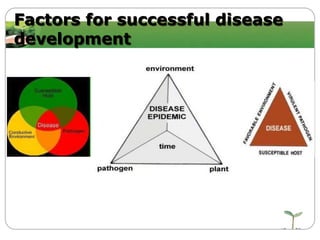
Factors for successful disease
development
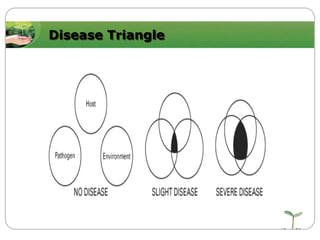
Disease Triangle

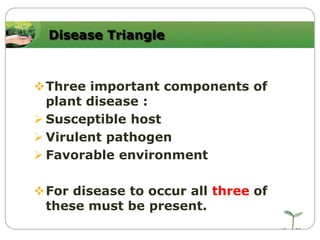
Three important components of
plant disease :
 Susceptible host
 Virulent pathogen
 Favorable environment
For disease to occur all three of
these must be present.
Disease Triangle
Factors for
successful
disease
development
1) Properties of Pathogen

Level of virulence
Adaptability
Dispersal efficiency
Survival efficiency
Reproductive fitness
2) Properties of Host

Susceptibility
Growth stage & form
Population density &
structure
General health
3) Properties of Environment

Temperature
Rainfall / Dew
Leaf wetness period
Soil properties
Wind
Stages in
Disease
Development
Stages in Disease Development

1)Inoculation
2)Penetration
3)Infection
4)Growth and Reproduction
5)Dissemination of Pathogen
1) Inoculation

Inoculation : The arrival of pathogen
on the host

Inoculum
 The pathogen (s) that land on the host or
 Any part of the pathogen that can initiate infection
Types of inoculum

Primary inoculum
 An inoculum that survives the dormant period &
caused the first infections

Primary infections
 Infection caused by primary inoculum

Secondary inoculum
 An inoculum produced from primary infections

Secondary infections
 Infection caused by secondary inoculum
Landing or Arrival of inoculum
 Most is carried by wind, water, insects
 Only a small number actually lands on
susceptible plants
 Vector born pathogens are much more
efficient since the vectors have an
attraction for plants
 E.g:





Germination of spores and seeds (fungus)
Hatching of nematode eggs
Attachment of Pathogen to Host (virus and bacteria)
Recognition Between Host and Pathogen (Pathogen
recognize the host)
2) Penetration

The initial invasion of a host by a
pathogen:
1. Direct Penetration
2. Penetration Through Natural
Openings
3. Penetration Through Wounds
Direct penetration
1)Direct Penetration
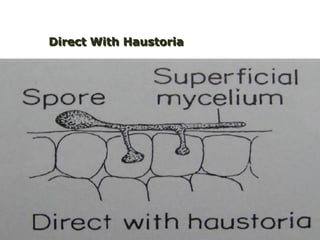
 Direct with haustoria
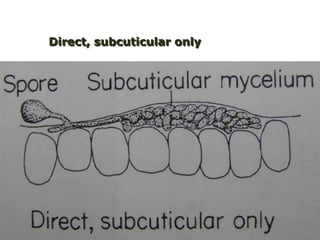
 Direct, subcuticular only
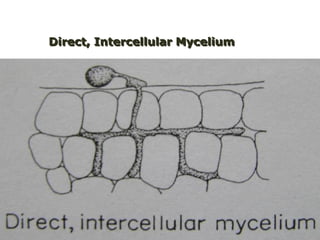
 Direct intercellular mycellium
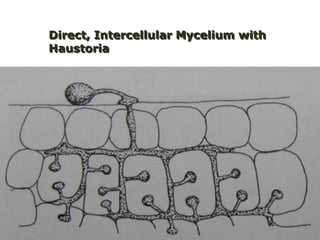
 Direct, intercellular mycellium
with haustoria
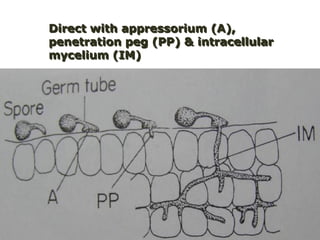
 Direct with appressorium (A),
penetration peg (PP) and
intracellular mycelium (IM)
Direct penetration
The most common type of
penetration by fungi and nematodes
and the only type by parasitic plants
Fungi use a fine hyphae produced by
a spore or mycelium or penetration
peg produced by an appressorium
This is formed at the point of contact
with the host
Direct penetration
The penetration is through
mechanical force and softening of the
cell walls by an enzyme
Most fungi form an appressorium at
the end of the germ tube
Then a penetration peg emerges from
the flat surface of the appressorium
and pierces the cuticle and cell wall
Direct penetration
The peg grows into a fine hyphae
then reaches a normal diameter once
it is inside the cell
As in the case of apple scab, the
fungus penetrates only the cuticle
and stays between the cuticle and the
cell wall
Parasitic plants also penetrate the
same way
Direct With Haustoria
Direct, subcuticular only
Direct, Intercellular Mycelium
Direct, Intercellular Mycelium with
Haustoria
Direct with appressorium (A),
penetration peg (PP) & intracellular
mycelium (IM)
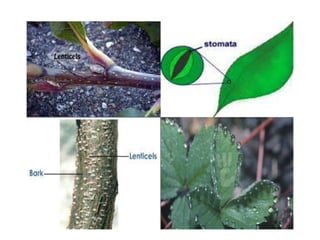
2)Penetration Through Natural
Openings
Stomata
Lenticels (opening on fruits,
stems and tubers –filled with
loosely connected cells – allow
the passage of air)
Hydathodes (permanently open
pores at the margins and tips of
leaves)
3) Penetration Through Wounds
Through various types of wounds
Natural cracks between main and
lateral roots
Openings made by fungus
3) Infection

Establishment of pathogen with
vulnerable cells or tissues of the
host and obtain the nutrients
from them
Successful infection will produce
symptoms
Incubation period : The time interval
between inoculation and the
appearance of disease symptoms
Latent infection : The state in which a
host is infected with a pathogen but
does not show any symptoms
4) Growth and Reproduction

The pathogen will grow and multiply
within the infected host.
Fungi – spores
Viruses – replicated by the cell
Nematodes – reproduce by means of
eggs
4. GROWTH & REPRODUCTION
5) Dissemination of Pathogen
 Pathogens are disseminated by several
ways:
 By air
 While airborne – spores touch wet
surfaces – get trapped – air movement
stops / rains – washed out
 From the air – brought down by rain
drops
 Winds also helps spreading by blowing
away rain splash droplets containing
pathogens
 By water
 Pathogens in the soil – dissemination by
rain / irrigation water that moves on the
surface / through soil
 By Insects, Nematodes & other Vectors
 Transmitted by insects during feeding,
movement from plant to plant
 Nematodes can also transmit virus
internally
 By Seed and Transplanting process
 Transported to other fields
 Are sold and transported to other areas
 By human
 Through handling of diseased and healthy
plants
 Tools (pruning shears)
 Transporting contaminated soil on their
feet / equipment
 Contaminated container
 Using infected seed / nursery stock

plant disease development

  • 1.
    MIC 319 FUNDAMENTALS OF AGRICULTURAL MICROBIOLOGY CHAPTER3 PLANT DISEASE DEVELOPMENT BY SITI NORAZURA JAMAL (MISS AZURA) 03 006/ 06 483 2132 norazura6775@ns.uitm.edu.my
  • 2.
    OBJECTIVE Be familiar withdisease triangle Clarify the factors for successful disease development Identify stages in disease development
  • 3.
    Outline  Disease Triangle Factors for successful disease development 1) Properties of pathogen 2) Properties of host 3) Properties of environment  Stages in disease development 1) 2) 3) 4) 5) Inoculation Penetration Infection Growth and Reproduction Dissemination
  • 4.
  • 5.
    Factors for successfuldisease development
  • 6.
    Disease Triangle Three importantcomponents of plant disease :  Susceptible host  Virulent pathogen  Favorable environment For disease to occur all three of these must be present.
  • 7.
  • 8.
  • 9.
    1) Properties ofPathogen Level of virulence Adaptability Dispersal efficiency Survival efficiency Reproductive fitness
  • 10.
    2) Properties ofHost Susceptibility Growth stage & form Population density & structure General health
  • 11.
    3) Properties ofEnvironment Temperature Rainfall / Dew Leaf wetness period Soil properties Wind
  • 12.
  • 13.
    Stages in DiseaseDevelopment 1)Inoculation 2)Penetration 3)Infection 4)Growth and Reproduction 5)Dissemination of Pathogen
  • 14.
    1) Inoculation Inoculation :The arrival of pathogen on the host Inoculum  The pathogen (s) that land on the host or  Any part of the pathogen that can initiate infection
  • 15.
    Types of inoculum Primaryinoculum  An inoculum that survives the dormant period & caused the first infections Primary infections  Infection caused by primary inoculum Secondary inoculum  An inoculum produced from primary infections Secondary infections  Infection caused by secondary inoculum
  • 16.
    Landing or Arrivalof inoculum  Most is carried by wind, water, insects  Only a small number actually lands on susceptible plants  Vector born pathogens are much more efficient since the vectors have an attraction for plants  E.g:     Germination of spores and seeds (fungus) Hatching of nematode eggs Attachment of Pathogen to Host (virus and bacteria) Recognition Between Host and Pathogen (Pathogen recognize the host)
  • 17.
    2) Penetration The initialinvasion of a host by a pathogen: 1. Direct Penetration 2. Penetration Through Natural Openings 3. Penetration Through Wounds
  • 18.
    Direct penetration 1)Direct Penetration Direct with haustoria  Direct, subcuticular only  Direct intercellular mycellium  Direct, intercellular mycellium with haustoria  Direct with appressorium (A), penetration peg (PP) and intracellular mycelium (IM)
  • 19.
    Direct penetration The mostcommon type of penetration by fungi and nematodes and the only type by parasitic plants Fungi use a fine hyphae produced by a spore or mycelium or penetration peg produced by an appressorium This is formed at the point of contact with the host
  • 20.
    Direct penetration The penetrationis through mechanical force and softening of the cell walls by an enzyme Most fungi form an appressorium at the end of the germ tube Then a penetration peg emerges from the flat surface of the appressorium and pierces the cuticle and cell wall
  • 21.
    Direct penetration The peggrows into a fine hyphae then reaches a normal diameter once it is inside the cell As in the case of apple scab, the fungus penetrates only the cuticle and stays between the cuticle and the cell wall Parasitic plants also penetrate the same way
  • 22.
  • 23.
  • 24.
  • 25.
  • 26.
    Direct with appressorium(A), penetration peg (PP) & intracellular mycelium (IM)
  • 27.
    2)Penetration Through Natural Openings Stomata Lenticels(opening on fruits, stems and tubers –filled with loosely connected cells – allow the passage of air) Hydathodes (permanently open pores at the margins and tips of leaves)
  • 29.
    3) Penetration ThroughWounds Through various types of wounds Natural cracks between main and lateral roots Openings made by fungus
  • 30.
    3) Infection Establishment ofpathogen with vulnerable cells or tissues of the host and obtain the nutrients from them Successful infection will produce symptoms
  • 31.
    Incubation period :The time interval between inoculation and the appearance of disease symptoms Latent infection : The state in which a host is infected with a pathogen but does not show any symptoms
  • 32.
    4) Growth andReproduction The pathogen will grow and multiply within the infected host. Fungi – spores Viruses – replicated by the cell Nematodes – reproduce by means of eggs 4. GROWTH & REPRODUCTION
  • 33.
    5) Dissemination ofPathogen  Pathogens are disseminated by several ways:  By air  While airborne – spores touch wet surfaces – get trapped – air movement stops / rains – washed out  From the air – brought down by rain drops  Winds also helps spreading by blowing away rain splash droplets containing pathogens
  • 34.
     By water Pathogens in the soil – dissemination by rain / irrigation water that moves on the surface / through soil  By Insects, Nematodes & other Vectors  Transmitted by insects during feeding, movement from plant to plant  Nematodes can also transmit virus internally
  • 35.
     By Seedand Transplanting process  Transported to other fields  Are sold and transported to other areas  By human  Through handling of diseased and healthy plants  Tools (pruning shears)  Transporting contaminated soil on their feet / equipment  Contaminated container  Using infected seed / nursery stock