CSE 380 C++ Boot Camp
Part 1/2
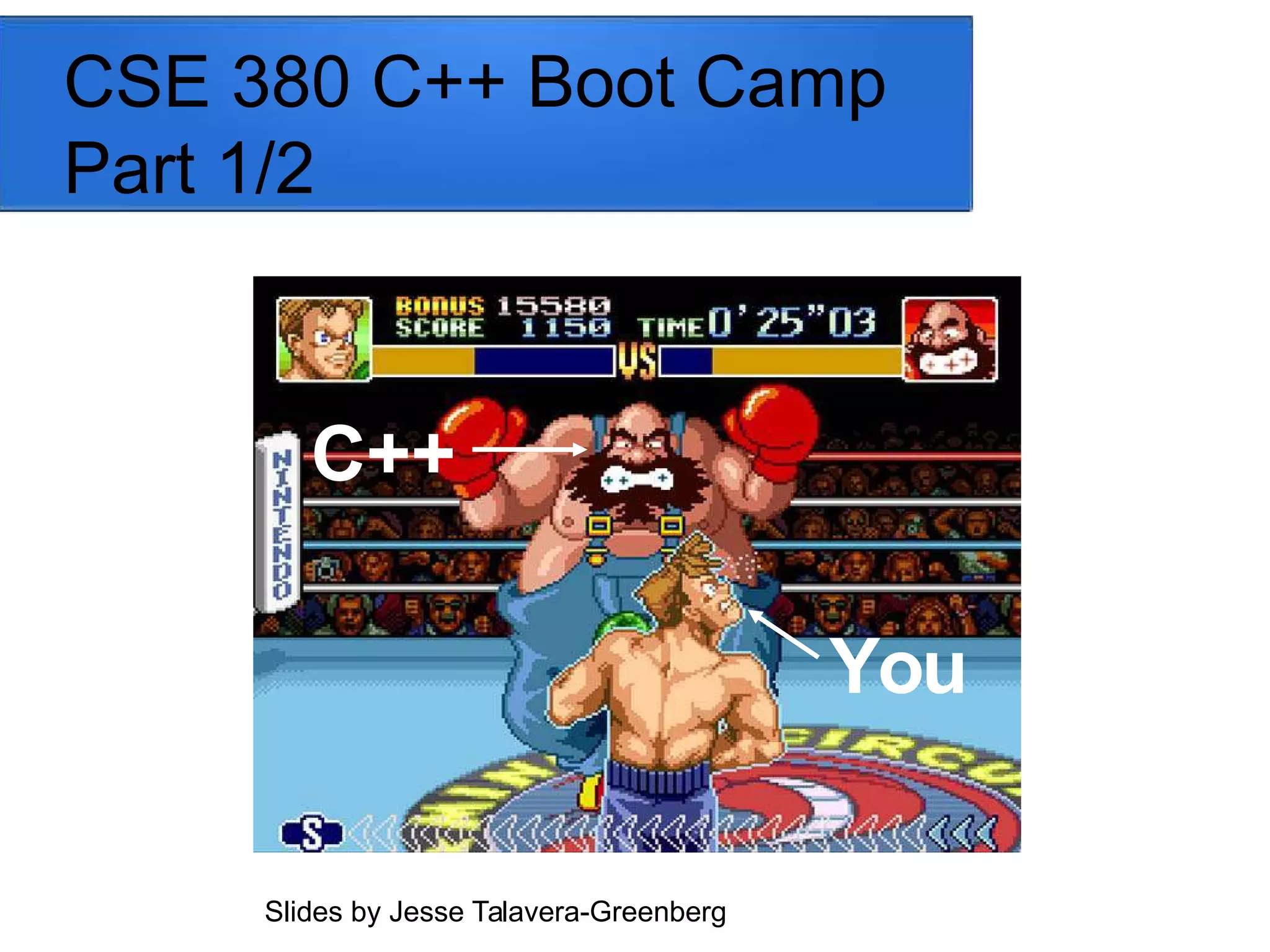
C++
You
Slides by Jesse Talavera-Greenberg
Disclaimer

I am not the grader for this course

Undergrads can't grade assignments

The boot camp is always part of the course,
but I volunteered to lead it this year

Any opinions expressed are my own and are
not necessarily condoned by McKenna

I don't know very much about DirectX
This Week

No need to download anything this week

Go to www.cppreference.com to follow code

This is your C++ Bible this semester

Online compiler
Basic Structure
#include <iostream>
// Include any header files at the top of the .cpp file to use the classes and
// functions they define
using std::cout;
using std::endl;
// Now do this to use names (or prefix them with “std::”)
// static initializers will be called before main()
// Main entry point of a C++ program
int main(int argc, char** argv, char** env) {
// All these args are optional, third one is not as common
// argc == number of command-line arguments
// argv == the actual arguments as an array of strings
// env == environment variables
cout << "Hello! The name of this program is " << argv[0] << endl;
// Call functions! Do things!
return 0;
// Return code of 0 tells the OS the program exited normally
// Anything else == something went wrong (you decide what the numbers mean)
// Leaving it off implies "return 0"
}
if, else, for, while

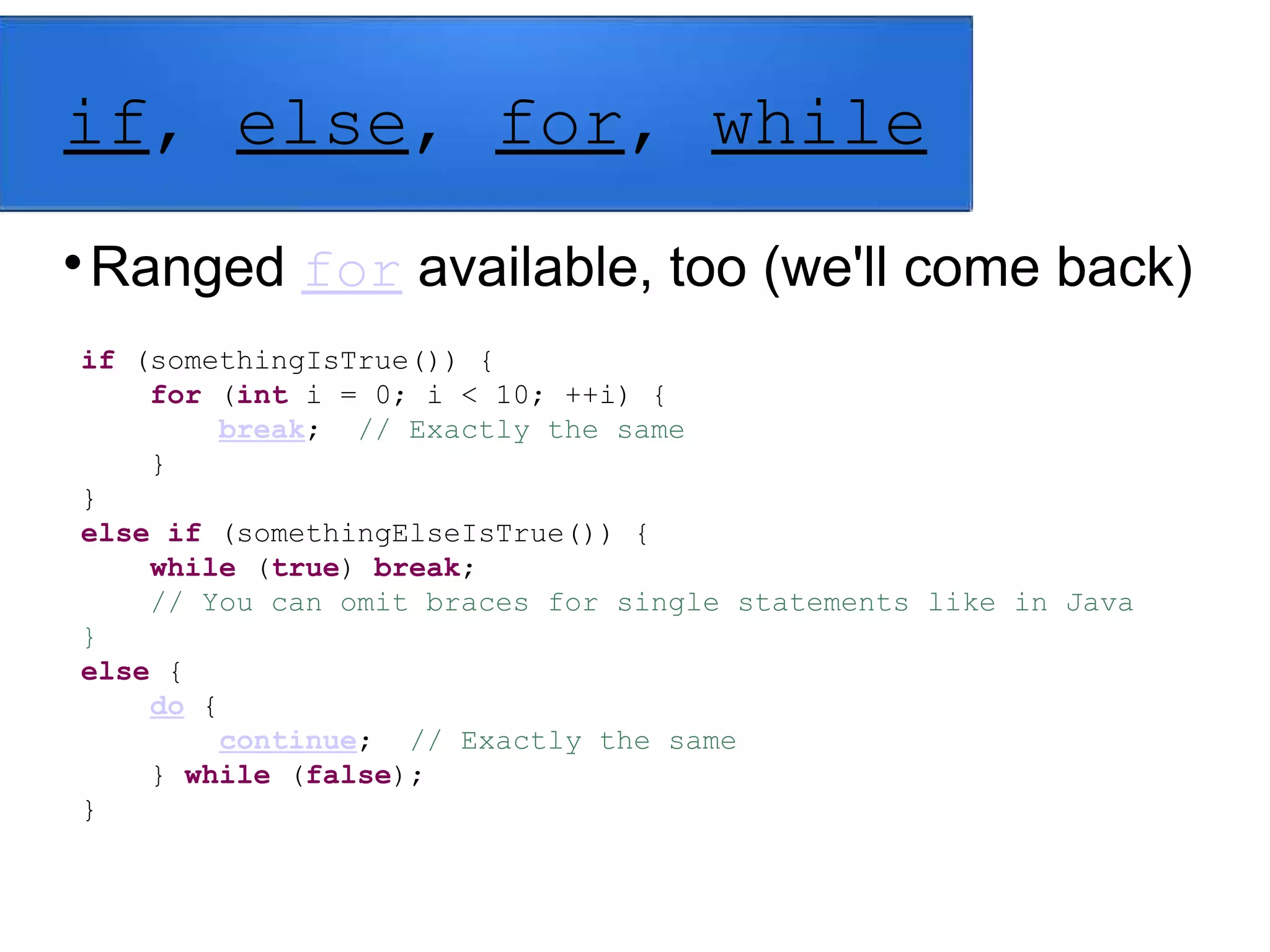
Ranged for available, too (we'll come back)
if (somethingIsTrue()) {
for (int i = 0; i < 10; ++i) {
break; // Exactly the same
}
}
else if (somethingElseIsTrue()) {
while (true) break;
// You can omit braces for single statements like in Java
}
else {
do {
continue; // Exactly the same
} while (false);
}
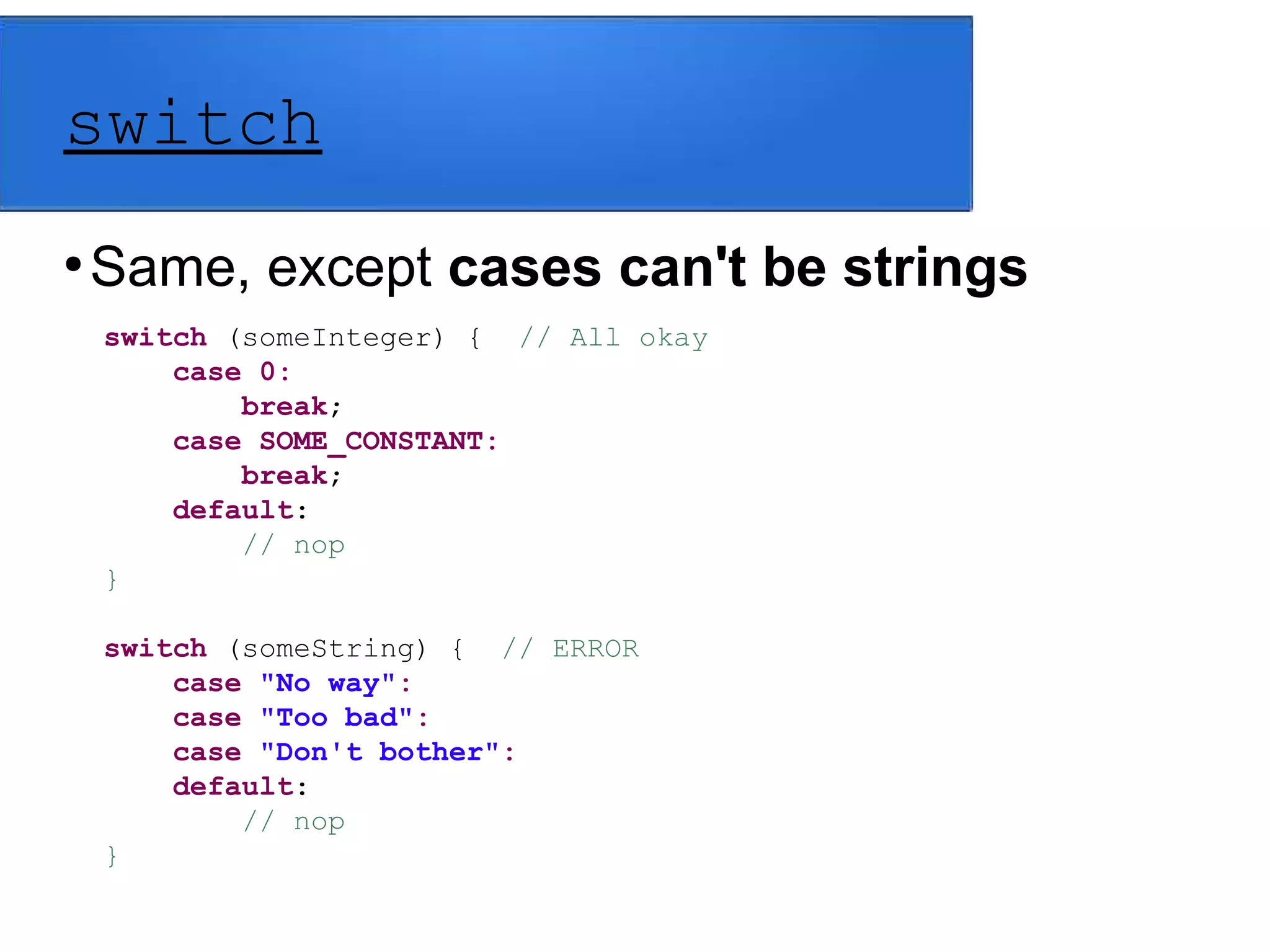
switch
●
Same, except cases can't be strings
switch (someInteger) { // All okay
case 0:
break;
case SOME_CONSTANT:
break;
default:
// nop
}
switch (someString) { // ERROR
case "No way":
case "Too bad":
case "Don't bother":
default:
// nop
}
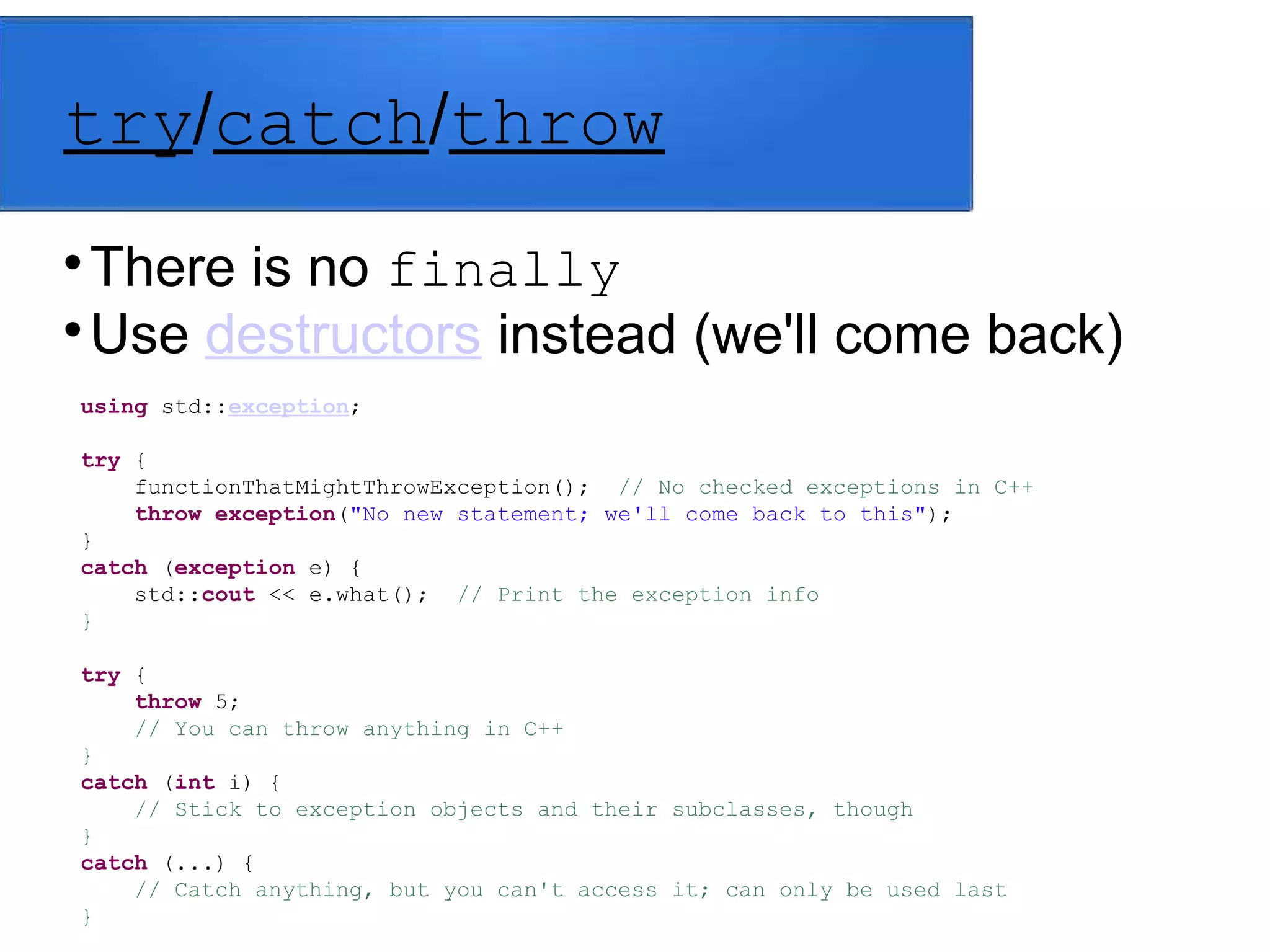
try/catch/throw

There is no finally

Use destructors instead (we'll come back)
using std::exception;
try {
functionThatMightThrowException(); // No checked exceptions in C++
throw exception("No new statement; we'll come back to this");
}
catch (exception e) {
std::cout << e.what(); // Print the exception info
}
try {
throw 5;
// You can throw anything in C++
}
catch (int i) {
// Stick to exception objects and their subclasses, though
}
catch (...) {
// Catch anything, but you can't access it; can only be used last
}
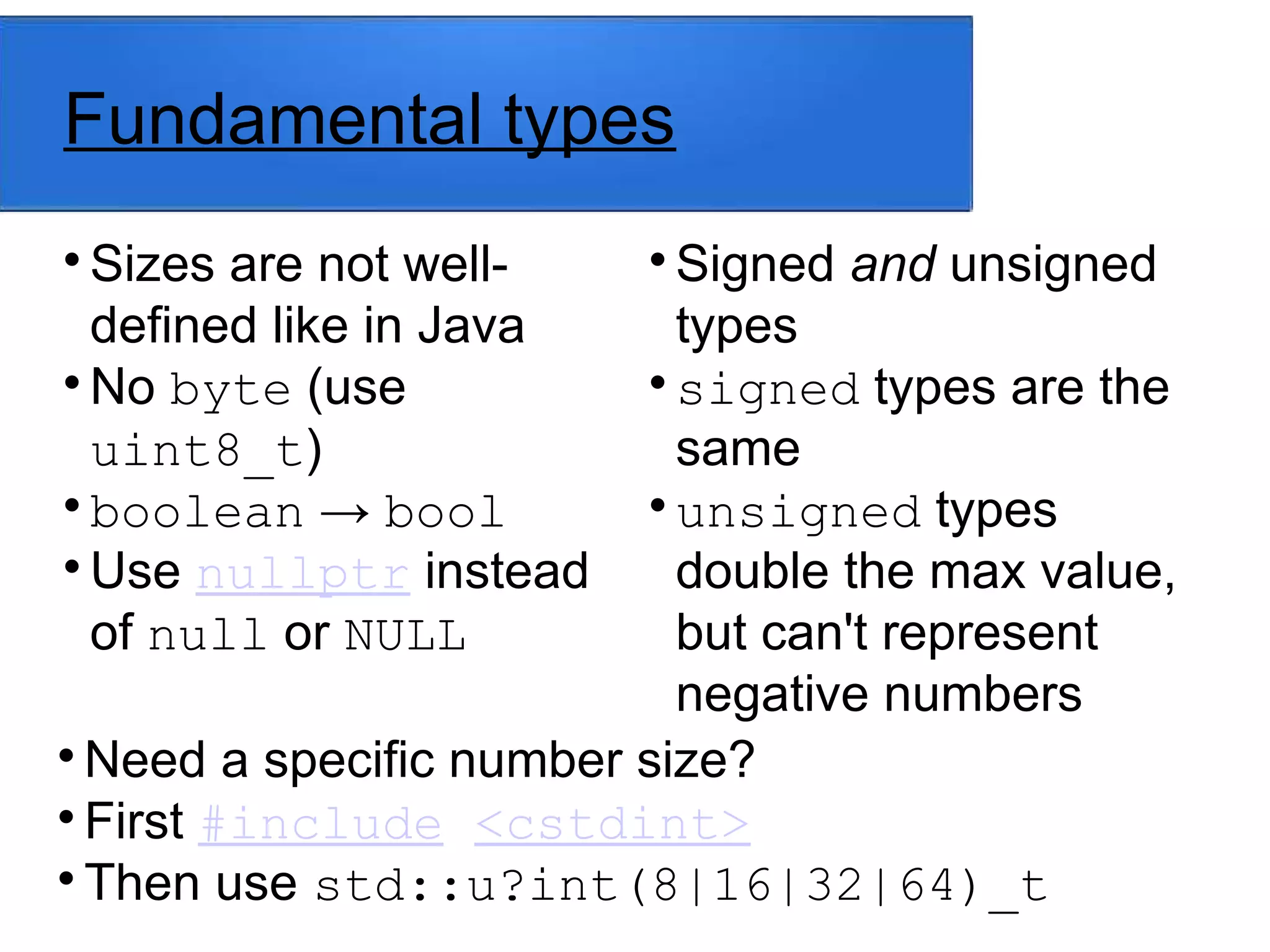
Fundamental types

Sizes are not well-
defined like in Java

No byte (use
uint8_t)

boolean → bool

Use nullptr instead
of null or NULL

Signed and unsigned
types

signed types are the
same

unsigned types
double the max value,
but can't represent
negative numbers

Need a specific number size?

First #include <cstdint>

Then use std::u?int(8|16|32|64)_t
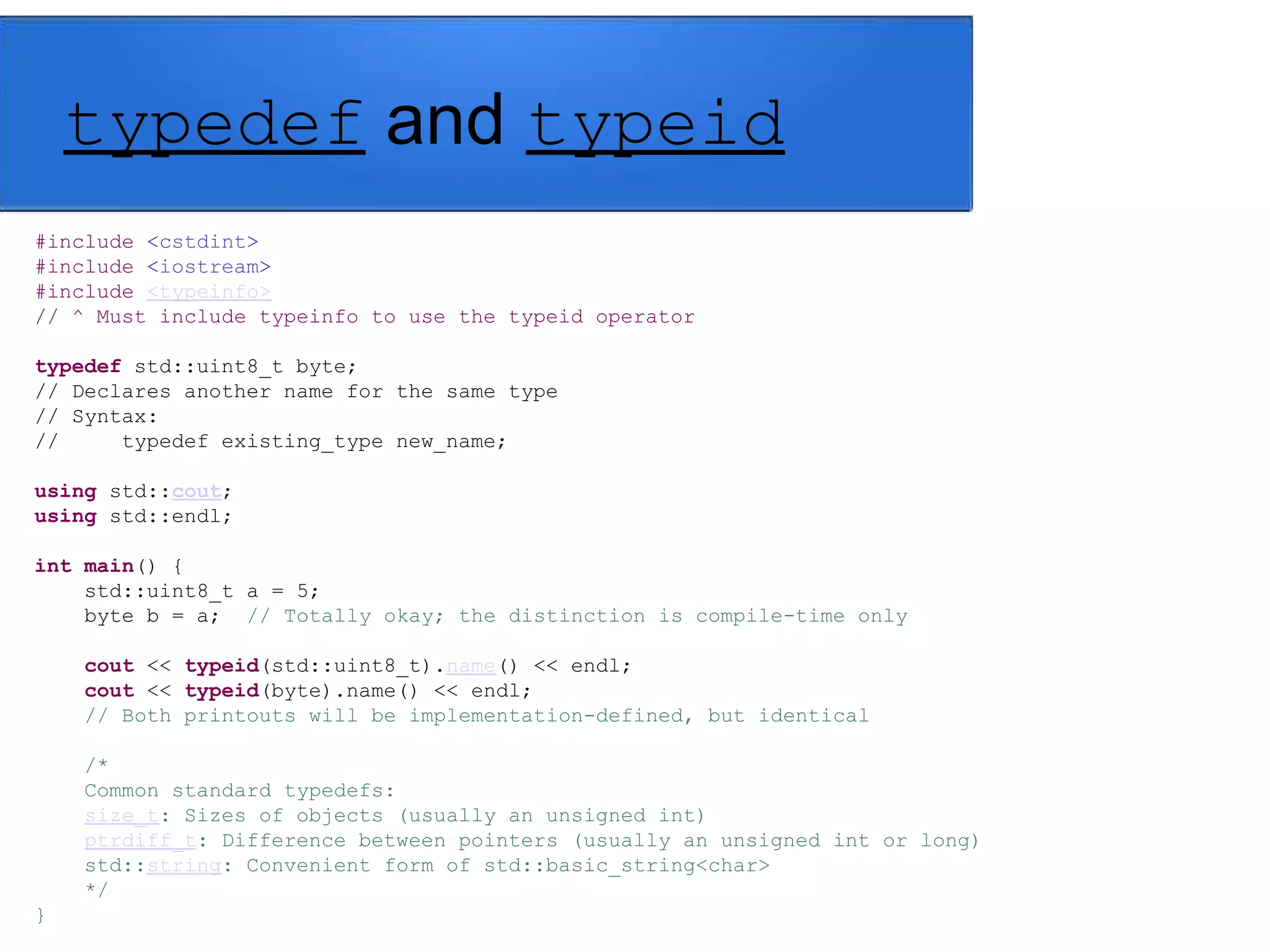
typedef and typeid
#include <cstdint>
#include <iostream>
#include <typeinfo>
// ^ Must include typeinfo to use the typeid operator
typedef std::uint8_t byte;
// Declares another name for the same type
// Syntax:
// typedef existing_type new_name;
using std::cout;
using std::endl;
int main() {
std::uint8_t a = 5;
byte b = a; // Totally okay; the distinction is compile-time only
cout << typeid(std::uint8_t).name() << endl;
cout << typeid(byte).name() << endl;
// Both printouts will be implementation-defined, but identical
/*
Common standard typedefs:
size_t: Sizes of objects (usually an unsigned int)
ptrdiff_t: Difference between pointers (usually an unsigned int or long)
std::string: Convenient form of std::basic_string<char>
*/
}
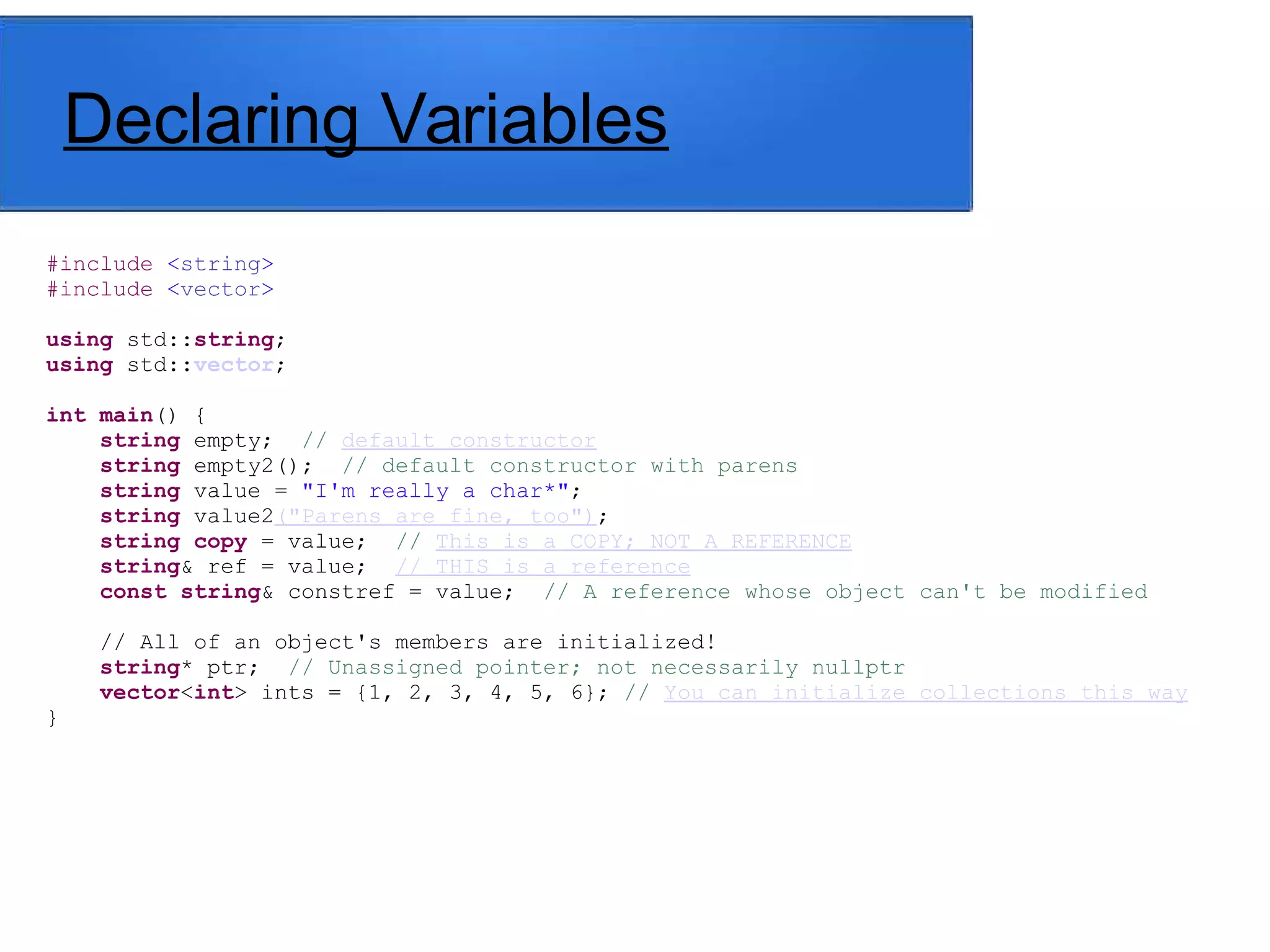
Declaring Variables
#include <string>
#include <vector>
using std::string;
using std::vector;
int main() {
string empty; // default constructor
string empty2(); // default constructor with parens
string value = "I'm really a char*";
string value2("Parens are fine, too");
string copy = value; // This is a COPY; NOT A REFERENCE
string& ref = value; // THIS is a reference
const string& constref = value; // A reference whose object can't be modified
// All of an object's members are initialized!
string* ptr; // Unassigned pointer; not necessarily nullptr
vector<int> ints = {1, 2, 3, 4, 5, 6}; // You can initialize collections this way
}
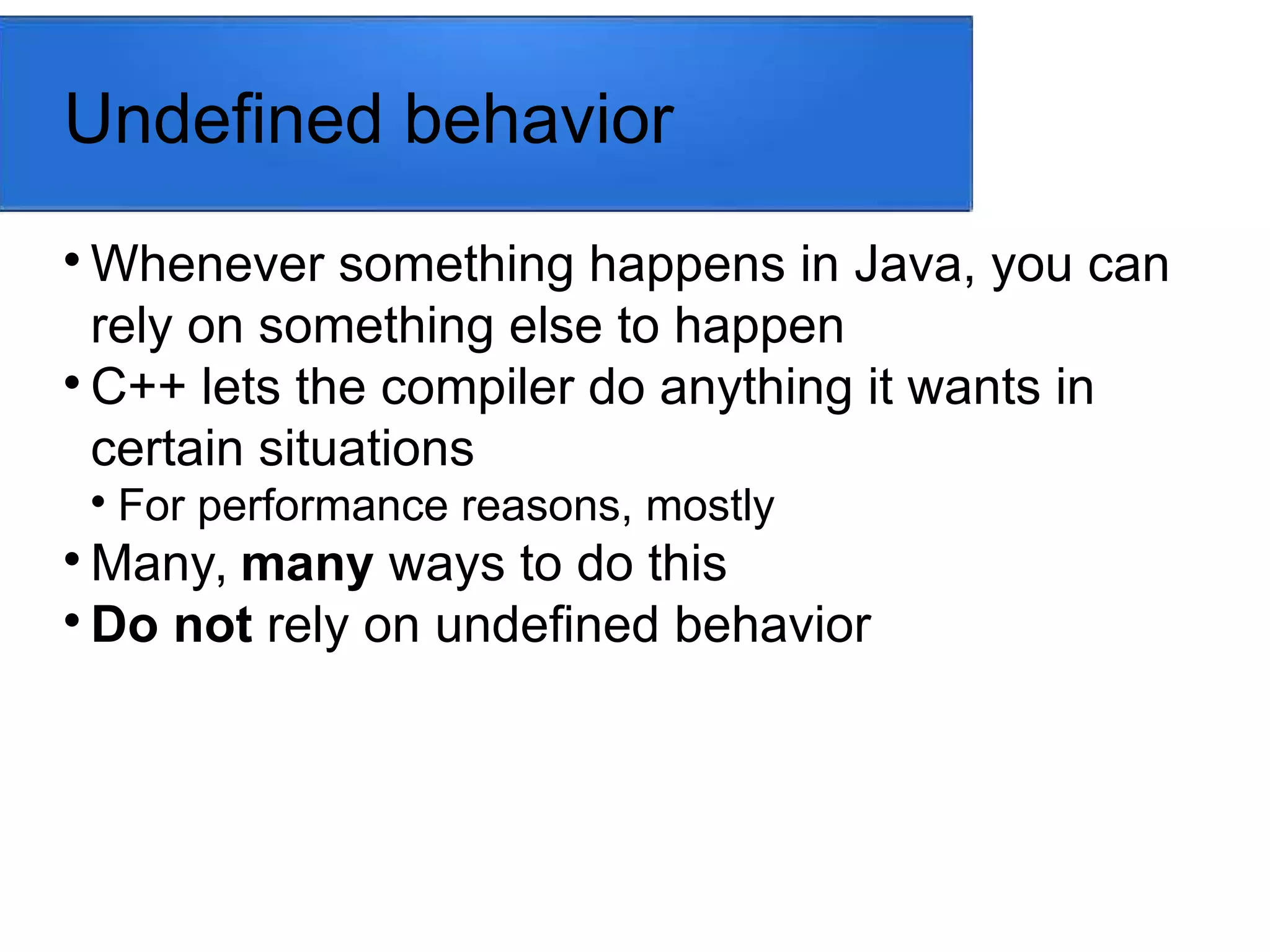
Undefined behavior

Whenever something happens in Java, you can
rely on something else to happen

C++ lets the compiler do anything it wants in
certain situations

For performance reasons, mostly

Many, many ways to do this

Do not rely on undefined behavior
Common undefined
behaviors
#include <string>
#include <cstdint>
#include <limits>
int32_t something(int32_t param) {
if (param > 0) return param;
// No return down here; now what?
}
std::string& returnsALocal() {
std::string reference = "Why are you doing this";
return reference; // Uh-oh
}
int main() {
int32_t a = std::numeric_limits<int32_t>::max();
a++; // Oops
int32_t* pointer; // Could be nullptr, could be garbage
int32_t number = *pointer; // BAD
int32_t[10] array;
number = array[12]; // WTF
}
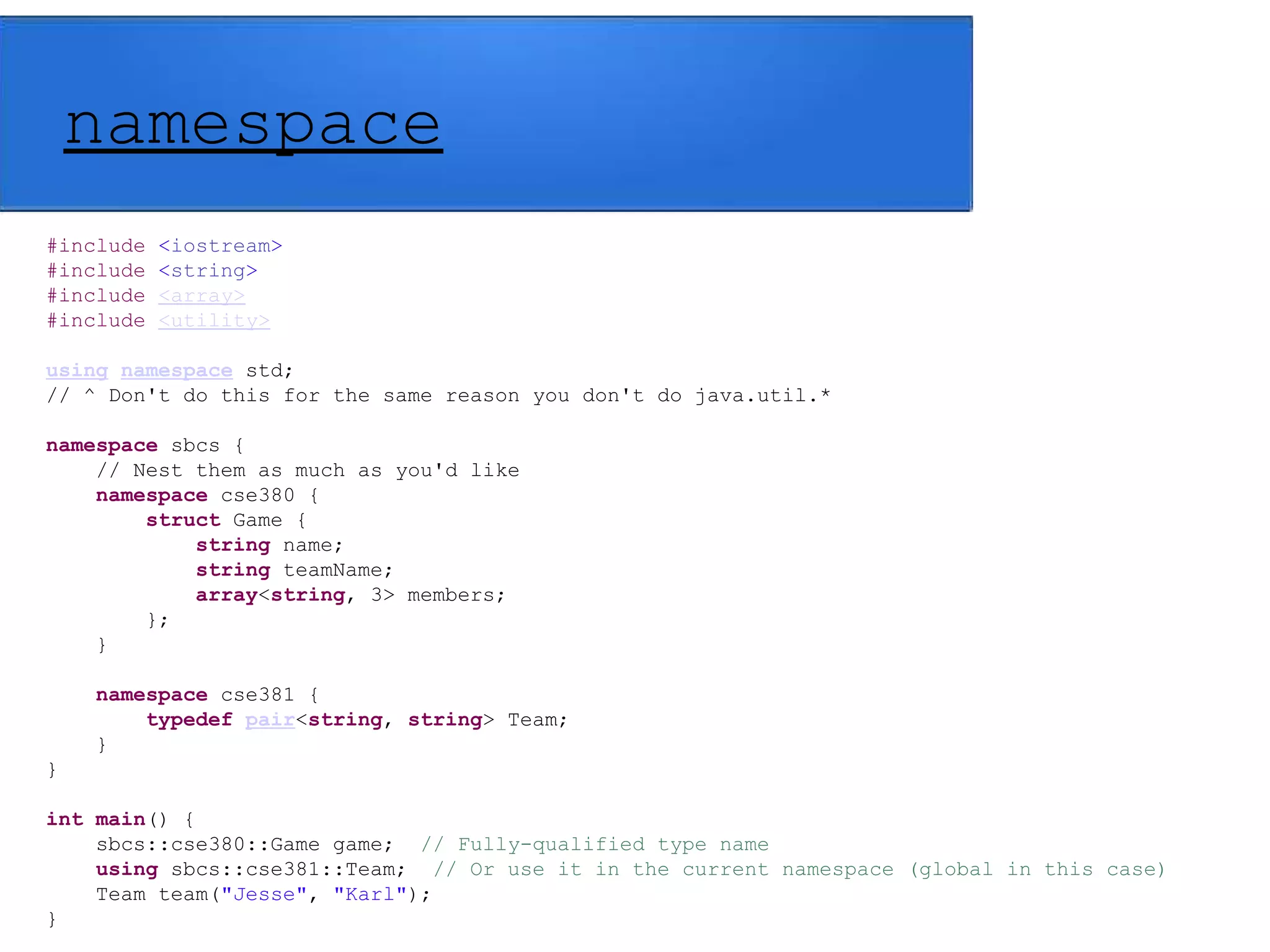
namespace
#include <iostream>
#include <string>
#include <array>
#include <utility>
using namespace std;
// ^ Don't do this for the same reason you don't do java.util.*
namespace sbcs {
// Nest them as much as you'd like
namespace cse380 {
struct Game {
string name;
string teamName;
array<string, 3> members;
};
}
namespace cse381 {
typedef pair<string, string> Team;
}
}
int main() {
sbcs::cse380::Game game; // Fully-qualified type name
using sbcs::cse381::Team; // Or use it in the current namespace (global in this case)
Team team("Jesse", "Karl");
}
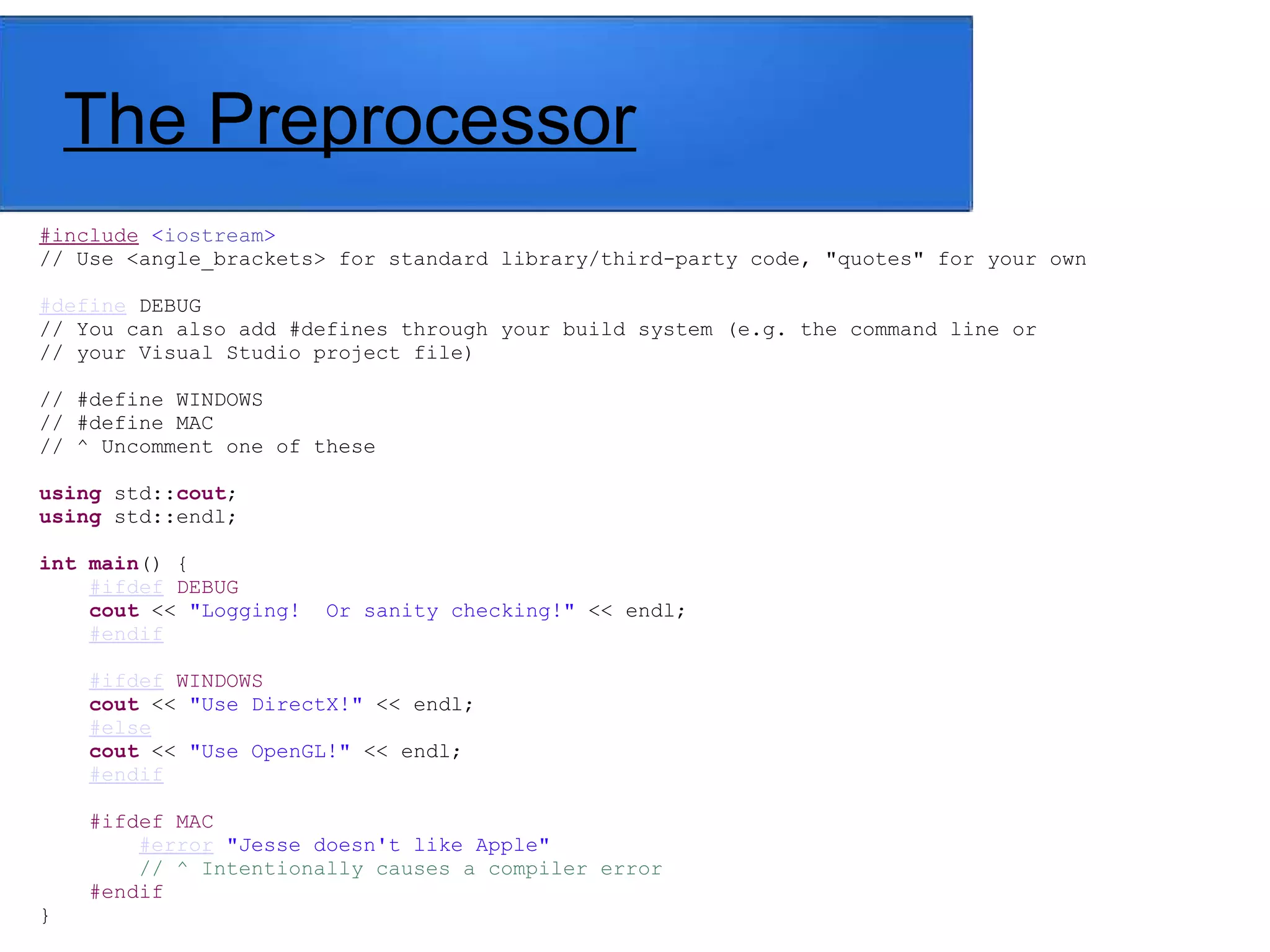
The Preprocessor
#include <iostream>
// Use <angle_brackets> for standard library/third-party code, "quotes" for your own
#define DEBUG
// You can also add #defines through your build system (e.g. the command line or
// your Visual Studio project file)
// #define WINDOWS
// #define MAC
// ^ Uncomment one of these
using std::cout;
using std::endl;
int main() {
#ifdef DEBUG
cout << "Logging! Or sanity checking!" << endl;
#endif
#ifdef WINDOWS
cout << "Use DirectX!" << endl;
#else
cout << "Use OpenGL!" << endl;
#endif
#ifdef MAC
#error "Jesse doesn't like Apple"
// ^ Intentionally causes a compiler error
#endif
}
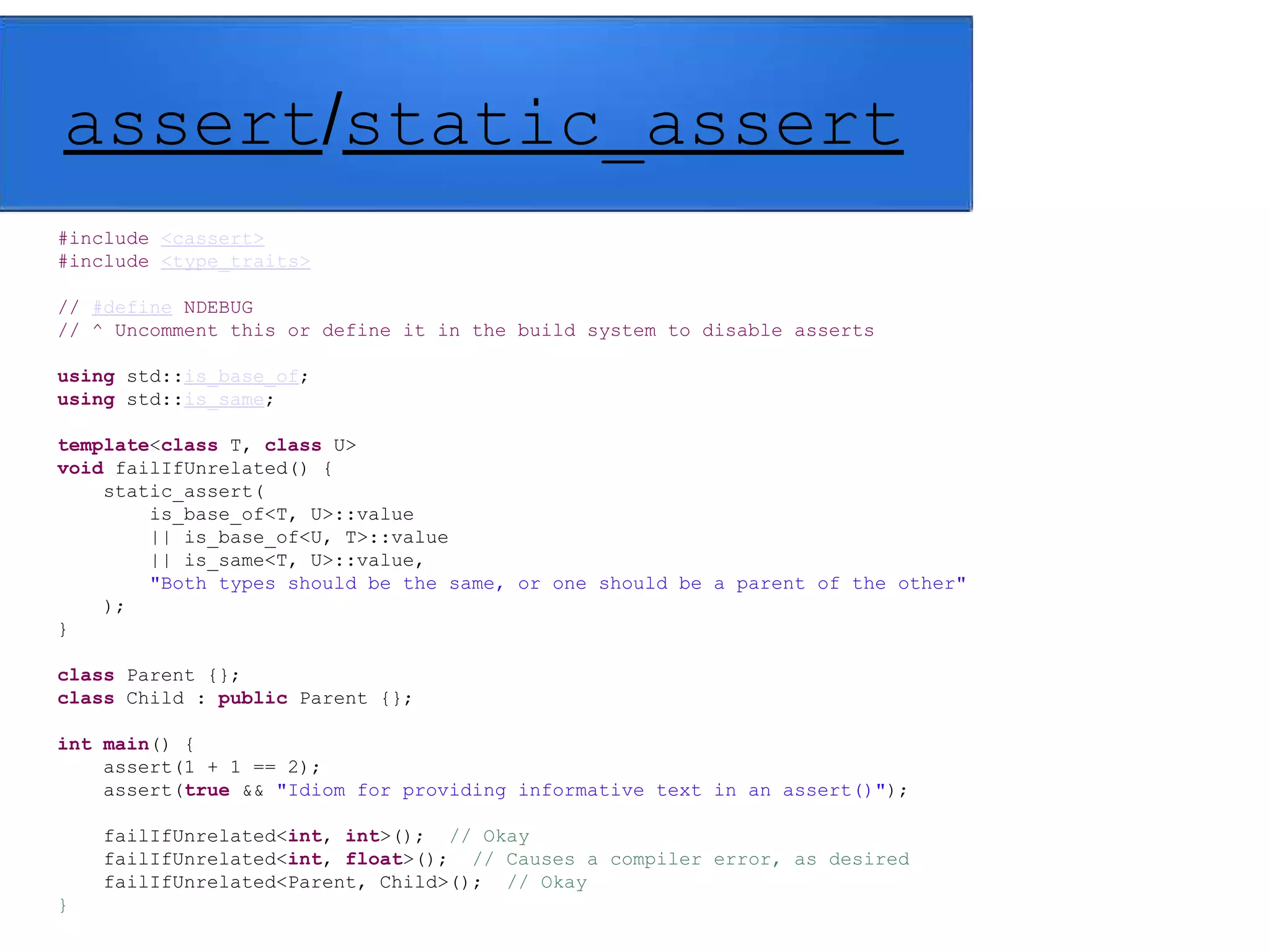
assert/static_assert
#include <cassert>
#include <type_traits>
// #define NDEBUG
// ^ Uncomment this or define it in the build system to disable asserts
using std::is_base_of;
using std::is_same;
template<class T, class U>
void failIfUnrelated() {
static_assert(
is_base_of<T, U>::value
|| is_base_of<U, T>::value
|| is_same<T, U>::value,
"Both types should be the same, or one should be a parent of the other"
);
}
class Parent {};
class Child : public Parent {};
int main() {
assert(1 + 1 == 2);
assert(true && "Idiom for providing informative text in an assert()");
failIfUnrelated<int, int>(); // Okay
failIfUnrelated<int, float>(); // Causes a compiler error, as desired
failIfUnrelated<Parent, Child>(); // Okay
}
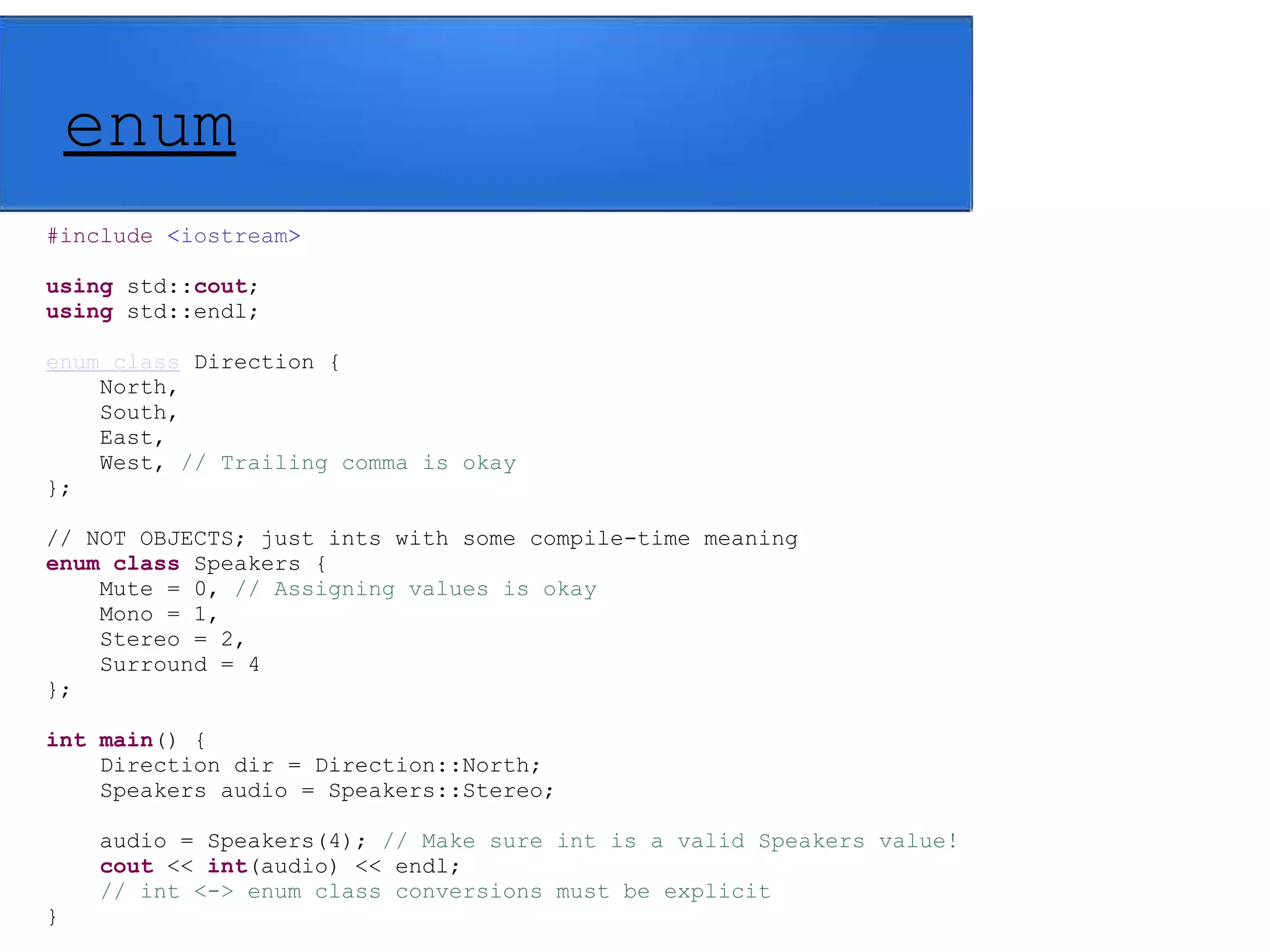
enum
#include <iostream>
using std::cout;
using std::endl;
enum class Direction {
North,
South,
East,
West, // Trailing comma is okay
};
// NOT OBJECTS; just ints with some compile-time meaning
enum class Speakers {
Mute = 0, // Assigning values is okay
Mono = 1,
Stereo = 2,
Surround = 4
};
int main() {
Direction dir = Direction::North;
Speakers audio = Speakers::Stereo;
audio = Speakers(4); // Make sure int is a valid Speakers value!
cout << int(audio) << endl;
// int <-> enum class conversions must be explicit
}
Pointers
#include <string>
using std::string;
int main() {
string a = "I'm a little teapot";
string* ptr = &a; // &some_object returns the address of some_object
string b = *ptr; // *some_pointer dereferences
int ints[] = {1, 2, 3, 4, 5, 6, 7, 8, 9, 10};
// Raw arrays are pointers
int* int_ptr = ints; // Points to ints[0]
int* int_ptr2 = ints + 1; // Points to ints[1]
// Increments the address sizeof(int) bytes
int** double_array = &int_ptr;
// Pointers to pointers okay; never usually need more than two**
void* pointer_to_anything = ints;
// Pointer to arbitrary data; very error-prone and unsafe; avoid unless you know
// exactly why you need one
pointer_to_anything = nullptr;
// nullptr == Java's null; assignable to any pointer type, but not to objects
float* garbage; // Uninitialized pointer; value is undefined
// Could be garbage, could be nullptr; initialize it ASAP!
}
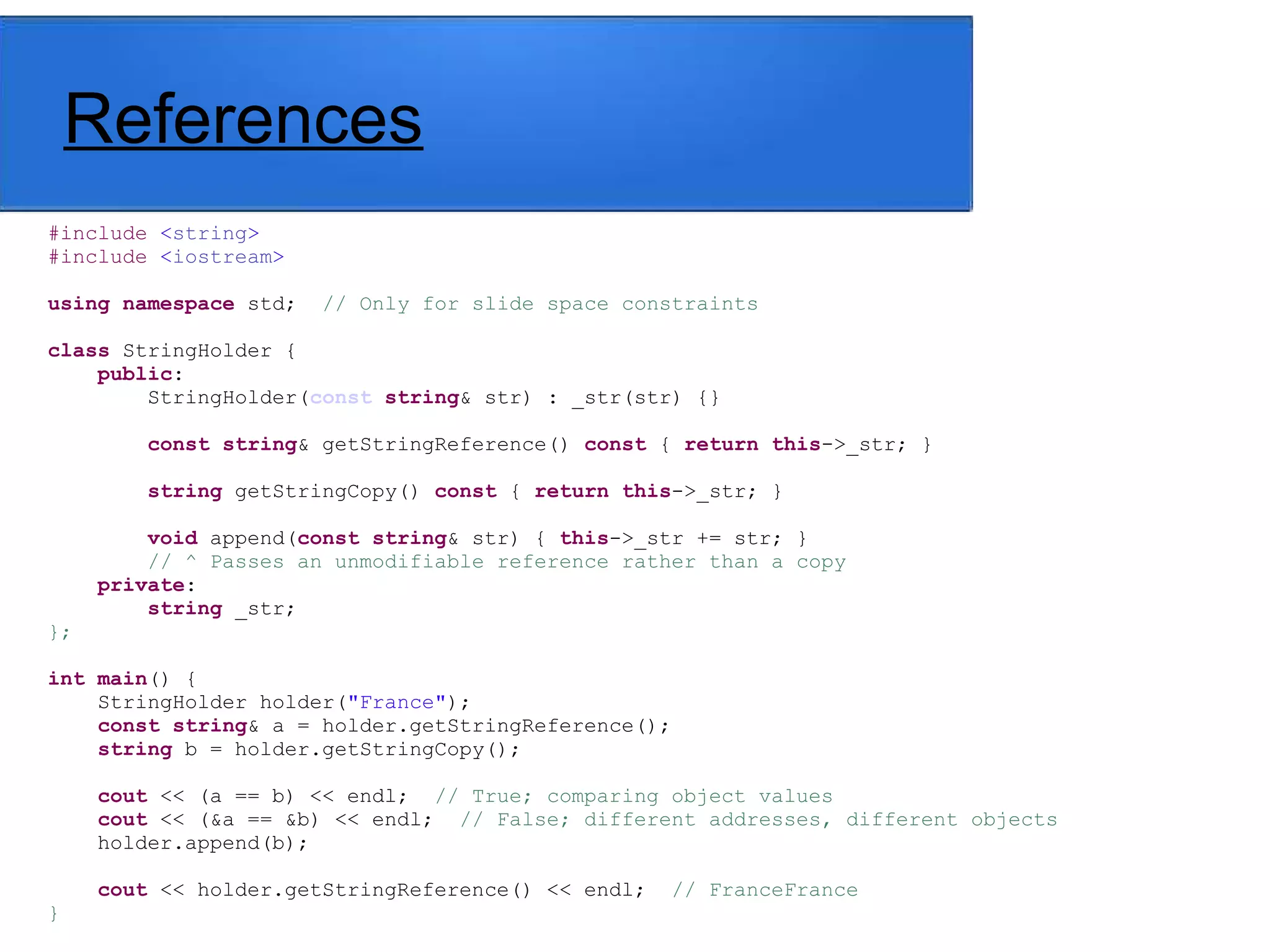
References
#include <string>
#include <iostream>
using namespace std; // Only for slide space constraints
class StringHolder {
public:
StringHolder(const string& str) : _str(str) {}
const string& getStringReference() const { return this->_str; }
string getStringCopy() const { return this->_str; }
void append(const string& str) { this->_str += str; }
// ^ Passes an unmodifiable reference rather than a copy
private:
string _str;
};
int main() {
StringHolder holder("France");
const string& a = holder.getStringReference();
string b = holder.getStringCopy();
cout << (a == b) << endl; // True; comparing object values
cout << (&a == &b) << endl; // False; different addresses, different objects
holder.append(b);
cout << holder.getStringReference() << endl; // FranceFrance
}
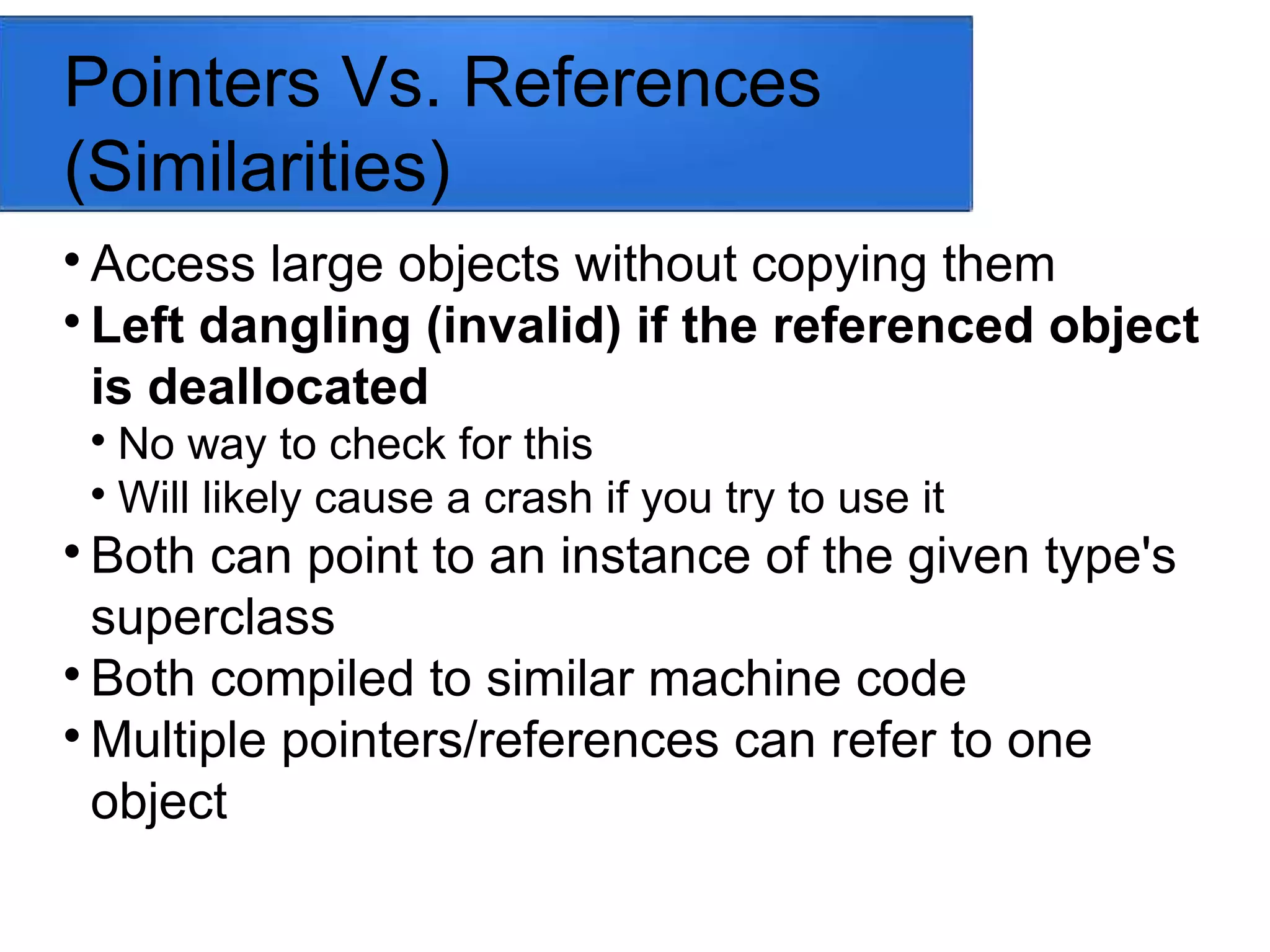
Pointers Vs. References
(Similarities)

Access large objects without copying them

Left dangling (invalid) if the referenced object
is deallocated

No way to check for this

Will likely cause a crash if you try to use it

Both can point to an instance of the given type's
superclass

Both compiled to similar machine code

Multiple pointers/references can refer to one
object
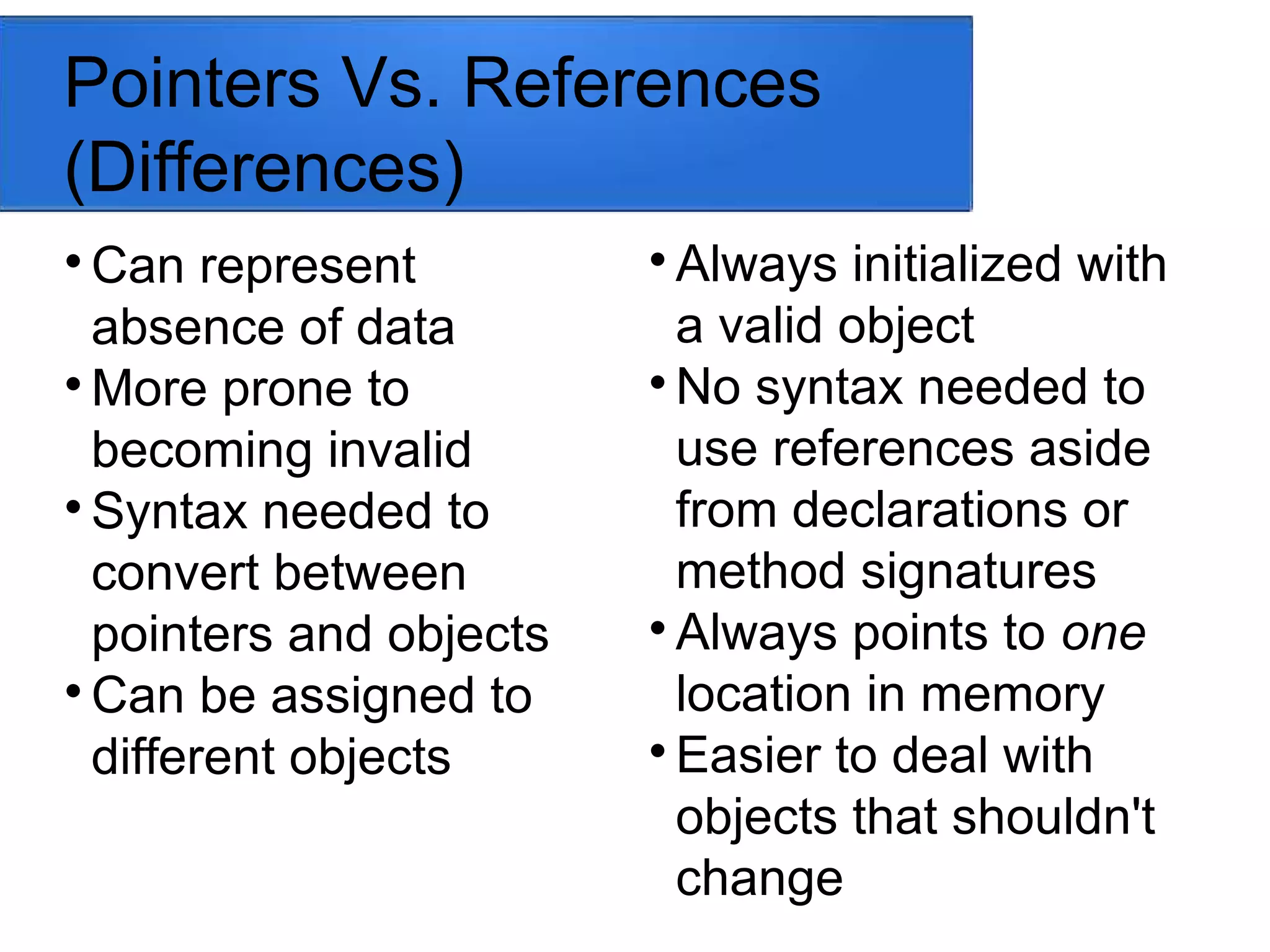
Pointers Vs. References
(Differences)

Can represent
absence of data

More prone to
becoming invalid

Syntax needed to
convert between
pointers and objects

Can be assigned to
different objects

Always initialized with
a valid object

No syntax needed to
use references aside
from declarations or
method signatures

Always points to one
location in memory

Easier to deal with
objects that shouldn't
change
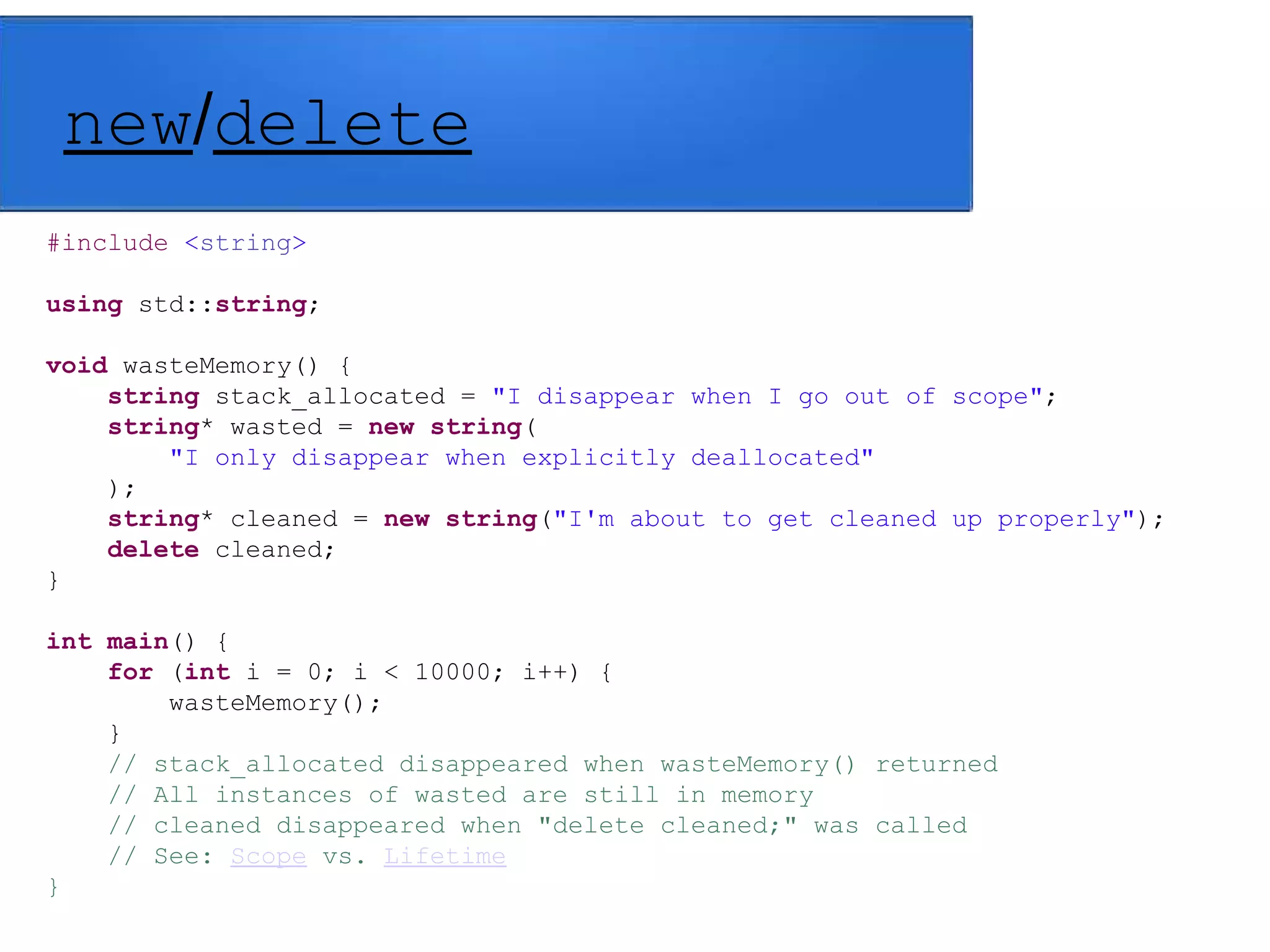
new/delete
#include <string>
using std::string;
void wasteMemory() {
string stack_allocated = "I disappear when I go out of scope";
string* wasted = new string(
"I only disappear when explicitly deallocated"
);
string* cleaned = new string("I'm about to get cleaned up properly");
delete cleaned;
}
int main() {
for (int i = 0; i < 10000; i++) {
wasteMemory();
}
// stack_allocated disappeared when wasteMemory() returned
// All instances of wasted are still in memory
// cleaned disappeared when "delete cleaned;" was called
// See: Scope vs. Lifetime
}
Exceptions
#include <iostream>
#include <string>
#include <exception>
#include <array>
using namespace std; // Again, slide space constraints
int main() {
array<int, 5> ints = {1, 2, 3, 4, 5};
try {
cout << ints.at(10) << endl; // at() checks bounds, operator[] doesn't
}
catch (const out_of_range& e) { // You can (and should) catch by reference
cout << "Out of range in an array" << endl;
}
catch (const runtime_error& e) {
cout << "Didn't see this coming: " << e.what() << endl;
}
catch (const exception& e) {
cout << "Unknown exception: " << e.what() << endl;
}
catch (...) {
cout << "WTF?" << endl;
}
// There is no finally clause; use destructors to guarantee exception safety
}
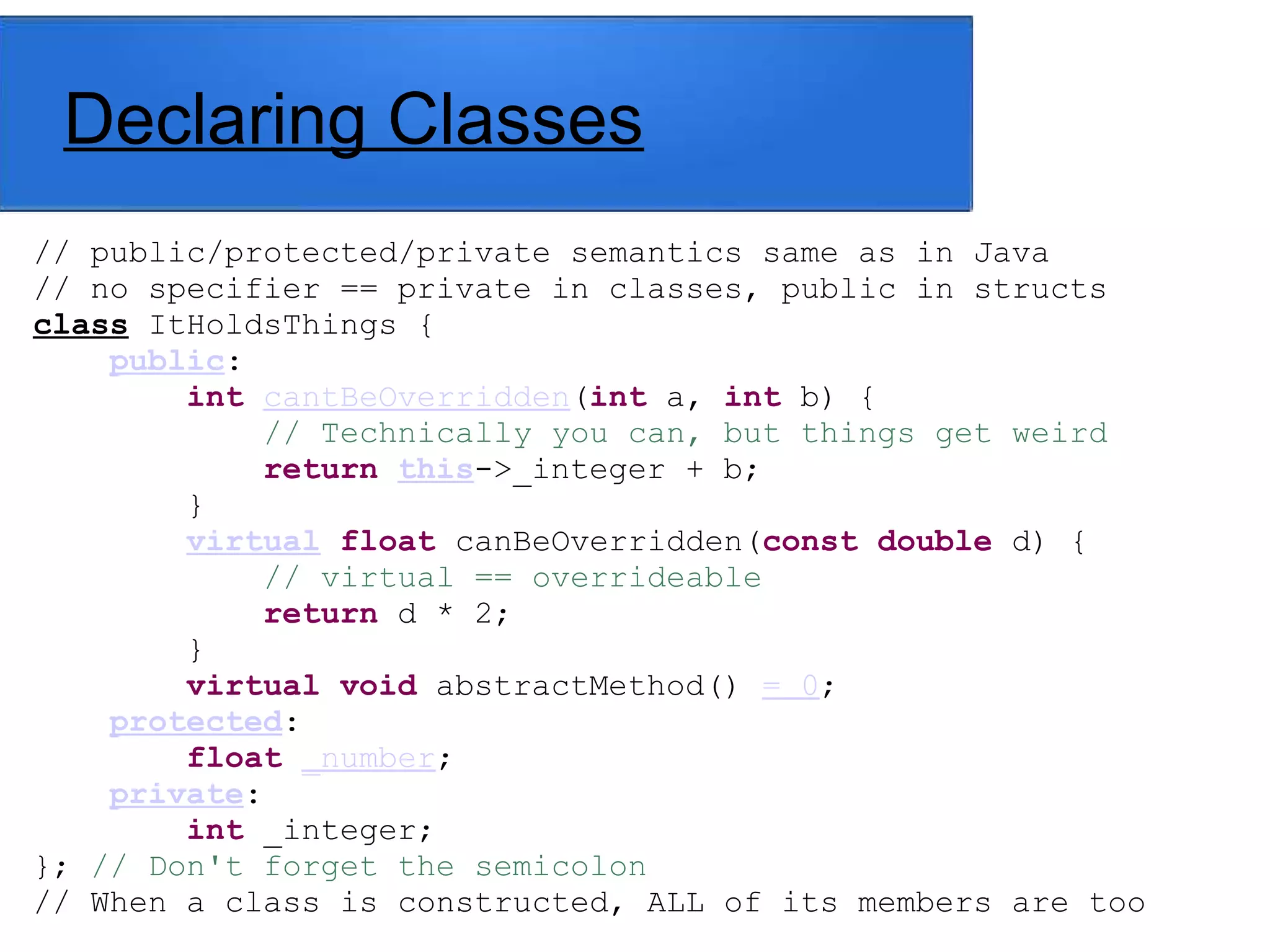
Declaring Classes
// public/protected/private semantics same as in Java
// no specifier == private in classes, public in structs
class ItHoldsThings {
public:
int cantBeOverridden(int a, int b) {
// Technically you can, but things get weird
return this->_integer + b;
}
virtual float canBeOverridden(const double d) {
// virtual == overrideable
return d * 2;
}
virtual void abstractMethod() = 0;
protected:
float _number;
private:
int _integer;
}; // Don't forget the semicolon
// When a class is constructed, ALL of its members are too
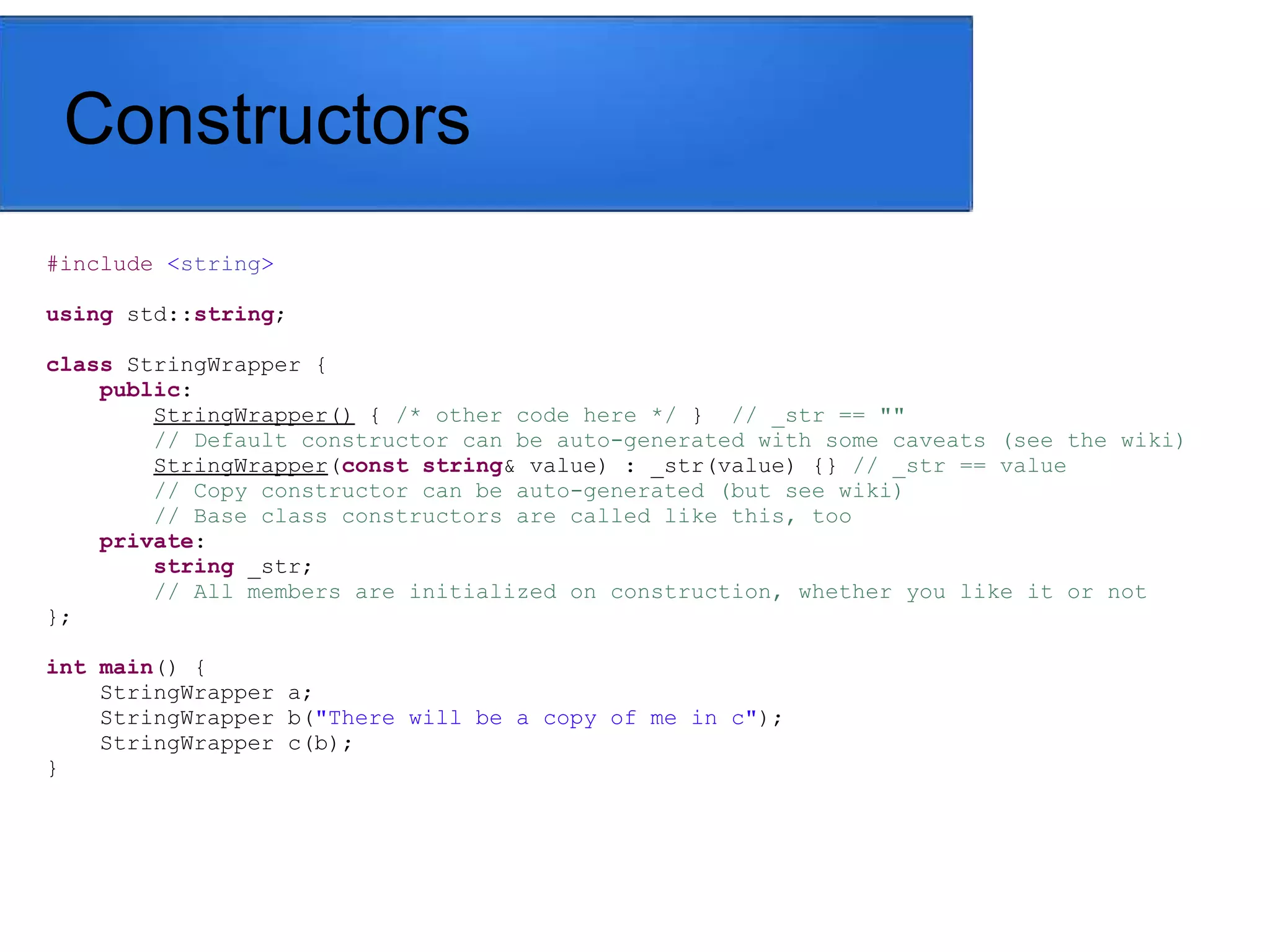
Constructors
#include <string>
using std::string;
class StringWrapper {
public:
StringWrapper() { /* other code here */ } // _str == ""
// Default constructor can be auto-generated with some caveats (see the wiki)
StringWrapper(const string& value) : _str(value) {} // _str == value
// Copy constructor can be auto-generated (but see wiki)
// Base class constructors are called like this, too
private:
string _str;
// All members are initialized on construction, whether you like it or not
};
int main() {
StringWrapper a;
StringWrapper b("There will be a copy of me in c");
StringWrapper c(b);
}
// Using constructors to allocate resources and destructors to clean them up is
// called Resource Acquisition Is Initialization (RAII). Only needed for low-level
// resources; high-level classes like std::iostream do RAII themselves.
#include <cstdlib>
using std::malloc;
using std::free;
class LotsOfResources {
public:
LotsOfResources() {
_floats = new float[64];
_buffer = malloc(64);
}
~LotsOfResources() { // Called when this object's lifetime ends
delete[] _floats; // Remember the [] when deleting a raw array
free(_buffer);
}
private:
float* _floats;
void* _buffer;
};
int main() {
LotsOfResources* resources = new LotsOfResources;
delete resources; // No memory leaks!
}
Destructors
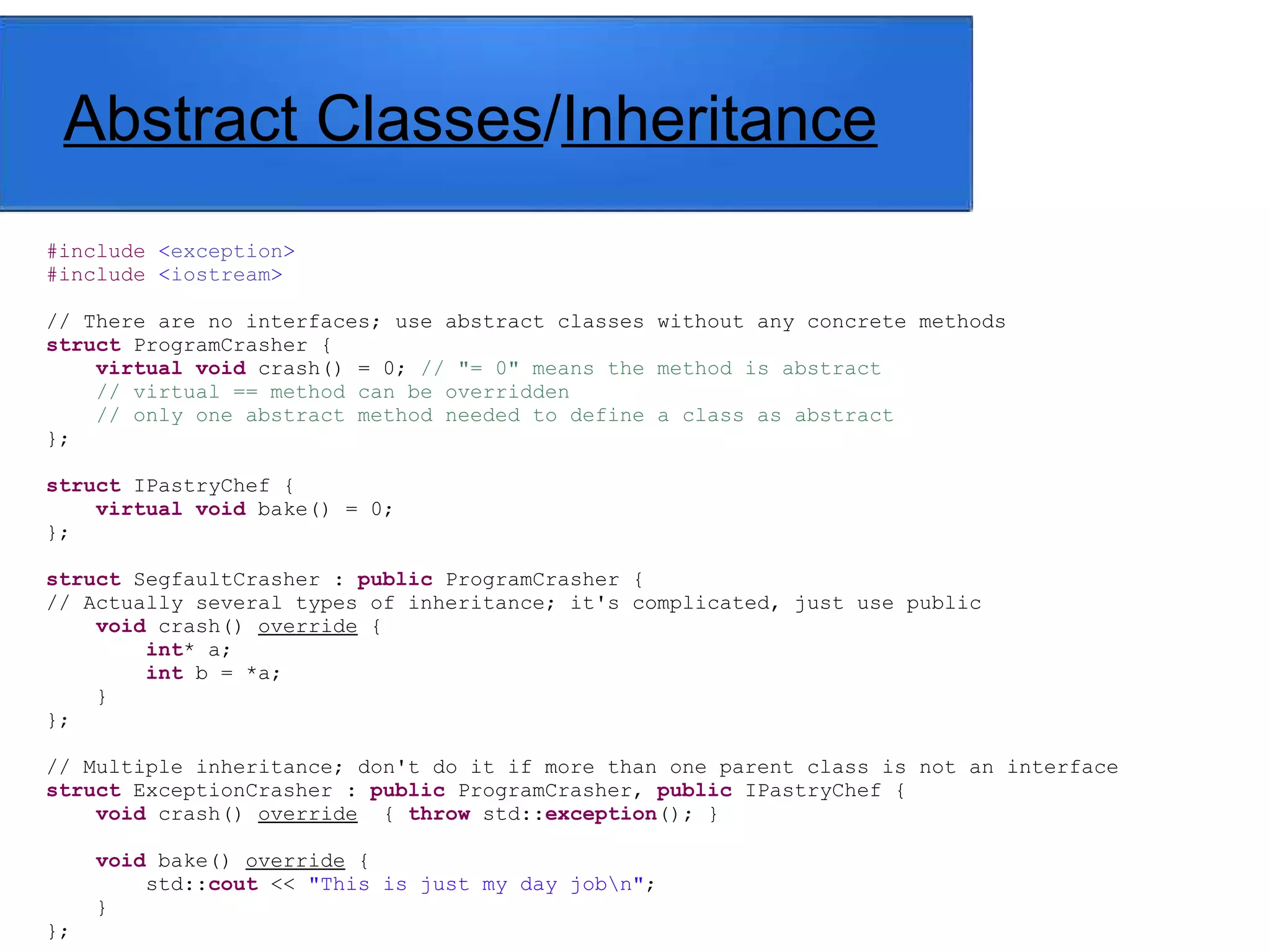
Abstract Classes/Inheritance
#include <exception>
#include <iostream>
// There are no interfaces; use abstract classes without any concrete methods
struct ProgramCrasher {
virtual void crash() = 0; // "= 0" means the method is abstract
// virtual == method can be overridden
// only one abstract method needed to define a class as abstract
};
struct IPastryChef {
virtual void bake() = 0;
};
struct SegfaultCrasher : public ProgramCrasher {
// Actually several types of inheritance; it's complicated, just use public
void crash() override {
int* a;
int b = *a;
}
};
// Multiple inheritance; don't do it if more than one parent class is not an interface
struct ExceptionCrasher : public ProgramCrasher, public IPastryChef {
void crash() override { throw std::exception(); }
void bake() override {
std::cout << "This is just my day jobn";
}
};
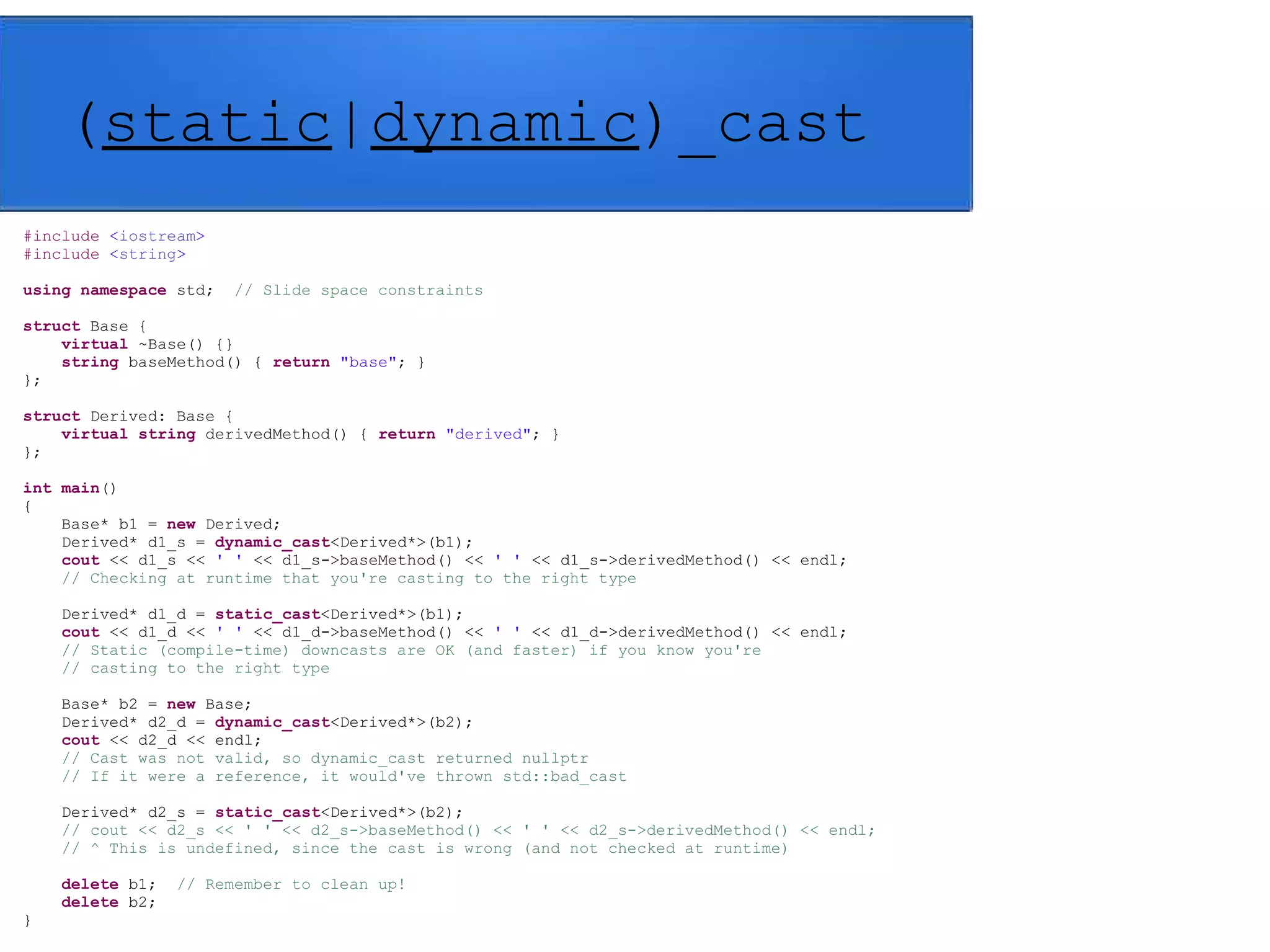
(static|dynamic)_cast
#include <iostream>
#include <string>
using namespace std; // Slide space constraints
struct Base {
virtual ~Base() {}
string baseMethod() { return "base"; }
};
struct Derived: Base {
virtual string derivedMethod() { return "derived"; }
};
int main()
{
Base* b1 = new Derived;
Derived* d1_s = dynamic_cast<Derived*>(b1);
cout << d1_s << ' ' << d1_s->baseMethod() << ' ' << d1_s->derivedMethod() << endl;
// Checking at runtime that you're casting to the right type
Derived* d1_d = static_cast<Derived*>(b1);
cout << d1_d << ' ' << d1_d->baseMethod() << ' ' << d1_d->derivedMethod() << endl;
// Static (compile-time) downcasts are OK (and faster) if you know you're
// casting to the right type
Base* b2 = new Base;
Derived* d2_d = dynamic_cast<Derived*>(b2);
cout << d2_d << endl;
// Cast was not valid, so dynamic_cast returned nullptr
// If it were a reference, it would've thrown std::bad_cast
Derived* d2_s = static_cast<Derived*>(b2);
// cout << d2_s << ' ' << d2_s->baseMethod() << ' ' << d2_s->derivedMethod() << endl;
// ^ This is undefined, since the cast is wrong (and not checked at runtime)
delete b1; // Remember to clean up!
delete b2;
}
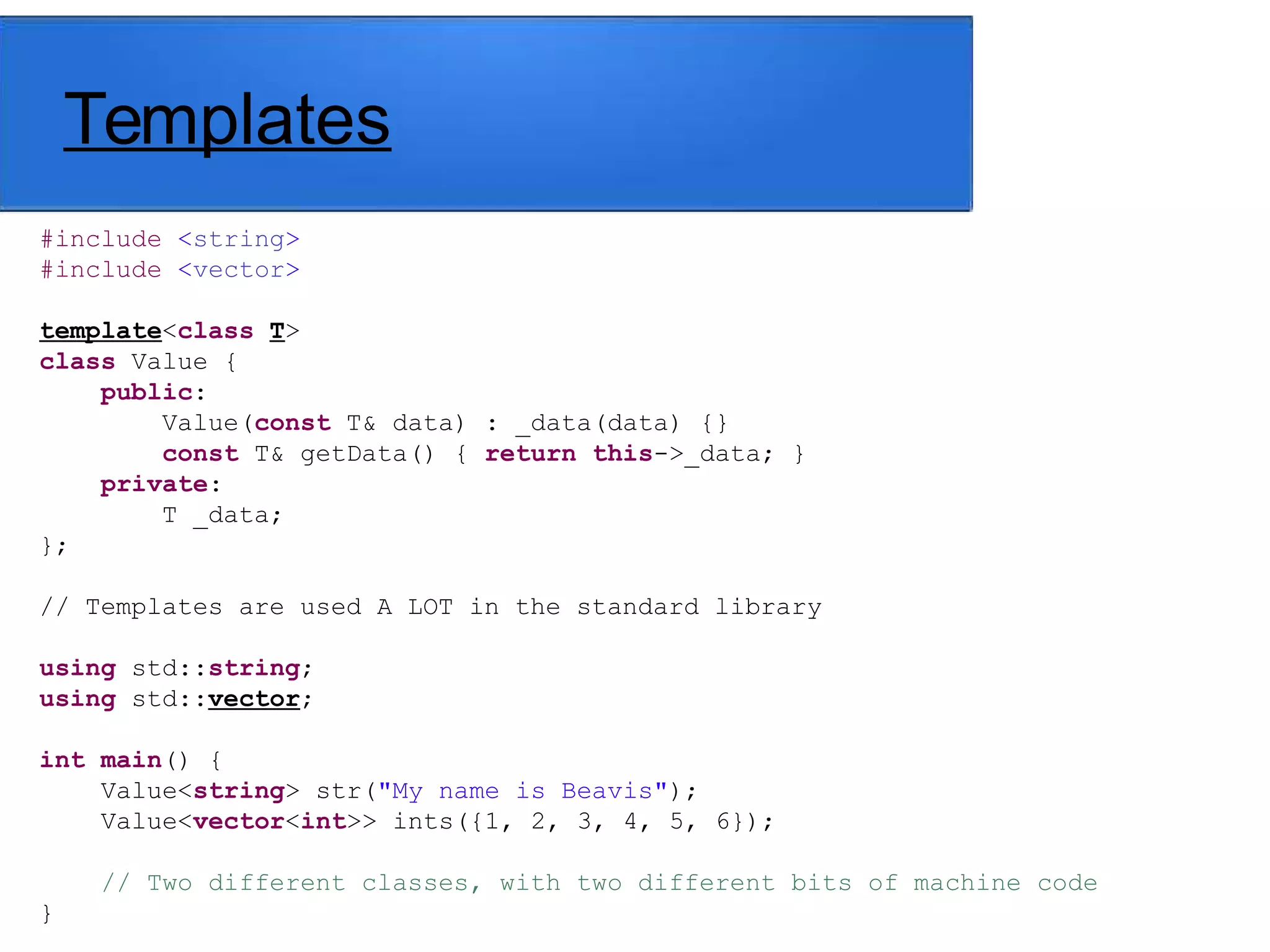
Templates
#include <string>
#include <vector>
template<class T>
class Value {
public:
Value(const T& data) : _data(data) {}
const T& getData() { return this->_data; }
private:
T _data;
};
// Templates are used A LOT in the standard library
using std::string;
using std::vector;
int main() {
Value<string> str("My name is Beavis");
Value<vector<int>> ints({1, 2, 3, 4, 5, 6});
// Two different classes, with two different bits of machine code
}
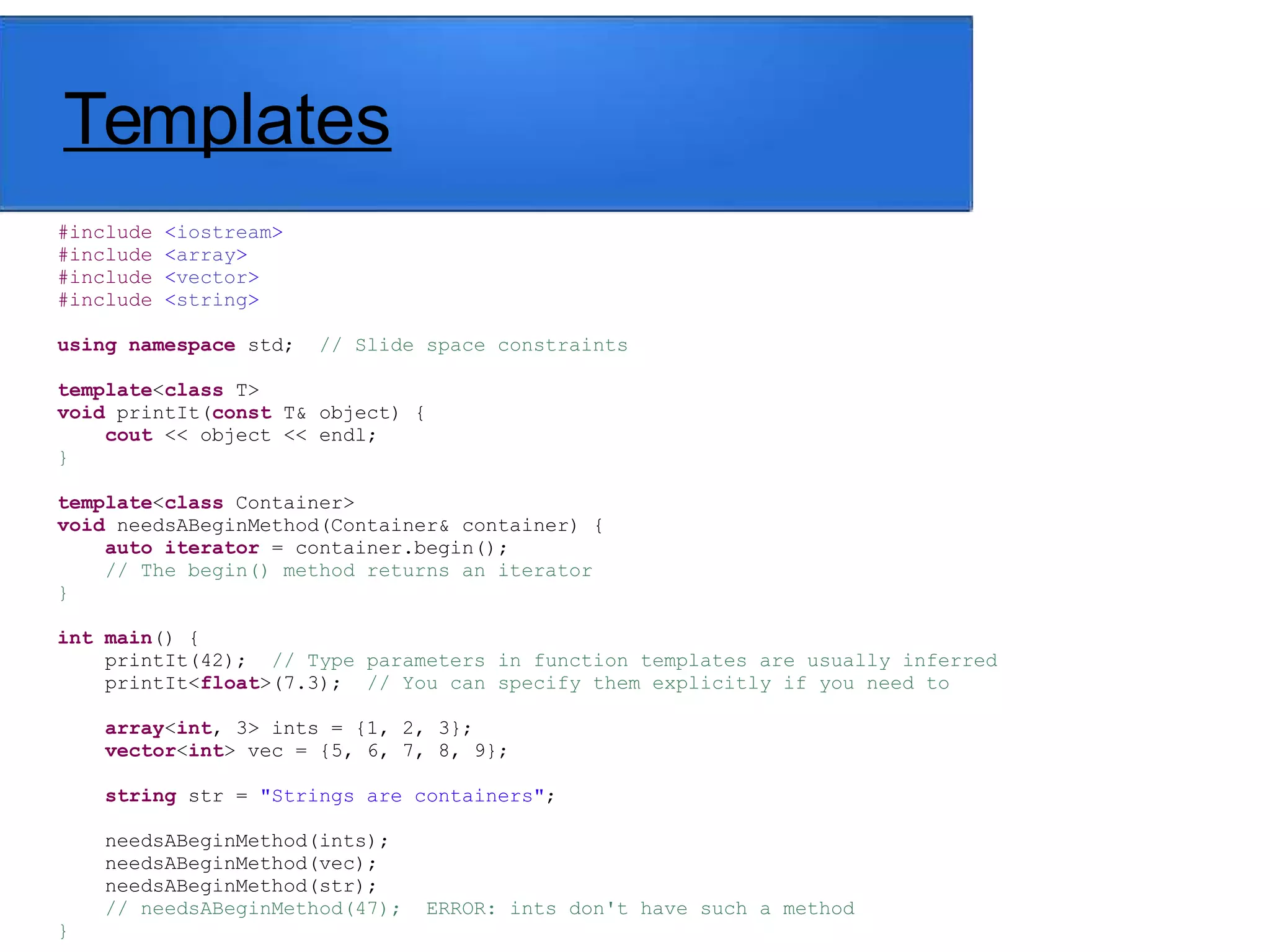
Templates
#include <iostream>
#include <array>
#include <vector>
#include <string>
using namespace std; // Slide space constraints
template<class T>
void printIt(const T& object) {
cout << object << endl;
}
template<class Container>
void needsABeginMethod(Container& container) {
auto iterator = container.begin();
// The begin() method returns an iterator
}
int main() {
printIt(42); // Type parameters in function templates are usually inferred
printIt<float>(7.3); // You can specify them explicitly if you need to
array<int, 3> ints = {1, 2, 3};
vector<int> vec = {5, 6, 7, 8, 9};
string str = "Strings are containers";
needsABeginMethod(ints);
needsABeginMethod(vec);
needsABeginMethod(str);
// needsABeginMethod(47); ERROR: ints don't have such a method
}
Templates
#include <array>
#include <iostream>
#include <typeinfo>
#include <string>
using namespace std; // slide space limits
template<class T, int ArrayLength = 10>
class SomeTypedefs {
public:
SomeTypedefs() = delete; // Prevent instantiation
typedef T Type;
typedef T* Pointer;
typedef T& Reference;
typedef T RawArray[ArrayLength];
typedef array<T, ArrayLength> STLArray;
};
// The standard library does this a lot ^
int main() {
cout << typeid(SomeTypedefs<int>::Type).name() << endl;
cout << typeid(SomeTypedefs<float>::Pointer).name() << endl;
cout << typeid(SomeTypedefs<string>::Reference).name() << endl;
cout << typeid(SomeTypedefs<int, 14>::RawArray).name() << endl;
cout << typeid(SomeTypedefs<double, 3>::STLArray).name() << endl;
}
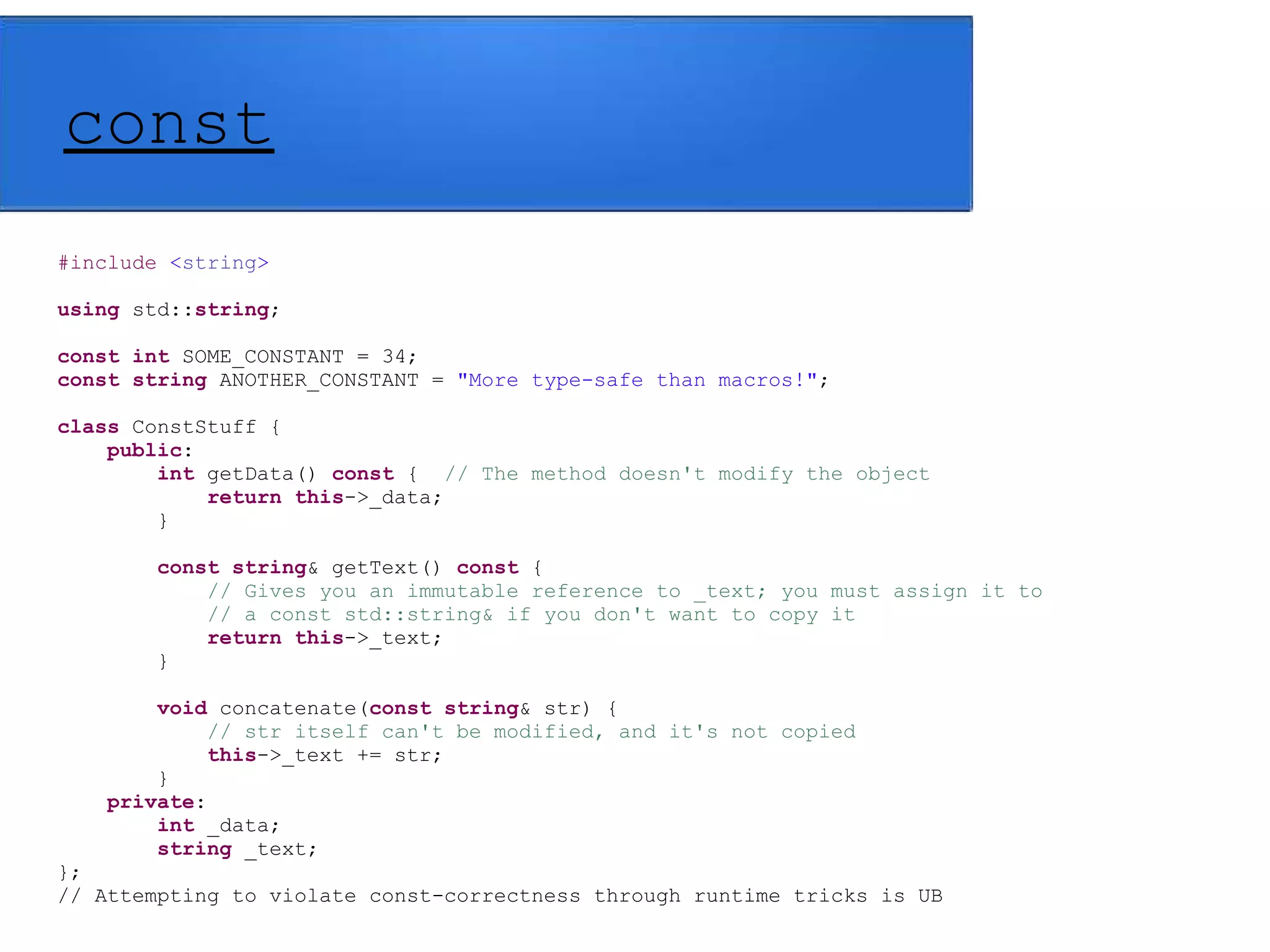
const
#include <string>
using std::string;
const int SOME_CONSTANT = 34;
const string ANOTHER_CONSTANT = "More type-safe than macros!";
class ConstStuff {
public:
int getData() const { // The method doesn't modify the object
return this->_data;
}
const string& getText() const {
// Gives you an immutable reference to _text; you must assign it to
// a const std::string& if you don't want to copy it
return this->_text;
}
void concatenate(const string& str) {
// str itself can't be modified, and it's not copied
this->_text += str;
}
private:
int _data;
string _text;
};
// Attempting to violate const-correctness through runtime tricks is UB
Operator Overloading
#include <iostream>
using std::cout;
using std::endl;
using std::ostream; // cout is an ostream
struct Vector2 {
float x, y;
Vector2(const float x, const float y) : x(x), y(y) {}
Vector2 operator+(const Vector2& other) {
return Vector2(x + other.x, y + other.y);
}
};
// This is how most types in the standard library are printed out
ostream& operator<<(ostream& out, const Vector2& v){
return out << '[' << v.x << ", " << v.y << ']';
}
int main() {
Vector2 a(1, 2);
Vector2 b(2, 1);
Vector2 c = a + b;
cout << c << endl;
}
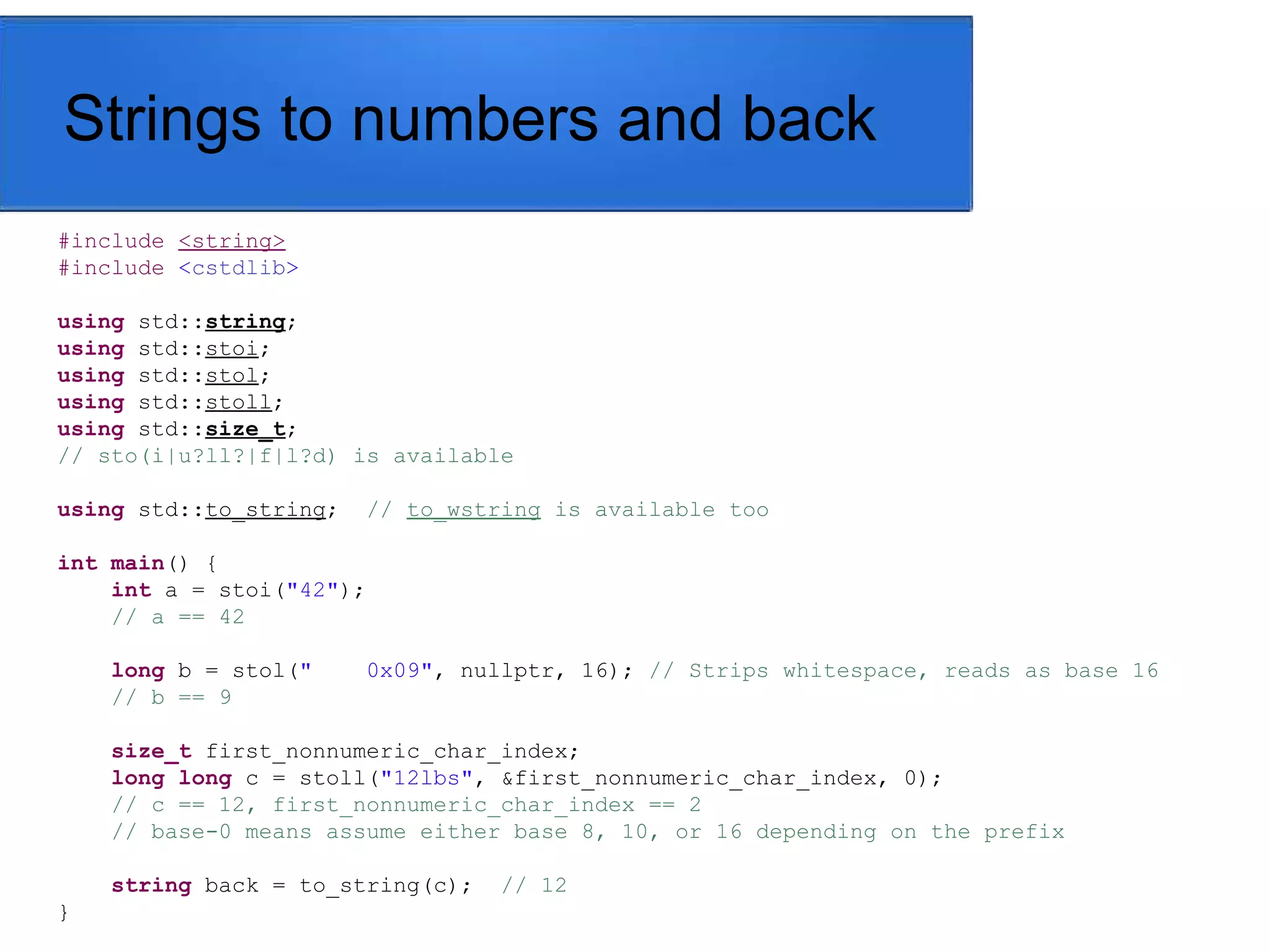
Strings to numbers and back
#include <string>
#include <cstdlib>
using std::string;
using std::stoi;
using std::stol;
using std::stoll;
using std::size_t;
// sto(i|u?ll?|f|l?d) is available
using std::to_string; // to_wstring is available too
int main() {
int a = stoi("42");
// a == 42
long b = stol(" 0x09", nullptr, 16); // Strips whitespace, reads as base 16
// b == 9
size_t first_nonnumeric_char_index;
long long c = stoll("12lbs", &first_nonnumeric_char_index, 0);
// c == 12, first_nonnumeric_char_index == 2
// base-0 means assume either base 8, 10, or 16 depending on the prefix
string back = to_string(c); // 12
}
Data Structures
●
The usual suspects
●
You must #include <class_name>
●
Prefer std::array<SomeType, Length> to SomeType[Length]
●
std::vector<T> ↔ java.util.ArrayList<T>
●
std::deque<T> ↔ java.util.ArrayQueue<T>
●
std::list<T> ↔ java.util.LinkedList<T>
●
std::set<T> ↔ java.util.TreeSet<T>
●
std::map<T, U> ↔ java.util.TreeMap<T, U>
●
std::unordered_set<T> ↔ java.util.HashSet<T>
●
std::unordered_map<T, U> ↔ java.util.HashMap<T, U>
●
std::stack<T> ↔ java.util.Stack<T>
●
std::priority_queue<T> ↔ java.util.PriorityQueue<T>
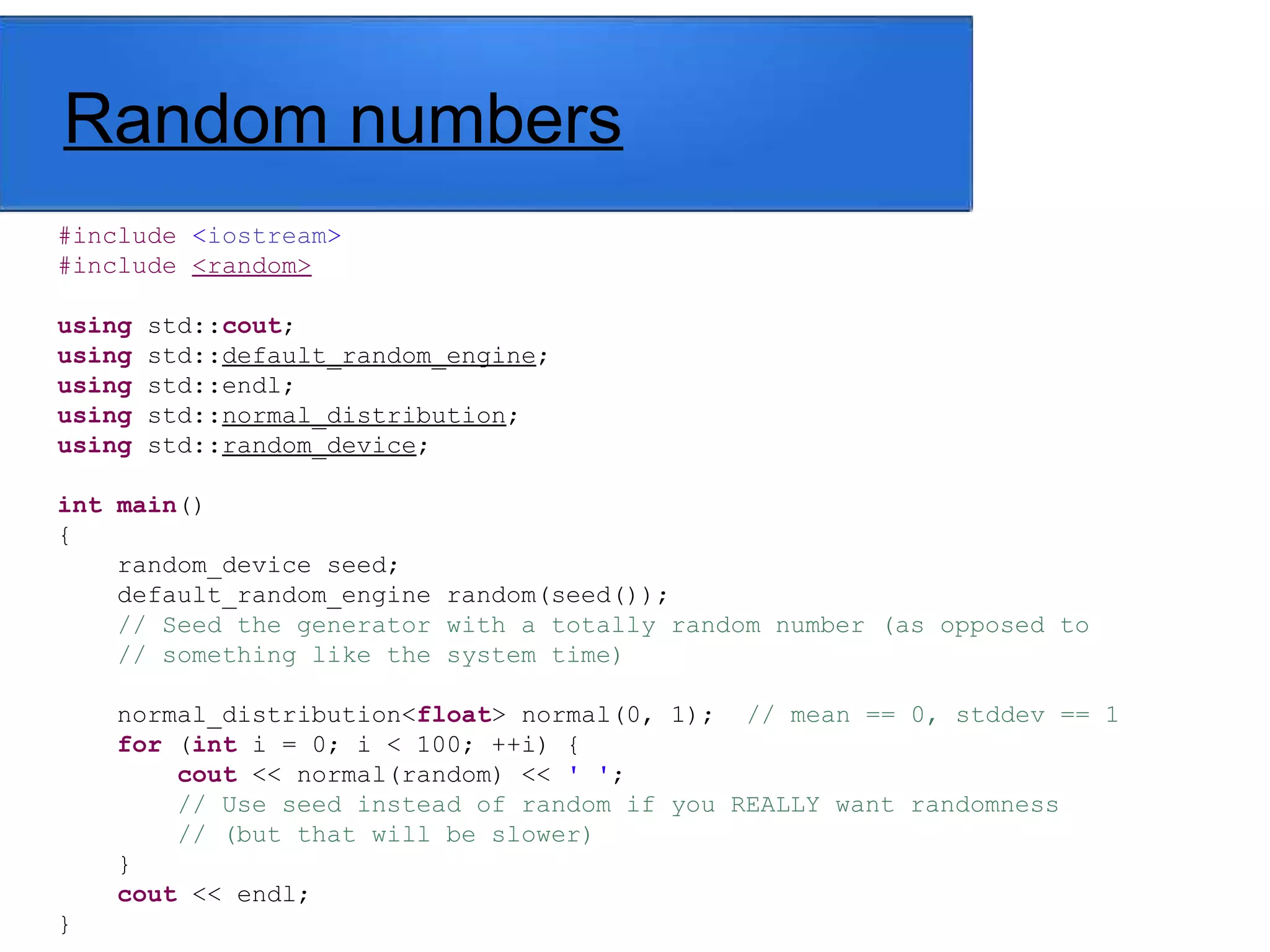
Random numbers
#include <iostream>
#include <random>
using std::cout;
using std::default_random_engine;
using std::endl;
using std::normal_distribution;
using std::random_device;
int main()
{
random_device seed;
default_random_engine random(seed());
// Seed the generator with a totally random number (as opposed to
// something like the system time)
normal_distribution<float> normal(0, 1); // mean == 0, stddev == 1
for (int i = 0; i < 100; ++i) {
cout << normal(random) << ' ';
// Use seed instead of random if you REALLY want randomness
// (but that will be slower)
}
cout << endl;
}
String Concatenation
#include <iostream>
#include <sstream>
#include <string>
#include <iomanip>
using std::string;
using std::stringstream;
using std::cout;
using std::endl;
using std::setprecision;
int main()
{
float x = 5.6435221, y = 7.1453634545, z = -23.452354215;
stringstream coords;
coords << "DEBUG LOGn"
<< "tPosition: [" << setprecision(4)
<< x << ", " << y << ", " << z << "]n";
cout << coords.str() << endl;
// Use stringstream for formatted output like in debug consoles
// Small amounts of pre-existing strings can be appended with operator+
}
Iterators
#include <array>
#include <string>
#include <iostream>
using std::array;
using std::cout;
using std::endl;
using std::string;
int main() {
array<string, 5> strings = {"France", "Spain", "China", "America", "Sweden"};
// No iterators
for (int i = 0; i < strings.size(); i++) {
cout << strings[i] << ' ';
}
cout << endl;
// The clunky way
for (array<string, 5>::iterator it = strings.begin(); it != strings.end(); it++) {
cout << *it << ' ';
}
cout << endl;
// The C++11 way
for (const string& s : strings) {
cout << s << ' ';
}
cout << endl;
}
Anonymous Functions and
<algorithm>
#include <array>
#include <iostream>
#include <algorithm>
#include <functional>
using namespace std; // For slide space
int main() {
array<int, 10> ints = {5, 7, 1, 2, 3, 9, 2, 1, 4, 2};
function<bool(int)> isEven = [](int n) -> bool {
return n % 2 == 0;
};
// () can be omitted if there are no parameters
function<void(void)> printInts = [&ints] {
for (int i : ints) {
cout << i << ' ';
}
cout << endl;
};
printInts();
// return type can be omitted if it can be deduced
transform(ints.begin(), ints.end(), ints.begin(), [&isEven](int i) {
// [&something] captures something by reference, [something] by value
return isEven(i) ? i : i * 2;
}); // ^ Doubles all odd numbers
printInts();
}
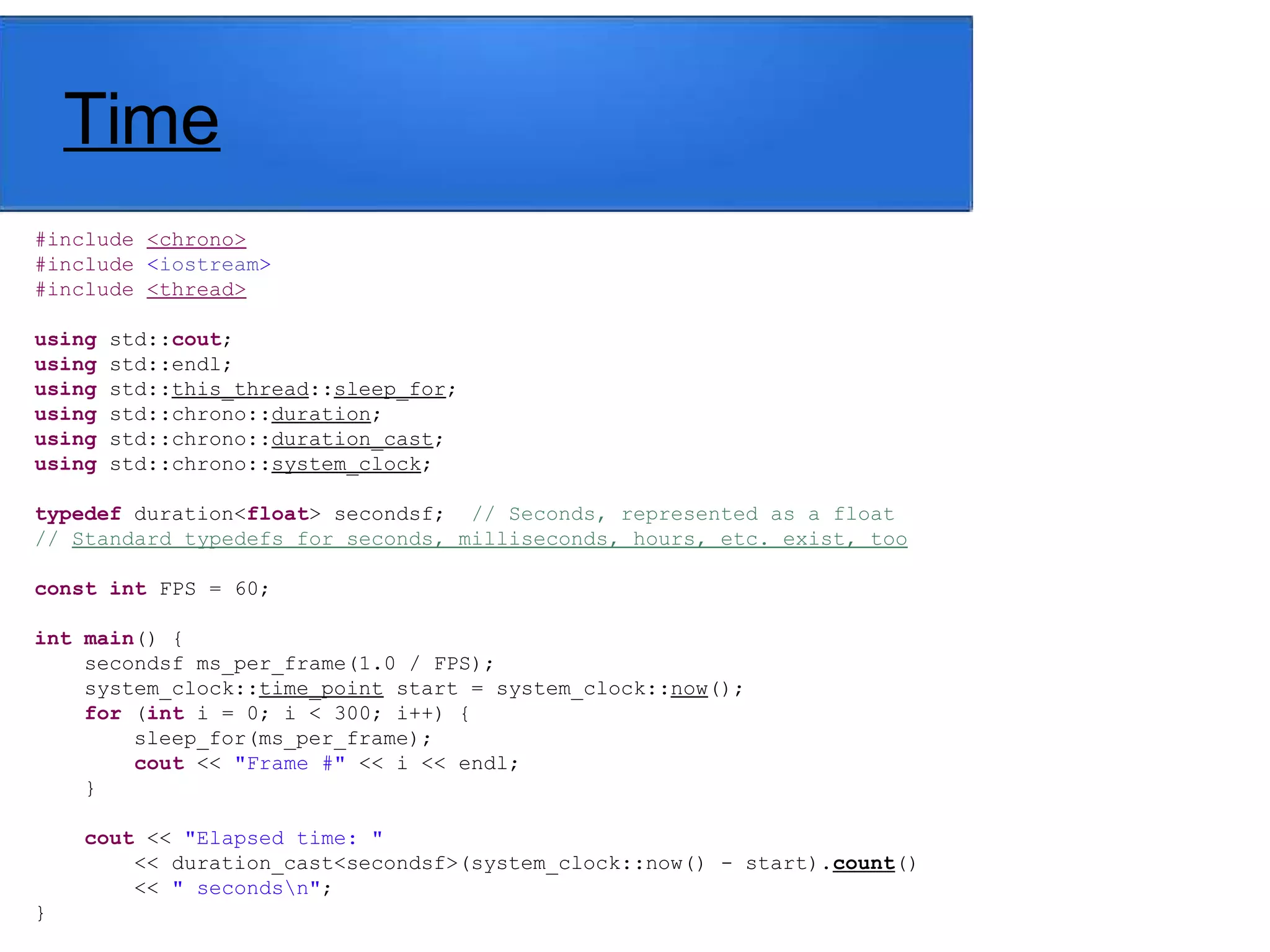
Time
#include <chrono>
#include <iostream>
#include <thread>
using std::cout;
using std::endl;
using std::this_thread::sleep_for;
using std::chrono::duration;
using std::chrono::duration_cast;
using std::chrono::system_clock;
typedef duration<float> secondsf; // Seconds, represented as a float
// Standard typedefs for seconds, milliseconds, hours, etc. exist, too
const int FPS = 60;
int main() {
secondsf ms_per_frame(1.0 / FPS);
system_clock::time_point start = system_clock::now();
for (int i = 0; i < 300; i++) {
sleep_for(ms_per_frame);
cout << "Frame #" << i << endl;
}
cout << "Elapsed time: "
<< duration_cast<secondsf>(system_clock::now() - start).count()
<< " secondsn";
}
Next Week

Compiling and linking code

Using Visual Studio

Overview of popular C++ tools

Building and using Box2D

This is part of your homework!

C++ boot camp part 1/2

  • 1.
    CSE 380 C++Boot Camp Part 1/2 C++ You Slides by Jesse Talavera-Greenberg
  • 2.
    Disclaimer  I am notthe grader for this course  Undergrads can't grade assignments  The boot camp is always part of the course, but I volunteered to lead it this year  Any opinions expressed are my own and are not necessarily condoned by McKenna  I don't know very much about DirectX
  • 3.
    This Week  No needto download anything this week  Go to www.cppreference.com to follow code  This is your C++ Bible this semester  Online compiler
  • 4.
    Basic Structure #include <iostream> //Include any header files at the top of the .cpp file to use the classes and // functions they define using std::cout; using std::endl; // Now do this to use names (or prefix them with “std::”) // static initializers will be called before main() // Main entry point of a C++ program int main(int argc, char** argv, char** env) { // All these args are optional, third one is not as common // argc == number of command-line arguments // argv == the actual arguments as an array of strings // env == environment variables cout << "Hello! The name of this program is " << argv[0] << endl; // Call functions! Do things! return 0; // Return code of 0 tells the OS the program exited normally // Anything else == something went wrong (you decide what the numbers mean) // Leaving it off implies "return 0" }
  • 5.
    if, else, for,while  Ranged for available, too (we'll come back) if (somethingIsTrue()) { for (int i = 0; i < 10; ++i) { break; // Exactly the same } } else if (somethingElseIsTrue()) { while (true) break; // You can omit braces for single statements like in Java } else { do { continue; // Exactly the same } while (false); }
  • 6.
    switch ● Same, except casescan't be strings switch (someInteger) { // All okay case 0: break; case SOME_CONSTANT: break; default: // nop } switch (someString) { // ERROR case "No way": case "Too bad": case "Don't bother": default: // nop }
  • 7.
    try/catch/throw  There is nofinally  Use destructors instead (we'll come back) using std::exception; try { functionThatMightThrowException(); // No checked exceptions in C++ throw exception("No new statement; we'll come back to this"); } catch (exception e) { std::cout << e.what(); // Print the exception info } try { throw 5; // You can throw anything in C++ } catch (int i) { // Stick to exception objects and their subclasses, though } catch (...) { // Catch anything, but you can't access it; can only be used last }
  • 8.
    Fundamental types  Sizes arenot well- defined like in Java  No byte (use uint8_t)  boolean → bool  Use nullptr instead of null or NULL  Signed and unsigned types  signed types are the same  unsigned types double the max value, but can't represent negative numbers  Need a specific number size?  First #include <cstdint>  Then use std::u?int(8|16|32|64)_t
  • 9.
    typedef and typeid #include<cstdint> #include <iostream> #include <typeinfo> // ^ Must include typeinfo to use the typeid operator typedef std::uint8_t byte; // Declares another name for the same type // Syntax: // typedef existing_type new_name; using std::cout; using std::endl; int main() { std::uint8_t a = 5; byte b = a; // Totally okay; the distinction is compile-time only cout << typeid(std::uint8_t).name() << endl; cout << typeid(byte).name() << endl; // Both printouts will be implementation-defined, but identical /* Common standard typedefs: size_t: Sizes of objects (usually an unsigned int) ptrdiff_t: Difference between pointers (usually an unsigned int or long) std::string: Convenient form of std::basic_string<char> */ }
  • 10.
    Declaring Variables #include <string> #include<vector> using std::string; using std::vector; int main() { string empty; // default constructor string empty2(); // default constructor with parens string value = "I'm really a char*"; string value2("Parens are fine, too"); string copy = value; // This is a COPY; NOT A REFERENCE string& ref = value; // THIS is a reference const string& constref = value; // A reference whose object can't be modified // All of an object's members are initialized! string* ptr; // Unassigned pointer; not necessarily nullptr vector<int> ints = {1, 2, 3, 4, 5, 6}; // You can initialize collections this way }
  • 11.
    Undefined behavior  Whenever somethinghappens in Java, you can rely on something else to happen  C++ lets the compiler do anything it wants in certain situations  For performance reasons, mostly  Many, many ways to do this  Do not rely on undefined behavior
  • 12.
    Common undefined behaviors #include <string> #include<cstdint> #include <limits> int32_t something(int32_t param) { if (param > 0) return param; // No return down here; now what? } std::string& returnsALocal() { std::string reference = "Why are you doing this"; return reference; // Uh-oh } int main() { int32_t a = std::numeric_limits<int32_t>::max(); a++; // Oops int32_t* pointer; // Could be nullptr, could be garbage int32_t number = *pointer; // BAD int32_t[10] array; number = array[12]; // WTF }
  • 13.
    namespace #include <iostream> #include <string> #include<array> #include <utility> using namespace std; // ^ Don't do this for the same reason you don't do java.util.* namespace sbcs { // Nest them as much as you'd like namespace cse380 { struct Game { string name; string teamName; array<string, 3> members; }; } namespace cse381 { typedef pair<string, string> Team; } } int main() { sbcs::cse380::Game game; // Fully-qualified type name using sbcs::cse381::Team; // Or use it in the current namespace (global in this case) Team team("Jesse", "Karl"); }
  • 14.
    The Preprocessor #include <iostream> //Use <angle_brackets> for standard library/third-party code, "quotes" for your own #define DEBUG // You can also add #defines through your build system (e.g. the command line or // your Visual Studio project file) // #define WINDOWS // #define MAC // ^ Uncomment one of these using std::cout; using std::endl; int main() { #ifdef DEBUG cout << "Logging! Or sanity checking!" << endl; #endif #ifdef WINDOWS cout << "Use DirectX!" << endl; #else cout << "Use OpenGL!" << endl; #endif #ifdef MAC #error "Jesse doesn't like Apple" // ^ Intentionally causes a compiler error #endif }
  • 15.
    assert/static_assert #include <cassert> #include <type_traits> //#define NDEBUG // ^ Uncomment this or define it in the build system to disable asserts using std::is_base_of; using std::is_same; template<class T, class U> void failIfUnrelated() { static_assert( is_base_of<T, U>::value || is_base_of<U, T>::value || is_same<T, U>::value, "Both types should be the same, or one should be a parent of the other" ); } class Parent {}; class Child : public Parent {}; int main() { assert(1 + 1 == 2); assert(true && "Idiom for providing informative text in an assert()"); failIfUnrelated<int, int>(); // Okay failIfUnrelated<int, float>(); // Causes a compiler error, as desired failIfUnrelated<Parent, Child>(); // Okay }
  • 16.
    enum #include <iostream> using std::cout; usingstd::endl; enum class Direction { North, South, East, West, // Trailing comma is okay }; // NOT OBJECTS; just ints with some compile-time meaning enum class Speakers { Mute = 0, // Assigning values is okay Mono = 1, Stereo = 2, Surround = 4 }; int main() { Direction dir = Direction::North; Speakers audio = Speakers::Stereo; audio = Speakers(4); // Make sure int is a valid Speakers value! cout << int(audio) << endl; // int <-> enum class conversions must be explicit }
  • 17.
    Pointers #include <string> using std::string; intmain() { string a = "I'm a little teapot"; string* ptr = &a; // &some_object returns the address of some_object string b = *ptr; // *some_pointer dereferences int ints[] = {1, 2, 3, 4, 5, 6, 7, 8, 9, 10}; // Raw arrays are pointers int* int_ptr = ints; // Points to ints[0] int* int_ptr2 = ints + 1; // Points to ints[1] // Increments the address sizeof(int) bytes int** double_array = &int_ptr; // Pointers to pointers okay; never usually need more than two** void* pointer_to_anything = ints; // Pointer to arbitrary data; very error-prone and unsafe; avoid unless you know // exactly why you need one pointer_to_anything = nullptr; // nullptr == Java's null; assignable to any pointer type, but not to objects float* garbage; // Uninitialized pointer; value is undefined // Could be garbage, could be nullptr; initialize it ASAP! }
  • 18.
    References #include <string> #include <iostream> usingnamespace std; // Only for slide space constraints class StringHolder { public: StringHolder(const string& str) : _str(str) {} const string& getStringReference() const { return this->_str; } string getStringCopy() const { return this->_str; } void append(const string& str) { this->_str += str; } // ^ Passes an unmodifiable reference rather than a copy private: string _str; }; int main() { StringHolder holder("France"); const string& a = holder.getStringReference(); string b = holder.getStringCopy(); cout << (a == b) << endl; // True; comparing object values cout << (&a == &b) << endl; // False; different addresses, different objects holder.append(b); cout << holder.getStringReference() << endl; // FranceFrance }
  • 19.
    Pointers Vs. References (Similarities)  Accesslarge objects without copying them  Left dangling (invalid) if the referenced object is deallocated  No way to check for this  Will likely cause a crash if you try to use it  Both can point to an instance of the given type's superclass  Both compiled to similar machine code  Multiple pointers/references can refer to one object
  • 20.
    Pointers Vs. References (Differences)  Canrepresent absence of data  More prone to becoming invalid  Syntax needed to convert between pointers and objects  Can be assigned to different objects  Always initialized with a valid object  No syntax needed to use references aside from declarations or method signatures  Always points to one location in memory  Easier to deal with objects that shouldn't change
  • 21.
    new/delete #include <string> using std::string; voidwasteMemory() { string stack_allocated = "I disappear when I go out of scope"; string* wasted = new string( "I only disappear when explicitly deallocated" ); string* cleaned = new string("I'm about to get cleaned up properly"); delete cleaned; } int main() { for (int i = 0; i < 10000; i++) { wasteMemory(); } // stack_allocated disappeared when wasteMemory() returned // All instances of wasted are still in memory // cleaned disappeared when "delete cleaned;" was called // See: Scope vs. Lifetime }
  • 22.
    Exceptions #include <iostream> #include <string> #include<exception> #include <array> using namespace std; // Again, slide space constraints int main() { array<int, 5> ints = {1, 2, 3, 4, 5}; try { cout << ints.at(10) << endl; // at() checks bounds, operator[] doesn't } catch (const out_of_range& e) { // You can (and should) catch by reference cout << "Out of range in an array" << endl; } catch (const runtime_error& e) { cout << "Didn't see this coming: " << e.what() << endl; } catch (const exception& e) { cout << "Unknown exception: " << e.what() << endl; } catch (...) { cout << "WTF?" << endl; } // There is no finally clause; use destructors to guarantee exception safety }
  • 23.
    Declaring Classes // public/protected/privatesemantics same as in Java // no specifier == private in classes, public in structs class ItHoldsThings { public: int cantBeOverridden(int a, int b) { // Technically you can, but things get weird return this->_integer + b; } virtual float canBeOverridden(const double d) { // virtual == overrideable return d * 2; } virtual void abstractMethod() = 0; protected: float _number; private: int _integer; }; // Don't forget the semicolon // When a class is constructed, ALL of its members are too
  • 24.
    Constructors #include <string> using std::string; classStringWrapper { public: StringWrapper() { /* other code here */ } // _str == "" // Default constructor can be auto-generated with some caveats (see the wiki) StringWrapper(const string& value) : _str(value) {} // _str == value // Copy constructor can be auto-generated (but see wiki) // Base class constructors are called like this, too private: string _str; // All members are initialized on construction, whether you like it or not }; int main() { StringWrapper a; StringWrapper b("There will be a copy of me in c"); StringWrapper c(b); }
  • 25.
    // Using constructorsto allocate resources and destructors to clean them up is // called Resource Acquisition Is Initialization (RAII). Only needed for low-level // resources; high-level classes like std::iostream do RAII themselves. #include <cstdlib> using std::malloc; using std::free; class LotsOfResources { public: LotsOfResources() { _floats = new float[64]; _buffer = malloc(64); } ~LotsOfResources() { // Called when this object's lifetime ends delete[] _floats; // Remember the [] when deleting a raw array free(_buffer); } private: float* _floats; void* _buffer; }; int main() { LotsOfResources* resources = new LotsOfResources; delete resources; // No memory leaks! } Destructors
  • 26.
    Abstract Classes/Inheritance #include <exception> #include<iostream> // There are no interfaces; use abstract classes without any concrete methods struct ProgramCrasher { virtual void crash() = 0; // "= 0" means the method is abstract // virtual == method can be overridden // only one abstract method needed to define a class as abstract }; struct IPastryChef { virtual void bake() = 0; }; struct SegfaultCrasher : public ProgramCrasher { // Actually several types of inheritance; it's complicated, just use public void crash() override { int* a; int b = *a; } }; // Multiple inheritance; don't do it if more than one parent class is not an interface struct ExceptionCrasher : public ProgramCrasher, public IPastryChef { void crash() override { throw std::exception(); } void bake() override { std::cout << "This is just my day jobn"; } };
  • 27.
    (static|dynamic)_cast #include <iostream> #include <string> usingnamespace std; // Slide space constraints struct Base { virtual ~Base() {} string baseMethod() { return "base"; } }; struct Derived: Base { virtual string derivedMethod() { return "derived"; } }; int main() { Base* b1 = new Derived; Derived* d1_s = dynamic_cast<Derived*>(b1); cout << d1_s << ' ' << d1_s->baseMethod() << ' ' << d1_s->derivedMethod() << endl; // Checking at runtime that you're casting to the right type Derived* d1_d = static_cast<Derived*>(b1); cout << d1_d << ' ' << d1_d->baseMethod() << ' ' << d1_d->derivedMethod() << endl; // Static (compile-time) downcasts are OK (and faster) if you know you're // casting to the right type Base* b2 = new Base; Derived* d2_d = dynamic_cast<Derived*>(b2); cout << d2_d << endl; // Cast was not valid, so dynamic_cast returned nullptr // If it were a reference, it would've thrown std::bad_cast Derived* d2_s = static_cast<Derived*>(b2); // cout << d2_s << ' ' << d2_s->baseMethod() << ' ' << d2_s->derivedMethod() << endl; // ^ This is undefined, since the cast is wrong (and not checked at runtime) delete b1; // Remember to clean up! delete b2; }
  • 28.
    Templates #include <string> #include <vector> template<classT> class Value { public: Value(const T& data) : _data(data) {} const T& getData() { return this->_data; } private: T _data; }; // Templates are used A LOT in the standard library using std::string; using std::vector; int main() { Value<string> str("My name is Beavis"); Value<vector<int>> ints({1, 2, 3, 4, 5, 6}); // Two different classes, with two different bits of machine code }
  • 29.
    Templates #include <iostream> #include <array> #include<vector> #include <string> using namespace std; // Slide space constraints template<class T> void printIt(const T& object) { cout << object << endl; } template<class Container> void needsABeginMethod(Container& container) { auto iterator = container.begin(); // The begin() method returns an iterator } int main() { printIt(42); // Type parameters in function templates are usually inferred printIt<float>(7.3); // You can specify them explicitly if you need to array<int, 3> ints = {1, 2, 3}; vector<int> vec = {5, 6, 7, 8, 9}; string str = "Strings are containers"; needsABeginMethod(ints); needsABeginMethod(vec); needsABeginMethod(str); // needsABeginMethod(47); ERROR: ints don't have such a method }
  • 30.
    Templates #include <array> #include <iostream> #include<typeinfo> #include <string> using namespace std; // slide space limits template<class T, int ArrayLength = 10> class SomeTypedefs { public: SomeTypedefs() = delete; // Prevent instantiation typedef T Type; typedef T* Pointer; typedef T& Reference; typedef T RawArray[ArrayLength]; typedef array<T, ArrayLength> STLArray; }; // The standard library does this a lot ^ int main() { cout << typeid(SomeTypedefs<int>::Type).name() << endl; cout << typeid(SomeTypedefs<float>::Pointer).name() << endl; cout << typeid(SomeTypedefs<string>::Reference).name() << endl; cout << typeid(SomeTypedefs<int, 14>::RawArray).name() << endl; cout << typeid(SomeTypedefs<double, 3>::STLArray).name() << endl; }
  • 31.
    const #include <string> using std::string; constint SOME_CONSTANT = 34; const string ANOTHER_CONSTANT = "More type-safe than macros!"; class ConstStuff { public: int getData() const { // The method doesn't modify the object return this->_data; } const string& getText() const { // Gives you an immutable reference to _text; you must assign it to // a const std::string& if you don't want to copy it return this->_text; } void concatenate(const string& str) { // str itself can't be modified, and it's not copied this->_text += str; } private: int _data; string _text; }; // Attempting to violate const-correctness through runtime tricks is UB
  • 32.
    Operator Overloading #include <iostream> usingstd::cout; using std::endl; using std::ostream; // cout is an ostream struct Vector2 { float x, y; Vector2(const float x, const float y) : x(x), y(y) {} Vector2 operator+(const Vector2& other) { return Vector2(x + other.x, y + other.y); } }; // This is how most types in the standard library are printed out ostream& operator<<(ostream& out, const Vector2& v){ return out << '[' << v.x << ", " << v.y << ']'; } int main() { Vector2 a(1, 2); Vector2 b(2, 1); Vector2 c = a + b; cout << c << endl; }
  • 33.
    Strings to numbersand back #include <string> #include <cstdlib> using std::string; using std::stoi; using std::stol; using std::stoll; using std::size_t; // sto(i|u?ll?|f|l?d) is available using std::to_string; // to_wstring is available too int main() { int a = stoi("42"); // a == 42 long b = stol(" 0x09", nullptr, 16); // Strips whitespace, reads as base 16 // b == 9 size_t first_nonnumeric_char_index; long long c = stoll("12lbs", &first_nonnumeric_char_index, 0); // c == 12, first_nonnumeric_char_index == 2 // base-0 means assume either base 8, 10, or 16 depending on the prefix string back = to_string(c); // 12 }
  • 34.
    Data Structures ● The usualsuspects ● You must #include <class_name> ● Prefer std::array<SomeType, Length> to SomeType[Length] ● std::vector<T> ↔ java.util.ArrayList<T> ● std::deque<T> ↔ java.util.ArrayQueue<T> ● std::list<T> ↔ java.util.LinkedList<T> ● std::set<T> ↔ java.util.TreeSet<T> ● std::map<T, U> ↔ java.util.TreeMap<T, U> ● std::unordered_set<T> ↔ java.util.HashSet<T> ● std::unordered_map<T, U> ↔ java.util.HashMap<T, U> ● std::stack<T> ↔ java.util.Stack<T> ● std::priority_queue<T> ↔ java.util.PriorityQueue<T>
  • 35.
    Random numbers #include <iostream> #include<random> using std::cout; using std::default_random_engine; using std::endl; using std::normal_distribution; using std::random_device; int main() { random_device seed; default_random_engine random(seed()); // Seed the generator with a totally random number (as opposed to // something like the system time) normal_distribution<float> normal(0, 1); // mean == 0, stddev == 1 for (int i = 0; i < 100; ++i) { cout << normal(random) << ' '; // Use seed instead of random if you REALLY want randomness // (but that will be slower) } cout << endl; }
  • 36.
    String Concatenation #include <iostream> #include<sstream> #include <string> #include <iomanip> using std::string; using std::stringstream; using std::cout; using std::endl; using std::setprecision; int main() { float x = 5.6435221, y = 7.1453634545, z = -23.452354215; stringstream coords; coords << "DEBUG LOGn" << "tPosition: [" << setprecision(4) << x << ", " << y << ", " << z << "]n"; cout << coords.str() << endl; // Use stringstream for formatted output like in debug consoles // Small amounts of pre-existing strings can be appended with operator+ }
  • 37.
    Iterators #include <array> #include <string> #include<iostream> using std::array; using std::cout; using std::endl; using std::string; int main() { array<string, 5> strings = {"France", "Spain", "China", "America", "Sweden"}; // No iterators for (int i = 0; i < strings.size(); i++) { cout << strings[i] << ' '; } cout << endl; // The clunky way for (array<string, 5>::iterator it = strings.begin(); it != strings.end(); it++) { cout << *it << ' '; } cout << endl; // The C++11 way for (const string& s : strings) { cout << s << ' '; } cout << endl; }
  • 38.
    Anonymous Functions and <algorithm> #include<array> #include <iostream> #include <algorithm> #include <functional> using namespace std; // For slide space int main() { array<int, 10> ints = {5, 7, 1, 2, 3, 9, 2, 1, 4, 2}; function<bool(int)> isEven = [](int n) -> bool { return n % 2 == 0; }; // () can be omitted if there are no parameters function<void(void)> printInts = [&ints] { for (int i : ints) { cout << i << ' '; } cout << endl; }; printInts(); // return type can be omitted if it can be deduced transform(ints.begin(), ints.end(), ints.begin(), [&isEven](int i) { // [&something] captures something by reference, [something] by value return isEven(i) ? i : i * 2; }); // ^ Doubles all odd numbers printInts(); }
  • 39.
    Time #include <chrono> #include <iostream> #include<thread> using std::cout; using std::endl; using std::this_thread::sleep_for; using std::chrono::duration; using std::chrono::duration_cast; using std::chrono::system_clock; typedef duration<float> secondsf; // Seconds, represented as a float // Standard typedefs for seconds, milliseconds, hours, etc. exist, too const int FPS = 60; int main() { secondsf ms_per_frame(1.0 / FPS); system_clock::time_point start = system_clock::now(); for (int i = 0; i < 300; i++) { sleep_for(ms_per_frame); cout << "Frame #" << i << endl; } cout << "Elapsed time: " << duration_cast<secondsf>(system_clock::now() - start).count() << " secondsn"; }
  • 40.
    Next Week  Compiling andlinking code  Using Visual Studio  Overview of popular C++ tools  Building and using Box2D  This is part of your homework!