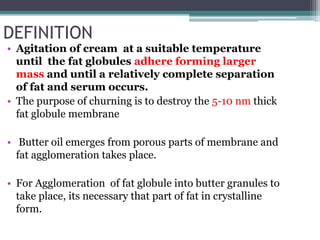
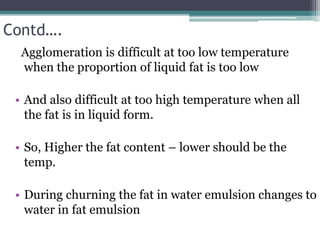
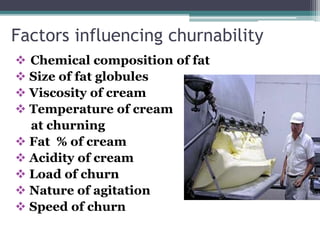
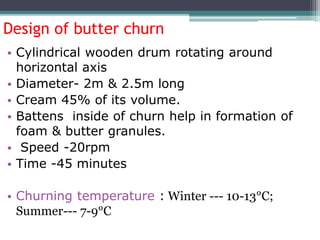
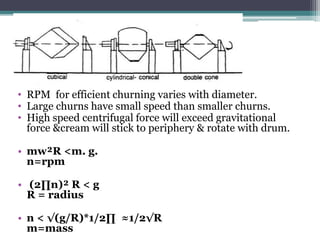
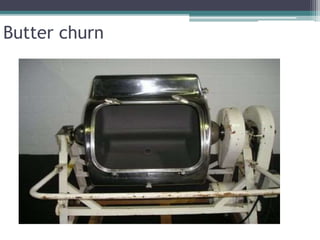
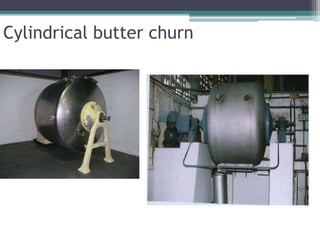
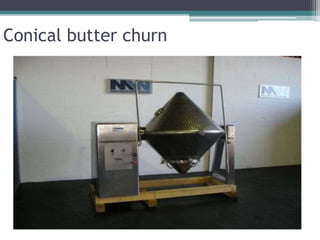
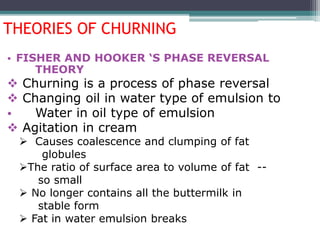
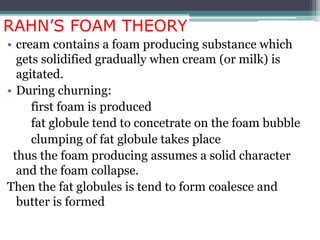
Churning cream involves agitating it at a suitable temperature to cause fat globules to adhere to each other and separate from the buttermilk. Successful churning depends on factors like cream temperature, fat content, churn speed and design. Theories propose that churning either causes a phase reversal from a water-in-oil emulsion to an oil-in-water emulsion, involves foam formation concentrating fat globules, or breaks up fat globule clusters allowing them to adhere into larger particles and emerge as butter.


![A presentation on Butter [Welcome To Everybody]](https://cdn.slidesharecdn.com/ss_thumbnails/welcometoeverybody-140830144751-phpapp01-thumbnail.jpg?width=640&height=640&fit=bounds)


