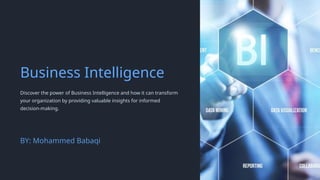
Business Intelligence
Discover the power of Business Intelligence and how it can transform
your organization by providing valuable insights for informed
decision-making.
BY: Mohammed Babaqi
What is Business
Intelligence?
Business Intelligence is the practice of analyzing data to drive
strategic business decisions, enabling organizations to gain valuable
insights and competitive advantage.
Importance of Business
Intelligence
Business Intelligence is essential in today's data-driven world as it
helps organizations identify trends, patterns, and opportunities,
ultimately improving operational efficiency and driving growth.
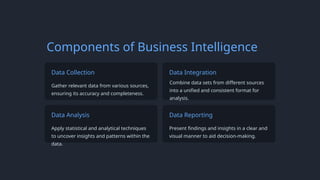
Components of Business Intelligence
Data Collection
Gather relevant data from various sources,
ensuring its accuracy and completeness.
Data Integration
Combine data sets from different sources
into a unified and consistent format for
analysis.
Data Analysis
Apply statistical and analytical techniques
to uncover insights and patterns within the
data.
Data Reporting
Present findings and insights in a clear and
visual manner to aid decision-making.
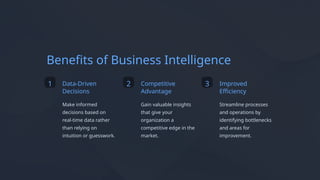
Benefits of Business Intelligence
1 Data-Driven
Decisions
Make informed
decisions based on
real-time data rather
than relying on
intuition or guesswork.
2 Competitive
Advantage
Gain valuable insights
that give your
organization a
competitive edge in the
market.
3 Improved
Efficiency
Streamline processes
and operations by
identifying bottlenecks
and areas for
improvement.
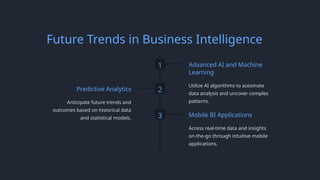
Future Trends in Business Intelligence
1 Advanced AI and Machine
Learning
Utilize AI algorithms to automate
data analysis and uncover complex
patterns.
2
Predictive Analytics
Anticipate future trends and
outcomes based on historical data
and statistical models. 3 Mobile BI Applications
Access real-time data and insights
on-the-go through intuitive mobile
applications.
Conclusion
Business Intelligence is a critical tool for organizations to thrive in the data-driven era. By
harnessing the power of data, businesses can make smarter decisions, drive innovation, and
achieve long-term success.
Thank you

Business-Intelligence examples .pptx

  • 1.
    Business Intelligence Discover thepower of Business Intelligence and how it can transform your organization by providing valuable insights for informed decision-making. BY: Mohammed Babaqi
  • 2.
    What is Business Intelligence? BusinessIntelligence is the practice of analyzing data to drive strategic business decisions, enabling organizations to gain valuable insights and competitive advantage.
  • 3.
    Importance of Business Intelligence BusinessIntelligence is essential in today's data-driven world as it helps organizations identify trends, patterns, and opportunities, ultimately improving operational efficiency and driving growth.
  • 4.
    Components of BusinessIntelligence Data Collection Gather relevant data from various sources, ensuring its accuracy and completeness. Data Integration Combine data sets from different sources into a unified and consistent format for analysis. Data Analysis Apply statistical and analytical techniques to uncover insights and patterns within the data. Data Reporting Present findings and insights in a clear and visual manner to aid decision-making.
  • 5.
    Benefits of BusinessIntelligence 1 Data-Driven Decisions Make informed decisions based on real-time data rather than relying on intuition or guesswork. 2 Competitive Advantage Gain valuable insights that give your organization a competitive edge in the market. 3 Improved Efficiency Streamline processes and operations by identifying bottlenecks and areas for improvement.
  • 6.
    Future Trends inBusiness Intelligence 1 Advanced AI and Machine Learning Utilize AI algorithms to automate data analysis and uncover complex patterns. 2 Predictive Analytics Anticipate future trends and outcomes based on historical data and statistical models. 3 Mobile BI Applications Access real-time data and insights on-the-go through intuitive mobile applications.
  • 7.
    Conclusion Business Intelligence isa critical tool for organizations to thrive in the data-driven era. By harnessing the power of data, businesses can make smarter decisions, drive innovation, and achieve long-term success.
  • 8.