Business And Management Study Guide Lloyd Gutteridge
Business And Management Study Guide Lloyd Gutteridge
Business And Management Study Guide Lloyd Gutteridge
Business And Management Study Guide Lloyd Gutteridge
Business And Management Study Guide Lloyd Gutteridge
1.
Business And ManagementStudy Guide Lloyd
Gutteridge download
https://ebookbell.com/product/business-and-management-study-
guide-lloyd-gutteridge-30373242
Explore and download more ebooks at ebookbell.com
2.
Here are somerecommended products that we believe you will be
interested in. You can click the link to download.
Business Management Study And Revision Guide Paul Hoang
https://ebookbell.com/product/business-management-study-and-revision-
guide-paul-hoang-30180262
Business Management For The Ib Diploma Study And Revision Guide
Illustrated Study Guide Paul Hoang
https://ebookbell.com/product/business-management-for-the-ib-diploma-
study-and-revision-guide-illustrated-study-guide-paul-hoang-11798556
Skills For Business And Management Macmillan Study Skills 76 1st
Edition Martin Sedgley
https://ebookbell.com/product/skills-for-business-and-management-
macmillan-study-skills-76-1st-edition-martin-sedgley-35015124
Study Skills For Business And Management Students Successful Studying
1st Edition Barbara Allan
https://ebookbell.com/product/study-skills-for-business-and-
management-students-successful-studying-1st-edition-barbara-
allan-2386276
3.
Rethinking The CaseStudy In International Business And Management
Research Rebecca Marschanpiekkari Catherine Welch
https://ebookbell.com/product/rethinking-the-case-study-in-
international-business-and-management-research-rebecca-
marschanpiekkari-catherine-welch-4922244
To Study The Role Of Quality Management System To Improve
Effectiveness Of Quality Culture In International Relations Department
At University Of Karachi Eissn 2278487x Zahid Yaqub Dr Kamal Haider
https://ebookbell.com/product/to-study-the-role-of-quality-management-
system-to-improve-effectiveness-of-quality-culture-in-international-
relations-department-at-university-of-karachi-eissn-2278487x-zahid-
yaqub-dr-kamal-haider-50949880
Quantitative Techniques In Business Management And Finance A Casestudy
Approach Awari
https://ebookbell.com/product/quantitative-techniques-in-business-
management-and-finance-a-casestudy-approach-awari-5699568
Environmental Management In The Dutch Food And Beverage Industry A
Longitudinal Study Into The Joint Impact Of Business Network And Firm
Characteristics On The Adoption Of Environmental Management
Capabilities Derkjan Haverkamp
https://ebookbell.com/product/environmental-management-in-the-dutch-
food-and-beverage-industry-a-longitudinal-study-into-the-joint-impact-
of-business-network-and-firm-characteristics-on-the-adoption-of-
environmental-management-capabilities-derkjan-haverkamp-4638430
Ethics And Diversity In Business Management Education A Sociological
Study With International Scope 1st Edition Mary Godwyn Auth
https://ebookbell.com/product/ethics-and-diversity-in-business-
management-education-a-sociological-study-with-international-
scope-1st-edition-mary-godwyn-auth-5142996
iii
CONTENTS
Contents
Introduction and acknowledgments1
“Quick start” guide 2
1.1 Introduction to business management 11
1.2 T
ypes of organization 14
1.3 Organizational objectives 17
1.4 Stakeholders 23
1.5 The external environment 24
1.6 Growth and evolution 26
1.7 Organizational planning tools (HL only) 31
2.1 Functions and evolution of HR management 34
2.2 Organizational structure 39
2.3 Leadership and management 43
2.4 Motivation 45
2.5 Organizational culture 50
2.6 Industrial or employee relations (HL only) 53
3.1 Sources of nance 56
3.2 Costs and revenues 59
3.3 Break-even analysis 60
3.4 Final accounts (some HL only) 63
3.5 Protability and liquidity ratio analysis 67
3.6 Efciency analysis (HL only) (A02–A04) 67
3.7 Cash ow 70
3.8 Investment appraisal (some HL only) 73
3.9 Budgets (HL only) 75
4.1 The role of marketing 77
4.2 Marketing planning (including the four Ps) 81
4.3 Sales forecasting (HL only) 87
4.4 Market research 90
4.5 The four Ps (product, price, promotion and place) 94
4.6 The extended marketing mix of seven Ps (HL only) 103
4.7 International marketing (HL only) 105
4.8 E-commerce 109
5.1 The role of operations management 112
5.2 Production methods 114
5.3 Lean production and quality management (HL only) 116
5.4 Location analysis 119
5.5 Production planning (HL only) 121
5.6 Research and development (HL only) 124
5.7 Crisis management and contingency planning (HL only) 127
IB learner prole activities: new lines of inquiry 129
6 External and internal assessment – guidance 134
IB Business Management practice questions with
suggested answers 139
Further assessment guidance unit linking contexts to concepts
and content for section C HL and SL paper 2 147
References and further reading 150
8.
1
INTRODUCTION
Introduction
Thank you forpurchasing this second edition of the Business
Management Study Guide. In 2009, when the rst edition was
published, this IB subject was called Business and Management.
This is only one of a number of changes, challenges and
opportunities. The new IB Business Management syllabus will be
examined in 2016 for the rst time.
In keeping with the ethos of the rst edition, the rationale for
this second edition is to provide clarity
, concise analysis and
evaluation guidance. It should “sit alongside” both web-based and
textbook resources to help students not only prepare for the nal
IB exams but also to provide a basis to develop an understanding
of fundamental business-themed concepts.
In addition to the text – at a number of places in the guide – students
are prompted to review Y
ouT
ube Clips and additional ICT resources
to assist in their learning. There are also a number of “ipped
learning” activities where topics will be introduced before students
have had a chance to read the accompanying notes. Students
are encouraged to follow these prompts or view these videos
to combine this resource with their own notes taken in class or
through independent research. Business knowledge in 2014 is being
created from a multitude of sources. The days of the teacher and the
textbook as the only sources of information and knowledge are over
.
This guide is written with both explicit and implicit intention
to provide a basis for the student (and teacher) to apply the
IBlearner prole to the learning of IB Business Management,
which underpins and drives the whole IB mission. In addition to
the text provided, there are a number of inquiry-based activities
and opportunities for students to be curious, creative, risk-taking,
adaptive and, crucially
, active researchers and knowledge gatherers
with balance and reason to the fore. This guide should not be seen
purely as a content revision crammer
. It is designed to develop your
competencies as a 21st-century learner of business management
and your responsibilities as a global citizen. At the heart of inquiry-
based learning is the hope that in addition to nding answers,
students will be prepared to ask the right questions.
For 2016, six concepts that underpin the new IB Business
Management course have been selected to allow students to make
connections in their learning with other parts of their IB course
and, importantly
, deepen their understanding of today’
s complex,
dynamic and uncertain business environment. These concepts
appear at the beginning of the guide and will be embedded
through the business content wherever possible.
These are some new features of the Business Management Study Guide:
• This guide has been written to satisfy the new IB Business
Management course for the rst exams in 2016. There have been
a signicant number of changes, including changes to external
and internal assessment, which will need to be addressed.
• A “quick start” guide is provided to indicate learning tools,
required skills, business concepts that need to be understood
and the depth of study necessary
. This guide assumes no
previous study of business.
• Most of the units begin with a “Setting the scene” introduction to
try to give an overview of the business content to follow
. Some of
these overviews are written as “ipped learning” activities.
• Wherever possible links between concepts and contexts have
been provided but please note that these links are not the only
ones possible.
• Thinking activities or research activities, which could be
carried out individually or in small groups and aligned to the
IB learner prole, have been updated. It is not the intention
that these activities are completed on paper as part of
homework or class exercise but they are to be discussed and
points of view must be challenged. May the arguments begin!
Contex ts
In order to provide what the author hopes are engaging case
studies to develop understanding of concepts and content in
business management, a number of recurring themes or contexts
will be covered. This is justied for two reasons. In the author’
s
experience of over 20 years of teaching business, provocative
and thought-provoking case studies provide a very useful way to
build discussion, create new learning opportunities and challenge
current thinking. Case studies used in this guide include reference
to Lego, Apple, T
witter
, Sony
, Kodak, Nokia, Pixar and Disney
.
(Students are of course encouraged to nd their own case
studies.)
Second, a major change in the summative assessment (or nal
exam) for both HL and SL is that the six concepts will be assessed
in a separate section C of paper 2 and students are expected to
provide knowledge, understanding and analysis of at least one real
organization that they have studied. For many years, students and
teachers have used case studies to reinforce the learning of business
theory and knowledge in class. This learning will now have a direct
impact on students’ grades in the nal exams. There is a separate
unit on preparing for this paper with a sample answer provided by
the author
, who has many years of examining experience.
Before we begin, please read carefully the “quick start” guide and
the six concepts to get a “feel” for what follows. The subsequent
units (from 1.1 to 5.7) have been written in the expectation that
students have these skills and concepts ready to apply
.
Acknowledgments
I wish to acknowledge the IB in allowing permission to use some
past paper questions in this guide. With over two years to go
before the rst exams in this new subject, please be advised that
advice on the types of questions to be faced will be speculative.
I would also like to acknowledge the work of OUP in allowing me
to develop a second edition of this study guide especially Mary-
Luz Espiritusanto and the various unknown people who work to
turn my shaky prose and handwritten diagrams into the nished,
polished product you are holding in your hands.
Finally
, it is said that it takes a village to raise a child. I would like
to adapt this to “it takes a family to write a book”. I have been very
fortunate to have the support of my family in this writing process.
I would like to thank my wife Elaine for her unlimited and
continuing support and encouragement to see this second edition
come to light. I also thank my two sons, Sam and Joel, who
continue to see “Dad at the computer”.
Without resorting to too many Oscar ceremony platitudes, I
would like to dedicate this book to my family members:
– Mrs Barbara Hollinworth: my big and kind-hearted sister
– my mother (Gerry) and mother-in-law (Pat), both of whom
unfortunately will not be able to see their name in print as they
have both moved on to a more peaceful place
– to Len (always).
I would also like to thank the following people for their
supportagain:
– Nick Hindson from Marketshare
– my wonderful new colleagues at Albany Senior High School,
especially Ross Martin, Sharon Kiely
, Mike Nahu, Tim T
yrrel-
Baxter and T
revor Sharp (legends, one and all).
And to all students, good luck on your new learning journey in
business management.
Lloyd Gutteridge
1 July 2014
9.
2 " QU I C K S T A R T " G U I D E
How to use this book
Many consumer electronic companies (even Apple) include a
“quick start” guide to help their customers enjoy their service as
soon as possible. While it will not be possible to cover every detail of
the new IB Business Management course in one chapter
, students
are strongly advised to read this section before they begin their
study of IB Business Management. This “quick start” guide is
provided to avoid undue repetition of text, to make explanations
clearer and to make effective use of this book. T
o be forewarned is
to be forearmed.
It may be a good idea for you to ask your teacher to give you a
copy of the new IB Business Management Guide at the beginning of
the course. W
e will be referring to this guide in this section and
titles of content units will be taken directly from it.
What exactly is the study of business management and
what am I going to be asked to do in this course?
This may seem like an odd question to start with (after all you
have chosen to study this subject) but it is absolutely critical
to have a sense or understanding of exactly what the study of
business management entails given the IB mission. A mind map
for HL and SL is given below
.
Clearly the study of business management does not simply
involve the study ofbusiness.
“Quick star t” guide
As outlined in the new IB Business Management Guide, the course
that you are about to embark upon will encourage you to:
• study strategic decision-making in a contemporary context
(i.e. business today in a rapidly changing uncertain world)
• explore how individuals and groups interact within an
organization
• understand how these individuals and groups try to ethically
optimize the use of resources in a world with increasing
scarcity and concerns for sustainability
• appreciate ethical concerns at a local and global level.
Furthermore, as a student of business management you are going
to exercise and develop your critical thinking skills, appreciate the
pace, nature and signicance of change, and plan for and create
new strategic options for a range of small to global businesses.
It is important that you are aware of these demands, and the six
concepts outlined below
, before you begin.
The six concepts
Y
ou must ensure that you are aware of the six concepts which
provide a framework around the IB Business Management
course content. These will be briey introduced after this “quick
start” guide and be linked wherever possible to the syllabus
content.
5.
1 The role of
operations management
1.
1 Introduction to
business management
1.2 T
ypes of organization
1.3 Organizational objectives
1.4 St
akeholders
1.5 The external environment
1.6 Growth and evolution
1.7 Organizational planning tools
(HL only)
IB Business Management
rst exam 20
1
6
5.2 Production methods
Operations management
Unit 5
HR
management
Unit 2
Business
organization
Unit 1
5.3 Lean production and
quality management (HL only)
5.4 Location analysis
5.5 Production planning
(HL only)
5.6 Research and development
(HL only)
5.7 Crisis management and
contingency planning (HL only)
3.
1 Sources of
nance
3.2 Costs and
revenues
3.3 Break-even analysis
3.4 Final accounts (some HL only)
3.5 Prot
ability and liquidity ratio analysis
3.6 Eciency analysis (HL only)
3.7 Cash ow
F
in
ance an
d
a
c
coun
t
in
g
U
nit 3
3.8 Investment appraisal (some HL only)
3.9 Budgets (HL only)
2.
1 F
unctions and evolution of
HR management
2.2 Organizational structure
2.3 Leadership and management
2.4 Motivation
2.5 Organizational culture
2.6 Industrial or employee relations
(HL only)
4.
1 The role of marketing
4.2 Marketing planning
Marketing
Unit 4
4.3 Sales forecasting
(HL only)
4.4 Market research
4.5 The four Ps
mix of seven Ps (HL only)
4.7 International marketing
(HL only)
4.8 E-commerce
10.
3
" Q UI C K S T A R T " G U I D E
Assessment
objective
Command term
associated
Depth of study required with example and explanation with indicative
marks awarded
AO1 Dene
Describe
Outline
State
Dene “price penetration”. (2 marks)
Students are required to show that they understand what this business termmeans.
Key skills are to show knowledge and understanding.
AO2 Analyse
Apply
Comment
Demonstrate
Distinguish
Explain
Interpret
Suggest
Analyse the appropriateness of the price penetration strategy of company X. (2 marks)
Students are required to consider both the benets and costs to company X of using
a price penetration strategy
.
Explain two benets to company X of introducing on-the-job training. (4 marks)
Students are required to show understanding of the benets by rst identifying a
benet, clearly explaining how this would benet a company and then making their
answer directly applicable to company X.
Key skills are to show the application (linked to the company in question) and
analysis (showing how business ideas can be broken into simpler parts and
highlighting benets and costs) to show knowledge and understanding.
AO3 Compare and
contrast
Discuss
Evaluate
Examine
Justify
Recommend
T
o what extent...
Evaluate the two options available to company X to increase its market share. (10 marks)
Students are expected to analyse both options highlighting positive and negative
consequences of implementation. Ideas generated should be linked or to use the
technical term “contextualized” to the company in the question and should not
be generic (i.e. they should not be ideas that could be applied to any business).
Students are also expected to provide a fully substantiated (or justied) conclusion
based on the analysis which preceded this and not merely repeat earlier arguments.
Key skills are the ability to provide convincing and justiable analysis applied to
the business in the question. Students will need to give a judgment or nal solution
to the question posed which includes and builds on the previous analysis – and,
remember
, does not merely repeat the same points.
AO4 Annotate
Calculate
Complete
Construct
Determine
Draw
Identify
Label
Plot
Construct a break-even chart for company Z identifying the break-even point and the margin
of safety. (4–8 marks depending on the question being asked and whether any
diagrams are requested)
Key skills are the ability to use a range of quantitative and qualitative business tools,
techniques and methods.
Students may also have to redraw material such as a change to a nancial
statement, clarify nancial information given using an accepted planning tool such
as a Gantt chart or prepare a seasonally adjusted sales forecast.
Business vocabulary to be used throughout the guide
The IB Business Management course assumes no prior knowledge
of business. However
, at this early stage in the course as we build
The Impor tance of understanding assessment
objectives
Students will need to consider assessment objectives (referred to
as AOs). For the IB Business Management course at both HL and
SL these include AO1, AO2, AO3 and AO4. AOs are critical and
they will be used extensively throughout this study guide as a
form of shorthand or code to determine the depth of teaching and,
by assumption, the depth of study required for a particular topic.
The following table is adapted from the IB Business Management
Guide page 39 to provide some guidance. These command words
will also be used in the exam question practice section, which
follows the content units.
our understanding, it will be useful to have a working knowledge
of the business ideas given in the table below before we meet
them in the concept and syllabus sections.
Key idea Condensed meaning
Sustainability An increasingly important business idea which has begun to take on greater importance given increasing
economic scarcity
, population and social change.
Sustainability can refer to:
• environmental factors
• economic factors
• cultural factors
• social factors.
A number of business writers collect these terms into one – called the “quadruple bottom line”. A business
should try to limit the environmental impact of its activity and remain viable to provide income and job
opportunities for future generations. In addition, the performance and role of business operations, especially
for a business in a global context, should not damage cultural and social norms in countries other than the
organization’
s country of origin.
11.
4 " QU I C K S T A R T " G U I D E
Enterprise Enterprise refers to the idea of responsible risk-taking by an entrepreneur
, to create new business
opportunities by bringing the three factors of production (capital, land and labour) together for productive
ends. Enterprise has strong links to sustainability
. Risk-taking should be carried out to add positive value to
communities in terms of economic sustainability and not damage cultural and environmental sustainability
.
This is not easy to achieve.
External factors These are factors that are outside the control of a business but which can act both negatively and positively
on business decision-making giving rise to both threats and opportunities. They can be summarized by the
acronym STEEPLE:
• social
• technological
• economic
• ethical
• political
• legal
• environmental.
(See unit 1.5 on the external environment for more detail.)
T
ransparency Given the rise of social networking, email, instant messaging and W
eb 2.0 tools, which allow greater
collaboration and feedback, business activity and decision-making now face greater scrutiny than ever
before. This scrutiny has now forced many businesses to become much more transparent, ethical and open.
Clear
, consistent reporting and communication to stakeholders is now the norm for all businesses as part of
the commitment to transparency
. Of course, greater transparency brings signicant opportunities and threats
to an organization.
Stakeholders Stakeholders are individuals or groups who have a direct or active interest in businesses’ operations.
They include external stakeholders such as customers, competitors, suppliers and the government and
internal stakeholders such as employees, managers and shareholders. The degree of interest and impact of
stakeholders will vary according to ownership stake, nancial resources and inuence.
Cultural intelligence
(CQ)
Given globalization, the need for a businesss to undertake CQ activities becomes paramount: it needs to
discover customs, values, and consumers’ backgrounds and preferences about potential new markets it may
wish to enter
. CQ should not be considered as just more market research on consumer tastes but a more
systematic attempt to build a consumer and social prole of existing and new customers across a range of
global markets.
Uncertainty and
complexity
Business decision-making and risk-taking have always uncertain and complex activities. Given the
existence of external factors, an entrepreneur can never be condent that every business decision he or she
has taken will be successful. In the new century
, with globalization and change, uncertainty and complexity
have taken on a whole new meaning. In 2007, Nokia effectively “owned” the mobile phone market with
nearly a 50% global market share and a value of over $100 billion as a company
. By 2013, Nokia had sold its
mobile phone business to Microsoft to remain economically sustainable with the value of Nokia now 93%
smaller at $7 billion. It is unlikely any stakeholder would have predicted such a fall from grace in 2007.
For a future career in business, given the rapid social and technological changes occurring as these words
are written, successful entrepreneurs will need to be able to incorporate uncertainty
, complexity
, greater
transparency and CQ into their decision-making. For these reasons, the ability to be creative and forward-
looking becomes critical.
Following a real-life business
throughout the course
In addition to your notes taken in class, question and answer
sessions or practising exam-style questions, your understanding
of business management will be enhanced by a number of
other learning strategies. One very good way to strengthen
your knowledge of concepts and content is to follow a real-life
business. T
o illustrate this point, this study guide will at various
points reect on real-life business examples in companies as
diverse as:
• Lego
• Google
• Facebook and other social media
• Disney and Pixar
• Apple.
These examples reect the author’
s own interest and are
“contemporary contexts”. Y
ou are advised to read through these
case studies and are encouraged to seek out your own local and
global business examples.
Not only is this a great learning opportunity but, as part of the new
assessment for the IB Business Management course for HL and SL,
students will have to apply their real-life knowledge of business to
six concepts which form the backbone or framework of the whole
course. HL/SL paper 2 requires this and a whole unit in this guide
is devoted to this aspect of the nal assessment.
The IB Learner Prole
In keeping with the IB mission statement, throughout this guide
there will be a number of examples, activities and reection
points which will allow students to develop their understanding
of business management through the IB learner prole. These
activities will allow students to develop the qualities to be inquirers,
knowledgeable, thinkers, communicators, principled, open-minded,
caring, risk-takers, to be able to take a balanced view and to be
reective. (Icons alongside examples given and activities indicate
these qualities.) The IB Business Management Guide states:
The IB learner prole represents 10 attributes valued by IB W
orld School. W
e
believe these attributes and others like them can help individuals and groups
become responsible members of local, national and global communities.
Let’
s begin with a brief review of concepts.
12.
5
C O NC E P T 1 : G L O B A L I Z A T I O N
1
Globalization can be dened as the growing integration,
interdependence and general connectedness of the world
through markets, labour mobility and capital transfer
.
Why has globalization occurred?
There is considerable debate as to when globalization became a
reality for business thinking. However
, the following important
“events” are considered vital in allowing globalization to ourish:
• A signicant fall in air fares with an increase in the number
of routes available led to greater competition in the airline
industry
.
• There was increased opportunity for large organizations to
spread tax liabilities around the world, boosting protability to
shareholders.
• The increase of and availability of international schools helped
with the relocation of families in response to the movement of
labour and capital.
• There have been dramatic falls in the cost of communication
and the simultaneous use of VOIP tools such as Skype
and instant messaging with the increased use of video
conferencing.
The impact of the Internet
The spread of the Internet and world wide web clearly has a
dening role to play in explaining the pace of globalization. In his
book The World is Flat Thomas Friedman identies a number of
factors where the Internet has attened the competitive playing
eld (or world – hence the book’
s title) and driven the move
towards globalization:
• The fall of the Berlin W
all on 9 November 1989 marked
the world balance of power shifting towards more open
economies and markets.
• The Netscape IPO on 9 August 1995 sparked interest in bre-
optic cables which allow much faster transfer of data.
• Power searching could be carried out on the Internet
through Google and other search engines, allowing greater
transparency about pricing, product availability and
competition.
• Widespread adoption of wireless technology increased mobile
and personal communication opportunities both locally and
globally
.
• W
eb 2.0 software facilitated a greater degree of online
collaborative workspaces across a range of time zones and
economic regions (Friedman, 2007).
Why is the study of globalization
impor tant?
Friedman’
s work clearly indicates that the competitive “playing
eld” for businesses has shifted. They now not only face competition
from domestic and international markets but potentially from any
region on earth. W
ith delivery and transport costs falling and the
increasing use of online retailing, as business management expert
Gary Hamel indicates in a 2011 lecture (see page 6), businesses now
really “have to earn their place in the market” and can take nothing
for granted. Of course, a more balanced view is that globalization
offers both opportunities and threats.
How does globalization link to the
other ve concepts?
Although all six concepts are treated equally in this course, it
could be argued that globalization represents the key driving
force for business management. Globalization has driven both
economic and socio-political change that has forced businesses
to become more innovative and retain their place in their own
market. Greater transparency through the world wide web via
communication and social media has promoted much greater
awareness of ethical issues, leading to all businesses having to
consider new strategic options. Moreover
, greater transparency
and “connectedness” through the Internet has heightened the
need to be sensitive to different cultures.
Globalization: an example of taking
oppor tunities
Subway is the largest supplier of fast food in the world. Its
growth model of franchising (see unit 1.6, page 28) has led to
rapid expansion resulting, in January 2014, in 41 217 outlets in
105 countries. Concept 1 T
able 1 shows the rapid change in the
growth of Subway in global markets.
Y
ear Event in Subway’
s growth
1965 The rst Subway opened in Connecticut, USA
and sold 312 sandwiches on the rst day
.
1981 The 200th Subway opened in W
ashington, USA.
1984 The rst overseas Subway opened – in Bahrain,
UAE.
1985 The 300th Subway opened in the United States
and 100 stores opened in this one year alone.
1987 The 1 000th Subway opened. This gure doubled
by the end of 1988.
1990 The 5 000th Subway opened.
2002 The 17 000th Subway opened.
2008 The 30 000th Subway opened.
January
2014
There are 41 217 Subway outlets operating in
105 countries.
Concept 1 T
able 1 Rapid change in the growth of Subway
outlets in global markets.
W
e will examine the globalization of Subway further
in unit1.6on growth and evolution and in unit 4.7 on
international marketing.
G L O B A L I Z A T I O N
13.
6 C ON C E P T 2 : C H A N G E
2
The world is changing economically
, socially
, environmentally
and politically at a rate of speed, which, according to business
management expert Gary Hamel, is “unprecedented” (Hamel
lecture, Y
ouT
ube, 2011 – see below for details).
Recommended resource
W
atch the following Y
ouT
ube clip to help explain the concept of
change: search for “Gary Hamel on the future of management”.
Now consider the following political and economic events that
have all occurred since 2008 and had an impact on our lives:
• the global nancial meltdown
• the Arab Spring uprising
• the economic rise of Brazil, Russia, India and China (the BRIC
countries)
• the ongoing euro crisis
• the “Occupy” movement creation with its increased activism
and social networking
• the Fukishima T
sunami in Japan
• the Wikileaks scandal and the rise of the “whistle blower”.
W
e can also include the environmental and social changes
suggested by Will McInnes (2012: 10), which are:
• global warming and the concern of being able to sustain
the planet environmentally given competing pressure on
dwindling natural resources
• creating a sense of social cohesion at a time of declining sense
of local identify and poor turn-outs in general elections in the
developed world
• providing care and nance for an increasingly elderly or
“greying” population
• the social, mental and physical impacts on families where
24/7 living is becoming the norm, job security has all but
disappeared and social media invasiveness has led to questions
as to what kind of society we have become.
This is one quotation from the Hamel lecture video clip:
We are the rst generation which is having to cope with an inexion
point (or accelerating rate) of change. Change is literally changing.
There has been “exponential” increase in the number of carbon
dioxide emissions, Internet connections, the amount of data storage
and mobile devices connected to the Internet.
W
e will be returning to some of Hamel’
s views on management
and motivation in later sections.
Impact of change on business
decision-making
Given the signicant changes in external factors and the onset
of globalization, businesses now have to constantly review their
operations, as Hamel says, “to earn their place in the market”.
Hyper-competition has forced many businesses to consider their
role in the market and forced CEOs to develop new ways of being
innovative. This leads to our next concept.
C H A N G E
14.
7
C O NC E P T 3 : I N N O V A T I O N
Innovation occurs when an invention (or new idea) becomes
successful in the market-place. The product attracts customers
and is economically sustainable.
Innovation is often referred to as either fundamental or
disruptive, or as incremental. It is fundamental or disruptive
when a product, such as the mobile smartphone or tablet,
changes consumer behaviour indenitely
. Incremental
innovation occurs where a business adds improvements or
modications to existing products resulting in added value to
stakeholders and increased sales. The Apple iPad is an example
of disruptive innovation while the iPad Mini is an example of
incremental innovation.
Why is the study of innovation
impor tant?
Given the pace of globalization and rapid change, businesses
now are being forced to consider how they can be innovative.
Asquoted in Robertson and Breen (2013) Gary Hamel notes:
With hyper competition, the only way for businesses to defend themselves
is through innovation. Knowledge is now a commodity and knowledge
advantages will disappear very quickly
. A key question, which companies
need to ask themselves, is how can I create new knowledge?
Hamel’
s point is worth stressing further
. He argues that
companies now not only need to be innovative through creating
new products and services to retain their place in the market,
but also companies need to be innovative in their leadership and
management of workers, organizational structure and culture to
ensure that creativity and innovation ourish.
This last point is very important. T
o encourage innovation,
many business writers speak of the importance of creating
an innovative culture at work where experimentation and
enterprise is encouraged. However
, there are number of
competing views on how to achievethis.
Steve Jobs argued that:
Innovation is me saying no to a 1 000 things.
The CEO of Lego, Jorgen Vig Knudstrop (quoted in Robertson
and Breen, 2013), argued that the innovation culture at Lego
wassuch a part of the whole company ethos that:
I could leave and innovation would still ourish.
3 I N N O V A T I O N
What is the impact
of innovation?
What drives
innovation?
86%
P
artnership
feel partnership is more import
ant
than st
and-alone success
95%
Competition
feel innovation can drive a
more competitive economy
$
91%
Go green
feel innovation can create
a greener economy
88%
Jobs
feel innovation is the
best way to create jobs
87%
Society
feel we should bring value to society
as a whole not only to individuals
Improve lives
can successfully change citizens’ lives in the next 1
0 years in:
90%
Communications
87%
Health quality
84%
Job market
84%
Environment
al
quality
imagination at work
66%
V
alue of innovation
believe that innovation will happen when the
general public is convinced of the value that
innovation will bring to their lives
65%
Universities and schools
feel that innovation happens when local
universities and schools provide a strong
model for tomorrow’
s leaders
62%
P
atent
protection
agree that when the protection of
the copyright and patent are
eective then innovation can occur
48%
Budget
allocation
believe that when government and public
ocials set aside an adequate share of their
budget to support innovative companies,
innovation can brew
43%
Government
support
think innovation can occur when
government
al support for innovation is
eciently organized and coordinated
58%
Private
investors
believe that innovation will occur when
private investors are supportive of
companies that need funds to innovate
$
Dat
a collected from an independent sur vey of 1,000 senior business
executives across 1
2 countries on the st
ate and perception on innovation
Concept 3 Figure 1 Impact and key drivers of the concept of innovation. Adapted from a Google image of data from an independent
survey published online
15.
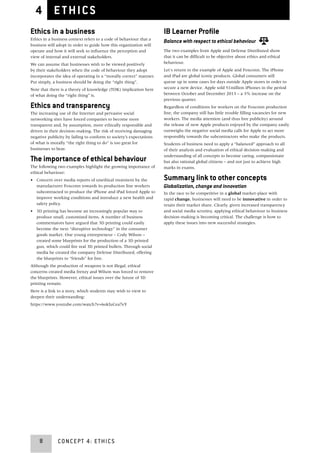
8 C ON C E P T 4 : E T H I C S
Ethics in a business
Ethics in a business context refers to a code of behaviour that a
business will adopt in order to guide how this organization will
operate and how it will seek to inuence the perception and
view of internal and external stakeholders.
W
e can assume that businesses wish to be viewed positively
by their stakeholders when the code of behaviour they adopt
incorporates the idea of operating in a “morally correct” manner
.
Put simply
, a business should be doing the “right thing”.
Note that there is a theory of knowledge (TOK) implication here
of what doing the “right thing” is.
Ethics and transparency
The increasing use of the Internet and pervasive social
networking sites have forced companies to become more
transparent and, by assumption, more ethically responsible and
driven in their decision-making. The risk of receiving damaging
negative publicity by failing to conform to society’
s expectations
of what is morally “the right thing to do” is too great for
businesses to bear
.
The impor tance of ethical behaviour
The following two examples highlight the growing importance of
ethical behaviour:
• Concern over media reports of unethical treatment by the
manufacturer Foxconn towards its production line workers
subcontracted to produce the iPhone and iPad forced Apple to
improve working conditions and introduce a new health and
safety policy
.
• 3D printing has become an increasingly popular way to
produce small, customized items. A number of business
commentators have argued that 3D printing could easily
become the next “disruptive technology” in the consumer
goods market. One young entrepreneur – Cody Wilson –
created some blueprints for the production of a 3D printed
gun, which could re real 3D printed bullets. Through social
media he created the company Defense Distributed, offering
the blueprints to “friends” for free.
Although the production of weapons is not illegal, ethical
concerns created media frenzy and Wilson was forced to remove
the blueprints. However
, ethical issues over the future of 3D
printing remain.
Here is a link to a story
, which students may wish to view to
deepen their understanding:
https://www
.youtube.com/watch?v=6okfuCea7eY
IB Learner Prole
Balance with respect to ethical behaviour
The two examples from Apple and Defense Distributed show
that it can be difcult to be objective about ethics and ethical
behaviour
.
Let's return to the example of Apple and Foxconn. The iPhone
and iPad are global iconic products. Global consumers still
queue up in some cases for days outside Apple stores in order to
secure a new device. Apple sold 51million iPhones in the period
between October and December 2013 – a 3% increase on the
previous quarter
.
Regardless of conditions for workers on the Foxconn production
line, the company still has little trouble lling vacancies for new
workers. The media attention (and thus free publicity) around
the release of new Apple products enjoyed by the company easily
outweighs the negative social media calls for Apple to act more
responsibly towards the subcontractors who make the products.
Students of business need to apply a “balanced” approach to all
of their analysis and evaluation of ethical decision-making and
understanding of all concepts to become caring, compassionate
but also rational global citizens – and not just to achieve high
marks in exams.
Summary link to other concepts
Globalization, change and innovation
In the race to be competitive in a global market-place with
rapid change, businesses will need to be innovative in order to
retain their market share. Clearly
, given increased transparency
and social media scrutiny
, applying ethical behaviour to business
decision-making is becoming critical. The challenge is how to
apply these issues into new successful strategies.
E T H I C S
4
16.
9
C O NC E P T 5 : S T R A T E G Y
There are many different denitions of the terms “strategy”
and “strategic management”. At this early stage of the Business
Management Study Guide, we can dene strategy as a coordinated
plan developed by senior managers involving all aspects of the
business such as marketing, nance, operations and human
resources (HR) to move a business towards a new goal or
objective.
New goals set should be considered to be SMART
:
• specic
• measurable
• achievable
• realistic
• time bound (to be accomplished within an agreed time
frame).
IB Learner Prole
Knowledgeable and open-minded
The four previous concepts link clearly with strategy
. For
example, the rapid pace of globalization and accelerated
change has meant that businesses have to be more innovative
to compete with hyper-competition and, given increased
transparency
, have to be perceived as more ethical in their
business operations than ever before. Consequently
, new
strategic decisions need to be made toallow businesses to ensure
economic sustainability and growth.
However
, it would be wrong to assume that strategic decision-
making is wholly focused on delivering growth in sales revenue
or the creation of new products. Businesses in the 21st century
are now having to consider and implement new strategies
affecting production, nance, marketing and HR management.
Consequently
, there is a much higher degree of business
complexity in decision-making than ever before.
A new way of thinking about strategy
There are a number of strategic decision-making tools that
businesses can use to develop a coordinated plan to achieve
a new goal. These will be covered in the content section of
this guide. However
, we should look to the future given the
enormous changes we have already said are taking place.
In their book Blue Ocean Strategy (2005) W Chan Kim and Renee
Mauborgne argue that a successful strategic plan is not about
competing in existing saturated markets (a plan they call a
“red ocean” strategy). They believe that the key for businesses
operating in a global market with hyper-competition is to
develop a new “blue ocean” strategy: a plan that attempts to
make the competition irrelevant.
They provide a compelling example of blue ocean strategy using
the organization Cirque du Soleil (Chan Kim and Mauborgne,
2005). Guy Laliberte created Cirque du Soleil at a time when the
external factors surrounding the opportunities for circus-style
entertainment were very unfavourable.
External factors acting as a threat to Cirque du Soleil included
the following:
• There were several competing entertainment options such as
home video, DVD and games such as PlayStations. (Online
gaming was not as big a threat as it would be now
.)
• Decreasing revenue and prots were being earned by the
existing rms, such as Ringling Brothers and Barnum &
Bailey
, who also had signicant brand awareness.
• There had been a dramatic change in social attitudes and
increased ethical concerns about animals being used in
circuses for entertainment purposes.
• The circus market was aimed at children with parents, who
found the cost of a family ticket compared to competing forms
of entertainment too expensive.
Cirque du Soleil decided not to try to compete with the existing
rms in what was clearly a very limited market space. Instead
they made the competition irrelevant by creating a new
experience featuring acrobats and human performers who
catered specically for adults, including the lucrative corporate
client market. Their shows were offered at a price several times
higher than that of traditional circuses.
Chan Kim and Mauborgne (2005) argue that the success of
Cirque du Soleil and its founder
, Guy Laliberte, was remarkable
because it was achieved in a declining market with limited
potential for growth and a set of unfavourable external factors.
In2014 Cirque du Soleil is the largest theatre production
company in the world with its new production based on the
music of Michael Jackson.
Concept 5 T
able 1 shows how Chan Kim and Mauborgne identify
the key ideas behind a blue ocean strategy compared to a red
ocean strategy
.
Red ocean Blue ocean
Compete in an existing
market-place
Create an uncontested
market-place
Exploit existing demand
Create and capture new
demand
Choose either differentiation
or low cost
Use differentiation and low
cost
Beat the competition
Make the competition
irrelevant
Concept 5 T
able 1 Differences between a red ocean strategy and
a blue ocean strategy (Chan Kim and Mauborgne, 2005)
Interested students may wish to look at the case studies of
Southwest Airlines (in the United States) and Y
ellowtail Wines
(in Australia) as examples of other successful blue ocean
strategies.
S T R A T E G Y
5
17.
10 C ON C E P T 6 : C U L T U R E
Culture is a difcult concept to dene and is often overlooked.
Culture can be explained as either of the following:
• the way we do things in our business
• the beliefs, values and norms within a business that dene
communication, working relationships and motivation
between internal stakeholders.
Professor Mike W
est from the University of Lancaster
, UK has
stressed the importance of organizational culture in achieving
business success. In research quoted in Henderson, Thompson
and Henderson (2006), he found the following in a study of 100
businesses over an eight-year period:
• Organizational strategy accounted for 2% of performance
variability (i.e. how well the business performed when its
actual performance was compared to what was expected).
• Organizational culture accounted for 17%.
His conclusion was that even with the best strategy in the world,
a business would underperform without a supportive culture.
Culture in a business drives performance.
Henderson, Thompson and Henderson argue that W
est’
s analysis
shows that “the role of leaders today should be primarily
focused on the effective alignment of the company culture
to the organization’
s strategies and not the other way round”
(2006). W
e will see the importance of this point when we look at
organizational culture in more detail in unit 2.5.
IB Learner Prole
Critical thinker on a organization’
s culture
What would your opinion be of a company that has the following
poster or noticeboard displayed in its reception area and stating
its culture?
• Communication: to talk and listen. Information is meant to
move people.
• Respect ourselves: no abusive or disrespectful treatment.
• Integrity: we work with customers openly
, honestly and
sincerely
.
• Excellence: we will do the very best in what we do and have
fun.
Y
our instant reaction would probably be favourable. Y
ou would
think that this would be a valued, ethical place in which to work
with a culture of listening and responding to stakeholders in a
positive manner
.
This culture statement appeared in the reception room of Enron.
The company was responsible for one of the most infamous fraud
and deception cases of modern times, the impact of which is still
being felt.
Recommended learning
W
atch the lm “Enron – the Smartest Guys in the Room”
(available on Y
ouT
ube) to learn more about the Enron
scandal.
Marketing and cultural issues in a
global contex t
The importance of cultural intelligence (CQ)
The denition of culture is broadened on the IB Business
Management course to include external stakeholders, especially
if businesses wish to locate their operations overseas. The “quick
start” guide introduced the term of “cultural intelligence” (CQ)
which requires that a business conducts a full investigation into
the cultural norms and backgrounds of consumers, suppliers,
government, etc. to allow it to operate more effectively in
a new region. As we shall see, CQ can prevent some of the
embarrassments in marketing that have occurred when businesses
fail to investigate their new cultural market-place effectively
.
Consider some the following cultural mistakes that were made by
successful businesses operating in a global market-place:
• In the UK, the V
auxhall Nova was a successful small family
car
. When it was launched in Spain, the original name was
used. The car was not successful because in Spanish “Nova”
means “No go”.
• Managers at one US company were startled when they
discovered that the brand name of the cooking oil they
were marketing in a Latin American country translated into
Spanish as “Jackass Oil”.
• A sales manager in Hong Kong tried to control employees’
punctuality at work. He insisted they come to work on
time instead of 15 minutes late as was their custom. They
complied, but then left exactly on time instead of working
into the evening as they previously had done. Much work was
left unnished until the manager relented and they returned
to their usual time schedule.
• During business negotiations a US business person refused
an offer of a cup of coffee from a Saudi businessman. Such a
rejection is considered very rude and the negotiations were
stalled.
• Kellogg had to rename its Bran Buds cereal in Sweden when
it discovered that the name roughly translated to ”burned
farmer”.
• One company printed the “OK” nger sign on each page of its
catalogue. In many parts of Latin America this is considered
an obscene gesture.
• Six months of work were lost when Pepsico advertised Pepsi
in T
aiwan with the advertisement “Come alive with Pepsi”.
The company had no idea that it would be translated into
Chinese as “Pepsi brings your ancestors back from the dead”.
Such a statement would be very offensive.
As we stated above, culture should not be overlooked.
C U L T U R E
6
18.
11
INTRODUCTION TO BUSINESSMANAGEMENT
1 .1 INTRODUCTION TO BUSINESS MANAGEMENT
Before we begin our study an important question to ask is:
What is a business?
Given the signicant impact of the Internet and world wide web
and the subsequent growth of new business start-ups, dening a
business can prove quite difcult. A traditional denition would
look something like this:
A business is an entity that tries to combine human, physical and
nancial resources into processing goods orservices to respond to and
satisfy customer needs.
However
, with the growth of the world wide web there are
a number of examples of businesses (Facebook, Google and
T
witter), which, apart from their head ofce, do not exist in the
physical sense, but online instead.
It is also possible with a laptop and a secure Internet connection
to create an online business with no additional human resources
and at very little or nocost. W
e must also remember that despite
the impact of large multinational and global brands, the majority
of businesses in both the developed and developing world are
classed as small.
The traditional idea that a business must contain a production
or operations division with marketing, nance and human
resources (HR) departments is also being challenged. The rise of
outsourcing and offshoring has led to a number of companies
now having their production or distribution facilities (loosely
termed the “supply chain”) located well away from head ofce.
IB Learner Prole
Inquirers and managing risk
A fundamental point, which is often missed by students, is that
the creation of any business relies heavily on the ability of the
entrepreneur to calculate and manage risk. W
e must not forget
that the creation of a business involves considerable opportunity
costs when combining human and nancial resources.
As part of your study
, research some successful global
entrepreneurs from the developing and developed world and
investigate their attitudes to risk-taking. Y
ou should consider the
entrepreneurs’ successes and their failures as both provide rich
learning experiences.
Business depar tments (AO2)
Role and contribution to overall business activity (AO2)
Whatever the size of organization, we typically see four main
departments:
• The production or operations management department is
concerned with the manufacturing of the product in the case
of goods, or with delivery and execution of a service.
• The marketing department will have responsibility for
developing customer interest and awareness as the good or
service is launched into the market-place and for monitoring
its ongoing performance.
• The nance and accounts department is designed to manage
and report on the economic sustainability of a business.
• The HR department is responsible for ensuring that employees
are organized to allow a business to achieve its objects and
determine the appropriate culture for an organization.
These areas and roles are inter-related, for example as described
below
.
Operations management, marketing and nance
• A new T
-shirt manufacturing company has a very successful
domestic product but no nance to promote or distribute this
into an overseas market.
• The marketing staff of a fast-food company become very
excited about the possibility of a zero saturated-fat French fry
but the production department does not have the knowledge,
technology or nancial resources to create this.
HR and operations management
• A shortage of skilled labour forces a technology company to
relocate its main production facility to another country
.
• A successful start-up, which is growing quickly in its domestic
market, is unable to recruit enough suitable sales staff to
handle customer enquiries.
These examples highlight one key aspect facing all businesses.
They must successfully manage and coordinate all departments in
order to satisfy consumer wants and needs and be economically
sustainable.
Business sectors (AO2)
Primary, secondary, ter tiary and quaternary
sectors (AO2)
W
e can classify business activity into four areas:
• The primary sector is concerned with extraction of natural
resources such as agricultural products or fossil fuels.
• The secondary sector includes construction and manufacturing
processes, for example by transforming raw materials
extracted from the primary sector into nished products.
• The tertiary sector includes various providers of skills or
services for business. For example, a provider of nancial
services, an electrician and a delivery company would be
classied as being part of the tertiary sector
.
• The quaternary sector is a recent classication used as a way
to describe a knowledge-based part of the economy which
typically includes services such asinformationgeneration
and sharing,information technology (IT), consultation,
education,research and development,nancial planning, and
other knowledge-based services.
It is expected, given the rate of technological change in the
developed world, that the quaternary and knowledge sectors
of the economy will become the most important in generating
growth. This has a huge implication for stakeholders in these
countries, as we shall see in this guide.
Impact of sectoral change on business
activity (AO2)
In the developed world the share or percentage of both the
primary and secondary sectors’ activity towards an economy’
s
total output has been decreasing. The tertiary and quaternary
sectors’ contribution has risen. For developing countries, the
trend from data published by the Organisation for Economic
Co-operation and Development (OECD) reveals that
manufacturing remains the most important sector
, especially
inChina and India. These changes in the economic structure
ofthe economy have signicant implications for business
decision-making and activity
.
For most of the developed world, this process is called de-
industrialization. A full discussion of this is beyond the scope
of this guide. However
, the combination of de-industrialization
and globalization has had profound effects on HR planning,
production and marketing. It has also had an impact on
organizational structure and culture and on decision-making,
stakeholder activity and objectives.
19.
12 INTRODUCTION TOBUSINESS MANAGEMENT
Entrepreneurship and
intrapreneurship (AO3)
Role of entrepreneurship and intrapreneurship (AO3)
The success of Facebook, Google, Apple and App developers
such as WhatsApp and Flappy Birds has brought renewed media
attention in 2014 on the importance of entrepreneurship in
creating new needs and thereby new business start-ups.
Entrepreneurship should be viewed as a dynamic activity that
centres around skills such as resilience, creativity and risk-
taking. In short, entrepreneurship is having the courage to turn
ideas into action leading to products and services which are
economically sustainable.
MOVIE RESOURCE
Individuals who gave up stable incomes in larger organizations
to pursue their passion and interests to, in the words of Steve
Jobs, put a “ding in the universe” started all of the businesses
mentioned above. The 2013 movie “Jobs” clearly illustrates
the challenges new business start-ups face, especially in the
rst difcult years where nance is difcult to obtain.
Intrapreneurship
Organizations seeing the success of instant messaging Apps such as
WhatsApp created by two young entrepreneurs (one of whom was
rejected by Facebook as a potential employee) are now looking
inward within their own organizations to see if they can create
the conditions that allow creativity and innovation to thrive.
Given the need for innovation in companies that is driven by
the rapid changes in technology and globalization reducing
barriers to entry in global markets, the new business term
“intrapreneurship” has been developed which looks at resilience,
creativity and risk-taking within an existing organization
IB Learner Prole
Knowledgeable
Link to concept 2: Change
As we saw with Gary Hamel’
s Y
ouT
ube clip (details in concept2:
Change, page 6), companies such as HCL technologies in India
and, more famously
, Google allow their employees time (20%
of their time in Google’
s case) and the autonomy to work on
projects of interest as long as the results are shared with the
senior management team. This autonomy is a key driver in
Daniel Pink’
s theory of motivation, which we will see in unit 2.4
when we look at non-nancial motivation.
Entrepreneurship and intrapreneurship: compare
and contrast
An entrepreneuris someone who, through his or her skills
and passion, creates a business and is willing to take full
accountability for its success or failure. An intrapreneur
, on the
other hand, is someone who utilizes his or her skill, passion and
innovation tomanage or create something useful for someone
else’
s business – with entrepreneurial enthusiasm.
Though both are visionary
, it is the entrepreneur who spots an
opportunity in the market-place and has the courage and desire
to turn this opportunity into a business.In contrast, however
, the
intrapreneur uses his or her passion, drive and skills to manage
the business or create something new and useful for the business.
The main difference between an entrepreneur and an
intrapreneur is that an entrepreneur has the freedom to act on
his or her whim, whereas an intrapreneur may need to ask for
managers’ approval to make changes in the company’
s processes,
product design or just about any innovation he or she needs to
implement. Since an intrapreneur acts on innovative impulses,
this may result in conict within the organization. It is important
for organizations that are implementing intrapreneurship to
create an atmosphere of mutual respect among employees.
When it comes to resources, the intrapreneur holds an advantage
over the entrepreneur since the company’
s resources are readily
available to him or her
. Conversely
, an entrepreneur has the difcult
task of sourcing funding and resources on his or her own.
What makes entrepreneurs and intrapreneurs similar is their
passion to see things through to the end and their courage to face
failure.
Source: Adapted from www
.ourknowledge.asia/1/post/2012/05/
entrepreneur-or-intrapreneur-whats-the-difference.html
Reasons for setting up a business (AO2)
W
e can summarize and explain some of the key reasons why any
individuals would want to set up their own business:
• They might want to become artistically and nancially
independent. This may be important for those who live in a
rural rather than urban area.
• They might want to take the opportunity to pursue a passion
or transform a hobby into an economically sustainable
business.
• They can exercise a degree of control over their future,
which they might particularly value if they have been made
redundant by an organization.
• Having identied a market opportunity where customer needs
have not been satised, an entrepreneur would wish to take a
risk with a desire to full those needs protably
.
• Another reason might be the ease with which it is possible to
set up a new business in particular country
.
The last point may seem slightly odd. However
, a key factor in
the decision-making process about starting a new business may
be the bureaucratic hurdles one has to go through in order to
register a new start-up; the idea being that the less time and
paperwork required to set up a new business, the more an
entrepreneur will be encouraged to do so. Consider T
able 1.1.1
which shows data about procedures in some countries.
Country Number of
procedures to
register a new
company
, 2004
Number of
days taken
for each
procedure, 2004
New Zealand 2 12
United States 5 5
Singapore 7 8
United Kingdom 6 18
Kazakhstan 9 25
Nigeria 10 44
China 12 41
Paraguay 17 74
Indonesia 12 151
20.
13
INTRODUCTION TO BUSINESSMANAGEMENT
Country Number of days to register
a new company
, 2014
Australia 1
New Zealand 1
Zimbabwe 90
Laos 92
Hong Kong 3
Brunei 101
Singapore 3
Canada 5
Brazil 119
Canada 5
V
enezuela 144
Congo-Brazzaville 161
Iceland 5
Portugal 5
Suriname 694
T
able 1.1.1 Data on procedures when setting up a business in
selected countries
Source: Adapted from The Economist: Business Miscellany
, 2005 and
Pocket World in Figures 2014
IB Learner Prole
Inquiry
Research the number of days it takes to register a company in
your country (your own country and your country of study
if different) and reect on what impact this has on the rate of
entrepreneurship in the country
. Is there a strong relationship?
Problems a star t-up may face (AO2)
W
e can identify and explain a number of problems. The type of
economy the business resides in and the state of the external
environment may pose problems for start-ups. Both of these
factors are of course outside the control of the individual rm.
W
e can also identify the following problems that a business start-
up may face:
• Lack of initial nance is often a problem. A start-up is unlikely
to be fully nanced at the beginning of its life and will see cash
outows leaving the business many days or months before
cash ows in.
• The owner of a start-up may have knowledge and entrepreneurial
enthusiasm for the product or service but may lack the ability
to prepare and monitor nancial accounts, organize suitable
promotional activities or delegate responsibilities. This multi-
tasking aspect is difcult for a one-person sole trader
.
• Incorrect pricing in the short run will lead to lower than
forecasted sales with a further impact on the amount of cash
the business receives.
• The need for clear
, accurate and unbiased market research
to guide pricing and promotion of a new product or service
is overwhelming but new start-ups may not be able to afford
independent objective market research provided by specialist
agencies.
• The role of venture capital and technology start-ups has posed
the following problems. During the dot.com boom of the late
1990s, venture capital poured into Internet start-ups at an
unsustainably fast pace. This capital demanded a quick return or
it would be removed and invested in “the next big thing”. This
external pressure, without allowing time for the business to build
a customer base in an increasingly competitive market, led to
many start-ups failing and becoming economically unsustainable.
Reecting on the news in February 2014, with Facebook having
just paid US$23 billion for WhatsApp, some commentators are
asking if we have reached another turning point in the growth
of the new dot.com or technological boom. The successful initial
public offerings (IPOs) of T
witter and Candy Crush do support
the theory that once again we have entered a social media and
gaming investment boom.
IB Learner Prole
Balanced
W
e must remember that the issues facing all new start-ups
depend on whether the business operates in the developed
or developing world. Some of the issues will be identical but
some will be completely different depending on the economy
concerned. Check to make sure that you have the correct context
for your answer
.
Elements of a business plan (AO2)
Any business start-up will need a business plan. The type of
plan presented will of course depend on satisfying a particular
objective.
In the case of Coffee Republic, a new coffee start-up in the UK,
the need for a business plan was to secure funding to launch the
rst coffee bar
. The owners also had growth plans to open other
coffee bars if the rst one was successful.
In 1995, Sahar and Bobby Hashemi decided to set up a coffee and
espresso bar in London. Without any previous business start-up
experience, they described their “journey” in a best-selling book
(2003) Their business plan, which was delivered to their bank
and to prospective investors, ran to over 20 pages.
They identied a number of elements that a business plan should
have:
• The aims of the business must be clearly stated.
• The business plan must include details of existing and
potential competition.
• The amount of funding required must be stated, with a time
line illustrating how the funding would be used to generate
favourable trading options.
• Details must be given of nance needed under different
scenarios if external factors move against the new start-up.
• Time lines for implementation and action to review aims if
forecasts are not met must be outlined.
• A comprehensive marketing plan with sales forecasts must be
included.
• A projected prot and loss account and cash ow forecast
must be presented.
Source: Adapted from Hashemi and Hashemi, 2003.
Note that the above example was fora new business start-up.
Other business plans drawn up by existing organizations may be
driven by different objectives, for example to change an existing
strategy or to restructure operations, and in fact a wholerange
of other possibilities. The elements contained in these plans will
need to be adjusted accordingly
.
place a processionof shepherds in the park; Easter Monday is a day
given up to rural festivity; the 19th of March St. José’s Day—is a
universal fête, hardly a family in Spain without a José among its
number. The first Sunday in May is a feast of flowers and poetic
competitions; the days consecrated to St. Juan and St. Pedro are
public holidays, patronized by enormous numbers of country-folks;
All Saints’ and All Souls’ Days are given up, as we have seen, to
alternate devotion and festivity. On the 20th of December is
celebrated the Feast of the Nativity, the fair and the displays of the
shops attracting strangers from all parts. But it is especially the days
sacred to the Virgin that are celebrated by all classes. Balls,
banquets, processions, miracle-plays, illuminations, bull-fights,
horse-races, scholastic fêtes, industrial exhibitions, civic ceremonial,
besides solemn services, occupy old and young, rich and poor.
Feasting is the order of the day, and the confectioners’ windows are
wonderful to behold.
Although many local customs are dying out, we may still see some
of the curious street sights described by Ford fifty years ago, and the
Mariolatry he deplored is still as active as ever. The goodly show of
dainties in the shops, however, belie his somewhat acrimonious
description of a Spanish reception. “Those who receive,” he wrote,
“provide very little refreshment unless they wish to be covered with
glory; space, light, and a little bad music, are sufficient to amuse
these merry, easily-pleased souls, and satisfy their frugal bodies. To
those who, by hospitality and entertainment, can only understand
eating and drinking—food for man and beast—such hungry
proceedings will be more honored in the breach than in the
observance; but these matters depend much on latitude and
longitude.” Be this as it may, either the climate of Barcelona has
changed, or international communication has revolutionized Spanish
digestion. Thirty years ago, when travelling in Spain, it was no
unusual sight to see a spare, aristocratic hidalgo enter a restaurant,
and, with much form and ceremony, breakfast off a tiny omelette.
Nowadays we find plenty of Spanish guests at public ordinaries
doing ample justice to a plentiful board. English visitors in a Spanish
23.
house will notonly get good music, in addition to space and light,
but abundant hospitality of material sort.
The Spain of which Ford wrote so humorously, and, it must be
admitted, often so maliciously, is undergoing slow, but sure,
transformation. Many national characteristics remain—the passion
for the brutal bull-fight still disgraces a polished people, the women
still spend the greater portion of their lives in church, religious
intolerance at the beginning of the twentieth century must be laid to
the charge of a slowly progressive nation. On the other hand, and
nowhere is the fact more patent than at Barcelona, the great
intellectual and social revolution, described by contemporary Spanish
novelists, is bringing the peninsula in closer sympathy with her
neighbors. Many young Spaniards, for instance, are now educated in
England, English is freely spoken at Malaga, and its literature is no
longer unknown to Spanish readers. These facts indicate coming
change. The exclusiveness which has hitherto barred the progress of
this richly-dowed and attractive country is on the wane. Who shall
say? We may ere long see dark-eyed students from Barcelona at
Girton College, and a Spanish society for the protection of animals
prohibiting the torture of bulls and horses for the public pleasure.
Already—all honor to her name—a Spanish woman novelist, the
gifted Caballero, has made pathetic appeals to her country-folks for
a gentler treatment of animals in general. For the most part, it must
be sadly confessed, in vain!
In spite of its foremost position, in intellectual and commercial pre-
eminence, Barcelona has produced no famous men. Her noblest
monument is raised to an alien; Lopez, a munificent citizen, honored
by a statue, was born at Santander. Prim, although a Catalan, did
not first see the light in the capital. By some strange concatenation
of events, this noble city owes her fame rather to the collective
genius and spirit of her children than to any one. A magnanimous
stepmother, she has adopted those identified with her splendor to
whom she did not herself give birth.
24.
Balzac wittily remarksthat the dinner is the barometer of the family
purse in Paris. One perceives whether Parisians are flourishing or no
by a glance at the daily board. Clothes afford a nice indication of
temperature all the world over. We have only to notice what people
wear, and we can construct a weather-chart for ourselves. Although
the late autumn was, on the whole, favorable, I left fires, furs, and
overcoats in Paris. At Lyons, a city afflicted with a climate the proper
epithet of which is “muggy,” ladies had not yet discarded their
summer clothes, and were only just beginning to refurbish felt hats
and fur-lined pelisses.
At Montpellier the weather was April-like—mild, blowy, showery;
waterproofs, goloshes, and umbrellas were the order of the day. On
reaching Barcelona I found a blazing sun, windows thrown wide
open, and everybody wearing the lightest garments. Such facts do
duty for a thermometer.
Boasting, as it does of one of the finest climates in the world, natural
position of rare beauty, a genial, cosmopolitan, and strikingly
handsome population, and lastly, accessibility, Barcelona should
undoubtedly be a health resort hardly second to Algiers. Why it is
not, I will undertake to explain.
In the first place, there is something that invalids and
valetudinarians require more imperatively than a perfect climate.
They cannot do without the ministrations of women. To the
suffering, the depressed, the nervous, feminine influence is ofttimes
of more soothing—nay, healing—power than any medical
prescription.
Let none take the flattering unction to their souls—as well look for a
woman in a Bashaw’s army, or on a man-of-war, as in the palatial,
well-appointed, otherwise irreproachable hotels of Barcelona! They
boast of marble floors, baths that would not have dissatisfied a
Roman epicure, salons luxurious as those of a West-end club,
newspapers in a score of languages, a phalanx of gentlemanly
waiters, a varied ordinary, delicious wines, but not a daughter of
25.
Eve, old oryoung, handsome or ugly—if, indeed, there exists an ugly
woman in Barcelona—to be caught sight of anywhere! No charming
landlady, as in French hotels, taking friendliest interest in her guests,
no housemaids, willing and nimble as the Marys and Janes we have
left at home, not even a rough, kindly, garrulous charwoman
scrubbing the floors. The fashionable hotel here is a vast barrack
conducted on strictly impersonal principles. Visitors obtain their
money’s worth, and pay their bills. There the transaction between
innkeeper and traveller ends.
Good family hotels or “pensions,” in which invalids would find a
home-like element, are sadly needed in this engaging, highly-favored
city. The next desideratum is a fast train from Port Bou—the first
Spanish town on the frontier. An express on the Spanish line would
shorten the journey to Lyons by several hours. New carriages are
needed as much as new iron roads. Many an English third-class is
cleaner and more comfortable than the so-called “first” here. It must
be added that the officials are all politeness and attention, and that
beyond slowness and shabbiness the traveller has nothing to
complain of. Exquisite urbanity is still a characteristic of the
Barcelonese as it was in the age of Cervantes. One exception will be
mentioned farther on.
If there are no women within the hotel walls—except, of course,
stray lady tourists—heaven be praised, there are enough, and to
spare, of most bewitching kind without. Piquancy is, perhaps, the
foremost charm of a Spanish beauty, whether a high-born señora in
her brougham, or a flower-girl at her stall. One and all seem born to
turn the heads of the other sex, after the fashion of Carmen in
Merimée’s story. Nor is outward attraction confined to women. The
city police, cab-drivers, tramway-conductors, all possess what
Schopenhauer calls the best possible letter of introduction, namely,
good looks.
The number of the police surprise us. These bustling, brilliant
streets, with their cosmopolitan crowds, seem the quietest, most
orderly in the world. It seems hard to believe that this tranquillity
26.
and contentment shouldbe fallacious—on the surface only. Yet such
is the case, as shown by the recent outbreak of rioting and
bloodshed.
“I have seen revolution after revolution,” said to me a Spanish
gentleman of high position, an hidalgo of the old school; “I expect to
see more if my life is sufficiently prolonged. Spain has no
government; each in power seeks but self-aggrandizement. Our
army is full of Boulangers, each ready to usurp power for his own
ends. You suggest a change of dynasty? We could not hope to be
thereby the gainers. A Republic, say you? That also has proved a
failure with us. Ah, you English are happy; you do not need to
change abruptly the existing order of things, you effect revolutions
more calmly.”
I observed that perhaps national character and temperament had
something to do with the matter. He replied very sadly, “You are
right; we Southerners are more impetuous, of fiercer temper.
Whichever way I look, I see no hope for unhappy Spain.”
Such somber reflections are difficult to realize by the passing
traveller. Yet, when we consider the tremendous force of such a city
as Barcelona, its progressive tendencies, its spirit of scientific inquiry,
we can but admit that an Ultramontane regency and reactionary
government must be out of harmony with the tendencies of modern
Spain.
There is only one occupation which seems to have a deteriorating
effect upon the Spanish temper. The atmosphere of the post-office,
at any rate, makes a Catalan rasping as an east wind, acrimonious
as a sloe-berry. I had been advised to provide myself with a passport
before revisiting Spain, but I refused to do so on principle.
What business have we with this relic of barbarism at the beginning
of the twentieth century, in times of peace among a friendly people?
The taking a passport under such circumstances seemed to me as
much of an anachronism as the wearing of a scapular, or seeking the
27.
royal touch forscrofula. By pure accident, a registered letter
containing bank notes was addressed to me at the Poste Restante.
Never was such a storm in a teacup, such groaning of the mountain
before the creeping forth of a tiny mouse! The delivery of registered
letters in Spain is accompanied with as much form as a marriage
contract in France. Let future travellers in expectation of such
documents provide themselves, not only with a passport, but a copy
of their baptismal register, of the marriage certificate of their
parents, the family Bible—no matter its size—and any other proofs of
identity they can lay hands upon. They will find none superfluous.
A
Its Greek foundersand early history—
Superb view from the sea—The
Cannebière—The Parado and
Chemin de la Corniche—Château d’If
and Monte-Cristo—Influence of the
Greeks in Marseilles—Ravages by
plague and pestilence—Treasures of
the Palais des Arts—The chapel of
Notre Dame de la Garde—The new
Marseilles and its future.
BOUT six hundred years before the birth of Christ, when the
Mediterranean, ringed round with a long series of commercial
colonies, was first beginning to transform itself with marvelous
rapidity into “a Greek lake,” a body of adventurous Hellenic mariners
—young Columbuses of their day—full of life and vigor, sailed forth
from Phocæa in Asia Minor, and steered their course, by devious
routes, to what was then the Far West, in search of a fitting and
unoccupied place in which to found a new trading city. Hard pressed
by the Persians on their native shore, these free young Greeks—the
Pilgrim Fathers of modern Marseilles—left behind for ever the city of
their birth, and struck for liberty in some distant land, where no
Cyrus or Xerxes could ever molest them. Sailing away past Greece
and Sicily, and round Messina into the almost unknown Tyrrhenian
Sea, the adventurous voyagers arrived at last, after various false
starts in Corsica and elsewhere, at some gaunt white hills of the
Gaulish coast, and cast anchor finally in a small but almost land-
locked harbor, under the shelter of some barren limestone
mountains. Whether they found a Phœnician colony already
established on the spot or not, matters as little to history nowadays
as whether their leaders’ names were really Simos and Protis or
quite otherwise. What does matter is the indubitable fact that
Massalia, as its Greek founders called it, preserved through all its
early history the impress of a truly Hellenic city; and that even to
30.
this moment muchgood Greek blood flows, without question, in the
hot veins of all its genuine native-born citizens.
The city thus founded has had a long, a glorious, and an eventful
history. Marseilles is to-day the capital of the Mediterranean, the true
commercial metropolis of that inland sea which now once more has
become a single organic whole, after its long division by the
Mohammedan conquest of North Africa and the Levant into two
distinct and hostile portions. Naples, it is true, has a larger
population; but then, a population of Neapolitan lazzaroni, mere
human drones lounging about their hive and basking in the sunlight,
does not count for much, except for the macaroni trade. What
Venice once was, that Marseilles is to-day; the chief gate of
Mediterranean traffic, the main mart of merchants who go down in
ships on the inland sea. In the Cannebière and the Old Port, she
possesses, indeed, as Edmond About once graphically phrased it,
“an open door upon the Mediterranean and the whole world.” The
steamers and sailing vessels that line her quays bind together the
entire Mediterranean coast into a single organic commercial whole.
Here is the packet for Barcelona and Malaga; there, the one for
Naples, Malta, and Constantinople. By this huge liner, sunning
herself at La Joliette, we can go to Athens and Alexandria; by that,
to Algiers, Cagliari, and Tunis. Nay, the Suez Canal has extended her
bounds beyond the inland sea to the Indian Ocean; and the Pillars of
Hercules no longer restrain her from free use of the great Atlantic
water-way. You may take ship, if you will, from the Quai de la
Fraternité for Bombay or Yokohama, for Rio or Buenos Ayres, for
Santa Cruz, Teneriffe, Singapore, or Melbourne. And this wide
extension of her commercial importance Marseilles owes, mainly no
doubt, to her exceptional advantages of natural position, but largely
also, I venture to think, to the Hellenic enterprise of her acute and
vigorous Græco-Gaulish population.
And what a marvelous history has she not behind her! First of all, no
doubt, a small fishing and trading station of prehistoric Gaulish or
Ligurian villagers occupied the site where now the magnificent
31.
façade of theBourse commemorates the names of Massalia’s
greatest Phocæan navigators. Then the Phœnicians supervened
upon the changeful scene, and built those antique columns and
forgotten shrines whose scanty remains were recently unearthed in
the excavations for making the Rue de la République. Next came the
early Phocæan colonists, reinforced a little later by the whole
strength of their unconquerable townsmen, who sailed away in a
body, according to the well-known legend preserved in Herodotus,
when they could no longer hold out against the besieging Persian.
The Greek town became as it were a sort of early Calcutta for the
Gaulish trade, with its own outlying colonies at Nice, Antibes, and
Hyères, and its inland “factories” (to use the old familiar Anglo-
Indian word) at Tarascon, Avignon, and many other ancient towns of
the Rhône valley. Her admirals sailed on every known sea:
Euthymenes explored the coasts of Africa as far as Senegal; Pytheas
followed the European shore past Britain and Ireland to the north of
the Shetlands. Till the Roman arrived upon the Gaulish coast with his
dreaded short-sword, Massalia, in short, remained undisputed queen
of all the western Mediterranean waters.
Before the wolf of the Capitol, however, all stars paled. Yet even
under the Roman Empire Massilia (as the new conquerors called the
name, with a mere change of vowel) retained her Greek speech and
manners, which she hardly lost (if we may believe stray hints in later
historians) till the very eve of the barbarian invasion. With the period
of the Crusades, the city of Euthymenes became once more great
and free, and hardly lost her independence completely up to the age
of Louis XIV. It was only after the French Revolution, however, that
she began really to supersede Venice as the true capital of the
Mediterranean. The decline of the Turkish power, the growth of trade
with Alexandria and the Levant, the final crushing of the Barbary
pirates, the conquest of Algeria, and, last of all, the opening of the
Suez Canal—a French work—all helped to increase her commerce
and population by gigantic strides in half a dozen decades. At the
present day Marseilles is the chief maritime town of France, and the
acknowledged center of Mediterranean travel and traffic.
32.
The right wayfor the stranger to enter Marseilles is, therefore, by
sea, the old-established high road of her antique commerce. The Old
Port and the Cannebière are her front door, while the railway from
Paris leads you in at best, as it were, through shabby corridors, by a
side entry. Seen from the sea, indeed, Marseilles is superb. I hardly
know whether the whole Mediterranean has any finer approach to a
great town to display before the eyes of the artistic traveller. All
round the city rises a semicircle of arid white hills, barren and bare
indeed to look upon; but lighted up by the blue Provençal sky with a
wonderful flood of borrowed radiance, bringing out every jutting
peak and crag through the clear dry air in distinct perspective. Their
sides are dotted with small square white houses, the famous
bastides or country boxes of the good Marseillais bourgeois. In front,
a group of sunlit rocky isles juts out from the bay, on one of which
tower the picturesque bastions of the Chateau d’If, so familiar to the
reader of “Monte-Cristo.” The foreground is occupied by the town
itself, with its forest of masts, and the new dome of its checkered
and gaudy Byzantine Cathedral, which has quite supplanted the old
cathedral of St. Lazare, of which only a few traces remain. In the
middle distance the famous old pilgrimage chapel of Notre Dame de
la Garde crowns the summit of a pyramidal hill, with its picturesque
mass of confused architecture. Away to right and left, those endless
white hills gleam on with almost wearying brightness in the sun for
miles together; but full in front, where the eye rests longest, the
bustle and commotion of a great trading town teem with varied life
upon the quays and landing-places.
If you are lucky enough to enter Marseilles for the first time by the
Old Port, you find yourself at once in the very thick of all that is most
characteristic and vivid and local in the busy city. That little oblong
basin, shut in on its outer side by projecting hills, was indeed the
making of the great town. Of course the Old Port is now utterly
insufficient for the modern wants of a first-class harbor; yet it still
survives, not only as a historical relic but as a living reality, thronged
even to-day with the crowded ships of all nations. On the quay you
may see the entire varied Mediterranean world in congress
33.
assembled. Here Greeksfrom Athens and Levantines from Smyrna
jostle cheek by jowl with Italians from Genoa and Arabs or Moors
from Tangier or Tunis. All costumes and all manners are admissible.
The crowd is always excited, and always animated. A babel of
tongues greets your ears as you land, in which the true Marseillais
dialect of the Provençal holds the chief place—a graceful language,
wherein the predominant Latin element has not even yet wholly got
rid of certain underlying traces of Hellenic origin. Bright color, din,
life, movement: in a moment the traveller from a northern climate
recognizes the patent fact that he has reached a new world—that
vivid, impetuous, eager southern world, which has its center to-day
on the Provençal seaboard.
34.
Go a yardor two farther into the crowded Cannebière, and the
difference between this and the chilly North will at each step be
forced even more strikingly upon you. That famous thoroughfare is
firmly believed by every good son of old Marseilles to be, in the
familiar local phrase, “la plus belle rue de l’univers.” My own
acquaintance with the precincts of the universe being somewhat
limited (I have never travelled myself, indeed, beyond the narrow
bounds of our own solar system), I should be loth to endorse too
literally and unreservedly this sweeping commendation of the
Marseillais mind; but as regards our modest little planet at least, I
certainly know no other street within my own experience (save
Broadway, New York) that has quite so much life and variety in it as
the Cannebière. It is not long, to be sure, but it is broad and airy,
and from morning till night its spacious trottoirs are continually
crowded by such a surging throng of cosmopolitan humanity as you
will hardly find elsewhere on this side of Alexandria. For
cosmopolitanism is the true key-note of Marseilles, and the
Cannebière is a road that leads in one direction straight to Paris, but
opens in the other direction full upon Algiers and Italy, upon Egypt
and India.
What a picture it offers, too, of human life, that noisy Cannebière!
By day or by night it is equally attractive. On it centers all that is
alive in Marseilles—big hotels, glittering cafés, luxurious shops,
scurrying drays, high-stepping carriage-horses, and fashionably-
dressed humanity; an endless crowd, many of them hatless and
bonnetless in true southern fashion, parade without ceasing its
ringing pavements. At the end of all, the Old Port closes the view
with its serried masts, and tells you the wherefore of this mixed
society. The Cannebière, in short, is the Rue de Rivoli of the
Mediterranean, the main thoroughfare of all those teeming shores of
oil and wine, where culture still lingers by its ancient cradle.
Close to the Quai, and at the entrance of the Cannebière, stands the
central point of business in new Marseilles, the Bourse, where the
filial piety of the modern Phocæans has done ample homage to the
35.
sacred memory oftheir ancient Hellenic ancestors. For in the place
of honor on the façade of that great palace of commerce the chief
post has been given, as was due, to the statues of the old
Massaliote admirals, Pytheas and Euthymenes. It is this constant
consciousness of historical continuity that adds so much interest to
Mediterranean towns. One feels as one stands before those two
stone figures in the crowded Cannebière, that after all humanity is
one, and that the Phocæans themselves are still, in the persons of
their sons, among us.
The Cannebière runs nearly east and west, and is of no great length,
under its own name at least; but under the transparent alias of the
Rue de Noailles it continues on in a straight line till it widens out at
last into the Allées de Meilhan, the favorite haunt of all the gossips
and quidnuncs of Marseilles. The Allées de Meilhan, indeed, form the
beau idéal of the formal and fashionable French promenade. Broad
avenues of plane trees cast a mellow shade over its well-kept walks,
and the neatest of nurses in marvelous caps and long silk streamers
dandle the laciest and fluffiest of babies, in exquisite costumes, with
ostentatious care, upon their bountiful laps. The stone seats on
either side buzz with the latest news of the town; the Zouave flirts
serenely with the bonnetless shop-girls; the sergeant-de-ville stalks
proudly down the midst, and barely deigns to notice such human
weaknesses. These Allées are the favorite haunt of all idle Marseilles,
below the rank of “carriage company,” and it is probable that Satan
finds as much mischief still for its hands to do here as in any other
part of that easy-going city.
At right angles to the main central artery thus constituted by the
Cannebière, the Rue de Noailles, and the Allées de Meilhan runs the
second chief stream of Marseillais life, down a channel which begins
as the Rue d’Aix and the Cours Belzunce, and ends, after various
intermediate disguises, as the Rue de Rome and the Prado. Just
where it crosses the current of the Cannebière, this polyonymous
street rejoices in the title of the Cours St. Louis. Close by is the place
where the flower-women sit perched up quaintly in their funny little
36.
pulpits, whence theyhand down great bunches of fresh dewy violets
or pinky-white rosebuds, with persuasive eloquence to the obdurate
passer-by. This flower-market is one of the sights of Marseilles, and I
know no other anywhere—not even at Nice—so picturesque or so
old-world. It keeps up something of the true Provençal flavor, and
reminds one that here, in this Greek colony, we are still in the midst
of the land of roses and of Good King René, the land of troubadours,
and gold and flowers, and that it is the land of sun and summer
sunshine.
As the Rue de Rome emerges from the town and gains the suburb, it
clothes itself in overhanging shade of plane-trees, and becomes
known forthwith as the Prado—that famous Prado, more sacred to
the loves and joys of the Marseillais than the Champs Elysées are to
the born Parisian. For the Prado is the afternoon-drive of Marseilles,
the Rotten Row of local equestrianism, the rallying-place and lounge
of all that is fashionable in the Phocæan city as the Allées de
Meilhan are of all that is bourgeois or frankly popular. Of course the
Prado does not differ much from all other promenades of its sort in
France: the upper-crust of the world has grown painfully tame and
monotonous everywhere within the last twenty-five years: all flavor
and savor of national costume or national manners has died out of it
in the lump, and left us only in provincial centers the insipid graces
of London and Paris, badly imitated. Still, the Prado is undoubtedly
lively; a broad avenue bordered with magnificent villas of the
meretricious Haussmannesque order of architecture; and it
possesses a certain great advantage over every other similar
promenade I know of in the world—it ends at last in one of the most
beautiful and picturesque sea-drives in all Europe.
This sea-drive has been christened by the Marseillais, with
pardonable pride, the Chemin de la Corniche, in humble imitation of
that other great Corniche road which winds its tortuous way by long,
slow gradients over the ramping heights of the Turbia between Nice
and Mentone. And a “ledge road” it is in good earnest, carved like a
shelf out of the solid limestone. When I first knew Marseilles there
37.
was no Corniche:the Prado, a long flat drive through a marshy plain,
ended then abruptly on the sea-front; and the hardy pedestrian who
wished to return to town by way of the cliffs had to clamber along a
doubtful and rocky path, always difficult, often dangerous, and much
obstructed by the attentions of the prowling douanier, ever ready to
arrest him as a suspected smuggler. Nowadays, however, all that is
changed. The French engineers—always famous for their roads—
have hewn a broad and handsome carriage-drive out of the rugged
rock, here hanging on a shelf sheer above the sea; there supported
from below by heavy buttresses of excellent masonwork; and have
given the Marseillais one of the most exquisite promenades to be
found anywhere on the seaboard of the Continent. It somewhat
resembles the new highway from Villefranche to Monte Carlo; but
the islands with which the sea is here studded recall rather Cannes
or the neighborhood of Sorrento. The seaward views are everywhere
delicious; and when sunset lights up the bare white rocks with pink
and purple, no richer coloring against the emerald green bay, can
possibly be imagined in art or nature. It is as good as Torquay; and
how can cosmopolitan say better?
On the Corniche, too, is the proper place nowadays to eat that
famous old Marseillais dish, immortalized by Thackeray, and known
as bouillabaisse. The Réserve de Roubion in particular prides itself
on the manufacture of this strictly national Provençal dainty, which
proves, however, a little too rich and a little too mixed in its company
for the fastidious taste of most English gourmets. Greater
exclusiveness and a more delicate eclecticism in matters of cookery
please our countrymen better than such catholic
comprehensiveness. I once asked a white-capped Provençal chef
what were the precise ingredients of his boasted bouillabaisse; and
the good man opened his palms expansively before him as he
answered with a shrug, “Que voulez-vous? Fish to start with; and
then—a handful of anything that happens to be lying about loose in
the kitchen.”
38.
Near the endof the Prado, at its junction with the Corniche, modern
Marseilles rejoices also in its park or Public Garden. Though laid out
on a flat and uninteresting plain, with none of the natural
advantages of the Bois de Boulogne or of the beautiful Central Park
at New York, these pretty grounds are nevertheless interesting to
the northern visitor, who makes his first acquaintance with the
Mediterranean here, by their curious and novel southern vegetation.
The rich types of the south are everywhere apparent. Clumps of
bamboo in feathery clusters overhang the ornamental waters;
cypresses and araucarias shade the gravel walks; the eucalyptus
showers down its fluffy flowers upon the grass below; the quaint
Salisburia covers the ground in autumn with its pretty and curious
maidenhair-shaped foliage. Yuccas and cactuses flourish vigorously
in the open air, and even fan-palms manage to thrive the year round
in cosy corners. It is an introduction to the glories of Rivieran
vegetation, and a faint echo of the magnificent tones of the North
African flora.
As we wind in and out on our way back to Marseilles by the Corniche
road, with the water ever dashing white from the blue against the
solid crags, whose corners we turn at every tiny headland, the most
conspicuous object in the nearer view is the Château d’If, with the
neighboring islets of Pomègues and Ratonneau. Who knows not the
Château d’If, by name at least, has wasted his boyhood. The castle
is not indeed of any great antiquity—it was built by order of François
I—nor can it lay much claim to picturesqueness of outline or beauty
of architecture; but in historical and romantic associations it is
peculiarly rich, and its situation is bold, interesting, and striking. It
was here that Mirabeau was imprisoned under a lettre de cachet
obtained by his father, the friend of man; and it was here, to pass
from history to romance, that Monte-Cristo went through those
marvelous and somewhat incredible adventures which will keep a
hundred generations of school-boys in breathless suspense long
after Walter Scott is dead and forgotten.
39.
But though thePrado and the Corniche are alive with carriages on
sunny afternoons, it is on the quays themselves, and around the
docks and basins, that the true vivacious Marseillais life must be
seen in all its full flow and eagerness. The quick southern
temperament, the bronzed faces, the open-air existence, the hurry
and bustle of a great seaport town, display themselves there to the
best advantage. And the ports of Marseilles are many and varied:
their name is legion, and their shipping manifold. As long ago as
1850, the old square port, the Phocæan harbor, was felt to have
become wholly insufficient for the needs of modern commerce in
Marseilles. From that day to this, the accommodation for vessels has
gone on increasing with that incredible rapidity which marks the
great boom of modern times. Never, surely, since the spacious days
of great Elizabeth, has the world so rapidly widened its borders as in
these latter days in which we are all living. The Pacific and the
Indian Ocean have joined the Atlantic. In 1853 the Port de la Joliette
was added, therefore, to the Old Harbor, and people thought
Marseilles had met all the utmost demands of its growing commerce.
But the Bassin du Lazaret and the Bassin d’Arenc were added shortly
after; and then, in 1856, came the further need for yet another port,
the Bassin National. In 1872 the Bassin de la Gare Maritime was
finally executed; and now the Marseillais are crying out again that
the ships know not where to turn in the harbor. Everywhere the
world seems to cosmopolitanize itself and to extend its limits: the
day of small things has passed away for ever; the day of vast ports,
huge concerns, gigantic undertakings is full upon us.
Curiously enough, however, in spite of all this rapid and immense
development, it is still to a great extent the Greek merchants who
hold in their hands—even in our own time—the entire commerce and
wealth of the old Phocæan city. A large Hellenic colony of recent
importation still inhabits and exploits Marseilles. Among the richly-
dressed crowd of southern ladies that throngs the Prado on a sunny
afternoon in full season, no small proportion of the proudest and
best equipped who loll back in their carriages were born at Athens or
in the Ionic Archipelago. For even to this day, these modern Greeks
40.
hang together wonderfullywith old Greek persistence. Their creed
keeps them apart from the Catholic French, in whose midst they live,
and trade, and thrive; for, of course, they are all members of the
“Orthodox” Church, and they retain their orthodoxy in spite of the
ocean of Latin Christianity which girds them round with its flood on
every side. The Greek community, in fact, dwells apart, marries
apart, worships apart, and thinks apart. The way the marriages, in
particular, are most frequently managed, differs to a very curious
extent from our notions of matrimonial proprieties. The system—as
duly explained to me one day under the shady plane-trees of the
Allées de Meilhan, in very choice modern Greek, by a Hellenic
merchant of Marseilles, who himself had been “arranged for” in this
very manner—is both simple and mercantile to the highest degree
yet practised in any civilized country. It is “marriage by purchase”
pure and simple; only here, instead of the husband buying the wife,
it is the wife who practically buys the husband.
A trader or ship-owner of Marseilles, let us say, has two sons,
partners in his concern, who he desires to marry. It is important,
however, that the wives he selects for them should not clash with
the orthodoxy of the Hellenic community. Our merchant, therefore,
anxious to do the best in both worlds at once, writes to his
correspondents of the great Greek houses in Smyrna,
Constantinople, Beyrout, and Alexandria; nay, perhaps even in
London, Manchester, New York, and Rio, stating his desire to settle
his sons in life, and the amount of dot they would respectively
require from the ladies upon whom they decided to bestow their
name and affections. The correspondents reply by return of post,
recommending to the favorable attention of the happy swains certain
Greek young ladies in the town of their adoption, whose dot and
whose orthodoxy can be equally guaranteed as beyond suspicion.
Photographs and lawyers’ letters are promptly exchanged;
settlements are drawn up to the mutual satisfaction of both the high
contracting parties; and when all the business portion of the
transaction has been thoroughly sifted, the young ladies are
consigned, with the figs and dates, as per bill of lading, to the port
41.
of entry, wheretheir lords await them, and are duly married, on the
morning of their arrival, at the Greek church in the Rue de la Grande
Armée, by the reverend archimandrite. The Greeks are an eminently
commercial people, and they find this idyllic mode of conducting a
courtship not only preserves the purity of the orthodox faith and the
Hellenic blood, but also saves an immense amount of time which
might otherwise be wasted on the composition of useless love-
letters.
It was not so, however, in the earlier Greek days. Then, the colonists
of Marseilles and its dependent towns must have intermarried freely
with the native Gaulish and Ligurian population of all the tributary
Provençal seaboard. The true antique Hellenic stock—the Aryan
Achæans of the classical period—were undoubtedly a fair, a light-
haired race, with a far more marked proportion of the blond type
than now survives among their mixed and degenerate modern
descendants. In Greece proper, a large intermixture of Albanian and
Sclavonic blood, which the old Athenians would have stigmatized as
barbarian or Scythian, has darkened the complexion and blackened
the hair of a vast majority of the existing population. But in
Marseilles, curiously enough, and in the surrounding country, the
genuine old light Greek type has left its mark to this day upon the
physique of the inhabitants. In the ethnographical map of France,
prepared by two distinguished French savants, the other
Mediterranean departments are all, without exception, marked as
“dark” or “very dark,” while the department of the Bouches du
Rhône is marked as “white,” having, in fact, as large a proportion of
fair complexions, blond hair, and light eyes as the eastern semi-
German provinces, or as Normandy and Flanders. This curious
survival of a very ancient type in spite of subsequent deluges, must
be regarded as a notable instance of the way in which the popular
stratum everywhere outlasts all changes of conquest and dynasty, of
governing class and ruling family.
Just think, indeed, how many changes and revolutions in this respect
that fiery Marseilles has gone through since the early days of her
42.
Hellenic independence! Firstcame that fatal but perhaps
indispensable error of inviting the Roman aid against her Ligurian
enemies, which gave the Romans their earliest foothold in Southern
Gaul. Then followed the foundation of Aquæ Sextiæ or Aix, the first
Roman colony in what was soon to be the favorite province of the
new conquerors. After that, in the great civil war, the Greeks of
Marseilles were unlucky enough to espouse the losing cause; and, in
the great day of Cæsar’s triumph, their town was reduced
accordingly to the inferior position of a mere Roman dependency.
Merged for a while in the all-absorbing empire, Marseilles fell at last
before Visigoths and Burgundians in the stormy days of that vast
upheaval, during which it is impossible for even the minutest
historian to follow in detail the long list of endless conquests and re-
conquests, while the wandering tribes ebbed and flowed on one
another in wild surging waves of refluent confusion. Ostrogoth and
Frank, Saracen and Christian, fought one after another for
possession of the mighty city. In the process her Greek and Roman
civilization was wholly swept away and not a trace now remains of
those glorious basilicas, temples, and arches, which must once, no
doubt, have adorned the metropolis of Grecian Gaul far more
abundantly than they still adorn mere provincial centers like Arles
and Nîmes, Vienne, and Orange. But at the end of it all, when
Marseilles emerges once more into the light of day as an integral
part of the Kingdom of Provence, it still retains its essentially Greek
population, fairer and handsomer than the surrounding dark Ligurian
stock; it still boasts its clear-cut Greek beauty of profile, its Hellenic
sharpness of wit and quickness of perception. And how interesting in
this relation to note, too, that Marseilles kept up, till a comparatively
late period in the Middle Ages, her active connection with the
Byzantine Empire; and that her chief magistrate was long nominated
—in name at least, if not in actual fact—by the shadowy
representative of the Cæsars at Constantinople.
May we not attribute to this continuous persistence of the Greek
element in the life of Marseilles something of that curious local and
self-satisfied feeling which northern Frenchmen so often deride in
43.
the born Marseillais?With the Greeks, the sense of civic individuality
and civic separateness was always strong. Their Polis was to them
their whole world—the center of everything. They were Athenians,
Spartans, Thebans first; Greeks or even Bœotians and
Lacedæmonians in the second place only. And the Marseillais
bourgeois, following the traditions of his Phocæan ancestry, is still in
a certain sense the most thoroughly provincial, the most
uncentralized and anti-Parisian of modern French citizens. He
believes in Marseilles even more devoutly than the average
boulevardier believes in Paris. To him the Cannebière is the High
Street of the world, and the Cours St. Louis the hub of the universe.
How pleased with himself and all his surroundings he is, too! “At
Marseilles, we do so-and-so,” is a frequent phrase which seems to
him to settle off-hand all questions of etiquette, of procedure, or of
the fitness of things generally. “Massilia locuta est; causa finita est.”
That anything can be done better anywhere than it is done in the
Cannebière or the Old Port is an idea that never even so much as
occurs to his smart and quick but somewhat geographically limited
intelligence. One of the best and cleverest of Mars’s clever
Marseillais caricatures exhibits a good bourgeois from the Cours
Pierre Puget, in his Sunday best, abroad on his travels along the
Genoese Riviera. On the shore at San Remo, the happy, easy-going,
conceited fellow, brimming over to the eyes with the happy-go-lucky
Cockney joy of the South, sees a couple of pretty Italian fisher-girls
mending their nets, and addresses them gaily in his own soft dialect:
“Hé bien, més pitchounettes, vous êtes tellement croussetillantes
que, sans ézaggérer, bagasse! ze vous croyais de Marseille!” To take
anyone elsewhere for a born fellow-citizen was the highest
compliment his good Marseillais soul could possibly hit upon.
Nevertheless, the Marseillais are not proud. They generously allow
the rest of the world to come and admire them. They throw their
doors open to East and West; they invite Jew and Greek alike to flow
in unchecked, and help them make their own fortunes. They know
very well that if Marseilles, as they all firmly believe, is the finest
town in the round world, it is the trade with the Levant that made
44.
and keeps itso. And they take good care to lay themselves out for
entertaining all and sundry as they come, in the handsomest hotels
in Southern Europe. The mere through passenger traffic with India
alone would serve to make Marseilles nowadays a commercial town
of the first importance.
Marseilles, however, has had to pay a heavy price, more than once,
for her open intercourse with the Eastern world, the native home of
cholera and all other epidemics. From a very early time, the city by
the Rhône has been the favorite haunt of the Plague and like
oriental visitants; and more than one of its appalling epidemics has
gained for itself a memorable place in history. To say the truth, old
Marseilles laid itself out almost deliberately for the righteous scourge
of zymotic disease. The vieille ville, that trackless labyrinth of foul
and noisome alleys, tortuous, deeply worn, ill-paved, ill-ventilated,
has been partly cleared away by the works of the Rue de la
République now driven through its midst; but enough still remains of
its Dædalean maze to show the adventurous traveller who
penetrates its dark and drainless dens how dirty the strenuous
Provençal can be when he bends his mind to it. There the true-
blooded Marseillais of the old rock and of the Greek profile still
lingers in his native insanitary condition; there the only scavenger is
that “broom of Provence,” the swooping mistral—the fierce Alpine
wind which, blowing fresh down with sweeping violence from the
frozen mountains, alone can change the air and cleanse the gutters
of that filthy and malodorous mediæval city. Everywhere else the
mistral is a curse: in Marseilles it is accepted with mitigated gratitude
as an excellent substitute for main drainage.
It is not to be wondered at that, under such conditions, Marseilles
was periodically devastated by terrible epidemics. Communications
with Constantinople, Alexandria, and the Levant were always
frequent; communications with Tunis, Algiers, and Morocco were far
from uncommon. And if the germs of disease were imported from
without, they found at Marseilles an appropriate nest provided
beforehand for their due development. Time after time the city was
45.
ravaged by plagueor pestilence; the most memorable occasion
being the great epidemic of 1720, when, according to local statistics
(too high, undoubtedly), as many as forty thousand persons died in
the streets, “like lambs on the hill-tops.” Never, even in the East
itself, the native home of the plague, says Méry, the Marseilles poet-
romancer, was so sad a picture of devastation seen as in the
doomed streets of that wealthy city. The pestilence came, according
to public belief, in a cargo of wool in May, 1720: it raged till, by
September, the tale of dead per diem had reached the appalling
number of a thousand.
So awful a public calamity was not without the usual effect in
bringing forth counterbalancing examples of distinguished public
service and noble self-denial. Chief among them shines forth the
name of the Chevalier Rose, who, aided by a couple of hundred
condemned convicts, carried forth to burial in the ditches of La
Tourette no less than two thousand dead bodies which infected the
streets with their deadly contagion. There, quicklime was thrown
over the horrible festering mass, in a spot still remembered as the
“Graves of the Plague-stricken.” But posterity has chosen most
especially to select for the honors of the occasion Monseigneur
Belzunce—“Marseilles’ good bishop,” as Pope calls him, who returned
in the hour of danger to his stricken flock from the salons of
Versailles, and by offering the last consolations of religion to the sick
and dying, aided somewhat in checking the orgy of despair and of
panic-stricken callousness which reigned everywhere throughout the
doomed city. The picture is indeed a striking and romantic one. On a
high altar raised in the Cours which now bears his name, the brave
bishop celebrated Mass one day before the eyes of all his people,
doing penance to heaven in the name of his flock, his feet bare, a
rope round his neck, and a flaming torch held high in his hand, for
the expiation of the sins that had brought such punishment. His
fervent intercession, the faithful believed, was at last effectual. In
May, 1721, the plague disappeared; but it left Marseilles almost
depopulated. The bishop’s statue in bronze, by Ramus, on the Cours
46.
Belzunce, now marksthe site of this strange and unparalleled
religious service.
From the Belzunce Monument, the Rue Tapis Vert and the Allées des
Capucins lead us direct by a short cut to the Boulevard Longchamp,
which terminates after the true modern Parisian fashion, with a vista
of the great fountains and the Palais des Arts, a bizarre and original
but not in its way unpleasing specimen of recent French
architecture. It is meretricious, of course—that goes without the
saying: what else can one expect from the France of the Second
Empire? But it is distinctly, what the children call “grand,” and if once
you can put yourself upon its peculiar level, it is not without a
certain queer rococo beauty of its own. As for the Château d’Eau, its
warmest admirer could hardly deny that it is painfully baroque in
design and execution. Tigers, panthers, and lions decorate the
approach; an allegorical figure representing the Durance,
accompanied by the geniuses of the Vine and of Corn, holds the seat
of honor in the midst of the waterspouts. To right and left a triton
blows his shelly trumpet; griffins and fauns crown the summit; and
triumphal arches flank the sides. A marvelous work indeed, of the
Versailles type, better fitted to the ideas of the eighteenth century
than to those of the age in which we live at present.
The Palais des Arts, one wing of this monument, encloses the usual
French provincial picture-gallery, with the stereotyped Rubens, and
the regulation Caraccio. It has its Raffael, its Giulio Romano, and its
Andrea del Sarto. It even diverges, not without success, into the
paths of Dutch and Flemish painting. But it is specially rich, of
course, in Provençal works, and its Pugets in particular are both
numerous and striking. There is a good Murillo and a square-faced
Holbein, and many yards of modern French battles and nudities,
alternating for the most part from the sensuous to the sanguinary.
But the gem of the collection is a most characteristic and interesting
Perugino, as beautiful as anything from the master’s hand to be
found in the galleries of Florence. Altogether, the interior makes one
47.
forgive the façadeand the Château d’Eau. One good Perugino
covers, like charity, a multitude of sins of the Marseillais architects.
Strange to say, old as Marseilles is, it contains to-day hardly any
buildings of remote antiquity. One would be tempted to suppose
beforehand that a town with so ancient and so continuous a history
would teem with Græco-Roman and mediæval remains. As Phocæan
colony, imperial town, mediæval republic, or Provençal city, it has so
long been great, famous, and prosperous that one might not
unnaturally expect in its streets to meet with endless memorials of
its early grandeur. Nothing could be farther from the actual fact.
While Nîmes, a mere second-rate provincial municipality, and Arles, a
local Roman capital, have preserved rich mementoes of the imperial
days—temples, arches, aqueducts, amphitheaters—Marseilles, their
mother city, so much older, so much richer, so much greater, so
much more famous, has not a single Roman building; scarcely even
a second-rate mediæval chapel. Its ancient cathedral has been long
since pulled down; of its oldest church but a spire now remains, built
into a vulgar modern pseudo-Gothic Calvary. St. Victor alone, near
the Fort St. Nicolas, is the one really fine piece of mediæval
architecture still left in the town after so many ages.
St. Victor itself remains to us now as the last relic of a very ancient
and important monastery, founded by St. Cassian in the fifth century,
and destroyed by the Saracens—those incessant scourges of the
Provençal coast—during one of their frequent plundering incursions.
In 1040 it was rebuilt, only to be once more razed to the ground, till,
in 1350, Pope Urban V., who himself had been abbot of this very
monastery restored it from the base, with those high, square towers,
which now, in their worn and battered solidity, give it rather the air
of a castellated fortress than of a Christian temple. Doubtless the
strong-handed Pope, warned by experience, intended his church to
stand a siege, if necessary, on the next visit to Marseilles of the
Paynim enemy. The interior, too, is not unworthy of notice. It
contains the catacombs where, according to the naïve Provençal
faith, Lazarus passed the last days of his second life; and it boasts
48.
Welcome to ourwebsite – the perfect destination for book lovers and
knowledge seekers. We believe that every book holds a new world,
offering opportunities for learning, discovery, and personal growth.
That’s why we are dedicated to bringing you a diverse collection of
books, ranging from classic literature and specialized publications to
self-development guides and children's books.
More than just a book-buying platform, we strive to be a bridge
connecting you with timeless cultural and intellectual values. With an
elegant, user-friendly interface and a smart search system, you can
quickly find the books that best suit your interests. Additionally,
our special promotions and home delivery services help you save time
and fully enjoy the joy of reading.
Join us on a journey of knowledge exploration, passion nurturing, and
personal growth every day!
ebookbell.com