Becoming Culturally
Competent: The Basics
BSHS/345r1 Week Two
Becoming Culturally Competent: The Basics
1. A Racial Identity Development Model
1. Conformity
2. Dissonance
3. Resistance and Immersion
4. Introspection
5. Integrative Awareness
2. Implications for Cultural Competence
3. The Impact of Discrimination on Physical and Mental Health
4. Diversity Skills
5. References
2
Becoming Culturally Competent:
The Basics
A Racial Identity Development Model
3
A Racial Identity Development Model
• A Conceptual Framework
1. Pre-encounter
2. Encounter
3. Immersion–emersion
4. Internalization
5. Internalization–commitment
4
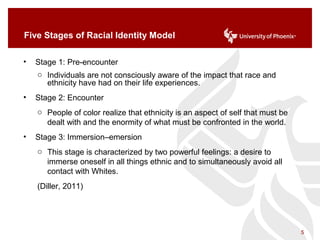
Five Stages of Racial Identity Model
• Stage 1: Pre-encounter
o Individuals are not consciously aware of the impact that race and
ethnicity have had on their life experiences.
• Stage 2: Encounter
o People of color realize that ethnicity is an aspect of self that must be
dealt with and the enormity of what must be confronted in the world.
• Stage 3: Immersion–emersion
o This stage is characterized by two powerful feelings: a desire to
immerse oneself in all things ethnic and to simultaneously avoid all
contact with Whites.
(Diller, 2011)
5
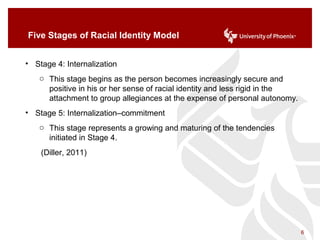
Five Stages of Racial Identity Model
• Stage 4: Internalization
o This stage begins as the person becomes increasingly secure and
positive in his or her sense of racial identity and less rigid in the
attachment to group allegiances at the expense of personal autonomy.
• Stage 5: Internalization–commitment
o This stage represents a growing and maturing of the tendencies
initiated in Stage 4.
(Diller, 2011)
6
Becoming Culturally Competent:
The Basics
Implications For Cultural Competence
7
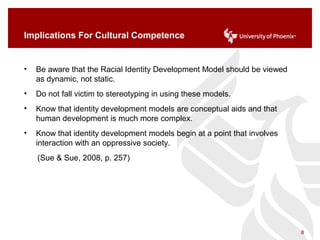
Implications For Cultural Competence
• Be aware that the Racial Identity Development Model should be viewed
as dynamic, not static.
• Do not fall victim to stereotyping in using these models.
• Know that identity development models are conceptual aids and that
human development is much more complex.
• Know that identity development models begin at a point that involves
interaction with an oppressive society.
(Sue & Sue, 2008, p. 257)
8
Implications For Cultural Competence
• Be careful of the implied value judgment given in almost all development
models.
• Be aware that racial identity development models seriously lack an
adequate integration of gender, class, sexual orientation, and other
sociodemographic group identities.
• Know that racial identity is not a simple, global concept.
(Sue & Sue, 2008, p. 258)
9
Becoming Culturally Competent:
The Basics
The Impact Of Discrimination On Physical
And Mental Health
10
The Impact Of Discrimination On Physical
And Mental Health
• Discrimination leads to increases in both mood and anxiety disorders,
particularly when not identified and discussed (McLaughlin,
Hatznbeuhler, & Keyes, 2010).
• Racial disparities in health are persistent. Racial discrimination has been
found to amplify cardiovascular, diabetes, and other age-related disease
risks (Szanton, et al., 2011).
• Researchers associate discrimination impacts with race-based battle
fatigue leading to psychological and physical symptoms that are so
severe that they can significantly affect everyday tasks and job
performance (Soto, Dawson-Andoh, & BeLue, 2011).
11
The Impact Of Discrimination On Physical
And Mental Health
• After 9-11, psychological distress increased among Arabs (Muslim and
non-Muslim) as well as Haitians due to discrimination (Rousseau,
Hassan, Moreau, & Thombs, 2011).
• Racial and gender microaggressions (covert insults towards subordinated
groups) can undermine healthy functioning (McCabe, 2009).
12
The Impact Of Discrimination On Physical
And Mental Health
• Discrimination may inhibit many groups of people from reaching their full
potential because they have to use some of their energy to constantly
emotionally manage inappropriate energy directed at them by an
empowered class.
13
Becoming Culturally Competent:
The Basics
Diversity Skills
14
Diversity Skills
• Ability to recognize different styles
• Sensitivity to communication cues
• Interest in other cultures
• Awareness of cultural and language differences
• Knowledge of cultural myths and stereotypes
(Mental Health Facilitator, n.d.)
15
Diversity Skills
• Concern for the welfare of people from another culture
• Ability to talk about your own culture
• Knowledge of the relationships between cultural groups
• Understanding what a person from another culture thinks is good and what
is bad
(Mental Health Facilitator, n.d.)
16
Becoming Culturally Competent:
The Basics
References
17
References
• Diller, J. V. (2011). Cultural diversity: A primer for the human services (4th ed.). Belmont, CA:
Brooks/Cole.
• McCabe, J. (2009). Racial and gender microaggressions on a pre-dominantly White campus:
Experiences of Black, Latina(o), and White undergraduates. Race, Gender, & Class,
16(1-2), 133–151.
• McLaughlin, K. A., Hatznbeuhler, M. L., & Keyes, K. M. (2010). Responses to discrimination
and psychiatric disorders among Black, Hispanic, female, and lesbian, gay, and
bisexual individuals. American Journal of Public Health, 100(8), 1477–1484.
• Mental Health Facilitator. (n.d.). Module 3: Understanding Differences [PowerPoint slides].
• Rousseau, C., Hassan, G., Moreau, N., & Thombs, B. D. (2011). Perceived
discrimination and its association with psychological distress among newly arrived
immigrants before and after September 11, 2001. American Journal of Public Health,
101(5), 909–915.
• Soto, J. A., Dawson-Andoh, N. A., & BeLue, R. (2011). The relationship between perceived
discrimination and Generalized Anxiety Disorder among African Americans, Afro
Caribbeans, and non-Hispanic Whites. Journal of Anxiety Disorders, 25(2), 258–265. doi:
10.1016/j.janxdis.2010.09.011
• Sue, D. W., & Sue, D. (2008). Counseling the culturally diverse: Theory and practice (5th ed.).
Hoboken, NJ: John Wiley & Sons.
• Szanton, S. L., Rifkind, J. M., Mohanty, J. G., Miller III, E. R., Thorpe, R. J., Nagababu, E. . .
Evans, M. K. (2011). Racial discrimination is associated with a measure of red blood
cell oxidative stress: A potential pathway for racial health disparities. International
Journal of Behavioral Medicine, doi: 10.1007/s12529-011-9188-z 18

Bshs345 r1 week2_becoming_culturally_competent

  • 1.
    Becoming Culturally Competent: TheBasics BSHS/345r1 Week Two
  • 2.
    Becoming Culturally Competent:The Basics 1. A Racial Identity Development Model 1. Conformity 2. Dissonance 3. Resistance and Immersion 4. Introspection 5. Integrative Awareness 2. Implications for Cultural Competence 3. The Impact of Discrimination on Physical and Mental Health 4. Diversity Skills 5. References 2
  • 3.
    Becoming Culturally Competent: TheBasics A Racial Identity Development Model 3
  • 4.
    A Racial IdentityDevelopment Model • A Conceptual Framework 1. Pre-encounter 2. Encounter 3. Immersion–emersion 4. Internalization 5. Internalization–commitment 4
  • 5.
    Five Stages ofRacial Identity Model • Stage 1: Pre-encounter o Individuals are not consciously aware of the impact that race and ethnicity have had on their life experiences. • Stage 2: Encounter o People of color realize that ethnicity is an aspect of self that must be dealt with and the enormity of what must be confronted in the world. • Stage 3: Immersion–emersion o This stage is characterized by two powerful feelings: a desire to immerse oneself in all things ethnic and to simultaneously avoid all contact with Whites. (Diller, 2011) 5
  • 6.
    Five Stages ofRacial Identity Model • Stage 4: Internalization o This stage begins as the person becomes increasingly secure and positive in his or her sense of racial identity and less rigid in the attachment to group allegiances at the expense of personal autonomy. • Stage 5: Internalization–commitment o This stage represents a growing and maturing of the tendencies initiated in Stage 4. (Diller, 2011) 6
  • 7.
    Becoming Culturally Competent: TheBasics Implications For Cultural Competence 7
  • 8.
    Implications For CulturalCompetence • Be aware that the Racial Identity Development Model should be viewed as dynamic, not static. • Do not fall victim to stereotyping in using these models. • Know that identity development models are conceptual aids and that human development is much more complex. • Know that identity development models begin at a point that involves interaction with an oppressive society. (Sue & Sue, 2008, p. 257) 8
  • 9.
    Implications For CulturalCompetence • Be careful of the implied value judgment given in almost all development models. • Be aware that racial identity development models seriously lack an adequate integration of gender, class, sexual orientation, and other sociodemographic group identities. • Know that racial identity is not a simple, global concept. (Sue & Sue, 2008, p. 258) 9
  • 10.
    Becoming Culturally Competent: TheBasics The Impact Of Discrimination On Physical And Mental Health 10
  • 11.
    The Impact OfDiscrimination On Physical And Mental Health • Discrimination leads to increases in both mood and anxiety disorders, particularly when not identified and discussed (McLaughlin, Hatznbeuhler, & Keyes, 2010). • Racial disparities in health are persistent. Racial discrimination has been found to amplify cardiovascular, diabetes, and other age-related disease risks (Szanton, et al., 2011). • Researchers associate discrimination impacts with race-based battle fatigue leading to psychological and physical symptoms that are so severe that they can significantly affect everyday tasks and job performance (Soto, Dawson-Andoh, & BeLue, 2011). 11
  • 12.
    The Impact OfDiscrimination On Physical And Mental Health • After 9-11, psychological distress increased among Arabs (Muslim and non-Muslim) as well as Haitians due to discrimination (Rousseau, Hassan, Moreau, & Thombs, 2011). • Racial and gender microaggressions (covert insults towards subordinated groups) can undermine healthy functioning (McCabe, 2009). 12
  • 13.
    The Impact OfDiscrimination On Physical And Mental Health • Discrimination may inhibit many groups of people from reaching their full potential because they have to use some of their energy to constantly emotionally manage inappropriate energy directed at them by an empowered class. 13
  • 14.
    Becoming Culturally Competent: TheBasics Diversity Skills 14
  • 15.
    Diversity Skills • Abilityto recognize different styles • Sensitivity to communication cues • Interest in other cultures • Awareness of cultural and language differences • Knowledge of cultural myths and stereotypes (Mental Health Facilitator, n.d.) 15
  • 16.
    Diversity Skills • Concernfor the welfare of people from another culture • Ability to talk about your own culture • Knowledge of the relationships between cultural groups • Understanding what a person from another culture thinks is good and what is bad (Mental Health Facilitator, n.d.) 16
  • 17.
  • 18.
    References • Diller, J.V. (2011). Cultural diversity: A primer for the human services (4th ed.). Belmont, CA: Brooks/Cole. • McCabe, J. (2009). Racial and gender microaggressions on a pre-dominantly White campus: Experiences of Black, Latina(o), and White undergraduates. Race, Gender, & Class, 16(1-2), 133–151. • McLaughlin, K. A., Hatznbeuhler, M. L., & Keyes, K. M. (2010). Responses to discrimination and psychiatric disorders among Black, Hispanic, female, and lesbian, gay, and bisexual individuals. American Journal of Public Health, 100(8), 1477–1484. • Mental Health Facilitator. (n.d.). Module 3: Understanding Differences [PowerPoint slides]. • Rousseau, C., Hassan, G., Moreau, N., & Thombs, B. D. (2011). Perceived discrimination and its association with psychological distress among newly arrived immigrants before and after September 11, 2001. American Journal of Public Health, 101(5), 909–915. • Soto, J. A., Dawson-Andoh, N. A., & BeLue, R. (2011). The relationship between perceived discrimination and Generalized Anxiety Disorder among African Americans, Afro Caribbeans, and non-Hispanic Whites. Journal of Anxiety Disorders, 25(2), 258–265. doi: 10.1016/j.janxdis.2010.09.011 • Sue, D. W., & Sue, D. (2008). Counseling the culturally diverse: Theory and practice (5th ed.). Hoboken, NJ: John Wiley & Sons. • Szanton, S. L., Rifkind, J. M., Mohanty, J. G., Miller III, E. R., Thorpe, R. J., Nagababu, E. . . Evans, M. K. (2011). Racial discrimination is associated with a measure of red blood cell oxidative stress: A potential pathway for racial health disparities. International Journal of Behavioral Medicine, doi: 10.1007/s12529-011-9188-z 18