BS6 3 9 9-2 Wind loading
                             Information Sheet 2                                                                July 2003


                           BS6399       Loading        for    Buildings       The second calibration showed that with
                           Part 2 Code of practice for wind loads             misapplied terrain categories in CP3, BS6399
How can we help?                                                              would appear to give design pressures up to
                           Friend or foe?                                     25% greater.
• Expert advice
                           There has been a lot of negative public            UK location facts
• Desk studies             comment about BS6399-2 since it was first
                           introduced in 1995 - mostly ill-informed and       To show you how important the altitude
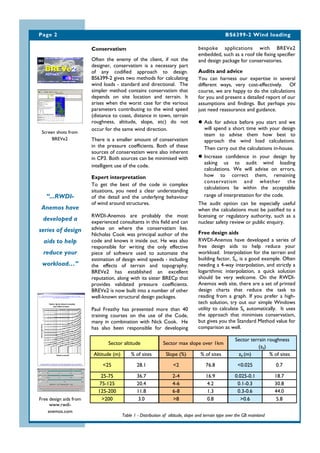
• Wind tunnel testing      caused       by     misapplication        of       corrections and topography are, look at
• Failure investigation
                           CP3:ChapterV:Part 2 over many years. This          Table 1. This shows the percentage of
                           is not all the fault of users, CP3 was badly       postcode sectors on the GB mainland that
• Software design          worded in places. Fortunately, the old code        have high altitude and/or significant slopes
                           is now withdrawn and should not be used.           within +/-1km of their centroid. It also shows
• Training / Seminars
                                                                              the distribution of terrain roughness, using a
                           There is a lot more useful information in the      parameter called z0. For open country, z0 is
                           new code, and it is described in a less            about 0.03m, in town z0 is 0.3m or more.
                           ambiguous way. This helps to avoid too many
                           arguments about interpretation. Equally,           There are many locations where slope and
                           there is less scope for misunderstanding and       altitude are significant, and yet it is surprising
                           misapplication. Much more background               how many designers have not routinely used
                           information on wind speeds and pressure            the topography rules that were introduced
  We’re on the web         coefficients was available to be included. All     into CP3 in more than 17 years ago.
www.rwdi-anemos.com
                           of this is good.

                           Nevertheless, like all codes, BS6399-2 can
                           only cover basic shapes and when it moves
                           into more intricate arrangements the clauses
                           do get more complex, or perhaps don’t exist
                           - which is where we can help you.
     “...negative          How does it compare with CP3?
 public comment            It may be several years since BS6399-2 was
                           introduced but this is still a popular question.
 about BS6399-2            Reported perceptions are that design loads
                           are significantly higher with the new code
 has been mostly
                           but extensive calibrations show this to be
  ill informed…”           untrue. One calibration based on a 10km
                           grid covering the whole of Great Britain
                           (Figure 1), showed that, on average, the
                           design wind pressure was 8% lower for
                           inland sites and 15% for coastal sites. A
                           separate study, using 9167 postcode sector
                           centroids showed -8% to +4%, depending on
                           the assumptions.
   RWDI-Anemos Ltd
                           Naturally, there is a range around these
   Charleston House
    13 High Street         average figures but the perception of higher
   Hemel Hempstead         loads is wrong. A major reason for this is the
    Herts HP1 3AA          misapplication of CP3 in two main areas -
                                                                                            Figure 1 - BS6399-2
   Tel: 01442 212292       • applying terrain categories incorrectly                  Basic mean wind speed contours
   Fax: 01442 256155                                                               with 2% risk of exceedence per annum
                           • not using the topography rules of CP3
enquiry@rwdi-anemos.com
Page 2                                                                                           BS6399-2 Wind loading

                        Conservatism                                              bespoke applications with BREVe2
                                                                                  embedded, such as a roof tile fixing specifier
                        Often the enemy of the client, if not the                 and design package for conservatories.
                        designer, conservatism is a necessary part
                        of any codified approach to design.                       Audits and advice
                        BS6399-2 gives two methods for calculating                You can harness our expertise in several
                        wind loads - standard and directional. The                different ways, very cost-effectively. Of
                        simpler method contains conservatism that                 course, we are happy to do the calculations
                        depends on site location and terrain. It                  for you and present a detailed report of our
                        arises when the worst case for the various                assumptions and findings. But perhaps you
                        parameters contributing to the wind speed                 just need reassurance and guidance.
                        (distance to coast, distance in town, terrain
                        roughness, altitude, slope, etc) do not                      Ask for advice before you start and we
                        occur for the same wind direction.                           will spend a short time with your design
 Screen shots from
                                                                                     team to advise them how best to
      BREVe2            There is a smaller amount of conservatism                    approach the wind load calculations.
                        in the pressure coefficients. Both of these                  Then carry out the calculations in-house.
                        sources of conservatism were also inherent
                        in CP3. Both sources can be minimised with                   Increase confidence in your design by
                                                                                     asking us to audit wind loading
                        intelligent use of the code.
                                                                                     calculations. We will advise on errors,
                        Expert interpretation                                        how to correct them, remaining
                                                                                     conservatism and whether the
                        To get the best of the code in complex
                                                                                     calculations lie within the acceptable
                        situations, you need a clear understanding
   “...RWDI-            of the detail and the underlying behaviour                   range of interpretation for the code.
                        of wind around structures.                                The audit option can be especially useful
 Anemos have                                                                      when the calculations must be justified to a
                        RWDI-Anemos are probably the most                         licensing or regulatory authority, such as a
 developed a            experienced consultants in this field and can             nuclear safety review or public enquiry.
series of design        advise on where the conservatism lies.
                        Nicholas Cook was principal author of the                 Free design aids
  aids to help          code and knows it inside out. He was also                 RWDI-Anemos have developed a series of
                        responsible for writing the only effective                free design aids to help reduce your
  reduce your           piece of software used to automate the                    workload. Interpolation for the terrain and
                        estimation of design wind speeds - including              building factor, Sb, is a good example. Often
 workload…”             the effects of terrain and topography.                    needing a 4-way interpolation, and strictly a
                        BREVe2 has established an excellent                       logarithmic interpolation, a quick solution
                        reputation, along with its sister BRECp that              should be very welcome. On the RWDI-
                        provides validated pressure coefficients.                 Anemos web site, there are a set of printed
                        BREVe2 is now built into a number of other                design charts that reduce the task to
                        well-known structural design packages.                    reading from a graph. If you prefer a high-
                                                                                  tech solution, try out our simple Windows
                        Paul Freathy has presented more than 40                   utility to calculate Sb automatically. It uses
                        training courses on the use of the Code,                  the approach that minimises conservatism,
                        many in combination with Nick Cook. He                    but gives you the Standard Method value for
                        has also been responsible for developing                  comparison as well.

                                                                                                      Sector terrain roughness
                               Sector altitude                Sector max slope over 1km
                                                                                                                 (z0)
                         Altitude (m)       % of sites          Slope (%)          % of sites          z0 (m)         % of sites

                             <25                28.1                <2                76.8             <0.025             0.7

                            25-75               36.7               2-4                16.9            0.025-0.1           18.7
                           75-125               20.4               4-6                 4.2             0.1-0.3            30.8
                           125-200              11.8               6-8                 1.3             0.3-0.6            44.0
Free design aids from       >200                 3.0               >8                 0.8                >0.6              5.8
     www.rwdi-
    anemos.com
                                        Table 1 - Distribution of altitude, slope and terrain type over the GB mainland

Bs6399

  • 1.
    BS6 3 99-2 Wind loading Information Sheet 2 July 2003 BS6399 Loading for Buildings The second calibration showed that with Part 2 Code of practice for wind loads misapplied terrain categories in CP3, BS6399 How can we help? would appear to give design pressures up to Friend or foe? 25% greater. • Expert advice There has been a lot of negative public UK location facts • Desk studies comment about BS6399-2 since it was first introduced in 1995 - mostly ill-informed and To show you how important the altitude • Wind tunnel testing caused by misapplication of corrections and topography are, look at • Failure investigation CP3:ChapterV:Part 2 over many years. This Table 1. This shows the percentage of is not all the fault of users, CP3 was badly postcode sectors on the GB mainland that • Software design worded in places. Fortunately, the old code have high altitude and/or significant slopes is now withdrawn and should not be used. within +/-1km of their centroid. It also shows • Training / Seminars the distribution of terrain roughness, using a There is a lot more useful information in the parameter called z0. For open country, z0 is new code, and it is described in a less about 0.03m, in town z0 is 0.3m or more. ambiguous way. This helps to avoid too many arguments about interpretation. Equally, There are many locations where slope and there is less scope for misunderstanding and altitude are significant, and yet it is surprising misapplication. Much more background how many designers have not routinely used information on wind speeds and pressure the topography rules that were introduced We’re on the web coefficients was available to be included. All into CP3 in more than 17 years ago. www.rwdi-anemos.com of this is good. Nevertheless, like all codes, BS6399-2 can only cover basic shapes and when it moves into more intricate arrangements the clauses do get more complex, or perhaps don’t exist - which is where we can help you. “...negative How does it compare with CP3? public comment It may be several years since BS6399-2 was introduced but this is still a popular question. about BS6399-2 Reported perceptions are that design loads are significantly higher with the new code has been mostly but extensive calibrations show this to be ill informed…” untrue. One calibration based on a 10km grid covering the whole of Great Britain (Figure 1), showed that, on average, the design wind pressure was 8% lower for inland sites and 15% for coastal sites. A separate study, using 9167 postcode sector centroids showed -8% to +4%, depending on the assumptions. RWDI-Anemos Ltd Naturally, there is a range around these Charleston House 13 High Street average figures but the perception of higher Hemel Hempstead loads is wrong. A major reason for this is the Herts HP1 3AA misapplication of CP3 in two main areas - Figure 1 - BS6399-2 Tel: 01442 212292 • applying terrain categories incorrectly Basic mean wind speed contours Fax: 01442 256155 with 2% risk of exceedence per annum • not using the topography rules of CP3 enquiry@rwdi-anemos.com
  • 2.
    Page 2 BS6399-2 Wind loading Conservatism bespoke applications with BREVe2 embedded, such as a roof tile fixing specifier Often the enemy of the client, if not the and design package for conservatories. designer, conservatism is a necessary part of any codified approach to design. Audits and advice BS6399-2 gives two methods for calculating You can harness our expertise in several wind loads - standard and directional. The different ways, very cost-effectively. Of simpler method contains conservatism that course, we are happy to do the calculations depends on site location and terrain. It for you and present a detailed report of our arises when the worst case for the various assumptions and findings. But perhaps you parameters contributing to the wind speed just need reassurance and guidance. (distance to coast, distance in town, terrain roughness, altitude, slope, etc) do not Ask for advice before you start and we occur for the same wind direction. will spend a short time with your design Screen shots from team to advise them how best to BREVe2 There is a smaller amount of conservatism approach the wind load calculations. in the pressure coefficients. Both of these Then carry out the calculations in-house. sources of conservatism were also inherent in CP3. Both sources can be minimised with Increase confidence in your design by asking us to audit wind loading intelligent use of the code. calculations. We will advise on errors, Expert interpretation how to correct them, remaining conservatism and whether the To get the best of the code in complex calculations lie within the acceptable situations, you need a clear understanding “...RWDI- of the detail and the underlying behaviour range of interpretation for the code. of wind around structures. The audit option can be especially useful Anemos have when the calculations must be justified to a RWDI-Anemos are probably the most licensing or regulatory authority, such as a developed a experienced consultants in this field and can nuclear safety review or public enquiry. series of design advise on where the conservatism lies. Nicholas Cook was principal author of the Free design aids aids to help code and knows it inside out. He was also RWDI-Anemos have developed a series of responsible for writing the only effective free design aids to help reduce your reduce your piece of software used to automate the workload. Interpolation for the terrain and estimation of design wind speeds - including building factor, Sb, is a good example. Often workload…” the effects of terrain and topography. needing a 4-way interpolation, and strictly a BREVe2 has established an excellent logarithmic interpolation, a quick solution reputation, along with its sister BRECp that should be very welcome. On the RWDI- provides validated pressure coefficients. Anemos web site, there are a set of printed BREVe2 is now built into a number of other design charts that reduce the task to well-known structural design packages. reading from a graph. If you prefer a high- tech solution, try out our simple Windows Paul Freathy has presented more than 40 utility to calculate Sb automatically. It uses training courses on the use of the Code, the approach that minimises conservatism, many in combination with Nick Cook. He but gives you the Standard Method value for has also been responsible for developing comparison as well. Sector terrain roughness Sector altitude Sector max slope over 1km (z0) Altitude (m) % of sites Slope (%) % of sites z0 (m) % of sites <25 28.1 <2 76.8 <0.025 0.7 25-75 36.7 2-4 16.9 0.025-0.1 18.7 75-125 20.4 4-6 4.2 0.1-0.3 30.8 125-200 11.8 6-8 1.3 0.3-0.6 44.0 Free design aids from >200 3.0 >8 0.8 >0.6 5.8 www.rwdi- anemos.com Table 1 - Distribution of altitude, slope and terrain type over the GB mainland