BRICS Science, Technology and Innovation
Cooperation: A Strategic Partnership for
Equitable Growth and Sustainable
Development
By Lyudmila Ogorodova
Vice-Minister, Ministry of Education and
Science of the Russian Federation
9-12 February 2014
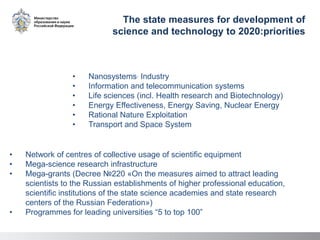
The state measures for development of
science and technology to 2020:priorities
• Nanosystems, Industry
• Information and telecommunication systems
• Life sciences (incl. Health research and Biotechnology)
• Energy Effectiveness, Energy Saving, Nuclear Energy
• Rational Nature Exploitation
• Transport and Space System
• Network of centres of collective usage of scientific equipment
• Mega-science research infrastructure
• Mega-grants (Decree №220 «On the measures aimed to attract leading
scientists to the Russian establishments of higher professional education,
scientific institutions of the state science academies and state research
centers of the Russian Federation»)
• Programmes for leading universities “5 to top 100”
The mechanisms of state support of science
and technology in the Russian Ministry of
Education and Science
 The Federal Targeting Program (FTP) «Research and development of the priority areas
of the scientific and technological complex in Russia» in 2014-2020
 The FTP «Development of pharmaceutical and medical industry of the Russian
Federation until 2020 and beyond»
 The Government Regulation № 218 of 9 April 2012 «On the measures of state support of
cooperation between the “Russian higher education institutions and organisations»
 The Government Regulation № 219 of 9 April 2012 «Support of the development of
innovative infrastructure in educational institutions»
 The Government Regulation № 220 of 9 April 2012 «On the measures aimed to attract
leading scientists to the Russian establishments of higher professional education, scientific
institutions of the state science academies and state research centers of the Russian
Federation»
 Federal Statute №291-FS of 2 November 2013 «On the Russian Science Fund and
amendments to certain legislative acts of the Russian Federation»
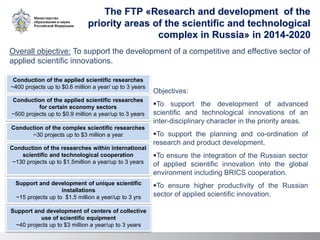
The FTP «Research and development of the
priority areas of the scientific and technological
complex in Russia» in 2014-2020
Overall objective: To support the development of a competitive and effective sector of
applied scientific innovations.
Objectives:
To support the development of advanced
scientific and technological innovations of an
inter-disciplinary character in the priority areas.
To support the planning and co-ordination of
research and product development.
To ensure the integration of the Russian sector
of applied scientific innovation into the global
environment including BRICS cooperation.
To ensure higher productivity of the Russian
sector of applied scientific innovation.
Conduction of the applied scientific researches
~400 projects up to $0.6 million a year/ up to 3 years
Conduction of the applied scientific researches
for certain economy sectors
~500 projects up to $0.9 million a year/up to 3 years
Conduction of the complex scientific researches
~30 projects up to $3 million a year
Conduction of the researches within international
scientific and technological cooperation
~130 projects up to $1.5million a year/up to 3 years
Support and development of unique scientific
installations
~15 projects up to $1.5 million a year/up to 3 yrs
Support and development of centers of collective
use of scientific equipment
~40 projects up to $3 million a year/up to 3 years
The FTP «Development of pharmaceutical
and medical industry of Russia until 2020»
The overall objective: To advance innovation in the Russian pharmaceutical and
medical industry.
Objectives:
 Introduce modern technologies into the production process
 Ensure that the most important medications, medical
equipment and devices (used to treat most
common/serious/life threatening diseases) are produced
domestically (overcome dependence on imports)
 Support the marketing of innovative products
 Increase the export potential of domestic medical and
pharmaceutical industry
Pre-clinical research into
innovative medications
Funding from the Ministry–
($353.7 million)
Development of new
educational programs
Funding from the Ministry–
($7.8 million)
Resource & technology
base for production Funding
from the Ministry -
($103.6 million)
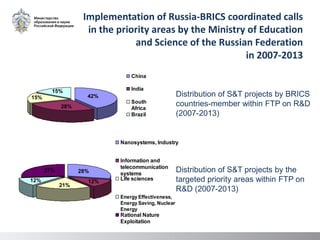
Implementation of Russia-BRICS coordinated calls
in the priority areas by the Ministry of Education
and Science of the Russian Federation
in 2007-2013
Distribution of S&T projects by BRICS
countries-member within FTP on R&D
(2007-2013)
Distribution of S&T projects by the
targeted priority areas within FTP on
R&D (2007-2013)
15%
42%
15%
28%
China
India
South
Africa
Brazil
27% 28%
12%
21%
12%
Nanosystems, Industry
Information and
telecommunication
systems
Life sciences
Energy Effectiveness,
Energy Saving, Nuclear
Energy
Rational Nature
Exploitation
Awardees of Russian Mega-grants
(Decree No.220 “On the Measures Aimed to Attract Leading Scientists to
the Russian Establishments of Higher Professional Education, Scientific
Institutions of the State Science Academies and State Research Centers of
the Russian Federation”)
1st call (2010): 40 grant contracts were
signed. Among the grantees 21 are
Russian (including 11 with double
residence), 12 EU citizens, 3 winners
from USA and 3 from other countries.
2nd call (2011): 38 grant contracts were
signed. Among the grantees 19 are
Russian (including 13 double
citizenships), 12 EU citizens, 6
winners from USA and 1 from Japan.
3rd call (2012): 41 grant contracts were
signed. Among the grantees 19 are
Russian (including 9 double
citizenships), 9 EU citizens, 5 winners
from USA and 8 from other countries.
4th call (2013): 42 grant contracts were
signed. Among the grantees 19 are
Russian (including 11 double
citizenships), 19 EU citizens, 2
winners from USA and 1 from Japan.
USA
12%
Other
countries
20%
Russia
24%
Russia
double
residence
22%
EU
22%
USA
5%
Other
countries
5%
Russia
19%
Russia
double
residence
26%
EU
45%
Russia
16%
Russia double
residence
33%
EU
32%
USA
16%
Japan
3%
Russia
28%
Russia
double
residence
26%
EU
30%
USA
8%
Other
countries
8%
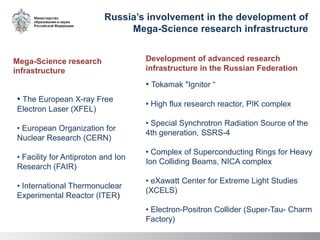
• Tokamak "Ignitor “
• High flux research reactor, PIK complex
• Special Synchrotron Radiation Source of the
4th generation, SSRS-4
• Complex of Superconducting Rings for Heavy
Ion Colliding Beams, NICA complex
• eXawatt Center for Extreme Light Studies
(XCELS)
• Electron-Positron Collider (Super-Tau- Charm
Factory)
Development of advanced research
infrastructure in the Russian Federation
Russia’s involvement in the development of
Mega-Science research infrastructure
• The European X-ray Free
Electron Laser (XFEL)
• European Organization for
Nuclear Research (CERN)
• Facility for Antiproton and Ion
Research (FAIR)
• International Thermonuclear
Experimental Reactor (ITER)
Mega-Science research
infrastructure
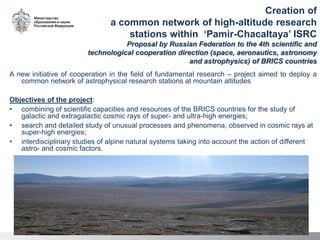
Creation of
a common network of high-altitude research
stations within ‘Pamir-Chacaltaya’ ISRC
Proposal by Russian Federation to the 4th scientific and
technological cooperation direction (space, aeronautics, astronomy
and astrophysics) of BRICS countries
A new initiative of cooperation in the field of fundamental research – project aimed to deploy a
common network of astrophysical research stations at mountain altitudes
Objectives of the project:
• combining of scientific capacities and resources of the BRICS countries for the study of
galactic and extragalactic cosmic rays of super- and ultra-high energies;
• search and detailed study of unusual processes and phenomena, observed in cosmic rays at
super-high energies;
• interdisciplinary studies of alpine natural systems taking into account the action of different
astro- and cosmic factors.
3rd BRICS Senior Official Meeting in New Delhi
(12th of December 2013)
By Lyudmila Ogorodova
Vice-Minister, Ministry of Education and
Science of the Russian Federation
Thank You for Your attention!

BRICS presentation and implications on indiA

  • 1.
    BRICS Science, Technologyand Innovation Cooperation: A Strategic Partnership for Equitable Growth and Sustainable Development By Lyudmila Ogorodova Vice-Minister, Ministry of Education and Science of the Russian Federation 9-12 February 2014
  • 2.
    The state measuresfor development of science and technology to 2020:priorities • Nanosystems, Industry • Information and telecommunication systems • Life sciences (incl. Health research and Biotechnology) • Energy Effectiveness, Energy Saving, Nuclear Energy • Rational Nature Exploitation • Transport and Space System • Network of centres of collective usage of scientific equipment • Mega-science research infrastructure • Mega-grants (Decree №220 «On the measures aimed to attract leading scientists to the Russian establishments of higher professional education, scientific institutions of the state science academies and state research centers of the Russian Federation») • Programmes for leading universities “5 to top 100”
  • 3.
    The mechanisms ofstate support of science and technology in the Russian Ministry of Education and Science  The Federal Targeting Program (FTP) «Research and development of the priority areas of the scientific and technological complex in Russia» in 2014-2020  The FTP «Development of pharmaceutical and medical industry of the Russian Federation until 2020 and beyond»  The Government Regulation № 218 of 9 April 2012 «On the measures of state support of cooperation between the “Russian higher education institutions and organisations»  The Government Regulation № 219 of 9 April 2012 «Support of the development of innovative infrastructure in educational institutions»  The Government Regulation № 220 of 9 April 2012 «On the measures aimed to attract leading scientists to the Russian establishments of higher professional education, scientific institutions of the state science academies and state research centers of the Russian Federation»  Federal Statute №291-FS of 2 November 2013 «On the Russian Science Fund and amendments to certain legislative acts of the Russian Federation»
  • 4.
    The FTP «Researchand development of the priority areas of the scientific and technological complex in Russia» in 2014-2020 Overall objective: To support the development of a competitive and effective sector of applied scientific innovations. Objectives: To support the development of advanced scientific and technological innovations of an inter-disciplinary character in the priority areas. To support the planning and co-ordination of research and product development. To ensure the integration of the Russian sector of applied scientific innovation into the global environment including BRICS cooperation. To ensure higher productivity of the Russian sector of applied scientific innovation. Conduction of the applied scientific researches ~400 projects up to $0.6 million a year/ up to 3 years Conduction of the applied scientific researches for certain economy sectors ~500 projects up to $0.9 million a year/up to 3 years Conduction of the complex scientific researches ~30 projects up to $3 million a year Conduction of the researches within international scientific and technological cooperation ~130 projects up to $1.5million a year/up to 3 years Support and development of unique scientific installations ~15 projects up to $1.5 million a year/up to 3 yrs Support and development of centers of collective use of scientific equipment ~40 projects up to $3 million a year/up to 3 years
  • 5.
    The FTP «Developmentof pharmaceutical and medical industry of Russia until 2020» The overall objective: To advance innovation in the Russian pharmaceutical and medical industry. Objectives:  Introduce modern technologies into the production process  Ensure that the most important medications, medical equipment and devices (used to treat most common/serious/life threatening diseases) are produced domestically (overcome dependence on imports)  Support the marketing of innovative products  Increase the export potential of domestic medical and pharmaceutical industry Pre-clinical research into innovative medications Funding from the Ministry– ($353.7 million) Development of new educational programs Funding from the Ministry– ($7.8 million) Resource & technology base for production Funding from the Ministry - ($103.6 million)
  • 6.
    Implementation of Russia-BRICScoordinated calls in the priority areas by the Ministry of Education and Science of the Russian Federation in 2007-2013 Distribution of S&T projects by BRICS countries-member within FTP on R&D (2007-2013) Distribution of S&T projects by the targeted priority areas within FTP on R&D (2007-2013) 15% 42% 15% 28% China India South Africa Brazil 27% 28% 12% 21% 12% Nanosystems, Industry Information and telecommunication systems Life sciences Energy Effectiveness, Energy Saving, Nuclear Energy Rational Nature Exploitation
  • 7.
    Awardees of RussianMega-grants (Decree No.220 “On the Measures Aimed to Attract Leading Scientists to the Russian Establishments of Higher Professional Education, Scientific Institutions of the State Science Academies and State Research Centers of the Russian Federation”) 1st call (2010): 40 grant contracts were signed. Among the grantees 21 are Russian (including 11 with double residence), 12 EU citizens, 3 winners from USA and 3 from other countries. 2nd call (2011): 38 grant contracts were signed. Among the grantees 19 are Russian (including 13 double citizenships), 12 EU citizens, 6 winners from USA and 1 from Japan. 3rd call (2012): 41 grant contracts were signed. Among the grantees 19 are Russian (including 9 double citizenships), 9 EU citizens, 5 winners from USA and 8 from other countries. 4th call (2013): 42 grant contracts were signed. Among the grantees 19 are Russian (including 11 double citizenships), 19 EU citizens, 2 winners from USA and 1 from Japan. USA 12% Other countries 20% Russia 24% Russia double residence 22% EU 22% USA 5% Other countries 5% Russia 19% Russia double residence 26% EU 45% Russia 16% Russia double residence 33% EU 32% USA 16% Japan 3% Russia 28% Russia double residence 26% EU 30% USA 8% Other countries 8%
  • 8.
    • Tokamak "Ignitor“ • High flux research reactor, PIK complex • Special Synchrotron Radiation Source of the 4th generation, SSRS-4 • Complex of Superconducting Rings for Heavy Ion Colliding Beams, NICA complex • eXawatt Center for Extreme Light Studies (XCELS) • Electron-Positron Collider (Super-Tau- Charm Factory) Development of advanced research infrastructure in the Russian Federation Russia’s involvement in the development of Mega-Science research infrastructure • The European X-ray Free Electron Laser (XFEL) • European Organization for Nuclear Research (CERN) • Facility for Antiproton and Ion Research (FAIR) • International Thermonuclear Experimental Reactor (ITER) Mega-Science research infrastructure
  • 9.
    Creation of a commonnetwork of high-altitude research stations within ‘Pamir-Chacaltaya’ ISRC Proposal by Russian Federation to the 4th scientific and technological cooperation direction (space, aeronautics, astronomy and astrophysics) of BRICS countries A new initiative of cooperation in the field of fundamental research – project aimed to deploy a common network of astrophysical research stations at mountain altitudes Objectives of the project: • combining of scientific capacities and resources of the BRICS countries for the study of galactic and extragalactic cosmic rays of super- and ultra-high energies; • search and detailed study of unusual processes and phenomena, observed in cosmic rays at super-high energies; • interdisciplinary studies of alpine natural systems taking into account the action of different astro- and cosmic factors.
  • 10.
    3rd BRICS SeniorOfficial Meeting in New Delhi (12th of December 2013)
  • 11.
    By Lyudmila Ogorodova Vice-Minister,Ministry of Education and Science of the Russian Federation Thank You for Your attention!