BRICKS
By –
ROHAN
ANKITA
KAVITA

 A brick is a block or a single unit of a ceramic
material used in masonry construction. Typically
bricks are stacked together or laid as brickwork
using various kinds of mortar to hold the bricks
together and make a permanent structure.
 Bricks are typically produced in common or
standard sizes in bulk quantities. They have been
regarded as one of the longest lasting and
strongest building materials used throughout
history.
COMPOSITION
 Alumina: - It is the chief constituent of every kind of
clay. A good brick earth should contain 20 to 30
percent of alumina. This constituent imparts
plasticity to earth so that it can be moulded.
 Silica-A good brick earth should contain about 50 to
60 percent of silica. Presence of silica prevents
crackers shrinking and warping of raw bricks.
Durability of bricks depends on the proper
proportion of silica in brick.
 Lime – A small quantity of lime is desirable in finely
powdered state to prevents shrinkage of raw bricks.
Excess of lime causes the brick to melt
 Oxide of iron- A small quantity of oxide of Iron to the
extent of 5 to 6 percent is desirable in good brick to
imparts red colour to bricks.
 Magnesia- A small quantity of magnesia in brick
earth imparts yellow tint to bricks, and decreases
shrinkage. But excess of magnesia decreases
shrink leads to the decay of bricks.
MANUFACTURING
 The manufacturing of brick, the following operations
are involved
1. Preparation of clay
2. Moulding
3. Drying
4. Burning
PHASES OF MANUFACTURING
PREPARATION OF CLAY
a) Unsoiling :- Top layer of 20cm depth is removed as it
contain impurities.
b) Digging: - Clay dug out from ground is spread on level
ground about 60cm to 120cm heaps.
c) Cleaning:-Stones, pebbles, vegetable matter etc
removed and converted into powder form.
d) Weathering:- Clay is exposed to atmosphere from few
weeks to full season.
e) Blending:- Clay is made loose and any ingradient to be
added to it is spread out at top and turning it up and down
in vertical direction.
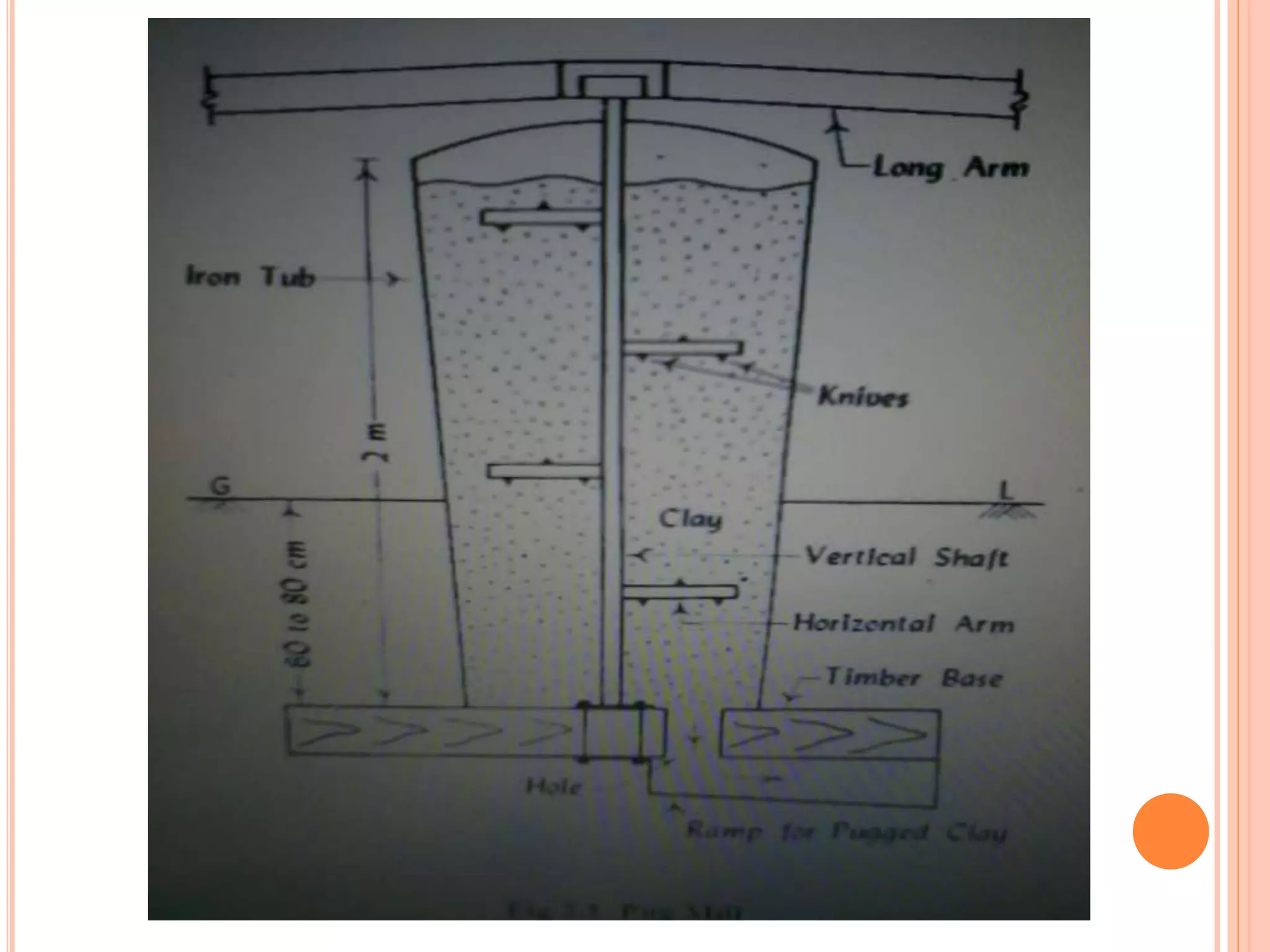
f) Tempering:- Clay is brought to a proper degree of
hardness, then water is added to clay and whole mass is
kneaded or pressed under the feet of men or cattle for
large scale, tempering is usually done in pug mill
MOULDING
 Clay, which is prepared form pug mill, is sent for the
next operation of moulding. Following are the two
ways of moulding.
1)Hand Moulding
2) Machine moulding
HAND MOULDING
 Moulds are rectangular boxes of wood or steel,
which are open at top and bottom. Steel moulds are
more durable and used for manufacturing bricks on
large scale . Bricks prepared by hand moulding are
of two types.
a) Ground moulded bricks
b) Table moulded bricks
MACHINE MOULDING
 This method proves to be economical when bricks
in huge quantity are to be manufactured at the
same spot. It is also helpful for moulding hard and
string clay. These machines are broadly classified
in two categories
(a) Plastic clay machines
(b) Dry clay machine
DRYING
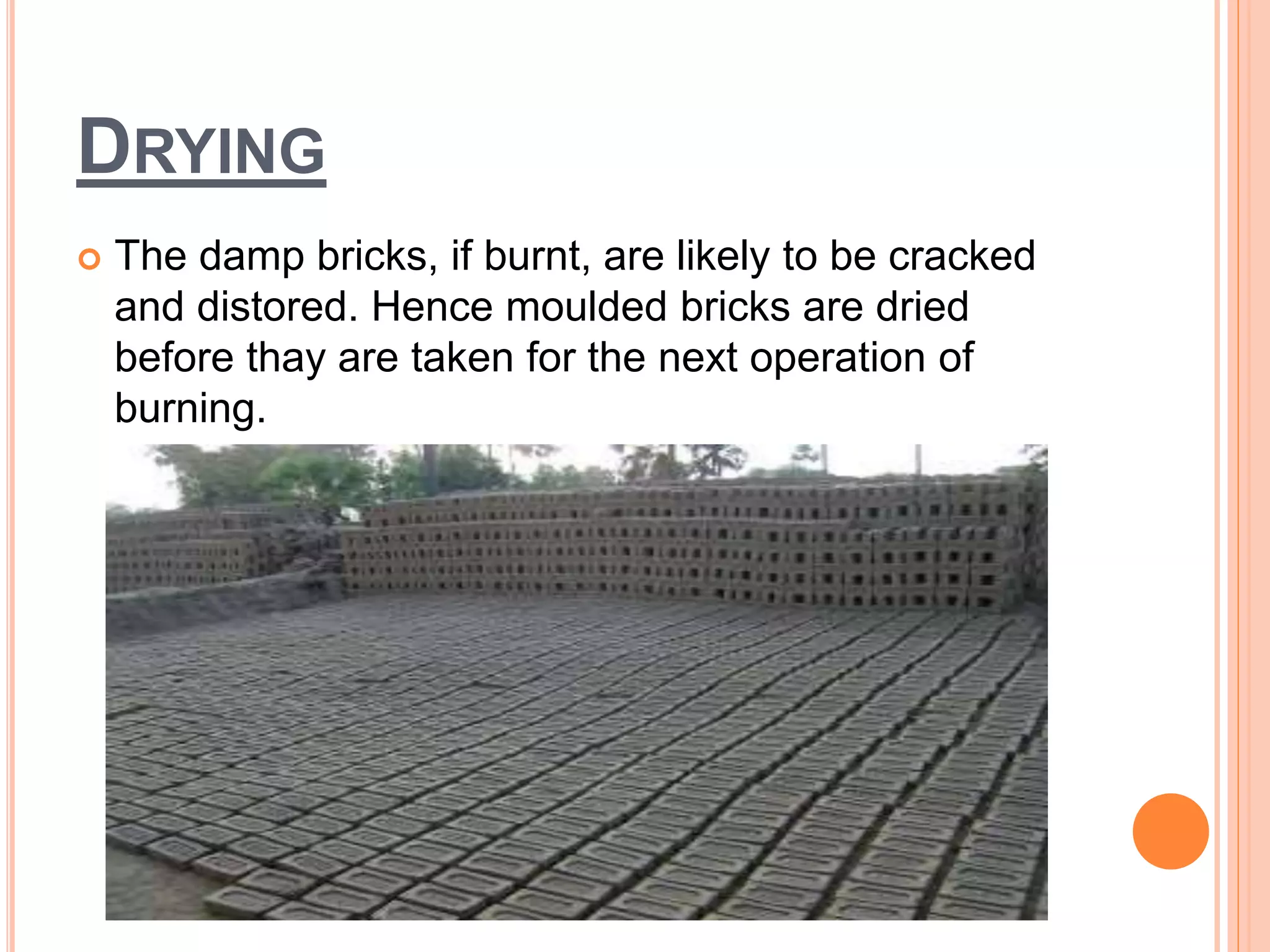
 The damp bricks, if burnt, are likely to be cracked
and distored. Hence moulded bricks are dried
before thay are taken for the next operation of
burning.
BURNING
 This is very important operation in the
manufacturing of bricks to impart hardness,
strength and makes them dense and durable.
Burning of bricks is done either in clamps or in
kilns.
Clamps are temporary structures and they are
adopted to manufacture bricks on small scale.
Kilns are permanent structures and they are adopted
to manufacture bricks on a large scale
CLASSIFICATION
Bricks can broadly be divided into two
categories.
(i) Unburnt or sundried bricks
(ii) Burnt bricks
UN BURNT OR SUN DRIED BRICKS
 UN burn or sun dried with the help of heat received
from sun after the process of moulding. These
bricks can only be used in the constructions of
temporary and cheap structures.
BURNT BRICKS
 The bricks used in construction works are burnt bricks and
they are classified into the following four categories.
a. First Class bricks: These bricks are table moulded and of
standard shape. The surface and edges of the bricks are sharp,
square, smooth and straight. The comply all the qualities of good
bricks and used for superior work of permanent
nature.(cost:5.60rs/brick)
b. Second class bricks: These bricks are ground moulded and
they are burnt in kilns. The surface of bricks is some what rough
and shape is also slightly irregular. These bricks are commonly
used at places where brick work is to be provided with a coat of
plaster .(cost:4.80rs/brick)
c. Third class bricks: These bricks are ground moulded and
they burnt in clamps. These bricks are not hard and they have
rough surfaces with irregular and distorted edges. They are used
for unimportant and temporary structures .(cost:3.80rs/brick)
d.Fourth class bricks: These are over burnt bricks with irregular
shape and dark colour. These bricks are used as aggregate for
concrete in foundation, floors, roads, etc
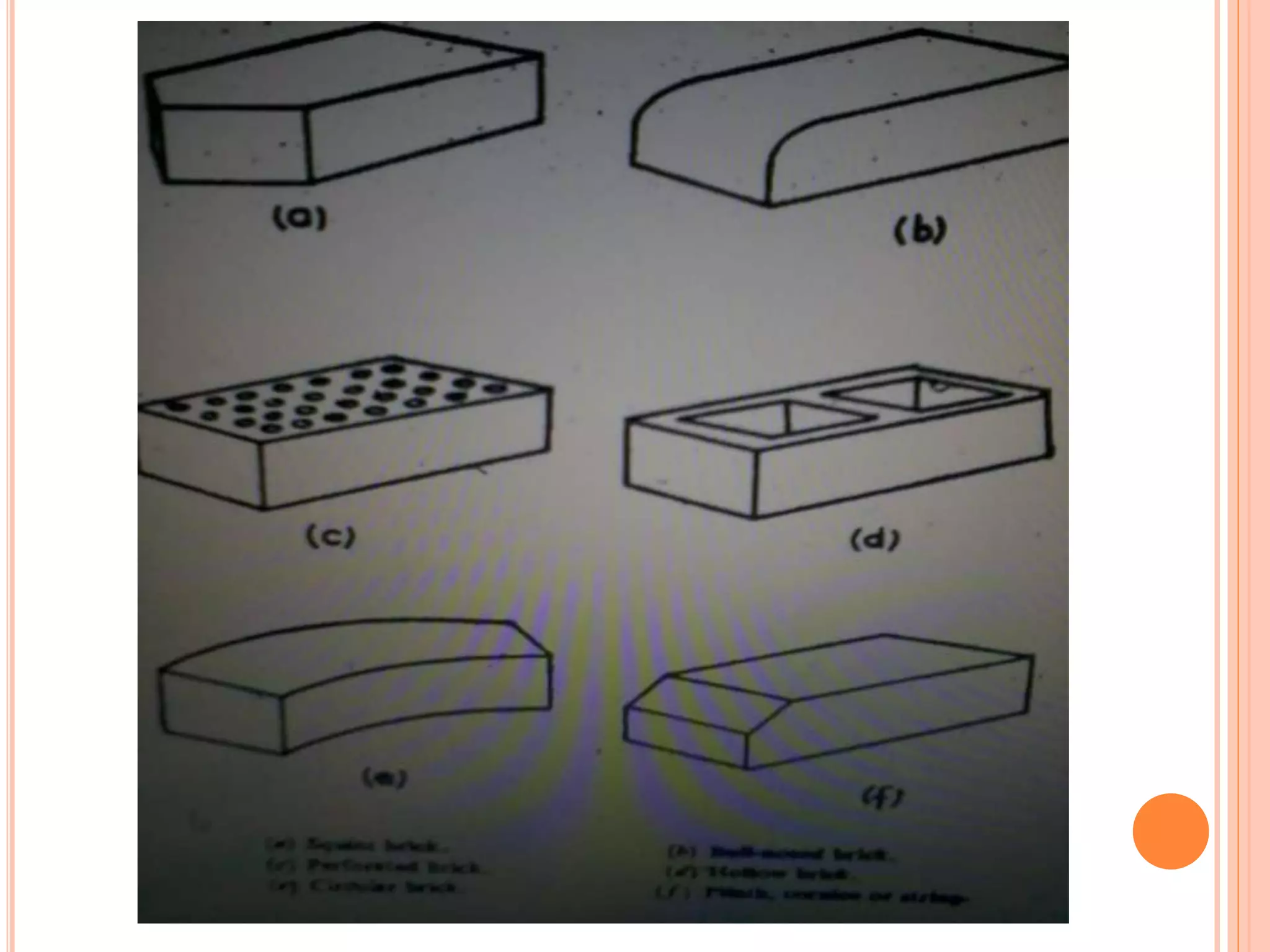
SPECIAL TYPES OF BRICKS
a. Squint Bricks: These bricks are made in a variety of
shapes and are used to the construction of a cute and
obtuse squint quoins.
b. Bull Nosed Bricks: These bricks are used to form
rounded quoins.
c. Perforated Bricks: These brick are used for
constructing load bearing wall of low building and give
maximum amount of vantilation.
d. Hallow Bricks: Hallow bricks are light in weight and are
used to increase insulation against heat and dampness.
e. Circular Bricks: These brick are used for well , towers
,etc to provide a particular curve or radius to wall
f. Plinth cornice and String Course Brick: These bricks
are moulded in several patterns with the object of adding
architectural beauty to the structure
QUALITIES OF GOOD BRICKS
 The brick should be uniform in shapes and
standard in size.
 Brick should give a clear metallic ringing sound
when struck with each other.
 Brick should be well burnt and possess sharp
edges.
 Colour of brick should be uniform and bright.
 No brick should have crushing strength below 5.50
N/mmsq
 The brick should not absorb water more than 20%
by weight for 1st class brick and 22% for 2nd class
brick when soaked in cold water for a period of 24
hours
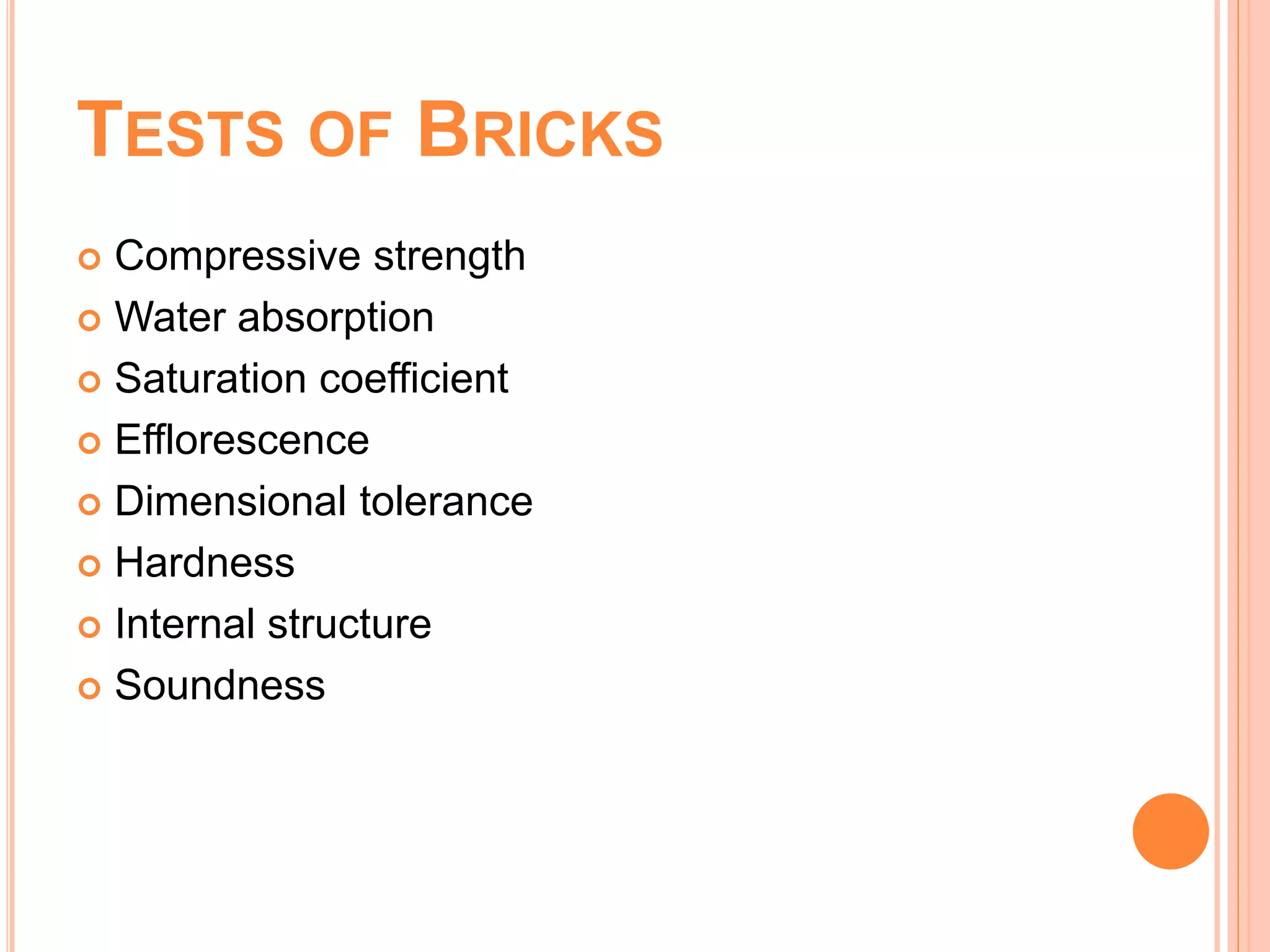
TESTS OF BRICKS
 Compressive strength
 Water absorption
 Saturation coefficient
 Efflorescence
 Dimensional tolerance
 Hardness
 Internal structure
 Soundness
STRENGTH OF BRICKS
 The average crushing strength of hand moulded
bricks is about 60N/mmsq.
 The shearing strength is about 1/10th of crushing
strength.
 It may be noted that the strength of brick work
mainly depends on the type of mortar used and not
so much on the individual strength of the brick.
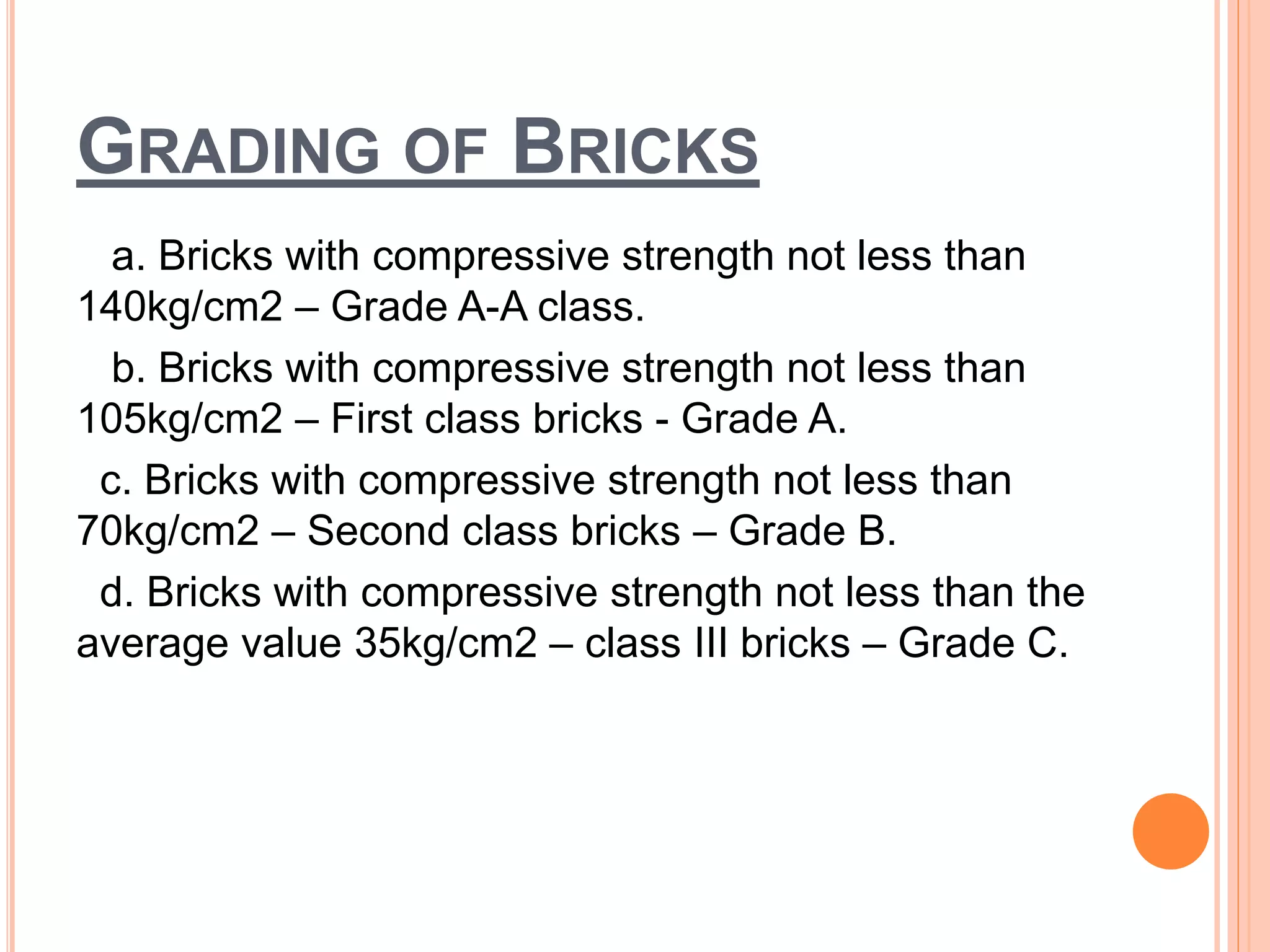
GRADING OF BRICKS
a. Bricks with compressive strength not less than
140kg/cm2 – Grade A-A class.
b. Bricks with compressive strength not less than
105kg/cm2 – First class bricks - Grade A.
c. Bricks with compressive strength not less than
70kg/cm2 – Second class bricks – Grade B.
d. Bricks with compressive strength not less than the
average value 35kg/cm2 – class III bricks – Grade C.
THANK YOU

Bricks

  • 1.
  • 2.
     A brickis a block or a single unit of a ceramic material used in masonry construction. Typically bricks are stacked together or laid as brickwork using various kinds of mortar to hold the bricks together and make a permanent structure.  Bricks are typically produced in common or standard sizes in bulk quantities. They have been regarded as one of the longest lasting and strongest building materials used throughout history.
  • 3.
    COMPOSITION  Alumina: -It is the chief constituent of every kind of clay. A good brick earth should contain 20 to 30 percent of alumina. This constituent imparts plasticity to earth so that it can be moulded.  Silica-A good brick earth should contain about 50 to 60 percent of silica. Presence of silica prevents crackers shrinking and warping of raw bricks. Durability of bricks depends on the proper proportion of silica in brick.
  • 4.
     Lime –A small quantity of lime is desirable in finely powdered state to prevents shrinkage of raw bricks. Excess of lime causes the brick to melt  Oxide of iron- A small quantity of oxide of Iron to the extent of 5 to 6 percent is desirable in good brick to imparts red colour to bricks.  Magnesia- A small quantity of magnesia in brick earth imparts yellow tint to bricks, and decreases shrinkage. But excess of magnesia decreases shrink leads to the decay of bricks.
  • 5.
    MANUFACTURING  The manufacturingof brick, the following operations are involved 1. Preparation of clay 2. Moulding 3. Drying 4. Burning
  • 6.
  • 7.
    PREPARATION OF CLAY a)Unsoiling :- Top layer of 20cm depth is removed as it contain impurities. b) Digging: - Clay dug out from ground is spread on level ground about 60cm to 120cm heaps. c) Cleaning:-Stones, pebbles, vegetable matter etc removed and converted into powder form. d) Weathering:- Clay is exposed to atmosphere from few weeks to full season. e) Blending:- Clay is made loose and any ingradient to be added to it is spread out at top and turning it up and down in vertical direction. f) Tempering:- Clay is brought to a proper degree of hardness, then water is added to clay and whole mass is kneaded or pressed under the feet of men or cattle for large scale, tempering is usually done in pug mill
  • 9.
    MOULDING  Clay, whichis prepared form pug mill, is sent for the next operation of moulding. Following are the two ways of moulding. 1)Hand Moulding 2) Machine moulding
  • 10.
    HAND MOULDING  Mouldsare rectangular boxes of wood or steel, which are open at top and bottom. Steel moulds are more durable and used for manufacturing bricks on large scale . Bricks prepared by hand moulding are of two types. a) Ground moulded bricks b) Table moulded bricks
  • 11.
    MACHINE MOULDING  Thismethod proves to be economical when bricks in huge quantity are to be manufactured at the same spot. It is also helpful for moulding hard and string clay. These machines are broadly classified in two categories (a) Plastic clay machines (b) Dry clay machine
  • 12.
    DRYING  The dampbricks, if burnt, are likely to be cracked and distored. Hence moulded bricks are dried before thay are taken for the next operation of burning.
  • 13.
    BURNING  This isvery important operation in the manufacturing of bricks to impart hardness, strength and makes them dense and durable. Burning of bricks is done either in clamps or in kilns. Clamps are temporary structures and they are adopted to manufacture bricks on small scale. Kilns are permanent structures and they are adopted to manufacture bricks on a large scale
  • 14.
    CLASSIFICATION Bricks can broadlybe divided into two categories. (i) Unburnt or sundried bricks (ii) Burnt bricks
  • 15.
    UN BURNT ORSUN DRIED BRICKS  UN burn or sun dried with the help of heat received from sun after the process of moulding. These bricks can only be used in the constructions of temporary and cheap structures.
  • 16.
    BURNT BRICKS  Thebricks used in construction works are burnt bricks and they are classified into the following four categories. a. First Class bricks: These bricks are table moulded and of standard shape. The surface and edges of the bricks are sharp, square, smooth and straight. The comply all the qualities of good bricks and used for superior work of permanent nature.(cost:5.60rs/brick) b. Second class bricks: These bricks are ground moulded and they are burnt in kilns. The surface of bricks is some what rough and shape is also slightly irregular. These bricks are commonly used at places where brick work is to be provided with a coat of plaster .(cost:4.80rs/brick) c. Third class bricks: These bricks are ground moulded and they burnt in clamps. These bricks are not hard and they have rough surfaces with irregular and distorted edges. They are used for unimportant and temporary structures .(cost:3.80rs/brick) d.Fourth class bricks: These are over burnt bricks with irregular shape and dark colour. These bricks are used as aggregate for concrete in foundation, floors, roads, etc
  • 17.
    SPECIAL TYPES OFBRICKS a. Squint Bricks: These bricks are made in a variety of shapes and are used to the construction of a cute and obtuse squint quoins. b. Bull Nosed Bricks: These bricks are used to form rounded quoins. c. Perforated Bricks: These brick are used for constructing load bearing wall of low building and give maximum amount of vantilation. d. Hallow Bricks: Hallow bricks are light in weight and are used to increase insulation against heat and dampness. e. Circular Bricks: These brick are used for well , towers ,etc to provide a particular curve or radius to wall f. Plinth cornice and String Course Brick: These bricks are moulded in several patterns with the object of adding architectural beauty to the structure
  • 19.
    QUALITIES OF GOODBRICKS  The brick should be uniform in shapes and standard in size.  Brick should give a clear metallic ringing sound when struck with each other.  Brick should be well burnt and possess sharp edges.  Colour of brick should be uniform and bright.  No brick should have crushing strength below 5.50 N/mmsq  The brick should not absorb water more than 20% by weight for 1st class brick and 22% for 2nd class brick when soaked in cold water for a period of 24 hours
  • 20.
    TESTS OF BRICKS Compressive strength  Water absorption  Saturation coefficient  Efflorescence  Dimensional tolerance  Hardness  Internal structure  Soundness
  • 21.
    STRENGTH OF BRICKS The average crushing strength of hand moulded bricks is about 60N/mmsq.  The shearing strength is about 1/10th of crushing strength.  It may be noted that the strength of brick work mainly depends on the type of mortar used and not so much on the individual strength of the brick.
  • 22.
    GRADING OF BRICKS a.Bricks with compressive strength not less than 140kg/cm2 – Grade A-A class. b. Bricks with compressive strength not less than 105kg/cm2 – First class bricks - Grade A. c. Bricks with compressive strength not less than 70kg/cm2 – Second class bricks – Grade B. d. Bricks with compressive strength not less than the average value 35kg/cm2 – class III bricks – Grade C.
  • 23.