Brick Walling
An Introduction for Stonemasons


                           Stonemasonry Department 2011
Bricklaying Tools


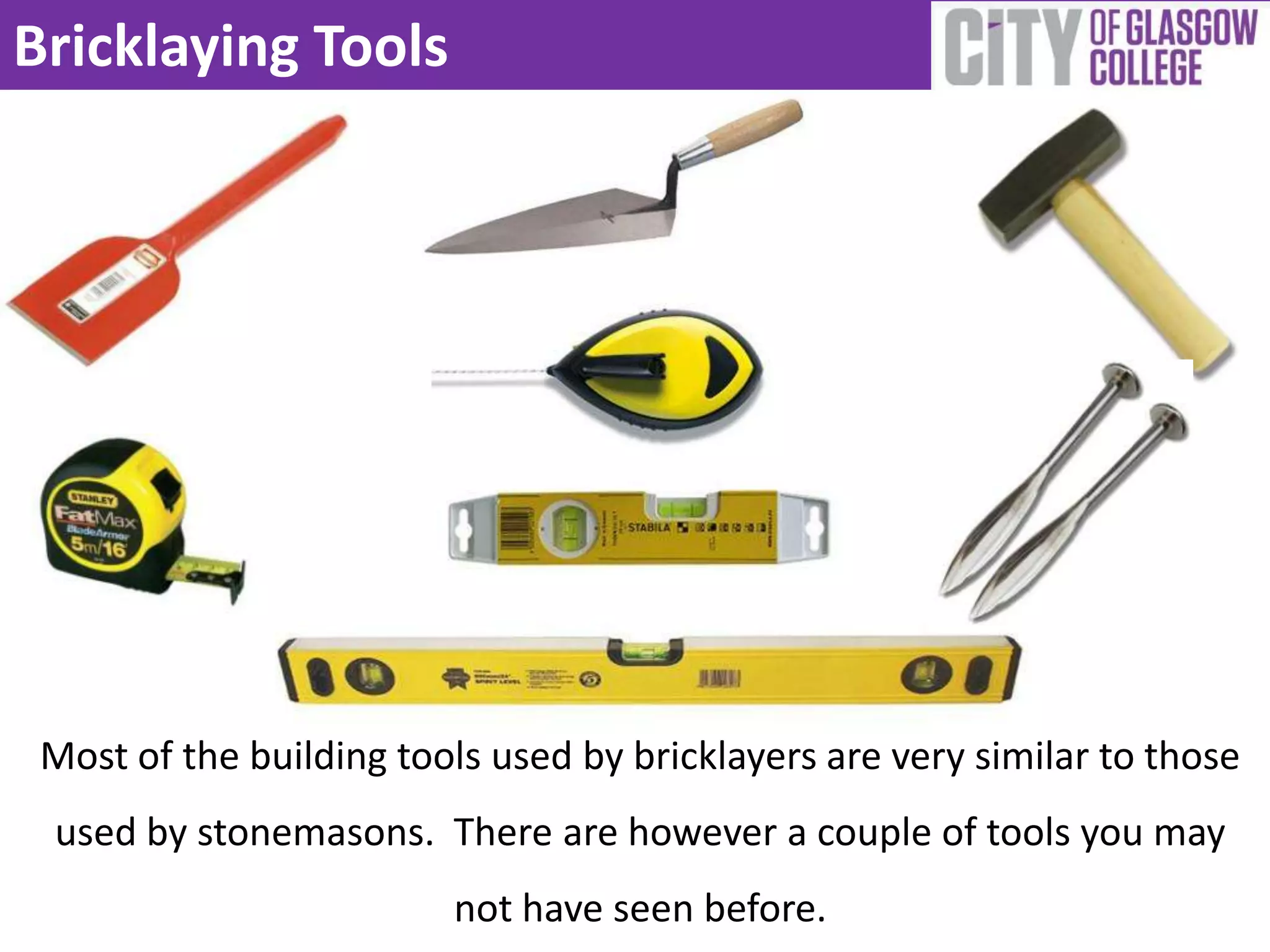
 Most of the building tools used by bricklayers are very similar to those
 used by stonemasons. There are however a couple of tools you may
                         not have seen before.
Bricklaying Tools
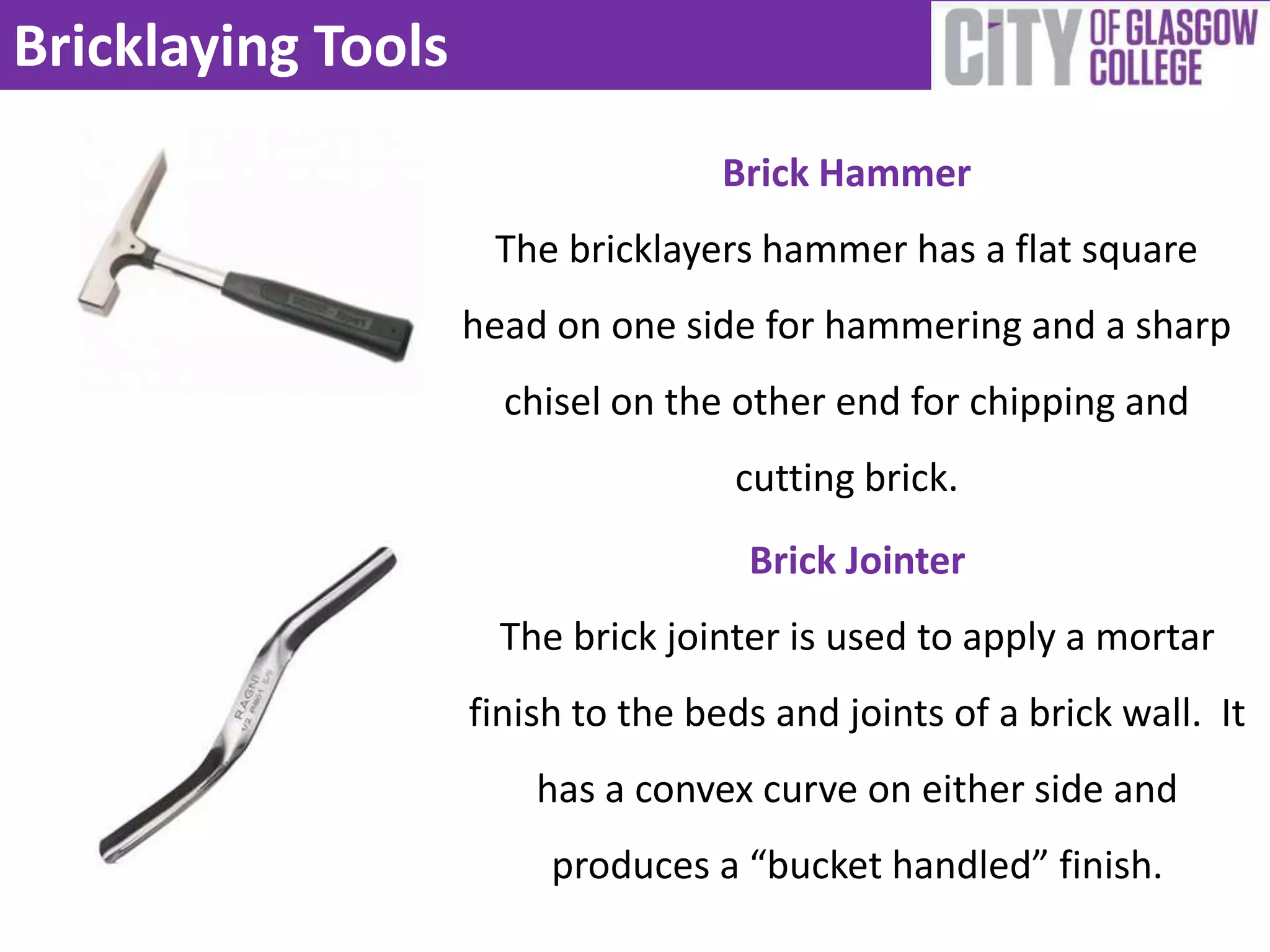
                                   Brick Hammer
                     The bricklayers hammer has a flat square
                    head on one side for hammering and a sharp
                      chisel on the other end for chipping and
                                    cutting brick.
                                     Brick Jointer
                      The brick jointer is used to apply a mortar
                    finish to the beds and joints of a brick wall. It
                        has a convex curve on either side and
                         produces a “bucket handled” finish.
Brick Dimensions

                                          102.5mm


  65mm


                                  215mm


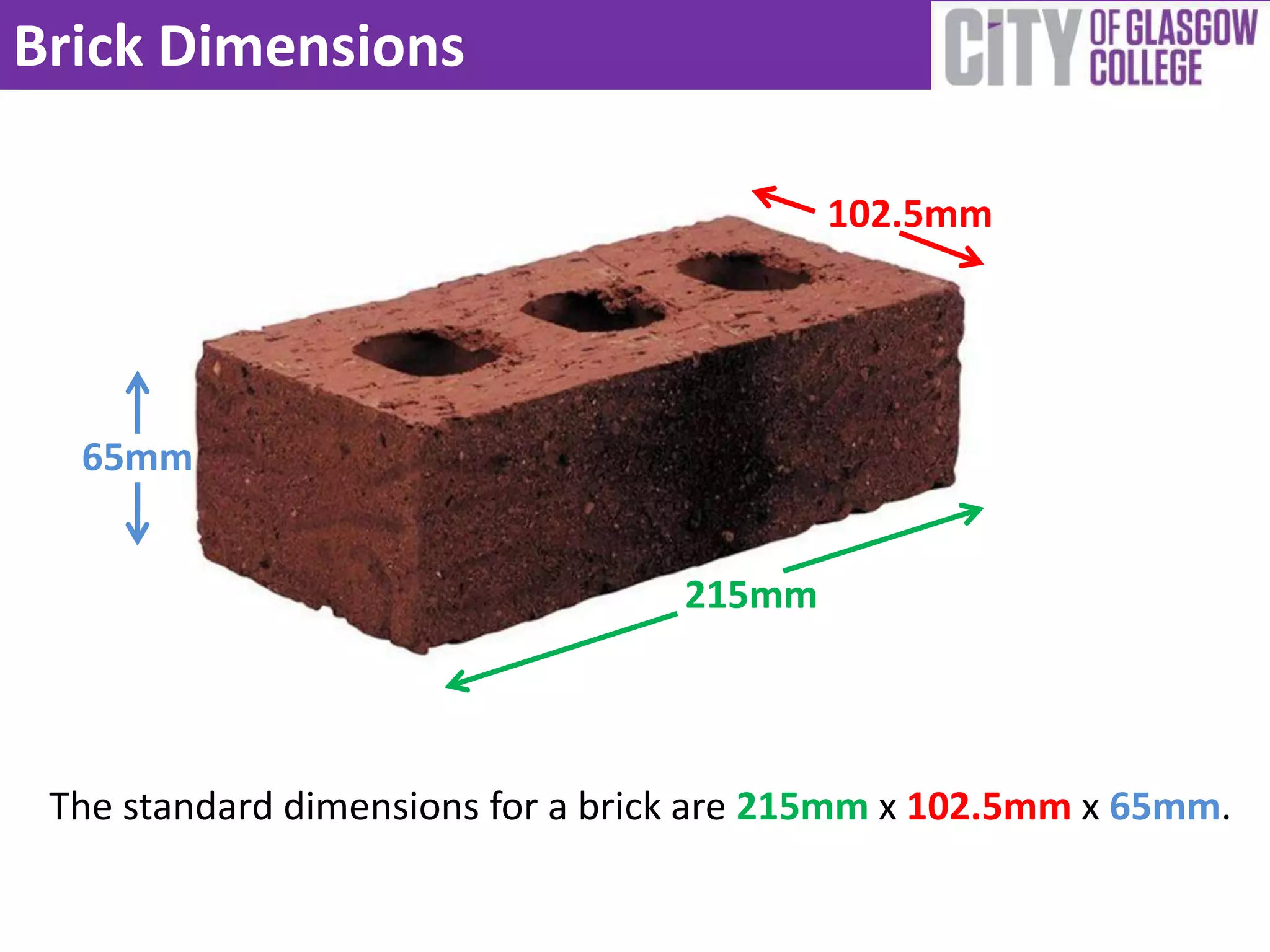
 The standard dimensions for a brick are 215mm x 102.5mm x 65mm.
Brick Identification
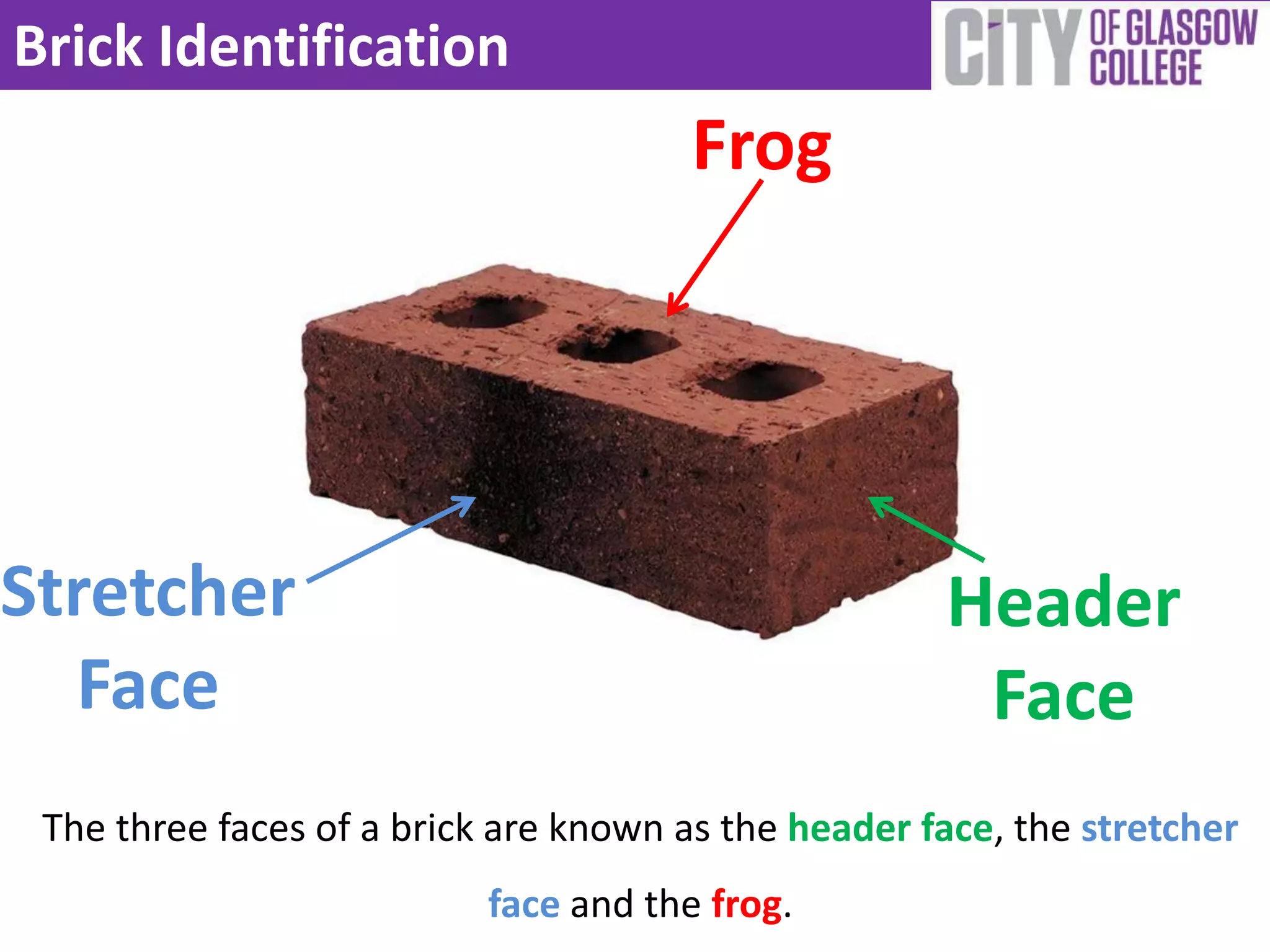
                                       Frog


Stretcher                                            Header
  Face                                                Face
 The three faces of a brick are known as the header face, the stretcher
                           face and the frog.
Brick Types

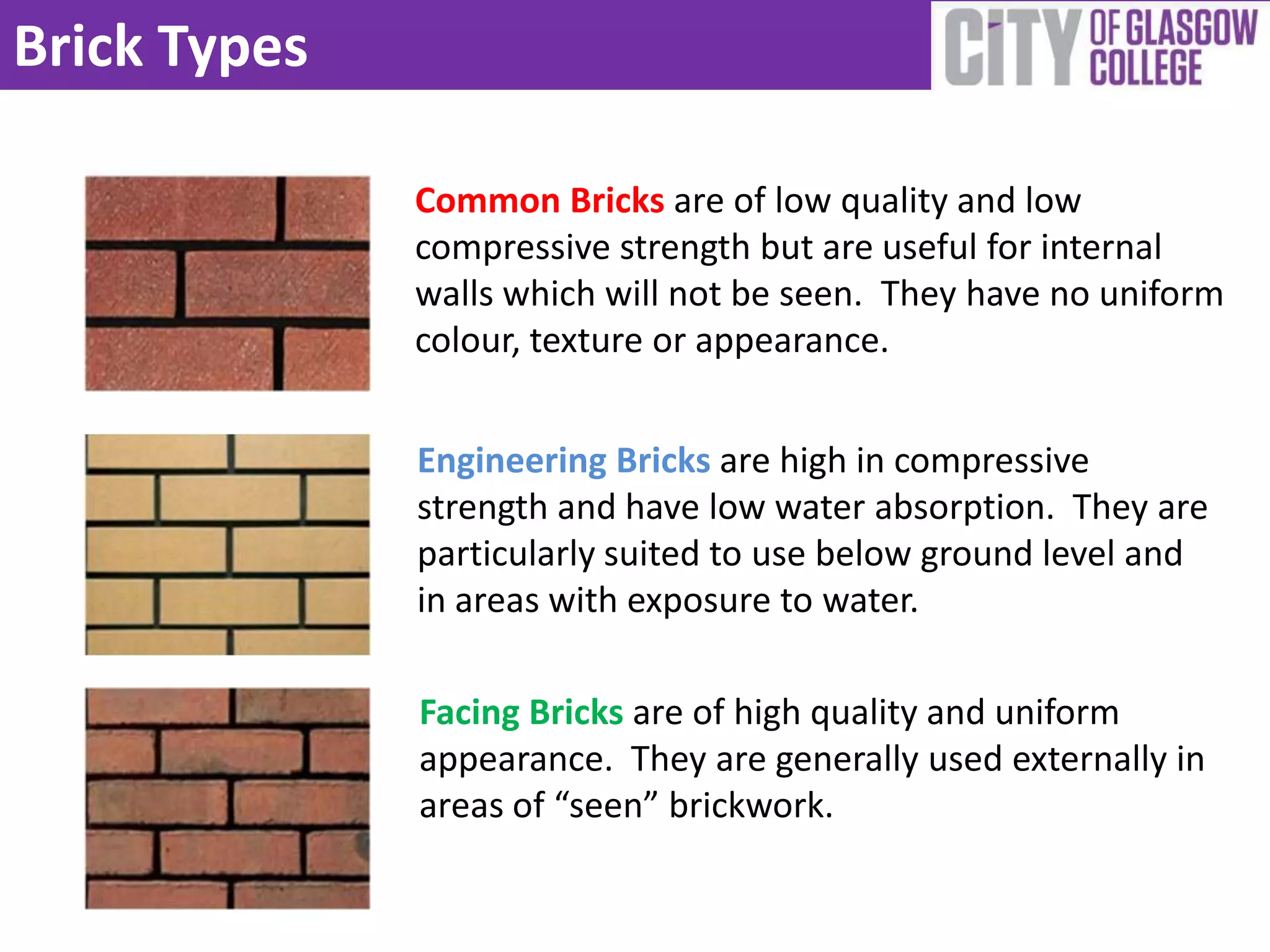
              Common Bricks are of low quality and low
              compressive strength but are useful for internal
              walls which will not be seen. They have no uniform
              colour, texture or appearance.


              Engineering Bricks are high in compressive
              strength and have low water absorption. They are
              particularly suited to use below ground level and
              in areas with exposure to water.

              Facing Bricks are of high quality and uniform
              appearance. They are generally used externally in
              areas of “seen” brickwork.
Brick Types
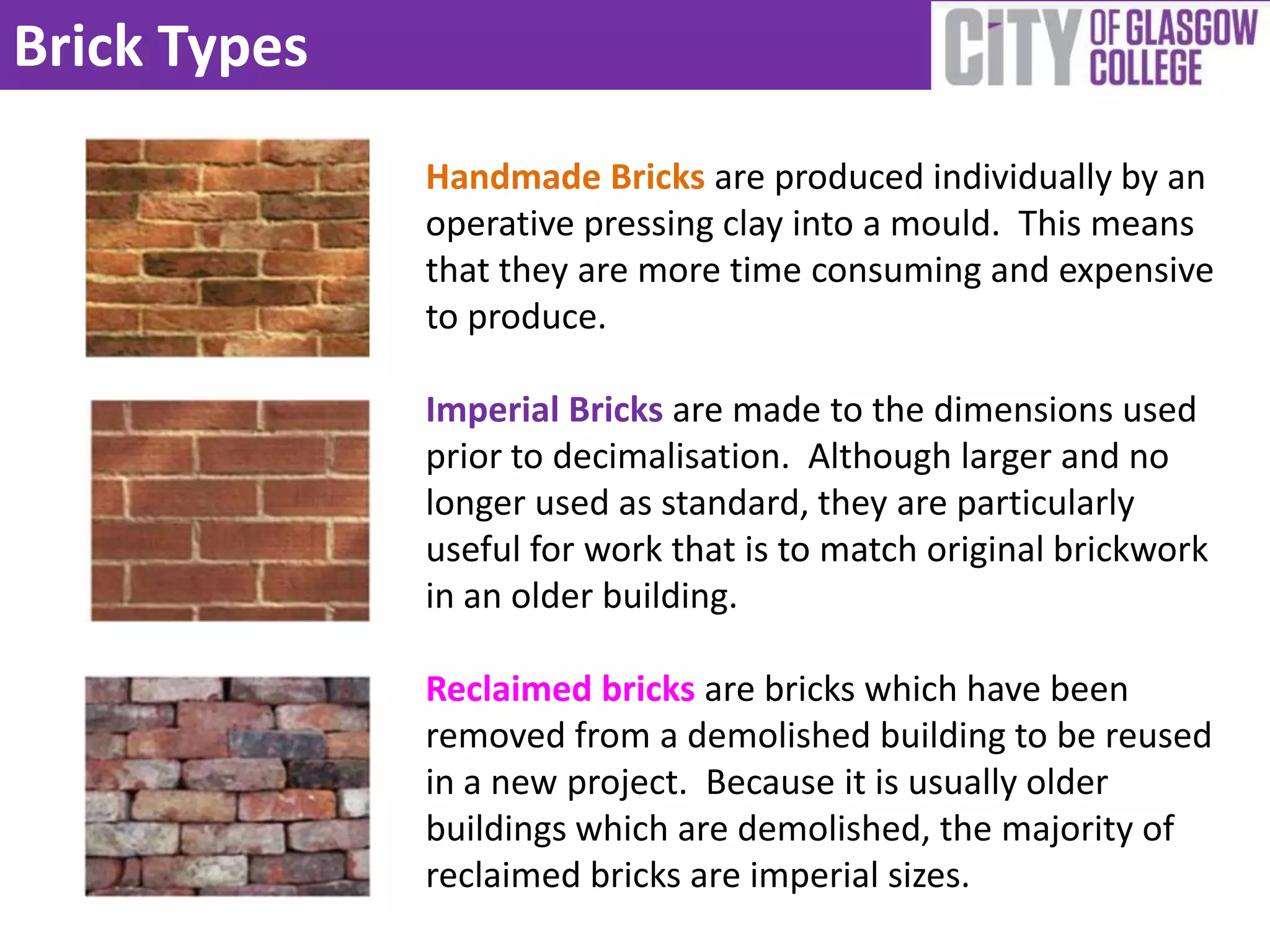
              Handmade Bricks are produced individually by an
              operative pressing clay into a mould. This means
              that they are more time consuming and expensive
              to produce.

              Imperial Bricks are made to the dimensions used
              prior to decimalisation. Although larger and no
              longer used as standard, they are particularly
              useful for work that is to match original brickwork
              in an older building.

              Reclaimed bricks are bricks which have been
              removed from a demolished building to be reused
              in a new project. Because it is usually older
              buildings which are demolished, the majority of
              reclaimed bricks are imperial sizes.
Brick Textures


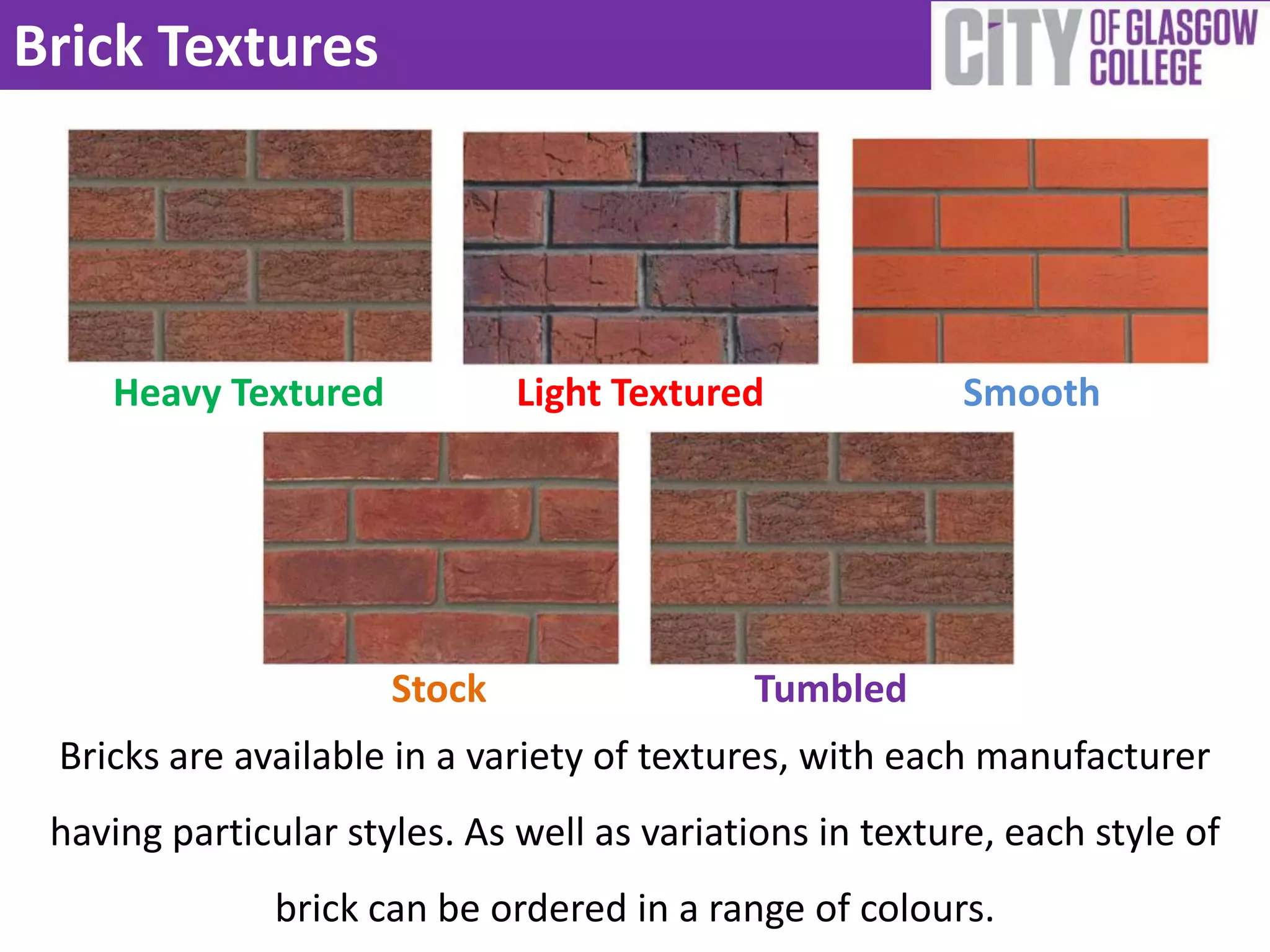
    Heavy Textured            Light Textured             Smooth


                      Stock                 Tumbled
 Bricks are available in a variety of textures, with each manufacturer
 having particular styles. As well as variations in texture, each style of
               brick can be ordered in a range of colours.
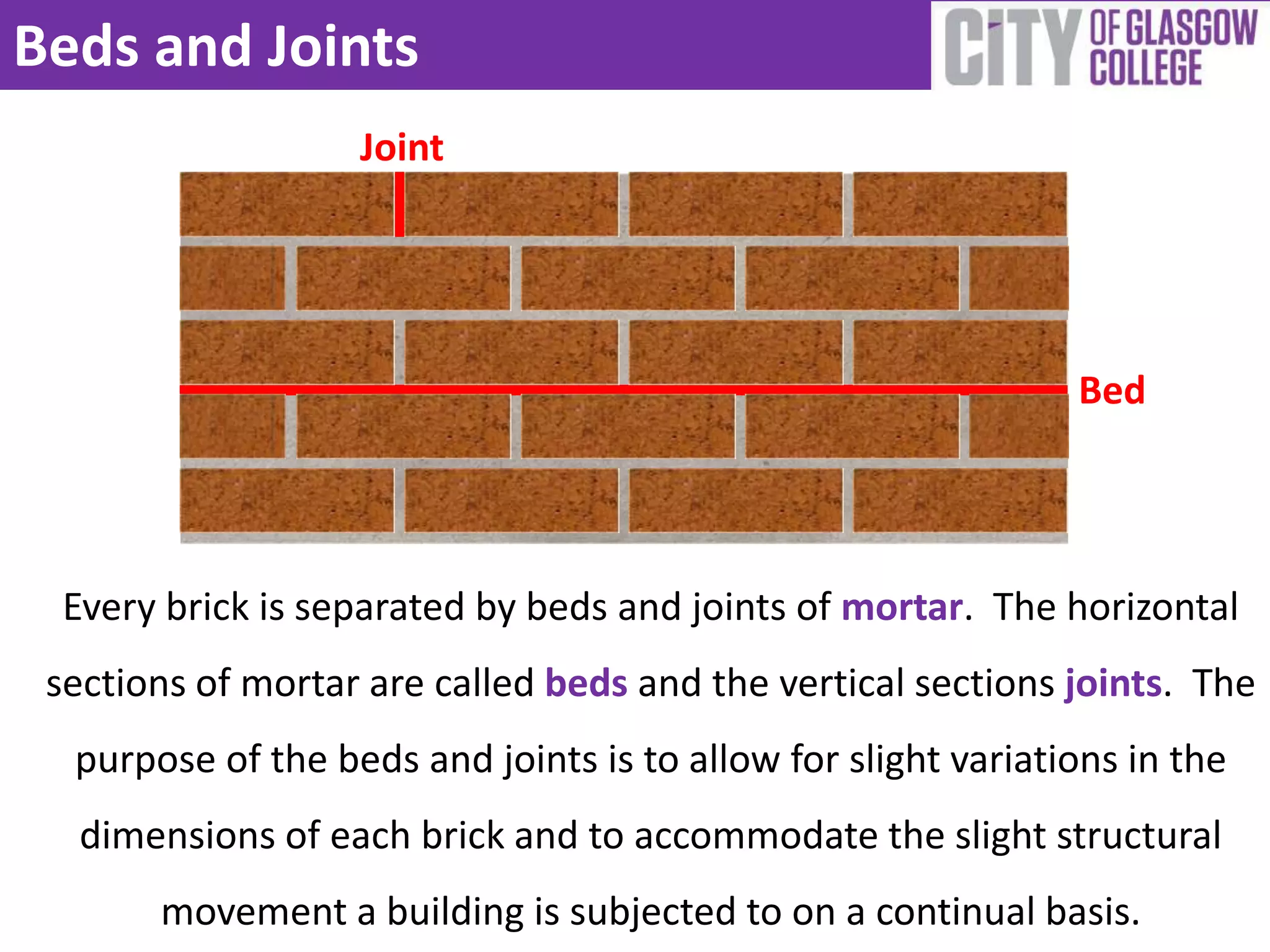
Beds and Joints
                   Joint


                                                               Bed


 Every brick is separated by beds and joints of mortar. The horizontal
 sections of mortar are called beds and the vertical sections joints. The
  purpose of the beds and joints is to allow for slight variations in the
   dimensions of each brick and to accommodate the slight structural
       movement a building is subjected to on a continual basis.
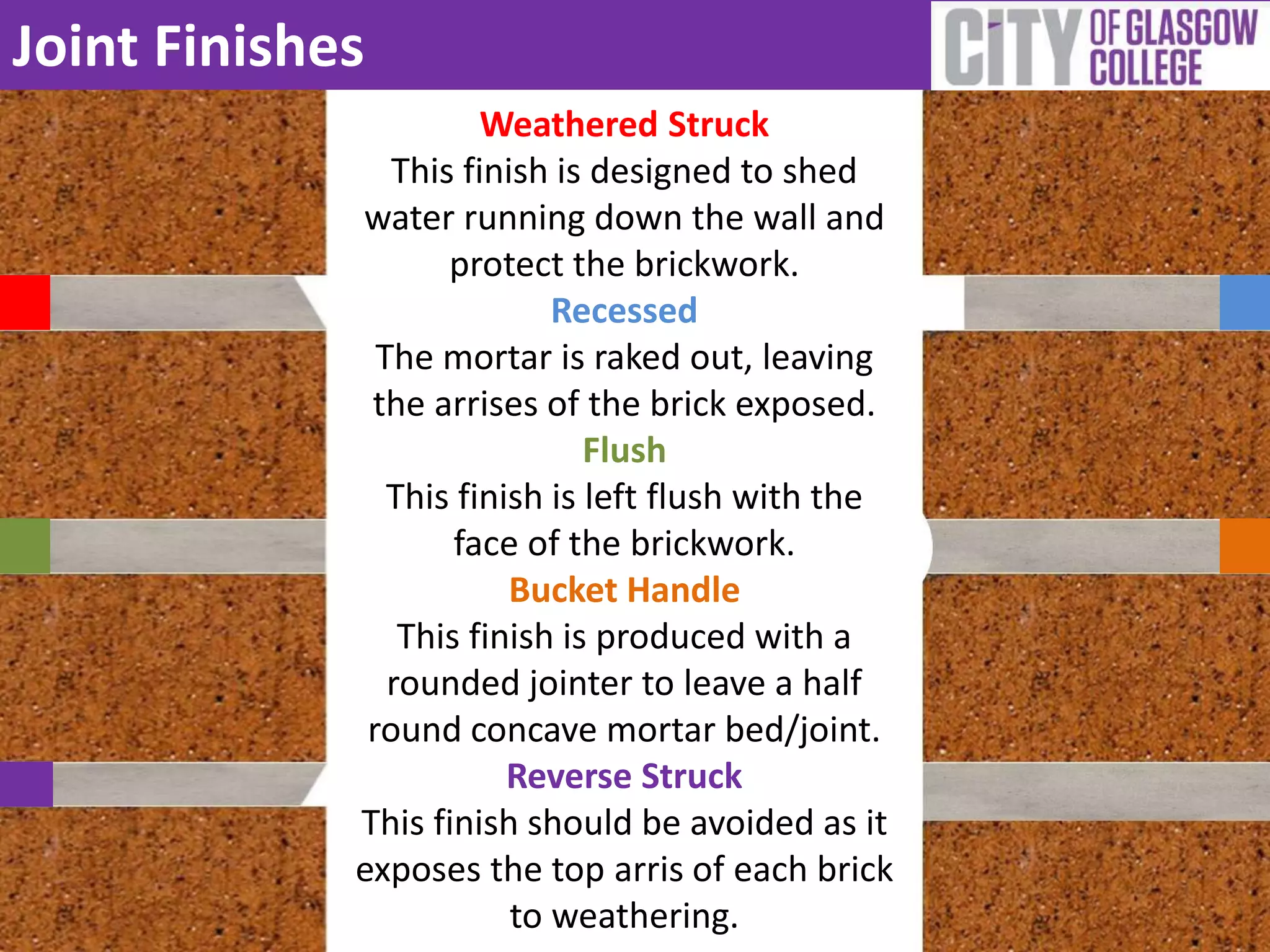
Joint Finishes
                       Weathered Struck
                This finish is designed to shed
             water running down the wall and
                    protect the brickwork.
                            Recessed
               The mortar is raked out, leaving
              the arrises of the brick exposed.
                               Flush
                This finish is left flush with the
                     face of the brickwork.
                         Bucket Handle
                 This finish is produced with a
                rounded jointer to leave a half
              round concave mortar bed/joint.
                         Reverse Struck
             This finish should be avoided as it
             exposes the top arris of each brick
                         to weathering.
Brick Manufacture


 The video is from the popular “How it’s Made” programme shown on
                      the Discovery Channel.
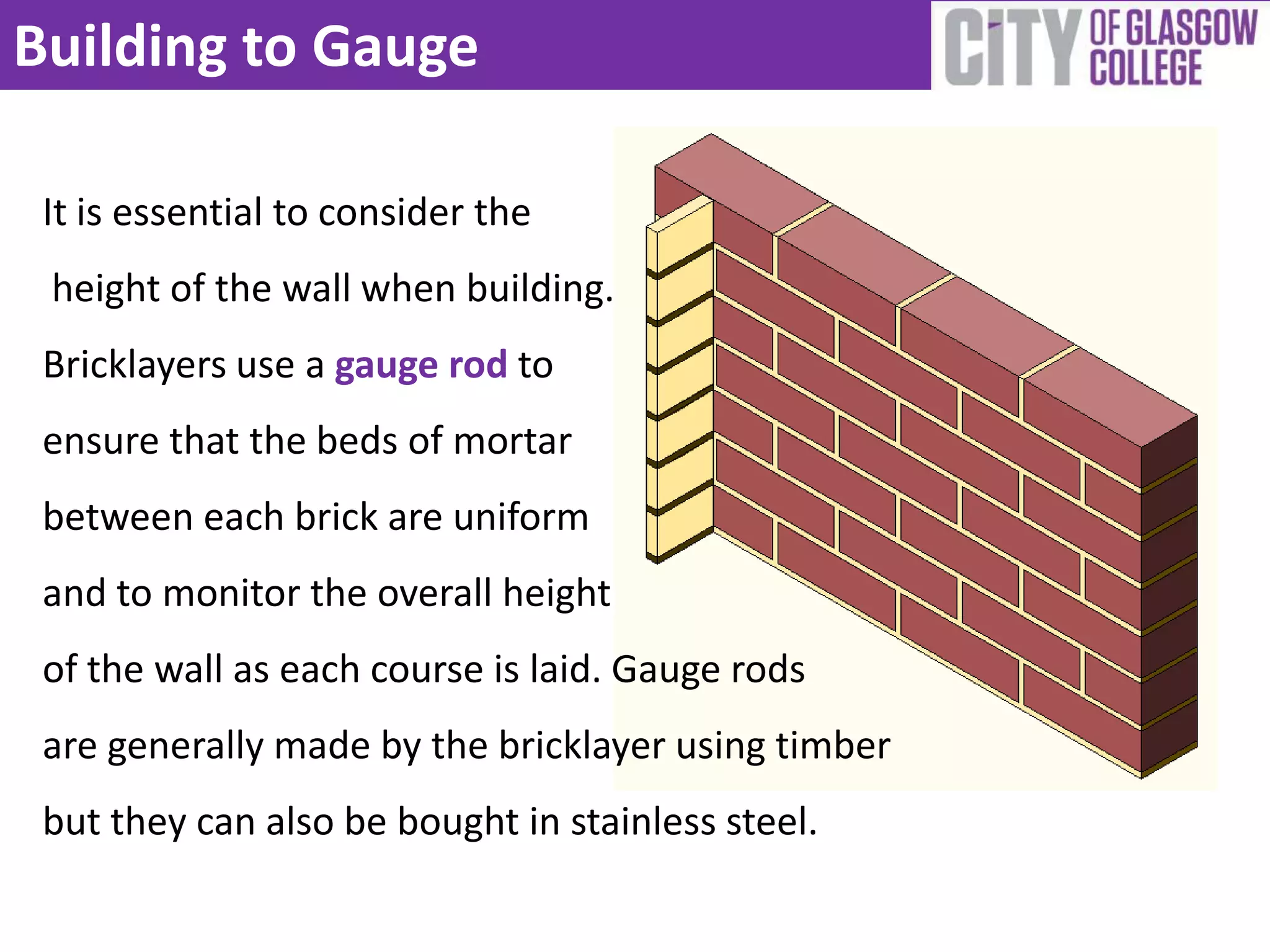
Building to Gauge

 It is essential to consider the
 height of the wall when building.
 Bricklayers use a gauge rod to
 ensure that the beds of mortar
 between each brick are uniform
 and to monitor the overall height
 of the wall as each course is laid. Gauge rods
 are generally made by the bricklayer using timber
 but they can also be bought in stainless steel.
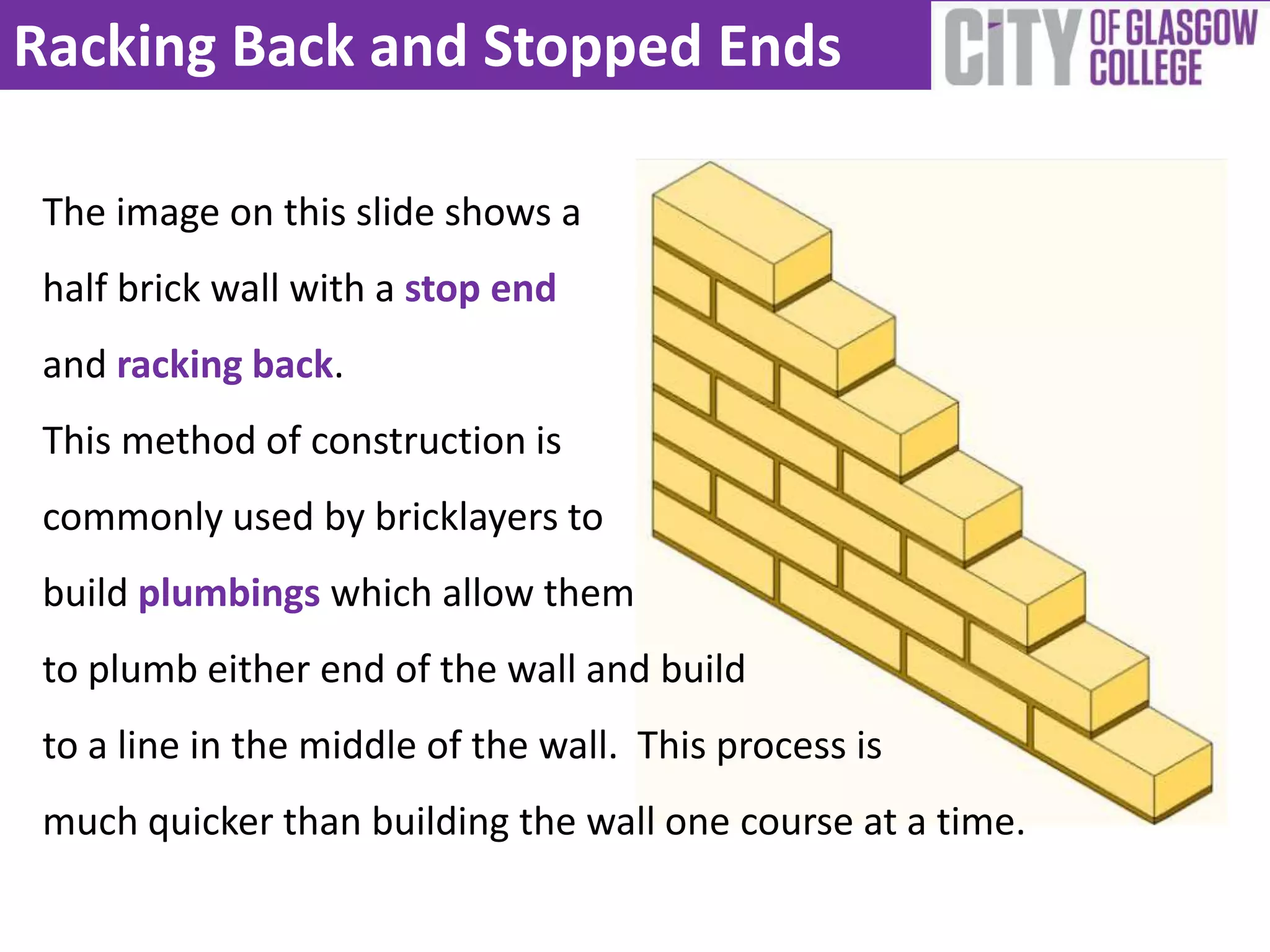
Racking Back and Stopped Ends

 The image on this slide shows a
 half brick wall with a stop end
 and racking back.
 This method of construction is
 commonly used by bricklayers to
 build plumbings which allow them
 to plumb either end of the wall and build
 to a line in the middle of the wall. This process is
 much quicker than building the wall one course at a time.
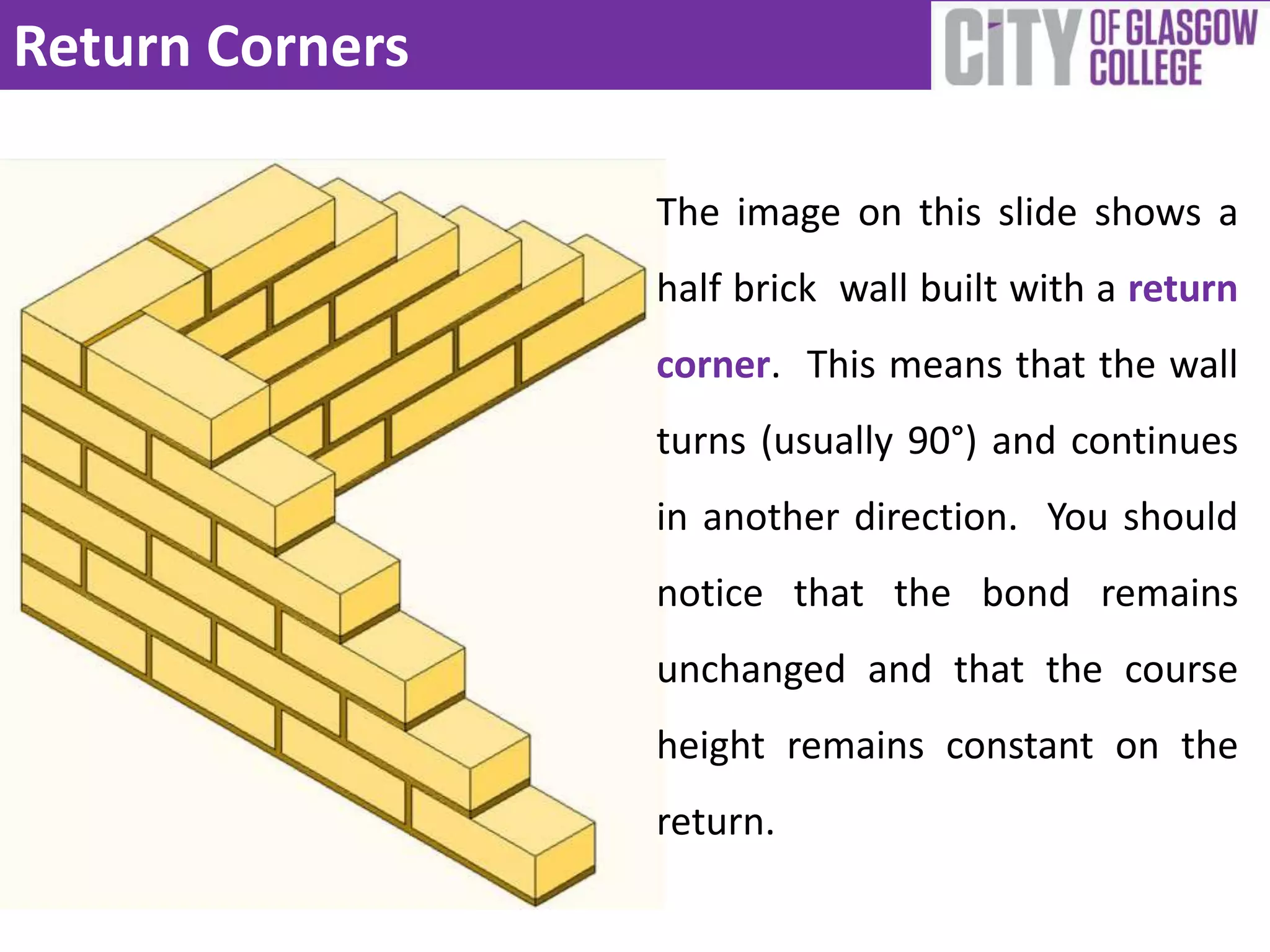
Return Corners

                 The image on this slide shows a
                 half brick wall built with a return
                 corner. This means that the wall
                 turns (usually 90°) and continues
                 in another direction. You should
                 notice that the bond remains
                 unchanged and that the course
                 height remains constant on the
                 return.
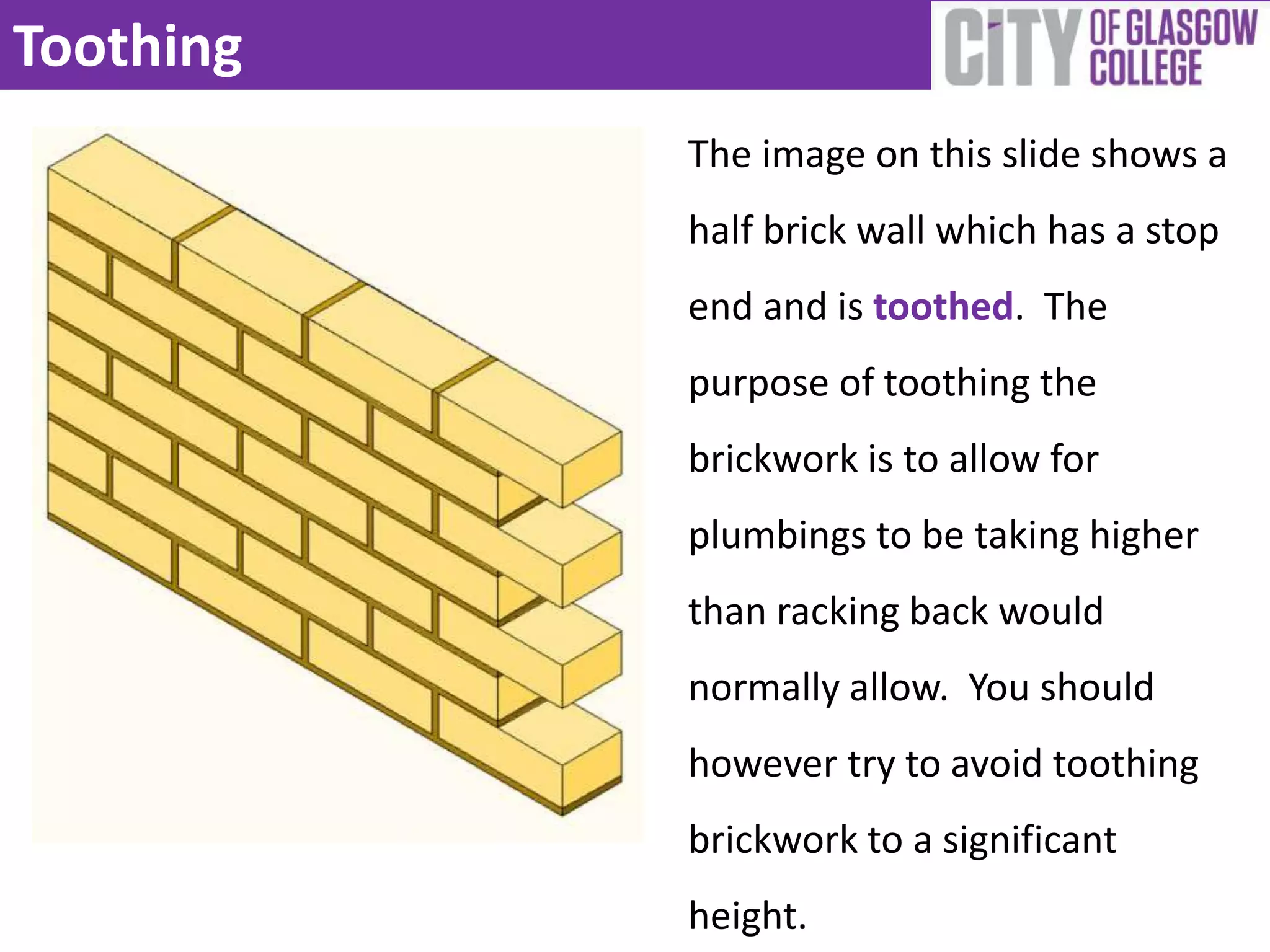
Toothing
           The image on this slide shows a
           half brick wall which has a stop
           end and is toothed. The
           purpose of toothing the
           brickwork is to allow for
           plumbings to be taking higher
           than racking back would
           normally allow. You should
           however try to avoid toothing
           brickwork to a significant
           height.
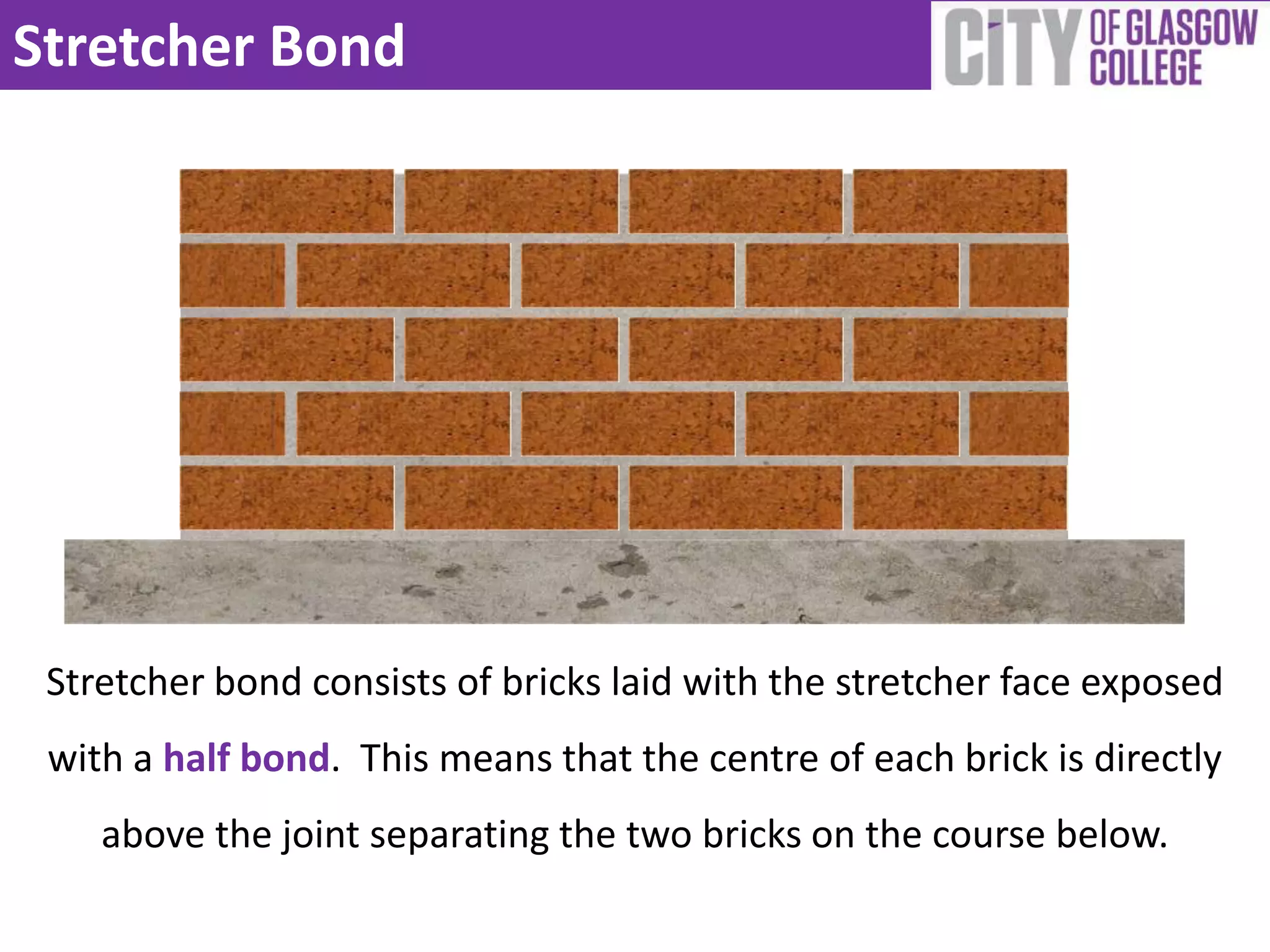
Stretcher Bond


 Stretcher bond consists of bricks laid with the stretcher face exposed
 with a half bond. This means that the centre of each brick is directly
    above the joint separating the two bricks on the course below.
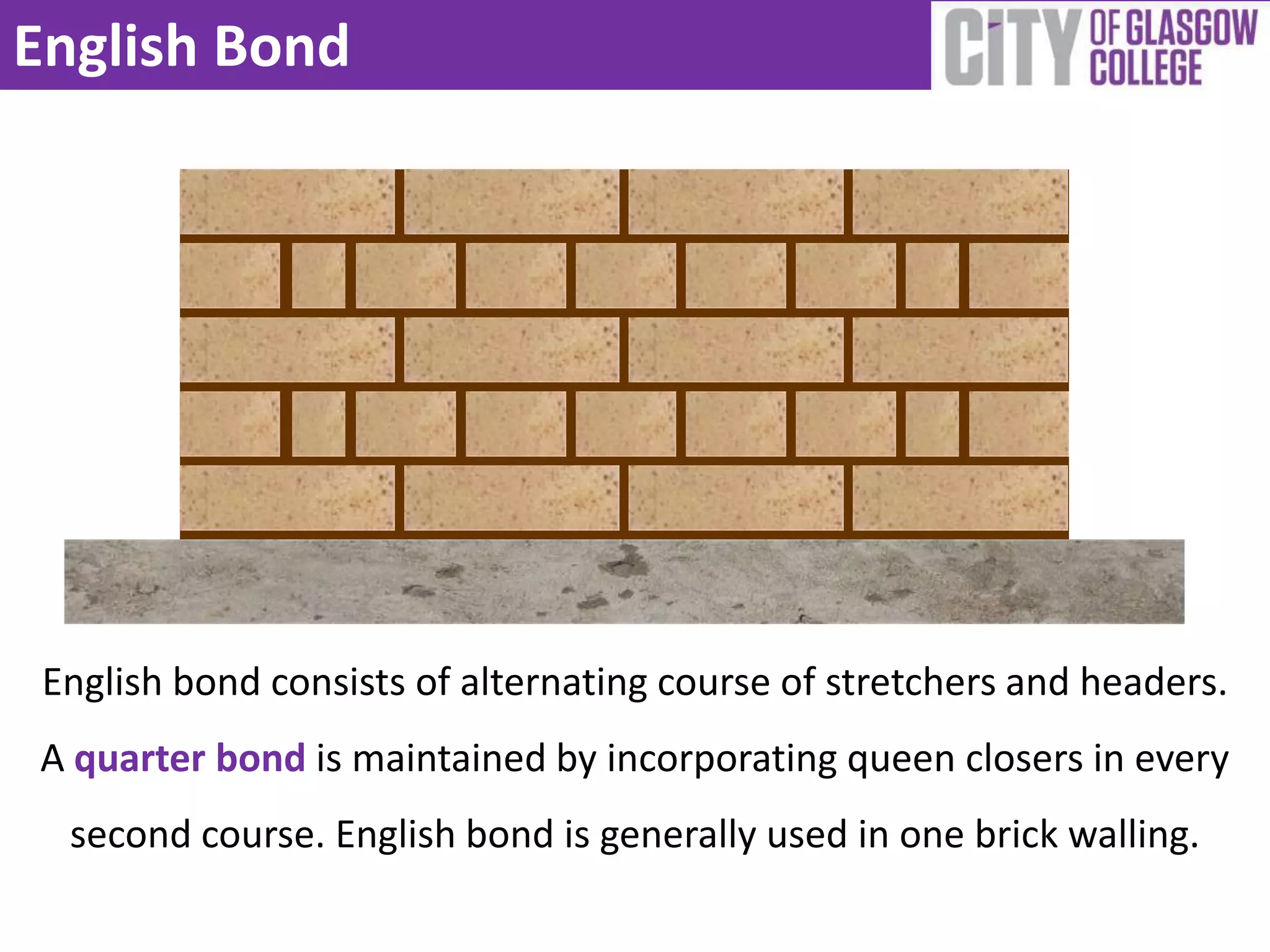
English Bond


 English bond consists of alternating course of stretchers and headers.
A quarter bond is maintained by incorporating queen closers in every
  second course. English bond is generally used in one brick walling.
Header Bond


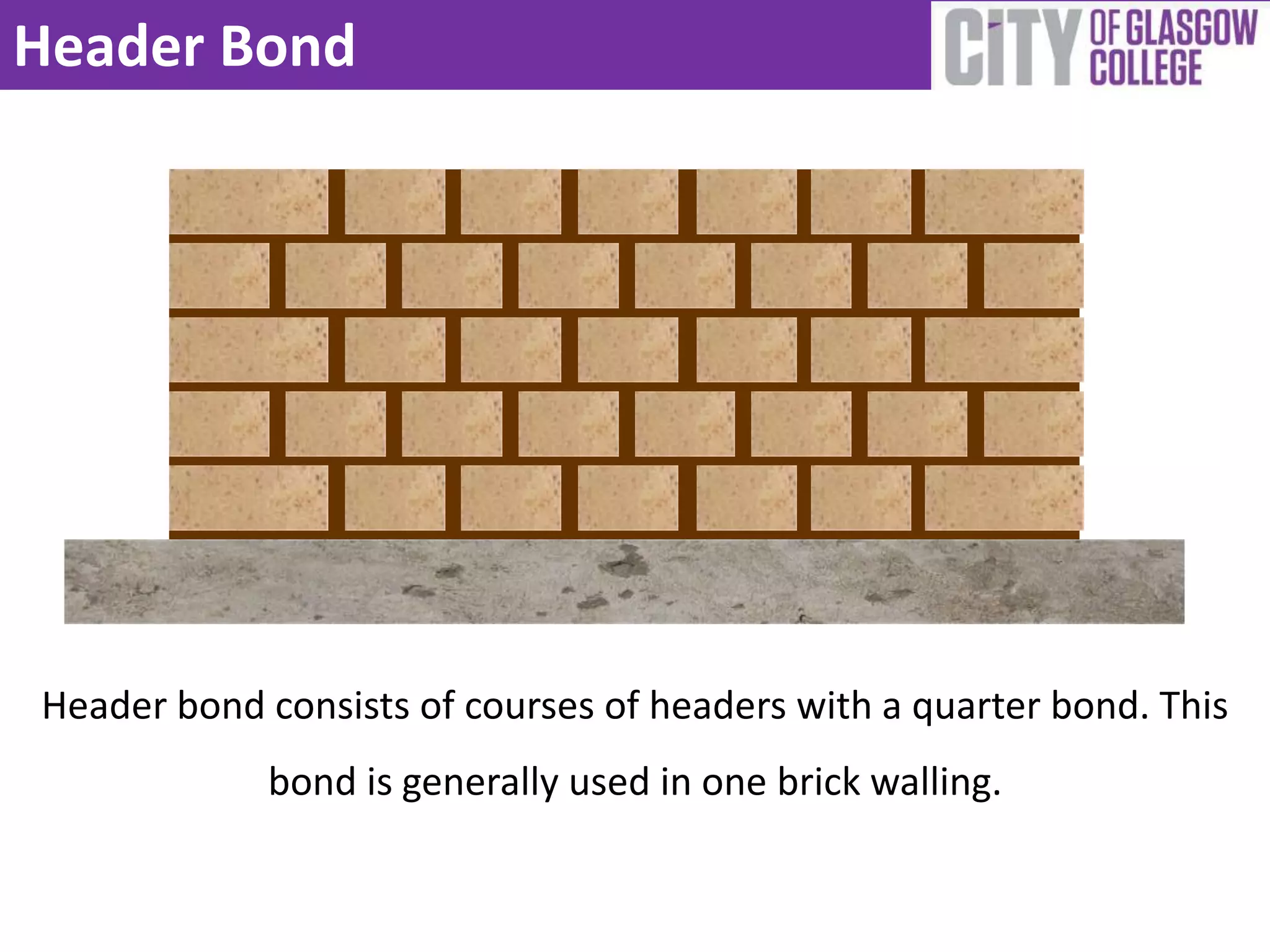
Header bond consists of courses of headers with a quarter bond. This
            bond is generally used in one brick walling.
Flemish Bond


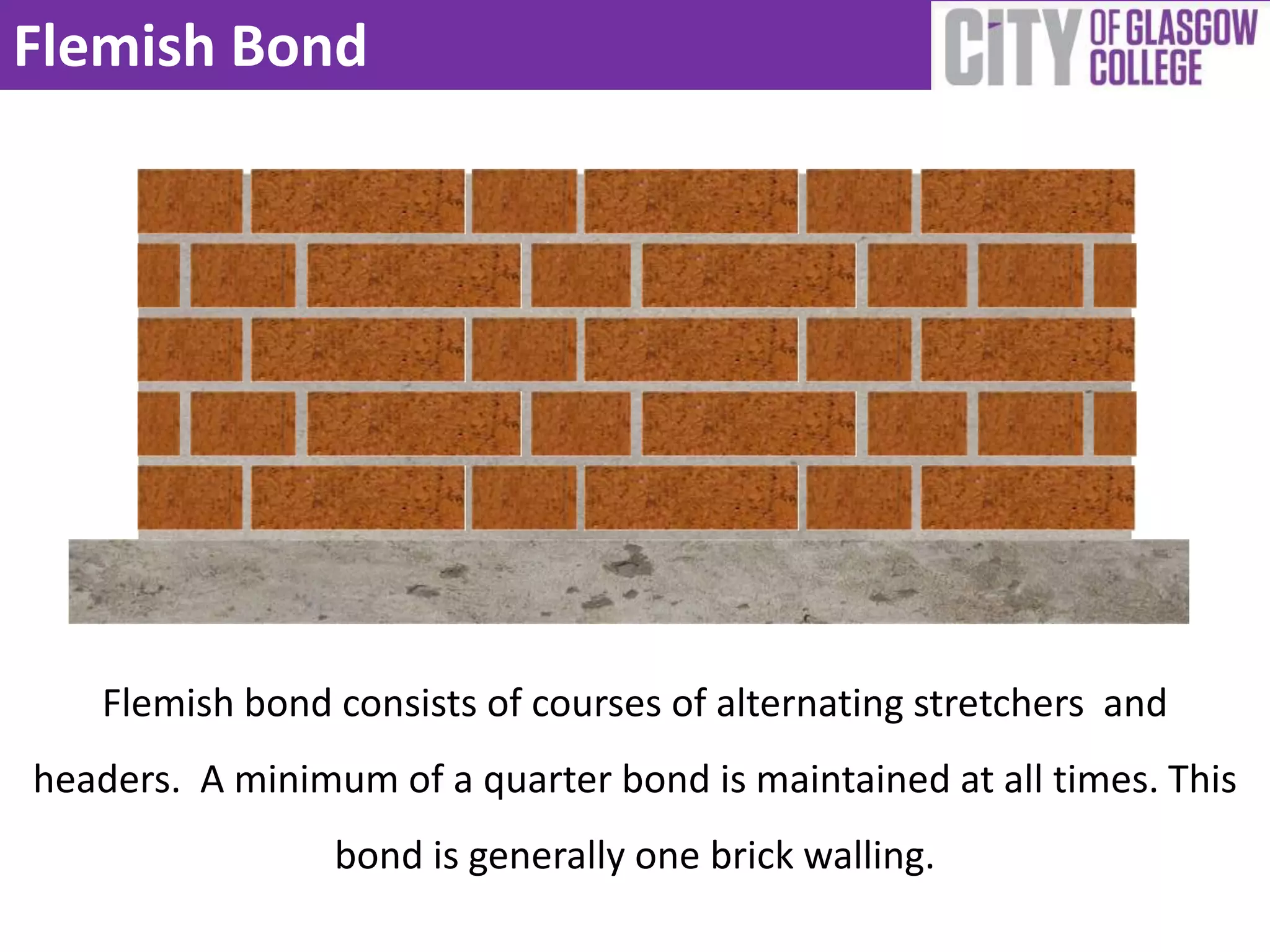
   Flemish bond consists of courses of alternating stretchers and
headers. A minimum of a quarter bond is maintained at all times. This
                 bond is generally one brick walling.
Activities


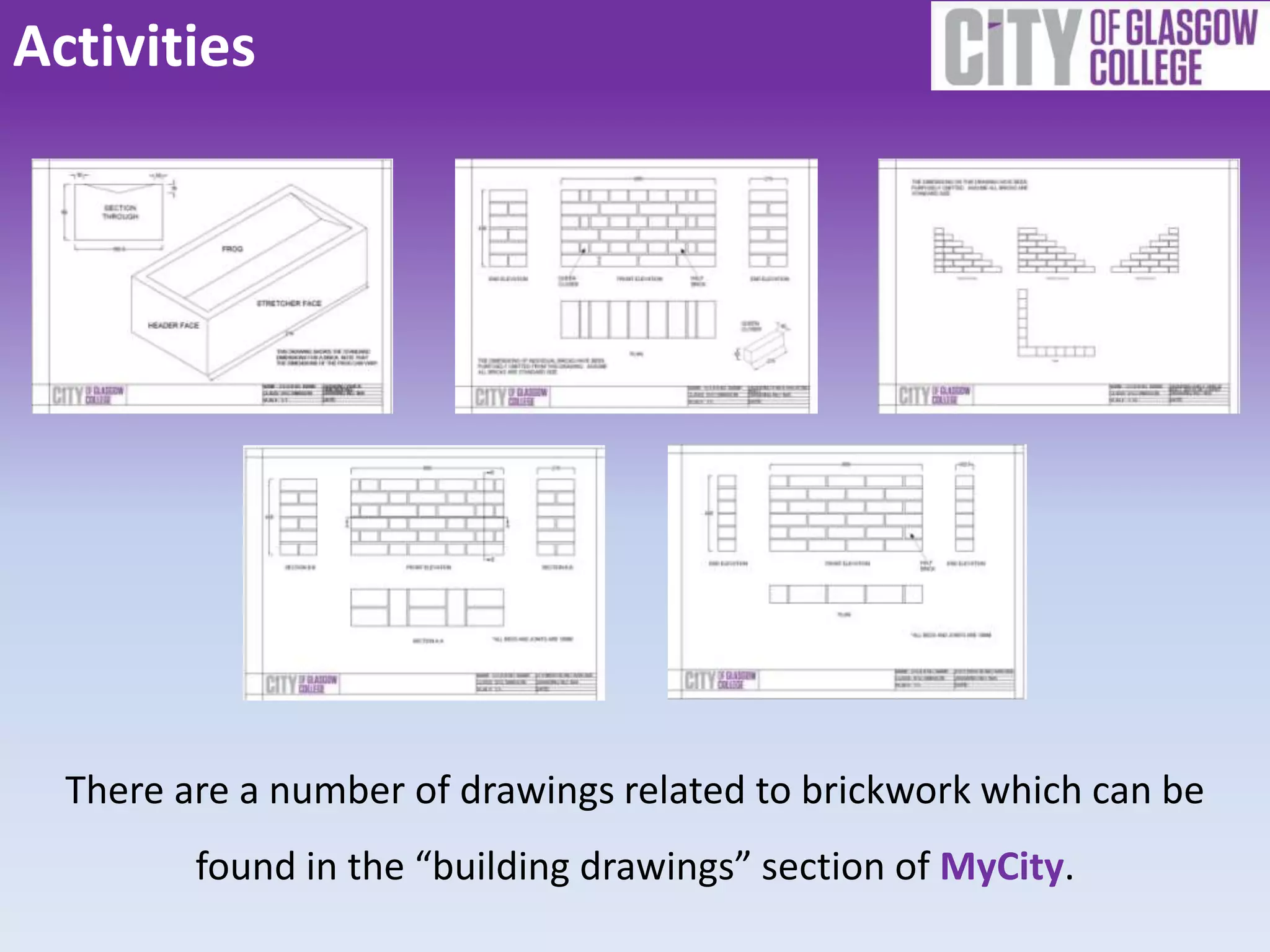
  There are a number of drawings related to brickwork which can be
         found in the “building drawings” section of MyCity.
Image References
          The image on the title slide of this presentation was
          sourced from http://www.freefoto.com/preview/33-32-
          8/Brick-Texture


          The video on the “Brick Manufacture” slide of this
          presentation was sourced from
          http://www.youtube.com/watch?v=SbKvhHzn4hQ


          The images on the “Brick Texture” slide of this presentation
          were sourced from
          http://www.heidelbergcement.com/uk/en/hanson/product
          s/bricks/brickwork_details/brick_colours_and_textures.htm
Image References
          The image on the “Bricklayers Tools” slide of this
          presentation was sourced from
          http://www.diytools.co.uk/draper-13964-expert-560g-
          bricklayers-hammer-with-tubular-steel-shaft.html


          The image on the “Bricklayers Tools” slide of this
          presentation was sourced from http://www.building-
          tools.co.uk/64-104-thickbox/ragni-r801-brick-jointer-1-2in-
          x-5-8in.jpg


          The images on the “Brick Types” slides of this presentation
          were sourced from
          http://www.matchingbrick.co.uk/products.html#common
Developed by The Stonemasonry Department
          City of Glasgow College
                    2011

Brick walling an introduction

  • 1.
    Brick Walling An Introductionfor Stonemasons Stonemasonry Department 2011
  • 2.
    Bricklaying Tools Mostof the building tools used by bricklayers are very similar to those used by stonemasons. There are however a couple of tools you may not have seen before.
  • 3.
    Bricklaying Tools Brick Hammer The bricklayers hammer has a flat square head on one side for hammering and a sharp chisel on the other end for chipping and cutting brick. Brick Jointer The brick jointer is used to apply a mortar finish to the beds and joints of a brick wall. It has a convex curve on either side and produces a “bucket handled” finish.
  • 4.
    Brick Dimensions 102.5mm 65mm 215mm The standard dimensions for a brick are 215mm x 102.5mm x 65mm.
  • 5.
    Brick Identification Frog Stretcher Header Face Face The three faces of a brick are known as the header face, the stretcher face and the frog.
  • 6.
    Brick Types Common Bricks are of low quality and low compressive strength but are useful for internal walls which will not be seen. They have no uniform colour, texture or appearance. Engineering Bricks are high in compressive strength and have low water absorption. They are particularly suited to use below ground level and in areas with exposure to water. Facing Bricks are of high quality and uniform appearance. They are generally used externally in areas of “seen” brickwork.
  • 7.
    Brick Types Handmade Bricks are produced individually by an operative pressing clay into a mould. This means that they are more time consuming and expensive to produce. Imperial Bricks are made to the dimensions used prior to decimalisation. Although larger and no longer used as standard, they are particularly useful for work that is to match original brickwork in an older building. Reclaimed bricks are bricks which have been removed from a demolished building to be reused in a new project. Because it is usually older buildings which are demolished, the majority of reclaimed bricks are imperial sizes.
  • 8.
    Brick Textures Heavy Textured Light Textured Smooth Stock Tumbled Bricks are available in a variety of textures, with each manufacturer having particular styles. As well as variations in texture, each style of brick can be ordered in a range of colours.
  • 9.
    Beds and Joints Joint Bed Every brick is separated by beds and joints of mortar. The horizontal sections of mortar are called beds and the vertical sections joints. The purpose of the beds and joints is to allow for slight variations in the dimensions of each brick and to accommodate the slight structural movement a building is subjected to on a continual basis.
  • 10.
    Joint Finishes Weathered Struck This finish is designed to shed water running down the wall and protect the brickwork. Recessed The mortar is raked out, leaving the arrises of the brick exposed. Flush This finish is left flush with the face of the brickwork. Bucket Handle This finish is produced with a rounded jointer to leave a half round concave mortar bed/joint. Reverse Struck This finish should be avoided as it exposes the top arris of each brick to weathering.
  • 11.
    Brick Manufacture Thevideo is from the popular “How it’s Made” programme shown on the Discovery Channel.
  • 12.
    Building to Gauge It is essential to consider the height of the wall when building. Bricklayers use a gauge rod to ensure that the beds of mortar between each brick are uniform and to monitor the overall height of the wall as each course is laid. Gauge rods are generally made by the bricklayer using timber but they can also be bought in stainless steel.
  • 13.
    Racking Back andStopped Ends The image on this slide shows a half brick wall with a stop end and racking back. This method of construction is commonly used by bricklayers to build plumbings which allow them to plumb either end of the wall and build to a line in the middle of the wall. This process is much quicker than building the wall one course at a time.
  • 14.
    Return Corners The image on this slide shows a half brick wall built with a return corner. This means that the wall turns (usually 90°) and continues in another direction. You should notice that the bond remains unchanged and that the course height remains constant on the return.
  • 15.
    Toothing The image on this slide shows a half brick wall which has a stop end and is toothed. The purpose of toothing the brickwork is to allow for plumbings to be taking higher than racking back would normally allow. You should however try to avoid toothing brickwork to a significant height.
  • 16.
    Stretcher Bond Stretcherbond consists of bricks laid with the stretcher face exposed with a half bond. This means that the centre of each brick is directly above the joint separating the two bricks on the course below.
  • 17.
    English Bond Englishbond consists of alternating course of stretchers and headers. A quarter bond is maintained by incorporating queen closers in every second course. English bond is generally used in one brick walling.
  • 18.
    Header Bond Header bondconsists of courses of headers with a quarter bond. This bond is generally used in one brick walling.
  • 19.
    Flemish Bond Flemish bond consists of courses of alternating stretchers and headers. A minimum of a quarter bond is maintained at all times. This bond is generally one brick walling.
  • 20.
    Activities Thereare a number of drawings related to brickwork which can be found in the “building drawings” section of MyCity.
  • 21.
    Image References The image on the title slide of this presentation was sourced from http://www.freefoto.com/preview/33-32- 8/Brick-Texture The video on the “Brick Manufacture” slide of this presentation was sourced from http://www.youtube.com/watch?v=SbKvhHzn4hQ The images on the “Brick Texture” slide of this presentation were sourced from http://www.heidelbergcement.com/uk/en/hanson/product s/bricks/brickwork_details/brick_colours_and_textures.htm
  • 22.
    Image References The image on the “Bricklayers Tools” slide of this presentation was sourced from http://www.diytools.co.uk/draper-13964-expert-560g- bricklayers-hammer-with-tubular-steel-shaft.html The image on the “Bricklayers Tools” slide of this presentation was sourced from http://www.building- tools.co.uk/64-104-thickbox/ragni-r801-brick-jointer-1-2in- x-5-8in.jpg The images on the “Brick Types” slides of this presentation were sourced from http://www.matchingbrick.co.uk/products.html#common
  • 23.
    Developed by TheStonemasonry Department City of Glasgow College 2011