Portuguese
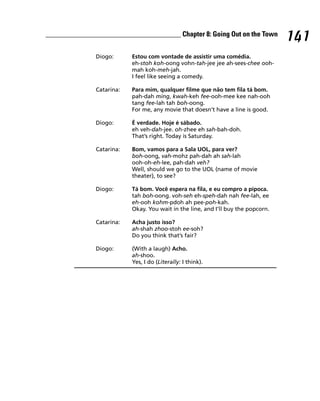
      FOR


DUMmIES
                    ‰


  by Karen Keller
Portuguese
    FOR


DUMmIES
          ‰
Portuguese
      FOR


DUMmIES
                    ‰


  by Karen Keller
Portuguese For Dummies®
Published by
Wiley Publishing, Inc.
111 River St.
Hoboken, NJ 07030-5774
www.wiley.com
Copyright © 2006 by Wiley Publishing, Inc., Indianapolis, Indiana
Published by Wiley Publishing, Inc., Indianapolis, Indiana
Published simultaneously in Canada
No part of this publication may be reproduced, stored in a retrieval system, or transmitted in any form or
by any means, electronic, mechanical, photocopying, recording, scanning, or otherwise, except as permit-
ted under Sections 107 or 108 of the 1976 United States Copyright Act, without either the prior written
permission of the Publisher, or authorization through payment of the appropriate per-copy fee to the
Copyright Clearance Center, 222 Rosewood Drive, Danvers, MA 01923, 978-750-8400, fax 978-646-8600.
Requests to the Publisher for permission should be addressed to the Legal Department, Wiley Publishing,
Inc., 10475 Crosspoint Blvd., Indianapolis, IN 46256, 317-572-3447, fax 317-572-4355, or online at http://
www.wiley.com/go/permissions.
Trademarks: Wiley, the Wiley Publishing logo, For Dummies, the Dummies Man logo, A Reference for the
Rest of Us!, The Dummies Way, Dummies Daily, The Fun and Easy Way, Dummies.com and related trade
dress are trademarks or registered trademarks of John Wiley & Sons, Inc. and/or its affiliates in the United
States and other countries, and may not be used without written permission. All other trademarks are the
property of their respective owners. Wiley Publishing, Inc., is not associated with any product or vendor
mentioned in this book.

LIMIT OF LIABILITY/DISCLAIMER OF WARRANTY: THE PUBLISHER AND THE AUTHOR MAKE NO REP-
RESENTATIONS OR WARRANTIES WITH RESPECT TO THE ACCURACY OR COMPLETENESS OF THE
CONTENTS OF THIS WORK AND SPECIFICALLY DISCLAIM ALL WARRANTIES, INCLUDING WITHOUT
LIMITATION WARRANTIES OF FITNESS FOR A PARTICULAR PURPOSE. NO WARRANTY MAY BE CRE-
ATED OR EXTENDED BY SALES OR PROMOTIONAL MATERIALS. THE ADVICE AND STRATEGIES CON-
TAINED HEREIN MAY NOT BE SUITABLE FOR EVERY SITUATION. THIS WORK IS SOLD WITH THE
UNDERSTANDING THAT THE PUBLISHER IS NOT ENGAGED IN RENDERING LEGAL, ACCOUNTING, OR
OTHER PROFESSIONAL SERVICES. IF PROFESSIONAL ASSISTANCE IS REQUIRED, THE SERVICES OF A
COMPETENT PROFESSIONAL PERSON SHOULD BE SOUGHT. NEITHER THE PUBLISHER NOR THE
AUTHOR SHALL BE LIABLE FOR DAMAGES ARISING HEREFROM. THE FACT THAT AN ORGANIZATION
OR WEBSITE IS REFERRED TO IN THIS WORK AS A CITATION AND/OR A POTENTIAL SOURCE OF FUR-
THER INFORMATION DOES NOT MEAN THAT THE AUTHOR OR THE PUBLISHER ENDORSES THE
INFORMATION THE ORGANIZATION OR WEBSITE MAY PROVIDE OR RECOMMENDATIONS IT MAY
MAKE. FURTHER, READERS SHOULD BE AWARE THAT INTERNET WEBSITES LISTED IN THIS WORK
MAY HAVE CHANGED OR DISAPPEARED BETWEEN WHEN THIS WORK WAS WRITTEN AND WHEN IT
IS READ.

For general information on our other products and services, please contact our Customer Care
Department within the U.S. at 800-762-2974, outside the U.S. at 317-572-3993, or fax 317-572-4002.
For technical support, please visit www.wiley.com/techsupport.
Wiley also publishes its books in a variety of electronic formats. Some content that appears in print may
not be available in electronic books.
Library of Congress Control Number: 2006920618
ISBN-13: 978-0-471-78738-9
ISBN-10: 0-471-78738-8
Manufactured in the United States of America
10 9 8 7 6 5 4 3 2 1
1B/RX/QU/QW/IN
About the Author
    Karen Keller is a journalist who lived and worked in São Paulo, Brazil, for
    three years. Before moving to Brazil, the California native taught Spanish at a
    New York City–based foreign language education Web site. Keller is also a
    published travel guide writer. She currently lives in New Jersey, where she is
    a local newspaper reporter.
Dedication
    To my dear non-Brazilian friends from the São Paulo days, for our chuckles
    over the maravilha that is Brazilian Portuguese.
Author’s Acknowledgments
    I’d like to extend my profound thanks to all editors I became involved with
    during the writing process: Natalie Harris, Stacy Kennedy, Danielle Voirol,
    Jennifer Bingham, and Peter Musson. It’s been an absolute kick.

    I must also thank my Columbia University Graduate School of Journalism pro-
    fessor Tim Harper for putting me in touch with my literary agent for the
    book, Jessica Faust. Jessica, thanks for putting good faith in me.

    Next, my warmest gratitude goes out to my editor and co-worker in Brazil,
    Matt Cowley. Your job offer made my Brazilian adventure possible, and you
    gave me my first Portuguese lessons. I still remember your directive that
    “Rodrigo has an ‘h’ sound at the beginning” as my first glimpse of the lan-
    guage I would soon be mesmerized by.

    Now for those non-Brazilian friends: Ivan, Mario, Ainhoa, Anna, Diego,
    Andrea, Juan, Sophia, Marisol. The sharing of our perspectives on life in
    Brazil and on that lingua esquisita are the stuff of my best memories.

    And to the Brazilian who always helped set us straight. You became my clos-
    est Brazilian confidante, Dayanne Mikevis.

    Chloe — thanks for all the sensible advice you’ve ever given me and for
    inspiring my first trips abroad. Jenny — you’re my soul mate and the best
    person ever for last-minute queries on Portuguese. Yolanda — si no fuera
    por ti y tu obsesión sobre Brasil, jamás hubiera ido.

    Finally, to my family: Mom, Dad, Chris, Jerry, Diane. I’m not that crazy, after
    all. After having melted away into the Southern Hemisphere, I’m back! And
    Mom: My open mind, curiosity, and word-wonder all stem from you.
Publisher’s Acknowledgments
We’re proud of this book; please send us your comments through our Dummies online registration
form located at www.dummies.com/register/.
Some of the people who helped bring this book to market include the following:

Acquisitions, Editorial, and                        Composition Services
Media Development                                   Project Coordinator: Adrienne Martinez
Project Editor: Natalie Faye Harris                 Layout and Graphics: Jonelle Burns,
Acquisitions Editor: Stacy Kennedy                     Denny Hager, Stephanie D. Jumper,
Assistant Editor: Courtney Allen                       Lynsey Osborn, Julie Trippetti

Copy Editors: Danielle Voirol, Jennifer Bingham     Proofreaders: Laura Albert, Betty Kish,
                                                       Jessica Kramer
Editorial Program Coordinator: Hanna K. Scott
                                                    Indexer: Joan Griffitts
Technical Editor: Peter Musson
Media Development Specialist:
   Constance Lewis
Editorial Manager: Christine Beck
Media Development Manager:
   Laura VanWinkle
Editorial Assistants: Erin Calligan, Nadine Bell,
    David Lutton
Cartoons: Rich Tennant
   (www.the5thwave.com)


Publishing and Editorial for Consumer Dummies
    Diane Graves Steele, Vice President and Publisher, Consumer Dummies
    Joyce Pepple, Acquisitions Director, Consumer Dummies
    Kristin A. Cocks, Product Development Director, Consumer Dummies
    Michael Spring, Vice President and Publisher, Travel
    Kelly Regan, Editorial Director, Travel
Publishing for Technology Dummies
    Andy Cummings, Vice President and Publisher, Dummies Technology/General User
Composition Services
    Gerry Fahey, Vice President of Production Services
    Debbie Stailey, Director of Composition Services
Contents at a Glance
Introduction .................................................................1
Part I: Getting Started ..................................................7
Chapter 1: You Already Know a Little Portuguese! ........................................................9
Chapter 2: The Nitty-Gritty: Basic Portuguese Grammar and Numbers ...................23
Chapter 3: Oi! Hello! Greetings and Introductions .......................................................39

Part II: Portuguese in Action .......................................59
Chapter 4: Getting to Know You: Making Small Talk ....................................................61
Chapter 5: Dining Out and Going to Market..................................................................77
Chapter 6: Shopping Made Easy.....................................................................................99
Chapter 7: At the Beach.................................................................................................113
Chapter 8: Going Out on the Town...............................................................................127
Chapter 9: Talking on the Phone ..................................................................................145
Chapter 10: At the Office and around the House .......................................................161

Part III: Portuguese on the Go ...................................173
Chapter 11: Money, Money, Money ..............................................................................175
Chapter 12: Onde Fica? (Where Is It?) Asking for Directions....................................185
Chapter 13: Staying at a Hotel or Guesthouse ............................................................201
Chapter 14: Getting Around: Planes, Buses, Taxis, and More...................................213
Chapter 15: Planning a Trip...........................................................................................231
Chapter 16: Me Ajuda! Help! Handling Emergencies ..................................................247
Chapter 17: O Carnaval! .................................................................................................267

Part IV: The Part of Tens ...........................................285
Chapter 18: Ten Ways to Get a Quick Handle on Brazilian Portuguese...................287
Chapter 19: Ten Favorite Brazilian Portuguese Expressions....................................293
Chapter 20: Eleven Common Portuguese Slang Words .............................................297
Chapter 21: Eleven Terms That Make You Sound Fluent
 in Brazilian Portuguese ...............................................................................................301
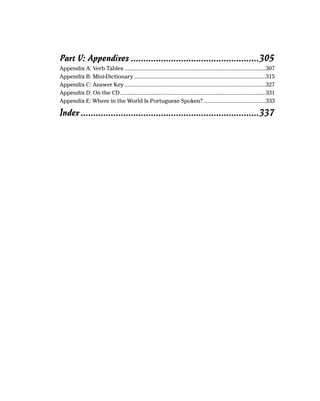
Part V: Appendixes ...................................................305
Appendix A: Verb Tables ...............................................................................................307
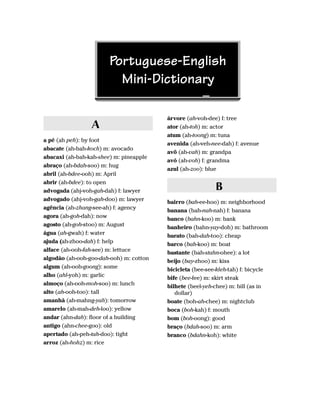
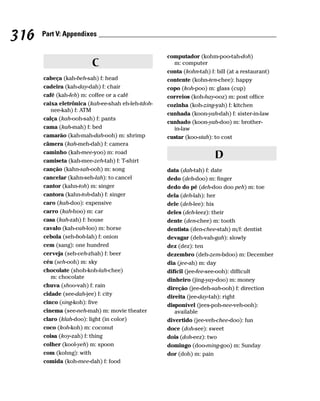
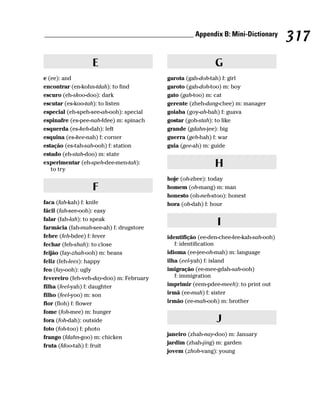
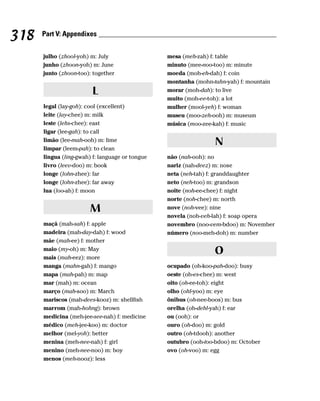
Appendix B: Mini-Dictionary.........................................................................................315
Appendix C: Answer Key ...............................................................................................327
Appendix D: On the CD ..................................................................................................331
Appendix E: Where in the World Is Portuguese Spoken? ..........................................333

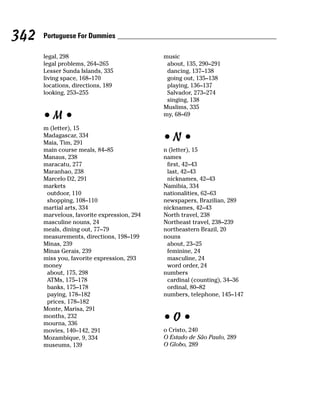
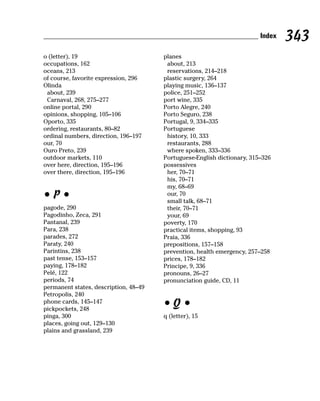
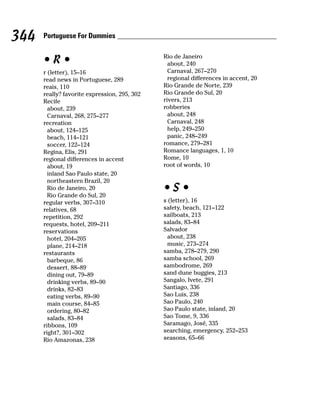
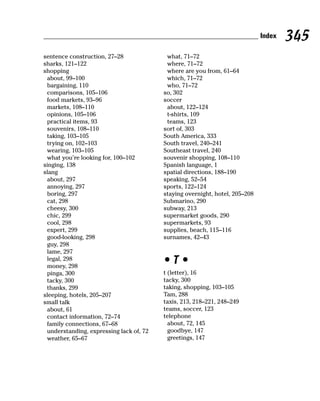
Index .......................................................................337
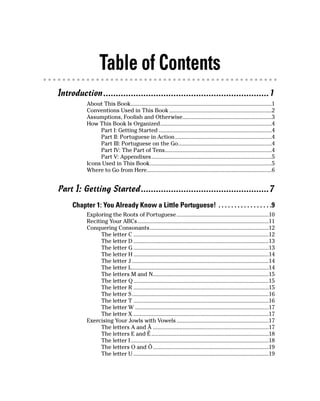
Table of Contents
Introduction ..................................................................1
          About This Book...............................................................................................1
          Conventions Used in This Book .....................................................................2
          Assumptions, Foolish and Otherwise............................................................3
          How This Book Is Organized...........................................................................4
               Part I: Getting Started ............................................................................4
               Part II: Portuguese in Action .................................................................4
               Part III: Portuguese on the Go...............................................................4
               Part IV: The Part of Tens........................................................................4
               Part V: Appendixes.................................................................................5
          Icons Used in This Book..................................................................................5
          Where to Go from Here....................................................................................6


Part I: Getting Started ...................................................7
     Chapter 1: You Already Know a Little Portuguese! . . . . . . . . . . . . . . . . .9
          Exploring the Roots of Portuguese ..............................................................10
          Reciting Your ABCs ........................................................................................11
          Conquering Consonants................................................................................12
                The letter C ...........................................................................................12
                The letter D ...........................................................................................13
                The letter G ...........................................................................................13
                The letter H ...........................................................................................14
                The letter J ............................................................................................14
                The letter L............................................................................................14
                The letters M and N..............................................................................15
                The letter Q ...........................................................................................15
                The letter R ...........................................................................................15
                The letter S ............................................................................................16
                The letter T ...........................................................................................16
                The letter W ..........................................................................................17
                The letter X ...........................................................................................17
          Exercising Your Jowls with Vowels ..............................................................17
                The letters A and à ..............................................................................17
                The letters E and Ê ...............................................................................18
                The letter I .............................................................................................18
                The letters O and Ô..............................................................................19
                The letter U ...........................................................................................19
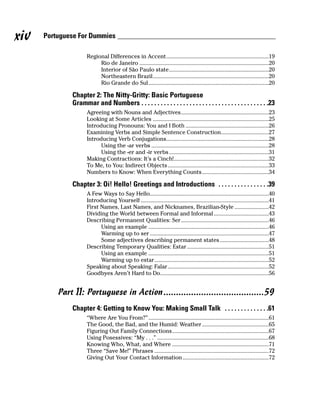
xiv   Portuguese For Dummies

                     Regional Differences in Accent.....................................................................19
                          Rio de Janeiro .......................................................................................20
                          Interior of São Paulo state...................................................................20
                          Northeastern Brazil..............................................................................20
                          Rio Grande do Sul.................................................................................20

              Chapter 2: The Nitty-Gritty: Basic Portuguese
              Grammar and Numbers . . . . . . . . . . . . . . . . . . . . . . . . . . . . . . . . . . . . . . . .23
                     Agreeing with Nouns and Adjectives...........................................................23
                     Looking at Some Articles ..............................................................................25
                     Introducing Pronouns: You and I Both ........................................................26
                     Examining Verbs and Simple Sentence Construction................................27
                     Introducing Verb Conjugations.....................................................................28
                           Using the -ar verbs ...............................................................................28
                           Using the -er and -ir verbs ...................................................................31
                     Making Contractions: It’s a Cinch!................................................................32
                     To Me, to You: Indirect Objects ....................................................................33
                     Numbers to Know: When Everything Counts.............................................34

              Chapter 3: Oi! Hello! Greetings and Introductions . . . . . . . . . . . . . . . .39
                     A Few Ways to Say Hello................................................................................40
                     Introducing Yourself ......................................................................................41
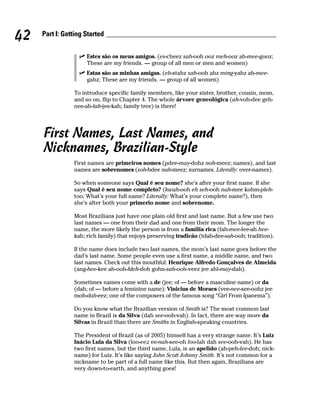
                     First Names, Last Names, and Nicknames, Brazilian-Style .......................42
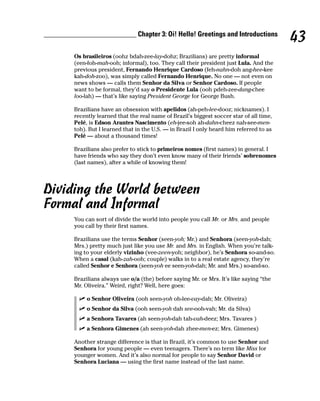
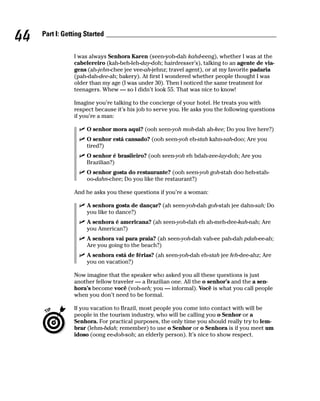
                     Dividing the World between Formal and Informal .....................................43
                     Describing Permanent Qualities: Ser ...........................................................46
                           Using an example .................................................................................46
                           Warming up to ser ................................................................................47
                           Some adjectives describing permanent states.................................48
                     Describing Temporary Qualities: Estar .......................................................51
                           Using an example .................................................................................51
                           Warming up to estar.............................................................................52
                     Speaking about Speaking: Falar....................................................................52
                     Goodbyes Aren’t Hard to Do.........................................................................56


          Part II: Portuguese in Action ........................................59
              Chapter 4: Getting to Know You: Making Small Talk . . . . . . . . . . . . . .61
                     “Where Are You From?” .................................................................................61
                     The Good, the Bad, and the Humid: Weather.............................................65
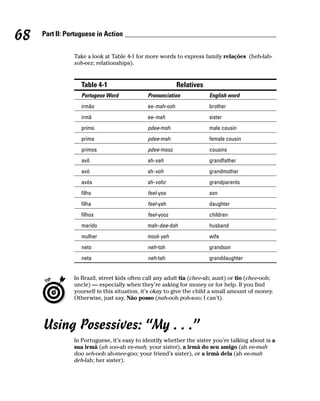
                     Figuring Out Family Connections.................................................................67
                     Using Posessives: “My . . .” ...........................................................................68
                     Knowing Who, What, and Where .................................................................71
                     Three “Save Me!” Phrases .............................................................................72
                     Giving Out Your Contact Information ..........................................................72
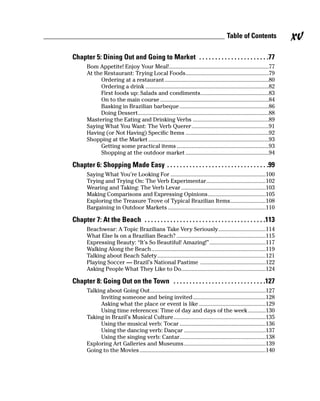
Table of Contents              xv
Chapter 5: Dining Out and Going to Market . . . . . . . . . . . . . . . . . . . . . .77
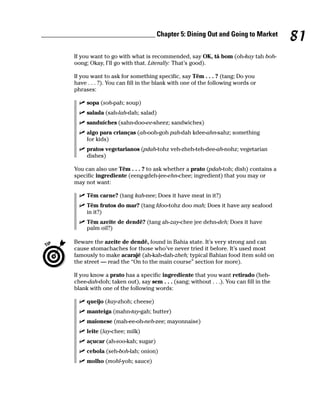
       Bom Appetite! Enjoy Your Meal!...................................................................77
       At the Restaurant: Trying Local Foods........................................................79
             Ordering at a restaurant ......................................................................80
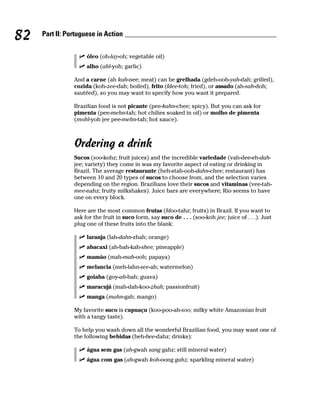
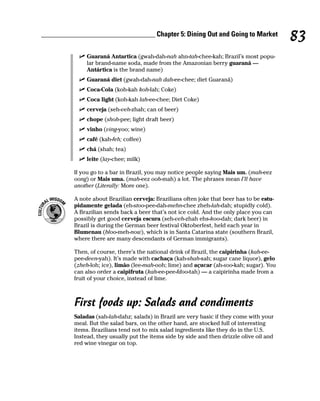
             Ordering a drink ...................................................................................82
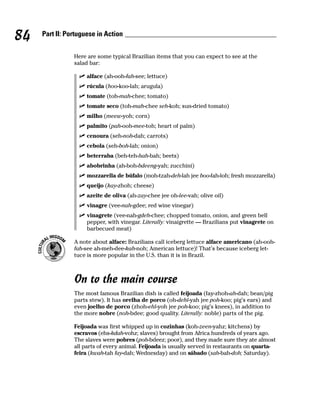
             First foods up: Salads and condiments..............................................83
             On to the main course .........................................................................84
             Basking in Brazilian barbeque ............................................................86
             Doing Dessert........................................................................................88
       Mastering the Eating and Drinking Verbs ...................................................89
       Saying What You Want: The Verb Querer....................................................91
       Having (or Not Having) Specific Items ........................................................92
       Shopping at the Market .................................................................................93
             Getting some practical items ..............................................................93
             Shopping at the outdoor market ........................................................94

Chapter 6: Shopping Made Easy . . . . . . . . . . . . . . . . . . . . . . . . . . . . . . . .99
       Saying What You’re Looking For ................................................................100
       Trying and Trying On: The Verb Experimentar........................................102
       Wearing and Taking: The Verb Levar .........................................................103
       Making Comparisons and Expressing Opinions.......................................105
       Exploring the Treasure Trove of Typical Brazilian Items........................108
       Bargaining in Outdoor Markets ..................................................................110

Chapter 7: At the Beach . . . . . . . . . . . . . . . . . . . . . . . . . . . . . . . . . . . . . .113
       Beachwear: A Topic Brazilians Take Very Seriously................................114
       What Else Is on a Brazilian Beach? ............................................................115
       Expressing Beauty: “It’s So Beautiful! Amazing!”......................................117
       Walking Along the Beach.............................................................................119
       Talking about Beach Safety.........................................................................121
       Playing Soccer — Brazil’s National Pastime ............................................122
       Asking People What They Like to Do.........................................................124

Chapter 8: Going Out on the Town . . . . . . . . . . . . . . . . . . . . . . . . . . . . .127
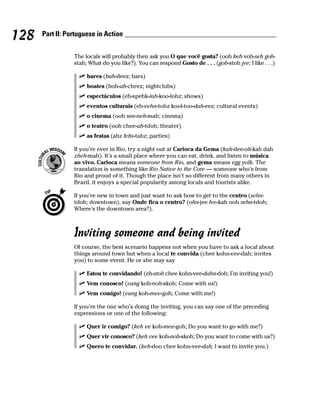
       Talking about Going Out..............................................................................127
             Inviting someone and being invited.................................................128
             Asking what the place or event is like .............................................129
             Using time references: Time of day and days of the week ............130
       Taking in Brazil’s Musical Culture ..............................................................135
             Using the musical verb: Tocar ..........................................................136
             Using the dancing verb: Dançar .......................................................137
             Using the singing verb: Cantar..........................................................138
       Exploring Art Galleries and Museums .......................................................139
       Going to the Movies .....................................................................................140
xvi   Portuguese For Dummies

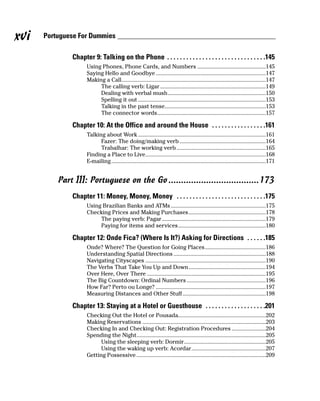
              Chapter 9: Talking on the Phone . . . . . . . . . . . . . . . . . . . . . . . . . . . . . . .145
                    Using Phones, Phone Cards, and Numbers ..............................................145
                    Saying Hello and Goodbye ..........................................................................147
                    Making a Call.................................................................................................147
                         The calling verb: Ligar .......................................................................149
                         Dealing with verbal mush..................................................................150
                         Spelling it out ......................................................................................153
                         Talking in the past tense....................................................................153
                         The connector words.........................................................................157

              Chapter 10: At the Office and around the House . . . . . . . . . . . . . . . . .161
                    Talking about Work ......................................................................................161
                          Fazer: The doing/making verb ..........................................................164
                          Trabalhar: The working verb ............................................................165
                    Finding a Place to Live.................................................................................168
                    E-mailing ........................................................................................................171


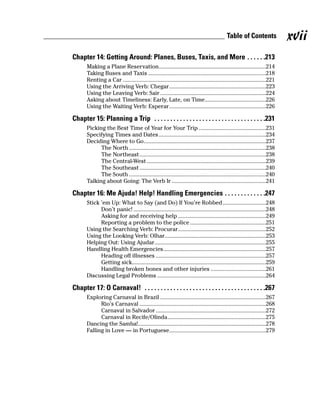
          Part III: Portuguese on the Go ....................................173
              Chapter 11: Money, Money, Money . . . . . . . . . . . . . . . . . . . . . . . . . . . .175
                    Using Brazilian Banks and ATMs ................................................................175
                    Checking Prices and Making Purchases....................................................178
                         The paying verb: Pagar......................................................................179
                         Paying for items and services...........................................................180

              Chapter 12: Onde Fica? (Where Is It?) Asking for Directions . . . . . .185
                    Onde? Where? The Question for Going Places.........................................186
                    Understanding Spatial Directions ..............................................................188
                    Navigating Cityscapes .................................................................................190
                    The Verbs That Take You Up and Down....................................................194
                    Over Here, Over There ................................................................................195
                    The Big Countdown: Ordinal Numbers .....................................................196
                    How Far? Perto ou Longe? ..........................................................................197
                    Measuring Distances and Other Stuff ........................................................198

              Chapter 13: Staying at a Hotel or Guesthouse . . . . . . . . . . . . . . . . . . .201
                    Checking Out the Hotel or Pousada...........................................................202
                    Making Reservations ...................................................................................203
                    Checking In and Checking Out: Registration Procedures .......................204
                    Spending the Night.......................................................................................205
                          Using the sleeping verb: Dormir.......................................................205
                          Using the waking up verb: Acordar..................................................207
                    Getting Possessive .......................................................................................209
Table of Contents               xvii
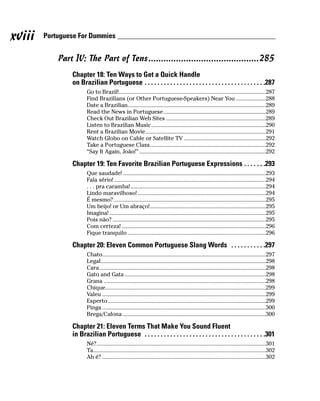
Chapter 14: Getting Around: Planes, Buses, Taxis, and More . . . . . .213
       Making a Plane Reservation........................................................................214
       Taking Buses and Taxis ...............................................................................218
       Renting a Car ................................................................................................221
       Using the Arriving Verb: Chegar.................................................................223
       Using the Leaving Verb: Sair .......................................................................224
       Asking about Timeliness: Early, Late, on Time.........................................226
       Using the Waiting Verb: Esperar.................................................................226

Chapter 15: Planning a Trip . . . . . . . . . . . . . . . . . . . . . . . . . . . . . . . . . . .231
       Picking the Best Time of Year for Your Trip .............................................231
       Specifying Times and Dates ........................................................................234
       Deciding Where to Go..................................................................................237
             The North ............................................................................................238
             The Northeast .....................................................................................238
             The Central-West ................................................................................239
             The Southeast .....................................................................................240
             The South ............................................................................................240
       Talking about Going: The Verb Ir ...............................................................241

Chapter 16: Me Ajuda! Help! Handling Emergencies . . . . . . . . . . . . .247
       Stick ’em Up: What to Say (and Do) If You’re Robbed.............................248
             Don’t panic! .........................................................................................248
             Asking for and receiving help ...........................................................249
             Reporting a problem to the police ...................................................251
       Using the Searching Verb: Procurar...........................................................252
       Using the Looking Verb: Olhar....................................................................253
       Helping Out: Using Ajudar...........................................................................255
       Handling Health Emergencies.....................................................................257
             Heading off illnesses ..........................................................................257
             Getting sick..........................................................................................259
             Handling broken bones and other injuries .....................................261
       Discussing Legal Problems .........................................................................264

Chapter 17: O Carnaval! . . . . . . . . . . . . . . . . . . . . . . . . . . . . . . . . . . . . . .267
       Exploring Carnaval in Brazil .......................................................................267
             Rio’s Carnaval .....................................................................................268
             Carnaval in Salvador ..........................................................................272
             Carnaval in Recife/Olinda..................................................................275
       Dancing the Samba!......................................................................................278
       Falling in Love — in Portuguese.................................................................279
xviii   Portuguese For Dummies


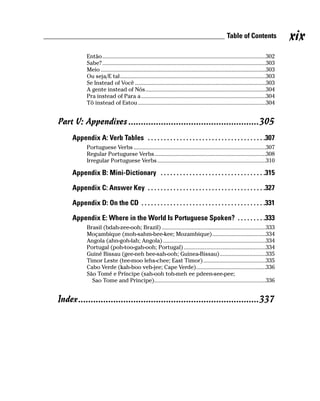
            Part IV: The Part of Tens ............................................285
                Chapter 18: Ten Ways to Get a Quick Handle
                on Brazilian Portuguese . . . . . . . . . . . . . . . . . . . . . . . . . . . . . . . . . . . . . .287
                       Go to Brazil!...................................................................................................287
                       Find Brazilians (or Other Portuguese-Speakers) Near You ....................288
                       Date a Brazilian.............................................................................................289
                       Read the News in Portuguese.....................................................................289
                       Check Out Brazilian Web Sites ...................................................................289
                       Listen to Brazilian Music.............................................................................290
                       Rent a Brazilian Movie.................................................................................291
                       Watch Globo on Cable or Satellite TV .......................................................292
                       Take a Portuguese Class..............................................................................292
                       “Say It Again, João!” .....................................................................................292

                Chapter 19: Ten Favorite Brazilian Portuguese Expressions . . . . . . .293
                       Que saudade! ................................................................................................293
                       Fala sério! ......................................................................................................294
                       . . . pra caramba! ...........................................................................................294
                       Lindo maravilhoso! ......................................................................................294
                       É mesmo? ......................................................................................................295
                       Um beijo! or Um abraço!..............................................................................295
                       Imagina! .........................................................................................................295
                       Pois não? .......................................................................................................295
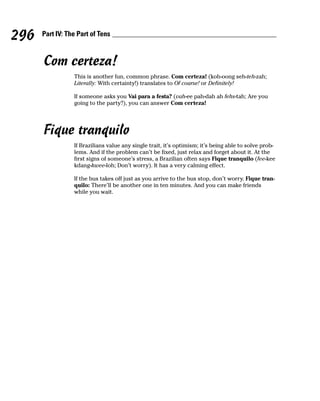
                       Com certeza! .................................................................................................296
                       Fique tranquilo .............................................................................................296

                Chapter 20: Eleven Common Portuguese Slang Words . . . . . . . . . . .297
                       Chato..............................................................................................................297
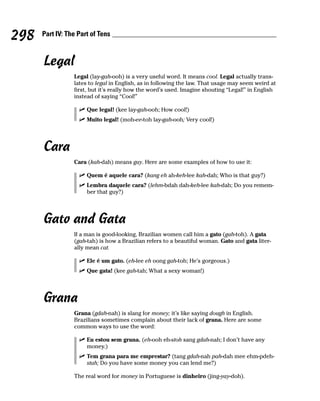
                       Legal...............................................................................................................298
                       Cara................................................................................................................298
                       Gato and Gata ...............................................................................................298
                       Grana .............................................................................................................298
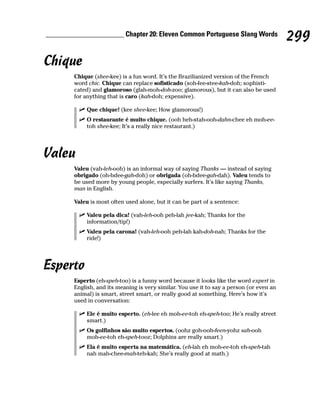
                       Chique............................................................................................................299
                       Valeu ..............................................................................................................299
                       Esperto ..........................................................................................................299
                       Pinga ..............................................................................................................300
                       Brega/Cafona ................................................................................................300

                Chapter 21: Eleven Terms That Make You Sound Fluent
                in Brazilian Portuguese . . . . . . . . . . . . . . . . . . . . . . . . . . . . . . . . . . . . . .301
                       Né?..................................................................................................................301
                       Ta....................................................................................................................302
                       Ah é? ..............................................................................................................302
Table of Contents                 xix
            Então..............................................................................................................302
            Sabe? ..............................................................................................................303
            Meio ...............................................................................................................303
            Ou seja/E tal..................................................................................................303
            Se Instead of Você ........................................................................................303
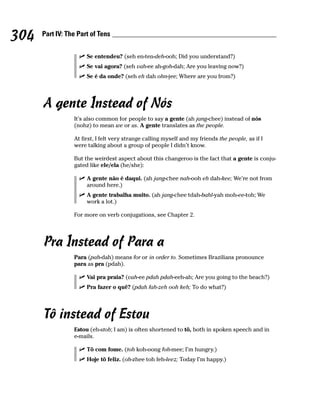
            A gente instead of Nós.................................................................................304
            Pra instead of Para a....................................................................................304
            Tô instead of Estou ......................................................................................304


Part V: Appendixes ....................................................305
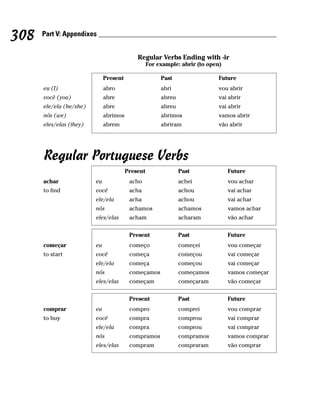
     Appendix A: Verb Tables . . . . . . . . . . . . . . . . . . . . . . . . . . . . . . . . . . . . .307
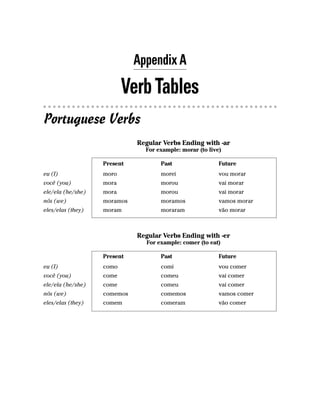
            Portuguese Verbs .........................................................................................307
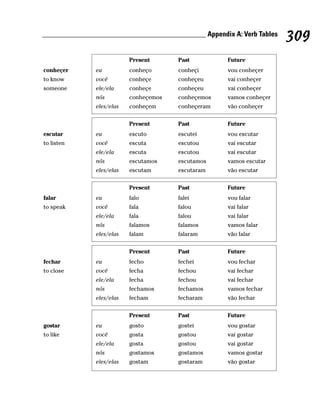
            Regular Portuguese Verbs...........................................................................308
            Irregular Portuguese Verbs .........................................................................310

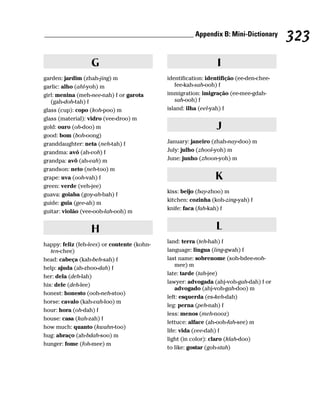
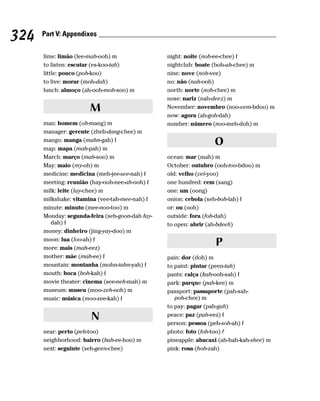
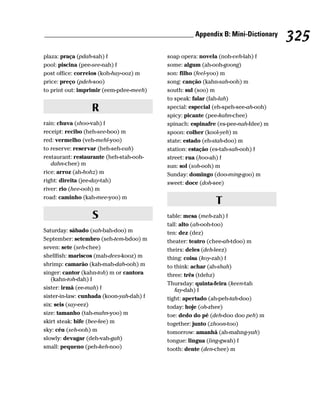
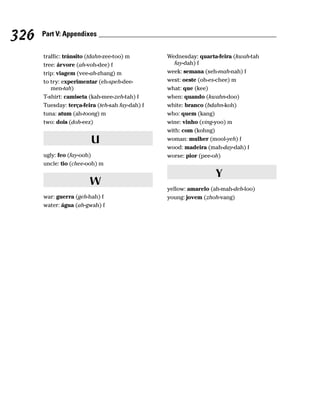
     Appendix B: Mini-Dictionary . . . . . . . . . . . . . . . . . . . . . . . . . . . . . . . . .315

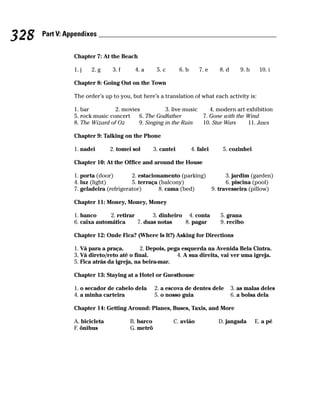
     Appendix C: Answer Key . . . . . . . . . . . . . . . . . . . . . . . . . . . . . . . . . . . . .327

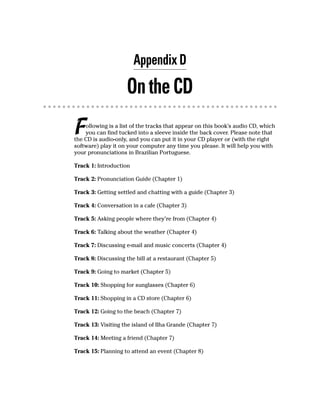
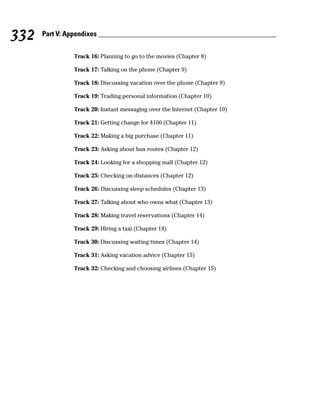
     Appendix D: On the CD . . . . . . . . . . . . . . . . . . . . . . . . . . . . . . . . . . . . . . .331

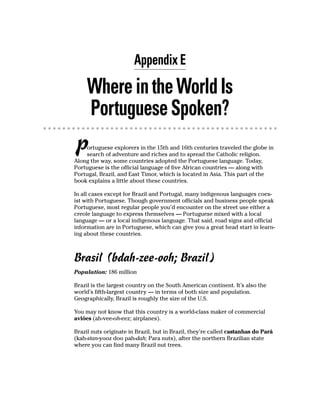
     Appendix E: Where in the World Is Portuguese Spoken? . . . . . . . . .333
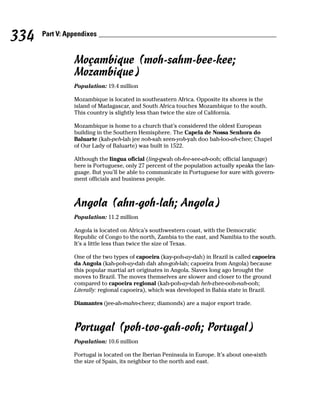
            Brasil (bdah-zee-ooh; Brazil) ......................................................................333
            Moçambique (moh-sahm-bee-kee; Mozambique)....................................334
            Angola (ahn-goh-lah; Angola) .....................................................................334
            Portugal (poh-too-gah-ooh; Portugal) .......................................................334
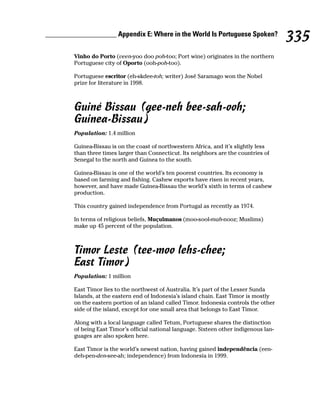
            Guiné Bissau (gee-neh bee-sah-ooh; Guinea-Bissau)...............................335
            Timor Leste (tee-moo lehs-chee; East Timor) ..........................................335
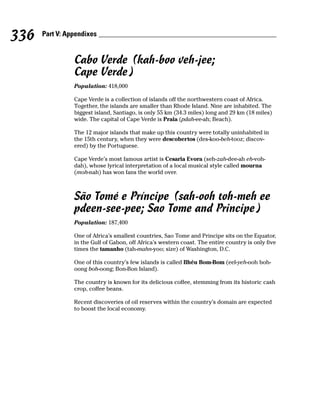
            Cabo Verde (kah-boo veh-jee; Cape Verde)...............................................336
            São Tomé e Príncipe (sah-ooh toh-meh ee pdeen-see-pee;
              Sao Tome and Principe)...........................................................................336


Index........................................................................337
xx   Portuguese For Dummies
Introduction
     T   he world is shrinking. Communication technology is getting faster and
         faster, making it easier to contact people in what used to be exotic, far-
     away lands. Air travel has gotten a lot cheaper, too, so visiting these places
     has never been simpler. Experiencing um pouco (oong poh-koo; a little) of a
     new language is a great way to familiarize yourself with a region of the world
     or specific country. Not only does it allow you to communicate verbally, but
     learning new words opens the door to understanding the specific culture
     itself.

     If you’re curious about language and want to learn how to ask someone’s
     name, ask for directions in a city, or talk about what your interests are,
     you’ve come to the right place. I’m not promising fluency here, but this book
     provides a great start.

     This book tells you about the language spoken in Brazil. Thanks to Brazil’s
     huge population — around 170 million or so — Portuguese is the fifth-most
     spoken language in the world. Flip ahead to Chapter 1 to read about which
     other countries in the world speak Portuguese.

     Brazilian Portuguese is specific because the accent and some basic words are
     unique to Brazil. And the country itself is a pretty popular destination these
     days, with its earned reputation as a land of fun-loving, generous people.

     A bonus to learning Brazilian Portuguese is that it can help you to under-
     stand a little French, Spanish, and Italian, too. They’re all Romance languages,
     which means many words among these languages sound similar.

     Brazilian Portuguese is very lyrical. The sounds can be difficult to make for
     non native speakers, but speaking Portuguese is fun after you get into it. I
     advise you to treat yourself while you’re reading the book: Buy some Brazilian
     music. You’ll fall in love with the sounds, and the background music adds
     great ambience.


About This Book
     Here’s the good news: This book isn’t a class you have to drag yourself to. It’s
     a reference book, so use it at your leisure. You’re the boss. You may choose
2   Portuguese For Dummies


             to just leaf through, glancing only at chapters and pages that grab your atten-
             tion. Or you can read the whole thing from start to finish. (From finish to
             start is okay, too — no one’s looking.)

             The first few chapters may be helpful to read first, though, because they
             explain some basic information about pronunciation and explain words that
             appear throughout the book.


    Conventions Used in This Book
             To make the book easy to read and understand, I’ve set up a few stylistic rules:

                  Web addresses appear in monofont.
                  Portuguese terms are set in boldface to make them stand out.
                  Pronunciations and definitions, which are shown in parentheses, follow
                  the terms the first time they appear in a section.
                  Within the pronunciation, the part of the word that’s stressed is shown
                  in italics.
                  Verb conjugations (lists that show you the forms of a verb) are given in
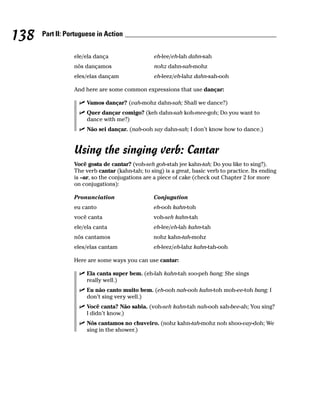
                  tables in this order: the I form, the you form, the he/she form, the we
                  form, and the they form. Pronunciations follow in a second column. (You
                  can also find conjugation charts in Appendix A.)

             Here’s an example of a conjugation chart for the word ser (seh; to be). Because
             the subjects always come in the same order, you can see that words in this
             chart mean I am, you are, he/she is, we are, and they are:

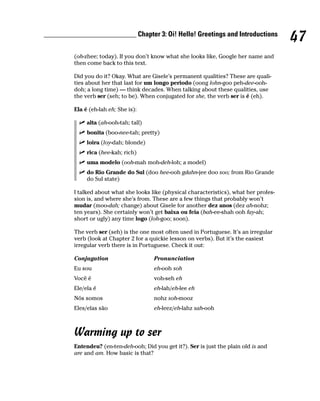
             Conjugation         Pronunciation
             eu sou              eh-ooh soh
             você é              voh-seh eh
             ele/ela             eh-lee/eh-la eh
             nós somos           nohz soh-mooz
             eles/elas são       eh-leez/eh-lahz sah-ooh

             In each chapter, you can also find the following:

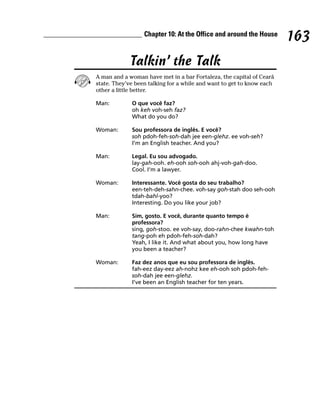
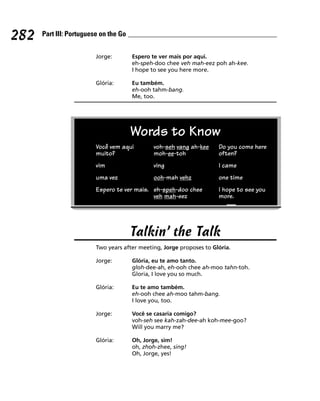
                  Talkin’ the Talk dialogues: The best way to learn a language (and the
                  most fun way) is to be exposed to real-life dialogues, so I include little
                  conversations throughout the book. The dialogues come under the
______________________________________________________ Introduction
                                                                                          3
            heading “Talkin’ the Talk” and show you the Portuguese words, the pro-
            nunciation, and the English translations. These conversations are on
            the CD that came with this book, so when you see a CD icon, be sure to
            listen along.
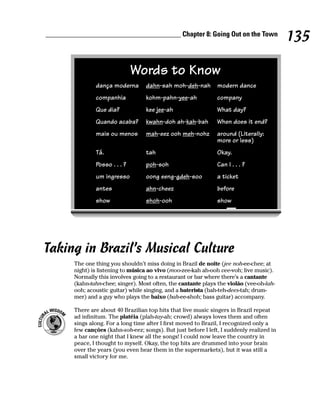
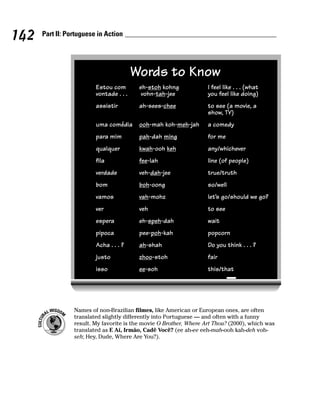
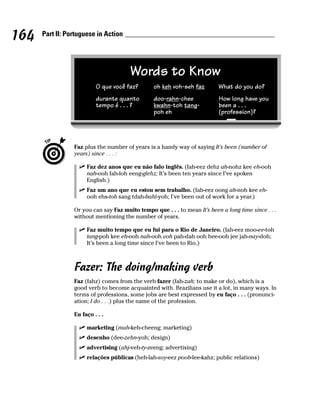
            Words to Know blackboards: Knowing key words and phrases is also
            important in the quest to speak a new language. I collect important
            words that appear in the Talkin’ the Talk dialogues (and perhaps add a
            few related terms) and put them in a special blackboard-shaped box that
            follows the dialogues.
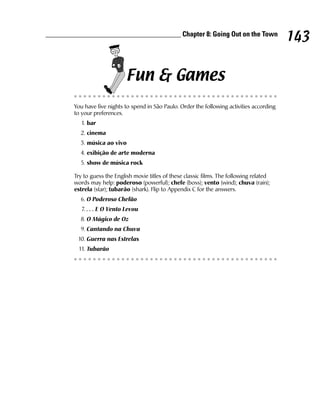
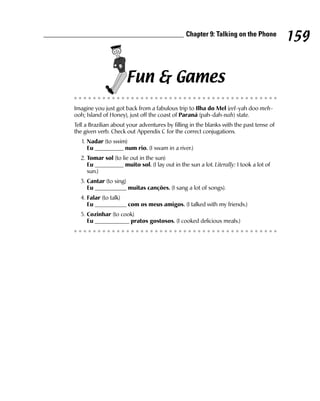
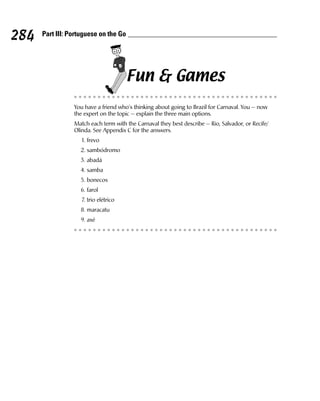
            Fun & Games activities: At the end of each chapter, I give you an activ-
            ity to help you practice some of the words and concepts I tell you in that
            chapter. I try to pick the most basic words for this section to ensure you
            know the essentials.


Assumptions, Foolish and Otherwise
        To write this book, I had to imagine who my readers would be. Yes, you! I
        think if you’ve picked up this book, you’re probably a pretty open-minded
        person who enjoys learning. That’s excellent. Because the first step to
        absorbing new information is wanting to absorb it.

        Here are some other things I’m imagining about you:

            You don’t want to memorize long lists of vocabulary to learn Portuguese.
            You want to get your feet wet in Portuguese while having fun at the
            same time.
            You’re interested in learning about Brazilian culture as well as its
            language.
            You’re not looking for a book to make you fluent in Portuguese but one
            that instead gives you bite-sized information that provides a solid base
            to understanding the language.

        The only thing I ask of you is to leave any foolish assumptions behind that
        you may have that would prevent you from getting the most out of this book!
        For example, it’s nonsense that only younger people can learn languages. The
        desire to learn is all you need. And it doesn’t matter how well you did in high
        school French or German, or whichever language classes you’ve taken before.
        This book is designed to take a fresh approach to learning languages, and I
        won’t grade you.
4   Portuguese For Dummies


    How This Book Is Organized
             This book is divided by topic into parts and then into chapters. Chapters are
             further divided into sections. The following sections tell you what types of
             information you can find in each part.


             Part I: Getting Started
             This part lets you get your feet wet by giving you some Portuguese basics —
             how to pronounce words, how sentences are constructed, and so on. I also
             give you an ego boost by showing you Portuguese words that are so close to
             English that you already know their meanings.


             Part II: Portuguese in Action
             In this part, you begin discovering the language and practicing Portuguese.
             Instead of focusing on grammar points and philosophizing about why the lan-
             guage is structured the way it is, I jump right in. I show you how it works
             instead of telling you how it works. This section in particular highlights how
             to talk to new Brazilian friends.


             Part III: Portuguese on the Go
             This part gives you the tools you need to take your Portuguese on the road,
             whether you’re going to a local restaurant, checking out a museum, or getting
             help planning a trip with a Brazilian travel agent. This section’s devoted to
             the traveler in you, the one who checks into hotels, hails a cab, and studies
             bus schedules. This information is all, of course, to help you get to places
             where you can have a good time — whether that means going out on a
             Saturday night in Rio or enjoying yourself during Brazil’s famous Carnaval
             season.


             Part IV: The Part of Tens
             If you’re looking for small, easily digestible pieces of information about
             Portuguese, this part is for you. Here, you can find ten ways to speak
             Portuguese quickly, ten useful Portuguese expressions to know, and ten
             common slang expressions.
______________________________________________________ Introduction
                                                                                           5
        Part V: Appendixes
        This part of the book is a great reference guide. I lay out verb conjugation
        tables for the most common Brazilian Portuguese verbs. I also include two
        mini-dictionaries here — one from English to Portuguese and the other from
        Portuguese to English. Another appendix lets you check out the answers to
        the “Fun & Games” activities. Finally, I provide a listing of the tracks that
        appear on the audio CD that comes with this book (the disc’s on the inside
        part of the last page). That’s so you can listen and follow along while you’re
        reading the dialogues.


Icons Used in This Book
        Drawings and symbols always liven things up a bit, don’t they? Here are some
        icons that point you to important information:

        This icon shows you where you can find some fascinating tidbits that high-
        light either a linguistic aspect or give travel tips. Tips can save you time and
        frustration.


        This handy icon pops up whenever you run across a bit of information that
        you really should remember after you close the book, whether it’s about the
        Portuguese language or Brazil in general.


        Pay attention when this icon appears, because it’s probably pointing out
        information that can keep you out of trouble or from making embarrassing
        boo-boos.


        The “Cultural Wisdom” snippets help give insight into Brazilian culture.


        The audio CD lets you listen to native Brazilian speakers. The icon marks
        some “Talkin’ the Talk” sections and reminds you that you can listen to the
        dialogue while you read it.
6   Portuguese For Dummies


    Where to Go from Here
             When you have a spare moment, pop open the book. All you need is a curi-
             ous mind and the openness to learn about Brazil. Above all, don’t think of
             reading the book as a chore. It’s meant to be relaxing and enjoyable.

             Feel free to complement this book with other activities that enhance your
             knowledge of Portuguese, like entering a Portuguese-language chat room on
             the Internet or having Brazilian music on in the background so you can hear
             the sounds of the language.

             Oh, and boa sorte (boh-ah soh-chee; good luck)!
Part I
Getting Started
In this part . . .
T   his part introduces you to Brazilian Portuguese. It lets
    you get your feet wet by giving you some Portuguese
basics — how to pronounce words, how sentences are
constructed, and so on. I also give you an ego boost by
showing you Portuguese words that are so close to English,
you already know their meanings.
Chapter 1

                     You Already Know
                    a Little Portuguese!
In This Chapter
  Recognizing what English and Portuguese have in common
  Spell it out: Saying the alphabet
  Looking at vowels and consonants: Basic Portuguese sounds
  Listening for regional variations in accent


            B     elieve it or not, the Portuguese language comes in different versions.
                  Pronunciation of Brazilian Portuguese and Portuguese from Portugal,
            say, is totally different. Some Brazilian tourists in Portugal report that they
            didn’t understand a word! I think it’s a little more of a stretch than the differ-
            ences between American and British English, just to give you an idea. But if a
            group of people from Texas, South Africa, and Scotland got together, they’d
            probably scratch their heads when trying to understand each other, too!

            Written Portuguese, on the other hand, is very standard, especially when it’s
            in a newspaper or some formal publication that doesn’t use slang. A Brazilian
            can understand a Portuguese newspaper or read the works of Portugal’s
            Nobel prize–winning author José Saramago, no problem.

            In this book, I focus on Brazilian Portuguese, as opposed to the Portuguese
            spoken in Portugal and countries in Africa — Cape Verde (islands off north-
            western Africa), Mozambique (on the coast of southeast Africa), Guinea-
            Bissau (in western Africa), Angola (in southwestern Africa), and Sao Tome
            and Principe (islands off western Africa).
10   Part I: Getting Started


     Exploring the Roots of Portuguese
                The beautiful Portuguese language belongs to a linguistic family known as the
                Romance languages. Back when the Roman Empire was around, Rome was in
                the center of a wide swath of Europe, northern Africa, and parts of Asia. With
                Rome’s influence came its language — Latin.

                And the closer a place was to Rome, the more likely it was to absorb Latin
                into its language. This was the case with Portugal — where the Portuguese
                language originates — as well as with places like France, Spain, and even
                Romania.

                So how did Portuguese get all the way to Brazil? A Portuguese conquistador
                named Pedro Álvares Cabral landed in modern-day Brazil on April 22, 1500,
                and is the person credited for having “discovered” Brazil. Many indigenous
                people were already living in the area, of course, many of whom spoke a lan-
                guage that’s part of a language family today called Tupi-Guarani (too-pee
                gwah-dah-nee).

                Brazilian Portuguese uses some Tupi-Guarani words. Mostly the words
                appear as names of towns in Brazil — for example, Uba-Tuba (ooh-bah-too-
                bah) is a pretty beach town in Sao Paulo state (it’s nicknamed Uba-Chuva
                because chuva [shoo-vah] means rain and it rains there a lot!). Tupi-Guarani
                words also name native plants and animals. Armadillo, for example, is tatu
                (tah-too). After you get used to speaking Portuguese, telling whether a word
                is Latin-based or Tupi-Guarani–based is pretty easy.

                Still other words in Brazilian Portuguese are based on African languages,
                from the vast influence African slaves had on creating modern-day Brazil and
                its culture.

                What you may not realize is that the English language has a lot of Latin influ-
                ence. Linguists consider English to be a Germanic language, and it technically
                is. But due to the on-and-off French occupations of the British Isles, some of
                those French (Latin-based) words rubbed off on English. Some people say as
                much as 40 percent of English is Latin-based.

                That’s great news for you. It means many Portuguese words have the same
                root as English words. The root of a word is usually the middle of the word —
                those few sounds that really define what the word means. Some examples of
                Portuguese words that resemble English include experimento (eh-speh-dee-
                men-toh; experiment), presidente (pdeh-zee-dang-chee; president), economía
                (eh-koh-noh-mee-ah; economy), decisão (ah deh-see-zah-ooh; decision), com-
                putadora (kom-poo-tah-doh-dah; computer), liberdade (lee-beh-dah-jee; lib-
                erty), and banana (bah-nah-nah). And that’s only to name a few!
________________________ Chapter 1: You Already Know a Little Portuguese!
                                                                                            11
         Another benefit: O português (ooh poh-too-gehz; Portuguese), like all Latin
         languages, uses the English alphabet. Some funny accent marks appear on
         some of the vowels, but they just add to the mystique of Portuguese. Learning
         Portuguese isn’t the same as learning Japanese or Arabic, which use totally
         different alphabets.

         Finally, due to the influence the U.S. has had on the world recently — in some
         ways greater than Rome’s ancient influence — many English words are used
         commonly in Portuguese, with no adaptation in the way they’re written. These
         words include modern technology words like e-mail (ee-may-oh) and also
         basic words like shopping (shoh-ping) or show (shoh; show/performance).


Reciting Your ABCs
         Brazilian Portuguese sounds very strange at first. I myself thought it sounded
         Russian, back when I didn’t understand a palavra (pah-lahv-dah; word)! A few
         of the sounds are a little hard to imitate, because people don’t use them in
         English. But Brazilians often understand you even if you don’t say words per-
         fectly. Many think a foreign sotaque (soh-tah-kee; accent) is charming, so don’t
         worry about it.

         But the way the sounds correspond to the written letters is very systematic
         in Brazilian Portuguese — more so than in English. After you get used to the
         way a letter or combination of letters sounds, you get the hang of pronuncia-
         tions pretty quickly. There are few surprises in a pronúncia (ah pdoh-noon-
         see-ah; pronunciation) after you get the basics down.

         Track 2 of the audio CD that accompanies this book also contains a pronun-
         ciaction guide to help you get a better feel for the Portuguese laungage.

         At the beginning of this chapter, did you notice how the pronunciation is
         shown in parentheses after the Portuguese word? That’s how this book
         shows the pronunciation of all new words. The italicized part is where you
         put the emphasis on the word. On “Words to Know” lists, the part you
         emphasize is underlined rather than italicized.

         Are you ready to learn the basics of o português? You can start with the
         alphabet. Practice spelling your name out:

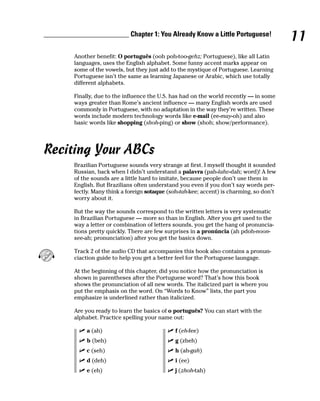
              a (ah)                             f (eh-fee)
              b (beh)                            g (zheh)
              c (seh)                            h (ah-gah)
              d (deh)                            i (ee)
              e (eh)                             j (zhoh-tah)
12   Part I: Getting Started


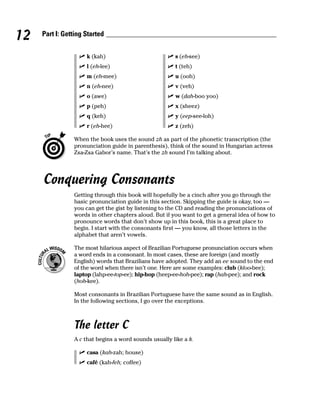
                     k (kah)                           s (eh-see)
                     l (eh-lee)                        t (teh)
                     m (eh-mee)                        u (ooh)
                     n (eh-nee)                        v (veh)
                     o (awe)                           w (dah-boo yoo)
                     p (peh)                           x (sheez)
                     q (keh)                           y (eep-see-loh)
                     r (eh-hee)                        z (zeh)

                When the book uses the sound zh as part of the phonetic transcription (the
                pronunciation guide in parenthesis), think of the sound in Hungarian actress
                Zsa-Zsa Gabor’s name. That’s the zh sound I’m talking about.


     Conquering Consonants
                Getting through this book will hopefully be a cinch after you go through the
                basic pronunciation guide in this section. Skipping the guide is okay, too —
                you can get the gist by listening to the CD and reading the pronunciations of
                words in other chapters aloud. But if you want to get a general idea of how to
                pronounce words that don’t show up in this book, this is a great place to
                begin. I start with the consonants first — you know, all those letters in the
                alphabet that aren’t vowels.

                The most hilarious aspect of Brazilian Portuguese pronunciation occurs when
                a word ends in a consonant. In most cases, these are foreign (and mostly
                English) words that Brazilians have adopted. They add an ee sound to the end
                of the word when there isn’t one. Here are some examples: club (kloo-bee);
                laptop (lahp-ee-top-ee); hip-hop (heep-ee-hoh-pee); rap (hah-pee); and rock
                (hoh-kee).

                Most consonants in Brazilian Portuguese have the same sound as in English.
                In the following sections, I go over the exceptions.


                The letter C
                A c that begins a word sounds usually like a k.

                     casa (kah-zah; house)
                     café (kah-feh; coffee)
________________________ Chapter 1: You Already Know a Little Portuguese!
                                                                                             13
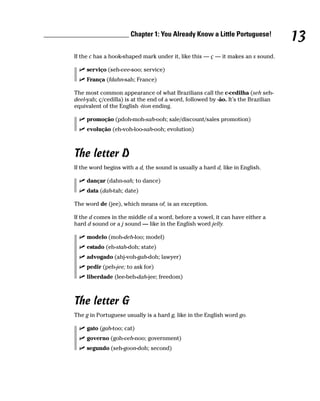
         If the c has a hook-shaped mark under it, like this — ç — it makes an s sound.

              serviço (seh-vee-soo; service)
              França (fdahn-sah; France)

         The most common appearance of what Brazilians call the c-cedilha (seh seh-
         deel-yah; ç/cedilla) is at the end of a word, followed by -ão. It’s the Brazilian
         equivalent of the English -tion ending.

              promoção (pdoh-moh-sah-ooh; sale/discount/sales promotion)
              evolução (eh-voh-loo-sah-ooh; evolution)


         The letter D
         If the word begins with a d, the sound is usually a hard d, like in English.

              dançar (dahn-sah; to dance)
              data (dah-tah; date)

         The word de (jee), which means of, is an exception.

         If the d comes in the middle of a word, before a vowel, it can have either a
         hard d sound or a j sound — like in the English word jelly.

              modelo (moh-deh-loo; model)
              estado (eh-stah-doh; state)
              advogado (ahj-voh-gah-doh; lawyer)
              pedir (peh-jee; to ask for)
              liberdade (lee-beh-dah-jee; freedom)


         The letter G
         The g in Portuguese usually is a hard g, like in the English word go.

              gato (gah-too; cat)
              governo (goh-veh-noo; government)
              segundo (seh-goon-doh; second)
14   Part I: Getting Started


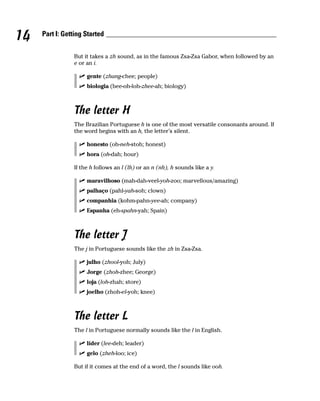
                But it takes a zh sound, as in the famous Zsa-Zsa Gabor, when followed by an
                e or an i.

                     gente (zhang-chee; people)
                     biologia (bee-oh-loh-zhee-ah; biology)


                The letter H
                The Brazilian Portuguese h is one of the most versatile consonants around. If
                the word begins with an h, the letter’s silent.

                     honesto (oh-neh-stoh; honest)
                     hora (oh-dah; hour)

                If the h follows an l (lh) or an n (nh), h sounds like a y.

                     maravilhoso (mah-dah-veel-yoh-zoo; marvellous/amazing)
                     palhaço (pahl-yah-soh; clown)
                     companhia (kohm-pahn-yee-ah; company)
                     Espanha (eh-spahn-yah; Spain)


                The letter J
                The j in Portuguese sounds like the zh in Zsa-Zsa.

                     julho (zhool-yoh; July)
                     Jorge (zhoh-zhee; George)
                     loja (loh-zhah; store)
                     joelho (zhoh-el-yoh; knee)


                The letter L
                The l in Portuguese normally sounds like the l in English.

                     líder (lee-deh; leader)
                     gelo (zheh-loo; ice)

                But if it comes at the end of a word, the l sounds like ooh.
________________________ Chapter 1: You Already Know a Little Portuguese!
                                                                                            15
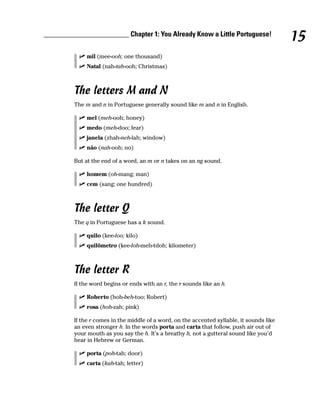
              mil (mee-ooh; one thousand)
              Natal (nah-tah-ooh; Christmas)


         The letters M and N
         The m and n in Portuguese generally sound like m and n in English.

              mel (meh-ooh; honey)
              medo (meh-doo; fear)
              janela (zhah-neh-lah; window)
              não (nah-ooh; no)

         But at the end of a word, an m or n takes on an ng sound.

              homem (oh-mang; man)
              cem (sang; one hundred)


         The letter Q
         The q in Portuguese has a k sound.

              quilo (kee-loo; kilo)
              quilômetro (kee-loh-meh-tdoh; kilometer)


         The letter R
         If the word begins or ends with an r, the r sounds like an h.

              Roberto (hoh-beh-too; Robert)
              rosa (hoh-zah; pink)

         If the r comes in the middle of a word, on the accented syllable, it sounds like
         an even stronger h. In the words porta and carta that follow, push air out of
         your mouth as you say the h. It’s a breathy h, not a gutteral sound like you’d
         hear in Hebrew or German.

              porta (poh-tah; door)
              carta (kah-tah; letter)
16   Part I: Getting Started


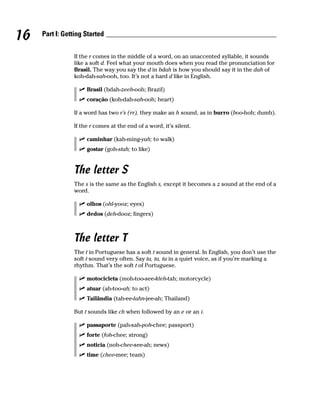
                If the r comes in the middle of a word, on an unaccented syllable, it sounds
                like a soft d. Feel what your mouth does when you read the pronunciation for
                Brasil. The way you say the d in bdah is how you should say it in the dah of
                koh-dah-sah-ooh, too. It’s not a hard d like in English.

                     Brasil (bdah-zeeh-ooh; Brazil)
                     coração (koh-dah-sah-ooh; heart)

                If a word has two r’s (rr), they make an h sound, as in burro (boo-hoh; dumb).

                If the r comes at the end of a word, it’s silent.

                     caminhar (kah-ming-yah; to walk)
                     gostar (goh-stah; to like)


                The letter S
                The s is the same as the English s, except it becomes a z sound at the end of a
                word.

                     olhos (ohl-yooz; eyes)
                     dedos (deh-dooz; fingers)


                The letter T
                The t in Portuguese has a soft t sound in general. In English, you don’t use the
                soft t sound very often. Say ta, ta, ta in a quiet voice, as if you’re marking a
                rhythm. That’s the soft t of Portuguese.

                     motocicleta (moh-too-see-kleh-tah; motorcycle)
                     atuar (ah-too-ah; to act)
                     Tailândia (tah-ee-lahn-jee-ah; Thailand)

                But t sounds like ch when followed by an e or an i.

                     passaporte (pah-sah-poh-chee; passport)
                     forte (foh-chee; strong)
                     noticia (noh-chee-see-ah; news)
                     time (chee-mee; team)
________________________ Chapter 1: You Already Know a Little Portuguese!
                                                                                             17
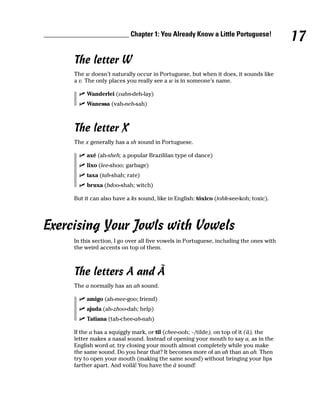
         The letter W
         The w doesn’t naturally occur in Portuguese, but when it does, it sounds like
         a v. The only places you really see a w is in someone’s name.

              Wanderlei (vahn-deh-lay)
              Wanessa (vah-neh-sah)


         The letter X
         The x generally has a sh sound in Portuguese.

              axé (ah-sheh; a popular Brazililan type of dance)
              lixo (lee-shoo; garbage)
              taxa (tah-shah; rate)
              bruxa (bdoo-shah; witch)

         But it can also have a ks sound, like in English: tóxico (tohk-see-koh; toxic).


Exercising Your Jowls with Vowels
         In this section, I go over all five vowels in Portuguese, including the ones with
         the weird accents on top of them.


         The letters A and Ã
         The a normally has an ah sound.

              amigo (ah-mee-goo; friend)
              ajuda (ah-zhoo-dah; help)
              Tatiana (tah-chee-ah-nah)

         If the a has a squiggly mark, or til (chee-ooh; ~/tilde), on top of it (ã), the
         letter makes a nasal sound. Instead of opening your mouth to say a, as in the
         English word at, try closing your mouth almost completely while you make
         the same sound. Do you hear that? It becomes more of an uh than an ah. Then
         try to open your mouth (making the same sound) without bringing your lips
         farther apart. And voilá! You have the ã sound!
18   Part I: Getting Started


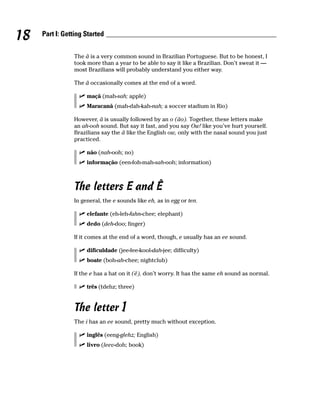
                The ã is a very common sound in Brazilian Portuguese. But to be honest, I
                took more than a year to be able to say it like a Brazilian. Don’t sweat it —
                most Brazilians will probably understand you either way.

                The ã occasionally comes at the end of a word.

                     maçã (mah-sah; apple)
                     Maracanã (mah-dah-kah-nah; a soccer stadium in Rio)

                However, ã is usually followed by an o (ão). Together, these letters make
                an ah-ooh sound. But say it fast, and you say Ow! like you’ve hurt yourself.
                Brazilians say the ã like the English ow, only with the nasal sound you just
                practiced.

                     não (nah-ooh; no)
                     informação (een-foh-mah-sah-ooh; information)


                The letters E and Ê
                In general, the e sounds like eh, as in egg or ten.

                     elefante (eh-leh-fahn-chee; elephant)
                     dedo (deh-doo; finger)

                If it comes at the end of a word, though, e usually has an ee sound.

                     dificuldade (jee-fee-kool-dah-jee; difficulty)
                     boate (boh-ah-chee; nightclub)

                If the e has a hat on it (ê), don’t worry. It has the same eh sound as normal.

                     três (tdehz; three)


                The letter I
                The i has an ee sound, pretty much without exception.

                     inglês (eeng-glehz; English)
                     livro (leev-doh; book)
________________________ Chapter 1: You Already Know a Little Portuguese!
                                                                                          19
         The letters O and Ô
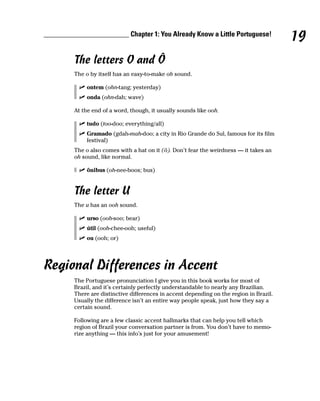
         The o by itself has an easy-to-make oh sound.

             ontem (ohn-tang; yesterday)
             onda (ohn-dah; wave)

         At the end of a word, though, it usually sounds like ooh.

             tudo (too-doo; everything/all)
             Gramado (gdah-mah-doo; a city in Rio Grande do Sul, famous for its film
             festival)
         The o also comes with a hat on it (ô). Don’t fear the weirdness — it takes an
         oh sound, like normal.

             ônibus (oh-nee-boos; bus)


         The letter U
         The u has an ooh sound.

             urso (ooh-soo; bear)
             útil (ooh-chee-ooh; useful)
             ou (ooh; or)


Regional Differences in Accent
         The Portuguese pronunciation I give you in this book works for most of
         Brazil, and it’s certainly perfectly understandable to nearly any Brazilian.
         There are distinctive differences in accent depending on the region in Brazil.
         Usually the difference isn’t an entire way people speak, just how they say a
         certain sound.

         Following are a few classic accent hallmarks that can help you tell which
         region of Brazil your conversation partner is from. You don’t have to memo-
         rize anything — this info’s just for your amusement!
20   Part I: Getting Started


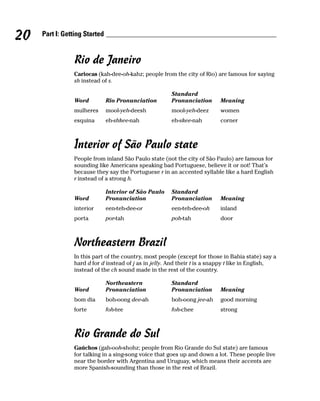
                Rio de Janeiro
                Cariocas (kah-dee-oh-kahz; people from the city of Rio) are famous for saying
                sh instead of s.

                                                       Standard
                Word           Rio Pronunciation       Pronunciation      Meaning
                mulheres       mool-yeh-deesh          mool-yeh-deez      women
                esquina        eh-shkee-nah            eh-skee-nah        corner


                Interior of São Paulo state
                People from inland São Paulo state (not the city of São Paulo) are famous for
                sounding like Americans speaking bad Portuguese, believe it or not! That’s
                because they say the Portuguese r in an accented syllable like a hard English
                r instead of a strong h.

                               Interior of São Paulo   Standard
                Word           Pronunciation           Pronunciation      Meaning
                interior       een-teh-dee-or          een-teh-dee-oh     inland
                porta          por-tah                 poh-tah            door


                Northeastern Brazil
                In this part of the country, most people (except for those in Bahia state) say a
                hard d for d instead of j as in jelly. And their t is a snappy t like in English,
                instead of the ch sound made in the rest of the country.

                               Northeastern            Standard
                Word           Pronunciation           Pronunciation      Meaning
                bom dia        boh-oong dee-ah         boh-oong jee-ah    good morning
                forte          foh-tee                 foh-chee           strong


                Rio Grande do Sul
                Gaúchos (gah-ooh-shohz; people from Rio Grande do Sul state) are famous
                for talking in a sing-song voice that goes up and down a lot. These people live
                near the border with Argentina and Uruguay, which means their accents are
                more Spanish-sounding than those in the rest of Brazil.
________________________ Chapter 1: You Already Know a Little Portuguese!
                                                                                            21

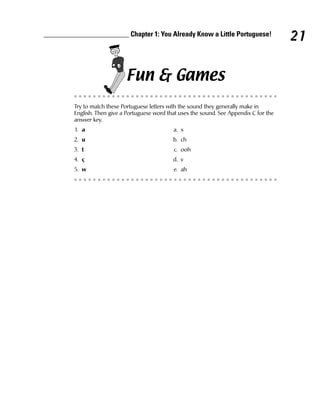
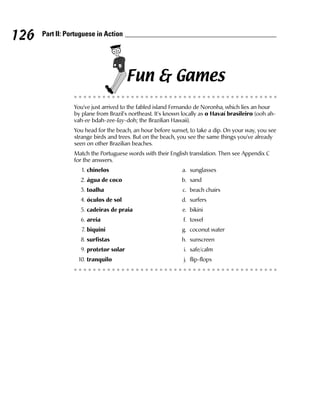
                             Fun & Games
         Try to match these Portuguese letters with the sound they generally make in
         English. Then give a Portuguese word that uses the sound. See Appendix C for the
         answer key.
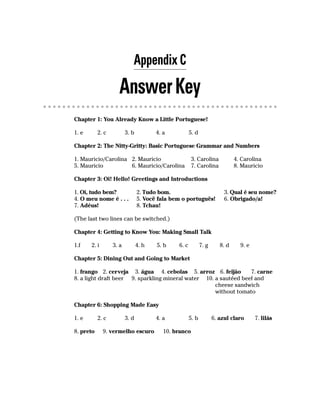
         1. a                                   a. s
         2. u                                   b. ch
         3. t                                    c. ooh
         4. ç                                   d. v
         5. w                                   e. ah
22   Part I: Getting Started
Chapter 2

The Nitty-Gritty: Basic Portuguese
     Grammar and Numbers
In This Chapter
  Nouns and adjectives: Describing people, places, and things
  Including articles: A, the, and some
  Practicing using pronouns: I, you, he, she, we, they
  Forming simple sentences
  Understanding regular and irregular verb conjugations
  Combining words with contractions
  Indirect objects: When something happens to you and me
  Practicing the numbers 1-100 (and up)


            I  ck. Grammar. Remember that word from high school? The way grammar is
               usually taught, you feel like you’re doing math problems, not exploring fun
            cultural stuff. Well, in this chapter, I don’t talk about grammar as a set of rules
            to memorize. (Though if you really want to do some math, I introduce some
            Portuguese numbers at the end.)

            Figuring out how to categorize types of words and understanding where they
            go in a sentence is like putting together a puzzle. And here’s some good news:
            Portuguese and English use only several pieces, and they’re the same. Each
            piece refers to a category of word that’s used to put together the sentence —
            the parts of speech.


Agreeing with Nouns and Adjectives
            Like in English, nouns are one of the main parts of Portuguese speech — the
            most important pieces of the puzzle. They’re used to name people, places,
24   Part I: Getting Started


                and things, like casa (kah-zah; house), amigo (ah-mee-goo; friend), Maria
                (mah-dee-ah; the name of a woman), caneta (kah-neh-tah; pen), and Brasil
                (bdah-zee-ooh; Brazil).

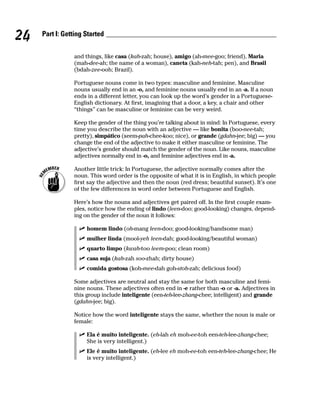
                Portuguese nouns come in two types: masculine and feminine. Masculine
                nouns usually end in an -o, and feminine nouns usually end in an -a. If a noun
                ends in a different letter, you can look up the word’s gender in a Portuguese-
                English dictionary. At first, imagining that a door, a key, a chair and other
                “things” can be masculine or feminine can be very weird.

                Keep the gender of the thing you’re talking about in mind: In Portuguese, every
                time you describe the noun with an adjective — like bonita (boo-nee-tah;
                pretty), simpático (seem-pah-chee-koo; nice), or grande (gdahn-jee; big) — you
                change the end of the adjective to make it either masculine or feminine. The
                adjective’s gender should match the gender of the noun. Like nouns, masculine
                adjectives normally end in -o, and feminine adjectives end in -a.

                Another little trick: In Portuguese, the adjective normally comes after the
                noun. This word order is the opposite of what it is in English, in which people
                first say the adjective and then the noun (red dress; beautiful sunset). It’s one
                of the few differences in word order between Portuguese and English.

                Here’s how the nouns and adjectives get paired off. In the first couple exam-
                ples, notice how the ending of lindo (leen-doo; good-looking) changes, depend-
                ing on the gender of the noun it follows:

                     homem lindo (oh-mang leen-doo; good-looking/handsome man)
                     mulher linda (mool-yeh leen-dah; good-looking/beautiful woman)
                     quarto limpo (kwah-too leem-poo; clean room)
                     casa suja (kah-zah soo-zhah; dirty house)
                     comida gostosa (koh-mee-dah goh-stoh-zah; delicious food)

                Some adjectives are neutral and stay the same for both masculine and femi-
                nine nouns. These adjectives often end in -e rather than -o or -a. Adjectives in
                this group include inteligente (een-teh-lee-zhang-chee; intelligent) and grande
                (gdahn-jee; big).

                Notice how the word inteligente stays the same, whether the noun is male or
                female:

                     Ela é muito inteligente. (eh-lah eh moh-ee-toh een-teh-lee-zhang-chee;
                     She is very intelligent.)
                     Ele é muito inteligente. (eh-lee eh moh-ee-toh een-teh-lee-zhang-chee; He
                     is very intelligent.)
__________ Chapter 2: The Nitty-Gritty: Basic Portuguese Grammar and Numbers
                                                                                            25
         If the noun is plural, just add an s to the end of the adjective: cachorros
         pequenos (kah-shoh-hooz peh-keh-nooz; small dogs).


Looking at Some Articles
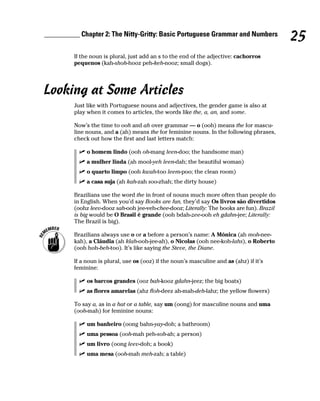
         Just like with Portuguese nouns and adjectives, the gender game is also at
         play when it comes to articles, the words like the, a, an, and some.

         Now’s the time to ooh and ah over grammar — o (ooh) means the for mascu-
         line nouns, and a (ah) means the for feminine nouns. In the following phrases,
         check out how the first and last letters match:

              o homem lindo (ooh oh-mang leen-doo; the handsome man)
              a mulher linda (ah mool-yeh leen-dah; the beautiful woman)
              o quarto limpo (ooh kwah-too leem-poo; the clean room)
              a casa suja (ah kah-zah soo-zhah; the dirty house)

         Brazilians use the word the in front of nouns much more often than people do
         in English. When you’d say Books are fun, they’d say Os livros são divertidos
         (oohz leev-dooz sah-ooh jee-veh-chee-dooz; Literally: The books are fun). Brazil
         is big would be O Brasil é grande (ooh bdah-zee-ooh eh gdahn-jee; Literally:
         The Brazil is big).

         Brazilians always use o or a before a person’s name: A Mónica (ah moh-nee-
         kah), a Cláudia (ah klah-ooh-jee-ah), o Nicolas (ooh nee-koh-lahs), o Roberto
         (ooh hoh-beh-too). It’s like saying the Steve, the Diane.

         If a noun is plural, use os (ooz) if the noun’s masculine and as (ahz) if it’s
         feminine:

              os barcos grandes (ooz bah-kooz gdahn-jeez; the big boats)
              as flores amarelas (ahz floh-deez ah-mah-deh-lahz; the yellow flowers)

         To say a, as in a hat or a table, say um (oong) for masculine nouns and uma
         (ooh-mah) for feminine nouns:

              um banheiro (oong bahn-yay-doh; a bathroom)
              uma pessoa (ooh-mah peh-soh-ah; a person)
              um livro (oong leev-doh; a book)
              uma mesa (ooh-mah meh-zah; a table)
26   Part I: Getting Started


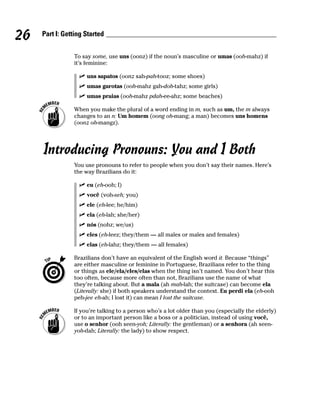
                To say some, use uns (oonz) if the noun’s masculine or umas (ooh-mahz) if
                it’s feminine:

                     uns sapatos (oonz sah-pah-tooz; some shoes)
                     umas garotas (ooh-mahz gah-doh-tahz; some girls)
                     umas praias (ooh-mahz pdah-ee-ahz; some beaches)

                When you make the plural of a word ending in m, such as um, the m always
                changes to an n: Um homem (oong oh-mang; a man) becomes uns homens
                (oonz oh-mangz).


     Introducing Pronouns: You and I Both
                You use pronouns to refer to people when you don’t say their names. Here’s
                the way Brazilians do it:

                     eu (eh-ooh; I)
                     você (voh-seh; you)
                     ele (eh-lee; he/him)
                     ela (eh-lah; she/her)
                     nós (nohz; we/us)
                     eles (eh-leez; they/them — all males or males and females)
                     elas (eh-lahz; they/them — all females)

                Brazilians don’t have an equivalent of the English word it. Because “things”
                are either masculine or feminine in Portuguese, Brazilians refer to the thing
                or things as ele/ela/eles/elas when the thing isn’t named. You don’t hear this
                too often, because more often than not, Brazilians use the name of what
                they’re talking about. But a mala (ah mah-lah; the suitcase) can become ela
                (Literally: she) if both speakers understand the context. Eu perdi ela (eh-ooh
                peh-jee eh-ah; I lost it) can mean I lost the suitcase.

                If you’re talking to a person who’s a lot older than you (especially the elderly)
                or to an important person like a boss or a politician, instead of using você,
                use o senhor (ooh seen-yoh; Literally: the gentleman) or a senhora (ah seen-
                yoh-dah; Literally: the lady) to show respect.
__________ Chapter 2: The Nitty-Gritty: Basic Portuguese Grammar and Numbers
                                                                                            27
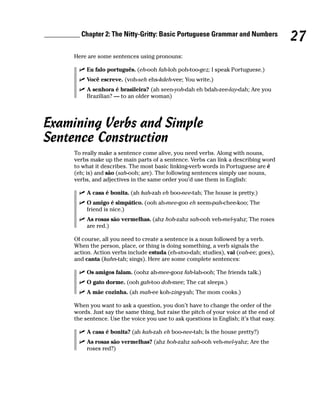
         Here are some sentences using pronouns:

              Eu falo português. (eh-ooh fah-loh poh-too-gez; I speak Portuguese.)
              Você escreve. (voh-seh ehs-kdeh-vee; You write.)
              A senhora é brasileira? (ah seen-yoh-dah eh bdah-zee-lay-dah; Are you
              Brazilian? — to an older woman)


Examining Verbs and Simple
Sentence Construction
         To really make a sentence come alive, you need verbs. Along with nouns,
         verbs make up the main parts of a sentence. Verbs can link a describing word
         to what it describes. The most basic linking-verb words in Portuguese are é
         (eh; is) and são (sah-ooh; are). The following sentences simply use nouns,
         verbs, and adjectives in the same order you’d use them in English:

              A casa é bonita. (ah kah-zah eh boo-nee-tah; The house is pretty.)
              O amigo é simpático. (ooh ah-mee-goo eh seem-pah-chee-koo; The
              friend is nice.)
              As rosas são vermelhas. (ahz hoh-zahz sah-ooh veh-mel-yahz; The roses
              are red.)

         Of course, all you need to create a sentence is a noun followed by a verb.
         When the person, place, or thing is doing something, a verb signals the
         action. Action verbs include estuda (eh-stoo-dah; studies), vai (vah-ee; goes),
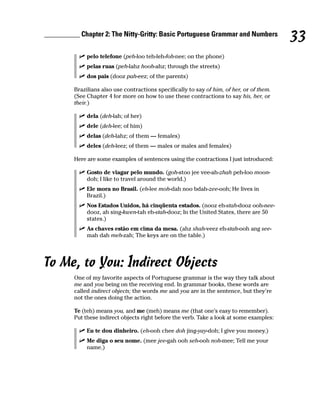
         and canta (kahn-tah; sings). Here are some complete sentences:

              Os amigos falam. (oohz ah-mee-gooz fah-lah-ooh; The friends talk.)
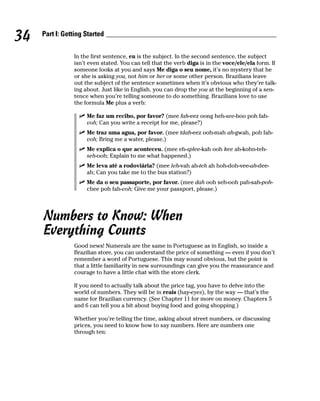
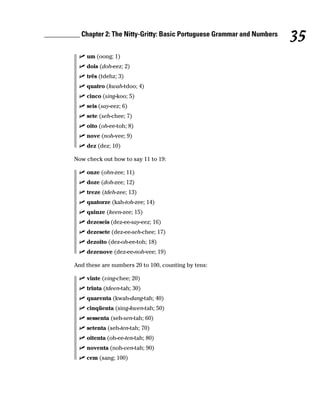
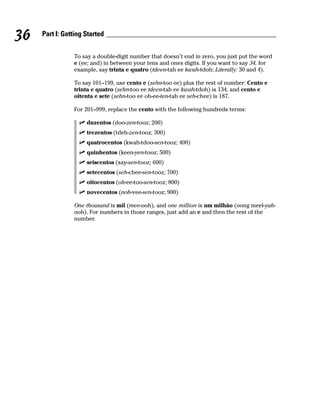
              O gato dorme. (ooh gah-too doh-mee; The cat sleeps.)
              A mãe cozinha. (ah mah-ee koh-zing-yah; The mom cooks.)

         When you want to ask a question, you don’t have to change the order of the
         words. Just say the same thing, but raise the pitch of your voice at the end of
         the sentence. Use the voice you use to ask questions in English; it’s that easy.

              A casa é bonita? (ah kah-zah eh boo-nee-tah; Is the house pretty?)
              As rosas são vermelhas? (ahz hoh-zahz sah-ooh veh-mel-yahz; Are the
              roses red?)
28   Part I: Getting Started


                The verb can change a bit depending on who’s doing the action. The next sec-
                tion tells you how to know which verb form to use.


     Introducing Verb Conjugations
                Conjugation is basically a matter of matching a verb to a subject. Portuguese
                verbs come in three varieties: those that end in -ar, -er, and -ir. The -ar ending
                is your best friend; with a few exceptions, -ar verbs tend to be conjugated the
                same way, all the time. The -ir and -er verbs can be a little trickier. There are
                general rules for their conjugation, but not all verbs ending in -ir or -er follow
                the rules. Appendix A gives you a list of verb conjugations, including some of
                the rule-breakers.

                To conjugate a verb, you snip off the ending (-ar, -er, -ir) and add a new one,
                depending on who’s doing the action. The following sections explain which
                endings to use.

                In this book, I separate você (you) and ele/ela (him/her) into different lines
                even though they use the same conjugation. I also don’t show in the conjuga-
                tion charts the formal version of you: o senhor/a senhora (ooh seen-yoh/ah
                seen-yoh-dah). This form of address uses the same conjugation as você and
                ele/ela. So whenever you want to say you — whether you’re being formal or
                not — you can always use the same form of the verb.

                If the noun is not a person but rather a thing or place, first check out whether
                it’s singular or plural. If it’s singular, use the ele/ela conjugation; if it’s plural,
                use the eles/elas conjugation.

                Sometimes, you don’t have to conjugate the verb at all. This often happens
                when you’d use an -ing ending in English: Dançar é divertido (dahn-sah eh
                jee-veh-chee-doo; Dancing is fun). Falar português não é dificil (fah-lah poh-
                too-gez nah-ooh eh jee-fee-see-ooh; Speaking Portuguese is not hard).


                Using the -ar verbs
                To use a verb that ends in -ar, replace the -ar with one of the new verb end-
                ings: -o, -a, -a, -amos, and -am; which ending you choose depends on the sub-
                ject of the sentence. Table 2-1 shows you how the endings match up with the
                pronouns.
__________ Chapter 2: The Nitty-Gritty: Basic Portuguese Grammar and Numbers
                                                                                             29
            Table 2-1               Verb Endings to Use with -ar Verbs
            English Pronoun          Portuguese Pronoun             Verb Ending
            I                        eu                             -o
            you                      você                           -a
            he/she                   ele/ela                        -a
            we                       nós                            -amos
            they                     eles/elas                      -am


         Take, for example, the verb falar (fah-lah; to talk/speak). First remove the -ar
         ending. You now have fal, which is the root or stem of the word. Now just add
         the proper verb endings:

         Conjugation                        Pronunciation
         eu falo                            eh-ooh fah-loo
         você fala                          voh-seh fah-lah
         ele/ela fala                       eh-lee/eh-lah fah-lah
         nós falamos                        nohz fah-lah-mooz
         eles/elas falam                    eh-leez/eh-lahz fah-lam

         Here’s how to use the -ar verbs adorar (ah-doh-dah; to love [something]),
         fechar (feh-shah; to close), and começar (koh-meh-sah; to begin). Some of the
         nouns in the following examples are not people, but they’re all singular like
         the English word it, so you use the ele/ela conjugation:

                Eu adoro viajar. (eh-ooh ah-doh-doo vee-ah-zhah; I love to travel.)
                A loja fecha cedo hoje. (ah loh-zhah feh-shah seh-doo oh-zhee; The store
                closes early today.)
                O concerto começa agora. (ooh kohn-seh-too koh-meh-sah ah-goh-dah;
                The concert begins now.)


                                Talkin’ the Talk
                   Vitor (vee-toh) and Danilo (dah-nee-loo) have just met at the gym.
                   The two guys chat about physical activities they like to do besides
                   lifting weights. Notice the verb conjugations. The verbs all originally
                   end in -ar: gostar (goh-stah; to like), caminhar (kah-ming-yah; to
                   walk), fazer (fah-zeh; to do), and jogar (zhoh-gah; to play).
30   Part I: Getting Started


                         Danilo:    O quê tipo de esporte você gosta de fazer?
                                    ooh kee chee-poh jee eh-spoh-chee voh-seh goh-stah
                                    jee fah-zeh?
                                    What type of sports do you like to do?

                         Vitor:     Eu caminho muito, e faço aula de Tai Chi.
                                    eh-ooh kah-ming-yoh moh-ee-toh, ee fah-soh ah-
                                    ooh-lah jee tah-ee-chee.
                                    I walk a lot, and I do Tai Chi classes.

                         Danilo:    Você não joga futebol?
                                    voh-seh nah-ooh zhoh-gah foo-chee-bah-ooh?
                                    You don’t play soccer?

                         Vitor:     Só as vezes.
                                    soh ahz veh-zeez.
                                    Only sometimes.


                                    Words to Know
                         quê               kee                    what
                         tipo              chee-poo               type
                         esporte           eh-spoh-chee           sport
                         gosta             goh-stah               you like
                         caminho           kah-ming-yoh           I walk
                         muito             moh-ee-toh             a lot
                         e                 ee                     and
                         aula              ah-ooh-lah             class
                         não               nah-ooh                no/not
                         joga              zhoh-gah               play
                         futebol           foo-chee-bah-ooh       soccer
                         só                soh                    only
                         as vezes          ahz veh-zeez           sometimes
__________ Chapter 2: The Nitty-Gritty: Basic Portuguese Grammar and Numbers
                                                                                              31
         Using the -er and -ir verbs
         Conjugating regular -er and -ir verbs isn’t difficult. For most -er and -ir verbs,
         just replace the -er or -ir with -o, -e, -e, -emos/-imos, or -em. Table 2-2 shows
         you which endings to use.


            Table 2-2      Verb Endings to Use with Regular -er and -ir Verbs
            English Pronoun      Portuguese Pronoun       Verb Ending
            I                    eu                       -o
            you                  você                     -e
            he/she               ele/ela                  -e
            we                   nós                      -emos (for -er verbs)
                                                          -imos (for -ir verbs)
            they                 eles/elas                -em


         A simple -er verb you can practice is comer (koh-meh; to eat). Remove the -er
         ending and add the new endings to the stem:

         Conjugation                         Pronunciation
         eu como                             eh-ooh koh-moo
         você come                           voh-seh koh-mee
         ele/ela come                        eh-lee/eh-lah koh-mee
         nós comemos                         nohz koh-meh-mooz
         eles/elas comem                     eh-leez/eh-lahz koh-mang

         Many -er and -ir verbs have special endings. With verbs that end in -zer, for
         example, like fazer (fah-zeh; to do) and trazer (tdah-zeh; to bring), you remove
         -zer to get the stem; the verbs then take the following endings: -ço, -z, -z,
         -zemos, and -zem. The last two endings are similar to the -er verb endings
         (for we and they), but the first few endings (for I and you/he/she) are indeed
         bizarre. Here are some examples, using the I and you forms:

                Eu faço muitas coisas. (eh-ooh fah-soo moh-ee-tahz koy-zahz; I do many
                things.)
                Você traz um presente. (voh-seh tdah-eez oong pdeh-zang-chee; You
                bring a present.)
32   Part I: Getting Started


     Making Contractions: It’s a Cinch!
                When you make contractions in English — in words like can’t and don’t — you
                use an apostrophe to show that a letter’s missing. Brazilians likewise combine
                words so they’re shorter or easier to pronounce, but Portuguese doesn’t use
                apostrophes. This section helps you recognize these weird Portuguese con-
                tractions and tells you what they mean.

                Remembering to use contractions can be hard, but don’t worry. Contractions
                are just those little words in a sentence that glue things together. They’re not
                the noun, verb, or adjective — which are the real estrelas (eh-stdeh-lahz; stars)
                of the sentence. If you skip contractions altogether when you speak, people
                will still understand you.

                Take a look at what happens in Portuguese when you combine em and o. Em
                (ang) means in/on, and o (oh) means the. But em o (in the) doesn’t exist in
                Portuguese, because Brazilians use the contraction no (noo):

                     no banheiro (noo bahn-yay-doh; in the bathroom)
                     no quarto (noo kwah-too; in the room)
                     no teto (noo teh-too; on the roof)

                The previous examples are for singular, masculine nouns. Take a look at what
                happens with feminine and plural nouns. Instead of no, you now have na (femi-
                nine and singular), nos (masculine and plural) and nas (feminine and plural):

                     na mesa (nah meh-zah; on the table)
                     na cozinha (nah koh-zing-yah; in the kitchen)
                     na rua (nah hoo-ah; on the street)
                     nos livros (nooz leev-dooz; in books)
                     nas praias (nahz pdah-ee-ahz; on beaches)

                Contractions with o also happen with de (deh; of) and por (poh; through/on/
                around). For example, when you want to say of the, you combine de and o to
                form do/da/dos/das. To say through/on/around the, use pelo/pela/pelos/pelas.
                (If you’re confused about which form to use, just remember that o goes with
                masculine nouns, a goes with feminine, and s makes words plural.)

                Here are some examples:

                     do computador (doo kom-poo-tah-doh; of the computer)
                     das professoras (dahz pdoh-feh-soh-dahz; of the teachers)
__________ Chapter 2: The Nitty-Gritty: Basic Portuguese Grammar and Numbers
                                                                                            33
              pelo telefone (peh-loo teh-leh-foh-nee; on the phone)
              pelas ruas (peh-lahz hooh-ahz; through the streets)
              dos pais (dooz pah-eez; of the parents)

         Brazilians also use contractions specifically to say of him, of her, or of them.
         (See Chapter 4 for more on how to use these contractions to say his, her, or
         their.)

              dela (deh-lah; of her)
              dele (deh-lee; of him)
              delas (deh-lahz; of them — females)
              deles (deh-leez; of them — males or males and females)

         Here are some examples of sentences using the contractions I just introduced:

              Gosto de viagar pelo mundo. (goh-stoo jee vee-ah-zhah peh-loo moon-
              doh; I like to travel around the world.)
              Ele mora no Brasil. (eh-lee moh-dah noo bdah-zee-ooh; He lives in
              Brazil.)
              Nos Estados Unidos, há cinqüenta estados. (nooz eh-stah-dooz ooh-nee-
              dooz, ah sing-kwen-tah eh-stah-dooz; In the United States, there are 50
              states.)
              As chaves estão em cima da mesa. (ahz shah-veez eh-stah-ooh ang see-
              mah dah meh-zah; The keys are on the table.)


To Me, to You: Indirect Objects
         One of my favorite aspects of Portuguese grammar is the way they talk about
         me and you being on the receiving end. In grammar books, these words are
         called indirect objects; the words me and you are in the sentence, but they’re
         not the ones doing the action.

         Te (teh) means you, and me (meh) means me (that one’s easy to remember).
         Put these indirect objects right before the verb. Take a look at some examples:

              Eu te dou dinheiro. (eh-ooh chee doh jing-yay-doh; I give you money.)
              Me diga o seu nome. (mee jee-gah ooh seh-ooh noh-mee; Tell me your
              name.)
34   Part I: Getting Started


                In the first sentence, eu is the subject. In the second sentence, the subject
                isn’t even stated. You can tell that the verb diga is in the voce/ele/ela form. If
                someone looks at you and says Me diga o seu nome, it’s no mystery that he
                or she is asking you, not him or her or some other person. Brazilians leave
                out the subject of the sentence sometimes when it’s obvious who they’re talk-
                ing about. Just like in English, you can drop the you at the beginning of a sen-
                tence when you’re telling someone to do something. Brazilians love to use
                the formula Me plus a verb:

                     Me faz um recibo, por favor? (mee fah-eez oong heh-see-boo poh fah-
                     voh; Can you write a receipt for me, please?)
                     Me traz uma agua, por favor. (mee tdah-eez ooh-mah ah-gwah, poh fah-
                     voh; Bring me a water, please.)
                     Me explica o que aconteceu. (mee eh-splee-kah ooh kee ah-kohn-teh-
                     seh-ooh; Explain to me what happened.)
                     Me leva até a rodoviária? (mee leh-vah ah-teh ah hoh-doh-vee-ah-dee-
                     ah; Can you take me to the bus station?)
                     Me da o seu passaporte, por favor. (mee dah ooh seh-ooh pah-sah-poh-
                     chee poh fah-voh; Give me your passport, please.)


     Numbers to Know: When
     Everything Counts
                Good news! Numerals are the same in Portuguese as in English, so inside a
                Brazilian store, you can understand the price of something — even if you don’t
                remember a word of Portuguese. This may sound obvious, but the point is
                that a little familiarity in new surroundings can give you the reassurance and
                courage to have a little chat with the store clerk.

                If you need to actually talk about the price tag, you have to delve into the
                world of numbers. They will be in reais (hay-eyes), by the way — that’s the
                name for Brazilian currency. (See Chapter 11 for more on money. Chapters 5
                and 6 can tell you a bit about buying food and going shopping.)

                Whether you’re telling the time, asking about street numbers, or discussing
                prices, you need to know how to say numbers. Here are numbers one
                through ten:
__________ Chapter 2: The Nitty-Gritty: Basic Portuguese Grammar and Numbers
                                                                               35
             um (oong; 1)
             dois (doh-eez; 2)
             três (tdehz; 3)
             quatro (kwah-tdoo; 4)
             cinco (sing-koo; 5)
             seis (say-eez; 6)
             sete (seh-chee; 7)
             oito (oh-ee-toh; 8)
             nove (noh-vee; 9)
             dez (dez; 10)

         Now check out how to say 11 to 19:

             onze (ohn-zee; 11)
             doze (doh-zee; 12)
             treze (tdeh-zee; 13)
             quatorze (kah-toh-zee; 14)
             quinze (keen-zee; 15)
             dezeseis (dez-ee-say-eez; 16)
             dezesete (dez-ee-seh-chee; 17)
             dezoito (dez-oh-ee-toh; 18)
             dezenove (dez-ee-noh-vee; 19)

         And these are numbers 20 to 100, counting by tens:

             vinte (ving-chee; 20)
             trinta (tdeen-tah; 30)
             quarenta (kwah-dang-tah; 40)
             cinqüenta (sing-kwen-tah; 50)
             sessenta (seh-sen-tah; 60)
             setenta (seh-ten-tah; 70)
             oitenta (oh-ee-ten-tah; 80)
             noventa (noh-ven-tah; 90)
             cem (sang; 100)
36   Part I: Getting Started


                To say a double-digit number that doesn’t end in zero, you just put the word
                e (ee; and) in between your tens and ones digits. If you want to say 34, for
                example, say trinta e quatro (tdeen-tah ee kwah-tdoh; Literally: 30 and 4).

                To say 101–199, use cento e (sehn-too ee) plus the rest of number: Cento e
                trinta e quatro (sehn-too ee tdeen-tah ee kwah-tdoh) is 134, and cento e
                oitenta e sete (sehn-too ee oh-ee-ten-tah ee seh-chee) is 187.

                For 201–999, replace the cento with the following hundreds terms:

                     duzentos (doo-zen-tooz; 200)
                     trezentos (tdeh-zen-tooz; 300)
                     quatrocentos (kwah-tdoo-sen-tooz; 400)
                     quinhentos (keen-yen-tooz; 500)
                     seiscentos (say-sen-tooz; 600)
                     setecentos (seh-chee-sen-tooz; 700)
                     oitocentos (oh-ee-too-sen-tooz; 800)
                     novecentos (noh-vee-sen-tooz; 900)

                One thousand is mil (mee-ooh), and one million is um milhão (oong meel-yah-
                ooh). For numbers in those ranges, just add an e and then the rest of the
                number.
__________ Chapter 2: The Nitty-Gritty: Basic Portuguese Grammar and Numbers
                                                                                           37

                             Fun & Games
         Carolina (kah-doh-lee-nah) and Mauricio (mah-ooh-dee-see-oh) are husband
         and wife. Match each adjective given below with him or her. Some adjectives can
         be used with both of them! Answers are in Appendix C.


            1. inteligente                          5. alto
           2. simpático                             6. jovem
           3. honesta                               7. médica
           4. linda                                 8. organizado
38   Part I: Getting Started
Chapter 3

                   Oi! Hello! Greetings
                    and Introductions
In This Chapter
  Saying hello
  Introducing yourself and friends
  Talking in formal situations
  Expressing who you are and how you are
  Talking about talking
  Saying goodbye


           S    aying hello and goodbye are the nuts and bolts of any lingua (ling-gwah;
                language). If you visit Brazil, you’ll have plenty of chances to praticar
           (pdah-chee-kah; practice) these basic palavras (pah-lah-vdahz; words).
           Walking in and out of lojas (loh-zhahz; shops), restaurantes (heh-stah-oo-
           dahn-cheez; restaurants), and hotéis (oh-tay-eez; hotels), you’ll hear Tudo
           bom? (too-doh boh-oong; How are you?) and Tchau! (chah-ooh; Bye! — from
           the Italian word ciao, which also means bye) several times a day.

           The próximo passo (pdoh-see-moh pah-soh; next step) is introducing yourself
           to people and introducing the people you’re with. You’ll want to tell people
           your nome (noh-mee; name), maybe even your apelido (ah-peh-lee-doh;
           nickname).

           After you establish names and where you’re from, the next step in a conversa
           (kohn-veh-sah; conversation) sometimes involves explaining what you do and
           even what kind of a person you are. You can use these description techniques
           to help talk about what kind of a person someone else is, too. What are they
           like fisicamente (fee-zee-kah-men-chee; physically) — alto (ah-ooh-toh; tall) or
           baixo (bah-ee-shoh; short)? Are they simpático (seem-pah-chee-koo; nice)?

           Finally, you’ll also want to figure out how to talk about how you are or some-
           one else is in a particular momento (moh-men-toh; moment). Are you cansado
40   Part I: Getting Started


                (kahn-sah-doo; tired)? Contente (kohn-ten-chee; happy)? Pronto (pdohn-toh;
                ready) to learn some basic Portuguese?


     A Few Ways to Say Hello
                Saying hello is the bare necessity whether you’re at home or in Brazil. After
                you communicate a friendly greeting, the scene is set for social interaction.
                That’s the fun part! What comes after the hello is unpredictable, and that’s
                the beauty of a vida (ah vee-dah; life).

                Here are the most common ways of saying hello in Brazil:

                     Oi. (oh-ee; Hi.)
                     Olá. (oh-lah; Hello.)

                If you’re walking into a shop, restaurant, or hotel, it’s more common to use
                Good morning or Good afternoon — just like in English:

                     Bom dia. (boh-oong jee-ah; Good morning.)
                     Boa tarde. (boh-ah tah-jee; Good afternoon/Good evening.)
                     Boa noite. (boh-ah noh-ee-chee; Good evening/Good night.)

                In Brazil, a tarde (ah tah-jee; the afternoon) starts and ends a little bit later
                than you may be used to. The afternoon começa (koh-meh-sah; starts) around
                2 p.m. and ends at about 8 p.m. Noon to 2 p.m. is meio-dia (may-oh-jee-ah;
                midday). But ninguém (ning-gang; no one) ever says Bom meio-dia! Go figure.
                They usually just say Boa tarde.

                Another way of saying hello in Brazil is by asking directly How are you? There
                are two ways of saying it:

                     Tudo bem? (too-doh bang; How are you? Literally: Everything well?)
                     Tudo bom? (too-doh boh-oong; How are you? Literally: Everything good?)

                Here’s how you answer:

                     Tudo bem. (too-doh bang; I’m good. Literally: Everything well.)
                     Tudo bom. (too-doh boh-oong; I’m good. Literally: Everything good.)

                So what’s the difference between Tudo bem and Tudo bom, you ask? Here’s
                the big answer: There is none! They mean the same thing. But here’s a great
                trick: If someone asks you Tudo bem? say Tudo bom. If it’s Tudo bom? answer
                back Tudo bem. Just use the opposite expression that he or she used. It took
__________________________ Chapter 3: Oi! Hello! Greetings and Introductions
                                                                                             41
         me many, many months to figure out that Brazilians prefer not to use match-
         ing phrases here. I had randomly used one expression or the other until I
         finally got around to asking someone about the bom/bem dilemma. Brazilians
         are such nice people, they never bothered correcting me.

         People commonly combine some of these phrases, like Olá, tudo bom? (oh-
         lah, too-doh bong; Hello, how are you?) or Oi, tudo bem? (oh-ee, too-doh
         bong; Hi, how are you?).


Introducing Yourself
         Introducing yourself is easy as torta de morango (toh-tah jee moh-dahng-goh;
         strawberry pie). Here are a couple different ways to do it:

               O meu nome é . . . (ooh meh-ooh noh-mee eh; My name is . . .)
               Eu sou o/a . . . (eh-ooh soh ooh/ah; I’m . . .)

         Use the o in front of your name if you’re male and the a if you’re female.
         Because o is the masculine way of saying the and a is the feminine the, saying
         Eu sou a Karen is like saying, “I’m the Karen.” It sounds estranho (eh-stdahn-
         yoh; weird) in English. But that’s the fun of learning another language — you
         get to be estranho and say coisas divertidas (koy-zahz jee-veh-chee-dahz;
         fun stuff).

         To ask someone his or her name, say Cual é seu nome? (kwah-ooh eh seh-
         ooh noh-mee; What’s your name?).

         After someone asks you for your name, you can say E o seu? (ee ooh seh-ooh;
         And yours?).

         If you want to apresentar (ah-pdeh-zen-tah; introduce) friends or family mem-
         bers after you introduce yourself, say:

         Este é . . .      es-chee eh           This is . . . (name of man)
         Esta é . . .      eh-stah eh           This is . . . (name of woman)
         Estes são . . .   es-jeez sah-ooh      These are . . . (names of multiple people)
         Estas são . . .   eh-stahz sah-ooh     These are . . . (names of women)

         Here are some common introductions:

               Este é o meu amigo. (es-chee eh ooh meh-ooh ah-mee-goo; This is my
               friend. — male)
               Esta é a minha amiga. (eh-stah eh ah ming-yah ah-mee-gah; This is my
               friend. — female)
42   Part I: Getting Started


                     Estes são os meus amigos. (es-cheez sah-ooh ooz meh-ooz ah-mee-gooz;
                     These are my friends. — group of all men or men and women)
                     Estas são as minhas amigas. (eh-stahz sah-ooh ahz ming-yahz ah-mee-
                     gahz; These are my friends. — group of all women)

                To introduce specific family members, like your sister, brother, cousin, mom,
                and so on, flip to Chapter 4. The whole árvore geneológica (ah-voh-dee geh-
                nee-ah-lah-jee-kah; family tree) is there!


     First Names, Last Names, and
     Nicknames, Brazilian-Style
                First names are primeiros nomes (pdee-may-dohz noh-meez; names), and last
                names are sobrenomes (soh-bdee nah-meez; surnames. Literally: over-names).

                So when someone says Qual é seu nome? she’s after your first name. If she
                says Qual é seu nome completo? (kwah-ooh eh seh-ooh nah-mee kohm-pleh-
                too; What’s your full name? Literally: What’s your complete name?), then
                she’s after both your primerio nome and sobrenome.

                Most Brazilians just have one plain old first and last name. But a few use two
                last names — one from their dad and one from their mom. The longer the
                name, the more likely the person is from a familia rica (fah-mee-lee-ah hee-
                kah; rich family) that enjoys preserving tradicão (tdah-dee-sah-ooh; tradition).

                If the name does include two last names, the mom’s last name goes before the
                dad’s last name. Some people even use a first name, a middle name, and two
                last names. Check out this mouthful: Henrique Alfredo Gonçalves de Almeida
                (ang-hee-kee ah-ooh-fdeh-doh gohn-sah-ooh-veez jee ahl-may-dah).

                Sometimes names come with a de (jee; of — before a masculine name) or da
                (dah; of — before a feminine name): Vinicius de Moraes (vee-nee-see-oohz jee
                moh-dah-eez; one of the composers of the famous song “Girl From Ipanema”).

                Do you know what the Brazilian version of Smith is? The most common last
                name in Brazil is da Silva (dah see-ooh-vah). In fact, there are way more da
                Silvas in Brazil than there are Smiths in English-speaking countries.

                The President of Brazil (as of 2005) himself has a very strange name. It’s Luiz
                Inácio Lula da Silva (loo-eez ee-nah-see-oh loo-lah dah see-ooh-vah). He has
                two first names, but the third name, Lula, is an apelido (ah-peh-lee-doh; nick-
                name) for Luiz. It’s like saying John Scott Johnny Smith. It’s not common for a
                nickname to be part of a full name like this. But then again, Brazilians are
                very down-to-earth, and anything goes!
__________________________ Chapter 3: Oi! Hello! Greetings and Introductions
                                                                                            43
         Os brasileiros (oohz bdah-zee-lay-dohz; Brazilians) are pretty informal
         (een-foh-mah-ooh; informal), too. They call their president just Lula. And the
         previous president, Fernando Henrique Cardoso (feh-nahn-doh ang-hee-kee
         kah-doh-zoo), was simply called Fernando Henrique. No one — not even on
         news shows — calls them Senhor da Silva or Senhor Cardoso. If people
         want to be formal, they’d say o Presidente Lula (ooh pdeh-zee-dang-chee
         loo-lah) — that’s like saying President George for George Bush.

         Brazilians have an obsession with apelidos (ah-peh-lee-dooz; nicknames). I
         recently learned that the real name of Brazil’s biggest soccer star of all time,
         Pelé, is Edson Arantes Nascimento (eh-jee-soh ah-dahn-cheez nah-see-men-
         toh). But I learned that in the U.S. — in Brazil I only heard him referred to as
         Pelé — about a thousand times!

         Brazilians also prefer to stick to primeiros nomes (first names) in general. I
         have friends who say they don’t even know many of their friends’ sobrenomes
         (last names), after a while of knowing them!


Dividing the World between
Formal and Informal
         You can sort of divide the world into people you call Mr. or Mrs. and people
         you call by their first names.

         Brazilians use the terms Senhor (seen-yoh; Mr.) and Senhora (seen-yoh-dah;
         Mrs.) pretty much just like you use Mr. and Mrs. in English. When you’re talk-
         ing to your elderly vizinho (vee-zeen-yoh; neighbor), he’s Senhora so-and-so.
         When a casal (kah-zah-ooh; couple) walks in to a real estate agency, they’re
         called Senhor e Senhora (seen-yoh ee seen-yoh-dah; Mr. and Mrs.) so-and-so.

         Brazilians always use o/a (the) before saying Mr. or Mrs. It’s like saying “the
         Mr. Oliveira.” Weird, right? Well, here goes:

              o Senhor Oliveira (ooh seen-yoh oh-lee-vay-dah; Mr. Oliveira)
              o Senhor da Silva (ooh seen-yoh dah see-ooh-vah; Mr. da Silva)
              a Senhora Tavares (ah seen-yoh-dah tah-vah-deez; Mrs. Tavares )
              a Senhora Gimenes (ah seen-yoh-dah zhee-men-ez; Mrs. Gimenes)

         Another strange difference is that in Brazil, it’s common to use Senhor and
         Senhora for young people — even teenagers. There’s no term like Miss for
         younger women. And it’s also normal for people to say Senhor David or
         Senhora Luciana — using the first name instead of the last name.
44   Part I: Getting Started


                I was always Senhora Karen (seen-yoh-dah kahd-eeng), whether I was at the
                cabelereiro (kah-beh-leh-day-doh; hairdresser’s), talking to an agente de via-
                gens (ah-jehn-chee jee vee-ah-jehnz; travel agent), or at my favorite padaria
                (pah-dah-dee-ah; bakery). At first I wondered whether people thought I was
                older than my age (I was under 30). Then I noticed the same treatment for
                teenagers. Whew — so I didn’t look 55. That was nice to know!

                Imagine you’re talking to the concierge of your hotel. He treats you with
                respect because it’s his job to serve you. He asks you the following questions
                if you’re a man:

                     O senhor mora aqui? (ooh seen-yoh moh-dah ah-kee; Do you live here?)
                     O senhor está cansado? (ooh seen-yoh eh-stah kahn-sah-doo; Are you
                     tired?)
                     O senhor é brasileiro? (ooh seen-yoh eh bdah-zee-lay-doh; Are you
                     Brazilian?)
                     O senhor gosta do restaurante? (ooh seen-yoh goh-stah doo heh-stah-
                     oo-dahn-chee; Do you like the restaurant?)

                And he asks you these questions if you’re a woman:

                     A senhora gosta de dançar? (ah seen-yoh-dah goh-stah jee dahn-sah; Do
                     you like to dance?)
                     A senhora é americana? (ah seen-yoh-dah eh ah-meh-dee-kah-nah; Are
                     you American?)
                     A senhora vai para praia? (ah seen-yoh-dah vah-ee pah-dah pdah-ee-ah;
                     Are you going to the beach?)
                     A senhora está de férias? (ah seen-yoh-dah eh-stah jee feh-dee-ahz; Are
                     you on vacation?)

                Now imagine that the speaker who asked you all these questions is just
                another fellow traveler — a Brazilian one. All the o senhor’s and the a sen-
                hora’s become você (voh-seh; you — informal). Você is what you call people
                when you don’t need to be formal.

                If you vacation to Brazil, most people you come into contact with will be
                people in the tourism industry, who will be calling you o Senhor or a
                Senhora. For practical purposes, the only time you should really try to lem-
                brar (lehm-bdah; remember) to use o Senhor or o Senhora is if you meet um
                idoso (oong ee-doh-soh; an elderly person). It’s nice to show respect.
__________________________ Chapter 3: Oi! Hello! Greetings and Introductions
                                                                                      45
                            Talkin’ the Talk
                Tatiana (tah-chee-ah-nah) is deep in the Amazon, getting settled at
                her jungle lodge. She’s meeting her tour guide, Lucas (loo-kahs),
                for the first time. He’s a young guy from the area. Notice how
                Tatiana calls Lucas você and he calls her a Senhora.

                Tatiana:     Olá, você é o guia?
                             oh-lah, voh-seh eh ooh gee-ah?
                             Hello, are you the guide?

                Lucas:       Olá. Sim, sou.
                             oh-lah. sing, soh.
                             Hello. Yes, I am.

                Tatiana:     Qual é seu nome?
                             kwah-ooh eh seh-ooh noh-mee?
                             What’s your name?

                Lucas:       Lucas. E o nome da Senhora?
                             loo-kahs. ee ooh noh-mee dah seen-yoh-dah?
                             Lucas. And your name?

                Tatiana:     Tatiana.
                             tah-chee-ah-nah.
                             Tatiana.

                Lucas:       A senhora é de onde?
                             ah seen-yoh-dah eh jee ohn-jee?
                             Where are you from?

                Tatiana:     Sou do Rio. E você, é daqui?
                             soh doo hee-ooh. ee voh-seh, eh dah-kee?
                             I’m from Rio. And you, are you from here?

                Lucas:       Sim, sou. A senhora quer uma caipirinha?
                             sing, soh. ah seen-yoh-dah keh ooh-mah
                             kah-ee-pee-ding-yah?
                             Yes, I am. Would you like a caipirinha?

                Tatiana:     Eu quero! Obrigada!
                             eh-ooh keh-doo! oh-bdee-gah-dah!
                             Yes (Literally: I want)! Thanks!
46   Part I: Getting Started


                                      Words to Know
                         guia         gee-ah               guide
                         daqui        dah-kee              from here
                         quer         keh                  want
                         uma          ooh-mah kah-ee-      a caipirinha (Brazilian national
                         caipirinha   pee-ding-yah         drink, made from sugarcane
                                                           liquor, lime and sugar)


     Describing Permanent Qualities: Ser
                The verb ser (seh; to be) is the way to describe what someone or something
                is like. Use this verb when you would say is or are in English.

                Brazilians use ser for permanent qualities of a thing or person. I’m talking
                about qualities of places and people that don’t change much: New York is an
                island. New York is big. New York is pretty. She is married. He is from New York.
                He is rich and nice. The verb estar (eh-stah; to be) is also used to mean is and
                are. But only in situations where the quality being described is temporary,
                like being tired. You may be tired right now, but after a nap, you’ll be ener-
                gized and ready to go. Estar is a linguistic tag that denotes a temporary state.
                For example, say Eu estou cansada (eh-ooh eh-stoh kahn-sah-dah; I am tired),
                not Eu sou cansada (no pronunciation, because this phrase doesn’t exist).

                Say you’re talking about your friend Ana, who has a rich husband. Don’t
                worry yourself over questions like What if Ana’s husband goes bankrupt
                tomorrow? or What if Ana gets divorced tomorrow? Just remember the decade
                rule: If the quality you’re talking about seems like it will last another ten
                years, then use ser.

                And if you make a mistake, don’t sweat it. That’s how you learn. And
                Brazilians are nice. They won’t laugh at you.


                Using an example
                I’m going to use the exemplo (eh-zehm-ploh; example) of Gisele Bundchen
                (zhee-zeh-ooh boon-chang), Brazil’s most famous fashion modelo (moh-deh-
                loh; model) — and perhaps the best-paid supermodel in the world hoje
__________________________ Chapter 3: Oi! Hello! Greetings and Introductions
                                                                                           47
         (oh-zhee; today). If you don’t know what she looks like, Google her name and
         then come back to this text.

         Did you do it? Okay. What are Gisele’s permanent qualities? These are quali-
         ties about her that last for um longo periodo (oong lohn-goo peh-dee-ooh-
         doh; a long time) — think decades. When talking about these qualities, use
         the verb ser (seh; to be). When conjugated for she, the verb ser is é (eh).

         Ela é (eh-lah eh; She is):

              alta (ah-ooh-tah; tall)
              bonita (boo-nee-tah; pretty)
              loira (loy-dah; blonde)
              rica (hee-kah; rich)
              uma modelo (ooh-mah moh-deh-loh; a model)
              do Rio Grande do Sul (doo hee-ooh gdahn-jee doo soo; from Rio Grande
              do Sul state)

         I talked about what she looks like (physical characteristics), what her profes-
         sion is, and where she’s from. These are a few things that probably won’t
         mudar (moo-dah; change) about Gisele for another dez anos (dez ah-nohz;
         ten years). She certainly won’t get baixa ou feia (bah-ee-shah ooh fay-ah;
         short or ugly) any time logo (loh-goo; soon).

         The verb ser (seh) is the one most often used in Portuguese. It’s an irregular
         verb (look at Chapter 2 for a quickie lesson on verbs). But it’s the easiest
         irregular verb there is in Portuguese. Check it out:

         Conjugation                    Pronunciation
         Eu sou                         eh-ooh soh
         Você é                         voh-seh eh
         Ele/ela é                      eh-lah/eh-lee eh
         Nós somos                      nohz soh-mooz
         Eles/elas são                  eh-leez/eh-lahz sah-ooh


         Warming up to ser
         Entendeu? (en-ten-deh-ooh; Did you get it?). Ser is just the plain old is and
         are and am. How basic is that?
48   Part I: Getting Started


                Now that you know the verb ser, you can say a ton of things:

                     Eu sou homem. (eh-ooh soh oh-mang; I am a man.)
                     Eu sou de California. (eh-ooh soh jee kah-lee-foh-nee-ah; I am from
                     California.)
                     Ele é muito alto. (eh-lee eh moo-ee-toh ah-ooh-toh; He is very tall.)
                     Nós somos amigos. (nohz soh-mooz ah-mee-gooz; We are friends.)
                     Elas são simpáticas. (eh-lahz sah-ooh seem-pah-chee-kahz; Those
                     women are nice.)
                     Ela é jovem. (eh-lah eh zhoh-vang; She is young.)
                     Nós somos da Australia. (nohz soh-mooz dah ah-ooh-stah-lee-ah; We are
                     from Australia.)
                     Eles são intelligentes. (eh-leez sah-ooh een-teh-lee-zhang-cheez; They
                     are smart.)


                Some adjectives describing
                permanent states
                As you can see, ser goes perfectly with descriptions of things and people.
                Now glance at some basic description words you can use with ser; take a
                look at Table 8-1. These words are sure to come in handy.


                   Table 8-1          Adjectives Describing Permanent States
                   Adjective           Pronunciation              Translation
                   alto                ah-ooh-toh                 tall
                   baixo               bah-ee-shoh                short (height)
                   caro                kah-doh                    expensive
                   barato              bah-dah-toh                cheap
                   bom                 boh-oong                   good
                   mau                 mah-ooh;                   bad
                   curto               kooh-toh                   short (length)
                   comprido            koom-pdee-doh              long
                   pequeno             peh-keh-noh                small
                   grande              gdahn-jee                  big
__________________________ Chapter 3: Oi! Hello! Greetings and Introductions
                                                                                               49
            Adjective               Pronunciation              Translation
            fácil                   fah-see-ooh                easy
            difícil                 jee-fee-see-ooh            difficult
            divertido               jee-veh-chee-doo           fun
            chato                   shah-toh                   boring/annoying
            gordo                   goh-doh                    fat
            magro                   mah-gdoh                   thin
            jovem                   zhoh-vang                  young
            velho                   vehl-yoh                   old


                                   Talkin’ the Talk
                      You’re at a charming cafe in the old part of Rio and overhear the fol-
                      lowing conversation. Note all the uses of ser to describe New York.

                      Marco:        E como é a Nova Iorque?
                                    ee koh-moh eh ah noh-vah yoh-kee?
                                    And what’s New York like?

                      Ana:          É muito grande. Também é muito bonita.
                                    eh moh-ee toh gdahn-jee. tahm-bang eh moh-ee-toh
                                    boo-nee-tah.
                                    It’s really big. It’s also really pretty.

                      Marco:        É uma ilha, né?
                                    eh ooh-mah eel-yah, neh?
                                    It’s an island, right?

                      Ana:          Manhattan é uma ilha.
                                    Mahn-hah-tahn eh ooh-mah eel-yah.
                                    Manhattan is an island.

                      Marco:        E foi para visitar a sua irmã, né?
                                    ee foh-ee pah-dah vee-see-tah ah soo-ah ee-mah,
                                    neh?
                                    And you went to visit your sister, right?

                      Ana:          É. Ela é muito legal.
                                    eh. eh-lah eh moh-ee-toh leh-gow.
                                    Yeah. She’s really cool.
50   Part I: Getting Started


                         Marco:           Ela é casada?
                                          eh-lah eh kah-zah-dah?
                                          Is she married?

                         Ana:             É. O marido dela é de Nova Iorque.
                                          eh. ooh mah-dee-doh deh-lah eh dah noh-vah yoh-kee.
                                          Yeah. Her husband is from New York.

                         Marco:           Como ele é?
                                          koh-moh eh-lee eh?
                                          What is he like?

                         Ana:             É rico e simpático!
                                          eh hee-koo ee seem-pah-chee-koh!
                                          He’s rich and nice!


                                          Words to Know
                         Como é . . . ?          koh-moh eh             What is . . . like?
                         Nova Iorque             noh-vah yoh-kee        New York
                         muito                   moh-ee-toh             really/very
                         grande                  gdahn-jee              big
                         também                  tahm-bang              too/also
                         ilha                    eel-yah                island
                         foi                     foh-ee                 you went
                         para                    pah-dah                in order to
                         visitar                 vee-zee-tah            to visit
                         irmã                    ee-mah                 sister
                         legal                   leh-gow                cool
                         casada                  kah-zah-dah            married
                         marido                  mah-dee-doh            husband
__________________________ Chapter 3: Oi! Hello! Greetings and Introductions
                                                                                              51
         For those of you who want to sound a little more sophisticated, use né at the
         end of a sentence to mean Right? Né is the contraction of não é (nah-ooh eh;
         Literally: is not), which can be used to mean the same thing as well. And use
         É at the beginning of a sentence to affirm a question someone just asked you.
         These words aren’t necessary for you to learn, but they’re fun, and Brazilians
         use them all the time!


Describing Temporary Qualities: Estar
         The verb estar (eh-stah) is used to describe the temporary qualities of a thing
         or person. Is the state of the person or thing going to change? Then use estar.
         In terms of people, estar is used most often to describe mood or physical
         state or physical location.

         Use estar to say you’re nervoso (neh-voh-zoo; nervous) about something,
         that you’re doente (doh-en-chee; sick), or that you’re at the banco (bahn-koh;
         bank). Tomorrow, you may be happy, well, and at work! If you were to use ser
         with these adjectives, it would be like you’re saying you’ll be nervous or sick
         or at the bank for many years. Hopefully that isn’t the case!

         But again, just a reminder: If you mix up the verbs, Brazilians will still per-
         fectly understand you. They won’t expect you to speak perfectly.


         Using an example
         I’m going to use the example of model Gisele Bunchen. But now I’ll talk about
         Gisele’s temporary qualities. If it helps you, you can think about temporary
         qualities as someone’s state of being. These are often things that can change
         from minute-to-minute or from one day to the next.

         All use the verb estar. When conjugated for she, the verb estar is está (eh-stah).

         Imagine Gisele on a photo shoot on a bad day. Ela está (eh-lah eh-stah; She is):

              com fome (kong foh-mee; hungry)
              triste (tdees-chee; sad)
              gordinha (goh-jing-yah; a little chubby)
              com os sapatos vermelhos (kohng ooz sah-pah-tooz veh-mel-yooz; wear-
              ing red shoes)
              em Roma (ang hoh-mah; in Rome)

         I talked about how she is (emotions, daily physical needs), temporary
         aspects of her appearance, and her physical location.
52   Part I: Getting Started


                Tomorrow, Gisele will be back to New York, where she lives, and where she’ll
                start to do extra exercises — so that next week she’ll be magra (mah-gdah;
                thin) again.

                Estar, remember, is for qualities of a person, place, or thing that are tempo-
                rary. Both ser and estar are used to say am, is, and are. To find out the differ-
                ent forms of estar, take a look:

                Conjugation                     Pronunciation
                Eu estou                        eh-ooh eh-stoh
                Você está                       voh-seh eh-stah
                Ele/ela está                    eh-lee/eh-lah eh-stah
                Nós estamos                     nohz eh-stah-mohz
                Eles/elas estão                 eh-leez/eh-lahz eh-stah-ooh


                Warming up to estar
                Here are some common phrases that use estar:

                     Ela está de férias. (eh-lah eh-stah jee feh-dee-ahz; She is on vacation.)
                     Nós estamos com fome. (nohz eh-stah-mohz kohng foh-mee; We are
                     hungry.)
                     Eu estou triste. (eh-ooh eh-stoh tdees-chee; I am sad.)
                     Ela está no carro. (eh-lah eh-stah noh kah-hoh; She is in the car.)
                     Eu estou em casa. (eh-ooh eh-stoh ang kah-zah; I am at home.)
                     Eles estão no Brasil. (eh-leez eh-stah-ooh noh bdah-zee-ooh; They are in
                     Brazil.)

                With estar, you’re talking about people’s emotional states, their physical
                states, and where they’re located. All are examples of what people are doing
                or are like or where they’re located right now. No one should be hungry or on
                vacation permanently.


      Speaking about Speaking: Falar
                Now onto a really easy, fun verb: falar (fah-lah; to speak/to talk). Talking is,
                after all, how to really learn a language! This book is a good primer for learn-
                ing Portuguese, but if you can spend some time in Brazil or can find a
                Brazilian where you live who will falar with you, your learning curve will go
                up exponentially.
__________________________ Chapter 3: Oi! Hello! Greetings and Introductions
                                                                                               53
         And Brazilians love to falar, so you’re in luck! They’re the perfect conversa-
         tion partners.

         To find out the different forms of falar, take a look at the following conjugation:

         Conjugation                        Pronunciation
         Eu falo                            eh-ooh fah-loh
         Você fala                          voh-seh fah-lah
         Ele/ela fala                       eh-lee/eh-lah fah-lah
         Nós falamos                        nohz fah-lah-mohz
         Eles/elas falam                    eh-leez/eh-lahz fah-lah-ooh

         Falar is the verbo perfeito (veh-boh peh-fay-toh; perfect verb) to use to talk
         about speaking Portuguese — or about any language at all. Take a look at
         Table 8-2 for a rundown of how to say the names of some of the world’s major
         languages.


            Table 8-2              Some of the World’s Major Languages
            Language              Pronunciation                     Translation
            inglês                eeng-glehz                        English
            português             poh-too-gez                       Portuguese
            português de          poh-too-gez jee                   Portuguese from
            Portugal              poh-too-gah-ooh                   Portugal
            português do Brasil   poh-too-gez doh bdah-zee-ooh      Brazilian Portuguese
            espanhol              eh-spahn-yoh-ooh                  Spanish
            russo                 hoo-soh                           Russian
            chinês                shee-nehz                         Chinese
            francês               fdahn-sehz                        French
            italiano              ee-tah-lee-ah-noh                 Italian
            alemão                ah-leh-mah-ooh                    German
            árabe                 ah-dah-bee                        Arabic
            hebréu                eh-bdeh-ooh                       Hebrew
54   Part I: Getting Started


                Some Brazilians prefer to say they speak brasileiro (bdah-zee-lay-doh;
                Brazilian) instead of português or português do Brasil.

                And hey — did you notice that they don’t capitalize the primeira letra (pdee-
                may-dah let-drah; first letter) of names of languages in Portuguese? This is
                the opposite of English, where you sempre (sem-pdee; always) capitalize the
                first letter of linguas estrangeiras (ling-gwahz eh-stdahn-jay-dahz; foreign
                languages).

                Here are some easy ways to use falar:

                     Eu falo inglês. (eh-ooh fah-loh eeng-glehz; I speak English.)
                     Eu gostaria de falar chinês. (eh-ooh goh-stah-dee-ah jee fah-lah shee-
                     nehz; I would like to speak Chinese.)
                     Você fala muito rápido! (voh-seh fah-lah moh-ee-toh hah-pee-doh; You
                     talk really fast!)
                     Na reunião, nós falamos durante cinco horas! (nah hay-ooh-nee-ah-ooh
                     nohz fah-lah-mohz doo-dahn-chee sing-koh oh-dahz; During the meeting,
                     we talked for five hours!)
                     Elas falam muito bem. (eh-lahz fah-lah-ooh moh-ee-toh bang; They
                     speak really well.)
                     Você fala quantas linguas? (voh-seh fah-lah kwahn-tuz ling-gwahz; How
                     many languages do you speak?)

                I’ll bet this will be one of your favorite phrases of the whole book: Como se
                fala . . . ? (koh-moo see fah-lah; How do you say . . . ?). This great phrase got
                me out of many linguistic jams.


                                      Talkin’ the Talk
                         You’re back at that cafe in the old part of Rio. You overhear a
                         waiter talking to a woman who’s alone at a table. He mistakes the
                         woman for a tourist; she’s actually Brazilian.

                         Waiter:       A senhora fala português?
                                       ah seen-yoh-dah fah-lah poh-too-gez?
                                       Do you speak Portuguese?

                         Woman:        Sou brasileira. Você fala quantas linguas?
                                       soh bdah-zee-lay-dah. voh-seh fah-lah kwahn-tahz
                                       ling-gwahz?
                                       I’m Brazilian. How many languages do you speak?
__________________________ Chapter 3: Oi! Hello! Greetings and Introductions
                                                                                         55
                 Waiter:       Eu falo o inglês e o francês — e o português, é claro!
                               eh-ooh fah-loh ooh eeng-glehz ee ooh fdahn-sehz —
                               ee ooh poh-too-gez, eh klah-doh!
                               I speak English and French — and Portuguese, of
                               course!

                 Woman:        É difícil falar o francês?
                               eh jee-fee-see-ooh fah-lah ooh fdahn-sehz?
                               Is it hard to speak French?

                 Waiter:       Não, é fácil.
                               nah-ooh, eh fah-see-ooh.
                               No, it’s easy.

                 Woman:        E é difícil falar o inglês?
                               ee eh jee-fee-see-ooh fah-lah ooh eeng-glehz?
                               And is it hard to speak English?

                 Waiter:       Inglês é mais difícil para mim.
                               eeng-glehz eh mah-eez jee-fee-see-ooh pah-dah
                               ming.
                               English is harder for me.

                 Woman:        Bom, eu só falo o português!
                               Boh-oong, eh-ooh soh fah-loh ooh poh-too-gez!
                               Well, I only speak Portuguese!

                 Waiter:       Mas é a melhor língua do mundo . . .
                               Mah-eez eh ah mehl-yoh ling-gwah doo moon-doh . . .
                               But it’s the best language in the world . . .

                 Maria Lucia: É. Eu adoro falar o português.
                              Eh. eh-ooh ah-doh-doo fah-lah ooh poh-too-gez.
                              Yeah. I love speaking Portuguese.


         Does it seem weird that alguém (ah-ooh-gang; someone) would say he loves
         speaking his língua nativa (ling-gwah nah-chee-vah; native language)? It’s
         like saying you love to speak English (if you’re a native speaker). Well, for
         Brazilians, it’s different. When famous Brazilians are interviewed and the
         interviewer asks what they miss most about Brazil when fora do pais (foh-
         dah doo pah-eez; out of the country), they often say they miss falando em
         português (fah-lahn-doh ang poh-too-gez; speaking in Portuguese). Aw, how
         sweet! The truth is, I miss speaking Portuguese now that I’m not living in
         Brazil anymore, too.
56   Part I: Getting Started


                                        Words to Know
                         quantas               kwahn-tahs                 which
                         É claro!              eh klah-doh                Of course!
                         mais difícil          mah-eez jee-fee-           harder
                                               see-ooh
                         para mim              pah-dah ming               for me
                         Bom,                  boh-oong                   Well,
                         só                    soh                        only
                         mas                   mah-eez                    but
                         melhor                mehl-yoh                   better
                         mundo                 moon-doh                   world
                         eu adoro              eh-ooh ah-doh-doo          I love


     Goodbyes Aren’t Hard to Do
                Saying goodbye to a Brazilian is easy! Well, the expression is fácil (fah-see-
                ooh; easy), at least. When you’ve made um bom amigo (oong boh-oong ah-
                mee-goo; a good friend) and you realize you won’t see them for a while, it’s
                difícil (jee-fee-see-ooh; difficult) to say goodbye in any language.

                The quick way to say goobye is simply to say Tchau! (chow; Ciao!)

                Todo mundo (toh-doo moon-doh; everyone. Literally: all world) in Brazil uses
                Tchau, in almost all situations. It’s not like in English, where Ciao! can sound
                a little snobby sometimes. In Brazil, Tchau is used by everyone from the guy
                selling abacaxi (ah-bah-kah-shee; pineapple) on the street to the dono (doh-
                noo; owner) of the restaurant where you’re eating.

                It’s also very common in Brazil to say Até (ah-teh; until) plus another word
                when you think you’ll see the person de novo (jee noh-voh; again). If you only
                memorizar (meh-moh-dee-zah; memorize) one of the following phrases, pick
                Até logo. It never fails.
__________________________ Chapter 3: Oi! Hello! Greetings and Introductions
                                                                                    57
             Até logo. (ah-teh loh-goo; See you later.)
             Até mais. (ah-teh mah-eez; See you.)
             Até amanhã. (ah-teh ah-mahn-yah; See you tomorrow.)
             Até a semana que vem. (ah-teh ah seh-mah-nah kee vang; See you next
             week.)

         Some people like to say religious phrases, too:

             Fique com Deus. (fee-kee kohng deh-ooz; Take care. Literally: Be
             with God.)
             Adeus. (ah-deh-oohz; Goodbye. Literally: To God.)

         A gente se vê (ah zhang-chee see veh; See you around) is a common slang-
         sounding of way of saying bye in a casual situation.
58   Part I: Getting Started


                                      Fun & Games
                Now you can play Choose Your Own Dialogue. You’re in Brasilia, Brazil’s capital,
                and a friendly Brazilian woman befriends you during breakfast at your hotel. Her
                name is Simone (see-moh-nee). She’s leaving the hotel tomorrow.
                Pick eight phrases from the following list of ten phrases:
                Tchau!
                Oi, tudo bem?
                Qual é seu nome?
                Obrigado/a!
                Adeus!
                Até a semana que vem.
                Tudo bom.
                Boa noite.
                Você fala bem o português!
                O meu nome é . . .
                Now, write them into the appropriate the dialogue slots. Watch out, or you may
                get tricked by the couple of phrases that don’t belong . . . Flip to Appendix C for
                the answers.
                   1. Simone:
                   2. You:
                   3. Simone:
                   4. You:
                   5. Simone:
                   6. You:
                   7. Simone:
                   8. You:
Part II
Portuguese
 in Action
In this part . . .
I   n this part, you begin to really put Brazilian Portuguese
    to use. Instead of focusing on grammar points and phi-
losophizing about why the language is structured the way
it is, here you jump right in. I show you how the language
works instead of telling you how it works. This section in
particular highlights how to talk to your new Brazilian
friends.
Chapter 4

                  Getting to Know You:
                   Making Small Talk
In This Chapter
  Asking people where they’re from
  Talking about the weather and your family
  Using possessives
  Using simple question words
  Giving out your contact info


           W         hen you’re just learning a language, talking to people — even about
                     the most basic things — can be a little stressful. But if you think about
           it, the first few minutes of talking to anybody new usually involves the same
           old questions. This chapter covers the questions that people who speak
           Portuguese are most likely to ask you, as well as the questions you’ll proba-
           bly want to ask them!


“Where Are You From?”
           The first question you’re likely to be asked in Brazil is De onde você é? (jee
           ohng-jee voh-seh eh; Where are you from?). Brazilians are very proud that
           people from all over the mundo (moon-doh; world) come to visit their coun-
           try. They’re always curious to imagine how longe (lohn-zhee; far) you came.
           They may also ask De que pais você é? (jee kee pah-eez voh-seh eh; Which
           country are you from?).
62   Part II: Portuguese in Action


                Here’s how you can answer:

                     Eu sou inglês (eh-ooh soh eeng-glehz; I’m English.)
                     Eu sou da Inglaterra (eh-ooh soh dah eeng-glah-teh-hah; I’m from England.)

                Here are some countries and nationalities that you may find useful:

                     Estados Unidos (ehs-tah-dooz ooh-nee-dooz; United States)
                     americano/a (ah-meh-dee-kahn-oh/ah; American)
                     Canadá (kah-nah-dah; Canada)
                     canadense (kah-nah-dehn-see; Canadian)
                     Inglaterra (eeng-glah-teh-hah; England)
                     inglês/inglesa (eeng-glehz/gleh-sah; English)
                     Australia (ah-oo-stdah-lee-ah; Australia)
                     australiano/a (ah-oo-stdah-lee-ah-noh/nah; Australian)
                     Alemanha (ah-leh-mahn-yah; Germany)
                     alemão/ã (ah-leh-mah-ooh/mah; German)
                     França (fdahn-sah; France)
                     francês/francesa (fdahn-sehz/fdahn-seh-zah; French)
                     China (shee-nah; China)
                     chinês/chinesa (shee-nehz/shee-neh-zah; Chinese)
                     Japão (zhah-pah-ooh; Japan)
                     japonês/japonesa (zhah-poh-nez/zhah-poh-nes-ah; Japanese)

                Don’t be surprised if a Brazilian from a touristy place like Rio responds Eu já
                sabia (eh-ooh jah sah-bee-ah; I knew it) when you say which country you’re
                from. With so many tourists around, Brazilians get plenty of practice at pin-
                pointing nationalities.

                Did you notice that in Portuguese, they don’t capitalize the first letter of nation-
                alities? In English, people write American. In Portuguese, it’s americano.
________________________ Chapter 4: Getting to Know You: Making Small Talk
                                                                                             63
         And another tip, while I’m talking about Americans: A few Brazilians get
         offended by the term americano. They say, “We’re Americans too!” These
         folks prefer the term norteamericano (noh-chee-ah-meh-dee-kah-noh).

         Brazilians often tell you where they’re from by using the nickname for people
         from their city or state. Here are the most common ones:

              gaucho/a (gah-ooh-shoh/ah; someone from Rio Grande do Sul state)
              paulistano/a (pow-lee-stahn-oh/ah; someone from the city of São Paulo)
              paulista (pow-lee-stah; someone from São Paulo state)
              carioca (kah-dee-oh-kah; someone from the city of Rio)
              bahiano/a (bah-ee-ah-noh/ah; someone from Bahia state)
              mineiro/a (mee-nay-doh/ah; someone from Minas Gerais state)

         After telling you where they’re from, Brazilians often try to tell you that their
         part of Brazil is the best. Their food and beaches are the best. And of course,
         the people are the nicest where they’re from.

         The truth is, Brazilians are nice in all parts of the country. But mineiros take
         the cake. They even have a reputation among Brazilians as being particularly
         nice. The common phrase is Mineiros, gente boa (mee-nay-dohz zhang-chee
         boh-ah; people from Minas state are really nice, cool people).

         Gente boa is a very common phrase in Brazil. It’s used to describe people
         who are laid-back and down-to-earth. It literally means good people, but you
         can use it to describe one person or a group of people. Here are a couple
         phrases you can use to win Brazilian friends:

              Você é gente boa. (voh-seh eh zhang-chee boh-ah; You’re a really cool
              person.)
              Os seus amigos são muito gente boa. (oohz say-oohz ah-mee-gohz sah-
              ooh moo-ee-toh zhang-chee boh-ah; Your friends are really great.)


                               Talkin’ the Talk
                 Juliana is a waitress at a churrasqueria (shoo-hahs-keh-dee-ah;
                 Brazilian barbeque restaurant) in Rio Grande do Sul state, where
                 churrasco (shoo-hah-skoh; all-you-can-eat grilled cuts of meat and
                 salad) food originates. Samir, from Ohio, has just sat down.
64   Part II: Portuguese in Action


                        Juliana:     Tudo bem? De onde você é?
                                     too-doh bang? jee ohn-jee voh-seh eh?
                                     How are you? Where are you from?

                        Samir:       Sou americano.
                                     soh ah-meh-dee-kahn-oh.
                                     I’m American.

                        Juliana:     De que lugar?
                                     jee kee loo-gah?
                                     From whereabouts?

                        Samir:       De Ohio. E você, e daqui?
                                     jee oh-hah-ee-oh. ee voh-seh, eh dah-kee?
                                     From Ohio. And you, are you from here?

                        Juliana:     Sim, sou gaucha. De onde vem?
                                     sing, soh gah-ooh-shah. jee ohn-jee vang?
                                     Yes, I’m Gaucha (from Rio Grande do Sul state).
                                     Where are you coming from?

                        Samir:       Do Rio. Vou passar uma semana aqui no Rio Grande
                                     do Sul.
                                     Doo hee-ooh. voh pah-sah ooh-mah seh-mah-nah
                                     ah-kee noh hee-ooh gdahn-jee doo soo.
                                     From Rio. I’m going to stay here in Rio Grande do Sul
                                     for a week.

                        Juliana:     Ótimo. Está gostando o Brasil?
                                     ah-chee-moh. ehs-tah goh-stahn-doh ooh bdah-zee-
                                     ooh?
                                     Great. Are you liking Brazil?

                        Samir:       É claro! Estou adorando esse pais.
                                     eh klah-doh! ehs-toh ah-doh-dahn-doh eh-see
                                     pah-eez.
                                     Of course! I’m loving this country.
________________________ Chapter 4: Getting to Know You: Making Small Talk
                                                                                            65

                               Words to Know
                 De que lugar?        jee kee loo-gah                 From
                                                                      whereabouts?
                 De onde vem?         jee ohn-jee vang                Which part of
                                                                      Brazil have you
                                                                      just been to?
                 Está gostando        eh-stah gohs-tahn-doh           Are you liking
                 o Brasil?            ooh bdah-zee-ooh                Brazil?
                 Estou adorando       ehs-toh ah-doh-dahn-doh         I’m loving this
                 esse pais.           eh-see pah-eez                  country.


The Good, the Bad, and
the Humid: Weather
         Though the clima (klee-mah; weather) in some parts of Brazil is nearly the
         same year-round, you’ll find that Brazilians talk about the weather just as
         much as people from countries with more dramatic weather.

         In southern Brazil, and as far north as São Paulo, the inverno (een-veh-noo;
         winter) can get very frio (fdee-ooh; chilly). It even neva (neh-vah; snows) some
         years in Rio Grande do Sul state, the southernmost part of the country. In Rio,
         which is five hours by car up the coast from São Paulo, no one even owns a
         casaco (kah-zah-koh; coat). I met a young, rich guy from Rio in New York once
         in the winter. He told me that all his brothers, his dad, and his uncles shared
         the same coat, and anytime one went to visit a cold country, he’d borrow it.

         In northern and northeastern Brazil, the concept of having quatro estações
         (kwah-tdoh eh-stah-soh-eez; four seasons) seems very foreign to locals. For
         them, there are just two seasons: temporada de chuva (temp-oh-dah-dah jee
         shoo-vah; rainy season) and temporada seca (temp-oh-dah-dah seh-kah; dry
         season). At many schools across Brazil, instructors teach children only about
         verão (veh-dah-ooh; summer) and inverno.
66   Part II: Portuguese in Action


                Here are a few more seasonal terms:

                     otono (oh-toh-noo; autumn)
                     primavera (pdee-mah-veh-dah; spring)
                     estacão (ehs-tah-sah-ooh; season)


                                     Talkin’ the Talk
                        Vinicius (vee-nee-see-ooz) is from Florianópolis (floh-dee-ah-noh-
                        poh-lees), a beautiful island in southern Brazil. It’s July, and he’s
                        just arrived in Manaus (mah-nah-ooz)— the biggest city in Brazil’s
                        share of the Amazon. During breakfast, he chats with a hotel
                        worker about local weather.

                        Vinicius:     Que calor! Estava esperando chuva.
                                      kee kah-loh! ehs-dah-vah ehs-peh-dahn-doh shoo-vah.
                                      It’s so hot! I was expecting rain.

                        Worker:       Não e só chuva aqui como todo mundo pensa.
                                      nah-ooh eh soh shoo-vah ah-kee koh-moh toh-doo
                                      moon-doh pen-sah.
                                      It’s not all rain here like everyone thinks.

                        Vinicius:     Porque estamos em temporada de chuva, né?
                                      poh-keh ehs-tahm-ohz ang tem-poh-dah-dah jee
                                      shoo-vah, neh?
                                      Because we’re in the rainy season, right?

                        Worker:       Estamos. Na verdade, não e tipico ter sol em julho.
                                      ehs-tah-mohz. nah veh-dah-jee nah-ooh eh chee-pee-
                                      koh teh soh-ooh ang joo-lee-oh.
                                      We are. Actually, it’s not normal to have sun in July.

                        Vinicius:     Tenho sorte, então.
                                      tang-yoh soh-chee, en-tah-ooh.
                                      I’m lucky, then.

                        Worker:       Sim, mas quem sabe — pela tarde pode precisar um
                                      guarda-chuva.
                                      sing, mah-eez kang sah-bee — peh-lah tah-jee poh-
                                      jee pdeh-see-zah oong goo-ah-dah shoo-vah.
                                      Yeah, but who knows — in the afternoon you may
                                      need an umbrella.
________________________ Chapter 4: Getting to Know You: Making Small Talk
                                                                                           67
                 Vinicius:      Obrigado pela dica. Vou lever um.
                                ohb-dee-gah-doh peh-lah jee-kah. voh leh-vah
                                oong.
                                Thanks for the tip. I’ll bring one along.


                               Words to Know
                 sol                     soh-ooh                   sun
                 quente                  kang-chee                 hot
                 calor                   kah-loh                   heat
                 frio                    fdee-ooh                  cold
                 chuva                   shoo-vah                  rain
                 chover                  shoh-veh                  to rain
                 guarda-chuva            goo-ah-dah shoo-vah umbrella
                 nuvens                  noo-vangz                 clouds
                 úmido                   ooh-mee-doh               humid
                 a umidade               ah ooh-mee-dah-jee        humidity


Figuring Out Family Connections
         Brazilian families are very tight-knit; they tend to live in the same cities as
         their pais (pah-eez; parents) and irmões (ee-moy-eez; siblings/brothers and
         sisters) and to see each other at least once a week.

         Brazilians like to ask new friends how many siblings they have and where
         their mãe (mah-ee; mom) and pãe (pah-ee; dad) live, right off the bat. This is
         opposed to some countries, where asking about familiares (fah-mee-lee-ah-
         deez; family members) can seem too intimate — or even too boring — within
         the first few minutes of a conversation.
68   Part II: Portuguese in Action


                Take a look at Table 4-1 for more words to express family relações (heh-lah-
                soh-eez; relationships).


                   Table 4-1                              Relatives
                   Portugese Word            Pronunciation            English word
                   irmão                     ee-mah-ooh               brother
                   irmã                      ee-mah                   sister
                   primo                     pdee-moh                 male cousin
                   prima                     pdee-mah                 female cousin
                   primos                    pdee-mooz                cousins
                   avô                       ah-vah                   grandfather
                   avó                       ah-voh                   grandmother
                   avós                      ah-vohz                  grandparents
                   filho                     feel-yoo                 son
                   filha                     feel-yah                 daughter
                   filhos                    feel-yooz                children
                   marido                    mah-dee-doh              husband
                   mulher                    mool-yeh                 wife
                   neto                      neh-toh                  grandson
                   neta                      neh-tah                  granddaughter


                In Brazil, street kids often call any adult tia (chee-ah; aunt) or tio (chee-ooh;
                uncle) — especially when they’re asking for money or for help. If you find
                yourself in this situation, it’s okay to give the child a small amount of money.
                Otherwise, just say, Não posso (nah-ooh poh-soo; I can’t).


     Using Posessives: “My . . .”
                In Portuguese, it’s easy to identify whether the sister you’re talking about is a
                sua irmã (ah soo-ah ee-mah; your sister), a irmã do seu amigo (ah ee-mah
                doo seh-ooh ah-mee-goo; your friend’s sister), or a irmã dela (ah ee-mah
                deh-lah; her sister).
________________________ Chapter 4: Getting to Know You: Making Small Talk
                                                                                                69
         The exemplos (eh-zem-plooz; examples) below use family relationships to
         mostrar (moh-stdah; show) how to say my, your, his, her, their in Portuguese.
         But these palavras (pah-lahv-dahz; words) come up in tons of situations that
         don’t have anything to do with family, é claro (eh klah-doh; of course).

         Possessives come up in day-to-day conversation all the time. You may want
         to talk about a minha idéia (ah ming-yah ee-day-ah; my idea), os meus amigos
         (ooz meh-ooz ah-mee-gooz; my friends), a sua profissão (ah soo-ah pdoh-fee-
         sah-ooh; your profession), o apartamento dela (ooh ah-pah-tah-men-toh deh-
         lah; her apartment) or os preços da loja (ooz pdeh-sooz dah loh-zhah; the
         store’s prices).

         To express my, say the phrases in Table 4-2:


           Table 4-2                        Phrases That Mean “My”
           Phrase        Pronunciation     Type of Relative      Example
           a minha       ah ming-ya        one female            a minha irmã (my sister)
           o meu         ooh meh-oo        one male              o meu irmão (my brother)
           as minhas     ahz ming-yahs     multiple females      as minhas irmãs (my sisters)
           os meus       oohz meh-ooz      multiple males        os meus irmãos (my brothers)
                                           or males and
                                           females


         To express your in an informal setting (that is, when the person you’re
         addressing is not an older person or an authority figure), say the phrases in
         Table 4-3. In formal settings, see Table 4-5. (You can read more about that in a
         little bit.)


           Table 4-3                       Phrases That Mean “Your”
           Phrase      Pronunciation     Type of Relative     Example
           a sua       ah soo-ah         one female           a sua irmã (your sister)
           o seu       ooh seh-oo        one male             o seu irmão (your brother)
           as suas     ahz soo-ahz       multiple females     as suas irmãs (your sisters)
           os seus     oohz seh-ooz      multiple males       os seus irmãos (your brothers)
70   Part II: Portuguese in Action


                To express our, say the phrases in Table 4-4:


                   Table 4-4                    Phrases That Mean “Our”
                   Phrase      Pronunciation    Type of Relative       Example
                   a nossa     ah noh-sah       one female             a nossa irmã (our sister)
                   o nosso     ooh noh-soo      one male               o nosso irmão (our brother)
                   as nossas   ahz noh-sahz     multiple females       as nossas irmãs (our sisters)
                   os nossos   oohz noh-sooz    multiple males         os nossos irmãos (our brothers)


                To express his or her or their, say the phrases in Table 4-5. When talking
                about the possessions of other people, Brazilians reverse the order of who
                has what. Instead of mentioning the owner first, and then what’s theirs, like
                with my and our, the owned thing is mentioned before the owner.

                For example, with os nossos irmãos (oohz noh-sooz ee-mah-ooz), the literal
                translation is our brothers. Our comes first, then brothers — just like in
                English. But if you want to talk about Tatiana’s brother, the correct translation
                is o irmão da Tatiana (oo ee-mah-ooh dah tah-chee-ah-nah; the brother of
                Tatiana). Say first what the owner owns, then name the owner. Another exam-
                ple is as casas deles (ahz kah-zahz deh-leez; their houses).

                Sometimes, the owner isn’t a person but rather a thing or even a place: os
                resultados financeiros da empresa (ooz heh-zool-tah-dooz fee-nahn-say-dooz
                dah em-pdeh-zah; the company’s financial results) or as praias do Rio (ahz
                pdah-ee-ahz doo hee-ooh; Rio’s beaches).

                In English, you could technically say the beaches of Rio as well as Rio’s
                beaches. But in Portuguese, you can only say the beaches of Rio.

                That said (and complicated as it is), if you make a mistake in the word order,
                a Brazilian will most likely still understand you! So don’t sweat it.


                   Table 4-5         Phrases That Mean “’s,” “Her,” “His,” and “Their”
                   Phrase      Pronunciation    Translation                Example
                   de (name)   jee              (name)’s (Literally:       irmã de José (José’s sister
                                                of [name])                 Literally: sister of José)
                   dela        deh-lah          her (Literally: of her)    irmã dela (her sister
                                                                           Literally: sister of her)
________________________ Chapter 4: Getting to Know You: Making Small Talk
                                                                                               71
           Phrase       Pronunciation   Translation               Example
           dele         deh-lee         his (Literally: of him)   irmã dele (his sister
                                                                  Literally: sister of him)
           deles        deh-lahz        their (Literally:         irmã deles (their sister
                                        of them)                  Literally: sister of them)


         The word de (of) in Portuguese often gets attached to the next word, in what
         people sometimes call a contraction. In the case of his and hers, Brazilians
         have found it easier to say dela instead of de ela and dele instead of de ele,
         and so on. It’s sort of fun to pronounce! Try it.


Knowing Who, What, and Where
         As a tourist in Brazil, you may want to ask locals about the best events and
         beaches around. You’ll want to know onde (ohn-jee; where), quando (kwahn-
         doh; when), and quanto (kwahn-toh; how much).

         If you want to ask someone what something means, say O quê quer dizer . . . ?
         (ooh keh keh jee-zeh). It literally means What does . . . mean to say? For exam-
         ple, say you’re at one of Brazil’s millions of drink stands on the street and you
         see the word vitamina. It looks like the word vitamin in English. But surely
         they’re not selling vitamins? So you ask O quê quer dizer vitamina? Vitamina
         (vee-tah-mee-nah), by the way, means milkshake. Vitaminas come in more than
         20 flavors in Brazil! You’ll be glad to know what the word means, because your
         favorite flavor is waiting for you to discover it.

         Here are some other basic words to help you find information:

              o quê? (ooh kee; what?)
              quem? (kang; who?)
              por quê? (poo-keh; why?)
              como? (koh-moo; how?)
              qual? (kwah-ooh; which?)

         The following are examples of how to use these words:

              O que é isso? (ooh kee eh ee-soh; What is that?)
              Onde fica a praia? (ohn-jee fee-kah ah pdah-ee-ah; Where is the beach?)
              Quando é o concerto? (kwahn-doh eh ooh kohn-seh-toh; When is the
              concert?)
72   Part II: Portuguese in Action


                     Quem é ele? (kang eh eh-lee; Who is he?)
                     Por quê é assim? (poh keh eh ah-sing; Why is it like that?)
                     Como é ela? (koh-moo eh eh-lah; What is she like?)
                     Quanto que é? (kwahn-toh kee eh; How much does it cost?)
                     Qual carro é seu? (kwah-ooh kah-hoh eh seh-ooh; Which car is yours?)


     Three “Save Me!” Phrases
                A few months after arriving in Brazil, I was sent as a reporter to cover a busi-
                ness conference. I still didn’t understand much of the language, and I felt
                helpless. De repente (deh heh-pen-chee; Suddenly), a speaker got up to the
                podium, and I could compreender (kohm-pdee-en-deh; understand) a lot
                more Portuguese than normal. I thought, is this guy from some region of
                Brazil that’s easier to understand? Talvez (tah-ooh vehz; Maybe) he’s
                Portuguese.

                It turned out that the guy was American! He spoke Portuguese very well but
                still had an American sotaque (soh-tah-kee; accent).

                The Brazilian accent is hard to understand at first, and sometimes you’ll just
                want to tell the person you’re speaking with: Slow down!

                When you’re feeling frustrated, pull these phrases out of your pocket:

                     Não entendi. (nah-ooh ehn-ten-jee; I didn’t understand.)
                     Oi? (oh-ee; What did you say? — informal)
                     Poderia repetir por favor? (poh-deh-dee-ah heh-peh-chee poh fah-voh;
                     Could you repeat that, please?)


     Giving Out Your Contact Information
                After your first conversation with some people who speak Portuguese, you
                may decide you’d like to keep in contact with them. Or they may ask you
                Qual o seu número de telefone? (kwah-oo ooh seh-oo noo-meh-doh jee teh-
                leh-fohn-ee; What’s your phone number?) You respond O meu número de
                telefone é . . . (ooh meh-oo noo-meh-doh jee teh-leh-foh-nee eh; My phone
                number is . . .).

                Here are some other questions you can ask them. Notice the use of seu
                (your) and meu (my), which I talk about earlier in this chapter:
________________________ Chapter 4: Getting to Know You: Making Small Talk
                                                                                     73
             Qual é o seu sobrenome? (kwah-ooh eh ooh seh-oo soh-bdee-noh-mee;
             What’s your last name?)
             Onde mora? (ohn-jee moh-dah; Where do you live?)
             Qual é o seu e-mail? (kwah-ooh eh ooh seh-oo ee-may-oh; What’s your
             e-mail?)

         And here’s how you can respond if you’re asked these questions:

             O meu sobrenome é . . . (ooh meh-oo soh-bdee-noh-mee eh; My last
             name is . . .)
             Eu moro . . . (eh-ooh moh-doo; I live . . .)
             O meu e-mail é . . . (ooh meh-oo ee-may-oh eh; My e-mail is . . .)


                               Talkin’ the Talk
                 Diogo (jee-oh-goo) and Zeca (zeh-kah) are samba music fanatics.
                 They like an old type of samba called chorinho (shoh-deen-yoh).
                 They just met each other in the audience of a chorinho show.

                 Zeca is telling Diogo about a chorinho concert next week. Notice
                 that even Brazilians themselves have trouble understanding each
                 other (it’s a loud concert):

                 Zeca:         Tem um concerto de chorinho na semana que vem,
                               sabia?
                               tang oong kohn-seh-toh jee shoh-deen-yoh nah
                               seh-mahn-ah kee vang, sah-bee-ah?
                               There’s a concert next week, did you know?

                 Diogo:        Ah é? Quando e onde?
                               ah eh? kwahn-doh ee ohn-jee?
                               Really? When and where?

                 Zeca:         Na noite da quarta-feira, no bairro da Laranjeiras.
                               nah noh-ee-chee dah kwah-tah fay-dah, noh bah-ee-
                               hoo dah lahd-ang-zhay-dahz.
                               On Wednesday night, in the neighborhood of
                               Laranjeiras.

                 Diogo:        Poderia me mandar um e-mail com os dados?
                               poh-deh-dee-ah mee mahn-dah oong ee-may-oh
                               kohng ooz dah-dooz?
                               Could you send me an e-mail with the details?
74   Part II: Portuguese in Action


                        Zeca:        Claro. Qual é o seu e-mail?
                                     klah-doh. kwah-ooh eh ooh seh-ooh ee-may-oh?
                                     Sure. What’s your e-mail?

                        Diogo:       É diogo.conrado@uol.com.br.
                                     eh jee-oh-goh pohn-toh kohng-hah-doh ah-hoh-bah
                                     ooh-oh-ooh pohn-toh kohng pohn-toh beh eh-hee.
                                     It’s diogo.conrado@uol.com.br.

                        Zeca:        Não entendi.
                                     nah-ooh en-ten-jee.
                                     I didn’t understand.

                        Diogo:       É diogo.conrado@uol.com.br.
                                     eh jee-oh-goh pohn-toh kohng-hah-doh ah-hoh-bah
                                     ooh-oh-ooh pohn-toh kohng pohn-toh beh eh-hee.
                                     It’s diogo.conrado@uol.com.br.


                The symbol @ in Portuguese is called the arroba and is pronounced ah-hoh-
                bah. If you have a period in your e-mail, you may want to remember that’s
                called a ponto (pohn-toh).
________________________ Chapter 4: Getting to Know You: Making Small Talk
                                                                                             75

                              Fun & Games
         Match the English sentences below with their translation in Brazilian Portuguese.
         All the main words are based on information in this chapter. Remember that learn-
         ing a new language is all about meeting new people. Sit back, relax, and enjoy!
         Check Appendix C for the answers.
           1. Where are you from?                      a. Onde moram os seus pais?
           2. I didn’t understand.                     b. Quantos irmãos tem?
           3. Where do your parents live?              c. Qual o seu sobrenome?
           4. Are you enjoying Brazil?                 d. Qual o seu e-mail?
           5. How many siblings do you have?           e. Onde mora?
           6. What’s your last name?                   f. De onde você é?
           7. Could you repeat that, please?           g. Poderia repetir por favor?
           8. What’s your e-mail?                      h. Está gostando o Brasil?
           9. Where do you live?                        i. Não entendi.
76   Part II: Portuguese in Action
Chapter 5

    Dining Out and Going to Market
In This Chapter
  Discussing food basics
  Ordering at a restaurant
  Talking about eating and drinking
  Getting what you want: The verb querer
  Asking what they have: The verb ter
  Checking out supermarkets and outdoor markets


           E   stá com fome? (eh-stah koh-oong foh-mee; Are you hungry?). Quer
               comer? (keh koh-meh; Do you want to eat?). Well, se fala (see fah-lah;
           they say) that you can’t really get to know a cultura estrangeira (kool-too-dah
           ehs-tdahn-zhey-dah; foreign culture) until you’ve eaten its comida (koh-mee-
           dah; food). This chapter helps you become acquainted with Brazilian cuisine
           and how to order it, talk about it, and enhance your enjoyment of it.


Bom Appetite! Enjoy Your Meal!
           Eating is something you’ll definitely have to do in Brazil — and you’re in for a
           treat. Brazilian cuisine uses exotic fruits and combines foods you’re already
           familiar with in new and exciting ways. This section gives you some dining
           basics. But before you take a seat at the mesa (meh-zah; table), check out
           some of these place-setting terms:

                garfo (gah-foh; fork)
                faca (fah-kah; knife)
                colher (kool-yeh; spoon)
                prato (pdah-toh; plate)
                prato fundo (pdah-toh foon-doh; bowl)
78   Part II: Portuguese in Action


                     copo (koh-poo; cup/glass)
                     guardanapo (gwah-dah-nah-poh; napkin)

                Following are some basic items that you may want to pedir (peh-jee; ask for)
                at a restaurante (heh-stah-ooh-dahn-chee; restaurant) or someone’s casa
                (kah-zah; house):

                     sal (sah-ooh; salt)
                     pimenta do reino (pee-mehn-tah doo hay-noo; black pepper)
                     pimenta (pee-mehn-tah; Brazilian hot sauce — hot red peppers soaking
                     in oil. Literally: pepper)
                     limão (lee-mah-ooh; lime — Brazilians squeeze limão on everything!)
                     pão (pah-ooh; bread)
                     gelo (zheh-loh; ice)

                Here are some useful phrases that you can use to talk about food:

                     Eu adoro chocolate! (eh-ooh ah-doh-doo shoh-koh-lah-chee; I love
                     chocolate! Literally: I adore chocolate!)
                     Eu detesto ovos. (eh-ooh deh-teh-stoh oh-vooz; I hate eggs. Literally: I
                     detest eggs.)
                     Qual a sua comida favorita? (kwah-ooh ah soo-ah koh-mee-dah fah-voh-
                     dee-tah; What’s your favorite food?)
                     Que tipo de comida gosta? (kee chee-poh jee koh-mee-dah goh-stah;
                     What type of food do you like?)
                     Qual prefere — a comida hindu ou a comida chinesa? (kwah-ooh
                     pdeh-feh-dee — ah koh-mee-dah een-doo ooh ah koh-mee-dah shee-neh-
                     sah; Which do you prefer — Indian or Chinese food?)
                     Você gosta de cozinhar? (voh-seh goh-stah jee koh-zing-yah; Do you like
                     to cook?)
                     Pode recomendar um bom restaurante por aqui? (poh-jee heh-koh-
                     mehn-dah oong boh-oong heh-stah-ooh-dahn-chee poh ah-kee; Can you
                     recommend a good restaurant around here?)

                Take a look at how to say the basic meals and parts of meals:

                     café da manhã (kah-feh dah mahn-yah; breakfast; Literally: morning’s
                     coffee)
                     almoço (ah-ooh-moh-soo; lunch)
________________________________ Chapter 5: Dining Out and Going to Market
                                                                                            79
               jantar (zhahn-tah; dinner)
               entrada (ehn-tdah-dah; appetizer. Literally: entry)
               sobremesa (soh-bdee-meh-zah; dessert)

          And these are some phrases you can say at the table:

               Que gostoso! (kee gohs-toh-zoo; How amazingly delicious!)
               É delicioso. (eh deh-lee-see-oh-zoo; It’s delicious.)
               Está quente. (eh-stah kang-chee; It’s hot.)
               Está frio. (es-stah fdee-oh; It’s cold.)
               Bom appetite! (boh-oong ah-peh-tee-chee; Bon appetite!)
               Saúde! (sah-oo-jee; Cheers! Literally: Health!)


At the Restaurant: Trying Local Foods
          The classic Brazilian comida (koh-mee-dah; meal/food) is simples (seem-
          pleez; basic). It’s a piece of carne (kah-nee; beef) served with feijão (fay-
          zhow; beans), arroz (ah-hohz; rice), and salada (sah-lah-dah; salad). In this
          section, I explore the restaurant experience and the food you can find there.

          You can get a refeição (heh-fay-sah-ooh; meal) at five basic places in Brazil:

               boteco (boo-teh-koo; cheap restaurant where people also go to drink
               beer or take shots of liquor)
               padaria (pah-dah-dee-ah; bakery — at Brazilian padarias you can also sit
               down for a meal)
               lanchonete (lahn-shoh-neh-chee; restaurant that specializes in hamburg-
               ers, sandwiches, and fruit juices)
               restaurante por quilo (heh-stah-ooh-dahn-chee poh kee-loh; self-serve
               buffet, pay per kilo — these are delicious, healthy, and cheap in Brazil)
               restaurante (heh-stah-ooh-dahn-chee; restaurant)

          The first four options are for quick meals. They generally offer sanduíches
          (sahn-dwee-sheez; sandwiches), hamburgers (ahm-booh-gehz; hamburgers),
          salgados (sah-ooh-gah-dohz; savory pastries), and pratos feitos (pdah-tohz
          fay-tohz; a combo plate, usually rice, beans, meat, and salad). Another option,
          the restaurante, is covered in this section.
80   Part II: Portuguese in Action


                Brazilians generally don’t leave a gorjeta (goh-zheh-tah; American-type tip) at
                restaurants. If service is exceptional, you can leave a gorjeta of 10 percent.
                Sometimes a 10 percent or 15 percent tip is required and included in the
                conta (kohn-tah; bill). You can tell because it says serviço incluido (seh-vee-
                soh een-kloo-ee-doh; tip included). Sales tax on a conta shows up as I.V.A.
                (ee-vah).

                In addition to Brazilian restaurantes, you can also find a lot of italiano (ee-
                tah-lee-ah-noh; Italian) and japonês (zhah-poh-nehz; Japanese) restaurants in
                Brazil.

                If you need to go to the bathroom in a restaurante, you can just say O ban-
                heiro? (ooh bahn-yay-doh; The bathroom?). To be fancier, you can say Por
                favor, onde fica o banheiro? (poh fah-voh ohn-jee fee-kah ooh bahn-yay-doh;
                Where is the bathroom, please?)


                Ordering at a restaurant
                When you arrive at a restaurante (heh-stah-ooh-dahn-chee; restaurant), the
                garçon (gah-sohng; waiter) or garconete (gah-soh-neh-chee; waitress) leads
                you to a mesa (meh-zah; table). He or she may ask you whether you want to
                sentar (sehn-tah; sit) fora (foh-dah; outside) or dentro (dehn-tdoh; inside).

                Then the waiter or waitress gives you the cardápio (kah-dah-pee-oh; menu).
                You may see these sections:

                     entradas (ehn-tdah-dahz; starters)
                     pratos principais (pdah-tohz pdeen-see-pah-eez; main dishes)
                     bebidas (beh-bee-dahz; drinks)
                     sobremesas (soh-bdee-meh-zahz; desserts)

                You may also see the heading especialidades da casa (eh-speh-see-ah-lee-
                dah-jeez dah kah-zah; house specialties).

                When you’re pronto (pdohn-toh; ready) to pedir (peh-jeeh; order. Literally: to
                ask for), you can just say Quero . . . por favor (keh-doo . . . poh-fah-voh; I
                want . . . please).

                Brazilians generally say Vou querer (voh keh-deh; I will have. Literally: I will
                want) instead of Quero. But Quero is easier to memorize, and it’s a useful
                word for many other situations. I get back to querer later in this chapter.

                If the cardápio is too confusing, you may just want the garçon to recommend
                something for you. Say O quê recomenda? (ooh keh heh-koh-mehn-dah; What
                do you recommend?).
________________________________ Chapter 5: Dining Out and Going to Market
                                                                                               81
          If you want to go with what is recommended, say OK, tá bom (oh-kay tah boh-
          oong; Okay, I’ll go with that. Literally: That’s good).

          If you want to ask for something specific, say Têm . . . ? (tang; Do you
          have . . . ?). You can fill in the blank with one of the following words or
          phrases:

               sopa (soh-pah; soup)
               salada (sah-lah-dah; salad)
               sanduíches (sahn-doo-ee-sheez; sandwiches)
               algo para crianças (ah-ooh-goh pah-dah kdee-ahn-sahz; something
               for kids)
               pratos vegetarianos (pdah-tohz veh-zheh-teh-dee-ah-nohz; vegetarian
               dishes)

          You can also use Têm . . . ? to ask whether a prato (pdah-toh; dish) contains a
          specific ingrediente (eeng-gdeh-jee-ehn-chee; ingredient) that you may or
          may not want:

               Têm carne? (tang kah-nee; Does it have meat in it?)
               Têm frutos do mar? (tang fdoo-tohz doo mah; Does it have any seafood
               in it?)
               Têm azeite de dendê? (tang ah-zay-chee jee dehn-deh; Does it have
               palm oil?)

          Beware the azeite de dendê, found in Bahia state. It’s very strong and can
          cause stomachaches for those who’ve never tried it before. It’s used most
          famously to make acarajé (ah-kah-dah-zheh; typical Bahian food item sold on
          the street — read the “On to the main course” section for more).

          If you know a prato has a specific ingrediente that you want retirado (heh-
          chee-dah-doh; taken out), say sem . . . (sang; without . . .). You can fill in the
          blank with one of the following words:

               queijo (kay-zhoh; cheese)
               manteiga (mahn-tay-gah; butter)
               maionese (mah-ee-oh-neh-zee; mayonnaise)
               leite (lay-chee; milk)
               açucar (ah-soo-kah; sugar)
               cebola (seh-boh-lah; onion)
               molho (mohl-yoh; sauce)
82   Part II: Portuguese in Action


                     óleo (oh-lay-oh; vegetable oil)
                     alho (ahl-yoh; garlic)

                And a carne (ah kah-nee; meat) can be grelhada (gdeh-ooh-yah-dah; grilled),
                cozida (koh-zee-dah; boiled), frito (fdee-toh; fried), or assado (ah-sah-doh;
                sautéed), so you may want to specify how you want it prepared.

                Brazilian food is not picante (pee-kahn-chee; spicy). But you can ask for
                pimenta (pee-mehn-tah; hot chilies soaked in oil) or molho de pimenta
                (mohl-yoh jee pee-mehn-tah; hot sauce).


                Ordering a drink
                Sucos (soo-kohz; fruit juices) and the incredible variedade (vah-dee-eh-dah-
                jee; variety) they come in was my favorite aspect of eating or drinking in
                Brazil. The average restaurante (heh-stah-ooh-dahn-chee; restaurant) has
                between 10 and 20 types of sucos to choose from, and the selection varies
                depending on the region. Brazilians love their sucos and vitaminas (vee-tah-
                mee-nahz; fruity milkshakes). Juice bars are everywhere; Rio seems to have
                one on every block.

                Here are the most common frutas (fdoo-tahz; fruits) in Brazil. If you want to
                ask for the fruit in suco form, say suco de . . . (soo-koh jee; juice of . . .). Just
                plug one of these fruits into the blank:

                     laranja (lah-dahn-zhah; orange)
                     abacaxi (ah-bah-kah-shee; pineapple)
                     mamão (mah-mah-ooh; papaya)
                     melancia (meh-lahn-see-ah; watermelon)
                     goiaba (goy-ah-bah; guava)
                     maracujá (mah-dah-koo-zhah; passionfruit)
                     manga (mahn-gah; mango)

                My favorite suco is cupuaçu (koo-poo-ah-soo; milky white Amazonian fruit
                with a tangy taste).

                To help you wash down all the wonderful Brazilian food, you may want one of
                the following bebidas (beh-bee-dahz; drinks):

                     água sem gas (ah-gwah sang gahz; still mineral water)
                     água com gas (ah-gwah koh-oong gahz; sparkling mineral water)
________________________________ Chapter 5: Dining Out and Going to Market
                                                                                            83
               Guaraná Antartica (gwah-dah-nah ahn-tah-chee-kah; Brazil’s most popu-
               lar brand-name soda, made from the Amazonian berry guaraná —
               Antártica is the brand name)
               Guaraná diet (gwah-dah-nah dah-ee-chee; diet Guaraná)
               Coca-Cola (koh-kah koh-lah; Coke)
               Coca light (koh-kah lah-ee-chee; Diet Coke)
               cerveja (seh-veh-zhah; can of beer)
               chope (shoh-pee; light draft beer)
               vinho (ving-yoo; wine)
               café (kah-feh; coffee)
               chá (shah; tea)
               leite (lay-chee; milk)

          If you go to a bar in Brazil, you may notice people saying Mais um. (mah-eez
          oong) or Mais uma. (mah-eez ooh-mah) a lot. The phrases mean I’ll have
          another (Literally: More one).

          A note about Brazilian cerveja: Brazilians often joke that beer has to be estu-
          pidamente gelada (eh-stoo-pee-dah-mehn-chee zheh-lah-dah; stupidly cold).
          A Brazilian sends back a beer that’s not ice cold. And the only place you can
          possibly get good cerveja escura (seh-veh-zhah ehs-koo-dah; dark beer) in
          Brazil is during the German beer festival Oktoberfest, held each year in
          Blumenau (bloo-meh-now), which is in Santa Catarina state (southern Brazil,
          where there are many descendants of German immigrants).

          Then, of course, there’s the national drink of Brazil, the caipirinha (kah-ee-
          pee-deen-yah). It’s made with cachaça (kah-shah-sah; sugar cane liquor), gelo
          (zheh-loh; ice), limão (lee-mah-ooh; lime) and açucar (ah-soo-kah; sugar). You
          can also order a caipifruta (kah-ee-pee-fdoo-tah) — a caipirinha made from a
          fruit of your choice, instead of lime.


          First foods up: Salads and condiments
          Saladas (sah-lah-dahz; salads) in Brazil are very basic if they come with your
          meal. But the salad bars, on the other hand, are stocked full of interesting
          items. Brazilians tend not to mix salad ingredients like they do in the U.S.
          Instead, they usually put the items side by side and then drizzle olive oil and
          red wine vinegar on top.
84   Part II: Portuguese in Action


                Here are some typical Brazilian items that you can expect to see at the
                salad bar:

                     alface (ah-ooh-fah-see; lettuce)
                     rúcula (hoo-koo-lah; arugula)
                     tomate (toh-mah-chee; tomato)
                     tomate seco (toh-mah-chee seh-koh; sun-dried tomato)
                     milho (meew-yoh; corn)
                     palmito (pah-ooh-mee-toh; heart of palm)
                     cenoura (seh-noh-dah; carrots)
                     cebola (seh-boh-lah; onion)
                     beterraba (beh-teh-hah-bah; beets)
                     abobrinha (ah-boh-bdeeng-yah; zucchini)
                     mozzarella de búfalo (moh-tzah-deh-lah jee boo-fah-loh; fresh mozzarella)
                     queijo (kay-zhoh; cheese)
                     azeite de oliva (ah-zay-chee jee oh-lee-vah; olive oil)
                     vinagre (vee-nah-gdee; red wine vinegar)
                     vinagrete (vee-nah-gdeh-chee; chopped tomato, onion, and green bell
                     pepper, with vinegar. Literally: vinaigrette — Brazilians put vinagrete on
                     barbecued meat)

                A note about alface: Brazilians call iceberg lettuce alface americano (ah-ooh-
                fah-see ah-meh-dee-kah-noh; American lettuce)! That’s because iceberg let-
                tuce is more popular in the U.S. than it is in Brazil.


                On to the main course
                The most famous Brazilian dish is called feijoada (fay-zhoh-ah-dah; bean/pig
                parts stew). It has orelha de porco (oh-dehl-yah jee poh-koo; pig’s ears) and
                even joelho de porco (zhoh-ehl-yoh jee poh-koo; pig’s knees), in addition to
                the more nobre (noh-bdee; good quality. Literally: noble) parts of the pig.

                Feijoada was first whipped up in cozinhas (koh-zeen-yahz; kitchens) by
                escravos (ehs-kdah-vohz; slaves) brought from Africa hundreds of years ago.
                The slaves were pobres (poh-bdeez; poor), and they made sure they ate almost
                all parts of every animal. Feijoada is usually served in restaurants on quarta-
                feira (kwah-tah fay-dah; Wednesday) and on sábado (sah-bah-doh; Saturday).
________________________________ Chapter 5: Dining Out and Going to Market
                                                                                               85
          Here’s an index of classic Brazilian food items and dishes — besides chur-
          rasco (choo-hah-skoo; Brazilian barbecue), which I cover in the “Basking in
          Brazilian barbecue” section, and feijoada:

              limão (lee-mah-ooh): Brazilians squeeze lime on just about anything,
              especially the classic meal combo of rice, beans, and skirt beef steak. It’s
              also used in juices and desserts. Don’t try to ask for a lemon in Brazil —
              they don’t have any.
              coco (koh-koh): Brazilians love coconut. They drink coconut juice out of
              a whole green coconut, through a straw. Men chop off a top slice of the
              coconut with a machete and then sell it for 1 real (about 30 cents) on the
              beach and on the street. Coco is also used in lots of main dishes from
              Bahia state.
              pão de queijo (pah-ooh jee kay-zhoh): Pão de queijo is cheese bread —
              sold either as little balls or in pieces the size of a biscuit. It’s unbeliev-
              ably delicious.
              moqueca (moh-keh-kah): This thick fish stew from Bahia state is made
              with azeite de dendê (ah-zay-chee jee dehn-deh; palm oil), which is hard
              on some tourists’ stomachs, and leite de coco (lay-chee jee koh-koo;
              coconut milk).
              acarajé (ah-kah-dah-zheh): This popular dish from Bahia state is sold on
              beaches and on the street. It’s deep-fried black-eyed-pea cakes, filled with
              tiny unpeeled shrimp, raw onions, tomato, green pepper, and peanut sauce.
              It’s also made with azeite de dendê.
              coxinha (koh-sheeng-yah): Coxinhas are mashed potatoes, fried, shaped
              into a teardrop, with shredded chicken inside. You can find them at most
              corner botecos (boo-teh-kooz; cheap restaurants) or bakeries in Brazil.
              açai na tigela com granola (ah-sah-ee nah tee-zheh-lah koh-oong gdah-
              noh-lah): Amazonian fruit sorbet in a large bowl, topped with granola and
              sometimes honey: This is the favored beach food of Brazilian surfers.
              Açai is a small eggplant-colored berry.
              farofa (fah-doh-fah): This is toasted manioc flour mixed in with bits of
              fried pork and scrambled eggs. It’s served with feijoada or on the side
              with your steak. Mmmm. A not-to-miss!
              mandioca frita (mahn-jee-ah-kah fdee-tah): Fried yucca is my favorite
              Brazilian food item. It’s way better than French fries!
              X-salada (sheez sah-lah-dah): This is a cheeseburger with lettuce and
              tomato (Literally: cheese with salad). The letter x is pronounced sheez
              in Portuguese, which sounds like the English word cheese, so they just
              write the letter x. Brazilians always have a sense of humor.
86   Part II: Portuguese in Action


                Basking in Brazilian barbeque
                You can’t talk about Brazilian food without mentioning the beloved churras-
                caria (choo-hah-skeh-dee-ahz; Brazilian-style barbeque joint). It’s a comer à
                vontade (koh-meh ah vohn-tah-jee; all-you-can-eat) affair.

                Waiters come by your mesa (meh-zah; table) with about ten different cortes
                (koh-cheez; cuts) of meat every five minutes or so. Sometimes they give you a
                round card that’s verde (veh-jee; green) on one side and vermelho (veh-mehl-
                yoh; red) on the other. When you want to comer mais (koh-meh mah-eez; eat
                more), place the card with the verde side up. And when you’re satisfeito
                (sah-tees-fay-toh; full), be sure to have the vermelho side showing. Otherwise,
                it’ll be hard to fend off the garçons (gah-soh-oongz; waiters)!

                The only thing the garçon won’t bring by your mesa is peixe (pay-shee; fish).
                Here are the typical cortes the garçons may bring by your mesa:

                     picanha (pee-kahn-yah; rumpsteak)
                     alcatra (ow-kah-tdah; top sirloin)
                     fraldinha (fdah-ooh-jeen-yah; flank steak)
                     linguiça (ling-gwee-sah; Brazilian chorizo-style sausage)
                     lombo (lohm-boh; pork loin)
                     coxa de frango (koh-shah jee fdahn-goh; chicken thighs)
                     peito de frango (pay-toh jee fdahn-goh; chicken breast)
                     coração de frango (koh-dah-sah-ooh jee fdahn-goh; chicken hearts)
                     cordeiro (koh-day-doh; lamb)

                Farinha (fah-ding-yah; manioc flour) is simply esquisito (ehs-kee-zee-toh;
                bizarre) the first time you encounter it. Flour you dip your meat into? I per-
                sonally didn’t like farinha for about a year. But now when I eat a steak here in
                the States, I miss it. It’s an acquired taste. And once acquired, it’s impossible
                to vivir sem (vee-vee sang; live without).

                Vegetarianos (veh-zheh-teh-dee-ah-nohz; vegetarians), never fear:
                Churrascarias always have a wonderful salad buffet.
________________________________ Chapter 5: Dining Out and Going to Market
                                                                                        87
                              Talkin’ the Talk
                 Paying the bill isn’t the most fun part of eating out, but this dia-
                 logue can help you practice what to say when the time comes.
                 Alberto (ah-ooh-beh-too) and Marina (mah-dee-nah) are surprised
                 when their tasty seafood meal ends in an expensive bill.

                 Alberto:     (To the waiter) A conta, por favor.
                              ah kohn-tah, poh fah-voh.
                              The check, please.

                 Waiter:      Vou trazé-la agora.
                              voh tdah-zeh-lah ah-goh-dah.
                              I’ll bring it now.

                 Alberto:     Aceita cartão?
                              ah-say-tah kah-tah-ooh?
                              Do you accept credit cards?

                 Waiter:      Aceitamos.
                              ah-say-tah-mohz.
                              Yes, we do (Literally: we accept).

                 Alberto:     (After he sees the bill) Que caro. Noventa e sete
                              reais?
                              kee kah-doh. noh-vehn-tah ee seh-chee hay-eyes?
                              How expensive. Ninety-seven reais (about US$30)?

                 Marina:      O serviço está incluido?
                              ooh seh-vee-soh eh-stah eeng-kloo-ee-doo?
                              Is the tip included?

                 Alberto:     Ah — foi por isto. É taxa de quinze por cento.
                              ah — foh-ee poh ees-toh. eh tah-shah jee keen-zee
                              poh sehn-toh.
                              Ah — that’s why. It’s 15 percent.

                 Marina:      (To the waiter, after the credit card receipt comes
                              back) Tem caneta?
                              tang kah-neh-tah?
                              Do you have a pen?

                 Waiter:      Aqui tem.
                              ah-kee tang.
                              Here you go (Literally: Here you have).
88   Part II: Portuguese in Action


                                       Words to Know
                        a conta           ah kohn-tah              the bill
                        vou               voh                      I will
                        trazé-lo          tdah-zeh-loh             bring it
                        aceita            ah-say-tah               do you accept/he or
                                                                   she accepts
                        cartão            kah-tah-ooh              credit card (Literally:
                                                                   card)
                        aceitamos         ah-say-tah-mohz          we accept
                        uma porção        ooh-mah poh-sah-ooh      an order (one portion
                                                                   of food)
                        cada              kah-dah                  each
                        caro              kah-doh                  expensive
                        o serviço         ooh seh-vee-soh          obligatory tip
                                                                   (Literally: service)
                        incluido          eeng kloo-ee-doo         included
                        foi por isto      foh-ee poh dee-stoh      that’s why
                        caneta            kah-neh-tah              pen


                Doing Dessert
                To end the section, I talk sobremesa (soh-bdee-meh-zah; dessert). Here are
                some of my favorites:

                     bolo de laranja (boh-loo jee lah-dahn-zhah; orange-flavored pound cake)
                     bolo de limão (boh-loo jee lee-mah-ooh; lime-flavored pound cake)
                     flan (fluhn; flan custard)
                     mousse de maracujá (mooz jee mah-dah-koo-jah; passionfruit mousse)
________________________________ Chapter 5: Dining Out and Going to Market
                                                                                              89
               mousse de chocolate (mooz jee sho-koh-lah-chee; chocolate mousse)
               sorvete (soh-veh-chee; ice cream)
               iogurte (ee-oh-goo-chee; yogurt)
               Romeo e Julieta (hoh-mee-oh ee zhoo-lee-eh-tah; guava paste with a
               piece of hard cheese. Literally: Romeo and Juliet)
               pizza doce (pee-tzah doh-see; sweet pizza)

          In Brazil it’s common for pizza joints to offer several dessert pizzas. Chocolate
          e morango (sho-koh-lah-chee ee; chocolate and strawberry) is an experience
          not to be missed.

          You may want a cafezinho (kah-feh-zeen-yoh; shot of Brazilian coffee, served
          in a tiny cup or glass and sweetened with a lot of sugar) to go with your
          sobremesa. In good restaurants, you can ask for your coffee to be sem açúcar
          (sang ah-soo-kah; unsweetened). And if you’re really in a decadent mood, you
          can ask for chantily (shan-chee-lee; whipped cream) with your coffee.


Mastering the Eating and Drinking Verbs
          I’ve included the word comida (koh-mee-dah; food) in this chapter already. It
          comes from the verb comer (koh-meh; to eat/to have lunch). Here’s how to
          conjugate comer:

          Conjugation                     Pronunciation
          eu como                         eh-ooh koh-moo
          você come                       voh-seh koh-mee
          ele/ela come                    eh-lee/eh-lah koh-mee
          nós comemos                     nohz koh-meh-mohz
          eles/elas comem                 eh-leez/eh-lahz koh-mang

          These are some basic sentences that use comer:

               Vamos comer. (vah-mohz koh-meh; Let’s eat.)
               O meu cachorro come cenoura. (ooh meh-ooh kah-shoh-hoo koh-mee
               seh-noh-dah; My dog eats carrots.)
               Como muito. (koh-moo moh-ee-toh; I eat a lot.)
               Ela come pouco. (eh-lah koh-mee poh-ooh-koh; She doesn’t eat much.
               Literally: She eats little.)
90   Part II: Portuguese in Action


                Next, glance at the verb beber (beh-beh; to drink). Depending on the context,
                beber can also specifically mean to drink alcohol — like in English when people
                say “He drinks a lot” to mean He drinks a lot of alcohol. The Portuguese equiva-
                lent is Ele bebe muito (eh-lee beh-bee moh-ee-toh). Here’s how to conjugate
                beber:

                Conjugation                    Pronunciation
                eu bebo                        eh-ooh beh-boh
                você bebe                      voh-seh beh-bee
                ele/ela bebe                   eh-lee/eh-lah beh-bee
                nós bebemos                    nohz beh-beh-mohz
                eles/elas bebem                eh-leez/eh-lahz beh-bang

                Here are some basic phrases that use beber:

                     É preciso beber muita água todos os dias. (eh pdeh-see-zoh beh-beh
                     moh-ee-tah ah-gwah toh-dooz ooz jee-ahz; It’s necessary to drink a lot of
                     water every day.)
                     O quê quer para beber? (ooh kee keh pah-dah beh-beh; What do you
                     want to drink?)

                Brazilians often also use the verb tomar (toh-mah) to mean to drink. It’s okay
                to use tomar when you’d say in English to have a drink.

                     Gostaria de tomar uma Coca-Cola? (gohs-tah-dee-ah jee toh-mah ooh-
                     mah koh-kah koh-lah; Would you like to have a Coke?)
                     Vamos tomar um drinque. (vah-mohz toh-mah oong dreeng-kee; Let’s
                     have a drink/cocktail.)

                Tomar also means to take. Brazilians and English-speakers use some of the
                same expressions that use take:

                     tomar a iniciativa (toh-mah ah ee-nee-see-ah-chee-vah; to take the
                     initiative)
                     tomar conta de (toh-mah kohn-tah jee; to take care of)
                     tomar remédios (toh-mah heh-meh-jee-ooz; to take medicine)
________________________________ Chapter 5: Dining Out and Going to Market
                                                                                            91
Saying What You Want: The Verb Querer
          You say quero (keh-doo; I want) when you’re at a restaurante (heh-stah-ooh-
          dahn-chee; restaraunt) and are ready to pedir (peh-jee; order). Quero comes
          from the verb querer (keh-deh; to want), which comes in handy in lots of situ-
          ações (see-too-ah-soh-eez; situations), not just when tem fome (tang foh-mee;
          you’re hungry).

          You can use querer at a store to tell the clerk what you want, to tell an amigo
          (ah-mee-goh; friend) while at his casa (kah-zah; house) what kind of bebida
          (beh-bee-dah; drink) you’d like, or even to tell someone about your job or life
          aspirations. Take a look to see how to conjugate querer:

          Conjugation                    Pronunciation
          eu quero                       eh-ooh keh-dooh
          você quer                      voh-seh keh
          ele/ela quer                   eh-lee/eh-lah keh
          nós queremos                   nohz keh-deh-mohz
          eles/elas querem               eh-leez/eh-lahz keh-dang

          You can practice querer with some mini-dialogues:

              Quer um Guaraná? (keh oong gwah-dah-nah; Do you want a Guaraná?)
              Sim, quero. (sing keh-dooh; Yes, please. Literally: Yes, I want.)

              Quer ir à praia comigo? (keh ee ah pdah-ee-ah koh-mee-goo; Do you
              want to go to the beach with me?)
              Não, não quero, obrigada. (nah-ooh, nah-ooh keh-dooh, oh-bdee-gah-
              dah; No thanks.)
              O quê quer fazer na vida? (ooh kee keh fah-zeh nah vee-dah; What do
              you want to do in life?)
              Quero ter filhos e ser um bom amigo. (keh-dooh teh feel-yohz ee seh
              oong boh-oong ah-mee-goo; I want to have children and to be a good
              friend.)

          Brazilians often just say Quer? (keh; Do you want?) to ask whether you want
          something. They may offer you a bite of their food by pointing to it and
          saying Quer?
92   Part II: Portuguese in Action


     Having (or Not Having) Specific Items
                When you’re at a restaurante (heh-stah-ooh-dahn-chee; restaurant) and want
                to ask if they serve a specific prato (pdah-toh; dish), say Têm . . . ? (tang; Do
                you have . . . ?).

                Têm comes from the verb ter (teh; to have). To see how to conjugate ter, take
                a look:

                Conjugation                     Pronunciation
                eu tenho                        eh-ooh tang-yoh
                você tem                        voh-seh tang
                ele/ela tem                     eh-lee/eh-lah tang
                nós temos                       nohz teh-mohz
                eles/elas têm                   eh-leez/eh-lahz tang

                And here are some ways to use ter:

                     Eu tenho um gato. (eh-ooh tang-yoh oong gah-toh; I have a cat.)
                     Eu tenho muitos amigos brasileiros. (eh-ooh tang-yoh moo-ee-tohz ah-
                     mee-gohz bdah-zee-lay-dohz; I have a lot of Brazilian friends.)
                     Eu tenho uma casa na Bahia. (eh-ooh tang-yoh ooh-mah kah-zah nah
                     bah-ee-ah; I have a house in Bahia.)
                     Eles têm muito dinheiro. (eh-leez tang moo-ee-toh jing-yay-doh; They
                     have a lot of money.)
                     Você tem olhos muito bonitos. (voh-seh tang ohl-yooz moo-ee-toh boo-
                     nee-tohz; You have really pretty eyes).
                     Nós temos um carro. (nohz teh-mohz oong kah-hoh; We have a car.)
                     A empresa tem um novo diretor. (ah ehm-pdeh-zah tang oong noh-voo
                     jee-deh-toh; The company has a new director.)

                Check out these common expressions that use ter:

                     ter razão (teh hah-zah-ooh; to be right)
                     ter sorte (teh soh-chee; to be lucky. Literally: to have luck)

                And here’s how to use them:

                     Ah, você tem razão. (ah voh-seh tang hah-zah-ooh; Ah, you’re right.)
                     Ela sempre tem muita sorte. (eh-lah sehm-pdee tang moh-ee-tah soh-
                     chee; She’s always really lucky.)
________________________________ Chapter 5: Dining Out and Going to Market
                                                                                         93
Shopping at the Market
          Brazilians shop at supermercados (soo-peh-meh-kah-dooz; supermarkets),
          but they also love to buy frutas (fdoo-tahz; fruits) and legumes e verduras
          (leh-goo-meez ee veh-doo-dahz; vegetables) at feirinhas (fay-deen-yahz; out-
          door markets), where the food is usually mais barato (may-eez bah-dah-toh;
          cheaper) and melhor (mehl-yoh; better). (Check out Chapter 11 to find out
          about Brazilian money.)

          The biggest supermarket chain in Brazil is called Pão de Acucar (pah-ooh jee
          ah-soo-kah; The Sugarloaf), named after the famous rock that distinguishes
          Rio’s skyline.


          Getting some practical items
          Here are some items you can buy at a supermercado (soo-peh-meh-kah-doo;
          supermarket), besides comida (koh-mee-dah; food):

              papel higiênico (pah-peh-ooh ee-zheh-nee-koh; toilet paper)
              produtos de limpeza (pdoh-doo-tohz jee leem-peh-zah; cleaning
              products)
              latas de legumes (lah-tahz jee leh-goo-meez; cans of vegetables)
              coisas congeladas (koy-zahz kohn-zhe-lah-dahz; frozen things)
              adoçante (ah-doh-sahn-chee; sugar substitute in liquid form — it’s very
              popular in Brazil)
              revistas (heh-vee-stahz; magazines)
              massas (mah-sahz; pasta)
              temperos (tehm-peh-dooz; herbs and spices)
              creme dental (kdeh-mee dehn-tah-ooh; toothpaste)
              escova dental (eh-skoh-vah dehn-tah-ooh; toothbrush)
              sabonete (sah-boh-neh-chee; soap)
              xampu (shahm-poo; shampoo)
              fralda (fdah-ooh-dah; diapers)
              aparelho de barbear (ah-pah-dehl-yoh jee bah-bee-ah; shaving razor)

          Check out www.paodeacucar.com.br to learn the names of more supermar-
          ket items in Portuguese.
94   Part II: Portuguese in Action


                Shopping at the outdoor market
                Now check out the feirinha (fay-deen-yah; outdoor market). Here are some
                typical verduras (veh-dooh-dahz; leafy veggies) and legumes (leh-goo-meez;
                veggies that grow underground) you can find:

                     batatas (bah-tah-tahz; potatoes)
                     couve (koh-ooh-vee; bitter greens — necessary to make feijoada [fay-
                     zhoh-ah-dah; bean/pig parts stew]; the couve is fried with garlic and
                     eaten on the side)
                     coentro (koh-ehn-tdoh; cilantro)
                     salsinha (sah-ooh-seen-yah; parsley)
                     feijão (fay-zhow; beans)
                     pepino (peh-pee-noh; cucumber)
                     brócolis (bdoh-koh-leez; broccoli)
                     espinafre (ehs-pee-nah-fdee; spinach)
                     repolho (heh-pol-yoh; cabbage)
                     berinjela (beh-dang-zheh-lah; eggplant)
                     abóbora (ah-boh-boh-dah; pumpkin)

                Here are some types of fish and meat:

                     peixe (pay-shee; fish)
                     frutos do mar (fdoo-tohz doo mah; shellfish. Literally: fruits of the sea)
                     atum (ah-toong; tuna)
                     salmão (sah-ooh-mah-ooh; salmon)
                     camarões (kah-mah-doh-eez; shrimp)
                     caranguejo (kahn-gdeh-zhoh; crab)
                     lula (loo-lah; squid)
                     polvo (pohl-voh; octopus)
                     cortes de carne (koh-cheez jee kah-nee; cuts of meat)
                     carne moída (kah-nee moh-ee-dah; ground beef)
                     aves (ah-veez; poultry)
                     frango sem osso (fdahn-goh sang oh-soo; boneless chicken)
                     frango com osso (fdahn-goh koh-oong oh-soo; boned chicken)
________________________________ Chapter 5: Dining Out and Going to Market
                                                                                      95
          Sometimes the butcher asks whether you want your meat de primeira ou de
          segunda (jee pdee-may-dah ooh jee seh-goon-dah; Grade A or Grade B).


                             Talkin’ the Talk
                 Luiza (loo-ee-zah) and Susana (soo-zah-nah) are friends. They
                 decide to visit the local feirinha (fay-deen-yah; outdoor market)
                 together to do their shopping. All around them, vendors are shout-
                 ing out what they’re selling.

                 Luiza:       O que você precisa?
                              ooh keh voh-seh pdeh-see-zah?
                              What do you need?

                 Susana:      Preciso uns tomates e muita fruta.
                              pdeh-see-zoo oonz toh-mah-cheez ee moh-ee-tah
                              fdoo-tah.
                              I need some tomatoes and a lot of fruit.

                 Luiza:       Vamos lá.
                              vah-mooz lah.
                              Let’s get to it.

                 Susana:      (To the vendor) Os tomates, quanto custam?
                              oohz toh-mah-cheez, kwahn-toh koos-tah-oong?
                              How much for the tomatoes?

                 Vendor:      Dois e cinquenta o quilo.
                              doh-eez ee sing-kwehn-tah ooh kee-loh.
                              Two-fifty a kilo.

                 Susana:      Dois quilos, por favor.
                              doh-eez kee-looz, poh fah-voh.
                              Two kilos, please.

                 Vendor:      Quer eles numa sacola ou duas?
                              keh eh-leez nooh-mah sah-koh-lah ooh doo-ahz?
                              Do you want them in one or two bags?

                 Susana:      Duas, por favor. Vai ser pesado demais senão.
                              doo-ahz, poh fah-voh. vah-ee seh peh-zah-doh jee-
                              mah-eez seh-nah-ooh.
                              Two, please. It’ll be too heavy otherwise.
96   Part II: Portuguese in Action


                        Luiza:       Agora as frutas . . .
                                     ah-goh-dah ahz fdoo-tahz . . .
                                     Now the fruit . . .

                        Another      Pêssego docinho, quatro por um real! Pêssego bem
                        seller:      docinho!
                                     peh-seh-goh doh-seen-yoh, kwah-tdoh poh oong
                                     hay-ow! peh-seh-goh bang doh-seen-yoh!
                                     Sweet peaches, four for one real! Really sweet
                                     peaches!


                                     Words to Know
                        precisa      pdeh-see-zah         you need
                        preciso      pdeh-see-zoo         I need
                        Vamos lá.    vah-mooz lah         Let’s get to it.
                        Quanto       kwahn-toh koos-      How much do they cost?
                        custam?      tah-ooh
                        quilo        kee-loh              kilogram
                        sacola       sah-koh-lah          bag
                        pesado       peh-zah-doh          heavy
                        demais       jee-mah-eez          too much
                        senão        see-nah-ooh          otherwise
                        pêssego      peh-seh-goh          peach
                        docinho      doh-sing-yoh         sweet
                        bem          bang                 very (Literally: well)
________________________________ Chapter 5: Dining Out and Going to Market
                                                                                                 97

                                Fun & Games
          A Brazilian friend has come to visit. You take him to a fancy restaurant. Of course,
          the menu is in English, and he asks you to translate for him. Write the Portuguese
          words following each menu item:
             1. chicken:
            2. beer:
            3. water:
            4. onions:
            5. rice:
            6. beans:
             7. meat:

          After translating the menu, your friend chooses what he wants to eat. Translate his
          choices to English. Flip to Appendix C for the answers:
            8. um chope:
            9. uma água com gas:
           10. um sanduíche de carne assada e queijo, sem tomate:
98   Part II: Portuguese in Action
Chapter 6

                  Shopping Made Easy
In This Chapter
  Telling the vendor what you want
  Trying things on
  Buying and wearing clothes
  Expressing opinions: Good, better, best
  Checking out Brazilian handicrafts
  Bargaining


           I   n Brazil or anywhere, you can shop for prazer (pdah-zeh; pleasure) or out
               of necessidade (neh-seh-see-dah-jee; necessity).

           And you can fazer compras (fah-zeh kohm-pdahz; shop) in three main ways
           in most countries: Go to um shopping (oong shoh-ping; a shopping mall), to
           uma loja na rua (ooh-mah loh-zhah nah hoo-ah; a store on the street), or to
           uma feira (ooh-mah fay-dah; an outdoor market).

           Brazil’s shoppings are very similar to the malls you’ve been to wherever you’re
           from. They have lojas de roupas (loh-zhahz jee hoh-pahz; clothing stores),
           livrarias (lee-vdah-dee-ahz; bookstores), farmácias (fah-mah-see-ahz; drug-
           stores), lojas de CDs (loh-zhahz jee seh-dehz; CD stores), salas de cinema
           (sah-lahz jee see-neh-mah; movie theaters), and a praça de alimentação
           (pdah-sah jee ah-lee-mehn-tah-sah-ooh; food court). One thing’s a little differ-
           ent, though — in Brazil, shoppings are more associated with the middle and
           upper classes. Those people with less dinheiro (jeen-yay-doh; money) prefer
           lojas na rua or feiras — where coisas (koy-zahz; things) are mais barato
           (mah-eez bah-dah-toh; cheaper).

           At Brazil’s feiras, you can comprar (kohm-pdah; buy) locally made artesanato
           (ah-teh-zah-nah-toh; handicrafts), which vary according to region. You can
           find bonecos feitos à mão (boo-neh-kooz fay-tohz ah mah-ooh; handmade
           dolls) in Pernambuco state, lots of items made from pedra (peh-drah; stone)
100   Part II: Portuguese in Action


                 in Minas Gerais state, and excellent redes (heh-jeez; hammocks) in practi-
                 cally any Brazilian povoado (poh-voh-ah-doh; town).


      Saying What You’re Looking For
                 In this section, I start with shopping for roupas (hoh-pahz; clothes). When
                 you enter a Brazilian loja (loh-zhah; store), expect to hear Posso ajudar?
                 (poh-soo ah-zhoo-dah; Can I help you?). After Posso ajudar? the atendente
                 (ah-tehn-dehn-chee; salesperson) may say

                      Está procurando algo em especifico? (eh-stah pdoh-koo-dahn-doh ah-
                      ooh-goh ang eh-speh-see-fee-koh; Are you looking for something in
                      particular?)
                      Já conhece a nossa loja? (zhah kohn-yeh-see ah noh-sah loh-zhah; Are
                      you already familiar with our store?)
                      Temos uma promoção. (teh-mohz ooh-mah pdoh-moh-sah-ooh; We’re
                      having a sale.)

                 And here are some things you can say to the atendente:

                      Estou só olhando. (eh-stoh soh ohl-yahn-doh; I’m just looking.)
                      Estou procurando . . . (eh-stoh pdoh-koo-dahn-doh; I’m looking for . . .)
                      Tem . . . ? (tang; Do you have . . . ?)

                 Now for the goods. O que precisa? (ooh keh pdeh-see-zah; What do you
                 need?). You can tell the salesperson Estou procurando (eh-stoh pdoh-koo-
                 dahn-doh; I’m looking for) one of the following items:

                      calças (cow-sahz; pants)
                      calça jeans (cow-sah jeenz; jeans)
                      blusa (bloo-zah; woman’s shirt)
                      camisa (kah-mee-zah; man’s shirt)
                      camiseta (kah-mee-zeh-tah; T-shirt)
                      saia (sah-ee-ah; skirt)
                      vestido (ves-chee-doo; dress)
                      cinto (seen-too; belt)
                      meias (may-ahz; socks)
________________________________________ Chapter 6: Shopping Made Easy
                                                                                            101
              sapatos (sah-pah-tohz; shoes)
              relógio (heh-law-zhee-oh; watch)
              chapéu (shah-peh-ooh; hat)

         You may want to specify a tamanho (tah-mahn-yoh; size). In Brazil, os taman-
         hos are either European (when they’re in numbers — both clothing and
         shoes) or generic, from small to extra large:

              pequeno (P) (peh-keh-noh; small)
              médio (M) (meh-jee-oh; medium)
              grande (G) (gdahn-jee; large)
              extra grande (GG) (ehz-tdah gdahn-jee; extra large)
              tamanho único (tah-mahn-yoh oo-nee-koh; one size fits all)

         Brazilian sizes are smaller than in North America and in some European
         countries. The same size shirt will be a medium, say, in the U.S. but a large in
         Brazil. I’m a semi-tall gal who tries to exercise regularly, and sadly, I most
         often had to buy the grande or extra grande sizes. So don’t feel like you sud-
         denly go on a regime (heh-zhee-mee; diet) after you hit the Brazilian stores!

         You can also request a certain cor (koh; color):

              branco (bdahn-koh; white)
              preto (pdeh-toh; black)
              vermelho (veh-meh-ooh-yoh; red)
              verde (veh-jee; green)
              amarelo (ah-mah-deh-loo; yellow)
              azul (ah-zoo; blue)
              marrom (mah-hoh-oong; brown)
              rosa (hoh-zah; pink)
              lilás (lee-lahz; purple)
              laranja (lah-dahn-zhah; orange)

         If you want a different shade, just add claro (klah-doh; light) or escuro (eh-
         skoo-doh; dark) after the name of the color:

              azul claro (ah-zoo klah-doh; light blue)
              vermelho escuro (veh-meh-ooh-yoh eh-skoo-doh; dark red)
102   Part II: Portuguese in Action


                 Brazilian atendentes can actually be annoying on your first encounter. They
                 never seem to leave you alone. But remember that they’re just being friendly
                 and trying to be helpful.

                 So what happens if your cinto or camiseta is too small? Or too big? You
                 could say:

                      É pequeno demais. (eh peh-keh-noh jee-my-eez; It’s too small.)
                      É grande demais. (eh gdahn-jee jee-my-eez; It’s too big.)

                 Putting the word demais after a word is like adding the word too or really in
                 front of an English word. Check it out:

                      É caro demais. (eh kah-doh jee-my-eez; It’s too expensive.)
                      É bonito demais. (eh boo-nee-too jee-my-eez; It’s really beautiful.)

                 É bom demais! (eh boh-oong jee-my-eez; It’s fantastic!) is a common phrase
                 that literally means It’s too good!


      Trying and Trying On: The Verb
      Experimentar
                 The verb for trying on clothes is experimentar (eh-speh-dee-mehn-tah). It’s
                 easy to remember — what does the word look like? Tá certo (tah seh-toh;
                 That’s right) — experiment. In Portuguese, you “experiment” with new cores
                 (koh-deez; colors) and new looks by experimentando (eh-speh-dee-mehn-
                 tahn-doh; trying on) artigos de roupa (ah-chee-gohz jee hoh-pah; articles of
                 clothing).

                 Experimentar has a second meaning that’s useful to know as well — to try, as
                 in to try uma comida nova (ooh-mah koh-mee-dah noh-vah; a new food). Here
                 are some common phrases using experimentar:

                      Quer experimentar . . . ? (keh eh-speh-dee-mehn-tah; Would you like to
                      try/try on . . . ?)
                      Posso experimentar . . . ? (poh-soo eh-speh-dee-mehn-tah; Can I try/
                      try on . . . ?)
                      Tem que experimentar . . . (tang kee eh-speh-dee-mehn-tah; You’ve got
                      to try/try on . . .)
                      Experimenta! (eh-speh-dee-mehn-tah; Try it!)
________________________________________ Chapter 6: Shopping Made Easy
                                                                                           103
         And here’s how to conjugate experimentar:

         Conjugation                      Pronunciation
         eu experimento                   eh-ooh eh-speh-dee-mehn-too
         você experimenta                 voh-seh eh-speh-dee-mehn-tah
         ele/ela experimenta              eh-lee/eh-lah eh-speh-dee-mehn-tah
         nós experimentamos               nohz eh-speh-dee-mehn-tah-mohz
         eles/elas experimentam           eh-leez/eh-lahz eh-speh-dee-mehn-tah-ooh

         Here are some uses for experimentar:

              Posso experimentar essa blusa? (pah-soo eh-speh-dee-mehn-tah eh-sah
              bloo-zah; Can I try on this [women’s] shirt?)
              Gostaria de experimentá-lo? (goh-stah-dee-ah jee eh-speh-dee-mehn-tah-
              loh; Would you like to try it on?)
              É só experimentar. (eh soh eh-speh-dee-mehn-tah; It won’t hurt just to
              try it/try it on. Literally: It’s just trying.)

         After you leave the provedor (pdoh-veh-doh; dressing room), you need to
         decide whether you want to comprar ou não (kohm-pdah ooh nah-ooh; buy
         or not).


Wearing and Taking: The Verb Levar
         Quer levar? (keh leh-vah; Would you like to get it?). After you’ve tried on the
         item, the salesperson may use the verb levar (leh-vah; to get/to take, as in to
         buy something) to ask whether you want to buy it.

         Here are some common phrases using levar:

              Vou levar. (voh leh-vah; I’ll take it.)
              Não, não vou levar, mas obrigado/a. (nah-ooh, nah-ooh voh leh-vah,
              mah-eez oh-bdee-gah-doh/ah; No, I’m not going to get it, but thanks.)

         Levar is another -ar verb (the easiest kind of verb to conjugate — see
         Chapter 2). Here’s what levar looks like conjugated:

         Conjugation                      Pronunciation
         eu levo                          eh-ooh leh-voh
         você leva                        voh-seh leh-vah
104   Part II: Portuguese in Action


                 ele/ela leva                   eh-lee/eh-lah leh-vah
                 nós levamos                    nohz leh-vah-mohz
                 eles/elas levam                eh-leez/eh-lahz leh-vah-ooh

                 Levar also means to take in the general sense, just like in English. Here are
                 some usage examples of levar — both as in to buy and to take:

                      Vai levar tudo, ou só as calças? (vah-ee leh-vah too-doh, ooh soh ahz
                      kah-ooh-sahz; Are you going to get everything, or just the pants?)
                      Levou aqueles sapatos? (leh-voh ah-keh-leez sah-pah-dohz; Did you get
                      those shoes?)
                      Leva uma toalha. (leh-vah ooh-mah toe-ahl-yah; Take a towel.)
                      Leva ela para a escola, por favor. (leh-vah eh-lah pah-dah ah eh-skoh-
                      lah, poh fah-voh; Take her to school, please.)


                                       Talkin’ the Talk
                         Dudu (doo-doo; the nickname for Eduardo — like saying Eddy for
                         Edward) is looking for a new pair of óculos de sol (oh-koo-lohz jee
                         soh-ooh; sunglasses). He stops at a stall on the street on Copacabana
                         beach and picks up a pair.

                         Dudu:          Gosto muito desses.
                                        goh-stoo moh-ee-too deh-seez.
                                        I really like these.

                         Salesperson: São bonitos. Quer experimentar?
                                      sah-ooh boo-nee-tooz. keh eh-speh-dee-mehn-tah?
                                      They’re nice. Do you want to try them on?

                         Dudu:          Posso?
                                        poh-soo?
                                        Can I?

                         Salesperson: Claro.
                                      klah-doo.
                                      Of course.

                         Dudu:          Obrigado. São muito legais.
                                        oh-bdee-gah-doh. sah-ooh moh-ee-toh lay-gah-eez.
                                        Thanks. They’re really cool.
________________________________________ Chapter 6: Shopping Made Easy
                                                                                              105
                 Salesperson: Estou vendendo muito desse modelo.
                              eh-stoh vehn-dehn-doh moh-ee-too deh-see moh-
                              deh-loo.
                              I’m selling a lot of that type.

                 Dudu:          Quanto custam?
                                kwahn-toh koo-stah-ooh?
                                How much do they cost?

                 Salesperson: São oito reais. Quer levar?
                              sah-ooh oh-ee-toh hay-eyes. keh leh-vah?
                              Eight reais. You wanna take them?

                 Dudu:          Vou sim. Tem troco para dez reais?
                                voh sing. tang tdoh-koo pah-dah dehz hay-eyes?
                                Yeah. Do you have change for ten reais?


                                Words to Know
                 gosto            goh-stoo              I like
                 desses           deh-seez              of these
                 estou            eh-stoh               I am
                 vendendo         vehn-dehn-doh         selling
                 troco            tdoh-koo              change (for money)


         The verb gostar (goh-stah; to like) is always followed by de (jee), which means
         of. But in English, saying something like “I like of these” just sounds weird, so
         when you translate Gostar desses (I like these) to English, just leave out the of.


Making Comparisons and
Expressing Opinions
         If you’re shopping with an amigo (ah-mee-goh; friend), you may want to share
         your opinião (oh-pee-nee-ah-ooh; opinion) about the things in the loja (loh-
         zhah; shop).
106   Part II: Portuguese in Action


                 If you think something is so-so, you can say:

                      Gosto. (gohs-doo; I like it.)
                      Está bem. (eh-stah bang; It’s okay.)
                      Nao está mau. (nah-ooh eh-stah mah-ooh; It’s not bad.)

                 Then if you see something that you like even more, you can say:

                      Esse é melhor. (ehs-ee eh meh-ooh-yoh; This one’s better.)
                      Esse eu gosto mais. (eh-see ee-ooh goh-stoo mah-eez; I like this one
                      more.)
                      É bem bonito esse. (eh bang boo-nee-too eh-see; This one’s really nice.)

                 When you see the best one, you can say:

                      Esse é o melhor. (eh-see eh ooh meh-ooh-yoh; This one’s the best.)
                      É perfeito esse. (eh peh-fay-toh eh-see; This one’s perfect.)

                 Better is melhor (meh-ooh-yoh), and the best is o melhor (ooh meh-ooh-yoh).

                 Now comes the fun part. In Portuguese, adding the ending -ísimo/a or
                 -érrimo/a to the end of some adjectives exaggerates whatever’s being said.

                 Brazilians love to exagerar (eh-zah-zheh-dah; exaggerate). Something that’s
                 nice but not really caro (kah-doh; expensive) is suddenly chiquérrimo (shee-
                 keh-hee-moh; really glamorous). This exaggeration is all about Brazilians’
                 great quality of making the most of a vida (ah vee-dah; life). Whatever’s in
                 front of them is o melhor.

                 Here are some common expressions you can use while shopping:

                      Chiquérrimo! (shee-keh-hee-moh! Really glamorous/expensive-looking! —
                      from the word chique)
                      Caríssimo! (kah-dee-see-moh; So expensive! — from the word caro)

                 And here are exaggerating expressions you can use in other situations:

                      Divertidíssimo! (jee-veh-chee-jee-see-moh; Incredibly fun! — from
                      divertido)
                      Gostosérrimo! (goh-stoh-zeh-hee-moh; Delicious! — from gostoso)
________________________________________ Chapter 6: Shopping Made Easy
                                                                                   107
                           Talkin’ the Talk
               Luis (loo-eez) and Fabiano (fah-bee-ah-noh) are checking out a
               used CD store.

               Luis:        Legal. Eles têm muito do Caetano.
                            lay-gow. eh-leez tang moh-ee-too doo kah-eh-tah-
                            noh.
                            Cool. They have a lot of Caetano (Caetano Veloso,
                            one of Brazil’s most famous singers).

               Fabiano:     Tem Outras Palavras?
                            tang oh-tdahz pah-lahv-dahz?
                            Do they have (the album) In Other Words?

               Luis:        Têm. Mas acho melhor os CDs mais recentes dele.
                            tang. mah-eez ah-shoo mel-yoh oohz say-dayz mah-
                            eez heh-sehn-cheez deh-lee.
                            They have it. But I think his more recent albums are
                            better.

               Fabiano:     Bom, o melhor de todos é Fina Estampa.
                            boh-oong, ooh mel-yoh jee too-dooz eh fee-nah eh-
                            stahm-pah.
                            Well, the best of all is Fina Estampa.

               Luis:        Cada qual têm a sua opinião.
                            kah-dah kwah-ooh tang ah soo-ah oh-pee-nee-ah-ooh.
                            Each to his own opinion.

               Fabiano:     Nossa, esse da Metállica é baratíssimo! Dois reais!
                            noh-sah, eh-see dah meh-tah-lee-kah eh bah-dah-
                            chee-see-moh! doh-eez hay-eyes!
                            Wow, this Metallica one is so cheap! Two reais!

               Luis:        Que bom.
                            kee boh-oong.
                            Great.

               Fabiano:     Esqueça o Caetano!
                            eh-skeh-sah ooh kah-ee-tah-noh!
                            Forget Caetano!
108   Part II: Portuguese in Action


                                       Words to Know
                         legal            lay-gow                      cool
                         Caetano          kah-eh-tah-noh veh-          Caetano Veloso
                         Veloso           loh-zoo
                         acho melhor      ah-shoo mel-yoh              I prefer
                         recentes         heh-sehn-cheez               recent
                         melhor de        meh-ooh-yoh jee too-         the best of all
                         todos            dooz
                         baratíssimo      bah-dah-chee-see-moh         really cheap
                         esqueça          eh-skeh-sah                  (you) forget


      Exploring the Treasure Trove
      of Typical Brazilian Items
                 Brazilian mercados (meh-kah-dooz; markets) have plenty of artesanato
                 (ah-teh-zah-nah-toh; handicrafts) that you may want to levar (leh-vah; take)
                 with you. The type of objetos (ohb-zheh-tohz; objects) depends on the região
                 (hey-zhee-ow; region) of Brazil.

                 The two most popular lembranças (lehm-bdahn-sahz; souvenirs) from Brazil
                 are redes (heh-jeez; hammocks) and berimbaus (beh-deem-bah-ooz; musical
                 instruments from the state of Bahia).

                 Berimbaus look like the bow from a bow and arrow, with a semi-open wooden
                 gourd at the bottom. To play it, you pluck the bow with your finger. The sound
                 isn’t particularly charming, and the instrument is only capable of veering a
                 note or two up or down. But the berimbau is beautiful, with striped colors
                 on the gourd. And beginners, delight! It’s impossible to make a bad sound on
                 the thing.
________________________________________ Chapter 6: Shopping Made Easy
                                                                                          109
         Also in Bahia are the famous colorful fitas de Bomfim (fee-tahz jee boh-oong-
         feeng; ribbons of Bomfin). These ribbons, which have religious sayings on
         them, come from a church called Bomfim in the city of Salvador. When you
         buy a fita, the seller ties it around your wrist and tells you to make a wish.
         The vendor then warns you nunca (noon-kah; never) to take it off; otherwise,
         you’ll be cursed with má sorte (mah soh-chee; bad luck). On the upside, if
         you let it disintegrate naturally, they say the wish you made will come true!

         Havaianas (ah-vah-ee-ah-nahz; Hawaiians) brand beach flip-flops are also
         popular tourist items.

         Many women enjoy the inexpensive bijouteria (bee-zhoo-teh-dee-ah; jewelery)
         sold in outdoor markets. You can find handmade anéis (ah-nay-eez; rings),
         brincos (bdeeng-kohz; earrings), and colares (koh-lah-deez; necklaces).

         Check out some other classic Brazilian souvenirs:

              uma pintura (ooh-mah peen-too-dah; a painting)
              um biquini (oohng bee-kee-nee; a bikini)
              uma canga com a bandeira brasileira (ooh-mah kahn-gah kohng ah
              bahn-day-dah bdah-zee-lay-dah; a beach sarong used as a towel or skirt,
              printed with the Brazilian flag)
              música brasileira (moo-zee-kah bdah-zee-lay-dah; music)
              produtos dos índios (pdoh-doo-tohz dohz een-jee-ohz; products made
              by native Brazilian tribes)
              po de guaraná (poh jee gwah-dah-nah; guarana berry powder used to
              make a traditional natural energy drink)
              uma camiseta de um time de futebol (ooh-mah kah-mee-zeh-tah jee
              oong chee-mee jee foo-chee-bah-ooh; a T-shirt with a Brazilian soccer
              team logo)

         Soccer T-shirts with the team’s name are sold all over Brazil. On the street,
         the shirts are probably knockoffs (which makes a great bargain in terms of
         price). The official team shirts are very expensive — so buy the fake!

         In Brazil, you may find tons of knickknacks made from

              barro (bah-hoh; clay)
              madeira (mah-day-dah; wood)
              pedra (peh-drah; stone)
              palha (pahl-yah; straw)
110   Part II: Portuguese in Action


                      cerámica (seh-dah-mee-kah; ceramics)
                      vidro (vee-droh; glass)
                      semente (seh-mehn-chee; seeds)
                      renda (hehn-dah; crocheted yarn)

                 If you want to know whether the item is handmade, ask whether it’s feito á
                 mão (fay-toh ah mah-ooh). If it’s food, the term for homemade is caseiro (kah-
                 zay-doh) — which comes from the word casa (kah-zah; house).


      Bargaining in Outdoor Markets
                 As a rule of thumb, you can bargain in Brazil in outdoor mercados (meh-kah-
                 dooz; markets) but not inside lojas (loh-zhahz; stores). At feirinhas (fay-deen-
                 yahz; outdoor food markets), most locals don’t bargain, though you can
                 always try; it won’t be considered offensive.

                 Start out by asking how much something costs, and then offer a lower price
                 (see Chapter 2 for more on numbers or Chapter 11 to find out about money)
                 or tell the vendor you have only a certain amount of money:

                      Quanto custa? (kwahn-toh koo-stah; How much does it cost?)
                      Quanto que é? (kwahn-toh kee eh; How much is it?)
                      Posso pagar . . . reais? (pah-sooh pah-gah . . . hay-eyez; Can I pay . . .
                      [number] reais?)
                      Só tenho vinte reais. (soh tang-yoh veen-chee hay-eyez; I have only
                      twenty reais.)

                 You can then accept the price the vendor gives you or make a final offer.

                 Of course, if you tell the vendor you only have 15 reais, you probably don’t
                 want to pay with a 20-real bill. Separate the bills you’d use to pay for the item
                 before approaching the stall.

                 When bargaining, keep your cool. If you make the first move, your first offer
                 should be about half what you’re prepared to pay; you can then accept the
                 vendor’s counteroffer or state your final price. Be firm but polite. Few ven-
                 dors will give you their best price if they feel you’re disrespecting them.
________________________________________ Chapter 6: Shopping Made Easy
                                                                                              111

                                 Fun & Games
         Go ahead — you can pretend you’re a kid, learning to say colors. Match the name
         of the color of the object with its Portuguese equivalent. Then flip to Appendix C
         for the answers.
           1. tomato                                 a. verde
           2. watermelon                             b. azul
           3. the sun                                c. rosa
           4. a plant                                d. amarelo
           5. the sky                                e. vermelho

         Now imagine that you want to surprise each of your amigos with a pair of
         Havianas sandals, and you’re trying to decide what colors to buy. Translate to
         Portuguese the colors you think your friends like best:
           6. Marina (light blue):
            7. Sarah (purple):
           8. Jim (black):
           9. Carlos (dark red):
          10. Kim (white):
112   Part II: Portuguese in Action
Chapter 7

                              At the Beach
In This Chapter
  Figuring out what to wear
  Naming things you see on a beach
  Expressing beauty, awe, and happiness
  Understanding danger warnings
  Talking about soccer and other forms of recreation


           M        ost of Brazil’s population is concentrated near its litoral (lee-toh-dah-
                    oo; coastline), making praias (pdah-ee-ahz; beaches) a focus of daily
           life for many locals. It’s an opportunity to sip água de coco (ah-gwah jee koh-
           koh; coconut water, sipped through a straw, out of a green coconut) or drink
           a cerveja (seh-veh-zhah; beer) with old friends and a chance to make new
           acquaintances, too. At urban beaches, you may see many people fazendo
           cooper (fah-zen-doh koo-peh; jogging) on the beachfront avenue and some
           surfistas (soo-fee-stahs; surfers).

           Most visitors to Brazil choose to stay for a few days in Rio (hee-ooh) and/or
           Salvador (sah-oo-vah-doh) — Brazil’s two most famous beach cities. Almost
           all of Brazil’s beaches are really lovely — except for those in Brazil’s south-
           ernmost region, in Rio Grande do Sul (hee-ooh gdahn-jee doo soo) state.

           There are interesting places to visit in Brazil that aren’t on the beach, like the
           Amazonas (ah-mah-soh-nahz; Amazon rainforest) or the Pantanal (pahn-tah-
           nah-ooh; safari-like landscape with rare animal species, in Brazil’s central-
           west region). But beaches are best for practicing your Portuguese. There are
           tons of people on them, and you’ll be catching them when they’re de bem
           humor (jee bang ooh-moh; in a good mood. Literally: of good humor).

           In Rio, the two main beaches are named Copacabana (koh-pah-kah-bah-nah)
           and Ipanema (ee-pah-neh-mah). Copacabana draws many types of people,
           while Ipanema is favored by the jovens (joh-vangs; young) and gente de
           moda (zhang-chee jee moh-dah; hip people). There are wooden post markers
114   Part II: Portuguese in Action


                 on Ipanema beach, each with a different number, to help situate people.
                 Posto 9 (poh-stoh noh-vee; post number 9) is considered the trendiest. But
                 whatever part of Ipanema beach you’re on, be sure to see the unforgettable
                 pôr do sol (poh doo soh-oo; sunset).

                 To get away from the tourists and ladrões (lah-droh-eez; pickpockets), head
                 to Barra da Tijuca (bah-hah dah tee-zhoo-kah), which is just a few beaches
                 over from Ipanema. It’s now one of the most popular beaches and is known
                 for having the cleanest water. This beach is also in front of the latest high-rise
                 developments in Rio’s Zona Sul (soh-nah soo; South Zone — Rio’s most
                 touristy area, with nice apartment buildings and hotels).


      Beachwear: A Topic Brazilians
      Take Very Seriously
                 It’s a myth that all Brazilian mulheres (moo-yeh-deez; women) wear itsy bitsy
                 teeny weeny thong bikini bottoms. In Portuguese, thong bikini bottoms are
                 called fio dental (fee-oh dang-tah-ooh; dental floss) — Brazilians always have
                 a sense of humor. You may see this type of bathing suit on many Rio de
                 Janeiro state beaches but only in isolated cases on other Brazilian beaches. It
                 is true, however, that the average top and bottom parts of a Brazilian biquini
                 (bee-kee-nee; bikini) is menor (meh-noh; smaller) than the average American
                 or European bikini.

                 Most Brazilian men wear sungas (soong-gahz; Speedo-style swim trunks), and
                 young male surfers tend to wear bermudas (beh-moo-dahz; longer, American-
                 style swimming shorts — Bermuda shorts).

                 Everyone should feel confortável (kong-foh-tah-veh-ooh; comfortable) on a
                 Brazilian beach. Though locals are known for being vaidosos (vah-ee-doh-
                 zooz; vain) and for wearing skimpy bathing suits (both men and women),
                 locals are also incredibly de mente aberta (jee mehn-chee ah-beh-tah; open-
                 minded). You can see people of all shapes and sizes enjoying themselves on
                 many Brazilian beaches.

                 There’s no need for you to buy a Brazilian bathing suit if you end up on a
                 beach there, if you don’t want to. Brazilians are plenty used to turistas (too-
                 dees-tahz; tourists) having a different estilo (ehs-chee-loh; style) and cultural
                 background than themselves. Brazilians are in fact curiosos (koo-dee-oh-zooz;
                 curious) about these differences and may be eager to discuss them with you.
______________________________________________ Chapter 7: At the Beach
                                                                                         115
        Here are some items that you’re sure to see people wearing or using on a
        beach:

            chinelos (shee-neh-looz; flip-flops)
            toalha (toe-ahl-yah; towel)
            canga (kang-gah; sarong to sit down on)
            óculos de sol (oh-koo-lohz jee soh-oo; sunglasses)
            protetor solar (pdoh-teh-toh soh-lah; sunblock)
            prancha de surf (pdahn-shah jee sooh-ee; surfboard)

        Brazilians tend to use cangas (kang-gahz; sarongs) more often than actual
        toalhas (toe-ahl-yahz; towels) on beaches. Camelôs (kahm-eh-lohs; street ven-
        dors) often sell cangas directly on the beach. Or you can find one at a nearby
        loja (loh-zhah; store).

        Brazil’s most popular flip-flop company, Havaianas (ah-vah-ee-ah-nahz), has
        become hugely successful worldwide. You can see thousands of pairs of the
        famous brand on Brazilian beaches, as well as on the streets of New York and
        Paris. The name Havaianas means Hawaiians, oddly enough. That’s because
        to Brazilians, Hawaii is the most exotic beach location they can think of.
        Never mind that to Americans, Brazil itself is pretty exotic.


What Else Is On a Brazilian Beach?
        On most major beaches, you can rent a cadeira de praia (kah-deh-dah jee
        pdah-ee-ah; beach chair) and sombrinha (sohm-bdeen-yah; beach umbrella.
        Literally: little shade) from people selling them right on the beach.

        You can also buy snacks, which generally cost um real (oong hay-ah-ooh; one
        Brazilian real, or about 35 cents). People walk by, shouting Um real! Um real!
        with the name of the food they’re selling. Typical beach snack food includes
        queijo coalho (kay-zhoh koh-ahl-yoh; barbequed cheese cubes), um espeto
        de carne (oong eh-speh-toh jee kah-nee; a beef shish kabob), amendoim
        (ah-mang-doh-eeng; peanuts), and picolé (pee-koh-leh; fruity popsicles). See
        Chapter 5 for more about food.

        Here are a few more things you can expect to see on a Brazilian beach:

            barraca (bah-hah-kah; beach shack that serves food/drinks)
            areia (ah-day-ah; sand)
116   Part II: Portuguese in Action


                      frescobol (fdeh-skoo-bah-ooh; beach ping-pong)
                      crianças (kdee-ahn-sahz; kids)
                      livros (leev-dohz; books)
                      pescadores (pehs-kah-doh-deez; fishermen)
                      futebol (foo-chee-bah-ooh; soccer)
                      vôlei (voh-lay; volleyball)


                                       Talkin’ the Talk
                         Paula (pah-ooh-lah) and Rogério (hoh-zheh-dee-ooh) are heading
                         to Posto 9 on Ipanema beach, in Rio. Did they remember to bring
                         everything they need from home for a day at the beach?

                         Paula:         Temos protetor solar?
                                        teh-mohz pdoh-teh-toh soh-lah?
                                        Do we have sunblock?

                         Rogério:       Sim, mas só fator oito. Tá bom para ti?
                                        sing, maz soh fah-toh oh-ee-toh. tah boh-oong pah-
                                        dah chee?
                                        Yeah, but it’s just SPF 8. Is that okay for you?

                         Paula:         Sim, tá bom. Eu estou com uma canga, mas acho sufi-
                                        ciente para os dois.
                                        sing, tah boh-oong. eh-ooh ehs-toh kohng ooh-mah
                                        kahng-gah, maz ah-shoo soo-fee-see-ehn-chee pah-
                                        dah ooze doh-eez.
                                        Yeah, that’s fine. I have one sarong (to lay down on),
                                        but I think it’s enough for the two of us.

                         Rogério:       Ótimo. Agora só quero uma cerveja.
                                        oh-chee-moh. ah-goh-dah soh keh-doo ooh-mah seh-
                                        veh-zhah.
                                        Great. Now I just want a beer.

                         Paula:         Eu estou de regime. Vou tomar uma água de coco.
                                        eh-ooh ehs-toh jee heh-zhee-mee. voh toh-mah oo-
                                        mah ah-gwah jee koh-koo.
                                        I’m on a diet. I’m going to have coconut water.
______________________________________________ Chapter 7: At the Beach
                                                                                          117

                                Words to Know
                Temos . . . ?          teh-mohz                  Do we have . . . ?
                fator . . .            fah-toh                   SPF . . . number
                para ti                pah-dah chee              for you
                Tá bom.                tah boh-oong              That’s fine.
                acho                   ah-shoo                   I think
                Ótimo                  oh-chee-moh               Great.
                agora                  ah-goh-dah                now
                regime                 heh-zhee-mee              diet


Expressing Beauty: “It’s So
Beautiful! Amazing!”
        It’s a matter of opinion which regions of Brazil have the best beaches. If you
        like lush-green mountain landscapes and turquesa (too-keh-zah; turquoise)
        water, head for southeast Brazil (Rio or São Paulo states). If it’s água quente
        (ah-gwah kang-chee; warm water) and lots of coqueiros (koh-kay-dohz;
        coconut trees) you’re after, head for the northeast — Bahia state and up —
        or north — Rio Grande do Norte state and west.

        Brazilians themselves tend to glorify beaches in the northeast, where the
        beaches are gorgeous and the local culture is particularly relaxado (heh-lah-
        shah-doo; relaxed). Bahia state would probably win the prize as the favorite
        beach férias (feh-dee-ahz; vacation) destination of Brazilians themselves.

        Other famous places known for their beaches include Florianópolis (floh-dee-
        ah-noh-poh-lees), an island off the coast of Santa Catarina (sahn-tah kah-tah-
        dee-nah) state (in the south), Ceará (say-ah-dah) state (in the north), and
        Fernando de Noronha (feh-nahn-doh jee noh-dohn-yah), an island about an
        hour by avião (ah-vee-ah-oo; plane) from the northeast.
118   Part II: Portuguese in Action


                 All beaches have a unique beauty, of course. Check out some phrases you
                 can use to talk about how pretty a beach is:

                      Que bonita! (kee boh-nee-tah; How pretty!)
                      É maravilhosa! (eh mah-dah-vee-lee-oh-zah; It’s amazing!)
                      Incrível! (eeng-kdee-veh-ooh; Unbelievable!)
                      Nossa senhora! (noh-sah seen-yoh-dah; Wow!)
                      Que legal! (kee leh-gah-ooh; How cool!)
                      Meu deus! (meh-oo deh-ooz; Oh my God!)
                      Não acredito! (nah-ooh ah-kdeh-jee-toh; I can’t believe it!)

                 Nossa senhora! literally means Our lady and would be the English equivalent
                 of saying Holy Mary, mother of God! It’s very common in Brazil, and people
                 often just say Nossa!


                                       Talkin’ the Talk
                         Marta and Fabiana have just reached Ilha Grande, a beautiful
                         island off the coast of Rio de Janeiro state.

                         Marta:         Nossa, que bonita!
                                        noh-sah, kee boo-nee-tah!
                                        Wow, how pretty!

                         Fabiana:       Incrível!
                                        eeng-kdee-veh-ooh!
                                        Unbelievable!

                         Marta:         É a praia mais bonita que eu já vi.
                                        eh ah pday-ee-ah mah-eez boo-nee-tah kee eh-ooh
                                        zhah vee.
                                        It’s the prettiest beach I’ve ever seen.

                         Fabiana:       Não sei disso, mas acho super legal.
                                        nah-ooh say jee-soh, maz ah-shoh soo-peh
                                        lay-gah-ooh
                                        I don’t know about that, but I think it’s really cool.

                         Marta:         A água é cor de turquesa mesmo.
                                        ah ah-gwah eh koh jee too-keh-zah mez-moh.
                                        The water is really turquoise.
______________________________________________ Chapter 7: At the Beach
                                                                                            119
Walking Along the Beach
        Taking uma caminhada (ooh-mah kah-meen-yah-dah) along the beira-mar
        (bay-dah-mah; seashore) is one of life’s simple pleasures. In Brazil, you’ll see
        many people walking along the beach — in order to se divertir (see jee-veh-
        chee; enjoy themselves), to observer as pessoas (ohb-seh-vah ahz peh-soh-az;
        people-watch), and for exercício (eh-seh-see-see-ooh; exercise).

        On praias urbanas (pdah-ee-ahz ooh-bahn-az; urban beaches), people espe-
        cially like to walk on the calcadão (cow-sah-dah-ooh; broad beachfront side-
        walk). In Rio, the sidewalks have a famous black-and-white pattern that look
        like ondas (ohn-dahz; waves).

        In Brazil’s rain forests and mata atlântica (mah-tah aht-lahn-chee-kah; jungle
        regions near the coast, in southeast Brazil) people like to fazer trilha (fah-zeh
        tdeel-yah; to hike).

        Caminhar (kah-meen-yah) is an –ar verb, and it’s easy to use:

        Conjugation               Pronunciation
        eu caminho                eh-ooh kah-mee-yoh
        você caminha              voh-seh kah-mee-yah
        ele/ela caminha           eh-lee/eh-lah kah-mee-yah
        nós caminhamos            nahs kah-mee-yah-mohz
        eles/elas caminhan        eh-leez/eh-lahz kah-mee-yah-ooh

        These phrases can help you talk about walking:

             Eu adoro caminhar pela praia. (eh-ooh ah-doh-doo kah-mee-yah peh-lah
             pdah-ee-ah; I love to walk on the beach.)
             Nós caminhamos pela cidade sempre. (nohz kah-mee-yah-mohz peh-lah
             see-dah-jee same-pdee; We always walk around the city.)
             Ela caminha muito devagar. (eh-lah kah-mee-yah moh-ee-toh deh-vah-
             gah; She walks really slowly.)
             Ele caminha muito rápido. (eh-lee kah-mee-yah moh-ee-toh hah-pee-
             doh; He walks very fast.)
             Eles tem que caminhar até o estacionamento. (eh-leez tang kee kah-
             mee-yah ah-teh ooh ehs-tah-see-ohn-ah-mehn-toh; They have to walk to
             the parking lot.)
120   Part II: Portuguese in Action


                 Here are some words associated with hiking and walking:

                      trilha (tdee-ooh-yah; trail)
                      fazer trilha (fah-zeh tdee-ooh-yah; to hike)
                      correr (koh-heh; to run/jog)
                      rápido (hah-pee-doh; fast)
                      devagar (deh-vah-gah; slow)
                      caminho (kah-mee-yo; road)
                      conversar (kohn-veh-sah; to chat)
                      pensar (pehn-sah; to think)
                      relaxar (heh-lah-shah; to relax)


                                       Talkin’ the Talk
                         Beto runs into a workmate, Márcia, on Itacaré beach, in Bahia
                         state. They decide to go for a walk together.

                         Beto:          Vamos fazer uma caminhada na praia?
                                        vah-mohz fah-zeh ooh-mah kah-mee-yah-dah nah
                                        pdah-ee-ah?
                                        Shall we go for a walk on the beach?

                         Márcia:        Tudo bem. Mas vamos rápido. Eu preciso fazer
                                        exerciso.
                                        too-doh bang. maz vah-mohz hah-pee-doh.
                                        eh-ooh pdeh-see-zoo fah-zeh eh-seh-see-soo.
                                        All right. But let’s go fast. I need to do exercise.

                         Beto:          Eu também. Ajuda para relaxar.
                                        eh-ooh tahm-bang. ah-zhoo-dah pah-dah
                                        heh-lah-shah.
                                        Me, too. It helps to relax.

                         Márcia:        Conhece a trilha para a próxima praia?
                                        kohn-yeh-see ah tdee-ooh-yah pah-dah ah pdoh-see-
                                        mah pdah-ee-ah?
                                        Do you know the trail to the next beach?

                         Beto:          Sim, deixa comigo.
                                        sing. day-shah koh-mee-goo.
                                        Yeah, leave it to me.
______________________________________________ Chapter 7: At the Beach
                                                                                         121

                              Words to Know
                Deixa comigo.      day-shah koh-mee-goo         Leave it to me.
                próximo/a          pdoh-see-moh/ah              next
                Tudo bem.          too-doh bang                 All right.
                Eu também.         eh-oo tahm-bang              Me, too.


Talking about Beach Safety
        Beaches are for relaxing. But before settling into your chair and making
        grooves into the sand, it’s always best to ask some basic perguntas (peh-goon-
        tahz; questions) that concern your segurança (seh-goo-dahn-sah; safety).

        Petty robbery is probably the biggest concern in Brazil, though the problem is
        not so widespread that you should evitar (eh-vee-tah; avoid) certain beaches.
        Keep all your belongings close to you, and never leave all your stuff sozinho
        (soh-zee-yoo; alone) when you go into the water.

        The tide from the Atlantic Ocean is strong along all parts of Brazil’s coast.
        There are salva-vidas (sah-ooh-vah-vee-dahz; lifeguards) on the most touristy
        beaches, and they wear yellow tank tops with a red cross.

        Even Brazil’s most famous urban beaches, like Ipanema in Rio, often have
        strong currents that cause powerful, gigante (zhee-gahn-chee; gigantic)
        waves that break right at the beach.

        Tubarões (too-bah-doy-eez; sharks) are not generally a problem in Brazil. The
        place with the most reported shark attacks every year is the northeastern city
        of Recife. The waters just off the main coast — where the famous Boa Viagem
        beach is — have been fished to exhaustion, causing the hungry sharks to be
        tempted by nadadores (nah-dah-doh-deez; swimmers).

        And don’t forget the most common beach safety concern — o sol (ooh soh-
        ooh; the sun)! Beaches especially in the north of Brazil are very hot because
        they’re close to the equator.
122   Part II: Portuguese in Action


                 Check out some useful phrases about beach safety:

                      Tem ladrão aqui? (tang lah-drah-ooh ah-kee; Are there pickpockets
                      around here?)
                      É perigoso a ressaca aqui? (eh peh-dee-goh-zoo ah heh-sah-kah ah-kee;
                      Is the undercurrent strong here?)
                      Tem salva-vida aqui? (tang sah-oo-vah vee-dah ah-kee; Are there any life-
                      guards here?)
                      Tem tubarão aqui? (tang too-bah-dah-ooh ah-kee; Are there sharks here?)
                      A praia tem pedras? (ah pdah-ee-ah tang peh-drahz; Is the beach rocky?)

                 And here are some responses you may get:

                      Sim, é perigoso. (sing eh peh-dee-goh-zoo; Yes, it’s dangerous.)
                      Sim, cuidado. (sing, kwee-dah-doh; Yes, be careful/watch out.)
                      Não se preocupe. (nah-ooh see pdeh-oh-koo-pee; Don’t worry.)
                      Não, é tranquilo. (nah-ooh eh tdahn-kwee-loo; No, it’s safe.)

                 Yell Socorro! (soh-koh-hoo; Help!) if you’re in immediate danger.

                 On urban beaches, flags stuck in the sand often say Perigoso (peh-dee-goh-
                 zoo; Dangerous) to alert you that entering the water is unsafe.


      Playing Soccer — Brazil’s
      National Pastime
                 Futebol (foo-chee-bah-ooh; soccer) is an activity that you may see more often
                 on Brazil’s nordeste (noh-dehs-chee; northeast) beaches than in beaches in Rio
                 or São Paulo state. The farther south you go, the richer Brazil gets. The richer
                 you are, the more money you have to build soccer fields. And Brazilians value
                 soccer fields a lot.

                 I don’t think I had ever heard of Pelé (peh-leh; 1960s soccer star), perhaps
                 the world’s most famous soccer player of all time, until I moved to South
                 America.

                 Like most of my fellow Americans, soccer brings back memories of third grade.
                 Many Americans don’t exactly dig futebol. And in my case, the thought of the
                 esporte (eh-spoh-chee; sport) conjures a memory of an adrenaline rush to the
                 goal post, only to realize after making the gol (goh-oo; goal) that it was for the
                 wrong team.
______________________________________________ Chapter 7: At the Beach
                                                                                         123
        Within a few months in Brazil, though, I suddenly knew the names of several
        regional soccer times (chee-meez; teams — from the word teams) and how
        to associate specific friends with specific teams. People get upset if you peg
        them as a torcedor (toh-seh-doh; fan) of the wrong team.

        If you catch my drift, soccer is a very important topic in Brazil — probably
        even more important than religião (heh-lee-zhee-ah-ooh; religion). The fastest
        way to make an amigo (ah-mee-goo; friend) — whether it be a Brazilian man
        or a woman — is to share the same favorite Brazilian soccer team.

        Most of Brazil’s famous soccer teams are in Rio or São Paulo. Here’s a quick
        rundown:

             Flamengo (flah-mang-goh): city of Rio
             Botafogo (boh-tah-foh-goh): city of Rio
             São Paulo (sah-ooh pah-oo-loh): city of São Paulo
             Corinthians (koh-deen-chee-ahnz): city of São Paulo
             Santos (sahn-tohz): beach city in São Paulo state — claim to fame is
             being Pelé’s first professional team

        So what do the millions of Brazilians who don’t live in São Paulo or Rio do?
        They either vote for the best team near them, or, in many cases, they just
        pick either Flamengo or Corinthians as their favorite team. These two teams
        always seem to have it in for each other.

        It’s also comum (koh-moong; common) for people to root for the team of their
        parents’ home team, which is usually the place where the rest of their
        extended family comes from.

        Besides soccer, there are a few other sports that Brazilians like as well:

             basquete (bahs-keh-chee; basketball)
             tênis (teh-neez; tennis)
             vôlei (voh-lay; volleyball)
             surfar (soo-fah; to surf)
             nadar (nah-dah; to swim)
             fazer cooper (fah-zeh koo-peh; to jog)

        Check out some words that relate to all forms of exercise and recreation. All
        lead to boa saúde (boh-ah sah-ooh-jee; good health):

             academia (ah-kah-deh-mee-ah; gym)
             levantar pesos (leh-vahn-tah peh-zohz; to lift weights)
124   Part II: Portuguese in Action


                      buggy (boo-gee; sand dune buggy — common in northeastern Brazil)
                      jangada (zhahng-gah-dah; tiny sailboat — common in northeastern Brazil)
                      ir de barco (ee jee bah-koh; to take a boat ride)
                      fazer snorkeling (fah-zeh snoh-keh-ooh-leeng; to snorkel)
                      fazer mergulho (fah-zeh meh-gool-yoh; to scuba dive)
                      escalada em rocha (ehs-kah-lah-dah ang hoh-shah; rock climbing)
                      ir de bicicleta (eed jee bee-see-kleh-tah; to go bicycling)

                 There are a number of places to do esportes radicais (eh-spoh-cheez hah-jee-
                 kah-eez; extreme sports) in Brazil. You can voar de asa delta (voh-ah jee ah-
                 zah deh-ooh-tah; go hang gliding) in Rio, over Ipanema beach.


      Asking People What They Like to Do
                 As you’re on the beach making friends with Brazilians, you’ll probably want
                 to figure out what you have in common. An easy thing to ask, especially in a
                 beach environment, is what sports or forms of recreation people enjoy.

                 It’s simple. Just say Você gosta de . . . ? (voh-seh goh-stah jee; Do you like . . . ?)
                 and then add in the activity, like this:

                      Você gosta de surfar? (voh-seh goh-stah jee soo-fah; Do you like to surf?)
                      Você gosta de ir á academia? (voh-seh goh-stah jee ee ah ah-kah-deh-
                      mee-ah; Do you like to go to the gym?)
                      Você gosta de correr? (voh-seh goh-stah jee koh-heh; Do you like to go
                      running?)
                      Você gosta de jogar futebol? (voh-seh goh-stah jee zhoh-gah foo-chee-
                      bah-ooh; Do you like to play soccer?)

                 If someone asks you one of these questions, you can answer Sim, gosto
                 (sing goh-stoo; Yeah, I like it) or Não, não gosto (nah-ooh, nah-ooh goh-stoo;
                 No, I don’t like it).

                 You can use the você gosta de . . . formula for a ton of fun activities, like these:

                      Você gosta de viajar? (voh-seh goh-stah jee vee-ah-zhah; Do you like to
                      travel?)
                      Você gosta de ir ao cinema? (voh-seh goh-stah jee ee ah-ooh see-neh-
                      mah; Do you like to go to the movies?)
______________________________________________ Chapter 7: At the Beach
                                                                                              125
             Você gosta de praticar o seu inglês? (voh-seh goh-stah jee pdah-chee-
             kah ooh seh-ooh eeng-glehz; Do you like practicing your English?)
             Você gosta de cozinhar? (voh-seh goh-stah jee koh-zeeng-yah; Do you
             like to cook?)

        It’s always difficult to express your most passionate feelings in another
        language. But here are a couple of easy tricks: To say you love doing some-
        thing, use Eu adoro . . . (eh-ooh ah-doh-doo; I love . . .). If you hate it, say Eu
        detesto . . . (eh-ooh deh-tehs-toh; I hate . . .). Can you guess what the root of
        the Portuguese words are? That’s right, to adore and to detest. People are
        people, and passions are passions!
126   Part II: Portuguese in Action


                                       Fun & Games
                 You’ve just arrived to the fabled island Fernando de Noronha, which lies an hour
                 by plane from Brazil’s northeast. It’s known locally as o Havaí brasileiro (ooh ah-
                 vah-ee bdah-zee-lay-doh; the Brazilian Hawaii).
                 You head for the beach, an hour before sunset, to take a dip. On your way, you see
                 strange birds and trees. But on the beach, you see the same things you’ve already
                 seen on other Brazilian beaches.
                 Match the Portuguese words with their English translation. Then see Appendix C
                 for the answers.
                    1. chinelos                              a. sunglasses
                   2. água de coco                           b. sand
                   3. toalha                                 c. beach chairs
                   4. óculos de sol                          d. surfers
                   5. cadeiras de praia                      e. bikini
                   6. areia                                  f. towel
                    7. biquini                               g. coconut water
                   8. surfistas                              h. sunscreen
                   9. protetor solar                          i. safe/calm
                  10. tranquilo                               j. flip-flops
Chapter 8

               Going Out on the Town
In This Chapter
  Asking about an event and giving and receiving invitations
  Planning when to meet: Days and times
  Checking out the music scene: Cantar, dançar, and tocar
  Exploring museums, movies, and special events


           B     razil is probably most famous for its praias (pdah-ee-ahz; beaches)
                 (check out Chapter 7) and Carnaval (kah-nah-vah-ooh) (see Chapter
           17). But that’s not all that Brazilian culture is. The country has fabulous
           museus (moo-zay-ooz; museums) and a vibrant arts scene, as well as lots
           of domestic filmes (fee-ooh-meez; films).

           Brazilians are also good at enjoying themselves. Listening to música ao vivo
           (moo-zee-kah ah-ooh vee-voo; live music) and taking in the atmosphere at a
           bar — or even jiving to local DJs at a boate (boh-ah-chee; nightclub) — are
           great cultural classrooms, too. This chapter tells you what you need to know
           to explore and appreciate the art and culture of Brazil and to enjoy yourself
           as much as any Brazilian.


Talking about Going Out
           Tem vontade de sair? (tang vohn-tah-jee jee sah-eeh; Are you in the mood to
           go out?).

           Whether you’re itching for música ao vivo (moo-zee-kah ah-ooh vee-voo; live
           music) or something else, you can use the following phrase to ask locals what
           you can do around town: O que recomenda para fazer hoje á noite? (ooh
           keh heh-koh-mehn-dah pah-dah fah-zeh oh-zhee ah noh-ee-chee; What do you
           recommend doing tonight?)
128   Part II: Portuguese in Action


                 The locals will probably then ask you O que você gosta? (ooh keh voh-seh goh-
                 stah; What do you like?). You can respond Gosto de . . . (goh-stoh jee; I like . . .)

                      bares (bah-deez; bars)
                      boates (boh-ah-cheez; nightclubs)
                      espectáculos (eh-spehk-tah-koo-lohz; shows)
                      eventos culturais (eh-vehn-tohz kool-too-dah-eez; cultural events)
                      o cinema (ooh see-neh-mah; cinema)
                      o teatro (ooh chee-ah-tdoh; theater)
                      as festas (ahz fehs-tahz; parties)

                 If you’re ever in Rio, try a night out at Carioca da Gema (kah-dee-oh-kah dah
                 zheh-mah). It’s a small place where you can eat, drink, and listen to música
                 ao vivo. Carioca means someone from Rio, and gema means egg yolk. The
                 translation is something like Rio Native to the Core — someone who’s from
                 Rio and proud of it. Though the place isn’t so different from many others in
                 Brazil, it enjoys a special popularity among locals and tourists alike.

                 If you’re new in town and just want to ask how to get to the centro (sehn-
                 tdoh; downtown), say Onde fica o centro? (ohn-jee fee-kah ooh sehn-tdoh;
                 Where’s the downtown area?).


                 Inviting someone and being invited
                 Of course, the best scenario happens not when you have to ask a local about
                 things around town but when a local te convida (chee kohn-vee-dah; invites
                 you) to some event. He or she may say

                      Estou te convidando! (eh-stoh chee kohn-vee-dahn-doh; I’m inviting you!)
                      Vem conosco! (vang koh-noh-skoh; Come with us!)
                      Vem comigo! (vang koh-mee-goh; Come with me!)

                 If you’re the one who’s doing the inviting, you can say one of the preceding
                 expressions or one of the following:

                      Quer ir comigo? (keh ee koh-mee-goh; Do you want to go with me?)
                      Quer vir conosco? (keh vee koh-noh-skoh; Do you want to come with us?)
                      Quero te convidar. (keh-doo chee kohn-vee-dah; I want to invite you.)
______________________________________ Chapter 8: Going Out on the Town
                                                                                          129
        Here are some more-specific examples of common expressions using convi-
        dar (kohn-vee-dah; to invite):

             Quero convidar a todos para a minha casa. (keh-doo kohn-vee-dah ah
             toh-dooz pah-dah ah meen-yah kah-zah; I want to invite everyone to my
             house.)
             Estão convidando a gente para a praia. (eh-stah-ooh kohn-vee-dahn-doh
             ah zhang-chee pah-dah ah pdah-ee-ah; They’re inviting us to go to the
             beach.)

        Brazilians often say a gente (ah zhang-chee) rather than nós (nohz) to mean
        we or us. A gente literally means the people. Strange but true, and fun to say.


        Asking what the place or event is like
        After you have an idea about the evento (eh-vehn-toh; event) or lugar (loo-
        gah; place) that a person from the area is recommending, you may want to
        ask for mais detalhes (mah-eez deh-tahl-yeez; more details).

        Here are the what, when, how, where, and why questions:

             Como é o lugar? (koh-moh eh ooh loo-gah; What’s the place like?)
             Quando começa? (kwahn-doh koh-meh-sah; When does it start?)
             Onde fica? (ohn-jee fee-kah; Where is it?)
             Tem algum motivo? (tang ah-ooh-goong moh-chee-voh; Why is it being
             put on?)
             O que é, exatamente? (ooh kee eh, eh-zah-tah-mehn-chee; What is it,
             exactly?)

        And check out some additional phrases that can give you even more clues
        about what to do:

             Custa caro? (koo-stah kah-doh; Is it expensive?)
             Vai ter muitas pessoas? (vah-ee teh moh-ee-tahz peh-soh-ahz; Will there
             be a lot of people?)
             Que tipo de música vai ter? (kee chee-poh jee moo-zee-kah vah-ee teh;
             What type of music will there be?)
             Que tipo de gente? (kee chee-poh jee zhang-chee; What type of people?)
130   Part II: Portuguese in Action


                      É informal ou formal? (eh een-foh-mah-ooh ooh foh-mah-ooh; Is it infor-
                      mal or formal?)
                      Vale a pena ir? (vah-lee ah peh-nah ee; Is it worth going to?)

                 Here are some answers you’re likely to get about an event:

                      Não custa caro. (nah-ooh koo-stah kah-doh; It’s not expensive.)
                      Vai ser muito bom. (vah-ee seh moh-ee-toh boh-oong; It’s going to be
                      really good.)
                      Vale a pena. (vah-lee ah peh-nah; It’s worth going to.)
                      Deve ter bastante gente. (deh-vee teh bah-stahn-chee zhang-chee; There
                      should be a lot of people.)
                      O lugar é pequeno. (ooh loo-gah eh peh-keh-noh; The place is small.)
                      É muito jovem. (eh moh-ee-toh zhoh-vang; It’s really young.)
                      É para todas as idades. (eh pah-dah toh-dahz ahz ee-dah-jeez; It’s for all
                      ages.)
                      É um bar gay. (eh oong bah gay; It’s a gay bar.)

                 You will also hear a “gay” place described as GLS (zeh eh-lee eh-see), or gay,
                 lésbicas e simpatizantes (gay, lehz-bee-kahs ee seem-pah-chee-zahn-cheez;
                 gay, lesbian, and those sympathetic). Brazilians say both “gay” and GLS.

                 Two other important questions to ask in Brazil about bars or events is whether
                 there’s an entrada (ehn-tdah-dah; cover charge) and whether the place has
                 a consumição minima (kohn-soo-mee-sah-ooh mee-nee-mah; dollar-amount
                 minimum), meaning you’d perhaps have to consume at least $10, say, in
                 drinks or food. Ask Tem entrada? (tang ehn-tdah-dah; Does it have a cover
                 charge?) or Tem consumação mínima? (tang kohn-soo-mah-sah-ooh mee-
                 nee-mah; Is there a minimum?).

                 At most bars in Brazil, you receive a paper card called a comanda (koh-mahn-
                 dah) when you walk in. Instead of paying for food and drinks when you order
                 them, the bartender or waiter marks your orders on the card (each person
                 gets a card; they aren’t for groups). When you’re ready to leave, you wait in
                 line by the cashier and pay for everything at once.


                 Using time references: Time of
                 day and days of the week
                 When you make social plans, the most important thing to ask may be quando
                 (kwahn-doh; when) an event will take place. This section tells you how to say
______________________________________ Chapter 8: Going Out on the Town
                                                                                             131
        what day and time you want to meet. (Check out Chapter 2 to brush up on
        Portuguese numbers; Chapter 15 gives you months of the year.)

        Time
        Saying the time of dia (jee-ah; day) is easy in Portuguese. With a little prac-
        tice, you can have it memorized in no time. Just say São as . . . (the number
        of hours) e . . . (the number of minutes) horas: São as cinco e quinze horas
        (sah-ooh ahz sing-koh ee keen-zee oh-dahz; It’s 5:15).

        Always use as (ahz; the) before the number of the hour because it matches
        horas (feminine, plural) — even if the number, like cinco, is masculine and
        singular.

        Most of the time, people don’t even say the word horas. Using the word horas
        is similar to saying o’clock, which is optional: São as sete (sah-ooh ahz seh-
        chee; It’s seven) and São as sete horas (sah-ooh ahz seh-chee oh-dahz; It’s
        seven o’clock) both mean the same thing. If it’s half past the hour, say e meia
        (ee may-ah; and a half). Here are some examples:

             São as duas horas. (sah-ooh ahz doo-ahz oh-dahz; It’s two o’clock.)
             São as duas e meia. (sah-ooh ahz doo-ahz ee may-ah; It’s 2:30.)
             São quinze para as três. (sah-ooh keen-zee pah-dah ahz tdehz; It’s 15 to
             3:00 [2:45].)
             São as onze e quinze. (sah-ooh ahz ohn-zee ee keen-zee; It’s 11:15.)
             São as oito e dez. (sah-ooh ahz oh-ee-toh ee dez; It’s 8:10.)

        In English, people sometimes give the time as quarter after or five till a certain
        hour. Brazilians sometimes use similar phrases and constructions. For times
        15 minutes after the hour, you have the option of saying e quinze (ee keen-
        zee; and 15) or e quarto (ee kwah-too; and a quarter) when you give the min-
        utes. For times ending in 45, you can say either quinze para (keen-zee pah-dah;
        15 to) before you give the hour or e quarenta e cinco (ee kwah-den-tah ee
        sing-koh; and 45) after you give the hour.

        Midnight is meia-noite (may-ah noh-ee-chee), and noon is meio-dia (may-oh
        jee-ah; midday). In these cases — and when you say it’s one o’clock — use É
        instead of São, because the number one and the words midnight and noon are
        singular:

             É meia-noite. (eh may-ah noh-ee-chee; It’s midnight.)
             É meio-dia. (eh may-oh jee-ah; It’s noon.)
             É a uma. (eh ah ooh-mah; It’s one.)
             É a uma e vinte. (eh ah ooh-mah ee veen-chee; It’s 1:20.)
132   Part II: Portuguese in Action


                 Brazilians often use military time, especially in formal situations, like check-
                 ing transportation schedules.

                 Here are some other words and phrases that indicate time:

                      hoje à noite (oh-zhee ah noh-ee-chee; tonight)
                      noite (noh-ee-chee; night)
                      cedo (seh-doo; early)
                      tarde (tah-jee; late)

                 If you’re meeting up with someone, you may want to ask A que horas? (ah kee
                 oh-dahz; At what time?) you’ll be meeting. If you’re responding to the question,
                 you can leave out the são and just give the time: As nove e meia (noh-vee ee
                 may-ah; 9:30).

                 Days of the week
                 Dias da semana (jee-ahz dah seh-mah-nah; days of the week) in Portuguese
                 seem bizarre at first. According to legend, the Portuguese were obsessed
                 with feiras (fay-dahz; outdoor food markets), and they sold different goods
                 on each day of the semana. Feiras were so important to the Portuguese that
                 they talked about the weekdays in reference to which feira was happening
                 that day. Here are the days of the week:

                      domingo (doh-ming-goo; Sunday)
                      segunda-feira (seh-goon-dah-fay-dah; Monday)
                      terça-feira (teh-sah-fay-dah; Tuesday)
                      quarta-feira (kwah-tah-fay-dah; Wednesday)
                      quinta-feira (keen-tah-fay-dah; Thursday)
                      sexta-feira (seh-stah-fay-dah; Friday)
                      sábado (sah-bah-doh; Saturday)

                 Brazilians also sometimes refer to the weekdays by their name without the
                 word feira. Segunda is technically segunda-feira (Literally: second market —
                 Monday is the second day of the week and a market or business day). But
                 people often just say segunda or quarta or sexta — instead of segunda-feira,
                 quarta-feira, and sexta-feira.

                 To say on a certain day of week, like on Sunday, say no (noh) or na (nah) before
                 the day of the week — no if the day is a masculine word, na if it’s feminine:

                      no domingo (noh doh-meeng-goh; on Sunday)
                      na segunda (nah seh-goon-dah; on Monday)
                      na terça (nah teh-sah; on Tuesday)
______________________________________ Chapter 8: Going Out on the Town
                                                                                          133
            na quarta (nah kwah-tah; on Wednesday)
            na quinta (nah keen-tah; on Thursday)
            na sexta (nah seh-stah; on Friday)
            no sábado (noh sah-bah-doh; on Saturday)

        Here are some examples:

            Tem um show na quarta. (tang oong shoh nah kwah-tah; There’s a show
            on Wednesday.)
            Na segunda, eu preciso trabalhar. (nah seh-goon-dah eh-ooh pdeh-see-
            zoo tdah-bal-yah; On Monday, I need to work.)
            Vamos sair na sexta? (vah-mooz sah-eeh nah seh-stah; Should we go out
            on Friday?)

        The following phrases are related to days:

            hoje (oh-zhee; today)
            amanhã (ah-mahn-yah; tomorrow)
            na semana que vem (nah seh-mah-nah kee vang; next week)
            no fim de semana (noh feeng jee seh-mah-nah; on the weekend)
            no mês que vem (noh mehz kee vang; next month)

        Brazilians love to use the verb combinar (kohm-bee-nah), which means to plan
        to get together. It literally means to combine. Weird, huh? They say Vamos com-
        binar para sair logo (vah-mohz kohm-bee-nah pah-dah sah-eeh loh-goo; Let’s
        plan to get together to go out soon). Or Já combinou com ela? (zhah kohm-
        bee-noh kohng eh-lah; Did you already make plans with her?) Combinado!
        (kohm-bee-nah-doh) is a common expression that people use after deciding
        on a time and place to meet. It means Agreed!


                             Talkin’ the Talk
                Valéria (vah-leh-dee-ah) is into the arts. She asks her hotel concierge
                what sorts of events are happening in town that she might like.

                Concierge:    Tem um espetáculo de dança moderna na semana
                              que vem.
                              tang oong eh-speh-tah-koo-loh jee dahn-sah moh-
                              deh-nah nah seh-mah-nah kee vang.
                              There’s a modern dance show next week.
134   Part II: Portuguese in Action


                         Valéria:     Ah é? Vale a pena ir?
                                      ah eh? vah-lee ah peh-nah ee?
                                      Really? Is it worth going to?

                         Concierge:   Sim, é uma companhia muito boa.
                                      sing, eh ooh-mah kohm-pahn-yee-ah moh-ee-toh
                                      boh-ah.
                                      Yes, it’s a very good company.

                         Valéria:     Que dia, e a que horas?
                                      kee jee-ah, ee ah kee oh-dahz?
                                      What day, and what time?

                         Concierge:   Na sexta, às oito da noite.
                                      nah seh-stah, ahz oh-ee-toh dah noh-ee-chee.
                                      On Friday, at 8:00 at night.

                         Valéria:     Quando acaba?
                                      kwahn-doh ah-kah-bah?
                                      When does it end?

                         Concierge:   Às dez horas, mais ou menos.
                                      ahz dehz oh-dahz, mah-eez ooh meh-nohz.
                                      At around 10:00.

                         Valéria:     Tá. Posso comprar um ingresso antes do show?
                                      tah. poh-soo kohm-pdah oong eeng-gdeh-soo
                                      ahn-cheez doo shoh?
                                      Okay. Can I buy a ticket before the show?

                         Concierge:   Pode. Mas tenta chegar meia-hora antes.
                                      poh-jee. maz tehn-tah sheh-gah may-ah oh-dah ahn-
                                      cheez.
                                      You can. But try to get there half an hour beforehand.
______________________________________ Chapter 8: Going Out on the Town
                                                                                            135

                                Words to Know
                dança moderna       dahn-sah moh-deh-nah modern dance
                companhia           kohm-pahn-yee-ah             company
                Que dia?            kee jee-ah                   What day?
                Quando acaba?       kwahn-doh ah-kah-bah         When does it end?
                mais ou menos       mah-eez ooh meh-nohz         around (Literally:
                                                                 more or less)
                Tá.                 tah                          Okay.
                Posso . . . ?       poh-soh                      Can I . . . ?
                um ingresso         oong eeng-gdeh-soo           a ticket
                antes               ahn-cheez                    before
                show                shoh-ooh                     show


Taking in Brazil’s Musical Culture
        The one thing you shouldn’t miss doing in Brazil de noite (jee noh-ee-chee; at
        night) is listening to música ao vivo (moo-zee-kah ah-ooh vee-voh; live music).
        Normally this involves going to a restaurant or bar where there’s a cantante
        (kahn-tahn-chee; singer). Most often, the cantante plays the violão (vee-oh-lah-
        ooh; acoustic guitar) while singing, and a baterista (bah-teh-dees-tah; drum-
        mer) and a guy who plays the baixo (bah-ee-shoh; bass guitar) accompany.

        There are about 40 Brazilian top hits that live music singers in Brazil repeat
        ad infinitum. The platéia (plah-tay-ah; crowd) always loves them and often
        sings along. For a long time after I first moved to Brazil, I recognized only a
        few canções (kahn-soh-eez; songs). But just before I left, I suddenly realized in
        a bar one night that I knew all the songs! I could now leave the country in
        peace, I thought to myself. Okay, the top hits are drummed into your brain
        over the years (you even hear them in the supermarkets), but it was still a
        small victory for me.
136   Part II: Portuguese in Action


                 Using the musical verb: Tocar
                 Você toca algum instrumento? (voh-seh toh-kah ah-ooh-goong een-stdoo-
                 mehn-toh; Do you play an instrument?). In Brazil, the violão (vee-ooh-lah-ooh;
                 guitar) is by far the most common instrument played. But Brazilians appreci-
                 ate all kinds of music, and anything having to do with music is a great conver-
                 sation starter.

                 Here’s how you conjugate tocar (toh-kah; to play [an instrument]):

                 Conjugation                     Pronunciation
                 eu toco                         eh-ooh toh-koo
                 você toca                       voh-seh toh-kah
                 ele/ela toca                    eh-lee/eh-lah toh-kah
                 nós tocamos                     nohz toh-kah-mohz
                 eles/elas tocam                 eh-leez/eh-lahz toh-kah-ooh

                 Take a glance at some names of instruments in Portuguese:

                      o violão (ooh vee-ooh-lah-ooh; acoustic guitar)
                      a guitarra (ah gee-tah-hah; electric guitar)
                      a bateria (ah bah-teh-dee-ah; drums)
                      o baixo (ooh bah-ee-shoh; bass guitar)
                      a flauta (ah flah-ooh-tah; flute)
                      o piano (ooh pee-ah-noh; piano)
                      o violino (ooh vee-oh-lee-noh; violin)

                 And here are some phrases about playing these instruments:

                      Eu toco o piano. (eh-ooh toh-koo ooh pee-ah-noh; I play the piano.)
                      Ela toca a bateria. (eh-lah toh-kah ah bah-teh-dee-ah; She plays the
                      drums.)
                      Eles tocam o violão. (eh-leez toh-kah-ooh ooh vee-oh-lah-ooh; They play
                      the guitar.)

                 Brazilians use the guitar as the model of the ideal woman’s body. English-
                 speakers say hourglass figure; Brazilians say corpo de violão (koh-poo jee
                 vee-ooh-lah-ooh; guitar-shaped body).
______________________________________ Chapter 8: Going Out on the Town
                                                                                              137
        Now for the Brazilian instruments. Perhaps hundreds of instruments are spe-
        cific to Brazil and Brazilian music. Music is Brazilians’ artistic specialty, after
        all. Here are some of the most famous ones:

             a cuica (ah kwee-kah; a stick that’s rubbed through what looks like a
             small drum — it makes a donkey hee-haw or whine, depending on how
             it’s moved)
             o berimbau (ooh beh-deem-bah-ooh; a large bow that’s played with a
             wooden stick — it’s used to accompany the Brazilian martial arts form
             capoeira [kay-poh-ay-dah])
             o paxixi (ooh pah-shee-shee; a woven rattle)
             o cavaquinho (ooh kah-vah-keen-yoh; an instrument similar to a
             ukulele — it’s used in bands that play forró music, which originates in
             the northeast and sounds similar to country)
             o pandeiro (ooh pahn-day-doh; a tambourine)
             a sanfona (ah sahn-foh-nah; an accordion — used for forró music)

        If you want to talk about children (or adults!) playing, avoid the verb tocar,
        which is only for playing instruments. Instead, use the verb brincar (bdeeng-
        kah): As crianças gostam de brincar (ahz kdee-ahn-sahz goh-stah-ooh jee
        bdeeng-kah; Children like to play). Brincar also means to kid around: Está
        brincando? (eh-stah bdeeng-kahn-doh) is a popular phrase that means Are
        you kidding?


        Using the dancing verb: Dançar
        Especially if you’re solteiro (sohl-tay-doh; a single person), you’ll probably
        want to learn how to ask someone to dançar (dahn-sah; dance) and how
        you’ll be asked to dançar.

        Couple-dancing is very common in Brazil. The most popular form is probably
        forró (foh-hah), a fast-paced country-sounding music and accompanying
        dance form that originates in the northeast. Samba (sahm-bah), the best-
        known music and dance from Brazil, is generally not for casais (kah-zah-eez;
        couples), at least during festivals. You dance sozinho (soh-zeen-yoh; alone).

        Take a peek at the conjugations for dançar:

        Conjugation                      Pronunciation
        eu danço                         eh-ooh dahn-soh
        você dança                       voh-seh dahn-sah
138   Part II: Portuguese in Action


                 ele/ela dança                   eh-lee/eh-lah dahn-sah
                 nós dançamos                    nohz dahn-sah-mohz
                 eles/elas dançam                eh-leez/eh-lahz dahn-sah-ooh

                 And here are some common expressions that use dançar:

                      Vamos dançar? (vah-mohz dahn-sah; Shall we dance?)
                      Quer dançar comigo? (keh dahn-sah koh-mee-goh; Do you want to
                      dance with me?)
                      Não sei dançar. (nah-ooh say dahn-sah; I don’t know how to dance.)


                 Using the singing verb: Cantar
                 Você gosta de cantar? (voh-seh goh-stah jee kahn-tah; Do you like to sing?).
                 The verb cantar (kahn-tah; to sing) is a great, basic verb to practice. Its ending
                 is –ar, so the conjugations are a piece of cake (check out Chapter 2 for more
                 on conjugations):

                 Pronunciation                   Conjugation
                 eu canto                        eh-ooh kahn-toh
                 você canta                      voh-seh kahn-tah
                 ele/ela canta                   eh-lee/eh-lah kahn-tah
                 nós cantamos                    nohz kahn-tah-mohz
                 eles/elas cantam                eh-leez/eh-lahz kahn-tah-ooh

                 Here are some ways you can use cantar:

                      Ela canta super bem. (eh-lah kahn-tah soo-peh bang; She sings
                      really well.)
                      Eu não canto muito bem. (eh-ooh nah-ooh kahn-toh moh-ee-toh bang; I
                      don’t sing very well.)
                      Você canta? Não sabia. (voh-seh kahn-tah nah-ooh sah-bee-ah; You sing?
                      I didn’t know.)
                      Nós cantamos no chuveiro. (nohz kahn-tah-mohz noh shoo-vay-doh; We
                      sing in the shower.)
______________________________________ Chapter 8: Going Out on the Town
                                                                                          139
Exploring Art Galleries and Museums
        Brazil has plenty of galerias de arte (gah-leh-dee-ahz jee ah-chee; art gal-
        leries) and museus (moo-zeh-oohz; museums). The biggest and most famous
        ones are in some of the country’s largest cities: São Paulo, Brasilia, and Rio.

        São Paulo has the most of all, and the best-known ones there are the Museu
        de Arte de São Paulo, known as o MASP (ooh mah-spee), and the Oca (oh-
        kah), which is located in the city’s main park, o Parque do Ibirapuera (ooh
        pah-kee doo ee-bee-dah-poo-eh-dah). Both have excellent exibições tem-
        porárias (eggs-ee-bee-soy-eez temp-oh-dah-dee-ahz; temporary exhibitions).

        Intriguing smaller museums are in all nooks and crannies in Brazil. I can’t
        even remember the name of this great one I found in the city of Maceió
        (mah-say-oh), state of Alagoas (ah-lah-goh-ahz), at the back of a semi-outdoor
        feira (fay-dah; market). It had photos of Brazil’s equivalent of Robin Hood,
        o Lampião (ooh lahm-pee-ah-ooh). He was a cowboy of sorts who ruled parts
        of the northeast region in the 1930s. His girlfriend was named Maria Bonita
        (mah-dee-ah boo-nee-tah; Pretty Maria). The powerful couple was finally
        killed by their enemies, and the museum shows an old photograph of their
        heads gruesomely on display, back in the day.

        Brazil also has great centros culturais (sehn-tdohz kool-too-dah-eez; cultural
        centers), which put on their own art exhibitions. Often, they’re funded by big
        Brazilian companies, like banks. Banco do Brasil (bahn-koh doo bdah-zee-
        ooh; Bank of Brazil) and Banco Itaú (bahn-koh ee-tah-ooh; Itaú Bank) are
        important patrons of the local arts.

        Inside Brazil’s galleries and museums, you can find quadros (kwah-drohz;
        paintings), esculturas (eh-skool-too-dahz; sculptures), fotografias (foh-toh-
        gdah-fee-ahz; photographs), and objetos históricos (ohb-zheh-tohz ee-stoh-
        dee-kohz; historic objects) — just like in any place in the world.

        Check out some phrases that deal with a arte (ah ah-chee; art):

             Você gosta de arte? (voh-seh goh-stah jee ah-chee; Do you like art?)
             Tem uma exibicão muito boa no Itaú Cultural. (tang ooh-mah eggs-ee-
             bee-sah-ooh moh-ee-toh boh-ah noh ee-tah-ooh kool-too-dah-ooh; There’s
             a really good exhibition at Itaú Cultural Center.)
             Tem uns quadros famosos do Picasso naquele muséu. (tang oonz kwah-
             drohz fah-moh-zooz doo pee-kah-soh nah-keh-lee moo-zeh-ooh; There are
             some famous Picasso paintings in that museum.)
             Eu adoro as vernissages. (ee-ooh ah-doh-doo ahz veh-nee-sah-zhehz;
             I love art exhibition opening nights.)
140   Part II: Portuguese in Action


      Going to the Movies
                 What type of filmes (fee-ooh-meez; movies) do you like? Have you ever seen
                 um filme brasileiro (oong fee-ooh-mee bdah-zee-lay-doh; a Brazilian movie)?
                 You may be surprised to find out that the Brazilian indústria de filmes (een-
                 doo-stee-ah jee fee-ooh-meez; film industry) is very large and of high quality.
                 (Check out Chapter 18 for a list of some Brazilian movies you can rent.)

                 At most salas de cinema (sah-lahz jee see-neh-mah; movie theaters) in Brazil,
                 about half of the filmes playing are Brazilian — there are several filmes novos
                 (fee-ooh-meez noh-vooz; new films) that come out every month. In addition
                 to domestic films, you can also see filmes americanos (fee-ooh-meez ah-meh-
                 dee-kah-nohz; American movies) and filmes europeus (fee-ooh-meez eh-ooh-
                 doh-peh-ooz; European flicks).

                 You may want to ask whether the movie is legendado (leh-zhang-dah-doo;
                 subtitled) or dublado (doo-blah-doo; dubbed over). Subtitled films are also
                 sometimes referred to as versão original (veh-sah-ooh oh-dee-zhee-nah-ooh;
                 original version).

                 Here are some handy phrases you can use to talk about filmes:

                      Vamos no cinema? (vah-mohz noh see-neh-mah; Do you want to go to
                      the movies?)
                      Quer assistir um filme? (keh ah-sees-chee oong fee-ooh-mee; Do you
                      want to see a movie?)
                      Que tipo de filmes gosta? (kee chee-poh jee fee-ooh-meez goh-stah;
                      What type of movies do you like?)
                      Qual filme gostaria de ver? (kwah-ooh fee-ooh-mee gohs-tah-dee-ah jee
                      veh; Which movie would you like to see?)


                                       Talkin’ the Talk
                         Diogo (jee-oh-goh) and Catarina (kah-tah-dee-nah) talk about
                         going to the movies together.

                         Diogo:        Vamos ao cinema?
                                       vah-mohz ah-ooh see-neh-mah?
                                       Should we go to the movies?

                         Catarina:     Vamos. Qual filme gostaria de assistir?
                                       vah-mohz. kwah-ooh fee-ooh-mee gohs-tah-dee-ah
                                       jee ah-sees-chee?
                                       Let’s go. What movie do you want to see?
______________________________________ Chapter 8: Going Out on the Town
                                                                                   141
               Diogo:      Estou com vontade de assistir uma comédia.
                           eh-stoh koh-oong vohn-tah-jee jee ah-sees-chee ooh-
                           mah koh-meh-jah.
                           I feel like seeing a comedy.

               Catarina:   Para mim, qualquer filme que não tem fila tá bom.
                           pah-dah ming, kwah-keh fee-ooh-mee kee nah-ooh
                           tang fee-lah tah boh-oong.
                           For me, any movie that doesn’t have a line is good.

               Diogo:      É verdade. Hoje é sábado.
                           eh veh-dah-jee. oh-zhee eh sah-bah-doh.
                           That’s right. Today is Saturday.

               Catarina:   Bom, vamos para a Sala UOL, para ver?
                           boh-oong, vah-mohz pah-dah ah sah-lah
                           ooh-oh-eh-lee, pah-dah veh?
                           Well, should we go to the UOL (name of movie
                           theater), to see?

               Diogo:      Tá bom. Você espera na fila, e eu compro a pipoca.
                           tah boh-oong. voh-seh eh-speh-dah nah fee-lah, ee
                           eh-ooh kohm-pdoh ah pee-poh-kah.
                           Okay. You wait in the line, and I’ll buy the popcorn.

               Catarina:   Acha justo isso?
                           ah-shah zhoo-stoh ee-soh?
                           Do you think that’s fair?

               Diogo:      (With a laugh) Acho.
                           ah-shoo.
                           Yes, I do (Literally: I think).
142   Part II: Portuguese in Action


                                         Words to Know
                         Estou com        eh-stoh kohng             I feel like . . . (what
                         vontade . . .     vohn-tah-jee             you feel like doing)
                         assistir         ah-sees-chee              to see (a movie, a
                                                                    show, TV)
                         uma comédia      ooh-mah koh-meh-jah       a comedy
                         para mim         pah-dah ming              for me
                         qualquer         kwah-ooh keh              any/whichever
                         fila             fee-lah                   line (of people)
                         verdade          veh-dah-jee               true/truth
                         bom              boh-oong                  so/well
                         vamos            vah-mohz                  let’s go/should we go?
                         ver              veh                       to see
                         espera           eh-speh-dah               wait
                         pipoca           pee-poh-kah               popcorn
                         Acha . . . ?     ah-shah                   Do you think . . . ?
                         justo            zhoo-stoh                 fair
                         isso             ee-soh                    this/that


                 Names of non-Brazilian filmes, like American or European ones, are often
                 translated slightly differently into Portuguese — and often with a funny
                 result. My favorite is the movie O Brother, Where Art Thou? (2000), which was
                 translated as E Aí, Irmão, Cadê Você? (ee ah-ee eeh-mah-ooh kah-deh voh-
                 seh; Hey, Dude, Where Are You?).
______________________________________ Chapter 8: Going Out on the Town
                                                                                               143

                              Fun & Games
        You have five nights to spend in São Paulo. Order the following activities according
        to your preferences.
           1. bar
          2. cinema
          3. música ao vivo
          4. exibição de arte moderna
          5. show de música rock

        Try to guess the English movie titles of these classic films. The following related
        words may help: poderoso (powerful); chefe (boss); vento (wind); chuva (rain);
        estrela (star); tubarão (shark). Flip to Appendix C for the answers.
          6. O Poderoso Chefão
           7. . . . E O Vento Levou
          8. O Mágico de Oz
          9. Cantando na Chuva
         10. Guerra nas Estrelas
          11. Tubarão
144   Part II: Portuguese in Action
Chapter 9

                  Talking on the Phone
In This Chapter
  Talking on the phone
  Making reservations and leaving messages
  Understanding the simple past tense
  Putting it all together: The connector words


           B    razilians are very social people, so talking on the phone comes naturally
                to them. The telefone (teh-leh-foh-nee; telephone) itself even holds an
           important place in Brazilian history. The very first samba tune ever recorded
           was titled “Pelo Telefone” (peh-loo teh-leh-foh-nee; On the Phone) (Rio,
           1917). This chapter gives you the basics of navigating Brazil’s telephone
           system and following Brazilian phone etiquette.

           Not only are Brazilians intensely social but they’re also very carinhosos (kah-
           deen-yoh-zooz; affectionate). When a chamada (shah-mah-dah; phone call)
           ends between two female friends, a male and a female friend, or two family
           members, Brazilians often say Um beijo (oong bay-zhoh; A kiss) or Um
           abraço (oong ah-bdah-soo; A hug).


Using Phones, Phone Cards,
and Numbers
           If you visit Brazil, you’ll probably want to use a telefone público (teh-leh-foh-
           nee poo-blee-koh; public phone) at some point. All you have to do is comprar
           (kohm-pdah; buy) a cartão telefônico (kah-tah-ooh teh-leh-foh-nee-koh; phone
           card) from any banca de jornal (bahn-kah jee zhoh-nah-ooh; news kiosk) on
           the rua (hoo-ah; street). The card may work only in the part of Brazil where
           you’re located, however, because local fixed line telephone companhias
           (kohm-pahn-yee-ahz; companies) each sell their own cards.
146   Part II: Portuguese in Action


                You can find plenty of telefones públicos on Brazilian ruas. Locals, always
                with a sense of humor, call public phones orelhões (oh-deh-ooh-yoh-eez.
                Literally: big ears) because the phones are housed in a semi-open booth that
                resembles a three-foot tall orelha (oh-deh-ooh-yah; ear). In touristy cities, the
                orelhões are designed to look like an object that’s native to the region. In the
                city of Salvador, for example, many orelhões look like a berimbau (beh-deem-
                bah-ooh), a popular local instrument, or a green coco (koh-koo; coconut).

                In Brazil, most phone numbers have a two-digit prefix for the cidade (see-
                dah-jee; city) or a código regional (koh-jee-goo heh-jee-oh-nah-ooh; regional
                code), which often has a zero in front. The phone number of a famous hotel
                in Rio called Copacabana Palace, for example, looks like this: (021) 2548-7070.
                Basic phone numbers have either seven or eight digits.

                The country is gradually migrating to all eight-digit numbers, due to a fast-
                growing população (poh-poo-lah-sah-ooh; population). If a seven-digit number
                in your travel guide doesn’t seem to work, this may be the razão (hah-zah-
                ooh; reason). In most cases, they’ve added a 3 to the front of the number.

                The código internacional (koh-jee-goh een-teh-nah-see-oh-nah-ooh; interna-
                tional calling code) for Brazil is 55. The phone number two paragraphs back
                would be (55-21) 2548-7070 when the caller’s outside Brazil.

                Brazilians themselves mostly use telefones celulares (teh-leh-foh-neez sel-
                loo-lah-deez; cell phones). In 2003, the number of cell phone linhas (leen-
                yahz; lines/accounts) in the country exceeded the number of land lines for
                the first time. Because most Brazilians don’t have much dinheiro (jeen-yay-
                doh; money), they buy a cell phone only to receber chamadas (heh-seh-beh
                shah-mah-dahz; receive calls) — in Brazil, the caller to a cell phone pays for
                the whole call.

                Here are a few useful phrases Brazilians use when they’re dealing with phone
                digits:

                     número de telefone (noo-meh-doh jee teh-leh-foh-nee; phone number)
                     está errado (ehs-tah eh-hah-doh; it’s wrong)
                     está correto (ehs-tah koh-heh-toh; it’s right)
                     fazer uma telefonema (fah-zeh ooh-mah teh-leh-foh-neh-mah; to make a
                     phone call)
                     ligar para alguém (lee-gah pah-dah ah-ooh-gang; to call someone)
                     atender o telefone (ah-tehn-deh ooh teh-leh-foh-nee; to answer the
                     phone)
Chapter 9: Talking on the Phone
                                                                                     147
        deixar um recado (day-shah oong heh-kah-doh; to leave a voice mail
        message)
        uma cabina telefônica (ooh-mah kah-bee-nah teh-leh-foh-nee-kah; public
        phone booth) or orelhão


Saying Hello and Goodbye
    Your phone is ringing. Não se preocupe (nah-ooh see pdeh-oh-koo-pee; Don’t
    sweat it). I’ll start with the greeting and goodbye words — they’re a cinch.
    What comes in between is a little harder, é claro (eh klah-doh; of course), so
    take the opportunity to show off some words you’ve mastered. Brazilians are
    impressionados (eem-pdeh-see-ooh-nah-dooz; impressed) when foreigners
    make even the smallest esforço (es-foh-soo; effort) to understand their cher-
    ished lingua (leeng-gwah; language).

    Perhaps the hotel receptionist is the one calling you, telling you there’s
    alguém (ah-ooh-gang; someone) to see you in the lobby. Or talvez (tah-ooh-
    vehz; maybe) it’s your agente de viagens (ah-zhang-shee jee vee-ah-zhangs;
    travel agent), ready to book your vôo (voh-ooh; flight) to the Amazon. Either
    way, answering the call is fácil (fah-see-ooh; easy).

    Here’s what you say:

        Alô? (ah-loh; Hello? — formal)
        Sim? (sing; Yes?)
        Oi. (oy-ee; Hi. — informal)

    Here’s what you can say before you hang up the phone:

        Tchau. (chow; Bye. Literally: Ciao, like in Italian)
        Até logo. (ah-teh loh-goo; Bye. Literally: Until soon.)
        Até mais. (ah-teh mah-eez; Bye. Literally: Until more.)
        Até amanhã. (ah-teh ah-mahn-yah; Talk to/See you tomorrow. Literally:
        Until tomorrow.)


Making a Call
    Making phone calls in a different language can be kind of intimidating, but
    você está com sorte! (voh-seh eh-stah kohng soh-chee; you’re in luck!). You’ve
    picked a great learners’ language, for a variety of reasons.
148   Part II: Portuguese in Action


                First, Brazilians typically talk reasonably devagar (deh-vah-gah; slowly), and
                they tend to clearly enunciate their syllables. Brazilians are also very used to
                talking with estrangeiros (ehs-tdahn-zhay-dohz; foreigners). Most locals slow
                their speech down automatically when their conversation partner isn’t fluent
                in Brazilian Portuguese. Best of all, Brazilians typically love foreigners and
                will be contente (kohn-tehn-chee; happy) to talk to you.

                So go native: Relax. Fique tranquilo (fee-kee tdahn-kwee-loh; Don’t worry).


                                      Talkin’ the Talk
                        Learn a little phone talk from Patricia, who’s calling a hotel near
                        Ipanema beach, in Rio. She wants to meet up with her friend
                        Roberta.

                        Operator:      Bom dia. Hotel do Sol Ipanema.
                                       boh-oong jee-ah. oh-teh-ooh doo soh-ooh eeh-pah-
                                       neh-mah.
                                       Good morning. Sun Hotel, Ipanema.

                        Patricia:      Bom dia. Poderia me comunicar com a Roberta
                                       Fernandes, quarto número setecentos e oitenta
                                       e três, por gentileza?
                                       boh-oong jee-ah. poh-deh-dee-ah mee koh-moo-nee-
                                       kah koh-oong ah hoh-beh-tah feh-nahn-jeez, kwah-
                                       toh noo-meh-doh seh-chee oh-ee-toh tdehz, poh
                                       zhehn-chee-leh-zah.
                                       Good morning. Could you connect me with Roberta
                                       Fernandes, room number 783, please?

                        Operator:      Quem fala?
                                       kang fah-lah?
                                       Who’s calling?

                        Patricia:      Sou a Patricia Assunção.
                                       soh ah pah-tdee-see-ah ah-soong-sah-ooh.
                                       This is Patricia Assunção.

                        Operator:      Só um momento, por favor.
                                       soh oong moh-mehn-toh, poh-fah-voh.
                                       Just a moment, please.
Chapter 9: Talking on the Phone
                                                                                       149

                       Words to Know
          Poderia me          poh-deh-dee-ah                Could you connect
          comunicar com . . . mee koh-moo-                  me with . . .
                              nee-kah koh-oong
          por gentileza          poh zhehn-chee-            please (formal)
                                 lay-zah
          Quem fala?             kang fah-lah               Who’s calling?
          Sou . . .              soh-ooh                    It’s . . . (name)
          Só um momento.         soh oong moh-              Just a moment.
                                 mehn-toh


The calling verb: Ligar
In this section, you get to know the verb ligar (lee-gah; to call). It’s a great –ar
verb you can use to practice verb conjugation. You may recall from Chapter 2
that –ar verbs are a piece of cake.

Ligar is almost always packaged with para — as in ligar para (lee-gah pah-
dah; to call) someone or someplace. To use this expression, use ligar para
plus the name of the person or place.

First, here are the conjugations of ligar:

Conjugation                            Pronunciation

eu ligo                                eh-ooh lee-goh

você liga                              voh-seh lee-gah

ele/ela liga                           eh-lee/eh-lah lee-gah

nós ligamos                            nohz lee-gah-mohz

eles/elas ligam                        eh-leez/eh-lahz lee-gah-ooh
150   Part II: Portuguese in Action


                And here are some example sentences that use ligar:

                     Ligo para os Estados Unidos todos os dias. (lee-goh pah-dah ooz eh-
                     stah-dooz ooh-nee-dohz toh-dooz ooz jee-ahz; I call the U.S. every day.)
                     Ela liga para o namorado dela cinco vezes por dia. (eh-lah lee-gah pah-
                     dah ooh nah-moh-dah-doh deh-lah seen-koh veh-zeez poh jee-ah; She
                     calls her boyfriend five times a day.)
                     Você liga para a sua mãe muito? (voh-seh lee-gah pah-dah ah soo-ah
                     mah-ee moh-ee-toh; Do you call your mom often?)

                The expression ligar para (to call) someone has a slang meaning. It can also
                mean to have a crush on someone or to pay attention to someone or some-
                thing. Ele liga muito para ela (eh-lee lee-gah moh-ee-toh pah-dah eh-lah)
                means He has a crush on her. Eu não ligo para o futebol (eh-ooh nah-ooh
                lee-goh pah-dah ooh foo-chee-bah-ooh) translates to I don’t follow soccer.

                The verb ligar also means to plug in something: Liga o computador, por
                favor. (lee-gah ooh kohm-poo-tah-doh, poh-fah-voh; Plug in the computer,
                please.)

                There’s even a Brazilian Internet service provider called Ligo (www.ligo.
                com.br).

                Desligar means to unplug or to turn off something: Desliga a tevê! (deh-slee-
                gah ah teh-veh; Turn off the TV!)

                Se liga (see lee-gah) is another popular slang expression that uses the verb
                ligar. It means Get with it or Wake up to the facts. Someone obsessed with
                celebrity gossip can say You don’t know about that [insert name of new hot
                nightclub]? Se liga! The expression literally means Plug yourself in.


                Dealing with verbal mush
                The first phone conversa (kohn-veh-sah; conversation) in any new language
                is tough. You can’t see the person’s face as she’s talking, or see her body lan-
                guage. You feel nervoso (neh-voh-zoo; nervous) that you’re taking up her
                valuable time. The connection may be bad. Her palavras (pah-lahv-dahz;
                words) come out sounding like mush.

                The Brazilian sotaque (soh-tah-kee; accent) is particularly strange-sounding in
                the beginning. Though natives tend to speak slowly, the abundance of nasal
                vowels throws off even people with a good knowledge of Portuguese words
                and grammar. All the talking through the nariz (nah-deez; nose) causes people
                to sometimes mistake Brazilian Portuguese for o russo (ooh hoo-soh; Russian)!
Chapter 9: Talking on the Phone
                                                                                    151
On top of all the weird vowels, you also experience the difficulty encountered
by anyone listening to a new language: Where do the words começam (koh-
meh-sah-ooh; begin), and where do they acabam (ah-kah-bah-ooh; end)? At
first, words sound like they’re all strung together, with no breaks. And on the
phone, it’s especially tough.

Be easy on yourself for the first few days you’re in Brazil (if you’re one of the
lucky ones with plans to visit). Turn on the televisão (teh-leh-vee-zah-ooh;
TV) while you’re getting ready to go out, and pay attention to people speak-
ing around you. Soak up the sounds of the language. Pay attention to body
language, which often provides useful clues as to the content of what the
person’s saying.

Slowly, you can begin to recognize repeated sons (soh-oongz; sounds) and
repeated words. With a little effort on the listening end, you may be surprised
by how many words you recognize with ease after just uma semana (ooh-
mah seh-mah-nah; one week). Then talking on the phone won’t be so hard.

Se não entende (see nah-ooh ehn-tehn-jee; If you don’t understand) what the
person calling you is saying, you can try asking whether he or she speaks
English. Say Fala inglês? (fah-lah eeng-glehz; Do you speak English?)

I remember hearing the word teatro (chee-aht-doh; theater) for the first time.
I had seen it on paper muitas vezes (moo-ee-tahz veh-zeez; many times), and
it seemed like one of the easier words to aprender (ah-pdehn-deh; learn) —
it’s not so different from the English equivalent. Yet my friend repeated the
word probably four times, and I still didn’t get it! She then translated to
English, and I felt a little avergonhada (ah-veh-gohn-yah-dah; embarrassed).
But it was worth it — I was able to recognize the word the very next time I
heard it.


                      Talkin’ the Talk
        Flavia tries to call her co-worker Carlos about a work project. The
        phone line is bad, and the conversation turns to mush.

        Flavia:                     Olá, está o Carlos?
                                    oh-lah, ehs-tah ooh kah-lohz?
                                    Hello, is Carlos there?

        Voice on other side:        Krnha estrn galades.
                                    (Unintelligible.)
152   Part II: Portuguese in Action


                        Flavia:                   Poderia falar um pouco mais devagar, por
                                                  favor?
                                                  poh-deh-dee-ah fah-lah oong poh-koh
                                                  mah-eez deh-vah-gah, poh-fah-voh?
                                                  Could you speak a little more slowly,
                                                  please?

                        Voice on other side:      Sod snod manjekof.
                                                  (Unintelligible.)

                        Flavia:                   Não estou te escutando. Está ruim a
                                                  linha.
                                                  nah-ooh ehs-toh chee ehs-koo-tahn-doh.
                                                  ehs-tah hoo-eeng ah leen-yah.
                                                  I can’t hear you. The connection is bad.

                        Voice on other side:      No momento, não se encontra.
                                                  noh moh-mehn-toh, nah-ooh see ehn-
                                                  kohn-tdah.
                                                  He’s not here right now.

                        Flavia:                   Ligo mais tarde, obrigada.
                                                  lee-goh mah-eez tah-jee, oh-bdee-gah-
                                                  dah.
                                                   I’ll call later, thanks.


                                      Words to Know
                        não se encontra        nah-ooh see ehn-        he/she isn’t here
                                               kohn-tdah               (formal)
                        não está               nah-ooh eh-stah         he/she isn’t here
                                                                       (informal)
                        a linha                ah leen-yah             the phone line
                        devagar                deh-vah-gah             slowly
                        mais tarde             mah-eez tah-jee         later
                        no momento             noh moh-mehn-toh        right now (formal)
Chapter 9: Talking on the Phone
                                                                                   153
If you want to say right now and you’re not talking on the phone, you can say
agora mesmo (ah-goh-dah mehs-moh. Literally: right now). No momento is
frequently used on the phone with strangers because it sounds more formal.


Spelling it out
When making hotel, plane, or restaurant reservas (heh-zeh-vahz; reserva-
tions), you may need to spell out your name over the phone. Or you may
need to pedir (peh-jee; ask) someone to spell his name for you.

Spelling in Brazilian Portuguese is pretty fácil (fah-see-ooh; easy), and the
vast majority of Brazilians have common Portuguese nomes (noh-meez;
names). Be prepared: Some of the names you hear may surprise you. There
are bastantes (bah-stahn-cheez; quite a few) Brazilian men with interesting
names like Givanildo or Washington, alongside the more classic Portuguese
names like João or Roberto.

Brazil is also home to many foreign immigrants, like the Japanese in São Paulo,
who have non-Portuguese names. Don’t let a pronúncia (ah pdoh-noon-see-ah;
the pronunciation) throw you off. Ask someone to spell out the name.


Talking in the past tense
Not everything happens in the aqui (ah-kee; here) and agora (ah-goh-dah;
now). Sometimes you want to say that you’ve already called the hotel or to
ask your friend whether your mom called you yesterday. This is stuff that hap-
pened in the passado (pah-sah-doh; past), so you need to change the verb
conjugation.

For ar verbs, the past tense conjugations go like this. Take off the ar from the
verb, and add on these endings:

Subject pronoun                  Past tense verb ending
eu                               -ei
você                             -ou
ele/ela                          -ou
nós                              -amos (same as in present tense)
eles/elas                        -aram
154   Part II: Portuguese in Action


                Here are the conjugations for the past tense of ligar:

                Conjugation                        Pronunciation
                eu liguei                          eh-ooh lee-gay
                você ligou                         voh-seh lee-goh
                ele/ela ligou                      eh-lee/eh-lah lee-goh
                nós ligamos                        nohz lee-gah-mohz
                eles/elas ligaram                  eh-leez/eh-lahz lee-gah-dah-ooh

                Don’t worry that the eu (I) form uses the stem ligu- while the others use the
                simple lig- stem. This means the verb ligar is irregular for the eu form. But
                spoken out loud, you can’t hear the u. So don’t sweat it.

                Check out some examples of ligar in the past tense:

                     Ligaram para você ontem. (lee-gah-dah-ooh pah-dah voh-seh ohn-tang;
                     They called you yesterday.)
                     Já liguei para ele. (zhah lee-gay pah-dah eh-lee; I already called him.)
                     Você não me ligou. (voh-seh nah-ooh mee lee-goh; You didn’t call me.)

                Now here’s a bunch of examples of -ar verbs that you may have learned else-
                where in this book. See how these verbs look in the past tense:

                     escutar (eh-skoo-tah; to listen)
                     Ela escutou um som estranho. (eh-lah eh-skoo-toh oong sohng eh-stdahn-
                     yoh; She heard a strange sound.)
                     falar (fah-lah; to talk/to tell)
                     Ele me falou que hoje vai ter festa. (eh-lee mee fah-loh kee oh-zhee vah-
                     ee teh feh-stah; He told me that there will be a party today.)
                     deixar (day-shah; to leave)
                     Deixou recado? (day-shoh heh-kah-doh; Did you leave a message?)
                     fechar (feh-shah; to close)
                     Fecharam a porta. (feh-shah-dah-ooh ah poh-tah; They closed the door.)
                     encontrar (ehn-kohn-tdah; to find/to meet)
                     Finalmente encontrei a rua certa. (fee-nah-ooh-mehn-chee ehn-kohnt-
                     day ah hoo-ah seh-tah; I finally found the right street.)
                     achar (ah-shah; to think/believe)
                     Achamos que ele estava doente. (ah-shah-mohz kee eh-lee eh-stah-vah
                     doh-ehn-chee; We thought he was sick.)
Chapter 9: Talking on the Phone
                                                                                 155
And check out Table 9-1 for some common time references that signal the
past tense:


   Table 9-1                  Past Tense Time References
   Term                  Pronunciation                  Meaning
   ontem                 ohn-tang                       yesterday
   na semana passada     nah seh-mah-mah pah-           last week
                         sah-dah
   hoje de manhã         oh-zhee jee mahn-yah           this morning
   ontem à noite         ohn-tang ah noh-ee-chee        last night
   faz alguns dias       fah-eez ah-ooh goonz jee-ahz   a few days ago
   faz vinte minutos     fah-eez veen-chee mee-         twenty minutes ago
                         noo-tohz
   faz muito tempo       fah-eez moh-ee-toh tehm-poh    a long time ago
   no ano passado        noh ah-noh pah-sah-doh         last year


Next, take a look at an important irregular verb in the past tense: ir (ee; to
go). Talking about where you’ve been and what you’ve done is simple.

Here are the conjugations for the past tense of ir:

Conjugation                      Pronunciation
eu fui                           eh-ooh fwee
você foi                         voh-seh foh-ee
ele/ela foi                      eh-lee/eh-lah foh-ee
nós fomos                        nohz foh-mooz
eles/elas foram                  eh-leez/eh-lahz foh-dah-ooh

And here are some examples of usage of ir in the past tense:

     Eu fui para o Brasil em abril. (eh-ooh fwee pah-dah ooh bdah-zee-ooh
     ang ah-bdee-ooh; I went to Brazil in April.)
     Nós fomos para praia no domingo. (nohz foh-mooz pah-dah pdah-ee-ah
     noh doh-ming-goh; We went to the beach on Sunday.)
     Para onde ela foi? (pah-dah ohn-jee eh-lah foh-ee; Where did she go?)
     Eles foram para jantar num restaurante. (eh-leez foh-dah-ooh pah-dah
     zhahn-tah noong heh-stah-ooh-dahn-chee; They went to have dinner at a
     restaurant.)
156   Part II: Portuguese in Action


                                      Talkin’ the Talk
                        Eliana and Leila are office co-workers. They just got back from sepa-
                        rate vacations in Bahia (bah-ee-ah) state. Notice the past-tense uses
                        of the verbs gostar (goh-stah; to like) and ir (ee; to go).

                        Eliana:       Gostou da Bahia?
                                      goh-stoh dah bah-ee-ah?
                                      Did you like Bahia?

                        Leila:        Sim, gostei muito.
                                      sing, goh-stay moh-ee-too.
                                      Yeah, I liked it a lot.

                        Eliana:       A onde foi?
                                      ah ohn-jee foh-ee?
                                      Where did you go?

                        Leila:        Nós fomos para Itacaré e Trancoso, além de Salvador.
                                      nohz foh-mooz pah-dah ee-tah-kah-deh ee tdahn-
                                      koh-zoo, ah-lang jee sah-ooh-vah-doh.
                                      We went to Itacaré and Trancoso, besides Salvador.

                        Eliana:       Eu nunca fui para o sul da Bahia.
                                      eh-ooh noon-kah fwee pah-dah ooh soo dah
                                      bah-ee-ah.
                                      I’ve never been to the south of Bahia.

                        Leila:        Nunca foi? Vale a pena.
                                      noon-kah foh-ee? vah-lee ah peh-nah.
                                      You’ve never been? It’s well worth it.

                        Eliana:       No ano passado fui para os Lençóis Maranhenses.
                                      Que delicia!
                                      noo ah-noh pah-sah-doo fwee pah-dah oohz lehn-soy-
                                      eez mah-dah-oong-yang-seez. kee deh-lee-see-ah!
                                      Last year I went to Lençóis Maranhenses (a sand dune
                                      area with pools of water, in Maranhão state). What a
                                      treat!
Chapter 9: Talking on the Phone
                                                                                   157

                        Words to Know
         Gostou . . . ?          goh-stoh                   Did you like . . . ?
         gostei                  goh-stay                   I liked
         a onde                  ah ohn-jee                 to where
         além de                 ah-lang jee                in addition
                                                            to/besides
         nunca                   noon-kah                   never
         sul                     soo                        south
         Vale a pena.            vah-lee ah peh-nah         It’s well worth it.
         Que delicia!            kee deh-lee-see-ah         What a treat!


The connector words
Now that your speech is getting sophisticated — with the past tense of
verbs — I’ll talk about the little connector words that make the rest of the
sentence fit together. You’ll be set to say native-sounding sentences in no
time.

You may recognize some of the words in the Table 9-2, because some appear
many times in this book. These connector words are small but very important.


  Table 9-2        Connector Words (Conjunctions and Prepositions)
  Term                    Pronunciation             Meaning
  e                       ee                        and
  além de                 ah-lang jee               in addition to
  mas                     mah-eez                   but
  para                    pah-dah                   to/in order to
158   Part II: Portuguese in Action


                   Term                    Pronunciation            Meaning
                   se                      see                      if
                   mesmo se                mehz-moh see             even if
                   embora                  ehm-boh-dah              although
                   que                     kee                      that
                   só que                  soh kee                  except that
                   desde                   dehz-jee                 since
                   porque                  poh-keh                  because
                   até                     ah-teh                   until
                   com                     koh-oong                 with
                   por                     poh                      through/by
                   de                      jee                      of
                   sobre                   soh-bdee                 about/on top of


                Here are a few phrases that use connectors:

                        Romeo e Julieta (hoh-mee-oh ee zhoo-lee-eh-tah; Romeo and Juliet)
                        café com leite (kah-feh koh-oong lay-chee; coffee with milk)
                        desde a primeira vez que eu te vi (dehz-jee ah pdee-may-dah vehz kee
                        eh-ooh chee vee; ever since I first saw you)
                        é para você (eh pah-dah voh-seh; it’s for you)

                Do you know what Rio de Janeiro (hee-ooh jee zhah-nay-doo) means? The lit-
                eral translation is River of January. The Portuguese discovered the area on
                January 1, 1552, and mistook Rio’s Guanabara Bay for the mouth of a river.
Chapter 9: Talking on the Phone
                                                                                         159

                      Fun & Games
Imagine you just got back from a fabulous trip to Ilha do Mel (eel-yah doo meh-
ooh; Island of Honey), just off the coast of Paraná (pah-dah-nah) state.
Tell a Brazilian about your adventures by filling in the blanks with the past tense of
the given verb. Check out Appendix C for the correct conjugations.
   1. Nadar (to swim)
      Eu __________ num rio. (I swam in a river.)
  2. Tomar sol (to lie out in the sun)
     Eu __________ muito sol. (I lay out in the sun a lot. Literally: I took a lot of
     sun.)
  3. Cantar (to sing)
     Eu ___________ muitas canções. (I sang a lot of songs).
  4. Falar (to talk)
     Eu ___________ com os meus amigos. (I talked with my friends.)
  5. Cozinhar (to cook)
     Eu ____________ pratos gostosos. (I cooked delicious meals.)
160   Part II: Portuguese in Action
Chapter 10

                      At the Office and
                      around the House
In This Chapter
  Telling people what you do for a living and discussing work
  Renting an apartment and naming parts of a building
  Using e-mail


           A     s you get to know new friends in Brazil, they may want to talk about
                 where you live and what sort of (trabalha ou estuda (tdah-bahl-yah ooh
           ehs-too-dah; work or study) you do. You may want to ask your new friends
           the same questions. This chapter shows you the ropes on how to go about
           talking business in Brazil and also guides you through proper Brazilian
           etiquette when discussing work. Also, if you’re staying in Brazil for a while
           and need a place to stay, this chapter can give you some pointers on securing
           your living space.


Talking about Work
           Brazilians generally don’t ask you what you do within the first few minutes of
           meeting you. Some locals consider the question rude. Instead, they ask you
           where you’re from or how long you’re staying in Brazil, but they wait until
           they know you a little better to ask what line of work you’re in. Part of the
           reasoning is that Brazilians don’t like talking about money or their lack of it.

           Aside from the Brazilian ettiquette about not immediately asking someone
           about his or her occupation, conversations about work and professions don’t
           vary much from those in other countries. In fact, you may notice that many
           Portuguese words about work are similar to those in English.
162   Part II: Portuguese in Action


                 Here are some questions you can ask your new friends when the time’s right:

                      Estuda ou trabalha? (ehs-too-dah ooh tdah-bahl-yah; Do you study or
                      work?)
                      Qual a sua profissão? (kwah-ooh ah soo-ah pdoh-fee-sah-ooh; What’s
                      your profession?)
                      Gosta do seu trabalho? (goh-stah doo seh-ooh tdah-bahl-yoh; Do you
                      like your work?)
                      Quanto tempo trabalha nisso? (kwan-toh tang-poh tdah-bahl-yah nee-
                      soh; How long have you been in this line of work?)

                 And here’s how you can respond if someone asks you these questions:

                      Eu trabalho na área de . . . (eh-ooh tdah-bahl-yoh nah ah-dee-ah jee; I
                      work in the field of . . .)
                      Eu estudo . . . (eh-ooh ehs-too-doh; I study . . .)
                      Eu sou . . . (eh-ooh soh; I’m . . . [profession])

                 Check out Table 10-1 for some common occupations:


                    Table 10-1                             Occupations
                    Occupation             Pronunciation                    Translation
                    estudante              es-too-dahn-chee                 student
                    professor/a            pdoh-feh-soh-dah                 teacher
                    médico                 meh-jee-koh                      doctor
                    advogado/a             ahj-voh-gah-doh                  lawyer
                    journalista            zhoh-nah-lee-stah                journalist
                    banqueiro              bahng-kay-doh                    banker
                    cozinheiro             koh-zeen-yay-doh                 chef
                    executivo              eh-zeh-koo-chee-voh              executive
                    artista                ah-chees-tah                     artist
                    diretor de . . .       jee-deh-toh jee                  director of . . .
                    gerente de . . .       jeh-dang-chee jee                manager of . . .
Chapter 10: At the Office and around the House
                                                                       163
             Talkin’ the Talk
A man and a woman have met in a bar Fortaleza, the capital of Ceará
state. They’ve been talking for a while and want to get to know each
other a little better.

Man:         O que você faz?
             oh keh voh-seh faz?
             What do you do?

Woman:       Sou professora de inglês. E você?
             soh pdoh-feh-soh-dah jee een-glehz. ee voh-seh?
             I’m an English teacher. And you?

Man:         Legal. Eu sou advogado.
             lay-gah-ooh. eh-ooh soh-ooh ahj-voh-gah-doo.
             Cool. I’m a lawyer.

Woman:       Interessante. Você gosta do seu trabalho?
             een-teh-deh-sahn-chee. voh-say goh-stah doo seh-ooh
             tdah-bahl-yoo?
             Interesting. Do you like your job?

Man:         Sim, gosto. E você, durante quanto tempo é
             professora?
             sing, goh-stoo. ee voh-say, doo-rahn-chee kwahn-toh
             tang-poh eh pdoh-feh-soh-dah?
             Yeah, I like it. And what about you, how long have
             you been a teacher?

Woman:       Faz dez anos que eu sou professora de inglês.
             fah-eez day-eez ah-nohz kee eh-ooh soh pdoh-feh-
             soh-dah jee een-glehz.
             I’ve been an English teacher for ten years.
164   Part II: Portuguese in Action


                                       Words to Know
                          O que você faz?        oh keh voh-seh faz        What do you do?
                          durante quanto         doo-rahn-chee             How long have you
                          tempo é . . . ?        kwahn-toh tang-           been a . . .
                                                 poh eh                    (profession)?


                 Faz plus the number of years is a handy way of saying It’s been (number of
                 years) since . . . :

                      Faz dez anos que eu não falo inglês. (fah-eez dehz ah-nohz kee eh-ooh
                      nah-ooh fah-loh eeng-glehz; It’s been ten years since I’ve spoken
                      English.)
                      Faz um ano que eu estou sem trabalho. (fah-eez oong ah-noh kee eh-
                      ooh ehs-toh sang tdah-bahl-yoh; I’ve been out of work for a year.)

                 Or you can say Faz muito tempo que . . . to mean It’s been a long time since . . .
                 without mentioning the number of years.

                      Faz muito tempo que eu fui para o Rio de Janeiro. (fah-eez moo-ee-toh
                      tang-poh kee eh-ooh nah-ooh voh pah-dah ooh hee-ooh jee jah-nay-doh;
                      It’s been a long time since I’ve been to Rio.)


                 Fazer: The doing/making verb
                 Faz (fahz) comes from the verb fazer (fah-zah; to make or do), which is a
                 good verb to become acquainted with. Brazilians use it a lot, in many ways. In
                 terms of professions, some jobs are best expressed by eu faço . . . (pronunci-
                 ation; I do . . .) plus the name of the profession.

                 Eu faço . . .

                      marketing (mah-keh-cheeng; marketing)
                      desenho (dee-zehn-yoh; design)
                      advertising (ahj-veh-ty-zeeng; advertising)
                      relações públicas (heh-lah-soy-eez poob-lee-kahz; public relations)
Chapter 10: At the Office and around the House
                                                                                    165
Here’s how you can conjugate fazer:

Conjugation                   Pronunciation
eu faço                       eh-ooh fah-soh
você faz                      voh-say fah-eez
ele/ela faz                   eh-lee/eh-lah fah-eez
nós fazemos                   nohz fah-zeh-mohz
eles/elas fazem               eh-leez/eh-lahz fah-zehm

Check out some common uses of fazer:

     Eu faço ioga. (eh-ooh fah-soh ee-oh-gah; I do yoga.)
     Ela faz analise de contas. (eh-lah fah-eez ah-nah-lah-zee jee kohn-tahz;
     She does account-analysis.)
     Você faz uma pasta muito boa. (voh-seh fah-eez ooh-mah pahs-tah moh-
     ee-toh boh-ah; That pasta dish you make is really good.)
     Eles fazem produção de filmes. (eh-leez fah-zang pdoh-doo-sah-ooh jee
     fee-ooh-meez; They do film production.)

And here are some everyday expressions and words that use fazer:

     fazer fila (fah-zeh fee-lah; to wait in line)
     faz sentido (fah-eez sang-chee-doo; it makes sense)
     tanto faz (tahn-toh fahz; whatever)
     fazenda (fah-zang-dah; ranch, large farm — common in rural Brazil)
     fazer uma festa (fah-zeh ooh-mah fehs-tah; to throw a party)
     . . . mas fazer o quê? (mah-eez fah-zeh ooh keh; . . . but what can you do?)


Trabalhar: The working verb
Brazilians know how to enjoy life, but they’re also very hard-working people.
Whether they’re selling coconut water on the beach or wearing a tie in an
office, Brazilians always offer great customer service.

Work itself is a sensitive issue for many Brazilians, because it’s often hard to
come by. When a person does manage to get a job, the job often doesn’t pay
much and doesn’t come with benefits.
166   Part II: Portuguese in Action


                 Within Brazil, Sao Paulo is known as the “work capital.” That’s where Brazil’s
                 hugely profitable banking industry is, and it’s also the most common city that
                 multinationals use as their Brazilian corporate headquarters. Brazilians often
                 say São Paulo é só trabalho (sah-oo pah-ooh loh eh soh tdah-bahl-yoh; All
                 they do is work in Sao Paulo).

                 Here’s how to conjugate trabalhar (tdah-bahl-yah; to work):

                 Conjugation                 Pronunciation
                 eu trabalho                 eh-ooh tdah-bahl-yoh
                 você trabalha               voh-seh tdah-bahl-yah
                 ele/ela trabalha            eh-lee/eh-lah tdah-bahl-yah
                 nós trabalhamos             nohz tdah-bahl-yah-mohz
                 eles/elas trabalham         eh-leez/eh-lahz tdah-bahl-yah-ooh

                 Brazilians commonly express someone’s occupation by saying trabalha de
                 plus the name of the job. Someone may ask Ele/ela faz o quê? (eh-lee/eh-lah
                 fah-eez ooh keh; What does he/she do?). You can respond:

                      Ela trabalha de faxineira. (eh-lah tdah-bahl-yah jee fah-shee-nay-dah;
                      She works as a cleaning lady.)
                      Ele trabalha de cozinheiro. (eh-lee tdah-bahl-yah jee koh-zing-yay-doh;
                      He works as a cook.)
                      Ele trabalha de condutor de ônibus. (eh-lee tdah-bahl-yah jee kohn-doo-
                      toh jee oh-nee-boos; He works as a bus driver.)

                 The Brazilians you meet in a corporate setting tend to speak English, and
                 they speak it well. But even a Brazilian fluent in English can appreciate your
                 attempts to speak some simple Portuguese.

                 Here are some typical office words:

                      escritório (eh-skdee-toh-dee-oh; office)
                      caneta (kah-neh-tah; pen)
                      computador (kohm-poo-tah-doh; computer)
                      notebook (notch-book-ee; laptop)
                      responder (hehs-pohn-deh; to answer)
                      imprimir (eemp-dee-mee; to print out)
Chapter 10: At the Office and around the House
                                                                        167
             Talkin’ the Talk
Ana and Carlos both work for a Brazilian advertising company.
Anna is out sick for the day, but she is taking a few minutes to help
her co-worker plan a meeting. They’re instant messaging over the
Internet:

Ana:         Bom dia Carlos. Vamos planejar a reunião?
             boh-oong jee-ah kah-looz. vah-mohz plahn-eh-zhah
             ah heh-ooh-nee-ah-ooh?
             Good morning Carlos. Shall we plan the meeting?

Carlos:      Sim. Vai ser a que hora?
             sing. vah-ee seh ah kee oh-dah?
             Yes. What time will it be?

Ana:         As quatorze horas. Convide todo mundo.
             ahz kah-toh-zee oh-dahz. kohn-vee-jee toh-doo
             moon-doh.
             At two o’clock. Invite everyone.

Carlos:      OK. Vou enviar um e-mail agora para todos.
             ah-kay-ee. voh en-vee-ah oong ee-may-oh ah-goh-
             dah pah-dah toh-dooz.
             Okay. I’m going to send an e-mail now to everyone.

Ana:         Perfeito. Depois me manda um e-mail com todos os
             nomes.
             peh-fay-toh. deh-poy-eez mee mahn-dah oong ee-
             may-oh koh-oong toh-dohz oohz noh-meez.
             Perfect. Afterward, send me an e-mail with all the
             names.

Carlos:      Ta bom. Não se preocupe por isto, e eu espero que
             melhore.
             tah boh-oong. nah-ooh see pdeh-oh-koo-pee poh
             ees-toh, eh eh-ooh eh-sped-oh kee mehl-yoh-dee.
             Okay. Don’t worry, and I hope you get better.
168   Part II: Portuguese in Action


                                       Words to Know
                         planejar               plahn-eh-zhah             to plan
                         reunião                hay-oon-ee-ah-ooh         meeting
                         enviar                 ang-vee-ah                to send
                         e-mail                 ee-may-oh                 e-mail
                         confêrencia            kohn-feh-dehn-see-ah conference


      Finding a Place to Live
                 Most Brazilians in cities live in apartments, and most Brazilians in rural areas
                 live in houses — like most people in the world. If you’re staying in Brazil for a
                 while and need to rent a place to stay, you may find that renting an apartment
                 in Brazil is a little different from renting an apartment in the U.S. Most come
                 unfurnished, with no appliances. On the upside, appliances and furniture are
                 inexpensive in Brazil. And all apartments have a nice patio area, with a tiled
                 floor where you can put a washing machine and hang wet clothes out to dry.
                 Brazilians do not use dryers.

                 In general, Brazilian stoves are gas-powered. Calling a propane tank vendor to
                 refill your gas whenever you need it is a cinch.

                 Tap water is okay to use for cooking and cleaning, although most Brazilians
                 keep five-gallon plastic jugs of drinking water in their apartments; these jugs
                 sit on top of a plastic base with a spigot. You can call a company to come
                 refill it every week or so.

                 Another thing that’s different about Brazilian apartments and houses is the
                 addition of one small room. Can you guess why? Because of the huge gap
                 between the rich and poor in Brazil, labor is cheap, and live-in maids are
                 common. Middle- and upper-class houses and apartments in Brazil have a
                 room just for the empregada doméstica (em-pdeh-gah-dah doh-mehs-chee-
                 kah; maid).

                 Most families with children pay for a woman to live with them. She cleans,
                 cooks, and cares for the children. Other people hire women called faxineiras
                 (fah-shee-neh-dahs; cleaning women), who come once a week to clean a
                 house or apartment.
Chapter 10: At the Office and around the House
                                                                                   169
If you’re serious about renting an apartment in Brazil, you’ll probably need a
fiador (fee-ah-doh; guarantor) — someone who owns property in the city —
to back you financially. Apartment owners often ask new renters to name a
fiador.

Here are some questions you may want to ask the landlord of an apartment
you’re interested in:

    Fica em qual andar? (fee-kah ang kwah-ooh ahn-dah; What floor is it on?)
    Que tipo de vista tem? (kee chee-poh jee vee-stah tang; What type of a
    view does it have?)
    Quanto que é o aluguel? (kwahn-toh kee eh ooh ah-loo-geh-ooh; How
    much is the rent?)
    Tem ar condicionado? (tang ah kohn-dee-see-ooh-nah-doo; Does it have
    air conditioning?)
    Quantos metros quadrados? (kwahn-toh meht-doh kwah-drah-doh;
    How many square meters?)
    Vem incluído a luz? (vang een-kloo-ee-doh ah looz; Is electricity
    included?)
    Tem estacionamento? (tang eh-stah-see-oh-nah-mehn-toh; Does it have a
    parking spot?)

Take a look at Table 10-2 for some basic words that you may want to use
when you discuss accomodations or start to furnish your apartment:


  Table 10-2                        Living-Space Words
  Term                  Pronunciation                Translation
  casa                  kah-zah                      house
  apartamento           ah-pah-tah-mehn-toh          apartment
  porta                 poh-tah                      door
  quarto                kwah-toh                     room
  banheiro              bahn-yay-doh                 bathroom
  terraça               teh-hah-sah                  balcony
  jardim                zhah-jing                    garden
  piscina               pee-see-nah                  pool
  cozinha               koh-zing-yah                 kitchen
                                                                     (continued)
170   Part II: Portuguese in Action


                    Table 10-2 (continued)
                    Term                  Pronunciation                  Translation
                    luz                   looz                           light
                    janela                zhah-neh-lah                   window
                    geladeira             zheh-lah-day-dah               refrigerator
                    fogão                 foh-gah-ooh                    stove
                    mesa                  meh-zah                        table
                    cadeira               kah-day-dah                    chair
                    sofá                  soh-fah                        sofa
                    cama                  koo-mah                        bed
                    travesseiro           tdah-veh-say-dah               pillow
                    lençois               lehn-soh-eez                   sheets
                    escrivaninha          ehs-kdee-vah-nee-ah            desk
                    televisão             teh-leh-vee-zah-ooh            television


                 There’s a famous town in Bahia state called Lençois, which means sheets. It
                 lies at the foothills of one of Brazil’s most famous national parks, Chapada
                 Diamantina (shah-pah-dah jee-ah-mahn-chee-nah), a beautiful terrain with
                 magestic plateus. So why did they name the town Sheets? One theory is that
                 the numerous miners’ tents at one point in history made the land look like it
                 was made of sheets.

                 Brazilians call the first floor of a building the térreo (teh-hee-oh; ground),
                 and what people call in English the second floor, they call the primer andar
                 (pdee-meh ahn-dah; first floor). A tad confusing at first, but fairly easy to get
                 used to!

                 Unfortunately, poverty is a big problem in Brazil, making some locals’ living
                 situation a little bit different. Some people live in favelas (fah-veh-lahz;
                 shantytowns). The worst shantytowns are on the fringes of Brazil’s biggest
                 cities: São Paulo, Rio, Recife, Salvador, and Brasilia. Not all shantytown-
                 dwellers are miserable, though. In Rio, some of the poorest people in the city
                 have the best views from the windows of their houses! They build houses on
                 the sides of steep cliffs that overlook Rio’s magical landscape. Brazil’s biggest
                 favela is named Rocinha (hoh-seen-yah), and it’s in Rio. About 200,000 people
                 live there, and most have magnificent views of the city and ocean.
Chapter 10: At the Office and around the House
                                                                                      171
E-mailing
     If you can’t make it to Brazil to practice your Portuguese, try making
     Brazilian friends over the Internet — whether they be in Brazil or in your
     country. If they live close to you, you can write a few e-mails to get
     acquainted and then meet in person.

     Many Brazilians use the Internet. And because they’re such social people,
     they spend a lot of time chatting online.

     If you already have Brazilian friends, ask them whether they’re registered on
     www.orkut.com. It was invented in the U.S., but the site creators were sur-
     prised to find out that Brazilians are using the service more than people from
     any other country! If you have a Brazilian friend, he or she can hook you into
     a network of friends.

     There are also thousands of chat rooms these days on the Internet. That
     gives you plenty of opportunities to make new friends.

     You can write the following words and abbreviations when you e-mail:

         Greetings
               Oi                     Hi
               Olá                    Hello
               Prezado . . .          Dear . . . — formal
         Abbreviations to use in the body of the e-mail
               vc                      you — informal (short for você)
               vcs                     you guys — informal (short for vocês)
         Closings
               Abs,                   Hugs, — informal (short for abraços)
               Bjs,                   Kisses, — informal (short for beijos)
               Saudações,             Greetings, — formal
               Atensiosamente,        Attentively, — formal
172   Part II: Portuguese in Action


                                       Fun & Games
                 You’ve won the lottery in Brazil! You decide to buy a condo in Rio overlooking
                 Copacabana beach (and invest the rest of your millions of reais Brazilian
                 currency — just to be sensible).
                 Unscramble the words below to discover some of the parts of your new place. Flip
                 to Appendix C for the answers.
                    1. orapt
                   2. acestionnemota
                   3. rajimd
                   4. zlu
                   5. csadaa
                   6. csipani
                    7. dgleaaeir
                   8. maca
                   9. sstarveaeir
Part III
Portuguese
 on the Go
In this part . . .
T   his part gives you the tools you need to take your
    Portuguese on the road in Brazil, whether you’re
going to a local restaurant, checking out a museum, or get-
ting help planning a trip with a Brazilian travel agent. This
section is devoted to the traveler in you, the one who
checks into hotels, hails a cab, and studies bus schedules.
This information is all, of course, to help you get to places
where you can have a good time, whether that means
going out on a Saturday night in Rio or enjoying yourself
during Brazil’s famous Carnaval season.
Chapter 11

               Money, Money, Money
In This Chapter
  Accessing and exchanging your money
  Buying things — using the paying verb: Pagar


           O      dinheiro (ooh jing-yay-doh; money) is the universal language. Or is that
                  o amor (ooh ah-moh; love)?

           In this chapter, I talk about the one that’s more clear-cut. In Brazil, your best
           bet for getting dinheiro is by bringing your cartão de banco (kah-tah-ooh jee
           bahn-koh; ATM card) and your cartão de crédito (kah-tah-ooh jee kdeh-jee-toh).
           Unlike in Europe, cheques de viagem (sheh-keez jee vee-ah-zhang; traveler’s
           checks) are be hard to trocar (tdoh-kah; change) to the national currency in
           Brazil. The taxa de câmbio (tah-shah jee kahm-bee-oh; exchange rate) is gener-
           ally good at ATMs.


Using Brazilian Banks and ATMs
           Most small towns in Brazil have a banco (bahn-koh; bank) and a caixa
           automática (kah-ee-shah ah-ooh-toh-mah-chee-koh; ATM) that takes cartões
           internacionais (kah-toh-eez een-teh-nah-see-ooh-nah-eez; international
           cards). Chances are, your ATM/debit card from home will work. If it has on
           the back a Cirrus or Star logo, and you’re in a big city, you’re okay. Citibank
           and HSBC are good to use, because they’re international banks. Both have
           several branches in Rio and São Paulo. You can check with your bank to find
           out how much the service charge is per international transaction. Credit
           cards are harder to use to withdraw money from in Brazil, but they’re great
           for paying for food and things in a shop.

           Watch out for small beach towns, especially in the north and northeast of the
           country — many don’t have any bank access, which means you have to reti-
           rar (heh-chee-dah; withdraw) as much dinheiro as you think you’ll need
176   Part III: Portuguese on the Go


                before you get there. Also keep in mind that smaller branches of Brazilian
                banks often are not connected to the international system. Your best bet is to
                withdraw at least a few days’ worth of money when you’re in one of Brazil’s
                larger cities.

                The moeda (moh-eh-dah; currency) in Brazil is called o real (ooh hay-ah-
                ooh), and the plural is reais (hay-eyez). Um real (oong hay-ah-ooh; one real)
                is worth around $0.45 (2.22 reais per US$1), and things are generally more
                than duas vezes (doo-ahz veh-zeez; two times) mais barato (mah-eez bah-
                dah-toh; cheaper) than they are in the U.S. Rejoice!

                Of course, how much of a deal you get all depends on the taxa de câmbio
                (tah-shah jee kahm-bee-oh; exchange rate), and you can do yourself a favor
                by checking before planning a visit to Brazil. Between 2001 and 2004, for
                example, the exchange rate fluctuated between about two reais per US$1 and
                nearly four reais per US$1. If you can plan your trip when the exchange rate
                is good (when you can get two or more reais per US$1), you can save a lot of
                money.

                If you want to trocar (tdoh-kah; change) U.S. dolares (doh-lah-deez; dollars)
                or some other moeda to reais, you’re likely to find the best rates at an agên-
                cia de viagens (ah-zhang-see-ah jee vee-ah-zhangz; travel agency).

                O real was created in 1994, after several years of financial instability in the
                country. During the 20 preceding years, Brazil changed moedas several
                times. A piada (ah pee-ah-dah; the joke) was that as soon as you got paid,
                you had to do your supermarket shopping — inflation was so quick that food
                was cheaper in the morning than in the afternoon.

                Brazilian slang for dinheiro is grana (gdah-nah). Estou sem grana (eh-stoh
                sang gdah-nah) means I don’t have any dough (Literally: I’m without dough).

                Brazilian vendors always seem to be out of trocado (tdoh-kah-doh; change).
                Getting large bills changed at the banco, right after you get it out of the caixa
                automática, is best. Vendors often ask Tem trocado? (tang tdoh-kah-doh; Do
                you have change?) when you pay, meaning Do you have exact change? That
                would help me out.

                To ask where the nearest banco or caixa automática is, say:

                     Por favor, sabe onde tem uma caixa automática? (poh fah-voh, sah-bee
                     ohn-jee tang ooh-mah kah-ee-shah ah-ooh-toh-mah-chee-kah; Excuse me,
                     do you know where there’s an ATM?)
                     Por favor, tem um banco perto daqui? (poh fah-voh, tang oong bahn-
                     koh peh-toh dah-kee; Excuse me, is there a bank near here?)
Chapter 11: Money, Money, Money
                                                                                  177
Following up by asking whether the area the bank or ATM is located is reason-
ably seguro (seh-goo-doh; safe) is a good idea. Say O local é seguro? (ooh loh-
kah-ooh eh seh-goo-doh; Is the area safe?). If you avoid withdrawing money at
night, you should be fine.

Agências de viagens are easy to find in big cities and touristy areas. There,
you can ask these questions when you want to change money:

    Trocam dólares por reais? (tdoh-kah-ooh doh-lah-deez poh hay-eyez; Do
    you change dollars for reais?)
    A quanto está o dólar? (ah kwahn-toh eh-stah ooh doh-lah; What’s the
    rate for the dollar?)
    Cobram taxa de comissão? (koh-bdah-ooh tah-shah jee koh-mee-sah-
    ooh; Do you charge a commission fee?)


                     Talkin’ the Talk
        Silvio just got back from a trip to New York, and he needs to change
        $100 to reais. He goes to an agência de viagens.

        Silvio:       Por favor, trocam dólares por reais aqui?
                      poh fah-voh, tdoh-kah-ooh doh-lah-deez poh hay-
                      eyez ah-kee?
                      Excuse me please, do you change dollars for reais
                      here?

        Worker:       Trocamos.
                      tdoh-kah-mooz.
                      Yes, we do (Literally: We change).

        Silvio:       Cobram taxa de comissão?
                      koh-bdah-ooh tah-shah deh koh-mee-sah-ooh?
                      Do you charge a fee?

        Worker:       Sim, é de dois por cento. Quanto quer trocar?
                      sing, eh jee doh-eez poh-sehn-toh. kwahn-toh keh
                      tdoh-kah?
                      Yes, it’s 2 percent. How much do you want to change?

        Silvio:       Cem dólares. A quanto está o dólar?
                      sang doh-lah-deez. ah kwahn-toh eh-stah ooh
                      doh-lah?
                      $100. What’s the rate for the dollar?
178   Part III: Portuguese on the Go


                        Worker:         Está a dois reais e trinta e quatro.
                                        eh-stah ah doh-eez hay-eyes ee tdeen-tah ee
                                        kwah-tdoh.
                                        It’s at 2.34 reais.

                        Silvio:         Tá bom. Me da em notas de dez?
                                        tah boh-oong. mee dah ang noh-tahz jee dehz?
                                        That’s fine. Can you give it to me in bills of 10?

                        Worker:         Tudo bem. Não tem problema.
                                        too-doh bang. nah-ooh tang pdoh-bleh-mah.
                                        Okay. No problem.


                                        Words to Know
                        Me da . . . ?           mee dah                    Can you give
                                                                           me . . . ?
                        notas                   noh-tahz                   bills
                        Não tem problema. nah-ooh tang                     No problem.
                                          pdoh-bleh-mah


      Checking Prices and Making Purchases
                Talking about o preço (ooh pdeh-soo; the price) of as coisas (ahz koy-zahz;
                things) in Brazil is easy. To find the preço, just look on the price tag if you’re
                in a store. If you’re at an informal outdoor market, you will probably have to
                ask for the preço from the vendor.

                Brazilian reais come in several bills, each with its own color and an animal
                found in Brazil on the back. The bills are as follows: R$1 (green/hummingbird),
                R$2 (blue/tortoise), R$5 (purple and blue/heron), R$10 (red/parrot), R$20
                (yellow/golden-faced lion monkey), R$50 (brown/jaguar) and R$100 (blue/
                grouper fish).

                Coins come in R$1, R$0.50, R$0.25, R$0.10, R$0.05 and R$0.01. The um cen-
                tavo (oong sen-tah-voh; one-cent) coin is tiny and is hardly worth anything.
                Stores more often than not let you get away with paying to within R$0.05 of
                the price, to avoid having the one-cent pieces around. Remember, they’re
                worth 1/100 of one real, or about 1/3 of a U.S. one-cent coin.
Chapter 11: Money, Money, Money
                                                                                   179
Here are the three most common ways of asking how much something is:

    Quanto vale? (kwahn-toh vah-lee; How much does it cost? Literally: How
    much is it worth?)
    Quanto custa? (kwahn-toh koo-stah; How much does it cost?)
    Quanto que é? (kwahn-toh kee eh; How much is it?)

Here’s how the vendor usually answers (for a review of numbers in
Portuguese, see Chapter 2):

    Vale . . . reais. (vah-lee . . . hay-eyez; It costs . . . [number] reais.)
    Custa . . . reais. (koos-tah . . . hay-eyez; It costs . . . [number] reais.)
    São . . . reais. (sah-ooh . . . hay-eyez; It costs . . . [number] reais.)

To say a preço (price), use the following formula: the number of reais, plus e
(ee; and), plus the number of centavos (sehn-tah-vohz; cents):

    R$12,30
    doze reais e trinta centavos (doh-zee hay-eyez ee tdeen-tah sehn-tah-
    vohz; twelve reais and thirty cents)
    R$4,60
    quatro reais e sessenta centavos (kwah-tdoh hay-eyez ee seh-sehn-tah
    sehn-tah-vohz; four reais and sixty cents)
    R$2,85
    dois reais e oitenta e cinco centavos (doh-eez hay-eyez ee oh-ee-tehn-
    tah ee sing-koh sehn-tah-vohz; two reais and eighty-five cents)

Did you notice that instead of decimal points, Brazilians use commas? The
decimal point is reserved in Portuguese for numbers beginning with one
thousand — which looks like 1.000. So R$2.440 would be two thousand, four
hundred and forty reais.


The paying verb: Pagar
Luckily, when you pagar (pah-gah; pay), visible números (noo-meh-dohz) are
often involved. At a nice shop or supermarket, you’ll be seeing the number
pop up on a cash register. That makes communication a little easier. If you’re
having problems communicating at an informal, outdoor market (where you
often won’t find even a calculator), you can always pull out a pen and paper
to clear things up.

Here’s how to conjugate pagar:
180   Part III: Portuguese on the Go


                Conjugation                    Pronunciation
                eu pago                        eh-ooh pah-goh
                você paga                      voh-seh pah-gah
                ele/ela paga                   eh-lee/eh-lah pah-gah
                nós pagamos                    nohz pah-gah-mohz
                eles/elas pagam                eh-leez/eh-lahz pah-gah-ooh

                This is what pagar looks like in the past tense (for a review of the past tense,
                see Chapter 9):

                Conjugation                    Pronunciation
                eu paguei                      eh-ooh pah-gay
                você pagou                     voh-seh pah-goh
                ele/ela pagou                  eh-lee/eh-lah pah-goh
                nós pagamos                    nohz pah-gah-mohz
                eles/elas pagaram              eh-leez/eh-lahz pah-gah-dah-oong

                Here are some uses of pagar:

                     Quer pagar agora, ou depois? (keh pah-gah ah-goh-dah ooh deh-poh-eez;
                     Do you want to pay now or later?)
                     Já pagou? (zhah pah-goh; Did you pay already?)
                     Paguei vinte reais. (pah-gay veen-chee hay-eyez; I paid 20 reais.)
                     Essa empresa paga bem. (eh-sah ehm-pdeh-sah pah-gah bang; This com-
                     pany pays well.)
                     Vão pagar a conta. (vah-ooh pah-gah ah kohn-tah; They will pay the bill.)


                Paying for items and services
                You can relax when you’re at a Brazilian cash register. The prices are often a
                great deal, and the process for paying is similar to what you’re already used
                to. You can pay with cash or a credit card. The one thing to remember is to
                bring along an I.D. card, because that may be asked of you if you pay by
                credit card. Receipts are easy to get in an established store, and sometimes
                vendors at informal markets can give you an official receipt filled out by pen.

                For bargaining tips, see Chapter 6.
Chapter 11: Money, Money, Money
                                                                              181
These phrases may come in handy when you’re at the caixa (kah-ee-shah;
register):

    Tem desconto para estudantes? (tang dehs-kohn-toh pah-dah eh-stoo-
    dahn-cheez; Do you have a student discount?)
    Tem caneta? (tang kah-neh-tah; Do you have a pen?)
    Me da um recibo, por favor? (mee dah oong heh-see-boh poh fah-voh;
    Can you give me a receipt, please?)

The vendor may ask you:

    Tem algum documento? Um passaporte? (tang ah-ooh-goong doh-koo-
    mehn-toh oong pah-sah-poh-chee; Do you have some I.D.? A passport?)
    Qual é a validade do cartão? (kwah-ooh eh ah vah-lee-dah-jee doo kah-
    tah-ooh; What’s the expiration on the card?)


                    Talkin’ the Talk
       Leila is a Portuguese woman on vacation in the state of Minas
       Gerais, Brazil. She stepped into a store to buy some beautiful stone
       sculptures.

       Leila:        Aceita cartão Visa?
                     ah-say-tah kah-tah-ooh vee-zah?
                     Do you accept Visa?

       Cashier:      Aceitamos.
                     ah-say-tah-mooz.
                     Yes (Literally: We accept).

       Leila:        (Hands her the credit card) Aqui tem.
                     ah-kee tang.
                     Here you go.

       Cashier:      Tem algum documento? Um passaporte?
                     tang ah-ooh-goong doh-koo-mehn-toh? oong pah-
                     sah-poh-chee?
                     Do you have some I.D.? A passport?

       Leila:        (Shows her the passport) Sim, tenho.
                     sing, tang-yoh.
                     Yes (Literally: Yes, I have).

       Cashier:      OK, assine aqui, por favor.
                     oh-keh-ee, ah-see-nee ah-kee, poh fah-voh.
                     Okay, sign here, please.
182   Part III: Portuguese on the Go


                        Leila:         Me da um recibo, por favor?
                                       mee dah oong heh-see-boh, poh fah-voh?
                                       Can you give me a receipt, please?

                        Cashier:       É claro.
                                       eh klah-doo.
                                       Of course.

                Have you noticed that Brazilians often repeat a word in a question they’re
                being asked? With Tem . . . ? (tang; Do you have . . . ?), the answer is Tenho
                (tang-yoh; I have) rather than just Sim (sing; Yes). Você é americano? (voh-
                seh eh ah-meh-dee-kah-noh; Are you American?). If you are, the answer is
                what? Sou (soh; I am), not Sim.


                                       Words to Know
                        Aceita cartão?         ah-say-tah kah-           Do you accept
                                               tah-ooh                   credit cards?
                        cartão Visa            kah-tah-ooh vee-zah       Visa
                        cartão American        kah-tah-ooh ah-meh- American Express
                        Express                dee-ken eh-spdehz
                        cartão Mastercard kah-tah-ooh mahs-              Mastercard
                                          teh-kah-jee
                        algum documento        ah-ooh-goong doh-         some I.D.
                                               koo-mehn-toh
                        um passaporte          oong pah-sah-             a passport
                                               poh-chee
                        Assine aqui,           ah-see-nee ah-kee.        Sign here, please.
                        por favo               poh fah-voh
                        um recibo              oong heh-see-boh          a receipt
Chapter 11: Money, Money, Money
                                                                                          183

                      Fun & Games
Imagine your friend Samantha has asked you to pick up a trendy Brazilian top for
her while you’re on vacation in Rio. She said she’ll pay you back when you return.
What do you do?
Fill in the blanks with the Portuguese translation of the English words in parenthe-
ses to find out. See Appendix C for the answers.
First, you go to a local 1. _____________ (bank) to 2. _____________ (withdraw)
3. _____________ (money). Your 4. _____________ (account) has plenty of
5. _____________ (dough)! You punch into the 6. ____________________ (ATM)
that you want R$200. The machine dispenses 7. _____________ (two bills) of R$100
reais. Then, you head to the local mall, where you find the perfect top. It’s colorful,
and a couple of the saleswomen are wearing it. It costs R$50 (what a bargain, you
think). You then 8. _____________ (pay) for it and ask for a 9. _____________
(receipt). Finally, you head to the beach, happy that you’ve gotten a practical matter
done with and can relax for the rest of the day.
184   Part III: Portuguese on the Go
Chapter 12

            Onde Fica? (Where Is It?)
             Asking for Directions
In This Chapter
  Asking onde: Where things are
  Interpreting directions
  Mapping out a new city
  The verbs that take you up and down: Subir and descer
  Going from here to there
  First, second, third: Ordinal numbers
  Measuring distances and other stuff: The metric system


           G     etting directions is one of the most important topics to get a handle on
                 in any new language. In a país estrangeiro (pah-eez eh-stahn-zhay-doh;
           foreign country), you’re not familiar with the cidades (see-dah-jeez; cities) or
           bairros (bah-ee-hooz; neighborhoods), and you need to know para onde
           (pah-dah ohn-jee; to where) you should ir (eeh; go).

           As soon as you get to a place, getting yourself um mapa (oong mah-pah; a
           map) may be a good idea. It can show you the ruas principais (hoo-ahz
           pdeen-see-pah-eez; main streets) and monumentos da cidade (moh-noo-
           mehn-tohz dah see-dah-jee; city monuments), as well as the cardinal direc-
           tions: norte (noh-chee; north), sul (soo; south), oeste (oh-ehs-chee; west),
           and leste (lehs-chee; east).

           Of course, it can be fun to se perder (see peh-deh; get lost) in um novo lugar
           (oong noh-voo loo-gah; a new place). Just make sure you’re not wandering
           into an area that’s periogoso (peh-dee-goh-zoo; dangerous), and restrict your
           wandering to the daytime.
186   Part III: Portuguese on the Go


      Onde? Where? The Question
      for Going Places
                 The word onde (ohn-jee; where) can be your best friend as you navigate any
                 new place in Brazil. Where is . . . is expressed in three ways: Onde é (ohn-jee
                 eh), Onde fica (ohn-jee fee-kah), and Onde está (ohn-jee eh-stah).

                 Onde é is used more for people and general locations, whereas Onde fica
                 and Onde está are used to ask for the precise location of something. Onde é
                 o Macau? (ohn-jee ee ooh mah-kah-ooh; Where is Macau?) someone asks.
                 They expect to hear an answer like “in Asia,” not the precise latitude and lon-
                 gitude of Macau. But by asking Onde fica aquela loja? (ohn-jee fee-kah ah-
                 keh-lah loh-zhah; Where is that store?), you expect someone to explain the
                 street, the cross street, and maybe the exact address so that you have no
                 problems finding it. Generally speaking, onde fica is more commonly used
                 than onde está.

                 Check out some common variations of phrases that use onde:

                      Para onde . . . ? (pah-dah ohn-jee; To where . . . ?)
                      Onde que é . . . ? (ohn-jee kee eh; Where is . . . ?)
                      Sabe onde fica . . . ? (sah-bee ohn-jee fee-kah; Do you know where . . . is
                      located?)
                      Sabe onde que tem . . . ? (sah-bee ohn-jee kee tang; Do you know where
                      there’s a . . . ?)
                      De onde . . . ? (jee ohn-jee; From where . . . ?)

                 Here are some sentences that use onde phrases:

                      Para onde vai esse ônibus? (pah-dah ohn-jee vah-ee eh-see oh-nee-boos;
                      Where does this bus go to?)
                      Onde que é a Rua Pedralbes? (ohn-jee kee eh ah hoo-ah peh-drah-ooh-
                      beez; Where is Pedralbes Street?)
                      Sabe onde fica o Citibank? (sah-bee ohn-jee fee-kah ooh see-chee-bahn-
                      kee; Do you know where the Citibank is located?)
                      Sabe onde que tem um supermercado? (sah-bee ohn-jee kee tang oong
                      soo-peh-meh-kah-doh; Do you know where there’s a supermarket?)
                      De onde é o cantor? (jee ohn-jee eh ooh kahn-toh; Where is the singer
                      from?)
Chapter 12: Onde Fica? (Where Is It?) Asking for Directions
                                                                                 187
Another useful phrase is Estou procurando . . . (eh-stoh pdoh-koo-dahn-doh;
I’m looking for . . .). The phrase uses the verb procurar (pdoh-koo-dah; to
look/search for). The verb is related to the old-fashioned word procure in
English. See Chapter 6 for more information on this phrase.


                     Talkin’ the Talk
        Silvio is in Rio, and she wants to visit the nearby city of Petrópolis
        (peh-tdoh-poh-leez) for the weekend. That’s where the Brazilian
        Portuguese royalty lived, back when Brazil was an empire. (Check
        out Chapter 2 for more on numbers.)

        Silvio:       Por favor, sabe onde que passa o ônibus número
                      sessenta e dois?
                      poh fah-voh, sah-bee ohn-jee kee pah-sah ooh oh-
                      nee-boos noo-meh-doh seh-sehn-tah ee doh-eez?
                      Excuse me, do you know where bus number 62
                      passes?

        Passerby:     Para onde quer ir?
                      pah-dah ohn-jee keh ee?
                      Where would you like to go?

        Silvio:       Quero ir para Petrópolis.
                      keh-doo ee pah-dah peh-tdoh-poh-leez.
                      I want to go to Petropolis.

        Passerby:     Não conheço o sessenta e dois, mas o quarenta e três
                      vai para o Petrópolis.
                      nah-ooh kohn-yeh-soo ooh seh-sehn-tah ee doh-eez,
                      mah-eez ooh kwah-dehn-tah ee tdehz vah-ee pah-
                      dah ooh peh-tdoh-poh-leez.
                      I don’t know the number 62, but the 43 goes to
                      Petropolis.

        Silvio:       Sabe onde que tem uma parada do quarenta e três?
                      sah-bee ohn-jee kee tang ooh-mah pah-dah-dah doo
                      kwah-dehn-tah ee tdehz?
                      Do you know where there’s a bus stop for the 43?

        Passerby:     Tem uma do lado do Pão de Açúcar. Sabe onde que é?
                      tang ooh-mah doo lah-doo doo pah-ooh jee ah-soo-
                      kah. sah-bee ohn-jee kee eh?
                      There’s one next to the Pão de Açúcar (the name of a
                      supermarket chain). Do you know where it is?
188   Part III: Portuguese on the Go


                         Silvio:        Não, não sei.
                                        nah-ooh, nah-ooh say.
                                        No, I don’t.

                         Passerby:      (Points to a nearby corner) Fica naquela esquina. Tá
                                        vendo?
                                        fee-kah nah-keh-lah eh-skee-nah. tah vehn-doh?
                                        It’s on that corner. Do you see it?


                                       Words to Know
                         passa                  pah-sah                   passes
                         ônibus                 oh-nee-boos               bus
                         número                 noo-meh-doh               number
                         conheço                kohn-yeh-soh              I know/I’m familiar
                                                                          with
                         vai                    vah-ee                    goes
                         parada                 pah-dah-dah               bus stop
                         do lado                doo lah-doo               next to
                         naquela                nah-keh-lah               on that
                         esquina                eh-skee-nah               street corner
                         Tá vendo?              tah vehn-doh              Do you see it?


      Understanding Spatial Directions
                 You can use the descriptions of space in Table 12-1 while asking for directions
                 in a city, trying to encontrar (ehn-kohn-tdah; find) something in someone’s
                 casa (kah-zah; house), or even while taking an axé (ah-sheh; Brazilian-style
                 aerobics) class.

                 Someone may explain that you can change your money at a travel agency
                 that’s na frente (nah fdehn-chee; in front of) a large bank that’s a landmark in
                 the city. Or that the museum you’re looking for is do lado (doo lah-doh; next
Chapter 12: Onde Fica? (Where Is It?) Asking for Directions
                                                                                189
to) a subway station. And is the particular beach you’re looking for para a
direita (pah-dah ah jee-day-tah; to the right) or para a esquerda (pah-dah ah
ehs-keh-dah; to the left) of the street you’re on?


  Table 12-1               Words That Describe Locations
  Term                  Pronunciation                Translation
  na frente             nah fdehn-chee               in front of
  atrás                 ah-tdah-eez                  behind
  para a direita        pah-dah ah jee-day-tah       to the right
  para a esquerda       pah-dah ah ehs-keh-dah       to the left
  abaixo                ah-bah-ee-shoh               below/underneath
  acima                 ah-see-mah                   above/on top of
  do lado               doo lah-doh                  next to
  dentro                dehn-tdoh                    inside
  fora                  foh-dah                      outside


Here are some sentences that use directional words and phrases:

    Fica na frente do Corréios. (fee-kah nah fdehn-chee doo koh-hay-ohz; It’s
    in front of the post office.)
    Está atrás da mesa. (eh-stah ah-tdah-eez dah meh-zah; It’s behind the
    table.)
    Vá para a direita. (vah pah-dah ah jee-day-tah; Go to the right.)
    Fica para a esquerda da loja. (fee-kah pah-dah ah ehs-keh-dah dah loh-
    zhah; It’s to the left of the store.)
    Olhe embaixo. (ohl-yee em-bah-ee-shoh; Look underneath.)
    Estão acima da geladeira. (eh-stah-ooh ah-see-mah dah zheh-lah-day-
    dah; They’re on top of the refrigerator.)
    Está do lado da janela. (eh-stah doo lah-doh dah zhah-neh-lah; It’s next
    to the window.)
    Está dentro da caixa. (eh-stah dehnt-droh dah kah-ee-shah; It’s inside
    the box.)
    O carro está fora da garagem. (ooh kah-hoh eh-stah foh-dah dah gah-
    dah-zhang; The car’s outside of the garage.)
190   Part III: Portuguese on the Go


                 Straight ahead can be expressed a couple of ways: direto (jee-deh-too.
                 Literally: direct) or reto (heh-too. Literally: straight). If you’re driving, some-
                 one may tell you

                      Pode ir reto. (poh-jee ee heh-too; You can go straight.)
                      Segue sempre direto. (seh-gee sehm-pdee jee-deh-too; It’s straight
                      ahead, all the way. Literally: It’s all straight.)


      Navigating Cityscapes
                 Some Brazilian cities are harder to figure out than others. São Paulo, for
                 example, is very confusing, even for longtime residents. It’s gargantuan in
                 size, yet it has only a small subway network — making having a car or taking
                 a taxi essential to getting to know the city. I also didn’t notice much of a real
                 centro da cidade (sent-droh dah see-dah-jee; city center) like there is in most
                 big cities.

                 A place to start your reconnaissance mission, however, is Avenida Paulista
                 (ah-veh-nee-dah pah-ooh-lees-tah; Paulista Avenue), the most famous and
                 busiest street in São Paulo. It’s mainly famous for the number of banks, but it
                 has many other attractions — at least four shopping centers with multiscreen
                 cinema complexes, two music and arts centers, one of South America’s most
                 famous modern art museums (MASP), two of the city’s largest hospitals, and
                 at least five of the city’s five-star hotels — all in an avenue no longer than two
                 miles.

                 Rio and Brasilia, in contrast, are fácil (fah-seeh-ooh; easy) and divertido (jee-
                 veh-chee-doo; fun) to figure out. They’re much smaller, with just a few areas
                 of major interest.

                 There are two main bairros (bah-ee-hooz; neighborhoods) in Rio to visit: a
                 zona sul (ah soh-nah soo; the southern zone), where the famous beaches
                 Copacabana (koh-pah-kah-bah-nah) and Ipanema (ee-pah-neh-mah) are, and
                 the centro histórico (sehn-tdoh ee-stoh-dee-koh; historic center), where you
                 can find the museus (moo-zeh-ooz; museums) and galerias de arte (gah-leh-
                 dee-ahz jee ah-chee).

                 Brasilia (bdah-zee-lee-ah), the capital of Brazil, is a very new cidade. It was
                 built mainly in the 1950s and ’60s by Brazil’s most famous architect, Oscar
                 Niemeyer. The city is very well organized in large city quarteirões (kwah-tay-
                 doh-eez; blocks).
Chapter 12: Onde Fica? (Where Is It?) Asking for Directions
                                                                                    191
Whichever the city, these terms should be helpful:

     praça (pdah-sah; plaza)
     rua (hoo-ah; street)
     rio (hee-ooh; river)
     parque (pah-kee; park)
     centro comercial (sehn-tdoh koh-meh-see-ah-ooh; shopping center)
     jardim (zhah-jing; garden)
     mar (mah; ocean)
     beira-mar (bay-dah-mah; shoreline/seafront)
     morro (moh-hoo; hill)
     igreja (ee-gdeh-zhah; church)
     ponte (pohn-chee; bridge)

Here are some words you can use to give directions:

     vá (vah; go)
     cruza (kdoo-zah; cross)
     olha (ohl-yah; look)
     pega (peh-gah; take)
     segue (seh-gee; follow)
     sobe (soh-bee; go up)
     desce (deh-see; go down)

When Brazilians give directions, they use what grammar books call a com-
mand or imperative. It’s what people use in English, too. The word command
sounds authoritarian, but in essence that’s what you do — you tell people to
take a certain street, cross on another, and so on.

In Portuguese, you can give commands to someone by using the você form
of the verb. Simply use the –a ending for –ar verbs or the –e ending for –er/–ir
verbs. The verb ir (ee; to go), however, is irregular; it takes the form vá (vah)
for commands. Just like in English, the subject of the sentence (you/você) is
implied, so you can start the sentence with the verb: Cruza a ponte (kdoo-
zah ah pohn-chee; Cross the bridge).

Getting directions straight is hard enough in English — let alone in Portuguese!
So here are sample sentences that put together some of the terms that have to
do with location:
192   Part III: Portuguese on the Go


                     Está atrás da igreja. (eh-stah ah-tdah-eez dah ee-gdeh-zhah; It’s behind
                     the church.)
                     Fica na beira-mar. (fee-kah nah bay-dah mah; It’s on the seafront.)
                     Olha para lá. (ohl-yah pah-dah lah; Look over there.)
                     Pega a segunda direita. (peh-gah ah seh-goon-dah jee-day-tah; Take the
                     second right.)
                     Segue essa rua direto. (seh-gee eh-sah hoo-ah jee-deh-toh; Follow this
                     road all the way.)

                 You may want to use some of these handy connector words, which help tell
                 you when to do something:

                     quando (kwahn-doh; when)
                     antes (ahn-cheez; before)
                     depois (deh-poh-eez; after)
                     logo (loh-goo; as soon as)
                     até (ah-teh; until)

                 Just for fun, here are some more-complicated sentences that show you how
                 you can use those connector words:

                     Vá até a praça, e depois pega a Rua Almirantes. (vah ah-teh ah pdah-
                     sah ee deh-poh-eez peh-gah ah hoo-ah ah-ooh-mee-dahn-cheez; Go until
                     you reach the plaza, and then take Almirantes Street.)
                     Sobe a Faria Lima, e depois pega a Bandeirantes quando chegar no
                     posto de gasolina. (soh-bee ah fah-dee-ah lee-mah ee deh-poh-eez peh-
                     gah ooh bahn-day-dahn-cheez kwahn-doh sheh-gah noo poh-stoo jee gah-
                     zoh-lee-nah; Go up Faria Lima, and then take Bandeirantes when you get
                     to the gas station.)


                                       Talkin’ the Talk
                         Gilberto is trying to find the shopping mall nearest to his hotel, so
                         he asks his waiter at breakfast.

                         Gilberto:         Oi, onde que tem um shopping por aqui?
                                           oh-ee, ohn-jee kee tang oong shoh-ping poh ah-kee?
                                           Excuse me, where is there a shopping mall around
                                           here?
Chapter 12: Onde Fica? (Where Is It?) Asking for Directions
                                                                    193
Waiter:     Quando sai da entrada, vai ver à sua direita a
            Avenida Espanha.
            kwahn-doh sah-ee dah ehn-tdah-dah, vah-ee veh ah
            soo-ah jee-day-tah ah ah-veh-nee-dah eh-spahn-yah.
            When you go out the entrance, you will see Spain
            Avenue to your right.

Gilberto:   Okay . . .
            oh-keh-ee . . .
            Okay . . .

Waiter:     Vai pegar a Espanha e seguir até uma ruazinha
            chamada Santa Maria.
            vah-ee peh-gah ah eh-spahn-yah ee seh-gee ah-teh
            ooh-mah hoo-ah-zing-yah shah-mah-dah sahn-tah
            mah-dee-ah.
            You’re going to take a right on Spain and follow it
            until a small street called Santa Maria.

Gilberto:   Tá bom . . .
            tah boh-oong . . .
            All right . . .

Waiter:     Vá para a esquerda nessa ruazinha, e depois de mais
            dois quarteirões, vai ver um Bompreço.
            vah pah-dah ah eh-skeh-dah neh-sah hoo-ah-zing-
            yah, ee deh-poh-eez jee mah-eez doh-eez kwah-tay-
            doh-eez, vah-ee veh oong boh-oong pdeh-soo.
            Go to the left on this little street, and after two
            blocks, you’ll see a Bompreço (the name of a super-
            market chain).

Gilberto:   Muito obrigado.
            moh-ee-toh oh-bdee-gah-doh.
            Thank you very much.

Waiter:     De nada. Não se preocupe, é fácil. Não vai se perder.
            jee nah-dah. nah-ooh see pdeh-oh-koo-pee, eh fah-
            see-ooh. nah-ooh vah-ee see peh-deh.
            You’re welcome. Don’t worry, it’s easy. You won’t get
            lost.
194   Part III: Portuguese on the Go


                                       Words to Know
                         por aqui               poh ah-kee                around here
                         sai                    sah-ee                    go out/leave
                         entrada                ehn-tdah-dah              entrance
                         vai                    vah-ee                    you will
                         ver                    veh                       see/to see
                         chamada                shah-mah-dah              called
                         nessa                  neh-sah                   on this
                         ruazinha               hoo-ah-zing-yah           little street
                         mais                   mah-eez                   another/more


                 Oi (oh-ee) normally means Hi. But it’s also used to mean Hey, like when you
                 want to get someone’s attention in an informal situation. Por favor (poh fah-
                 voh) can be used to say the same thing, in both informal and formal situations.


      The Verbs That Take You Up and Down
                 Someone can tell you to go up or down a street by saying Sobe (soh-bee; Go
                 up) or Desce (deh-see; Go down). Thinking about a related word in English,
                 descend, may help you to remember desce.

                 The two terms come from the verbs subir (soo-bee; to go up) and descer
                 (deh-seh; to go down). They’re used in other situations, too, like going up and
                 down in an elevador (eh-leh-vah-doh; elevator), coming up to see someone in
                 his or her apartment, and going down to the street level of an apartment
                 building. When you enter an elevador, you can say Sobe? to ask if it’s going
                 up or Desce? to ask if it’s going down.

                 Imagine you’re talking over an intercom system to someone who’s in a prédio
                 de apartamentos (pdej-yoh jee ah-pah-tah-mehn-tohz; apartment building).
                 You may say or hear some of these phrases:
Chapter 12: Onde Fica? (Where Is It?) Asking for Directions
                                                                                         195
          Vou subir. (voh soo-bee; I’m coming up.)
          Vou descer. (voh deh-seh; I’m coming down.)
          Ela vai subir agora. (eh-lah vah-ee soo-bee ah-goh-dah; She’s coming
          up now.)
          Vou descer daqui a cinco minutos. Me espera? (voh deh-seh dah-kee ah
          sing-koh mee-noo-tohz. mee eh-speh-dah; I’ll come down in five minutes.
          Will you wait for me?)

     Daqui a (dah-kee ah) plus a time reference is one of my favorite Brazilian
     expressions. Daqui is a shortened version of de and aqui, and it literally
     means from here. Use this phrase when you want to say how soon some-
     thing’s going to happen. When are you going to be ready? Daqui a dois minu-
     tos (dah-kee ah doh-eez mee-noo-tohz; In about two minutes). When will the
     TV program start? Daqui a pouco (dah-kee ah poh-koh). Pouco means little,
     so the program will start in very little time.


Over Here, Over There
     Take a look at how you can say here, there, and over there. You can use these
     words in so many settings — when you’re asking for directions, browsing in
     a shop, or pointing out a person on the street. These terms help you distin-
     guish the physical position of the item or person in relation to your location.

          aqui (ah-kee; here)
          ali (ah-lee; there)
          lá (lah; over there)

     In general, lá is reserved for places that are a few minutes’ walk away or more.
     If you’re talking about an object upstairs, use ali. If you’re talking about your
     car parked on the other side of town, use lá. Also use lá to talk about stuff
     happening really far away, like in other countries. Here are some examples:

          Estamos aqui. (eh-stah-mohz ah-kee; We’re here.)
          Está ali, na mesa. (eh-stah ah-lee nah meh-zah; It’s there, on the table.)
          Lá nos Estados Unidos, se come muita comida rápida. (lah nohz eh-
          stah-dohz ooh-nee-dooz, see koh-mee moh-ee-tah koh-mee-dah hah-pee-
          dah; Over there in the United States, they eat a lot of fast food.)
          Vá lá. (vah lah; Go over there.)

     Say you’re in a taxi. You’ve told the driver the street where you’re going, but
     now you’re on that street and want to say Let me off right here. SAY Aqui-o!
     (ah-kee-ah; Right here!) to sound like a native Brazilian.
196   Part III: Portuguese on the Go


                 The one time you won’t use aqui when you mean here is with the expression
                 Come here, where cá replaces aqui: Vem cá! (vang kah; Come here!), a
                 mother says to her child.


      The Big Countdown: Ordinal Numbers
                 When people give directions, they often use ordinal numbers. Someone may
                 tell you to take the primeira (pdee-may-dah; first) left and then the terceira
                 (teh-say-dah; third) right. Or someone may say to take the elevator to the
                 sétimo (seh-chee-moh; seventh) floor. Here’s a handy list for all that (if you
                 want to see the numbers you use to count, check out Chapter 2):

                      primeiro (pdee-may-doh; first)
                      segundo (seh-goon-doh; second)
                      terceiro (teh-say-doh; third)
                      quarto (kwah-toh; fourth)
                      quinto (keen-toh; fifth)
                      sexto (sehs-toh; sixth)
                      sétimo (seh-chee-moh; seventh)
                      oitavo (oh-ee-tah-voh; eighth)
                      nono (noh-noh; ninth)

                 Try to remember to change the ending to -a instead of -o if the following word
                 is feminine.

                 Here are some example sentences using the ordinal numbers:

                      Pega a primeira direita. (peh-gah ah pdee-may-dah jee-day-tah; Take the
                      first right.)
                      Moro no quarto andar. (moh-doo noh kwah-toh ahn-dah; I live on the
                      fourth floor.)
                      É a segunda porta. (eh ah seh-goon-dah poh-tah; It’s the second door.)

                 In any building in Brazil, the primeiro andar (pdee-may-doh ahn-dah; first
                 floor) is what English-speakers call the second floor. That’s because they have
                 a special term for the first floor: o térreo (ooh teh-hee-oh; ground floor). The
                 basement, where parking garages are often located, is called the subsolo
                 (soo-bee-soh-loo).
Chapter 12: Onde Fica? (Where Is It?) Asking for Directions
                                                                                        197
How far? Perto ou Longe?
     One question you may want to ask before hearing a complicated set of direc-
     tions is Fica longe? (fee-kah lohn-zhee; Is it far?). Here are some handy words
     you can use for estimating distances:

         longe (lohn-zhee; far)
         perto (peh-too; close)
         muito longe (moh-ee-toh lohn-zhee; really far)
         muito perto (moh-ee-toh peh-too; really close)
         pertinho (peh-cheen-yoh; really close)


                            Talkin’ the Talk
             Taís is deciding how to spend her afternoon in Vitória (vee-toh-
             dee-ah), the capital of Espirito Santo (eh-spee-dee-toh sahn-too)
             state. Should she go to the shopping mall or the beach or both?
             She asks the hotel concierge how far away each place is from the
             hotel.

             Taís:           Por favor, qual fica mais perto, o shopping ou a praia?
                             poh fah-voh, kwah-ooh fee-kah mah-eez peh-too,
                             ooh shoh-ping ooh ah pdah-ee-ah?
                             Excuse me, which is closer, the shopping mall or the
                             beach?

             Concierge:      A praia é bem mais perto. Fica aqui do lado.
                             ah pdah-ee-ah eh bang mah-eez peh-too. fee-kah ah-
                             kee doo lah-doo.
                             The beach is much closer. It’s just on the other side of
                             here.

             Taís:           E o shopping? Como se chega?
                             ee ooh shoh-ping? koh-moh see sheh-gah?
                             And the mall? How do you get there?

             Concierge:      Olha, tem que pegar dois ônibus, ou pode ir em táxi.
                             ohl-yah, tang kee peh-gah doh-eez oh-nee-boos, oh
                             poh-jee eeh ang tahk-see.
                             Well, you have to take two buses, or you can take a
                             taxi.
198   Part III: Portuguese on the Go


                         Taís:          Tudo bem. O shopping para ir hoje parece longe
                                        demais.
                                        too-doh bang. ooh shoh-ping pah-dah eeh oh-zhee
                                        pah-deh-see lohn-zhee jee-mah-eez.
                                        All right. The mall seems too far away to go to today.

                         Concierge:     Melhor ficar tranqüila na praia.
                                        mel-yoh fee-kah tdahn-kwee-lah nah pdah-ee-ah.
                                        It’s better to relax on the beach.


                                       Words to Know
                         mais perto              mah-eez peh-too           closer
                         bem mais perto          bang mah-eez              a lot closer
                                                 peh-too
                         tem que pegar . . .     tang kee peh-gah          you have to
                                                                           take . . .
                         pode                    poh-jee                   you can
                         ir em táxi              eeh ang tahk-see          go by taxi
                         parece                  pah-deh-see               it seems
                         longe demais            lohn-zhee jee-            too far
                                                 mah-eez
                         ficar tranqüila         fee-kah tdahn-            to relax
                                                 kwee-lah


      Measuring Distances and Other Stuff
                 Brazilians’ spatial sense is pretty common to all cultures. It’s hard to imagine a
                 language that doesn’t have terms for here, there, and over there, for example.

                 Measuring things like volume and weight is just as universal. But if you
                 happen to be an American, you’ll find that the way Brazilians measure stuff is
                 different: They use the metric system.
Chapter 12: Onde Fica? (Where Is It?) Asking for Directions
                                                                                199
Check out Table 12-2 for the names of metric measurements and some U.S.
equivalents.


  Table 12-2                   Brazilian Measurements
  Type of        Term          Pronunciation   Translation   U.S.
  Measurement                                                Equivalent
  distance       quilômetro    kee-loh-meh-    kilometer     0.62 miles
                               tdoh
  length         centímetro    sehn-chee-      centimeter    0.4 inches
                               meh-tdoh
  volume         litro         lee-tdoh        liter         1.06 quarts
  weight/mass    quilo         kee-loh         kilogram      2.2 pounds
  temperature    centígrados   sehn-chee-      degrees       9
                                                              ⁄5 × Celsius
                               gdah-dohz       Celsius       temperature + 32
200   Part III: Portuguese on the Go


                                          Fun & Games
                 Cláudio e Renata Alves (klah-ooh-jyoh ee heh-nah-tah ah-ooh veez) speak
                 little English, and they’re coming to your house for dinner. They’ve called you for
                 directions — to your fabulous apartment in Rio that faces the beach. See whether
                 you can translate the English directions given below into Portuguese. Then flip to
                 Appendix C for the answers:
                    1. Go to the plaza.
                   2. Then take a left on Bela Cintra Ave.
                   3. Go straight all the way to the end.
                   4. On your right, you will see a church.
                   5. It’s behind the church, on the beachfront.
Chapter 13

  Staying at a Hotel or Guesthouse
In This Chapter
  Checking out the accommodations before you check in
  Reserving a room
  Registering
  Dormir and acordar: Sleeping and waking up
  Being possessive: Whose stuff is whose?


           I  n Brazil, there are two main types of hospedagem (oh-speh-dah-zhang;
              lodging). Hotéis (oh-tay-eez; hotels) are very large and impersonal, and
           pousadas (poh-zah-dahz; guesthouses) are small and friendly. Do I seem
           biased? Well, I really recommend staying at a pousada, because the close
           quarters and chatty donos (doh-nooz; owners) make for an excellent
           Portuguese classroom. The donos often work in the pousada themselves
           because it’s their livelihood. Staying in a pousada sort of feels like staying in
           another family’s home. They’re similar to what North Americans refer to as a
           B&B (“bed and breakfast” — a small inn), except that pousadas can be larger.
           At a pousada, there can be anywhere from under 10 quartos (kwah-tooz;
           rooms) to maybe 20 at a large pousada.

           Pousadas are generally baratas (bah-dah-tahz; inexpensive). A simples (seem-
           pleez; modest) one may cost only 30 reais (about $15, depending on the
           exchange rate) for two people por noite (poh noh-ee-chee; per night). As you
           get to desirable neighborhoods, say in Olinda (oh-leen-dah), a historic gem of
           a town in the northeast, pousadas can be pricier, at around 300 reais (about
           $135) por noite for duas pessoas (doo-ahz peh-soh-ahz; two people).

           What you don’t generally get with a pousada that you do get with a hotel
           (oh-tay-ooh) is an academia (ah-kah-deh-mee-ah; fitness room/gym) and full-
           service restaurante (heh-stah-ooh-dahn-chee; restaurant).
202   Part III: Portuguese on the Go


                 One nice thing about Brazilian hospedagem is that o café da manhã (ooh
                 kah-feh dah mahn-yah; breakfast) almost always comes with the per-night
                 rate. The term o café da manhã is often shortened to just café, so you can
                 ask the receptionist Vem incluído o café? (vang een-kloo-ee-doh ooh kah-feh;
                 Is breakfast included?). Brazilian breakfasts are ample and delicious — see
                 Chapter 5 to get an idea of what’s on the menu.

                 If you plan to visit Brazil for Reveillón (heh-vay-yohn; New Year’s Eve) or for
                 Carnaval (kah-nah-vah-ooh; Carnival), Faz uma reserva com antecedência!
                 (fah-eez ooh-mah heh-seh-vah kohng ahn-teh-seh-dehn-see-ah; Make a reserva-
                 tion ahead of time!). In the case of Carnaval, it’s best to book lodging and air
                 travel about six months in advance. Hotéis and pousadas often offer a five-
                 day pacote (pah-koh-chee; package) that covers Saturday through Ash
                 Wednesday. For more on Carnaval, see Chapter 17.


      Checking Out the Hotel or Pousada
                 Before you decide where to stay, you want to revisar (heh-vee-zah; check
                 out) the quartos (kwah-tooz; rooms) and the place in general, dentro (dehn-
                 tdoh; inside) and fora (foh-dah; outside). You’ll want to ask some perguntas
                 (peh-goon-tahz; questions), too.

                 You may have already seen the expression Tem . . . ? (tang; Does it have/Do
                 you have . . . ?) in this book. Hotels are a great place to use it. Here are some
                 perguntas you can use to ask about o quarto:

                      Tem agua quente? (tang ah-gwah kang-chee; Does it have hot water?)
                      Tem banheira? (tang bahn-yay-dah; Does it have a bathtub?)
                      Tem ar condicionado? (tang ah kohn-dee-see-ooh-nah-doo; Does it have
                      air conditioning?)
                      Tem ventilador? (tang vehn-chee-lah-doh; Does it have a fan?)
                      Tem cofre? (tang koh-fdee; Does it have a safe deposit box?)
                      Tem vista? (tang vee-stah; Does it have a view?)
                      Tem acesso ao Internet? (tang ahk-seh-soo ah-ooh een-teh-neh-chee;
                      Does it have Internet access?)
                      Tem TV à cabo? (tang teh-veh ah kah-boh; Does it have cable TV?)
                      Tem Jacuzzi? (tang zhah-koo-zee; Does it have a Jacuzzi?)
Chapter 13: Staying at a Hotel or Guesthouse
                                                                                     203
    And here’s what you can ask about the hotel or pousada in general:

        Tem piscina? (tang pee-see-nah; Do you have a pool?)
        Tem quarto para não fumantes? (tang kwah-toh pah-dah nah-ooh foo-
        mahn-cheez; Do you have non-smoking rooms?)
        Tem academia? (tang ah-kah-deh-mee-ah; Do you have a gym?)

    This phrase doesn’t use tem, but you can use it to ask about one of the hotel
    services: Ofereçam transporte do aeroporto? (oh-feh-deh-sah-ooh tdahn-spoh-
    chee doo ah-eh-doh-poh-too; Do you offer a pick-up service from the airport?).


Making Reservations
    You can use the preceding questions and phrases about hospedagem (oh-
    speh-dah-zhang; accomodations) either on the phone, when you’re making a
    reserva (heh-seh-vah; reservation), or in person, at the reçepção do hotel
    (heh-sep-sah-ooh doo oh-teh-ooh; hotel reception desk). (For more on talking
    on the phone, see Chapter 9.)

    If you can do so, trying to fazer uma reserva (fah-zeh ooh-mah heh-seh-vah;
    make a reservation) before you chegar (sheh-gah; arrive) is always a good
    idea. But unless you’re staying during a holiday or some special event’s going
    on, you should be fine just showing up and scouting out the area.

    The most important question, of course, is whether the place has a vaga
    (vah-gah; vacancy). Here are some helpful phrases:

        Tem vaga para hoje à noite? (tang vah-gah pah-dah oh-zhee ah noh-ee-
        chee; Do you have a vacancy for tonight?)
        Tem vaga para o fim de semana? (tang vah-gah pah-dah ooh fing jee
        seh-mah-nah; Do you have a vacancy for the weekend?)
        Tem vaga para o mês que vem? (tang vah-gah pah-dah ooh mehz kee
        vang; Do you have a vacancy for next month?)
        Eu queria fazer uma reserva. (eh-ooh kee-dee-ah fah-zeh ooh-mah heh-
        seh-vah; I wanted to make a reservation.)
        É para duas pessoas. (eh pah-dah doo-ahz peh-soh-ahz; It’s for two
        people.)
        Só para uma pessoa. (soh pah-dah ooh-mah peh-soh-ah; Just for one
        person.)
204   Part III: Portuguese on the Go


                 These are some things the hotel clerk may ask or tell you:

                      Quantas pessoas? (kwahn-tahz peh-soh-ahz; How many people?)
                      Por quantas noites? (poh kwahn-tahz noh-ee-cheez; For how many
                      nights?)
                      Cama de casal, ou duas camas solteiras? (kah-mah jee kah-zah-ooh, ooh
                      doo-ahz kah-mahz soh-ooh-tay-dahz; A double bed, or two twin beds?)


      Checking In and Checking Out:
      Registration Procedures
                 Funnily enough, most Brazilians refer to the check-in process as o check-in
                 (ooh sheh-king). Fazer o check-in (fah-zeh ooh sheh-king) means to check in.

                 Checking into a hotel (oh-tay-ooh; hotel) or pousada (poh-zah-dah; guest-
                 house) in Brazil is the same process as you’d see in most places around the
                 world. First, you give the desk clerk your nome (noh-mee; name). If you have
                 a reserva (heh-seh-vah; reservation), the clerk will probably check the detal-
                 hes (deh-tah-leez; details) on file for you and then give you the chaves (shah-
                 veez; keys) to the room. On the way to your quarto (kwah-too; room), a hotel
                 worker will probably point out important places in the prédio (pdehj-ee-yoo;
                 building), like where you’ll be eating café da manhã (kah-feh dah mahn-yah;
                 breakfast) and where the academia (ah-kah-deh-mee-ah; gym) and piscina
                 (pee-see-nah; pool) are, if it’s a large hotel.

                 By federal law, every hotel and pousada has to give every hóspede (oh-speh-
                 jee; guest) a ficha (fee-shah; form) to fill out, which asks you to write down
                 basic I.D. information, as well as which places you’ve visited in Brazil so far
                 and which places you’re headed to. This ficha helps Embratur (em-bdah-too;
                 the federal tourism board) understand the activity of its tourists. The ficha
                 uses the following terms:

                      nome (noh-mee; first name)
                      sobrenome (soh-bdee noh-mee; last name/surname)
                      pais de origem (pah-eez jee oh-dee-zhang; country of origin)
                      data (dah-tah; date)
                      próximo destino (pdoh-see-moh dehs-chee-noo; next destination)
                      número de passaporte (noo-meh-doh jee pah-sah-poh-chee; passport
                      number)
Chapter 13: Staying at a Hotel or Guesthouse
                                                                                       205
     The following are some phrases the hotel clerk may use:

         Aqui tem duas chaves. (ah-kee tang doo-ahz shah-veez; Here are two
         keys.)
         Preenche essa ficha, por favor. (pdehn-shee eh-sah fee-shah poh fah-
         voh; Fill out this form, please.)


Spending the Night
     After doing some sightseeing around the city or town you’re in, you’ll want to
     settle in to your hotel for the night. You may want to talk to the concierge
     (kohn-see-ezh; concierge — yep, same as in English!) or hotel equipe de fun-
     cionários (eh-kee-pee jee foon-see-ooh-nah-dee-ooz; staff. Literally: team of
     workers) to help you planejar (plahn-eh-zhah; plan) what to do the next day.

     You can then watch a little Brazilian tevê (teh-veh; TV) before going to sleep.
     At 8 p.m., tune in to Brazil’s most popular TV station, Globo (gloh-boo), to
     watch the current hot novela (noh-veh-lah; soap opera). Some years, a differ-
     ent canal (kah-nah-ooh; channel) has the most popular novela, but nine
     times out of ten, the one to watch is on Globo. Watching the novela can tell
     you lots about Brazilian culture, as well as expose you to the som (soh-oong;
     sound) of Portuguese. And, hey, it’s fun to know you’re watching the show
     that probably 25 percent of the county is watching at the same time!


     Using the sleeping verb: Dormir
     If you want to dormir bem (doo-mee bang; sleep well) in Brazil, you should
     probably ask the hotel (oh-tay-ooh; hotel) or pousada (poh-zah-dah; guest-
     house) receptionist whether to expect barulho (bah-dool-yoh; noise).

     Brazilians’ tolerance for barulho is generally higher than that of people from
     other cultures. So another question to ask may be to ask whether the place is
     close to any bares (bah-deez; bars) or música ao vivo (moo-zeeh-kah ah-ooh
     vee-voh; live music) — especially if you’ll be there no fim de semana (noh
     feeng jee seh-mah-nah; on the weekend).

     Hopefully, conjugating dormir will be a good luck charm for your sleeping
     soundly in the future:
206   Part III: Portuguese on the Go


                 Conjugation                    Pronunciation
                 eu dormo                       eh-ooh doo-moh
                 você dorme                     voh-seh doo-mee
                 ele/ela dorme                  eh-lee/eh-lah doo-mee
                 nós dormimos                   nohz doo-mee-mooz
                 eles/elas dormem               eh-leez/eh-lahz doo-mang

                 And here’s the past tense of dormir (see Chapter 9 for more on the simple
                 past tense):

                 Conjugation                    Pronunciation
                 eu dormi                       eh-ooh doo-mee
                 você dormiu                    voh-seh doo-mee-ooh
                 ele/ela dormiu                 eh-lee/eh-lah doo-mee-ooh
                 nós dormimos                   nohz doo-mee-mooz
                 eles/elas dormiram             eh-leez/eh-lahz doo-mee-dah-ooh

                 You can also practice some phrases that use both tenses, as well as the infini-
                 tive (unconjugated) form dormir:

                      Dormiu bem? (doo-mee-ooh bang; Did you sleep well?)
                      Dormi muito máu. (doo-mee moh-ee-toh mah-ooh; I slept really poorly.)
                      Dormi como uma pedra. (doo-mee koh-moo ooh-mah ped-rah; I slept
                      like a rock — Brazilian for I slept like a log.)
                      Dormimos só quatro horas. (doo-mee-mooz soh kwah-tdoh oh-dahz; We
                      slept only four hours.)
                      Eu preciso dormir oito horas. (eh-ooh pdeh-see-zoo doo-mee oh-ee-toh
                      oh-dahz; I need to sleep eight hours.)
                      Os gatos dormem no meu quarto. (ooz gah-tohz doo-mang noh meh-ooh
                      kwah-too; The cats sleep in my room.)
                      Adoro dormir na praia. (ah-doh-doo doh-mee nah pdah-ee-ah; I love
                      sleeping on the beach.)
                      Vou dormir. Boa noite. (voh doo-mee. boh-ah noh-ee-chee; I’m going to
                      bed. Good night.)

                 A useful sleep-related phrase is estar com sono (eh-stah kohng soh-noo; to be
                 sleepy):
Chapter 13: Staying at a Hotel or Guesthouse
                                                                                207
    Está com sono? (eh-stah kohng soh-noo; Are you sleepy?)
    Estou com sono. (eh-stoh kohng soh-noo; I’m sleepy.)

Hopefully, you’ll never have pesadelos (peh-zah-deh-looz; nightmares) — only
sonhos doces (sohn-yooz doh-seez; sweet dreams)!


Using the waking up verb: Acordar
Acorda! (ah-koh-dah; Wake up!) is what a Brazilian may say if you haven’t set
your despertador (deh-speh-tah-doh; alarm clock) properly. In hotéis e pou-
sadas (oh-tay-eez ee poh-zah-dahz; hotels and guesthouses), you can always
request to be woken up. Say Poderia me acordar as . . . (poh-deh-dee-ah mee
ah-koh-dah ahz . . .) plus a time. (To find out more about telling time, see
Chapter 8).

Here’s how to conjugate acordar:

Conjugation                   Pronunciation
eu acordo                     eh-ooh ah-koh-doo
você acorda                   voh-seh ah-koh-dah
ele/ela acorda                eh-lee/eh-lah ah-koh-dah
nós acordamos                 nohz ah-koh-dah-mooz
eles/elas acordam             eh-leez/eh-lahz ah-koh-dah-ooh

And here’s the past tense so you can say when you woke up:

Conjugation                   Pronunciation
eu acordei                    eh-ooh ah-koh-day
você acordou                  voh-seh ah-koh-doh
ele/ela acordou               eh-lee/eh-lah ah-koh-doh
nós acordamos                 nohz ah-koh-dah-mooz
eles/elas acordaram           eh-leez/eh-lahz ah-koh-dah-dah-ooh

And some practice using acordar:

    Acordei cedo. (ah-koh-day seh-doh; I woke up early.)
    Acordei tarde. (ah-koh-day tah-jee; I woke up late.)
    Poderia me acordar as oito horas? (poh-deh-dee-ah mee ah-koh-dah ahz
    oh-ee-toh oh-dahz; Could you wake me up at 8 o’clock?)
208   Part III: Portuguese on the Go


                                        Talkin’ the Talk
                         Two friends, Marcos and Rodrigo, are talking about sleep.

                         Marcos:        A que horas tem que acordar amanhã?
                                        ah kee oh-dahz tang kee ah-koh-dah ah-mahn-yah?
                                        What time do you have to wake up tomorrow?

                         Rodrigo:       Às seis horas. Que mal, hein?
                                        ahz say-eez oh-dahz. kee mah-ooh, ang?
                                        At six o’clock. How terrible, right?

                         Marcos:        Você deveria ir dormir cedo hoje.
                                        voh-seh deh-veh-dee-ah ee doo-mee seh-doo
                                        oh-zhee.
                                        You should go to sleep early today.

                         Rodrigo:       Vou. Não funciono se durmo menos de cinco horas.
                                        voh. nah-ooh foon-see-oh-noo see doo-moh meh-
                                        nohz jee seen-koh oh-dahz.
                                        I will. I can’t function if I sleep less than five hours.


                                        Words to Know
                         A que horas . . . ?    ah kee oh-dahz             At what time . . . ?
                         tem que acordar        tang kee ah-koh-dah        you have to
                                                                           wake up
                         Que mal!               kee mah-ooh                How terrible!
                         . . . hein?            ang                        . . . right?
                         você deveria           voh-seh deh-veh-           you should
                                                dee-ah
                         ir a dormir            eeh ah doh-mee             to go to sleep
                         cedo                   seh-doo                    early
                         Não funciono.          nah-ooh foon-see-          I can’t function.
                                                oh-noo
                         menos de               meh-nohz jee               less than
Chapter 13: Staying at a Hotel or Guesthouse
                                                                                       209
Getting Possessive
     If you’re traveling with a companion, you may want to tell hotel staff what
     your individual requests are. Or you may want to specify that there’s a prob-
     lem with a sua cama (ah soo-ah kah-mah; your bed) or that your friend Mary
     would like to put as coisas dela (ahz koy-zahz deh-lah; her things) in a safe
     deposit box, although you don’t. And in some cases, you may want to denote
     sharing. Maybe your towels are missing and you want to ask about as nossas
     toalhas (ahz noh-sahz toe-ahl-yahz; our towels).

     For all these situations, you want to use a possessive term. I go over these
     terms in the context of explaining who your relatives are in Chapter 4, but
     this section tells you how to use those words for objects.

     If you want to express It’s mine, say É meu (eh meh-ooh) while you’re point-
     ing to something. To say it’s yours, use the phrase É seu (eh seh-ooh). To say
     it’s ours, use the phrase É nosso (eh noh-soo). If you want to specify what
     exactly is yours, change the meu, seu, or nosso to match the thing that
     you’re talking about. Just ask yourself: Is the name of that thing a masculine
     or feminine word? Is it singular or plural? Check out Table 13-1 for the possi-
     bilities of combinations for talking about my things, your things, and our
     things.


       Table 13-1           Possessive Words — My, Your, and Our
       Meaning      Singular        Singular       Plural           Plural
                    Masculine       Feminine       Masculine        Feminine
                    Object          Object         Object           Object
       my           o meu           a minha       os meus           as minhas
                    (ooh meh-ooh)   (ah ming-yah) (ooz meh-ooz)     (ahz ming-yahz)
       your         o seu           a sua          os seus          as suas
                    (ooh seh-ooh)   (ah soo-ah)    (ooz seh-ooz)    (ahz soo-ahz)
       our          o nosso         a nossa        os nossos        as nossas
                    (ooh noh-soo)   (ah noh-sah)   (ooz noh-sooz)   (ahz noh-sahz)


     Take a look at some examples that may come up in a hotel (oh-tay-ooh;
     hotels) or pousada (poh-zah-dah; guesthouses):

          o meu passaporte (ooh meh-ooh pah-sah-poh-chee; my passport)
          o seu cartão de crédito (ooh seh-ooh kah-tah-ooh jee kdeh-jee-toh; your
          credit card)
          os nossos bagagens (ooz noh-sooz bah-gah-zhangz; our baggage)
          os nossos planos (ooz noh-sooz plah-nohz; our plans)
210   Part III: Portuguese on the Go


                 When you want to talk about his, her, or their things, you have to switch the
                 word order. Instead of putting the possessive word in front of the thing (o
                 meu quarto [ooh meh-ooh kwah-too; my room]), first say what the thing is,
                 and then say de (deh; of) plus the owner. The de gets attached to the ele, ela,
                 or eles/elas (the him, her, or them), and the e between the words is dropped.

                      dele (deh-lee; his. Literally: of him)
                      dela (deh-lah; her. Literally: of her)
                      deles (deh-leez; their — for all males or males and females. Literally: of
                      them)
                      delas (deh-lahz; their — for all females. Literally: of them)

                 Technically, when you say o quarto dele (ooh kwah-toh deh-lee; his room),
                 you’re saying the room of him. Remember, name the thing first, and then say
                 whose it is:

                      o dinheiro dela (ooh jing-yay-doh deh-lah; her money)
                      a comida deles (ah koh-mee-dah deh-leez; their food — for all males or
                      males and females)
                      as roupas delas (ahz hoh-pahz deh-lahz; their clothes — for all females)

                 Using a specific name is the easiest situation. Just say the name of the thing
                 plus de and the specific name. Also note that people’s names always take an
                 o or an a before them (depending on whether the person is male or female);
                 when combined with de, these words become do or da. When you want to
                 say Lucia’s house, you can say a casa da Lucia (ah kah-zah dah loo-see-ah),
                 which literally means the house of Lucia. Check out some other examples:

                      o carro do Mario (ooh kah-hoh doo mah-dee-oh; Mario’s car)
                      o cabelo da Ana Cristina (ooh kah-beh-loh dah ah-nah kdee-schee-nah;
                      Ana Cristina’s hair)
                      as empresas do Petrobrás (ahz ehm-pdeh-zahz doo peh-tdoh-bdah-eez;
                      Petrobras’ companies — Petrobrás is Brazil’s largest oil company)
                      as praias do Pará (ahz pdah-ee-ahz doo pah-dah; Para state’s beaches)
Chapter 13: Staying at a Hotel or Guesthouse
                                                                    211
            Talkin’ the Talk
A mom is asking her son and daughter whose dirty socks are on the
hotel room floor.

Mom:         De quem são essas meias sujas?
             jee kang sah-ooh eh-sahz may-ahz soo-zhahz?
             Whose dirty socks are these?

Son:         São dela.
             sah-ooh deh-lah.
             They’re hers.

Daughter:    Não, são dele.
             nah-ooh, sah-ooh deh-lee.
             No, they’re his.

Mom:         Quem está mentindo?
             kang eh-stah mehn-cheen-doo?
             Who’s lying?


            Words to Know
de quem             jee kang                whose
meias               may-ahz                 socks
sujas               soo-zhahz               dirty
quem                kang                    who
mentindo            mehn-cheen-doo          lying
212   Part III: Portuguese on the Go


                                       Fun & Games
                 You’re at an Amazonian lodge near Manaus, Brazil’s biggest city in the Amazon
                 rain forest. You’re traveling with a man and a woman. To practice your Portuguese,
                 you take a look at the things in your room and theirs and identify which objects
                 belong to whom.
                 Translate the phrases in English into Portuguese. See Appendix C for the answers.
                    1. her hair dryer (hair dryer is o secador de cabelo)
                    2. his toothbrush (toothbrush is a escova de dentes)
                    3. their suitcases (suitcases is as malas)
                    4. my wallet (wallet is a carteira)
                    5. our guidebook (guidebook is o guia)
                    6. her purse (purse is a bolsa)
Chapter 14

            Getting Around:
    Planes, Buses, Taxis, and More
In This Chapter
  Talking to travel agents about plane reservations
  Taking a bus or taxi
  Getting a rental car
  Using the arriving and leaving verbs: Chegar and sair
  Talking about being early, late, or on time
  Using the waiting verb: Esperar


            B     razil is a vast country, just about the same size as the U.S., and the best
                  way to viajar (vee-ah-zhah; go. Literally: to voyage) from place to far-
            away place is by ônibus (oh-nee-boos; bus) or avião (ah-vee-ah-ooh; plane).
            Trens (tdangz; trains) are seldom used. You can also alugar um carro (ah-
            loo-gah oong kah-hoh; rent a car).

            In Brazil’s two biggest cities, Rio and São Paulo, you can find a metrô (meh-
            tdoh; subway). They are clean, punctual, and safe. Táxis (talk-seez) are safe,
            too, and inexpensive. City buses can also take you anywhere you need to go.
            But be cautious, especially in Rio, where buses are sometimes robbed.

            Near beach areas, you can take joyrides on buggys (boo-geez; sand dune bug-
            gies) or on jangadas (zhan-gah-dahz; sailboats). And there are barcos (bah-
            kooz; boats) of all sizes that you can navigate in the mar (mah; ocean) or
            down a río (hee-ooh; river). Boats are the main mode of transporte (tdahn-
            spoh-chee; transport) in the Amazon. Of course, you can always see the coun-
            try by bicicleta (bee-see-kleh-tah; bicycle) or a pé (ah peh; on foot).
214   Part III: Portuguese on the Go


                 If you have cash to burn, you can also take a helicóptero (eh-lee-kohp-teh-doo;
                 helicopter) ride. This option is particularly popular in São Paulo, supposedly
                 the city with the second-highest helicopter air tránsito (tdahn-zee-toh; traffic)
                 in the world!

                 This chapter tells you what you need to get around, from accessing taxi
                 services to discussing whether buses are on schedule. Here are a few quick
                 transportation-related phrases:

                      Vamos embora! (vah-mooz em-boh-dah; Let’s go!)
                      Como se chega? (koh-moo see sheh-gah; How do you get there?)
                      Quanto tempo demora para chegar? (kwahn-toh tehm-poh deh-moh-dah
                      pah-dah sheh-gah; How long does it take to get there?)
                      Eu vou para . . . (eh-ooh voh pah-dah; I’m going to . . .)
                      Vamos para . . . (vah-mohz pah-dah; We’re going to . . .)
                      Eu fui para . . . (eh-ooh fwee pah-dah; I went to . . .)


      Making a Plane Reservation
                 If you’re in Brazil for longer than just a few days, you may decide to schedule
                 a viagem (vee-ah-zhang; trip) somewhere within the country. There are agên-
                 cias de viagens (ah-zhang-see-ahz jee vee-ah-zhangz; travel agencies) all over
                 the place in major cities, so finding one shouldn’t be hard. This is where you
                 fazer uma reserva (fah-zeh ooh-mah heh-zeh-vah; make a reservation) for
                 your lodging (see Chapter 13) and transportation.

                 You usually have to fazer fila (fah-zeh fee-lah; wait in line) at the agência de
                 viagens. You may have to pick up a ficha (fee-shah; ticket) with a number on
                 it. After the agente (ah-zhang-chee; agent) says Olá, posso ajudar? (oh-lah
                 poh-soo ah-zhoo-dah; Hello, can I help you?), he or she often asks some of the
                 following questions:

                      Qual é o destino? (kwah-ooh eh ooh dehs-chee-noo; What is the
                      destination?)
                      Para quantos dias? (pah-dah kwahn-tooz jee-ahz; For how many days?)
                      Quantos passageiros? (kwahn-tohz pah-sah-zhay-dooz; How many
                      passengers?)
                      Importa o horário do dia? (eem-poh-tah ooh ooh-dah-dee-ooh doh
                      jee-ah; Does the time of day matter?)
Chapter 14: Getting Around: Planes, Buses, Taxis, and More
                                                                                  215
     Quer reservar o vôo? (keh heh-seh-vah ooh voh; Do you want to reserve
     the flight?)
     Como vai pagar? (koh-moo vah-ee pah-gah; How do you want to pay?)

You may want to ask which flight is mais barato (mah-eez bah-dah-toh;
cheaper) or whether the agency can offer you a pacote (pah-koh-chee;
package) that includes the hotel.

You can also make reservations online. Brazil’s main airlines are Gol (www.
voegol.com.br), Vasp (www.vasp.com.br), Varig (www.varig.com.br), Tam
(www.tam.com.br), and BRA (www.voebra.com.br). BRA is normally the
cheapest, but you have to buy the ticket at a BRA ticket agency in Brazil. It’s
worth checking out the Web site just for new vocabulary. Sometimes certain
flights are cheaper online, too!

Here are some key terms Brazilian airlines have on their Web sites:

     ida e volta (ee-dah ee voh-ooh-tah; round trip)
     somente ida (soh-mehn-chee ee-dah; one way)
     de (jee; from)
     para (pah-dah; to)
     data da ida (dah-tah dah ee-dah; departure date)
     data da volta (dah-tah dah voh-ooh-tah; return date)
     horário dos vôos (ooh-dah-dee-ooh dooz voh-ooz; flight schedule)
     formas de pagamento (foh-mahz jee pah-gah-mehn-toh; method of
     payment)
     cadastra-se (kah-dah-stah-see; register)


                      Talkin’ the Talk
        It’s Wednesday, and Daniela is in São Paulo and wants to visit her
        aunt in Rio for the weekend. The bus would take five hours. Not
        bad, but because she only has a couple of days, she decides to book
        a flight.

        Travel agent: Olá, posso ajudar?
                      oh-lah, poh-soo ah-zhoo-dah?
                      Hello, can I help you?
216   Part III: Portuguese on the Go


                         Daniela:      Queria fazer uma reserva para ir para o Rio.
                                       kee-dee-ah fah-zeh ooh-mah heh-zeh-vah pah-dah ee
                                       pah-dah ooh hee-ooh.
                                       I’d like to make a reservation to go to Rio.

                         Travel agent: Que dia?
                                       kee jee-ah?
                                       Which day?

                         Daniela:      Na sexta, retornando no domingo.
                                       nah sehs-tah, heh-toh-nahn-doh noh doh-ming-goh.
                                       For Friday, coming back on Sunday.

                         Travel agent: Olha, não sei se tem vaga. Mas vou checar.
                                       ohl-yah, nah-ooh say see tang vah-gah. mah-eez voh
                                       sheh-kah.
                                       To be honest, I don’t know if there are any seats. But
                                       I’ll check.

                         Daniela:      Posso retornar também na segunda, de manhãzinha.
                                       poh-soo heh-toh-nah tahm-bang nah seh-goon-dah,
                                       jee mahn-yah-zing-yah.
                                       I can also return on Monday, really early.

                         Travel agent: Ai vai ser mais fácil.
                                       ah-ee vah-ee seh mah-eez fah-see-ooh.
                                       Now that will be easier.

                         Daniela:      Fantástico.
                                       fahn-tahs-chee-koh.
                                       Fantastic.

                         Travel agent: (After looking at her computer) Tem duas opções —
                                       no Gol e na Vasp.
                                       tang doo-ahz ohp-soh-eez — noh goh-ooh ee nah
                                       vah-spee.
                                       You have two options — on Gol and on Vasp.

                         Daniela:      Ótimo.
                                       oh-chee-moh.
                                       Great.
Chapter 14: Getting Around: Planes, Buses, Taxis, and More
                                                                                   217

                      Words to Know
        retornando              heh-toh-nahn-doh          returning/coming
                                                          back
        vaga                    vah-gah                   seat/available
                                                          spot
        checar                  sheh-kah                  to check
        retornar                heh-toh-nah               to return
        de manhãzinha           jee mah-yah-zing-yah      really early in the
                                                          morning
        vai ser                 vah-ee seh                it will be
        opções                  ohp-soh-eez               options


If you’re successful in reserving the bilhete (beel-yeh-chee; ticket), you’ll be
assigned an assento (ah-sehn-too; seat). You may want to request an assento
by a janela (zhah-neh-lah; window) or by a corredor (koh-heh-doh; aisle).

You may also want to travel by primeira classe (pdee-may-dah klah-see; first
class). Otherwise, you’ll be flying classe econômico (klah-see eh-koh-noh-
mee-koh; economy class/coach).

In Brazil, there’s usually a taxa de embarque (tah-shah jee em-bah-kee; board-
ing tax). It’s significant for international flights, at around US$80 but only
about US$3 for domestic flights. The taxa will be included in the quoted flight
price.

Here are some useful words and phrases you can use when you travel
internationally:

     comprar um bilhete de avião (kohm-pdah oong beel-yeh-chee jee ah-
     vee-ah-ooh; to buy an airline ticket)
     levar o seu passaporte (leh-vah ooh seh-ooh pah-sah-poh-chee; to bring
     your passport)
     preencher as fichas (pdehn-sheh ahz fee-shahz; to fill out forms)
218   Part III: Portuguese on the Go


                      a bagagem (ah bah-gah-zhang; the baggage)
                      o visto (ooh vee-stoh; the visa)
                      o consulado (ooh kohn-soo-lah-doh; the consulate)
                      a embaixada (ah ehm-bah-ee-shah-dah; the embassy)
                      o aeroporto (ooh ah-eh-doh-poh-too; the airport)
                      a alfândega (ah ah-ooh-fahn-deh-gah; customs)
                      a multa (ah mool-tah; the fine)
                      os impostos (oohz eem-poh-stooz; taxes)
                      a Loja Franca (ah loh-zhah fdahn-kah; duty-free)
                      nada a declarar (nah-dah ah deh-klah-dah; nothing to declare)
                      a segurança (ah seh-goo-dahn-sah; security)

                 Check on the Web site of the Brazililan embaixada in your pais (pah-eez;
                 country) to find out whether you need a visto to enter Brazil.

                 If you’re coming to Brazil through another South American country, you’ll
                 probably be asked for proof of vaccination against a febre amarela (ah feh-
                 bdee ah-mah-deh-lah; yellow fever). Airport vaccination officials are quite
                 strict and often don’t even tell your airline that you need it. I should know —
                 I was stuck in Bolivia for a few days because Brazil wouldn’t accept me with-
                 out my vaccination papers! They were sitting in my apartment in São Paulo,
                 but I had no idea I’d need them to reenter the country.


      Taking Buses and Taxis
                 I generally recommend that you take an ônibus (oh-nee-boos; bus) for traveling
                 long distances in Brazil and a taxi or the subway to get around cities. Taxis are
                 cheap, and buses within a city can demorar (deh-moh-dah; take a long time).

                 The best way to get a passagem de ônibus (pah-sah-zhang jee oh-nee-boos;
                 bus ticket) is to go to the rodoviária (hoh-doh-vee-ah-dee-ah; central bus
                 station). They’re gigantic places in Brazil, and you have many companhias
                 (kohm-pahn-yee-ahz; companies) to choose from.

                 Try to buy the bus ticket the day before to make sure you get a poltrona
                 (pohl-tdoh-nah; seat). Like at an airport, the competing bus companies have
                 offices right next to each other. A sign above the ticket window tells you the
                 name of the company and which cidades (see-dah-jeez; cities) the buses
                 travel to.
Chapter 14: Getting Around: Planes, Buses, Taxis, and More
                                                                                       219
Bring your passaporte (pah-sah-poh-chee; passport), because the bus com-
pany needs to write down the number. After you pay for the ticket, company
employees issue you a seat number — seating isn’t usually first-come, first-
served. Keep the passport handy as you get on the bus. Employees of the bus
company hand you a little paper form, which asks you for the origem (oh-
dee-zhang; name of city you’re traveling from/origin) and destino (dehs-chee-
noo; destination), as well as your nome (noh-mee; name), your passport
number, and the data (dah-tah; date).

Also keep in mind that Brazilians use military time for bus tickets. Eight
o’clock at night becomes às vinte horas (ahz veen-chee oh-dahz; at 8 p.m./
at 20:00 hours). See Chapter 8 for more on telling time.

Taking city buses is a good way to see how polite Brazilians are with each
other. The buses are often crowded, and the people sitting down regularly
offer to hold bags for the people who have to stand; it’s an optional act of
courtesy. Brazilians are also very good about giving up seats to the idosos
(ee-doh-zooz; elderly), deficientes (deh-fee-see-en-cheez; disabled), and mul-
heres grávidas (mool-yeh-deez gdah-vee-dahz; pregnant women).

If you do plan to ride an ônibus urbana (oh-nee-boos ooh-bah-nah; city bus),
check out some phrases you can use either with the motorista (moh-toh-dee-
stah; driver) or another passageiro (pah-sah-zhay-doo; passenger):

     Vai para . . . ? (vah-ee pah-dah; Do you go to . . . ?)
     Para na Rua . . . ? (pah-dah nah hoo-ah; Do you stop on . . . Street?)
     Quanto que é? (kwahn-toh kee eh; How much?)

Táxis (talk-seez; taxis) are plentiful and cheap in Brazil. You can flag one
down in the street, just like you would in big cities anywhere else in the
world. If you’re having trouble finding one, ask someone whether a ponto de
táxi (pohn-toh jee talk-see; place where taxis line up to wait for passengers) is
nearby.

The ponto de táxi consists of a bunch of taxi drivers sitting on a bench,
sometimes watching a novela (noh-veh-lah; soap opera) or jogo de futebol
(zhoh-goo jee foo-chee-bah-ooh; soccer match) on an overhead TV.

Here’s some taxi talk:

     Para . . . por favor. (pah-dah . . . poh fah-voh; To . . . [location], please.)
     Sabe como chegar em . . . ? (sah-bee koh-moo sheh-gah ang; Do you
     know how to get to . . . ?)
220   Part III: Portuguese on the Go


                     Quanto seria para ir a . . . ? (kwahn-toh seh-dee-ah pah-dah ee ah; How
                     much would it be to go to . . . ?)
                     É perto? (eh peh-too; Is it close?)
                     É longe? (eh lohn-zhee; Is it far?)

                 Before you agree to ride, ask the taxista (tahk-sees-tah; taxi driver) whether
                 he or she knows where your destination is. In big cities like São Paulo, taxi
                 drivers often know only a part of the city well. They sometimes have to bring
                 out a mapa (mah-pah; map) to help them figure out the way. You may want to
                 bring a pen and paper with you to spell the name of your destination to pre-
                 vent any miscommunication.


                                        Talkin’ the Talk
                         Ricardo and Carolina are visiting Rio for the first time. They’re stay-
                         ing at a hotel near Ipanema (ee-pah-neh-mah) beach and are dying
                         to see the city’s world-famous soccer stadium Maracanã (mah-dah-
                         kah-nah). They flag down a taxi.

                         Ricardo:       Olá, é longe o Maracanã?
                                        oh-lah, eh lohn-zhee ooh mah-dah-kah-nah?
                                        Hi. Is Maracanã Stadium far?

                         Taxi driver:   Não, e pertinho.
                                        nah-ooh, eh peh-ching-yoo.
                                        No, it’s really close.

                         Carolina:      Quanto custaria?
                                        kwahn-toh koos-tah-dee-ah?
                                        How much would it cost?

                         Taxi driver:   Uns dez reais.
                                        oonz dez hay-eyes.
                                        About 10 reais.

                         Ricardo:       Tá bom.
                                        tah boh-oong.
                                        Okay.

                         Taxi driver:   É a sua primeira vez no Rio de Janeiro?
                                        eh ah soo-ah pdee-may-dah vez noh hee-ooh jee
                                        zhah-nay-doh?
                                        Is it your first time in Rio?
Chapter 14: Getting Around: Planes, Buses, Taxis, and More
                                                                                     221
             Ricardo:       É. E nós estamos muito emocionados ao ver o famoso
                            Maracanã.
                            eh. ee nohz eh-stah-mooz moh-ee-toh eh-moh-see-
                            ooh-nah-dooz ah-ooh veh ooh fah-moh-zoo mah-
                            dah-kah-nah.
                            Yeah. And we’re really excited to see the famous
                            Maracanã.

             Taxi driver:   Não tem jogo hoje.
                            nah-ooh tang zhoh-goo oh-zhee.
                            There’s no game today.

             Carolina:      Tá bom, é só para ver.
                            tah boh-oong, eh soh pah-dah veh.
                            That’s okay. It’s just to take a look.


                            Words to Know
             pertinho               peh-ching-yoh              very close/
                                                               close by
             uns                    oonz                       about/some
             vez                    vez                        time
             emocionados            eh-moh-see-ooh-            excited
                                    nah-dooz
             famoso                 fah-moh-zoo                famous


Renting a Car
     If you’re the adventurous type, you may decide to alugar um carro (ah-loo-
     gah oong kah-hoh; rent a car) from a locadora de carros (loh-kah-doh-dah jee
     kah-hohz; car rental agency) in Brazil. You’re probably already familiar with
     several international rental agencies in Brazil, like Hertz and Avis.
222   Part III: Portuguese on the Go


                 You can use your carteira de habilitação (kah-tay-dah jee ah-bee-lee-tah-sah-
                 ooh; driver’s license) from home, although it’s a good idea to get it translated
                 by a tradutor juramentado (tdah-doo-toh zhoo-dah-men-tah-doo; official
                 translator). The local consulate of your country or a local travel agency
                 should be able to suggest where you can find one.

                 Cars tend to be smaller in Brazil. Be sure to first ask what modelos (moh-deh-
                 lohz; types of cars) are available. And the roads can get pretty bad, too, so
                 ask about road conditions. Also, Brazil doesn’t have nearly the number of
                 postos de gasolina (poh-stooz jee gah-zoo-lee-nah; gas stations) as North
                 America, so keep your tanque de gasolina (tan-kee jee gah-zoh-lee-nah; gas
                 tank) pretty full.

                 You may scratch your head when you first visit a posto de gasolina (gas sta-
                 tion): In addition to gasolina, you sometimes have the option of choosing
                 álcool (ah-ooh-koh-ooh; alcohol), a fuel made from cana de açúcar (kah-nah
                 jee ah-soo-kah; sugarcane) that’s cheaper than gasolina. The price difference is
                 about US$2.30 per gallon of alcohol, compared with about US$4 per gallon of
                 gasoline. Many cars made in Brazil use technology that converts the alcohol to
                 car fuel. Ask your rental shop employees which you can use with your car.

                 Most international car rental companies have a flat rate and then charge per
                 kilometer driven. Make sure to get a flat rate that includes quilometragem
                 livre (kee-loo-meh-tdah-zhang leev-dee; unlimited mileage).

                 People at the rental agency refer to the checking-out and checking-in of the
                 car as the retirada (heh-chee-dah-dah; check-out) and devolução (deh-voh-
                 loo-sah-ooh; check-in).

                 Here are some questions to ask at a locadora:

                      Tem um carro disponível para hoje? (tang oong kah-hoh jee-spoh-nee-
                      veh-ooh pah-dah oh-zhee; Do you have a car available for today?)
                      Qual é a tarifa diária para esse modelo? (kwah-ooh eh ah tah-dee-fah
                      jee-ah-dee-ah pah-dah eh-see moh-deh-loo; What’s the day rate for this
                      [car] make?)
                      Tem assistência vinte-quatro horas? (tang ah-see-stehn-see-ah ving-chee
                      kwah-tdoh oh-dahz; Do you have 24-hour roadside assistance?)
                      Tem alguma promoção? (tang ah-ooh-goo-mah pdoh-moh-sah-ooh; Do
                      you have any deals/promotions going on?)
                      Oferece um plano de seguro? (oh-feh-deh-see oong plah-noh jee seh-
                      goo-doh; Do you offer an insurance plan?)

                 You may also want to get familiar with the names of the parts of a car in
                 Portuguese — here are the basics: volante (voh-lahn-chee; steering wheel),
Chapter 14: Getting Around: Planes, Buses, Taxis, and More
                                                                                     223
     freios (fday-oohz; brakes), rodas (hoh-dahz; wheels), párabrisa (pah-dah-
     bdee-sah; windshield), motor (moh-toh; engine).

     Here are another couple of questions you may need to ask about driving in
     general:

         As estradas em . . . são boas ou ruins? (ahz eh-stdah-dahz ang . . . sah-
         ooh boh-ahz oh hoo-eenz; Are the roads in . . . [location] good or bad?)
         Tem um mecânico por aqui? (tang oong meh-kah-nee-koh poh ah-kee; Is
         there a mechanic around here?)

     The shapes and colors of the placas (plah-kahz; road signs) in Brazil are
     pretty much the same as in English-speaking countries.


Using the Arriving Verb: Chegar
     Chegar (sheh-gah; Arriving/to arrive) someplace is what you’re trying to do
     when you enter an avião (ah-vee-ah-ooh; plane), ônibus (oh-nee-boos; bus),
     or táxi (talk-see; taxi). Here are the basic conjugations:

     Conjugation                    Pronunciation
     eu chego                       eh-ooh sheh-goh
     você chega                     voh-seh sheh-gah
     ele/ela chega                  eh-lee/eh-lah sheh-gah
     nós chegamos                   nohz sheh-gah-mooz
     eles/elas chegam               eh-leez/eh-lahz sheh-gah-ooh

     The past tense of chegar looks like this (see Chapter 9 for more on forming
     the past tense):

     Conjugation                    Pronunciation
     eu chegei                      eh-ooh sheh-gay
     você chegou                    voh-seh sheh-goh
     ele/ela chegou                 eh-lee/eh-lah sheh-goh
     nós chegamos                   nohz sheh-gah-mooz
     eles/elas chegaram             eh-leez/eh-lahz sheh-gah-dah-oong
224   Part III: Portuguese on the Go


                 Here are some example sentences that use both tenses:

                      Eles chegaram ontem. (eh-leez sheh-gah-ah-oong ohn-tang; They arrived
                      yesterday.)
                      Eu chegei tarde. (eh-ooh sheh-gay tah-jee; I arrived late.)
                      Você sempre chega na hora certa. (voh-seh sem-pdee sheh-gah nah oh-
                      dah seh-tah; You always arrive at the right time.)
                      Chegou uma carta pelo correio. (sheh-goh ooh-mah kah-tah peh-loh
                      koh-hay-oh; A letter arrived in the mail.)

                 You can also use chegar in its infinitive form — that is, not conjugated. In this
                 case, chegar stays chegar. Use the infinitive pretty much any time you’d use
                 the words to arrive in English, as well as when you’d use arriving as a noun:

                      Chegar uma hora tarde é rude. (sheh-gah ooh-mah oh-dah tah-jee eh
                      hoo-jee; Arriving an hour late is rude.)
                      Tenta chegar cedo. (ten-tah sheh-gah seh-doo; Try to arrive on time.)
                      Quando ela vai chegar? (kwahn-doh eh-lah vah-ee sheh-gah; When is
                      she going to arrive?)
                      Vou chegar logo. (voh sheh-gah loh-goo; I’m going to arrive soon.)

                 If you’d like to find out more about how to use infinitives to help you talk
                 about the future, see Chapter 15.

                 Chega! (sheh-gah) is a popular and useful expression that means Stop it!
                 Chegei! (sheh-gay) is what you say when you arrive someplace — I’m here!


      Using the Leaving Verb: Sair
                 Sair (sah-ee; to leave) is a verb Brazilians use to talk about leaving. If you
                 read Chapter 8, you may already know that sair means to go out, as in to go
                 out and party. Sair doesn’t have that easy -ar ending. And it’s a little weird
                 that the word is so short; you have to conjugate based just on the root sa.
                 But the rules ultimately follow what you know (see Chapter 2 for more on
                 conjugations).
Chapter 14: Getting Around: Planes, Buses, Taxis, and More
                                                                               225
Here are the basic conjugations of sair:

Conjugation                     Pronunciation
eu saio                         eh-ooh sah-ee-oh
você sai                        voh-seh sah-ee
ele/ela sai                     eh-lee/eh-lah sah-ee
nós saimos                      nohz sah-ee-mooz
eles/elas saem                  eh-leez/eh-lahz sah-ang

And this is the past tense (more on the past tense is in Chapter 9):

Conjugations                    Pronunciations
eu sai                          eh-ooh sah-ee
você saiu                       voh-seh sah-ee-ooh
ele/ela saiu                    eh-lee/eh-lah sah-ee-ooh
nós saimos                      nohz sah-ee-mooz
eles/elas sairam                eh-leez/eh-lahz sah-ee-dah-ooh

Here are some example sentences using sair:

     Ela já saiu. (eh-lah zhah sah-ee-ooh; She already left.)
     O ônibus sai às onze e quarenta. (ooh oh-nee-boos sah-ee ahz ohn-zee
     ee kwah-den-tah; The bus leaves at 11:40.)
     A que horas sai o avião para Londres? (ah kee oh-dahz sah-ee ooh ah-
     vee-ah-ooh pah-dah lonh-dreez; What time does the plane leave for
     London?)

Sair is also used to say to come out:

     O relatório sai em breve. (ooh heh-lah-toh-dee-ooh sah-ee ang bdeh-vee;
     The report will come out shortly.)
     O novo disco da Madonna sai amanhã. (ooh noh-voo jees-koh dah mah-
     doh-nah sah-ee ah-mah-yah; Madonna’s new CD comes out tomorrow.)
     O coelho está saindo de um buraco. (ooh koh-eh-ooh-yoh eh-stah sah-
     een-doh jee oong boo-dah-koh; The rabbit is coming out of a hole.)
226   Part III: Portuguese on the Go


      Asking about Timeliness:
      Early, Late, on Time
                 You may have noticed that some terms in this chapter express timeliness.
                 The main terms to know are cedo (seh-doo; early) and atrasado (ah-tdah-zah-
                 doo; late). O atraso (ooh ah-tdah-zoo) refers to the delay. (For information on
                 telling time, check out Chapter 8.)

                 Chegar na hora certa (sheh-gah nah oh-dah seh-tah) means to arrive on time,
                 and chegar a tempo (sheh-gah ah tem-poo) means to arrive in time. Pontual
                 (pon-too-ah-ooh) means punctual. Here are some sentences that put these
                 terms to use:

                      O avião está atrasado. (ooh ah-vee-ah-ooh eh-stah ah-tdah-zah-doo; The
                      plane is late.)
                      Está atrasado o ônibus? (eh-stah ah-tdah-zah-doo ooh oh-nee-boos; Is
                      the bus late?)
                      É sempre melhor chegar cedo. (eh sem-pdee mel-yoh sheh-gah seh-doo;
                      It’s always better to arrive early.)
                      Acha que vamos poder chegar a tempo? (ah-shah kee vah-mooz poh-
                      deh sheh-gah ah tem-poh; Do you think we’ll be able to arrive on time?)
                      O metrô de São Paulo é muito pontual. (ooh meh-tdoh jee sah-ooh pah-
                      ooh-loh eh moh-ee-toh pon-too-ah-ooh; The São Paulo subway system is
                      very punctual.)
                      O atraso vai ser de uma hora. (ooh ah-tdah-zoo vah-ee seh jee ooh-mah
                      oh-dah; The delay will be an hour.)
                      Quase não chegamos a tempo. (kwah-zee nah-ooh sheh-gah-mohz ah
                      tem-poh; We almost didn’t arrive in time.)


      Using the Waiting Verb: Esperar
                 Unfortunately, if you’re talking about transportation, you have to talk about
                 waiting, too! But don’t think of waiting at a Brazilian rodoviária (hoh-doh-vee-
                 ah-dee-ah; central bus station) or aeroporto (ah-eh-doh-poh-too; airport) as a
                 pain: Pick up a local revista (heh-vee-stah; magazine) to soak up Brazilian cul-
                 ture, or just watch the movement and listen to the people around you.
                 Become an anthropologist.
Chapter 14: Getting Around: Planes, Buses, Taxis, and More
                                                                                227
This is how you conjugate esperar (eh-speh-dah; to wait/to wait for):

Conjugation                   Pronunciation
eu espero                     eh-ooh eh-speh-doo
você espera                   voh-seh eh-speh-dah
ele/ela espera                eh-lee/eh-lah eh-speh-dah
nós esperamos                 nohz eh-speh-dah-mooz
eles/elas esperam             eh-leez/eh-lahz eh-speh-dah-ooh

And the past tense (see Chapter 9 for more on talking about the past):

Conjugation                   Pronunciation
eu esperei                    eh-ooh eh-speh-day
você esperou                  voh-seh eh-speh-doh
ele/ela esperou               eh-lee/eh-lah eh-speh-doh
nós esperamos                 nohz eh-speh-dah-mooz
eles/elas esperaram           eh-leez/eh-lahz eh-speh-dah-dah-ooh

Here are some example sentences:

    Eu esperei duas horas. (eh-ooh eh-speh-day doo-ahz oh-dahz; I waited
    two hours.)
    Espera aqui, por favor. (eh-speh-dah ah-kee, poh fah-voh; Wait here,
    please.)
    Esperaram a decisão do juiz. (eh-speh-dah-dah-ooh ah deh-see-zah-ooh
    doh zhoo-eez; They waited for the judge’s decision.)


                      Talkin’ the Talk
        Ofélia and Sofia are two elderly ladies waiting to see a doctor. They
        gossip about the waiting time.

        Ofélia:       Meu deus do céu, não agüento esperar mais.
                      meh-ooh deh-ooz doo seh-ooh, nah-ooh ah-gwehn-
                      toh eh-speh-dah mah-eez.
                      My God in heaven, I can’t stand waiting any longer.
228   Part III: Portuguese on the Go


                         Sofia:        Calma, tem que ser paciente. É bom para a saúde.
                                       kah-ooh-mah, tang kee seh pah-see-ang-shee. eh
                                       boh-oong pah-dah ah sah-oo-jee.
                                       Don’t worry, you have to be patient. It’s good for
                                       your health.

                         Ofélia:       O que você diz? Está louca.
                                       ooh kee voh-seh jeez? eh-stah loh-kah.
                                       What did you say? You’re crazy.

                         Sofia:        Esperei no hospital ontem quatro horas.
                                       eh-speh-day noo oh-spee-tah-ooh ohn-tang kwah-
                                       tdoh oh-dahz.
                                       I waited in the hospital yesterday four hours.

                         Ofélia:       Sério?
                                       seh-dee-ooh?
                                       Are you serious?

                         Sofia:        Sério. Mas fiz muitos amigos.
                                       seh-dee-ooh. maz feez moh-ee-tohz ah-mee-gooz.
                                       Serious. But I made a lot of friends.


                                       Words to Know
                         Meu deus do céu.      meh-ooh deh-ooz         My goodness.
                                               doo seh-ooh             (Literally: My God
                                                                       in heaven.)
                         não aguento           nah-ooh ah-             I can’t stand
                                               gwehn-toh
                         Calma.                kah-ooh-mah             Don’t worry.
                         paciente              pah-see-ang-shee        patient
                         O que voce diz?       ooh kee voh-seh jeez    What did you say?
                         louca                 loh-kah                 crazy
Chapter 14: Getting Around: Planes, Buses, Taxis, and More
                                                                                             229

                       Fun & Games
You’ve decided to do a heptathlon (you know, like a triathlon, except with seven
types of activities) in Brazil. Okay, you’ll just be sitting and enjoying the ride in most
cases — not exerting your physical strength — but it’ll be a challenge nonetheless.
Match the drawing of each of the modes of transportation you plan to use to its
Portuguese equivalent. Then flip to Appendix C for the answers.


A.                                                            metrô


B.                                                            ônibus


C.                                                            barco


D.                                                            bicicleta


E.                                                            avião


F.                                                            jangada


G.                                                            a pé
230   Part III: Portuguese on the Go
Chapter 15

                          Planning a Trip
In This Chapter
  Choosing when to travel
  Specifying dates and times
  Picking a destination
  Going places: The verb Ir
  Bringing your computer


           I   don’t know whether it’s verdade (veh-dah-jee; true) that the privada
              (pdee-vah-dah; toilet) flushes in the opposite direction in the Southern
           Hemisphere, as it’s said. I wanted to do an experiment before taking off to live
           in Brazil but somehow never got around to it. Maybe you can try it . . . .

           What I do know firsthand, though, is how strange baking in the sol (soh-ooh;
           sun) in mid-January feels. That’s right — wintertime in the Northern
           Hemisphere is summertime in Brazil. When you’re planning a viagem (vee-ah-
           zhang; trip) to Brazil, this seasonal switcheroo is important to consider. This
           chapter tells you how to choose the best times to travel and lists a few places
           you may want to check out.


Picking the Best Time
of Year for Your Trip
           Prices are double, sometimes triple, for the Brazilian summer — dezembro
           até março (deh-zehm-bdoh ah-teh mah-soh; December to March). The sum-
           mertime price hike is due more to the surge of Brazilian vacationers than
           foreign tourists. Foreign tourists flock to Brazil year-round, whereas most
           Brazilians go de férias (jee feh-dee-ahz; on vacation) in the verão (veh-dah-
           ooh; summer) only.
232   Part III: Portuguese on the Go


                If you like crowds and festas (feh-stahz; parties) and want to meet lots of
                native Brazilians, visit Brazil during their verão. If you prefer to travel on the
                cheap, go during the Northern Hemisphere’s summer months, the Brazilian
                equivalent of inverno (een-veh-noh; winter).

                In Brazil’s North and Northeast, the weather’s quente (kang-chee; hot) year-
                round. In the North (Amazon), rain is likely at some point in the day all year
                round, so bring your guarda-chuva (gwah-dah shoo-vah; umbrella). And if you
                visit the Northeast from abril até julho (ah-bdee-ooh ah-teh joo-lyoh; April to
                July), the chance of chuva (shoo-vah; rain) is high. Brazilians call these three
                months a época de chuva (ah eh-poh-kah jee shoo-vah; the rainy season). On
                the other hand, the rain usually doesn’t last all day. And having to wait out
                the tropical storms can be kind of relaxing.

                In the South and Southeast (where Rio and São Paulo are located), weather
                patterns are a bit different; dezembro até março (deh-zem-bdoh ah-teh mah-
                soo) is hot and humid with a high probability of rainstorms, while juno até
                setembro (zhoon-yoh ah-teh seh-tehm-bdoh; June to September) is often
                sunny and dry.

                Pull out a mapa do Brasil (mah-pah doh bdah-zee-ooh; map of Brazil). North
                of Rio is basically quente year round, but with considerable chuva from abril
                até julho. South of Rio has a real inverno from abril até julho; temperatures
                get pretty frío (fdee-oh; cold) the higher up you go in altitude. But the beaches
                there can still be a pleasant 70 degrees in July.

                As you’re thinking about the right time to visit Brazil, I’ll give you the months
                of the year. Note that in Portuguese, the first letter of the name of each month
                isn’t capitalized like it is in English:

                     janeiro (zhah-nay-doh; January)
                     fevereiro (feh-veh-day-doh; February)
                     março (mah-soo; March)
                     abril (ah-bdee-ooh; April)
                     maio (my-oh; May)
                     junho (zhoon-yoh; June)
                     julho (zhool-yoh; July)
                     agosto (ah-goh-stoh; August)
                     setembro (seh-tehm-bdoh; September)
                     outubro (oh-too-bdoh; October)
                     novembro (noh-vem-bdoh; November)
                     dezembro (deh-zem-bdoh; December)
Chapter 15: Planning a Trip
                                                                               233
To say in a certain month, use em (ang) plus the name of the month. Here are
some example sentences:

    Vou para o Brasil em maio. (voh pah-dah ooh bdah-zee-ooh ang my-oh;
    I’m going to Brazil in May.)
    Ela retornou do Canadá em novembro. (eh-lah heh-toh-noh doo kah-
    nah-dah ang noh-vehm-bdoh; She returned from Canada in November.)


                     Talkin’ the Talk
        Caio dreams about visiting the Amazon, but he only has vacation
        days off in June — right during the rainy season. He asks his friend
        Fábio, a biologist who’s spent a lot of time in the Amazon, for
        advice.

        Caio:        Oi Fábio, já foi para o Amazonas no inverno?
                     oh-ee fah-bee-ooh, zhah foh-ee pah-dah ooh ah-
                     mah-zoh-nahz noo een-veh-noh?
                     Hey Fabio, have you been to the Amazon in the
                     winter?

        Fábio:       Já. Por quê?
                     zhah. poh keh?
                     Yeah. Why?

        Caio:        Qual mês foi?
                     kwah-ooh mez foh-ee?
                     What month was it?

        Fábio:       Fui em junho.
                     fwee ang zhoon-yoh.
                     I went in June.

        Caio:        Chovéu muito?
                     shoh-veh-ooh moh-ee-too?
                     Did it rain a lot?

        Fábio:       Chovéu muito pela manhã, mas teve sol pela tarde.
                     shoh-veh-ooh moh-ee-too peh-lah mahn-yah,
                     mah-eez teh-vee soh-ooh peh-lah tah-jee.
                     It rained a lot in the morning, but it was sunny in the
                     afternoon.

        Caio:        Ah é? Que bom.
                     ah eh? kee boh-oong.
                     Really? Great.
234   Part III: Portuguese on the Go


                                          Words to Know
                         Já foi . . . ?          zhah foh-ee                Have you
                                                                            been . . . ?
                         no inverno              noo een-veh-noh            in the winter
                         chovéu                  shoh-veh-ooh               rained
                         pela manhã              peh-lah mahn-yah           in the morning
                         teve sol                teh-vee soh-ooh            it was sunny
                         pela tarde              peh-lah tah-jee            in the afternoon


      Specifying Times and Dates
                Está planejando uma viagem? (eh-stah plah-neh-zhahn-doh ooh-mah vee-ah-
                zhang; You’re planning a trip?). You may want to talk about days of the month
                and time of day for your odyssey. (To find out how to pronounce numbers,
                see Chapter 2. The preceding section gives you months of the year, and you
                can read up on time of day in Chapter 8.)

                Brazilians tend to use military time in formal situations, including when
                they’re doing business; to convert to civilian time in the afternoon, you can
                subtract 12 from the time someone gives you. If you’re at an agência de via-
                gens (ah-zhang-see-ah jee vee-ah-zhangz; travel agency), the agent may offer
                several different travel times.

                To say on a certain day, use no (noh) plus the date. Use no dia . . . (date)
                de . . . (month) (noo jee-ah . . . jee . . .) to say on such-and-such day of such-
                and-such month. For example, no dia quinze de setembro (noo jee-ah keen-
                zee jee seh-tehm-bdoh) is September 15.

                Check out some phrases that give you dates and times:

                     no dia três de outubro, as oito e vinte e cinco da manhã (noo jee-ah
                     tdehz jee oh-too-bdoh ahz oh-ee-toh ee veen-chee ee sing-koh dah mahn-
                     yah; on October 3, at 8:25 a.m.)
                     no dia vinte e dois de agosto, as vinte horas (noo jee-ah veen-chee ee
                     doh-eez jee ah-goh-stoh ahz veen-chee oh-dahz; on August 22, at 8:00
                     p.m. [2000 hours])
Chapter 15: Planning a Trip
                                                                                  235
    no dia dezessete de dezembro, as vinte e uma horas e cinquenta minu-
    tos (noo jee-ah dehz-ee-seh-chee jee deh-zem-bdoh ahz veen-chee ee ooh-
    mah oh-dahz ee sing-kwen-tah mee-noo-tohz; on December 17, at 9:50 p.m.
    [2150 hours)
    no dia quatorze de maio, as dez e quinze da manhã (noo jee-ah kah-
    toh-zee jee my-oh ahz dez ee keen-zee dah mahn-yah; on May 14, at
    10:15 a.m.)

Even though you usually don’t need to express the ano (ah-noh; year) when
you make travel plans, you may want to talk about past travels or trips you’re
planning years in advance. Most years people refer to start with either 19 or
20. If the year’s in the 1900s, say mil novescentos e . . . (mee-ooh noh-vee
sehn-tohz ee; Nineteen . . .) If the year’s in the current século (seh-koo-loh;
century), say dois mil e . . . (doh-eez mee-ooh ee; Two-thousand . . .).

When was the last time you went on a major trip? Check out some possible
answers:

    mil novescentos e cinquenta e dois (mee-ooh noh-vee-sehn-tohz ee sing-
    kwehn-tah ee doh-eez; 1952)
    mil novescentos e oitenta e três (mee-ooh noh-vee-sehn-tohz ee oh-ee-
    tehn-tah ee tdehz; 1983)
    mil novescentos e setenta e quatro (mee-ooh noh-vee-sehn-tohz ee seh-
    tehn-tah ee kwah-tdoh; 1974)
    dois mil e um (doh-eez mee-ooh ee oong; 2001)
    dois mil e seis (doh-eez mee-ooh ee say-eez; 2006)


                     Talkin’ the Talk
        Daniela is planning a trip to Londres (lone-dreez; London). She’s just
        checked a few airline Web sites, and asks her mom for her opinion on
        the best option.

        Daniela:      Oi mãe, o que você acha? Escuta.
                      oh-ee mah-ee, ooh kee voh-seh ah-shah?
                      eh-skoo-tah.
                      Hey Mom, what do you think? Listen.

        Mom:          Fala.
                      fah-lah.
                      Tell me (Literally: Speak).
236   Part III: Portuguese on the Go


                        Daniela:       Tem duas opções que parecem boas.
                                       tang doo-ahz op-soh-eez kee pah-deh-sang boh-ahz.
                                       There’s two options that seem good.

                        Mom:           Ótimo.
                                       oh-chee-moh.
                                       Great.

                        Daniela:       A Varig tem um vôo que sai no dia quinze, às sete da
                                       manhã, por mil e quinhentos reais.
                                       ah vah-dee-gee tang oong voh kee sah-ee noo jee-ah
                                       keen-zee, ahz seh-chee dah mahn-yah, poh mee-ooh
                                       ee keen-yehn-tooz hay-eyes.
                                       Varig (a Brazilian airline) has a flight that leaves on
                                       the 15th, at 7:00 in the morning, for 1,500 reais.

                        Mom:           O preço não está mal.
                                       ooh pdeh-soo nah-ooh eh-stah mah-ooh.
                                       The price isn’t bad.

                        Daniela:       Só que sai muito cedo.
                                       soh kee sah-ee moh-ee-toh seh-doo.
                                       It’s just that it leaves really early.

                        Mom:           É claro . . .
                                       eh klah-doh . . .
                                       Right . . .

                        Daniela:       Bom, e a British Airways tem um que sai no dia
                                       dezesseis, às dezessete horas, por mil e novecentos
                                       reais.
                                       boh-oong, ee ah bdee-teesh ah-ehd-way-eez tang
                                       oong kee sah-ee noo jee-ah dez-ee-say-eez, ahz dez-
                                       ee-seh-chee oh-dahz, poh mee-ooh ee noh-vee-sehn-
                                       tooz hay-eyes.
                                       Okay, and British Airways has one that leaves on the
                                       16th, at 5:00 p.m., for 1,900 reais.

                        Mom:           Acho melhor a primeira opção.
                                       ah-shoo mehl-yoh ah pdee-may-dah op-sah-ooh.
                                       I think the first option’s better.

                        Daniela:       E teria mais um dia também . . .
                                       ee teh-dee-ah mah-eez oong jee-ah tahm-bang . . .
                                       And I’d have another day, too . . .
Chapter 15: Planning a Trip
                                                                                         237
             Mom:           Filha, compre logo! As promoções na Internet não
                            duram muito.
                            feel-yah, kohm-pdee loh-goo! ahz pdoh-moh-soh-eez
                            nah een-teh-neh-chee nah-ooh doo-dah-ooh moh-
                            ee-toh.
                            Daughter, buy it ASAP! Good deals don’t last long on
                            the Internet.


                            Words to Know
             O que você              ooh kee voh-seh           What do you
             acha?                   ah-shah                   think?
             Escuta.                 eh-skoo-tah               Listen.
             vôo                     voh                       flight
             não está mal            nah-ooh eh-stah           it’s not bad
                                     mah-ooh
             Só que . . .            soh kee                   It’s just that . . .
             cedo                    seh-doo                   early
             teria                   teh-dee-ah                would have
             mais um dia             mah-eez oong jee-ah       another day
             compre                  kohmp-dee                 buy
             promoções               pdoh-moh-soh-eez          good deals/sales
                                                               promotions
             na Internet             nah een-teh-neh-chee on the internet


Deciding Where to Go
     In this section, I give you some highlights of places to go in Brazil, as well as
     a little bit about what you can expect from each one. I list the most popular
     tourist destinations in the country, for Brazilians and foreigners alike. These
     places feature some intriguing natural, urban, and historical wonders. But of
     course, veering off the beaten path is fun, too.
238   Part III: Portuguese on the Go


                Brazil’s airlines have daily flights to all parts of Brazil, so you can visit more
                than one region. The biggest companies are called Varig (vah-dee-gee), Tam
                (tah), Vasp (vahs-pee), and Gol (goh-ooh). Check out Chapter 14 for more on
                traveling by air.


                The North
                The North is not a very touristy area, which may delight those of you who
                like to make your own tracks.

                Pará (pah-dah) state has beautiful beaches, and the Lençois Maranhenses
                (lehn-soh-eez mah-dahn-yehn-seez; turquoise lagoons amid white sand dunes)
                in Maranhão (mah-dahn-yah-ooh) state are like nothing else on Earth. Belém
                (beh-lang), the capital of Pará state, and São Luis (sah-ooh loo-eez), the capi-
                tal of Maranhão state, are relaxed, culturally interesting cities to check out.

                In the North, you can also find the world-famous Amazon rain forest. Most
                people fly into Manáus (mah-nah-ooz), the capital of Amazonas (ah-mah-soh-
                nahz) state and the biggest city in the Brazilian part of the Amazon. From
                Manáus, you can stay at several jungle lodges within a couple of hours of
                the city. You’ll likely stay somewhere close to the Rio Amazonas (hee-ooh ah-
                mah-soh-nahz; Amazon River), because that’s where most lodges and relative
                civilization are. You’ll get a chance to see local indigenous culture, as well as
                see local fauna like piranhas (pee-dahn-yahz; piranas), macacos (mah-kah-
                kooz; monkeys), and bicho-preguiças (bee-shoo pdeh-gee-sahz; sloths).
                Parintins (pah-deen-cheenz), a town a few hours from Manáus, is famous for
                its Carnaval in July.


                The Northeast
                If you want to see what many people consider the country’s best beaches,
                come here. Tourists often make a holiday in Brazil just by connecting the
                dots between the following places.

                Bahia (bah-ee-ah) is the most popular destination in the Northeast. It’s the
                place for relaxing and listening to music; many of Brazil’s most famous musi-
                cians are from Bahia. Salvador (sah-ooh-vah-doh) is the capital, and it has
                beautiful old colonial architecture in the city center. Bahia is also the place
                to see capoeira (kah-poh-ay-dah), a world-famous martial arts form. Popular
                beach places to go in Bahia include Morro de São Paulo (moh-hoo jee sah-
                ooh pah-ooh-loo), Itacaré (ee-tah-kah-deh), and Trancoso (tdahn-koh-zoo),
                which are all rustic, and Porto Seguro (poh-too seh-goo-doo), which is urban
Chapter 15: Planning a Trip
                                                                                    239
and more expensive. In the interior of the state is a majestic plateau-filled
area called Chapada Diamantina (shah-pah-dah jee-ah-mahn-chee-nah),
which hikers can appreciate.

Besides Bahia, the Northeast has Recife e Olinda (heh-see-fee ee oh-leen-dah),
two neighboring cities along the coast. Recife is very urban, while Olinda is
maybe the most charming little town in Brazil, with its amazing views, narrow
streets, colonial architecture, and emphasis on local art.

Rio Grande do Norte (hee-ooh gdahn-jee doo noh-chee), which boasts sand
dunes and dolphins, and Ceará (see-ah-dah), which has turquoise water, are
northeastern states famous for their beaches. My personal favorite beach is
Pipa (pee-pah), in Rio Grande do Norte. It’s pure magic, with its dolphins,
views of turquoise waters from a bluff, rainbow-colored rocks, fun little town,
and perfect mix of locals and tourists. And with just a few places to go out,
you meet them all!


The Central-West
The Central-West region is historically where a lot of mining was done in
Brazil. It’s known today for its rock formations, mysticism, great food, and
exotic animals in the plains and wetlands.

The Pantanal (pahn-tah-nah-ooh) is Brazil’s Serengeti — its African plains.
Here’s the best place by far to see wild animals in Brazil. Spotting animals here
is easier than in the Amazon simply because the Pantanal has a lot of open
space. Campo Grande (kahm-poh gdahn-jee) and Bonito (boo-nee-too) are
the two main towns in the Pantanal; both are located in Mato Grosso do Sul
(mah-toh gdoh-soo doo soo) state. The area is huge, so going with a tour here,
rather than just renting a car, is best. And the tour guides can lead you to all
the magnificent flocks of rare pássaros (pah-sah-dohz; birds), giant pintados
(peen-tah-dooz; catfish), gargantuan tamuandá bandeiras (tah-moo-ahn-dah
bahn-day-dahz; anteaters), and fearsome serpentes (seh-pen-cheez; snakes)!

Minas Gerais (mee-nahz zheh-dah-eez; General Mines) state has no beaches,
but it has some of the tastiest food in Brazil and some of the friendliest
locals. It’s full of historic towns with colonial Portuguese architecture, and
it has lots of old mines to check out. The most famous town is called Ouro
Preto (oh-ooh-doh pdeh-toh; Black Gold), named after the gold mines there.
There’s even a town in Minas (the state’s nickname) that’s famous for UFO
sightings, called São Tomé das Letras (sah-ooh toh-meh dahz leh-tdahz).
240   Part III: Portuguese on the Go


                The Southeast
                This region is considered the most sophisticated in Brazil, with the country’s
                two richest and most famous cities. Here you can find the best restaurants in
                the country, as well as all the cultural joys and the horrors stemming from
                poverty that are typical of any megalopolis in the world.

                Rio (hee-ooh) is a gorgeous city, with its hills, fabulous urban beaches, o
                Cristo (ooh kdees-too; Christ the Redeemer statue), Pão de Açúcar (pah-ooh
                jee ah-soo-kah; Sugarloaf rock — with a cable car to get there), and lively
                locals. Popular beach places to go near Rio are Ilha Grande (eel-yah gdahn-
                jee), which is rustic, Búzios (boo-zee-oohz), which is sophisticated, and
                Paraty (pah-dah-chee), which is historic. Also worth a quick trip is Petrópolis
                (peh-tdoh-poh-leez), where the Portuguese royalty once lived.

                Many foreigners are surprised to find out that most Brazilians refer to Rio by
                its full name, Rio de Janeiro (hee-ooh jee zhah-nay-doo). Brazilians don’t
                generally nickname it Rio.

                São Paulo (sah-ooh pah-ooh-loo) is great for anthropologists. This city has
                huge immigrant populations from Japan, Lebanon, and Italy, among other
                parts of the world. It’s also one of the largest cities on Earth, with more than
                18 million people. Art and restaurant buffs appreciate São Paulo’s nightlife and
                cultural institutions — the best Brazil has to offer. But the heavy traffic makes
                transportation difficult, and the city isn’t very pretty. São Paulo state beaches
                are at least two hours from the city of São Paulo, and they’re gorgeous.


                The South
                Here the color of Brazilians’ skin gets lighter, as you see a concentration of the
                descendants of German and Polish immigrants. The sea water also changes
                down here — it gets colder.

                Rio Grande do Sul (hee-ooh gdahn-jee doo soo) state shares a border, as well
                as many cultural traditions, with Argentina. Here’s where the famous
                Brazilian churrasqueiras (choo-hahs-kay-dahz; Brazilian all-you-can-eat steak-
                houses with a salad buffet) originate from. The capital, Porto Alegre (poh-too
                ah-leh-gdee), is a clean, safe, and pleasant city, and the people are polite but a
                bit more introverted compared to the rest of Brazil. The state hosts Brazil’s
                most famous film festival in Gramado (gdah-mah-doo), a town in the interior.
                Hikers may like the Serra Gaúcha (seh-hah gah-ooh-shah) — the interior of
                the state, with its vast plains and plateaus reminiscent of the American West.
                By the way, this is the only Brazilian state on the Atlantic coast not known for
                its beaches!

                Florianópolis (floh-dee-ah-noh-poh-lees) is the capital of Santa Catarina state
                and is known for its beautiful people, who often lounge on the beaches. It’s
Chapter 15: Planning a Trip
                                                                                      241
     on an island called Santa Catarina (sahn-tah kah-tah-dee-nah), with at least
     32 stunning beaches — one for every day of the month, as the local tourism
     board would have you believe. This city’s a modern place, without much
     emphasis on Brazilian culture and traditions. It attracts many Argentine
     tourists in the summer.

     Iguaçu Falls is in southern Brazil, on the border of Paraná (pah-dah-nah)
     state and Argentina. The name in Portuguese is Foz de Iguaçu (fohz jee ee-
     gwah-soo). This attraction is a canyon filled with 250 breathtaking cataratas
     (kah-tah-dah-tahz; waterfalls). It was way more impressive and beautiful to
     me than Niagara, which has just two waterfalls.


Talking about Going: The Verb Ir
     I’m excited to talk about this one. The verb ir (ee; to go/to be going) is so
     useful. You may feel like you’ve advanced by leaps and bounds in your
     Portuguese with this section. The verb ir is very common in Portuguese, just
     like all phrases that use go are so common in English.

     First take a look at the present tense (the here and now) conjugations for ir:

     Conjugation                    Pronunciation
     eu vou                         eh-ooh voh
     você vai                       voh-seh vah-ee
     ele/ela vai                    eh-lee/eh-lah vah-ee
     nós vamos                      nohz vah-mohz
     eles/elas vão                  eh-leez/eh-lahz vah-ooh

     Here are some sample sentences using ir:

          Ela vai para a praia. (eh-lah vah-ee pah-dah ah pdah-ee-ah; She’s going
          to the beach.)
          Você vai para o show? (voh-seh vah-ee pah-dah ooh shoh; Are you going
          to the show?)
          Eu vou para a minha casa. (eh-ooh voh pah-dah ah ming-yah kah-zah;
          I’m going to my house.)
          Nós vamos ao cinema. (nohz vah-mooz ah-ooh see-neh-mah; We’re going
          to the movies.)
          Eles vão para o concerto. (eh-leez vah-ooh pah-dah ooh kohn-seh-toh;
          They’re going to the concert.)
242   Part III: Portuguese on the Go


                Note that ir often goes with para (pah-dah). Ir para (eeh pah-dah) means to
                go to.

                Now for the exciting part of the going verb. Use ir conjugated, add another
                verb, and voilá: You can talk about the future: You’re going to . . ., He’s going
                to . . ., We’re going to . . .. For example, Nós vamos dançar (nohz vah-mohz
                dahn-sah) means We’re going to dance.

                Try the magic first with the verb viajar (vee-ah-zhah; to travel/to take a trip),
                because that’s what this chapter’s about. In each of these phrases, someone
                is going to take a trip/going to travel:

                Conjugation                     Pronunciation
                eu vou viajar                   eh-ooh voh vee-ah-zhah
                você vai viajar                 voh-seh vah-ee vee-ah-zhah
                ele/ela vai viajar              eh-lee/eh-lah vah-ee vee-ah-zhah
                nós vamos viajar                nohz vah-mohz vee-ah-zhah
                eles/elas vão viajar            eh-leez/eh-lahz vah-ooh vee-ah-zhah

                Take a glance at some examples that use the future tense:

                     Eu vou viajar de trem. (eh-ooh voh vee-ah-zhah jee tdang; I’m going to
                     travel by train.)
                     Você vai viajar de ônibus. (voh-seh vah-ee vee-ah-zhah jee oh-nee-boos;
                     You’re going to travel by bus.)
                     Ela vai viajar de avião. (eh-lah vah-ee vee-ah-zhah jee ah-vee-ah-ooh;
                     She’s going to travel by plane.)

                Brazilians like to say who’s going to do something except when they’re talking
                about nós (nohz; we) and eu (eh-ooh; I). They often leave out the nós or the
                eu and just start the sentence with the verb, vamos or vou.

                Now you can have fun using the formula ir plus a verb to talk about all kinds
                of things in the future:

                     Vamos fazer o jantar. (vah-mohz fah-zeh ooh zhan-tah; We’re going to
                     make dinner.)
                     Você vai cantar para nós? (voh-seh vah-ee kahn-tah pah-dah nohz;
                     You’re going to sing for us?)
                     Ele vai ligar para ela. (eh-lee vah-ee lee-gah pah-dah eh-lah; He’s going
                     to call her.)
Chapter 15: Planning a Trip
                                                                              243
    Vou fazer o trabalho. (voh fah-zeh ooh tdah-bahl-yoh; I’m going to do
    the job.)
    Você vai assistir aquela programa de TV? (voh-seh vah-ee ah-sees-chee
    ah-keh-lah pdoh-gdah-mah jee teh-veh; Are you going to watch that TV
    show?)
    Vamos sair? (vah-mohz sah-eeh; Are we going to go out?)
    Vou comer. (voh koh-meh; I’m going to eat.)
    Vou no supermercado. (voh noh soo-peh-meh-kah-doh; I’m going to the
    supermarket.)
    Vou para a Europa no mês que vem. (voh pah-dah ah eh-ooh-doh-pah
    noh mez kee vang; I’m going to Europe next month.)


                     Talkin’ the Talk
Today is Pedro’s (pehd-roh) first day of school. His mom is asking him what
he’s promised to do and not do today. Pay attention to how they use the
verb ir.

        Mom:         O que vai fazer hoje, meu filho?
                     ooh keh vah-ee fah-zeh oh-zhee, meh-ooh feel-yoh?
                     What are you going to do today, my son?

        Pedro:       Vou ser um bom menino.
                     voh seh oong boh-oong meh-nee-noh.
                     I’m going to be a good boy.

        Mom:         E o que mais?
                     ee ooh keh mah-eez?
                     And what else?

        Pedro:       Vou comer tudo no almoço.
                     voh koh-meh too-doo noh ah-ooh-moh-soo.
                     I’m going to eat everything at lunch.

        Mom:         Muito bem. E o que não vai fazer?
                     moh-ee-toh bang. eeh ooh keh nah-ooh vah-ee
                     fah-zeh?
                     Very good. And what are you not going to do?

        Pedro:       Não vou falar quando a professora está falando.
                     nah-ooh voh fah-lah kwahn-doh eh-stah fah-lahn-
                     doh ah pdoh-feh-soh-dah.
                     I’m not going to talk when the teacher is talking.
244   Part III: Portuguese on the Go


                        Mom:           E o que mais?
                                       ee ooh kee mah-eez?
                                       And what else?

                        Pedro:         Vou te esperar na frente da escola no final
                                       do dia.
                                       voh chee eh-speh-dah nah fden-chee dah eh-skoh-lah
                                       noh fee-nah-ooh doo jee-ah.
                                       I’m going to wait for you in front of the school at the
                                       end of the day.

                        Mom:           Muito bom, Pedro. Eu te amo.
                                       moh-ee-toh boh-oong, pehd-roh. eh-ooh chee
                                       ah-moh.
                                       Very good, Pedro. I love you.

                        Pedro:         Eu te amo também, mamãe.
                                       eh-ooh chee ah-moh tahm-bang, mah-ee.
                                       I love you too, Mommy.


                                       Words to Know
                        O que vai fazer?       ooh kee vah-ee           What are you
                                               fah-zeh                  going to do?
                        meu filho              meh-ooh feel-yoh         my son
                        menino                 meh-nee-noh              boy
                        está falando           eh-stah fah-lahn-doh is talking
                        professora             pdoh-feh-soh-dah         teacher
                        esperar                eh-speh-dah              to wait
                        no final do dia        noh fee-nah-ooh          at the end
                                               doh jee-ah               of the day
                        Eu te amo.             eh-ooh chee ah-moh       I love you.
Chapter 15: Planning a Trip
                                                                                        245

                     Fun & Games
Choosing when you’re going to travel is step number one. Unscramble the names
of the 12 months in Portuguese. Then decide whether each month is mostly in
Brazil’s spring, summer, winter, or fall (remember, their seasons are the opposite of
those in the Northern Hemisphere). Flip to Appendix C for the answers.
   1. zdeobmer
  2. liabr
  3. otsmbeer
  4. ieajnor
  5. oima
  6. vfeeiorr
   7. çomar
  8. goatso
  9. lhjuo
 10. vnoembor
 11. ojnhu
 12. tbuouro
246   Part III: Portuguese on the Go
Chapter 16

           Me Ajuda! Help! Handling
                Emergencies
In This Chapter
  Shouting for help after a robbery or other incident
  Preventing illness and getting medical help
  Using the searching, looking, and helping verbs: Procurar, olhar, and ajudar
  Talking about legal problems


           E   mergencies can happen anywhere, and you can handle them best if
               you’re prepared. This chapter tells you how to deal with life’s unex-
           pected adventures.

           Despite what you may have read or heard, Brazil is pretty tranquilo (tdahn-
           kwee-loh; calm) for visitors in terms of roubos (hoh-booz; robberies). If you
           use bom senso (boh-oong sen-soo; common sense), you’ll be fine.

           If you get hurt in the country, you may be glad to know that there are state-
           of-the-art hospitais (oh-spee-tah-eez; hospitals) and médicos (meh-jee-kooz;
           doctors) in most parts of Brazil, especially in major urban areas. But before
           you go, you may want to consider buying a plano de seguro saúde (plah-noh
           jee seh-goo-doh sah-ooh-jee; health insurance plan) specifically for travelers.

           Here are some basic emergency terms to start you out:

                Cuidado! (kwee-dah-doh; Watch out!)
                Rápido! (hah-pee-doh; Quick!)
                Vamos! (vah-mooz; Let’s go!)
                Me ajuda! (mee ah-zhoo-dah; Help me!)
                Fogo! (foh-goo; Fire!)
248   Part III: Portuguese on the Go


      Stick ’em Up: What to Say (and Do)
      If You’re Robbed
                 The places in which you’re most likely to have a bad experience are the most
                 touristy parts of the country — the cities of Rio and Salvador. Small towns
                 and beach towns tend to be seguro (seh-goo-doh; safe).

                 Use the same precautions you’d use in any lugar que não conhece (loo-gah
                 kee nah-ooh kohn-yeh-see; place you don’t know): Avoid being out in the
                 street late at night, don’t wear expensive jewelry or watches, and ask locals
                 which areas you should avoid.

                 Be extra careful during festivals like Carnaval (kah-nah-vah-ooh). Consider
                 sticking your dinheiro (jing-yay-doh; money) in your sapatos (sah-pah-tohz;
                 shoes). Also consider buying a money belt you can wear close to your belly,
                 under your clothes. The good news is that you don’t need much dinheiro to
                 enjoy yourself during the festivities.

                 Pegar táxi (peh-gah talk-see; taking taxis) is fine — Brazilian taxi cab drivers
                 don’t rob the passengers like drivers do in some other countries.

                 Brazil is actually much less seguro for locals, especially os ricos (oohz hee-
                 kooz; the rich ones) with nice carros (kah-hooz; cars). These people are often
                 preocupados (pdeh-oh-koo-pah-dooz; worried) about seqüestros (seh-kwehs-
                 tdooz; kidnappings), in which the seqüestradores (seh-kweh-stdah-doh-deez;
                 kidnappers) demand dinheiro from the família (fah-mee-lee-ah; family) of the
                 vítima (vee-chee-mah; victim).

                 A more recent problema (pdoh-bleh-mah; problem) is sequestros relâmpa-
                 gos (seh-kweh-stdros heh-lahm-pah-gohz; lightning-speed kidnappings). In
                 this case, the kidnappers usually kidnap a driver in his or her car, take the
                 victim to an ATM, and ask that person to withdraw a wad of cash. Then they
                 leave him or her alone. At most, the person is held captive overnight.

                 Having a car in Brazil makes you more of a robbery target. People sometimes
                 rob drivers at stoplights, which is why a lot of drivers go through red lights
                 late at night.


                 Don’t panic!
                 So what should you do if you’re being robbed? The local refrain is Não reage
                 (nah-ooh hee-ah-zhee; Don’t react). That means: Don’t shout, don’t try to get
                 away, don’t punch the ladrão (lah-drah-ooh; robber/pickpocket).
Chapter 16: Me Ajuda! Help! Handling Emergencies
                                                                                                            249

      Keeping things in perspective after a robbery
During my three years in the country, I was            You may want to remember that ladrões (lah-
robbed only uma vez (ooh-mah vehz; once), and          droh-eez; robbers/pickpockets) in Brazil are
it happened in front of my apartment building in       sometimes just very poor people who need to
São Paulo. It was very late at night. I was upset      feed a sick child. My Spanish friend Mario once
at first but then realized that losing a little din-   resisted a ladrão at the back of a bus in Rio. The
heiro isn’t that big of a deal and that reordering     next day, he ran into the ladrão at a bus stop.
credit cards is just a small annoyance. But after      They recognized each other, and the guy ended
that, I was much more careful walking around de        up explaining his sad life story to Mario!
noite (jee noh-ee-chee; at night), that’s for sure!


           Next, hand over your carteira (kah-tay-dah; wallet), relógio (heh-loh-zhee-
           ooh; watch), or bolsa (boh-ooh-sah; purse) — whatever the assailant wants.
           Nothing is worth getting hurt over.

           Saying nothing during a robbery is generally best, but here are some classic
           phrases you may want to know:

                 Não tenho dinheiro. (nah-ooh tang-yoh jing-yay-doh; I don’t have any
                 money.)
                 Não tenho nada. (nah-ooh tang-yoh nah-dah; I don’t have anything.)
                 Socorro! (soh-koh-hoo; Help!)
                 É ladrão! (eh lah-drah-ooh; He’s a robber/pickpocket!)

           Of course, you want to try to avoid having any problems in Brazil. Besides
           taking the same safety precautions you’d take back at home, it’s always a
           good idea to ask locals whether a certain area is safe:

                 Essa região, é seguro? (eh-sah heh-zhee-ah-ooh eh seh-goo-doo; Is this
                 area safe?)
                 Quais os bairros que são perigosos? (kwah-eez oohz bah-ee-hooz kee
                 sah-ooh peh-dee-goh-zooz; Which neighborhoods are dangerous?)


           Asking for and receiving help
           Say you’ve just been robbed. You had only a little money on you, and the
           robber didn’t get anything else. You now need to get back home or to your
           hotel.
250   Part III: Portuguese on the Go


                 For this situation, or any other time you need help for something that’s not a
                 major emergency, you can use these phrases:

                     Por favor, poderia me ajudar? (poh fah-voh poh-deh-dee-ah mee ah-
                     zhoo-dah; Excuse me, could you help me?)
                     Eu preciso de ajuda, por favor. (eh-ooh pdeh-see-zoo jee ah-zhoo-dah,
                     poh fah-voh; I need help, please.)

                 Conversely, what can you say if Brazilians offer you ajuda (ah-zhoo-dah;
                 help)? Try these responses:

                     Obrigado/a, sim, eu preciso de ajuda. (oh-bdee-gah-doh/dah sing eh-
                     ooh pdeh-see-zoo jee ah-zhoo-dah; Thanks, yes, I need help.)
                     Estou bem, obrigado/a. (eh-stoh bang, oh-bdee-gah-doh/dah; I’m fine,
                     thanks.)
                     Não preciso de ajuda. (nah-ooh pdeh-see-zoo jee ah-zhoo-dah; I don’t
                     need any help.)
                     Eu prefiro ficar sozinho/a. (eh-ooh pdeh-fee-doo fee-kah soh-zeen-
                     yoh/yah; I prefer to be alone.)


                                       Talkin’ the Talk
                         José, a tourist from Moçambique (moh-sahm-bee-kee; Mozambique),
                         where Portuguese is the national language, has just gotten robbed.
                         He goes to the nearest hotel and asks to use the phone.

                         José:         Por favor, poderia usar o seu telefone?
                                       poh fah-voh, poh-deh-dee-ah ooh-zah ooh seh-ooh
                                       teh-leh-foh-nee?
                                       Excuse me, could I use your phone?

                         Hotel clerk: Para o que precisa?
                                      pah-dah ooh keh pdeh-see-zah?
                                      What do you need it for?

                         José:         Preciso ligar para o consulado moçambicano.
                                       pdeh-see-zoo lee-gah pah-dah ooh kohn-soo-lah-doo
                                       moh-sahm-bee-kah-noh.
                                       I need to call the Mozambiquan consulate.

                         Hotel clerk: É claro. (Hands over the phone)
                                      eh klah-doh.
                                      Of course.
Chapter 16: Me Ajuda! Help! Handling Emergencies
                                                                                    251
        José:            E tem o número da polícia local?
                         ee tang ooh noo-meh-doh dah poh-lee-see-ah loh-
                         kah-ooh?
                         And do you have the number for the local police?

        Hotel clerk: Eu vou ver.
                     eeh-ooh voh veh.
                     I’m going to see.


                        Words to Know
        ligar para              lee-gah pah-dah           to call
        consulado               kohn-soo-lah-doh          consulate
        número                  noo-meh-doh               phone number
        polícia local           poh-lee-see-ah loh-       local police
                                kah-ooh
        delegacia               deh-leh-gah-see-ah        police station


Reporting a problem to the police
Most Brazilians will tell you they fear a polícia (ah poh-lee-see-ah; the police)
more than they trust them. Police officers are generally fine with tourists,
though, and they’re good for filing insurance forms if you get robbed —
especially in Rio, a city economically tied to its tourism trade.

Here’s what you can tell the polícia if you want to report a robbery:

     Fui roubado/a. (fwee hoh-bah-doh/dah; I’ve been robbed.)
     Eu preciso fazer um boletim de ocorrência. (eh-ooh pdeh-see-zoo
     fah-zeh oong boh-leh-ching jee oh-koo-hen-see-ah; I need to report a
     robbery.)
     É para a minha companhia de seguros. (eh pah-dah ah ming-yah kom-
     pahn-yee-ah jee seh-goo-dohz; It’s for my insurance company.)
252   Part III: Portuguese on the Go


                 The policia may ask you some of the following questions:

                      Quando aconteceu? (kwahn-doh ah-kohn-teh-seh-ooh; When did it
                      happen?)
                      Aonde aconteceu? (ah-ohn-jee ah-kohn-teh-seh-ooh; Where did it
                      happen?)
                      O que que foi roubado? (ooh kee kee foh-ee hoh-bah-doh; What was
                      stolen?)
                      Viu o assaltante? (vee-ooh ooh ah-sah-ooh-tahn-chee; Did you see the
                      assailant?)
                      Usou uma arma? (ooh-zoh ooh-mah ah-mah; Did he use a weapon?)

                 Of course, the policia will probably ask you the regular questions outlined
                 in earlier chapters, like Qual é seu nome? (kwah-ooh eh seh-ooh noh-mee;
                 What’s your name?) and Você é de que pais? (voh-seh eh jee kee pah-eez;
                 What country are you from?). (See especially Chapters 3 and 4.)


      Using the Searching Verb: Procurar
                 Losing something or getting lost in an unfamiliar area can be an emergência
                 (eh-meh-zhang-see-ah; emergency) sometimes. You may need to tell a police
                 officer you’re looking for a friend or tell a store clerk you’re looking for some-
                 thing you left behind. No matter what you’re looking for, use the verb procu-
                 rar (pdoh-koo-dah; to look for). Procurar is related to the fancy English word
                 procure.

                 Here are the basic conjugations of procurar:

                 Conjugation                     Pronunciation
                 eu procuro                      eh-ooh pdoh-koo-doh
                 você procura                    voh-seh pdoh-koo-dah
                 ele/ela procura                 eh-lee/eh-lah pdoh-koo-dah
                 nós procuramos                  nohz pdoh-koo-dah-mohz
                 eles/elas procuram              eh-leez/eh-lahz pdoh-koo-dah-ooh
Chapter 16: Me Ajuda! Help! Handling Emergencies
                                                                                     253
     This is what procurar looks like in the past tense:

     Conjugation                    Pronunciation
     eu procurei                    eh-ooh pdoh-koo-day
     você procurou                  voh-seh pdoh-koo-doh
     ele/ela procurou               eh-lee/eh-lah pdoh-koo-doh
     nós procuramos                 nohz pdoh-koo-dah-mohz
     eles/elas procuraram           eh-leez/eh-lahz pdoh-koo-dah-dah-ooh

     Here are some example sentences using both tenses:

         Eles procuram os peixes maiores. (eh-leez pdoh-koo-dah-ooh oohz pay-
         sheez mah-ee-oh-deez; They look for the biggest fish.)
         Ela procurou umas rosas vermelhas. (eh-lah pdoh-koo-doh ooh-mahz
         hoh-zahz veh-mehl-yahz; She looked for some red roses.)
         Eu procuro as palavras novas. (eh-ooh pdoh-koo-doh ahz pah-lahv-dahz
         noh-vahz; I look for the new words.)

     Another common way of using procurar is estar procurando (eh-stah pdoh-
     koo-dahn-doh; to be looking for):

         Estou procurando a minha mãe. (eh-stoh pdoh-koo-dahn-doh ah ming-
         yah mah-ee; I’m looking for my mother.)
         Nós estamos procurando a Avenida Paulista. (nohz eh-stah-mohz pdoh-
         koo-dahn-doh ah ah-veh-nee-dah pah-ooh-lee-stah; We’re looking for
         Paulista Avenue.)
         Ela está procurando as chaves. (eh-lah eh-stah pdoh-koo-dahn-doh ahz
         shah-veez; She’s looking for the keys.)


Using the Looking Verb: Olhar
     You can use the verb olhar (ohl-yah; to look) in an emergency situation, like
     when you need to tell a pharmacist to look at the ingredients in a medication
     so you can avoid a drug reaction. Or a policial (poh-lee-see-ah-ooh; police
     officer) may ask you to look in a certain direction to verify that the person
     standing before you is the one who just picked your pocket.
254   Part III: Portuguese on the Go


                 Olhar is most often used in combination with para (pah-dah; at): olhar para
                 (ohl-yah pah-dah; to look at).

                 The conjugations for olhar have the same verb endings as procurar because
                 it’s an -ar verb (see Chapter 2):

                 Conjugation                    Pronunciation
                 eu olho                        eh-ooh ohl-yoh
                 você olha                      voh-seh ohl-yah
                 ele/ela olha                   eh-lee/eh-lah ohl-yah
                 nós olhamos                    nohz ohl-yah-mohz
                 eles/elas olham                eh-leez/eh-lahz ohl-yah-ooh

                 Here are some practice sentences (see Chapter 9 for info on forming the past
                 tense of -ar verbs):

                      Ele olha para ela. (eh-lee ohl-yah pah-dah eh-lah; He looks at her.)
                      Eles olham para o mar. (eh-leez ohl-yah-ooh pah-dah ooh mah; They
                      look at the ocean.)
                      Eu olhei para a janela. (eh-ooh ohl-yay pah-dah ah zhah-neh-lah; I looked
                      at the window.)
                      Nós olhamos para a professora. (nohz ohl-yah-mohz pah-dah ah pdoh-
                      feh-soh-dah; We look at the teacher.)
                      O gato olhou para a comida. (ooh gah-toh ohl-yoh pah-dah ah koh-mee-
                      dah; The cat looked at the food.)

                 The most common use of olhar is probably when someone tells someone
                 else to look at something:

                      Olha isso! (ohl-yah ee-soh; Look at this!)
                      Olha para a frente. (ohl-yah pah-dah ah fdehn-chee; Look forward.)
                      Olha aquele carro estranho. (ohl-yah ah-keh-lee kah-hoh eh-stdahn-yoh;
                      Look at that strange car.)
                      Olha para aquele homem. (ohl-yah pah-dah ah-keh-lee oh-mang; Look at
                      that man.)
                      Olha para os nuvens. (ohl-yah pah-dah oohz noo-vangz; Look at the
                      clouds.)
Chapter 16: Me Ajuda! Help! Handling Emergencies
                                                                                      255
     Just as English-speakers say Look . . . when they’re ready to say something
     and want the listener to pay attention, or when they’re about to explain
     something frankly, Brazilians say Olha . . .


Helping Out: Using Ajudar
     Brazilians like to ajudar (ah-zhoo-dah; help). Their helpfulness may seem like
     an invasion of privacy at first if you’re in an emergency situation, but just
     realize these are nice people wanting to offer some genuine warmth. Here’s
     how to conjugate ajudar:

     Conjugation                   Pronunciation
     eu ajudo                      eh-ooh ah-zhoo-doh
     você ajuda                    voh-seh ah-zhoo-dah
     ele/ela ajuda                 eh-lee/eh-lah ah-zhoo-dah
     nós ajudamos                  nohz ah-zhoo-dah-mohz
     eles/elas ajudam              eh-leez/eh-lahz ah-zhoo-dah-ooh

     Here are some example sentences:

         Quero te ajudar. (keh-doo chee ah-zhoo-dah; I want to help you.)
         Ele me ajuda muito. (eh-lee mee ah-zhoo-dah moh-ee-toh; He helps me
         a lot.)
         Você ajuda a sua mãe? (voh-seh ah-zhoo-dah ah soo-ah mah-ee; Do you
         help your mother?)
         Nós ajudamos as crianças de rua. (nohz ah-zhoo-dah-mohz ahz kdee-
         ahn-sahz jee hoo-ah; We help street children.)
         Ajuda. (ah-zhoo-dah; That helps.)

     Although Socorro! (soh-koh-hoo) means Help! Brazilians don’t use the verb
     socorrer much. You can also shout Ajuda! if you’re in trouble, though
     Socorro! is the classic plea for help.
256   Part III: Portuguese on the Go


                                       Talkin’ the Talk
                         Eliana and her friend Cíntia are at the beach. Eliana got hit by a
                         huge wave and scratched her knee on a rock. She’s bleeding.

                         Cíntia:       Eliana, você está bem?
                                       eh-lee-ah-nah, voh-seh eh-stah bang?
                                       Eliana, are you okay?

                         Eliana:       Mais ou menos.
                                       mah-eez ooh meh-nooz.
                                       More or less.

                         Cíntia:       Está sangrando muito!
                                       eh-stah sahn-gdahn-doh moh-ee-toh!
                                       It’s bleeding a lot!

                         Eliana:       Sim . . .
                                       Sing . . .
                                       Yeah . . .

                         Cíntia:       Vou procurar o salva-vida.
                                       voh pdoh-koo-dah ooh sah-ooh-vah vee-dah.
                                       I’m going to look for the lifeguard.

                         Eliana:       Acha que pode ajudar?
                                       ah-shah kee poh-jee ah-zhoo-dah?
                                       Do you think he can help?

                         Cíntia:       Pode ter uma bandagem.
                                       poh-jee teh ooh-mah bahn-dah-zhang.
                                       He could have a bandage.

                         Eliana:       (Pointing) Olha, lá — tem um.
                                       ohl-yah, lah — tang oong.
                                       Look over there — there’s one.

                         Cíntia:       Aguarde aqui e fique quieto, tá?
                                       ah-gwah-jee ah-kee ee fee-kee kee-eh-too, tah?
                                       Stay here and stay still, okay?

                         Eliana:       Tá. Obrigada!
                                       tah. oh-bdee-gah-dah!
                                       Okay. Thanks!
Chapter 16: Me Ajuda! Help! Handling Emergencies
                                                                                      257

                           Words to Know
            Você está bem?         voh-seh eh-stah bang Are you okay?
            Está sangrando.        eh-stah sahn-             You’re bleeding.
                                   gdahn-doh
            uma bandagem           ooh-mah bahn-dah-         a bandage
                                   zhang
            Olha lá.               ohl-yah lah               Look over there.
            Aguarde.               ah-gwah-jee               Wait.
            Fique queto.           fee-kee keh-too           Stay still.


Handling Health Emergencies
    In this section, I give you tips on what to do if you injure yourself or become
    ill in Brazil. Having to get medical treatment in another country can be scary,
    and it’s never fun. You could scrape yourself badly at the beach, injure your-
    self while hiking, or come down with strange symptoms you need help inter-
    preting. Knowing a few phrases that can help you communicate is bound to
    calm you down a bit!


    Heading off illnesses
    Think about your saúde (sah-ooh-jee; health) before you visit Brazil. You
    need certain vaccinations before you’re even allowed to enter the country,
    and other vaccinations are highly recommended — I remember getting a 10-
    year shot for Hepatitis A, as well as a shot for a febre amarela (ah feh-bdee
    ah-mah-deh-lah; yellow fever). If you’re still concerned about getting sick in
    Brazil, you can buy travel health insurance; rates are often more reasonable
    than you’d expect.

    You may feel most comfortable talking with your local doctor or getting travel
    tips from a local health clinic. Most doctors’ offices and hospitals have pam-
    phlets and information sheets relating to disease prevention for international
    travelers.
258   Part III: Portuguese on the Go


                 For information about recommended vaccinations, you can visit the Web site
                 of the World Health Organization (www.who.int) — the health arm of the
                 United Nations. In the U.S., the Center for Disease Control (www.cdc.gov)
                 has good information, particularly about malaria. At either site, just click on
                 Travelers’ Health. You can also contact a Brazilian consulate near you or your
                 national health agency. Finally, you can also check the Brazilian government’s
                 Web site for vaccine recommendations (www.brasil.gov.br). Just click on
                 In English to translate the site and then do a search for vaccinations.

                 If you’ve been in countries with a febre amarela alert within three months of
                 your entry into Brazil, the Brazilian government won’t let you in the country
                 without a yellow fever proof-of-vaccination card. You may also want to keep
                 in mind that a febre amarela vaccination takes ten days to take effect.

                 When deciding on vaccines, consider what part of the country you’re going
                 to. If it’s the Amazon, ask a doctor whether you should take preventative
                 medicine for a malária (ah mah-lah-dee-ah; malaria).

                 The most common tropical illness among locals and tourists in Brazil is one
                 you may have never heard of — a dengue (ah dehn-gee; dengue fever). City
                 subways in Brazil have ads to warn the public about dengue fever. Risk usu-
                 ally comes with stagnant water — breeding grounds for mosquitos (moh-
                 skee-tohz; mosquitos) that carry the sickness. Having dengue fever usually
                 just means you have a stomach ache and what feels like a gripe (ah gdee-pee;
                 the flu) for a few days.

                 A dengue also has a much more serious variant called hemorrhagic dengue,
                 which can be fatal if untreated. If your flu-like symptoms worsen and you begin
                 to get restless, bleed easily, or go into shock, get medical help right away. A
                 dengue is caused by one of four viruses, and your chances of getting hemor-
                 rhagic dengue increase if you’ve had a different strain of dengue before.

                 It’s always a good idea to wear repelente (heh-peh-len-chee; insect repellent)
                 while you’re in Brazil. Mosquitos are thick in the Amazon, but the worst bites
                 I ever got were in São Paulo! The climate in most of Brazil is humid at some
                 point in the year, and mosquitos love it.

                 A diarréia (ah jee-ah-hay-ah; diarrhea) is very common among visitors to
                 Brazil. The best way to avoid this is not to drink tap water or drinks with ice.
                 Don’t eat raw vegetables and unpeeled fruit, and avoid room-temperature
                 sauces. Boiled, baked, or peeled foods are the safest. Taking a small dose of
                 bismuth subsalicylate (like Pepto-Bismol) every day — provided your trip is
                 less than ten days — can help to prevent diarrhea. Talk to your doctor about
                 this and other preventative measures.
Chapter 16: Me Ajuda! Help! Handling Emergencies
                                                                                259
Getting sick
In addition to tropical diseases, you can develop the normal sicknesses, like
a resfriado (hehs-fdee-ah-doo; cold), a dor (doh; pain), or even a ressaca
(heh-sah-kah; hangover)! Brazil has plenty of farmácias (fah-mah-see-ahz;
drug stores) around, so getting the remédio (heh-meh-jee-ooh; medicine)
you need isn’t hard.

Here are some helpful phrases to use, whether you’re at the médico (meh-jee-
koo; doctor) or the farmácia:

    Estou com dor de cabeça. (eh-stoh koh-oong doh jee kah-beh-sah; I have
    a headache.)
    Estou com muita dor. (eh-stoh koh-oong moh-ee-tah doh; I’m in a lot of
    pain.)
    Tenho dores no corpo. (tang-yoh doh-deez noh koh-poo; I have body
    aches.)
    Tenho tosse. (tang-yoh toh-see; I have a cough.)
    Sou diabético. (soh jee-ah-beh-chee-koh; I’m diabetic.)
    Tenho asma. (tang-yoh ahz-mah; I have asthma.)
    Têm band-aids? (tang bahn-day-ee-jeez; Do you have Band-Aids?)
    Têm aspirina? (tang ah-spee-dee-nah; Do you have aspirin?)
    Têm algo para a diarréia? (tang ah-ooh-goh pah-dah ah jee-ah-hay-ah;
    Do you have something for diarrhea?)

Here are some questions the pharmacist or doctor may ask you:

    Dói? (doh-ee; Does it hurt?)
    Aonde dói? (ah-ohn-jee doh-ee; Where does it hurt?)
    Tem febre? (tang feh-bdee; Do you have a fever?)
    Tem náuseas? (tang nah-ooh-zee-ahz; Are you nauseous?)
    É alérgico? (eh ah-leh-zhee-koh; Are you allergic?)
    Tem alta pressão sanguínea? (tang ah-ooh-tah pdeh-sah-ooh sahn-gee-
    neh-ah; Do you have high blood pressure?)
    Já foi operado? (zhah foh-ee oh-peh-dah-doh; Have you ever had
    surgery?)
    Abre a boca, por favor. (ah-bdee ah boh-kah, poh fah-voh; Open your
    mouth, please.)
    Tome esses comprimidos. (toh-mee eh-seez kohm-pdee-mee-dooz; Take
    these pills.)
260   Part III: Portuguese on the Go


                                       Talkin’ the Talk
                         Mauricio woke up in the morning with a swollen eye. He’s worried
                         but decides it’s not an emergency, so he goes to a drug store and
                         talks to a pharmacist.

                         Mauricio:     Por favor, estou com o olho inchado.
                                       poh fah-voh, eh-stoh koh-oong ooh ohl-yoh een-
                                       shah-doo.
                                       Excuse me, I have a swollen eye.

                         Pharmacist: Sabe por que está inchado?
                                     sah-bee poh keh eh-stah een-shah-doo?
                                     Do you know why it’s swollen?

                         Mauricio:     Não. Acordei hoje e já estava assim.
                                       nah-ooh. ah-koh-day oh-zhee ee zhah eh-stah-vah
                                       ah-sing.
                                       No. I woke up this morning and it was already like
                                       that.

                         Pharmacist: Não parece muito grave.
                                     nah-ooh pah-deh-see moh-ee-toh gdah-vee.
                                     It doesn’t look very serious.

                         Mauricio:     O que recomenda fazer?
                                       ooh kee heh-koh-men-dah fah-zeh?
                                       What do you recommend I do?

                         Pharmacist: Eu recomendo você colocar um saquinho de gelo em
                                     cima.
                                     eh-ooh heh-koh-mehn-doo voh-seh koh-loh-kah oong
                                     sah-king-yoh jee zheh-loh ang see-mah.
                                     I recommend that you put a little bag of ice on it.

                         Mauricio:     Mas é normal o olho inchar, sem fazer nada?
                                       mah-eez eh noh-mah-ooh ooh ohl-yoh een-shah,
                                       sang fah-zeh nah-dah?
                                       But is it normal for an eye to swell, without doing
                                       anything?

                         Pharmacist: Poderia ser uma picada de inseto.
                                     poh-deh-dee-ah seh ooh-mah pee-kah-dah jee een-
                                     seh-toh.
                                     It could be an insect bite.
Chapter 16: Me Ajuda! Help! Handling Emergencies
                                                                                261

                       Words to Know
        olho inchado           ohl-yoh een-shah-doo swollen eye
        Sabe . . . ?           sah-bee                  Do you know . . . ?
        já                     zhah                     already
        estava                 eh-stah-vah              was
        assim                  ah-sing                  like that
        grave                  gdah-vee                 serious
        colocar                koh-loh-kah              to put
        saquinho               sah-king-yoh             little bag
        gelo                   zheh-loh                 ice
        inchar                 een-shah                 to swell
        sem                    sang                     without
        Poderia ser . . .      poh-deh-dee-ah seh       It could be . . .
        picada                 pee-kah-dah              bite
        inseto                 een-seh-too              insect


Handling broken bones and other injuries
Dealing with the misfortune of breaking a bone or suffering an immediate
emergency in Brazil works much like it probably does in your home country.
You can take a taxi to a local sala de emergência (sah-lah jee eh-meh-zhang-
see-ah; emergency room), or you can call a three-digit number and request
that an ambulância (ahm-boo-lahn-see-ah; ambulance) be sent to pick you
up. The number in Brazil is 190.

Brazil’s large cities have some very good hospitais (oh-spee-tah-eez; hospi-
tals). You can get the same good care there that you’d get in the best hospi-
tais in the world. The salas de emergência can no doubt be a little scary in
262   Part III: Portuguese on the Go


                 small towns, especially the rural ones, but rest assured you’ll get the basic
                 care you need.

                 Brazilian research and politics regarding AIDS medicine is world-famous. The
                 AIDS rate in Brazil is much lower than in other developing countries, thanks
                 to effective local campaigns. Also, local scientists figured out how to make
                 patented AIDS-related drugs and began offering them despite protests from
                 multinational drug companies.

                 Whether you have a stomach virus or a broken leg, knowing what certain
                 parts of the body are called in Portuguese is useful so you can more easily
                 communicate with doctors in Brazil. I start with a cabeça (ah kah-beh-sah;
                 the head) and work my way down o corpo (ooh koh-poo; the body):

                      olho (ohl-yoh; eye)
                      boca (boh-kah; mouth)
                      lingua (ling-gwah; tongue)
                      orelha (oh-deh-ooh-yah; ear)
                      nariz (nah-deez; nose)
                      rosto (hoh-stoo; face)
                      dentes (dang-cheez; teeth)
                      sobrancelhas (soh-bdan-sel-yahz; eyebrows)
                      pescoço (peh-skoh-soo; neck)
                      costas (koh-stahz; back)
                      peito (pay-too; chest)
                      braços (bdah-sooz; arms)
                      dedos (deh-dooz; fingers)
                      bum-bum (boong-boong; bottom)
                      barriga (bah-hee-gah; belly)
                      pernas (peh-nahz; legs)
                      joelho (zhoh-el-yoh; knee)
                      pes (pez; feet)
                      dedos do pé (deh-dooz doo peh; toes)

                 And here are the names of some internal organs and useful medical terms:

                      coração (koh-dah-sah-ooh; heart)
                      pulmões (pool-moh-eez; lungs)
Chapter 16: Me Ajuda! Help! Handling Emergencies
                                                                           263
intestinos (een-tehs-chee-nooz; intestines)
fígado (fee-gah-doo; liver)
sangue (sahn-gee; blood)
cirugia (see-doo-zhee-ah; surgery)


                 Talkin’ the Talk
   João hurt his leg playing soccer. Here’s the conversation he has with
   his doctor.

   Doctor:        Tem dores na perna?
                  tang doh-deez nah peh-nah?
                  Your leg hurts?

   João:          Sim, dói muito.
                  sing, doh-ee moh-ee-toh.
                  Yes, it hurts a lot.

   Doctor:        Vamos tomar uma radiografia.
                  vah-mohz toh-mah ooh-mah hah-jee-ooh-gdah-fee-
                  ah.
                  We’re going to take an X-ray.

   João:          Acha que está quebrado?
                  ah-shah kee eh-stah keh-bdah-doo?
                  Do you think it’s broken?

   Doctor:        Não sei ainda.
                  nah-ooh say ah-een-dah.
                  I don’t know yet.

   João:          Vai ter que dar anestesia?
                  vah-ee teh kee dah ah-neh-steh-zee-ah?
                  Are you going to have to give me anesthesia?

   Doctor:        Não, não é preciso.
                  nah-ooh, nah-ooh eh pdeh-see-zoo.
                  No, that’s not necessary.
264   Part III: Portuguese on the Go


                                        Words to Know
                         uma radiografia        ooh-mah hah-jee-         X-ray
                                                ooh-gdah-fee-ah
                         quebrada               keh-bdah-dah             broken
                         ainda                  ah-een-dah               yet/still
                         Vai ter que . . . ?    vah-ee teh kee           Will you have
                                                                         to . . . ?
                         dar                    dah                      to give
                         anestesia              ah-neh-steh-zee-ah       anesthesia
                         Não é preciso.         nah-ooh eh pdeh-         That’s not
                                                see-zoo                  necessary.


                 Brazil is supposedly the number two country in the world, after the U.S., for
                 cirurgia plástica (see-dooh-zhee-ah plahs-chee-kah; plastic surgery). And
                 with Brazil’s cirurgiões (see-dooh-zhoh-eez; surgeons) being some of the
                 world’s best — and the cost per operation being comparatively low — some
                 people say there’s a significant plastic surgery tourism trade.


      Discussing Legal Problems
                 Most types of atividades ilegais (ah-chee-vee-dah-jeez ee-lay-gah-eez; illegal
                 activities) in Brazil are also illegal in most countries of the Western world.
                 But the enforcement and consequences of a lei (ah lay; the law) can be differ-
                 ent. For instance, in Brazil, possession of marijuana is treated much more
                 seriously than in much of the West. Cultural norms are at play, too. For exam-
                 ple, it’s more normal in Brazil for lawbreakers to pay off a police officer or
                 customs agent than it is in North America or Western Europe.

                 It’s best to leave any borderline illegal activities — even speeding in your
                 rental car — for when you’re at home, where you understand the language
                 perfectly and have familiar recursos legais (heh-koo-sohz leh-gah-eez; legal
                 resources) at hand.
Chapter 16: Me Ajuda! Help! Handling Emergencies
                                                                                       265
Misunderstandings with the police can occur. If the situation is at all sério
(seh-dee-ooh; serious), the first thing to do is contact the nearest consulate
for your country. You may also need to contact an advogado (ahj-voh-gah-
doo; lawyer). In that case, ask for one who speaks English:

     Tem um advogado que fala inglês? (tang oong ahj-voh-gah-doh kee fah-
     lah een-glehz; Is there a lawyer who speaks English?)
     Tem aqui um consulado americano? (tang ah-kee oong kohn-soo-lah-
     doh ah-meh-dee-kah-noh; Is there an American consulate here?)

If you need to ask for another consulate, see Chapter 4 for a list of nationalities.

Hopefully, you won’t ever have to say or hear these phrases:

     Quero fazer uma queixa. (keh-doo fah-zeh ooh-mah kay-shah; I want to
     register a complaint.)
     Vamos ter que dar uma multa. (vah-mohz teh kee dah ooh-mah mool-
     tah; We’re going to have to give you a ticket.)
     Vamos te levar para a delegacia de polícia. (vah-mohz chee leh-vah
     pah-dah ah deh-leh-gah-see-ah jee poh-lee-see-ah; We’re going to take you
     to the police station.)

You want to evitar (eh-vee-tah; avoid) a visit to a cadéia (ah kah-day-ah; jail)
at all costs — jails in Brazil are notoriously overcrowded, scary places.
266   Part III: Portuguese on the Go


                                       Fun & Games
                 Your new Brazilian friend Caio (kah-ee-oh) is a soccer fanatic. He’s played the
                 game for more than a decade and has experienced mild injuries to several parts of
                 his body. During a break in a game, he sits down and points out his battle scars.
                 Try to identify the Portuguese words for the places he’s talking about. Then flip to
                 Appendix C for the answers.


                                              H.                                          peito
                 G.                           C.
                                                                                          dedos

                                              D.
                                              A.                                          dedos do pé


                                              E.                                          cabeça


                                              B.                                          perna


                                                                                          olho


                                                                                          orelha


                                              F.                                          braÁo
Chapter 17

                              O Carnaval!
In This Chapter
  Discovering and celebrating Carnaval
  Dancing in the streets: Getting your samba groove on
  Falling in love: Romantic words and flirting in Portuguese


           B    razil is world-famous for its Carnaval (kah-nah-vah-ooh; Carnival). The
                festivities take place usually in fevereiro (feh-veh-day-doh; February)
           or março (mah-soo; March), when the weather is hot in Brazil, for the four
           days preceding Quarta-feira de Cinzas (kwah-tah-fay-dah jee seen-zahz; Ash
           Wednesday).

           Other places famous for Carnaval are Venice, Italy, and New Orleans, in the U.S.
           The tradition dates back to the Middle Ages, and each place today celebrates
           the days of revelry a little bit differently. Venice is famous for people dressing
           up in costume and wearing masquerade masks, while New Orleans is known
           for people drinking in the street and wearing flashy beads for Mardi Gras.

           If you can’t get to Brazil during Carnaval (flights and hotels tend to be expen-
           sive), never fear: Brazilians hold unofficial Carnaval parties year-round. The
           most famous of all of these Carnavais fora de época (kah-nah-vah-eez foh-
           dah jee eh-poh-kah; out-of-season Carnavals) is Fortal (foh-tah-ooh), which
           takes place in the large northeastern city of Fortaleza in August. The name
           Fortal simply combines the words Fortaleza and Carnaval. This chapter gives
           you even more tips on how to discover and experience Carnaval, including
           information on how to samba and flirt with all those Brazilians you meet!


Exploring Carnaval in Brazil
           The preparations for Carnaval — especially in Rio, where a ton of money is
           poured into the party — often take place year-round. Women from different
           escolas de samba (eh-skoh-lahz jee sahm-bah; samba schools) make the fan-
           tasias (fahn-tah-zee-ahz; costumes) months ahead of time. The compositor
268   Part III: Portuguese on the Go


                 (kom-poh-zee-toh; composer) of the official song of a specific escola de samba
                 starts humming ditties to himself as soon as the previous year’s Carnaval ends.

                 Another surprising thing about Carnaval in Brazil is that Rio’s is not necessar-
                 ily the best. Rio certainly has the best desfile (des-fee-lee; parade) of escolas
                 de samba over the four-day period, but it has little carnaval de rua (kah-nah-
                 vah-ooh jee hoo-ah; street carnival) activity.

                 The other two less-publicized but equally fantastic Carnavais (kah-nah-vah-
                 eez; Carnavals) — unique each in their own way — are those of Salvador and
                 of the neighboring cities Recife (heh-see-fee) and Olinda (oh-leen-dah). Both
                 locations are in the northeastern part of the country, and both are better for
                 people-watching and partying in the streets than Rio.

                 Every Brazilian has a different opinion on which Carnaval best. Some don’t like
                 all the fuss and prefer to use their two vacation days (Monday and Tuesday
                 before Ash Wednesday) to head to a secluded praia (pdah-ee-ah; beach).

                 Here are some questions you can ask a Brazilian to help you decide which
                 Carnaval is right for you:

                      Qual Carnaval no Brasil você acha melhor? (kwah-ooh kah-nah-vah-
                      ooh noh bdah-zee-ooh ah-shah mel-yoh; Which Carnaval in Brazil do you
                      think is best?)
                      Qual é o mais divertido? (kwah-ooh eh ooh mah-eez jee-veh-chee-doo;
                      Which one is the most fun?)
                      Qual tem o melhor show? (kwah-ooh tang ah mel-yoh shoh; Which one
                      has the best show?)
                      Qual tem a melhor carnaval de rua? (kwah-ooh tang ah mel-yoh kah-
                      nah-vah-ooh jee hoo-ah; Which one has the best street carnival?)
                      Já esteve no Carnaval de . . . ? (zhah eh-steh-vee noo kah-nah-vah-ooh
                      jee; Have you been to the Carnaval in . . . ?)


                 Rio’s Carnaval
                 This is the one you want to go to if you want to see a huge espetáculo (eh-
                 speh-tah-koo-loo; spectacle). Tickets can be relatively caros (kah-dooz;
                 expensive) — say US$100 for a good seat. The entire four-day event takes
                 place in Rio’s sambódromo (sahm-boh-droh-moo; sambodrome), an open-air
                 place with bleachers that looks like an oblong sports stadium. This venue is
                 longer rather than wide because a desfile (dehs-fee-lee; parade) has to come
                 through it.
Chapter 17: O Carnaval!
                                                                                                         269

          Escola de samba: Carnaval as competition
I had thought that uma escola de samba (ooh-          theme. What doesn’t change from year to year,
mah eh-skoh-lah jee sahm-bah; a samba                 though, are a school’s two official cores (koh-
school) was a place where people learned              deez; colors).
samba! In fact, they’re not schools at all. They’re
                                                      Historically, the most famous escolas de samba
just places where a group of people who want
                                                      in Rio are Mangueira (mahn-gay-dah; the name
to compete in Carnaval meet up to plan and
                                                      of a neighborhood in Rio), Salgueiro (sah-ooh-
practice the moves and anthem they’ll use that
                                                      gay-doh; a last name), and Beija-Flor (bay-zhah
year. These people include the músicos (moo-
                                                      floh; Hummingbird). One of these three schools
zee-kooz; musicians), passistas (pah-see-stahz;
                                                      usually wins first or second place each year.
men and women in costume who parade with
the school), and people involved in the produc-       You can check out the Web sites for these
tion of fantasias (fahn-tah-zee-ahz; costumes),       samba schools to see their colors and get a
as well as people who live nearby who just want       real feel for Brazilian Carnaval: Mangueira
to come and dance to the music. Because many          (www.mangueira.com.br), Salgueiro (www.
escolas de samba in Rio are named after and           salgueiro.com.br), and Beija-Flor (www.
originate in a specific bairro (bah-ee-hoo;           beija-flor.com.br).
neighborhood), the feel of visiting an escola is
                                                      On the Web sites, you can find information about
like hanging out at a community center. There
                                                      ensaios (en-sah-ee-ooz; rehearsals). These can
are people of all ages enjoying themselves.
                                                      be great fun. Ensaios are held at each escola de
Each escola has a new anthem every year.              samba’s headquarters, usually a couple of times
Anthem letras (leh-tdahz; lyrics) often have          a week for the few months preceding Carnaval.
socially progressive temas (teh-mahz; themes),        The entrance fee is about 20 reais (around
like calling an end to racism or even encourag-       US$8). Attending ensaios is a way to hear the
ing water conservation. For this last Carnaval, I     escola’s band practice and see some of its
saw people dressed like water faucets! The fan-       dancers in costume. And of course, you’re
tasias (fahn-tah-zee-ahz; costumes) match the         allowed to dançar (dahn-sah; dance) with them!


           Why is it called a sambodrome? Because people dance an extra-fast samba
           (sahm-bah) as they parade their way through. Samba is the most famous
           dance from Brazil. It’s a three-beat step repeated over and over again. It can
           be fast- or medium-speed, but during Carnaval, it’s very rápido (hah-pee-doh;
           fast). Check out the section on “Dancing the Samba!” for more information.

           São Paulo also has a sambódromo, and everything I mention in this section
           holds for the Carnaval in São Paulo, too. The show in São Paulo keeps getting
           better every year, but it still doesn’t draw the gigantic crowds that Rio does.

           The entire Rio Carnaval is in fact a major competição (kohm-peh-chee-sah-
           ooh; competition). During the four days, each of the city’s escolas de samba
           (eh-skoh-lahz jee sahm-bah; samba schools) has just one chance to move it,
270   Part III: Portuguese on the Go


                 shake it, and show off the school’s artistic talents and magnificently deco-
                 rated floats. On Tuesday night, os juízes (ooz zhoo-ee-zeez; judges) decide
                 who performed best.

                 Tourists (Brazilian and foreign) can actually parade with an escola de samba.
                 I had a few daring friends who did (though they had their costumes on back-
                 ward and only reversed them right before the show). They said they had a
                 blast. Participation costs around US$80, and you don’t have to know how to
                 sambar (sahm-bah; dance samba) to get involved. It’s more like jumping
                 around when you’re actually parading. Movement is key, not any actual
                 passos (pah-sooz; steps). Have your travel agent or someone at a local tourist
                 bureau make calls for you to figure out which escolas you can choose from.
                 You can certainly impress friends back at home with the photos. And don’t
                 worry — the costumes for females are generally not skimpy.

                 Each escola has many floats decorated with the school’s theme, and they
                 take months to make. They are indeed works of art. On top of the floats are
                 the famous samba-dancing babes with spectacular bodies, little clothing, and
                 high heels. They often wear impressive feathery headdresses. On the ground,
                 in front of and behind the float, are hundreds more dançarinas (dahn-sah-
                 dee-nahz; dancers), all in costume. The parading of a single escola takes
                 about an hour during the actual competition.

                 In terms of music, the most important part of any escola is the batucada
                 (bah-too-kah-dah; drumming). There are up to 200 drummers in each escola.
                 The beats of the drums is deafening, but the energy is contagious.


                                       Talkin’ the Talk
                         Susana and her friend Lu have decided to take the plunge. They
                         want to join a samba school for the Rio Carnaval. They talk to their
                         friend, Clara, who did it last year.

                         Clara:        Vocês estão pensando em desfilar?
                                       voh-say-eez eh-stah-ooh pen-sahn-doh ang des-fee-
                                       lah?
                                       You guys are thinking about parading during
                                       Carnaval?

                         Susana:       Sim, é divertido?
                                       sing, eh jee-veh-chee-doo?
                                       Yeah, is it fun?

                         Lu:           É demais . . .
                                       eh jee-mah-eez . . .
                                       It’s fabulous . . . (Literally: It’s too much)
Chapter 17: O Carnaval!
                                                                    271
Susana:        Desfilou com que escola?
               des-fee-loh kohng kee eh-skoh-lah?
               You paraded with which school?

Lu:            Com o Salgueiro.
               kohng ooh sah-ooh-gay-doh.
               With Salgueiro.

Clara:         Custou caro?
               koos-toh kah-doh?
               Was it expensive?

Susana:        Bom, duzentos reais. Mas valeu a pena.
               boh-oong, dooz-en-tooz hay-eyes. mah-eez vah-leh-
               ooh ah peh-nah.
               Well, 200 reais. But it was worth it.


               Words to Know
estão pensando        eh-stah-ooh pen-       are thinking
                      sahn-doh
desfilar              des-fee-lah            to parade during
                                             Carnaval
É demais.             eh jee-mah-eez         It’s fabulous/
                                             great. (Literally:
                                             It’s too much)
desfilou              des-fee-loh            you paraded
custou                koo-stoh               it cost
valeu a pena          vah-leh-ooh ah         it was worth it
                      peh-nah
272   Part III: Portuguese on the Go


                 Carnaval in Salvador
                 Salvador’s Carnaval is completely different from Rio’s. Salvador doesn’t have
                 bleachers set up in a sambódromo (sahm-boh-droh-moo; sambodrome).
                 Instead, a several-miles-long parade route winds its way through the city. The
                 parade ends at Salvador’s most famous landmark, o farol (ooh fah-doh-ooh;
                 the lighthouse) — right on the beach. And instead of escolas de samba (eh-
                 skoh-lahz jee sahm-bah), they have what are called blocos (bloh-kooz; bands
                 that play on top of a truck with fans dancing below. Literally: blocks). The
                 name of the bloco is usually that of a local or famous band. This is a different
                 situation from the one in Rio, where the musicians aren’t famous pop stars,
                 though the traditional samba music composers often are some of the most
                 famous in Brazil. But if you want to hear some of Brazil’s most famed and
                 beloved stars and musicians, Salvador is the place to go.

                 The bloco is made up of a trio elétrico (tdee-ooh eh-leh-tdee-koo; motorized
                 truck with a platform on top, where people dance and a singer sings), with
                 people who’ve paid to be a part of the specific bloco dancing on the ground
                 and moving forward slowly with the truck, in front of and behind it. There are
                 maybe about 40 different main blocos involved in the whole Carnaval.

                 If you’re not in a bloco, you can either watch the parade from the sidelines or
                 just roam the city. The parts near the parade route are filled with people,
                 laughing and just generally hanging out. Some bars and restaurants remain
                 open, but others close for the festivities.

                 Salvador’s Carnaval is very hectic and crowded. That can be music to your
                 ears if you’re the adventurous, fun-loving type, or it can sound like a gigantic
                 dor de cabeça (doh jee kah-beh-sah; headache) if you prefer low-key events.
                 If you’re the latter type, you’d probably like Carnaval in Recife/Olinda better
                 than in Salvador.

                 Abadás and blocos
                 Most Brazilians and foreign tourists who go to Salvador for Carnaval buy
                 T-shirts or tank tops called an abadá (ah-bah-dah) for a particular bloco
                 months in advance. Unlike in Rio, if you choose to buy an abadá and partici-
                 pate in Salvador’s Carnaval, there’s no practicing involved. You can just show
                 up, pick up the shirts, and meet your bloco at its scheduled time to begin the
                 parade route.

                 Abadás can be expensive — they usually cost more than US$80. The price
                 goes up for each of the four days you participate in Carnaval. For each day
                 you pay for, you get a different T-shirt or tank top with a new design so you
                 can prove you paid to be in the bloco for that specific day. Generally you
                 have to pick up the abadás from each bloco’s headquarters, but you may find
                 street vendors with abadás to buy at the last minute.
Chapter 17: O Carnaval!
                                                                                   273
Men usually wear an abadá, shorts, socks, and tennis shoes. Young women
from Salvador take their abadás to a tailor months in advance. The tailors
fashion the abadás into a unique top for each garota (gah-doh-tah; girl). This
is the regimented clothing style of people parading in Salvador’s Carnaval. On
the sidelines, there’s a huge crowd, where people wear whatever they feel
like wearing.

After you buy a top with the name of your bloco, you can travel along the
parade route with that bloco, participating — not spectating! If you prefer not
to participate, you can sit and watch from the bleachers in some parts of the
parade route. Or you can stand on the sidelines and watch the parade pass,
though the crowd is thick.

Each bloco has a trio elétrico (tdee-ooh eh-leh-tdee-koo; motorized truck
with a platform on top, where people dance and a singer sings). People with
abadás dance in front of and behind the float. To separate the bloco from the
crowd watching the parade, a group of people are paid to encircle each bloco
with a corda (koh-dah; rope). They form a rectangle around each bloco, with
the trio elétrico in the center. They slowly walk along. Though the music is
fast-paced, the parade isn’t.

Each bloco parades for about six hours a day. If you get tired, you can duck
under the rope to escape. My friends and I had a lot of fun but decided before
the end of the parade to leave our bloco and just walk around the city.

On the streets of Salvador, stands that sell all kinds of tropical cocktail con-
coctions are set up. These are generally the only vendors you’ll find along the
parade route, because the parade is the main focus.

Salvador Carnaval music
Some famous bands that play every year in Salvador are Chiclete com Banana
(shee-kleh-chee kohng bah-nah-nah; Gum with Banana) and Olodum (oh-loh-
doong), Daniela Mercury (dahn-ee-eh-lah meh-koo-dee) and Ivete Sangalo (ee-
veh-chee sahn-gah-loo).

The general music genre of Salvador is different from that of Rio. In Rio, the
music’s a fast samba, whereas in Salvador, it’s generally a music form known
as axé (ah-sheh). The singing in samba is chorus-based. In axé, there’s one
singer. Axé also sounds more contemporary than samba. Music stores sell
the CDs of hundreds of axé bands.

Sometimes the world-famous Brazilian singers Gilberto Gil (zhee-ooh-beh-too
zhee-ooh) and Caetano Veloso (kah-eh-tah-noo veh-loh-zoo) perform, too.

The most unusual bloco in Salvador, in terms of Brazilian costume, is a group
that dates back to 1949, called os Filhos de Ghandi (ooz feel-yooz jee gahn-
dee; Sons of Ghandi). They wear white turbans.
274   Part III: Portuguese on the Go


                 As for dancing, it’s mostly jumping around. No special moves required.
                 Carnaval is so important in Brazil that there’s even a verb that means enjoy-
                 ing Carnaval. It’s pular (poo-lah), which also means to jump.


                                       Talkin’ the Talk
                         Zezé is a tourist from Rio who’s at the Salvador Carnaval for the
                         first time. He strikes up a conversation with Teresa, a woman in his
                         bloco.

                         Zézé:         Oi, está gostando da festa?
                                       oh-ee, eh-stah goh-stahn-doh dah feh-stah?
                                       Hi, are you enjoying the party?

                         Teresa:       Estou pulando muito.
                                       eh-stoh poo-lahn-doh moh-ee-toh.
                                       I’m really enjoying myself.

                         Zezé:         Não tem tempo para a praia!
                                       nah-ooh tang tehm-poo pah-dah ah pdah-ee-ah!
                                       There’s no time for the beach!

                         Teresa:       Não, é só festa!
                                       nah-ooh, eh soh feh-stah!
                                       No, it’s all partying!

                         Zezé:         Você é da onde? Veio no ano passado?
                                       voh-seh eh dah ohn-jee? vay-oh noo ah-noo pah-sah-
                                       doo?
                                       Where are you from? Did you come last year?

                         Teresa:       Sou de Minas. É a minha primeira vez no Carnaval de
                                       Salvador.
                                       soh jee mee-nahz. eh ah ming-yah pdee-may-dah
                                       vehz noo kah-nah-vah-ooh jee sah-ooh-vah-doh.
                                       I’m from Minas (Minas Gerais state). It’s my first time
                                       at the Salvador Carnaval.

                         Zezé:         É o melhor do Brasil, com certeza.
                                       eh ooh mel-yoh doo bdah-zee-ooh, kohng
                                       seh-teh-zah.
                                       It’s the best in Brazil, for sure.

                         Teresa:       Eu concordo!
                                       eh-ooh kohn-koh-doo!
                                       I agree!
Chapter 17: O Carnaval!
                                                                                   275

                      Words to Know
        Estou pulando.         eh-stoh poo-              I’m enjoying
                               lahn-doh                  myself (at
                                                         Carnaval).
        não tem tempo          nah-ooh tang              there’s no time
                               tehm-poo
        veio                   vay-oh                    did you come/
                                                         you came
        no ano passado         noo ah-noo pah-           last year
                               sah-doo
        com certeza            kohng seh-teh-zah         for sure
        eu condordo            eh-ooh kohn-koh-doo       I agree


Carnaval in Recife/Olinda
Recife (heh-see-fee) and Olinda (oh-leen-dah) are two beachside cities in the
northeastern state of Pernambuco (peh-nahm-boo-koh). They’re right next to
each other, with less than a mile separating them. The cities are close enough
that you can spend time in both places in a single day. This is the place to see
a bit more of a historic type of Brazilian Carnaval, and for me, it’s the most
mágico (mah-zhee-koo; magical).

Recife is a large city, with a population of about 2 million. Olinda is one of
Brazil’s most beautiful old colonial towns. It’s very small, with narrow, wind-
ing streets, pastel-colored houses, and breathtaking views of the city and the
ocean. Olinda is also home to many artists. The name of the town comes
from O, linda! (Oh, beautiful!) — a Portuguese sailor was apparently smitten
with the location.

Recife and Olinda
Carnaval takes place in the old section of Recife — Recife antigo (heh-see-fee
ahn-chee-goo; old Recife) — and throughout the Olinda. Carnaval here feels
less official than the ones in Rio and Salvador. There are no fees to pay
(except for the hotels, which may be hard to book at this time), no T-shirts
with logos.
276   Part III: Portuguese on the Go


                 And between the two, Recife is a little more tranquilo (tdahn-kwee-loo; low-
                 key) than Olinda. Olinda’s narrow streets make for a close-together crowd
                 that’s hard to walk through. But Olinda’s parties are more energetic than
                 Recife’s.

                 The Carnaval in both places is the most colorful carnaval de rua (kah-nah-
                 vah-ooh jee hoo-ah; street carnival) in Brazil. Most visitors don’t wear a fanta-
                 sia (fahn-tah-zee-ah; costume), but some do, and you certainly can. People
                 tend not to dress in costume like during Halloween but rather wear flashy,
                 colorful clothing or generally festive outfits.

                 People just mill about on the streets, bebidas (beh-bee-dahz; drinks) in hand,
                 and stop to watch impromptu blocos (bloh-kooz; bands with fans dancing
                 nearby. Literally: blocks) parade by. The “parade” in Recife is pretty disorgan-
                 ized, although there seems to be more timing involved in Olinda. But both
                 places feature blocos of all sorts. A bloco, in either place, can simply be a
                 group of co-workers who’ve picked a theme for themselves, dressed accord-
                 ingly, and beat some makeshift percussion instruments. Little in either city
                 feels “official.” And the parading/roaming the streets lasts all day. There’s
                 also food you can buy on the street, as well as some plazas where you can
                 hang out in the open air and eat a more substantial meal while you hear
                 drumbeats in the distance (or parading by you).

                 In Olinda, what’s famous and incredible are the bonecos gigantes (boo-neh-
                 kooz zhee-gahn-cheez; gigantic dolls). They’re handmade figures that stand
                 about 20 feet tall — which is great, because they’re visible no matter where
                 you are in the crowd. The bonecos are sometimes of famous Brazilian people,
                 like the 20th-century writer Jorge Amado.

                 The most famous bonecos are the Homem da Meia-Noite (oh-mang dah may-
                 ah noh-ee-chee; Midnight Man) in Olinda and the Galo da Madrugada (gah-loo
                 dah mah-droo-gah-dah; Sunrise Rooster) in Recife. Parading of the rooster kicks
                 off the whole Carnaval in Recife on the first day. The bonecos are paraded
                 through the ruas, along with informal blocos.

                 O frevo and o maracatu
                 The traditional Carnaval music from this part of northeastern Brazil by
                 Recife/Olinda is o frevo (ooh fdeh-voo) and o maracatu (ooh mah-dah-kah-
                 too). Frevo dancing is indeed strange and seemingly un-Brazilian when you
                 first see it: Usually a small child or a grown man in a colorful, clownish outfit
                 dances with a guarda-chuva (gwah-dah shoo-vah; umbrella). The name frevo
                 comes from the verb ferver (feh-veh; to boil) — the dancing and footwork are
                 so fast, the dancer seems to be on the boil. Frevo music sounds very tradi-
                 tional because the melodies hark back hundreds of years.
Chapter 17: O Carnaval!
                                                                                     277
Maracatu has a fast, distinctive beat that really shows off Brazilians’ talent for
drumming. The drummers — all men — wear huge, shaggy, sparkling head-
dresses. The tradition was brought to Brazil by African slaves, who used the
music and dancing rituals for naming African royalty.


                      Talkin’ the Talk
        Fernando and Roberta are a couple from São Paulo. They’re in
        Recife. They ask Katia, a local, where to go in Olinda to find the
        Carnaval action.

        Fernando:      Por favor, você é daqui?
                       poh fah-voh, voh-seh eh dah-kee?
                       Excuse me, are you from around here?

        Katia:         Sou.
                       soh.
                       I am.

        Roberta:       Onde tem a festa na Olinda?
                       ohn-jee tang ah feh-stah nah oh-leen-dah?
                       Where’s the party in Olinda?

        Katia:         Olha, a festa tem pela cidade toda, mas a rua princi-
                       pal é a Rua 15 de novembro.
                       ohl-yah, ah feh-stah tang peh-lah see-dah-jee toh-
                       dah, mah-eez ah hoo-ah pdeen-see-pah-ooh eh ah
                       hoo-ah keen-zee jee noh-vehm-bdoh.
                       Well, the party is throughout the city, but the main
                       street is 15 of November Street.

        Fernando:      Acha que um táxi pode chegar até lá?
                       ah-shah kee oong talk-see poh-jee sheh-gah
                       ah-teh lah?
                       Do you think a taxi can get through to there?

        Katia:         Têm muito movimento por ai; peça para o taxista te
                       deixar ai perto daquela rua, e vai ver a festa.
                       tang moh-ee-toh moh-vee-men-toh poh ah-ee; peh-
                       sah pah-dah ooh talk-see-stah chee day-shah ah-ee
                       peh-too dah-keh-lah hoo-ah, ee vah-ee veh ah
                       feh-stah.
                       There’s a lot of crowd activity over there; ask the taxi
                       driver to leave you over there close to that street, and
                       you’ll see the party.
278   Part III: Portuguese on the Go


                         Roberta:       Tá legal, obrigada!
                                        tah lay-gah-ooh, oh-bdee-gah-dah!
                                        Cool, thanks!

                         Roberta:       Não tem como errar.
                                        nah-ooh tang koh-moo eh-hah.
                                        There’s no way to make a mistake.


                                       Words to Know
                         pela cidade toda       peh-lah see-dah-jee       throughout the
                                                toh-dah                   city
                         movimento              moh-vee-men-toh           crowd activity
                         peça                   peh-sah                   ask
                         deixar                 day-shah                  to drop off
                         daquela                dah-keh-lah               of that
                         errar                  eh-hah                    to make a
                                                                          mistake


      Dancing the Samba!
                 If you visit Brazil, you can hear samba music and see people dancing samba
                 (sahm-bah) regardless of where you go for Carnaval. So how is the famous
                 dança (dahn-sah; dance) danced?

                 There are two basic tipos (chee-pooz; types) of samba: the step the women
                 sambistas (sahm-bee-stahz; samba dancers) do during Carnaval while wear-
                 ing high heels on top of a float and the type that everyone else does. The
                 heels make the dance much more dificil (jee-fee-see-ooh; difficult). You can
                 leave those moves to the talented women who remain a mistério (mee-steh-
                 dee-ooh; mystery) to dazzled spectators.

                 It took me a good three years to aprender (ah-pdehn-deh; learn) to dance
                 samba, and I still don’t do it very well. The step is simple, but I’m convinced
                 you need to have Brazilian sangue (sahn-gee; blood) in your veins to do it
Chapter 17: O Carnaval!
                                                                                         279
     muito bem (moh-ee-toh bang; very well). Nonetheless, for the mere mortals
     out there, here’s what to do:

       1. First, loosen those joelhos (zhoh-ehl-yooz; knees); relaxe (heh-lah-shee;
          relax) and bend them a little bit. Samba isn’t danced with the corpo
          (koh-poo; body) straight up but rather like you’re going to sit down.
       2. Next, put your feet together. Shift your weight onto your pé direito (peh
          jee-day-too; right foot). Then shift the weight to your pé esquerdo (peh
          eh-skeh-doo; left foot). As you do this, fling your pé direito to the front,
          with your heel sliding on the ground, as if your heel is scuffing the
          floor — and at the end, fling your heel up, just slightly, off the floor.
       3. As you do the scuff, point your right foot’s toes slightly to the right, as
          if you’re just starting to make an arc with the right foot. And your body
          faces forward the whole time, upper body moving as little as possible.
          Arms should be bent at the elbows, as if to balance yourself.
       4. Now, bring that pé direito back to where it was and step on it. You’re
          just moving in place — shifting your weight back to your right foot. Now
          do the same thing, starting with the pé esquerdo! It’s a three-beat move,
          and the dance is subtle, not showy.

     If you feel awkward trying it, don’t worry. Here’s a huge segredo (seh-gdeh-doo;
     secret): Many Brazilians can’t samba. Either try it again, or just sit down, have
     a drink, and enjoy yourself. That’s all that matters, anyway!


Falling in Love — in Portuguese
     They say o amor (ooh ah-moh; love) is the international language. That’s true,
     but why love without talking when saying lovey-dovey things in Portuguese is
     so much fun?

     Brazilian Portuguese is an extremely romantic language — not only are the
     sounds beautiful and melodic, but Brazilians themselves are very românticos
     (hoh-mahn-chee-kooz; romantic). And you can’t separate the lingua (ling-
     gwah; language) from its cultura (kool-too-dah; culture). The language está
     cheia de poesía (eh-stah shay-ah jee poh-eh-zee-ah; it’s full of poetry).

     In Brazil, most people are up-to-date on the television novelas (noh-veh-lahz;
     soap operas). And with 80 percent of Brazilian novelas dealing with a paixão
     (ah pah-ee-shah-ooh; passion), that means most Brazilians think about
     romance a lot. The stories are alegres (ah-leh-gdeez; happy) and tristes
     (tdees-cheez; sad), of course, and a touch of tragédia (tdah-zheh-jee-ah;
     tragedy) never hurts. In contrast, cop shows, talk shows, and sitcoms seem
     to top the ratings in the U.S.
280   Part III: Portuguese on the Go


                 Brazilians even have a specific verb to describe the act of smooching about
                 town with your honey: namorar (nah-moh-dah). The root of the verb is amor.
                 What did Jaqueline (zhah-keh-lee-nee) do Saturday? Ela foi namorar (eh-lah
                 foh-ee nah-moh-dah; She hung out with her boyfriend).

                 Girlfriend, by the way, is namorada (nah-moh-dah-dah), and boyfriend is
                 namorado (nah-moh-dah-doo). After things move along and the happy
                 couple has a casamento (kah-zah-men-toh; wedding), they become husband
                 and wife — marido e mulher (mah-dee-doo ee mool-yeh).

                 Check out some classic romantic phrases in Portuguese:

                     Eu te amo. (eh-ooh chee ah-moo; I love you.)
                     Voce se casaria comigo? (voh-seh see kah-zah-dee-ah koh-mee-goo; Will
                     you marry me?)
                     Eu estou apaixionado/a. (eh-ooh eh-stoh ah-pah-ee-shee-ooh-nah-
                     doo/dah; I’m in love.)
                     Estou com muita saudade de você. (eh-stoh kohng moh-ee-tah sah-ooh-
                     dah-jee jee voh-seh; I miss you very much.)
                     Me da um beijo. (mee dah oong bay-zhoh; Give me a kiss.)
                     Eu vou te amar por toda a minha vida. (eh-ooh voh chee ah-mah poh
                     toh-dah ah ming-yah vee-dah; I’m going to love you for the rest of my life.)

                 And here’s how Brazilians say sweet nothings:

                     o meu amor (ooh meh-ooh ah-moh; my love)
                     o meu querido/a minha querida (ooh meh-ooh keh-dee-doo/ah ming-
                     yah keh-dee-dah; my honey. Literally: my loved one)
                     o meu fofinho/a minha fofinha (ooh meh-ooh foh-fing-yoh/ah ming-yah
                     foh-fing-yah; my sweetie. Literally: my soft, fluffy one)

                 Here are some classic romantic phrases that Brazilians use to paquerar (pah-
                 keh-dah; flirt):

                     Você é muito lindo/a. (voh-seh eh moh-ee-toh leen-doh/dah; You’re
                     really handsome/beautiful.)
                     Você tem olhos muito bonitos. (voh-seh tang ohl-yooz moh-ee-toh boo-
                     nee-tooz; You have very pretty eyes.)
                     Gosto muito de você. (goh-stoo moh-ee-toh jee voh-seh; I really like you.)

                 Here are some practical phrases, too, for when you meet someone you’re
                 interested in:
Chapter 17: O Carnaval!
                                                                                281
     Me da o seu número de telefone? (mee dah ooh seh-ooh noo-meh-doh
     jee teh-leh-foh-nee; Will you give me your phone number?)
     O quê vai fazer amanhã? (ooh kee vah-ee fah-zeh ah-mahn-yah; What
     are you doing tomorrow?)
     Quer ir para o cinema comigo? (keh ee pah-dah ooh see-neh-mah koh-
     mee-goo; Do you want to go to the movies with me?)

Of course, these are all things you say after the very first question: Qual é
seu nome? (kwah-ooh eh seh-ooh noh-mee; What’s your name?) or Quer
dançar? (keh dahn-sah; Do you want to dance?)


                      Talkin’ the Talk
        Pay attention as Jorge and Glória flirt with each other.

        Jorge:         Olá, quer dançar?
                       oh-lah, keh dahn-sah?
                       Hi, do you want to dance?

        Glória:        Tá bom.
                       tah boh-oong.
                       Okay.

        Jorge:         Você é muito linda. Qual é seu nome?
                       voh-seh eh moh-ee-toh leen-dah. kwah-ooh eh seh-
                       ooh noh-mee?
                       You’re very pretty. What’s your name?

        Glória:        Obrigada. Sou a Glória. E você?
                       oh-bdee-gah-dah. soh ah gloh-dee-ah. ee voh-seh?
                       Thanks. I’m Gloria. And you?

        Jorge:         Jorge. Você vem aqui muito? Nunca te vi aqui.
                       zhoh-zhee. voh-seh vang ah-kee moh-ee-toh? noong-
                       kah chee vee ah-kee.
                       Jorge. Do you come here often? I’ve never seen you
                       here.

        Glória:        Só vim uma vez antes.
                       soh veeng ooh-mah vehz ahn-cheez.
                       I only came once before.
282   Part III: Portuguese on the Go


                         Jorge:        Espero te ver mais por aqui.
                                       eh-speh-doo chee veh mah-eez poh ah-kee.
                                       I hope to see you here more.

                         Glória:       Eu também.
                                       eh-ooh tahm-bang.
                                       Me, too.


                                       Words to Know
                         Você vem aqui        voh-seh vang ah-kee     Do you come here
                         muito?               moh-ee-toh              often?
                         vim                  ving                    I came
                         uma vez              ooh-mah vehz            one time
                         Espero te ver mais. eh-speh-doo chee         I hope to see you
                                             veh mah-eez              more.


                                       Talkin’ the Talk
                         Two years after meeting, Jorge proposes to Glória.

                         Jorge:        Glória, eu te amo tanto.
                                       gloh-dee-ah, eh-ooh chee ah-moo tahn-toh.
                                       Gloria, I love you so much.

                         Glória:       Eu te amo também.
                                       eh-ooh chee ah-moo tahm-bang.
                                       I love you, too.

                         Jorge:        Você se casaria comigo?
                                       voh-seh see kah-zah-dee-ah koh-mee-goo?
                                       Will you marry me?

                         Glória:       Oh, Jorge, sim!
                                       oh, zhoh-zhee, sing!
                                       Oh, Jorge, yes!
Chapter 17: O Carnaval!
                                                              283
Jorge:    Você é a mulher dos meus sonhos.
          voh-seh eh ah mool-yeh dooz meh-ooz sohn-yooz.
          You’re the woman of my dreams.

Glória:   Quero estar com você sempre.
          keh-doo eh-stah kohng voh-seh sehm-pdee.
          I want to be with you always.
284   Part III: Portuguese on the Go


                                       Fun & Games
                 You have a friend who’s thinking about going to Brazil for Carnaval. You — now
                 the expert on the topic — explain the three main options.
                 Match each term with the Carnaval they best describe — Rio, Salvador, or Recife/
                 Olinda. See Appendix C for the answers.
                    1. frevo
                   2. sambódromo
                   3. abadá
                   4. samba
                   5. bonecos
                   6. farol
                    7. trio elétrico
                   8. maracatu
                   9. axé
Part IV
The Part of Tens
In this part . . .
I  f you’re looking for small, easily digestible pieces of
   information about Portuguese, this part is for you. Here,
you can find ten ways to speak Portuguese quickly, ten
useful Portuguese expressions to know, eleven common
slang expressions, and eleven terms you can use to make
people think you’re fluent.
Chapter 18

   Ten Ways to Get a Quick Handle
       on Brazilian Portuguese
In This Chapter
  Practicing Portuguese while on a trip to Brazil
  Meeting Brazilians near where you live
  Using the Web to get real-world exposure to Portuguese
  Checking out Brazilian media and entertainment
  Taking formal language lessons and practicing aloud


           T  he real fun comes when you put this book down and listen to some
              live Brazilians talking. Even if you can’t find any Brazilians or other
           Portuguese-speaking people near you, I give you some options for immersing
           yourself in their language. Take a peek at the following for some ideas.


Go to Brazil!
           The absolute best way to learn Portuguese, or any foreign language, is to
           spend time in a country where the people speak the language. Brazil is a par-
           ticularly great place to learn a new language, because locals are unbelievably
           friendly. They also don’t speak English very fluently, so you’ll be practically
           immersed in Portuguese.

           You can meet waiters, new friends, people in shops. They’ll probably speak a
           little English, and you’ll speak a little Portuguese. That’s the perfect language-
           learning situation — you can both have fun teaching each other some words.
288   Part IV: The Part of Tens


                 Travel to Brazil can be a little pricey. But when you’re there, the exchange
                 rate means things are generally three or four times cheaper than they are in
                 North America or Europe. The going rate for Brazil’s pousadas (poh-zah-
                 dahz; lovely small hotels) is only about US$20 a night for two people.

                 If you’re interested in exploring several regions of Brazil (and hearing a few
                 different accents within the country), look into buying a Brazil Air Pass. It
                 allows you to make up to five one-way flights within Brazil for about US$560.
                 Brazil Air Passes are offered by Varig and Tam — two Brazilian airlines — and
                 you have to buy them outside Brazil (before you go).


      Find Brazilians (or Other Portuguese-
      Speakers) Near You
                 To research whether you’re in a Brazilian-immigration hot spot, look online
                 for authentic Brazilian restaurants, Brazilian goods shops, or Brazilian live
                 music in your area. If you get a hit, check it out. Ask one of the Brazilian work-
                 ers (using a few Portuguese words if you can) where Brazilians in your area
                 hang out. Or just make friends at the restaurant or venue. You can also try
                 putting the name of your hometown in the Search box of Brazil’s Google site
                 (www.google.com.br) and see what comes up!

                 The majority of Brazilians in the United States live on the East Coast — in
                 Miami, near Boston, or in New Jersey. You’re in luck if you live near one of
                 these places! But Brazilian immigration to the U.S. is increasing, and as soon
                 as one cousin touches down in your town, more family members and friends
                 are probably on the way.

                 If you’re a sporty person, you can consider trying to meet people at a
                 capoeira (kah-poh-ey-dah; Brazilian martial art/dance form) class. It’s very
                 trendy at the moment, and most metropolitan areas have classes.

                 You can also research whether any Portuguese restaurants (from Portugal) or
                 neighborhoods with a known Portuguese district are near you (Newark’s
                 Ironbound District is one in New Jersey). The accent is very different, but any
                 exposure to the language helps! Besides, written Portuguese (think restau-
                 rant menus) in both Portugal and Brazil is very standard.
__________ Chapter 18: Ten Ways to Get a Quick Handle on Brazilian Portuguese
                                                                                            289
Date a Brazilian
         This option isn’t for everyone, of course. But if you do find a place where
         Brazilians hang out near where you live and you’re single, it’s not a bad idea
         at all! Brazilians are a very affectionate and fun-to-date crowd. And they’ll be
         more patient with your stuttered sentences and questions about Portuguese
         than any teacher you’ll ever have.


Read the News in Portuguese
         Your brain is constantly absorbing new information in ways that you don’t
         even realize. By reading Portuguese news, you can familiarize yourself with
         the way Portuguese looks and the patterns its words make.

         If you enjoy reading, you should consider browsing the day’s top news online.
         First read the story in an English-language newspaper to get the facts. Then
         log on to a Brazilian newspaper’s Web site and read the same story in
         Portuguese. It’ll be easier to understand because you’ll already know the con-
         text and most of the details. It’s okay if you don’t understand many of the
         words! But guaranteed, you’ll notice a few words that look like English, and
         you may understand a few more given the context. Hopefully, you’ll recognize
         some words that you’ve already picked up from this book.

         The biggest newspapers in Brazil are O Globo (www.oglobo.com.br) in Rio
         and the politically left-leaning Folha de São Paulo (www.folha.com.br) and the
         politically right-leaning O Estado de São Paulo (www.estadao.com.br) in São
         Paulo. You can also check out BBC Brazil (www.bbc.co.uk/portuguese/).


Check Out Brazilian Web Sites
         To research any topic in Brazilian Portuguese, try going to Google Brazil
         (www.google.com.br). Pesquisa (pehs-kee-zah) means Search. Below the
         Search box, you can select one of three options: a web (the Web), páginas
         em português (Portuguese-language Web sites), or páginas do Brasil
         (Brazilian Web pages). Click on the last option to limit your search to Web
         sites with a Brazilian domain name (.br). The button next to Pesquisa
         Google — Estou com sorte — means I’m feeling lucky. If you choose that, the
         search engine automatically takes you to the first Web page your search
         turns up.
290   Part IV: The Part of Tens


                 You can try entering search terms on Brazilian Google in either Portuguese or
                 English. Sometimes an English-language site comes up. Ignore it, and find one
                 in Portuguese instead.

                 Try putting a hobby of yours in the Search box. Say you’re a NASCAR fan. Or
                 you like to knit. Or you love drinking Brazil’s national drink, the caipirinha
                 (kah-ee-pee-deeng-yah), which is made from lime, sugar, sugarcane liquor, and
                 ice. Put caipirinha in the Search box, and you can discover how to make an
                 authentic one.

                 Again, don’t stress out when you see a ton of words you don’t know. Your
                 curiosity is your best learning aid. As you expose yourself to the language,
                 you’re taking sure but slow steps toward understanding and speaking
                 Portuguese.

                 Here are some of Brazil’s most popular sites and stores. Find out about
                 Brazilian culture, and pick up a few new words, too:

                      Pão de Açucar (www.paodeacucar.com.br): Supermarket goods
                      Mercado Livre (www.mercadolivre.com.br): Brazil’s main online
                      auction site
                      UOL (www.uol.com.br): Brazil’s most popular online portal
                      Submarino (www.submarino.com.br): Brazil’s biggest online bookstore

                 Tourism sites are great, because they often have versions of the same text in
                 English and Portuguese. Check out www.turismo.gov.br for general tourism
                 information on Brazil. You can switch the language to Portuguese by clicking
                 on the icon of Brazil’s green, yellow, and blue flag; selecting an American or
                 British flag changes the language back to English.


      Listen to Brazilian Music
                 Absorb the sound of Brazilian Portuguese through its music. Take a look at
                 the lyrics too, if they’re included with the CD or are available online.

                 Brazil has many musical genres. The most famous ones are bossa nova (boh-
                 sah noh-vah), slow, lyrical music from the 1960s; música popular brasileira
                 (MPB) (moo-zee-kah poh-poo-lah bdah-zee-lay-dah [eh-mee peh beh]), which
                 is mostly acoustic guitar and singing; pagode (pah-goh-jee), which is fun and
                 has a light beat; samba (sahm-bah), call-and-response music with a medium
                 beat; chorinho (shoh-ding-yoh), the precursor to samba, from the 1920s; and
                 axé (ah-sheh), ultra-fast music typical of Carnival in Salvador.
__________ Chapter 18: Ten Ways to Get a Quick Handle on Brazilian Portuguese
                                                                                         291
         Here are some popular artists:

             Gilberto Gil (MPB)
             Caetano Veloso (MPB)
             Marisa Monte (MPB)
             Jorge Ben Jor (MPB/funk)
             Tim Maia (funk)
             Gal Costa (bossa nova)
             Elis Regina (bossa nova)
             Vinicius de Moraes (bossa nova)
             Zeca Pagodinho (samba)
             Ivete Sangalo (axé)
             Revelação (pagode)
             Marcelo D2 (rap)
             DJ Patife (electronic)
             DJ Marky (hard electronic)


Rent a Brazilian Movie
         Watching a Brazilian movie is another great way to learn about Brazilian cul-
         ture and pick up some new words at the same time. The movie should have
         English subtitles. That allows your ear to absorb the new sounds as you read
         the translation in English.

         Here are some famous Brazilian movies:

             Deus É Brasileiro/God is Brazilian (2003)
             Carandirú/Carandiru (2003)
             Cidade de Deus/City of God (2002)
             Ônibus 174/Bus 174 (2002)
             Eu, Tu, Eles/Me, You, Them (2000)
             Central do Brasil/Central Station (1998)
             Pixote (1981)
             Bye Bye Brazil (1979)
             Orfeu Negro/Black Orpheus (1959)
292   Part IV: The Part of Tens


      Watch Globo on Cable or Satellite TV
                 Order Rede Globo (heh-jee gloh-boo; Globo Network), Brazil’s best-known TV
                 station. Watching Brazilian novelas (noh-veh-lahs; soap operas) is an excel-
                 lent way to learn about Brazilian culture!

                 DISH Network (www.dishnetwork.com) offers Rede Globo anywhere in the
                 U.S. for people who have a satellite dish. Otherwise, you can go to the follow-
                 ing Web page on Rede Globo’s international distribution partners: tvglobo
                 internacional.globo.com/assinar.jsp. Click on the region of the world
                 you’re from, and a list of local companies appears.


      Take a Portuguese Class
                 If you can’t make it to Brazil, the next best thing may be to take a Portuguese
                 class at a location near you. Make sure the teacher is a Brazilian if you’re seri-
                 ous about learning Portuguese from Brazil and not Portuguese from Portugal.
                 The accent and many common words are different.


      “Say It Again, João!”
                 Talk to yourself on the street. If people think you’re crazy, that’s okay.
                 Repetition is the only way to get new words to stick in your brain. Repeat
                 words from this book and sound them out loud whenever you feel like it.

                 I talked to myself on the streets of Brazil, attempting to get that nasal sound
                 so I could fake being a real Brazilian for a minute while I was alone. I found
                 practicing my accent easier that way, because I’d get embarrassed trying to
                 replicate all the new sounds in front of other people.
Chapter 19

              Ten Favorite Brazilian
             Portuguese Expressions
In This Chapter
  Terms you can use to impress Brazilians with your language abilities
  Phrases you’ll hear all the time from Brazilian speakers


           C    heck out the phrases in this chapter. In using them, not only can you
                sound like a native Brazilian, but you may be able to recognize these
           commonplace expressions. Brazilian Portuguese is a fun language. It’s humor-
           ous and full of spice and emotion.

           Think of these phrases as clues to Brazilian culture. They start to paint a pic-
           ture of a nation full of lively, friendly, and laid-back people.


Que saudade!
           The word saudade (sah-ooh-dah-jee) has no direct translation in English, and
           it’s a major source of linguistic pride for Brazilians. Use Que saudade! (kee
           sah-ooh-dah-jee) when you miss something so desperately, you have a
           heartache over it. People say Que saudade! when they remember their best
           friend who’s now living far away, or their childhood beach. Brazilians also
           often say simply Saudades! at the end of e-mails to tell you they’re missing
           you terribly.
294   Part IV: The Part of Tens


      Fala sério!
                 Say Fala sério (fah-lah seh-dee-oh) to mean You’re kidding! or You’re joking! or
                 No way! Brazilians also say Não acredito! (nah-ooh ah-kdeh-jee-toh; I can’t
                 believe it!) in the same situations. But Fala sério has a funnier tone to it. It
                 literally means Talk seriously.


      . . . pra caramba!
                 Here’s a great way to emphasize how off-the-charts something is. Pra
                 caramba (pdah kah-dahm-bah) is most often used at the end of a sentence to
                 exaggerate something. Use this phrase instead of putting muito (moh-ee-toh;
                 very) or bem (bang; very) in front of these same words.

                 Take the classic phrase É boa pra caramba (eh boh-ah pdah kah-dahm-bah).
                 Boa by itself means good. When pra caramba comes after good, it transforms
                 It’s good to It’s amazing.

                 Engraçado means funny. Engraçado pra caramba (ang-gdah-sah-doo pdah
                 kah-dahm-bah) means hilarious. Muito frío means very cold. So how cold was
                 it? Frío pra caramba! (fdee-oh pdah kah-dahm-bah; Really, really cold!).


      Lindo maravilhoso!
                 Lindo maravilhoso! (leen-doh mah-dah-veel-yoh-zoo) is a very Brazilian
                 saying that literally translates to Beautiful, marvelous! Brazilians like to gush
                 about beauty and how amazing things are.

                 The weather can be lindo maravilhoso! — Hoje esteve um dia lindo maravi-
                 hoso! (oh-zhee eh-steh-vee oong jee-ah leen-doh mah-dah-veel-yoh-zoo; Today
                 the weather was fantastic!). A place can be lindo maravihoso! — O local é
                 lindo maravihoso! (ooh loh-kah-ooh eh leen-doh mah-dah-veel-yoh-zoo; The
                 place is amazing!). If you admire someone’s work, that can be lindo maravil-
                 hoso! too.

                 And try to remember to use an -a at the end of each word instead of the -o if
                 the word you’re talking about is feminine. A gorgeous woman is linda mar-
                 avilhosa! And a handsome man is lindo maravilhoso!
__________________ Chapter 19: Ten Favorite Brazilian Portuguese Expressions
                                                                                               295
É mesmo?
         É mesmo? (eh mehz-moh) means Really? It’s usually used to react to some
         interesting new fact.

         You tell someone: Did you know that Portuguese is the fifth most-spoken lan-
         guage in the world? She answers back: É mesmo?

         You tell someone: Did you know that Karla is dating Paulinho? He answers
         back: É mesmo?

         You tell someone that you’re learning Portuguese. What does she answer
         back? Sometimes it’s an enthusiastic É mesmo! Really!


Um beijo! or Um abraço!
         Brazilians are very affectionate people. They often end a conversation with a
         friend or acquaintance they feel friendly toward by saying Um beijo! (oong
         bay-zhoh; a kiss) or Um abraço! (oong ah-bdah-soh; a hug). In general, women
         use Um beijo! to male and female friends, and men use Um beijo! to women
         and Um abraço! to male friends. These expressions are also common ways to
         end an e-mail.


Imagina!
         Brazilians are also very hospitable. After telling you thank you — obrigado
         (oh-bdee-gah-doh) if you’re male and obrigada (oh-bdee-gah-dah) if you’re
         female — a Brazilian often says Imagina! (mah-zhee-nah; Literally: Imagine!)
         to mean It’s no trouble at all! The initial i is chopped off in spoken language. It
         sounds like Magina!


Pois não?
         Here’s a common phrase you may hear when you enter a shop or call a
         service-oriented company over the phone, like a restaurant. Pois não? (poh-
         eez nah-ooh) means Can I help you? It’s a funny phrase, because it literally
         means Because no? It’s pretty nonsensical, and Brazilians have a hard time
         saying where the phrase originated.
296   Part IV: The Part of Tens


      Com certeza!
                 This is another fun, common phrase. Com certeza! (koh-oong seh-teh-zah;
                 Literally: With certainty!) translates to Of course! or Definitely!

                 If someone asks you Vai para a festa? (vah-ee pah-dah ah fehs-tah; Are you
                 going to the party?), you can answer Com certeza!


      Fique tranquilo
                 If Brazilians value any single trait, it’s optimism; it’s being able to solve prob-
                 lems. And if the problem can’t be fixed, just relax and forget about it. At the
                 first signs of someone’s stress, a Brazilian often says Fique tranquilo (fee-kee
                 kdang-kwee-loh; Don’t worry). It has a very calming effect.

                 If the bus takes off just as you arrive to the bus stop, don’t worry. Fique tran-
                 quilo: There’ll be another one in ten minutes. And you can make friends
                 while you wait.
Chapter 20

        Eleven Common Portuguese
               Slang Words
In This Chapter
  Words you hear often in Brazil
  Words you can use to make you sound more like a native


           B     razilians use the words in this chapter on a day-to-day basis. It’s okay if
                 you don’t feel comfortable stringing along whole sentences using these
           words. Being able to recognize real jiria (zhee-dee-ah; slang) when you hear it
           is fun enough!


Chato
           This word is my personal favorite. What’s interesting about chato (shah-toh)
           is that it doesn’t really have a precise translation in English. It means boring,
           annoying, or lame, depending on the context. Here are some examples of how
           to use it:

                Aquele filme é muito chato. (ah-keh-lee fee-ooh-mee eh moh-ee-toh
                shah-toh; That movie is really boring.)
                Que chato! (kee shah-toh; How lame!)
298   Part IV: The Part of Tens


      Legal
                 Legal (lay-gah-ooh) is a very useful word. It means cool. Legal actually trans-
                 lates to legal in English, as in following the law. That usage may seem weird at
                 first, but it’s really how the word’s used. Imagine shouting “Legal!” in English
                 instead of saying “Cool!”

                      Que legal! (kee lay-gah-ooh; How cool!)
                      Muito legal! (moh-ee-toh lay-gah-ooh; Very cool!)


      Cara
                 Cara (kah-dah) means guy. Here are some examples of how to use it:

                      Quem é aquele cara? (kang eh ah-keh-lee kah-dah; Who is that guy?)
                      Lembra daquele cara? (lehm-bdah dah-keh-lee kah-dah; Do you remem-
                      ber that guy?)


      Gato and Gata
                 If a man is good-looking, Brazilian women call him a gato (gah-toh). A gata
                 (gah-tah) is how a Brazilian refers to a beautiful woman. Gato and gata liter-
                 ally mean cat.

                      Ele é um gato. (eh-lee eh oong gah-toh; He’s gorgeous.)
                      Que gata! (kee gah-tah; What a sexy woman!)


      Grana
                 Grana (gdah-nah) is slang for money; it’s like saying dough in English.
                 Brazilians sometimes complain about their lack of grana. Here are some
                 common ways to use the word:

                      Eu estou sem grana. (eh-ooh eh-stoh sang gdah-nah; I don’t have any
                      money.)
                      Tem grana para me emprestar? (tang gdah-nah pah-dah mee ehm-pdeh-
                      stah; Do you have some money you can lend me?)

                 The real word for money in Portuguese is dinheiro (jing-yay-doh).
______________________ Chapter 20: Eleven Common Portuguese Slang Words
                                                                                           299
Chique
        Chique (shee-kee) is a fun word. It’s the Brazilianized version of the French
        word chic. Chique can replace sofisticado (soh-fee-stee-kah-doh; sophisti-
        cated) and glamoroso (glah-moh-doh-zoo; glamorous), but it can also be used
        for anything that is caro (kah-doh; expensive).

             Que chique! (kee shee-kee; How glamorous!)
             O restaurante é muito chique. (ooh heh-stah-ooh-dahn-chee eh moh-ee-
             toh shee-kee; It’s a really nice restaurant.)


Valeu
        Valeu (vah-leh-ooh) is an informal way of saying Thanks — instead of saying
        obrigado (oh-bdee-gah-doh) or obrigada (oh-bdee-gah-dah). Valeu tends to
        be used more by young people, especially surfers. It’s like saying Thanks,
        man in English.

        Valeu is most often used alone, but it can be part of a sentence:

             Valeu pela dica! (vah-leh-ooh peh-lah jee-kah; Thanks for the
             information/tip!)
             Valeu pela carona! (vah-leh-ooh peh-lah kah-doh-nah; Thanks for the
             ride!)


Esperto
        Esperto (eh-speh-too) is a funny word because it looks like the word expert in
        English, and its meaning is very similar. You use it to say a person (or even an
        animal) is smart, street smart, or really good at something. Here’s how it’s
        used in conversation:

             Ele é muito esperto. (eh-lee eh moh-ee-toh eh-speh-too; He’s really street
             smart.)
             Os golfinhos são muito espertos. (oohz goh-ooh-feen-yohz sah-ooh
             moh-ee-toh eh-speh-tooz; Dolphins are really smart.)
             Ela é muito esperta na matemática. (eh-lah eh moh-ee-toh eh-speh-tah
             nah mah-chee-mah-teh-kah; She’s really good at math.)
300   Part IV: The Part of Tens


      Pinga
                 Pinga (ping-gah) is slang for cachaça (kah-shah-sah) — Brazil’s most famous
                 alcoholic spirit. It’s made from sugar cane and tastes like a sweet tequila. The
                 best pinga is made in the state of Minas Gerais. Pinga is also used to make
                 caipirinhas (kah-ee-pee-deen-yah), Brazil’s national drink, which is made by
                 grinding lime and sugar in a mortar and pestle and then pouring the lime and
                 sugar over ice and pinga.

                 Here are some sentences that use pinga:

                      Um copinho de pinga, por favor. (oong koh-ping-yoh jee ping-gah poh-
                      fah-voh; A small glass of cachaça, please.)
                      Que marcas de pinga tem ai? (kee mah-kahz jee ping-gah tang ah-ee;
                      What brands of cachaça do you have?)

                 Pinga com mel (ping-gah koh-oong meh-ooh; pinga with honey) is very popu-
                 lar. And in some places, you can find pinga that’s been distilled with figs and
                 other fruits.


      Brega/Cafona
                 Maybe it’s just me, but when I first got to Brazil, I found myself wanting to say
                 cheesy in Portuguese. I discovered that Brazilians use two different words to
                 express the concept. Brega (bdeh-gah) tends to mean cheesy, while cafona
                 (kah-foh-nah) is more like tacky.

                      Essa música é muito brega. (eh-sah moo-zee-kah eh moh-ee-toh bdeh-
                      gah; This music is really cheesy.)
                      Viu o vestido dela? Que cafona! (vee-ooh ooh vehs-chee-doo deh-lah
                      kee kah-foh-nah; Did you see her dress? How tacky!)
Chapter 21

         Eleven Terms That Make
       You Sound Fluent in Brazilian
               Portuguese
In This Chapter
  How Brazilian Portuguese really sounds
  The filler words and phonetic abbreviations that distinguish the way Brazilians speak


           P    eople often say that Brazilian Portuguese is lyrical. Following are some
                of the nuts and bolts of the language that help to give it its sound.

           Some are “filler” words — think of how often most Americans say “like” when
           it adds no extra meaning to the sentence. And at the end of this chapter I give
           you some examples of how Brazilians often shorten certain words when they
           say them.

           Relax — this stuff is here just to help you recognize the sound of the words so
           you have an idea of what they mean when you hear them. And if you’re feeling
           up to using them, they can make you sound really fluent in Portuguese!


Né?
           Brazilians probably say né (neh) more often than any other word or term. It
           means Right? They stick it at the end of sentences all the time: Você vai para
           o aeroporto amanhã, né? (voh-seh vah-ee pah-dah ooh ah-eh-doh-poh-too ah-
           mahn-yah, neh; You’re going to the airport tomorrow, right?)
302   Part IV: The Part of Tens


                 And you may also hear né in the middle of sentences, where it doesn’t really
                 have any use or meaning: Eu vi o meu amigo, né, e depois não lembro mais
                 nada (eh-ooh vee ooh meh-ooh ah-mee-goh neh ee deh-poh-eez nah-ooh lehm-
                 bdoh mah-eez nah-dah; I saw my friend, right, and then I don’t remember any-
                 thing else).

                 Né is the short way of saying não é? (nah-ooh eh; Literally: is it not?).


      Ta
                 You know when you’re listening to someone talking on the phone, and you
                 hear them say Oh . . . Yeah . . . Right . . . Uh-huh . . .

                 Ta (tah) is the Brazilian equivalent of these words. If someone’s giving you
                 directions on how to get somewhere, for example, you can repeat Ta . . . Ta . . .
                 Ta . . . and it’ll sound like you’re understanding and recording into memory
                 everything he or she is saying.

                 Ta is the short way of saying Está (eh-stah).


      Ah é?
                 Ah é (ah eh) is one of a few ways to say Really? It’s also another of those
                 phone conversation fillers. You can use it either to say Really? with real inter-
                 est in what the person’s saying or as a way to show the speaker you haven’t
                 fallen asleep.

                 My friend Jenny, an American who lived in Bahia state, said Ah é? was one of
                 the first things she learned to say in Brazil.


      Então
                 Então (eh-tah-ooh; so/then) is a major conversation filler in Brazil. People
                 often say então to change the subject to something more interesting when
                 there’s a lull in a conversation. It also can be used to simply say so or then.
__ Chapter 21: Eleven Terms That Make You Sound Fluent in Brazilian Portuguese
                                                                                          303
Sabe?
         Here’s a case where the translation and use of the word is exactly the same
         as in English. A Brazilian’s saying Sabe? (sah-bee) is the equivalent of an
         American speaker’s weaving the phrase You know? constantly throughout.

         Imagine two people talking on the phone. Person A is telling a story to Person
         B. Person A says Sabe? about every 20 seconds as they talk. What does
         Person B say? (See previous entries for clues): Ta . . . Ah é? . . . Ta . . .


Meio
         Meio (may-o; sort of) is an easy term for you to practice and wow native
         speakers with. Just remember — the pronunciation sounds like mayo in
         English. Yes, the short way of saying mayonnaise.

         Use meio when you’d say sort of:

              Ele é meio alto. (eh-lee eh may-oh ah-ooh-toh-ooh; He’s sort of tall.)
              O vestido parece meio asiático. (ooh vehs-chee-doo pah-deh-see may-oh
              ah-zee-ah-chee-koh; The dress looks sort of Asian.)


Ou seja/E tal
         These two phrases are pure fillers. Ou seja (ooh seh-zhah) means in other
         words but is often used by speakers just to gather their thoughts for a few
         seconds. And e tal (ee tah-ooh) means etc. or and stuff like that or and
         everything.

         Here is a real example of e tal I found on Google in Brazilian Portuguese
         (www.google.com.br): O livro é sobre dragões e tal (ooh leev-doh eh sob-
         dee drah-goh-eez ee tah-ooh; The book is about dragons and stuff like that).


Se Instead of Você
         Here’s an important one. People very often shorten você (voh-seh; you) to se
         when they speak. Instead of Você entendeu? Você vai agora? or Você é da
         onde? they say
304   Part IV: The Part of Tens


                      Se entendeu? (seh en-ten-deh-ooh; Did you understand?)
                      Se vai agora? (seh vah-ee ah-goh-dah; Are you leaving now?)
                      Se é da onde? (seh eh dah ohn-jee; Where are you from?)


      A gente Instead of Nós
                 It’s also common for people to say a gente (ah jang-chee) instead of nós
                 (nohz) to mean we or us. A gente translates as the people.

                 At first, I felt very strange calling myself and my friends the people, as if I
                 were talking about a group of people I didn’t know.

                 But the weirdest aspect about this changeroo is the fact that a gente is conju-
                 gated like ele/ela (he/she):

                      A gente não é daqui. (ah jang-chee nah-ooh eh dah-kee; We’re not from
                      around here.)
                      A gente trabalha muito. (ah jang-chee tdah-bahl-yah moh-ee-toh; We
                      work a lot.)

                 For more on verb conjugations, see Chapter 2.


      Pra Instead of Para a
                 Para (pah-dah) means for or in order to. Sometimes Brazilians pronounce
                 para as pra (pdah).

                      Vai pra praia? (vah-ee pdah pdah-eeh-ah; Are you going to the beach?)
                      Pra fazer o quê? (pdah fah-zeh ooh keh; To do what?)


      Tô instead of Estou
                 Estou (eh-stoh; I am) is often shortened to tô, both in spoken speech and in
                 e-mails.

                      Tô com fome. (toh koh-oong foh-mee; I’m hungry.)
                      Hoje tô feliz. (oh-zhee toh feh-leez; Today I’m happy.)
Part V
Appendixes
In this part . . .
T     his part of the book is a great reference guide. I lay
      out verb conjugation tables for the most common
Brazilian Portuguese verbs. I also include two mini-
dictionaries here — one from English to Portuguese, and
the other from Portuguese to English. Another appendix
lets you check out the answers to the Fun & Games activi-
ties. I also provide a listing of the tracks that appear on
the audio CD that comes with this book (the disc is on the
inside part of the last page). That’s so you can listen and
follow along while you’re reading the dialogues. Finally,
I list some countries where the official language is
Portuguese.
Appendix A

                          Verb Tables
Portuguese Verbs
                             Regular Verbs Ending with -ar
                               For example: morar (to live)

                   Present          Past                  Future
eu (I)             moro             morei                 vou morar
você (you)         mora             morou                 vai morar
ele/ela (he/she)   mora             morou                 vai morar
nós (we)           moramos          moramos               vamos morar
eles/elas (they)   moram            moraram               vão morar


                             Regular Verbs Ending with -er
                               For example: comer (to eat)

                   Present          Past                  Future
eu (I)             como             comi                  vou comer
você (you)         come             comeu                 vai comer
ele/ela (he/she)   come             comeu                 vai comer
nós (we)           comemos          comemos               vamos comer
eles/elas (they)   comem            comeram               vão comer
308   Part V: Appendixes


                                            Regular Verbs Ending with -ir
                                                  For example: abrir (to open)

                              Present                  Past                  Future
      eu (I)                  abro                     abri                  vou abrir
      você (you)              abre                     abreu                 vai abrir
      ele/ela (he/she)        abre                     abreu                 vai abrir
      nós (we)                abrimos                  abrimos               vamos abrir
      eles/elas (they)        abrem                    abriram               vão abrir


      Regular Portuguese Verbs
                                        Present                Past              Future
      achar              eu              acho                  achei             vou achar
      to find            você            acha                  achou             vai achar
                         ele/ela         acha                  achou             vai achar
                         nós             achamos               achamos           vamos achar
                         eles/elas       acham                 acharam           vão achar


                                         Present               Past              Future
      começar            eu              começo                começei           vou começar
      to start           você            começa                começou           vai começar
                         ele/ela         começa                começou           vai começar
                         nós             começamos             começamos         vamos começar
                         eles/elas       começam               começaram         vão começar


                                         Present               Past              Future
      comprar            eu              compro                comprei           vou comprar
      to buy             você            compra                comprou           vai comprar
                         ele/ela         compra                comprou           vai comprar
                         nós             compramos             compramos         vamos comprar
                         eles/elas       compram               compraram         vão comprar
______________________________________________ Appendix A: Verb Tables
                                                                         309
                           Present      Past           Future
conheçer       eu          conheço      conheçi        vou conheçer
to know        você        conheçe      conheçeu       vai conheçer
someone        ele/ela     conheçe      conheçeu       vai conheçer
               nós         conheçemos   conheçemos     vamos conheçer
               eles/elas   conheçem     conheçeram     vão conheçer


                           Present      Past           Future
escutar        eu          escuto       escutei        vou escutar
to listen      você        escuta       escutou        vai escutar
               ele/ela     escuta       escutou        vai escutar
               nós         escutamos    escutamos      vamos escutar
               eles/elas   escutam      escutaram      vão escutar


                           Present      Past           Future
falar          eu          falo         falei          vou falar
to speak       você        fala         falou          vai falar
               ele/ela     fala         falou          vai falar
               nós         falamos      falamos        vamos falar
               eles/elas   falam        falaram        vão falar


                           Present      Past           Future
fechar         eu          fecho        fechei         vou fechar
to close       você        fecha        fechou         vai fechar
               ele/ela     fecha        fechou         vai fechar
               nós         fechamos     fechamos       vamos fechar
               eles/elas   fecham       fecharam       vão fechar


                           Present      Past           Future
gostar         eu          gosto        gostei         vou gostar
to like        você        gosta        gostou         vai gostar
               ele/ela     gosta        gostou         vai gostar
               nós         gostamos     gostamos       vamos gostar
               eles/elas   gostam       gostaram       vão gostar
310   Part V: Appendixes


                                   Present     Past         Future
      voltar           eu          volto       voltei       vou voltar
      to come back     você        volta       voltou       vai voltar
                       ele/ela     volta       voltou       vai voltar
                       nós         voltamos    voltamos     vamos voltar
                       eles/elas   voltam      voltaram     vão voltar


      Irregular Portuguese Verbs
                                   Present     Past         Future
      colocar          eu          coloco      coloquei     vou colocar
      to put           você        coloca      colocou      vai colocar
                       ele/ela     coloca      colocou      vai colocar
                       nós         colocamos   coloquemos   vamos colocar
                       eles/elas   colocam     colocaram    vão colocar


                                   Present     Past         Future
      dar              eu          dou         dei          vou dar
      to give          você        dá          deu          vai dar
                       ele/ela     dá          deu          vai dar
                       nós         damos       demos        vamos dar
                       eles/elas   dão         deram        vão dar


                                   Present     Past         Future
      estar            eu          estou       estive       vou estar
      to be            você        está        esteve       vai estar
      (temporarily)    ele/ela     está        esteve       vai estar
                       nós         estamos     estivemos    vamos estar
                       eles/elas   estão       estiveram    vão estar
______________________________________________ Appendix A: Verb Tables
                                                                         311
                            Present     Past           Future
fazer           eu          faço        fiz            vou fazer
to make/do      você        faz         fez            vai fazer
                ele/ela     faz         fez            vai fazer
                nós         fazemos     fizemos        vamos fazer
                eles/elas   fazem       fizeram        vão fazer


                            Present     Past           Future
ir              eu          vou         fui            vou ir
to go           você        vai         foi            vai ir
                ele/ela     vai         foi            vai ir
                nós         vamos       fomos          vamos ir
                eles/elas   vão         foram          vão ir


                            Present     Past           Future
peder           eu          perco       perdi          vou perder
to lose         você        perde       perdeu         vai perder
                ele/ela     perde       perdeu         vai perder
                nós         perdemos    perdemos       vamos perder
                eles/elas   perdem      perderam       vão perder


                            Present     Past           Future
pedir           eu          peço        pedi           vou pedir
to ask for      você        pede        pediu          vai pedir
                ele/ela     pede        pediu          vai pedir
                nós         pedimos     pedimos        vamos pedir
                eles/elas   pedem       pediram        vão pedir


                            Present     Past           Future
poder           eu          posso       podia          vou poder
to be able to   você        pode        podia          vai poder
                ele/ela     pode        podia          vai poder
                nós         podemos     podiamos       vamos poder
                eles/elas   podem       podiam         vão poder
312   Part V: Appendixes


                                    Present    Past       Future
      querer            eu          quero      quis       vou querer
      to want           você        quer       quis       vai querer
                        ele/ela     quer       quis       vai querer
                        nós         queremos   quisemos   vamos querer
                        eles/elas   querem     quiseram   vão querer


                                    Present    Past       Future
      saber             eu          sei        sabia      vou saber
      to know/          você        sabe       sabia      vai saber
      understand        ele/ela     sabe       sabia      vai saber
                        nós         sabemos    sabiamos   vamos saber
                        eles/elas   sabem      sabiam     vão saber


                                    Present    Past       Future
      sair              eu          saio       saí        vou sair
      to leave/go out   você        sai        saiu       vai sair
                        ele/ela     sai        saiu       vai sair
                        nós         saimos     saímos     vamos sair
                        eles/elas   saiam      saíram     vão sair


                                    Present    Past       Future
      ser               eu          sou        fui        vou ser
      to be             você        é          foi        vai ser
      (permanently)     ele/ela     é          foi        vai ser
                        nós         somos      fomos      vamos ser
                        eles/elas   são        foram      vão ser


                                    Present    Past       Future
      ter               eu          tenho      tive       vou ter
      to have           você        tem        teve       vai ter
                        ele/ela     tem        teve       vai ter
                        nós         temos      tivemos    vamos ter
                        eles/elas   têm        tiveram    vão ter
______________________________________________ Appendix A: Verb Tables
                                                                         313
                           Present      Past           Future
ver            eu          vejo         vi             vou ver
to see         você        vê           viu            vai ver
               ele/ela     vê           viu            vai ver
               nós         vemos        vimos          vamos ver
               eles/elas   vêem         viram          vão ver


                           Present      Past           Future
vir            eu          venho        vim            vou vir
to come        você        vem          veio           vai vir
               ele/ela     vem          veio           vai vir
               nós         vemos        viemos         vamos vir
               eles/elas   vêm          vieram         vão vir
314   Part V: Appendixes
Portuguese-English
                         Mini-Dictionary

                                         árvore (ah-voh-dee) f: tree
                 A                       ator (ah-toh) m: actor
                                         atum (ah-toong) m: tuna
a pé (ah peh): by foot
                                         avenida (ah-veh-nee-dah) f: avenue
abacate (ah-bah-koch) m: avocado
                                         avô (ah-vah) m: grandpa
abacaxi (ah-bah-kah-shee) m: pineapple
                                         avó (ah-voh) f: grandma
abraço (ah-bdah-soo) m: hug
                                         azul (ah-zoo): blue
abril (ah-bdee-ooh) m: April
abrir (ah-bdee): to open
advogada (ahj-voh-gah-dah) f: lawyer                       B
advogado (ahj-voh-gah-doo) m: lawyer     bairro (bah-ee-hoo) m: neighborhood
agência (ah-zhang-see-ah) f: agency      banana (bah-nah-nah) f: banana
agora (ah-goh-dah): now                  banco (bahn-koo) m: bank
agosto (ah-goh-stoo) m: August           banheiro (bahn-yay-doh) m: bathroom
água (ah-gwah) f: water                  barato (bah-dah-too): cheap
ajuda (ah-zhoo-dah) f: help              barco (bah-koo) m: boat
alface (ah-ooh-fah-see) m: lettuce       bastante (bah-stahn-ohee): a lot
algodão (ah-ooh-goo-dah-ooh) m: cotton   beijo (bay-zhoo) m: kiss
algum (ah-ooh-goong): some               bicicleta (bee-see-kleh-tah) f: bicycle
alho (ahl-yoh) m: garlic                 bife (bee-fee) m: skirt steak
almoço (ah-ooh-moh-soo) m: lunch         bilhete (beel-yeh-chee) m: bill (as in
alto (ah-ooh-too): tall                     dollar)
amanhã (ah-mahng-yah): tomorrow          boate (boh-ah-chee) m: nightclub
amarelo (ah-mah-deh-loo): yellow         boca (boh-kah) f: mouth
andar (ahn-dah): floor of a building     bom (boh-oong): good
antigo (ahn-chee-goo): old               braço (bdah-soo) m: arm
apertado (ah-peh-tah-doo): tight         branco (bdahn-koh): white
arroz (ah-hohz) m: rice
316   Part V: Appendixes


                                                   computador (kohm-poo-tah-doh)
                        C                            m: computer
                                                   conta (kohn-tah) f: bill (at a restaurant)
      cabeça (kah-beh-sah) f: head                 contente (kohn-ten-chee): happy
      cadeira (kah-day-dah) f: chair               copo (koh-poo) m: glass (cup)
      café (kah-feh) m: coffee or a café           correios (koh-hay-ooz) m: post office
      caixa eletrônica (kah-ee-shah eh-leh-tdoh-   cozinha (koh-zing-yah) f: kitchen
         nee-kah) f: ATM
                                                   cunhada (koon-yah-dah) f: sister-in-law
      calça (kah-ooh-sah) f: pants
                                                   cunhado (koon-yah-doo) m: brother-
      cama (kah-mah) f: bed                          in-law
      camarão (kah-mah-dah-ooh) m: shrimp          custar (koo-stah): to cost
      câmera (kah-meh-dah) f: camera
      caminho (kah-mee-yoo) m: road
      camiseta (kah-mee-zeh-tah) f: T-shirt
                                                                      D
      canção (kahn-sah-ooh) m: song                data (dah-tah) f: date
      cancelar (kahn-seh-lah): to cancel           dedo (deh-doo) m: finger
      cantor (kahn-toh) m: singer                  dedo do pé (deh-doo doo peh) m: toe
      cantora (kahn-toh-dah) f: singer             dela (deh-lah): her
      caro (kah-doo): expensive                    dele (deh-lee): his
      carro (kah-hoo) m: car                       deles (deh-leez): their
      casa (kah-zah) f: house                      dente (den-chee) m: tooth
      cavalo (kah-vah-loo) m: horse                dentista (den-chee-stah) m/f: dentist
      cebola (seh-boh-lah) f: onion                devagar (deh-vah-gah): slowly
      cem (sang): one hundred                      dez (dez): ten
      cerveja (seh-veh-zhah) f: beer               dezembro (deh-zem-bdoo) m: December
      céu (seh-ooh) m: sky                         dia (jee-ah) m: day
      chocolate (shoh-koh-lah-chee)                difícil (jee-fee-see-ooh): difficult
         m: chocolate                              dinheiro (jing-yay-doo) m: money
      chuva (shoo-vah) f: rain                     direção (jee-deh-sah-ooh) f: direction
      cidade (see-dah-jee) f: city                 direita (jee-day-tah): right
      cinco (sing-koh): five                       disponível (jees-poh-nee-veh-ooh):
      cinema (see-neh-mah) m: movie theater           available
      claro (klah-doo): light (in color)           divertido (jee-veh-chee-doo): fun
      coco (koh-koh) m: coconut                    doce (doh-see): sweet
      coisa (koy-zah) f: thing                     dois (doh-eez): two
      colher (kool-yeh) m: spoon                   domingo (doo-ming-goo) m: Sunday
      com (kohng): with                            dor (doh) m: pain
      comida (koh-mee-dah) f: food
__________________________________________ Appendix B: Mini-Dictionary
                                                                                      317
                  E                                         G
e (ee): and                               garota (gah-doh-tah) f: girl
encontrar (en-kohn-tdah): to find         garoto (gah-doh-too) m: boy
escuro (eh-skoo-doo): dark                gato (gah-too) m: cat
escutar (es-koo-tah): to listen           gerente (zheh-dang-chee) m: manager
especial (eh-speh-see-ah-ooh): special    goiaba (goy-ah-bah) f: guava
espinafre (es-pee-nah-fdee) m: spinach    gostar (goh-stah): to like
esquerda (es-keh-dah): left               grande (gdahn-jee): big
esquina (es-kee-nah) f: corner            guerra (geh-hah) f: war
estação (es-tah-sah-ooh) f: station       guia (gee-ah) m: guide
estado (eh-stah-doo) m: state
experimentar (eh-speh-dee-men-tah):
   to try
                                                            H
                                          hoje (oh-zhee): today
                  F                       homem (oh-mang) m: man
                                          honesto (oh-neh-stoo): honest
faca (fah-kah) f: knife                   hora (oh-dah) f: hour
fácil (fah-see-ooh): easy
falar (fah-lah): to speak
farmácia (fah-mah-see-ah) f: drugstore
                                                             I
febre (feh-bdee) f: fever                 identifição (ee-den-chee-fee-kah-sah-ooh)
fechar (feh-shah): to close                  f: identification
feijão (fay-zhah-ooh) m: beans            idioma (ee-jee-oh-mah) m: language
feliz (feh-lees): happy                   ilha (eel-yah) f: island
feo (fay-ooh): ugly                       imigração (ee-mee-gdah-sah-ooh)
fevereiro (feh-veh-day-doo) m: February      f: immigration
filha (feel-yah) f: daughter              imprimir (eem-pdee-meeh): to print out
filho (feel-yoo) m: son                   irmã (ee-mah) f: sister
flor (floh) f: flower                     irmão (ee-mah-ooh) m: brother
fome (foh-mee) m: hunger
fora (foh-dah): outside                                     J
foto (foh-too) f: photo
                                          janeiro (zhah-nay-doo) m: January
frango (fdahn-goo) m: chicken
                                          jardim (zhah-jing) m: garden
fruta (fdoo-tah) f: fruit
                                          jovem (zhoh-vang): young
318   Part V: Appendixes


      julho (zhool-yoh) m: July                  mesa (meh-zah) f: table
      junho (zhoon-yoh) m: June                  minuto (mee-noo-too) m: minute
      junto (zhoon-too): together                moeda (moh-eh-dah) f: coin
                                                 montanha (mohn-tahn-yah) f: mountain
                        L                        morar (moh-dah): to live
                                                 muito (moh-ee-toh): a lot
      legal (lay-goh): cool (excellent)          mulher (mool-yeh) f: woman
      leite (lay-chee) m: milk                   museu (moo-zeh-ooh) m: museum
      leste (lehs-chee): east                    música (moo-zee-kah) f: music
      ligar (lee-gah): to call
      limão (lee-mah-ooh) m: lime
                                                                 N
      limpar (leem-pah): to clean
      lingua (ling-gwah) f: language or tongue   não (nah-ooh): no
      livro (leev-doo) m: book                   nariz (nah-deez) m: nose
      longe (lohn-zhee): far                     neta (neh-tah) f: granddaughter
      longe (lohn-zhee): far away                neto (neh-too) m: grandson
      lua (loo-ah) f: moon                       noite (noh-ee-chee) f: night
                                                 norte (noh-chee) m: north
                        M                        nove (noh-vee): nine
                                                 novela (noh-veh-lah) f: soap opera
      maçã (mah-sah) f: apple                    novembro (noo-vem-bdoo) m: November
      madeira (mah-day-dah) f: wood              número (noo-meh-doh) m: number
      mãe (mah-ee) f: mother
      maio (my-oh) m: May
                                                                 O
      mais (mah-eez): more
      manga (mahn-gah) f: mango                  ocupado (oh-koo-pah-doo): busy
      mapa (mah-pah) m: map                      oeste (oh-es-chee) m: west
      mar (mah) m: ocean                         oito (oh-ee-toh): eight
      março (mah-soo) m: March                   olho (ohl-yoo) m: eye
      mariscos (mah-dees-kooz) m: shellfish      ônibus (oh-nee-boos) m: bus
      marrom (mah-hohng): brown                  orelha (oh-dehl-yah) f: ear
      medicina (meh-jee-see-nah) f: medicine     ou (ooh): or
      médico (meh-jee-koo) m: doctor             ouro (oh-doo) m: gold
      melhor (mel-yoh): better                   outro (oh-tdooh): another
      menina (meh-nee-nah) f: girl               outubro (ooh-too-bdoo) m: October
      menino (meh-nee-noo) m: boy                ovo (oh-voo) m: egg
      menos (meh-nooz): less
__________________________________________ Appendix B: Mini-Dictionary
                                                                                  319
                P                                        Q
pagar (pah-gah): to pay                 quando (kwahn-doo): when
pai (pah-ee) m: father                  quanto (kwahn-too): how much
pais (pah-eez) m: country               quarta-feira (kwah-tah fay-dah)
pão (pah-ooh) m: bread                    f: Wednesday
para (pah-dah): for/in order to         quarteirão (kwah-tay-dah-ooh)
                                          m: city block
parque (pah-kee) m: park
                                        quatro (kwah-tdoo): four
passaporte (pah-sah-poh-chee)
   m: passport                          que (kee): what
paz (pah-eez) f: peace                  quem (kang): who
pé (peh) m: foot                        quinta-feira (keen-tah fay-dah)
                                          f: Thursday
peito (pay-too) m: chest
peixe (pay-shee) m: fish
pequeno (peh-keh-noo): small                              R
perguntar (peh-goon-tah): to ask
                                        rápido (hah-pee-doo): fast
perna (peh-nah) f: leg
                                        recibo (heh-see-boo) m: receipt
perto (peh-too): near
                                        reservar (heh-seh-vah): to reserve
pessoa (peh-soh-ah) f: person
                                        responder (heh-spohn-deh): to answer
picante (pee-kahn-chee): spicy
                                        restaurante (heh-stah-ooh-dahn-chee)
pintar (peen-tah): to paint                m: restaurant
pior (pee-oh): worse                    reunião (hay-ooh-nee-ah-ooh) f: meeting
piscina (pee-see-nah) f: pool           rio (hee-ooh) m: river
porta (poh-tah) f: door                 rosa (hoh-zah): pink
pouco (poh-koo): little                 rua (hoo-ah) f: street
praça (pdah-sah) f: plaza               ruim (hoo-eeng): bad
praia (pdah-ee-ah) f: beach
preço (pdeh-soo) m: price
preto (pdeh-too): black
                                                          S
prima (pdee-mah) f: female cousin       sábado (sah-bah-doo) m: Saturday
primeiro (pdee-may-doo): first          sangue (sahn-gee) m: blood
primeiro nome (pdee-may-doo noh-mee):   seco (seh-koo): dry
   first name
                                        seguinte (seh-geen-chee): next
primo (pdee-moo) m: male cousin
                                        segunda-feira (seh-goon-dah fay-dah)
                                           f: Monday
320   Part V: Appendixes


      seis (say-eez): six
      semana (seh-mah-nah) f: week                                 U
      sete (seh-chee): seven
                                                 um (oong): one
      setembro (seh-tem-bdoo) m: September
                                                 uva (ooh-vah) f: grape
      sexta-feira (ses-tah fay-dah) f: Friday
      sobrenome (soh-bdee-noh-mee)
         m: last name surname                                      V
      sol (soh-ooh) m: sun
      sul (soo) m: south                         velho (vel-yoo): old
                                                 verde (veh-jee): green
                                                 vermelho (veh-mehl-yoo): red
                         T                       viagem (vee-ah-zhang) m: trip
      tamanho (tah-mahn-yoo) m: size             vida (vee-dah) f: life
      tarde (tah-jee): late                      vidro (vee-droo) m: glass (material)
      teatro (chee-ah-tdoo) m: theater           vinho (ving-yoo) m: wine
      terça-feira (teh-sah fay-dah) f: Tuesday   violão (vee-ooh-lah-ooh) m: guitar
      terra (teh-hah) f: land                    vitamina (vee-tah-mee-nah) f: milkshake
      tia (chee-ah) f: aunt                      voltar (vol-tah): to come back
      tio (chee-ooh) m: uncle
      tranquilo (tdahn-kwee-loo): calm or
         relaxed
      tránsito (tdahn-zee-too) m: traffic
      três (tdehz): three
English-Portuguese
                          Mini-Dictionary

                                         bed: cama (kah-mah) f
                 A                       beer: cerveja (seh-veh-zhah) f
                                         better: melhor (mel-yoh)
a lot: muito (moh-ee-toh)
                                         bicycle: bicicleta (bee-see-kleh-tah) f
actor: ator (ah-toh) m
                                         big: grande (gdahn-jee)
agency: agência (ah-zhang-see-ah) f
                                         bill: bilhete (beel-yeh-chee) m
and: e (ee)
                                         black: preto (pdeh-too)
another: outro (oh-tdooh)
                                         blood: sangue (sahn-gee) m
to answer: responder (heh-spohn-deh)
                                         blue: azul (ah-zoo)
apple: maçã (mah-sah) f
                                         boat: barco (bah-koo) m
April: abril (ah-bdee-ooh) m
                                         book: livro (leev-doo) m
arm: braço (bdah-soo) m
                                         boy: menino (meh-nee-noo) m or garoto
to ask: perguntar (peh-goon-tah)            (gah-doh-too) m
ATM: caixa eletrônica (kah-ee-shah eh-   bread: pão (pah-ooh) m
   leh-tdoh-nee-kah) f
                                         brother: irmão (ee-mah-ooh) m
August: agosto (ah-goh-stoo) m
                                         brother-in-law: cunhado (koon-
aunt: tia (chee-ah) f                       yah-doo) m
available: disponível (jees-poh-nee-     brown: marrom (mah-hohng)
   veh-ooh)
                                         bus: ônibus (oh-nee-boos) m
avenue: avenida (ah-veh-nee-dah) f
                                         busy: ocupado (oh-koo-pah-doo)
avocado: abacate (ah-bah-koch) m
                                         by foot: a pé (ah peh)

                  B                                        C
bad: ruim (hoo-eeng)
                                         to call: ligar (lee-gah)
banana: banana (bah-nah-nah) f
                                         calm, relaxed: tranquilo (tdahn-kwee-loo)
bank: banco (bahn-koh) m
                                         camera: câmera (kah-meh-dah) f
bathroom: banheiro (bahn-yay-doh) m
                                         to cancel: cancelar (kahn-seh-lah)
beach: praia (pdah-ee-ah) f
                                         car: carro (kah-hoo) m
beans: feijão (fay-zhah-ooh) m
322   Part V: Appendixes


      cat: gato (gah-too) m                    door: porta (poh-tah) f
      chair: cadeira (kah-day-dah) f           drugstore: farmácia (fah-mah-see-ah) f
      cheap: barato (bah-dah-too)              dry: seco (seh-koo)
      chest: peito (pay-too) m
      chicken: frango (fdahn-goo) m                              E
      chocolate: chocolate (shoh-koh-
         lah-chee) m                           ear: orelha (oh-deh-ooh-yah) f
      city block: quarteirão (kwah-tay-        east: leste (lehs-chee)
         dah-ooh) m
                                               easy: fácil (fah-see-ooh)
      city: cidade (see-dah-jee) f
                                               egg: ovo (oh-voo) m
      to clean: limpar (leem-pah)
                                               eight: oito (oh-ee-toh)
      to close: fechar (feh-shah)
                                               expensive: caro (kah-doo)
      coconut: coco (koh-koh) m
                                               eye: olho (ohl-yoo) m
      coffee: café (kah-feh) m
      coin: moeda (moh-eh-dah) f
      come back: voltar (vol-tah)
                                                                 F
      computer: computador (kohm-poo-tah-      far away: longe (lohn-zhee)
         doh) m
                                               fast: rápido (hah-pee-doo)
      cool (excellent): legal (lay-goh)
                                               father: pai (pah-ee) m
      corner: esquina (es-kee-nah) f
                                               February: fevereiro (feh-veh-day-doo) m
      cost: custar (koo-stah)
                                               fever: febre (feh-bdee) f
      cotton: algodão (ah-ooh-goo-dah-ooh) m
                                               to find: encontrar (en-kohn-tdah)
      country: pais (pah-eez) m
                                               finger: dedo (deh-doo) m
      cousin: primo (pdee-moo) m or prima
         (pdee-mah) f                          first name: primeiro nome (pdee-may-
                                                   doo noh-mee)
                                               first: primeiro (pdee-may-doo)
                       D                       fish: peixe (pay-shee) m
                                               five: cinco (sing-koh)
      dark: escuro (eh-skoo-doo)
                                               floor: andar (ahn-dah) m
      date: data (dah-tah) f
                                               flower: flor (floh) f
      daughter: filha (feel-yah) f
                                               food: comida (koh-mee-dah) f
      day: dia (jee-ah) m
                                               foot: pé (peh) m
      December: dezembro (deh-zem-bdoo) m
                                               for/in order to: para (pah-dah)
      dentist: dentista (den-chee-stah) m/f
                                               four: quatro (kwah-tdoo)
      difficult: difícil (jee-fee-see-ooh)
                                               Friday: sexta-feira (ses-tah fay-dah) f
      direction: direção (jee-deh-sah-ooh) f
                                               fruit: fruta (fdoo-tah) f
      doctor: médico (meh-jee-koo) m
                                               fun: divertido (jee-veh-chee-doo)
__________________________________________ Appendix B: Mini-Dictionary
                                                                                         323
                  G                                              I
garden: jardim (zhah-jing) m                 identification: identifição (ee-den-chee-
garlic: alho (ahl-yoh) m                        fee-kah-sah-ooh) f
girl: menina (meh-nee-nah) f or garota       immigration: imigração (ee-mee-gdah-
   (gah-doh-tah) f                              sah-ooh) f
glass (cup): copo (koh-poo) m                island: ilha (eel-yah) f
glass (material): vidro (vee-droo) m
gold: ouro (oh-doo) m                                           J
good: bom (boh-oong)
granddaughter: neta (neh-tah) f              January: janeiro (zhah-nay-doo) m
grandma: avó (ah-voh) f                      July: julho (zhool-yoh) m
grandpa: avô (ah-vah) m                      June: junho (zhoon-yoh) m
grandson: neto (neh-too) m
grape: uva (ooh-vah) f                                          K
green: verde (veh-jee)
                                             kiss: beijo (bay-zhoo) m
guava: goiaba (goy-ah-bah) f
                                             kitchen: cozinha (koh-zing-yah) f
guide: guia (gee-ah) m
                                             knife: faca (fah-kah) f
guitar: violão (vee-ooh-lah-ooh) m


                  H                                             L
                                             land: terra (teh-hah) f
happy: feliz (feh-lees) or contente (kohn-
   ten-chee)                                 language: lingua (ling-gwah) f
head: cabeça (kah-beh-sah) f                 last name: sobrenome (soh-bdee-noh-
                                                 mee) m
help: ajuda (ah-zhoo-dah) f
                                             late: tarde (tah-jee)
her: dela (deh-lah)
                                             lawyer: advogada (ahj-voh-gah-dah) f or
his: dele (deh-lee)
                                                 advogado (ahj-voh-gah-doo) m
honest: honesto (ooh-neh-stoo)
                                             left: esquerda (es-keh-dah)
horse: cavalo (kah-vah-loo) m
                                             leg: perna (peh-nah) f
hour: hora (oh-dah) f
                                             less: menos (meh-nooz)
house: casa (kah-zah) f
                                             lettuce: alface (ah-ooh-fah-see) m
how much: quanto (kwahn-too)
                                             life: vida (vee-dah) f
hug: abraço (ah-bdah-soo) m
                                             light (in color): claro (klah-doo)
hunger: fome (foh-mee) m
                                             to like: gostar (goh-stah)
324   Part V: Appendixes


      lime: limão (lee-mah-ooh) m                night: noite (noh-ee-chee) f
      to listen: escutar (es-koo-tah)            nightclub: boate (boh-ah-chee) m
      little: pouco (poh-koo)                    nine: nove (noh-vee)
      to live: morar (moh-dah)                   no: não (nah-ooh)
      lunch: almoço (ah-ooh-moh-soo) m           north: norte (noh-chee) m
                                                 nose: nariz (nah-deez) m
                       M                         November: novembro (noo-vem-bdoo) m
                                                 now: agora (ah-goh-dah)
      man: homem (oh-mang) m                     number: número (noo-meh-doh) m
      manager: gerente (zheh-dang-chee) m
      mango: manga (mahn-gah) f
                                                                  O
      map: mapa (mah-pah) m
      March: março (mah-soo) m                   ocean: mar (mah) m
      May: maio (my-oh) m                        October: outubro (ooh-too-bdoo) m
      medicine: medicina (meh-jee-see-nah) f     old: velho (vel-yoo)
      meeting: reunião (hay-ooh-nee-ah-ooh) f    one hundred: cem (sang)
      milk: leite (lay-chee) m                   one: um (oong)
      milkshake: vitamina (vee-tah-mee-nah) f    onion: cebola (seh-boh-lah) f
      minute: minuto (mee-noo-too) m             or: ou (ooh)
      Monday: segunda-feira (seh-goon-dah fay-   outside: fora (foh-dah)
        dah) f                                   to open: abrir (ah-bdeeh)
      money: dinheiro (jing-yay-doo) m
      moon: lua (loo-ah) f
      more: mais (mah-eez)
                                                                  P
      mother: mãe (mah-ee) f                     pain: dor (doh) m
      mountain: montanha (mohn-tahn-yah) f       to paint: pintar (peen-tah)
      mouth: boca (boh-kah) f                    pants: calça (kah-ooh-sah) f
      movie theater: cinema (see-neh-mah) m      park: parque (pah-kee) m
      museum: museu (moo-zeh-ooh) m              passport: passaporte (pah-sah-
      music: música (moo-zee-kah) f                 poh-chee) m
                                                 to pay: pagar (pah-gah)
                       N                         peace: paz (pah-eez) f
                                                 person: pessoa (peh-soh-ah) f
      near: perto (peh-too)                      photo: foto (foh-too) f
      neighborhood: bairro (bah-ee-hoo) m        pineapple: abacaxi (ah-bah-kah-shee) m
      next: seguinte (seh-geen-chee)             pink: rosa (hoh-zah)
__________________________________________ Appendix B: Mini-Dictionary
                                                                                   325
plaza: praça (pdah-sah) f                 soap opera: novela (noh-veh-lah) f
pool: piscina (pee-see-nah) f             some: algum (ah-ooh-goong)
post office: correios (koh-hay-ooz) m     son: filho (feel-yoo) m
price: preço (pdeh-soo)                   song: canção (kahn-sah-ooh) m
to print out: imprimir (eem-pdee-meeh)    south: sul (soo) m
                                          to speak: falar (fah-lah)
                  R                       special: especial (eh-speh-see-ah-ooh)
                                          spicy: picante (pee-kahn-chee)
rain: chuva (shoo-vah) f                  spinach: espinafre (es-pee-nah-fdee) m
receipt: recibo (heh-see-boo) m           spoon: colher (kool-yeh) m
red: vermelho (veh-mehl-yoo)              state: estado (eh-stah-doo) m
to reserve: reservar (heh-seh-vah)        station: estação (es-tah-sah-ooh) f
restaurant: restaurante (heh-stah-ooh-    street: rua (hoo-ah) f
   dahn-chee) m                           sun: sol (soh-ooh) m
rice: arroz (ah-hohz) m                   Sunday: domingo (doo-ming-goo) m
right: direita (jee-day-tah)              sweet: doce (doh-see)
river: rio (hee-ooh) m
road: caminho (kah-mee-yoo) m
                                                            T
                  S                       table: mesa (meh-zah) f
                                          tall: alto (ah-ooh-too)
Saturday: sábado (sah-bah-doo) m          ten: dez (dez)
September: setembro (seh-tem-bdoo) m      theater: teatro (chee-ah-tdoo) m
seven: sete (seh-chee)                    theirs: deles (deh-leez)
shellfish: mariscos (mah-dees-kooz) m     thing: coisa (koy-zah) f
shrimp: camarão (kah-mah-dah-ooh) m       to think: achar (ah-shah)
singer: cantor (kahn-toh) m or cantora    three: três (tdehz)
   (kahn-toh-dah) f
                                          Thursday: quinta-feira (keen-tah
sister: irmã (ee-mah) f                      fay-dah) f
sister-in-law: cunhada (koon-yah-dah) f   tight: apertado (ah-peh-tah-doo)
six: seis (say-eez)                       today: hoje (oh-zhee)
size: tamanho (tah-mahn-yoo) m            toe: dedo do pé (deh-doo doo peh) m
skirt steak: bife (bee-fee) m             together: junto (zhoon-too)
sky: céu (seh-ooh) m                      tomorrow: amanhã (ah-mahng-yah)
slowly: devagar (deh-vah-gah)             tongue: lingua (ling-gwah) f
small: pequeno (peh-keh-noo)              tooth: dente (den-chee) m
326   Part V: Appendixes


      traffic: tránsito (tdahn-zee-too) m        Wednesday: quarta-feira (kwah-tah
      tree: árvore (ah-voh-dee) f                   fay-dah) f
      trip: viagem (vee-ah-zhang) m              week: semana (seh-mah-nah) f
      to try: experimentar (eh-speh-dee-         west: oeste (oh-es-chee) m
         men-tah)                                what: que (kee)
      T-shirt: camiseta (kah-mee-zeh-tah) f      when: quando (kwahn-doo)
      Tuesday: terça-feira (teh-sah fay-dah) f   white: branco (bdahn-koh)
      tuna: atum (ah-toong) m                    who: quem (kang)
      two: dois (doh-eez)                        wine: vinho (ving-yoo) m
                                                 with: com (kohng)
                        U                        woman: mulher (mool-yeh) f
                                                 wood: madeira (mah-day-dah) f
      ugly: feo (fay-ooh)                        worse: pior (pee-oh)
      uncle: tio (chee-ooh) m
                                                                  Y
                        W
                                                 yellow: amarelo (ah-mah-deh-loo)
      war: guerra (geh-hah) f                    young: jovem (zhoh-vang)
      water: água (ah-gwah) f
Appendix C

                    Answer Key
Chapter 1: You Already Know a Little Portuguese!

1. e       2. c          3. b          4. a           5. d

Chapter 2: The Nitty-Gritty: Basic Portuguese Grammar and Numbers

1. Mauricio/Carolina 2. Mauricio                       3. Carolina            4. Carolina
5. Mauricio          6. Mauricio/Carolina              7. Carolina            8. Mauricio

Chapter 3: Oi! Hello! Greetings and Introductions

1. Oi, tudo bem?                2. Tudo bom.                             3. Qual é seu nome?
4. O meu nome é . . .           5. Você fala bem o português!            6. Obrigado/a!
7. Adéus!                       8. Tchau!

(The last two lines can be switched.)

Chapter 4: Getting to Know You: Making Small Talk

1.f    2. i       3. a          4. h   5. b    6. c          7. g      8. d     9. e

Chapter 5: Dining Out and Going to Market

1. frango 2. cerveja 3. água 4. cebolas 5. arroz 6. feijão        7. carne
8. a light draft beer 9. sparkling mineral water 10. a sautéed beef and
                                                     cheese sandwich
                                                     without tomato

Chapter 6: Shopping Made Easy

1. e       2. c          3. d          4. a           5. b          6. azul claro      7. lilás

8. preto      9. vermelho escuro          10. branco
328   Part V: Appendixes


                Chapter 7: At the Beach

                1. j   2. g     3. f    4. a       5. c       6. b      7. e    8. d      9. h    10. i

                Chapter 8: Going Out on the Town

                The order’s up to you, but here’s a translation of what each activity is:

                1. bar          2. movies           3. live music    4. modern art exhibition
                5. rock music concert    6. The Godfather         7. Gone with the Wind
                8. The Wizard of Oz      9. Singing in the Rain   10. Star Wars     11. Jaws

                Chapter 9: Talking on the Phone

                1. nadei       2. tomei sol       3. cantei          4. falei    5. cozinhei

                Chapter 10: At the Office and around the House

                1. porta (door)        2. estacionamento (parking)       3. jardim (garden)
                4. luz (light)         5. terraça (balcony)              6. piscina (pool)
                7. geladeira (refrigerator)       8. cama (bed)    9. travesseira (pillow)

                Chapter 11: Money, Money, Money

                1. banco      2. retirar       3. dinheiro 4. conta             5. grana
                6. caixa automática      7. duas notas    8. pagar              9. recibo

                Chapter 12: Onde Fica? (Where Is It?) Asking for Directions

                1. Vá para a praça.        2. Depois, pega esquerda na Avenida Bela Cintra.
                3. Vá direto/reto até o final.           4. A sua direita, vai ver uma igreja.
                5. Fica atrás da igreja, na beira-mar.

                Chapter 13: Staying at a Hotel or Guesthouse

                1. o secador de cabelo dela       2. a escova de dentes dele           3. as malas deles
                4. a minha carteira               5. o nosso guia                      6. a bolsa dela

                Chapter 14: Getting Around: Planes, Buses, Taxis, and More

                A. bicicleta           B. barco           C. avião              D. jangada       E. a pé
                F. ônibus              G. metrô
______________________________________________ Appendix C: Answer Key
                                                                                           329
         Chapter 15: Planning a Trip

           1. dezembro (December); spring          2. abril (April); fall
           3. setembro (September); winter         4. janeiro (January); summer
           5. maio (May); fall                     6. fevereiro (February); summer
           7. março (March) summer                 8. agosto (August); winter
           9. julho (July); winter                10. novembro (November); spring
          11. junho (June); fall                  12. outubro (October); spring

         Chapter 16: Me Ajuda! Help! Handling Emergencies

         A. braço (arm)     B. perna (leg)        C. olho (eye)        D. peito (chest)
         E. dedos (fingers) F. dedos do pé (toes) G. ore ha (ear)      H. ca beça (head)

         Chapter 17: O Carnaval!

         1. Recife/Olinda   2. Rio        3. Salvador    4. Rio   5. Recife/Olinda
         6. Salvador        7. Salvador   8. Recife/Olinda        9. Salvador
330   Part V: Appendixes
Appendix D

                    On the CD
F   ollowing is a list of the tracks that appear on this book’s audio CD, which
    you can find tucked into a sleeve inside the back cover. Please note that
the CD is audio-only, and you can put it in your CD player or (with the right
software) play it on your computer any time you please. It will help you with
your pronunciations in Brazilian Portuguese.

Track 1: Introduction

Track 2: Pronunciation Guide (Chapter 1)

Track 3: Getting settled and chatting with a guide (Chapter 3)

Track 4: Conversation in a cafe (Chapter 3)

Track 5: Asking people where they’re from (Chapter 4)

Track 6: Talking about the weather (Chapter 4)

Track 7: Discussing e-mail and music concerts (Chapter 4)

Track 8: Discussing the bill at a restaurant (Chapter 5)

Track 9: Going to market (Chapter 5)

Track 10: Shopping for sunglasses (Chapter 6)

Track 11: Shopping in a CD store (Chapter 6)

Track 12: Going to the beach (Chapter 7)

Track 13: Visiting the island of Ilha Grande (Chapter 7)

Track 14: Meeting a friend (Chapter 7)

Track 15: Planning to attend an event (Chapter 8)
332   Part V: Appendixes


                Track 16: Planning to go to the movies (Chapter 8)

                Track 17: Talking on the phone (Chapter 9)

                Track 18: Discussing vacation over the phone (Chapter 9)

                Track 19: Trading personal information (Chapter 10)

                Track 20: Instant messaging over the Internet (Chapter 10)

                Track 21: Getting change for $100 (Chapter 11)

                Track 22: Making a big purchase (Chapter 11)

                Track 23: Asking about bus routes (Chapter 12)

                Track 24: Looking for a shopping mall (Chapter 12)

                Track 25: Checking on distances (Chapter 12)

                Track 26: Discussing sleep schedules (Chapter 13)

                Track 27: Talking about who owns what (Chapter 13)

                Track 28: Making travel reservations (Chapter 14)

                Track 29: Hiring a taxi (Chapter 14)

                Track 30: Discussing waiting times (Chapter 14)

                Track 31: Asking vacation advice (Chapter 15)

                Track 32: Checking and choosing airlines (Chapter 15)
Appendix E

     Where in the World Is
     Portuguese Spoken?
P   ortuguese explorers in the 15th and 16th centuries traveled the globe in
    search of adventure and riches and to spread the Catholic religion.
Along the way, some countries adopted the Portuguese language. Today,
Portuguese is the official language of five African countries — along with
Portugal, Brazil, and East Timor, which is located in Asia. This part of the
book explains a little about these countries.

In all cases except for Brazil and Portugal, many indigenous languages coex-
ist with Portuguese. Though government officials and business people speak
Portuguese, most regular people you’d encounter on the street use either a
creole language to express themselves — Portuguese mixed with a local
language — or a local indigenous language. That said, road signs and official
information are in Portuguese, which can give you a great head start in learn-
ing about these countries.


Brasil (bdah-zee-ooh; Brazil)
Population: 186 million

Brazil is the largest country on the South American continent. It’s also the
world’s fifth-largest country — in terms of both size and population.
Geographically, Brazil is roughly the size of the U.S.

You may not know that this country is a world-class maker of commercial
aviões (ah-vee-oh-eez; airplanes).

Brazil nuts originate in Brazil, but in Brazil, they’re called castanhas do Pará
(kah-stan-yooz doo pah-dah; Para nuts), after the northern Brazilian state
where you can find many Brazil nut trees.
334   Part V: Appendixes


                Moçambique (moh-sahm-bee-kee;
                Mozambique)
                Population: 19.4 million

                Mozambique is located in southeastern Africa. Opposite its shores is the
                island of Madagascar, and South Africa touches Mozambique to the south.
                This country is slightly less than twice the size of California.

                Mozambique is home to a church that’s considered the oldest European
                building in the Southern Hemisphere. The Capela de Nossa Senhora do
                Baluarte (kah-peh-lah jee noh-sah seen-yoh-yah doo bah-loo-ah-chee; Chapel
                of Our Lady of Baluarte) was built in 1522.

                Although the lingua oficial (ling-gwah oh-fee-see-ah-ooh; official language)
                here is Portuguese, only 27 percent of the population actually speaks the lan-
                guage. But you’ll be able to communicate in Portuguese for sure with govern-
                ment officials and business people.


                Angola (ahn-goh-lah; Angola)
                Population: 11.2 million

                Angola is located on Africa’s southwestern coast, with the Democratic
                Republic of Congo to the north, Zambia to the east, and Namibia to the south.
                It’s a little less than twice the size of Texas.

                One of the two types of capoeira (kay-poh-ay-dah) in Brazil is called capoeira
                da Angola (kah-poh-ay-dah dah ahn-goh-lah; capoeira from Angola) because
                this popular martial art originates in Angola. Slaves long ago brought the
                moves to Brazil. The moves themselves are slower and closer to the ground
                compared to capoeira regional (kah-poh-ay-dah heh-zhee-ooh-nah-ooh;
                Literally: regional capoeira), which was developed in Bahia state in Brazil.

                Diamantes (jee-ah-mahn-cheez; diamonds) are a major export trade.


                Portugal (poh-too-gah-ooh; Portugal)
                Population: 10.6 million

                Portugal is located on the Iberian Peninsula in Europe. It’s about one-sixth
                the size of Spain, its neighbor to the north and east.
____________________ Appendix E: Where in the World Is Portuguese Spoken?
                                                                                           335
         Vinho do Porto (veen-yoo doo poh-too; Port wine) originates in the northern
         Portuguese city of Oporto (ooh-poh-too).

         Portuguese escritor (eh-skdee-toh; writer) José Saramago won the Nobel
         prize for literature in 1998.


         Guiné Bissau (gee-neh bee-sah-ooh;
         Guinea-Bissau)
         Population: 1.4 million

         Guinea-Bissau is on the coast of northwestern Africa, and it’s slightly less
         than three times larger than Connecticut. Its neighbors are the countries of
         Senegal to the north and Guinea to the south.

         Guinea-Bissau is one of the world’s ten poorest countries. Its economy is
         based on farming and fishing. Cashew exports have risen in recent years,
         however, and have made Guinea-Bissau the world’s sixth in terms of cashew
         production.

         This country gained independence from Portugal as recently as 1974.

         In terms of religious beliefs, Muçulmanos (moo-sool-mah-nooz; Muslims)
         make up 45 percent of the population.


         Timor Leste (tee-moo lehs-chee;
         East Timor)
         Population: 1 million

         East Timor lies to the northwest of Australia. It’s part of the Lesser Sunda
         Islands, at the eastern end of Indonesia’s island chain. East Timor is mostly
         on the eastern portion of an island called Timor. Indonesia controls the other
         side of the island, except for one small area that belongs to East Timor.

         Along with a local language called Tetum, Portuguese shares the distinction
         of being East Timor’s official national language. Sixteen other indigenous lan-
         guages are also spoken here.

         East Timor is the world’s newest nation, having gained independência (een-
         deh-pen-den-see-ah; independence) from Indonesia in 1999.
336   Part V: Appendixes


                Cabo Verde (kah-boo veh-jee;
                Cape Verde)
                Population: 418,000

                Cape Verde is a collection of islands off the northwestern coast of Africa.
                Together, the islands are smaller than Rhode Island. Nine are inhabited. The
                biggest island, Santiago, is only 55 km (34.3 miles) long and 29 km (18 miles)
                wide. The capital of Cape Verde is Praia (pdah-ee-ah; Beach).

                The 12 major islands that make up this country were totally uninhabited in
                the 15th century, when they were descobertos (des-koo-beh-tooz; discov-
                ered) by the Portuguese.

                Cape Verde’s most famous artist is Cesaria Evora (seh-zah-dee-ah eh-voh-
                dah), whose lyrical interpretation of a local musical style called mourna
                (moh-nah) has won fans the world over.


                São Tomé e Príncipe (sah-ooh toh-meh ee
                pdeen-see-pee; Sao Tome and Principe)
                Population: 187,400

                One of Africa’s smallest countries, Sao Tome and Principe sits on the Equator,
                in the Gulf of Gabon, off Africa’s western coast. The entire country is only five
                times the tamanho (tah-mahn-yoo; size) of Washington, D.C.

                One of this country’s few islands is called Ilhéu Bom-Bom (eel-yeh-ooh boh-
                oong boh-oong; Bon-Bon Island).

                The country is known for its delicious coffee, stemming from its historic cash
                crop, coffee beans.

                Recent discoveries of oil reserves within the country’s domain are expected
                to boost the local economy.
Index
•A•                                  •B•
a (letter), 17–18                    Bahia, 238, 334
accents, regional differences, 19    bakeries, 79
accent marks                         banks, 175–178
 cedilla (ç), 13                     barbeque food, 86
 circumflex or hat (ˆ), 18           Barra da Tijuca, 114
 tilde (~), 17–18                    BBC Brazil, 289
adjectives                           beach
 about, 23–25                         about, 113–114
 describing permanent state, 48–49    clothing, 114–115
 gender, 24                           expressing beauty, 116–118
 plural, 25                           food, 115
 word order, 24                       safety, 121–122
Africa                                sharks, 121–122
 about, 333                           supplies, 115–116
 Angola, 334                          walking, 116–118
 Cape Verde, 336                     beautiful, favorite expression, 294
 Guinea-Bissau, 335                  Belem, 238
 Mozambique, 334                     berimbaus, 108
agreement with nouns                 bicycles, 213
 adjectives, 24–25                   boats, 213
 articles, 25–26                     Bon-Bon Island, 336
airlines, 238                        bones, broken, 261–263
airplanes, 333                       boredom, expressing, 297
alphabet, 11                         bossa nova, 290
Amazonas, 238                        Brazil, 333
Angola, 9, 334                       Brazil, regions, 237–240
annoying, 297                        Brazil Air Pass, 288
answer key, 327–329                  Brazil nuts, 333
arriving, travel, 223–224            Brazilian Portuguese, 1, 9
art galleries, 139                   Brazilians
art museums, 139                      finding near you, 288
articles, 25–26                       in U.S., 288
at symbol, 74                        broken bones, health emergency,
ATMs, 175–178                            261–263
auctions, 290                        buses, 213, 218–221
Australia, 335
338   Portuguese For Dummies

                                                 coffee beans, 336
      •C•                                        comparison shopping, 105–106
      c (letter), 12–13                          comprehension, expressing lack of, 72
      Cabral, Pedro Alvares, 10                  Congo, Democratic Republic of, 334
      calls, telephone, 147–150                  conjugations, verbs, 28–31
      Campo Grande, 239                          conjunctions, 157–158
      can I help you? favorite expression, 295   consonants
      Cape Verde, 9, 336                          about, 12
      capoeira, 288, 334                          c (letter), 12–13
      cardinal numbers, 34–36                     cedilha, 13
      Carnaval                                    d (letter), 13
       about, 267                                 g (letter), 13–14
       costumes, 269                              h (letter), 14
       Olinda, 268, 275–277                       j (letter), 14
       parades, 272                               l (letter), 14–15
       Recife, 268, 275–277                       m (letter), 15
       Rio, 267–270                               n (letter), 15
       robberies, 248                             q (letter), 15
       Salvador, 268, 272–274                     r (letter), 15–16
       samba school, 269                          s (letter), 16
      cars                                        t (letter), 16
       about, 213                                 w (letter), 17
       rentals, 221–223                           x (letter), 17
      cats, 298                                  contact information, 72–74
      CD                                         contractions, 32–33
       contents, 331–332                         cool, 298
       pronunciation guide, 11                   Costa, Gal, 291
      cedilla (ç), 13                            countries, 62–63
      Central-West travel, 239                   creole languages, 333
      Chapada Diamantina, 170, 239               culture
      Chapel of Our Lady of Baluarte, 334         art galleries, 139
      checking in, hotel, 204–205                 art museums, 139
      checking out, hotel, 204–205                movies, 140–142
      cheesy, 300                                 music, 135
      chic, 299
      chorinho, 290
      city directions, 190–193
      clothes shopping
                                                 •D•
       taking, 103–105                           d (letter), 13
       trying on, 102–103                        dancing, 137–138, 278–279
       wearing, 103–105                          dates, travel, 234–237
      clothing, beach, 114–115                   dating Brazilians, 289
Index   339
days of week, 132–133
de Moraes, Vinicius, 291                •E•
definitely, favorite expression, 296    e (letter), 18
Democratic Republic of Congo, 334       East Timor, 333, 335
descriptions                            eating
 about, 46                               about, 77
 adjectives, 23–25                       beach, 115
 permanent states, 48–49                 dining out, 89–90
 temporary qualities, 51–52              drinking, 89–90
diamonds, 334                            having, 92
dining out                               meals, 77–79
 about, 77                               restaurants, 79–89
 drinking, 89–90                         what do you want, 91
 eating, 89–90                          e-mail, 74, 171
 food, beach, 115                       emergencies
 having, 92                              about, 247
 meals, 77–79                            help, 249–250
 restaurants, 79–89                      helping, 255–257
 what do you want?, 91                   looking, 253–255
directions                               reporting to police, 251–252
 about, 185                              robberies, 248–252
 cities, 190–193                         searching, 252–253
 distances, 198–199                     etc., 303
 down, 194–195                          events, 129–130
 locations, 189                         Evora, Cesaria, 336
 measurements, 198–199                  expert, 299
 ordinal numbers, 196–197               expressing beauty, 116–118
 over here, 195–196
 over there, 195–196
 spatial, 188–190
 up, 194–195                            •F•
 where, 186–188                         family connections, 67–68
DISH Network, 292                       favorite expressions
distances, directions, 198–199            about, 293
doing work, 164–165                       beautiful, 294
don’t worry, favorite expression, 296     can I help you?, 295
down directions, 194–195                  definitely, 296
drinking, dining out, 89–90               don’t worry, 296
drinks, restaurants, 82–83                funny, 294
340   Portuguese For Dummies

      favorite expressions (continued)    Folha de São Paulo, 289
        hug, 295                          food, beach, 115
        imagine, 295                      food markets, 93–96
        it’s amazing, 294                 for, 304
        kiss, 295                         formal introductions, 43–45
        marvelous, 294                    Fortal, 267
        miss you, 293                     French language, 1
        of course, 296                    funny, favorite expression, 294
        really, 295                       future tense, 242
        you’re joking, 294
        you’re kidding, 294
      feminine nouns, 24
                                          •G•
      first names, 42–43                  g (letter), 13–14
      flip-flops, 109                     galleries, art, 139
      flirting, 279–281                   gauchos, 20
      Florianopolis, 240                  gender agreement
      fluency, ways to increase            adjectives and nouns, 24–25
        Brazilian newspapers, 289          articles and nouns, 25–26
        Brazilian Web sites, 289–290      Gil, Gilberto, 291
        Brazilians in U.S., 288           Globo Network, 292
        dating Brazilians, 289            going out
        movies, 291                        about, 127
        music, 290–291                     art galleries, 139
        Portuguese restaurants, 288        art museums, 139
        repetition, 292                    days of week, 132–133
        television stations, 292           events, 129–130
        travel to Brazil, 287–288          invitations, 128–129
      fluent, terms that make you sound    movies, 140–142
        about, 301                         musical culture, 135–138
        etc., 303                          places, 129–130
        for, 304                           talking about, 127–128
        I am, 304                          time of day, 130–132
        in order to, 304                  goodbye, 56–57, 147
        in other words, 303               good-looking, 298
        really?, 302                      Google site, Brazil, 288, 289–290
        right?, 301–302                   Gramado, 240
        so, 302                           grammar
        sort of, 303                       about, 23
        then, 302                          contractions, 32–33
        uh-huh, 302                        indirect objects, 33–34
        us, 304                            pronouns, 26–27
        we, 304                            sentence construction, 27–28
        you, 303–304                       verb conjugations, 28–31
        you know?, 303
Index   341
greetings                           illness, health emergency, 259–261
 about, 39–40                       imagine, favorite expression, 295
 goodbye, 56–57                     in order to, 304
 hello, 40–41                       in other words, 303
 speaking, 52–54                    indigenous languages, 333
 telephone, 147                     indirect objects, 33–34
Guinea-Bissau, 9, 335               Indonesia, 335
Gulf of Gabon, 336                  informal introductions, 43–45
guy, 298                            inland Sao Paulo state, 20
                                    introductions
                                      about, 39–40
•H•                                   first names, 42–43
                                      formal, 43–45
h (letter), 14                        informal, 43–45
handicrafts, 108–109                  last names, 42–43
having, 92                            nicknames, 42–43
health emergencies                    surnames, 42–43
 about, 257                           yourself, 41–42
 broken bones, 261–263              invitations, 128–129
 illness, 259–261                   irregular verbs, 310–313
 prevention, 257–258                Italian language, 1
hello, 40–41                        it’s amazing, favorite expression, 294
help, emergency, 249–250, 255–257
her, 70–71
his, 70–71
hotels
                                    •J•
 about, 201–202                     j (letter), 14
 Brazil, 288                        Jor, Jorge Ben, 291
 checking in, 204–205               jump, 274
 checking out, 204–205
 information about, 202–203
 requests, 209–211
 reservations, 203–205
                                    •K•
 sleeping, 205–207                  kidnapping, 248
 staying overnight, 205–208         kiss, favorite expression, 295
 waking up, 207
hug, favorite expression, 295
                                    •L•
•I•                                 l (letter), 14–15
                                    lame, 297
I am, 304                           last names, 42–43
i (letter), 18                      Latin, 10
Iberian Peninsula, 334              leaving, travel, 224–225
342   Portuguese For Dummies

      legal, 298                            music
      legal problems, 264–265                about, 135, 290–291
      Lesser Sunda Islands, 335              dancing, 137–138
      living space, 168–170                  going out, 135–138
      locations, directions, 189             playing, 136–137
      looking, 253–255                       Salvador, 273–274
                                             singing, 138
                                            Muslims, 335
      •M•                                   my, 68–69

      m (letter), 15
      Madagascar, 334
      Maia, Tim, 291
                                            •N•
      main course meals, 84–85              n (letter), 15
      Manaus, 238                           names
      maracatu, 277                          first, 42–43
      Maranhao, 238                          last, 42–43
      Marcelo D2, 291                        nicknames, 42–43
      markets                               Namibia, 334
       outdoor, 110                         nationalities, 62–63
       shopping, 108–110                    newspapers, Brazilian, 289
      martial arts, 334                     nicknames, 42–43
      marvelous, favorite expression, 294   North travel, 238
      masculine nouns, 24                   Northeast travel, 238–239
      meals, dining out, 77–79              northeastern Brazil, 20
      measurements, directions, 198–199     nouns
      Minas, 239                             about, 23–25
      Minas Gerais, 239                      feminine, 24
      miss you, favorite expression, 293     masculine, 24
      money                                  word order, 24
       about, 175, 298                      numbers
       ATMs, 175–178                         cardinal (counting), 34–36
       banks, 175–178                        ordinal, 80–82
       paying, 178–182                      numbers, telephone, 145–147
       prices, 178–182
      Monte, Marisa, 291
      months, 232
      mourna, 336
                                            •O•
      movies, 140–142, 291                  o Cristo, 240
      Mozambique, 9, 334                    O Estado de São Paulo, 289
      museums, 139                          O Globo, 289
Index   343
o (letter), 19                         planes
occupations, 162                        about, 213
oceans, 213                             reservations, 214–218
of course, favorite expression, 296    plastic surgery, 264
Olinda                                 playing music, 136–137
 about, 239                            police, 251–252
 Carnaval, 268, 275–277                port wine, 335
online portal, 290                     Porto Alegre, 240
opinions, shopping, 105–106            Porto Seguro, 238
Oporto, 335                            Portugal, 9, 334–335
ordering, restaurants, 80–82           Portuguese
ordinal numbers, direction, 196–197     history, 10, 333
our, 70                                 restaurants, 288
Ouro Preto, 239                         where spoken, 333–336
outdoor markets, 110                   Portuguese-English dictionary, 315–326
over here, direction, 195–196          possessives
over there, direction, 195–196          her, 70–71
                                        his, 70–71
                                        my, 68–69
•P•                                     our, 70
                                        small talk, 68–71
pagode, 290                             their, 70–71
Pagodinho, Zeca, 291                    your, 69
Pantanal, 239                          poverty, 170
Para, 238                              practical items, shopping, 93
parades, 272                           Praia, 336
Paraty, 240                            prepositions, 157–158
Parintins, 238                         prevention, health emergency, 257–258
past tense, 153–157                    prices, 178–182
paying, 178–182                        Principe, 9, 336
Pelé, 122                              pronouns, 26–27
periods, 74                            pronunciation guide, CD, 11
permanent states, description, 48–49
Petropolis, 240
phone cards, 145–147
pickpockets, 248
                                       •Q•
pinga, 300                             q (letter), 15
places, going out, 129–130
plains and grassland, 239
344   Portuguese For Dummies

                                              Rio de Janeiro
      •R•                                       about, 240
      r (letter), 15–16                         Carnaval, 267–270
      read news in Portuguese, 289              regional differences in accent, 20
      reais, 110                              Rio Grande de Norte, 239
      really? favorite expression, 295, 302   Rio Grande do Sul, 20
      Recife                                  rivers, 213
        about, 239                            robberies
        Carnaval, 268, 275–277                  about, 248
      recreation                                Carnaval, 248
        about, 124–125                          help, 249–250
        beach, 114–121                          panic, 248–249
        soccer, 122–124                       romance, 279–281
      Regina, Elis, 291                       Romance languages, 1, 10
      regional differences in accent          Rome, 10
        about, 19                             root of words, 10
        inland Sao Paulo state, 20
        northeastern Brazil, 20
        Rio de Janeiro, 20
        Rio Grande do Sul, 20
                                              •S•
      regular verbs, 307–310                  s (letter), 16
      relatives, 68                           safety, beach, 121–122
      repetition, 292                         sailboats, 213
      requests, hotel, 209–211                salads, 83–84
      reservations                            Salvador
        hotel, 204–205                         about, 238
        plane, 214–218                         music, 273–274
      restaurants                             samba, 278–279, 290
        barbeque, 86                          samba school, 269
        dessert, 88–89                        sambodrome, 269
        dining out, 79–89                     sand dune buggies, 213
        drinking verbs, 89–90                 Sangalo, Ivete, 291
        drinks, 82–83                         Santiago, 336
        eating verbs, 89–90                   Sao Luis, 238
        main course, 84–85                    Sao Paulo, 240
        ordering, 80–82                       Sao Paulo state, inland, 20
        salads, 83–84                         Sao Tome, 9, 336
      ribbons, 109                            Saramago, José, 335
      right?, 301–302                         searching, emergency, 252–253
      Rio Amazonas, 238                       seasons, 65–66
Index   345
sentence construction, 27–28              what, 71–72
sharks, 121–122                           where, 71–72
shopping                                  where are you from, 61–64
 about, 99–100                            which, 71–72
 bargaining, 110                          who, 71–72
 comparisons, 105–106                    so, 302
 food markets, 93–96                     soccer
 markets, 108–110                         about, 122–124
 opinions, 105–106                        t-shirts, 109
 practical items, 93                      teams, 123
 souvenirs, 108–110                      sort of, 303
 taking, 103–105                         South America, 333
 trying on, 102–103                      South travel, 240–241
 wearing, 103–105                        Southeast travel, 240
 what you’re looking for, 100–102        souvenir shopping, 108–110
singing, 138                             Spanish language, 1
slang                                    spatial directions, 188–190
 about, 297                              speaking, 52–54
 annoying, 297                           sports, 122–124
 boring, 297                             staying overnight, hotel, 205–208
 cat, 298                                Submarino, 290
 cheesy, 300                             subway, 213
 chic, 299                               supermarket goods, 290
 cool, 298                               supermarkets, 93
 expert, 299                             supplies, beach, 115–116
 good-looking, 298                       surnames, 42–43
 guy, 298
 lame, 297
 legal, 298
 money, 298
                                         •T•
 pinga, 300                              t (letter), 16
 tacky, 300                              tacky, 300
 thanks, 299                             taking, shopping, 103–105
sleeping, hotels, 205–207                Tam, 288
small talk                               taxis, 213, 218–221, 248–249
 about, 61                               teams, soccer, 123
 contact information, 72–74              telephone
 family connections, 67–68                 about, 72, 145
 understanding, expressing lack of, 72     goodbye, 147
 weather, 65–67                            greetings, 147
346   Portuguese For Dummies

      telephone (continued)                      United States
        making calls, 147–150                     Brazilians in, 288
        numbers, 145–147                          influence, 11
        phone cards, 145–147                     up directions, 194–195
      television stations, 292                   us, 304
      temporary qualities, descriptions, 51–52
      Tetum, 335
      thanks, 299
      their, 70–71
                                                 •V•
      then, 302                                  vaccinations, 257–258
      tilde (~), 17–18                           Varig, 288
      time for travel, 231–234                   Veloso, Caetano, 291
      time of day, 130–132                       verbs
      timeliness, travel, 226                     conjugations, 28–31
      times, travel, 234–237                      irregular, 310–313
      Timor, 335                                  regular, 307–310
      toiletries, 93                              sentence construction, 27–28
      trains, 213                                 tables, 307–313
      travel                                     vowels
        about, 213–214, 231                       about, 17
        arriving, 223–224                         a (letter), 17–18
        Brazil, 287–288                           e (letter), 18
        buses, 218–221                            i (letter), 18
        car rentals, 221–223                      o (letter), 19
        going, 241–244                            tilde, 17–18
        leaving, 224–225                          u (letter), 19
        planes, 214–218
        taxis, 218–221
        time for, 231–234
        timeliness, 226
                                                 •W•
        times and dates, 234–237                 w (letter), 17
        waiting, 226–228                         waiting, travel, 226–228
        where to go, 237–240                     waking up, hotel, 207
      trying on, shopping, 102–103               walking beach, 116–118
      Tupi-Guarani, 10                           we, 304
                                                 wearing, shopping, 103–105
                                                 weather, 65–67
      •U•                                        Web sites
                                                  auctions, 290
      u (letter), 19                              BBC Brazil, 289
      uh-huh, 302                                 bookstore, 290
      understanding, expressing lack of, 72       Brazilian, 289–290
Index   347
 Brazilian newspapers, 289              words
 Brazil’s Google site, 288               order, 24
 DISH Network, 292                       roots, 10
 online portal, 290                     work
 supermarket goods, 290                  about, 161
 supermarkets, 93                        doing, 164–165
week days, 132–133                       making, 164–165
what, small talk, 71–72                  occupations, 162
what do you want, dining out, 91         working, 165–168
where
 directions, 186–188
 small talk, 71–72
where are you from, small talk, 61–64
                                        •X•
where spoken, Portuguese, 333–336       x (letter), 17
where to go
 about, 237–238
 Central-West, 239
 North, 238
                                        •Y•
 Northeast, 238–239                     years, 235
 South, 240–241                         you, 303–304
 Southeast, 240                         you’re kidding, favorite expression, 294
 travel, 237–240                        you know?, 303
which, small talk, 71–72                your, 69
who, small talk, 71–72
Notes
______________________________________
______________________________________
______________________________________
______________________________________
______________________________________
______________________________________
______________________________________
______________________________________
______________________________________
______________________________________
______________________________________
______________________________________
______________________________________
______________________________________
______________________________________
______________________________________
______________________________________
______________________________________
______________________________________
______________________________________
______________________________________
______________________________________
______________________________________
______________________________________
______________________________________
______________________________________
BUSINESS, CAREERS & PERSONAL FINANCE

                                                                Also available:                                         Marketing For Dummies
                                                                   Accounting For Dummies †                             0-7645-5600-2
                                                                   0-7645-5314-3                                        Personal Finance For Dummies *
                                                                   Business Plans Kit For Dummies †                     0-7645-2590-5
                                                                   0-7645-5365-8                                        Project Management For Dummies
                                                                   Cover Letters For Dummies                            0-7645-5283-X
                                                                   0-7645-5224-4                                        Resumes For Dummies †
                                                                   Frugal Living For Dummies                            0-7645-5471-9
                                                                   0-7645-5403-4                                        Selling For Dummies
                                                                   Leadership For Dummies                               0-7645-5363-1
                                                                   0-7645-5176-0                                        Small Business Kit For Dummies *†
      0-7645-5307-0               0-7645-5331-3 *†                                                                      0-7645-5093-4
                                                                   Managing For Dummies
                                                                   0-7645-1771-6
HOME & BUSINESS COMPUTER BASICS

                                                                Also available:                                         Microsoft Money 2004 For Dummies
                                                                   ACT! 6 For Dummies                                   0-7645-4195-1
                                                                   0-7645-2645-6                                        Office 2003 All-in-One Desk Reference
                                                                   iLife ‘04 All-in-One Desk Reference                  For Dummies
                                                                   For Dummies                                          0-7645-3883-7
                                                                   0-7645-7347-0                                        Outlook 2003 For Dummies
                                                                   iPAQ For Dummies                                     0-7645-3759-8
                                                                   0-7645-6769-1                                        PCs For Dummies
                                                                   Mac OS X Panther Timesaving                          0-7645-4074-2
                                                                   Techniques For Dummies                               TiVo For Dummies
                                                                   0-7645-5812-9                                        0-7645-6923-6
      0-7645-4074-2                0-7645-3758-X
                                                                   Macs For Dummies                                     Upgrading and Fixing PCs For Dummies
                                                                   0-7645-5656-8                                        0-7645-1665-5
                                                                                                                        Windows XP Timesaving Techniques
                                                                                                                        For Dummies
FOOD, HOME, GARDEN, HOBBIES, MUSIC & PETS                                                                               0-7645-3748-2

                                                                Also available:                                         Knitting For Dummies
                                                                   Bass Guitar For Dummies                              0-7645-5395-X
                                                                   0-7645-2487-9                                        Piano For Dummies
                                                                   Diabetes Cookbook For Dummies                        0-7645-5105-1
                                                                   0-7645-5230-9                                        Puppies For Dummies
                                                                   Gardening For Dummies *                              0-7645-5255-4
                                                                   0-7645-5130-2                                        Scrapbooking For Dummies
                                                                   Guitar For Dummies                                   0-7645-7208-3
                                                                   0-7645-5106-X                                        Senior Dogs For Dummies
                                                                   Holiday Decorating For Dummies                       0-7645-5818-8
                                                                   0-7645-2570-0                                        Singing For Dummies
      0-7645-5295-3                0-7645-5232-5                   Home Improvement All-in-One                          0-7645-2475-5
                                                                   For Dummies                                          30-Minute Meals For Dummies
INTERNET & DIGITAL MEDIA                                           0-7645-5680-0                                        0-7645-2589-1

                                                                Also available:                                         Home Recording For Musicians
                                                                   2005 Online Shopping Directory                       For Dummies
                                                                   For Dummies                                          0-7645-1634-5
                                                                   0-7645-7495-7                                        The Internet For Dummies
                                                                   CD & DVD Recording For Dummies                       0-7645-4173-0
                                                                   0-7645-5956-7                                        iPod & iTunes For Dummies
                                                                   eBay For Dummies                                     0-7645-7772-7
                                                                   0-7645-5654-1                                        Preventing Identity Theft For Dummies
                                                                   Fighting Spam For Dummies                            0-7645-7336-5
                                                                   0-7645-5965-6                                        Pro Tools All-in-One Desk Reference
                                                                   Genealogy Online For Dummies                         For Dummies
      0-7645-1664-7                0-7645-6924-4                   0-7645-5964-8                                        0-7645-5714-9
                                                                   Google For Dummies                                   Roxio Easy Media Creator For Dummies
* Separate Canadian edition also available                         0-7645-4420-9                                        0-7645-7131-1
† Separate U.K. edition also available

Available wherever books are sold. For more information or to order direct: U.S. customers visit www.dummies.com or call 1-877-762-2974.
U.K. customers visit www.wileyeurope.com or call 0800 243407. Canadian customers visit www.wiley.ca or call 1-800-567-4797.
SPORTS, FITNESS, PARENTING, RELIGION & SPIRITUALITY

                                      Also available:                        Judaism For Dummies
                                        Adoption For Dummies                 0-7645-5299-6
                                        0-7645-5488-3                        Martial Arts For Dummies
                                        Basketball For Dummies               0-7645-5358-5
                                        0-7645-5248-1                        Pilates For Dummies
                                        The Bible For Dummies                0-7645-5397-6
                                        0-7645-5296-1                        Religion For Dummies
                                        Buddhism For Dummies                 0-7645-5264-3
                                        0-7645-5359-3                        Teaching Kids to Read For Dummies
                                        Catholicism For Dummies              0-7645-4043-2
    0-7645-5146-9     0-7645-5418-2     0-7645-5391-7                        Weight Training For Dummies
                                        Hockey For Dummies                   0-7645-5168-X
                                        0-7645-5228-7                        Yoga For Dummies
                                                                             0-7645-5117-5
TRAVEL

                                      Also available:                        Las Vegas For Dummies
                                        Alaska For Dummies                   0-7645-5448-4
                                        0-7645-1761-9                        London For Dummies
                                        Arizona For Dummies                  0-7645-4277-X
                                        0-7645-6938-4                        New York City For Dummies
                                        Cancún and the Yucatán For Dummies   0-7645-6945-7
                                        0-7645-2437-2                        Paris For Dummies
                                        Cruise Vacations For Dummies         0-7645-5494-8
                                        0-7645-6941-4                        RV Vacations For Dummies
                                        Europe For Dummies                   0-7645-5443-3
                                        0-7645-5456-5                        Walt Disney World & Orlando For Dummies
     0-7645-5438-7   0-7645-5453-0                                           0-7645-6943-0
                                        Ireland For Dummies
                                        0-7645-5455-7

GRAPHICS, DESIGN & WEB DEVELOPMENT

                                      Also available:                        Macromedia Flash MX 2004 For Dummies
                                        Adobe Acrobat 6 PDF For Dummies      0-7645-4358-X
                                        0-7645-3760-1                        Photoshop 7 All-in-One Desk
                                        Building a Web Site For Dummies      Reference For Dummies
                                        0-7645-7144-3                        0-7645-1667-1
                                        Dreamweaver MX 2004 For Dummies      Photoshop CS Timesaving Techniques
                                        0-7645-4342-3                        For Dummies
                                        FrontPage 2003 For Dummies           0-7645-6782-9
                                        0-7645-3882-9                        PHP 5 For Dummies
                                        HTML 4 For Dummies                   0-7645-4166-8
                                        0-7645-1995-6                        PowerPoint 2003 For Dummies
    0-7645-4345-8     0-7645-5589-8                                          0-7645-3908-6
                                        Illustrator CS For Dummies
                                        0-7645-4084-X                        QuarkXPress 6 For Dummies
                                                                             0-7645-2593-X

NETWORKING, SECURITY, PROGRAMMING & DATABASES

                                      Also available:                        Network Security For Dummies
                                        A+ Certification For Dummies         0-7645-1679-5
                                        0-7645-4187-0                        Networking For Dummies
                                        Access 2003 All-in-One Desk          0-7645-1677-9
                                        Reference For Dummies                TCP/IP For Dummies
                                        0-7645-3988-4                        0-7645-1760-0
                                        Beginning Programming For Dummies    VBA For Dummies
                                        0-7645-4997-9                        0-7645-3989-2
                                        C For Dummies                        Wireless All In-One Desk Reference
                                        0-7645-7068-4                        For Dummies
                                        Firewalls For Dummies                0-7645-7496-5
    0-7645-6852-3     0-7645-5784-X     0-7645-4048-3                        Wireless Home Networking For Dummies
                                        Home Networking For Dummies          0-7645-3910-8
                                        0-7645-42796
HEALTH & SELF-HELP
                                                                Also available:                                         Fibromyalgia For Dummies
                                                                   Alzheimer’s For Dummies                              0-7645-5441-7
                                                                   0-7645-3899-3                                        Improving Your Memory For Dummies
                                                                   Asthma For Dummies                                   0-7645-5435-2
                                                                   0-7645-4233-8                                        Pregnancy For Dummies †
                                                                   Controlling Cholesterol For Dummies                  0-7645-4483-7
                                                                   0-7645-5440-9                                        Quitting Smoking For Dummies
                                                                   Depression For Dummies                               0-7645-2629-4
                                                                   0-7645-3900-0                                        Relationships For Dummies
                                                                   Dieting For Dummies                                  0-7645-5384-4
                                                                   0-7645-4149-8                                        Thyroid For Dummies
     0-7645-6820-5 *†              0-7645-2566-2                   Fertility For Dummies                                0-7645-5385-2
                                                                   0-7645-2549-2

EDUCATION, HISTORY, REFERENCE & TEST PREPARATION
                                                                Also available:                                         Italian For Dummies
                                                                   Algebra For Dummies                                  0-7645-5196-5
                                                                   0-7645-5325-9                                        Latin For Dummies
                                                                   British History For Dummies                          0-7645-5431-X
                                                                   0-7645-7021-8                                        Lewis & Clark For Dummies
                                                                   Calculus For Dummies                                 0-7645-2545-X
                                                                   0-7645-2498-4                                        Research Papers For Dummies
                                                                   English Grammar For Dummies                          0-7645-5426-3
                                                                   0-7645-5322-4                                        The SAT I For Dummies
                                                                   Forensics For Dummies                                0-7645-7193-1
                                                                   0-7645-5580-4                                        Science Fair Projects For Dummies
      0-7645-5194-9                0-7645-4186-2                   The GMAT For Dummies                                 0-7645-5460-3
                                                                   0-7645-5251-1                                        U.S. History For Dummies
                                                                   Inglés Para Dummies                                  0-7645-5249-X
                                                                   0-7645-5427-1


                                                                                       Get smart @ dummies.com®
                                                                                       • Find a full list of Dummies titles
                                                                                       • Look into loads of FREE on-site articles
                                                                                       • Sign up for FREE eTips e-mailed to you weekly
                                                                                       • See what other products carry the Dummies name
                                                                                       • Shop directly from the Dummies bookstore
                                                                                       • Enter to win new prizes every month!


* Separate Canadian edition also available
† Separate U.K. edition also available

Available wherever books are sold. For more information or to order direct: U.S. customers visit www.dummies.com or call 1-877-762-2974.
U.K. customers visit www.wileyeurope.com or call 0800 243407. Canadian customers visit www.wiley.ca or call 1-800-567-4797.
Do More with Dummies
         ducts for the Rest of Us!
      Pro
From hobbies to health,
  discover a wide
variety of fun products


                                  DVDs/Videos • Music CDs • Games
                                       Consumer Electronics • Software
                                  Craft Kits • Culinary Kits • and More!
Check out the Dummies Specialty Shop at www.dummies.com for more information!

Brazilian Portuguese for dummies

  • 1.
    Portuguese FOR DUMmIES ‰ by Karen Keller
  • 3.
    Portuguese FOR DUMmIES ‰
  • 5.
    Portuguese FOR DUMmIES ‰ by Karen Keller
  • 6.
    Portuguese For Dummies® Publishedby Wiley Publishing, Inc. 111 River St. Hoboken, NJ 07030-5774 www.wiley.com Copyright © 2006 by Wiley Publishing, Inc., Indianapolis, Indiana Published by Wiley Publishing, Inc., Indianapolis, Indiana Published simultaneously in Canada No part of this publication may be reproduced, stored in a retrieval system, or transmitted in any form or by any means, electronic, mechanical, photocopying, recording, scanning, or otherwise, except as permit- ted under Sections 107 or 108 of the 1976 United States Copyright Act, without either the prior written permission of the Publisher, or authorization through payment of the appropriate per-copy fee to the Copyright Clearance Center, 222 Rosewood Drive, Danvers, MA 01923, 978-750-8400, fax 978-646-8600. Requests to the Publisher for permission should be addressed to the Legal Department, Wiley Publishing, Inc., 10475 Crosspoint Blvd., Indianapolis, IN 46256, 317-572-3447, fax 317-572-4355, or online at http:// www.wiley.com/go/permissions. Trademarks: Wiley, the Wiley Publishing logo, For Dummies, the Dummies Man logo, A Reference for the Rest of Us!, The Dummies Way, Dummies Daily, The Fun and Easy Way, Dummies.com and related trade dress are trademarks or registered trademarks of John Wiley & Sons, Inc. and/or its affiliates in the United States and other countries, and may not be used without written permission. All other trademarks are the property of their respective owners. Wiley Publishing, Inc., is not associated with any product or vendor mentioned in this book. LIMIT OF LIABILITY/DISCLAIMER OF WARRANTY: THE PUBLISHER AND THE AUTHOR MAKE NO REP- RESENTATIONS OR WARRANTIES WITH RESPECT TO THE ACCURACY OR COMPLETENESS OF THE CONTENTS OF THIS WORK AND SPECIFICALLY DISCLAIM ALL WARRANTIES, INCLUDING WITHOUT LIMITATION WARRANTIES OF FITNESS FOR A PARTICULAR PURPOSE. NO WARRANTY MAY BE CRE- ATED OR EXTENDED BY SALES OR PROMOTIONAL MATERIALS. THE ADVICE AND STRATEGIES CON- TAINED HEREIN MAY NOT BE SUITABLE FOR EVERY SITUATION. THIS WORK IS SOLD WITH THE UNDERSTANDING THAT THE PUBLISHER IS NOT ENGAGED IN RENDERING LEGAL, ACCOUNTING, OR OTHER PROFESSIONAL SERVICES. IF PROFESSIONAL ASSISTANCE IS REQUIRED, THE SERVICES OF A COMPETENT PROFESSIONAL PERSON SHOULD BE SOUGHT. NEITHER THE PUBLISHER NOR THE AUTHOR SHALL BE LIABLE FOR DAMAGES ARISING HEREFROM. THE FACT THAT AN ORGANIZATION OR WEBSITE IS REFERRED TO IN THIS WORK AS A CITATION AND/OR A POTENTIAL SOURCE OF FUR- THER INFORMATION DOES NOT MEAN THAT THE AUTHOR OR THE PUBLISHER ENDORSES THE INFORMATION THE ORGANIZATION OR WEBSITE MAY PROVIDE OR RECOMMENDATIONS IT MAY MAKE. FURTHER, READERS SHOULD BE AWARE THAT INTERNET WEBSITES LISTED IN THIS WORK MAY HAVE CHANGED OR DISAPPEARED BETWEEN WHEN THIS WORK WAS WRITTEN AND WHEN IT IS READ. For general information on our other products and services, please contact our Customer Care Department within the U.S. at 800-762-2974, outside the U.S. at 317-572-3993, or fax 317-572-4002. For technical support, please visit www.wiley.com/techsupport. Wiley also publishes its books in a variety of electronic formats. Some content that appears in print may not be available in electronic books. Library of Congress Control Number: 2006920618 ISBN-13: 978-0-471-78738-9 ISBN-10: 0-471-78738-8 Manufactured in the United States of America 10 9 8 7 6 5 4 3 2 1 1B/RX/QU/QW/IN
  • 7.
    About the Author Karen Keller is a journalist who lived and worked in São Paulo, Brazil, for three years. Before moving to Brazil, the California native taught Spanish at a New York City–based foreign language education Web site. Keller is also a published travel guide writer. She currently lives in New Jersey, where she is a local newspaper reporter.
  • 9.
    Dedication To my dear non-Brazilian friends from the São Paulo days, for our chuckles over the maravilha that is Brazilian Portuguese.
  • 11.
    Author’s Acknowledgments I’d like to extend my profound thanks to all editors I became involved with during the writing process: Natalie Harris, Stacy Kennedy, Danielle Voirol, Jennifer Bingham, and Peter Musson. It’s been an absolute kick. I must also thank my Columbia University Graduate School of Journalism pro- fessor Tim Harper for putting me in touch with my literary agent for the book, Jessica Faust. Jessica, thanks for putting good faith in me. Next, my warmest gratitude goes out to my editor and co-worker in Brazil, Matt Cowley. Your job offer made my Brazilian adventure possible, and you gave me my first Portuguese lessons. I still remember your directive that “Rodrigo has an ‘h’ sound at the beginning” as my first glimpse of the lan- guage I would soon be mesmerized by. Now for those non-Brazilian friends: Ivan, Mario, Ainhoa, Anna, Diego, Andrea, Juan, Sophia, Marisol. The sharing of our perspectives on life in Brazil and on that lingua esquisita are the stuff of my best memories. And to the Brazilian who always helped set us straight. You became my clos- est Brazilian confidante, Dayanne Mikevis. Chloe — thanks for all the sensible advice you’ve ever given me and for inspiring my first trips abroad. Jenny — you’re my soul mate and the best person ever for last-minute queries on Portuguese. Yolanda — si no fuera por ti y tu obsesión sobre Brasil, jamás hubiera ido. Finally, to my family: Mom, Dad, Chris, Jerry, Diane. I’m not that crazy, after all. After having melted away into the Southern Hemisphere, I’m back! And Mom: My open mind, curiosity, and word-wonder all stem from you.
  • 12.
    Publisher’s Acknowledgments We’re proudof this book; please send us your comments through our Dummies online registration form located at www.dummies.com/register/. Some of the people who helped bring this book to market include the following: Acquisitions, Editorial, and Composition Services Media Development Project Coordinator: Adrienne Martinez Project Editor: Natalie Faye Harris Layout and Graphics: Jonelle Burns, Acquisitions Editor: Stacy Kennedy Denny Hager, Stephanie D. Jumper, Assistant Editor: Courtney Allen Lynsey Osborn, Julie Trippetti Copy Editors: Danielle Voirol, Jennifer Bingham Proofreaders: Laura Albert, Betty Kish, Jessica Kramer Editorial Program Coordinator: Hanna K. Scott Indexer: Joan Griffitts Technical Editor: Peter Musson Media Development Specialist: Constance Lewis Editorial Manager: Christine Beck Media Development Manager: Laura VanWinkle Editorial Assistants: Erin Calligan, Nadine Bell, David Lutton Cartoons: Rich Tennant (www.the5thwave.com) Publishing and Editorial for Consumer Dummies Diane Graves Steele, Vice President and Publisher, Consumer Dummies Joyce Pepple, Acquisitions Director, Consumer Dummies Kristin A. Cocks, Product Development Director, Consumer Dummies Michael Spring, Vice President and Publisher, Travel Kelly Regan, Editorial Director, Travel Publishing for Technology Dummies Andy Cummings, Vice President and Publisher, Dummies Technology/General User Composition Services Gerry Fahey, Vice President of Production Services Debbie Stailey, Director of Composition Services
  • 13.
    Contents at aGlance Introduction .................................................................1 Part I: Getting Started ..................................................7 Chapter 1: You Already Know a Little Portuguese! ........................................................9 Chapter 2: The Nitty-Gritty: Basic Portuguese Grammar and Numbers ...................23 Chapter 3: Oi! Hello! Greetings and Introductions .......................................................39 Part II: Portuguese in Action .......................................59 Chapter 4: Getting to Know You: Making Small Talk ....................................................61 Chapter 5: Dining Out and Going to Market..................................................................77 Chapter 6: Shopping Made Easy.....................................................................................99 Chapter 7: At the Beach.................................................................................................113 Chapter 8: Going Out on the Town...............................................................................127 Chapter 9: Talking on the Phone ..................................................................................145 Chapter 10: At the Office and around the House .......................................................161 Part III: Portuguese on the Go ...................................173 Chapter 11: Money, Money, Money ..............................................................................175 Chapter 12: Onde Fica? (Where Is It?) Asking for Directions....................................185 Chapter 13: Staying at a Hotel or Guesthouse ............................................................201 Chapter 14: Getting Around: Planes, Buses, Taxis, and More...................................213 Chapter 15: Planning a Trip...........................................................................................231 Chapter 16: Me Ajuda! Help! Handling Emergencies ..................................................247 Chapter 17: O Carnaval! .................................................................................................267 Part IV: The Part of Tens ...........................................285 Chapter 18: Ten Ways to Get a Quick Handle on Brazilian Portuguese...................287 Chapter 19: Ten Favorite Brazilian Portuguese Expressions....................................293 Chapter 20: Eleven Common Portuguese Slang Words .............................................297 Chapter 21: Eleven Terms That Make You Sound Fluent in Brazilian Portuguese ...............................................................................................301
  • 14.
    Part V: Appendixes...................................................305 Appendix A: Verb Tables ...............................................................................................307 Appendix B: Mini-Dictionary.........................................................................................315 Appendix C: Answer Key ...............................................................................................327 Appendix D: On the CD ..................................................................................................331 Appendix E: Where in the World Is Portuguese Spoken? ..........................................333 Index .......................................................................337
  • 15.
    Table of Contents Introduction..................................................................1 About This Book...............................................................................................1 Conventions Used in This Book .....................................................................2 Assumptions, Foolish and Otherwise............................................................3 How This Book Is Organized...........................................................................4 Part I: Getting Started ............................................................................4 Part II: Portuguese in Action .................................................................4 Part III: Portuguese on the Go...............................................................4 Part IV: The Part of Tens........................................................................4 Part V: Appendixes.................................................................................5 Icons Used in This Book..................................................................................5 Where to Go from Here....................................................................................6 Part I: Getting Started ...................................................7 Chapter 1: You Already Know a Little Portuguese! . . . . . . . . . . . . . . . . .9 Exploring the Roots of Portuguese ..............................................................10 Reciting Your ABCs ........................................................................................11 Conquering Consonants................................................................................12 The letter C ...........................................................................................12 The letter D ...........................................................................................13 The letter G ...........................................................................................13 The letter H ...........................................................................................14 The letter J ............................................................................................14 The letter L............................................................................................14 The letters M and N..............................................................................15 The letter Q ...........................................................................................15 The letter R ...........................................................................................15 The letter S ............................................................................................16 The letter T ...........................................................................................16 The letter W ..........................................................................................17 The letter X ...........................................................................................17 Exercising Your Jowls with Vowels ..............................................................17 The letters A and à ..............................................................................17 The letters E and Ê ...............................................................................18 The letter I .............................................................................................18 The letters O and Ô..............................................................................19 The letter U ...........................................................................................19
  • 16.
    xiv Portuguese For Dummies Regional Differences in Accent.....................................................................19 Rio de Janeiro .......................................................................................20 Interior of São Paulo state...................................................................20 Northeastern Brazil..............................................................................20 Rio Grande do Sul.................................................................................20 Chapter 2: The Nitty-Gritty: Basic Portuguese Grammar and Numbers . . . . . . . . . . . . . . . . . . . . . . . . . . . . . . . . . . . . . . . .23 Agreeing with Nouns and Adjectives...........................................................23 Looking at Some Articles ..............................................................................25 Introducing Pronouns: You and I Both ........................................................26 Examining Verbs and Simple Sentence Construction................................27 Introducing Verb Conjugations.....................................................................28 Using the -ar verbs ...............................................................................28 Using the -er and -ir verbs ...................................................................31 Making Contractions: It’s a Cinch!................................................................32 To Me, to You: Indirect Objects ....................................................................33 Numbers to Know: When Everything Counts.............................................34 Chapter 3: Oi! Hello! Greetings and Introductions . . . . . . . . . . . . . . . .39 A Few Ways to Say Hello................................................................................40 Introducing Yourself ......................................................................................41 First Names, Last Names, and Nicknames, Brazilian-Style .......................42 Dividing the World between Formal and Informal .....................................43 Describing Permanent Qualities: Ser ...........................................................46 Using an example .................................................................................46 Warming up to ser ................................................................................47 Some adjectives describing permanent states.................................48 Describing Temporary Qualities: Estar .......................................................51 Using an example .................................................................................51 Warming up to estar.............................................................................52 Speaking about Speaking: Falar....................................................................52 Goodbyes Aren’t Hard to Do.........................................................................56 Part II: Portuguese in Action ........................................59 Chapter 4: Getting to Know You: Making Small Talk . . . . . . . . . . . . . .61 “Where Are You From?” .................................................................................61 The Good, the Bad, and the Humid: Weather.............................................65 Figuring Out Family Connections.................................................................67 Using Posessives: “My . . .” ...........................................................................68 Knowing Who, What, and Where .................................................................71 Three “Save Me!” Phrases .............................................................................72 Giving Out Your Contact Information ..........................................................72
  • 17.
    Table of Contents xv Chapter 5: Dining Out and Going to Market . . . . . . . . . . . . . . . . . . . . . .77 Bom Appetite! Enjoy Your Meal!...................................................................77 At the Restaurant: Trying Local Foods........................................................79 Ordering at a restaurant ......................................................................80 Ordering a drink ...................................................................................82 First foods up: Salads and condiments..............................................83 On to the main course .........................................................................84 Basking in Brazilian barbeque ............................................................86 Doing Dessert........................................................................................88 Mastering the Eating and Drinking Verbs ...................................................89 Saying What You Want: The Verb Querer....................................................91 Having (or Not Having) Specific Items ........................................................92 Shopping at the Market .................................................................................93 Getting some practical items ..............................................................93 Shopping at the outdoor market ........................................................94 Chapter 6: Shopping Made Easy . . . . . . . . . . . . . . . . . . . . . . . . . . . . . . . .99 Saying What You’re Looking For ................................................................100 Trying and Trying On: The Verb Experimentar........................................102 Wearing and Taking: The Verb Levar .........................................................103 Making Comparisons and Expressing Opinions.......................................105 Exploring the Treasure Trove of Typical Brazilian Items........................108 Bargaining in Outdoor Markets ..................................................................110 Chapter 7: At the Beach . . . . . . . . . . . . . . . . . . . . . . . . . . . . . . . . . . . . . .113 Beachwear: A Topic Brazilians Take Very Seriously................................114 What Else Is on a Brazilian Beach? ............................................................115 Expressing Beauty: “It’s So Beautiful! Amazing!”......................................117 Walking Along the Beach.............................................................................119 Talking about Beach Safety.........................................................................121 Playing Soccer — Brazil’s National Pastime ............................................122 Asking People What They Like to Do.........................................................124 Chapter 8: Going Out on the Town . . . . . . . . . . . . . . . . . . . . . . . . . . . . .127 Talking about Going Out..............................................................................127 Inviting someone and being invited.................................................128 Asking what the place or event is like .............................................129 Using time references: Time of day and days of the week ............130 Taking in Brazil’s Musical Culture ..............................................................135 Using the musical verb: Tocar ..........................................................136 Using the dancing verb: Dançar .......................................................137 Using the singing verb: Cantar..........................................................138 Exploring Art Galleries and Museums .......................................................139 Going to the Movies .....................................................................................140
  • 18.
    xvi Portuguese For Dummies Chapter 9: Talking on the Phone . . . . . . . . . . . . . . . . . . . . . . . . . . . . . . .145 Using Phones, Phone Cards, and Numbers ..............................................145 Saying Hello and Goodbye ..........................................................................147 Making a Call.................................................................................................147 The calling verb: Ligar .......................................................................149 Dealing with verbal mush..................................................................150 Spelling it out ......................................................................................153 Talking in the past tense....................................................................153 The connector words.........................................................................157 Chapter 10: At the Office and around the House . . . . . . . . . . . . . . . . .161 Talking about Work ......................................................................................161 Fazer: The doing/making verb ..........................................................164 Trabalhar: The working verb ............................................................165 Finding a Place to Live.................................................................................168 E-mailing ........................................................................................................171 Part III: Portuguese on the Go ....................................173 Chapter 11: Money, Money, Money . . . . . . . . . . . . . . . . . . . . . . . . . . . .175 Using Brazilian Banks and ATMs ................................................................175 Checking Prices and Making Purchases....................................................178 The paying verb: Pagar......................................................................179 Paying for items and services...........................................................180 Chapter 12: Onde Fica? (Where Is It?) Asking for Directions . . . . . .185 Onde? Where? The Question for Going Places.........................................186 Understanding Spatial Directions ..............................................................188 Navigating Cityscapes .................................................................................190 The Verbs That Take You Up and Down....................................................194 Over Here, Over There ................................................................................195 The Big Countdown: Ordinal Numbers .....................................................196 How Far? Perto ou Longe? ..........................................................................197 Measuring Distances and Other Stuff ........................................................198 Chapter 13: Staying at a Hotel or Guesthouse . . . . . . . . . . . . . . . . . . .201 Checking Out the Hotel or Pousada...........................................................202 Making Reservations ...................................................................................203 Checking In and Checking Out: Registration Procedures .......................204 Spending the Night.......................................................................................205 Using the sleeping verb: Dormir.......................................................205 Using the waking up verb: Acordar..................................................207 Getting Possessive .......................................................................................209
  • 19.
    Table of Contents xvii Chapter 14: Getting Around: Planes, Buses, Taxis, and More . . . . . .213 Making a Plane Reservation........................................................................214 Taking Buses and Taxis ...............................................................................218 Renting a Car ................................................................................................221 Using the Arriving Verb: Chegar.................................................................223 Using the Leaving Verb: Sair .......................................................................224 Asking about Timeliness: Early, Late, on Time.........................................226 Using the Waiting Verb: Esperar.................................................................226 Chapter 15: Planning a Trip . . . . . . . . . . . . . . . . . . . . . . . . . . . . . . . . . . .231 Picking the Best Time of Year for Your Trip .............................................231 Specifying Times and Dates ........................................................................234 Deciding Where to Go..................................................................................237 The North ............................................................................................238 The Northeast .....................................................................................238 The Central-West ................................................................................239 The Southeast .....................................................................................240 The South ............................................................................................240 Talking about Going: The Verb Ir ...............................................................241 Chapter 16: Me Ajuda! Help! Handling Emergencies . . . . . . . . . . . . .247 Stick ’em Up: What to Say (and Do) If You’re Robbed.............................248 Don’t panic! .........................................................................................248 Asking for and receiving help ...........................................................249 Reporting a problem to the police ...................................................251 Using the Searching Verb: Procurar...........................................................252 Using the Looking Verb: Olhar....................................................................253 Helping Out: Using Ajudar...........................................................................255 Handling Health Emergencies.....................................................................257 Heading off illnesses ..........................................................................257 Getting sick..........................................................................................259 Handling broken bones and other injuries .....................................261 Discussing Legal Problems .........................................................................264 Chapter 17: O Carnaval! . . . . . . . . . . . . . . . . . . . . . . . . . . . . . . . . . . . . . .267 Exploring Carnaval in Brazil .......................................................................267 Rio’s Carnaval .....................................................................................268 Carnaval in Salvador ..........................................................................272 Carnaval in Recife/Olinda..................................................................275 Dancing the Samba!......................................................................................278 Falling in Love — in Portuguese.................................................................279
  • 20.
    xviii Portuguese For Dummies Part IV: The Part of Tens ............................................285 Chapter 18: Ten Ways to Get a Quick Handle on Brazilian Portuguese . . . . . . . . . . . . . . . . . . . . . . . . . . . . . . . . . . . . . .287 Go to Brazil!...................................................................................................287 Find Brazilians (or Other Portuguese-Speakers) Near You ....................288 Date a Brazilian.............................................................................................289 Read the News in Portuguese.....................................................................289 Check Out Brazilian Web Sites ...................................................................289 Listen to Brazilian Music.............................................................................290 Rent a Brazilian Movie.................................................................................291 Watch Globo on Cable or Satellite TV .......................................................292 Take a Portuguese Class..............................................................................292 “Say It Again, João!” .....................................................................................292 Chapter 19: Ten Favorite Brazilian Portuguese Expressions . . . . . . .293 Que saudade! ................................................................................................293 Fala sério! ......................................................................................................294 . . . pra caramba! ...........................................................................................294 Lindo maravilhoso! ......................................................................................294 É mesmo? ......................................................................................................295 Um beijo! or Um abraço!..............................................................................295 Imagina! .........................................................................................................295 Pois não? .......................................................................................................295 Com certeza! .................................................................................................296 Fique tranquilo .............................................................................................296 Chapter 20: Eleven Common Portuguese Slang Words . . . . . . . . . . .297 Chato..............................................................................................................297 Legal...............................................................................................................298 Cara................................................................................................................298 Gato and Gata ...............................................................................................298 Grana .............................................................................................................298 Chique............................................................................................................299 Valeu ..............................................................................................................299 Esperto ..........................................................................................................299 Pinga ..............................................................................................................300 Brega/Cafona ................................................................................................300 Chapter 21: Eleven Terms That Make You Sound Fluent in Brazilian Portuguese . . . . . . . . . . . . . . . . . . . . . . . . . . . . . . . . . . . . . .301 Né?..................................................................................................................301 Ta....................................................................................................................302 Ah é? ..............................................................................................................302
  • 21.
    Table of Contents xix Então..............................................................................................................302 Sabe? ..............................................................................................................303 Meio ...............................................................................................................303 Ou seja/E tal..................................................................................................303 Se Instead of Você ........................................................................................303 A gente instead of Nós.................................................................................304 Pra instead of Para a....................................................................................304 Tô instead of Estou ......................................................................................304 Part V: Appendixes ....................................................305 Appendix A: Verb Tables . . . . . . . . . . . . . . . . . . . . . . . . . . . . . . . . . . . . .307 Portuguese Verbs .........................................................................................307 Regular Portuguese Verbs...........................................................................308 Irregular Portuguese Verbs .........................................................................310 Appendix B: Mini-Dictionary . . . . . . . . . . . . . . . . . . . . . . . . . . . . . . . . .315 Appendix C: Answer Key . . . . . . . . . . . . . . . . . . . . . . . . . . . . . . . . . . . . .327 Appendix D: On the CD . . . . . . . . . . . . . . . . . . . . . . . . . . . . . . . . . . . . . . .331 Appendix E: Where in the World Is Portuguese Spoken? . . . . . . . . .333 Brasil (bdah-zee-ooh; Brazil) ......................................................................333 Moçambique (moh-sahm-bee-kee; Mozambique)....................................334 Angola (ahn-goh-lah; Angola) .....................................................................334 Portugal (poh-too-gah-ooh; Portugal) .......................................................334 Guiné Bissau (gee-neh bee-sah-ooh; Guinea-Bissau)...............................335 Timor Leste (tee-moo lehs-chee; East Timor) ..........................................335 Cabo Verde (kah-boo veh-jee; Cape Verde)...............................................336 São Tomé e Príncipe (sah-ooh toh-meh ee pdeen-see-pee; Sao Tome and Principe)...........................................................................336 Index........................................................................337
  • 22.
    xx Portuguese For Dummies
  • 23.
    Introduction T he world is shrinking. Communication technology is getting faster and faster, making it easier to contact people in what used to be exotic, far- away lands. Air travel has gotten a lot cheaper, too, so visiting these places has never been simpler. Experiencing um pouco (oong poh-koo; a little) of a new language is a great way to familiarize yourself with a region of the world or specific country. Not only does it allow you to communicate verbally, but learning new words opens the door to understanding the specific culture itself. If you’re curious about language and want to learn how to ask someone’s name, ask for directions in a city, or talk about what your interests are, you’ve come to the right place. I’m not promising fluency here, but this book provides a great start. This book tells you about the language spoken in Brazil. Thanks to Brazil’s huge population — around 170 million or so — Portuguese is the fifth-most spoken language in the world. Flip ahead to Chapter 1 to read about which other countries in the world speak Portuguese. Brazilian Portuguese is specific because the accent and some basic words are unique to Brazil. And the country itself is a pretty popular destination these days, with its earned reputation as a land of fun-loving, generous people. A bonus to learning Brazilian Portuguese is that it can help you to under- stand a little French, Spanish, and Italian, too. They’re all Romance languages, which means many words among these languages sound similar. Brazilian Portuguese is very lyrical. The sounds can be difficult to make for non native speakers, but speaking Portuguese is fun after you get into it. I advise you to treat yourself while you’re reading the book: Buy some Brazilian music. You’ll fall in love with the sounds, and the background music adds great ambience. About This Book Here’s the good news: This book isn’t a class you have to drag yourself to. It’s a reference book, so use it at your leisure. You’re the boss. You may choose
  • 24.
    2 Portuguese For Dummies to just leaf through, glancing only at chapters and pages that grab your atten- tion. Or you can read the whole thing from start to finish. (From finish to start is okay, too — no one’s looking.) The first few chapters may be helpful to read first, though, because they explain some basic information about pronunciation and explain words that appear throughout the book. Conventions Used in This Book To make the book easy to read and understand, I’ve set up a few stylistic rules: Web addresses appear in monofont. Portuguese terms are set in boldface to make them stand out. Pronunciations and definitions, which are shown in parentheses, follow the terms the first time they appear in a section. Within the pronunciation, the part of the word that’s stressed is shown in italics. Verb conjugations (lists that show you the forms of a verb) are given in tables in this order: the I form, the you form, the he/she form, the we form, and the they form. Pronunciations follow in a second column. (You can also find conjugation charts in Appendix A.) Here’s an example of a conjugation chart for the word ser (seh; to be). Because the subjects always come in the same order, you can see that words in this chart mean I am, you are, he/she is, we are, and they are: Conjugation Pronunciation eu sou eh-ooh soh você é voh-seh eh ele/ela eh-lee/eh-la eh nós somos nohz soh-mooz eles/elas são eh-leez/eh-lahz sah-ooh In each chapter, you can also find the following: Talkin’ the Talk dialogues: The best way to learn a language (and the most fun way) is to be exposed to real-life dialogues, so I include little conversations throughout the book. The dialogues come under the
  • 25.
    ______________________________________________________ Introduction 3 heading “Talkin’ the Talk” and show you the Portuguese words, the pro- nunciation, and the English translations. These conversations are on the CD that came with this book, so when you see a CD icon, be sure to listen along. Words to Know blackboards: Knowing key words and phrases is also important in the quest to speak a new language. I collect important words that appear in the Talkin’ the Talk dialogues (and perhaps add a few related terms) and put them in a special blackboard-shaped box that follows the dialogues. Fun & Games activities: At the end of each chapter, I give you an activ- ity to help you practice some of the words and concepts I tell you in that chapter. I try to pick the most basic words for this section to ensure you know the essentials. Assumptions, Foolish and Otherwise To write this book, I had to imagine who my readers would be. Yes, you! I think if you’ve picked up this book, you’re probably a pretty open-minded person who enjoys learning. That’s excellent. Because the first step to absorbing new information is wanting to absorb it. Here are some other things I’m imagining about you: You don’t want to memorize long lists of vocabulary to learn Portuguese. You want to get your feet wet in Portuguese while having fun at the same time. You’re interested in learning about Brazilian culture as well as its language. You’re not looking for a book to make you fluent in Portuguese but one that instead gives you bite-sized information that provides a solid base to understanding the language. The only thing I ask of you is to leave any foolish assumptions behind that you may have that would prevent you from getting the most out of this book! For example, it’s nonsense that only younger people can learn languages. The desire to learn is all you need. And it doesn’t matter how well you did in high school French or German, or whichever language classes you’ve taken before. This book is designed to take a fresh approach to learning languages, and I won’t grade you.
  • 26.
    4 Portuguese For Dummies How This Book Is Organized This book is divided by topic into parts and then into chapters. Chapters are further divided into sections. The following sections tell you what types of information you can find in each part. Part I: Getting Started This part lets you get your feet wet by giving you some Portuguese basics — how to pronounce words, how sentences are constructed, and so on. I also give you an ego boost by showing you Portuguese words that are so close to English that you already know their meanings. Part II: Portuguese in Action In this part, you begin discovering the language and practicing Portuguese. Instead of focusing on grammar points and philosophizing about why the lan- guage is structured the way it is, I jump right in. I show you how it works instead of telling you how it works. This section in particular highlights how to talk to new Brazilian friends. Part III: Portuguese on the Go This part gives you the tools you need to take your Portuguese on the road, whether you’re going to a local restaurant, checking out a museum, or getting help planning a trip with a Brazilian travel agent. This section’s devoted to the traveler in you, the one who checks into hotels, hails a cab, and studies bus schedules. This information is all, of course, to help you get to places where you can have a good time — whether that means going out on a Saturday night in Rio or enjoying yourself during Brazil’s famous Carnaval season. Part IV: The Part of Tens If you’re looking for small, easily digestible pieces of information about Portuguese, this part is for you. Here, you can find ten ways to speak Portuguese quickly, ten useful Portuguese expressions to know, and ten common slang expressions.
  • 27.
    ______________________________________________________ Introduction 5 Part V: Appendixes This part of the book is a great reference guide. I lay out verb conjugation tables for the most common Brazilian Portuguese verbs. I also include two mini-dictionaries here — one from English to Portuguese and the other from Portuguese to English. Another appendix lets you check out the answers to the “Fun & Games” activities. Finally, I provide a listing of the tracks that appear on the audio CD that comes with this book (the disc’s on the inside part of the last page). That’s so you can listen and follow along while you’re reading the dialogues. Icons Used in This Book Drawings and symbols always liven things up a bit, don’t they? Here are some icons that point you to important information: This icon shows you where you can find some fascinating tidbits that high- light either a linguistic aspect or give travel tips. Tips can save you time and frustration. This handy icon pops up whenever you run across a bit of information that you really should remember after you close the book, whether it’s about the Portuguese language or Brazil in general. Pay attention when this icon appears, because it’s probably pointing out information that can keep you out of trouble or from making embarrassing boo-boos. The “Cultural Wisdom” snippets help give insight into Brazilian culture. The audio CD lets you listen to native Brazilian speakers. The icon marks some “Talkin’ the Talk” sections and reminds you that you can listen to the dialogue while you read it.
  • 28.
    6 Portuguese For Dummies Where to Go from Here When you have a spare moment, pop open the book. All you need is a curi- ous mind and the openness to learn about Brazil. Above all, don’t think of reading the book as a chore. It’s meant to be relaxing and enjoyable. Feel free to complement this book with other activities that enhance your knowledge of Portuguese, like entering a Portuguese-language chat room on the Internet or having Brazilian music on in the background so you can hear the sounds of the language. Oh, and boa sorte (boh-ah soh-chee; good luck)!
  • 29.
  • 30.
    In this part. . . T his part introduces you to Brazilian Portuguese. It lets you get your feet wet by giving you some Portuguese basics — how to pronounce words, how sentences are constructed, and so on. I also give you an ego boost by showing you Portuguese words that are so close to English, you already know their meanings.
  • 31.
    Chapter 1 You Already Know a Little Portuguese! In This Chapter Recognizing what English and Portuguese have in common Spell it out: Saying the alphabet Looking at vowels and consonants: Basic Portuguese sounds Listening for regional variations in accent B elieve it or not, the Portuguese language comes in different versions. Pronunciation of Brazilian Portuguese and Portuguese from Portugal, say, is totally different. Some Brazilian tourists in Portugal report that they didn’t understand a word! I think it’s a little more of a stretch than the differ- ences between American and British English, just to give you an idea. But if a group of people from Texas, South Africa, and Scotland got together, they’d probably scratch their heads when trying to understand each other, too! Written Portuguese, on the other hand, is very standard, especially when it’s in a newspaper or some formal publication that doesn’t use slang. A Brazilian can understand a Portuguese newspaper or read the works of Portugal’s Nobel prize–winning author José Saramago, no problem. In this book, I focus on Brazilian Portuguese, as opposed to the Portuguese spoken in Portugal and countries in Africa — Cape Verde (islands off north- western Africa), Mozambique (on the coast of southeast Africa), Guinea- Bissau (in western Africa), Angola (in southwestern Africa), and Sao Tome and Principe (islands off western Africa).
  • 32.
    10 Part I: Getting Started Exploring the Roots of Portuguese The beautiful Portuguese language belongs to a linguistic family known as the Romance languages. Back when the Roman Empire was around, Rome was in the center of a wide swath of Europe, northern Africa, and parts of Asia. With Rome’s influence came its language — Latin. And the closer a place was to Rome, the more likely it was to absorb Latin into its language. This was the case with Portugal — where the Portuguese language originates — as well as with places like France, Spain, and even Romania. So how did Portuguese get all the way to Brazil? A Portuguese conquistador named Pedro Álvares Cabral landed in modern-day Brazil on April 22, 1500, and is the person credited for having “discovered” Brazil. Many indigenous people were already living in the area, of course, many of whom spoke a lan- guage that’s part of a language family today called Tupi-Guarani (too-pee gwah-dah-nee). Brazilian Portuguese uses some Tupi-Guarani words. Mostly the words appear as names of towns in Brazil — for example, Uba-Tuba (ooh-bah-too- bah) is a pretty beach town in Sao Paulo state (it’s nicknamed Uba-Chuva because chuva [shoo-vah] means rain and it rains there a lot!). Tupi-Guarani words also name native plants and animals. Armadillo, for example, is tatu (tah-too). After you get used to speaking Portuguese, telling whether a word is Latin-based or Tupi-Guarani–based is pretty easy. Still other words in Brazilian Portuguese are based on African languages, from the vast influence African slaves had on creating modern-day Brazil and its culture. What you may not realize is that the English language has a lot of Latin influ- ence. Linguists consider English to be a Germanic language, and it technically is. But due to the on-and-off French occupations of the British Isles, some of those French (Latin-based) words rubbed off on English. Some people say as much as 40 percent of English is Latin-based. That’s great news for you. It means many Portuguese words have the same root as English words. The root of a word is usually the middle of the word — those few sounds that really define what the word means. Some examples of Portuguese words that resemble English include experimento (eh-speh-dee- men-toh; experiment), presidente (pdeh-zee-dang-chee; president), economía (eh-koh-noh-mee-ah; economy), decisão (ah deh-see-zah-ooh; decision), com- putadora (kom-poo-tah-doh-dah; computer), liberdade (lee-beh-dah-jee; lib- erty), and banana (bah-nah-nah). And that’s only to name a few!
  • 33.
    ________________________ Chapter 1:You Already Know a Little Portuguese! 11 Another benefit: O português (ooh poh-too-gehz; Portuguese), like all Latin languages, uses the English alphabet. Some funny accent marks appear on some of the vowels, but they just add to the mystique of Portuguese. Learning Portuguese isn’t the same as learning Japanese or Arabic, which use totally different alphabets. Finally, due to the influence the U.S. has had on the world recently — in some ways greater than Rome’s ancient influence — many English words are used commonly in Portuguese, with no adaptation in the way they’re written. These words include modern technology words like e-mail (ee-may-oh) and also basic words like shopping (shoh-ping) or show (shoh; show/performance). Reciting Your ABCs Brazilian Portuguese sounds very strange at first. I myself thought it sounded Russian, back when I didn’t understand a palavra (pah-lahv-dah; word)! A few of the sounds are a little hard to imitate, because people don’t use them in English. But Brazilians often understand you even if you don’t say words per- fectly. Many think a foreign sotaque (soh-tah-kee; accent) is charming, so don’t worry about it. But the way the sounds correspond to the written letters is very systematic in Brazilian Portuguese — more so than in English. After you get used to the way a letter or combination of letters sounds, you get the hang of pronuncia- tions pretty quickly. There are few surprises in a pronúncia (ah pdoh-noon- see-ah; pronunciation) after you get the basics down. Track 2 of the audio CD that accompanies this book also contains a pronun- ciaction guide to help you get a better feel for the Portuguese laungage. At the beginning of this chapter, did you notice how the pronunciation is shown in parentheses after the Portuguese word? That’s how this book shows the pronunciation of all new words. The italicized part is where you put the emphasis on the word. On “Words to Know” lists, the part you emphasize is underlined rather than italicized. Are you ready to learn the basics of o português? You can start with the alphabet. Practice spelling your name out: a (ah) f (eh-fee) b (beh) g (zheh) c (seh) h (ah-gah) d (deh) i (ee) e (eh) j (zhoh-tah)
  • 34.
    12 Part I: Getting Started k (kah) s (eh-see) l (eh-lee) t (teh) m (eh-mee) u (ooh) n (eh-nee) v (veh) o (awe) w (dah-boo yoo) p (peh) x (sheez) q (keh) y (eep-see-loh) r (eh-hee) z (zeh) When the book uses the sound zh as part of the phonetic transcription (the pronunciation guide in parenthesis), think of the sound in Hungarian actress Zsa-Zsa Gabor’s name. That’s the zh sound I’m talking about. Conquering Consonants Getting through this book will hopefully be a cinch after you go through the basic pronunciation guide in this section. Skipping the guide is okay, too — you can get the gist by listening to the CD and reading the pronunciations of words in other chapters aloud. But if you want to get a general idea of how to pronounce words that don’t show up in this book, this is a great place to begin. I start with the consonants first — you know, all those letters in the alphabet that aren’t vowels. The most hilarious aspect of Brazilian Portuguese pronunciation occurs when a word ends in a consonant. In most cases, these are foreign (and mostly English) words that Brazilians have adopted. They add an ee sound to the end of the word when there isn’t one. Here are some examples: club (kloo-bee); laptop (lahp-ee-top-ee); hip-hop (heep-ee-hoh-pee); rap (hah-pee); and rock (hoh-kee). Most consonants in Brazilian Portuguese have the same sound as in English. In the following sections, I go over the exceptions. The letter C A c that begins a word sounds usually like a k. casa (kah-zah; house) café (kah-feh; coffee)
  • 35.
    ________________________ Chapter 1:You Already Know a Little Portuguese! 13 If the c has a hook-shaped mark under it, like this — ç — it makes an s sound. serviço (seh-vee-soo; service) França (fdahn-sah; France) The most common appearance of what Brazilians call the c-cedilha (seh seh- deel-yah; ç/cedilla) is at the end of a word, followed by -ão. It’s the Brazilian equivalent of the English -tion ending. promoção (pdoh-moh-sah-ooh; sale/discount/sales promotion) evolução (eh-voh-loo-sah-ooh; evolution) The letter D If the word begins with a d, the sound is usually a hard d, like in English. dançar (dahn-sah; to dance) data (dah-tah; date) The word de (jee), which means of, is an exception. If the d comes in the middle of a word, before a vowel, it can have either a hard d sound or a j sound — like in the English word jelly. modelo (moh-deh-loo; model) estado (eh-stah-doh; state) advogado (ahj-voh-gah-doh; lawyer) pedir (peh-jee; to ask for) liberdade (lee-beh-dah-jee; freedom) The letter G The g in Portuguese usually is a hard g, like in the English word go. gato (gah-too; cat) governo (goh-veh-noo; government) segundo (seh-goon-doh; second)
  • 36.
    14 Part I: Getting Started But it takes a zh sound, as in the famous Zsa-Zsa Gabor, when followed by an e or an i. gente (zhang-chee; people) biologia (bee-oh-loh-zhee-ah; biology) The letter H The Brazilian Portuguese h is one of the most versatile consonants around. If the word begins with an h, the letter’s silent. honesto (oh-neh-stoh; honest) hora (oh-dah; hour) If the h follows an l (lh) or an n (nh), h sounds like a y. maravilhoso (mah-dah-veel-yoh-zoo; marvellous/amazing) palhaço (pahl-yah-soh; clown) companhia (kohm-pahn-yee-ah; company) Espanha (eh-spahn-yah; Spain) The letter J The j in Portuguese sounds like the zh in Zsa-Zsa. julho (zhool-yoh; July) Jorge (zhoh-zhee; George) loja (loh-zhah; store) joelho (zhoh-el-yoh; knee) The letter L The l in Portuguese normally sounds like the l in English. líder (lee-deh; leader) gelo (zheh-loo; ice) But if it comes at the end of a word, the l sounds like ooh.
  • 37.
    ________________________ Chapter 1:You Already Know a Little Portuguese! 15 mil (mee-ooh; one thousand) Natal (nah-tah-ooh; Christmas) The letters M and N The m and n in Portuguese generally sound like m and n in English. mel (meh-ooh; honey) medo (meh-doo; fear) janela (zhah-neh-lah; window) não (nah-ooh; no) But at the end of a word, an m or n takes on an ng sound. homem (oh-mang; man) cem (sang; one hundred) The letter Q The q in Portuguese has a k sound. quilo (kee-loo; kilo) quilômetro (kee-loh-meh-tdoh; kilometer) The letter R If the word begins or ends with an r, the r sounds like an h. Roberto (hoh-beh-too; Robert) rosa (hoh-zah; pink) If the r comes in the middle of a word, on the accented syllable, it sounds like an even stronger h. In the words porta and carta that follow, push air out of your mouth as you say the h. It’s a breathy h, not a gutteral sound like you’d hear in Hebrew or German. porta (poh-tah; door) carta (kah-tah; letter)
  • 38.
    16 Part I: Getting Started If the r comes in the middle of a word, on an unaccented syllable, it sounds like a soft d. Feel what your mouth does when you read the pronunciation for Brasil. The way you say the d in bdah is how you should say it in the dah of koh-dah-sah-ooh, too. It’s not a hard d like in English. Brasil (bdah-zeeh-ooh; Brazil) coração (koh-dah-sah-ooh; heart) If a word has two r’s (rr), they make an h sound, as in burro (boo-hoh; dumb). If the r comes at the end of a word, it’s silent. caminhar (kah-ming-yah; to walk) gostar (goh-stah; to like) The letter S The s is the same as the English s, except it becomes a z sound at the end of a word. olhos (ohl-yooz; eyes) dedos (deh-dooz; fingers) The letter T The t in Portuguese has a soft t sound in general. In English, you don’t use the soft t sound very often. Say ta, ta, ta in a quiet voice, as if you’re marking a rhythm. That’s the soft t of Portuguese. motocicleta (moh-too-see-kleh-tah; motorcycle) atuar (ah-too-ah; to act) Tailândia (tah-ee-lahn-jee-ah; Thailand) But t sounds like ch when followed by an e or an i. passaporte (pah-sah-poh-chee; passport) forte (foh-chee; strong) noticia (noh-chee-see-ah; news) time (chee-mee; team)
  • 39.
    ________________________ Chapter 1:You Already Know a Little Portuguese! 17 The letter W The w doesn’t naturally occur in Portuguese, but when it does, it sounds like a v. The only places you really see a w is in someone’s name. Wanderlei (vahn-deh-lay) Wanessa (vah-neh-sah) The letter X The x generally has a sh sound in Portuguese. axé (ah-sheh; a popular Brazililan type of dance) lixo (lee-shoo; garbage) taxa (tah-shah; rate) bruxa (bdoo-shah; witch) But it can also have a ks sound, like in English: tóxico (tohk-see-koh; toxic). Exercising Your Jowls with Vowels In this section, I go over all five vowels in Portuguese, including the ones with the weird accents on top of them. The letters A and à The a normally has an ah sound. amigo (ah-mee-goo; friend) ajuda (ah-zhoo-dah; help) Tatiana (tah-chee-ah-nah) If the a has a squiggly mark, or til (chee-ooh; ~/tilde), on top of it (ã), the letter makes a nasal sound. Instead of opening your mouth to say a, as in the English word at, try closing your mouth almost completely while you make the same sound. Do you hear that? It becomes more of an uh than an ah. Then try to open your mouth (making the same sound) without bringing your lips farther apart. And voilá! You have the ã sound!
  • 40.
    18 Part I: Getting Started The ã is a very common sound in Brazilian Portuguese. But to be honest, I took more than a year to be able to say it like a Brazilian. Don’t sweat it — most Brazilians will probably understand you either way. The ã occasionally comes at the end of a word. maçã (mah-sah; apple) Maracanã (mah-dah-kah-nah; a soccer stadium in Rio) However, ã is usually followed by an o (ão). Together, these letters make an ah-ooh sound. But say it fast, and you say Ow! like you’ve hurt yourself. Brazilians say the ã like the English ow, only with the nasal sound you just practiced. não (nah-ooh; no) informação (een-foh-mah-sah-ooh; information) The letters E and Ê In general, the e sounds like eh, as in egg or ten. elefante (eh-leh-fahn-chee; elephant) dedo (deh-doo; finger) If it comes at the end of a word, though, e usually has an ee sound. dificuldade (jee-fee-kool-dah-jee; difficulty) boate (boh-ah-chee; nightclub) If the e has a hat on it (ê), don’t worry. It has the same eh sound as normal. três (tdehz; three) The letter I The i has an ee sound, pretty much without exception. inglês (eeng-glehz; English) livro (leev-doh; book)
  • 41.
    ________________________ Chapter 1:You Already Know a Little Portuguese! 19 The letters O and Ô The o by itself has an easy-to-make oh sound. ontem (ohn-tang; yesterday) onda (ohn-dah; wave) At the end of a word, though, it usually sounds like ooh. tudo (too-doo; everything/all) Gramado (gdah-mah-doo; a city in Rio Grande do Sul, famous for its film festival) The o also comes with a hat on it (ô). Don’t fear the weirdness — it takes an oh sound, like normal. ônibus (oh-nee-boos; bus) The letter U The u has an ooh sound. urso (ooh-soo; bear) útil (ooh-chee-ooh; useful) ou (ooh; or) Regional Differences in Accent The Portuguese pronunciation I give you in this book works for most of Brazil, and it’s certainly perfectly understandable to nearly any Brazilian. There are distinctive differences in accent depending on the region in Brazil. Usually the difference isn’t an entire way people speak, just how they say a certain sound. Following are a few classic accent hallmarks that can help you tell which region of Brazil your conversation partner is from. You don’t have to memo- rize anything — this info’s just for your amusement!
  • 42.
    20 Part I: Getting Started Rio de Janeiro Cariocas (kah-dee-oh-kahz; people from the city of Rio) are famous for saying sh instead of s. Standard Word Rio Pronunciation Pronunciation Meaning mulheres mool-yeh-deesh mool-yeh-deez women esquina eh-shkee-nah eh-skee-nah corner Interior of São Paulo state People from inland São Paulo state (not the city of São Paulo) are famous for sounding like Americans speaking bad Portuguese, believe it or not! That’s because they say the Portuguese r in an accented syllable like a hard English r instead of a strong h. Interior of São Paulo Standard Word Pronunciation Pronunciation Meaning interior een-teh-dee-or een-teh-dee-oh inland porta por-tah poh-tah door Northeastern Brazil In this part of the country, most people (except for those in Bahia state) say a hard d for d instead of j as in jelly. And their t is a snappy t like in English, instead of the ch sound made in the rest of the country. Northeastern Standard Word Pronunciation Pronunciation Meaning bom dia boh-oong dee-ah boh-oong jee-ah good morning forte foh-tee foh-chee strong Rio Grande do Sul Gaúchos (gah-ooh-shohz; people from Rio Grande do Sul state) are famous for talking in a sing-song voice that goes up and down a lot. These people live near the border with Argentina and Uruguay, which means their accents are more Spanish-sounding than those in the rest of Brazil.
  • 43.
    ________________________ Chapter 1:You Already Know a Little Portuguese! 21 Fun & Games Try to match these Portuguese letters with the sound they generally make in English. Then give a Portuguese word that uses the sound. See Appendix C for the answer key. 1. a a. s 2. u b. ch 3. t c. ooh 4. ç d. v 5. w e. ah
  • 44.
    22 Part I: Getting Started
  • 45.
    Chapter 2 The Nitty-Gritty:Basic Portuguese Grammar and Numbers In This Chapter Nouns and adjectives: Describing people, places, and things Including articles: A, the, and some Practicing using pronouns: I, you, he, she, we, they Forming simple sentences Understanding regular and irregular verb conjugations Combining words with contractions Indirect objects: When something happens to you and me Practicing the numbers 1-100 (and up) I ck. Grammar. Remember that word from high school? The way grammar is usually taught, you feel like you’re doing math problems, not exploring fun cultural stuff. Well, in this chapter, I don’t talk about grammar as a set of rules to memorize. (Though if you really want to do some math, I introduce some Portuguese numbers at the end.) Figuring out how to categorize types of words and understanding where they go in a sentence is like putting together a puzzle. And here’s some good news: Portuguese and English use only several pieces, and they’re the same. Each piece refers to a category of word that’s used to put together the sentence — the parts of speech. Agreeing with Nouns and Adjectives Like in English, nouns are one of the main parts of Portuguese speech — the most important pieces of the puzzle. They’re used to name people, places,
  • 46.
    24 Part I: Getting Started and things, like casa (kah-zah; house), amigo (ah-mee-goo; friend), Maria (mah-dee-ah; the name of a woman), caneta (kah-neh-tah; pen), and Brasil (bdah-zee-ooh; Brazil). Portuguese nouns come in two types: masculine and feminine. Masculine nouns usually end in an -o, and feminine nouns usually end in an -a. If a noun ends in a different letter, you can look up the word’s gender in a Portuguese- English dictionary. At first, imagining that a door, a key, a chair and other “things” can be masculine or feminine can be very weird. Keep the gender of the thing you’re talking about in mind: In Portuguese, every time you describe the noun with an adjective — like bonita (boo-nee-tah; pretty), simpático (seem-pah-chee-koo; nice), or grande (gdahn-jee; big) — you change the end of the adjective to make it either masculine or feminine. The adjective’s gender should match the gender of the noun. Like nouns, masculine adjectives normally end in -o, and feminine adjectives end in -a. Another little trick: In Portuguese, the adjective normally comes after the noun. This word order is the opposite of what it is in English, in which people first say the adjective and then the noun (red dress; beautiful sunset). It’s one of the few differences in word order between Portuguese and English. Here’s how the nouns and adjectives get paired off. In the first couple exam- ples, notice how the ending of lindo (leen-doo; good-looking) changes, depend- ing on the gender of the noun it follows: homem lindo (oh-mang leen-doo; good-looking/handsome man) mulher linda (mool-yeh leen-dah; good-looking/beautiful woman) quarto limpo (kwah-too leem-poo; clean room) casa suja (kah-zah soo-zhah; dirty house) comida gostosa (koh-mee-dah goh-stoh-zah; delicious food) Some adjectives are neutral and stay the same for both masculine and femi- nine nouns. These adjectives often end in -e rather than -o or -a. Adjectives in this group include inteligente (een-teh-lee-zhang-chee; intelligent) and grande (gdahn-jee; big). Notice how the word inteligente stays the same, whether the noun is male or female: Ela é muito inteligente. (eh-lah eh moh-ee-toh een-teh-lee-zhang-chee; She is very intelligent.) Ele é muito inteligente. (eh-lee eh moh-ee-toh een-teh-lee-zhang-chee; He is very intelligent.)
  • 47.
    __________ Chapter 2:The Nitty-Gritty: Basic Portuguese Grammar and Numbers 25 If the noun is plural, just add an s to the end of the adjective: cachorros pequenos (kah-shoh-hooz peh-keh-nooz; small dogs). Looking at Some Articles Just like with Portuguese nouns and adjectives, the gender game is also at play when it comes to articles, the words like the, a, an, and some. Now’s the time to ooh and ah over grammar — o (ooh) means the for mascu- line nouns, and a (ah) means the for feminine nouns. In the following phrases, check out how the first and last letters match: o homem lindo (ooh oh-mang leen-doo; the handsome man) a mulher linda (ah mool-yeh leen-dah; the beautiful woman) o quarto limpo (ooh kwah-too leem-poo; the clean room) a casa suja (ah kah-zah soo-zhah; the dirty house) Brazilians use the word the in front of nouns much more often than people do in English. When you’d say Books are fun, they’d say Os livros são divertidos (oohz leev-dooz sah-ooh jee-veh-chee-dooz; Literally: The books are fun). Brazil is big would be O Brasil é grande (ooh bdah-zee-ooh eh gdahn-jee; Literally: The Brazil is big). Brazilians always use o or a before a person’s name: A Mónica (ah moh-nee- kah), a Cláudia (ah klah-ooh-jee-ah), o Nicolas (ooh nee-koh-lahs), o Roberto (ooh hoh-beh-too). It’s like saying the Steve, the Diane. If a noun is plural, use os (ooz) if the noun’s masculine and as (ahz) if it’s feminine: os barcos grandes (ooz bah-kooz gdahn-jeez; the big boats) as flores amarelas (ahz floh-deez ah-mah-deh-lahz; the yellow flowers) To say a, as in a hat or a table, say um (oong) for masculine nouns and uma (ooh-mah) for feminine nouns: um banheiro (oong bahn-yay-doh; a bathroom) uma pessoa (ooh-mah peh-soh-ah; a person) um livro (oong leev-doh; a book) uma mesa (ooh-mah meh-zah; a table)
  • 48.
    26 Part I: Getting Started To say some, use uns (oonz) if the noun’s masculine or umas (ooh-mahz) if it’s feminine: uns sapatos (oonz sah-pah-tooz; some shoes) umas garotas (ooh-mahz gah-doh-tahz; some girls) umas praias (ooh-mahz pdah-ee-ahz; some beaches) When you make the plural of a word ending in m, such as um, the m always changes to an n: Um homem (oong oh-mang; a man) becomes uns homens (oonz oh-mangz). Introducing Pronouns: You and I Both You use pronouns to refer to people when you don’t say their names. Here’s the way Brazilians do it: eu (eh-ooh; I) você (voh-seh; you) ele (eh-lee; he/him) ela (eh-lah; she/her) nós (nohz; we/us) eles (eh-leez; they/them — all males or males and females) elas (eh-lahz; they/them — all females) Brazilians don’t have an equivalent of the English word it. Because “things” are either masculine or feminine in Portuguese, Brazilians refer to the thing or things as ele/ela/eles/elas when the thing isn’t named. You don’t hear this too often, because more often than not, Brazilians use the name of what they’re talking about. But a mala (ah mah-lah; the suitcase) can become ela (Literally: she) if both speakers understand the context. Eu perdi ela (eh-ooh peh-jee eh-ah; I lost it) can mean I lost the suitcase. If you’re talking to a person who’s a lot older than you (especially the elderly) or to an important person like a boss or a politician, instead of using você, use o senhor (ooh seen-yoh; Literally: the gentleman) or a senhora (ah seen- yoh-dah; Literally: the lady) to show respect.
  • 49.
    __________ Chapter 2:The Nitty-Gritty: Basic Portuguese Grammar and Numbers 27 Here are some sentences using pronouns: Eu falo português. (eh-ooh fah-loh poh-too-gez; I speak Portuguese.) Você escreve. (voh-seh ehs-kdeh-vee; You write.) A senhora é brasileira? (ah seen-yoh-dah eh bdah-zee-lay-dah; Are you Brazilian? — to an older woman) Examining Verbs and Simple Sentence Construction To really make a sentence come alive, you need verbs. Along with nouns, verbs make up the main parts of a sentence. Verbs can link a describing word to what it describes. The most basic linking-verb words in Portuguese are é (eh; is) and são (sah-ooh; are). The following sentences simply use nouns, verbs, and adjectives in the same order you’d use them in English: A casa é bonita. (ah kah-zah eh boo-nee-tah; The house is pretty.) O amigo é simpático. (ooh ah-mee-goo eh seem-pah-chee-koo; The friend is nice.) As rosas são vermelhas. (ahz hoh-zahz sah-ooh veh-mel-yahz; The roses are red.) Of course, all you need to create a sentence is a noun followed by a verb. When the person, place, or thing is doing something, a verb signals the action. Action verbs include estuda (eh-stoo-dah; studies), vai (vah-ee; goes), and canta (kahn-tah; sings). Here are some complete sentences: Os amigos falam. (oohz ah-mee-gooz fah-lah-ooh; The friends talk.) O gato dorme. (ooh gah-too doh-mee; The cat sleeps.) A mãe cozinha. (ah mah-ee koh-zing-yah; The mom cooks.) When you want to ask a question, you don’t have to change the order of the words. Just say the same thing, but raise the pitch of your voice at the end of the sentence. Use the voice you use to ask questions in English; it’s that easy. A casa é bonita? (ah kah-zah eh boo-nee-tah; Is the house pretty?) As rosas são vermelhas? (ahz hoh-zahz sah-ooh veh-mel-yahz; Are the roses red?)
  • 50.
    28 Part I: Getting Started The verb can change a bit depending on who’s doing the action. The next sec- tion tells you how to know which verb form to use. Introducing Verb Conjugations Conjugation is basically a matter of matching a verb to a subject. Portuguese verbs come in three varieties: those that end in -ar, -er, and -ir. The -ar ending is your best friend; with a few exceptions, -ar verbs tend to be conjugated the same way, all the time. The -ir and -er verbs can be a little trickier. There are general rules for their conjugation, but not all verbs ending in -ir or -er follow the rules. Appendix A gives you a list of verb conjugations, including some of the rule-breakers. To conjugate a verb, you snip off the ending (-ar, -er, -ir) and add a new one, depending on who’s doing the action. The following sections explain which endings to use. In this book, I separate você (you) and ele/ela (him/her) into different lines even though they use the same conjugation. I also don’t show in the conjuga- tion charts the formal version of you: o senhor/a senhora (ooh seen-yoh/ah seen-yoh-dah). This form of address uses the same conjugation as você and ele/ela. So whenever you want to say you — whether you’re being formal or not — you can always use the same form of the verb. If the noun is not a person but rather a thing or place, first check out whether it’s singular or plural. If it’s singular, use the ele/ela conjugation; if it’s plural, use the eles/elas conjugation. Sometimes, you don’t have to conjugate the verb at all. This often happens when you’d use an -ing ending in English: Dançar é divertido (dahn-sah eh jee-veh-chee-doo; Dancing is fun). Falar português não é dificil (fah-lah poh- too-gez nah-ooh eh jee-fee-see-ooh; Speaking Portuguese is not hard). Using the -ar verbs To use a verb that ends in -ar, replace the -ar with one of the new verb end- ings: -o, -a, -a, -amos, and -am; which ending you choose depends on the sub- ject of the sentence. Table 2-1 shows you how the endings match up with the pronouns.
  • 51.
    __________ Chapter 2:The Nitty-Gritty: Basic Portuguese Grammar and Numbers 29 Table 2-1 Verb Endings to Use with -ar Verbs English Pronoun Portuguese Pronoun Verb Ending I eu -o you você -a he/she ele/ela -a we nós -amos they eles/elas -am Take, for example, the verb falar (fah-lah; to talk/speak). First remove the -ar ending. You now have fal, which is the root or stem of the word. Now just add the proper verb endings: Conjugation Pronunciation eu falo eh-ooh fah-loo você fala voh-seh fah-lah ele/ela fala eh-lee/eh-lah fah-lah nós falamos nohz fah-lah-mooz eles/elas falam eh-leez/eh-lahz fah-lam Here’s how to use the -ar verbs adorar (ah-doh-dah; to love [something]), fechar (feh-shah; to close), and começar (koh-meh-sah; to begin). Some of the nouns in the following examples are not people, but they’re all singular like the English word it, so you use the ele/ela conjugation: Eu adoro viajar. (eh-ooh ah-doh-doo vee-ah-zhah; I love to travel.) A loja fecha cedo hoje. (ah loh-zhah feh-shah seh-doo oh-zhee; The store closes early today.) O concerto começa agora. (ooh kohn-seh-too koh-meh-sah ah-goh-dah; The concert begins now.) Talkin’ the Talk Vitor (vee-toh) and Danilo (dah-nee-loo) have just met at the gym. The two guys chat about physical activities they like to do besides lifting weights. Notice the verb conjugations. The verbs all originally end in -ar: gostar (goh-stah; to like), caminhar (kah-ming-yah; to walk), fazer (fah-zeh; to do), and jogar (zhoh-gah; to play).
  • 52.
    30 Part I: Getting Started Danilo: O quê tipo de esporte você gosta de fazer? ooh kee chee-poh jee eh-spoh-chee voh-seh goh-stah jee fah-zeh? What type of sports do you like to do? Vitor: Eu caminho muito, e faço aula de Tai Chi. eh-ooh kah-ming-yoh moh-ee-toh, ee fah-soh ah- ooh-lah jee tah-ee-chee. I walk a lot, and I do Tai Chi classes. Danilo: Você não joga futebol? voh-seh nah-ooh zhoh-gah foo-chee-bah-ooh? You don’t play soccer? Vitor: Só as vezes. soh ahz veh-zeez. Only sometimes. Words to Know quê kee what tipo chee-poo type esporte eh-spoh-chee sport gosta goh-stah you like caminho kah-ming-yoh I walk muito moh-ee-toh a lot e ee and aula ah-ooh-lah class não nah-ooh no/not joga zhoh-gah play futebol foo-chee-bah-ooh soccer só soh only as vezes ahz veh-zeez sometimes
  • 53.
    __________ Chapter 2:The Nitty-Gritty: Basic Portuguese Grammar and Numbers 31 Using the -er and -ir verbs Conjugating regular -er and -ir verbs isn’t difficult. For most -er and -ir verbs, just replace the -er or -ir with -o, -e, -e, -emos/-imos, or -em. Table 2-2 shows you which endings to use. Table 2-2 Verb Endings to Use with Regular -er and -ir Verbs English Pronoun Portuguese Pronoun Verb Ending I eu -o you você -e he/she ele/ela -e we nós -emos (for -er verbs) -imos (for -ir verbs) they eles/elas -em A simple -er verb you can practice is comer (koh-meh; to eat). Remove the -er ending and add the new endings to the stem: Conjugation Pronunciation eu como eh-ooh koh-moo você come voh-seh koh-mee ele/ela come eh-lee/eh-lah koh-mee nós comemos nohz koh-meh-mooz eles/elas comem eh-leez/eh-lahz koh-mang Many -er and -ir verbs have special endings. With verbs that end in -zer, for example, like fazer (fah-zeh; to do) and trazer (tdah-zeh; to bring), you remove -zer to get the stem; the verbs then take the following endings: -ço, -z, -z, -zemos, and -zem. The last two endings are similar to the -er verb endings (for we and they), but the first few endings (for I and you/he/she) are indeed bizarre. Here are some examples, using the I and you forms: Eu faço muitas coisas. (eh-ooh fah-soo moh-ee-tahz koy-zahz; I do many things.) Você traz um presente. (voh-seh tdah-eez oong pdeh-zang-chee; You bring a present.)
  • 54.
    32 Part I: Getting Started Making Contractions: It’s a Cinch! When you make contractions in English — in words like can’t and don’t — you use an apostrophe to show that a letter’s missing. Brazilians likewise combine words so they’re shorter or easier to pronounce, but Portuguese doesn’t use apostrophes. This section helps you recognize these weird Portuguese con- tractions and tells you what they mean. Remembering to use contractions can be hard, but don’t worry. Contractions are just those little words in a sentence that glue things together. They’re not the noun, verb, or adjective — which are the real estrelas (eh-stdeh-lahz; stars) of the sentence. If you skip contractions altogether when you speak, people will still understand you. Take a look at what happens in Portuguese when you combine em and o. Em (ang) means in/on, and o (oh) means the. But em o (in the) doesn’t exist in Portuguese, because Brazilians use the contraction no (noo): no banheiro (noo bahn-yay-doh; in the bathroom) no quarto (noo kwah-too; in the room) no teto (noo teh-too; on the roof) The previous examples are for singular, masculine nouns. Take a look at what happens with feminine and plural nouns. Instead of no, you now have na (femi- nine and singular), nos (masculine and plural) and nas (feminine and plural): na mesa (nah meh-zah; on the table) na cozinha (nah koh-zing-yah; in the kitchen) na rua (nah hoo-ah; on the street) nos livros (nooz leev-dooz; in books) nas praias (nahz pdah-ee-ahz; on beaches) Contractions with o also happen with de (deh; of) and por (poh; through/on/ around). For example, when you want to say of the, you combine de and o to form do/da/dos/das. To say through/on/around the, use pelo/pela/pelos/pelas. (If you’re confused about which form to use, just remember that o goes with masculine nouns, a goes with feminine, and s makes words plural.) Here are some examples: do computador (doo kom-poo-tah-doh; of the computer) das professoras (dahz pdoh-feh-soh-dahz; of the teachers)
  • 55.
    __________ Chapter 2:The Nitty-Gritty: Basic Portuguese Grammar and Numbers 33 pelo telefone (peh-loo teh-leh-foh-nee; on the phone) pelas ruas (peh-lahz hooh-ahz; through the streets) dos pais (dooz pah-eez; of the parents) Brazilians also use contractions specifically to say of him, of her, or of them. (See Chapter 4 for more on how to use these contractions to say his, her, or their.) dela (deh-lah; of her) dele (deh-lee; of him) delas (deh-lahz; of them — females) deles (deh-leez; of them — males or males and females) Here are some examples of sentences using the contractions I just introduced: Gosto de viagar pelo mundo. (goh-stoo jee vee-ah-zhah peh-loo moon- doh; I like to travel around the world.) Ele mora no Brasil. (eh-lee moh-dah noo bdah-zee-ooh; He lives in Brazil.) Nos Estados Unidos, há cinqüenta estados. (nooz eh-stah-dooz ooh-nee- dooz, ah sing-kwen-tah eh-stah-dooz; In the United States, there are 50 states.) As chaves estão em cima da mesa. (ahz shah-veez eh-stah-ooh ang see- mah dah meh-zah; The keys are on the table.) To Me, to You: Indirect Objects One of my favorite aspects of Portuguese grammar is the way they talk about me and you being on the receiving end. In grammar books, these words are called indirect objects; the words me and you are in the sentence, but they’re not the ones doing the action. Te (teh) means you, and me (meh) means me (that one’s easy to remember). Put these indirect objects right before the verb. Take a look at some examples: Eu te dou dinheiro. (eh-ooh chee doh jing-yay-doh; I give you money.) Me diga o seu nome. (mee jee-gah ooh seh-ooh noh-mee; Tell me your name.)
  • 56.
    34 Part I: Getting Started In the first sentence, eu is the subject. In the second sentence, the subject isn’t even stated. You can tell that the verb diga is in the voce/ele/ela form. If someone looks at you and says Me diga o seu nome, it’s no mystery that he or she is asking you, not him or her or some other person. Brazilians leave out the subject of the sentence sometimes when it’s obvious who they’re talk- ing about. Just like in English, you can drop the you at the beginning of a sen- tence when you’re telling someone to do something. Brazilians love to use the formula Me plus a verb: Me faz um recibo, por favor? (mee fah-eez oong heh-see-boo poh fah- voh; Can you write a receipt for me, please?) Me traz uma agua, por favor. (mee tdah-eez ooh-mah ah-gwah, poh fah- voh; Bring me a water, please.) Me explica o que aconteceu. (mee eh-splee-kah ooh kee ah-kohn-teh- seh-ooh; Explain to me what happened.) Me leva até a rodoviária? (mee leh-vah ah-teh ah hoh-doh-vee-ah-dee- ah; Can you take me to the bus station?) Me da o seu passaporte, por favor. (mee dah ooh seh-ooh pah-sah-poh- chee poh fah-voh; Give me your passport, please.) Numbers to Know: When Everything Counts Good news! Numerals are the same in Portuguese as in English, so inside a Brazilian store, you can understand the price of something — even if you don’t remember a word of Portuguese. This may sound obvious, but the point is that a little familiarity in new surroundings can give you the reassurance and courage to have a little chat with the store clerk. If you need to actually talk about the price tag, you have to delve into the world of numbers. They will be in reais (hay-eyes), by the way — that’s the name for Brazilian currency. (See Chapter 11 for more on money. Chapters 5 and 6 can tell you a bit about buying food and going shopping.) Whether you’re telling the time, asking about street numbers, or discussing prices, you need to know how to say numbers. Here are numbers one through ten:
  • 57.
    __________ Chapter 2:The Nitty-Gritty: Basic Portuguese Grammar and Numbers 35 um (oong; 1) dois (doh-eez; 2) três (tdehz; 3) quatro (kwah-tdoo; 4) cinco (sing-koo; 5) seis (say-eez; 6) sete (seh-chee; 7) oito (oh-ee-toh; 8) nove (noh-vee; 9) dez (dez; 10) Now check out how to say 11 to 19: onze (ohn-zee; 11) doze (doh-zee; 12) treze (tdeh-zee; 13) quatorze (kah-toh-zee; 14) quinze (keen-zee; 15) dezeseis (dez-ee-say-eez; 16) dezesete (dez-ee-seh-chee; 17) dezoito (dez-oh-ee-toh; 18) dezenove (dez-ee-noh-vee; 19) And these are numbers 20 to 100, counting by tens: vinte (ving-chee; 20) trinta (tdeen-tah; 30) quarenta (kwah-dang-tah; 40) cinqüenta (sing-kwen-tah; 50) sessenta (seh-sen-tah; 60) setenta (seh-ten-tah; 70) oitenta (oh-ee-ten-tah; 80) noventa (noh-ven-tah; 90) cem (sang; 100)
  • 58.
    36 Part I: Getting Started To say a double-digit number that doesn’t end in zero, you just put the word e (ee; and) in between your tens and ones digits. If you want to say 34, for example, say trinta e quatro (tdeen-tah ee kwah-tdoh; Literally: 30 and 4). To say 101–199, use cento e (sehn-too ee) plus the rest of number: Cento e trinta e quatro (sehn-too ee tdeen-tah ee kwah-tdoh) is 134, and cento e oitenta e sete (sehn-too ee oh-ee-ten-tah ee seh-chee) is 187. For 201–999, replace the cento with the following hundreds terms: duzentos (doo-zen-tooz; 200) trezentos (tdeh-zen-tooz; 300) quatrocentos (kwah-tdoo-sen-tooz; 400) quinhentos (keen-yen-tooz; 500) seiscentos (say-sen-tooz; 600) setecentos (seh-chee-sen-tooz; 700) oitocentos (oh-ee-too-sen-tooz; 800) novecentos (noh-vee-sen-tooz; 900) One thousand is mil (mee-ooh), and one million is um milhão (oong meel-yah- ooh). For numbers in those ranges, just add an e and then the rest of the number.
  • 59.
    __________ Chapter 2:The Nitty-Gritty: Basic Portuguese Grammar and Numbers 37 Fun & Games Carolina (kah-doh-lee-nah) and Mauricio (mah-ooh-dee-see-oh) are husband and wife. Match each adjective given below with him or her. Some adjectives can be used with both of them! Answers are in Appendix C. 1. inteligente 5. alto 2. simpático 6. jovem 3. honesta 7. médica 4. linda 8. organizado
  • 60.
    38 Part I: Getting Started
  • 61.
    Chapter 3 Oi! Hello! Greetings and Introductions In This Chapter Saying hello Introducing yourself and friends Talking in formal situations Expressing who you are and how you are Talking about talking Saying goodbye S aying hello and goodbye are the nuts and bolts of any lingua (ling-gwah; language). If you visit Brazil, you’ll have plenty of chances to praticar (pdah-chee-kah; practice) these basic palavras (pah-lah-vdahz; words). Walking in and out of lojas (loh-zhahz; shops), restaurantes (heh-stah-oo- dahn-cheez; restaurants), and hotéis (oh-tay-eez; hotels), you’ll hear Tudo bom? (too-doh boh-oong; How are you?) and Tchau! (chah-ooh; Bye! — from the Italian word ciao, which also means bye) several times a day. The próximo passo (pdoh-see-moh pah-soh; next step) is introducing yourself to people and introducing the people you’re with. You’ll want to tell people your nome (noh-mee; name), maybe even your apelido (ah-peh-lee-doh; nickname). After you establish names and where you’re from, the next step in a conversa (kohn-veh-sah; conversation) sometimes involves explaining what you do and even what kind of a person you are. You can use these description techniques to help talk about what kind of a person someone else is, too. What are they like fisicamente (fee-zee-kah-men-chee; physically) — alto (ah-ooh-toh; tall) or baixo (bah-ee-shoh; short)? Are they simpático (seem-pah-chee-koo; nice)? Finally, you’ll also want to figure out how to talk about how you are or some- one else is in a particular momento (moh-men-toh; moment). Are you cansado
  • 62.
    40 Part I: Getting Started (kahn-sah-doo; tired)? Contente (kohn-ten-chee; happy)? Pronto (pdohn-toh; ready) to learn some basic Portuguese? A Few Ways to Say Hello Saying hello is the bare necessity whether you’re at home or in Brazil. After you communicate a friendly greeting, the scene is set for social interaction. That’s the fun part! What comes after the hello is unpredictable, and that’s the beauty of a vida (ah vee-dah; life). Here are the most common ways of saying hello in Brazil: Oi. (oh-ee; Hi.) Olá. (oh-lah; Hello.) If you’re walking into a shop, restaurant, or hotel, it’s more common to use Good morning or Good afternoon — just like in English: Bom dia. (boh-oong jee-ah; Good morning.) Boa tarde. (boh-ah tah-jee; Good afternoon/Good evening.) Boa noite. (boh-ah noh-ee-chee; Good evening/Good night.) In Brazil, a tarde (ah tah-jee; the afternoon) starts and ends a little bit later than you may be used to. The afternoon começa (koh-meh-sah; starts) around 2 p.m. and ends at about 8 p.m. Noon to 2 p.m. is meio-dia (may-oh-jee-ah; midday). But ninguém (ning-gang; no one) ever says Bom meio-dia! Go figure. They usually just say Boa tarde. Another way of saying hello in Brazil is by asking directly How are you? There are two ways of saying it: Tudo bem? (too-doh bang; How are you? Literally: Everything well?) Tudo bom? (too-doh boh-oong; How are you? Literally: Everything good?) Here’s how you answer: Tudo bem. (too-doh bang; I’m good. Literally: Everything well.) Tudo bom. (too-doh boh-oong; I’m good. Literally: Everything good.) So what’s the difference between Tudo bem and Tudo bom, you ask? Here’s the big answer: There is none! They mean the same thing. But here’s a great trick: If someone asks you Tudo bem? say Tudo bom. If it’s Tudo bom? answer back Tudo bem. Just use the opposite expression that he or she used. It took
  • 63.
    __________________________ Chapter 3:Oi! Hello! Greetings and Introductions 41 me many, many months to figure out that Brazilians prefer not to use match- ing phrases here. I had randomly used one expression or the other until I finally got around to asking someone about the bom/bem dilemma. Brazilians are such nice people, they never bothered correcting me. People commonly combine some of these phrases, like Olá, tudo bom? (oh- lah, too-doh bong; Hello, how are you?) or Oi, tudo bem? (oh-ee, too-doh bong; Hi, how are you?). Introducing Yourself Introducing yourself is easy as torta de morango (toh-tah jee moh-dahng-goh; strawberry pie). Here are a couple different ways to do it: O meu nome é . . . (ooh meh-ooh noh-mee eh; My name is . . .) Eu sou o/a . . . (eh-ooh soh ooh/ah; I’m . . .) Use the o in front of your name if you’re male and the a if you’re female. Because o is the masculine way of saying the and a is the feminine the, saying Eu sou a Karen is like saying, “I’m the Karen.” It sounds estranho (eh-stdahn- yoh; weird) in English. But that’s the fun of learning another language — you get to be estranho and say coisas divertidas (koy-zahz jee-veh-chee-dahz; fun stuff). To ask someone his or her name, say Cual é seu nome? (kwah-ooh eh seh- ooh noh-mee; What’s your name?). After someone asks you for your name, you can say E o seu? (ee ooh seh-ooh; And yours?). If you want to apresentar (ah-pdeh-zen-tah; introduce) friends or family mem- bers after you introduce yourself, say: Este é . . . es-chee eh This is . . . (name of man) Esta é . . . eh-stah eh This is . . . (name of woman) Estes são . . . es-jeez sah-ooh These are . . . (names of multiple people) Estas são . . . eh-stahz sah-ooh These are . . . (names of women) Here are some common introductions: Este é o meu amigo. (es-chee eh ooh meh-ooh ah-mee-goo; This is my friend. — male) Esta é a minha amiga. (eh-stah eh ah ming-yah ah-mee-gah; This is my friend. — female)
  • 64.
    42 Part I: Getting Started Estes são os meus amigos. (es-cheez sah-ooh ooz meh-ooz ah-mee-gooz; These are my friends. — group of all men or men and women) Estas são as minhas amigas. (eh-stahz sah-ooh ahz ming-yahz ah-mee- gahz; These are my friends. — group of all women) To introduce specific family members, like your sister, brother, cousin, mom, and so on, flip to Chapter 4. The whole árvore geneológica (ah-voh-dee geh- nee-ah-lah-jee-kah; family tree) is there! First Names, Last Names, and Nicknames, Brazilian-Style First names are primeiros nomes (pdee-may-dohz noh-meez; names), and last names are sobrenomes (soh-bdee nah-meez; surnames. Literally: over-names). So when someone says Qual é seu nome? she’s after your first name. If she says Qual é seu nome completo? (kwah-ooh eh seh-ooh nah-mee kohm-pleh- too; What’s your full name? Literally: What’s your complete name?), then she’s after both your primerio nome and sobrenome. Most Brazilians just have one plain old first and last name. But a few use two last names — one from their dad and one from their mom. The longer the name, the more likely the person is from a familia rica (fah-mee-lee-ah hee- kah; rich family) that enjoys preserving tradicão (tdah-dee-sah-ooh; tradition). If the name does include two last names, the mom’s last name goes before the dad’s last name. Some people even use a first name, a middle name, and two last names. Check out this mouthful: Henrique Alfredo Gonçalves de Almeida (ang-hee-kee ah-ooh-fdeh-doh gohn-sah-ooh-veez jee ahl-may-dah). Sometimes names come with a de (jee; of — before a masculine name) or da (dah; of — before a feminine name): Vinicius de Moraes (vee-nee-see-oohz jee moh-dah-eez; one of the composers of the famous song “Girl From Ipanema”). Do you know what the Brazilian version of Smith is? The most common last name in Brazil is da Silva (dah see-ooh-vah). In fact, there are way more da Silvas in Brazil than there are Smiths in English-speaking countries. The President of Brazil (as of 2005) himself has a very strange name. It’s Luiz Inácio Lula da Silva (loo-eez ee-nah-see-oh loo-lah dah see-ooh-vah). He has two first names, but the third name, Lula, is an apelido (ah-peh-lee-doh; nick- name) for Luiz. It’s like saying John Scott Johnny Smith. It’s not common for a nickname to be part of a full name like this. But then again, Brazilians are very down-to-earth, and anything goes!
  • 65.
    __________________________ Chapter 3:Oi! Hello! Greetings and Introductions 43 Os brasileiros (oohz bdah-zee-lay-dohz; Brazilians) are pretty informal (een-foh-mah-ooh; informal), too. They call their president just Lula. And the previous president, Fernando Henrique Cardoso (feh-nahn-doh ang-hee-kee kah-doh-zoo), was simply called Fernando Henrique. No one — not even on news shows — calls them Senhor da Silva or Senhor Cardoso. If people want to be formal, they’d say o Presidente Lula (ooh pdeh-zee-dang-chee loo-lah) — that’s like saying President George for George Bush. Brazilians have an obsession with apelidos (ah-peh-lee-dooz; nicknames). I recently learned that the real name of Brazil’s biggest soccer star of all time, Pelé, is Edson Arantes Nascimento (eh-jee-soh ah-dahn-cheez nah-see-men- toh). But I learned that in the U.S. — in Brazil I only heard him referred to as Pelé — about a thousand times! Brazilians also prefer to stick to primeiros nomes (first names) in general. I have friends who say they don’t even know many of their friends’ sobrenomes (last names), after a while of knowing them! Dividing the World between Formal and Informal You can sort of divide the world into people you call Mr. or Mrs. and people you call by their first names. Brazilians use the terms Senhor (seen-yoh; Mr.) and Senhora (seen-yoh-dah; Mrs.) pretty much just like you use Mr. and Mrs. in English. When you’re talk- ing to your elderly vizinho (vee-zeen-yoh; neighbor), he’s Senhora so-and-so. When a casal (kah-zah-ooh; couple) walks in to a real estate agency, they’re called Senhor e Senhora (seen-yoh ee seen-yoh-dah; Mr. and Mrs.) so-and-so. Brazilians always use o/a (the) before saying Mr. or Mrs. It’s like saying “the Mr. Oliveira.” Weird, right? Well, here goes: o Senhor Oliveira (ooh seen-yoh oh-lee-vay-dah; Mr. Oliveira) o Senhor da Silva (ooh seen-yoh dah see-ooh-vah; Mr. da Silva) a Senhora Tavares (ah seen-yoh-dah tah-vah-deez; Mrs. Tavares ) a Senhora Gimenes (ah seen-yoh-dah zhee-men-ez; Mrs. Gimenes) Another strange difference is that in Brazil, it’s common to use Senhor and Senhora for young people — even teenagers. There’s no term like Miss for younger women. And it’s also normal for people to say Senhor David or Senhora Luciana — using the first name instead of the last name.
  • 66.
    44 Part I: Getting Started I was always Senhora Karen (seen-yoh-dah kahd-eeng), whether I was at the cabelereiro (kah-beh-leh-day-doh; hairdresser’s), talking to an agente de via- gens (ah-jehn-chee jee vee-ah-jehnz; travel agent), or at my favorite padaria (pah-dah-dee-ah; bakery). At first I wondered whether people thought I was older than my age (I was under 30). Then I noticed the same treatment for teenagers. Whew — so I didn’t look 55. That was nice to know! Imagine you’re talking to the concierge of your hotel. He treats you with respect because it’s his job to serve you. He asks you the following questions if you’re a man: O senhor mora aqui? (ooh seen-yoh moh-dah ah-kee; Do you live here?) O senhor está cansado? (ooh seen-yoh eh-stah kahn-sah-doo; Are you tired?) O senhor é brasileiro? (ooh seen-yoh eh bdah-zee-lay-doh; Are you Brazilian?) O senhor gosta do restaurante? (ooh seen-yoh goh-stah doo heh-stah- oo-dahn-chee; Do you like the restaurant?) And he asks you these questions if you’re a woman: A senhora gosta de dançar? (ah seen-yoh-dah goh-stah jee dahn-sah; Do you like to dance?) A senhora é americana? (ah seen-yoh-dah eh ah-meh-dee-kah-nah; Are you American?) A senhora vai para praia? (ah seen-yoh-dah vah-ee pah-dah pdah-ee-ah; Are you going to the beach?) A senhora está de férias? (ah seen-yoh-dah eh-stah jee feh-dee-ahz; Are you on vacation?) Now imagine that the speaker who asked you all these questions is just another fellow traveler — a Brazilian one. All the o senhor’s and the a sen- hora’s become você (voh-seh; you — informal). Você is what you call people when you don’t need to be formal. If you vacation to Brazil, most people you come into contact with will be people in the tourism industry, who will be calling you o Senhor or a Senhora. For practical purposes, the only time you should really try to lem- brar (lehm-bdah; remember) to use o Senhor or o Senhora is if you meet um idoso (oong ee-doh-soh; an elderly person). It’s nice to show respect.
  • 67.
    __________________________ Chapter 3:Oi! Hello! Greetings and Introductions 45 Talkin’ the Talk Tatiana (tah-chee-ah-nah) is deep in the Amazon, getting settled at her jungle lodge. She’s meeting her tour guide, Lucas (loo-kahs), for the first time. He’s a young guy from the area. Notice how Tatiana calls Lucas você and he calls her a Senhora. Tatiana: Olá, você é o guia? oh-lah, voh-seh eh ooh gee-ah? Hello, are you the guide? Lucas: Olá. Sim, sou. oh-lah. sing, soh. Hello. Yes, I am. Tatiana: Qual é seu nome? kwah-ooh eh seh-ooh noh-mee? What’s your name? Lucas: Lucas. E o nome da Senhora? loo-kahs. ee ooh noh-mee dah seen-yoh-dah? Lucas. And your name? Tatiana: Tatiana. tah-chee-ah-nah. Tatiana. Lucas: A senhora é de onde? ah seen-yoh-dah eh jee ohn-jee? Where are you from? Tatiana: Sou do Rio. E você, é daqui? soh doo hee-ooh. ee voh-seh, eh dah-kee? I’m from Rio. And you, are you from here? Lucas: Sim, sou. A senhora quer uma caipirinha? sing, soh. ah seen-yoh-dah keh ooh-mah kah-ee-pee-ding-yah? Yes, I am. Would you like a caipirinha? Tatiana: Eu quero! Obrigada! eh-ooh keh-doo! oh-bdee-gah-dah! Yes (Literally: I want)! Thanks!
  • 68.
    46 Part I: Getting Started Words to Know guia gee-ah guide daqui dah-kee from here quer keh want uma ooh-mah kah-ee- a caipirinha (Brazilian national caipirinha pee-ding-yah drink, made from sugarcane liquor, lime and sugar) Describing Permanent Qualities: Ser The verb ser (seh; to be) is the way to describe what someone or something is like. Use this verb when you would say is or are in English. Brazilians use ser for permanent qualities of a thing or person. I’m talking about qualities of places and people that don’t change much: New York is an island. New York is big. New York is pretty. She is married. He is from New York. He is rich and nice. The verb estar (eh-stah; to be) is also used to mean is and are. But only in situations where the quality being described is temporary, like being tired. You may be tired right now, but after a nap, you’ll be ener- gized and ready to go. Estar is a linguistic tag that denotes a temporary state. For example, say Eu estou cansada (eh-ooh eh-stoh kahn-sah-dah; I am tired), not Eu sou cansada (no pronunciation, because this phrase doesn’t exist). Say you’re talking about your friend Ana, who has a rich husband. Don’t worry yourself over questions like What if Ana’s husband goes bankrupt tomorrow? or What if Ana gets divorced tomorrow? Just remember the decade rule: If the quality you’re talking about seems like it will last another ten years, then use ser. And if you make a mistake, don’t sweat it. That’s how you learn. And Brazilians are nice. They won’t laugh at you. Using an example I’m going to use the exemplo (eh-zehm-ploh; example) of Gisele Bundchen (zhee-zeh-ooh boon-chang), Brazil’s most famous fashion modelo (moh-deh- loh; model) — and perhaps the best-paid supermodel in the world hoje
  • 69.
    __________________________ Chapter 3:Oi! Hello! Greetings and Introductions 47 (oh-zhee; today). If you don’t know what she looks like, Google her name and then come back to this text. Did you do it? Okay. What are Gisele’s permanent qualities? These are quali- ties about her that last for um longo periodo (oong lohn-goo peh-dee-ooh- doh; a long time) — think decades. When talking about these qualities, use the verb ser (seh; to be). When conjugated for she, the verb ser is é (eh). Ela é (eh-lah eh; She is): alta (ah-ooh-tah; tall) bonita (boo-nee-tah; pretty) loira (loy-dah; blonde) rica (hee-kah; rich) uma modelo (ooh-mah moh-deh-loh; a model) do Rio Grande do Sul (doo hee-ooh gdahn-jee doo soo; from Rio Grande do Sul state) I talked about what she looks like (physical characteristics), what her profes- sion is, and where she’s from. These are a few things that probably won’t mudar (moo-dah; change) about Gisele for another dez anos (dez ah-nohz; ten years). She certainly won’t get baixa ou feia (bah-ee-shah ooh fay-ah; short or ugly) any time logo (loh-goo; soon). The verb ser (seh) is the one most often used in Portuguese. It’s an irregular verb (look at Chapter 2 for a quickie lesson on verbs). But it’s the easiest irregular verb there is in Portuguese. Check it out: Conjugation Pronunciation Eu sou eh-ooh soh Você é voh-seh eh Ele/ela é eh-lah/eh-lee eh Nós somos nohz soh-mooz Eles/elas são eh-leez/eh-lahz sah-ooh Warming up to ser Entendeu? (en-ten-deh-ooh; Did you get it?). Ser is just the plain old is and are and am. How basic is that?
  • 70.
    48 Part I: Getting Started Now that you know the verb ser, you can say a ton of things: Eu sou homem. (eh-ooh soh oh-mang; I am a man.) Eu sou de California. (eh-ooh soh jee kah-lee-foh-nee-ah; I am from California.) Ele é muito alto. (eh-lee eh moo-ee-toh ah-ooh-toh; He is very tall.) Nós somos amigos. (nohz soh-mooz ah-mee-gooz; We are friends.) Elas são simpáticas. (eh-lahz sah-ooh seem-pah-chee-kahz; Those women are nice.) Ela é jovem. (eh-lah eh zhoh-vang; She is young.) Nós somos da Australia. (nohz soh-mooz dah ah-ooh-stah-lee-ah; We are from Australia.) Eles são intelligentes. (eh-leez sah-ooh een-teh-lee-zhang-cheez; They are smart.) Some adjectives describing permanent states As you can see, ser goes perfectly with descriptions of things and people. Now glance at some basic description words you can use with ser; take a look at Table 8-1. These words are sure to come in handy. Table 8-1 Adjectives Describing Permanent States Adjective Pronunciation Translation alto ah-ooh-toh tall baixo bah-ee-shoh short (height) caro kah-doh expensive barato bah-dah-toh cheap bom boh-oong good mau mah-ooh; bad curto kooh-toh short (length) comprido koom-pdee-doh long pequeno peh-keh-noh small grande gdahn-jee big
  • 71.
    __________________________ Chapter 3:Oi! Hello! Greetings and Introductions 49 Adjective Pronunciation Translation fácil fah-see-ooh easy difícil jee-fee-see-ooh difficult divertido jee-veh-chee-doo fun chato shah-toh boring/annoying gordo goh-doh fat magro mah-gdoh thin jovem zhoh-vang young velho vehl-yoh old Talkin’ the Talk You’re at a charming cafe in the old part of Rio and overhear the fol- lowing conversation. Note all the uses of ser to describe New York. Marco: E como é a Nova Iorque? ee koh-moh eh ah noh-vah yoh-kee? And what’s New York like? Ana: É muito grande. Também é muito bonita. eh moh-ee toh gdahn-jee. tahm-bang eh moh-ee-toh boo-nee-tah. It’s really big. It’s also really pretty. Marco: É uma ilha, né? eh ooh-mah eel-yah, neh? It’s an island, right? Ana: Manhattan é uma ilha. Mahn-hah-tahn eh ooh-mah eel-yah. Manhattan is an island. Marco: E foi para visitar a sua irmã, né? ee foh-ee pah-dah vee-see-tah ah soo-ah ee-mah, neh? And you went to visit your sister, right? Ana: É. Ela é muito legal. eh. eh-lah eh moh-ee-toh leh-gow. Yeah. She’s really cool.
  • 72.
    50 Part I: Getting Started Marco: Ela é casada? eh-lah eh kah-zah-dah? Is she married? Ana: É. O marido dela é de Nova Iorque. eh. ooh mah-dee-doh deh-lah eh dah noh-vah yoh-kee. Yeah. Her husband is from New York. Marco: Como ele é? koh-moh eh-lee eh? What is he like? Ana: É rico e simpático! eh hee-koo ee seem-pah-chee-koh! He’s rich and nice! Words to Know Como é . . . ? koh-moh eh What is . . . like? Nova Iorque noh-vah yoh-kee New York muito moh-ee-toh really/very grande gdahn-jee big também tahm-bang too/also ilha eel-yah island foi foh-ee you went para pah-dah in order to visitar vee-zee-tah to visit irmã ee-mah sister legal leh-gow cool casada kah-zah-dah married marido mah-dee-doh husband
  • 73.
    __________________________ Chapter 3:Oi! Hello! Greetings and Introductions 51 For those of you who want to sound a little more sophisticated, use né at the end of a sentence to mean Right? Né is the contraction of não é (nah-ooh eh; Literally: is not), which can be used to mean the same thing as well. And use É at the beginning of a sentence to affirm a question someone just asked you. These words aren’t necessary for you to learn, but they’re fun, and Brazilians use them all the time! Describing Temporary Qualities: Estar The verb estar (eh-stah) is used to describe the temporary qualities of a thing or person. Is the state of the person or thing going to change? Then use estar. In terms of people, estar is used most often to describe mood or physical state or physical location. Use estar to say you’re nervoso (neh-voh-zoo; nervous) about something, that you’re doente (doh-en-chee; sick), or that you’re at the banco (bahn-koh; bank). Tomorrow, you may be happy, well, and at work! If you were to use ser with these adjectives, it would be like you’re saying you’ll be nervous or sick or at the bank for many years. Hopefully that isn’t the case! But again, just a reminder: If you mix up the verbs, Brazilians will still per- fectly understand you. They won’t expect you to speak perfectly. Using an example I’m going to use the example of model Gisele Bunchen. But now I’ll talk about Gisele’s temporary qualities. If it helps you, you can think about temporary qualities as someone’s state of being. These are often things that can change from minute-to-minute or from one day to the next. All use the verb estar. When conjugated for she, the verb estar is está (eh-stah). Imagine Gisele on a photo shoot on a bad day. Ela está (eh-lah eh-stah; She is): com fome (kong foh-mee; hungry) triste (tdees-chee; sad) gordinha (goh-jing-yah; a little chubby) com os sapatos vermelhos (kohng ooz sah-pah-tooz veh-mel-yooz; wear- ing red shoes) em Roma (ang hoh-mah; in Rome) I talked about how she is (emotions, daily physical needs), temporary aspects of her appearance, and her physical location.
  • 74.
    52 Part I: Getting Started Tomorrow, Gisele will be back to New York, where she lives, and where she’ll start to do extra exercises — so that next week she’ll be magra (mah-gdah; thin) again. Estar, remember, is for qualities of a person, place, or thing that are tempo- rary. Both ser and estar are used to say am, is, and are. To find out the differ- ent forms of estar, take a look: Conjugation Pronunciation Eu estou eh-ooh eh-stoh Você está voh-seh eh-stah Ele/ela está eh-lee/eh-lah eh-stah Nós estamos nohz eh-stah-mohz Eles/elas estão eh-leez/eh-lahz eh-stah-ooh Warming up to estar Here are some common phrases that use estar: Ela está de férias. (eh-lah eh-stah jee feh-dee-ahz; She is on vacation.) Nós estamos com fome. (nohz eh-stah-mohz kohng foh-mee; We are hungry.) Eu estou triste. (eh-ooh eh-stoh tdees-chee; I am sad.) Ela está no carro. (eh-lah eh-stah noh kah-hoh; She is in the car.) Eu estou em casa. (eh-ooh eh-stoh ang kah-zah; I am at home.) Eles estão no Brasil. (eh-leez eh-stah-ooh noh bdah-zee-ooh; They are in Brazil.) With estar, you’re talking about people’s emotional states, their physical states, and where they’re located. All are examples of what people are doing or are like or where they’re located right now. No one should be hungry or on vacation permanently. Speaking about Speaking: Falar Now onto a really easy, fun verb: falar (fah-lah; to speak/to talk). Talking is, after all, how to really learn a language! This book is a good primer for learn- ing Portuguese, but if you can spend some time in Brazil or can find a Brazilian where you live who will falar with you, your learning curve will go up exponentially.
  • 75.
    __________________________ Chapter 3:Oi! Hello! Greetings and Introductions 53 And Brazilians love to falar, so you’re in luck! They’re the perfect conversa- tion partners. To find out the different forms of falar, take a look at the following conjugation: Conjugation Pronunciation Eu falo eh-ooh fah-loh Você fala voh-seh fah-lah Ele/ela fala eh-lee/eh-lah fah-lah Nós falamos nohz fah-lah-mohz Eles/elas falam eh-leez/eh-lahz fah-lah-ooh Falar is the verbo perfeito (veh-boh peh-fay-toh; perfect verb) to use to talk about speaking Portuguese — or about any language at all. Take a look at Table 8-2 for a rundown of how to say the names of some of the world’s major languages. Table 8-2 Some of the World’s Major Languages Language Pronunciation Translation inglês eeng-glehz English português poh-too-gez Portuguese português de poh-too-gez jee Portuguese from Portugal poh-too-gah-ooh Portugal português do Brasil poh-too-gez doh bdah-zee-ooh Brazilian Portuguese espanhol eh-spahn-yoh-ooh Spanish russo hoo-soh Russian chinês shee-nehz Chinese francês fdahn-sehz French italiano ee-tah-lee-ah-noh Italian alemão ah-leh-mah-ooh German árabe ah-dah-bee Arabic hebréu eh-bdeh-ooh Hebrew
  • 76.
    54 Part I: Getting Started Some Brazilians prefer to say they speak brasileiro (bdah-zee-lay-doh; Brazilian) instead of português or português do Brasil. And hey — did you notice that they don’t capitalize the primeira letra (pdee- may-dah let-drah; first letter) of names of languages in Portuguese? This is the opposite of English, where you sempre (sem-pdee; always) capitalize the first letter of linguas estrangeiras (ling-gwahz eh-stdahn-jay-dahz; foreign languages). Here are some easy ways to use falar: Eu falo inglês. (eh-ooh fah-loh eeng-glehz; I speak English.) Eu gostaria de falar chinês. (eh-ooh goh-stah-dee-ah jee fah-lah shee- nehz; I would like to speak Chinese.) Você fala muito rápido! (voh-seh fah-lah moh-ee-toh hah-pee-doh; You talk really fast!) Na reunião, nós falamos durante cinco horas! (nah hay-ooh-nee-ah-ooh nohz fah-lah-mohz doo-dahn-chee sing-koh oh-dahz; During the meeting, we talked for five hours!) Elas falam muito bem. (eh-lahz fah-lah-ooh moh-ee-toh bang; They speak really well.) Você fala quantas linguas? (voh-seh fah-lah kwahn-tuz ling-gwahz; How many languages do you speak?) I’ll bet this will be one of your favorite phrases of the whole book: Como se fala . . . ? (koh-moo see fah-lah; How do you say . . . ?). This great phrase got me out of many linguistic jams. Talkin’ the Talk You’re back at that cafe in the old part of Rio. You overhear a waiter talking to a woman who’s alone at a table. He mistakes the woman for a tourist; she’s actually Brazilian. Waiter: A senhora fala português? ah seen-yoh-dah fah-lah poh-too-gez? Do you speak Portuguese? Woman: Sou brasileira. Você fala quantas linguas? soh bdah-zee-lay-dah. voh-seh fah-lah kwahn-tahz ling-gwahz? I’m Brazilian. How many languages do you speak?
  • 77.
    __________________________ Chapter 3:Oi! Hello! Greetings and Introductions 55 Waiter: Eu falo o inglês e o francês — e o português, é claro! eh-ooh fah-loh ooh eeng-glehz ee ooh fdahn-sehz — ee ooh poh-too-gez, eh klah-doh! I speak English and French — and Portuguese, of course! Woman: É difícil falar o francês? eh jee-fee-see-ooh fah-lah ooh fdahn-sehz? Is it hard to speak French? Waiter: Não, é fácil. nah-ooh, eh fah-see-ooh. No, it’s easy. Woman: E é difícil falar o inglês? ee eh jee-fee-see-ooh fah-lah ooh eeng-glehz? And is it hard to speak English? Waiter: Inglês é mais difícil para mim. eeng-glehz eh mah-eez jee-fee-see-ooh pah-dah ming. English is harder for me. Woman: Bom, eu só falo o português! Boh-oong, eh-ooh soh fah-loh ooh poh-too-gez! Well, I only speak Portuguese! Waiter: Mas é a melhor língua do mundo . . . Mah-eez eh ah mehl-yoh ling-gwah doo moon-doh . . . But it’s the best language in the world . . . Maria Lucia: É. Eu adoro falar o português. Eh. eh-ooh ah-doh-doo fah-lah ooh poh-too-gez. Yeah. I love speaking Portuguese. Does it seem weird that alguém (ah-ooh-gang; someone) would say he loves speaking his língua nativa (ling-gwah nah-chee-vah; native language)? It’s like saying you love to speak English (if you’re a native speaker). Well, for Brazilians, it’s different. When famous Brazilians are interviewed and the interviewer asks what they miss most about Brazil when fora do pais (foh- dah doo pah-eez; out of the country), they often say they miss falando em português (fah-lahn-doh ang poh-too-gez; speaking in Portuguese). Aw, how sweet! The truth is, I miss speaking Portuguese now that I’m not living in Brazil anymore, too.
  • 78.
    56 Part I: Getting Started Words to Know quantas kwahn-tahs which É claro! eh klah-doh Of course! mais difícil mah-eez jee-fee- harder see-ooh para mim pah-dah ming for me Bom, boh-oong Well, só soh only mas mah-eez but melhor mehl-yoh better mundo moon-doh world eu adoro eh-ooh ah-doh-doo I love Goodbyes Aren’t Hard to Do Saying goodbye to a Brazilian is easy! Well, the expression is fácil (fah-see- ooh; easy), at least. When you’ve made um bom amigo (oong boh-oong ah- mee-goo; a good friend) and you realize you won’t see them for a while, it’s difícil (jee-fee-see-ooh; difficult) to say goodbye in any language. The quick way to say goobye is simply to say Tchau! (chow; Ciao!) Todo mundo (toh-doo moon-doh; everyone. Literally: all world) in Brazil uses Tchau, in almost all situations. It’s not like in English, where Ciao! can sound a little snobby sometimes. In Brazil, Tchau is used by everyone from the guy selling abacaxi (ah-bah-kah-shee; pineapple) on the street to the dono (doh- noo; owner) of the restaurant where you’re eating. It’s also very common in Brazil to say Até (ah-teh; until) plus another word when you think you’ll see the person de novo (jee noh-voh; again). If you only memorizar (meh-moh-dee-zah; memorize) one of the following phrases, pick Até logo. It never fails.
  • 79.
    __________________________ Chapter 3:Oi! Hello! Greetings and Introductions 57 Até logo. (ah-teh loh-goo; See you later.) Até mais. (ah-teh mah-eez; See you.) Até amanhã. (ah-teh ah-mahn-yah; See you tomorrow.) Até a semana que vem. (ah-teh ah seh-mah-nah kee vang; See you next week.) Some people like to say religious phrases, too: Fique com Deus. (fee-kee kohng deh-ooz; Take care. Literally: Be with God.) Adeus. (ah-deh-oohz; Goodbye. Literally: To God.) A gente se vê (ah zhang-chee see veh; See you around) is a common slang- sounding of way of saying bye in a casual situation.
  • 80.
    58 Part I: Getting Started Fun & Games Now you can play Choose Your Own Dialogue. You’re in Brasilia, Brazil’s capital, and a friendly Brazilian woman befriends you during breakfast at your hotel. Her name is Simone (see-moh-nee). She’s leaving the hotel tomorrow. Pick eight phrases from the following list of ten phrases: Tchau! Oi, tudo bem? Qual é seu nome? Obrigado/a! Adeus! Até a semana que vem. Tudo bom. Boa noite. Você fala bem o português! O meu nome é . . . Now, write them into the appropriate the dialogue slots. Watch out, or you may get tricked by the couple of phrases that don’t belong . . . Flip to Appendix C for the answers. 1. Simone: 2. You: 3. Simone: 4. You: 5. Simone: 6. You: 7. Simone: 8. You:
  • 81.
  • 82.
    In this part. . . I n this part, you begin to really put Brazilian Portuguese to use. Instead of focusing on grammar points and phi- losophizing about why the language is structured the way it is, here you jump right in. I show you how the language works instead of telling you how it works. This section in particular highlights how to talk to your new Brazilian friends.
  • 83.
    Chapter 4 Getting to Know You: Making Small Talk In This Chapter Asking people where they’re from Talking about the weather and your family Using possessives Using simple question words Giving out your contact info W hen you’re just learning a language, talking to people — even about the most basic things — can be a little stressful. But if you think about it, the first few minutes of talking to anybody new usually involves the same old questions. This chapter covers the questions that people who speak Portuguese are most likely to ask you, as well as the questions you’ll proba- bly want to ask them! “Where Are You From?” The first question you’re likely to be asked in Brazil is De onde você é? (jee ohng-jee voh-seh eh; Where are you from?). Brazilians are very proud that people from all over the mundo (moon-doh; world) come to visit their coun- try. They’re always curious to imagine how longe (lohn-zhee; far) you came. They may also ask De que pais você é? (jee kee pah-eez voh-seh eh; Which country are you from?).
  • 84.
    62 Part II: Portuguese in Action Here’s how you can answer: Eu sou inglês (eh-ooh soh eeng-glehz; I’m English.) Eu sou da Inglaterra (eh-ooh soh dah eeng-glah-teh-hah; I’m from England.) Here are some countries and nationalities that you may find useful: Estados Unidos (ehs-tah-dooz ooh-nee-dooz; United States) americano/a (ah-meh-dee-kahn-oh/ah; American) Canadá (kah-nah-dah; Canada) canadense (kah-nah-dehn-see; Canadian) Inglaterra (eeng-glah-teh-hah; England) inglês/inglesa (eeng-glehz/gleh-sah; English) Australia (ah-oo-stdah-lee-ah; Australia) australiano/a (ah-oo-stdah-lee-ah-noh/nah; Australian) Alemanha (ah-leh-mahn-yah; Germany) alemão/ã (ah-leh-mah-ooh/mah; German) França (fdahn-sah; France) francês/francesa (fdahn-sehz/fdahn-seh-zah; French) China (shee-nah; China) chinês/chinesa (shee-nehz/shee-neh-zah; Chinese) Japão (zhah-pah-ooh; Japan) japonês/japonesa (zhah-poh-nez/zhah-poh-nes-ah; Japanese) Don’t be surprised if a Brazilian from a touristy place like Rio responds Eu já sabia (eh-ooh jah sah-bee-ah; I knew it) when you say which country you’re from. With so many tourists around, Brazilians get plenty of practice at pin- pointing nationalities. Did you notice that in Portuguese, they don’t capitalize the first letter of nation- alities? In English, people write American. In Portuguese, it’s americano.
  • 85.
    ________________________ Chapter 4:Getting to Know You: Making Small Talk 63 And another tip, while I’m talking about Americans: A few Brazilians get offended by the term americano. They say, “We’re Americans too!” These folks prefer the term norteamericano (noh-chee-ah-meh-dee-kah-noh). Brazilians often tell you where they’re from by using the nickname for people from their city or state. Here are the most common ones: gaucho/a (gah-ooh-shoh/ah; someone from Rio Grande do Sul state) paulistano/a (pow-lee-stahn-oh/ah; someone from the city of São Paulo) paulista (pow-lee-stah; someone from São Paulo state) carioca (kah-dee-oh-kah; someone from the city of Rio) bahiano/a (bah-ee-ah-noh/ah; someone from Bahia state) mineiro/a (mee-nay-doh/ah; someone from Minas Gerais state) After telling you where they’re from, Brazilians often try to tell you that their part of Brazil is the best. Their food and beaches are the best. And of course, the people are the nicest where they’re from. The truth is, Brazilians are nice in all parts of the country. But mineiros take the cake. They even have a reputation among Brazilians as being particularly nice. The common phrase is Mineiros, gente boa (mee-nay-dohz zhang-chee boh-ah; people from Minas state are really nice, cool people). Gente boa is a very common phrase in Brazil. It’s used to describe people who are laid-back and down-to-earth. It literally means good people, but you can use it to describe one person or a group of people. Here are a couple phrases you can use to win Brazilian friends: Você é gente boa. (voh-seh eh zhang-chee boh-ah; You’re a really cool person.) Os seus amigos são muito gente boa. (oohz say-oohz ah-mee-gohz sah- ooh moo-ee-toh zhang-chee boh-ah; Your friends are really great.) Talkin’ the Talk Juliana is a waitress at a churrasqueria (shoo-hahs-keh-dee-ah; Brazilian barbeque restaurant) in Rio Grande do Sul state, where churrasco (shoo-hah-skoh; all-you-can-eat grilled cuts of meat and salad) food originates. Samir, from Ohio, has just sat down.
  • 86.
    64 Part II: Portuguese in Action Juliana: Tudo bem? De onde você é? too-doh bang? jee ohn-jee voh-seh eh? How are you? Where are you from? Samir: Sou americano. soh ah-meh-dee-kahn-oh. I’m American. Juliana: De que lugar? jee kee loo-gah? From whereabouts? Samir: De Ohio. E você, e daqui? jee oh-hah-ee-oh. ee voh-seh, eh dah-kee? From Ohio. And you, are you from here? Juliana: Sim, sou gaucha. De onde vem? sing, soh gah-ooh-shah. jee ohn-jee vang? Yes, I’m Gaucha (from Rio Grande do Sul state). Where are you coming from? Samir: Do Rio. Vou passar uma semana aqui no Rio Grande do Sul. Doo hee-ooh. voh pah-sah ooh-mah seh-mah-nah ah-kee noh hee-ooh gdahn-jee doo soo. From Rio. I’m going to stay here in Rio Grande do Sul for a week. Juliana: Ótimo. Está gostando o Brasil? ah-chee-moh. ehs-tah goh-stahn-doh ooh bdah-zee- ooh? Great. Are you liking Brazil? Samir: É claro! Estou adorando esse pais. eh klah-doh! ehs-toh ah-doh-dahn-doh eh-see pah-eez. Of course! I’m loving this country.
  • 87.
    ________________________ Chapter 4:Getting to Know You: Making Small Talk 65 Words to Know De que lugar? jee kee loo-gah From whereabouts? De onde vem? jee ohn-jee vang Which part of Brazil have you just been to? Está gostando eh-stah gohs-tahn-doh Are you liking o Brasil? ooh bdah-zee-ooh Brazil? Estou adorando ehs-toh ah-doh-dahn-doh I’m loving this esse pais. eh-see pah-eez country. The Good, the Bad, and the Humid: Weather Though the clima (klee-mah; weather) in some parts of Brazil is nearly the same year-round, you’ll find that Brazilians talk about the weather just as much as people from countries with more dramatic weather. In southern Brazil, and as far north as São Paulo, the inverno (een-veh-noo; winter) can get very frio (fdee-ooh; chilly). It even neva (neh-vah; snows) some years in Rio Grande do Sul state, the southernmost part of the country. In Rio, which is five hours by car up the coast from São Paulo, no one even owns a casaco (kah-zah-koh; coat). I met a young, rich guy from Rio in New York once in the winter. He told me that all his brothers, his dad, and his uncles shared the same coat, and anytime one went to visit a cold country, he’d borrow it. In northern and northeastern Brazil, the concept of having quatro estações (kwah-tdoh eh-stah-soh-eez; four seasons) seems very foreign to locals. For them, there are just two seasons: temporada de chuva (temp-oh-dah-dah jee shoo-vah; rainy season) and temporada seca (temp-oh-dah-dah seh-kah; dry season). At many schools across Brazil, instructors teach children only about verão (veh-dah-ooh; summer) and inverno.
  • 88.
    66 Part II: Portuguese in Action Here are a few more seasonal terms: otono (oh-toh-noo; autumn) primavera (pdee-mah-veh-dah; spring) estacão (ehs-tah-sah-ooh; season) Talkin’ the Talk Vinicius (vee-nee-see-ooz) is from Florianópolis (floh-dee-ah-noh- poh-lees), a beautiful island in southern Brazil. It’s July, and he’s just arrived in Manaus (mah-nah-ooz)— the biggest city in Brazil’s share of the Amazon. During breakfast, he chats with a hotel worker about local weather. Vinicius: Que calor! Estava esperando chuva. kee kah-loh! ehs-dah-vah ehs-peh-dahn-doh shoo-vah. It’s so hot! I was expecting rain. Worker: Não e só chuva aqui como todo mundo pensa. nah-ooh eh soh shoo-vah ah-kee koh-moh toh-doo moon-doh pen-sah. It’s not all rain here like everyone thinks. Vinicius: Porque estamos em temporada de chuva, né? poh-keh ehs-tahm-ohz ang tem-poh-dah-dah jee shoo-vah, neh? Because we’re in the rainy season, right? Worker: Estamos. Na verdade, não e tipico ter sol em julho. ehs-tah-mohz. nah veh-dah-jee nah-ooh eh chee-pee- koh teh soh-ooh ang joo-lee-oh. We are. Actually, it’s not normal to have sun in July. Vinicius: Tenho sorte, então. tang-yoh soh-chee, en-tah-ooh. I’m lucky, then. Worker: Sim, mas quem sabe — pela tarde pode precisar um guarda-chuva. sing, mah-eez kang sah-bee — peh-lah tah-jee poh- jee pdeh-see-zah oong goo-ah-dah shoo-vah. Yeah, but who knows — in the afternoon you may need an umbrella.
  • 89.
    ________________________ Chapter 4:Getting to Know You: Making Small Talk 67 Vinicius: Obrigado pela dica. Vou lever um. ohb-dee-gah-doh peh-lah jee-kah. voh leh-vah oong. Thanks for the tip. I’ll bring one along. Words to Know sol soh-ooh sun quente kang-chee hot calor kah-loh heat frio fdee-ooh cold chuva shoo-vah rain chover shoh-veh to rain guarda-chuva goo-ah-dah shoo-vah umbrella nuvens noo-vangz clouds úmido ooh-mee-doh humid a umidade ah ooh-mee-dah-jee humidity Figuring Out Family Connections Brazilian families are very tight-knit; they tend to live in the same cities as their pais (pah-eez; parents) and irmões (ee-moy-eez; siblings/brothers and sisters) and to see each other at least once a week. Brazilians like to ask new friends how many siblings they have and where their mãe (mah-ee; mom) and pãe (pah-ee; dad) live, right off the bat. This is opposed to some countries, where asking about familiares (fah-mee-lee-ah- deez; family members) can seem too intimate — or even too boring — within the first few minutes of a conversation.
  • 90.
    68 Part II: Portuguese in Action Take a look at Table 4-1 for more words to express family relações (heh-lah- soh-eez; relationships). Table 4-1 Relatives Portugese Word Pronunciation English word irmão ee-mah-ooh brother irmã ee-mah sister primo pdee-moh male cousin prima pdee-mah female cousin primos pdee-mooz cousins avô ah-vah grandfather avó ah-voh grandmother avós ah-vohz grandparents filho feel-yoo son filha feel-yah daughter filhos feel-yooz children marido mah-dee-doh husband mulher mool-yeh wife neto neh-toh grandson neta neh-tah granddaughter In Brazil, street kids often call any adult tia (chee-ah; aunt) or tio (chee-ooh; uncle) — especially when they’re asking for money or for help. If you find yourself in this situation, it’s okay to give the child a small amount of money. Otherwise, just say, Não posso (nah-ooh poh-soo; I can’t). Using Posessives: “My . . .” In Portuguese, it’s easy to identify whether the sister you’re talking about is a sua irmã (ah soo-ah ee-mah; your sister), a irmã do seu amigo (ah ee-mah doo seh-ooh ah-mee-goo; your friend’s sister), or a irmã dela (ah ee-mah deh-lah; her sister).
  • 91.
    ________________________ Chapter 4:Getting to Know You: Making Small Talk 69 The exemplos (eh-zem-plooz; examples) below use family relationships to mostrar (moh-stdah; show) how to say my, your, his, her, their in Portuguese. But these palavras (pah-lahv-dahz; words) come up in tons of situations that don’t have anything to do with family, é claro (eh klah-doh; of course). Possessives come up in day-to-day conversation all the time. You may want to talk about a minha idéia (ah ming-yah ee-day-ah; my idea), os meus amigos (ooz meh-ooz ah-mee-gooz; my friends), a sua profissão (ah soo-ah pdoh-fee- sah-ooh; your profession), o apartamento dela (ooh ah-pah-tah-men-toh deh- lah; her apartment) or os preços da loja (ooz pdeh-sooz dah loh-zhah; the store’s prices). To express my, say the phrases in Table 4-2: Table 4-2 Phrases That Mean “My” Phrase Pronunciation Type of Relative Example a minha ah ming-ya one female a minha irmã (my sister) o meu ooh meh-oo one male o meu irmão (my brother) as minhas ahz ming-yahs multiple females as minhas irmãs (my sisters) os meus oohz meh-ooz multiple males os meus irmãos (my brothers) or males and females To express your in an informal setting (that is, when the person you’re addressing is not an older person or an authority figure), say the phrases in Table 4-3. In formal settings, see Table 4-5. (You can read more about that in a little bit.) Table 4-3 Phrases That Mean “Your” Phrase Pronunciation Type of Relative Example a sua ah soo-ah one female a sua irmã (your sister) o seu ooh seh-oo one male o seu irmão (your brother) as suas ahz soo-ahz multiple females as suas irmãs (your sisters) os seus oohz seh-ooz multiple males os seus irmãos (your brothers)
  • 92.
    70 Part II: Portuguese in Action To express our, say the phrases in Table 4-4: Table 4-4 Phrases That Mean “Our” Phrase Pronunciation Type of Relative Example a nossa ah noh-sah one female a nossa irmã (our sister) o nosso ooh noh-soo one male o nosso irmão (our brother) as nossas ahz noh-sahz multiple females as nossas irmãs (our sisters) os nossos oohz noh-sooz multiple males os nossos irmãos (our brothers) To express his or her or their, say the phrases in Table 4-5. When talking about the possessions of other people, Brazilians reverse the order of who has what. Instead of mentioning the owner first, and then what’s theirs, like with my and our, the owned thing is mentioned before the owner. For example, with os nossos irmãos (oohz noh-sooz ee-mah-ooz), the literal translation is our brothers. Our comes first, then brothers — just like in English. But if you want to talk about Tatiana’s brother, the correct translation is o irmão da Tatiana (oo ee-mah-ooh dah tah-chee-ah-nah; the brother of Tatiana). Say first what the owner owns, then name the owner. Another exam- ple is as casas deles (ahz kah-zahz deh-leez; their houses). Sometimes, the owner isn’t a person but rather a thing or even a place: os resultados financeiros da empresa (ooz heh-zool-tah-dooz fee-nahn-say-dooz dah em-pdeh-zah; the company’s financial results) or as praias do Rio (ahz pdah-ee-ahz doo hee-ooh; Rio’s beaches). In English, you could technically say the beaches of Rio as well as Rio’s beaches. But in Portuguese, you can only say the beaches of Rio. That said (and complicated as it is), if you make a mistake in the word order, a Brazilian will most likely still understand you! So don’t sweat it. Table 4-5 Phrases That Mean “’s,” “Her,” “His,” and “Their” Phrase Pronunciation Translation Example de (name) jee (name)’s (Literally: irmã de José (José’s sister of [name]) Literally: sister of José) dela deh-lah her (Literally: of her) irmã dela (her sister Literally: sister of her)
  • 93.
    ________________________ Chapter 4:Getting to Know You: Making Small Talk 71 Phrase Pronunciation Translation Example dele deh-lee his (Literally: of him) irmã dele (his sister Literally: sister of him) deles deh-lahz their (Literally: irmã deles (their sister of them) Literally: sister of them) The word de (of) in Portuguese often gets attached to the next word, in what people sometimes call a contraction. In the case of his and hers, Brazilians have found it easier to say dela instead of de ela and dele instead of de ele, and so on. It’s sort of fun to pronounce! Try it. Knowing Who, What, and Where As a tourist in Brazil, you may want to ask locals about the best events and beaches around. You’ll want to know onde (ohn-jee; where), quando (kwahn- doh; when), and quanto (kwahn-toh; how much). If you want to ask someone what something means, say O quê quer dizer . . . ? (ooh keh keh jee-zeh). It literally means What does . . . mean to say? For exam- ple, say you’re at one of Brazil’s millions of drink stands on the street and you see the word vitamina. It looks like the word vitamin in English. But surely they’re not selling vitamins? So you ask O quê quer dizer vitamina? Vitamina (vee-tah-mee-nah), by the way, means milkshake. Vitaminas come in more than 20 flavors in Brazil! You’ll be glad to know what the word means, because your favorite flavor is waiting for you to discover it. Here are some other basic words to help you find information: o quê? (ooh kee; what?) quem? (kang; who?) por quê? (poo-keh; why?) como? (koh-moo; how?) qual? (kwah-ooh; which?) The following are examples of how to use these words: O que é isso? (ooh kee eh ee-soh; What is that?) Onde fica a praia? (ohn-jee fee-kah ah pdah-ee-ah; Where is the beach?) Quando é o concerto? (kwahn-doh eh ooh kohn-seh-toh; When is the concert?)
  • 94.
    72 Part II: Portuguese in Action Quem é ele? (kang eh eh-lee; Who is he?) Por quê é assim? (poh keh eh ah-sing; Why is it like that?) Como é ela? (koh-moo eh eh-lah; What is she like?) Quanto que é? (kwahn-toh kee eh; How much does it cost?) Qual carro é seu? (kwah-ooh kah-hoh eh seh-ooh; Which car is yours?) Three “Save Me!” Phrases A few months after arriving in Brazil, I was sent as a reporter to cover a busi- ness conference. I still didn’t understand much of the language, and I felt helpless. De repente (deh heh-pen-chee; Suddenly), a speaker got up to the podium, and I could compreender (kohm-pdee-en-deh; understand) a lot more Portuguese than normal. I thought, is this guy from some region of Brazil that’s easier to understand? Talvez (tah-ooh vehz; Maybe) he’s Portuguese. It turned out that the guy was American! He spoke Portuguese very well but still had an American sotaque (soh-tah-kee; accent). The Brazilian accent is hard to understand at first, and sometimes you’ll just want to tell the person you’re speaking with: Slow down! When you’re feeling frustrated, pull these phrases out of your pocket: Não entendi. (nah-ooh ehn-ten-jee; I didn’t understand.) Oi? (oh-ee; What did you say? — informal) Poderia repetir por favor? (poh-deh-dee-ah heh-peh-chee poh fah-voh; Could you repeat that, please?) Giving Out Your Contact Information After your first conversation with some people who speak Portuguese, you may decide you’d like to keep in contact with them. Or they may ask you Qual o seu número de telefone? (kwah-oo ooh seh-oo noo-meh-doh jee teh- leh-fohn-ee; What’s your phone number?) You respond O meu número de telefone é . . . (ooh meh-oo noo-meh-doh jee teh-leh-foh-nee eh; My phone number is . . .). Here are some other questions you can ask them. Notice the use of seu (your) and meu (my), which I talk about earlier in this chapter:
  • 95.
    ________________________ Chapter 4:Getting to Know You: Making Small Talk 73 Qual é o seu sobrenome? (kwah-ooh eh ooh seh-oo soh-bdee-noh-mee; What’s your last name?) Onde mora? (ohn-jee moh-dah; Where do you live?) Qual é o seu e-mail? (kwah-ooh eh ooh seh-oo ee-may-oh; What’s your e-mail?) And here’s how you can respond if you’re asked these questions: O meu sobrenome é . . . (ooh meh-oo soh-bdee-noh-mee eh; My last name is . . .) Eu moro . . . (eh-ooh moh-doo; I live . . .) O meu e-mail é . . . (ooh meh-oo ee-may-oh eh; My e-mail is . . .) Talkin’ the Talk Diogo (jee-oh-goo) and Zeca (zeh-kah) are samba music fanatics. They like an old type of samba called chorinho (shoh-deen-yoh). They just met each other in the audience of a chorinho show. Zeca is telling Diogo about a chorinho concert next week. Notice that even Brazilians themselves have trouble understanding each other (it’s a loud concert): Zeca: Tem um concerto de chorinho na semana que vem, sabia? tang oong kohn-seh-toh jee shoh-deen-yoh nah seh-mahn-ah kee vang, sah-bee-ah? There’s a concert next week, did you know? Diogo: Ah é? Quando e onde? ah eh? kwahn-doh ee ohn-jee? Really? When and where? Zeca: Na noite da quarta-feira, no bairro da Laranjeiras. nah noh-ee-chee dah kwah-tah fay-dah, noh bah-ee- hoo dah lahd-ang-zhay-dahz. On Wednesday night, in the neighborhood of Laranjeiras. Diogo: Poderia me mandar um e-mail com os dados? poh-deh-dee-ah mee mahn-dah oong ee-may-oh kohng ooz dah-dooz? Could you send me an e-mail with the details?
  • 96.
    74 Part II: Portuguese in Action Zeca: Claro. Qual é o seu e-mail? klah-doh. kwah-ooh eh ooh seh-ooh ee-may-oh? Sure. What’s your e-mail? Diogo: É diogo.conrado@uol.com.br. eh jee-oh-goh pohn-toh kohng-hah-doh ah-hoh-bah ooh-oh-ooh pohn-toh kohng pohn-toh beh eh-hee. It’s diogo.conrado@uol.com.br. Zeca: Não entendi. nah-ooh en-ten-jee. I didn’t understand. Diogo: É diogo.conrado@uol.com.br. eh jee-oh-goh pohn-toh kohng-hah-doh ah-hoh-bah ooh-oh-ooh pohn-toh kohng pohn-toh beh eh-hee. It’s diogo.conrado@uol.com.br. The symbol @ in Portuguese is called the arroba and is pronounced ah-hoh- bah. If you have a period in your e-mail, you may want to remember that’s called a ponto (pohn-toh).
  • 97.
    ________________________ Chapter 4:Getting to Know You: Making Small Talk 75 Fun & Games Match the English sentences below with their translation in Brazilian Portuguese. All the main words are based on information in this chapter. Remember that learn- ing a new language is all about meeting new people. Sit back, relax, and enjoy! Check Appendix C for the answers. 1. Where are you from? a. Onde moram os seus pais? 2. I didn’t understand. b. Quantos irmãos tem? 3. Where do your parents live? c. Qual o seu sobrenome? 4. Are you enjoying Brazil? d. Qual o seu e-mail? 5. How many siblings do you have? e. Onde mora? 6. What’s your last name? f. De onde você é? 7. Could you repeat that, please? g. Poderia repetir por favor? 8. What’s your e-mail? h. Está gostando o Brasil? 9. Where do you live? i. Não entendi.
  • 98.
    76 Part II: Portuguese in Action
  • 99.
    Chapter 5 Dining Out and Going to Market In This Chapter Discussing food basics Ordering at a restaurant Talking about eating and drinking Getting what you want: The verb querer Asking what they have: The verb ter Checking out supermarkets and outdoor markets E stá com fome? (eh-stah koh-oong foh-mee; Are you hungry?). Quer comer? (keh koh-meh; Do you want to eat?). Well, se fala (see fah-lah; they say) that you can’t really get to know a cultura estrangeira (kool-too-dah ehs-tdahn-zhey-dah; foreign culture) until you’ve eaten its comida (koh-mee- dah; food). This chapter helps you become acquainted with Brazilian cuisine and how to order it, talk about it, and enhance your enjoyment of it. Bom Appetite! Enjoy Your Meal! Eating is something you’ll definitely have to do in Brazil — and you’re in for a treat. Brazilian cuisine uses exotic fruits and combines foods you’re already familiar with in new and exciting ways. This section gives you some dining basics. But before you take a seat at the mesa (meh-zah; table), check out some of these place-setting terms: garfo (gah-foh; fork) faca (fah-kah; knife) colher (kool-yeh; spoon) prato (pdah-toh; plate) prato fundo (pdah-toh foon-doh; bowl)
  • 100.
    78 Part II: Portuguese in Action copo (koh-poo; cup/glass) guardanapo (gwah-dah-nah-poh; napkin) Following are some basic items that you may want to pedir (peh-jee; ask for) at a restaurante (heh-stah-ooh-dahn-chee; restaurant) or someone’s casa (kah-zah; house): sal (sah-ooh; salt) pimenta do reino (pee-mehn-tah doo hay-noo; black pepper) pimenta (pee-mehn-tah; Brazilian hot sauce — hot red peppers soaking in oil. Literally: pepper) limão (lee-mah-ooh; lime — Brazilians squeeze limão on everything!) pão (pah-ooh; bread) gelo (zheh-loh; ice) Here are some useful phrases that you can use to talk about food: Eu adoro chocolate! (eh-ooh ah-doh-doo shoh-koh-lah-chee; I love chocolate! Literally: I adore chocolate!) Eu detesto ovos. (eh-ooh deh-teh-stoh oh-vooz; I hate eggs. Literally: I detest eggs.) Qual a sua comida favorita? (kwah-ooh ah soo-ah koh-mee-dah fah-voh- dee-tah; What’s your favorite food?) Que tipo de comida gosta? (kee chee-poh jee koh-mee-dah goh-stah; What type of food do you like?) Qual prefere — a comida hindu ou a comida chinesa? (kwah-ooh pdeh-feh-dee — ah koh-mee-dah een-doo ooh ah koh-mee-dah shee-neh- sah; Which do you prefer — Indian or Chinese food?) Você gosta de cozinhar? (voh-seh goh-stah jee koh-zing-yah; Do you like to cook?) Pode recomendar um bom restaurante por aqui? (poh-jee heh-koh- mehn-dah oong boh-oong heh-stah-ooh-dahn-chee poh ah-kee; Can you recommend a good restaurant around here?) Take a look at how to say the basic meals and parts of meals: café da manhã (kah-feh dah mahn-yah; breakfast; Literally: morning’s coffee) almoço (ah-ooh-moh-soo; lunch)
  • 101.
    ________________________________ Chapter 5:Dining Out and Going to Market 79 jantar (zhahn-tah; dinner) entrada (ehn-tdah-dah; appetizer. Literally: entry) sobremesa (soh-bdee-meh-zah; dessert) And these are some phrases you can say at the table: Que gostoso! (kee gohs-toh-zoo; How amazingly delicious!) É delicioso. (eh deh-lee-see-oh-zoo; It’s delicious.) Está quente. (eh-stah kang-chee; It’s hot.) Está frio. (es-stah fdee-oh; It’s cold.) Bom appetite! (boh-oong ah-peh-tee-chee; Bon appetite!) Saúde! (sah-oo-jee; Cheers! Literally: Health!) At the Restaurant: Trying Local Foods The classic Brazilian comida (koh-mee-dah; meal/food) is simples (seem- pleez; basic). It’s a piece of carne (kah-nee; beef) served with feijão (fay- zhow; beans), arroz (ah-hohz; rice), and salada (sah-lah-dah; salad). In this section, I explore the restaurant experience and the food you can find there. You can get a refeição (heh-fay-sah-ooh; meal) at five basic places in Brazil: boteco (boo-teh-koo; cheap restaurant where people also go to drink beer or take shots of liquor) padaria (pah-dah-dee-ah; bakery — at Brazilian padarias you can also sit down for a meal) lanchonete (lahn-shoh-neh-chee; restaurant that specializes in hamburg- ers, sandwiches, and fruit juices) restaurante por quilo (heh-stah-ooh-dahn-chee poh kee-loh; self-serve buffet, pay per kilo — these are delicious, healthy, and cheap in Brazil) restaurante (heh-stah-ooh-dahn-chee; restaurant) The first four options are for quick meals. They generally offer sanduíches (sahn-dwee-sheez; sandwiches), hamburgers (ahm-booh-gehz; hamburgers), salgados (sah-ooh-gah-dohz; savory pastries), and pratos feitos (pdah-tohz fay-tohz; a combo plate, usually rice, beans, meat, and salad). Another option, the restaurante, is covered in this section.
  • 102.
    80 Part II: Portuguese in Action Brazilians generally don’t leave a gorjeta (goh-zheh-tah; American-type tip) at restaurants. If service is exceptional, you can leave a gorjeta of 10 percent. Sometimes a 10 percent or 15 percent tip is required and included in the conta (kohn-tah; bill). You can tell because it says serviço incluido (seh-vee- soh een-kloo-ee-doh; tip included). Sales tax on a conta shows up as I.V.A. (ee-vah). In addition to Brazilian restaurantes, you can also find a lot of italiano (ee- tah-lee-ah-noh; Italian) and japonês (zhah-poh-nehz; Japanese) restaurants in Brazil. If you need to go to the bathroom in a restaurante, you can just say O ban- heiro? (ooh bahn-yay-doh; The bathroom?). To be fancier, you can say Por favor, onde fica o banheiro? (poh fah-voh ohn-jee fee-kah ooh bahn-yay-doh; Where is the bathroom, please?) Ordering at a restaurant When you arrive at a restaurante (heh-stah-ooh-dahn-chee; restaurant), the garçon (gah-sohng; waiter) or garconete (gah-soh-neh-chee; waitress) leads you to a mesa (meh-zah; table). He or she may ask you whether you want to sentar (sehn-tah; sit) fora (foh-dah; outside) or dentro (dehn-tdoh; inside). Then the waiter or waitress gives you the cardápio (kah-dah-pee-oh; menu). You may see these sections: entradas (ehn-tdah-dahz; starters) pratos principais (pdah-tohz pdeen-see-pah-eez; main dishes) bebidas (beh-bee-dahz; drinks) sobremesas (soh-bdee-meh-zahz; desserts) You may also see the heading especialidades da casa (eh-speh-see-ah-lee- dah-jeez dah kah-zah; house specialties). When you’re pronto (pdohn-toh; ready) to pedir (peh-jeeh; order. Literally: to ask for), you can just say Quero . . . por favor (keh-doo . . . poh-fah-voh; I want . . . please). Brazilians generally say Vou querer (voh keh-deh; I will have. Literally: I will want) instead of Quero. But Quero is easier to memorize, and it’s a useful word for many other situations. I get back to querer later in this chapter. If the cardápio is too confusing, you may just want the garçon to recommend something for you. Say O quê recomenda? (ooh keh heh-koh-mehn-dah; What do you recommend?).
  • 103.
    ________________________________ Chapter 5:Dining Out and Going to Market 81 If you want to go with what is recommended, say OK, tá bom (oh-kay tah boh- oong; Okay, I’ll go with that. Literally: That’s good). If you want to ask for something specific, say Têm . . . ? (tang; Do you have . . . ?). You can fill in the blank with one of the following words or phrases: sopa (soh-pah; soup) salada (sah-lah-dah; salad) sanduíches (sahn-doo-ee-sheez; sandwiches) algo para crianças (ah-ooh-goh pah-dah kdee-ahn-sahz; something for kids) pratos vegetarianos (pdah-tohz veh-zheh-teh-dee-ah-nohz; vegetarian dishes) You can also use Têm . . . ? to ask whether a prato (pdah-toh; dish) contains a specific ingrediente (eeng-gdeh-jee-ehn-chee; ingredient) that you may or may not want: Têm carne? (tang kah-nee; Does it have meat in it?) Têm frutos do mar? (tang fdoo-tohz doo mah; Does it have any seafood in it?) Têm azeite de dendê? (tang ah-zay-chee jee dehn-deh; Does it have palm oil?) Beware the azeite de dendê, found in Bahia state. It’s very strong and can cause stomachaches for those who’ve never tried it before. It’s used most famously to make acarajé (ah-kah-dah-zheh; typical Bahian food item sold on the street — read the “On to the main course” section for more). If you know a prato has a specific ingrediente that you want retirado (heh- chee-dah-doh; taken out), say sem . . . (sang; without . . .). You can fill in the blank with one of the following words: queijo (kay-zhoh; cheese) manteiga (mahn-tay-gah; butter) maionese (mah-ee-oh-neh-zee; mayonnaise) leite (lay-chee; milk) açucar (ah-soo-kah; sugar) cebola (seh-boh-lah; onion) molho (mohl-yoh; sauce)
  • 104.
    82 Part II: Portuguese in Action óleo (oh-lay-oh; vegetable oil) alho (ahl-yoh; garlic) And a carne (ah kah-nee; meat) can be grelhada (gdeh-ooh-yah-dah; grilled), cozida (koh-zee-dah; boiled), frito (fdee-toh; fried), or assado (ah-sah-doh; sautéed), so you may want to specify how you want it prepared. Brazilian food is not picante (pee-kahn-chee; spicy). But you can ask for pimenta (pee-mehn-tah; hot chilies soaked in oil) or molho de pimenta (mohl-yoh jee pee-mehn-tah; hot sauce). Ordering a drink Sucos (soo-kohz; fruit juices) and the incredible variedade (vah-dee-eh-dah- jee; variety) they come in was my favorite aspect of eating or drinking in Brazil. The average restaurante (heh-stah-ooh-dahn-chee; restaurant) has between 10 and 20 types of sucos to choose from, and the selection varies depending on the region. Brazilians love their sucos and vitaminas (vee-tah- mee-nahz; fruity milkshakes). Juice bars are everywhere; Rio seems to have one on every block. Here are the most common frutas (fdoo-tahz; fruits) in Brazil. If you want to ask for the fruit in suco form, say suco de . . . (soo-koh jee; juice of . . .). Just plug one of these fruits into the blank: laranja (lah-dahn-zhah; orange) abacaxi (ah-bah-kah-shee; pineapple) mamão (mah-mah-ooh; papaya) melancia (meh-lahn-see-ah; watermelon) goiaba (goy-ah-bah; guava) maracujá (mah-dah-koo-zhah; passionfruit) manga (mahn-gah; mango) My favorite suco is cupuaçu (koo-poo-ah-soo; milky white Amazonian fruit with a tangy taste). To help you wash down all the wonderful Brazilian food, you may want one of the following bebidas (beh-bee-dahz; drinks): água sem gas (ah-gwah sang gahz; still mineral water) água com gas (ah-gwah koh-oong gahz; sparkling mineral water)
  • 105.
    ________________________________ Chapter 5:Dining Out and Going to Market 83 Guaraná Antartica (gwah-dah-nah ahn-tah-chee-kah; Brazil’s most popu- lar brand-name soda, made from the Amazonian berry guaraná — Antártica is the brand name) Guaraná diet (gwah-dah-nah dah-ee-chee; diet Guaraná) Coca-Cola (koh-kah koh-lah; Coke) Coca light (koh-kah lah-ee-chee; Diet Coke) cerveja (seh-veh-zhah; can of beer) chope (shoh-pee; light draft beer) vinho (ving-yoo; wine) café (kah-feh; coffee) chá (shah; tea) leite (lay-chee; milk) If you go to a bar in Brazil, you may notice people saying Mais um. (mah-eez oong) or Mais uma. (mah-eez ooh-mah) a lot. The phrases mean I’ll have another (Literally: More one). A note about Brazilian cerveja: Brazilians often joke that beer has to be estu- pidamente gelada (eh-stoo-pee-dah-mehn-chee zheh-lah-dah; stupidly cold). A Brazilian sends back a beer that’s not ice cold. And the only place you can possibly get good cerveja escura (seh-veh-zhah ehs-koo-dah; dark beer) in Brazil is during the German beer festival Oktoberfest, held each year in Blumenau (bloo-meh-now), which is in Santa Catarina state (southern Brazil, where there are many descendants of German immigrants). Then, of course, there’s the national drink of Brazil, the caipirinha (kah-ee- pee-deen-yah). It’s made with cachaça (kah-shah-sah; sugar cane liquor), gelo (zheh-loh; ice), limão (lee-mah-ooh; lime) and açucar (ah-soo-kah; sugar). You can also order a caipifruta (kah-ee-pee-fdoo-tah) — a caipirinha made from a fruit of your choice, instead of lime. First foods up: Salads and condiments Saladas (sah-lah-dahz; salads) in Brazil are very basic if they come with your meal. But the salad bars, on the other hand, are stocked full of interesting items. Brazilians tend not to mix salad ingredients like they do in the U.S. Instead, they usually put the items side by side and then drizzle olive oil and red wine vinegar on top.
  • 106.
    84 Part II: Portuguese in Action Here are some typical Brazilian items that you can expect to see at the salad bar: alface (ah-ooh-fah-see; lettuce) rúcula (hoo-koo-lah; arugula) tomate (toh-mah-chee; tomato) tomate seco (toh-mah-chee seh-koh; sun-dried tomato) milho (meew-yoh; corn) palmito (pah-ooh-mee-toh; heart of palm) cenoura (seh-noh-dah; carrots) cebola (seh-boh-lah; onion) beterraba (beh-teh-hah-bah; beets) abobrinha (ah-boh-bdeeng-yah; zucchini) mozzarella de búfalo (moh-tzah-deh-lah jee boo-fah-loh; fresh mozzarella) queijo (kay-zhoh; cheese) azeite de oliva (ah-zay-chee jee oh-lee-vah; olive oil) vinagre (vee-nah-gdee; red wine vinegar) vinagrete (vee-nah-gdeh-chee; chopped tomato, onion, and green bell pepper, with vinegar. Literally: vinaigrette — Brazilians put vinagrete on barbecued meat) A note about alface: Brazilians call iceberg lettuce alface americano (ah-ooh- fah-see ah-meh-dee-kah-noh; American lettuce)! That’s because iceberg let- tuce is more popular in the U.S. than it is in Brazil. On to the main course The most famous Brazilian dish is called feijoada (fay-zhoh-ah-dah; bean/pig parts stew). It has orelha de porco (oh-dehl-yah jee poh-koo; pig’s ears) and even joelho de porco (zhoh-ehl-yoh jee poh-koo; pig’s knees), in addition to the more nobre (noh-bdee; good quality. Literally: noble) parts of the pig. Feijoada was first whipped up in cozinhas (koh-zeen-yahz; kitchens) by escravos (ehs-kdah-vohz; slaves) brought from Africa hundreds of years ago. The slaves were pobres (poh-bdeez; poor), and they made sure they ate almost all parts of every animal. Feijoada is usually served in restaurants on quarta- feira (kwah-tah fay-dah; Wednesday) and on sábado (sah-bah-doh; Saturday).
  • 107.
    ________________________________ Chapter 5:Dining Out and Going to Market 85 Here’s an index of classic Brazilian food items and dishes — besides chur- rasco (choo-hah-skoo; Brazilian barbecue), which I cover in the “Basking in Brazilian barbecue” section, and feijoada: limão (lee-mah-ooh): Brazilians squeeze lime on just about anything, especially the classic meal combo of rice, beans, and skirt beef steak. It’s also used in juices and desserts. Don’t try to ask for a lemon in Brazil — they don’t have any. coco (koh-koh): Brazilians love coconut. They drink coconut juice out of a whole green coconut, through a straw. Men chop off a top slice of the coconut with a machete and then sell it for 1 real (about 30 cents) on the beach and on the street. Coco is also used in lots of main dishes from Bahia state. pão de queijo (pah-ooh jee kay-zhoh): Pão de queijo is cheese bread — sold either as little balls or in pieces the size of a biscuit. It’s unbeliev- ably delicious. moqueca (moh-keh-kah): This thick fish stew from Bahia state is made with azeite de dendê (ah-zay-chee jee dehn-deh; palm oil), which is hard on some tourists’ stomachs, and leite de coco (lay-chee jee koh-koo; coconut milk). acarajé (ah-kah-dah-zheh): This popular dish from Bahia state is sold on beaches and on the street. It’s deep-fried black-eyed-pea cakes, filled with tiny unpeeled shrimp, raw onions, tomato, green pepper, and peanut sauce. It’s also made with azeite de dendê. coxinha (koh-sheeng-yah): Coxinhas are mashed potatoes, fried, shaped into a teardrop, with shredded chicken inside. You can find them at most corner botecos (boo-teh-kooz; cheap restaurants) or bakeries in Brazil. açai na tigela com granola (ah-sah-ee nah tee-zheh-lah koh-oong gdah- noh-lah): Amazonian fruit sorbet in a large bowl, topped with granola and sometimes honey: This is the favored beach food of Brazilian surfers. Açai is a small eggplant-colored berry. farofa (fah-doh-fah): This is toasted manioc flour mixed in with bits of fried pork and scrambled eggs. It’s served with feijoada or on the side with your steak. Mmmm. A not-to-miss! mandioca frita (mahn-jee-ah-kah fdee-tah): Fried yucca is my favorite Brazilian food item. It’s way better than French fries! X-salada (sheez sah-lah-dah): This is a cheeseburger with lettuce and tomato (Literally: cheese with salad). The letter x is pronounced sheez in Portuguese, which sounds like the English word cheese, so they just write the letter x. Brazilians always have a sense of humor.
  • 108.
    86 Part II: Portuguese in Action Basking in Brazilian barbeque You can’t talk about Brazilian food without mentioning the beloved churras- caria (choo-hah-skeh-dee-ahz; Brazilian-style barbeque joint). It’s a comer à vontade (koh-meh ah vohn-tah-jee; all-you-can-eat) affair. Waiters come by your mesa (meh-zah; table) with about ten different cortes (koh-cheez; cuts) of meat every five minutes or so. Sometimes they give you a round card that’s verde (veh-jee; green) on one side and vermelho (veh-mehl- yoh; red) on the other. When you want to comer mais (koh-meh mah-eez; eat more), place the card with the verde side up. And when you’re satisfeito (sah-tees-fay-toh; full), be sure to have the vermelho side showing. Otherwise, it’ll be hard to fend off the garçons (gah-soh-oongz; waiters)! The only thing the garçon won’t bring by your mesa is peixe (pay-shee; fish). Here are the typical cortes the garçons may bring by your mesa: picanha (pee-kahn-yah; rumpsteak) alcatra (ow-kah-tdah; top sirloin) fraldinha (fdah-ooh-jeen-yah; flank steak) linguiça (ling-gwee-sah; Brazilian chorizo-style sausage) lombo (lohm-boh; pork loin) coxa de frango (koh-shah jee fdahn-goh; chicken thighs) peito de frango (pay-toh jee fdahn-goh; chicken breast) coração de frango (koh-dah-sah-ooh jee fdahn-goh; chicken hearts) cordeiro (koh-day-doh; lamb) Farinha (fah-ding-yah; manioc flour) is simply esquisito (ehs-kee-zee-toh; bizarre) the first time you encounter it. Flour you dip your meat into? I per- sonally didn’t like farinha for about a year. But now when I eat a steak here in the States, I miss it. It’s an acquired taste. And once acquired, it’s impossible to vivir sem (vee-vee sang; live without). Vegetarianos (veh-zheh-teh-dee-ah-nohz; vegetarians), never fear: Churrascarias always have a wonderful salad buffet.
  • 109.
    ________________________________ Chapter 5:Dining Out and Going to Market 87 Talkin’ the Talk Paying the bill isn’t the most fun part of eating out, but this dia- logue can help you practice what to say when the time comes. Alberto (ah-ooh-beh-too) and Marina (mah-dee-nah) are surprised when their tasty seafood meal ends in an expensive bill. Alberto: (To the waiter) A conta, por favor. ah kohn-tah, poh fah-voh. The check, please. Waiter: Vou trazé-la agora. voh tdah-zeh-lah ah-goh-dah. I’ll bring it now. Alberto: Aceita cartão? ah-say-tah kah-tah-ooh? Do you accept credit cards? Waiter: Aceitamos. ah-say-tah-mohz. Yes, we do (Literally: we accept). Alberto: (After he sees the bill) Que caro. Noventa e sete reais? kee kah-doh. noh-vehn-tah ee seh-chee hay-eyes? How expensive. Ninety-seven reais (about US$30)? Marina: O serviço está incluido? ooh seh-vee-soh eh-stah eeng-kloo-ee-doo? Is the tip included? Alberto: Ah — foi por isto. É taxa de quinze por cento. ah — foh-ee poh ees-toh. eh tah-shah jee keen-zee poh sehn-toh. Ah — that’s why. It’s 15 percent. Marina: (To the waiter, after the credit card receipt comes back) Tem caneta? tang kah-neh-tah? Do you have a pen? Waiter: Aqui tem. ah-kee tang. Here you go (Literally: Here you have).
  • 110.
    88 Part II: Portuguese in Action Words to Know a conta ah kohn-tah the bill vou voh I will trazé-lo tdah-zeh-loh bring it aceita ah-say-tah do you accept/he or she accepts cartão kah-tah-ooh credit card (Literally: card) aceitamos ah-say-tah-mohz we accept uma porção ooh-mah poh-sah-ooh an order (one portion of food) cada kah-dah each caro kah-doh expensive o serviço ooh seh-vee-soh obligatory tip (Literally: service) incluido eeng kloo-ee-doo included foi por isto foh-ee poh dee-stoh that’s why caneta kah-neh-tah pen Doing Dessert To end the section, I talk sobremesa (soh-bdee-meh-zah; dessert). Here are some of my favorites: bolo de laranja (boh-loo jee lah-dahn-zhah; orange-flavored pound cake) bolo de limão (boh-loo jee lee-mah-ooh; lime-flavored pound cake) flan (fluhn; flan custard) mousse de maracujá (mooz jee mah-dah-koo-jah; passionfruit mousse)
  • 111.
    ________________________________ Chapter 5:Dining Out and Going to Market 89 mousse de chocolate (mooz jee sho-koh-lah-chee; chocolate mousse) sorvete (soh-veh-chee; ice cream) iogurte (ee-oh-goo-chee; yogurt) Romeo e Julieta (hoh-mee-oh ee zhoo-lee-eh-tah; guava paste with a piece of hard cheese. Literally: Romeo and Juliet) pizza doce (pee-tzah doh-see; sweet pizza) In Brazil it’s common for pizza joints to offer several dessert pizzas. Chocolate e morango (sho-koh-lah-chee ee; chocolate and strawberry) is an experience not to be missed. You may want a cafezinho (kah-feh-zeen-yoh; shot of Brazilian coffee, served in a tiny cup or glass and sweetened with a lot of sugar) to go with your sobremesa. In good restaurants, you can ask for your coffee to be sem açúcar (sang ah-soo-kah; unsweetened). And if you’re really in a decadent mood, you can ask for chantily (shan-chee-lee; whipped cream) with your coffee. Mastering the Eating and Drinking Verbs I’ve included the word comida (koh-mee-dah; food) in this chapter already. It comes from the verb comer (koh-meh; to eat/to have lunch). Here’s how to conjugate comer: Conjugation Pronunciation eu como eh-ooh koh-moo você come voh-seh koh-mee ele/ela come eh-lee/eh-lah koh-mee nós comemos nohz koh-meh-mohz eles/elas comem eh-leez/eh-lahz koh-mang These are some basic sentences that use comer: Vamos comer. (vah-mohz koh-meh; Let’s eat.) O meu cachorro come cenoura. (ooh meh-ooh kah-shoh-hoo koh-mee seh-noh-dah; My dog eats carrots.) Como muito. (koh-moo moh-ee-toh; I eat a lot.) Ela come pouco. (eh-lah koh-mee poh-ooh-koh; She doesn’t eat much. Literally: She eats little.)
  • 112.
    90 Part II: Portuguese in Action Next, glance at the verb beber (beh-beh; to drink). Depending on the context, beber can also specifically mean to drink alcohol — like in English when people say “He drinks a lot” to mean He drinks a lot of alcohol. The Portuguese equiva- lent is Ele bebe muito (eh-lee beh-bee moh-ee-toh). Here’s how to conjugate beber: Conjugation Pronunciation eu bebo eh-ooh beh-boh você bebe voh-seh beh-bee ele/ela bebe eh-lee/eh-lah beh-bee nós bebemos nohz beh-beh-mohz eles/elas bebem eh-leez/eh-lahz beh-bang Here are some basic phrases that use beber: É preciso beber muita água todos os dias. (eh pdeh-see-zoh beh-beh moh-ee-tah ah-gwah toh-dooz ooz jee-ahz; It’s necessary to drink a lot of water every day.) O quê quer para beber? (ooh kee keh pah-dah beh-beh; What do you want to drink?) Brazilians often also use the verb tomar (toh-mah) to mean to drink. It’s okay to use tomar when you’d say in English to have a drink. Gostaria de tomar uma Coca-Cola? (gohs-tah-dee-ah jee toh-mah ooh- mah koh-kah koh-lah; Would you like to have a Coke?) Vamos tomar um drinque. (vah-mohz toh-mah oong dreeng-kee; Let’s have a drink/cocktail.) Tomar also means to take. Brazilians and English-speakers use some of the same expressions that use take: tomar a iniciativa (toh-mah ah ee-nee-see-ah-chee-vah; to take the initiative) tomar conta de (toh-mah kohn-tah jee; to take care of) tomar remédios (toh-mah heh-meh-jee-ooz; to take medicine)
  • 113.
    ________________________________ Chapter 5:Dining Out and Going to Market 91 Saying What You Want: The Verb Querer You say quero (keh-doo; I want) when you’re at a restaurante (heh-stah-ooh- dahn-chee; restaraunt) and are ready to pedir (peh-jee; order). Quero comes from the verb querer (keh-deh; to want), which comes in handy in lots of situ- ações (see-too-ah-soh-eez; situations), not just when tem fome (tang foh-mee; you’re hungry). You can use querer at a store to tell the clerk what you want, to tell an amigo (ah-mee-goh; friend) while at his casa (kah-zah; house) what kind of bebida (beh-bee-dah; drink) you’d like, or even to tell someone about your job or life aspirations. Take a look to see how to conjugate querer: Conjugation Pronunciation eu quero eh-ooh keh-dooh você quer voh-seh keh ele/ela quer eh-lee/eh-lah keh nós queremos nohz keh-deh-mohz eles/elas querem eh-leez/eh-lahz keh-dang You can practice querer with some mini-dialogues: Quer um Guaraná? (keh oong gwah-dah-nah; Do you want a Guaraná?) Sim, quero. (sing keh-dooh; Yes, please. Literally: Yes, I want.) Quer ir à praia comigo? (keh ee ah pdah-ee-ah koh-mee-goo; Do you want to go to the beach with me?) Não, não quero, obrigada. (nah-ooh, nah-ooh keh-dooh, oh-bdee-gah- dah; No thanks.) O quê quer fazer na vida? (ooh kee keh fah-zeh nah vee-dah; What do you want to do in life?) Quero ter filhos e ser um bom amigo. (keh-dooh teh feel-yohz ee seh oong boh-oong ah-mee-goo; I want to have children and to be a good friend.) Brazilians often just say Quer? (keh; Do you want?) to ask whether you want something. They may offer you a bite of their food by pointing to it and saying Quer?
  • 114.
    92 Part II: Portuguese in Action Having (or Not Having) Specific Items When you’re at a restaurante (heh-stah-ooh-dahn-chee; restaurant) and want to ask if they serve a specific prato (pdah-toh; dish), say Têm . . . ? (tang; Do you have . . . ?). Têm comes from the verb ter (teh; to have). To see how to conjugate ter, take a look: Conjugation Pronunciation eu tenho eh-ooh tang-yoh você tem voh-seh tang ele/ela tem eh-lee/eh-lah tang nós temos nohz teh-mohz eles/elas têm eh-leez/eh-lahz tang And here are some ways to use ter: Eu tenho um gato. (eh-ooh tang-yoh oong gah-toh; I have a cat.) Eu tenho muitos amigos brasileiros. (eh-ooh tang-yoh moo-ee-tohz ah- mee-gohz bdah-zee-lay-dohz; I have a lot of Brazilian friends.) Eu tenho uma casa na Bahia. (eh-ooh tang-yoh ooh-mah kah-zah nah bah-ee-ah; I have a house in Bahia.) Eles têm muito dinheiro. (eh-leez tang moo-ee-toh jing-yay-doh; They have a lot of money.) Você tem olhos muito bonitos. (voh-seh tang ohl-yooz moo-ee-toh boo- nee-tohz; You have really pretty eyes). Nós temos um carro. (nohz teh-mohz oong kah-hoh; We have a car.) A empresa tem um novo diretor. (ah ehm-pdeh-zah tang oong noh-voo jee-deh-toh; The company has a new director.) Check out these common expressions that use ter: ter razão (teh hah-zah-ooh; to be right) ter sorte (teh soh-chee; to be lucky. Literally: to have luck) And here’s how to use them: Ah, você tem razão. (ah voh-seh tang hah-zah-ooh; Ah, you’re right.) Ela sempre tem muita sorte. (eh-lah sehm-pdee tang moh-ee-tah soh- chee; She’s always really lucky.)
  • 115.
    ________________________________ Chapter 5:Dining Out and Going to Market 93 Shopping at the Market Brazilians shop at supermercados (soo-peh-meh-kah-dooz; supermarkets), but they also love to buy frutas (fdoo-tahz; fruits) and legumes e verduras (leh-goo-meez ee veh-doo-dahz; vegetables) at feirinhas (fay-deen-yahz; out- door markets), where the food is usually mais barato (may-eez bah-dah-toh; cheaper) and melhor (mehl-yoh; better). (Check out Chapter 11 to find out about Brazilian money.) The biggest supermarket chain in Brazil is called Pão de Acucar (pah-ooh jee ah-soo-kah; The Sugarloaf), named after the famous rock that distinguishes Rio’s skyline. Getting some practical items Here are some items you can buy at a supermercado (soo-peh-meh-kah-doo; supermarket), besides comida (koh-mee-dah; food): papel higiênico (pah-peh-ooh ee-zheh-nee-koh; toilet paper) produtos de limpeza (pdoh-doo-tohz jee leem-peh-zah; cleaning products) latas de legumes (lah-tahz jee leh-goo-meez; cans of vegetables) coisas congeladas (koy-zahz kohn-zhe-lah-dahz; frozen things) adoçante (ah-doh-sahn-chee; sugar substitute in liquid form — it’s very popular in Brazil) revistas (heh-vee-stahz; magazines) massas (mah-sahz; pasta) temperos (tehm-peh-dooz; herbs and spices) creme dental (kdeh-mee dehn-tah-ooh; toothpaste) escova dental (eh-skoh-vah dehn-tah-ooh; toothbrush) sabonete (sah-boh-neh-chee; soap) xampu (shahm-poo; shampoo) fralda (fdah-ooh-dah; diapers) aparelho de barbear (ah-pah-dehl-yoh jee bah-bee-ah; shaving razor) Check out www.paodeacucar.com.br to learn the names of more supermar- ket items in Portuguese.
  • 116.
    94 Part II: Portuguese in Action Shopping at the outdoor market Now check out the feirinha (fay-deen-yah; outdoor market). Here are some typical verduras (veh-dooh-dahz; leafy veggies) and legumes (leh-goo-meez; veggies that grow underground) you can find: batatas (bah-tah-tahz; potatoes) couve (koh-ooh-vee; bitter greens — necessary to make feijoada [fay- zhoh-ah-dah; bean/pig parts stew]; the couve is fried with garlic and eaten on the side) coentro (koh-ehn-tdoh; cilantro) salsinha (sah-ooh-seen-yah; parsley) feijão (fay-zhow; beans) pepino (peh-pee-noh; cucumber) brócolis (bdoh-koh-leez; broccoli) espinafre (ehs-pee-nah-fdee; spinach) repolho (heh-pol-yoh; cabbage) berinjela (beh-dang-zheh-lah; eggplant) abóbora (ah-boh-boh-dah; pumpkin) Here are some types of fish and meat: peixe (pay-shee; fish) frutos do mar (fdoo-tohz doo mah; shellfish. Literally: fruits of the sea) atum (ah-toong; tuna) salmão (sah-ooh-mah-ooh; salmon) camarões (kah-mah-doh-eez; shrimp) caranguejo (kahn-gdeh-zhoh; crab) lula (loo-lah; squid) polvo (pohl-voh; octopus) cortes de carne (koh-cheez jee kah-nee; cuts of meat) carne moída (kah-nee moh-ee-dah; ground beef) aves (ah-veez; poultry) frango sem osso (fdahn-goh sang oh-soo; boneless chicken) frango com osso (fdahn-goh koh-oong oh-soo; boned chicken)
  • 117.
    ________________________________ Chapter 5:Dining Out and Going to Market 95 Sometimes the butcher asks whether you want your meat de primeira ou de segunda (jee pdee-may-dah ooh jee seh-goon-dah; Grade A or Grade B). Talkin’ the Talk Luiza (loo-ee-zah) and Susana (soo-zah-nah) are friends. They decide to visit the local feirinha (fay-deen-yah; outdoor market) together to do their shopping. All around them, vendors are shout- ing out what they’re selling. Luiza: O que você precisa? ooh keh voh-seh pdeh-see-zah? What do you need? Susana: Preciso uns tomates e muita fruta. pdeh-see-zoo oonz toh-mah-cheez ee moh-ee-tah fdoo-tah. I need some tomatoes and a lot of fruit. Luiza: Vamos lá. vah-mooz lah. Let’s get to it. Susana: (To the vendor) Os tomates, quanto custam? oohz toh-mah-cheez, kwahn-toh koos-tah-oong? How much for the tomatoes? Vendor: Dois e cinquenta o quilo. doh-eez ee sing-kwehn-tah ooh kee-loh. Two-fifty a kilo. Susana: Dois quilos, por favor. doh-eez kee-looz, poh fah-voh. Two kilos, please. Vendor: Quer eles numa sacola ou duas? keh eh-leez nooh-mah sah-koh-lah ooh doo-ahz? Do you want them in one or two bags? Susana: Duas, por favor. Vai ser pesado demais senão. doo-ahz, poh fah-voh. vah-ee seh peh-zah-doh jee- mah-eez seh-nah-ooh. Two, please. It’ll be too heavy otherwise.
  • 118.
    96 Part II: Portuguese in Action Luiza: Agora as frutas . . . ah-goh-dah ahz fdoo-tahz . . . Now the fruit . . . Another Pêssego docinho, quatro por um real! Pêssego bem seller: docinho! peh-seh-goh doh-seen-yoh, kwah-tdoh poh oong hay-ow! peh-seh-goh bang doh-seen-yoh! Sweet peaches, four for one real! Really sweet peaches! Words to Know precisa pdeh-see-zah you need preciso pdeh-see-zoo I need Vamos lá. vah-mooz lah Let’s get to it. Quanto kwahn-toh koos- How much do they cost? custam? tah-ooh quilo kee-loh kilogram sacola sah-koh-lah bag pesado peh-zah-doh heavy demais jee-mah-eez too much senão see-nah-ooh otherwise pêssego peh-seh-goh peach docinho doh-sing-yoh sweet bem bang very (Literally: well)
  • 119.
    ________________________________ Chapter 5:Dining Out and Going to Market 97 Fun & Games A Brazilian friend has come to visit. You take him to a fancy restaurant. Of course, the menu is in English, and he asks you to translate for him. Write the Portuguese words following each menu item: 1. chicken: 2. beer: 3. water: 4. onions: 5. rice: 6. beans: 7. meat: After translating the menu, your friend chooses what he wants to eat. Translate his choices to English. Flip to Appendix C for the answers: 8. um chope: 9. uma água com gas: 10. um sanduíche de carne assada e queijo, sem tomate:
  • 120.
    98 Part II: Portuguese in Action
  • 121.
    Chapter 6 Shopping Made Easy In This Chapter Telling the vendor what you want Trying things on Buying and wearing clothes Expressing opinions: Good, better, best Checking out Brazilian handicrafts Bargaining I n Brazil or anywhere, you can shop for prazer (pdah-zeh; pleasure) or out of necessidade (neh-seh-see-dah-jee; necessity). And you can fazer compras (fah-zeh kohm-pdahz; shop) in three main ways in most countries: Go to um shopping (oong shoh-ping; a shopping mall), to uma loja na rua (ooh-mah loh-zhah nah hoo-ah; a store on the street), or to uma feira (ooh-mah fay-dah; an outdoor market). Brazil’s shoppings are very similar to the malls you’ve been to wherever you’re from. They have lojas de roupas (loh-zhahz jee hoh-pahz; clothing stores), livrarias (lee-vdah-dee-ahz; bookstores), farmácias (fah-mah-see-ahz; drug- stores), lojas de CDs (loh-zhahz jee seh-dehz; CD stores), salas de cinema (sah-lahz jee see-neh-mah; movie theaters), and a praça de alimentação (pdah-sah jee ah-lee-mehn-tah-sah-ooh; food court). One thing’s a little differ- ent, though — in Brazil, shoppings are more associated with the middle and upper classes. Those people with less dinheiro (jeen-yay-doh; money) prefer lojas na rua or feiras — where coisas (koy-zahz; things) are mais barato (mah-eez bah-dah-toh; cheaper). At Brazil’s feiras, you can comprar (kohm-pdah; buy) locally made artesanato (ah-teh-zah-nah-toh; handicrafts), which vary according to region. You can find bonecos feitos à mão (boo-neh-kooz fay-tohz ah mah-ooh; handmade dolls) in Pernambuco state, lots of items made from pedra (peh-drah; stone)
  • 122.
    100 Part II: Portuguese in Action in Minas Gerais state, and excellent redes (heh-jeez; hammocks) in practi- cally any Brazilian povoado (poh-voh-ah-doh; town). Saying What You’re Looking For In this section, I start with shopping for roupas (hoh-pahz; clothes). When you enter a Brazilian loja (loh-zhah; store), expect to hear Posso ajudar? (poh-soo ah-zhoo-dah; Can I help you?). After Posso ajudar? the atendente (ah-tehn-dehn-chee; salesperson) may say Está procurando algo em especifico? (eh-stah pdoh-koo-dahn-doh ah- ooh-goh ang eh-speh-see-fee-koh; Are you looking for something in particular?) Já conhece a nossa loja? (zhah kohn-yeh-see ah noh-sah loh-zhah; Are you already familiar with our store?) Temos uma promoção. (teh-mohz ooh-mah pdoh-moh-sah-ooh; We’re having a sale.) And here are some things you can say to the atendente: Estou só olhando. (eh-stoh soh ohl-yahn-doh; I’m just looking.) Estou procurando . . . (eh-stoh pdoh-koo-dahn-doh; I’m looking for . . .) Tem . . . ? (tang; Do you have . . . ?) Now for the goods. O que precisa? (ooh keh pdeh-see-zah; What do you need?). You can tell the salesperson Estou procurando (eh-stoh pdoh-koo- dahn-doh; I’m looking for) one of the following items: calças (cow-sahz; pants) calça jeans (cow-sah jeenz; jeans) blusa (bloo-zah; woman’s shirt) camisa (kah-mee-zah; man’s shirt) camiseta (kah-mee-zeh-tah; T-shirt) saia (sah-ee-ah; skirt) vestido (ves-chee-doo; dress) cinto (seen-too; belt) meias (may-ahz; socks)
  • 123.
    ________________________________________ Chapter 6:Shopping Made Easy 101 sapatos (sah-pah-tohz; shoes) relógio (heh-law-zhee-oh; watch) chapéu (shah-peh-ooh; hat) You may want to specify a tamanho (tah-mahn-yoh; size). In Brazil, os taman- hos are either European (when they’re in numbers — both clothing and shoes) or generic, from small to extra large: pequeno (P) (peh-keh-noh; small) médio (M) (meh-jee-oh; medium) grande (G) (gdahn-jee; large) extra grande (GG) (ehz-tdah gdahn-jee; extra large) tamanho único (tah-mahn-yoh oo-nee-koh; one size fits all) Brazilian sizes are smaller than in North America and in some European countries. The same size shirt will be a medium, say, in the U.S. but a large in Brazil. I’m a semi-tall gal who tries to exercise regularly, and sadly, I most often had to buy the grande or extra grande sizes. So don’t feel like you sud- denly go on a regime (heh-zhee-mee; diet) after you hit the Brazilian stores! You can also request a certain cor (koh; color): branco (bdahn-koh; white) preto (pdeh-toh; black) vermelho (veh-meh-ooh-yoh; red) verde (veh-jee; green) amarelo (ah-mah-deh-loo; yellow) azul (ah-zoo; blue) marrom (mah-hoh-oong; brown) rosa (hoh-zah; pink) lilás (lee-lahz; purple) laranja (lah-dahn-zhah; orange) If you want a different shade, just add claro (klah-doh; light) or escuro (eh- skoo-doh; dark) after the name of the color: azul claro (ah-zoo klah-doh; light blue) vermelho escuro (veh-meh-ooh-yoh eh-skoo-doh; dark red)
  • 124.
    102 Part II: Portuguese in Action Brazilian atendentes can actually be annoying on your first encounter. They never seem to leave you alone. But remember that they’re just being friendly and trying to be helpful. So what happens if your cinto or camiseta is too small? Or too big? You could say: É pequeno demais. (eh peh-keh-noh jee-my-eez; It’s too small.) É grande demais. (eh gdahn-jee jee-my-eez; It’s too big.) Putting the word demais after a word is like adding the word too or really in front of an English word. Check it out: É caro demais. (eh kah-doh jee-my-eez; It’s too expensive.) É bonito demais. (eh boo-nee-too jee-my-eez; It’s really beautiful.) É bom demais! (eh boh-oong jee-my-eez; It’s fantastic!) is a common phrase that literally means It’s too good! Trying and Trying On: The Verb Experimentar The verb for trying on clothes is experimentar (eh-speh-dee-mehn-tah). It’s easy to remember — what does the word look like? Tá certo (tah seh-toh; That’s right) — experiment. In Portuguese, you “experiment” with new cores (koh-deez; colors) and new looks by experimentando (eh-speh-dee-mehn- tahn-doh; trying on) artigos de roupa (ah-chee-gohz jee hoh-pah; articles of clothing). Experimentar has a second meaning that’s useful to know as well — to try, as in to try uma comida nova (ooh-mah koh-mee-dah noh-vah; a new food). Here are some common phrases using experimentar: Quer experimentar . . . ? (keh eh-speh-dee-mehn-tah; Would you like to try/try on . . . ?) Posso experimentar . . . ? (poh-soo eh-speh-dee-mehn-tah; Can I try/ try on . . . ?) Tem que experimentar . . . (tang kee eh-speh-dee-mehn-tah; You’ve got to try/try on . . .) Experimenta! (eh-speh-dee-mehn-tah; Try it!)
  • 125.
    ________________________________________ Chapter 6:Shopping Made Easy 103 And here’s how to conjugate experimentar: Conjugation Pronunciation eu experimento eh-ooh eh-speh-dee-mehn-too você experimenta voh-seh eh-speh-dee-mehn-tah ele/ela experimenta eh-lee/eh-lah eh-speh-dee-mehn-tah nós experimentamos nohz eh-speh-dee-mehn-tah-mohz eles/elas experimentam eh-leez/eh-lahz eh-speh-dee-mehn-tah-ooh Here are some uses for experimentar: Posso experimentar essa blusa? (pah-soo eh-speh-dee-mehn-tah eh-sah bloo-zah; Can I try on this [women’s] shirt?) Gostaria de experimentá-lo? (goh-stah-dee-ah jee eh-speh-dee-mehn-tah- loh; Would you like to try it on?) É só experimentar. (eh soh eh-speh-dee-mehn-tah; It won’t hurt just to try it/try it on. Literally: It’s just trying.) After you leave the provedor (pdoh-veh-doh; dressing room), you need to decide whether you want to comprar ou não (kohm-pdah ooh nah-ooh; buy or not). Wearing and Taking: The Verb Levar Quer levar? (keh leh-vah; Would you like to get it?). After you’ve tried on the item, the salesperson may use the verb levar (leh-vah; to get/to take, as in to buy something) to ask whether you want to buy it. Here are some common phrases using levar: Vou levar. (voh leh-vah; I’ll take it.) Não, não vou levar, mas obrigado/a. (nah-ooh, nah-ooh voh leh-vah, mah-eez oh-bdee-gah-doh/ah; No, I’m not going to get it, but thanks.) Levar is another -ar verb (the easiest kind of verb to conjugate — see Chapter 2). Here’s what levar looks like conjugated: Conjugation Pronunciation eu levo eh-ooh leh-voh você leva voh-seh leh-vah
  • 126.
    104 Part II: Portuguese in Action ele/ela leva eh-lee/eh-lah leh-vah nós levamos nohz leh-vah-mohz eles/elas levam eh-leez/eh-lahz leh-vah-ooh Levar also means to take in the general sense, just like in English. Here are some usage examples of levar — both as in to buy and to take: Vai levar tudo, ou só as calças? (vah-ee leh-vah too-doh, ooh soh ahz kah-ooh-sahz; Are you going to get everything, or just the pants?) Levou aqueles sapatos? (leh-voh ah-keh-leez sah-pah-dohz; Did you get those shoes?) Leva uma toalha. (leh-vah ooh-mah toe-ahl-yah; Take a towel.) Leva ela para a escola, por favor. (leh-vah eh-lah pah-dah ah eh-skoh- lah, poh fah-voh; Take her to school, please.) Talkin’ the Talk Dudu (doo-doo; the nickname for Eduardo — like saying Eddy for Edward) is looking for a new pair of óculos de sol (oh-koo-lohz jee soh-ooh; sunglasses). He stops at a stall on the street on Copacabana beach and picks up a pair. Dudu: Gosto muito desses. goh-stoo moh-ee-too deh-seez. I really like these. Salesperson: São bonitos. Quer experimentar? sah-ooh boo-nee-tooz. keh eh-speh-dee-mehn-tah? They’re nice. Do you want to try them on? Dudu: Posso? poh-soo? Can I? Salesperson: Claro. klah-doo. Of course. Dudu: Obrigado. São muito legais. oh-bdee-gah-doh. sah-ooh moh-ee-toh lay-gah-eez. Thanks. They’re really cool.
  • 127.
    ________________________________________ Chapter 6:Shopping Made Easy 105 Salesperson: Estou vendendo muito desse modelo. eh-stoh vehn-dehn-doh moh-ee-too deh-see moh- deh-loo. I’m selling a lot of that type. Dudu: Quanto custam? kwahn-toh koo-stah-ooh? How much do they cost? Salesperson: São oito reais. Quer levar? sah-ooh oh-ee-toh hay-eyes. keh leh-vah? Eight reais. You wanna take them? Dudu: Vou sim. Tem troco para dez reais? voh sing. tang tdoh-koo pah-dah dehz hay-eyes? Yeah. Do you have change for ten reais? Words to Know gosto goh-stoo I like desses deh-seez of these estou eh-stoh I am vendendo vehn-dehn-doh selling troco tdoh-koo change (for money) The verb gostar (goh-stah; to like) is always followed by de (jee), which means of. But in English, saying something like “I like of these” just sounds weird, so when you translate Gostar desses (I like these) to English, just leave out the of. Making Comparisons and Expressing Opinions If you’re shopping with an amigo (ah-mee-goh; friend), you may want to share your opinião (oh-pee-nee-ah-ooh; opinion) about the things in the loja (loh- zhah; shop).
  • 128.
    106 Part II: Portuguese in Action If you think something is so-so, you can say: Gosto. (gohs-doo; I like it.) Está bem. (eh-stah bang; It’s okay.) Nao está mau. (nah-ooh eh-stah mah-ooh; It’s not bad.) Then if you see something that you like even more, you can say: Esse é melhor. (ehs-ee eh meh-ooh-yoh; This one’s better.) Esse eu gosto mais. (eh-see ee-ooh goh-stoo mah-eez; I like this one more.) É bem bonito esse. (eh bang boo-nee-too eh-see; This one’s really nice.) When you see the best one, you can say: Esse é o melhor. (eh-see eh ooh meh-ooh-yoh; This one’s the best.) É perfeito esse. (eh peh-fay-toh eh-see; This one’s perfect.) Better is melhor (meh-ooh-yoh), and the best is o melhor (ooh meh-ooh-yoh). Now comes the fun part. In Portuguese, adding the ending -ísimo/a or -érrimo/a to the end of some adjectives exaggerates whatever’s being said. Brazilians love to exagerar (eh-zah-zheh-dah; exaggerate). Something that’s nice but not really caro (kah-doh; expensive) is suddenly chiquérrimo (shee- keh-hee-moh; really glamorous). This exaggeration is all about Brazilians’ great quality of making the most of a vida (ah vee-dah; life). Whatever’s in front of them is o melhor. Here are some common expressions you can use while shopping: Chiquérrimo! (shee-keh-hee-moh! Really glamorous/expensive-looking! — from the word chique) Caríssimo! (kah-dee-see-moh; So expensive! — from the word caro) And here are exaggerating expressions you can use in other situations: Divertidíssimo! (jee-veh-chee-jee-see-moh; Incredibly fun! — from divertido) Gostosérrimo! (goh-stoh-zeh-hee-moh; Delicious! — from gostoso)
  • 129.
    ________________________________________ Chapter 6:Shopping Made Easy 107 Talkin’ the Talk Luis (loo-eez) and Fabiano (fah-bee-ah-noh) are checking out a used CD store. Luis: Legal. Eles têm muito do Caetano. lay-gow. eh-leez tang moh-ee-too doo kah-eh-tah- noh. Cool. They have a lot of Caetano (Caetano Veloso, one of Brazil’s most famous singers). Fabiano: Tem Outras Palavras? tang oh-tdahz pah-lahv-dahz? Do they have (the album) In Other Words? Luis: Têm. Mas acho melhor os CDs mais recentes dele. tang. mah-eez ah-shoo mel-yoh oohz say-dayz mah- eez heh-sehn-cheez deh-lee. They have it. But I think his more recent albums are better. Fabiano: Bom, o melhor de todos é Fina Estampa. boh-oong, ooh mel-yoh jee too-dooz eh fee-nah eh- stahm-pah. Well, the best of all is Fina Estampa. Luis: Cada qual têm a sua opinião. kah-dah kwah-ooh tang ah soo-ah oh-pee-nee-ah-ooh. Each to his own opinion. Fabiano: Nossa, esse da Metállica é baratíssimo! Dois reais! noh-sah, eh-see dah meh-tah-lee-kah eh bah-dah- chee-see-moh! doh-eez hay-eyes! Wow, this Metallica one is so cheap! Two reais! Luis: Que bom. kee boh-oong. Great. Fabiano: Esqueça o Caetano! eh-skeh-sah ooh kah-ee-tah-noh! Forget Caetano!
  • 130.
    108 Part II: Portuguese in Action Words to Know legal lay-gow cool Caetano kah-eh-tah-noh veh- Caetano Veloso Veloso loh-zoo acho melhor ah-shoo mel-yoh I prefer recentes heh-sehn-cheez recent melhor de meh-ooh-yoh jee too- the best of all todos dooz baratíssimo bah-dah-chee-see-moh really cheap esqueça eh-skeh-sah (you) forget Exploring the Treasure Trove of Typical Brazilian Items Brazilian mercados (meh-kah-dooz; markets) have plenty of artesanato (ah-teh-zah-nah-toh; handicrafts) that you may want to levar (leh-vah; take) with you. The type of objetos (ohb-zheh-tohz; objects) depends on the região (hey-zhee-ow; region) of Brazil. The two most popular lembranças (lehm-bdahn-sahz; souvenirs) from Brazil are redes (heh-jeez; hammocks) and berimbaus (beh-deem-bah-ooz; musical instruments from the state of Bahia). Berimbaus look like the bow from a bow and arrow, with a semi-open wooden gourd at the bottom. To play it, you pluck the bow with your finger. The sound isn’t particularly charming, and the instrument is only capable of veering a note or two up or down. But the berimbau is beautiful, with striped colors on the gourd. And beginners, delight! It’s impossible to make a bad sound on the thing.
  • 131.
    ________________________________________ Chapter 6:Shopping Made Easy 109 Also in Bahia are the famous colorful fitas de Bomfim (fee-tahz jee boh-oong- feeng; ribbons of Bomfin). These ribbons, which have religious sayings on them, come from a church called Bomfim in the city of Salvador. When you buy a fita, the seller ties it around your wrist and tells you to make a wish. The vendor then warns you nunca (noon-kah; never) to take it off; otherwise, you’ll be cursed with má sorte (mah soh-chee; bad luck). On the upside, if you let it disintegrate naturally, they say the wish you made will come true! Havaianas (ah-vah-ee-ah-nahz; Hawaiians) brand beach flip-flops are also popular tourist items. Many women enjoy the inexpensive bijouteria (bee-zhoo-teh-dee-ah; jewelery) sold in outdoor markets. You can find handmade anéis (ah-nay-eez; rings), brincos (bdeeng-kohz; earrings), and colares (koh-lah-deez; necklaces). Check out some other classic Brazilian souvenirs: uma pintura (ooh-mah peen-too-dah; a painting) um biquini (oohng bee-kee-nee; a bikini) uma canga com a bandeira brasileira (ooh-mah kahn-gah kohng ah bahn-day-dah bdah-zee-lay-dah; a beach sarong used as a towel or skirt, printed with the Brazilian flag) música brasileira (moo-zee-kah bdah-zee-lay-dah; music) produtos dos índios (pdoh-doo-tohz dohz een-jee-ohz; products made by native Brazilian tribes) po de guaraná (poh jee gwah-dah-nah; guarana berry powder used to make a traditional natural energy drink) uma camiseta de um time de futebol (ooh-mah kah-mee-zeh-tah jee oong chee-mee jee foo-chee-bah-ooh; a T-shirt with a Brazilian soccer team logo) Soccer T-shirts with the team’s name are sold all over Brazil. On the street, the shirts are probably knockoffs (which makes a great bargain in terms of price). The official team shirts are very expensive — so buy the fake! In Brazil, you may find tons of knickknacks made from barro (bah-hoh; clay) madeira (mah-day-dah; wood) pedra (peh-drah; stone) palha (pahl-yah; straw)
  • 132.
    110 Part II: Portuguese in Action cerámica (seh-dah-mee-kah; ceramics) vidro (vee-droh; glass) semente (seh-mehn-chee; seeds) renda (hehn-dah; crocheted yarn) If you want to know whether the item is handmade, ask whether it’s feito á mão (fay-toh ah mah-ooh). If it’s food, the term for homemade is caseiro (kah- zay-doh) — which comes from the word casa (kah-zah; house). Bargaining in Outdoor Markets As a rule of thumb, you can bargain in Brazil in outdoor mercados (meh-kah- dooz; markets) but not inside lojas (loh-zhahz; stores). At feirinhas (fay-deen- yahz; outdoor food markets), most locals don’t bargain, though you can always try; it won’t be considered offensive. Start out by asking how much something costs, and then offer a lower price (see Chapter 2 for more on numbers or Chapter 11 to find out about money) or tell the vendor you have only a certain amount of money: Quanto custa? (kwahn-toh koo-stah; How much does it cost?) Quanto que é? (kwahn-toh kee eh; How much is it?) Posso pagar . . . reais? (pah-sooh pah-gah . . . hay-eyez; Can I pay . . . [number] reais?) Só tenho vinte reais. (soh tang-yoh veen-chee hay-eyez; I have only twenty reais.) You can then accept the price the vendor gives you or make a final offer. Of course, if you tell the vendor you only have 15 reais, you probably don’t want to pay with a 20-real bill. Separate the bills you’d use to pay for the item before approaching the stall. When bargaining, keep your cool. If you make the first move, your first offer should be about half what you’re prepared to pay; you can then accept the vendor’s counteroffer or state your final price. Be firm but polite. Few ven- dors will give you their best price if they feel you’re disrespecting them.
  • 133.
    ________________________________________ Chapter 6:Shopping Made Easy 111 Fun & Games Go ahead — you can pretend you’re a kid, learning to say colors. Match the name of the color of the object with its Portuguese equivalent. Then flip to Appendix C for the answers. 1. tomato a. verde 2. watermelon b. azul 3. the sun c. rosa 4. a plant d. amarelo 5. the sky e. vermelho Now imagine that you want to surprise each of your amigos with a pair of Havianas sandals, and you’re trying to decide what colors to buy. Translate to Portuguese the colors you think your friends like best: 6. Marina (light blue): 7. Sarah (purple): 8. Jim (black): 9. Carlos (dark red): 10. Kim (white):
  • 134.
    112 Part II: Portuguese in Action
  • 135.
    Chapter 7 At the Beach In This Chapter Figuring out what to wear Naming things you see on a beach Expressing beauty, awe, and happiness Understanding danger warnings Talking about soccer and other forms of recreation M ost of Brazil’s population is concentrated near its litoral (lee-toh-dah- oo; coastline), making praias (pdah-ee-ahz; beaches) a focus of daily life for many locals. It’s an opportunity to sip água de coco (ah-gwah jee koh- koh; coconut water, sipped through a straw, out of a green coconut) or drink a cerveja (seh-veh-zhah; beer) with old friends and a chance to make new acquaintances, too. At urban beaches, you may see many people fazendo cooper (fah-zen-doh koo-peh; jogging) on the beachfront avenue and some surfistas (soo-fee-stahs; surfers). Most visitors to Brazil choose to stay for a few days in Rio (hee-ooh) and/or Salvador (sah-oo-vah-doh) — Brazil’s two most famous beach cities. Almost all of Brazil’s beaches are really lovely — except for those in Brazil’s south- ernmost region, in Rio Grande do Sul (hee-ooh gdahn-jee doo soo) state. There are interesting places to visit in Brazil that aren’t on the beach, like the Amazonas (ah-mah-soh-nahz; Amazon rainforest) or the Pantanal (pahn-tah- nah-ooh; safari-like landscape with rare animal species, in Brazil’s central- west region). But beaches are best for practicing your Portuguese. There are tons of people on them, and you’ll be catching them when they’re de bem humor (jee bang ooh-moh; in a good mood. Literally: of good humor). In Rio, the two main beaches are named Copacabana (koh-pah-kah-bah-nah) and Ipanema (ee-pah-neh-mah). Copacabana draws many types of people, while Ipanema is favored by the jovens (joh-vangs; young) and gente de moda (zhang-chee jee moh-dah; hip people). There are wooden post markers
  • 136.
    114 Part II: Portuguese in Action on Ipanema beach, each with a different number, to help situate people. Posto 9 (poh-stoh noh-vee; post number 9) is considered the trendiest. But whatever part of Ipanema beach you’re on, be sure to see the unforgettable pôr do sol (poh doo soh-oo; sunset). To get away from the tourists and ladrões (lah-droh-eez; pickpockets), head to Barra da Tijuca (bah-hah dah tee-zhoo-kah), which is just a few beaches over from Ipanema. It’s now one of the most popular beaches and is known for having the cleanest water. This beach is also in front of the latest high-rise developments in Rio’s Zona Sul (soh-nah soo; South Zone — Rio’s most touristy area, with nice apartment buildings and hotels). Beachwear: A Topic Brazilians Take Very Seriously It’s a myth that all Brazilian mulheres (moo-yeh-deez; women) wear itsy bitsy teeny weeny thong bikini bottoms. In Portuguese, thong bikini bottoms are called fio dental (fee-oh dang-tah-ooh; dental floss) — Brazilians always have a sense of humor. You may see this type of bathing suit on many Rio de Janeiro state beaches but only in isolated cases on other Brazilian beaches. It is true, however, that the average top and bottom parts of a Brazilian biquini (bee-kee-nee; bikini) is menor (meh-noh; smaller) than the average American or European bikini. Most Brazilian men wear sungas (soong-gahz; Speedo-style swim trunks), and young male surfers tend to wear bermudas (beh-moo-dahz; longer, American- style swimming shorts — Bermuda shorts). Everyone should feel confortável (kong-foh-tah-veh-ooh; comfortable) on a Brazilian beach. Though locals are known for being vaidosos (vah-ee-doh- zooz; vain) and for wearing skimpy bathing suits (both men and women), locals are also incredibly de mente aberta (jee mehn-chee ah-beh-tah; open- minded). You can see people of all shapes and sizes enjoying themselves on many Brazilian beaches. There’s no need for you to buy a Brazilian bathing suit if you end up on a beach there, if you don’t want to. Brazilians are plenty used to turistas (too- dees-tahz; tourists) having a different estilo (ehs-chee-loh; style) and cultural background than themselves. Brazilians are in fact curiosos (koo-dee-oh-zooz; curious) about these differences and may be eager to discuss them with you.
  • 137.
    ______________________________________________ Chapter 7:At the Beach 115 Here are some items that you’re sure to see people wearing or using on a beach: chinelos (shee-neh-looz; flip-flops) toalha (toe-ahl-yah; towel) canga (kang-gah; sarong to sit down on) óculos de sol (oh-koo-lohz jee soh-oo; sunglasses) protetor solar (pdoh-teh-toh soh-lah; sunblock) prancha de surf (pdahn-shah jee sooh-ee; surfboard) Brazilians tend to use cangas (kang-gahz; sarongs) more often than actual toalhas (toe-ahl-yahz; towels) on beaches. Camelôs (kahm-eh-lohs; street ven- dors) often sell cangas directly on the beach. Or you can find one at a nearby loja (loh-zhah; store). Brazil’s most popular flip-flop company, Havaianas (ah-vah-ee-ah-nahz), has become hugely successful worldwide. You can see thousands of pairs of the famous brand on Brazilian beaches, as well as on the streets of New York and Paris. The name Havaianas means Hawaiians, oddly enough. That’s because to Brazilians, Hawaii is the most exotic beach location they can think of. Never mind that to Americans, Brazil itself is pretty exotic. What Else Is On a Brazilian Beach? On most major beaches, you can rent a cadeira de praia (kah-deh-dah jee pdah-ee-ah; beach chair) and sombrinha (sohm-bdeen-yah; beach umbrella. Literally: little shade) from people selling them right on the beach. You can also buy snacks, which generally cost um real (oong hay-ah-ooh; one Brazilian real, or about 35 cents). People walk by, shouting Um real! Um real! with the name of the food they’re selling. Typical beach snack food includes queijo coalho (kay-zhoh koh-ahl-yoh; barbequed cheese cubes), um espeto de carne (oong eh-speh-toh jee kah-nee; a beef shish kabob), amendoim (ah-mang-doh-eeng; peanuts), and picolé (pee-koh-leh; fruity popsicles). See Chapter 5 for more about food. Here are a few more things you can expect to see on a Brazilian beach: barraca (bah-hah-kah; beach shack that serves food/drinks) areia (ah-day-ah; sand)
  • 138.
    116 Part II: Portuguese in Action frescobol (fdeh-skoo-bah-ooh; beach ping-pong) crianças (kdee-ahn-sahz; kids) livros (leev-dohz; books) pescadores (pehs-kah-doh-deez; fishermen) futebol (foo-chee-bah-ooh; soccer) vôlei (voh-lay; volleyball) Talkin’ the Talk Paula (pah-ooh-lah) and Rogério (hoh-zheh-dee-ooh) are heading to Posto 9 on Ipanema beach, in Rio. Did they remember to bring everything they need from home for a day at the beach? Paula: Temos protetor solar? teh-mohz pdoh-teh-toh soh-lah? Do we have sunblock? Rogério: Sim, mas só fator oito. Tá bom para ti? sing, maz soh fah-toh oh-ee-toh. tah boh-oong pah- dah chee? Yeah, but it’s just SPF 8. Is that okay for you? Paula: Sim, tá bom. Eu estou com uma canga, mas acho sufi- ciente para os dois. sing, tah boh-oong. eh-ooh ehs-toh kohng ooh-mah kahng-gah, maz ah-shoo soo-fee-see-ehn-chee pah- dah ooze doh-eez. Yeah, that’s fine. I have one sarong (to lay down on), but I think it’s enough for the two of us. Rogério: Ótimo. Agora só quero uma cerveja. oh-chee-moh. ah-goh-dah soh keh-doo ooh-mah seh- veh-zhah. Great. Now I just want a beer. Paula: Eu estou de regime. Vou tomar uma água de coco. eh-ooh ehs-toh jee heh-zhee-mee. voh toh-mah oo- mah ah-gwah jee koh-koo. I’m on a diet. I’m going to have coconut water.
  • 139.
    ______________________________________________ Chapter 7:At the Beach 117 Words to Know Temos . . . ? teh-mohz Do we have . . . ? fator . . . fah-toh SPF . . . number para ti pah-dah chee for you Tá bom. tah boh-oong That’s fine. acho ah-shoo I think Ótimo oh-chee-moh Great. agora ah-goh-dah now regime heh-zhee-mee diet Expressing Beauty: “It’s So Beautiful! Amazing!” It’s a matter of opinion which regions of Brazil have the best beaches. If you like lush-green mountain landscapes and turquesa (too-keh-zah; turquoise) water, head for southeast Brazil (Rio or São Paulo states). If it’s água quente (ah-gwah kang-chee; warm water) and lots of coqueiros (koh-kay-dohz; coconut trees) you’re after, head for the northeast — Bahia state and up — or north — Rio Grande do Norte state and west. Brazilians themselves tend to glorify beaches in the northeast, where the beaches are gorgeous and the local culture is particularly relaxado (heh-lah- shah-doo; relaxed). Bahia state would probably win the prize as the favorite beach férias (feh-dee-ahz; vacation) destination of Brazilians themselves. Other famous places known for their beaches include Florianópolis (floh-dee- ah-noh-poh-lees), an island off the coast of Santa Catarina (sahn-tah kah-tah- dee-nah) state (in the south), Ceará (say-ah-dah) state (in the north), and Fernando de Noronha (feh-nahn-doh jee noh-dohn-yah), an island about an hour by avião (ah-vee-ah-oo; plane) from the northeast.
  • 140.
    118 Part II: Portuguese in Action All beaches have a unique beauty, of course. Check out some phrases you can use to talk about how pretty a beach is: Que bonita! (kee boh-nee-tah; How pretty!) É maravilhosa! (eh mah-dah-vee-lee-oh-zah; It’s amazing!) Incrível! (eeng-kdee-veh-ooh; Unbelievable!) Nossa senhora! (noh-sah seen-yoh-dah; Wow!) Que legal! (kee leh-gah-ooh; How cool!) Meu deus! (meh-oo deh-ooz; Oh my God!) Não acredito! (nah-ooh ah-kdeh-jee-toh; I can’t believe it!) Nossa senhora! literally means Our lady and would be the English equivalent of saying Holy Mary, mother of God! It’s very common in Brazil, and people often just say Nossa! Talkin’ the Talk Marta and Fabiana have just reached Ilha Grande, a beautiful island off the coast of Rio de Janeiro state. Marta: Nossa, que bonita! noh-sah, kee boo-nee-tah! Wow, how pretty! Fabiana: Incrível! eeng-kdee-veh-ooh! Unbelievable! Marta: É a praia mais bonita que eu já vi. eh ah pday-ee-ah mah-eez boo-nee-tah kee eh-ooh zhah vee. It’s the prettiest beach I’ve ever seen. Fabiana: Não sei disso, mas acho super legal. nah-ooh say jee-soh, maz ah-shoh soo-peh lay-gah-ooh I don’t know about that, but I think it’s really cool. Marta: A água é cor de turquesa mesmo. ah ah-gwah eh koh jee too-keh-zah mez-moh. The water is really turquoise.
  • 141.
    ______________________________________________ Chapter 7:At the Beach 119 Walking Along the Beach Taking uma caminhada (ooh-mah kah-meen-yah-dah) along the beira-mar (bay-dah-mah; seashore) is one of life’s simple pleasures. In Brazil, you’ll see many people walking along the beach — in order to se divertir (see jee-veh- chee; enjoy themselves), to observer as pessoas (ohb-seh-vah ahz peh-soh-az; people-watch), and for exercício (eh-seh-see-see-ooh; exercise). On praias urbanas (pdah-ee-ahz ooh-bahn-az; urban beaches), people espe- cially like to walk on the calcadão (cow-sah-dah-ooh; broad beachfront side- walk). In Rio, the sidewalks have a famous black-and-white pattern that look like ondas (ohn-dahz; waves). In Brazil’s rain forests and mata atlântica (mah-tah aht-lahn-chee-kah; jungle regions near the coast, in southeast Brazil) people like to fazer trilha (fah-zeh tdeel-yah; to hike). Caminhar (kah-meen-yah) is an –ar verb, and it’s easy to use: Conjugation Pronunciation eu caminho eh-ooh kah-mee-yoh você caminha voh-seh kah-mee-yah ele/ela caminha eh-lee/eh-lah kah-mee-yah nós caminhamos nahs kah-mee-yah-mohz eles/elas caminhan eh-leez/eh-lahz kah-mee-yah-ooh These phrases can help you talk about walking: Eu adoro caminhar pela praia. (eh-ooh ah-doh-doo kah-mee-yah peh-lah pdah-ee-ah; I love to walk on the beach.) Nós caminhamos pela cidade sempre. (nohz kah-mee-yah-mohz peh-lah see-dah-jee same-pdee; We always walk around the city.) Ela caminha muito devagar. (eh-lah kah-mee-yah moh-ee-toh deh-vah- gah; She walks really slowly.) Ele caminha muito rápido. (eh-lee kah-mee-yah moh-ee-toh hah-pee- doh; He walks very fast.) Eles tem que caminhar até o estacionamento. (eh-leez tang kee kah- mee-yah ah-teh ooh ehs-tah-see-ohn-ah-mehn-toh; They have to walk to the parking lot.)
  • 142.
    120 Part II: Portuguese in Action Here are some words associated with hiking and walking: trilha (tdee-ooh-yah; trail) fazer trilha (fah-zeh tdee-ooh-yah; to hike) correr (koh-heh; to run/jog) rápido (hah-pee-doh; fast) devagar (deh-vah-gah; slow) caminho (kah-mee-yo; road) conversar (kohn-veh-sah; to chat) pensar (pehn-sah; to think) relaxar (heh-lah-shah; to relax) Talkin’ the Talk Beto runs into a workmate, Márcia, on Itacaré beach, in Bahia state. They decide to go for a walk together. Beto: Vamos fazer uma caminhada na praia? vah-mohz fah-zeh ooh-mah kah-mee-yah-dah nah pdah-ee-ah? Shall we go for a walk on the beach? Márcia: Tudo bem. Mas vamos rápido. Eu preciso fazer exerciso. too-doh bang. maz vah-mohz hah-pee-doh. eh-ooh pdeh-see-zoo fah-zeh eh-seh-see-soo. All right. But let’s go fast. I need to do exercise. Beto: Eu também. Ajuda para relaxar. eh-ooh tahm-bang. ah-zhoo-dah pah-dah heh-lah-shah. Me, too. It helps to relax. Márcia: Conhece a trilha para a próxima praia? kohn-yeh-see ah tdee-ooh-yah pah-dah ah pdoh-see- mah pdah-ee-ah? Do you know the trail to the next beach? Beto: Sim, deixa comigo. sing. day-shah koh-mee-goo. Yeah, leave it to me.
  • 143.
    ______________________________________________ Chapter 7:At the Beach 121 Words to Know Deixa comigo. day-shah koh-mee-goo Leave it to me. próximo/a pdoh-see-moh/ah next Tudo bem. too-doh bang All right. Eu também. eh-oo tahm-bang Me, too. Talking about Beach Safety Beaches are for relaxing. But before settling into your chair and making grooves into the sand, it’s always best to ask some basic perguntas (peh-goon- tahz; questions) that concern your segurança (seh-goo-dahn-sah; safety). Petty robbery is probably the biggest concern in Brazil, though the problem is not so widespread that you should evitar (eh-vee-tah; avoid) certain beaches. Keep all your belongings close to you, and never leave all your stuff sozinho (soh-zee-yoo; alone) when you go into the water. The tide from the Atlantic Ocean is strong along all parts of Brazil’s coast. There are salva-vidas (sah-ooh-vah-vee-dahz; lifeguards) on the most touristy beaches, and they wear yellow tank tops with a red cross. Even Brazil’s most famous urban beaches, like Ipanema in Rio, often have strong currents that cause powerful, gigante (zhee-gahn-chee; gigantic) waves that break right at the beach. Tubarões (too-bah-doy-eez; sharks) are not generally a problem in Brazil. The place with the most reported shark attacks every year is the northeastern city of Recife. The waters just off the main coast — where the famous Boa Viagem beach is — have been fished to exhaustion, causing the hungry sharks to be tempted by nadadores (nah-dah-doh-deez; swimmers). And don’t forget the most common beach safety concern — o sol (ooh soh- ooh; the sun)! Beaches especially in the north of Brazil are very hot because they’re close to the equator.
  • 144.
    122 Part II: Portuguese in Action Check out some useful phrases about beach safety: Tem ladrão aqui? (tang lah-drah-ooh ah-kee; Are there pickpockets around here?) É perigoso a ressaca aqui? (eh peh-dee-goh-zoo ah heh-sah-kah ah-kee; Is the undercurrent strong here?) Tem salva-vida aqui? (tang sah-oo-vah vee-dah ah-kee; Are there any life- guards here?) Tem tubarão aqui? (tang too-bah-dah-ooh ah-kee; Are there sharks here?) A praia tem pedras? (ah pdah-ee-ah tang peh-drahz; Is the beach rocky?) And here are some responses you may get: Sim, é perigoso. (sing eh peh-dee-goh-zoo; Yes, it’s dangerous.) Sim, cuidado. (sing, kwee-dah-doh; Yes, be careful/watch out.) Não se preocupe. (nah-ooh see pdeh-oh-koo-pee; Don’t worry.) Não, é tranquilo. (nah-ooh eh tdahn-kwee-loo; No, it’s safe.) Yell Socorro! (soh-koh-hoo; Help!) if you’re in immediate danger. On urban beaches, flags stuck in the sand often say Perigoso (peh-dee-goh- zoo; Dangerous) to alert you that entering the water is unsafe. Playing Soccer — Brazil’s National Pastime Futebol (foo-chee-bah-ooh; soccer) is an activity that you may see more often on Brazil’s nordeste (noh-dehs-chee; northeast) beaches than in beaches in Rio or São Paulo state. The farther south you go, the richer Brazil gets. The richer you are, the more money you have to build soccer fields. And Brazilians value soccer fields a lot. I don’t think I had ever heard of Pelé (peh-leh; 1960s soccer star), perhaps the world’s most famous soccer player of all time, until I moved to South America. Like most of my fellow Americans, soccer brings back memories of third grade. Many Americans don’t exactly dig futebol. And in my case, the thought of the esporte (eh-spoh-chee; sport) conjures a memory of an adrenaline rush to the goal post, only to realize after making the gol (goh-oo; goal) that it was for the wrong team.
  • 145.
    ______________________________________________ Chapter 7:At the Beach 123 Within a few months in Brazil, though, I suddenly knew the names of several regional soccer times (chee-meez; teams — from the word teams) and how to associate specific friends with specific teams. People get upset if you peg them as a torcedor (toh-seh-doh; fan) of the wrong team. If you catch my drift, soccer is a very important topic in Brazil — probably even more important than religião (heh-lee-zhee-ah-ooh; religion). The fastest way to make an amigo (ah-mee-goo; friend) — whether it be a Brazilian man or a woman — is to share the same favorite Brazilian soccer team. Most of Brazil’s famous soccer teams are in Rio or São Paulo. Here’s a quick rundown: Flamengo (flah-mang-goh): city of Rio Botafogo (boh-tah-foh-goh): city of Rio São Paulo (sah-ooh pah-oo-loh): city of São Paulo Corinthians (koh-deen-chee-ahnz): city of São Paulo Santos (sahn-tohz): beach city in São Paulo state — claim to fame is being Pelé’s first professional team So what do the millions of Brazilians who don’t live in São Paulo or Rio do? They either vote for the best team near them, or, in many cases, they just pick either Flamengo or Corinthians as their favorite team. These two teams always seem to have it in for each other. It’s also comum (koh-moong; common) for people to root for the team of their parents’ home team, which is usually the place where the rest of their extended family comes from. Besides soccer, there are a few other sports that Brazilians like as well: basquete (bahs-keh-chee; basketball) tênis (teh-neez; tennis) vôlei (voh-lay; volleyball) surfar (soo-fah; to surf) nadar (nah-dah; to swim) fazer cooper (fah-zeh koo-peh; to jog) Check out some words that relate to all forms of exercise and recreation. All lead to boa saúde (boh-ah sah-ooh-jee; good health): academia (ah-kah-deh-mee-ah; gym) levantar pesos (leh-vahn-tah peh-zohz; to lift weights)
  • 146.
    124 Part II: Portuguese in Action buggy (boo-gee; sand dune buggy — common in northeastern Brazil) jangada (zhahng-gah-dah; tiny sailboat — common in northeastern Brazil) ir de barco (ee jee bah-koh; to take a boat ride) fazer snorkeling (fah-zeh snoh-keh-ooh-leeng; to snorkel) fazer mergulho (fah-zeh meh-gool-yoh; to scuba dive) escalada em rocha (ehs-kah-lah-dah ang hoh-shah; rock climbing) ir de bicicleta (eed jee bee-see-kleh-tah; to go bicycling) There are a number of places to do esportes radicais (eh-spoh-cheez hah-jee- kah-eez; extreme sports) in Brazil. You can voar de asa delta (voh-ah jee ah- zah deh-ooh-tah; go hang gliding) in Rio, over Ipanema beach. Asking People What They Like to Do As you’re on the beach making friends with Brazilians, you’ll probably want to figure out what you have in common. An easy thing to ask, especially in a beach environment, is what sports or forms of recreation people enjoy. It’s simple. Just say Você gosta de . . . ? (voh-seh goh-stah jee; Do you like . . . ?) and then add in the activity, like this: Você gosta de surfar? (voh-seh goh-stah jee soo-fah; Do you like to surf?) Você gosta de ir á academia? (voh-seh goh-stah jee ee ah ah-kah-deh- mee-ah; Do you like to go to the gym?) Você gosta de correr? (voh-seh goh-stah jee koh-heh; Do you like to go running?) Você gosta de jogar futebol? (voh-seh goh-stah jee zhoh-gah foo-chee- bah-ooh; Do you like to play soccer?) If someone asks you one of these questions, you can answer Sim, gosto (sing goh-stoo; Yeah, I like it) or Não, não gosto (nah-ooh, nah-ooh goh-stoo; No, I don’t like it). You can use the você gosta de . . . formula for a ton of fun activities, like these: Você gosta de viajar? (voh-seh goh-stah jee vee-ah-zhah; Do you like to travel?) Você gosta de ir ao cinema? (voh-seh goh-stah jee ee ah-ooh see-neh- mah; Do you like to go to the movies?)
  • 147.
    ______________________________________________ Chapter 7:At the Beach 125 Você gosta de praticar o seu inglês? (voh-seh goh-stah jee pdah-chee- kah ooh seh-ooh eeng-glehz; Do you like practicing your English?) Você gosta de cozinhar? (voh-seh goh-stah jee koh-zeeng-yah; Do you like to cook?) It’s always difficult to express your most passionate feelings in another language. But here are a couple of easy tricks: To say you love doing some- thing, use Eu adoro . . . (eh-ooh ah-doh-doo; I love . . .). If you hate it, say Eu detesto . . . (eh-ooh deh-tehs-toh; I hate . . .). Can you guess what the root of the Portuguese words are? That’s right, to adore and to detest. People are people, and passions are passions!
  • 148.
    126 Part II: Portuguese in Action Fun & Games You’ve just arrived to the fabled island Fernando de Noronha, which lies an hour by plane from Brazil’s northeast. It’s known locally as o Havaí brasileiro (ooh ah- vah-ee bdah-zee-lay-doh; the Brazilian Hawaii). You head for the beach, an hour before sunset, to take a dip. On your way, you see strange birds and trees. But on the beach, you see the same things you’ve already seen on other Brazilian beaches. Match the Portuguese words with their English translation. Then see Appendix C for the answers. 1. chinelos a. sunglasses 2. água de coco b. sand 3. toalha c. beach chairs 4. óculos de sol d. surfers 5. cadeiras de praia e. bikini 6. areia f. towel 7. biquini g. coconut water 8. surfistas h. sunscreen 9. protetor solar i. safe/calm 10. tranquilo j. flip-flops
  • 149.
    Chapter 8 Going Out on the Town In This Chapter Asking about an event and giving and receiving invitations Planning when to meet: Days and times Checking out the music scene: Cantar, dançar, and tocar Exploring museums, movies, and special events B razil is probably most famous for its praias (pdah-ee-ahz; beaches) (check out Chapter 7) and Carnaval (kah-nah-vah-ooh) (see Chapter 17). But that’s not all that Brazilian culture is. The country has fabulous museus (moo-zay-ooz; museums) and a vibrant arts scene, as well as lots of domestic filmes (fee-ooh-meez; films). Brazilians are also good at enjoying themselves. Listening to música ao vivo (moo-zee-kah ah-ooh vee-voo; live music) and taking in the atmosphere at a bar — or even jiving to local DJs at a boate (boh-ah-chee; nightclub) — are great cultural classrooms, too. This chapter tells you what you need to know to explore and appreciate the art and culture of Brazil and to enjoy yourself as much as any Brazilian. Talking about Going Out Tem vontade de sair? (tang vohn-tah-jee jee sah-eeh; Are you in the mood to go out?). Whether you’re itching for música ao vivo (moo-zee-kah ah-ooh vee-voo; live music) or something else, you can use the following phrase to ask locals what you can do around town: O que recomenda para fazer hoje á noite? (ooh keh heh-koh-mehn-dah pah-dah fah-zeh oh-zhee ah noh-ee-chee; What do you recommend doing tonight?)
  • 150.
    128 Part II: Portuguese in Action The locals will probably then ask you O que você gosta? (ooh keh voh-seh goh- stah; What do you like?). You can respond Gosto de . . . (goh-stoh jee; I like . . .) bares (bah-deez; bars) boates (boh-ah-cheez; nightclubs) espectáculos (eh-spehk-tah-koo-lohz; shows) eventos culturais (eh-vehn-tohz kool-too-dah-eez; cultural events) o cinema (ooh see-neh-mah; cinema) o teatro (ooh chee-ah-tdoh; theater) as festas (ahz fehs-tahz; parties) If you’re ever in Rio, try a night out at Carioca da Gema (kah-dee-oh-kah dah zheh-mah). It’s a small place where you can eat, drink, and listen to música ao vivo. Carioca means someone from Rio, and gema means egg yolk. The translation is something like Rio Native to the Core — someone who’s from Rio and proud of it. Though the place isn’t so different from many others in Brazil, it enjoys a special popularity among locals and tourists alike. If you’re new in town and just want to ask how to get to the centro (sehn- tdoh; downtown), say Onde fica o centro? (ohn-jee fee-kah ooh sehn-tdoh; Where’s the downtown area?). Inviting someone and being invited Of course, the best scenario happens not when you have to ask a local about things around town but when a local te convida (chee kohn-vee-dah; invites you) to some event. He or she may say Estou te convidando! (eh-stoh chee kohn-vee-dahn-doh; I’m inviting you!) Vem conosco! (vang koh-noh-skoh; Come with us!) Vem comigo! (vang koh-mee-goh; Come with me!) If you’re the one who’s doing the inviting, you can say one of the preceding expressions or one of the following: Quer ir comigo? (keh ee koh-mee-goh; Do you want to go with me?) Quer vir conosco? (keh vee koh-noh-skoh; Do you want to come with us?) Quero te convidar. (keh-doo chee kohn-vee-dah; I want to invite you.)
  • 151.
    ______________________________________ Chapter 8:Going Out on the Town 129 Here are some more-specific examples of common expressions using convi- dar (kohn-vee-dah; to invite): Quero convidar a todos para a minha casa. (keh-doo kohn-vee-dah ah toh-dooz pah-dah ah meen-yah kah-zah; I want to invite everyone to my house.) Estão convidando a gente para a praia. (eh-stah-ooh kohn-vee-dahn-doh ah zhang-chee pah-dah ah pdah-ee-ah; They’re inviting us to go to the beach.) Brazilians often say a gente (ah zhang-chee) rather than nós (nohz) to mean we or us. A gente literally means the people. Strange but true, and fun to say. Asking what the place or event is like After you have an idea about the evento (eh-vehn-toh; event) or lugar (loo- gah; place) that a person from the area is recommending, you may want to ask for mais detalhes (mah-eez deh-tahl-yeez; more details). Here are the what, when, how, where, and why questions: Como é o lugar? (koh-moh eh ooh loo-gah; What’s the place like?) Quando começa? (kwahn-doh koh-meh-sah; When does it start?) Onde fica? (ohn-jee fee-kah; Where is it?) Tem algum motivo? (tang ah-ooh-goong moh-chee-voh; Why is it being put on?) O que é, exatamente? (ooh kee eh, eh-zah-tah-mehn-chee; What is it, exactly?) And check out some additional phrases that can give you even more clues about what to do: Custa caro? (koo-stah kah-doh; Is it expensive?) Vai ter muitas pessoas? (vah-ee teh moh-ee-tahz peh-soh-ahz; Will there be a lot of people?) Que tipo de música vai ter? (kee chee-poh jee moo-zee-kah vah-ee teh; What type of music will there be?) Que tipo de gente? (kee chee-poh jee zhang-chee; What type of people?)
  • 152.
    130 Part II: Portuguese in Action É informal ou formal? (eh een-foh-mah-ooh ooh foh-mah-ooh; Is it infor- mal or formal?) Vale a pena ir? (vah-lee ah peh-nah ee; Is it worth going to?) Here are some answers you’re likely to get about an event: Não custa caro. (nah-ooh koo-stah kah-doh; It’s not expensive.) Vai ser muito bom. (vah-ee seh moh-ee-toh boh-oong; It’s going to be really good.) Vale a pena. (vah-lee ah peh-nah; It’s worth going to.) Deve ter bastante gente. (deh-vee teh bah-stahn-chee zhang-chee; There should be a lot of people.) O lugar é pequeno. (ooh loo-gah eh peh-keh-noh; The place is small.) É muito jovem. (eh moh-ee-toh zhoh-vang; It’s really young.) É para todas as idades. (eh pah-dah toh-dahz ahz ee-dah-jeez; It’s for all ages.) É um bar gay. (eh oong bah gay; It’s a gay bar.) You will also hear a “gay” place described as GLS (zeh eh-lee eh-see), or gay, lésbicas e simpatizantes (gay, lehz-bee-kahs ee seem-pah-chee-zahn-cheez; gay, lesbian, and those sympathetic). Brazilians say both “gay” and GLS. Two other important questions to ask in Brazil about bars or events is whether there’s an entrada (ehn-tdah-dah; cover charge) and whether the place has a consumição minima (kohn-soo-mee-sah-ooh mee-nee-mah; dollar-amount minimum), meaning you’d perhaps have to consume at least $10, say, in drinks or food. Ask Tem entrada? (tang ehn-tdah-dah; Does it have a cover charge?) or Tem consumação mínima? (tang kohn-soo-mah-sah-ooh mee- nee-mah; Is there a minimum?). At most bars in Brazil, you receive a paper card called a comanda (koh-mahn- dah) when you walk in. Instead of paying for food and drinks when you order them, the bartender or waiter marks your orders on the card (each person gets a card; they aren’t for groups). When you’re ready to leave, you wait in line by the cashier and pay for everything at once. Using time references: Time of day and days of the week When you make social plans, the most important thing to ask may be quando (kwahn-doh; when) an event will take place. This section tells you how to say
  • 153.
    ______________________________________ Chapter 8:Going Out on the Town 131 what day and time you want to meet. (Check out Chapter 2 to brush up on Portuguese numbers; Chapter 15 gives you months of the year.) Time Saying the time of dia (jee-ah; day) is easy in Portuguese. With a little prac- tice, you can have it memorized in no time. Just say São as . . . (the number of hours) e . . . (the number of minutes) horas: São as cinco e quinze horas (sah-ooh ahz sing-koh ee keen-zee oh-dahz; It’s 5:15). Always use as (ahz; the) before the number of the hour because it matches horas (feminine, plural) — even if the number, like cinco, is masculine and singular. Most of the time, people don’t even say the word horas. Using the word horas is similar to saying o’clock, which is optional: São as sete (sah-ooh ahz seh- chee; It’s seven) and São as sete horas (sah-ooh ahz seh-chee oh-dahz; It’s seven o’clock) both mean the same thing. If it’s half past the hour, say e meia (ee may-ah; and a half). Here are some examples: São as duas horas. (sah-ooh ahz doo-ahz oh-dahz; It’s two o’clock.) São as duas e meia. (sah-ooh ahz doo-ahz ee may-ah; It’s 2:30.) São quinze para as três. (sah-ooh keen-zee pah-dah ahz tdehz; It’s 15 to 3:00 [2:45].) São as onze e quinze. (sah-ooh ahz ohn-zee ee keen-zee; It’s 11:15.) São as oito e dez. (sah-ooh ahz oh-ee-toh ee dez; It’s 8:10.) In English, people sometimes give the time as quarter after or five till a certain hour. Brazilians sometimes use similar phrases and constructions. For times 15 minutes after the hour, you have the option of saying e quinze (ee keen- zee; and 15) or e quarto (ee kwah-too; and a quarter) when you give the min- utes. For times ending in 45, you can say either quinze para (keen-zee pah-dah; 15 to) before you give the hour or e quarenta e cinco (ee kwah-den-tah ee sing-koh; and 45) after you give the hour. Midnight is meia-noite (may-ah noh-ee-chee), and noon is meio-dia (may-oh jee-ah; midday). In these cases — and when you say it’s one o’clock — use É instead of São, because the number one and the words midnight and noon are singular: É meia-noite. (eh may-ah noh-ee-chee; It’s midnight.) É meio-dia. (eh may-oh jee-ah; It’s noon.) É a uma. (eh ah ooh-mah; It’s one.) É a uma e vinte. (eh ah ooh-mah ee veen-chee; It’s 1:20.)
  • 154.
    132 Part II: Portuguese in Action Brazilians often use military time, especially in formal situations, like check- ing transportation schedules. Here are some other words and phrases that indicate time: hoje à noite (oh-zhee ah noh-ee-chee; tonight) noite (noh-ee-chee; night) cedo (seh-doo; early) tarde (tah-jee; late) If you’re meeting up with someone, you may want to ask A que horas? (ah kee oh-dahz; At what time?) you’ll be meeting. If you’re responding to the question, you can leave out the são and just give the time: As nove e meia (noh-vee ee may-ah; 9:30). Days of the week Dias da semana (jee-ahz dah seh-mah-nah; days of the week) in Portuguese seem bizarre at first. According to legend, the Portuguese were obsessed with feiras (fay-dahz; outdoor food markets), and they sold different goods on each day of the semana. Feiras were so important to the Portuguese that they talked about the weekdays in reference to which feira was happening that day. Here are the days of the week: domingo (doh-ming-goo; Sunday) segunda-feira (seh-goon-dah-fay-dah; Monday) terça-feira (teh-sah-fay-dah; Tuesday) quarta-feira (kwah-tah-fay-dah; Wednesday) quinta-feira (keen-tah-fay-dah; Thursday) sexta-feira (seh-stah-fay-dah; Friday) sábado (sah-bah-doh; Saturday) Brazilians also sometimes refer to the weekdays by their name without the word feira. Segunda is technically segunda-feira (Literally: second market — Monday is the second day of the week and a market or business day). But people often just say segunda or quarta or sexta — instead of segunda-feira, quarta-feira, and sexta-feira. To say on a certain day of week, like on Sunday, say no (noh) or na (nah) before the day of the week — no if the day is a masculine word, na if it’s feminine: no domingo (noh doh-meeng-goh; on Sunday) na segunda (nah seh-goon-dah; on Monday) na terça (nah teh-sah; on Tuesday)
  • 155.
    ______________________________________ Chapter 8:Going Out on the Town 133 na quarta (nah kwah-tah; on Wednesday) na quinta (nah keen-tah; on Thursday) na sexta (nah seh-stah; on Friday) no sábado (noh sah-bah-doh; on Saturday) Here are some examples: Tem um show na quarta. (tang oong shoh nah kwah-tah; There’s a show on Wednesday.) Na segunda, eu preciso trabalhar. (nah seh-goon-dah eh-ooh pdeh-see- zoo tdah-bal-yah; On Monday, I need to work.) Vamos sair na sexta? (vah-mooz sah-eeh nah seh-stah; Should we go out on Friday?) The following phrases are related to days: hoje (oh-zhee; today) amanhã (ah-mahn-yah; tomorrow) na semana que vem (nah seh-mah-nah kee vang; next week) no fim de semana (noh feeng jee seh-mah-nah; on the weekend) no mês que vem (noh mehz kee vang; next month) Brazilians love to use the verb combinar (kohm-bee-nah), which means to plan to get together. It literally means to combine. Weird, huh? They say Vamos com- binar para sair logo (vah-mohz kohm-bee-nah pah-dah sah-eeh loh-goo; Let’s plan to get together to go out soon). Or Já combinou com ela? (zhah kohm- bee-noh kohng eh-lah; Did you already make plans with her?) Combinado! (kohm-bee-nah-doh) is a common expression that people use after deciding on a time and place to meet. It means Agreed! Talkin’ the Talk Valéria (vah-leh-dee-ah) is into the arts. She asks her hotel concierge what sorts of events are happening in town that she might like. Concierge: Tem um espetáculo de dança moderna na semana que vem. tang oong eh-speh-tah-koo-loh jee dahn-sah moh- deh-nah nah seh-mah-nah kee vang. There’s a modern dance show next week.
  • 156.
    134 Part II: Portuguese in Action Valéria: Ah é? Vale a pena ir? ah eh? vah-lee ah peh-nah ee? Really? Is it worth going to? Concierge: Sim, é uma companhia muito boa. sing, eh ooh-mah kohm-pahn-yee-ah moh-ee-toh boh-ah. Yes, it’s a very good company. Valéria: Que dia, e a que horas? kee jee-ah, ee ah kee oh-dahz? What day, and what time? Concierge: Na sexta, às oito da noite. nah seh-stah, ahz oh-ee-toh dah noh-ee-chee. On Friday, at 8:00 at night. Valéria: Quando acaba? kwahn-doh ah-kah-bah? When does it end? Concierge: Às dez horas, mais ou menos. ahz dehz oh-dahz, mah-eez ooh meh-nohz. At around 10:00. Valéria: Tá. Posso comprar um ingresso antes do show? tah. poh-soo kohm-pdah oong eeng-gdeh-soo ahn-cheez doo shoh? Okay. Can I buy a ticket before the show? Concierge: Pode. Mas tenta chegar meia-hora antes. poh-jee. maz tehn-tah sheh-gah may-ah oh-dah ahn- cheez. You can. But try to get there half an hour beforehand.
  • 157.
    ______________________________________ Chapter 8:Going Out on the Town 135 Words to Know dança moderna dahn-sah moh-deh-nah modern dance companhia kohm-pahn-yee-ah company Que dia? kee jee-ah What day? Quando acaba? kwahn-doh ah-kah-bah When does it end? mais ou menos mah-eez ooh meh-nohz around (Literally: more or less) Tá. tah Okay. Posso . . . ? poh-soh Can I . . . ? um ingresso oong eeng-gdeh-soo a ticket antes ahn-cheez before show shoh-ooh show Taking in Brazil’s Musical Culture The one thing you shouldn’t miss doing in Brazil de noite (jee noh-ee-chee; at night) is listening to música ao vivo (moo-zee-kah ah-ooh vee-voh; live music). Normally this involves going to a restaurant or bar where there’s a cantante (kahn-tahn-chee; singer). Most often, the cantante plays the violão (vee-oh-lah- ooh; acoustic guitar) while singing, and a baterista (bah-teh-dees-tah; drum- mer) and a guy who plays the baixo (bah-ee-shoh; bass guitar) accompany. There are about 40 Brazilian top hits that live music singers in Brazil repeat ad infinitum. The platéia (plah-tay-ah; crowd) always loves them and often sings along. For a long time after I first moved to Brazil, I recognized only a few canções (kahn-soh-eez; songs). But just before I left, I suddenly realized in a bar one night that I knew all the songs! I could now leave the country in peace, I thought to myself. Okay, the top hits are drummed into your brain over the years (you even hear them in the supermarkets), but it was still a small victory for me.
  • 158.
    136 Part II: Portuguese in Action Using the musical verb: Tocar Você toca algum instrumento? (voh-seh toh-kah ah-ooh-goong een-stdoo- mehn-toh; Do you play an instrument?). In Brazil, the violão (vee-ooh-lah-ooh; guitar) is by far the most common instrument played. But Brazilians appreci- ate all kinds of music, and anything having to do with music is a great conver- sation starter. Here’s how you conjugate tocar (toh-kah; to play [an instrument]): Conjugation Pronunciation eu toco eh-ooh toh-koo você toca voh-seh toh-kah ele/ela toca eh-lee/eh-lah toh-kah nós tocamos nohz toh-kah-mohz eles/elas tocam eh-leez/eh-lahz toh-kah-ooh Take a glance at some names of instruments in Portuguese: o violão (ooh vee-ooh-lah-ooh; acoustic guitar) a guitarra (ah gee-tah-hah; electric guitar) a bateria (ah bah-teh-dee-ah; drums) o baixo (ooh bah-ee-shoh; bass guitar) a flauta (ah flah-ooh-tah; flute) o piano (ooh pee-ah-noh; piano) o violino (ooh vee-oh-lee-noh; violin) And here are some phrases about playing these instruments: Eu toco o piano. (eh-ooh toh-koo ooh pee-ah-noh; I play the piano.) Ela toca a bateria. (eh-lah toh-kah ah bah-teh-dee-ah; She plays the drums.) Eles tocam o violão. (eh-leez toh-kah-ooh ooh vee-oh-lah-ooh; They play the guitar.) Brazilians use the guitar as the model of the ideal woman’s body. English- speakers say hourglass figure; Brazilians say corpo de violão (koh-poo jee vee-ooh-lah-ooh; guitar-shaped body).
  • 159.
    ______________________________________ Chapter 8:Going Out on the Town 137 Now for the Brazilian instruments. Perhaps hundreds of instruments are spe- cific to Brazil and Brazilian music. Music is Brazilians’ artistic specialty, after all. Here are some of the most famous ones: a cuica (ah kwee-kah; a stick that’s rubbed through what looks like a small drum — it makes a donkey hee-haw or whine, depending on how it’s moved) o berimbau (ooh beh-deem-bah-ooh; a large bow that’s played with a wooden stick — it’s used to accompany the Brazilian martial arts form capoeira [kay-poh-ay-dah]) o paxixi (ooh pah-shee-shee; a woven rattle) o cavaquinho (ooh kah-vah-keen-yoh; an instrument similar to a ukulele — it’s used in bands that play forró music, which originates in the northeast and sounds similar to country) o pandeiro (ooh pahn-day-doh; a tambourine) a sanfona (ah sahn-foh-nah; an accordion — used for forró music) If you want to talk about children (or adults!) playing, avoid the verb tocar, which is only for playing instruments. Instead, use the verb brincar (bdeeng- kah): As crianças gostam de brincar (ahz kdee-ahn-sahz goh-stah-ooh jee bdeeng-kah; Children like to play). Brincar also means to kid around: Está brincando? (eh-stah bdeeng-kahn-doh) is a popular phrase that means Are you kidding? Using the dancing verb: Dançar Especially if you’re solteiro (sohl-tay-doh; a single person), you’ll probably want to learn how to ask someone to dançar (dahn-sah; dance) and how you’ll be asked to dançar. Couple-dancing is very common in Brazil. The most popular form is probably forró (foh-hah), a fast-paced country-sounding music and accompanying dance form that originates in the northeast. Samba (sahm-bah), the best- known music and dance from Brazil, is generally not for casais (kah-zah-eez; couples), at least during festivals. You dance sozinho (soh-zeen-yoh; alone). Take a peek at the conjugations for dançar: Conjugation Pronunciation eu danço eh-ooh dahn-soh você dança voh-seh dahn-sah
  • 160.
    138 Part II: Portuguese in Action ele/ela dança eh-lee/eh-lah dahn-sah nós dançamos nohz dahn-sah-mohz eles/elas dançam eh-leez/eh-lahz dahn-sah-ooh And here are some common expressions that use dançar: Vamos dançar? (vah-mohz dahn-sah; Shall we dance?) Quer dançar comigo? (keh dahn-sah koh-mee-goh; Do you want to dance with me?) Não sei dançar. (nah-ooh say dahn-sah; I don’t know how to dance.) Using the singing verb: Cantar Você gosta de cantar? (voh-seh goh-stah jee kahn-tah; Do you like to sing?). The verb cantar (kahn-tah; to sing) is a great, basic verb to practice. Its ending is –ar, so the conjugations are a piece of cake (check out Chapter 2 for more on conjugations): Pronunciation Conjugation eu canto eh-ooh kahn-toh você canta voh-seh kahn-tah ele/ela canta eh-lee/eh-lah kahn-tah nós cantamos nohz kahn-tah-mohz eles/elas cantam eh-leez/eh-lahz kahn-tah-ooh Here are some ways you can use cantar: Ela canta super bem. (eh-lah kahn-tah soo-peh bang; She sings really well.) Eu não canto muito bem. (eh-ooh nah-ooh kahn-toh moh-ee-toh bang; I don’t sing very well.) Você canta? Não sabia. (voh-seh kahn-tah nah-ooh sah-bee-ah; You sing? I didn’t know.) Nós cantamos no chuveiro. (nohz kahn-tah-mohz noh shoo-vay-doh; We sing in the shower.)
  • 161.
    ______________________________________ Chapter 8:Going Out on the Town 139 Exploring Art Galleries and Museums Brazil has plenty of galerias de arte (gah-leh-dee-ahz jee ah-chee; art gal- leries) and museus (moo-zeh-oohz; museums). The biggest and most famous ones are in some of the country’s largest cities: São Paulo, Brasilia, and Rio. São Paulo has the most of all, and the best-known ones there are the Museu de Arte de São Paulo, known as o MASP (ooh mah-spee), and the Oca (oh- kah), which is located in the city’s main park, o Parque do Ibirapuera (ooh pah-kee doo ee-bee-dah-poo-eh-dah). Both have excellent exibições tem- porárias (eggs-ee-bee-soy-eez temp-oh-dah-dee-ahz; temporary exhibitions). Intriguing smaller museums are in all nooks and crannies in Brazil. I can’t even remember the name of this great one I found in the city of Maceió (mah-say-oh), state of Alagoas (ah-lah-goh-ahz), at the back of a semi-outdoor feira (fay-dah; market). It had photos of Brazil’s equivalent of Robin Hood, o Lampião (ooh lahm-pee-ah-ooh). He was a cowboy of sorts who ruled parts of the northeast region in the 1930s. His girlfriend was named Maria Bonita (mah-dee-ah boo-nee-tah; Pretty Maria). The powerful couple was finally killed by their enemies, and the museum shows an old photograph of their heads gruesomely on display, back in the day. Brazil also has great centros culturais (sehn-tdohz kool-too-dah-eez; cultural centers), which put on their own art exhibitions. Often, they’re funded by big Brazilian companies, like banks. Banco do Brasil (bahn-koh doo bdah-zee- ooh; Bank of Brazil) and Banco Itaú (bahn-koh ee-tah-ooh; Itaú Bank) are important patrons of the local arts. Inside Brazil’s galleries and museums, you can find quadros (kwah-drohz; paintings), esculturas (eh-skool-too-dahz; sculptures), fotografias (foh-toh- gdah-fee-ahz; photographs), and objetos históricos (ohb-zheh-tohz ee-stoh- dee-kohz; historic objects) — just like in any place in the world. Check out some phrases that deal with a arte (ah ah-chee; art): Você gosta de arte? (voh-seh goh-stah jee ah-chee; Do you like art?) Tem uma exibicão muito boa no Itaú Cultural. (tang ooh-mah eggs-ee- bee-sah-ooh moh-ee-toh boh-ah noh ee-tah-ooh kool-too-dah-ooh; There’s a really good exhibition at Itaú Cultural Center.) Tem uns quadros famosos do Picasso naquele muséu. (tang oonz kwah- drohz fah-moh-zooz doo pee-kah-soh nah-keh-lee moo-zeh-ooh; There are some famous Picasso paintings in that museum.) Eu adoro as vernissages. (ee-ooh ah-doh-doo ahz veh-nee-sah-zhehz; I love art exhibition opening nights.)
  • 162.
    140 Part II: Portuguese in Action Going to the Movies What type of filmes (fee-ooh-meez; movies) do you like? Have you ever seen um filme brasileiro (oong fee-ooh-mee bdah-zee-lay-doh; a Brazilian movie)? You may be surprised to find out that the Brazilian indústria de filmes (een- doo-stee-ah jee fee-ooh-meez; film industry) is very large and of high quality. (Check out Chapter 18 for a list of some Brazilian movies you can rent.) At most salas de cinema (sah-lahz jee see-neh-mah; movie theaters) in Brazil, about half of the filmes playing are Brazilian — there are several filmes novos (fee-ooh-meez noh-vooz; new films) that come out every month. In addition to domestic films, you can also see filmes americanos (fee-ooh-meez ah-meh- dee-kah-nohz; American movies) and filmes europeus (fee-ooh-meez eh-ooh- doh-peh-ooz; European flicks). You may want to ask whether the movie is legendado (leh-zhang-dah-doo; subtitled) or dublado (doo-blah-doo; dubbed over). Subtitled films are also sometimes referred to as versão original (veh-sah-ooh oh-dee-zhee-nah-ooh; original version). Here are some handy phrases you can use to talk about filmes: Vamos no cinema? (vah-mohz noh see-neh-mah; Do you want to go to the movies?) Quer assistir um filme? (keh ah-sees-chee oong fee-ooh-mee; Do you want to see a movie?) Que tipo de filmes gosta? (kee chee-poh jee fee-ooh-meez goh-stah; What type of movies do you like?) Qual filme gostaria de ver? (kwah-ooh fee-ooh-mee gohs-tah-dee-ah jee veh; Which movie would you like to see?) Talkin’ the Talk Diogo (jee-oh-goh) and Catarina (kah-tah-dee-nah) talk about going to the movies together. Diogo: Vamos ao cinema? vah-mohz ah-ooh see-neh-mah? Should we go to the movies? Catarina: Vamos. Qual filme gostaria de assistir? vah-mohz. kwah-ooh fee-ooh-mee gohs-tah-dee-ah jee ah-sees-chee? Let’s go. What movie do you want to see?
  • 163.
    ______________________________________ Chapter 8:Going Out on the Town 141 Diogo: Estou com vontade de assistir uma comédia. eh-stoh koh-oong vohn-tah-jee jee ah-sees-chee ooh- mah koh-meh-jah. I feel like seeing a comedy. Catarina: Para mim, qualquer filme que não tem fila tá bom. pah-dah ming, kwah-keh fee-ooh-mee kee nah-ooh tang fee-lah tah boh-oong. For me, any movie that doesn’t have a line is good. Diogo: É verdade. Hoje é sábado. eh veh-dah-jee. oh-zhee eh sah-bah-doh. That’s right. Today is Saturday. Catarina: Bom, vamos para a Sala UOL, para ver? boh-oong, vah-mohz pah-dah ah sah-lah ooh-oh-eh-lee, pah-dah veh? Well, should we go to the UOL (name of movie theater), to see? Diogo: Tá bom. Você espera na fila, e eu compro a pipoca. tah boh-oong. voh-seh eh-speh-dah nah fee-lah, ee eh-ooh kohm-pdoh ah pee-poh-kah. Okay. You wait in the line, and I’ll buy the popcorn. Catarina: Acha justo isso? ah-shah zhoo-stoh ee-soh? Do you think that’s fair? Diogo: (With a laugh) Acho. ah-shoo. Yes, I do (Literally: I think).
  • 164.
    142 Part II: Portuguese in Action Words to Know Estou com eh-stoh kohng I feel like . . . (what vontade . . . vohn-tah-jee you feel like doing) assistir ah-sees-chee to see (a movie, a show, TV) uma comédia ooh-mah koh-meh-jah a comedy para mim pah-dah ming for me qualquer kwah-ooh keh any/whichever fila fee-lah line (of people) verdade veh-dah-jee true/truth bom boh-oong so/well vamos vah-mohz let’s go/should we go? ver veh to see espera eh-speh-dah wait pipoca pee-poh-kah popcorn Acha . . . ? ah-shah Do you think . . . ? justo zhoo-stoh fair isso ee-soh this/that Names of non-Brazilian filmes, like American or European ones, are often translated slightly differently into Portuguese — and often with a funny result. My favorite is the movie O Brother, Where Art Thou? (2000), which was translated as E Aí, Irmão, Cadê Você? (ee ah-ee eeh-mah-ooh kah-deh voh- seh; Hey, Dude, Where Are You?).
  • 165.
    ______________________________________ Chapter 8:Going Out on the Town 143 Fun & Games You have five nights to spend in São Paulo. Order the following activities according to your preferences. 1. bar 2. cinema 3. música ao vivo 4. exibição de arte moderna 5. show de música rock Try to guess the English movie titles of these classic films. The following related words may help: poderoso (powerful); chefe (boss); vento (wind); chuva (rain); estrela (star); tubarão (shark). Flip to Appendix C for the answers. 6. O Poderoso Chefão 7. . . . E O Vento Levou 8. O Mágico de Oz 9. Cantando na Chuva 10. Guerra nas Estrelas 11. Tubarão
  • 166.
    144 Part II: Portuguese in Action
  • 167.
    Chapter 9 Talking on the Phone In This Chapter Talking on the phone Making reservations and leaving messages Understanding the simple past tense Putting it all together: The connector words B razilians are very social people, so talking on the phone comes naturally to them. The telefone (teh-leh-foh-nee; telephone) itself even holds an important place in Brazilian history. The very first samba tune ever recorded was titled “Pelo Telefone” (peh-loo teh-leh-foh-nee; On the Phone) (Rio, 1917). This chapter gives you the basics of navigating Brazil’s telephone system and following Brazilian phone etiquette. Not only are Brazilians intensely social but they’re also very carinhosos (kah- deen-yoh-zooz; affectionate). When a chamada (shah-mah-dah; phone call) ends between two female friends, a male and a female friend, or two family members, Brazilians often say Um beijo (oong bay-zhoh; A kiss) or Um abraço (oong ah-bdah-soo; A hug). Using Phones, Phone Cards, and Numbers If you visit Brazil, you’ll probably want to use a telefone público (teh-leh-foh- nee poo-blee-koh; public phone) at some point. All you have to do is comprar (kohm-pdah; buy) a cartão telefônico (kah-tah-ooh teh-leh-foh-nee-koh; phone card) from any banca de jornal (bahn-kah jee zhoh-nah-ooh; news kiosk) on the rua (hoo-ah; street). The card may work only in the part of Brazil where you’re located, however, because local fixed line telephone companhias (kohm-pahn-yee-ahz; companies) each sell their own cards.
  • 168.
    146 Part II: Portuguese in Action You can find plenty of telefones públicos on Brazilian ruas. Locals, always with a sense of humor, call public phones orelhões (oh-deh-ooh-yoh-eez. Literally: big ears) because the phones are housed in a semi-open booth that resembles a three-foot tall orelha (oh-deh-ooh-yah; ear). In touristy cities, the orelhões are designed to look like an object that’s native to the region. In the city of Salvador, for example, many orelhões look like a berimbau (beh-deem- bah-ooh), a popular local instrument, or a green coco (koh-koo; coconut). In Brazil, most phone numbers have a two-digit prefix for the cidade (see- dah-jee; city) or a código regional (koh-jee-goo heh-jee-oh-nah-ooh; regional code), which often has a zero in front. The phone number of a famous hotel in Rio called Copacabana Palace, for example, looks like this: (021) 2548-7070. Basic phone numbers have either seven or eight digits. The country is gradually migrating to all eight-digit numbers, due to a fast- growing população (poh-poo-lah-sah-ooh; population). If a seven-digit number in your travel guide doesn’t seem to work, this may be the razão (hah-zah- ooh; reason). In most cases, they’ve added a 3 to the front of the number. The código internacional (koh-jee-goh een-teh-nah-see-oh-nah-ooh; interna- tional calling code) for Brazil is 55. The phone number two paragraphs back would be (55-21) 2548-7070 when the caller’s outside Brazil. Brazilians themselves mostly use telefones celulares (teh-leh-foh-neez sel- loo-lah-deez; cell phones). In 2003, the number of cell phone linhas (leen- yahz; lines/accounts) in the country exceeded the number of land lines for the first time. Because most Brazilians don’t have much dinheiro (jeen-yay- doh; money), they buy a cell phone only to receber chamadas (heh-seh-beh shah-mah-dahz; receive calls) — in Brazil, the caller to a cell phone pays for the whole call. Here are a few useful phrases Brazilians use when they’re dealing with phone digits: número de telefone (noo-meh-doh jee teh-leh-foh-nee; phone number) está errado (ehs-tah eh-hah-doh; it’s wrong) está correto (ehs-tah koh-heh-toh; it’s right) fazer uma telefonema (fah-zeh ooh-mah teh-leh-foh-neh-mah; to make a phone call) ligar para alguém (lee-gah pah-dah ah-ooh-gang; to call someone) atender o telefone (ah-tehn-deh ooh teh-leh-foh-nee; to answer the phone)
  • 169.
    Chapter 9: Talkingon the Phone 147 deixar um recado (day-shah oong heh-kah-doh; to leave a voice mail message) uma cabina telefônica (ooh-mah kah-bee-nah teh-leh-foh-nee-kah; public phone booth) or orelhão Saying Hello and Goodbye Your phone is ringing. Não se preocupe (nah-ooh see pdeh-oh-koo-pee; Don’t sweat it). I’ll start with the greeting and goodbye words — they’re a cinch. What comes in between is a little harder, é claro (eh klah-doh; of course), so take the opportunity to show off some words you’ve mastered. Brazilians are impressionados (eem-pdeh-see-ooh-nah-dooz; impressed) when foreigners make even the smallest esforço (es-foh-soo; effort) to understand their cher- ished lingua (leeng-gwah; language). Perhaps the hotel receptionist is the one calling you, telling you there’s alguém (ah-ooh-gang; someone) to see you in the lobby. Or talvez (tah-ooh- vehz; maybe) it’s your agente de viagens (ah-zhang-shee jee vee-ah-zhangs; travel agent), ready to book your vôo (voh-ooh; flight) to the Amazon. Either way, answering the call is fácil (fah-see-ooh; easy). Here’s what you say: Alô? (ah-loh; Hello? — formal) Sim? (sing; Yes?) Oi. (oy-ee; Hi. — informal) Here’s what you can say before you hang up the phone: Tchau. (chow; Bye. Literally: Ciao, like in Italian) Até logo. (ah-teh loh-goo; Bye. Literally: Until soon.) Até mais. (ah-teh mah-eez; Bye. Literally: Until more.) Até amanhã. (ah-teh ah-mahn-yah; Talk to/See you tomorrow. Literally: Until tomorrow.) Making a Call Making phone calls in a different language can be kind of intimidating, but você está com sorte! (voh-seh eh-stah kohng soh-chee; you’re in luck!). You’ve picked a great learners’ language, for a variety of reasons.
  • 170.
    148 Part II: Portuguese in Action First, Brazilians typically talk reasonably devagar (deh-vah-gah; slowly), and they tend to clearly enunciate their syllables. Brazilians are also very used to talking with estrangeiros (ehs-tdahn-zhay-dohz; foreigners). Most locals slow their speech down automatically when their conversation partner isn’t fluent in Brazilian Portuguese. Best of all, Brazilians typically love foreigners and will be contente (kohn-tehn-chee; happy) to talk to you. So go native: Relax. Fique tranquilo (fee-kee tdahn-kwee-loh; Don’t worry). Talkin’ the Talk Learn a little phone talk from Patricia, who’s calling a hotel near Ipanema beach, in Rio. She wants to meet up with her friend Roberta. Operator: Bom dia. Hotel do Sol Ipanema. boh-oong jee-ah. oh-teh-ooh doo soh-ooh eeh-pah- neh-mah. Good morning. Sun Hotel, Ipanema. Patricia: Bom dia. Poderia me comunicar com a Roberta Fernandes, quarto número setecentos e oitenta e três, por gentileza? boh-oong jee-ah. poh-deh-dee-ah mee koh-moo-nee- kah koh-oong ah hoh-beh-tah feh-nahn-jeez, kwah- toh noo-meh-doh seh-chee oh-ee-toh tdehz, poh zhehn-chee-leh-zah. Good morning. Could you connect me with Roberta Fernandes, room number 783, please? Operator: Quem fala? kang fah-lah? Who’s calling? Patricia: Sou a Patricia Assunção. soh ah pah-tdee-see-ah ah-soong-sah-ooh. This is Patricia Assunção. Operator: Só um momento, por favor. soh oong moh-mehn-toh, poh-fah-voh. Just a moment, please.
  • 171.
    Chapter 9: Talkingon the Phone 149 Words to Know Poderia me poh-deh-dee-ah Could you connect comunicar com . . . mee koh-moo- me with . . . nee-kah koh-oong por gentileza poh zhehn-chee- please (formal) lay-zah Quem fala? kang fah-lah Who’s calling? Sou . . . soh-ooh It’s . . . (name) Só um momento. soh oong moh- Just a moment. mehn-toh The calling verb: Ligar In this section, you get to know the verb ligar (lee-gah; to call). It’s a great –ar verb you can use to practice verb conjugation. You may recall from Chapter 2 that –ar verbs are a piece of cake. Ligar is almost always packaged with para — as in ligar para (lee-gah pah- dah; to call) someone or someplace. To use this expression, use ligar para plus the name of the person or place. First, here are the conjugations of ligar: Conjugation Pronunciation eu ligo eh-ooh lee-goh você liga voh-seh lee-gah ele/ela liga eh-lee/eh-lah lee-gah nós ligamos nohz lee-gah-mohz eles/elas ligam eh-leez/eh-lahz lee-gah-ooh
  • 172.
    150 Part II: Portuguese in Action And here are some example sentences that use ligar: Ligo para os Estados Unidos todos os dias. (lee-goh pah-dah ooz eh- stah-dooz ooh-nee-dohz toh-dooz ooz jee-ahz; I call the U.S. every day.) Ela liga para o namorado dela cinco vezes por dia. (eh-lah lee-gah pah- dah ooh nah-moh-dah-doh deh-lah seen-koh veh-zeez poh jee-ah; She calls her boyfriend five times a day.) Você liga para a sua mãe muito? (voh-seh lee-gah pah-dah ah soo-ah mah-ee moh-ee-toh; Do you call your mom often?) The expression ligar para (to call) someone has a slang meaning. It can also mean to have a crush on someone or to pay attention to someone or some- thing. Ele liga muito para ela (eh-lee lee-gah moh-ee-toh pah-dah eh-lah) means He has a crush on her. Eu não ligo para o futebol (eh-ooh nah-ooh lee-goh pah-dah ooh foo-chee-bah-ooh) translates to I don’t follow soccer. The verb ligar also means to plug in something: Liga o computador, por favor. (lee-gah ooh kohm-poo-tah-doh, poh-fah-voh; Plug in the computer, please.) There’s even a Brazilian Internet service provider called Ligo (www.ligo. com.br). Desligar means to unplug or to turn off something: Desliga a tevê! (deh-slee- gah ah teh-veh; Turn off the TV!) Se liga (see lee-gah) is another popular slang expression that uses the verb ligar. It means Get with it or Wake up to the facts. Someone obsessed with celebrity gossip can say You don’t know about that [insert name of new hot nightclub]? Se liga! The expression literally means Plug yourself in. Dealing with verbal mush The first phone conversa (kohn-veh-sah; conversation) in any new language is tough. You can’t see the person’s face as she’s talking, or see her body lan- guage. You feel nervoso (neh-voh-zoo; nervous) that you’re taking up her valuable time. The connection may be bad. Her palavras (pah-lahv-dahz; words) come out sounding like mush. The Brazilian sotaque (soh-tah-kee; accent) is particularly strange-sounding in the beginning. Though natives tend to speak slowly, the abundance of nasal vowels throws off even people with a good knowledge of Portuguese words and grammar. All the talking through the nariz (nah-deez; nose) causes people to sometimes mistake Brazilian Portuguese for o russo (ooh hoo-soh; Russian)!
  • 173.
    Chapter 9: Talkingon the Phone 151 On top of all the weird vowels, you also experience the difficulty encountered by anyone listening to a new language: Where do the words começam (koh- meh-sah-ooh; begin), and where do they acabam (ah-kah-bah-ooh; end)? At first, words sound like they’re all strung together, with no breaks. And on the phone, it’s especially tough. Be easy on yourself for the first few days you’re in Brazil (if you’re one of the lucky ones with plans to visit). Turn on the televisão (teh-leh-vee-zah-ooh; TV) while you’re getting ready to go out, and pay attention to people speak- ing around you. Soak up the sounds of the language. Pay attention to body language, which often provides useful clues as to the content of what the person’s saying. Slowly, you can begin to recognize repeated sons (soh-oongz; sounds) and repeated words. With a little effort on the listening end, you may be surprised by how many words you recognize with ease after just uma semana (ooh- mah seh-mah-nah; one week). Then talking on the phone won’t be so hard. Se não entende (see nah-ooh ehn-tehn-jee; If you don’t understand) what the person calling you is saying, you can try asking whether he or she speaks English. Say Fala inglês? (fah-lah eeng-glehz; Do you speak English?) I remember hearing the word teatro (chee-aht-doh; theater) for the first time. I had seen it on paper muitas vezes (moo-ee-tahz veh-zeez; many times), and it seemed like one of the easier words to aprender (ah-pdehn-deh; learn) — it’s not so different from the English equivalent. Yet my friend repeated the word probably four times, and I still didn’t get it! She then translated to English, and I felt a little avergonhada (ah-veh-gohn-yah-dah; embarrassed). But it was worth it — I was able to recognize the word the very next time I heard it. Talkin’ the Talk Flavia tries to call her co-worker Carlos about a work project. The phone line is bad, and the conversation turns to mush. Flavia: Olá, está o Carlos? oh-lah, ehs-tah ooh kah-lohz? Hello, is Carlos there? Voice on other side: Krnha estrn galades. (Unintelligible.)
  • 174.
    152 Part II: Portuguese in Action Flavia: Poderia falar um pouco mais devagar, por favor? poh-deh-dee-ah fah-lah oong poh-koh mah-eez deh-vah-gah, poh-fah-voh? Could you speak a little more slowly, please? Voice on other side: Sod snod manjekof. (Unintelligible.) Flavia: Não estou te escutando. Está ruim a linha. nah-ooh ehs-toh chee ehs-koo-tahn-doh. ehs-tah hoo-eeng ah leen-yah. I can’t hear you. The connection is bad. Voice on other side: No momento, não se encontra. noh moh-mehn-toh, nah-ooh see ehn- kohn-tdah. He’s not here right now. Flavia: Ligo mais tarde, obrigada. lee-goh mah-eez tah-jee, oh-bdee-gah- dah. I’ll call later, thanks. Words to Know não se encontra nah-ooh see ehn- he/she isn’t here kohn-tdah (formal) não está nah-ooh eh-stah he/she isn’t here (informal) a linha ah leen-yah the phone line devagar deh-vah-gah slowly mais tarde mah-eez tah-jee later no momento noh moh-mehn-toh right now (formal)
  • 175.
    Chapter 9: Talkingon the Phone 153 If you want to say right now and you’re not talking on the phone, you can say agora mesmo (ah-goh-dah mehs-moh. Literally: right now). No momento is frequently used on the phone with strangers because it sounds more formal. Spelling it out When making hotel, plane, or restaurant reservas (heh-zeh-vahz; reserva- tions), you may need to spell out your name over the phone. Or you may need to pedir (peh-jee; ask) someone to spell his name for you. Spelling in Brazilian Portuguese is pretty fácil (fah-see-ooh; easy), and the vast majority of Brazilians have common Portuguese nomes (noh-meez; names). Be prepared: Some of the names you hear may surprise you. There are bastantes (bah-stahn-cheez; quite a few) Brazilian men with interesting names like Givanildo or Washington, alongside the more classic Portuguese names like João or Roberto. Brazil is also home to many foreign immigrants, like the Japanese in São Paulo, who have non-Portuguese names. Don’t let a pronúncia (ah pdoh-noon-see-ah; the pronunciation) throw you off. Ask someone to spell out the name. Talking in the past tense Not everything happens in the aqui (ah-kee; here) and agora (ah-goh-dah; now). Sometimes you want to say that you’ve already called the hotel or to ask your friend whether your mom called you yesterday. This is stuff that hap- pened in the passado (pah-sah-doh; past), so you need to change the verb conjugation. For ar verbs, the past tense conjugations go like this. Take off the ar from the verb, and add on these endings: Subject pronoun Past tense verb ending eu -ei você -ou ele/ela -ou nós -amos (same as in present tense) eles/elas -aram
  • 176.
    154 Part II: Portuguese in Action Here are the conjugations for the past tense of ligar: Conjugation Pronunciation eu liguei eh-ooh lee-gay você ligou voh-seh lee-goh ele/ela ligou eh-lee/eh-lah lee-goh nós ligamos nohz lee-gah-mohz eles/elas ligaram eh-leez/eh-lahz lee-gah-dah-ooh Don’t worry that the eu (I) form uses the stem ligu- while the others use the simple lig- stem. This means the verb ligar is irregular for the eu form. But spoken out loud, you can’t hear the u. So don’t sweat it. Check out some examples of ligar in the past tense: Ligaram para você ontem. (lee-gah-dah-ooh pah-dah voh-seh ohn-tang; They called you yesterday.) Já liguei para ele. (zhah lee-gay pah-dah eh-lee; I already called him.) Você não me ligou. (voh-seh nah-ooh mee lee-goh; You didn’t call me.) Now here’s a bunch of examples of -ar verbs that you may have learned else- where in this book. See how these verbs look in the past tense: escutar (eh-skoo-tah; to listen) Ela escutou um som estranho. (eh-lah eh-skoo-toh oong sohng eh-stdahn- yoh; She heard a strange sound.) falar (fah-lah; to talk/to tell) Ele me falou que hoje vai ter festa. (eh-lee mee fah-loh kee oh-zhee vah- ee teh feh-stah; He told me that there will be a party today.) deixar (day-shah; to leave) Deixou recado? (day-shoh heh-kah-doh; Did you leave a message?) fechar (feh-shah; to close) Fecharam a porta. (feh-shah-dah-ooh ah poh-tah; They closed the door.) encontrar (ehn-kohn-tdah; to find/to meet) Finalmente encontrei a rua certa. (fee-nah-ooh-mehn-chee ehn-kohnt- day ah hoo-ah seh-tah; I finally found the right street.) achar (ah-shah; to think/believe) Achamos que ele estava doente. (ah-shah-mohz kee eh-lee eh-stah-vah doh-ehn-chee; We thought he was sick.)
  • 177.
    Chapter 9: Talkingon the Phone 155 And check out Table 9-1 for some common time references that signal the past tense: Table 9-1 Past Tense Time References Term Pronunciation Meaning ontem ohn-tang yesterday na semana passada nah seh-mah-mah pah- last week sah-dah hoje de manhã oh-zhee jee mahn-yah this morning ontem à noite ohn-tang ah noh-ee-chee last night faz alguns dias fah-eez ah-ooh goonz jee-ahz a few days ago faz vinte minutos fah-eez veen-chee mee- twenty minutes ago noo-tohz faz muito tempo fah-eez moh-ee-toh tehm-poh a long time ago no ano passado noh ah-noh pah-sah-doh last year Next, take a look at an important irregular verb in the past tense: ir (ee; to go). Talking about where you’ve been and what you’ve done is simple. Here are the conjugations for the past tense of ir: Conjugation Pronunciation eu fui eh-ooh fwee você foi voh-seh foh-ee ele/ela foi eh-lee/eh-lah foh-ee nós fomos nohz foh-mooz eles/elas foram eh-leez/eh-lahz foh-dah-ooh And here are some examples of usage of ir in the past tense: Eu fui para o Brasil em abril. (eh-ooh fwee pah-dah ooh bdah-zee-ooh ang ah-bdee-ooh; I went to Brazil in April.) Nós fomos para praia no domingo. (nohz foh-mooz pah-dah pdah-ee-ah noh doh-ming-goh; We went to the beach on Sunday.) Para onde ela foi? (pah-dah ohn-jee eh-lah foh-ee; Where did she go?) Eles foram para jantar num restaurante. (eh-leez foh-dah-ooh pah-dah zhahn-tah noong heh-stah-ooh-dahn-chee; They went to have dinner at a restaurant.)
  • 178.
    156 Part II: Portuguese in Action Talkin’ the Talk Eliana and Leila are office co-workers. They just got back from sepa- rate vacations in Bahia (bah-ee-ah) state. Notice the past-tense uses of the verbs gostar (goh-stah; to like) and ir (ee; to go). Eliana: Gostou da Bahia? goh-stoh dah bah-ee-ah? Did you like Bahia? Leila: Sim, gostei muito. sing, goh-stay moh-ee-too. Yeah, I liked it a lot. Eliana: A onde foi? ah ohn-jee foh-ee? Where did you go? Leila: Nós fomos para Itacaré e Trancoso, além de Salvador. nohz foh-mooz pah-dah ee-tah-kah-deh ee tdahn- koh-zoo, ah-lang jee sah-ooh-vah-doh. We went to Itacaré and Trancoso, besides Salvador. Eliana: Eu nunca fui para o sul da Bahia. eh-ooh noon-kah fwee pah-dah ooh soo dah bah-ee-ah. I’ve never been to the south of Bahia. Leila: Nunca foi? Vale a pena. noon-kah foh-ee? vah-lee ah peh-nah. You’ve never been? It’s well worth it. Eliana: No ano passado fui para os Lençóis Maranhenses. Que delicia! noo ah-noh pah-sah-doo fwee pah-dah oohz lehn-soy- eez mah-dah-oong-yang-seez. kee deh-lee-see-ah! Last year I went to Lençóis Maranhenses (a sand dune area with pools of water, in Maranhão state). What a treat!
  • 179.
    Chapter 9: Talkingon the Phone 157 Words to Know Gostou . . . ? goh-stoh Did you like . . . ? gostei goh-stay I liked a onde ah ohn-jee to where além de ah-lang jee in addition to/besides nunca noon-kah never sul soo south Vale a pena. vah-lee ah peh-nah It’s well worth it. Que delicia! kee deh-lee-see-ah What a treat! The connector words Now that your speech is getting sophisticated — with the past tense of verbs — I’ll talk about the little connector words that make the rest of the sentence fit together. You’ll be set to say native-sounding sentences in no time. You may recognize some of the words in the Table 9-2, because some appear many times in this book. These connector words are small but very important. Table 9-2 Connector Words (Conjunctions and Prepositions) Term Pronunciation Meaning e ee and além de ah-lang jee in addition to mas mah-eez but para pah-dah to/in order to
  • 180.
    158 Part II: Portuguese in Action Term Pronunciation Meaning se see if mesmo se mehz-moh see even if embora ehm-boh-dah although que kee that só que soh kee except that desde dehz-jee since porque poh-keh because até ah-teh until com koh-oong with por poh through/by de jee of sobre soh-bdee about/on top of Here are a few phrases that use connectors: Romeo e Julieta (hoh-mee-oh ee zhoo-lee-eh-tah; Romeo and Juliet) café com leite (kah-feh koh-oong lay-chee; coffee with milk) desde a primeira vez que eu te vi (dehz-jee ah pdee-may-dah vehz kee eh-ooh chee vee; ever since I first saw you) é para você (eh pah-dah voh-seh; it’s for you) Do you know what Rio de Janeiro (hee-ooh jee zhah-nay-doo) means? The lit- eral translation is River of January. The Portuguese discovered the area on January 1, 1552, and mistook Rio’s Guanabara Bay for the mouth of a river.
  • 181.
    Chapter 9: Talkingon the Phone 159 Fun & Games Imagine you just got back from a fabulous trip to Ilha do Mel (eel-yah doo meh- ooh; Island of Honey), just off the coast of Paraná (pah-dah-nah) state. Tell a Brazilian about your adventures by filling in the blanks with the past tense of the given verb. Check out Appendix C for the correct conjugations. 1. Nadar (to swim) Eu __________ num rio. (I swam in a river.) 2. Tomar sol (to lie out in the sun) Eu __________ muito sol. (I lay out in the sun a lot. Literally: I took a lot of sun.) 3. Cantar (to sing) Eu ___________ muitas canções. (I sang a lot of songs). 4. Falar (to talk) Eu ___________ com os meus amigos. (I talked with my friends.) 5. Cozinhar (to cook) Eu ____________ pratos gostosos. (I cooked delicious meals.)
  • 182.
    160 Part II: Portuguese in Action
  • 183.
    Chapter 10 At the Office and around the House In This Chapter Telling people what you do for a living and discussing work Renting an apartment and naming parts of a building Using e-mail A s you get to know new friends in Brazil, they may want to talk about where you live and what sort of (trabalha ou estuda (tdah-bahl-yah ooh ehs-too-dah; work or study) you do. You may want to ask your new friends the same questions. This chapter shows you the ropes on how to go about talking business in Brazil and also guides you through proper Brazilian etiquette when discussing work. Also, if you’re staying in Brazil for a while and need a place to stay, this chapter can give you some pointers on securing your living space. Talking about Work Brazilians generally don’t ask you what you do within the first few minutes of meeting you. Some locals consider the question rude. Instead, they ask you where you’re from or how long you’re staying in Brazil, but they wait until they know you a little better to ask what line of work you’re in. Part of the reasoning is that Brazilians don’t like talking about money or their lack of it. Aside from the Brazilian ettiquette about not immediately asking someone about his or her occupation, conversations about work and professions don’t vary much from those in other countries. In fact, you may notice that many Portuguese words about work are similar to those in English.
  • 184.
    162 Part II: Portuguese in Action Here are some questions you can ask your new friends when the time’s right: Estuda ou trabalha? (ehs-too-dah ooh tdah-bahl-yah; Do you study or work?) Qual a sua profissão? (kwah-ooh ah soo-ah pdoh-fee-sah-ooh; What’s your profession?) Gosta do seu trabalho? (goh-stah doo seh-ooh tdah-bahl-yoh; Do you like your work?) Quanto tempo trabalha nisso? (kwan-toh tang-poh tdah-bahl-yah nee- soh; How long have you been in this line of work?) And here’s how you can respond if someone asks you these questions: Eu trabalho na área de . . . (eh-ooh tdah-bahl-yoh nah ah-dee-ah jee; I work in the field of . . .) Eu estudo . . . (eh-ooh ehs-too-doh; I study . . .) Eu sou . . . (eh-ooh soh; I’m . . . [profession]) Check out Table 10-1 for some common occupations: Table 10-1 Occupations Occupation Pronunciation Translation estudante es-too-dahn-chee student professor/a pdoh-feh-soh-dah teacher médico meh-jee-koh doctor advogado/a ahj-voh-gah-doh lawyer journalista zhoh-nah-lee-stah journalist banqueiro bahng-kay-doh banker cozinheiro koh-zeen-yay-doh chef executivo eh-zeh-koo-chee-voh executive artista ah-chees-tah artist diretor de . . . jee-deh-toh jee director of . . . gerente de . . . jeh-dang-chee jee manager of . . .
  • 185.
    Chapter 10: Atthe Office and around the House 163 Talkin’ the Talk A man and a woman have met in a bar Fortaleza, the capital of Ceará state. They’ve been talking for a while and want to get to know each other a little better. Man: O que você faz? oh keh voh-seh faz? What do you do? Woman: Sou professora de inglês. E você? soh pdoh-feh-soh-dah jee een-glehz. ee voh-seh? I’m an English teacher. And you? Man: Legal. Eu sou advogado. lay-gah-ooh. eh-ooh soh-ooh ahj-voh-gah-doo. Cool. I’m a lawyer. Woman: Interessante. Você gosta do seu trabalho? een-teh-deh-sahn-chee. voh-say goh-stah doo seh-ooh tdah-bahl-yoo? Interesting. Do you like your job? Man: Sim, gosto. E você, durante quanto tempo é professora? sing, goh-stoo. ee voh-say, doo-rahn-chee kwahn-toh tang-poh eh pdoh-feh-soh-dah? Yeah, I like it. And what about you, how long have you been a teacher? Woman: Faz dez anos que eu sou professora de inglês. fah-eez day-eez ah-nohz kee eh-ooh soh pdoh-feh- soh-dah jee een-glehz. I’ve been an English teacher for ten years.
  • 186.
    164 Part II: Portuguese in Action Words to Know O que você faz? oh keh voh-seh faz What do you do? durante quanto doo-rahn-chee How long have you tempo é . . . ? kwahn-toh tang- been a . . . poh eh (profession)? Faz plus the number of years is a handy way of saying It’s been (number of years) since . . . : Faz dez anos que eu não falo inglês. (fah-eez dehz ah-nohz kee eh-ooh nah-ooh fah-loh eeng-glehz; It’s been ten years since I’ve spoken English.) Faz um ano que eu estou sem trabalho. (fah-eez oong ah-noh kee eh- ooh ehs-toh sang tdah-bahl-yoh; I’ve been out of work for a year.) Or you can say Faz muito tempo que . . . to mean It’s been a long time since . . . without mentioning the number of years. Faz muito tempo que eu fui para o Rio de Janeiro. (fah-eez moo-ee-toh tang-poh kee eh-ooh nah-ooh voh pah-dah ooh hee-ooh jee jah-nay-doh; It’s been a long time since I’ve been to Rio.) Fazer: The doing/making verb Faz (fahz) comes from the verb fazer (fah-zah; to make or do), which is a good verb to become acquainted with. Brazilians use it a lot, in many ways. In terms of professions, some jobs are best expressed by eu faço . . . (pronunci- ation; I do . . .) plus the name of the profession. Eu faço . . . marketing (mah-keh-cheeng; marketing) desenho (dee-zehn-yoh; design) advertising (ahj-veh-ty-zeeng; advertising) relações públicas (heh-lah-soy-eez poob-lee-kahz; public relations)
  • 187.
    Chapter 10: Atthe Office and around the House 165 Here’s how you can conjugate fazer: Conjugation Pronunciation eu faço eh-ooh fah-soh você faz voh-say fah-eez ele/ela faz eh-lee/eh-lah fah-eez nós fazemos nohz fah-zeh-mohz eles/elas fazem eh-leez/eh-lahz fah-zehm Check out some common uses of fazer: Eu faço ioga. (eh-ooh fah-soh ee-oh-gah; I do yoga.) Ela faz analise de contas. (eh-lah fah-eez ah-nah-lah-zee jee kohn-tahz; She does account-analysis.) Você faz uma pasta muito boa. (voh-seh fah-eez ooh-mah pahs-tah moh- ee-toh boh-ah; That pasta dish you make is really good.) Eles fazem produção de filmes. (eh-leez fah-zang pdoh-doo-sah-ooh jee fee-ooh-meez; They do film production.) And here are some everyday expressions and words that use fazer: fazer fila (fah-zeh fee-lah; to wait in line) faz sentido (fah-eez sang-chee-doo; it makes sense) tanto faz (tahn-toh fahz; whatever) fazenda (fah-zang-dah; ranch, large farm — common in rural Brazil) fazer uma festa (fah-zeh ooh-mah fehs-tah; to throw a party) . . . mas fazer o quê? (mah-eez fah-zeh ooh keh; . . . but what can you do?) Trabalhar: The working verb Brazilians know how to enjoy life, but they’re also very hard-working people. Whether they’re selling coconut water on the beach or wearing a tie in an office, Brazilians always offer great customer service. Work itself is a sensitive issue for many Brazilians, because it’s often hard to come by. When a person does manage to get a job, the job often doesn’t pay much and doesn’t come with benefits.
  • 188.
    166 Part II: Portuguese in Action Within Brazil, Sao Paulo is known as the “work capital.” That’s where Brazil’s hugely profitable banking industry is, and it’s also the most common city that multinationals use as their Brazilian corporate headquarters. Brazilians often say São Paulo é só trabalho (sah-oo pah-ooh loh eh soh tdah-bahl-yoh; All they do is work in Sao Paulo). Here’s how to conjugate trabalhar (tdah-bahl-yah; to work): Conjugation Pronunciation eu trabalho eh-ooh tdah-bahl-yoh você trabalha voh-seh tdah-bahl-yah ele/ela trabalha eh-lee/eh-lah tdah-bahl-yah nós trabalhamos nohz tdah-bahl-yah-mohz eles/elas trabalham eh-leez/eh-lahz tdah-bahl-yah-ooh Brazilians commonly express someone’s occupation by saying trabalha de plus the name of the job. Someone may ask Ele/ela faz o quê? (eh-lee/eh-lah fah-eez ooh keh; What does he/she do?). You can respond: Ela trabalha de faxineira. (eh-lah tdah-bahl-yah jee fah-shee-nay-dah; She works as a cleaning lady.) Ele trabalha de cozinheiro. (eh-lee tdah-bahl-yah jee koh-zing-yay-doh; He works as a cook.) Ele trabalha de condutor de ônibus. (eh-lee tdah-bahl-yah jee kohn-doo- toh jee oh-nee-boos; He works as a bus driver.) The Brazilians you meet in a corporate setting tend to speak English, and they speak it well. But even a Brazilian fluent in English can appreciate your attempts to speak some simple Portuguese. Here are some typical office words: escritório (eh-skdee-toh-dee-oh; office) caneta (kah-neh-tah; pen) computador (kohm-poo-tah-doh; computer) notebook (notch-book-ee; laptop) responder (hehs-pohn-deh; to answer) imprimir (eemp-dee-mee; to print out)
  • 189.
    Chapter 10: Atthe Office and around the House 167 Talkin’ the Talk Ana and Carlos both work for a Brazilian advertising company. Anna is out sick for the day, but she is taking a few minutes to help her co-worker plan a meeting. They’re instant messaging over the Internet: Ana: Bom dia Carlos. Vamos planejar a reunião? boh-oong jee-ah kah-looz. vah-mohz plahn-eh-zhah ah heh-ooh-nee-ah-ooh? Good morning Carlos. Shall we plan the meeting? Carlos: Sim. Vai ser a que hora? sing. vah-ee seh ah kee oh-dah? Yes. What time will it be? Ana: As quatorze horas. Convide todo mundo. ahz kah-toh-zee oh-dahz. kohn-vee-jee toh-doo moon-doh. At two o’clock. Invite everyone. Carlos: OK. Vou enviar um e-mail agora para todos. ah-kay-ee. voh en-vee-ah oong ee-may-oh ah-goh- dah pah-dah toh-dooz. Okay. I’m going to send an e-mail now to everyone. Ana: Perfeito. Depois me manda um e-mail com todos os nomes. peh-fay-toh. deh-poy-eez mee mahn-dah oong ee- may-oh koh-oong toh-dohz oohz noh-meez. Perfect. Afterward, send me an e-mail with all the names. Carlos: Ta bom. Não se preocupe por isto, e eu espero que melhore. tah boh-oong. nah-ooh see pdeh-oh-koo-pee poh ees-toh, eh eh-ooh eh-sped-oh kee mehl-yoh-dee. Okay. Don’t worry, and I hope you get better.
  • 190.
    168 Part II: Portuguese in Action Words to Know planejar plahn-eh-zhah to plan reunião hay-oon-ee-ah-ooh meeting enviar ang-vee-ah to send e-mail ee-may-oh e-mail confêrencia kohn-feh-dehn-see-ah conference Finding a Place to Live Most Brazilians in cities live in apartments, and most Brazilians in rural areas live in houses — like most people in the world. If you’re staying in Brazil for a while and need to rent a place to stay, you may find that renting an apartment in Brazil is a little different from renting an apartment in the U.S. Most come unfurnished, with no appliances. On the upside, appliances and furniture are inexpensive in Brazil. And all apartments have a nice patio area, with a tiled floor where you can put a washing machine and hang wet clothes out to dry. Brazilians do not use dryers. In general, Brazilian stoves are gas-powered. Calling a propane tank vendor to refill your gas whenever you need it is a cinch. Tap water is okay to use for cooking and cleaning, although most Brazilians keep five-gallon plastic jugs of drinking water in their apartments; these jugs sit on top of a plastic base with a spigot. You can call a company to come refill it every week or so. Another thing that’s different about Brazilian apartments and houses is the addition of one small room. Can you guess why? Because of the huge gap between the rich and poor in Brazil, labor is cheap, and live-in maids are common. Middle- and upper-class houses and apartments in Brazil have a room just for the empregada doméstica (em-pdeh-gah-dah doh-mehs-chee- kah; maid). Most families with children pay for a woman to live with them. She cleans, cooks, and cares for the children. Other people hire women called faxineiras (fah-shee-neh-dahs; cleaning women), who come once a week to clean a house or apartment.
  • 191.
    Chapter 10: Atthe Office and around the House 169 If you’re serious about renting an apartment in Brazil, you’ll probably need a fiador (fee-ah-doh; guarantor) — someone who owns property in the city — to back you financially. Apartment owners often ask new renters to name a fiador. Here are some questions you may want to ask the landlord of an apartment you’re interested in: Fica em qual andar? (fee-kah ang kwah-ooh ahn-dah; What floor is it on?) Que tipo de vista tem? (kee chee-poh jee vee-stah tang; What type of a view does it have?) Quanto que é o aluguel? (kwahn-toh kee eh ooh ah-loo-geh-ooh; How much is the rent?) Tem ar condicionado? (tang ah kohn-dee-see-ooh-nah-doo; Does it have air conditioning?) Quantos metros quadrados? (kwahn-toh meht-doh kwah-drah-doh; How many square meters?) Vem incluído a luz? (vang een-kloo-ee-doh ah looz; Is electricity included?) Tem estacionamento? (tang eh-stah-see-oh-nah-mehn-toh; Does it have a parking spot?) Take a look at Table 10-2 for some basic words that you may want to use when you discuss accomodations or start to furnish your apartment: Table 10-2 Living-Space Words Term Pronunciation Translation casa kah-zah house apartamento ah-pah-tah-mehn-toh apartment porta poh-tah door quarto kwah-toh room banheiro bahn-yay-doh bathroom terraça teh-hah-sah balcony jardim zhah-jing garden piscina pee-see-nah pool cozinha koh-zing-yah kitchen (continued)
  • 192.
    170 Part II: Portuguese in Action Table 10-2 (continued) Term Pronunciation Translation luz looz light janela zhah-neh-lah window geladeira zheh-lah-day-dah refrigerator fogão foh-gah-ooh stove mesa meh-zah table cadeira kah-day-dah chair sofá soh-fah sofa cama koo-mah bed travesseiro tdah-veh-say-dah pillow lençois lehn-soh-eez sheets escrivaninha ehs-kdee-vah-nee-ah desk televisão teh-leh-vee-zah-ooh television There’s a famous town in Bahia state called Lençois, which means sheets. It lies at the foothills of one of Brazil’s most famous national parks, Chapada Diamantina (shah-pah-dah jee-ah-mahn-chee-nah), a beautiful terrain with magestic plateus. So why did they name the town Sheets? One theory is that the numerous miners’ tents at one point in history made the land look like it was made of sheets. Brazilians call the first floor of a building the térreo (teh-hee-oh; ground), and what people call in English the second floor, they call the primer andar (pdee-meh ahn-dah; first floor). A tad confusing at first, but fairly easy to get used to! Unfortunately, poverty is a big problem in Brazil, making some locals’ living situation a little bit different. Some people live in favelas (fah-veh-lahz; shantytowns). The worst shantytowns are on the fringes of Brazil’s biggest cities: São Paulo, Rio, Recife, Salvador, and Brasilia. Not all shantytown- dwellers are miserable, though. In Rio, some of the poorest people in the city have the best views from the windows of their houses! They build houses on the sides of steep cliffs that overlook Rio’s magical landscape. Brazil’s biggest favela is named Rocinha (hoh-seen-yah), and it’s in Rio. About 200,000 people live there, and most have magnificent views of the city and ocean.
  • 193.
    Chapter 10: Atthe Office and around the House 171 E-mailing If you can’t make it to Brazil to practice your Portuguese, try making Brazilian friends over the Internet — whether they be in Brazil or in your country. If they live close to you, you can write a few e-mails to get acquainted and then meet in person. Many Brazilians use the Internet. And because they’re such social people, they spend a lot of time chatting online. If you already have Brazilian friends, ask them whether they’re registered on www.orkut.com. It was invented in the U.S., but the site creators were sur- prised to find out that Brazilians are using the service more than people from any other country! If you have a Brazilian friend, he or she can hook you into a network of friends. There are also thousands of chat rooms these days on the Internet. That gives you plenty of opportunities to make new friends. You can write the following words and abbreviations when you e-mail: Greetings Oi Hi Olá Hello Prezado . . . Dear . . . — formal Abbreviations to use in the body of the e-mail vc you — informal (short for você) vcs you guys — informal (short for vocês) Closings Abs, Hugs, — informal (short for abraços) Bjs, Kisses, — informal (short for beijos) Saudações, Greetings, — formal Atensiosamente, Attentively, — formal
  • 194.
    172 Part II: Portuguese in Action Fun & Games You’ve won the lottery in Brazil! You decide to buy a condo in Rio overlooking Copacabana beach (and invest the rest of your millions of reais Brazilian currency — just to be sensible). Unscramble the words below to discover some of the parts of your new place. Flip to Appendix C for the answers. 1. orapt 2. acestionnemota 3. rajimd 4. zlu 5. csadaa 6. csipani 7. dgleaaeir 8. maca 9. sstarveaeir
  • 195.
  • 196.
    In this part. . . T his part gives you the tools you need to take your Portuguese on the road in Brazil, whether you’re going to a local restaurant, checking out a museum, or get- ting help planning a trip with a Brazilian travel agent. This section is devoted to the traveler in you, the one who checks into hotels, hails a cab, and studies bus schedules. This information is all, of course, to help you get to places where you can have a good time, whether that means going out on a Saturday night in Rio or enjoying yourself during Brazil’s famous Carnaval season.
  • 197.
    Chapter 11 Money, Money, Money In This Chapter Accessing and exchanging your money Buying things — using the paying verb: Pagar O dinheiro (ooh jing-yay-doh; money) is the universal language. Or is that o amor (ooh ah-moh; love)? In this chapter, I talk about the one that’s more clear-cut. In Brazil, your best bet for getting dinheiro is by bringing your cartão de banco (kah-tah-ooh jee bahn-koh; ATM card) and your cartão de crédito (kah-tah-ooh jee kdeh-jee-toh). Unlike in Europe, cheques de viagem (sheh-keez jee vee-ah-zhang; traveler’s checks) are be hard to trocar (tdoh-kah; change) to the national currency in Brazil. The taxa de câmbio (tah-shah jee kahm-bee-oh; exchange rate) is gener- ally good at ATMs. Using Brazilian Banks and ATMs Most small towns in Brazil have a banco (bahn-koh; bank) and a caixa automática (kah-ee-shah ah-ooh-toh-mah-chee-koh; ATM) that takes cartões internacionais (kah-toh-eez een-teh-nah-see-ooh-nah-eez; international cards). Chances are, your ATM/debit card from home will work. If it has on the back a Cirrus or Star logo, and you’re in a big city, you’re okay. Citibank and HSBC are good to use, because they’re international banks. Both have several branches in Rio and São Paulo. You can check with your bank to find out how much the service charge is per international transaction. Credit cards are harder to use to withdraw money from in Brazil, but they’re great for paying for food and things in a shop. Watch out for small beach towns, especially in the north and northeast of the country — many don’t have any bank access, which means you have to reti- rar (heh-chee-dah; withdraw) as much dinheiro as you think you’ll need
  • 198.
    176 Part III: Portuguese on the Go before you get there. Also keep in mind that smaller branches of Brazilian banks often are not connected to the international system. Your best bet is to withdraw at least a few days’ worth of money when you’re in one of Brazil’s larger cities. The moeda (moh-eh-dah; currency) in Brazil is called o real (ooh hay-ah- ooh), and the plural is reais (hay-eyez). Um real (oong hay-ah-ooh; one real) is worth around $0.45 (2.22 reais per US$1), and things are generally more than duas vezes (doo-ahz veh-zeez; two times) mais barato (mah-eez bah- dah-toh; cheaper) than they are in the U.S. Rejoice! Of course, how much of a deal you get all depends on the taxa de câmbio (tah-shah jee kahm-bee-oh; exchange rate), and you can do yourself a favor by checking before planning a visit to Brazil. Between 2001 and 2004, for example, the exchange rate fluctuated between about two reais per US$1 and nearly four reais per US$1. If you can plan your trip when the exchange rate is good (when you can get two or more reais per US$1), you can save a lot of money. If you want to trocar (tdoh-kah; change) U.S. dolares (doh-lah-deez; dollars) or some other moeda to reais, you’re likely to find the best rates at an agên- cia de viagens (ah-zhang-see-ah jee vee-ah-zhangz; travel agency). O real was created in 1994, after several years of financial instability in the country. During the 20 preceding years, Brazil changed moedas several times. A piada (ah pee-ah-dah; the joke) was that as soon as you got paid, you had to do your supermarket shopping — inflation was so quick that food was cheaper in the morning than in the afternoon. Brazilian slang for dinheiro is grana (gdah-nah). Estou sem grana (eh-stoh sang gdah-nah) means I don’t have any dough (Literally: I’m without dough). Brazilian vendors always seem to be out of trocado (tdoh-kah-doh; change). Getting large bills changed at the banco, right after you get it out of the caixa automática, is best. Vendors often ask Tem trocado? (tang tdoh-kah-doh; Do you have change?) when you pay, meaning Do you have exact change? That would help me out. To ask where the nearest banco or caixa automática is, say: Por favor, sabe onde tem uma caixa automática? (poh fah-voh, sah-bee ohn-jee tang ooh-mah kah-ee-shah ah-ooh-toh-mah-chee-kah; Excuse me, do you know where there’s an ATM?) Por favor, tem um banco perto daqui? (poh fah-voh, tang oong bahn- koh peh-toh dah-kee; Excuse me, is there a bank near here?)
  • 199.
    Chapter 11: Money,Money, Money 177 Following up by asking whether the area the bank or ATM is located is reason- ably seguro (seh-goo-doh; safe) is a good idea. Say O local é seguro? (ooh loh- kah-ooh eh seh-goo-doh; Is the area safe?). If you avoid withdrawing money at night, you should be fine. Agências de viagens are easy to find in big cities and touristy areas. There, you can ask these questions when you want to change money: Trocam dólares por reais? (tdoh-kah-ooh doh-lah-deez poh hay-eyez; Do you change dollars for reais?) A quanto está o dólar? (ah kwahn-toh eh-stah ooh doh-lah; What’s the rate for the dollar?) Cobram taxa de comissão? (koh-bdah-ooh tah-shah jee koh-mee-sah- ooh; Do you charge a commission fee?) Talkin’ the Talk Silvio just got back from a trip to New York, and he needs to change $100 to reais. He goes to an agência de viagens. Silvio: Por favor, trocam dólares por reais aqui? poh fah-voh, tdoh-kah-ooh doh-lah-deez poh hay- eyez ah-kee? Excuse me please, do you change dollars for reais here? Worker: Trocamos. tdoh-kah-mooz. Yes, we do (Literally: We change). Silvio: Cobram taxa de comissão? koh-bdah-ooh tah-shah deh koh-mee-sah-ooh? Do you charge a fee? Worker: Sim, é de dois por cento. Quanto quer trocar? sing, eh jee doh-eez poh-sehn-toh. kwahn-toh keh tdoh-kah? Yes, it’s 2 percent. How much do you want to change? Silvio: Cem dólares. A quanto está o dólar? sang doh-lah-deez. ah kwahn-toh eh-stah ooh doh-lah? $100. What’s the rate for the dollar?
  • 200.
    178 Part III: Portuguese on the Go Worker: Está a dois reais e trinta e quatro. eh-stah ah doh-eez hay-eyes ee tdeen-tah ee kwah-tdoh. It’s at 2.34 reais. Silvio: Tá bom. Me da em notas de dez? tah boh-oong. mee dah ang noh-tahz jee dehz? That’s fine. Can you give it to me in bills of 10? Worker: Tudo bem. Não tem problema. too-doh bang. nah-ooh tang pdoh-bleh-mah. Okay. No problem. Words to Know Me da . . . ? mee dah Can you give me . . . ? notas noh-tahz bills Não tem problema. nah-ooh tang No problem. pdoh-bleh-mah Checking Prices and Making Purchases Talking about o preço (ooh pdeh-soo; the price) of as coisas (ahz koy-zahz; things) in Brazil is easy. To find the preço, just look on the price tag if you’re in a store. If you’re at an informal outdoor market, you will probably have to ask for the preço from the vendor. Brazilian reais come in several bills, each with its own color and an animal found in Brazil on the back. The bills are as follows: R$1 (green/hummingbird), R$2 (blue/tortoise), R$5 (purple and blue/heron), R$10 (red/parrot), R$20 (yellow/golden-faced lion monkey), R$50 (brown/jaguar) and R$100 (blue/ grouper fish). Coins come in R$1, R$0.50, R$0.25, R$0.10, R$0.05 and R$0.01. The um cen- tavo (oong sen-tah-voh; one-cent) coin is tiny and is hardly worth anything. Stores more often than not let you get away with paying to within R$0.05 of the price, to avoid having the one-cent pieces around. Remember, they’re worth 1/100 of one real, or about 1/3 of a U.S. one-cent coin.
  • 201.
    Chapter 11: Money,Money, Money 179 Here are the three most common ways of asking how much something is: Quanto vale? (kwahn-toh vah-lee; How much does it cost? Literally: How much is it worth?) Quanto custa? (kwahn-toh koo-stah; How much does it cost?) Quanto que é? (kwahn-toh kee eh; How much is it?) Here’s how the vendor usually answers (for a review of numbers in Portuguese, see Chapter 2): Vale . . . reais. (vah-lee . . . hay-eyez; It costs . . . [number] reais.) Custa . . . reais. (koos-tah . . . hay-eyez; It costs . . . [number] reais.) São . . . reais. (sah-ooh . . . hay-eyez; It costs . . . [number] reais.) To say a preço (price), use the following formula: the number of reais, plus e (ee; and), plus the number of centavos (sehn-tah-vohz; cents): R$12,30 doze reais e trinta centavos (doh-zee hay-eyez ee tdeen-tah sehn-tah- vohz; twelve reais and thirty cents) R$4,60 quatro reais e sessenta centavos (kwah-tdoh hay-eyez ee seh-sehn-tah sehn-tah-vohz; four reais and sixty cents) R$2,85 dois reais e oitenta e cinco centavos (doh-eez hay-eyez ee oh-ee-tehn- tah ee sing-koh sehn-tah-vohz; two reais and eighty-five cents) Did you notice that instead of decimal points, Brazilians use commas? The decimal point is reserved in Portuguese for numbers beginning with one thousand — which looks like 1.000. So R$2.440 would be two thousand, four hundred and forty reais. The paying verb: Pagar Luckily, when you pagar (pah-gah; pay), visible números (noo-meh-dohz) are often involved. At a nice shop or supermarket, you’ll be seeing the number pop up on a cash register. That makes communication a little easier. If you’re having problems communicating at an informal, outdoor market (where you often won’t find even a calculator), you can always pull out a pen and paper to clear things up. Here’s how to conjugate pagar:
  • 202.
    180 Part III: Portuguese on the Go Conjugation Pronunciation eu pago eh-ooh pah-goh você paga voh-seh pah-gah ele/ela paga eh-lee/eh-lah pah-gah nós pagamos nohz pah-gah-mohz eles/elas pagam eh-leez/eh-lahz pah-gah-ooh This is what pagar looks like in the past tense (for a review of the past tense, see Chapter 9): Conjugation Pronunciation eu paguei eh-ooh pah-gay você pagou voh-seh pah-goh ele/ela pagou eh-lee/eh-lah pah-goh nós pagamos nohz pah-gah-mohz eles/elas pagaram eh-leez/eh-lahz pah-gah-dah-oong Here are some uses of pagar: Quer pagar agora, ou depois? (keh pah-gah ah-goh-dah ooh deh-poh-eez; Do you want to pay now or later?) Já pagou? (zhah pah-goh; Did you pay already?) Paguei vinte reais. (pah-gay veen-chee hay-eyez; I paid 20 reais.) Essa empresa paga bem. (eh-sah ehm-pdeh-sah pah-gah bang; This com- pany pays well.) Vão pagar a conta. (vah-ooh pah-gah ah kohn-tah; They will pay the bill.) Paying for items and services You can relax when you’re at a Brazilian cash register. The prices are often a great deal, and the process for paying is similar to what you’re already used to. You can pay with cash or a credit card. The one thing to remember is to bring along an I.D. card, because that may be asked of you if you pay by credit card. Receipts are easy to get in an established store, and sometimes vendors at informal markets can give you an official receipt filled out by pen. For bargaining tips, see Chapter 6.
  • 203.
    Chapter 11: Money,Money, Money 181 These phrases may come in handy when you’re at the caixa (kah-ee-shah; register): Tem desconto para estudantes? (tang dehs-kohn-toh pah-dah eh-stoo- dahn-cheez; Do you have a student discount?) Tem caneta? (tang kah-neh-tah; Do you have a pen?) Me da um recibo, por favor? (mee dah oong heh-see-boh poh fah-voh; Can you give me a receipt, please?) The vendor may ask you: Tem algum documento? Um passaporte? (tang ah-ooh-goong doh-koo- mehn-toh oong pah-sah-poh-chee; Do you have some I.D.? A passport?) Qual é a validade do cartão? (kwah-ooh eh ah vah-lee-dah-jee doo kah- tah-ooh; What’s the expiration on the card?) Talkin’ the Talk Leila is a Portuguese woman on vacation in the state of Minas Gerais, Brazil. She stepped into a store to buy some beautiful stone sculptures. Leila: Aceita cartão Visa? ah-say-tah kah-tah-ooh vee-zah? Do you accept Visa? Cashier: Aceitamos. ah-say-tah-mooz. Yes (Literally: We accept). Leila: (Hands her the credit card) Aqui tem. ah-kee tang. Here you go. Cashier: Tem algum documento? Um passaporte? tang ah-ooh-goong doh-koo-mehn-toh? oong pah- sah-poh-chee? Do you have some I.D.? A passport? Leila: (Shows her the passport) Sim, tenho. sing, tang-yoh. Yes (Literally: Yes, I have). Cashier: OK, assine aqui, por favor. oh-keh-ee, ah-see-nee ah-kee, poh fah-voh. Okay, sign here, please.
  • 204.
    182 Part III: Portuguese on the Go Leila: Me da um recibo, por favor? mee dah oong heh-see-boh, poh fah-voh? Can you give me a receipt, please? Cashier: É claro. eh klah-doo. Of course. Have you noticed that Brazilians often repeat a word in a question they’re being asked? With Tem . . . ? (tang; Do you have . . . ?), the answer is Tenho (tang-yoh; I have) rather than just Sim (sing; Yes). Você é americano? (voh- seh eh ah-meh-dee-kah-noh; Are you American?). If you are, the answer is what? Sou (soh; I am), not Sim. Words to Know Aceita cartão? ah-say-tah kah- Do you accept tah-ooh credit cards? cartão Visa kah-tah-ooh vee-zah Visa cartão American kah-tah-ooh ah-meh- American Express Express dee-ken eh-spdehz cartão Mastercard kah-tah-ooh mahs- Mastercard teh-kah-jee algum documento ah-ooh-goong doh- some I.D. koo-mehn-toh um passaporte oong pah-sah- a passport poh-chee Assine aqui, ah-see-nee ah-kee. Sign here, please. por favo poh fah-voh um recibo oong heh-see-boh a receipt
  • 205.
    Chapter 11: Money,Money, Money 183 Fun & Games Imagine your friend Samantha has asked you to pick up a trendy Brazilian top for her while you’re on vacation in Rio. She said she’ll pay you back when you return. What do you do? Fill in the blanks with the Portuguese translation of the English words in parenthe- ses to find out. See Appendix C for the answers. First, you go to a local 1. _____________ (bank) to 2. _____________ (withdraw) 3. _____________ (money). Your 4. _____________ (account) has plenty of 5. _____________ (dough)! You punch into the 6. ____________________ (ATM) that you want R$200. The machine dispenses 7. _____________ (two bills) of R$100 reais. Then, you head to the local mall, where you find the perfect top. It’s colorful, and a couple of the saleswomen are wearing it. It costs R$50 (what a bargain, you think). You then 8. _____________ (pay) for it and ask for a 9. _____________ (receipt). Finally, you head to the beach, happy that you’ve gotten a practical matter done with and can relax for the rest of the day.
  • 206.
    184 Part III: Portuguese on the Go
  • 207.
    Chapter 12 Onde Fica? (Where Is It?) Asking for Directions In This Chapter Asking onde: Where things are Interpreting directions Mapping out a new city The verbs that take you up and down: Subir and descer Going from here to there First, second, third: Ordinal numbers Measuring distances and other stuff: The metric system G etting directions is one of the most important topics to get a handle on in any new language. In a país estrangeiro (pah-eez eh-stahn-zhay-doh; foreign country), you’re not familiar with the cidades (see-dah-jeez; cities) or bairros (bah-ee-hooz; neighborhoods), and you need to know para onde (pah-dah ohn-jee; to where) you should ir (eeh; go). As soon as you get to a place, getting yourself um mapa (oong mah-pah; a map) may be a good idea. It can show you the ruas principais (hoo-ahz pdeen-see-pah-eez; main streets) and monumentos da cidade (moh-noo- mehn-tohz dah see-dah-jee; city monuments), as well as the cardinal direc- tions: norte (noh-chee; north), sul (soo; south), oeste (oh-ehs-chee; west), and leste (lehs-chee; east). Of course, it can be fun to se perder (see peh-deh; get lost) in um novo lugar (oong noh-voo loo-gah; a new place). Just make sure you’re not wandering into an area that’s periogoso (peh-dee-goh-zoo; dangerous), and restrict your wandering to the daytime.
  • 208.
    186 Part III: Portuguese on the Go Onde? Where? The Question for Going Places The word onde (ohn-jee; where) can be your best friend as you navigate any new place in Brazil. Where is . . . is expressed in three ways: Onde é (ohn-jee eh), Onde fica (ohn-jee fee-kah), and Onde está (ohn-jee eh-stah). Onde é is used more for people and general locations, whereas Onde fica and Onde está are used to ask for the precise location of something. Onde é o Macau? (ohn-jee ee ooh mah-kah-ooh; Where is Macau?) someone asks. They expect to hear an answer like “in Asia,” not the precise latitude and lon- gitude of Macau. But by asking Onde fica aquela loja? (ohn-jee fee-kah ah- keh-lah loh-zhah; Where is that store?), you expect someone to explain the street, the cross street, and maybe the exact address so that you have no problems finding it. Generally speaking, onde fica is more commonly used than onde está. Check out some common variations of phrases that use onde: Para onde . . . ? (pah-dah ohn-jee; To where . . . ?) Onde que é . . . ? (ohn-jee kee eh; Where is . . . ?) Sabe onde fica . . . ? (sah-bee ohn-jee fee-kah; Do you know where . . . is located?) Sabe onde que tem . . . ? (sah-bee ohn-jee kee tang; Do you know where there’s a . . . ?) De onde . . . ? (jee ohn-jee; From where . . . ?) Here are some sentences that use onde phrases: Para onde vai esse ônibus? (pah-dah ohn-jee vah-ee eh-see oh-nee-boos; Where does this bus go to?) Onde que é a Rua Pedralbes? (ohn-jee kee eh ah hoo-ah peh-drah-ooh- beez; Where is Pedralbes Street?) Sabe onde fica o Citibank? (sah-bee ohn-jee fee-kah ooh see-chee-bahn- kee; Do you know where the Citibank is located?) Sabe onde que tem um supermercado? (sah-bee ohn-jee kee tang oong soo-peh-meh-kah-doh; Do you know where there’s a supermarket?) De onde é o cantor? (jee ohn-jee eh ooh kahn-toh; Where is the singer from?)
  • 209.
    Chapter 12: OndeFica? (Where Is It?) Asking for Directions 187 Another useful phrase is Estou procurando . . . (eh-stoh pdoh-koo-dahn-doh; I’m looking for . . .). The phrase uses the verb procurar (pdoh-koo-dah; to look/search for). The verb is related to the old-fashioned word procure in English. See Chapter 6 for more information on this phrase. Talkin’ the Talk Silvio is in Rio, and she wants to visit the nearby city of Petrópolis (peh-tdoh-poh-leez) for the weekend. That’s where the Brazilian Portuguese royalty lived, back when Brazil was an empire. (Check out Chapter 2 for more on numbers.) Silvio: Por favor, sabe onde que passa o ônibus número sessenta e dois? poh fah-voh, sah-bee ohn-jee kee pah-sah ooh oh- nee-boos noo-meh-doh seh-sehn-tah ee doh-eez? Excuse me, do you know where bus number 62 passes? Passerby: Para onde quer ir? pah-dah ohn-jee keh ee? Where would you like to go? Silvio: Quero ir para Petrópolis. keh-doo ee pah-dah peh-tdoh-poh-leez. I want to go to Petropolis. Passerby: Não conheço o sessenta e dois, mas o quarenta e três vai para o Petrópolis. nah-ooh kohn-yeh-soo ooh seh-sehn-tah ee doh-eez, mah-eez ooh kwah-dehn-tah ee tdehz vah-ee pah- dah ooh peh-tdoh-poh-leez. I don’t know the number 62, but the 43 goes to Petropolis. Silvio: Sabe onde que tem uma parada do quarenta e três? sah-bee ohn-jee kee tang ooh-mah pah-dah-dah doo kwah-dehn-tah ee tdehz? Do you know where there’s a bus stop for the 43? Passerby: Tem uma do lado do Pão de Açúcar. Sabe onde que é? tang ooh-mah doo lah-doo doo pah-ooh jee ah-soo- kah. sah-bee ohn-jee kee eh? There’s one next to the Pão de Açúcar (the name of a supermarket chain). Do you know where it is?
  • 210.
    188 Part III: Portuguese on the Go Silvio: Não, não sei. nah-ooh, nah-ooh say. No, I don’t. Passerby: (Points to a nearby corner) Fica naquela esquina. Tá vendo? fee-kah nah-keh-lah eh-skee-nah. tah vehn-doh? It’s on that corner. Do you see it? Words to Know passa pah-sah passes ônibus oh-nee-boos bus número noo-meh-doh number conheço kohn-yeh-soh I know/I’m familiar with vai vah-ee goes parada pah-dah-dah bus stop do lado doo lah-doo next to naquela nah-keh-lah on that esquina eh-skee-nah street corner Tá vendo? tah vehn-doh Do you see it? Understanding Spatial Directions You can use the descriptions of space in Table 12-1 while asking for directions in a city, trying to encontrar (ehn-kohn-tdah; find) something in someone’s casa (kah-zah; house), or even while taking an axé (ah-sheh; Brazilian-style aerobics) class. Someone may explain that you can change your money at a travel agency that’s na frente (nah fdehn-chee; in front of) a large bank that’s a landmark in the city. Or that the museum you’re looking for is do lado (doo lah-doh; next
  • 211.
    Chapter 12: OndeFica? (Where Is It?) Asking for Directions 189 to) a subway station. And is the particular beach you’re looking for para a direita (pah-dah ah jee-day-tah; to the right) or para a esquerda (pah-dah ah ehs-keh-dah; to the left) of the street you’re on? Table 12-1 Words That Describe Locations Term Pronunciation Translation na frente nah fdehn-chee in front of atrás ah-tdah-eez behind para a direita pah-dah ah jee-day-tah to the right para a esquerda pah-dah ah ehs-keh-dah to the left abaixo ah-bah-ee-shoh below/underneath acima ah-see-mah above/on top of do lado doo lah-doh next to dentro dehn-tdoh inside fora foh-dah outside Here are some sentences that use directional words and phrases: Fica na frente do Corréios. (fee-kah nah fdehn-chee doo koh-hay-ohz; It’s in front of the post office.) Está atrás da mesa. (eh-stah ah-tdah-eez dah meh-zah; It’s behind the table.) Vá para a direita. (vah pah-dah ah jee-day-tah; Go to the right.) Fica para a esquerda da loja. (fee-kah pah-dah ah ehs-keh-dah dah loh- zhah; It’s to the left of the store.) Olhe embaixo. (ohl-yee em-bah-ee-shoh; Look underneath.) Estão acima da geladeira. (eh-stah-ooh ah-see-mah dah zheh-lah-day- dah; They’re on top of the refrigerator.) Está do lado da janela. (eh-stah doo lah-doh dah zhah-neh-lah; It’s next to the window.) Está dentro da caixa. (eh-stah dehnt-droh dah kah-ee-shah; It’s inside the box.) O carro está fora da garagem. (ooh kah-hoh eh-stah foh-dah dah gah- dah-zhang; The car’s outside of the garage.)
  • 212.
    190 Part III: Portuguese on the Go Straight ahead can be expressed a couple of ways: direto (jee-deh-too. Literally: direct) or reto (heh-too. Literally: straight). If you’re driving, some- one may tell you Pode ir reto. (poh-jee ee heh-too; You can go straight.) Segue sempre direto. (seh-gee sehm-pdee jee-deh-too; It’s straight ahead, all the way. Literally: It’s all straight.) Navigating Cityscapes Some Brazilian cities are harder to figure out than others. São Paulo, for example, is very confusing, even for longtime residents. It’s gargantuan in size, yet it has only a small subway network — making having a car or taking a taxi essential to getting to know the city. I also didn’t notice much of a real centro da cidade (sent-droh dah see-dah-jee; city center) like there is in most big cities. A place to start your reconnaissance mission, however, is Avenida Paulista (ah-veh-nee-dah pah-ooh-lees-tah; Paulista Avenue), the most famous and busiest street in São Paulo. It’s mainly famous for the number of banks, but it has many other attractions — at least four shopping centers with multiscreen cinema complexes, two music and arts centers, one of South America’s most famous modern art museums (MASP), two of the city’s largest hospitals, and at least five of the city’s five-star hotels — all in an avenue no longer than two miles. Rio and Brasilia, in contrast, are fácil (fah-seeh-ooh; easy) and divertido (jee- veh-chee-doo; fun) to figure out. They’re much smaller, with just a few areas of major interest. There are two main bairros (bah-ee-hooz; neighborhoods) in Rio to visit: a zona sul (ah soh-nah soo; the southern zone), where the famous beaches Copacabana (koh-pah-kah-bah-nah) and Ipanema (ee-pah-neh-mah) are, and the centro histórico (sehn-tdoh ee-stoh-dee-koh; historic center), where you can find the museus (moo-zeh-ooz; museums) and galerias de arte (gah-leh- dee-ahz jee ah-chee). Brasilia (bdah-zee-lee-ah), the capital of Brazil, is a very new cidade. It was built mainly in the 1950s and ’60s by Brazil’s most famous architect, Oscar Niemeyer. The city is very well organized in large city quarteirões (kwah-tay- doh-eez; blocks).
  • 213.
    Chapter 12: OndeFica? (Where Is It?) Asking for Directions 191 Whichever the city, these terms should be helpful: praça (pdah-sah; plaza) rua (hoo-ah; street) rio (hee-ooh; river) parque (pah-kee; park) centro comercial (sehn-tdoh koh-meh-see-ah-ooh; shopping center) jardim (zhah-jing; garden) mar (mah; ocean) beira-mar (bay-dah-mah; shoreline/seafront) morro (moh-hoo; hill) igreja (ee-gdeh-zhah; church) ponte (pohn-chee; bridge) Here are some words you can use to give directions: vá (vah; go) cruza (kdoo-zah; cross) olha (ohl-yah; look) pega (peh-gah; take) segue (seh-gee; follow) sobe (soh-bee; go up) desce (deh-see; go down) When Brazilians give directions, they use what grammar books call a com- mand or imperative. It’s what people use in English, too. The word command sounds authoritarian, but in essence that’s what you do — you tell people to take a certain street, cross on another, and so on. In Portuguese, you can give commands to someone by using the você form of the verb. Simply use the –a ending for –ar verbs or the –e ending for –er/–ir verbs. The verb ir (ee; to go), however, is irregular; it takes the form vá (vah) for commands. Just like in English, the subject of the sentence (you/você) is implied, so you can start the sentence with the verb: Cruza a ponte (kdoo- zah ah pohn-chee; Cross the bridge). Getting directions straight is hard enough in English — let alone in Portuguese! So here are sample sentences that put together some of the terms that have to do with location:
  • 214.
    192 Part III: Portuguese on the Go Está atrás da igreja. (eh-stah ah-tdah-eez dah ee-gdeh-zhah; It’s behind the church.) Fica na beira-mar. (fee-kah nah bay-dah mah; It’s on the seafront.) Olha para lá. (ohl-yah pah-dah lah; Look over there.) Pega a segunda direita. (peh-gah ah seh-goon-dah jee-day-tah; Take the second right.) Segue essa rua direto. (seh-gee eh-sah hoo-ah jee-deh-toh; Follow this road all the way.) You may want to use some of these handy connector words, which help tell you when to do something: quando (kwahn-doh; when) antes (ahn-cheez; before) depois (deh-poh-eez; after) logo (loh-goo; as soon as) até (ah-teh; until) Just for fun, here are some more-complicated sentences that show you how you can use those connector words: Vá até a praça, e depois pega a Rua Almirantes. (vah ah-teh ah pdah- sah ee deh-poh-eez peh-gah ah hoo-ah ah-ooh-mee-dahn-cheez; Go until you reach the plaza, and then take Almirantes Street.) Sobe a Faria Lima, e depois pega a Bandeirantes quando chegar no posto de gasolina. (soh-bee ah fah-dee-ah lee-mah ee deh-poh-eez peh- gah ooh bahn-day-dahn-cheez kwahn-doh sheh-gah noo poh-stoo jee gah- zoh-lee-nah; Go up Faria Lima, and then take Bandeirantes when you get to the gas station.) Talkin’ the Talk Gilberto is trying to find the shopping mall nearest to his hotel, so he asks his waiter at breakfast. Gilberto: Oi, onde que tem um shopping por aqui? oh-ee, ohn-jee kee tang oong shoh-ping poh ah-kee? Excuse me, where is there a shopping mall around here?
  • 215.
    Chapter 12: OndeFica? (Where Is It?) Asking for Directions 193 Waiter: Quando sai da entrada, vai ver à sua direita a Avenida Espanha. kwahn-doh sah-ee dah ehn-tdah-dah, vah-ee veh ah soo-ah jee-day-tah ah ah-veh-nee-dah eh-spahn-yah. When you go out the entrance, you will see Spain Avenue to your right. Gilberto: Okay . . . oh-keh-ee . . . Okay . . . Waiter: Vai pegar a Espanha e seguir até uma ruazinha chamada Santa Maria. vah-ee peh-gah ah eh-spahn-yah ee seh-gee ah-teh ooh-mah hoo-ah-zing-yah shah-mah-dah sahn-tah mah-dee-ah. You’re going to take a right on Spain and follow it until a small street called Santa Maria. Gilberto: Tá bom . . . tah boh-oong . . . All right . . . Waiter: Vá para a esquerda nessa ruazinha, e depois de mais dois quarteirões, vai ver um Bompreço. vah pah-dah ah eh-skeh-dah neh-sah hoo-ah-zing- yah, ee deh-poh-eez jee mah-eez doh-eez kwah-tay- doh-eez, vah-ee veh oong boh-oong pdeh-soo. Go to the left on this little street, and after two blocks, you’ll see a Bompreço (the name of a super- market chain). Gilberto: Muito obrigado. moh-ee-toh oh-bdee-gah-doh. Thank you very much. Waiter: De nada. Não se preocupe, é fácil. Não vai se perder. jee nah-dah. nah-ooh see pdeh-oh-koo-pee, eh fah- see-ooh. nah-ooh vah-ee see peh-deh. You’re welcome. Don’t worry, it’s easy. You won’t get lost.
  • 216.
    194 Part III: Portuguese on the Go Words to Know por aqui poh ah-kee around here sai sah-ee go out/leave entrada ehn-tdah-dah entrance vai vah-ee you will ver veh see/to see chamada shah-mah-dah called nessa neh-sah on this ruazinha hoo-ah-zing-yah little street mais mah-eez another/more Oi (oh-ee) normally means Hi. But it’s also used to mean Hey, like when you want to get someone’s attention in an informal situation. Por favor (poh fah- voh) can be used to say the same thing, in both informal and formal situations. The Verbs That Take You Up and Down Someone can tell you to go up or down a street by saying Sobe (soh-bee; Go up) or Desce (deh-see; Go down). Thinking about a related word in English, descend, may help you to remember desce. The two terms come from the verbs subir (soo-bee; to go up) and descer (deh-seh; to go down). They’re used in other situations, too, like going up and down in an elevador (eh-leh-vah-doh; elevator), coming up to see someone in his or her apartment, and going down to the street level of an apartment building. When you enter an elevador, you can say Sobe? to ask if it’s going up or Desce? to ask if it’s going down. Imagine you’re talking over an intercom system to someone who’s in a prédio de apartamentos (pdej-yoh jee ah-pah-tah-mehn-tohz; apartment building). You may say or hear some of these phrases:
  • 217.
    Chapter 12: OndeFica? (Where Is It?) Asking for Directions 195 Vou subir. (voh soo-bee; I’m coming up.) Vou descer. (voh deh-seh; I’m coming down.) Ela vai subir agora. (eh-lah vah-ee soo-bee ah-goh-dah; She’s coming up now.) Vou descer daqui a cinco minutos. Me espera? (voh deh-seh dah-kee ah sing-koh mee-noo-tohz. mee eh-speh-dah; I’ll come down in five minutes. Will you wait for me?) Daqui a (dah-kee ah) plus a time reference is one of my favorite Brazilian expressions. Daqui is a shortened version of de and aqui, and it literally means from here. Use this phrase when you want to say how soon some- thing’s going to happen. When are you going to be ready? Daqui a dois minu- tos (dah-kee ah doh-eez mee-noo-tohz; In about two minutes). When will the TV program start? Daqui a pouco (dah-kee ah poh-koh). Pouco means little, so the program will start in very little time. Over Here, Over There Take a look at how you can say here, there, and over there. You can use these words in so many settings — when you’re asking for directions, browsing in a shop, or pointing out a person on the street. These terms help you distin- guish the physical position of the item or person in relation to your location. aqui (ah-kee; here) ali (ah-lee; there) lá (lah; over there) In general, lá is reserved for places that are a few minutes’ walk away or more. If you’re talking about an object upstairs, use ali. If you’re talking about your car parked on the other side of town, use lá. Also use lá to talk about stuff happening really far away, like in other countries. Here are some examples: Estamos aqui. (eh-stah-mohz ah-kee; We’re here.) Está ali, na mesa. (eh-stah ah-lee nah meh-zah; It’s there, on the table.) Lá nos Estados Unidos, se come muita comida rápida. (lah nohz eh- stah-dohz ooh-nee-dooz, see koh-mee moh-ee-tah koh-mee-dah hah-pee- dah; Over there in the United States, they eat a lot of fast food.) Vá lá. (vah lah; Go over there.) Say you’re in a taxi. You’ve told the driver the street where you’re going, but now you’re on that street and want to say Let me off right here. SAY Aqui-o! (ah-kee-ah; Right here!) to sound like a native Brazilian.
  • 218.
    196 Part III: Portuguese on the Go The one time you won’t use aqui when you mean here is with the expression Come here, where cá replaces aqui: Vem cá! (vang kah; Come here!), a mother says to her child. The Big Countdown: Ordinal Numbers When people give directions, they often use ordinal numbers. Someone may tell you to take the primeira (pdee-may-dah; first) left and then the terceira (teh-say-dah; third) right. Or someone may say to take the elevator to the sétimo (seh-chee-moh; seventh) floor. Here’s a handy list for all that (if you want to see the numbers you use to count, check out Chapter 2): primeiro (pdee-may-doh; first) segundo (seh-goon-doh; second) terceiro (teh-say-doh; third) quarto (kwah-toh; fourth) quinto (keen-toh; fifth) sexto (sehs-toh; sixth) sétimo (seh-chee-moh; seventh) oitavo (oh-ee-tah-voh; eighth) nono (noh-noh; ninth) Try to remember to change the ending to -a instead of -o if the following word is feminine. Here are some example sentences using the ordinal numbers: Pega a primeira direita. (peh-gah ah pdee-may-dah jee-day-tah; Take the first right.) Moro no quarto andar. (moh-doo noh kwah-toh ahn-dah; I live on the fourth floor.) É a segunda porta. (eh ah seh-goon-dah poh-tah; It’s the second door.) In any building in Brazil, the primeiro andar (pdee-may-doh ahn-dah; first floor) is what English-speakers call the second floor. That’s because they have a special term for the first floor: o térreo (ooh teh-hee-oh; ground floor). The basement, where parking garages are often located, is called the subsolo (soo-bee-soh-loo).
  • 219.
    Chapter 12: OndeFica? (Where Is It?) Asking for Directions 197 How far? Perto ou Longe? One question you may want to ask before hearing a complicated set of direc- tions is Fica longe? (fee-kah lohn-zhee; Is it far?). Here are some handy words you can use for estimating distances: longe (lohn-zhee; far) perto (peh-too; close) muito longe (moh-ee-toh lohn-zhee; really far) muito perto (moh-ee-toh peh-too; really close) pertinho (peh-cheen-yoh; really close) Talkin’ the Talk Taís is deciding how to spend her afternoon in Vitória (vee-toh- dee-ah), the capital of Espirito Santo (eh-spee-dee-toh sahn-too) state. Should she go to the shopping mall or the beach or both? She asks the hotel concierge how far away each place is from the hotel. Taís: Por favor, qual fica mais perto, o shopping ou a praia? poh fah-voh, kwah-ooh fee-kah mah-eez peh-too, ooh shoh-ping ooh ah pdah-ee-ah? Excuse me, which is closer, the shopping mall or the beach? Concierge: A praia é bem mais perto. Fica aqui do lado. ah pdah-ee-ah eh bang mah-eez peh-too. fee-kah ah- kee doo lah-doo. The beach is much closer. It’s just on the other side of here. Taís: E o shopping? Como se chega? ee ooh shoh-ping? koh-moh see sheh-gah? And the mall? How do you get there? Concierge: Olha, tem que pegar dois ônibus, ou pode ir em táxi. ohl-yah, tang kee peh-gah doh-eez oh-nee-boos, oh poh-jee eeh ang tahk-see. Well, you have to take two buses, or you can take a taxi.
  • 220.
    198 Part III: Portuguese on the Go Taís: Tudo bem. O shopping para ir hoje parece longe demais. too-doh bang. ooh shoh-ping pah-dah eeh oh-zhee pah-deh-see lohn-zhee jee-mah-eez. All right. The mall seems too far away to go to today. Concierge: Melhor ficar tranqüila na praia. mel-yoh fee-kah tdahn-kwee-lah nah pdah-ee-ah. It’s better to relax on the beach. Words to Know mais perto mah-eez peh-too closer bem mais perto bang mah-eez a lot closer peh-too tem que pegar . . . tang kee peh-gah you have to take . . . pode poh-jee you can ir em táxi eeh ang tahk-see go by taxi parece pah-deh-see it seems longe demais lohn-zhee jee- too far mah-eez ficar tranqüila fee-kah tdahn- to relax kwee-lah Measuring Distances and Other Stuff Brazilians’ spatial sense is pretty common to all cultures. It’s hard to imagine a language that doesn’t have terms for here, there, and over there, for example. Measuring things like volume and weight is just as universal. But if you happen to be an American, you’ll find that the way Brazilians measure stuff is different: They use the metric system.
  • 221.
    Chapter 12: OndeFica? (Where Is It?) Asking for Directions 199 Check out Table 12-2 for the names of metric measurements and some U.S. equivalents. Table 12-2 Brazilian Measurements Type of Term Pronunciation Translation U.S. Measurement Equivalent distance quilômetro kee-loh-meh- kilometer 0.62 miles tdoh length centímetro sehn-chee- centimeter 0.4 inches meh-tdoh volume litro lee-tdoh liter 1.06 quarts weight/mass quilo kee-loh kilogram 2.2 pounds temperature centígrados sehn-chee- degrees 9 ⁄5 × Celsius gdah-dohz Celsius temperature + 32
  • 222.
    200 Part III: Portuguese on the Go Fun & Games Cláudio e Renata Alves (klah-ooh-jyoh ee heh-nah-tah ah-ooh veez) speak little English, and they’re coming to your house for dinner. They’ve called you for directions — to your fabulous apartment in Rio that faces the beach. See whether you can translate the English directions given below into Portuguese. Then flip to Appendix C for the answers: 1. Go to the plaza. 2. Then take a left on Bela Cintra Ave. 3. Go straight all the way to the end. 4. On your right, you will see a church. 5. It’s behind the church, on the beachfront.
  • 223.
    Chapter 13 Staying at a Hotel or Guesthouse In This Chapter Checking out the accommodations before you check in Reserving a room Registering Dormir and acordar: Sleeping and waking up Being possessive: Whose stuff is whose? I n Brazil, there are two main types of hospedagem (oh-speh-dah-zhang; lodging). Hotéis (oh-tay-eez; hotels) are very large and impersonal, and pousadas (poh-zah-dahz; guesthouses) are small and friendly. Do I seem biased? Well, I really recommend staying at a pousada, because the close quarters and chatty donos (doh-nooz; owners) make for an excellent Portuguese classroom. The donos often work in the pousada themselves because it’s their livelihood. Staying in a pousada sort of feels like staying in another family’s home. They’re similar to what North Americans refer to as a B&B (“bed and breakfast” — a small inn), except that pousadas can be larger. At a pousada, there can be anywhere from under 10 quartos (kwah-tooz; rooms) to maybe 20 at a large pousada. Pousadas are generally baratas (bah-dah-tahz; inexpensive). A simples (seem- pleez; modest) one may cost only 30 reais (about $15, depending on the exchange rate) for two people por noite (poh noh-ee-chee; per night). As you get to desirable neighborhoods, say in Olinda (oh-leen-dah), a historic gem of a town in the northeast, pousadas can be pricier, at around 300 reais (about $135) por noite for duas pessoas (doo-ahz peh-soh-ahz; two people). What you don’t generally get with a pousada that you do get with a hotel (oh-tay-ooh) is an academia (ah-kah-deh-mee-ah; fitness room/gym) and full- service restaurante (heh-stah-ooh-dahn-chee; restaurant).
  • 224.
    202 Part III: Portuguese on the Go One nice thing about Brazilian hospedagem is that o café da manhã (ooh kah-feh dah mahn-yah; breakfast) almost always comes with the per-night rate. The term o café da manhã is often shortened to just café, so you can ask the receptionist Vem incluído o café? (vang een-kloo-ee-doh ooh kah-feh; Is breakfast included?). Brazilian breakfasts are ample and delicious — see Chapter 5 to get an idea of what’s on the menu. If you plan to visit Brazil for Reveillón (heh-vay-yohn; New Year’s Eve) or for Carnaval (kah-nah-vah-ooh; Carnival), Faz uma reserva com antecedência! (fah-eez ooh-mah heh-seh-vah kohng ahn-teh-seh-dehn-see-ah; Make a reserva- tion ahead of time!). In the case of Carnaval, it’s best to book lodging and air travel about six months in advance. Hotéis and pousadas often offer a five- day pacote (pah-koh-chee; package) that covers Saturday through Ash Wednesday. For more on Carnaval, see Chapter 17. Checking Out the Hotel or Pousada Before you decide where to stay, you want to revisar (heh-vee-zah; check out) the quartos (kwah-tooz; rooms) and the place in general, dentro (dehn- tdoh; inside) and fora (foh-dah; outside). You’ll want to ask some perguntas (peh-goon-tahz; questions), too. You may have already seen the expression Tem . . . ? (tang; Does it have/Do you have . . . ?) in this book. Hotels are a great place to use it. Here are some perguntas you can use to ask about o quarto: Tem agua quente? (tang ah-gwah kang-chee; Does it have hot water?) Tem banheira? (tang bahn-yay-dah; Does it have a bathtub?) Tem ar condicionado? (tang ah kohn-dee-see-ooh-nah-doo; Does it have air conditioning?) Tem ventilador? (tang vehn-chee-lah-doh; Does it have a fan?) Tem cofre? (tang koh-fdee; Does it have a safe deposit box?) Tem vista? (tang vee-stah; Does it have a view?) Tem acesso ao Internet? (tang ahk-seh-soo ah-ooh een-teh-neh-chee; Does it have Internet access?) Tem TV à cabo? (tang teh-veh ah kah-boh; Does it have cable TV?) Tem Jacuzzi? (tang zhah-koo-zee; Does it have a Jacuzzi?)
  • 225.
    Chapter 13: Stayingat a Hotel or Guesthouse 203 And here’s what you can ask about the hotel or pousada in general: Tem piscina? (tang pee-see-nah; Do you have a pool?) Tem quarto para não fumantes? (tang kwah-toh pah-dah nah-ooh foo- mahn-cheez; Do you have non-smoking rooms?) Tem academia? (tang ah-kah-deh-mee-ah; Do you have a gym?) This phrase doesn’t use tem, but you can use it to ask about one of the hotel services: Ofereçam transporte do aeroporto? (oh-feh-deh-sah-ooh tdahn-spoh- chee doo ah-eh-doh-poh-too; Do you offer a pick-up service from the airport?). Making Reservations You can use the preceding questions and phrases about hospedagem (oh- speh-dah-zhang; accomodations) either on the phone, when you’re making a reserva (heh-seh-vah; reservation), or in person, at the reçepção do hotel (heh-sep-sah-ooh doo oh-teh-ooh; hotel reception desk). (For more on talking on the phone, see Chapter 9.) If you can do so, trying to fazer uma reserva (fah-zeh ooh-mah heh-seh-vah; make a reservation) before you chegar (sheh-gah; arrive) is always a good idea. But unless you’re staying during a holiday or some special event’s going on, you should be fine just showing up and scouting out the area. The most important question, of course, is whether the place has a vaga (vah-gah; vacancy). Here are some helpful phrases: Tem vaga para hoje à noite? (tang vah-gah pah-dah oh-zhee ah noh-ee- chee; Do you have a vacancy for tonight?) Tem vaga para o fim de semana? (tang vah-gah pah-dah ooh fing jee seh-mah-nah; Do you have a vacancy for the weekend?) Tem vaga para o mês que vem? (tang vah-gah pah-dah ooh mehz kee vang; Do you have a vacancy for next month?) Eu queria fazer uma reserva. (eh-ooh kee-dee-ah fah-zeh ooh-mah heh- seh-vah; I wanted to make a reservation.) É para duas pessoas. (eh pah-dah doo-ahz peh-soh-ahz; It’s for two people.) Só para uma pessoa. (soh pah-dah ooh-mah peh-soh-ah; Just for one person.)
  • 226.
    204 Part III: Portuguese on the Go These are some things the hotel clerk may ask or tell you: Quantas pessoas? (kwahn-tahz peh-soh-ahz; How many people?) Por quantas noites? (poh kwahn-tahz noh-ee-cheez; For how many nights?) Cama de casal, ou duas camas solteiras? (kah-mah jee kah-zah-ooh, ooh doo-ahz kah-mahz soh-ooh-tay-dahz; A double bed, or two twin beds?) Checking In and Checking Out: Registration Procedures Funnily enough, most Brazilians refer to the check-in process as o check-in (ooh sheh-king). Fazer o check-in (fah-zeh ooh sheh-king) means to check in. Checking into a hotel (oh-tay-ooh; hotel) or pousada (poh-zah-dah; guest- house) in Brazil is the same process as you’d see in most places around the world. First, you give the desk clerk your nome (noh-mee; name). If you have a reserva (heh-seh-vah; reservation), the clerk will probably check the detal- hes (deh-tah-leez; details) on file for you and then give you the chaves (shah- veez; keys) to the room. On the way to your quarto (kwah-too; room), a hotel worker will probably point out important places in the prédio (pdehj-ee-yoo; building), like where you’ll be eating café da manhã (kah-feh dah mahn-yah; breakfast) and where the academia (ah-kah-deh-mee-ah; gym) and piscina (pee-see-nah; pool) are, if it’s a large hotel. By federal law, every hotel and pousada has to give every hóspede (oh-speh- jee; guest) a ficha (fee-shah; form) to fill out, which asks you to write down basic I.D. information, as well as which places you’ve visited in Brazil so far and which places you’re headed to. This ficha helps Embratur (em-bdah-too; the federal tourism board) understand the activity of its tourists. The ficha uses the following terms: nome (noh-mee; first name) sobrenome (soh-bdee noh-mee; last name/surname) pais de origem (pah-eez jee oh-dee-zhang; country of origin) data (dah-tah; date) próximo destino (pdoh-see-moh dehs-chee-noo; next destination) número de passaporte (noo-meh-doh jee pah-sah-poh-chee; passport number)
  • 227.
    Chapter 13: Stayingat a Hotel or Guesthouse 205 The following are some phrases the hotel clerk may use: Aqui tem duas chaves. (ah-kee tang doo-ahz shah-veez; Here are two keys.) Preenche essa ficha, por favor. (pdehn-shee eh-sah fee-shah poh fah- voh; Fill out this form, please.) Spending the Night After doing some sightseeing around the city or town you’re in, you’ll want to settle in to your hotel for the night. You may want to talk to the concierge (kohn-see-ezh; concierge — yep, same as in English!) or hotel equipe de fun- cionários (eh-kee-pee jee foon-see-ooh-nah-dee-ooz; staff. Literally: team of workers) to help you planejar (plahn-eh-zhah; plan) what to do the next day. You can then watch a little Brazilian tevê (teh-veh; TV) before going to sleep. At 8 p.m., tune in to Brazil’s most popular TV station, Globo (gloh-boo), to watch the current hot novela (noh-veh-lah; soap opera). Some years, a differ- ent canal (kah-nah-ooh; channel) has the most popular novela, but nine times out of ten, the one to watch is on Globo. Watching the novela can tell you lots about Brazilian culture, as well as expose you to the som (soh-oong; sound) of Portuguese. And, hey, it’s fun to know you’re watching the show that probably 25 percent of the county is watching at the same time! Using the sleeping verb: Dormir If you want to dormir bem (doo-mee bang; sleep well) in Brazil, you should probably ask the hotel (oh-tay-ooh; hotel) or pousada (poh-zah-dah; guest- house) receptionist whether to expect barulho (bah-dool-yoh; noise). Brazilians’ tolerance for barulho is generally higher than that of people from other cultures. So another question to ask may be to ask whether the place is close to any bares (bah-deez; bars) or música ao vivo (moo-zeeh-kah ah-ooh vee-voh; live music) — especially if you’ll be there no fim de semana (noh feeng jee seh-mah-nah; on the weekend). Hopefully, conjugating dormir will be a good luck charm for your sleeping soundly in the future:
  • 228.
    206 Part III: Portuguese on the Go Conjugation Pronunciation eu dormo eh-ooh doo-moh você dorme voh-seh doo-mee ele/ela dorme eh-lee/eh-lah doo-mee nós dormimos nohz doo-mee-mooz eles/elas dormem eh-leez/eh-lahz doo-mang And here’s the past tense of dormir (see Chapter 9 for more on the simple past tense): Conjugation Pronunciation eu dormi eh-ooh doo-mee você dormiu voh-seh doo-mee-ooh ele/ela dormiu eh-lee/eh-lah doo-mee-ooh nós dormimos nohz doo-mee-mooz eles/elas dormiram eh-leez/eh-lahz doo-mee-dah-ooh You can also practice some phrases that use both tenses, as well as the infini- tive (unconjugated) form dormir: Dormiu bem? (doo-mee-ooh bang; Did you sleep well?) Dormi muito máu. (doo-mee moh-ee-toh mah-ooh; I slept really poorly.) Dormi como uma pedra. (doo-mee koh-moo ooh-mah ped-rah; I slept like a rock — Brazilian for I slept like a log.) Dormimos só quatro horas. (doo-mee-mooz soh kwah-tdoh oh-dahz; We slept only four hours.) Eu preciso dormir oito horas. (eh-ooh pdeh-see-zoo doo-mee oh-ee-toh oh-dahz; I need to sleep eight hours.) Os gatos dormem no meu quarto. (ooz gah-tohz doo-mang noh meh-ooh kwah-too; The cats sleep in my room.) Adoro dormir na praia. (ah-doh-doo doh-mee nah pdah-ee-ah; I love sleeping on the beach.) Vou dormir. Boa noite. (voh doo-mee. boh-ah noh-ee-chee; I’m going to bed. Good night.) A useful sleep-related phrase is estar com sono (eh-stah kohng soh-noo; to be sleepy):
  • 229.
    Chapter 13: Stayingat a Hotel or Guesthouse 207 Está com sono? (eh-stah kohng soh-noo; Are you sleepy?) Estou com sono. (eh-stoh kohng soh-noo; I’m sleepy.) Hopefully, you’ll never have pesadelos (peh-zah-deh-looz; nightmares) — only sonhos doces (sohn-yooz doh-seez; sweet dreams)! Using the waking up verb: Acordar Acorda! (ah-koh-dah; Wake up!) is what a Brazilian may say if you haven’t set your despertador (deh-speh-tah-doh; alarm clock) properly. In hotéis e pou- sadas (oh-tay-eez ee poh-zah-dahz; hotels and guesthouses), you can always request to be woken up. Say Poderia me acordar as . . . (poh-deh-dee-ah mee ah-koh-dah ahz . . .) plus a time. (To find out more about telling time, see Chapter 8). Here’s how to conjugate acordar: Conjugation Pronunciation eu acordo eh-ooh ah-koh-doo você acorda voh-seh ah-koh-dah ele/ela acorda eh-lee/eh-lah ah-koh-dah nós acordamos nohz ah-koh-dah-mooz eles/elas acordam eh-leez/eh-lahz ah-koh-dah-ooh And here’s the past tense so you can say when you woke up: Conjugation Pronunciation eu acordei eh-ooh ah-koh-day você acordou voh-seh ah-koh-doh ele/ela acordou eh-lee/eh-lah ah-koh-doh nós acordamos nohz ah-koh-dah-mooz eles/elas acordaram eh-leez/eh-lahz ah-koh-dah-dah-ooh And some practice using acordar: Acordei cedo. (ah-koh-day seh-doh; I woke up early.) Acordei tarde. (ah-koh-day tah-jee; I woke up late.) Poderia me acordar as oito horas? (poh-deh-dee-ah mee ah-koh-dah ahz oh-ee-toh oh-dahz; Could you wake me up at 8 o’clock?)
  • 230.
    208 Part III: Portuguese on the Go Talkin’ the Talk Two friends, Marcos and Rodrigo, are talking about sleep. Marcos: A que horas tem que acordar amanhã? ah kee oh-dahz tang kee ah-koh-dah ah-mahn-yah? What time do you have to wake up tomorrow? Rodrigo: Às seis horas. Que mal, hein? ahz say-eez oh-dahz. kee mah-ooh, ang? At six o’clock. How terrible, right? Marcos: Você deveria ir dormir cedo hoje. voh-seh deh-veh-dee-ah ee doo-mee seh-doo oh-zhee. You should go to sleep early today. Rodrigo: Vou. Não funciono se durmo menos de cinco horas. voh. nah-ooh foon-see-oh-noo see doo-moh meh- nohz jee seen-koh oh-dahz. I will. I can’t function if I sleep less than five hours. Words to Know A que horas . . . ? ah kee oh-dahz At what time . . . ? tem que acordar tang kee ah-koh-dah you have to wake up Que mal! kee mah-ooh How terrible! . . . hein? ang . . . right? você deveria voh-seh deh-veh- you should dee-ah ir a dormir eeh ah doh-mee to go to sleep cedo seh-doo early Não funciono. nah-ooh foon-see- I can’t function. oh-noo menos de meh-nohz jee less than
  • 231.
    Chapter 13: Stayingat a Hotel or Guesthouse 209 Getting Possessive If you’re traveling with a companion, you may want to tell hotel staff what your individual requests are. Or you may want to specify that there’s a prob- lem with a sua cama (ah soo-ah kah-mah; your bed) or that your friend Mary would like to put as coisas dela (ahz koy-zahz deh-lah; her things) in a safe deposit box, although you don’t. And in some cases, you may want to denote sharing. Maybe your towels are missing and you want to ask about as nossas toalhas (ahz noh-sahz toe-ahl-yahz; our towels). For all these situations, you want to use a possessive term. I go over these terms in the context of explaining who your relatives are in Chapter 4, but this section tells you how to use those words for objects. If you want to express It’s mine, say É meu (eh meh-ooh) while you’re point- ing to something. To say it’s yours, use the phrase É seu (eh seh-ooh). To say it’s ours, use the phrase É nosso (eh noh-soo). If you want to specify what exactly is yours, change the meu, seu, or nosso to match the thing that you’re talking about. Just ask yourself: Is the name of that thing a masculine or feminine word? Is it singular or plural? Check out Table 13-1 for the possi- bilities of combinations for talking about my things, your things, and our things. Table 13-1 Possessive Words — My, Your, and Our Meaning Singular Singular Plural Plural Masculine Feminine Masculine Feminine Object Object Object Object my o meu a minha os meus as minhas (ooh meh-ooh) (ah ming-yah) (ooz meh-ooz) (ahz ming-yahz) your o seu a sua os seus as suas (ooh seh-ooh) (ah soo-ah) (ooz seh-ooz) (ahz soo-ahz) our o nosso a nossa os nossos as nossas (ooh noh-soo) (ah noh-sah) (ooz noh-sooz) (ahz noh-sahz) Take a look at some examples that may come up in a hotel (oh-tay-ooh; hotels) or pousada (poh-zah-dah; guesthouses): o meu passaporte (ooh meh-ooh pah-sah-poh-chee; my passport) o seu cartão de crédito (ooh seh-ooh kah-tah-ooh jee kdeh-jee-toh; your credit card) os nossos bagagens (ooz noh-sooz bah-gah-zhangz; our baggage) os nossos planos (ooz noh-sooz plah-nohz; our plans)
  • 232.
    210 Part III: Portuguese on the Go When you want to talk about his, her, or their things, you have to switch the word order. Instead of putting the possessive word in front of the thing (o meu quarto [ooh meh-ooh kwah-too; my room]), first say what the thing is, and then say de (deh; of) plus the owner. The de gets attached to the ele, ela, or eles/elas (the him, her, or them), and the e between the words is dropped. dele (deh-lee; his. Literally: of him) dela (deh-lah; her. Literally: of her) deles (deh-leez; their — for all males or males and females. Literally: of them) delas (deh-lahz; their — for all females. Literally: of them) Technically, when you say o quarto dele (ooh kwah-toh deh-lee; his room), you’re saying the room of him. Remember, name the thing first, and then say whose it is: o dinheiro dela (ooh jing-yay-doh deh-lah; her money) a comida deles (ah koh-mee-dah deh-leez; their food — for all males or males and females) as roupas delas (ahz hoh-pahz deh-lahz; their clothes — for all females) Using a specific name is the easiest situation. Just say the name of the thing plus de and the specific name. Also note that people’s names always take an o or an a before them (depending on whether the person is male or female); when combined with de, these words become do or da. When you want to say Lucia’s house, you can say a casa da Lucia (ah kah-zah dah loo-see-ah), which literally means the house of Lucia. Check out some other examples: o carro do Mario (ooh kah-hoh doo mah-dee-oh; Mario’s car) o cabelo da Ana Cristina (ooh kah-beh-loh dah ah-nah kdee-schee-nah; Ana Cristina’s hair) as empresas do Petrobrás (ahz ehm-pdeh-zahz doo peh-tdoh-bdah-eez; Petrobras’ companies — Petrobrás is Brazil’s largest oil company) as praias do Pará (ahz pdah-ee-ahz doo pah-dah; Para state’s beaches)
  • 233.
    Chapter 13: Stayingat a Hotel or Guesthouse 211 Talkin’ the Talk A mom is asking her son and daughter whose dirty socks are on the hotel room floor. Mom: De quem são essas meias sujas? jee kang sah-ooh eh-sahz may-ahz soo-zhahz? Whose dirty socks are these? Son: São dela. sah-ooh deh-lah. They’re hers. Daughter: Não, são dele. nah-ooh, sah-ooh deh-lee. No, they’re his. Mom: Quem está mentindo? kang eh-stah mehn-cheen-doo? Who’s lying? Words to Know de quem jee kang whose meias may-ahz socks sujas soo-zhahz dirty quem kang who mentindo mehn-cheen-doo lying
  • 234.
    212 Part III: Portuguese on the Go Fun & Games You’re at an Amazonian lodge near Manaus, Brazil’s biggest city in the Amazon rain forest. You’re traveling with a man and a woman. To practice your Portuguese, you take a look at the things in your room and theirs and identify which objects belong to whom. Translate the phrases in English into Portuguese. See Appendix C for the answers. 1. her hair dryer (hair dryer is o secador de cabelo) 2. his toothbrush (toothbrush is a escova de dentes) 3. their suitcases (suitcases is as malas) 4. my wallet (wallet is a carteira) 5. our guidebook (guidebook is o guia) 6. her purse (purse is a bolsa)
  • 235.
    Chapter 14 Getting Around: Planes, Buses, Taxis, and More In This Chapter Talking to travel agents about plane reservations Taking a bus or taxi Getting a rental car Using the arriving and leaving verbs: Chegar and sair Talking about being early, late, or on time Using the waiting verb: Esperar B razil is a vast country, just about the same size as the U.S., and the best way to viajar (vee-ah-zhah; go. Literally: to voyage) from place to far- away place is by ônibus (oh-nee-boos; bus) or avião (ah-vee-ah-ooh; plane). Trens (tdangz; trains) are seldom used. You can also alugar um carro (ah- loo-gah oong kah-hoh; rent a car). In Brazil’s two biggest cities, Rio and São Paulo, you can find a metrô (meh- tdoh; subway). They are clean, punctual, and safe. Táxis (talk-seez) are safe, too, and inexpensive. City buses can also take you anywhere you need to go. But be cautious, especially in Rio, where buses are sometimes robbed. Near beach areas, you can take joyrides on buggys (boo-geez; sand dune bug- gies) or on jangadas (zhan-gah-dahz; sailboats). And there are barcos (bah- kooz; boats) of all sizes that you can navigate in the mar (mah; ocean) or down a río (hee-ooh; river). Boats are the main mode of transporte (tdahn- spoh-chee; transport) in the Amazon. Of course, you can always see the coun- try by bicicleta (bee-see-kleh-tah; bicycle) or a pé (ah peh; on foot).
  • 236.
    214 Part III: Portuguese on the Go If you have cash to burn, you can also take a helicóptero (eh-lee-kohp-teh-doo; helicopter) ride. This option is particularly popular in São Paulo, supposedly the city with the second-highest helicopter air tránsito (tdahn-zee-toh; traffic) in the world! This chapter tells you what you need to get around, from accessing taxi services to discussing whether buses are on schedule. Here are a few quick transportation-related phrases: Vamos embora! (vah-mooz em-boh-dah; Let’s go!) Como se chega? (koh-moo see sheh-gah; How do you get there?) Quanto tempo demora para chegar? (kwahn-toh tehm-poh deh-moh-dah pah-dah sheh-gah; How long does it take to get there?) Eu vou para . . . (eh-ooh voh pah-dah; I’m going to . . .) Vamos para . . . (vah-mohz pah-dah; We’re going to . . .) Eu fui para . . . (eh-ooh fwee pah-dah; I went to . . .) Making a Plane Reservation If you’re in Brazil for longer than just a few days, you may decide to schedule a viagem (vee-ah-zhang; trip) somewhere within the country. There are agên- cias de viagens (ah-zhang-see-ahz jee vee-ah-zhangz; travel agencies) all over the place in major cities, so finding one shouldn’t be hard. This is where you fazer uma reserva (fah-zeh ooh-mah heh-zeh-vah; make a reservation) for your lodging (see Chapter 13) and transportation. You usually have to fazer fila (fah-zeh fee-lah; wait in line) at the agência de viagens. You may have to pick up a ficha (fee-shah; ticket) with a number on it. After the agente (ah-zhang-chee; agent) says Olá, posso ajudar? (oh-lah poh-soo ah-zhoo-dah; Hello, can I help you?), he or she often asks some of the following questions: Qual é o destino? (kwah-ooh eh ooh dehs-chee-noo; What is the destination?) Para quantos dias? (pah-dah kwahn-tooz jee-ahz; For how many days?) Quantos passageiros? (kwahn-tohz pah-sah-zhay-dooz; How many passengers?) Importa o horário do dia? (eem-poh-tah ooh ooh-dah-dee-ooh doh jee-ah; Does the time of day matter?)
  • 237.
    Chapter 14: GettingAround: Planes, Buses, Taxis, and More 215 Quer reservar o vôo? (keh heh-seh-vah ooh voh; Do you want to reserve the flight?) Como vai pagar? (koh-moo vah-ee pah-gah; How do you want to pay?) You may want to ask which flight is mais barato (mah-eez bah-dah-toh; cheaper) or whether the agency can offer you a pacote (pah-koh-chee; package) that includes the hotel. You can also make reservations online. Brazil’s main airlines are Gol (www. voegol.com.br), Vasp (www.vasp.com.br), Varig (www.varig.com.br), Tam (www.tam.com.br), and BRA (www.voebra.com.br). BRA is normally the cheapest, but you have to buy the ticket at a BRA ticket agency in Brazil. It’s worth checking out the Web site just for new vocabulary. Sometimes certain flights are cheaper online, too! Here are some key terms Brazilian airlines have on their Web sites: ida e volta (ee-dah ee voh-ooh-tah; round trip) somente ida (soh-mehn-chee ee-dah; one way) de (jee; from) para (pah-dah; to) data da ida (dah-tah dah ee-dah; departure date) data da volta (dah-tah dah voh-ooh-tah; return date) horário dos vôos (ooh-dah-dee-ooh dooz voh-ooz; flight schedule) formas de pagamento (foh-mahz jee pah-gah-mehn-toh; method of payment) cadastra-se (kah-dah-stah-see; register) Talkin’ the Talk It’s Wednesday, and Daniela is in São Paulo and wants to visit her aunt in Rio for the weekend. The bus would take five hours. Not bad, but because she only has a couple of days, she decides to book a flight. Travel agent: Olá, posso ajudar? oh-lah, poh-soo ah-zhoo-dah? Hello, can I help you?
  • 238.
    216 Part III: Portuguese on the Go Daniela: Queria fazer uma reserva para ir para o Rio. kee-dee-ah fah-zeh ooh-mah heh-zeh-vah pah-dah ee pah-dah ooh hee-ooh. I’d like to make a reservation to go to Rio. Travel agent: Que dia? kee jee-ah? Which day? Daniela: Na sexta, retornando no domingo. nah sehs-tah, heh-toh-nahn-doh noh doh-ming-goh. For Friday, coming back on Sunday. Travel agent: Olha, não sei se tem vaga. Mas vou checar. ohl-yah, nah-ooh say see tang vah-gah. mah-eez voh sheh-kah. To be honest, I don’t know if there are any seats. But I’ll check. Daniela: Posso retornar também na segunda, de manhãzinha. poh-soo heh-toh-nah tahm-bang nah seh-goon-dah, jee mahn-yah-zing-yah. I can also return on Monday, really early. Travel agent: Ai vai ser mais fácil. ah-ee vah-ee seh mah-eez fah-see-ooh. Now that will be easier. Daniela: Fantástico. fahn-tahs-chee-koh. Fantastic. Travel agent: (After looking at her computer) Tem duas opções — no Gol e na Vasp. tang doo-ahz ohp-soh-eez — noh goh-ooh ee nah vah-spee. You have two options — on Gol and on Vasp. Daniela: Ótimo. oh-chee-moh. Great.
  • 239.
    Chapter 14: GettingAround: Planes, Buses, Taxis, and More 217 Words to Know retornando heh-toh-nahn-doh returning/coming back vaga vah-gah seat/available spot checar sheh-kah to check retornar heh-toh-nah to return de manhãzinha jee mah-yah-zing-yah really early in the morning vai ser vah-ee seh it will be opções ohp-soh-eez options If you’re successful in reserving the bilhete (beel-yeh-chee; ticket), you’ll be assigned an assento (ah-sehn-too; seat). You may want to request an assento by a janela (zhah-neh-lah; window) or by a corredor (koh-heh-doh; aisle). You may also want to travel by primeira classe (pdee-may-dah klah-see; first class). Otherwise, you’ll be flying classe econômico (klah-see eh-koh-noh- mee-koh; economy class/coach). In Brazil, there’s usually a taxa de embarque (tah-shah jee em-bah-kee; board- ing tax). It’s significant for international flights, at around US$80 but only about US$3 for domestic flights. The taxa will be included in the quoted flight price. Here are some useful words and phrases you can use when you travel internationally: comprar um bilhete de avião (kohm-pdah oong beel-yeh-chee jee ah- vee-ah-ooh; to buy an airline ticket) levar o seu passaporte (leh-vah ooh seh-ooh pah-sah-poh-chee; to bring your passport) preencher as fichas (pdehn-sheh ahz fee-shahz; to fill out forms)
  • 240.
    218 Part III: Portuguese on the Go a bagagem (ah bah-gah-zhang; the baggage) o visto (ooh vee-stoh; the visa) o consulado (ooh kohn-soo-lah-doh; the consulate) a embaixada (ah ehm-bah-ee-shah-dah; the embassy) o aeroporto (ooh ah-eh-doh-poh-too; the airport) a alfândega (ah ah-ooh-fahn-deh-gah; customs) a multa (ah mool-tah; the fine) os impostos (oohz eem-poh-stooz; taxes) a Loja Franca (ah loh-zhah fdahn-kah; duty-free) nada a declarar (nah-dah ah deh-klah-dah; nothing to declare) a segurança (ah seh-goo-dahn-sah; security) Check on the Web site of the Brazililan embaixada in your pais (pah-eez; country) to find out whether you need a visto to enter Brazil. If you’re coming to Brazil through another South American country, you’ll probably be asked for proof of vaccination against a febre amarela (ah feh- bdee ah-mah-deh-lah; yellow fever). Airport vaccination officials are quite strict and often don’t even tell your airline that you need it. I should know — I was stuck in Bolivia for a few days because Brazil wouldn’t accept me with- out my vaccination papers! They were sitting in my apartment in São Paulo, but I had no idea I’d need them to reenter the country. Taking Buses and Taxis I generally recommend that you take an ônibus (oh-nee-boos; bus) for traveling long distances in Brazil and a taxi or the subway to get around cities. Taxis are cheap, and buses within a city can demorar (deh-moh-dah; take a long time). The best way to get a passagem de ônibus (pah-sah-zhang jee oh-nee-boos; bus ticket) is to go to the rodoviária (hoh-doh-vee-ah-dee-ah; central bus station). They’re gigantic places in Brazil, and you have many companhias (kohm-pahn-yee-ahz; companies) to choose from. Try to buy the bus ticket the day before to make sure you get a poltrona (pohl-tdoh-nah; seat). Like at an airport, the competing bus companies have offices right next to each other. A sign above the ticket window tells you the name of the company and which cidades (see-dah-jeez; cities) the buses travel to.
  • 241.
    Chapter 14: GettingAround: Planes, Buses, Taxis, and More 219 Bring your passaporte (pah-sah-poh-chee; passport), because the bus com- pany needs to write down the number. After you pay for the ticket, company employees issue you a seat number — seating isn’t usually first-come, first- served. Keep the passport handy as you get on the bus. Employees of the bus company hand you a little paper form, which asks you for the origem (oh- dee-zhang; name of city you’re traveling from/origin) and destino (dehs-chee- noo; destination), as well as your nome (noh-mee; name), your passport number, and the data (dah-tah; date). Also keep in mind that Brazilians use military time for bus tickets. Eight o’clock at night becomes às vinte horas (ahz veen-chee oh-dahz; at 8 p.m./ at 20:00 hours). See Chapter 8 for more on telling time. Taking city buses is a good way to see how polite Brazilians are with each other. The buses are often crowded, and the people sitting down regularly offer to hold bags for the people who have to stand; it’s an optional act of courtesy. Brazilians are also very good about giving up seats to the idosos (ee-doh-zooz; elderly), deficientes (deh-fee-see-en-cheez; disabled), and mul- heres grávidas (mool-yeh-deez gdah-vee-dahz; pregnant women). If you do plan to ride an ônibus urbana (oh-nee-boos ooh-bah-nah; city bus), check out some phrases you can use either with the motorista (moh-toh-dee- stah; driver) or another passageiro (pah-sah-zhay-doo; passenger): Vai para . . . ? (vah-ee pah-dah; Do you go to . . . ?) Para na Rua . . . ? (pah-dah nah hoo-ah; Do you stop on . . . Street?) Quanto que é? (kwahn-toh kee eh; How much?) Táxis (talk-seez; taxis) are plentiful and cheap in Brazil. You can flag one down in the street, just like you would in big cities anywhere else in the world. If you’re having trouble finding one, ask someone whether a ponto de táxi (pohn-toh jee talk-see; place where taxis line up to wait for passengers) is nearby. The ponto de táxi consists of a bunch of taxi drivers sitting on a bench, sometimes watching a novela (noh-veh-lah; soap opera) or jogo de futebol (zhoh-goo jee foo-chee-bah-ooh; soccer match) on an overhead TV. Here’s some taxi talk: Para . . . por favor. (pah-dah . . . poh fah-voh; To . . . [location], please.) Sabe como chegar em . . . ? (sah-bee koh-moo sheh-gah ang; Do you know how to get to . . . ?)
  • 242.
    220 Part III: Portuguese on the Go Quanto seria para ir a . . . ? (kwahn-toh seh-dee-ah pah-dah ee ah; How much would it be to go to . . . ?) É perto? (eh peh-too; Is it close?) É longe? (eh lohn-zhee; Is it far?) Before you agree to ride, ask the taxista (tahk-sees-tah; taxi driver) whether he or she knows where your destination is. In big cities like São Paulo, taxi drivers often know only a part of the city well. They sometimes have to bring out a mapa (mah-pah; map) to help them figure out the way. You may want to bring a pen and paper with you to spell the name of your destination to pre- vent any miscommunication. Talkin’ the Talk Ricardo and Carolina are visiting Rio for the first time. They’re stay- ing at a hotel near Ipanema (ee-pah-neh-mah) beach and are dying to see the city’s world-famous soccer stadium Maracanã (mah-dah- kah-nah). They flag down a taxi. Ricardo: Olá, é longe o Maracanã? oh-lah, eh lohn-zhee ooh mah-dah-kah-nah? Hi. Is Maracanã Stadium far? Taxi driver: Não, e pertinho. nah-ooh, eh peh-ching-yoo. No, it’s really close. Carolina: Quanto custaria? kwahn-toh koos-tah-dee-ah? How much would it cost? Taxi driver: Uns dez reais. oonz dez hay-eyes. About 10 reais. Ricardo: Tá bom. tah boh-oong. Okay. Taxi driver: É a sua primeira vez no Rio de Janeiro? eh ah soo-ah pdee-may-dah vez noh hee-ooh jee zhah-nay-doh? Is it your first time in Rio?
  • 243.
    Chapter 14: GettingAround: Planes, Buses, Taxis, and More 221 Ricardo: É. E nós estamos muito emocionados ao ver o famoso Maracanã. eh. ee nohz eh-stah-mooz moh-ee-toh eh-moh-see- ooh-nah-dooz ah-ooh veh ooh fah-moh-zoo mah- dah-kah-nah. Yeah. And we’re really excited to see the famous Maracanã. Taxi driver: Não tem jogo hoje. nah-ooh tang zhoh-goo oh-zhee. There’s no game today. Carolina: Tá bom, é só para ver. tah boh-oong, eh soh pah-dah veh. That’s okay. It’s just to take a look. Words to Know pertinho peh-ching-yoh very close/ close by uns oonz about/some vez vez time emocionados eh-moh-see-ooh- excited nah-dooz famoso fah-moh-zoo famous Renting a Car If you’re the adventurous type, you may decide to alugar um carro (ah-loo- gah oong kah-hoh; rent a car) from a locadora de carros (loh-kah-doh-dah jee kah-hohz; car rental agency) in Brazil. You’re probably already familiar with several international rental agencies in Brazil, like Hertz and Avis.
  • 244.
    222 Part III: Portuguese on the Go You can use your carteira de habilitação (kah-tay-dah jee ah-bee-lee-tah-sah- ooh; driver’s license) from home, although it’s a good idea to get it translated by a tradutor juramentado (tdah-doo-toh zhoo-dah-men-tah-doo; official translator). The local consulate of your country or a local travel agency should be able to suggest where you can find one. Cars tend to be smaller in Brazil. Be sure to first ask what modelos (moh-deh- lohz; types of cars) are available. And the roads can get pretty bad, too, so ask about road conditions. Also, Brazil doesn’t have nearly the number of postos de gasolina (poh-stooz jee gah-zoo-lee-nah; gas stations) as North America, so keep your tanque de gasolina (tan-kee jee gah-zoh-lee-nah; gas tank) pretty full. You may scratch your head when you first visit a posto de gasolina (gas sta- tion): In addition to gasolina, you sometimes have the option of choosing álcool (ah-ooh-koh-ooh; alcohol), a fuel made from cana de açúcar (kah-nah jee ah-soo-kah; sugarcane) that’s cheaper than gasolina. The price difference is about US$2.30 per gallon of alcohol, compared with about US$4 per gallon of gasoline. Many cars made in Brazil use technology that converts the alcohol to car fuel. Ask your rental shop employees which you can use with your car. Most international car rental companies have a flat rate and then charge per kilometer driven. Make sure to get a flat rate that includes quilometragem livre (kee-loo-meh-tdah-zhang leev-dee; unlimited mileage). People at the rental agency refer to the checking-out and checking-in of the car as the retirada (heh-chee-dah-dah; check-out) and devolução (deh-voh- loo-sah-ooh; check-in). Here are some questions to ask at a locadora: Tem um carro disponível para hoje? (tang oong kah-hoh jee-spoh-nee- veh-ooh pah-dah oh-zhee; Do you have a car available for today?) Qual é a tarifa diária para esse modelo? (kwah-ooh eh ah tah-dee-fah jee-ah-dee-ah pah-dah eh-see moh-deh-loo; What’s the day rate for this [car] make?) Tem assistência vinte-quatro horas? (tang ah-see-stehn-see-ah ving-chee kwah-tdoh oh-dahz; Do you have 24-hour roadside assistance?) Tem alguma promoção? (tang ah-ooh-goo-mah pdoh-moh-sah-ooh; Do you have any deals/promotions going on?) Oferece um plano de seguro? (oh-feh-deh-see oong plah-noh jee seh- goo-doh; Do you offer an insurance plan?) You may also want to get familiar with the names of the parts of a car in Portuguese — here are the basics: volante (voh-lahn-chee; steering wheel),
  • 245.
    Chapter 14: GettingAround: Planes, Buses, Taxis, and More 223 freios (fday-oohz; brakes), rodas (hoh-dahz; wheels), párabrisa (pah-dah- bdee-sah; windshield), motor (moh-toh; engine). Here are another couple of questions you may need to ask about driving in general: As estradas em . . . são boas ou ruins? (ahz eh-stdah-dahz ang . . . sah- ooh boh-ahz oh hoo-eenz; Are the roads in . . . [location] good or bad?) Tem um mecânico por aqui? (tang oong meh-kah-nee-koh poh ah-kee; Is there a mechanic around here?) The shapes and colors of the placas (plah-kahz; road signs) in Brazil are pretty much the same as in English-speaking countries. Using the Arriving Verb: Chegar Chegar (sheh-gah; Arriving/to arrive) someplace is what you’re trying to do when you enter an avião (ah-vee-ah-ooh; plane), ônibus (oh-nee-boos; bus), or táxi (talk-see; taxi). Here are the basic conjugations: Conjugation Pronunciation eu chego eh-ooh sheh-goh você chega voh-seh sheh-gah ele/ela chega eh-lee/eh-lah sheh-gah nós chegamos nohz sheh-gah-mooz eles/elas chegam eh-leez/eh-lahz sheh-gah-ooh The past tense of chegar looks like this (see Chapter 9 for more on forming the past tense): Conjugation Pronunciation eu chegei eh-ooh sheh-gay você chegou voh-seh sheh-goh ele/ela chegou eh-lee/eh-lah sheh-goh nós chegamos nohz sheh-gah-mooz eles/elas chegaram eh-leez/eh-lahz sheh-gah-dah-oong
  • 246.
    224 Part III: Portuguese on the Go Here are some example sentences that use both tenses: Eles chegaram ontem. (eh-leez sheh-gah-ah-oong ohn-tang; They arrived yesterday.) Eu chegei tarde. (eh-ooh sheh-gay tah-jee; I arrived late.) Você sempre chega na hora certa. (voh-seh sem-pdee sheh-gah nah oh- dah seh-tah; You always arrive at the right time.) Chegou uma carta pelo correio. (sheh-goh ooh-mah kah-tah peh-loh koh-hay-oh; A letter arrived in the mail.) You can also use chegar in its infinitive form — that is, not conjugated. In this case, chegar stays chegar. Use the infinitive pretty much any time you’d use the words to arrive in English, as well as when you’d use arriving as a noun: Chegar uma hora tarde é rude. (sheh-gah ooh-mah oh-dah tah-jee eh hoo-jee; Arriving an hour late is rude.) Tenta chegar cedo. (ten-tah sheh-gah seh-doo; Try to arrive on time.) Quando ela vai chegar? (kwahn-doh eh-lah vah-ee sheh-gah; When is she going to arrive?) Vou chegar logo. (voh sheh-gah loh-goo; I’m going to arrive soon.) If you’d like to find out more about how to use infinitives to help you talk about the future, see Chapter 15. Chega! (sheh-gah) is a popular and useful expression that means Stop it! Chegei! (sheh-gay) is what you say when you arrive someplace — I’m here! Using the Leaving Verb: Sair Sair (sah-ee; to leave) is a verb Brazilians use to talk about leaving. If you read Chapter 8, you may already know that sair means to go out, as in to go out and party. Sair doesn’t have that easy -ar ending. And it’s a little weird that the word is so short; you have to conjugate based just on the root sa. But the rules ultimately follow what you know (see Chapter 2 for more on conjugations).
  • 247.
    Chapter 14: GettingAround: Planes, Buses, Taxis, and More 225 Here are the basic conjugations of sair: Conjugation Pronunciation eu saio eh-ooh sah-ee-oh você sai voh-seh sah-ee ele/ela sai eh-lee/eh-lah sah-ee nós saimos nohz sah-ee-mooz eles/elas saem eh-leez/eh-lahz sah-ang And this is the past tense (more on the past tense is in Chapter 9): Conjugations Pronunciations eu sai eh-ooh sah-ee você saiu voh-seh sah-ee-ooh ele/ela saiu eh-lee/eh-lah sah-ee-ooh nós saimos nohz sah-ee-mooz eles/elas sairam eh-leez/eh-lahz sah-ee-dah-ooh Here are some example sentences using sair: Ela já saiu. (eh-lah zhah sah-ee-ooh; She already left.) O ônibus sai às onze e quarenta. (ooh oh-nee-boos sah-ee ahz ohn-zee ee kwah-den-tah; The bus leaves at 11:40.) A que horas sai o avião para Londres? (ah kee oh-dahz sah-ee ooh ah- vee-ah-ooh pah-dah lonh-dreez; What time does the plane leave for London?) Sair is also used to say to come out: O relatório sai em breve. (ooh heh-lah-toh-dee-ooh sah-ee ang bdeh-vee; The report will come out shortly.) O novo disco da Madonna sai amanhã. (ooh noh-voo jees-koh dah mah- doh-nah sah-ee ah-mah-yah; Madonna’s new CD comes out tomorrow.) O coelho está saindo de um buraco. (ooh koh-eh-ooh-yoh eh-stah sah- een-doh jee oong boo-dah-koh; The rabbit is coming out of a hole.)
  • 248.
    226 Part III: Portuguese on the Go Asking about Timeliness: Early, Late, on Time You may have noticed that some terms in this chapter express timeliness. The main terms to know are cedo (seh-doo; early) and atrasado (ah-tdah-zah- doo; late). O atraso (ooh ah-tdah-zoo) refers to the delay. (For information on telling time, check out Chapter 8.) Chegar na hora certa (sheh-gah nah oh-dah seh-tah) means to arrive on time, and chegar a tempo (sheh-gah ah tem-poo) means to arrive in time. Pontual (pon-too-ah-ooh) means punctual. Here are some sentences that put these terms to use: O avião está atrasado. (ooh ah-vee-ah-ooh eh-stah ah-tdah-zah-doo; The plane is late.) Está atrasado o ônibus? (eh-stah ah-tdah-zah-doo ooh oh-nee-boos; Is the bus late?) É sempre melhor chegar cedo. (eh sem-pdee mel-yoh sheh-gah seh-doo; It’s always better to arrive early.) Acha que vamos poder chegar a tempo? (ah-shah kee vah-mooz poh- deh sheh-gah ah tem-poh; Do you think we’ll be able to arrive on time?) O metrô de São Paulo é muito pontual. (ooh meh-tdoh jee sah-ooh pah- ooh-loh eh moh-ee-toh pon-too-ah-ooh; The São Paulo subway system is very punctual.) O atraso vai ser de uma hora. (ooh ah-tdah-zoo vah-ee seh jee ooh-mah oh-dah; The delay will be an hour.) Quase não chegamos a tempo. (kwah-zee nah-ooh sheh-gah-mohz ah tem-poh; We almost didn’t arrive in time.) Using the Waiting Verb: Esperar Unfortunately, if you’re talking about transportation, you have to talk about waiting, too! But don’t think of waiting at a Brazilian rodoviária (hoh-doh-vee- ah-dee-ah; central bus station) or aeroporto (ah-eh-doh-poh-too; airport) as a pain: Pick up a local revista (heh-vee-stah; magazine) to soak up Brazilian cul- ture, or just watch the movement and listen to the people around you. Become an anthropologist.
  • 249.
    Chapter 14: GettingAround: Planes, Buses, Taxis, and More 227 This is how you conjugate esperar (eh-speh-dah; to wait/to wait for): Conjugation Pronunciation eu espero eh-ooh eh-speh-doo você espera voh-seh eh-speh-dah ele/ela espera eh-lee/eh-lah eh-speh-dah nós esperamos nohz eh-speh-dah-mooz eles/elas esperam eh-leez/eh-lahz eh-speh-dah-ooh And the past tense (see Chapter 9 for more on talking about the past): Conjugation Pronunciation eu esperei eh-ooh eh-speh-day você esperou voh-seh eh-speh-doh ele/ela esperou eh-lee/eh-lah eh-speh-doh nós esperamos nohz eh-speh-dah-mooz eles/elas esperaram eh-leez/eh-lahz eh-speh-dah-dah-ooh Here are some example sentences: Eu esperei duas horas. (eh-ooh eh-speh-day doo-ahz oh-dahz; I waited two hours.) Espera aqui, por favor. (eh-speh-dah ah-kee, poh fah-voh; Wait here, please.) Esperaram a decisão do juiz. (eh-speh-dah-dah-ooh ah deh-see-zah-ooh doh zhoo-eez; They waited for the judge’s decision.) Talkin’ the Talk Ofélia and Sofia are two elderly ladies waiting to see a doctor. They gossip about the waiting time. Ofélia: Meu deus do céu, não agüento esperar mais. meh-ooh deh-ooz doo seh-ooh, nah-ooh ah-gwehn- toh eh-speh-dah mah-eez. My God in heaven, I can’t stand waiting any longer.
  • 250.
    228 Part III: Portuguese on the Go Sofia: Calma, tem que ser paciente. É bom para a saúde. kah-ooh-mah, tang kee seh pah-see-ang-shee. eh boh-oong pah-dah ah sah-oo-jee. Don’t worry, you have to be patient. It’s good for your health. Ofélia: O que você diz? Está louca. ooh kee voh-seh jeez? eh-stah loh-kah. What did you say? You’re crazy. Sofia: Esperei no hospital ontem quatro horas. eh-speh-day noo oh-spee-tah-ooh ohn-tang kwah- tdoh oh-dahz. I waited in the hospital yesterday four hours. Ofélia: Sério? seh-dee-ooh? Are you serious? Sofia: Sério. Mas fiz muitos amigos. seh-dee-ooh. maz feez moh-ee-tohz ah-mee-gooz. Serious. But I made a lot of friends. Words to Know Meu deus do céu. meh-ooh deh-ooz My goodness. doo seh-ooh (Literally: My God in heaven.) não aguento nah-ooh ah- I can’t stand gwehn-toh Calma. kah-ooh-mah Don’t worry. paciente pah-see-ang-shee patient O que voce diz? ooh kee voh-seh jeez What did you say? louca loh-kah crazy
  • 251.
    Chapter 14: GettingAround: Planes, Buses, Taxis, and More 229 Fun & Games You’ve decided to do a heptathlon (you know, like a triathlon, except with seven types of activities) in Brazil. Okay, you’ll just be sitting and enjoying the ride in most cases — not exerting your physical strength — but it’ll be a challenge nonetheless. Match the drawing of each of the modes of transportation you plan to use to its Portuguese equivalent. Then flip to Appendix C for the answers. A. metrô B. ônibus C. barco D. bicicleta E. avião F. jangada G. a pé
  • 252.
    230 Part III: Portuguese on the Go
  • 253.
    Chapter 15 Planning a Trip In This Chapter Choosing when to travel Specifying dates and times Picking a destination Going places: The verb Ir Bringing your computer I don’t know whether it’s verdade (veh-dah-jee; true) that the privada (pdee-vah-dah; toilet) flushes in the opposite direction in the Southern Hemisphere, as it’s said. I wanted to do an experiment before taking off to live in Brazil but somehow never got around to it. Maybe you can try it . . . . What I do know firsthand, though, is how strange baking in the sol (soh-ooh; sun) in mid-January feels. That’s right — wintertime in the Northern Hemisphere is summertime in Brazil. When you’re planning a viagem (vee-ah- zhang; trip) to Brazil, this seasonal switcheroo is important to consider. This chapter tells you how to choose the best times to travel and lists a few places you may want to check out. Picking the Best Time of Year for Your Trip Prices are double, sometimes triple, for the Brazilian summer — dezembro até março (deh-zehm-bdoh ah-teh mah-soh; December to March). The sum- mertime price hike is due more to the surge of Brazilian vacationers than foreign tourists. Foreign tourists flock to Brazil year-round, whereas most Brazilians go de férias (jee feh-dee-ahz; on vacation) in the verão (veh-dah- ooh; summer) only.
  • 254.
    232 Part III: Portuguese on the Go If you like crowds and festas (feh-stahz; parties) and want to meet lots of native Brazilians, visit Brazil during their verão. If you prefer to travel on the cheap, go during the Northern Hemisphere’s summer months, the Brazilian equivalent of inverno (een-veh-noh; winter). In Brazil’s North and Northeast, the weather’s quente (kang-chee; hot) year- round. In the North (Amazon), rain is likely at some point in the day all year round, so bring your guarda-chuva (gwah-dah shoo-vah; umbrella). And if you visit the Northeast from abril até julho (ah-bdee-ooh ah-teh joo-lyoh; April to July), the chance of chuva (shoo-vah; rain) is high. Brazilians call these three months a época de chuva (ah eh-poh-kah jee shoo-vah; the rainy season). On the other hand, the rain usually doesn’t last all day. And having to wait out the tropical storms can be kind of relaxing. In the South and Southeast (where Rio and São Paulo are located), weather patterns are a bit different; dezembro até março (deh-zem-bdoh ah-teh mah- soo) is hot and humid with a high probability of rainstorms, while juno até setembro (zhoon-yoh ah-teh seh-tehm-bdoh; June to September) is often sunny and dry. Pull out a mapa do Brasil (mah-pah doh bdah-zee-ooh; map of Brazil). North of Rio is basically quente year round, but with considerable chuva from abril até julho. South of Rio has a real inverno from abril até julho; temperatures get pretty frío (fdee-oh; cold) the higher up you go in altitude. But the beaches there can still be a pleasant 70 degrees in July. As you’re thinking about the right time to visit Brazil, I’ll give you the months of the year. Note that in Portuguese, the first letter of the name of each month isn’t capitalized like it is in English: janeiro (zhah-nay-doh; January) fevereiro (feh-veh-day-doh; February) março (mah-soo; March) abril (ah-bdee-ooh; April) maio (my-oh; May) junho (zhoon-yoh; June) julho (zhool-yoh; July) agosto (ah-goh-stoh; August) setembro (seh-tehm-bdoh; September) outubro (oh-too-bdoh; October) novembro (noh-vem-bdoh; November) dezembro (deh-zem-bdoh; December)
  • 255.
    Chapter 15: Planninga Trip 233 To say in a certain month, use em (ang) plus the name of the month. Here are some example sentences: Vou para o Brasil em maio. (voh pah-dah ooh bdah-zee-ooh ang my-oh; I’m going to Brazil in May.) Ela retornou do Canadá em novembro. (eh-lah heh-toh-noh doo kah- nah-dah ang noh-vehm-bdoh; She returned from Canada in November.) Talkin’ the Talk Caio dreams about visiting the Amazon, but he only has vacation days off in June — right during the rainy season. He asks his friend Fábio, a biologist who’s spent a lot of time in the Amazon, for advice. Caio: Oi Fábio, já foi para o Amazonas no inverno? oh-ee fah-bee-ooh, zhah foh-ee pah-dah ooh ah- mah-zoh-nahz noo een-veh-noh? Hey Fabio, have you been to the Amazon in the winter? Fábio: Já. Por quê? zhah. poh keh? Yeah. Why? Caio: Qual mês foi? kwah-ooh mez foh-ee? What month was it? Fábio: Fui em junho. fwee ang zhoon-yoh. I went in June. Caio: Chovéu muito? shoh-veh-ooh moh-ee-too? Did it rain a lot? Fábio: Chovéu muito pela manhã, mas teve sol pela tarde. shoh-veh-ooh moh-ee-too peh-lah mahn-yah, mah-eez teh-vee soh-ooh peh-lah tah-jee. It rained a lot in the morning, but it was sunny in the afternoon. Caio: Ah é? Que bom. ah eh? kee boh-oong. Really? Great.
  • 256.
    234 Part III: Portuguese on the Go Words to Know Já foi . . . ? zhah foh-ee Have you been . . . ? no inverno noo een-veh-noh in the winter chovéu shoh-veh-ooh rained pela manhã peh-lah mahn-yah in the morning teve sol teh-vee soh-ooh it was sunny pela tarde peh-lah tah-jee in the afternoon Specifying Times and Dates Está planejando uma viagem? (eh-stah plah-neh-zhahn-doh ooh-mah vee-ah- zhang; You’re planning a trip?). You may want to talk about days of the month and time of day for your odyssey. (To find out how to pronounce numbers, see Chapter 2. The preceding section gives you months of the year, and you can read up on time of day in Chapter 8.) Brazilians tend to use military time in formal situations, including when they’re doing business; to convert to civilian time in the afternoon, you can subtract 12 from the time someone gives you. If you’re at an agência de via- gens (ah-zhang-see-ah jee vee-ah-zhangz; travel agency), the agent may offer several different travel times. To say on a certain day, use no (noh) plus the date. Use no dia . . . (date) de . . . (month) (noo jee-ah . . . jee . . .) to say on such-and-such day of such- and-such month. For example, no dia quinze de setembro (noo jee-ah keen- zee jee seh-tehm-bdoh) is September 15. Check out some phrases that give you dates and times: no dia três de outubro, as oito e vinte e cinco da manhã (noo jee-ah tdehz jee oh-too-bdoh ahz oh-ee-toh ee veen-chee ee sing-koh dah mahn- yah; on October 3, at 8:25 a.m.) no dia vinte e dois de agosto, as vinte horas (noo jee-ah veen-chee ee doh-eez jee ah-goh-stoh ahz veen-chee oh-dahz; on August 22, at 8:00 p.m. [2000 hours])
  • 257.
    Chapter 15: Planninga Trip 235 no dia dezessete de dezembro, as vinte e uma horas e cinquenta minu- tos (noo jee-ah dehz-ee-seh-chee jee deh-zem-bdoh ahz veen-chee ee ooh- mah oh-dahz ee sing-kwen-tah mee-noo-tohz; on December 17, at 9:50 p.m. [2150 hours) no dia quatorze de maio, as dez e quinze da manhã (noo jee-ah kah- toh-zee jee my-oh ahz dez ee keen-zee dah mahn-yah; on May 14, at 10:15 a.m.) Even though you usually don’t need to express the ano (ah-noh; year) when you make travel plans, you may want to talk about past travels or trips you’re planning years in advance. Most years people refer to start with either 19 or 20. If the year’s in the 1900s, say mil novescentos e . . . (mee-ooh noh-vee sehn-tohz ee; Nineteen . . .) If the year’s in the current século (seh-koo-loh; century), say dois mil e . . . (doh-eez mee-ooh ee; Two-thousand . . .). When was the last time you went on a major trip? Check out some possible answers: mil novescentos e cinquenta e dois (mee-ooh noh-vee-sehn-tohz ee sing- kwehn-tah ee doh-eez; 1952) mil novescentos e oitenta e três (mee-ooh noh-vee-sehn-tohz ee oh-ee- tehn-tah ee tdehz; 1983) mil novescentos e setenta e quatro (mee-ooh noh-vee-sehn-tohz ee seh- tehn-tah ee kwah-tdoh; 1974) dois mil e um (doh-eez mee-ooh ee oong; 2001) dois mil e seis (doh-eez mee-ooh ee say-eez; 2006) Talkin’ the Talk Daniela is planning a trip to Londres (lone-dreez; London). She’s just checked a few airline Web sites, and asks her mom for her opinion on the best option. Daniela: Oi mãe, o que você acha? Escuta. oh-ee mah-ee, ooh kee voh-seh ah-shah? eh-skoo-tah. Hey Mom, what do you think? Listen. Mom: Fala. fah-lah. Tell me (Literally: Speak).
  • 258.
    236 Part III: Portuguese on the Go Daniela: Tem duas opções que parecem boas. tang doo-ahz op-soh-eez kee pah-deh-sang boh-ahz. There’s two options that seem good. Mom: Ótimo. oh-chee-moh. Great. Daniela: A Varig tem um vôo que sai no dia quinze, às sete da manhã, por mil e quinhentos reais. ah vah-dee-gee tang oong voh kee sah-ee noo jee-ah keen-zee, ahz seh-chee dah mahn-yah, poh mee-ooh ee keen-yehn-tooz hay-eyes. Varig (a Brazilian airline) has a flight that leaves on the 15th, at 7:00 in the morning, for 1,500 reais. Mom: O preço não está mal. ooh pdeh-soo nah-ooh eh-stah mah-ooh. The price isn’t bad. Daniela: Só que sai muito cedo. soh kee sah-ee moh-ee-toh seh-doo. It’s just that it leaves really early. Mom: É claro . . . eh klah-doh . . . Right . . . Daniela: Bom, e a British Airways tem um que sai no dia dezesseis, às dezessete horas, por mil e novecentos reais. boh-oong, ee ah bdee-teesh ah-ehd-way-eez tang oong kee sah-ee noo jee-ah dez-ee-say-eez, ahz dez- ee-seh-chee oh-dahz, poh mee-ooh ee noh-vee-sehn- tooz hay-eyes. Okay, and British Airways has one that leaves on the 16th, at 5:00 p.m., for 1,900 reais. Mom: Acho melhor a primeira opção. ah-shoo mehl-yoh ah pdee-may-dah op-sah-ooh. I think the first option’s better. Daniela: E teria mais um dia também . . . ee teh-dee-ah mah-eez oong jee-ah tahm-bang . . . And I’d have another day, too . . .
  • 259.
    Chapter 15: Planninga Trip 237 Mom: Filha, compre logo! As promoções na Internet não duram muito. feel-yah, kohm-pdee loh-goo! ahz pdoh-moh-soh-eez nah een-teh-neh-chee nah-ooh doo-dah-ooh moh- ee-toh. Daughter, buy it ASAP! Good deals don’t last long on the Internet. Words to Know O que você ooh kee voh-seh What do you acha? ah-shah think? Escuta. eh-skoo-tah Listen. vôo voh flight não está mal nah-ooh eh-stah it’s not bad mah-ooh Só que . . . soh kee It’s just that . . . cedo seh-doo early teria teh-dee-ah would have mais um dia mah-eez oong jee-ah another day compre kohmp-dee buy promoções pdoh-moh-soh-eez good deals/sales promotions na Internet nah een-teh-neh-chee on the internet Deciding Where to Go In this section, I give you some highlights of places to go in Brazil, as well as a little bit about what you can expect from each one. I list the most popular tourist destinations in the country, for Brazilians and foreigners alike. These places feature some intriguing natural, urban, and historical wonders. But of course, veering off the beaten path is fun, too.
  • 260.
    238 Part III: Portuguese on the Go Brazil’s airlines have daily flights to all parts of Brazil, so you can visit more than one region. The biggest companies are called Varig (vah-dee-gee), Tam (tah), Vasp (vahs-pee), and Gol (goh-ooh). Check out Chapter 14 for more on traveling by air. The North The North is not a very touristy area, which may delight those of you who like to make your own tracks. Pará (pah-dah) state has beautiful beaches, and the Lençois Maranhenses (lehn-soh-eez mah-dahn-yehn-seez; turquoise lagoons amid white sand dunes) in Maranhão (mah-dahn-yah-ooh) state are like nothing else on Earth. Belém (beh-lang), the capital of Pará state, and São Luis (sah-ooh loo-eez), the capi- tal of Maranhão state, are relaxed, culturally interesting cities to check out. In the North, you can also find the world-famous Amazon rain forest. Most people fly into Manáus (mah-nah-ooz), the capital of Amazonas (ah-mah-soh- nahz) state and the biggest city in the Brazilian part of the Amazon. From Manáus, you can stay at several jungle lodges within a couple of hours of the city. You’ll likely stay somewhere close to the Rio Amazonas (hee-ooh ah- mah-soh-nahz; Amazon River), because that’s where most lodges and relative civilization are. You’ll get a chance to see local indigenous culture, as well as see local fauna like piranhas (pee-dahn-yahz; piranas), macacos (mah-kah- kooz; monkeys), and bicho-preguiças (bee-shoo pdeh-gee-sahz; sloths). Parintins (pah-deen-cheenz), a town a few hours from Manáus, is famous for its Carnaval in July. The Northeast If you want to see what many people consider the country’s best beaches, come here. Tourists often make a holiday in Brazil just by connecting the dots between the following places. Bahia (bah-ee-ah) is the most popular destination in the Northeast. It’s the place for relaxing and listening to music; many of Brazil’s most famous musi- cians are from Bahia. Salvador (sah-ooh-vah-doh) is the capital, and it has beautiful old colonial architecture in the city center. Bahia is also the place to see capoeira (kah-poh-ay-dah), a world-famous martial arts form. Popular beach places to go in Bahia include Morro de São Paulo (moh-hoo jee sah- ooh pah-ooh-loo), Itacaré (ee-tah-kah-deh), and Trancoso (tdahn-koh-zoo), which are all rustic, and Porto Seguro (poh-too seh-goo-doo), which is urban
  • 261.
    Chapter 15: Planninga Trip 239 and more expensive. In the interior of the state is a majestic plateau-filled area called Chapada Diamantina (shah-pah-dah jee-ah-mahn-chee-nah), which hikers can appreciate. Besides Bahia, the Northeast has Recife e Olinda (heh-see-fee ee oh-leen-dah), two neighboring cities along the coast. Recife is very urban, while Olinda is maybe the most charming little town in Brazil, with its amazing views, narrow streets, colonial architecture, and emphasis on local art. Rio Grande do Norte (hee-ooh gdahn-jee doo noh-chee), which boasts sand dunes and dolphins, and Ceará (see-ah-dah), which has turquoise water, are northeastern states famous for their beaches. My personal favorite beach is Pipa (pee-pah), in Rio Grande do Norte. It’s pure magic, with its dolphins, views of turquoise waters from a bluff, rainbow-colored rocks, fun little town, and perfect mix of locals and tourists. And with just a few places to go out, you meet them all! The Central-West The Central-West region is historically where a lot of mining was done in Brazil. It’s known today for its rock formations, mysticism, great food, and exotic animals in the plains and wetlands. The Pantanal (pahn-tah-nah-ooh) is Brazil’s Serengeti — its African plains. Here’s the best place by far to see wild animals in Brazil. Spotting animals here is easier than in the Amazon simply because the Pantanal has a lot of open space. Campo Grande (kahm-poh gdahn-jee) and Bonito (boo-nee-too) are the two main towns in the Pantanal; both are located in Mato Grosso do Sul (mah-toh gdoh-soo doo soo) state. The area is huge, so going with a tour here, rather than just renting a car, is best. And the tour guides can lead you to all the magnificent flocks of rare pássaros (pah-sah-dohz; birds), giant pintados (peen-tah-dooz; catfish), gargantuan tamuandá bandeiras (tah-moo-ahn-dah bahn-day-dahz; anteaters), and fearsome serpentes (seh-pen-cheez; snakes)! Minas Gerais (mee-nahz zheh-dah-eez; General Mines) state has no beaches, but it has some of the tastiest food in Brazil and some of the friendliest locals. It’s full of historic towns with colonial Portuguese architecture, and it has lots of old mines to check out. The most famous town is called Ouro Preto (oh-ooh-doh pdeh-toh; Black Gold), named after the gold mines there. There’s even a town in Minas (the state’s nickname) that’s famous for UFO sightings, called São Tomé das Letras (sah-ooh toh-meh dahz leh-tdahz).
  • 262.
    240 Part III: Portuguese on the Go The Southeast This region is considered the most sophisticated in Brazil, with the country’s two richest and most famous cities. Here you can find the best restaurants in the country, as well as all the cultural joys and the horrors stemming from poverty that are typical of any megalopolis in the world. Rio (hee-ooh) is a gorgeous city, with its hills, fabulous urban beaches, o Cristo (ooh kdees-too; Christ the Redeemer statue), Pão de Açúcar (pah-ooh jee ah-soo-kah; Sugarloaf rock — with a cable car to get there), and lively locals. Popular beach places to go near Rio are Ilha Grande (eel-yah gdahn- jee), which is rustic, Búzios (boo-zee-oohz), which is sophisticated, and Paraty (pah-dah-chee), which is historic. Also worth a quick trip is Petrópolis (peh-tdoh-poh-leez), where the Portuguese royalty once lived. Many foreigners are surprised to find out that most Brazilians refer to Rio by its full name, Rio de Janeiro (hee-ooh jee zhah-nay-doo). Brazilians don’t generally nickname it Rio. São Paulo (sah-ooh pah-ooh-loo) is great for anthropologists. This city has huge immigrant populations from Japan, Lebanon, and Italy, among other parts of the world. It’s also one of the largest cities on Earth, with more than 18 million people. Art and restaurant buffs appreciate São Paulo’s nightlife and cultural institutions — the best Brazil has to offer. But the heavy traffic makes transportation difficult, and the city isn’t very pretty. São Paulo state beaches are at least two hours from the city of São Paulo, and they’re gorgeous. The South Here the color of Brazilians’ skin gets lighter, as you see a concentration of the descendants of German and Polish immigrants. The sea water also changes down here — it gets colder. Rio Grande do Sul (hee-ooh gdahn-jee doo soo) state shares a border, as well as many cultural traditions, with Argentina. Here’s where the famous Brazilian churrasqueiras (choo-hahs-kay-dahz; Brazilian all-you-can-eat steak- houses with a salad buffet) originate from. The capital, Porto Alegre (poh-too ah-leh-gdee), is a clean, safe, and pleasant city, and the people are polite but a bit more introverted compared to the rest of Brazil. The state hosts Brazil’s most famous film festival in Gramado (gdah-mah-doo), a town in the interior. Hikers may like the Serra Gaúcha (seh-hah gah-ooh-shah) — the interior of the state, with its vast plains and plateaus reminiscent of the American West. By the way, this is the only Brazilian state on the Atlantic coast not known for its beaches! Florianópolis (floh-dee-ah-noh-poh-lees) is the capital of Santa Catarina state and is known for its beautiful people, who often lounge on the beaches. It’s
  • 263.
    Chapter 15: Planninga Trip 241 on an island called Santa Catarina (sahn-tah kah-tah-dee-nah), with at least 32 stunning beaches — one for every day of the month, as the local tourism board would have you believe. This city’s a modern place, without much emphasis on Brazilian culture and traditions. It attracts many Argentine tourists in the summer. Iguaçu Falls is in southern Brazil, on the border of Paraná (pah-dah-nah) state and Argentina. The name in Portuguese is Foz de Iguaçu (fohz jee ee- gwah-soo). This attraction is a canyon filled with 250 breathtaking cataratas (kah-tah-dah-tahz; waterfalls). It was way more impressive and beautiful to me than Niagara, which has just two waterfalls. Talking about Going: The Verb Ir I’m excited to talk about this one. The verb ir (ee; to go/to be going) is so useful. You may feel like you’ve advanced by leaps and bounds in your Portuguese with this section. The verb ir is very common in Portuguese, just like all phrases that use go are so common in English. First take a look at the present tense (the here and now) conjugations for ir: Conjugation Pronunciation eu vou eh-ooh voh você vai voh-seh vah-ee ele/ela vai eh-lee/eh-lah vah-ee nós vamos nohz vah-mohz eles/elas vão eh-leez/eh-lahz vah-ooh Here are some sample sentences using ir: Ela vai para a praia. (eh-lah vah-ee pah-dah ah pdah-ee-ah; She’s going to the beach.) Você vai para o show? (voh-seh vah-ee pah-dah ooh shoh; Are you going to the show?) Eu vou para a minha casa. (eh-ooh voh pah-dah ah ming-yah kah-zah; I’m going to my house.) Nós vamos ao cinema. (nohz vah-mooz ah-ooh see-neh-mah; We’re going to the movies.) Eles vão para o concerto. (eh-leez vah-ooh pah-dah ooh kohn-seh-toh; They’re going to the concert.)
  • 264.
    242 Part III: Portuguese on the Go Note that ir often goes with para (pah-dah). Ir para (eeh pah-dah) means to go to. Now for the exciting part of the going verb. Use ir conjugated, add another verb, and voilá: You can talk about the future: You’re going to . . ., He’s going to . . ., We’re going to . . .. For example, Nós vamos dançar (nohz vah-mohz dahn-sah) means We’re going to dance. Try the magic first with the verb viajar (vee-ah-zhah; to travel/to take a trip), because that’s what this chapter’s about. In each of these phrases, someone is going to take a trip/going to travel: Conjugation Pronunciation eu vou viajar eh-ooh voh vee-ah-zhah você vai viajar voh-seh vah-ee vee-ah-zhah ele/ela vai viajar eh-lee/eh-lah vah-ee vee-ah-zhah nós vamos viajar nohz vah-mohz vee-ah-zhah eles/elas vão viajar eh-leez/eh-lahz vah-ooh vee-ah-zhah Take a glance at some examples that use the future tense: Eu vou viajar de trem. (eh-ooh voh vee-ah-zhah jee tdang; I’m going to travel by train.) Você vai viajar de ônibus. (voh-seh vah-ee vee-ah-zhah jee oh-nee-boos; You’re going to travel by bus.) Ela vai viajar de avião. (eh-lah vah-ee vee-ah-zhah jee ah-vee-ah-ooh; She’s going to travel by plane.) Brazilians like to say who’s going to do something except when they’re talking about nós (nohz; we) and eu (eh-ooh; I). They often leave out the nós or the eu and just start the sentence with the verb, vamos or vou. Now you can have fun using the formula ir plus a verb to talk about all kinds of things in the future: Vamos fazer o jantar. (vah-mohz fah-zeh ooh zhan-tah; We’re going to make dinner.) Você vai cantar para nós? (voh-seh vah-ee kahn-tah pah-dah nohz; You’re going to sing for us?) Ele vai ligar para ela. (eh-lee vah-ee lee-gah pah-dah eh-lah; He’s going to call her.)
  • 265.
    Chapter 15: Planninga Trip 243 Vou fazer o trabalho. (voh fah-zeh ooh tdah-bahl-yoh; I’m going to do the job.) Você vai assistir aquela programa de TV? (voh-seh vah-ee ah-sees-chee ah-keh-lah pdoh-gdah-mah jee teh-veh; Are you going to watch that TV show?) Vamos sair? (vah-mohz sah-eeh; Are we going to go out?) Vou comer. (voh koh-meh; I’m going to eat.) Vou no supermercado. (voh noh soo-peh-meh-kah-doh; I’m going to the supermarket.) Vou para a Europa no mês que vem. (voh pah-dah ah eh-ooh-doh-pah noh mez kee vang; I’m going to Europe next month.) Talkin’ the Talk Today is Pedro’s (pehd-roh) first day of school. His mom is asking him what he’s promised to do and not do today. Pay attention to how they use the verb ir. Mom: O que vai fazer hoje, meu filho? ooh keh vah-ee fah-zeh oh-zhee, meh-ooh feel-yoh? What are you going to do today, my son? Pedro: Vou ser um bom menino. voh seh oong boh-oong meh-nee-noh. I’m going to be a good boy. Mom: E o que mais? ee ooh keh mah-eez? And what else? Pedro: Vou comer tudo no almoço. voh koh-meh too-doo noh ah-ooh-moh-soo. I’m going to eat everything at lunch. Mom: Muito bem. E o que não vai fazer? moh-ee-toh bang. eeh ooh keh nah-ooh vah-ee fah-zeh? Very good. And what are you not going to do? Pedro: Não vou falar quando a professora está falando. nah-ooh voh fah-lah kwahn-doh eh-stah fah-lahn- doh ah pdoh-feh-soh-dah. I’m not going to talk when the teacher is talking.
  • 266.
    244 Part III: Portuguese on the Go Mom: E o que mais? ee ooh kee mah-eez? And what else? Pedro: Vou te esperar na frente da escola no final do dia. voh chee eh-speh-dah nah fden-chee dah eh-skoh-lah noh fee-nah-ooh doo jee-ah. I’m going to wait for you in front of the school at the end of the day. Mom: Muito bom, Pedro. Eu te amo. moh-ee-toh boh-oong, pehd-roh. eh-ooh chee ah-moh. Very good, Pedro. I love you. Pedro: Eu te amo também, mamãe. eh-ooh chee ah-moh tahm-bang, mah-ee. I love you too, Mommy. Words to Know O que vai fazer? ooh kee vah-ee What are you fah-zeh going to do? meu filho meh-ooh feel-yoh my son menino meh-nee-noh boy está falando eh-stah fah-lahn-doh is talking professora pdoh-feh-soh-dah teacher esperar eh-speh-dah to wait no final do dia noh fee-nah-ooh at the end doh jee-ah of the day Eu te amo. eh-ooh chee ah-moh I love you.
  • 267.
    Chapter 15: Planninga Trip 245 Fun & Games Choosing when you’re going to travel is step number one. Unscramble the names of the 12 months in Portuguese. Then decide whether each month is mostly in Brazil’s spring, summer, winter, or fall (remember, their seasons are the opposite of those in the Northern Hemisphere). Flip to Appendix C for the answers. 1. zdeobmer 2. liabr 3. otsmbeer 4. ieajnor 5. oima 6. vfeeiorr 7. çomar 8. goatso 9. lhjuo 10. vnoembor 11. ojnhu 12. tbuouro
  • 268.
    246 Part III: Portuguese on the Go
  • 269.
    Chapter 16 Me Ajuda! Help! Handling Emergencies In This Chapter Shouting for help after a robbery or other incident Preventing illness and getting medical help Using the searching, looking, and helping verbs: Procurar, olhar, and ajudar Talking about legal problems E mergencies can happen anywhere, and you can handle them best if you’re prepared. This chapter tells you how to deal with life’s unex- pected adventures. Despite what you may have read or heard, Brazil is pretty tranquilo (tdahn- kwee-loh; calm) for visitors in terms of roubos (hoh-booz; robberies). If you use bom senso (boh-oong sen-soo; common sense), you’ll be fine. If you get hurt in the country, you may be glad to know that there are state- of-the-art hospitais (oh-spee-tah-eez; hospitals) and médicos (meh-jee-kooz; doctors) in most parts of Brazil, especially in major urban areas. But before you go, you may want to consider buying a plano de seguro saúde (plah-noh jee seh-goo-doh sah-ooh-jee; health insurance plan) specifically for travelers. Here are some basic emergency terms to start you out: Cuidado! (kwee-dah-doh; Watch out!) Rápido! (hah-pee-doh; Quick!) Vamos! (vah-mooz; Let’s go!) Me ajuda! (mee ah-zhoo-dah; Help me!) Fogo! (foh-goo; Fire!)
  • 270.
    248 Part III: Portuguese on the Go Stick ’em Up: What to Say (and Do) If You’re Robbed The places in which you’re most likely to have a bad experience are the most touristy parts of the country — the cities of Rio and Salvador. Small towns and beach towns tend to be seguro (seh-goo-doh; safe). Use the same precautions you’d use in any lugar que não conhece (loo-gah kee nah-ooh kohn-yeh-see; place you don’t know): Avoid being out in the street late at night, don’t wear expensive jewelry or watches, and ask locals which areas you should avoid. Be extra careful during festivals like Carnaval (kah-nah-vah-ooh). Consider sticking your dinheiro (jing-yay-doh; money) in your sapatos (sah-pah-tohz; shoes). Also consider buying a money belt you can wear close to your belly, under your clothes. The good news is that you don’t need much dinheiro to enjoy yourself during the festivities. Pegar táxi (peh-gah talk-see; taking taxis) is fine — Brazilian taxi cab drivers don’t rob the passengers like drivers do in some other countries. Brazil is actually much less seguro for locals, especially os ricos (oohz hee- kooz; the rich ones) with nice carros (kah-hooz; cars). These people are often preocupados (pdeh-oh-koo-pah-dooz; worried) about seqüestros (seh-kwehs- tdooz; kidnappings), in which the seqüestradores (seh-kweh-stdah-doh-deez; kidnappers) demand dinheiro from the família (fah-mee-lee-ah; family) of the vítima (vee-chee-mah; victim). A more recent problema (pdoh-bleh-mah; problem) is sequestros relâmpa- gos (seh-kweh-stdros heh-lahm-pah-gohz; lightning-speed kidnappings). In this case, the kidnappers usually kidnap a driver in his or her car, take the victim to an ATM, and ask that person to withdraw a wad of cash. Then they leave him or her alone. At most, the person is held captive overnight. Having a car in Brazil makes you more of a robbery target. People sometimes rob drivers at stoplights, which is why a lot of drivers go through red lights late at night. Don’t panic! So what should you do if you’re being robbed? The local refrain is Não reage (nah-ooh hee-ah-zhee; Don’t react). That means: Don’t shout, don’t try to get away, don’t punch the ladrão (lah-drah-ooh; robber/pickpocket).
  • 271.
    Chapter 16: MeAjuda! Help! Handling Emergencies 249 Keeping things in perspective after a robbery During my three years in the country, I was You may want to remember that ladrões (lah- robbed only uma vez (ooh-mah vehz; once), and droh-eez; robbers/pickpockets) in Brazil are it happened in front of my apartment building in sometimes just very poor people who need to São Paulo. It was very late at night. I was upset feed a sick child. My Spanish friend Mario once at first but then realized that losing a little din- resisted a ladrão at the back of a bus in Rio. The heiro isn’t that big of a deal and that reordering next day, he ran into the ladrão at a bus stop. credit cards is just a small annoyance. But after They recognized each other, and the guy ended that, I was much more careful walking around de up explaining his sad life story to Mario! noite (jee noh-ee-chee; at night), that’s for sure! Next, hand over your carteira (kah-tay-dah; wallet), relógio (heh-loh-zhee- ooh; watch), or bolsa (boh-ooh-sah; purse) — whatever the assailant wants. Nothing is worth getting hurt over. Saying nothing during a robbery is generally best, but here are some classic phrases you may want to know: Não tenho dinheiro. (nah-ooh tang-yoh jing-yay-doh; I don’t have any money.) Não tenho nada. (nah-ooh tang-yoh nah-dah; I don’t have anything.) Socorro! (soh-koh-hoo; Help!) É ladrão! (eh lah-drah-ooh; He’s a robber/pickpocket!) Of course, you want to try to avoid having any problems in Brazil. Besides taking the same safety precautions you’d take back at home, it’s always a good idea to ask locals whether a certain area is safe: Essa região, é seguro? (eh-sah heh-zhee-ah-ooh eh seh-goo-doo; Is this area safe?) Quais os bairros que são perigosos? (kwah-eez oohz bah-ee-hooz kee sah-ooh peh-dee-goh-zooz; Which neighborhoods are dangerous?) Asking for and receiving help Say you’ve just been robbed. You had only a little money on you, and the robber didn’t get anything else. You now need to get back home or to your hotel.
  • 272.
    250 Part III: Portuguese on the Go For this situation, or any other time you need help for something that’s not a major emergency, you can use these phrases: Por favor, poderia me ajudar? (poh fah-voh poh-deh-dee-ah mee ah- zhoo-dah; Excuse me, could you help me?) Eu preciso de ajuda, por favor. (eh-ooh pdeh-see-zoo jee ah-zhoo-dah, poh fah-voh; I need help, please.) Conversely, what can you say if Brazilians offer you ajuda (ah-zhoo-dah; help)? Try these responses: Obrigado/a, sim, eu preciso de ajuda. (oh-bdee-gah-doh/dah sing eh- ooh pdeh-see-zoo jee ah-zhoo-dah; Thanks, yes, I need help.) Estou bem, obrigado/a. (eh-stoh bang, oh-bdee-gah-doh/dah; I’m fine, thanks.) Não preciso de ajuda. (nah-ooh pdeh-see-zoo jee ah-zhoo-dah; I don’t need any help.) Eu prefiro ficar sozinho/a. (eh-ooh pdeh-fee-doo fee-kah soh-zeen- yoh/yah; I prefer to be alone.) Talkin’ the Talk José, a tourist from Moçambique (moh-sahm-bee-kee; Mozambique), where Portuguese is the national language, has just gotten robbed. He goes to the nearest hotel and asks to use the phone. José: Por favor, poderia usar o seu telefone? poh fah-voh, poh-deh-dee-ah ooh-zah ooh seh-ooh teh-leh-foh-nee? Excuse me, could I use your phone? Hotel clerk: Para o que precisa? pah-dah ooh keh pdeh-see-zah? What do you need it for? José: Preciso ligar para o consulado moçambicano. pdeh-see-zoo lee-gah pah-dah ooh kohn-soo-lah-doo moh-sahm-bee-kah-noh. I need to call the Mozambiquan consulate. Hotel clerk: É claro. (Hands over the phone) eh klah-doh. Of course.
  • 273.
    Chapter 16: MeAjuda! Help! Handling Emergencies 251 José: E tem o número da polícia local? ee tang ooh noo-meh-doh dah poh-lee-see-ah loh- kah-ooh? And do you have the number for the local police? Hotel clerk: Eu vou ver. eeh-ooh voh veh. I’m going to see. Words to Know ligar para lee-gah pah-dah to call consulado kohn-soo-lah-doh consulate número noo-meh-doh phone number polícia local poh-lee-see-ah loh- local police kah-ooh delegacia deh-leh-gah-see-ah police station Reporting a problem to the police Most Brazilians will tell you they fear a polícia (ah poh-lee-see-ah; the police) more than they trust them. Police officers are generally fine with tourists, though, and they’re good for filing insurance forms if you get robbed — especially in Rio, a city economically tied to its tourism trade. Here’s what you can tell the polícia if you want to report a robbery: Fui roubado/a. (fwee hoh-bah-doh/dah; I’ve been robbed.) Eu preciso fazer um boletim de ocorrência. (eh-ooh pdeh-see-zoo fah-zeh oong boh-leh-ching jee oh-koo-hen-see-ah; I need to report a robbery.) É para a minha companhia de seguros. (eh pah-dah ah ming-yah kom- pahn-yee-ah jee seh-goo-dohz; It’s for my insurance company.)
  • 274.
    252 Part III: Portuguese on the Go The policia may ask you some of the following questions: Quando aconteceu? (kwahn-doh ah-kohn-teh-seh-ooh; When did it happen?) Aonde aconteceu? (ah-ohn-jee ah-kohn-teh-seh-ooh; Where did it happen?) O que que foi roubado? (ooh kee kee foh-ee hoh-bah-doh; What was stolen?) Viu o assaltante? (vee-ooh ooh ah-sah-ooh-tahn-chee; Did you see the assailant?) Usou uma arma? (ooh-zoh ooh-mah ah-mah; Did he use a weapon?) Of course, the policia will probably ask you the regular questions outlined in earlier chapters, like Qual é seu nome? (kwah-ooh eh seh-ooh noh-mee; What’s your name?) and Você é de que pais? (voh-seh eh jee kee pah-eez; What country are you from?). (See especially Chapters 3 and 4.) Using the Searching Verb: Procurar Losing something or getting lost in an unfamiliar area can be an emergência (eh-meh-zhang-see-ah; emergency) sometimes. You may need to tell a police officer you’re looking for a friend or tell a store clerk you’re looking for some- thing you left behind. No matter what you’re looking for, use the verb procu- rar (pdoh-koo-dah; to look for). Procurar is related to the fancy English word procure. Here are the basic conjugations of procurar: Conjugation Pronunciation eu procuro eh-ooh pdoh-koo-doh você procura voh-seh pdoh-koo-dah ele/ela procura eh-lee/eh-lah pdoh-koo-dah nós procuramos nohz pdoh-koo-dah-mohz eles/elas procuram eh-leez/eh-lahz pdoh-koo-dah-ooh
  • 275.
    Chapter 16: MeAjuda! Help! Handling Emergencies 253 This is what procurar looks like in the past tense: Conjugation Pronunciation eu procurei eh-ooh pdoh-koo-day você procurou voh-seh pdoh-koo-doh ele/ela procurou eh-lee/eh-lah pdoh-koo-doh nós procuramos nohz pdoh-koo-dah-mohz eles/elas procuraram eh-leez/eh-lahz pdoh-koo-dah-dah-ooh Here are some example sentences using both tenses: Eles procuram os peixes maiores. (eh-leez pdoh-koo-dah-ooh oohz pay- sheez mah-ee-oh-deez; They look for the biggest fish.) Ela procurou umas rosas vermelhas. (eh-lah pdoh-koo-doh ooh-mahz hoh-zahz veh-mehl-yahz; She looked for some red roses.) Eu procuro as palavras novas. (eh-ooh pdoh-koo-doh ahz pah-lahv-dahz noh-vahz; I look for the new words.) Another common way of using procurar is estar procurando (eh-stah pdoh- koo-dahn-doh; to be looking for): Estou procurando a minha mãe. (eh-stoh pdoh-koo-dahn-doh ah ming- yah mah-ee; I’m looking for my mother.) Nós estamos procurando a Avenida Paulista. (nohz eh-stah-mohz pdoh- koo-dahn-doh ah ah-veh-nee-dah pah-ooh-lee-stah; We’re looking for Paulista Avenue.) Ela está procurando as chaves. (eh-lah eh-stah pdoh-koo-dahn-doh ahz shah-veez; She’s looking for the keys.) Using the Looking Verb: Olhar You can use the verb olhar (ohl-yah; to look) in an emergency situation, like when you need to tell a pharmacist to look at the ingredients in a medication so you can avoid a drug reaction. Or a policial (poh-lee-see-ah-ooh; police officer) may ask you to look in a certain direction to verify that the person standing before you is the one who just picked your pocket.
  • 276.
    254 Part III: Portuguese on the Go Olhar is most often used in combination with para (pah-dah; at): olhar para (ohl-yah pah-dah; to look at). The conjugations for olhar have the same verb endings as procurar because it’s an -ar verb (see Chapter 2): Conjugation Pronunciation eu olho eh-ooh ohl-yoh você olha voh-seh ohl-yah ele/ela olha eh-lee/eh-lah ohl-yah nós olhamos nohz ohl-yah-mohz eles/elas olham eh-leez/eh-lahz ohl-yah-ooh Here are some practice sentences (see Chapter 9 for info on forming the past tense of -ar verbs): Ele olha para ela. (eh-lee ohl-yah pah-dah eh-lah; He looks at her.) Eles olham para o mar. (eh-leez ohl-yah-ooh pah-dah ooh mah; They look at the ocean.) Eu olhei para a janela. (eh-ooh ohl-yay pah-dah ah zhah-neh-lah; I looked at the window.) Nós olhamos para a professora. (nohz ohl-yah-mohz pah-dah ah pdoh- feh-soh-dah; We look at the teacher.) O gato olhou para a comida. (ooh gah-toh ohl-yoh pah-dah ah koh-mee- dah; The cat looked at the food.) The most common use of olhar is probably when someone tells someone else to look at something: Olha isso! (ohl-yah ee-soh; Look at this!) Olha para a frente. (ohl-yah pah-dah ah fdehn-chee; Look forward.) Olha aquele carro estranho. (ohl-yah ah-keh-lee kah-hoh eh-stdahn-yoh; Look at that strange car.) Olha para aquele homem. (ohl-yah pah-dah ah-keh-lee oh-mang; Look at that man.) Olha para os nuvens. (ohl-yah pah-dah oohz noo-vangz; Look at the clouds.)
  • 277.
    Chapter 16: MeAjuda! Help! Handling Emergencies 255 Just as English-speakers say Look . . . when they’re ready to say something and want the listener to pay attention, or when they’re about to explain something frankly, Brazilians say Olha . . . Helping Out: Using Ajudar Brazilians like to ajudar (ah-zhoo-dah; help). Their helpfulness may seem like an invasion of privacy at first if you’re in an emergency situation, but just realize these are nice people wanting to offer some genuine warmth. Here’s how to conjugate ajudar: Conjugation Pronunciation eu ajudo eh-ooh ah-zhoo-doh você ajuda voh-seh ah-zhoo-dah ele/ela ajuda eh-lee/eh-lah ah-zhoo-dah nós ajudamos nohz ah-zhoo-dah-mohz eles/elas ajudam eh-leez/eh-lahz ah-zhoo-dah-ooh Here are some example sentences: Quero te ajudar. (keh-doo chee ah-zhoo-dah; I want to help you.) Ele me ajuda muito. (eh-lee mee ah-zhoo-dah moh-ee-toh; He helps me a lot.) Você ajuda a sua mãe? (voh-seh ah-zhoo-dah ah soo-ah mah-ee; Do you help your mother?) Nós ajudamos as crianças de rua. (nohz ah-zhoo-dah-mohz ahz kdee- ahn-sahz jee hoo-ah; We help street children.) Ajuda. (ah-zhoo-dah; That helps.) Although Socorro! (soh-koh-hoo) means Help! Brazilians don’t use the verb socorrer much. You can also shout Ajuda! if you’re in trouble, though Socorro! is the classic plea for help.
  • 278.
    256 Part III: Portuguese on the Go Talkin’ the Talk Eliana and her friend Cíntia are at the beach. Eliana got hit by a huge wave and scratched her knee on a rock. She’s bleeding. Cíntia: Eliana, você está bem? eh-lee-ah-nah, voh-seh eh-stah bang? Eliana, are you okay? Eliana: Mais ou menos. mah-eez ooh meh-nooz. More or less. Cíntia: Está sangrando muito! eh-stah sahn-gdahn-doh moh-ee-toh! It’s bleeding a lot! Eliana: Sim . . . Sing . . . Yeah . . . Cíntia: Vou procurar o salva-vida. voh pdoh-koo-dah ooh sah-ooh-vah vee-dah. I’m going to look for the lifeguard. Eliana: Acha que pode ajudar? ah-shah kee poh-jee ah-zhoo-dah? Do you think he can help? Cíntia: Pode ter uma bandagem. poh-jee teh ooh-mah bahn-dah-zhang. He could have a bandage. Eliana: (Pointing) Olha, lá — tem um. ohl-yah, lah — tang oong. Look over there — there’s one. Cíntia: Aguarde aqui e fique quieto, tá? ah-gwah-jee ah-kee ee fee-kee kee-eh-too, tah? Stay here and stay still, okay? Eliana: Tá. Obrigada! tah. oh-bdee-gah-dah! Okay. Thanks!
  • 279.
    Chapter 16: MeAjuda! Help! Handling Emergencies 257 Words to Know Você está bem? voh-seh eh-stah bang Are you okay? Está sangrando. eh-stah sahn- You’re bleeding. gdahn-doh uma bandagem ooh-mah bahn-dah- a bandage zhang Olha lá. ohl-yah lah Look over there. Aguarde. ah-gwah-jee Wait. Fique queto. fee-kee keh-too Stay still. Handling Health Emergencies In this section, I give you tips on what to do if you injure yourself or become ill in Brazil. Having to get medical treatment in another country can be scary, and it’s never fun. You could scrape yourself badly at the beach, injure your- self while hiking, or come down with strange symptoms you need help inter- preting. Knowing a few phrases that can help you communicate is bound to calm you down a bit! Heading off illnesses Think about your saúde (sah-ooh-jee; health) before you visit Brazil. You need certain vaccinations before you’re even allowed to enter the country, and other vaccinations are highly recommended — I remember getting a 10- year shot for Hepatitis A, as well as a shot for a febre amarela (ah feh-bdee ah-mah-deh-lah; yellow fever). If you’re still concerned about getting sick in Brazil, you can buy travel health insurance; rates are often more reasonable than you’d expect. You may feel most comfortable talking with your local doctor or getting travel tips from a local health clinic. Most doctors’ offices and hospitals have pam- phlets and information sheets relating to disease prevention for international travelers.
  • 280.
    258 Part III: Portuguese on the Go For information about recommended vaccinations, you can visit the Web site of the World Health Organization (www.who.int) — the health arm of the United Nations. In the U.S., the Center for Disease Control (www.cdc.gov) has good information, particularly about malaria. At either site, just click on Travelers’ Health. You can also contact a Brazilian consulate near you or your national health agency. Finally, you can also check the Brazilian government’s Web site for vaccine recommendations (www.brasil.gov.br). Just click on In English to translate the site and then do a search for vaccinations. If you’ve been in countries with a febre amarela alert within three months of your entry into Brazil, the Brazilian government won’t let you in the country without a yellow fever proof-of-vaccination card. You may also want to keep in mind that a febre amarela vaccination takes ten days to take effect. When deciding on vaccines, consider what part of the country you’re going to. If it’s the Amazon, ask a doctor whether you should take preventative medicine for a malária (ah mah-lah-dee-ah; malaria). The most common tropical illness among locals and tourists in Brazil is one you may have never heard of — a dengue (ah dehn-gee; dengue fever). City subways in Brazil have ads to warn the public about dengue fever. Risk usu- ally comes with stagnant water — breeding grounds for mosquitos (moh- skee-tohz; mosquitos) that carry the sickness. Having dengue fever usually just means you have a stomach ache and what feels like a gripe (ah gdee-pee; the flu) for a few days. A dengue also has a much more serious variant called hemorrhagic dengue, which can be fatal if untreated. If your flu-like symptoms worsen and you begin to get restless, bleed easily, or go into shock, get medical help right away. A dengue is caused by one of four viruses, and your chances of getting hemor- rhagic dengue increase if you’ve had a different strain of dengue before. It’s always a good idea to wear repelente (heh-peh-len-chee; insect repellent) while you’re in Brazil. Mosquitos are thick in the Amazon, but the worst bites I ever got were in São Paulo! The climate in most of Brazil is humid at some point in the year, and mosquitos love it. A diarréia (ah jee-ah-hay-ah; diarrhea) is very common among visitors to Brazil. The best way to avoid this is not to drink tap water or drinks with ice. Don’t eat raw vegetables and unpeeled fruit, and avoid room-temperature sauces. Boiled, baked, or peeled foods are the safest. Taking a small dose of bismuth subsalicylate (like Pepto-Bismol) every day — provided your trip is less than ten days — can help to prevent diarrhea. Talk to your doctor about this and other preventative measures.
  • 281.
    Chapter 16: MeAjuda! Help! Handling Emergencies 259 Getting sick In addition to tropical diseases, you can develop the normal sicknesses, like a resfriado (hehs-fdee-ah-doo; cold), a dor (doh; pain), or even a ressaca (heh-sah-kah; hangover)! Brazil has plenty of farmácias (fah-mah-see-ahz; drug stores) around, so getting the remédio (heh-meh-jee-ooh; medicine) you need isn’t hard. Here are some helpful phrases to use, whether you’re at the médico (meh-jee- koo; doctor) or the farmácia: Estou com dor de cabeça. (eh-stoh koh-oong doh jee kah-beh-sah; I have a headache.) Estou com muita dor. (eh-stoh koh-oong moh-ee-tah doh; I’m in a lot of pain.) Tenho dores no corpo. (tang-yoh doh-deez noh koh-poo; I have body aches.) Tenho tosse. (tang-yoh toh-see; I have a cough.) Sou diabético. (soh jee-ah-beh-chee-koh; I’m diabetic.) Tenho asma. (tang-yoh ahz-mah; I have asthma.) Têm band-aids? (tang bahn-day-ee-jeez; Do you have Band-Aids?) Têm aspirina? (tang ah-spee-dee-nah; Do you have aspirin?) Têm algo para a diarréia? (tang ah-ooh-goh pah-dah ah jee-ah-hay-ah; Do you have something for diarrhea?) Here are some questions the pharmacist or doctor may ask you: Dói? (doh-ee; Does it hurt?) Aonde dói? (ah-ohn-jee doh-ee; Where does it hurt?) Tem febre? (tang feh-bdee; Do you have a fever?) Tem náuseas? (tang nah-ooh-zee-ahz; Are you nauseous?) É alérgico? (eh ah-leh-zhee-koh; Are you allergic?) Tem alta pressão sanguínea? (tang ah-ooh-tah pdeh-sah-ooh sahn-gee- neh-ah; Do you have high blood pressure?) Já foi operado? (zhah foh-ee oh-peh-dah-doh; Have you ever had surgery?) Abre a boca, por favor. (ah-bdee ah boh-kah, poh fah-voh; Open your mouth, please.) Tome esses comprimidos. (toh-mee eh-seez kohm-pdee-mee-dooz; Take these pills.)
  • 282.
    260 Part III: Portuguese on the Go Talkin’ the Talk Mauricio woke up in the morning with a swollen eye. He’s worried but decides it’s not an emergency, so he goes to a drug store and talks to a pharmacist. Mauricio: Por favor, estou com o olho inchado. poh fah-voh, eh-stoh koh-oong ooh ohl-yoh een- shah-doo. Excuse me, I have a swollen eye. Pharmacist: Sabe por que está inchado? sah-bee poh keh eh-stah een-shah-doo? Do you know why it’s swollen? Mauricio: Não. Acordei hoje e já estava assim. nah-ooh. ah-koh-day oh-zhee ee zhah eh-stah-vah ah-sing. No. I woke up this morning and it was already like that. Pharmacist: Não parece muito grave. nah-ooh pah-deh-see moh-ee-toh gdah-vee. It doesn’t look very serious. Mauricio: O que recomenda fazer? ooh kee heh-koh-men-dah fah-zeh? What do you recommend I do? Pharmacist: Eu recomendo você colocar um saquinho de gelo em cima. eh-ooh heh-koh-mehn-doo voh-seh koh-loh-kah oong sah-king-yoh jee zheh-loh ang see-mah. I recommend that you put a little bag of ice on it. Mauricio: Mas é normal o olho inchar, sem fazer nada? mah-eez eh noh-mah-ooh ooh ohl-yoh een-shah, sang fah-zeh nah-dah? But is it normal for an eye to swell, without doing anything? Pharmacist: Poderia ser uma picada de inseto. poh-deh-dee-ah seh ooh-mah pee-kah-dah jee een- seh-toh. It could be an insect bite.
  • 283.
    Chapter 16: MeAjuda! Help! Handling Emergencies 261 Words to Know olho inchado ohl-yoh een-shah-doo swollen eye Sabe . . . ? sah-bee Do you know . . . ? já zhah already estava eh-stah-vah was assim ah-sing like that grave gdah-vee serious colocar koh-loh-kah to put saquinho sah-king-yoh little bag gelo zheh-loh ice inchar een-shah to swell sem sang without Poderia ser . . . poh-deh-dee-ah seh It could be . . . picada pee-kah-dah bite inseto een-seh-too insect Handling broken bones and other injuries Dealing with the misfortune of breaking a bone or suffering an immediate emergency in Brazil works much like it probably does in your home country. You can take a taxi to a local sala de emergência (sah-lah jee eh-meh-zhang- see-ah; emergency room), or you can call a three-digit number and request that an ambulância (ahm-boo-lahn-see-ah; ambulance) be sent to pick you up. The number in Brazil is 190. Brazil’s large cities have some very good hospitais (oh-spee-tah-eez; hospi- tals). You can get the same good care there that you’d get in the best hospi- tais in the world. The salas de emergência can no doubt be a little scary in
  • 284.
    262 Part III: Portuguese on the Go small towns, especially the rural ones, but rest assured you’ll get the basic care you need. Brazilian research and politics regarding AIDS medicine is world-famous. The AIDS rate in Brazil is much lower than in other developing countries, thanks to effective local campaigns. Also, local scientists figured out how to make patented AIDS-related drugs and began offering them despite protests from multinational drug companies. Whether you have a stomach virus or a broken leg, knowing what certain parts of the body are called in Portuguese is useful so you can more easily communicate with doctors in Brazil. I start with a cabeça (ah kah-beh-sah; the head) and work my way down o corpo (ooh koh-poo; the body): olho (ohl-yoh; eye) boca (boh-kah; mouth) lingua (ling-gwah; tongue) orelha (oh-deh-ooh-yah; ear) nariz (nah-deez; nose) rosto (hoh-stoo; face) dentes (dang-cheez; teeth) sobrancelhas (soh-bdan-sel-yahz; eyebrows) pescoço (peh-skoh-soo; neck) costas (koh-stahz; back) peito (pay-too; chest) braços (bdah-sooz; arms) dedos (deh-dooz; fingers) bum-bum (boong-boong; bottom) barriga (bah-hee-gah; belly) pernas (peh-nahz; legs) joelho (zhoh-el-yoh; knee) pes (pez; feet) dedos do pé (deh-dooz doo peh; toes) And here are the names of some internal organs and useful medical terms: coração (koh-dah-sah-ooh; heart) pulmões (pool-moh-eez; lungs)
  • 285.
    Chapter 16: MeAjuda! Help! Handling Emergencies 263 intestinos (een-tehs-chee-nooz; intestines) fígado (fee-gah-doo; liver) sangue (sahn-gee; blood) cirugia (see-doo-zhee-ah; surgery) Talkin’ the Talk João hurt his leg playing soccer. Here’s the conversation he has with his doctor. Doctor: Tem dores na perna? tang doh-deez nah peh-nah? Your leg hurts? João: Sim, dói muito. sing, doh-ee moh-ee-toh. Yes, it hurts a lot. Doctor: Vamos tomar uma radiografia. vah-mohz toh-mah ooh-mah hah-jee-ooh-gdah-fee- ah. We’re going to take an X-ray. João: Acha que está quebrado? ah-shah kee eh-stah keh-bdah-doo? Do you think it’s broken? Doctor: Não sei ainda. nah-ooh say ah-een-dah. I don’t know yet. João: Vai ter que dar anestesia? vah-ee teh kee dah ah-neh-steh-zee-ah? Are you going to have to give me anesthesia? Doctor: Não, não é preciso. nah-ooh, nah-ooh eh pdeh-see-zoo. No, that’s not necessary.
  • 286.
    264 Part III: Portuguese on the Go Words to Know uma radiografia ooh-mah hah-jee- X-ray ooh-gdah-fee-ah quebrada keh-bdah-dah broken ainda ah-een-dah yet/still Vai ter que . . . ? vah-ee teh kee Will you have to . . . ? dar dah to give anestesia ah-neh-steh-zee-ah anesthesia Não é preciso. nah-ooh eh pdeh- That’s not see-zoo necessary. Brazil is supposedly the number two country in the world, after the U.S., for cirurgia plástica (see-dooh-zhee-ah plahs-chee-kah; plastic surgery). And with Brazil’s cirurgiões (see-dooh-zhoh-eez; surgeons) being some of the world’s best — and the cost per operation being comparatively low — some people say there’s a significant plastic surgery tourism trade. Discussing Legal Problems Most types of atividades ilegais (ah-chee-vee-dah-jeez ee-lay-gah-eez; illegal activities) in Brazil are also illegal in most countries of the Western world. But the enforcement and consequences of a lei (ah lay; the law) can be differ- ent. For instance, in Brazil, possession of marijuana is treated much more seriously than in much of the West. Cultural norms are at play, too. For exam- ple, it’s more normal in Brazil for lawbreakers to pay off a police officer or customs agent than it is in North America or Western Europe. It’s best to leave any borderline illegal activities — even speeding in your rental car — for when you’re at home, where you understand the language perfectly and have familiar recursos legais (heh-koo-sohz leh-gah-eez; legal resources) at hand.
  • 287.
    Chapter 16: MeAjuda! Help! Handling Emergencies 265 Misunderstandings with the police can occur. If the situation is at all sério (seh-dee-ooh; serious), the first thing to do is contact the nearest consulate for your country. You may also need to contact an advogado (ahj-voh-gah- doo; lawyer). In that case, ask for one who speaks English: Tem um advogado que fala inglês? (tang oong ahj-voh-gah-doh kee fah- lah een-glehz; Is there a lawyer who speaks English?) Tem aqui um consulado americano? (tang ah-kee oong kohn-soo-lah- doh ah-meh-dee-kah-noh; Is there an American consulate here?) If you need to ask for another consulate, see Chapter 4 for a list of nationalities. Hopefully, you won’t ever have to say or hear these phrases: Quero fazer uma queixa. (keh-doo fah-zeh ooh-mah kay-shah; I want to register a complaint.) Vamos ter que dar uma multa. (vah-mohz teh kee dah ooh-mah mool- tah; We’re going to have to give you a ticket.) Vamos te levar para a delegacia de polícia. (vah-mohz chee leh-vah pah-dah ah deh-leh-gah-see-ah jee poh-lee-see-ah; We’re going to take you to the police station.) You want to evitar (eh-vee-tah; avoid) a visit to a cadéia (ah kah-day-ah; jail) at all costs — jails in Brazil are notoriously overcrowded, scary places.
  • 288.
    266 Part III: Portuguese on the Go Fun & Games Your new Brazilian friend Caio (kah-ee-oh) is a soccer fanatic. He’s played the game for more than a decade and has experienced mild injuries to several parts of his body. During a break in a game, he sits down and points out his battle scars. Try to identify the Portuguese words for the places he’s talking about. Then flip to Appendix C for the answers. H. peito G. C. dedos D. A. dedos do pé E. cabeça B. perna olho orelha F. braÁo
  • 289.
    Chapter 17 O Carnaval! In This Chapter Discovering and celebrating Carnaval Dancing in the streets: Getting your samba groove on Falling in love: Romantic words and flirting in Portuguese B razil is world-famous for its Carnaval (kah-nah-vah-ooh; Carnival). The festivities take place usually in fevereiro (feh-veh-day-doh; February) or março (mah-soo; March), when the weather is hot in Brazil, for the four days preceding Quarta-feira de Cinzas (kwah-tah-fay-dah jee seen-zahz; Ash Wednesday). Other places famous for Carnaval are Venice, Italy, and New Orleans, in the U.S. The tradition dates back to the Middle Ages, and each place today celebrates the days of revelry a little bit differently. Venice is famous for people dressing up in costume and wearing masquerade masks, while New Orleans is known for people drinking in the street and wearing flashy beads for Mardi Gras. If you can’t get to Brazil during Carnaval (flights and hotels tend to be expen- sive), never fear: Brazilians hold unofficial Carnaval parties year-round. The most famous of all of these Carnavais fora de época (kah-nah-vah-eez foh- dah jee eh-poh-kah; out-of-season Carnavals) is Fortal (foh-tah-ooh), which takes place in the large northeastern city of Fortaleza in August. The name Fortal simply combines the words Fortaleza and Carnaval. This chapter gives you even more tips on how to discover and experience Carnaval, including information on how to samba and flirt with all those Brazilians you meet! Exploring Carnaval in Brazil The preparations for Carnaval — especially in Rio, where a ton of money is poured into the party — often take place year-round. Women from different escolas de samba (eh-skoh-lahz jee sahm-bah; samba schools) make the fan- tasias (fahn-tah-zee-ahz; costumes) months ahead of time. The compositor
  • 290.
    268 Part III: Portuguese on the Go (kom-poh-zee-toh; composer) of the official song of a specific escola de samba starts humming ditties to himself as soon as the previous year’s Carnaval ends. Another surprising thing about Carnaval in Brazil is that Rio’s is not necessar- ily the best. Rio certainly has the best desfile (des-fee-lee; parade) of escolas de samba over the four-day period, but it has little carnaval de rua (kah-nah- vah-ooh jee hoo-ah; street carnival) activity. The other two less-publicized but equally fantastic Carnavais (kah-nah-vah- eez; Carnavals) — unique each in their own way — are those of Salvador and of the neighboring cities Recife (heh-see-fee) and Olinda (oh-leen-dah). Both locations are in the northeastern part of the country, and both are better for people-watching and partying in the streets than Rio. Every Brazilian has a different opinion on which Carnaval best. Some don’t like all the fuss and prefer to use their two vacation days (Monday and Tuesday before Ash Wednesday) to head to a secluded praia (pdah-ee-ah; beach). Here are some questions you can ask a Brazilian to help you decide which Carnaval is right for you: Qual Carnaval no Brasil você acha melhor? (kwah-ooh kah-nah-vah- ooh noh bdah-zee-ooh ah-shah mel-yoh; Which Carnaval in Brazil do you think is best?) Qual é o mais divertido? (kwah-ooh eh ooh mah-eez jee-veh-chee-doo; Which one is the most fun?) Qual tem o melhor show? (kwah-ooh tang ah mel-yoh shoh; Which one has the best show?) Qual tem a melhor carnaval de rua? (kwah-ooh tang ah mel-yoh kah- nah-vah-ooh jee hoo-ah; Which one has the best street carnival?) Já esteve no Carnaval de . . . ? (zhah eh-steh-vee noo kah-nah-vah-ooh jee; Have you been to the Carnaval in . . . ?) Rio’s Carnaval This is the one you want to go to if you want to see a huge espetáculo (eh- speh-tah-koo-loo; spectacle). Tickets can be relatively caros (kah-dooz; expensive) — say US$100 for a good seat. The entire four-day event takes place in Rio’s sambódromo (sahm-boh-droh-moo; sambodrome), an open-air place with bleachers that looks like an oblong sports stadium. This venue is longer rather than wide because a desfile (dehs-fee-lee; parade) has to come through it.
  • 291.
    Chapter 17: OCarnaval! 269 Escola de samba: Carnaval as competition I had thought that uma escola de samba (ooh- theme. What doesn’t change from year to year, mah eh-skoh-lah jee sahm-bah; a samba though, are a school’s two official cores (koh- school) was a place where people learned deez; colors). samba! In fact, they’re not schools at all. They’re Historically, the most famous escolas de samba just places where a group of people who want in Rio are Mangueira (mahn-gay-dah; the name to compete in Carnaval meet up to plan and of a neighborhood in Rio), Salgueiro (sah-ooh- practice the moves and anthem they’ll use that gay-doh; a last name), and Beija-Flor (bay-zhah year. These people include the músicos (moo- floh; Hummingbird). One of these three schools zee-kooz; musicians), passistas (pah-see-stahz; usually wins first or second place each year. men and women in costume who parade with the school), and people involved in the produc- You can check out the Web sites for these tion of fantasias (fahn-tah-zee-ahz; costumes), samba schools to see their colors and get a as well as people who live nearby who just want real feel for Brazilian Carnaval: Mangueira to come and dance to the music. Because many (www.mangueira.com.br), Salgueiro (www. escolas de samba in Rio are named after and salgueiro.com.br), and Beija-Flor (www. originate in a specific bairro (bah-ee-hoo; beija-flor.com.br). neighborhood), the feel of visiting an escola is On the Web sites, you can find information about like hanging out at a community center. There ensaios (en-sah-ee-ooz; rehearsals). These can are people of all ages enjoying themselves. be great fun. Ensaios are held at each escola de Each escola has a new anthem every year. samba’s headquarters, usually a couple of times Anthem letras (leh-tdahz; lyrics) often have a week for the few months preceding Carnaval. socially progressive temas (teh-mahz; themes), The entrance fee is about 20 reais (around like calling an end to racism or even encourag- US$8). Attending ensaios is a way to hear the ing water conservation. For this last Carnaval, I escola’s band practice and see some of its saw people dressed like water faucets! The fan- dancers in costume. And of course, you’re tasias (fahn-tah-zee-ahz; costumes) match the allowed to dançar (dahn-sah; dance) with them! Why is it called a sambodrome? Because people dance an extra-fast samba (sahm-bah) as they parade their way through. Samba is the most famous dance from Brazil. It’s a three-beat step repeated over and over again. It can be fast- or medium-speed, but during Carnaval, it’s very rápido (hah-pee-doh; fast). Check out the section on “Dancing the Samba!” for more information. São Paulo also has a sambódromo, and everything I mention in this section holds for the Carnaval in São Paulo, too. The show in São Paulo keeps getting better every year, but it still doesn’t draw the gigantic crowds that Rio does. The entire Rio Carnaval is in fact a major competição (kohm-peh-chee-sah- ooh; competition). During the four days, each of the city’s escolas de samba (eh-skoh-lahz jee sahm-bah; samba schools) has just one chance to move it,
  • 292.
    270 Part III: Portuguese on the Go shake it, and show off the school’s artistic talents and magnificently deco- rated floats. On Tuesday night, os juízes (ooz zhoo-ee-zeez; judges) decide who performed best. Tourists (Brazilian and foreign) can actually parade with an escola de samba. I had a few daring friends who did (though they had their costumes on back- ward and only reversed them right before the show). They said they had a blast. Participation costs around US$80, and you don’t have to know how to sambar (sahm-bah; dance samba) to get involved. It’s more like jumping around when you’re actually parading. Movement is key, not any actual passos (pah-sooz; steps). Have your travel agent or someone at a local tourist bureau make calls for you to figure out which escolas you can choose from. You can certainly impress friends back at home with the photos. And don’t worry — the costumes for females are generally not skimpy. Each escola has many floats decorated with the school’s theme, and they take months to make. They are indeed works of art. On top of the floats are the famous samba-dancing babes with spectacular bodies, little clothing, and high heels. They often wear impressive feathery headdresses. On the ground, in front of and behind the float, are hundreds more dançarinas (dahn-sah- dee-nahz; dancers), all in costume. The parading of a single escola takes about an hour during the actual competition. In terms of music, the most important part of any escola is the batucada (bah-too-kah-dah; drumming). There are up to 200 drummers in each escola. The beats of the drums is deafening, but the energy is contagious. Talkin’ the Talk Susana and her friend Lu have decided to take the plunge. They want to join a samba school for the Rio Carnaval. They talk to their friend, Clara, who did it last year. Clara: Vocês estão pensando em desfilar? voh-say-eez eh-stah-ooh pen-sahn-doh ang des-fee- lah? You guys are thinking about parading during Carnaval? Susana: Sim, é divertido? sing, eh jee-veh-chee-doo? Yeah, is it fun? Lu: É demais . . . eh jee-mah-eez . . . It’s fabulous . . . (Literally: It’s too much)
  • 293.
    Chapter 17: OCarnaval! 271 Susana: Desfilou com que escola? des-fee-loh kohng kee eh-skoh-lah? You paraded with which school? Lu: Com o Salgueiro. kohng ooh sah-ooh-gay-doh. With Salgueiro. Clara: Custou caro? koos-toh kah-doh? Was it expensive? Susana: Bom, duzentos reais. Mas valeu a pena. boh-oong, dooz-en-tooz hay-eyes. mah-eez vah-leh- ooh ah peh-nah. Well, 200 reais. But it was worth it. Words to Know estão pensando eh-stah-ooh pen- are thinking sahn-doh desfilar des-fee-lah to parade during Carnaval É demais. eh jee-mah-eez It’s fabulous/ great. (Literally: It’s too much) desfilou des-fee-loh you paraded custou koo-stoh it cost valeu a pena vah-leh-ooh ah it was worth it peh-nah
  • 294.
    272 Part III: Portuguese on the Go Carnaval in Salvador Salvador’s Carnaval is completely different from Rio’s. Salvador doesn’t have bleachers set up in a sambódromo (sahm-boh-droh-moo; sambodrome). Instead, a several-miles-long parade route winds its way through the city. The parade ends at Salvador’s most famous landmark, o farol (ooh fah-doh-ooh; the lighthouse) — right on the beach. And instead of escolas de samba (eh- skoh-lahz jee sahm-bah), they have what are called blocos (bloh-kooz; bands that play on top of a truck with fans dancing below. Literally: blocks). The name of the bloco is usually that of a local or famous band. This is a different situation from the one in Rio, where the musicians aren’t famous pop stars, though the traditional samba music composers often are some of the most famous in Brazil. But if you want to hear some of Brazil’s most famed and beloved stars and musicians, Salvador is the place to go. The bloco is made up of a trio elétrico (tdee-ooh eh-leh-tdee-koo; motorized truck with a platform on top, where people dance and a singer sings), with people who’ve paid to be a part of the specific bloco dancing on the ground and moving forward slowly with the truck, in front of and behind it. There are maybe about 40 different main blocos involved in the whole Carnaval. If you’re not in a bloco, you can either watch the parade from the sidelines or just roam the city. The parts near the parade route are filled with people, laughing and just generally hanging out. Some bars and restaurants remain open, but others close for the festivities. Salvador’s Carnaval is very hectic and crowded. That can be music to your ears if you’re the adventurous, fun-loving type, or it can sound like a gigantic dor de cabeça (doh jee kah-beh-sah; headache) if you prefer low-key events. If you’re the latter type, you’d probably like Carnaval in Recife/Olinda better than in Salvador. Abadás and blocos Most Brazilians and foreign tourists who go to Salvador for Carnaval buy T-shirts or tank tops called an abadá (ah-bah-dah) for a particular bloco months in advance. Unlike in Rio, if you choose to buy an abadá and partici- pate in Salvador’s Carnaval, there’s no practicing involved. You can just show up, pick up the shirts, and meet your bloco at its scheduled time to begin the parade route. Abadás can be expensive — they usually cost more than US$80. The price goes up for each of the four days you participate in Carnaval. For each day you pay for, you get a different T-shirt or tank top with a new design so you can prove you paid to be in the bloco for that specific day. Generally you have to pick up the abadás from each bloco’s headquarters, but you may find street vendors with abadás to buy at the last minute.
  • 295.
    Chapter 17: OCarnaval! 273 Men usually wear an abadá, shorts, socks, and tennis shoes. Young women from Salvador take their abadás to a tailor months in advance. The tailors fashion the abadás into a unique top for each garota (gah-doh-tah; girl). This is the regimented clothing style of people parading in Salvador’s Carnaval. On the sidelines, there’s a huge crowd, where people wear whatever they feel like wearing. After you buy a top with the name of your bloco, you can travel along the parade route with that bloco, participating — not spectating! If you prefer not to participate, you can sit and watch from the bleachers in some parts of the parade route. Or you can stand on the sidelines and watch the parade pass, though the crowd is thick. Each bloco has a trio elétrico (tdee-ooh eh-leh-tdee-koo; motorized truck with a platform on top, where people dance and a singer sings). People with abadás dance in front of and behind the float. To separate the bloco from the crowd watching the parade, a group of people are paid to encircle each bloco with a corda (koh-dah; rope). They form a rectangle around each bloco, with the trio elétrico in the center. They slowly walk along. Though the music is fast-paced, the parade isn’t. Each bloco parades for about six hours a day. If you get tired, you can duck under the rope to escape. My friends and I had a lot of fun but decided before the end of the parade to leave our bloco and just walk around the city. On the streets of Salvador, stands that sell all kinds of tropical cocktail con- coctions are set up. These are generally the only vendors you’ll find along the parade route, because the parade is the main focus. Salvador Carnaval music Some famous bands that play every year in Salvador are Chiclete com Banana (shee-kleh-chee kohng bah-nah-nah; Gum with Banana) and Olodum (oh-loh- doong), Daniela Mercury (dahn-ee-eh-lah meh-koo-dee) and Ivete Sangalo (ee- veh-chee sahn-gah-loo). The general music genre of Salvador is different from that of Rio. In Rio, the music’s a fast samba, whereas in Salvador, it’s generally a music form known as axé (ah-sheh). The singing in samba is chorus-based. In axé, there’s one singer. Axé also sounds more contemporary than samba. Music stores sell the CDs of hundreds of axé bands. Sometimes the world-famous Brazilian singers Gilberto Gil (zhee-ooh-beh-too zhee-ooh) and Caetano Veloso (kah-eh-tah-noo veh-loh-zoo) perform, too. The most unusual bloco in Salvador, in terms of Brazilian costume, is a group that dates back to 1949, called os Filhos de Ghandi (ooz feel-yooz jee gahn- dee; Sons of Ghandi). They wear white turbans.
  • 296.
    274 Part III: Portuguese on the Go As for dancing, it’s mostly jumping around. No special moves required. Carnaval is so important in Brazil that there’s even a verb that means enjoy- ing Carnaval. It’s pular (poo-lah), which also means to jump. Talkin’ the Talk Zezé is a tourist from Rio who’s at the Salvador Carnaval for the first time. He strikes up a conversation with Teresa, a woman in his bloco. Zézé: Oi, está gostando da festa? oh-ee, eh-stah goh-stahn-doh dah feh-stah? Hi, are you enjoying the party? Teresa: Estou pulando muito. eh-stoh poo-lahn-doh moh-ee-toh. I’m really enjoying myself. Zezé: Não tem tempo para a praia! nah-ooh tang tehm-poo pah-dah ah pdah-ee-ah! There’s no time for the beach! Teresa: Não, é só festa! nah-ooh, eh soh feh-stah! No, it’s all partying! Zezé: Você é da onde? Veio no ano passado? voh-seh eh dah ohn-jee? vay-oh noo ah-noo pah-sah- doo? Where are you from? Did you come last year? Teresa: Sou de Minas. É a minha primeira vez no Carnaval de Salvador. soh jee mee-nahz. eh ah ming-yah pdee-may-dah vehz noo kah-nah-vah-ooh jee sah-ooh-vah-doh. I’m from Minas (Minas Gerais state). It’s my first time at the Salvador Carnaval. Zezé: É o melhor do Brasil, com certeza. eh ooh mel-yoh doo bdah-zee-ooh, kohng seh-teh-zah. It’s the best in Brazil, for sure. Teresa: Eu concordo! eh-ooh kohn-koh-doo! I agree!
  • 297.
    Chapter 17: OCarnaval! 275 Words to Know Estou pulando. eh-stoh poo- I’m enjoying lahn-doh myself (at Carnaval). não tem tempo nah-ooh tang there’s no time tehm-poo veio vay-oh did you come/ you came no ano passado noo ah-noo pah- last year sah-doo com certeza kohng seh-teh-zah for sure eu condordo eh-ooh kohn-koh-doo I agree Carnaval in Recife/Olinda Recife (heh-see-fee) and Olinda (oh-leen-dah) are two beachside cities in the northeastern state of Pernambuco (peh-nahm-boo-koh). They’re right next to each other, with less than a mile separating them. The cities are close enough that you can spend time in both places in a single day. This is the place to see a bit more of a historic type of Brazilian Carnaval, and for me, it’s the most mágico (mah-zhee-koo; magical). Recife is a large city, with a population of about 2 million. Olinda is one of Brazil’s most beautiful old colonial towns. It’s very small, with narrow, wind- ing streets, pastel-colored houses, and breathtaking views of the city and the ocean. Olinda is also home to many artists. The name of the town comes from O, linda! (Oh, beautiful!) — a Portuguese sailor was apparently smitten with the location. Recife and Olinda Carnaval takes place in the old section of Recife — Recife antigo (heh-see-fee ahn-chee-goo; old Recife) — and throughout the Olinda. Carnaval here feels less official than the ones in Rio and Salvador. There are no fees to pay (except for the hotels, which may be hard to book at this time), no T-shirts with logos.
  • 298.
    276 Part III: Portuguese on the Go And between the two, Recife is a little more tranquilo (tdahn-kwee-loo; low- key) than Olinda. Olinda’s narrow streets make for a close-together crowd that’s hard to walk through. But Olinda’s parties are more energetic than Recife’s. The Carnaval in both places is the most colorful carnaval de rua (kah-nah- vah-ooh jee hoo-ah; street carnival) in Brazil. Most visitors don’t wear a fanta- sia (fahn-tah-zee-ah; costume), but some do, and you certainly can. People tend not to dress in costume like during Halloween but rather wear flashy, colorful clothing or generally festive outfits. People just mill about on the streets, bebidas (beh-bee-dahz; drinks) in hand, and stop to watch impromptu blocos (bloh-kooz; bands with fans dancing nearby. Literally: blocks) parade by. The “parade” in Recife is pretty disorgan- ized, although there seems to be more timing involved in Olinda. But both places feature blocos of all sorts. A bloco, in either place, can simply be a group of co-workers who’ve picked a theme for themselves, dressed accord- ingly, and beat some makeshift percussion instruments. Little in either city feels “official.” And the parading/roaming the streets lasts all day. There’s also food you can buy on the street, as well as some plazas where you can hang out in the open air and eat a more substantial meal while you hear drumbeats in the distance (or parading by you). In Olinda, what’s famous and incredible are the bonecos gigantes (boo-neh- kooz zhee-gahn-cheez; gigantic dolls). They’re handmade figures that stand about 20 feet tall — which is great, because they’re visible no matter where you are in the crowd. The bonecos are sometimes of famous Brazilian people, like the 20th-century writer Jorge Amado. The most famous bonecos are the Homem da Meia-Noite (oh-mang dah may- ah noh-ee-chee; Midnight Man) in Olinda and the Galo da Madrugada (gah-loo dah mah-droo-gah-dah; Sunrise Rooster) in Recife. Parading of the rooster kicks off the whole Carnaval in Recife on the first day. The bonecos are paraded through the ruas, along with informal blocos. O frevo and o maracatu The traditional Carnaval music from this part of northeastern Brazil by Recife/Olinda is o frevo (ooh fdeh-voo) and o maracatu (ooh mah-dah-kah- too). Frevo dancing is indeed strange and seemingly un-Brazilian when you first see it: Usually a small child or a grown man in a colorful, clownish outfit dances with a guarda-chuva (gwah-dah shoo-vah; umbrella). The name frevo comes from the verb ferver (feh-veh; to boil) — the dancing and footwork are so fast, the dancer seems to be on the boil. Frevo music sounds very tradi- tional because the melodies hark back hundreds of years.
  • 299.
    Chapter 17: OCarnaval! 277 Maracatu has a fast, distinctive beat that really shows off Brazilians’ talent for drumming. The drummers — all men — wear huge, shaggy, sparkling head- dresses. The tradition was brought to Brazil by African slaves, who used the music and dancing rituals for naming African royalty. Talkin’ the Talk Fernando and Roberta are a couple from São Paulo. They’re in Recife. They ask Katia, a local, where to go in Olinda to find the Carnaval action. Fernando: Por favor, você é daqui? poh fah-voh, voh-seh eh dah-kee? Excuse me, are you from around here? Katia: Sou. soh. I am. Roberta: Onde tem a festa na Olinda? ohn-jee tang ah feh-stah nah oh-leen-dah? Where’s the party in Olinda? Katia: Olha, a festa tem pela cidade toda, mas a rua princi- pal é a Rua 15 de novembro. ohl-yah, ah feh-stah tang peh-lah see-dah-jee toh- dah, mah-eez ah hoo-ah pdeen-see-pah-ooh eh ah hoo-ah keen-zee jee noh-vehm-bdoh. Well, the party is throughout the city, but the main street is 15 of November Street. Fernando: Acha que um táxi pode chegar até lá? ah-shah kee oong talk-see poh-jee sheh-gah ah-teh lah? Do you think a taxi can get through to there? Katia: Têm muito movimento por ai; peça para o taxista te deixar ai perto daquela rua, e vai ver a festa. tang moh-ee-toh moh-vee-men-toh poh ah-ee; peh- sah pah-dah ooh talk-see-stah chee day-shah ah-ee peh-too dah-keh-lah hoo-ah, ee vah-ee veh ah feh-stah. There’s a lot of crowd activity over there; ask the taxi driver to leave you over there close to that street, and you’ll see the party.
  • 300.
    278 Part III: Portuguese on the Go Roberta: Tá legal, obrigada! tah lay-gah-ooh, oh-bdee-gah-dah! Cool, thanks! Roberta: Não tem como errar. nah-ooh tang koh-moo eh-hah. There’s no way to make a mistake. Words to Know pela cidade toda peh-lah see-dah-jee throughout the toh-dah city movimento moh-vee-men-toh crowd activity peça peh-sah ask deixar day-shah to drop off daquela dah-keh-lah of that errar eh-hah to make a mistake Dancing the Samba! If you visit Brazil, you can hear samba music and see people dancing samba (sahm-bah) regardless of where you go for Carnaval. So how is the famous dança (dahn-sah; dance) danced? There are two basic tipos (chee-pooz; types) of samba: the step the women sambistas (sahm-bee-stahz; samba dancers) do during Carnaval while wear- ing high heels on top of a float and the type that everyone else does. The heels make the dance much more dificil (jee-fee-see-ooh; difficult). You can leave those moves to the talented women who remain a mistério (mee-steh- dee-ooh; mystery) to dazzled spectators. It took me a good three years to aprender (ah-pdehn-deh; learn) to dance samba, and I still don’t do it very well. The step is simple, but I’m convinced you need to have Brazilian sangue (sahn-gee; blood) in your veins to do it
  • 301.
    Chapter 17: OCarnaval! 279 muito bem (moh-ee-toh bang; very well). Nonetheless, for the mere mortals out there, here’s what to do: 1. First, loosen those joelhos (zhoh-ehl-yooz; knees); relaxe (heh-lah-shee; relax) and bend them a little bit. Samba isn’t danced with the corpo (koh-poo; body) straight up but rather like you’re going to sit down. 2. Next, put your feet together. Shift your weight onto your pé direito (peh jee-day-too; right foot). Then shift the weight to your pé esquerdo (peh eh-skeh-doo; left foot). As you do this, fling your pé direito to the front, with your heel sliding on the ground, as if your heel is scuffing the floor — and at the end, fling your heel up, just slightly, off the floor. 3. As you do the scuff, point your right foot’s toes slightly to the right, as if you’re just starting to make an arc with the right foot. And your body faces forward the whole time, upper body moving as little as possible. Arms should be bent at the elbows, as if to balance yourself. 4. Now, bring that pé direito back to where it was and step on it. You’re just moving in place — shifting your weight back to your right foot. Now do the same thing, starting with the pé esquerdo! It’s a three-beat move, and the dance is subtle, not showy. If you feel awkward trying it, don’t worry. Here’s a huge segredo (seh-gdeh-doo; secret): Many Brazilians can’t samba. Either try it again, or just sit down, have a drink, and enjoy yourself. That’s all that matters, anyway! Falling in Love — in Portuguese They say o amor (ooh ah-moh; love) is the international language. That’s true, but why love without talking when saying lovey-dovey things in Portuguese is so much fun? Brazilian Portuguese is an extremely romantic language — not only are the sounds beautiful and melodic, but Brazilians themselves are very românticos (hoh-mahn-chee-kooz; romantic). And you can’t separate the lingua (ling- gwah; language) from its cultura (kool-too-dah; culture). The language está cheia de poesía (eh-stah shay-ah jee poh-eh-zee-ah; it’s full of poetry). In Brazil, most people are up-to-date on the television novelas (noh-veh-lahz; soap operas). And with 80 percent of Brazilian novelas dealing with a paixão (ah pah-ee-shah-ooh; passion), that means most Brazilians think about romance a lot. The stories are alegres (ah-leh-gdeez; happy) and tristes (tdees-cheez; sad), of course, and a touch of tragédia (tdah-zheh-jee-ah; tragedy) never hurts. In contrast, cop shows, talk shows, and sitcoms seem to top the ratings in the U.S.
  • 302.
    280 Part III: Portuguese on the Go Brazilians even have a specific verb to describe the act of smooching about town with your honey: namorar (nah-moh-dah). The root of the verb is amor. What did Jaqueline (zhah-keh-lee-nee) do Saturday? Ela foi namorar (eh-lah foh-ee nah-moh-dah; She hung out with her boyfriend). Girlfriend, by the way, is namorada (nah-moh-dah-dah), and boyfriend is namorado (nah-moh-dah-doo). After things move along and the happy couple has a casamento (kah-zah-men-toh; wedding), they become husband and wife — marido e mulher (mah-dee-doo ee mool-yeh). Check out some classic romantic phrases in Portuguese: Eu te amo. (eh-ooh chee ah-moo; I love you.) Voce se casaria comigo? (voh-seh see kah-zah-dee-ah koh-mee-goo; Will you marry me?) Eu estou apaixionado/a. (eh-ooh eh-stoh ah-pah-ee-shee-ooh-nah- doo/dah; I’m in love.) Estou com muita saudade de você. (eh-stoh kohng moh-ee-tah sah-ooh- dah-jee jee voh-seh; I miss you very much.) Me da um beijo. (mee dah oong bay-zhoh; Give me a kiss.) Eu vou te amar por toda a minha vida. (eh-ooh voh chee ah-mah poh toh-dah ah ming-yah vee-dah; I’m going to love you for the rest of my life.) And here’s how Brazilians say sweet nothings: o meu amor (ooh meh-ooh ah-moh; my love) o meu querido/a minha querida (ooh meh-ooh keh-dee-doo/ah ming- yah keh-dee-dah; my honey. Literally: my loved one) o meu fofinho/a minha fofinha (ooh meh-ooh foh-fing-yoh/ah ming-yah foh-fing-yah; my sweetie. Literally: my soft, fluffy one) Here are some classic romantic phrases that Brazilians use to paquerar (pah- keh-dah; flirt): Você é muito lindo/a. (voh-seh eh moh-ee-toh leen-doh/dah; You’re really handsome/beautiful.) Você tem olhos muito bonitos. (voh-seh tang ohl-yooz moh-ee-toh boo- nee-tooz; You have very pretty eyes.) Gosto muito de você. (goh-stoo moh-ee-toh jee voh-seh; I really like you.) Here are some practical phrases, too, for when you meet someone you’re interested in:
  • 303.
    Chapter 17: OCarnaval! 281 Me da o seu número de telefone? (mee dah ooh seh-ooh noo-meh-doh jee teh-leh-foh-nee; Will you give me your phone number?) O quê vai fazer amanhã? (ooh kee vah-ee fah-zeh ah-mahn-yah; What are you doing tomorrow?) Quer ir para o cinema comigo? (keh ee pah-dah ooh see-neh-mah koh- mee-goo; Do you want to go to the movies with me?) Of course, these are all things you say after the very first question: Qual é seu nome? (kwah-ooh eh seh-ooh noh-mee; What’s your name?) or Quer dançar? (keh dahn-sah; Do you want to dance?) Talkin’ the Talk Pay attention as Jorge and Glória flirt with each other. Jorge: Olá, quer dançar? oh-lah, keh dahn-sah? Hi, do you want to dance? Glória: Tá bom. tah boh-oong. Okay. Jorge: Você é muito linda. Qual é seu nome? voh-seh eh moh-ee-toh leen-dah. kwah-ooh eh seh- ooh noh-mee? You’re very pretty. What’s your name? Glória: Obrigada. Sou a Glória. E você? oh-bdee-gah-dah. soh ah gloh-dee-ah. ee voh-seh? Thanks. I’m Gloria. And you? Jorge: Jorge. Você vem aqui muito? Nunca te vi aqui. zhoh-zhee. voh-seh vang ah-kee moh-ee-toh? noong- kah chee vee ah-kee. Jorge. Do you come here often? I’ve never seen you here. Glória: Só vim uma vez antes. soh veeng ooh-mah vehz ahn-cheez. I only came once before.
  • 304.
    282 Part III: Portuguese on the Go Jorge: Espero te ver mais por aqui. eh-speh-doo chee veh mah-eez poh ah-kee. I hope to see you here more. Glória: Eu também. eh-ooh tahm-bang. Me, too. Words to Know Você vem aqui voh-seh vang ah-kee Do you come here muito? moh-ee-toh often? vim ving I came uma vez ooh-mah vehz one time Espero te ver mais. eh-speh-doo chee I hope to see you veh mah-eez more. Talkin’ the Talk Two years after meeting, Jorge proposes to Glória. Jorge: Glória, eu te amo tanto. gloh-dee-ah, eh-ooh chee ah-moo tahn-toh. Gloria, I love you so much. Glória: Eu te amo também. eh-ooh chee ah-moo tahm-bang. I love you, too. Jorge: Você se casaria comigo? voh-seh see kah-zah-dee-ah koh-mee-goo? Will you marry me? Glória: Oh, Jorge, sim! oh, zhoh-zhee, sing! Oh, Jorge, yes!
  • 305.
    Chapter 17: OCarnaval! 283 Jorge: Você é a mulher dos meus sonhos. voh-seh eh ah mool-yeh dooz meh-ooz sohn-yooz. You’re the woman of my dreams. Glória: Quero estar com você sempre. keh-doo eh-stah kohng voh-seh sehm-pdee. I want to be with you always.
  • 306.
    284 Part III: Portuguese on the Go Fun & Games You have a friend who’s thinking about going to Brazil for Carnaval. You — now the expert on the topic — explain the three main options. Match each term with the Carnaval they best describe — Rio, Salvador, or Recife/ Olinda. See Appendix C for the answers. 1. frevo 2. sambódromo 3. abadá 4. samba 5. bonecos 6. farol 7. trio elétrico 8. maracatu 9. axé
  • 307.
  • 308.
    In this part. . . I f you’re looking for small, easily digestible pieces of information about Portuguese, this part is for you. Here, you can find ten ways to speak Portuguese quickly, ten useful Portuguese expressions to know, eleven common slang expressions, and eleven terms you can use to make people think you’re fluent.
  • 309.
    Chapter 18 Ten Ways to Get a Quick Handle on Brazilian Portuguese In This Chapter Practicing Portuguese while on a trip to Brazil Meeting Brazilians near where you live Using the Web to get real-world exposure to Portuguese Checking out Brazilian media and entertainment Taking formal language lessons and practicing aloud T he real fun comes when you put this book down and listen to some live Brazilians talking. Even if you can’t find any Brazilians or other Portuguese-speaking people near you, I give you some options for immersing yourself in their language. Take a peek at the following for some ideas. Go to Brazil! The absolute best way to learn Portuguese, or any foreign language, is to spend time in a country where the people speak the language. Brazil is a par- ticularly great place to learn a new language, because locals are unbelievably friendly. They also don’t speak English very fluently, so you’ll be practically immersed in Portuguese. You can meet waiters, new friends, people in shops. They’ll probably speak a little English, and you’ll speak a little Portuguese. That’s the perfect language- learning situation — you can both have fun teaching each other some words.
  • 310.
    288 Part IV: The Part of Tens Travel to Brazil can be a little pricey. But when you’re there, the exchange rate means things are generally three or four times cheaper than they are in North America or Europe. The going rate for Brazil’s pousadas (poh-zah- dahz; lovely small hotels) is only about US$20 a night for two people. If you’re interested in exploring several regions of Brazil (and hearing a few different accents within the country), look into buying a Brazil Air Pass. It allows you to make up to five one-way flights within Brazil for about US$560. Brazil Air Passes are offered by Varig and Tam — two Brazilian airlines — and you have to buy them outside Brazil (before you go). Find Brazilians (or Other Portuguese- Speakers) Near You To research whether you’re in a Brazilian-immigration hot spot, look online for authentic Brazilian restaurants, Brazilian goods shops, or Brazilian live music in your area. If you get a hit, check it out. Ask one of the Brazilian work- ers (using a few Portuguese words if you can) where Brazilians in your area hang out. Or just make friends at the restaurant or venue. You can also try putting the name of your hometown in the Search box of Brazil’s Google site (www.google.com.br) and see what comes up! The majority of Brazilians in the United States live on the East Coast — in Miami, near Boston, or in New Jersey. You’re in luck if you live near one of these places! But Brazilian immigration to the U.S. is increasing, and as soon as one cousin touches down in your town, more family members and friends are probably on the way. If you’re a sporty person, you can consider trying to meet people at a capoeira (kah-poh-ey-dah; Brazilian martial art/dance form) class. It’s very trendy at the moment, and most metropolitan areas have classes. You can also research whether any Portuguese restaurants (from Portugal) or neighborhoods with a known Portuguese district are near you (Newark’s Ironbound District is one in New Jersey). The accent is very different, but any exposure to the language helps! Besides, written Portuguese (think restau- rant menus) in both Portugal and Brazil is very standard.
  • 311.
    __________ Chapter 18:Ten Ways to Get a Quick Handle on Brazilian Portuguese 289 Date a Brazilian This option isn’t for everyone, of course. But if you do find a place where Brazilians hang out near where you live and you’re single, it’s not a bad idea at all! Brazilians are a very affectionate and fun-to-date crowd. And they’ll be more patient with your stuttered sentences and questions about Portuguese than any teacher you’ll ever have. Read the News in Portuguese Your brain is constantly absorbing new information in ways that you don’t even realize. By reading Portuguese news, you can familiarize yourself with the way Portuguese looks and the patterns its words make. If you enjoy reading, you should consider browsing the day’s top news online. First read the story in an English-language newspaper to get the facts. Then log on to a Brazilian newspaper’s Web site and read the same story in Portuguese. It’ll be easier to understand because you’ll already know the con- text and most of the details. It’s okay if you don’t understand many of the words! But guaranteed, you’ll notice a few words that look like English, and you may understand a few more given the context. Hopefully, you’ll recognize some words that you’ve already picked up from this book. The biggest newspapers in Brazil are O Globo (www.oglobo.com.br) in Rio and the politically left-leaning Folha de São Paulo (www.folha.com.br) and the politically right-leaning O Estado de São Paulo (www.estadao.com.br) in São Paulo. You can also check out BBC Brazil (www.bbc.co.uk/portuguese/). Check Out Brazilian Web Sites To research any topic in Brazilian Portuguese, try going to Google Brazil (www.google.com.br). Pesquisa (pehs-kee-zah) means Search. Below the Search box, you can select one of three options: a web (the Web), páginas em português (Portuguese-language Web sites), or páginas do Brasil (Brazilian Web pages). Click on the last option to limit your search to Web sites with a Brazilian domain name (.br). The button next to Pesquisa Google — Estou com sorte — means I’m feeling lucky. If you choose that, the search engine automatically takes you to the first Web page your search turns up.
  • 312.
    290 Part IV: The Part of Tens You can try entering search terms on Brazilian Google in either Portuguese or English. Sometimes an English-language site comes up. Ignore it, and find one in Portuguese instead. Try putting a hobby of yours in the Search box. Say you’re a NASCAR fan. Or you like to knit. Or you love drinking Brazil’s national drink, the caipirinha (kah-ee-pee-deeng-yah), which is made from lime, sugar, sugarcane liquor, and ice. Put caipirinha in the Search box, and you can discover how to make an authentic one. Again, don’t stress out when you see a ton of words you don’t know. Your curiosity is your best learning aid. As you expose yourself to the language, you’re taking sure but slow steps toward understanding and speaking Portuguese. Here are some of Brazil’s most popular sites and stores. Find out about Brazilian culture, and pick up a few new words, too: Pão de Açucar (www.paodeacucar.com.br): Supermarket goods Mercado Livre (www.mercadolivre.com.br): Brazil’s main online auction site UOL (www.uol.com.br): Brazil’s most popular online portal Submarino (www.submarino.com.br): Brazil’s biggest online bookstore Tourism sites are great, because they often have versions of the same text in English and Portuguese. Check out www.turismo.gov.br for general tourism information on Brazil. You can switch the language to Portuguese by clicking on the icon of Brazil’s green, yellow, and blue flag; selecting an American or British flag changes the language back to English. Listen to Brazilian Music Absorb the sound of Brazilian Portuguese through its music. Take a look at the lyrics too, if they’re included with the CD or are available online. Brazil has many musical genres. The most famous ones are bossa nova (boh- sah noh-vah), slow, lyrical music from the 1960s; música popular brasileira (MPB) (moo-zee-kah poh-poo-lah bdah-zee-lay-dah [eh-mee peh beh]), which is mostly acoustic guitar and singing; pagode (pah-goh-jee), which is fun and has a light beat; samba (sahm-bah), call-and-response music with a medium beat; chorinho (shoh-ding-yoh), the precursor to samba, from the 1920s; and axé (ah-sheh), ultra-fast music typical of Carnival in Salvador.
  • 313.
    __________ Chapter 18:Ten Ways to Get a Quick Handle on Brazilian Portuguese 291 Here are some popular artists: Gilberto Gil (MPB) Caetano Veloso (MPB) Marisa Monte (MPB) Jorge Ben Jor (MPB/funk) Tim Maia (funk) Gal Costa (bossa nova) Elis Regina (bossa nova) Vinicius de Moraes (bossa nova) Zeca Pagodinho (samba) Ivete Sangalo (axé) Revelação (pagode) Marcelo D2 (rap) DJ Patife (electronic) DJ Marky (hard electronic) Rent a Brazilian Movie Watching a Brazilian movie is another great way to learn about Brazilian cul- ture and pick up some new words at the same time. The movie should have English subtitles. That allows your ear to absorb the new sounds as you read the translation in English. Here are some famous Brazilian movies: Deus É Brasileiro/God is Brazilian (2003) Carandirú/Carandiru (2003) Cidade de Deus/City of God (2002) Ônibus 174/Bus 174 (2002) Eu, Tu, Eles/Me, You, Them (2000) Central do Brasil/Central Station (1998) Pixote (1981) Bye Bye Brazil (1979) Orfeu Negro/Black Orpheus (1959)
  • 314.
    292 Part IV: The Part of Tens Watch Globo on Cable or Satellite TV Order Rede Globo (heh-jee gloh-boo; Globo Network), Brazil’s best-known TV station. Watching Brazilian novelas (noh-veh-lahs; soap operas) is an excel- lent way to learn about Brazilian culture! DISH Network (www.dishnetwork.com) offers Rede Globo anywhere in the U.S. for people who have a satellite dish. Otherwise, you can go to the follow- ing Web page on Rede Globo’s international distribution partners: tvglobo internacional.globo.com/assinar.jsp. Click on the region of the world you’re from, and a list of local companies appears. Take a Portuguese Class If you can’t make it to Brazil, the next best thing may be to take a Portuguese class at a location near you. Make sure the teacher is a Brazilian if you’re seri- ous about learning Portuguese from Brazil and not Portuguese from Portugal. The accent and many common words are different. “Say It Again, João!” Talk to yourself on the street. If people think you’re crazy, that’s okay. Repetition is the only way to get new words to stick in your brain. Repeat words from this book and sound them out loud whenever you feel like it. I talked to myself on the streets of Brazil, attempting to get that nasal sound so I could fake being a real Brazilian for a minute while I was alone. I found practicing my accent easier that way, because I’d get embarrassed trying to replicate all the new sounds in front of other people.
  • 315.
    Chapter 19 Ten Favorite Brazilian Portuguese Expressions In This Chapter Terms you can use to impress Brazilians with your language abilities Phrases you’ll hear all the time from Brazilian speakers C heck out the phrases in this chapter. In using them, not only can you sound like a native Brazilian, but you may be able to recognize these commonplace expressions. Brazilian Portuguese is a fun language. It’s humor- ous and full of spice and emotion. Think of these phrases as clues to Brazilian culture. They start to paint a pic- ture of a nation full of lively, friendly, and laid-back people. Que saudade! The word saudade (sah-ooh-dah-jee) has no direct translation in English, and it’s a major source of linguistic pride for Brazilians. Use Que saudade! (kee sah-ooh-dah-jee) when you miss something so desperately, you have a heartache over it. People say Que saudade! when they remember their best friend who’s now living far away, or their childhood beach. Brazilians also often say simply Saudades! at the end of e-mails to tell you they’re missing you terribly.
  • 316.
    294 Part IV: The Part of Tens Fala sério! Say Fala sério (fah-lah seh-dee-oh) to mean You’re kidding! or You’re joking! or No way! Brazilians also say Não acredito! (nah-ooh ah-kdeh-jee-toh; I can’t believe it!) in the same situations. But Fala sério has a funnier tone to it. It literally means Talk seriously. . . . pra caramba! Here’s a great way to emphasize how off-the-charts something is. Pra caramba (pdah kah-dahm-bah) is most often used at the end of a sentence to exaggerate something. Use this phrase instead of putting muito (moh-ee-toh; very) or bem (bang; very) in front of these same words. Take the classic phrase É boa pra caramba (eh boh-ah pdah kah-dahm-bah). Boa by itself means good. When pra caramba comes after good, it transforms It’s good to It’s amazing. Engraçado means funny. Engraçado pra caramba (ang-gdah-sah-doo pdah kah-dahm-bah) means hilarious. Muito frío means very cold. So how cold was it? Frío pra caramba! (fdee-oh pdah kah-dahm-bah; Really, really cold!). Lindo maravilhoso! Lindo maravilhoso! (leen-doh mah-dah-veel-yoh-zoo) is a very Brazilian saying that literally translates to Beautiful, marvelous! Brazilians like to gush about beauty and how amazing things are. The weather can be lindo maravilhoso! — Hoje esteve um dia lindo maravi- hoso! (oh-zhee eh-steh-vee oong jee-ah leen-doh mah-dah-veel-yoh-zoo; Today the weather was fantastic!). A place can be lindo maravihoso! — O local é lindo maravihoso! (ooh loh-kah-ooh eh leen-doh mah-dah-veel-yoh-zoo; The place is amazing!). If you admire someone’s work, that can be lindo maravil- hoso! too. And try to remember to use an -a at the end of each word instead of the -o if the word you’re talking about is feminine. A gorgeous woman is linda mar- avilhosa! And a handsome man is lindo maravilhoso!
  • 317.
    __________________ Chapter 19:Ten Favorite Brazilian Portuguese Expressions 295 É mesmo? É mesmo? (eh mehz-moh) means Really? It’s usually used to react to some interesting new fact. You tell someone: Did you know that Portuguese is the fifth most-spoken lan- guage in the world? She answers back: É mesmo? You tell someone: Did you know that Karla is dating Paulinho? He answers back: É mesmo? You tell someone that you’re learning Portuguese. What does she answer back? Sometimes it’s an enthusiastic É mesmo! Really! Um beijo! or Um abraço! Brazilians are very affectionate people. They often end a conversation with a friend or acquaintance they feel friendly toward by saying Um beijo! (oong bay-zhoh; a kiss) or Um abraço! (oong ah-bdah-soh; a hug). In general, women use Um beijo! to male and female friends, and men use Um beijo! to women and Um abraço! to male friends. These expressions are also common ways to end an e-mail. Imagina! Brazilians are also very hospitable. After telling you thank you — obrigado (oh-bdee-gah-doh) if you’re male and obrigada (oh-bdee-gah-dah) if you’re female — a Brazilian often says Imagina! (mah-zhee-nah; Literally: Imagine!) to mean It’s no trouble at all! The initial i is chopped off in spoken language. It sounds like Magina! Pois não? Here’s a common phrase you may hear when you enter a shop or call a service-oriented company over the phone, like a restaurant. Pois não? (poh- eez nah-ooh) means Can I help you? It’s a funny phrase, because it literally means Because no? It’s pretty nonsensical, and Brazilians have a hard time saying where the phrase originated.
  • 318.
    296 Part IV: The Part of Tens Com certeza! This is another fun, common phrase. Com certeza! (koh-oong seh-teh-zah; Literally: With certainty!) translates to Of course! or Definitely! If someone asks you Vai para a festa? (vah-ee pah-dah ah fehs-tah; Are you going to the party?), you can answer Com certeza! Fique tranquilo If Brazilians value any single trait, it’s optimism; it’s being able to solve prob- lems. And if the problem can’t be fixed, just relax and forget about it. At the first signs of someone’s stress, a Brazilian often says Fique tranquilo (fee-kee kdang-kwee-loh; Don’t worry). It has a very calming effect. If the bus takes off just as you arrive to the bus stop, don’t worry. Fique tran- quilo: There’ll be another one in ten minutes. And you can make friends while you wait.
  • 319.
    Chapter 20 Eleven Common Portuguese Slang Words In This Chapter Words you hear often in Brazil Words you can use to make you sound more like a native B razilians use the words in this chapter on a day-to-day basis. It’s okay if you don’t feel comfortable stringing along whole sentences using these words. Being able to recognize real jiria (zhee-dee-ah; slang) when you hear it is fun enough! Chato This word is my personal favorite. What’s interesting about chato (shah-toh) is that it doesn’t really have a precise translation in English. It means boring, annoying, or lame, depending on the context. Here are some examples of how to use it: Aquele filme é muito chato. (ah-keh-lee fee-ooh-mee eh moh-ee-toh shah-toh; That movie is really boring.) Que chato! (kee shah-toh; How lame!)
  • 320.
    298 Part IV: The Part of Tens Legal Legal (lay-gah-ooh) is a very useful word. It means cool. Legal actually trans- lates to legal in English, as in following the law. That usage may seem weird at first, but it’s really how the word’s used. Imagine shouting “Legal!” in English instead of saying “Cool!” Que legal! (kee lay-gah-ooh; How cool!) Muito legal! (moh-ee-toh lay-gah-ooh; Very cool!) Cara Cara (kah-dah) means guy. Here are some examples of how to use it: Quem é aquele cara? (kang eh ah-keh-lee kah-dah; Who is that guy?) Lembra daquele cara? (lehm-bdah dah-keh-lee kah-dah; Do you remem- ber that guy?) Gato and Gata If a man is good-looking, Brazilian women call him a gato (gah-toh). A gata (gah-tah) is how a Brazilian refers to a beautiful woman. Gato and gata liter- ally mean cat. Ele é um gato. (eh-lee eh oong gah-toh; He’s gorgeous.) Que gata! (kee gah-tah; What a sexy woman!) Grana Grana (gdah-nah) is slang for money; it’s like saying dough in English. Brazilians sometimes complain about their lack of grana. Here are some common ways to use the word: Eu estou sem grana. (eh-ooh eh-stoh sang gdah-nah; I don’t have any money.) Tem grana para me emprestar? (tang gdah-nah pah-dah mee ehm-pdeh- stah; Do you have some money you can lend me?) The real word for money in Portuguese is dinheiro (jing-yay-doh).
  • 321.
    ______________________ Chapter 20:Eleven Common Portuguese Slang Words 299 Chique Chique (shee-kee) is a fun word. It’s the Brazilianized version of the French word chic. Chique can replace sofisticado (soh-fee-stee-kah-doh; sophisti- cated) and glamoroso (glah-moh-doh-zoo; glamorous), but it can also be used for anything that is caro (kah-doh; expensive). Que chique! (kee shee-kee; How glamorous!) O restaurante é muito chique. (ooh heh-stah-ooh-dahn-chee eh moh-ee- toh shee-kee; It’s a really nice restaurant.) Valeu Valeu (vah-leh-ooh) is an informal way of saying Thanks — instead of saying obrigado (oh-bdee-gah-doh) or obrigada (oh-bdee-gah-dah). Valeu tends to be used more by young people, especially surfers. It’s like saying Thanks, man in English. Valeu is most often used alone, but it can be part of a sentence: Valeu pela dica! (vah-leh-ooh peh-lah jee-kah; Thanks for the information/tip!) Valeu pela carona! (vah-leh-ooh peh-lah kah-doh-nah; Thanks for the ride!) Esperto Esperto (eh-speh-too) is a funny word because it looks like the word expert in English, and its meaning is very similar. You use it to say a person (or even an animal) is smart, street smart, or really good at something. Here’s how it’s used in conversation: Ele é muito esperto. (eh-lee eh moh-ee-toh eh-speh-too; He’s really street smart.) Os golfinhos são muito espertos. (oohz goh-ooh-feen-yohz sah-ooh moh-ee-toh eh-speh-tooz; Dolphins are really smart.) Ela é muito esperta na matemática. (eh-lah eh moh-ee-toh eh-speh-tah nah mah-chee-mah-teh-kah; She’s really good at math.)
  • 322.
    300 Part IV: The Part of Tens Pinga Pinga (ping-gah) is slang for cachaça (kah-shah-sah) — Brazil’s most famous alcoholic spirit. It’s made from sugar cane and tastes like a sweet tequila. The best pinga is made in the state of Minas Gerais. Pinga is also used to make caipirinhas (kah-ee-pee-deen-yah), Brazil’s national drink, which is made by grinding lime and sugar in a mortar and pestle and then pouring the lime and sugar over ice and pinga. Here are some sentences that use pinga: Um copinho de pinga, por favor. (oong koh-ping-yoh jee ping-gah poh- fah-voh; A small glass of cachaça, please.) Que marcas de pinga tem ai? (kee mah-kahz jee ping-gah tang ah-ee; What brands of cachaça do you have?) Pinga com mel (ping-gah koh-oong meh-ooh; pinga with honey) is very popu- lar. And in some places, you can find pinga that’s been distilled with figs and other fruits. Brega/Cafona Maybe it’s just me, but when I first got to Brazil, I found myself wanting to say cheesy in Portuguese. I discovered that Brazilians use two different words to express the concept. Brega (bdeh-gah) tends to mean cheesy, while cafona (kah-foh-nah) is more like tacky. Essa música é muito brega. (eh-sah moo-zee-kah eh moh-ee-toh bdeh- gah; This music is really cheesy.) Viu o vestido dela? Que cafona! (vee-ooh ooh vehs-chee-doo deh-lah kee kah-foh-nah; Did you see her dress? How tacky!)
  • 323.
    Chapter 21 Eleven Terms That Make You Sound Fluent in Brazilian Portuguese In This Chapter How Brazilian Portuguese really sounds The filler words and phonetic abbreviations that distinguish the way Brazilians speak P eople often say that Brazilian Portuguese is lyrical. Following are some of the nuts and bolts of the language that help to give it its sound. Some are “filler” words — think of how often most Americans say “like” when it adds no extra meaning to the sentence. And at the end of this chapter I give you some examples of how Brazilians often shorten certain words when they say them. Relax — this stuff is here just to help you recognize the sound of the words so you have an idea of what they mean when you hear them. And if you’re feeling up to using them, they can make you sound really fluent in Portuguese! Né? Brazilians probably say né (neh) more often than any other word or term. It means Right? They stick it at the end of sentences all the time: Você vai para o aeroporto amanhã, né? (voh-seh vah-ee pah-dah ooh ah-eh-doh-poh-too ah- mahn-yah, neh; You’re going to the airport tomorrow, right?)
  • 324.
    302 Part IV: The Part of Tens And you may also hear né in the middle of sentences, where it doesn’t really have any use or meaning: Eu vi o meu amigo, né, e depois não lembro mais nada (eh-ooh vee ooh meh-ooh ah-mee-goh neh ee deh-poh-eez nah-ooh lehm- bdoh mah-eez nah-dah; I saw my friend, right, and then I don’t remember any- thing else). Né is the short way of saying não é? (nah-ooh eh; Literally: is it not?). Ta You know when you’re listening to someone talking on the phone, and you hear them say Oh . . . Yeah . . . Right . . . Uh-huh . . . Ta (tah) is the Brazilian equivalent of these words. If someone’s giving you directions on how to get somewhere, for example, you can repeat Ta . . . Ta . . . Ta . . . and it’ll sound like you’re understanding and recording into memory everything he or she is saying. Ta is the short way of saying Está (eh-stah). Ah é? Ah é (ah eh) is one of a few ways to say Really? It’s also another of those phone conversation fillers. You can use it either to say Really? with real inter- est in what the person’s saying or as a way to show the speaker you haven’t fallen asleep. My friend Jenny, an American who lived in Bahia state, said Ah é? was one of the first things she learned to say in Brazil. Então Então (eh-tah-ooh; so/then) is a major conversation filler in Brazil. People often say então to change the subject to something more interesting when there’s a lull in a conversation. It also can be used to simply say so or then.
  • 325.
    __ Chapter 21:Eleven Terms That Make You Sound Fluent in Brazilian Portuguese 303 Sabe? Here’s a case where the translation and use of the word is exactly the same as in English. A Brazilian’s saying Sabe? (sah-bee) is the equivalent of an American speaker’s weaving the phrase You know? constantly throughout. Imagine two people talking on the phone. Person A is telling a story to Person B. Person A says Sabe? about every 20 seconds as they talk. What does Person B say? (See previous entries for clues): Ta . . . Ah é? . . . Ta . . . Meio Meio (may-o; sort of) is an easy term for you to practice and wow native speakers with. Just remember — the pronunciation sounds like mayo in English. Yes, the short way of saying mayonnaise. Use meio when you’d say sort of: Ele é meio alto. (eh-lee eh may-oh ah-ooh-toh-ooh; He’s sort of tall.) O vestido parece meio asiático. (ooh vehs-chee-doo pah-deh-see may-oh ah-zee-ah-chee-koh; The dress looks sort of Asian.) Ou seja/E tal These two phrases are pure fillers. Ou seja (ooh seh-zhah) means in other words but is often used by speakers just to gather their thoughts for a few seconds. And e tal (ee tah-ooh) means etc. or and stuff like that or and everything. Here is a real example of e tal I found on Google in Brazilian Portuguese (www.google.com.br): O livro é sobre dragões e tal (ooh leev-doh eh sob- dee drah-goh-eez ee tah-ooh; The book is about dragons and stuff like that). Se Instead of Você Here’s an important one. People very often shorten você (voh-seh; you) to se when they speak. Instead of Você entendeu? Você vai agora? or Você é da onde? they say
  • 326.
    304 Part IV: The Part of Tens Se entendeu? (seh en-ten-deh-ooh; Did you understand?) Se vai agora? (seh vah-ee ah-goh-dah; Are you leaving now?) Se é da onde? (seh eh dah ohn-jee; Where are you from?) A gente Instead of Nós It’s also common for people to say a gente (ah jang-chee) instead of nós (nohz) to mean we or us. A gente translates as the people. At first, I felt very strange calling myself and my friends the people, as if I were talking about a group of people I didn’t know. But the weirdest aspect about this changeroo is the fact that a gente is conju- gated like ele/ela (he/she): A gente não é daqui. (ah jang-chee nah-ooh eh dah-kee; We’re not from around here.) A gente trabalha muito. (ah jang-chee tdah-bahl-yah moh-ee-toh; We work a lot.) For more on verb conjugations, see Chapter 2. Pra Instead of Para a Para (pah-dah) means for or in order to. Sometimes Brazilians pronounce para as pra (pdah). Vai pra praia? (vah-ee pdah pdah-eeh-ah; Are you going to the beach?) Pra fazer o quê? (pdah fah-zeh ooh keh; To do what?) Tô instead of Estou Estou (eh-stoh; I am) is often shortened to tô, both in spoken speech and in e-mails. Tô com fome. (toh koh-oong foh-mee; I’m hungry.) Hoje tô feliz. (oh-zhee toh feh-leez; Today I’m happy.)
  • 327.
  • 328.
    In this part. . . T his part of the book is a great reference guide. I lay out verb conjugation tables for the most common Brazilian Portuguese verbs. I also include two mini- dictionaries here — one from English to Portuguese, and the other from Portuguese to English. Another appendix lets you check out the answers to the Fun & Games activi- ties. I also provide a listing of the tracks that appear on the audio CD that comes with this book (the disc is on the inside part of the last page). That’s so you can listen and follow along while you’re reading the dialogues. Finally, I list some countries where the official language is Portuguese.
  • 329.
    Appendix A Verb Tables Portuguese Verbs Regular Verbs Ending with -ar For example: morar (to live) Present Past Future eu (I) moro morei vou morar você (you) mora morou vai morar ele/ela (he/she) mora morou vai morar nós (we) moramos moramos vamos morar eles/elas (they) moram moraram vão morar Regular Verbs Ending with -er For example: comer (to eat) Present Past Future eu (I) como comi vou comer você (you) come comeu vai comer ele/ela (he/she) come comeu vai comer nós (we) comemos comemos vamos comer eles/elas (they) comem comeram vão comer
  • 330.
    308 Part V: Appendixes Regular Verbs Ending with -ir For example: abrir (to open) Present Past Future eu (I) abro abri vou abrir você (you) abre abreu vai abrir ele/ela (he/she) abre abreu vai abrir nós (we) abrimos abrimos vamos abrir eles/elas (they) abrem abriram vão abrir Regular Portuguese Verbs Present Past Future achar eu acho achei vou achar to find você acha achou vai achar ele/ela acha achou vai achar nós achamos achamos vamos achar eles/elas acham acharam vão achar Present Past Future começar eu começo começei vou começar to start você começa começou vai começar ele/ela começa começou vai começar nós começamos começamos vamos começar eles/elas começam começaram vão começar Present Past Future comprar eu compro comprei vou comprar to buy você compra comprou vai comprar ele/ela compra comprou vai comprar nós compramos compramos vamos comprar eles/elas compram compraram vão comprar
  • 331.
    ______________________________________________ Appendix A:Verb Tables 309 Present Past Future conheçer eu conheço conheçi vou conheçer to know você conheçe conheçeu vai conheçer someone ele/ela conheçe conheçeu vai conheçer nós conheçemos conheçemos vamos conheçer eles/elas conheçem conheçeram vão conheçer Present Past Future escutar eu escuto escutei vou escutar to listen você escuta escutou vai escutar ele/ela escuta escutou vai escutar nós escutamos escutamos vamos escutar eles/elas escutam escutaram vão escutar Present Past Future falar eu falo falei vou falar to speak você fala falou vai falar ele/ela fala falou vai falar nós falamos falamos vamos falar eles/elas falam falaram vão falar Present Past Future fechar eu fecho fechei vou fechar to close você fecha fechou vai fechar ele/ela fecha fechou vai fechar nós fechamos fechamos vamos fechar eles/elas fecham fecharam vão fechar Present Past Future gostar eu gosto gostei vou gostar to like você gosta gostou vai gostar ele/ela gosta gostou vai gostar nós gostamos gostamos vamos gostar eles/elas gostam gostaram vão gostar
  • 332.
    310 Part V: Appendixes Present Past Future voltar eu volto voltei vou voltar to come back você volta voltou vai voltar ele/ela volta voltou vai voltar nós voltamos voltamos vamos voltar eles/elas voltam voltaram vão voltar Irregular Portuguese Verbs Present Past Future colocar eu coloco coloquei vou colocar to put você coloca colocou vai colocar ele/ela coloca colocou vai colocar nós colocamos coloquemos vamos colocar eles/elas colocam colocaram vão colocar Present Past Future dar eu dou dei vou dar to give você dá deu vai dar ele/ela dá deu vai dar nós damos demos vamos dar eles/elas dão deram vão dar Present Past Future estar eu estou estive vou estar to be você está esteve vai estar (temporarily) ele/ela está esteve vai estar nós estamos estivemos vamos estar eles/elas estão estiveram vão estar
  • 333.
    ______________________________________________ Appendix A:Verb Tables 311 Present Past Future fazer eu faço fiz vou fazer to make/do você faz fez vai fazer ele/ela faz fez vai fazer nós fazemos fizemos vamos fazer eles/elas fazem fizeram vão fazer Present Past Future ir eu vou fui vou ir to go você vai foi vai ir ele/ela vai foi vai ir nós vamos fomos vamos ir eles/elas vão foram vão ir Present Past Future peder eu perco perdi vou perder to lose você perde perdeu vai perder ele/ela perde perdeu vai perder nós perdemos perdemos vamos perder eles/elas perdem perderam vão perder Present Past Future pedir eu peço pedi vou pedir to ask for você pede pediu vai pedir ele/ela pede pediu vai pedir nós pedimos pedimos vamos pedir eles/elas pedem pediram vão pedir Present Past Future poder eu posso podia vou poder to be able to você pode podia vai poder ele/ela pode podia vai poder nós podemos podiamos vamos poder eles/elas podem podiam vão poder
  • 334.
    312 Part V: Appendixes Present Past Future querer eu quero quis vou querer to want você quer quis vai querer ele/ela quer quis vai querer nós queremos quisemos vamos querer eles/elas querem quiseram vão querer Present Past Future saber eu sei sabia vou saber to know/ você sabe sabia vai saber understand ele/ela sabe sabia vai saber nós sabemos sabiamos vamos saber eles/elas sabem sabiam vão saber Present Past Future sair eu saio saí vou sair to leave/go out você sai saiu vai sair ele/ela sai saiu vai sair nós saimos saímos vamos sair eles/elas saiam saíram vão sair Present Past Future ser eu sou fui vou ser to be você é foi vai ser (permanently) ele/ela é foi vai ser nós somos fomos vamos ser eles/elas são foram vão ser Present Past Future ter eu tenho tive vou ter to have você tem teve vai ter ele/ela tem teve vai ter nós temos tivemos vamos ter eles/elas têm tiveram vão ter
  • 335.
    ______________________________________________ Appendix A:Verb Tables 313 Present Past Future ver eu vejo vi vou ver to see você vê viu vai ver ele/ela vê viu vai ver nós vemos vimos vamos ver eles/elas vêem viram vão ver Present Past Future vir eu venho vim vou vir to come você vem veio vai vir ele/ela vem veio vai vir nós vemos viemos vamos vir eles/elas vêm vieram vão vir
  • 336.
    314 Part V: Appendixes
  • 337.
    Portuguese-English Mini-Dictionary árvore (ah-voh-dee) f: tree A ator (ah-toh) m: actor atum (ah-toong) m: tuna a pé (ah peh): by foot avenida (ah-veh-nee-dah) f: avenue abacate (ah-bah-koch) m: avocado avô (ah-vah) m: grandpa abacaxi (ah-bah-kah-shee) m: pineapple avó (ah-voh) f: grandma abraço (ah-bdah-soo) m: hug azul (ah-zoo): blue abril (ah-bdee-ooh) m: April abrir (ah-bdee): to open advogada (ahj-voh-gah-dah) f: lawyer B advogado (ahj-voh-gah-doo) m: lawyer bairro (bah-ee-hoo) m: neighborhood agência (ah-zhang-see-ah) f: agency banana (bah-nah-nah) f: banana agora (ah-goh-dah): now banco (bahn-koo) m: bank agosto (ah-goh-stoo) m: August banheiro (bahn-yay-doh) m: bathroom água (ah-gwah) f: water barato (bah-dah-too): cheap ajuda (ah-zhoo-dah) f: help barco (bah-koo) m: boat alface (ah-ooh-fah-see) m: lettuce bastante (bah-stahn-ohee): a lot algodão (ah-ooh-goo-dah-ooh) m: cotton beijo (bay-zhoo) m: kiss algum (ah-ooh-goong): some bicicleta (bee-see-kleh-tah) f: bicycle alho (ahl-yoh) m: garlic bife (bee-fee) m: skirt steak almoço (ah-ooh-moh-soo) m: lunch bilhete (beel-yeh-chee) m: bill (as in alto (ah-ooh-too): tall dollar) amanhã (ah-mahng-yah): tomorrow boate (boh-ah-chee) m: nightclub amarelo (ah-mah-deh-loo): yellow boca (boh-kah) f: mouth andar (ahn-dah): floor of a building bom (boh-oong): good antigo (ahn-chee-goo): old braço (bdah-soo) m: arm apertado (ah-peh-tah-doo): tight branco (bdahn-koh): white arroz (ah-hohz) m: rice
  • 338.
    316 Part V: Appendixes computador (kohm-poo-tah-doh) C m: computer conta (kohn-tah) f: bill (at a restaurant) cabeça (kah-beh-sah) f: head contente (kohn-ten-chee): happy cadeira (kah-day-dah) f: chair copo (koh-poo) m: glass (cup) café (kah-feh) m: coffee or a café correios (koh-hay-ooz) m: post office caixa eletrônica (kah-ee-shah eh-leh-tdoh- cozinha (koh-zing-yah) f: kitchen nee-kah) f: ATM cunhada (koon-yah-dah) f: sister-in-law calça (kah-ooh-sah) f: pants cunhado (koon-yah-doo) m: brother- cama (kah-mah) f: bed in-law camarão (kah-mah-dah-ooh) m: shrimp custar (koo-stah): to cost câmera (kah-meh-dah) f: camera caminho (kah-mee-yoo) m: road camiseta (kah-mee-zeh-tah) f: T-shirt D canção (kahn-sah-ooh) m: song data (dah-tah) f: date cancelar (kahn-seh-lah): to cancel dedo (deh-doo) m: finger cantor (kahn-toh) m: singer dedo do pé (deh-doo doo peh) m: toe cantora (kahn-toh-dah) f: singer dela (deh-lah): her caro (kah-doo): expensive dele (deh-lee): his carro (kah-hoo) m: car deles (deh-leez): their casa (kah-zah) f: house dente (den-chee) m: tooth cavalo (kah-vah-loo) m: horse dentista (den-chee-stah) m/f: dentist cebola (seh-boh-lah) f: onion devagar (deh-vah-gah): slowly cem (sang): one hundred dez (dez): ten cerveja (seh-veh-zhah) f: beer dezembro (deh-zem-bdoo) m: December céu (seh-ooh) m: sky dia (jee-ah) m: day chocolate (shoh-koh-lah-chee) difícil (jee-fee-see-ooh): difficult m: chocolate dinheiro (jing-yay-doo) m: money chuva (shoo-vah) f: rain direção (jee-deh-sah-ooh) f: direction cidade (see-dah-jee) f: city direita (jee-day-tah): right cinco (sing-koh): five disponível (jees-poh-nee-veh-ooh): cinema (see-neh-mah) m: movie theater available claro (klah-doo): light (in color) divertido (jee-veh-chee-doo): fun coco (koh-koh) m: coconut doce (doh-see): sweet coisa (koy-zah) f: thing dois (doh-eez): two colher (kool-yeh) m: spoon domingo (doo-ming-goo) m: Sunday com (kohng): with dor (doh) m: pain comida (koh-mee-dah) f: food
  • 339.
    __________________________________________ Appendix B:Mini-Dictionary 317 E G e (ee): and garota (gah-doh-tah) f: girl encontrar (en-kohn-tdah): to find garoto (gah-doh-too) m: boy escuro (eh-skoo-doo): dark gato (gah-too) m: cat escutar (es-koo-tah): to listen gerente (zheh-dang-chee) m: manager especial (eh-speh-see-ah-ooh): special goiaba (goy-ah-bah) f: guava espinafre (es-pee-nah-fdee) m: spinach gostar (goh-stah): to like esquerda (es-keh-dah): left grande (gdahn-jee): big esquina (es-kee-nah) f: corner guerra (geh-hah) f: war estação (es-tah-sah-ooh) f: station guia (gee-ah) m: guide estado (eh-stah-doo) m: state experimentar (eh-speh-dee-men-tah): to try H hoje (oh-zhee): today F homem (oh-mang) m: man honesto (oh-neh-stoo): honest faca (fah-kah) f: knife hora (oh-dah) f: hour fácil (fah-see-ooh): easy falar (fah-lah): to speak farmácia (fah-mah-see-ah) f: drugstore I febre (feh-bdee) f: fever identifição (ee-den-chee-fee-kah-sah-ooh) fechar (feh-shah): to close f: identification feijão (fay-zhah-ooh) m: beans idioma (ee-jee-oh-mah) m: language feliz (feh-lees): happy ilha (eel-yah) f: island feo (fay-ooh): ugly imigração (ee-mee-gdah-sah-ooh) fevereiro (feh-veh-day-doo) m: February f: immigration filha (feel-yah) f: daughter imprimir (eem-pdee-meeh): to print out filho (feel-yoo) m: son irmã (ee-mah) f: sister flor (floh) f: flower irmão (ee-mah-ooh) m: brother fome (foh-mee) m: hunger fora (foh-dah): outside J foto (foh-too) f: photo janeiro (zhah-nay-doo) m: January frango (fdahn-goo) m: chicken jardim (zhah-jing) m: garden fruta (fdoo-tah) f: fruit jovem (zhoh-vang): young
  • 340.
    318 Part V: Appendixes julho (zhool-yoh) m: July mesa (meh-zah) f: table junho (zhoon-yoh) m: June minuto (mee-noo-too) m: minute junto (zhoon-too): together moeda (moh-eh-dah) f: coin montanha (mohn-tahn-yah) f: mountain L morar (moh-dah): to live muito (moh-ee-toh): a lot legal (lay-goh): cool (excellent) mulher (mool-yeh) f: woman leite (lay-chee) m: milk museu (moo-zeh-ooh) m: museum leste (lehs-chee): east música (moo-zee-kah) f: music ligar (lee-gah): to call limão (lee-mah-ooh) m: lime N limpar (leem-pah): to clean lingua (ling-gwah) f: language or tongue não (nah-ooh): no livro (leev-doo) m: book nariz (nah-deez) m: nose longe (lohn-zhee): far neta (neh-tah) f: granddaughter longe (lohn-zhee): far away neto (neh-too) m: grandson lua (loo-ah) f: moon noite (noh-ee-chee) f: night norte (noh-chee) m: north M nove (noh-vee): nine novela (noh-veh-lah) f: soap opera maçã (mah-sah) f: apple novembro (noo-vem-bdoo) m: November madeira (mah-day-dah) f: wood número (noo-meh-doh) m: number mãe (mah-ee) f: mother maio (my-oh) m: May O mais (mah-eez): more manga (mahn-gah) f: mango ocupado (oh-koo-pah-doo): busy mapa (mah-pah) m: map oeste (oh-es-chee) m: west mar (mah) m: ocean oito (oh-ee-toh): eight março (mah-soo) m: March olho (ohl-yoo) m: eye mariscos (mah-dees-kooz) m: shellfish ônibus (oh-nee-boos) m: bus marrom (mah-hohng): brown orelha (oh-dehl-yah) f: ear medicina (meh-jee-see-nah) f: medicine ou (ooh): or médico (meh-jee-koo) m: doctor ouro (oh-doo) m: gold melhor (mel-yoh): better outro (oh-tdooh): another menina (meh-nee-nah) f: girl outubro (ooh-too-bdoo) m: October menino (meh-nee-noo) m: boy ovo (oh-voo) m: egg menos (meh-nooz): less
  • 341.
    __________________________________________ Appendix B:Mini-Dictionary 319 P Q pagar (pah-gah): to pay quando (kwahn-doo): when pai (pah-ee) m: father quanto (kwahn-too): how much pais (pah-eez) m: country quarta-feira (kwah-tah fay-dah) pão (pah-ooh) m: bread f: Wednesday para (pah-dah): for/in order to quarteirão (kwah-tay-dah-ooh) m: city block parque (pah-kee) m: park quatro (kwah-tdoo): four passaporte (pah-sah-poh-chee) m: passport que (kee): what paz (pah-eez) f: peace quem (kang): who pé (peh) m: foot quinta-feira (keen-tah fay-dah) f: Thursday peito (pay-too) m: chest peixe (pay-shee) m: fish pequeno (peh-keh-noo): small R perguntar (peh-goon-tah): to ask rápido (hah-pee-doo): fast perna (peh-nah) f: leg recibo (heh-see-boo) m: receipt perto (peh-too): near reservar (heh-seh-vah): to reserve pessoa (peh-soh-ah) f: person responder (heh-spohn-deh): to answer picante (pee-kahn-chee): spicy restaurante (heh-stah-ooh-dahn-chee) pintar (peen-tah): to paint m: restaurant pior (pee-oh): worse reunião (hay-ooh-nee-ah-ooh) f: meeting piscina (pee-see-nah) f: pool rio (hee-ooh) m: river porta (poh-tah) f: door rosa (hoh-zah): pink pouco (poh-koo): little rua (hoo-ah) f: street praça (pdah-sah) f: plaza ruim (hoo-eeng): bad praia (pdah-ee-ah) f: beach preço (pdeh-soo) m: price preto (pdeh-too): black S prima (pdee-mah) f: female cousin sábado (sah-bah-doo) m: Saturday primeiro (pdee-may-doo): first sangue (sahn-gee) m: blood primeiro nome (pdee-may-doo noh-mee): seco (seh-koo): dry first name seguinte (seh-geen-chee): next primo (pdee-moo) m: male cousin segunda-feira (seh-goon-dah fay-dah) f: Monday
  • 342.
    320 Part V: Appendixes seis (say-eez): six semana (seh-mah-nah) f: week U sete (seh-chee): seven um (oong): one setembro (seh-tem-bdoo) m: September uva (ooh-vah) f: grape sexta-feira (ses-tah fay-dah) f: Friday sobrenome (soh-bdee-noh-mee) m: last name surname V sol (soh-ooh) m: sun sul (soo) m: south velho (vel-yoo): old verde (veh-jee): green vermelho (veh-mehl-yoo): red T viagem (vee-ah-zhang) m: trip tamanho (tah-mahn-yoo) m: size vida (vee-dah) f: life tarde (tah-jee): late vidro (vee-droo) m: glass (material) teatro (chee-ah-tdoo) m: theater vinho (ving-yoo) m: wine terça-feira (teh-sah fay-dah) f: Tuesday violão (vee-ooh-lah-ooh) m: guitar terra (teh-hah) f: land vitamina (vee-tah-mee-nah) f: milkshake tia (chee-ah) f: aunt voltar (vol-tah): to come back tio (chee-ooh) m: uncle tranquilo (tdahn-kwee-loo): calm or relaxed tránsito (tdahn-zee-too) m: traffic três (tdehz): three
  • 343.
    English-Portuguese Mini-Dictionary bed: cama (kah-mah) f A beer: cerveja (seh-veh-zhah) f better: melhor (mel-yoh) a lot: muito (moh-ee-toh) bicycle: bicicleta (bee-see-kleh-tah) f actor: ator (ah-toh) m big: grande (gdahn-jee) agency: agência (ah-zhang-see-ah) f bill: bilhete (beel-yeh-chee) m and: e (ee) black: preto (pdeh-too) another: outro (oh-tdooh) blood: sangue (sahn-gee) m to answer: responder (heh-spohn-deh) blue: azul (ah-zoo) apple: maçã (mah-sah) f boat: barco (bah-koo) m April: abril (ah-bdee-ooh) m book: livro (leev-doo) m arm: braço (bdah-soo) m boy: menino (meh-nee-noo) m or garoto to ask: perguntar (peh-goon-tah) (gah-doh-too) m ATM: caixa eletrônica (kah-ee-shah eh- bread: pão (pah-ooh) m leh-tdoh-nee-kah) f brother: irmão (ee-mah-ooh) m August: agosto (ah-goh-stoo) m brother-in-law: cunhado (koon- aunt: tia (chee-ah) f yah-doo) m available: disponível (jees-poh-nee- brown: marrom (mah-hohng) veh-ooh) bus: ônibus (oh-nee-boos) m avenue: avenida (ah-veh-nee-dah) f busy: ocupado (oh-koo-pah-doo) avocado: abacate (ah-bah-koch) m by foot: a pé (ah peh) B C bad: ruim (hoo-eeng) to call: ligar (lee-gah) banana: banana (bah-nah-nah) f calm, relaxed: tranquilo (tdahn-kwee-loo) bank: banco (bahn-koh) m camera: câmera (kah-meh-dah) f bathroom: banheiro (bahn-yay-doh) m to cancel: cancelar (kahn-seh-lah) beach: praia (pdah-ee-ah) f car: carro (kah-hoo) m beans: feijão (fay-zhah-ooh) m
  • 344.
    322 Part V: Appendixes cat: gato (gah-too) m door: porta (poh-tah) f chair: cadeira (kah-day-dah) f drugstore: farmácia (fah-mah-see-ah) f cheap: barato (bah-dah-too) dry: seco (seh-koo) chest: peito (pay-too) m chicken: frango (fdahn-goo) m E chocolate: chocolate (shoh-koh- lah-chee) m ear: orelha (oh-deh-ooh-yah) f city block: quarteirão (kwah-tay- east: leste (lehs-chee) dah-ooh) m easy: fácil (fah-see-ooh) city: cidade (see-dah-jee) f egg: ovo (oh-voo) m to clean: limpar (leem-pah) eight: oito (oh-ee-toh) to close: fechar (feh-shah) expensive: caro (kah-doo) coconut: coco (koh-koh) m eye: olho (ohl-yoo) m coffee: café (kah-feh) m coin: moeda (moh-eh-dah) f come back: voltar (vol-tah) F computer: computador (kohm-poo-tah- far away: longe (lohn-zhee) doh) m fast: rápido (hah-pee-doo) cool (excellent): legal (lay-goh) father: pai (pah-ee) m corner: esquina (es-kee-nah) f February: fevereiro (feh-veh-day-doo) m cost: custar (koo-stah) fever: febre (feh-bdee) f cotton: algodão (ah-ooh-goo-dah-ooh) m to find: encontrar (en-kohn-tdah) country: pais (pah-eez) m finger: dedo (deh-doo) m cousin: primo (pdee-moo) m or prima (pdee-mah) f first name: primeiro nome (pdee-may- doo noh-mee) first: primeiro (pdee-may-doo) D fish: peixe (pay-shee) m five: cinco (sing-koh) dark: escuro (eh-skoo-doo) floor: andar (ahn-dah) m date: data (dah-tah) f flower: flor (floh) f daughter: filha (feel-yah) f food: comida (koh-mee-dah) f day: dia (jee-ah) m foot: pé (peh) m December: dezembro (deh-zem-bdoo) m for/in order to: para (pah-dah) dentist: dentista (den-chee-stah) m/f four: quatro (kwah-tdoo) difficult: difícil (jee-fee-see-ooh) Friday: sexta-feira (ses-tah fay-dah) f direction: direção (jee-deh-sah-ooh) f fruit: fruta (fdoo-tah) f doctor: médico (meh-jee-koo) m fun: divertido (jee-veh-chee-doo)
  • 345.
    __________________________________________ Appendix B:Mini-Dictionary 323 G I garden: jardim (zhah-jing) m identification: identifição (ee-den-chee- garlic: alho (ahl-yoh) m fee-kah-sah-ooh) f girl: menina (meh-nee-nah) f or garota immigration: imigração (ee-mee-gdah- (gah-doh-tah) f sah-ooh) f glass (cup): copo (koh-poo) m island: ilha (eel-yah) f glass (material): vidro (vee-droo) m gold: ouro (oh-doo) m J good: bom (boh-oong) granddaughter: neta (neh-tah) f January: janeiro (zhah-nay-doo) m grandma: avó (ah-voh) f July: julho (zhool-yoh) m grandpa: avô (ah-vah) m June: junho (zhoon-yoh) m grandson: neto (neh-too) m grape: uva (ooh-vah) f K green: verde (veh-jee) kiss: beijo (bay-zhoo) m guava: goiaba (goy-ah-bah) f kitchen: cozinha (koh-zing-yah) f guide: guia (gee-ah) m knife: faca (fah-kah) f guitar: violão (vee-ooh-lah-ooh) m H L land: terra (teh-hah) f happy: feliz (feh-lees) or contente (kohn- ten-chee) language: lingua (ling-gwah) f head: cabeça (kah-beh-sah) f last name: sobrenome (soh-bdee-noh- mee) m help: ajuda (ah-zhoo-dah) f late: tarde (tah-jee) her: dela (deh-lah) lawyer: advogada (ahj-voh-gah-dah) f or his: dele (deh-lee) advogado (ahj-voh-gah-doo) m honest: honesto (ooh-neh-stoo) left: esquerda (es-keh-dah) horse: cavalo (kah-vah-loo) m leg: perna (peh-nah) f hour: hora (oh-dah) f less: menos (meh-nooz) house: casa (kah-zah) f lettuce: alface (ah-ooh-fah-see) m how much: quanto (kwahn-too) life: vida (vee-dah) f hug: abraço (ah-bdah-soo) m light (in color): claro (klah-doo) hunger: fome (foh-mee) m to like: gostar (goh-stah)
  • 346.
    324 Part V: Appendixes lime: limão (lee-mah-ooh) m night: noite (noh-ee-chee) f to listen: escutar (es-koo-tah) nightclub: boate (boh-ah-chee) m little: pouco (poh-koo) nine: nove (noh-vee) to live: morar (moh-dah) no: não (nah-ooh) lunch: almoço (ah-ooh-moh-soo) m north: norte (noh-chee) m nose: nariz (nah-deez) m M November: novembro (noo-vem-bdoo) m now: agora (ah-goh-dah) man: homem (oh-mang) m number: número (noo-meh-doh) m manager: gerente (zheh-dang-chee) m mango: manga (mahn-gah) f O map: mapa (mah-pah) m March: março (mah-soo) m ocean: mar (mah) m May: maio (my-oh) m October: outubro (ooh-too-bdoo) m medicine: medicina (meh-jee-see-nah) f old: velho (vel-yoo) meeting: reunião (hay-ooh-nee-ah-ooh) f one hundred: cem (sang) milk: leite (lay-chee) m one: um (oong) milkshake: vitamina (vee-tah-mee-nah) f onion: cebola (seh-boh-lah) f minute: minuto (mee-noo-too) m or: ou (ooh) Monday: segunda-feira (seh-goon-dah fay- outside: fora (foh-dah) dah) f to open: abrir (ah-bdeeh) money: dinheiro (jing-yay-doo) m moon: lua (loo-ah) f more: mais (mah-eez) P mother: mãe (mah-ee) f pain: dor (doh) m mountain: montanha (mohn-tahn-yah) f to paint: pintar (peen-tah) mouth: boca (boh-kah) f pants: calça (kah-ooh-sah) f movie theater: cinema (see-neh-mah) m park: parque (pah-kee) m museum: museu (moo-zeh-ooh) m passport: passaporte (pah-sah- music: música (moo-zee-kah) f poh-chee) m to pay: pagar (pah-gah) N peace: paz (pah-eez) f person: pessoa (peh-soh-ah) f near: perto (peh-too) photo: foto (foh-too) f neighborhood: bairro (bah-ee-hoo) m pineapple: abacaxi (ah-bah-kah-shee) m next: seguinte (seh-geen-chee) pink: rosa (hoh-zah)
  • 347.
    __________________________________________ Appendix B:Mini-Dictionary 325 plaza: praça (pdah-sah) f soap opera: novela (noh-veh-lah) f pool: piscina (pee-see-nah) f some: algum (ah-ooh-goong) post office: correios (koh-hay-ooz) m son: filho (feel-yoo) m price: preço (pdeh-soo) song: canção (kahn-sah-ooh) m to print out: imprimir (eem-pdee-meeh) south: sul (soo) m to speak: falar (fah-lah) R special: especial (eh-speh-see-ah-ooh) spicy: picante (pee-kahn-chee) rain: chuva (shoo-vah) f spinach: espinafre (es-pee-nah-fdee) m receipt: recibo (heh-see-boo) m spoon: colher (kool-yeh) m red: vermelho (veh-mehl-yoo) state: estado (eh-stah-doo) m to reserve: reservar (heh-seh-vah) station: estação (es-tah-sah-ooh) f restaurant: restaurante (heh-stah-ooh- street: rua (hoo-ah) f dahn-chee) m sun: sol (soh-ooh) m rice: arroz (ah-hohz) m Sunday: domingo (doo-ming-goo) m right: direita (jee-day-tah) sweet: doce (doh-see) river: rio (hee-ooh) m road: caminho (kah-mee-yoo) m T S table: mesa (meh-zah) f tall: alto (ah-ooh-too) Saturday: sábado (sah-bah-doo) m ten: dez (dez) September: setembro (seh-tem-bdoo) m theater: teatro (chee-ah-tdoo) m seven: sete (seh-chee) theirs: deles (deh-leez) shellfish: mariscos (mah-dees-kooz) m thing: coisa (koy-zah) f shrimp: camarão (kah-mah-dah-ooh) m to think: achar (ah-shah) singer: cantor (kahn-toh) m or cantora three: três (tdehz) (kahn-toh-dah) f Thursday: quinta-feira (keen-tah sister: irmã (ee-mah) f fay-dah) f sister-in-law: cunhada (koon-yah-dah) f tight: apertado (ah-peh-tah-doo) six: seis (say-eez) today: hoje (oh-zhee) size: tamanho (tah-mahn-yoo) m toe: dedo do pé (deh-doo doo peh) m skirt steak: bife (bee-fee) m together: junto (zhoon-too) sky: céu (seh-ooh) m tomorrow: amanhã (ah-mahng-yah) slowly: devagar (deh-vah-gah) tongue: lingua (ling-gwah) f small: pequeno (peh-keh-noo) tooth: dente (den-chee) m
  • 348.
    326 Part V: Appendixes traffic: tránsito (tdahn-zee-too) m Wednesday: quarta-feira (kwah-tah tree: árvore (ah-voh-dee) f fay-dah) f trip: viagem (vee-ah-zhang) m week: semana (seh-mah-nah) f to try: experimentar (eh-speh-dee- west: oeste (oh-es-chee) m men-tah) what: que (kee) T-shirt: camiseta (kah-mee-zeh-tah) f when: quando (kwahn-doo) Tuesday: terça-feira (teh-sah fay-dah) f white: branco (bdahn-koh) tuna: atum (ah-toong) m who: quem (kang) two: dois (doh-eez) wine: vinho (ving-yoo) m with: com (kohng) U woman: mulher (mool-yeh) f wood: madeira (mah-day-dah) f ugly: feo (fay-ooh) worse: pior (pee-oh) uncle: tio (chee-ooh) m Y W yellow: amarelo (ah-mah-deh-loo) war: guerra (geh-hah) f young: jovem (zhoh-vang) water: água (ah-gwah) f
  • 349.
    Appendix C Answer Key Chapter 1: You Already Know a Little Portuguese! 1. e 2. c 3. b 4. a 5. d Chapter 2: The Nitty-Gritty: Basic Portuguese Grammar and Numbers 1. Mauricio/Carolina 2. Mauricio 3. Carolina 4. Carolina 5. Mauricio 6. Mauricio/Carolina 7. Carolina 8. Mauricio Chapter 3: Oi! Hello! Greetings and Introductions 1. Oi, tudo bem? 2. Tudo bom. 3. Qual é seu nome? 4. O meu nome é . . . 5. Você fala bem o português! 6. Obrigado/a! 7. Adéus! 8. Tchau! (The last two lines can be switched.) Chapter 4: Getting to Know You: Making Small Talk 1.f 2. i 3. a 4. h 5. b 6. c 7. g 8. d 9. e Chapter 5: Dining Out and Going to Market 1. frango 2. cerveja 3. água 4. cebolas 5. arroz 6. feijão 7. carne 8. a light draft beer 9. sparkling mineral water 10. a sautéed beef and cheese sandwich without tomato Chapter 6: Shopping Made Easy 1. e 2. c 3. d 4. a 5. b 6. azul claro 7. lilás 8. preto 9. vermelho escuro 10. branco
  • 350.
    328 Part V: Appendixes Chapter 7: At the Beach 1. j 2. g 3. f 4. a 5. c 6. b 7. e 8. d 9. h 10. i Chapter 8: Going Out on the Town The order’s up to you, but here’s a translation of what each activity is: 1. bar 2. movies 3. live music 4. modern art exhibition 5. rock music concert 6. The Godfather 7. Gone with the Wind 8. The Wizard of Oz 9. Singing in the Rain 10. Star Wars 11. Jaws Chapter 9: Talking on the Phone 1. nadei 2. tomei sol 3. cantei 4. falei 5. cozinhei Chapter 10: At the Office and around the House 1. porta (door) 2. estacionamento (parking) 3. jardim (garden) 4. luz (light) 5. terraça (balcony) 6. piscina (pool) 7. geladeira (refrigerator) 8. cama (bed) 9. travesseira (pillow) Chapter 11: Money, Money, Money 1. banco 2. retirar 3. dinheiro 4. conta 5. grana 6. caixa automática 7. duas notas 8. pagar 9. recibo Chapter 12: Onde Fica? (Where Is It?) Asking for Directions 1. Vá para a praça. 2. Depois, pega esquerda na Avenida Bela Cintra. 3. Vá direto/reto até o final. 4. A sua direita, vai ver uma igreja. 5. Fica atrás da igreja, na beira-mar. Chapter 13: Staying at a Hotel or Guesthouse 1. o secador de cabelo dela 2. a escova de dentes dele 3. as malas deles 4. a minha carteira 5. o nosso guia 6. a bolsa dela Chapter 14: Getting Around: Planes, Buses, Taxis, and More A. bicicleta B. barco C. avião D. jangada E. a pé F. ônibus G. metrô
  • 351.
    ______________________________________________ Appendix C:Answer Key 329 Chapter 15: Planning a Trip 1. dezembro (December); spring 2. abril (April); fall 3. setembro (September); winter 4. janeiro (January); summer 5. maio (May); fall 6. fevereiro (February); summer 7. março (March) summer 8. agosto (August); winter 9. julho (July); winter 10. novembro (November); spring 11. junho (June); fall 12. outubro (October); spring Chapter 16: Me Ajuda! Help! Handling Emergencies A. braço (arm) B. perna (leg) C. olho (eye) D. peito (chest) E. dedos (fingers) F. dedos do pé (toes) G. ore ha (ear) H. ca beça (head) Chapter 17: O Carnaval! 1. Recife/Olinda 2. Rio 3. Salvador 4. Rio 5. Recife/Olinda 6. Salvador 7. Salvador 8. Recife/Olinda 9. Salvador
  • 352.
    330 Part V: Appendixes
  • 353.
    Appendix D On the CD F ollowing is a list of the tracks that appear on this book’s audio CD, which you can find tucked into a sleeve inside the back cover. Please note that the CD is audio-only, and you can put it in your CD player or (with the right software) play it on your computer any time you please. It will help you with your pronunciations in Brazilian Portuguese. Track 1: Introduction Track 2: Pronunciation Guide (Chapter 1) Track 3: Getting settled and chatting with a guide (Chapter 3) Track 4: Conversation in a cafe (Chapter 3) Track 5: Asking people where they’re from (Chapter 4) Track 6: Talking about the weather (Chapter 4) Track 7: Discussing e-mail and music concerts (Chapter 4) Track 8: Discussing the bill at a restaurant (Chapter 5) Track 9: Going to market (Chapter 5) Track 10: Shopping for sunglasses (Chapter 6) Track 11: Shopping in a CD store (Chapter 6) Track 12: Going to the beach (Chapter 7) Track 13: Visiting the island of Ilha Grande (Chapter 7) Track 14: Meeting a friend (Chapter 7) Track 15: Planning to attend an event (Chapter 8)
  • 354.
    332 Part V: Appendixes Track 16: Planning to go to the movies (Chapter 8) Track 17: Talking on the phone (Chapter 9) Track 18: Discussing vacation over the phone (Chapter 9) Track 19: Trading personal information (Chapter 10) Track 20: Instant messaging over the Internet (Chapter 10) Track 21: Getting change for $100 (Chapter 11) Track 22: Making a big purchase (Chapter 11) Track 23: Asking about bus routes (Chapter 12) Track 24: Looking for a shopping mall (Chapter 12) Track 25: Checking on distances (Chapter 12) Track 26: Discussing sleep schedules (Chapter 13) Track 27: Talking about who owns what (Chapter 13) Track 28: Making travel reservations (Chapter 14) Track 29: Hiring a taxi (Chapter 14) Track 30: Discussing waiting times (Chapter 14) Track 31: Asking vacation advice (Chapter 15) Track 32: Checking and choosing airlines (Chapter 15)
  • 355.
    Appendix E Where in the World Is Portuguese Spoken? P ortuguese explorers in the 15th and 16th centuries traveled the globe in search of adventure and riches and to spread the Catholic religion. Along the way, some countries adopted the Portuguese language. Today, Portuguese is the official language of five African countries — along with Portugal, Brazil, and East Timor, which is located in Asia. This part of the book explains a little about these countries. In all cases except for Brazil and Portugal, many indigenous languages coex- ist with Portuguese. Though government officials and business people speak Portuguese, most regular people you’d encounter on the street use either a creole language to express themselves — Portuguese mixed with a local language — or a local indigenous language. That said, road signs and official information are in Portuguese, which can give you a great head start in learn- ing about these countries. Brasil (bdah-zee-ooh; Brazil) Population: 186 million Brazil is the largest country on the South American continent. It’s also the world’s fifth-largest country — in terms of both size and population. Geographically, Brazil is roughly the size of the U.S. You may not know that this country is a world-class maker of commercial aviões (ah-vee-oh-eez; airplanes). Brazil nuts originate in Brazil, but in Brazil, they’re called castanhas do Pará (kah-stan-yooz doo pah-dah; Para nuts), after the northern Brazilian state where you can find many Brazil nut trees.
  • 356.
    334 Part V: Appendixes Moçambique (moh-sahm-bee-kee; Mozambique) Population: 19.4 million Mozambique is located in southeastern Africa. Opposite its shores is the island of Madagascar, and South Africa touches Mozambique to the south. This country is slightly less than twice the size of California. Mozambique is home to a church that’s considered the oldest European building in the Southern Hemisphere. The Capela de Nossa Senhora do Baluarte (kah-peh-lah jee noh-sah seen-yoh-yah doo bah-loo-ah-chee; Chapel of Our Lady of Baluarte) was built in 1522. Although the lingua oficial (ling-gwah oh-fee-see-ah-ooh; official language) here is Portuguese, only 27 percent of the population actually speaks the lan- guage. But you’ll be able to communicate in Portuguese for sure with govern- ment officials and business people. Angola (ahn-goh-lah; Angola) Population: 11.2 million Angola is located on Africa’s southwestern coast, with the Democratic Republic of Congo to the north, Zambia to the east, and Namibia to the south. It’s a little less than twice the size of Texas. One of the two types of capoeira (kay-poh-ay-dah) in Brazil is called capoeira da Angola (kah-poh-ay-dah dah ahn-goh-lah; capoeira from Angola) because this popular martial art originates in Angola. Slaves long ago brought the moves to Brazil. The moves themselves are slower and closer to the ground compared to capoeira regional (kah-poh-ay-dah heh-zhee-ooh-nah-ooh; Literally: regional capoeira), which was developed in Bahia state in Brazil. Diamantes (jee-ah-mahn-cheez; diamonds) are a major export trade. Portugal (poh-too-gah-ooh; Portugal) Population: 10.6 million Portugal is located on the Iberian Peninsula in Europe. It’s about one-sixth the size of Spain, its neighbor to the north and east.
  • 357.
    ____________________ Appendix E:Where in the World Is Portuguese Spoken? 335 Vinho do Porto (veen-yoo doo poh-too; Port wine) originates in the northern Portuguese city of Oporto (ooh-poh-too). Portuguese escritor (eh-skdee-toh; writer) José Saramago won the Nobel prize for literature in 1998. Guiné Bissau (gee-neh bee-sah-ooh; Guinea-Bissau) Population: 1.4 million Guinea-Bissau is on the coast of northwestern Africa, and it’s slightly less than three times larger than Connecticut. Its neighbors are the countries of Senegal to the north and Guinea to the south. Guinea-Bissau is one of the world’s ten poorest countries. Its economy is based on farming and fishing. Cashew exports have risen in recent years, however, and have made Guinea-Bissau the world’s sixth in terms of cashew production. This country gained independence from Portugal as recently as 1974. In terms of religious beliefs, Muçulmanos (moo-sool-mah-nooz; Muslims) make up 45 percent of the population. Timor Leste (tee-moo lehs-chee; East Timor) Population: 1 million East Timor lies to the northwest of Australia. It’s part of the Lesser Sunda Islands, at the eastern end of Indonesia’s island chain. East Timor is mostly on the eastern portion of an island called Timor. Indonesia controls the other side of the island, except for one small area that belongs to East Timor. Along with a local language called Tetum, Portuguese shares the distinction of being East Timor’s official national language. Sixteen other indigenous lan- guages are also spoken here. East Timor is the world’s newest nation, having gained independência (een- deh-pen-den-see-ah; independence) from Indonesia in 1999.
  • 358.
    336 Part V: Appendixes Cabo Verde (kah-boo veh-jee; Cape Verde) Population: 418,000 Cape Verde is a collection of islands off the northwestern coast of Africa. Together, the islands are smaller than Rhode Island. Nine are inhabited. The biggest island, Santiago, is only 55 km (34.3 miles) long and 29 km (18 miles) wide. The capital of Cape Verde is Praia (pdah-ee-ah; Beach). The 12 major islands that make up this country were totally uninhabited in the 15th century, when they were descobertos (des-koo-beh-tooz; discov- ered) by the Portuguese. Cape Verde’s most famous artist is Cesaria Evora (seh-zah-dee-ah eh-voh- dah), whose lyrical interpretation of a local musical style called mourna (moh-nah) has won fans the world over. São Tomé e Príncipe (sah-ooh toh-meh ee pdeen-see-pee; Sao Tome and Principe) Population: 187,400 One of Africa’s smallest countries, Sao Tome and Principe sits on the Equator, in the Gulf of Gabon, off Africa’s western coast. The entire country is only five times the tamanho (tah-mahn-yoo; size) of Washington, D.C. One of this country’s few islands is called Ilhéu Bom-Bom (eel-yeh-ooh boh- oong boh-oong; Bon-Bon Island). The country is known for its delicious coffee, stemming from its historic cash crop, coffee beans. Recent discoveries of oil reserves within the country’s domain are expected to boost the local economy.
  • 359.
    Index •A• •B• a (letter), 17–18 Bahia, 238, 334 accents, regional differences, 19 bakeries, 79 accent marks banks, 175–178 cedilla (ç), 13 barbeque food, 86 circumflex or hat (ˆ), 18 Barra da Tijuca, 114 tilde (~), 17–18 BBC Brazil, 289 adjectives beach about, 23–25 about, 113–114 describing permanent state, 48–49 clothing, 114–115 gender, 24 expressing beauty, 116–118 plural, 25 food, 115 word order, 24 safety, 121–122 Africa sharks, 121–122 about, 333 supplies, 115–116 Angola, 334 walking, 116–118 Cape Verde, 336 beautiful, favorite expression, 294 Guinea-Bissau, 335 Belem, 238 Mozambique, 334 berimbaus, 108 agreement with nouns bicycles, 213 adjectives, 24–25 boats, 213 articles, 25–26 Bon-Bon Island, 336 airlines, 238 bones, broken, 261–263 airplanes, 333 boredom, expressing, 297 alphabet, 11 bossa nova, 290 Amazonas, 238 Brazil, 333 Angola, 9, 334 Brazil, regions, 237–240 annoying, 297 Brazil Air Pass, 288 answer key, 327–329 Brazil nuts, 333 arriving, travel, 223–224 Brazilian Portuguese, 1, 9 art galleries, 139 Brazilians art museums, 139 finding near you, 288 articles, 25–26 in U.S., 288 at symbol, 74 broken bones, health emergency, ATMs, 175–178 261–263 auctions, 290 buses, 213, 218–221 Australia, 335
  • 360.
    338 Portuguese For Dummies coffee beans, 336 •C• comparison shopping, 105–106 c (letter), 12–13 comprehension, expressing lack of, 72 Cabral, Pedro Alvares, 10 Congo, Democratic Republic of, 334 calls, telephone, 147–150 conjugations, verbs, 28–31 Campo Grande, 239 conjunctions, 157–158 can I help you? favorite expression, 295 consonants Cape Verde, 9, 336 about, 12 capoeira, 288, 334 c (letter), 12–13 cardinal numbers, 34–36 cedilha, 13 Carnaval d (letter), 13 about, 267 g (letter), 13–14 costumes, 269 h (letter), 14 Olinda, 268, 275–277 j (letter), 14 parades, 272 l (letter), 14–15 Recife, 268, 275–277 m (letter), 15 Rio, 267–270 n (letter), 15 robberies, 248 q (letter), 15 Salvador, 268, 272–274 r (letter), 15–16 samba school, 269 s (letter), 16 cars t (letter), 16 about, 213 w (letter), 17 rentals, 221–223 x (letter), 17 cats, 298 contact information, 72–74 CD contractions, 32–33 contents, 331–332 cool, 298 pronunciation guide, 11 Costa, Gal, 291 cedilla (ç), 13 countries, 62–63 Central-West travel, 239 creole languages, 333 Chapada Diamantina, 170, 239 culture Chapel of Our Lady of Baluarte, 334 art galleries, 139 checking in, hotel, 204–205 art museums, 139 checking out, hotel, 204–205 movies, 140–142 cheesy, 300 music, 135 chic, 299 chorinho, 290 city directions, 190–193 clothes shopping •D• taking, 103–105 d (letter), 13 trying on, 102–103 dancing, 137–138, 278–279 wearing, 103–105 dates, travel, 234–237 clothing, beach, 114–115 dating Brazilians, 289
  • 361.
    Index 339 days of week, 132–133 de Moraes, Vinicius, 291 •E• definitely, favorite expression, 296 e (letter), 18 Democratic Republic of Congo, 334 East Timor, 333, 335 descriptions eating about, 46 about, 77 adjectives, 23–25 beach, 115 permanent states, 48–49 dining out, 89–90 temporary qualities, 51–52 drinking, 89–90 diamonds, 334 having, 92 dining out meals, 77–79 about, 77 restaurants, 79–89 drinking, 89–90 what do you want, 91 eating, 89–90 e-mail, 74, 171 food, beach, 115 emergencies having, 92 about, 247 meals, 77–79 help, 249–250 restaurants, 79–89 helping, 255–257 what do you want?, 91 looking, 253–255 directions reporting to police, 251–252 about, 185 robberies, 248–252 cities, 190–193 searching, 252–253 distances, 198–199 etc., 303 down, 194–195 events, 129–130 locations, 189 Evora, Cesaria, 336 measurements, 198–199 expert, 299 ordinal numbers, 196–197 expressing beauty, 116–118 over here, 195–196 over there, 195–196 spatial, 188–190 up, 194–195 •F• where, 186–188 family connections, 67–68 DISH Network, 292 favorite expressions distances, directions, 198–199 about, 293 doing work, 164–165 beautiful, 294 don’t worry, favorite expression, 296 can I help you?, 295 down directions, 194–195 definitely, 296 drinking, dining out, 89–90 don’t worry, 296 drinks, restaurants, 82–83 funny, 294
  • 362.
    340 Portuguese For Dummies favorite expressions (continued) Folha de São Paulo, 289 hug, 295 food, beach, 115 imagine, 295 food markets, 93–96 it’s amazing, 294 for, 304 kiss, 295 formal introductions, 43–45 marvelous, 294 Fortal, 267 miss you, 293 French language, 1 of course, 296 funny, favorite expression, 294 really, 295 future tense, 242 you’re joking, 294 you’re kidding, 294 feminine nouns, 24 •G• first names, 42–43 g (letter), 13–14 flip-flops, 109 galleries, art, 139 flirting, 279–281 gauchos, 20 Florianopolis, 240 gender agreement fluency, ways to increase adjectives and nouns, 24–25 Brazilian newspapers, 289 articles and nouns, 25–26 Brazilian Web sites, 289–290 Gil, Gilberto, 291 Brazilians in U.S., 288 Globo Network, 292 dating Brazilians, 289 going out movies, 291 about, 127 music, 290–291 art galleries, 139 Portuguese restaurants, 288 art museums, 139 repetition, 292 days of week, 132–133 television stations, 292 events, 129–130 travel to Brazil, 287–288 invitations, 128–129 fluent, terms that make you sound movies, 140–142 about, 301 musical culture, 135–138 etc., 303 places, 129–130 for, 304 talking about, 127–128 I am, 304 time of day, 130–132 in order to, 304 goodbye, 56–57, 147 in other words, 303 good-looking, 298 really?, 302 Google site, Brazil, 288, 289–290 right?, 301–302 Gramado, 240 so, 302 grammar sort of, 303 about, 23 then, 302 contractions, 32–33 uh-huh, 302 indirect objects, 33–34 us, 304 pronouns, 26–27 we, 304 sentence construction, 27–28 you, 303–304 verb conjugations, 28–31 you know?, 303
  • 363.
    Index 341 greetings illness, health emergency, 259–261 about, 39–40 imagine, favorite expression, 295 goodbye, 56–57 in order to, 304 hello, 40–41 in other words, 303 speaking, 52–54 indigenous languages, 333 telephone, 147 indirect objects, 33–34 Guinea-Bissau, 9, 335 Indonesia, 335 Gulf of Gabon, 336 informal introductions, 43–45 guy, 298 inland Sao Paulo state, 20 introductions about, 39–40 •H• first names, 42–43 formal, 43–45 h (letter), 14 informal, 43–45 handicrafts, 108–109 last names, 42–43 having, 92 nicknames, 42–43 health emergencies surnames, 42–43 about, 257 yourself, 41–42 broken bones, 261–263 invitations, 128–129 illness, 259–261 irregular verbs, 310–313 prevention, 257–258 Italian language, 1 hello, 40–41 it’s amazing, favorite expression, 294 help, emergency, 249–250, 255–257 her, 70–71 his, 70–71 hotels •J• about, 201–202 j (letter), 14 Brazil, 288 Jor, Jorge Ben, 291 checking in, 204–205 jump, 274 checking out, 204–205 information about, 202–203 requests, 209–211 reservations, 203–205 •K• sleeping, 205–207 kidnapping, 248 staying overnight, 205–208 kiss, favorite expression, 295 waking up, 207 hug, favorite expression, 295 •L• •I• l (letter), 14–15 lame, 297 I am, 304 last names, 42–43 i (letter), 18 Latin, 10 Iberian Peninsula, 334 leaving, travel, 224–225
  • 364.
    342 Portuguese For Dummies legal, 298 music legal problems, 264–265 about, 135, 290–291 Lesser Sunda Islands, 335 dancing, 137–138 living space, 168–170 going out, 135–138 locations, directions, 189 playing, 136–137 looking, 253–255 Salvador, 273–274 singing, 138 Muslims, 335 •M• my, 68–69 m (letter), 15 Madagascar, 334 Maia, Tim, 291 •N• main course meals, 84–85 n (letter), 15 Manaus, 238 names maracatu, 277 first, 42–43 Maranhao, 238 last, 42–43 Marcelo D2, 291 nicknames, 42–43 markets Namibia, 334 outdoor, 110 nationalities, 62–63 shopping, 108–110 newspapers, Brazilian, 289 martial arts, 334 nicknames, 42–43 marvelous, favorite expression, 294 North travel, 238 masculine nouns, 24 Northeast travel, 238–239 meals, dining out, 77–79 northeastern Brazil, 20 measurements, directions, 198–199 nouns Minas, 239 about, 23–25 Minas Gerais, 239 feminine, 24 miss you, favorite expression, 293 masculine, 24 money word order, 24 about, 175, 298 numbers ATMs, 175–178 cardinal (counting), 34–36 banks, 175–178 ordinal, 80–82 paying, 178–182 numbers, telephone, 145–147 prices, 178–182 Monte, Marisa, 291 months, 232 mourna, 336 •O• movies, 140–142, 291 o Cristo, 240 Mozambique, 9, 334 O Estado de São Paulo, 289 museums, 139 O Globo, 289
  • 365.
    Index 343 o (letter), 19 planes occupations, 162 about, 213 oceans, 213 reservations, 214–218 of course, favorite expression, 296 plastic surgery, 264 Olinda playing music, 136–137 about, 239 police, 251–252 Carnaval, 268, 275–277 port wine, 335 online portal, 290 Porto Alegre, 240 opinions, shopping, 105–106 Porto Seguro, 238 Oporto, 335 Portugal, 9, 334–335 ordering, restaurants, 80–82 Portuguese ordinal numbers, direction, 196–197 history, 10, 333 our, 70 restaurants, 288 Ouro Preto, 239 where spoken, 333–336 outdoor markets, 110 Portuguese-English dictionary, 315–326 over here, direction, 195–196 possessives over there, direction, 195–196 her, 70–71 his, 70–71 my, 68–69 •P• our, 70 small talk, 68–71 pagode, 290 their, 70–71 Pagodinho, Zeca, 291 your, 69 Pantanal, 239 poverty, 170 Para, 238 practical items, shopping, 93 parades, 272 Praia, 336 Paraty, 240 prepositions, 157–158 Parintins, 238 prevention, health emergency, 257–258 past tense, 153–157 prices, 178–182 paying, 178–182 Principe, 9, 336 Pelé, 122 pronouns, 26–27 periods, 74 pronunciation guide, CD, 11 permanent states, description, 48–49 Petropolis, 240 phone cards, 145–147 pickpockets, 248 •Q• pinga, 300 q (letter), 15 places, going out, 129–130 plains and grassland, 239
  • 366.
    344 Portuguese For Dummies Rio de Janeiro •R• about, 240 r (letter), 15–16 Carnaval, 267–270 read news in Portuguese, 289 regional differences in accent, 20 reais, 110 Rio Grande de Norte, 239 really? favorite expression, 295, 302 Rio Grande do Sul, 20 Recife rivers, 213 about, 239 robberies Carnaval, 268, 275–277 about, 248 recreation Carnaval, 248 about, 124–125 help, 249–250 beach, 114–121 panic, 248–249 soccer, 122–124 romance, 279–281 Regina, Elis, 291 Romance languages, 1, 10 regional differences in accent Rome, 10 about, 19 root of words, 10 inland Sao Paulo state, 20 northeastern Brazil, 20 Rio de Janeiro, 20 Rio Grande do Sul, 20 •S• regular verbs, 307–310 s (letter), 16 relatives, 68 safety, beach, 121–122 repetition, 292 sailboats, 213 requests, hotel, 209–211 salads, 83–84 reservations Salvador hotel, 204–205 about, 238 plane, 214–218 music, 273–274 restaurants samba, 278–279, 290 barbeque, 86 samba school, 269 dessert, 88–89 sambodrome, 269 dining out, 79–89 sand dune buggies, 213 drinking verbs, 89–90 Sangalo, Ivete, 291 drinks, 82–83 Santiago, 336 eating verbs, 89–90 Sao Luis, 238 main course, 84–85 Sao Paulo, 240 ordering, 80–82 Sao Paulo state, inland, 20 salads, 83–84 Sao Tome, 9, 336 ribbons, 109 Saramago, José, 335 right?, 301–302 searching, emergency, 252–253 Rio Amazonas, 238 seasons, 65–66
  • 367.
    Index 345 sentence construction, 27–28 what, 71–72 sharks, 121–122 where, 71–72 shopping where are you from, 61–64 about, 99–100 which, 71–72 bargaining, 110 who, 71–72 comparisons, 105–106 so, 302 food markets, 93–96 soccer markets, 108–110 about, 122–124 opinions, 105–106 t-shirts, 109 practical items, 93 teams, 123 souvenirs, 108–110 sort of, 303 taking, 103–105 South America, 333 trying on, 102–103 South travel, 240–241 wearing, 103–105 Southeast travel, 240 what you’re looking for, 100–102 souvenir shopping, 108–110 singing, 138 Spanish language, 1 slang spatial directions, 188–190 about, 297 speaking, 52–54 annoying, 297 sports, 122–124 boring, 297 staying overnight, hotel, 205–208 cat, 298 Submarino, 290 cheesy, 300 subway, 213 chic, 299 supermarket goods, 290 cool, 298 supermarkets, 93 expert, 299 supplies, beach, 115–116 good-looking, 298 surnames, 42–43 guy, 298 lame, 297 legal, 298 money, 298 •T• pinga, 300 t (letter), 16 tacky, 300 tacky, 300 thanks, 299 taking, shopping, 103–105 sleeping, hotels, 205–207 Tam, 288 small talk taxis, 213, 218–221, 248–249 about, 61 teams, soccer, 123 contact information, 72–74 telephone family connections, 67–68 about, 72, 145 understanding, expressing lack of, 72 goodbye, 147 weather, 65–67 greetings, 147
  • 368.
    346 Portuguese For Dummies telephone (continued) United States making calls, 147–150 Brazilians in, 288 numbers, 145–147 influence, 11 phone cards, 145–147 up directions, 194–195 television stations, 292 us, 304 temporary qualities, descriptions, 51–52 Tetum, 335 thanks, 299 their, 70–71 •V• then, 302 vaccinations, 257–258 tilde (~), 17–18 Varig, 288 time for travel, 231–234 Veloso, Caetano, 291 time of day, 130–132 verbs timeliness, travel, 226 conjugations, 28–31 times, travel, 234–237 irregular, 310–313 Timor, 335 regular, 307–310 toiletries, 93 sentence construction, 27–28 trains, 213 tables, 307–313 travel vowels about, 213–214, 231 about, 17 arriving, 223–224 a (letter), 17–18 Brazil, 287–288 e (letter), 18 buses, 218–221 i (letter), 18 car rentals, 221–223 o (letter), 19 going, 241–244 tilde, 17–18 leaving, 224–225 u (letter), 19 planes, 214–218 taxis, 218–221 time for, 231–234 timeliness, 226 •W• times and dates, 234–237 w (letter), 17 waiting, 226–228 waiting, travel, 226–228 where to go, 237–240 waking up, hotel, 207 trying on, shopping, 102–103 walking beach, 116–118 Tupi-Guarani, 10 we, 304 wearing, shopping, 103–105 weather, 65–67 •U• Web sites auctions, 290 u (letter), 19 BBC Brazil, 289 uh-huh, 302 bookstore, 290 understanding, expressing lack of, 72 Brazilian, 289–290
  • 369.
    Index 347 Brazilian newspapers, 289 words Brazil’s Google site, 288 order, 24 DISH Network, 292 roots, 10 online portal, 290 work supermarket goods, 290 about, 161 supermarkets, 93 doing, 164–165 week days, 132–133 making, 164–165 what, small talk, 71–72 occupations, 162 what do you want, dining out, 91 working, 165–168 where directions, 186–188 small talk, 71–72 where are you from, small talk, 61–64 •X• where spoken, Portuguese, 333–336 x (letter), 17 where to go about, 237–238 Central-West, 239 North, 238 •Y• Northeast, 238–239 years, 235 South, 240–241 you, 303–304 Southeast, 240 you’re kidding, favorite expression, 294 travel, 237–240 you know?, 303 which, small talk, 71–72 your, 69 who, small talk, 71–72
  • 370.
    Notes ______________________________________ ______________________________________ ______________________________________ ______________________________________ ______________________________________ ______________________________________ ______________________________________ ______________________________________ ______________________________________ ______________________________________ ______________________________________ ______________________________________ ______________________________________ ______________________________________ ______________________________________ ______________________________________ ______________________________________ ______________________________________ ______________________________________ ______________________________________ ______________________________________ ______________________________________ ______________________________________ ______________________________________ ______________________________________ ______________________________________
  • 371.
    BUSINESS, CAREERS &PERSONAL FINANCE Also available: Marketing For Dummies Accounting For Dummies † 0-7645-5600-2 0-7645-5314-3 Personal Finance For Dummies * Business Plans Kit For Dummies † 0-7645-2590-5 0-7645-5365-8 Project Management For Dummies Cover Letters For Dummies 0-7645-5283-X 0-7645-5224-4 Resumes For Dummies † Frugal Living For Dummies 0-7645-5471-9 0-7645-5403-4 Selling For Dummies Leadership For Dummies 0-7645-5363-1 0-7645-5176-0 Small Business Kit For Dummies *† 0-7645-5307-0 0-7645-5331-3 *† 0-7645-5093-4 Managing For Dummies 0-7645-1771-6 HOME & BUSINESS COMPUTER BASICS Also available: Microsoft Money 2004 For Dummies ACT! 6 For Dummies 0-7645-4195-1 0-7645-2645-6 Office 2003 All-in-One Desk Reference iLife ‘04 All-in-One Desk Reference For Dummies For Dummies 0-7645-3883-7 0-7645-7347-0 Outlook 2003 For Dummies iPAQ For Dummies 0-7645-3759-8 0-7645-6769-1 PCs For Dummies Mac OS X Panther Timesaving 0-7645-4074-2 Techniques For Dummies TiVo For Dummies 0-7645-5812-9 0-7645-6923-6 0-7645-4074-2 0-7645-3758-X Macs For Dummies Upgrading and Fixing PCs For Dummies 0-7645-5656-8 0-7645-1665-5 Windows XP Timesaving Techniques For Dummies FOOD, HOME, GARDEN, HOBBIES, MUSIC & PETS 0-7645-3748-2 Also available: Knitting For Dummies Bass Guitar For Dummies 0-7645-5395-X 0-7645-2487-9 Piano For Dummies Diabetes Cookbook For Dummies 0-7645-5105-1 0-7645-5230-9 Puppies For Dummies Gardening For Dummies * 0-7645-5255-4 0-7645-5130-2 Scrapbooking For Dummies Guitar For Dummies 0-7645-7208-3 0-7645-5106-X Senior Dogs For Dummies Holiday Decorating For Dummies 0-7645-5818-8 0-7645-2570-0 Singing For Dummies 0-7645-5295-3 0-7645-5232-5 Home Improvement All-in-One 0-7645-2475-5 For Dummies 30-Minute Meals For Dummies INTERNET & DIGITAL MEDIA 0-7645-5680-0 0-7645-2589-1 Also available: Home Recording For Musicians 2005 Online Shopping Directory For Dummies For Dummies 0-7645-1634-5 0-7645-7495-7 The Internet For Dummies CD & DVD Recording For Dummies 0-7645-4173-0 0-7645-5956-7 iPod & iTunes For Dummies eBay For Dummies 0-7645-7772-7 0-7645-5654-1 Preventing Identity Theft For Dummies Fighting Spam For Dummies 0-7645-7336-5 0-7645-5965-6 Pro Tools All-in-One Desk Reference Genealogy Online For Dummies For Dummies 0-7645-1664-7 0-7645-6924-4 0-7645-5964-8 0-7645-5714-9 Google For Dummies Roxio Easy Media Creator For Dummies * Separate Canadian edition also available 0-7645-4420-9 0-7645-7131-1 † Separate U.K. edition also available Available wherever books are sold. For more information or to order direct: U.S. customers visit www.dummies.com or call 1-877-762-2974. U.K. customers visit www.wileyeurope.com or call 0800 243407. Canadian customers visit www.wiley.ca or call 1-800-567-4797.
  • 372.
    SPORTS, FITNESS, PARENTING,RELIGION & SPIRITUALITY Also available: Judaism For Dummies Adoption For Dummies 0-7645-5299-6 0-7645-5488-3 Martial Arts For Dummies Basketball For Dummies 0-7645-5358-5 0-7645-5248-1 Pilates For Dummies The Bible For Dummies 0-7645-5397-6 0-7645-5296-1 Religion For Dummies Buddhism For Dummies 0-7645-5264-3 0-7645-5359-3 Teaching Kids to Read For Dummies Catholicism For Dummies 0-7645-4043-2 0-7645-5146-9 0-7645-5418-2 0-7645-5391-7 Weight Training For Dummies Hockey For Dummies 0-7645-5168-X 0-7645-5228-7 Yoga For Dummies 0-7645-5117-5 TRAVEL Also available: Las Vegas For Dummies Alaska For Dummies 0-7645-5448-4 0-7645-1761-9 London For Dummies Arizona For Dummies 0-7645-4277-X 0-7645-6938-4 New York City For Dummies Cancún and the Yucatán For Dummies 0-7645-6945-7 0-7645-2437-2 Paris For Dummies Cruise Vacations For Dummies 0-7645-5494-8 0-7645-6941-4 RV Vacations For Dummies Europe For Dummies 0-7645-5443-3 0-7645-5456-5 Walt Disney World & Orlando For Dummies 0-7645-5438-7 0-7645-5453-0 0-7645-6943-0 Ireland For Dummies 0-7645-5455-7 GRAPHICS, DESIGN & WEB DEVELOPMENT Also available: Macromedia Flash MX 2004 For Dummies Adobe Acrobat 6 PDF For Dummies 0-7645-4358-X 0-7645-3760-1 Photoshop 7 All-in-One Desk Building a Web Site For Dummies Reference For Dummies 0-7645-7144-3 0-7645-1667-1 Dreamweaver MX 2004 For Dummies Photoshop CS Timesaving Techniques 0-7645-4342-3 For Dummies FrontPage 2003 For Dummies 0-7645-6782-9 0-7645-3882-9 PHP 5 For Dummies HTML 4 For Dummies 0-7645-4166-8 0-7645-1995-6 PowerPoint 2003 For Dummies 0-7645-4345-8 0-7645-5589-8 0-7645-3908-6 Illustrator CS For Dummies 0-7645-4084-X QuarkXPress 6 For Dummies 0-7645-2593-X NETWORKING, SECURITY, PROGRAMMING & DATABASES Also available: Network Security For Dummies A+ Certification For Dummies 0-7645-1679-5 0-7645-4187-0 Networking For Dummies Access 2003 All-in-One Desk 0-7645-1677-9 Reference For Dummies TCP/IP For Dummies 0-7645-3988-4 0-7645-1760-0 Beginning Programming For Dummies VBA For Dummies 0-7645-4997-9 0-7645-3989-2 C For Dummies Wireless All In-One Desk Reference 0-7645-7068-4 For Dummies Firewalls For Dummies 0-7645-7496-5 0-7645-6852-3 0-7645-5784-X 0-7645-4048-3 Wireless Home Networking For Dummies Home Networking For Dummies 0-7645-3910-8 0-7645-42796
  • 373.
    HEALTH & SELF-HELP Also available: Fibromyalgia For Dummies Alzheimer’s For Dummies 0-7645-5441-7 0-7645-3899-3 Improving Your Memory For Dummies Asthma For Dummies 0-7645-5435-2 0-7645-4233-8 Pregnancy For Dummies † Controlling Cholesterol For Dummies 0-7645-4483-7 0-7645-5440-9 Quitting Smoking For Dummies Depression For Dummies 0-7645-2629-4 0-7645-3900-0 Relationships For Dummies Dieting For Dummies 0-7645-5384-4 0-7645-4149-8 Thyroid For Dummies 0-7645-6820-5 *† 0-7645-2566-2 Fertility For Dummies 0-7645-5385-2 0-7645-2549-2 EDUCATION, HISTORY, REFERENCE & TEST PREPARATION Also available: Italian For Dummies Algebra For Dummies 0-7645-5196-5 0-7645-5325-9 Latin For Dummies British History For Dummies 0-7645-5431-X 0-7645-7021-8 Lewis & Clark For Dummies Calculus For Dummies 0-7645-2545-X 0-7645-2498-4 Research Papers For Dummies English Grammar For Dummies 0-7645-5426-3 0-7645-5322-4 The SAT I For Dummies Forensics For Dummies 0-7645-7193-1 0-7645-5580-4 Science Fair Projects For Dummies 0-7645-5194-9 0-7645-4186-2 The GMAT For Dummies 0-7645-5460-3 0-7645-5251-1 U.S. History For Dummies Inglés Para Dummies 0-7645-5249-X 0-7645-5427-1 Get smart @ dummies.com® • Find a full list of Dummies titles • Look into loads of FREE on-site articles • Sign up for FREE eTips e-mailed to you weekly • See what other products carry the Dummies name • Shop directly from the Dummies bookstore • Enter to win new prizes every month! * Separate Canadian edition also available † Separate U.K. edition also available Available wherever books are sold. For more information or to order direct: U.S. customers visit www.dummies.com or call 1-877-762-2974. U.K. customers visit www.wileyeurope.com or call 0800 243407. Canadian customers visit www.wiley.ca or call 1-800-567-4797.
  • 374.
    Do More withDummies ducts for the Rest of Us! Pro From hobbies to health, discover a wide variety of fun products DVDs/Videos • Music CDs • Games Consumer Electronics • Software Craft Kits • Culinary Kits • and More! Check out the Dummies Specialty Shop at www.dummies.com for more information!