Brain Data as
Cognitive
Personal Informatics
Max L. Wilson
@gingdottwit
Dr Max L. Wilson https://brain-data-uon.gitlab.io/
3
https://news.ubc.ca/
https://medium.com/
https://choosemuse.com
Consumer NeuroTech is here
And its not great yet…
Dr Max L. Wilson http://cs.nott.ac.uk/~pszmw
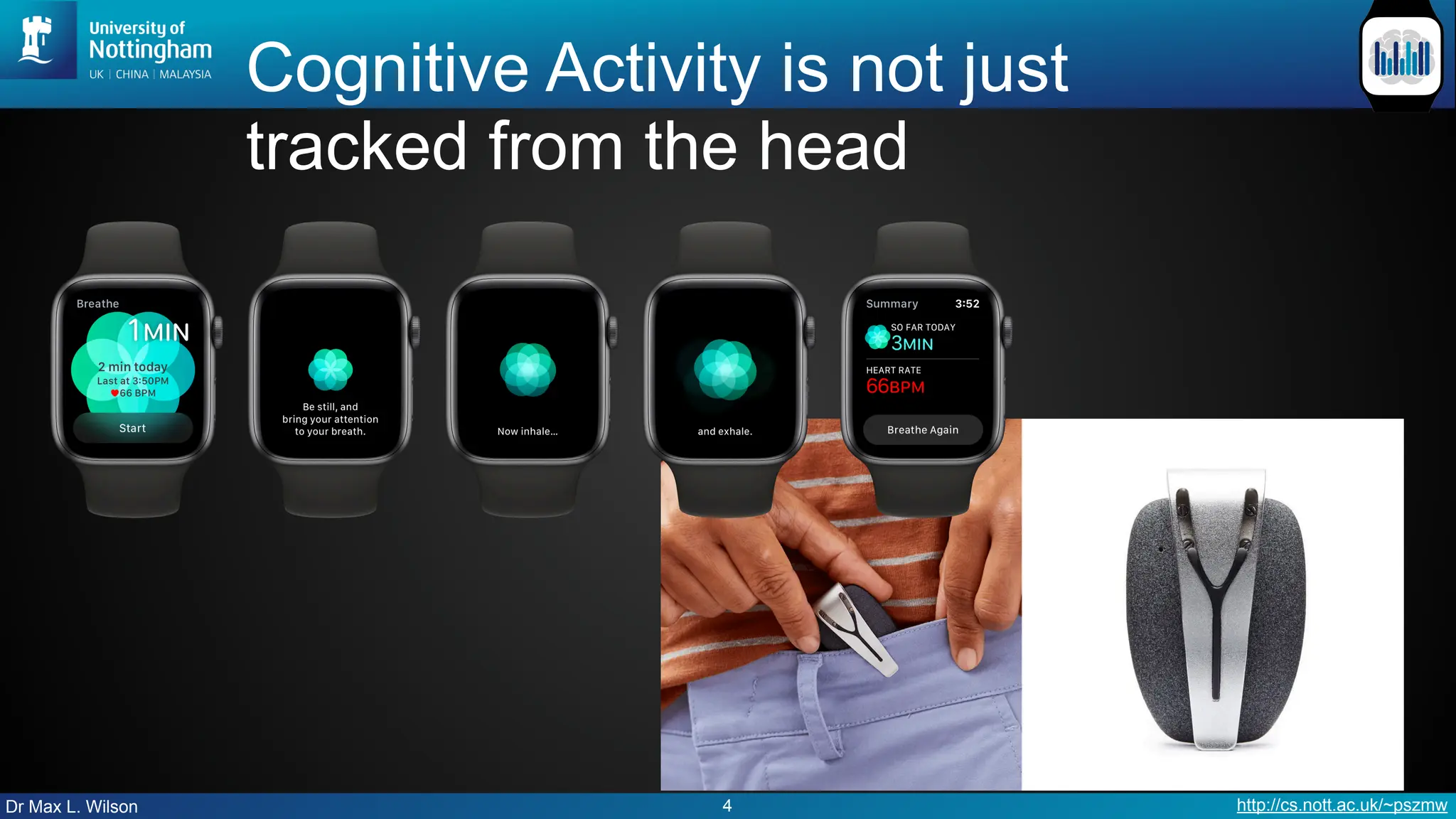
Cognitive Activity is not just
tracked from the head
4
Dr Max L. Wilson http://cs.nott.ac.uk/~pszmw
So far
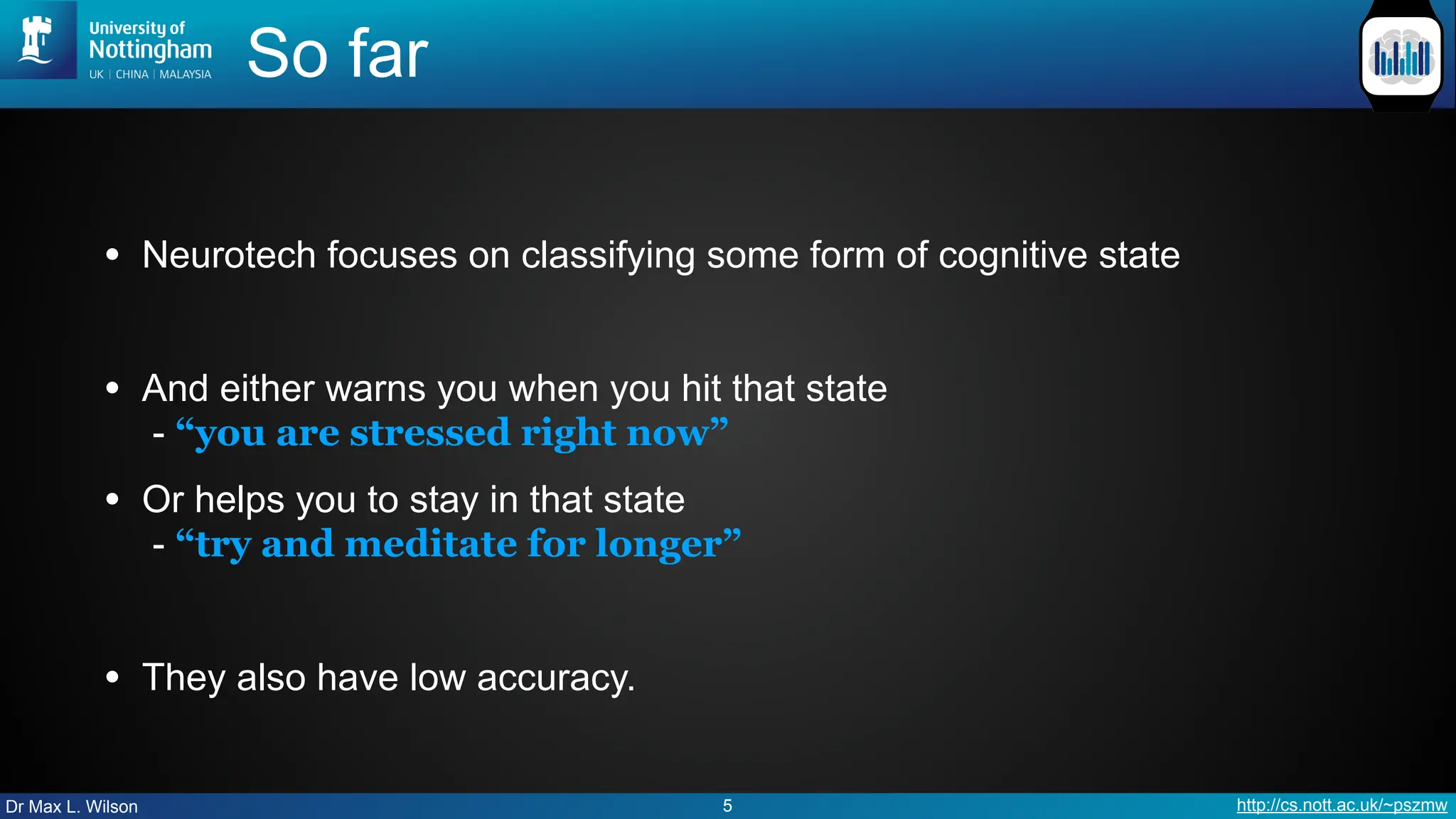
• Neurotech focuses on classifying some form of cognitive state
• And either warns you when you hit that state
- “you are stressed right now”
• Or helps you to stay in that state
- “try and meditate for longer”
• They also have low accuracy.
5
Dr Max L. Wilson https://brain-data-uon.gitlab.io/
Neurotech at work (thanks DALL-E)
6
Dr Max L. Wilson http://cs.nott.ac.uk/~pszmw
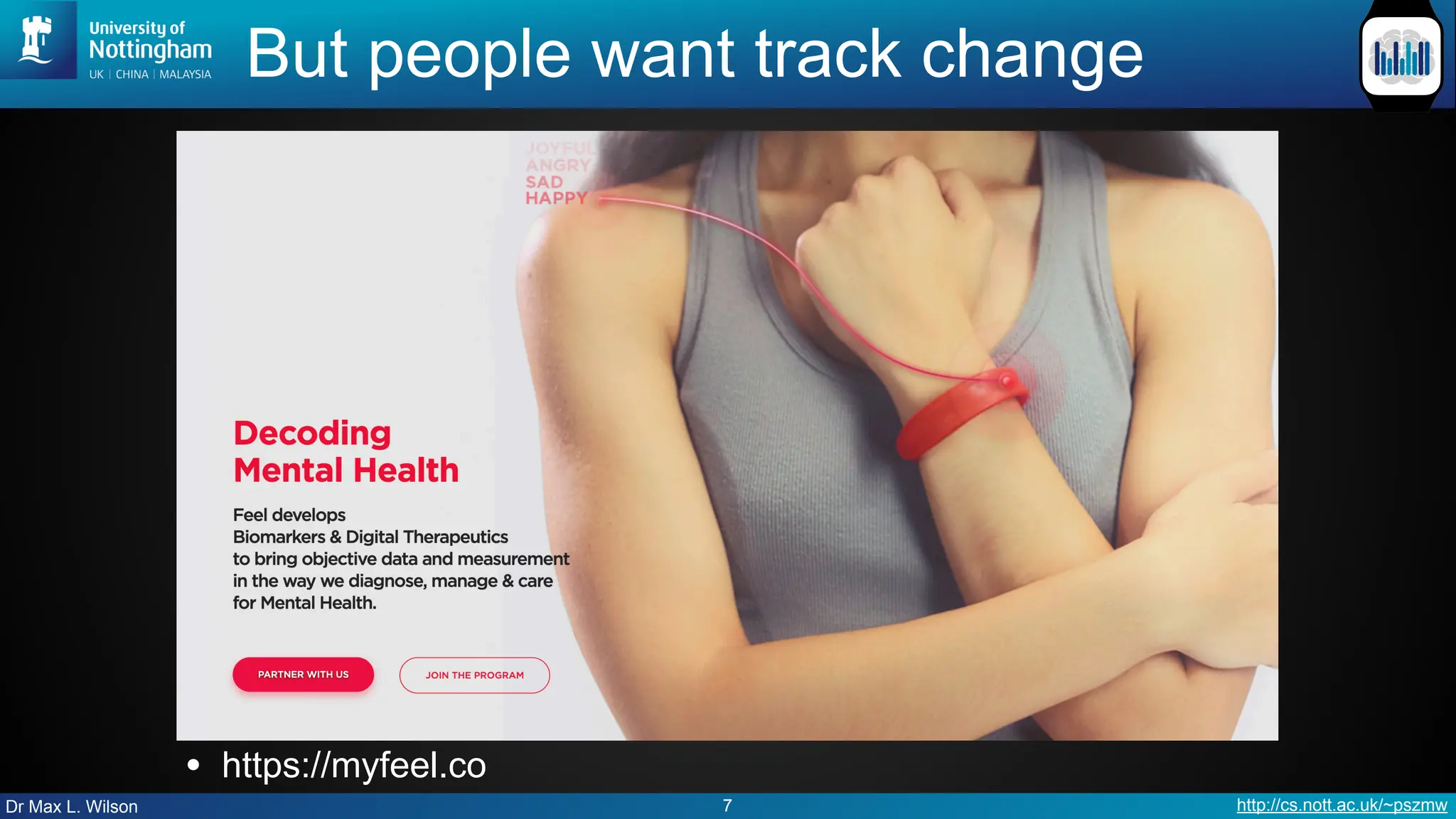
But people want track change
• https://myfeel.co
7
Dr Max L. Wilson http://cs.nott.ac.uk/~pszmw
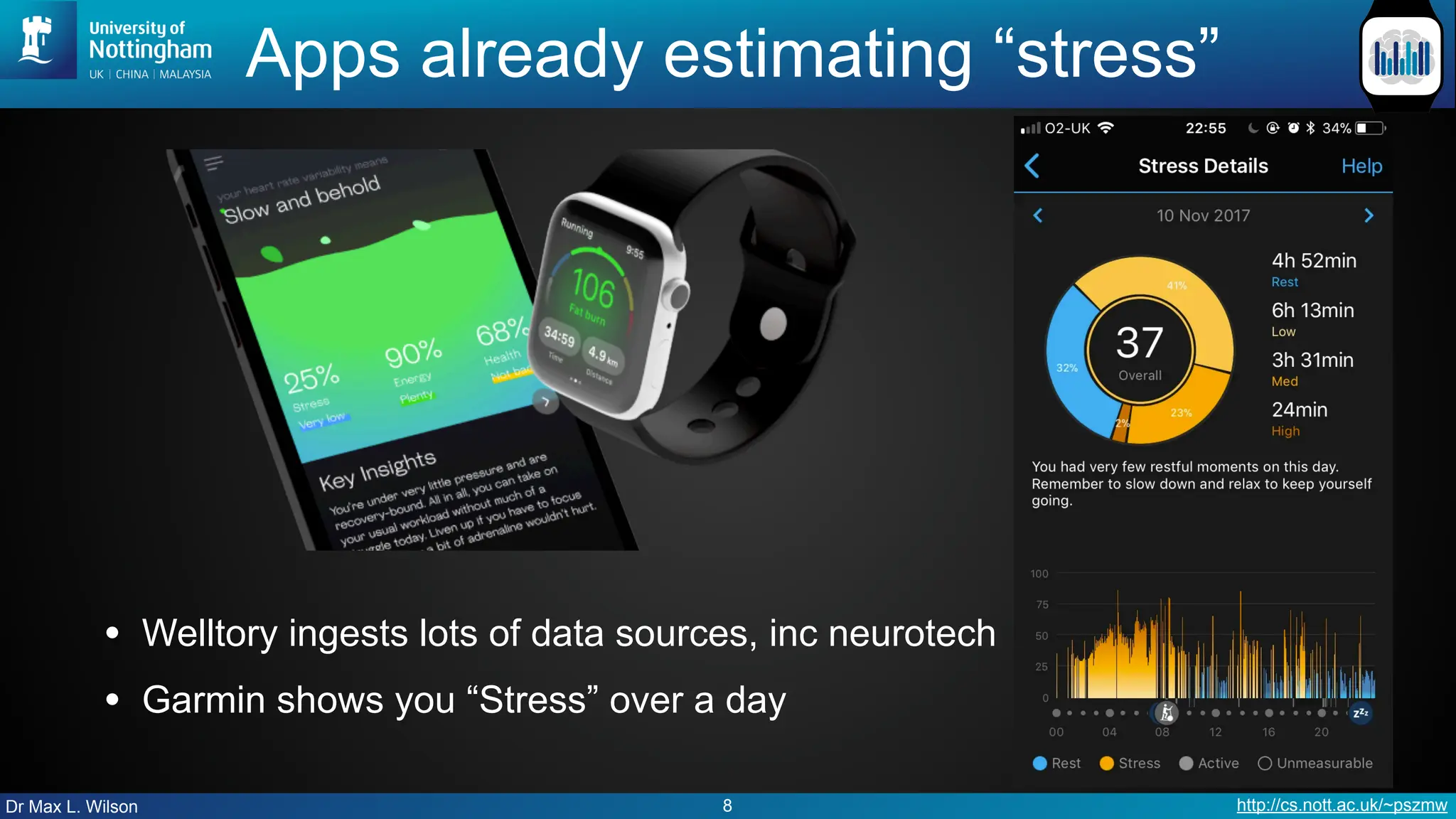
Apps already estimating “stress”
• Welltory ingests lots of data sources, inc neurotech
• Garmin shows you “Stress” over a day
8
Dr Max L. Wilson http://cs.nott.ac.uk/~pszmw
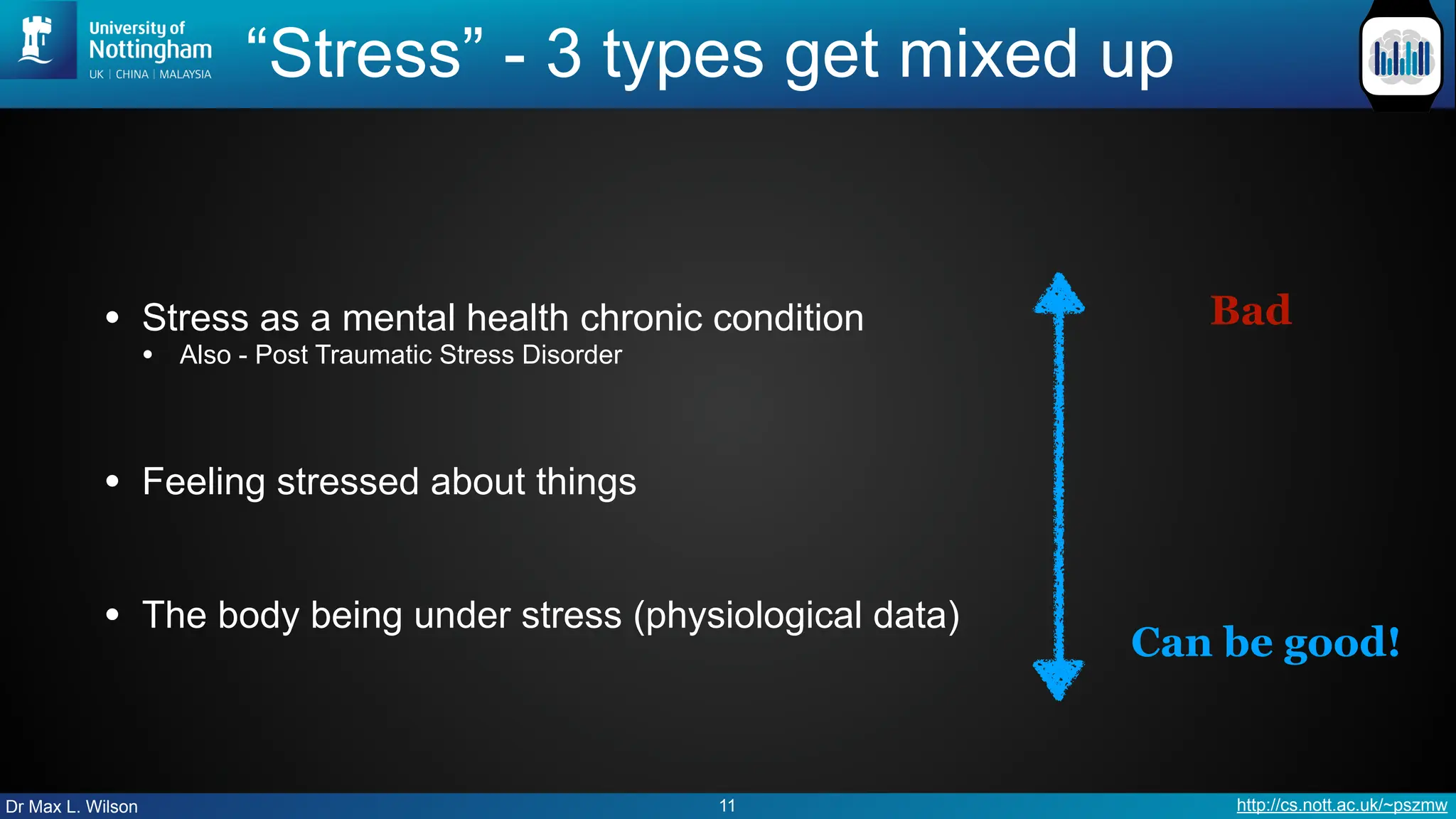
“Stress” - 3 types get mixed up
• Stress as a mental health chronic condition
• Also - Post Traumatic Stress Disorder
• Feeling stressed about things
• The body being under stress (physiological data)
9
Dr Max L. Wilson http://cs.nott.ac.uk/~pszmw
“Stress” - 3 types get mixed up
• Stress as a mental health chronic condition
• Also - Post Traumatic Stress Disorder
• Feeling stressed about things
• The body being under stress (physiological data)
10
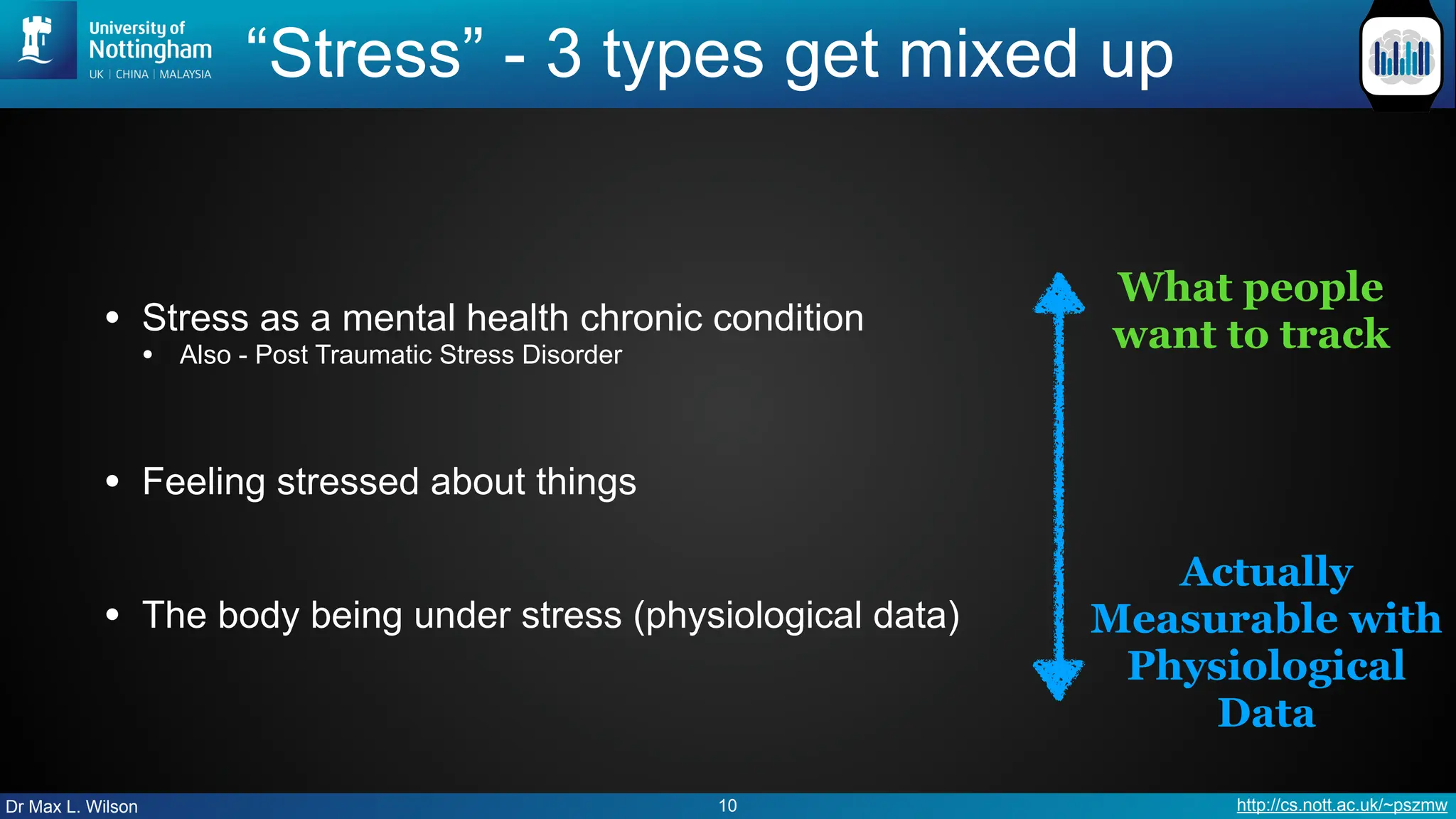
Actually
Measurable with
Physiological
Data
What people
want to track
Dr Max L. Wilson http://cs.nott.ac.uk/~pszmw
“Stress” - 3 types get mixed up
• Stress as a mental health chronic condition
• Also - Post Traumatic Stress Disorder
• Feeling stressed about things
• The body being under stress (physiological data)
11
Can be good!
Bad
Dr Max L. Wilson http://cs.nott.ac.uk/~pszmw
Good Stress
Probably == “High Mental Workload”
• Going on a run would show as high stress in Garmin
• Some people thrive on high pressure workloads and enjoy them
• And they do not necessarily feel stressed about it, and dont necessarily get chronic stress
• You need to be in high mental workload to achieve a hard task
• And then feel a sense of achievement
• Gaming can lead to high mental workload and feeling relaxed
• Many papers use the same tasks to induce stress and mental workload
• and both can be estimated by the same physiological indicators
12
Dr Max L. Wilson http://cs.nott.ac.uk/~pszmw
We’re using “Mental Workload”
• Mental Workload is a kind of emotionally agnostic term
• Compared to ‘stress’, as a loaded term
• A super well established theoretical basis scientifically
- Wickens, attention, multiple resource theory, NASA TLX, etc
• Becomes a good ‘parallel’ for physical activity and representative of
general cognitive activity
13
Dr Max L. Wilson http://cs.nott.ac.uk/~pszmw
So what are HCI Questions?
• State classification is largely a machine learning problem now
• The HCI Qs are for when it becomes a form of
cognitive personal informatics
• What amount of mental workload are people aiming for?
• What should neurotech aim to help us track longitudinally?
• How should apps visualise this to us?
• How will society handle the inclusion of this data?
14
Lived Experiences of Mental Workload
in Everyday Life
Serena Midha, Max L. Wilson, Sarah Sharples
CHI2022
Dr Max L. Wilson http://cs.nott.ac.uk/~pszmw
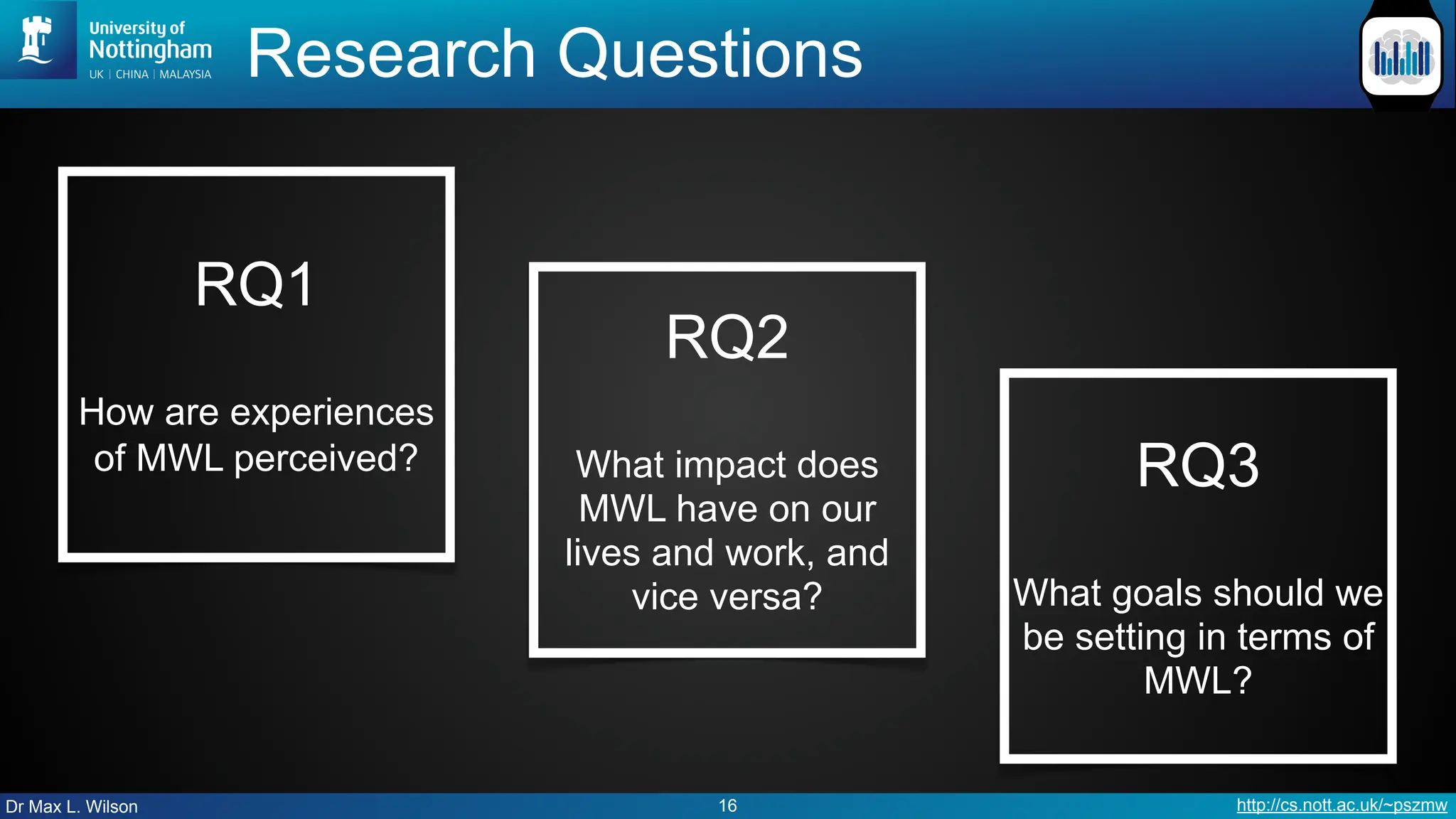
Research Questions
16
RQ1
How are experiences
of MWL perceived?
RQ2
What impact does
MWL have on our
lives and work, and
vice versa?
RQ3
What goals should we
be setting in terms of
MWL?
Dr Max L. Wilson http://cs.nott.ac.uk/~pszmw
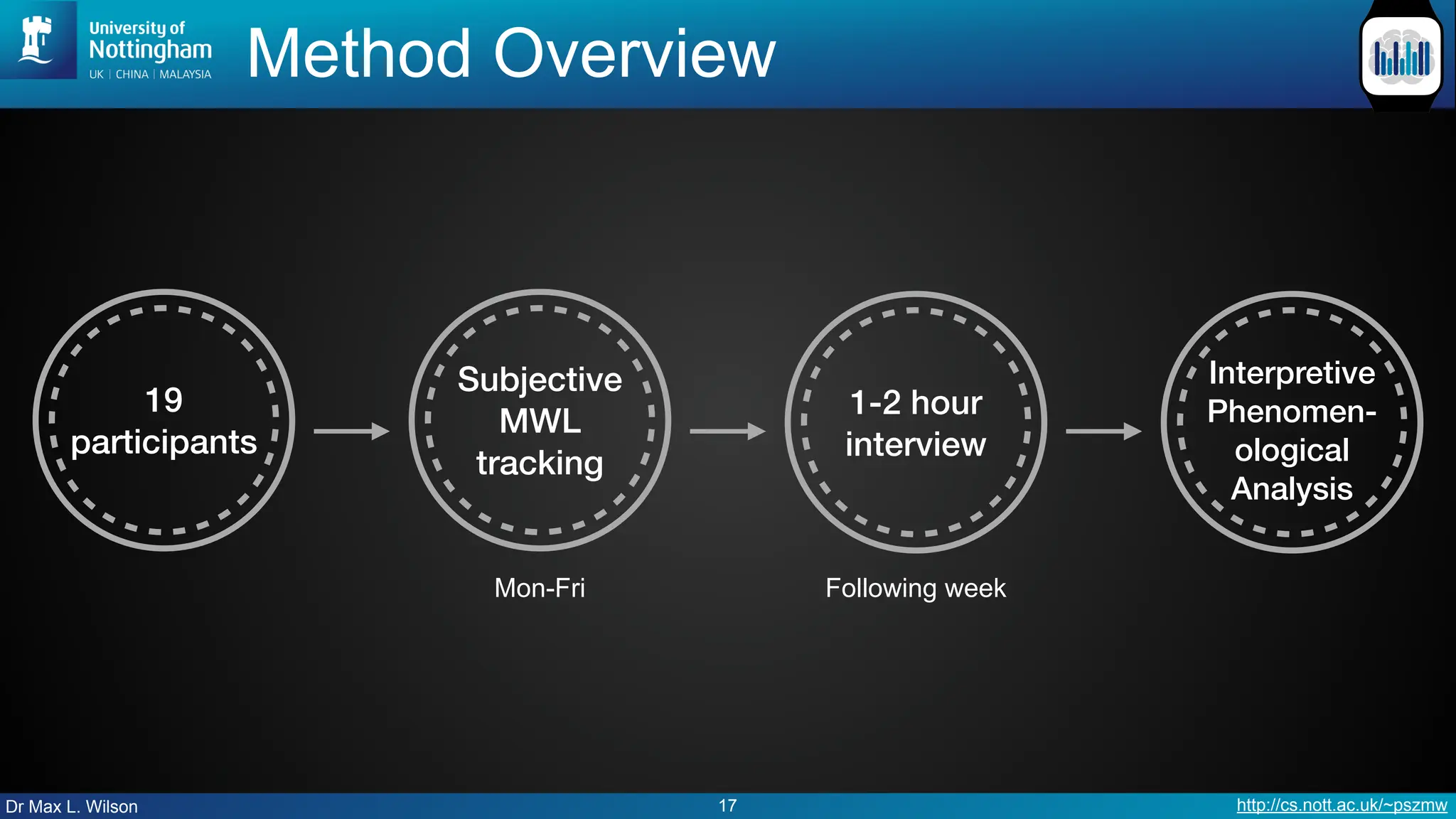
Method Overview
17
19
participants
Subjective
MWL
tracking
1-2 hour
interview
Interpretive
Phenomen-
ological
Analysis
Mon-Fri Following week
Dr Max L. Wilson http://cs.nott.ac.uk/~pszmw
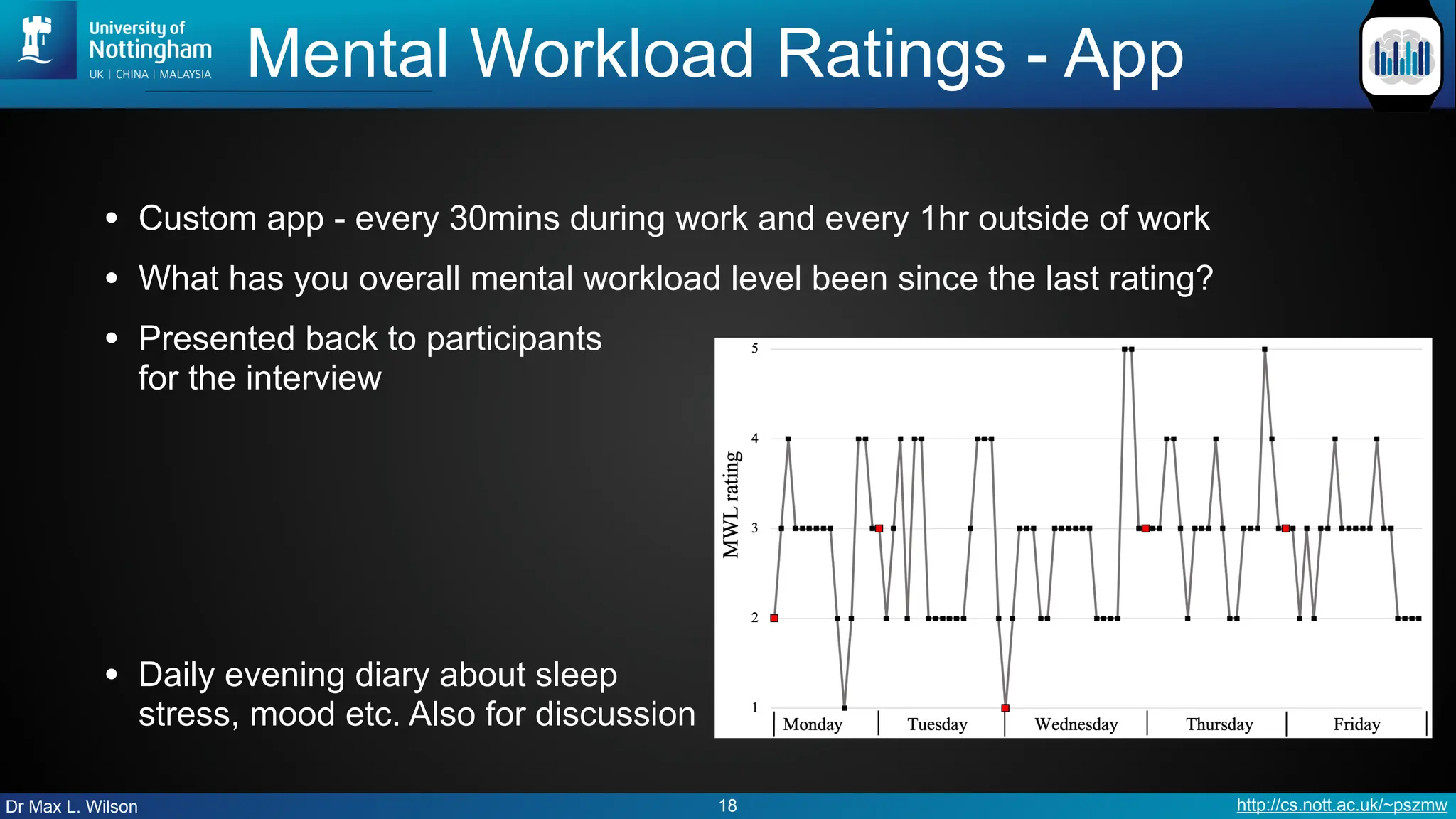
Mental Workload Ratings - App
• Custom app - every 30mins during work and every 1hr outside of work
• What has you overall mental workload level been since the last rating?
• Presented back to participants
for the interview
• Daily evening diary about sleep
stress, mood etc. Also for discussion
18
Dr Max L. Wilson http://cs.nott.ac.uk/~pszmw
Semi-Structured Interview
• Typically between 1-2hrs, on zoom or teams (during covid)
• Personal Experiences throughout the week
• How people understood and conceptualised their own mental workload
• What people wanted to know about their cognitive activity
• Ethical/Legal/Moral concerns they had about future tracking
19
Dr Max L. Wilson http://cs.nott.ac.uk/~pszmw
19 Participants (from 20)
• Office workers, with android phones, no clinical mental health history
• Originally 10 researchers and 10 industry
- 1 researcher excluded after interview highlighted misunderstanding
• Received £75 remuneration (for week of ratings + interview)
- additional £25 given for good data return during the week
- all given £100 in the end, including excluded participant
20
Dr Max L. Wilson http://cs.nott.ac.uk/~pszmw
Results
21
CHI’22 - Mental Workload Concept - 4 themes
FAccT’22 - Neuroethics - 3 themes
Dr Max L. Wilson http://cs.nott.ac.uk/~pszmw
4 Themes about Mental Workload
22
1 General Perceptions of MWL
Changing Perceptions of MWL
The MWL Cycle
The Cycle Can’t Always be Facilitated
2
3
4
Dr Max L. Wilson http://cs.nott.ac.uk/~pszmw
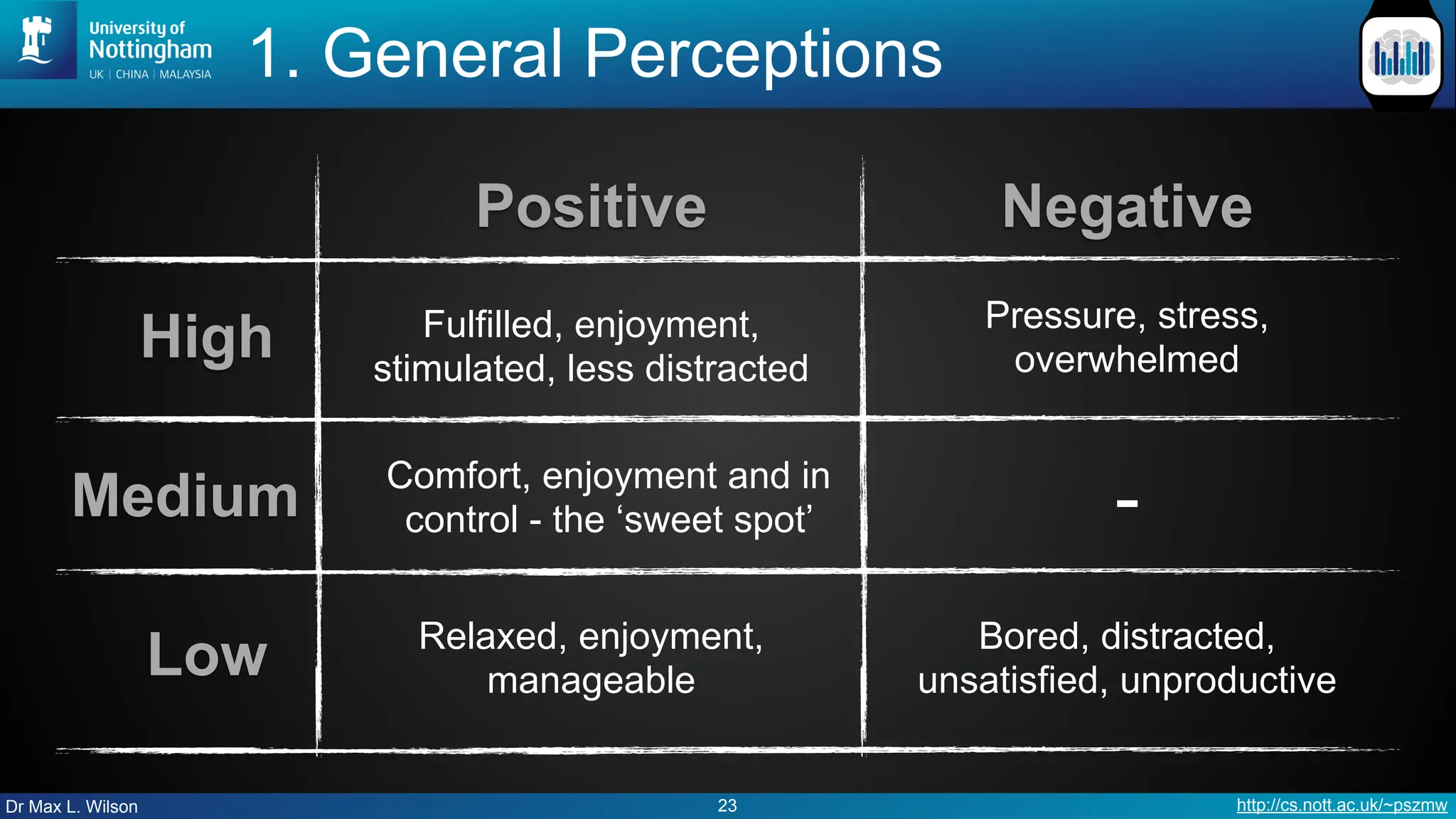
1. General Perceptions
23
Positive Negative
High
Low
Medium
Fulfilled, enjoyment,
stimulated, less distracted
Pressure, stress,
overwhelmed
Relaxed, enjoyment,
manageable
Bored, distracted,
unsatisfied, unproductive
Comfort, enjoyment and in
control - the ‘sweet spot’ -
Dr Max L. Wilson http://cs.nott.ac.uk/~pszmw
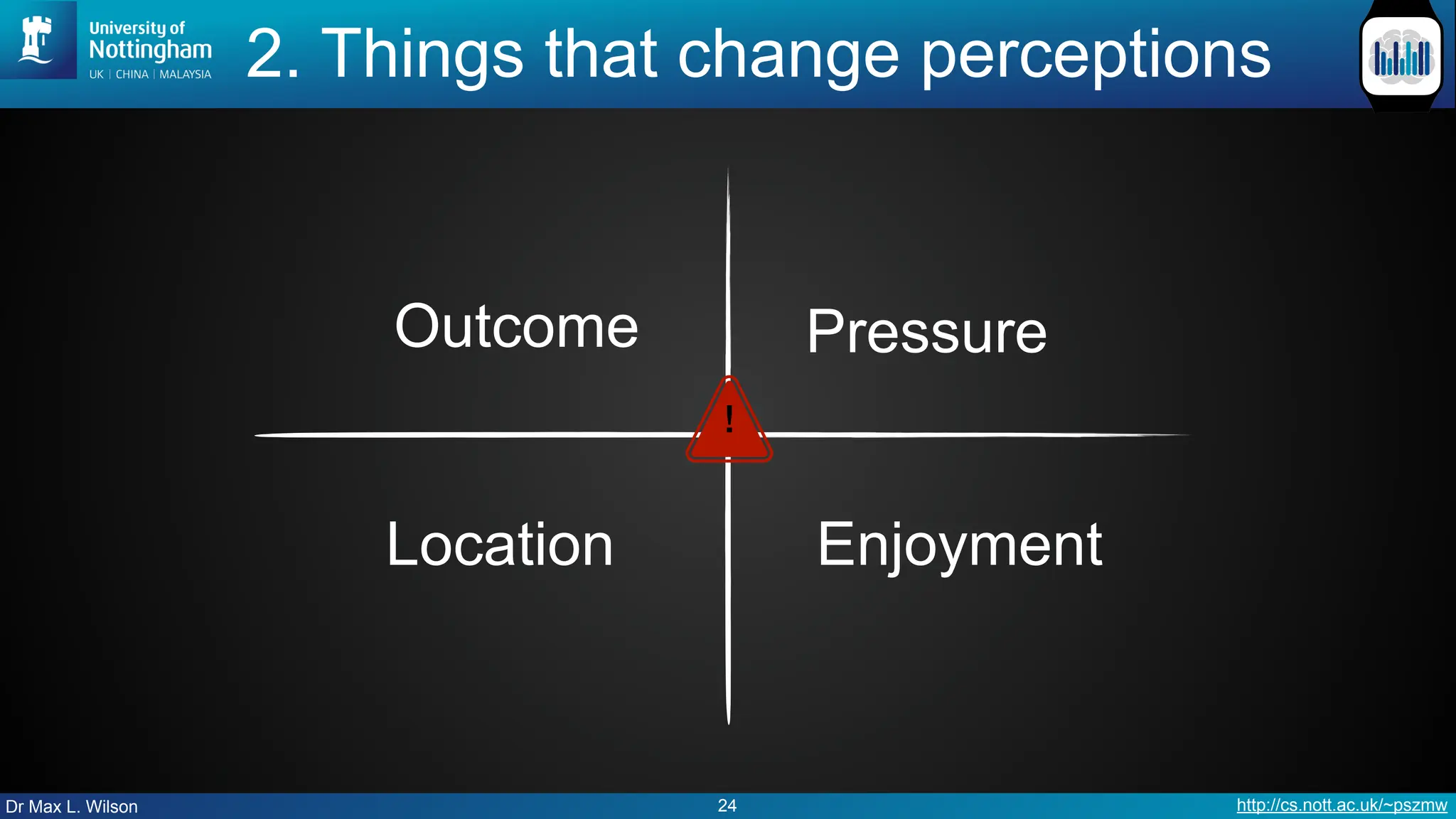
2. Things that change perceptions
24
Pressure
Outcome
Enjoyment
Location
!
Dr Max L. Wilson http://cs.nott.ac.uk/~pszmw
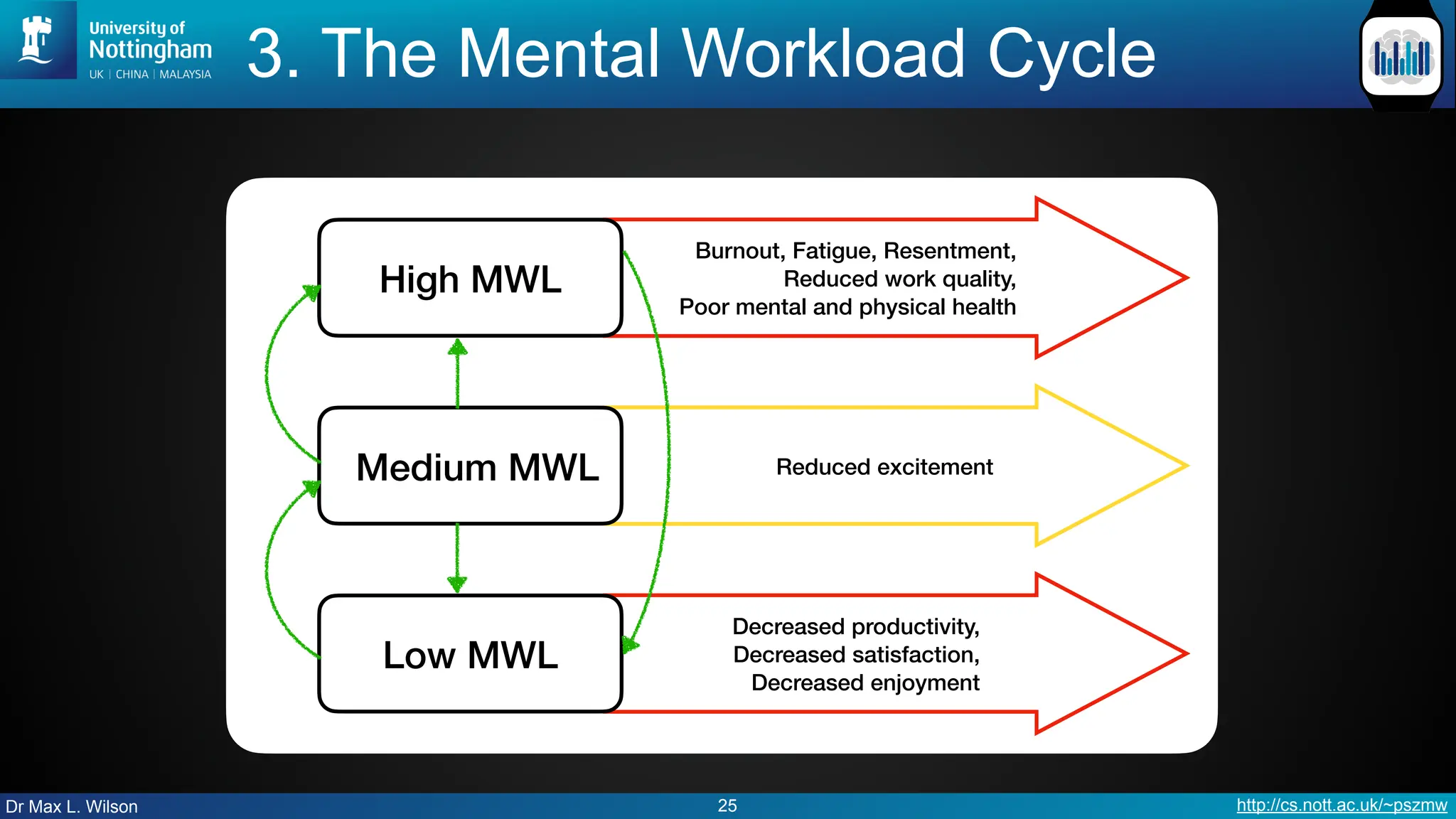
3. The Mental Workload Cycle
25
Low MWL
Medium MWL
High MWL
Burnout, Fatigue, Resentment,
Reduced work quality,
Poor mental and physical health
Decreased productivity,
Decreased satisfaction,
Decreased enjoyment
Reduced excitement
Dr Max L. Wilson http://cs.nott.ac.uk/~pszmw
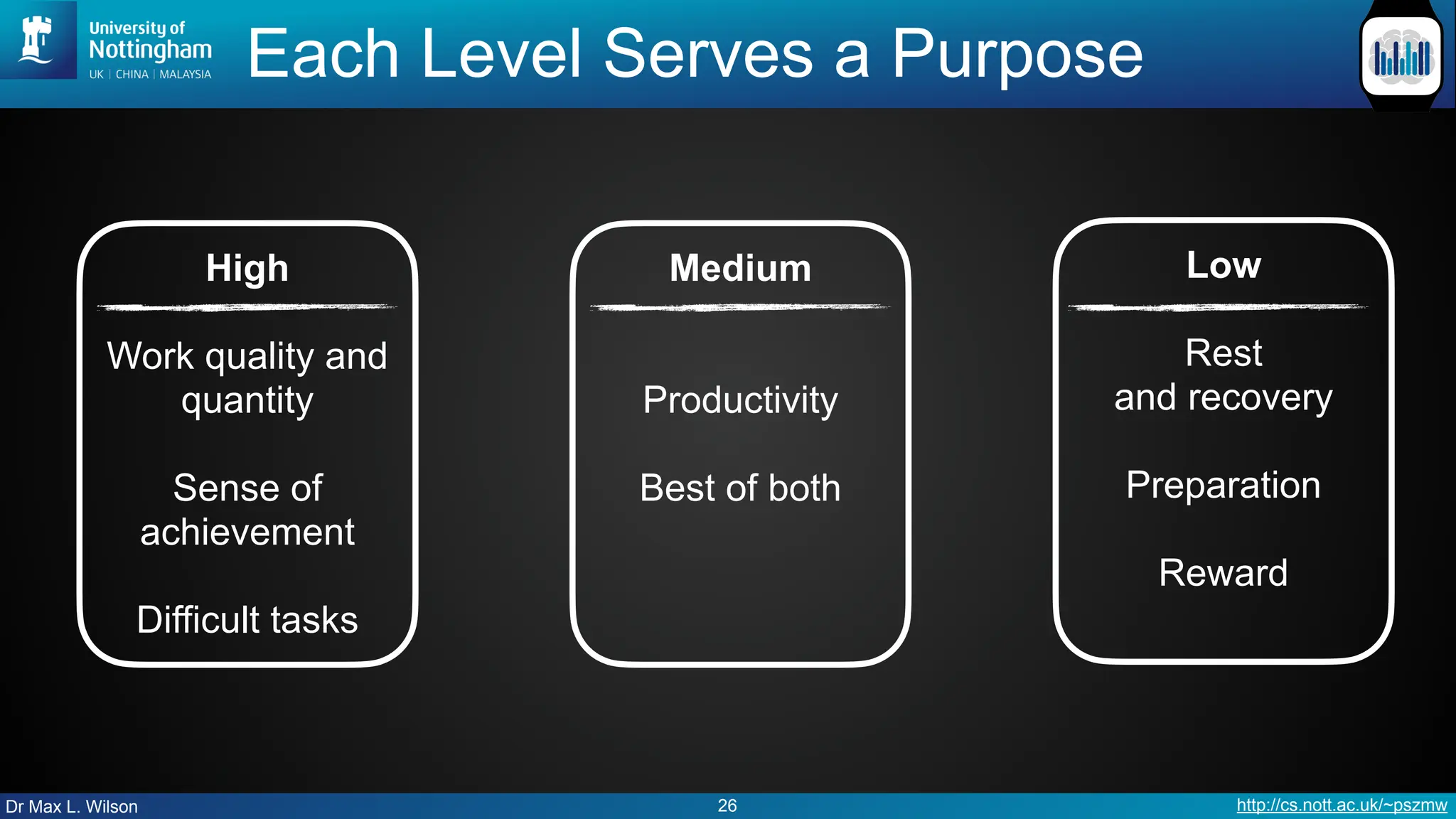
Each Level Serves a Purpose
26
High
Work quality and
quantity
Sense of
achievement
Difficult tasks
Medium
Productivity
Best of both
Low
Rest
and recovery
Preparation
Reward
Dr Max L. Wilson http://cs.nott.ac.uk/~pszmw
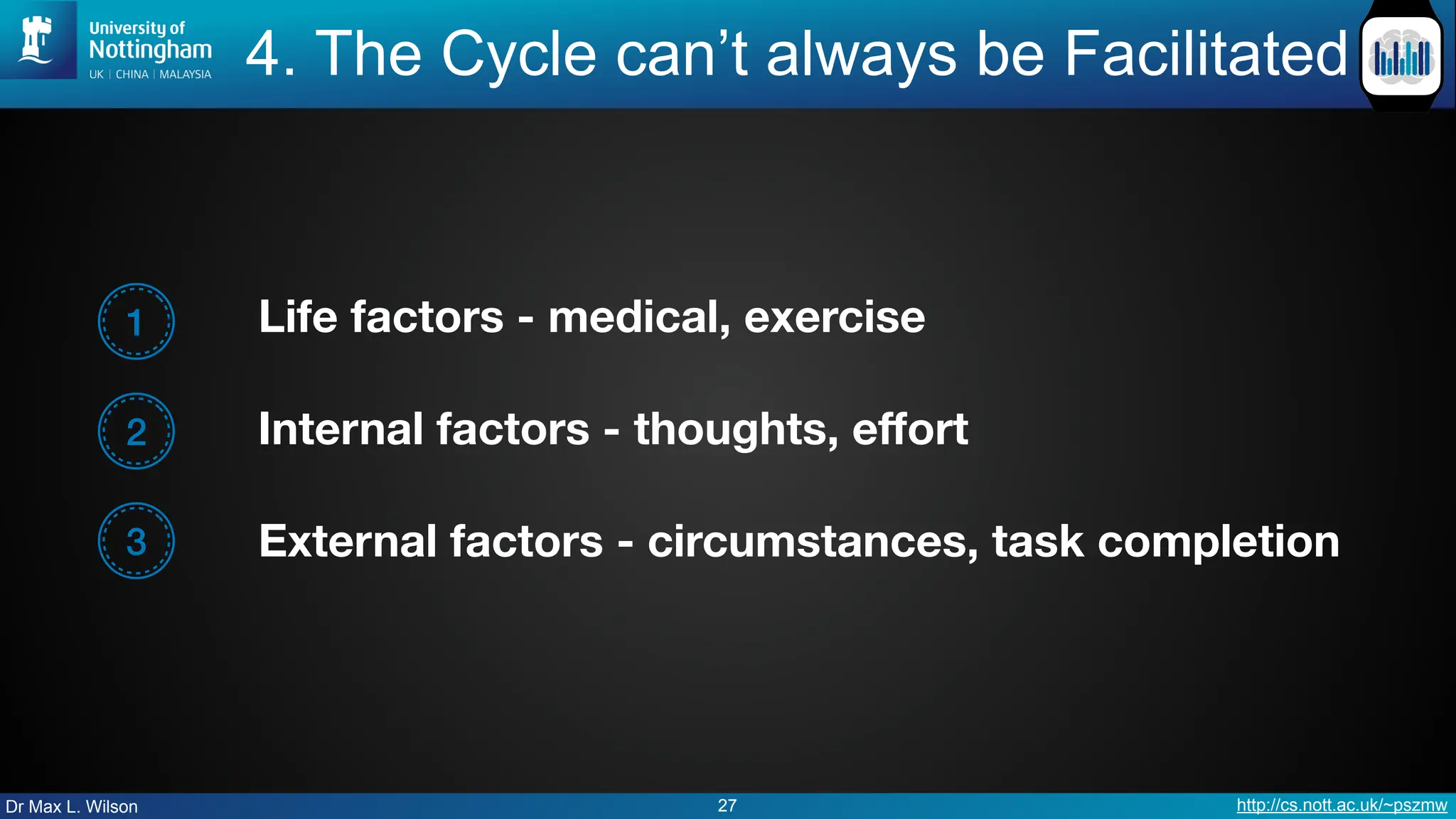
4. The Cycle can’t always be Facilitated
27
1 Life factors - medical, exercise
Internal factors - thoughts, effort
External factors - circumstances, task completion
2
3
Dr Max L. Wilson http://cs.nott.ac.uk/~pszmw
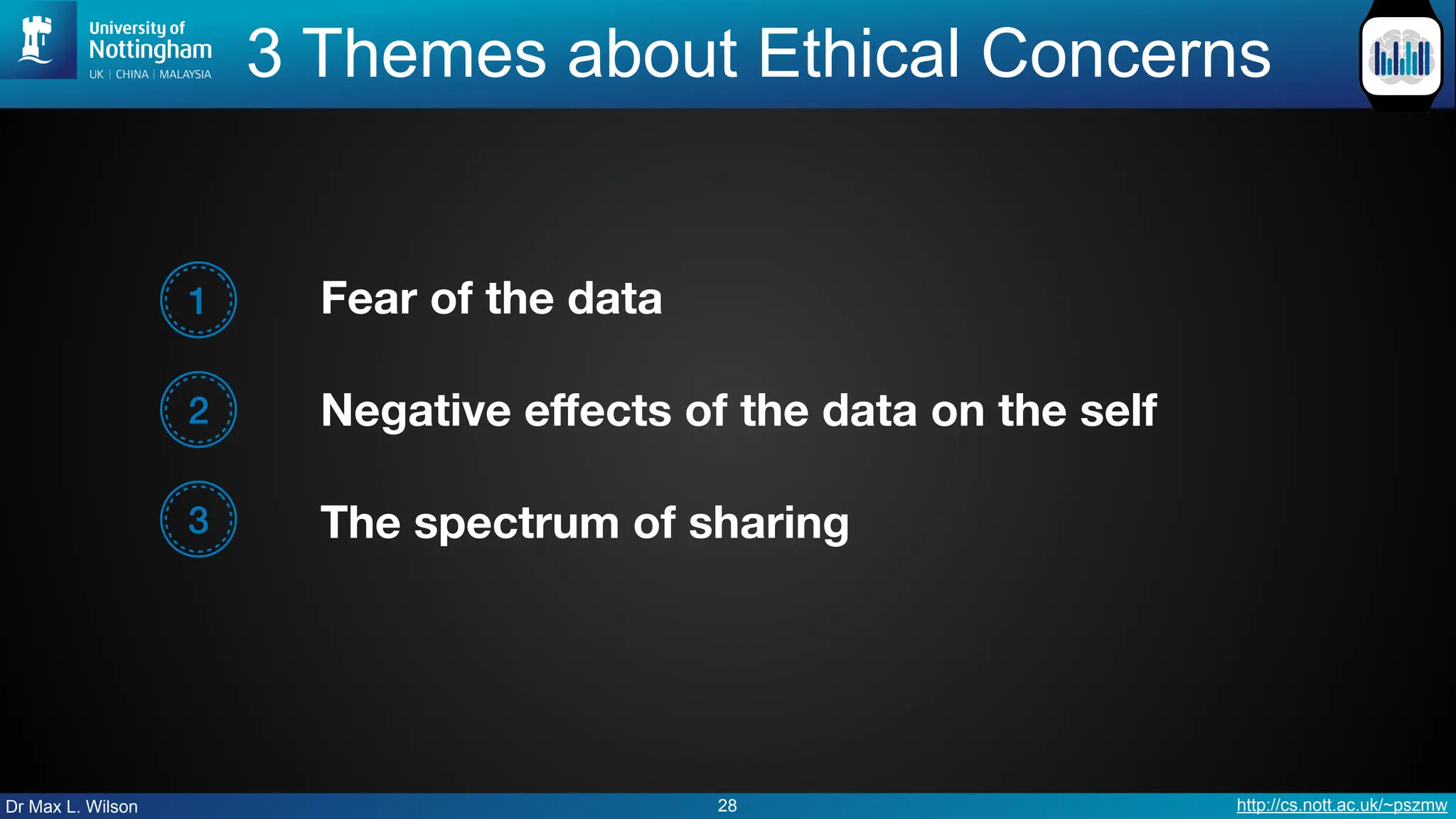
3 Themes about Ethical Concerns
28
1 Fear of the data
Negative effects of the data on the self
The spectrum of sharing
2
3
Dr Max L. Wilson http://cs.nott.ac.uk/~pszmw
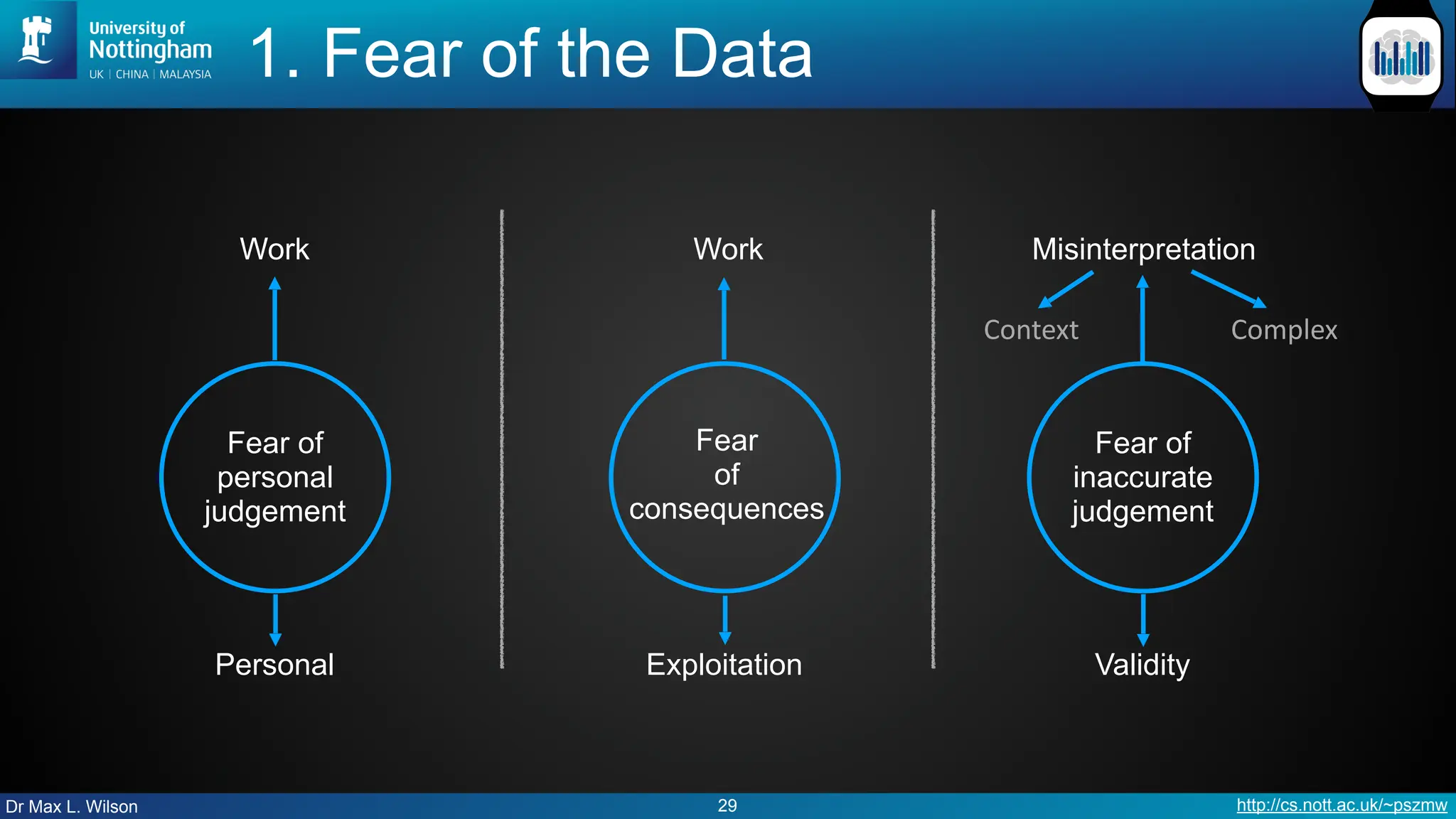
1. Fear of the Data
29
Fear of
inaccurate
judgement
Fear of
personal
judgement
Fear
of
consequences
Work
Personal
Work
Exploitation
Misinterpretation
Validity
Complex
Context
Dr Max L. Wilson http://cs.nott.ac.uk/~pszmw
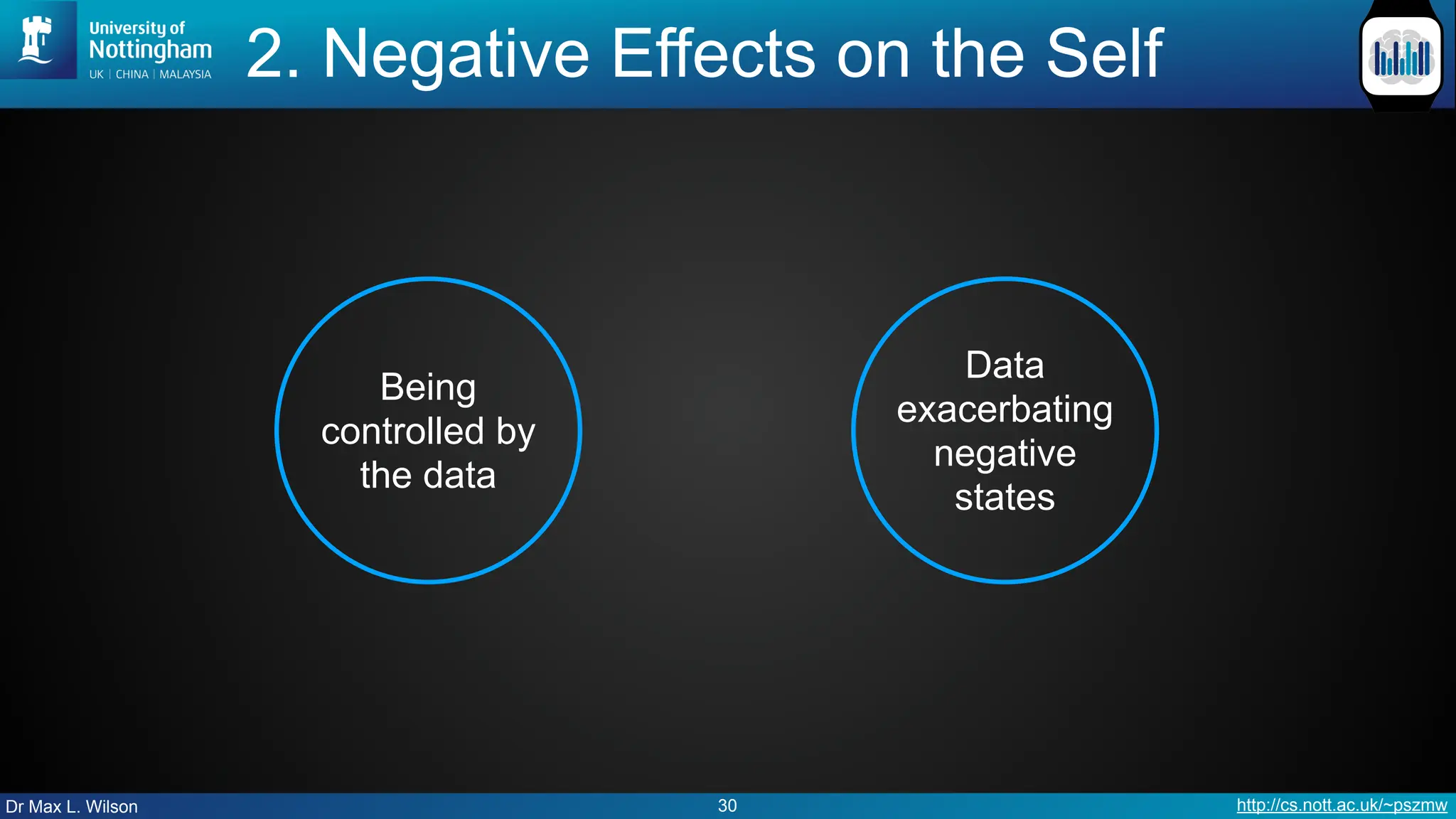
2. Negative Effects on the Self
30
Being
controlled by
the data
Data
exacerbating
negative
states
Dr Max L. Wilson http://cs.nott.ac.uk/~pszmw
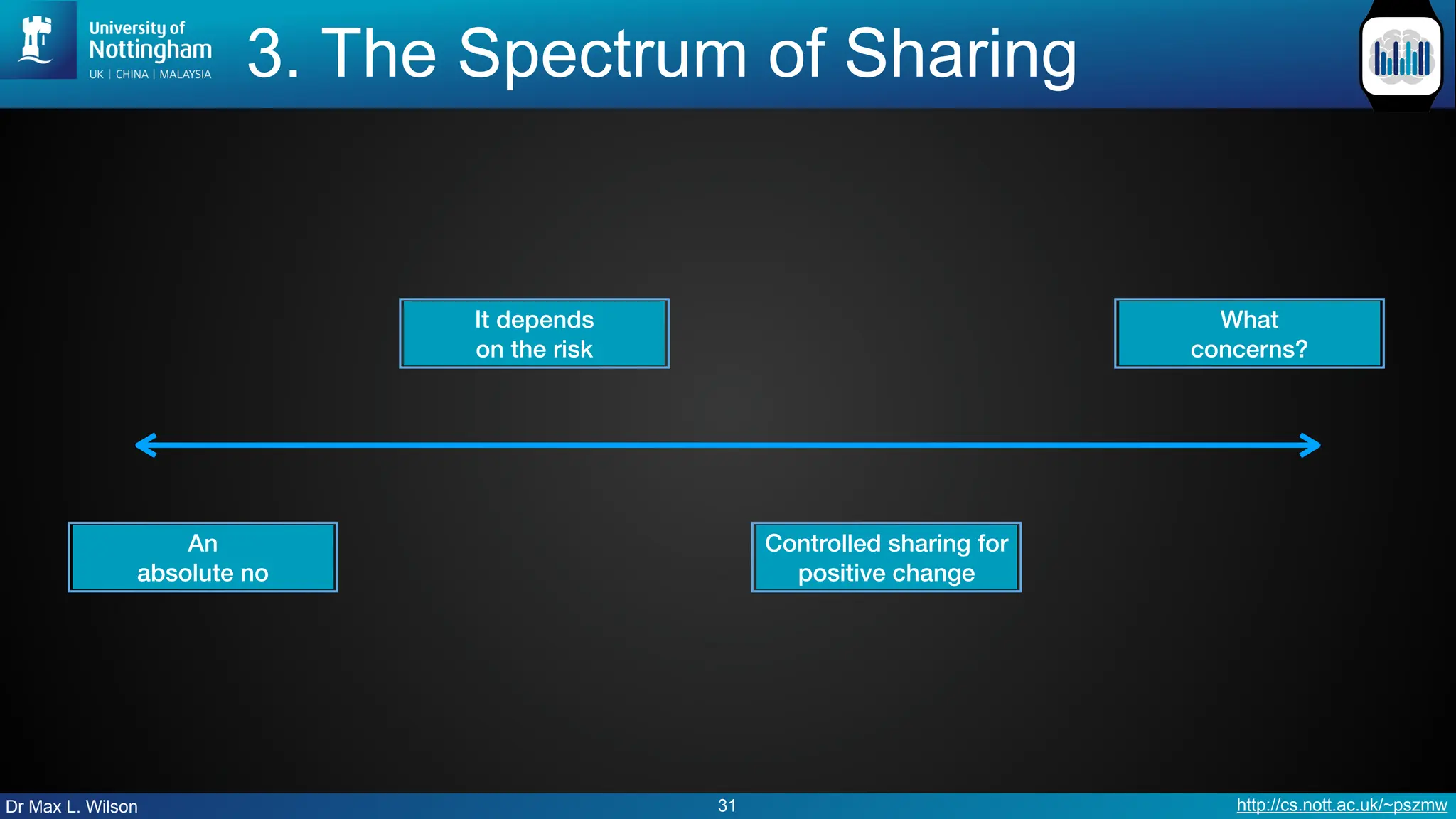
3. The Spectrum of Sharing
31
What
concerns?
Controlled sharing for
positive change
It depends
on the risk
An
absolute no
Dr Max L. Wilson http://cs.nott.ac.uk/~pszmw
Discussion
32
Dr Max L. Wilson http://cs.nott.ac.uk/~pszmw
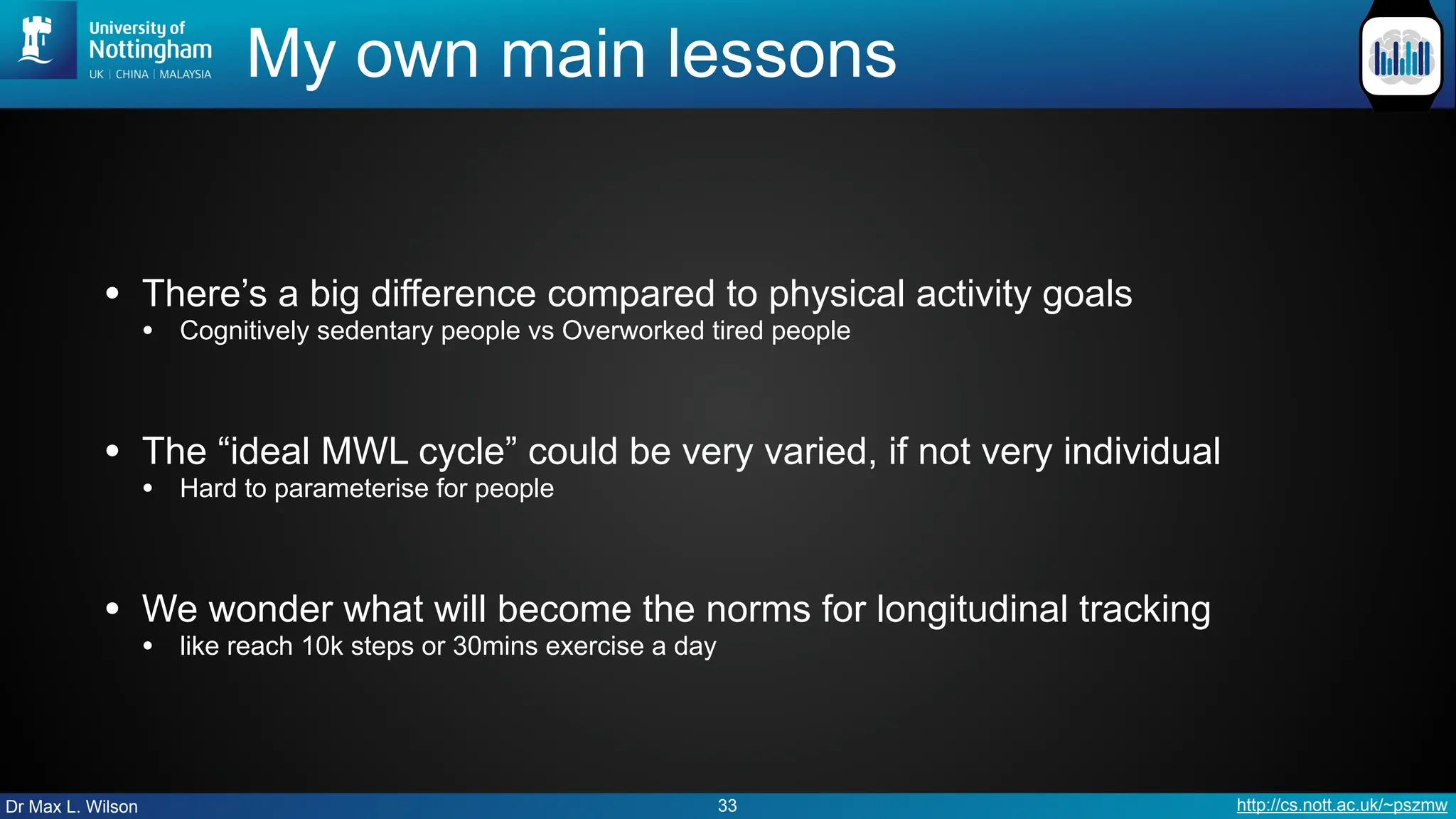
My own main lessons
• There’s a big difference compared to physical activity goals
• Cognitively sedentary people vs Overworked tired people
• The “ideal MWL cycle” could be very varied, if not very individual
• Hard to parameterise for people
• We wonder what will become the norms for longitudinal tracking
• like reach 10k steps or 30mins exercise a day
33
Dr Max L. Wilson http://cs.nott.ac.uk/~pszmw
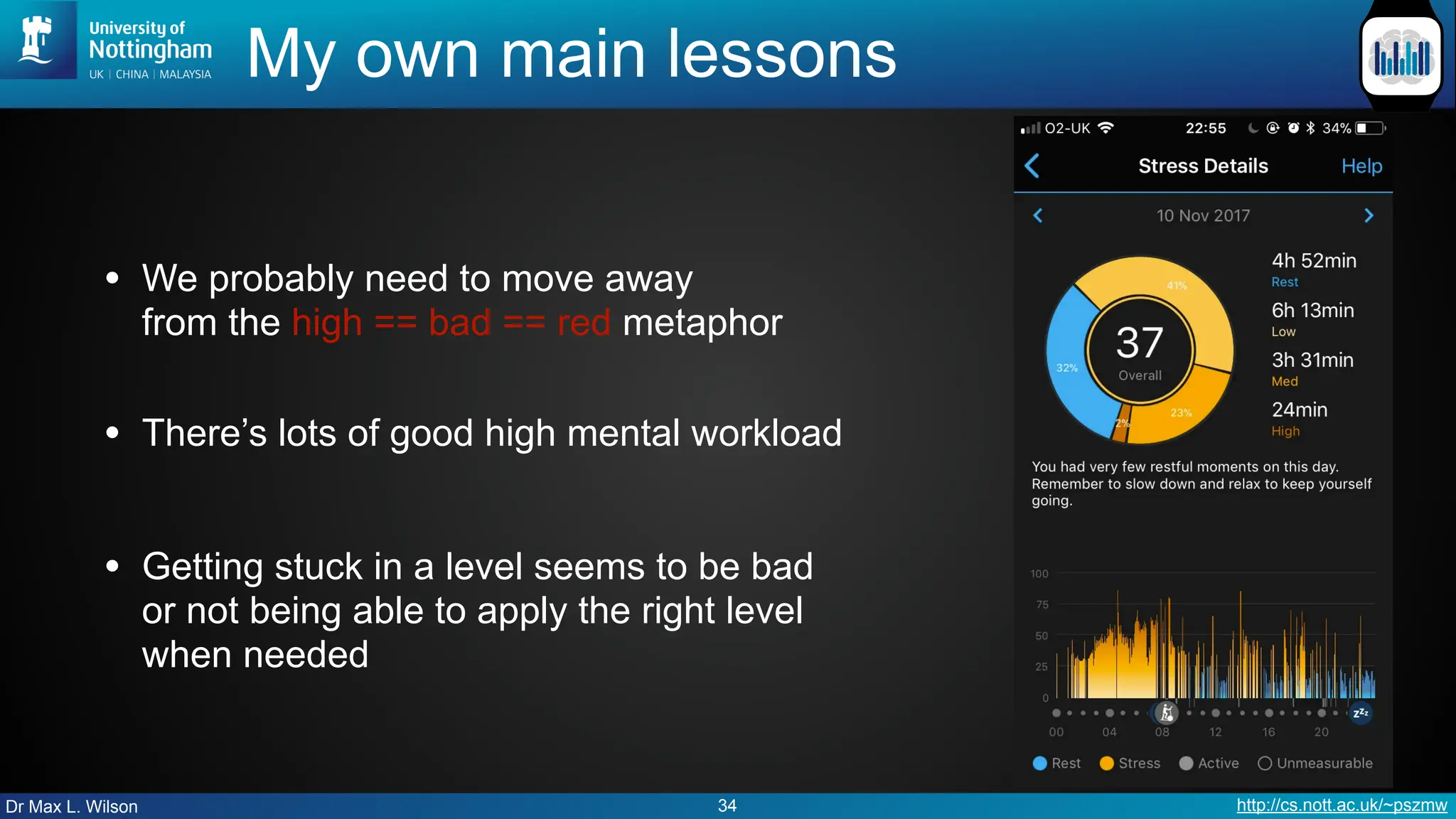
My own main lessons
• We probably need to move away
from the high == bad == red metaphor
• There’s lots of good high mental workload
• Getting stuck in a level seems to be bad
or not being able to apply the right level
when needed
34
Dr Max L. Wilson http://cs.nott.ac.uk/~pszmw
My own main lessons
• There’s a very large gap between
- motivating behavioural goals / changes
- and understanding this mental workload cycle
• Most people talk about wanting to reduce “stress”
- so its part perception of what is good and bad
- and part understanding the relationship between what we can
measure and what people want to achieve
• A massive research gap in cognitive personal informatics
35
Building a community focus on
Cognitive Personal Informatics
Dr Max L. Wilson http://cs.nott.ac.uk/~pszmw
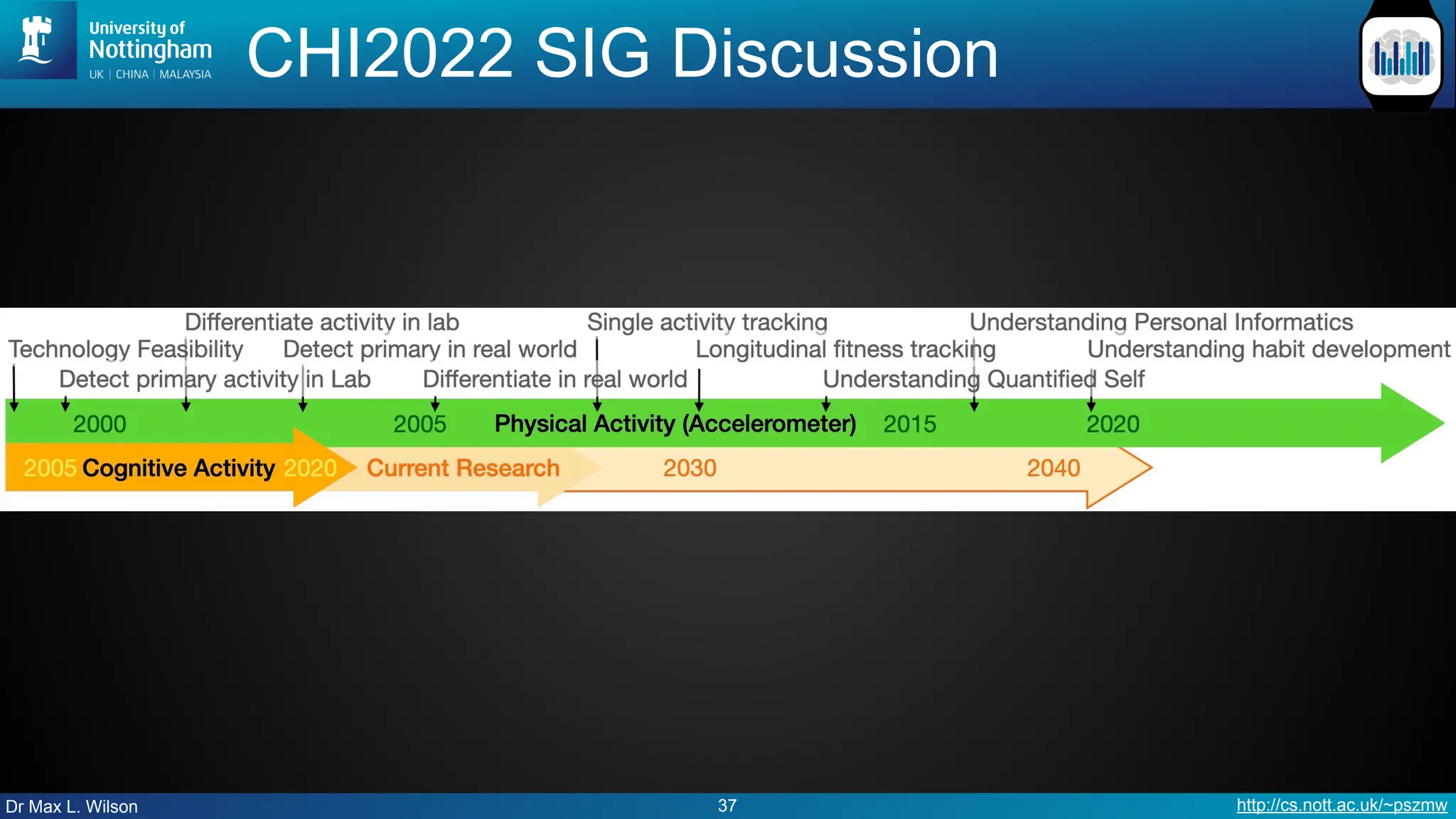
CHI2022 SIG Discussion
37
Dr Max L. Wilson http://cs.nott.ac.uk/~pszmw
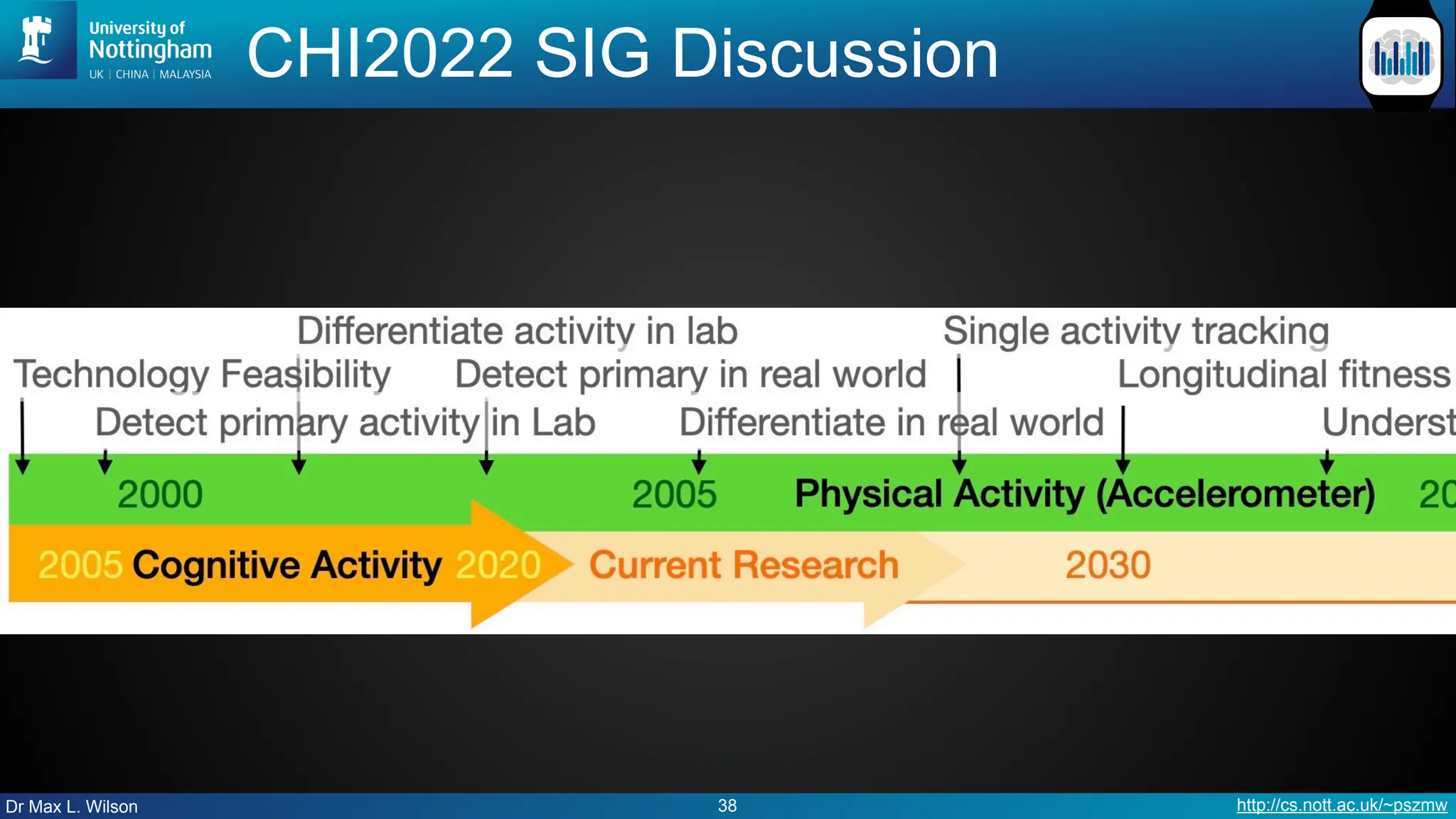
CHI2022 SIG Discussion
38
Dr Max L. Wilson http://cs.nott.ac.uk/~pszmw
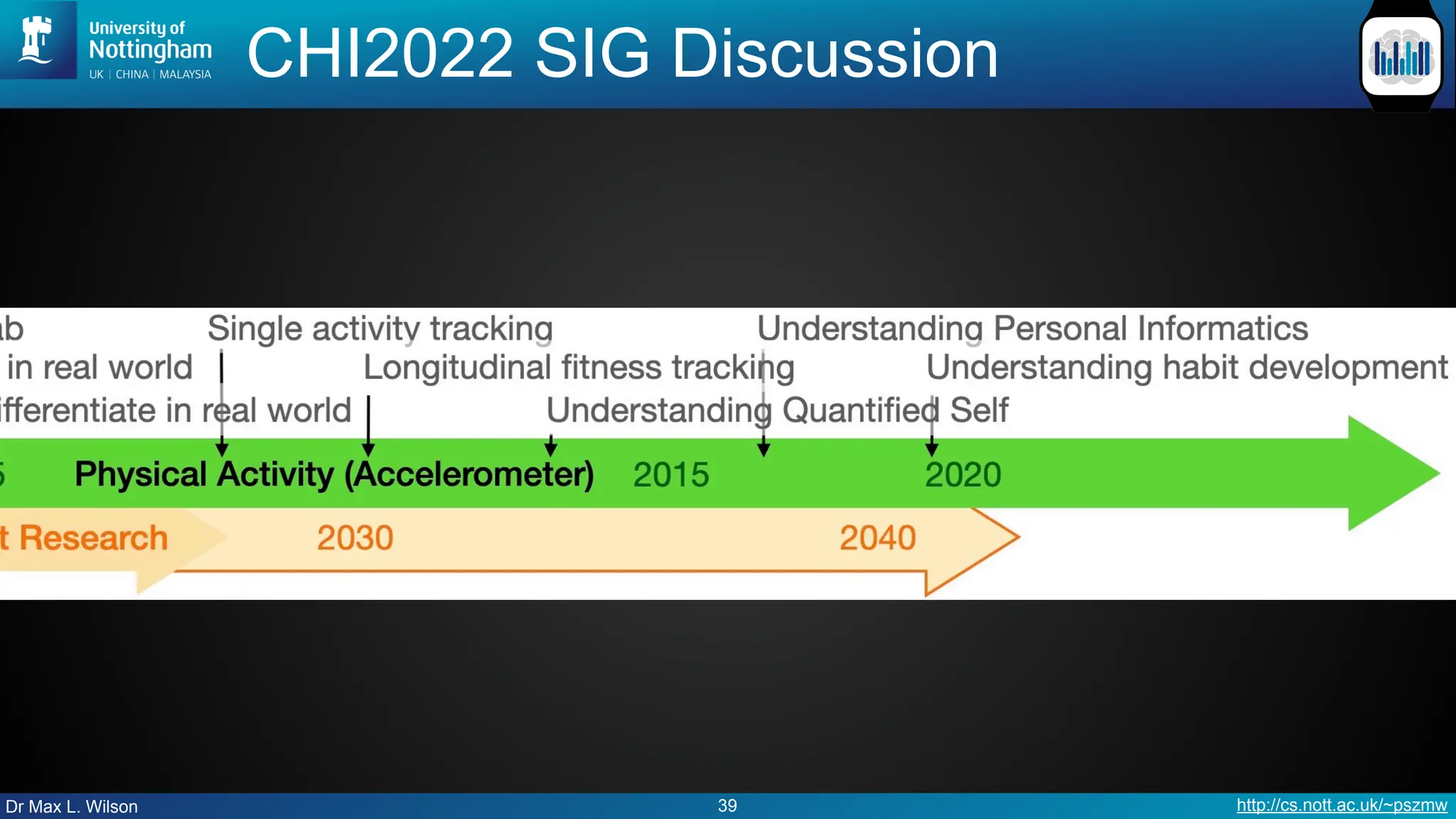
CHI2022 SIG Discussion
39
Dr Max L. Wilson http://cs.nott.ac.uk/~pszmw
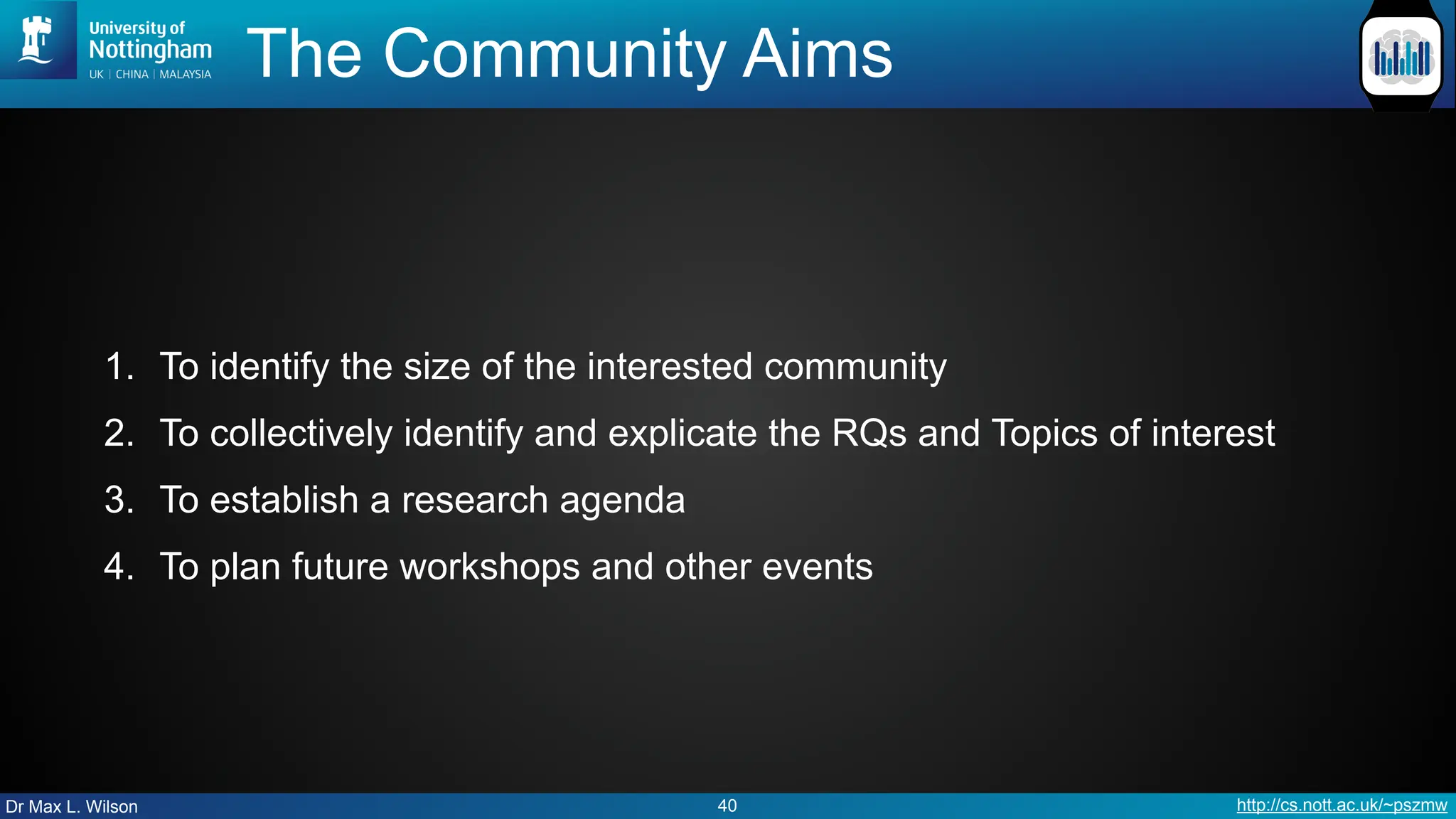
The Community Aims
1. To identify the size of the interested community
2. To collectively identify and explicate the RQs and Topics of interest
3. To establish a research agenda
4. To plan future workshops and other events
40
Dr Max L. Wilson http://cs.nott.ac.uk/~pszmw
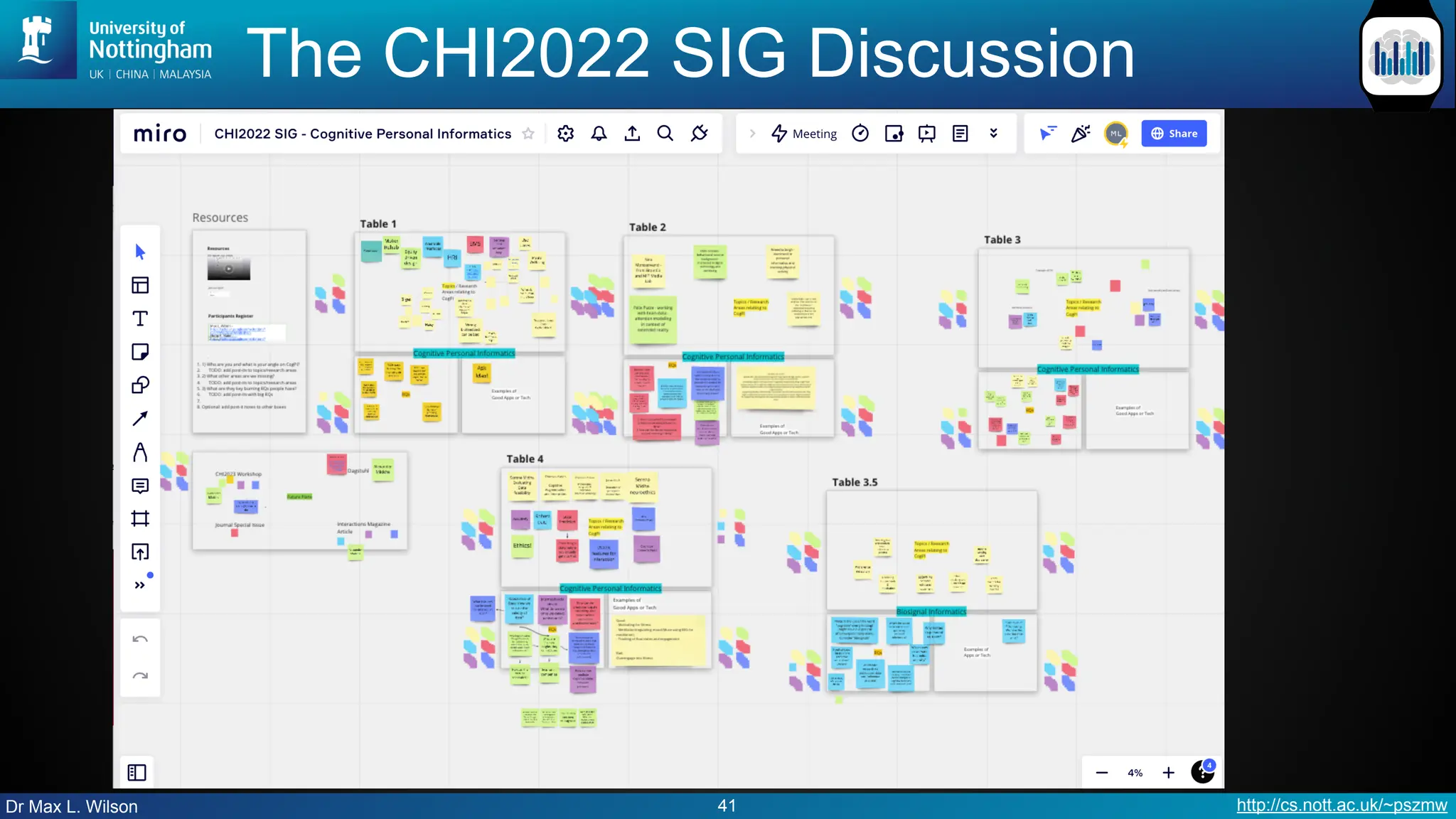
The CHI2022 SIG Discussion
41
Dr Max L. Wilson http://cs.nott.ac.uk/~pszmw
Upcoming plans
• A CHI2023 Workshop
• An IJHCS Special Issue
• A Medium blog series
42
Dr Max L. Wilson http://cs.nott.ac.uk/~pszmw
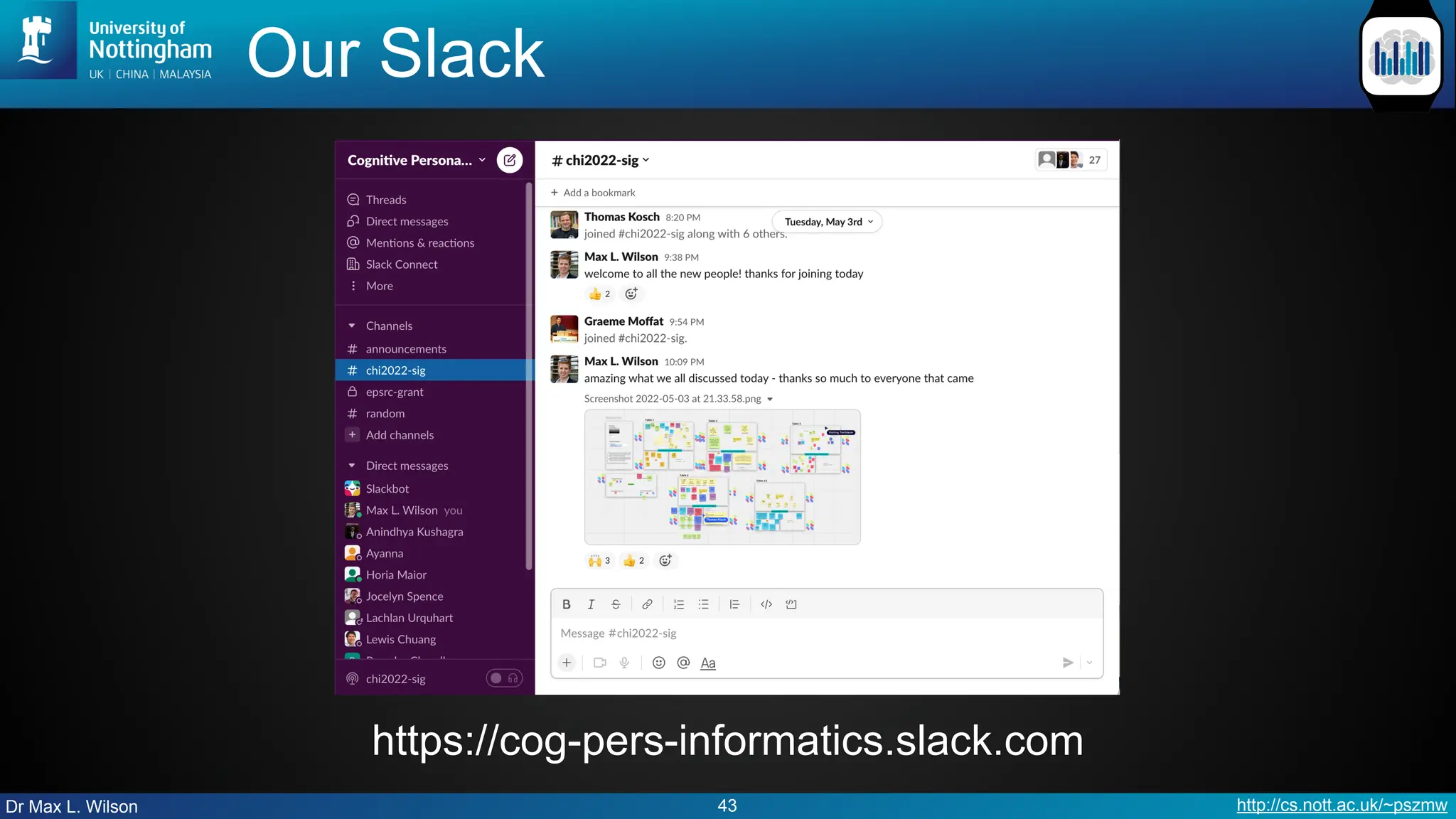
Our Slack
43
https://cog-pers-informatics.slack.com
Dr Max L. Wilson http://cs.nott.ac.uk/~pszmw
Questions?
44
https://brain-data-uon.gitlab.io

Brain Data as Cognitive Personal Informatics - Bell Labs 2022

  • 1.
    Brain Data as Cognitive PersonalInformatics Max L. Wilson @gingdottwit
  • 3.
    Dr Max L.Wilson https://brain-data-uon.gitlab.io/ 3 https://news.ubc.ca/ https://medium.com/ https://choosemuse.com Consumer NeuroTech is here And its not great yet…
  • 4.
    Dr Max L.Wilson http://cs.nott.ac.uk/~pszmw Cognitive Activity is not just tracked from the head 4
  • 5.
    Dr Max L.Wilson http://cs.nott.ac.uk/~pszmw So far • Neurotech focuses on classifying some form of cognitive state • And either warns you when you hit that state - “you are stressed right now” • Or helps you to stay in that state - “try and meditate for longer” • They also have low accuracy. 5
  • 6.
    Dr Max L.Wilson https://brain-data-uon.gitlab.io/ Neurotech at work (thanks DALL-E) 6
  • 7.
    Dr Max L.Wilson http://cs.nott.ac.uk/~pszmw But people want track change • https://myfeel.co 7
  • 8.
    Dr Max L.Wilson http://cs.nott.ac.uk/~pszmw Apps already estimating “stress” • Welltory ingests lots of data sources, inc neurotech • Garmin shows you “Stress” over a day 8
  • 9.
    Dr Max L.Wilson http://cs.nott.ac.uk/~pszmw “Stress” - 3 types get mixed up • Stress as a mental health chronic condition • Also - Post Traumatic Stress Disorder • Feeling stressed about things • The body being under stress (physiological data) 9
  • 10.
    Dr Max L.Wilson http://cs.nott.ac.uk/~pszmw “Stress” - 3 types get mixed up • Stress as a mental health chronic condition • Also - Post Traumatic Stress Disorder • Feeling stressed about things • The body being under stress (physiological data) 10 Actually Measurable with Physiological Data What people want to track
  • 11.
    Dr Max L.Wilson http://cs.nott.ac.uk/~pszmw “Stress” - 3 types get mixed up • Stress as a mental health chronic condition • Also - Post Traumatic Stress Disorder • Feeling stressed about things • The body being under stress (physiological data) 11 Can be good! Bad
  • 12.
    Dr Max L.Wilson http://cs.nott.ac.uk/~pszmw Good Stress Probably == “High Mental Workload” • Going on a run would show as high stress in Garmin • Some people thrive on high pressure workloads and enjoy them • And they do not necessarily feel stressed about it, and dont necessarily get chronic stress • You need to be in high mental workload to achieve a hard task • And then feel a sense of achievement • Gaming can lead to high mental workload and feeling relaxed • Many papers use the same tasks to induce stress and mental workload • and both can be estimated by the same physiological indicators 12
  • 13.
    Dr Max L.Wilson http://cs.nott.ac.uk/~pszmw We’re using “Mental Workload” • Mental Workload is a kind of emotionally agnostic term • Compared to ‘stress’, as a loaded term • A super well established theoretical basis scientifically - Wickens, attention, multiple resource theory, NASA TLX, etc • Becomes a good ‘parallel’ for physical activity and representative of general cognitive activity 13
  • 14.
    Dr Max L.Wilson http://cs.nott.ac.uk/~pszmw So what are HCI Questions? • State classification is largely a machine learning problem now • The HCI Qs are for when it becomes a form of cognitive personal informatics • What amount of mental workload are people aiming for? • What should neurotech aim to help us track longitudinally? • How should apps visualise this to us? • How will society handle the inclusion of this data? 14
  • 15.
    Lived Experiences ofMental Workload in Everyday Life Serena Midha, Max L. Wilson, Sarah Sharples CHI2022
  • 16.
    Dr Max L.Wilson http://cs.nott.ac.uk/~pszmw Research Questions 16 RQ1 How are experiences of MWL perceived? RQ2 What impact does MWL have on our lives and work, and vice versa? RQ3 What goals should we be setting in terms of MWL?
  • 17.
    Dr Max L.Wilson http://cs.nott.ac.uk/~pszmw Method Overview 17 19 participants Subjective MWL tracking 1-2 hour interview Interpretive Phenomen- ological Analysis Mon-Fri Following week
  • 18.
    Dr Max L.Wilson http://cs.nott.ac.uk/~pszmw Mental Workload Ratings - App • Custom app - every 30mins during work and every 1hr outside of work • What has you overall mental workload level been since the last rating? • Presented back to participants for the interview • Daily evening diary about sleep stress, mood etc. Also for discussion 18
  • 19.
    Dr Max L.Wilson http://cs.nott.ac.uk/~pszmw Semi-Structured Interview • Typically between 1-2hrs, on zoom or teams (during covid) • Personal Experiences throughout the week • How people understood and conceptualised their own mental workload • What people wanted to know about their cognitive activity • Ethical/Legal/Moral concerns they had about future tracking 19
  • 20.
    Dr Max L.Wilson http://cs.nott.ac.uk/~pszmw 19 Participants (from 20) • Office workers, with android phones, no clinical mental health history • Originally 10 researchers and 10 industry - 1 researcher excluded after interview highlighted misunderstanding • Received £75 remuneration (for week of ratings + interview) - additional £25 given for good data return during the week - all given £100 in the end, including excluded participant 20
  • 21.
    Dr Max L.Wilson http://cs.nott.ac.uk/~pszmw Results 21 CHI’22 - Mental Workload Concept - 4 themes FAccT’22 - Neuroethics - 3 themes
  • 22.
    Dr Max L.Wilson http://cs.nott.ac.uk/~pszmw 4 Themes about Mental Workload 22 1 General Perceptions of MWL Changing Perceptions of MWL The MWL Cycle The Cycle Can’t Always be Facilitated 2 3 4
  • 23.
    Dr Max L.Wilson http://cs.nott.ac.uk/~pszmw 1. General Perceptions 23 Positive Negative High Low Medium Fulfilled, enjoyment, stimulated, less distracted Pressure, stress, overwhelmed Relaxed, enjoyment, manageable Bored, distracted, unsatisfied, unproductive Comfort, enjoyment and in control - the ‘sweet spot’ -
  • 24.
    Dr Max L.Wilson http://cs.nott.ac.uk/~pszmw 2. Things that change perceptions 24 Pressure Outcome Enjoyment Location !
  • 25.
    Dr Max L.Wilson http://cs.nott.ac.uk/~pszmw 3. The Mental Workload Cycle 25 Low MWL Medium MWL High MWL Burnout, Fatigue, Resentment, Reduced work quality, Poor mental and physical health Decreased productivity, Decreased satisfaction, Decreased enjoyment Reduced excitement
  • 26.
    Dr Max L.Wilson http://cs.nott.ac.uk/~pszmw Each Level Serves a Purpose 26 High Work quality and quantity Sense of achievement Difficult tasks Medium Productivity Best of both Low Rest and recovery Preparation Reward
  • 27.
    Dr Max L.Wilson http://cs.nott.ac.uk/~pszmw 4. The Cycle can’t always be Facilitated 27 1 Life factors - medical, exercise Internal factors - thoughts, effort External factors - circumstances, task completion 2 3
  • 28.
    Dr Max L.Wilson http://cs.nott.ac.uk/~pszmw 3 Themes about Ethical Concerns 28 1 Fear of the data Negative effects of the data on the self The spectrum of sharing 2 3
  • 29.
    Dr Max L.Wilson http://cs.nott.ac.uk/~pszmw 1. Fear of the Data 29 Fear of inaccurate judgement Fear of personal judgement Fear of consequences Work Personal Work Exploitation Misinterpretation Validity Complex Context
  • 30.
    Dr Max L.Wilson http://cs.nott.ac.uk/~pszmw 2. Negative Effects on the Self 30 Being controlled by the data Data exacerbating negative states
  • 31.
    Dr Max L.Wilson http://cs.nott.ac.uk/~pszmw 3. The Spectrum of Sharing 31 What concerns? Controlled sharing for positive change It depends on the risk An absolute no
  • 32.
    Dr Max L.Wilson http://cs.nott.ac.uk/~pszmw Discussion 32
  • 33.
    Dr Max L.Wilson http://cs.nott.ac.uk/~pszmw My own main lessons • There’s a big difference compared to physical activity goals • Cognitively sedentary people vs Overworked tired people • The “ideal MWL cycle” could be very varied, if not very individual • Hard to parameterise for people • We wonder what will become the norms for longitudinal tracking • like reach 10k steps or 30mins exercise a day 33
  • 34.
    Dr Max L.Wilson http://cs.nott.ac.uk/~pszmw My own main lessons • We probably need to move away from the high == bad == red metaphor • There’s lots of good high mental workload • Getting stuck in a level seems to be bad or not being able to apply the right level when needed 34
  • 35.
    Dr Max L.Wilson http://cs.nott.ac.uk/~pszmw My own main lessons • There’s a very large gap between - motivating behavioural goals / changes - and understanding this mental workload cycle • Most people talk about wanting to reduce “stress” - so its part perception of what is good and bad - and part understanding the relationship between what we can measure and what people want to achieve • A massive research gap in cognitive personal informatics 35
  • 36.
    Building a communityfocus on Cognitive Personal Informatics
  • 37.
    Dr Max L.Wilson http://cs.nott.ac.uk/~pszmw CHI2022 SIG Discussion 37
  • 38.
    Dr Max L.Wilson http://cs.nott.ac.uk/~pszmw CHI2022 SIG Discussion 38
  • 39.
    Dr Max L.Wilson http://cs.nott.ac.uk/~pszmw CHI2022 SIG Discussion 39
  • 40.
    Dr Max L.Wilson http://cs.nott.ac.uk/~pszmw The Community Aims 1. To identify the size of the interested community 2. To collectively identify and explicate the RQs and Topics of interest 3. To establish a research agenda 4. To plan future workshops and other events 40
  • 41.
    Dr Max L.Wilson http://cs.nott.ac.uk/~pszmw The CHI2022 SIG Discussion 41
  • 42.
    Dr Max L.Wilson http://cs.nott.ac.uk/~pszmw Upcoming plans • A CHI2023 Workshop • An IJHCS Special Issue • A Medium blog series 42
  • 43.
    Dr Max L.Wilson http://cs.nott.ac.uk/~pszmw Our Slack 43 https://cog-pers-informatics.slack.com
  • 44.
    Dr Max L.Wilson http://cs.nott.ac.uk/~pszmw Questions? 44 https://brain-data-uon.gitlab.io