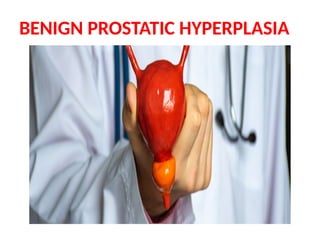
BENIGN PROSTATIC HYPERPLASIA
Definition
Definition- Benign prostatic hypertrophy (BPH) is a condition of a
speculative etiological factors characterized by an increase in size of the
inner zone of glands of the prostate.
Incidence- It usually occurs in men over 50 years of age.
Structure-
The prostate is a gland of the male reproductive system. In adults, it is
about the size of a walnut, and has an average weight of about 11 grams,
usually ranging between 7 and 16 grams. The prostate is located in the
pelvis.
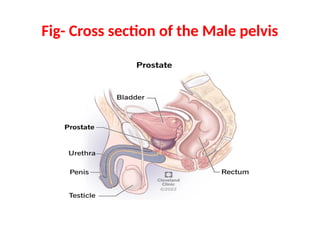
It sits below the urinary bladder and surrounds the urethra. The part of the
urethra passing through it is called the prostatic urethra, which joins with
the two ejaculatory ducts. The prostate is covered in a surface called the
prostatic capsule or prostatic fascia.
Fig- Cross section of the Male pelvis
Etio-Pathogenesis
1. The hormone theory:
According to this theory, there is decline in the level of androgen, e.g.
testosterone with advancing age slowly but significantly. However, the
levels of estrogenic steroids are not decreased equally.
A possible hypothesis suggested is that there is stimulation of the
prostate by both hormones – the estrogen acting to sensitize the
prostatic tissue to the growth promoting effect of dihydro-testosterone
(DHT) derived from testosterone by the enzyme 5α - reductase.
The importance of DHT is underlined by the fact that in 5α - reductase
deficiency, the prostate is vestigial and these patients do not develop BPH.
2. The neoplastic theory:
This theory postulates that BPH is a benign neoplasm. As the prostate is
composed essentially of fibrous tissue, muscle tissue and glandular
tissue, the neoplasm is adeno-fibromyoma.
Recently prostatic growth factors have been isolated that stimulates the
growth of fibroblasts and epithelial cells.
The appearance on cut section varies depending upon whether the
hyperplasia is predominantly of the glandular or fibro-muscular tissue.
In primary glandular BPH, the tissue is soft, honeycombed, with milky
fluid exudates.
In fibromuscular BPH, the cut surface is firm, homogeneous and does not
exude milky fluid.
Microscopic stromal nodules develop around the periurethral glands;
glandular hyperplasia originates around these nodules.
Eventually their overgrowth compresses the “peripheral zone glands”
forming the ‘surgical capsule’.
A plane of cleavage is readily set up between the nodular mass and
the surgical capsule.
Histology
There is hyperplasia of all three tissue elements in varying
proportions- glandular, fibrous and muscular.
Clinical Features-
1. Age- Men over 50 years of age.
2. Family History- First degree blood relatives.
3. Race- More in American African.
BPH results in Bladder Outlet Obstruction (BOO).
Symptoms of BOO are of two types-
4. Obstructive Symptoms
5. Irritative Symptoms
1. Obstructive symptoms-
I. Poor stream of urine due to urethral compression which does not improve,
rather, worsens by straining.
II. Hesitancy due to longer time taken by the detrusor to overcome the
urethral resistance.
III. Terminal dribbling and incomplete emptying due to a weak detrusor which
cannot sustain the pressure till the end of voiding.
IV. There is increased residual volume of urine in the bladder which
ultimately gives rise to acute or chronic urinary retention.
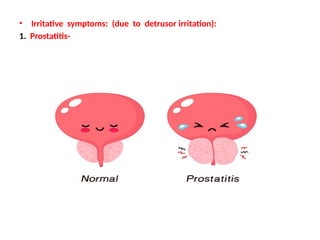
• Irritative symptoms: (due to detrusor irritation):
1. Prostatitis-
2. Frequency and nocturia- There is incomplete voiding, so the patient
has to pass urine more frequently.
3. Later the causes of frequency are - cystitis, residual urine and stone
formation.
4. Nocturia occurs because - At night, the cortical inhibition of the
bladder is reduced and the sphincter tone is low.
Urgency- This is due to the following factors:
5. A part of prostatic urethra which is very sensitive is exposed to
the bladder urine as the “prostate enlarges intravesically”.
6. The internal sphincter being stretched up, drops of urine come down
to the prostatic urethra giving rise to urgency and urge incontinence.
• Investigations-
1. Urinalysis is done to rule out infection.
2. Urine culture with antibiotic sensitively is done to identify the
organism.
3. Blood urea, serum creatinine and electrolytes are done routinely.
4. Uroflowmetry- Urine flow rate of 15 ml per sec. is normal. with
increasing obstruction , due to BPH, the flow rate decreases.
5. USG - kidneys and bladder is done to detect residual urine volume
and other urinary tract pathology like stones, tumor and diverticula,
etc.
6. Transrectal Ultrasound for Prostate Cancer.
7. Others- cystourethroscopy. But it is not routinely done in a case of BPH.
D/D-
1. Bladder neck stenosis or hypertrophy
2. Urethral stricture
3. Functional obstruction
4. Prostatic cancer.
Treatment-
5. Medical Management-
a. Alpha1 blockers- e.g.- Prazocin which relaxes the prostatic smooth
muscle. Prazocin improves symptoms and urinary flow rates.
b. 5 Alpha reductase inhibitors
6. Surgical Management-
1. Transurethral resection of prostate .
(TURP)—TURP is preferred in a gland weighing less than 60gm.
2. Open prostatectomy
• Post surgical Complications-
1. TUR syndrome – Hypervolemia and dilutional hyponatremia.
2. Perforation of the bladder or prostatic capsule may occur at the
time of TURP.
3. Urine Incontinence occurs due to damage of the external urethral
sphincter.
4. Recurrence - 15-18% after 7-8 years.
BPH- HOM. APPROACH
1.THUJA
2.SARSAPARILLA
3.GELSEMIUM
4.SEBAL SERULATA
5.LYCOPODIUM
THUJA
1. King of anti-sycotics .
2. Acts on skin, blood, gastro-intestinal tract, kidneys, and brain.
3. Its relation to the production of pathological vegetation's condylomate,
warty excrescences, spongy tumors is very important.
4. Naevus. Excess of venosity.
5. The main action of Thuja is on the skin and genito-urinary organs,
producing conditions that correspond with Hahnemann's sycotic
dyscrasia, whose chief manifestation is the formation of wart-like
excrescences upon mucous and cutaneous surfaces- fig-warts and
condylomata.
6. Has a specific antibacterial action, as in gonorrhea and vaccination.
Suppressed gonorrhea, salpingitis.
• Ill-effects of vaccination. Sycotic pains, i.e., tearing in muscles and joints,
worse at rest, better in dry weather, worse damp humid atmosphere;
lameness.
• Hydrogenoid constitutions, whose blood is morbidly hydroscopic, so that
damp air and water are inimical. Complaints from moonlight.
• Rapid exhaustion and emaciation. Left-sided and chilly medicine.
• Variola , aborts the pustule and prevents the suppurating
fever. Vaccinosis, skin troubles, neuralgia, etc.
Mind
• Fixed ideas, as if a strange person were at his side; as if soul and body
were separated; as if something alive in abdomen. Emotional
sensitiveness; music causes weeping and trembling.
ROLE IN BPH-
1. Urethra swollen and inflamed. Urinary stream split and small.
Sensation of trickling after urinating. Severe cutting after urinating.
2. Frequent micturition accompanying pains. Desire sudden and urgent,
but cannot be controlled. Paralysis sphincter vesicae.
3. Inflammation of prepuce and glans; pain in penis.
4. Gonorrhoeal rheumatism. Gonorrhea. Chronic induration of testicles.
Pain and burning felt near neck of bladder, with frequent and urgent
desire to urinate. Prostatic enlargement .
MODALITIES-
Aggravation- at night, from heat of bed; at 3 am and 3 pm; from cold, damp
air; after breakfast; fat, coffee; vaccination.
Amelioration- left side; while drawing up a limb
SARSAPARILA
• Clinical Indications-
Asthma. Bladder, affections of. Bones, affections of. Bright's disease. Calculi.
Climaxis. Constipation. Dysmenia. Dyspepsia. Dysuria. Enuresis. Eruptions.
Eyes, affections of. Faintness.
Glands, enlarged. Gonorrhea. Hernia. Herpes; of prepuce. Hiccough.
Intermittent. Marasmus. Masturbation, effects of. Melancholia. Mercury,
abuse of. Mycosis. Nipples, retracted. Renal colic. Rheumatism; gonorrheal.
Seborrhea. Spermatic cords, swelling of. Spermatorrhœa. Strangury.
Syphilis. Ulcers. Warts.
• Mind. ─ Anxiety, with trembling of the feet. The mental depression is
caused by the pains; anxiety also occurs after seminal emissions.
Thinking about the food he has eaten = nausea.
• Despondency, gloominess, amounting to despair. Moroseness and ill-
humor, with inclination to work, but unfitness for exertion.
• Fickleness (changeable disposition).─Impatient.
ROLE IN BPH
Diminished secretion of urine. Frequent discharge of pale, copious urine.
Tenses, with pressure on bladder, and discharge of a white and turbid
matter, mixed with mucus.
Frequent and ineffectual want to urinate, or with scanty emission. Frequent
urination with hard stool. Burning while urine passes with discharge of
elongated flakes.
Frequent and profuse emission of pale urine, day and night, often without
any sensation in urinary organs.
Turbid urine, like clay water. Fiery, scanty, red urine. Thread-like flakes in
urine. Blood in urine towards the end of an emission .
Can pass urine only when standing; when he sits it dribbles.
Burning sensation in urethra during every urination.
Burning in urethra with incontinence of urine, < in daytime, < when urine is
high-cultured, and < after drinking beer. Much scalding up urethra while
urinating ; enuresis day and night.
Cramps in bladder, with contractive pain. Stones in the bladder. Discharge of
pus from the urethra, as in gonorrhea. Jerking sensation along male
urethra.
Fetid smell from genital organs. Inflammation and redness of
glans.─(Blennorrhœa). Herpes on the prepuce. Desire for coition, with
frequent and painful pollutions. Bloody pollutions; spermatic cords swollen,
sexual excitement makes them ache and sensitive. Swelling of cords from
unrequited sexual excitement.
Bad effects from gonorrhea suppressed by Mercury.
GELSEMIUM
Clinical Indications-
Anterior crural neuralgia. Aphonia. Astigmatism. Bilious fever. Cerebro-
spinal meningitis. Colds. Constipation. Convulsions. Deafness. Dengue
fever. Diarrhea. Diphtheria, Dupuytren's contraction. Dysentery.
Emotions, effects of. Epilepsy. Eyes, affections of. Fever. Fright. Gonorrhea.
Hay-fever. Headache. Heat, effects of. Heart, diseases of. Hydro-salpingitis.
Hysteria. Influenza. Intermittent fever. Jaundice.
Measles. Meningitis. Menstruation, painful; suppressed.
Metrorrhagia. Myalgia. Neuralgia. Nystagmus. Esophagus, stricture of.
Paralysis. Pregnancy, albuminuria of. Ptosis. Puerperal
convulsions. Remittent fever. Retina, detachment of. Rheumatism. Sexual
excess, effects of. Sleep, disordered. Spasms. Sun-headache. Sunstroke.
Teething. Tongue, affections of. Toothache. Tremors. Uterus, affections of.
Vertigo. Voice, loss of. Writer's cramp.
Mind-
A/F─ Depressing emotions. Fright. Anger. Bad news. Sun. Heat. Damp
weather, warm or cold. Thunderstorms. Alcohol. Self-abuse.
Great irritability, does not wish to be spoken to. Irritable, sensitive; desires
to be let alone. Incapacity to think or fix the attention. Vivacity,
carelessness, followed by depression of spirits. Unconnected ideas; cannot
follow an idea for any length of time; if he attempts to think consecutively
he is attacked by a painful vacant feeling of the mind.
Loss of memory with headache-unconsciousness.
ROLE IN BPH
Frequent micturition (relieving the headache).
Incontinence from paralysis of the sphincter.
Tenesmus of the bladder.
Genitals cold and relaxed.
Involuntary emission of semen without an erection; also during stool.
Excitable sexual desire (spermatorrhea).
MODALITIES
Complaints from sudden change from hot or dry to damp air.
Catarrh occurring in warm, moist, relaxing weather. < Damp weather; cold,
damp atmosphere; > cold, open air; < from fog.
Cold drinks are vomited immediately; warm or spirituous drinks can
partially be swallowed. "> From stimulants" is a very general characteristic.
SEBAL SERULATA
Clinical Indications-
Appendicitis. Asthma, catarrhal. Atrophic pharyngitis. Atrophic rhinitis.
Atrophy, Backache. Bronchitis. Catarrh. Cystitis. Dysuria. Enuresis. Glands,
affections of. Gleet. Gonorrhea. Headache. Hoarseness. Impotence.
Iritis. Lactation, defects of. Laryngitis, catarrhal. Lumbago. Menses, delayed.
Neuralgia. Neurasthenia. Obesity. Peritonitis. Phthisis. Proctitis.
Prostate, enlarged; affections of prostate. Puerperal fever. Sterility. Testes,
atrophy of. Urine, incontinence of.
MIND-
Unusual, full, confused sensation; thinking difficult; cannot grasp or
remember what is read. Irritability; impatience; fretfulness.
Immutability with indifference to wants of others; mind self-concentrated
on her own sufferings, wants to be left alone
ROLE IN BPH
1. Slight irritation of prostate.
2. Great excitement first two days and throughout proving; discharge of
prostatic fluid. Amorous feelings, firm erections but fully under control;
testes very warm; slight itching deep in perinium > by deep pressure.
3. Increased power and enjoyment in coitus.
4. Semen feels thick and flows slowly, but causes a hot feeling along the
cord. Testicles tightly drawn up, almost painfully (one of the most
prominent and constant symptoms).
5. Sense of coldness extending into external genitals; sharp pain
extending up into abdomen; tenesmus, frequent micturition;
despondent, irritable, sympathy, anger; constipation, enlarged prostate
(Coldness of external genitals, dull aching in prostate extending into
abdomen.) Drawing pains in spermatic cords.
Modalities-
All pains were < in early morning; or from noon until bedtime. Pains in
ovaries or uterus, < on motion.
Character of pains mostly sharp and stinging.
Most pains > by sleep.
LYCOPODIUM
Clinical Indications-
Abdomen, distended. Abortion. Albuminuria. Aneurism. Angina
pectoris. Aphasia. Asthma. Axilla- offensive perspiration of. Biliousness.
Bright's disease. Cancer. Cataract. Constipation. Corns. Cough. Cramps.
Cystitis.
Mind-
Silent, melancholy, and peevish humour ; despair of eternal salvation.
Desponding, grieving mood. Sadness when hearing distant music.
Anguish, esp. in region of epigastrium, with melancholy and disposition to
weep; esp. after a fit of anger, or on the approach of other persons. Sensitive
disposition. Dread of men; desires to be alone, or else aversion to solitude.
Excitement after a glass of wine, almost mischievous.
Must laugh if any one say anything serious.
Inclined to laugh and cry at same time.
Irritability and susceptibility, with tears. Obstinacy.
• Urgent want to urinate, with too frequent emission, with discharge of
large quantities of pale urine .
• Frequent micturition by night, with scanty and rare discharges by day.
Dark urine with diminished discharge .
• Involuntary micturition.
• Discharge of blood from the bladder, painless .Old thickening of bladder
with irritable urethra.
• Foamy urine ─ Urine deep coloured, with yellow or reddish sediment.
Clear, transparent urine, having a heavy, red, crystallised sediment in the
bottom of the chamber.
ROLE IN BPH
• A very severe pain is felt in the back every time before urinating; causing
patient to cry out; retention of urine; patients will get into position to
urinate, but wait a great while before the urine comes, accompanied by
the characteristic pain in the back, which ceases when the urine flows;
Shooting, drawing, and incisive pain in the glans.
• Gonorrhea, with a deep red and smarting pustule behind the glans.
• Excoriation between scrotum and thighs. Dropsical swelling of genital
organs. Immoderate excitement, or absence of sexual desire.
Repugnance to coition, or disposition to be too easily excited to it.
Impotence of long standing. Weakness or total absence of erections.
Penis small, cold, relaxed. Itching of the internal surface of the prepuce.
Excessive pollutions, or absence of pollutions. Emission too speedy or
too tardy during coition. Falling asleep during coition. Lassitude, after
coition or pollutions.
• Flow of prostatic fluid, without an erection.
Modalities
Aggravation - Nearly all diseases from 4 to 8 pm.
Amelioration - Warm food and drinks; from uncovering the head; loosening
the garments.

BPH PROPER..............................

  • 1.
  • 2.
    Definition Definition- Benign prostatichypertrophy (BPH) is a condition of a speculative etiological factors characterized by an increase in size of the inner zone of glands of the prostate. Incidence- It usually occurs in men over 50 years of age. Structure- The prostate is a gland of the male reproductive system. In adults, it is about the size of a walnut, and has an average weight of about 11 grams, usually ranging between 7 and 16 grams. The prostate is located in the pelvis. It sits below the urinary bladder and surrounds the urethra. The part of the urethra passing through it is called the prostatic urethra, which joins with the two ejaculatory ducts. The prostate is covered in a surface called the prostatic capsule or prostatic fascia.
  • 3.
    Fig- Cross sectionof the Male pelvis
  • 4.
    Etio-Pathogenesis 1. The hormonetheory: According to this theory, there is decline in the level of androgen, e.g. testosterone with advancing age slowly but significantly. However, the levels of estrogenic steroids are not decreased equally. A possible hypothesis suggested is that there is stimulation of the prostate by both hormones – the estrogen acting to sensitize the prostatic tissue to the growth promoting effect of dihydro-testosterone (DHT) derived from testosterone by the enzyme 5α - reductase. The importance of DHT is underlined by the fact that in 5α - reductase deficiency, the prostate is vestigial and these patients do not develop BPH. 2. The neoplastic theory: This theory postulates that BPH is a benign neoplasm. As the prostate is composed essentially of fibrous tissue, muscle tissue and glandular tissue, the neoplasm is adeno-fibromyoma. Recently prostatic growth factors have been isolated that stimulates the growth of fibroblasts and epithelial cells.
  • 5.
    The appearance oncut section varies depending upon whether the hyperplasia is predominantly of the glandular or fibro-muscular tissue. In primary glandular BPH, the tissue is soft, honeycombed, with milky fluid exudates. In fibromuscular BPH, the cut surface is firm, homogeneous and does not exude milky fluid. Microscopic stromal nodules develop around the periurethral glands; glandular hyperplasia originates around these nodules. Eventually their overgrowth compresses the “peripheral zone glands” forming the ‘surgical capsule’. A plane of cleavage is readily set up between the nodular mass and the surgical capsule. Histology There is hyperplasia of all three tissue elements in varying proportions- glandular, fibrous and muscular.
  • 6.
    Clinical Features- 1. Age-Men over 50 years of age. 2. Family History- First degree blood relatives. 3. Race- More in American African. BPH results in Bladder Outlet Obstruction (BOO). Symptoms of BOO are of two types- 4. Obstructive Symptoms 5. Irritative Symptoms 1. Obstructive symptoms- I. Poor stream of urine due to urethral compression which does not improve, rather, worsens by straining. II. Hesitancy due to longer time taken by the detrusor to overcome the urethral resistance. III. Terminal dribbling and incomplete emptying due to a weak detrusor which cannot sustain the pressure till the end of voiding. IV. There is increased residual volume of urine in the bladder which ultimately gives rise to acute or chronic urinary retention.
  • 7.
    • Irritative symptoms:(due to detrusor irritation): 1. Prostatitis-
  • 8.
    2. Frequency andnocturia- There is incomplete voiding, so the patient has to pass urine more frequently. 3. Later the causes of frequency are - cystitis, residual urine and stone formation. 4. Nocturia occurs because - At night, the cortical inhibition of the bladder is reduced and the sphincter tone is low. Urgency- This is due to the following factors: 5. A part of prostatic urethra which is very sensitive is exposed to the bladder urine as the “prostate enlarges intravesically”. 6. The internal sphincter being stretched up, drops of urine come down to the prostatic urethra giving rise to urgency and urge incontinence.
  • 9.
    • Investigations- 1. Urinalysisis done to rule out infection. 2. Urine culture with antibiotic sensitively is done to identify the organism. 3. Blood urea, serum creatinine and electrolytes are done routinely. 4. Uroflowmetry- Urine flow rate of 15 ml per sec. is normal. with increasing obstruction , due to BPH, the flow rate decreases. 5. USG - kidneys and bladder is done to detect residual urine volume and other urinary tract pathology like stones, tumor and diverticula, etc. 6. Transrectal Ultrasound for Prostate Cancer. 7. Others- cystourethroscopy. But it is not routinely done in a case of BPH.
  • 10.
    D/D- 1. Bladder neckstenosis or hypertrophy 2. Urethral stricture 3. Functional obstruction 4. Prostatic cancer. Treatment- 5. Medical Management- a. Alpha1 blockers- e.g.- Prazocin which relaxes the prostatic smooth muscle. Prazocin improves symptoms and urinary flow rates. b. 5 Alpha reductase inhibitors 6. Surgical Management- 1. Transurethral resection of prostate . (TURP)—TURP is preferred in a gland weighing less than 60gm. 2. Open prostatectomy
  • 11.
    • Post surgicalComplications- 1. TUR syndrome – Hypervolemia and dilutional hyponatremia. 2. Perforation of the bladder or prostatic capsule may occur at the time of TURP. 3. Urine Incontinence occurs due to damage of the external urethral sphincter. 4. Recurrence - 15-18% after 7-8 years.
  • 12.
  • 13.
  • 14.
    THUJA 1. King ofanti-sycotics . 2. Acts on skin, blood, gastro-intestinal tract, kidneys, and brain. 3. Its relation to the production of pathological vegetation's condylomate, warty excrescences, spongy tumors is very important. 4. Naevus. Excess of venosity. 5. The main action of Thuja is on the skin and genito-urinary organs, producing conditions that correspond with Hahnemann's sycotic dyscrasia, whose chief manifestation is the formation of wart-like excrescences upon mucous and cutaneous surfaces- fig-warts and condylomata. 6. Has a specific antibacterial action, as in gonorrhea and vaccination. Suppressed gonorrhea, salpingitis.
  • 15.
    • Ill-effects ofvaccination. Sycotic pains, i.e., tearing in muscles and joints, worse at rest, better in dry weather, worse damp humid atmosphere; lameness. • Hydrogenoid constitutions, whose blood is morbidly hydroscopic, so that damp air and water are inimical. Complaints from moonlight. • Rapid exhaustion and emaciation. Left-sided and chilly medicine. • Variola , aborts the pustule and prevents the suppurating fever. Vaccinosis, skin troubles, neuralgia, etc. Mind • Fixed ideas, as if a strange person were at his side; as if soul and body were separated; as if something alive in abdomen. Emotional sensitiveness; music causes weeping and trembling.
  • 16.
    ROLE IN BPH- 1.Urethra swollen and inflamed. Urinary stream split and small. Sensation of trickling after urinating. Severe cutting after urinating. 2. Frequent micturition accompanying pains. Desire sudden and urgent, but cannot be controlled. Paralysis sphincter vesicae. 3. Inflammation of prepuce and glans; pain in penis. 4. Gonorrhoeal rheumatism. Gonorrhea. Chronic induration of testicles. Pain and burning felt near neck of bladder, with frequent and urgent desire to urinate. Prostatic enlargement . MODALITIES- Aggravation- at night, from heat of bed; at 3 am and 3 pm; from cold, damp air; after breakfast; fat, coffee; vaccination. Amelioration- left side; while drawing up a limb
  • 17.
    SARSAPARILA • Clinical Indications- Asthma.Bladder, affections of. Bones, affections of. Bright's disease. Calculi. Climaxis. Constipation. Dysmenia. Dyspepsia. Dysuria. Enuresis. Eruptions. Eyes, affections of. Faintness. Glands, enlarged. Gonorrhea. Hernia. Herpes; of prepuce. Hiccough. Intermittent. Marasmus. Masturbation, effects of. Melancholia. Mercury, abuse of. Mycosis. Nipples, retracted. Renal colic. Rheumatism; gonorrheal. Seborrhea. Spermatic cords, swelling of. Spermatorrhœa. Strangury. Syphilis. Ulcers. Warts.
  • 18.
    • Mind. ─Anxiety, with trembling of the feet. The mental depression is caused by the pains; anxiety also occurs after seminal emissions. Thinking about the food he has eaten = nausea. • Despondency, gloominess, amounting to despair. Moroseness and ill- humor, with inclination to work, but unfitness for exertion. • Fickleness (changeable disposition).─Impatient.
  • 19.
    ROLE IN BPH Diminishedsecretion of urine. Frequent discharge of pale, copious urine. Tenses, with pressure on bladder, and discharge of a white and turbid matter, mixed with mucus. Frequent and ineffectual want to urinate, or with scanty emission. Frequent urination with hard stool. Burning while urine passes with discharge of elongated flakes. Frequent and profuse emission of pale urine, day and night, often without any sensation in urinary organs. Turbid urine, like clay water. Fiery, scanty, red urine. Thread-like flakes in urine. Blood in urine towards the end of an emission .
  • 20.
    Can pass urineonly when standing; when he sits it dribbles. Burning sensation in urethra during every urination. Burning in urethra with incontinence of urine, < in daytime, < when urine is high-cultured, and < after drinking beer. Much scalding up urethra while urinating ; enuresis day and night. Cramps in bladder, with contractive pain. Stones in the bladder. Discharge of pus from the urethra, as in gonorrhea. Jerking sensation along male urethra. Fetid smell from genital organs. Inflammation and redness of glans.─(Blennorrhœa). Herpes on the prepuce. Desire for coition, with frequent and painful pollutions. Bloody pollutions; spermatic cords swollen, sexual excitement makes them ache and sensitive. Swelling of cords from unrequited sexual excitement. Bad effects from gonorrhea suppressed by Mercury.
  • 21.
    GELSEMIUM Clinical Indications- Anterior cruralneuralgia. Aphonia. Astigmatism. Bilious fever. Cerebro- spinal meningitis. Colds. Constipation. Convulsions. Deafness. Dengue fever. Diarrhea. Diphtheria, Dupuytren's contraction. Dysentery. Emotions, effects of. Epilepsy. Eyes, affections of. Fever. Fright. Gonorrhea. Hay-fever. Headache. Heat, effects of. Heart, diseases of. Hydro-salpingitis. Hysteria. Influenza. Intermittent fever. Jaundice. Measles. Meningitis. Menstruation, painful; suppressed. Metrorrhagia. Myalgia. Neuralgia. Nystagmus. Esophagus, stricture of. Paralysis. Pregnancy, albuminuria of. Ptosis. Puerperal convulsions. Remittent fever. Retina, detachment of. Rheumatism. Sexual excess, effects of. Sleep, disordered. Spasms. Sun-headache. Sunstroke. Teething. Tongue, affections of. Toothache. Tremors. Uterus, affections of. Vertigo. Voice, loss of. Writer's cramp.
  • 22.
    Mind- A/F─ Depressing emotions.Fright. Anger. Bad news. Sun. Heat. Damp weather, warm or cold. Thunderstorms. Alcohol. Self-abuse. Great irritability, does not wish to be spoken to. Irritable, sensitive; desires to be let alone. Incapacity to think or fix the attention. Vivacity, carelessness, followed by depression of spirits. Unconnected ideas; cannot follow an idea for any length of time; if he attempts to think consecutively he is attacked by a painful vacant feeling of the mind. Loss of memory with headache-unconsciousness.
  • 23.
    ROLE IN BPH Frequentmicturition (relieving the headache). Incontinence from paralysis of the sphincter. Tenesmus of the bladder. Genitals cold and relaxed. Involuntary emission of semen without an erection; also during stool. Excitable sexual desire (spermatorrhea). MODALITIES Complaints from sudden change from hot or dry to damp air. Catarrh occurring in warm, moist, relaxing weather. < Damp weather; cold, damp atmosphere; > cold, open air; < from fog. Cold drinks are vomited immediately; warm or spirituous drinks can partially be swallowed. "> From stimulants" is a very general characteristic.
  • 24.
    SEBAL SERULATA Clinical Indications- Appendicitis.Asthma, catarrhal. Atrophic pharyngitis. Atrophic rhinitis. Atrophy, Backache. Bronchitis. Catarrh. Cystitis. Dysuria. Enuresis. Glands, affections of. Gleet. Gonorrhea. Headache. Hoarseness. Impotence. Iritis. Lactation, defects of. Laryngitis, catarrhal. Lumbago. Menses, delayed. Neuralgia. Neurasthenia. Obesity. Peritonitis. Phthisis. Proctitis. Prostate, enlarged; affections of prostate. Puerperal fever. Sterility. Testes, atrophy of. Urine, incontinence of. MIND- Unusual, full, confused sensation; thinking difficult; cannot grasp or remember what is read. Irritability; impatience; fretfulness. Immutability with indifference to wants of others; mind self-concentrated on her own sufferings, wants to be left alone
  • 25.
    ROLE IN BPH 1.Slight irritation of prostate. 2. Great excitement first two days and throughout proving; discharge of prostatic fluid. Amorous feelings, firm erections but fully under control; testes very warm; slight itching deep in perinium > by deep pressure. 3. Increased power and enjoyment in coitus. 4. Semen feels thick and flows slowly, but causes a hot feeling along the cord. Testicles tightly drawn up, almost painfully (one of the most prominent and constant symptoms). 5. Sense of coldness extending into external genitals; sharp pain extending up into abdomen; tenesmus, frequent micturition; despondent, irritable, sympathy, anger; constipation, enlarged prostate (Coldness of external genitals, dull aching in prostate extending into abdomen.) Drawing pains in spermatic cords.
  • 26.
    Modalities- All pains were< in early morning; or from noon until bedtime. Pains in ovaries or uterus, < on motion. Character of pains mostly sharp and stinging. Most pains > by sleep.
  • 27.
    LYCOPODIUM Clinical Indications- Abdomen, distended.Abortion. Albuminuria. Aneurism. Angina pectoris. Aphasia. Asthma. Axilla- offensive perspiration of. Biliousness. Bright's disease. Cancer. Cataract. Constipation. Corns. Cough. Cramps. Cystitis. Mind- Silent, melancholy, and peevish humour ; despair of eternal salvation. Desponding, grieving mood. Sadness when hearing distant music. Anguish, esp. in region of epigastrium, with melancholy and disposition to weep; esp. after a fit of anger, or on the approach of other persons. Sensitive disposition. Dread of men; desires to be alone, or else aversion to solitude. Excitement after a glass of wine, almost mischievous. Must laugh if any one say anything serious. Inclined to laugh and cry at same time. Irritability and susceptibility, with tears. Obstinacy.
  • 28.
    • Urgent wantto urinate, with too frequent emission, with discharge of large quantities of pale urine . • Frequent micturition by night, with scanty and rare discharges by day. Dark urine with diminished discharge . • Involuntary micturition. • Discharge of blood from the bladder, painless .Old thickening of bladder with irritable urethra. • Foamy urine ─ Urine deep coloured, with yellow or reddish sediment. Clear, transparent urine, having a heavy, red, crystallised sediment in the bottom of the chamber.
  • 29.
    ROLE IN BPH •A very severe pain is felt in the back every time before urinating; causing patient to cry out; retention of urine; patients will get into position to urinate, but wait a great while before the urine comes, accompanied by the characteristic pain in the back, which ceases when the urine flows; Shooting, drawing, and incisive pain in the glans. • Gonorrhea, with a deep red and smarting pustule behind the glans. • Excoriation between scrotum and thighs. Dropsical swelling of genital organs. Immoderate excitement, or absence of sexual desire. Repugnance to coition, or disposition to be too easily excited to it. Impotence of long standing. Weakness or total absence of erections. Penis small, cold, relaxed. Itching of the internal surface of the prepuce. Excessive pollutions, or absence of pollutions. Emission too speedy or too tardy during coition. Falling asleep during coition. Lassitude, after coition or pollutions. • Flow of prostatic fluid, without an erection.
  • 30.
    Modalities Aggravation - Nearlyall diseases from 4 to 8 pm. Amelioration - Warm food and drinks; from uncovering the head; loosening the garments.