Dr.A.Kannan MD(Hom) & Dr.Jyothi Kannan MD(Hom)
Analysis & Evaluation
Dr.A.Kannan MD(Hom)
T.C.20/1362, Karamana
Thiruvananthapuram-2
www.homoeodoctor.com
Ph: 047 1234 6789
1
Dr.A.Kannan MD(Hom) & Dr.Jyothi Kannan MD(Hom)
Need for study
Need for study
Analysis & Evaluation
Conclusion
Conclusion
Introduction
Introduction
2
Dr.A.Kannan MD(Hom) & Dr.Jyothi Kannan MD(Hom)
A Homoeopath after collecting the data from
the patient & logically arranging the
symptoms forms a picture or portrait of the
disease. A conceptual image
conceptual image is formed
which gives the totality of the case.
Analysis & Evaluation
3
Dr.A.Kannan MD(Hom) & Dr.Jyothi Kannan MD(Hom)
Totality depends on the type of
case:
• Acute
• Chronic
Analysis & Evaluation
4
Dr.A.Kannan MD(Hom) & Dr.Jyothi Kannan MD(Hom)
If the totality of all the symptoms of the
case were covered by a single remedy
then there would be no practical difficult in
arriving at the similimum. But quite often
such is not the case. Few symptoms may
be covered by a particular remedy and few
symptoms by another remedy. So the
Physician has to evaluate the symptoms
and select the important ones on which he
can prescribe.
Analysis & Evaluation
5
Dr.A.Kannan MD(Hom) & Dr.Jyothi Kannan MD(Hom)
“ It is important that these points should be
understood, because, otherwise, there is liability
to err in several directions.
1. Error may arise in placing too much emphasis
upon a single symptom or perhaps actually
prescribing on a single symptom as many
thoughtlessly do.
2. Error may arise in attempting to fit a remedy to a
mass of indefinite, unrelated or fragmentary
symptoms by a mechanical comparison of
symptom with symptom, by which the prescriber
becomes a mere superficial ''symptom coverer."
Analysis & Evaluation
6
Dr.A.Kannan MD(Hom) & Dr.Jyothi Kannan MD(Hom)
Failing in both these ways the prescriber
may fall to the level of the so-called
"pathological prescribers," who empirically
base their treatment upon a theoretical
pathological diagnosis and end in
prescribing unnecessary and injurious
sedatives, stimulants, combination tablets,
and other crude mixtures of common
practice.”
Analysis & Evaluation
7
Dr.A.Kannan MD(Hom) & Dr.Jyothi Kannan MD(Hom)
"Genius of the Remedy" is the essential
principle of the remedy which gives it its
individuality.- (The Genius of Homeopathy
- Lectures and Essays on Homeopathic
Philosophy By Dr Stuart M. CLOSE-
Chapter XI-Symptomatology)
Analysis & Evaluation
8
Dr.A.Kannan MD(Hom) & Dr.Jyothi Kannan MD(Hom)
BOENNINGHAUSEN had proposed a prize-
question to answer which a period of two years
was granted. This prize essay, as the
Homoeopathic journals have also made known,
was intended to call out a "Treatise concerning
the greater or lesser (characteristic) value of the
symptoms occurring in a disease, to aid as a
norm or basis in the therapeutical selection of
the remedy." The competition was for the whole
medical world but it remained unsolved.
Analysis & Evaluation
9
Dr.A.Kannan MD(Hom) & Dr.Jyothi Kannan MD(Hom)
• Analysis is the resolution, by application
of logic etc., of complex structures, facts,
propositions, and concepts into their
elements
– Excerpted from Oxford Dictionary.
• Separating or breaking up of any whole
into its parts, esp. with an examination of
these parts to find out their nature,
proportion, function, interrelationship, etc.
– Excerpted from Webster’s Dictionary.
Analysis & Evaluation
10
Dr.A.Kannan MD(Hom) & Dr.Jyothi Kannan MD(Hom)
Evaluation of symptoms implies the
principle of grading different kinds of
symptoms in the order of priority,
which are to be matched with drug
symptoms in the order to cover the
characteristic totality in a natural
disease condition with that of the drug
disease.
Analysis & Evaluation
11
Dr.A.Kannan MD(Hom) & Dr.Jyothi Kannan MD(Hom)
METHODS OF ANALYSIS:
Analysis & Evaluation
HAHNEMANNIAN METHOD.
KENTIAN METHOD
BOENNINGHAUSEN’S METHOD.
BOERICKE’S METHOD.
12
Dr.A.Kannan MD(Hom) & Dr.Jyothi Kannan MD(Hom)
HAHNEMANNIAN METHOD OF
ANALYSIS OF SYMPTOMS: (§153)
Analysis & Evaluation
General Symptoms Uncommon Symptoms
Dr.HAHNEMANN
13
Dr.A.Kannan MD(Hom) & Dr.Jyothi Kannan MD(Hom)
General Symptom:
• Symptoms that are common to many diseases or to
many remedies.
• Eg. Headache, Discomfort, Loss of Appetite, etc.
Uncommon symptom:
• Symptom which is unexplainable or paradoxical i.e.,
contrary to our usual expectations from physiological
point of view. These symptoms are found in few patients
and in provings of few medicines. The common
symptoms, which reflect the individuality of the patient,
are of great value in the selection of the homoeopathic
medicine.
• Eg. Coryza relieved by cold bath, burning relieved by
heat.
Analysis & Evaluation
14
Dr.A.Kannan MD(Hom) & Dr.Jyothi Kannan MD(Hom)
KENTIAN METHOD
Dr.Kent classifies the symptoms into three
main categories:
Analysis & Evaluation
General
Symptom
Common
Symptom
Particular
symptom
15
Dr.A.Kannan MD(Hom) & Dr.Jyothi Kannan MD(Hom)
General Symptom: The symptoms referring
to the person as a whole. The sensation or
symptoms that the patient predicates of
himself or he uses first person pronoun
when telling about them, like- I am thirsty, I
am weak, etc. The aggregate of many
similar particulars also makes a general.
Analysis & Evaluation
16
Dr.A.Kannan MD(Hom) & Dr.Jyothi Kannan MD(Hom)
As the general affects the patient as a whole they
carry a higher value than the particulars which
affect only a given organ. If it is strong and well
marked it can overrule any number of even
strong particulars. On the other hand a number
of strong particulars must not be neglected for
weak generals.
The generals are subdivided into two groups.
• Mental symptoms
• Physical General Symptoms
Analysis & Evaluation
17
Dr.A.Kannan MD(Hom) & Dr.Jyothi Kannan MD(Hom)
MENTAL SYMPTOMS:
All mental symptoms are generals because
they reflect the inner self and individuality
of the person. They take the highest mark
in selection of the remedy.
Amongst the mental the symptoms of will
and affection are the most important then
the symptoms of understanding followed
by those of intellect.
Analysis & Evaluation
18
Dr.A.Kannan MD(Hom) & Dr.Jyothi Kannan MD(Hom)
WILL
WILL:
:
• Love
• Hates & Emotions
• Fear
• Greed
• Desire or Aversion to company
• Jealousy
• Suspicion
• Weeping
• Laughing
Analysis & Evaluation
19
Dr.A.Kannan MD(Hom) & Dr.Jyothi Kannan MD(Hom)
UNDERSTANDING:
UNDERSTANDING:
• Delirium
• Hallucination
• Mental Confusion
• Loss of time sense
INTELLECT:
INTELLECT:
• Memory
• Concentration
Analysis & Evaluation
20
Dr.A.Kannan MD(Hom) & Dr.Jyothi Kannan MD(Hom)
PHYSICAL GENERAL SYMPTOM:
Symptom referring to the body a whole with
regard to various physical
circumstances.
1. Symptoms of physical desires or
aversions.
– Any sexual disturbance
– Desire & Aversion for particular food
– Thirst
– Appetite
Analysis & Evaluation
21
Dr.A.Kannan MD(Hom) & Dr.Jyothi Kannan MD(Hom)
1. Patients reaction as a whole to external stimuli.
• To heat & cold
• Wet or dry weather
• To pressure, bathing, wetting, touch, part of
day,seasons
• Periodicity in complaints.
2. The reaction of the patient in response to
• Specific actions like, in motion or at rest; better or
worse from sleeping, fasting, eating.
• Definite physical state like, feeling of well-being or ill
being after stool; before, during & after
menstruation; after sexual intercourse, etc.
Analysis & Evaluation
22
Dr.A.Kannan MD(Hom) & Dr.Jyothi Kannan MD(Hom)
1. Side of body, alternate sides
2. General sensations like burning, throbbing,
stitching, etc.
3. Symptoms related to special senses having no
pathological condition are generals. Eg: The
site or smell of food makes sick, oversensitive
to light, noise, sounds, etc.
4. General pathological changes like, Oedema,
Discolorations, atrophy, etc.
Analysis & Evaluation
23
Dr.A.Kannan MD(Hom) & Dr.Jyothi Kannan MD(Hom)
COMMON SYMPTOM:
These are noting but Hahnemann’s general
symptoms.
PARTICULAR SYMPTOMS:
Symptoms relating to the particular parts or
organs of the body.
Analysis & Evaluation
24
Dr.A.Kannan MD(Hom) & Dr.Jyothi Kannan MD(Hom)
EVALUATION OF SYMPTOMS:
Evaluation of symptoms implies the principle
of grading or ranking of different kinds of
symptoms in order of priority.
Analysis & Evaluation
General Symptom Common Symptom Particular symptom
First
Grade
Second
Grade
Third
Grade
First
Grade
Second
Grade
Third
Grade
First
Grade
Second
Grade
Third
Grade
25
Dr.A.Kannan MD(Hom) & Dr.Jyothi Kannan MD(Hom)
First Grade: Symptoms which appeared in all
or majority of provers.
Confirmed by reproving
Verified clinically upon the sick.
Second Grade: Appeared in few of the provers
Confirmed by reproving
Occasionally verified clinically upon the sick.
Third Grade: Appeared now and then in proving
Not yet confirmed by reproving
But stands out pretty strong.
Analysis & Evaluation
26
Dr.A.Kannan MD(Hom) & Dr.Jyothi Kannan MD(Hom)
BOENNINGHAUSEN’S METHOD:
The seven rubrics designated in this maxim
seem to contain all the essential
momenta which are required in the list of
the complete image of a disease.
"Quis? quid? ubi? quibus auxiliis? cur?
quomodo? quando?"
Analysis & Evaluation
27
Dr.A.Kannan MD(Hom) & Dr.Jyothi Kannan MD(Hom)
1. Quis: personality of the individual. –age, sex,
bodily constitution & temparament.
2. Quid: Of course this question refers to the
disease, i.e., to its nature and peculiarity.
3. Ubi: Seat of the disease.
4. Quibis Auxillus: Associated symptoms.
5. Cur: Why; the cause of the disease.
6. Quomodo: The modifying factors.
7. Quando: The time of appearance of
aggravation and relief as also the natural
evolution.
Analysis & Evaluation
28
Dr.A.Kannan MD(Hom) & Dr.Jyothi Kannan MD(Hom)
BOERICKE METHOD:
Boericke has divided symptoms mainly into two
main groups:
General or absolute symptom: that which are
common to all patient suffering from the same
disease and they are essentially for the
purpose of diagnosis.
Contingent or peculiar symptom: those which
varies with the individual and are not
essentially pathognomic of the disease, but
always of the individual patient. They are
therefore the characteristic symptoms.
Analysis & Evaluation
29
Dr.A.Kannan MD(Hom) & Dr.Jyothi Kannan MD(Hom)
The order followed by some
experts for repertorisation is
as follows:
According to Dr.Spalding:
Mental General
Physical General
Discharges
Dreams
Special Senses
Desires, Aversions, Cravings
Modalities (< and >)
Strange, rare and peculiar
Particulars
Objective of pathology.
Analysis & Evaluation
30
Dr.A.Kannan MD(Hom) & Dr.Jyothi Kannan MD(Hom)
According to Dr.Elizabeth Hubbard:
Mental General
Will
Emotions
Intellect
Physical General
Menses
Discharges, etc.
and rest like Dr.Spalding.
Analysis & Evaluation
31
Dr.A.Kannan MD(Hom) & Dr.Jyothi Kannan MD(Hom)
According to Dr.Whitman:
Mental General
Physical General, modalities
Food, desires and aversions
Menses
Strange, Rare and Peculiar
Particular
Analysis & Evaluation
32
Dr.A.Kannan MD(Hom) & Dr.Jyothi Kannan MD(Hom)
According to Dr.Margaret Tyler:
Mentals
Will: with love, hates, fears.
Understanding: with delusion, delirium.
Memory.
Strange, Rare and Peculiar
These may occur among Mentals, Generals or Particulars
and must be of varying importance and marks.
Physical
Sexual pervertions (loves and hates, physical) or those
referred to stomach, as desires and aversions for foods;
for hot and cold foods and drinks; appetite; thirst.
Analysis & Evaluation
33
Dr.A.Kannan MD(Hom) & Dr.Jyothi Kannan MD(Hom)
Physical Generals
Reaction to Heat and Cold
To Time
Damp and dry
Electricity
Oxygen and carbon dioxide
To menstruation
To Position, gravitation
Pressure, motion, with travel-sickness, etc.
Food aggravation and ameliorations.
Character of Discharges
Particulars: (relating to a part and not the whole;
qualifies, always)
Analysis & Evaluation
34
Dr.A.Kannan MD(Hom) & Dr.Jyothi Kannan MD(Hom)
According to Dr.Weir & Tyler
Mental Generals
Physical generals – as a whole
Craving and Aversions
Menstrual State &
Particulars
Analysis & Evaluation
35
Dr.A.Kannan MD(Hom) & Dr.Jyothi Kannan MD(Hom)
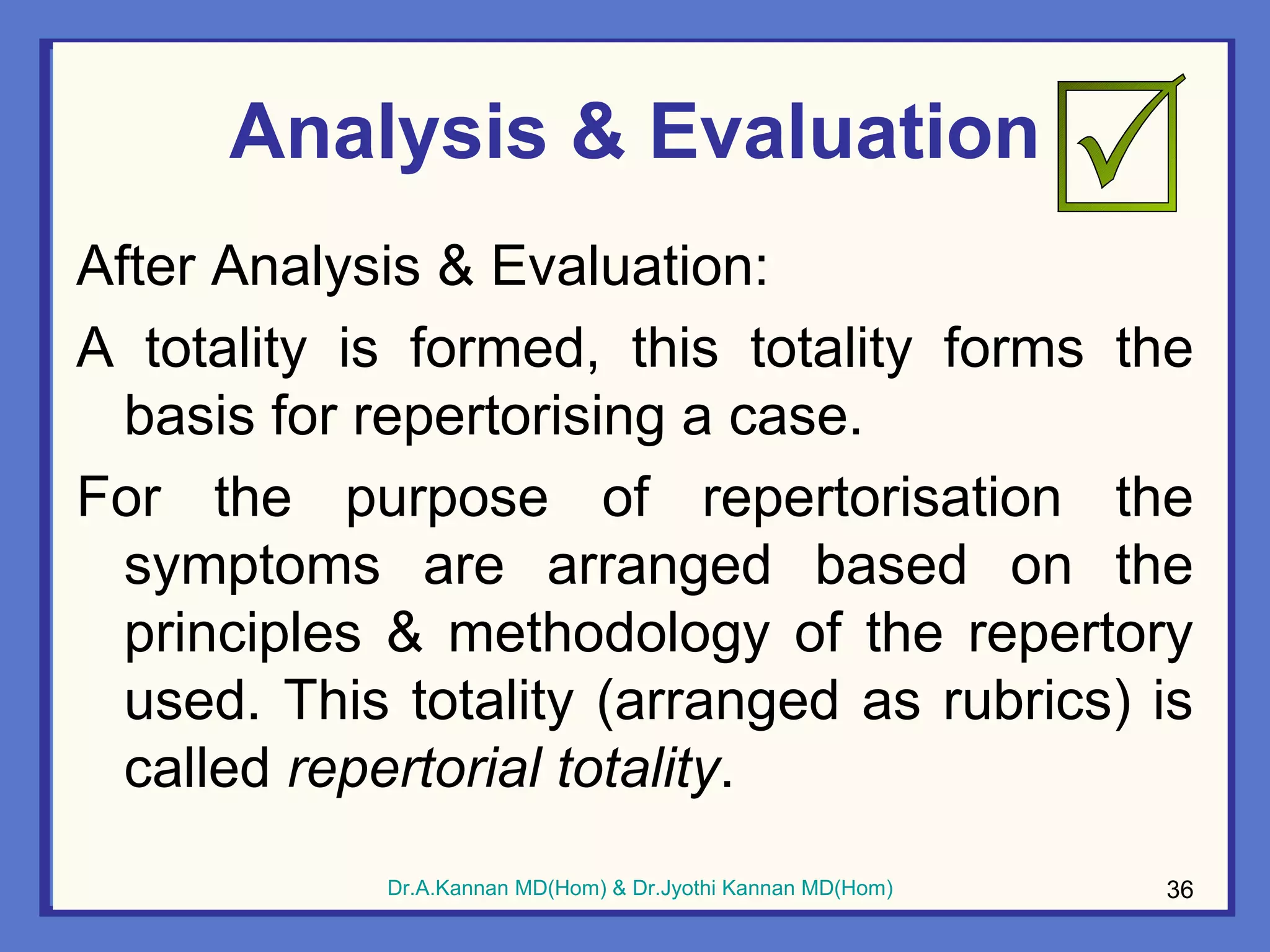
After Analysis & Evaluation:
A totality is formed, this totality forms the
basis for repertorising a case.
For the purpose of repertorisation the
symptoms are arranged based on the
principles & methodology of the repertory
used. This totality (arranged as rubrics) is
called repertorial totality.
Analysis & Evaluation
36
Dr.A.Kannan MD(Hom) & Dr.Jyothi Kannan MD(Hom)
Thank You
Thank You
047 1234 6789
047 1234 6789
37

analysis-evaluation.pdf

  • 1.
    Dr.A.Kannan MD(Hom) &Dr.Jyothi Kannan MD(Hom) Analysis & Evaluation Dr.A.Kannan MD(Hom) T.C.20/1362, Karamana Thiruvananthapuram-2 www.homoeodoctor.com Ph: 047 1234 6789 1
  • 2.
    Dr.A.Kannan MD(Hom) &Dr.Jyothi Kannan MD(Hom) Need for study Need for study Analysis & Evaluation Analysis & Evaluation Analysis & Evaluation Conclusion Conclusion Introduction Introduction 2
  • 3.
    Dr.A.Kannan MD(Hom) &Dr.Jyothi Kannan MD(Hom) A Homoeopath after collecting the data from the patient & logically arranging the symptoms forms a picture or portrait of the disease. A conceptual image conceptual image is formed which gives the totality of the case. Analysis & Evaluation 3
  • 4.
    Dr.A.Kannan MD(Hom) &Dr.Jyothi Kannan MD(Hom) Totality depends on the type of case: • Acute • Chronic Analysis & Evaluation 4
  • 5.
    Dr.A.Kannan MD(Hom) &Dr.Jyothi Kannan MD(Hom) If the totality of all the symptoms of the case were covered by a single remedy then there would be no practical difficult in arriving at the similimum. But quite often such is not the case. Few symptoms may be covered by a particular remedy and few symptoms by another remedy. So the Physician has to evaluate the symptoms and select the important ones on which he can prescribe. Analysis & Evaluation 5
  • 6.
    Dr.A.Kannan MD(Hom) &Dr.Jyothi Kannan MD(Hom) “ It is important that these points should be understood, because, otherwise, there is liability to err in several directions. 1. Error may arise in placing too much emphasis upon a single symptom or perhaps actually prescribing on a single symptom as many thoughtlessly do. 2. Error may arise in attempting to fit a remedy to a mass of indefinite, unrelated or fragmentary symptoms by a mechanical comparison of symptom with symptom, by which the prescriber becomes a mere superficial ''symptom coverer." Analysis & Evaluation 6
  • 7.
    Dr.A.Kannan MD(Hom) &Dr.Jyothi Kannan MD(Hom) Failing in both these ways the prescriber may fall to the level of the so-called "pathological prescribers," who empirically base their treatment upon a theoretical pathological diagnosis and end in prescribing unnecessary and injurious sedatives, stimulants, combination tablets, and other crude mixtures of common practice.” Analysis & Evaluation 7
  • 8.
    Dr.A.Kannan MD(Hom) &Dr.Jyothi Kannan MD(Hom) "Genius of the Remedy" is the essential principle of the remedy which gives it its individuality.- (The Genius of Homeopathy - Lectures and Essays on Homeopathic Philosophy By Dr Stuart M. CLOSE- Chapter XI-Symptomatology) Analysis & Evaluation 8
  • 9.
    Dr.A.Kannan MD(Hom) &Dr.Jyothi Kannan MD(Hom) BOENNINGHAUSEN had proposed a prize- question to answer which a period of two years was granted. This prize essay, as the Homoeopathic journals have also made known, was intended to call out a "Treatise concerning the greater or lesser (characteristic) value of the symptoms occurring in a disease, to aid as a norm or basis in the therapeutical selection of the remedy." The competition was for the whole medical world but it remained unsolved. Analysis & Evaluation 9
  • 10.
    Dr.A.Kannan MD(Hom) &Dr.Jyothi Kannan MD(Hom) • Analysis is the resolution, by application of logic etc., of complex structures, facts, propositions, and concepts into their elements – Excerpted from Oxford Dictionary. • Separating or breaking up of any whole into its parts, esp. with an examination of these parts to find out their nature, proportion, function, interrelationship, etc. – Excerpted from Webster’s Dictionary. Analysis & Evaluation 10
  • 11.
    Dr.A.Kannan MD(Hom) &Dr.Jyothi Kannan MD(Hom) Evaluation of symptoms implies the principle of grading different kinds of symptoms in the order of priority, which are to be matched with drug symptoms in the order to cover the characteristic totality in a natural disease condition with that of the drug disease. Analysis & Evaluation 11
  • 12.
    Dr.A.Kannan MD(Hom) &Dr.Jyothi Kannan MD(Hom) METHODS OF ANALYSIS: METHODS OF ANALYSIS: Analysis & Evaluation HAHNEMANNIAN METHOD. KENTIAN METHOD BOENNINGHAUSEN’S METHOD. BOERICKE’S METHOD. 12
  • 13.
    Dr.A.Kannan MD(Hom) &Dr.Jyothi Kannan MD(Hom) HAHNEMANNIAN METHOD OF ANALYSIS OF SYMPTOMS: (§153) Analysis & Evaluation General Symptoms Uncommon Symptoms Dr.HAHNEMANN 13
  • 14.
    Dr.A.Kannan MD(Hom) &Dr.Jyothi Kannan MD(Hom) General Symptom: • Symptoms that are common to many diseases or to many remedies. • Eg. Headache, Discomfort, Loss of Appetite, etc. Uncommon symptom: • Symptom which is unexplainable or paradoxical i.e., contrary to our usual expectations from physiological point of view. These symptoms are found in few patients and in provings of few medicines. The common symptoms, which reflect the individuality of the patient, are of great value in the selection of the homoeopathic medicine. • Eg. Coryza relieved by cold bath, burning relieved by heat. Analysis & Evaluation 14
  • 15.
    Dr.A.Kannan MD(Hom) &Dr.Jyothi Kannan MD(Hom) KENTIAN METHOD Dr.Kent classifies the symptoms into three main categories: Analysis & Evaluation General Symptom Common Symptom Particular symptom 15
  • 16.
    Dr.A.Kannan MD(Hom) &Dr.Jyothi Kannan MD(Hom) General Symptom: The symptoms referring to the person as a whole. The sensation or symptoms that the patient predicates of himself or he uses first person pronoun when telling about them, like- I am thirsty, I am weak, etc. The aggregate of many similar particulars also makes a general. Analysis & Evaluation 16
  • 17.
    Dr.A.Kannan MD(Hom) &Dr.Jyothi Kannan MD(Hom) As the general affects the patient as a whole they carry a higher value than the particulars which affect only a given organ. If it is strong and well marked it can overrule any number of even strong particulars. On the other hand a number of strong particulars must not be neglected for weak generals. The generals are subdivided into two groups. • Mental symptoms • Physical General Symptoms Analysis & Evaluation 17
  • 18.
    Dr.A.Kannan MD(Hom) &Dr.Jyothi Kannan MD(Hom) MENTAL SYMPTOMS: All mental symptoms are generals because they reflect the inner self and individuality of the person. They take the highest mark in selection of the remedy. Amongst the mental the symptoms of will and affection are the most important then the symptoms of understanding followed by those of intellect. Analysis & Evaluation 18
  • 19.
    Dr.A.Kannan MD(Hom) &Dr.Jyothi Kannan MD(Hom) WILL WILL: : • Love • Hates & Emotions • Fear • Greed • Desire or Aversion to company • Jealousy • Suspicion • Weeping • Laughing Analysis & Evaluation 19
  • 20.
    Dr.A.Kannan MD(Hom) &Dr.Jyothi Kannan MD(Hom) UNDERSTANDING: UNDERSTANDING: • Delirium • Hallucination • Mental Confusion • Loss of time sense INTELLECT: INTELLECT: • Memory • Concentration Analysis & Evaluation 20
  • 21.
    Dr.A.Kannan MD(Hom) &Dr.Jyothi Kannan MD(Hom) PHYSICAL GENERAL SYMPTOM: Symptom referring to the body a whole with regard to various physical circumstances. 1. Symptoms of physical desires or aversions. – Any sexual disturbance – Desire & Aversion for particular food – Thirst – Appetite Analysis & Evaluation 21
  • 22.
    Dr.A.Kannan MD(Hom) &Dr.Jyothi Kannan MD(Hom) 1. Patients reaction as a whole to external stimuli. • To heat & cold • Wet or dry weather • To pressure, bathing, wetting, touch, part of day,seasons • Periodicity in complaints. 2. The reaction of the patient in response to • Specific actions like, in motion or at rest; better or worse from sleeping, fasting, eating. • Definite physical state like, feeling of well-being or ill being after stool; before, during & after menstruation; after sexual intercourse, etc. Analysis & Evaluation 22
  • 23.
    Dr.A.Kannan MD(Hom) &Dr.Jyothi Kannan MD(Hom) 1. Side of body, alternate sides 2. General sensations like burning, throbbing, stitching, etc. 3. Symptoms related to special senses having no pathological condition are generals. Eg: The site or smell of food makes sick, oversensitive to light, noise, sounds, etc. 4. General pathological changes like, Oedema, Discolorations, atrophy, etc. Analysis & Evaluation 23
  • 24.
    Dr.A.Kannan MD(Hom) &Dr.Jyothi Kannan MD(Hom) COMMON SYMPTOM: These are noting but Hahnemann’s general symptoms. PARTICULAR SYMPTOMS: Symptoms relating to the particular parts or organs of the body. Analysis & Evaluation 24
  • 25.
    Dr.A.Kannan MD(Hom) &Dr.Jyothi Kannan MD(Hom) EVALUATION OF SYMPTOMS: Evaluation of symptoms implies the principle of grading or ranking of different kinds of symptoms in order of priority. Analysis & Evaluation General Symptom Common Symptom Particular symptom First Grade Second Grade Third Grade First Grade Second Grade Third Grade First Grade Second Grade Third Grade 25
  • 26.
    Dr.A.Kannan MD(Hom) &Dr.Jyothi Kannan MD(Hom) First Grade: Symptoms which appeared in all or majority of provers. Confirmed by reproving Verified clinically upon the sick. Second Grade: Appeared in few of the provers Confirmed by reproving Occasionally verified clinically upon the sick. Third Grade: Appeared now and then in proving Not yet confirmed by reproving But stands out pretty strong. Analysis & Evaluation 26
  • 27.
    Dr.A.Kannan MD(Hom) &Dr.Jyothi Kannan MD(Hom) BOENNINGHAUSEN’S METHOD: The seven rubrics designated in this maxim seem to contain all the essential momenta which are required in the list of the complete image of a disease. "Quis? quid? ubi? quibus auxiliis? cur? quomodo? quando?" Analysis & Evaluation 27
  • 28.
    Dr.A.Kannan MD(Hom) &Dr.Jyothi Kannan MD(Hom) 1. Quis: personality of the individual. –age, sex, bodily constitution & temparament. 2. Quid: Of course this question refers to the disease, i.e., to its nature and peculiarity. 3. Ubi: Seat of the disease. 4. Quibis Auxillus: Associated symptoms. 5. Cur: Why; the cause of the disease. 6. Quomodo: The modifying factors. 7. Quando: The time of appearance of aggravation and relief as also the natural evolution. Analysis & Evaluation 28
  • 29.
    Dr.A.Kannan MD(Hom) &Dr.Jyothi Kannan MD(Hom) BOERICKE METHOD: Boericke has divided symptoms mainly into two main groups: General or absolute symptom: that which are common to all patient suffering from the same disease and they are essentially for the purpose of diagnosis. Contingent or peculiar symptom: those which varies with the individual and are not essentially pathognomic of the disease, but always of the individual patient. They are therefore the characteristic symptoms. Analysis & Evaluation 29
  • 30.
    Dr.A.Kannan MD(Hom) &Dr.Jyothi Kannan MD(Hom) The order followed by some experts for repertorisation is as follows: According to Dr.Spalding: Mental General Physical General Discharges Dreams Special Senses Desires, Aversions, Cravings Modalities (< and >) Strange, rare and peculiar Particulars Objective of pathology. Analysis & Evaluation 30
  • 31.
    Dr.A.Kannan MD(Hom) &Dr.Jyothi Kannan MD(Hom) According to Dr.Elizabeth Hubbard: Mental General Will Emotions Intellect Physical General Menses Discharges, etc. and rest like Dr.Spalding. Analysis & Evaluation 31
  • 32.
    Dr.A.Kannan MD(Hom) &Dr.Jyothi Kannan MD(Hom) According to Dr.Whitman: Mental General Physical General, modalities Food, desires and aversions Menses Strange, Rare and Peculiar Particular Analysis & Evaluation 32
  • 33.
    Dr.A.Kannan MD(Hom) &Dr.Jyothi Kannan MD(Hom) According to Dr.Margaret Tyler: Mentals Will: with love, hates, fears. Understanding: with delusion, delirium. Memory. Strange, Rare and Peculiar These may occur among Mentals, Generals or Particulars and must be of varying importance and marks. Physical Sexual pervertions (loves and hates, physical) or those referred to stomach, as desires and aversions for foods; for hot and cold foods and drinks; appetite; thirst. Analysis & Evaluation 33
  • 34.
    Dr.A.Kannan MD(Hom) &Dr.Jyothi Kannan MD(Hom) Physical Generals Reaction to Heat and Cold To Time Damp and dry Electricity Oxygen and carbon dioxide To menstruation To Position, gravitation Pressure, motion, with travel-sickness, etc. Food aggravation and ameliorations. Character of Discharges Particulars: (relating to a part and not the whole; qualifies, always) Analysis & Evaluation 34
  • 35.
    Dr.A.Kannan MD(Hom) &Dr.Jyothi Kannan MD(Hom) According to Dr.Weir & Tyler Mental Generals Physical generals – as a whole Craving and Aversions Menstrual State & Particulars Analysis & Evaluation 35
  • 36.
    Dr.A.Kannan MD(Hom) &Dr.Jyothi Kannan MD(Hom) After Analysis & Evaluation: A totality is formed, this totality forms the basis for repertorising a case. For the purpose of repertorisation the symptoms are arranged based on the principles & methodology of the repertory used. This totality (arranged as rubrics) is called repertorial totality. Analysis & Evaluation 36
  • 37.
    Dr.A.Kannan MD(Hom) &Dr.Jyothi Kannan MD(Hom) Thank You Thank You 047 1234 6789 047 1234 6789 37