CPC
E MEDICINE
BOTULISM
INTRODUCTION
 Botulism is a rare but potentially life-threatening
neuroparalytic syndrome resulting from the action of
a neurotoxin elaborated by the
bacterium Clostridium botulinum.
EPIDEMOLOGY
 An average of 110 cases of botulism are reported each
year in the United States according to the Centers for
Disease Control and Prevention (CDC).
 72 percent of these cases are infant botulism,
 25 percent are foodborne botulism
 3 percent wound botulism.
 Adult infectious botulism is only occasionally
reported.
MICROBIOLOGY
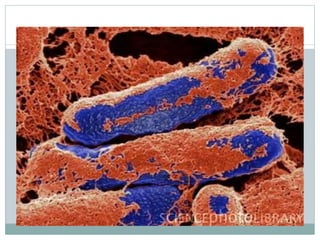
 C. botulinum is a gram-positive, rod-shaped, spore-
forming, obligate anaerobic bacteria.
 They are ubiquitous
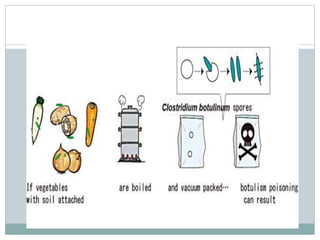
 easily isolated from the surfaces of vegetables, fruits,
seafood
 Eight strains of C. botulinum have been
distinguished based upon the antigenic specificities
of their toxins
TYPES
●Foodborne botulism – Ingestion of food
contaminated by preformed botulinum toxin
●Infant botulism – The ingestion of clostridial
spores that then colonize the host's gastrointestinal
(GI) tract and release toxin produced in vivo
●Wound botulism – Infection of a wound
by Clostridium botulinum with subsequent in vivo
production of neurotoxin
●Adult enteric infectious botulism – toxin is
produced in vivo in the GI tract of an infected adult
host.
●Inhalational botulism – The form that would
occur if aerosolized toxin was released in an act of
bioterrorism.
●Iatrogenic botulism – reported in patients who
have received botulinum toxin for cosmetic
indications.
PATHOGENESIS
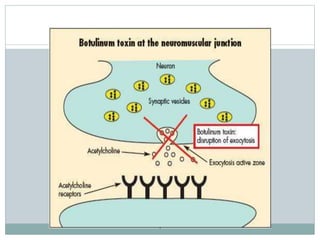
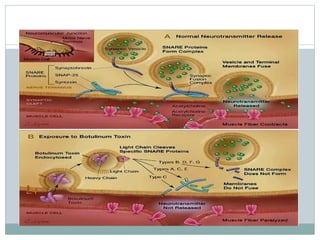
 Regardless of the route of entry into the body, the
toxin disperses widely via the vascular system and
binds to a specific receptor (synaptotagmin II) on the
presynaptic sides of peripheral cholinergic synapses
at ganglia and neuromuscular junctions.
 The heavy chain of the toxin binds to the receptors,
allowing the light chain to translocate into the nerve
cell via receptor-mediated endocytosis
 After gaining entrance to the cell's cytoplasm, the
toxin produces an irreversible disruption in
stimulation-induced acetylcholine release by that
presynaptic nerve terminal.
 Return of synaptic function requires sprouting of a
new presynaptic terminal with subsequent formation
of a new synapse, a process that requires
approximately six months.
 Adrenergic synapses are not affected by the toxin,
nor does the toxin appear to permeate the blood
brain barrier, therefore limiting involvement to the
peripheral cholinergic nervous system
 Botulinum toxin is the most potent bacterial toxin
and perhaps the most potent known poison.
 The minimum lethal dose in experimental mice
(MLD) of botulinum toxin is 0.0003 mcg/kg.
 By comparison, the MLDs for curare and sodium
cyanide are 500 and 10,000 mcg/kg, respectively.
 It is estimated that one gram of aerosolized botulism
toxin could kill at least 1.5 million people.
CLINICAL FEATURES
 The onset of symptoms in foodborne botulism
usually begins within 12 to 36 hours after ingestion
of the preformed toxin
 Prodromal symptoms often include nausea,
vomiting, abdominal pain, diarrhea, and dry mouth
with sore throat
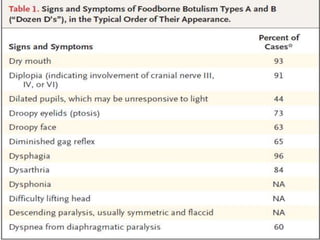
 Cranial nerve involvement most commonly marks
the onset of symptomatic illness and can include
blurred vision (secondary to fixed pupillary dilation
and palsies of cranial nerves III, IV, and VI),
diplopia, nystagmus, ptosis, dysphagia, dysarthria,
and facial weakness.
 Descending muscle weakness usually progresses to
the trunk and upper extremities, followed by the
lower extremities.
 Urinary retention and constipation are common
resulting from smooth muscle paralysis.
 respiratory difficulties (eg, dyspnea) requiring
intubation and mechanical ventilation are common,
caused by diaphragmatic paralysis, upper airway
compromise, or both.
 The United States Centers for Disease Control and
Prevention (CDC) has also suggested that the following
be considered as key features of the botulism syndrome:
 Absence of fever
 Symmetric neurologic deficits
 The patient remains responsive
 Normal or slow heart rate and normal blood pressure
 No sensory deficits with the exception of blurred vision
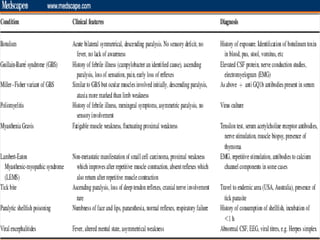
DIFFERENTIAL DIAGNOSIS
 myasthenia gravis
 Lambert-Eaton myasthenic syndrome (LEMS)
 tick paralysis
 Guillain-Barré syndrome
 poliomyelitis,
 Stroke
 heavy metal intoxication
 Myasthenia gravis lacks autonomic symptoms, while
these symptoms, especially involving salivation and
erectile function, are common in LEMS; both entities
can be excluded by electromyography (EMG) or
antibody study.
 Tensilon tests to rule out myasthenia gravis should
not be conducted, as they are often falsely positive in
patients with botulism.
 Guillain-Barré syndrome usually involves ascending
paralysis, sensory findings, and elevated
cerebrospinal fluid (CSF) protein
 A tick check should be performed as part of the
physical examination since the ticks transmitting
tick paralysis may still be attached when the patient
presents..
 Cerebrospinal fluid studies of most patients with
meningitis and encephalitis will reveal elevated
protein and red and white blood cells.
 White blood cell counts, CSF studies, and
sedimentation rates are all normal in patients with
botulism
DIAGNOSIS
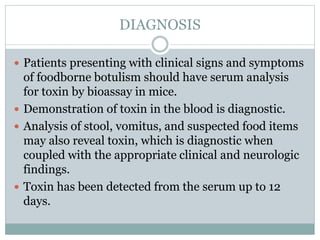
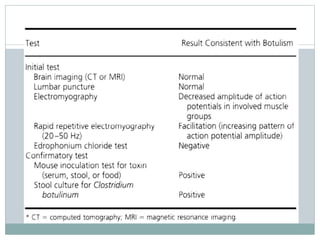
 Patients presenting with clinical signs and symptoms
of foodborne botulism should have serum analysis
for toxin by bioassay in mice.
 Demonstration of toxin in the blood is diagnostic.
 Analysis of stool, vomitus, and suspected food items
may also reveal toxin, which is diagnostic when
coupled with the appropriate clinical and neurologic
findings.
 Toxin has been detected from the serum up to 12
days.
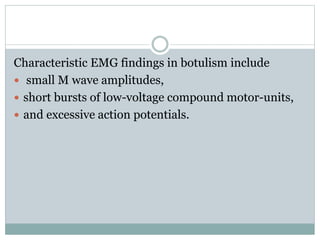
Characteristic EMG findings in botulism include
 small M wave amplitudes,
 short bursts of low-voltage compound motor-units,
 and excessive action potentials.
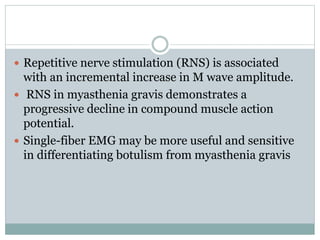
 Repetitive nerve stimulation (RNS) is associated
with an incremental increase in M wave amplitude.
 RNS in myasthenia gravis demonstrates a
progressive decline in compound muscle action
potential.
 Single-fiber EMG may be more useful and sensitive
in differentiating botulism from myasthenia gravis
TREATMENT
 Antitoxin
 Antibiotics
 Supportive care
 Monitoring should include pulse oximetry,
spirometry, arterial blood gas measurement, and
clinical evaluation of ventilation, perfusion, and
upper airway integrity.
 Respiratory failure is the primary cause of death in
these patients.
 Intubation should be considered for those patients
with inadequate or worsening upper airway
competency and those with a vital capacity less than
30 percent of predicted.
 Supportive care in these cases should also include
small volume continuous nasogastric feedings (to
minimize aspiration risk)
 There are two botulism antitoxin therapies available
in the United States. Equine serum heptavalent
botulism antitoxin is used to treat children older
than one year of age and adults; human-
derived botulism immune globulin is used for infants
less than one year of age.
 Antibiotic therapy is unproven by clinical trial but
widely used and recommended for wound botulism
after antitoxin has been administered .
 Penicillin G(3 million units IV every four hours in
adults) provides effective coverage of other
clostridial species and is frequently used.
 Metronidazole(500 mg IV every eight hours) is a
possible alternative for penicillin-allergic patients
PREVENTION
 proper food handling and preparation
 Good home canning techniques
 Food from damaged cans (cans with slits, holes,
dents, or bulges) should not be consumed.
 avoidance of honey in infants less than 12 months
OUTCOMES
 Botulism of any type usually requires hospitalization
for one to three months.
 With prompt attention to the impending respiratory
failure and supportive care, mortality in botulism
ranges from less than 5 percent to 8 percent
 A retrospective review of 706 patients hospitalized
for foodborne botulism in the Republic of Georgia,
 Shortness of breath alone identified patients at
increased mortality risk (18 versus 1 percent without
this symptom).
 In addition, shortness of breath was present in 50 of
the 54 patients who died.
 In comparison, there were no deaths among 209
patients without shortness of breath, facial muscle
weakness, or vomiting.
THANK YOU

Botulism2

  • 1.
  • 2.
    INTRODUCTION  Botulism isa rare but potentially life-threatening neuroparalytic syndrome resulting from the action of a neurotoxin elaborated by the bacterium Clostridium botulinum.
  • 4.
    EPIDEMOLOGY  An averageof 110 cases of botulism are reported each year in the United States according to the Centers for Disease Control and Prevention (CDC).  72 percent of these cases are infant botulism,  25 percent are foodborne botulism  3 percent wound botulism.  Adult infectious botulism is only occasionally reported.
  • 7.
    MICROBIOLOGY  C. botulinumis a gram-positive, rod-shaped, spore- forming, obligate anaerobic bacteria.  They are ubiquitous  easily isolated from the surfaces of vegetables, fruits, seafood  Eight strains of C. botulinum have been distinguished based upon the antigenic specificities of their toxins
  • 8.
    TYPES ●Foodborne botulism –Ingestion of food contaminated by preformed botulinum toxin ●Infant botulism – The ingestion of clostridial spores that then colonize the host's gastrointestinal (GI) tract and release toxin produced in vivo ●Wound botulism – Infection of a wound by Clostridium botulinum with subsequent in vivo production of neurotoxin
  • 9.
    ●Adult enteric infectiousbotulism – toxin is produced in vivo in the GI tract of an infected adult host. ●Inhalational botulism – The form that would occur if aerosolized toxin was released in an act of bioterrorism. ●Iatrogenic botulism – reported in patients who have received botulinum toxin for cosmetic indications.
  • 11.
    PATHOGENESIS  Regardless ofthe route of entry into the body, the toxin disperses widely via the vascular system and binds to a specific receptor (synaptotagmin II) on the presynaptic sides of peripheral cholinergic synapses at ganglia and neuromuscular junctions.  The heavy chain of the toxin binds to the receptors, allowing the light chain to translocate into the nerve cell via receptor-mediated endocytosis
  • 12.
     After gainingentrance to the cell's cytoplasm, the toxin produces an irreversible disruption in stimulation-induced acetylcholine release by that presynaptic nerve terminal.  Return of synaptic function requires sprouting of a new presynaptic terminal with subsequent formation of a new synapse, a process that requires approximately six months.
  • 13.
     Adrenergic synapsesare not affected by the toxin, nor does the toxin appear to permeate the blood brain barrier, therefore limiting involvement to the peripheral cholinergic nervous system
  • 16.
     Botulinum toxinis the most potent bacterial toxin and perhaps the most potent known poison.  The minimum lethal dose in experimental mice (MLD) of botulinum toxin is 0.0003 mcg/kg.  By comparison, the MLDs for curare and sodium cyanide are 500 and 10,000 mcg/kg, respectively.  It is estimated that one gram of aerosolized botulism toxin could kill at least 1.5 million people.
  • 17.
    CLINICAL FEATURES  Theonset of symptoms in foodborne botulism usually begins within 12 to 36 hours after ingestion of the preformed toxin  Prodromal symptoms often include nausea, vomiting, abdominal pain, diarrhea, and dry mouth with sore throat
  • 18.
     Cranial nerveinvolvement most commonly marks the onset of symptomatic illness and can include blurred vision (secondary to fixed pupillary dilation and palsies of cranial nerves III, IV, and VI), diplopia, nystagmus, ptosis, dysphagia, dysarthria, and facial weakness.
  • 19.
     Descending muscleweakness usually progresses to the trunk and upper extremities, followed by the lower extremities.  Urinary retention and constipation are common resulting from smooth muscle paralysis.  respiratory difficulties (eg, dyspnea) requiring intubation and mechanical ventilation are common, caused by diaphragmatic paralysis, upper airway compromise, or both.

  • 20.
     The UnitedStates Centers for Disease Control and Prevention (CDC) has also suggested that the following be considered as key features of the botulism syndrome:  Absence of fever  Symmetric neurologic deficits  The patient remains responsive  Normal or slow heart rate and normal blood pressure  No sensory deficits with the exception of blurred vision
  • 21.
    DIFFERENTIAL DIAGNOSIS  myastheniagravis  Lambert-Eaton myasthenic syndrome (LEMS)  tick paralysis  Guillain-Barré syndrome  poliomyelitis,  Stroke  heavy metal intoxication
  • 22.
     Myasthenia gravislacks autonomic symptoms, while these symptoms, especially involving salivation and erectile function, are common in LEMS; both entities can be excluded by electromyography (EMG) or antibody study.  Tensilon tests to rule out myasthenia gravis should not be conducted, as they are often falsely positive in patients with botulism.
  • 23.
     Guillain-Barré syndromeusually involves ascending paralysis, sensory findings, and elevated cerebrospinal fluid (CSF) protein  A tick check should be performed as part of the physical examination since the ticks transmitting tick paralysis may still be attached when the patient presents..
  • 24.
     Cerebrospinal fluidstudies of most patients with meningitis and encephalitis will reveal elevated protein and red and white blood cells.  White blood cell counts, CSF studies, and sedimentation rates are all normal in patients with botulism
  • 26.
    DIAGNOSIS  Patients presentingwith clinical signs and symptoms of foodborne botulism should have serum analysis for toxin by bioassay in mice.  Demonstration of toxin in the blood is diagnostic.  Analysis of stool, vomitus, and suspected food items may also reveal toxin, which is diagnostic when coupled with the appropriate clinical and neurologic findings.  Toxin has been detected from the serum up to 12 days.
  • 27.
    Characteristic EMG findingsin botulism include  small M wave amplitudes,  short bursts of low-voltage compound motor-units,  and excessive action potentials.
  • 28.
     Repetitive nervestimulation (RNS) is associated with an incremental increase in M wave amplitude.  RNS in myasthenia gravis demonstrates a progressive decline in compound muscle action potential.  Single-fiber EMG may be more useful and sensitive in differentiating botulism from myasthenia gravis
  • 30.
  • 31.
     Monitoring shouldinclude pulse oximetry, spirometry, arterial blood gas measurement, and clinical evaluation of ventilation, perfusion, and upper airway integrity.  Respiratory failure is the primary cause of death in these patients.
  • 32.
     Intubation shouldbe considered for those patients with inadequate or worsening upper airway competency and those with a vital capacity less than 30 percent of predicted.  Supportive care in these cases should also include small volume continuous nasogastric feedings (to minimize aspiration risk)
  • 33.
     There aretwo botulism antitoxin therapies available in the United States. Equine serum heptavalent botulism antitoxin is used to treat children older than one year of age and adults; human- derived botulism immune globulin is used for infants less than one year of age.
  • 34.
     Antibiotic therapyis unproven by clinical trial but widely used and recommended for wound botulism after antitoxin has been administered .  Penicillin G(3 million units IV every four hours in adults) provides effective coverage of other clostridial species and is frequently used.  Metronidazole(500 mg IV every eight hours) is a possible alternative for penicillin-allergic patients
  • 35.
    PREVENTION  proper foodhandling and preparation  Good home canning techniques  Food from damaged cans (cans with slits, holes, dents, or bulges) should not be consumed.  avoidance of honey in infants less than 12 months
  • 36.
    OUTCOMES  Botulism ofany type usually requires hospitalization for one to three months.  With prompt attention to the impending respiratory failure and supportive care, mortality in botulism ranges from less than 5 percent to 8 percent
  • 37.
     A retrospectivereview of 706 patients hospitalized for foodborne botulism in the Republic of Georgia,  Shortness of breath alone identified patients at increased mortality risk (18 versus 1 percent without this symptom).  In addition, shortness of breath was present in 50 of the 54 patients who died.  In comparison, there were no deaths among 209 patients without shortness of breath, facial muscle weakness, or vomiting.
  • 38.