
Bootstrapping for Startups
Ameer Sherif
CEO, BasharSoft
May 2017
at Flat6Labs Bootcamp
Agenda
• Intro
• About me
• Bootstrapping and related terms
• Should you bootstrap? Pros and Cons
• Tips on bootstrapping
• Do your homework
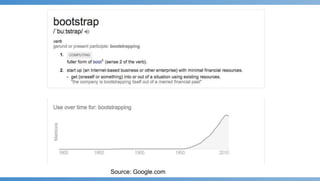
What is bootstrapping?
Source: Google.com
About me
• Co-founded BasharSoft in 2009
• Products: WUZZUF, FORASNA, and Viriphi (acq’d)
• 100k+ people hired at 10k+ companies.
• Now 170 FTEs.
• Raised $2m. 5 years to Series A.
• Bootstrapped most of 2011-2013
Why you need to bootstrap?
1. To survive long enough to reach your next
meaningful milestone that enables growing
independently or fundraising
2. Because cash is king
3. Investors rarely invest in ideas. They need traction
as proof that you are worthy of investment.
Bootstrap till when?
Sample meaningful milestones:
• Traction (definition on Quora)
• MVP or Product-Market Fit (definition on Quora)
• Learn/Experiment
• Ramen Profitable (as defined by Paul Graham)
Or don’t bootstrap.
• In some startups or business models, you HAVE to fundraise in
order to grow, and bootstrapping is not an option. But you need to
have significant experience or success with previous startups as
proof of your abilities so investors would be willing to invest.
Important Terms
• Monthly Burn Rate = cash out – cash in
– Burn rate is the rate at which a company is losing money. It is typically expressed in monthly terms.
E.g., "the company's burn rate is currently $65,000 per month." In this sense, the word "burn" is a
synonymous term for negative cash flow. It is also measure for how fast a company will use up its
shareholder capital. – Wikipedia
• Startup Runway = cash available / burn rate
• Ramen profitable
Tips for bootstrapping
• Increase cash in
– Revenues, debt, FFF
• Reduce cash out
– Salaries. Less people do more.
– Rent, Perks, Negotiate all expenses even SaaS,
– Frugal, Lean
Do your homework
• Calculate your burn rate and runway (months)
– Mostly cash out / expenses. What are they and what can be
reduced?
– What sources of cash can you get to extend your runway?
Pros and Cons for each. Ease vs Risk.
• What is your next target milestone or achievement?
– Before you reach end of runway.
– MVP  PMF, Traction (which KPIs – revenues or users),
Learn/Pivot, Ramen profitable (unlikely)
Thank You!

Bootstrapping for Startups in Cairo, Egypt

  • 1.
    Bootstrapping for Startups AmeerSherif CEO, BasharSoft May 2017 at Flat6Labs Bootcamp
  • 2.
    Agenda • Intro • Aboutme • Bootstrapping and related terms • Should you bootstrap? Pros and Cons • Tips on bootstrapping • Do your homework
  • 3.
  • 4.
  • 5.
    About me • Co-foundedBasharSoft in 2009 • Products: WUZZUF, FORASNA, and Viriphi (acq’d) • 100k+ people hired at 10k+ companies. • Now 170 FTEs. • Raised $2m. 5 years to Series A. • Bootstrapped most of 2011-2013
  • 6.
    Why you needto bootstrap? 1. To survive long enough to reach your next meaningful milestone that enables growing independently or fundraising 2. Because cash is king 3. Investors rarely invest in ideas. They need traction as proof that you are worthy of investment.
  • 7.
    Bootstrap till when? Samplemeaningful milestones: • Traction (definition on Quora) • MVP or Product-Market Fit (definition on Quora) • Learn/Experiment • Ramen Profitable (as defined by Paul Graham) Or don’t bootstrap. • In some startups or business models, you HAVE to fundraise in order to grow, and bootstrapping is not an option. But you need to have significant experience or success with previous startups as proof of your abilities so investors would be willing to invest.
  • 8.
    Important Terms • MonthlyBurn Rate = cash out – cash in – Burn rate is the rate at which a company is losing money. It is typically expressed in monthly terms. E.g., "the company's burn rate is currently $65,000 per month." In this sense, the word "burn" is a synonymous term for negative cash flow. It is also measure for how fast a company will use up its shareholder capital. – Wikipedia • Startup Runway = cash available / burn rate • Ramen profitable
  • 9.
    Tips for bootstrapping •Increase cash in – Revenues, debt, FFF • Reduce cash out – Salaries. Less people do more. – Rent, Perks, Negotiate all expenses even SaaS, – Frugal, Lean
  • 10.
    Do your homework •Calculate your burn rate and runway (months) – Mostly cash out / expenses. What are they and what can be reduced? – What sources of cash can you get to extend your runway? Pros and Cons for each. Ease vs Risk. • What is your next target milestone or achievement? – Before you reach end of runway. – MVP  PMF, Traction (which KPIs – revenues or users), Learn/Pivot, Ramen profitable (unlikely)
  • 11.