Basics of bone marrow
examination

courtesy:anonymous
Aspiration of the BM
 Satisfactory

samples can usually be
aspirated from the
– Sternum
– Anterior or posterior iliac spines

 Aspiration

from only one site can give
rise to misleading information; this is
particularly true in aplastic anaemia as
the marrow may be affected partially.
courtesy:anonymous
 There

is little advantage in aspirating
more than 0.3 ml of marrow fluid from a
single site for morphological
examination as this increases
peripheral blood dilution.

courtesy:anonymous
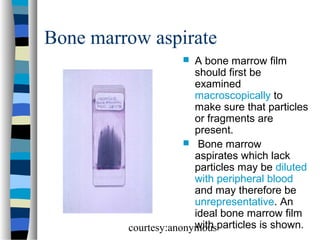
Bone marrow aspirate
A bone marrow film
should first be
examined
macroscopically to
make sure that particles
or fragments are
present.
 Bone marrow
aspirates which lack
particles may be diluted
with peripheral blood
and may therefore be
unrepresentative. An
ideal bone marrow film
with
courtesy:anonymousparticles is shown.





Even films without fragments are worth
examining as useful information may be
gained.
However, assessment of cellularity and
megakaryocyte numbers is unreliable and
dilution with peripheral blood may lead to
lymphocytes and neutrophils being overrepresented in the differential count.
courtesy:anonymous
Cells of the bone
marrow
Erythroid series
Myeloid series
Megakaryocytic series
courtesy:anonymous
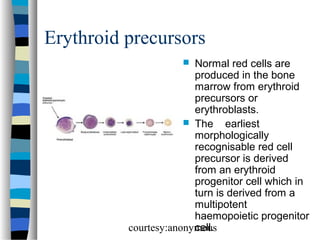
Erythroid series
*Proerythroblast
**Early erythroblast
***Intermediate erythroblast
****Late erythroblast
courtesy:anonymous
Erythroid precursors
Normal red cells are
produced in the bone
marrow from erythroid
precursors or
erythroblasts.
 The earliest
morphologically
recognisable red cell
precursor is derived
from an erythroid
progenitor cell which in
turn is derived from a
multipotent
haemopoietic progenitor
cell.
courtesy:anonymous

proerythroblast
Normal proerythroblast
[dark red arrow] in the
bone marrow. This is a
large cell with a round
nucleus and a finely
stippled chromatin
pattern. Nucleoli are
sometimes apparent.
 The cytoplasm is
moderately to strongly
basophilic.

There may be a paler
staining area of
cytoplasm surrounding
the nucleus.
courtesy:anonymous

Normal erythroblasts in the BM


. The early erythroblast [red

arrow] is similar to a
proerythroblast but is smaller
and no longer has visible
nucleoli.
 The intermediate
erythroblast [green arrow]
and the late erythroblast
[blue arrow] show a
progressive reduction in cell
size, reduction in
cytoplasmic basophilia and
increase in chromatin
clumping.
 The cytoplasm of the late
erythroblast may have a pink
tinge attributable to
haemoglobin.
courtesy:anonymous
Myeloid series

courtesy:anonymous
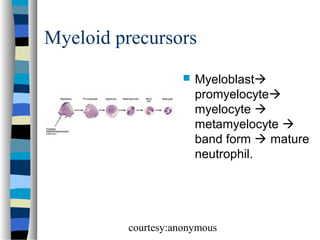
Myeloid precursors


Myeloblast
promyelocyte
myelocyte 
metamyelocyte 
band form  mature
neutrophil.

courtesy:anonymous
Myeloid precursors





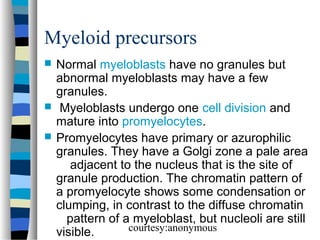
Normal myeloblasts have no granules but
abnormal myeloblasts may have a few
granules.
Myeloblasts undergo one cell division and
mature into promyelocytes.
Promyelocytes have primary or azurophilic
granules. They have a Golgi zone a pale area
adjacent to the nucleus that is the site of
granule production. The chromatin pattern of
a promyelocyte shows some condensation or
clumping, in contrast to the diffuse chromatin
pattern of a myeloblast, but nucleoli are still
courtesy:anonymous
visible.
Normal granulocyte precursors in
the bone marrow




. Note the myeloblast
[dark red arrow] with a
high nucleocytoplasmic
ratio, diffuse chromatin
pattern and nucleolus.
There is a promyelocyte
[green arrow] which is
larger and has a lower
nucleocytoplasmic
ratio and abundant
azurophilic granules.

courtesy:anonymous
Myelocytes




Myelocytes are smaller
than promyelocytes
and have specific
granules that indicate
whether they are of
neutrophil, eosinophil or
basophil lineage.
The nucleolus is no
longer visible.

courtesy:anonymous
A neutrophil metamyelocyte




The metamyelocyte
differs from a
myelocyte in having
some indentation of
the nucleus.
It differs from a
band form in not
having any part of its
nucleus with two
parallel edges.

courtesy:anonymous
Band or juvenile Neutrophils
 There

are smaller
numbers of cells of
neutrophil lineage with
non-segmented
nuclei. They are
referred to as
neutrophil band cells or
band forms. They are
less mature than
segmented
neutrophils.

.

courtesy:anonymous
Megakaryocytic
series
*Megakaryoblasts
**Megakaryocytes
courtesy:anonymous
Megakaryoblasts




Megakaryoblasts
are the precursors
of the
megakarycytes.
They may show
cytoplasmic
blebbing.

courtesy:anonymous
Megakaryocytes in the BM
. Most megakaryocytes
[arrows] are large cells
which can be identified
with low power. Their
numbers are very
variable in normal bone
marrow films, being
partly related to the
number of fragments
present.
 This image shows
increased
megakaryocyte
numbers.
courtesy:anonymous

Points to be considered in BMA
reporting







The M:E ratio is the ratio of all granulocytic
plus monocytic cells (Myeloid) to all
erythroblasts (Erythroid).
For all bone marrow aspirates examined, the
report should specify the M:E ratio and the
percentage of lymphocytes and plasma cells.
A differential count of at least 200-300 cells
should be performed.
If there is any borderline abnormality, e.g. in
the number of blasts, lymphocytes or plasma
cells, a 500 cell differential count should be
courtesy:anonymous
performed.
 Only

after the bone marrow has been
carefully assessed on low and medium
power should the X100 oil be used to
assess cellular detail.

courtesy:anonymous
Assessment of BM cellularity
Cellularity cannot be assessed without
knowing the age of a patient.
 A young child on average has about
80% of the intertrabecular space
occupied by haemopoietic cells
whereas in a 75-year-old the average
has fallen to around 30%.


courtesy:anonymous
Comparing normo, hyper, &
hypocellular marrows

courtesy:anonymous
Systemic scheme for Examining
aspirated BM films
 Low

power (x10)

– Determine cellularity
– Identify megakaryocytes
– Look for clumps of abnormal cells
– Identify macrophages

courtesy:anonymous
Systemic scheme for Examining
aspirated BM films
 Higher

power (x40, x100)

– Identify all stages of maturation of myeloid
and erythroid cells.
– Determine the M:E ratio
– Perform a differential count
– Look for areas of BM necrosis.
– Assess the iron content.
courtesy:anonymous
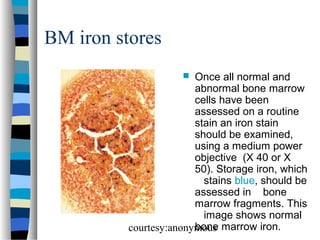
BM iron stores
Once all normal and
abnormal bone marrow
cells have been
assessed on a routine
stain an iron stain
should be examined,
using a medium power
objective (X 40 or X
50). Storage iron, which
stains blue, should be
assessed in bone
marrow fragments. This
image shows normal
bone
courtesy:anonymous marrow iron.

Reporting results
List the various descriptive comments
regarding all the cell lines present in the
BM
 Mention the striking abnormalities
separately.
 Write your impression and any
recommendations to the clinician.


courtesy:anonymous
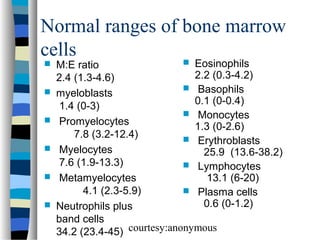
Normal ranges of bone marrow
cells








Eosinophils
M:E ratio
2.2 (0.3-4.2)
2.4 (1.3-4.6)
 Basophils
myeloblasts
0.1 (0-0.4)
1.4 (0-3)
 Monocytes
Promyelocytes
1.3 (0-2.6)
7.8 (3.2-12.4)
 Erythroblasts
Myelocytes
25.9 (13.6-38.2)
7.6 (1.9-13.3)
 Lymphocytes
13.1 (6-20)
Metamyelocytes
 Plasma cells
4.1 (2.3-5.9)
0.6 (0-1.2)
Neutrophils plus
band cells
34.2 (23.4-45) courtesy:anonymous

Bone marrow morphology

  • 1.
    Basics of bonemarrow examination courtesy:anonymous
  • 2.
    Aspiration of theBM  Satisfactory samples can usually be aspirated from the – Sternum – Anterior or posterior iliac spines  Aspiration from only one site can give rise to misleading information; this is particularly true in aplastic anaemia as the marrow may be affected partially. courtesy:anonymous
  • 3.
     There is littleadvantage in aspirating more than 0.3 ml of marrow fluid from a single site for morphological examination as this increases peripheral blood dilution. courtesy:anonymous
  • 4.
    Bone marrow aspirate Abone marrow film should first be examined macroscopically to make sure that particles or fragments are present.  Bone marrow aspirates which lack particles may be diluted with peripheral blood and may therefore be unrepresentative. An ideal bone marrow film with courtesy:anonymousparticles is shown. 
  • 5.
      Even films withoutfragments are worth examining as useful information may be gained. However, assessment of cellularity and megakaryocyte numbers is unreliable and dilution with peripheral blood may lead to lymphocytes and neutrophils being overrepresented in the differential count. courtesy:anonymous
  • 6.
    Cells of thebone marrow Erythroid series Myeloid series Megakaryocytic series courtesy:anonymous
  • 7.
    Erythroid series *Proerythroblast **Early erythroblast ***Intermediateerythroblast ****Late erythroblast courtesy:anonymous
  • 8.
    Erythroid precursors Normal redcells are produced in the bone marrow from erythroid precursors or erythroblasts.  The earliest morphologically recognisable red cell precursor is derived from an erythroid progenitor cell which in turn is derived from a multipotent haemopoietic progenitor cell. courtesy:anonymous 
  • 9.
    proerythroblast Normal proerythroblast [dark redarrow] in the bone marrow. This is a large cell with a round nucleus and a finely stippled chromatin pattern. Nucleoli are sometimes apparent.  The cytoplasm is moderately to strongly basophilic.  There may be a paler staining area of cytoplasm surrounding the nucleus. courtesy:anonymous 
  • 10.
    Normal erythroblasts inthe BM  . The early erythroblast [red arrow] is similar to a proerythroblast but is smaller and no longer has visible nucleoli.  The intermediate erythroblast [green arrow] and the late erythroblast [blue arrow] show a progressive reduction in cell size, reduction in cytoplasmic basophilia and increase in chromatin clumping.  The cytoplasm of the late erythroblast may have a pink tinge attributable to haemoglobin. courtesy:anonymous
  • 11.
  • 12.
    Myeloid precursors  Myeloblast promyelocyte myelocyte  metamyelocyte band form  mature neutrophil. courtesy:anonymous
  • 13.
    Myeloid precursors    Normal myeloblastshave no granules but abnormal myeloblasts may have a few granules. Myeloblasts undergo one cell division and mature into promyelocytes. Promyelocytes have primary or azurophilic granules. They have a Golgi zone a pale area adjacent to the nucleus that is the site of granule production. The chromatin pattern of a promyelocyte shows some condensation or clumping, in contrast to the diffuse chromatin pattern of a myeloblast, but nucleoli are still courtesy:anonymous visible.
  • 14.
    Normal granulocyte precursorsin the bone marrow   . Note the myeloblast [dark red arrow] with a high nucleocytoplasmic ratio, diffuse chromatin pattern and nucleolus. There is a promyelocyte [green arrow] which is larger and has a lower nucleocytoplasmic ratio and abundant azurophilic granules. courtesy:anonymous
  • 15.
    Myelocytes   Myelocytes are smaller thanpromyelocytes and have specific granules that indicate whether they are of neutrophil, eosinophil or basophil lineage. The nucleolus is no longer visible. courtesy:anonymous
  • 16.
    A neutrophil metamyelocyte   Themetamyelocyte differs from a myelocyte in having some indentation of the nucleus. It differs from a band form in not having any part of its nucleus with two parallel edges. courtesy:anonymous
  • 17.
    Band or juvenileNeutrophils  There are smaller numbers of cells of neutrophil lineage with non-segmented nuclei. They are referred to as neutrophil band cells or band forms. They are less mature than segmented neutrophils. . courtesy:anonymous
  • 18.
  • 19.
    Megakaryoblasts   Megakaryoblasts are the precursors ofthe megakarycytes. They may show cytoplasmic blebbing. courtesy:anonymous
  • 20.
    Megakaryocytes in theBM . Most megakaryocytes [arrows] are large cells which can be identified with low power. Their numbers are very variable in normal bone marrow films, being partly related to the number of fragments present.  This image shows increased megakaryocyte numbers. courtesy:anonymous 
  • 21.
    Points to beconsidered in BMA reporting     The M:E ratio is the ratio of all granulocytic plus monocytic cells (Myeloid) to all erythroblasts (Erythroid). For all bone marrow aspirates examined, the report should specify the M:E ratio and the percentage of lymphocytes and plasma cells. A differential count of at least 200-300 cells should be performed. If there is any borderline abnormality, e.g. in the number of blasts, lymphocytes or plasma cells, a 500 cell differential count should be courtesy:anonymous performed.
  • 22.
     Only after thebone marrow has been carefully assessed on low and medium power should the X100 oil be used to assess cellular detail. courtesy:anonymous
  • 23.
    Assessment of BMcellularity Cellularity cannot be assessed without knowing the age of a patient.  A young child on average has about 80% of the intertrabecular space occupied by haemopoietic cells whereas in a 75-year-old the average has fallen to around 30%.  courtesy:anonymous
  • 24.
    Comparing normo, hyper,& hypocellular marrows courtesy:anonymous
  • 25.
    Systemic scheme forExamining aspirated BM films  Low power (x10) – Determine cellularity – Identify megakaryocytes – Look for clumps of abnormal cells – Identify macrophages courtesy:anonymous
  • 26.
    Systemic scheme forExamining aspirated BM films  Higher power (x40, x100) – Identify all stages of maturation of myeloid and erythroid cells. – Determine the M:E ratio – Perform a differential count – Look for areas of BM necrosis. – Assess the iron content. courtesy:anonymous
  • 27.
    BM iron stores Onceall normal and abnormal bone marrow cells have been assessed on a routine stain an iron stain should be examined, using a medium power objective (X 40 or X 50). Storage iron, which stains blue, should be assessed in bone marrow fragments. This image shows normal bone courtesy:anonymous marrow iron. 
  • 28.
    Reporting results List thevarious descriptive comments regarding all the cell lines present in the BM  Mention the striking abnormalities separately.  Write your impression and any recommendations to the clinician.  courtesy:anonymous
  • 29.
    Normal ranges ofbone marrow cells        Eosinophils M:E ratio 2.2 (0.3-4.2) 2.4 (1.3-4.6)  Basophils myeloblasts 0.1 (0-0.4) 1.4 (0-3)  Monocytes Promyelocytes 1.3 (0-2.6) 7.8 (3.2-12.4)  Erythroblasts Myelocytes 25.9 (13.6-38.2) 7.6 (1.9-13.3)  Lymphocytes 13.1 (6-20) Metamyelocytes  Plasma cells 4.1 (2.3-5.9) 0.6 (0-1.2) Neutrophils plus band cells 34.2 (23.4-45) courtesy:anonymous