4
Failure of Reheater Tubes
Failure Mechanism Probable Root Cause
Short term
overheating in RH
tubing
 Tube blockage induced (especially exfoliated
oxide
blockage)
 Maintenance induced (improper chemical cleaning
or
repairs)
 Operation induced (improper startup or shutdown,
or overfiring with top heater out of service)
Long term over-
heating/creep
 Influences of initial design and/or material choice
 Buildup of internal oxide scale
 Overheating due to restricted flow caused by
chemical or other
 Deposits, scale, debris, etc.
 Operating conditions or changes in operation
 Blockage or laning of boiler gas passages
 Increases in stress due to wall thinning
RH Fireside
Corrosion
(Sootblower
 Influence of overheating of tubes (poor initial design,
internal
oxide growth during operation, high temperature laning,
5
Failure of Reheater Tubes
Failure Mechanism Probable Root Cause
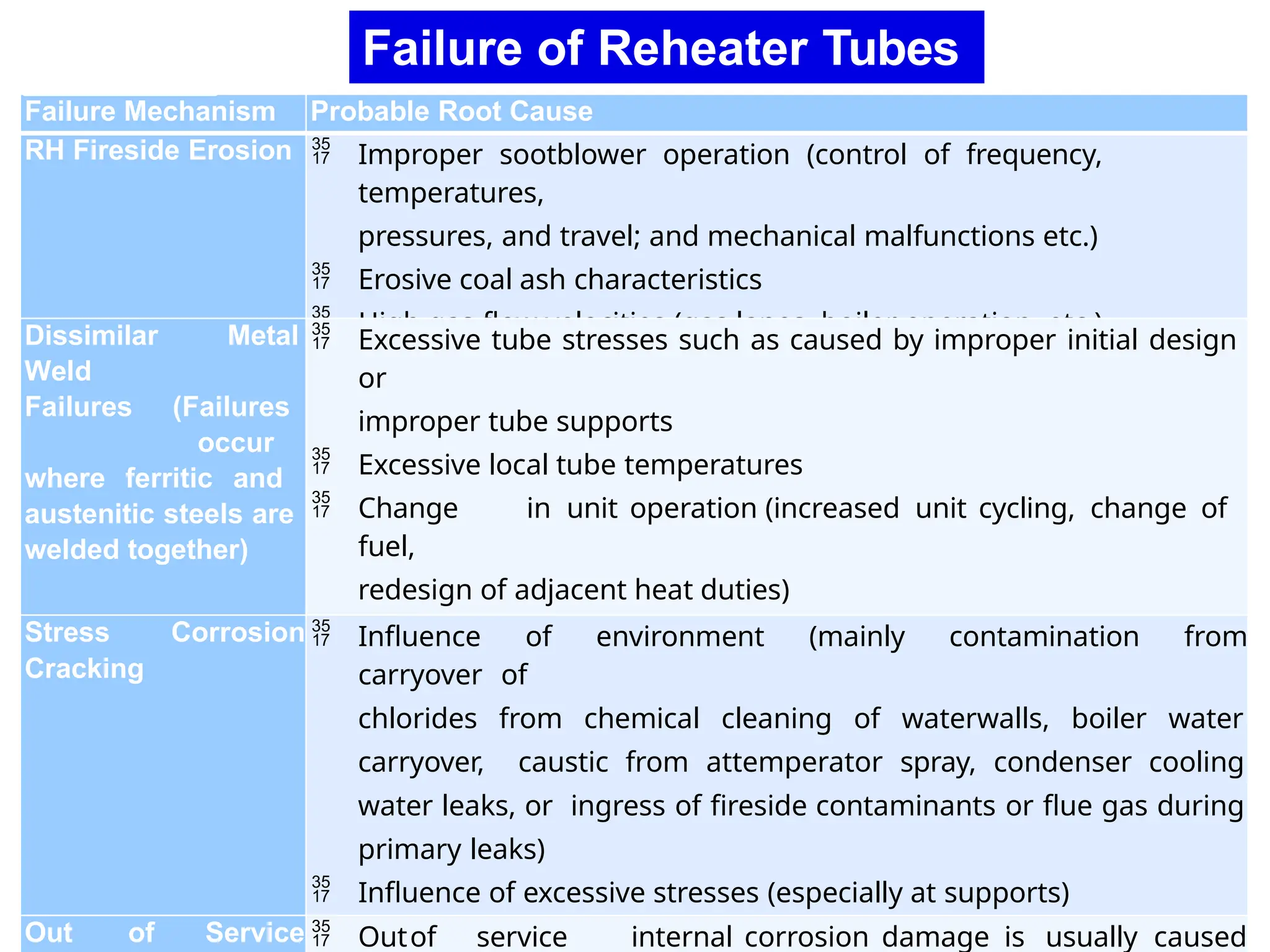
RH Fireside Erosion  Improper sootblower operation (control of frequency,
temperatures,
pressures, and travel; and mechanical malfunctions etc.)
 Erosive coal ash characteristics
 High gas flow velocities (gas lanes, boiler operation, etc.)
Dissimilar Metal
Weld
Failures (Failures
occur
where ferritic and
austenitic steels are
welded together)
 Excessive tube stresses such as caused by improper initial design
or
improper tube supports
 Excessive local tube temperatures
 Change in unit operation (increased unit cycling, change of
fuel,
redesign of adjacent heat duties)
 Initial fabrication defects
Stress Corrosion
Cracking
 Influence of environment (mainly contamination from
carryover of
chlorides from chemical cleaning of waterwalls, boiler water
carryover, caustic from attemperator spray, condenser cooling
water leaks, or ingress of fireside contaminants or flue gas during
primary leaks)
 Influence of excessive stresses (especially at supports)
 Need to change material to a stabilized grade of stainless steel
Out of Service  Outof service internal corrosion damage is usually caused
 Scale exfoliation from the steam-side of superheater and reheater
tubes can become a problem after some length of service (between
5 and 50kh).
 Most exfoliation (from superheaters, main steam line, reheaters)
takes place during shut down; then, during start-up (especially at low
loads), the exfoliated scale flakes are transported by the steam flow
until either they settle out in tube bends, or they reach the turbine.
 High heat fluxes, flexing of the components, and creep of the
substrate alloy also may be important.
 Ferritic steels, such as the 2.25Cr-1Mo alloys (T-22), are observed to
undergo scale exfoliation during full cool-down and warm-up cycles,
while the 300-series stainless steels typically exfoliate while cooling
down.
 Recent experience suggests units that experience frequent
shutdowns lead to more frequent exfoliation (probably in relatively
OXIDATION AND EXFOLIATION OF SUPERHEATER
& REHEATER TUBES
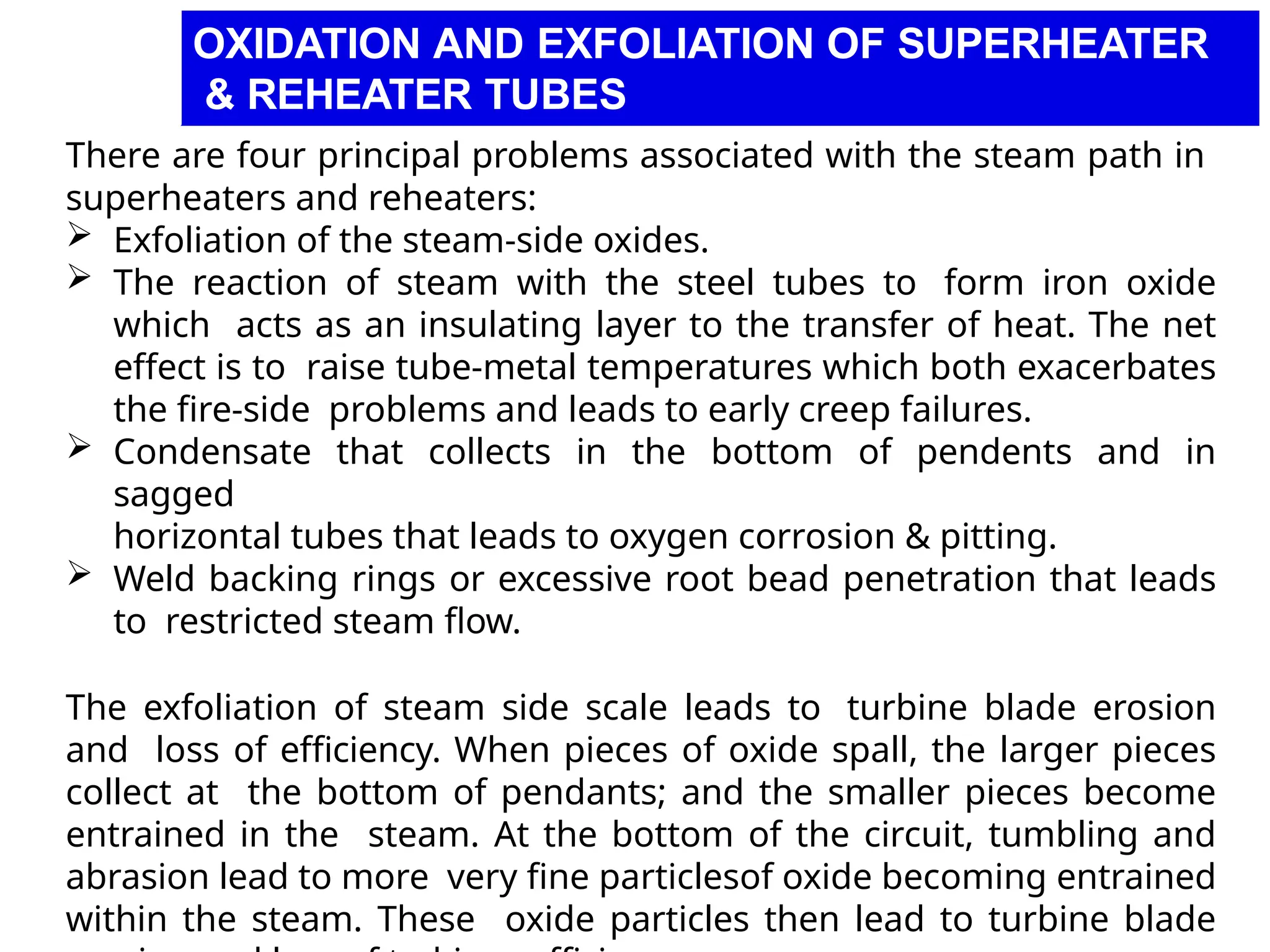
There are four principal problems associated with the steam path in
superheaters and reheaters:
 Exfoliation of the steam-side oxides.
 The reaction of steam with the steel tubes to form iron oxide
which acts as an insulating layer to the transfer of heat. The net
effect is to raise tube-metal temperatures which both exacerbates
the fire-side problems and leads to early creep failures.
 Condensate that collects in the bottom of pendents and in
sagged
horizontal tubes that leads to oxygen corrosion & pitting.
 Weld backing rings or excessive root bead penetration that leads
to restricted steam flow.
The exfoliation of steam side scale leads to turbine blade erosion
and loss of efficiency. When pieces of oxide spall, the larger pieces
collect at the bottom of pendants; and the smaller pieces become
entrained in the steam. At the bottom of the circuit, tumbling and
abrasion lead to more very fine particlesof oxide becoming entrained
within the steam. These oxide particles then lead to turbine blade
OXIDATION AND EXFOLIATION OF SUPERHEATER
& REHEATER TUBES
8
OXIDATION AND EXFOLIATION OF SUPERHEATER
& REHEATER TUBES
 The large flakes of oxide that are too big to be moved up the pendant
with the steam flow collect at the bottom. When theunit is shut down,
any fine oxide particles and condensate collect. When the unit
restarts, the evaporating condensate and solid particles of scale siter
to form an immovable mass. Locally, the scale acts as an insulating
barrier to heat transfer. Net result is that the tube metal temperature
is raised and creep damage or short term overheating may occur.
The reaction of steam with steel forms iron oxide, The rate at which the
steam side scale develops is related to both the composition of the steel
and the temperature of operation. The rate of oxide growth follows the
parabolic law with operating temperature. The increase in metal
temperature as a result of the steam side scale formation depends on
several factors such as the heat flux; the tube diameter & wall
thickness; the thickness of the steam side scale. The temperature
increase is somewhere between 1 and 4 times the scale thickness. Thus
for a superheater with a fairly high heat heat flux, a thickness of 15
mils may raise the tube metal temperature
between 50 oF and perhaps as much as 75 oF.
OXIDATION AND EXFOLIATION OF SUPERHEATER
& REHEATER TUBES
6
For a reheater where the heat flux is lower, the increase in metal
temperature is somewhat less, around 25 oF to 50 oF. In any case, the
increase in tube metal temperature will exacerbate the fire side
corrosion.
Any moisture in the steam leads to accelerated oxidation by steam.
This requires controlled operation of attempretion spray. Sudden
changes in heat fluxes should be avoided as this significantly
affects the internal & external oxidation.
Combustion Effects
7
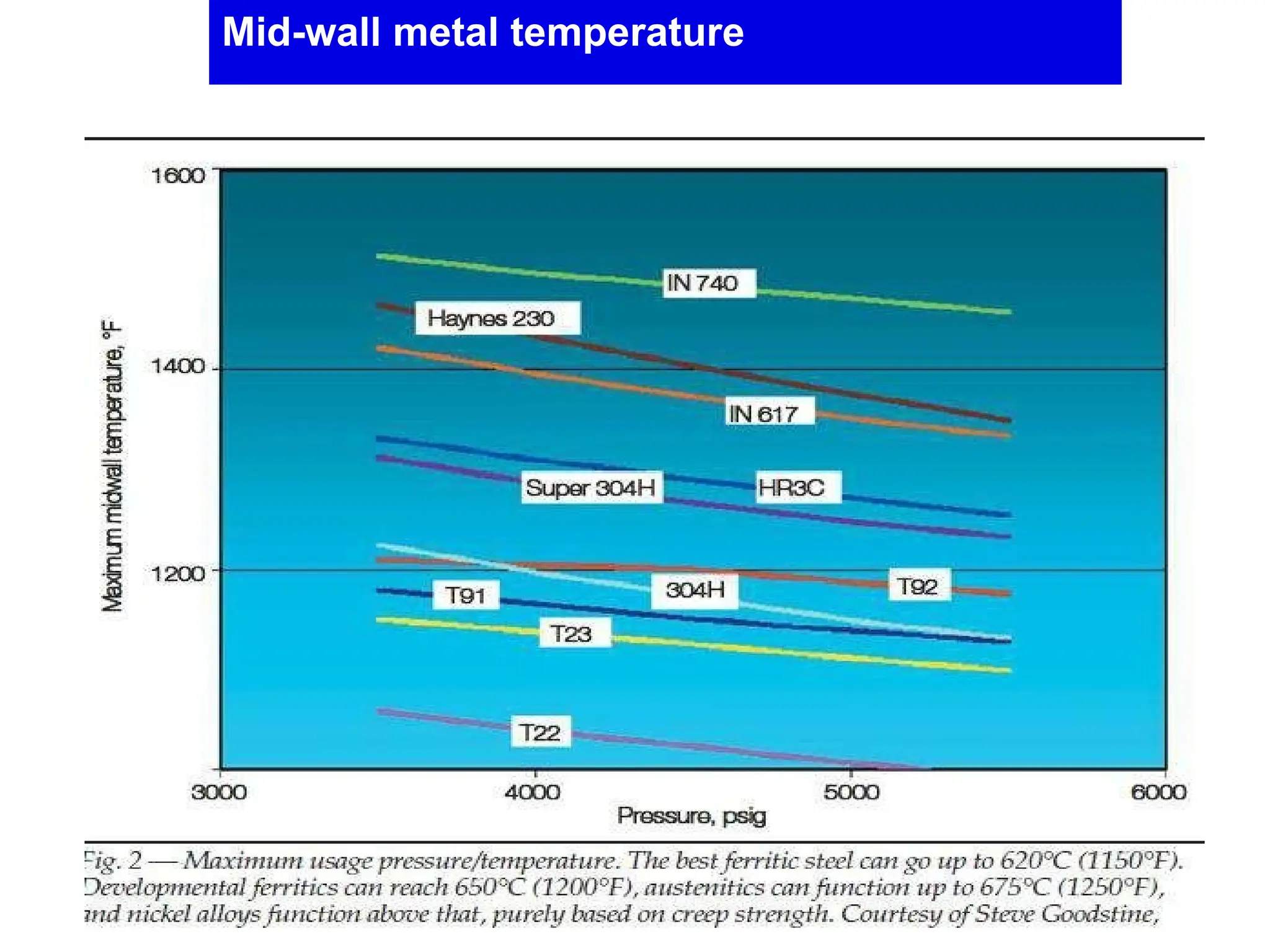
Mid-wall metal temperature
Failure of RH/SH Tubes
FACTORS AFFECTING OXIDATION AND EXFOLIATION
1.Mid-wall metal temperature – (most critical factor, affected by many
factors).
2.Ramp-up/Ramp Down rates (higher than designed).
3.Heat distribution within the furnace (imbalance in heat).
4.Sudden changes in coal quality (Improper blended coals and use of
coals for which boiler was not designed).
5.Internal & External fouling of tubes (fireside corrosion &
internal
corrosion).
6.Design tube thicknesses (considering the fuel used).
7.Lay up without drying the tube (condensed water in bends).
8.High attemperator spray (higher use of spray than
designed).
9.Steam temperatures higher than permissible temperatures
for metals
in use (non-availability of metal temperature sensors on all tubes).
10.Conversion from one to another feed water chemistry
without adopting chemical cleaning (> 1 year between cleaning &

Boilet Tube Failures and Remedial Action Plan

  • 1.
    4 Failure of ReheaterTubes Failure Mechanism Probable Root Cause Short term overheating in RH tubing  Tube blockage induced (especially exfoliated oxide blockage)  Maintenance induced (improper chemical cleaning or repairs)  Operation induced (improper startup or shutdown, or overfiring with top heater out of service) Long term over- heating/creep  Influences of initial design and/or material choice  Buildup of internal oxide scale  Overheating due to restricted flow caused by chemical or other  Deposits, scale, debris, etc.  Operating conditions or changes in operation  Blockage or laning of boiler gas passages  Increases in stress due to wall thinning RH Fireside Corrosion (Sootblower  Influence of overheating of tubes (poor initial design, internal oxide growth during operation, high temperature laning,
  • 2.
    5 Failure of ReheaterTubes Failure Mechanism Probable Root Cause RH Fireside Erosion  Improper sootblower operation (control of frequency, temperatures, pressures, and travel; and mechanical malfunctions etc.)  Erosive coal ash characteristics  High gas flow velocities (gas lanes, boiler operation, etc.) Dissimilar Metal Weld Failures (Failures occur where ferritic and austenitic steels are welded together)  Excessive tube stresses such as caused by improper initial design or improper tube supports  Excessive local tube temperatures  Change in unit operation (increased unit cycling, change of fuel, redesign of adjacent heat duties)  Initial fabrication defects Stress Corrosion Cracking  Influence of environment (mainly contamination from carryover of chlorides from chemical cleaning of waterwalls, boiler water carryover, caustic from attemperator spray, condenser cooling water leaks, or ingress of fireside contaminants or flue gas during primary leaks)  Influence of excessive stresses (especially at supports)  Need to change material to a stabilized grade of stainless steel Out of Service  Outof service internal corrosion damage is usually caused
  • 3.
     Scale exfoliationfrom the steam-side of superheater and reheater tubes can become a problem after some length of service (between 5 and 50kh).  Most exfoliation (from superheaters, main steam line, reheaters) takes place during shut down; then, during start-up (especially at low loads), the exfoliated scale flakes are transported by the steam flow until either they settle out in tube bends, or they reach the turbine.  High heat fluxes, flexing of the components, and creep of the substrate alloy also may be important.  Ferritic steels, such as the 2.25Cr-1Mo alloys (T-22), are observed to undergo scale exfoliation during full cool-down and warm-up cycles, while the 300-series stainless steels typically exfoliate while cooling down.  Recent experience suggests units that experience frequent shutdowns lead to more frequent exfoliation (probably in relatively OXIDATION AND EXFOLIATION OF SUPERHEATER & REHEATER TUBES
  • 4.
    There are fourprincipal problems associated with the steam path in superheaters and reheaters:  Exfoliation of the steam-side oxides.  The reaction of steam with the steel tubes to form iron oxide which acts as an insulating layer to the transfer of heat. The net effect is to raise tube-metal temperatures which both exacerbates the fire-side problems and leads to early creep failures.  Condensate that collects in the bottom of pendents and in sagged horizontal tubes that leads to oxygen corrosion & pitting.  Weld backing rings or excessive root bead penetration that leads to restricted steam flow. The exfoliation of steam side scale leads to turbine blade erosion and loss of efficiency. When pieces of oxide spall, the larger pieces collect at the bottom of pendants; and the smaller pieces become entrained in the steam. At the bottom of the circuit, tumbling and abrasion lead to more very fine particlesof oxide becoming entrained within the steam. These oxide particles then lead to turbine blade OXIDATION AND EXFOLIATION OF SUPERHEATER & REHEATER TUBES
  • 5.
    8 OXIDATION AND EXFOLIATIONOF SUPERHEATER & REHEATER TUBES  The large flakes of oxide that are too big to be moved up the pendant with the steam flow collect at the bottom. When theunit is shut down, any fine oxide particles and condensate collect. When the unit restarts, the evaporating condensate and solid particles of scale siter to form an immovable mass. Locally, the scale acts as an insulating barrier to heat transfer. Net result is that the tube metal temperature is raised and creep damage or short term overheating may occur. The reaction of steam with steel forms iron oxide, The rate at which the steam side scale develops is related to both the composition of the steel and the temperature of operation. The rate of oxide growth follows the parabolic law with operating temperature. The increase in metal temperature as a result of the steam side scale formation depends on several factors such as the heat flux; the tube diameter & wall thickness; the thickness of the steam side scale. The temperature increase is somewhere between 1 and 4 times the scale thickness. Thus for a superheater with a fairly high heat heat flux, a thickness of 15 mils may raise the tube metal temperature between 50 oF and perhaps as much as 75 oF.
  • 6.
    OXIDATION AND EXFOLIATIONOF SUPERHEATER & REHEATER TUBES 6 For a reheater where the heat flux is lower, the increase in metal temperature is somewhat less, around 25 oF to 50 oF. In any case, the increase in tube metal temperature will exacerbate the fire side corrosion. Any moisture in the steam leads to accelerated oxidation by steam. This requires controlled operation of attempretion spray. Sudden changes in heat fluxes should be avoided as this significantly affects the internal & external oxidation.
  • 7.
  • 8.
  • 9.
    Failure of RH/SHTubes FACTORS AFFECTING OXIDATION AND EXFOLIATION 1.Mid-wall metal temperature – (most critical factor, affected by many factors). 2.Ramp-up/Ramp Down rates (higher than designed). 3.Heat distribution within the furnace (imbalance in heat). 4.Sudden changes in coal quality (Improper blended coals and use of coals for which boiler was not designed). 5.Internal & External fouling of tubes (fireside corrosion & internal corrosion). 6.Design tube thicknesses (considering the fuel used). 7.Lay up without drying the tube (condensed water in bends). 8.High attemperator spray (higher use of spray than designed). 9.Steam temperatures higher than permissible temperatures for metals in use (non-availability of metal temperature sensors on all tubes). 10.Conversion from one to another feed water chemistry without adopting chemical cleaning (> 1 year between cleaning &