WHAT IS RSD?
DEFINITION-
RSD
 A group of disorder may develop
as a consequence of trauma
affecting body parts, with or
without an obious nerve lesion.

*1
The trauma is sometimes
relatively minor, but symptoms are
out of proportion to the trauma.
*2
CRPS(complex regional pain
syndrome) consist of –
• Pain
• sensory abnormalities,
• abnormal blood flow & sweating,
• abnormalities in the motor system,
&
• trophic changes in the structure of
both superficial & deep tissues.
*1
SYNONYMS-
Sudeck's Atrophy
Shoulder hand syndrome
CRPS
Caugalgia
Algodystrophy
Algoneurodystrophy
Reflex Neurovascular Dystrophy
Post-traumatic sympathetic
dystrophy
HISTORY-
John Bonica- term RSD,
describes 3-stages
Paul Sudeck- sugested symptoms
of RSD,sudeck atrophy=bone loss
asso. With RSD.
CLASSIFICATION-
IASP NOMENCLATURE
CRPS-1
CRPS-2....causalgia
STAGES-
There are generally 3- stages
associated with RSD- *1
1.early/acute stage
2.Dystrophic
3.Atrophic
EPIDEMIOLOGY-
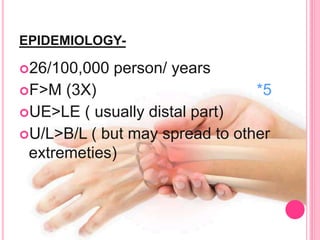
26/100,000 person/ years
F>M (3X) *5
UE>LE ( usually distal part)
U/L>B/L ( but may spread to other
extremeties)
CAUSE-
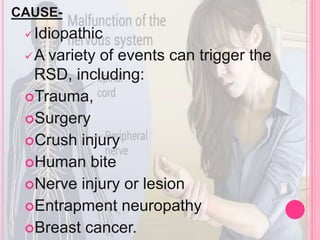
Idiopathic
A variety of events can trigger the
RSD, including:
Trauma,
Surgery
Crush injury
Human bite
Nerve injury or lesion
Entrapment neuropathy
Breast cancer.
CLINICAL FEATURES-
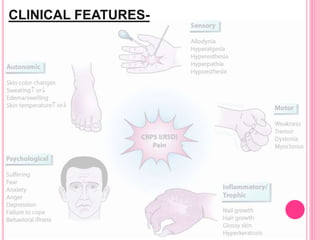
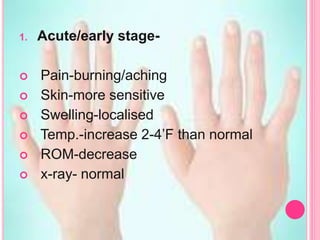
1. Acute/early stage-
 Pain-burning/aching
 Skin-more sensitive
 Swelling-localised
 Temp.-increase 2-4’F than normal
 ROM-decrease
 x-ray- normal
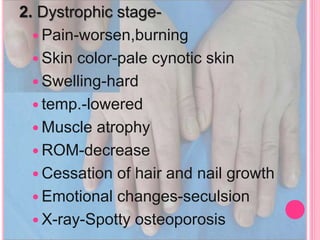
2. Dystrophic stage-
 Pain-worsen,burning
 Skin color-pale cynotic skin
 Swelling-hard
 temp.-lowered
 Muscle atrophy
 ROM-decrease
 Cessation of hair and nail growth
 Emotional changes-seculsion
 X-ray-Spotty osteoporosis
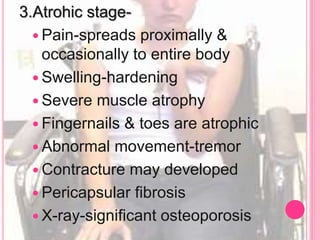
3.Atrohic stage-
 Pain-spreads proximally &
occasionally to entire body
 Swelling-hardening
 Severe muscle atrophy
 Fingernails & toes are atrophic
 Abnormal movement-tremor
 Contracture may developed
 Pericapsular fibrosis
 X-ray-significant osteoporosis
DEMOGRAPHIC DATA-
Name-
Age-40-60
Gender- F>M
Occupation-
Address
C/C- burning pain c swelling...
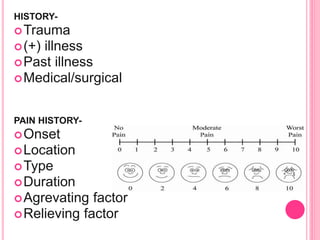
HISTORY-
Trauma
(+) illness
Past illness
Medical/surgical
PAIN HISTORY-
Onset
Location
Type
Duration
Agrevating factor
Relieving factor
O/E-
*GBPD
*Gait
INSPECTION- PALPATION-
• Skin color Temp.
Nail Tenderness
Scar Swelling
Swelling Tone
Attitude of limb
MOVEMENT- .
NEUROVASCULAR EXAMINATION-
Sensory
Motor
Vascular
DTR –
Special test-
D/D- *6
Bony or soft tissue injury
Peripheral neuropathy, nerve lesions
Compartment syndrome
Thoracic Outlet Syndrome (TOS)
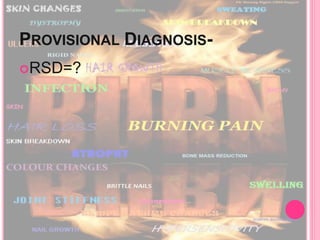
PROVISIONAL DIAGNOSIS-
RSD=?
INVESTIGATION-
CRPS diagnosis is mainly based
on patient history, clinical
examination, and supportive
investigations.
Some other test include-
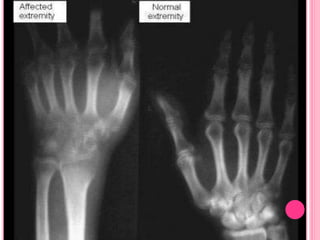
o X-Ray-
Shows, sign of osteoporosis
o 3 phase bone scan-
o Magnetic resonance imaging (MRI)
o Sympathetic Blockade-
MANAGEMENT-
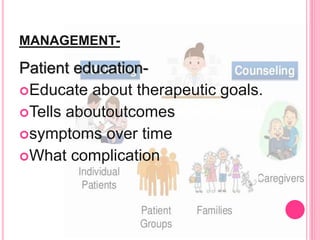
Patient education-
Educate about therapeutic goals.
Tells aboutoutcomesworseningof
symptoms over time
What complication
PHYSIOTHERAPY-
The main goals of treatment are a
reduction in pain, preservation of
limb function and a return to work.
MEDICAL-
Pain killer-baclophen
Anti-inflammatory-dimethyle
sulphoxide
Anti-covulsive drugs-phenytoin
Antiepileptic drugs-
Pregabalin/gabapentin
Ca- channel blockers
Biphosphonates are potent
inhibitors of bone resorption;
Topical application-
to relieve the localized
hyperalgesia
HORMONE THERAPY-
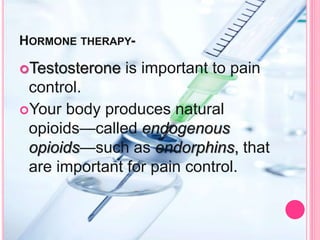
Testosterone is important to pain
control.
Your body produces natural
opioids—called endogenous
opioids—such as endorphins, that
are important for pain control.
PSYCHO THERAPY--
RSD causes psychological
problems.
Antidepressants -amytryptilene
Anti-anxiety-Benzodiazepam
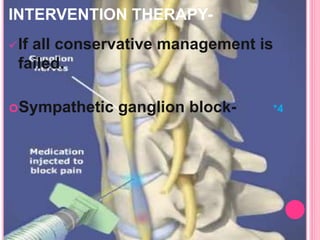
If all conservative management is
failed.
Sympathetic ganglion block- *4
INTERVENTION THERAPY-
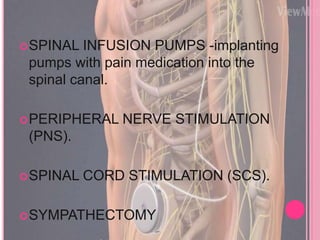
SPINAL INFUSION PUMPS -implanting
pumps with pain medication into the
spinal canal.
PERIPHERAL NERVE STIMULATION
(PNS).
SPINAL CORD STIMULATION (SCS).
SYMPATHECTOMY
REFRENCE-
 1*.SUSAN B.O’SULLIVAN-physical
rehabilitation.1st INDIAN edition 2001
 2*.J.MAHESHWARI-essential orthopaedics-
4th edition-2011
 3*DAVID J. MAGEE-orthopedic
assessment-4th edition
 4*DAVID L. HAMBLEN- Adam’s outline of
orthopaedics-4th edition
 5* SRINIVASA N. et al., Complex Regional
Pain Syndrome I (Reflex Sympathetic
Dystrophy). American Society of
Anesthesiologists, 2002.
 6* TURNER-STOKES, L., e.a., Complex
regional pain syndrome in adults: concise
guidance. Clinical Med, 2011.
 7*Schott GD-Reflex sympathetic dystrophy-
Journal of Neurology, Neurosurgery &
Psychiatry 2001.
 8* Karmarkar A, Lieberman I (2006) Mirror box
therapy for complex regional pain syndrome.
 8*Schott GD-Reflex sympathetic dystrophy-
Journal of Neurology, Neurosurgery &
Psychiatry 2001.
 Stengel M, Binder A, Baron R. Updates on the
diagnosis and management of complex
regional pain syndrome.Adv Pain Manage.
2007;
RSD-REFLEX SYMPATHETIC DYSTROPHY

RSD-REFLEX SYMPATHETIC DYSTROPHY