KENTUCKY
PSYCHOLOGICAL
ASSOCIATION
Serving on
the KPA

Board
SIX KEY AREAS OF BOARD
RESPONSIBILITY
 1. Mission and Purpose
 2. Strategic Planning and Evaluation
 3. Fiscal Oversight/Risk Management
 4. Resource Development
 5. Board Development
 6. Staff Relations
1. MISSION AND PURPOSE
Exceptional Boards are driven by a
clear mission, inspiring vision, and
fidelity to core values…
- Information on “Exceptional Boards” from Center for Nonprofit Excellence (CNPE)
1. MISSION AND PURPOSE
cont’d
KPA Mission:
“To promote psychology as a science
and profession.”
1. MISSION AND PURPOSE
cont’d
KPA Vision
To be a diverse and inclusive
organization at the forefront of
psychological practice, science,
and advocacy to improve the
quality of people‟s lives.
(Adopted in 2012)
1. MISSION AND PURPOSE
cont’d
KPA VALUES
 Enhance the professional life of
members in all aspects of
psychology.
 Improve the quality of life for the
populations we serve.
2. STRATEGIC PLANNING &
EVALUATION
“Exceptional Boards are generative;
strategic planning and evaluation are
on-going and dynamic processes.”
1. The KPA Board engaged in a formal evaluation
process in 2010.
2. The latest round of KPA Strategic Planning also
began in 2010, and a Strategic Planning Steering
Committee was identified.
3. A process for strategic plan review is in the
works currently.
Strategic Planning Steering
Committee Was Identified:
President
Vice President
Past President
Executive Director
The Steering Committee‟s role is to
champion, evaluate, and update the
Strategic Plan. (Decision to do this
by role rather than by person.)
2. STRATEGIC PLANNING &
EVALUATION cont’d
KPA‟s Three Strategic Priorities
(Adopted by the KPA Board in 2010)
•Membership
•Advocacy
•Leadership Development
2. STRATEGIC PLANNING &
EVALUATION cont’d
History: With input from KPA members
and leadership, the Steering
Committee developed and proposed
a strategic plan which was adopted
by the KPA Board on December 14,
2012.
2. STRATEGIC PLANNING &
EVALUATION: Plan Overview
Strategic Priority 1: Membership
 Member recruitment, retention, and re-
instatement.
 Maintain and build on excellent member
services.
 Outreach to diverse groups within KPA.
 Make KPA an essential element of
Kentucky’s culture of psychologists.
2. STRATEGIC PLANNING &
EVALUATION: Plan Overview
Strategic Priority 2: Advocacy
 Provide effective legislative advocacy for the
profession and science at the state level.
 Provide effective legislative advocacy for the
profession and science at the federal level.
 Provide support, advocacy, and education for
practitioners.
 Advocate for the general social welfare, as it relates
to the science and profession of psychology.
 Increase public understanding of psychology‟s unique
strengths and contributions.
 Respond to relevant advocacy issues as they arise.
2. STRATEGIC PLANNING &
EVALUATION: Plan Overview
Strategic Priority 3:
Leadership Development
 Develop a culture of leadership
within KPA. (The Leadership
Challenge)
 Provide KPA leadership with sufficient
training, tools, and support needed
to lead the Association.
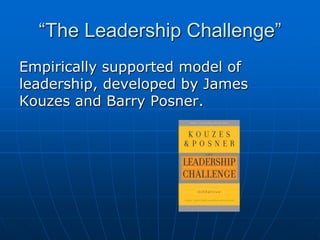
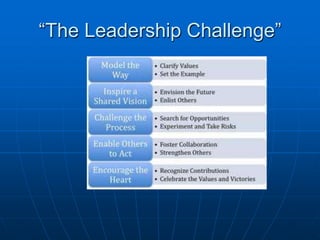
“The Leadership Challenge”
Empirically supported model of
leadership, developed by James
Kouzes and Barry Posner.
“The Leadership Challenge”
2. STRATEGIC PLANNING &
EVALUATION: Plan Overview
 Provide opportunities for
leadership/recognition/involvement
at local, state, and national levels.
 Conduct KPA activities and
operations according to association
best practices.
 Conduct regular and ongoing review
and revision of the strategic plan.
3. FISCAL OVERSIGHT/
RISK MANAGEMENT
“Exceptional Boards are proactive in
risk assessment; they engage in
regular audits, and are attentive and
inquisitive in financial matters of the
Association. They are guided by an
ethos of transparency. “
3. FISCAL OVERSIGHT
cont’d
KPA Board members have
fiduciary responsibility for the
Association.
KNOW THE BUDGET…
What is the budget process?
3. FISCAL OVERSIGHT
cont’d
 Review Financial Reports.
 Know the Financial Practices.
 ASK QUESTIONS!
 Review Bylaws and policies.
 Transparency, ethics, and the
law are guiding principles.
3. FISCAL OVERSIGHT
cont’d
Follow best practices:
 Directors‟ and Officers‟
insurance.
 General liability insurance.
 Conflict of interest policy.
 Other policies…. (investment,
records retention and protection,
etc.)
4. RESOURCE DEVELOPMENT
“Exceptional Boards‟
members are highly active,
and generous to their
Associations with gifts of
time, talents, and financial
resources.”
4. RESOURCE DEVELOPMENT
cont’d
KPA Board members are asked to
 Support the KPA Foundation.
 Share their time and skills
with the Association.
 Attend Board meetings and
functions at their own
expense.
5. BOARD DEVELOPMENT
“Exceptional Boards are stewards
of their Associations. They have
a culture of endless learning.
Members are loyal to the
mission, vision, and values.
Board members exercise a duty
of loyalty, duty of care, and a
duty of obedience.”
5. BOARD DEVELOPMENT
cont’d
Duty of Care -
a level of competence that is
expected of a board member; a
board member owes the duty to
exercise reasonable care when
making decisions as a steward of
the organization.
Boardsource (2009)
e.g. know your Board manual!; review meeting
documents in advance
5. BOARD DEVELOPMENT
cont’d
Duty of Loyalty -
a standard of faithfulness; a Board
member must give undivided
allegiance when making decisions
affecting the organization. A Board
member can never use information
obtained as a member for personal
gain, but must act in the best
interests of the organization.
Boardsource ( 2009)
5. BOARD DEVELOPMENT
cont’d
Duty of Obedience
This requires Board members to be faithful
to the organization's mission. They are not
permitted to act in a way that is
inconsistent with the Association‟s central
goals. A basis for this rule lies in the
public's trust that the organization will
manage donated funds to fulfill the
organization's mission. Boardsource (2009)
5. BOARD DEVELOPMENT
KPA has a working board!
KPA Board Member Expectations:
 Put Board meetings on your calendar:
attend faithfully and participate fully.
 Prepare reports as requested.
 Read minutes from last meeting &
materials for any upcoming meetings.
 Review Financial Reports and Budgets.
 RSVP promptly.
 Avoid conflicts of interest .
5. BOARD DEVELOPMENT
KPA has a working board!
KPA Board Member expectations:
 Be an Ambassador for KPA.
 Recruit members.
 Encourage member involvement.
 Read KPA Publications.
 Communicate with members and
relay feedback to staff and Board.
 Promote and support KPA events.
5. BOARD DEVELOPMENT
KPA has a working board!
 Take an active role in programs and
initiatives that are developed by the
board.
 Volunteer for and accept invitations
to join specific committees, task
forces, and work groups as needs
arise.
 Actively work to further KPA's
mission by contributing new ideas
and working to carry them out.
5. BOARD DEVELOPMENT
cont’d
According to the KPA Board‟s 2010
assessment:
“The KPA Board is a team, with a solid
diversity of skills, knowledge,
experience, backgrounds, and
talent.” 100% of 2010 KPA Board
members were “satisfied” (46%) or
“very satisfied” (54%) with their
Board experience.
5. BOARD DEVELOPMENT
cont’d
 The 2011 KPA Board was honored by
the Center for Nonprofit Excellence
with the “Art of Governance” Award
for “commitment to mission,
outstanding level of organizational
participation, and investment in the
organization‟s financial health.”
5. BOARD DEVELOPMENT
cont’d
The Board engaged in on-
going self-evaluation,
pursues goals consistent with
KPA‟s mission, and annually
sets and re-sets a course for
progress at its annual
summer retreat.
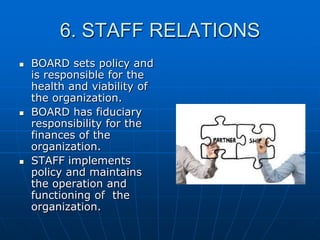
6. STAFF RELATIONS
 BOARD sets policy and
is responsible for the
health and viability of
the organization.
 BOARD has fiduciary
responsibility for the
finances of the
organization.
 STAFF implements
policy and maintains
the operation and
functioning of the
organization.
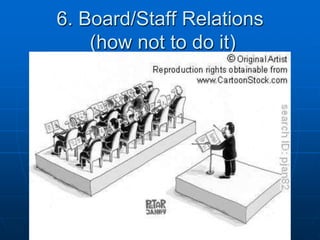
6. Board/Staff Relations
(how not to do it)
6. STAFF RELATIONS
cont’d
“Exceptional Boards have an
„executive partnership‟ with their
Executive Director, that includes a
culture of high trust, candor, and
interdependence between Board
and hired leadership. They take
seriously their duties to support
and evaluate the Executive
Director.”
6. STAFF RELATIONS
cont’d
 The Board hires the Executive
Director.
 The Executive Director hires and
supervises the staff.
 Board, committee members and
staff work cooperatively and
collaboratively for the good of
the organization and profession.
KPA Board Member
Reference Page
http://www.kpa.org/?page=191
Bookmark this page!
FINALLY…
 Your services on the Board is valued and
valuable.
 We want your experience as a Board
member to be satisfying and enjoyable.
 The time, talent, and treasure that you
give to KPA is greatly appreciated.
 Psychologists in Kentucky are fortunate to
have leaders like you.
KPA 2014 Board members…
Thank you for
your
leadership.

2014 New Board Member Orientation

  • 1.
  • 2.
    SIX KEY AREASOF BOARD RESPONSIBILITY  1. Mission and Purpose  2. Strategic Planning and Evaluation  3. Fiscal Oversight/Risk Management  4. Resource Development  5. Board Development  6. Staff Relations
  • 3.
    1. MISSION ANDPURPOSE Exceptional Boards are driven by a clear mission, inspiring vision, and fidelity to core values… - Information on “Exceptional Boards” from Center for Nonprofit Excellence (CNPE)
  • 4.
    1. MISSION ANDPURPOSE cont’d KPA Mission: “To promote psychology as a science and profession.”
  • 5.
    1. MISSION ANDPURPOSE cont’d KPA Vision To be a diverse and inclusive organization at the forefront of psychological practice, science, and advocacy to improve the quality of people‟s lives. (Adopted in 2012)
  • 6.
    1. MISSION ANDPURPOSE cont’d KPA VALUES  Enhance the professional life of members in all aspects of psychology.  Improve the quality of life for the populations we serve.
  • 7.
    2. STRATEGIC PLANNING& EVALUATION “Exceptional Boards are generative; strategic planning and evaluation are on-going and dynamic processes.” 1. The KPA Board engaged in a formal evaluation process in 2010. 2. The latest round of KPA Strategic Planning also began in 2010, and a Strategic Planning Steering Committee was identified. 3. A process for strategic plan review is in the works currently.
  • 8.
    Strategic Planning Steering CommitteeWas Identified: President Vice President Past President Executive Director The Steering Committee‟s role is to champion, evaluate, and update the Strategic Plan. (Decision to do this by role rather than by person.)
  • 9.
    2. STRATEGIC PLANNING& EVALUATION cont’d KPA‟s Three Strategic Priorities (Adopted by the KPA Board in 2010) •Membership •Advocacy •Leadership Development
  • 10.
    2. STRATEGIC PLANNING& EVALUATION cont’d History: With input from KPA members and leadership, the Steering Committee developed and proposed a strategic plan which was adopted by the KPA Board on December 14, 2012.
  • 11.
    2. STRATEGIC PLANNING& EVALUATION: Plan Overview Strategic Priority 1: Membership  Member recruitment, retention, and re- instatement.  Maintain and build on excellent member services.  Outreach to diverse groups within KPA.  Make KPA an essential element of Kentucky’s culture of psychologists.
  • 12.
    2. STRATEGIC PLANNING& EVALUATION: Plan Overview Strategic Priority 2: Advocacy  Provide effective legislative advocacy for the profession and science at the state level.  Provide effective legislative advocacy for the profession and science at the federal level.  Provide support, advocacy, and education for practitioners.  Advocate for the general social welfare, as it relates to the science and profession of psychology.  Increase public understanding of psychology‟s unique strengths and contributions.  Respond to relevant advocacy issues as they arise.
  • 13.
    2. STRATEGIC PLANNING& EVALUATION: Plan Overview Strategic Priority 3: Leadership Development  Develop a culture of leadership within KPA. (The Leadership Challenge)  Provide KPA leadership with sufficient training, tools, and support needed to lead the Association.
  • 14.
    “The Leadership Challenge” Empiricallysupported model of leadership, developed by James Kouzes and Barry Posner.
  • 15.
  • 16.
    2. STRATEGIC PLANNING& EVALUATION: Plan Overview  Provide opportunities for leadership/recognition/involvement at local, state, and national levels.  Conduct KPA activities and operations according to association best practices.  Conduct regular and ongoing review and revision of the strategic plan.
  • 17.
    3. FISCAL OVERSIGHT/ RISKMANAGEMENT “Exceptional Boards are proactive in risk assessment; they engage in regular audits, and are attentive and inquisitive in financial matters of the Association. They are guided by an ethos of transparency. “
  • 18.
    3. FISCAL OVERSIGHT cont’d KPABoard members have fiduciary responsibility for the Association. KNOW THE BUDGET… What is the budget process?
  • 19.
    3. FISCAL OVERSIGHT cont’d Review Financial Reports.  Know the Financial Practices.  ASK QUESTIONS!  Review Bylaws and policies.  Transparency, ethics, and the law are guiding principles.
  • 20.
    3. FISCAL OVERSIGHT cont’d Followbest practices:  Directors‟ and Officers‟ insurance.  General liability insurance.  Conflict of interest policy.  Other policies…. (investment, records retention and protection, etc.)
  • 21.
    4. RESOURCE DEVELOPMENT “ExceptionalBoards‟ members are highly active, and generous to their Associations with gifts of time, talents, and financial resources.”
  • 22.
    4. RESOURCE DEVELOPMENT cont’d KPABoard members are asked to  Support the KPA Foundation.  Share their time and skills with the Association.  Attend Board meetings and functions at their own expense.
  • 23.
    5. BOARD DEVELOPMENT “ExceptionalBoards are stewards of their Associations. They have a culture of endless learning. Members are loyal to the mission, vision, and values. Board members exercise a duty of loyalty, duty of care, and a duty of obedience.”
  • 24.
    5. BOARD DEVELOPMENT cont’d Dutyof Care - a level of competence that is expected of a board member; a board member owes the duty to exercise reasonable care when making decisions as a steward of the organization. Boardsource (2009) e.g. know your Board manual!; review meeting documents in advance
  • 25.
    5. BOARD DEVELOPMENT cont’d Dutyof Loyalty - a standard of faithfulness; a Board member must give undivided allegiance when making decisions affecting the organization. A Board member can never use information obtained as a member for personal gain, but must act in the best interests of the organization. Boardsource ( 2009)
  • 26.
    5. BOARD DEVELOPMENT cont’d Dutyof Obedience This requires Board members to be faithful to the organization's mission. They are not permitted to act in a way that is inconsistent with the Association‟s central goals. A basis for this rule lies in the public's trust that the organization will manage donated funds to fulfill the organization's mission. Boardsource (2009)
  • 27.
    5. BOARD DEVELOPMENT KPAhas a working board! KPA Board Member Expectations:  Put Board meetings on your calendar: attend faithfully and participate fully.  Prepare reports as requested.  Read minutes from last meeting & materials for any upcoming meetings.  Review Financial Reports and Budgets.  RSVP promptly.  Avoid conflicts of interest .
  • 28.
    5. BOARD DEVELOPMENT KPAhas a working board! KPA Board Member expectations:  Be an Ambassador for KPA.  Recruit members.  Encourage member involvement.  Read KPA Publications.  Communicate with members and relay feedback to staff and Board.  Promote and support KPA events.
  • 29.
    5. BOARD DEVELOPMENT KPAhas a working board!  Take an active role in programs and initiatives that are developed by the board.  Volunteer for and accept invitations to join specific committees, task forces, and work groups as needs arise.  Actively work to further KPA's mission by contributing new ideas and working to carry them out.
  • 30.
    5. BOARD DEVELOPMENT cont’d Accordingto the KPA Board‟s 2010 assessment: “The KPA Board is a team, with a solid diversity of skills, knowledge, experience, backgrounds, and talent.” 100% of 2010 KPA Board members were “satisfied” (46%) or “very satisfied” (54%) with their Board experience.
  • 31.
    5. BOARD DEVELOPMENT cont’d The 2011 KPA Board was honored by the Center for Nonprofit Excellence with the “Art of Governance” Award for “commitment to mission, outstanding level of organizational participation, and investment in the organization‟s financial health.”
  • 32.
    5. BOARD DEVELOPMENT cont’d TheBoard engaged in on- going self-evaluation, pursues goals consistent with KPA‟s mission, and annually sets and re-sets a course for progress at its annual summer retreat.
  • 33.
    6. STAFF RELATIONS BOARD sets policy and is responsible for the health and viability of the organization.  BOARD has fiduciary responsibility for the finances of the organization.  STAFF implements policy and maintains the operation and functioning of the organization.
  • 34.
  • 35.
    6. STAFF RELATIONS cont’d “ExceptionalBoards have an „executive partnership‟ with their Executive Director, that includes a culture of high trust, candor, and interdependence between Board and hired leadership. They take seriously their duties to support and evaluate the Executive Director.”
  • 36.
    6. STAFF RELATIONS cont’d The Board hires the Executive Director.  The Executive Director hires and supervises the staff.  Board, committee members and staff work cooperatively and collaboratively for the good of the organization and profession.
  • 37.
    KPA Board Member ReferencePage http://www.kpa.org/?page=191 Bookmark this page!
  • 38.
    FINALLY…  Your serviceson the Board is valued and valuable.  We want your experience as a Board member to be satisfying and enjoyable.  The time, talent, and treasure that you give to KPA is greatly appreciated.  Psychologists in Kentucky are fortunate to have leaders like you.
  • 39.
    KPA 2014 Boardmembers… Thank you for your leadership.