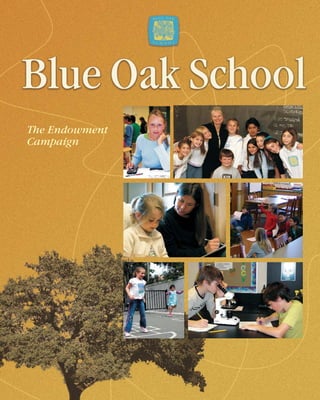
The Endowment
Campaign
Access and
Innovation
ac-cess
[ák séss]
[14th century. Directly or via Old French
acces < Latin accessus, past participle
of accedere “come near”
Definition:
1. a means of entering or approaching
a place. Blue Oak School provides
financial assistance to over 30% of
our families so that our student body
reflects the community of Napa and
the North Bay (compared to a 16%
national average for independent
schools). By educating children
in an environment that embodies
the richness and variety of our
world, we give them the tools to be
thoughtful and tolerant citizens.
A diverse student body enriches and
promotes responsible leadership.
2. the opportunity or right to experience
or make use of something. Our
thoughtful teachers, leaders, and
parents work together to provide
a learning environment in which
students are able to explore, create,
share, and discover as they mature.
3. the right or opportunity to meet
somebody. Our students become
confident, aware, and inquisitive
exploring first themselves and then
others in an environment that
reflects the world at large. We
develop programs that further
children’s knowledge and ability to
collaborate in a complex world.
printer note:
this is a half page
Meeting the Challenge
of Our Future
Access and
Innovation
at Blue Oak School means:
• Access for a diverse
student body
• A responsible, innovative
education in a rich
academic environment
tailored to student
needs and interests
B
lue Oak School is a respected
educational model in our
local school community.
Founded in 2002, our curriculum
is designed to foster children’s under-
standing of, and stewardship for, the
world in which we live.
Our School’s mission calls us to serve
the needs of each child while serving
the larger community.
In the Fall of 2006, Blue Oak School
will enroll 170 K-8 grade students
from the North Bay area, including
Napa, St. Helena, Sonoma, Angwin,
American Canyon, and Vallejo.
We will reach another important mile-
stone in the spring of 2007: our first
eighth grade graduating class.
Access and
Innovation
Next Step:
The
Endowment
Campaign
B
lue Oak School is succeeding
financially. Under the direction
of our Board of Trustees, we
balanced the budget by meeting
enrollment targets, carefully managing
expenditures, and exceeding our
fundraising goals. Our next step is
to secure long term financial stability
to allow Blue Oak School to serve
generations to come. Annual
fundraising efforts have established
a culture of giving amongst our
constituents and members of the
Napa Valley community. Access for
future generations will be achieved
with the successful completion of
our Endowment campaign.
Endowment Campaign
The Endowment Campaign launched
by Blue Oak School Volunteer
Leaders will support outreach and
growth. Our goal is to raise five
million dollars over the next five
years. A successful Endowment
Campaign will fund projected costs
associated with supporting access
to the School. And a successful
Endowment Campaign will continue
to fund new innovation.
A Blue Oak School education is
unique, in part because it offers:
•Access, financial aid, and outreach
to the community. We strive to be
accessible to the broad cultural
and economic diversity of this area.
Blue Oak School provides twice the
national average in financial aid
as most independent schools.
Despite the challenge of meeting
this goal, the School is committed
to providing access to students in
need of financial aid.
•Educational innovation in a
growing school. Maintaining a
high-quality education for students
requires us to continually refine
the curriculum, and to hire and
retain a high-caliber staff. The
curriculum is brought to life by
our experienced faculty, recruited
locally and nationally by the
Head of School. The faculty focuses
on creating a rich academic
environment that is tailored to
students’ interests and needs.
Join usin continuing to provide
access to innovative
education for more children
in the Napa Valley.
Endowment
Committee
Background and
Perspectives
David Beckstoffer
Endowment Campaign Chair
David Beckstoffer
is President of
Beckstoffer Vineyards
and lives in St. Helena
with his wife, Susan,
and their daughter, Claire, a Blue
Oak student. David is active in the
Napa Valley community and has
recently served as a Director of the
Napa County Farm Bureau. He is
currently a Director of the Napa
Valley Grape Growers Association
and Chairman of the Farmworker
Housing Advisory Committee.
“ The endowment
will help the school
to grow in the years
ahead as program,
facility and staff needs evolve and
change. The endowment will also
help us continue to maintain a
diverse student body and relieve
financial pressures, allowing the
school to focus on the students,
which is really what this is all about.
I am involved in the endowment
campaign because I believe that
a well funded endowment is
important for the long-term success
of the school.” —David Beckstoffer
Lisa Cort
Endowment Campaign Chair
Lisa Cort spent more
than 13 years as a
marketing professional
creating, developing,
managing, and implementing innova-
tive communication programs in
business-to-business and consumer
markets at several Bay Area high-tech
and interactive media companies.
Lisa and her husband, David
Goldman, are co-founding families
of Blue Oak School. They have two
children attending Blue Oak School.
Lisa is also on the Board of the
Community Foundation of the
Napa Valley.
“We cannot just look
at our day to day
operations to make
the school successful,
but we have to look out beyond our
tenure at the school. The trustees
hold the school in trust for the chil-
dren of the future. As a founder I
developed the school as a gift to my
children, my community and the
children of future generations. We
all need to look at the bigger picture
and dream about a day when our
grown children can come back to
their alma matter and give back to
a place that provided them with the
foundation that allowed them to
make a difference. We are raising
future leaders.” —Lisa Cort
C. Paul Johnson
Endowment Campaign Chair
C. Paul Johnson is
the owner of Astrale e
Terra Winery. Paul is
the former Chairman
and CEO of First Colonial Bancshares,
Chicago. He graduated from Michigan
State University and served as a
pilot in the US Air Force. He serves on
the boards of the Adler Planetarium,
the Leakey Foundation and Roosevelt
University, and is the former
Chairman of the Crow Canyon
Archaeology Center.
“I think that diversity
of the students and
financial aid is the
compelling story
that will resonate well. A larger
endowment is critical for the school
in case of an unforseen financial
problem that needs substantial
funding. It is a financial safeguard.”
—Paul Johnson
Joel Peterson
Endowment Campaign Chair
Joel Peterson is
cofounder and the
winemaker at
Ravenswood winery in
Sonoma. Joel is a member and for-
mer president of the Sonoma Valley
Vintners and Growers Alliance. He is
a founding member and former
President of Zinfandel Advocates and
Producers. Joel is a Senior Vice
President with Constellation Wines
and the Centerra Wine Company.
He also serves on the Oregon State
University College of Science Board
of Visitors. Joel, his wife, Madeleine,
and their son, Galen, are actively
engaged in the Blue Oak experience.
“The endowment will
provide the flexibility
necessary for the
school to control its
operational direction and pursue its
valuable progressive educational
agenda. A well funded endowment
is the key to the long term financial
stability and sustainability of Blue
Oak School. Successful execution of
programs that tend to be chronically
difficult to fund, which include
environmental programs, tuition
support, value added programs
and general operations, is critical
to the mission of Blue Oak. An
endowment that supports Blue Oak
in these areas will make a critical
difference for the children and
provide worthwhile value to the
community by maintaining a high
value educational institution in
the Napa Valley.“ —Joel Peterson
ABlue Oak School
Education
B
lue Oak School is the first
independent, non-profit,
non-denominational school
in Napa County. The School is a
vibrant, diverse community where
learning is an active, joyful process
of discovery. Designed to draw out
each child’s innate curiosity, our
curriculum inspires students to
think, question, and create.
The School offers a broad, liberal
arts curriculum. In grades K-5,
homeroom subjects include reading,
writing, math, science, history, art,
spelling, handwriting and more.
Specialists teach music, art, Spanish,
drama, and physical education.
Middle School courses include math,
science, humanities, Spanish, music,
art, physical education, life skills,
and electives, as well as a strong
advisory program.
The themes that run throughout the
curriculum are character education,
environmental responsibility, use
of technology, respect for other
cultures, service and community.
“The curriculum begins
with the children. It draws
on what they already
know and what interests
them. A course of study
is created by mixing these
factors with the teacher’s
knowledge and a sense
of what children need
to learn.”
Scott Duyan
Head of School
printer note:
this is a half page
The Curriculum
T
he faculty at Blue Oak School cooperatively
creates the curriculum. It follows these
guiding principles:
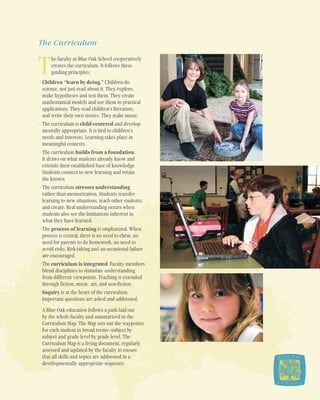
•Children “learn by doing.” Children do
science, not just read about it. They explore,
make hypotheses and test them. They create
mathematical models and use them in practical
applications. They read children’s literature,
and write their own stories. They make music.
•The curriculum is child-centered and develop-
mentally appropriate. It is tied to children’s
needs and interests. Learning takes place in
meaningful contexts.
•The curriculum builds from a foundation.
It draws on what students already know and
extends their established base of knowledge.
Students connect to new learning and retain
the known.
•The curriculum stresses understanding
rather than memorization. Students transfer
learning to new situations, teach other students,
and create. Real understanding occurs when
students also see the limitations inherent in
what they have learned.
•The process of learning is emphasized. When
process is central, there is no need to cheat, no
need for parents to do homework, no need to
avoid risks. Risk-taking and an occasional failure
are encouraged.
•The curriculum is integrated. Faculty members
blend disciplines to stimulate understanding
from different viewpoints. Teaching is extended
through fiction, music, art, and non-fiction.
•Inquiry is at the heart of the curriculum.
Important questions are asked and addressed.
A Blue Oak education follows a path laid out
by the whole faculty and summarized in the
Curriculum Map. The Map sets out the waypoints
for each student in broad terms—subject by
subject and grade level by grade level. The
Curriculum Map is a living document, regularly
assessed and updated by the faculty to ensure
that all skills and topics are addressed in a
developmentally appropriate sequence.
U
ltimately, it’s about character.
A Blue Oak School education
encourages a constellation
of character traits that comprise a
fully-realized human being: responsi-
bility, compassion, respect, honesty,
empathy, integrity, humor, humility,
thoughtfulness, curiosity, courage,
open-mindedness, resilience, and
selflessness.
Blue Oak School is an independent
school—which means that we receive
no state or government funding, nor
are we supported by any religious
institutions. Our students come from
Napa, Sonoma, and Solano Counties.
In order to mirror the make-up of the
community in which we teach, the
School provides generous financial
aid. The degree of our commitment
to financial aid sets us apart from
the great majority of independent
schools.
Two areas of inquiry are central to
a Blue Oak education: community
and sustainability.
Community
We begin teaching about the
communities of home and classroom.
Children then learn about the wider
communities of school, city and
county, state, country, and world in
ever-expanding circles. They study
important elements of community at
each level: tolerance, understanding,
inclusiveness, open-mindedness,
and compassion. Other pertinent
issues are explored, such as the
comparison of human communities
to other biological communities,
our place in these ecosystems, and
our responsibility for them.
The study of community is both
multicultural and global. We strive
to represent diversity in our school
population. Board policies, funding
strategies, hiring, and daily life
reflect not only the diversity of
the children, but also expand the
knowledge of and empathy for
many cultures.
Sustainability
Our curriculum and school culture
address broad questions and consider
possible answers in daily routines.
What can be learned from history
or science that enables us to envision
sustainable human enterprises?
What can we learn from our present
circumstances and future predictions
that might lead us beyond our present
preoccupations to responsibility
for the world? How can we enable
our students to make the kind of
choices that will lead them not to
ecological dead-ends but to the kind
of growth that can be accommodated
by the planet? What information
do they need? What habits of mind
must they have? What skills will
they need to pursue their dreams?
A
n emphasis on both community
and sustainability leads us to
study connections. Our cur-
riculum focuses not only on facts but
on the connections between them—
the processes, not just the products.
Creative, compassionate teachers who
share a passion for children, collabo-
ration, and building community are
necessary for teaching character.
Talented faculty make connections to
children, and their effect on a child’s
life is transformative. We hire and
nurture the best faculty available.
We live on a finite planet, yet with
seemingly infinite appetites. Children
who grow up working cooperatively
and caring about one another are
less likely to want everything for
themselves at the expense of others.
An education that encourages
children to see the big picture and
take the long view will enable them
to create a sustainable future.
Blue Oak School sets itself to
these essential questions because
this is important work. From the
student’s point of view, it is engaging
work. Supporting children in the
development of their character
through a curriculum that inspires
is the best gift we can give them,
and their best preparation for a
successful future.
Building Character

Blue Oak Endowment brochure

  • 1.
  • 2.
  • 3.
    ac-cess [ák séss] [14th century.Directly or via Old French acces < Latin accessus, past participle of accedere “come near” Definition: 1. a means of entering or approaching a place. Blue Oak School provides financial assistance to over 30% of our families so that our student body reflects the community of Napa and the North Bay (compared to a 16% national average for independent schools). By educating children in an environment that embodies the richness and variety of our world, we give them the tools to be thoughtful and tolerant citizens. A diverse student body enriches and promotes responsible leadership. 2. the opportunity or right to experience or make use of something. Our thoughtful teachers, leaders, and parents work together to provide a learning environment in which students are able to explore, create, share, and discover as they mature. 3. the right or opportunity to meet somebody. Our students become confident, aware, and inquisitive exploring first themselves and then others in an environment that reflects the world at large. We develop programs that further children’s knowledge and ability to collaborate in a complex world. printer note: this is a half page
  • 4.
    Meeting the Challenge ofOur Future Access and Innovation at Blue Oak School means: • Access for a diverse student body • A responsible, innovative education in a rich academic environment tailored to student needs and interests B lue Oak School is a respected educational model in our local school community. Founded in 2002, our curriculum is designed to foster children’s under- standing of, and stewardship for, the world in which we live. Our School’s mission calls us to serve the needs of each child while serving the larger community. In the Fall of 2006, Blue Oak School will enroll 170 K-8 grade students from the North Bay area, including Napa, St. Helena, Sonoma, Angwin, American Canyon, and Vallejo. We will reach another important mile- stone in the spring of 2007: our first eighth grade graduating class. Access and Innovation
  • 5.
    Next Step: The Endowment Campaign B lue OakSchool is succeeding financially. Under the direction of our Board of Trustees, we balanced the budget by meeting enrollment targets, carefully managing expenditures, and exceeding our fundraising goals. Our next step is to secure long term financial stability to allow Blue Oak School to serve generations to come. Annual fundraising efforts have established a culture of giving amongst our constituents and members of the Napa Valley community. Access for future generations will be achieved with the successful completion of our Endowment campaign. Endowment Campaign The Endowment Campaign launched by Blue Oak School Volunteer Leaders will support outreach and growth. Our goal is to raise five million dollars over the next five years. A successful Endowment Campaign will fund projected costs associated with supporting access to the School. And a successful Endowment Campaign will continue to fund new innovation. A Blue Oak School education is unique, in part because it offers: •Access, financial aid, and outreach to the community. We strive to be accessible to the broad cultural and economic diversity of this area. Blue Oak School provides twice the national average in financial aid as most independent schools. Despite the challenge of meeting this goal, the School is committed to providing access to students in need of financial aid. •Educational innovation in a growing school. Maintaining a high-quality education for students requires us to continually refine the curriculum, and to hire and retain a high-caliber staff. The curriculum is brought to life by our experienced faculty, recruited locally and nationally by the Head of School. The faculty focuses on creating a rich academic environment that is tailored to students’ interests and needs. Join usin continuing to provide access to innovative education for more children in the Napa Valley.
  • 6.
  • 7.
    David Beckstoffer Endowment CampaignChair David Beckstoffer is President of Beckstoffer Vineyards and lives in St. Helena with his wife, Susan, and their daughter, Claire, a Blue Oak student. David is active in the Napa Valley community and has recently served as a Director of the Napa County Farm Bureau. He is currently a Director of the Napa Valley Grape Growers Association and Chairman of the Farmworker Housing Advisory Committee. “ The endowment will help the school to grow in the years ahead as program, facility and staff needs evolve and change. The endowment will also help us continue to maintain a diverse student body and relieve financial pressures, allowing the school to focus on the students, which is really what this is all about. I am involved in the endowment campaign because I believe that a well funded endowment is important for the long-term success of the school.” —David Beckstoffer Lisa Cort Endowment Campaign Chair Lisa Cort spent more than 13 years as a marketing professional creating, developing, managing, and implementing innova- tive communication programs in business-to-business and consumer markets at several Bay Area high-tech and interactive media companies. Lisa and her husband, David Goldman, are co-founding families of Blue Oak School. They have two children attending Blue Oak School. Lisa is also on the Board of the Community Foundation of the Napa Valley. “We cannot just look at our day to day operations to make the school successful, but we have to look out beyond our tenure at the school. The trustees hold the school in trust for the chil- dren of the future. As a founder I developed the school as a gift to my children, my community and the children of future generations. We all need to look at the bigger picture and dream about a day when our grown children can come back to their alma matter and give back to a place that provided them with the foundation that allowed them to make a difference. We are raising future leaders.” —Lisa Cort C. Paul Johnson Endowment Campaign Chair C. Paul Johnson is the owner of Astrale e Terra Winery. Paul is the former Chairman and CEO of First Colonial Bancshares, Chicago. He graduated from Michigan State University and served as a pilot in the US Air Force. He serves on the boards of the Adler Planetarium, the Leakey Foundation and Roosevelt University, and is the former Chairman of the Crow Canyon Archaeology Center. “I think that diversity of the students and financial aid is the compelling story that will resonate well. A larger endowment is critical for the school in case of an unforseen financial problem that needs substantial funding. It is a financial safeguard.” —Paul Johnson Joel Peterson Endowment Campaign Chair Joel Peterson is cofounder and the winemaker at Ravenswood winery in Sonoma. Joel is a member and for- mer president of the Sonoma Valley Vintners and Growers Alliance. He is a founding member and former President of Zinfandel Advocates and Producers. Joel is a Senior Vice President with Constellation Wines and the Centerra Wine Company. He also serves on the Oregon State University College of Science Board of Visitors. Joel, his wife, Madeleine, and their son, Galen, are actively engaged in the Blue Oak experience. “The endowment will provide the flexibility necessary for the school to control its operational direction and pursue its valuable progressive educational agenda. A well funded endowment is the key to the long term financial stability and sustainability of Blue Oak School. Successful execution of programs that tend to be chronically difficult to fund, which include environmental programs, tuition support, value added programs and general operations, is critical to the mission of Blue Oak. An endowment that supports Blue Oak in these areas will make a critical difference for the children and provide worthwhile value to the community by maintaining a high value educational institution in the Napa Valley.“ —Joel Peterson
  • 8.
  • 9.
    B lue Oak Schoolis the first independent, non-profit, non-denominational school in Napa County. The School is a vibrant, diverse community where learning is an active, joyful process of discovery. Designed to draw out each child’s innate curiosity, our curriculum inspires students to think, question, and create. The School offers a broad, liberal arts curriculum. In grades K-5, homeroom subjects include reading, writing, math, science, history, art, spelling, handwriting and more. Specialists teach music, art, Spanish, drama, and physical education. Middle School courses include math, science, humanities, Spanish, music, art, physical education, life skills, and electives, as well as a strong advisory program. The themes that run throughout the curriculum are character education, environmental responsibility, use of technology, respect for other cultures, service and community. “The curriculum begins with the children. It draws on what they already know and what interests them. A course of study is created by mixing these factors with the teacher’s knowledge and a sense of what children need to learn.” Scott Duyan Head of School printer note: this is a half page
  • 10.
    The Curriculum T he facultyat Blue Oak School cooperatively creates the curriculum. It follows these guiding principles: •Children “learn by doing.” Children do science, not just read about it. They explore, make hypotheses and test them. They create mathematical models and use them in practical applications. They read children’s literature, and write their own stories. They make music. •The curriculum is child-centered and develop- mentally appropriate. It is tied to children’s needs and interests. Learning takes place in meaningful contexts. •The curriculum builds from a foundation. It draws on what students already know and extends their established base of knowledge. Students connect to new learning and retain the known. •The curriculum stresses understanding rather than memorization. Students transfer learning to new situations, teach other students, and create. Real understanding occurs when students also see the limitations inherent in what they have learned. •The process of learning is emphasized. When process is central, there is no need to cheat, no need for parents to do homework, no need to avoid risks. Risk-taking and an occasional failure are encouraged. •The curriculum is integrated. Faculty members blend disciplines to stimulate understanding from different viewpoints. Teaching is extended through fiction, music, art, and non-fiction. •Inquiry is at the heart of the curriculum. Important questions are asked and addressed. A Blue Oak education follows a path laid out by the whole faculty and summarized in the Curriculum Map. The Map sets out the waypoints for each student in broad terms—subject by subject and grade level by grade level. The Curriculum Map is a living document, regularly assessed and updated by the faculty to ensure that all skills and topics are addressed in a developmentally appropriate sequence.
  • 11.
    U ltimately, it’s aboutcharacter. A Blue Oak School education encourages a constellation of character traits that comprise a fully-realized human being: responsi- bility, compassion, respect, honesty, empathy, integrity, humor, humility, thoughtfulness, curiosity, courage, open-mindedness, resilience, and selflessness. Blue Oak School is an independent school—which means that we receive no state or government funding, nor are we supported by any religious institutions. Our students come from Napa, Sonoma, and Solano Counties. In order to mirror the make-up of the community in which we teach, the School provides generous financial aid. The degree of our commitment to financial aid sets us apart from the great majority of independent schools. Two areas of inquiry are central to a Blue Oak education: community and sustainability. Community We begin teaching about the communities of home and classroom. Children then learn about the wider communities of school, city and county, state, country, and world in ever-expanding circles. They study important elements of community at each level: tolerance, understanding, inclusiveness, open-mindedness, and compassion. Other pertinent issues are explored, such as the comparison of human communities to other biological communities, our place in these ecosystems, and our responsibility for them. The study of community is both multicultural and global. We strive to represent diversity in our school population. Board policies, funding strategies, hiring, and daily life reflect not only the diversity of the children, but also expand the knowledge of and empathy for many cultures. Sustainability Our curriculum and school culture address broad questions and consider possible answers in daily routines. What can be learned from history or science that enables us to envision sustainable human enterprises? What can we learn from our present circumstances and future predictions that might lead us beyond our present preoccupations to responsibility for the world? How can we enable our students to make the kind of choices that will lead them not to ecological dead-ends but to the kind of growth that can be accommodated by the planet? What information do they need? What habits of mind must they have? What skills will they need to pursue their dreams? A n emphasis on both community and sustainability leads us to study connections. Our cur- riculum focuses not only on facts but on the connections between them— the processes, not just the products. Creative, compassionate teachers who share a passion for children, collabo- ration, and building community are necessary for teaching character. Talented faculty make connections to children, and their effect on a child’s life is transformative. We hire and nurture the best faculty available. We live on a finite planet, yet with seemingly infinite appetites. Children who grow up working cooperatively and caring about one another are less likely to want everything for themselves at the expense of others. An education that encourages children to see the big picture and take the long view will enable them to create a sustainable future. Blue Oak School sets itself to these essential questions because this is important work. From the student’s point of view, it is engaging work. Supporting children in the development of their character through a curriculum that inspires is the best gift we can give them, and their best preparation for a successful future. Building Character