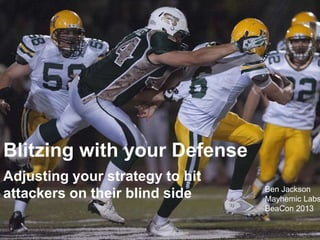
Blitzing with your Defense
Adjusting your strategy to hit
attackers on their blind side Ben Jackson
Mayhemic Labs
BeaCon 2013
Outline
• Background
• Developing Intelligence
• Information
– Receiving
– Gathering
– Sharing
• Active Defense
• Tying it together
But first about me…
http://www.funsted.com/pdata/t/l-1725.jpghttp://www.funsted.com/pdata/t/l-1725.jpg
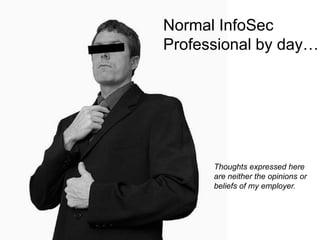
Normal InfoSec
Professional by day…
Thoughts expressed here
are neither the opinions or
beliefs of my employer.
SOC
Light is green,
network is clean!
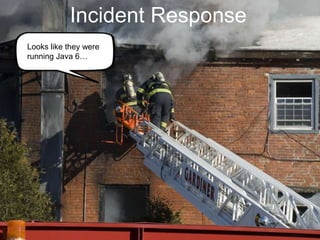
Incident Response
Looks like they were
running Java 6…
https://farm5.staticflickr.com/4101/4793807817_69c95f6342_b.jpg
Crazy Researcher by Night…
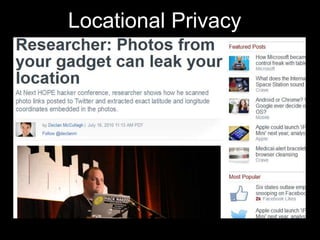
Locational Privacy
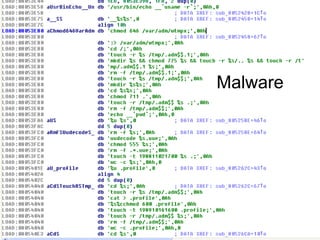
Malware
https://farm9.staticflickr.com/8148/7695709198_8f8113e3f8_b.jpg
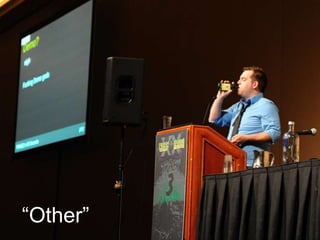
“Other”
Background
Or… “Why we are totally screwed…”
Disclaimer
• You can’t do this if you’re not passionate
– Tom Brady does not look at football as a 9-5
job
• Blitzing is a different way to look at
defense, but it is not a cure all
– If you’re not patching, you’re still doomed
• Every defense requires fundamentals
– If your defense can’t run and tackle, your blitz
isn’t going to be very effective
We’re in a “prevent defense”
“A prevent defense is an American
football defensive alignment... the goal of
which is to prevent the opposing offense
from completing a long pass...” –
Wikipedia
Prevent Defenses don’t work
• We can’t prevent 100% of the time
• Attackers are completely OK with gaining
a few yards at time
• Occasionally, the defense will still give up
the “big play”
– RSA, Comodo, Bit9, Broncos vs Ravens,
etc…
• We’re giving up yardage to burn time
– Only we don’t have a clock we can run out
Incident Response Model
• Preparation
• Identification
• Containment
• Eradication
• Recovery
• Lessons Learned
Patrick Kral, Incident Handler's Handbook, SANS Institute Reading Room, 2011
Changes, kind of…
• Incident Response model is geared toward
handing incidents as separate events
• Once the fire is out, it’s business as usual
• Good for handling viruses, isolated
compromises, and casual attackers
• Less than ideal for handling determined
attackers
Changes, kind of…
• Incident Response model still works
– Learn it, live it, love it
• However, the game has changed
– Wider awareness is needed
• Incidents may be Independent or Linked
The baddies have a model
too…
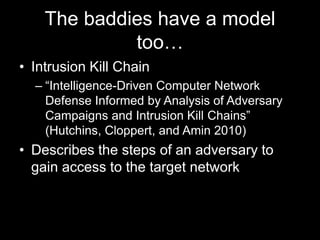
• Intrusion Kill Chain
– “Intelligence-Driven Computer Network
Defense Informed by Analysis of Adversary
Campaigns and Intrusion Kill Chains”
(Hutchins, Cloppert, and Amin 2010)
• Describes the steps of an adversary to
gain access to the target network
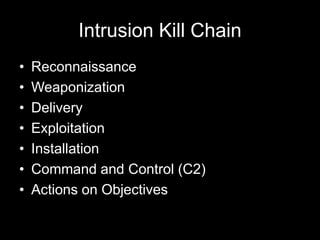
Intrusion Kill Chain
• Reconnaissance
• Weaponization
• Delivery
• Exploitation
• Installation
• Command and Control (C2)
• Actions on Objectives
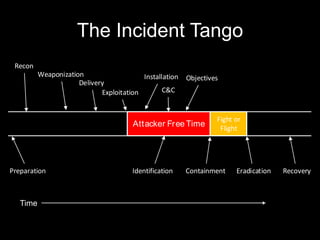
Attacker Free Time
Fight or
Flight
Preparation Identification Containment Eradication Recovery
Recon
Weaponization
Delivery
Exploitation
Installation
C&C
Objectives
The Incident Tango
Time
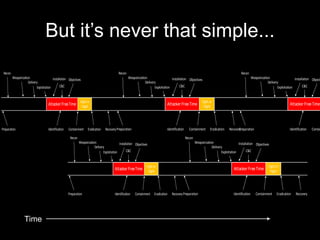
But it’s never that simple...
Attacker FreeTime
Fight or
Flight
Preparation Identification Containment Eradication Recovery
Recon
Weaponization
Delivery
Exploitation
Installation
C&C
Objectives
Attacker FreeTime
Fight or
Flight
Preparation Identification Containment Eradication Recovery
Recon
Weaponization
Delivery
Exploitation
Installation
C&C
Objectives
Attacker FreeTime
Preparation Identification Contain
Recon
Weaponization
Delivery
Exploitation
Installation
C&C
Object
Attacker FreeTime
Fight or
Flight
Preparation Identification Containment Eradication Recovery
Recon
Weaponization
Delivery
Exploitation
Installation
C&C
Objectives
Attacker FreeTime
Fight or
Flight
Preparation Identification Containment Eradication Recovery
Recon
Weaponization
Delivery
Exploitation
Installation
C&C
Objectives
Time
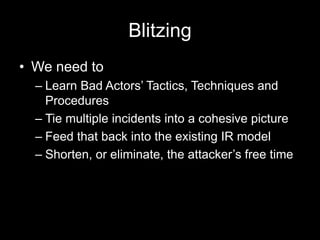
Blitzing
• We need to
– Learn Bad Actors’ Tactics, Techniques and
Procedures
– Tie multiple incidents into a cohesive picture
– Feed that back into the existing IR model
– Shorten, or eliminate, the attacker’s free time
Developing
Intelligence
They know about you, learn about them
Data to Intelligence
• Everyone is talking about intelligence
• Unfortunately most people don’t know
what intelligence is
• IOCs? IP Addresses? FQDNs? MD5s?
– Data, Data, Data, Data
• Intelligence = Data + Analysis
Data to Intelligence
(Star Wars Model)
• Princess Leia steals plans for Death Star
• Rebel Alliance analysts review plans and
find exhaust port vulnerability (Not Shown)
• Luke, R2D2, Han, and Chewbacca blow
up Death Star
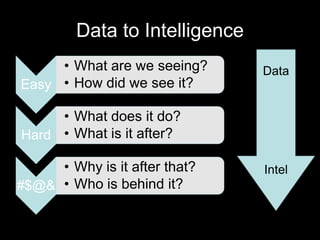
Data to Intelligence
Easy
• What are we seeing?
• How did we see it?
Hard
• What does it do?
• What is it after?
#$@&
• Why is it after that?
• Who is behind it?
Data
Intel
Developing Intelligence
• Intelligence is hard work
– Long days looking like a conspiracy nut
– A single piece of data can ruin weeks of work
• Needs to be an on-going, internal,
process
– No one knows your network better than you
– Threat actors will change on a regular basis
• Once you become proficient, it’s worth it’s
weight in gold
Using Your Data
It works for the NSA, and it can work for you…
Here! Have some Data!
• Data for intelligence is being sent to your
company every day
• Every attack, successful or not, results in
data
– IP addresses, C2 servers, phishing themes,
etc.
• Most attackers do not have good OPSEC
– They’re lazy
– Use this against them
– “OPSEC For Hackers” - thegrugq
Start busting out of Silos
• Start extracting data out of your SIEM,
IDS, AV Solution, or other security devices
– Learn how to script
• Start correlating and forming timelines
– Did that IP address probe the same server
today and last week? Odd…
• Pay attention to attack methods and start
looking for patterns
– Humans still beat machines for pattern
recognition
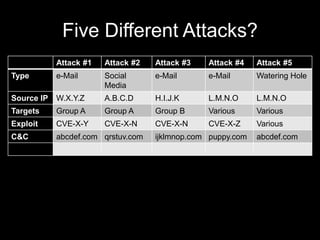
Five Different Attacks?
Attack #1 Attack #2 Attack #3 Attack #4 Attack #5
Type e-Mail Social
Media
e-Mail e-Mail Watering Hole
Source IP W.X.Y.Z A.B.C.D H.I.J.K L.M.N.O L.M.N.O
Targets Group A Group A Group B Various Various
Exploit CVE-X-Y CVE-X-N CVE-X-N CVE-X-Z Various
C&C abcdef.com qrstuv.com ijklmnop.com puppy.com abcdef.com
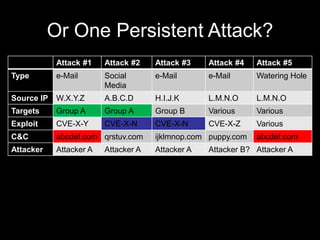
Or One Persistent Attack?
Attack #1 Attack #2 Attack #3 Attack #4 Attack #5
Type e-Mail Social
Media
e-Mail e-Mail Watering Hole
Source IP W.X.Y.Z A.B.C.D H.I.J.K L.M.N.O L.M.N.O
Targets Group A Group A Group B Various Various
Exploit CVE-X-Y CVE-X-N CVE-X-N CVE-X-Z Various
C&C abcdef.com qrstuv.com ijklmnop.com puppy.com abcdef.com
Attacker Attacker A Attacker A Attacker A Attacker B? Attacker A
Gathering Data
Embrace being the Nosy Neighbor on the Internet
IRC
• Certain groups still love to hang out in IRC
• Do not… Do NOT IRC from devices or
networks that can be traced back to you
– Groups of bad actors often love privacy –
Embrace it, but don’t tempt fate
• Due to the nature of IRC, groups can be
harder to infiltrate
– Smaller the group, the more trusted it is.
Social Media
• Certain groups love to discuss their
exploits on Social Media
– Some groups use this as advertising
• Find out who’s talking about you and why
– Then find out who’s talking to them and why
• Much easier to easier to monitor people
than IRC
Pastebin
• A wretched hive of scum and villainy
– …therefore a great source for data
• Groups often will post dumps of stolen
data here for easy access
– Look for yours
• Has a subscription service that will alert
when posts are made with key words
– Or you can roll your own monitoring system
Google Alerts
• Google knows everything about everyone
– Leverage this to your advantage
• Does have a high false positive rate, but
will yield occasional nuggets of beautiful
data
Things to look for
• Company name
• Company Twitter Handles/Hashtags
• Domain Names
• IP addresses
• e-Mail addresses
• Names of Company Leadership
• Terms that the people you are monitoring
talk about
Deep Undercover
• Interacting with bad actors is dangerous
– And on shaky legal ground as well
• Sometimes you will attract attention just
being a fly on the wall
• Developing a believable “legend” for your
persona is necessary
• Need an identity?
– http://namegenerator.in
Cover Identities
• Cover identities cannot be created, only
grown
– An account set up last week looks suspicious
• Tending a garden takes time and effort
• If you start today, you may have a
believable identity in a few months
– Years? Even more believable
• Always have multiple identities “good to
go”
Quick Tips for Believability
• LinkedIn
– Research colleges, majors, student life
• Facebook
– Find friends, create pictures and events
• Twitter
– Tweet on an appropriate schedule
• A college student in LA is not going to tweet
between 9 and 5 in Boston
• Never, ever, cross contaminate accounts
Early Warning
• Cover identities are not just for James
Bond type stuff
• Creating fake employees can give you an
early warning for someone looking into
your company
– Legitimate and Illegitimate
• Set up a fake work identities as well and
see who pokes at them
Data Sharing
Don’t be a hoarder…
Data Sharing
• Knowing as much as you can during an
incident is key
• Sharing with peers can make a difference
– Time to detection
– Situational awareness
– Targeted vs Untargeted
• Sharing means giving and receiving
– Produce and consume
Unorganized Informal
Communities
• Never underestimate the power of
networking
– Introverted geeks, this means you
• Numerous communities in the local area
– BeanSec
– GraniteSec
– MassHackers
– Local chapters of National Organizations
Organized Informal
Communities
• Closed communities that are designed to
share information
– Mostly mailing lists
• Don’t call them, they’ll call you
– Again, networking…
• Can be great sources, but depends widely
on the community
– Also a can be a bear to get into
Infragard
• Partnership between the FBI and private
sector
• Good networking opportunities
– Get to know your fellow geeks
• Private Secure Portal
• Have recently started releasing DHS Joint
Indicator Bulletins to members
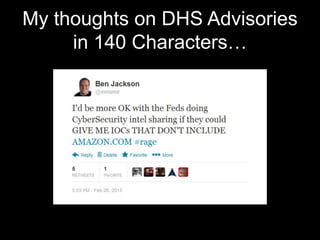
– Quality?
My thoughts on DHS Advisories
in 140 Characters…
ISACs
• Information Sharing and Analysis Centers
• Formal communities set up within your
vertical
– Finance, Energy, State Governments, Health,
Higher Education, and More
• The communities vary wildly between
ISACs
• Usually not free, but worth it
Advanced Cyber Security
Center
• Multi-vertical ISAC
• Weekly meetings on threat evaluation and
information sharing
• Young, but growing
• Again, not free
Active Defense
Embrace your home field advantage…
Always calling the same play
• We always use the same tools
– Firewall, IDS, Anti-Virus, Windows, RHEL
• Attackers know this
– They’ve adapted their methods
• Defense has stayed stagnant while
offense has continued to develop new
tools
– HD Moore’s law by Josh Corman
• “Casual Attacker power grows at the rate of
Metasploit”
Active Defense is NOT…
• Hacking Back
– Questionable Legality
• Attribution
– The rabbit hole always goes deeper
• Retaliation
– Don’t fight angry
• Counterstrikes
– You’re not going to eliminate the problem
Active Defense is…
• Delay
– Slow them down
• Deception
– Where’s the data?
• Detection
– Find them
• Disruption
– Deny access
Why Active Defense?
• Increasing attacker cost
– The bad actors will either move on or the
people pulling the strings may get another
“hired gun”
• Mind games
– If the bad actors think everything is a trap,
they’ll be overly cautious
• It’s an uncommonly used tactic
Delay
• Use Honeypots
– Internally facing only
– Double edged sword
• Run additional services on underutilized
servers
– If the bad actors are looking for SQL servers,
give them SQL servers
Deceive
• Put “interesting” files on open shares
– “Corporate_Forecast_1H2014.doc”
• Complete with a web bug that calls to a offsite
server
– “Customer DB Backup.zip”
• 12GB Zip file with a 36 alphanumeric password
• Fake databases
– http://fakenamegenerator.com
Detect
• Monitor your systems that delay and
deceive
– Like a hawk on amphetamines
• Establish “Motion Sensors”
– Route a few network segments to a tarpit
• Keep an eye on your “traditional” alerting
systems as well
Disrupt
• Find them and destroy them!
– Or not..
• Monitoring intruders can be a good source
of tactics, techniques, and procedures
– And keep your IR staff consuming large
amounts of antacids
– It is very, very, very risky
Would you like to know more?
• Offensive Countermeasures Training
– Paul Asadorian and John Strand
• Active Defense Harbinger Distribution
– Bootable Linux Distribution with all kinds of
“Active Defense” goodies
– http://sf.net/projects/adhd/
Putting it all together
…with bailing wire and duct tape
Putting it all together
• All of these techniques are useless
– Until you start feeding them back into the
traditional incident response model
• Feeding intelligence back into the Incident
Response loop shortens attacker free time
• For example…
To the WABAC machine!
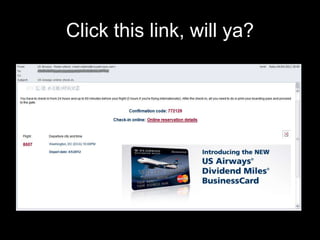
• April-July 2012
• Noticeable increase in Malware spam
lures
– Verizon, American and United Airlines, USPS,
PayPal, Facebook
• Widespread reports across the Internet
– Not targeted against a single individual,
company, or vertical
Click this link, will ya?
Common Threads
• A large majority of the spam runs had
commonalities
– All same “kind” of lure
– Similar lists of targets
– All using the Blackhole Exploit kit
– Similar URL structure on lures
– Mostly pushing Zeus
• There were other runs that were different
Smoking Gun…
• The exploit kits invariably included two
styles of URLs:
http://ip.address/showthread.php?t=<16 hexadecimal digits>
http://ip.address/page.php?p=<16 hexadecimal digits>
Achievement Unlocked
• Conclusion: Single group of bad actors
behind campaign
• Adjusted defenses to locate URLs with
“page.php” and “showthread.php” with hex
strings
– Some false positives
• Was able to detect malware spam runs
often before they were reported
Turns out we were right…
• Trend Micro “Blackhole Exploit Kit: A Spam
Campaign, Not a Series of Individual
Spam Runs”
• Released July 12th, 2012
• Reached similar conclusions
• Campaign started to sputter after that...
Conclusion
• You are the best tool to defend your
network
– Get passionate
• Stop thinking about threats and start
worrying about actors
• Stop being nice and start playing “dirty”
• Learn who is talking about you, where,
and why
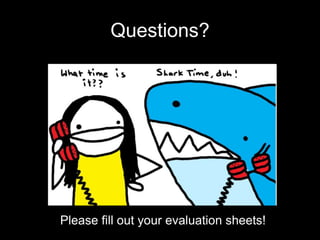
Questions?
Please fill out your evaluation sheets!
Contact Information
• Ben Jackson
• e-Mail: bbj@mayhemiclabs.com
• Twitter: @innismir
• Web/Code: http://mayhemiclabs.com

Blitzing with your defense bea con

  • 1.
    Blitzing with yourDefense Adjusting your strategy to hit attackers on their blind side Ben Jackson Mayhemic Labs BeaCon 2013
  • 2.
    Outline • Background • DevelopingIntelligence • Information – Receiving – Gathering – Sharing • Active Defense • Tying it together
  • 3.
    But first aboutme… http://www.funsted.com/pdata/t/l-1725.jpghttp://www.funsted.com/pdata/t/l-1725.jpg
  • 4.
    Normal InfoSec Professional byday… Thoughts expressed here are neither the opinions or beliefs of my employer.
  • 5.
  • 6.
    Incident Response Looks likethey were running Java 6…
  • 7.
  • 8.
  • 9.
  • 10.
  • 11.
    Background Or… “Why weare totally screwed…”
  • 12.
    Disclaimer • You can’tdo this if you’re not passionate – Tom Brady does not look at football as a 9-5 job • Blitzing is a different way to look at defense, but it is not a cure all – If you’re not patching, you’re still doomed • Every defense requires fundamentals – If your defense can’t run and tackle, your blitz isn’t going to be very effective
  • 13.
    We’re in a“prevent defense” “A prevent defense is an American football defensive alignment... the goal of which is to prevent the opposing offense from completing a long pass...” – Wikipedia
  • 14.
    Prevent Defenses don’twork • We can’t prevent 100% of the time • Attackers are completely OK with gaining a few yards at time • Occasionally, the defense will still give up the “big play” – RSA, Comodo, Bit9, Broncos vs Ravens, etc… • We’re giving up yardage to burn time – Only we don’t have a clock we can run out
  • 15.
    Incident Response Model •Preparation • Identification • Containment • Eradication • Recovery • Lessons Learned Patrick Kral, Incident Handler's Handbook, SANS Institute Reading Room, 2011
  • 16.
    Changes, kind of… •Incident Response model is geared toward handing incidents as separate events • Once the fire is out, it’s business as usual • Good for handling viruses, isolated compromises, and casual attackers • Less than ideal for handling determined attackers
  • 17.
    Changes, kind of… •Incident Response model still works – Learn it, live it, love it • However, the game has changed – Wider awareness is needed • Incidents may be Independent or Linked
  • 18.
    The baddies havea model too… • Intrusion Kill Chain – “Intelligence-Driven Computer Network Defense Informed by Analysis of Adversary Campaigns and Intrusion Kill Chains” (Hutchins, Cloppert, and Amin 2010) • Describes the steps of an adversary to gain access to the target network
  • 19.
    Intrusion Kill Chain •Reconnaissance • Weaponization • Delivery • Exploitation • Installation • Command and Control (C2) • Actions on Objectives
  • 20.
    Attacker Free Time Fightor Flight Preparation Identification Containment Eradication Recovery Recon Weaponization Delivery Exploitation Installation C&C Objectives The Incident Tango Time
  • 21.
    But it’s neverthat simple... Attacker FreeTime Fight or Flight Preparation Identification Containment Eradication Recovery Recon Weaponization Delivery Exploitation Installation C&C Objectives Attacker FreeTime Fight or Flight Preparation Identification Containment Eradication Recovery Recon Weaponization Delivery Exploitation Installation C&C Objectives Attacker FreeTime Preparation Identification Contain Recon Weaponization Delivery Exploitation Installation C&C Object Attacker FreeTime Fight or Flight Preparation Identification Containment Eradication Recovery Recon Weaponization Delivery Exploitation Installation C&C Objectives Attacker FreeTime Fight or Flight Preparation Identification Containment Eradication Recovery Recon Weaponization Delivery Exploitation Installation C&C Objectives Time
  • 22.
    Blitzing • We needto – Learn Bad Actors’ Tactics, Techniques and Procedures – Tie multiple incidents into a cohesive picture – Feed that back into the existing IR model – Shorten, or eliminate, the attacker’s free time
  • 23.
  • 24.
    Data to Intelligence •Everyone is talking about intelligence • Unfortunately most people don’t know what intelligence is • IOCs? IP Addresses? FQDNs? MD5s? – Data, Data, Data, Data • Intelligence = Data + Analysis
  • 25.
    Data to Intelligence (StarWars Model) • Princess Leia steals plans for Death Star • Rebel Alliance analysts review plans and find exhaust port vulnerability (Not Shown) • Luke, R2D2, Han, and Chewbacca blow up Death Star
  • 26.
    Data to Intelligence Easy •What are we seeing? • How did we see it? Hard • What does it do? • What is it after? #$@& • Why is it after that? • Who is behind it? Data Intel
  • 27.
    Developing Intelligence • Intelligenceis hard work – Long days looking like a conspiracy nut – A single piece of data can ruin weeks of work • Needs to be an on-going, internal, process – No one knows your network better than you – Threat actors will change on a regular basis • Once you become proficient, it’s worth it’s weight in gold
  • 28.
    Using Your Data Itworks for the NSA, and it can work for you…
  • 29.
    Here! Have someData! • Data for intelligence is being sent to your company every day • Every attack, successful or not, results in data – IP addresses, C2 servers, phishing themes, etc. • Most attackers do not have good OPSEC – They’re lazy – Use this against them – “OPSEC For Hackers” - thegrugq
  • 30.
    Start busting outof Silos • Start extracting data out of your SIEM, IDS, AV Solution, or other security devices – Learn how to script • Start correlating and forming timelines – Did that IP address probe the same server today and last week? Odd… • Pay attention to attack methods and start looking for patterns – Humans still beat machines for pattern recognition
  • 31.
    Five Different Attacks? Attack#1 Attack #2 Attack #3 Attack #4 Attack #5 Type e-Mail Social Media e-Mail e-Mail Watering Hole Source IP W.X.Y.Z A.B.C.D H.I.J.K L.M.N.O L.M.N.O Targets Group A Group A Group B Various Various Exploit CVE-X-Y CVE-X-N CVE-X-N CVE-X-Z Various C&C abcdef.com qrstuv.com ijklmnop.com puppy.com abcdef.com
  • 32.
    Or One PersistentAttack? Attack #1 Attack #2 Attack #3 Attack #4 Attack #5 Type e-Mail Social Media e-Mail e-Mail Watering Hole Source IP W.X.Y.Z A.B.C.D H.I.J.K L.M.N.O L.M.N.O Targets Group A Group A Group B Various Various Exploit CVE-X-Y CVE-X-N CVE-X-N CVE-X-Z Various C&C abcdef.com qrstuv.com ijklmnop.com puppy.com abcdef.com Attacker Attacker A Attacker A Attacker A Attacker B? Attacker A
  • 33.
    Gathering Data Embrace beingthe Nosy Neighbor on the Internet
  • 34.
    IRC • Certain groupsstill love to hang out in IRC • Do not… Do NOT IRC from devices or networks that can be traced back to you – Groups of bad actors often love privacy – Embrace it, but don’t tempt fate • Due to the nature of IRC, groups can be harder to infiltrate – Smaller the group, the more trusted it is.
  • 35.
    Social Media • Certaingroups love to discuss their exploits on Social Media – Some groups use this as advertising • Find out who’s talking about you and why – Then find out who’s talking to them and why • Much easier to easier to monitor people than IRC
  • 36.
    Pastebin • A wretchedhive of scum and villainy – …therefore a great source for data • Groups often will post dumps of stolen data here for easy access – Look for yours • Has a subscription service that will alert when posts are made with key words – Or you can roll your own monitoring system
  • 37.
    Google Alerts • Googleknows everything about everyone – Leverage this to your advantage • Does have a high false positive rate, but will yield occasional nuggets of beautiful data
  • 38.
    Things to lookfor • Company name • Company Twitter Handles/Hashtags • Domain Names • IP addresses • e-Mail addresses • Names of Company Leadership • Terms that the people you are monitoring talk about
  • 39.
    Deep Undercover • Interactingwith bad actors is dangerous – And on shaky legal ground as well • Sometimes you will attract attention just being a fly on the wall • Developing a believable “legend” for your persona is necessary • Need an identity? – http://namegenerator.in
  • 40.
    Cover Identities • Coveridentities cannot be created, only grown – An account set up last week looks suspicious • Tending a garden takes time and effort • If you start today, you may have a believable identity in a few months – Years? Even more believable • Always have multiple identities “good to go”
  • 41.
    Quick Tips forBelievability • LinkedIn – Research colleges, majors, student life • Facebook – Find friends, create pictures and events • Twitter – Tweet on an appropriate schedule • A college student in LA is not going to tweet between 9 and 5 in Boston • Never, ever, cross contaminate accounts
  • 42.
    Early Warning • Coveridentities are not just for James Bond type stuff • Creating fake employees can give you an early warning for someone looking into your company – Legitimate and Illegitimate • Set up a fake work identities as well and see who pokes at them
  • 43.
  • 44.
    Data Sharing • Knowingas much as you can during an incident is key • Sharing with peers can make a difference – Time to detection – Situational awareness – Targeted vs Untargeted • Sharing means giving and receiving – Produce and consume
  • 45.
    Unorganized Informal Communities • Neverunderestimate the power of networking – Introverted geeks, this means you • Numerous communities in the local area – BeanSec – GraniteSec – MassHackers – Local chapters of National Organizations
  • 46.
    Organized Informal Communities • Closedcommunities that are designed to share information – Mostly mailing lists • Don’t call them, they’ll call you – Again, networking… • Can be great sources, but depends widely on the community – Also a can be a bear to get into
  • 47.
    Infragard • Partnership betweenthe FBI and private sector • Good networking opportunities – Get to know your fellow geeks • Private Secure Portal • Have recently started releasing DHS Joint Indicator Bulletins to members – Quality?
  • 48.
    My thoughts onDHS Advisories in 140 Characters…
  • 49.
    ISACs • Information Sharingand Analysis Centers • Formal communities set up within your vertical – Finance, Energy, State Governments, Health, Higher Education, and More • The communities vary wildly between ISACs • Usually not free, but worth it
  • 50.
    Advanced Cyber Security Center •Multi-vertical ISAC • Weekly meetings on threat evaluation and information sharing • Young, but growing • Again, not free
  • 51.
    Active Defense Embrace yourhome field advantage…
  • 52.
    Always calling thesame play • We always use the same tools – Firewall, IDS, Anti-Virus, Windows, RHEL • Attackers know this – They’ve adapted their methods • Defense has stayed stagnant while offense has continued to develop new tools – HD Moore’s law by Josh Corman • “Casual Attacker power grows at the rate of Metasploit”
  • 53.
    Active Defense isNOT… • Hacking Back – Questionable Legality • Attribution – The rabbit hole always goes deeper • Retaliation – Don’t fight angry • Counterstrikes – You’re not going to eliminate the problem
  • 54.
    Active Defense is… •Delay – Slow them down • Deception – Where’s the data? • Detection – Find them • Disruption – Deny access
  • 55.
    Why Active Defense? •Increasing attacker cost – The bad actors will either move on or the people pulling the strings may get another “hired gun” • Mind games – If the bad actors think everything is a trap, they’ll be overly cautious • It’s an uncommonly used tactic
  • 56.
    Delay • Use Honeypots –Internally facing only – Double edged sword • Run additional services on underutilized servers – If the bad actors are looking for SQL servers, give them SQL servers
  • 57.
    Deceive • Put “interesting”files on open shares – “Corporate_Forecast_1H2014.doc” • Complete with a web bug that calls to a offsite server – “Customer DB Backup.zip” • 12GB Zip file with a 36 alphanumeric password • Fake databases – http://fakenamegenerator.com
  • 58.
    Detect • Monitor yoursystems that delay and deceive – Like a hawk on amphetamines • Establish “Motion Sensors” – Route a few network segments to a tarpit • Keep an eye on your “traditional” alerting systems as well
  • 59.
    Disrupt • Find themand destroy them! – Or not.. • Monitoring intruders can be a good source of tactics, techniques, and procedures – And keep your IR staff consuming large amounts of antacids – It is very, very, very risky
  • 60.
    Would you liketo know more? • Offensive Countermeasures Training – Paul Asadorian and John Strand • Active Defense Harbinger Distribution – Bootable Linux Distribution with all kinds of “Active Defense” goodies – http://sf.net/projects/adhd/
  • 61.
    Putting it alltogether …with bailing wire and duct tape
  • 62.
    Putting it alltogether • All of these techniques are useless – Until you start feeding them back into the traditional incident response model • Feeding intelligence back into the Incident Response loop shortens attacker free time • For example…
  • 63.
    To the WABACmachine! • April-July 2012 • Noticeable increase in Malware spam lures – Verizon, American and United Airlines, USPS, PayPal, Facebook • Widespread reports across the Internet – Not targeted against a single individual, company, or vertical
  • 64.
  • 65.
    Common Threads • Alarge majority of the spam runs had commonalities – All same “kind” of lure – Similar lists of targets – All using the Blackhole Exploit kit – Similar URL structure on lures – Mostly pushing Zeus • There were other runs that were different
  • 66.
    Smoking Gun… • Theexploit kits invariably included two styles of URLs: http://ip.address/showthread.php?t=<16 hexadecimal digits> http://ip.address/page.php?p=<16 hexadecimal digits>
  • 67.
    Achievement Unlocked • Conclusion:Single group of bad actors behind campaign • Adjusted defenses to locate URLs with “page.php” and “showthread.php” with hex strings – Some false positives • Was able to detect malware spam runs often before they were reported
  • 68.
    Turns out wewere right… • Trend Micro “Blackhole Exploit Kit: A Spam Campaign, Not a Series of Individual Spam Runs” • Released July 12th, 2012 • Reached similar conclusions • Campaign started to sputter after that...
  • 69.
    Conclusion • You arethe best tool to defend your network – Get passionate • Stop thinking about threats and start worrying about actors • Stop being nice and start playing “dirty” • Learn who is talking about you, where, and why
  • 70.
    Questions? Please fill outyour evaluation sheets!
  • 71.
    Contact Information • BenJackson • e-Mail: bbj@mayhemiclabs.com • Twitter: @innismir • Web/Code: http://mayhemiclabs.com