Bio.Phylo
A unified phylogenetics toolkit for Biopython


                Eric Talevich

            Institute of Bioinformatics
              University of Georgia


               June 29, 2010
Abstract


       Bio.Phylo is a new phylogenetics library for:

• Exploring, modifying and annotating trees
• Reading & writing standard file formats
• Quick visualization
• Gluing together computational pipelines


                 Availability: Biopython 1.54
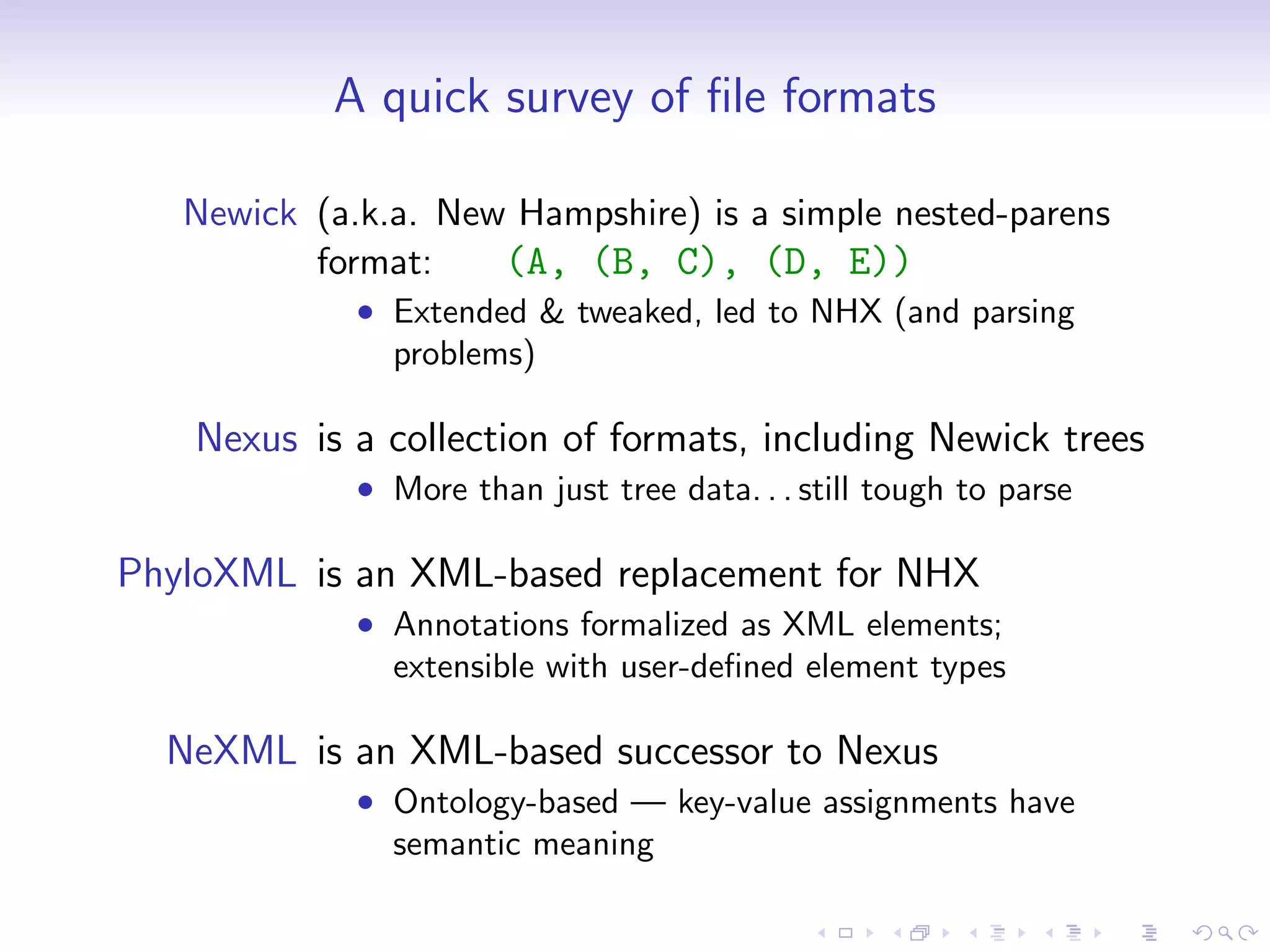
A quick survey of file formats

   Newick (a.k.a. New Hampshire) is a simple nested-parens
          format:    (A, (B, C), (D, E))
             • Extended & tweaked, led to NHX (and parsing
               problems)

   Nexus is a collection of formats, including Newick trees
             • More than just tree data. . . still tough to parse

PhyloXML is an XML-based replacement for NHX
             • Annotations formalized as XML elements;
               extensible with user-defined element types

  NeXML is an XML-based successor to Nexus
             • Ontology-based — key-value assignments have
               semantic meaning
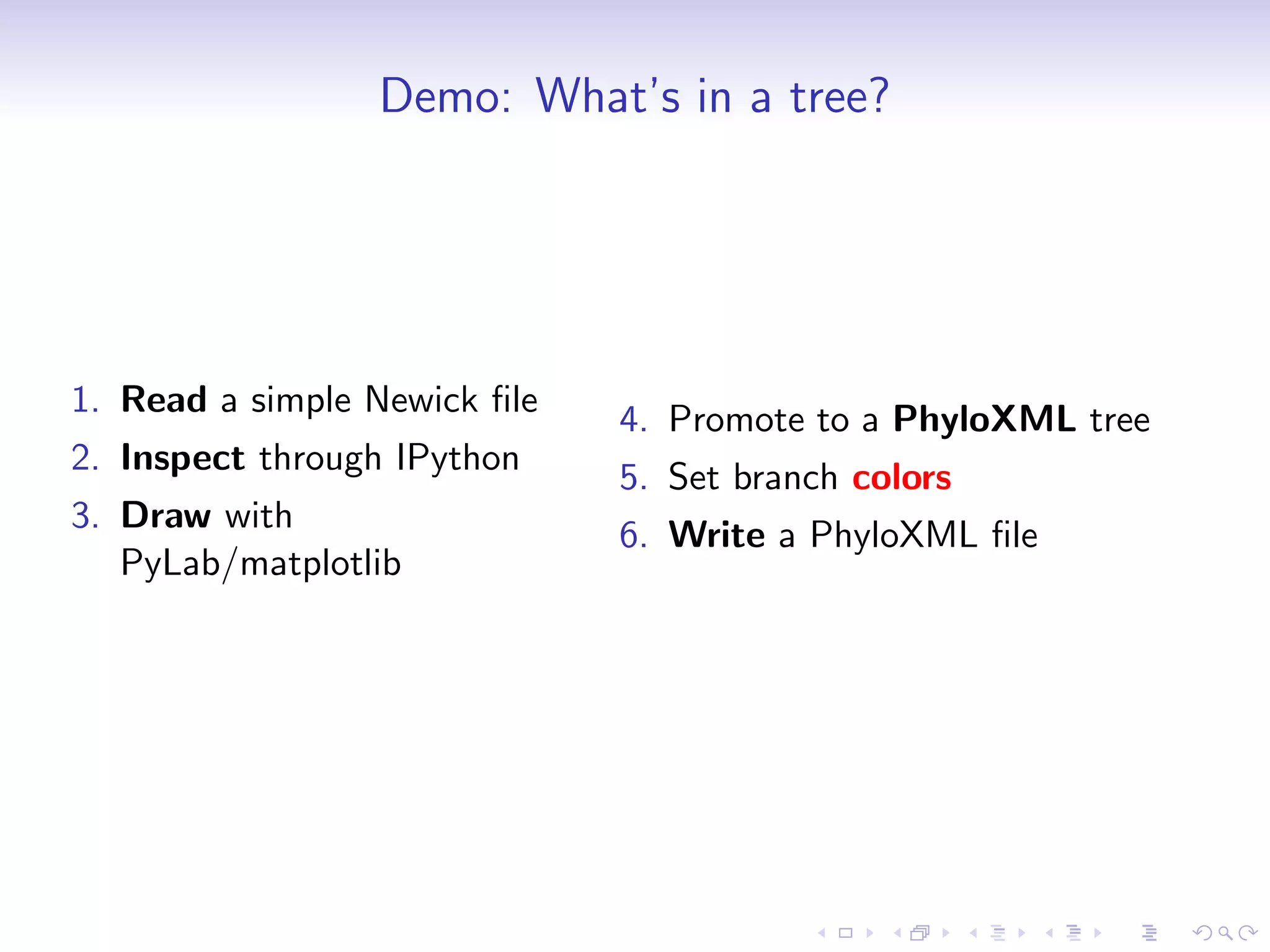
Demo: What’s in a tree?


1. Read a simple Newick file
                              4. Promote to a PhyloXML tree
2. Inspect through IPython
                              5. Set branch colors
3. Draw with
                              6. Write a PhyloXML file
   PyLab/matplotlib
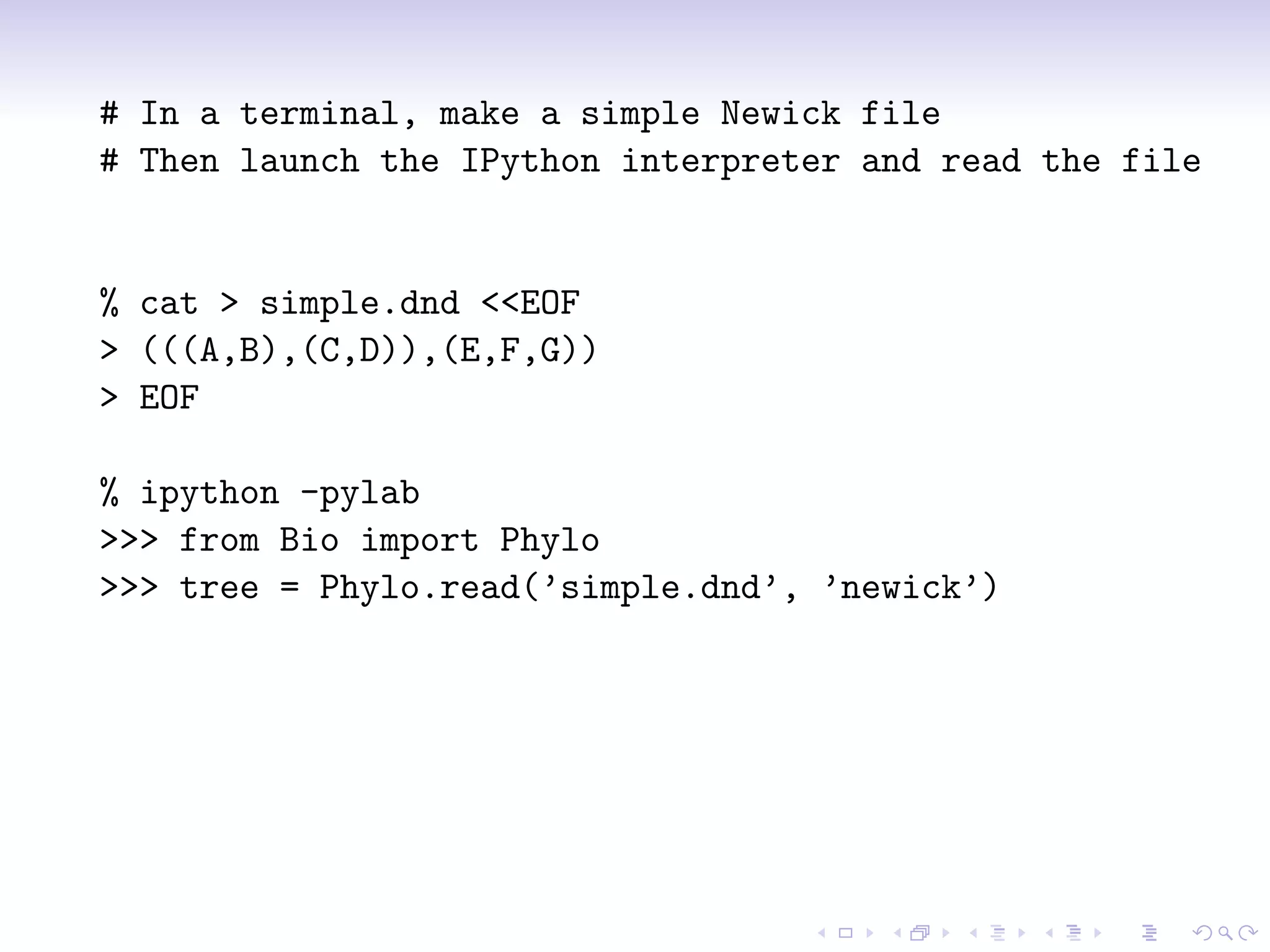
# In a terminal, make a simple Newick file
# Then launch the IPython interpreter and read the file


% cat > simple.dnd <<EOF
> (((A,B),(C,D)),(E,F,G))
> EOF

% ipython -pylab
>>> from Bio import Phylo
>>> tree = Phylo.read(’simple.dnd’, ’newick’)
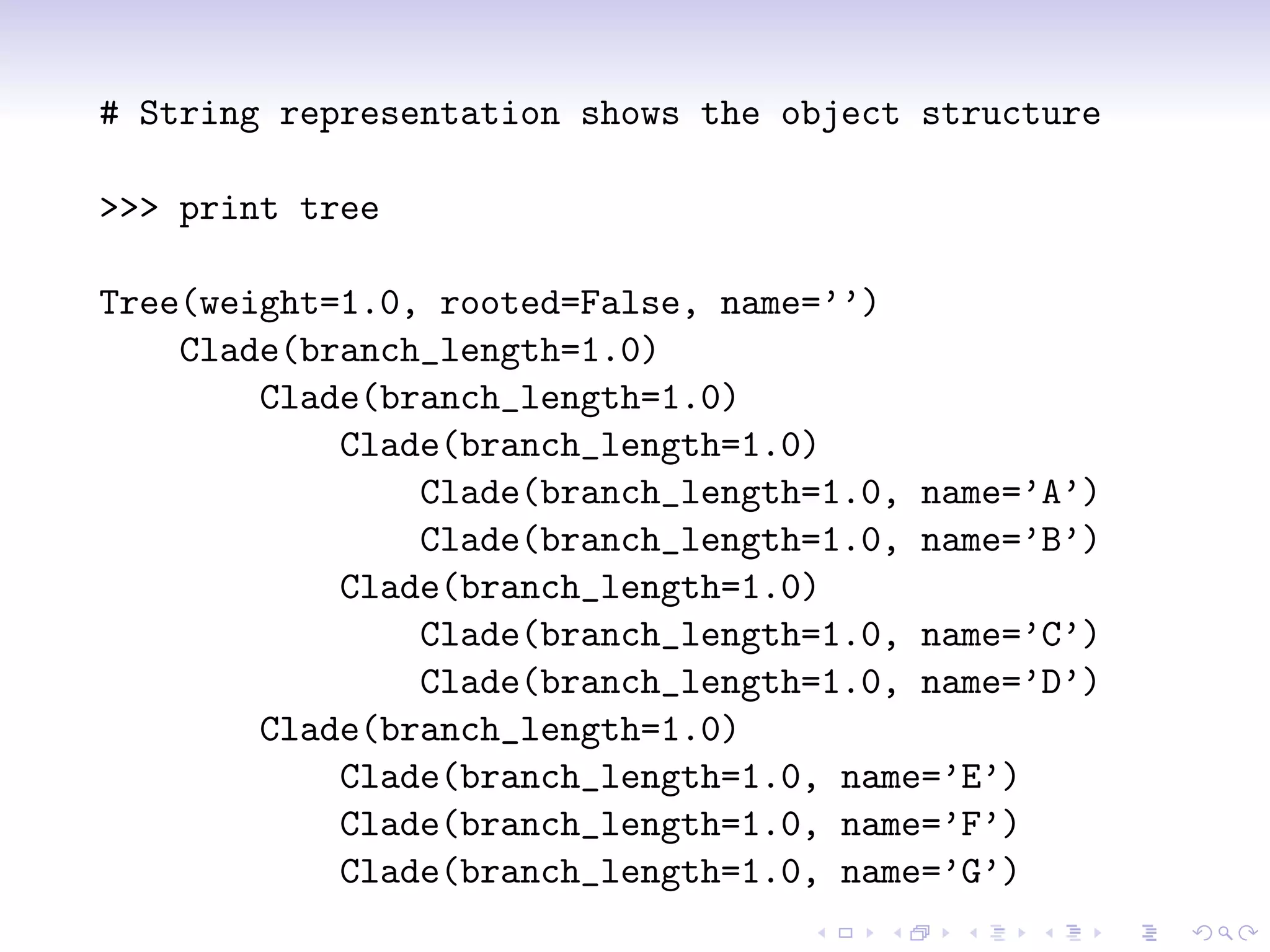
# String representation shows the object structure

>>> print tree

Tree(weight=1.0, rooted=False, name=’’)
    Clade(branch_length=1.0)
        Clade(branch_length=1.0)
            Clade(branch_length=1.0)
                Clade(branch_length=1.0, name=’A’)
                Clade(branch_length=1.0, name=’B’)
            Clade(branch_length=1.0)
                Clade(branch_length=1.0, name=’C’)
                Clade(branch_length=1.0, name=’D’)
        Clade(branch_length=1.0)
            Clade(branch_length=1.0, name=’E’)
            Clade(branch_length=1.0, name=’F’)
            Clade(branch_length=1.0, name=’G’)
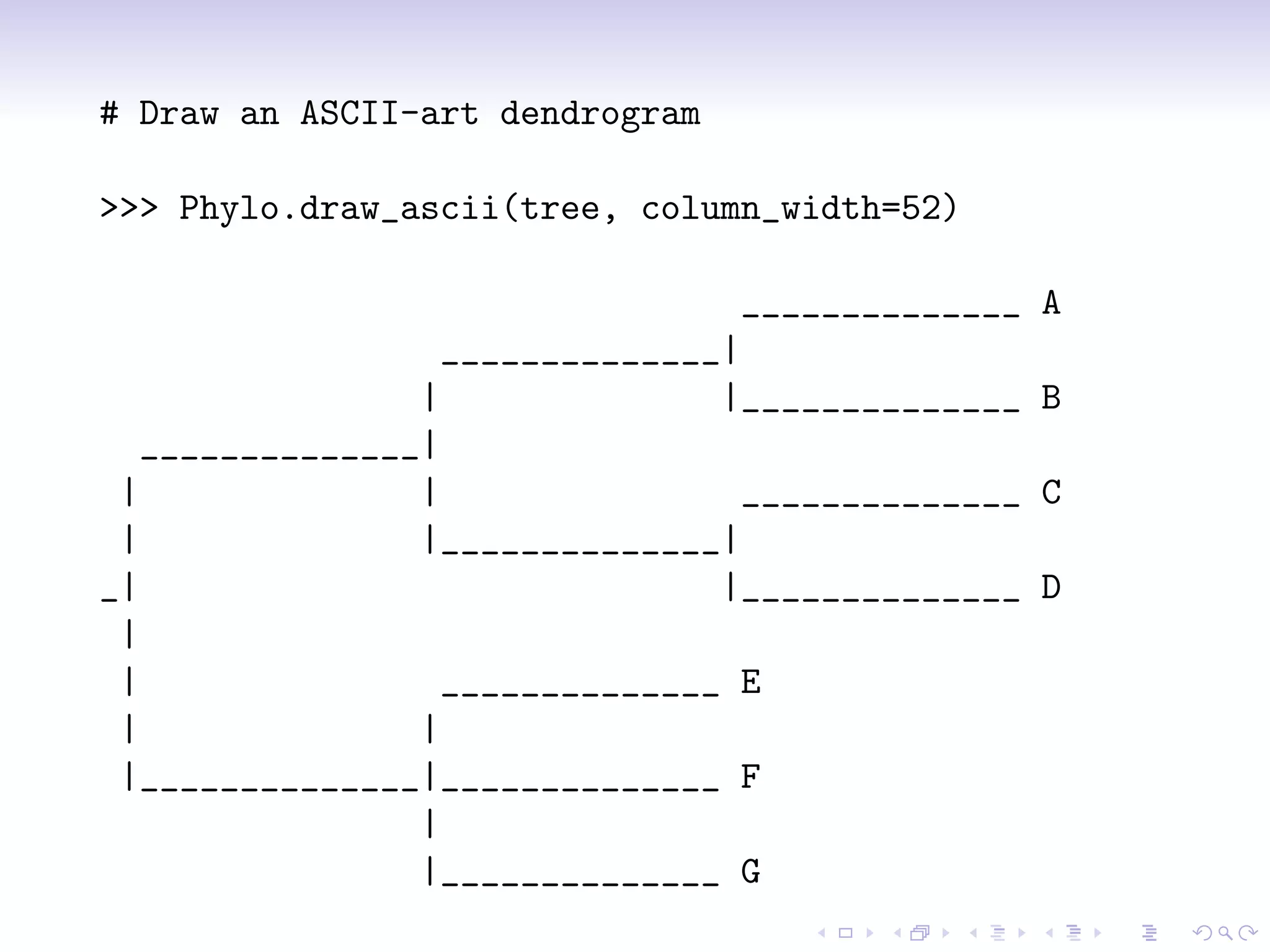
# Draw an ASCII-art dendrogram

>>> Phylo.draw_ascii(tree, column_width=52)

                                  ______________   A
                  ______________|
                 |               |______________   B
   ______________|
 |               |                ______________   C
 |               |______________|
_|                               |______________   D
 |
 |                 ______________ E
 |               |
 |______________|______________ F
                 |
                 |______________ G
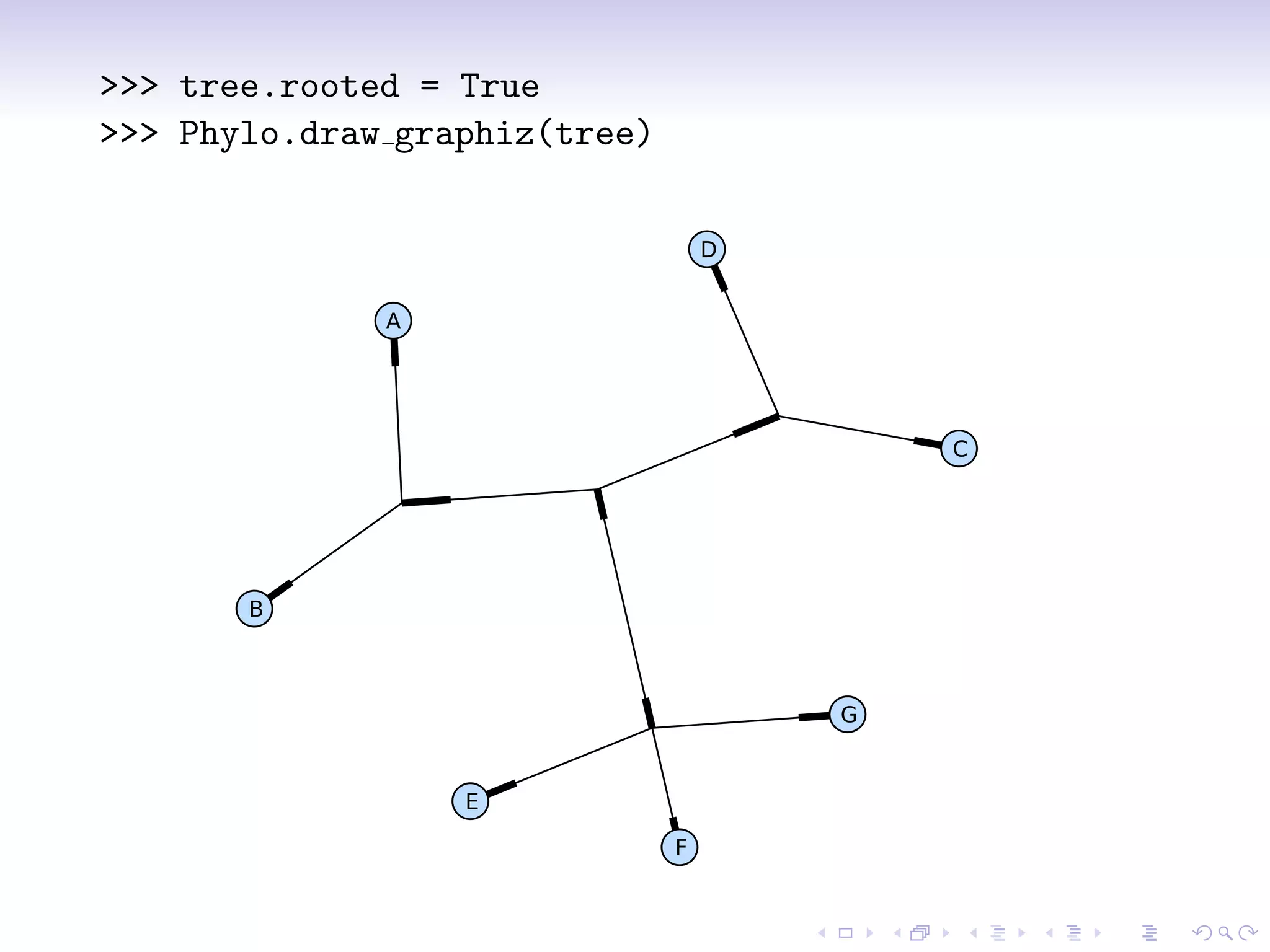
>>> tree.rooted = True
>>> Phylo.draw graphiz(tree)

                                   D
              A


                                           C


       B

                                       G

                  E
                               F
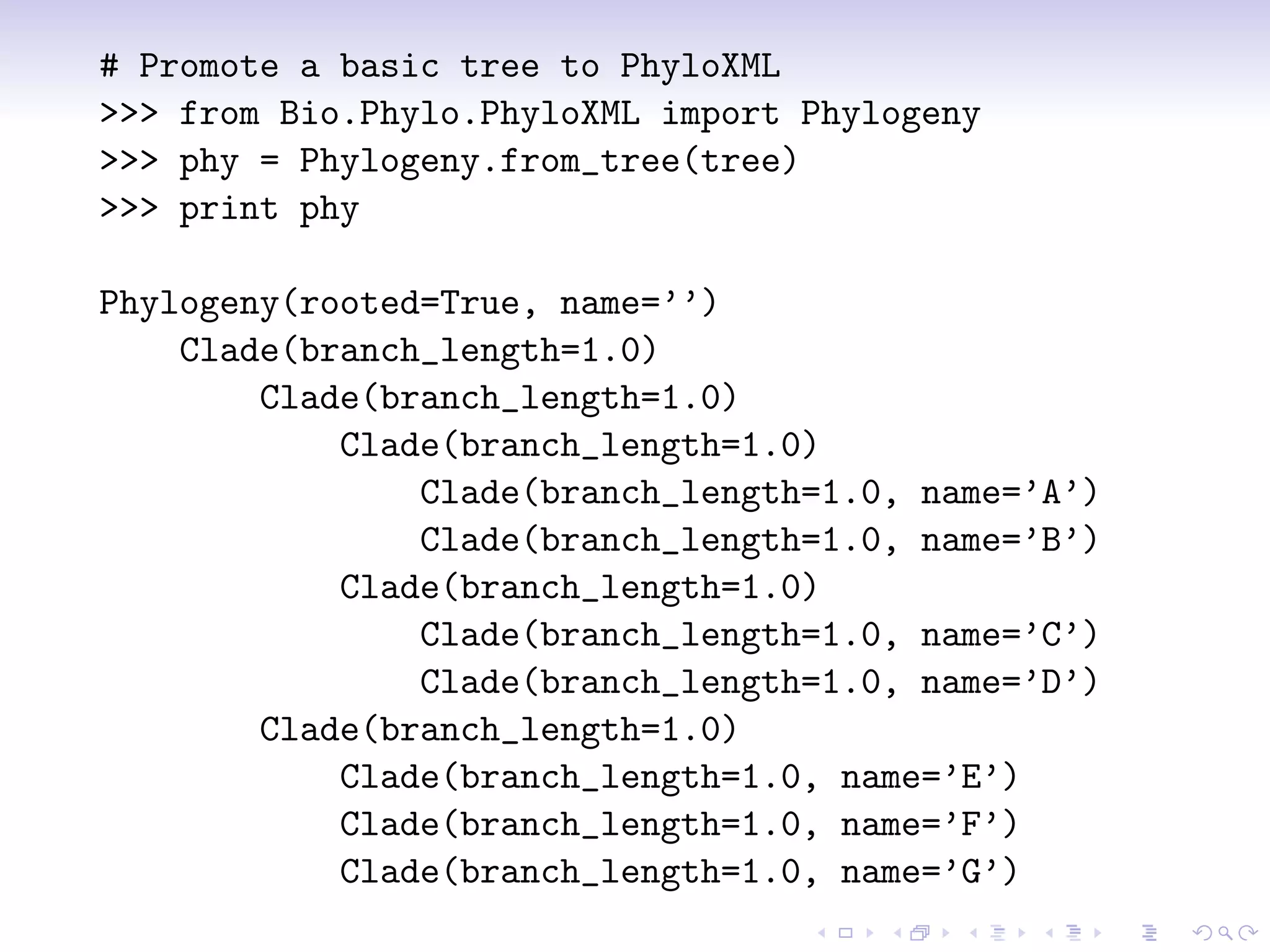
# Promote a basic tree to PhyloXML
>>> from Bio.Phylo.PhyloXML import Phylogeny
>>> phy = Phylogeny.from_tree(tree)
>>> print phy

Phylogeny(rooted=True, name=’’)
    Clade(branch_length=1.0)
        Clade(branch_length=1.0)
            Clade(branch_length=1.0)
                Clade(branch_length=1.0, name=’A’)
                Clade(branch_length=1.0, name=’B’)
            Clade(branch_length=1.0)
                Clade(branch_length=1.0, name=’C’)
                Clade(branch_length=1.0, name=’D’)
        Clade(branch_length=1.0)
            Clade(branch_length=1.0, name=’E’)
            Clade(branch_length=1.0, name=’F’)
            Clade(branch_length=1.0, name=’G’)
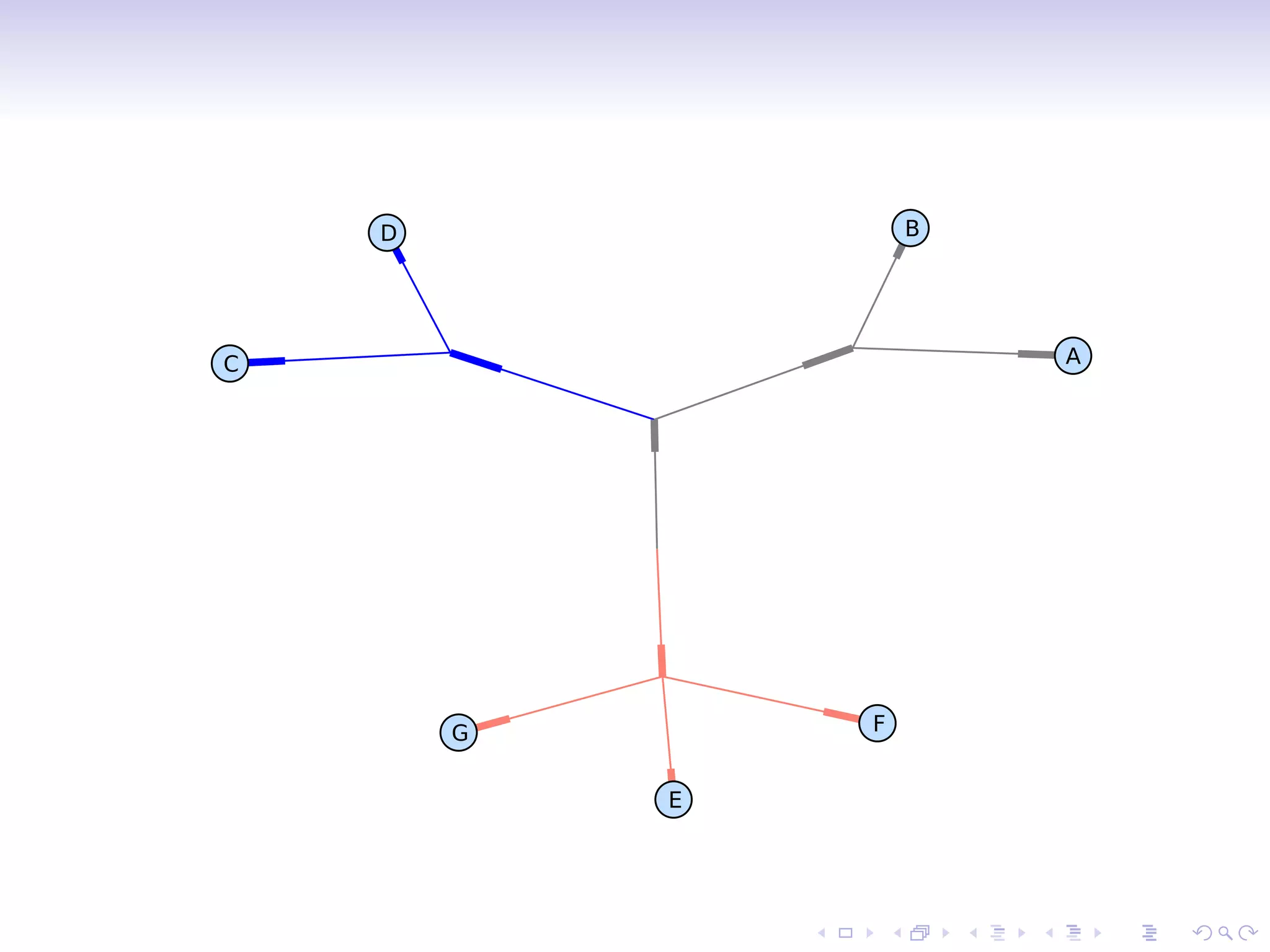
Branch color
>>> phy.root.color = (128, 128, 128)
Or:
>>> phy.root.color = ’#808080’
Or:
>>> phy.root.color = ’gray’

Find clades by attribute values:
>>> mrca = phy.common ancestor({’name’:’E’},
                                 {’name’:’F’})
>>> mrca.color = ’salmon’

Directly index a clade:
>>> phy.clade[0,1].color = ’blue’

>>> Phylo.draw graphviz(phy, prog=’neato’)
D               B


C                       A


        G       F

            E
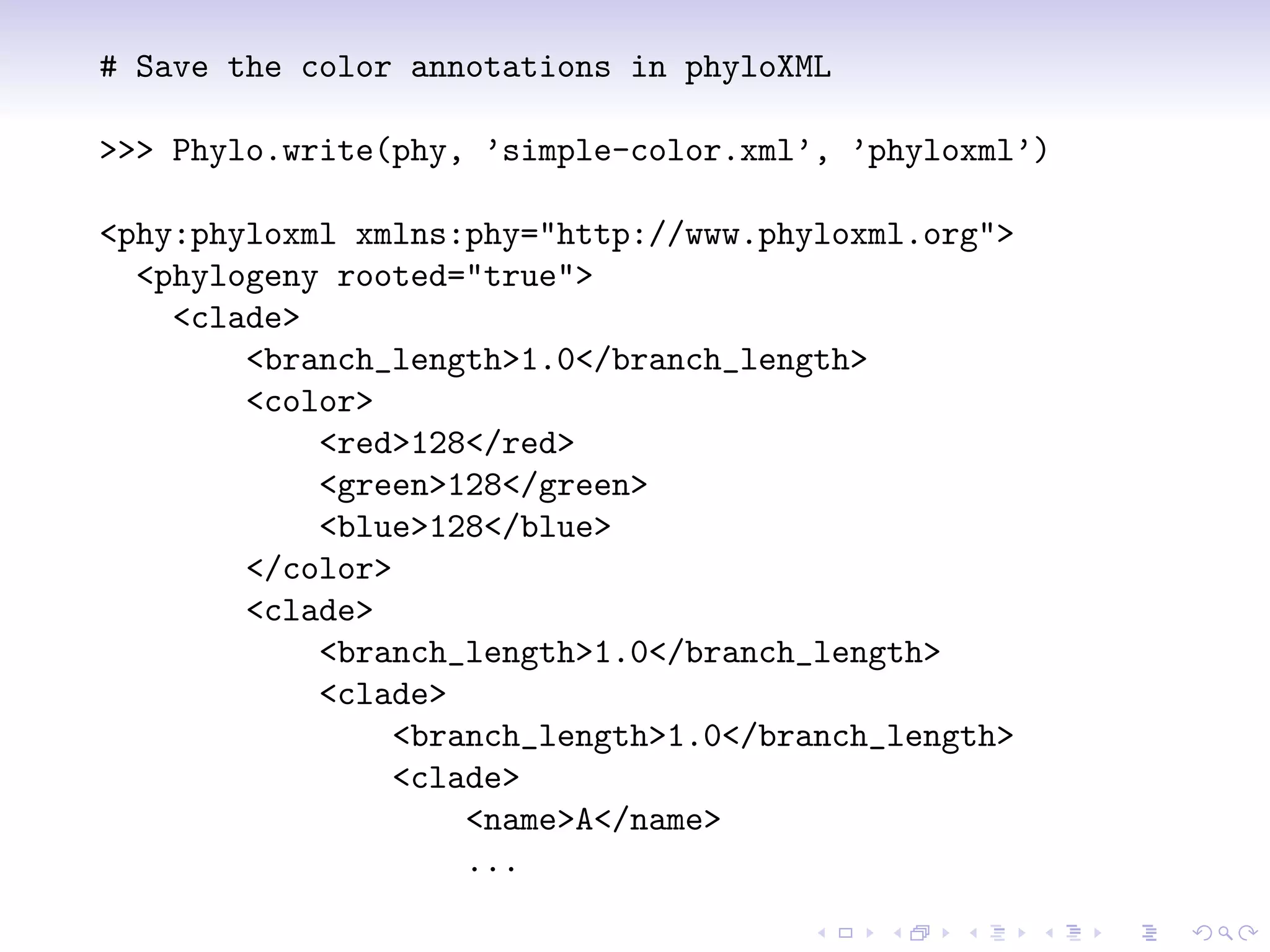
# Save the color annotations in phyloXML

>>> Phylo.write(phy, ’simple-color.xml’, ’phyloxml’)

<phy:phyloxml xmlns:phy="http://www.phyloxml.org">
  <phylogeny rooted="true">
    <clade>
        <branch_length>1.0</branch_length>
        <color>
            <red>128</red>
            <green>128</green>
            <blue>128</blue>
        </color>
        <clade>
            <branch_length>1.0</branch_length>
            <clade>
                 <branch_length>1.0</branch_length>
                 <clade>
                     <name>A</name>
                     ...
Thanks


Holla:
  • Brad Chapman and Christian Zmasek, GSoC 2009 mentors
  • The Biopython developers, feat. Peter J. A. Cock,
    Frank Kauff & Cymon J. Cox
  • Hilmar Lapp & the NESCent Phyloinformatics program
  • Google’s Open Source Programs Office
  • My professor, Dr. Natarajan Kannan
  • Developers like you
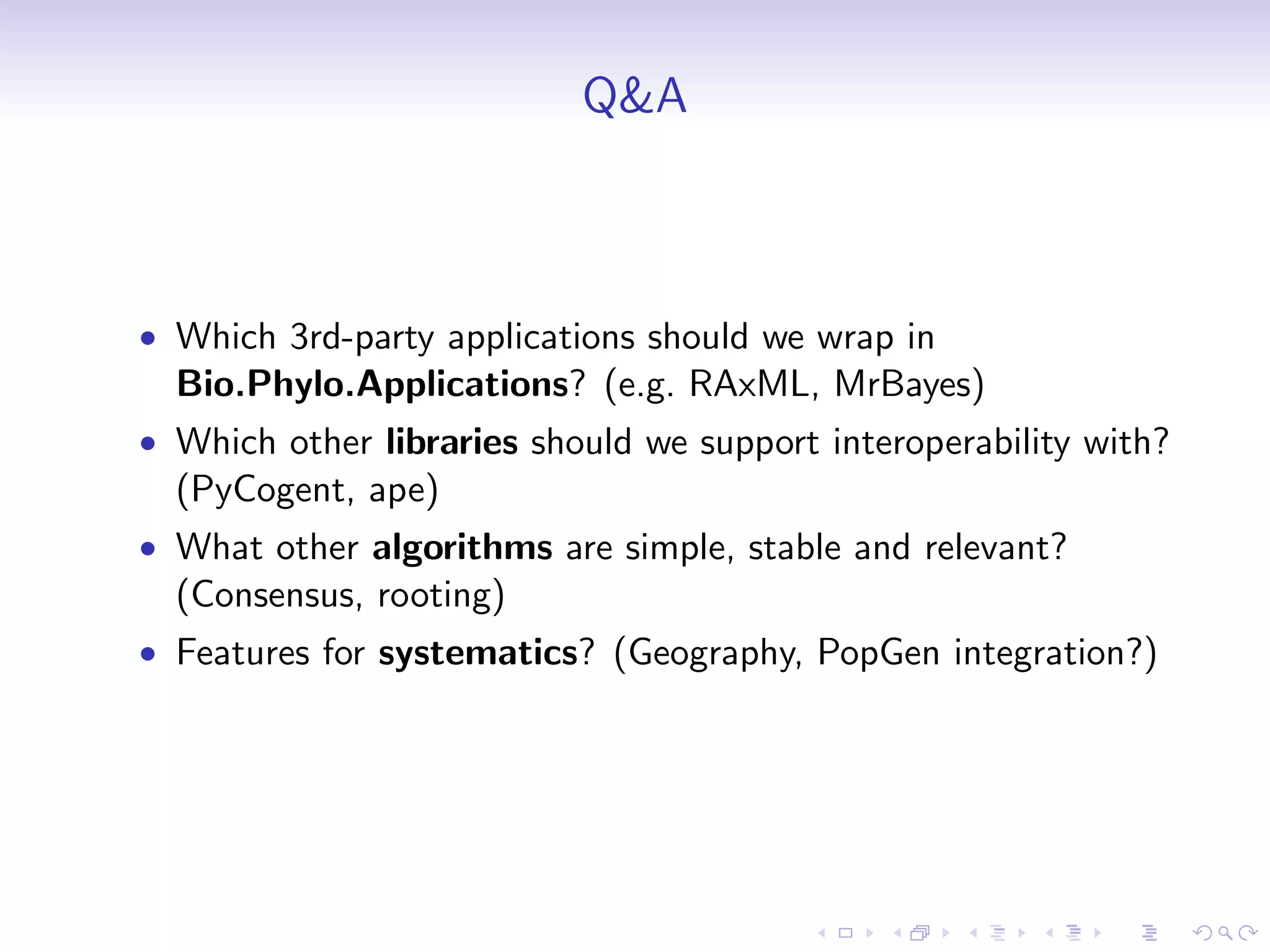
Q&A


• Which 3rd-party applications should we wrap in
  Bio.Phylo.Applications? (e.g. RAxML, MrBayes)
• Which other libraries should we support interoperability with?
  (PyCogent, ape)
• What other algorithms are simple, stable and relevant?
  (Consensus, rooting)
• Features for systematics? (Geography, PopGen integration?)
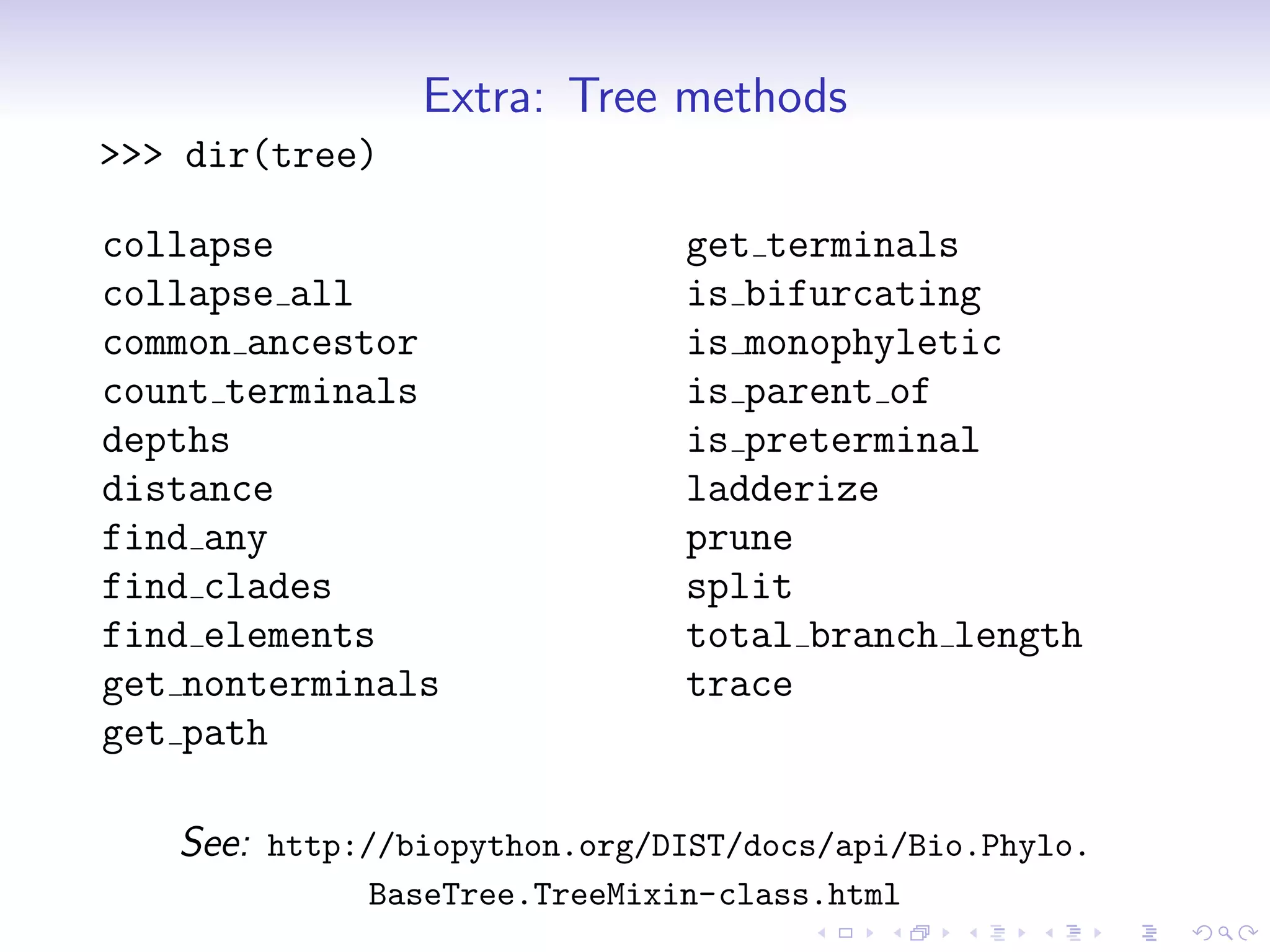
Extra: Tree methods
>>> dir(tree)

collapse                      get terminals
collapse all                  is bifurcating
common ancestor               is monophyletic
count terminals               is parent of
depths                        is preterminal
distance                      ladderize
find any                      prune
find clades                   split
find elements                 total branch length
get nonterminals              trace
get path

   See: http://biopython.org/DIST/docs/api/Bio.Phylo.
             BaseTree.TreeMixin-class.html
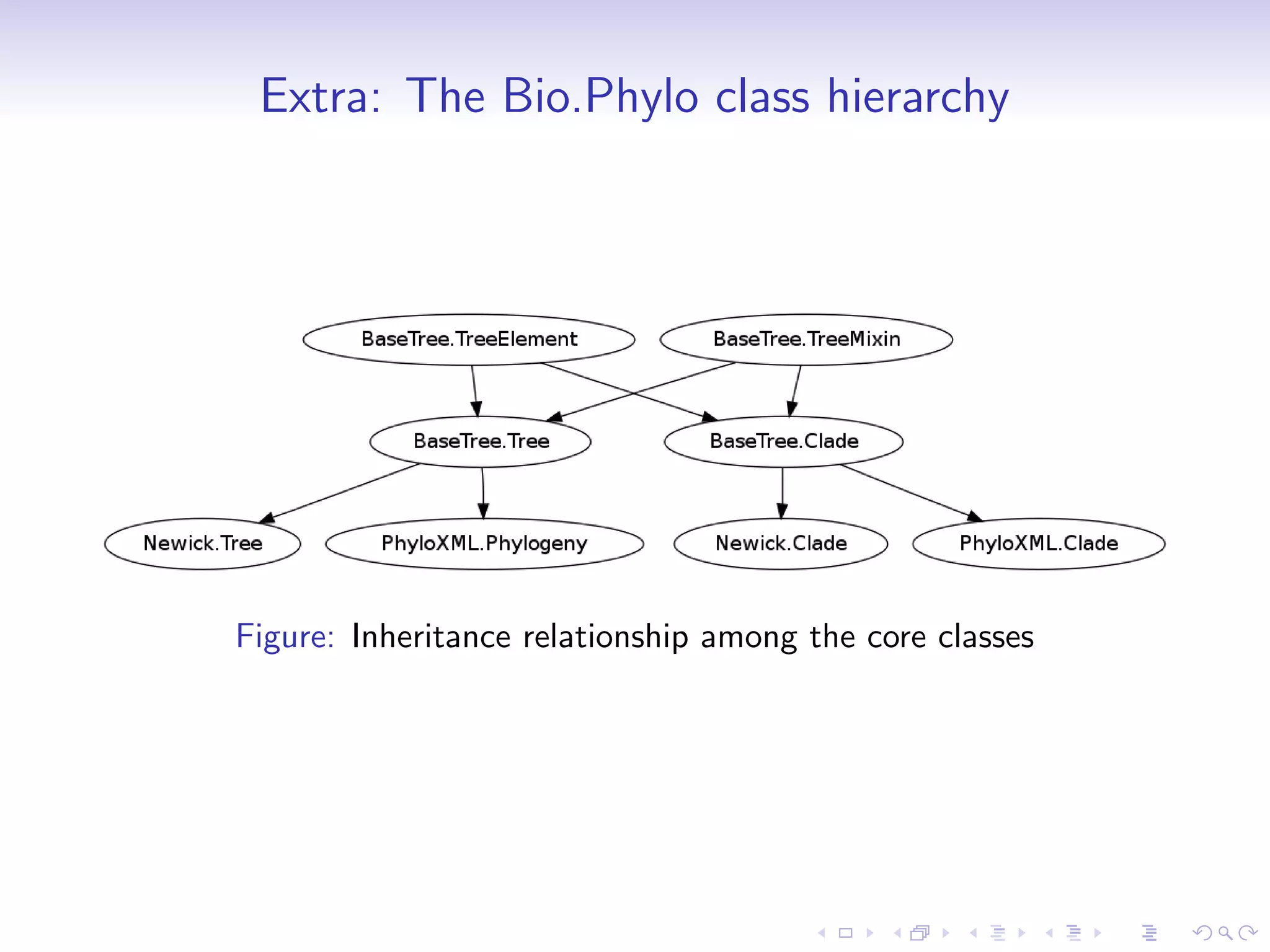
Extra: The Bio.Phylo class hierarchy


Figure: Inheritance relationship among the core classes
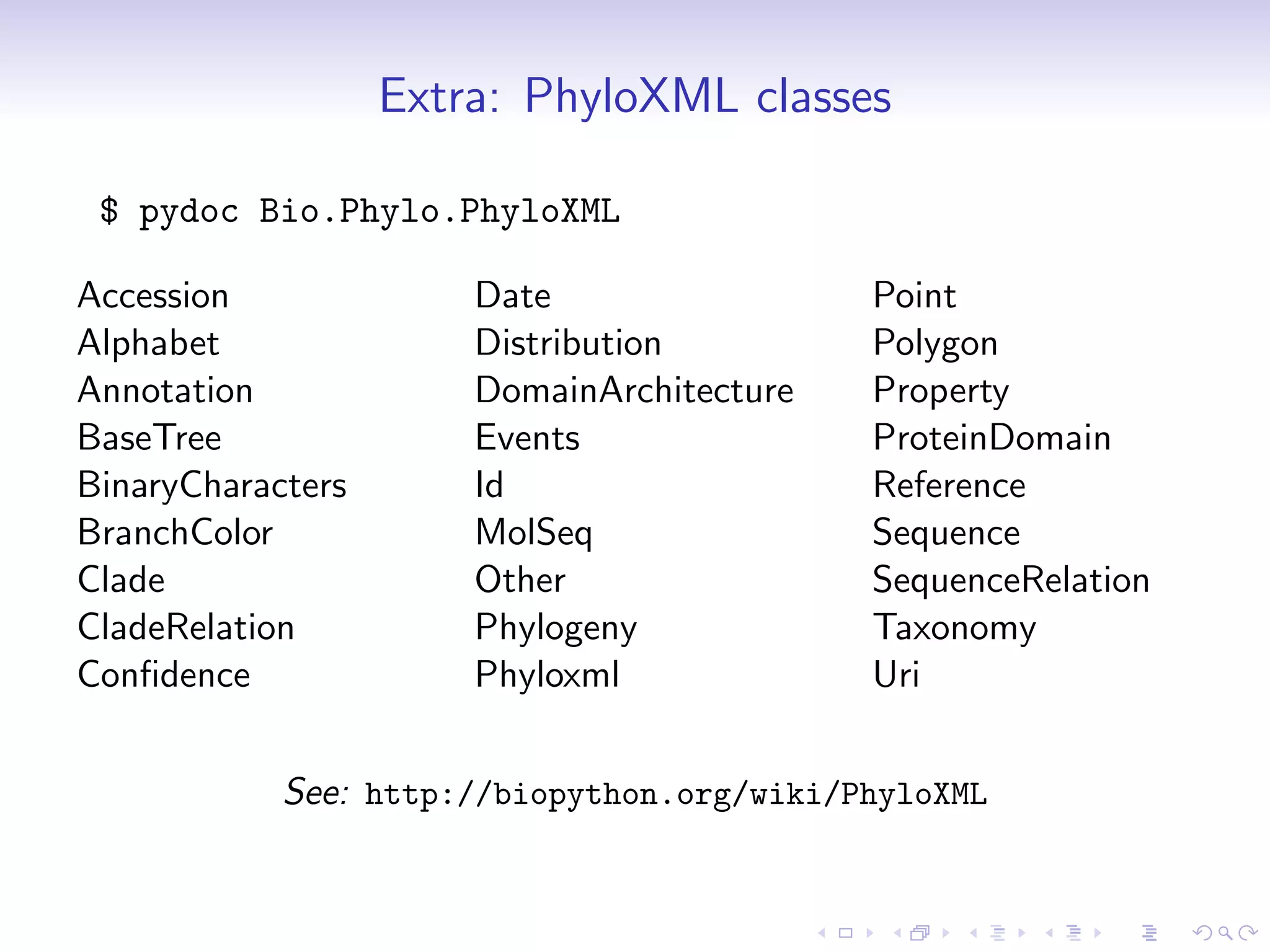
Extra: PhyloXML classes

 $ pydoc Bio.Phylo.PhyloXML

Accession              Date                 Point
Alphabet               Distribution         Polygon
Annotation             DomainArchitecture   Property
BaseTree               Events               ProteinDomain
BinaryCharacters       Id                   Reference
BranchColor            MolSeq               Sequence
Clade                  Other                SequenceRelation
CladeRelation          Phylogeny            Taxonomy
Confidence              Phyloxml             Uri


            See: http://biopython.org/wiki/PhyloXML

Bio.Phylo: Phylogenetics in Biopython (BOSC 2010)

  • 1.
    Bio.Phylo A unified phylogeneticstoolkit for Biopython Eric Talevich Institute of Bioinformatics University of Georgia June 29, 2010
  • 2.
    Abstract Bio.Phylo is a new phylogenetics library for: • Exploring, modifying and annotating trees • Reading & writing standard file formats • Quick visualization • Gluing together computational pipelines Availability: Biopython 1.54
  • 3.
    A quick surveyof file formats Newick (a.k.a. New Hampshire) is a simple nested-parens format: (A, (B, C), (D, E)) • Extended & tweaked, led to NHX (and parsing problems) Nexus is a collection of formats, including Newick trees • More than just tree data. . . still tough to parse PhyloXML is an XML-based replacement for NHX • Annotations formalized as XML elements; extensible with user-defined element types NeXML is an XML-based successor to Nexus • Ontology-based — key-value assignments have semantic meaning
  • 4.
    Demo: What’s ina tree? 1. Read a simple Newick file 4. Promote to a PhyloXML tree 2. Inspect through IPython 5. Set branch colors 3. Draw with 6. Write a PhyloXML file PyLab/matplotlib
  • 5.
    # In aterminal, make a simple Newick file # Then launch the IPython interpreter and read the file % cat > simple.dnd <<EOF > (((A,B),(C,D)),(E,F,G)) > EOF % ipython -pylab >>> from Bio import Phylo >>> tree = Phylo.read(’simple.dnd’, ’newick’)
  • 6.
    # String representationshows the object structure >>> print tree Tree(weight=1.0, rooted=False, name=’’) Clade(branch_length=1.0) Clade(branch_length=1.0) Clade(branch_length=1.0) Clade(branch_length=1.0, name=’A’) Clade(branch_length=1.0, name=’B’) Clade(branch_length=1.0) Clade(branch_length=1.0, name=’C’) Clade(branch_length=1.0, name=’D’) Clade(branch_length=1.0) Clade(branch_length=1.0, name=’E’) Clade(branch_length=1.0, name=’F’) Clade(branch_length=1.0, name=’G’)
  • 7.
    # Draw anASCII-art dendrogram >>> Phylo.draw_ascii(tree, column_width=52) ______________ A ______________| | |______________ B ______________| | | ______________ C | |______________| _| |______________ D | | ______________ E | | |______________|______________ F | |______________ G
  • 8.
    >>> tree.rooted =True >>> Phylo.draw graphiz(tree) D A C B G E F
  • 9.
    # Promote abasic tree to PhyloXML >>> from Bio.Phylo.PhyloXML import Phylogeny >>> phy = Phylogeny.from_tree(tree) >>> print phy Phylogeny(rooted=True, name=’’) Clade(branch_length=1.0) Clade(branch_length=1.0) Clade(branch_length=1.0) Clade(branch_length=1.0, name=’A’) Clade(branch_length=1.0, name=’B’) Clade(branch_length=1.0) Clade(branch_length=1.0, name=’C’) Clade(branch_length=1.0, name=’D’) Clade(branch_length=1.0) Clade(branch_length=1.0, name=’E’) Clade(branch_length=1.0, name=’F’) Clade(branch_length=1.0, name=’G’)
  • 10.
    Branch color >>> phy.root.color= (128, 128, 128) Or: >>> phy.root.color = ’#808080’ Or: >>> phy.root.color = ’gray’ Find clades by attribute values: >>> mrca = phy.common ancestor({’name’:’E’}, {’name’:’F’}) >>> mrca.color = ’salmon’ Directly index a clade: >>> phy.clade[0,1].color = ’blue’ >>> Phylo.draw graphviz(phy, prog=’neato’)
  • 11.
    D B C A G F E
  • 12.
    # Save thecolor annotations in phyloXML >>> Phylo.write(phy, ’simple-color.xml’, ’phyloxml’) <phy:phyloxml xmlns:phy="http://www.phyloxml.org"> <phylogeny rooted="true"> <clade> <branch_length>1.0</branch_length> <color> <red>128</red> <green>128</green> <blue>128</blue> </color> <clade> <branch_length>1.0</branch_length> <clade> <branch_length>1.0</branch_length> <clade> <name>A</name> ...
  • 13.
    Thanks Holla: •Brad Chapman and Christian Zmasek, GSoC 2009 mentors • The Biopython developers, feat. Peter J. A. Cock, Frank Kauff & Cymon J. Cox • Hilmar Lapp & the NESCent Phyloinformatics program • Google’s Open Source Programs Office • My professor, Dr. Natarajan Kannan • Developers like you
  • 14.
    Q&A • Which 3rd-partyapplications should we wrap in Bio.Phylo.Applications? (e.g. RAxML, MrBayes) • Which other libraries should we support interoperability with? (PyCogent, ape) • What other algorithms are simple, stable and relevant? (Consensus, rooting) • Features for systematics? (Geography, PopGen integration?)
  • 15.
    Extra: Tree methods >>>dir(tree) collapse get terminals collapse all is bifurcating common ancestor is monophyletic count terminals is parent of depths is preterminal distance ladderize find any prune find clades split find elements total branch length get nonterminals trace get path See: http://biopython.org/DIST/docs/api/Bio.Phylo. BaseTree.TreeMixin-class.html
  • 16.
    Extra: The Bio.Phyloclass hierarchy Figure: Inheritance relationship among the core classes
  • 17.
    Extra: PhyloXML classes $ pydoc Bio.Phylo.PhyloXML Accession Date Point Alphabet Distribution Polygon Annotation DomainArchitecture Property BaseTree Events ProteinDomain BinaryCharacters Id Reference BranchColor MolSeq Sequence Clade Other SequenceRelation CladeRelation Phylogeny Taxonomy Confidence Phyloxml Uri See: http://biopython.org/wiki/PhyloXML