




Field staff training Programme   Haryana   15 April 2009 Karnal
Rice is a major source of food in India It is staple food for nearly 2/3 of Indian population Rice is the single largest crop in India with 42 million ha. with a production of 88 Million tons (milled rice) Rice covers 22% of total cropped area with 39% of total cereal acreages.  Haryana contribute 61% total basmati rice produced in India.  Uttar Pradesh is having highestPaddy and  hybrid of Rice acreages  in India Rice  -- Some Facts
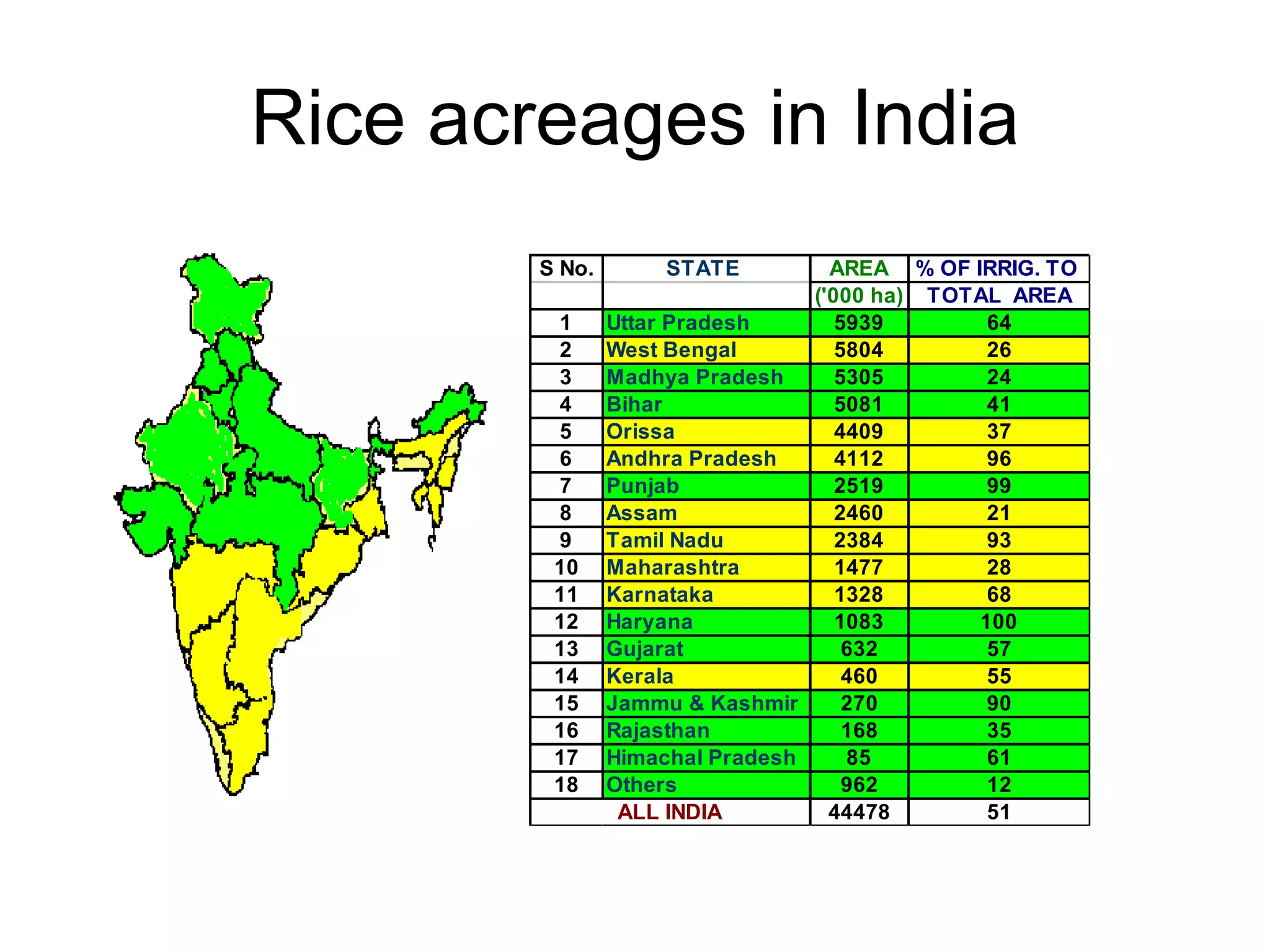
Rice acreages in India
Crop Biology of Rice Packages of practices Insect Management Diseases Management Nutrient Deficiencies UPL product profile Q&A and Quiz Topics to be covered
GROWTH STAGES OF RICE PLANT
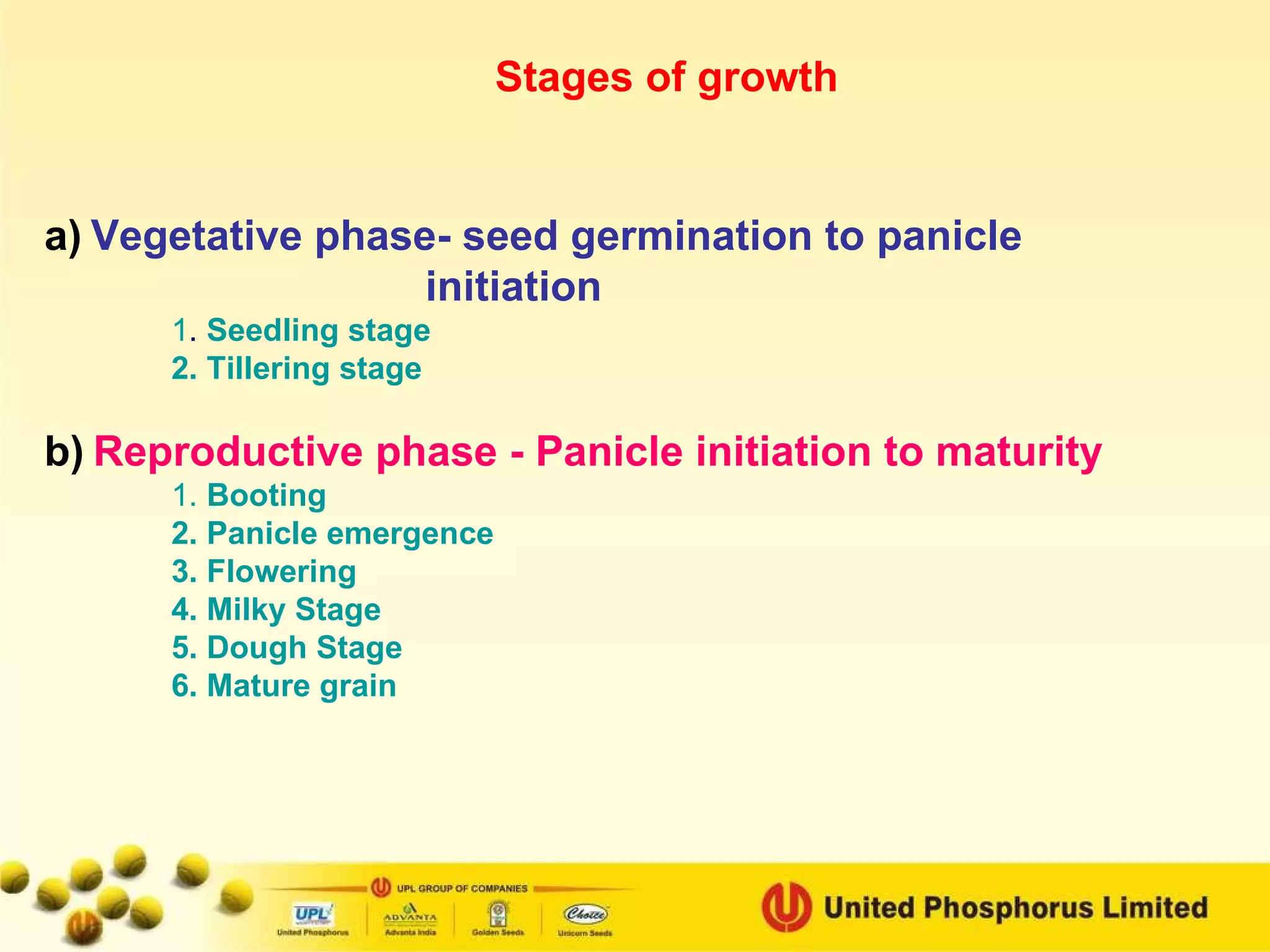
The growth of the rice plant is divided into three phases:   1.Vegetative  (germination  to panicle initiation) 2. Reproductive  (panicle initiation to flowering);  3.  Ripening  (flowering to mature grain) Phases of Growth
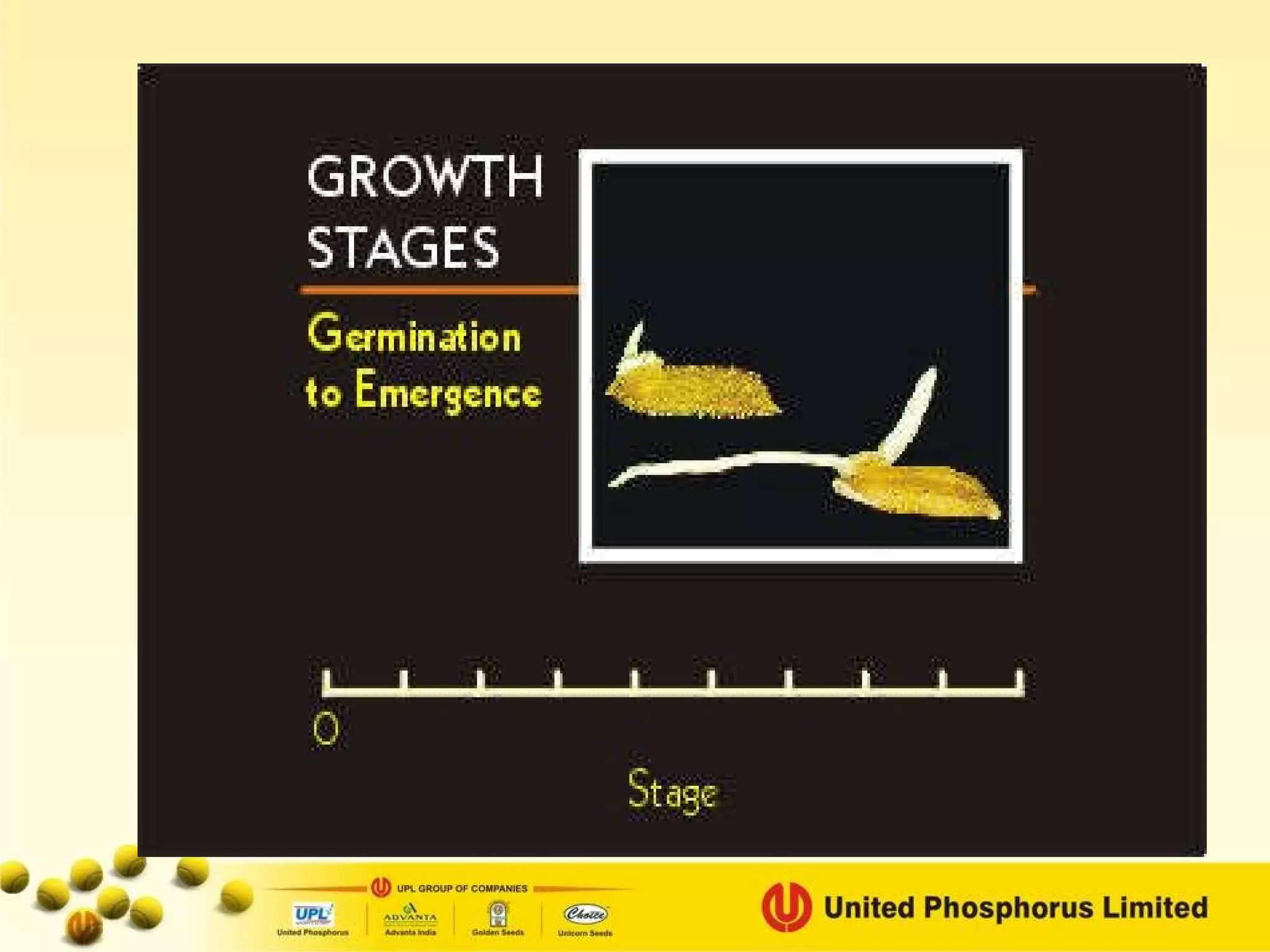
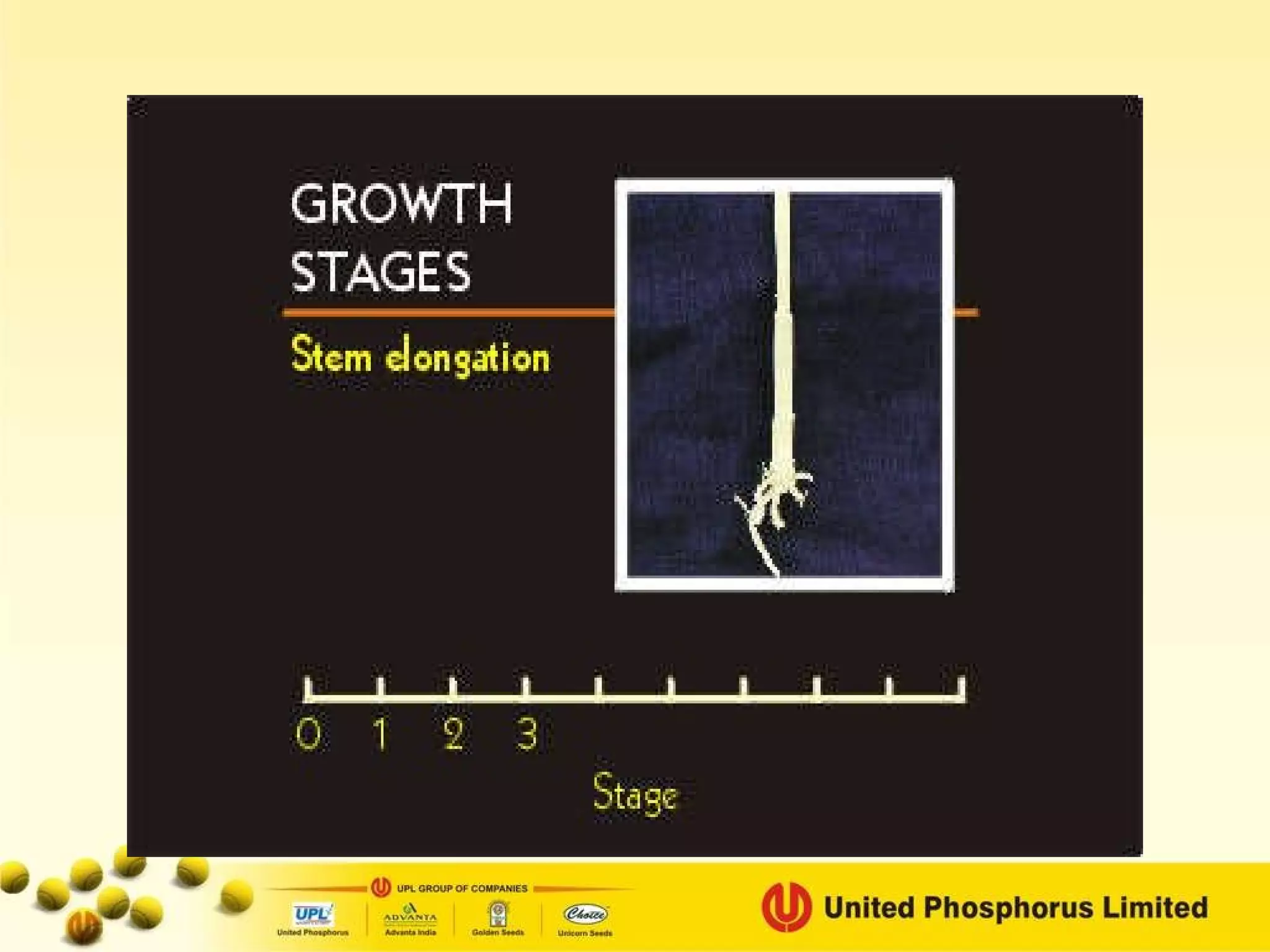
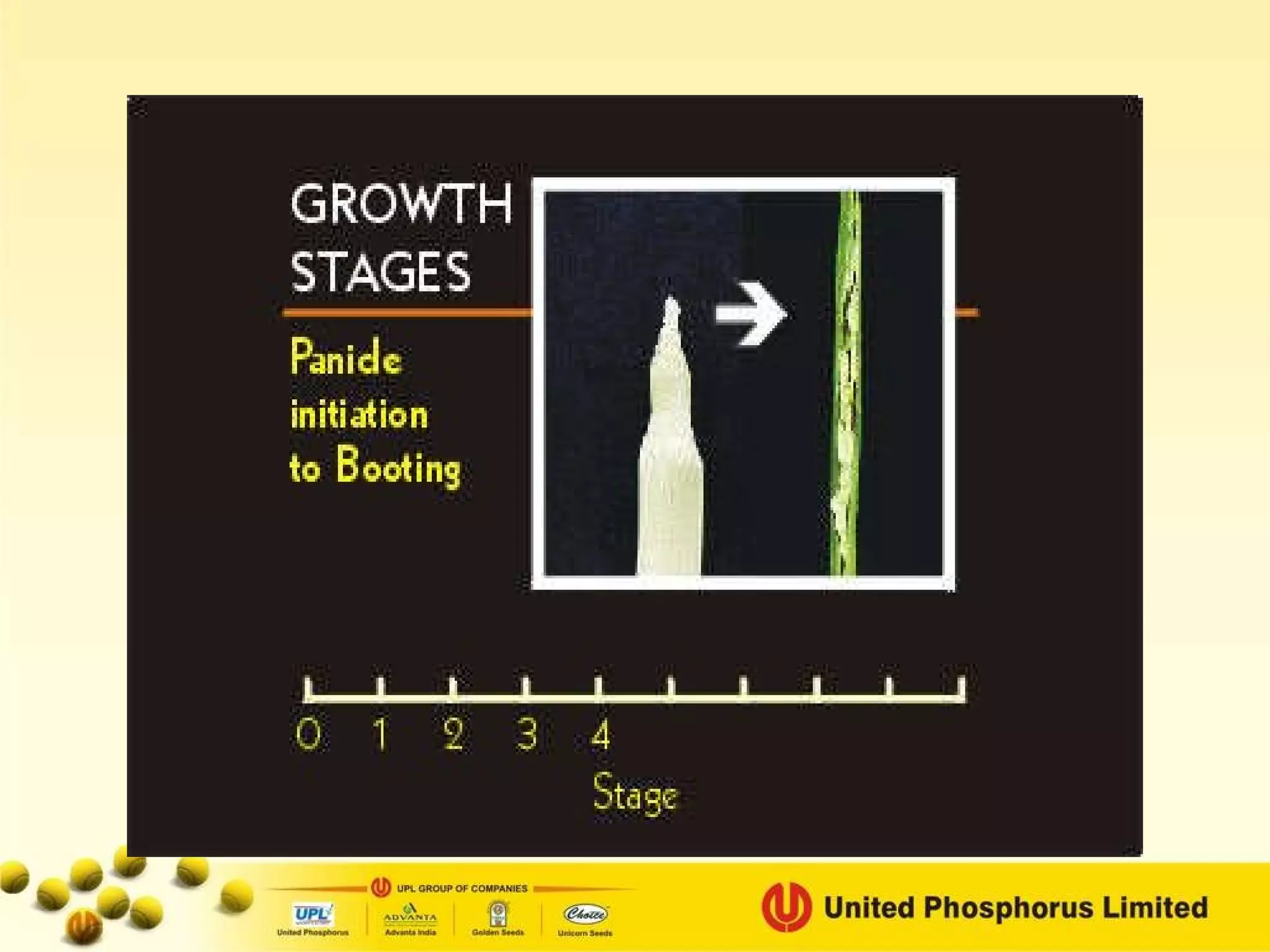
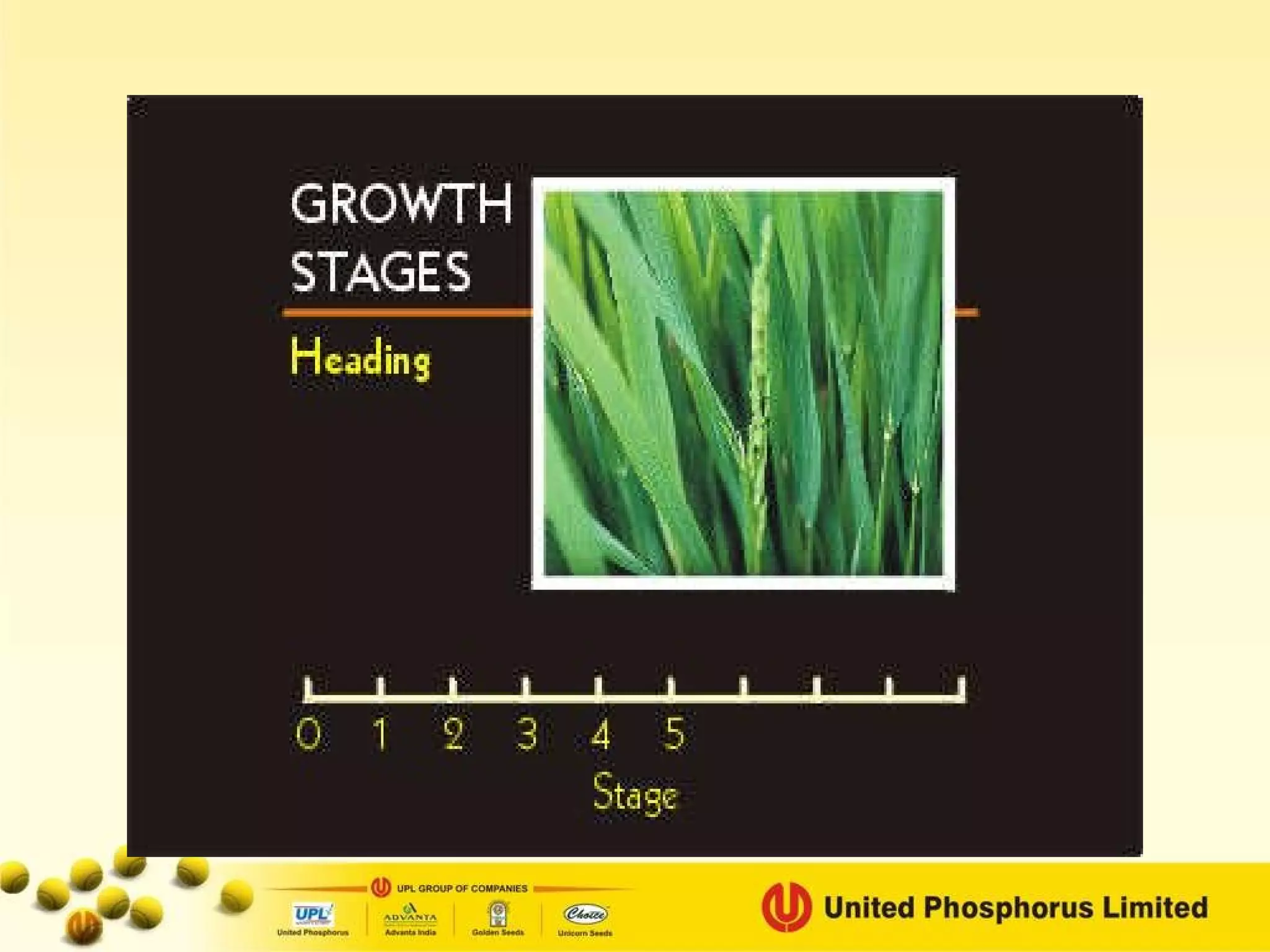
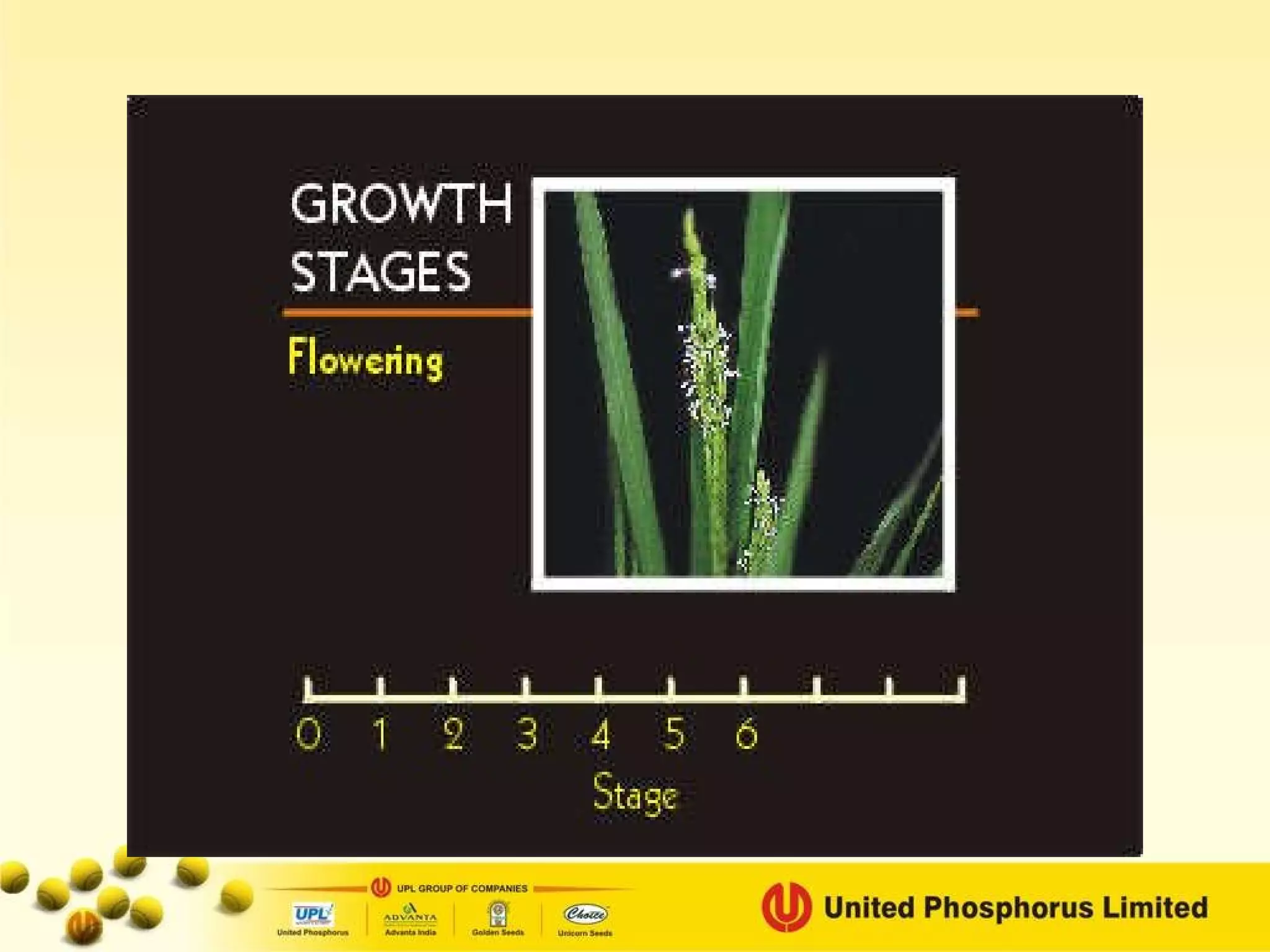
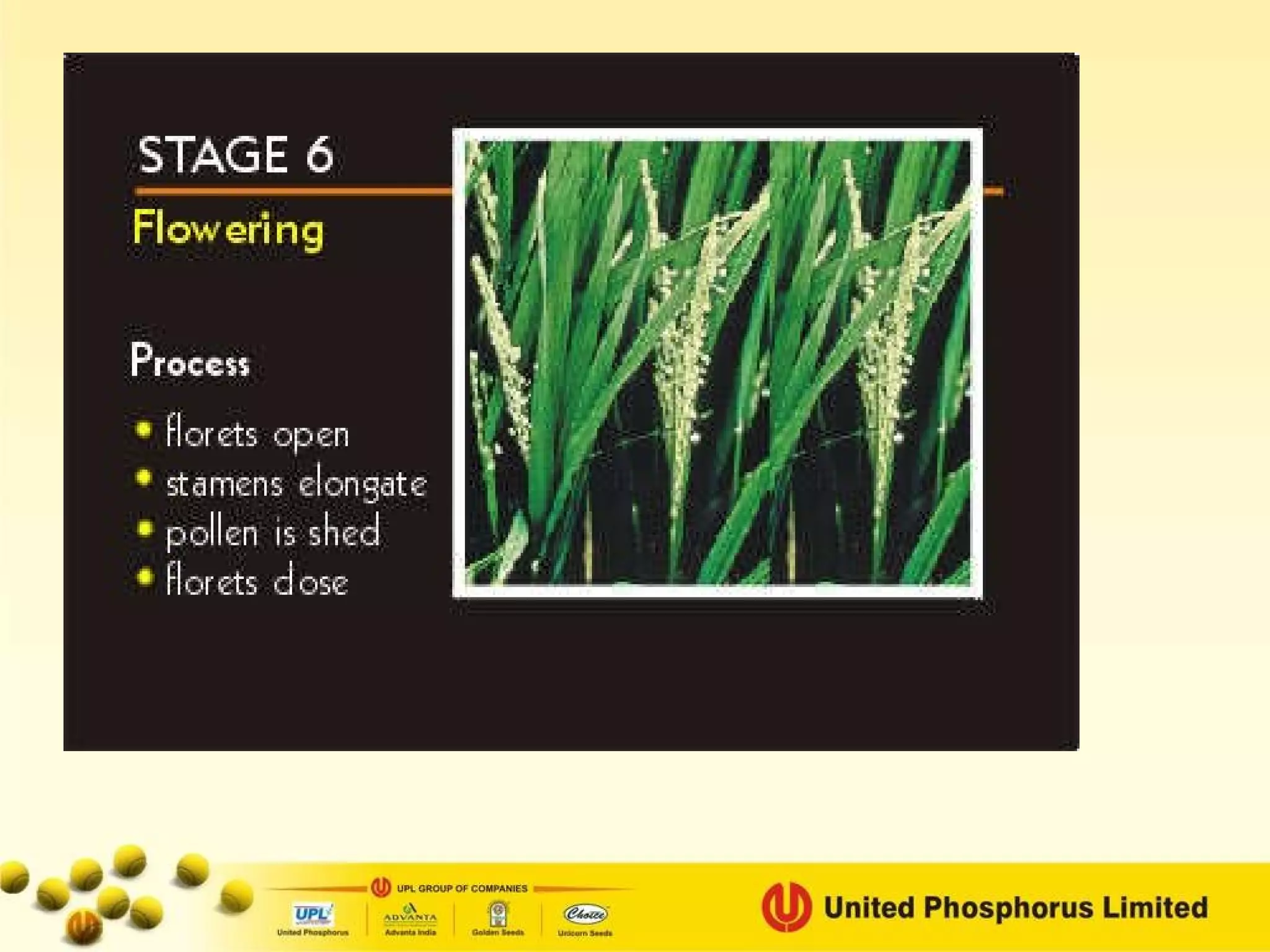
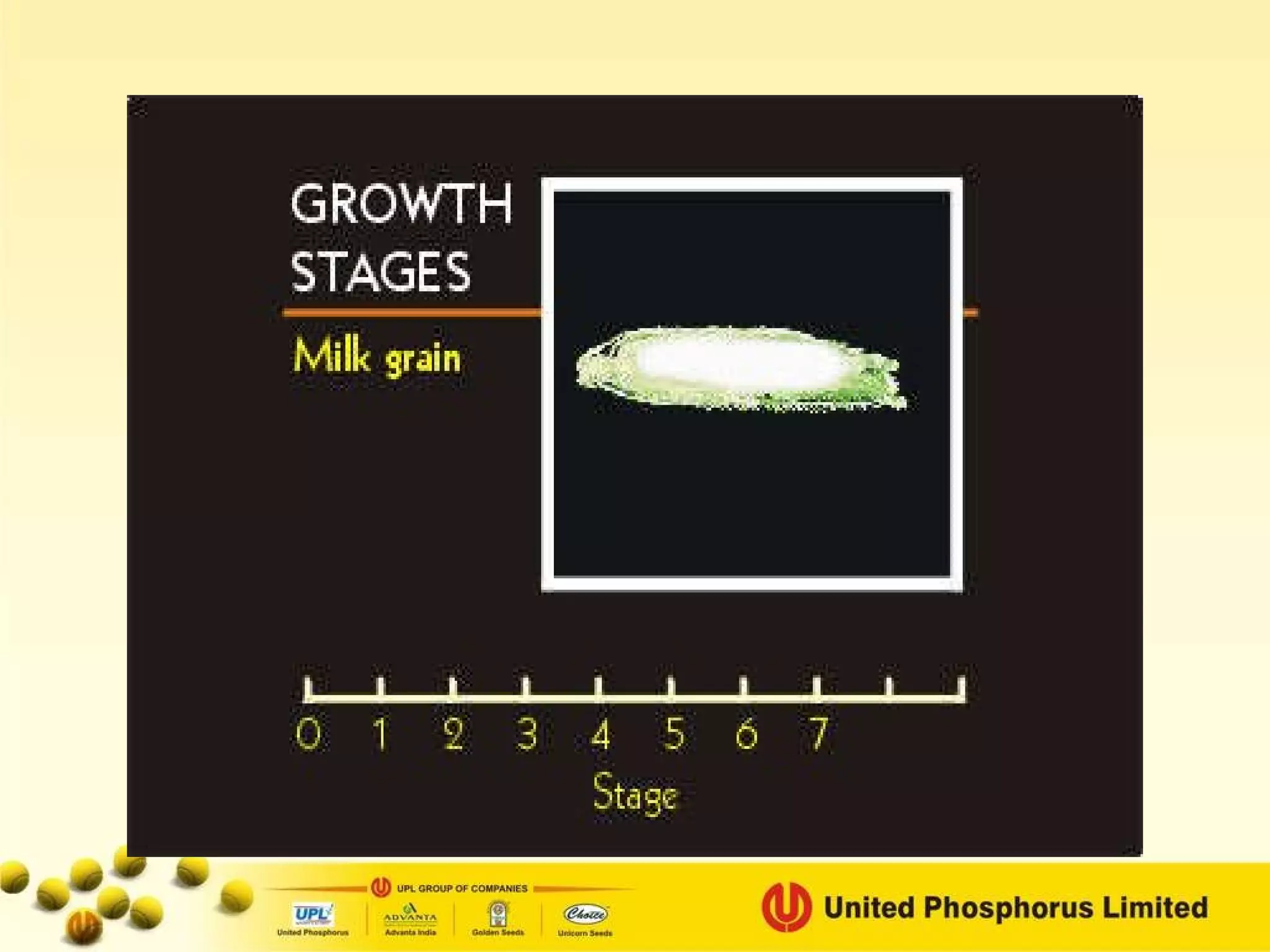
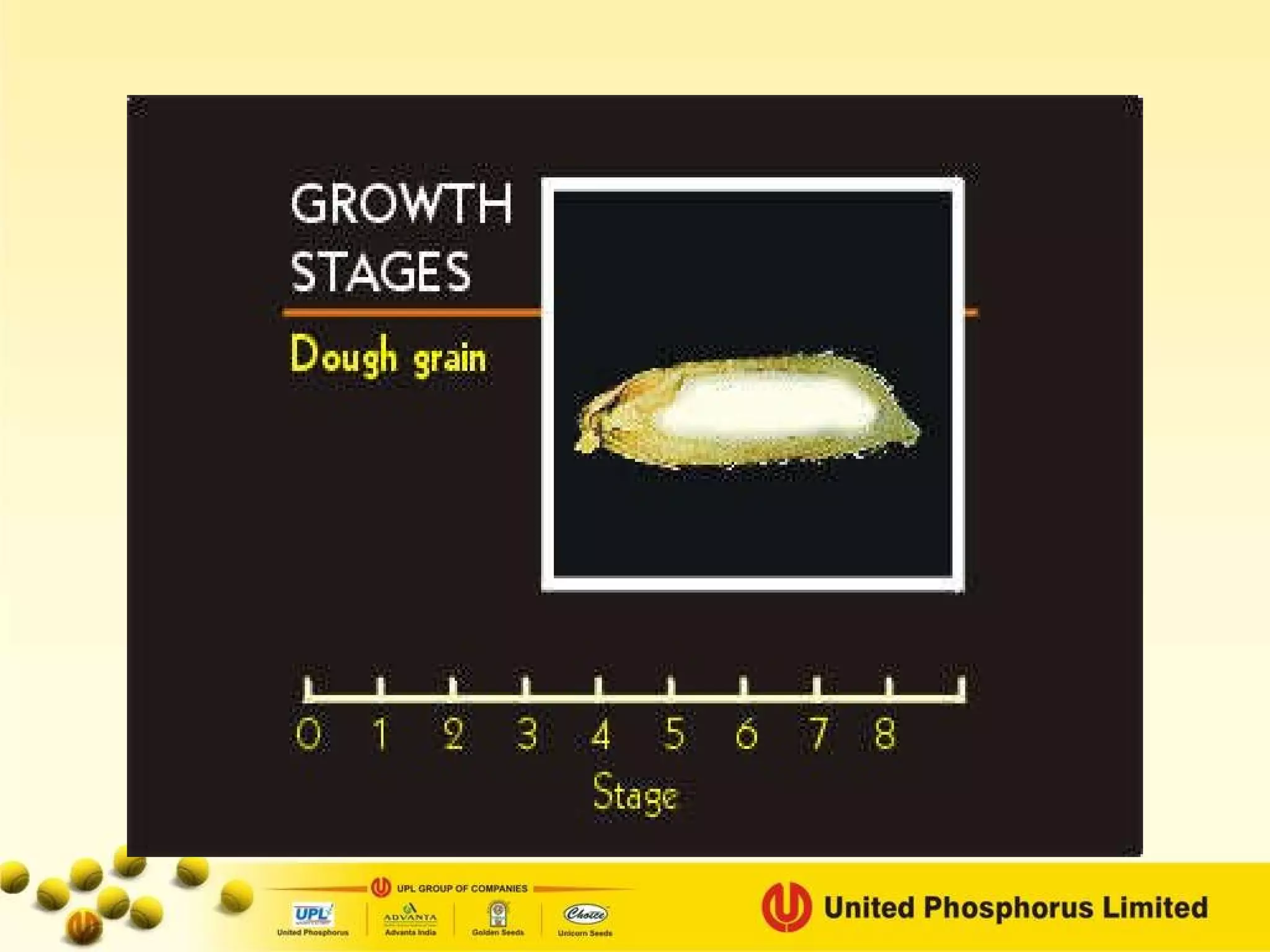
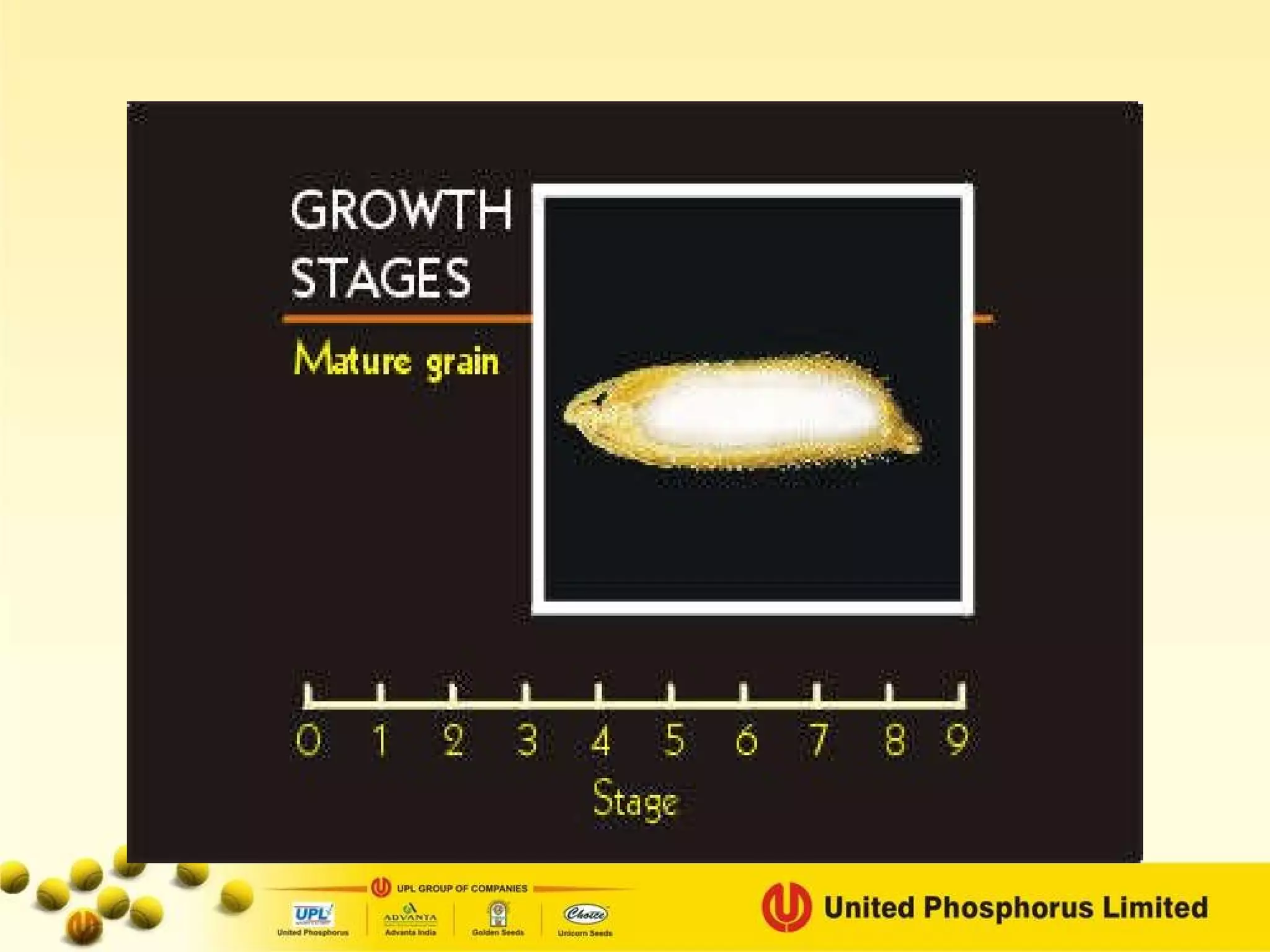
a)   Vegetative phase- seed germination to panicle initiation 1 .  Seedling stage 2. Tillering stage b)   Reproductive phase - Panicle initiation to maturity 1.   Booting 2. Panicle emergence 3. Flowering 4. Milky Stage 5. Dough Stage 6. Mature grain Stages of growth


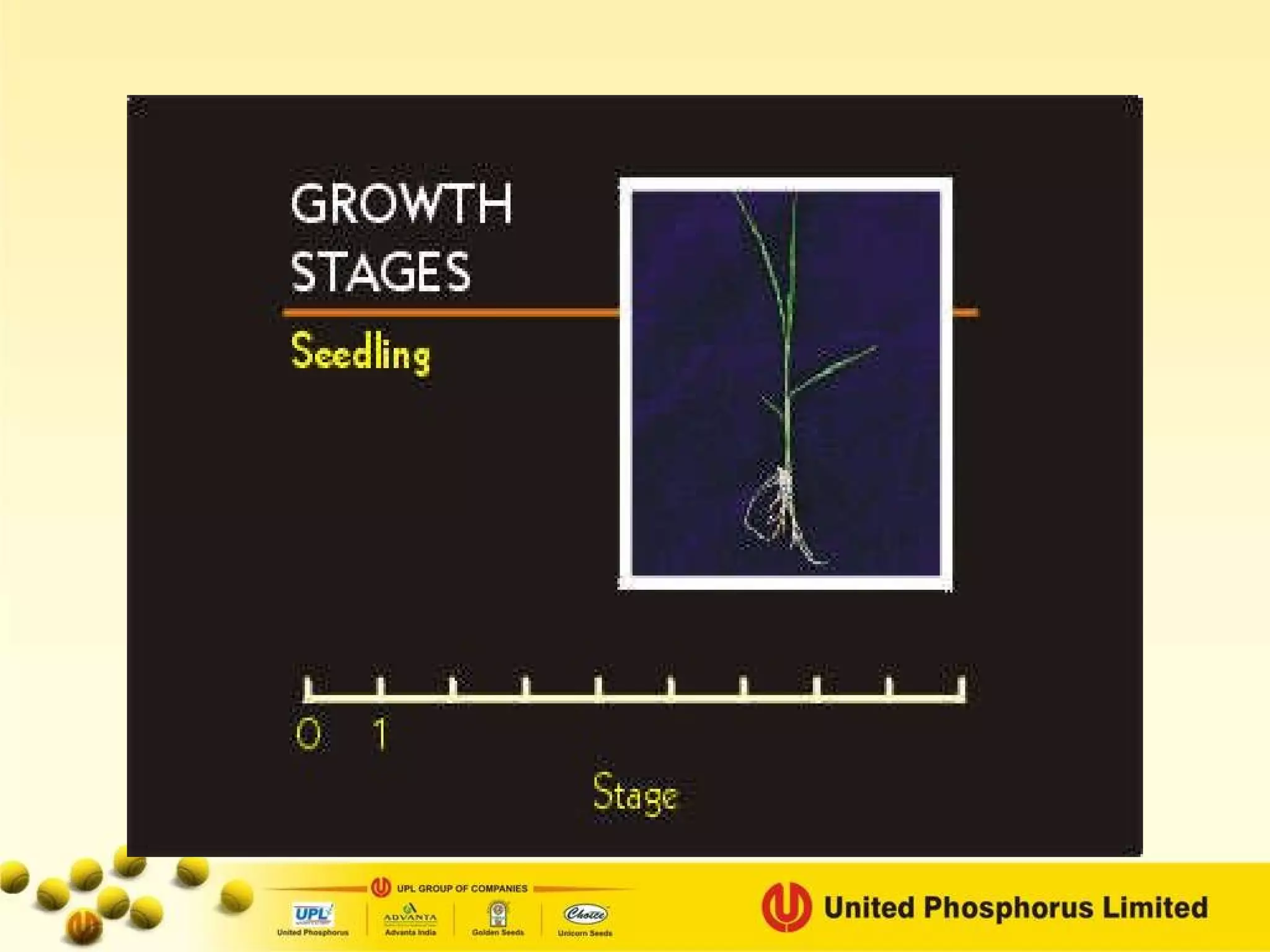
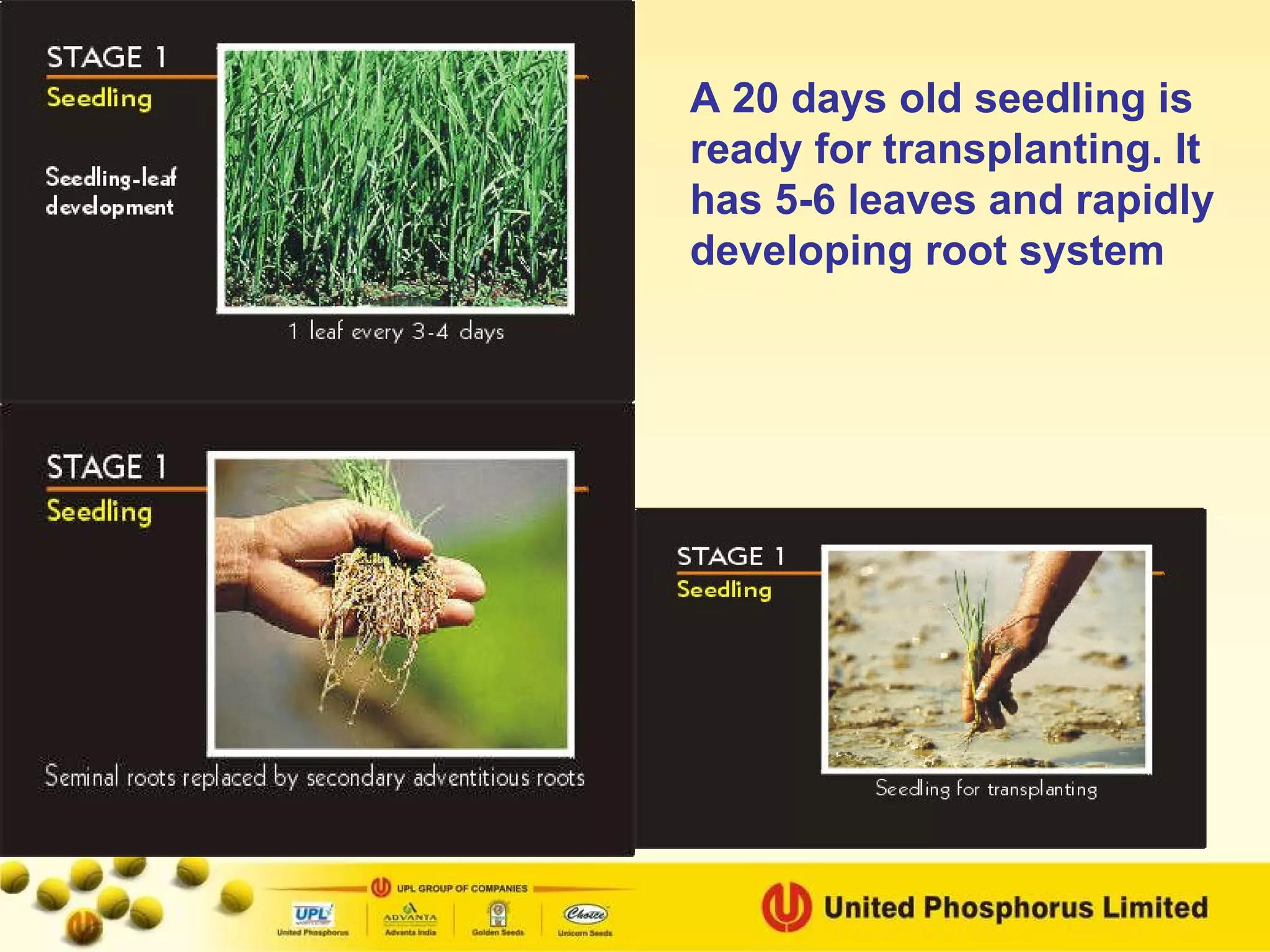
A 20 days old seedling is ready for transplanting. It has 5-6 leaves and rapidly developing root system
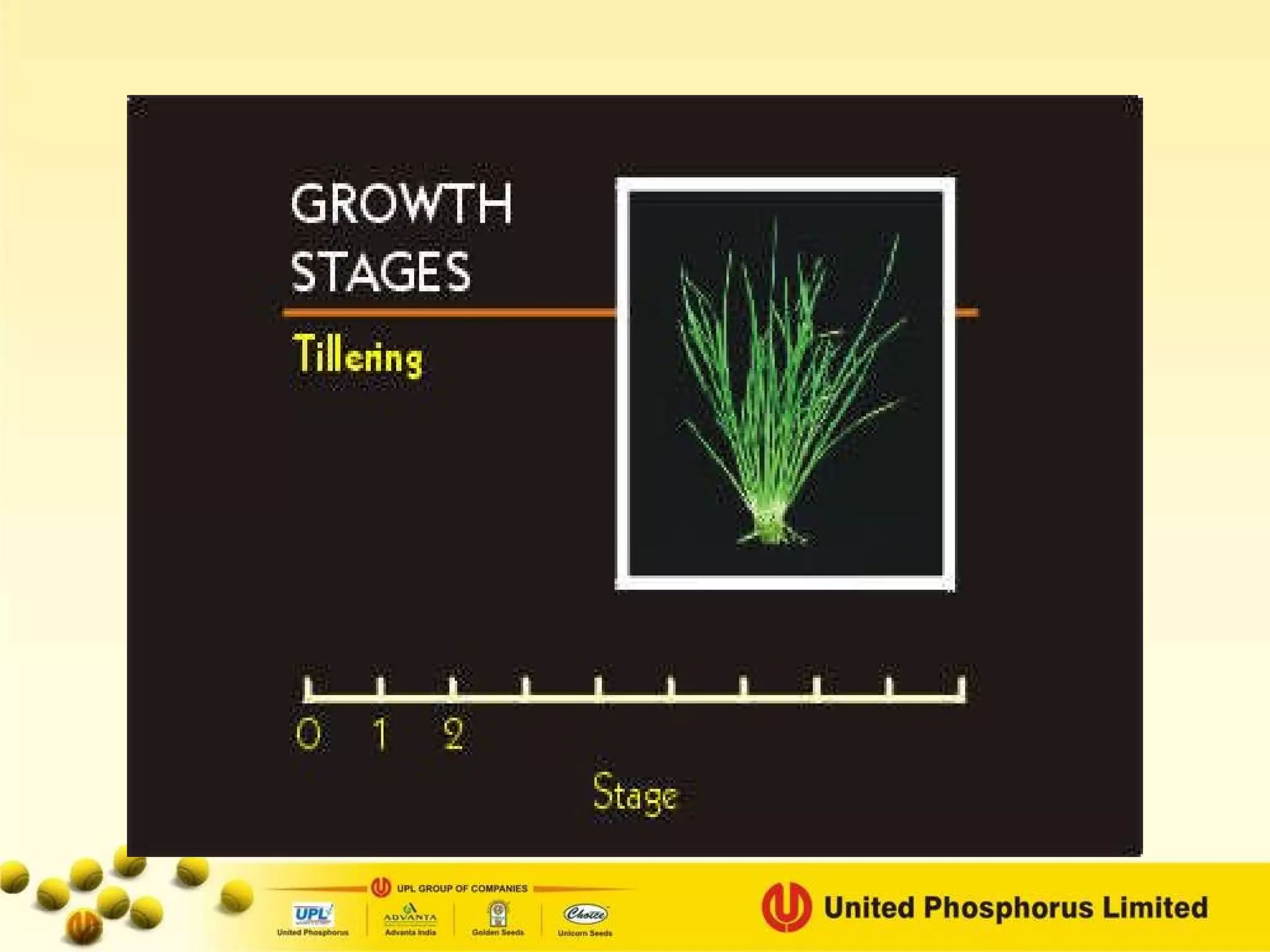
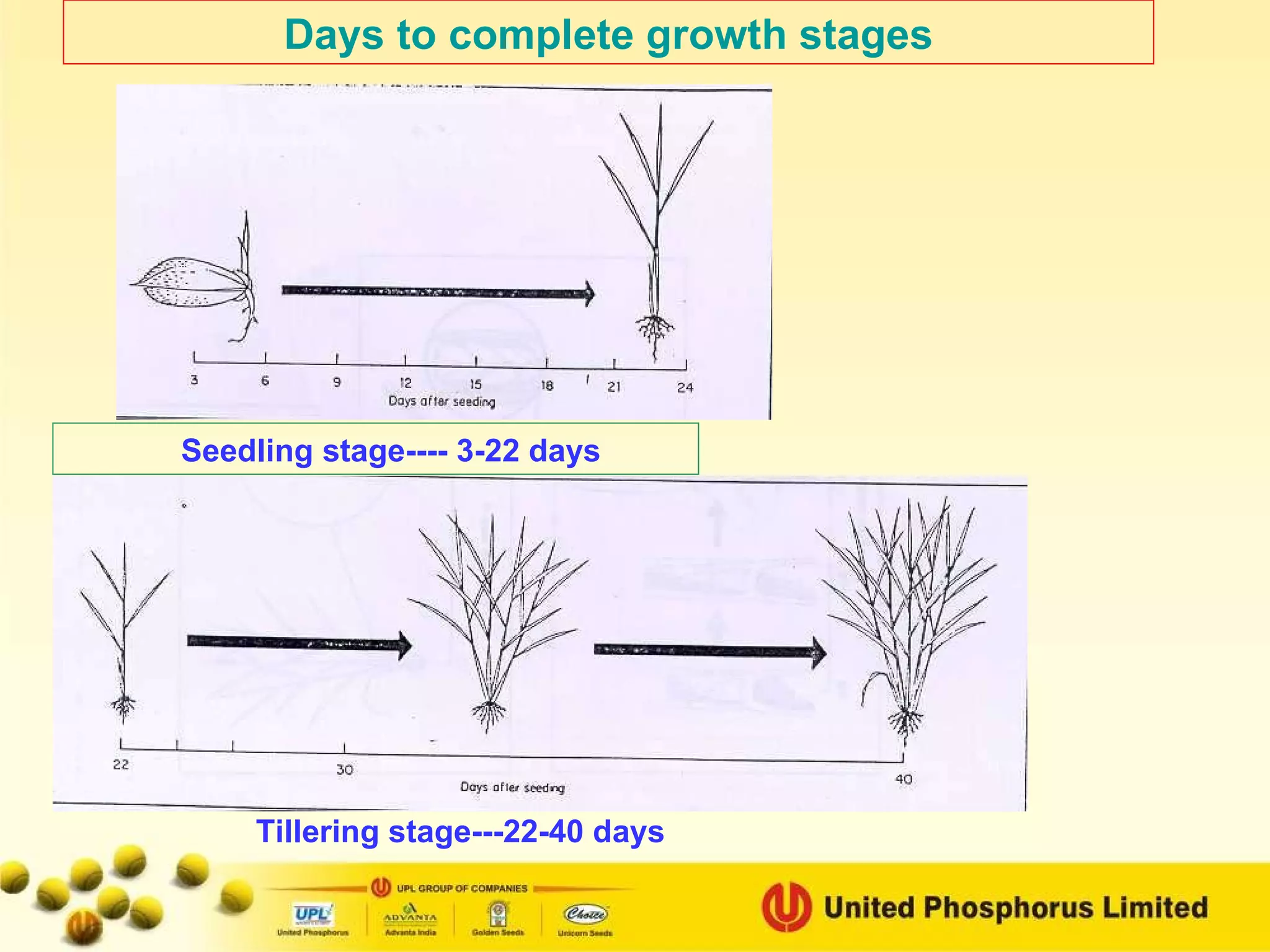
Days to complete growth stages Seedling stage---- 3-22 days Tillering stage---22-40 days


Packages of Practices
Planting Time and seed rate  : North  India------------------   Mid May to end June Seed Rate :  ------------------- -   6 Kg. per Acre Seed Treatment  -----------------  Organo mercurial's@ 2g/Kg seed  SAAF @2gm/Kg of seed
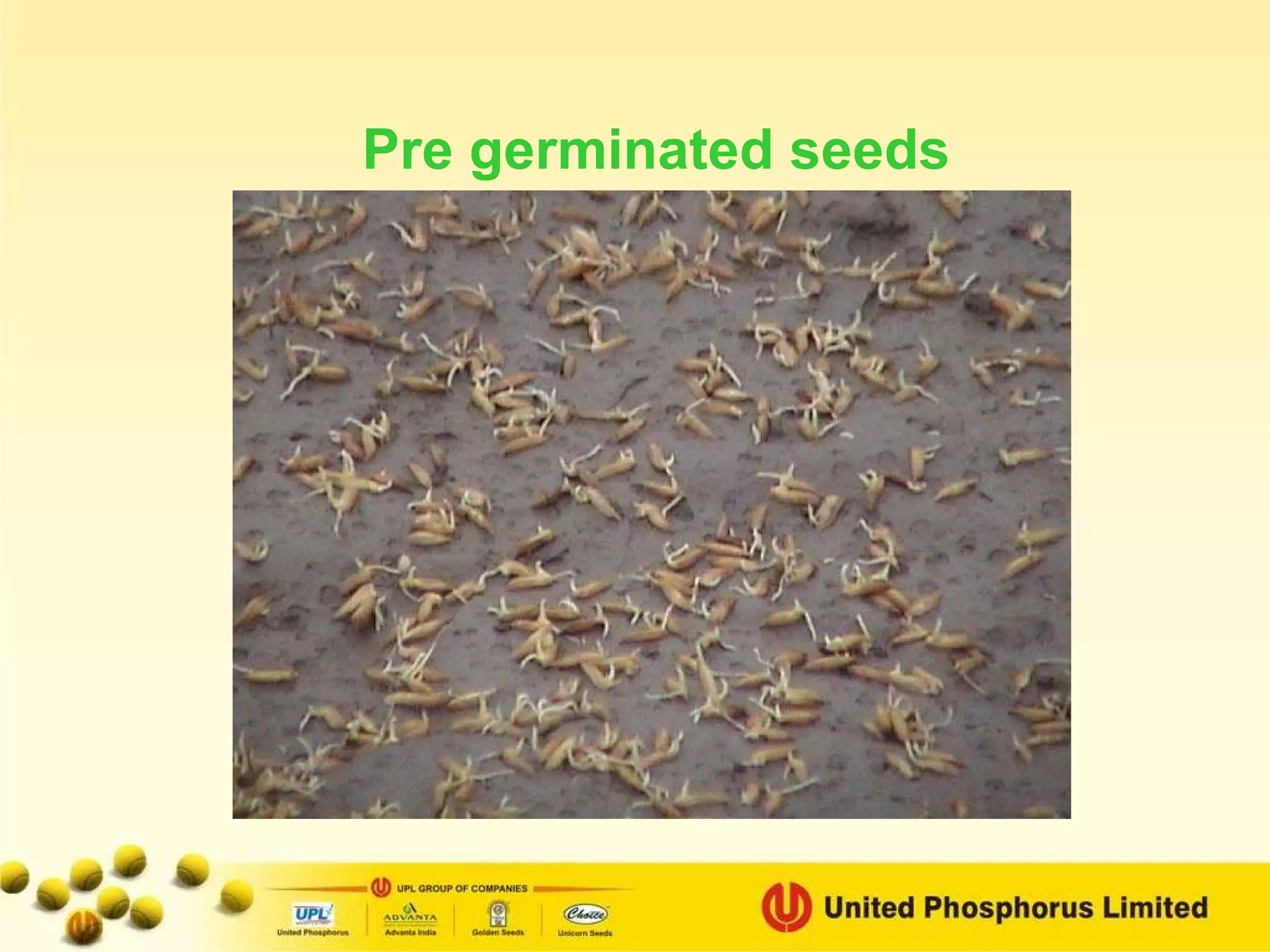
Soak the seed in water solution for overnight. Incubate the seeds in warm moist condition for 36-48 hours or until it gets sprouted(pregermination). Wash the seed in clean water twice a day to avoid the rotten smell. Seeds can be incubate in moist jute sacks. Sow pregerminated seeds uniformly on the seed beds @ 1 kg /35 to 40 sq.meter area preferably during evening hours. PLANTING METHOD
Pre germinated seeds
Seedbed preparation Prepare nursery area thoroughly by repeated ploughing, puddling and uniform leveling Prepare seedbeds of one meter width and of convenient length Apply 250 kg. FYM, 1kg Nitrogen, 0.5 kg Phosphorous, 0.5 kg  Potash  and0 .25Kg Zn for every 100 sq. meter area.
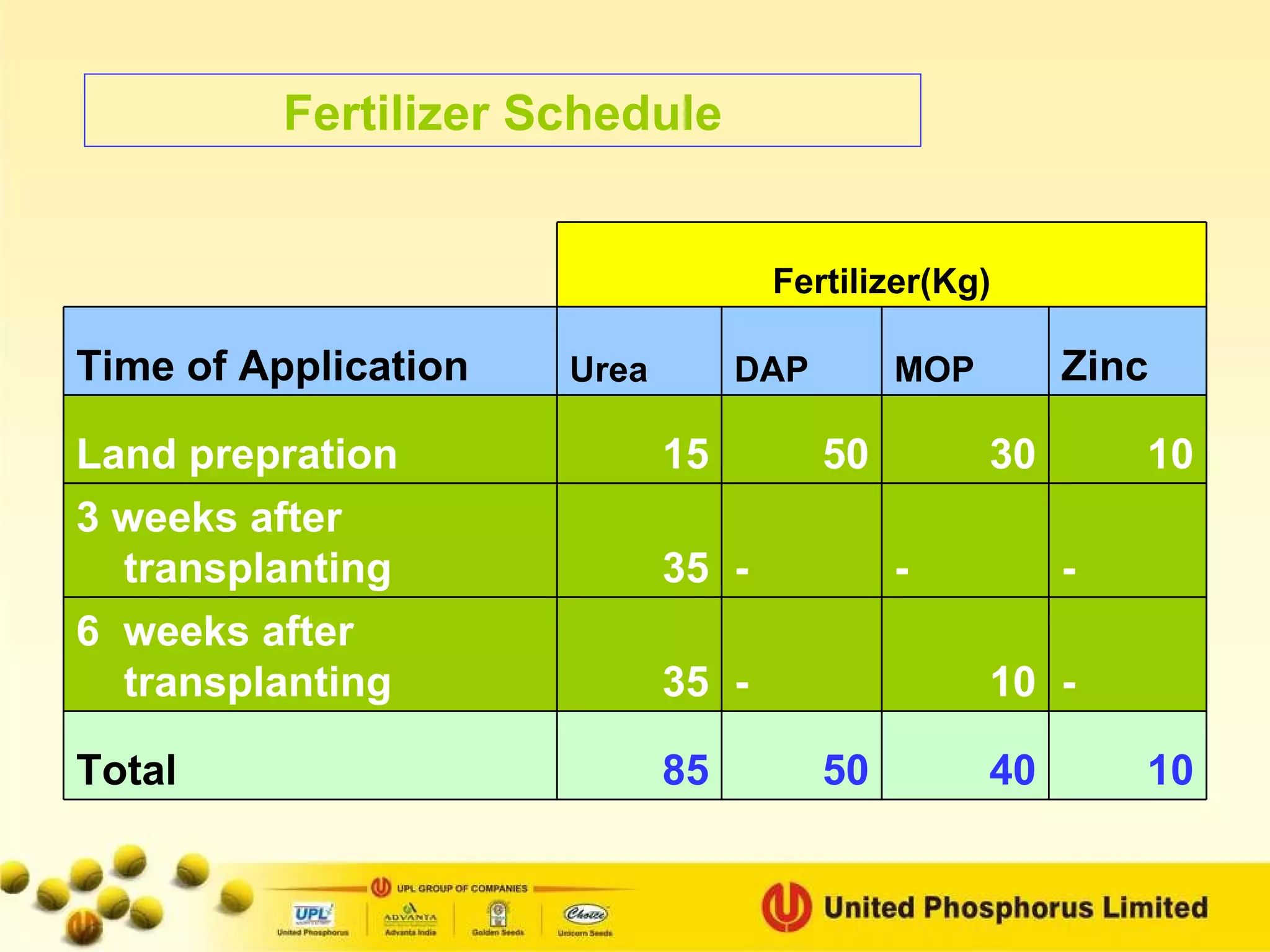
Main field preparation   Prepare main field area thoroughly by repeated ploughing, puddling and uniform leveling. Apply 15 tons of well decomposed FYM per hectare. Apply  15 Kg Urea, 50 Kg DAP ,30 Kg MOP and 10 Kg Zinc  per acre before transplanting.
Transplant after 25 to 30 days depending on the seedling growth(5-6 leaf stage) Plant only one seedling per hill Spacing between row is 20 cm and between plant is 15 cm(33 plants/sq m) Fill the gaps if any due to mortality of seedlings after 8 days of transplanting using the excess seedlings   Transplanting
Weed control-Apply  SAATHI @ 80gm/Acre mixed with 20 Kg sand within 2-3 days of  transplanting.  There should be 2-3 cm standing water in the field.
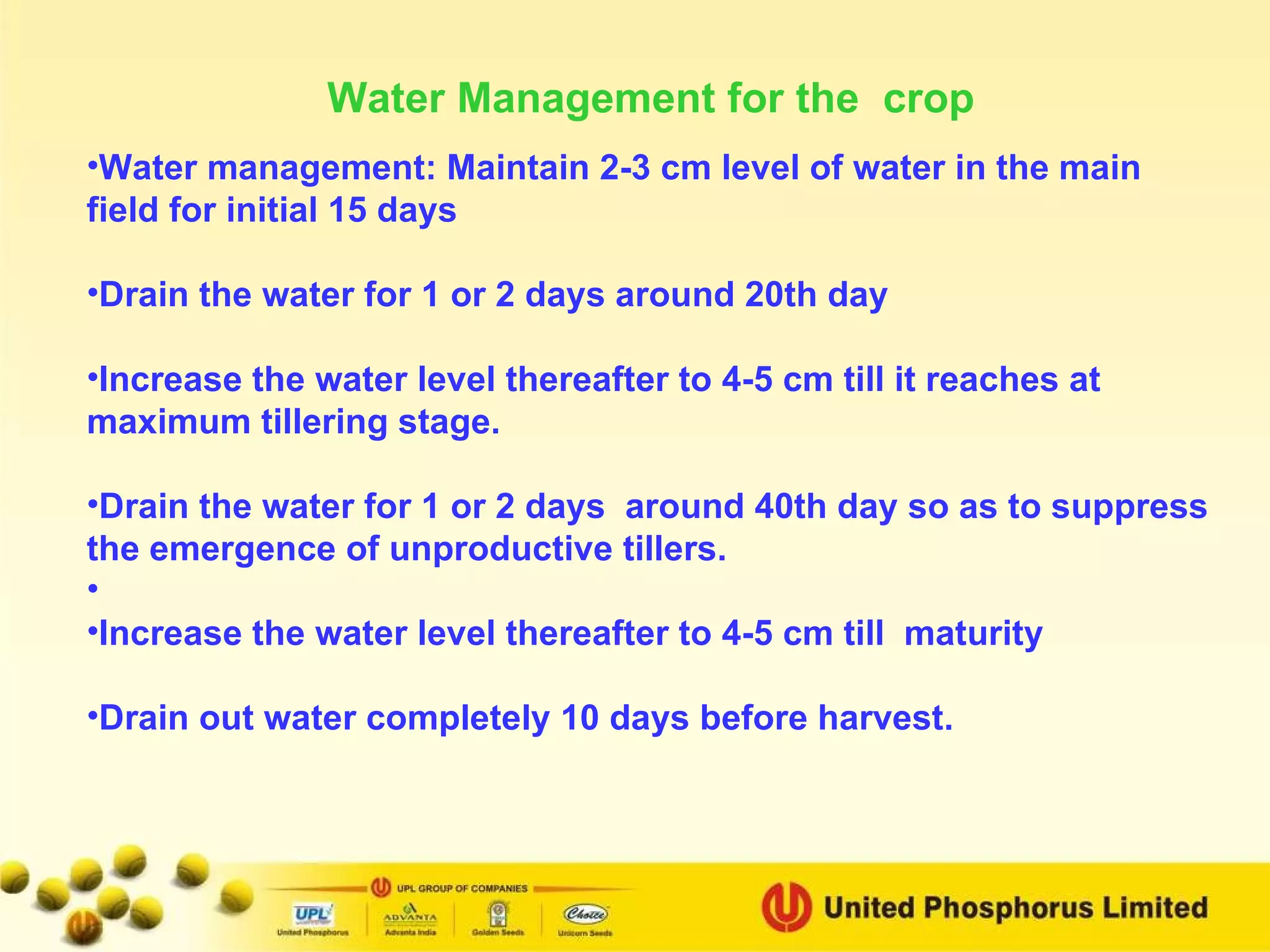
Water management: Maintain 2-3 cm level of water in the main field for initial 15 days Drain the water for 1 or 2 days around 20th day Increase the water level thereafter to 4-5 cm till it reaches at maximum tillering stage. Drain the water for 1 or 2 days  around 40th day so as to suppress the emergence of unproductive tillers. Increase the water level thereafter to 4-5 cm till  maturity Drain out water completely 10 days before harvest. Water Management for the  crop
Fertilizer Schedule 10 40 50 85 Total - 10 - 35 6  weeks after transplanting - - - 35 3 weeks after transplanting 10 30 50 15 Land prepration Zinc MOP DAP Urea Time of Application Fertilizer(Kg)
Insect Pests of Rice and  their management
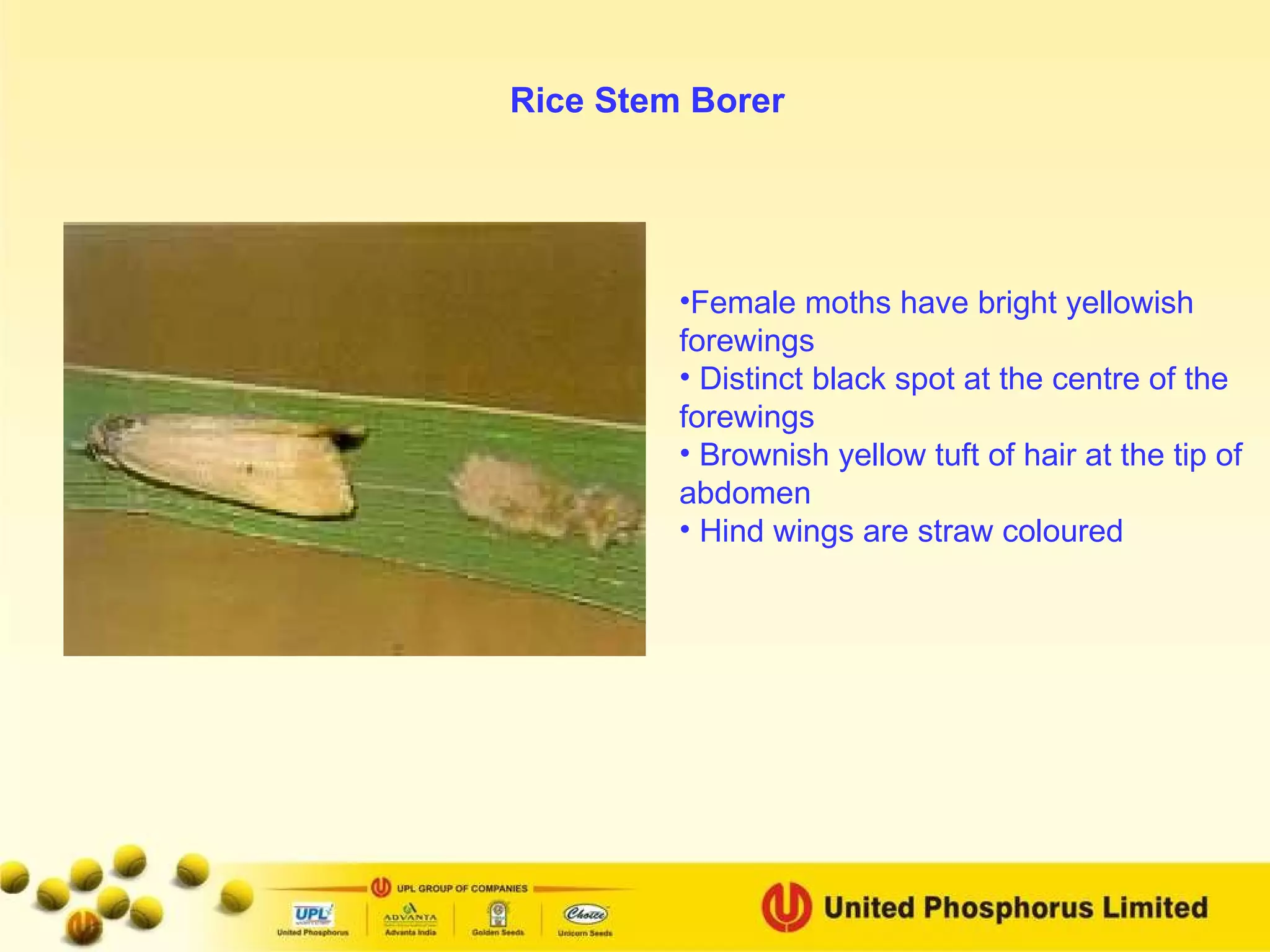
Female moths have bright yellowish forewings Distinct black spot at the centre of the forewings Brownish yellow tuft of hair at the tip of abdomen Hind wings are straw coloured Rice Stem Borer
Eggs are laid in masses on leaf tips/upper half Eggs are covered with the light yellow coloured  hairs  Newly hatched yellowish larvae move downward -  wander around for a couple of hrs. - hang down by silken threads - blown to nearby clumps - land on water, swim in search of plants New larvae feed on leaf and leaf sheath for a few days
Medium sized larvae bore into stem near the  nodal region Older larvae feed inside the stem near the base of the plant Feeding cuts nutrient and water supply to growing end - hence the symptoms Pupation occurs inside the stem near the soil surface or below the soil surface Adults crawl out through exit holes cut by the larvae before pupation - ENTRY HOLES NOT VISIBLE
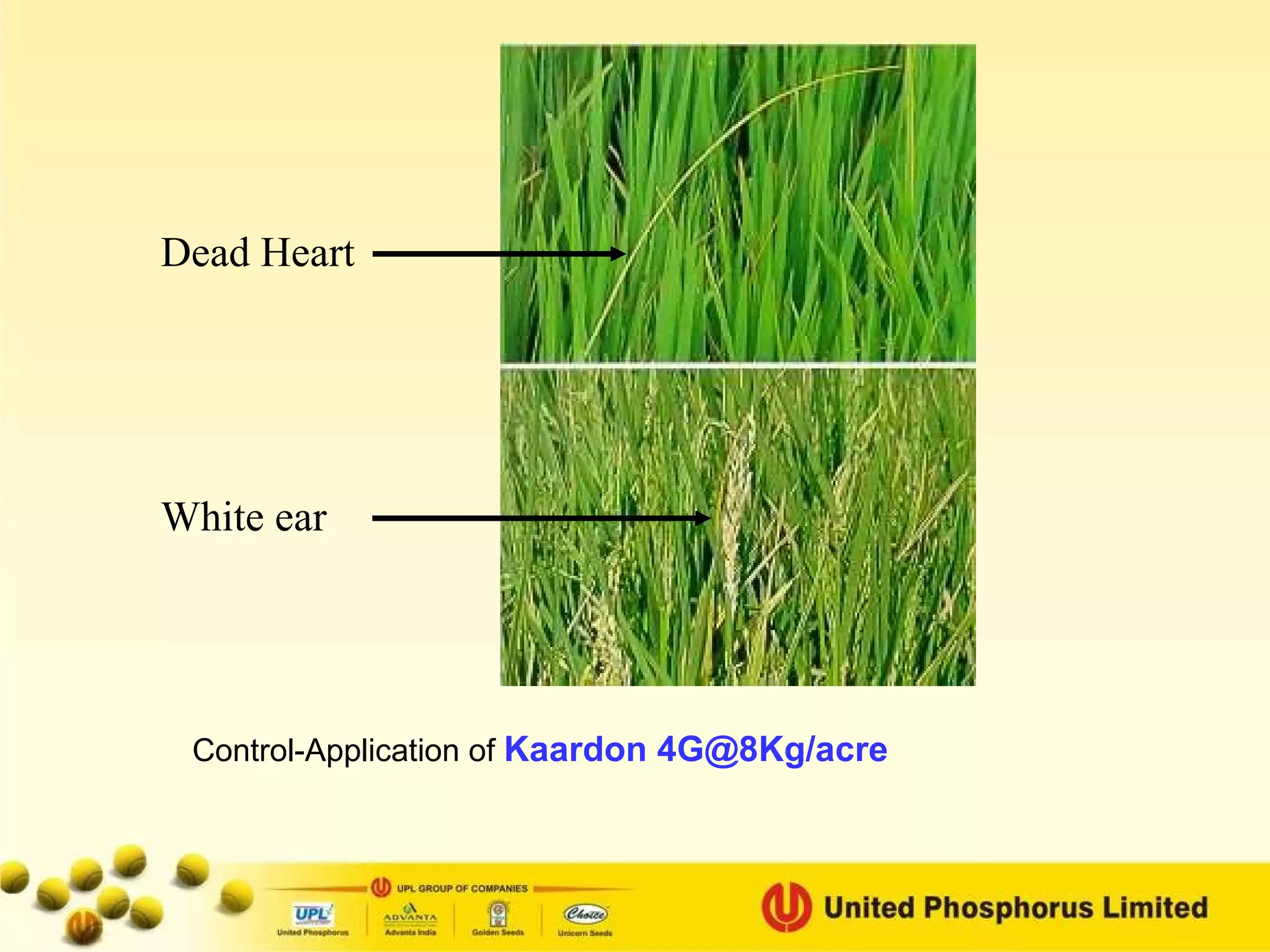
SYMPTOMS “ DEAD HEARTS” IN YOUNG PLANTS - DRYING OF THE CENTRAL SHOOTS “ WHITE EARS” IN OLDER PLANTS - DRYING OF THE PANICLE INJURY LEADS TO YIELD LOSS
Control-Application of  Kaardon 4G@8Kg/acre   Dead Heart White ear
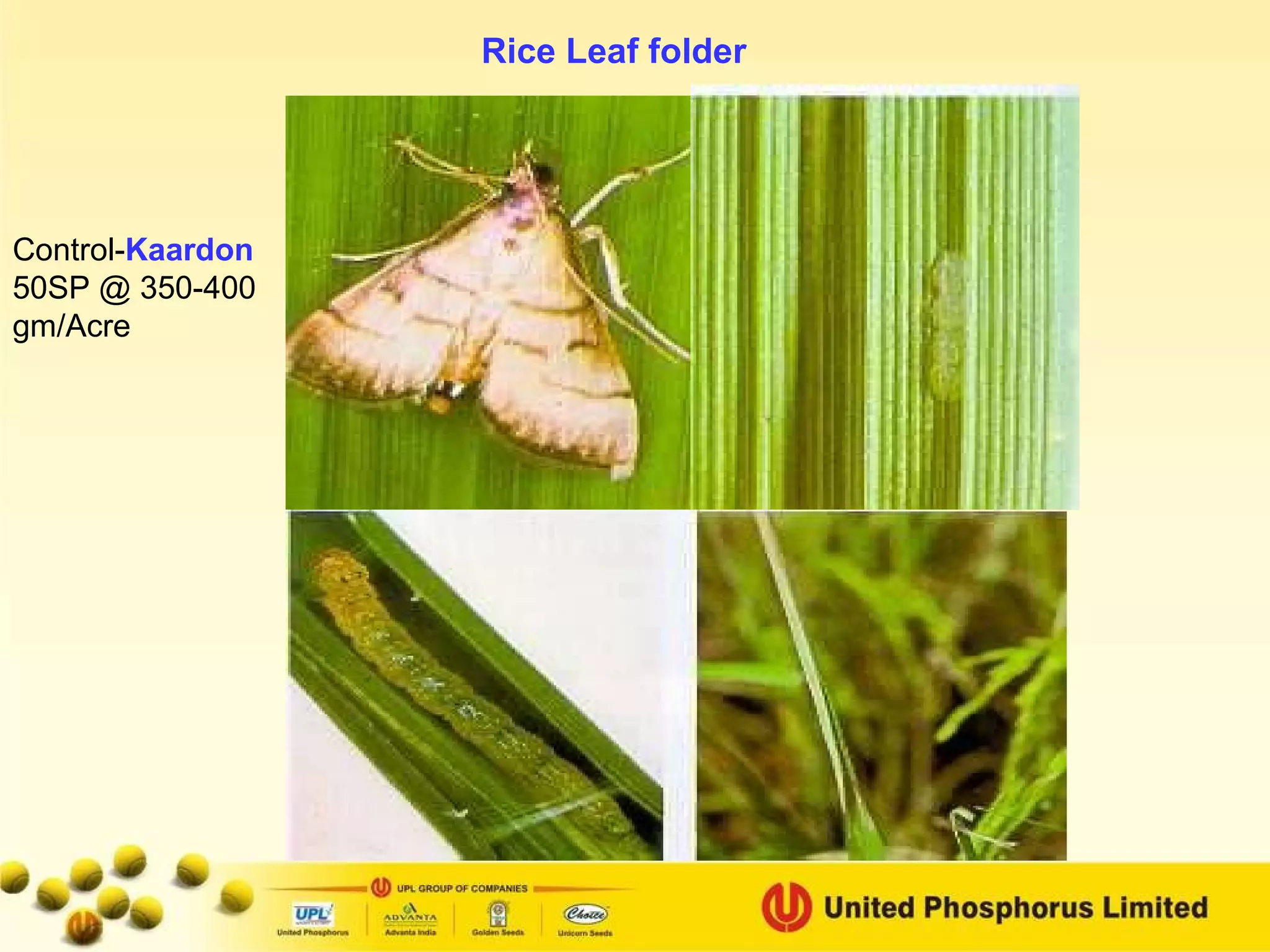
Rice Leaf folder Control- Kaardon  50SP @ 350-400 gm/Acre
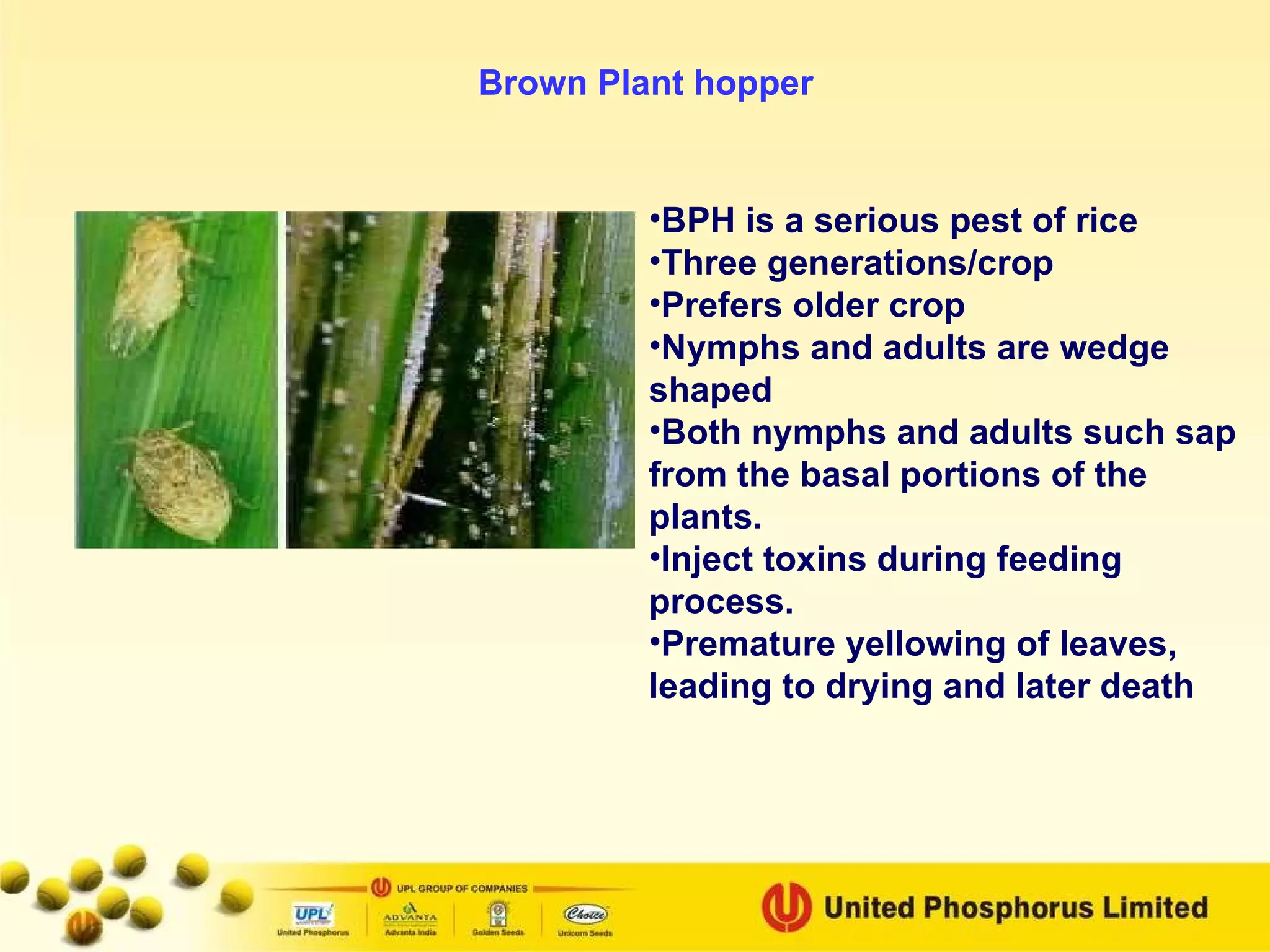
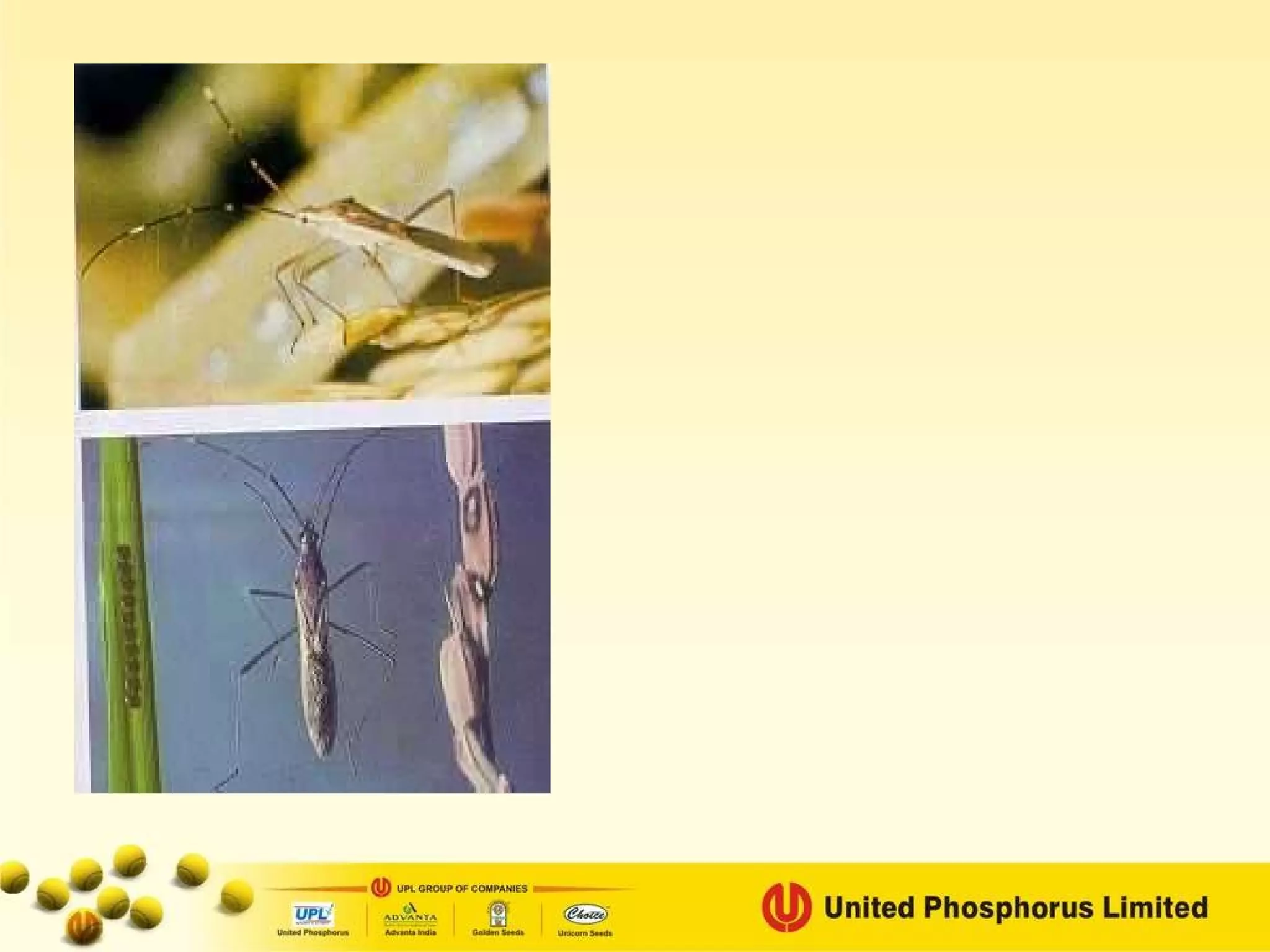
BPH is a serious pest of rice Three generations/crop Prefers older crop Nymphs and adults are wedge shaped Both nymphs and adults such sap from the basal portions of the plants. Inject toxins during feeding process. Premature yellowing of leaves, leading to drying and later death Brown Plant hopper
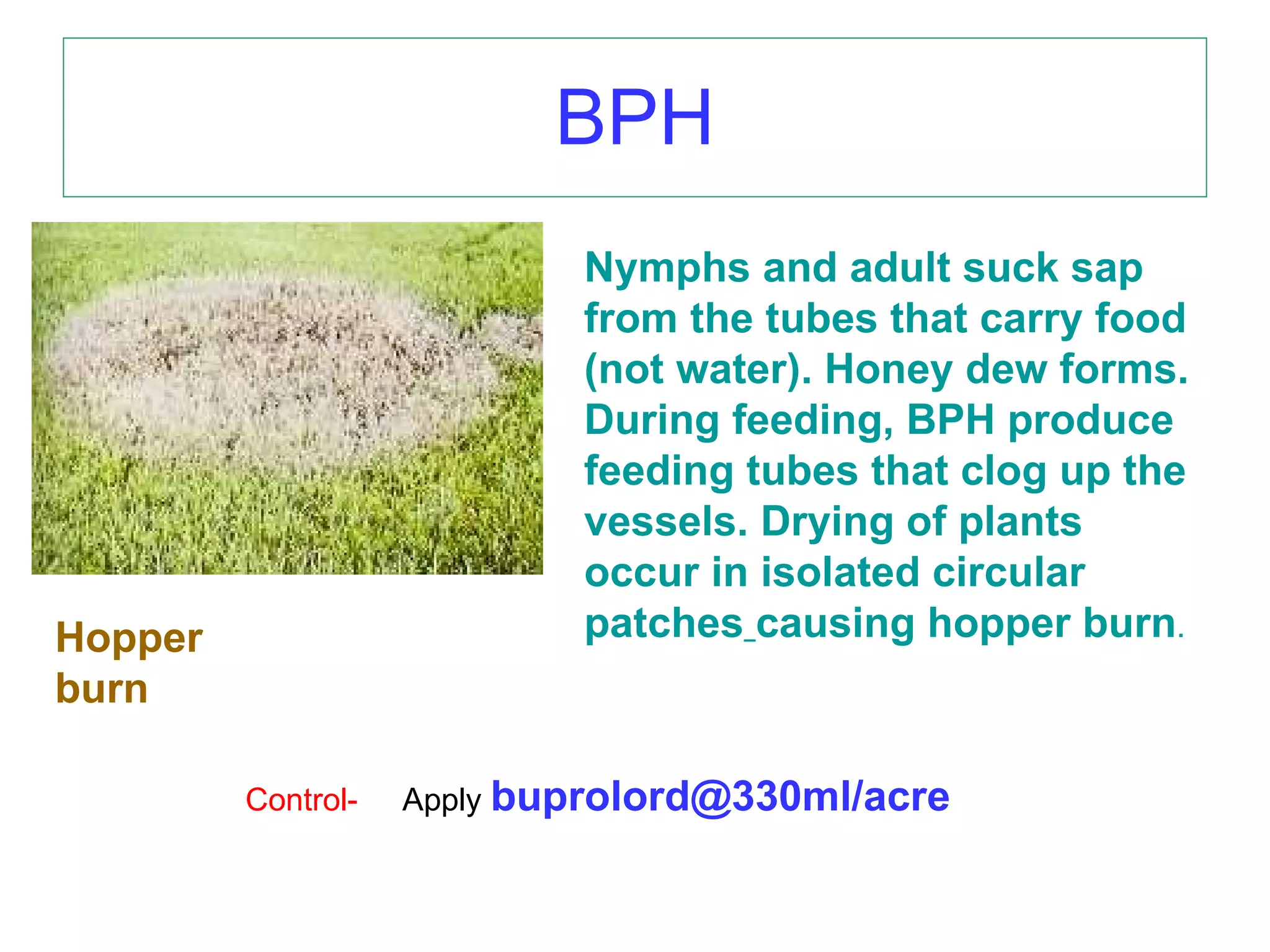
BPH Nymphs and adult suck sap from the tubes that carry food (not water). Honey dew forms. During feeding, BPH produce  feeding tubes that clog up the vessels. Drying of plants occur in isolated circular patches   causing hopper burn . Hopper burn Control-  Apply  buprolord@330ml/acre
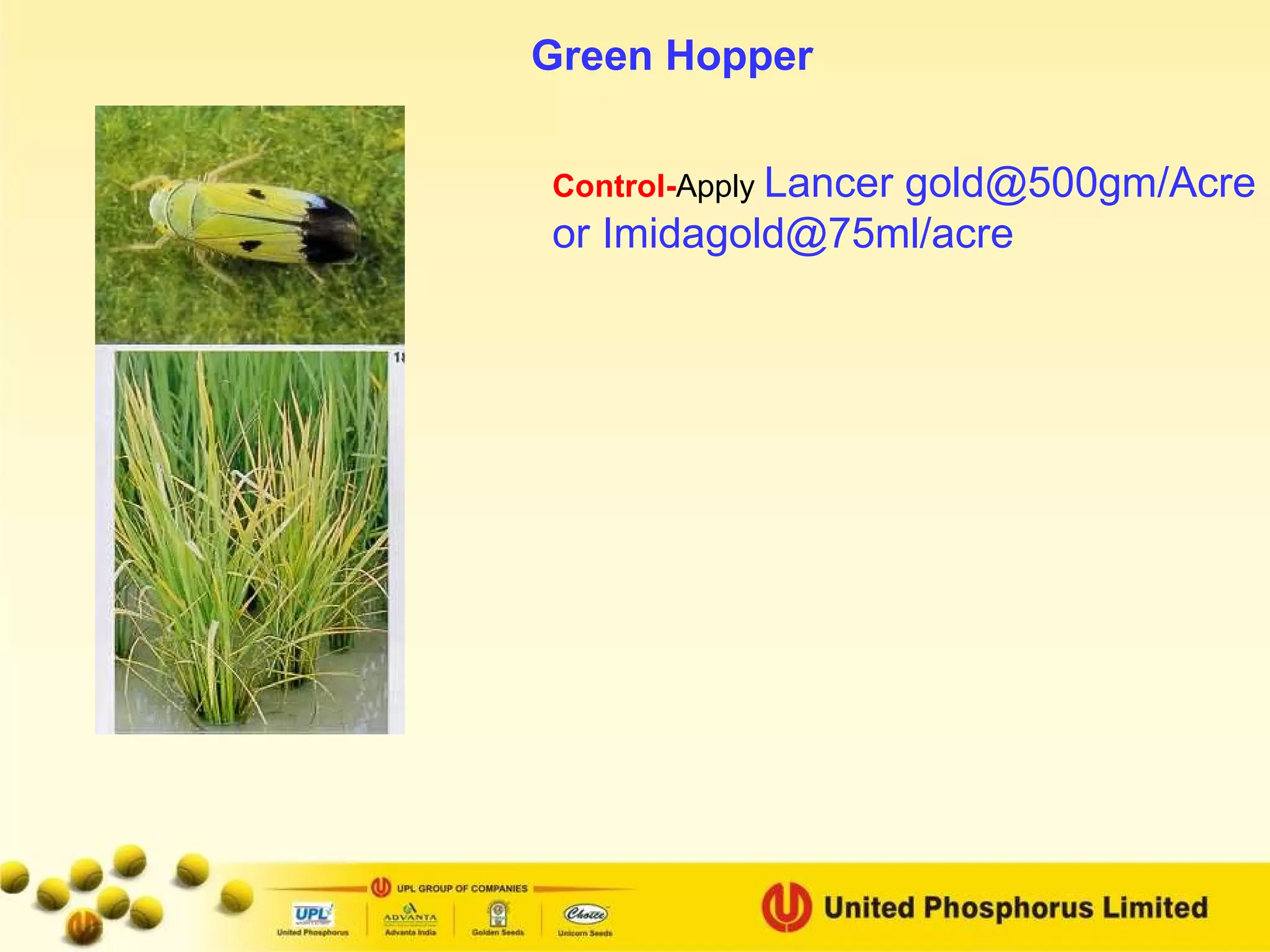
Green Hopper Control- Apply  Lancer gold@500gm/Acre or Imidagold@75ml/acre
 
Important diseases of rice and their management
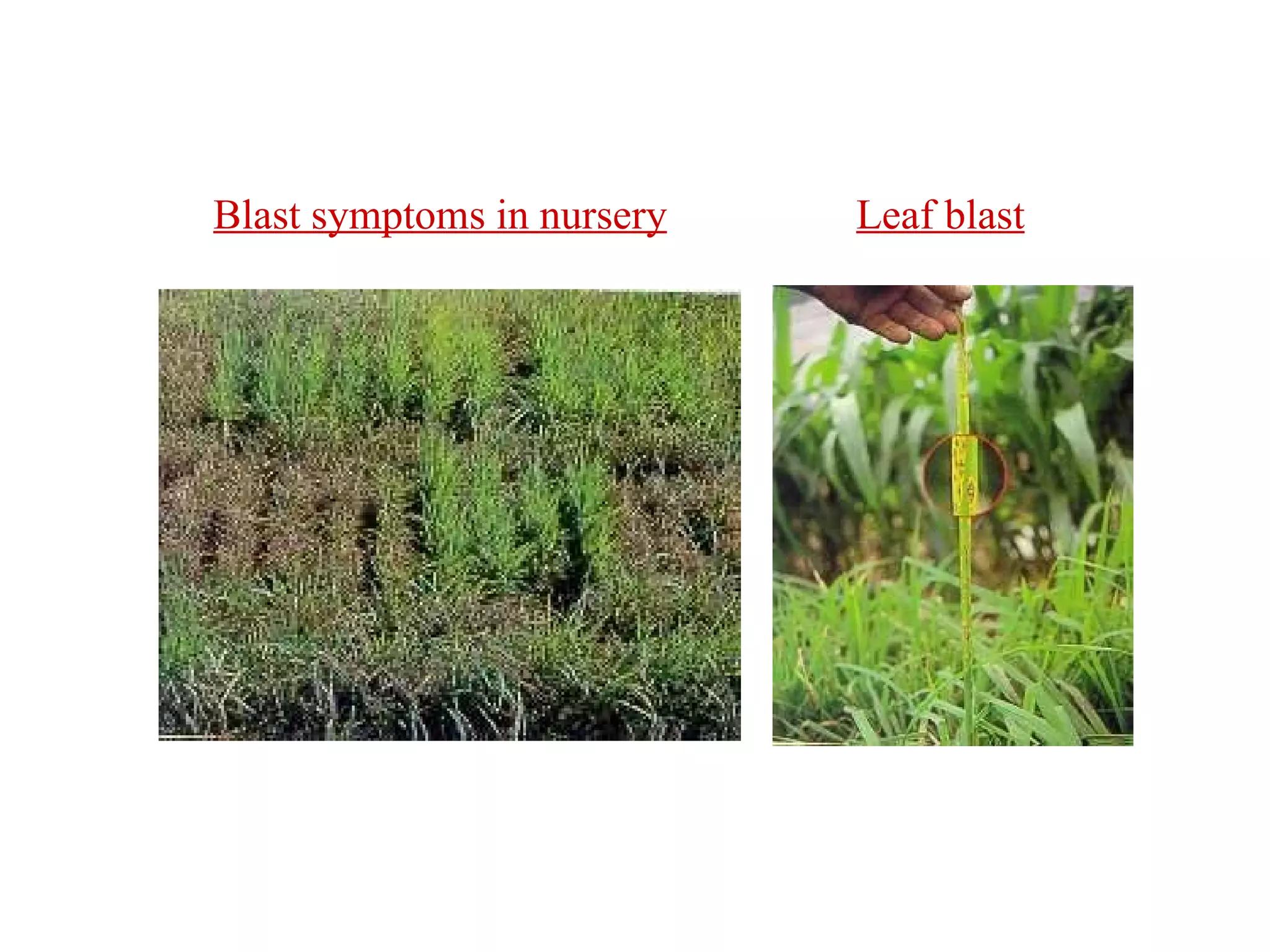
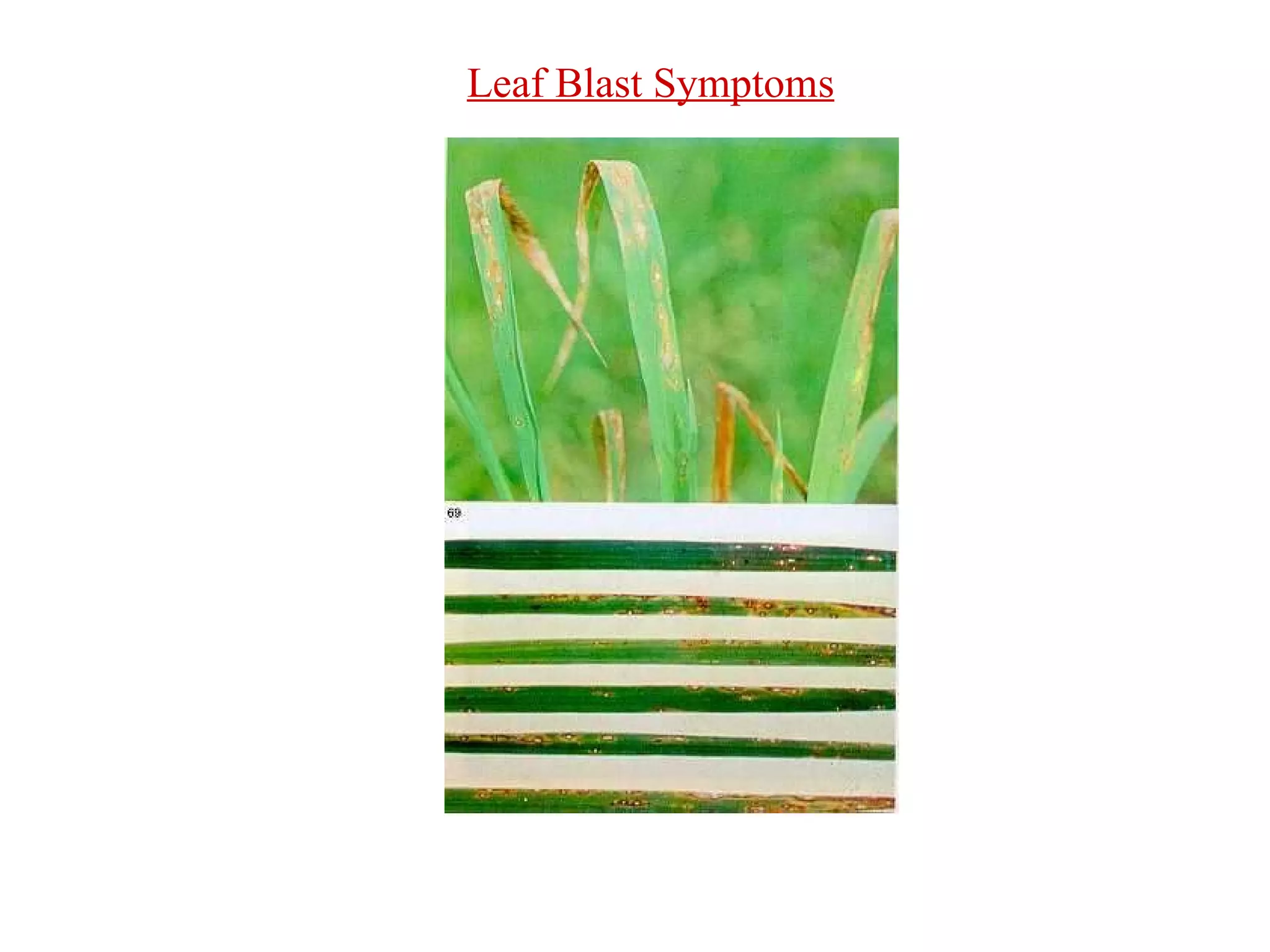
Rice Blast Disease occurs in all growth stages of rice crop - nursery to panicle and grain formation stage Blast is first noticed as minute brown specks on leaves Under low night temp. and high humidity, the spots enlarge and become spindle shaped (pointed at both ends). These have brown margins and grey centre Part or whole of the leaf will wither when these spots   merge with one another. The crop gives a blasted appearance when severely infested in the seedling and tillering stages Leaf blast symptoms are seen in the nursery and during   early vegetative stage (up to 30 to 35 DAT)
Blast symptoms in nursery Leaf blast
Leaf Blast Symptoms
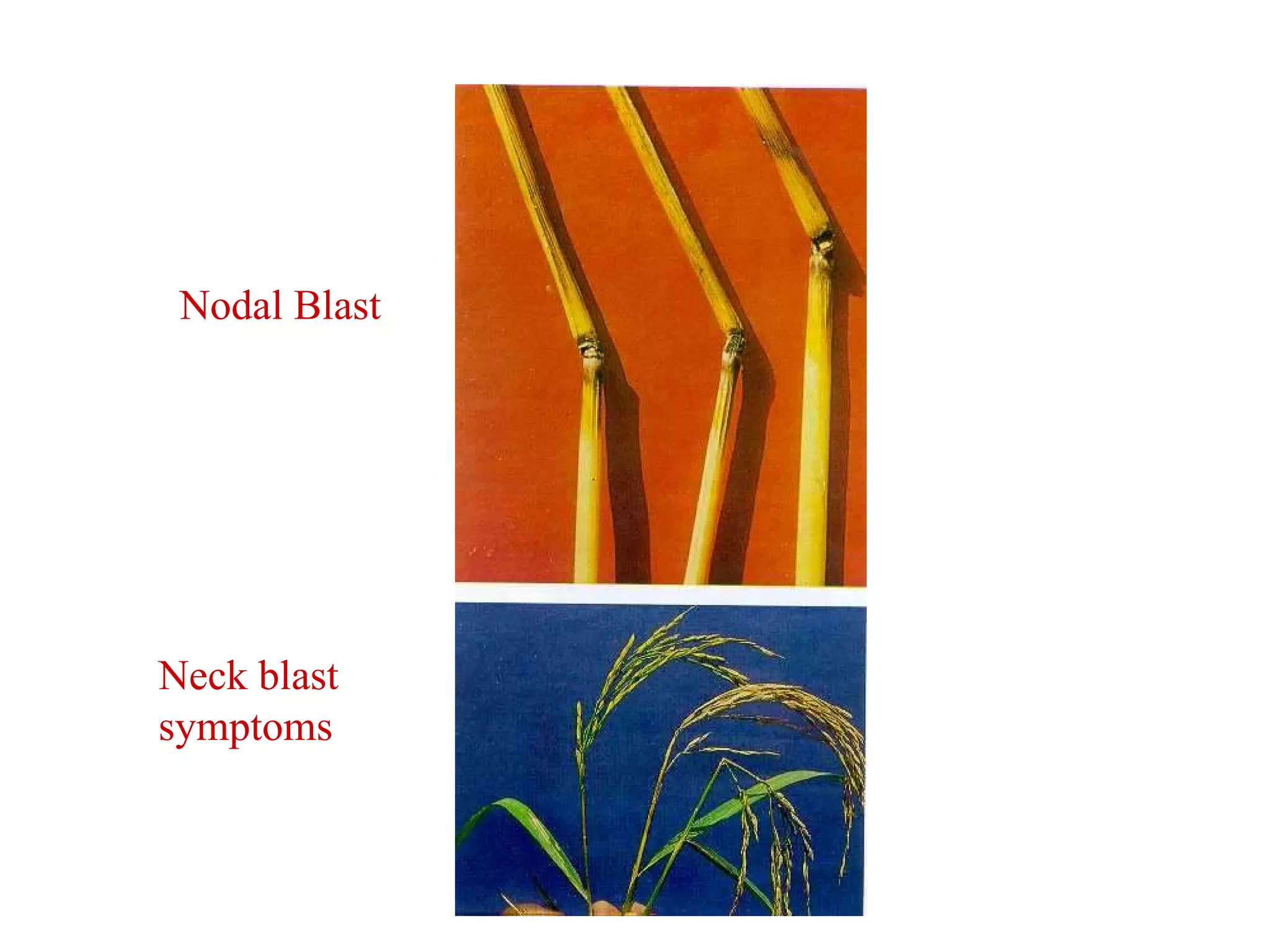
Neck blast symptoms Nodal Blast
Rice Blast Nodal infection results in rotting of the sheath which turns black and breaks apart upon drying All parts above the infected node die Neck infection is the most serious phase of the disease Brown necrotic areas are seen on the neck Girdling of neck of the panicle causing entire panicle  to fall off Infection before milk stage results in unfilled/chaffy grains Later infection results in partial filling of grains; grain quality becomes bad Panicles fall over before grain maturation.
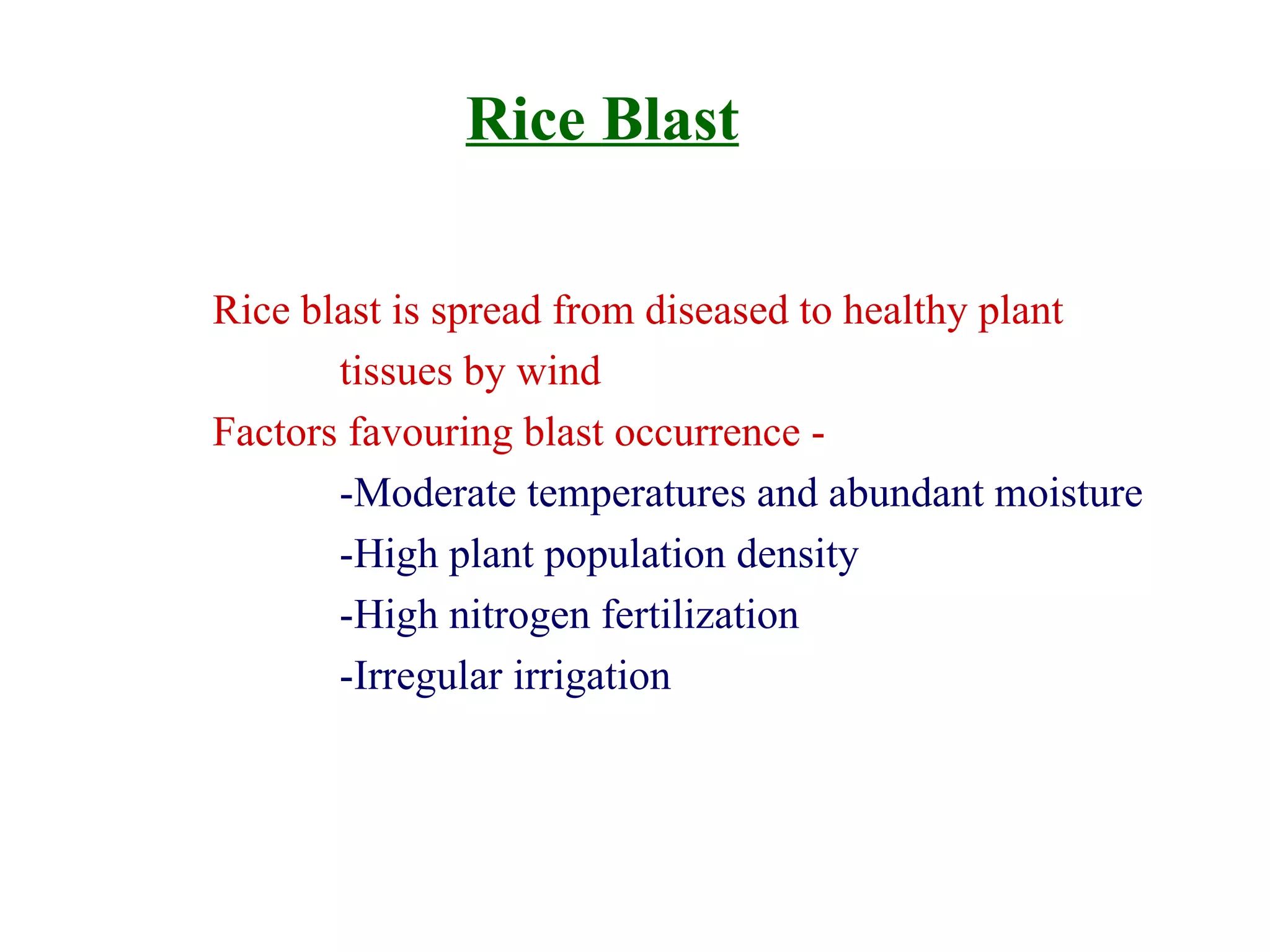
Rice Blast Rice blast is spread from diseased to healthy plant tissues by wind Factors favouring blast occurrence - -Moderate temperatures and abundant moisture -High plant population density -High nitrogen fertilization -Irregular irrigation
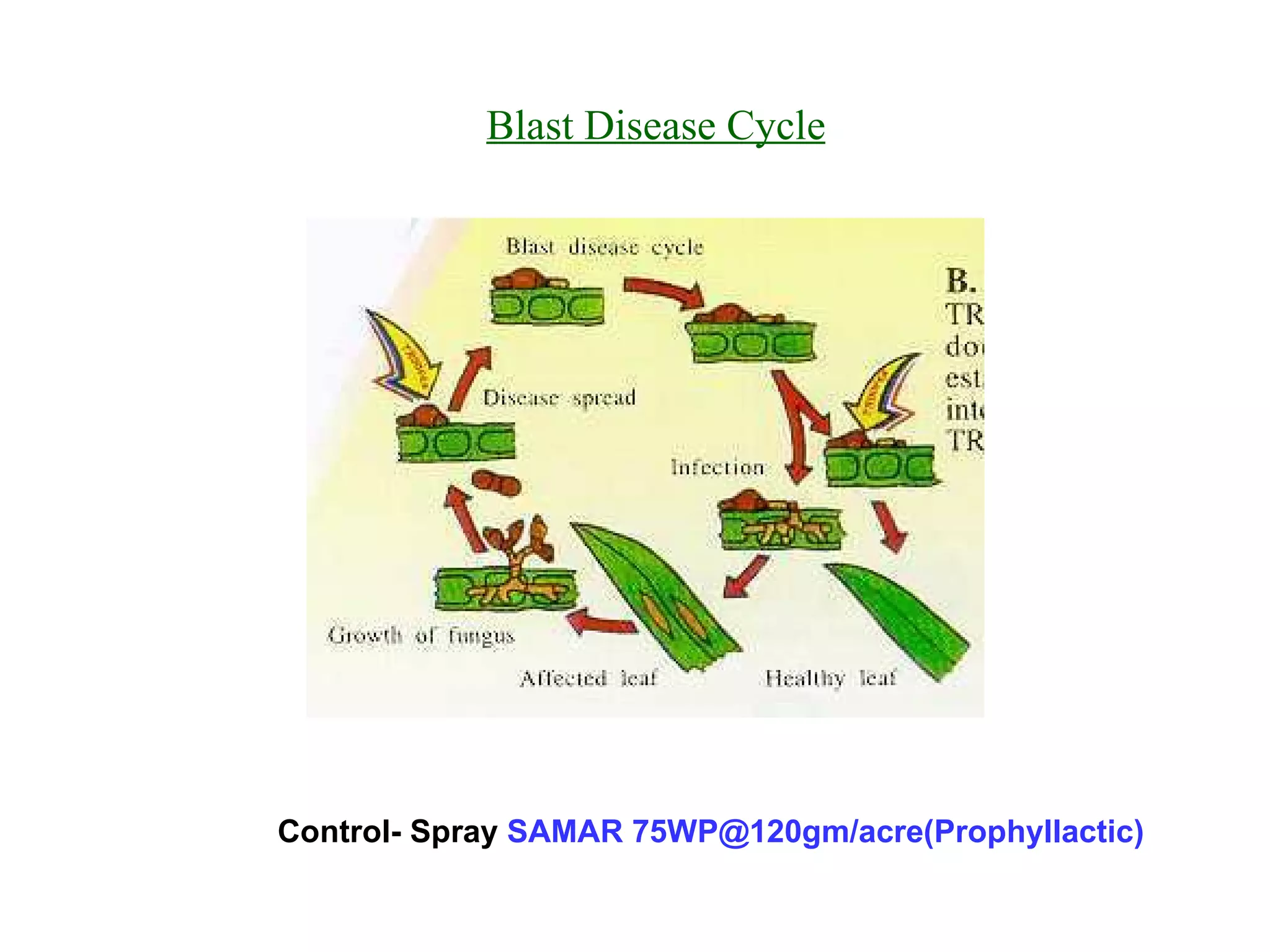
Blast Disease Cycle Control- Spray  SAMAR 75WP@120gm/acre(Prophyllactic)
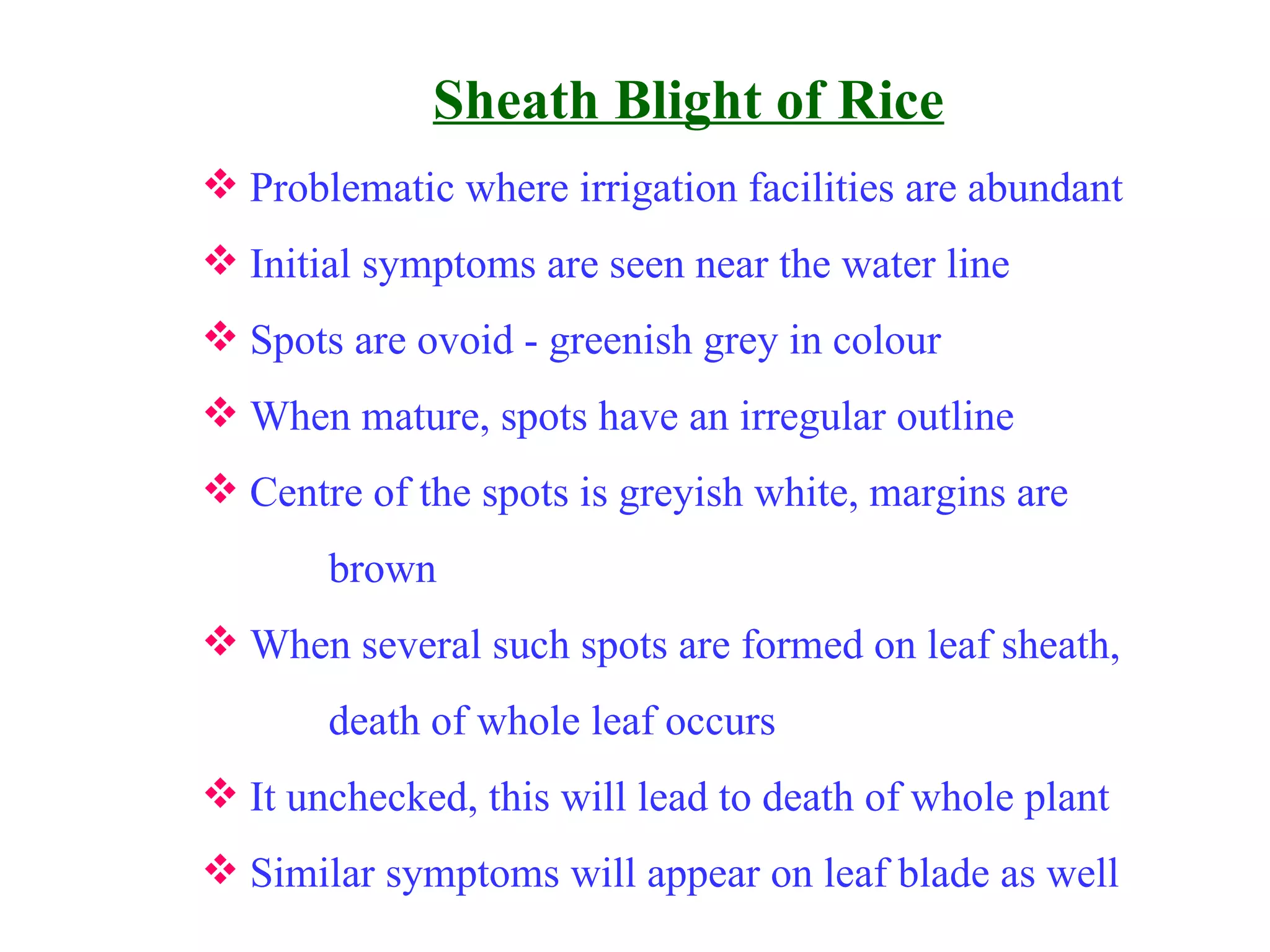
Sheath Blight of Rice Problematic where irrigation facilities are abundant Initial symptoms are seen near the water line Spots are ovoid - greenish grey in colour When mature, spots have an irregular outline Centre of the spots is greyish white, margins are brown When several such spots are formed on leaf sheath, death of whole leaf occurs It unchecked, this will lead to death of whole plant Similar symptoms will appear on leaf blade as well
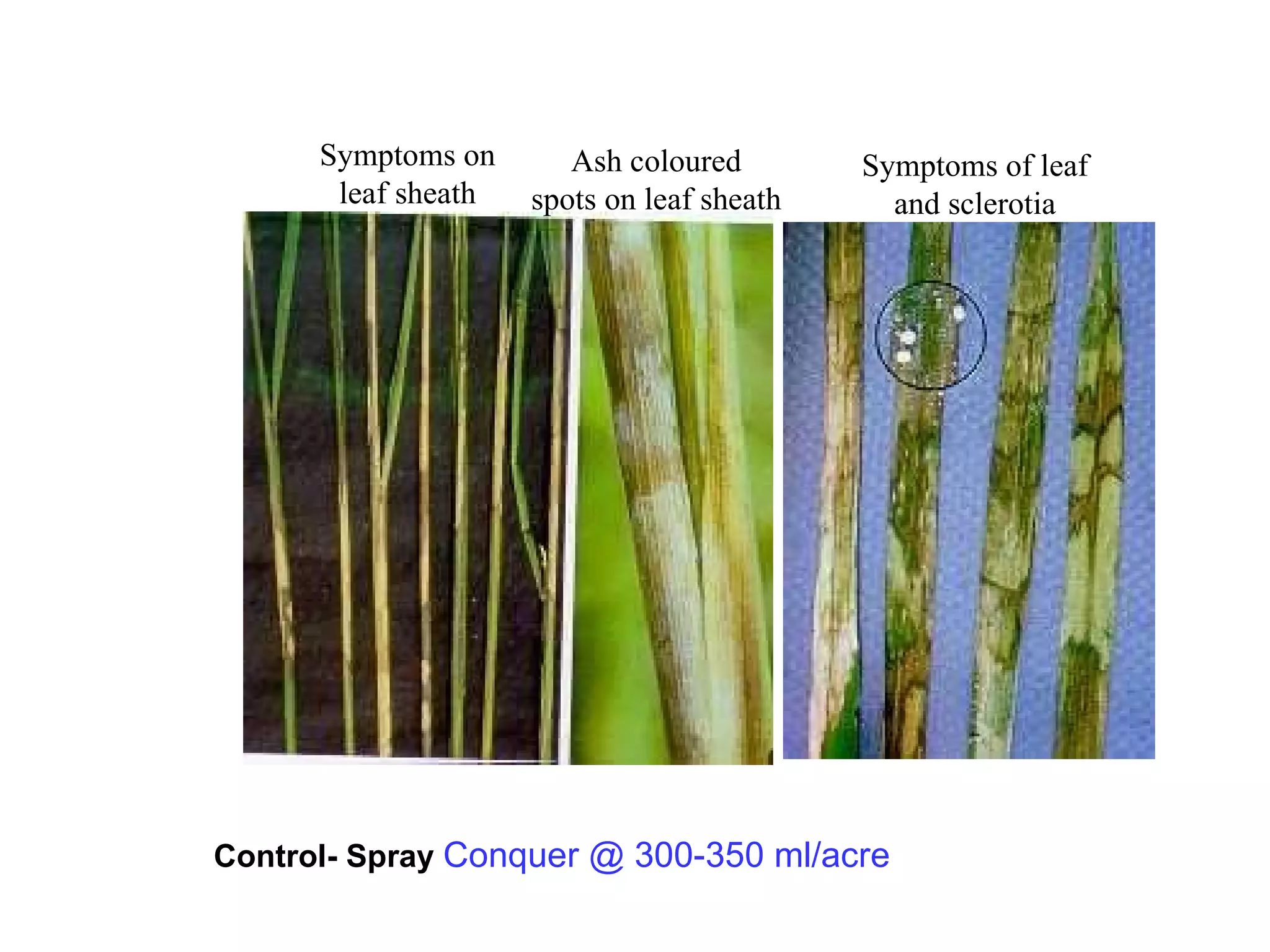
Symptoms on leaf sheath Ash coloured spots on leaf sheath Symptoms of leaf and sclerotia Control- Spray  Conquer @ 300-350 ml/acre
Sheath Blight of Rice Seedling infection starts 15-25 days after sowing Base of plant is attacked - seedlings die in patches In main field, disease is seen during active tillering Severe incidence during panicle emergence stage Crop loss could be as high as 50% High levels of Nitrogen will contribute to disease
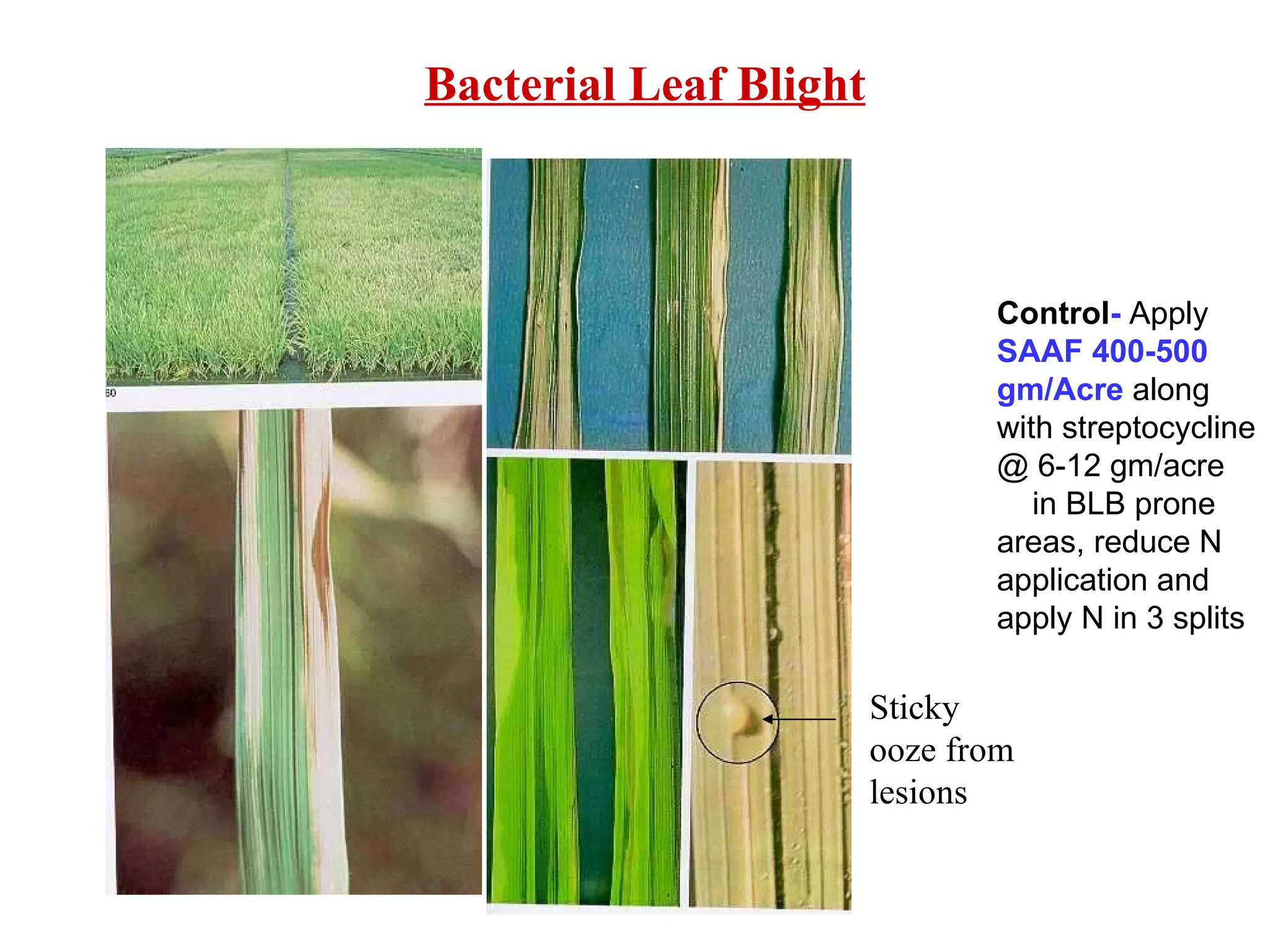
Bacterial Leaf Blight Sticky ooze from lesions Control -  Apply  SAAF 400-500 gm/Acre  along with streptocycline @ 6-12 gm/acre  in BLB prone areas, reduce N application and apply N in 3 splits
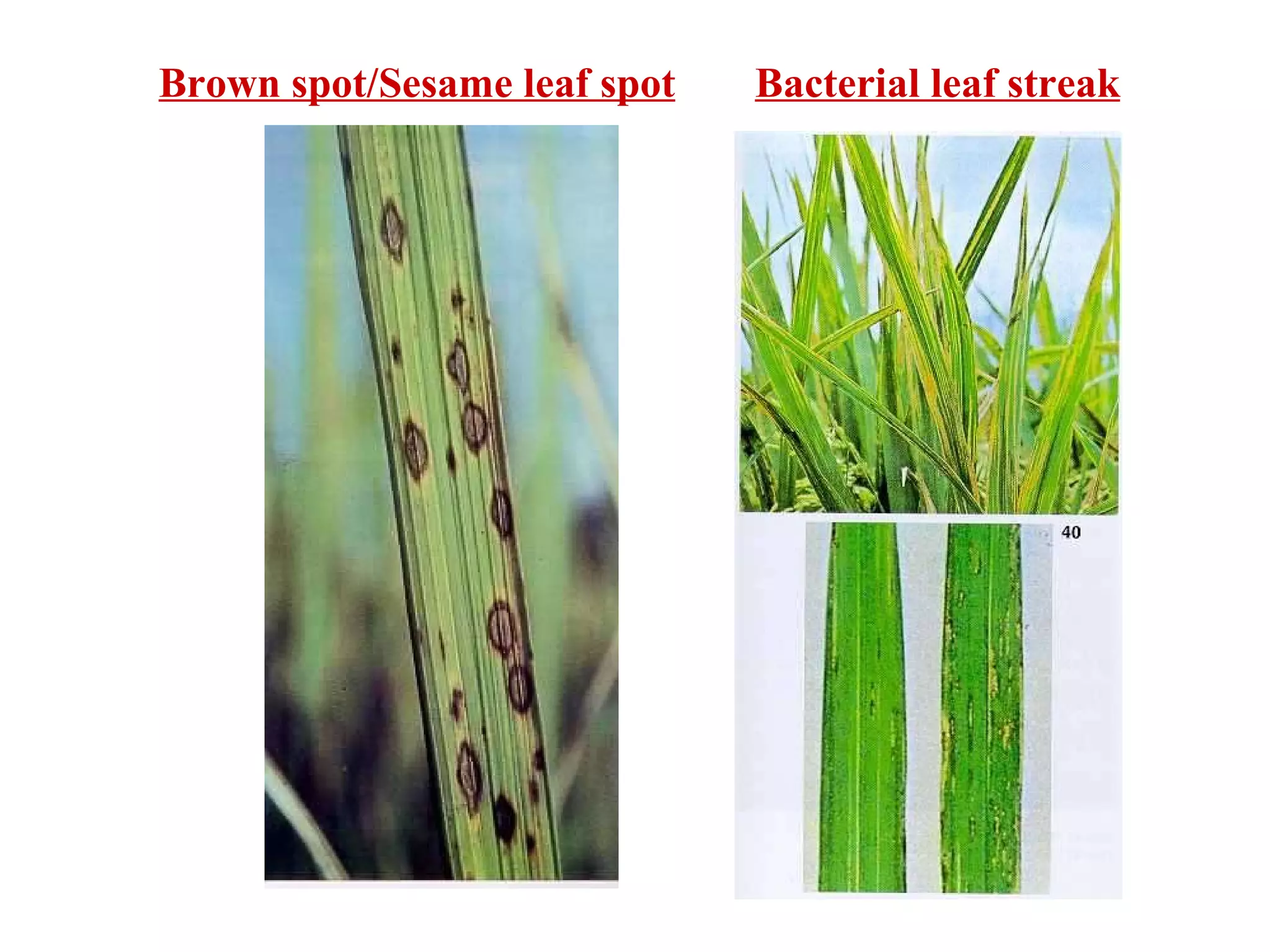
Brown spot/Sesame leaf spot Bacterial leaf streak
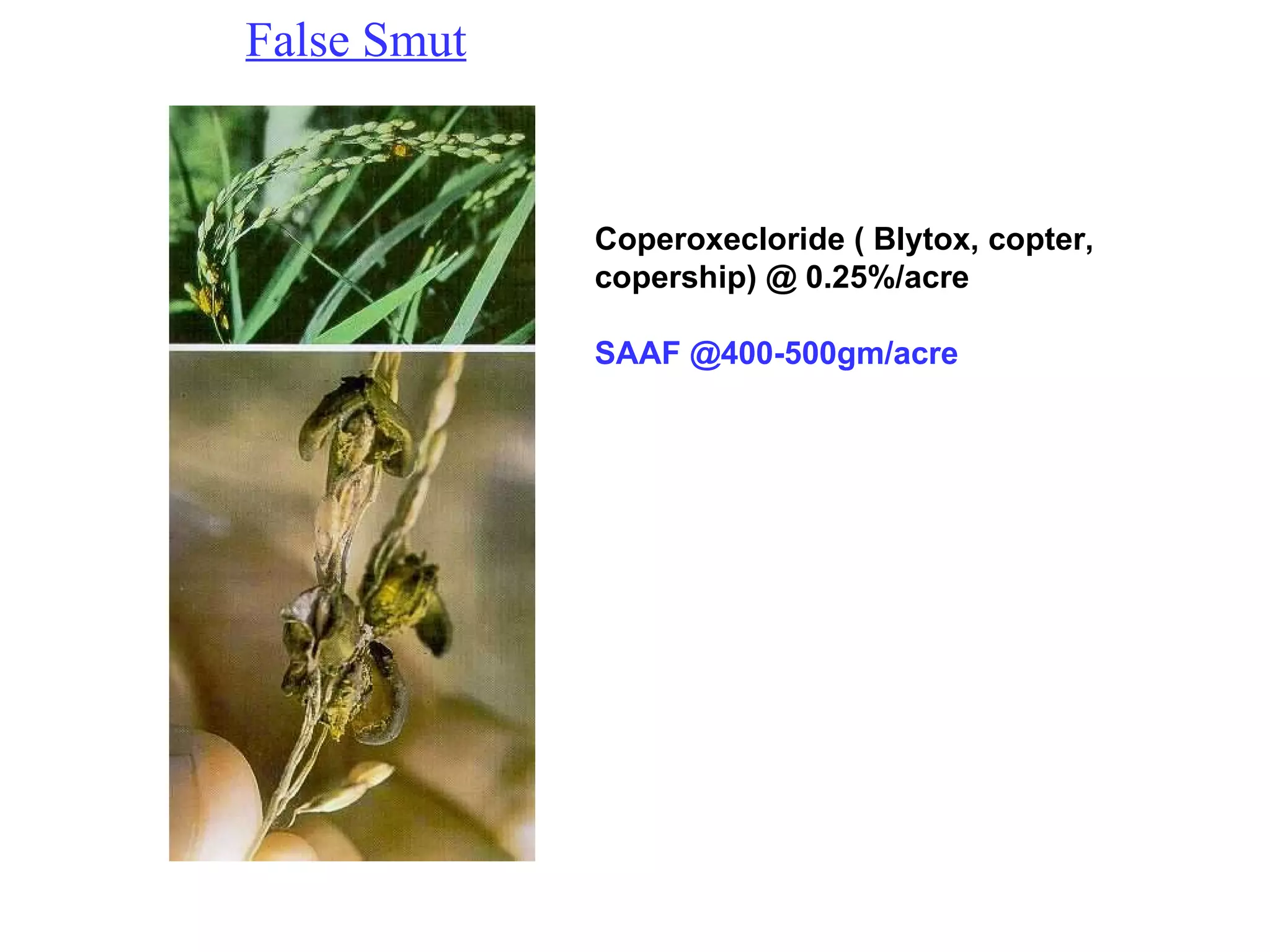
False Smut Coperoxecloride ( Blytox, copter, copership) @ 0.25%/acre SAAF @400-500gm/acre
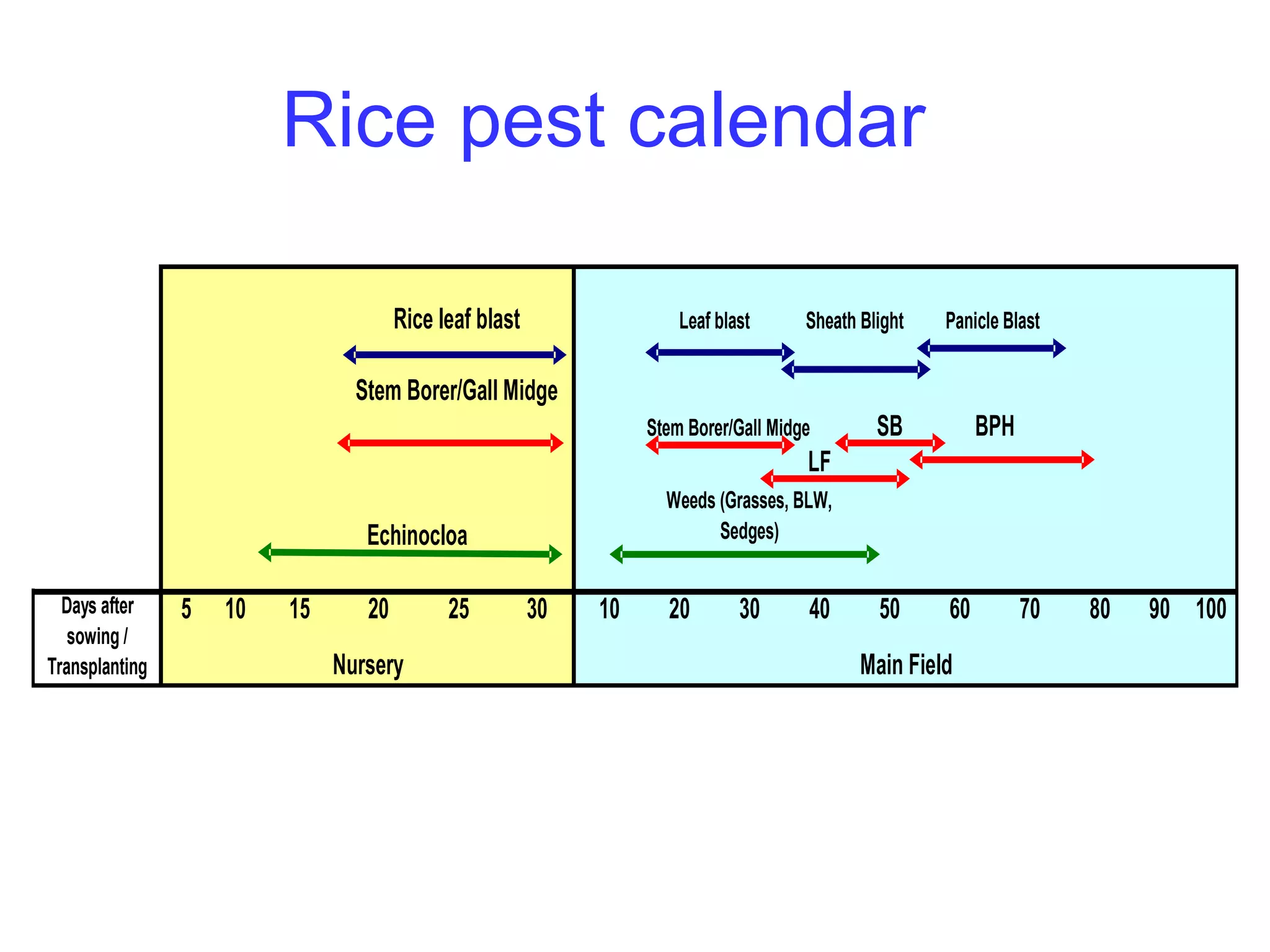
Rice pest calendar
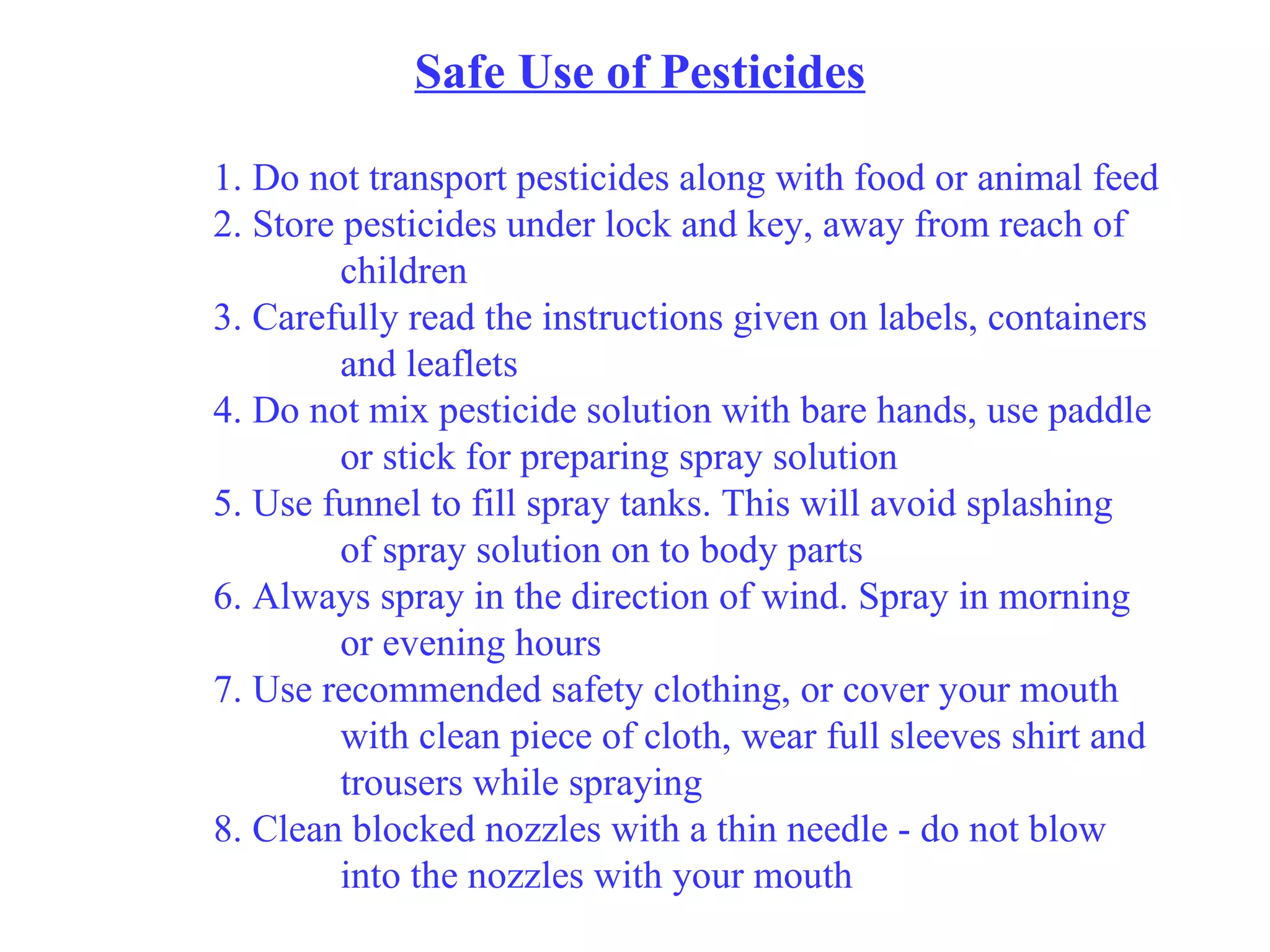
Safe Use of Pesticides 1. Do not transport pesticides along with food or animal feed 2. Store pesticides under lock and key, away from reach of  children 3. Carefully read the instructions given on labels, containers  and leaflets 4. Do not mix pesticide solution with bare hands, use paddle  or stick for preparing spray solution 5. Use funnel to fill spray tanks. This will avoid splashing  of spray solution on to body parts 6. Always spray in the direction of wind. Spray in morning  or evening hours 7. Use recommended safety clothing, or cover your mouth  with clean piece of cloth, wear full sleeves shirt and  trousers while spraying 8. Clean blocked nozzles with a thin needle - do not blow  into the nozzles with your mouth
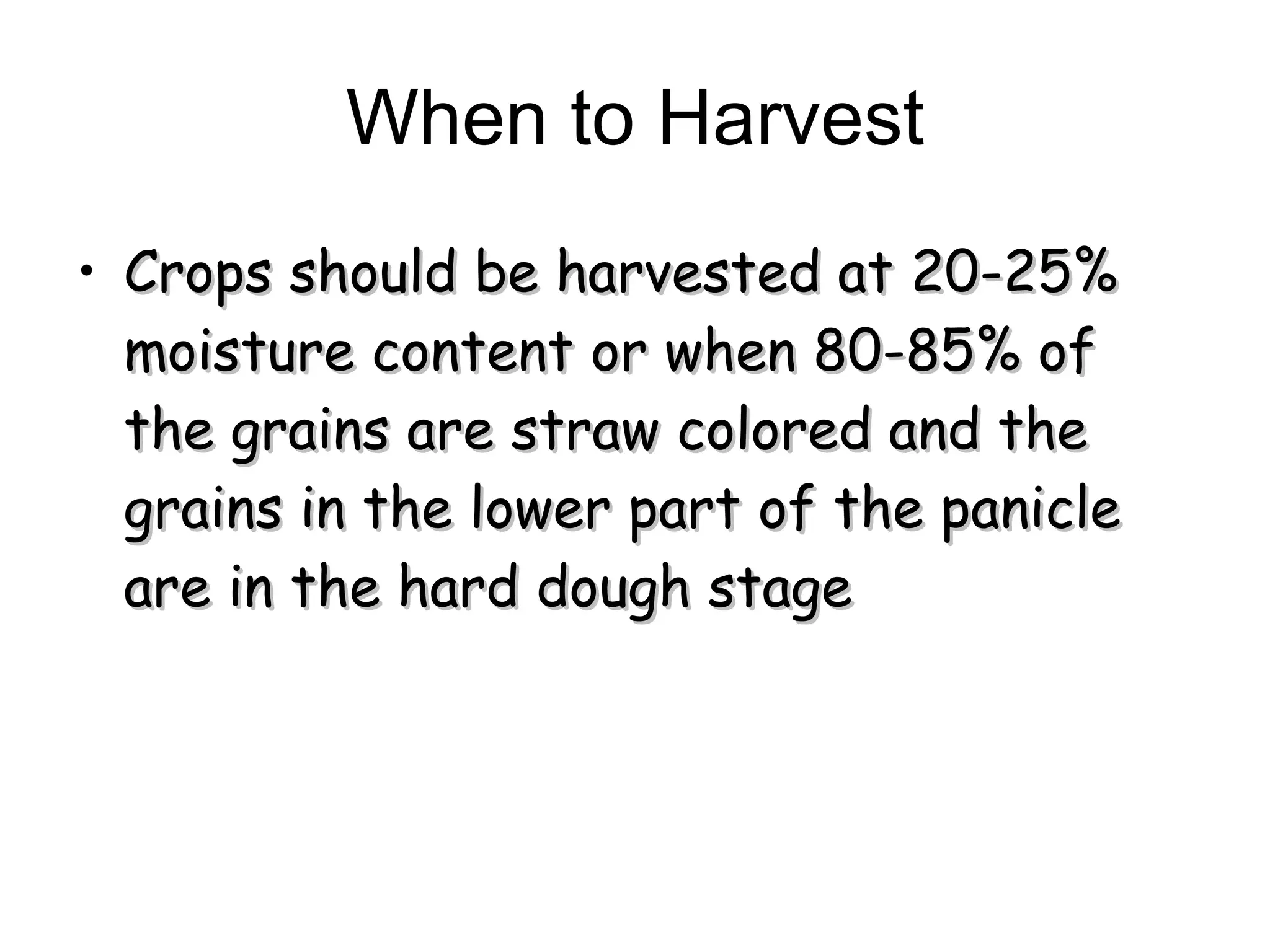
When to Harvest Crops should be harvested at 20-25% moisture content or when 80-85% of the grains are straw colored and the grains in the lower part of the panicle are in the hard dough stage
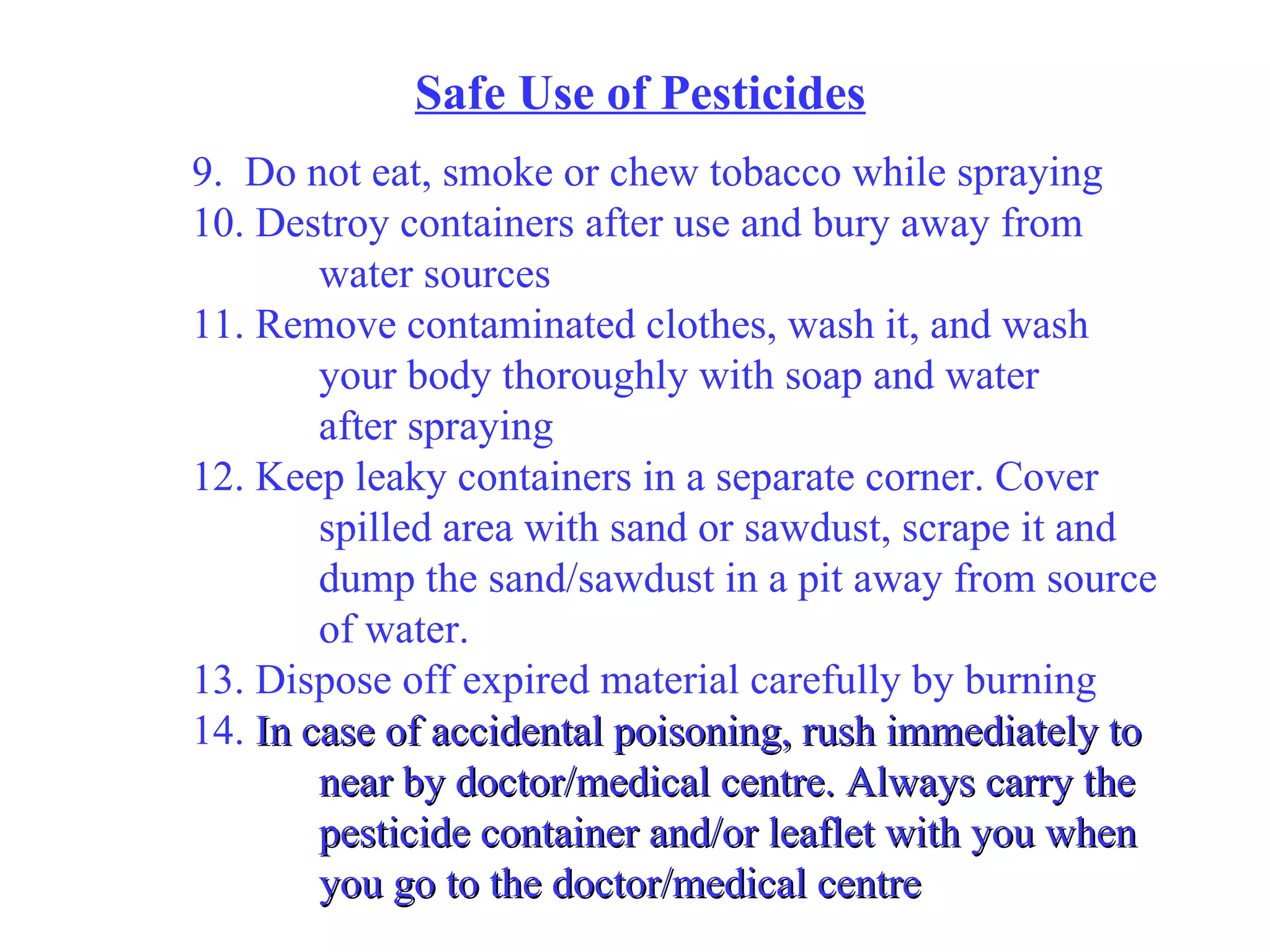
Safe Use of Pesticides 9.  Do not eat, smoke or chew tobacco while spraying 10. Destroy containers after use and bury away from water sources 11. Remove contaminated clothes, wash it, and wash your body thoroughly with soap and water  after spraying 12. Keep leaky containers in a separate corner. Cover spilled area with sand or sawdust, scrape it and dump the sand/sawdust in a pit away from source of water. 13. Dispose off expired material carefully by burning 14.  In case of accidental poisoning, rush immediately to near by doctor/medical centre. Always carry the pesticide container and/or leaflet with you when you go to the doctor/medical centre
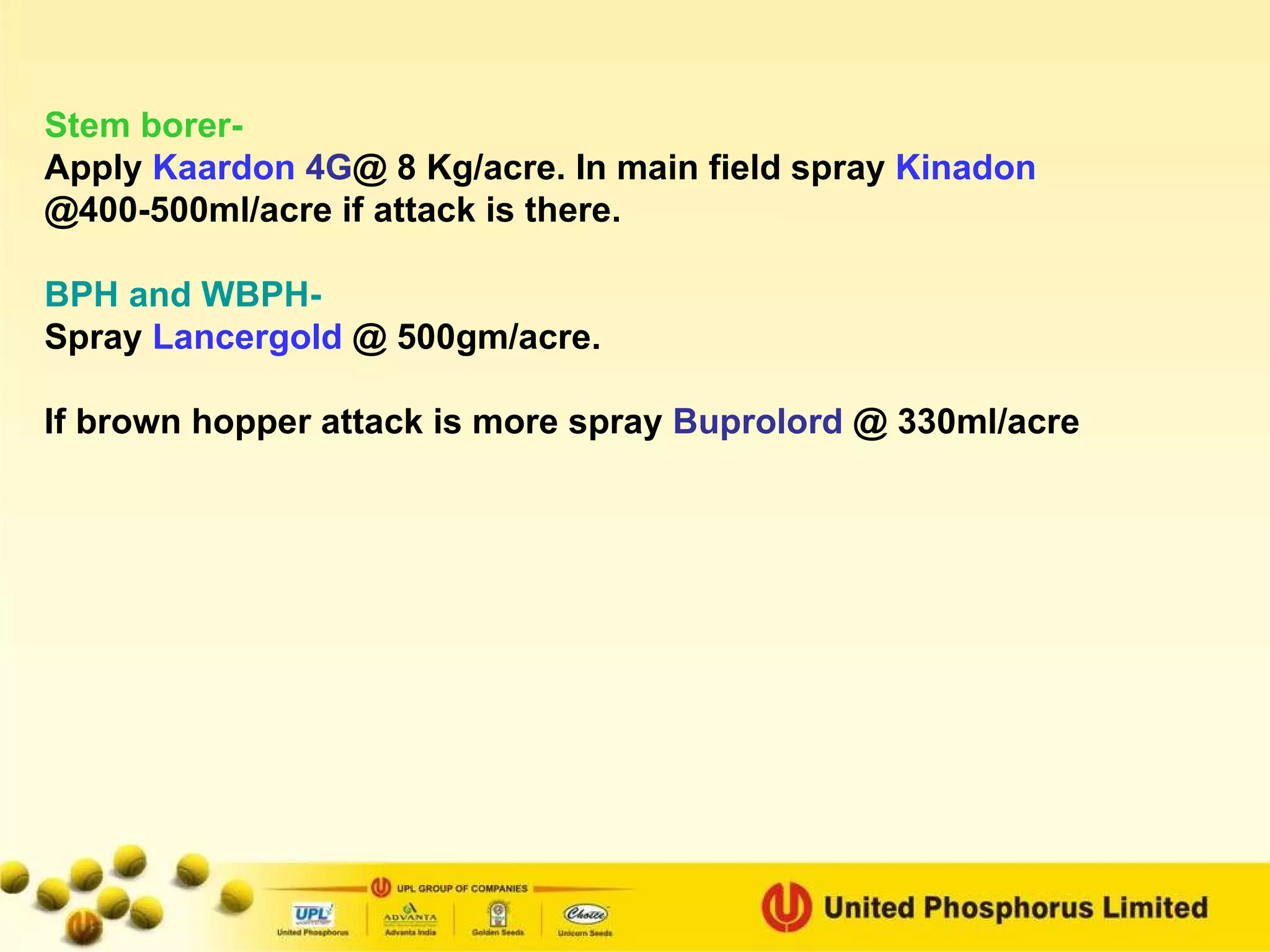
Stem borer-   Apply  Kaardon  4G @ 8 Kg/acre. In main field spray   Kinadon  @400-500ml/acre if attack is there. BPH and WBPH- Spray  Lancergold  @ 500gm/acre. If brown hopper attack is more spray  Buprolord  @ 330ml/acre
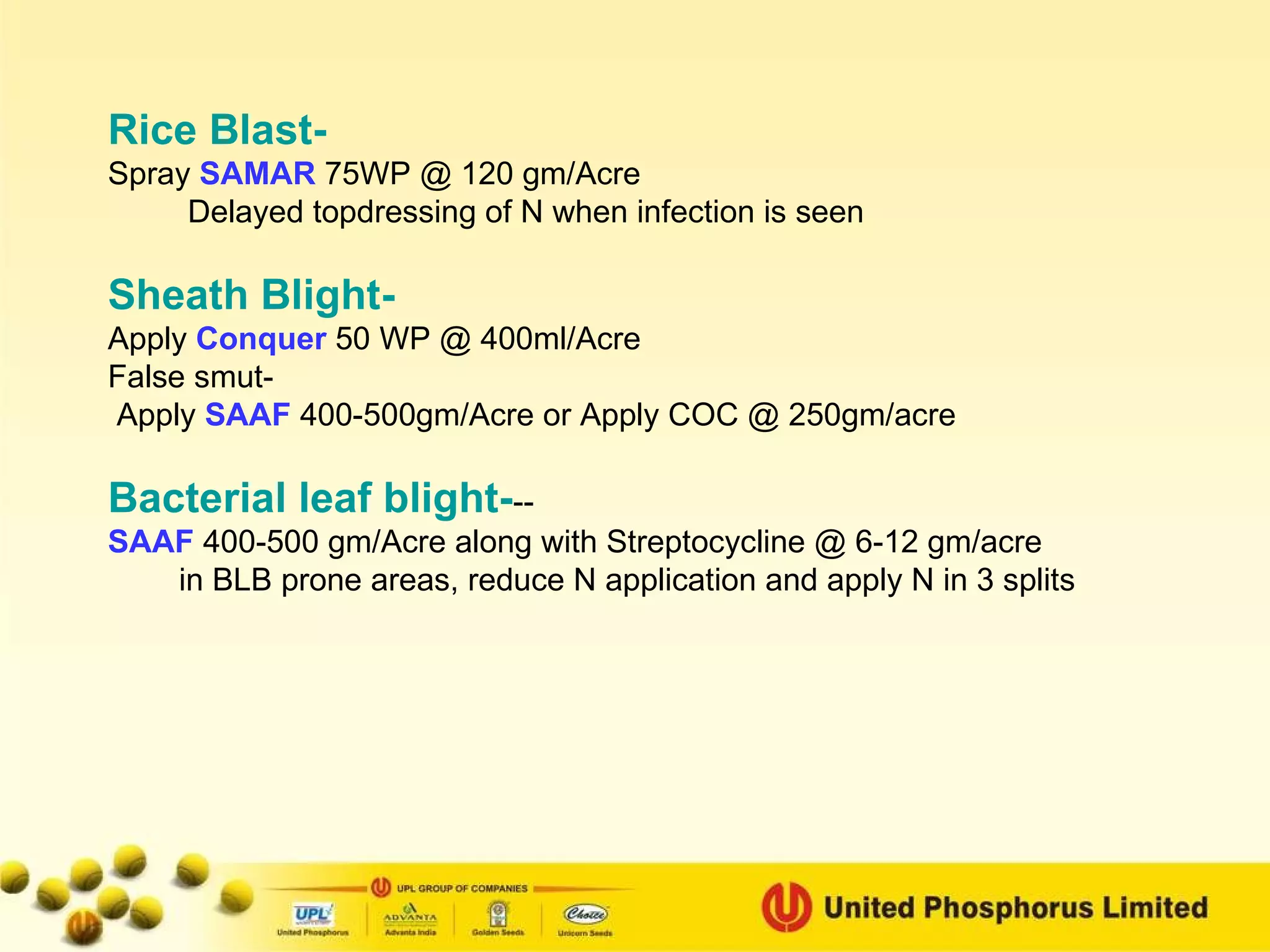
Rice Blast-   Spray  SAMAR   75WP @ 120 gm/Acre Delayed topdressing of N when infection is seen Sheath Blight- Apply  Conquer   50 WP @ 400ml/Acre False smut- Apply   SAAF   400-500gm/Acre or Apply COC @ 250gm/acre Bacterial leaf blight- --  SAAF   400-500 gm/Acre along with Streptocycline @ 6-12 gm/acre in BLB prone areas, reduce N application and apply N in 3 splits
Thanks
 

Biology And Package Of Practices Of Rice

  • 1.
    Field staff trainingProgramme Haryana 15 April 2009 Karnal
  • 2.
    Rice is amajor source of food in India It is staple food for nearly 2/3 of Indian population Rice is the single largest crop in India with 42 million ha. with a production of 88 Million tons (milled rice) Rice covers 22% of total cropped area with 39% of total cereal acreages. Haryana contribute 61% total basmati rice produced in India. Uttar Pradesh is having highestPaddy and hybrid of Rice acreages in India Rice -- Some Facts
  • 3.
  • 4.
    Crop Biology ofRice Packages of practices Insect Management Diseases Management Nutrient Deficiencies UPL product profile Q&A and Quiz Topics to be covered
  • 5.
    GROWTH STAGES OFRICE PLANT
  • 6.
    The growth ofthe rice plant is divided into three phases: 1.Vegetative (germination to panicle initiation) 2. Reproductive (panicle initiation to flowering); 3. Ripening (flowering to mature grain) Phases of Growth
  • 7.
    a) Vegetative phase- seed germination to panicle initiation 1 . Seedling stage 2. Tillering stage b) Reproductive phase - Panicle initiation to maturity 1. Booting 2. Panicle emergence 3. Flowering 4. Milky Stage 5. Dough Stage 6. Mature grain Stages of growth
  • 8.
  • 9.
  • 10.
  • 11.
    A 20 daysold seedling is ready for transplanting. It has 5-6 leaves and rapidly developing root system
  • 12.
    Days to completegrowth stages Seedling stage---- 3-22 days Tillering stage---22-40 days
  • 13.
  • 14.
  • 15.
  • 16.
  • 17.
  • 18.
  • 19.
  • 20.
  • 21.
  • 22.
    Planting Time andseed rate : North India------------------ Mid May to end June Seed Rate : ------------------- - 6 Kg. per Acre Seed Treatment ----------------- Organo mercurial's@ 2g/Kg seed SAAF @2gm/Kg of seed
  • 23.
    Soak the seedin water solution for overnight. Incubate the seeds in warm moist condition for 36-48 hours or until it gets sprouted(pregermination). Wash the seed in clean water twice a day to avoid the rotten smell. Seeds can be incubate in moist jute sacks. Sow pregerminated seeds uniformly on the seed beds @ 1 kg /35 to 40 sq.meter area preferably during evening hours. PLANTING METHOD
  • 24.
  • 25.
    Seedbed preparation Preparenursery area thoroughly by repeated ploughing, puddling and uniform leveling Prepare seedbeds of one meter width and of convenient length Apply 250 kg. FYM, 1kg Nitrogen, 0.5 kg Phosphorous, 0.5 kg Potash and0 .25Kg Zn for every 100 sq. meter area.
  • 26.
    Main field preparation Prepare main field area thoroughly by repeated ploughing, puddling and uniform leveling. Apply 15 tons of well decomposed FYM per hectare. Apply 15 Kg Urea, 50 Kg DAP ,30 Kg MOP and 10 Kg Zinc per acre before transplanting.
  • 27.
    Transplant after 25to 30 days depending on the seedling growth(5-6 leaf stage) Plant only one seedling per hill Spacing between row is 20 cm and between plant is 15 cm(33 plants/sq m) Fill the gaps if any due to mortality of seedlings after 8 days of transplanting using the excess seedlings Transplanting
  • 28.
    Weed control-Apply SAATHI @ 80gm/Acre mixed with 20 Kg sand within 2-3 days of transplanting. There should be 2-3 cm standing water in the field.
  • 29.
    Water management: Maintain2-3 cm level of water in the main field for initial 15 days Drain the water for 1 or 2 days around 20th day Increase the water level thereafter to 4-5 cm till it reaches at maximum tillering stage. Drain the water for 1 or 2 days around 40th day so as to suppress the emergence of unproductive tillers. Increase the water level thereafter to 4-5 cm till maturity Drain out water completely 10 days before harvest. Water Management for the crop
  • 30.
    Fertilizer Schedule 1040 50 85 Total - 10 - 35 6 weeks after transplanting - - - 35 3 weeks after transplanting 10 30 50 15 Land prepration Zinc MOP DAP Urea Time of Application Fertilizer(Kg)
  • 31.
    Insect Pests ofRice and their management
  • 32.
    Female moths havebright yellowish forewings Distinct black spot at the centre of the forewings Brownish yellow tuft of hair at the tip of abdomen Hind wings are straw coloured Rice Stem Borer
  • 33.
    Eggs are laidin masses on leaf tips/upper half Eggs are covered with the light yellow coloured hairs Newly hatched yellowish larvae move downward - wander around for a couple of hrs. - hang down by silken threads - blown to nearby clumps - land on water, swim in search of plants New larvae feed on leaf and leaf sheath for a few days
  • 34.
    Medium sized larvaebore into stem near the nodal region Older larvae feed inside the stem near the base of the plant Feeding cuts nutrient and water supply to growing end - hence the symptoms Pupation occurs inside the stem near the soil surface or below the soil surface Adults crawl out through exit holes cut by the larvae before pupation - ENTRY HOLES NOT VISIBLE
  • 35.
    SYMPTOMS “ DEADHEARTS” IN YOUNG PLANTS - DRYING OF THE CENTRAL SHOOTS “ WHITE EARS” IN OLDER PLANTS - DRYING OF THE PANICLE INJURY LEADS TO YIELD LOSS
  • 36.
    Control-Application of Kaardon 4G@8Kg/acre Dead Heart White ear
  • 37.
    Rice Leaf folderControl- Kaardon 50SP @ 350-400 gm/Acre
  • 38.
    BPH is aserious pest of rice Three generations/crop Prefers older crop Nymphs and adults are wedge shaped Both nymphs and adults such sap from the basal portions of the plants. Inject toxins during feeding process. Premature yellowing of leaves, leading to drying and later death Brown Plant hopper
  • 39.
    BPH Nymphs andadult suck sap from the tubes that carry food (not water). Honey dew forms. During feeding, BPH produce feeding tubes that clog up the vessels. Drying of plants occur in isolated circular patches causing hopper burn . Hopper burn Control- Apply buprolord@330ml/acre
  • 40.
    Green Hopper Control-Apply Lancer gold@500gm/Acre or Imidagold@75ml/acre
  • 41.
  • 42.
    Important diseases ofrice and their management
  • 43.
    Rice Blast Diseaseoccurs in all growth stages of rice crop - nursery to panicle and grain formation stage Blast is first noticed as minute brown specks on leaves Under low night temp. and high humidity, the spots enlarge and become spindle shaped (pointed at both ends). These have brown margins and grey centre Part or whole of the leaf will wither when these spots merge with one another. The crop gives a blasted appearance when severely infested in the seedling and tillering stages Leaf blast symptoms are seen in the nursery and during early vegetative stage (up to 30 to 35 DAT)
  • 44.
    Blast symptoms innursery Leaf blast
  • 45.
  • 46.
  • 47.
    Rice Blast Nodalinfection results in rotting of the sheath which turns black and breaks apart upon drying All parts above the infected node die Neck infection is the most serious phase of the disease Brown necrotic areas are seen on the neck Girdling of neck of the panicle causing entire panicle to fall off Infection before milk stage results in unfilled/chaffy grains Later infection results in partial filling of grains; grain quality becomes bad Panicles fall over before grain maturation.
  • 48.
    Rice Blast Riceblast is spread from diseased to healthy plant tissues by wind Factors favouring blast occurrence - -Moderate temperatures and abundant moisture -High plant population density -High nitrogen fertilization -Irregular irrigation
  • 49.
    Blast Disease CycleControl- Spray SAMAR 75WP@120gm/acre(Prophyllactic)
  • 50.
    Sheath Blight ofRice Problematic where irrigation facilities are abundant Initial symptoms are seen near the water line Spots are ovoid - greenish grey in colour When mature, spots have an irregular outline Centre of the spots is greyish white, margins are brown When several such spots are formed on leaf sheath, death of whole leaf occurs It unchecked, this will lead to death of whole plant Similar symptoms will appear on leaf blade as well
  • 51.
    Symptoms on leafsheath Ash coloured spots on leaf sheath Symptoms of leaf and sclerotia Control- Spray Conquer @ 300-350 ml/acre
  • 52.
    Sheath Blight ofRice Seedling infection starts 15-25 days after sowing Base of plant is attacked - seedlings die in patches In main field, disease is seen during active tillering Severe incidence during panicle emergence stage Crop loss could be as high as 50% High levels of Nitrogen will contribute to disease
  • 53.
    Bacterial Leaf BlightSticky ooze from lesions Control - Apply SAAF 400-500 gm/Acre along with streptocycline @ 6-12 gm/acre in BLB prone areas, reduce N application and apply N in 3 splits
  • 54.
    Brown spot/Sesame leafspot Bacterial leaf streak
  • 55.
    False Smut Coperoxecloride( Blytox, copter, copership) @ 0.25%/acre SAAF @400-500gm/acre
  • 56.
  • 57.
    Safe Use ofPesticides 1. Do not transport pesticides along with food or animal feed 2. Store pesticides under lock and key, away from reach of children 3. Carefully read the instructions given on labels, containers and leaflets 4. Do not mix pesticide solution with bare hands, use paddle or stick for preparing spray solution 5. Use funnel to fill spray tanks. This will avoid splashing of spray solution on to body parts 6. Always spray in the direction of wind. Spray in morning or evening hours 7. Use recommended safety clothing, or cover your mouth with clean piece of cloth, wear full sleeves shirt and trousers while spraying 8. Clean blocked nozzles with a thin needle - do not blow into the nozzles with your mouth
  • 58.
    When to HarvestCrops should be harvested at 20-25% moisture content or when 80-85% of the grains are straw colored and the grains in the lower part of the panicle are in the hard dough stage
  • 59.
    Safe Use ofPesticides 9. Do not eat, smoke or chew tobacco while spraying 10. Destroy containers after use and bury away from water sources 11. Remove contaminated clothes, wash it, and wash your body thoroughly with soap and water after spraying 12. Keep leaky containers in a separate corner. Cover spilled area with sand or sawdust, scrape it and dump the sand/sawdust in a pit away from source of water. 13. Dispose off expired material carefully by burning 14. In case of accidental poisoning, rush immediately to near by doctor/medical centre. Always carry the pesticide container and/or leaflet with you when you go to the doctor/medical centre
  • 60.
    Stem borer- Apply Kaardon 4G @ 8 Kg/acre. In main field spray Kinadon @400-500ml/acre if attack is there. BPH and WBPH- Spray Lancergold @ 500gm/acre. If brown hopper attack is more spray Buprolord @ 330ml/acre
  • 61.
    Rice Blast- Spray SAMAR 75WP @ 120 gm/Acre Delayed topdressing of N when infection is seen Sheath Blight- Apply Conquer 50 WP @ 400ml/Acre False smut- Apply SAAF 400-500gm/Acre or Apply COC @ 250gm/acre Bacterial leaf blight- -- SAAF 400-500 gm/Acre along with Streptocycline @ 6-12 gm/acre in BLB prone areas, reduce N application and apply N in 3 splits
  • 62.
  • 63.