1
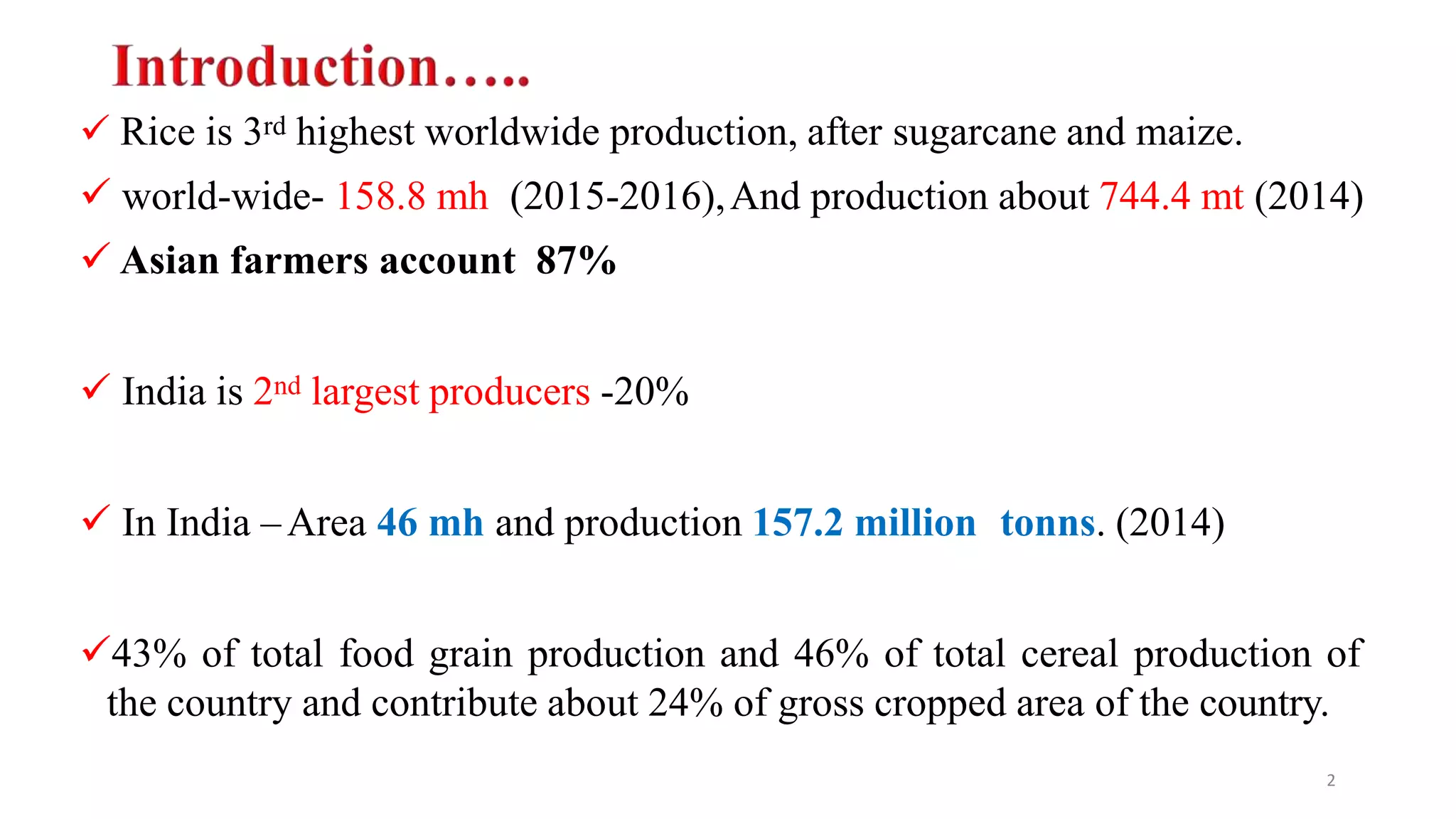
 Rice is 3rd highest worldwide production, after sugarcane and maize.
 world-wide- 158.8 mh (2015-2016),And production about 744.4 mt (2014)
 Asian farmers account 87%
 India is 2nd largest producers -20%
 In India –Area 46 mh and production 157.2 million tonns. (2014)
43% of total food grain production and 46% of total cereal production of
the country and contribute about 24% of gross cropped area of the country.
2
3
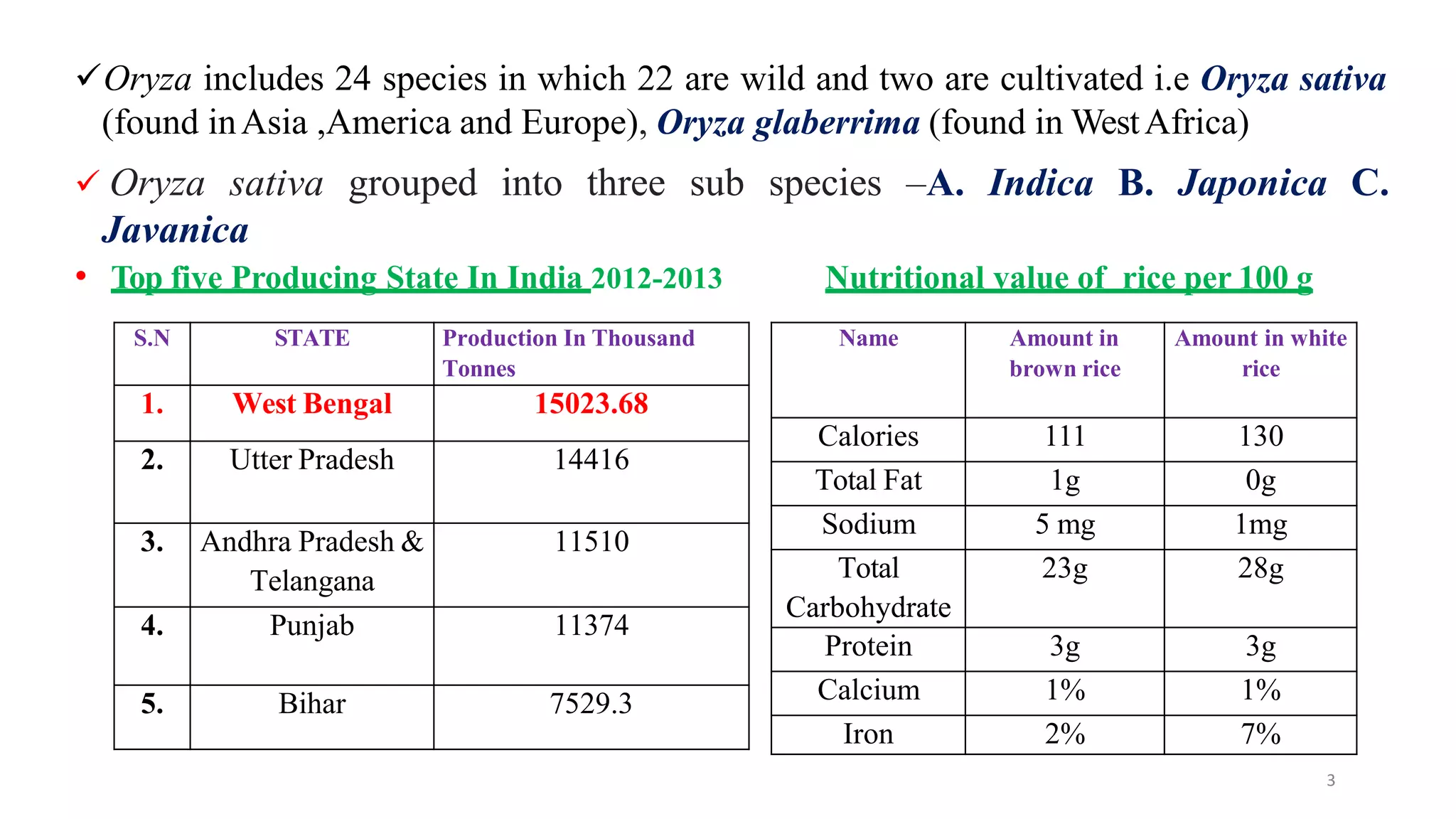
Oryza includes 24 species in which 22 are wild and two are cultivated i.e Oryza sativa
(found inAsia ,America and Europe), Oryza glaberrima (found in WestAfrica)
 Oryza sativa grouped into three sub species –A. Indica B. Japonica C.
Javanica
• Top five Producing State In India 2012-2013 Nutritional value of rice per 100 g
S.N STATE Production In Thousand
Tonnes
1. West Bengal 15023.68
2. Utter Pradesh 14416
3. Andhra Pradesh &
Telangana
11510
4. Punjab 11374
5. Bihar 7529.3
Name Amount in
brown rice
Amount in white
rice
Calories 111 130
Total Fat 1g 0g
Sodium 5 mg 1mg
Total
Carbohydrate
23g 28g
Protein 3g 3g
Calcium 1% 1%
Iron 2% 7%
4
Highest productivity in Punjab 6000 kg/ha - 2013 . Egypt - 9.5 tonnes
per hectare.
India exported 40,45,796.25 MT of Basmati Rice of Rs. 22718.44 crores.
Uttar Pradesh export 443957.16 MT of Rs. 2722.65 crore (2015-16)
 63,66,585.53 MT of Non-Basmati Rice to the world for the worth of Rs.
15129.09 crores Uttar Pradesh export 3, 21,473.61 MT worth of Rs.
949.82 crores. (2015-16)
5
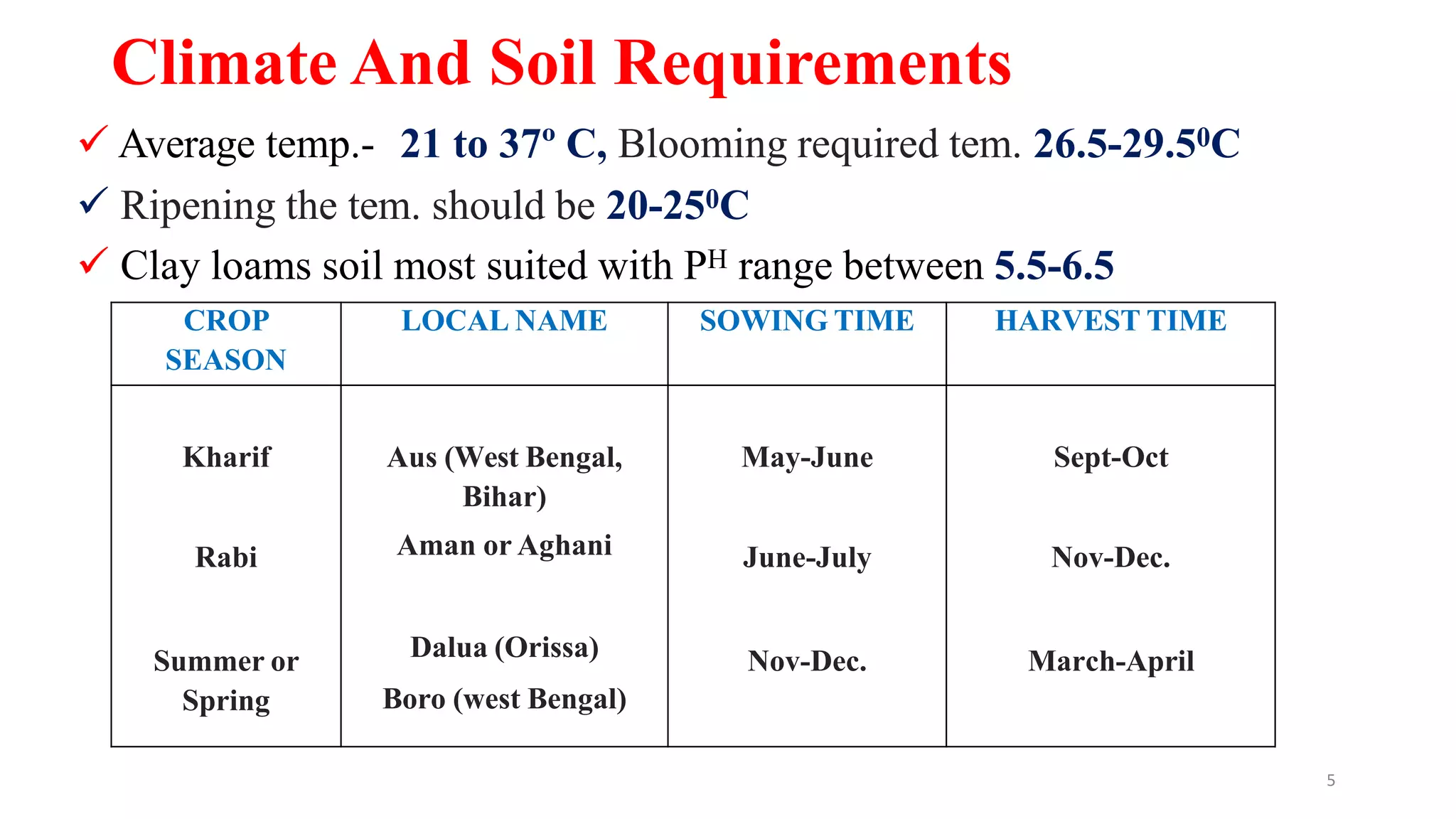
Climate And Soil Requirements
 Average temp.- 21 to 37º C, Blooming required tem. 26.5-29.50C
 Ripening the tem. should be 20-250C
 Clay loams soil most suited with PH range between 5.5-6.5
CROP
SEASON
LOCAL NAME SOWING TIME HARVEST TIME
Kharif Aus (West Bengal,
Bihar)
May-June Sept-Oct
Rabi Aman or Aghani June-July Nov-Dec.
Summer or
Spring
Dalua (Orissa)
Boro (west Bengal)
Nov-Dec. March-April
6
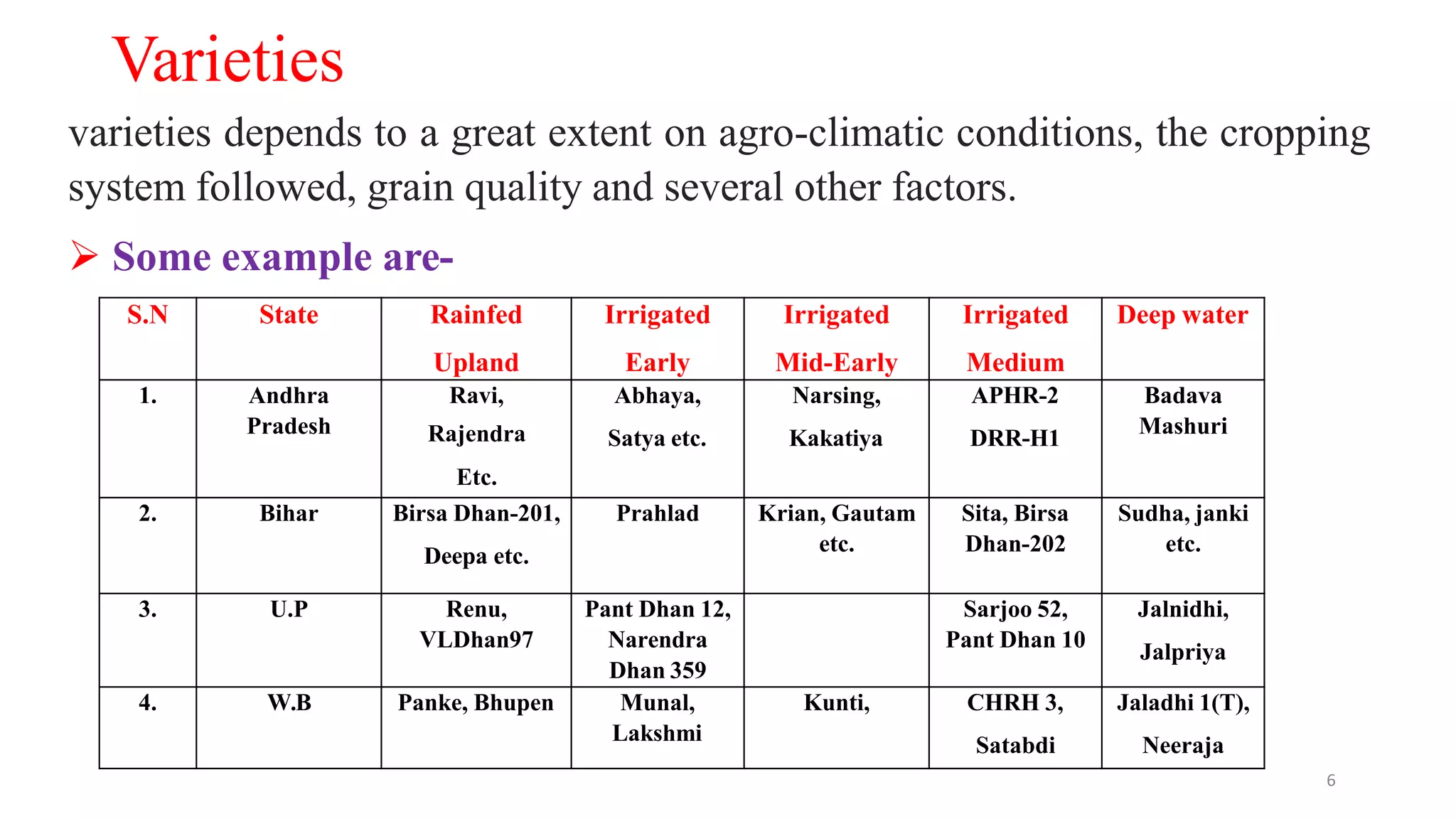
Varieties
varieties depends to a great extent on agro-climatic conditions, the cropping
system followed, grain quality and several other factors.
 Some example are-
S.N State Rainfed
Upland
Irrigated
Early
Irrigated
Mid-Early
Irrigated
Medium
Deep water
1. Andhra
Pradesh
Ravi,
Rajendra
Etc.
Abhaya,
Satya etc.
Narsing,
Kakatiya
APHR-2
DRR-H1
Badava
Mashuri
2. Bihar Birsa Dhan-201,
Deepa etc.
Prahlad Krian, Gautam
etc.
Sita, Birsa
Dhan-202
Sudha, janki
etc.
3. U.P Renu,
VLDhan97
Pant Dhan 12,
Narendra
Dhan 359
Sarjoo 52,
Pant Dhan 10
Jalnidhi,
Jalpriya
4. W.B Panke, Bhupen Munal,
Lakshmi
Kunti, CHRH 3,
Satabdi
Jaladhi 1(T),
Neeraja
Method Of Rice Cultivation
Aerobic rice
Alternate wetting
and drying (AWD)
Ground cover rice
production system
Deep water rice
Cultivation
through drip
irrigation
SRI
Raised bed-
saturated soil
culture method
Up-land
cultivation
Low land rice
7
• Aerobic rice varieties e.g PMK-3, CO47
• Well drained
• Non puddled
• 4-6t/ha with 50% saving irrigation water
• Uplands
• Undulating, rainfed lowlands
• Water-short irrigated low lands
8
 Called ‘intermittent irrigation’or ‘controlled irrigation’
Save -15-30% water
9
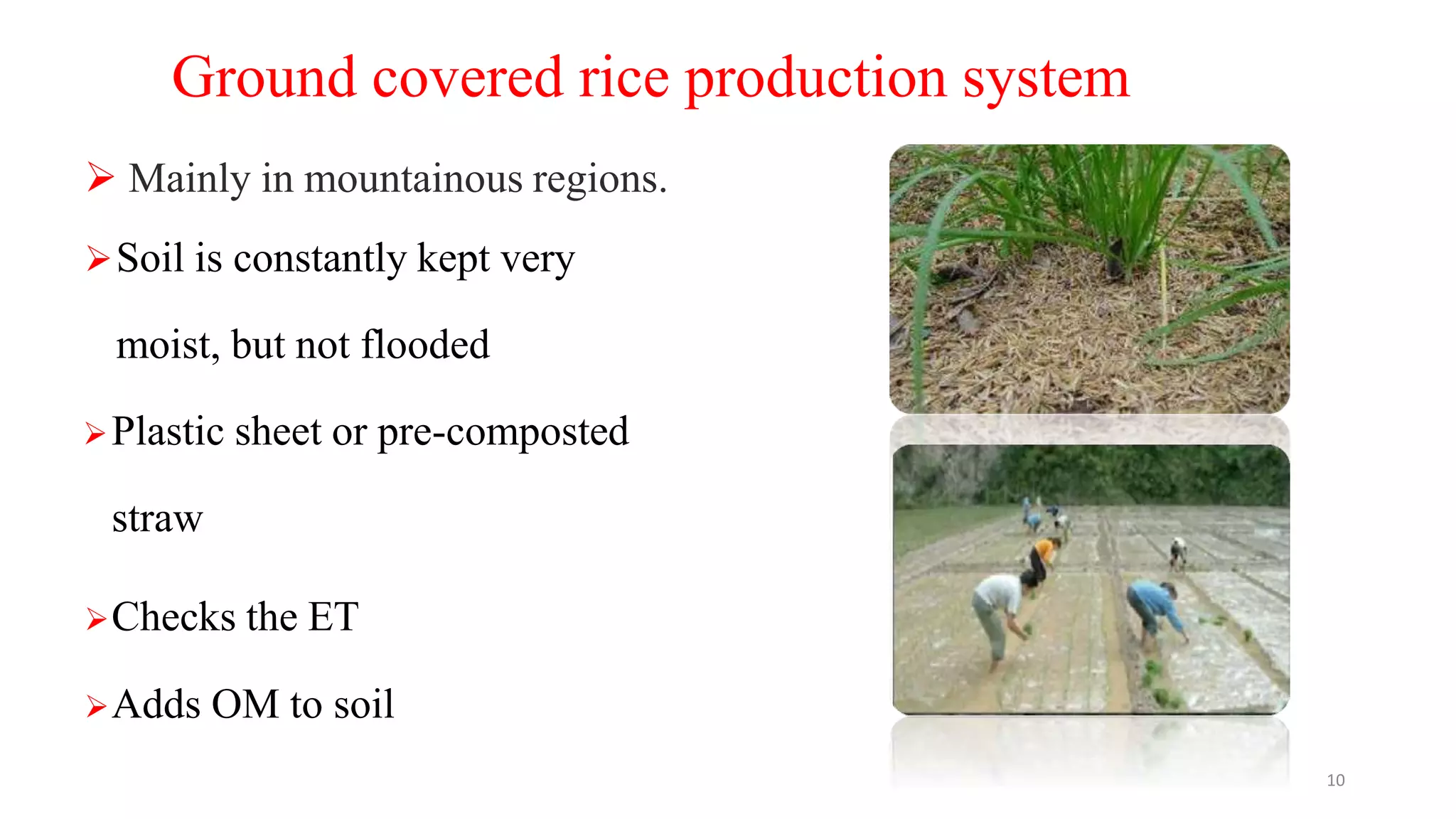
Ground covered rice production system
 Mainly in mountainous regions.
Soil is constantly kept very
moist, but not flooded
Plastic sheet or pre-composted
straw
Checks the ET
Adds OM to soil
10
Deep water rice cultivation
 Grow where water more then 50 cm deep for at least a month
 Grow two type of rice floating rice and traditional talls
Traditional talls are varieties that are grown at water depths of between
50 cm and 100 cm Floating rice grows in water deeper than 100 cm
eg.- Swarna 1
11
Drip irrigation system
 Very new system and under experiment in rice cultivation
Experiment is doing different public and private sector e.g IARI,
TNAU, Jain Irrigation Systems (world's 2nd largest micro-irrigation
company.)
12
System of rice intensification (SRI)
 Developed in Madagascar early-1980s by Father Henri de Laulanie
 Formal experimentation started in India 2002-2003
Core principles of SRI
8-10 Days (2 leaf stage)
nursery
Wider spacing (25X25cm) Weeding with weeder Use of Organics
13
 Saving of 30 – 40% irrigation water
14
seed (2 kg / acre as against 25-30 kg/ acre in
 Saving of 85 %
normal method)
 Saving of chemical inputs
 More healthy and tasty rice due to organic farming practices
 Better and higher yields with lower inputs
 Crop duration reduced by 7-10 days due to absence of transplanting
shock
 Also called direct –seeded rice
 Mainly early maturing variety of 100-115 days
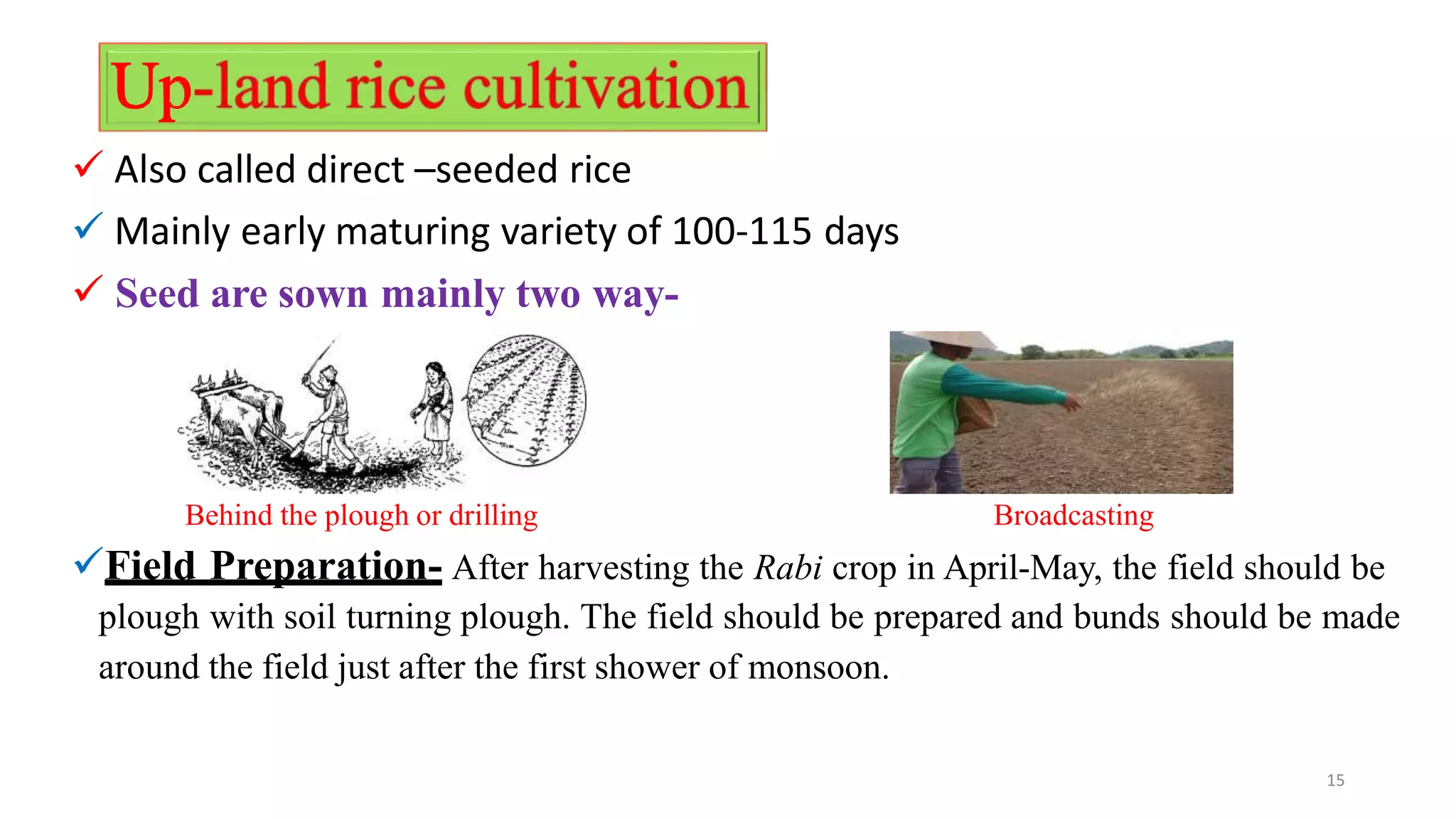
 Seed are sown mainly two way-
Behind the plough or drilling Broadcasting
Field Preparation- After harvesting the Rabi crop in April-May, the field should be
plough with soil turning plough. The field should be prepared and bunds should be made
around the field just after the first shower of monsoon.
15
16
 Seed rate- 60 kg in behind the plough or drilling and for broadcasting
100 kg seed /hectare.
 Fertilizer Application in Dry and Rainfed Upland cultivation
60 kg Nitrogen, 30 kg Phosphorus, 30 kg potash per hec.
25% N, total P & K applied at time of land preparation. After 35-40 days of
sowing or tilering stage, top dress 50% of total N, The remaining 25% N
should be top dressed at dressed at panicle initiation stage.
 Weeding and Howing
In upland rice weeds are major problem. Apply Benthiocarb at the rate of 2
kg a.i per hectare 6-7 days after seedling of rice. One manual weeding 40-45
days after sowing.
Wet or low land rice cultivation
17
1. Transplanting in puddled fields.
2. Broadcasting sprouted seeds in puddled fields.
•For transplanting one hectare area about 500 square meter area is sufficient
for nursery raising. In case of late sowing area should be 750-1000 square
meter.
Seed rate- 40-45 kg seed for bold grain varieties and 30-35 kg seed for
fine grain varieties
Method of raising seedling
18
 1. Wet bed nursery 2. Dry bed nursery 3. Dapog
1. Wet bed nursery
•Most popular worldwide, Raised beds within the swamp, Apply 225g urea or
500g ammonium sulphate and 500g SSP per 10 square meter, Keep the seed
beds saturated with water for five days, Seedling would be ready for
transplanting at the age of 20-25 days.
2. Dry bed nursery
Practiced in areas where water is not sufficient, Use the same seed rate and
fertilizer as in wet nurseries.
Beds should be watered thoroughly immediately after planting and twice
every day thereafter
19
 Maintain a thin film of water if possible after 5days of sowing
 Seedlings on the dry bed should be ready for transplanting from 21 days
 Water the bed to saturation before uprooting
3. The Dapog Nursery
 Method introduced in India from Philippines
Main merit of this method is that less area is needed to raise seedlings
about 25-30 square meters
 Save almost half of the time in seedling raising
 1 Sq m of seed bed should be require for every 3 Kg of seed.
 Seedling would be ready for transplanting with in 11 to 14 days
20
Land preparation
A. Brushing and Clearing B. Repairing Water Control Structures
C. Plowings and Puddling
 1st plowing- 2-3 weeks before transplanting begins
 2nd take place 7-10 days after the first plowing
Puddling- 10 days after the second plowing
transplanting.
and one day before
If a basal application of fertilizer is intended, broadcast the fertilizer just
before puddling
21
Transplanting
A. Hand Transplanting
 Most widely practiced method
 1/2" -1" deep transplanting is best
Space the hills 8"X8" during the wet season, 6"X6" during the dry season but can
be modified
B. Broadling
 Method use where rice grown in extremely boggy, making it difficult to walk in them
 Seedlings are thrown randomly into a the puddled soil
 The technique requires smaller plots than are found ordinarily
2.Broadcasting sprouted seed in puddle field
22
Area where there is a shortage of labourers or otherwise labour is very
extensive for transplanting.
 100 kg seed are required for one hectare
 Seed should be shocked in water and pre-germinated before broadcast
The sprouted seed with radicle length one to two millimeter are uniformly
broadcasted by hand
Water Management
 Water requirement is high during in initial period about 10 days
 Tillering to flowering is most critical stage
23
 Water allowed to stand in the field at deft of 2-5 cm
Water drained out from field 7 -15 days before harvest encourage quick
and uniform maturity of grain.
•Water saving method:- System of rice Intensification (SRI): 30-40% •
Alternate wetting and drying (AWD): 15-30% • Aerobic rice: 40-50% • Direct
seeded rice: 75% • Ground cover rice production system: 50-60%
Weed control
24
 Yield reduce 20 to 40 percent
 Most common weed are-
• Echinochloa coionum Echinochloa crusgallli
• Cyprus defformis Setaria glauca Scirpus spp.
Cyperus iria Eclipta iria
Ceiosia argentia etc.
Weed should removed once at 20 days after transplanting and second at
50-60 days after transplanting
 Herbicide Used in paddy control for weed control are-
• Butachlor50 a.i (Machete) @1.5 kg per hectare within 5-6 day of transplanting.
• Thiobencarp 30a.i (Saturn) @ 1.5 kg per hectare within 5-6 day of transplanting.
• Pendimethalin 30a.i (stomp) 1 kg/hec spray uniformly within 1-2 days of direct seeding
of paddy.
Diseases of rice
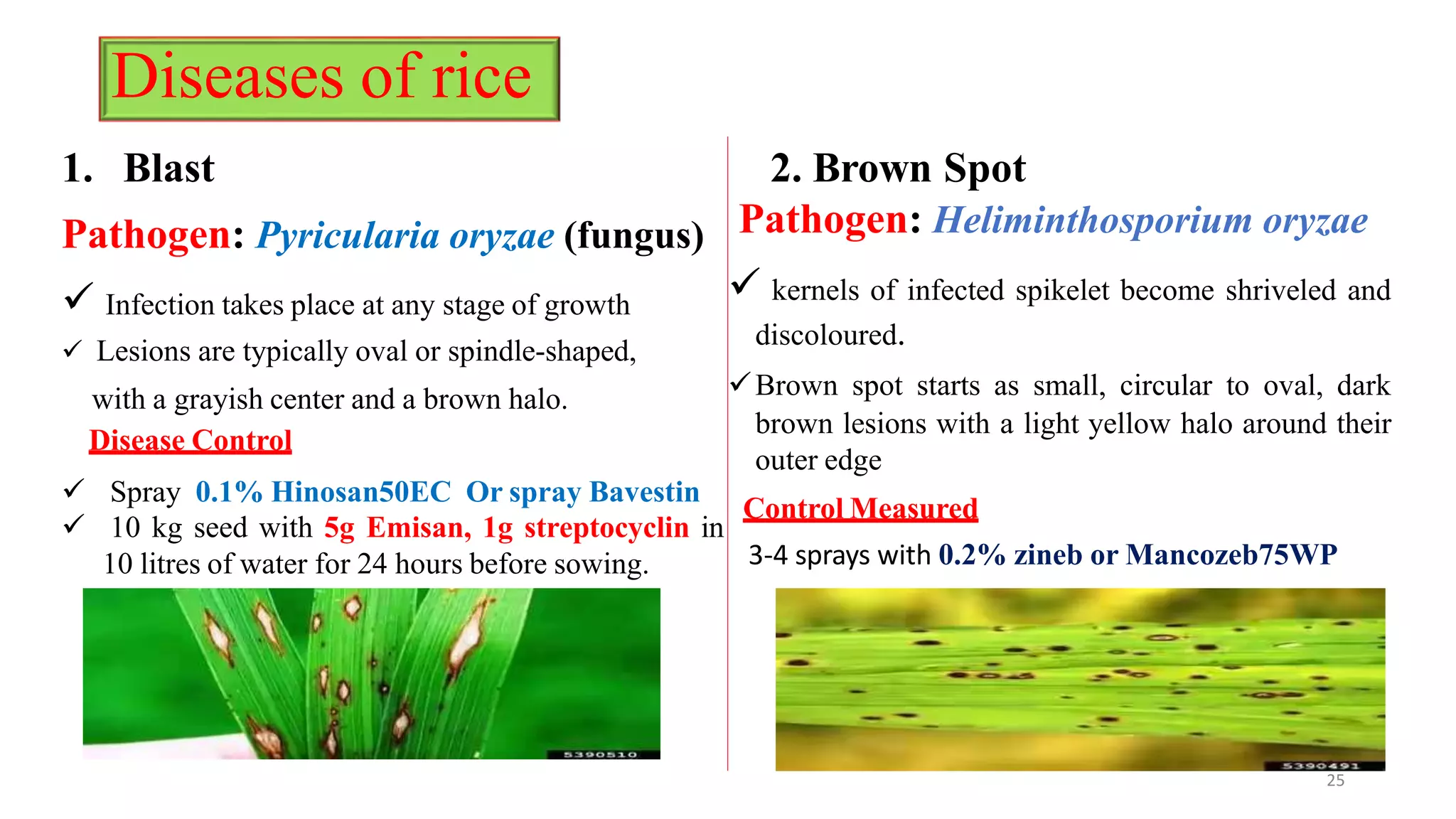
1. Blast
Pathogen: Pyricularia oryzae (fungus)
 Infection takes place at any stage of growth
 Lesions are typically oval or spindle-shaped,
with a grayish center and a brown halo.
Disease Control
 Spray 0.1% Hinosan50EC Or spray Bavestin
 10 kg seed with 5g Emisan, 1g streptocyclin in
10 litres of water for 24 hours before sowing.
2. Brown Spot
Pathogen: Heliminthosporium oryzae
 kernels of infected spikelet become shriveled and
discoloured.
Brown spot starts as small, circular to oval, dark
brown lesions with a light yellow halo around their
outer edge
Control Measured
3-4 sprays with 0.2% zineb or Mancozeb75WP
25
3. False Smut
Pathogen: Ustinaginoidea virens (fungus)
Transformation of the individual grains
into greenish spore ball of velvety
appearance.
Balls are slightly flattened, smooth and
yellow, and covered by a membrane
4. Sheath Blight
Pathogen: Rhizoctonia solanii (fungus)
 Grayish-green lesions on the leaf sheath
between the surface of irrigation water and
the leaf blade.
 The lesions may also extend to the leaf
blades
Control- Spray the crop with 0.2% copperControl-
oxychloride (Blitox) at the time of 50%(Bavistin) per hectare in 1000L of water.
panical emerge
spray with 1.0 kg carbendazin
26
Insect pests
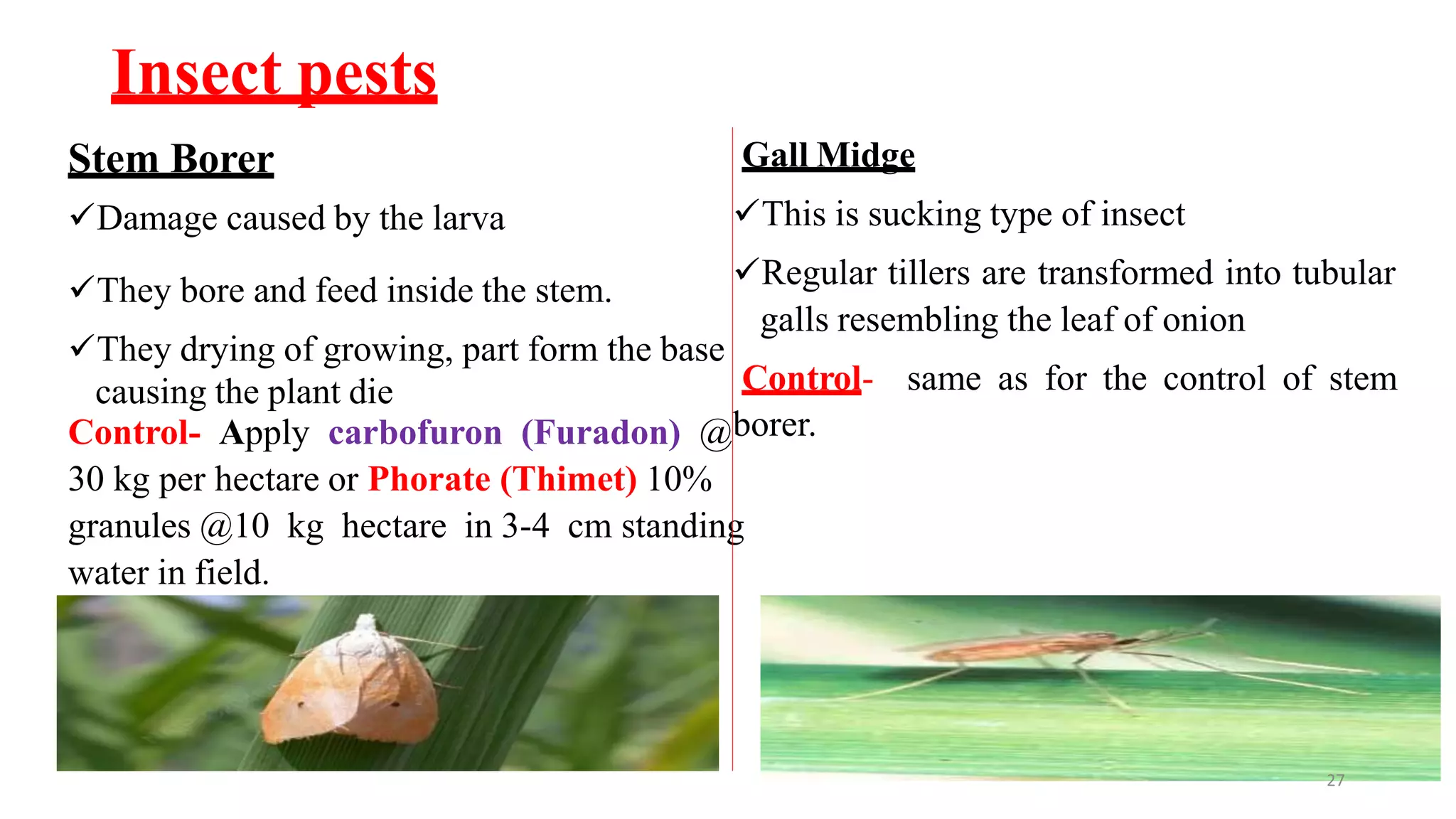
Stem Borer
Damage caused by the larva
They bore and feed inside the stem.
They drying of growing, part form the base
causing the plant die
Gall Midge
This is sucking type of insect
Regular tillers are transformed into tubular
galls resembling the leaf of onion
Control- same as for the control of stem
Control- Apply carbofuron (Furadon) @borer.
30 kg per hectare or Phorate (Thimet) 10%
granules @10 kg hectare in 3-4 cm standing
water in field.
27
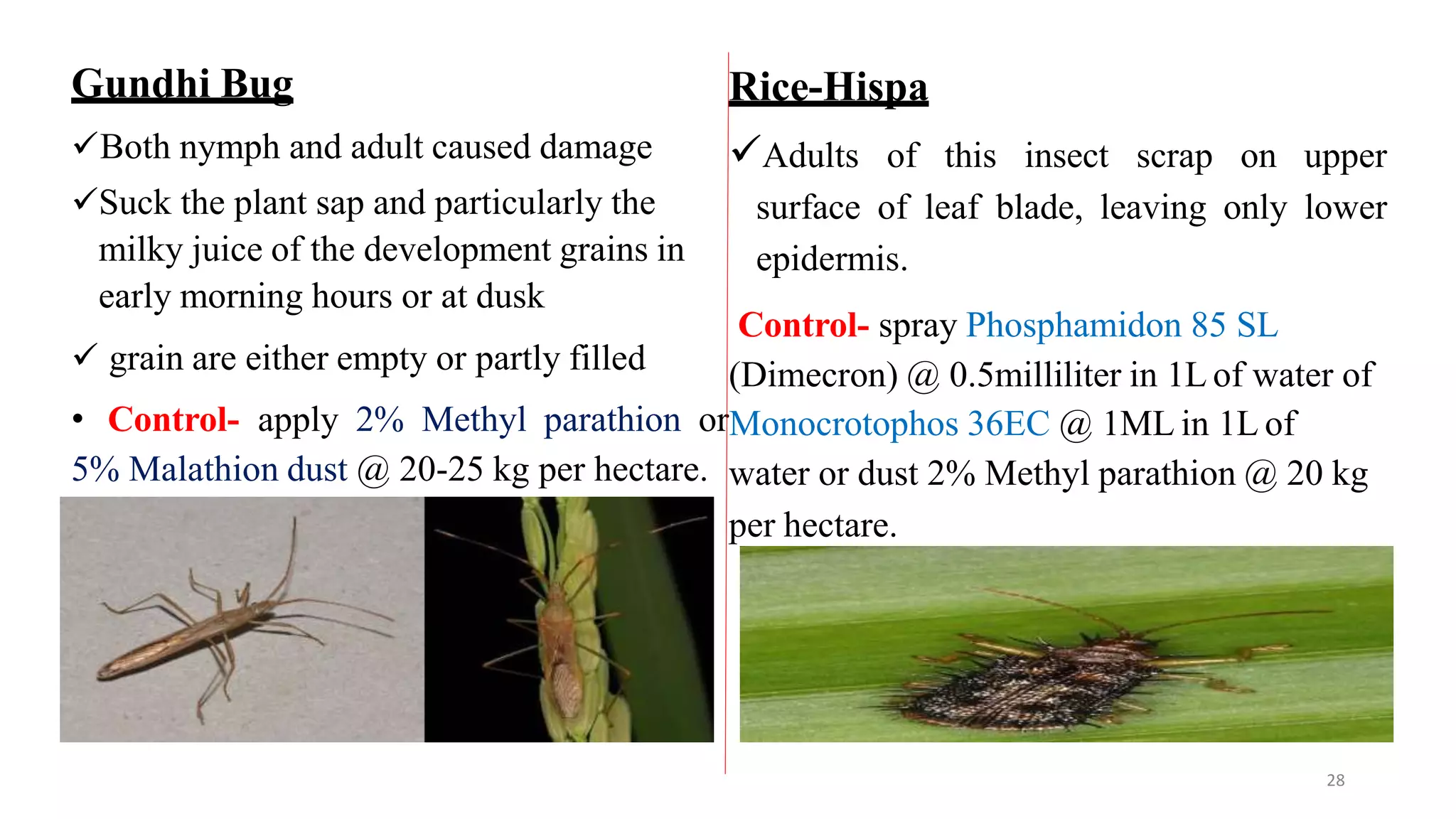
Gundhi Bug
Both nymph and adult caused damage
Suck the plant sap and particularly the
milky juice of the development grains in
early morning hours or at dusk
 grain are either empty or partly filled
Rice-Hispa
Adults of this insect scrap on upper
surface of leaf blade, leaving only lower
epidermis.
Control- spray Phosphamidon 85 SL
(Dimecron) @ 0.5milliliter in 1L of water of
• Control- apply 2% Methyl parathion orMonocrotophos 36EC @ 1ML in 1L of
5% Malathion dust @ 20-25 kg per hectare. water or dust 2% Methyl parathion @ 20 kg
per hectare.
28
Harvesting and threshing
29
85-90% of the panicles are ripe means 90% of the spikelets are golden
and hard.
 Drain the plots 7-10 days before anticipated harvesting
 At the time of harvesting, moisture content - 20-26%
 12-14% before milling or storage
Yield
A well-managed crop of mid duration (135-150) paddy, yields about 60-70
quintal paddy per hectare. Short duration varieties yield about 45-55quintals
per hectare, Hybrid rice yield, about 60-70 quintals per hectare
30
Conclusion and future aspect
 About half of the world population depending upon the rice specific food.
By 2025 about 15-20 mh of irrigated rice fields may suffer from water
scarcity .
To over come this water problem and supply sufficient amount of food to
the people it is necessary that type of cultivation system who need less
water but give more yield.
 Awareness about rice is not aquatic plant
 Standardization ofAWD
 Weed management in aerobic andAWD
 Scope for sprinkler and drip irrigation
31

2.pptx

  • 1.
  • 2.
     Rice is3rd highest worldwide production, after sugarcane and maize.  world-wide- 158.8 mh (2015-2016),And production about 744.4 mt (2014)  Asian farmers account 87%  India is 2nd largest producers -20%  In India –Area 46 mh and production 157.2 million tonns. (2014) 43% of total food grain production and 46% of total cereal production of the country and contribute about 24% of gross cropped area of the country. 2
  • 3.
    3 Oryza includes 24species in which 22 are wild and two are cultivated i.e Oryza sativa (found inAsia ,America and Europe), Oryza glaberrima (found in WestAfrica)  Oryza sativa grouped into three sub species –A. Indica B. Japonica C. Javanica • Top five Producing State In India 2012-2013 Nutritional value of rice per 100 g S.N STATE Production In Thousand Tonnes 1. West Bengal 15023.68 2. Utter Pradesh 14416 3. Andhra Pradesh & Telangana 11510 4. Punjab 11374 5. Bihar 7529.3 Name Amount in brown rice Amount in white rice Calories 111 130 Total Fat 1g 0g Sodium 5 mg 1mg Total Carbohydrate 23g 28g Protein 3g 3g Calcium 1% 1% Iron 2% 7%
  • 4.
    4 Highest productivity inPunjab 6000 kg/ha - 2013 . Egypt - 9.5 tonnes per hectare. India exported 40,45,796.25 MT of Basmati Rice of Rs. 22718.44 crores. Uttar Pradesh export 443957.16 MT of Rs. 2722.65 crore (2015-16)  63,66,585.53 MT of Non-Basmati Rice to the world for the worth of Rs. 15129.09 crores Uttar Pradesh export 3, 21,473.61 MT worth of Rs. 949.82 crores. (2015-16)
  • 5.
    5 Climate And SoilRequirements  Average temp.- 21 to 37º C, Blooming required tem. 26.5-29.50C  Ripening the tem. should be 20-250C  Clay loams soil most suited with PH range between 5.5-6.5 CROP SEASON LOCAL NAME SOWING TIME HARVEST TIME Kharif Aus (West Bengal, Bihar) May-June Sept-Oct Rabi Aman or Aghani June-July Nov-Dec. Summer or Spring Dalua (Orissa) Boro (west Bengal) Nov-Dec. March-April
  • 6.
    6 Varieties varieties depends toa great extent on agro-climatic conditions, the cropping system followed, grain quality and several other factors.  Some example are- S.N State Rainfed Upland Irrigated Early Irrigated Mid-Early Irrigated Medium Deep water 1. Andhra Pradesh Ravi, Rajendra Etc. Abhaya, Satya etc. Narsing, Kakatiya APHR-2 DRR-H1 Badava Mashuri 2. Bihar Birsa Dhan-201, Deepa etc. Prahlad Krian, Gautam etc. Sita, Birsa Dhan-202 Sudha, janki etc. 3. U.P Renu, VLDhan97 Pant Dhan 12, Narendra Dhan 359 Sarjoo 52, Pant Dhan 10 Jalnidhi, Jalpriya 4. W.B Panke, Bhupen Munal, Lakshmi Kunti, CHRH 3, Satabdi Jaladhi 1(T), Neeraja
  • 7.
    Method Of RiceCultivation Aerobic rice Alternate wetting and drying (AWD) Ground cover rice production system Deep water rice Cultivation through drip irrigation SRI Raised bed- saturated soil culture method Up-land cultivation Low land rice 7
  • 8.
    • Aerobic ricevarieties e.g PMK-3, CO47 • Well drained • Non puddled • 4-6t/ha with 50% saving irrigation water • Uplands • Undulating, rainfed lowlands • Water-short irrigated low lands 8
  • 9.
     Called ‘intermittentirrigation’or ‘controlled irrigation’ Save -15-30% water 9
  • 10.
    Ground covered riceproduction system  Mainly in mountainous regions. Soil is constantly kept very moist, but not flooded Plastic sheet or pre-composted straw Checks the ET Adds OM to soil 10
  • 11.
    Deep water ricecultivation  Grow where water more then 50 cm deep for at least a month  Grow two type of rice floating rice and traditional talls Traditional talls are varieties that are grown at water depths of between 50 cm and 100 cm Floating rice grows in water deeper than 100 cm eg.- Swarna 1 11
  • 12.
    Drip irrigation system Very new system and under experiment in rice cultivation Experiment is doing different public and private sector e.g IARI, TNAU, Jain Irrigation Systems (world's 2nd largest micro-irrigation company.) 12
  • 13.
    System of riceintensification (SRI)  Developed in Madagascar early-1980s by Father Henri de Laulanie  Formal experimentation started in India 2002-2003 Core principles of SRI 8-10 Days (2 leaf stage) nursery Wider spacing (25X25cm) Weeding with weeder Use of Organics 13
  • 14.
     Saving of30 – 40% irrigation water 14 seed (2 kg / acre as against 25-30 kg/ acre in  Saving of 85 % normal method)  Saving of chemical inputs  More healthy and tasty rice due to organic farming practices  Better and higher yields with lower inputs  Crop duration reduced by 7-10 days due to absence of transplanting shock
  • 15.
     Also calleddirect –seeded rice  Mainly early maturing variety of 100-115 days  Seed are sown mainly two way- Behind the plough or drilling Broadcasting Field Preparation- After harvesting the Rabi crop in April-May, the field should be plough with soil turning plough. The field should be prepared and bunds should be made around the field just after the first shower of monsoon. 15
  • 16.
    16  Seed rate-60 kg in behind the plough or drilling and for broadcasting 100 kg seed /hectare.  Fertilizer Application in Dry and Rainfed Upland cultivation 60 kg Nitrogen, 30 kg Phosphorus, 30 kg potash per hec. 25% N, total P & K applied at time of land preparation. After 35-40 days of sowing or tilering stage, top dress 50% of total N, The remaining 25% N should be top dressed at dressed at panicle initiation stage.  Weeding and Howing In upland rice weeds are major problem. Apply Benthiocarb at the rate of 2 kg a.i per hectare 6-7 days after seedling of rice. One manual weeding 40-45 days after sowing.
  • 17.
    Wet or lowland rice cultivation 17 1. Transplanting in puddled fields. 2. Broadcasting sprouted seeds in puddled fields. •For transplanting one hectare area about 500 square meter area is sufficient for nursery raising. In case of late sowing area should be 750-1000 square meter. Seed rate- 40-45 kg seed for bold grain varieties and 30-35 kg seed for fine grain varieties
  • 18.
    Method of raisingseedling 18  1. Wet bed nursery 2. Dry bed nursery 3. Dapog 1. Wet bed nursery •Most popular worldwide, Raised beds within the swamp, Apply 225g urea or 500g ammonium sulphate and 500g SSP per 10 square meter, Keep the seed beds saturated with water for five days, Seedling would be ready for transplanting at the age of 20-25 days. 2. Dry bed nursery Practiced in areas where water is not sufficient, Use the same seed rate and fertilizer as in wet nurseries. Beds should be watered thoroughly immediately after planting and twice every day thereafter
  • 19.
    19  Maintain athin film of water if possible after 5days of sowing  Seedlings on the dry bed should be ready for transplanting from 21 days  Water the bed to saturation before uprooting 3. The Dapog Nursery  Method introduced in India from Philippines Main merit of this method is that less area is needed to raise seedlings about 25-30 square meters  Save almost half of the time in seedling raising  1 Sq m of seed bed should be require for every 3 Kg of seed.  Seedling would be ready for transplanting with in 11 to 14 days
  • 20.
    20 Land preparation A. Brushingand Clearing B. Repairing Water Control Structures C. Plowings and Puddling  1st plowing- 2-3 weeks before transplanting begins  2nd take place 7-10 days after the first plowing Puddling- 10 days after the second plowing transplanting. and one day before If a basal application of fertilizer is intended, broadcast the fertilizer just before puddling
  • 21.
    21 Transplanting A. Hand Transplanting Most widely practiced method  1/2" -1" deep transplanting is best Space the hills 8"X8" during the wet season, 6"X6" during the dry season but can be modified B. Broadling  Method use where rice grown in extremely boggy, making it difficult to walk in them  Seedlings are thrown randomly into a the puddled soil  The technique requires smaller plots than are found ordinarily
  • 22.
    2.Broadcasting sprouted seedin puddle field 22 Area where there is a shortage of labourers or otherwise labour is very extensive for transplanting.  100 kg seed are required for one hectare  Seed should be shocked in water and pre-germinated before broadcast The sprouted seed with radicle length one to two millimeter are uniformly broadcasted by hand Water Management  Water requirement is high during in initial period about 10 days  Tillering to flowering is most critical stage
  • 23.
    23  Water allowedto stand in the field at deft of 2-5 cm Water drained out from field 7 -15 days before harvest encourage quick and uniform maturity of grain. •Water saving method:- System of rice Intensification (SRI): 30-40% • Alternate wetting and drying (AWD): 15-30% • Aerobic rice: 40-50% • Direct seeded rice: 75% • Ground cover rice production system: 50-60%
  • 24.
    Weed control 24  Yieldreduce 20 to 40 percent  Most common weed are- • Echinochloa coionum Echinochloa crusgallli • Cyprus defformis Setaria glauca Scirpus spp. Cyperus iria Eclipta iria Ceiosia argentia etc. Weed should removed once at 20 days after transplanting and second at 50-60 days after transplanting  Herbicide Used in paddy control for weed control are- • Butachlor50 a.i (Machete) @1.5 kg per hectare within 5-6 day of transplanting. • Thiobencarp 30a.i (Saturn) @ 1.5 kg per hectare within 5-6 day of transplanting. • Pendimethalin 30a.i (stomp) 1 kg/hec spray uniformly within 1-2 days of direct seeding of paddy.
  • 25.
    Diseases of rice 1.Blast Pathogen: Pyricularia oryzae (fungus)  Infection takes place at any stage of growth  Lesions are typically oval or spindle-shaped, with a grayish center and a brown halo. Disease Control  Spray 0.1% Hinosan50EC Or spray Bavestin  10 kg seed with 5g Emisan, 1g streptocyclin in 10 litres of water for 24 hours before sowing. 2. Brown Spot Pathogen: Heliminthosporium oryzae  kernels of infected spikelet become shriveled and discoloured. Brown spot starts as small, circular to oval, dark brown lesions with a light yellow halo around their outer edge Control Measured 3-4 sprays with 0.2% zineb or Mancozeb75WP 25
  • 26.
    3. False Smut Pathogen:Ustinaginoidea virens (fungus) Transformation of the individual grains into greenish spore ball of velvety appearance. Balls are slightly flattened, smooth and yellow, and covered by a membrane 4. Sheath Blight Pathogen: Rhizoctonia solanii (fungus)  Grayish-green lesions on the leaf sheath between the surface of irrigation water and the leaf blade.  The lesions may also extend to the leaf blades Control- Spray the crop with 0.2% copperControl- oxychloride (Blitox) at the time of 50%(Bavistin) per hectare in 1000L of water. panical emerge spray with 1.0 kg carbendazin 26
  • 27.
    Insect pests Stem Borer Damagecaused by the larva They bore and feed inside the stem. They drying of growing, part form the base causing the plant die Gall Midge This is sucking type of insect Regular tillers are transformed into tubular galls resembling the leaf of onion Control- same as for the control of stem Control- Apply carbofuron (Furadon) @borer. 30 kg per hectare or Phorate (Thimet) 10% granules @10 kg hectare in 3-4 cm standing water in field. 27
  • 28.
    Gundhi Bug Both nymphand adult caused damage Suck the plant sap and particularly the milky juice of the development grains in early morning hours or at dusk  grain are either empty or partly filled Rice-Hispa Adults of this insect scrap on upper surface of leaf blade, leaving only lower epidermis. Control- spray Phosphamidon 85 SL (Dimecron) @ 0.5milliliter in 1L of water of • Control- apply 2% Methyl parathion orMonocrotophos 36EC @ 1ML in 1L of 5% Malathion dust @ 20-25 kg per hectare. water or dust 2% Methyl parathion @ 20 kg per hectare. 28
  • 29.
    Harvesting and threshing 29 85-90%of the panicles are ripe means 90% of the spikelets are golden and hard.  Drain the plots 7-10 days before anticipated harvesting  At the time of harvesting, moisture content - 20-26%  12-14% before milling or storage Yield A well-managed crop of mid duration (135-150) paddy, yields about 60-70 quintal paddy per hectare. Short duration varieties yield about 45-55quintals per hectare, Hybrid rice yield, about 60-70 quintals per hectare
  • 30.
    30 Conclusion and futureaspect  About half of the world population depending upon the rice specific food. By 2025 about 15-20 mh of irrigated rice fields may suffer from water scarcity . To over come this water problem and supply sufficient amount of food to the people it is necessary that type of cultivation system who need less water but give more yield.  Awareness about rice is not aquatic plant  Standardization ofAWD  Weed management in aerobic andAWD  Scope for sprinkler and drip irrigation
  • 31.