bible verses for self reflection on selflessness docx
1.
Spiritual and MoralImplications:
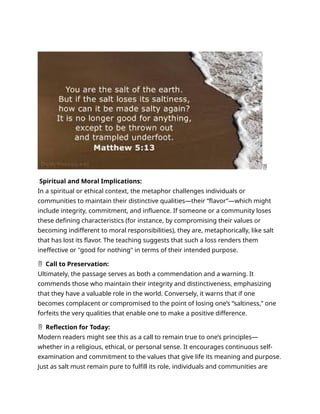
In a spiritual or ethical context, the metaphor challenges individuals or
communities to maintain their distinctive qualities—their “flavor”—which might
include integrity, commitment, and influence. If someone or a community loses
these defining characteristics (for instance, by compromising their values or
becoming indifferent to moral responsibilities), they are, metaphorically, like salt
that has lost its flavor. The teaching suggests that such a loss renders them
ineffective or "good for nothing" in terms of their intended purpose.
Call to Preservation:
Ultimately, the passage serves as both a commendation and a warning. It
commends those who maintain their integrity and distinctiveness, emphasizing
that they have a valuable role in the world. Conversely, it warns that if one
becomes complacent or compromised to the point of losing one’s “saltiness,” one
forfeits the very qualities that enable one to make a positive difference.
Reflection for Today:
Modern readers might see this as a call to remain true to one’s principles—
whether in a religious, ethical, or personal sense. It encourages continuous self-
examination and commitment to the values that give life its meaning and purpose.
Just as salt must remain pure to fulfill its role, individuals and communities are
2.
urged to upholdthe qualities that define their character and contribute to the
common good.