





Business Intelligence
Guidebook
From Data Integration to Analytics
Rick Sherman
Chapter-03
DEFINING REQUIREMENTS—
BUSINESS, DATA AND QUALITY
DEFINING REQUIREMENTS—
BUSINESS, DATA AND QUALITY
• INFORMATION IN THIS CHAPTER:
• Purpose
• Goals
• Deliverables
• Roles
• Workflow
• Interviewing business people
• Documentation techniques
THE PURPOSE OF DEFINING REQUIREMENTS
Defining requirements creates the foundation of a
successful business
intelligence (BI) solution by documenting what you
are planning to build.
The development team then uses these requirements
to design, develop, and deploy BI systems.
Traditionally, a business analyst (or someone in that
role) handles this phase, which takes place early in the
project and includes a lot of document writing.
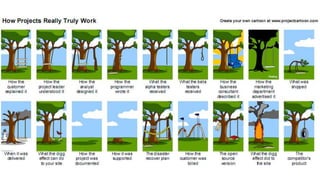
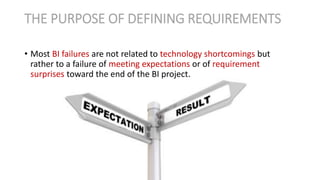
• Most BI failures are not related to technology shortcomings but
rather to a failure of meeting expectations or of requirement
surprises toward the end of the BI project.
THE PURPOSE OF DEFINING REQUIREMENTS
• The most common mistakes in defining requirements are that they:
• Are not detailed enough to clarify what is needed and set
expectations
• Restrict their focus to just business requirements
• Are not refined and changed as the project changes
• Do not involve business power users or BI designers and developers
• Re-create the existing system with its warts and inefficiencies
THE PURPOSE OF DEFINING REQUIREMENTS
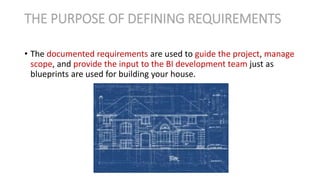
• The documented requirements are used to guide the project, manage
scope, and provide the input to the BI development team just as
blueprints are used for building your house.
THE PURPOSE OF DEFINING REQUIREMENTS
DEFINING REQUIREMENTS—
BUSINESS, DATA AND QUALITY
• INFORMATION IN THIS CHAPTER:
• Purpose
• Goals
• Deliverables
• Roles
• Workflow
• Interviewing business people
• Documentation techniques
GOALS
• The primary goal is to define the set of requirements that will be used
to design, build, and implement BI solutions within an agreed-upon
project timeline and budget.
• From a business perspective, it gets agreement on the business needs
and their priorities, while from a technology perspective, it
establishes what needs to be built in the three pillars of BI: data
model, data integration, and analytical processes.
• The secondary goal is for the BI team to establish the working
relationships with its sponsors, stakeholders, and others that support
the BI project. This phase is often the first opportunity for everyone in
the project to work together:
• Business people who will ultimately be the information consumers
• Business and technology people who are subject matter experts
(SMEs) in the analytical requirements, data source systems and data
shadow systems
• IT staff members who support the applications and infrastructure
for the BI solution
GOALS
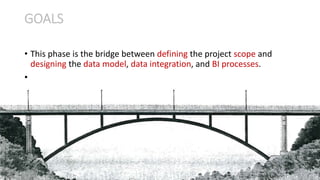
• This phase is the bridge between defining the project scope and
designing the data model, data integration, and BI processes.
•
GOALS
• Defining requirements
often encounters the
“Goldilocks syndrome”
of being too hot or too
cold, but never “just
right.”
GOALS
• When too hot, the requirements process suffers from analysis
paralysis, takes too long, and appears too bureaucratic.
• Although a waterfall-style software development life cycle has many
benefits, this project approach can be accompanied by an inordinate
amount of documents that need to be filled out completely as to
whether they are applicable to the BI project and its scope.
• This approach puts the emphasis on completing a checklist of
documents rather than getting the right content to build a BI solution
on time and within budget.
GOALS
• When too cold, the requirements are too high level, creating
ambiguity both with the business and the people building the BI
solution.
• The primary danger is that the business expectations do not match
what gets built.
• In addition, BI developers will need to interpret high-level
requirements, which takes additional time and can introduce errors.
• Most BI project failures are not caused by technology but rather a
failure to meet business expectations. This is often caused by high-
level requirements that lack the necessary detail to reduce ambiguity.
GOALS
DEFINING REQUIREMENTS—
BUSINESS, DATA AND QUALITY
• INFORMATION IN THIS CHAPTER:
• Purpose
• Goals
• Deliverables
• Roles
• Workflow
• Interviewing business people
• Documentation techniques
DELIVERABLES
• The primary deliverable is a set of requirements that business
sponsors, stakeholders, and IT management have agreed upon.
• A supporting deliverable will be a revised project plan including
budget and resource commitments based on these requirements.
• The requirements need to be in sufficient detail to move on to
following steps of designing the data model, data integration
processes, and BI applications.
DELIVERABLES
• A complete set of requirements would include the following subjects:
• Business requirements
• High-level business requirements
• Business processes supported
• Business rules and metrics
• BI functional requirements
• Use cases
• Process workflow and user interaction
• Analytical styles and functionality
• Data requirements
• Data sources
• Data conformance, consistency, and currency
• Data integration
• Data quality
• Regulatory and compliance requirements
• Country
• Industry
• Privacy and security
• Technical requirements
• Infrastructure standards
• Technology directions
DELIVERABLES
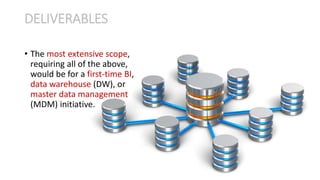
• The most extensive scope,
requiring all of the above,
would be for a first-time BI,
data warehouse (DW), or
master data management
(MDM) initiative.
DELIVERABLES
• The best practice for defining requirements is a combination of
bottom-up and top-down:
• Gather new requirements bottom-up to ensure that needed features
in the existing systems become part of the new solution and are not
lost.
• Determine existing requirements top-down to ensure that all business
stakeholders have their say and you get to validate and fine tune the
requirements through feedback loops.
DELIVERABLES
DEFINING REQUIREMENTS—
BUSINESS, DATA AND QUALITY
• INFORMATION IN THIS CHAPTER:
• Purpose
• Goals
• Deliverables
• Roles
• Workflow
• Interviewing business people
• Documentation techniques
ROLES
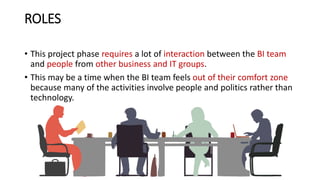
• This project phase requires a lot of interaction between the BI team
and people from other business and IT groups.
• This may be a time when the BI team feels out of their comfort zone
because many of the activities involve people and politics rather than
technology.
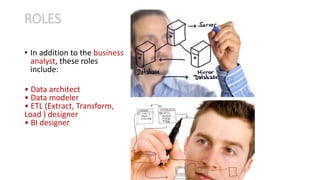
• In addition to the business
analyst, these roles
include:
• Data architect
• Data modeler
• ETL (Extract, Transform,
Load ) designer
• BI designer
ROLES
These additional BI roles are not likely to participate in the initial
interviews to gather business requirements but get involved as more
detailed data and BI functional requirements are defined.
ROLES
DEFINING REQUIREMENTS—
BUSINESS, DATA AND QUALITY
• INFORMATION IN THIS CHAPTER:
• Purpose
• Goals
• Deliverables
• Roles
• Workflow
• Interviewing business people
• Documentation techniques
DEFINING REQUIREMENTS WORKFLOW
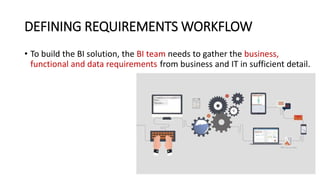
• To build the BI solution, the BI team needs to gather the business,
functional and data requirements from business and IT in sufficient detail.
DEFINING REQUIREMENTS WORKFLOW
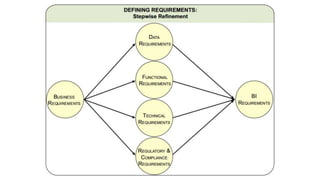
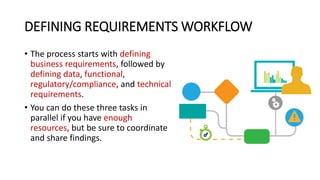
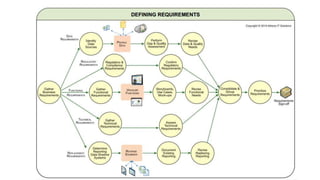
• The process starts with defining
business requirements, followed by
defining data, functional,
regulatory/compliance, and technical
requirements.
• You can do these three tasks in
parallel if you have enough
resources, but be sure to coordinate
and share findings.
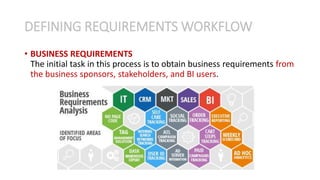
• BUSINESS REQUIREMENTS
The initial task in this process is to obtain business requirements from
the business sponsors, stakeholders, and BI users.
DEFINING REQUIREMENTS WORKFLOW
Gathering requirements is
done primarily though
interviewing, which is
discussed in the following
section.
This association identifies
who and what will be
affected by the BI solution.
DEFINING REQUIREMENTS WORKFLOW
BUSINESS REQUIREMENTS
• While defining business requirements,
it is crucial to define the business
metrics—also referred to as
performance metrics, measure or key
performance indicators (KPI)—that will
be required in the BI solution.
DEFINING REQUIREMENTS WORKFLOW
BUSINESS REQUIREMENTS
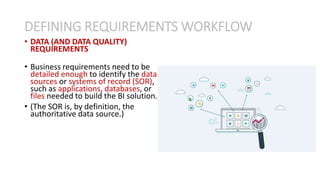
• DATA (AND DATA QUALITY)
REQUIREMENTS
• Business requirements need to be
detailed enough to identify the data
sources or systems of record (SOR),
such as applications, databases, or
files needed to build the BI solution.
• (The SOR is, by definition, the
authoritative data source.)
DEFINING REQUIREMENTS WORKFLOW
Defining data requirements means drilling into the data sources to
identify detailed data content, such as columns within tables or fields
within files, and the transformations that are needed for consistency,
conformance, or to calculate the business metrics.
DEFINING REQUIREMENTS WORKFLOW
DATA (AND DATA QUALITY) REQUIREMENTS
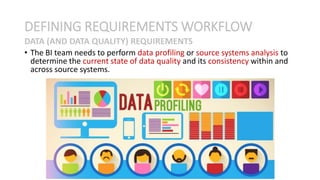
• The BI team needs to perform data profiling or source systems analysis to
determine the current state of data quality and its consistency within and
across source systems.
DEFINING REQUIREMENTS WORKFLOW
DATA (AND DATA QUALITY) REQUIREMENTS
• FUNCTIONAL REQUIREMENTS
• There is a tendency for functional requirements to be very generic,
such as providing the ability to “drill down into data details,” “access
multiple sources,” and “perform role-based security.”
• These types of generic functions should be evaluation criteria for BI
products rather than BI functional requirements.
DEFINING REQUIREMENTS WORKFLOW
• Without more details, how does the BI development know what to
build?
• This is a symptom of oversimplifying BI as if it is nothing more than
accessing data.
• BI is a lot more complicated than that—it supports business processes
and decision making by giving a business person the ability to analyze
data.
• Functional requirements are a description of that analytical process.
DEFINING REQUIREMENTS WORKFLOW
• BI functional requirements need to include the following:
• BI use cases
• Analytical process workflow and user interaction
• Analytical styles needed
DEFINING REQUIREMENTS WORKFLOW
FUNCTIONAL REQUIREMENTS
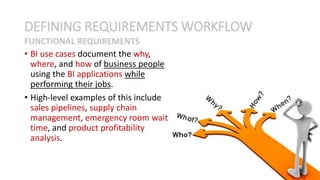
• BI use cases document the why,
where, and how of business people
using the BI applications while
performing their jobs.
• High-level examples of this include
sales pipelines, supply chain
management, emergency room wait
time, and product profitability
analysis.
DEFINING REQUIREMENTS WORKFLOW
FUNCTIONAL REQUIREMENTS
• The next portion of the functional requirements is describing the
analytical process workflow and user interactions.
• Once you identify the business processes involved, it becomes clear
that analyzing data and metrics is rarely a one-time occurrence.
• Rather, it is a succession of analyses that are often interconnected.
Documenting the workflow and dependencies enables you to design
a more productive BI environment for the people using it.
DEFINING REQUIREMENTS WORKFLOW
FUNCTIONAL REQUIREMENTS
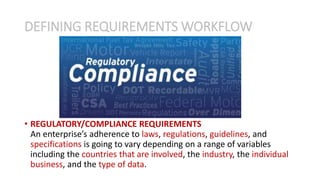
• REGULATORY/COMPLIANCE REQUIREMENTS
An enterprise’s adherence to laws, regulations, guidelines, and
specifications is going to vary depending on a range of variables
including the countries that are involved, the industry, the individual
business, and the type of data.
DEFINING REQUIREMENTS WORKFLOW
• When you are gathering
requirements, be aware that people
you are working with either may not
know all the relevant and required
compliance and regulatory rules or
may assume that you already know
them.
DEFINING REQUIREMENTS WORKFLOW
REGULATORY/COMPLIANCE REQUIREMENTS
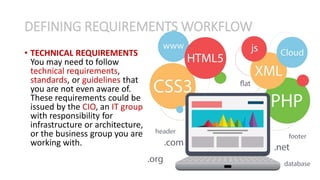
• TECHNICAL REQUIREMENTS
You may need to follow
technical requirements,
standards, or guidelines that
you are not even aware of.
These requirements could be
issued by the CIO, an IT group
with responsibility for
infrastructure or architecture,
or the business group you are
working with.
DEFINING REQUIREMENTS WORKFLOW
• Technical requirements can include:
• New technology directions, such as whether
work is done in the cloud or on the premises
• Policies on where the data centers are located
• What vendor hardware and software can be
used
• If BI appliances are required
• If Web services are required
• Rules on who can access the databases (some
enterprises only allow one group to access the
database, so you will have to work with them)
DEFINING REQUIREMENTS WORKFLOW
TECHNICAL REQUIREMENTS
• REVERSE ENGINEERING (WHEN NECESSARY)
It is rare to create a BI solution with no existing reporting capability in place.
• In most cases, if the analytical need is important enough, then the business has
been doing something, no matter how imperfect, to get data and analyze it.
DEFINING REQUIREMENTS WORKFLOW
There are two reasons why the BI team will need to
reverse engineer some or all of the existing reporting
or data shadow systems:
• First, for comparison—although business users may
complain about their existing reports or data
shadow system, they have been using them for
analysis for some period of time, so these systems
are now the benchmark for comparison.
• Second, for better understanding—even when the
old systems are being discarded and the
business is providing “new” requirements, it is fairly
common for many of the business rules and
data used by the business in the old systems to be
relevant
DEFINING REQUIREMENTS WORKFLOW
REVERSE ENGINEERING (WHEN NECESSARY)
• PUTTING IT ALL TOGETHER
You will need to collect business, data, functional, regulatory,
technical, and, if applicable, existing reporting requirements from
different business groups and people who may have different needs
or at least different viewpoints regarding those needs. As the scope of
the BI solution expands, so too does the diversity of business groups
and requirements you gather.
DEFINING REQUIREMENTS WORKFLOW
• PRIORITIZING REQUIREMENTS
Although business and technology participants should validate
business, functional, and data requirements as soon as they are
gathered and documented, make sure the consolidated requirements
documentation is made available for final review and feedback.
DEFINING REQUIREMENTS WORKFLOW
• With the consolidated requirements documentation validated, the
next step is to meet to review and prioritize those requirements. The
discussions should include the following:
• Who was interviewed
• List of business requirements by business process
• Brief description
• Commonality of requirement across business groups
• Feasibility
DEFINING REQUIREMENTS WORKFLOW
PRIORITIZING REQUIREMENTS
Never accept that every requirement is a top priority.
At a minimum, the business needs to classify the requirements in its
initial reviews as:
• Must-have
• Should-have
• Nice-to-have
• Forget about it
DEFINING REQUIREMENTS WORKFLOW
PRIORITIZING REQUIREMENTS
DEFINING REQUIREMENTS—
BUSINESS, DATA AND QUALITY
• INFORMATION IN THIS CHAPTER:
• Purpose
• Goals
• Deliverables
• Roles
• Workflow
• Interviewing business people
• Documentation techniques
INTERVIEWING
• The primary technique for gathering business and functional requirements is
interviewing.
• This section will discuss how to:
• Prepare for the interviews
• Conduct the interviews
• Follow up after the interviews
PREPARATION FOR INTERVIEWS
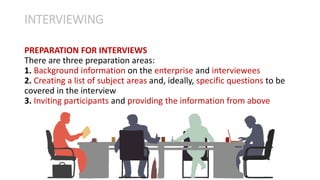
There are three preparation areas:
1. Background information on the enterprise and interviewees
2. Creating a list of subject areas and, ideally, specific questions to be
covered in the interview
3. Inviting participants and providing the information from above
INTERVIEWING
• First, the background information check for requirement interviews is
similar to what one would do for a job interview.
• The BI team needs to be somewhat knowledgeable about the
following subjects as they apply to the proposed BI solution heading
into the interviews:
• Enterprise’s business and customers
• Business and technology initiatives
• Business terminology and acronyms
• Business processes that proposed BI solution will be used to
support
• Interviewees’ title, organization, and background
INTERVIEWING
PREPARATION FOR INTERVIEWS
• Background information on the organization, its business, financial
performance, its industry, its competitors, and its customers is
available on its Web site and outside financial sites.
• Other information may be on its intranet: business and technology
initiatives, business terminology and acronyms, business processes,
and organizational information.
• In addition, do not overlook business-oriented social media sites as a
great source of background on your interviewees.
INTERVIEWING
PREPARATION FOR INTERVIEWS
• Second, the BI team needs to determine what subject areas they will
focus on during the interviews.
• If possible, it is useful to know what business processes and existing
reporting or data shadow systems the interviewees use in order to
better focus the discussion and make it more productive.
INTERVIEWING
PREPARATION FOR INTERVIEWS
• Some sample questions for business interviewees can include:
• What are your roles and responsibilities?
In each area:
• What information do you need?
• How is that information gathered and analyzed?
• What reports or data shadow systems do you use?
• What information do you lack and how valuable is it to you?
• What new types of business analysis would be useful to you and how?
• Do you rely on others to perform this analysis? If so, who does it?
• If a specific report or information is no longer available, what is your backup plan?
INTERVIEWING
PREPARATION FOR INTERVIEWS
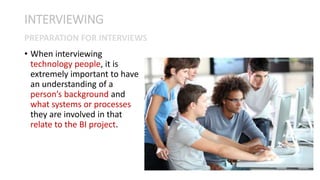
• When interviewing
technology people, it is
extremely important to have
an understanding of a
person’s background and
what systems or processes
they are involved in that
relate to the BI project.
INTERVIEWING
PREPARATION FOR INTERVIEWS
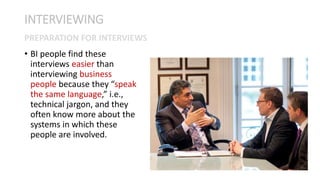
• BI people find these
interviews easier than
interviewing business
people because they “speak
the same language,” i.e.,
technical jargon, and they
often know more about the
systems in which these
people are involved.
INTERVIEWING
PREPARATION FOR INTERVIEWS
• Finally, even if interviewees have already been asked to attend requirements-
gathering discussions, send a formal invitation to all potential attendees. This
invitation should include:
• Meeting time, location, and list of potential attendees
• Brief overview of BI project
• Goals and expectations of meeting and participants
• List of subject areas to be discussed (if known)
• Sample of list of questions (if available)
• A list of decisions that need to be made
INTERVIEWING
Invitation
PREPARATION FOR INTERVIEWS
• The interviewees’ time is valuable; allowing them to prepare for the
meeting is well advised.
• Often the attendees do not really prepare for the interview sessions
but, at a minimum, the invitation gives them a chance to at least
glance at what the interview sessions are about.
• In addition, the invitation content is an excellent framework for the
meeting agenda regardless of the attendees’ preparation.
INTERVIEWING
PREPARATION FOR INTERVIEWS
• CONDUCTING THE
INTERVIEWS
Whether the interview is a
one-on-one discussion or a
group meeting, the agenda
published in the meeting
invitation should guide the
meeting.
INTERVIEWING
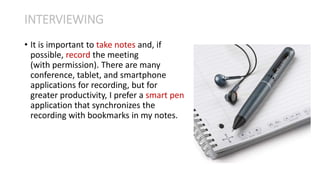
• It is important to take notes and, if
possible, record the meeting
(with permission). There are many
conference, tablet, and smartphone
applications for recording, but for
greater productivity, I prefer a smart pen
application that synchronizes the
recording with bookmarks in my notes.
INTERVIEWING
When interviewing business people, a common mistake is to ask an open-ended
question such as,
“What do you want in regard to reporting and analytics?”
This inquiry generally results in a business person either being focused on current
limitations in their existing reports or asking for every piece of data their enterprise
has and maybe more.
In either case, the BI team often feels like the business person does not know what
they want or does not understand what BI can do for them.
The problem is not with the interviewee, but rather with the interviewer who
abdicated responsibility to direct the discussion.
A better question would be something specific like, “What is the most valuable
report that you currently run from your data shadow system or on your own
spreadsheets?”
INTERVIEWING
CONDUCTING THE INTERVIEWS
• Ideally, the interviewers are prepared with subject areas to discuss
and a list of questions. But the questions are just a starting point; the
interviewee needs to delve into the areas that will yield the most
information regarding the interviewee’s requirements.
• Interviewing is an invaluable skill and includes an element of
detective work. The interviewer needs to be flexible and follow the
line of inquiry to where it leads.
INTERVIEWING
CONDUCTING THE INTERVIEWS
• REVIEWING INTERVIEW CONTENT
Try to review your notes (and recording, if you have it) as soon as possible
after the interview. Although
it is tempting to schedule interview sessions back-to-back, there are
several good reasons to leave yourself time in between them to review
what was discussed. First, you need to be very attentive during each
interview; a day-long series of meetings will tire even the most dedicated
person. Second, there may be
overlap between what interviewees discuss—this will all blur together if
you have meetings back-toback. Finally, the interview may raise questions
or ideas that you are going to want to write down and
digest before you lose those trains of thought.
INTERVIEWING
• After the interviews, you
should send a thank-you note
and, if at all possible, attach a
quick summary of the
interview, listing topics
discussed, agreed-upon action
items, and outstanding issues.
INTERVIEWING
REVIEWING INTERVIEW CONTENT
• INTERVIEW FOLLOW-UPS
You will need to have follow-up discussions with interviewees to
clarify items, resolve disparities, and to expand upon the topics
discussed.
• These discussions need not be formal meetings, but may be handled
more effectively with one-on-one or informal group conversations.
• The reason for this approach is that often the questions are very
specific to particular people or topics.
INTERVIEWING
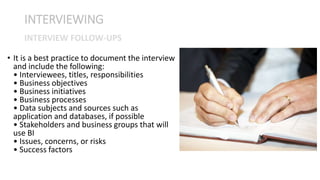
• It is a best practice to document the interview
and include the following:
• Interviewees, titles, responsibilities
• Business objectives
• Business initiatives
• Business processes
• Data subjects and sources such as
application and databases, if possible
• Stakeholders and business groups that will
use BI
• Issues, concerns, or risks
• Success factors
INTERVIEWING
INTERVIEW FOLLOW-UPS
• After documenting the interview, send a copy to the interviewees and conduct
a follow-up meeting with them to validate the content. Revise the document as
necessary, and then, most importantly, get the interviewees to sign off on the
document.
INTERVIEWING
INTERVIEW FOLLOW-UPS
• This serves two purposes:
first, it ensures that the interviewees do indeed agree on the content,
and second, it serves as explicit permission to publish the document for
other stakeholders to review.
INTERVIEWING
INTERVIEW FOLLOW-UPS
• If there are materials that are not meant to be shared, be sure to clear them up
prior to publishing.
• BI projects too often fail to meet expectations and deliver what the business is
asking for precisely because this step was not taken seriously, allowing
misunderstandings to arise and kill the project.
INTERVIEWING
INTERVIEW FOLLOW-UPS
DEFINING REQUIREMENTS—
BUSINESS, DATA AND QUALITY
• INFORMATION IN THIS CHAPTER:
• Purpose
• Goals
• Deliverables
• Roles
• Workflow
• Interviewing business people
• Documentation techniques
DOCUMENTING REQUIREMENTS
• You should document each of the
processes during the requirements
workflow, gathering feedback from
applicable stakeholders and refining the
document throughout the process.
• It is much easier and productive to create
the documentation while you go rather
than waiting until you have completed all
the tasks.
• If you wait, it is guaranteed that you will
forget things and risk
shortchanging the process by getting
behind schedule.
• The key topics in the requirements documentation include:
• Business requirements
• Data requirements
• Current state reporting assessment
• Feasibility analysis
• Critical success criteria
DOCUMENTING REQUIREMENTS
• In the “dark ages,” documentation meant
an excessively long Microsoft Word
document that few people read, and that
was likely very verbose or poorly written.
• People spent way too much time on
writing prose, editing it, and then finally
giving up on it altogether.
• Once reviewed, the document went into
a folder never to be seen again. This is
bad practice!
DOCUMENTING REQUIREMENTS
• The best practices today are
to use collaborative tools to
manage the content and as
many visual tools or
techniques as possible.
• Although visual techniques
reduce writing, the primary
benefits are
improved communication and
increased productivity.
DOCUMENTING REQUIREMENTS
• The simplest technique is to
have a documentation tool
with revision capabilities to
track changes and enable the
document owner to accept or
reject changes from each
reviewer.
• You can also find collaborative
tools that work in the cloud
and on mobile devices; these
may improve access and
participation.
DOCUMENTING REQUIREMENTS
• Using a collaborative tool is
recommended for documentation,
but do not rely on it for gathering
requirements, especially business
requirements, since nothing
replaces interactive discussions
between the stakeholders and you.
DOCUMENTING REQUIREMENTS
• There are specific techniques or tools that you
can use when gathering various requirements:
• Business requirements
• Storyboards
• BI mock-ups
• Prototyping BI objects
• Data requirements
• Data profiling
• Output from data modeling, ETL, and BI tools
• Functional requirements
• Current state of reporting
• Sample reports or spreadsheets
• Sample data
DOCUMENTING REQUIREMENTS
• using storyboarding, mock-ups, or prototyping is an extremely effective
method to gather, validate, and document functional requirements.
• These visual techniques are a much better way to communicate and
establish joint expectations than writing dozens of pages of prose.
• After all the collaboration in defining and documenting the requirements,
this phase should be completed with the business sponsor(s) and key
stakeholders signing off on the requirements documentation.
• This sets expectations and establishes a baseline to manage the project as
it progresses.
DOCUMENTING REQUIREMENTS
Bi 03

Bi 03

  • 1.
    Business Intelligence Guidebook From DataIntegration to Analytics Rick Sherman
  • 2.
  • 4.
    DEFINING REQUIREMENTS— BUSINESS, DATAAND QUALITY • INFORMATION IN THIS CHAPTER: • Purpose • Goals • Deliverables • Roles • Workflow • Interviewing business people • Documentation techniques
  • 5.
    THE PURPOSE OFDEFINING REQUIREMENTS Defining requirements creates the foundation of a successful business intelligence (BI) solution by documenting what you are planning to build. The development team then uses these requirements to design, develop, and deploy BI systems. Traditionally, a business analyst (or someone in that role) handles this phase, which takes place early in the project and includes a lot of document writing.
  • 6.
    • Most BIfailures are not related to technology shortcomings but rather to a failure of meeting expectations or of requirement surprises toward the end of the BI project. THE PURPOSE OF DEFINING REQUIREMENTS
  • 7.
    • The mostcommon mistakes in defining requirements are that they: • Are not detailed enough to clarify what is needed and set expectations • Restrict their focus to just business requirements • Are not refined and changed as the project changes • Do not involve business power users or BI designers and developers • Re-create the existing system with its warts and inefficiencies THE PURPOSE OF DEFINING REQUIREMENTS
  • 8.
    • The documentedrequirements are used to guide the project, manage scope, and provide the input to the BI development team just as blueprints are used for building your house. THE PURPOSE OF DEFINING REQUIREMENTS
  • 9.
    DEFINING REQUIREMENTS— BUSINESS, DATAAND QUALITY • INFORMATION IN THIS CHAPTER: • Purpose • Goals • Deliverables • Roles • Workflow • Interviewing business people • Documentation techniques
  • 10.
    GOALS • The primarygoal is to define the set of requirements that will be used to design, build, and implement BI solutions within an agreed-upon project timeline and budget. • From a business perspective, it gets agreement on the business needs and their priorities, while from a technology perspective, it establishes what needs to be built in the three pillars of BI: data model, data integration, and analytical processes.
  • 11.
    • The secondarygoal is for the BI team to establish the working relationships with its sponsors, stakeholders, and others that support the BI project. This phase is often the first opportunity for everyone in the project to work together: • Business people who will ultimately be the information consumers • Business and technology people who are subject matter experts (SMEs) in the analytical requirements, data source systems and data shadow systems • IT staff members who support the applications and infrastructure for the BI solution GOALS
  • 12.
    • This phaseis the bridge between defining the project scope and designing the data model, data integration, and BI processes. • GOALS
  • 13.
    • Defining requirements oftenencounters the “Goldilocks syndrome” of being too hot or too cold, but never “just right.” GOALS
  • 14.
    • When toohot, the requirements process suffers from analysis paralysis, takes too long, and appears too bureaucratic. • Although a waterfall-style software development life cycle has many benefits, this project approach can be accompanied by an inordinate amount of documents that need to be filled out completely as to whether they are applicable to the BI project and its scope. • This approach puts the emphasis on completing a checklist of documents rather than getting the right content to build a BI solution on time and within budget. GOALS
  • 15.
    • When toocold, the requirements are too high level, creating ambiguity both with the business and the people building the BI solution. • The primary danger is that the business expectations do not match what gets built. • In addition, BI developers will need to interpret high-level requirements, which takes additional time and can introduce errors. • Most BI project failures are not caused by technology but rather a failure to meet business expectations. This is often caused by high- level requirements that lack the necessary detail to reduce ambiguity. GOALS
  • 16.
    DEFINING REQUIREMENTS— BUSINESS, DATAAND QUALITY • INFORMATION IN THIS CHAPTER: • Purpose • Goals • Deliverables • Roles • Workflow • Interviewing business people • Documentation techniques
  • 17.
    DELIVERABLES • The primarydeliverable is a set of requirements that business sponsors, stakeholders, and IT management have agreed upon. • A supporting deliverable will be a revised project plan including budget and resource commitments based on these requirements.
  • 18.
    • The requirementsneed to be in sufficient detail to move on to following steps of designing the data model, data integration processes, and BI applications. DELIVERABLES
  • 19.
    • A completeset of requirements would include the following subjects: • Business requirements • High-level business requirements • Business processes supported • Business rules and metrics • BI functional requirements • Use cases • Process workflow and user interaction • Analytical styles and functionality • Data requirements • Data sources • Data conformance, consistency, and currency • Data integration • Data quality • Regulatory and compliance requirements • Country • Industry • Privacy and security • Technical requirements • Infrastructure standards • Technology directions DELIVERABLES
  • 20.
    • The mostextensive scope, requiring all of the above, would be for a first-time BI, data warehouse (DW), or master data management (MDM) initiative. DELIVERABLES
  • 21.
    • The bestpractice for defining requirements is a combination of bottom-up and top-down: • Gather new requirements bottom-up to ensure that needed features in the existing systems become part of the new solution and are not lost. • Determine existing requirements top-down to ensure that all business stakeholders have their say and you get to validate and fine tune the requirements through feedback loops. DELIVERABLES
  • 23.
    DEFINING REQUIREMENTS— BUSINESS, DATAAND QUALITY • INFORMATION IN THIS CHAPTER: • Purpose • Goals • Deliverables • Roles • Workflow • Interviewing business people • Documentation techniques
  • 24.
    ROLES • This projectphase requires a lot of interaction between the BI team and people from other business and IT groups. • This may be a time when the BI team feels out of their comfort zone because many of the activities involve people and politics rather than technology.
  • 25.
    • In additionto the business analyst, these roles include: • Data architect • Data modeler • ETL (Extract, Transform, Load ) designer • BI designer ROLES
  • 26.
    These additional BIroles are not likely to participate in the initial interviews to gather business requirements but get involved as more detailed data and BI functional requirements are defined. ROLES
  • 27.
    DEFINING REQUIREMENTS— BUSINESS, DATAAND QUALITY • INFORMATION IN THIS CHAPTER: • Purpose • Goals • Deliverables • Roles • Workflow • Interviewing business people • Documentation techniques
  • 28.
    DEFINING REQUIREMENTS WORKFLOW •To build the BI solution, the BI team needs to gather the business, functional and data requirements from business and IT in sufficient detail.
  • 29.
    DEFINING REQUIREMENTS WORKFLOW •The process starts with defining business requirements, followed by defining data, functional, regulatory/compliance, and technical requirements. • You can do these three tasks in parallel if you have enough resources, but be sure to coordinate and share findings.
  • 30.
    • BUSINESS REQUIREMENTS Theinitial task in this process is to obtain business requirements from the business sponsors, stakeholders, and BI users. DEFINING REQUIREMENTS WORKFLOW
  • 31.
    Gathering requirements is doneprimarily though interviewing, which is discussed in the following section. This association identifies who and what will be affected by the BI solution. DEFINING REQUIREMENTS WORKFLOW BUSINESS REQUIREMENTS
  • 32.
    • While definingbusiness requirements, it is crucial to define the business metrics—also referred to as performance metrics, measure or key performance indicators (KPI)—that will be required in the BI solution. DEFINING REQUIREMENTS WORKFLOW BUSINESS REQUIREMENTS
  • 34.
    • DATA (ANDDATA QUALITY) REQUIREMENTS • Business requirements need to be detailed enough to identify the data sources or systems of record (SOR), such as applications, databases, or files needed to build the BI solution. • (The SOR is, by definition, the authoritative data source.) DEFINING REQUIREMENTS WORKFLOW
  • 35.
    Defining data requirementsmeans drilling into the data sources to identify detailed data content, such as columns within tables or fields within files, and the transformations that are needed for consistency, conformance, or to calculate the business metrics. DEFINING REQUIREMENTS WORKFLOW DATA (AND DATA QUALITY) REQUIREMENTS
  • 36.
    • The BIteam needs to perform data profiling or source systems analysis to determine the current state of data quality and its consistency within and across source systems. DEFINING REQUIREMENTS WORKFLOW DATA (AND DATA QUALITY) REQUIREMENTS
  • 37.
    • FUNCTIONAL REQUIREMENTS •There is a tendency for functional requirements to be very generic, such as providing the ability to “drill down into data details,” “access multiple sources,” and “perform role-based security.” • These types of generic functions should be evaluation criteria for BI products rather than BI functional requirements. DEFINING REQUIREMENTS WORKFLOW
  • 38.
    • Without moredetails, how does the BI development know what to build? • This is a symptom of oversimplifying BI as if it is nothing more than accessing data. • BI is a lot more complicated than that—it supports business processes and decision making by giving a business person the ability to analyze data. • Functional requirements are a description of that analytical process. DEFINING REQUIREMENTS WORKFLOW
  • 39.
    • BI functionalrequirements need to include the following: • BI use cases • Analytical process workflow and user interaction • Analytical styles needed DEFINING REQUIREMENTS WORKFLOW FUNCTIONAL REQUIREMENTS
  • 40.
    • BI usecases document the why, where, and how of business people using the BI applications while performing their jobs. • High-level examples of this include sales pipelines, supply chain management, emergency room wait time, and product profitability analysis. DEFINING REQUIREMENTS WORKFLOW FUNCTIONAL REQUIREMENTS
  • 41.
    • The nextportion of the functional requirements is describing the analytical process workflow and user interactions. • Once you identify the business processes involved, it becomes clear that analyzing data and metrics is rarely a one-time occurrence. • Rather, it is a succession of analyses that are often interconnected. Documenting the workflow and dependencies enables you to design a more productive BI environment for the people using it. DEFINING REQUIREMENTS WORKFLOW FUNCTIONAL REQUIREMENTS
  • 42.
    • REGULATORY/COMPLIANCE REQUIREMENTS Anenterprise’s adherence to laws, regulations, guidelines, and specifications is going to vary depending on a range of variables including the countries that are involved, the industry, the individual business, and the type of data. DEFINING REQUIREMENTS WORKFLOW
  • 43.
    • When youare gathering requirements, be aware that people you are working with either may not know all the relevant and required compliance and regulatory rules or may assume that you already know them. DEFINING REQUIREMENTS WORKFLOW REGULATORY/COMPLIANCE REQUIREMENTS
  • 44.
    • TECHNICAL REQUIREMENTS Youmay need to follow technical requirements, standards, or guidelines that you are not even aware of. These requirements could be issued by the CIO, an IT group with responsibility for infrastructure or architecture, or the business group you are working with. DEFINING REQUIREMENTS WORKFLOW
  • 45.
    • Technical requirementscan include: • New technology directions, such as whether work is done in the cloud or on the premises • Policies on where the data centers are located • What vendor hardware and software can be used • If BI appliances are required • If Web services are required • Rules on who can access the databases (some enterprises only allow one group to access the database, so you will have to work with them) DEFINING REQUIREMENTS WORKFLOW TECHNICAL REQUIREMENTS
  • 46.
    • REVERSE ENGINEERING(WHEN NECESSARY) It is rare to create a BI solution with no existing reporting capability in place. • In most cases, if the analytical need is important enough, then the business has been doing something, no matter how imperfect, to get data and analyze it. DEFINING REQUIREMENTS WORKFLOW
  • 47.
    There are tworeasons why the BI team will need to reverse engineer some or all of the existing reporting or data shadow systems: • First, for comparison—although business users may complain about their existing reports or data shadow system, they have been using them for analysis for some period of time, so these systems are now the benchmark for comparison. • Second, for better understanding—even when the old systems are being discarded and the business is providing “new” requirements, it is fairly common for many of the business rules and data used by the business in the old systems to be relevant DEFINING REQUIREMENTS WORKFLOW REVERSE ENGINEERING (WHEN NECESSARY)
  • 48.
    • PUTTING ITALL TOGETHER You will need to collect business, data, functional, regulatory, technical, and, if applicable, existing reporting requirements from different business groups and people who may have different needs or at least different viewpoints regarding those needs. As the scope of the BI solution expands, so too does the diversity of business groups and requirements you gather. DEFINING REQUIREMENTS WORKFLOW
  • 49.
    • PRIORITIZING REQUIREMENTS Althoughbusiness and technology participants should validate business, functional, and data requirements as soon as they are gathered and documented, make sure the consolidated requirements documentation is made available for final review and feedback. DEFINING REQUIREMENTS WORKFLOW
  • 50.
    • With theconsolidated requirements documentation validated, the next step is to meet to review and prioritize those requirements. The discussions should include the following: • Who was interviewed • List of business requirements by business process • Brief description • Commonality of requirement across business groups • Feasibility DEFINING REQUIREMENTS WORKFLOW PRIORITIZING REQUIREMENTS
  • 51.
    Never accept thatevery requirement is a top priority. At a minimum, the business needs to classify the requirements in its initial reviews as: • Must-have • Should-have • Nice-to-have • Forget about it DEFINING REQUIREMENTS WORKFLOW PRIORITIZING REQUIREMENTS
  • 52.
    DEFINING REQUIREMENTS— BUSINESS, DATAAND QUALITY • INFORMATION IN THIS CHAPTER: • Purpose • Goals • Deliverables • Roles • Workflow • Interviewing business people • Documentation techniques
  • 54.
    INTERVIEWING • The primarytechnique for gathering business and functional requirements is interviewing. • This section will discuss how to: • Prepare for the interviews • Conduct the interviews • Follow up after the interviews
  • 55.
    PREPARATION FOR INTERVIEWS Thereare three preparation areas: 1. Background information on the enterprise and interviewees 2. Creating a list of subject areas and, ideally, specific questions to be covered in the interview 3. Inviting participants and providing the information from above INTERVIEWING
  • 56.
    • First, thebackground information check for requirement interviews is similar to what one would do for a job interview. • The BI team needs to be somewhat knowledgeable about the following subjects as they apply to the proposed BI solution heading into the interviews: • Enterprise’s business and customers • Business and technology initiatives • Business terminology and acronyms • Business processes that proposed BI solution will be used to support • Interviewees’ title, organization, and background INTERVIEWING PREPARATION FOR INTERVIEWS
  • 57.
    • Background informationon the organization, its business, financial performance, its industry, its competitors, and its customers is available on its Web site and outside financial sites. • Other information may be on its intranet: business and technology initiatives, business terminology and acronyms, business processes, and organizational information. • In addition, do not overlook business-oriented social media sites as a great source of background on your interviewees. INTERVIEWING PREPARATION FOR INTERVIEWS
  • 58.
    • Second, theBI team needs to determine what subject areas they will focus on during the interviews. • If possible, it is useful to know what business processes and existing reporting or data shadow systems the interviewees use in order to better focus the discussion and make it more productive. INTERVIEWING PREPARATION FOR INTERVIEWS
  • 59.
    • Some samplequestions for business interviewees can include: • What are your roles and responsibilities? In each area: • What information do you need? • How is that information gathered and analyzed? • What reports or data shadow systems do you use? • What information do you lack and how valuable is it to you? • What new types of business analysis would be useful to you and how? • Do you rely on others to perform this analysis? If so, who does it? • If a specific report or information is no longer available, what is your backup plan? INTERVIEWING PREPARATION FOR INTERVIEWS
  • 60.
    • When interviewing technologypeople, it is extremely important to have an understanding of a person’s background and what systems or processes they are involved in that relate to the BI project. INTERVIEWING PREPARATION FOR INTERVIEWS
  • 61.
    • BI peoplefind these interviews easier than interviewing business people because they “speak the same language,” i.e., technical jargon, and they often know more about the systems in which these people are involved. INTERVIEWING PREPARATION FOR INTERVIEWS
  • 62.
    • Finally, evenif interviewees have already been asked to attend requirements- gathering discussions, send a formal invitation to all potential attendees. This invitation should include: • Meeting time, location, and list of potential attendees • Brief overview of BI project • Goals and expectations of meeting and participants • List of subject areas to be discussed (if known) • Sample of list of questions (if available) • A list of decisions that need to be made INTERVIEWING Invitation PREPARATION FOR INTERVIEWS
  • 63.
    • The interviewees’time is valuable; allowing them to prepare for the meeting is well advised. • Often the attendees do not really prepare for the interview sessions but, at a minimum, the invitation gives them a chance to at least glance at what the interview sessions are about. • In addition, the invitation content is an excellent framework for the meeting agenda regardless of the attendees’ preparation. INTERVIEWING PREPARATION FOR INTERVIEWS
  • 64.
    • CONDUCTING THE INTERVIEWS Whetherthe interview is a one-on-one discussion or a group meeting, the agenda published in the meeting invitation should guide the meeting. INTERVIEWING
  • 65.
    • It isimportant to take notes and, if possible, record the meeting (with permission). There are many conference, tablet, and smartphone applications for recording, but for greater productivity, I prefer a smart pen application that synchronizes the recording with bookmarks in my notes. INTERVIEWING
  • 66.
    When interviewing businesspeople, a common mistake is to ask an open-ended question such as, “What do you want in regard to reporting and analytics?” This inquiry generally results in a business person either being focused on current limitations in their existing reports or asking for every piece of data their enterprise has and maybe more. In either case, the BI team often feels like the business person does not know what they want or does not understand what BI can do for them. The problem is not with the interviewee, but rather with the interviewer who abdicated responsibility to direct the discussion. A better question would be something specific like, “What is the most valuable report that you currently run from your data shadow system or on your own spreadsheets?” INTERVIEWING CONDUCTING THE INTERVIEWS
  • 67.
    • Ideally, theinterviewers are prepared with subject areas to discuss and a list of questions. But the questions are just a starting point; the interviewee needs to delve into the areas that will yield the most information regarding the interviewee’s requirements. • Interviewing is an invaluable skill and includes an element of detective work. The interviewer needs to be flexible and follow the line of inquiry to where it leads. INTERVIEWING CONDUCTING THE INTERVIEWS
  • 68.
    • REVIEWING INTERVIEWCONTENT Try to review your notes (and recording, if you have it) as soon as possible after the interview. Although it is tempting to schedule interview sessions back-to-back, there are several good reasons to leave yourself time in between them to review what was discussed. First, you need to be very attentive during each interview; a day-long series of meetings will tire even the most dedicated person. Second, there may be overlap between what interviewees discuss—this will all blur together if you have meetings back-toback. Finally, the interview may raise questions or ideas that you are going to want to write down and digest before you lose those trains of thought. INTERVIEWING
  • 69.
    • After theinterviews, you should send a thank-you note and, if at all possible, attach a quick summary of the interview, listing topics discussed, agreed-upon action items, and outstanding issues. INTERVIEWING REVIEWING INTERVIEW CONTENT
  • 70.
    • INTERVIEW FOLLOW-UPS Youwill need to have follow-up discussions with interviewees to clarify items, resolve disparities, and to expand upon the topics discussed. • These discussions need not be formal meetings, but may be handled more effectively with one-on-one or informal group conversations. • The reason for this approach is that often the questions are very specific to particular people or topics. INTERVIEWING
  • 71.
    • It isa best practice to document the interview and include the following: • Interviewees, titles, responsibilities • Business objectives • Business initiatives • Business processes • Data subjects and sources such as application and databases, if possible • Stakeholders and business groups that will use BI • Issues, concerns, or risks • Success factors INTERVIEWING INTERVIEW FOLLOW-UPS
  • 72.
    • After documentingthe interview, send a copy to the interviewees and conduct a follow-up meeting with them to validate the content. Revise the document as necessary, and then, most importantly, get the interviewees to sign off on the document. INTERVIEWING INTERVIEW FOLLOW-UPS
  • 73.
    • This servestwo purposes: first, it ensures that the interviewees do indeed agree on the content, and second, it serves as explicit permission to publish the document for other stakeholders to review. INTERVIEWING INTERVIEW FOLLOW-UPS
  • 74.
    • If thereare materials that are not meant to be shared, be sure to clear them up prior to publishing. • BI projects too often fail to meet expectations and deliver what the business is asking for precisely because this step was not taken seriously, allowing misunderstandings to arise and kill the project. INTERVIEWING INTERVIEW FOLLOW-UPS
  • 75.
    DEFINING REQUIREMENTS— BUSINESS, DATAAND QUALITY • INFORMATION IN THIS CHAPTER: • Purpose • Goals • Deliverables • Roles • Workflow • Interviewing business people • Documentation techniques
  • 76.
    DOCUMENTING REQUIREMENTS • Youshould document each of the processes during the requirements workflow, gathering feedback from applicable stakeholders and refining the document throughout the process. • It is much easier and productive to create the documentation while you go rather than waiting until you have completed all the tasks. • If you wait, it is guaranteed that you will forget things and risk shortchanging the process by getting behind schedule.
  • 77.
    • The keytopics in the requirements documentation include: • Business requirements • Data requirements • Current state reporting assessment • Feasibility analysis • Critical success criteria DOCUMENTING REQUIREMENTS
  • 78.
    • In the“dark ages,” documentation meant an excessively long Microsoft Word document that few people read, and that was likely very verbose or poorly written. • People spent way too much time on writing prose, editing it, and then finally giving up on it altogether. • Once reviewed, the document went into a folder never to be seen again. This is bad practice! DOCUMENTING REQUIREMENTS
  • 79.
    • The bestpractices today are to use collaborative tools to manage the content and as many visual tools or techniques as possible. • Although visual techniques reduce writing, the primary benefits are improved communication and increased productivity. DOCUMENTING REQUIREMENTS
  • 80.
    • The simplesttechnique is to have a documentation tool with revision capabilities to track changes and enable the document owner to accept or reject changes from each reviewer. • You can also find collaborative tools that work in the cloud and on mobile devices; these may improve access and participation. DOCUMENTING REQUIREMENTS
  • 81.
    • Using acollaborative tool is recommended for documentation, but do not rely on it for gathering requirements, especially business requirements, since nothing replaces interactive discussions between the stakeholders and you. DOCUMENTING REQUIREMENTS
  • 82.
    • There arespecific techniques or tools that you can use when gathering various requirements: • Business requirements • Storyboards • BI mock-ups • Prototyping BI objects • Data requirements • Data profiling • Output from data modeling, ETL, and BI tools • Functional requirements • Current state of reporting • Sample reports or spreadsheets • Sample data DOCUMENTING REQUIREMENTS
  • 83.
    • using storyboarding,mock-ups, or prototyping is an extremely effective method to gather, validate, and document functional requirements. • These visual techniques are a much better way to communicate and establish joint expectations than writing dozens of pages of prose. • After all the collaboration in defining and documenting the requirements, this phase should be completed with the business sponsor(s) and key stakeholders signing off on the requirements documentation. • This sets expectations and establishes a baseline to manage the project as it progresses. DOCUMENTING REQUIREMENTS