Better Regulation In Europe Better Regulation In
Europe Oecd download
https://ebookbell.com/product/better-regulation-in-europe-better-
regulation-in-europe-oecd-6771084
Explore and download more ebooks at ebookbell.com
Here are some recommended products that we believe you will be
interested in. You can click the link to download.
Better Regulation In Europe Better Regulation In Europe Oecd
https://ebookbell.com/product/better-regulation-in-europe-better-
regulation-in-europe-oecd-6770628
Better Regulation In Europe Better Regulation In Europe Oecd
https://ebookbell.com/product/better-regulation-in-europe-better-
regulation-in-europe-oecd-6771468
Better Regulation In Europe Better Regulation In Europe Oecd
https://ebookbell.com/product/better-regulation-in-europe-better-
regulation-in-europe-oecd-6771616
Better Regulation In Europe Better Regulation In Europe Sweden 2010
Oecd
https://ebookbell.com/product/better-regulation-in-europe-better-
regulation-in-europe-sweden-2010-oecd-6822718
Better Regulation In Europe Italy 2012 Rev Ed June 2012 Oecd
https://ebookbell.com/product/better-regulation-in-europe-
italy-2012-rev-ed-june-2012-oecd-6767644
Better Regulation In Europe Ireland 2010 Oecd
https://ebookbell.com/product/better-regulation-in-europe-
ireland-2010-oecd-6771590
Better Regulation In Europe Austria Oecd
https://ebookbell.com/product/better-regulation-in-europe-austria-
oecd-6771592
Better Regulation In Europe Belgium Oecd
https://ebookbell.com/product/better-regulation-in-europe-belgium-
oecd-6771686
Better Regulation In Europe Spain 2010 Oecd
https://ebookbell.com/product/better-regulation-in-europe-
spain-2010-oecd-6771800
Better
Regulation
in
Europe
FRANCE
-:HSTCQE=U][ZZZ:
isbn 978-92-64-08655-5
42 2010 20 1 P
www.oecd.org/publishing
The full text of this book is available on line via this link:
www.sourceoecd.org/governance/9789264086555
Those with access to all OECD books on line should use this link:
www.sourceoecd.org/9789264086555
SourceOECD is the OECD’s online library of books, periodicals and statistical databases.
For more information about this award-winning service and free trials ask your librarian, or write to us
at SourceOECD@oecd.org.
Better Regulation in Europe
FRANCE
The importance of effective regulation has never been so clear as it is today, in the wake of the
worst economic downturn since the Great Depression. But how exactly can Better Regulation
policy improve countries’ economic and social welfare prospects, underpin sustained growth and
strengthen their resilience? What, in fact, is effective regulation? What should be the shape and
direction of Better Regulation policy over the next decade? To respond to these questions, the
OECD has launched, in partnership with the European Commission, a major project examining
Better Regulation developments in 15 OECD countries in the EU, including France. Each report
maps and analyses the core issues which together make up effective regulatory management,
laying down a framework of what should be driving regulatory policy and reform in the future.
Issues examined include:
• Strategy and policies for improving regulatory management.
• Institutional capacities for effective regulation and the broader policy making context.
• Transparency and processes for effective public consultation and communication.
• 
Processes for the development of new regulations, including impact assessment, and for the
management of the regulatory stock, including administrative burdens.
• Compliance rates, enforcement policy and appeal processes.
• 
The multilevel dimension: interface between different levels of government and interface between
national processes and those of the EU.
The participating countries are: Austria, Belgium, Denmark, Finland, France, Germany, Greece,
Ireland, Italy, Luxembourg, Netherlands, Portugal, Spain, Sweden and the United Kingdom.
Better Regulation in Europe
FRANCE
With the financial assistance
of the European Union
Better Regulation
in Europe:
France
2010
ORGANISATION FOR ECONOMIC CO-OPERATION
AND DEVELOPMENT
The OECD is a unique forum where governments work together to address the economic, social
and environmental challenges of globalisation. The OECD is also at the forefront of efforts to
understand and to help governments respond to new developments and concerns, such as corporate
governance, the information economy and the challenges of an ageing population. The Organisation
provides a setting where governments can compare policy experiences, seek answers to common
problems, identify good practice and work to co-ordinate domestic and international policies.
The OECD member countries are: Australia, Austria, Belgium, Canada, Chile, the Czech Republic,
Denmark, Finland, France, Germany, Greece, Hungary, Iceland, Ireland, Israel, Italy, Japan, Korea,
Luxembourg, Mexico, the Netherlands, New Zealand, Norway, Poland, Portugal, the Slovak Republic,
Slovenia, Spain, Sweden, Switzerland, Turkey, the United Kingdom and the United States. The
European Commission takes part in the work of the OECD.
OECD Publishing disseminates widely the results of the Organisation’s statistics gathering and
research on economic, social and environmental issues, as well as the conventions, guidelines and
standards agreed by its members.
ISBN 978-92-64-08655-5 (print)
ISBN 978-92-64-08696-8 (PDF)
Series: Better Regulation in Europe
ISSN 2079-035X (print)
ISSN 2079-0368 (online)
Photo credits: Cover © Ronald Hudson/Fotolia.com
Corrigenda to OECD publications may be found on line at: www.oecd.org/publishing/corrigenda.
© OECD 2010
You can copy, download or print OECD content for your own use, and you can include excerpts from OECD publications, databases and multimedia
products in your own documents, presentations, blogs, websites and teaching materials, provided that suitable acknowledgment of OECD as source
and copyright owner is given. All requests for public or commercial use and translation rights should be submitted to rights@oecd.org. Requests for
permission to photocopy portions of this material for public or commercial use shall be addressed directly to the Copyright Clearance Center (CCC)
at info@copyright.com or the Centre français d’exploitation du droit de copie (CFC) at contact@cfcopies.com.
This work is published on the responsibility of the Secretary-General of the OECD. The
opinions expressed and arguments employed herein do not necessarily reflect the official
views of the Organisation or of the governments of its member countries.
FOREWORD – 3
BETTER REGULATION IN EUROPE: FRANCE © OECD 2010
Foreword
The OECD Review of Better Regulation in France is one of a series of country
reports launched by the OECD in partnership with the European Commission. The
objective is to assess regulatory management capacities in the 15 original member states
of the European Union (Austria, Belgium, Denmark, Finland, France, Germany, Greece,
Ireland, Italy, Luxembourg, Netherlands, Portugal, Spain, Sweden, United Kingdom),
including trends in their development, and to identify gaps in relation to good practice as
defined by the OECD and the EU in their guidelines and policies for Better Regulation.
The project is also an opportunity to discuss the follow-up to the OECD’s
multidisciplinary reviews, for those countries which were part of this process, and to find
out what has happened in respect of the recommendations made at the time. Austria,
Belgium, Luxembourg and Portugal were not covered by these previous reviews. The
multidisciplinary review of France was published in 2004 [OECD (2004), OECD Reviews
of Regulatory Reform France 2004: Charting a Clearer Way Forward, OECD
Publishing, Paris].
France is part of the second group of countries to be reviewed – the other five are
Belgium, Finland, Germany, Spain and Sweden. The first group of Denmark, the
Netherlands, Portugal and the United Kingdom were published in May 2009 and the
remaining countries will follow in the second half of 2010. This report was discussed and
approved for publication at a meeting of the OECD’s Regulatory Policy Committee on
15 April 2010.
The completed reviews will form the basis for a synthesis report, which will also take
into account the experiences of other OECD countries. This will be an opportunity to put
the results of the reviews in a broader international perspective, and to flesh out prospects
for the next ten years of regulatory reform.
TABLE OF CONTENTS – 5
BETTER REGULATION IN EUROPE: FRANCE © OECD 2010
Table of contents
Abbreviations and acronyms.......................................................................................................................9
Country Profile – France...........................................................................................................................11
Executive Summary..................................................................................................................................13
Introduction: Conduct of the review.........................................................................................................27
Chapter 1: Strategy and policies for Better Regulation.......................................................................33
Assessment and recommendations........................................................................................................34
Background ...........................................................................................................................................37
Economic context and drivers of Better Regulation..........................................................................37
Developments in France’s Better Regulation agenda........................................................................39
Guiding principles for the current Better Regulation agenda............................................................40
Main Better Regulation policies........................................................................................................41
Communication on Better Regulation strategy and policies..............................................................42
Ex post evaluation of Better Regulation strategy and policies ..........................................................43
E-Government in support of Better Regulation.................................................................................43
Chapter 2: Institutional capacities for Better Regulation....................................................................45
Assessment and recommendations........................................................................................................46
Background ...........................................................................................................................................49
The French public governance context..............................................................................................49
Institutional framework for devising public policies and regulations ...............................................52
Developments in Better Regulation institutions................................................................................55
Key institutional players for Better Regulation policy......................................................................56
Resources and training.......................................................................................................................65
Chapter 3: Transparency through consultation and communication.................................................69
Assessment and recommendations........................................................................................................69
Background ...........................................................................................................................................72
Public consultation on regulations.....................................................................................................72
Public consultation on regulations.....................................................................................................74
Access to the law...............................................................................................................................81
Chapter 4: The development of new regulations ..................................................................................87
Assessment and recommendations........................................................................................................88
Background ...........................................................................................................................................96
The development of legislation .........................................................................................................99
Ex ante impact studies .....................................................................................................................106
Ex post evaluation of regulations.....................................................................................................114
Alternatives to legislation................................................................................................................114
Taking account of risk .....................................................................................................................117
6 – TABLE OF CONTENTS
BETTER REGULATION IN EUROPE: FRANCE © OECD 2010
Chapter 5: The management and rationalisation of existing regulation..........................................121
Assessment and recommendations......................................................................................................122
Background .........................................................................................................................................126
General background: The aims of administrative simplification in France.....................................126
Simplifying the law..........................................................................................................................127
Methodology and process................................................................................................................136
Subnational levels of government ...................................................................................................138
Chapter 6: Compliance, enforcement, appeals ...................................................................................143
Assessment and recommendations......................................................................................................143
Background .........................................................................................................................................144
Compliance and enforcement ..........................................................................................................144
Types of recourse against administrative decisions.........................................................................147
Chapter 7: The interface between member states and the European Union ...................................155
Assessment and recommendations......................................................................................................155
Background .........................................................................................................................................157
General context................................................................................................................................157
Negotiating EU regulations .............................................................................................................158
Transposing EU directives...............................................................................................................160
Link with the European Commission’s policy on regulatory governance.......................................161
Chapter 8: The interface between subnational and national levels of government.........................165
Assessment and recommendations......................................................................................................166
Background .........................................................................................................................................168
Structure, responsibilities and funding of local governments..........................................................168
So-called “deconcentrated” state services .......................................................................................170
Regulatory governance policies at the subnational level.................................................................171
Co-ordination mechanisms ..............................................................................................................172
Bibliography...........................................................................................................................................177
Annex A: Powers transferred to the territorial communities...................................................................181
Annex B: Application of laws .................................................................................................................185
Annex C: Structure of the “Guide for drafting legislation and regulations”...........................................189
Annex D: The Constitutional Reform of 23 July 2008 ...........................................................................193
Annex E: Independent administrative authorities....................................................................................195
Annex F:The process of preparing laws and decrees in France..............................................................203
Annex G: Local level use of ICT ............................................................................................................205
Annex H: Reference system for impact assessments ..............................................................................207
Annex I: Progress report on the 15 measures outlined on 19 October 2009...........................................215
TABLE OF CONTENTS – 7
BETTER REGULATION IN EUROPE: FRANCE © OECD 2010
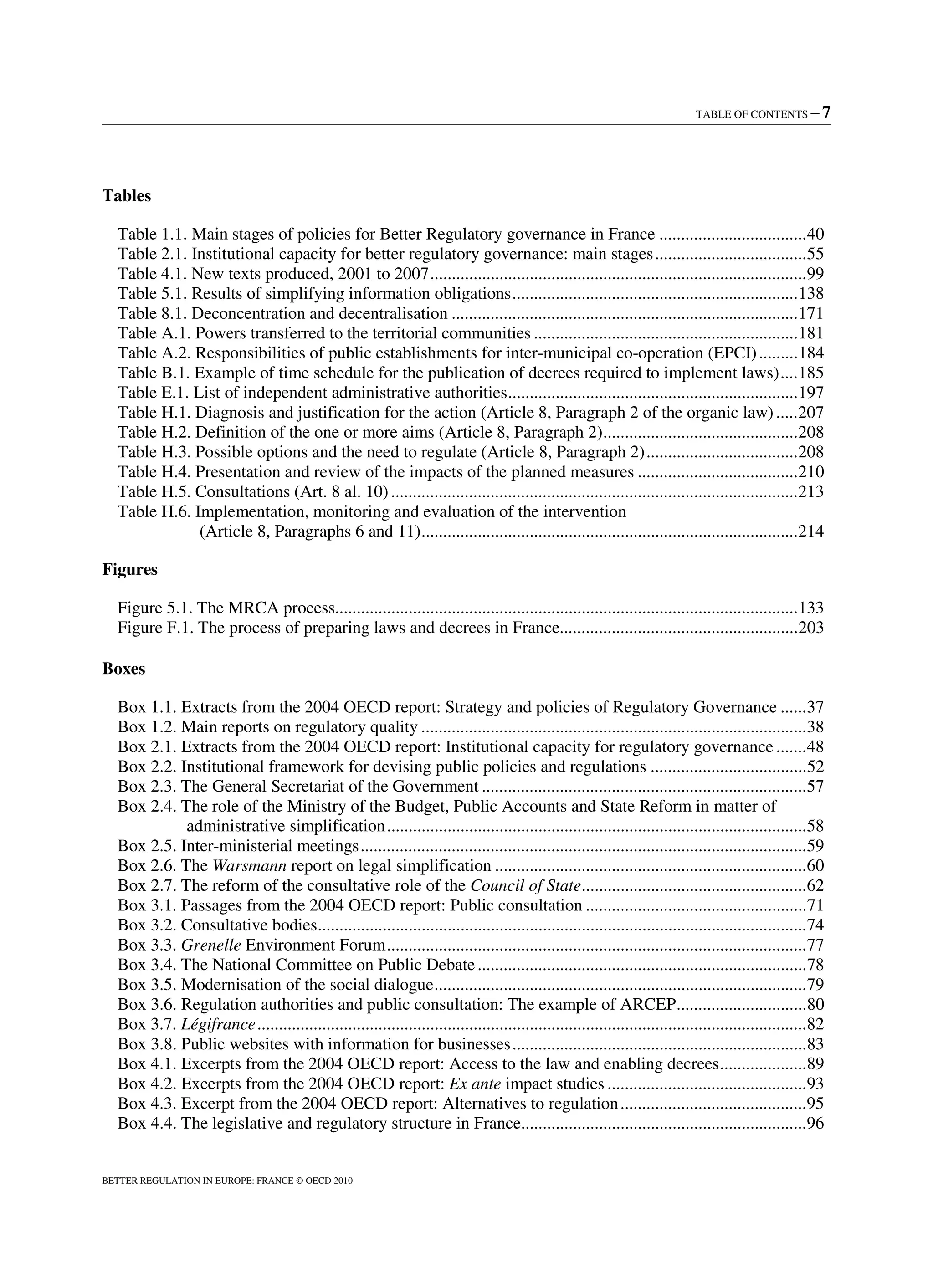
Tables
Table 1.1. Main stages of policies for Better Regulatory governance in France ..................................40
Table 2.1. Institutional capacity for better regulatory governance: main stages...................................55
Table 4.1. New texts produced, 2001 to 2007.......................................................................................99
Table 5.1. Results of simplifying information obligations..................................................................138
Table 8.1. Deconcentration and decentralisation ................................................................................171
Table A.1. Powers transferred to the territorial communities .............................................................181
Table A.2. Responsibilities of public establishments for inter-municipal co-operation (EPCI).........184
Table B.1. Example of time schedule for the publication of decrees required to implement laws)....185
Table E.1. List of independent administrative authorities...................................................................197
Table H.1. Diagnosis and justification for the action (Article 8, Paragraph 2 of the organic law).....207
Table H.2. Definition of the one or more aims (Article 8, Paragraph 2).............................................208
Table H.3. Possible options and the need to regulate (Article 8, Paragraph 2)...................................208
Table H.4. Presentation and review of the impacts of the planned measures .....................................210
Table H.5. Consultations (Art. 8 al. 10)..............................................................................................213
Table H.6. Implementation, monitoring and evaluation of the intervention
(Article 8, Paragraphs 6 and 11).......................................................................................214
Figures
Figure 5.1. The MRCA process...........................................................................................................133
Figure F.1. The process of preparing laws and decrees in France.......................................................203
Boxes
Box 1.1. Extracts from the 2004 OECD report: Strategy and policies of Regulatory Governance ......37
Box 1.2. Main reports on regulatory quality .........................................................................................38
Box 2.1. Extracts from the 2004 OECD report: Institutional capacity for regulatory governance .......48
Box 2.2. Institutional framework for devising public policies and regulations ....................................52
Box 2.3. The General Secretariat of the Government ...........................................................................57
Box 2.4. The role of the Ministry of the Budget, Public Accounts and State Reform in matter of
administrative simplification.................................................................................................58
Box 2.5. Inter-ministerial meetings.......................................................................................................59
Box 2.6. The Warsmann report on legal simplification ........................................................................60
Box 2.7. The reform of the consultative role of the Council of State....................................................62
Box 3.1. Passages from the 2004 OECD report: Public consultation ...................................................71
Box 3.2. Consultative bodies.................................................................................................................74
Box 3.3. Grenelle Environment Forum.................................................................................................77
Box 3.4. The National Committee on Public Debate............................................................................78
Box 3.5. Modernisation of the social dialogue......................................................................................79
Box 3.6. Regulation authorities and public consultation: The example of ARCEP..............................80
Box 3.7. Légifrance...............................................................................................................................82
Box 3.8. Public websites with information for businesses....................................................................83
Box 4.1. Excerpts from the 2004 OECD report: Access to the law and enabling decrees....................89
Box 4.2. Excerpts from the 2004 OECD report: Ex ante impact studies ..............................................93
Box 4.3. Excerpt from the 2004 OECD report: Alternatives to regulation...........................................95
Box 4.4. The legislative and regulatory structure in France..................................................................96
8 – TABLE OF CONTENTS
BETTER REGULATION IN EUROPE: FRANCE © OECD 2010
Box 4.5. 2004 OECD report: Regulatory inflation in France................................................................98
Box 4.6. The stages in the legislative process.....................................................................................100
Box 4.7. The role of the General Secretariat of the Government and of the Council of State
in the process of drafting legislation ...................................................................................102
Box 4.8. The good legislation guide....................................................................................................105
Box 4.9. Legislation relating to impact assessment obligations..........................................................109
Box 4.10. Oscar: Simulation tool for the administrative cost of new legislation ...............................112
Box 5.1. 2004 OECD report: Simplification.......................................................................................122
Box 5.2. Excerpts from the 2004 OECD report: Management of existing regulations.......................123
Box 5.3. Main stages in regulatory simplification in France ..............................................................128
Box 5.4. Examples of simplifying the law for businesses...................................................................129
Box 5.5. Administrative simplification and e-Government: Examples of e-services .........................131
Box 5.6. 2009 Administrative Procedures Simplification Plan...........................................................134
Box 5.7. Structure of the DGME.........................................................................................................135
Box 6.1. Extract from the 2004 OECD report.....................................................................................144
Box 6.2. Appeals against administrative decisions .............................................................................147
Box 6.3. Mediator of the Republic......................................................................................................152
Box 7.1. Comments from the 2004 OECD report: Transposition of EU directives............................156
Box 7.2. 2004 OECD report: Consultation and impact assessment for EU directives........................157
Box 7.3. Parliamentary Committees on European Affairs..................................................................159
Box 8.1. Excerpts from the 2004 report: Regulatory powers of the subnational levels......................166
Box 8.2. How responsibilities are shared between subnational governments.....................................168
Box 8.3. Advisory Board for Regulatory Evaluation (CCEN)............................................................173
Box 8.4. Co-operation between municipalities ...................................................................................174
ABBREVIATIONS AND ACRONYMS – 9
BETTER REGULATION IN EUROPE: FRANCE © OECD 2010
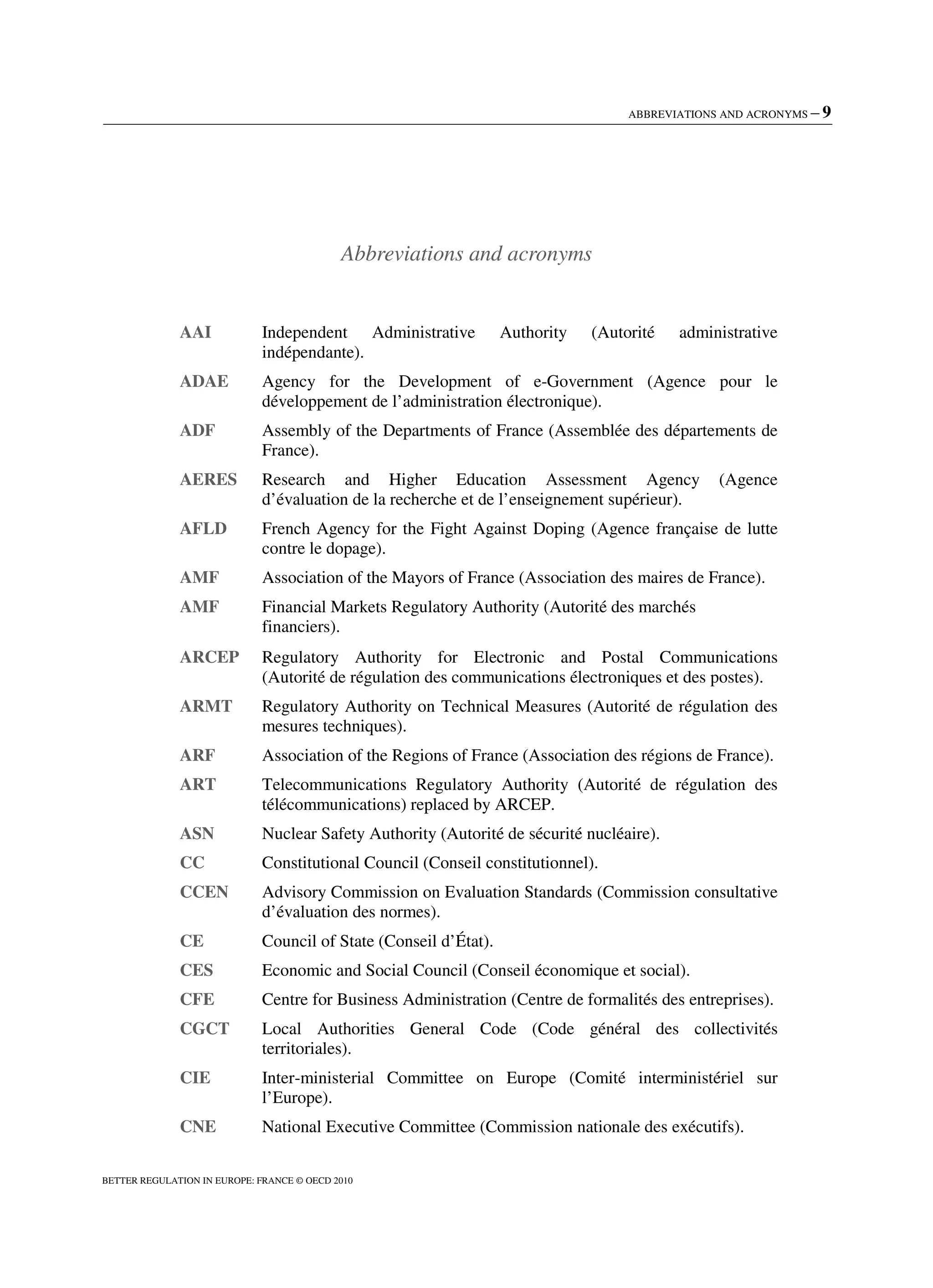
Abbreviations and acronyms
AAI Independent Administrative Authority (Autorité administrative
indépendante).
ADAE Agency for the Development of e-Government (Agence pour le
développement de l’administration électronique).
ADF Assembly of the Departments of France (Assemblée des départements de
France).
AERES Research and Higher Education Assessment Agency (Agence
d’évaluation de la recherche et de l’enseignement supérieur).
AFLD French Agency for the Fight Against Doping (Agence française de lutte
contre le dopage).
AMF Association of the Mayors of France (Association des maires de France).
AMF Financial Markets Regulatory Authority (Autorité des marchés
financiers).
ARCEP Regulatory Authority for Electronic and Postal Communications
(Autorité de régulation des communications électroniques et des postes).
ARMT Regulatory Authority on Technical Measures (Autorité de régulation des
mesures techniques).
ARF Association of the Regions of France (Association des régions de France).
ART Telecommunications Regulatory Authority (Autorité de régulation des
télécommunications) replaced by ARCEP.
ASN Nuclear Safety Authority (Autorité de sécurité nucléaire).
CC Constitutional Council (Conseil constitutionnel).
CCEN Advisory Commission on Evaluation Standards (Commission consultative
d’évaluation des normes).
CE Council of State (Conseil d’État).
CES Economic and Social Council (Conseil économique et social).
CFE Centre for Business Administration (Centre de formalités des entreprises).
CGCT Local Authorities General Code (Code général des collectivités
territoriales).
CIE Inter-ministerial Committee on Europe (Comité interministériel sur
l’Europe).
CNE National Executive Committee (Commission nationale des exécutifs).
10 – ABBREVIATIONS AND ACRONYMS
BETTER REGULATION IN EUROPE: FRANCE © OECD 2010
CNIL National Commission for Information and Privacy (Commission nationale
de l’informatique et des libertés).
CRE Commission for Energy Regulation (Commission de régulation de
l’énergie).
CSA Audiovisual High Council (Conseil supérieur de l’audiovisuel).
DGME General Directorate for the Modernisation of the State (Direction
générale de la modernisation de l’État).
ECPI Public Institution for Inter-municipal Co-operation (Établissement public
de coopération intercommunale).
FIS Simplified impact record (Fiche d’impact simplifiée).
H3C High Council of Auditors (Haut conseil du commissariat aux comptes).
HALDE High Authority Against Discrimination and for Equality (Haute autorité
de lutte contre les discriminations et pour l’égalité).
HAS High Authority for Health (Haute autorité de santé).
IGPDE Institute of Public Management and Economic Development (Institut de la
gestion publique et du développement économique).
LOLF Organic law on financial legislation (Loi organique relative aux lois de
finances).
LOLFSS The Funding Social Security Act (Loi de financement de la sécurité
sociale).
MRCA Monitoring the reduction of administrative burden (Mesure de la
réduction de la charge administrative).
RGPP Public Policy Review (Révision générale des politiques publiques).
SCM Standard Cost Model.
SGAE General Secretariat for European Affairs (Secrétariat général des affaires
européennes).
SGG Secretariat General of the Government (Secrétariat général du
gouvernement).
BETTER REGULATION IN EUROPE: FRANCE © OECD 2010
Co
Source: CIA Factbook, www.cia.g
COUNTRY PRO
ountry Profile – France
gov/library/publications/the-world-factbook/geos/fr.html.
FILE – FRANCE – 11
12 – COUNTRY PROFILE – FRANCE
BETTER REGULATION IN EUROPE: FRANCE © OECD 2010
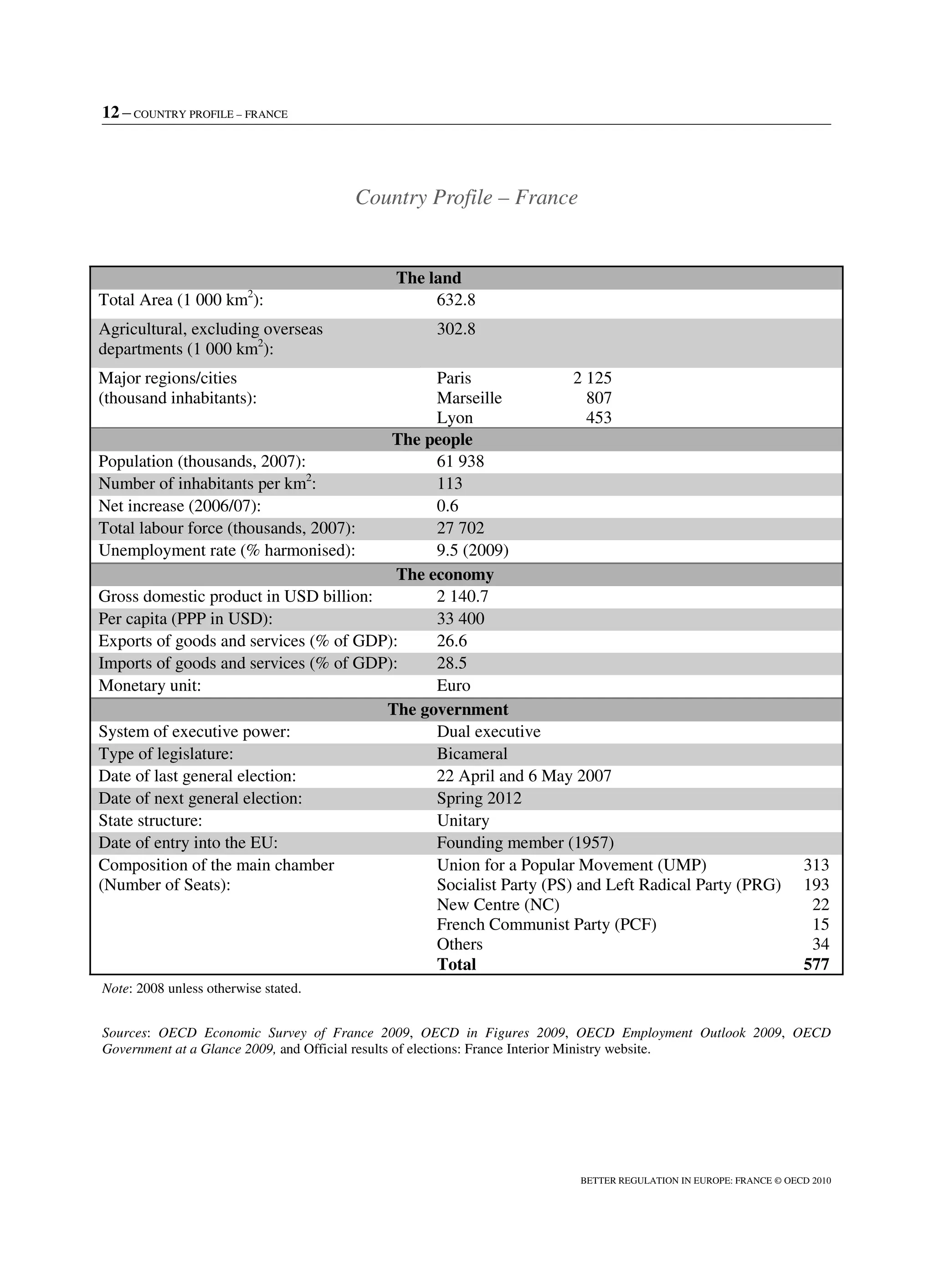
Country Profile – France
The land
Total Area (1 000 km2
): 632.8
Agricultural, excluding overseas
departments (1 000 km2
):
302.8
Major regions/cities
(thousand inhabitants):
Paris
Marseille
Lyon
2 125
807
453
The people
Population (thousands, 2007): 61 938
Number of inhabitants per km2
: 113
Net increase (2006/07): 0.6
Total labour force (thousands, 2007): 27 702
Unemployment rate (% harmonised): 9.5 (2009)
The economy
Gross domestic product in USD billion: 2 140.7
Per capita (PPP in USD): 33 400
Exports of goods and services (% of GDP): 26.6
Imports of goods and services (% of GDP): 28.5
Monetary unit: Euro
The government
System of executive power: Dual executive
Type of legislature: Bicameral
Date of last general election: 22 April and 6 May 2007
Date of next general election: Spring 2012
State structure: Unitary
Date of entry into the EU: Founding member (1957)
Composition of the main chamber
(Number of Seats):
Union for a Popular Movement (UMP)
Socialist Party (PS) and Left Radical Party (PRG)
New Centre (NC)
French Communist Party (PCF)
Others
Total
313
193
22
15
34
577
Note: 2008 unless otherwise stated.
Sources: OECD Economic Survey of France 2009, OECD in Figures 2009, OECD Employment Outlook 2009, OECD
Government at a Glance 2009, and Official results of elections: France Interior Ministry website.
EXECUTIVE SUMMARY – 13
BETTER REGULATION IN EUROPE: FRANCE © OECD 2010
Executive Summary
Economic context and drivers of Better Regulation
France is a major player in the world economy. It faces substantial challenges,
including loss of business competitiveness on world markets. At the same time, France
can boast a range of advantages which should help it to rise to meet these challenges. The
implementation of certain necessary structural reforms partly depends on a further
strengthening of regulatory governance policy.
In recent years, French policies for Better Regulation have underlined a political will,
which has grown in strength since 2004, to undertake reforms in order to improve
regulatory quality. A stronger and deeper understanding of the importance of effective
regulatory management within the administration has helped to promote this trend. A
number of public reports on the quality of the law have fuelled discussion, and
contributed to a promotion of the principles of regulatory quality. The perception of what
some have labelled the French disease (which is not confined to France, but can also be
found in some other countries), meaning a proliferation of regulations which need to be
controlled, has led to a reassessment of the changes necessary to improve the rule-making
process.
French policy on regulatory governance is also strongly linked to the reforms
undertaken to modernise the state, in the context of a deep seated use of legal instruments
as the dominant instrument of state intervention. The current initiatives, with regard to
impact assessment or the reduction of administrative burdens, also fall within the wider
framework of the general review of public policies (RGPP), launched in June 2007,
immediately after the presidential elections. The RGPP aims to achieve budgetary savings
and improve the effectiveness of public policies, including the quality of the services
provided to citizens and businesses.
The relevance of effective regulatory governance for economic performance is not
absent from the debates, but is less visible compared with other European countries where
economic considerations have provided the main driving force of regulatory reforms. One
of the government's regulatory policies is the reduction of administrative burden on
businesses. Even if the aim of this particular programme is to promote the
competitiveness of French businesses, this consideration is not at the core of French
regulatory governance policy. The fact that economic considerations play a relatively
minor role in regulatory policy is somewhat surprising in the context of post-crisis
recovery. The lack of a clear link with economic policies means that regulatory
governance policy is not particularly visible beyond a restricted group of administrative
and political institutions.
Public governance framework for Better Regulation
The organisation of public governance in France is structured around the following
features: shared executive authority between the President of the Republic and the prime
14 – EXECUTIVE SUMMARY
BETTER REGULATION IN EUROPE: FRANCE © OECD 2010
minister; maintenance of strong central government (even though France has embarked
on a process of decentralisation over the last three decades); a public administration
characterised by recruitment, based on competitive examinations and key role played by
distinctive formal groups of public servants (grands corps de l’État); and a significant
public sector.
A range of extensive reforms undertaken since 2007 is leading – or will lead – to
changes in this institutional framework:
• The constitutional law of 23 July 2008, provided parliament with new mechanisms.
It should be noted that the new provisions to strengthen parliament have
limitations, not least the willingness of members to make use of them. They are
also conditioned by the reality of a parliamentary majority.
• The territorial reform began following the debate prompted by the report of the
“Attali” Committee (2008) which, amongst other things, advocated the dismantling
of one of the main subnational levels of government (that of the department).
• The reform of the public service includes a reduction in the number of public
servants and an overhaul of the regulations governing the public service, so that
there is a better match between needs and jobs.
Developments in Better Regulation and main findings of this review
Strategy and policies for Better Regulation
Since the OECD Review of Regulatory Reform of France published in 2004,
France has undertaken a set of ambitious measures to improve regulatory quality;
these measures constitute a major quality change. Three substantial fields of action
may be distinguished. Two are upstream: the first tackles the process of drafting
regulations by strengthening ex ante impact assessment; the second is the overhaul of
public consultation processes. The third field is downstream of regulatory production.
The French government has conducted a simplification policy which combines legal
simplification and a reduction in administrative burdens. Special efforts have also been
developed to reduce the backlog of EU legislation to be transposed into national law, and
to speed up the production of secondary regulations necessary for the implementation of
primary laws, two weaknesses emphasised in the OECD 2004 report.
Upstream and downstream policies are tending to join up. A discussion has begun
on how best to combine ex ante impact assessment and the ex post simplification policies.
To date, there is no integrated strategy in the field, but an evolutionary process is
underway to provide a framework for future developments. This trend is also relevant to
other EU countries.
The expression Better Regulation does not always accurately reflect the
nature of French regulatory governance policy. The term goes beyond simplification
and legal clarity. Strictly speaking, there is no regulatory governance strategy in France,
but rather a set of measures intended to improve regulatory quality, basically propelled by
the perception of French disease. In other words, an overproduction of regulations that
needs to be controlled. The economic dimension and the economic cost of excessive
regulation or of poor regulation have not yet been fully taken into account.
EXECUTIVE SUMMARY – 15
BETTER REGULATION IN EUROPE: FRANCE © OECD 2010
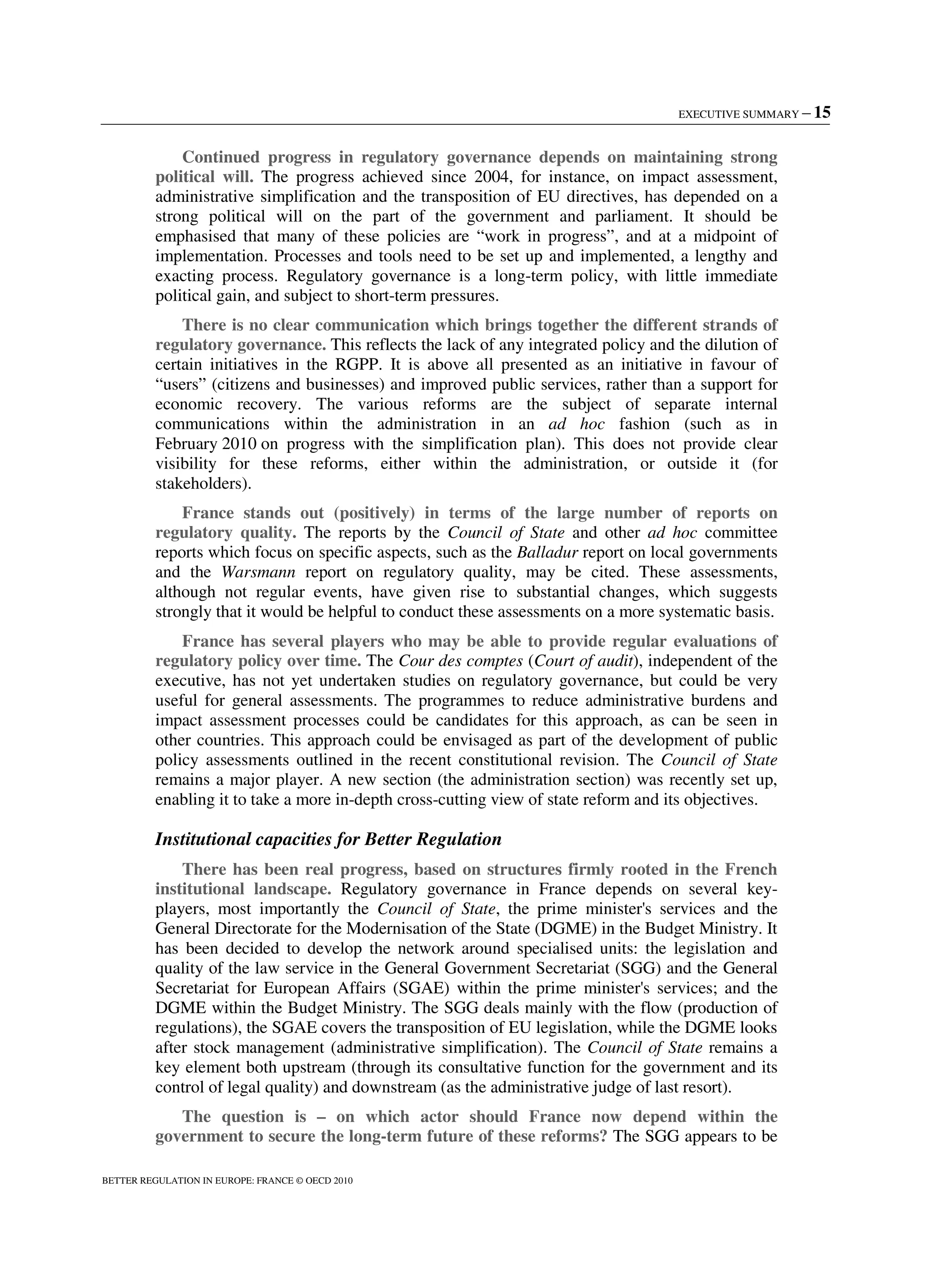
Continued progress in regulatory governance depends on maintaining strong
political will. The progress achieved since 2004, for instance, on impact assessment,
administrative simplification and the transposition of EU directives, has depended on a
strong political will on the part of the government and parliament. It should be
emphasised that many of these policies are “work in progress”, and at a midpoint of
implementation. Processes and tools need to be set up and implemented, a lengthy and
exacting process. Regulatory governance is a long-term policy, with little immediate
political gain, and subject to short-term pressures.
There is no clear communication which brings together the different strands of
regulatory governance. This reflects the lack of any integrated policy and the dilution of
certain initiatives in the RGPP. It is above all presented as an initiative in favour of
“users” (citizens and businesses) and improved public services, rather than a support for
economic recovery. The various reforms are the subject of separate internal
communications within the administration in an ad hoc fashion (such as in
February 2010 on progress with the simplification plan). This does not provide clear
visibility for these reforms, either within the administration, or outside it (for
stakeholders).
France stands out (positively) in terms of the large number of reports on
regulatory quality. The reports by the Council of State and other ad hoc committee
reports which focus on specific aspects, such as the Balladur report on local governments
and the Warsmann report on regulatory quality, may be cited. These assessments,
although not regular events, have given rise to substantial changes, which suggests
strongly that it would be helpful to conduct these assessments on a more systematic basis.
France has several players who may be able to provide regular evaluations of
regulatory policy over time. The Cour des comptes (Court of audit), independent of the
executive, has not yet undertaken studies on regulatory governance, but could be very
useful for general assessments. The programmes to reduce administrative burdens and
impact assessment processes could be candidates for this approach, as can be seen in
other countries. This approach could be envisaged as part of the development of public
policy assessments outlined in the recent constitutional revision. The Council of State
remains a major player. A new section (the administration section) was recently set up,
enabling it to take a more in-depth cross-cutting view of state reform and its objectives.
Institutional capacities for Better Regulation
There has been real progress, based on structures firmly rooted in the French
institutional landscape. Regulatory governance in France depends on several key-
players, most importantly the Council of State, the prime minister's services and the
General Directorate for the Modernisation of the State (DGME) in the Budget Ministry. It
has been decided to develop the network around specialised units: the legislation and
quality of the law service in the General Government Secretariat (SGG) and the General
Secretariat for European Affairs (SGAE) within the prime minister's services; and the
DGME within the Budget Ministry. The SGG deals mainly with the flow (production of
regulations), the SGAE covers the transposition of EU legislation, while the DGME looks
after stock management (administrative simplification). The Council of State remains a
key element both upstream (through its consultative function for the government and its
control of legal quality) and downstream (as the administrative judge of last resort).
The question is – on which actor should France now depend within the
government to secure the long-term future of these reforms? The SGG appears to be
16 – EXECUTIVE SUMMARY
BETTER REGULATION IN EUROPE: FRANCE © OECD 2010
best placed to tackle cross-cutting issues. It is emerging as a key-partner to ministries in
their law making processes. It does not have any direct sanctioning powers, but its close
relationship to the head of the government gives it a strong persuasive platform from
which to encourage progress. However, as is the case of many of its counterparts in other
countries, as a prime minister's service, it is more likely to play a co-ordination role than
that of a powerful driver of a regulatory governance network. Furthermore, it has few
resources (compared to the ministries). The French government decided to build
regulatory quality policy on a network of correspondents throughout the ministries rather
than to establish a single regulatory management body, which is difficult to fit in with the
existing institutional structures and the administrative culture. Nevertheless, this network
must still be based on a strong and clear political intention, associated with a clearly
recognised centre of gravity, without which, it runs the risk of gradually disappearing.
Progress in recent years is the result of monitoring and discipline (including
penalties) as well as the development of methodologies and support tools. The
administrative culture is gradually changing with, for instance, the development of
progress charts, impact assessment, the establishment of networks of correspondents on
administrative simplification and quality of the law, and the development of new forms of
consultation. The beginnings of a change in culture are evident. Two issues need
attention. First, the administrative culture remains marked by the dominant weight of
legal training and, in comparison to other countries, there is little sign of an economic
culture. Second, the development of regulatory quality requires particular attention to the
training of civil servants, including in-house training. Acculturation must continue so that
the processes and tools which have been set up function effectively.
Transparency through public consultation and communication
Since the 2004 OECD review, the French approach to public consultation has
experienced major changes. France has moved away from a model based largely on
corporatism, though with plenty of scope for traditional elements. The method chosen for
reshaping the approach has not been to do away completely with traditional
institutionalised forms (advisory boards or committees) and pursue “all-out use” of the
Internet, but to supervise them more closely, diversify consultation procedures and
involve stakeholders more effectively beforehand in drawing up public policies. These
lines of action reflect recognition of the need to reform public consultation so that it is
more effective, and to adapt consultation methods to changes in society, while taking
account of the institutional heritage and some degree of wariness among many
administrative authorities regarding the effectiveness of open consultation over the
Internet.
In recent years, significant breakthroughs have been achieved in revitalising
public consultation. First of all, rules have been devised governing the establishment and
operation of all advisory boards, and almost 40% of these boards were abolished in June
2009, following a process of review with “cut-off” clauses. This rationalisation of the
advisory boards will only have a long-term impact if it occurs in conjunction with regular
monitoring of the rules for the establishment and the work of the boards. Second,
ministries have developed new consultation methods to involve stakeholders more
effectively in drawing up public policies prior to the process (the Grenelle forum, Internet
forums on reforms or major schemes under consideration, and the establishment of a
“Business Council”). Third, with the January 2007 law for modernisation of the social
dialogue, the reform of public consultation has also affected the processes of consultation
EXECUTIVE SUMMARY – 17
BETTER REGULATION IN EUROPE: FRANCE © OECD 2010
and negotiation involving the government and “social partners” (trade unions and
business representatives).
The work undertaken has to be part of a broader and more ambitious policy for
reshaping public consultation. This need is recognised by the administration, which is
seeking to establish clearer guidelines, but it has not (yet) resulted in comprehensive
reflection and discussion. While reform of the advisory boards may make the system less
cumbersome, it must be part of a strategic vision of what public consultation is expected
to achieve. There is a need to strengthen the openness and diversity of consultation
procedures, beyond experimentation with new methods. It is increasingly hard to rely
solely on predetermined expert groups in more complex societies.
Consultation currently lacks a baseline methodology to support a clearer
strategy and raise its profile. During the OECD discussions, several interlocutors (from
within and outside the public administration) highlighted the need to establish more
structured procedures and, more generally, to develop guidance on consultation.
Reference was made to how the views of stakeholders were often not considered and to
the lack of feedback on consultation (a frequently mentioned weak point, and not solely
in France), partly because of the pressure of time.
Much attention is focused on access to the law. Considerable effort has been
invested and maintained in developing mechanisms for accessing the law, and in
particular the Légifrance and monservicepublic.fr websites.
The development of new regulations
Since 2004, steps have been taken to strengthen rule-making processes. The
government's work programme has been set up (and remains the government's internal
working document), which, every six months, establishes the government's overall
direction, containing the list of bills, orders and decrees. The time limits for implementing
the acts' application decrees have been reduced. An application has been developed to
dematerialise the regulatory production chain. Finally, the support tools for drafting laws
have been strengthened. The rules for drafting legal texts have been grouped in the legal
drafting manual (guide legistic). This voluminous manual (500 pages) concentrates on
legal drafting and does not adopt a comprehensive approach to the production of
regulations. It has still to be integrated into the online tools for the production of
regulations. The need to strengthen legal drafting capacities in the various ministries was
often emphasised at OECD meetings, particularly to produce texts that are clearer and
easily accessible.
Bills introduced by the parliament need attention. Since the constitutional revision
of 2008 provides greater scope for parliamentary initiative, the issue arises of the need to
reinforce the procedures ensuring the quality of draft laws proposed by the members of
parliament, including impact assessment. There is the risk of a “fast-track” procedure
under which government initiatives are promoted through the intervention of one or more
members of parliament.
France has set up a new system for impact assessment, which gives it a leading
position in Europe, at least in principle. Since 1 September 2009, impact assessment
has been a constitutional requirement. This anchoring constitutes a first in comparison
with other countries. According to the new provisions, an impact assessment must be
attached to all bills the government sends to parliament. Failing this, the conference of
presidents of the parliamentary chamber to which they have been initially referred, may
18 – EXECUTIVE SUMMARY
BETTER REGULATION IN EUROPE: FRANCE © OECD 2010
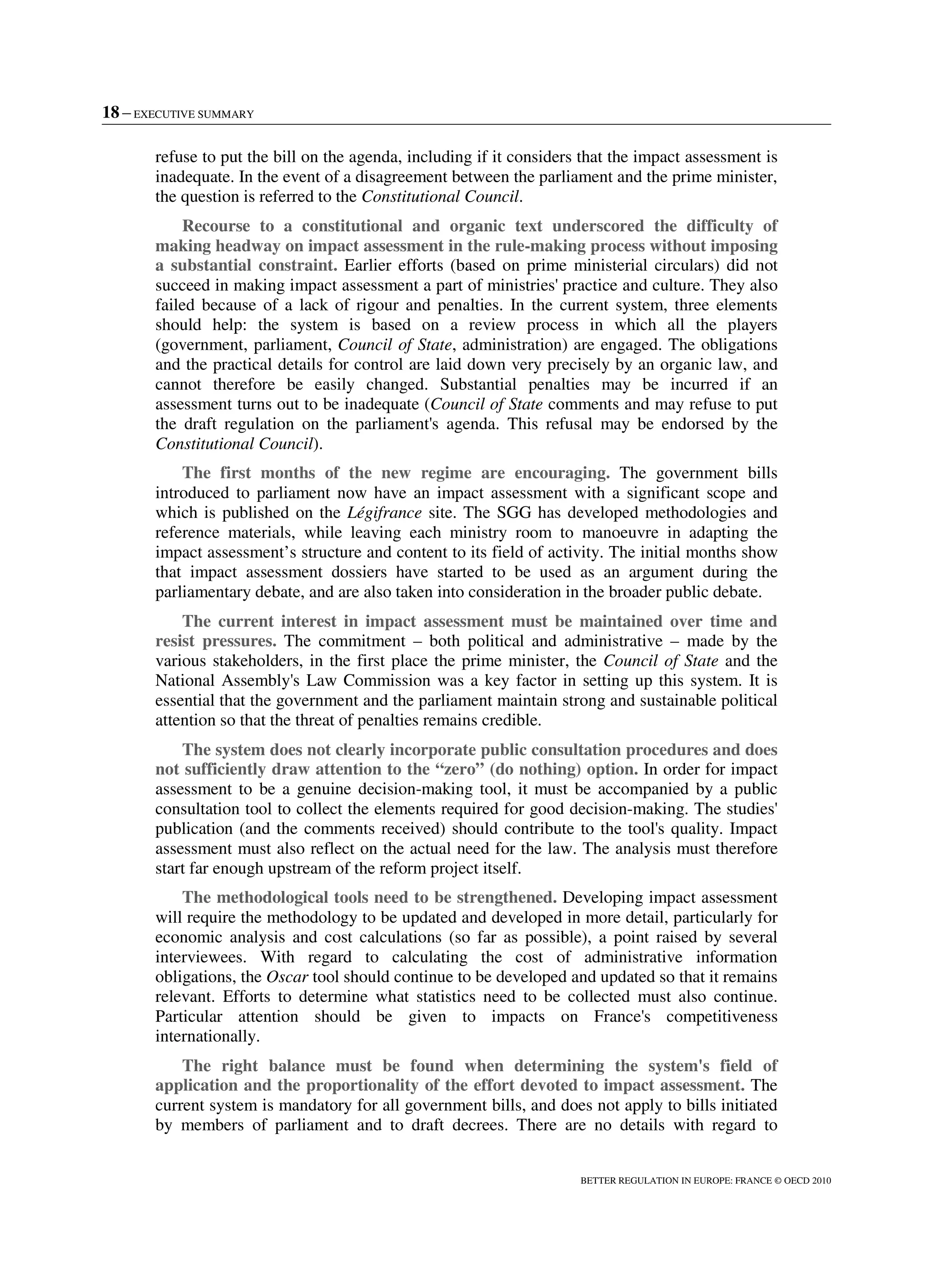
refuse to put the bill on the agenda, including if it considers that the impact assessment is
inadequate. In the event of a disagreement between the parliament and the prime minister,
the question is referred to the Constitutional Council.
Recourse to a constitutional and organic text underscored the difficulty of
making headway on impact assessment in the rule-making process without imposing
a substantial constraint. Earlier efforts (based on prime ministerial circulars) did not
succeed in making impact assessment a part of ministries' practice and culture. They also
failed because of a lack of rigour and penalties. In the current system, three elements
should help: the system is based on a review process in which all the players
(government, parliament, Council of State, administration) are engaged. The obligations
and the practical details for control are laid down very precisely by an organic law, and
cannot therefore be easily changed. Substantial penalties may be incurred if an
assessment turns out to be inadequate (Council of State comments and may refuse to put
the draft regulation on the parliament's agenda. This refusal may be endorsed by the
Constitutional Council).
The first months of the new regime are encouraging. The government bills
introduced to parliament now have an impact assessment with a significant scope and
which is published on the Légifrance site. The SGG has developed methodologies and
reference materials, while leaving each ministry room to manoeuvre in adapting the
impact assessment’s structure and content to its field of activity. The initial months show
that impact assessment dossiers have started to be used as an argument during the
parliamentary debate, and are also taken into consideration in the broader public debate.
The current interest in impact assessment must be maintained over time and
resist pressures. The commitment – both political and administrative – made by the
various stakeholders, in the first place the prime minister, the Council of State and the
National Assembly's Law Commission was a key factor in setting up this system. It is
essential that the government and the parliament maintain strong and sustainable political
attention so that the threat of penalties remains credible.
The system does not clearly incorporate public consultation procedures and does
not sufficiently draw attention to the “zero” (do nothing) option. In order for impact
assessment to be a genuine decision-making tool, it must be accompanied by a public
consultation tool to collect the elements required for good decision-making. The studies'
publication (and the comments received) should contribute to the tool's quality. Impact
assessment must also reflect on the actual need for the law. The analysis must therefore
start far enough upstream of the reform project itself.
The methodological tools need to be strengthened. Developing impact assessment
will require the methodology to be updated and developed in more detail, particularly for
economic analysis and cost calculations (so far as possible), a point raised by several
interviewees. With regard to calculating the cost of administrative information
obligations, the Oscar tool should continue to be developed and updated so that it remains
relevant. Efforts to determine what statistics need to be collected must also continue.
Particular attention should be given to impacts on France's competitiveness
internationally.
The right balance must be found when determining the system's field of
application and the proportionality of the effort devoted to impact assessment. The
current system is mandatory for all government bills, and does not apply to bills initiated
by members of parliament and to draft decrees. There are no details with regard to
EXECUTIVE SUMMARY – 19
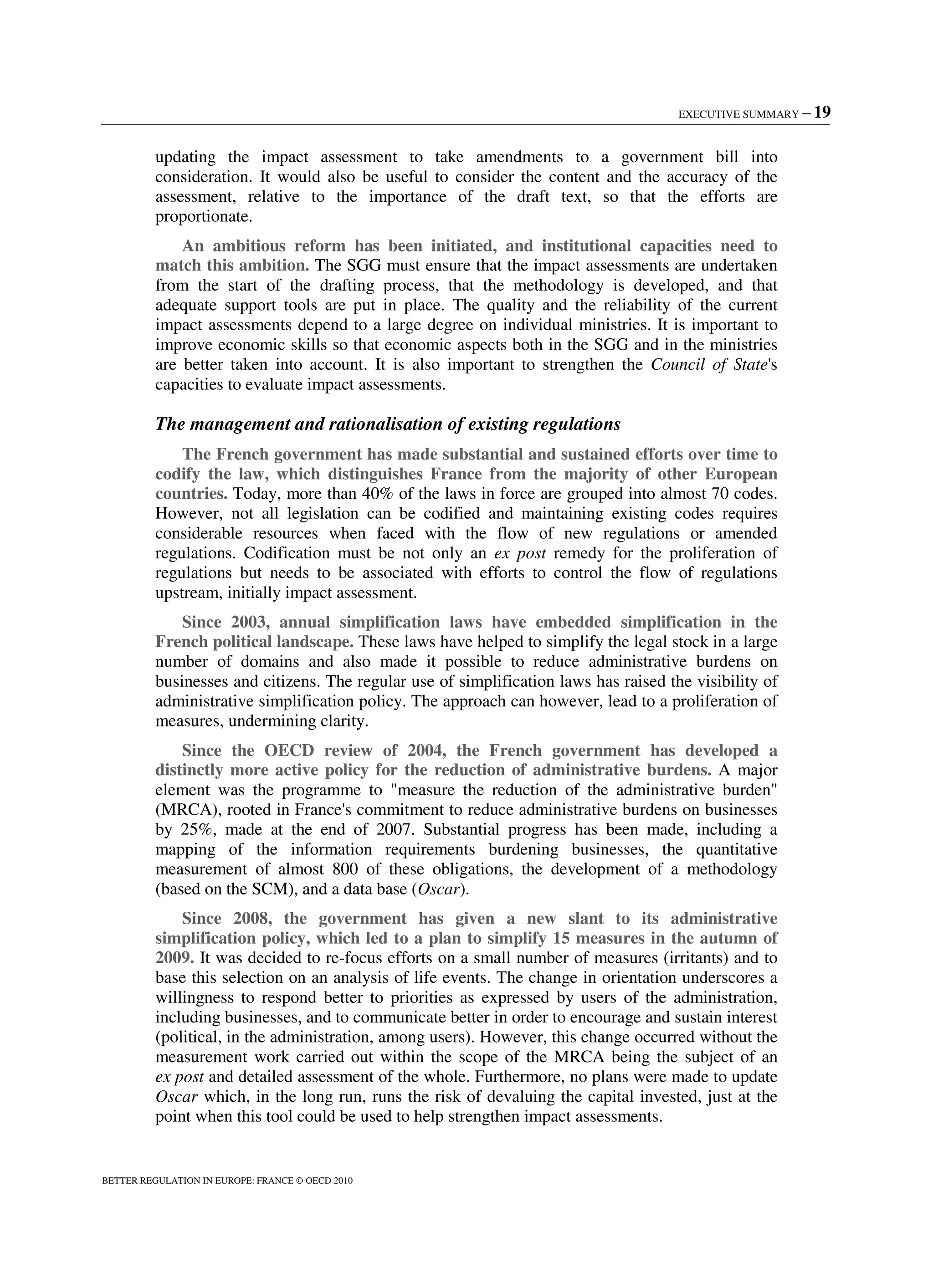
BETTER REGULATION IN EUROPE: FRANCE © OECD 2010
updating the impact assessment to take amendments to a government bill into
consideration. It would also be useful to consider the content and the accuracy of the
assessment, relative to the importance of the draft text, so that the efforts are
proportionate.
An ambitious reform has been initiated, and institutional capacities need to
match this ambition. The SGG must ensure that the impact assessments are undertaken
from the start of the drafting process, that the methodology is developed, and that
adequate support tools are put in place. The quality and the reliability of the current
impact assessments depend to a large degree on individual ministries. It is important to
improve economic skills so that economic aspects both in the SGG and in the ministries
are better taken into account. It is also important to strengthen the Council of State's
capacities to evaluate impact assessments.
The management and rationalisation of existing regulations
The French government has made substantial and sustained efforts over time to
codify the law, which distinguishes France from the majority of other European
countries. Today, more than 40% of the laws in force are grouped into almost 70 codes.
However, not all legislation can be codified and maintaining existing codes requires
considerable resources when faced with the flow of new regulations or amended
regulations. Codification must be not only an ex post remedy for the proliferation of
regulations but needs to be associated with efforts to control the flow of regulations
upstream, initially impact assessment.
Since 2003, annual simplification laws have embedded simplification in the
French political landscape. These laws have helped to simplify the legal stock in a large
number of domains and also made it possible to reduce administrative burdens on
businesses and citizens. The regular use of simplification laws has raised the visibility of
administrative simplification policy. The approach can however, lead to a proliferation of
measures, undermining clarity.
Since the OECD review of 2004, the French government has developed a
distinctly more active policy for the reduction of administrative burdens. A major
element was the programme to measure the reduction of the administrative burden
(MRCA), rooted in France's commitment to reduce administrative burdens on businesses
by 25%, made at the end of 2007. Substantial progress has been made, including a
mapping of the information requirements burdening businesses, the quantitative
measurement of almost 800 of these obligations, the development of a methodology
(based on the SCM), and a data base (Oscar).
Since 2008, the government has given a new slant to its administrative
simplification policy, which led to a plan to simplify 15 measures in the autumn of
2009. It was decided to re-focus efforts on a small number of measures (irritants) and to
base this selection on an analysis of life events. The change in orientation underscores a
willingness to respond better to priorities as expressed by users of the administration,
including businesses, and to communicate better in order to encourage and sustain interest
(political, in the administration, among users). However, this change occurred without the
measurement work carried out within the scope of the MRCA being the subject of an
ex post and detailed assessment of the whole. Furthermore, no plans were made to update
Oscar which, in the long run, runs the risk of devaluing the capital invested, just at the
point when this tool could be used to help strengthen impact assessments.
20 – EXECUTIVE SUMMARY
BETTER REGULATION IN EUROPE: FRANCE © OECD 2010
More strategically, the policy to reduce administrative burdens is not clearly
attached to economic policy objectives. Above all, it is incorporated into the wider state
modernisation programme (RGPP), in which the main objective is to make the state more
effective. In so doing, business competitiveness, even if it is mentioned and is the subject
of specific initiatives (such as the simplification of business creation procedures), is not a
prime objective. In the current context of the emergence of the world economy (and that
of France) from one of the more serious crises in its history, it would be timely to create a
more direct and closer link between the policy on reducing administrative burdens and
boosting the economy.
The objectives to be attained have not been clearly determined or assigned. The
25% reduction objective was a step towards a more quantitative and specific approach,
which can be found in the MRCA programme. The objective was set globally, without
taking into account the flow of new regulations and without setting detailed objectives by
ministry. With the slant towards life events, it is even more important to stay on course
with regard to clearly determined objectives. However, if the 25% reduction objective is
not to be officially abandoned, it is not clear, in the absence of well-defined quantitative
monitoring, how progress made towards achieving this objective can be assessed.
An issue which needs attention is the co-ordination of administrative
simplification actions throughout the administration. Discussions held by the OECD
showed that the project to reduce administrative burdens is somewhat out of touch with
ministries' initiatives, which do not fall clearly within an overall programme. The lack of
specific objectives by ministry, for which they must be held accountable, has made it
difficult to mobilise shared support for the project, and, more broadly, for administrative
simplification.
There is a need for more information on progress. Until recently, no detailed and
regular information was provided on the progress of the administrative burden reduction
programme, so much so that this policy has remained relatively invisible both for the
external stakeholders and for the rest of the administration. The publication in February
2010 of a follow-up sheet on the 15 simplification measures is a step in the right
direction.
Compliance, enforcement, appeals
Enforcement activities are (rightly) moving towards increased consideration of
risk and better co-ordination between inspection services. “Obligations based on
results” have replaced “obligations of means” while risk analysis is increasingly used to
target controls. The policy on state modernisation and application of EU regulations have
also led to the regrouping of some services (which in France are primarily under the remit
of central government) and to improve co-ordination of inspection bodies. Simplification
and co-ordination of inspection and control activities are concerns raised by business
representatives.
Alternatives to judicial appeals have been developed, in particular,
administrative appeals and the mediator. This meets the need to reduce the number of
cases that come before administrative courts. The mediator fills in (or attempts to fill in)
the gaps in the formal system. A major necessary improvement relates to the need for
greater transparency in relation to information about appeals procedures, in particular
time limits for referring a case which are often very short. Another difficulty lies in the
delays for taking cases forward, as the number of cases continues to rise.
EXECUTIVE SUMMARY – 21
BETTER REGULATION IN EUROPE: FRANCE © OECD 2010
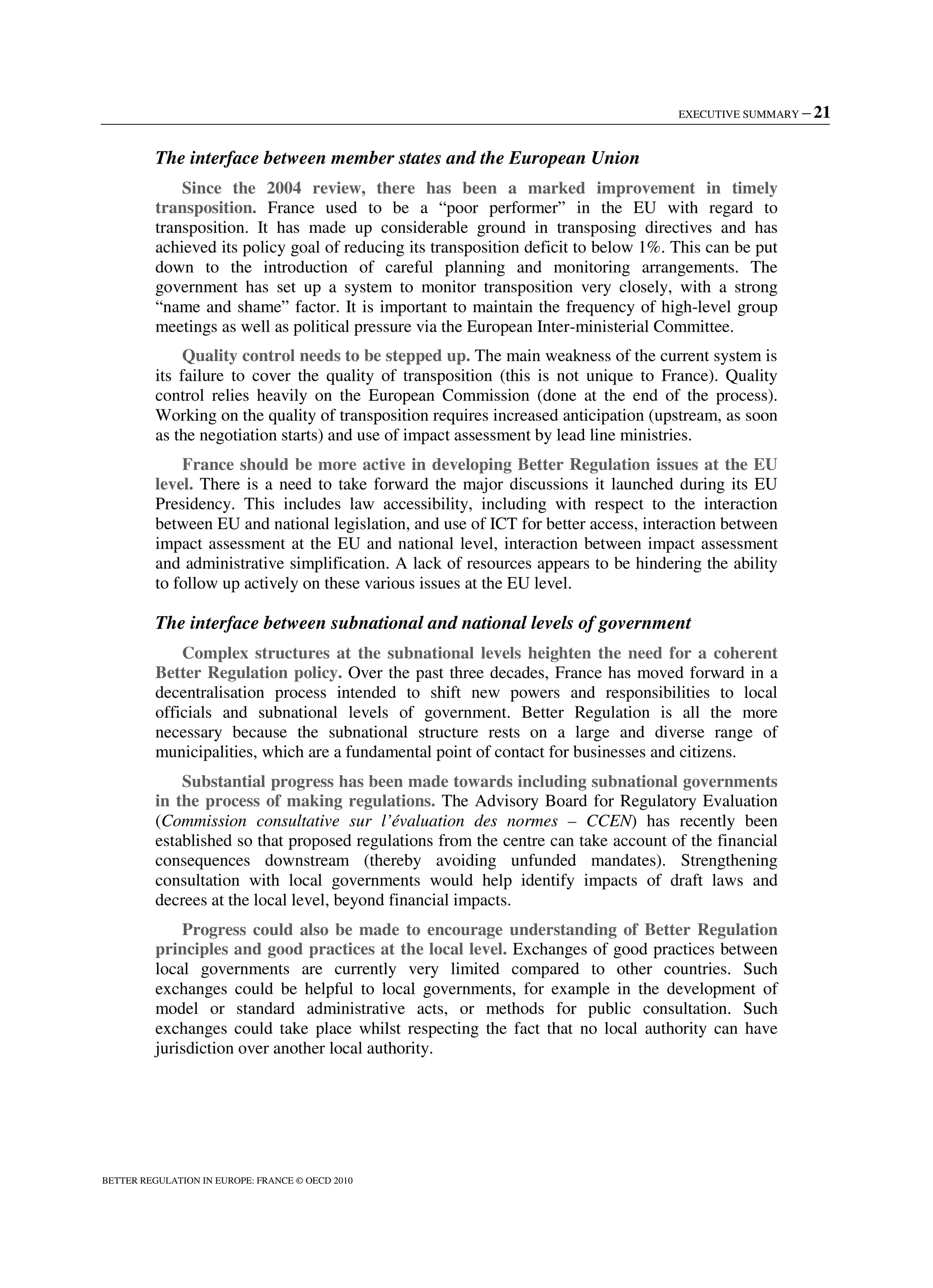
The interface between member states and the European Union
Since the 2004 review, there has been a marked improvement in timely
transposition. France used to be a “poor performer” in the EU with regard to
transposition. It has made up considerable ground in transposing directives and has
achieved its policy goal of reducing its transposition deficit to below 1%. This can be put
down to the introduction of careful planning and monitoring arrangements. The
government has set up a system to monitor transposition very closely, with a strong
“name and shame” factor. It is important to maintain the frequency of high-level group
meetings as well as political pressure via the European Inter-ministerial Committee.
Quality control needs to be stepped up. The main weakness of the current system is
its failure to cover the quality of transposition (this is not unique to France). Quality
control relies heavily on the European Commission (done at the end of the process).
Working on the quality of transposition requires increased anticipation (upstream, as soon
as the negotiation starts) and use of impact assessment by lead line ministries.
France should be more active in developing Better Regulation issues at the EU
level. There is a need to take forward the major discussions it launched during its EU
Presidency. This includes law accessibility, including with respect to the interaction
between EU and national legislation, and use of ICT for better access, interaction between
impact assessment at the EU and national level, interaction between impact assessment
and administrative simplification. A lack of resources appears to be hindering the ability
to follow up actively on these various issues at the EU level.
The interface between subnational and national levels of government
Complex structures at the subnational levels heighten the need for a coherent
Better Regulation policy. Over the past three decades, France has moved forward in a
decentralisation process intended to shift new powers and responsibilities to local
officials and subnational levels of government. Better Regulation is all the more
necessary because the subnational structure rests on a large and diverse range of
municipalities, which are a fundamental point of contact for businesses and citizens.
Substantial progress has been made towards including subnational governments
in the process of making regulations. The Advisory Board for Regulatory Evaluation
(Commission consultative sur l’évaluation des normes – CCEN) has recently been
established so that proposed regulations from the centre can take account of the financial
consequences downstream (thereby avoiding unfunded mandates). Strengthening
consultation with local governments would help identify impacts of draft laws and
decrees at the local level, beyond financial impacts.
Progress could also be made to encourage understanding of Better Regulation
principles and good practices at the local level. Exchanges of good practices between
local governments are currently very limited compared to other countries. Such
exchanges could be helpful to local governments, for example in the development of
model or standard administrative acts, or methods for public consultation. Such
exchanges could take place whilst respecting the fact that no local authority can have
jurisdiction over another local authority.
22 – EXECUTIVE SUMMARY
BETTER REGULATION IN EUROPE: FRANCE © OECD 2010
Key recommendations
Better Regulation strategy and policies
1.1. Regroup the different initiatives to create an overall
strategy. Launch an integrated communication strategy
covering the initiatives and the vision for the future,
highlighting the link to economic performance. Produce an
annual progress report, which could be sent to the prime
minister and parliament by a minister given the
responsibility for co-ordination of the strategy, its
implementation, and its communication. This report would
be made public.
1.2. Elaborate a communications strategy that regroups the
different initiatives, showing the interaction, leaving room
for communication on individual reforms. Ensure that
communication is targeted to meet the needs of the
administration as well as those of the general public, outside
the administration.
1.3. Reinforce and make more systematic the evaluation of
Better Regulation policies. Anticipate the evaluation of key
programmes, such as impact assessment. A global
evaluation could also be done to show the link between
Better Regulation policies and economic performance.
Consider which body would be best placed to carry out such
evaluations.
Institutional capacities for Better Regulation
2.1. Evaluate capacities and mechanisms in place for ensuring
that line ministries take full and active responsibility for
their part in simplification policies.
2.2. Consider what the adequate role and resources (including in
terms of economic capacities) of the SGG should be to
ensure an efficient monitoring of Better Regulation policies
from the centre of government.
EXECUTIVE SUMMARY – 23
BETTER REGULATION IN EUROPE: FRANCE © OECD 2010
2.3. Consider setting up an inter-ministerial committee to
provide political support to Better Regulation policies as a
whole. The Inter-ministerial Committee on Europe (CIE)
could be taken as a template. Nominate a minister in charge
of following up and communicating on Better Regulation
policies.
2.4. Strengthen administrative culture as necessary for
implementation of Better Regulation policies. Review
training policy so that civil servants fully grasp Better
Regulation tools. Review economic skills.
Transparency through public consultation and communication
3.1. Engage a discussion on the overhaul of public consultation.
This could be partly based on targeted audits, for example,
on open consultation processes on the Internet.
3.2. Establish consultation guidelines. Set up a consultation
portal (in which the forum website could be integrated).
Encourage ministries to share their experiences in order to
highlight good practices and the most useful processes.
3.3. Consider how Légifrance can be further developed (the
public website providing access to legal texts) further.
Development of new regulations
4.1. Continue to reinforce basic processes for making new
regulations. Further develop online tools, in particular by
integrating the legistic guide and developing training
programmes in parallel. Continue to focus on monitoring
delays for issuing secondary regulations necessary for the
implementation of laws and for transposing directives.
Publish the government programme to increase its visibility.
4.2. Encourage strengthening of procedures for making new
regulations when they are initiated by members of
parliament.
24 – EXECUTIVE SUMMARY
BETTER REGULATION IN EUROPE: FRANCE © OECD 2010
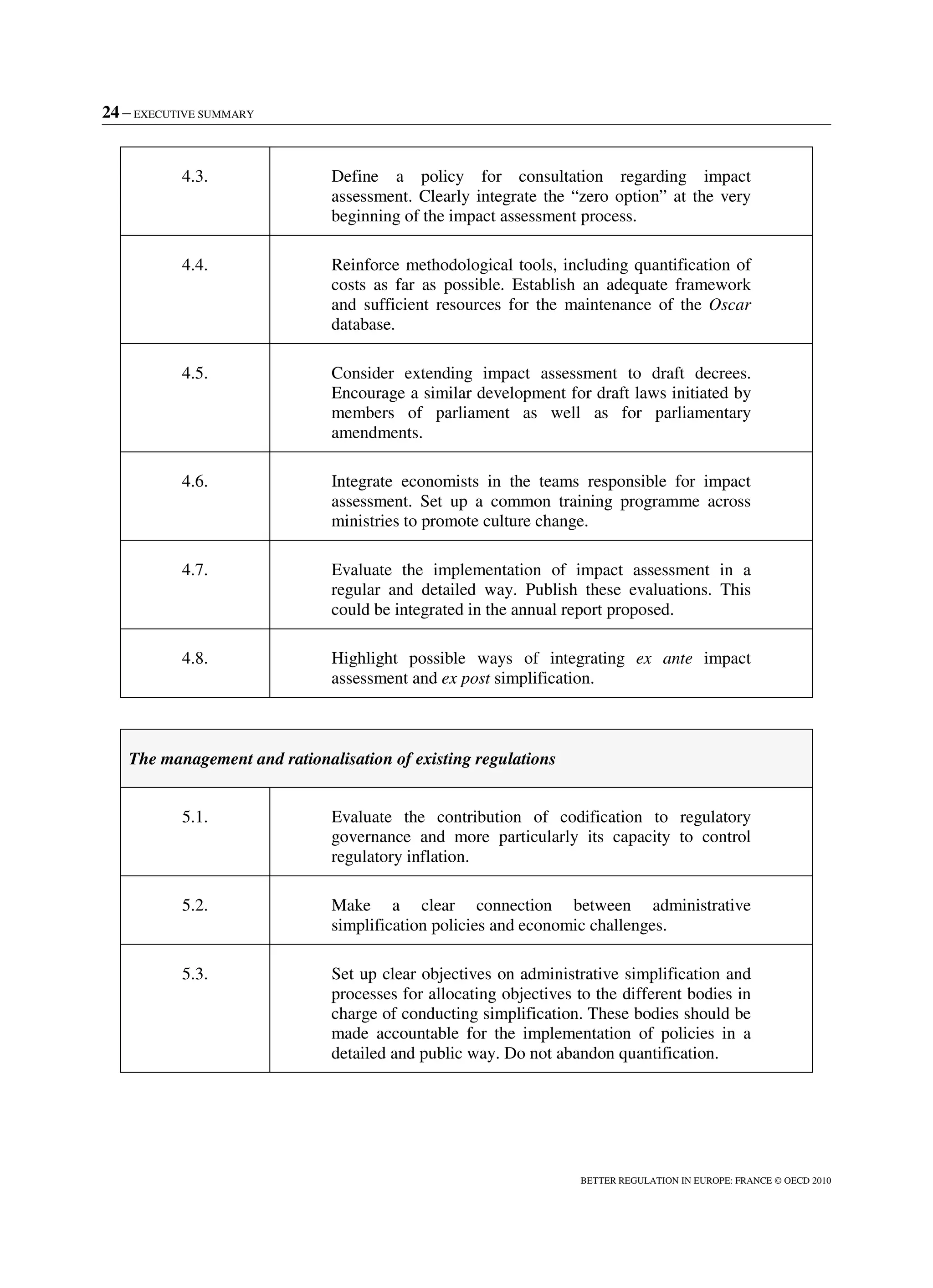
4.3. Define a policy for consultation regarding impact
assessment. Clearly integrate the “zero option” at the very
beginning of the impact assessment process.
4.4. Reinforce methodological tools, including quantification of
costs as far as possible. Establish an adequate framework
and sufficient resources for the maintenance of the Oscar
database.
4.5. Consider extending impact assessment to draft decrees.
Encourage a similar development for draft laws initiated by
members of parliament as well as for parliamentary
amendments.
4.6. Integrate economists in the teams responsible for impact
assessment. Set up a common training programme across
ministries to promote culture change.
4.7. Evaluate the implementation of impact assessment in a
regular and detailed way. Publish these evaluations. This
could be integrated in the annual report proposed.
4.8. Highlight possible ways of integrating ex ante impact
assessment and ex post simplification.
The management and rationalisation of existing regulations
5.1. Evaluate the contribution of codification to regulatory
governance and more particularly its capacity to control
regulatory inflation.
5.2. Make a clear connection between administrative
simplification policies and economic challenges.
5.3. Set up clear objectives on administrative simplification and
processes for allocating objectives to the different bodies in
charge of conducting simplification. These bodies should be
made accountable for the implementation of policies in a
detailed and public way. Do not abandon quantification.
EXECUTIVE SUMMARY – 25
BETTER REGULATION IN EUROPE: FRANCE © OECD 2010
5.4. Prepare and publish scoreboards on the effective
implementation and specific results of simplification
initiatives, for both government and external stakeholders,
in addition to general communication on RGPP.
5.5. Establish a schedule for regular evaluations. Identify the
body which is best placed to carrying out these evaluations.
Compliance, enforcement, appeals
6.1. Encourage co-ordination between inspection bodies,
including through mergers if necessary.
6.2. Monitor the transparency of the different appeal processes
for businesses and citizens, and time taken in processing
appeals.
The interface between member states and the European Union
7.1. Maintain pressure on the monitoring of the transposition of
EU directives by ministries.
7.2. Continue to reflect on the interaction between impact
assessment undertaken at the European Commission’s level
and the national level, and on integration of impact
assessment in the transposition process.
7.3. Reinforce France’s role in discussions on Better Regulation
at the EU level. Consider how to secure adequate resources
to support this objective.
The interface between subnational and national levels of government
8.1. Consider monitoring and an extension of the scope of the
work of the Advisory Commission on Evaluation Standards
(CCEN).
8.2. Encourage the development of good practice exchanges
between local governments.
26 – EXECUTIVE SUMMARY
BETTER REGULATION IN EUROPE: FRANCE © OECD 2010
8.3. Improve communication on local regulations by identifying
possible tools and measures (e.g. legal portals, progressive
codification of local regulations).
8.4. Efforts should be continued to incorporate subnational
entities into the central government’s administrative
simplification initiatives.
INTRODUCTION – 27
BETTER REGULATION IN EUROPE: FRANCE © OECD 2010
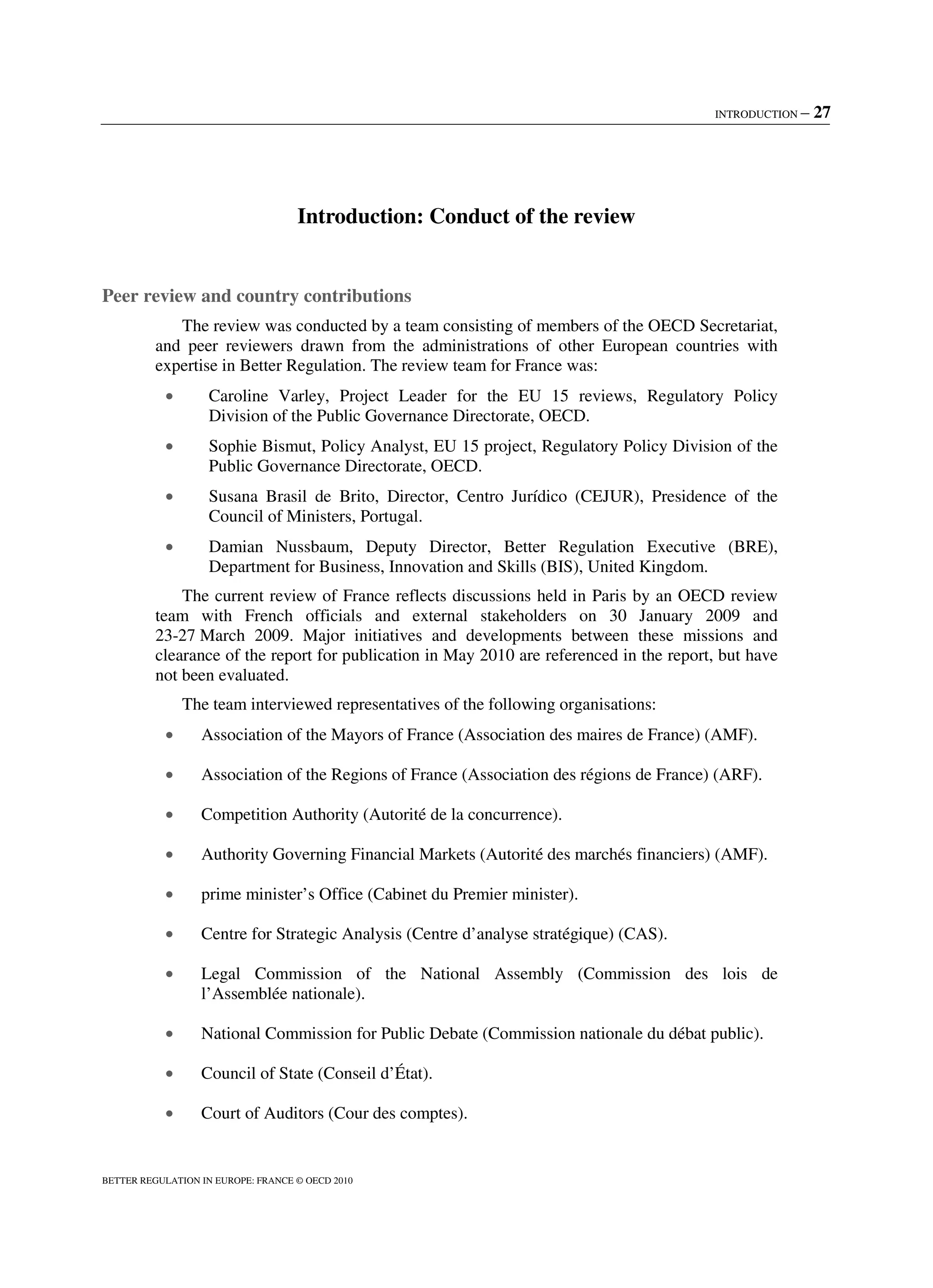
Introduction: Conduct of the review
Peer review and country contributions
The review was conducted by a team consisting of members of the OECD Secretariat,
and peer reviewers drawn from the administrations of other European countries with
expertise in Better Regulation. The review team for France was:
• Caroline Varley, Project Leader for the EU 15 reviews, Regulatory Policy
Division of the Public Governance Directorate, OECD.
• Sophie Bismut, Policy Analyst, EU 15 project, Regulatory Policy Division of the
Public Governance Directorate, OECD.
• Susana Brasil de Brito, Director, Centro Jurídico (CEJUR), Presidence of the
Council of Ministers, Portugal.
• Damian Nussbaum, Deputy Director, Better Regulation Executive (BRE),
Department for Business, Innovation and Skills (BIS), United Kingdom.
The current review of France reflects discussions held in Paris by an OECD review
team with French officials and external stakeholders on 30 January 2009 and
23-27 March 2009. Major initiatives and developments between these missions and
clearance of the report for publication in May 2010 are referenced in the report, but have
not been evaluated.
The team interviewed representatives of the following organisations:
• Association of the Mayors of France (Association des maires de France) (AMF).
• Association of the Regions of France (Association des régions de France) (ARF).
• Competition Authority (Autorité de la concurrence).
• Authority Governing Financial Markets (Autorité des marchés financiers) (AMF).
• prime minister’s Office (Cabinet du Premier minister).
• Centre for Strategic Analysis (Centre d’analyse stratégique) (CAS).
• Legal Commission of the National Assembly (Commission des lois de
l’Assemblée nationale).
• National Commission for Public Debate (Commission nationale du débat public).
• Council of State (Conseil d’État).
• Court of Auditors (Cour des comptes).
28 – INTRODUCTION
BETTER REGULATION IN EUROPE: FRANCE © OECD 2010
• Department of Tax Legislation, Ministry of Budget, Public Accounts, the Civil
Service and State Reform (Direction de la Législation fiscale, ministère du Budget,
des Comptes publics, de la Fonction publique et de la Réforme de l’État).
• Department of Social Security (Direction de la Sécurité sociale) (DSS).
• Department of Civil Affairs and the Seal, Ministry of Justice and Freedom
(Direction des Affaires civiles et du Sceau, ministère de la Justice et des Libertés).
• Department of Legal Affairs, Ministry of Budget, Public Accounts, the Civil
Service and State Reform and the Ministry of Economy, Industry and Employment
(Direction des Affaires juridiques, ministère du Budget, des Comptes publics, de la
Fonction publique et de la Réforme de l’État et ministère de l’Économie, de
l’Industrie et de l’Emploi).
• Competitiveness Department, Industry and Services (DGCIS), Ministry of
Economy, Industry and Employment (Direction générale de la Compétitivité, de
l’Industrie et des Services (DGCIS), ministère de l’Économie, de l’Industrie et de
l’Emploi).
• Directorate General for the Modernisation of the State (DGME), Ministry of
Budget, Public Accounts, the Civil Service and State Reform (Direction générale
de la Modernisation de l'État (DGME), ministère du Budget, des Comptes publics,
de la Fonction publique et de la Réforme de l’État).
• Directorate General of Local Authorities (DGCL), Ministry of the Interior,
Overseas France and Local Authorities (Direction générale des Collectivités
locales (DGCL), ministère de l’Intérieur, de l’Outre-Mer et des Collectivités
territoriales).
• Directorate General of Labour (DGT), Ministry of Labour, Social Relations,
Family, Solidarity and the City (Direction générale du Travail (DGT), ministère du
Travail, des Relations sociales, de la Famille, de la Solidarité et de la Ville).
• Mediator of the Republic (Médiateur de la République).
• The Senate (Sénat).
• Department of Legal Affairs, General Secretariat for Food, Agriculture and
Fisheries Ministry (Service des Affaires juridiques, secrétariat général du ministère
de l’Alimentation, de l’Agriculture et de la Pêche).
• Secretariat General for European Affairs (Secrétariat général des Affaires
européennes) (SGAE).
• General Secretariat of the Government (Secrétariat général du Gouvernement)
(SGG).
INTRODUCTION – 29
BETTER REGULATION IN EUROPE: FRANCE © OECD 2010
• French Confederation of Professionals – Confederation of Professionals
(Confédération française de l’encadrement – Confederation generale des cadres)
(CFE-CGC).
• French Confederation of Christian Workers (Confédération française des
travailleurs chrétiens) (CFTC).
• General Confederation of Small and Medium Enterprises (Confédération générale
des petites et moyennes entreprises) (CGPME).
• General Labour Confederation (Confédération générale du travail) (CGT).
• Workers' Force (Force ouvrière) (FO).
• French Business Movement (Mouvement des entreprises de France) (MEDEF).
• Federal Union of Consumers – What to Choose (Union fédérale des
consommateurs – Que Choisir) (UFC – Que Choisir).
• Paris X University, Nanterre (Université Paris X Nanterre).
The report, which was drafted by the OECD Secretariat, was the subject of comments
and contributions from the peer reviewers as well as from colleagues within the OECD
Secretariat. It was fact checked by France.
The report is also based on material provided by France in response to a
questionnaire, including relevant documents, as well as relevant recent reports and
reviews carried out by the OECD and other international organisations on linked issues
such as e-Government and public governance.
Within the OECD Secretariat, the EU 15 project is led by Caroline Varley, supported
by Sophie Bismut. Elsa Cruz de Cisneros and Shayne MacLachlan provided
administrative and communications support, respectively, for the development and
publication of the report.
Structure of the report
The report is structured into eight chapters. The project baseline is set out at the start
of each chapter. This is followed by an assessment and recommendations, and
background material.
• Strategy and policies for Better Regulation. This chapter first considers the
drivers of Better Regulation policies. It seeks to provide a “helicopter view” of
Better Regulation strategy and policies. It then considers overall communication
to stakeholders on strategy and policies, as a means of encouraging their ongoing
support. It reviews the mechanisms in place for the evaluation of strategy and
policies aimed at testing their effectiveness. Finally, it (briefly) considers the role
of e-Government in support of Better Regulation.
• Institutional capacities for Better Regulation. This chapter seeks to map and
understand the different and often interlocking roles of the entities involved in
regulatory management and the promotion and implementation of Better
30 – INTRODUCTION
BETTER REGULATION IN EUROPE: FRANCE © OECD 2010
Regulation policies, against the background of the country’s public governance
framework. It also examines training and capacity building within government.
• Transparency through consultation and communication. This chapter
examines how the country secures transparency in the regulatory environment,
both through public consultation in the process of rule- making and public
communication on regulatory requirements.
• The development of new regulations. This chapter considers the processes,
which may be interwoven, for the development of new regulations: procedures for
the development of new regulations (forward planning; administrative procedures,
legal quality); the ex ante impact assessment of new regulations; and the
consideration of alternatives to regulation.
• The management and rationalisation of existing regulations. This chapter
looks at regulatory policies focused on the management of the “stock” of
regulations. These policies include initiatives to simplify the existing stock of
regulations, and initiatives to reduce burdens which administrative requirements
impose on businesses, citizens and the administration itself.
• Compliance, enforcement, appeals. This chapter considers the processes for
ensuring compliance and enforcement of regulations, as well administrative and
judicial review procedures available to citizens and businesses for raising issues
related to the rules that bind them.
• The interface between member states and the EU. This chapter considers the
processes that are in place to manage the negotiation of EU regulations, and their
transposition into national regulations. It also briefly considers the interface of
national Better Regulation policies with Better Regulation policies implemented
at EU level.
• The interface between subnational and national levels of government. This
chapter considers the rule-making and rule-enforcement activities of
local/sub-federal levels of government, and their interplay with the
national/federal level. It reviews the allocation of regulatory responsibilities at the
different levels of government, the capacities of the local/sub federal levels to
produce quality regulation, and co-ordination mechanisms between the different
levels.
Methodology
The starting point for the reviews is a “project baseline” which draws on the
initiatives for Better Regulation promoted by both the OECD and the European
Commission over the last few years:
• The OECD’s 2005 Guiding Principles for Regulatory Quality and Performance
set out core principles of effective regulatory management which have been tested
and debated in the OECD membership.
• The OECD’s multidisciplinary reviews over the last few years of regulatory
reform in 11 of the 15 countries to be reviewed in this project included a
comprehensive analysis of regulatory management in those countries, and
recommendations.
INTRODUCTION – 31
BETTER REGULATION IN EUROPE: FRANCE © OECD 2010
• The OECD/SIGMA regulatory management reviews in the 12 “new” EU member
states carried out between 2005 and 2007.
• The 2005 renewed Lisbon Strategy adopted by the European Council which
emphasises actions for growth and jobs, enhanced productivity and
competitiveness, including measures to improve the regulatory environment for
businesses. The Lisbon Agenda includes national reform programmes to be
carried out by member states.
• The European Commission’s 2006 Better Regulation Strategy, and associated
guidelines, which puts special emphasis on businesses and especially small to
medium-sized enterprises, drawing attention to the need for a reduction in
administrative burdens.
• The European Commission’s follow up Action Programme for reducing
administrative burdens, endorsed by the European Council in March 2007.
• The European Commission’s development of its own strategy and tools for Better
Regulation, notably the establishment of an impact assessment process applied to
the development of its own regulations.
• The OECD’s recent studies of specific aspects of regulatory management, notably
on cutting red tape and e-Government, including country reviews on these issues.
Regulation: What the term means for this project
The term “regulation” in this project is generally used to cover any instrument by
which governments set requirements on citizens and enterprises. It therefore includes all
laws (primary and secondary), formal and informal orders, subordinate rules,
administrative formalities and rules issued by non-governmental or self-regulatory bodies
to whom governments have delegated regulatory powers. The term is not to be confused
with EU regulations. These are one of three types of EC binding legal instrument under
the Treaties (the other two being directives and decisions).
1. STRATEGY AND POLICIES FOR BETTER REGULATION – 33
BETTER REGULATION IN EUROPE: FRANCE © OECD 2010
Chapter 1
Strategy and policies for Better Regulation
Regulatory policy may be defined broadly as an explicit, dynamic, and consistent
“whole-of-government” policy to pursue high quality regulation. A key part of the
OECD’s 2005 Guiding Principles for Regulatory Quality and Performance is that
countries adopt broad programmes of regulatory reform that establish principles of “good
regulation”, as well as a framework for implementation. Experience across the OECD
suggests that an effective regulatory policy should be adopted at the highest political
levels, contain explicit and measurable regulatory quality standards, and provide for
continued regulatory management capacity.
Effective communication to stakeholders is of growing importance to secure ongoing
support for regulatory quality work. A key issue relates to stakeholders’ perceptions of
regulatory achievements (business, for example, may continue to complain about
regulatory issues that are better managed than previously).
Governments are accountable for the often significant resources as well as political
capital invested in regulatory management systems. There is a growing interest in the
systematic evaluation of regulatory management performance – “measuring the gap”
between regulatory policies as set out in principle and their efficiency and effectiveness in
practice. How do specific institutions, tools and processes perform? What contributes to
their effective design? The systematic application of ex post evaluation and measurement
techniques can provide part of the answer and help to strengthen the framework.
E-Government is an important support tool for Better Regulation. It permeates
virtually all aspects of regulatory policy from consultation and communication to
stakeholders, to the effective development of strategies addressing administrative
burdens, and not least as a means of disseminating Better Regulation policies, best
practices, and guidance across government, including local levels. Whilst a full evaluation
of this aspect is beyond the scope of this exercise and would be inappropriate, the report
makes a few comments that may prove helpful for a more in-depth analysis.
34 – 1. STRATEGY AND POLICIES FOR BETTER REGULATION
BETTER REGULATION IN EUROPE: FRANCE © OECD 2010
Assessment and recommendations
Development of Better Regulation strategy and policies
Since the OECD Review of Regulatory Reform of France published in 2004, France
has undertaken a set of ambitious measures to improve regulatory quality; these
measures constitute a major change in quality. Three substantial fields of action may be
distinguished. Two are upstream: the first tackles the process of drafting regulations by
strengthening ex ante impact assessment; the second is the overhaul of the public
consultation processes. The third field is downstream of regulatory production. The
French government has conducted a simplification policy which combines legal
simplification and a reduction in administrative burdens. Special efforts have also been
developed to reduce the backlog of EU legislation to be transposed into national law, and
to speed up the production of secondary regulations necessary for the implementation of
primary laws, two weaknesses emphasised in the 2004 OECD report. Upstream and
downstream actions are converging. There is growing consideration of how to combine
ex ante impact assessment and ex post simplification. While there is still no integrated
strategy on the ground, principles guiding future developments are clearly coming to
fruition. This discussion is of just as much importance to France as to other countries.
In the area of regulatory governance, France has long emphasised the importance of
rule drafting and achieving legal consistency, but the debate on these matters is
broadening. High quality regulation is increasingly regarded as an aim of public policies;
which was not previously the case. The most recent period has been important in
heightening awareness about the significance of high quality regulation and a real desire
for change, in contrast to the significant lack of progress apparent in 2003/04. This
awareness is broadly shared (on the part of the government, the Council of State, the
parliament and the public administration), even though external stakeholders (and
particularly business representatives) have been only modestly involved in the debate in
comparison to other European countries. Awareness has also been influenced by
examples from other countries, through the sharing of good practice and experience.
Compared to other countries, it is worth emphasising the innovative nature of the impact
assessment arrangements introduced in France since 2009, as well as the changes in the
area of public consultation. These represent a major breakthrough, offering scope for
creativity in a context that remains largely traditional and centralised.
The approach to regulatory governance continues to be strongly influenced by legal
considerations. Legal codification and simplification, as well as access to the law, are still
important mainstays of regulatory governance. Regulatory governance policy is largely
driven by the perception that France would suffer more than it should
from “overproduction of legal norms”, which has prompted discussion about what needs
to change in order for regulatory management to improve. The definition and policy field
of French regulatory governance do not always fit the expression “Better Regulation”,
which is difficult to translate into French.1
It means more than just the simplification and
clarification of laws. France does not have a regulatory governance strategy in the strict
sense, but a set of measures to improve the quality of regulation, which are driven
essentially by the perception of a “French disease”, namely the overproduction of legal
norms that has to be kept in check.
The economic dimension and the cost to the economy of excessive regulation or
“poor” regulation still tends to be discounted. Reference is made to economic concerns
but with a less important emphasis, compared to other European countries. Action in the
1. STRATEGY AND POLICIES FOR BETTER REGULATION – 35
BETTER REGULATION IN EUROPE: FRANCE © OECD 2010
field of regulatory governance is part of a broader programme reviewing public policies
(RGPP), which aims to modernise government administration and increase its
effectiveness. The economic goal is thus not central to the system. Administrative
burdens aside, there is arguably insufficient awareness of the fact that regulation has a
cost, as well as benefits, which is a rough equivalent to the cost of public expenditure. For
example, the United Kingdom has considered the idea of “regulatory budgets”, though
difficult to put into practice, tend to point to the importance of keeping regulatory costs in
check. Symptomatic of this lack of awareness is that the Ministry for Economic Affairs
and the Cour des Comptes (the Court of audit) are still insufficiently involved in
regulatory governance issues.
Continued progress in regulatory governance depends on maintaining strong
political will. The progress achieved since 2004, for example, on impact assessment,
administrative simplification, and the transposition of EU directives, has depended on a
strong political will on the part of the government and parliament. It should be
emphasised that many of these policies are a “work in progress”, and at the midpoint of
implementation. Processes and tools need to be set up and implemented, a lengthy and
exacting process. Regulatory governance is a long-term policy, with little immediate
political gain, and subject to short-term pressures. It is harder to raise its profile in France
given, that on the one hand, there is a lack of a comprehensive regulatory governance
programme which might be sustained with political backing and, on the other, the relative
disregard for economic concerns, which is somewhat surprising at a time when policy is
geared towards economic recovery. Under these circumstances, relatively little attention
is paid to the issue of regulatory governance beyond the limited context of administrative
and political institutions. Identifying an overall policy could increase the visibility of the
process and give it impetus over time.
Recommendation 1.1. Regroup the different initiatives to create an overall
strategy. Launch an integrated communication strategy covering the initiatives
and the vision for the future, highlighting the link to economic performance.
Produce an annual progress report, which could be sent to the prime minister
and parliament by a minister given the responsibility for co-ordination of the
strategy, its implementation, and its communication. This report would be
made public.
Communication on Better Regulation strategy and policies
There is no clear communication which brings together the different strands of
regulatory governance. This reflects the lack of any integrated policy and the dilution of
certain initiatives in the RGPP. It is above all presented as an initiative in favour of
“users” (citizens and businesses) and improved public services, rather than a support for
economic recovery. The various reforms are the subject of separate internal
communications within the administration in an ad hoc fashion (such as in
February 2010 on progress with the simplification plan). This does not provide clear
visibility for these reforms, either within the administration, or outside it (for
stakeholders).
36 – 1. STRATEGY AND POLICIES FOR BETTER REGULATION
BETTER REGULATION IN EUROPE: FRANCE © OECD 2010
Recommendation 1.2. Elaborate a communications strategy that regroups the
different initiatives, showing the interaction, leaving room for communication
on individual reforms. Ensure that communication is targeted to meet the
needs of the administration as well as those of the general public, outside the
administration.
Ex post evaluation of Better Regulation strategy and policies
France stands out (positively) in terms of the large number of reports on regulatory
quality. The reports by the Council of State and other ad hoc committee reports which
focus on specific aspects, such as the Balladur report on local governments and the
Warsmann report on regulatory quality, may be cited. These assessments, although not
regular events, have given rise to substantial changes, which suggests that it would be
helpful to conduct these assessments on a more systematic basis. Thus the publication of
several reports which emphasises the ineffectiveness of the measures introduced by a
decree or a circular to establish impact assessments, has contributed to the setting up of
more stringent and ambitious arrangements through the constitutional reform of 2008
(Chapter 4).
France has several players who may be able to provide regular evaluations of
regulatory policy over time. The Cour des comptes (Court of audit), independent of the
executive, has not yet undertaken studies on regulatory governance, but could be very
useful for general assessments. The programmes to reduce administrative burdens and
impact assessment processes could be candidates for this approach, as can be seen in
other countries. This approach could be envisaged as part of the development of public
policy assessments outlined in the recent constitutional revision. The Council of State
remains a major player. A new section (the administration section) was recently set up,
enabling it to take a more in-depth cross-cutting view of state reform and its objectives.
Recommendation 1.3. Reinforce and make the evaluation of Better Regulation
policies more systematic. Anticipate the evaluation of key programmes, such as
impact assessment. A global evaluation could also be carried out to show the
link between Better Regulation policies and economic performance. Consider
which body would be best placed to carry out such evaluations.
E-Government in support of Better Regulation
Many initiatives have been supported by the development of e-Government. The
spread of e-Government has provided a mechanism for many reforms in the area of
regulatory governance. This applies in particular to measures for administrative
simplification (for example, in order fully to dematerialise administrative procedures
applicable to businesses). It also concerns access to information (especially with
Légifrance), the simplification of administrative procedures through developing the
public service portal (mon.service-public.fr) and the internal operation of public
administration. This progress has been acknowledged by businesses. Several OECD
interviewees have suggested the need to go further, particularly by simplifying the “back
office”.
1. STRATEGY AND POLICIES FOR BETTER REGULATION – 37
BETTER REGULATION IN EUROPE: FRANCE © OECD 2010
Box 1.1. Extracts from the 2004 OECD report: Strategy and policies of regulatory
governance
Evaluation
The solid legal character of the French system, with formalised procedures for preparing and
recording, has long masked the necessity for a global effort aimed at improving the quality of
regulations and strengthening the resources for developing controls. There are directives prepared by
the prime minister, such as that of 26 August 2003 which recall the importance that must be attached to
the quality of the rule of law, by using the legal expertise of ministries appropriately and co-ordinating
it between different ministerial departments. However, such directives do not have any legal binding on
legislation that has been drawn up, and their impact has not been assessed. Moreover, in some sector
ministries, legal and economic expert resources have long failed to respond to the prior demands of
regulatory quality and evaluation.
Thus regulatory reform policies have retained a fragmented character for a long time without a
global framework of concepts enabling regulatory quality to be defined. However, from 2001, the work
carried out as a result of the Mandelkern report has led to planning conditions for transposing principles
for regulating quality which apply at the inter-departmental level.
Source: OECD (2004), Regulatory Reform in France: Government capacity to assure high quality regulation,
OECD Publishing, Paris.
Background
Economic context and drivers of Better Regulation
France is a major player in the world economy. It faces substantial challenges,
including loss of business competitiveness on world markets. At the same time France
can boast a range of advantages which should help it to rise to these challenges. The
implementation of certain necessary structural reforms partly depends on a further
strengthening of regulatory governance policy, which requires strong and sustainable
will. For example, it will be important to draw on modernisation brought by the organic
law on impact assessment and the new models for public participation in the elaboration
of policies.
In recent years, French policies for Better Regulation have underlined a political will,
which has grown in strength since 2004, to undertake reforms in order to improve
regulatory quality. A stronger and deeper understanding of the importance of effective
regulatory management within the administration has helped to promote this trend. A
number of public reports on the quality of laws have fuelled discussion, and contributed
to a promotion of the principles of regulatory quality (Box 2.1). The perception of what
some have termed “French disease” (but in fact a disease present in other countries,
though not all), corresponding to the overproduction of legal norms that has to be
controlled, has led to discussion about what has to change to give rise to better legislative
and regulatory management. These debates, which have involved among others the
government, parliament, the Council of State and the central administrative authorities
have resulted in actions aimed at improving regulatory quality both from the outset (by
reforming the process for drawing up standards) and subsequently (by evaluating and
simplifying what is already in place). The momentum generated by the Community (EU)
“Better Regulation” initiative (in French, mieux légiférer), in conjunction with the Lisbon
process, has also helped to create a context more conducive to reforms in the area of
regulatory quality. In the interviews conducted by the OECD, many informants stressed
38 – 1. STRATEGY AND POLICIES FOR BETTER REGULATION
BETTER REGULATION IN EUROPE: FRANCE © OECD 2010
how there was heightened awareness of the importance of regulatory quality and a kind of
“acculturation” on the part of French administration both to reform and to evaluation.
Box 1.2. Main reports on regulatory quality
The Picq report (1994)
This report followed the 1991 Council of State report on the proliferation of regulations and their
inadequate quality. These reports are part of the growth in awareness, from the end of the 1990s, of the
need to reform the State. They highlighted the fact that the increased number of formal regulations was
in practice of little use to direct, modernise and control state operations. The Picq report proposed an
overall strategy to modernise the role of the state by refocusing it on its basic responsibilities, by
improving the delegation of responsibility and modernising budgetary and accounting rules. It also led
to initiate regulatory impact analysis (RIA) in 1997.
The Mandelkern report (2002)
On 12 October 2000, the inter-departmental committee for state reform entrusted an
inter-ministerial working group on the quality of regulation with the task of examining the following
questions: civic consultation on draft texts; access to the law; the readability and intelligibility of the
law; impact studies; and the cost of regulation. This working group chaired by
Mr Dieudonné Mandelkern (who also chaired the High-Level Advisory Group on Better Regulation,
appointed by the European Commission in 2000) submitted a set of proposals intended to establish
more “proportionate” regulations, which were indeed implemented and more readily accepted. The
most important recommendations were concerned with the implementation of an annual simplification
programme, the preparation of cost indicators for each new regulation, systematic consultation with the
departments expected to ensure observance of the text, and improvements to the processes of preparing
and finalising texts. The working group undertook a close examination of the practice of impact
assessments as thitherto carried out, noting that they were often belated and generally formal, but also
the fact that much draft legislation avoided this form of scrutiny (Mandelkern, 2002).
The Lasserre report (2004)
The observations on impact assessments in the Mandelkern report were further examined in a
supplementary evaluation undertaken, at the request of the prime minister, by a working group chaired
by Mr. Bruno Lasserre, which submitted its report in 2004. This report too, noted the limits to the
arrangement based on a circular from the prime minister, and recommended that the projected analysis
of the impact should be taken into account at a much earlier stage, when the basic options confronting
the reform were determined (Lasserre, 2004).
The Council of State report on legal certainty and the complexity of the law (2006)
The Council of State devoted considerable effort to evaluating the policy for the quality of the law
in the general review of issues in its 2006 public report entitled Sécurité juridique et complexité du
droit (“legal certainty and the complexity of the law”), (Conseil d’État, 2006). A working group was
accordingly formed by the General Secretariat of the government to draw conclusions from it, and
proposed that the obligation to undertake impact assessments should be included in an organic law
(Secrétariat general du gouvernement, 2007).
The Warsmann report (2009)
In June 2008, the prime minister commissioned Mr. Warsmann, a deputy and chair of the National
Assembly Commission for Laws, with the brief to identify an “operational” strategy for the quality of
the legal standard, the aim being to devise a methodology for simplification of the law, and then to
ensure that the constitutional aim of intelligibility was achieved more effectively and that every citizen
could access all legal norms. This strategy was defined with reference to an appraisal of existing
1. STRATEGY AND POLICIES FOR BETTER REGULATION – 39
BETTER REGULATION IN EUROPE: FRANCE © OECD 2010
practices for producing and publicising the standard. A second part of the brief was to propose
simplification measures in three areas: namely company accounting; VAT; and public procurement.
Submitted in January 2009, the report contained 103 proposals, including 46 concerned with the fore
mentioned areas.
French policy for regulatory quality is also strongly linked to reforms for modernising
the state, under circumstances in which regulation has become deeply embedded as a
primary means of state intervention. The various current initiatives, for example as
regards impact assessments or the reduction of administrative burdens, are part of the
broader framework of the RGPP, which was initiated in June 2007 just after the
presidential election. The RGPP seeks to produce gains in budgetary savings and improve
the effectiveness of public policies, which includes action to strengthen the quality of
services provided for citizens and businesses (OECD, 2009). The actions to promote
regulatory quality are also linked to institutional reforms, and especially the constitutional
reform of July 2008 (which formally upheld the principle of impact assessments) and the
territorial reform (see Chapter 2).
Economic issues and the relevance of effective regulatory governance for economic
performance are not totally removed from regulatory governance policies, but they are
not nearly as conspicuous as in some other European countries (such as the United
Kingdom or the Netherlands), in which they have been the main driving force behind
reforms. One of the government actions is to reduce the administrative burden on
businesses. While the aim of this programme is certainly to promote the competitiveness
of French business, it does not lie at the “heart” of policies for regulatory governance.
The relatively low profile of economic concerns may also be attributed to the paramount
importance traditionally attached to legal order and legal certainty. Policies must benefit
private individuals and businesses, which are above all portrayed as “users” of public
services rather than economic players. Already noted in the 2004 OECD report, the
economic goal is not central to the system.
Developments in France’s Better Regulation agenda
Initiatives to improve regulatory governance have become steadily more substantive
in the last 40 years. The first raft of reforms in the 1970s sought primarily to lessen the
distance between ordinary citizens and administrative authorities and put an end to the
traditional secrecy and lack of openness in administrative activity (creation of the post of
Republic Ombudsman in 1973, and the laws of 1978 and 1979 on access to administrative
documents). A second wave of reforms occurred in the 1990s to facilitate access to the
law (with the establishment of Légifrance) and, in a more limited way, simplify existing
law. In the years from 2000 onwards, the field of Better Regulation became broader. In
particular, regulatory policy covered accessibility of the law, the reform of conditions for
the drafting of standards, the simplification of existing law and the reduction of the
administrative burden. These various initiatives have not been part of a formal strategy
for Better Regulation. However, the quality of the law has become an increasingly clear
aim and the different actions of recent years have been geared to it.
Since the 2004 OECD report, the French government has undertaken several major
initiatives. A key measure has been the inclusion – enshrined in the Constitution – of
ex ante impact evaluation on draft legislation. The government has initiated other reforms
pointing in several directions: simplification of the law and lessening of the
administrative burdens for private individuals and businesses, access to the law,
40 – 1. STRATEGY AND POLICIES FOR BETTER REGULATION
BETTER REGULATION IN EUROPE: FRANCE © OECD 2010
modernisation of public consultation procedures, and legal certainty in the application of
Community (EU) legislation and the enforcement of laws.
Table 1.1. Main stages of policies for Better Regulatory governance in France
1978 Law of 17 July 1978 on administrative transparency.
1981 Establishment of business formality centres (BFCs) linked to the chambers of commerce and industry.
1987 Decree by the prime minister who required an assessment of the budgetary impact and impact in terms of jobs for all regulations.
1991 Council of State report on the proliferation of regulations and their inadequate quality.
1994 Picq report on reform of the state (following the 1991 Council of State report).
1997 • Experimentation with impact assessments for draft laws and draft decrees in the Council of Ministers.
• Administrative simplification programme (decentralised to the level of the ministries).
1998 Creation of Légifrance.
1989 Decree of 12 September 1989 which revitalised codification.
2000 • The Mandelkern report (inter-ministerial working group on state reform).
• Law No 2000-321 of 12 April 2000, concerning the rights of citizens in their relations with administrative authorities, which
broadened the area of simplification beyond the central state to territorial authorities, local public institutions and social security
bodies.
2002 • Law No 2002-276 of 27 February 2002 concerning community-based democracy.
• Decree of 7 August 2002 on general distribution of the law over the Internet.
2003 Enabling law for administrative simplification (July).
2004 Lasserre report “for better quality regulation”.
2006 • Annual report of the Council of State which dealt extensively with the evaluation of policy for the quality of the law (“legal certainty
and the complexity of the law”).
• Decree No 2006-672 of 8 June 2006 on consultative committees.
2007 • Law of 31 January 2007 on reform of the social dialogue.
• Government commitment to a 25% reduction by the end of 2011 in the burden resulting from the 1 000 heaviest or most irritating
formalities weighing on businesses (December).
2008 The constitutional law of 23 July 2008. Intended to strengthen the capacity of parliament to examine draft reforms, the constitutional
reform established in particular an obligation to conduct prior evaluation of draft legislation.
2009 • The Warsmann report, “Let’s make the Law simpler to cure a French disease”.
• Organic Law No 2009-403 of 15 April 2009 which incorporated the rule on prior evaluation of draft legislative measures.
Guiding principles for the current Better Regulation agenda
Just as there is no integrated policy for Better Regulation, the French government has
not drawn up a special set of principles for Better Regulation. However, the various
policies and initiatives in this area have led in actual fact to the emergence of two major
guiding principles – legal certainty and access to the law – more strikingly than in most
other European countries. There is a broad consensus among political and administrative
leaders, as well as the economic players, that France appears to be suffering more than it
should from a constant tendency to over-regulate (see Chapter 4). This is regarded as a
source of legal uncertainty and of a cost to society and the economy, which is affecting
the credibility and effectiveness of public action. Many people are further concerned that
1. STRATEGY AND POLICIES FOR BETTER REGULATION – 41
BETTER REGULATION IN EUROPE: FRANCE © OECD 2010
steps should be taken to ensure that citizens are fully familiar with the law, and that their
relations with public administration should be simplified.
Main Better Regulation policies
Legislative simplification and reduction of the administrative burden
Simplification of the law constitutes one of the main strategic components of the
RGPP. This policy targets all categories of “users” (private individuals, businesses,
territorial authorities and associations). Its aim is to simplify regulation along with the
relation between the state and its users and to reduce the administrative burden weighing
on the latter in their relations with the administrative authorities. The policy for
simplification in France is based on a prescriptive programme for simplifying the law and
procedures (especially through the simplification laws of 2003, 2004, 2007, 2008 and
2009) and a programme for the modernisation of public administration, including the
introduction of e-Government.
Meanwhile, the French government introduced a special programme in 2006 to
reduce the administrative burdens weighing on businesses. “Measurement and reduction
of the administrative burden” (MRAB) is part of both the Lisbon Strategy and the public
undertaking of the French government at the first Council for the Modernisation of Public
Policies on 12 December 2007, to achieve a 25% reduction by the end of 2011 in the
burden resulting from the 1 000 heaviest or most irritating formalities weighing on
businesses. Supervision of this activity has been handed to the Direction général de la
Modernisation de l’État (DGME, or Directorate General for State Modernisation), within
the Ministry of the Budget, Public Accounts and State Reform. Recently, this programme
has changed in terms of its target group (it is intended for all users) and its methodology,
with the use of common life events in selecting simplification activities (see Chapter 5).
Impact assessment
The French government has embarked on a reform of methods for drawing up the
standard, by modernising parliamentary procedure and formally approving an obligation
to evaluate draft legislation at a much earlier stage. The constitutional law of 23 July
2008 and the organic law of 15 April 2009 represent major steps in taking account of
legal quality requirements in relations between government and parliament. One aspect of
this reform has indeed been to introduce an obligation to evaluate draft legislation from
the outset, disregard for which is likely to carry political or even judicial penalties
(imposed by the Constitutional Council). This obligation came into effect on 1 September
2009. The government anticipated it and has implemented impact assessments
systematically (for draft legislation) since April 2009 (Chapter 4).
Modernising consultation with stakeholders
Several joint actions have been launched to modernise consultation with stakeholders
when devising public policies and prescriptive draft documents, in ways that include
greater use of information technology. They entail overhauling forms of traditional
consultation (which occurs within institutional advisory boards) and diversifying methods
of consultation so that stakeholders are involved in the process of drawing up public
policies (Chapter 3). These actions have included:
42 – 1. STRATEGY AND POLICIES FOR BETTER REGULATION
BETTER REGULATION IN EUROPE: FRANCE © OECD 2010
• The reform of traditional institutional consultation, with a systematic overhaul of
existing advisory boards. This has led to the abrogation of over 200 such bodies.
Rules have also been defined to guide the establishment of new boards.
• Reform of the social dialogue. The law of 31 January 2007 on modernising the
social dialogue has established, in the case of any government proposal involving
reforms in industrial relations, employment or vocational training, an obligation to
engage in prior consultation with the social partners (nationally recognised
representative union organisations of employees and inter-professional employers’
organisations) in order to begin a negotiation procedure. The Houses of the
parliament have recently defined a protocol giving social partners equal rights
regarding draft bills on social reforms when they are introduced by members of
parliament.2
• The development of new forms of participatory consultation about the
determination of public policies (with in particular the Grenelle Environment
Forum).
Promoting legal quality
• Legal certainty in the application of Community (EU) legislation and the
enforcement of laws. Fresh measures have been introduced by the prime minister
in both areas, especially as regards the organisation of inter-departmental activity.
Their aim has been to reduce the gap in transposing European directives
(Chapter 4).
• Access to the law. This remains a central feature of national regulatory policy,
which was highlighted by France during its EU presidency in the second half of
2008. It has materialised most notably in an enlargement of the Légifrance website
(Chapter 3).
• The national codification programme. This is going ahead with special attention
paid to maintaining existing codes (Chapter 5). The circulation, since 2005, of a
“Guide for Drafting Legislation and Regulations” jointly published by the Council
of State and the SGG is indicative of the progress made with legislative drafting
(Chapter 4).
Communication on Better Regulation strategy and policies
As in the case of many other EU countries, France has not developed an integrated
communication strategy for matters concerned with quality regulation. However, many
reports on regulatory quality have fuelled the public debate. Several government websites
give details about the process of drafting legislation and about simplification
initiatives. As regards the general framework, the “regulatory quality” heading on the
home page of the Légifrance3
website provides access to information on progress with the
codification programme and on the development of drafting rules for legislative and
regulatory documents, as well as on trends in the volume of such documents. The DGME
websites4
contain details about simplification initiatives.
1. STRATEGY AND POLICIES FOR BETTER REGULATION – 43
BETTER REGULATION IN EUROPE: FRANCE © OECD 2010
Ex post evaluation of Better Regulation strategy and policies
As in most other EU member countries, ex post evaluations have not been undertaken
systematically. That said, it has been possible to evaluate different measures for
regulatory quality in reports by the Council of State, as well as in various reports
commissioned by the President of the Republic or the prime minister (Box 1.2). Several
reports have thus emphasised the ineffectiveness of measures taken by decree or by
circular to introduce impact assessments, and have led to the establishment of more
stringent and ambitious arrangements through the constitutional reform of 2008
(Chapter 4). The Court of audit has produced no report devoted specifically to a
programme directly concerned with policies for regulatory quality. By means of some
reports, however, it may identify on an ad hoc basis the difficulties faced by the
administrative authorities, such as the mass of decrees that have to be produced or the
deadlines for transposing European directives.
E-Government in support of Better Regulation
In October 2008, the French government initiated a development plan for the digital
economy known as France numérique 2012 (“Digital France 2012”). It follows the first
plan for the development of e-Government, known as Adèle, which ran between 2004 and
2007. The current plan is part of the RGPP and its progress is thus monitored by the
Council for the Modernisation of Public Policies. Organised in terms of 150 actions,
France numérique 2012 seeks to develop an infrastructure (access for all and
development of VDSL), the promotion of digital content, the promotion and
diversification of services used by business, the public authorities and private individuals,
and the modernisation of digital economy governance. To encourage the rapid
development of e-Government, one priority has been to promote the spread of electronic
identity cards.
E-Government is regarded as an essential mechanism in simplifying administration
for users (who here include private individuals, businesses and associations), as well as
improving the accessibility and quality of public services. The full dematerialisation of
administrative procedures applicable to businesses has been a goal pursued in close
co-operation with the business formality centres, particularly in transposing the so-called
“services” directive. The aim has been to establish by then a new portal combining many
online services already available. As regards access to information, France has possessed
since 2000 a single government portal (www.service-public.fr) run by the Documentation
française (the French national office for documentary resources). The portal is intended
both for private individuals and businesses (with a special section for SMEs) and has
become gradually more detailed and extensive. In January 2008, two-thirds of
administrative procedures could be undertaken on line.5
The DGME has offered Internet
users new facilities and the opportunity to open a personal account for online procedures
at “mon.service-public.fr” (MSP). The first services became operational at the beginning
of 2009.
Information and communication technology is also a mechanism to reform processes
for drafting and publicising the law. An important stage in the incorporation of these
procedures was completed in 2007 when the Système d’Organisation en ligne des
Opérations Normatives (SOLON, or the “online system for regulatory operations”) was
introduced throughout all central government departments. The system dematerialises the
path of legislation published in the Journal officiel de la République française (the
“Official Gazette of the French Republic”) in its Laws and Decrees edition via the
44 – 1. STRATEGY AND POLICIES FOR BETTER REGULATION
BETTER REGULATION IN EUROPE: FRANCE © OECD 2010
involvement of ministries, the Council of State and the SGG. SOLON is notably of benefit
in providing for better monitoring of government activity, by reliably keeping track of the
successive draft versions of documents prior to their final publication in the “Official
Gazette”. The system also enables common models to be circulated among ministries to
support the decentralised production of legal norms. However, it does not provide direct
assistance with drafting and is not clearly linked to the “Guide for Drafting Legislation
and Regulations”. Moreover, it includes neither independent regulatory authorities, nor
the dialogue between government and parliament. However, there are plans for a
forthcoming expanded version which in particular should pave the way for the
consolidation of documents when preparing draft regulations.
Notes
1. The expression generally used is Mieux légiférer.
2. In December 2009, the Bureau of the Senate adopted a protocol which organises
consultation with social partners previous to Senate discussion of draft bills
initiated by Parliament on individual and collective labour relations, employment
and vocational education. The Senate is implementing this protocol on an
experimental and will evaluate it by 30 September 2011. In practical terms, when
a the President Conference considers to table a draft “social” bill initiated by
Parliament, the President of the Social Affairs Commission informs social
partners by writing to get their views and, if relevant, to see if they want to open
negotiations.
3. www.legifrance.gouv.fr/.
4. www.ensemble-simplifions.fr and www.modernisation.gouv.fr.
5. Source: e-Government in France, EC.
2. INSTITUTIONAL CAPACITIES FOR BETTER REGULATION – 45
BETTER REGULATION IN EUROPE: FRANCE © OECD 2010
Chapter 2
Institutional capacities for Better Regulation
Regulatory management needs to find its place in a country’s institutional architecture, and
have support from all the relevant institutions. The institutional framework within which Better
Regulation must exert influence extends well beyond the executive centre of government,
although this is the main starting point. The legislature and the judiciary, regulatory agencies and
the subnational levels of government, as well as international structures (notably, for this project,
the EU), also play critical roles in the development, implementation and enforcement of policies
and regulations.
The parliament may initiate new primary legislation, and proposals from the executive rarely
if ever become law without integrating the changes generated by parliamentary scrutiny. The
judiciary may have the role of constitutional guardian, and is generally responsible for ensuring
that the executive acts within its proper authority, as well as playing an important role in the
interpretation and enforcement of regulations. Regulatory agencies and subnational levels of
government may exercise a range of regulatory responsibilities. They may be responsible
(variously) for the development of secondary regulations, issue guidance on regulations, have
discretionary powers to interpret regulations, enforce regulations, as well as influencing the
development of the overall policy and regulatory framework. What role should each actor have,
taking into account accountability, feasibility, and balance across government? What is the best
way to secure effective institutional oversight of Better Regulation policies?
The OECD’s previous country reviews highlight the fact that the institutional context for
implanting effective regulatory management is complex and often highly fragmented.
Approaches need to be customised, as countries’ institutional settings and legal systems can be
very specific, ranging from systems adapted to small societies with closely knit governments that
rely on trust and informality, to large federal systems that must find ways of dealing with high
levels of autonomy and diversity.
Continuous training and capacity building within government, supported by adequate
financial resources, contributes to the effective application of Better Regulation. Beyond the
technical need for training in certain processes such as impact assessment or plain drafting,
training communicates the message to administrators that this is an important issue, recognised
as such by the administrative and political hierarchy. It can be seen as a measure of the political
commitment to Better Regulation. It also fosters a sense of ownership for reform initiatives, and
enhances co-ordination and regulatory coherence.
46 – 2. INSTITUTIONAL CAPACITIES FOR BETTER REGULATION
BETTER REGULATION IN EUROPE: FRANCE © OECD 2010
Assessment and recommendations
General context
There has been real progress, based on structures firmly rooted in the French
institutional landscape. Regulatory governance in France depends on several key-players,
most importantly the Council of State, the prime minister's services and the General
Directorate for the Modernisation of the State (DGME) in the Budget Ministry. It has
been decided to develop the network around specialised units: the legislation and quality
of the law service in the General Government Secretariat (SGG) and the General
Secretariat for European Affairs (SGAE) within the prime minister's services; and the
DGME within the Budget Ministry. The SGG deals mainly with the flow (production of
regulations), the SGAE covers the transposition of EU legislation, while the DGME looks
after stock management (administrative simplification). The Council of State remains a
key element both upstream (through its consultative function for the government and its
control of legal quality) and downstream (as the administrative judge of last resort).
Since 2004, the role of the SGG in the conduct and monitoring of regulatory
governance policy has become stronger. The 2004 OECD report emphasised that “... the
role of the SGG remains unassuming at a public level with duties like those of a ‘clerk of
the court’ to the Republic…”. While this role remains unobtrusive vis-à-vis the public, it
has been decisive in many key areas of work in regulatory governance (running and
monitoring impact assessments, the “Guide for Drafting Legislation and Regulations” in
co-operation with the Council of State, the transposition of European directives with the
SGAE, and reform of the advisory boards), and far exceeded its customary responsibility
for co-ordinating and preparing documents for the Council of Ministers. The legislative
department of the SGG has been strengthened and its reorganisation into a “department of
legislation and quality of the law” reflects how its role has changed. The SGG is
increasingly exercising authority as a partner to the ministries in the process of drawing
up legislation. While it possesses no direct binding authority, its closeness to the head of
government may lend it considerable powers of persuasion. It also gains from its close
relations with the Council of State, from which its top officials originally come.
The DGME is responsible for all questions to do with administrative simplification,
which constitutes one of the main basic principles of regulatory governance policy. The
work involved combines administrative simplification (including reduction of the
administrative burden), the development of e-Government, and adjustments to
administrative organisation. It has recently changed considerably with its action more
closely focused on 15 key simplification measures announced in October 2009
(Chapter 5). As directorate of one of the main ministries, the DGME is capable of
unlocking resources on a scale well beyond that of the SGG. This has led, for example, to
the introduction of the Oscar tool for measurement of administrative burdens (Chapter 4).
A noteworthy point is the co-ordination of action for administrative simplification via
public administration. The OECD-led discussions have indeed pointed to some
disjointedness between the plans for reducing the administrative burden and different
actions by the ministries, which are not clearly part of an overall programme. The lack of
clear aims for which individual ministries have to be accountable has made it hard to
generate strong joint action to further reduction of the administrative burden, and more
broadly administrative simplification.
2. INSTITUTIONAL CAPACITIES FOR BETTER REGULATION – 47
BETTER REGULATION IN EUROPE: FRANCE © OECD 2010
Recommendation 2.1. Evaluate capacities and mechanisms in place for
ensuring that line ministries take full and active responsibility for their part in
simplification policies.
The Constitutional Council appears capable of playing a very significant role,
especially as regards the development of impact assessments. Under the arrangements
introduced following the constitutional reform, in the event of disagreement between the
prime minister and the parliament about the quality of impact assessments, the prime
minister and the President of the assembly to which the case has been referred may call
upon the Constitutional Council to settle the dispute. The arrangement is still too recent to
have provided a clear demonstration of how the Constitutional Council may perform this
role. The Council has also taken high profile decisions regarding the accessibility of the
law.
In the area of regulatory governance, France is distinctive as regards the important
role of parliament in the central activities of simplifying the law and improving its
quality. The National Assembly Commission for Laws has played an important part in
reviving simplification policy through detailed recommendations (the January 2009
Warsmann report) and the simplification laws (several of them introduced by members of
parliament). The 2008 constitutional reforms have expanded the role of parliament in
evaluating public policy and, as pointed out above, have enabled it to postpone
consideration of a text whose impact assessment was of substandard quality. The ability
of parliament to exercise these powers depends on its means and resources (and
particularly on teams for studying the quality of these assessments). A breakthrough is
already apparent with the establishment of the National Assembly Committee for
Evaluation of Public Policies, which submitted an initial report on impact assessment
monitoring criteria in November 2009 (Chapter 4).
The question is – on which actor should France now depend within the government to
secure the long-term future of these reforms? The SGG appears to be best placed to tackle
cross-cutting issues. It is emerging as a key-partner to ministries in their law-making
processes. It does not have any direct sanctioning powers, but its close relationship to the
head of the government gives it a strong persuasive platform from which to encourage
progress. However, as is the case of many of its counterparts in other countries, as a
prime minister's service, it is more likely to play a co-ordination role than that of a
powerful driver of a regulatory governance network. Furthermore, it has few resources
(compared to the ministries). The French government decided to build regulatory quality
policy on a network of correspondents throughout the ministries rather than to establish a
single regulatory management body, which is difficult to fit in with the existing
institutional structures and the administrative culture. Nevertheless, this network must
still be based on a strong and clear political intention, associated with a clearly recognised
centre of gravity, without which, it runs the risk of gradually disappearing.
Recommendation 2.2. Consider what the adequate role and resources
(including in terms of economic capacities) of the SGG should be to ensure an
efficient monitoring of Better Regulation policies from the centre of
government.
It is also necessary to provide for sustainable inter-ministerial accountability. The
breakthroughs with impact assessments and the transposition of EU legislation
demonstrate that the “network” system may yield tangible results, in so far as the various
48 – 2. INSTITUTIONAL CAPACITIES FOR BETTER REGULATION
BETTER REGULATION IN EUROPE: FRANCE © OECD 2010
members of the network are actively committed to a clearly defined political goal. This
again raises the issue of regulatory governance policy assuming a political incarnation
(Chapter 1). A “natural” arrangement already exists with the role of the prime minister as
arbitrator. Also to be noted, however, are a great many technical inter-ministerial
meetings and less “policy” co-ordination (the inter-ministerial meetings are more
concerned with form than with content). Stronger and more targeted organisational
arrangements should be envisaged for taking regulatory policy forward. A first line of
enquiry might be the experience of the Inter-ministerial Committee on Europe (CIE). This
committee meets every month with the prime minister as chairperson, and has been able
to stimulate momentum and determination to make progress with regard to European
issues. Another course of action would be to see whether the arrangements established in
other European Union countries might be transferred to France. To round off the
high-level political arrangement, it seems desirable that a minister should be made
responsible for overall supervision and for communicating the regulatory strategy
(Chapter 1).
Recommendation 2.3. Consider setting up an inter-ministerial committee to
provide political support to Better Regulation policies as a whole. The
Inter-ministerial Committee on Europe (CIE) could be taken as a template.
Nominate a minister in charge of following up and communicating on Better
Regulation policies.
Progress in recent years is the result of monitoring and discipline (including
penalties) as well as the development of methodologies and support tools. The
administrative culture is gradually changing with, for instance, the development of
progress charts, impact assessment, the establishment of networks of correspondents on
administrative simplification and quality of the law, and the development of new forms of
consultation. The beginnings of a change in culture are evident. Two issues need
attention. First, the administrative culture remains marked by the dominant weight of
legal training and, in comparison to other countries, there is little sign of an economic
culture. Second, the development of regulatory quality requires particular attention to the
training of civil servants, including in-house training. Acculturation must continue so that
the processes and tools which have been set up function effectively.
Recommendation 2.4. Strengthen administrative culture as necessary for
implementation of Better Regulation policies. Review training policy so that
civil servants fully grasp Better Regulation tools. Review economic skills.
Box 2.1. Extracts from the 2004 OECD report: Institutional Capacity for Regulatory
Governance
Recommendations
Envisaging an institution in charge of the overall quality of new regulations
The review of other OECD countries shows that having a specific institution taking decisions, and
located as close as possible to the centre of government responsible for taking a final decision on policy
and the implementation of policy in law can make a decisive contribution to improving the quality of
regulations. However, such an institution is currently lacking in France, in spite of multiple players
intervening in the preparation of texts, and those in charge of controlling their legal quality. However,
the networking of the bodies responsible for this task would undoubtedly make it possible to take the
Exploring the Variety of Random
Documents with Different Content
O
THE NEW OWNER COMES
N the morning after the family left, a pale and quiet Man,
wearing glasses, came out in a platform wagon to look over the
farm. He had been there but a short time when two great loads of
furniture appeared down the road. Then the Man took off his coat
and helped the drivers carry it all into the little farmhouse. The
fowls, who happened to be near enough, noticed that the Man never
lifted anything which seemed to be heavy. They noticed, too, that his
hands were rather small and very white. Still he acted as though he
expected to live on the place. With the others helping him, he put
down two carpets and set up two stoves.
The other Men drove away, leaving the single Horse and the
platform wagon. The Man washed his hands, put on his coat, and
brought a pasteboard box out onto the side porch. He opened it
carefully, took out a glass, and drew up a bucketful of water at the
well. He filled his glass and carried it back to the porch. Then he
began to eat his dinner.
All the farm people had been properly cared for that morning by the
Farmer from across the road, and felt sure that he would not see
them wanting food, so it was not just a wish for something to eat
which made every creature there come quietly to a place near the
side porch. They were certain that they belonged to this Man, and
they wanted to find out what he was like.
“I hope he isn’t expecting to milk me,” said Brown Bess. “I don’t
believe he could draw a drop from my udders, and he would
probably set the stool down on the wrong side anyhow.”
Bobs and Snip were no longer on the farm, having gone to town, to
work there with their old master, so the Hog was the next to speak.
“I hope he won’t eat that kind of dinner every day,” said she. “It
looks to me as though there would be no scraps left to go into my
pail.”
“Ugh! Ugh! Stingy!” grunted the little Pigs. “He wants it all for
himself!” They did not stop to think that every time food was
emptied into their trough, each of them acted as though he wanted
every drop and crumb of it for himself.
The Gobbler strutted up and down near the porch, with his feathers
on end and his wings dragging. “There is just one thing I like about
the Man,” said he. “He does not wear a red tie.”
“I can’t tell exactly what is the matter,” said the Gander, “but he is
certainly very different from any Man I ever saw before. I think he
must belong to a different breed. The things he has on his feet are
much blacker and shinier than the Men around here wear, and that
stiff and shiny white thing around his neck is much higher. I hope he
is not stupid. I cannot bear stupid people.”
“Neither can we,” murmured the Geese. “We really cannot bear
them.”
“I fear he does not know very much,” said the Drake, sadly,
“although I must say that I like his face. He looks good and kind, not
at all as though he would ever throw stones at people for the fun of
seeing them waddle faster. What I do not like is the way in which he
acted about getting his water. Any Duck knows that you can tell
most about people by the way they take water. The old gourd which
the Farmer and his family used so long, hung right on the chain-
pump, and yet this Man got a glass and filled it. He did not even
drink from it as soon as it was full, but filled and emptied it three
times before drinking. That is not what I call good sense.”
“Did you notice how he put on his coat before he began to eat?”
asked the White Cock. “I never saw our Farmer do that except in
very cold weather, and I have been close to the kitchen door a great
many times when they sat down to the table.”
“It must be that he was not very hungry,” said one of the Hens, “or
he would never have taken so much time to begin eating. Besides,
you can see that he was not, by the size of his mouthfuls. He did not
take a single bite as big as he could, and you will never make me
believe that a person is hungry when he eats in that way.” This was
the Hen who usually got the largest piece from the food-pan and
swallowed it whole to make sure of it, before any of the other fowls
could overtake her and get it away.
Then the Barred Plymouth Rock Hen spoke. “I like him,” she said. “I
am sure that he belongs to a different breed, but I think it is a good
one. I remember hearing somebody say, when I was a Chicken, that
it was well for fowls to have a change of ground once in a while, and
that it would make them stronger. I believe that is why he is here.
You can tell by watching him work that he is not strong, and he may
be here for a change of ground. I shall certainly befriend him,
whatever the rest of you do. We people of fine families should stand
by each other.” Then she strolled over toward the Man, lifting her
feet in her most aristocratic way and perking her head prettily.
The Man smiled. He broke a piece from the slice of bread which he
was eating, and sprinkled it lightly with salt from a tiny bottle. This
piece he divided into two portions and held one out at arm’s length
toward the Barred Plymouth Rock Hen. She had never before been
invited to eat from anybody’s hand, and she was really afraid to do
it. Her skin felt creepy, as though her feathers were about to stand
on end. Still, she had just said that she meant to befriend the new
Man, and that he and she were of finer breeds than most people.
Here was her chance to prove her words, and she was not the sort
of Hen to show the white feather.
She stood erect in all her Plymouth Rock dignity, and ate the bread
in five pecks. Then she stooped and wiped her bill daintily on the
grass at the Man’s feet before strolling away again.
You can imagine what excitement this made among the poultry. The
Gobbler, the Gander, and the Drake did not wish to appear too much
interested, and some of the Cocks acted in the same way, but the
mothers and sisters of the families talked of nothing else for a long
time. It is true that the Barred Plymouth Rock Hen had not been
very popular on the farm, most of the Hens insisting that she put on
airs, but now they could not help admiring her courage and grace.
Two or three of them even thought she might be right in saying that
it was a good thing to come from a fine family. The Cocks had never
thought her airy. They always told the other Hens that it was just
their notion, and that she was really a very clever and friendly Hen.
As for the Man, he seemed much pleased by what had happened.
He put his hat on the back of his head and smiled. “That is a good
beginning,” he said to himself. “To eat bread and salt together
means that we will always be friends, and I would rather break
bread with respectable poultry than with some Men that I know.”
Late in the afternoon, the Man harnessed his Horse, whom he called
Brownie, to the same platform wagon in which he had come, gave
one parting look all around the house and yard, turned the key in
the side door, and drove off toward town. “What next?” asked all the
poultry.
If you had ever been a Hen or a Duck or a Turkey or a Goose (for
although you may have acted like a perfect Goose, you probably
never have been one), you would know just how worried the poultry
on this particular farm were, after the new Man had driven away in
the platform wagon. It seemed quite certain that he had gone to
town to bring out his family, and it mattered a great deal to them
what his family were like. A single Boy of the wrong kind could make
all the fowls on the place unhappy, and the others agreed with the
Gobbler when he said, “There is one thing worse than a Girl in a red
dress, and that is a Boy who throws stones.”
It was a very sad company which wandered around the farmyard,
picking here and there, and really eating but little. The White Cock
would keep talking about the dreadful things which might happen,
and reminded his friends that there might be two Boys, or three, or
four, perhaps even five in the family! The other fowls soon tried to
get away from him, and then they were often so unfortunate as to
meet the Brown Hen, who was fussing and worrying for fear the
Man would shut her up in a small yard.
At last the Shanghai Cock lost his temper, as he was very apt to do,
and said that there were some fowls he would like to have shut up.
This displeased both the White Cock and the Brown Hen, because
the Shanghai Cock had looked at both of them when he spoke, using
one eye for each, and they did not know what to say. They thought
from the mean little cackling laugh which the others gave, that he
might have wished them to shut up their bills. Then they did the
very best thing that they could have done, going off together to the
pasture, where each could talk gloomily to the other without
annoying anybody else.
When Brownie came jogging back to the farm, the platform wagon
looked very gay. On the back seat sat a pleasant looking Woman
with a fat Baby on her lap. Beside her sat a Little Girl with brown
hair. On the seat beside the Man sat another Little Girl, dressed
exactly like the first one and just as large as she, but with golden
hair. They were all laughing and talking and pointing at different
things as they drove into the yard.
“It is not much like our other home,” said the Man, as he set the
Baby on his feet beside the steps, and turned to help the Woman
out.
“That does not matter if we can be comfortable and well here,” she
answered with a smile. “It will be a lovely place for the children, and
I believe it will make you strong again.”
“Cock-a-doodle-doo!” said the young Cock from the top rail of the
fence. He did it only to show off, but the children, who had never
lived on a farm, and so could not understand poultry-talk very well,
felt sure that he said, “How-do-you-all-do?” and thought him
exceedingly polite. The Baby started after him at once, and fell flat
before he had taken six steps.
“COCK-A-DOODLE-DOO!” SAID THE YOUNG COCK. Page 26
The Man, the Woman, and the two Little Girls all started to pick up
the Baby, who was so wound up in his long cloak that he could not
rise. Brownie looked around in a friendly way and stood perfectly
still, instead of edging off toward the barn as some Horses would
have done, while the Baby just rolled over on his back and laughed.
“Gobble-gobble-gobble!” said the Gobbler. “I think this family will suit
us very well.”
The Barred Plymouth Rock Hen was too polite a fowl ever to say “I
told you so,” but she stood very straight and chuckled softly to
herself, so the rest could know that she was pleased with what she
saw, and felt more certain than ever that the Man and his family
were no common people.
All the family went to the barn with the Man while he unharnessed
Brownie and gave him his supper. The children had a happy time on
the hay, and, before they went into the house together, the Man put
some corn in a pan and let them scatter it by the door for the
poultry. “They have been running loose in the fields,” he said, “and
they may not need it all, but we will give it to them anyway, and to-
morrow I will study my book of directions and see how they should
be fed at this season.”
The children scattered the corn, the Woman kneeling down with her
arm around the Baby, to keep him from falling over each time that
he threw a few kernels. The Barred Plymouth Rock Hen was the first
to come forward to pick it up, and the Man told his wife how he and
she had eaten bread and salt at noon.
Then the Woman said: “Come, we must go into the house! I should
have been there working long ago, but I wanted to see the children
make friends with the poultry.”
As the door of the house closed behind its new inmates, the Barred
Plymouth Rock Hen could not help looking at the Shanghai Cock.
“Yes,” he said, for he knew what she meant, “I like your friends very
much. They seem to have some sense.” Then the Barred Plymouth
Rock Hen was satisfied, for she was fond of the Shanghai Cock, and
praise from him was praise indeed.
I
THE FIRST SPRING CHICKENS ARE
HATCHED
T was only a few days after the new family settled in the house
that the Man drove out from town with a queer-looking box-like
thing in his light wagon. This he took out and left on the ground
beside the cellarway. When he had unharnessed Brownie and let him
loose in the pasture, he came back and took the crate off from the
box. Then the poultry who were standing around saw that it was not
at all an ordinary box. Indeed, as soon as the Man had fastened a
leg to each corner, they thought it rather more like a fat table than a
box.
While the Man was examining it, he kept turning over the pages of a
small book which he took from some place inside the table. The
Geese thought it quite a senseless habit of the Man’s, this looking at
books when he was at work. They had never seen the Farmer do so,
and they did not understand it. When Geese do not understand
anything, you know, they always decide that it is very silly and
senseless. There are a great many things which they do not
understand, so, of course, there are a great many which they think
extremely silly.
The Little Girls and their mother stood beside the Man as he looked
at the book and the fat new table. He said something to one of them
and she went into the house. When she came out she had a small
basketful of eggs. The Man took some and put them into one part of
the table. Then he took them out again and put them into the
basket. That disgusted the Brown Hen, who was watching it all.
“I am always fair,” she said, “and I am willing to say that I have been
treated very well by this Man, very well indeed, but it is most
distressing and unpleasant to a sensible fowl like myself to have to
see so much utter foolishness on a farm where I have spent my life.”
“Then why don’t you shut your eyes?” asked the Shanghai Cock,
with his usual rudeness, and after that the Brown Hen could say
nothing more. This was a great relief to the Barred Plymouth Rock
Hen, who did not at all understand what was going on, but would
have tried to defend the Man if the Brown Hen had asked her about
it.
After a while the Woman helped the Man carry the queer-looking
object into the cellar, and then the poultry strolled off to talk it all
over. They heard nothing more about the fat table until the next
morning. Then the Gander, who had been standing for a long time
close to the cellarway, waddled off toward the barn with the news.
“They use that table to keep eggs in,” said he. “Now isn’t that just
like the Man? I saw him put in a great many eggs, and he took them
all out of little cases which he brought from town this morning. I
don’t see why a Man should bring eggs out from town, when he can
get plenty in the barn by hunting for them. Do you?”
“He won’t find any of mine in the barn,” said a Hen Turkey. “I lay
one every day, but I never put them there.” When she had finished
speaking, she looked around to see if the Gobbler had heard her.
Luckily he had not. If he had, he would have tried to find and break
her eggs.
“That was not the only silly thing the Man did,” said the Gander, who
intended to tell every bit of news he had, in spite of interruptions.
“Probably not,” said the White Cock, who was feeling badly that
morning, and so thought the world was all wrong.
“No indeed,” said the Gander, raising his voice somewhat, so that the
poultry around might know he had news of importance to tell. “No
indeed! The Man marked every egg with a sort of stick, which he
took from his pocket. It was sharp at both ends, and sometimes he
marked with one end and sometimes with the other. He put a black
mark on one side of each egg and a red mark on the other.”
“Red!” exclaimed the Gobbler. “Ugh!”
“Yes, red,” said the Gander. “But the worst and most stupid part of it
all was when he lighted a little fire in something that he had and
fastened it onto the table.”
“What a shame!” cried all the Geese together. “It will burn up those
eggs, and every fowl knows that it takes time to get a good lot of
them together. He may not have thought of that. He cannot know
very much, for he probably never lived on a farm before. He may
think that eggs are to be found in barns exactly as stones are found
in fields.”
All this made the Barred Plymouth Rock Hen very sad. She could not
help believing what she had heard, and still she hoped they might
yet find out that the Man had a good reason for marking and then
burning up those eggs. She was glad to think that none of hers were
in the lot. She was not saving them for Chickens just then, but she
preferred to think of them as being eaten by the Little Girls or the fat
Baby who lived in the house. She decided to begin saving for a
brood of Chickens at once. She wanted to say something kind about
the Man, or explain what he was doing when he lighted that fire.
However, she could not, so she just kept her bill tightly shut and said
nothing at all. This also showed that she was a fine Hen, for the best
people would rather say nothing at all about others than to say
unkind things.
It was a long time before the friendly Barred Plymouth Rock Hen
knew what was going on in the cellar. She was greatly discouraged
about the Man. She had tried as hard as she could to make the
other poultry believe in him, and had thought she was succeeding,
but now this foolishness about the fat table and the eggs seemed
likely to spoil it all. She found a good place for laying, in a corner of
the carriage house on some old bags, and there she put all her eggs.
She had decided to raise a brood of Chickens and take comfort with
them, leaving the Man to look out for himself as well as he could.
She still believed in him, but she was discouraged.
Several of the other Hens also stole nests and began filling them, so
on the day when the Man hunted very thoroughly for eggs and
found these stolen nests, taking all but one egg from each, there
were five exceedingly sad Hens. You would think they might have
been discouraged, yet they were not. A Hen may become
discouraged about anything else in the world, but if she wants to sit,
she sticks to it.
That very day was an exciting one in the cellar. When the Man came
down after breakfast to look at the eggs in the fat table he found
them all as he had left them, with the black-marked side uppermost.
He took them out to air for a few minutes, and then began putting
them back with the red-marked side uppermost. As he lifted them,
he often put one to his ear, or held it up to the light. He had handled
the eggs over in this way twice a day for about three weeks. A few
of them had small breaks in the shell, and through one of these
breaks there stuck out the tiny beak of an unhatched Chicken. When
he found an egg that was cracked, or one in which there seemed to
be a faint tap-tap-tapping, he put it apart from the others.
RETURNED WITH THE BABY IN HIS ARMS. Page 37
When this was done, the Man ran up the inside stairs. In a few
minutes he returned with the Baby in his arms and the rest of the
family following. The Woman had her sleeves rolled up and flour on
her apron. The Little Girls were dressed in the plain blue denim
frocks which they wore all the time, except when they went to town.
Then all five of them watched the cracked eggs, and saw the tiny
Chickens who were inside chip away the shell and get ready to come
out into the great world. The Woman had to leave first, for there
came a hissing, bubbling sound from the kitchen above, which made
her turn and run up-stairs as fast as she could.
Then what a time the Man had! The Baby in his arms kept jumping
and reaching for the struggling Chickens, and the two Little Girls
could hardly keep their hands away from them. “Let me help just
one get out of his shell,” said the brown-haired Little Girl. “It is so
hard for such small Chickens.”
“No,” said the Man, and he said it very patiently, although they had
already been begging like this for some time. “No, you must not
touch one of them. If you were Hens, you would know better than
to want to do such a thing. If you should take the shell off for a
Chicken, he would either die or be a very weak little fellow. Before
long each will have a fine round doorway at the large end of his
shell, through which he can slip out easily.”
Some of the Chickens worked faster than others, and some had thin
shells to break, while others had quite thick ones, so when the first
Chicken was safely out many had not even poked their bills through.
As soon as the first was safely hatched, the Man took away the
broken shell and closed the fat table again. Then he waved his hat
at the Little Girls and said “Shoo! Shoo!” until they laughed and ran
out-of-doors.
All that day there were tiny Chickens busy in the incubator (that was
what the Man called the fat table), working and working and
working to get out of their shells. Each was curled up in a tight
bunch inside, and one would almost think that he could not work in
such a position. However, each had his head curled around under his
left wing, and pecked with it there. Then, too, as he worked, each
pushed with his feet against the shell, and so turned very slowly
around and around inside it. That gave him a chance, you see, to
peck in a circle and so break open a round doorway. As they came
out, the Chickens nestled close to each other or ran around a bit and
got acquainted, talking in soft little “Cheep-cheep-cheeps.”
They were very happy Chickens, for they were warm and had just
about light enough for eyes that had seen no light at all until that
day. It is true that they had no food, but one does not need food
when first hatched, so it is not strange that they were happy. It is
also true that they had no mother, yet even that did not trouble
them, for they knew nothing at all about mothers. Probably they
thought that Chickens were always hatched in incubators and kept
warm by lamps.
The next morning, when the Barred Plymouth Rock Hen was sitting
on her one egg in the carriage house, thinking sadly of her friend,
the Man, that same Man came slowly up to her. The Little Girls were
following him, and when they reached the doorway they stood still
with their toes on a mark which the Man had made. They wanted
very much to see what he was about to do, yet they minded, and
stood where they had been told, although they did bend forward as
far as they could without tumbling over.
The Man knelt in front of the sitting Hen, and gently uncovered the
basket he held. The Hen could hardly believe her ears, for she heard
the soft “cheep-cheep-cheep” of newly hatched Chickens. She tried
to see into the basket. “There! There!” said the Man, “I have
brought you some children.” Then he lifted one at a time and slipped
it into her nest, until she had twelve beautiful downy white Chickens
there.
“Well! Well! Well!” clucked the Hen. And she could not think of
another thing to say until the Man had gone off to the barn. He had
taken her egg, but she did not care about that. All she wanted was
those beautiful Chickens. She fluffed up her feathers and spread out
her wings until she covered the whole twelve, and then she was the
happiest fowl on the place. The Man came back to put food and
water where she could reach both without leaving her nest, and
even then she could think of nothing to say.
After he went away, a friend came strolling through the open
doorway. This Hen was also sitting, but had come off the nest to
stretch her legs and find food. It was a warm April day, and she felt
so certain that the eggs would not chill, that she paused to chat.
“Such dreadful luck!” she cackled. “You must never try to make me
think that this Man is friendly. He has left me only one of the eggs I
had laid, and now I have to start all over for a brood of Chickens, or
else give up. The worst of it is that I feel as though I could not lay
any more for a while.”
“Don’t be discouraged,” said the Barred Plymouth Rock Hen. “I had
only one egg to sit on last night, and this morning I have a whole
brood of Chickens.”
“Where did they come from?” asked the visiting Hen, in great
excitement.
“That is what I don’t know,” replied the happy mother. “The Man
brought them to me just now, and put food and water beside my
nest. I have asked and asked them who their mother was, and they
say I am the first Hen they ever saw. Of course that cannot be so,
for Chickens are not blind at first, like Kittens, but it is very strange
that they cannot remember about the Hen who hatched them. They
say that there were many more Chickens where they came from, but
no Hen whatever.”
The White Cock stood in the doorway. “Do you know where my
Chickens were hatched?” asked the Barred Plymouth Rock Hen.
“Do I know?” said he, pausing to loosen some mud from one of his
feet (he did not understand the feelings of a mother, or he would
have answered at once). “I saw the Man bring a basketful of
Chickens over this way a while ago. He got them from the cellar. The
door was open and I stood on it. Of course I was not hanging
around to find out what he was doing. I simply happened to be
there, you understand.”
“Yes, we understand all about it,” said the Hens, who knew the
White Cock as well as anybody.
“I happened to be there,” he repeated, “and I saw the Man take the
Chickens out of the fat table. There was no Hen in sight. It must be
a machine for hatching Chickens. I think it is dreadful if the Chickens
on this farm have to be hatched in a cellar, without Hens. Everything
is going wrong since the Farmer left.”
The Barred Plymouth Rock Hen and her caller looked at each other
without speaking. They remembered hearing the White Cock talk in
that way before the Farmer left. He was one of those fowls who are
always discontented.
“I am going back to my nest,” said the visiting Hen. “Perhaps the
Man will bring me some Chickens too.”
The Barred Plymouth Rock Hen sat on her nest in the carriage
house, eating and drinking when she wished, and cuddling her
children under her feathers. She was very happy, and thought it a
beautiful world. “I would rather have had them gray,” she said to
herself, “but if they couldn’t be gray, I prefer white. They are
certainly Plymouth Rock Chickens anyway, and the color does not
matter, if they are good.”
She stood up carefully and took a long look at her family. “I couldn’t
have hatched out a better brood myself,” she said. “It is a queer
thing for tables to take to hatching Chickens, but if that is the way it
is to be done on this farm, it will save me a great deal of time and
be a good thing for my legs. It is lucky that this Man came here. The
Farmer who left would never have thought of making a table sit on
eggs and hatch them.”
I
THE MAN BUILDS A POULTRY-
HOUSE
T would be wrong to say that all the poultry on the farm really
liked the Man. The White Cock and the Brown Hen had never
been known really to approve of anybody, and the Shanghai Cock
was not given to saying pleasant things of people. However, the Man
certainly had more and more friends among the fowls on the place,
and when the White Cock and the Brown Hen wanted to say what
they thought of his ways, they had to go off together to some far-
away corner where they could not be overheard. If they did not do
this, they were quite certain to be asked to talk about something
else.
The five Hens who had had Chickens given to them were his firmest
friends. It is true that each of them had really been on the nest long
enough to hatch out Chickens of her own, yet they saw that another
time they would be saved the long and weary sitting. They
remembered, too, the Man’s thoughtfulness in putting food and
water where they could reach it easily on that first day, when they
disliked so much to leave their families. They had spoken of this to
the Gander, and had tried to make him change his mind about the
fat table in the cellar. They might exactly as well have talked to a
feed-cutter.
“I hear what you say,” he replied politely (Ganders are often the
most polite when they are about to do or say mean things). “I hear
what you say, but you cannot expect me to change my mind about
what I have seen with my own eyes. It was certainly quite wrong for
him to get ready to burn those eggs, and the marking of them was
almost as bad. As for this nonsense about the table hatching out
Chickens, that is quite absurd. You could not expect a Gander to
believe that. It is the sort of thing which Hens believe.”
So the Man’s friends had to give up talking to the Gander. Even the
Geese were not sure that it was all right. “We would like to think so,”
they often remarked, “but the Gander says it cannot be.”
Now the fowls had something new to puzzle them, for the Man spent
one sunshiny morning in walking to and fro in the fields which had
always been used for a pasture, stopping every now and then to
drive a stake. Sometimes he walked with long strides, and then
when his Little Girls spoke to him he would shake his head and not
answer. Afterward he seemed to be measuring off the ground with a
long line of some sort, letting the Little Girls take turns in holding
one end of it for him.
After all of the stakes had been driven, the Man harnessed Brownie
to the old stone-boat and began to draw large stones from different
parts of the farmyard and pasture. He even went along the road and
pried out some which had always lain there, right in the way of
every team that had to turn aside from the narrow track. All these
were drawn over to the stakes and tumbled off on the ground there.
In the afternoon the Farmer from across the road brought a load of
lumber, which he left beside the stone and stakes, and then the
work began. The Farmer, who was used to building barns and sheds,
began to help the Man lay stone for some sort of long, narrow
building. For days after that the work went on. Sometimes the two
Men worked together, and sometimes the Farmer drove off to town
for more lumber, after showing the Man just what to do while he
was gone. The Man seemed to learn very easily, and did not have to
take out or do over any of his work. That was probably because he
listened so carefully when the Farmer was telling him. People always
make mistakes, you know, unless they listen carefully to what they
are told.
The poultry strolled around and discussed the new building every
day. They could not imagine what it was to be. At first, when only
the foundation was laid, it looked so long and narrow that the
Gander declared it must be for a carriage house. “Don’t you see?” he
said. “There will be plenty of room for the platform wagon, the light
lumber wagon, and the implements. When they are all in, there will
be room for the Man to walk along on either side of them and clean
them off. It is about the most sensible thing that I have known the
Man to do.” The Farmer always left his implements out in all kinds of
weather, and sometimes one of his wagons stood out in a storm too.
Nobody except the Geese agreed with the Gander, and they would
have agreed with him just as quickly if he had said that the building
was for Barn Swallows. You see the Gander was always ready to tell
what he thought, and as the Geese never even thought of thinking
for themselves, it was very easy for them simply to agree with him.
Brown Bess looked at the long lines of stone all neatly set in cement,
and said that she would not mind having one end of the building for
herself and the Calf. “It would be much snugger than my place in
the barn,” said she, “although that is all right in warm weather.”
Brownie may have known what it was for, because he had a great
deal of Horse sense, but if he knew he did not tell. Being the only
Horse on the place, and so much larger than any of the other
people, he had not made friends very quickly, although everybody
liked him as well as they had Bobs.
It was not until the Barred Plymouth Rock Hen saw that the long
space was to be divided into many small rooms that she guessed it
might be for the poultry themselves. Even then she dared not tell
anybody what she thought. “In the first place,” she said to herself,
“they may prefer to run all over the farm, as they always have done,
laying their eggs wherever they can. If any of them feel that way,
they won’t like it. If they really want a good house to live in, I might
better not tell them what I think, for if I should be mistaken they
would be disappointed.” In all of which she was exactly right. It is
much better for people not to tell their guesses to others. There is
time enough for the telling of news when one is quite sure of it.
As the work went on, the Barred Plymouth Rock Hen noticed that at
each end of the long space there was a sort of scratching-shed with
an open front. The distance between these end sheds was filled by
two closed pens, two more scratching-sheds, two more pens, and so
on. There were doors from one room to another all the way along,
big doors such as Men need, and there were little doors from each
pen to its scratching-shed just large enough for fowls.
The Barred Plymouth Rock Hen grew more and more sure that her
guess was right, and still she said nothing, although she was happy
to see how warm and snug the Man was making the pens. “Why,”
she said to herself, “if he will let me live in that sort of house I will
lay eggs for him in the winter.” She had hardly got the words out of
her bill when the other poultry came up. It was growing late, and
they came for a last look at the house before going to roost.
“I declare,” said the Gobbler, “I believe that house is for the Hens!”
“Surely not,” said the Gander. “You don’t mean for the Hens, do
you?”
“That is what I said,” replied the Gobbler, standing his feathers on
end and dragging his wings on the ground. “Why not? The Man
knows that Turkeys do not care much for houses, else we might
have a place in it. I really wouldn’t mind staying in a quiet home
sometimes, but in pleasant weather my wives will go, and of course
I cannot let them walk around the country alone, so that is how I
have to spend my days.”
The Turkey Hens looked at each other knowingly. They wished that
he would leave them and their children quite alone. He was not fond
of children, and the year before the Turkey mothers had had
dreadful times in trying to keep theirs out of his sight.
Welcome to our website – the perfect destination for book lovers and
knowledge seekers. We believe that every book holds a new world,
offering opportunities for learning, discovery, and personal growth.
That’s why we are dedicated to bringing you a diverse collection of
books, ranging from classic literature and specialized publications to
self-development guides and children's books.
More than just a book-buying platform, we strive to be a bridge
connecting you with timeless cultural and intellectual values. With an
elegant, user-friendly interface and a smart search system, you can
quickly find the books that best suit your interests. Additionally,
our special promotions and home delivery services help you save time
and fully enjoy the joy of reading.
Join us on a journey of knowledge exploration, passion nurturing, and
personal growth every day!
ebookbell.com
Better Regulation In Europe Better Regulation In Europe Oecd

  • 1.
    Better Regulation InEurope Better Regulation In Europe Oecd download https://ebookbell.com/product/better-regulation-in-europe-better- regulation-in-europe-oecd-6771084 Explore and download more ebooks at ebookbell.com
  • 2.
    Here are somerecommended products that we believe you will be interested in. You can click the link to download. Better Regulation In Europe Better Regulation In Europe Oecd https://ebookbell.com/product/better-regulation-in-europe-better- regulation-in-europe-oecd-6770628 Better Regulation In Europe Better Regulation In Europe Oecd https://ebookbell.com/product/better-regulation-in-europe-better- regulation-in-europe-oecd-6771468 Better Regulation In Europe Better Regulation In Europe Oecd https://ebookbell.com/product/better-regulation-in-europe-better- regulation-in-europe-oecd-6771616 Better Regulation In Europe Better Regulation In Europe Sweden 2010 Oecd https://ebookbell.com/product/better-regulation-in-europe-better- regulation-in-europe-sweden-2010-oecd-6822718
  • 3.
    Better Regulation InEurope Italy 2012 Rev Ed June 2012 Oecd https://ebookbell.com/product/better-regulation-in-europe- italy-2012-rev-ed-june-2012-oecd-6767644 Better Regulation In Europe Ireland 2010 Oecd https://ebookbell.com/product/better-regulation-in-europe- ireland-2010-oecd-6771590 Better Regulation In Europe Austria Oecd https://ebookbell.com/product/better-regulation-in-europe-austria- oecd-6771592 Better Regulation In Europe Belgium Oecd https://ebookbell.com/product/better-regulation-in-europe-belgium- oecd-6771686 Better Regulation In Europe Spain 2010 Oecd https://ebookbell.com/product/better-regulation-in-europe- spain-2010-oecd-6771800
  • 5.
    Better Regulation in Europe FRANCE -:HSTCQE=U][ZZZ: isbn 978-92-64-08655-5 42 201020 1 P www.oecd.org/publishing The full text of this book is available on line via this link: www.sourceoecd.org/governance/9789264086555 Those with access to all OECD books on line should use this link: www.sourceoecd.org/9789264086555 SourceOECD is the OECD’s online library of books, periodicals and statistical databases. For more information about this award-winning service and free trials ask your librarian, or write to us at SourceOECD@oecd.org. Better Regulation in Europe FRANCE The importance of effective regulation has never been so clear as it is today, in the wake of the worst economic downturn since the Great Depression. But how exactly can Better Regulation policy improve countries’ economic and social welfare prospects, underpin sustained growth and strengthen their resilience? What, in fact, is effective regulation? What should be the shape and direction of Better Regulation policy over the next decade? To respond to these questions, the OECD has launched, in partnership with the European Commission, a major project examining Better Regulation developments in 15 OECD countries in the EU, including France. Each report maps and analyses the core issues which together make up effective regulatory management, laying down a framework of what should be driving regulatory policy and reform in the future. Issues examined include: • Strategy and policies for improving regulatory management. • Institutional capacities for effective regulation and the broader policy making context. • Transparency and processes for effective public consultation and communication. • Processes for the development of new regulations, including impact assessment, and for the management of the regulatory stock, including administrative burdens. • Compliance rates, enforcement policy and appeal processes. • The multilevel dimension: interface between different levels of government and interface between national processes and those of the EU. The participating countries are: Austria, Belgium, Denmark, Finland, France, Germany, Greece, Ireland, Italy, Luxembourg, Netherlands, Portugal, Spain, Sweden and the United Kingdom. Better Regulation in Europe FRANCE With the financial assistance of the European Union
  • 7.
  • 8.
    ORGANISATION FOR ECONOMICCO-OPERATION AND DEVELOPMENT The OECD is a unique forum where governments work together to address the economic, social and environmental challenges of globalisation. The OECD is also at the forefront of efforts to understand and to help governments respond to new developments and concerns, such as corporate governance, the information economy and the challenges of an ageing population. The Organisation provides a setting where governments can compare policy experiences, seek answers to common problems, identify good practice and work to co-ordinate domestic and international policies. The OECD member countries are: Australia, Austria, Belgium, Canada, Chile, the Czech Republic, Denmark, Finland, France, Germany, Greece, Hungary, Iceland, Ireland, Israel, Italy, Japan, Korea, Luxembourg, Mexico, the Netherlands, New Zealand, Norway, Poland, Portugal, the Slovak Republic, Slovenia, Spain, Sweden, Switzerland, Turkey, the United Kingdom and the United States. The European Commission takes part in the work of the OECD. OECD Publishing disseminates widely the results of the Organisation’s statistics gathering and research on economic, social and environmental issues, as well as the conventions, guidelines and standards agreed by its members. ISBN 978-92-64-08655-5 (print) ISBN 978-92-64-08696-8 (PDF) Series: Better Regulation in Europe ISSN 2079-035X (print) ISSN 2079-0368 (online) Photo credits: Cover © Ronald Hudson/Fotolia.com Corrigenda to OECD publications may be found on line at: www.oecd.org/publishing/corrigenda. © OECD 2010 You can copy, download or print OECD content for your own use, and you can include excerpts from OECD publications, databases and multimedia products in your own documents, presentations, blogs, websites and teaching materials, provided that suitable acknowledgment of OECD as source and copyright owner is given. All requests for public or commercial use and translation rights should be submitted to rights@oecd.org. Requests for permission to photocopy portions of this material for public or commercial use shall be addressed directly to the Copyright Clearance Center (CCC) at info@copyright.com or the Centre français d’exploitation du droit de copie (CFC) at contact@cfcopies.com. This work is published on the responsibility of the Secretary-General of the OECD. The opinions expressed and arguments employed herein do not necessarily reflect the official views of the Organisation or of the governments of its member countries.
  • 9.
    FOREWORD – 3 BETTERREGULATION IN EUROPE: FRANCE © OECD 2010 Foreword The OECD Review of Better Regulation in France is one of a series of country reports launched by the OECD in partnership with the European Commission. The objective is to assess regulatory management capacities in the 15 original member states of the European Union (Austria, Belgium, Denmark, Finland, France, Germany, Greece, Ireland, Italy, Luxembourg, Netherlands, Portugal, Spain, Sweden, United Kingdom), including trends in their development, and to identify gaps in relation to good practice as defined by the OECD and the EU in their guidelines and policies for Better Regulation. The project is also an opportunity to discuss the follow-up to the OECD’s multidisciplinary reviews, for those countries which were part of this process, and to find out what has happened in respect of the recommendations made at the time. Austria, Belgium, Luxembourg and Portugal were not covered by these previous reviews. The multidisciplinary review of France was published in 2004 [OECD (2004), OECD Reviews of Regulatory Reform France 2004: Charting a Clearer Way Forward, OECD Publishing, Paris]. France is part of the second group of countries to be reviewed – the other five are Belgium, Finland, Germany, Spain and Sweden. The first group of Denmark, the Netherlands, Portugal and the United Kingdom were published in May 2009 and the remaining countries will follow in the second half of 2010. This report was discussed and approved for publication at a meeting of the OECD’s Regulatory Policy Committee on 15 April 2010. The completed reviews will form the basis for a synthesis report, which will also take into account the experiences of other OECD countries. This will be an opportunity to put the results of the reviews in a broader international perspective, and to flesh out prospects for the next ten years of regulatory reform.
  • 11.
    TABLE OF CONTENTS– 5 BETTER REGULATION IN EUROPE: FRANCE © OECD 2010 Table of contents Abbreviations and acronyms.......................................................................................................................9 Country Profile – France...........................................................................................................................11 Executive Summary..................................................................................................................................13 Introduction: Conduct of the review.........................................................................................................27 Chapter 1: Strategy and policies for Better Regulation.......................................................................33 Assessment and recommendations........................................................................................................34 Background ...........................................................................................................................................37 Economic context and drivers of Better Regulation..........................................................................37 Developments in France’s Better Regulation agenda........................................................................39 Guiding principles for the current Better Regulation agenda............................................................40 Main Better Regulation policies........................................................................................................41 Communication on Better Regulation strategy and policies..............................................................42 Ex post evaluation of Better Regulation strategy and policies ..........................................................43 E-Government in support of Better Regulation.................................................................................43 Chapter 2: Institutional capacities for Better Regulation....................................................................45 Assessment and recommendations........................................................................................................46 Background ...........................................................................................................................................49 The French public governance context..............................................................................................49 Institutional framework for devising public policies and regulations ...............................................52 Developments in Better Regulation institutions................................................................................55 Key institutional players for Better Regulation policy......................................................................56 Resources and training.......................................................................................................................65 Chapter 3: Transparency through consultation and communication.................................................69 Assessment and recommendations........................................................................................................69 Background ...........................................................................................................................................72 Public consultation on regulations.....................................................................................................72 Public consultation on regulations.....................................................................................................74 Access to the law...............................................................................................................................81 Chapter 4: The development of new regulations ..................................................................................87 Assessment and recommendations........................................................................................................88 Background ...........................................................................................................................................96 The development of legislation .........................................................................................................99 Ex ante impact studies .....................................................................................................................106 Ex post evaluation of regulations.....................................................................................................114 Alternatives to legislation................................................................................................................114 Taking account of risk .....................................................................................................................117
  • 12.
    6 – TABLEOF CONTENTS BETTER REGULATION IN EUROPE: FRANCE © OECD 2010 Chapter 5: The management and rationalisation of existing regulation..........................................121 Assessment and recommendations......................................................................................................122 Background .........................................................................................................................................126 General background: The aims of administrative simplification in France.....................................126 Simplifying the law..........................................................................................................................127 Methodology and process................................................................................................................136 Subnational levels of government ...................................................................................................138 Chapter 6: Compliance, enforcement, appeals ...................................................................................143 Assessment and recommendations......................................................................................................143 Background .........................................................................................................................................144 Compliance and enforcement ..........................................................................................................144 Types of recourse against administrative decisions.........................................................................147 Chapter 7: The interface between member states and the European Union ...................................155 Assessment and recommendations......................................................................................................155 Background .........................................................................................................................................157 General context................................................................................................................................157 Negotiating EU regulations .............................................................................................................158 Transposing EU directives...............................................................................................................160 Link with the European Commission’s policy on regulatory governance.......................................161 Chapter 8: The interface between subnational and national levels of government.........................165 Assessment and recommendations......................................................................................................166 Background .........................................................................................................................................168 Structure, responsibilities and funding of local governments..........................................................168 So-called “deconcentrated” state services .......................................................................................170 Regulatory governance policies at the subnational level.................................................................171 Co-ordination mechanisms ..............................................................................................................172 Bibliography...........................................................................................................................................177 Annex A: Powers transferred to the territorial communities...................................................................181 Annex B: Application of laws .................................................................................................................185 Annex C: Structure of the “Guide for drafting legislation and regulations”...........................................189 Annex D: The Constitutional Reform of 23 July 2008 ...........................................................................193 Annex E: Independent administrative authorities....................................................................................195 Annex F:The process of preparing laws and decrees in France..............................................................203 Annex G: Local level use of ICT ............................................................................................................205 Annex H: Reference system for impact assessments ..............................................................................207 Annex I: Progress report on the 15 measures outlined on 19 October 2009...........................................215
  • 13.
    TABLE OF CONTENTS– 7 BETTER REGULATION IN EUROPE: FRANCE © OECD 2010 Tables Table 1.1. Main stages of policies for Better Regulatory governance in France ..................................40 Table 2.1. Institutional capacity for better regulatory governance: main stages...................................55 Table 4.1. New texts produced, 2001 to 2007.......................................................................................99 Table 5.1. Results of simplifying information obligations..................................................................138 Table 8.1. Deconcentration and decentralisation ................................................................................171 Table A.1. Powers transferred to the territorial communities .............................................................181 Table A.2. Responsibilities of public establishments for inter-municipal co-operation (EPCI).........184 Table B.1. Example of time schedule for the publication of decrees required to implement laws)....185 Table E.1. List of independent administrative authorities...................................................................197 Table H.1. Diagnosis and justification for the action (Article 8, Paragraph 2 of the organic law).....207 Table H.2. Definition of the one or more aims (Article 8, Paragraph 2).............................................208 Table H.3. Possible options and the need to regulate (Article 8, Paragraph 2)...................................208 Table H.4. Presentation and review of the impacts of the planned measures .....................................210 Table H.5. Consultations (Art. 8 al. 10)..............................................................................................213 Table H.6. Implementation, monitoring and evaluation of the intervention (Article 8, Paragraphs 6 and 11).......................................................................................214 Figures Figure 5.1. The MRCA process...........................................................................................................133 Figure F.1. The process of preparing laws and decrees in France.......................................................203 Boxes Box 1.1. Extracts from the 2004 OECD report: Strategy and policies of Regulatory Governance ......37 Box 1.2. Main reports on regulatory quality .........................................................................................38 Box 2.1. Extracts from the 2004 OECD report: Institutional capacity for regulatory governance .......48 Box 2.2. Institutional framework for devising public policies and regulations ....................................52 Box 2.3. The General Secretariat of the Government ...........................................................................57 Box 2.4. The role of the Ministry of the Budget, Public Accounts and State Reform in matter of administrative simplification.................................................................................................58 Box 2.5. Inter-ministerial meetings.......................................................................................................59 Box 2.6. The Warsmann report on legal simplification ........................................................................60 Box 2.7. The reform of the consultative role of the Council of State....................................................62 Box 3.1. Passages from the 2004 OECD report: Public consultation ...................................................71 Box 3.2. Consultative bodies.................................................................................................................74 Box 3.3. Grenelle Environment Forum.................................................................................................77 Box 3.4. The National Committee on Public Debate............................................................................78 Box 3.5. Modernisation of the social dialogue......................................................................................79 Box 3.6. Regulation authorities and public consultation: The example of ARCEP..............................80 Box 3.7. Légifrance...............................................................................................................................82 Box 3.8. Public websites with information for businesses....................................................................83 Box 4.1. Excerpts from the 2004 OECD report: Access to the law and enabling decrees....................89 Box 4.2. Excerpts from the 2004 OECD report: Ex ante impact studies ..............................................93 Box 4.3. Excerpt from the 2004 OECD report: Alternatives to regulation...........................................95 Box 4.4. The legislative and regulatory structure in France..................................................................96
  • 14.
    8 – TABLEOF CONTENTS BETTER REGULATION IN EUROPE: FRANCE © OECD 2010 Box 4.5. 2004 OECD report: Regulatory inflation in France................................................................98 Box 4.6. The stages in the legislative process.....................................................................................100 Box 4.7. The role of the General Secretariat of the Government and of the Council of State in the process of drafting legislation ...................................................................................102 Box 4.8. The good legislation guide....................................................................................................105 Box 4.9. Legislation relating to impact assessment obligations..........................................................109 Box 4.10. Oscar: Simulation tool for the administrative cost of new legislation ...............................112 Box 5.1. 2004 OECD report: Simplification.......................................................................................122 Box 5.2. Excerpts from the 2004 OECD report: Management of existing regulations.......................123 Box 5.3. Main stages in regulatory simplification in France ..............................................................128 Box 5.4. Examples of simplifying the law for businesses...................................................................129 Box 5.5. Administrative simplification and e-Government: Examples of e-services .........................131 Box 5.6. 2009 Administrative Procedures Simplification Plan...........................................................134 Box 5.7. Structure of the DGME.........................................................................................................135 Box 6.1. Extract from the 2004 OECD report.....................................................................................144 Box 6.2. Appeals against administrative decisions .............................................................................147 Box 6.3. Mediator of the Republic......................................................................................................152 Box 7.1. Comments from the 2004 OECD report: Transposition of EU directives............................156 Box 7.2. 2004 OECD report: Consultation and impact assessment for EU directives........................157 Box 7.3. Parliamentary Committees on European Affairs..................................................................159 Box 8.1. Excerpts from the 2004 report: Regulatory powers of the subnational levels......................166 Box 8.2. How responsibilities are shared between subnational governments.....................................168 Box 8.3. Advisory Board for Regulatory Evaluation (CCEN)............................................................173 Box 8.4. Co-operation between municipalities ...................................................................................174
  • 15.
    ABBREVIATIONS AND ACRONYMS– 9 BETTER REGULATION IN EUROPE: FRANCE © OECD 2010 Abbreviations and acronyms AAI Independent Administrative Authority (Autorité administrative indépendante). ADAE Agency for the Development of e-Government (Agence pour le développement de l’administration électronique). ADF Assembly of the Departments of France (Assemblée des départements de France). AERES Research and Higher Education Assessment Agency (Agence d’évaluation de la recherche et de l’enseignement supérieur). AFLD French Agency for the Fight Against Doping (Agence française de lutte contre le dopage). AMF Association of the Mayors of France (Association des maires de France). AMF Financial Markets Regulatory Authority (Autorité des marchés financiers). ARCEP Regulatory Authority for Electronic and Postal Communications (Autorité de régulation des communications électroniques et des postes). ARMT Regulatory Authority on Technical Measures (Autorité de régulation des mesures techniques). ARF Association of the Regions of France (Association des régions de France). ART Telecommunications Regulatory Authority (Autorité de régulation des télécommunications) replaced by ARCEP. ASN Nuclear Safety Authority (Autorité de sécurité nucléaire). CC Constitutional Council (Conseil constitutionnel). CCEN Advisory Commission on Evaluation Standards (Commission consultative d’évaluation des normes). CE Council of State (Conseil d’État). CES Economic and Social Council (Conseil économique et social). CFE Centre for Business Administration (Centre de formalités des entreprises). CGCT Local Authorities General Code (Code général des collectivités territoriales). CIE Inter-ministerial Committee on Europe (Comité interministériel sur l’Europe). CNE National Executive Committee (Commission nationale des exécutifs).
  • 16.
    10 – ABBREVIATIONSAND ACRONYMS BETTER REGULATION IN EUROPE: FRANCE © OECD 2010 CNIL National Commission for Information and Privacy (Commission nationale de l’informatique et des libertés). CRE Commission for Energy Regulation (Commission de régulation de l’énergie). CSA Audiovisual High Council (Conseil supérieur de l’audiovisuel). DGME General Directorate for the Modernisation of the State (Direction générale de la modernisation de l’État). ECPI Public Institution for Inter-municipal Co-operation (Établissement public de coopération intercommunale). FIS Simplified impact record (Fiche d’impact simplifiée). H3C High Council of Auditors (Haut conseil du commissariat aux comptes). HALDE High Authority Against Discrimination and for Equality (Haute autorité de lutte contre les discriminations et pour l’égalité). HAS High Authority for Health (Haute autorité de santé). IGPDE Institute of Public Management and Economic Development (Institut de la gestion publique et du développement économique). LOLF Organic law on financial legislation (Loi organique relative aux lois de finances). LOLFSS The Funding Social Security Act (Loi de financement de la sécurité sociale). MRCA Monitoring the reduction of administrative burden (Mesure de la réduction de la charge administrative). RGPP Public Policy Review (Révision générale des politiques publiques). SCM Standard Cost Model. SGAE General Secretariat for European Affairs (Secrétariat général des affaires européennes). SGG Secretariat General of the Government (Secrétariat général du gouvernement).
  • 17.
    BETTER REGULATION INEUROPE: FRANCE © OECD 2010 Co Source: CIA Factbook, www.cia.g COUNTRY PRO ountry Profile – France gov/library/publications/the-world-factbook/geos/fr.html. FILE – FRANCE – 11
  • 18.
    12 – COUNTRYPROFILE – FRANCE BETTER REGULATION IN EUROPE: FRANCE © OECD 2010 Country Profile – France The land Total Area (1 000 km2 ): 632.8 Agricultural, excluding overseas departments (1 000 km2 ): 302.8 Major regions/cities (thousand inhabitants): Paris Marseille Lyon 2 125 807 453 The people Population (thousands, 2007): 61 938 Number of inhabitants per km2 : 113 Net increase (2006/07): 0.6 Total labour force (thousands, 2007): 27 702 Unemployment rate (% harmonised): 9.5 (2009) The economy Gross domestic product in USD billion: 2 140.7 Per capita (PPP in USD): 33 400 Exports of goods and services (% of GDP): 26.6 Imports of goods and services (% of GDP): 28.5 Monetary unit: Euro The government System of executive power: Dual executive Type of legislature: Bicameral Date of last general election: 22 April and 6 May 2007 Date of next general election: Spring 2012 State structure: Unitary Date of entry into the EU: Founding member (1957) Composition of the main chamber (Number of Seats): Union for a Popular Movement (UMP) Socialist Party (PS) and Left Radical Party (PRG) New Centre (NC) French Communist Party (PCF) Others Total 313 193 22 15 34 577 Note: 2008 unless otherwise stated. Sources: OECD Economic Survey of France 2009, OECD in Figures 2009, OECD Employment Outlook 2009, OECD Government at a Glance 2009, and Official results of elections: France Interior Ministry website.
  • 19.
    EXECUTIVE SUMMARY –13 BETTER REGULATION IN EUROPE: FRANCE © OECD 2010 Executive Summary Economic context and drivers of Better Regulation France is a major player in the world economy. It faces substantial challenges, including loss of business competitiveness on world markets. At the same time, France can boast a range of advantages which should help it to rise to meet these challenges. The implementation of certain necessary structural reforms partly depends on a further strengthening of regulatory governance policy. In recent years, French policies for Better Regulation have underlined a political will, which has grown in strength since 2004, to undertake reforms in order to improve regulatory quality. A stronger and deeper understanding of the importance of effective regulatory management within the administration has helped to promote this trend. A number of public reports on the quality of the law have fuelled discussion, and contributed to a promotion of the principles of regulatory quality. The perception of what some have labelled the French disease (which is not confined to France, but can also be found in some other countries), meaning a proliferation of regulations which need to be controlled, has led to a reassessment of the changes necessary to improve the rule-making process. French policy on regulatory governance is also strongly linked to the reforms undertaken to modernise the state, in the context of a deep seated use of legal instruments as the dominant instrument of state intervention. The current initiatives, with regard to impact assessment or the reduction of administrative burdens, also fall within the wider framework of the general review of public policies (RGPP), launched in June 2007, immediately after the presidential elections. The RGPP aims to achieve budgetary savings and improve the effectiveness of public policies, including the quality of the services provided to citizens and businesses. The relevance of effective regulatory governance for economic performance is not absent from the debates, but is less visible compared with other European countries where economic considerations have provided the main driving force of regulatory reforms. One of the government's regulatory policies is the reduction of administrative burden on businesses. Even if the aim of this particular programme is to promote the competitiveness of French businesses, this consideration is not at the core of French regulatory governance policy. The fact that economic considerations play a relatively minor role in regulatory policy is somewhat surprising in the context of post-crisis recovery. The lack of a clear link with economic policies means that regulatory governance policy is not particularly visible beyond a restricted group of administrative and political institutions. Public governance framework for Better Regulation The organisation of public governance in France is structured around the following features: shared executive authority between the President of the Republic and the prime
  • 20.
    14 – EXECUTIVESUMMARY BETTER REGULATION IN EUROPE: FRANCE © OECD 2010 minister; maintenance of strong central government (even though France has embarked on a process of decentralisation over the last three decades); a public administration characterised by recruitment, based on competitive examinations and key role played by distinctive formal groups of public servants (grands corps de l’État); and a significant public sector. A range of extensive reforms undertaken since 2007 is leading – or will lead – to changes in this institutional framework: • The constitutional law of 23 July 2008, provided parliament with new mechanisms. It should be noted that the new provisions to strengthen parliament have limitations, not least the willingness of members to make use of them. They are also conditioned by the reality of a parliamentary majority. • The territorial reform began following the debate prompted by the report of the “Attali” Committee (2008) which, amongst other things, advocated the dismantling of one of the main subnational levels of government (that of the department). • The reform of the public service includes a reduction in the number of public servants and an overhaul of the regulations governing the public service, so that there is a better match between needs and jobs. Developments in Better Regulation and main findings of this review Strategy and policies for Better Regulation Since the OECD Review of Regulatory Reform of France published in 2004, France has undertaken a set of ambitious measures to improve regulatory quality; these measures constitute a major quality change. Three substantial fields of action may be distinguished. Two are upstream: the first tackles the process of drafting regulations by strengthening ex ante impact assessment; the second is the overhaul of public consultation processes. The third field is downstream of regulatory production. The French government has conducted a simplification policy which combines legal simplification and a reduction in administrative burdens. Special efforts have also been developed to reduce the backlog of EU legislation to be transposed into national law, and to speed up the production of secondary regulations necessary for the implementation of primary laws, two weaknesses emphasised in the OECD 2004 report. Upstream and downstream policies are tending to join up. A discussion has begun on how best to combine ex ante impact assessment and the ex post simplification policies. To date, there is no integrated strategy in the field, but an evolutionary process is underway to provide a framework for future developments. This trend is also relevant to other EU countries. The expression Better Regulation does not always accurately reflect the nature of French regulatory governance policy. The term goes beyond simplification and legal clarity. Strictly speaking, there is no regulatory governance strategy in France, but rather a set of measures intended to improve regulatory quality, basically propelled by the perception of French disease. In other words, an overproduction of regulations that needs to be controlled. The economic dimension and the economic cost of excessive regulation or of poor regulation have not yet been fully taken into account.
  • 21.
    EXECUTIVE SUMMARY –15 BETTER REGULATION IN EUROPE: FRANCE © OECD 2010 Continued progress in regulatory governance depends on maintaining strong political will. The progress achieved since 2004, for instance, on impact assessment, administrative simplification and the transposition of EU directives, has depended on a strong political will on the part of the government and parliament. It should be emphasised that many of these policies are “work in progress”, and at a midpoint of implementation. Processes and tools need to be set up and implemented, a lengthy and exacting process. Regulatory governance is a long-term policy, with little immediate political gain, and subject to short-term pressures. There is no clear communication which brings together the different strands of regulatory governance. This reflects the lack of any integrated policy and the dilution of certain initiatives in the RGPP. It is above all presented as an initiative in favour of “users” (citizens and businesses) and improved public services, rather than a support for economic recovery. The various reforms are the subject of separate internal communications within the administration in an ad hoc fashion (such as in February 2010 on progress with the simplification plan). This does not provide clear visibility for these reforms, either within the administration, or outside it (for stakeholders). France stands out (positively) in terms of the large number of reports on regulatory quality. The reports by the Council of State and other ad hoc committee reports which focus on specific aspects, such as the Balladur report on local governments and the Warsmann report on regulatory quality, may be cited. These assessments, although not regular events, have given rise to substantial changes, which suggests strongly that it would be helpful to conduct these assessments on a more systematic basis. France has several players who may be able to provide regular evaluations of regulatory policy over time. The Cour des comptes (Court of audit), independent of the executive, has not yet undertaken studies on regulatory governance, but could be very useful for general assessments. The programmes to reduce administrative burdens and impact assessment processes could be candidates for this approach, as can be seen in other countries. This approach could be envisaged as part of the development of public policy assessments outlined in the recent constitutional revision. The Council of State remains a major player. A new section (the administration section) was recently set up, enabling it to take a more in-depth cross-cutting view of state reform and its objectives. Institutional capacities for Better Regulation There has been real progress, based on structures firmly rooted in the French institutional landscape. Regulatory governance in France depends on several key- players, most importantly the Council of State, the prime minister's services and the General Directorate for the Modernisation of the State (DGME) in the Budget Ministry. It has been decided to develop the network around specialised units: the legislation and quality of the law service in the General Government Secretariat (SGG) and the General Secretariat for European Affairs (SGAE) within the prime minister's services; and the DGME within the Budget Ministry. The SGG deals mainly with the flow (production of regulations), the SGAE covers the transposition of EU legislation, while the DGME looks after stock management (administrative simplification). The Council of State remains a key element both upstream (through its consultative function for the government and its control of legal quality) and downstream (as the administrative judge of last resort). The question is – on which actor should France now depend within the government to secure the long-term future of these reforms? The SGG appears to be
  • 22.
    16 – EXECUTIVESUMMARY BETTER REGULATION IN EUROPE: FRANCE © OECD 2010 best placed to tackle cross-cutting issues. It is emerging as a key-partner to ministries in their law making processes. It does not have any direct sanctioning powers, but its close relationship to the head of the government gives it a strong persuasive platform from which to encourage progress. However, as is the case of many of its counterparts in other countries, as a prime minister's service, it is more likely to play a co-ordination role than that of a powerful driver of a regulatory governance network. Furthermore, it has few resources (compared to the ministries). The French government decided to build regulatory quality policy on a network of correspondents throughout the ministries rather than to establish a single regulatory management body, which is difficult to fit in with the existing institutional structures and the administrative culture. Nevertheless, this network must still be based on a strong and clear political intention, associated with a clearly recognised centre of gravity, without which, it runs the risk of gradually disappearing. Progress in recent years is the result of monitoring and discipline (including penalties) as well as the development of methodologies and support tools. The administrative culture is gradually changing with, for instance, the development of progress charts, impact assessment, the establishment of networks of correspondents on administrative simplification and quality of the law, and the development of new forms of consultation. The beginnings of a change in culture are evident. Two issues need attention. First, the administrative culture remains marked by the dominant weight of legal training and, in comparison to other countries, there is little sign of an economic culture. Second, the development of regulatory quality requires particular attention to the training of civil servants, including in-house training. Acculturation must continue so that the processes and tools which have been set up function effectively. Transparency through public consultation and communication Since the 2004 OECD review, the French approach to public consultation has experienced major changes. France has moved away from a model based largely on corporatism, though with plenty of scope for traditional elements. The method chosen for reshaping the approach has not been to do away completely with traditional institutionalised forms (advisory boards or committees) and pursue “all-out use” of the Internet, but to supervise them more closely, diversify consultation procedures and involve stakeholders more effectively beforehand in drawing up public policies. These lines of action reflect recognition of the need to reform public consultation so that it is more effective, and to adapt consultation methods to changes in society, while taking account of the institutional heritage and some degree of wariness among many administrative authorities regarding the effectiveness of open consultation over the Internet. In recent years, significant breakthroughs have been achieved in revitalising public consultation. First of all, rules have been devised governing the establishment and operation of all advisory boards, and almost 40% of these boards were abolished in June 2009, following a process of review with “cut-off” clauses. This rationalisation of the advisory boards will only have a long-term impact if it occurs in conjunction with regular monitoring of the rules for the establishment and the work of the boards. Second, ministries have developed new consultation methods to involve stakeholders more effectively in drawing up public policies prior to the process (the Grenelle forum, Internet forums on reforms or major schemes under consideration, and the establishment of a “Business Council”). Third, with the January 2007 law for modernisation of the social dialogue, the reform of public consultation has also affected the processes of consultation
  • 23.
    EXECUTIVE SUMMARY –17 BETTER REGULATION IN EUROPE: FRANCE © OECD 2010 and negotiation involving the government and “social partners” (trade unions and business representatives). The work undertaken has to be part of a broader and more ambitious policy for reshaping public consultation. This need is recognised by the administration, which is seeking to establish clearer guidelines, but it has not (yet) resulted in comprehensive reflection and discussion. While reform of the advisory boards may make the system less cumbersome, it must be part of a strategic vision of what public consultation is expected to achieve. There is a need to strengthen the openness and diversity of consultation procedures, beyond experimentation with new methods. It is increasingly hard to rely solely on predetermined expert groups in more complex societies. Consultation currently lacks a baseline methodology to support a clearer strategy and raise its profile. During the OECD discussions, several interlocutors (from within and outside the public administration) highlighted the need to establish more structured procedures and, more generally, to develop guidance on consultation. Reference was made to how the views of stakeholders were often not considered and to the lack of feedback on consultation (a frequently mentioned weak point, and not solely in France), partly because of the pressure of time. Much attention is focused on access to the law. Considerable effort has been invested and maintained in developing mechanisms for accessing the law, and in particular the Légifrance and monservicepublic.fr websites. The development of new regulations Since 2004, steps have been taken to strengthen rule-making processes. The government's work programme has been set up (and remains the government's internal working document), which, every six months, establishes the government's overall direction, containing the list of bills, orders and decrees. The time limits for implementing the acts' application decrees have been reduced. An application has been developed to dematerialise the regulatory production chain. Finally, the support tools for drafting laws have been strengthened. The rules for drafting legal texts have been grouped in the legal drafting manual (guide legistic). This voluminous manual (500 pages) concentrates on legal drafting and does not adopt a comprehensive approach to the production of regulations. It has still to be integrated into the online tools for the production of regulations. The need to strengthen legal drafting capacities in the various ministries was often emphasised at OECD meetings, particularly to produce texts that are clearer and easily accessible. Bills introduced by the parliament need attention. Since the constitutional revision of 2008 provides greater scope for parliamentary initiative, the issue arises of the need to reinforce the procedures ensuring the quality of draft laws proposed by the members of parliament, including impact assessment. There is the risk of a “fast-track” procedure under which government initiatives are promoted through the intervention of one or more members of parliament. France has set up a new system for impact assessment, which gives it a leading position in Europe, at least in principle. Since 1 September 2009, impact assessment has been a constitutional requirement. This anchoring constitutes a first in comparison with other countries. According to the new provisions, an impact assessment must be attached to all bills the government sends to parliament. Failing this, the conference of presidents of the parliamentary chamber to which they have been initially referred, may
  • 24.
    18 – EXECUTIVESUMMARY BETTER REGULATION IN EUROPE: FRANCE © OECD 2010 refuse to put the bill on the agenda, including if it considers that the impact assessment is inadequate. In the event of a disagreement between the parliament and the prime minister, the question is referred to the Constitutional Council. Recourse to a constitutional and organic text underscored the difficulty of making headway on impact assessment in the rule-making process without imposing a substantial constraint. Earlier efforts (based on prime ministerial circulars) did not succeed in making impact assessment a part of ministries' practice and culture. They also failed because of a lack of rigour and penalties. In the current system, three elements should help: the system is based on a review process in which all the players (government, parliament, Council of State, administration) are engaged. The obligations and the practical details for control are laid down very precisely by an organic law, and cannot therefore be easily changed. Substantial penalties may be incurred if an assessment turns out to be inadequate (Council of State comments and may refuse to put the draft regulation on the parliament's agenda. This refusal may be endorsed by the Constitutional Council). The first months of the new regime are encouraging. The government bills introduced to parliament now have an impact assessment with a significant scope and which is published on the Légifrance site. The SGG has developed methodologies and reference materials, while leaving each ministry room to manoeuvre in adapting the impact assessment’s structure and content to its field of activity. The initial months show that impact assessment dossiers have started to be used as an argument during the parliamentary debate, and are also taken into consideration in the broader public debate. The current interest in impact assessment must be maintained over time and resist pressures. The commitment – both political and administrative – made by the various stakeholders, in the first place the prime minister, the Council of State and the National Assembly's Law Commission was a key factor in setting up this system. It is essential that the government and the parliament maintain strong and sustainable political attention so that the threat of penalties remains credible. The system does not clearly incorporate public consultation procedures and does not sufficiently draw attention to the “zero” (do nothing) option. In order for impact assessment to be a genuine decision-making tool, it must be accompanied by a public consultation tool to collect the elements required for good decision-making. The studies' publication (and the comments received) should contribute to the tool's quality. Impact assessment must also reflect on the actual need for the law. The analysis must therefore start far enough upstream of the reform project itself. The methodological tools need to be strengthened. Developing impact assessment will require the methodology to be updated and developed in more detail, particularly for economic analysis and cost calculations (so far as possible), a point raised by several interviewees. With regard to calculating the cost of administrative information obligations, the Oscar tool should continue to be developed and updated so that it remains relevant. Efforts to determine what statistics need to be collected must also continue. Particular attention should be given to impacts on France's competitiveness internationally. The right balance must be found when determining the system's field of application and the proportionality of the effort devoted to impact assessment. The current system is mandatory for all government bills, and does not apply to bills initiated by members of parliament and to draft decrees. There are no details with regard to
  • 25.
    EXECUTIVE SUMMARY –19 BETTER REGULATION IN EUROPE: FRANCE © OECD 2010 updating the impact assessment to take amendments to a government bill into consideration. It would also be useful to consider the content and the accuracy of the assessment, relative to the importance of the draft text, so that the efforts are proportionate. An ambitious reform has been initiated, and institutional capacities need to match this ambition. The SGG must ensure that the impact assessments are undertaken from the start of the drafting process, that the methodology is developed, and that adequate support tools are put in place. The quality and the reliability of the current impact assessments depend to a large degree on individual ministries. It is important to improve economic skills so that economic aspects both in the SGG and in the ministries are better taken into account. It is also important to strengthen the Council of State's capacities to evaluate impact assessments. The management and rationalisation of existing regulations The French government has made substantial and sustained efforts over time to codify the law, which distinguishes France from the majority of other European countries. Today, more than 40% of the laws in force are grouped into almost 70 codes. However, not all legislation can be codified and maintaining existing codes requires considerable resources when faced with the flow of new regulations or amended regulations. Codification must be not only an ex post remedy for the proliferation of regulations but needs to be associated with efforts to control the flow of regulations upstream, initially impact assessment. Since 2003, annual simplification laws have embedded simplification in the French political landscape. These laws have helped to simplify the legal stock in a large number of domains and also made it possible to reduce administrative burdens on businesses and citizens. The regular use of simplification laws has raised the visibility of administrative simplification policy. The approach can however, lead to a proliferation of measures, undermining clarity. Since the OECD review of 2004, the French government has developed a distinctly more active policy for the reduction of administrative burdens. A major element was the programme to measure the reduction of the administrative burden (MRCA), rooted in France's commitment to reduce administrative burdens on businesses by 25%, made at the end of 2007. Substantial progress has been made, including a mapping of the information requirements burdening businesses, the quantitative measurement of almost 800 of these obligations, the development of a methodology (based on the SCM), and a data base (Oscar). Since 2008, the government has given a new slant to its administrative simplification policy, which led to a plan to simplify 15 measures in the autumn of 2009. It was decided to re-focus efforts on a small number of measures (irritants) and to base this selection on an analysis of life events. The change in orientation underscores a willingness to respond better to priorities as expressed by users of the administration, including businesses, and to communicate better in order to encourage and sustain interest (political, in the administration, among users). However, this change occurred without the measurement work carried out within the scope of the MRCA being the subject of an ex post and detailed assessment of the whole. Furthermore, no plans were made to update Oscar which, in the long run, runs the risk of devaluing the capital invested, just at the point when this tool could be used to help strengthen impact assessments.
  • 26.
    20 – EXECUTIVESUMMARY BETTER REGULATION IN EUROPE: FRANCE © OECD 2010 More strategically, the policy to reduce administrative burdens is not clearly attached to economic policy objectives. Above all, it is incorporated into the wider state modernisation programme (RGPP), in which the main objective is to make the state more effective. In so doing, business competitiveness, even if it is mentioned and is the subject of specific initiatives (such as the simplification of business creation procedures), is not a prime objective. In the current context of the emergence of the world economy (and that of France) from one of the more serious crises in its history, it would be timely to create a more direct and closer link between the policy on reducing administrative burdens and boosting the economy. The objectives to be attained have not been clearly determined or assigned. The 25% reduction objective was a step towards a more quantitative and specific approach, which can be found in the MRCA programme. The objective was set globally, without taking into account the flow of new regulations and without setting detailed objectives by ministry. With the slant towards life events, it is even more important to stay on course with regard to clearly determined objectives. However, if the 25% reduction objective is not to be officially abandoned, it is not clear, in the absence of well-defined quantitative monitoring, how progress made towards achieving this objective can be assessed. An issue which needs attention is the co-ordination of administrative simplification actions throughout the administration. Discussions held by the OECD showed that the project to reduce administrative burdens is somewhat out of touch with ministries' initiatives, which do not fall clearly within an overall programme. The lack of specific objectives by ministry, for which they must be held accountable, has made it difficult to mobilise shared support for the project, and, more broadly, for administrative simplification. There is a need for more information on progress. Until recently, no detailed and regular information was provided on the progress of the administrative burden reduction programme, so much so that this policy has remained relatively invisible both for the external stakeholders and for the rest of the administration. The publication in February 2010 of a follow-up sheet on the 15 simplification measures is a step in the right direction. Compliance, enforcement, appeals Enforcement activities are (rightly) moving towards increased consideration of risk and better co-ordination between inspection services. “Obligations based on results” have replaced “obligations of means” while risk analysis is increasingly used to target controls. The policy on state modernisation and application of EU regulations have also led to the regrouping of some services (which in France are primarily under the remit of central government) and to improve co-ordination of inspection bodies. Simplification and co-ordination of inspection and control activities are concerns raised by business representatives. Alternatives to judicial appeals have been developed, in particular, administrative appeals and the mediator. This meets the need to reduce the number of cases that come before administrative courts. The mediator fills in (or attempts to fill in) the gaps in the formal system. A major necessary improvement relates to the need for greater transparency in relation to information about appeals procedures, in particular time limits for referring a case which are often very short. Another difficulty lies in the delays for taking cases forward, as the number of cases continues to rise.
  • 27.
    EXECUTIVE SUMMARY –21 BETTER REGULATION IN EUROPE: FRANCE © OECD 2010 The interface between member states and the European Union Since the 2004 review, there has been a marked improvement in timely transposition. France used to be a “poor performer” in the EU with regard to transposition. It has made up considerable ground in transposing directives and has achieved its policy goal of reducing its transposition deficit to below 1%. This can be put down to the introduction of careful planning and monitoring arrangements. The government has set up a system to monitor transposition very closely, with a strong “name and shame” factor. It is important to maintain the frequency of high-level group meetings as well as political pressure via the European Inter-ministerial Committee. Quality control needs to be stepped up. The main weakness of the current system is its failure to cover the quality of transposition (this is not unique to France). Quality control relies heavily on the European Commission (done at the end of the process). Working on the quality of transposition requires increased anticipation (upstream, as soon as the negotiation starts) and use of impact assessment by lead line ministries. France should be more active in developing Better Regulation issues at the EU level. There is a need to take forward the major discussions it launched during its EU Presidency. This includes law accessibility, including with respect to the interaction between EU and national legislation, and use of ICT for better access, interaction between impact assessment at the EU and national level, interaction between impact assessment and administrative simplification. A lack of resources appears to be hindering the ability to follow up actively on these various issues at the EU level. The interface between subnational and national levels of government Complex structures at the subnational levels heighten the need for a coherent Better Regulation policy. Over the past three decades, France has moved forward in a decentralisation process intended to shift new powers and responsibilities to local officials and subnational levels of government. Better Regulation is all the more necessary because the subnational structure rests on a large and diverse range of municipalities, which are a fundamental point of contact for businesses and citizens. Substantial progress has been made towards including subnational governments in the process of making regulations. The Advisory Board for Regulatory Evaluation (Commission consultative sur l’évaluation des normes – CCEN) has recently been established so that proposed regulations from the centre can take account of the financial consequences downstream (thereby avoiding unfunded mandates). Strengthening consultation with local governments would help identify impacts of draft laws and decrees at the local level, beyond financial impacts. Progress could also be made to encourage understanding of Better Regulation principles and good practices at the local level. Exchanges of good practices between local governments are currently very limited compared to other countries. Such exchanges could be helpful to local governments, for example in the development of model or standard administrative acts, or methods for public consultation. Such exchanges could take place whilst respecting the fact that no local authority can have jurisdiction over another local authority.
  • 28.
    22 – EXECUTIVESUMMARY BETTER REGULATION IN EUROPE: FRANCE © OECD 2010 Key recommendations Better Regulation strategy and policies 1.1. Regroup the different initiatives to create an overall strategy. Launch an integrated communication strategy covering the initiatives and the vision for the future, highlighting the link to economic performance. Produce an annual progress report, which could be sent to the prime minister and parliament by a minister given the responsibility for co-ordination of the strategy, its implementation, and its communication. This report would be made public. 1.2. Elaborate a communications strategy that regroups the different initiatives, showing the interaction, leaving room for communication on individual reforms. Ensure that communication is targeted to meet the needs of the administration as well as those of the general public, outside the administration. 1.3. Reinforce and make more systematic the evaluation of Better Regulation policies. Anticipate the evaluation of key programmes, such as impact assessment. A global evaluation could also be done to show the link between Better Regulation policies and economic performance. Consider which body would be best placed to carry out such evaluations. Institutional capacities for Better Regulation 2.1. Evaluate capacities and mechanisms in place for ensuring that line ministries take full and active responsibility for their part in simplification policies. 2.2. Consider what the adequate role and resources (including in terms of economic capacities) of the SGG should be to ensure an efficient monitoring of Better Regulation policies from the centre of government.
  • 29.
    EXECUTIVE SUMMARY –23 BETTER REGULATION IN EUROPE: FRANCE © OECD 2010 2.3. Consider setting up an inter-ministerial committee to provide political support to Better Regulation policies as a whole. The Inter-ministerial Committee on Europe (CIE) could be taken as a template. Nominate a minister in charge of following up and communicating on Better Regulation policies. 2.4. Strengthen administrative culture as necessary for implementation of Better Regulation policies. Review training policy so that civil servants fully grasp Better Regulation tools. Review economic skills. Transparency through public consultation and communication 3.1. Engage a discussion on the overhaul of public consultation. This could be partly based on targeted audits, for example, on open consultation processes on the Internet. 3.2. Establish consultation guidelines. Set up a consultation portal (in which the forum website could be integrated). Encourage ministries to share their experiences in order to highlight good practices and the most useful processes. 3.3. Consider how Légifrance can be further developed (the public website providing access to legal texts) further. Development of new regulations 4.1. Continue to reinforce basic processes for making new regulations. Further develop online tools, in particular by integrating the legistic guide and developing training programmes in parallel. Continue to focus on monitoring delays for issuing secondary regulations necessary for the implementation of laws and for transposing directives. Publish the government programme to increase its visibility. 4.2. Encourage strengthening of procedures for making new regulations when they are initiated by members of parliament.
  • 30.
    24 – EXECUTIVESUMMARY BETTER REGULATION IN EUROPE: FRANCE © OECD 2010 4.3. Define a policy for consultation regarding impact assessment. Clearly integrate the “zero option” at the very beginning of the impact assessment process. 4.4. Reinforce methodological tools, including quantification of costs as far as possible. Establish an adequate framework and sufficient resources for the maintenance of the Oscar database. 4.5. Consider extending impact assessment to draft decrees. Encourage a similar development for draft laws initiated by members of parliament as well as for parliamentary amendments. 4.6. Integrate economists in the teams responsible for impact assessment. Set up a common training programme across ministries to promote culture change. 4.7. Evaluate the implementation of impact assessment in a regular and detailed way. Publish these evaluations. This could be integrated in the annual report proposed. 4.8. Highlight possible ways of integrating ex ante impact assessment and ex post simplification. The management and rationalisation of existing regulations 5.1. Evaluate the contribution of codification to regulatory governance and more particularly its capacity to control regulatory inflation. 5.2. Make a clear connection between administrative simplification policies and economic challenges. 5.3. Set up clear objectives on administrative simplification and processes for allocating objectives to the different bodies in charge of conducting simplification. These bodies should be made accountable for the implementation of policies in a detailed and public way. Do not abandon quantification.
  • 31.
    EXECUTIVE SUMMARY –25 BETTER REGULATION IN EUROPE: FRANCE © OECD 2010 5.4. Prepare and publish scoreboards on the effective implementation and specific results of simplification initiatives, for both government and external stakeholders, in addition to general communication on RGPP. 5.5. Establish a schedule for regular evaluations. Identify the body which is best placed to carrying out these evaluations. Compliance, enforcement, appeals 6.1. Encourage co-ordination between inspection bodies, including through mergers if necessary. 6.2. Monitor the transparency of the different appeal processes for businesses and citizens, and time taken in processing appeals. The interface between member states and the European Union 7.1. Maintain pressure on the monitoring of the transposition of EU directives by ministries. 7.2. Continue to reflect on the interaction between impact assessment undertaken at the European Commission’s level and the national level, and on integration of impact assessment in the transposition process. 7.3. Reinforce France’s role in discussions on Better Regulation at the EU level. Consider how to secure adequate resources to support this objective. The interface between subnational and national levels of government 8.1. Consider monitoring and an extension of the scope of the work of the Advisory Commission on Evaluation Standards (CCEN). 8.2. Encourage the development of good practice exchanges between local governments.
  • 32.
    26 – EXECUTIVESUMMARY BETTER REGULATION IN EUROPE: FRANCE © OECD 2010 8.3. Improve communication on local regulations by identifying possible tools and measures (e.g. legal portals, progressive codification of local regulations). 8.4. Efforts should be continued to incorporate subnational entities into the central government’s administrative simplification initiatives.
  • 33.
    INTRODUCTION – 27 BETTERREGULATION IN EUROPE: FRANCE © OECD 2010 Introduction: Conduct of the review Peer review and country contributions The review was conducted by a team consisting of members of the OECD Secretariat, and peer reviewers drawn from the administrations of other European countries with expertise in Better Regulation. The review team for France was: • Caroline Varley, Project Leader for the EU 15 reviews, Regulatory Policy Division of the Public Governance Directorate, OECD. • Sophie Bismut, Policy Analyst, EU 15 project, Regulatory Policy Division of the Public Governance Directorate, OECD. • Susana Brasil de Brito, Director, Centro Jurídico (CEJUR), Presidence of the Council of Ministers, Portugal. • Damian Nussbaum, Deputy Director, Better Regulation Executive (BRE), Department for Business, Innovation and Skills (BIS), United Kingdom. The current review of France reflects discussions held in Paris by an OECD review team with French officials and external stakeholders on 30 January 2009 and 23-27 March 2009. Major initiatives and developments between these missions and clearance of the report for publication in May 2010 are referenced in the report, but have not been evaluated. The team interviewed representatives of the following organisations: • Association of the Mayors of France (Association des maires de France) (AMF). • Association of the Regions of France (Association des régions de France) (ARF). • Competition Authority (Autorité de la concurrence). • Authority Governing Financial Markets (Autorité des marchés financiers) (AMF). • prime minister’s Office (Cabinet du Premier minister). • Centre for Strategic Analysis (Centre d’analyse stratégique) (CAS). • Legal Commission of the National Assembly (Commission des lois de l’Assemblée nationale). • National Commission for Public Debate (Commission nationale du débat public). • Council of State (Conseil d’État). • Court of Auditors (Cour des comptes).
  • 34.
    28 – INTRODUCTION BETTERREGULATION IN EUROPE: FRANCE © OECD 2010 • Department of Tax Legislation, Ministry of Budget, Public Accounts, the Civil Service and State Reform (Direction de la Législation fiscale, ministère du Budget, des Comptes publics, de la Fonction publique et de la Réforme de l’État). • Department of Social Security (Direction de la Sécurité sociale) (DSS). • Department of Civil Affairs and the Seal, Ministry of Justice and Freedom (Direction des Affaires civiles et du Sceau, ministère de la Justice et des Libertés). • Department of Legal Affairs, Ministry of Budget, Public Accounts, the Civil Service and State Reform and the Ministry of Economy, Industry and Employment (Direction des Affaires juridiques, ministère du Budget, des Comptes publics, de la Fonction publique et de la Réforme de l’État et ministère de l’Économie, de l’Industrie et de l’Emploi). • Competitiveness Department, Industry and Services (DGCIS), Ministry of Economy, Industry and Employment (Direction générale de la Compétitivité, de l’Industrie et des Services (DGCIS), ministère de l’Économie, de l’Industrie et de l’Emploi). • Directorate General for the Modernisation of the State (DGME), Ministry of Budget, Public Accounts, the Civil Service and State Reform (Direction générale de la Modernisation de l'État (DGME), ministère du Budget, des Comptes publics, de la Fonction publique et de la Réforme de l’État). • Directorate General of Local Authorities (DGCL), Ministry of the Interior, Overseas France and Local Authorities (Direction générale des Collectivités locales (DGCL), ministère de l’Intérieur, de l’Outre-Mer et des Collectivités territoriales). • Directorate General of Labour (DGT), Ministry of Labour, Social Relations, Family, Solidarity and the City (Direction générale du Travail (DGT), ministère du Travail, des Relations sociales, de la Famille, de la Solidarité et de la Ville). • Mediator of the Republic (Médiateur de la République). • The Senate (Sénat). • Department of Legal Affairs, General Secretariat for Food, Agriculture and Fisheries Ministry (Service des Affaires juridiques, secrétariat général du ministère de l’Alimentation, de l’Agriculture et de la Pêche). • Secretariat General for European Affairs (Secrétariat général des Affaires européennes) (SGAE). • General Secretariat of the Government (Secrétariat général du Gouvernement) (SGG).
  • 35.
    INTRODUCTION – 29 BETTERREGULATION IN EUROPE: FRANCE © OECD 2010 • French Confederation of Professionals – Confederation of Professionals (Confédération française de l’encadrement – Confederation generale des cadres) (CFE-CGC). • French Confederation of Christian Workers (Confédération française des travailleurs chrétiens) (CFTC). • General Confederation of Small and Medium Enterprises (Confédération générale des petites et moyennes entreprises) (CGPME). • General Labour Confederation (Confédération générale du travail) (CGT). • Workers' Force (Force ouvrière) (FO). • French Business Movement (Mouvement des entreprises de France) (MEDEF). • Federal Union of Consumers – What to Choose (Union fédérale des consommateurs – Que Choisir) (UFC – Que Choisir). • Paris X University, Nanterre (Université Paris X Nanterre). The report, which was drafted by the OECD Secretariat, was the subject of comments and contributions from the peer reviewers as well as from colleagues within the OECD Secretariat. It was fact checked by France. The report is also based on material provided by France in response to a questionnaire, including relevant documents, as well as relevant recent reports and reviews carried out by the OECD and other international organisations on linked issues such as e-Government and public governance. Within the OECD Secretariat, the EU 15 project is led by Caroline Varley, supported by Sophie Bismut. Elsa Cruz de Cisneros and Shayne MacLachlan provided administrative and communications support, respectively, for the development and publication of the report. Structure of the report The report is structured into eight chapters. The project baseline is set out at the start of each chapter. This is followed by an assessment and recommendations, and background material. • Strategy and policies for Better Regulation. This chapter first considers the drivers of Better Regulation policies. It seeks to provide a “helicopter view” of Better Regulation strategy and policies. It then considers overall communication to stakeholders on strategy and policies, as a means of encouraging their ongoing support. It reviews the mechanisms in place for the evaluation of strategy and policies aimed at testing their effectiveness. Finally, it (briefly) considers the role of e-Government in support of Better Regulation. • Institutional capacities for Better Regulation. This chapter seeks to map and understand the different and often interlocking roles of the entities involved in regulatory management and the promotion and implementation of Better
  • 36.
    30 – INTRODUCTION BETTERREGULATION IN EUROPE: FRANCE © OECD 2010 Regulation policies, against the background of the country’s public governance framework. It also examines training and capacity building within government. • Transparency through consultation and communication. This chapter examines how the country secures transparency in the regulatory environment, both through public consultation in the process of rule- making and public communication on regulatory requirements. • The development of new regulations. This chapter considers the processes, which may be interwoven, for the development of new regulations: procedures for the development of new regulations (forward planning; administrative procedures, legal quality); the ex ante impact assessment of new regulations; and the consideration of alternatives to regulation. • The management and rationalisation of existing regulations. This chapter looks at regulatory policies focused on the management of the “stock” of regulations. These policies include initiatives to simplify the existing stock of regulations, and initiatives to reduce burdens which administrative requirements impose on businesses, citizens and the administration itself. • Compliance, enforcement, appeals. This chapter considers the processes for ensuring compliance and enforcement of regulations, as well administrative and judicial review procedures available to citizens and businesses for raising issues related to the rules that bind them. • The interface between member states and the EU. This chapter considers the processes that are in place to manage the negotiation of EU regulations, and their transposition into national regulations. It also briefly considers the interface of national Better Regulation policies with Better Regulation policies implemented at EU level. • The interface between subnational and national levels of government. This chapter considers the rule-making and rule-enforcement activities of local/sub-federal levels of government, and their interplay with the national/federal level. It reviews the allocation of regulatory responsibilities at the different levels of government, the capacities of the local/sub federal levels to produce quality regulation, and co-ordination mechanisms between the different levels. Methodology The starting point for the reviews is a “project baseline” which draws on the initiatives for Better Regulation promoted by both the OECD and the European Commission over the last few years: • The OECD’s 2005 Guiding Principles for Regulatory Quality and Performance set out core principles of effective regulatory management which have been tested and debated in the OECD membership. • The OECD’s multidisciplinary reviews over the last few years of regulatory reform in 11 of the 15 countries to be reviewed in this project included a comprehensive analysis of regulatory management in those countries, and recommendations.
  • 37.
    INTRODUCTION – 31 BETTERREGULATION IN EUROPE: FRANCE © OECD 2010 • The OECD/SIGMA regulatory management reviews in the 12 “new” EU member states carried out between 2005 and 2007. • The 2005 renewed Lisbon Strategy adopted by the European Council which emphasises actions for growth and jobs, enhanced productivity and competitiveness, including measures to improve the regulatory environment for businesses. The Lisbon Agenda includes national reform programmes to be carried out by member states. • The European Commission’s 2006 Better Regulation Strategy, and associated guidelines, which puts special emphasis on businesses and especially small to medium-sized enterprises, drawing attention to the need for a reduction in administrative burdens. • The European Commission’s follow up Action Programme for reducing administrative burdens, endorsed by the European Council in March 2007. • The European Commission’s development of its own strategy and tools for Better Regulation, notably the establishment of an impact assessment process applied to the development of its own regulations. • The OECD’s recent studies of specific aspects of regulatory management, notably on cutting red tape and e-Government, including country reviews on these issues. Regulation: What the term means for this project The term “regulation” in this project is generally used to cover any instrument by which governments set requirements on citizens and enterprises. It therefore includes all laws (primary and secondary), formal and informal orders, subordinate rules, administrative formalities and rules issued by non-governmental or self-regulatory bodies to whom governments have delegated regulatory powers. The term is not to be confused with EU regulations. These are one of three types of EC binding legal instrument under the Treaties (the other two being directives and decisions).
  • 39.
    1. STRATEGY ANDPOLICIES FOR BETTER REGULATION – 33 BETTER REGULATION IN EUROPE: FRANCE © OECD 2010 Chapter 1 Strategy and policies for Better Regulation Regulatory policy may be defined broadly as an explicit, dynamic, and consistent “whole-of-government” policy to pursue high quality regulation. A key part of the OECD’s 2005 Guiding Principles for Regulatory Quality and Performance is that countries adopt broad programmes of regulatory reform that establish principles of “good regulation”, as well as a framework for implementation. Experience across the OECD suggests that an effective regulatory policy should be adopted at the highest political levels, contain explicit and measurable regulatory quality standards, and provide for continued regulatory management capacity. Effective communication to stakeholders is of growing importance to secure ongoing support for regulatory quality work. A key issue relates to stakeholders’ perceptions of regulatory achievements (business, for example, may continue to complain about regulatory issues that are better managed than previously). Governments are accountable for the often significant resources as well as political capital invested in regulatory management systems. There is a growing interest in the systematic evaluation of regulatory management performance – “measuring the gap” between regulatory policies as set out in principle and their efficiency and effectiveness in practice. How do specific institutions, tools and processes perform? What contributes to their effective design? The systematic application of ex post evaluation and measurement techniques can provide part of the answer and help to strengthen the framework. E-Government is an important support tool for Better Regulation. It permeates virtually all aspects of regulatory policy from consultation and communication to stakeholders, to the effective development of strategies addressing administrative burdens, and not least as a means of disseminating Better Regulation policies, best practices, and guidance across government, including local levels. Whilst a full evaluation of this aspect is beyond the scope of this exercise and would be inappropriate, the report makes a few comments that may prove helpful for a more in-depth analysis.
  • 40.
    34 – 1.STRATEGY AND POLICIES FOR BETTER REGULATION BETTER REGULATION IN EUROPE: FRANCE © OECD 2010 Assessment and recommendations Development of Better Regulation strategy and policies Since the OECD Review of Regulatory Reform of France published in 2004, France has undertaken a set of ambitious measures to improve regulatory quality; these measures constitute a major change in quality. Three substantial fields of action may be distinguished. Two are upstream: the first tackles the process of drafting regulations by strengthening ex ante impact assessment; the second is the overhaul of the public consultation processes. The third field is downstream of regulatory production. The French government has conducted a simplification policy which combines legal simplification and a reduction in administrative burdens. Special efforts have also been developed to reduce the backlog of EU legislation to be transposed into national law, and to speed up the production of secondary regulations necessary for the implementation of primary laws, two weaknesses emphasised in the 2004 OECD report. Upstream and downstream actions are converging. There is growing consideration of how to combine ex ante impact assessment and ex post simplification. While there is still no integrated strategy on the ground, principles guiding future developments are clearly coming to fruition. This discussion is of just as much importance to France as to other countries. In the area of regulatory governance, France has long emphasised the importance of rule drafting and achieving legal consistency, but the debate on these matters is broadening. High quality regulation is increasingly regarded as an aim of public policies; which was not previously the case. The most recent period has been important in heightening awareness about the significance of high quality regulation and a real desire for change, in contrast to the significant lack of progress apparent in 2003/04. This awareness is broadly shared (on the part of the government, the Council of State, the parliament and the public administration), even though external stakeholders (and particularly business representatives) have been only modestly involved in the debate in comparison to other European countries. Awareness has also been influenced by examples from other countries, through the sharing of good practice and experience. Compared to other countries, it is worth emphasising the innovative nature of the impact assessment arrangements introduced in France since 2009, as well as the changes in the area of public consultation. These represent a major breakthrough, offering scope for creativity in a context that remains largely traditional and centralised. The approach to regulatory governance continues to be strongly influenced by legal considerations. Legal codification and simplification, as well as access to the law, are still important mainstays of regulatory governance. Regulatory governance policy is largely driven by the perception that France would suffer more than it should from “overproduction of legal norms”, which has prompted discussion about what needs to change in order for regulatory management to improve. The definition and policy field of French regulatory governance do not always fit the expression “Better Regulation”, which is difficult to translate into French.1 It means more than just the simplification and clarification of laws. France does not have a regulatory governance strategy in the strict sense, but a set of measures to improve the quality of regulation, which are driven essentially by the perception of a “French disease”, namely the overproduction of legal norms that has to be kept in check. The economic dimension and the cost to the economy of excessive regulation or “poor” regulation still tends to be discounted. Reference is made to economic concerns but with a less important emphasis, compared to other European countries. Action in the
  • 41.
    1. STRATEGY ANDPOLICIES FOR BETTER REGULATION – 35 BETTER REGULATION IN EUROPE: FRANCE © OECD 2010 field of regulatory governance is part of a broader programme reviewing public policies (RGPP), which aims to modernise government administration and increase its effectiveness. The economic goal is thus not central to the system. Administrative burdens aside, there is arguably insufficient awareness of the fact that regulation has a cost, as well as benefits, which is a rough equivalent to the cost of public expenditure. For example, the United Kingdom has considered the idea of “regulatory budgets”, though difficult to put into practice, tend to point to the importance of keeping regulatory costs in check. Symptomatic of this lack of awareness is that the Ministry for Economic Affairs and the Cour des Comptes (the Court of audit) are still insufficiently involved in regulatory governance issues. Continued progress in regulatory governance depends on maintaining strong political will. The progress achieved since 2004, for example, on impact assessment, administrative simplification, and the transposition of EU directives, has depended on a strong political will on the part of the government and parliament. It should be emphasised that many of these policies are a “work in progress”, and at the midpoint of implementation. Processes and tools need to be set up and implemented, a lengthy and exacting process. Regulatory governance is a long-term policy, with little immediate political gain, and subject to short-term pressures. It is harder to raise its profile in France given, that on the one hand, there is a lack of a comprehensive regulatory governance programme which might be sustained with political backing and, on the other, the relative disregard for economic concerns, which is somewhat surprising at a time when policy is geared towards economic recovery. Under these circumstances, relatively little attention is paid to the issue of regulatory governance beyond the limited context of administrative and political institutions. Identifying an overall policy could increase the visibility of the process and give it impetus over time. Recommendation 1.1. Regroup the different initiatives to create an overall strategy. Launch an integrated communication strategy covering the initiatives and the vision for the future, highlighting the link to economic performance. Produce an annual progress report, which could be sent to the prime minister and parliament by a minister given the responsibility for co-ordination of the strategy, its implementation, and its communication. This report would be made public. Communication on Better Regulation strategy and policies There is no clear communication which brings together the different strands of regulatory governance. This reflects the lack of any integrated policy and the dilution of certain initiatives in the RGPP. It is above all presented as an initiative in favour of “users” (citizens and businesses) and improved public services, rather than a support for economic recovery. The various reforms are the subject of separate internal communications within the administration in an ad hoc fashion (such as in February 2010 on progress with the simplification plan). This does not provide clear visibility for these reforms, either within the administration, or outside it (for stakeholders).
  • 42.
    36 – 1.STRATEGY AND POLICIES FOR BETTER REGULATION BETTER REGULATION IN EUROPE: FRANCE © OECD 2010 Recommendation 1.2. Elaborate a communications strategy that regroups the different initiatives, showing the interaction, leaving room for communication on individual reforms. Ensure that communication is targeted to meet the needs of the administration as well as those of the general public, outside the administration. Ex post evaluation of Better Regulation strategy and policies France stands out (positively) in terms of the large number of reports on regulatory quality. The reports by the Council of State and other ad hoc committee reports which focus on specific aspects, such as the Balladur report on local governments and the Warsmann report on regulatory quality, may be cited. These assessments, although not regular events, have given rise to substantial changes, which suggests that it would be helpful to conduct these assessments on a more systematic basis. Thus the publication of several reports which emphasises the ineffectiveness of the measures introduced by a decree or a circular to establish impact assessments, has contributed to the setting up of more stringent and ambitious arrangements through the constitutional reform of 2008 (Chapter 4). France has several players who may be able to provide regular evaluations of regulatory policy over time. The Cour des comptes (Court of audit), independent of the executive, has not yet undertaken studies on regulatory governance, but could be very useful for general assessments. The programmes to reduce administrative burdens and impact assessment processes could be candidates for this approach, as can be seen in other countries. This approach could be envisaged as part of the development of public policy assessments outlined in the recent constitutional revision. The Council of State remains a major player. A new section (the administration section) was recently set up, enabling it to take a more in-depth cross-cutting view of state reform and its objectives. Recommendation 1.3. Reinforce and make the evaluation of Better Regulation policies more systematic. Anticipate the evaluation of key programmes, such as impact assessment. A global evaluation could also be carried out to show the link between Better Regulation policies and economic performance. Consider which body would be best placed to carry out such evaluations. E-Government in support of Better Regulation Many initiatives have been supported by the development of e-Government. The spread of e-Government has provided a mechanism for many reforms in the area of regulatory governance. This applies in particular to measures for administrative simplification (for example, in order fully to dematerialise administrative procedures applicable to businesses). It also concerns access to information (especially with Légifrance), the simplification of administrative procedures through developing the public service portal (mon.service-public.fr) and the internal operation of public administration. This progress has been acknowledged by businesses. Several OECD interviewees have suggested the need to go further, particularly by simplifying the “back office”.
  • 43.
    1. STRATEGY ANDPOLICIES FOR BETTER REGULATION – 37 BETTER REGULATION IN EUROPE: FRANCE © OECD 2010 Box 1.1. Extracts from the 2004 OECD report: Strategy and policies of regulatory governance Evaluation The solid legal character of the French system, with formalised procedures for preparing and recording, has long masked the necessity for a global effort aimed at improving the quality of regulations and strengthening the resources for developing controls. There are directives prepared by the prime minister, such as that of 26 August 2003 which recall the importance that must be attached to the quality of the rule of law, by using the legal expertise of ministries appropriately and co-ordinating it between different ministerial departments. However, such directives do not have any legal binding on legislation that has been drawn up, and their impact has not been assessed. Moreover, in some sector ministries, legal and economic expert resources have long failed to respond to the prior demands of regulatory quality and evaluation. Thus regulatory reform policies have retained a fragmented character for a long time without a global framework of concepts enabling regulatory quality to be defined. However, from 2001, the work carried out as a result of the Mandelkern report has led to planning conditions for transposing principles for regulating quality which apply at the inter-departmental level. Source: OECD (2004), Regulatory Reform in France: Government capacity to assure high quality regulation, OECD Publishing, Paris. Background Economic context and drivers of Better Regulation France is a major player in the world economy. It faces substantial challenges, including loss of business competitiveness on world markets. At the same time France can boast a range of advantages which should help it to rise to these challenges. The implementation of certain necessary structural reforms partly depends on a further strengthening of regulatory governance policy, which requires strong and sustainable will. For example, it will be important to draw on modernisation brought by the organic law on impact assessment and the new models for public participation in the elaboration of policies. In recent years, French policies for Better Regulation have underlined a political will, which has grown in strength since 2004, to undertake reforms in order to improve regulatory quality. A stronger and deeper understanding of the importance of effective regulatory management within the administration has helped to promote this trend. A number of public reports on the quality of laws have fuelled discussion, and contributed to a promotion of the principles of regulatory quality (Box 2.1). The perception of what some have termed “French disease” (but in fact a disease present in other countries, though not all), corresponding to the overproduction of legal norms that has to be controlled, has led to discussion about what has to change to give rise to better legislative and regulatory management. These debates, which have involved among others the government, parliament, the Council of State and the central administrative authorities have resulted in actions aimed at improving regulatory quality both from the outset (by reforming the process for drawing up standards) and subsequently (by evaluating and simplifying what is already in place). The momentum generated by the Community (EU) “Better Regulation” initiative (in French, mieux légiférer), in conjunction with the Lisbon process, has also helped to create a context more conducive to reforms in the area of regulatory quality. In the interviews conducted by the OECD, many informants stressed
  • 44.
    38 – 1.STRATEGY AND POLICIES FOR BETTER REGULATION BETTER REGULATION IN EUROPE: FRANCE © OECD 2010 how there was heightened awareness of the importance of regulatory quality and a kind of “acculturation” on the part of French administration both to reform and to evaluation. Box 1.2. Main reports on regulatory quality The Picq report (1994) This report followed the 1991 Council of State report on the proliferation of regulations and their inadequate quality. These reports are part of the growth in awareness, from the end of the 1990s, of the need to reform the State. They highlighted the fact that the increased number of formal regulations was in practice of little use to direct, modernise and control state operations. The Picq report proposed an overall strategy to modernise the role of the state by refocusing it on its basic responsibilities, by improving the delegation of responsibility and modernising budgetary and accounting rules. It also led to initiate regulatory impact analysis (RIA) in 1997. The Mandelkern report (2002) On 12 October 2000, the inter-departmental committee for state reform entrusted an inter-ministerial working group on the quality of regulation with the task of examining the following questions: civic consultation on draft texts; access to the law; the readability and intelligibility of the law; impact studies; and the cost of regulation. This working group chaired by Mr Dieudonné Mandelkern (who also chaired the High-Level Advisory Group on Better Regulation, appointed by the European Commission in 2000) submitted a set of proposals intended to establish more “proportionate” regulations, which were indeed implemented and more readily accepted. The most important recommendations were concerned with the implementation of an annual simplification programme, the preparation of cost indicators for each new regulation, systematic consultation with the departments expected to ensure observance of the text, and improvements to the processes of preparing and finalising texts. The working group undertook a close examination of the practice of impact assessments as thitherto carried out, noting that they were often belated and generally formal, but also the fact that much draft legislation avoided this form of scrutiny (Mandelkern, 2002). The Lasserre report (2004) The observations on impact assessments in the Mandelkern report were further examined in a supplementary evaluation undertaken, at the request of the prime minister, by a working group chaired by Mr. Bruno Lasserre, which submitted its report in 2004. This report too, noted the limits to the arrangement based on a circular from the prime minister, and recommended that the projected analysis of the impact should be taken into account at a much earlier stage, when the basic options confronting the reform were determined (Lasserre, 2004). The Council of State report on legal certainty and the complexity of the law (2006) The Council of State devoted considerable effort to evaluating the policy for the quality of the law in the general review of issues in its 2006 public report entitled Sécurité juridique et complexité du droit (“legal certainty and the complexity of the law”), (Conseil d’État, 2006). A working group was accordingly formed by the General Secretariat of the government to draw conclusions from it, and proposed that the obligation to undertake impact assessments should be included in an organic law (Secrétariat general du gouvernement, 2007). The Warsmann report (2009) In June 2008, the prime minister commissioned Mr. Warsmann, a deputy and chair of the National Assembly Commission for Laws, with the brief to identify an “operational” strategy for the quality of the legal standard, the aim being to devise a methodology for simplification of the law, and then to ensure that the constitutional aim of intelligibility was achieved more effectively and that every citizen could access all legal norms. This strategy was defined with reference to an appraisal of existing
  • 45.
    1. STRATEGY ANDPOLICIES FOR BETTER REGULATION – 39 BETTER REGULATION IN EUROPE: FRANCE © OECD 2010 practices for producing and publicising the standard. A second part of the brief was to propose simplification measures in three areas: namely company accounting; VAT; and public procurement. Submitted in January 2009, the report contained 103 proposals, including 46 concerned with the fore mentioned areas. French policy for regulatory quality is also strongly linked to reforms for modernising the state, under circumstances in which regulation has become deeply embedded as a primary means of state intervention. The various current initiatives, for example as regards impact assessments or the reduction of administrative burdens, are part of the broader framework of the RGPP, which was initiated in June 2007 just after the presidential election. The RGPP seeks to produce gains in budgetary savings and improve the effectiveness of public policies, which includes action to strengthen the quality of services provided for citizens and businesses (OECD, 2009). The actions to promote regulatory quality are also linked to institutional reforms, and especially the constitutional reform of July 2008 (which formally upheld the principle of impact assessments) and the territorial reform (see Chapter 2). Economic issues and the relevance of effective regulatory governance for economic performance are not totally removed from regulatory governance policies, but they are not nearly as conspicuous as in some other European countries (such as the United Kingdom or the Netherlands), in which they have been the main driving force behind reforms. One of the government actions is to reduce the administrative burden on businesses. While the aim of this programme is certainly to promote the competitiveness of French business, it does not lie at the “heart” of policies for regulatory governance. The relatively low profile of economic concerns may also be attributed to the paramount importance traditionally attached to legal order and legal certainty. Policies must benefit private individuals and businesses, which are above all portrayed as “users” of public services rather than economic players. Already noted in the 2004 OECD report, the economic goal is not central to the system. Developments in France’s Better Regulation agenda Initiatives to improve regulatory governance have become steadily more substantive in the last 40 years. The first raft of reforms in the 1970s sought primarily to lessen the distance between ordinary citizens and administrative authorities and put an end to the traditional secrecy and lack of openness in administrative activity (creation of the post of Republic Ombudsman in 1973, and the laws of 1978 and 1979 on access to administrative documents). A second wave of reforms occurred in the 1990s to facilitate access to the law (with the establishment of Légifrance) and, in a more limited way, simplify existing law. In the years from 2000 onwards, the field of Better Regulation became broader. In particular, regulatory policy covered accessibility of the law, the reform of conditions for the drafting of standards, the simplification of existing law and the reduction of the administrative burden. These various initiatives have not been part of a formal strategy for Better Regulation. However, the quality of the law has become an increasingly clear aim and the different actions of recent years have been geared to it. Since the 2004 OECD report, the French government has undertaken several major initiatives. A key measure has been the inclusion – enshrined in the Constitution – of ex ante impact evaluation on draft legislation. The government has initiated other reforms pointing in several directions: simplification of the law and lessening of the administrative burdens for private individuals and businesses, access to the law,
  • 46.
    40 – 1.STRATEGY AND POLICIES FOR BETTER REGULATION BETTER REGULATION IN EUROPE: FRANCE © OECD 2010 modernisation of public consultation procedures, and legal certainty in the application of Community (EU) legislation and the enforcement of laws. Table 1.1. Main stages of policies for Better Regulatory governance in France 1978 Law of 17 July 1978 on administrative transparency. 1981 Establishment of business formality centres (BFCs) linked to the chambers of commerce and industry. 1987 Decree by the prime minister who required an assessment of the budgetary impact and impact in terms of jobs for all regulations. 1991 Council of State report on the proliferation of regulations and their inadequate quality. 1994 Picq report on reform of the state (following the 1991 Council of State report). 1997 • Experimentation with impact assessments for draft laws and draft decrees in the Council of Ministers. • Administrative simplification programme (decentralised to the level of the ministries). 1998 Creation of Légifrance. 1989 Decree of 12 September 1989 which revitalised codification. 2000 • The Mandelkern report (inter-ministerial working group on state reform). • Law No 2000-321 of 12 April 2000, concerning the rights of citizens in their relations with administrative authorities, which broadened the area of simplification beyond the central state to territorial authorities, local public institutions and social security bodies. 2002 • Law No 2002-276 of 27 February 2002 concerning community-based democracy. • Decree of 7 August 2002 on general distribution of the law over the Internet. 2003 Enabling law for administrative simplification (July). 2004 Lasserre report “for better quality regulation”. 2006 • Annual report of the Council of State which dealt extensively with the evaluation of policy for the quality of the law (“legal certainty and the complexity of the law”). • Decree No 2006-672 of 8 June 2006 on consultative committees. 2007 • Law of 31 January 2007 on reform of the social dialogue. • Government commitment to a 25% reduction by the end of 2011 in the burden resulting from the 1 000 heaviest or most irritating formalities weighing on businesses (December). 2008 The constitutional law of 23 July 2008. Intended to strengthen the capacity of parliament to examine draft reforms, the constitutional reform established in particular an obligation to conduct prior evaluation of draft legislation. 2009 • The Warsmann report, “Let’s make the Law simpler to cure a French disease”. • Organic Law No 2009-403 of 15 April 2009 which incorporated the rule on prior evaluation of draft legislative measures. Guiding principles for the current Better Regulation agenda Just as there is no integrated policy for Better Regulation, the French government has not drawn up a special set of principles for Better Regulation. However, the various policies and initiatives in this area have led in actual fact to the emergence of two major guiding principles – legal certainty and access to the law – more strikingly than in most other European countries. There is a broad consensus among political and administrative leaders, as well as the economic players, that France appears to be suffering more than it should from a constant tendency to over-regulate (see Chapter 4). This is regarded as a source of legal uncertainty and of a cost to society and the economy, which is affecting the credibility and effectiveness of public action. Many people are further concerned that
  • 47.
    1. STRATEGY ANDPOLICIES FOR BETTER REGULATION – 41 BETTER REGULATION IN EUROPE: FRANCE © OECD 2010 steps should be taken to ensure that citizens are fully familiar with the law, and that their relations with public administration should be simplified. Main Better Regulation policies Legislative simplification and reduction of the administrative burden Simplification of the law constitutes one of the main strategic components of the RGPP. This policy targets all categories of “users” (private individuals, businesses, territorial authorities and associations). Its aim is to simplify regulation along with the relation between the state and its users and to reduce the administrative burden weighing on the latter in their relations with the administrative authorities. The policy for simplification in France is based on a prescriptive programme for simplifying the law and procedures (especially through the simplification laws of 2003, 2004, 2007, 2008 and 2009) and a programme for the modernisation of public administration, including the introduction of e-Government. Meanwhile, the French government introduced a special programme in 2006 to reduce the administrative burdens weighing on businesses. “Measurement and reduction of the administrative burden” (MRAB) is part of both the Lisbon Strategy and the public undertaking of the French government at the first Council for the Modernisation of Public Policies on 12 December 2007, to achieve a 25% reduction by the end of 2011 in the burden resulting from the 1 000 heaviest or most irritating formalities weighing on businesses. Supervision of this activity has been handed to the Direction général de la Modernisation de l’État (DGME, or Directorate General for State Modernisation), within the Ministry of the Budget, Public Accounts and State Reform. Recently, this programme has changed in terms of its target group (it is intended for all users) and its methodology, with the use of common life events in selecting simplification activities (see Chapter 5). Impact assessment The French government has embarked on a reform of methods for drawing up the standard, by modernising parliamentary procedure and formally approving an obligation to evaluate draft legislation at a much earlier stage. The constitutional law of 23 July 2008 and the organic law of 15 April 2009 represent major steps in taking account of legal quality requirements in relations between government and parliament. One aspect of this reform has indeed been to introduce an obligation to evaluate draft legislation from the outset, disregard for which is likely to carry political or even judicial penalties (imposed by the Constitutional Council). This obligation came into effect on 1 September 2009. The government anticipated it and has implemented impact assessments systematically (for draft legislation) since April 2009 (Chapter 4). Modernising consultation with stakeholders Several joint actions have been launched to modernise consultation with stakeholders when devising public policies and prescriptive draft documents, in ways that include greater use of information technology. They entail overhauling forms of traditional consultation (which occurs within institutional advisory boards) and diversifying methods of consultation so that stakeholders are involved in the process of drawing up public policies (Chapter 3). These actions have included:
  • 48.
    42 – 1.STRATEGY AND POLICIES FOR BETTER REGULATION BETTER REGULATION IN EUROPE: FRANCE © OECD 2010 • The reform of traditional institutional consultation, with a systematic overhaul of existing advisory boards. This has led to the abrogation of over 200 such bodies. Rules have also been defined to guide the establishment of new boards. • Reform of the social dialogue. The law of 31 January 2007 on modernising the social dialogue has established, in the case of any government proposal involving reforms in industrial relations, employment or vocational training, an obligation to engage in prior consultation with the social partners (nationally recognised representative union organisations of employees and inter-professional employers’ organisations) in order to begin a negotiation procedure. The Houses of the parliament have recently defined a protocol giving social partners equal rights regarding draft bills on social reforms when they are introduced by members of parliament.2 • The development of new forms of participatory consultation about the determination of public policies (with in particular the Grenelle Environment Forum). Promoting legal quality • Legal certainty in the application of Community (EU) legislation and the enforcement of laws. Fresh measures have been introduced by the prime minister in both areas, especially as regards the organisation of inter-departmental activity. Their aim has been to reduce the gap in transposing European directives (Chapter 4). • Access to the law. This remains a central feature of national regulatory policy, which was highlighted by France during its EU presidency in the second half of 2008. It has materialised most notably in an enlargement of the Légifrance website (Chapter 3). • The national codification programme. This is going ahead with special attention paid to maintaining existing codes (Chapter 5). The circulation, since 2005, of a “Guide for Drafting Legislation and Regulations” jointly published by the Council of State and the SGG is indicative of the progress made with legislative drafting (Chapter 4). Communication on Better Regulation strategy and policies As in the case of many other EU countries, France has not developed an integrated communication strategy for matters concerned with quality regulation. However, many reports on regulatory quality have fuelled the public debate. Several government websites give details about the process of drafting legislation and about simplification initiatives. As regards the general framework, the “regulatory quality” heading on the home page of the Légifrance3 website provides access to information on progress with the codification programme and on the development of drafting rules for legislative and regulatory documents, as well as on trends in the volume of such documents. The DGME websites4 contain details about simplification initiatives.
  • 49.
    1. STRATEGY ANDPOLICIES FOR BETTER REGULATION – 43 BETTER REGULATION IN EUROPE: FRANCE © OECD 2010 Ex post evaluation of Better Regulation strategy and policies As in most other EU member countries, ex post evaluations have not been undertaken systematically. That said, it has been possible to evaluate different measures for regulatory quality in reports by the Council of State, as well as in various reports commissioned by the President of the Republic or the prime minister (Box 1.2). Several reports have thus emphasised the ineffectiveness of measures taken by decree or by circular to introduce impact assessments, and have led to the establishment of more stringent and ambitious arrangements through the constitutional reform of 2008 (Chapter 4). The Court of audit has produced no report devoted specifically to a programme directly concerned with policies for regulatory quality. By means of some reports, however, it may identify on an ad hoc basis the difficulties faced by the administrative authorities, such as the mass of decrees that have to be produced or the deadlines for transposing European directives. E-Government in support of Better Regulation In October 2008, the French government initiated a development plan for the digital economy known as France numérique 2012 (“Digital France 2012”). It follows the first plan for the development of e-Government, known as Adèle, which ran between 2004 and 2007. The current plan is part of the RGPP and its progress is thus monitored by the Council for the Modernisation of Public Policies. Organised in terms of 150 actions, France numérique 2012 seeks to develop an infrastructure (access for all and development of VDSL), the promotion of digital content, the promotion and diversification of services used by business, the public authorities and private individuals, and the modernisation of digital economy governance. To encourage the rapid development of e-Government, one priority has been to promote the spread of electronic identity cards. E-Government is regarded as an essential mechanism in simplifying administration for users (who here include private individuals, businesses and associations), as well as improving the accessibility and quality of public services. The full dematerialisation of administrative procedures applicable to businesses has been a goal pursued in close co-operation with the business formality centres, particularly in transposing the so-called “services” directive. The aim has been to establish by then a new portal combining many online services already available. As regards access to information, France has possessed since 2000 a single government portal (www.service-public.fr) run by the Documentation française (the French national office for documentary resources). The portal is intended both for private individuals and businesses (with a special section for SMEs) and has become gradually more detailed and extensive. In January 2008, two-thirds of administrative procedures could be undertaken on line.5 The DGME has offered Internet users new facilities and the opportunity to open a personal account for online procedures at “mon.service-public.fr” (MSP). The first services became operational at the beginning of 2009. Information and communication technology is also a mechanism to reform processes for drafting and publicising the law. An important stage in the incorporation of these procedures was completed in 2007 when the Système d’Organisation en ligne des Opérations Normatives (SOLON, or the “online system for regulatory operations”) was introduced throughout all central government departments. The system dematerialises the path of legislation published in the Journal officiel de la République française (the “Official Gazette of the French Republic”) in its Laws and Decrees edition via the
  • 50.
    44 – 1.STRATEGY AND POLICIES FOR BETTER REGULATION BETTER REGULATION IN EUROPE: FRANCE © OECD 2010 involvement of ministries, the Council of State and the SGG. SOLON is notably of benefit in providing for better monitoring of government activity, by reliably keeping track of the successive draft versions of documents prior to their final publication in the “Official Gazette”. The system also enables common models to be circulated among ministries to support the decentralised production of legal norms. However, it does not provide direct assistance with drafting and is not clearly linked to the “Guide for Drafting Legislation and Regulations”. Moreover, it includes neither independent regulatory authorities, nor the dialogue between government and parliament. However, there are plans for a forthcoming expanded version which in particular should pave the way for the consolidation of documents when preparing draft regulations. Notes 1. The expression generally used is Mieux légiférer. 2. In December 2009, the Bureau of the Senate adopted a protocol which organises consultation with social partners previous to Senate discussion of draft bills initiated by Parliament on individual and collective labour relations, employment and vocational education. The Senate is implementing this protocol on an experimental and will evaluate it by 30 September 2011. In practical terms, when a the President Conference considers to table a draft “social” bill initiated by Parliament, the President of the Social Affairs Commission informs social partners by writing to get their views and, if relevant, to see if they want to open negotiations. 3. www.legifrance.gouv.fr/. 4. www.ensemble-simplifions.fr and www.modernisation.gouv.fr. 5. Source: e-Government in France, EC.
  • 51.
    2. INSTITUTIONAL CAPACITIESFOR BETTER REGULATION – 45 BETTER REGULATION IN EUROPE: FRANCE © OECD 2010 Chapter 2 Institutional capacities for Better Regulation Regulatory management needs to find its place in a country’s institutional architecture, and have support from all the relevant institutions. The institutional framework within which Better Regulation must exert influence extends well beyond the executive centre of government, although this is the main starting point. The legislature and the judiciary, regulatory agencies and the subnational levels of government, as well as international structures (notably, for this project, the EU), also play critical roles in the development, implementation and enforcement of policies and regulations. The parliament may initiate new primary legislation, and proposals from the executive rarely if ever become law without integrating the changes generated by parliamentary scrutiny. The judiciary may have the role of constitutional guardian, and is generally responsible for ensuring that the executive acts within its proper authority, as well as playing an important role in the interpretation and enforcement of regulations. Regulatory agencies and subnational levels of government may exercise a range of regulatory responsibilities. They may be responsible (variously) for the development of secondary regulations, issue guidance on regulations, have discretionary powers to interpret regulations, enforce regulations, as well as influencing the development of the overall policy and regulatory framework. What role should each actor have, taking into account accountability, feasibility, and balance across government? What is the best way to secure effective institutional oversight of Better Regulation policies? The OECD’s previous country reviews highlight the fact that the institutional context for implanting effective regulatory management is complex and often highly fragmented. Approaches need to be customised, as countries’ institutional settings and legal systems can be very specific, ranging from systems adapted to small societies with closely knit governments that rely on trust and informality, to large federal systems that must find ways of dealing with high levels of autonomy and diversity. Continuous training and capacity building within government, supported by adequate financial resources, contributes to the effective application of Better Regulation. Beyond the technical need for training in certain processes such as impact assessment or plain drafting, training communicates the message to administrators that this is an important issue, recognised as such by the administrative and political hierarchy. It can be seen as a measure of the political commitment to Better Regulation. It also fosters a sense of ownership for reform initiatives, and enhances co-ordination and regulatory coherence.
  • 52.
    46 – 2.INSTITUTIONAL CAPACITIES FOR BETTER REGULATION BETTER REGULATION IN EUROPE: FRANCE © OECD 2010 Assessment and recommendations General context There has been real progress, based on structures firmly rooted in the French institutional landscape. Regulatory governance in France depends on several key-players, most importantly the Council of State, the prime minister's services and the General Directorate for the Modernisation of the State (DGME) in the Budget Ministry. It has been decided to develop the network around specialised units: the legislation and quality of the law service in the General Government Secretariat (SGG) and the General Secretariat for European Affairs (SGAE) within the prime minister's services; and the DGME within the Budget Ministry. The SGG deals mainly with the flow (production of regulations), the SGAE covers the transposition of EU legislation, while the DGME looks after stock management (administrative simplification). The Council of State remains a key element both upstream (through its consultative function for the government and its control of legal quality) and downstream (as the administrative judge of last resort). Since 2004, the role of the SGG in the conduct and monitoring of regulatory governance policy has become stronger. The 2004 OECD report emphasised that “... the role of the SGG remains unassuming at a public level with duties like those of a ‘clerk of the court’ to the Republic…”. While this role remains unobtrusive vis-à-vis the public, it has been decisive in many key areas of work in regulatory governance (running and monitoring impact assessments, the “Guide for Drafting Legislation and Regulations” in co-operation with the Council of State, the transposition of European directives with the SGAE, and reform of the advisory boards), and far exceeded its customary responsibility for co-ordinating and preparing documents for the Council of Ministers. The legislative department of the SGG has been strengthened and its reorganisation into a “department of legislation and quality of the law” reflects how its role has changed. The SGG is increasingly exercising authority as a partner to the ministries in the process of drawing up legislation. While it possesses no direct binding authority, its closeness to the head of government may lend it considerable powers of persuasion. It also gains from its close relations with the Council of State, from which its top officials originally come. The DGME is responsible for all questions to do with administrative simplification, which constitutes one of the main basic principles of regulatory governance policy. The work involved combines administrative simplification (including reduction of the administrative burden), the development of e-Government, and adjustments to administrative organisation. It has recently changed considerably with its action more closely focused on 15 key simplification measures announced in October 2009 (Chapter 5). As directorate of one of the main ministries, the DGME is capable of unlocking resources on a scale well beyond that of the SGG. This has led, for example, to the introduction of the Oscar tool for measurement of administrative burdens (Chapter 4). A noteworthy point is the co-ordination of action for administrative simplification via public administration. The OECD-led discussions have indeed pointed to some disjointedness between the plans for reducing the administrative burden and different actions by the ministries, which are not clearly part of an overall programme. The lack of clear aims for which individual ministries have to be accountable has made it hard to generate strong joint action to further reduction of the administrative burden, and more broadly administrative simplification.
  • 53.
    2. INSTITUTIONAL CAPACITIESFOR BETTER REGULATION – 47 BETTER REGULATION IN EUROPE: FRANCE © OECD 2010 Recommendation 2.1. Evaluate capacities and mechanisms in place for ensuring that line ministries take full and active responsibility for their part in simplification policies. The Constitutional Council appears capable of playing a very significant role, especially as regards the development of impact assessments. Under the arrangements introduced following the constitutional reform, in the event of disagreement between the prime minister and the parliament about the quality of impact assessments, the prime minister and the President of the assembly to which the case has been referred may call upon the Constitutional Council to settle the dispute. The arrangement is still too recent to have provided a clear demonstration of how the Constitutional Council may perform this role. The Council has also taken high profile decisions regarding the accessibility of the law. In the area of regulatory governance, France is distinctive as regards the important role of parliament in the central activities of simplifying the law and improving its quality. The National Assembly Commission for Laws has played an important part in reviving simplification policy through detailed recommendations (the January 2009 Warsmann report) and the simplification laws (several of them introduced by members of parliament). The 2008 constitutional reforms have expanded the role of parliament in evaluating public policy and, as pointed out above, have enabled it to postpone consideration of a text whose impact assessment was of substandard quality. The ability of parliament to exercise these powers depends on its means and resources (and particularly on teams for studying the quality of these assessments). A breakthrough is already apparent with the establishment of the National Assembly Committee for Evaluation of Public Policies, which submitted an initial report on impact assessment monitoring criteria in November 2009 (Chapter 4). The question is – on which actor should France now depend within the government to secure the long-term future of these reforms? The SGG appears to be best placed to tackle cross-cutting issues. It is emerging as a key-partner to ministries in their law-making processes. It does not have any direct sanctioning powers, but its close relationship to the head of the government gives it a strong persuasive platform from which to encourage progress. However, as is the case of many of its counterparts in other countries, as a prime minister's service, it is more likely to play a co-ordination role than that of a powerful driver of a regulatory governance network. Furthermore, it has few resources (compared to the ministries). The French government decided to build regulatory quality policy on a network of correspondents throughout the ministries rather than to establish a single regulatory management body, which is difficult to fit in with the existing institutional structures and the administrative culture. Nevertheless, this network must still be based on a strong and clear political intention, associated with a clearly recognised centre of gravity, without which, it runs the risk of gradually disappearing. Recommendation 2.2. Consider what the adequate role and resources (including in terms of economic capacities) of the SGG should be to ensure an efficient monitoring of Better Regulation policies from the centre of government. It is also necessary to provide for sustainable inter-ministerial accountability. The breakthroughs with impact assessments and the transposition of EU legislation demonstrate that the “network” system may yield tangible results, in so far as the various
  • 54.
    48 – 2.INSTITUTIONAL CAPACITIES FOR BETTER REGULATION BETTER REGULATION IN EUROPE: FRANCE © OECD 2010 members of the network are actively committed to a clearly defined political goal. This again raises the issue of regulatory governance policy assuming a political incarnation (Chapter 1). A “natural” arrangement already exists with the role of the prime minister as arbitrator. Also to be noted, however, are a great many technical inter-ministerial meetings and less “policy” co-ordination (the inter-ministerial meetings are more concerned with form than with content). Stronger and more targeted organisational arrangements should be envisaged for taking regulatory policy forward. A first line of enquiry might be the experience of the Inter-ministerial Committee on Europe (CIE). This committee meets every month with the prime minister as chairperson, and has been able to stimulate momentum and determination to make progress with regard to European issues. Another course of action would be to see whether the arrangements established in other European Union countries might be transferred to France. To round off the high-level political arrangement, it seems desirable that a minister should be made responsible for overall supervision and for communicating the regulatory strategy (Chapter 1). Recommendation 2.3. Consider setting up an inter-ministerial committee to provide political support to Better Regulation policies as a whole. The Inter-ministerial Committee on Europe (CIE) could be taken as a template. Nominate a minister in charge of following up and communicating on Better Regulation policies. Progress in recent years is the result of monitoring and discipline (including penalties) as well as the development of methodologies and support tools. The administrative culture is gradually changing with, for instance, the development of progress charts, impact assessment, the establishment of networks of correspondents on administrative simplification and quality of the law, and the development of new forms of consultation. The beginnings of a change in culture are evident. Two issues need attention. First, the administrative culture remains marked by the dominant weight of legal training and, in comparison to other countries, there is little sign of an economic culture. Second, the development of regulatory quality requires particular attention to the training of civil servants, including in-house training. Acculturation must continue so that the processes and tools which have been set up function effectively. Recommendation 2.4. Strengthen administrative culture as necessary for implementation of Better Regulation policies. Review training policy so that civil servants fully grasp Better Regulation tools. Review economic skills. Box 2.1. Extracts from the 2004 OECD report: Institutional Capacity for Regulatory Governance Recommendations Envisaging an institution in charge of the overall quality of new regulations The review of other OECD countries shows that having a specific institution taking decisions, and located as close as possible to the centre of government responsible for taking a final decision on policy and the implementation of policy in law can make a decisive contribution to improving the quality of regulations. However, such an institution is currently lacking in France, in spite of multiple players intervening in the preparation of texts, and those in charge of controlling their legal quality. However, the networking of the bodies responsible for this task would undoubtedly make it possible to take the
  • 55.
    Exploring the Varietyof Random Documents with Different Content
  • 57.
    O THE NEW OWNERCOMES N the morning after the family left, a pale and quiet Man, wearing glasses, came out in a platform wagon to look over the farm. He had been there but a short time when two great loads of furniture appeared down the road. Then the Man took off his coat and helped the drivers carry it all into the little farmhouse. The fowls, who happened to be near enough, noticed that the Man never lifted anything which seemed to be heavy. They noticed, too, that his hands were rather small and very white. Still he acted as though he expected to live on the place. With the others helping him, he put down two carpets and set up two stoves. The other Men drove away, leaving the single Horse and the platform wagon. The Man washed his hands, put on his coat, and brought a pasteboard box out onto the side porch. He opened it carefully, took out a glass, and drew up a bucketful of water at the well. He filled his glass and carried it back to the porch. Then he began to eat his dinner. All the farm people had been properly cared for that morning by the Farmer from across the road, and felt sure that he would not see them wanting food, so it was not just a wish for something to eat which made every creature there come quietly to a place near the side porch. They were certain that they belonged to this Man, and they wanted to find out what he was like. “I hope he isn’t expecting to milk me,” said Brown Bess. “I don’t believe he could draw a drop from my udders, and he would probably set the stool down on the wrong side anyhow.” Bobs and Snip were no longer on the farm, having gone to town, to work there with their old master, so the Hog was the next to speak. “I hope he won’t eat that kind of dinner every day,” said she. “It
  • 58.
    looks to meas though there would be no scraps left to go into my pail.” “Ugh! Ugh! Stingy!” grunted the little Pigs. “He wants it all for himself!” They did not stop to think that every time food was emptied into their trough, each of them acted as though he wanted every drop and crumb of it for himself. The Gobbler strutted up and down near the porch, with his feathers on end and his wings dragging. “There is just one thing I like about the Man,” said he. “He does not wear a red tie.” “I can’t tell exactly what is the matter,” said the Gander, “but he is certainly very different from any Man I ever saw before. I think he must belong to a different breed. The things he has on his feet are much blacker and shinier than the Men around here wear, and that stiff and shiny white thing around his neck is much higher. I hope he is not stupid. I cannot bear stupid people.” “Neither can we,” murmured the Geese. “We really cannot bear them.” “I fear he does not know very much,” said the Drake, sadly, “although I must say that I like his face. He looks good and kind, not at all as though he would ever throw stones at people for the fun of seeing them waddle faster. What I do not like is the way in which he acted about getting his water. Any Duck knows that you can tell most about people by the way they take water. The old gourd which the Farmer and his family used so long, hung right on the chain- pump, and yet this Man got a glass and filled it. He did not even drink from it as soon as it was full, but filled and emptied it three times before drinking. That is not what I call good sense.” “Did you notice how he put on his coat before he began to eat?” asked the White Cock. “I never saw our Farmer do that except in very cold weather, and I have been close to the kitchen door a great many times when they sat down to the table.”
  • 59.
    “It must bethat he was not very hungry,” said one of the Hens, “or he would never have taken so much time to begin eating. Besides, you can see that he was not, by the size of his mouthfuls. He did not take a single bite as big as he could, and you will never make me believe that a person is hungry when he eats in that way.” This was the Hen who usually got the largest piece from the food-pan and swallowed it whole to make sure of it, before any of the other fowls could overtake her and get it away. Then the Barred Plymouth Rock Hen spoke. “I like him,” she said. “I am sure that he belongs to a different breed, but I think it is a good one. I remember hearing somebody say, when I was a Chicken, that it was well for fowls to have a change of ground once in a while, and that it would make them stronger. I believe that is why he is here. You can tell by watching him work that he is not strong, and he may be here for a change of ground. I shall certainly befriend him, whatever the rest of you do. We people of fine families should stand by each other.” Then she strolled over toward the Man, lifting her feet in her most aristocratic way and perking her head prettily. The Man smiled. He broke a piece from the slice of bread which he was eating, and sprinkled it lightly with salt from a tiny bottle. This piece he divided into two portions and held one out at arm’s length toward the Barred Plymouth Rock Hen. She had never before been invited to eat from anybody’s hand, and she was really afraid to do it. Her skin felt creepy, as though her feathers were about to stand on end. Still, she had just said that she meant to befriend the new Man, and that he and she were of finer breeds than most people. Here was her chance to prove her words, and she was not the sort of Hen to show the white feather. She stood erect in all her Plymouth Rock dignity, and ate the bread in five pecks. Then she stooped and wiped her bill daintily on the grass at the Man’s feet before strolling away again. You can imagine what excitement this made among the poultry. The Gobbler, the Gander, and the Drake did not wish to appear too much
  • 60.
    interested, and someof the Cocks acted in the same way, but the mothers and sisters of the families talked of nothing else for a long time. It is true that the Barred Plymouth Rock Hen had not been very popular on the farm, most of the Hens insisting that she put on airs, but now they could not help admiring her courage and grace. Two or three of them even thought she might be right in saying that it was a good thing to come from a fine family. The Cocks had never thought her airy. They always told the other Hens that it was just their notion, and that she was really a very clever and friendly Hen. As for the Man, he seemed much pleased by what had happened. He put his hat on the back of his head and smiled. “That is a good beginning,” he said to himself. “To eat bread and salt together means that we will always be friends, and I would rather break bread with respectable poultry than with some Men that I know.” Late in the afternoon, the Man harnessed his Horse, whom he called Brownie, to the same platform wagon in which he had come, gave one parting look all around the house and yard, turned the key in the side door, and drove off toward town. “What next?” asked all the poultry. If you had ever been a Hen or a Duck or a Turkey or a Goose (for although you may have acted like a perfect Goose, you probably never have been one), you would know just how worried the poultry on this particular farm were, after the new Man had driven away in the platform wagon. It seemed quite certain that he had gone to town to bring out his family, and it mattered a great deal to them what his family were like. A single Boy of the wrong kind could make all the fowls on the place unhappy, and the others agreed with the Gobbler when he said, “There is one thing worse than a Girl in a red dress, and that is a Boy who throws stones.” It was a very sad company which wandered around the farmyard, picking here and there, and really eating but little. The White Cock would keep talking about the dreadful things which might happen, and reminded his friends that there might be two Boys, or three, or
  • 61.
    four, perhaps evenfive in the family! The other fowls soon tried to get away from him, and then they were often so unfortunate as to meet the Brown Hen, who was fussing and worrying for fear the Man would shut her up in a small yard. At last the Shanghai Cock lost his temper, as he was very apt to do, and said that there were some fowls he would like to have shut up. This displeased both the White Cock and the Brown Hen, because the Shanghai Cock had looked at both of them when he spoke, using one eye for each, and they did not know what to say. They thought from the mean little cackling laugh which the others gave, that he might have wished them to shut up their bills. Then they did the very best thing that they could have done, going off together to the pasture, where each could talk gloomily to the other without annoying anybody else. When Brownie came jogging back to the farm, the platform wagon looked very gay. On the back seat sat a pleasant looking Woman with a fat Baby on her lap. Beside her sat a Little Girl with brown hair. On the seat beside the Man sat another Little Girl, dressed exactly like the first one and just as large as she, but with golden hair. They were all laughing and talking and pointing at different things as they drove into the yard. “It is not much like our other home,” said the Man, as he set the Baby on his feet beside the steps, and turned to help the Woman out. “That does not matter if we can be comfortable and well here,” she answered with a smile. “It will be a lovely place for the children, and I believe it will make you strong again.” “Cock-a-doodle-doo!” said the young Cock from the top rail of the fence. He did it only to show off, but the children, who had never lived on a farm, and so could not understand poultry-talk very well, felt sure that he said, “How-do-you-all-do?” and thought him
  • 62.
    exceedingly polite. TheBaby started after him at once, and fell flat before he had taken six steps. “COCK-A-DOODLE-DOO!” SAID THE YOUNG COCK. Page 26 The Man, the Woman, and the two Little Girls all started to pick up the Baby, who was so wound up in his long cloak that he could not rise. Brownie looked around in a friendly way and stood perfectly
  • 63.
    still, instead ofedging off toward the barn as some Horses would have done, while the Baby just rolled over on his back and laughed. “Gobble-gobble-gobble!” said the Gobbler. “I think this family will suit us very well.” The Barred Plymouth Rock Hen was too polite a fowl ever to say “I told you so,” but she stood very straight and chuckled softly to herself, so the rest could know that she was pleased with what she saw, and felt more certain than ever that the Man and his family were no common people. All the family went to the barn with the Man while he unharnessed Brownie and gave him his supper. The children had a happy time on the hay, and, before they went into the house together, the Man put some corn in a pan and let them scatter it by the door for the poultry. “They have been running loose in the fields,” he said, “and they may not need it all, but we will give it to them anyway, and to- morrow I will study my book of directions and see how they should be fed at this season.” The children scattered the corn, the Woman kneeling down with her arm around the Baby, to keep him from falling over each time that he threw a few kernels. The Barred Plymouth Rock Hen was the first to come forward to pick it up, and the Man told his wife how he and she had eaten bread and salt at noon. Then the Woman said: “Come, we must go into the house! I should have been there working long ago, but I wanted to see the children make friends with the poultry.” As the door of the house closed behind its new inmates, the Barred Plymouth Rock Hen could not help looking at the Shanghai Cock. “Yes,” he said, for he knew what she meant, “I like your friends very much. They seem to have some sense.” Then the Barred Plymouth Rock Hen was satisfied, for she was fond of the Shanghai Cock, and praise from him was praise indeed.
  • 66.
    I THE FIRST SPRINGCHICKENS ARE HATCHED T was only a few days after the new family settled in the house that the Man drove out from town with a queer-looking box-like thing in his light wagon. This he took out and left on the ground beside the cellarway. When he had unharnessed Brownie and let him loose in the pasture, he came back and took the crate off from the box. Then the poultry who were standing around saw that it was not at all an ordinary box. Indeed, as soon as the Man had fastened a leg to each corner, they thought it rather more like a fat table than a box. While the Man was examining it, he kept turning over the pages of a small book which he took from some place inside the table. The Geese thought it quite a senseless habit of the Man’s, this looking at books when he was at work. They had never seen the Farmer do so, and they did not understand it. When Geese do not understand anything, you know, they always decide that it is very silly and senseless. There are a great many things which they do not understand, so, of course, there are a great many which they think extremely silly. The Little Girls and their mother stood beside the Man as he looked at the book and the fat new table. He said something to one of them and she went into the house. When she came out she had a small basketful of eggs. The Man took some and put them into one part of the table. Then he took them out again and put them into the basket. That disgusted the Brown Hen, who was watching it all. “I am always fair,” she said, “and I am willing to say that I have been treated very well by this Man, very well indeed, but it is most
  • 67.
    distressing and unpleasantto a sensible fowl like myself to have to see so much utter foolishness on a farm where I have spent my life.” “Then why don’t you shut your eyes?” asked the Shanghai Cock, with his usual rudeness, and after that the Brown Hen could say nothing more. This was a great relief to the Barred Plymouth Rock Hen, who did not at all understand what was going on, but would have tried to defend the Man if the Brown Hen had asked her about it. After a while the Woman helped the Man carry the queer-looking object into the cellar, and then the poultry strolled off to talk it all over. They heard nothing more about the fat table until the next morning. Then the Gander, who had been standing for a long time close to the cellarway, waddled off toward the barn with the news. “They use that table to keep eggs in,” said he. “Now isn’t that just like the Man? I saw him put in a great many eggs, and he took them all out of little cases which he brought from town this morning. I don’t see why a Man should bring eggs out from town, when he can get plenty in the barn by hunting for them. Do you?” “He won’t find any of mine in the barn,” said a Hen Turkey. “I lay one every day, but I never put them there.” When she had finished speaking, she looked around to see if the Gobbler had heard her. Luckily he had not. If he had, he would have tried to find and break her eggs. “That was not the only silly thing the Man did,” said the Gander, who intended to tell every bit of news he had, in spite of interruptions. “Probably not,” said the White Cock, who was feeling badly that morning, and so thought the world was all wrong. “No indeed,” said the Gander, raising his voice somewhat, so that the poultry around might know he had news of importance to tell. “No indeed! The Man marked every egg with a sort of stick, which he took from his pocket. It was sharp at both ends, and sometimes he
  • 68.
    marked with oneend and sometimes with the other. He put a black mark on one side of each egg and a red mark on the other.” “Red!” exclaimed the Gobbler. “Ugh!” “Yes, red,” said the Gander. “But the worst and most stupid part of it all was when he lighted a little fire in something that he had and fastened it onto the table.” “What a shame!” cried all the Geese together. “It will burn up those eggs, and every fowl knows that it takes time to get a good lot of them together. He may not have thought of that. He cannot know very much, for he probably never lived on a farm before. He may think that eggs are to be found in barns exactly as stones are found in fields.” All this made the Barred Plymouth Rock Hen very sad. She could not help believing what she had heard, and still she hoped they might yet find out that the Man had a good reason for marking and then burning up those eggs. She was glad to think that none of hers were in the lot. She was not saving them for Chickens just then, but she preferred to think of them as being eaten by the Little Girls or the fat Baby who lived in the house. She decided to begin saving for a brood of Chickens at once. She wanted to say something kind about the Man, or explain what he was doing when he lighted that fire. However, she could not, so she just kept her bill tightly shut and said nothing at all. This also showed that she was a fine Hen, for the best people would rather say nothing at all about others than to say unkind things. It was a long time before the friendly Barred Plymouth Rock Hen knew what was going on in the cellar. She was greatly discouraged about the Man. She had tried as hard as she could to make the other poultry believe in him, and had thought she was succeeding, but now this foolishness about the fat table and the eggs seemed likely to spoil it all. She found a good place for laying, in a corner of the carriage house on some old bags, and there she put all her eggs.
  • 69.
    She had decidedto raise a brood of Chickens and take comfort with them, leaving the Man to look out for himself as well as he could. She still believed in him, but she was discouraged. Several of the other Hens also stole nests and began filling them, so on the day when the Man hunted very thoroughly for eggs and found these stolen nests, taking all but one egg from each, there were five exceedingly sad Hens. You would think they might have been discouraged, yet they were not. A Hen may become discouraged about anything else in the world, but if she wants to sit, she sticks to it. That very day was an exciting one in the cellar. When the Man came down after breakfast to look at the eggs in the fat table he found them all as he had left them, with the black-marked side uppermost. He took them out to air for a few minutes, and then began putting them back with the red-marked side uppermost. As he lifted them, he often put one to his ear, or held it up to the light. He had handled the eggs over in this way twice a day for about three weeks. A few of them had small breaks in the shell, and through one of these breaks there stuck out the tiny beak of an unhatched Chicken. When he found an egg that was cracked, or one in which there seemed to be a faint tap-tap-tapping, he put it apart from the others.
  • 70.
    RETURNED WITH THEBABY IN HIS ARMS. Page 37 When this was done, the Man ran up the inside stairs. In a few minutes he returned with the Baby in his arms and the rest of the family following. The Woman had her sleeves rolled up and flour on her apron. The Little Girls were dressed in the plain blue denim frocks which they wore all the time, except when they went to town.
  • 71.
    Then all fiveof them watched the cracked eggs, and saw the tiny Chickens who were inside chip away the shell and get ready to come out into the great world. The Woman had to leave first, for there came a hissing, bubbling sound from the kitchen above, which made her turn and run up-stairs as fast as she could. Then what a time the Man had! The Baby in his arms kept jumping and reaching for the struggling Chickens, and the two Little Girls could hardly keep their hands away from them. “Let me help just one get out of his shell,” said the brown-haired Little Girl. “It is so hard for such small Chickens.” “No,” said the Man, and he said it very patiently, although they had already been begging like this for some time. “No, you must not touch one of them. If you were Hens, you would know better than to want to do such a thing. If you should take the shell off for a Chicken, he would either die or be a very weak little fellow. Before long each will have a fine round doorway at the large end of his shell, through which he can slip out easily.” Some of the Chickens worked faster than others, and some had thin shells to break, while others had quite thick ones, so when the first Chicken was safely out many had not even poked their bills through. As soon as the first was safely hatched, the Man took away the broken shell and closed the fat table again. Then he waved his hat at the Little Girls and said “Shoo! Shoo!” until they laughed and ran out-of-doors. All that day there were tiny Chickens busy in the incubator (that was what the Man called the fat table), working and working and working to get out of their shells. Each was curled up in a tight bunch inside, and one would almost think that he could not work in such a position. However, each had his head curled around under his left wing, and pecked with it there. Then, too, as he worked, each pushed with his feet against the shell, and so turned very slowly around and around inside it. That gave him a chance, you see, to peck in a circle and so break open a round doorway. As they came
  • 72.
    out, the Chickensnestled close to each other or ran around a bit and got acquainted, talking in soft little “Cheep-cheep-cheeps.” They were very happy Chickens, for they were warm and had just about light enough for eyes that had seen no light at all until that day. It is true that they had no food, but one does not need food when first hatched, so it is not strange that they were happy. It is also true that they had no mother, yet even that did not trouble them, for they knew nothing at all about mothers. Probably they thought that Chickens were always hatched in incubators and kept warm by lamps. The next morning, when the Barred Plymouth Rock Hen was sitting on her one egg in the carriage house, thinking sadly of her friend, the Man, that same Man came slowly up to her. The Little Girls were following him, and when they reached the doorway they stood still with their toes on a mark which the Man had made. They wanted very much to see what he was about to do, yet they minded, and stood where they had been told, although they did bend forward as far as they could without tumbling over. The Man knelt in front of the sitting Hen, and gently uncovered the basket he held. The Hen could hardly believe her ears, for she heard the soft “cheep-cheep-cheep” of newly hatched Chickens. She tried to see into the basket. “There! There!” said the Man, “I have brought you some children.” Then he lifted one at a time and slipped it into her nest, until she had twelve beautiful downy white Chickens there. “Well! Well! Well!” clucked the Hen. And she could not think of another thing to say until the Man had gone off to the barn. He had taken her egg, but she did not care about that. All she wanted was those beautiful Chickens. She fluffed up her feathers and spread out her wings until she covered the whole twelve, and then she was the happiest fowl on the place. The Man came back to put food and water where she could reach both without leaving her nest, and even then she could think of nothing to say.
  • 73.
    After he wentaway, a friend came strolling through the open doorway. This Hen was also sitting, but had come off the nest to stretch her legs and find food. It was a warm April day, and she felt so certain that the eggs would not chill, that she paused to chat. “Such dreadful luck!” she cackled. “You must never try to make me think that this Man is friendly. He has left me only one of the eggs I had laid, and now I have to start all over for a brood of Chickens, or else give up. The worst of it is that I feel as though I could not lay any more for a while.” “Don’t be discouraged,” said the Barred Plymouth Rock Hen. “I had only one egg to sit on last night, and this morning I have a whole brood of Chickens.” “Where did they come from?” asked the visiting Hen, in great excitement. “That is what I don’t know,” replied the happy mother. “The Man brought them to me just now, and put food and water beside my nest. I have asked and asked them who their mother was, and they say I am the first Hen they ever saw. Of course that cannot be so, for Chickens are not blind at first, like Kittens, but it is very strange that they cannot remember about the Hen who hatched them. They say that there were many more Chickens where they came from, but no Hen whatever.” The White Cock stood in the doorway. “Do you know where my Chickens were hatched?” asked the Barred Plymouth Rock Hen. “Do I know?” said he, pausing to loosen some mud from one of his feet (he did not understand the feelings of a mother, or he would have answered at once). “I saw the Man bring a basketful of Chickens over this way a while ago. He got them from the cellar. The door was open and I stood on it. Of course I was not hanging around to find out what he was doing. I simply happened to be there, you understand.”
  • 74.
    “Yes, we understandall about it,” said the Hens, who knew the White Cock as well as anybody. “I happened to be there,” he repeated, “and I saw the Man take the Chickens out of the fat table. There was no Hen in sight. It must be a machine for hatching Chickens. I think it is dreadful if the Chickens on this farm have to be hatched in a cellar, without Hens. Everything is going wrong since the Farmer left.” The Barred Plymouth Rock Hen and her caller looked at each other without speaking. They remembered hearing the White Cock talk in that way before the Farmer left. He was one of those fowls who are always discontented. “I am going back to my nest,” said the visiting Hen. “Perhaps the Man will bring me some Chickens too.” The Barred Plymouth Rock Hen sat on her nest in the carriage house, eating and drinking when she wished, and cuddling her children under her feathers. She was very happy, and thought it a beautiful world. “I would rather have had them gray,” she said to herself, “but if they couldn’t be gray, I prefer white. They are certainly Plymouth Rock Chickens anyway, and the color does not matter, if they are good.” She stood up carefully and took a long look at her family. “I couldn’t have hatched out a better brood myself,” she said. “It is a queer thing for tables to take to hatching Chickens, but if that is the way it is to be done on this farm, it will save me a great deal of time and be a good thing for my legs. It is lucky that this Man came here. The Farmer who left would never have thought of making a table sit on eggs and hatch them.”
  • 77.
    I THE MAN BUILDSA POULTRY- HOUSE T would be wrong to say that all the poultry on the farm really liked the Man. The White Cock and the Brown Hen had never been known really to approve of anybody, and the Shanghai Cock was not given to saying pleasant things of people. However, the Man certainly had more and more friends among the fowls on the place, and when the White Cock and the Brown Hen wanted to say what they thought of his ways, they had to go off together to some far- away corner where they could not be overheard. If they did not do this, they were quite certain to be asked to talk about something else. The five Hens who had had Chickens given to them were his firmest friends. It is true that each of them had really been on the nest long enough to hatch out Chickens of her own, yet they saw that another time they would be saved the long and weary sitting. They remembered, too, the Man’s thoughtfulness in putting food and water where they could reach it easily on that first day, when they disliked so much to leave their families. They had spoken of this to the Gander, and had tried to make him change his mind about the fat table in the cellar. They might exactly as well have talked to a feed-cutter. “I hear what you say,” he replied politely (Ganders are often the most polite when they are about to do or say mean things). “I hear what you say, but you cannot expect me to change my mind about what I have seen with my own eyes. It was certainly quite wrong for him to get ready to burn those eggs, and the marking of them was almost as bad. As for this nonsense about the table hatching out
  • 78.
    Chickens, that isquite absurd. You could not expect a Gander to believe that. It is the sort of thing which Hens believe.” So the Man’s friends had to give up talking to the Gander. Even the Geese were not sure that it was all right. “We would like to think so,” they often remarked, “but the Gander says it cannot be.” Now the fowls had something new to puzzle them, for the Man spent one sunshiny morning in walking to and fro in the fields which had always been used for a pasture, stopping every now and then to drive a stake. Sometimes he walked with long strides, and then when his Little Girls spoke to him he would shake his head and not answer. Afterward he seemed to be measuring off the ground with a long line of some sort, letting the Little Girls take turns in holding one end of it for him. After all of the stakes had been driven, the Man harnessed Brownie to the old stone-boat and began to draw large stones from different parts of the farmyard and pasture. He even went along the road and pried out some which had always lain there, right in the way of every team that had to turn aside from the narrow track. All these were drawn over to the stakes and tumbled off on the ground there. In the afternoon the Farmer from across the road brought a load of lumber, which he left beside the stone and stakes, and then the work began. The Farmer, who was used to building barns and sheds, began to help the Man lay stone for some sort of long, narrow building. For days after that the work went on. Sometimes the two Men worked together, and sometimes the Farmer drove off to town for more lumber, after showing the Man just what to do while he was gone. The Man seemed to learn very easily, and did not have to take out or do over any of his work. That was probably because he listened so carefully when the Farmer was telling him. People always make mistakes, you know, unless they listen carefully to what they are told.
  • 79.
    The poultry strolledaround and discussed the new building every day. They could not imagine what it was to be. At first, when only the foundation was laid, it looked so long and narrow that the Gander declared it must be for a carriage house. “Don’t you see?” he said. “There will be plenty of room for the platform wagon, the light lumber wagon, and the implements. When they are all in, there will be room for the Man to walk along on either side of them and clean them off. It is about the most sensible thing that I have known the Man to do.” The Farmer always left his implements out in all kinds of weather, and sometimes one of his wagons stood out in a storm too. Nobody except the Geese agreed with the Gander, and they would have agreed with him just as quickly if he had said that the building was for Barn Swallows. You see the Gander was always ready to tell what he thought, and as the Geese never even thought of thinking for themselves, it was very easy for them simply to agree with him. Brown Bess looked at the long lines of stone all neatly set in cement, and said that she would not mind having one end of the building for herself and the Calf. “It would be much snugger than my place in the barn,” said she, “although that is all right in warm weather.” Brownie may have known what it was for, because he had a great deal of Horse sense, but if he knew he did not tell. Being the only Horse on the place, and so much larger than any of the other people, he had not made friends very quickly, although everybody liked him as well as they had Bobs. It was not until the Barred Plymouth Rock Hen saw that the long space was to be divided into many small rooms that she guessed it might be for the poultry themselves. Even then she dared not tell anybody what she thought. “In the first place,” she said to herself, “they may prefer to run all over the farm, as they always have done, laying their eggs wherever they can. If any of them feel that way, they won’t like it. If they really want a good house to live in, I might better not tell them what I think, for if I should be mistaken they would be disappointed.” In all of which she was exactly right. It is
  • 80.
    much better forpeople not to tell their guesses to others. There is time enough for the telling of news when one is quite sure of it. As the work went on, the Barred Plymouth Rock Hen noticed that at each end of the long space there was a sort of scratching-shed with an open front. The distance between these end sheds was filled by two closed pens, two more scratching-sheds, two more pens, and so on. There were doors from one room to another all the way along, big doors such as Men need, and there were little doors from each pen to its scratching-shed just large enough for fowls. The Barred Plymouth Rock Hen grew more and more sure that her guess was right, and still she said nothing, although she was happy to see how warm and snug the Man was making the pens. “Why,” she said to herself, “if he will let me live in that sort of house I will lay eggs for him in the winter.” She had hardly got the words out of her bill when the other poultry came up. It was growing late, and they came for a last look at the house before going to roost. “I declare,” said the Gobbler, “I believe that house is for the Hens!” “Surely not,” said the Gander. “You don’t mean for the Hens, do you?” “That is what I said,” replied the Gobbler, standing his feathers on end and dragging his wings on the ground. “Why not? The Man knows that Turkeys do not care much for houses, else we might have a place in it. I really wouldn’t mind staying in a quiet home sometimes, but in pleasant weather my wives will go, and of course I cannot let them walk around the country alone, so that is how I have to spend my days.” The Turkey Hens looked at each other knowingly. They wished that he would leave them and their children quite alone. He was not fond of children, and the year before the Turkey mothers had had dreadful times in trying to keep theirs out of his sight.
  • 81.
    Welcome to ourwebsite – the perfect destination for book lovers and knowledge seekers. We believe that every book holds a new world, offering opportunities for learning, discovery, and personal growth. That’s why we are dedicated to bringing you a diverse collection of books, ranging from classic literature and specialized publications to self-development guides and children's books. More than just a book-buying platform, we strive to be a bridge connecting you with timeless cultural and intellectual values. With an elegant, user-friendly interface and a smart search system, you can quickly find the books that best suit your interests. Additionally, our special promotions and home delivery services help you save time and fully enjoy the joy of reading. Join us on a journey of knowledge exploration, passion nurturing, and personal growth every day! ebookbell.com