Memory in Ruins: Remembering War in the Ruins of
Coventry Cathedral
Benjamin Clark
Architectural History Report
September 2015
  MEMORY IN RUINS | 2
MA Architectural History
Memory in Ruins: Remembering War in the Ruins of Coventry Cathedral
2014/2015
Submitted by: Benjamin Clark
SN: 14079354
Submitted on: 21 September 2015
Architectural History Report
BENVGBE2
Supervisor: Professor Iain Borden
Module Coordinator: Dr Peg Rawes
The Bartlett School of Architecture
University College London
  MEMORY IN RUINS | 3
Acknowledgements
First and foremost, I would like to thank my grandparents, John and
Veronika Simons, for putting me up and putting up with me while I wrote
this dissertation. I would also like to thank my parents and sister, Andrew
Clark, Katherine Simons, and Rose, for their on-going support, as well as
Hollie Wilkinson for her extraordinary patience. Finally, I would like to thank
my supervisor, Iain Borden. Were it not for his extraordinary patience and
encouraging support throughout this process; I would have surely been lost.
  MEMORY IN RUINS | 4
Abstract
This dissertation examines the use of ruins as war memorials in light of
continuing debates concerning their use for this purpose. The preservation
of the ruins of Coventry’s 14th
-century Cathedral, which was destroyed in
the Blitz during the Second World War, is used as a case study. Rebuilt after
the war, the new Cathedral incorporated the ruins of the old as a memorial
to the city’s devastating wartime experience. As the architect of the
reconstruction, Basil Spence created a memorial that would be seen not as
a reminder of suffering and loss, but as one that invited recollection of the
Blitz in the spirit of peace and reconciliation. It is therefore an example of
what scholars have seen as a problem for such memorials: they give
permanent form to a particular interpretation of experience that may be
ideological in its intent. This is undeniable, but so too is the fact, pointed
out by Pierre Nora, that the public selects the interpretation it wants to
remember, which in this case may have been the one initially conveyed by a
barrage of press reports and photographs that presented the destruction of
the Cathedral as a barbaric atrocity. But arguably, it is not these
considerations that should affect how Spence’s memorial is assessed. In
linking the destruction of the Cathedral to its post-war reconstruction, his
design memorialises the city’s determination to transcend its traumatic
wartime experience.
MEMORY IN RUINS | 5
Contents
Page
Introduction 6
Signifying Sites of Destruction 13
Capturing Coventry’s Blitz 21
Devastated Architecture and the Language of Remembrance 29
Not a War Memorial in Christendom to Match This 39
History Looks Over Its Shoulder 50
Conclusion 56
Bibliography 60
Appendix: Interview Transcript 70
MEMORY IN RUINS | 6
Introduction
Seventy-five years on, the Blitz continues to loom large in the British
popular imagination, assuming virtually mythical status. While arguably the
most common experience of the Second World War for Britain’s urban
populations, the ways in which the Blitz is remembered are ‘partial,
fragmented and dispersed.’1
Memories of the concentrated aerial
bombardment of London and other British cities by the German Luftwaffe
during the early years of the Second World War are sustained through a
cultural myriad of personal testimonies, photographs, films, television
programmes, artworks, professional histories, and literature. In addition, the
consequences of the bombing raids have been inscribed on the cityscapes
themselves through the vigorous post-war urban planning and architectural
reconstruction that they necessitated. Nowhere else have the effects of the
Blitz been more irrevocably inscribed into the urban landscape than in
Coventry.
On the night of November 14 1940, Coventry became the first British city
outside of London to experience sustained aerial bombardment. Referred
to as the ‘Coventry Blitz’, this single event, lasting just 10 hours, ultimately
caused a complete topographical reordering of the city: 568 civilians were
killed, 863 severely injured, and its dense urban topography, consisting of
‘factories, small workshops, shops, flats and houses of all kinds… mixed up


1
Gabriel Moshenka, ‘Charred churches or iron harvests?:	
  Counter-monumentality and the
MEMORY IN RUINS | 7
together around the ancient centre’, was devastated.2
The city’s medieval
street pattern was obliterated to such an extent that one eyewitness
recalled, ‘After the Blitz, the first time I went into Coventry you did not
know where you were at all.’ 3
Coventry’s Blitz exemplified the combination of devastation, dislocation and
loss that aerial bombardment can impose on the urban landscape. It was
this brute physicality that arguably led to the emergence of a distinctly
urban phenomenon after the Second World War: the preservation of bomb-
damaged buildings as war memorials. This dissertation examines one such
case in light of contemporary theorizing about the use of war ruins as
memorials: the preservation of Coventry’s bomb-damaged 14th
century
Cathedral.
While Coventry’s wartime experience was not unique, its post-war memorial
landscape probably is. The only cathedral to be destroyed in the German air
raids, Coventry’s St Michael’s Cathedral was arguably the most prominent
architectural casualty of the Blitz. After the war, its ruin was preserved as a
monument to national and civic loss.4
The resolution to rebuild was
accompanied by the decision to have the new building ‘entwined and in
dialogue with the ruins of the old.’5
Perhaps the only example in Britain of a
post-war reconstruction project to incorporate its own ruins as a dedicated
memorial space, Coventry Cathedral offers an interesting opportunity to


2
Norman Longmate, Air Raid: the bombing of Coventry, 1940 (London: Hutchinson, 1976) pp
15-16; 60,000 buildings were either levelled or damaged, and 4,000 homes were totally
destroyed.
3
Rory Olcayto, ‘Coventry Complex’, The Architects Journal, v. 229 n. 3 (2009) p 21.
4
Heather Wiebe, Britten’s Unquiet Pasts: Sound and Memory in Postwar Reconstruction
(Cambridge: Cambridge University Press, 2012) p 193.
5
Robert Bevan, The Destruction of Memory (London: Reaktion Books, 2006) p 191.
MEMORY IN RUINS | 8
explore the relationships between memory, conflict and the built
environment.
When transformed into a memorial, a war ruin is an example of what Pierre
Nora describes as a site of memory (lieu de mémoire) around which
narratives of the past are articulated, negotiated, represented, and
crystallised. 6
It is a site considered to have the power to evoke and sustain
memories. Nora’s concept was influenced by the work of the sociologist
Maurice Halwbachs on collective memory and the semiotics of space.7
Halbwachs suggested that memory is formed not just by consciously lived
experience, but also by collective representations of socially produced
physical spaces:
collective memory unfolds within a spatial framework… space is a
reality that endures: since our impressions rush by, one after another,
and leave nothing behind in the mind, we can understand how we
recapture the past only by understanding how it is, in effect,
preserved by our physical surroundings.8
The theorizing of Halbwachs and Nora helps us to locate a distinctly spatial
dimension of urban conflict memories in cities most affected by its
destructive force. It is upon the spaces and buildings of cities that conflict
leaves a visibly lasting imprint, and it is through these same built, lived in,
and imagined spaces of cities that it can be recalled.9


6
Pierre Nora, ‘Between Memory and History: Les Lieux de Mémoire’, Representations, n. 26,
Special Issue: Memory and Counter-Memory (1989) pp 7-24.
7
Reuben Rose-Redwood, Derek Alderman, Maoz Azaryahu, ‘Collective memory and the
politics of urban space: an introduction’, GeoJournal, v. 73 (2008) pp 161-164.
8
Maurice Halbwachs, The Collective Memory, trans. Francis J. Ditter, Jr., and Vida Y. Ditter
(New York: Harper Colophon, 1980) p 140.
9
Jorg Arnold, The Allied Air War and Urban Memory (Cambridge: Cambridge University
Press, 2011) p 11.
MEMORY IN RUINS | 9
Since the emergence of the field of ‘memory studies’ in the 1990s, there has
been a sustained interest in researching ‘collective’ memories of the
experience of violent conflict. As Finney notes, ‘[w]ork on the memory of
war has lain at the heart of the broader memory project’10
. Much of this
work has been about the commemoration and institutionalization of
collective memory by such cultural practices as the erection of war
memorials.11
In a noteworthy contribution to the findings, historians have
pointed out that there was no boom in memorialising after 1945, in contrast
to the one that occurred after the First World War. As Goebel and Keene
put it, memories of the Second World War ‘struggled to find a designated
space’ in the memorial landscapes of cities.12
However, the task of appropriately representing and remembering the
ruins, voids, and absences left behind in cities effected by violent conflict
has been the subject of much debate among cultural critics, historians,
archaeologists architects and urban theorists, after the Second World War.
More recently, memory scholars inspired by the work of Halbwachs and
Nora have once again shifted their attention towards issues involved in the
memorialisation of post-war urban landscapes. Discussion of these issues
has formed part of broader debates over legacies of destruction and, as
concisely summarised by Kerr in his study of Blitz memorials in London, ‘the
problematic relationship between the act of memory and its


10
Patrick Finney, ‘On Memory, Identity and War’, Rethinking History, v. 6 (2002) p 5.
11
Jay Winter, Sites of Memory, Sites of Mourning (Cambridge: Cambridge University Press,
1995).
12
Stefan Goebel, Derek Keene, ‘Towards a Metropolitan History of Total War: An
Introduction’, Stefan Goebel, Derek Keene (eds.), Cities into Battlefields: Metropolitan
Scenarios, Experiences and Commemorations of Total War (Surrey: Ashgate, 2011) p 29.
MEMORY IN RUINS | 10
institutionalization in built form’13
. It is a relationship that has received
particular attention in studies of Holocaust, Berlin Wall, and 9/11 memorial
sites.14
A major feature of all of these studies is the emphasis they place on
the void, the palimpsest, the ruin, and other material signifiers that point
towards violent histories, but whose meanings might have become
obscured.15
In situating my study within these debates, I explore how preserved war
ruins in urban settings emerged as a unique form of war memorial after the
Second World War, and what these traces of destruction signify about the
violence that created them. Specifically, I explore the metamorphosis of
Coventry’s wartime experience into built form through the symbolic and
material transformation of the ruins of its Cathedral into a site of memory.
In doing so, I move away from the study of intentionally erected war
memorials towards other, more vernacular, topographies of war
remembrance.
The ruin-turned-memorial raises a number of critical questions about post-
war commemorative culture. Why did bomb-damaged buildings, especially
churches, come to be seen as symbolic of the wartime experience of cities?
As a commemorative object, what role does the war ruin play in the
reproduction of urban memories of war? And what does it reveal about how


13
Joe Kerr, ‘The Uncompleted Monument: London, War, and the Architecture of
Remembrance’, Iain Borden, Joe Kerr, Jane Rendell, Alicia Pivaro (eds.), The Unknown City
(London: The MIT Press, 2001) p 70.
14
James E. Young, The Texture of Memory: Holocaust Memorials and Meaning (London: Yale
University Press, 1993); Karen Till, The New Berlin: Memory, Politics, Place (Minneapolis:
University of Minnesota Press, 2005); Paul Goldberger, Up from Zero: Politics, Architecture
and the Rebuilding of New York (New York: Random House, 2004).
15
C. Greig Crysler, ‘Time’s Arrows: Spaces of the Past’, C. Greig Crysler, Stephen Cairns,
Hilde Heynen, The SAGE Handbook of Architectural Theory (London: SAGE Publications,
2013) pp 301-302.
MEMORY IN RUINS | 11
violent histories have been mediated and represented in urban space? To
answer these questions and a number of others that they prompt, I base my
approach on one put forward by James E. Young in his book The Texture of
Memory: Holocaust Memorials and Meaning. Young refers to memorials as
‘texts’ that are able to construct memory by ascribing certain meanings to
the past. He proposes taking a ‘textured’ approach to ‘reading’ these sites
of memory through an analysis of:
the activity that brought them into being, the constant give and take
between memorials and viewers, and finally the responses of viewers
to their own world in light of a memorialised past.16
While the scope and depth of Young’s study goes well beyond the reach of
mine, his methodology provides a useful starting point for my analysis of
Coventry Cathedral’s ruins as a war memorial.
First, it seems prudent to clarify my intended use of the term ‘war
memorial’. It is based on Mayo’s broad definition as
Whether a statue, a place, a building, or a combination of these and
other elements, a war memorial is a social and physical arrangement
of space and artefacts to keep alive the memories of persons who
participated in a war sponsored by their country.17
For my study, the combination of elements that constitutes the memorial is
a war ruin. Its aim was to keep alive the memories of participants in a war,
though of course these were involuntary participants. They had war thrust
upon them.
The study is split into five sections. The first uses Pierre Nora’s concept of
Lieux de Memoire to develop a theoretical framework with which to explain


16
Young, The Texture of Memory, p ix.
17
James M. Mayo, ‘War Memorials as Political Memory’, Geographical Review, v. 78 n. 1
(1998) p 62.
MEMORY IN RUINS | 12
how a ruin might become a signifier of wartime experience. The next four
sections apply this framework to the specific case of Coventry. In these I
explore the destructive events and wartime context that initially led to the
emergence of Coventry’s ruins as a prominent site of memory, the anxieties
and debates surrounding the decision to preserve the ruins as a memorial
after the war, and commentaries on the completed memorial. As the
experiences of the Blitz and the Second World War begin to fade ever
further from living memory, I highlight the importance of locating and re-
evaluating the ways in which their consequences have been memorialised in
the post-war urban landscape, and the meanings that are attributed to
them.
MEMORY IN RUINS | 13
Signifying Sites of Destruction
Traces of Destruction
The devastation of a city through war is undoubtedly a pivotal event in its
history. With the memory of it sustained through personal testimonies,
photographs, films, literature, and professional histories, the event becomes
irrevocably associated with the city in the popular imagination.18
To be
remembered in this way was to be the fate of numerous cities in the
twentieth century, especially those attacked during the Second World War.
As well as the blitzing of British cities, the destruction of Rotterdam (1940),
Stalingrad (1942), Warsaw (1939,1943,1945), Berlin and Dresden (1945),
Hiroshima and Nagasaki (1945) remain some of the most vividly recalled
moments of that conflict for marking the apex of destruction.19
In the built environment of the cityscape, such destruction leaves its trace in
the voids and absences it creates. Eventually, reconstruction erases these
reminders of the initial onslaught. But through its retention, a void can serve
as a potent reminder of the original moment of destruction.20
The conviction
that they could serve this purpose goes someway to explain the widespread
preservation of war ruins in stricken cities from Coventry to Hiroshima after


18
Kerr, ‘The Uncompleted Monument’, p 70.
19
See: Martin Kohlrausch, Stefan-Ludwig Hoffmann, ‘Introduction: Post-Catastrophic Cities’,
Journal of Modern European History, v 9 n 3 (2011) pp 308-313.
20
Bevan, The Destruction of Memory, p 198.
MEMORY IN RUINS | 14
the Second World War, both as monuments to the events that precipitated
their destruction and as ‘eloquent testimony to the suffering of civilians’.21
The notion that ruins have the potential to evoke the past is not limited to
discourse on war memorialisation. Simine notes that the architectural ruin
always appears to show the past as invading the present, making history
visible through space.22
However, when created by an act of violence, the
ruin can become a reminder of and testament to that act.23
According to
Simmel, the potency of the war ruin’s effect is heightened by its
unnaturalness. He pointed out that when history is made visible by a ruin
created through human-inflicted violence, it contradicts the contrast that
usually gives a ruin its significance: the contrast between the human labour
that created a building and the effect of nature in destroying it.24
Crowley
makes a similar point, noting that, as chronometers, ruins created by
violence measure not the slow and natural decay of ancient buildings, found
so enthralling by 18th- and 19th-century intellectuals, but ‘relatively short
and literally explosive events’.25
Like the traditional monument, the war ruin is generally considered to be
particularly significant in evoking the memory of an event that occurred on
its site. But this connection between event and site is fragile. While a city is
under attack, the site and the event are bound together in time. When the


21
Ken S. Inglis, ‘War Memorials: Ten Questions For Historians’, Guerres Mondiales et conflits
contemporains, n. 167, Les Monuments Aux Morts de la Première Guerre Mondiale (1992) p
14.
22
Silke Arnold-de Simine, ‘The Ruins as Memorial – The Memorial as Ruin’, Performance
Research: A Journal of the Performing Arts, v. 20 n. 3 (2015) p 95.
23
Simine, ‘The Ruins as Memorial – The Memorial as Ruin’, p 95.
24
George Simmel, ‘Two Essays’, The Hudson Review, v. 11 n. 3 (1958) p 380.
25
David Crowley, ‘Memory in Pieces: The Symbolism of the Ruin in Warsaw after 1944’,
Journal of Modern European History, v. 9 n. 3 (2011) p 353.
MEMORY IN RUINS | 15
battle is over, only the site is left, bloody and buried under wreckage, but
otherwise mute. As time passes, site and event will gradually lose their
connection unless a deliberate intervention, such as the erection of a
monument, can reconnect them and re-endow the site with something that
signifies its link to the event in question.26
As Kerr notes, only in this way
can both the site and its past be adequately invested with visible, public
meaning.27
But if a war ruin is to signify a link to the past, and thus acquire
its public meaning, it needs to be framed in a way that provokes a memory
discourse around the controversial events which led to its destruction.	
  This
is an issue on which Nora’s views have been influential.
Sites of Destruction as Sites of Memory
Drawing on Halbwachs, Nora defines memory as ‘the diverse
representational modes through which communities imagine, represent and
enact their specific relationship to the past’28
. He argues that modern
society is no longer consciously connected to its own past because, with
increasing rapidity, its consciousness of the present slips into a historical
past that is lost forever.29
Memory, he claims, has been eradicated by the
sense that what is past is the province of the historian, so that history, the
practice of distancing past from present through critical analysis and
representation, is now in fundamental opposition to memory. As
compensation for this rupture of the ties of shared experience and identity,
he claims, we rely on certain sites that seem to offer some measure of
historical continuity. These sites of memory, lieux de mémoire, have


26
Young, The Texture of Memory, p 119.
27
Kerr, ‘The Uncompleted Monument’, p 70
28
Nancy Wood, Vectors of Memory (Oxford: Berg, 1999) p 16.
29
Nora, ‘Between Memory and History’, p 7.
MEMORY IN RUINS | 16
replaced the real environments of memory, milieux de mémoire.30
As a
result, memory has become rooted in the symbols constituted by spaces,
gestures, images, and objects that rely entirely on the materiality of the
trace and the symbolic forms they are given: ‘the immediacy of the
recording, the visibility of the image’.31
He uses the term ‘site’ to include
material and immaterial things, objects, practices, and events that have
been invested with symbolic significance and express a ‘will to remember’. 32
According to Nora, the manifestation of a will to remember is the essential
requirement of any lieu de mémoire; without it the site of memory becomes
‘indistinguishable from the lieu d’histoire (the site of history)’.33
Some of the most obvious examples of what were intended to be lieux de
mémoire are the public monuments and war memorials that can be found
dotted throughout urban landscapes, making up what Gough describes as a
city’s ‘topography of commemoration’.34
Most of them, such as the
Cenotaph or the Tomb of the Unknown Warrior, were inaugurated in the
aftermath of the First World War and display a will to remember the men
who died in battle. These sites deal with issues of absence by functioning as
‘substitute graves triggering memories in absence of bodies’.35
War ruins,
on the other hand, symbolise not the absence of bodies, but absence in
cities. The incarnation of the will to remember in a war-damaged building
can transform a site of destruction into a site of memory; as Clark suggests,
a preserved ruin can evoke the environment in which a destructive event


30
Nora, ‘Between Memory and History’, p 7.
31
Nora, ‘Between Memory and History’, p 13.
32
Nora, ‘Between Memory and History’, p 19.
33
Nora, ‘Between Memory and History’, p 19.
34
Paul Gough, ‘From Heroes’ Groves to Parks of Peace: landscapes of remembrance, protest
and peace’, Landscape Research, v. 25 n. 2 (2000) p 216.
35
Stefan Goebel, Derek Keene, ‘Towards a Metropolitan History of Total War’, p 27.
MEMORY IN RUINS | 17
occurred by displaying the resulting architectural residue on the
landscape.36
As a material trace of a past act of urban violence, the war ruin is arguably a
site that can anchor the memory of a city’s destruction within the city itself.
It can therefore be considered as a site of memory for a quintessentially
urban experience of war. Goebel and Keene suggest , ‘[r]uins implied that
‘the city’ constituted the principal victim’.37
Clark agrees, and maintains that
ruins are an implicit part of all site-specific memorials, and a core element of
the strategy adopted for the way many memorials to traumatic events are
exhibited.38
In a similar vein, Kerr refers to the calculated conservation of
traces of destruction in the cities of Coventry, Dresden, and Hiroshima as
distinctly urban memorials that are highly literal and can be universally
understood as mute testimony to the horrific consequences of aerial
warfare.39
Goebel and Keene suggest that due to their apparent literality ‘ruins-
turned-memorials allowed the survivors to circumvent a key dilemma... [of
assigning] some kind of historical meaning to what happened’.40
However,
in themselves, these crumbling sites of destruction are little more than inert
pieces of the landscape.41
It is not enough for them to simply exist
physically as indexes of destruction; they need to be actively invested with
meaning via an intentional will to remember. This is because, as Koonz
explains, historical memorialisation always depends on the


36
Laurie Beth Clark, ‘Ruined Landscapes and Residual Architecture’, Performance Research:
A Journal of the Performing Arts, v. 20 n. 3 (2015) p 84.
37
Goebel, Keene, ‘Towards a Metropolitan History of Total War’, p 30.
38
Clark, ‘Ruined Landscapes and Residual Architecture’, p 84.
39
Kerr, ‘The Uncompleted Monument’, p 78.
40
Goebel, Keene, ‘Towards a Metropolitan History of Total War’, p 30.
41
Young, The Texture of Memory, p 119.
MEMORY IN RUINS | 18
interpretation of a signifier… a symbol that stands between the
viewer and the event commemorated; once a powerful icon enters
into circulation, its connotations are set in motion. Thus historical
revision inheres in the process of memorialisation.42
Thus the task for those who choose to preserve a war ruin as a memorial is
to try to find a way of presenting it that will shape the interpretation, so
that it will be an enduring symbol of the traumatic event and the historical
significance, or moral resonance, of the site. According to Gough, once a
war ruin comes to be considered in this way, as a significant ‘historical
trace’, it can often assume a greater authority as a signifier of the past than
other, more artificial, forms of war commemoration.43
Thus, the preservation
of a war ruin as a memorial nearly always reflects a desire to produce a
legitimized historical narrative of wartime experience and have it inscribed
into the landscape: stories of violence, destruction, sacrifice, or collective
victimization. Of course, what it is meant to signify may not be what a
historian would recognize as an authentic representation.
In Young’s view, just the existence of memorials perpetuates an illusion.
Referring to the way traumatic historical events are memorialized through
monuments, he maintains that the outcome is to create an illusion about the
mnemonic significance of a particular space: ‘By creating common spaces
for memory, monuments propagate the illusion of common memory’.44
In
the case of war ruins, there is also the fundamental problem of
distinguishing between the remnants of conflict and the representation of
it. Young points out that remnants of destruction tend to collapse the


42
Claudia Koonz, ‘Between Memory and Oblivion: Concentration Camps in German
Memory’, John R. Gillis (ed.), Commemorations (New Jersey: Princeton University Press, 1994)
p 260.
43
Paul Gough, ‘Sites in the Imagination: the Beaumont Hamel Newfoundland Memorial on
the Somme’, Cultural Geographies, v. 11 n. 3 (2004) p 237.
44
Young, The Texture of Memory, p 6.
MEMORY IN RUINS | 19
distinction between what they are and what they evoke, always inviting us
to mistake the debris of history for history itself.45
That mistake can be
made more likely by the form of the memorial. He points out that
memorials are often state-sponsored, and tend to ‘concretise’ certain
historical interpretations.46
Dwyer and Alderman share this view and note
that ‘memorials narrate history in selected and controlled ways – hiding as
much as they reveal’47
.
	
  
Once a particular interpretation is imposed on it, a war ruin can create a
new space in the city for propagating a common memory of its own
traumatic wartime experience. Gillis advocates the importance of such
physical artefacts to the mechanisms of memory, arguing that ‘people find it
difficult to remember without access to mementos, images, and physical
sites to objectify their memory.’48
But such objectifications implicitly
privilege certain meanings over others in their representations of the past.
On the other hand, the meanings attributed to war memorials are always
dependent on the vicissitudes of memory. As Nora points out, the past is
always represented through a kaleidoscope of history, memory, ideals and
politics. Society actively selects what meanings it ‘wills to remember’, a
process entailing that other meanings be forgotten and relegated to the
lieu d’histoire. But these meanings do not necessarily remain fixed. The
palimpsest-like layering of historical and commemorative significance at
these sites are, as Nora maintains, ‘forever open to a full range of possible
significations’49
. Thus, examining why certain war ruins have been preserved


45
Young, The Texture of Memory, p 120.
46
Young, The Texture of Memory, p 2.
47
Owen J. Dwyer, Derek H. Alderman, ‘Memorial landscapes: analytic questions and
metaphors’, GeoJournal, v. 73 n. 3 (2008) p 169.
48
John R. Gillis, ‘Memory and identity: the history of a relationship’, John R. Gillis (ed),
Commemorations (New Jersey: Princeton University Press, 1994) p.17. pp 3-26.
49
Nora, ‘Between Memory and History’, p 24.
MEMORY IN RUINS | 20
as sites of memory, what meanings have been assigned to them, and how
these meanings have subsequently been mediated over time, is imperative
if we are to understand how the Second World War has come to be
memorialised in post-war cities such as Coventry.
MEMORY IN RUINS | 21
Capturing Coventry’s Blitz
The intensity of the attack on Coventry on the night of 14th
November 1940
and the level of destruction caused had not previously been experienced
anywhere else in Britain other than London. According to Mass Observation
surveyor Tom Harrison, the amount of ordnance dropped on Coventry that
night was ‘nearly twice the cumulative total on any one London borough
during all the preceding month’50
. At the time, it had been the largest air
raid on a British city ever. The destruction of the city’s Cathedral became
the focus of the traumatic experience, paving the way for its emergence as
a poignant site of memory after the war. To understand how this happened,
it is necessary to revisit how Coventry’s destruction was reported by the
mass media in the immediate aftermath of the attack.
Writing from Coventry on the morning of the 15 November 1940, Hilda
Marchant of the Daily Express wrote, ‘the centre of Coventry is one choking
mass of ruins’51
. Throughout the war, the British press functioned as
powerful memory agents in their selective, and censored, reporting of
events. Early in 1940, the Ministry of Information insisted that censorship
laws governing news coverage of air raids be relaxed in order to counter
speculation and scaremongering. As a result, Coventry’s destruction
received unprecedented news coverage. The early reports were extensively
manipulated for propaganda purposes, and generally construed the attack
as an ‘outrage to decency’, with heavy emphasis placed on the city’s


50
Tom Harrison, Living Through The Blitz (London: Faber and Faber, 2010) p 132.
51
Hilda Marchant, Daily Express (16 November 1940) p 1.
MEMORY IN RUINS | 22
innocence and the valour of its civilians, as well as its physical destruction.52
The raid on Coventry was initially revealed on national radio in the
afternoon of 15 November 1940. But by the evening further details of the
‘particularly vicious’ raid were disclosed: ‘the raiders dropped their bombs
indiscriminately on churches, hospitals and the homes of the people’53
. The
national press followed suit. The Times spoke of ‘butchery at Coventry…
the wanton slaughter by a people pretending to be civilized who… kill
mostly for the joy of destroying’54
. Local newspapers ramped up this
rhetoric by employing a familiar reference. The headline of the Birmingham
Gazette on November 16 1940 read: ‘Coventry – Our Guernica’. On the
same day, the Daily Herald reported that the raid was ‘the greatest
bombardment in the history of warfare… Apparently, the Luftwaffe was
striving to make Coventry a second Guernica’55
. The comparison with the
destruction of Guernica in 1937, largely regarded by the British as the worst
pre-war bombing atrocity and the epitome of fascist brutality, implied that
Coventry was, like Guernica, a peaceful civilian city that had been victimized
by a violent regime.56
The comparison with Guernica was, to say the least,
an exaggeration. At the time Coventry was very actively engaged in
manufacturing armaments and aircraft to be used against Germany.57
However, as if to emphasize the Coventry’s innocence, the majority of
accounts placed the burnt-out carcass of St Michael’s Cathedral at the
epicentre of Coventry’s ground zero.


52
Louise Campbell, Coventry Cathedral: Art and Architecture in Post-War Britain (Oxford:
Clarendon Press, 1996) p 8.
53
Longmate, Air Raid, p 209.
54
Quoted in Campbell, Coventry Cathedral, p 9.
55
Quoted in Tim Lewis, Moonlight Sonata: the Coventry Blitz, 14/15 November 1940
(Coventry: Tim Lewis and Coventry City Council, 1990) p 146.
56
Richard Overy, The Bombing War (London: Allen Lane, 2013) p 34.
57
John Grindrod, Concretopia (Brecon: Old Street Publishing, 2013) p 102.
MEMORY IN RUINS | 23
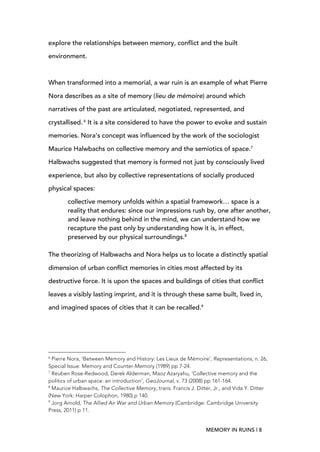
Built as a parish church in the 14th
century, it was not until 1918 that
Coventry Cathedral acquired cathedral status (fig. 1). The reason for the
upgrade was the need for a cathedral in the newly formed Diocese of
Coventry, created to cater for the city’s exponential growth during the first
half of the 20th
century. During the bombing, the timber roof was set alight
by an incendiary device, and the ensuing heat caused the buckling of iron
girders inserted during restorative work in the late 19th
century. As a result
the roof, internal arcades, and clerestory all collapsed, leaving only the
outer walls, tower, and spire still standing. The Provost, who first saw the
gutted Cathedral at 6am that morning, said ‘the appearance of the ruins
was so completely different from the Cathedral before the destruction that
it was impossible to think of them as the same building’58
.
The imagined attitudes of the city were freely attributed to the ruins by the
press. Spalding has suggested that this was because the image of the
Cathedral’s ruin, ‘appeared to convey both vulnerability and defiance.’59
The
Cathedral was assigned the role of sentinel by the Birmingham Gazette,
which reported: ‘The proud spirit of Coventry cathedral yesterday stood as
a sentinel over the grim scene of destruction below’60
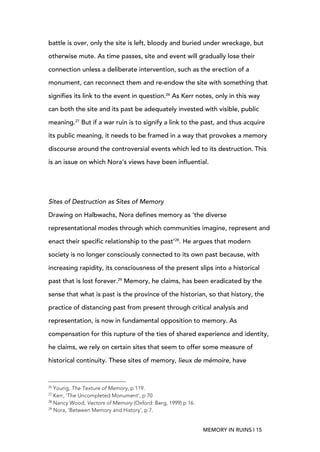
. The New York Herald
Tribune attributed grimmer symbolism to the site. It published a
photograph of the Cathedral’s interior, strewn with rubble, looking
eastwards towards the apse (fig. 2). The image was captioned, ‘The gaunt
ruins of St Michael’s Cathedral, Coventry, stare from the photographs, the


58
Richard Howard, Ruined and Rebuilt: The Story of Coventry Cathedral, 1939-1962
(Coventry: Council of Coventry Cathedral, 1962) p 19.
59
Frances Spalding, ‘John Piper and Coventry, in War and Peace’, The Burlington Magazine,
v. 145 n. 1204 (2003) p 488.
60
Quoted in Longmate, Air Raid, p 212.
MEMORY IN RUINS | 24
voiceless symbol of the insane, unfathomable barbarity which has been
released upon western civilization’61
.
While appearing to portray the reality of Coventry’s harrowing ordeal, all of
these images were meant to evoke a particular response. With no
armaments factories in sight, it was in the hollow void of the cathedral that
the innocence of Coventry and the physical devastation of the city could be
represented in a way that conveyed the official narrative. The images were
essentially propaganda, intended to reinforce British resolve and raise
international support by highlighting the barbarity of Nazi war methods.
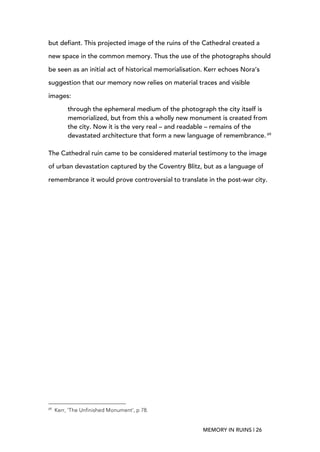
The Daily Mirror published perhaps the most iconic photograph of the ruins.
Taken the morning after the raid from the surviving tower, it showed two of
the steel girders from the collapsed roof lying in the shape of a cross at the
heart of the smouldering ruins (fig. 3). As Campbell comments, while first
framed as a crime against humanity, the raid on Coventry ‘soon became
aestheticized as a crime against the city (symbolized, as in Victor Hugo’s
Notre-Dame de Paris, by its cathedral) and thus as a simultaneous blow to
religion, architecture and history’62
. The fate of the city became inextricably
linked to the fate of its Cathedral: ‘All night long the city burned, and her
cathedral burned with her’63
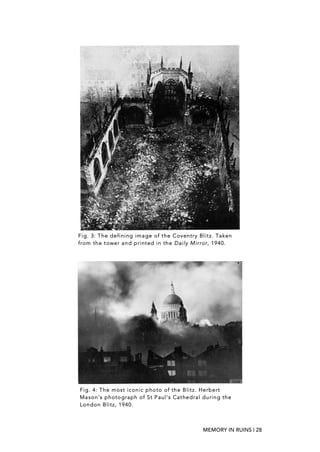
. Much as Herbert Mason’s image of St Paul’s
Cathedral, standing defiant amidst the flames, came to represent London’s
war (fig. 4), the image of St Michael’s Cathedral, ruined and still
smouldering, came to define Coventry’s war. As a result, claims Knightly,
‘Coventry has gone down in history as a monument to German
frightfulness’64
.


61
Quoted in Howard, Ruined and Rebuilt, p 18.
62
Campbell, Coventry Cathedral, p 10.
63
Howard, Ruined and Rebuilt, p 14.
64
Philip Knightly, The First Casualty (London: Quarter, 1982) 223.
MEMORY IN RUINS | 25
Kerr suggests that, because the Second World War was the first conflict to
be fought ‘wholly in the glare of the flashbulb’; the conflict gave rise to a
universal memorial culture based on the photographic image.65
Certainly the
Coventry Blitz is still primarily remembered through the photographs we
have of it. Even now, looking at images of the ruined Cathedral, we are
unable to separate the ruin from the destructive event that created it. The
photographs appear to crystallize the experience of the exact moment after
the devastating impact of total war was unleashed on the city.
Thus these lasting images achieved their aim of investing this particular site
of destruction with a symbolic and mnemonic significance, making them an
incarnation of a will to remember the city’s wartime experience. Coventry
was rapidly identified in Britain and internationally as the city with the
devastated centre, and over the course of the war it came to represent the
suffering of other bombed towns and cities across the country.66
Regarded
as the first ‘Martyred City’, a symbol of the damage to English culture in the
struggle against the Nazis, the inherently religious symbolism of sacrifice
and martyrdom were readily attached to the Cathedral ruins.67
By the end of
the war, Thomas suggests, the Cathedral had become an ‘embodiment and
a symbol of the futile destruction of war, and thereby of the religious
doctrines of death and sacrifice.’68
The propagandist images of the ruins propagated the officially sanctioned
image of Coventry as innocent, peaceful, and unjustly destroyed, vulnerable


65
Kerr, ‘The Unfinished Monument’, p 76.
66
Nicholas Bullock, Building the post-war world: modern architecture and reconstruction in
Britain (London: Routledge, 2002) p 267.
67
Bevan, The Destruction of Memory, p 79.
68
John Thomas, The New Bell’s Cathedral Guides: Coventry Cathedral (London: Unwin
Hyman, 1987) p 120.
MEMORY IN RUINS | 26
but defiant. This projected image of the ruins of the Cathedral created a
new space in the common memory. Thus the use of the photographs should
be seen as an initial act of historical memorialisation. Kerr echoes Nora’s
suggestion that our memory now relies on material traces and visible
images:
through the ephemeral medium of the photograph the city itself is
memorialized, but from this a wholly new monument is created from
the city. Now it is the very real – and readable – remains of the
devastated architecture that form a new language of remembrance. 69
The Cathedral ruin came to be considered material testimony to the image
of urban devastation captured by the Coventry Blitz, but as a language of
remembrance it would prove controversial to translate in the post-war city.


69
Kerr, ‘The Unfinished Monument’, p 78.
MEMORY IN RUINS | 27
Fig. 2: Looking east towards the apse, image published in New York
Herald Tribune, 1940.
Fig. 1: St Michael's Cathedral before the war,
1918
MEMORY IN RUINS | 28
Fig. 3: The defining image of the Coventry Blitz. Taken
from the tower and printed in the Daily Mirror, 1940.
	
  
Fig. 4: The most iconic photo of the Blitz. Herbert
Mason’s photograph of St Paul's Cathedral during the
London Blitz, 1940.
MEMORY IN RUINS | 29
Devastated Architecture and the Language of
Remembrance
‘There is no instruction manual’ writes Goldberger of post-9/11 New York,
‘to tell a city what to do when its tallest buildings are suddenly gone, and
there is a void in its heart’70
. Coventry faced a similar problem in the
aftermath of the Blitz, especially over what to do about its devastated
Cathedral. In the debates over the reconstruction of the building, the
significance of the ruins as a site of memory became heavily contested.
The argument for preserving Britain’s war ruins
In 1943 The Architectural Review published what could be regarded as an
instruction manual for what to do with church buildings destroyed by the
Blitz. It was described as an attempt to tackle ‘two burning questions of the
day: what would be the sincerest, most genuine memorials to the dead of
this war, the dead overseas and on the home front, and what is to be the
future of the bombed churches of Britain’71
. In 1944 The Times published a
letter on the subject written by a group of individuals prominent in cultural
circles. They advocated that bomb-damaged churches be ‘preserved in their
ruined condition, as permanent memorials of this war’72
.


70
Goldberger, Up from Zero, p xi.
71
Bombed Churches as War Memorials (Surrey: The Architectural Press War Address, 1945) p
4.
72
Marjory Allen of Hurtwood, David Cecil, Kenneth Clark, F. A. Cockin, T. S. Eliot, H. S.
Goodhart-Rendel, Julian Huxley, Keynes, E. J. Salisbury, ‘Letter reprinted from The Times,
Tuesday August 15 1944 titled ‘Ruined City Churches’’, Bombed Churches as War Memorials
(Surrey: The Architectural Press War Address, 1945) p 4.
MEMORY IN RUINS | 30
The following year, a book, Bombed Churches as War Memorials, was
published (fig. 5). In the opening chapter, ‘Ruins for Remembrance’,
architect Hugh Casson proposed that, after the war, some of London’s
bomb-damaged churches should be preserved as ‘garden-ruins’: to serve as
sanctuaries, pleasant open spaces, and, most importantly, war memorials.
The book was illustrated with conceptual sketches of what a bombed
church converted into a memorial garden-ruin would look like (fig. 6 & 7). As
Peter Webster suggests, ‘these were memorials that would be at once
beautiful, provocative of thought and of practical use’73
. Explaining his view
of the significance of ruined churches, Casson wrote:
[W]ith us they have undergone the physical trials of war, and bear its
scars… though they stand to-day upon what is still a battle-field, it
will not always be so. It will not be many years before all traces of
war damage will have gone, and its strange beauty vanished from our
streets. … Soon a pock-marked parapet or a broken cornice will be
to future generations the only signs of former shock and flame… with
their going the ordeal through which we passed will seem remote,
unreal, perhaps forgotten.74
For Casson and others, only devastated architecture could effectively
portray the reality of Britain’s wartime experience. The letter to The Times
had revealed a pervading unease about how to appropriately represent a
war that had seen British civilians also drawn into the conflict. The authors
suggested that the majority of war memorials erected after the First World
War, abstract monuments and statues representing victory and sacrifice to
honour soldiers who had died fighting in foreign lands, were considered
unsuitable. This was due to a perceivably ‘vast gulf of feeling’ between the
actual wartime experiences of soldiers and the sentiments expressed by the


73
Peter Webster, ‘Beauty, Utility and Christian Civilisation: war memorials and the Church of
England, 1940-47’, Forum for Modern Language Studies, n. 44 v. 2 (2008), p 206.
74
Hugh Casson, ‘Ruins for Remembrance’, Bombed Churches as War Memorials (Surrey: The
Architectural Press War Address, 1945) p 21.
MEMORY IN RUINS | 31
memorials. Kenneth Clark et al. instead argued that now ‘England has itself
been in the battle and London is still in it… Could there be a more
appropriate memorial of the nation’s crisis than the preservation of
fragments of its battleground?’75
.
The desire to maintain the architectural fragments of Britain’s war-torn cities
appears, therefore, to have been motivated by what Lacquer calls the
‘anxiety of erasure’, stemming from a lack of faith in traditional
commemorative traditions: ‘the thing itself must do because representation
can no longer be relied on.’76
These influential opinions were the first public
expression in Britain of the notion that physical war ruins had the capacity
to articulate the language of war remembrance. To some extent, Casson’s
suggestions were eventually followed in the rebuilding of Coventry
Cathedral, though only after much deliberation.
The decision to preserve Coventry’s ruins
The destruction of St Michael’s Cathedral had left a huge void, not only in
the heart of the physical city but also in the metaphorical heart of the
civitas. It was impractical just to leave the Cathedral in its ruined state as a
memorial, in the way that Casson had envisioned for London’s smaller
bomb-damaged churches. In fact, the decision to rebuild had been taken
the morning after the raid, when the Provost, Richard Howard, evidently
aware of the symbolism of the occasion, declared from within the ruins: ‘The
Cathedral will rise again. It will be rebuilt and will be as great a pride to the


75
‘Letter reprinted from The Times, Tuesday August 15 1944 titled ‘Ruined City Churches’,
Bombed Churches as War Memorials, p 4.
76
Thomas Lacquer, ‘The Past’s Past’, London Review of Books, v. 18 n. 18 (1996) pp 3-7.
MEMORY IN RUINS | 32
generations of the future as to the generations of the past.’77
Rather than an
act of defiance, the declaration was widely seen as a gesture of optimism,
faith, and hope for a peaceful future.
However, nothing was decided until after the war about how the Cathedral
should be rebuilt, and what was to become of its ruins. The ruins were
certainly not destined from the outset to be preserved as a memorial, as is
evident from the following summary of the initial questions that faced the
Cathedral Council:
Would it be better to leave the ruins as a kind of war memorial in the
form of a Garden of Rest? Should we try to rebuild the Cathedral
exactly as it was before the destruction? If not, should we rebuild it in
the Gothic style, or in a modern style, or in a mixture of both? Was it
proper to rebuild at all, when the War Damages Compensation
money might be used to build new parish churches? […] In view of
the need for houses and hospitals, would it be better to postpone
rebuilding to some date in the future?78
In 1941 a Rebuilding Commission was set up to push ahead with rebuilding
by appointing an architect and exploring issues connected to the site and
design of a new Cathedral. It was generally hoped that a new one could be
built either on or close to the existing site. In 1942 Giles Gilbert Scott was
announced as the new Cathedral architect. He submitted his proposed
designs in 1944-45, but his inability to conform to the limitations of the site,
including the ruins, led to the rejection of his designs by the Royal Fine Art
Commission and his resignation in 1947. In response to Gilbert Scotts’
resignation, Lord Harlech was commissioned to produce a report advising
on what to do next. Published on 7 July 1947, the report advised that the
new Cathedral be built on the same site, or as close as possible to the
original and in a traditional Gothic style. In his view, to leave the surviving


77
Coventry Standard (30 November 1940) quoted in Grindrod, Concretopia, p 100.
78
Howard, Ruined and Rebuilt, p 27.
MEMORY IN RUINS | 33
tower and spire without an appropriately matching church would be ‘both a
dereliction of duty and an acquiescence in the destruction wrought on 14
November 1940 by the forces of oppression and evil’79
. The report also
stipulated that the ruined outer walls were not strong enough to be
incorporated into a new building and should be demolished. However, the
treatment of the ruins seriously divided opinion between architects, clergy,
and local people. According to Campbell, by the late 1940s interest in
‘preserving the ruins in their entirety’ had become the central issue for the
Cathedral’s reconstruction project.80
After the raid, the Cathedral ruins had continued to serve as a place of
worship. In 1941, a local stonemason, Jock Forbes, created an altar from
rubble found on the site (the ‘Altar of Rubble’) and erected it in what had
once been the sanctuary. A Cross, fashioned from the Cathedral’s charred
roof beams and bound together by blackened wire (the ‘Charred Cross’),
was then placed on top of the makeshift altar. Owing to wartime
restrictions on labour, the ruins had remained strewn with rubble with no
one available to remove it. However, according to Howard, the provost,
‘[t]his was not wholly regretted’, as many of City’s inhabitants appeared to
have shared Casson’s anxiety about erasure:
many people felt that the rubble was what gave the ruins their
power, and this power might vanish if the rubble was cleared. For the
rest of the war the ruins continued to inspire, challenge, and comfort
the tired spirits of Coventry.81


79
Cathedral Archive Coventry (CAC), PA2506/1/1/94, Lord Harlech’s Commission, Coventry
Cathedral (Oxford: Oxford University Press, 1947) p 19.
80
Louise Campbell, ‘Towards a New Cathedral: The Competition for Coventry Cathedral
1950-51’, Architectural History, v. 35 (1992) p 212.
81
Howard, Ruined and Rebuilt, p 76.
MEMORY IN RUINS | 34
By the end of the war, the commemorative potential of the ruins had
become obvious. On VE Day, 8 May 1945, the people of Coventry
‘completely took possession of the ruins’ to celebrate the end of the war,
and annual commemorative services have been held for the victims of the
Coventry Blitz since 1941.82
The rubble was finally cleared in 1947, and a
temporary garden of remembrance created (fig. 8). According to Howard,
while the rubble ‘had been beautiful’ it had also been ‘austere, desolate,
and uncomfortable’. After it was cleared, he said, ‘the whole thing spoke of
peace’83
. A year later, Howard had ‘FATHER FORGIVE’ inscribed on the
sanctuary wall behind the Altar of Rubble, a gesture towards the
Cathedral’s newly acquired commitment to peace and reconciliation (fig. 9).
In suggesting that the ruins be removed to make way for a new cathedral,
the Harlech Report was subsequently criticised for not realizing ‘the
possibilities inherent in the site’84
. But many of Coventry’s prominent figures
were not at all anxious about losing the ruins and erasing the memory of
war; it was a memory they were anxious to see erased. In 1947, the local
philanthropist and industrialist Sir Alfred Herbert wrote to the Coventry
Evening Telegraph, imploring his fellow citizens to reject any plan to
preserve the ruin: ‘the retention of parts of its ruin, side by side with a new
and incongruous structure, would only perpetuate the memory of one of
our darkest hours.’85
Worried that the ruins might get in the way of plans for
a dynamic contemporary cathedral, the Bishop of Coventry, Neville Gorton,
told the local architects’ society ‘You cannot have a ruin to represent the


82
Howard, Ruined and Rebuilt, p 82.
83
Howard, Ruined and Rebuilt, p 40.
84
Quoted in Campbell, ‘Towards a New Cathedral’, p 212.
85
Alfred Herbert, ‘Shall the old Cathedral be restored?’, Coventry Evening Telegraph (22
January 1947), p 4.
MEMORY IN RUINS | 35
Church in your city’, and warned against the ‘false sentimental affection’
that the ruins seemed to have attracted.86
In 1950, following another of Lord Harlech’s suggestions, a competition was
launched to find a new architect. The competition criteria, loosely based on
the Harlech Report, stated that the new cathedral had to be built on or next
to the existing site, and the spire and tower must both be retained, but not
necessarily as part of the new build. The remaining ruins however were
expendable at the architect’s discretion.87
This last provision, and the lack of
restrictions on architectural style and materials in the competition rules,
seems to have been in tune with the Bishop’s wishes to make way for a
dynamic new building. Competitors were, however, sent information in the
form of photographs and drawings of the ruins, including depictions of the
wartime services held in them to illustrate their significance (fig. 10).
In 1951, Basil Spence was declared the winner; from the 219 entries, his
design was thought to exhibit ‘spirit and imagination of the highest order’
along with the ‘ability to solve the problem of designing a Cathedral in
terms of contemporary architecture’88
. However, more significantly, Spence
appears to have responded to Casson’s appeal by proposing to retain the
ruins in their entirety, incorporating them into his new Cathedral as a
‘memorial to the courage of the people of Coventry’89
.


86
Campbell, ‘Towards a New Cathedral’, p 212.
87
Coventry Cathedral: Architectural Competition Conditions and Instructions to Competing
Architects (Coventry, 1950) p 11.
88
Basil Spence, Phoenix at Coventry: the Building of a Cathedral (London: George Bles, 1962)
p 18.
89
Spence, Phoenix at Coventry, p 117.
MEMORY IN RUINS | 36
Fig. 5: Front cover of Bombed Churches as
War Memorials.
Fig. 6: Example of a bombed church
converted into a garden-ruin memorial, St
Alban’s, London.
MEMORY IN RUINS | 37
Fig. 7: Another example from Bombed
Churches as War Memorials showing the
converted ruin of St John’s, London.
Fig. 8: Temporary garden of remembrance in the ruins, 1947.
MEMORY IN RUINS | 38
Fig. 10: Plan and elevations of the ruins, sent to architects for the
competition, 1950.
Fig. 9: The Altar of Rubble and Charred Cross in
the sanctuary of the ruins, as they stand today.
MEMORY IN RUINS | 39
Not a War Memorial in Christendom to Match This
The announcement of Spence’s designs for the new Cathedral in 1951,
followed by the commencement of reconstruction, marked a major turning
point for the Cathedral site. It heralded the transformation of the space,
from former bombsite to an official memorial, and the transformation of
what the space would symbolize, from remnants of a catastrophe to the
commemoration of it.90
On 23 March 1956, 16 years after the Coventry Blitz,
Queen Elizabeth II laid the foundation stone for the new Cathedral, officially
marking the commencement of reconstruction. By this time, the Cathedral
had entered the national consciousness as an important site of memory, not
only of Britain’s wartime suffering, but of its post-war reconstruction as well.
In 1957, the Manchester Guardian was already proclaiming that, ‘there is
not in Christendom a war memorial to match this’91
. Elsewhere, other bomb-
damaged buildings were similarly being preserved as war memorials.
Casson’s suggestions, noted in the previous section, appear to have
resonated well beyond Coventry in the years following 1945. In other cities
devastated during the war, the idea of preserving the ruins of religious
buildings as memorials became a recurring theme of discussions of how the
destruction should be commemorated.


90
I take this conception of what the transformation would entail from Gutman’s analysis of
the rebuilding of Ground Zero. See: Yifat Gutman, ‘Where do we go from here: The pasts,
presents and futures of Ground Zero’, Memory Studies, v. 2 n. 1 (2009), p 56.
91
‘First Hymns from New Cathedral: Builders ‘Thanksgiving’, Manchester Guardian (1 January
1959).
MEMORY IN RUINS | 40
The significance of religious ruins
Unlike the residential and industrial areas of Coventry that were attacked
during the Blitz, the destruction of the Cathedral had not led to any civilian
casualties. Instead, as already suggested, its destruction was widely
perceived as an attack on the very fabric of the city itself, on religion, and
on the cultural heritage of Britain. For example, in a letter attached to the
building licence for Spence’s new cathedral, the Minister of Works, Sir David
Eccles, wrote to the Lord Mayor of Coventry: ‘we cannot tell how many
people are waiting in this country and abroad for this church to rise and
prove that English traditions live again after the blitz’92
.
Similar plans to transform symbolically bomb-damaged buildings into
memorials went ahead in other cities too. In Berlin the ruined tower of the
Kaiser-Wilhelm-Gedächtnis-Kirche was kept as a ‘commemorative foil to a
new structure’ that was built between 1959 and 1963 (fig. 11).93
Across
Britain and Germany, many smaller bombed churches were also preserved
as public memorial spaces. They included St Alban’s in Cologne; St Dunstan-
in-the-East, Christ Church, and St Anne’s in London; St Luke’s in Liverpool;
and St Andrew’s in Plymouth (later reconstructed). In contrast, Dresden’s
Frauenkirche, totally obliterated in the allied bombing of the City in 1945,
was intentionally left as a pile of rubble by the East German authorities after
the war. They wanted it to be a Mahnmal, ‘a monument of admonition’, to
the destructive capability of Western capitalism (fig. 12). It was re-built after
German re-unification.94


92
Quoted in Spence, Phoenix at Coventry, p 86.
93
Nicola Lambourne, War Damage in Western Europe: The Destruction of Historic
Monuments During the Second World War (Edinburgh: Edinburgh University Press, 2001) p
180.
94
Stefan Goebel, The Great War and Medieval Memory (Cambridge: Cambridge University
Press, 2007) p 296.
MEMORY IN RUINS | 41
Other buildings were also memorialised in this period as evidence of
wartime criminality, such as Hiroshima’s exhibition hall, the entire French
village of Oradour-sur-Glane, and a number of concentration camps
scattered throughout Europe.95
In all such cases, Bevan suggests, ‘[t]o have
left no physical trace of the devastation would have been to abnegate the
trauma’96
. Although other types of building were treated in the same way,
bomb-damaged religious buildings seem to have emerged as the
predominant form of memorialised ruin, especially in post-war Europe. This
was largely because, as was the case for Coventry, the destruction of
churches appears to have been over-represented in the wartime reporting
of air raids. In both Britain and Germany, depictions of destroyed homes
and workplaces, suggests Moshenka ‘were discouraged by censors for
reasons of morale and national security’97
. As a result, after the war it was
the ruins of religious architecture that resonated most readily with popular
notions of the wartime experience of urban areas.
Given that many other bomb-damaged buildings were also preserved, was
the Manchester Guardian justified in proclaiming that Spence’s preservation
of the ruins of Coventry Cathedral would produce a memorial without
match in Christendom? Perhaps not, but the following account of the
Cathedral’s rebuilding will explain why they were considered so significant.
Transforming the Topography of Destruction
The war had left the Cathedral shaped void in the cityscape, one that, as
Herbert had lamented in 1947, served as a reminder of one of the city’s


95
See: Young, The Texture of Memory, pp 49-80, 113-208.
96
Bevan, The Destruction of Memory, p 191.
97
Moshenka, ‘Charred churches or iron harvests?’, p 12.
MEMORY IN RUINS | 42
darkest hours. Adopting a philosophy similar to that expressed by Casson
in Bombed Churches as War Memorials, Spence’s first move as Cathedral
architect was to set about transforming the appearance of the ruins into
one that he believed would reflect a collective transcendence over the city’s
trauma. He summarized his views in this way:
Through the ordeal of bombing, Coventry was given a beautiful
ruin… It is felt that the ruin should be preserved as a garden of rest,
embracing the open-air pulpit and stage.98
It is clear from his perspective sketch of the ruins what Spence envisioned
for the space (fig. 13): a garden ruin with ample greenery and open space,
‘planted out with trees, shrubs, and flowers, and certain creepers…
encouraged to grow over the old walls’.99
This would serve to radically alter
the appearance of the ruins. The authors of ‘Ruined city churches’ had
emphasised the ‘realism’ and ‘gravity’ with which preserved church ruins
would serve to ‘remind posterity of the reality of the sacrifices upon which
its apparent security has been built’100
. But Spence’s treatment of the
Cathedral ruins suggests that maintaining a sense of wartime realism was
not his intention. Chris Woodward has argued that realism could not be
expected of any site that utilised the ideas put forward in Bombed
Churches as War Memorials, which he described as ‘the last great fling of
the British Picturesque, summoning the spirit of Stourhead and Stowe to
soothe the trauma of high explosive bombs’101
. Expressing a similar view,
Wiebe suggests that, rather than seeking to preserve the ruins of Coventry
Cathedral as a war-scarred reminder of the harsh realities of the city’s
traumatic wartime experience, Spence’s idea had been to turn them into


98
Spence, Phoenix at Coventry, p 117.
99
Spence, Phoenix at Coventry, p 117.
100
‘Letter reprinted from The Times, Tuesday August 15 1944 titled ‘Ruined City Churches’,
Bombed Churches as War Memorials, p 4.
101
Christopher Woodward, In Ruins (London: Vintage, 2002) p 212.
MEMORY IN RUINS | 43
‘more gentle and familiar ruins of gradual decay, which evoked remnants of
the past rather than permanent examples of it’102
.
War Memorial as Sacred Place
Spence’s preservation of the ruins also lends itself to a description using the
distinction between ‘sacred’ and ‘profane’. A war memorial is generally
considered to be a ‘sacred place’ as Kenneth Foote defines it: ‘a site set
apart from its surroundings and dedicated to the memory of an event,
person, or group’103
. According to Foote, a place becomes sacred through a
process of ‘sanctification’ in which a landscape is inscribed with a ‘durable
marker’, such as a monument, to be maintained over time for the purposes
of ritual commemoration.104
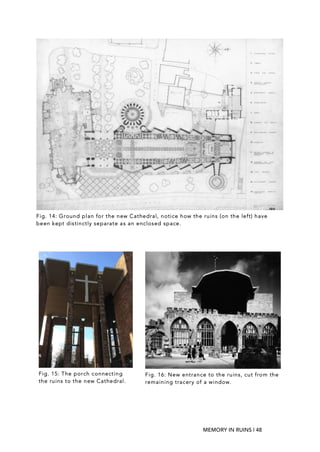
In his plan for the new Cathedral, Spence had
decided to maintain the physical integrity of the ‘lace-like screen of
masonry’ offered by the remaining outer walls in its entirety, creating just
such a durable marker that would also maintain a separate, delicately
enclosed, space set apart from the rest of the new Cathedral. 105
His new
building was to be positioned at a right angle to the ruins, on a separate
site on the opposite side of St Michael’s Avenue (fig. 14).
In ascribing memorial significance to the ruins, as ‘a memorial to the
courage of the people of Coventry’, and placing the new Cathedral on an
adjacent site, Spence effectively re-sacralised a once sacred site that had


102
Wiebe, Britten’s Unquiet Pasts, p 205.
103
Kenneth E. Foote, Shadowed Ground: America’s Landscapes of Violence and Tragedy
(Austin: University of Texas Press, 2003) p 8.
104
Foote, Shadowed Ground, p 8.
105
Spence, Phoenix at Coventry, p 5.
MEMORY IN RUINS | 44
been made profane by its violent destruction.106
Mayo outlines the
significance of this distinction:
profane space has amorphous meaning, one in which people have
fragmented life experiences. In contrast, sacred space enables a
place to have a distinct spiritual meaning amid chaos, and this
sacredness is beyond unique individual experiences.107
The significance of this was that the preserved ruins, which were to remain
consecrated, could now be considered as being simultaneously sacred and
profane.108
Thus, the preserved ruins would at once signify the fragmented
experiences of the city’s destruction, while at the same time propagating an
acquired spiritual meaning that would serve to go beyond these individual
experiences. For Spence, and everyone else who had lived through the war,
the spiritual meaning of the ruins was clear, ‘I always saw the old Cathedral
as standing clearly for The Sacrifice’109
. The new Cathedral, which Spence
designed in a modernist style expressing the post-war optimism of the
1950s and the Festival of Britain, was to ‘stand for the Triumph of the
Resurrection’.110
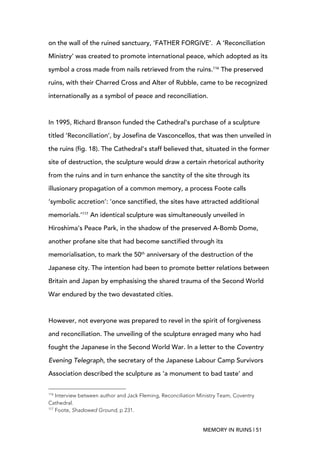
The ruins were to be physically incorporated into the new Cathedral via a
Cathedral Porch (fig. 15). A new entrance to the ruins was cut from the
remaining tracery of a window in the north nave wall and steps were
installed leading down under the porch to the main entrance of the new
Cathedral building (fig. 16). Following the new Cathedral’s consecration on
25 May 1962, commentators observed that joined together, the ‘sacrificed’


106
Moshenka, ‘Charred churches or iron harvests?’, p 12.
107
Mayo, ‘War Memorials as Political Memory’, pp 62-63.
108
Interview between author and Jack Fleming, Reconciliation Ministry Team, Coventry
Cathedral (Coventry, 17 August 2015).
109
Spence, Phoenix at Coventry, p 117.
110
Spence, Phoenix at Coventry, p 6.
MEMORY IN RUINS | 45
ruins and the ‘resurrected’ new building created a clear architectural
representation of ‘the Atonement’.111
Gutman suggests that, ‘[b]uilding (on) a site of memory is a symbolic-
material practice that forms a concrete version of past events’112
. Such a
practice is exemplified by Spence’s topographical work on the ruins and the
symbolism he achieved by their incorporation into his rebuilt Cathedral. He
wanted them to be a concrete version of Coventry’s wartime trauma that
would symbolise wartime loss and sacrifice, but within a wider narrative of
post-war resurrection (fig. 17). Architecturally, he succeeded. We now turn
to the question of whether the architectural success was matched by its
actual performance as a site of memory.


111
R. Furneaux Jordan, ‘Criticism: Cathedral Church of St. Michael, Coventry’, The
Architectural Review, v. 132 n. 785 (July 1962) p 28.
112
Gutman, ‘Where do we go from here’, p 56.
MEMORY IN RUINS | 46
Fig. 11: The ruined tower of the Kaiser-
Wilhelm-Gedächtnis-Kirche, acting as a
commemorative foil to a new structure,
2006.
Fig. 12: The abandoned remnants of Dresden’s Frauenkirche, 1990.
MEMORY IN RUINS | 47


Fig. 13: Spence’s perspective sketch of the ruins reveals his intention to
transform the space into a garden-ruin, very similar to those portrayed in
Bombed Churches as War Memorials.
MEMORY IN RUINS | 48
Fig. 15: The porch connecting
the ruins to the new Cathedral.
Fig. 16: New entrance to the ruins, cut from the
remaining tracery of a window.
Fig. 14: Ground plan for the new Cathedral, notice how the ruins (on the left) have
been kept distinctly separate as an enclosed space.
MEMORY IN RUINS | 49
Fig. 17: A poster produced in 1957 by London Midland Railway, advertising the
‘Rebirth’ of Coventry Cathedral, even though it had yet to be completed.
MEMORY IN RUINS | 50
History Looks Over Its Shoulder
History moves forward while looking over its shoulder; how much to
commemorate and remember, how much needs to be forgiven then
forgotten in the interests of peace within and without?113
Contested symbolism
In a previous section I referred to Koonz’s observation that ‘historical
revision inheres in the process of memorialisation’114
. The very process of
creating a memorial implicitly privileges certain meanings over others in the
desire to represent a particular version of the past. In his treatment of the
Coventry ruins, Spence had deliberately concealed the scar left by the
bombing. His picturesque landscaping had manipulated the appearance of
the site, and therefore the meanings it invited. According to Goebel
From the ruins of Coventry emerged a new mode of war
commemoration, a mode which focused on the future rather than the
past, a mode which invested the act of remembrance (that is
reconciliation) rather than death on the battlefield with meaning.115
The ample greenery of the garden-ruin and the contemporary architecture
of the new Cathedral were an invitation to remember the past but not with
bitterness or anger. To the Provost and his colleagues, Spence’s vision
seemed perfectly in tune with Christian belief, epitomized in the inscription


113
Bevan, The Destruction of Memory, p 176.
114
Koonz, ‘Between Memory and Oblivion’, p 260.
115
Goebel, The Great War and Medieval Memory, p 301.
MEMORY IN RUINS | 51
on the wall of the ruined sanctuary, ‘FATHER FORGIVE’. A ‘Reconciliation
Ministry’ was created to promote international peace, which adopted as its
symbol a cross made from nails retrieved from the ruins.116
The preserved
ruins, with their Charred Cross and Alter of Rubble, came to be recognized
internationally as a symbol of peace and reconciliation.
In 1995, Richard Branson funded the Cathedral’s purchase of a sculpture
titled ‘Reconciliation’, by Josefina de Vasconcellos, that was then unveiled in
the ruins (fig. 18). The Cathedral’s staff believed that, situated in the former
site of destruction, the sculpture would draw a certain rhetorical authority
from the ruins and in turn enhance the sanctity of the site through its
illusionary propagation of a common memory, a process Foote calls
‘symbolic accretion’: ‘once sanctified, the sites have attracted additional
memorials.’117
An identical sculpture was simultaneously unveiled in
Hiroshima’s Peace Park, in the shadow of the preserved A-Bomb Dome,
another profane site that had become sanctified through its
memorialisation, to mark the 50th
anniversary of the destruction of the
Japanese city. The intention had been to promote better relations between
Britain and Japan by emphasising the shared trauma of the Second World
War endured by the two devastated cities.
However, not everyone was prepared to revel in the spirit of forgiveness
and reconciliation. The unveiling of the sculpture enraged many who had
fought the Japanese in the Second World War. In a letter to the Coventry
Evening Telegraph, the secretary of the Japanese Labour Camp Survivors
Association described the sculpture as ‘a monument to bad taste’ and


116
Interview between author and Jack Fleming, Reconciliation Ministry Team, Coventry
Cathedral.
117
Foote, Shadowed Ground, p 231.
MEMORY IN RUINS | 52
explained ‘there can only be reconciliation where there is repentance, and
since we were the injured party we have nothing to repent’118
. According to
James Herbert, such ‘bad faith’ has been present in Coventry ever since the
Cathedral was rebuilt. Reconciliation, he argued, was a retrospective
activity, and Coventry’s ability to promote reconciliation in peacetime
ultimately relied on the acknowledgment that it had first been wronged in
wartime. As Herbert suggests, ‘No forgiveness of Germans at Coventry in
1962 without the memory of incendiary bombs dropping in November
1940.’119
Realities not remembered
It seems likely that these unforgiving attitudes were common among those
with bitter memories of their wartime experience. Britain had been attacked
and her civilians deliberately targeted and killed. The notion of preserving
bombed churches had, after all, stemmed from a desire to memorialise
these very real wartime experiences of the Blitz. In Coventry, observers
from Mass Observation, who went to the city on the morning after the Blitz,
had recorded the realities of their experience. They reported that key
phrases used by the survivors were ‘Coventry is finished’ and ‘Coventry is
dead’, and that ‘Many for a while showed no hope for the place. They could
only survive as persons’120
. It seemed that everyone in the city had known
someone who was either dead or injured, and there was widespread panic
and a collapse of morale. One of the observers reported ‘more open signs
of hysteria, terror and neurosis… in one evening than during the whole of
the past two months in all areas’121
.


118
‘A monument to bad taste’, Coventry Evening Telegraph (5 July 1995) p 8.
119
James D. Herbert, ‘Bad Faith at Coventry’, Critical Inquiry, v. 25 n. 3 (Spring 1999) p 559.
120
Harrison, Living Through The Blitz, p 135.
121
‘The Blitz’, Mass Observation Extracts,
http://www.massobs.org.uk/images/booklets/Blitz.pdf [accessed 30 August 2015].
MEMORY IN RUINS | 53
The preserving of the ruins failed to acknowledge these fragmented
individual experiences of the Blitz and the anguish that survivors must have
felt at the destruction of their city and the death of relatives and friends. In
other words, the ruins seemed to represent the absent city as victim, but
not necessarily the absent civilian. Attempts to redress this imbalance were
made by the Reconciliation Ministry, which in 2011 decided to ‘give focus
and further purpose to the ruins in the 21st
Century by designating them as
a memorial to all civilians killed, injured or traumatised by war and violent
conflict worldwide… and a witness to suffering’122
. To emphasise this
renewed focus, a tombstone to ‘Unknown Civilians Killed in War’, has since
appeared in the Cathedral grounds, although there is no record of how it
came to be there (fig. 19). It is an obvious imitation of the Tomb of the
Unknown Warrior in Westminster Abbey. An inconspicuous slab, it is
undoubtedly intended to draw on the symbolism of the ruins for meaning,
and represent a more rounded civilian experience of war by inserting the
absent bodies back into an absent city.
As a consequence of the media’s focus on the destruction of the Cathedral
and the attack on innocent civilians outlined earlier, another important part
of the city’ wartime experience was almost completely overlooked. This was
the major contribution made by its arms factories to the country’s fighting
capacity. In an attempt to address this particular imbalance in the city’s
wartime history, a Home Front Memorial was unveiled in the Cathedral ruins
in 2000 (fig. 20). The Coventry Evening Telegraph proclaimed ‘There could
be no more fitting place for a plaque to honour the Home Front heroes than
in the ruins of Coventry Cathedral… it seemed the perfect site to remember


122
‘Our reconciliation ministry’, http://www.coventrycathedral.org.uk/wpsite/our-
reconciliation-ministry/ [accessed 20 September 2015].
MEMORY IN RUINS | 54
those ordinary people who gave heart and soul for the war effort’123
. The
plaque reads:
In gratitude to God, and to commend to future generations the self-
sacrifice of all those who served on the Home Front during the
Second World War


123
‘Queen steals a city’s hearts’, Coventry Evening Telegraph (4 March 2000) pp 2-3.
MEMORY IN RUINS | 55
Fig. 18: ‘Reconciliation’, by Josefina de
Vasconcellos.
Fig. 19: Tomb of the Unknown Civilian.
Fig. 20: Home Front Memorial.
MEMORY IN RUINS | 56
Conclusion
In this dissertation I have examined the preservation of the ruins of
Coventry’s 14th
-century Cathedral in light of continuing debates concerning
the use of war ruins as memorials. Destroyed by the Luftwaffe in a single
night in November 1940, Coventry’s Cathedral was the only one to be
destroyed by a German air raid and was probably the most prominent
casualty of the Blitz. Rebuilt after the war, it was the only Cathedral to
incorporate the ruins of the one it replaced, as a monument to national and
civic loss.
There was a time when the purpose of war memorials seemed too obvious
to be questioned but, as has been argued over the course of this
dissertation, scholarly studies have shown that stance to be naive. There
are questions to be considered about the validity of a memorial’s rendering
of the experience that led to its creation, and about its performance in
helping to sustain a memory of the experience, accurate or otherwise.
Questions of both kinds are highly pertinent when the memorials in
question are war ruins.
The very existence of a memorial perpetuates the illusion that a common
memory exists of the experiences it commemorates, and it is also likely to
give permanent form to a particular interpretation of these experiences.
Both points apply to Basil Spence’s treatment of the Coventry ruins. His aim
was not to depict the experience of loss and suffering that the air raids
brought to the city, but rather to invite recollection of the experience in a
MEMORY IN RUINS | 57
spirit of peace and reconciliation. And, through its very existence, the
memorial implies that its rendering of Coventry’s wartime experience is how
that experience should be commonly remembered. The memorial might be
said to embody what Pierre Nora believes is the essential requirement of a
site of memory, the manifestation of a will to remember. But again, what it
wills us to remember is not the past as it was experienced but the past seen
through a screen of Christian sentiment, not too dissimilar from the
abstracted representations of heroic sacrifice so prevalent in memorials to
the First World War. But as I have noted, there was explicit opposition to
the desire to view the past in this way after the Second World War.
Does this mean that the ruins are fundamentally flawed as a memorial?
Before answering this question, other considerations should be taken into
account. First, the memorial is not the only interpretation of Coventry’s
wartime experience on offer, and has probably much less impact than its
principal rival, the press. As I have explained, the press presented the raid
as a barbarous attack on innocent civilians and the destruction of the
Cathedral as emblematic of the enemy’s depravity. It was this
interpretation, illustrated with a barrage of press photographs of the ruined
Cathedral that would shape the form in which Coventry’s Blitz was lodged
in public consciousness, a form subsequently sustained by countless
personal testimonies, films, television programmes, and fictional and non-
fictional accounts.
Secondly, the public consciousness is not a passive vehicle, open to
whatever interpretations of experience it is offered. I have referred to
Nora’s insistence on the fact that, although it is open to the full range of
possible meanings, a society actively selects the interpretations that it
MEMORY IN RUINS | 58
wants to remember. He also points out that the past is viewed through a
kaleidoscope of what actually happened, what we remember, and our moral
and political values. Thus, Spence’s interpretation will have had little impact
if it was not how most people prefer to remember the Blitz.
Finally, whatever interpretation is embodied in a memorial of a city’s
trauma, and even if the memorial has little impact on memories of the past,
its existence meets a deep-rooted sense that we have an obligation to
memorialize the experience of those who suffered. And if it is memorialised,
the memorial will inevitably embody some particular interpretation of the
past. What kind of interpretation should be favoured? One that attempts to
symbolise the understandable anger and bitterness of the survivors of the
trauma? One intended to enhance a feeling of national pride? Personally, I
cannot imagine any interpretation that would be an improvement on the
one that Spence wanted to convey through his transformation of the
Cathedral ruins. Today, as Thomas says in his guide to Coventry Cathedral:
‘We stand not in a medieval church, but in a place that has been fashioned,
by modern destruction and re-creation, as a different, very special, public
place.’124
Bevan has argued that ‘[t]here is a need for truth to be expressed in the
raising of buildings’.125
By linking the moment of its destruction inextricably
to that of its optimistic post-war reconstruction, the rebuilt Cathedral was
intended to represent Coventry as transcending its traumatic wartime
experiences. The spatial arrangement of Spence’s new Cathedral means
that one cannot enter it without first passing through or past the ruins of
the old. A visual straight line from the entrance of the ruins to the new altar
(in the northern end of the new building) forms one of the main axes of the


124
Thomas, The New Bell’s Cathedral Guides, p 119.
125
Bevan, The Destruction of Memory, p 177.
MEMORY IN RUINS | 59
Cathedral (fig. 21). Arriving in the new nave, on the floor there is an
inscription:
TO THE GLORY OF GOD, THIS CATHEDRAL BURNT NOVEMBER
14, 1940, IT IS NOW REBUILT, 1962.
The inscription, drawing authority from the traces of destruction behind it,
affirms a simple historical truth: that the determination to rebuild will always
transcend the capacity to destroy.
Fig. 21: The view of the ruins from the new Cathedral through
the 70ft ‘Screen of Saints and Angels’ etched by John Hutton.
MEMORY IN RUINS | 60
Bibliography
Primary Sources
• Cathedral Archive Coventry (CAC), PA2506/1/1/94, Lord Harlech’s
Commission, Coventry Cathedral (Oxford: Oxford University Press,
1947) p 19.
• Casson, Hugh, Bombed Churches as War Memorials (Surrey: The
Architectural Press War Address, 1945).
• Casson, Hugh, ‘Ruins for Remembrance’, Bombed Churches as War
Memorials (Surrey: The Architectural Press War Address, 1945) pp 5-
22.
• Coventry Cathedral: Architectural Competition Conditions and
Instructions to Competing Architects (Coventry, 1950).
• Harrison, Tom, Living Through The Blitz (London: Faber and Faber,
2010).
• Howard, Richard, Ruined and Rebuilt: The Story of Coventry
Cathedral, 1939-1962 (Coventry: Council of Coventry Cathedral,
1962).
• Jordan, R. Furneaux, ‘Criticism: Cathedral Church of St. Michael,
Coventry’, The Architectural Review, v. 132 n. 785 (1962) p 24-34.
• Lewis, Tim, Moonlight Sonata: the Coventry Blitz, 14/15 November
1940 (Coventry: Tim Lewis and Coventry City Council, 1990).
• Marjory Allen of Hurtwood, David Cecil, Kenneth Clark, F. A. Cockin,
T. S. Eliot, H. S. Goodhart-Rendel, Julian Huxley, Keynes, E. J.
MEMORY IN RUINS | 61
Salisbury, ‘Letter reprinted from The Times, Tuesday August 15 1944
titled ‘Ruined City Churches’’, Casson, Hugh, Bombed Churches as
War Memorials (Surrey: The Architectural Press War Address, 1945) p
4.
• Spence, Basil, Phoenix at Coventry: the Building of a Cathedral
(London: George Bles, 1962).
Newspapers
• Coventry Evening Telegraph
• Manchester Guardian
• Daily Express
Books and Journals
• Arnold, Jorg, The Allied Air War and Urban Memory (Cambridge:
Cambridge University Press, 2011).
• Barber, Bernard, ‘Place, Symbol, and Utilitarian Function in War
Memorials’, Social Forces, v. 28 n. 1 (1949) pp 64-68.
• Bevan, Robert, The Destruction of Memory (London: Reaktion Books,
2006).
• Braniff, Máire, McDowell, Sara, Commemoration as Conflict: Space,
Memory and Identity in Peace Processes (London: Palgrave
Macmillan, 2014).
• Bullock, Nicholas, Building the post-war world: modern architecture
and reconstruction in Britain (London: Routledge, 2002).
• Campbell, Louise, ‘Towards a New Cathedral: The Competition for
Coventry Cathedral 1950-51’, Architectural History, v. 35 (1992) pp
208-234.
MEMORY IN RUINS | 62
• Campbell, Louise, Coventry Cathedral: Art and Architecture in Post-
War Britain (Oxford: Clarendon Press, 1996).
• Clark, Laurie Beth, ‘Ruined Landscapes and Residual Architecture’,
Performance Research: A Journal of the Performing Arts, v. 20 n. 3
(2015) pp 83-93.
• Crowley, David, ‘Memory in Pieces: The Symbolism of the Ruin in
Warsaw after 1944’, Journal of Modern European History, v. 9 n. 3
(2011) pp 351-371.
• Crysler, C. Greig, ‘Time’s Arrows: Spaces of the Past’, C. Greig
Crysler, Stephen Cairns, Hilde Heynen, The SAGE Handbook of
Architectural Theory (London: SAGE Publications, 2013) pp 289-307.
• Dwyer, Owen J., Alderman, Derek H., ‘Memorial landscapes: analytic
questions and metaphors’, GeoJournal, v. 73 n. 3 (2008) pp 165-178.
• Gillis, John R., ‘Memory and identity: the history of a relationship’,
John R. Gillis (ed), Commemorations (New Jersey: Princeton
University Press, 1994) pp 3-26.
• Herbert, James D., ‘Bad Faith at Coventry’, Critical Inquiry, v. 25 n. 3
(Spring 1999) pp 535-565.
• Finney, Patrick, ‘On Memory, Identity and War’, Rethinking History, v.
6 (2002) pp 1–13.
• Foote, Kenneth E., Shadowed Ground: America’s Landscapes of
Violence and Tragedy (Austin: University of Texas Press, 2003).
• Goebel, Stefan, The Great War and Medieval Memory (Cambridge:
Cambridge University Press, 2007).
• Goebel, Stefan, Keene, Derek, ‘Towards a Metropolitan History of
Total War: An Introduction’, Stefan Goebel, Derek Keene (eds.),
Cities into Battlefields: Metropolitan Scenarios, Experiences and
Commemorations of Total War (Surrey: Ashgate, 2011) pp 1-46.
MEMORY IN RUINS | 63
• Goebel, Stefan, ‘Commemorative Cosmopolis: Transnational
Networks of Remembrance in Post-War Coventry’, Stefan Goebel,
Derek Keene (eds.), Cities into Battlefields: Metropolitan Scenarios,
Experiences and Commemorations of Total War (Surrey: Ashgate,
2011) pp 163-184.
• Goldberger, Paul, Up from Zero: Politics, Architecture and the
Rebuilding of New York (New York: Random House, 2004).
• Gough, Paul, ‘From Heroes’ Groves to Parks of Peace: landscapes of
remembrance, protest and peace’, Landscape Research, v. 25 n. 2
(2000) pp 213-228.
• Gough, Paul, ‘Sites in the Imagination: the Beaumont Hamel
Newfoundland Memorial on the Somme’, Cultural Geographies, v. 11
n. 3 (2004) pp 235-258.
• Grindrod, John, Concretopia (Brecon: Old Street Publishing, 2013).
• Gutman, Yifat, ‘Where do we go from here: The pasts, presents and
futures of Ground Zero’, Memory Studies, v. 2 n. 1 (2009), p 55-70.
• Halbwachs, Maurice, The Collective Memory, trans. Francis J. Ditter,
Jr., and Vida Y. Ditter (New York: Harper Colophon, 1980).
• Inglis, Ken S., ‘War Memorials: Ten Questions For Historians’,
Guerres Mondiales et conflits contemporains, n. 167, Les Monuments
Aux Morts de la Première Guerre Mondiale (1992) pp 5-21.
• Kerr, Joe, ‘The Uncompleted Monument: London, War, and the
Architecture of Remembrance’, Iain Borden, Joe Kerr, Jane Rendell,
Alicia Pivaro (eds), The Unknown City (London: The MIT Press, 2001)
pp 68-89.
• Knightly, Philip, The First Casualty (London: Quarter, 1982).
MEMORY IN RUINS | 64
• Kohlrausch, Martin, Hoffmann, Stefan-Ludwig, ‘Introduction: Post-
Catastrophic Cities’, Journal of Modern European History, v 9 n 3
(2011) pp 308-313.
• Koonz, Claudia, ‘Between Memory and Oblivion: Concentration
Camps in German Memory’, John R. Gillis (ed.), Commemorations
(New Jersey: Princeton University Press, 1994) pp 258-280.
• Lacquer, Thomas, ‘The Past’s Past’, London Review of Books, v. 18 n.
18 (1996) pp 3-7.
• Lambourne, Nicola, War Damage in Western Europe: The
Destruction of Historic Monuments During the Second World War
(Edinburgh: Edinburgh University Press, 2001).
• Longmate, Norman, Air Raid: the bombing of Coventry, 1940
(London: Hutchinson, 1976).
• Mason, Tony, ‘Looking Back on the Blitz’, Bill Lancaster, Tony Mason
(eds), Life and Labour in a Twentieth Century City: The Experience of
Coventry (Coventry: Cryfield Press, 1986) pp 329-333.
• Mayo, James M., ‘War Memorials as Political Memory’, Geographical
Review, v. 78 n. 1 (1998) pp 62–75
• Moshenka, Gabriel, ‘Charred churches or iron harvests?: Counter-
monumentality and the commemoration of the London Blitz’, Journal
of Social Archaeology, v. 10 n. 1 (2010) pp 5-27.
• Moshenka, Gabriel, ‘Unbuilt Heritage: Conceptualising Absences in
the Historic Environment’, Sarah May, Hilary Orange, Sefryn Penrose
(eds), The Good, the Bad and the Unbuilt: Handling the Heritage of
the Recent Past (Oxford: Archaeopress, 2012) pp 123-126.
• Nora, Pierre, ‘Between Memory and History: Les Lieux de Mémoire’,
Representations, n. 26, Special Issue: Memory and Counter-Memory
(1989) pp 7-24.
MEMORY IN RUINS | 65
• Olcayto, Rory, ‘Coventry Complex’, The Architects Journal, v. 229 n.
3 (2009) pp 20-31.
• Overy, Richard, The Bombing War (London: Allen Lane, 2013).
• Rose-Redwood, Reuben, Alderman, Derek, Azaryahu, Maoz,
‘Collective memory and the politics of urban space: an introduction’,
GeoJournal, v. 73 (2008) pp 161-164.
• Silke Arnold-de Simine, ‘The Ruins as Memorial – The Memorial as
Ruin’, Performance Research: A Journal of the Performing Arts, v. 20
n. 3 (2015) pp 94-102.
• Simmel, George, ‘Two Essays’, The Hudson Review, v. 11 n. 3 (1958)
pp 371-385.
• Smith, Adrian, The City of Coventry: A Twentieth Century Icon
(London: IB Tauris, 2006).
• Spalding, Frances, ‘John Piper and Coventry, in War and Peace’, The
Burlington Magazine, v. 145 n. 1204 (2003) pp 488-500.
• Till, Karen, The New Berlin: Memory, Politics, Place (Minneapolis:
University of Minnesota Press, 2005).
• Thomas, John, The New Bell’s Cathedral Guides: Coventry Cathedral
(London: Unwin Hyman, 1987).
• Wasserman, Judith R., ‘To Trace the Shifting Sands: Community,
Ritual, and the Memorial Landscape’, Landscape Journal, v. 17 n. 1,
pp 42-61.
• Webster, Peter, ‘Beauty, Utility and Christian Civilisation: war
memorials and the Church of England, 1940-47’, Forum for Modern
Language Studies, n. 44 v. 2 (2008), pp 199-211.
• Wiebe, Heather, Britten’s Unquiet Pasts: Sound and Memory in
Postwar Reconstruction (Cambridge: Cambridge University Press,
2012).
MEMORY IN RUINS | 66
• Winter, Jay, Sites of Memory, Sites of Mourning (Cambridge:
Cambridge University Press, 1995).
• Winter, Jay, ‘The Generation of Memory: Reflections on the “Memory
Boom” in Contemporary Historical Studies’, Canadian Military
History, v. 10 n. 3 (2001) pp 57-66.
• Wood, Nancy, Vectors of Memory (Oxford: Berg, 1999).
• Woodward, Christopher, In Ruins (London: Vintage, 2002).
• Young, James E., The Texture of Memory: Holocaust Memorials and
Meaning (London: Yale University Press, 1993).
Images
• Front Cover: Benjamin Clark, ‘Sanctuary’ [Photograph, 2015].
• Figure 1: Wilfred Sims, ‘St Michael’s Cathedral before the war’
[Photograph, 1909]. Retrieved: Frederic W. Woodhouse, The
Churches of Coventry (George Bell & Sons: London, 1909) p 28,
http://www.gutenberg.org/files/11403/11403-
h/images/imagep028.jpg [accessed 10 September 2015].
• Figure 2: ‘Looking east towards the apse’ [Photograph, 1940].
Retrieved: Francis Spalding, ‘John Piper and Coventry, in war and
peace’, The Burlington Magazine, v. 145 n. 1204 (2003) pp 488-500.
• Figure 3: ‘The defining image of the Coventry Blitz. Taken from the
tower and printed in the Daily Mirror’ [Photograph, 1940]. Retrieved:
Francis Spalding, ‘John Piper and Coventry, in war and peace’, The
Burlington Magazine, v. 145 n. 1204 (2003) pp 488-500.
• Figure 4: Herbert Mason, ‘The most iconic photo of the Blitz’
[Photograph, 1940]. Retrieved:
http://www.iwm.org.uk/collections/item/object/205070067 [accessed
10 September 2015].
MEMORY IN RUINS | 67
• Figure 5: Barbara Jones, ‘Front Cover’ [Illustration, 1945]. Retrieved:
Bombed Churches as War Memorials (Surrey: The Architectural Press
War Address, 1945).
• Figure 6: Barbara Jones, ‘Example of a bombed church converted
into a garden-ruin memorial, St Alban’s, London’ [Illustration, 1945].
Retrieved: Bombed Churches as War Memorials (Surrey: The
Architectural Press War Address, 1945) p 12.
• Figure 7: Barbara Jones, ‘Another example from Bombed Churches
as War Memorials showing the converted ruin of St John’s, London’
[Illustration, 1945]. Retrieved: Bombed Churches as War Memorials
(Surrey: The Architectural Press War Address, 1945) p 8.
• Figure 8: ‘Temporary garden of remembrance in the ruins, 1947’
[Photograph, 1962]. Retrieved: Richard, Ruined and Rebuilt: The
Story of Coventry Cathedral, 1939-1962 (Coventry: Council of
Coventry Cathedral, 1962).
• Figure 9: Benjamin Clark, ‘The Altar of Rubble and Charred Cross’
[Photograph, 2015].
• Figure 10: ‘Plan and elevations of the ruins, sent to architects for the
competition, 1950’ [Drawing, 1950]. Retrieved:
http://canmore.rcahms.gov.uk/en/details/1066959/ [accessed 20
August 2015].
• Figure 11: Ian Barwick, ‘The ruined tower of the Kaiser-Wilhelm-
Gedächtnis-Kirche’ [Photograph, 2006]. Retrieved:
http://berlin.barwick.de/sights/famous-places/kaiser-wilhelm-
memorial-church.html [accessed 20 September 2015].
• Figure 12: Jurgen Sautter, ‘The abandoned remnants of Dresden’s
Frauenkirche’ [Photograph, 1990]. Retrieved:
MEMORY IN RUINS | 68
http://www.panoramio.com/photo/2739285 [accessed 20 September
2015].
• Figure 13: Basil Spence, ‘Spence’s perspective sketch of the ruins’
[Colour Sketch, 1955-56]. Retrieved:
http://canmore.rcahms.gov.uk/en/details/1073750/ [accessed 10
September 2015].
• Figure 14: Basil Spence, ‘Ground plan for the new Cathedral’
[Drawing, 1953]. Retrieved:
http://canmore.rcahms.gov.uk/en/details/1069426/ [accessed 10
September 2015].
• Figure 15: Benjamin Clark, ‘The porch connecting the ruins to the
new Cathedral’ [Photograph, 2015].
• Figure 16: Henk Snoek, ‘New entrance to the ruins, cut from the
remaining tracery of a window’ [Photograph, 1962]. Retrieved:
http://canmore.rcahms.gov.uk/en/details/1071284/ [accessed 10
September 2015].
• Figure 17: London Midland Railway, ‘A poster produced in 1957 by
London Midland Railway, advertising the ‘Rebirth’ of Coventry
Cathedral’ [Poster, 1957]. Retrieved:
http://canmore.rcahms.gov.uk/en/details/1057056/ [accessed 10
September 2015].
• Figure 18: Benjamin Clark, ‘Reconciliation’ [Photograph, 2015].
• Figure 19: Benjamin Clark, ‘Tomb of the Unknown Civilian’
[Photograph, 2015].
• Figure 20: Benjamin Clark, ‘Home Front Memorial’ [Photograph,
2015].
• Figure 21: Barratts Photo Press Ltd., ‘The view of the ruins from the
new Cathedral’ [Photograph, 1962]. Retrieved:
MEMORY IN RUINS | 69
http://canmore.rcahms.gov.uk/en/details/1029717/ [accessed 21
Sepetember 2015].
Websites
• ‘Basil Spence Archive’, http://canmore.org.uk/gallery/886810
[accessed 10 September 2015].
• ‘Coventry Cathedral’, http://www.coventrycathedral.org.uk/wpsite/
[accessed 20 September 2015].
• ‘Our reconciliation ministry’,
http://www.coventrycathedral.org.uk/wpsite/our-reconciliation-
ministry/ [accessed 20 September 2015].
• ‘The Blitz’, Mass Observation Extracts,
http://www.massobs.org.uk/images/booklets/Blitz.pdf [accessed 30
August 2015].
Interview
• Interview between author and Jack Fleming, Reconciliation Ministry
Team, Coventry Cathedral (Coventry, 17 August 2015).
MEMORY IN RUINS | 70
Appendix
Transcription of Interview between author and Jack Fleming, Reconciliation
Ministry Team, Coventry Cathedral (Coventry, 17 August 2015).
BC: To start, could you just outline to sort of work that you do?
JF: Yeah, sure, it all stems from the destruction of the old cathedral and
the drive to rebuild both the cathedral and communities around, that
led Provost Howard in the wake of the destruction of the old
cathedral, he made a call for forgiveness and reconciliation initially at
that point with Germany looking even then, even quite early on in the
war, looking to time beyond it when we could build relationships and
that led to building up this idea of building a ministry of reconciliation
and so the cross of nails which was made from nails from the ruins
initially they were kind of sent out randomly to people who could be
significant in making a more beautiful world. So people like the
queen and Winston Churchill and faith leaders and most of them had
no response, we sent out a lot in the early years and we completely
lost track of them, so somewhere in the world there are loads of
cross of nails, we don’t know where they are now, but a couple of
German cities did respond and build on it. The first one was Kiel
which was again total, well basically levelled about four years after
Coventry was, in 1945.
MEMORY IN RUINS | 71
BC: There is an interesting link between other cities that have suffered
urban devastation
JF: Yes, it was almost a shared trauma, that both of them together. We,
in 1947, sent Kiel a cross of nails and they responded with the Kiel
stone of forgiveness, I think it’s called. Which is somewhere in the
depths of our archives. Was a stone from one of their destroyed
churches so we were both giving bits of our own, effectively our own
cultural life, physically part of the cathedral the old cross of nails were
all made from bits of the cathedral. Now we’ve run out of nails they
are made in a prison in Germany, which is really cool. So it was about
giving, both places had sacrificed something and they’ve shared that
destruction, so everybody was admitting their role in destruction and
they are victimised, so they are both perpetrators and victims and
that is why behind the altar in the old cathedral it says “Father
forgive”, where as the line in the bible it is taken from says “Father
forgive them”, Jesus on the cross saying to the people who crucified
him “forgive them” but Provost Howard was very strict, about the
fact that it had to be “forgive” because we are all responsible.
BC: That’s interesting, so Spence’s rebuilding and the composition having
the new next to the old was the first indication from my research that
the cathedral had become a symbol of peace and reconciliation,
would it be right to say the ruins themselves were for a long time
prior to the rebuilding a symbol of peace and reconciliation or was it
not until it was framed in that way?
MEMORY IN RUINS | 72
JF: I think the ruins as a symbol probably didn’t have as much currency
until Spence’s design but certainly it was part of the cathedral
community culture as the original design winner was a Gilbert Scott
commission they chucked that out which suggests to me that they
clearly thought it was not saying the right things. It was a big grand
gesture, like Liverpool Cathedral, or Battersea power station
BC: Yes, the plans were to cut the ruins in half, so what do you think the
impact of Spence’s design was, was it a national symbol or
international?
JF: To start with it was quite local, my experience here is that the ruins,
that Coventry as a city feels much more affinity with the ruins than
with the new cathedral, they feel more like part of who they are, the
two are linked but people just the way people pass through it, it’s
more like home for them
BC: It has more historical link to their city
JF: I think it has quite a strong local pull, but the rebuilding was certainly
done with an international side to it, so the roof was funded by
Canada, we have Swedish windows, lots of contributions by
international supporters, the funding and construction was a way of
bringing people together, so I think even from the time when it was
being built it had this international side to it very strongly. And at
that point also Coventry was sending people to Dresden to help
rebuild there so it was an exchange of support
MEMORY IN RUINS | 73
BC: So looking at the ruins today, what role do they play in your work,
are you responsible for taking people to look at them, or show
people around them?
JF: Yes, the cathedral as a whole, they are still part of the cathedral we
can still do services in them, they are still consecrated and every
Friday we say the litany of reconciliation, which is a pattern of prayer
between us and partners in the community of the cross of nails
around the world. In terms of the way the reconciliation uses them
we would see them, we do pilgrimages and we take people who are
interested in reconciliation and give them a tour to include that,
tourists as well get tours around the ruins. But they are, on their own
not that important but in combination with the new cathedral gives it
a different angle because you’ve got the destruction and the rebuild
and you’ve got the progression from the ruins through the west
screens towards Christ in Majesty which is Spence’s big vision and
that sense of God being there in the brokenness as well as in the
glory. Its complete set piece, over-the-topness is very important to
what we do. There’s been a reasonable amount of development of
the ruins around the millennium project, which has more or less
petered out now but over the past five years we’ve been doing
repairs around the edge there has obviously been a lot of focus on
them, fund raising to maintain them and also things like installing
artworks. So the Choir of Survivors was a German artwork, all of the
art in there is about dealing with stuff we’ve done wrong. Choir of
Survivors addresses atrocity. The Reconciliation Statue which was
originally commissioned for Bradford University, but there is a copy
here there’s a copy in the peace garden in Hiroshima , a copy in
MEMORY IN RUINS | 74
Stormont and a copy in Berlin by one of the wall crossings. There is a
chapel of reconciliation that has the names of all the people who died
trying to cross the wall at that point. So it links very strongly to our
continuing need to remember everything we’ve done wrong and
learn from it. Just remembering is no good if you don’t do the
learning from it. So we try to use the ruins as a way of focusing our
action and our engagement and our advocacy so there is a concept,
the Coventry cathedral memorial ruins they were designated as a
memorial to civilian victims of war, I think that happened in 2012, on
the anniversary of the consecration of the new cathedral. And we
draw out six themes from that: victims of sexual violence, land
mines, aerial bombardment, refugees, environmental impact of war.
The idea is that the ruins serve as a focus for those and we’ve got a
vigil service we use occasionally, we try to link it into key memorial
dates, so for example it was the 20th
Anniversary of the Chevromitzia
massacre during the Bosnia war about a month ago and that was one
of the worst atrocities since the Second World War and so we
focused on that as a way of trying to engage with mistakes that we
are still making and a lot of it is trying to raise awareness and
outreach work, but also we can hold vigils and we try and link in
these key themes into our prayers in the main cathedral as well.
BC: So there is a capacity for the ruins to metamorphose and be applied
to these as more atrocities are committed?
JF: Because it was obviously destroyed in a very specific set of
circumstances, but destruction and rebuilding but also not forgetting
MEMORY IN RUINS | 75
where you come from is a much more broad and a way of thinking
that can be applied to a lot of different situations
BC: And what do you think about the links to Hiroshima, through the
placement of the reconciliation sculptures, do you have direct
contact or a similar organisation in Hiroshima?
JF: I don’t think there is an equivalent organisation, two weeks ago we
had the lord mayor and the dean hosted a special service in the
chapel of unity rather than the ruins, because of the weather mainly,
and we had the deputy ambassador of Japan and key figures, and
there was a service made up of poetry, music and speaking and
engagements. And they made the peace cranes, you know the paper
cranes. So we still have links and are very much aware, again it is
part of our shared responsibility as part of the allied forces in that
situation
BC: I like that idea, of shared responsibility, I hadn’t thought of it in that
way, two different cities that suffered destruction.
JF: If we were only doing it from the point of view of shared destruction,
destruction is really not comparable, in terms of the scale. I mean
even somewhere like Dresden was far more heavily damaged in the
bombing the Allies undertook than Coventry, so in terms of scale we
actually got off quite lightly.
BC: Yes, that has always been the thing, compared to other countries it
did get off quite lightly so it seems strange that there is this really
MEMORY IN RUINS | 76
deep memorial culture that has come out of the experience of the
war, but actually if it is more than simply remembering destruction
and more about trying to progress forward,
JF: Yes, trying to engage with the world as it is
BC: Do you think the ruins supply a suitable symbol for that?
JF: Yes, and of course the other thing, it was the only English cathedral
that was destroyed – and they had only been a cathedral for 20
years, Coventry as a city has just got its cathedral back after 500
years of not having one and then it loses it again. So I think that must
have had quite a strong impact on collective psyche, a cultural
significance
BC: And do you think it still is – obviously there is not many people that
remember the experiences first hand left – but do you still have
contact with survivors?
JF: We do get visitors who come and say ‘I remember it being built’, and
a lot of them do think of it very fondly. Some less so because at the
time there was effectively a tax on school children – they all had to
bring in 2 pence to contribute. So some of them actually see that
almost in a negative light, and find it quite a hard place to engage
with, because the cathedral was being rebuilt while most of the city
was still in ruins. In some ways that was quite hard, for some people
it was a symbol, it was kind of a big shared thing, but for others it
was ‘the cathedral getting attention while we are all standing here in
MEMORY IN RUINS | 77
the rubble of our destroyed lives’. So, it can be quite challenging to
deal with but I mean most people do think of it positively. And, lots
of people, you come here and you say to people ‘I’m working at
Coventry cathedral now’ and so many people have memories of ‘oh
my great uncle helped build the chapel or something’, ‘he was one of
the glass artists’ that sort of thing. Lots of people seem to have
stories and have affinities with the place. Again, more so with the
new cathedral as a collective enterprise, than with the ruins. But, I
think as the two cathedrals as a whole, you take them together, and
people have a strong link to it.
BC: Do you think though, that as we get further away from the events of
the war, the 20th
century architecture heritage of the place might
overtake the ‘Blitz’ heritage?
JF: I think you’re right, and I actually think that is healthy, I mean that it is
quite easy to focus too much and it’s something that we are quite
often guilty of. We focus too much on the blitz history side of things
and lose track of what that means now. And yeah there is also quite a
lot of architectural focus. So, the Basil Spence society is quite strict in
trying to maintain the building in line with his vision. So, it can quite
easily become a time capsule for the 20th
century, and that is very
valuable because there aren’t many buildings that will survive in the
way that the cathedral will, hopefully. Hopefully it will survive
because as a cathedral it is likely to have more of a drive to it, than
say tower blocks from a similar era. They are far less likely to survive
in the same way. So, in that way I think it will be quite valuable in 50
years or 100 years time. But definitely, it is very important that we
MEMORY IN RUINS | 78
don’t lose focus on why it matters now. It is very easy to focus too
much on the memorialisation and not on actually doing something.
BC: Just going back to the public art in the ruins, when was ‘the choir of
survivors’ installed?
JF: The choir of the survivors was installed in the early 2010s
BC: And, I only noticed it very recently, but the tomb of the unknown
civilian in the gardens, when did that come about?
JF: I don’t know how old that is…
BC: But it seems to have come out of nowhere
JF: But again, its tying into the idea of our focus on the civilian victims of
war. We have the tomb of the unknown warrior at the cenotaph and I
think it is the idea that this is the civilian equivalent. It is somewhere
that anyone who has lost something as a result of war can focus on
that.
BC: Do you think, just looking to the future, do you think that the ruins
can continue to serve as a strong symbol of these sorts of themes?
JF: I think so, there is a danger of them losing their significance as the
generation that lived through, even the rebuilding, begins to fade
out. And the people who got the stories first hand, there is a lot of
story telling involved and reliving and remembering through stories,
MEMORY IN RUINS | 79
that is quite important. And as that kind of generational link begins
to fade, I think it might be quite easy to lose their significance. Which
is why it is important to continue to focus as something that matters
now. But, even if there specific ‘Anglo-German world war II’
significance begins to fade, it will still be that you have destruction
and rebuilding next to each other. And you will always be able to see
the high alter from the ruins of the cathedral and vice versa. So the
physical symbolism of it will remain, even if the specific details fade. I
think having the two of them together next to each other does make
it a symbolic statement in a way that you wouldn’t get somewhere
like St Andrews Cathedral.
BC: Ok, just to finish off with an awkward question – what do the ruins
‘say’ to you? Or what do you read into them?
JF: I mean, for me probably the most powerful thing is the movement
from the ruins down through the screens towards Christ in majesty.
But the ruins on their own, I do love, and I love the way that they are
a public space even though they are still consecrated. So you have
people effectively just eating lunch in a church, which is brilliant!
That’s the kind of thing that the church should be doing, it should be
out there for the people, which is really inspiring. Also, I love Ecce
Homo, the statue that looks like an Easter Island head.
BC: Right, I think that is everything, thank you.
JF: Great, thanks.

Benjamin+Clark+MA+Dissertation+2015

  • 1.
    Memory in Ruins:Remembering War in the Ruins of Coventry Cathedral Benjamin Clark Architectural History Report September 2015
  • 2.
      MEMORY INRUINS | 2 MA Architectural History Memory in Ruins: Remembering War in the Ruins of Coventry Cathedral 2014/2015 Submitted by: Benjamin Clark SN: 14079354 Submitted on: 21 September 2015 Architectural History Report BENVGBE2 Supervisor: Professor Iain Borden Module Coordinator: Dr Peg Rawes The Bartlett School of Architecture University College London
  • 3.
      MEMORY INRUINS | 3 Acknowledgements First and foremost, I would like to thank my grandparents, John and Veronika Simons, for putting me up and putting up with me while I wrote this dissertation. I would also like to thank my parents and sister, Andrew Clark, Katherine Simons, and Rose, for their on-going support, as well as Hollie Wilkinson for her extraordinary patience. Finally, I would like to thank my supervisor, Iain Borden. Were it not for his extraordinary patience and encouraging support throughout this process; I would have surely been lost.
  • 4.
      MEMORY INRUINS | 4 Abstract This dissertation examines the use of ruins as war memorials in light of continuing debates concerning their use for this purpose. The preservation of the ruins of Coventry’s 14th -century Cathedral, which was destroyed in the Blitz during the Second World War, is used as a case study. Rebuilt after the war, the new Cathedral incorporated the ruins of the old as a memorial to the city’s devastating wartime experience. As the architect of the reconstruction, Basil Spence created a memorial that would be seen not as a reminder of suffering and loss, but as one that invited recollection of the Blitz in the spirit of peace and reconciliation. It is therefore an example of what scholars have seen as a problem for such memorials: they give permanent form to a particular interpretation of experience that may be ideological in its intent. This is undeniable, but so too is the fact, pointed out by Pierre Nora, that the public selects the interpretation it wants to remember, which in this case may have been the one initially conveyed by a barrage of press reports and photographs that presented the destruction of the Cathedral as a barbaric atrocity. But arguably, it is not these considerations that should affect how Spence’s memorial is assessed. In linking the destruction of the Cathedral to its post-war reconstruction, his design memorialises the city’s determination to transcend its traumatic wartime experience.
  • 5.
    MEMORY IN RUINS| 5 Contents Page Introduction 6 Signifying Sites of Destruction 13 Capturing Coventry’s Blitz 21 Devastated Architecture and the Language of Remembrance 29 Not a War Memorial in Christendom to Match This 39 History Looks Over Its Shoulder 50 Conclusion 56 Bibliography 60 Appendix: Interview Transcript 70
  • 6.
    MEMORY IN RUINS| 6 Introduction Seventy-five years on, the Blitz continues to loom large in the British popular imagination, assuming virtually mythical status. While arguably the most common experience of the Second World War for Britain’s urban populations, the ways in which the Blitz is remembered are ‘partial, fragmented and dispersed.’1 Memories of the concentrated aerial bombardment of London and other British cities by the German Luftwaffe during the early years of the Second World War are sustained through a cultural myriad of personal testimonies, photographs, films, television programmes, artworks, professional histories, and literature. In addition, the consequences of the bombing raids have been inscribed on the cityscapes themselves through the vigorous post-war urban planning and architectural reconstruction that they necessitated. Nowhere else have the effects of the Blitz been more irrevocably inscribed into the urban landscape than in Coventry. On the night of November 14 1940, Coventry became the first British city outside of London to experience sustained aerial bombardment. Referred to as the ‘Coventry Blitz’, this single event, lasting just 10 hours, ultimately caused a complete topographical reordering of the city: 568 civilians were killed, 863 severely injured, and its dense urban topography, consisting of ‘factories, small workshops, shops, flats and houses of all kinds… mixed up                                                                                                                 1 Gabriel Moshenka, ‘Charred churches or iron harvests?:  Counter-monumentality and the
  • 7.
    MEMORY IN RUINS| 7 together around the ancient centre’, was devastated.2 The city’s medieval street pattern was obliterated to such an extent that one eyewitness recalled, ‘After the Blitz, the first time I went into Coventry you did not know where you were at all.’ 3 Coventry’s Blitz exemplified the combination of devastation, dislocation and loss that aerial bombardment can impose on the urban landscape. It was this brute physicality that arguably led to the emergence of a distinctly urban phenomenon after the Second World War: the preservation of bomb- damaged buildings as war memorials. This dissertation examines one such case in light of contemporary theorizing about the use of war ruins as memorials: the preservation of Coventry’s bomb-damaged 14th century Cathedral. While Coventry’s wartime experience was not unique, its post-war memorial landscape probably is. The only cathedral to be destroyed in the German air raids, Coventry’s St Michael’s Cathedral was arguably the most prominent architectural casualty of the Blitz. After the war, its ruin was preserved as a monument to national and civic loss.4 The resolution to rebuild was accompanied by the decision to have the new building ‘entwined and in dialogue with the ruins of the old.’5 Perhaps the only example in Britain of a post-war reconstruction project to incorporate its own ruins as a dedicated memorial space, Coventry Cathedral offers an interesting opportunity to                                                                                                                 2 Norman Longmate, Air Raid: the bombing of Coventry, 1940 (London: Hutchinson, 1976) pp 15-16; 60,000 buildings were either levelled or damaged, and 4,000 homes were totally destroyed. 3 Rory Olcayto, ‘Coventry Complex’, The Architects Journal, v. 229 n. 3 (2009) p 21. 4 Heather Wiebe, Britten’s Unquiet Pasts: Sound and Memory in Postwar Reconstruction (Cambridge: Cambridge University Press, 2012) p 193. 5 Robert Bevan, The Destruction of Memory (London: Reaktion Books, 2006) p 191.
  • 8.
    MEMORY IN RUINS| 8 explore the relationships between memory, conflict and the built environment. When transformed into a memorial, a war ruin is an example of what Pierre Nora describes as a site of memory (lieu de mémoire) around which narratives of the past are articulated, negotiated, represented, and crystallised. 6 It is a site considered to have the power to evoke and sustain memories. Nora’s concept was influenced by the work of the sociologist Maurice Halwbachs on collective memory and the semiotics of space.7 Halbwachs suggested that memory is formed not just by consciously lived experience, but also by collective representations of socially produced physical spaces: collective memory unfolds within a spatial framework… space is a reality that endures: since our impressions rush by, one after another, and leave nothing behind in the mind, we can understand how we recapture the past only by understanding how it is, in effect, preserved by our physical surroundings.8 The theorizing of Halbwachs and Nora helps us to locate a distinctly spatial dimension of urban conflict memories in cities most affected by its destructive force. It is upon the spaces and buildings of cities that conflict leaves a visibly lasting imprint, and it is through these same built, lived in, and imagined spaces of cities that it can be recalled.9                                                                                                                 6 Pierre Nora, ‘Between Memory and History: Les Lieux de Mémoire’, Representations, n. 26, Special Issue: Memory and Counter-Memory (1989) pp 7-24. 7 Reuben Rose-Redwood, Derek Alderman, Maoz Azaryahu, ‘Collective memory and the politics of urban space: an introduction’, GeoJournal, v. 73 (2008) pp 161-164. 8 Maurice Halbwachs, The Collective Memory, trans. Francis J. Ditter, Jr., and Vida Y. Ditter (New York: Harper Colophon, 1980) p 140. 9 Jorg Arnold, The Allied Air War and Urban Memory (Cambridge: Cambridge University Press, 2011) p 11.
  • 9.
    MEMORY IN RUINS| 9 Since the emergence of the field of ‘memory studies’ in the 1990s, there has been a sustained interest in researching ‘collective’ memories of the experience of violent conflict. As Finney notes, ‘[w]ork on the memory of war has lain at the heart of the broader memory project’10 . Much of this work has been about the commemoration and institutionalization of collective memory by such cultural practices as the erection of war memorials.11 In a noteworthy contribution to the findings, historians have pointed out that there was no boom in memorialising after 1945, in contrast to the one that occurred after the First World War. As Goebel and Keene put it, memories of the Second World War ‘struggled to find a designated space’ in the memorial landscapes of cities.12 However, the task of appropriately representing and remembering the ruins, voids, and absences left behind in cities effected by violent conflict has been the subject of much debate among cultural critics, historians, archaeologists architects and urban theorists, after the Second World War. More recently, memory scholars inspired by the work of Halbwachs and Nora have once again shifted their attention towards issues involved in the memorialisation of post-war urban landscapes. Discussion of these issues has formed part of broader debates over legacies of destruction and, as concisely summarised by Kerr in his study of Blitz memorials in London, ‘the problematic relationship between the act of memory and its                                                                                                                 10 Patrick Finney, ‘On Memory, Identity and War’, Rethinking History, v. 6 (2002) p 5. 11 Jay Winter, Sites of Memory, Sites of Mourning (Cambridge: Cambridge University Press, 1995). 12 Stefan Goebel, Derek Keene, ‘Towards a Metropolitan History of Total War: An Introduction’, Stefan Goebel, Derek Keene (eds.), Cities into Battlefields: Metropolitan Scenarios, Experiences and Commemorations of Total War (Surrey: Ashgate, 2011) p 29.
  • 10.
    MEMORY IN RUINS| 10 institutionalization in built form’13 . It is a relationship that has received particular attention in studies of Holocaust, Berlin Wall, and 9/11 memorial sites.14 A major feature of all of these studies is the emphasis they place on the void, the palimpsest, the ruin, and other material signifiers that point towards violent histories, but whose meanings might have become obscured.15 In situating my study within these debates, I explore how preserved war ruins in urban settings emerged as a unique form of war memorial after the Second World War, and what these traces of destruction signify about the violence that created them. Specifically, I explore the metamorphosis of Coventry’s wartime experience into built form through the symbolic and material transformation of the ruins of its Cathedral into a site of memory. In doing so, I move away from the study of intentionally erected war memorials towards other, more vernacular, topographies of war remembrance. The ruin-turned-memorial raises a number of critical questions about post- war commemorative culture. Why did bomb-damaged buildings, especially churches, come to be seen as symbolic of the wartime experience of cities? As a commemorative object, what role does the war ruin play in the reproduction of urban memories of war? And what does it reveal about how                                                                                                                 13 Joe Kerr, ‘The Uncompleted Monument: London, War, and the Architecture of Remembrance’, Iain Borden, Joe Kerr, Jane Rendell, Alicia Pivaro (eds.), The Unknown City (London: The MIT Press, 2001) p 70. 14 James E. Young, The Texture of Memory: Holocaust Memorials and Meaning (London: Yale University Press, 1993); Karen Till, The New Berlin: Memory, Politics, Place (Minneapolis: University of Minnesota Press, 2005); Paul Goldberger, Up from Zero: Politics, Architecture and the Rebuilding of New York (New York: Random House, 2004). 15 C. Greig Crysler, ‘Time’s Arrows: Spaces of the Past’, C. Greig Crysler, Stephen Cairns, Hilde Heynen, The SAGE Handbook of Architectural Theory (London: SAGE Publications, 2013) pp 301-302.
  • 11.
    MEMORY IN RUINS| 11 violent histories have been mediated and represented in urban space? To answer these questions and a number of others that they prompt, I base my approach on one put forward by James E. Young in his book The Texture of Memory: Holocaust Memorials and Meaning. Young refers to memorials as ‘texts’ that are able to construct memory by ascribing certain meanings to the past. He proposes taking a ‘textured’ approach to ‘reading’ these sites of memory through an analysis of: the activity that brought them into being, the constant give and take between memorials and viewers, and finally the responses of viewers to their own world in light of a memorialised past.16 While the scope and depth of Young’s study goes well beyond the reach of mine, his methodology provides a useful starting point for my analysis of Coventry Cathedral’s ruins as a war memorial. First, it seems prudent to clarify my intended use of the term ‘war memorial’. It is based on Mayo’s broad definition as Whether a statue, a place, a building, or a combination of these and other elements, a war memorial is a social and physical arrangement of space and artefacts to keep alive the memories of persons who participated in a war sponsored by their country.17 For my study, the combination of elements that constitutes the memorial is a war ruin. Its aim was to keep alive the memories of participants in a war, though of course these were involuntary participants. They had war thrust upon them. The study is split into five sections. The first uses Pierre Nora’s concept of Lieux de Memoire to develop a theoretical framework with which to explain                                                                                                                 16 Young, The Texture of Memory, p ix. 17 James M. Mayo, ‘War Memorials as Political Memory’, Geographical Review, v. 78 n. 1 (1998) p 62.
  • 12.
    MEMORY IN RUINS| 12 how a ruin might become a signifier of wartime experience. The next four sections apply this framework to the specific case of Coventry. In these I explore the destructive events and wartime context that initially led to the emergence of Coventry’s ruins as a prominent site of memory, the anxieties and debates surrounding the decision to preserve the ruins as a memorial after the war, and commentaries on the completed memorial. As the experiences of the Blitz and the Second World War begin to fade ever further from living memory, I highlight the importance of locating and re- evaluating the ways in which their consequences have been memorialised in the post-war urban landscape, and the meanings that are attributed to them.
  • 13.
    MEMORY IN RUINS| 13 Signifying Sites of Destruction Traces of Destruction The devastation of a city through war is undoubtedly a pivotal event in its history. With the memory of it sustained through personal testimonies, photographs, films, literature, and professional histories, the event becomes irrevocably associated with the city in the popular imagination.18 To be remembered in this way was to be the fate of numerous cities in the twentieth century, especially those attacked during the Second World War. As well as the blitzing of British cities, the destruction of Rotterdam (1940), Stalingrad (1942), Warsaw (1939,1943,1945), Berlin and Dresden (1945), Hiroshima and Nagasaki (1945) remain some of the most vividly recalled moments of that conflict for marking the apex of destruction.19 In the built environment of the cityscape, such destruction leaves its trace in the voids and absences it creates. Eventually, reconstruction erases these reminders of the initial onslaught. But through its retention, a void can serve as a potent reminder of the original moment of destruction.20 The conviction that they could serve this purpose goes someway to explain the widespread preservation of war ruins in stricken cities from Coventry to Hiroshima after                                                                                                                 18 Kerr, ‘The Uncompleted Monument’, p 70. 19 See: Martin Kohlrausch, Stefan-Ludwig Hoffmann, ‘Introduction: Post-Catastrophic Cities’, Journal of Modern European History, v 9 n 3 (2011) pp 308-313. 20 Bevan, The Destruction of Memory, p 198.
  • 14.
    MEMORY IN RUINS| 14 the Second World War, both as monuments to the events that precipitated their destruction and as ‘eloquent testimony to the suffering of civilians’.21 The notion that ruins have the potential to evoke the past is not limited to discourse on war memorialisation. Simine notes that the architectural ruin always appears to show the past as invading the present, making history visible through space.22 However, when created by an act of violence, the ruin can become a reminder of and testament to that act.23 According to Simmel, the potency of the war ruin’s effect is heightened by its unnaturalness. He pointed out that when history is made visible by a ruin created through human-inflicted violence, it contradicts the contrast that usually gives a ruin its significance: the contrast between the human labour that created a building and the effect of nature in destroying it.24 Crowley makes a similar point, noting that, as chronometers, ruins created by violence measure not the slow and natural decay of ancient buildings, found so enthralling by 18th- and 19th-century intellectuals, but ‘relatively short and literally explosive events’.25 Like the traditional monument, the war ruin is generally considered to be particularly significant in evoking the memory of an event that occurred on its site. But this connection between event and site is fragile. While a city is under attack, the site and the event are bound together in time. When the                                                                                                                 21 Ken S. Inglis, ‘War Memorials: Ten Questions For Historians’, Guerres Mondiales et conflits contemporains, n. 167, Les Monuments Aux Morts de la Première Guerre Mondiale (1992) p 14. 22 Silke Arnold-de Simine, ‘The Ruins as Memorial – The Memorial as Ruin’, Performance Research: A Journal of the Performing Arts, v. 20 n. 3 (2015) p 95. 23 Simine, ‘The Ruins as Memorial – The Memorial as Ruin’, p 95. 24 George Simmel, ‘Two Essays’, The Hudson Review, v. 11 n. 3 (1958) p 380. 25 David Crowley, ‘Memory in Pieces: The Symbolism of the Ruin in Warsaw after 1944’, Journal of Modern European History, v. 9 n. 3 (2011) p 353.
  • 15.
    MEMORY IN RUINS| 15 battle is over, only the site is left, bloody and buried under wreckage, but otherwise mute. As time passes, site and event will gradually lose their connection unless a deliberate intervention, such as the erection of a monument, can reconnect them and re-endow the site with something that signifies its link to the event in question.26 As Kerr notes, only in this way can both the site and its past be adequately invested with visible, public meaning.27 But if a war ruin is to signify a link to the past, and thus acquire its public meaning, it needs to be framed in a way that provokes a memory discourse around the controversial events which led to its destruction.  This is an issue on which Nora’s views have been influential. Sites of Destruction as Sites of Memory Drawing on Halbwachs, Nora defines memory as ‘the diverse representational modes through which communities imagine, represent and enact their specific relationship to the past’28 . He argues that modern society is no longer consciously connected to its own past because, with increasing rapidity, its consciousness of the present slips into a historical past that is lost forever.29 Memory, he claims, has been eradicated by the sense that what is past is the province of the historian, so that history, the practice of distancing past from present through critical analysis and representation, is now in fundamental opposition to memory. As compensation for this rupture of the ties of shared experience and identity, he claims, we rely on certain sites that seem to offer some measure of historical continuity. These sites of memory, lieux de mémoire, have                                                                                                                 26 Young, The Texture of Memory, p 119. 27 Kerr, ‘The Uncompleted Monument’, p 70 28 Nancy Wood, Vectors of Memory (Oxford: Berg, 1999) p 16. 29 Nora, ‘Between Memory and History’, p 7.
  • 16.
    MEMORY IN RUINS| 16 replaced the real environments of memory, milieux de mémoire.30 As a result, memory has become rooted in the symbols constituted by spaces, gestures, images, and objects that rely entirely on the materiality of the trace and the symbolic forms they are given: ‘the immediacy of the recording, the visibility of the image’.31 He uses the term ‘site’ to include material and immaterial things, objects, practices, and events that have been invested with symbolic significance and express a ‘will to remember’. 32 According to Nora, the manifestation of a will to remember is the essential requirement of any lieu de mémoire; without it the site of memory becomes ‘indistinguishable from the lieu d’histoire (the site of history)’.33 Some of the most obvious examples of what were intended to be lieux de mémoire are the public monuments and war memorials that can be found dotted throughout urban landscapes, making up what Gough describes as a city’s ‘topography of commemoration’.34 Most of them, such as the Cenotaph or the Tomb of the Unknown Warrior, were inaugurated in the aftermath of the First World War and display a will to remember the men who died in battle. These sites deal with issues of absence by functioning as ‘substitute graves triggering memories in absence of bodies’.35 War ruins, on the other hand, symbolise not the absence of bodies, but absence in cities. The incarnation of the will to remember in a war-damaged building can transform a site of destruction into a site of memory; as Clark suggests, a preserved ruin can evoke the environment in which a destructive event                                                                                                                 30 Nora, ‘Between Memory and History’, p 7. 31 Nora, ‘Between Memory and History’, p 13. 32 Nora, ‘Between Memory and History’, p 19. 33 Nora, ‘Between Memory and History’, p 19. 34 Paul Gough, ‘From Heroes’ Groves to Parks of Peace: landscapes of remembrance, protest and peace’, Landscape Research, v. 25 n. 2 (2000) p 216. 35 Stefan Goebel, Derek Keene, ‘Towards a Metropolitan History of Total War’, p 27.
  • 17.
    MEMORY IN RUINS| 17 occurred by displaying the resulting architectural residue on the landscape.36 As a material trace of a past act of urban violence, the war ruin is arguably a site that can anchor the memory of a city’s destruction within the city itself. It can therefore be considered as a site of memory for a quintessentially urban experience of war. Goebel and Keene suggest , ‘[r]uins implied that ‘the city’ constituted the principal victim’.37 Clark agrees, and maintains that ruins are an implicit part of all site-specific memorials, and a core element of the strategy adopted for the way many memorials to traumatic events are exhibited.38 In a similar vein, Kerr refers to the calculated conservation of traces of destruction in the cities of Coventry, Dresden, and Hiroshima as distinctly urban memorials that are highly literal and can be universally understood as mute testimony to the horrific consequences of aerial warfare.39 Goebel and Keene suggest that due to their apparent literality ‘ruins- turned-memorials allowed the survivors to circumvent a key dilemma... [of assigning] some kind of historical meaning to what happened’.40 However, in themselves, these crumbling sites of destruction are little more than inert pieces of the landscape.41 It is not enough for them to simply exist physically as indexes of destruction; they need to be actively invested with meaning via an intentional will to remember. This is because, as Koonz explains, historical memorialisation always depends on the                                                                                                                 36 Laurie Beth Clark, ‘Ruined Landscapes and Residual Architecture’, Performance Research: A Journal of the Performing Arts, v. 20 n. 3 (2015) p 84. 37 Goebel, Keene, ‘Towards a Metropolitan History of Total War’, p 30. 38 Clark, ‘Ruined Landscapes and Residual Architecture’, p 84. 39 Kerr, ‘The Uncompleted Monument’, p 78. 40 Goebel, Keene, ‘Towards a Metropolitan History of Total War’, p 30. 41 Young, The Texture of Memory, p 119.
  • 18.
    MEMORY IN RUINS| 18 interpretation of a signifier… a symbol that stands between the viewer and the event commemorated; once a powerful icon enters into circulation, its connotations are set in motion. Thus historical revision inheres in the process of memorialisation.42 Thus the task for those who choose to preserve a war ruin as a memorial is to try to find a way of presenting it that will shape the interpretation, so that it will be an enduring symbol of the traumatic event and the historical significance, or moral resonance, of the site. According to Gough, once a war ruin comes to be considered in this way, as a significant ‘historical trace’, it can often assume a greater authority as a signifier of the past than other, more artificial, forms of war commemoration.43 Thus, the preservation of a war ruin as a memorial nearly always reflects a desire to produce a legitimized historical narrative of wartime experience and have it inscribed into the landscape: stories of violence, destruction, sacrifice, or collective victimization. Of course, what it is meant to signify may not be what a historian would recognize as an authentic representation. In Young’s view, just the existence of memorials perpetuates an illusion. Referring to the way traumatic historical events are memorialized through monuments, he maintains that the outcome is to create an illusion about the mnemonic significance of a particular space: ‘By creating common spaces for memory, monuments propagate the illusion of common memory’.44 In the case of war ruins, there is also the fundamental problem of distinguishing between the remnants of conflict and the representation of it. Young points out that remnants of destruction tend to collapse the                                                                                                                 42 Claudia Koonz, ‘Between Memory and Oblivion: Concentration Camps in German Memory’, John R. Gillis (ed.), Commemorations (New Jersey: Princeton University Press, 1994) p 260. 43 Paul Gough, ‘Sites in the Imagination: the Beaumont Hamel Newfoundland Memorial on the Somme’, Cultural Geographies, v. 11 n. 3 (2004) p 237. 44 Young, The Texture of Memory, p 6.
  • 19.
    MEMORY IN RUINS| 19 distinction between what they are and what they evoke, always inviting us to mistake the debris of history for history itself.45 That mistake can be made more likely by the form of the memorial. He points out that memorials are often state-sponsored, and tend to ‘concretise’ certain historical interpretations.46 Dwyer and Alderman share this view and note that ‘memorials narrate history in selected and controlled ways – hiding as much as they reveal’47 .   Once a particular interpretation is imposed on it, a war ruin can create a new space in the city for propagating a common memory of its own traumatic wartime experience. Gillis advocates the importance of such physical artefacts to the mechanisms of memory, arguing that ‘people find it difficult to remember without access to mementos, images, and physical sites to objectify their memory.’48 But such objectifications implicitly privilege certain meanings over others in their representations of the past. On the other hand, the meanings attributed to war memorials are always dependent on the vicissitudes of memory. As Nora points out, the past is always represented through a kaleidoscope of history, memory, ideals and politics. Society actively selects what meanings it ‘wills to remember’, a process entailing that other meanings be forgotten and relegated to the lieu d’histoire. But these meanings do not necessarily remain fixed. The palimpsest-like layering of historical and commemorative significance at these sites are, as Nora maintains, ‘forever open to a full range of possible significations’49 . Thus, examining why certain war ruins have been preserved                                                                                                                 45 Young, The Texture of Memory, p 120. 46 Young, The Texture of Memory, p 2. 47 Owen J. Dwyer, Derek H. Alderman, ‘Memorial landscapes: analytic questions and metaphors’, GeoJournal, v. 73 n. 3 (2008) p 169. 48 John R. Gillis, ‘Memory and identity: the history of a relationship’, John R. Gillis (ed), Commemorations (New Jersey: Princeton University Press, 1994) p.17. pp 3-26. 49 Nora, ‘Between Memory and History’, p 24.
  • 20.
    MEMORY IN RUINS| 20 as sites of memory, what meanings have been assigned to them, and how these meanings have subsequently been mediated over time, is imperative if we are to understand how the Second World War has come to be memorialised in post-war cities such as Coventry.
  • 21.
    MEMORY IN RUINS| 21 Capturing Coventry’s Blitz The intensity of the attack on Coventry on the night of 14th November 1940 and the level of destruction caused had not previously been experienced anywhere else in Britain other than London. According to Mass Observation surveyor Tom Harrison, the amount of ordnance dropped on Coventry that night was ‘nearly twice the cumulative total on any one London borough during all the preceding month’50 . At the time, it had been the largest air raid on a British city ever. The destruction of the city’s Cathedral became the focus of the traumatic experience, paving the way for its emergence as a poignant site of memory after the war. To understand how this happened, it is necessary to revisit how Coventry’s destruction was reported by the mass media in the immediate aftermath of the attack. Writing from Coventry on the morning of the 15 November 1940, Hilda Marchant of the Daily Express wrote, ‘the centre of Coventry is one choking mass of ruins’51 . Throughout the war, the British press functioned as powerful memory agents in their selective, and censored, reporting of events. Early in 1940, the Ministry of Information insisted that censorship laws governing news coverage of air raids be relaxed in order to counter speculation and scaremongering. As a result, Coventry’s destruction received unprecedented news coverage. The early reports were extensively manipulated for propaganda purposes, and generally construed the attack as an ‘outrage to decency’, with heavy emphasis placed on the city’s                                                                                                                 50 Tom Harrison, Living Through The Blitz (London: Faber and Faber, 2010) p 132. 51 Hilda Marchant, Daily Express (16 November 1940) p 1.
  • 22.
    MEMORY IN RUINS| 22 innocence and the valour of its civilians, as well as its physical destruction.52 The raid on Coventry was initially revealed on national radio in the afternoon of 15 November 1940. But by the evening further details of the ‘particularly vicious’ raid were disclosed: ‘the raiders dropped their bombs indiscriminately on churches, hospitals and the homes of the people’53 . The national press followed suit. The Times spoke of ‘butchery at Coventry… the wanton slaughter by a people pretending to be civilized who… kill mostly for the joy of destroying’54 . Local newspapers ramped up this rhetoric by employing a familiar reference. The headline of the Birmingham Gazette on November 16 1940 read: ‘Coventry – Our Guernica’. On the same day, the Daily Herald reported that the raid was ‘the greatest bombardment in the history of warfare… Apparently, the Luftwaffe was striving to make Coventry a second Guernica’55 . The comparison with the destruction of Guernica in 1937, largely regarded by the British as the worst pre-war bombing atrocity and the epitome of fascist brutality, implied that Coventry was, like Guernica, a peaceful civilian city that had been victimized by a violent regime.56 The comparison with Guernica was, to say the least, an exaggeration. At the time Coventry was very actively engaged in manufacturing armaments and aircraft to be used against Germany.57 However, as if to emphasize the Coventry’s innocence, the majority of accounts placed the burnt-out carcass of St Michael’s Cathedral at the epicentre of Coventry’s ground zero.                                                                                                                 52 Louise Campbell, Coventry Cathedral: Art and Architecture in Post-War Britain (Oxford: Clarendon Press, 1996) p 8. 53 Longmate, Air Raid, p 209. 54 Quoted in Campbell, Coventry Cathedral, p 9. 55 Quoted in Tim Lewis, Moonlight Sonata: the Coventry Blitz, 14/15 November 1940 (Coventry: Tim Lewis and Coventry City Council, 1990) p 146. 56 Richard Overy, The Bombing War (London: Allen Lane, 2013) p 34. 57 John Grindrod, Concretopia (Brecon: Old Street Publishing, 2013) p 102.
  • 23.
    MEMORY IN RUINS| 23 Built as a parish church in the 14th century, it was not until 1918 that Coventry Cathedral acquired cathedral status (fig. 1). The reason for the upgrade was the need for a cathedral in the newly formed Diocese of Coventry, created to cater for the city’s exponential growth during the first half of the 20th century. During the bombing, the timber roof was set alight by an incendiary device, and the ensuing heat caused the buckling of iron girders inserted during restorative work in the late 19th century. As a result the roof, internal arcades, and clerestory all collapsed, leaving only the outer walls, tower, and spire still standing. The Provost, who first saw the gutted Cathedral at 6am that morning, said ‘the appearance of the ruins was so completely different from the Cathedral before the destruction that it was impossible to think of them as the same building’58 . The imagined attitudes of the city were freely attributed to the ruins by the press. Spalding has suggested that this was because the image of the Cathedral’s ruin, ‘appeared to convey both vulnerability and defiance.’59 The Cathedral was assigned the role of sentinel by the Birmingham Gazette, which reported: ‘The proud spirit of Coventry cathedral yesterday stood as a sentinel over the grim scene of destruction below’60 . The New York Herald Tribune attributed grimmer symbolism to the site. It published a photograph of the Cathedral’s interior, strewn with rubble, looking eastwards towards the apse (fig. 2). The image was captioned, ‘The gaunt ruins of St Michael’s Cathedral, Coventry, stare from the photographs, the                                                                                                                 58 Richard Howard, Ruined and Rebuilt: The Story of Coventry Cathedral, 1939-1962 (Coventry: Council of Coventry Cathedral, 1962) p 19. 59 Frances Spalding, ‘John Piper and Coventry, in War and Peace’, The Burlington Magazine, v. 145 n. 1204 (2003) p 488. 60 Quoted in Longmate, Air Raid, p 212.
  • 24.
    MEMORY IN RUINS| 24 voiceless symbol of the insane, unfathomable barbarity which has been released upon western civilization’61 . While appearing to portray the reality of Coventry’s harrowing ordeal, all of these images were meant to evoke a particular response. With no armaments factories in sight, it was in the hollow void of the cathedral that the innocence of Coventry and the physical devastation of the city could be represented in a way that conveyed the official narrative. The images were essentially propaganda, intended to reinforce British resolve and raise international support by highlighting the barbarity of Nazi war methods. The Daily Mirror published perhaps the most iconic photograph of the ruins. Taken the morning after the raid from the surviving tower, it showed two of the steel girders from the collapsed roof lying in the shape of a cross at the heart of the smouldering ruins (fig. 3). As Campbell comments, while first framed as a crime against humanity, the raid on Coventry ‘soon became aestheticized as a crime against the city (symbolized, as in Victor Hugo’s Notre-Dame de Paris, by its cathedral) and thus as a simultaneous blow to religion, architecture and history’62 . The fate of the city became inextricably linked to the fate of its Cathedral: ‘All night long the city burned, and her cathedral burned with her’63 . Much as Herbert Mason’s image of St Paul’s Cathedral, standing defiant amidst the flames, came to represent London’s war (fig. 4), the image of St Michael’s Cathedral, ruined and still smouldering, came to define Coventry’s war. As a result, claims Knightly, ‘Coventry has gone down in history as a monument to German frightfulness’64 .                                                                                                                 61 Quoted in Howard, Ruined and Rebuilt, p 18. 62 Campbell, Coventry Cathedral, p 10. 63 Howard, Ruined and Rebuilt, p 14. 64 Philip Knightly, The First Casualty (London: Quarter, 1982) 223.
  • 25.
    MEMORY IN RUINS| 25 Kerr suggests that, because the Second World War was the first conflict to be fought ‘wholly in the glare of the flashbulb’; the conflict gave rise to a universal memorial culture based on the photographic image.65 Certainly the Coventry Blitz is still primarily remembered through the photographs we have of it. Even now, looking at images of the ruined Cathedral, we are unable to separate the ruin from the destructive event that created it. The photographs appear to crystallize the experience of the exact moment after the devastating impact of total war was unleashed on the city. Thus these lasting images achieved their aim of investing this particular site of destruction with a symbolic and mnemonic significance, making them an incarnation of a will to remember the city’s wartime experience. Coventry was rapidly identified in Britain and internationally as the city with the devastated centre, and over the course of the war it came to represent the suffering of other bombed towns and cities across the country.66 Regarded as the first ‘Martyred City’, a symbol of the damage to English culture in the struggle against the Nazis, the inherently religious symbolism of sacrifice and martyrdom were readily attached to the Cathedral ruins.67 By the end of the war, Thomas suggests, the Cathedral had become an ‘embodiment and a symbol of the futile destruction of war, and thereby of the religious doctrines of death and sacrifice.’68 The propagandist images of the ruins propagated the officially sanctioned image of Coventry as innocent, peaceful, and unjustly destroyed, vulnerable                                                                                                                 65 Kerr, ‘The Unfinished Monument’, p 76. 66 Nicholas Bullock, Building the post-war world: modern architecture and reconstruction in Britain (London: Routledge, 2002) p 267. 67 Bevan, The Destruction of Memory, p 79. 68 John Thomas, The New Bell’s Cathedral Guides: Coventry Cathedral (London: Unwin Hyman, 1987) p 120.
  • 26.
    MEMORY IN RUINS| 26 but defiant. This projected image of the ruins of the Cathedral created a new space in the common memory. Thus the use of the photographs should be seen as an initial act of historical memorialisation. Kerr echoes Nora’s suggestion that our memory now relies on material traces and visible images: through the ephemeral medium of the photograph the city itself is memorialized, but from this a wholly new monument is created from the city. Now it is the very real – and readable – remains of the devastated architecture that form a new language of remembrance. 69 The Cathedral ruin came to be considered material testimony to the image of urban devastation captured by the Coventry Blitz, but as a language of remembrance it would prove controversial to translate in the post-war city.                                                                                                                 69 Kerr, ‘The Unfinished Monument’, p 78.
  • 27.
    MEMORY IN RUINS| 27 Fig. 2: Looking east towards the apse, image published in New York Herald Tribune, 1940. Fig. 1: St Michael's Cathedral before the war, 1918
  • 28.
    MEMORY IN RUINS| 28 Fig. 3: The defining image of the Coventry Blitz. Taken from the tower and printed in the Daily Mirror, 1940.   Fig. 4: The most iconic photo of the Blitz. Herbert Mason’s photograph of St Paul's Cathedral during the London Blitz, 1940.
  • 29.
    MEMORY IN RUINS| 29 Devastated Architecture and the Language of Remembrance ‘There is no instruction manual’ writes Goldberger of post-9/11 New York, ‘to tell a city what to do when its tallest buildings are suddenly gone, and there is a void in its heart’70 . Coventry faced a similar problem in the aftermath of the Blitz, especially over what to do about its devastated Cathedral. In the debates over the reconstruction of the building, the significance of the ruins as a site of memory became heavily contested. The argument for preserving Britain’s war ruins In 1943 The Architectural Review published what could be regarded as an instruction manual for what to do with church buildings destroyed by the Blitz. It was described as an attempt to tackle ‘two burning questions of the day: what would be the sincerest, most genuine memorials to the dead of this war, the dead overseas and on the home front, and what is to be the future of the bombed churches of Britain’71 . In 1944 The Times published a letter on the subject written by a group of individuals prominent in cultural circles. They advocated that bomb-damaged churches be ‘preserved in their ruined condition, as permanent memorials of this war’72 .                                                                                                                 70 Goldberger, Up from Zero, p xi. 71 Bombed Churches as War Memorials (Surrey: The Architectural Press War Address, 1945) p 4. 72 Marjory Allen of Hurtwood, David Cecil, Kenneth Clark, F. A. Cockin, T. S. Eliot, H. S. Goodhart-Rendel, Julian Huxley, Keynes, E. J. Salisbury, ‘Letter reprinted from The Times, Tuesday August 15 1944 titled ‘Ruined City Churches’’, Bombed Churches as War Memorials (Surrey: The Architectural Press War Address, 1945) p 4.
  • 30.
    MEMORY IN RUINS| 30 The following year, a book, Bombed Churches as War Memorials, was published (fig. 5). In the opening chapter, ‘Ruins for Remembrance’, architect Hugh Casson proposed that, after the war, some of London’s bomb-damaged churches should be preserved as ‘garden-ruins’: to serve as sanctuaries, pleasant open spaces, and, most importantly, war memorials. The book was illustrated with conceptual sketches of what a bombed church converted into a memorial garden-ruin would look like (fig. 6 & 7). As Peter Webster suggests, ‘these were memorials that would be at once beautiful, provocative of thought and of practical use’73 . Explaining his view of the significance of ruined churches, Casson wrote: [W]ith us they have undergone the physical trials of war, and bear its scars… though they stand to-day upon what is still a battle-field, it will not always be so. It will not be many years before all traces of war damage will have gone, and its strange beauty vanished from our streets. … Soon a pock-marked parapet or a broken cornice will be to future generations the only signs of former shock and flame… with their going the ordeal through which we passed will seem remote, unreal, perhaps forgotten.74 For Casson and others, only devastated architecture could effectively portray the reality of Britain’s wartime experience. The letter to The Times had revealed a pervading unease about how to appropriately represent a war that had seen British civilians also drawn into the conflict. The authors suggested that the majority of war memorials erected after the First World War, abstract monuments and statues representing victory and sacrifice to honour soldiers who had died fighting in foreign lands, were considered unsuitable. This was due to a perceivably ‘vast gulf of feeling’ between the actual wartime experiences of soldiers and the sentiments expressed by the                                                                                                                 73 Peter Webster, ‘Beauty, Utility and Christian Civilisation: war memorials and the Church of England, 1940-47’, Forum for Modern Language Studies, n. 44 v. 2 (2008), p 206. 74 Hugh Casson, ‘Ruins for Remembrance’, Bombed Churches as War Memorials (Surrey: The Architectural Press War Address, 1945) p 21.
  • 31.
    MEMORY IN RUINS| 31 memorials. Kenneth Clark et al. instead argued that now ‘England has itself been in the battle and London is still in it… Could there be a more appropriate memorial of the nation’s crisis than the preservation of fragments of its battleground?’75 . The desire to maintain the architectural fragments of Britain’s war-torn cities appears, therefore, to have been motivated by what Lacquer calls the ‘anxiety of erasure’, stemming from a lack of faith in traditional commemorative traditions: ‘the thing itself must do because representation can no longer be relied on.’76 These influential opinions were the first public expression in Britain of the notion that physical war ruins had the capacity to articulate the language of war remembrance. To some extent, Casson’s suggestions were eventually followed in the rebuilding of Coventry Cathedral, though only after much deliberation. The decision to preserve Coventry’s ruins The destruction of St Michael’s Cathedral had left a huge void, not only in the heart of the physical city but also in the metaphorical heart of the civitas. It was impractical just to leave the Cathedral in its ruined state as a memorial, in the way that Casson had envisioned for London’s smaller bomb-damaged churches. In fact, the decision to rebuild had been taken the morning after the raid, when the Provost, Richard Howard, evidently aware of the symbolism of the occasion, declared from within the ruins: ‘The Cathedral will rise again. It will be rebuilt and will be as great a pride to the                                                                                                                 75 ‘Letter reprinted from The Times, Tuesday August 15 1944 titled ‘Ruined City Churches’, Bombed Churches as War Memorials, p 4. 76 Thomas Lacquer, ‘The Past’s Past’, London Review of Books, v. 18 n. 18 (1996) pp 3-7.
  • 32.
    MEMORY IN RUINS| 32 generations of the future as to the generations of the past.’77 Rather than an act of defiance, the declaration was widely seen as a gesture of optimism, faith, and hope for a peaceful future. However, nothing was decided until after the war about how the Cathedral should be rebuilt, and what was to become of its ruins. The ruins were certainly not destined from the outset to be preserved as a memorial, as is evident from the following summary of the initial questions that faced the Cathedral Council: Would it be better to leave the ruins as a kind of war memorial in the form of a Garden of Rest? Should we try to rebuild the Cathedral exactly as it was before the destruction? If not, should we rebuild it in the Gothic style, or in a modern style, or in a mixture of both? Was it proper to rebuild at all, when the War Damages Compensation money might be used to build new parish churches? […] In view of the need for houses and hospitals, would it be better to postpone rebuilding to some date in the future?78 In 1941 a Rebuilding Commission was set up to push ahead with rebuilding by appointing an architect and exploring issues connected to the site and design of a new Cathedral. It was generally hoped that a new one could be built either on or close to the existing site. In 1942 Giles Gilbert Scott was announced as the new Cathedral architect. He submitted his proposed designs in 1944-45, but his inability to conform to the limitations of the site, including the ruins, led to the rejection of his designs by the Royal Fine Art Commission and his resignation in 1947. In response to Gilbert Scotts’ resignation, Lord Harlech was commissioned to produce a report advising on what to do next. Published on 7 July 1947, the report advised that the new Cathedral be built on the same site, or as close as possible to the original and in a traditional Gothic style. In his view, to leave the surviving                                                                                                                 77 Coventry Standard (30 November 1940) quoted in Grindrod, Concretopia, p 100. 78 Howard, Ruined and Rebuilt, p 27.
  • 33.
    MEMORY IN RUINS| 33 tower and spire without an appropriately matching church would be ‘both a dereliction of duty and an acquiescence in the destruction wrought on 14 November 1940 by the forces of oppression and evil’79 . The report also stipulated that the ruined outer walls were not strong enough to be incorporated into a new building and should be demolished. However, the treatment of the ruins seriously divided opinion between architects, clergy, and local people. According to Campbell, by the late 1940s interest in ‘preserving the ruins in their entirety’ had become the central issue for the Cathedral’s reconstruction project.80 After the raid, the Cathedral ruins had continued to serve as a place of worship. In 1941, a local stonemason, Jock Forbes, created an altar from rubble found on the site (the ‘Altar of Rubble’) and erected it in what had once been the sanctuary. A Cross, fashioned from the Cathedral’s charred roof beams and bound together by blackened wire (the ‘Charred Cross’), was then placed on top of the makeshift altar. Owing to wartime restrictions on labour, the ruins had remained strewn with rubble with no one available to remove it. However, according to Howard, the provost, ‘[t]his was not wholly regretted’, as many of City’s inhabitants appeared to have shared Casson’s anxiety about erasure: many people felt that the rubble was what gave the ruins their power, and this power might vanish if the rubble was cleared. For the rest of the war the ruins continued to inspire, challenge, and comfort the tired spirits of Coventry.81                                                                                                                 79 Cathedral Archive Coventry (CAC), PA2506/1/1/94, Lord Harlech’s Commission, Coventry Cathedral (Oxford: Oxford University Press, 1947) p 19. 80 Louise Campbell, ‘Towards a New Cathedral: The Competition for Coventry Cathedral 1950-51’, Architectural History, v. 35 (1992) p 212. 81 Howard, Ruined and Rebuilt, p 76.
  • 34.
    MEMORY IN RUINS| 34 By the end of the war, the commemorative potential of the ruins had become obvious. On VE Day, 8 May 1945, the people of Coventry ‘completely took possession of the ruins’ to celebrate the end of the war, and annual commemorative services have been held for the victims of the Coventry Blitz since 1941.82 The rubble was finally cleared in 1947, and a temporary garden of remembrance created (fig. 8). According to Howard, while the rubble ‘had been beautiful’ it had also been ‘austere, desolate, and uncomfortable’. After it was cleared, he said, ‘the whole thing spoke of peace’83 . A year later, Howard had ‘FATHER FORGIVE’ inscribed on the sanctuary wall behind the Altar of Rubble, a gesture towards the Cathedral’s newly acquired commitment to peace and reconciliation (fig. 9). In suggesting that the ruins be removed to make way for a new cathedral, the Harlech Report was subsequently criticised for not realizing ‘the possibilities inherent in the site’84 . But many of Coventry’s prominent figures were not at all anxious about losing the ruins and erasing the memory of war; it was a memory they were anxious to see erased. In 1947, the local philanthropist and industrialist Sir Alfred Herbert wrote to the Coventry Evening Telegraph, imploring his fellow citizens to reject any plan to preserve the ruin: ‘the retention of parts of its ruin, side by side with a new and incongruous structure, would only perpetuate the memory of one of our darkest hours.’85 Worried that the ruins might get in the way of plans for a dynamic contemporary cathedral, the Bishop of Coventry, Neville Gorton, told the local architects’ society ‘You cannot have a ruin to represent the                                                                                                                 82 Howard, Ruined and Rebuilt, p 82. 83 Howard, Ruined and Rebuilt, p 40. 84 Quoted in Campbell, ‘Towards a New Cathedral’, p 212. 85 Alfred Herbert, ‘Shall the old Cathedral be restored?’, Coventry Evening Telegraph (22 January 1947), p 4.
  • 35.
    MEMORY IN RUINS| 35 Church in your city’, and warned against the ‘false sentimental affection’ that the ruins seemed to have attracted.86 In 1950, following another of Lord Harlech’s suggestions, a competition was launched to find a new architect. The competition criteria, loosely based on the Harlech Report, stated that the new cathedral had to be built on or next to the existing site, and the spire and tower must both be retained, but not necessarily as part of the new build. The remaining ruins however were expendable at the architect’s discretion.87 This last provision, and the lack of restrictions on architectural style and materials in the competition rules, seems to have been in tune with the Bishop’s wishes to make way for a dynamic new building. Competitors were, however, sent information in the form of photographs and drawings of the ruins, including depictions of the wartime services held in them to illustrate their significance (fig. 10). In 1951, Basil Spence was declared the winner; from the 219 entries, his design was thought to exhibit ‘spirit and imagination of the highest order’ along with the ‘ability to solve the problem of designing a Cathedral in terms of contemporary architecture’88 . However, more significantly, Spence appears to have responded to Casson’s appeal by proposing to retain the ruins in their entirety, incorporating them into his new Cathedral as a ‘memorial to the courage of the people of Coventry’89 .                                                                                                                 86 Campbell, ‘Towards a New Cathedral’, p 212. 87 Coventry Cathedral: Architectural Competition Conditions and Instructions to Competing Architects (Coventry, 1950) p 11. 88 Basil Spence, Phoenix at Coventry: the Building of a Cathedral (London: George Bles, 1962) p 18. 89 Spence, Phoenix at Coventry, p 117.
  • 36.
    MEMORY IN RUINS| 36 Fig. 5: Front cover of Bombed Churches as War Memorials. Fig. 6: Example of a bombed church converted into a garden-ruin memorial, St Alban’s, London.
  • 37.
    MEMORY IN RUINS| 37 Fig. 7: Another example from Bombed Churches as War Memorials showing the converted ruin of St John’s, London. Fig. 8: Temporary garden of remembrance in the ruins, 1947.
  • 38.
    MEMORY IN RUINS| 38 Fig. 10: Plan and elevations of the ruins, sent to architects for the competition, 1950. Fig. 9: The Altar of Rubble and Charred Cross in the sanctuary of the ruins, as they stand today.
  • 39.
    MEMORY IN RUINS| 39 Not a War Memorial in Christendom to Match This The announcement of Spence’s designs for the new Cathedral in 1951, followed by the commencement of reconstruction, marked a major turning point for the Cathedral site. It heralded the transformation of the space, from former bombsite to an official memorial, and the transformation of what the space would symbolize, from remnants of a catastrophe to the commemoration of it.90 On 23 March 1956, 16 years after the Coventry Blitz, Queen Elizabeth II laid the foundation stone for the new Cathedral, officially marking the commencement of reconstruction. By this time, the Cathedral had entered the national consciousness as an important site of memory, not only of Britain’s wartime suffering, but of its post-war reconstruction as well. In 1957, the Manchester Guardian was already proclaiming that, ‘there is not in Christendom a war memorial to match this’91 . Elsewhere, other bomb- damaged buildings were similarly being preserved as war memorials. Casson’s suggestions, noted in the previous section, appear to have resonated well beyond Coventry in the years following 1945. In other cities devastated during the war, the idea of preserving the ruins of religious buildings as memorials became a recurring theme of discussions of how the destruction should be commemorated.                                                                                                                 90 I take this conception of what the transformation would entail from Gutman’s analysis of the rebuilding of Ground Zero. See: Yifat Gutman, ‘Where do we go from here: The pasts, presents and futures of Ground Zero’, Memory Studies, v. 2 n. 1 (2009), p 56. 91 ‘First Hymns from New Cathedral: Builders ‘Thanksgiving’, Manchester Guardian (1 January 1959).
  • 40.
    MEMORY IN RUINS| 40 The significance of religious ruins Unlike the residential and industrial areas of Coventry that were attacked during the Blitz, the destruction of the Cathedral had not led to any civilian casualties. Instead, as already suggested, its destruction was widely perceived as an attack on the very fabric of the city itself, on religion, and on the cultural heritage of Britain. For example, in a letter attached to the building licence for Spence’s new cathedral, the Minister of Works, Sir David Eccles, wrote to the Lord Mayor of Coventry: ‘we cannot tell how many people are waiting in this country and abroad for this church to rise and prove that English traditions live again after the blitz’92 . Similar plans to transform symbolically bomb-damaged buildings into memorials went ahead in other cities too. In Berlin the ruined tower of the Kaiser-Wilhelm-Gedächtnis-Kirche was kept as a ‘commemorative foil to a new structure’ that was built between 1959 and 1963 (fig. 11).93 Across Britain and Germany, many smaller bombed churches were also preserved as public memorial spaces. They included St Alban’s in Cologne; St Dunstan- in-the-East, Christ Church, and St Anne’s in London; St Luke’s in Liverpool; and St Andrew’s in Plymouth (later reconstructed). In contrast, Dresden’s Frauenkirche, totally obliterated in the allied bombing of the City in 1945, was intentionally left as a pile of rubble by the East German authorities after the war. They wanted it to be a Mahnmal, ‘a monument of admonition’, to the destructive capability of Western capitalism (fig. 12). It was re-built after German re-unification.94                                                                                                                 92 Quoted in Spence, Phoenix at Coventry, p 86. 93 Nicola Lambourne, War Damage in Western Europe: The Destruction of Historic Monuments During the Second World War (Edinburgh: Edinburgh University Press, 2001) p 180. 94 Stefan Goebel, The Great War and Medieval Memory (Cambridge: Cambridge University Press, 2007) p 296.
  • 41.
    MEMORY IN RUINS| 41 Other buildings were also memorialised in this period as evidence of wartime criminality, such as Hiroshima’s exhibition hall, the entire French village of Oradour-sur-Glane, and a number of concentration camps scattered throughout Europe.95 In all such cases, Bevan suggests, ‘[t]o have left no physical trace of the devastation would have been to abnegate the trauma’96 . Although other types of building were treated in the same way, bomb-damaged religious buildings seem to have emerged as the predominant form of memorialised ruin, especially in post-war Europe. This was largely because, as was the case for Coventry, the destruction of churches appears to have been over-represented in the wartime reporting of air raids. In both Britain and Germany, depictions of destroyed homes and workplaces, suggests Moshenka ‘were discouraged by censors for reasons of morale and national security’97 . As a result, after the war it was the ruins of religious architecture that resonated most readily with popular notions of the wartime experience of urban areas. Given that many other bomb-damaged buildings were also preserved, was the Manchester Guardian justified in proclaiming that Spence’s preservation of the ruins of Coventry Cathedral would produce a memorial without match in Christendom? Perhaps not, but the following account of the Cathedral’s rebuilding will explain why they were considered so significant. Transforming the Topography of Destruction The war had left the Cathedral shaped void in the cityscape, one that, as Herbert had lamented in 1947, served as a reminder of one of the city’s                                                                                                                 95 See: Young, The Texture of Memory, pp 49-80, 113-208. 96 Bevan, The Destruction of Memory, p 191. 97 Moshenka, ‘Charred churches or iron harvests?’, p 12.
  • 42.
    MEMORY IN RUINS| 42 darkest hours. Adopting a philosophy similar to that expressed by Casson in Bombed Churches as War Memorials, Spence’s first move as Cathedral architect was to set about transforming the appearance of the ruins into one that he believed would reflect a collective transcendence over the city’s trauma. He summarized his views in this way: Through the ordeal of bombing, Coventry was given a beautiful ruin… It is felt that the ruin should be preserved as a garden of rest, embracing the open-air pulpit and stage.98 It is clear from his perspective sketch of the ruins what Spence envisioned for the space (fig. 13): a garden ruin with ample greenery and open space, ‘planted out with trees, shrubs, and flowers, and certain creepers… encouraged to grow over the old walls’.99 This would serve to radically alter the appearance of the ruins. The authors of ‘Ruined city churches’ had emphasised the ‘realism’ and ‘gravity’ with which preserved church ruins would serve to ‘remind posterity of the reality of the sacrifices upon which its apparent security has been built’100 . But Spence’s treatment of the Cathedral ruins suggests that maintaining a sense of wartime realism was not his intention. Chris Woodward has argued that realism could not be expected of any site that utilised the ideas put forward in Bombed Churches as War Memorials, which he described as ‘the last great fling of the British Picturesque, summoning the spirit of Stourhead and Stowe to soothe the trauma of high explosive bombs’101 . Expressing a similar view, Wiebe suggests that, rather than seeking to preserve the ruins of Coventry Cathedral as a war-scarred reminder of the harsh realities of the city’s traumatic wartime experience, Spence’s idea had been to turn them into                                                                                                                 98 Spence, Phoenix at Coventry, p 117. 99 Spence, Phoenix at Coventry, p 117. 100 ‘Letter reprinted from The Times, Tuesday August 15 1944 titled ‘Ruined City Churches’, Bombed Churches as War Memorials, p 4. 101 Christopher Woodward, In Ruins (London: Vintage, 2002) p 212.
  • 43.
    MEMORY IN RUINS| 43 ‘more gentle and familiar ruins of gradual decay, which evoked remnants of the past rather than permanent examples of it’102 . War Memorial as Sacred Place Spence’s preservation of the ruins also lends itself to a description using the distinction between ‘sacred’ and ‘profane’. A war memorial is generally considered to be a ‘sacred place’ as Kenneth Foote defines it: ‘a site set apart from its surroundings and dedicated to the memory of an event, person, or group’103 . According to Foote, a place becomes sacred through a process of ‘sanctification’ in which a landscape is inscribed with a ‘durable marker’, such as a monument, to be maintained over time for the purposes of ritual commemoration.104 In his plan for the new Cathedral, Spence had decided to maintain the physical integrity of the ‘lace-like screen of masonry’ offered by the remaining outer walls in its entirety, creating just such a durable marker that would also maintain a separate, delicately enclosed, space set apart from the rest of the new Cathedral. 105 His new building was to be positioned at a right angle to the ruins, on a separate site on the opposite side of St Michael’s Avenue (fig. 14). In ascribing memorial significance to the ruins, as ‘a memorial to the courage of the people of Coventry’, and placing the new Cathedral on an adjacent site, Spence effectively re-sacralised a once sacred site that had                                                                                                                 102 Wiebe, Britten’s Unquiet Pasts, p 205. 103 Kenneth E. Foote, Shadowed Ground: America’s Landscapes of Violence and Tragedy (Austin: University of Texas Press, 2003) p 8. 104 Foote, Shadowed Ground, p 8. 105 Spence, Phoenix at Coventry, p 5.
  • 44.
    MEMORY IN RUINS| 44 been made profane by its violent destruction.106 Mayo outlines the significance of this distinction: profane space has amorphous meaning, one in which people have fragmented life experiences. In contrast, sacred space enables a place to have a distinct spiritual meaning amid chaos, and this sacredness is beyond unique individual experiences.107 The significance of this was that the preserved ruins, which were to remain consecrated, could now be considered as being simultaneously sacred and profane.108 Thus, the preserved ruins would at once signify the fragmented experiences of the city’s destruction, while at the same time propagating an acquired spiritual meaning that would serve to go beyond these individual experiences. For Spence, and everyone else who had lived through the war, the spiritual meaning of the ruins was clear, ‘I always saw the old Cathedral as standing clearly for The Sacrifice’109 . The new Cathedral, which Spence designed in a modernist style expressing the post-war optimism of the 1950s and the Festival of Britain, was to ‘stand for the Triumph of the Resurrection’.110 The ruins were to be physically incorporated into the new Cathedral via a Cathedral Porch (fig. 15). A new entrance to the ruins was cut from the remaining tracery of a window in the north nave wall and steps were installed leading down under the porch to the main entrance of the new Cathedral building (fig. 16). Following the new Cathedral’s consecration on 25 May 1962, commentators observed that joined together, the ‘sacrificed’                                                                                                                 106 Moshenka, ‘Charred churches or iron harvests?’, p 12. 107 Mayo, ‘War Memorials as Political Memory’, pp 62-63. 108 Interview between author and Jack Fleming, Reconciliation Ministry Team, Coventry Cathedral (Coventry, 17 August 2015). 109 Spence, Phoenix at Coventry, p 117. 110 Spence, Phoenix at Coventry, p 6.
  • 45.
    MEMORY IN RUINS| 45 ruins and the ‘resurrected’ new building created a clear architectural representation of ‘the Atonement’.111 Gutman suggests that, ‘[b]uilding (on) a site of memory is a symbolic- material practice that forms a concrete version of past events’112 . Such a practice is exemplified by Spence’s topographical work on the ruins and the symbolism he achieved by their incorporation into his rebuilt Cathedral. He wanted them to be a concrete version of Coventry’s wartime trauma that would symbolise wartime loss and sacrifice, but within a wider narrative of post-war resurrection (fig. 17). Architecturally, he succeeded. We now turn to the question of whether the architectural success was matched by its actual performance as a site of memory.                                                                                                                 111 R. Furneaux Jordan, ‘Criticism: Cathedral Church of St. Michael, Coventry’, The Architectural Review, v. 132 n. 785 (July 1962) p 28. 112 Gutman, ‘Where do we go from here’, p 56.
  • 46.
    MEMORY IN RUINS| 46 Fig. 11: The ruined tower of the Kaiser- Wilhelm-Gedächtnis-Kirche, acting as a commemorative foil to a new structure, 2006. Fig. 12: The abandoned remnants of Dresden’s Frauenkirche, 1990.
  • 47.
    MEMORY IN RUINS| 47     Fig. 13: Spence’s perspective sketch of the ruins reveals his intention to transform the space into a garden-ruin, very similar to those portrayed in Bombed Churches as War Memorials.
  • 48.
    MEMORY IN RUINS| 48 Fig. 15: The porch connecting the ruins to the new Cathedral. Fig. 16: New entrance to the ruins, cut from the remaining tracery of a window. Fig. 14: Ground plan for the new Cathedral, notice how the ruins (on the left) have been kept distinctly separate as an enclosed space.
  • 49.
    MEMORY IN RUINS| 49 Fig. 17: A poster produced in 1957 by London Midland Railway, advertising the ‘Rebirth’ of Coventry Cathedral, even though it had yet to be completed.
  • 50.
    MEMORY IN RUINS| 50 History Looks Over Its Shoulder History moves forward while looking over its shoulder; how much to commemorate and remember, how much needs to be forgiven then forgotten in the interests of peace within and without?113 Contested symbolism In a previous section I referred to Koonz’s observation that ‘historical revision inheres in the process of memorialisation’114 . The very process of creating a memorial implicitly privileges certain meanings over others in the desire to represent a particular version of the past. In his treatment of the Coventry ruins, Spence had deliberately concealed the scar left by the bombing. His picturesque landscaping had manipulated the appearance of the site, and therefore the meanings it invited. According to Goebel From the ruins of Coventry emerged a new mode of war commemoration, a mode which focused on the future rather than the past, a mode which invested the act of remembrance (that is reconciliation) rather than death on the battlefield with meaning.115 The ample greenery of the garden-ruin and the contemporary architecture of the new Cathedral were an invitation to remember the past but not with bitterness or anger. To the Provost and his colleagues, Spence’s vision seemed perfectly in tune with Christian belief, epitomized in the inscription                                                                                                                 113 Bevan, The Destruction of Memory, p 176. 114 Koonz, ‘Between Memory and Oblivion’, p 260. 115 Goebel, The Great War and Medieval Memory, p 301.
  • 51.
    MEMORY IN RUINS| 51 on the wall of the ruined sanctuary, ‘FATHER FORGIVE’. A ‘Reconciliation Ministry’ was created to promote international peace, which adopted as its symbol a cross made from nails retrieved from the ruins.116 The preserved ruins, with their Charred Cross and Alter of Rubble, came to be recognized internationally as a symbol of peace and reconciliation. In 1995, Richard Branson funded the Cathedral’s purchase of a sculpture titled ‘Reconciliation’, by Josefina de Vasconcellos, that was then unveiled in the ruins (fig. 18). The Cathedral’s staff believed that, situated in the former site of destruction, the sculpture would draw a certain rhetorical authority from the ruins and in turn enhance the sanctity of the site through its illusionary propagation of a common memory, a process Foote calls ‘symbolic accretion’: ‘once sanctified, the sites have attracted additional memorials.’117 An identical sculpture was simultaneously unveiled in Hiroshima’s Peace Park, in the shadow of the preserved A-Bomb Dome, another profane site that had become sanctified through its memorialisation, to mark the 50th anniversary of the destruction of the Japanese city. The intention had been to promote better relations between Britain and Japan by emphasising the shared trauma of the Second World War endured by the two devastated cities. However, not everyone was prepared to revel in the spirit of forgiveness and reconciliation. The unveiling of the sculpture enraged many who had fought the Japanese in the Second World War. In a letter to the Coventry Evening Telegraph, the secretary of the Japanese Labour Camp Survivors Association described the sculpture as ‘a monument to bad taste’ and                                                                                                                 116 Interview between author and Jack Fleming, Reconciliation Ministry Team, Coventry Cathedral. 117 Foote, Shadowed Ground, p 231.
  • 52.
    MEMORY IN RUINS| 52 explained ‘there can only be reconciliation where there is repentance, and since we were the injured party we have nothing to repent’118 . According to James Herbert, such ‘bad faith’ has been present in Coventry ever since the Cathedral was rebuilt. Reconciliation, he argued, was a retrospective activity, and Coventry’s ability to promote reconciliation in peacetime ultimately relied on the acknowledgment that it had first been wronged in wartime. As Herbert suggests, ‘No forgiveness of Germans at Coventry in 1962 without the memory of incendiary bombs dropping in November 1940.’119 Realities not remembered It seems likely that these unforgiving attitudes were common among those with bitter memories of their wartime experience. Britain had been attacked and her civilians deliberately targeted and killed. The notion of preserving bombed churches had, after all, stemmed from a desire to memorialise these very real wartime experiences of the Blitz. In Coventry, observers from Mass Observation, who went to the city on the morning after the Blitz, had recorded the realities of their experience. They reported that key phrases used by the survivors were ‘Coventry is finished’ and ‘Coventry is dead’, and that ‘Many for a while showed no hope for the place. They could only survive as persons’120 . It seemed that everyone in the city had known someone who was either dead or injured, and there was widespread panic and a collapse of morale. One of the observers reported ‘more open signs of hysteria, terror and neurosis… in one evening than during the whole of the past two months in all areas’121 .                                                                                                                 118 ‘A monument to bad taste’, Coventry Evening Telegraph (5 July 1995) p 8. 119 James D. Herbert, ‘Bad Faith at Coventry’, Critical Inquiry, v. 25 n. 3 (Spring 1999) p 559. 120 Harrison, Living Through The Blitz, p 135. 121 ‘The Blitz’, Mass Observation Extracts, http://www.massobs.org.uk/images/booklets/Blitz.pdf [accessed 30 August 2015].
  • 53.
    MEMORY IN RUINS| 53 The preserving of the ruins failed to acknowledge these fragmented individual experiences of the Blitz and the anguish that survivors must have felt at the destruction of their city and the death of relatives and friends. In other words, the ruins seemed to represent the absent city as victim, but not necessarily the absent civilian. Attempts to redress this imbalance were made by the Reconciliation Ministry, which in 2011 decided to ‘give focus and further purpose to the ruins in the 21st Century by designating them as a memorial to all civilians killed, injured or traumatised by war and violent conflict worldwide… and a witness to suffering’122 . To emphasise this renewed focus, a tombstone to ‘Unknown Civilians Killed in War’, has since appeared in the Cathedral grounds, although there is no record of how it came to be there (fig. 19). It is an obvious imitation of the Tomb of the Unknown Warrior in Westminster Abbey. An inconspicuous slab, it is undoubtedly intended to draw on the symbolism of the ruins for meaning, and represent a more rounded civilian experience of war by inserting the absent bodies back into an absent city. As a consequence of the media’s focus on the destruction of the Cathedral and the attack on innocent civilians outlined earlier, another important part of the city’ wartime experience was almost completely overlooked. This was the major contribution made by its arms factories to the country’s fighting capacity. In an attempt to address this particular imbalance in the city’s wartime history, a Home Front Memorial was unveiled in the Cathedral ruins in 2000 (fig. 20). The Coventry Evening Telegraph proclaimed ‘There could be no more fitting place for a plaque to honour the Home Front heroes than in the ruins of Coventry Cathedral… it seemed the perfect site to remember                                                                                                                 122 ‘Our reconciliation ministry’, http://www.coventrycathedral.org.uk/wpsite/our- reconciliation-ministry/ [accessed 20 September 2015].
  • 54.
    MEMORY IN RUINS| 54 those ordinary people who gave heart and soul for the war effort’123 . The plaque reads: In gratitude to God, and to commend to future generations the self- sacrifice of all those who served on the Home Front during the Second World War                                                                                                                 123 ‘Queen steals a city’s hearts’, Coventry Evening Telegraph (4 March 2000) pp 2-3.
  • 55.
    MEMORY IN RUINS| 55 Fig. 18: ‘Reconciliation’, by Josefina de Vasconcellos. Fig. 19: Tomb of the Unknown Civilian. Fig. 20: Home Front Memorial.
  • 56.
    MEMORY IN RUINS| 56 Conclusion In this dissertation I have examined the preservation of the ruins of Coventry’s 14th -century Cathedral in light of continuing debates concerning the use of war ruins as memorials. Destroyed by the Luftwaffe in a single night in November 1940, Coventry’s Cathedral was the only one to be destroyed by a German air raid and was probably the most prominent casualty of the Blitz. Rebuilt after the war, it was the only Cathedral to incorporate the ruins of the one it replaced, as a monument to national and civic loss. There was a time when the purpose of war memorials seemed too obvious to be questioned but, as has been argued over the course of this dissertation, scholarly studies have shown that stance to be naive. There are questions to be considered about the validity of a memorial’s rendering of the experience that led to its creation, and about its performance in helping to sustain a memory of the experience, accurate or otherwise. Questions of both kinds are highly pertinent when the memorials in question are war ruins. The very existence of a memorial perpetuates the illusion that a common memory exists of the experiences it commemorates, and it is also likely to give permanent form to a particular interpretation of these experiences. Both points apply to Basil Spence’s treatment of the Coventry ruins. His aim was not to depict the experience of loss and suffering that the air raids brought to the city, but rather to invite recollection of the experience in a
  • 57.
    MEMORY IN RUINS| 57 spirit of peace and reconciliation. And, through its very existence, the memorial implies that its rendering of Coventry’s wartime experience is how that experience should be commonly remembered. The memorial might be said to embody what Pierre Nora believes is the essential requirement of a site of memory, the manifestation of a will to remember. But again, what it wills us to remember is not the past as it was experienced but the past seen through a screen of Christian sentiment, not too dissimilar from the abstracted representations of heroic sacrifice so prevalent in memorials to the First World War. But as I have noted, there was explicit opposition to the desire to view the past in this way after the Second World War. Does this mean that the ruins are fundamentally flawed as a memorial? Before answering this question, other considerations should be taken into account. First, the memorial is not the only interpretation of Coventry’s wartime experience on offer, and has probably much less impact than its principal rival, the press. As I have explained, the press presented the raid as a barbarous attack on innocent civilians and the destruction of the Cathedral as emblematic of the enemy’s depravity. It was this interpretation, illustrated with a barrage of press photographs of the ruined Cathedral that would shape the form in which Coventry’s Blitz was lodged in public consciousness, a form subsequently sustained by countless personal testimonies, films, television programmes, and fictional and non- fictional accounts. Secondly, the public consciousness is not a passive vehicle, open to whatever interpretations of experience it is offered. I have referred to Nora’s insistence on the fact that, although it is open to the full range of possible meanings, a society actively selects the interpretations that it
  • 58.
    MEMORY IN RUINS| 58 wants to remember. He also points out that the past is viewed through a kaleidoscope of what actually happened, what we remember, and our moral and political values. Thus, Spence’s interpretation will have had little impact if it was not how most people prefer to remember the Blitz. Finally, whatever interpretation is embodied in a memorial of a city’s trauma, and even if the memorial has little impact on memories of the past, its existence meets a deep-rooted sense that we have an obligation to memorialize the experience of those who suffered. And if it is memorialised, the memorial will inevitably embody some particular interpretation of the past. What kind of interpretation should be favoured? One that attempts to symbolise the understandable anger and bitterness of the survivors of the trauma? One intended to enhance a feeling of national pride? Personally, I cannot imagine any interpretation that would be an improvement on the one that Spence wanted to convey through his transformation of the Cathedral ruins. Today, as Thomas says in his guide to Coventry Cathedral: ‘We stand not in a medieval church, but in a place that has been fashioned, by modern destruction and re-creation, as a different, very special, public place.’124 Bevan has argued that ‘[t]here is a need for truth to be expressed in the raising of buildings’.125 By linking the moment of its destruction inextricably to that of its optimistic post-war reconstruction, the rebuilt Cathedral was intended to represent Coventry as transcending its traumatic wartime experiences. The spatial arrangement of Spence’s new Cathedral means that one cannot enter it without first passing through or past the ruins of the old. A visual straight line from the entrance of the ruins to the new altar (in the northern end of the new building) forms one of the main axes of the                                                                                                                 124 Thomas, The New Bell’s Cathedral Guides, p 119. 125 Bevan, The Destruction of Memory, p 177.
  • 59.
    MEMORY IN RUINS| 59 Cathedral (fig. 21). Arriving in the new nave, on the floor there is an inscription: TO THE GLORY OF GOD, THIS CATHEDRAL BURNT NOVEMBER 14, 1940, IT IS NOW REBUILT, 1962. The inscription, drawing authority from the traces of destruction behind it, affirms a simple historical truth: that the determination to rebuild will always transcend the capacity to destroy. Fig. 21: The view of the ruins from the new Cathedral through the 70ft ‘Screen of Saints and Angels’ etched by John Hutton.
  • 60.
    MEMORY IN RUINS| 60 Bibliography Primary Sources • Cathedral Archive Coventry (CAC), PA2506/1/1/94, Lord Harlech’s Commission, Coventry Cathedral (Oxford: Oxford University Press, 1947) p 19. • Casson, Hugh, Bombed Churches as War Memorials (Surrey: The Architectural Press War Address, 1945). • Casson, Hugh, ‘Ruins for Remembrance’, Bombed Churches as War Memorials (Surrey: The Architectural Press War Address, 1945) pp 5- 22. • Coventry Cathedral: Architectural Competition Conditions and Instructions to Competing Architects (Coventry, 1950). • Harrison, Tom, Living Through The Blitz (London: Faber and Faber, 2010). • Howard, Richard, Ruined and Rebuilt: The Story of Coventry Cathedral, 1939-1962 (Coventry: Council of Coventry Cathedral, 1962). • Jordan, R. Furneaux, ‘Criticism: Cathedral Church of St. Michael, Coventry’, The Architectural Review, v. 132 n. 785 (1962) p 24-34. • Lewis, Tim, Moonlight Sonata: the Coventry Blitz, 14/15 November 1940 (Coventry: Tim Lewis and Coventry City Council, 1990). • Marjory Allen of Hurtwood, David Cecil, Kenneth Clark, F. A. Cockin, T. S. Eliot, H. S. Goodhart-Rendel, Julian Huxley, Keynes, E. J.
  • 61.
    MEMORY IN RUINS| 61 Salisbury, ‘Letter reprinted from The Times, Tuesday August 15 1944 titled ‘Ruined City Churches’’, Casson, Hugh, Bombed Churches as War Memorials (Surrey: The Architectural Press War Address, 1945) p 4. • Spence, Basil, Phoenix at Coventry: the Building of a Cathedral (London: George Bles, 1962). Newspapers • Coventry Evening Telegraph • Manchester Guardian • Daily Express Books and Journals • Arnold, Jorg, The Allied Air War and Urban Memory (Cambridge: Cambridge University Press, 2011). • Barber, Bernard, ‘Place, Symbol, and Utilitarian Function in War Memorials’, Social Forces, v. 28 n. 1 (1949) pp 64-68. • Bevan, Robert, The Destruction of Memory (London: Reaktion Books, 2006). • Braniff, Máire, McDowell, Sara, Commemoration as Conflict: Space, Memory and Identity in Peace Processes (London: Palgrave Macmillan, 2014). • Bullock, Nicholas, Building the post-war world: modern architecture and reconstruction in Britain (London: Routledge, 2002). • Campbell, Louise, ‘Towards a New Cathedral: The Competition for Coventry Cathedral 1950-51’, Architectural History, v. 35 (1992) pp 208-234.
  • 62.
    MEMORY IN RUINS| 62 • Campbell, Louise, Coventry Cathedral: Art and Architecture in Post- War Britain (Oxford: Clarendon Press, 1996). • Clark, Laurie Beth, ‘Ruined Landscapes and Residual Architecture’, Performance Research: A Journal of the Performing Arts, v. 20 n. 3 (2015) pp 83-93. • Crowley, David, ‘Memory in Pieces: The Symbolism of the Ruin in Warsaw after 1944’, Journal of Modern European History, v. 9 n. 3 (2011) pp 351-371. • Crysler, C. Greig, ‘Time’s Arrows: Spaces of the Past’, C. Greig Crysler, Stephen Cairns, Hilde Heynen, The SAGE Handbook of Architectural Theory (London: SAGE Publications, 2013) pp 289-307. • Dwyer, Owen J., Alderman, Derek H., ‘Memorial landscapes: analytic questions and metaphors’, GeoJournal, v. 73 n. 3 (2008) pp 165-178. • Gillis, John R., ‘Memory and identity: the history of a relationship’, John R. Gillis (ed), Commemorations (New Jersey: Princeton University Press, 1994) pp 3-26. • Herbert, James D., ‘Bad Faith at Coventry’, Critical Inquiry, v. 25 n. 3 (Spring 1999) pp 535-565. • Finney, Patrick, ‘On Memory, Identity and War’, Rethinking History, v. 6 (2002) pp 1–13. • Foote, Kenneth E., Shadowed Ground: America’s Landscapes of Violence and Tragedy (Austin: University of Texas Press, 2003). • Goebel, Stefan, The Great War and Medieval Memory (Cambridge: Cambridge University Press, 2007). • Goebel, Stefan, Keene, Derek, ‘Towards a Metropolitan History of Total War: An Introduction’, Stefan Goebel, Derek Keene (eds.), Cities into Battlefields: Metropolitan Scenarios, Experiences and Commemorations of Total War (Surrey: Ashgate, 2011) pp 1-46.
  • 63.
    MEMORY IN RUINS| 63 • Goebel, Stefan, ‘Commemorative Cosmopolis: Transnational Networks of Remembrance in Post-War Coventry’, Stefan Goebel, Derek Keene (eds.), Cities into Battlefields: Metropolitan Scenarios, Experiences and Commemorations of Total War (Surrey: Ashgate, 2011) pp 163-184. • Goldberger, Paul, Up from Zero: Politics, Architecture and the Rebuilding of New York (New York: Random House, 2004). • Gough, Paul, ‘From Heroes’ Groves to Parks of Peace: landscapes of remembrance, protest and peace’, Landscape Research, v. 25 n. 2 (2000) pp 213-228. • Gough, Paul, ‘Sites in the Imagination: the Beaumont Hamel Newfoundland Memorial on the Somme’, Cultural Geographies, v. 11 n. 3 (2004) pp 235-258. • Grindrod, John, Concretopia (Brecon: Old Street Publishing, 2013). • Gutman, Yifat, ‘Where do we go from here: The pasts, presents and futures of Ground Zero’, Memory Studies, v. 2 n. 1 (2009), p 55-70. • Halbwachs, Maurice, The Collective Memory, trans. Francis J. Ditter, Jr., and Vida Y. Ditter (New York: Harper Colophon, 1980). • Inglis, Ken S., ‘War Memorials: Ten Questions For Historians’, Guerres Mondiales et conflits contemporains, n. 167, Les Monuments Aux Morts de la Première Guerre Mondiale (1992) pp 5-21. • Kerr, Joe, ‘The Uncompleted Monument: London, War, and the Architecture of Remembrance’, Iain Borden, Joe Kerr, Jane Rendell, Alicia Pivaro (eds), The Unknown City (London: The MIT Press, 2001) pp 68-89. • Knightly, Philip, The First Casualty (London: Quarter, 1982).
  • 64.
    MEMORY IN RUINS| 64 • Kohlrausch, Martin, Hoffmann, Stefan-Ludwig, ‘Introduction: Post- Catastrophic Cities’, Journal of Modern European History, v 9 n 3 (2011) pp 308-313. • Koonz, Claudia, ‘Between Memory and Oblivion: Concentration Camps in German Memory’, John R. Gillis (ed.), Commemorations (New Jersey: Princeton University Press, 1994) pp 258-280. • Lacquer, Thomas, ‘The Past’s Past’, London Review of Books, v. 18 n. 18 (1996) pp 3-7. • Lambourne, Nicola, War Damage in Western Europe: The Destruction of Historic Monuments During the Second World War (Edinburgh: Edinburgh University Press, 2001). • Longmate, Norman, Air Raid: the bombing of Coventry, 1940 (London: Hutchinson, 1976). • Mason, Tony, ‘Looking Back on the Blitz’, Bill Lancaster, Tony Mason (eds), Life and Labour in a Twentieth Century City: The Experience of Coventry (Coventry: Cryfield Press, 1986) pp 329-333. • Mayo, James M., ‘War Memorials as Political Memory’, Geographical Review, v. 78 n. 1 (1998) pp 62–75 • Moshenka, Gabriel, ‘Charred churches or iron harvests?: Counter- monumentality and the commemoration of the London Blitz’, Journal of Social Archaeology, v. 10 n. 1 (2010) pp 5-27. • Moshenka, Gabriel, ‘Unbuilt Heritage: Conceptualising Absences in the Historic Environment’, Sarah May, Hilary Orange, Sefryn Penrose (eds), The Good, the Bad and the Unbuilt: Handling the Heritage of the Recent Past (Oxford: Archaeopress, 2012) pp 123-126. • Nora, Pierre, ‘Between Memory and History: Les Lieux de Mémoire’, Representations, n. 26, Special Issue: Memory and Counter-Memory (1989) pp 7-24.
  • 65.
    MEMORY IN RUINS| 65 • Olcayto, Rory, ‘Coventry Complex’, The Architects Journal, v. 229 n. 3 (2009) pp 20-31. • Overy, Richard, The Bombing War (London: Allen Lane, 2013). • Rose-Redwood, Reuben, Alderman, Derek, Azaryahu, Maoz, ‘Collective memory and the politics of urban space: an introduction’, GeoJournal, v. 73 (2008) pp 161-164. • Silke Arnold-de Simine, ‘The Ruins as Memorial – The Memorial as Ruin’, Performance Research: A Journal of the Performing Arts, v. 20 n. 3 (2015) pp 94-102. • Simmel, George, ‘Two Essays’, The Hudson Review, v. 11 n. 3 (1958) pp 371-385. • Smith, Adrian, The City of Coventry: A Twentieth Century Icon (London: IB Tauris, 2006). • Spalding, Frances, ‘John Piper and Coventry, in War and Peace’, The Burlington Magazine, v. 145 n. 1204 (2003) pp 488-500. • Till, Karen, The New Berlin: Memory, Politics, Place (Minneapolis: University of Minnesota Press, 2005). • Thomas, John, The New Bell’s Cathedral Guides: Coventry Cathedral (London: Unwin Hyman, 1987). • Wasserman, Judith R., ‘To Trace the Shifting Sands: Community, Ritual, and the Memorial Landscape’, Landscape Journal, v. 17 n. 1, pp 42-61. • Webster, Peter, ‘Beauty, Utility and Christian Civilisation: war memorials and the Church of England, 1940-47’, Forum for Modern Language Studies, n. 44 v. 2 (2008), pp 199-211. • Wiebe, Heather, Britten’s Unquiet Pasts: Sound and Memory in Postwar Reconstruction (Cambridge: Cambridge University Press, 2012).
  • 66.
    MEMORY IN RUINS| 66 • Winter, Jay, Sites of Memory, Sites of Mourning (Cambridge: Cambridge University Press, 1995). • Winter, Jay, ‘The Generation of Memory: Reflections on the “Memory Boom” in Contemporary Historical Studies’, Canadian Military History, v. 10 n. 3 (2001) pp 57-66. • Wood, Nancy, Vectors of Memory (Oxford: Berg, 1999). • Woodward, Christopher, In Ruins (London: Vintage, 2002). • Young, James E., The Texture of Memory: Holocaust Memorials and Meaning (London: Yale University Press, 1993). Images • Front Cover: Benjamin Clark, ‘Sanctuary’ [Photograph, 2015]. • Figure 1: Wilfred Sims, ‘St Michael’s Cathedral before the war’ [Photograph, 1909]. Retrieved: Frederic W. Woodhouse, The Churches of Coventry (George Bell & Sons: London, 1909) p 28, http://www.gutenberg.org/files/11403/11403- h/images/imagep028.jpg [accessed 10 September 2015]. • Figure 2: ‘Looking east towards the apse’ [Photograph, 1940]. Retrieved: Francis Spalding, ‘John Piper and Coventry, in war and peace’, The Burlington Magazine, v. 145 n. 1204 (2003) pp 488-500. • Figure 3: ‘The defining image of the Coventry Blitz. Taken from the tower and printed in the Daily Mirror’ [Photograph, 1940]. Retrieved: Francis Spalding, ‘John Piper and Coventry, in war and peace’, The Burlington Magazine, v. 145 n. 1204 (2003) pp 488-500. • Figure 4: Herbert Mason, ‘The most iconic photo of the Blitz’ [Photograph, 1940]. Retrieved: http://www.iwm.org.uk/collections/item/object/205070067 [accessed 10 September 2015].
  • 67.
    MEMORY IN RUINS| 67 • Figure 5: Barbara Jones, ‘Front Cover’ [Illustration, 1945]. Retrieved: Bombed Churches as War Memorials (Surrey: The Architectural Press War Address, 1945). • Figure 6: Barbara Jones, ‘Example of a bombed church converted into a garden-ruin memorial, St Alban’s, London’ [Illustration, 1945]. Retrieved: Bombed Churches as War Memorials (Surrey: The Architectural Press War Address, 1945) p 12. • Figure 7: Barbara Jones, ‘Another example from Bombed Churches as War Memorials showing the converted ruin of St John’s, London’ [Illustration, 1945]. Retrieved: Bombed Churches as War Memorials (Surrey: The Architectural Press War Address, 1945) p 8. • Figure 8: ‘Temporary garden of remembrance in the ruins, 1947’ [Photograph, 1962]. Retrieved: Richard, Ruined and Rebuilt: The Story of Coventry Cathedral, 1939-1962 (Coventry: Council of Coventry Cathedral, 1962). • Figure 9: Benjamin Clark, ‘The Altar of Rubble and Charred Cross’ [Photograph, 2015]. • Figure 10: ‘Plan and elevations of the ruins, sent to architects for the competition, 1950’ [Drawing, 1950]. Retrieved: http://canmore.rcahms.gov.uk/en/details/1066959/ [accessed 20 August 2015]. • Figure 11: Ian Barwick, ‘The ruined tower of the Kaiser-Wilhelm- Gedächtnis-Kirche’ [Photograph, 2006]. Retrieved: http://berlin.barwick.de/sights/famous-places/kaiser-wilhelm- memorial-church.html [accessed 20 September 2015]. • Figure 12: Jurgen Sautter, ‘The abandoned remnants of Dresden’s Frauenkirche’ [Photograph, 1990]. Retrieved:
  • 68.
    MEMORY IN RUINS| 68 http://www.panoramio.com/photo/2739285 [accessed 20 September 2015]. • Figure 13: Basil Spence, ‘Spence’s perspective sketch of the ruins’ [Colour Sketch, 1955-56]. Retrieved: http://canmore.rcahms.gov.uk/en/details/1073750/ [accessed 10 September 2015]. • Figure 14: Basil Spence, ‘Ground plan for the new Cathedral’ [Drawing, 1953]. Retrieved: http://canmore.rcahms.gov.uk/en/details/1069426/ [accessed 10 September 2015]. • Figure 15: Benjamin Clark, ‘The porch connecting the ruins to the new Cathedral’ [Photograph, 2015]. • Figure 16: Henk Snoek, ‘New entrance to the ruins, cut from the remaining tracery of a window’ [Photograph, 1962]. Retrieved: http://canmore.rcahms.gov.uk/en/details/1071284/ [accessed 10 September 2015]. • Figure 17: London Midland Railway, ‘A poster produced in 1957 by London Midland Railway, advertising the ‘Rebirth’ of Coventry Cathedral’ [Poster, 1957]. Retrieved: http://canmore.rcahms.gov.uk/en/details/1057056/ [accessed 10 September 2015]. • Figure 18: Benjamin Clark, ‘Reconciliation’ [Photograph, 2015]. • Figure 19: Benjamin Clark, ‘Tomb of the Unknown Civilian’ [Photograph, 2015]. • Figure 20: Benjamin Clark, ‘Home Front Memorial’ [Photograph, 2015]. • Figure 21: Barratts Photo Press Ltd., ‘The view of the ruins from the new Cathedral’ [Photograph, 1962]. Retrieved:
  • 69.
    MEMORY IN RUINS| 69 http://canmore.rcahms.gov.uk/en/details/1029717/ [accessed 21 Sepetember 2015]. Websites • ‘Basil Spence Archive’, http://canmore.org.uk/gallery/886810 [accessed 10 September 2015]. • ‘Coventry Cathedral’, http://www.coventrycathedral.org.uk/wpsite/ [accessed 20 September 2015]. • ‘Our reconciliation ministry’, http://www.coventrycathedral.org.uk/wpsite/our-reconciliation- ministry/ [accessed 20 September 2015]. • ‘The Blitz’, Mass Observation Extracts, http://www.massobs.org.uk/images/booklets/Blitz.pdf [accessed 30 August 2015]. Interview • Interview between author and Jack Fleming, Reconciliation Ministry Team, Coventry Cathedral (Coventry, 17 August 2015).
  • 70.
    MEMORY IN RUINS| 70 Appendix Transcription of Interview between author and Jack Fleming, Reconciliation Ministry Team, Coventry Cathedral (Coventry, 17 August 2015). BC: To start, could you just outline to sort of work that you do? JF: Yeah, sure, it all stems from the destruction of the old cathedral and the drive to rebuild both the cathedral and communities around, that led Provost Howard in the wake of the destruction of the old cathedral, he made a call for forgiveness and reconciliation initially at that point with Germany looking even then, even quite early on in the war, looking to time beyond it when we could build relationships and that led to building up this idea of building a ministry of reconciliation and so the cross of nails which was made from nails from the ruins initially they were kind of sent out randomly to people who could be significant in making a more beautiful world. So people like the queen and Winston Churchill and faith leaders and most of them had no response, we sent out a lot in the early years and we completely lost track of them, so somewhere in the world there are loads of cross of nails, we don’t know where they are now, but a couple of German cities did respond and build on it. The first one was Kiel which was again total, well basically levelled about four years after Coventry was, in 1945.
  • 71.
    MEMORY IN RUINS| 71 BC: There is an interesting link between other cities that have suffered urban devastation JF: Yes, it was almost a shared trauma, that both of them together. We, in 1947, sent Kiel a cross of nails and they responded with the Kiel stone of forgiveness, I think it’s called. Which is somewhere in the depths of our archives. Was a stone from one of their destroyed churches so we were both giving bits of our own, effectively our own cultural life, physically part of the cathedral the old cross of nails were all made from bits of the cathedral. Now we’ve run out of nails they are made in a prison in Germany, which is really cool. So it was about giving, both places had sacrificed something and they’ve shared that destruction, so everybody was admitting their role in destruction and they are victimised, so they are both perpetrators and victims and that is why behind the altar in the old cathedral it says “Father forgive”, where as the line in the bible it is taken from says “Father forgive them”, Jesus on the cross saying to the people who crucified him “forgive them” but Provost Howard was very strict, about the fact that it had to be “forgive” because we are all responsible. BC: That’s interesting, so Spence’s rebuilding and the composition having the new next to the old was the first indication from my research that the cathedral had become a symbol of peace and reconciliation, would it be right to say the ruins themselves were for a long time prior to the rebuilding a symbol of peace and reconciliation or was it not until it was framed in that way?
  • 72.
    MEMORY IN RUINS| 72 JF: I think the ruins as a symbol probably didn’t have as much currency until Spence’s design but certainly it was part of the cathedral community culture as the original design winner was a Gilbert Scott commission they chucked that out which suggests to me that they clearly thought it was not saying the right things. It was a big grand gesture, like Liverpool Cathedral, or Battersea power station BC: Yes, the plans were to cut the ruins in half, so what do you think the impact of Spence’s design was, was it a national symbol or international? JF: To start with it was quite local, my experience here is that the ruins, that Coventry as a city feels much more affinity with the ruins than with the new cathedral, they feel more like part of who they are, the two are linked but people just the way people pass through it, it’s more like home for them BC: It has more historical link to their city JF: I think it has quite a strong local pull, but the rebuilding was certainly done with an international side to it, so the roof was funded by Canada, we have Swedish windows, lots of contributions by international supporters, the funding and construction was a way of bringing people together, so I think even from the time when it was being built it had this international side to it very strongly. And at that point also Coventry was sending people to Dresden to help rebuild there so it was an exchange of support
  • 73.
    MEMORY IN RUINS| 73 BC: So looking at the ruins today, what role do they play in your work, are you responsible for taking people to look at them, or show people around them? JF: Yes, the cathedral as a whole, they are still part of the cathedral we can still do services in them, they are still consecrated and every Friday we say the litany of reconciliation, which is a pattern of prayer between us and partners in the community of the cross of nails around the world. In terms of the way the reconciliation uses them we would see them, we do pilgrimages and we take people who are interested in reconciliation and give them a tour to include that, tourists as well get tours around the ruins. But they are, on their own not that important but in combination with the new cathedral gives it a different angle because you’ve got the destruction and the rebuild and you’ve got the progression from the ruins through the west screens towards Christ in Majesty which is Spence’s big vision and that sense of God being there in the brokenness as well as in the glory. Its complete set piece, over-the-topness is very important to what we do. There’s been a reasonable amount of development of the ruins around the millennium project, which has more or less petered out now but over the past five years we’ve been doing repairs around the edge there has obviously been a lot of focus on them, fund raising to maintain them and also things like installing artworks. So the Choir of Survivors was a German artwork, all of the art in there is about dealing with stuff we’ve done wrong. Choir of Survivors addresses atrocity. The Reconciliation Statue which was originally commissioned for Bradford University, but there is a copy here there’s a copy in the peace garden in Hiroshima , a copy in
  • 74.
    MEMORY IN RUINS| 74 Stormont and a copy in Berlin by one of the wall crossings. There is a chapel of reconciliation that has the names of all the people who died trying to cross the wall at that point. So it links very strongly to our continuing need to remember everything we’ve done wrong and learn from it. Just remembering is no good if you don’t do the learning from it. So we try to use the ruins as a way of focusing our action and our engagement and our advocacy so there is a concept, the Coventry cathedral memorial ruins they were designated as a memorial to civilian victims of war, I think that happened in 2012, on the anniversary of the consecration of the new cathedral. And we draw out six themes from that: victims of sexual violence, land mines, aerial bombardment, refugees, environmental impact of war. The idea is that the ruins serve as a focus for those and we’ve got a vigil service we use occasionally, we try to link it into key memorial dates, so for example it was the 20th Anniversary of the Chevromitzia massacre during the Bosnia war about a month ago and that was one of the worst atrocities since the Second World War and so we focused on that as a way of trying to engage with mistakes that we are still making and a lot of it is trying to raise awareness and outreach work, but also we can hold vigils and we try and link in these key themes into our prayers in the main cathedral as well. BC: So there is a capacity for the ruins to metamorphose and be applied to these as more atrocities are committed? JF: Because it was obviously destroyed in a very specific set of circumstances, but destruction and rebuilding but also not forgetting
  • 75.
    MEMORY IN RUINS| 75 where you come from is a much more broad and a way of thinking that can be applied to a lot of different situations BC: And what do you think about the links to Hiroshima, through the placement of the reconciliation sculptures, do you have direct contact or a similar organisation in Hiroshima? JF: I don’t think there is an equivalent organisation, two weeks ago we had the lord mayor and the dean hosted a special service in the chapel of unity rather than the ruins, because of the weather mainly, and we had the deputy ambassador of Japan and key figures, and there was a service made up of poetry, music and speaking and engagements. And they made the peace cranes, you know the paper cranes. So we still have links and are very much aware, again it is part of our shared responsibility as part of the allied forces in that situation BC: I like that idea, of shared responsibility, I hadn’t thought of it in that way, two different cities that suffered destruction. JF: If we were only doing it from the point of view of shared destruction, destruction is really not comparable, in terms of the scale. I mean even somewhere like Dresden was far more heavily damaged in the bombing the Allies undertook than Coventry, so in terms of scale we actually got off quite lightly. BC: Yes, that has always been the thing, compared to other countries it did get off quite lightly so it seems strange that there is this really
  • 76.
    MEMORY IN RUINS| 76 deep memorial culture that has come out of the experience of the war, but actually if it is more than simply remembering destruction and more about trying to progress forward, JF: Yes, trying to engage with the world as it is BC: Do you think the ruins supply a suitable symbol for that? JF: Yes, and of course the other thing, it was the only English cathedral that was destroyed – and they had only been a cathedral for 20 years, Coventry as a city has just got its cathedral back after 500 years of not having one and then it loses it again. So I think that must have had quite a strong impact on collective psyche, a cultural significance BC: And do you think it still is – obviously there is not many people that remember the experiences first hand left – but do you still have contact with survivors? JF: We do get visitors who come and say ‘I remember it being built’, and a lot of them do think of it very fondly. Some less so because at the time there was effectively a tax on school children – they all had to bring in 2 pence to contribute. So some of them actually see that almost in a negative light, and find it quite a hard place to engage with, because the cathedral was being rebuilt while most of the city was still in ruins. In some ways that was quite hard, for some people it was a symbol, it was kind of a big shared thing, but for others it was ‘the cathedral getting attention while we are all standing here in
  • 77.
    MEMORY IN RUINS| 77 the rubble of our destroyed lives’. So, it can be quite challenging to deal with but I mean most people do think of it positively. And, lots of people, you come here and you say to people ‘I’m working at Coventry cathedral now’ and so many people have memories of ‘oh my great uncle helped build the chapel or something’, ‘he was one of the glass artists’ that sort of thing. Lots of people seem to have stories and have affinities with the place. Again, more so with the new cathedral as a collective enterprise, than with the ruins. But, I think as the two cathedrals as a whole, you take them together, and people have a strong link to it. BC: Do you think though, that as we get further away from the events of the war, the 20th century architecture heritage of the place might overtake the ‘Blitz’ heritage? JF: I think you’re right, and I actually think that is healthy, I mean that it is quite easy to focus too much and it’s something that we are quite often guilty of. We focus too much on the blitz history side of things and lose track of what that means now. And yeah there is also quite a lot of architectural focus. So, the Basil Spence society is quite strict in trying to maintain the building in line with his vision. So, it can quite easily become a time capsule for the 20th century, and that is very valuable because there aren’t many buildings that will survive in the way that the cathedral will, hopefully. Hopefully it will survive because as a cathedral it is likely to have more of a drive to it, than say tower blocks from a similar era. They are far less likely to survive in the same way. So, in that way I think it will be quite valuable in 50 years or 100 years time. But definitely, it is very important that we
  • 78.
    MEMORY IN RUINS| 78 don’t lose focus on why it matters now. It is very easy to focus too much on the memorialisation and not on actually doing something. BC: Just going back to the public art in the ruins, when was ‘the choir of survivors’ installed? JF: The choir of the survivors was installed in the early 2010s BC: And, I only noticed it very recently, but the tomb of the unknown civilian in the gardens, when did that come about? JF: I don’t know how old that is… BC: But it seems to have come out of nowhere JF: But again, its tying into the idea of our focus on the civilian victims of war. We have the tomb of the unknown warrior at the cenotaph and I think it is the idea that this is the civilian equivalent. It is somewhere that anyone who has lost something as a result of war can focus on that. BC: Do you think, just looking to the future, do you think that the ruins can continue to serve as a strong symbol of these sorts of themes? JF: I think so, there is a danger of them losing their significance as the generation that lived through, even the rebuilding, begins to fade out. And the people who got the stories first hand, there is a lot of story telling involved and reliving and remembering through stories,
  • 79.
    MEMORY IN RUINS| 79 that is quite important. And as that kind of generational link begins to fade, I think it might be quite easy to lose their significance. Which is why it is important to continue to focus as something that matters now. But, even if there specific ‘Anglo-German world war II’ significance begins to fade, it will still be that you have destruction and rebuilding next to each other. And you will always be able to see the high alter from the ruins of the cathedral and vice versa. So the physical symbolism of it will remain, even if the specific details fade. I think having the two of them together next to each other does make it a symbolic statement in a way that you wouldn’t get somewhere like St Andrews Cathedral. BC: Ok, just to finish off with an awkward question – what do the ruins ‘say’ to you? Or what do you read into them? JF: I mean, for me probably the most powerful thing is the movement from the ruins down through the screens towards Christ in majesty. But the ruins on their own, I do love, and I love the way that they are a public space even though they are still consecrated. So you have people effectively just eating lunch in a church, which is brilliant! That’s the kind of thing that the church should be doing, it should be out there for the people, which is really inspiring. Also, I love Ecce Homo, the statue that looks like an Easter Island head. BC: Right, I think that is everything, thank you. JF: Great, thanks.