Is Islamic Finance really the value proposition it claims to be? Assessment and OpportunitiesSayd FarookSenior Consultant, Dar Al IstithmarResearch Advisor, Oxford Islamic FinanceDisclaimer: The views presented herein are the author’s own and do not necessary represent the views of Dar Al-Istithmar or Oxford Islamic Finance1
About Dar Al-IstithmarOur Services	Established in 2004, Dar Al Istithmar is a venture between Russell Wood and Oxford Islamic Finance.  Independent from its shareholders Dar Al Istithmar offers:Shari’a StructuresShari'a  Consultancy ServicesShari'a Monitoring / Purification ServicesShari’a Compliance Reviews Global Investment Products / Investment BankingAsset and Fund ManagementIslamic Finance Arranging and Advising *Academic and Educational Work Shari’a Supervisory Board  	DI’s Shari’a Supervisory Board comprises world renowned scholars Dr. Hussein Hamed Hassan (Chairman)Dr. Mohammed DaudBakarDr. Abu Sattar Abu GhuddahDr. Ali Al Qaradaghi Management Team Asim Khan ACA Executive DirectorSayd Farook Phd FCIPA Senior ConsultantSaud SiddiquiFCCA CIA CISA Senior Consultant  2Euromoney “Best Islamic Assurance and Advisory Services” 2006 Euromoney “Best Islamic Advisory Services” 2007
Track RecordShari'a StructuresOur work has involved the use of Murabaha, Mudarabaha, Wakala, Musharaka, Istisna’a, Ijara, Intifah, Salam, Wa’ad structures (to name a few) and these structures have been used in products such as equity funds, hedge funds, private equity funds, real estate development projects, home finance, personal finance, deposit accounts, credit cards, capital markets sukuk.  Real EstateWe acted as the Global Shari'a Advisor for a mega tower project, part of the Al-Haram scheme being developed in the heart of the holy city of Makkah.We have developed real estate investment funds (using vehicles in a number of different jurisdictions) Academic and Educational WorkWe write professional reports and articles on Islamic Finance and Islamic Capital MarketsThrough our affiliation with Oxford Islamic Finance, we produce contemporary research on innovations in Islamic Finance.We give presentations at numerous International Conferences, Seminars and Forums on Islamic FinanceWe have conducted a global educational road show on Shari'a and innovation in Islamic finance Asset and Fund ManagementDesigned an innovative Shari'a-compliant technique for short selling for an Islamic long-short hedge fundShari'a advisor to one of the largest banks in the world for an umbrella structure to set up a number of Islamic funds covering a wide range of asset classesShari'a advisor to a number of Middle East asset managers on regional equity and Sukuk fundsShari'a advisor for an Islamic private equity fund to invest in science, health and technology products  Investment Products / Investment BankingShari'a advisor to one of the largest banks in the world on a new range of Shari'a-compliant derivative products. This is arguably the most sophisticated range of Islamic investment products. We have structured a Shari'a-compliant overdraft facility, housing finance, and deposit accounts for one of the largest retail banks in the United Arab EmiratesShari'a advisor to a major index provider on a new range of Islamic indicesEquity Structured Products3
"Law is in Islam a process of discovery. Just as the physical scientist believes that the laws of physics exist as an absolute, waiting to be discovered rather than invented, so the Muslim legal scholar believes that the shariah has been created by God and his role is to discover and articulate it rather than invent it”					-Imad-ad-Dean Ahmad 4
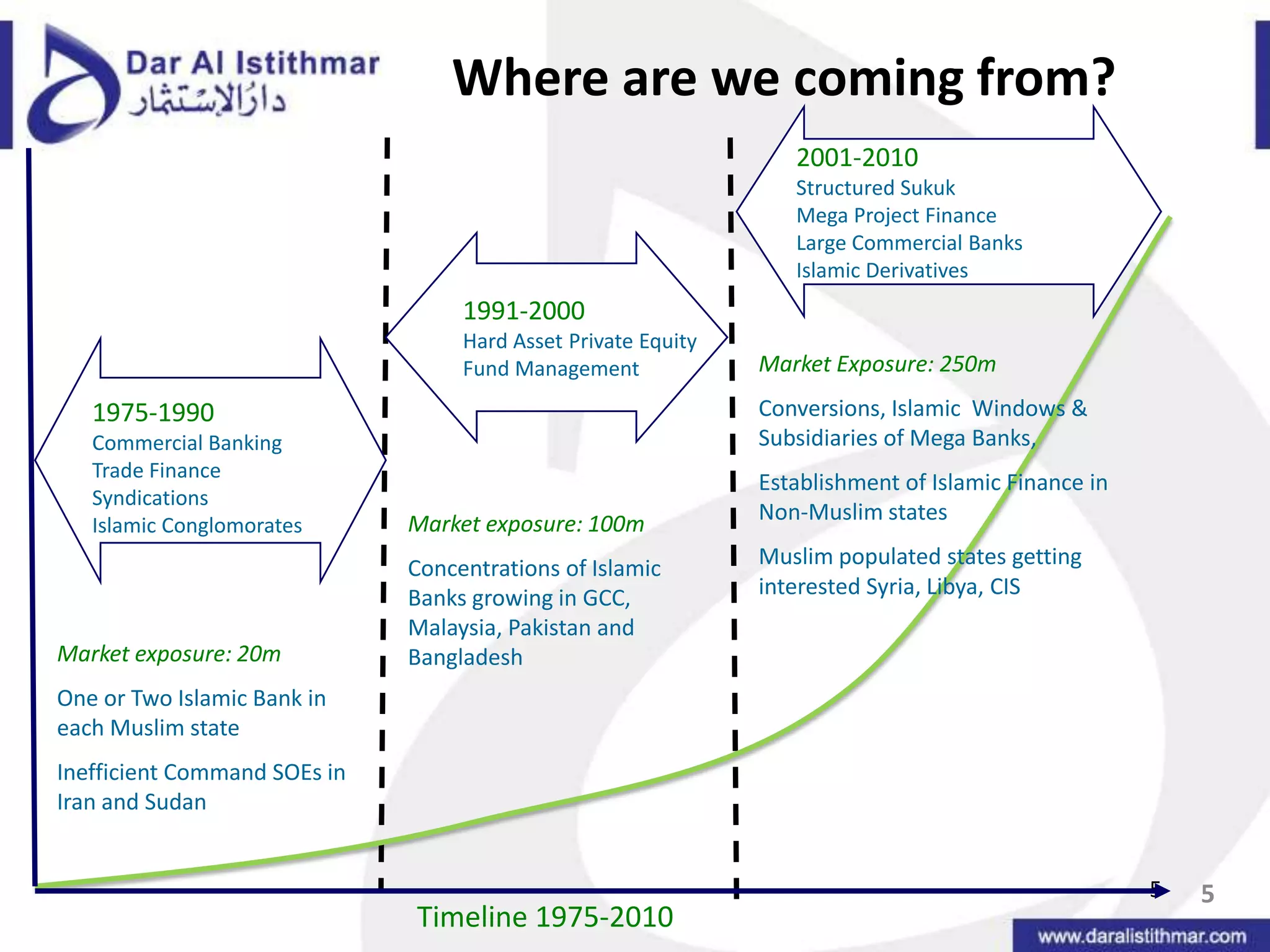
Where are we coming from?2001-2010Structured SukukMega Project Finance Large Commercial BanksIslamic Derivatives1991-2000Hard Asset Private EquityFund Management1975-1990Commercial Banking  Trade FinanceSyndicationsIslamic ConglomoratesMarket Exposure: 250mConversions, Islamic  Windows &  Subsidiaries of Mega Banks,               Establishment of Islamic Finance in Non-Muslim statesMuslim populated states getting interested Syria, Libya, CISMarket exposure: 100mConcentrations of Islamic Banks growing in GCC, Malaysia, Pakistan and BangladeshMarket exposure: 20mOne or Two Islamic Bank in each Muslim state Inefficient Command SOEs in Iran and SudanTimeline 1975-201055
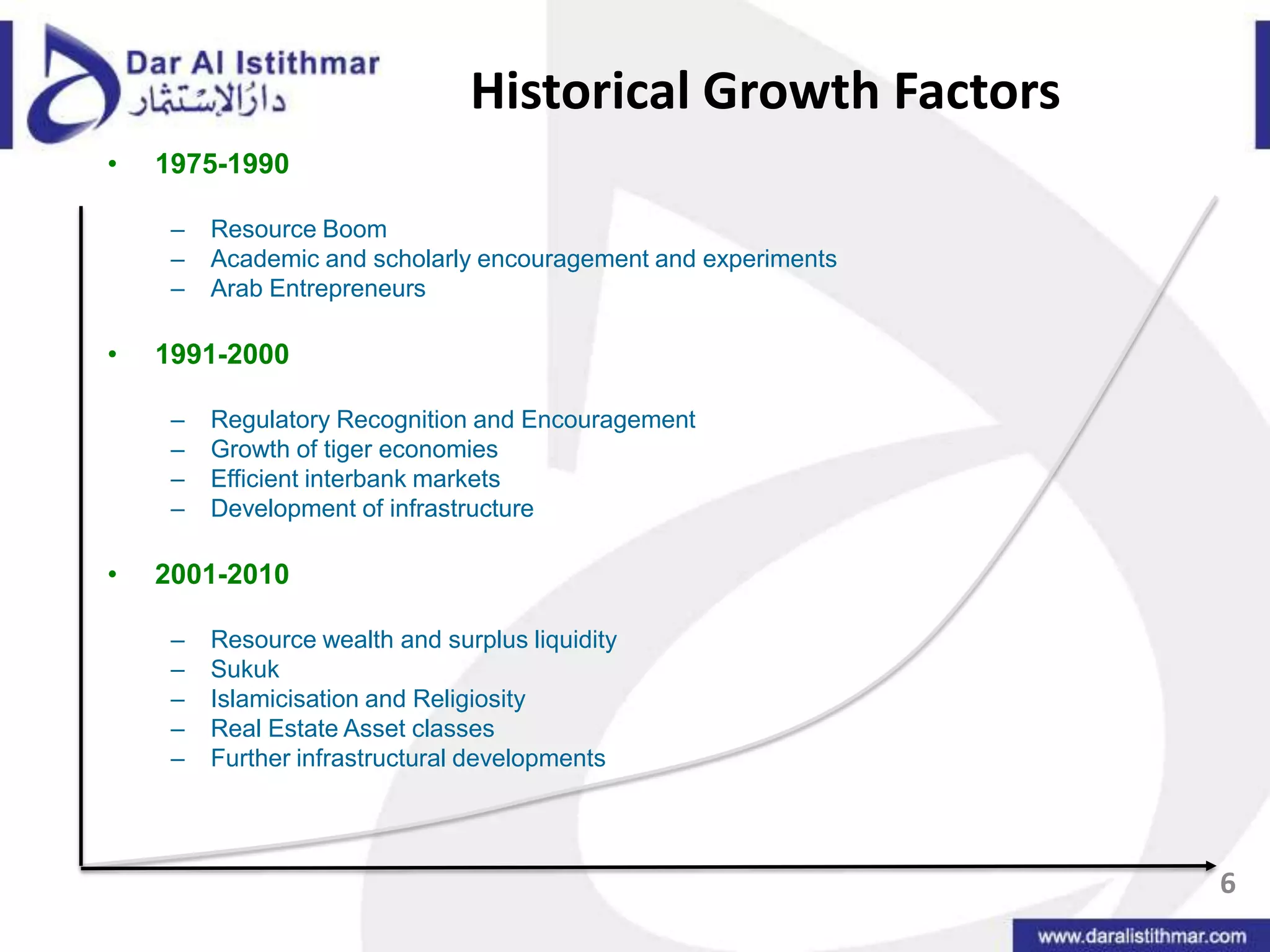
Historical Growth Factors1975-1990Resource BoomAcademic and scholarly encouragement and experimentsArab Entrepreneurs1991-2000Regulatory Recognition and EncouragementGrowth of tiger economiesEfficient interbank marketsDevelopment of infrastructure2001-2010Resource wealth and surplus liquiditySukukIslamicisation and ReligiosityReal Estate Asset classesFurther infrastructural developments6
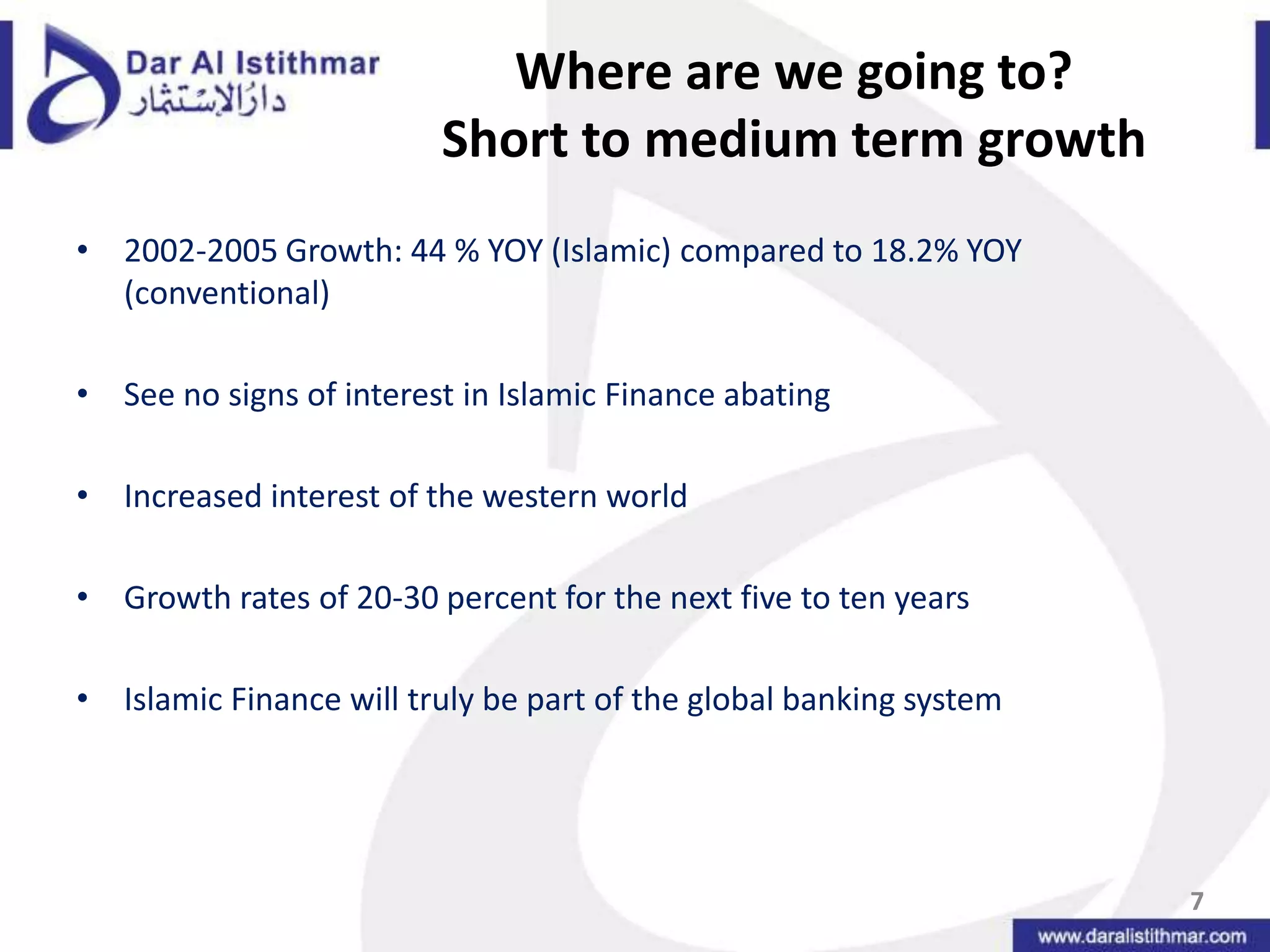
Where are we going to? Short to medium term growth 2002-2005 Growth: 44 % YOY (Islamic) compared to 18.2% YOY (conventional)See no signs of interest in Islamic Finance abatingIncreased interest of the western worldGrowth rates of 20-30 percent for the next five to ten yearsIslamic Finance will truly be part of the global banking system7
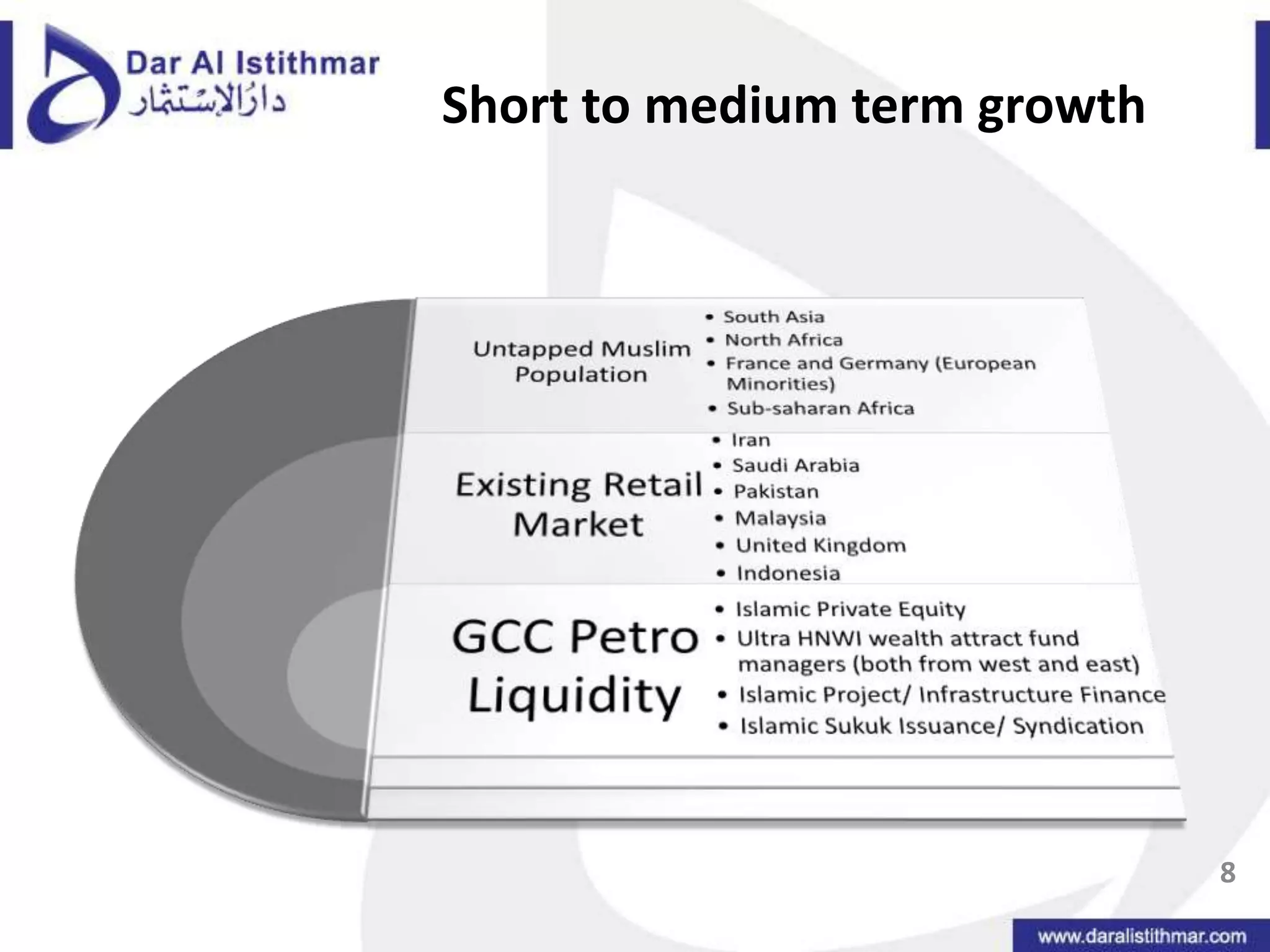
Short to medium term growth8
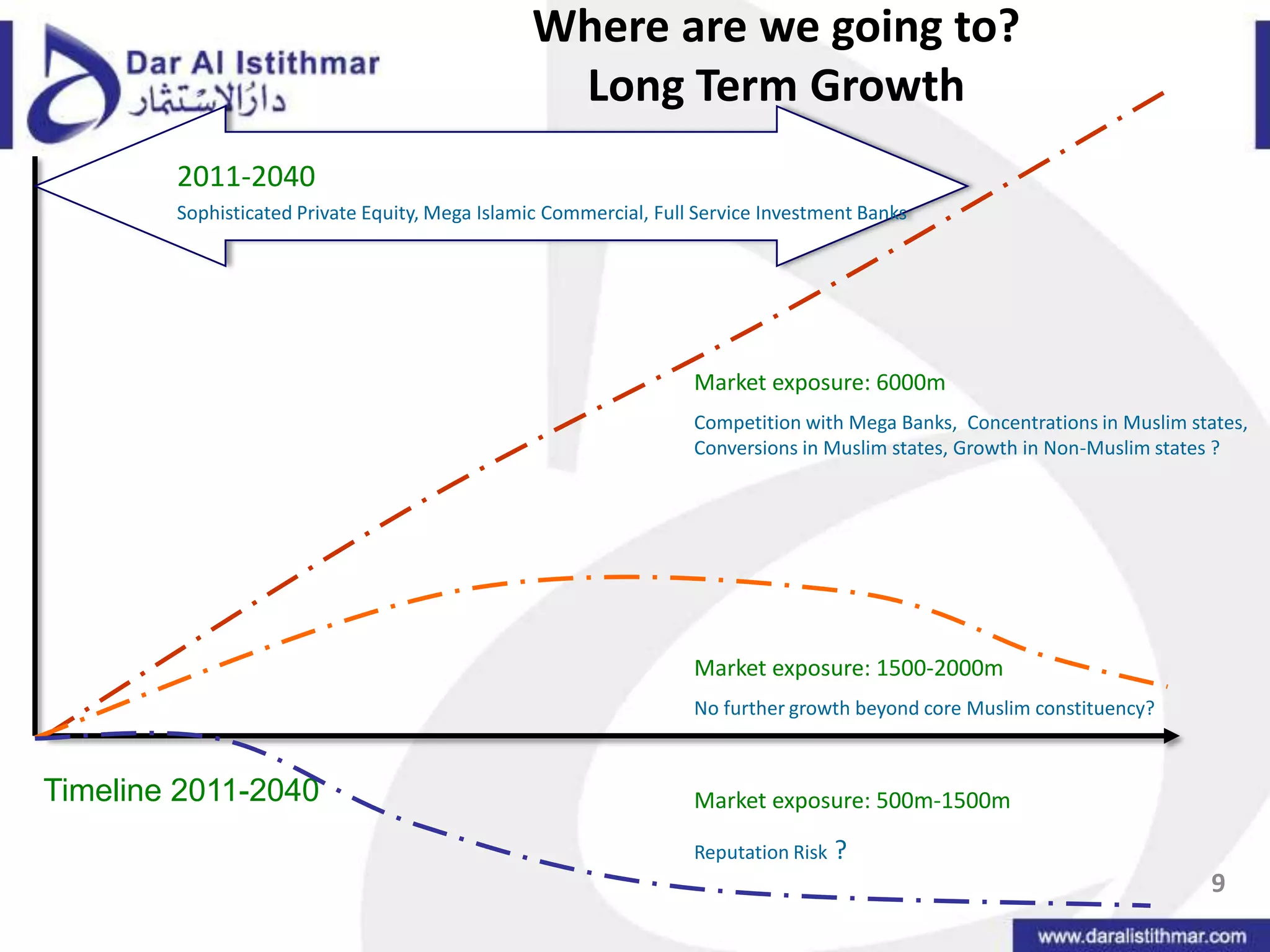
Where are we going to?Long Term Growth 2011-2040Sophisticated Private Equity, Mega Islamic Commercial, Full Service Investment BanksMarket exposure: 6000mCompetition with Mega Banks,  Concentrations in Muslim states, Conversions in Muslim states, Growth in Non-Muslim states ?Market exposure: 1500-2000mNo further growth beyond core Muslim constituency?Market exposure: 500m-1500mReputation Risk ?Timeline 2011-20409
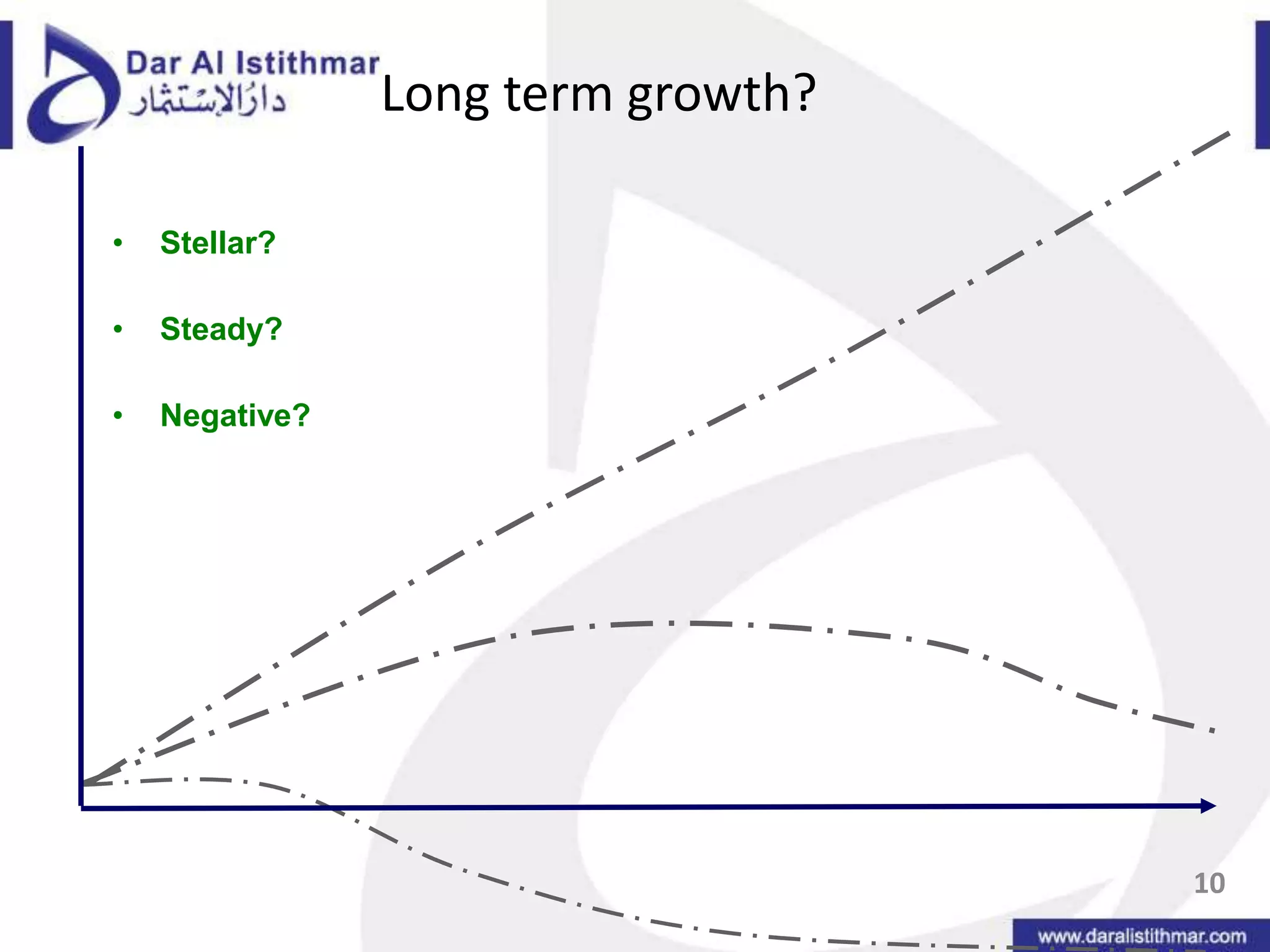
Long term growth?Stellar?Steady?Negative?10
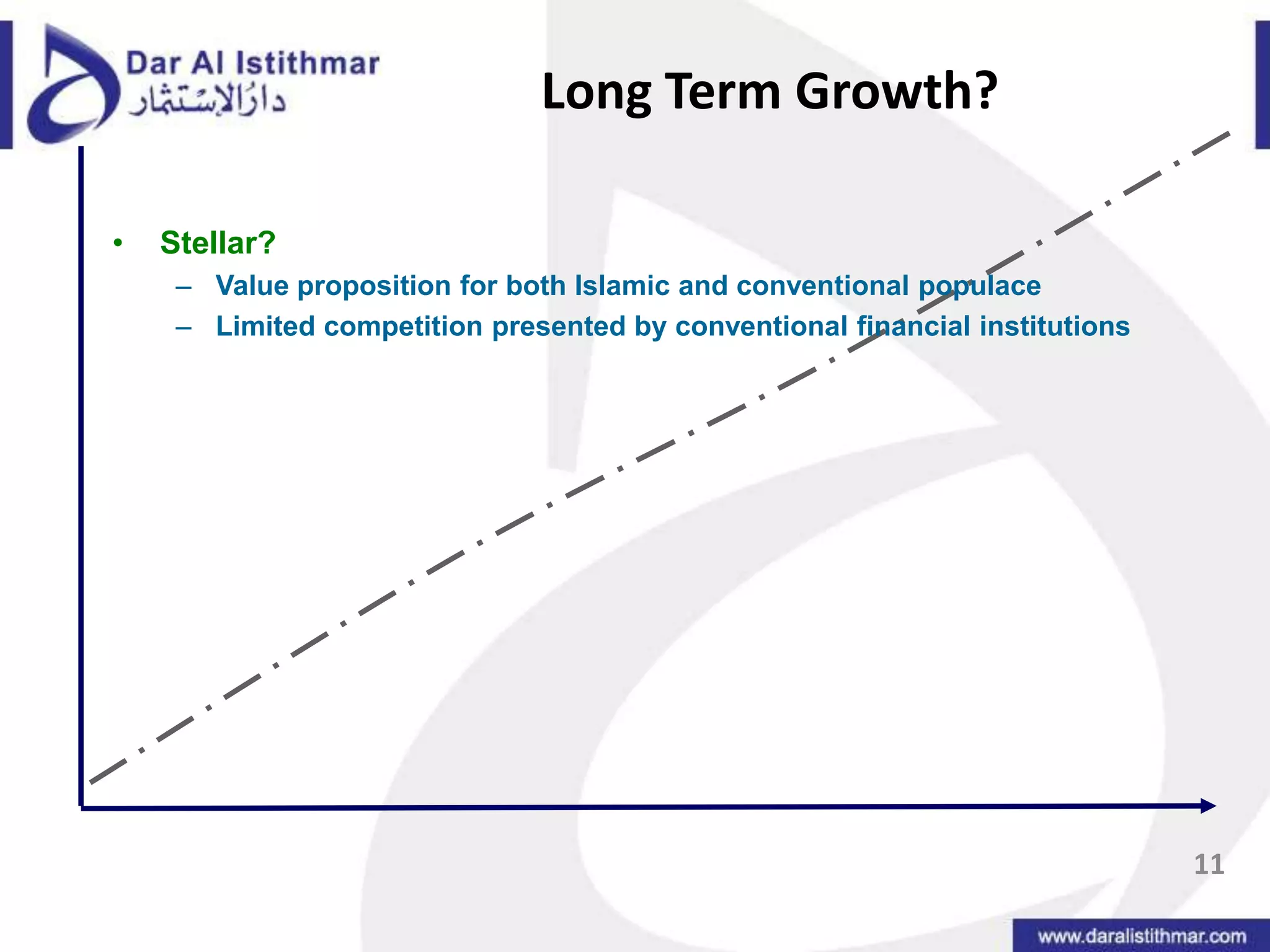
Long Term Growth?Stellar?Value proposition for both Islamic and conventional populaceLimited competition presented by conventional financial institutions11
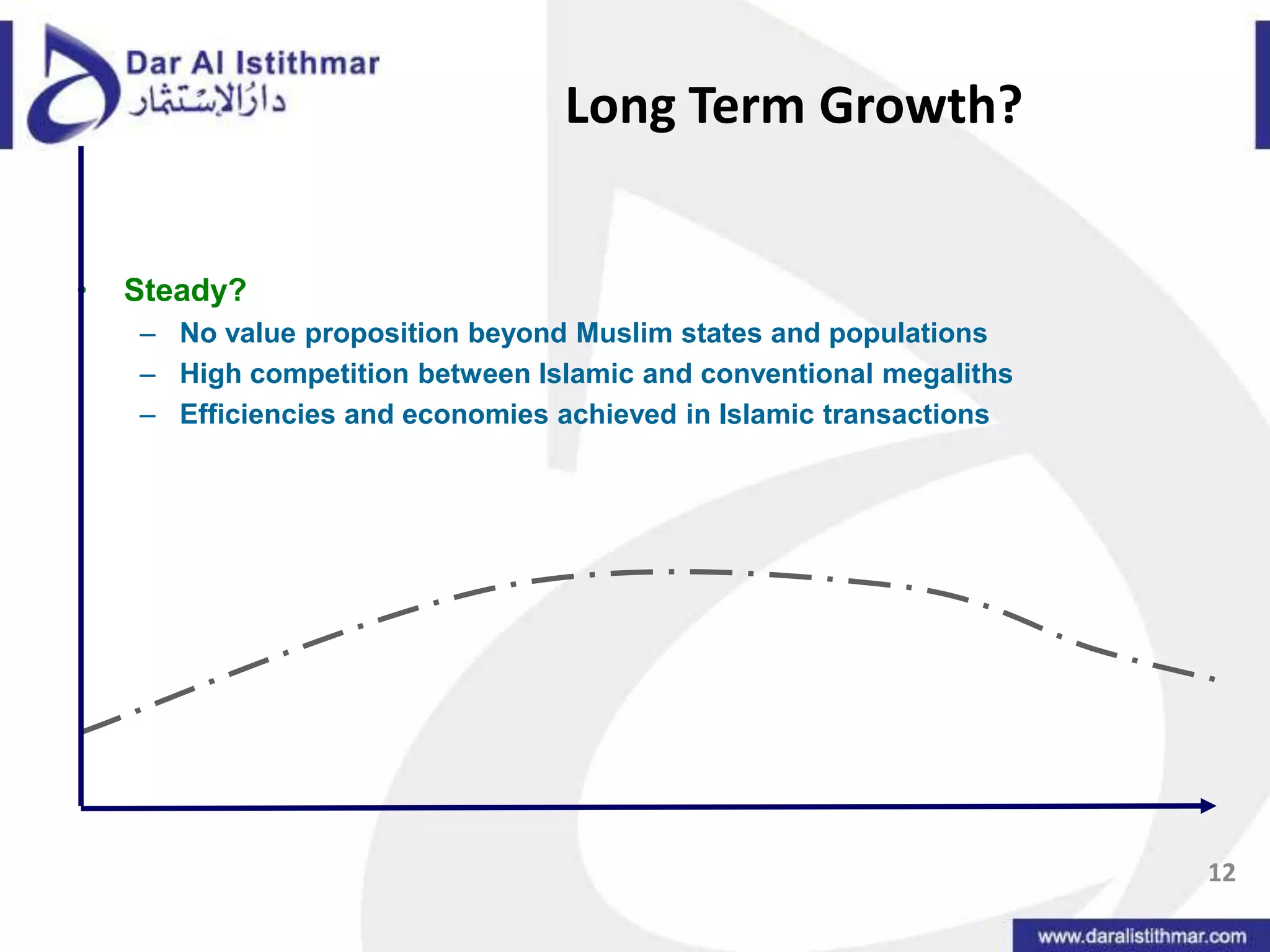
Long Term Growth?Steady?No value proposition beyond Muslim states and populationsHigh competition between Islamic and conventional megalithsEfficiencies and economies achieved in Islamic transactions12
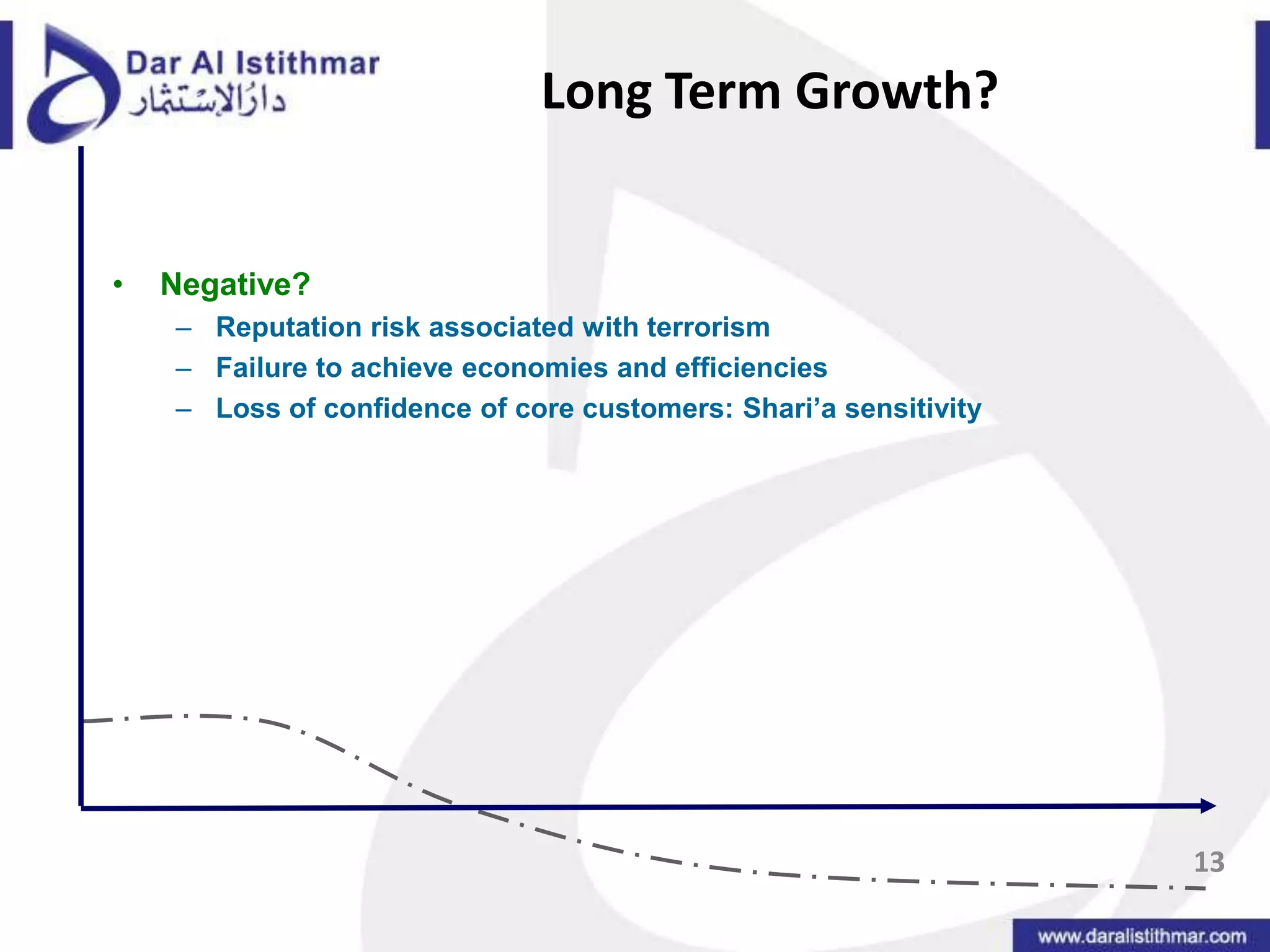
Long Term Growth?Negative?Reputation risk associated with terrorismFailure to achieve economies and efficienciesLoss of confidence of core customers: Shari’a sensitivity13
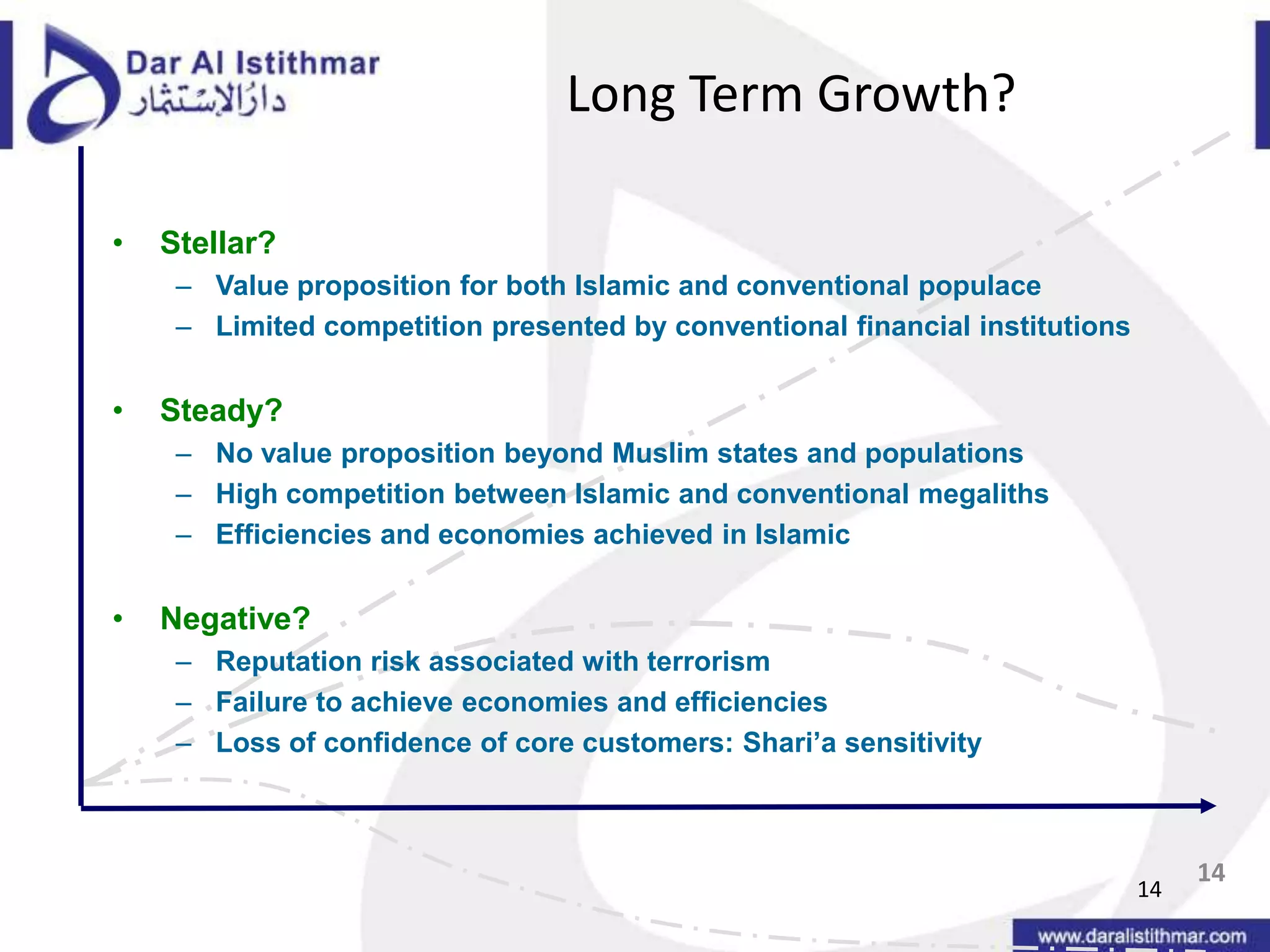
14Long Term Growth?Stellar?Value proposition for both Islamic and conventional populaceLimited competition presented by conventional financial institutionsSteady?No value proposition beyond Muslim states and populationsHigh competition between Islamic and conventional megalithsEfficiencies and economies achieved in IslamicNegative?Reputation risk associated with terrorismFailure to achieve economies and efficienciesLoss of confidence of core customers: Shari’a sensitivity14
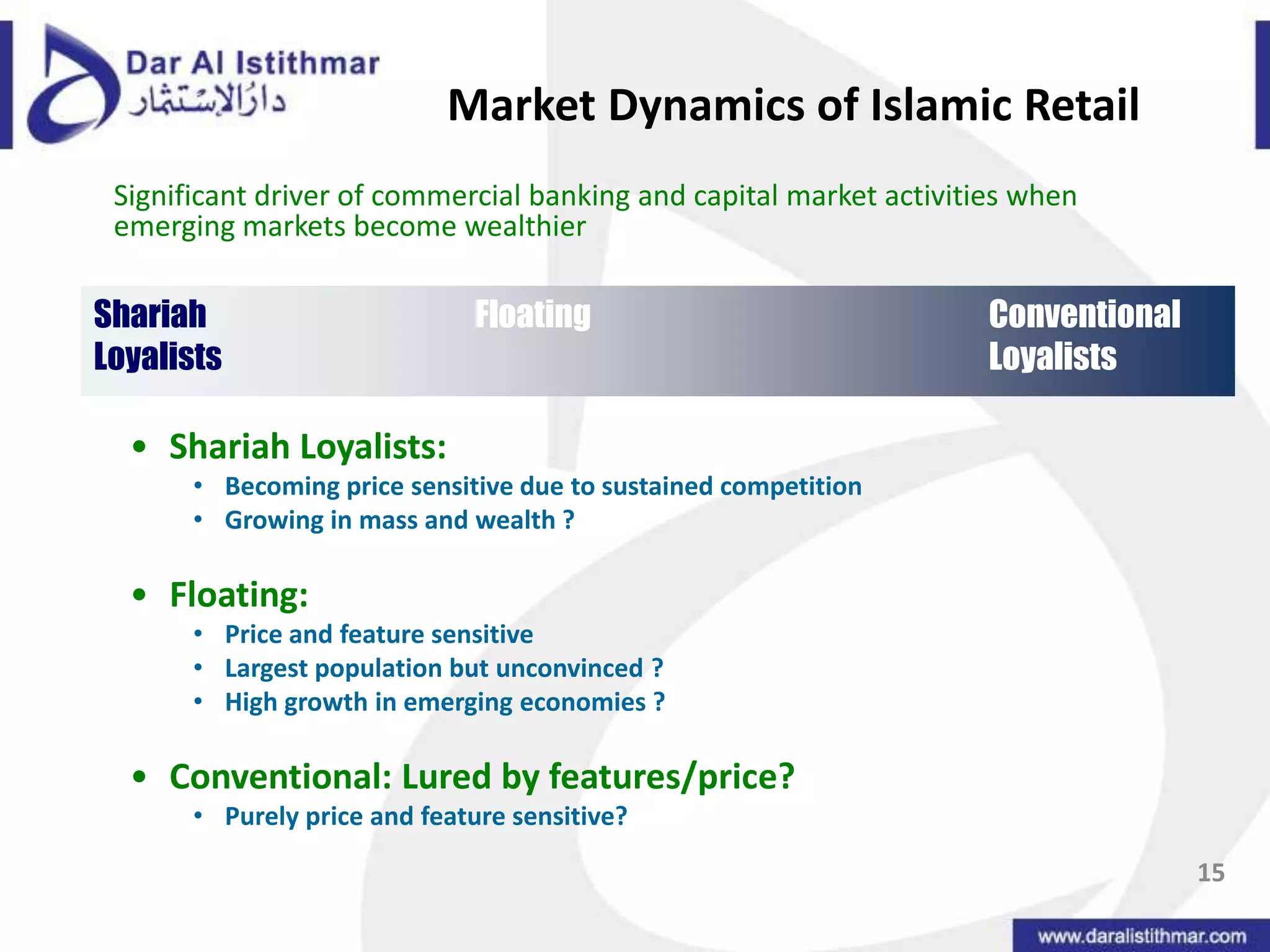
15Market Dynamics of Islamic RetailSignificant driver of commercial banking and capital market activities when emerging markets become wealthierShariah Loyalists:Becoming price sensitive due to sustained competitionGrowing in mass and wealth ?Floating:Price and feature sensitive Largest population but unconvinced ?High growth in emerging economies ?Conventional: Lured by features/price?Purely price and feature sensitive?ShariahFloatingConventional LoyalistsLoyalists
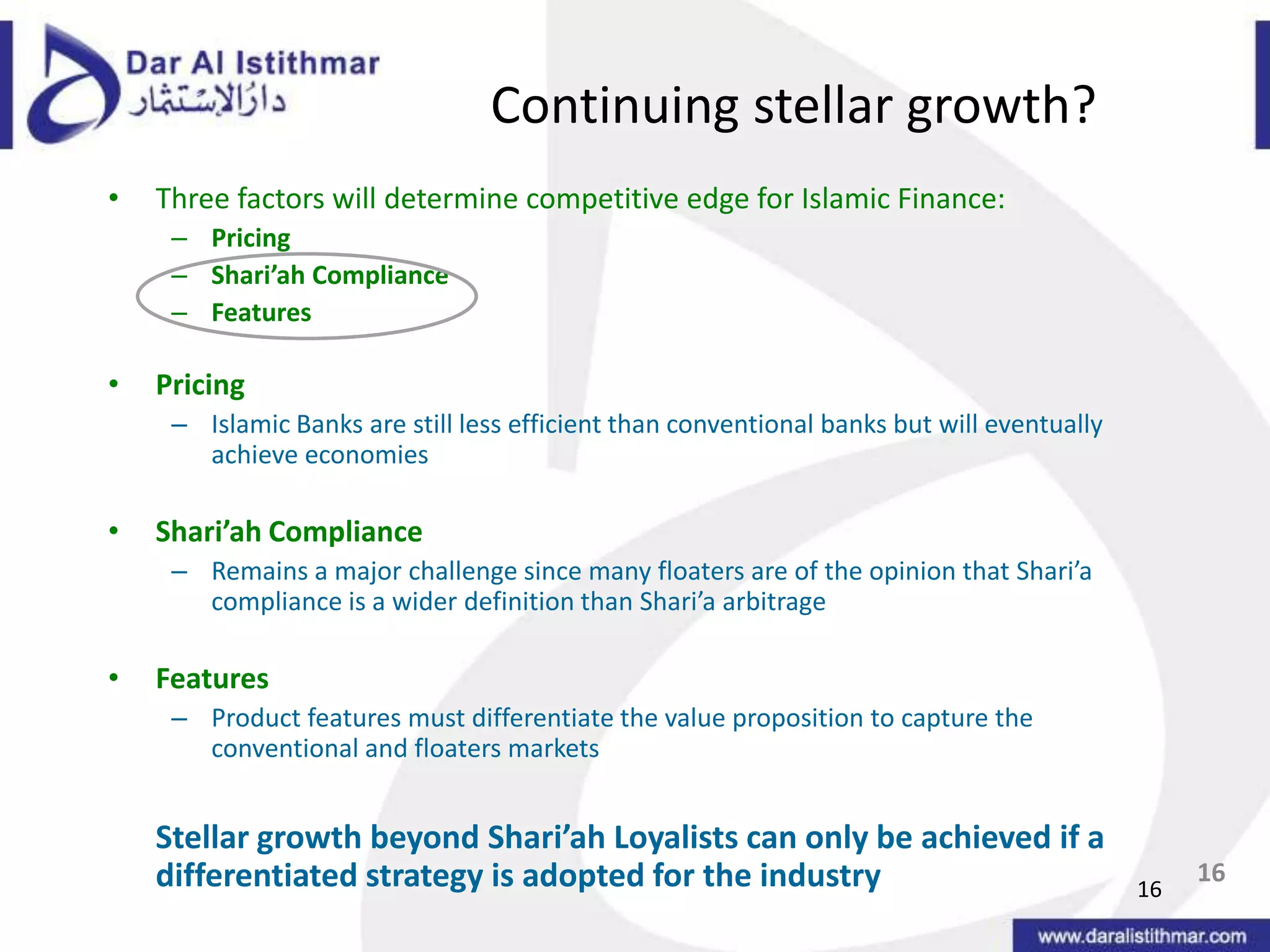
1616Continuing stellar growth?Three factors will determine competitive edge for Islamic Finance:PricingShari’ah ComplianceFeaturesPricingIslamic Banks are still less efficient than conventional banks but will eventually achieve economiesShari’ah ComplianceRemains a major challenge since many floaters are of the opinion that Shari’a compliance is a wider definition than Shari’a arbitrageFeaturesProduct features must differentiate the value proposition to capture the conventional and floaters markets	Stellar growth beyond Shari’ah Loyalists can only be achieved if a differentiated strategy is adopted for the industry
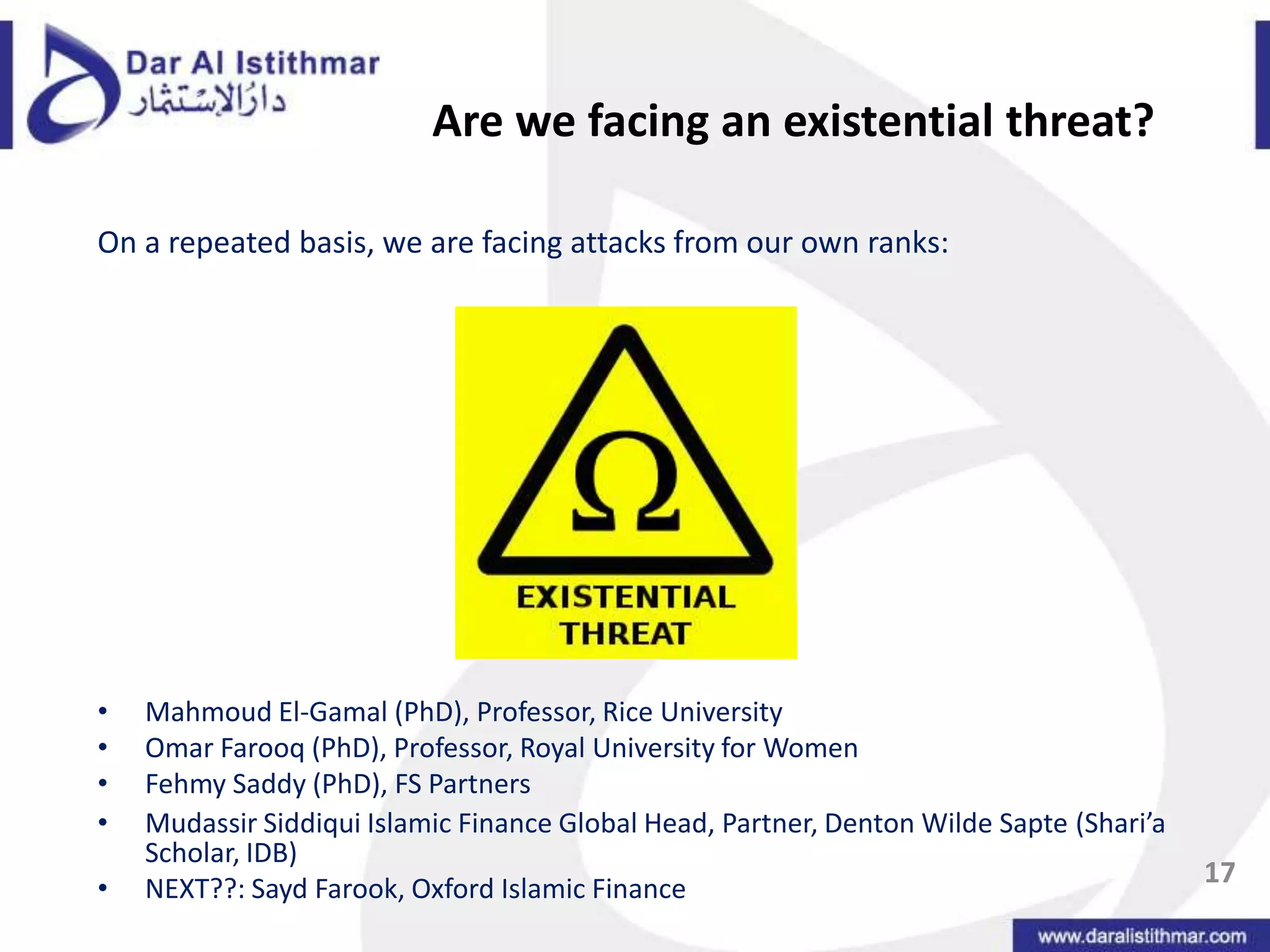
Are we facing an existential threat?On a repeated basis, we are facing attacks from our own ranks:Mahmoud El-Gamal (PhD), Professor, Rice University Omar Farooq (PhD), Professor, Royal University for WomenFehmySaddy (PhD), FS PartnersMudassirSiddiqui Islamic Finance Global Head, Partner, Denton Wilde Sapte(Shari’a Scholar, IDB) NEXT??: Sayd Farook, Oxford Islamic Finance17
Are we facing an existential threat?Islamic Finance CANNOT be: only about “Shari’a arbitrage”only about meeting the needs of conventional financing or capital marketsconstrained by the traditional nominate contractsall just commodity murabahaYET, ALL OF THIS EXISTS AND CANNOT BE AVOIDED AT THIS STAGE.In reality, the first is a blessing in disguise!18
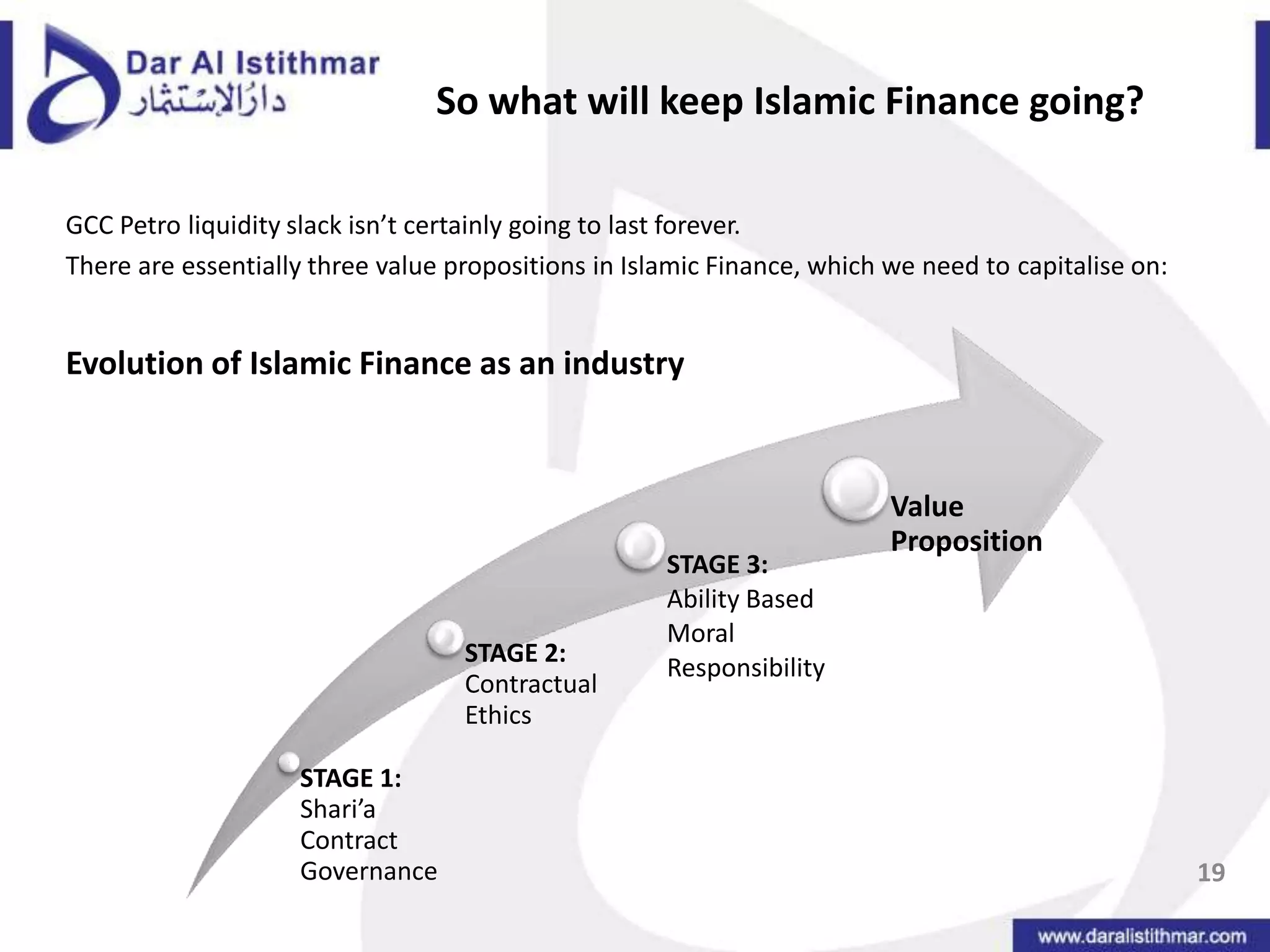
So what will keep Islamic Finance going?GCC Petro liquidity slack isn’t certainly going to last forever.There are essentially three value propositions in Islamic Finance, which we need to capitalise on:Evolution of Islamic Finance as an industry19
Shari’a Contract GovernanceThe process of ensuring that a contract is Shari’a compliantAvoid Main ProhibitionsRibaGhararMaysirAvoid Subsidiary ProhibitionsPermissibility of subject matter (evaluability) consideration and processOwnership and possession of assetsCannot combine two contracts (with exceptions)Cannot defer both counter-value or have bilateral promisesCannot have twin salesCannot have tying contractsThis ensures that:All transactions are asset linked: first degree of separation only allowed i.e. trading of debts and money not allowedMal is generally conservatively defined i.e. financial rights do not give rise to assets.20
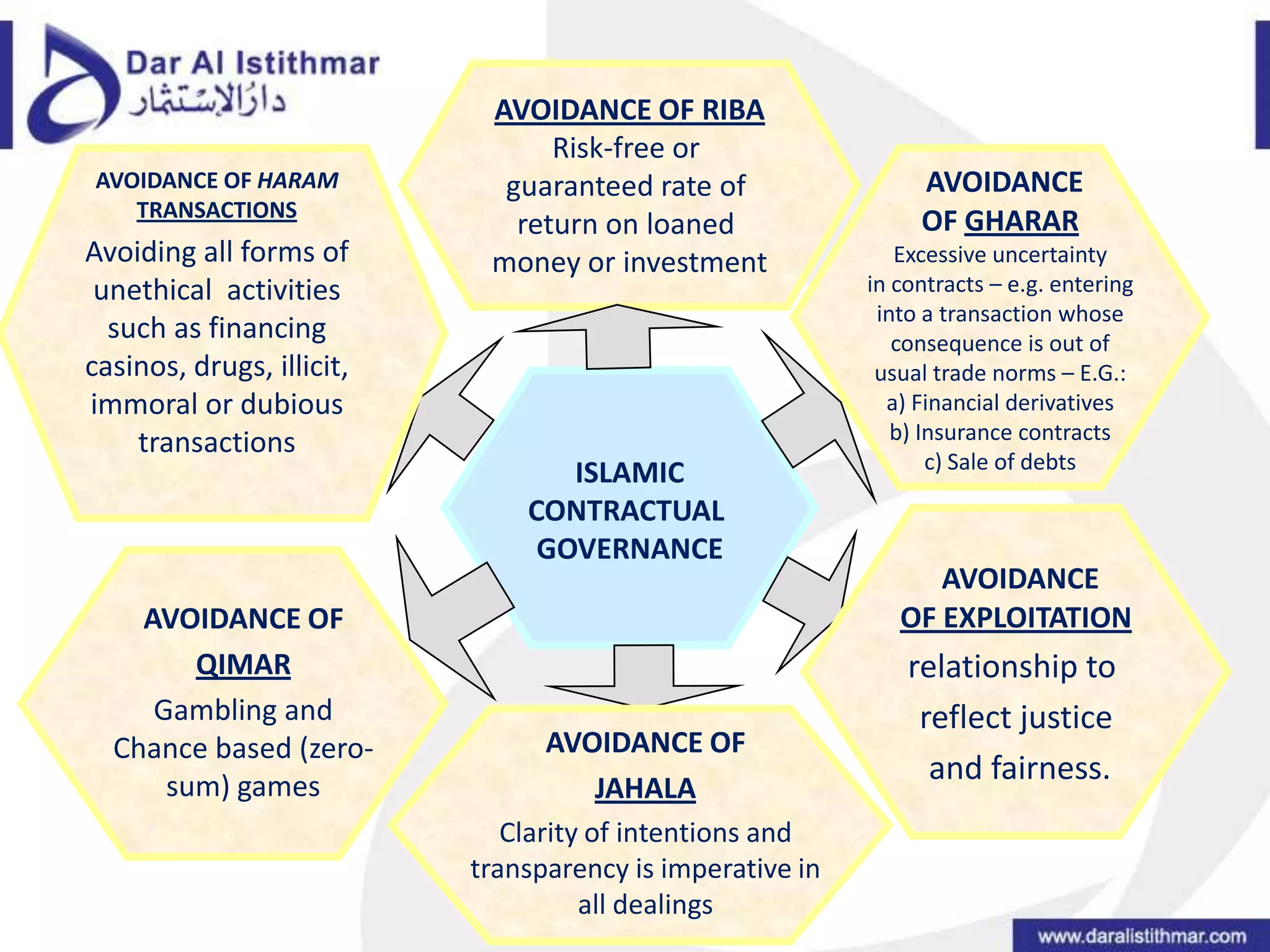
AVOIDANCE OF HARAMTRANSACTIONSAvoiding all forms of unethical  activities such as financing casinos, drugs, illicit, immoral or dubious transactionsAVOIDANCE OF QIMARGambling and Chance based (zero-sum) gamesAVOIDANCE OFJAHALAClarity of intentions and transparency is imperative in all dealingsAVOIDANCE OF RIBARisk-free or guaranteed rate of return on loaned money or investmentAVOIDANCE OF GHARARExcessive uncertaintyin contracts – e.g. enteringinto a transaction whoseconsequence is out ofusual trade norms – E.G.:a) Financial derivativesb) Insurance contractsc) Sale of debtsISLAMICCONTRACTUAL GOVERNANCEAVOIDANCE OF EXPLOITATIONrelationship to reflect justice and fairness.
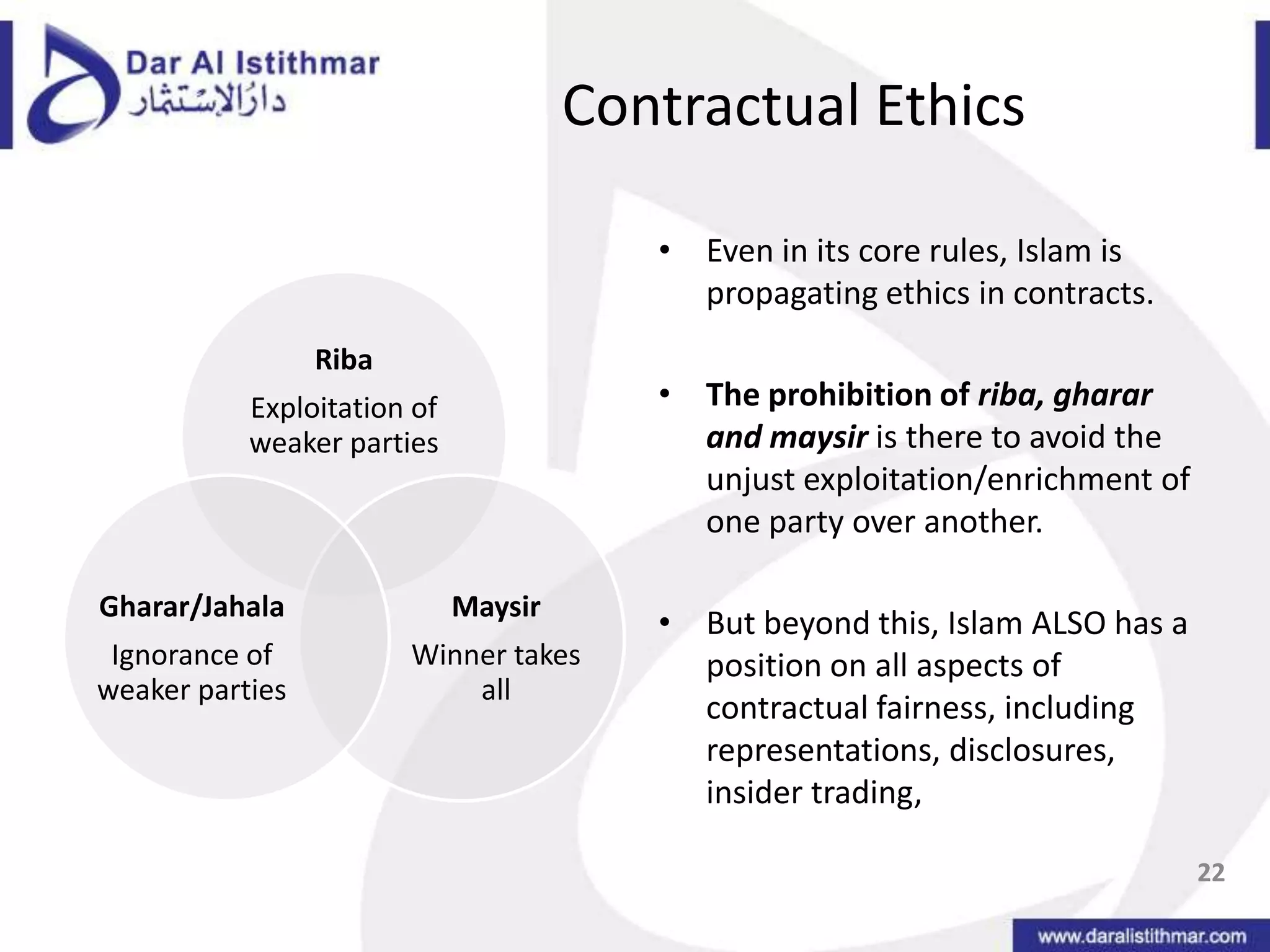
Contractual EthicsEven in its core rules, Islam is propagating ethics in contracts.The prohibition of riba, gharar and maysiris there to avoid the unjust exploitation/enrichment of one party over another.But beyond this, Islam ALSO has a position on all aspects of contractual fairness, including representations, disclosures, insider trading, 22
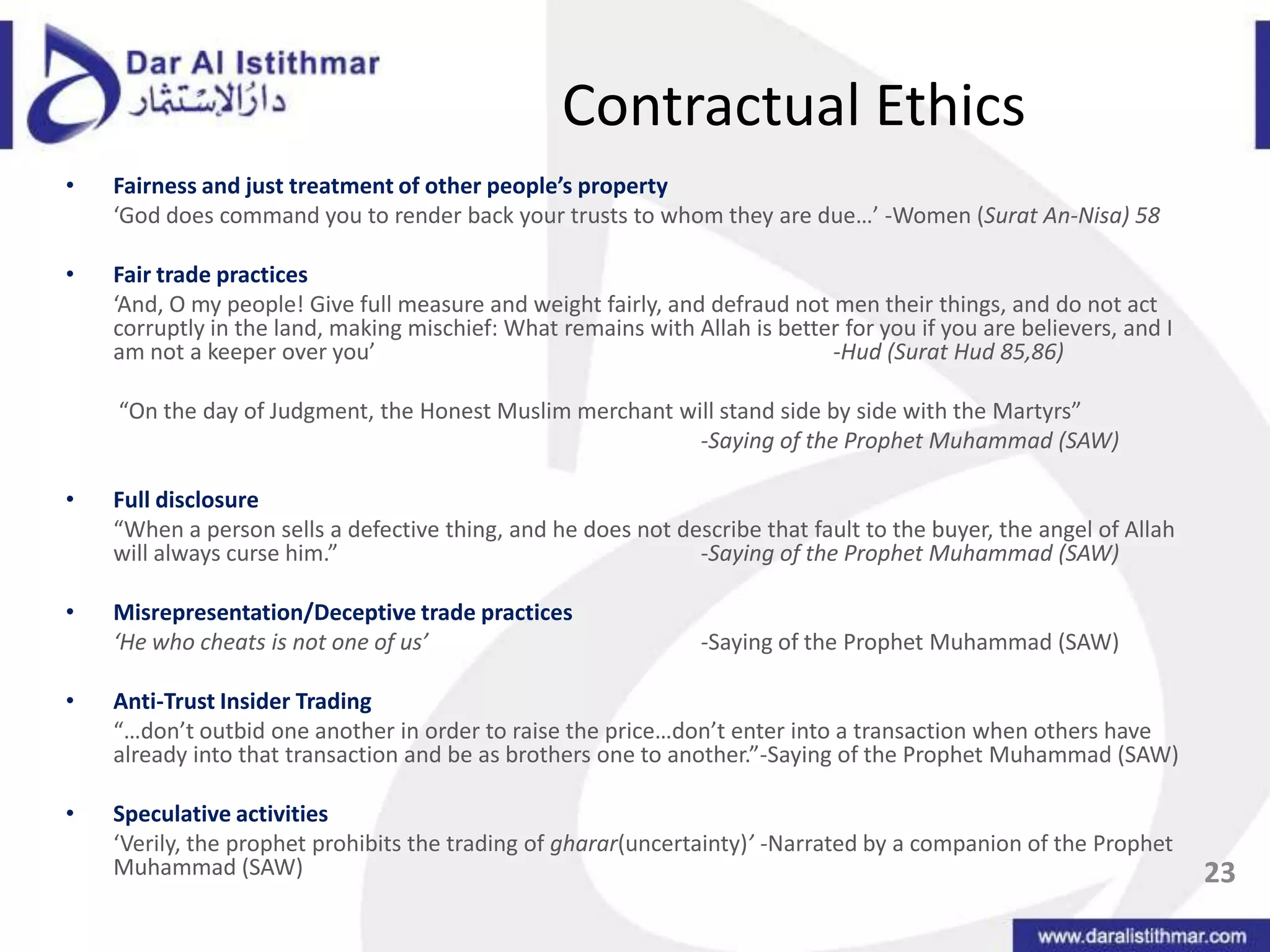
Contractual EthicsFairness and just treatment of other people’s property‘God does command you to render back your trusts to whom they are due…’ -Women (Surat An-Nisa) 58Fair trade practices‘And, O my people! Give full measure and weight fairly, and defraud not men their things, and do not act corruptly in the land, making mischief: What remains with Allah is better for you if you are believers, and I am not a keeper over you’ 				 -Hud (SuratHud 85,86)	 “On the day of Judgment, the Honest Muslim merchant will stand side by side with the Martyrs”  						-Saying of the Prophet Muhammad (SAW)Full disclosure“When a person sells a defective thing, and he does not describe that fault to the buyer, the angel of Allah will always curse him.”			-Saying of the Prophet Muhammad (SAW)Misrepresentation/Deceptive trade practices‘He who cheats is not one of us’ 			-Saying of the Prophet Muhammad (SAW)Anti-Trust Insider Trading“…don’t outbid one another in order to raise the price…don’t enter into a transaction when others have already into that transaction and be as brothers one to another.”-Saying of the Prophet Muhammad (SAW)Speculative activities‘Verily, the prophet prohibits the trading of gharar(uncertainty)’ -Narrated by a companion of the Prophet Muhammad (SAW)23
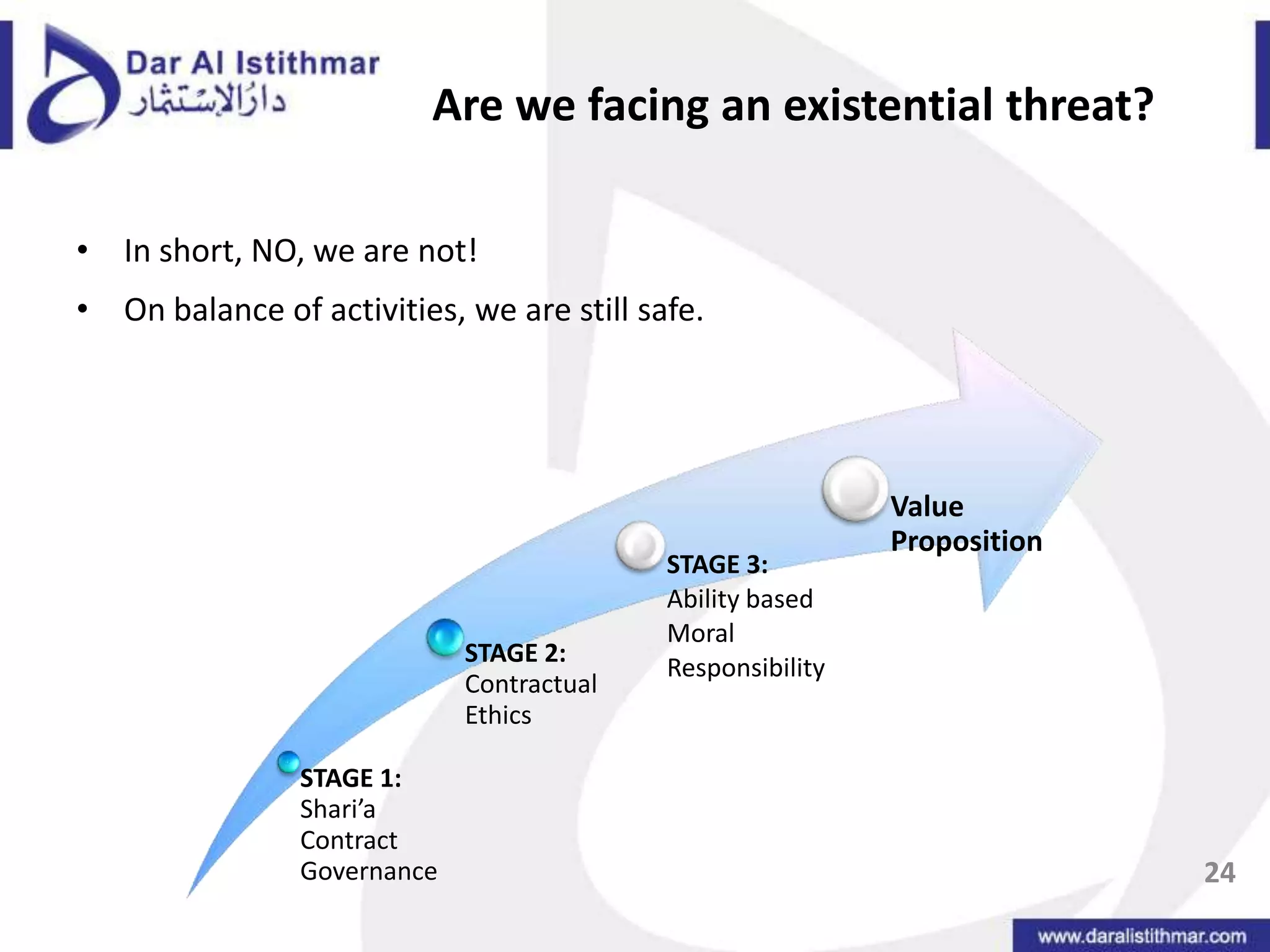
Are we facing an existential threat?In short, NO, we are not!On balance of activities, we are still safe. 24
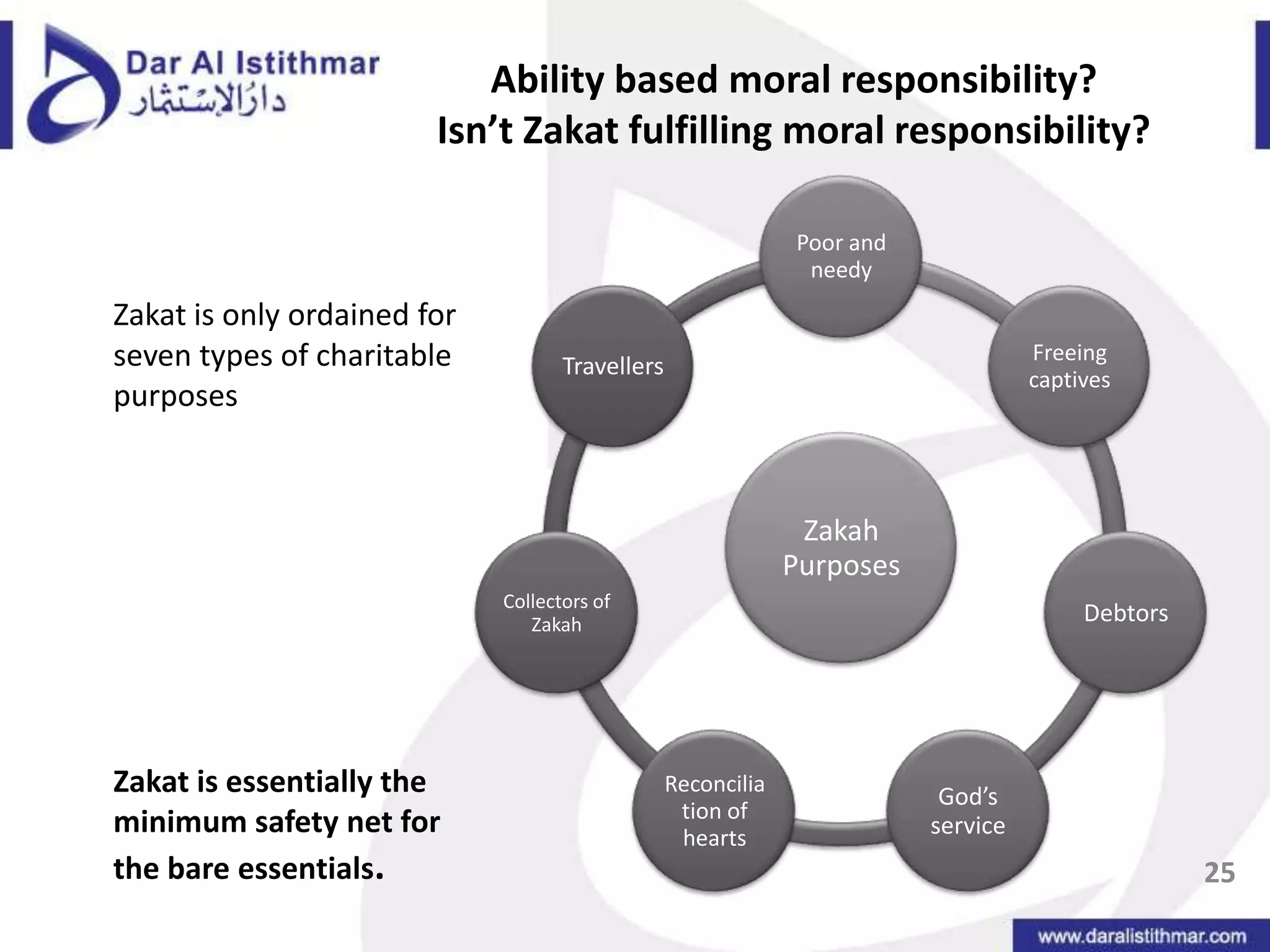
Ability based moral responsibility?Isn’t Zakat fulfilling moral responsibility?Zakat is only ordained for seven types of charitable purposesZakat is essentially the minimum safety net for the bare essentials. 25
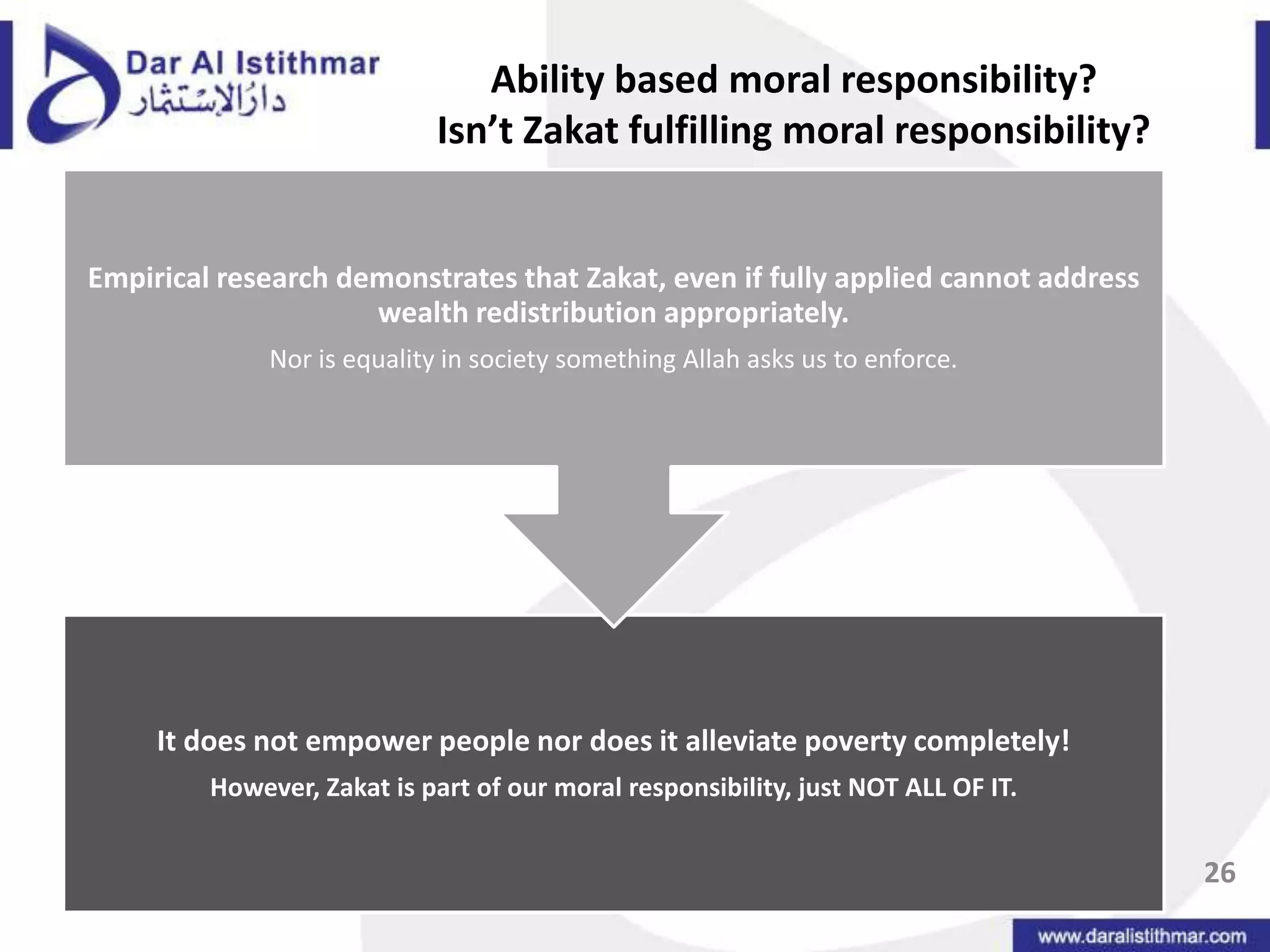
Ability based moral responsibility?Isn’t Zakat fulfilling moral responsibility?26
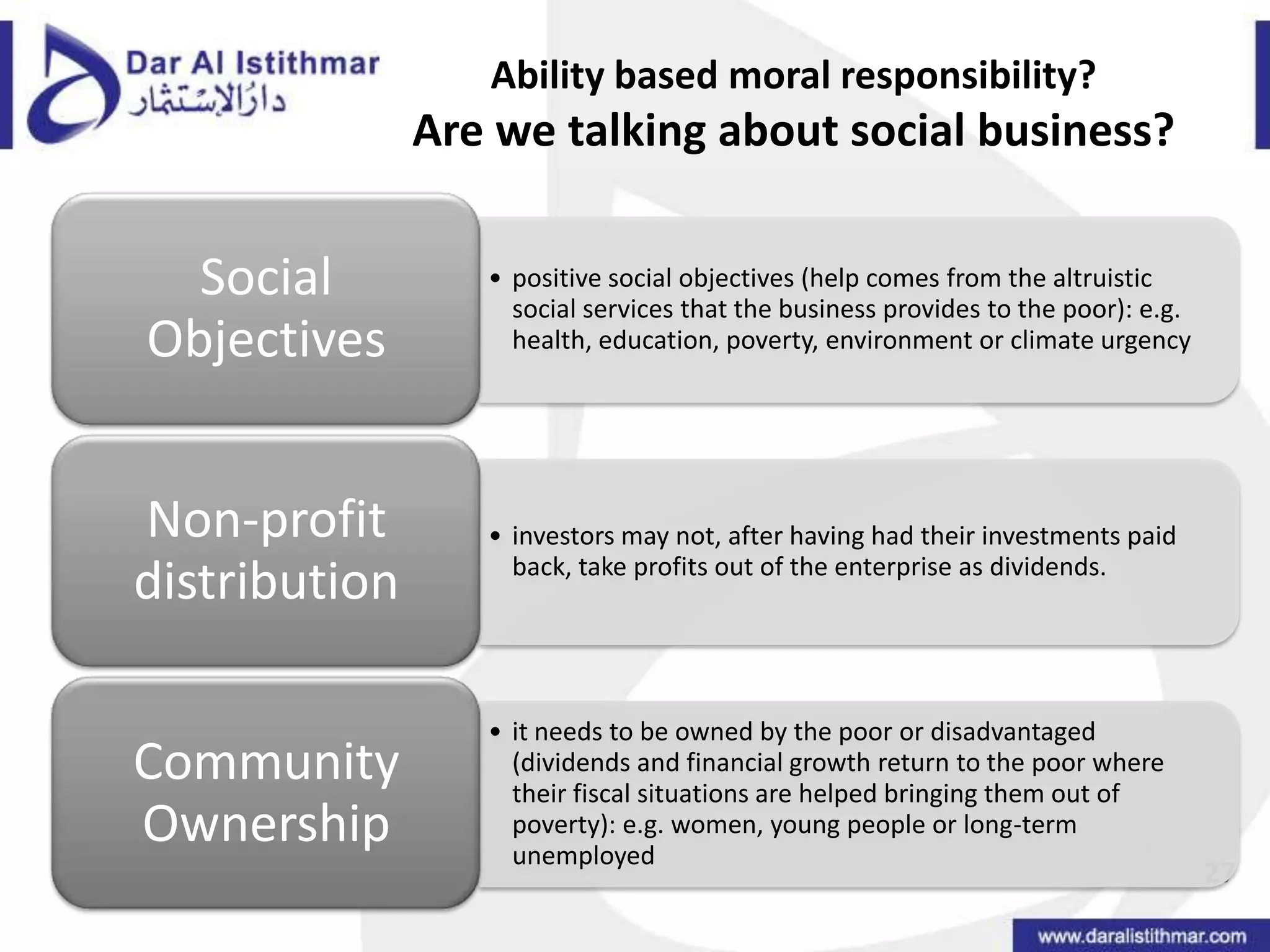
Ability based moral responsibility?Are we talking about social business?27
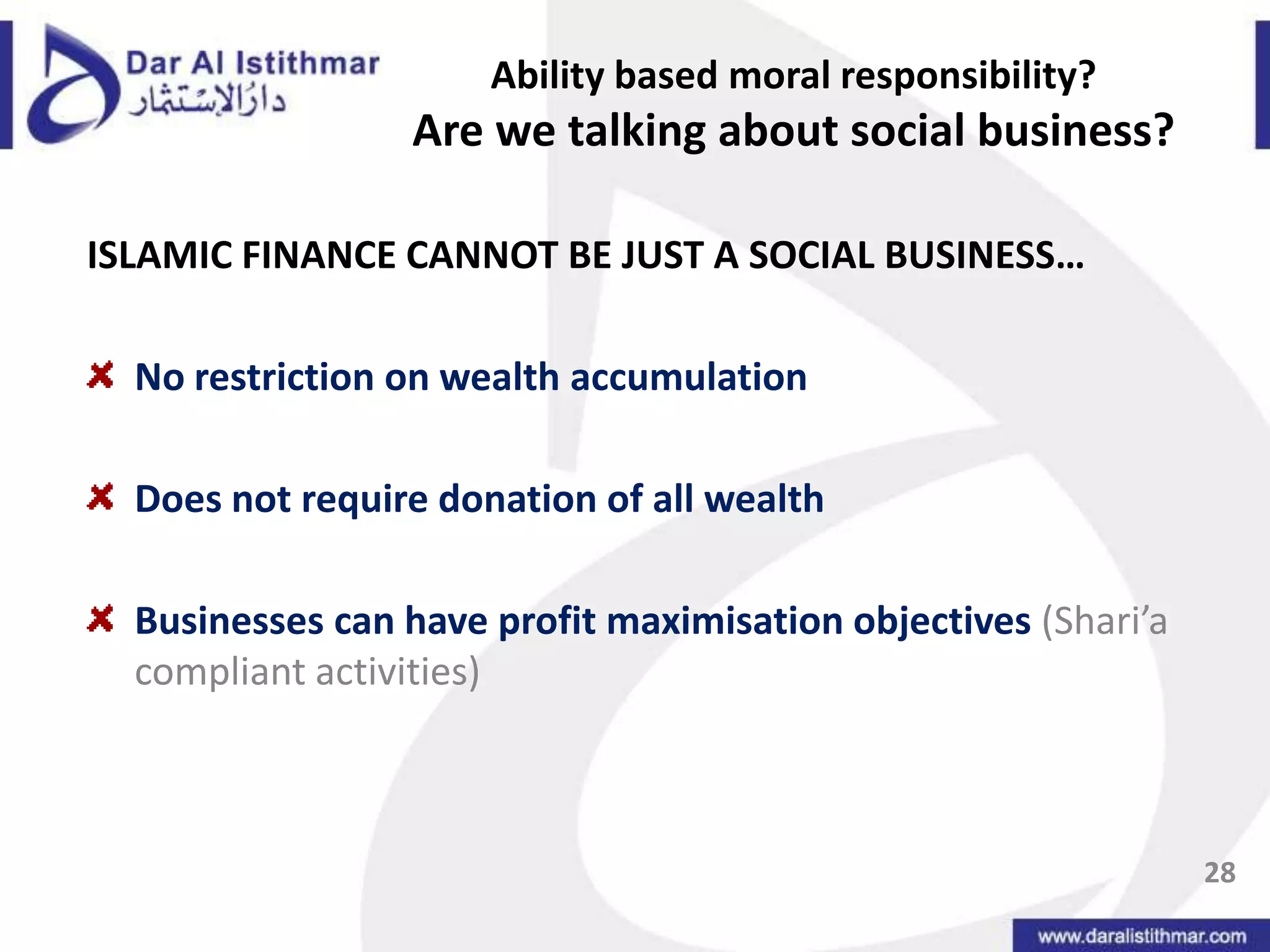
Ability based moral responsibility?Are we talking about social business?ISLAMIC FINANCE CANNOT BE JUST A SOCIAL BUSINESS…No restriction on wealth accumulationDoes not require donation of all wealthBusinesses can have profit maximisation objectives(Shari’a compliant activities)28
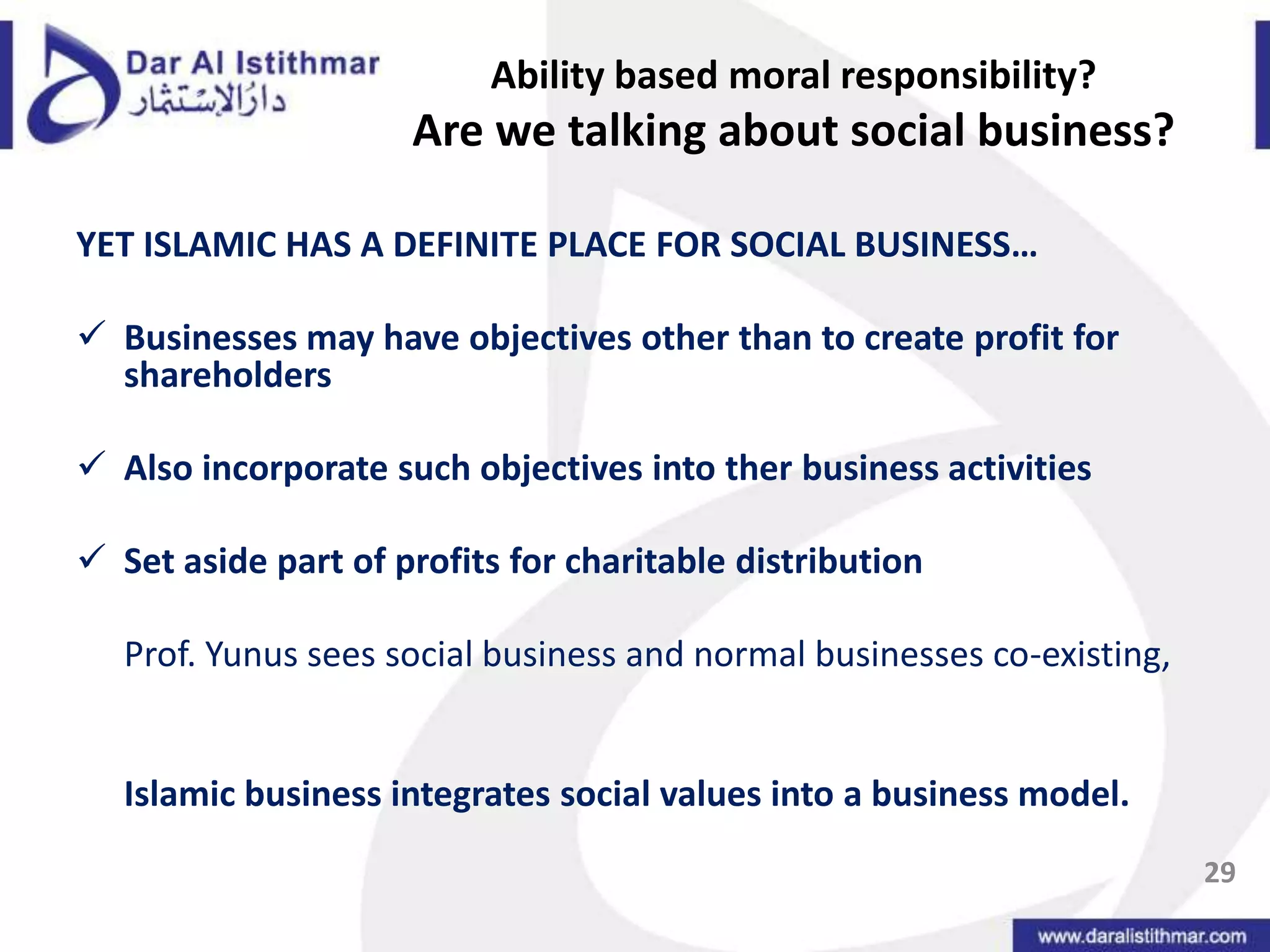
Ability based moral responsibility?Are we talking about social business?YET ISLAMIC HAS A DEFINITE PLACE FOR SOCIAL BUSINESS… Businesses may have objectives other than to create profit for shareholders
Also incorporate such objectives into ther business activities
Set aside part of profits for charitable distribution	Prof. Yunus sees social business and normal businesses co-existing, 	Islamic business integrates social values into a business model.29
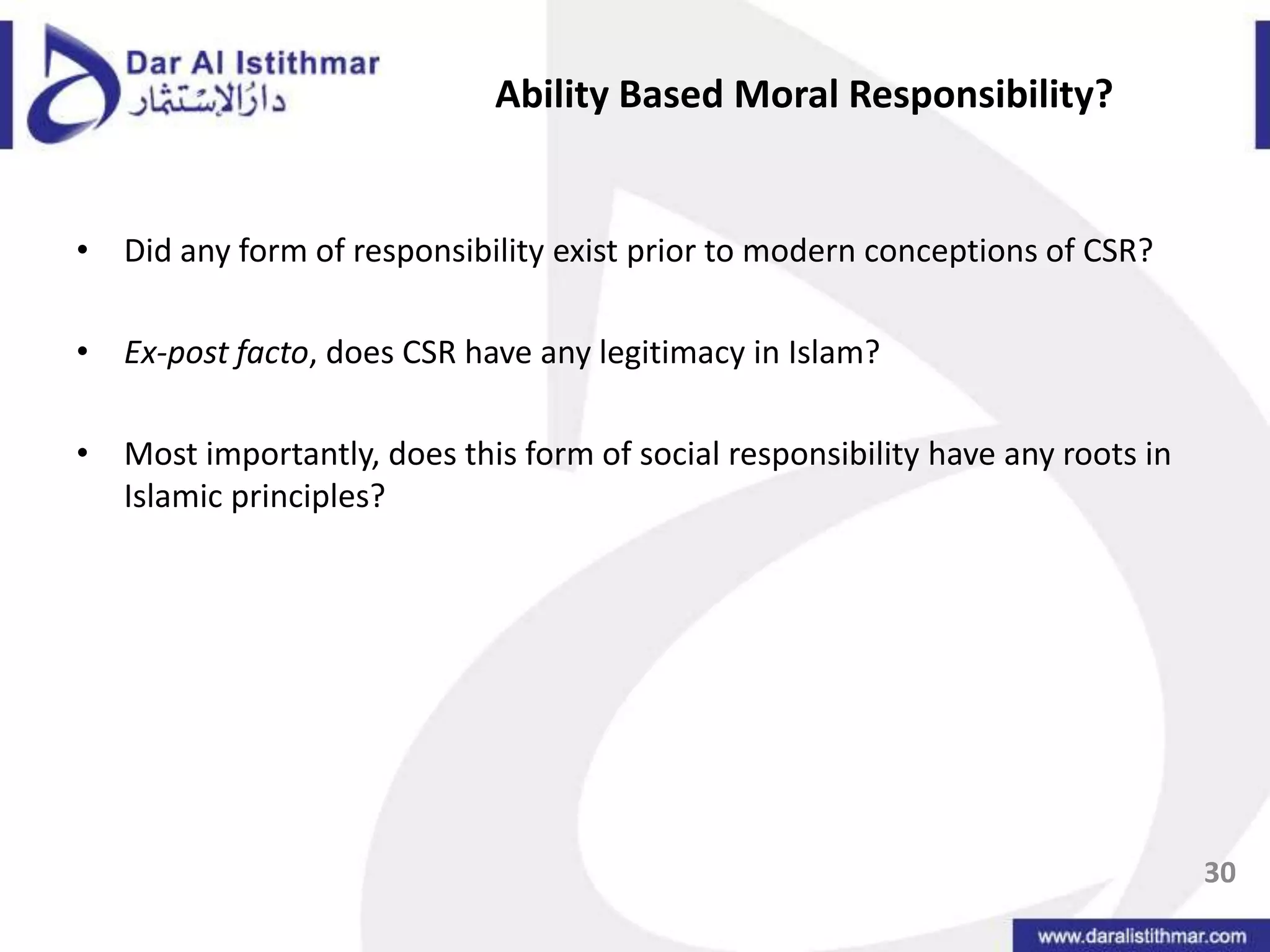
Ability Based Moral Responsibility?Did any form of responsibility exist prior to modern conceptions of CSR?Ex-post facto, does CSR have any legitimacy in Islam?Most importantly, does this form of social responsibility have any roots in Islamic principles?30
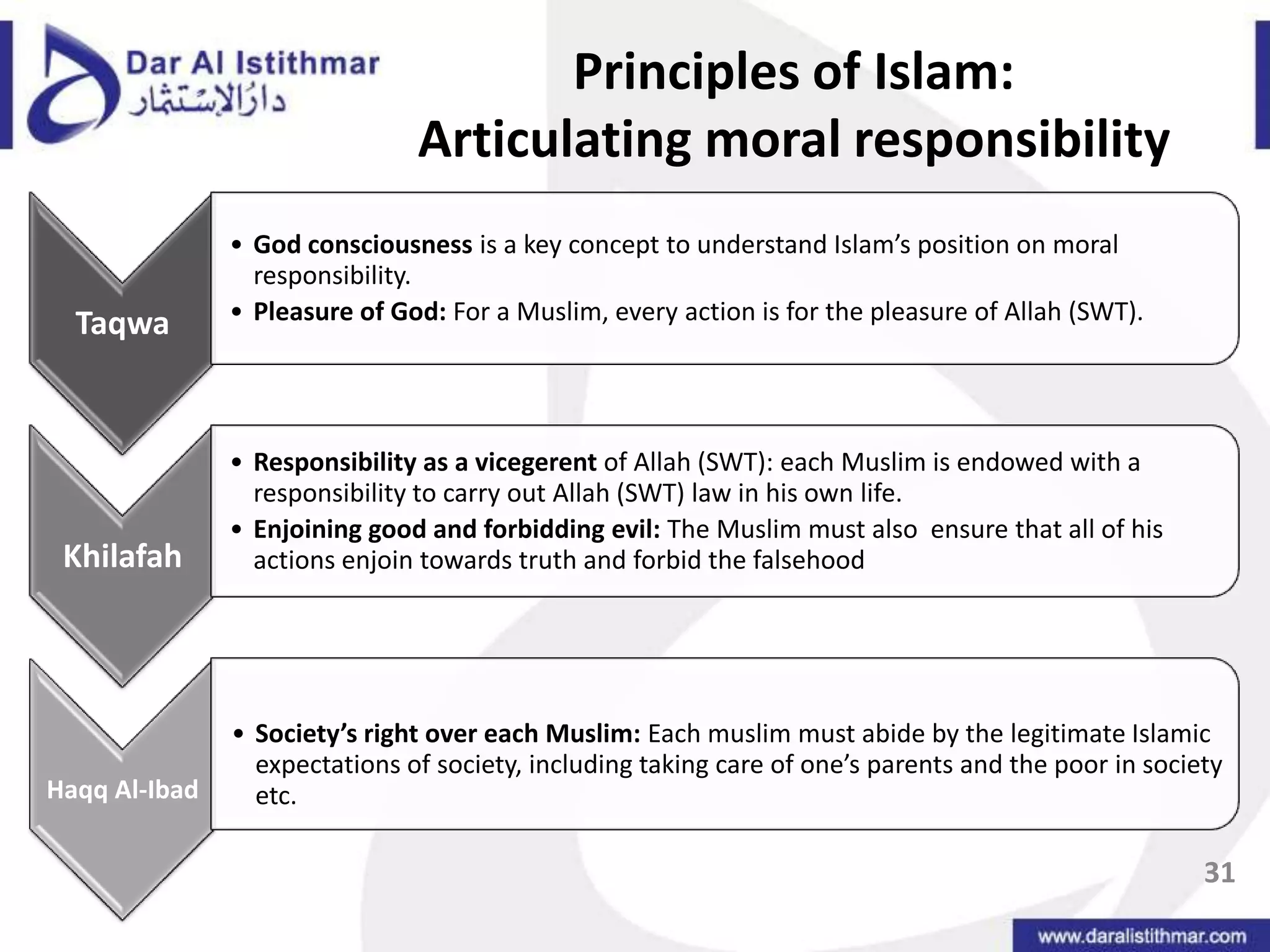
Principles of Islam:Articulating moral responsibility31
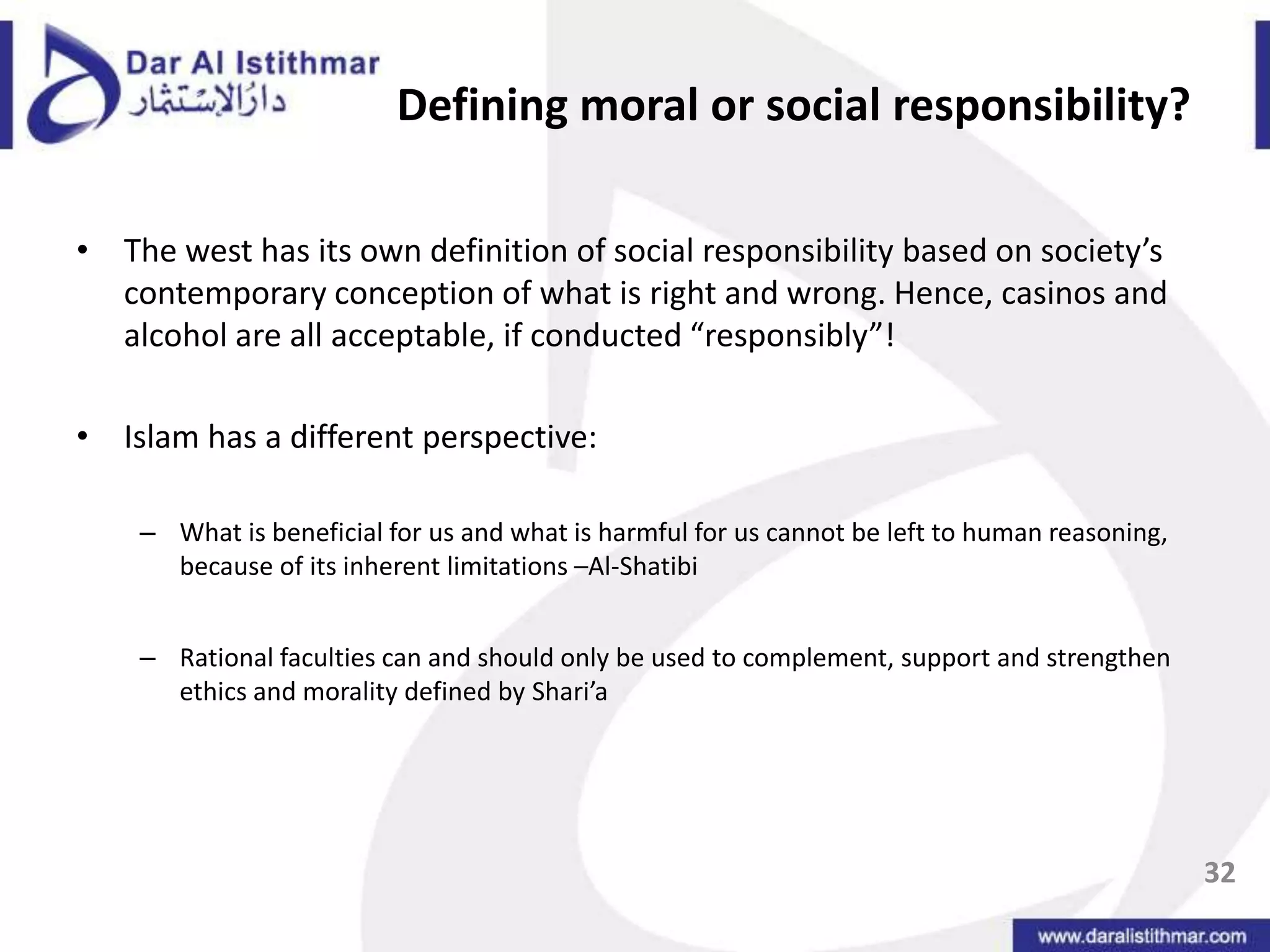
Defining moral or social responsibility?The west has its own definition of social responsibility based on society’s contemporary conception of what is right and wrong. Hence, casinos and alcohol are all acceptable, if conducted “responsibly”!Islam has a different perspective:What is beneficial for us and what is harmful for us cannot be left to human reasoning, because of its inherent limitations –Al-ShatibiRational faculties can and should only be used to complement, support and strengthen ethics and morality defined by Shari’a32
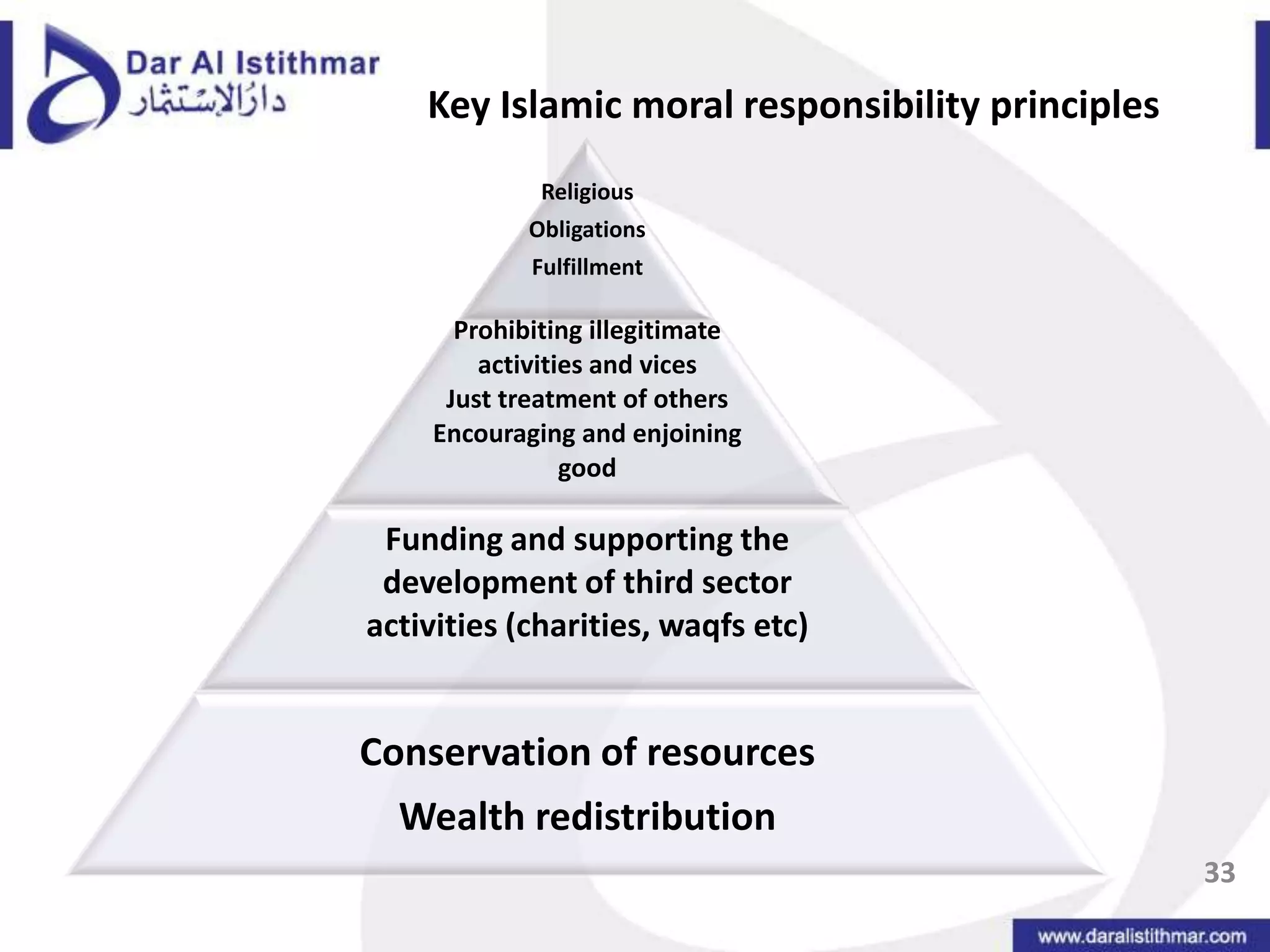
Key Islamic moral responsibility principles33
Ability Based Moral ResponsibilityPublic goods and wealth redistribution ALSO responsibility of individualsIslam recognizes Income disparity and makes it an obligation among those with wealth and power to redistribute it as a test	“He has raised you in ranks, some above others: that He may try you in the gifts He has given you: for your Lord is quick in punishment: yet He is indeed Oft-forgiving, Most Merciful.”  -The Livestock (Surat Al-Anaam) 165	“(Alms are) for the poor who are confined in the way of Allah-- they cannot go about in the land; the ignorant man thinks them to be rich on account of (their) abstaining (from begging); you can recognise them by their mark; they do not beg from men importunately; and whatever good thing you spend, surely Allah knows it.” -The Heifer (Surat Al-Baqarra) 27334
Ability Based Moral ResponsibilityHowever:“On no soul doth Allah Place a burden greater than it can bear….”Baqara (The Heifer) 286The principle of ability is paramount to the extent of moral obligation placed on each individual.35
36Islamic Social Responsibility and Corporate GovernanceThe differentiated strategyThe only real value propositions of Islamic Finance: Shari’ah Compliance (for Shari’ah Loyalists and Floaters)	Social Responsibility (for Floaters and both loyalists) Shari’ah Compliance:complying with the Shari’ah rules associated with each instrument or transaction Social Responsibility: the broader manifestation of Islamic principles of equity and social justice evident in the micro rules of the Shari’ahHow can these be implemented?Islamic Corporate Governance36
Technical ChallengeHow do we incorporate such behaviour into our corporate culture?How do we engender a system and infrastructure that encourages social responsibility in all aspects of the workplace and all aspects of our work? 37
ConclusionGOLDEN OPPORTUNITY The world of finance is looking at us for direction. WAKE UP CALLThis a is wake up call to the industry to identify and differentiate Islamic Finance based on principles of opportunity based moral responsibility.  LOOSE OUR APPEALIf we don’t follow this route, we will loose our appeal tothose who don’t see any value in Shari’a governance or contractual ethics because some of these are already existent in conventional finance. 38
Corporate Social Responsibility and Islamic Finance: The Way ForwardSayd Farook 39
Vision without action is a dream. Action without vision is simply passing the time. Action with Vision is making a positive difference.40
Vision without action is a dream.41
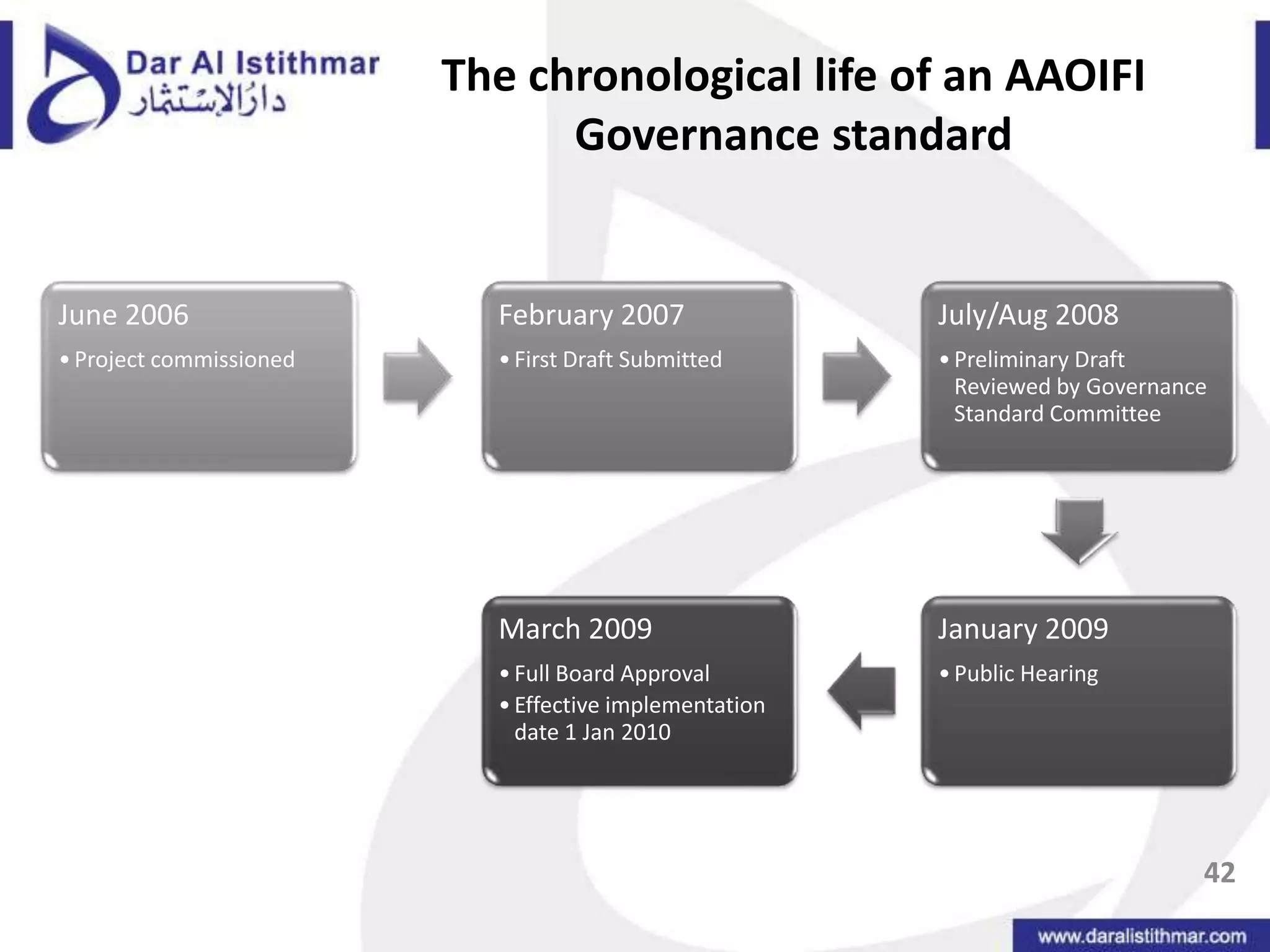
The chronological life of an AAOIFI Governance standard42
CSR and AAOIFI43Series of studies verified that there was a disjoint between the perceived ethical stance of IFIs and the reality of the IFIsMaali, Casson and Napier (2003)Farook and Lanis (2004)Beydoun and Willett (2000)Studies suggested that Islamic banks were attempting to PORTRAY themselves as Islamic  or socially responsible through Islamic art inclined annual report disclosures without necessarily following the substantive content.There is a LACK OF CONCEPTUAL UNDERSTANDING OF WHAT SOCIAL RESPONSIBILITY IS!
Action without vision is simply passing the time. 44
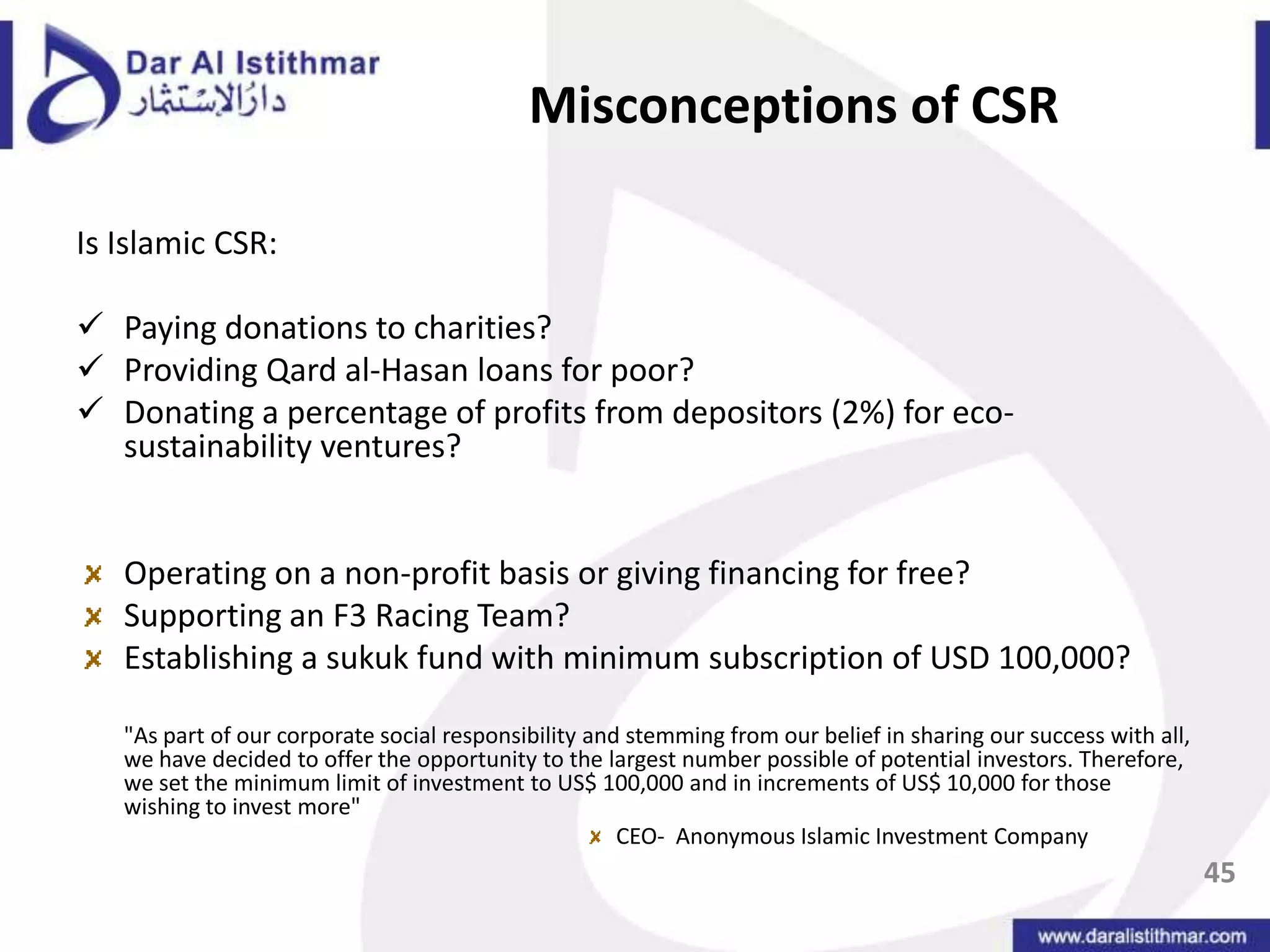
Misconceptions of CSRIs Islamic CSR:Paying donations to charities?
Providing Qard al-Hasan loans for poor?
Donating a percentage of profits from depositors (2%) for eco-sustainability ventures?Operating on a non-profit basis or giving financing for free?Supporting an F3 Racing Team?Establishing a sukuk fund with minimum subscription of USD 100,000?	"As part of our corporate social responsibility and stemming from our belief in sharing our success with all, we have decided to offer the opportunity to the largest number possible of potential investors. Therefore, we set the minimum limit of investment to US$ 100,000 and in increments of US$ 10,000 for those wishing to invest more"CEO-  Anonymous Islamic Investment Company45
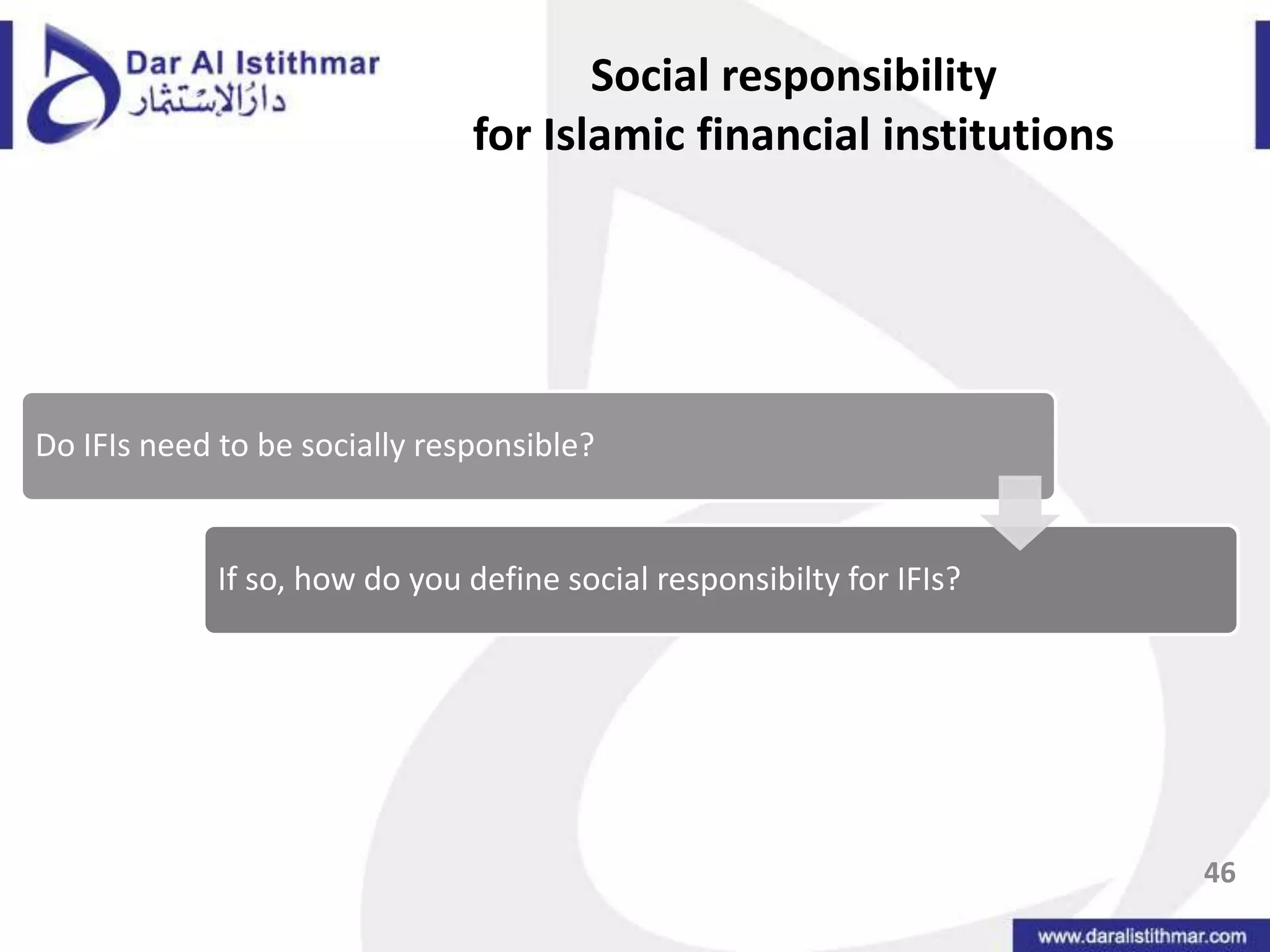
Social responsibility for Islamic financial institutions46
Do IFIs need to be socially responsible?Representing themselves as complying with Shari’a rulesRepresentatives for individuals who: i.	invest their money as shareholders or investment account holders, 	ii. 	have co-operative, partnership or borrowing relations with the IFI, 	iii. 	are employed by the IFI, 	iv. 	have other explicit contractual relations with the IFI, 	v. 	in addition to the above, have a implicit social contract with the IFI  as part 	of the larger community (Ummah). Representative of Muslims, who are accountable to Allah (SWT)In addition, IFIs have a SPECIAL POSITION in society as FINANCIAL INTERMEDIARIES, which carry with it certain responsibilities and obligations.47
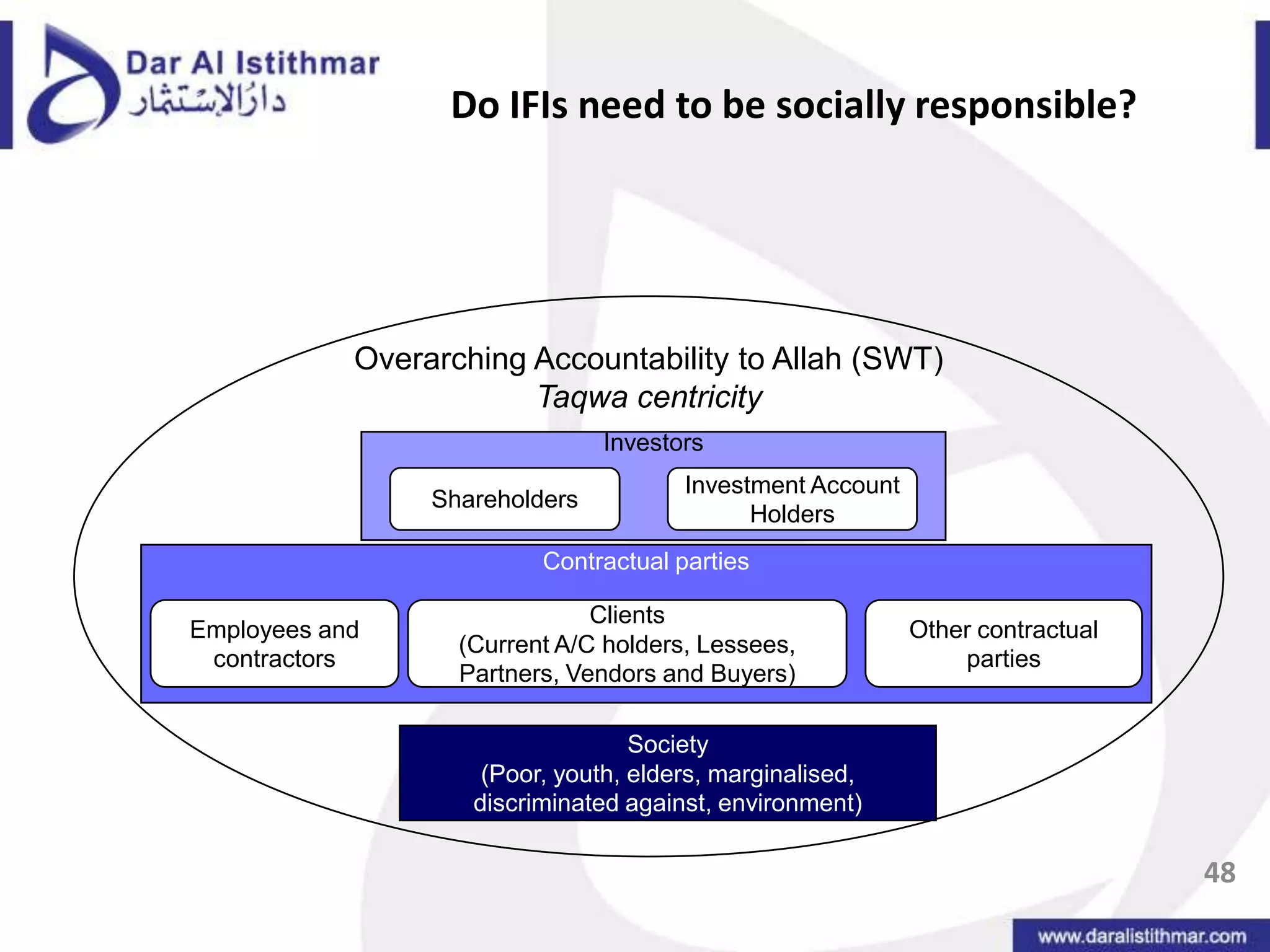
Do IFIs need to be socially responsible?48InvestorsShareholdersInvestment Account HoldersOverarching Accountability to Allah (SWT)Taqwa centricityContractual partiesClients (Current A/C holders, Lessees, Partners, Vendors and Buyers)Employees and contractorsOther contractual partiesSociety(Poor, youth, elders, marginalised, discriminated against, environment)
Technical ChallengeRemember my questions before:How do we incorporate such behaviour into our corporate culture?How do we engender a system that encourages social responsibility in all aspects of the workplace and all aspects of our work?How do we develop an infrastructure in line with such principles? 49
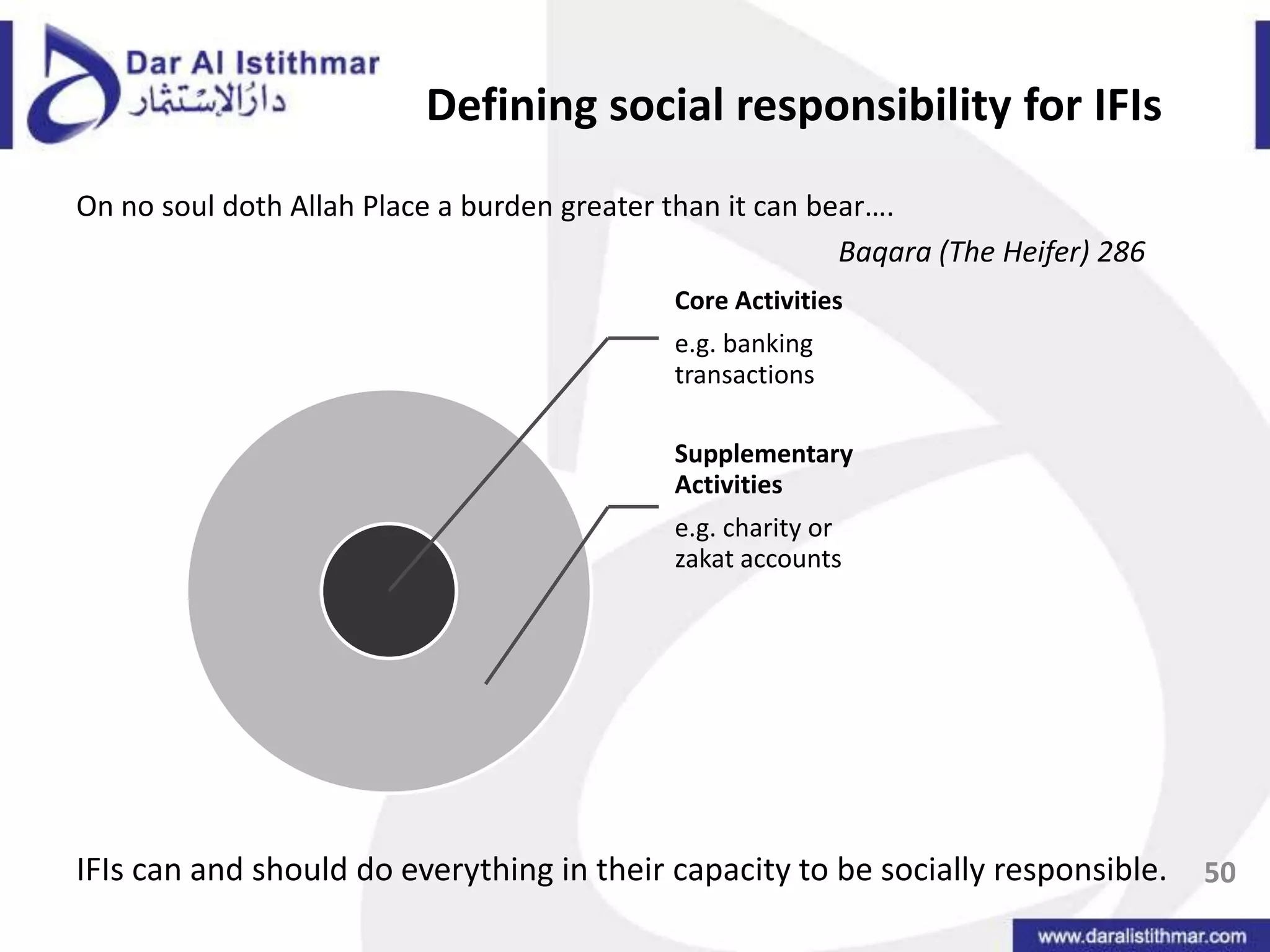
Defining social responsibility for IFIsOn no soul doth Allah Place a burden greater than it can bear….Baqara (The Heifer) 286IFIs can and should do everything in their capacity to be socially responsible. 50
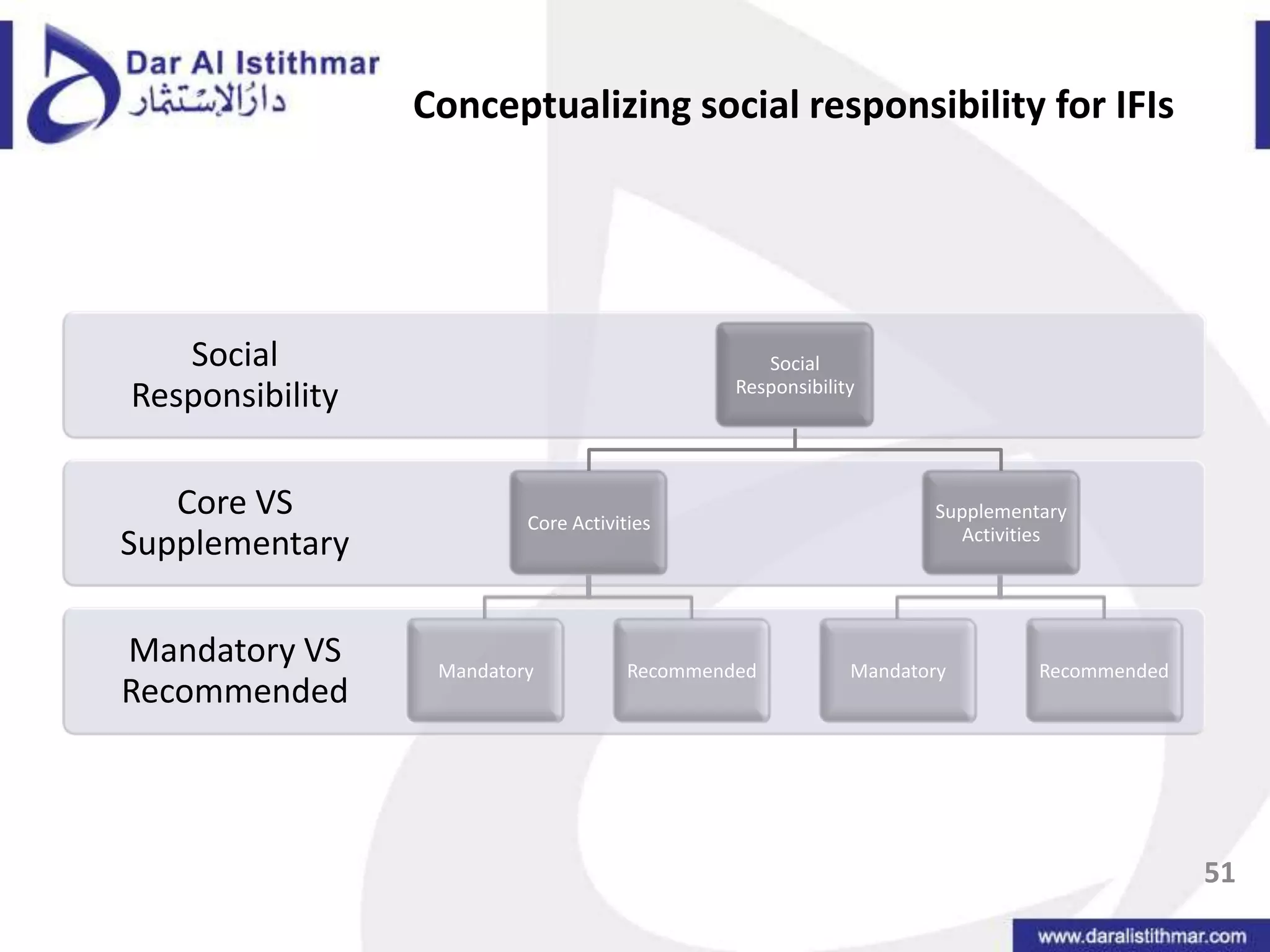
Conceptualizing social responsibility for IFIs51
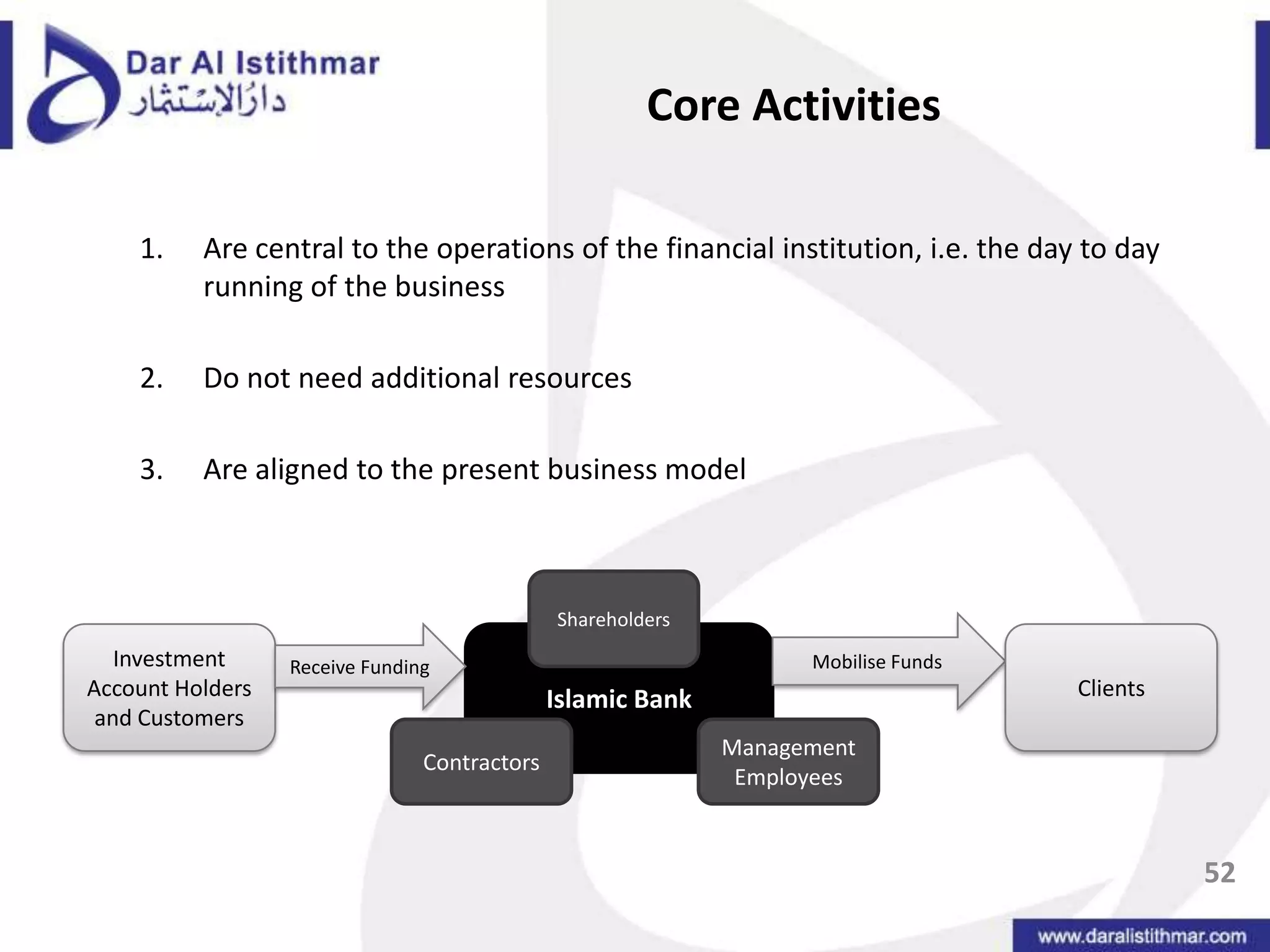
Core ActivitiesAre central to the operations of the financial institution, i.e. the day to day running of the businessDo not need additional resourcesAre aligned to the present business model52ShareholdersMobilise FundsIslamic BankInvestment Account Holders and CustomersReceive FundingClientsManagementEmployeesContractors
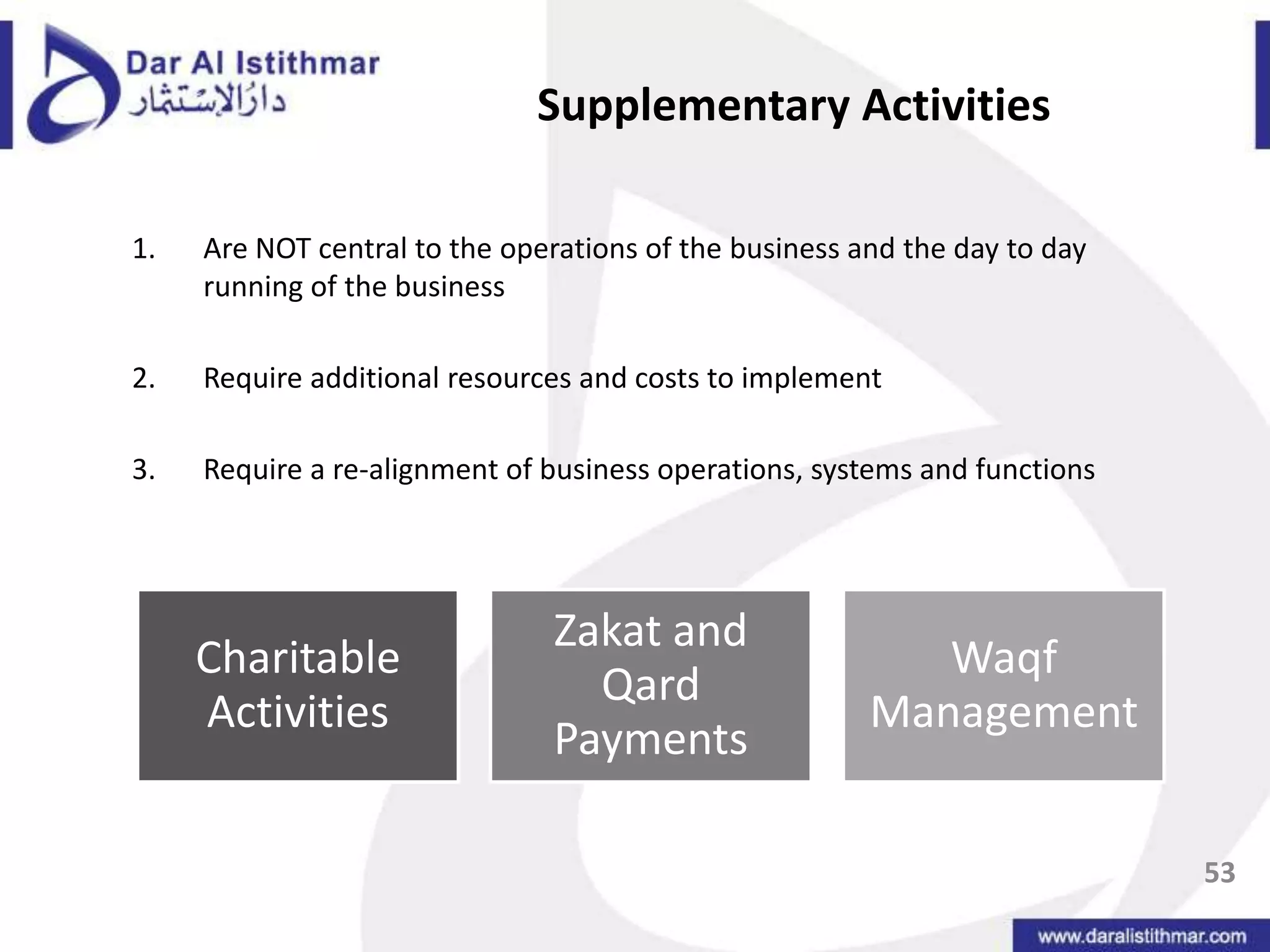
Supplementary ActivitiesAre NOT central to the operations of the business and the day to day running of the businessRequire additional resources and costs to implementRequire a re-alignment of business operations, systems and functions53
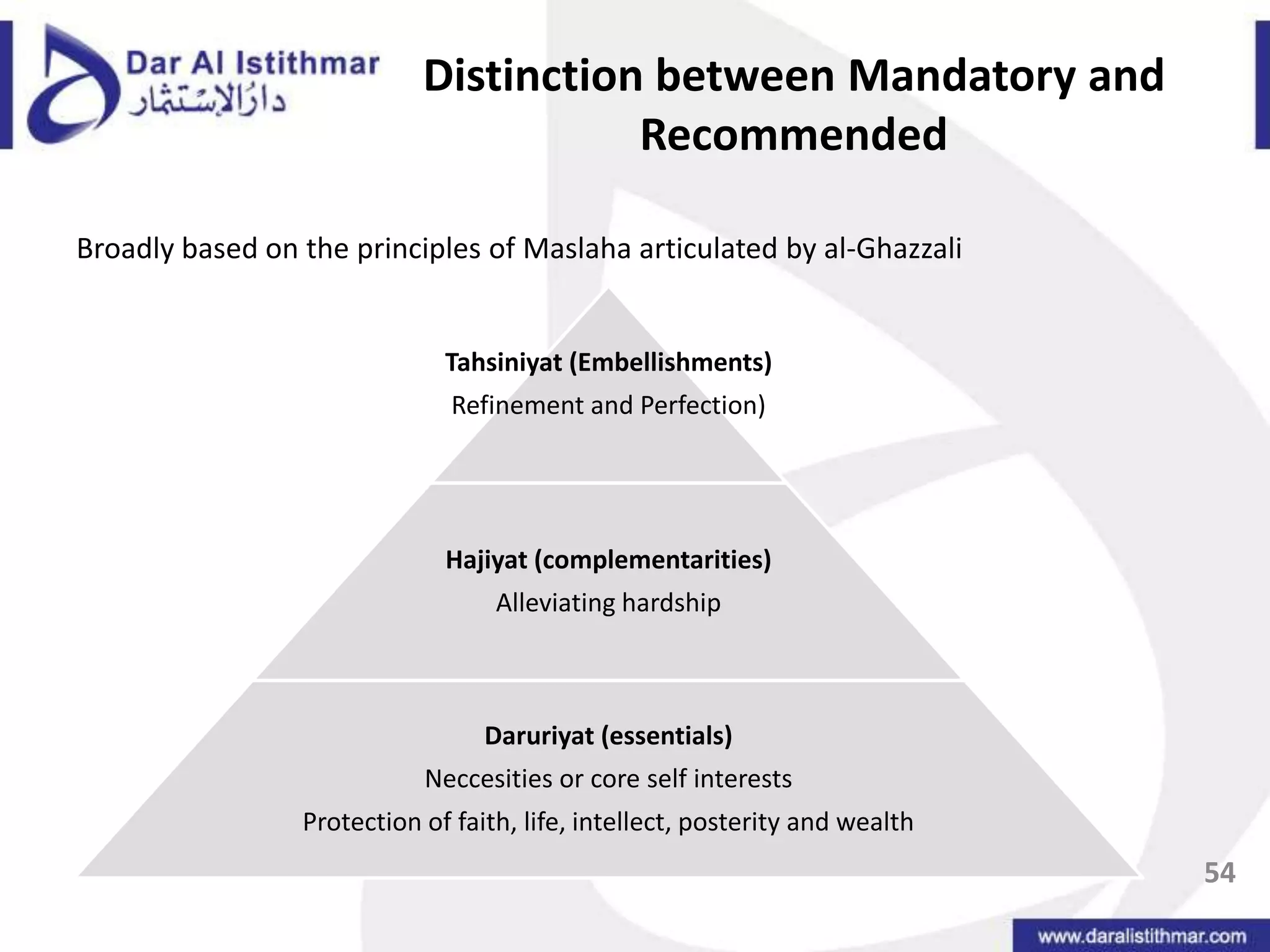
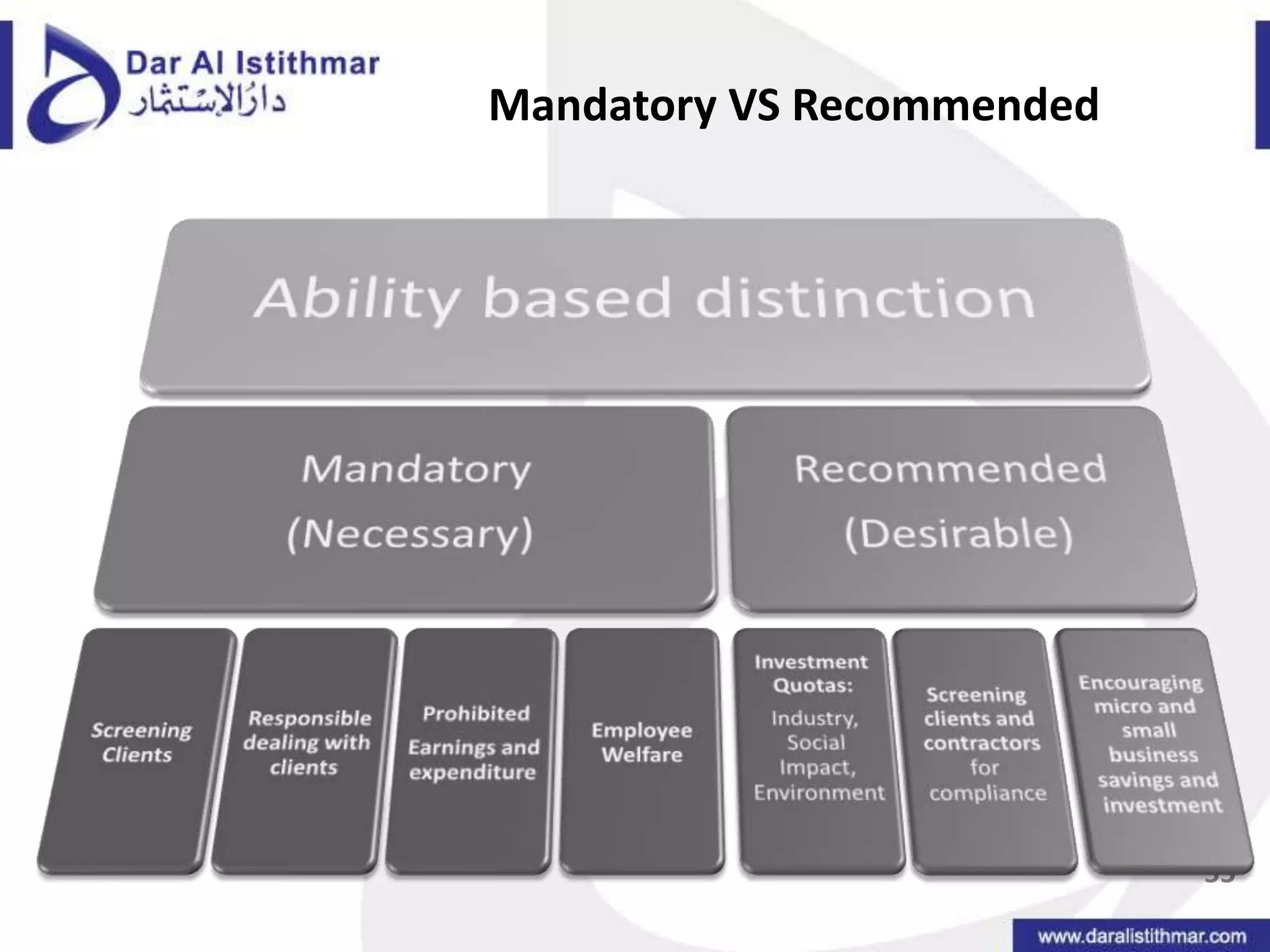
Distinction between Mandatory and RecommendedBroadly based on the principles of Maslaha articulated by al-Ghazzali54
Mandatory VS Recommended55
Action with Vision is making a positive difference.56
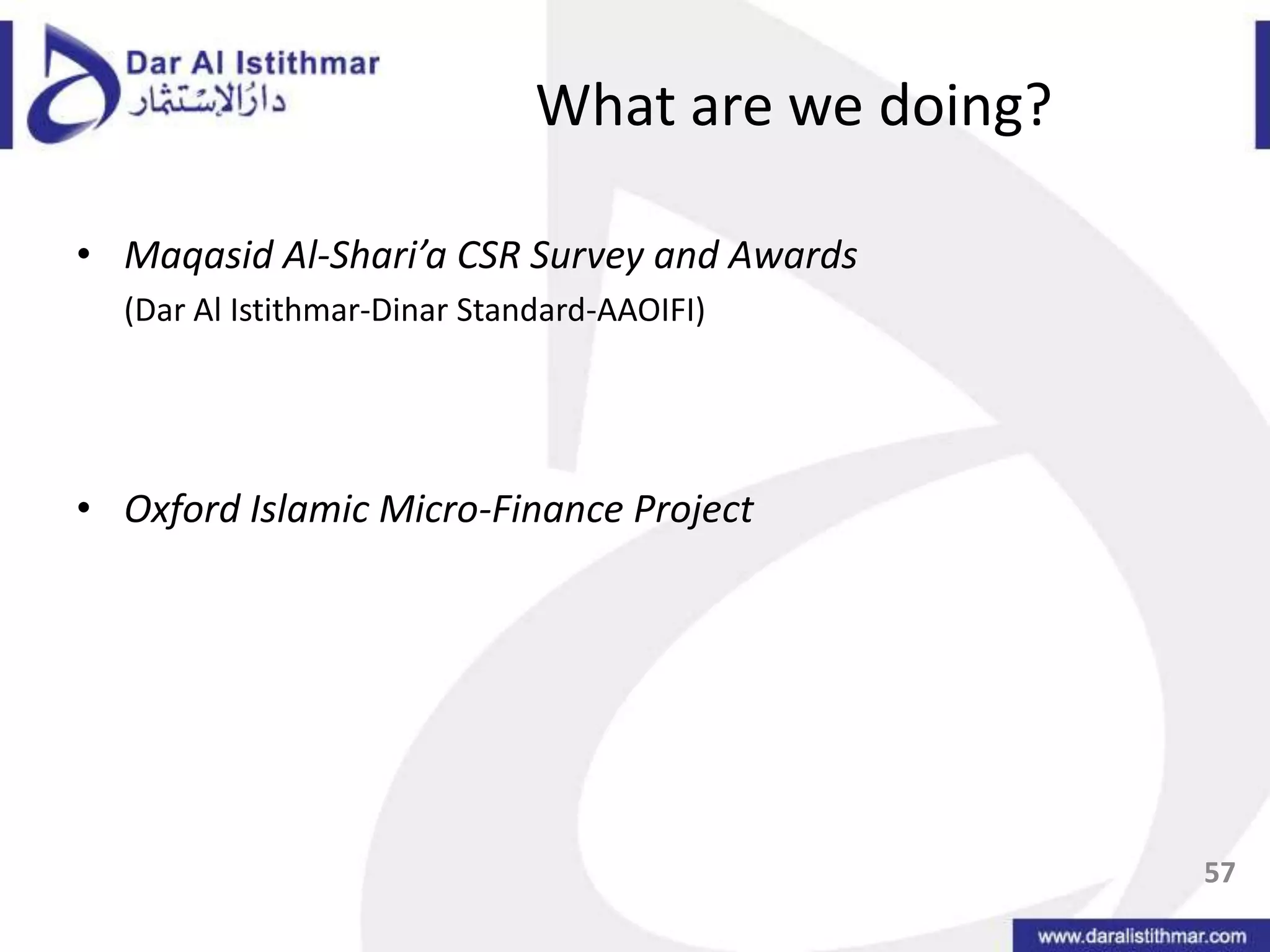
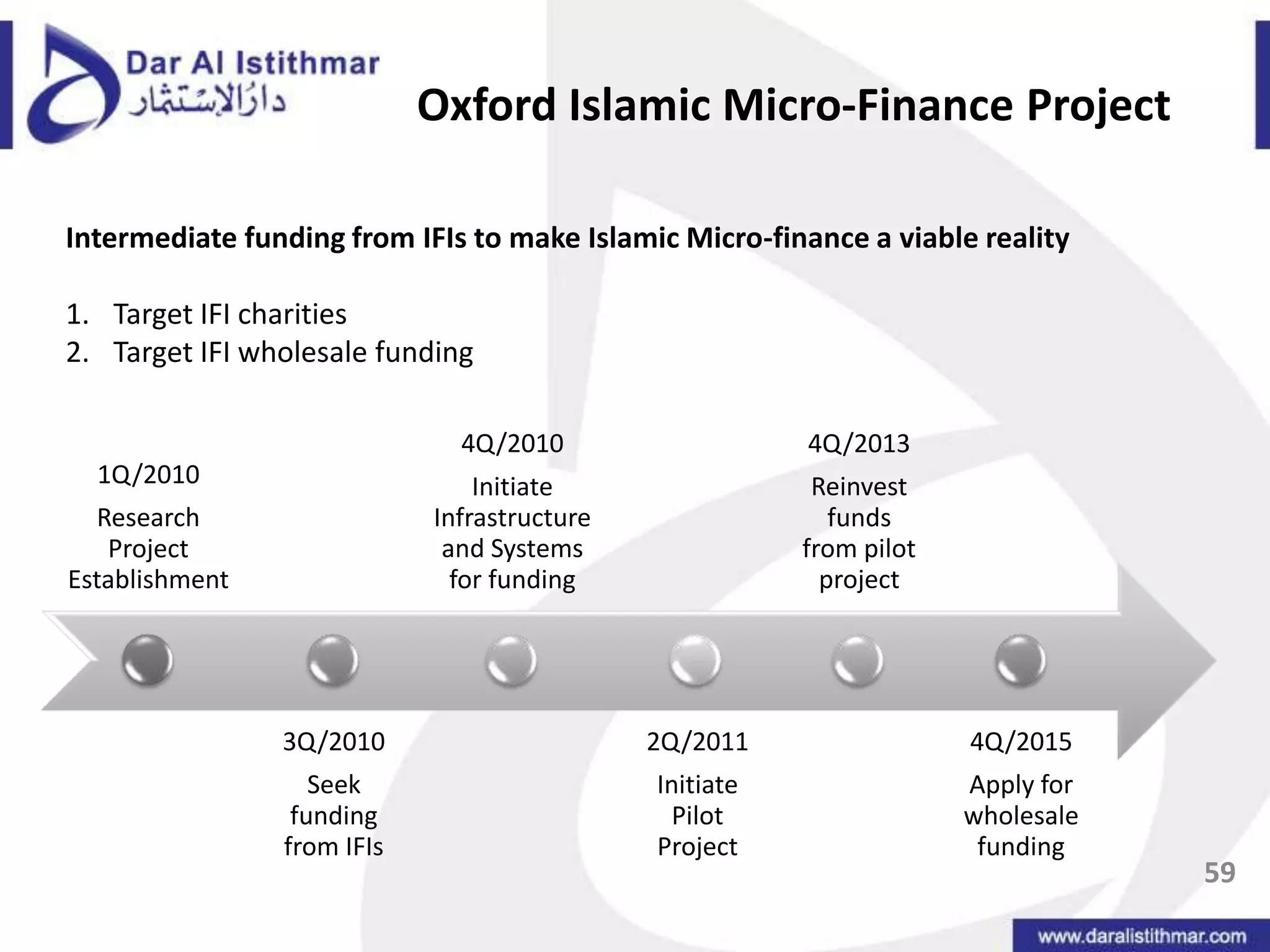
What are we doing?Maqasid Al-Shari’a CSR Survey and Awards	(Dar Al Istithmar-Dinar Standard-AAOIFI) Oxford Islamic Micro-Finance Project57

Is Islamic Finance really the value proposition it claims to be? Assessment and Opportunities

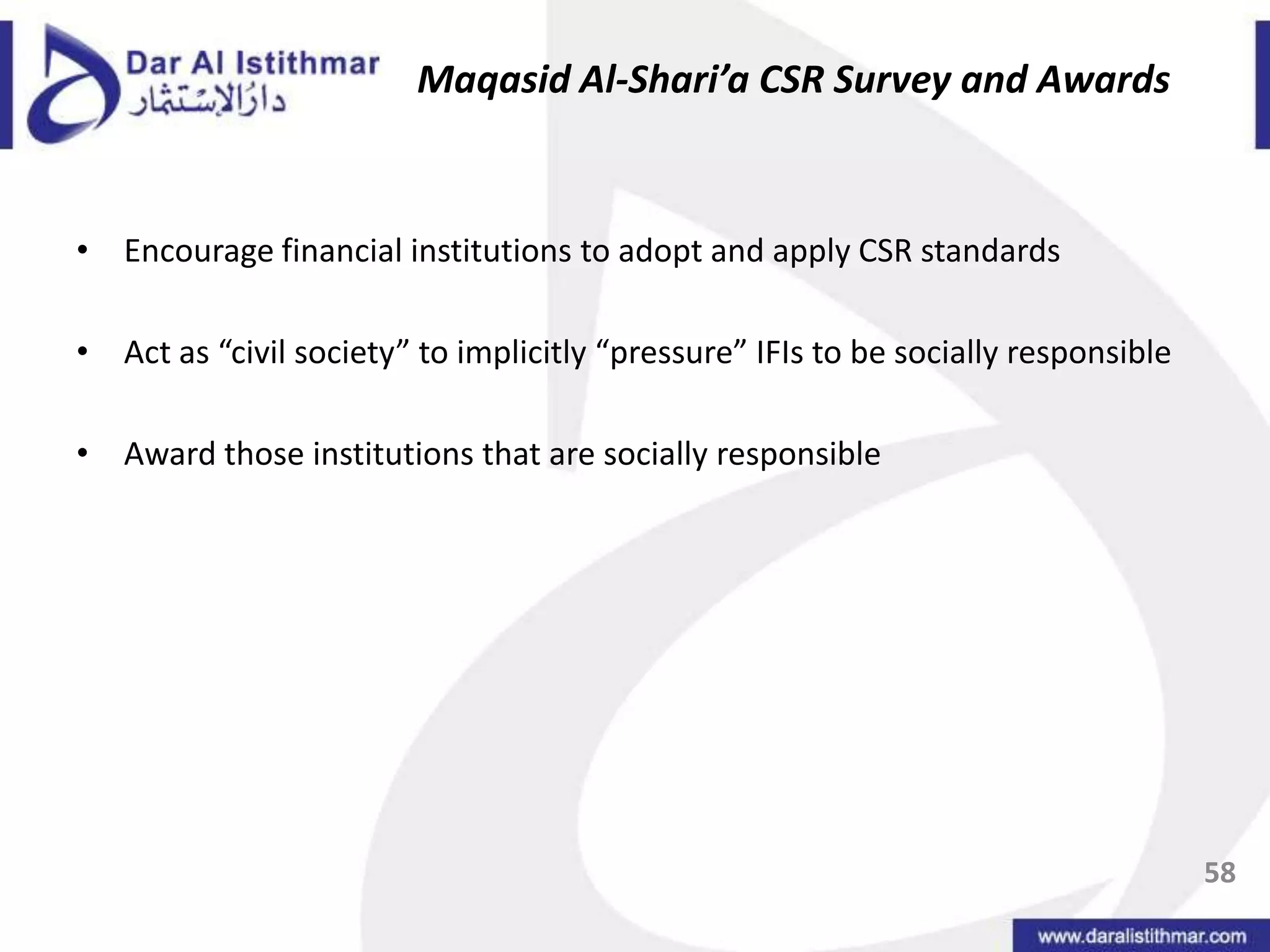
  • 1.
    Is Islamic Financereally the value proposition it claims to be? Assessment and OpportunitiesSayd FarookSenior Consultant, Dar Al IstithmarResearch Advisor, Oxford Islamic FinanceDisclaimer: The views presented herein are the author’s own and do not necessary represent the views of Dar Al-Istithmar or Oxford Islamic Finance1
  • 2.
    About Dar Al-IstithmarOurServices Established in 2004, Dar Al Istithmar is a venture between Russell Wood and Oxford Islamic Finance. Independent from its shareholders Dar Al Istithmar offers:Shari’a StructuresShari'a Consultancy ServicesShari'a Monitoring / Purification ServicesShari’a Compliance Reviews Global Investment Products / Investment BankingAsset and Fund ManagementIslamic Finance Arranging and Advising *Academic and Educational Work Shari’a Supervisory Board   DI’s Shari’a Supervisory Board comprises world renowned scholars Dr. Hussein Hamed Hassan (Chairman)Dr. Mohammed DaudBakarDr. Abu Sattar Abu GhuddahDr. Ali Al Qaradaghi Management Team Asim Khan ACA Executive DirectorSayd Farook Phd FCIPA Senior ConsultantSaud SiddiquiFCCA CIA CISA Senior Consultant  2Euromoney “Best Islamic Assurance and Advisory Services” 2006 Euromoney “Best Islamic Advisory Services” 2007
  • 3.
    Track RecordShari'a StructuresOurwork has involved the use of Murabaha, Mudarabaha, Wakala, Musharaka, Istisna’a, Ijara, Intifah, Salam, Wa’ad structures (to name a few) and these structures have been used in products such as equity funds, hedge funds, private equity funds, real estate development projects, home finance, personal finance, deposit accounts, credit cards, capital markets sukuk.  Real EstateWe acted as the Global Shari'a Advisor for a mega tower project, part of the Al-Haram scheme being developed in the heart of the holy city of Makkah.We have developed real estate investment funds (using vehicles in a number of different jurisdictions) Academic and Educational WorkWe write professional reports and articles on Islamic Finance and Islamic Capital MarketsThrough our affiliation with Oxford Islamic Finance, we produce contemporary research on innovations in Islamic Finance.We give presentations at numerous International Conferences, Seminars and Forums on Islamic FinanceWe have conducted a global educational road show on Shari'a and innovation in Islamic finance Asset and Fund ManagementDesigned an innovative Shari'a-compliant technique for short selling for an Islamic long-short hedge fundShari'a advisor to one of the largest banks in the world for an umbrella structure to set up a number of Islamic funds covering a wide range of asset classesShari'a advisor to a number of Middle East asset managers on regional equity and Sukuk fundsShari'a advisor for an Islamic private equity fund to invest in science, health and technology products  Investment Products / Investment BankingShari'a advisor to one of the largest banks in the world on a new range of Shari'a-compliant derivative products. This is arguably the most sophisticated range of Islamic investment products. We have structured a Shari'a-compliant overdraft facility, housing finance, and deposit accounts for one of the largest retail banks in the United Arab EmiratesShari'a advisor to a major index provider on a new range of Islamic indicesEquity Structured Products3
  • 4.
    "Law is inIslam a process of discovery. Just as the physical scientist believes that the laws of physics exist as an absolute, waiting to be discovered rather than invented, so the Muslim legal scholar believes that the shariah has been created by God and his role is to discover and articulate it rather than invent it” -Imad-ad-Dean Ahmad 4
  • 5.
    Where are wecoming from?2001-2010Structured SukukMega Project Finance Large Commercial BanksIslamic Derivatives1991-2000Hard Asset Private EquityFund Management1975-1990Commercial Banking Trade FinanceSyndicationsIslamic ConglomoratesMarket Exposure: 250mConversions, Islamic Windows & Subsidiaries of Mega Banks, Establishment of Islamic Finance in Non-Muslim statesMuslim populated states getting interested Syria, Libya, CISMarket exposure: 100mConcentrations of Islamic Banks growing in GCC, Malaysia, Pakistan and BangladeshMarket exposure: 20mOne or Two Islamic Bank in each Muslim state Inefficient Command SOEs in Iran and SudanTimeline 1975-201055
  • 6.
    Historical Growth Factors1975-1990ResourceBoomAcademic and scholarly encouragement and experimentsArab Entrepreneurs1991-2000Regulatory Recognition and EncouragementGrowth of tiger economiesEfficient interbank marketsDevelopment of infrastructure2001-2010Resource wealth and surplus liquiditySukukIslamicisation and ReligiosityReal Estate Asset classesFurther infrastructural developments6
  • 7.
    Where are wegoing to? Short to medium term growth 2002-2005 Growth: 44 % YOY (Islamic) compared to 18.2% YOY (conventional)See no signs of interest in Islamic Finance abatingIncreased interest of the western worldGrowth rates of 20-30 percent for the next five to ten yearsIslamic Finance will truly be part of the global banking system7
  • 8.
    Short to mediumterm growth8
  • 9.
    Where are wegoing to?Long Term Growth 2011-2040Sophisticated Private Equity, Mega Islamic Commercial, Full Service Investment BanksMarket exposure: 6000mCompetition with Mega Banks, Concentrations in Muslim states, Conversions in Muslim states, Growth in Non-Muslim states ?Market exposure: 1500-2000mNo further growth beyond core Muslim constituency?Market exposure: 500m-1500mReputation Risk ?Timeline 2011-20409
  • 10.
  • 11.
    Long Term Growth?Stellar?Valueproposition for both Islamic and conventional populaceLimited competition presented by conventional financial institutions11
  • 12.
    Long Term Growth?Steady?Novalue proposition beyond Muslim states and populationsHigh competition between Islamic and conventional megalithsEfficiencies and economies achieved in Islamic transactions12
  • 13.
    Long Term Growth?Negative?Reputationrisk associated with terrorismFailure to achieve economies and efficienciesLoss of confidence of core customers: Shari’a sensitivity13
  • 14.
    14Long Term Growth?Stellar?Valueproposition for both Islamic and conventional populaceLimited competition presented by conventional financial institutionsSteady?No value proposition beyond Muslim states and populationsHigh competition between Islamic and conventional megalithsEfficiencies and economies achieved in IslamicNegative?Reputation risk associated with terrorismFailure to achieve economies and efficienciesLoss of confidence of core customers: Shari’a sensitivity14
  • 15.
    15Market Dynamics ofIslamic RetailSignificant driver of commercial banking and capital market activities when emerging markets become wealthierShariah Loyalists:Becoming price sensitive due to sustained competitionGrowing in mass and wealth ?Floating:Price and feature sensitive Largest population but unconvinced ?High growth in emerging economies ?Conventional: Lured by features/price?Purely price and feature sensitive?ShariahFloatingConventional LoyalistsLoyalists
  • 16.
    1616Continuing stellar growth?Threefactors will determine competitive edge for Islamic Finance:PricingShari’ah ComplianceFeaturesPricingIslamic Banks are still less efficient than conventional banks but will eventually achieve economiesShari’ah ComplianceRemains a major challenge since many floaters are of the opinion that Shari’a compliance is a wider definition than Shari’a arbitrageFeaturesProduct features must differentiate the value proposition to capture the conventional and floaters markets Stellar growth beyond Shari’ah Loyalists can only be achieved if a differentiated strategy is adopted for the industry
  • 17.
    Are we facingan existential threat?On a repeated basis, we are facing attacks from our own ranks:Mahmoud El-Gamal (PhD), Professor, Rice University Omar Farooq (PhD), Professor, Royal University for WomenFehmySaddy (PhD), FS PartnersMudassirSiddiqui Islamic Finance Global Head, Partner, Denton Wilde Sapte(Shari’a Scholar, IDB) NEXT??: Sayd Farook, Oxford Islamic Finance17
  • 18.
    Are we facingan existential threat?Islamic Finance CANNOT be: only about “Shari’a arbitrage”only about meeting the needs of conventional financing or capital marketsconstrained by the traditional nominate contractsall just commodity murabahaYET, ALL OF THIS EXISTS AND CANNOT BE AVOIDED AT THIS STAGE.In reality, the first is a blessing in disguise!18
  • 19.
    So what willkeep Islamic Finance going?GCC Petro liquidity slack isn’t certainly going to last forever.There are essentially three value propositions in Islamic Finance, which we need to capitalise on:Evolution of Islamic Finance as an industry19
  • 20.
    Shari’a Contract GovernanceTheprocess of ensuring that a contract is Shari’a compliantAvoid Main ProhibitionsRibaGhararMaysirAvoid Subsidiary ProhibitionsPermissibility of subject matter (evaluability) consideration and processOwnership and possession of assetsCannot combine two contracts (with exceptions)Cannot defer both counter-value or have bilateral promisesCannot have twin salesCannot have tying contractsThis ensures that:All transactions are asset linked: first degree of separation only allowed i.e. trading of debts and money not allowedMal is generally conservatively defined i.e. financial rights do not give rise to assets.20
  • 21.
    AVOIDANCE OF HARAMTRANSACTIONSAvoidingall forms of unethical activities such as financing casinos, drugs, illicit, immoral or dubious transactionsAVOIDANCE OF QIMARGambling and Chance based (zero-sum) gamesAVOIDANCE OFJAHALAClarity of intentions and transparency is imperative in all dealingsAVOIDANCE OF RIBARisk-free or guaranteed rate of return on loaned money or investmentAVOIDANCE OF GHARARExcessive uncertaintyin contracts – e.g. enteringinto a transaction whoseconsequence is out ofusual trade norms – E.G.:a) Financial derivativesb) Insurance contractsc) Sale of debtsISLAMICCONTRACTUAL GOVERNANCEAVOIDANCE OF EXPLOITATIONrelationship to reflect justice and fairness.
  • 22.
    Contractual EthicsEven inits core rules, Islam is propagating ethics in contracts.The prohibition of riba, gharar and maysiris there to avoid the unjust exploitation/enrichment of one party over another.But beyond this, Islam ALSO has a position on all aspects of contractual fairness, including representations, disclosures, insider trading, 22
  • 23.
    Contractual EthicsFairness andjust treatment of other people’s property‘God does command you to render back your trusts to whom they are due…’ -Women (Surat An-Nisa) 58Fair trade practices‘And, O my people! Give full measure and weight fairly, and defraud not men their things, and do not act corruptly in the land, making mischief: What remains with Allah is better for you if you are believers, and I am not a keeper over you’ -Hud (SuratHud 85,86) “On the day of Judgment, the Honest Muslim merchant will stand side by side with the Martyrs” -Saying of the Prophet Muhammad (SAW)Full disclosure“When a person sells a defective thing, and he does not describe that fault to the buyer, the angel of Allah will always curse him.” -Saying of the Prophet Muhammad (SAW)Misrepresentation/Deceptive trade practices‘He who cheats is not one of us’ -Saying of the Prophet Muhammad (SAW)Anti-Trust Insider Trading“…don’t outbid one another in order to raise the price…don’t enter into a transaction when others have already into that transaction and be as brothers one to another.”-Saying of the Prophet Muhammad (SAW)Speculative activities‘Verily, the prophet prohibits the trading of gharar(uncertainty)’ -Narrated by a companion of the Prophet Muhammad (SAW)23
  • 24.
    Are we facingan existential threat?In short, NO, we are not!On balance of activities, we are still safe. 24
  • 25.
    Ability based moralresponsibility?Isn’t Zakat fulfilling moral responsibility?Zakat is only ordained for seven types of charitable purposesZakat is essentially the minimum safety net for the bare essentials. 25
  • 26.
    Ability based moralresponsibility?Isn’t Zakat fulfilling moral responsibility?26
  • 27.
    Ability based moralresponsibility?Are we talking about social business?27
  • 28.
    Ability based moralresponsibility?Are we talking about social business?ISLAMIC FINANCE CANNOT BE JUST A SOCIAL BUSINESS…No restriction on wealth accumulationDoes not require donation of all wealthBusinesses can have profit maximisation objectives(Shari’a compliant activities)28
  • 29.
    Ability based moralresponsibility?Are we talking about social business?YET ISLAMIC HAS A DEFINITE PLACE FOR SOCIAL BUSINESS… Businesses may have objectives other than to create profit for shareholders
  • 30.
    Also incorporate suchobjectives into ther business activities
  • 31.
    Set aside partof profits for charitable distribution Prof. Yunus sees social business and normal businesses co-existing, Islamic business integrates social values into a business model.29
  • 32.
    Ability Based MoralResponsibility?Did any form of responsibility exist prior to modern conceptions of CSR?Ex-post facto, does CSR have any legitimacy in Islam?Most importantly, does this form of social responsibility have any roots in Islamic principles?30
  • 33.
    Principles of Islam:Articulatingmoral responsibility31
  • 34.
    Defining moral orsocial responsibility?The west has its own definition of social responsibility based on society’s contemporary conception of what is right and wrong. Hence, casinos and alcohol are all acceptable, if conducted “responsibly”!Islam has a different perspective:What is beneficial for us and what is harmful for us cannot be left to human reasoning, because of its inherent limitations –Al-ShatibiRational faculties can and should only be used to complement, support and strengthen ethics and morality defined by Shari’a32
  • 35.
    Key Islamic moralresponsibility principles33
  • 36.
    Ability Based MoralResponsibilityPublic goods and wealth redistribution ALSO responsibility of individualsIslam recognizes Income disparity and makes it an obligation among those with wealth and power to redistribute it as a test “He has raised you in ranks, some above others: that He may try you in the gifts He has given you: for your Lord is quick in punishment: yet He is indeed Oft-forgiving, Most Merciful.” -The Livestock (Surat Al-Anaam) 165 “(Alms are) for the poor who are confined in the way of Allah-- they cannot go about in the land; the ignorant man thinks them to be rich on account of (their) abstaining (from begging); you can recognise them by their mark; they do not beg from men importunately; and whatever good thing you spend, surely Allah knows it.” -The Heifer (Surat Al-Baqarra) 27334
  • 37.
    Ability Based MoralResponsibilityHowever:“On no soul doth Allah Place a burden greater than it can bear….”Baqara (The Heifer) 286The principle of ability is paramount to the extent of moral obligation placed on each individual.35
  • 38.
    36Islamic Social Responsibilityand Corporate GovernanceThe differentiated strategyThe only real value propositions of Islamic Finance: Shari’ah Compliance (for Shari’ah Loyalists and Floaters) Social Responsibility (for Floaters and both loyalists) Shari’ah Compliance:complying with the Shari’ah rules associated with each instrument or transaction Social Responsibility: the broader manifestation of Islamic principles of equity and social justice evident in the micro rules of the Shari’ahHow can these be implemented?Islamic Corporate Governance36
  • 39.
    Technical ChallengeHow dowe incorporate such behaviour into our corporate culture?How do we engender a system and infrastructure that encourages social responsibility in all aspects of the workplace and all aspects of our work? 37
  • 40.
    ConclusionGOLDEN OPPORTUNITY Theworld of finance is looking at us for direction. WAKE UP CALLThis a is wake up call to the industry to identify and differentiate Islamic Finance based on principles of opportunity based moral responsibility. LOOSE OUR APPEALIf we don’t follow this route, we will loose our appeal tothose who don’t see any value in Shari’a governance or contractual ethics because some of these are already existent in conventional finance. 38
  • 41.
    Corporate Social Responsibilityand Islamic Finance: The Way ForwardSayd Farook 39
  • 42.
    Vision without actionis a dream. Action without vision is simply passing the time. Action with Vision is making a positive difference.40
  • 43.
  • 44.
    The chronological lifeof an AAOIFI Governance standard42
  • 45.
    CSR and AAOIFI43Seriesof studies verified that there was a disjoint between the perceived ethical stance of IFIs and the reality of the IFIsMaali, Casson and Napier (2003)Farook and Lanis (2004)Beydoun and Willett (2000)Studies suggested that Islamic banks were attempting to PORTRAY themselves as Islamic or socially responsible through Islamic art inclined annual report disclosures without necessarily following the substantive content.There is a LACK OF CONCEPTUAL UNDERSTANDING OF WHAT SOCIAL RESPONSIBILITY IS!
  • 46.
    Action without visionis simply passing the time. 44
  • 47.
    Misconceptions of CSRIsIslamic CSR:Paying donations to charities?
  • 48.
  • 49.
    Donating a percentageof profits from depositors (2%) for eco-sustainability ventures?Operating on a non-profit basis or giving financing for free?Supporting an F3 Racing Team?Establishing a sukuk fund with minimum subscription of USD 100,000? "As part of our corporate social responsibility and stemming from our belief in sharing our success with all, we have decided to offer the opportunity to the largest number possible of potential investors. Therefore, we set the minimum limit of investment to US$ 100,000 and in increments of US$ 10,000 for those wishing to invest more"CEO- Anonymous Islamic Investment Company45
  • 50.
    Social responsibility forIslamic financial institutions46
  • 51.
    Do IFIs needto be socially responsible?Representing themselves as complying with Shari’a rulesRepresentatives for individuals who: i. invest their money as shareholders or investment account holders, ii. have co-operative, partnership or borrowing relations with the IFI, iii. are employed by the IFI, iv. have other explicit contractual relations with the IFI, v. in addition to the above, have a implicit social contract with the IFI as part of the larger community (Ummah). Representative of Muslims, who are accountable to Allah (SWT)In addition, IFIs have a SPECIAL POSITION in society as FINANCIAL INTERMEDIARIES, which carry with it certain responsibilities and obligations.47
  • 52.
    Do IFIs needto be socially responsible?48InvestorsShareholdersInvestment Account HoldersOverarching Accountability to Allah (SWT)Taqwa centricityContractual partiesClients (Current A/C holders, Lessees, Partners, Vendors and Buyers)Employees and contractorsOther contractual partiesSociety(Poor, youth, elders, marginalised, discriminated against, environment)
  • 53.
    Technical ChallengeRemember myquestions before:How do we incorporate such behaviour into our corporate culture?How do we engender a system that encourages social responsibility in all aspects of the workplace and all aspects of our work?How do we develop an infrastructure in line with such principles? 49
  • 54.
    Defining social responsibilityfor IFIsOn no soul doth Allah Place a burden greater than it can bear….Baqara (The Heifer) 286IFIs can and should do everything in their capacity to be socially responsible. 50
  • 55.
  • 56.
    Core ActivitiesAre centralto the operations of the financial institution, i.e. the day to day running of the businessDo not need additional resourcesAre aligned to the present business model52ShareholdersMobilise FundsIslamic BankInvestment Account Holders and CustomersReceive FundingClientsManagementEmployeesContractors
  • 57.
    Supplementary ActivitiesAre NOTcentral to the operations of the business and the day to day running of the businessRequire additional resources and costs to implementRequire a re-alignment of business operations, systems and functions53
  • 58.
    Distinction between Mandatoryand RecommendedBroadly based on the principles of Maslaha articulated by al-Ghazzali54
  • 59.
  • 60.
    Action with Visionis making a positive difference.56
  • 61.
    What are wedoing?Maqasid Al-Shari’a CSR Survey and Awards (Dar Al Istithmar-Dinar Standard-AAOIFI) Oxford Islamic Micro-Finance Project57
  • 62.
    Maqasid Al-Shari’a CSRSurvey and AwardsEncourage financial institutions to adopt and apply CSR standardsAct as “civil society” to implicitly “pressure” IFIs to be socially responsibleAward those institutions that are socially responsible58
  • 63.
    Oxford Islamic Micro-FinanceProject59Intermediate funding from IFIs to make Islamic Micro-finance a viable realityTarget IFI charitiesTarget IFI wholesale funding
  • 64.
    ConclusionWhen we havedone what we can, God will do what we can’t.60
  • 65.
    ContactDar Al IstithmarHeadOffice: 3 George Street, Oxford, OX1 2AT, United Kingdom T: +44-1865288545 F: +44-1865244762 W: www.daralistithmar.com E:di.admin@oxif.co.uk61