Idaho
Black
Bear
Rehab, Inc.
Idaho Black Bear Rehab, Inc.
6097 Arney Lane
Garden City, Idaho 83714, USA
www.bearrehab.org
Mission
To give all orphaned cubs a second chance at a life of
freedom in the wild by:
• Rescuing, rehabilitating and releasing orphaned
cubs whenever possible.
• Instituting bear rehabilitation programs and training
rehabilitators in states where the option currently
does not exist.
• Working with state wildlife agencies to establish
black bear rehabilitation as a standard part of their
wildlife management policies.
• Educating the public about black bear rehabilitation
and our shared responsibility to protect wild bears
and their habitat.
Ethical and science-based protocols concerning injured
and orphaned black bear need to be incorporated into
state or province regulations and management plans for
wildlife. Wildlife agencies should integrate the fluid
nature and adaptive needs of bear cub rehabilitation
when drafting policies and procedures meant to
regulate bear cub rehabilitation. Most important, black
bear rehabilitators should be a part of, and major
contributor to, black bear management policies as they
affect black bear rehabilitation.
The Future
The Organization
Idaho Black Bear Rehab, Inc. (IBBR) is a not-for-profit
501(c)(3) organization dedicated to saving orphaned
and injured bear cubs by utilizing proven scientific
methods for successful rehabilitation and release back
into the wild.
IBBR provides high standards of cub care, veterinary
treatment, and data monitored follow-up after release.
IBBR does not rehabilitate bears to be placed in zoos,
sanctuaries, or
research facilities.
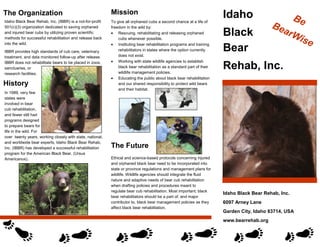
In 1989, very few
states were
involved in bear
cub rehabilitation,
and fewer still had
programs designed
to prepare bears for
life in the wild. For
over twenty years, working closely with state, national,
and worldwide bear experts, Idaho Black Bear Rehab,
Inc. (IBBR) has developed a successful rehabilitation
program for the American Black Bear. (Ursus
Americanus).
History
BeBearWise
Be BearWise
Hiking
• Hike in groups of 4-5 people in areas where
bears live.
• Make sure when hiking to make a lot of noise to
alert bears. Consider using an air horn.
• NEVER run away from a bear.
• Carry bear spray at all times
while hiking or camping.
Camping
• Use a portable electric fence when camping in
remote areas.
• Look around first. Camp well away from natural
bear food sources - berry bushes, waterways,
and carcasses.
• Use bear-proof containers to store food or hang
high between trees.
• Store garbage so it’s inaccessible to bears.
• Dispose of food in bear-proof containers.
What is BearWise?
As IBBR continues to affect positive change in the lives
of individual bears and world-wide bear populations,
we’re excited to announce the development of
additional programs that will help to educate the public
about bear rehab and the wild environment of bears.
As a part of those efforts,
we’re introducing our
Be BearWise initiative in
communities and parks
around the state of Idaho.
We hope that our efforts
will make a lasting and
positive impact on wild
bear populations and on
the people who live and recreate in black bear habitat.
Why do BearWise habits
matter?
Orphan cubs come to IBBR for a variety of reasons…
all too often, cubs are orphaned because their mother
is killed because of perceived nuisance behavior…
some are found injured and separated from their
mother for reasons unknown…some cubs have had
their mothers killed in motor vehicle accidents… Many
of the situations that result in orphan cubs, property
damage, and personal injury, can be avoided by
educating the public, and offering tips and solutions on
how to co-exist peacefully with bears in their wild
environment. IBBR is committed to sharing information
with the public, and wildlife agencies - information that
can offer potential solutions to problems that lead to
injury, illness, and orphan-states of bear cubs.
We are working to build compassion, protection, and
ownership for the welfare of bears and their
environment by developing and sharing successful
methods and practices for living, working, and
recreating in bear habitat.
A
At Home
• Cut back or remove brush around your home,
walkways, or play areas.
• Feed your pets inside and store pet food inside
including dog bones.
• Birdfeeders do attract bears,
only use them when bears
are hibernating during winter.
• Keep your lawn mowed and
weeded. Grasses, dandelions,
clovers are natural food sources for bears.
Bear Manners
• Respect all wildlife by keeping your distance.
• Remain calm when you see a bear. Keep your
head and trust your instincts.
• Never feed bears or attract them in any way.
Bears are very curious creatures.
• Give bears plenty of space and a safe pathway
to escape. NEVER corner or crowd a bear.
X

Be BearWise Brochure

  • 1.
    Idaho Black Bear Rehab, Inc. Idaho BlackBear Rehab, Inc. 6097 Arney Lane Garden City, Idaho 83714, USA www.bearrehab.org Mission To give all orphaned cubs a second chance at a life of freedom in the wild by: • Rescuing, rehabilitating and releasing orphaned cubs whenever possible. • Instituting bear rehabilitation programs and training rehabilitators in states where the option currently does not exist. • Working with state wildlife agencies to establish black bear rehabilitation as a standard part of their wildlife management policies. • Educating the public about black bear rehabilitation and our shared responsibility to protect wild bears and their habitat. Ethical and science-based protocols concerning injured and orphaned black bear need to be incorporated into state or province regulations and management plans for wildlife. Wildlife agencies should integrate the fluid nature and adaptive needs of bear cub rehabilitation when drafting policies and procedures meant to regulate bear cub rehabilitation. Most important, black bear rehabilitators should be a part of, and major contributor to, black bear management policies as they affect black bear rehabilitation. The Future The Organization Idaho Black Bear Rehab, Inc. (IBBR) is a not-for-profit 501(c)(3) organization dedicated to saving orphaned and injured bear cubs by utilizing proven scientific methods for successful rehabilitation and release back into the wild. IBBR provides high standards of cub care, veterinary treatment, and data monitored follow-up after release. IBBR does not rehabilitate bears to be placed in zoos, sanctuaries, or research facilities. In 1989, very few states were involved in bear cub rehabilitation, and fewer still had programs designed to prepare bears for life in the wild. For over twenty years, working closely with state, national, and worldwide bear experts, Idaho Black Bear Rehab, Inc. (IBBR) has developed a successful rehabilitation program for the American Black Bear. (Ursus Americanus). History BeBearWise
  • 2.
    Be BearWise Hiking • Hikein groups of 4-5 people in areas where bears live. • Make sure when hiking to make a lot of noise to alert bears. Consider using an air horn. • NEVER run away from a bear. • Carry bear spray at all times while hiking or camping. Camping • Use a portable electric fence when camping in remote areas. • Look around first. Camp well away from natural bear food sources - berry bushes, waterways, and carcasses. • Use bear-proof containers to store food or hang high between trees. • Store garbage so it’s inaccessible to bears. • Dispose of food in bear-proof containers. What is BearWise? As IBBR continues to affect positive change in the lives of individual bears and world-wide bear populations, we’re excited to announce the development of additional programs that will help to educate the public about bear rehab and the wild environment of bears. As a part of those efforts, we’re introducing our Be BearWise initiative in communities and parks around the state of Idaho. We hope that our efforts will make a lasting and positive impact on wild bear populations and on the people who live and recreate in black bear habitat. Why do BearWise habits matter? Orphan cubs come to IBBR for a variety of reasons… all too often, cubs are orphaned because their mother is killed because of perceived nuisance behavior… some are found injured and separated from their mother for reasons unknown…some cubs have had their mothers killed in motor vehicle accidents… Many of the situations that result in orphan cubs, property damage, and personal injury, can be avoided by educating the public, and offering tips and solutions on how to co-exist peacefully with bears in their wild environment. IBBR is committed to sharing information with the public, and wildlife agencies - information that can offer potential solutions to problems that lead to injury, illness, and orphan-states of bear cubs. We are working to build compassion, protection, and ownership for the welfare of bears and their environment by developing and sharing successful methods and practices for living, working, and recreating in bear habitat. A At Home • Cut back or remove brush around your home, walkways, or play areas. • Feed your pets inside and store pet food inside including dog bones. • Birdfeeders do attract bears, only use them when bears are hibernating during winter. • Keep your lawn mowed and weeded. Grasses, dandelions, clovers are natural food sources for bears. Bear Manners • Respect all wildlife by keeping your distance. • Remain calm when you see a bear. Keep your head and trust your instincts. • Never feed bears or attract them in any way. Bears are very curious creatures. • Give bears plenty of space and a safe pathway to escape. NEVER corner or crowd a bear. X