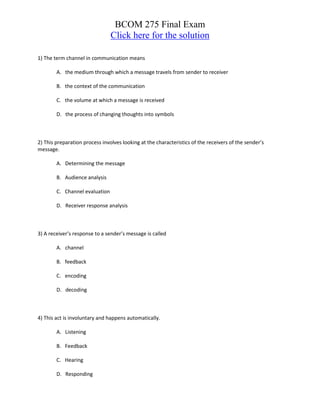
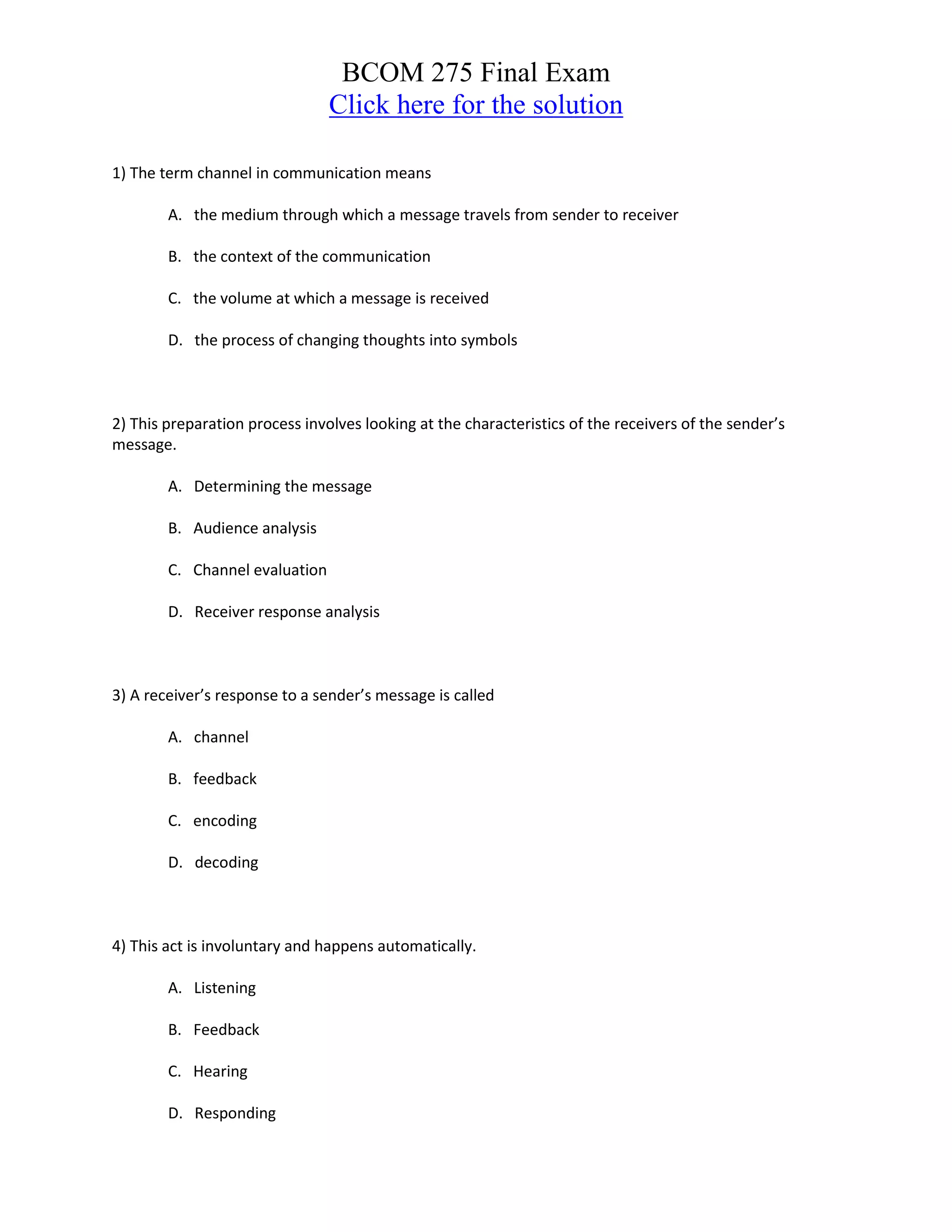
BCOM 275 Final Exam
                                Click here for the solution

1) The term channel in communication means

        A. the medium through which a message travels from sender to receiver

        B. the context of the communication

        C. the volume at which a message is received

        D. the process of changing thoughts into symbols


2) This preparation process involves looking at the characteristics of the receivers of the sender’s
message.

        A. Determining the message

        B. Audience analysis

        C. Channel evaluation

        D. Receiver response analysis


3) A receiver’s response to a sender’s message is called

        A. channel

        B. feedback

        C. encoding

        D. decoding


4) This act is involuntary and happens automatically.

        A. Listening

        B. Feedback

        C. Hearing

        D. Responding
Click here for the solution
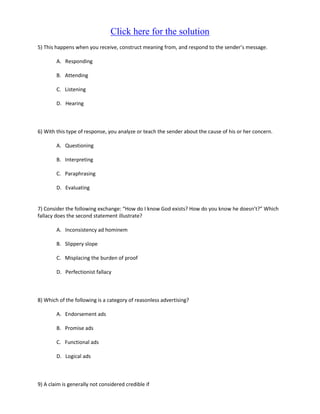
5) This happens when you receive, construct meaning from, and respond to the sender’s message.

        A. Responding

        B. Attending

        C. Listening

        D. Hearing


6) With this type of response, you analyze or teach the sender about the cause of his or her concern.

        A. Questioning

        B. Interpreting

        C. Paraphrasing

        D. Evaluating


7) Consider the following exchange: “How do I know God exists? How do you know he doesn’t?” Which
fallacy does the second statement illustrate?

        A. Inconsistency ad hominem

        B. Slippery slope

        C. Misplacing the burden of proof

        D. Perfectionist fallacy


8) Which of the following is a category of reasonless advertising?

        A. Endorsement ads

        B. Promise ads

        C. Functional ads

        D. Logical ads


9) A claim is generally not considered credible if
Click here for the solution
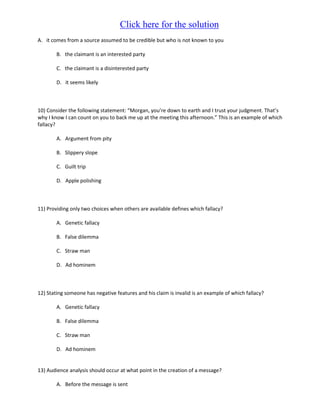
A. it comes from a source assumed to be credible but who is not known to you

        B. the claimant is an interested party

        C. the claimant is a disinterested party

        D. it seems likely


10) Consider the following statement: “Morgan, you’re down to earth and I trust your judgment. That’s
why I know I can count on you to back me up at the meeting this afternoon.” This is an example of which
fallacy?

        A. Argument from pity

        B. Slippery slope

        C. Guilt trip

        D. Apple polishing


11) Providing only two choices when others are available defines which fallacy?

        A. Genetic fallacy

        B. False dilemma

        C. Straw man

        D. Ad hominem


12) Stating someone has negative features and his claim is invalid is an example of which fallacy?

        A. Genetic fallacy

        B. False dilemma

        C. Straw man

        D. Ad hominem


13) Audience analysis should occur at what point in the creation of a message?

        A. Before the message is sent
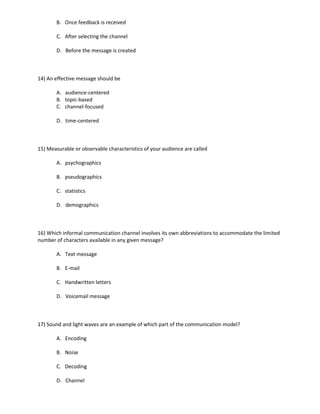
B. Once feedback is received

       C. After selecting the channel

       D. Before the message is created


14) An effective message should be

       A. audience-centered
       B. topic-based
       C. channel-focused

       D. time-centered


15) Measurable or observable characteristics of your audience are called

       A. psychographics

       B. pseudographics

       C. statistics

       D. demographics


16) Which informal communication channel involves its own abbreviations to accommodate the limited
number of characters available in any given message?

       A. Text message

       B. E-mail

       C. Handwritten letters

       D. Voicemail message


17) Sound and light waves are an example of which part of the communication model?

       A. Encoding

       B. Noise

       C. Decoding

       D. Channel
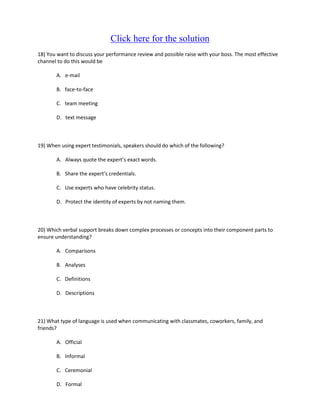
Click here for the solution
18) You want to discuss your performance review and possible raise with your boss. The most effective
channel to do this would be

       A. e-mail

       B. face-to-face

       C. team meeting

       D. text message


19) When using expert testimonials, speakers should do which of the following?

       A. Always quote the expert’s exact words.

       B. Share the expert’s credentials.

       C. Use experts who have celebrity status.

       D. Protect the identity of experts by not naming them.


20) Which verbal support breaks down complex processes or concepts into their component parts to
ensure understanding?

       A. Comparisons

       B. Analyses

       C. Definitions

       D. Descriptions


21) What type of language is used when communicating with classmates, coworkers, family, and
friends?

       A. Official

       B. Informal

       C. Ceremonial

       D. Formal
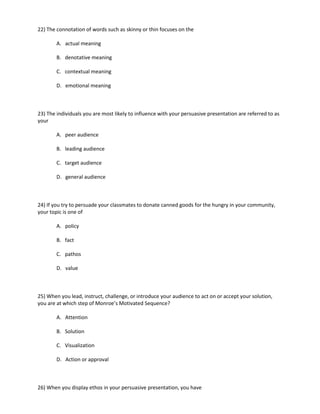
22) The connotation of words such as skinny or thin focuses on the

        A. actual meaning

        B. denotative meaning

        C. contextual meaning

        D. emotional meaning


23) The individuals you are most likely to influence with your persuasive presentation are referred to as
your

        A. peer audience

        B. leading audience

        C. target audience

        D. general audience


24) If you try to persuade your classmates to donate canned goods for the hungry in your community,
your topic is one of

        A. policy

        B. fact

        C. pathos

        D. value


25) When you lead, instruct, challenge, or introduce your audience to act on or accept your solution,
you are at which step of Monroe’s Motivated Sequence?

        A. Attention

        B. Solution

        C. Visualization

        D. Action or approval


26) When you display ethos in your persuasive presentation, you have
Click here for the solution

        A. credibility

        B. logic

        C. emotion

        D. evidence


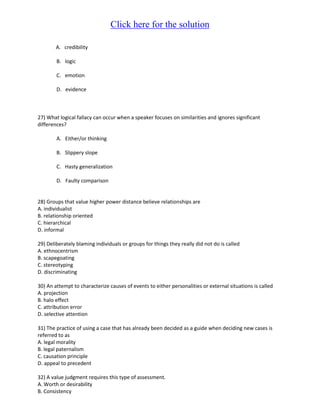
27) What logical fallacy can occur when a speaker focuses on similarities and ignores significant
differences?

        A. Either/or thinking

        B. Slippery slope

        C. Hasty generalization

        D. Faulty comparison


28) Groups that value higher power distance believe relationships are
A. individualist
B. relationship oriented
C. hierarchical
D. informal

29) Deliberately blaming individuals or groups for things they really did not do is called
A. ethnocentrism
B. scapegoating
C. stereotyping
D. discriminating

30) An attempt to characterize causes of events to either personalities or external situations is called
A. projection
B. halo effect
C. attribution error
D. selective attention

31) The practice of using a case that has already been decided as a guide when deciding new cases is
referred to as
A. legal morality
B. legal paternalism
C. causation principle
D. appeal to precedent

32) A value judgment requires this type of assessment.
A. Worth or desirability
B. Consistency
C. Normative
D. Monroe’s Value Sequence

33) What is the belief that laws are justified if they prevent a person from harming him- or herself
known as?
A. Offense principle
B. Harm principle
C. Legal paternalism
D. Legal moralism

                               Click here for the solution

BCOM 275 Final Exam

  • 1.
    BCOM 275 FinalExam Click here for the solution 1) The term channel in communication means A. the medium through which a message travels from sender to receiver B. the context of the communication C. the volume at which a message is received D. the process of changing thoughts into symbols 2) This preparation process involves looking at the characteristics of the receivers of the sender’s message. A. Determining the message B. Audience analysis C. Channel evaluation D. Receiver response analysis 3) A receiver’s response to a sender’s message is called A. channel B. feedback C. encoding D. decoding 4) This act is involuntary and happens automatically. A. Listening B. Feedback C. Hearing D. Responding
  • 2.
    Click here forthe solution 5) This happens when you receive, construct meaning from, and respond to the sender’s message. A. Responding B. Attending C. Listening D. Hearing 6) With this type of response, you analyze or teach the sender about the cause of his or her concern. A. Questioning B. Interpreting C. Paraphrasing D. Evaluating 7) Consider the following exchange: “How do I know God exists? How do you know he doesn’t?” Which fallacy does the second statement illustrate? A. Inconsistency ad hominem B. Slippery slope C. Misplacing the burden of proof D. Perfectionist fallacy 8) Which of the following is a category of reasonless advertising? A. Endorsement ads B. Promise ads C. Functional ads D. Logical ads 9) A claim is generally not considered credible if
  • 3.
    Click here forthe solution A. it comes from a source assumed to be credible but who is not known to you B. the claimant is an interested party C. the claimant is a disinterested party D. it seems likely 10) Consider the following statement: “Morgan, you’re down to earth and I trust your judgment. That’s why I know I can count on you to back me up at the meeting this afternoon.” This is an example of which fallacy? A. Argument from pity B. Slippery slope C. Guilt trip D. Apple polishing 11) Providing only two choices when others are available defines which fallacy? A. Genetic fallacy B. False dilemma C. Straw man D. Ad hominem 12) Stating someone has negative features and his claim is invalid is an example of which fallacy? A. Genetic fallacy B. False dilemma C. Straw man D. Ad hominem 13) Audience analysis should occur at what point in the creation of a message? A. Before the message is sent
  • 4.
    B. Once feedbackis received C. After selecting the channel D. Before the message is created 14) An effective message should be A. audience-centered B. topic-based C. channel-focused D. time-centered 15) Measurable or observable characteristics of your audience are called A. psychographics B. pseudographics C. statistics D. demographics 16) Which informal communication channel involves its own abbreviations to accommodate the limited number of characters available in any given message? A. Text message B. E-mail C. Handwritten letters D. Voicemail message 17) Sound and light waves are an example of which part of the communication model? A. Encoding B. Noise C. Decoding D. Channel
  • 5.
    Click here forthe solution 18) You want to discuss your performance review and possible raise with your boss. The most effective channel to do this would be A. e-mail B. face-to-face C. team meeting D. text message 19) When using expert testimonials, speakers should do which of the following? A. Always quote the expert’s exact words. B. Share the expert’s credentials. C. Use experts who have celebrity status. D. Protect the identity of experts by not naming them. 20) Which verbal support breaks down complex processes or concepts into their component parts to ensure understanding? A. Comparisons B. Analyses C. Definitions D. Descriptions 21) What type of language is used when communicating with classmates, coworkers, family, and friends? A. Official B. Informal C. Ceremonial D. Formal
  • 6.
    22) The connotationof words such as skinny or thin focuses on the A. actual meaning B. denotative meaning C. contextual meaning D. emotional meaning 23) The individuals you are most likely to influence with your persuasive presentation are referred to as your A. peer audience B. leading audience C. target audience D. general audience 24) If you try to persuade your classmates to donate canned goods for the hungry in your community, your topic is one of A. policy B. fact C. pathos D. value 25) When you lead, instruct, challenge, or introduce your audience to act on or accept your solution, you are at which step of Monroe’s Motivated Sequence? A. Attention B. Solution C. Visualization D. Action or approval 26) When you display ethos in your persuasive presentation, you have
  • 7.
    Click here forthe solution A. credibility B. logic C. emotion D. evidence 27) What logical fallacy can occur when a speaker focuses on similarities and ignores significant differences? A. Either/or thinking B. Slippery slope C. Hasty generalization D. Faulty comparison 28) Groups that value higher power distance believe relationships are A. individualist B. relationship oriented C. hierarchical D. informal 29) Deliberately blaming individuals or groups for things they really did not do is called A. ethnocentrism B. scapegoating C. stereotyping D. discriminating 30) An attempt to characterize causes of events to either personalities or external situations is called A. projection B. halo effect C. attribution error D. selective attention 31) The practice of using a case that has already been decided as a guide when deciding new cases is referred to as A. legal morality B. legal paternalism C. causation principle D. appeal to precedent 32) A value judgment requires this type of assessment. A. Worth or desirability B. Consistency
  • 8.
    C. Normative D. Monroe’sValue Sequence 33) What is the belief that laws are justified if they prevent a person from harming him- or herself known as? A. Offense principle B. Harm principle C. Legal paternalism D. Legal moralism Click here for the solution