Chappuis Halder & Cie Voice of the Customer Approach January 2010
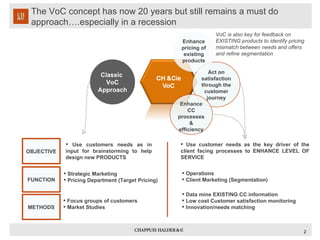
Classic  VoC Approach The VoC concept has now 20 years but still remains a must do approach….especially in a recession Act on satisfaction through the customer journey Enhance CC processes & efficiency Use customers needs as in input for brainstorming to help design new PRODUCTS VoC is also key for feedback on EXISTING products to identify pricing mismatch between needs and offers and refine segmentation Enhance pricing of existing products OBJECTIVE FUNCTION METHODS Strategic Marketing Pricing Department (Target Pricing) Use customer needs as the key driver of the client facing processes to ENHANCE LEVEL OF SERVICE Focus groups of customers Market Studies Data mine EXISTING CC information Low cost Customer satisfaction monitoring  Innovation/needs matching Operations Client Marketing (Segmentation)
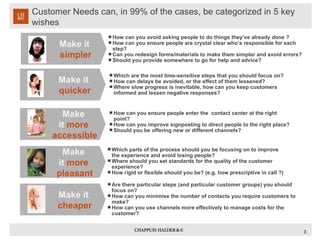
Customer Needs can, in 99% of the cases, be categorized in 5 key wishes Make it  simpler How can you avoid asking people to do things they’ve already done ? How can you ensure people are crystal clear who’s responsible for each step? Can you redesign forms/materials to make them simpler and avoid errors? Should you provide somewhere to go for help and advice? Make it  quicker Which are the most time-sensitive steps that you should focus on? How can delays be avoided, or the effect of them lessened? Where slow progress is inevitable, how can you keep customers informed and lessen negative responses? Make  it  more  accessible How can you ensure people enter the  contact center at the right point? How can you improve signposting to direct people to the right place? Should you be offering new or different channels? Make  it  more  pleasant Which parts of the process should you be focusing on to improve the experience and avoid losing people? Where should you set standards for the quality of the customer experience? How rigid or flexible should you be? (e.g. how prescriptive in call ?) Make it  cheaper Are there particular steps (and particular customer groups) you should focus on? How can you minimise the number of contacts you require customers to make? How can you use channels more effectively to manage costs for the customer?
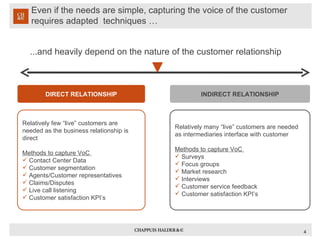
Even if the needs are simple, capturing the voice of the customer  requires adapted  techniques … INDIRECT RELATIONSHIP Relatively few “live” customers are needed as the business relationship is direct Methods to capture VoC  Contact Center Data Customer segmentation Agents/Customer representatives Claims/Disputes Live call listening Customer satisfaction KPI’s DIRECT RELATIONSHIP Relatively many “live” customers are needed as intermediaries interface with customer Methods to capture VoC  Surveys Focus groups Market research Interviews Customer service feedback Customer satisfaction KPI’s ...and heavily depend on the nature of the customer relationship
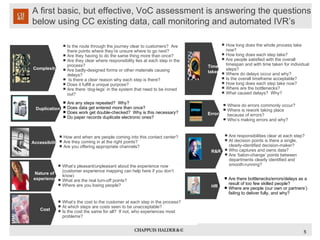
A first basic, but effective, VoC assessment is answering the questions below using CC existing data, call monitoring and automated IVR’s Complexity Is the route through the journey clear to customers?  Are there points where they’re unsure where to go next? Are they having to do the same thing more than once? Are they clear where responsibility lies at each step in the process? Are badly-designed forms or other materials causing delays? Is there a clear reason why each step is there? Does it fulfill a unique purpose? Are there ‘dog-legs’ in the system that need to be ironed out? Time  taken How long does the whole process take now? How long does each step take? Are people satisfied with the overall timespan and with time taken for individual steps? Where do delays occur and why? Is the overall timeframe acceptable? How long does each step take now? Where are the bottlenecks? What caused delays?  Why? Accessibility How and when are people coming into this contact center?  Are they coming in at the right points? Are you offering appropriate channels? Nature of  experience What’s pleasant/unpleasant about the experience now (customer experience mapping can help here if you don’t know) What are the real turn-off points? Where are you losing people? Cost What’s the cost to the customer at each step in the process? At which steps are costs seen to be unacceptable? Is the cost the same for all?  If not, who experiences most problems? Duplication Are any steps repeated?  Why? Does data get entered more than once? Does work get double-checked?  Why is this necessary? Do paper records duplicate electronic ones? Errors Where do errors commonly occur? Where is rework taking place because of errors? Who’s making errors and why? R&R Are responsibilities clear at each step?  At decision points is there a single, clearly-identified decision-maker? Who captures and owns data? Are ‘baton-change’ points between departments clearly identified and smooth-running? HR Are there bottlenecks/errors/delays as a result of too few skilled people? Where are people (our own or partners’) failing to deliver fully, and why?
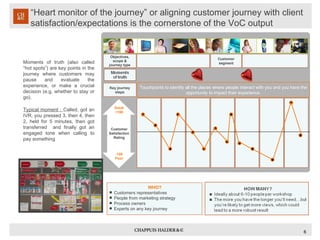
“ Heart monitor of the journey” or aligning customer journey with client satisfaction/expectations is the cornerstone of the VoC output Key journey steps Moments of truth (also called  “ hot spots ” ) are key points in the journey where customers may pause and evaluate the experience, or make a crucial decision (e.g. whether to stay or go).  Typical moment :  Called, got an IVR, you pressed 3, then 4, then 2, held for 5 minutes, then got transferred  and finally got an engaged tone when calling to pay something Touchpoints to identify all the places where people interact with you and you have the opportunity to impact their experience. Objectives, scope & journey type Customer segment Great +100 -100 Poor Customer Satisfaction Rating WHO? Customers representatives  People from marketing strategy Process owners Experts on any key journey

B-Case 2

  • 1.
    Chappuis Halder &Cie Voice of the Customer Approach January 2010
  • 2.
    Classic VoCApproach The VoC concept has now 20 years but still remains a must do approach….especially in a recession Act on satisfaction through the customer journey Enhance CC processes & efficiency Use customers needs as in input for brainstorming to help design new PRODUCTS VoC is also key for feedback on EXISTING products to identify pricing mismatch between needs and offers and refine segmentation Enhance pricing of existing products OBJECTIVE FUNCTION METHODS Strategic Marketing Pricing Department (Target Pricing) Use customer needs as the key driver of the client facing processes to ENHANCE LEVEL OF SERVICE Focus groups of customers Market Studies Data mine EXISTING CC information Low cost Customer satisfaction monitoring Innovation/needs matching Operations Client Marketing (Segmentation)
  • 3.
    Customer Needs can,in 99% of the cases, be categorized in 5 key wishes Make it simpler How can you avoid asking people to do things they’ve already done ? How can you ensure people are crystal clear who’s responsible for each step? Can you redesign forms/materials to make them simpler and avoid errors? Should you provide somewhere to go for help and advice? Make it quicker Which are the most time-sensitive steps that you should focus on? How can delays be avoided, or the effect of them lessened? Where slow progress is inevitable, how can you keep customers informed and lessen negative responses? Make it more accessible How can you ensure people enter the contact center at the right point? How can you improve signposting to direct people to the right place? Should you be offering new or different channels? Make it more pleasant Which parts of the process should you be focusing on to improve the experience and avoid losing people? Where should you set standards for the quality of the customer experience? How rigid or flexible should you be? (e.g. how prescriptive in call ?) Make it cheaper Are there particular steps (and particular customer groups) you should focus on? How can you minimise the number of contacts you require customers to make? How can you use channels more effectively to manage costs for the customer?
  • 4.
    Even if theneeds are simple, capturing the voice of the customer requires adapted techniques … INDIRECT RELATIONSHIP Relatively few “live” customers are needed as the business relationship is direct Methods to capture VoC Contact Center Data Customer segmentation Agents/Customer representatives Claims/Disputes Live call listening Customer satisfaction KPI’s DIRECT RELATIONSHIP Relatively many “live” customers are needed as intermediaries interface with customer Methods to capture VoC Surveys Focus groups Market research Interviews Customer service feedback Customer satisfaction KPI’s ...and heavily depend on the nature of the customer relationship
  • 5.
    A first basic,but effective, VoC assessment is answering the questions below using CC existing data, call monitoring and automated IVR’s Complexity Is the route through the journey clear to customers? Are there points where they’re unsure where to go next? Are they having to do the same thing more than once? Are they clear where responsibility lies at each step in the process? Are badly-designed forms or other materials causing delays? Is there a clear reason why each step is there? Does it fulfill a unique purpose? Are there ‘dog-legs’ in the system that need to be ironed out? Time taken How long does the whole process take now? How long does each step take? Are people satisfied with the overall timespan and with time taken for individual steps? Where do delays occur and why? Is the overall timeframe acceptable? How long does each step take now? Where are the bottlenecks? What caused delays? Why? Accessibility How and when are people coming into this contact center? Are they coming in at the right points? Are you offering appropriate channels? Nature of experience What’s pleasant/unpleasant about the experience now (customer experience mapping can help here if you don’t know) What are the real turn-off points? Where are you losing people? Cost What’s the cost to the customer at each step in the process? At which steps are costs seen to be unacceptable? Is the cost the same for all? If not, who experiences most problems? Duplication Are any steps repeated? Why? Does data get entered more than once? Does work get double-checked? Why is this necessary? Do paper records duplicate electronic ones? Errors Where do errors commonly occur? Where is rework taking place because of errors? Who’s making errors and why? R&R Are responsibilities clear at each step? At decision points is there a single, clearly-identified decision-maker? Who captures and owns data? Are ‘baton-change’ points between departments clearly identified and smooth-running? HR Are there bottlenecks/errors/delays as a result of too few skilled people? Where are people (our own or partners’) failing to deliver fully, and why?
  • 6.
    “ Heart monitorof the journey” or aligning customer journey with client satisfaction/expectations is the cornerstone of the VoC output Key journey steps Moments of truth (also called “ hot spots ” ) are key points in the journey where customers may pause and evaluate the experience, or make a crucial decision (e.g. whether to stay or go). Typical moment : Called, got an IVR, you pressed 3, then 4, then 2, held for 5 minutes, then got transferred and finally got an engaged tone when calling to pay something Touchpoints to identify all the places where people interact with you and you have the opportunity to impact their experience. Objectives, scope & journey type Customer segment Great +100 -100 Poor Customer Satisfaction Rating WHO? Customers representatives People from marketing strategy Process owners Experts on any key journey