Basics of Data Science
Foundation Explained
www.iabac.org
www.iabac.org
Introduction to Data Science
Key Components of Data Science
Data Collection Methods
Data Processing Techniques
Exploratory Data Analysis (EDA)
Statistical Analysis
Machine Learning Basics
Popular Data Science Tools
Real-World Applications
Challenges in Data Science
Future Trends in Data Science
Conclusion
Agenda
www.iabac.org
Introduction to Data Science
What is Data Science?
●
●
●
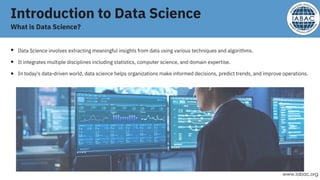
Data Science involves extracting meaningful insights from data using various techniques and algorithms.
It integrates multiple disciplines including statistics, computer science, and domain expertise.
In today's data-driven world, data science helps organizations make informed decisions, predict trends, and improve operations.
www.iabac.org
Key Components of Data Science
Data is the foundational element of data science. It can be structured or
unstructured, and is collected from various sources to analyze and extract
insights.
Algorithms are mathematical models and computational procedures used to
analyze data. They help in making predictions, identifying patterns, and
deriving actionable insights.
Domain knowledge refers to expertise in the specific field where data science
is applied. It ensures that data analysis is relevant and that the insights
derived are actionable and practical.
Data
Algorithms
Domain Knowledge
www.iabac.org
Surveys Web Scraping Sensor Data
Surveys involve collecting data
directly from respondents through
questionnaires. They are useful for
gathering structured data on
opinions, behaviors, and
demographics.
Web scraping entails extracting
data from websites using
automated tools or scripts. It is
valuable for obtaining large
volumes of unstructured data from
online sources.
Sensor data is collected through
devices that measure physical
properties like temperature,
motion, or pressure. It is essential
for real-time monitoring and IoT
applications.
Data Collection Methods
www.iabac.org
Data Processing Techniques
Reducing the volume of data while maintaining its integrity. Techniques
include dimensionality reduction and aggregating data to make it more
manageable.
Converting data into a suitable format for analysis. This includes
normalization, standardization, and feature engineering to enhance data
usability.
Involves identifying and correcting errors and inconsistencies in data to
improve its quality. This may include handling missing values and removing
duplicates.
Data Cleaning
Data Reduction
Data
Transformation
www.iabac.org
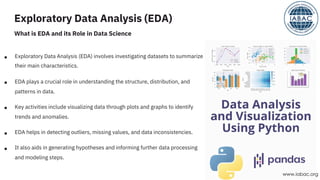
Exploratory Data Analysis (EDA)
●
●
●
●
●
Exploratory Data Analysis (EDA) involves investigating datasets to summarize
their main characteristics.
EDA plays a crucial role in understanding the structure, distribution, and
patterns in data.
Key activities include visualizing data through plots and graphs to identify
trends and anomalies.
EDA helps in detecting outliers, missing values, and data inconsistencies.
It also aids in generating hypotheses and informing further data processing
and modeling steps.
What is EDA and its Role in Data Science
www.iabac.org
Statistical Analysis
Correlation measures the relationship between two variables, while regression analysis helps in
predicting the value of a dependent variable based on one or more independent variables.
Statistical methods are crucial for making data-driven decisions. They help in understanding
data distributions, identifying trends, and validating assumptions to ensure the reliability of
results.
Used to determine if there is enough evidence to support a specific claim about a dataset. It
often involves calculating p-values to assess the significance of results.
Hypothesis
Testing
Correlation and
Regression
Importance in
Data Science
www.iabac.org
Machine Learning is a subset of artificial intelligence that
focuses on building systems that can learn from data,
identify patterns, and make decisions with minimal human
intervention.
Unsupervised learning works with unlabeled data. The
system tries to learn the patterns and the structure from
the data itself. Examples include clustering and association
tasks.
Supervised learning involves training a model on labeled
data, meaning the input comes with the correct output.
Examples include classification and regression tasks.
Reinforcement learning involves training agents to make
sequences of decisions by rewarding them for good actions
and penalizing them for bad ones. It is commonly used in
robotics and game playing.
Unsupervised Learning
Definition of Machine Learning Supervised Learning
Reinforcement Learning
Machine Learning Basics
www.iabac.org
Python is a versatile programming
language widely used for its
extensive libraries and ease of use
in data manipulation and analysis.
R is a statistical programming
language favored for its strong data
visualization capabilities and
statistical computing.
Jupyter Notebooks provide an
interactive environment for coding,
visualizing data, and sharing
reports, supporting multiple
programming languages.
Popular Data Science Tools
www.iabac.org
Real-World Applications
Using customer segmentation and sentiment analysis
to tailor marketing campaigns.
Implementing fraud detection systems and algorithmic
trading to optimize investment strategies.
Utilizing predictive analytics for patient diagnosis and
personalized treatment plans.
Finance
Marketing
Healthcare
www.iabac.org
Ensuring data privacy and security is critical to protect sensitive information, adhering to
regulations like GDPR and CCPA.
Continuous learning is required to keep up with evolving tools, techniques, and methodologies
in the rapidly changing field of data science.
Maintaining high data quality is essential for accurate analysis, but it is often challenging due to
incomplete or inconsistent data.
Challenges in Data Science
www.iabac.org
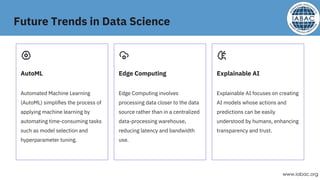
AutoML Edge Computing Explainable AI
Automated Machine Learning
(AutoML) simplifies the process of
applying machine learning by
automating time-consuming tasks
such as model selection and
hyperparameter tuning.
Edge Computing involves
processing data closer to the data
source rather than in a centralized
data-processing warehouse,
reducing latency and bandwidth
use.
Explainable AI focuses on creating
AI models whose actions and
predictions can be easily
understood by humans, enhancing
transparency and trust.
Future Trends in Data Science
www.iabac.org
Conclusion
Understanding the basics of data science is crucial in today's data-driven world. Key
components include data collection, processing, and analysis, forming the foundation
for advanced techniques like machine learning. Real-world applications in healthcare,
finance, and marketing demonstrate its transformative potential. Despite challenges
like data privacy and quality, staying informed about emerging trends ensures you
harness the full power of data science.
www.iabac.org
Thank you
www.iabac.org

Basics of Data Science Foundation Explained | IABAC

  • 1.
    Basics of DataScience Foundation Explained www.iabac.org www.iabac.org
  • 2.
    Introduction to DataScience Key Components of Data Science Data Collection Methods Data Processing Techniques Exploratory Data Analysis (EDA) Statistical Analysis Machine Learning Basics Popular Data Science Tools Real-World Applications Challenges in Data Science Future Trends in Data Science Conclusion Agenda www.iabac.org
  • 3.
    Introduction to DataScience What is Data Science? ● ● ● Data Science involves extracting meaningful insights from data using various techniques and algorithms. It integrates multiple disciplines including statistics, computer science, and domain expertise. In today's data-driven world, data science helps organizations make informed decisions, predict trends, and improve operations. www.iabac.org
  • 4.
    Key Components ofData Science Data is the foundational element of data science. It can be structured or unstructured, and is collected from various sources to analyze and extract insights. Algorithms are mathematical models and computational procedures used to analyze data. They help in making predictions, identifying patterns, and deriving actionable insights. Domain knowledge refers to expertise in the specific field where data science is applied. It ensures that data analysis is relevant and that the insights derived are actionable and practical. Data Algorithms Domain Knowledge www.iabac.org
  • 5.
    Surveys Web ScrapingSensor Data Surveys involve collecting data directly from respondents through questionnaires. They are useful for gathering structured data on opinions, behaviors, and demographics. Web scraping entails extracting data from websites using automated tools or scripts. It is valuable for obtaining large volumes of unstructured data from online sources. Sensor data is collected through devices that measure physical properties like temperature, motion, or pressure. It is essential for real-time monitoring and IoT applications. Data Collection Methods www.iabac.org
  • 6.
    Data Processing Techniques Reducingthe volume of data while maintaining its integrity. Techniques include dimensionality reduction and aggregating data to make it more manageable. Converting data into a suitable format for analysis. This includes normalization, standardization, and feature engineering to enhance data usability. Involves identifying and correcting errors and inconsistencies in data to improve its quality. This may include handling missing values and removing duplicates. Data Cleaning Data Reduction Data Transformation www.iabac.org
  • 7.
    Exploratory Data Analysis(EDA) ● ● ● ● ● Exploratory Data Analysis (EDA) involves investigating datasets to summarize their main characteristics. EDA plays a crucial role in understanding the structure, distribution, and patterns in data. Key activities include visualizing data through plots and graphs to identify trends and anomalies. EDA helps in detecting outliers, missing values, and data inconsistencies. It also aids in generating hypotheses and informing further data processing and modeling steps. What is EDA and its Role in Data Science www.iabac.org
  • 8.
    Statistical Analysis Correlation measuresthe relationship between two variables, while regression analysis helps in predicting the value of a dependent variable based on one or more independent variables. Statistical methods are crucial for making data-driven decisions. They help in understanding data distributions, identifying trends, and validating assumptions to ensure the reliability of results. Used to determine if there is enough evidence to support a specific claim about a dataset. It often involves calculating p-values to assess the significance of results. Hypothesis Testing Correlation and Regression Importance in Data Science www.iabac.org
  • 9.
    Machine Learning isa subset of artificial intelligence that focuses on building systems that can learn from data, identify patterns, and make decisions with minimal human intervention. Unsupervised learning works with unlabeled data. The system tries to learn the patterns and the structure from the data itself. Examples include clustering and association tasks. Supervised learning involves training a model on labeled data, meaning the input comes with the correct output. Examples include classification and regression tasks. Reinforcement learning involves training agents to make sequences of decisions by rewarding them for good actions and penalizing them for bad ones. It is commonly used in robotics and game playing. Unsupervised Learning Definition of Machine Learning Supervised Learning Reinforcement Learning Machine Learning Basics www.iabac.org
  • 10.
    Python is aversatile programming language widely used for its extensive libraries and ease of use in data manipulation and analysis. R is a statistical programming language favored for its strong data visualization capabilities and statistical computing. Jupyter Notebooks provide an interactive environment for coding, visualizing data, and sharing reports, supporting multiple programming languages. Popular Data Science Tools www.iabac.org
  • 11.
    Real-World Applications Using customersegmentation and sentiment analysis to tailor marketing campaigns. Implementing fraud detection systems and algorithmic trading to optimize investment strategies. Utilizing predictive analytics for patient diagnosis and personalized treatment plans. Finance Marketing Healthcare www.iabac.org
  • 12.
    Ensuring data privacyand security is critical to protect sensitive information, adhering to regulations like GDPR and CCPA. Continuous learning is required to keep up with evolving tools, techniques, and methodologies in the rapidly changing field of data science. Maintaining high data quality is essential for accurate analysis, but it is often challenging due to incomplete or inconsistent data. Challenges in Data Science www.iabac.org
  • 13.
    AutoML Edge ComputingExplainable AI Automated Machine Learning (AutoML) simplifies the process of applying machine learning by automating time-consuming tasks such as model selection and hyperparameter tuning. Edge Computing involves processing data closer to the data source rather than in a centralized data-processing warehouse, reducing latency and bandwidth use. Explainable AI focuses on creating AI models whose actions and predictions can be easily understood by humans, enhancing transparency and trust. Future Trends in Data Science www.iabac.org
  • 14.
    Conclusion Understanding the basicsof data science is crucial in today's data-driven world. Key components include data collection, processing, and analysis, forming the foundation for advanced techniques like machine learning. Real-world applications in healthcare, finance, and marketing demonstrate its transformative potential. Despite challenges like data privacy and quality, staying informed about emerging trends ensures you harness the full power of data science. www.iabac.org
  • 15.