Basics of Clinical
Basics of Clinical
Research
Research
Beth Elinoff, RN, MPH, CCRC
Human Immunology Research Coordinator
What is Clinical Research/
Human Subject Research?
Department of Health and Human Services
(DHHS) Definitions (45 CFR 46.102):
 1. Human Subject Research
1. Human Subject Research
In order for activities to be deemed “Human Subject
Research” by the DHHS, they must meet the definition
of “research” and involve one or more “human
subjects” as defined by DHHS regulations.
DHHS Definitions (con’t)
 A. Research
A. Research
“
“A systematic investigation, including research
A systematic investigation, including research
development, testing and evaluation, designed to
develop or contribute to generalizable knowledge.”
 Belmont Report Definition of Research
Belmont Report Definition of Research
“
“Any activity designed to test a hypothesis, permit
Any activity designed to test a hypothesis, permit
conclusions to be drawn and thereby to develop or
contribute to generalizable knowledge (expressed, for
example, in theories, principles, and statements of
relationships).”
relationships).”
DHHS Definitions (con’t)
 B. Human Subjects:
B. Human Subjects:
“
“A living individual about whom an investigator
A living individual about whom an investigator
conducting research obtains (1) data through
intervention or interaction with the individual; or (2)
identifiable private information.”
DHHS Definitions (con’t)
 Intervention:
Intervention:
Includes both the physical procedures by which data
are gathered (eg. blood draw) and manipulations of the
subject or the subject’s environment that are performed
for research purposes
 Interaction:
Interaction:
Includes communication or interpersonal contact (eg.
questionnaires, interviews) between the investigator and
subject
subject
DHHS Definitions (con’t)
 Private Information:
Private Information:
Includes information about behavior that occurs in a
context in which an individual can reasonably expect
that no observation or recording is taking place, and
information which has been provided for specific
purposes by an individual and which the individual can
reasonably expect will not be made public (eg. medical
record). Private information must be individually
identifiable (eg. the identity of the subject is or may
readily be ascertained by the investigator or associated
with the information).
Food and Drug Administration
(FDA) Definition of Human Subject
Research
Research
 FDA has different definitions of “research” and
FDA has different definitions of “research” and
“human subjects”
“human subjects”
 FDA guidelines must be followed when using a
FDA guidelines must be followed when using a
drug or device in the study
History of Development of Human
Research Protections
1.
1. Public Health Service Syphilis Study ’32-’71
Public Health Service Syphilis Study ’32-’71
 Better known as the “Tuskeegee Syphilis Study”
Better known as the “Tuskeegee Syphilis Study”
 Originally designed to make treatment available to
Originally designed to make treatment available to
African-American men with syphilis, even though there
was no known effective treatment
 Issues:
Issues:
1.
1. Men were recruited without their consent
Men were recruited without their consent
2.
2. Misinformation about procedures, ie spinal taps
Misinformation about procedures, ie spinal taps
3.
3. After penicillin was proven an effective treatment ’40’s), men
After penicillin was proven an effective treatment ’40’s), men
were denied antibiotics and prevented treatment from military
and local physicians
History of Development of Human
Research Protections
2.
2. US Food, Drug and Safety Act (1938)
US Food, Drug and Safety Act (1938)
 107 people died after taking sulfanilamide, a cold
107 people died after taking sulfanilamide, a cold
remedy that contained anti-freeze.
 This act enforces manufacturers to demonstrate
This act enforces manufacturers to demonstrate
drug safety.
drug safety.
History of Development of Human
Research Protections
3.
3. Nuremberg Code (1947)
Nuremberg Code (1947)
 Result of the trial of Nazi doctors and scientists from
Result of the trial of Nazi doctors and scientists from
WWII – no guidelines for human research
 Guidelines:
Guidelines:
1.
1. Need for informed consent
Need for informed consent
2.
2. Research should be based on prior animal work
Research should be based on prior animal work
3.
3. Risks should be justified by anticipated benefits
Risks should be justified by anticipated benefits
4.
4. Only qualified scientists must conduct research
Only qualified scientists must conduct research
5.
5. Physical and mental suffering must be avoided
Physical and mental suffering must be avoided
6.
6. No research where death/severe injury is expected
No research where death/severe injury is expected
History of Development of Human
Research Protections
3.
3. Nuremberg Code (con’t)
Nuremberg Code (con’t)
 Problems:
Problems:
1.
1. Little impact on research done in the US – thought to
Little impact on research done in the US – thought to
condemn Nazis
condemn Nazis
2.
2. No strength of the law behind it
No strength of the law behind it
3.
3. Only applied to non-therapeutic human subject research
Only applied to non-therapeutic human subject research
History of Development of Human
Research Protections
4.
4. Declaration of Helsinki (1964)
Declaration of Helsinki (1964)
 Code of ethics developed by the World Medical
Code of ethics developed by the World Medical
Association (now known and World Health Org)
 Broader than Nuremberg Code
Broader than Nuremberg Code
 Geared towards therapeutic medical research
Geared towards therapeutic medical research
 Recommended informed consent
Recommended informed consent
 Precursor to IRB requirement
Precursor to IRB requirement
 Journals required all published research to follow
Journals required all published research to follow
Declaration’s guidelines
History of Development of Human
Research Protections
5.
5. The National Research Act (1974)
The National Research Act (1974)
 Culmination of hearings by US Congress
Culmination of hearings by US Congress
established the National Commission for the
Protection of Human Subjects of Biomedical and
Behavioral Research
Behavioral Research
 Purpose of The National Commission:
Purpose of The National Commission:
1.
1. Identify basic ethical principles underlying the
Identify basic ethical principles underlying the
conduct of human subject research
2.
2. Develop guidelines to ensure conduct of human
Develop guidelines to ensure conduct of human
subject research in accordance with those principles
History of Development of Human
Research Protections
5.
5. The National Research Act (con’t)
The National Research Act (con’t)
 45 CFR 46 – “Regulations for the Protection of
45 CFR 46 – “Regulations for the Protection of
Human Subjects of Biomedical and Behavioral
Research”; Issued by the Department of Health,
Education and Welfare (later renamed DHHS)
 Revisions made in late 1970’s and early 1980’s
Revisions made in late 1970’s and early 1980’s
 By 1991, 16 other federal agencies/departments
By 1991, 16 other federal agencies/departments
applied 45 CFR 46 to research they fund/conduct
 Referred to as the “Common Rule”
Referred to as the “Common Rule”
History of Development of Human
Research Protections
6.
6. The Belmont Report (1979)
The Belmont Report (1979)
 Issued by the National Commission for the
Issued by the National Commission for the
Protection of Human Subjects of Biomedical and
Behavioral Research
Behavioral Research
 Purpose: resolve ethical problems that surround
Purpose: resolve ethical problems that surround
the conduct of human subject research
 One principle does not outweigh another; each has
One principle does not outweigh another; each has
equal weight
equal weight
History of Development of Human
Research Protections
6.
6. The Belmont Report (con’t)
The Belmont Report (con’t)
The three principles:
1.
1. Respect for Persons – treat people as autonomous
Respect for Persons – treat people as autonomous
creatures and not a means to an end; provide extra
protection for those with limited autonomy
 Requires informed consent
Requires informed consent
 Requires respect of privacy of research subjects
Requires respect of privacy of research subjects
History of Development of Human
Research Protections
6.
6. The Belmont Report (con’t)
The Belmont Report (con’t)
The three principles:
2.
2. Beneficence – minimize harm and maximize
Beneficence – minimize harm and maximize
benefit
benefit
 Requires use of the best possible research design to
Requires use of the best possible research design to
maximize benefit and minimize harm
 Requires researchers to be able to perform the
Requires researchers to be able to perform the
procedures and manage the risks
 Prohibits research without a favorable risk-benefit ratio
Prohibits research without a favorable risk-benefit ratio
History of Development of Human
Research Protections
6.
6. The Belmont Report (con’t)
The Belmont Report (con’t)
The three principles:
3.
3. Justice – treat all people fairly and ensure burdens
Justice – treat all people fairly and ensure burdens
and benefits are shared equitably
 Requires equitable selection of research subjects
Requires equitable selection of research subjects
 Requires avoidance of exploitation of vulnerable
Requires avoidance of exploitation of vulnerable
populations or populations of convenience (ie pregnant
women; children; incarcerated populations)
History of Development of Human
Research Protections
7.
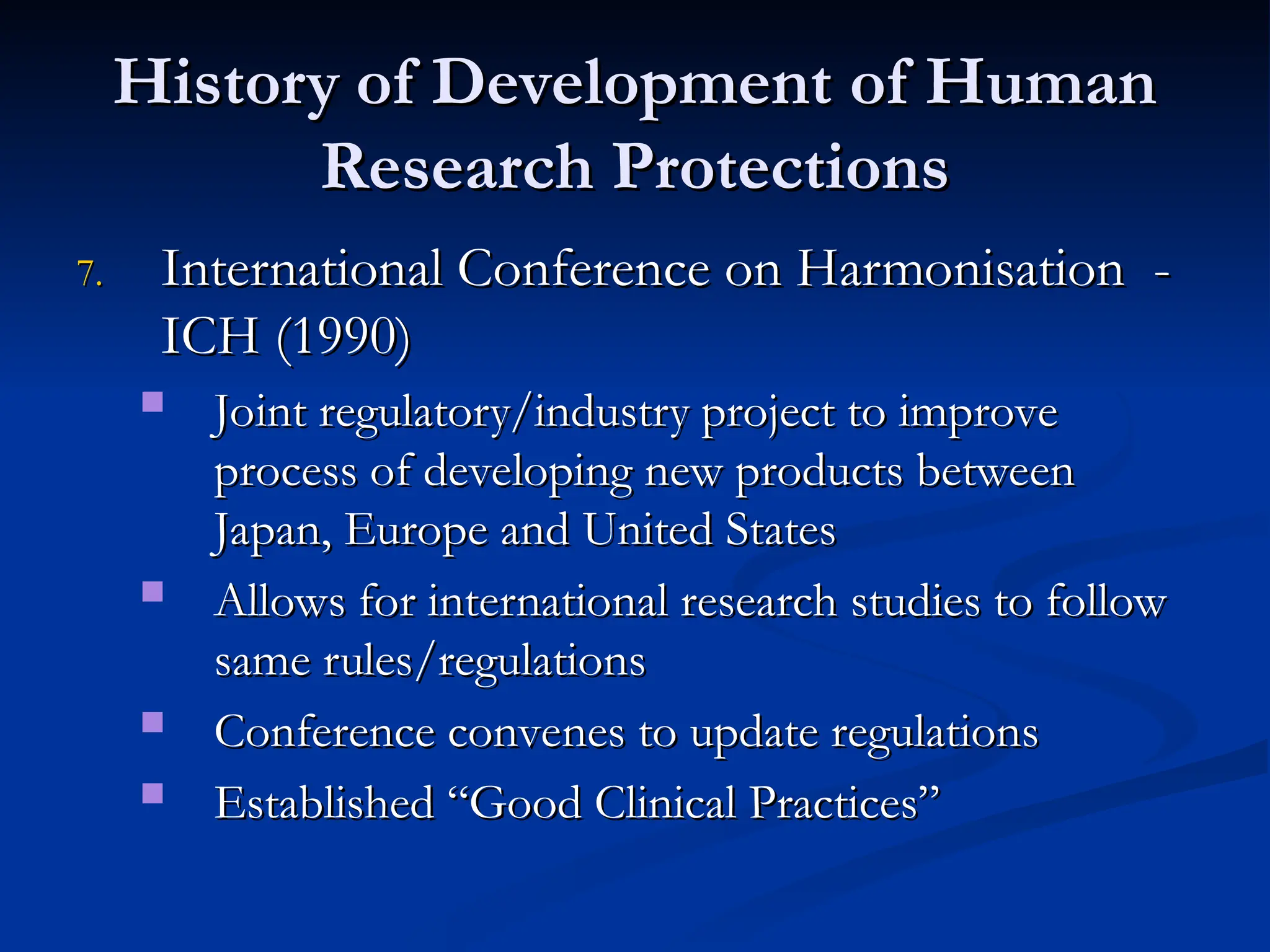
7. International Conference on Harmonisation -
International Conference on Harmonisation -
ICH (1990)
ICH (1990)
 Joint regulatory/industry project to improve
Joint regulatory/industry project to improve
process of developing new products between
Japan, Europe and United States
 Allows for international research studies to follow
Allows for international research studies to follow
same rules/regulations
 Conference convenes to update regulations
Conference convenes to update regulations
 Established “Good Clinical Practices”
Established “Good Clinical Practices”
Good Clinical Practices
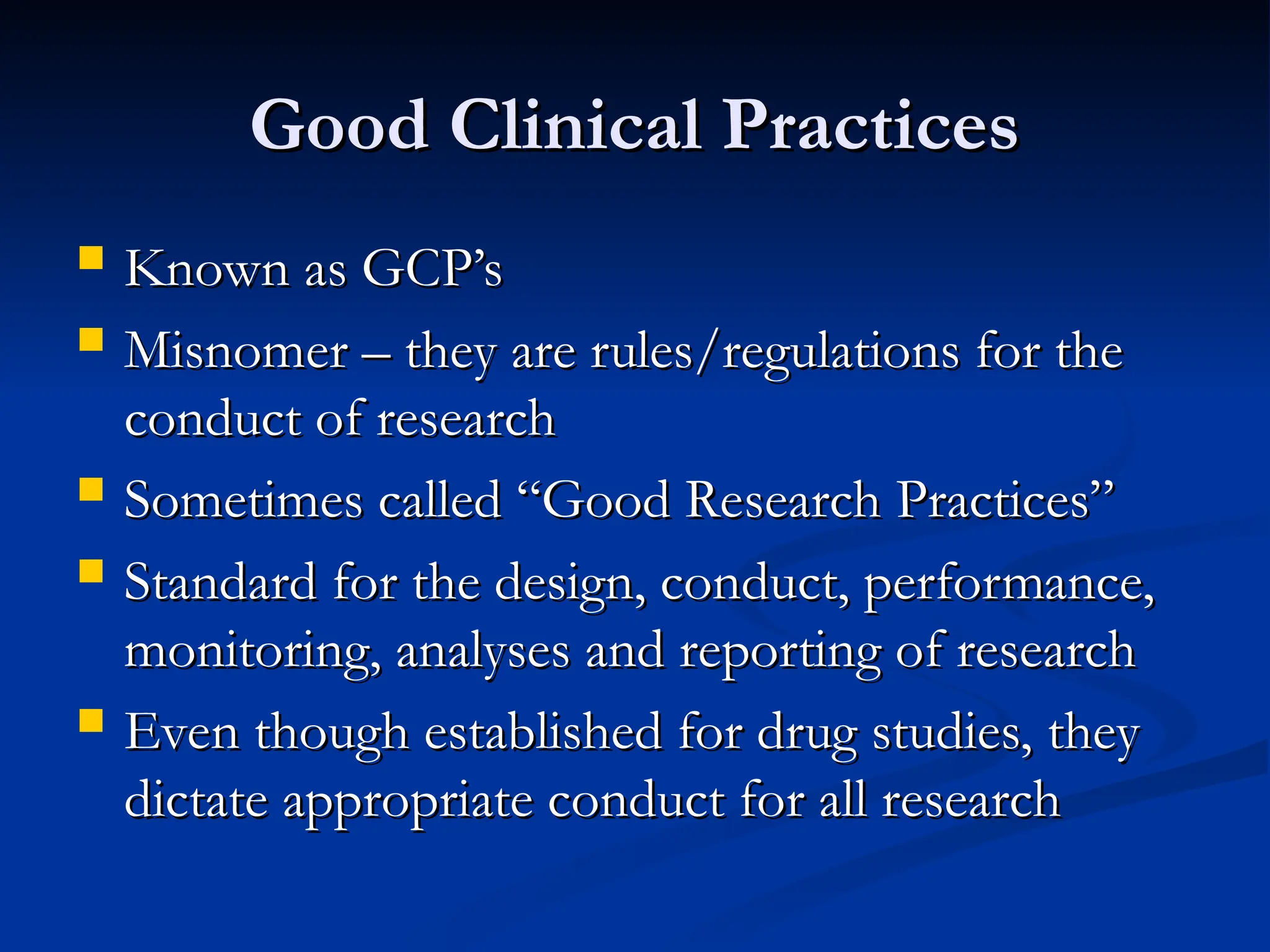
 Known as GCP’s
Known as GCP’s
 Misnomer – they are rules/regulations for the
Misnomer – they are rules/regulations for the
conduct of research
conduct of research
 Sometimes called “Good Research Practices”
Sometimes called “Good Research Practices”
 Standard for the design, conduct, performance,
Standard for the design, conduct, performance,
monitoring, analyses and reporting of research
 Even though established for drug studies, they
Even though established for drug studies, they
dictate appropriate conduct for all research
Innovative Practice vs. Research
 Innovative clinical practice is an intervention designed
Innovative clinical practice is an intervention designed
solely to enhance the well-being of an individual patient
or client. The purpose is to provide diagnosis,
preventative treatment, or therapy to particular
individuals.
individuals.
 Considered “research” only if previous criteria is met.
Considered “research” only if previous criteria is met.
 At UPMC, the introduction of innovative procedures
At UPMC, the introduction of innovative procedures
or therapies into clinical practice (when research is not
involved), requires review by department chair and the
UPMC Technology Assessment Committee/Innovative
Practices Sub-Committee prior to implementation.
Quality Assurance vs. Research
 Precise definitions to permit the distinction between
Precise definitions to permit the distinction between
research studies and quality assurance projects are
difficult and have not been established. In general, a
quality assurance project is a project that is focused
primarily on improving patient care within a given
patient care environment and, as such, the outcome
may not be generalizable to other patient care
environments.
environments.
 Both UPMC and CHP require the submission of all
Both UPMC and CHP require the submission of all
quality assurance projects for review.
Questions to distinguish QA from Research
(any yes response indicates research)
1.
1. Is there a commitment, in advance of data collection, to a
Is there a commitment, in advance of data collection, to a
corrective plan given any one of a number of study outcomes?
Does the PI of the study have both clinical supervisory
responsibility and the authority to impose change?
2.
2. Is the research being sponsored/funded by an external agency?
Is the research being sponsored/funded by an external agency?
3.
3. Does the proposed study involve the prospective assignment
Does the proposed study involve the prospective assignment
of patients to different procedures or therapies based on a
predetermined plan?
predetermined plan?
4.
4. Does the proposed study involve a “control group” in whom
Does the proposed study involve a “control group” in whom
the therapeutic or study intervention is intentionally withheld
to allow an assessment of its efficacy?
Questions to distinguish QA from Research
5.
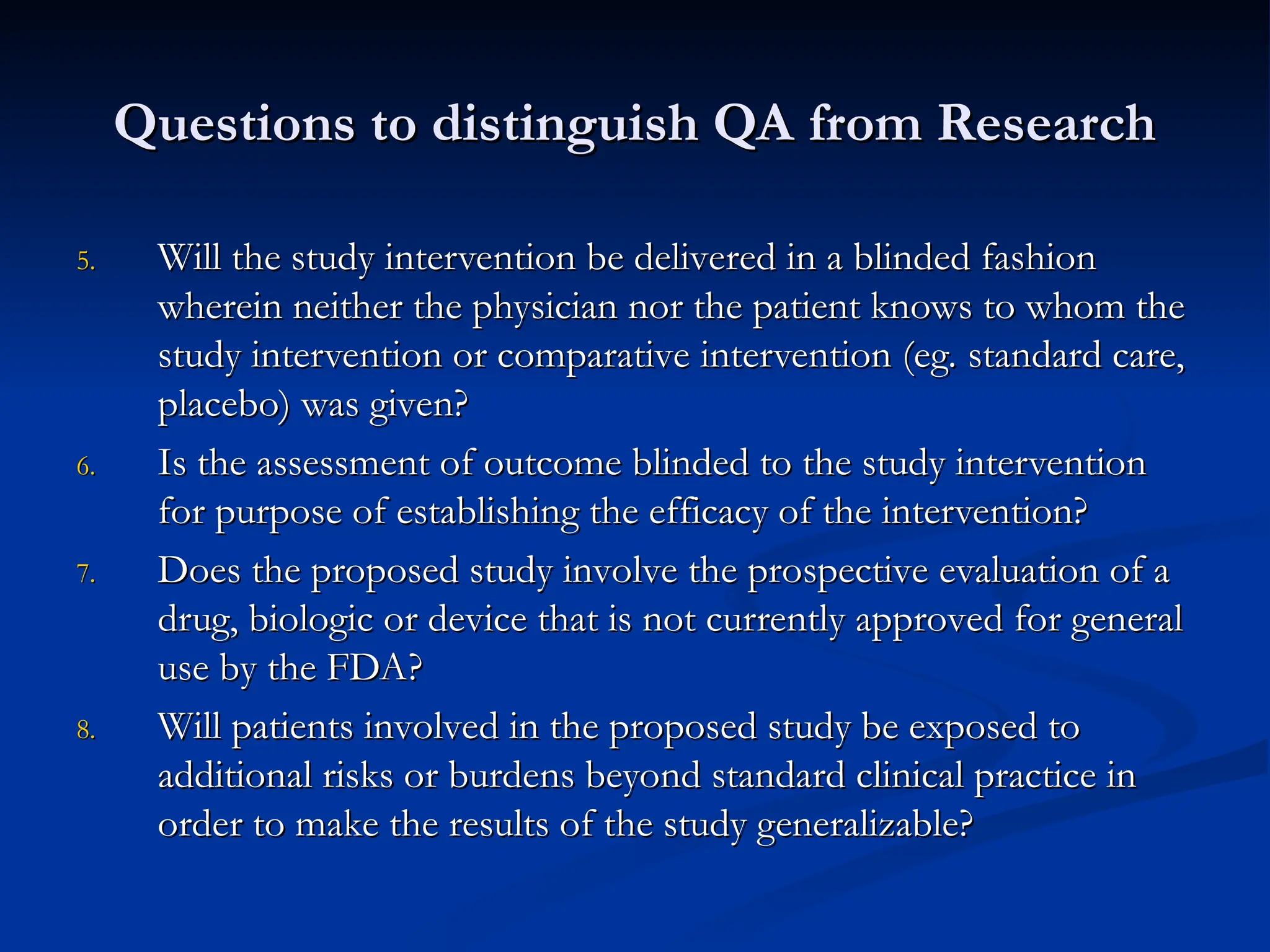
5. Will the study intervention be delivered in a blinded fashion
Will the study intervention be delivered in a blinded fashion
wherein neither the physician nor the patient knows to whom the
study intervention or comparative intervention (eg. standard care,
placebo) was given?
placebo) was given?
6.
6. Is the assessment of outcome blinded to the study intervention
Is the assessment of outcome blinded to the study intervention
for purpose of establishing the efficacy of the intervention?
7.
7. Does the proposed study involve the prospective evaluation of a
Does the proposed study involve the prospective evaluation of a
drug, biologic or device that is not currently approved for general
use by the FDA?
use by the FDA?
8.
8. Will patients involved in the proposed study be exposed to
Will patients involved in the proposed study be exposed to
additional risks or burdens beyond standard clinical practice in
order to make the results of the study generalizable?
Types of Study Designs
1.
1. Observational Designs
Observational Designs
Types of Observational Studies
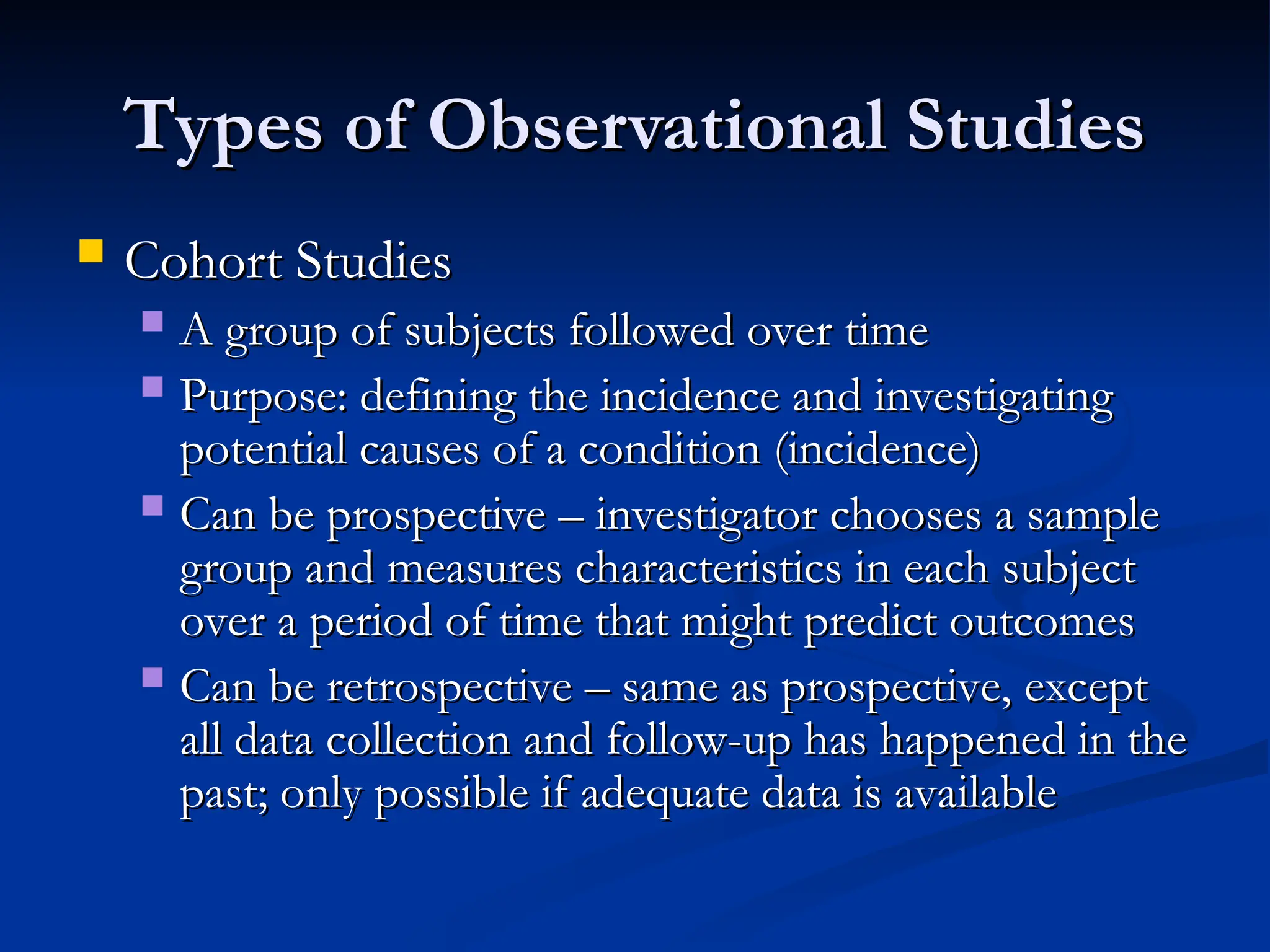
 Cohort Studies
Cohort Studies
 A group of subjects followed over time
A group of subjects followed over time
 Purpose: defining the incidence and investigating
Purpose: defining the incidence and investigating
potential causes of a condition (incidence)
 Can be prospective – investigator chooses a sample
Can be prospective – investigator chooses a sample
group and measures characteristics in each subject
over a period of time that might predict outcomes
 Can be retrospective – same as prospective, except
Can be retrospective – same as prospective, except
all data collection and follow-up has happened in the
past; only possible if adequate data is available
Types of Observational Studies
 Cross-Sectional Studies
Cross-Sectional Studies
 Similar to cohort studies except all the
Similar to cohort studies except all the
measurements are made at one time point with no
follow-up
follow-up
 Purpose: describing variables and their distribution
Purpose: describing variables and their distribution
patterns (prevalence)
 Strength – fast and inexpensive since there is no
Strength – fast and inexpensive since there is no
follow-up or waiting time for outcome
Types of Observational Studies
 Case-Control Studies
Case-Control Studies
 Two groups of people examined for the same
Two groups of people examined for the same
outcome
outcome
 Group 1 – “cases” or a population of people with a
Group 1 – “cases” or a population of people with a
certain disease
certain disease
 Group 2 – “controls” or a population of people without
Group 2 – “controls” or a population of people without
that same disease
that same disease
 Purpose: compare prevalence of risk factor(s) in
Purpose: compare prevalence of risk factor(s) in
subjects with the disease (cases) versus subjects
without the disease (controls)
Types of Study Designs
1.
1. Observational Designs
Observational Designs
1.
1. Experimental Designs –
Experimental Designs – interventional
interventional
studies
studies
Experimental Studies
 These studies evaluate the effects of an
These studies evaluate the effects of an
intervention
intervention
 Types of interventions:
Types of interventions:
 Behavior modification (eg. a walking program to improve
Behavior modification (eg. a walking program to improve
weight loss)
weight loss)
 Drug (eg. a new investigational drug or studying a drug
Drug (eg. a new investigational drug or studying a drug
for off-label use – subject to FDA regulations)
 Device (eg. a new investigational stent – subject to FDA
Device (eg. a new investigational stent – subject to FDA
regulations)
regulations)
 Strength: Can demonstrate causality
Strength: Can demonstrate causality
Phases of Experimental Studies
 Phase I:
Phase I:
Unblinded studies of a small number of healthy
volunteers to test safety of treatment (can sometimes
use people with the disease)
 Phase II:
Phase II:
Randomized studies of relatively small number of
people with the disease to test dose ranges and/or
efficacy of treatment
Phases of Experimental Studies
 Phase III:
Phase III:
Randomized studies of large number of people with
the disease to test efficacy of treatment on pre-
selected outcomes
selected outcomes
 Phase IV:
Phase IV:
Large experimental studies or observational studies
conducted after treatment has been approved by the
FDA to assess performance of treatment (called
Post-Market Studies)
Do I really want to
Do I really want to
conduct clinical
conduct clinical
research?
research?
What Help is Available?
 University of Pittsburgh IRB/RCCO
University of Pittsburgh IRB/RCCO
 IRB Coordinators – wealth of knowledge; will
IRB Coordinators – wealth of knowledge; will
perform an informal review prior to official review
 www.irb.pitt.edu – IRB manual; required forms; link
– IRB manual; required forms; link
to research training website; etc.
 Sponsored educational activities – monthly “Ask the
Sponsored educational activities – monthly “Ask the
IRB” sessions; conferences on current issues; etc.
 Human Immunology Research Office
Human Immunology Research Office
Human Immunology
Human Immunology
Research Office
Research Office
 Assistance with investigational human studies
Assistance with investigational human studies
involving transplantation that are initiated by
STI research or involves substantial support
from STI research
from STI research
 Act as repository for all documents related to
Act as repository for all documents related to
above studies and all other studies requiring
STI research participation (eg. Processing of
blood samples on 15
blood samples on 15th
th
floor BST
floor BST
Human Immunology
Human Immunology
Research Office
Research Office
 Services Available:
Services Available:
1.
1. Consultation regarding clinical aspects/logistics of
Consultation regarding clinical aspects/logistics of
new projects
new projects
2.
2. IRB summary protocol and consent form
IRB summary protocol and consent form
preparation assistance
3.
3. Project coordination:
Project coordination:
 Assist with recruitment based on project
Assist with recruitment based on project
 Ensure proper handling of samples/specimens from
Ensure proper handling of samples/specimens from
patient to lab
patient to lab
Human Immunology
Human Immunology
Research Office
Research Office
 Information to be stored in this office:
Information to be stored in this office:
1.
1. Copies of all current and future IRB submissions
Copies of all current and future IRB submissions
2.
2. Correspondence between IRB and investigators
Correspondence between IRB and investigators
including approval letters, audit reports, etc
3.
3. Correspondence between sponsor and
Correspondence between sponsor and
investigators regarding protocol issues
4.
4. RPF training certificates
RPF training certificates
5.
5. Copies of current CV’s
Copies of current CV’s
6.
6. Copies of current licenses
Copies of current licenses
Human Immunology
Human Immunology
Research Office
Research Office
 To request assistance:
To request assistance:
1.
1. Contact office to set up meeting to discuss project,
Contact office to set up meeting to discuss project,
assistance requested, etc
2.
2. Complete research outline (template will be supplied
Complete research outline (template will be supplied
by the office)
by the office)
 Contact information:
Contact information:
Location: E1540 BST
Location: E1540 BST
Phone: 412-624-6611
Phone: 412-624-6611
Email: elinoffbd@upmc.edu
Requirements Prior to IRB
Submission
Submission
 Possible UPMC fiscal approval
Possible UPMC fiscal approval
 STI PRC (protocol review committee) approval
STI PRC (protocol review committee) approval
 Any protocol submitted to the IRB requires prior
Any protocol submitted to the IRB requires prior
scientific review; PRC review includes scientific
review.
review.
 submission is reviewed both by an investigator and a
submission is reviewed both by an investigator and a
research coordinator
 Facilitator of committee is Agnes Zachoszcz (all
Facilitator of committee is Agnes Zachoszcz (all
submissions are emailed to her)

Basics of Clinical Research for humans.p

  • 1.
    Basics of Clinical Basicsof Clinical Research Research Beth Elinoff, RN, MPH, CCRC Beth Elinoff, RN, MPH, CCRC Human Immunology Research Coordinator Human Immunology Research Coordinator
  • 2.
    What is ClinicalResearch/ What is Clinical Research/ Human Subject Research? Human Subject Research? Department of Health and Human Services Department of Health and Human Services (DHHS) Definitions (45 CFR 46.102): (DHHS) Definitions (45 CFR 46.102):  1. Human Subject Research 1. Human Subject Research In order for activities to be deemed “Human Subject In order for activities to be deemed “Human Subject Research” by the DHHS, they must meet the definition Research” by the DHHS, they must meet the definition of “research” and involve one or more “human of “research” and involve one or more “human subjects” as defined by DHHS regulations. subjects” as defined by DHHS regulations.
  • 3.
    DHHS Definitions (con’t) DHHSDefinitions (con’t)  A. Research A. Research “ “A systematic investigation, including research A systematic investigation, including research development, testing and evaluation, designed to development, testing and evaluation, designed to develop or contribute to generalizable knowledge.” develop or contribute to generalizable knowledge.”  Belmont Report Definition of Research Belmont Report Definition of Research “ “Any activity designed to test a hypothesis, permit Any activity designed to test a hypothesis, permit conclusions to be drawn and thereby to develop or conclusions to be drawn and thereby to develop or contribute to generalizable knowledge (expressed, for contribute to generalizable knowledge (expressed, for example, in theories, principles, and statements of example, in theories, principles, and statements of relationships).” relationships).”
  • 4.
    DHHS Definitions (con’t) DHHSDefinitions (con’t)  B. Human Subjects: B. Human Subjects: “ “A living individual about whom an investigator A living individual about whom an investigator conducting research obtains (1) data through conducting research obtains (1) data through intervention or interaction with the individual; or (2) intervention or interaction with the individual; or (2) identifiable private information.” identifiable private information.”
  • 5.
    DHHS Definitions (con’t) DHHSDefinitions (con’t)  Intervention: Intervention: Includes both the physical procedures by which data Includes both the physical procedures by which data are gathered (eg. blood draw) and manipulations of the are gathered (eg. blood draw) and manipulations of the subject or the subject’s environment that are performed subject or the subject’s environment that are performed for research purposes for research purposes  Interaction: Interaction: Includes communication or interpersonal contact (eg. Includes communication or interpersonal contact (eg. questionnaires, interviews) between the investigator and questionnaires, interviews) between the investigator and subject subject
  • 6.
    DHHS Definitions (con’t) DHHSDefinitions (con’t)  Private Information: Private Information: Includes information about behavior that occurs in a Includes information about behavior that occurs in a context in which an individual can reasonably expect context in which an individual can reasonably expect that no observation or recording is taking place, and that no observation or recording is taking place, and information which has been provided for specific information which has been provided for specific purposes by an individual and which the individual can purposes by an individual and which the individual can reasonably expect will not be made public (eg. medical reasonably expect will not be made public (eg. medical record). Private information must be individually record). Private information must be individually identifiable (eg. the identity of the subject is or may identifiable (eg. the identity of the subject is or may readily be ascertained by the investigator or associated readily be ascertained by the investigator or associated with the information). with the information).
  • 7.
    Food and DrugAdministration Food and Drug Administration (FDA) Definition of Human Subject (FDA) Definition of Human Subject Research Research  FDA has different definitions of “research” and FDA has different definitions of “research” and “human subjects” “human subjects”  FDA guidelines must be followed when using a FDA guidelines must be followed when using a drug or device in the study drug or device in the study
  • 8.
    History of Developmentof Human History of Development of Human Research Protections Research Protections 1. 1. Public Health Service Syphilis Study ’32-’71 Public Health Service Syphilis Study ’32-’71  Better known as the “Tuskeegee Syphilis Study” Better known as the “Tuskeegee Syphilis Study”  Originally designed to make treatment available to Originally designed to make treatment available to African-American men with syphilis, even though there African-American men with syphilis, even though there was no known effective treatment was no known effective treatment  Issues: Issues: 1. 1. Men were recruited without their consent Men were recruited without their consent 2. 2. Misinformation about procedures, ie spinal taps Misinformation about procedures, ie spinal taps 3. 3. After penicillin was proven an effective treatment ’40’s), men After penicillin was proven an effective treatment ’40’s), men were denied antibiotics and prevented treatment from military were denied antibiotics and prevented treatment from military and local physicians and local physicians
  • 9.
    History of Developmentof Human History of Development of Human Research Protections Research Protections 2. 2. US Food, Drug and Safety Act (1938) US Food, Drug and Safety Act (1938)  107 people died after taking sulfanilamide, a cold 107 people died after taking sulfanilamide, a cold remedy that contained anti-freeze. remedy that contained anti-freeze.  This act enforces manufacturers to demonstrate This act enforces manufacturers to demonstrate drug safety. drug safety.
  • 10.
    History of Developmentof Human History of Development of Human Research Protections Research Protections 3. 3. Nuremberg Code (1947) Nuremberg Code (1947)  Result of the trial of Nazi doctors and scientists from Result of the trial of Nazi doctors and scientists from WWII – no guidelines for human research WWII – no guidelines for human research  Guidelines: Guidelines: 1. 1. Need for informed consent Need for informed consent 2. 2. Research should be based on prior animal work Research should be based on prior animal work 3. 3. Risks should be justified by anticipated benefits Risks should be justified by anticipated benefits 4. 4. Only qualified scientists must conduct research Only qualified scientists must conduct research 5. 5. Physical and mental suffering must be avoided Physical and mental suffering must be avoided 6. 6. No research where death/severe injury is expected No research where death/severe injury is expected
  • 11.
    History of Developmentof Human History of Development of Human Research Protections Research Protections 3. 3. Nuremberg Code (con’t) Nuremberg Code (con’t)  Problems: Problems: 1. 1. Little impact on research done in the US – thought to Little impact on research done in the US – thought to condemn Nazis condemn Nazis 2. 2. No strength of the law behind it No strength of the law behind it 3. 3. Only applied to non-therapeutic human subject research Only applied to non-therapeutic human subject research
  • 12.
    History of Developmentof Human History of Development of Human Research Protections Research Protections 4. 4. Declaration of Helsinki (1964) Declaration of Helsinki (1964)  Code of ethics developed by the World Medical Code of ethics developed by the World Medical Association (now known and World Health Org) Association (now known and World Health Org)  Broader than Nuremberg Code Broader than Nuremberg Code  Geared towards therapeutic medical research Geared towards therapeutic medical research  Recommended informed consent Recommended informed consent  Precursor to IRB requirement Precursor to IRB requirement  Journals required all published research to follow Journals required all published research to follow Declaration’s guidelines Declaration’s guidelines
  • 13.
    History of Developmentof Human History of Development of Human Research Protections Research Protections 5. 5. The National Research Act (1974) The National Research Act (1974)  Culmination of hearings by US Congress Culmination of hearings by US Congress established the National Commission for the established the National Commission for the Protection of Human Subjects of Biomedical and Protection of Human Subjects of Biomedical and Behavioral Research Behavioral Research  Purpose of The National Commission: Purpose of The National Commission: 1. 1. Identify basic ethical principles underlying the Identify basic ethical principles underlying the conduct of human subject research conduct of human subject research 2. 2. Develop guidelines to ensure conduct of human Develop guidelines to ensure conduct of human subject research in accordance with those principles subject research in accordance with those principles
  • 14.
    History of Developmentof Human History of Development of Human Research Protections Research Protections 5. 5. The National Research Act (con’t) The National Research Act (con’t)  45 CFR 46 – “Regulations for the Protection of 45 CFR 46 – “Regulations for the Protection of Human Subjects of Biomedical and Behavioral Human Subjects of Biomedical and Behavioral Research”; Issued by the Department of Health, Research”; Issued by the Department of Health, Education and Welfare (later renamed DHHS) Education and Welfare (later renamed DHHS)  Revisions made in late 1970’s and early 1980’s Revisions made in late 1970’s and early 1980’s  By 1991, 16 other federal agencies/departments By 1991, 16 other federal agencies/departments applied 45 CFR 46 to research they fund/conduct applied 45 CFR 46 to research they fund/conduct  Referred to as the “Common Rule” Referred to as the “Common Rule”
  • 15.
    History of Developmentof Human History of Development of Human Research Protections Research Protections 6. 6. The Belmont Report (1979) The Belmont Report (1979)  Issued by the National Commission for the Issued by the National Commission for the Protection of Human Subjects of Biomedical and Protection of Human Subjects of Biomedical and Behavioral Research Behavioral Research  Purpose: resolve ethical problems that surround Purpose: resolve ethical problems that surround the conduct of human subject research the conduct of human subject research  One principle does not outweigh another; each has One principle does not outweigh another; each has equal weight equal weight
  • 16.
    History of Developmentof Human History of Development of Human Research Protections Research Protections 6. 6. The Belmont Report (con’t) The Belmont Report (con’t) The three principles: The three principles: 1. 1. Respect for Persons – treat people as autonomous Respect for Persons – treat people as autonomous creatures and not a means to an end; provide extra creatures and not a means to an end; provide extra protection for those with limited autonomy protection for those with limited autonomy  Requires informed consent Requires informed consent  Requires respect of privacy of research subjects Requires respect of privacy of research subjects
  • 17.
    History of Developmentof Human History of Development of Human Research Protections Research Protections 6. 6. The Belmont Report (con’t) The Belmont Report (con’t) The three principles: The three principles: 2. 2. Beneficence – minimize harm and maximize Beneficence – minimize harm and maximize benefit benefit  Requires use of the best possible research design to Requires use of the best possible research design to maximize benefit and minimize harm maximize benefit and minimize harm  Requires researchers to be able to perform the Requires researchers to be able to perform the procedures and manage the risks procedures and manage the risks  Prohibits research without a favorable risk-benefit ratio Prohibits research without a favorable risk-benefit ratio
  • 18.
    History of Developmentof Human History of Development of Human Research Protections Research Protections 6. 6. The Belmont Report (con’t) The Belmont Report (con’t) The three principles: The three principles: 3. 3. Justice – treat all people fairly and ensure burdens Justice – treat all people fairly and ensure burdens and benefits are shared equitably and benefits are shared equitably  Requires equitable selection of research subjects Requires equitable selection of research subjects  Requires avoidance of exploitation of vulnerable Requires avoidance of exploitation of vulnerable populations or populations of convenience (ie pregnant populations or populations of convenience (ie pregnant women; children; incarcerated populations) women; children; incarcerated populations)
  • 19.
    History of Developmentof Human History of Development of Human Research Protections Research Protections 7. 7. International Conference on Harmonisation - International Conference on Harmonisation - ICH (1990) ICH (1990)  Joint regulatory/industry project to improve Joint regulatory/industry project to improve process of developing new products between process of developing new products between Japan, Europe and United States Japan, Europe and United States  Allows for international research studies to follow Allows for international research studies to follow same rules/regulations same rules/regulations  Conference convenes to update regulations Conference convenes to update regulations  Established “Good Clinical Practices” Established “Good Clinical Practices”
  • 20.
    Good Clinical Practices GoodClinical Practices  Known as GCP’s Known as GCP’s  Misnomer – they are rules/regulations for the Misnomer – they are rules/regulations for the conduct of research conduct of research  Sometimes called “Good Research Practices” Sometimes called “Good Research Practices”  Standard for the design, conduct, performance, Standard for the design, conduct, performance, monitoring, analyses and reporting of research monitoring, analyses and reporting of research  Even though established for drug studies, they Even though established for drug studies, they dictate appropriate conduct for all research dictate appropriate conduct for all research
  • 21.
    Innovative Practice vs.Research Innovative Practice vs. Research  Innovative clinical practice is an intervention designed Innovative clinical practice is an intervention designed solely to enhance the well-being of an individual patient solely to enhance the well-being of an individual patient or client. The purpose is to provide diagnosis, or client. The purpose is to provide diagnosis, preventative treatment, or therapy to particular preventative treatment, or therapy to particular individuals. individuals.  Considered “research” only if previous criteria is met. Considered “research” only if previous criteria is met.  At UPMC, the introduction of innovative procedures At UPMC, the introduction of innovative procedures or therapies into clinical practice (when research is not or therapies into clinical practice (when research is not involved), requires review by department chair and the involved), requires review by department chair and the UPMC Technology Assessment Committee/Innovative UPMC Technology Assessment Committee/Innovative Practices Sub-Committee prior to implementation. Practices Sub-Committee prior to implementation.
  • 22.
    Quality Assurance vs.Research Quality Assurance vs. Research  Precise definitions to permit the distinction between Precise definitions to permit the distinction between research studies and quality assurance projects are research studies and quality assurance projects are difficult and have not been established. In general, a difficult and have not been established. In general, a quality assurance project is a project that is focused quality assurance project is a project that is focused primarily on improving patient care within a given primarily on improving patient care within a given patient care environment and, as such, the outcome patient care environment and, as such, the outcome may not be generalizable to other patient care may not be generalizable to other patient care environments. environments.  Both UPMC and CHP require the submission of all Both UPMC and CHP require the submission of all quality assurance projects for review. quality assurance projects for review.
  • 23.
    Questions to distinguishQA from Research Questions to distinguish QA from Research (any yes response indicates research) (any yes response indicates research) 1. 1. Is there a commitment, in advance of data collection, to a Is there a commitment, in advance of data collection, to a corrective plan given any one of a number of study outcomes? corrective plan given any one of a number of study outcomes? Does the PI of the study have both clinical supervisory Does the PI of the study have both clinical supervisory responsibility and the authority to impose change? responsibility and the authority to impose change? 2. 2. Is the research being sponsored/funded by an external agency? Is the research being sponsored/funded by an external agency? 3. 3. Does the proposed study involve the prospective assignment Does the proposed study involve the prospective assignment of patients to different procedures or therapies based on a of patients to different procedures or therapies based on a predetermined plan? predetermined plan? 4. 4. Does the proposed study involve a “control group” in whom Does the proposed study involve a “control group” in whom the therapeutic or study intervention is intentionally withheld the therapeutic or study intervention is intentionally withheld to allow an assessment of its efficacy? to allow an assessment of its efficacy?
  • 24.
    Questions to distinguishQA from Research Questions to distinguish QA from Research 5. 5. Will the study intervention be delivered in a blinded fashion Will the study intervention be delivered in a blinded fashion wherein neither the physician nor the patient knows to whom the wherein neither the physician nor the patient knows to whom the study intervention or comparative intervention (eg. standard care, study intervention or comparative intervention (eg. standard care, placebo) was given? placebo) was given? 6. 6. Is the assessment of outcome blinded to the study intervention Is the assessment of outcome blinded to the study intervention for purpose of establishing the efficacy of the intervention? for purpose of establishing the efficacy of the intervention? 7. 7. Does the proposed study involve the prospective evaluation of a Does the proposed study involve the prospective evaluation of a drug, biologic or device that is not currently approved for general drug, biologic or device that is not currently approved for general use by the FDA? use by the FDA? 8. 8. Will patients involved in the proposed study be exposed to Will patients involved in the proposed study be exposed to additional risks or burdens beyond standard clinical practice in additional risks or burdens beyond standard clinical practice in order to make the results of the study generalizable? order to make the results of the study generalizable?
  • 25.
    Types of StudyDesigns Types of Study Designs 1. 1. Observational Designs Observational Designs
  • 26.
    Types of ObservationalStudies Types of Observational Studies  Cohort Studies Cohort Studies  A group of subjects followed over time A group of subjects followed over time  Purpose: defining the incidence and investigating Purpose: defining the incidence and investigating potential causes of a condition (incidence) potential causes of a condition (incidence)  Can be prospective – investigator chooses a sample Can be prospective – investigator chooses a sample group and measures characteristics in each subject group and measures characteristics in each subject over a period of time that might predict outcomes over a period of time that might predict outcomes  Can be retrospective – same as prospective, except Can be retrospective – same as prospective, except all data collection and follow-up has happened in the all data collection and follow-up has happened in the past; only possible if adequate data is available past; only possible if adequate data is available
  • 27.
    Types of ObservationalStudies Types of Observational Studies  Cross-Sectional Studies Cross-Sectional Studies  Similar to cohort studies except all the Similar to cohort studies except all the measurements are made at one time point with no measurements are made at one time point with no follow-up follow-up  Purpose: describing variables and their distribution Purpose: describing variables and their distribution patterns (prevalence) patterns (prevalence)  Strength – fast and inexpensive since there is no Strength – fast and inexpensive since there is no follow-up or waiting time for outcome follow-up or waiting time for outcome
  • 28.
    Types of ObservationalStudies Types of Observational Studies  Case-Control Studies Case-Control Studies  Two groups of people examined for the same Two groups of people examined for the same outcome outcome  Group 1 – “cases” or a population of people with a Group 1 – “cases” or a population of people with a certain disease certain disease  Group 2 – “controls” or a population of people without Group 2 – “controls” or a population of people without that same disease that same disease  Purpose: compare prevalence of risk factor(s) in Purpose: compare prevalence of risk factor(s) in subjects with the disease (cases) versus subjects subjects with the disease (cases) versus subjects without the disease (controls) without the disease (controls)
  • 29.
    Types of StudyDesigns Types of Study Designs 1. 1. Observational Designs Observational Designs 1. 1. Experimental Designs – Experimental Designs – interventional interventional studies studies
  • 30.
    Experimental Studies Experimental Studies These studies evaluate the effects of an These studies evaluate the effects of an intervention intervention  Types of interventions: Types of interventions:  Behavior modification (eg. a walking program to improve Behavior modification (eg. a walking program to improve weight loss) weight loss)  Drug (eg. a new investigational drug or studying a drug Drug (eg. a new investigational drug or studying a drug for off-label use – subject to FDA regulations) for off-label use – subject to FDA regulations)  Device (eg. a new investigational stent – subject to FDA Device (eg. a new investigational stent – subject to FDA regulations) regulations)  Strength: Can demonstrate causality Strength: Can demonstrate causality
  • 31.
    Phases of ExperimentalStudies Phases of Experimental Studies  Phase I: Phase I: Unblinded studies of a small number of healthy Unblinded studies of a small number of healthy volunteers to test safety of treatment (can sometimes volunteers to test safety of treatment (can sometimes use people with the disease) use people with the disease)  Phase II: Phase II: Randomized studies of relatively small number of Randomized studies of relatively small number of people with the disease to test dose ranges and/or people with the disease to test dose ranges and/or efficacy of treatment efficacy of treatment
  • 32.
    Phases of ExperimentalStudies Phases of Experimental Studies  Phase III: Phase III: Randomized studies of large number of people with Randomized studies of large number of people with the disease to test efficacy of treatment on pre- the disease to test efficacy of treatment on pre- selected outcomes selected outcomes  Phase IV: Phase IV: Large experimental studies or observational studies Large experimental studies or observational studies conducted after treatment has been approved by the conducted after treatment has been approved by the FDA to assess performance of treatment (called FDA to assess performance of treatment (called Post-Market Studies) Post-Market Studies)
  • 33.
    Do I reallywant to Do I really want to conduct clinical conduct clinical research? research?
  • 34.
    What Help isAvailable? What Help is Available?  University of Pittsburgh IRB/RCCO University of Pittsburgh IRB/RCCO  IRB Coordinators – wealth of knowledge; will IRB Coordinators – wealth of knowledge; will perform an informal review prior to official review perform an informal review prior to official review  www.irb.pitt.edu – IRB manual; required forms; link – IRB manual; required forms; link to research training website; etc. to research training website; etc.  Sponsored educational activities – monthly “Ask the Sponsored educational activities – monthly “Ask the IRB” sessions; conferences on current issues; etc. IRB” sessions; conferences on current issues; etc.  Human Immunology Research Office Human Immunology Research Office
  • 35.
    Human Immunology Human Immunology ResearchOffice Research Office  Assistance with investigational human studies Assistance with investigational human studies involving transplantation that are initiated by involving transplantation that are initiated by STI research or involves substantial support STI research or involves substantial support from STI research from STI research  Act as repository for all documents related to Act as repository for all documents related to above studies and all other studies requiring above studies and all other studies requiring STI research participation (eg. Processing of STI research participation (eg. Processing of blood samples on 15 blood samples on 15th th floor BST floor BST
  • 36.
    Human Immunology Human Immunology ResearchOffice Research Office  Services Available: Services Available: 1. 1. Consultation regarding clinical aspects/logistics of Consultation regarding clinical aspects/logistics of new projects new projects 2. 2. IRB summary protocol and consent form IRB summary protocol and consent form preparation assistance preparation assistance 3. 3. Project coordination: Project coordination:  Assist with recruitment based on project Assist with recruitment based on project  Ensure proper handling of samples/specimens from Ensure proper handling of samples/specimens from patient to lab patient to lab
  • 37.
    Human Immunology Human Immunology ResearchOffice Research Office  Information to be stored in this office: Information to be stored in this office: 1. 1. Copies of all current and future IRB submissions Copies of all current and future IRB submissions 2. 2. Correspondence between IRB and investigators Correspondence between IRB and investigators including approval letters, audit reports, etc including approval letters, audit reports, etc 3. 3. Correspondence between sponsor and Correspondence between sponsor and investigators regarding protocol issues investigators regarding protocol issues 4. 4. RPF training certificates RPF training certificates 5. 5. Copies of current CV’s Copies of current CV’s 6. 6. Copies of current licenses Copies of current licenses
  • 38.
    Human Immunology Human Immunology ResearchOffice Research Office  To request assistance: To request assistance: 1. 1. Contact office to set up meeting to discuss project, Contact office to set up meeting to discuss project, assistance requested, etc assistance requested, etc 2. 2. Complete research outline (template will be supplied Complete research outline (template will be supplied by the office) by the office)  Contact information: Contact information: Location: E1540 BST Location: E1540 BST Phone: 412-624-6611 Phone: 412-624-6611 Email: elinoffbd@upmc.edu Email: elinoffbd@upmc.edu
  • 39.
    Requirements Prior toIRB Requirements Prior to IRB Submission Submission  Possible UPMC fiscal approval Possible UPMC fiscal approval  STI PRC (protocol review committee) approval STI PRC (protocol review committee) approval  Any protocol submitted to the IRB requires prior Any protocol submitted to the IRB requires prior scientific review; PRC review includes scientific scientific review; PRC review includes scientific review. review.  submission is reviewed both by an investigator and a submission is reviewed both by an investigator and a research coordinator research coordinator  Facilitator of committee is Agnes Zachoszcz (all Facilitator of committee is Agnes Zachoszcz (all submissions are emailed to her) submissions are emailed to her)