APPLIED MECHANICS (अनुप्रयुक्त य ांत्रिकी )
@Locus Point of Your Career : By Aditya Mishra
Topic :
Laws of Forces
Lecture 1.1 : (Introduction to Force)
Definition of force, measurement of force, its representation, types
of force: Point force/concentrated force & Uniformly distributed
force, effects of force, characteristics of a force
Common to
B.Tech (1st Year),
Polytechnic (1st Year) students
Force ( बल ) :
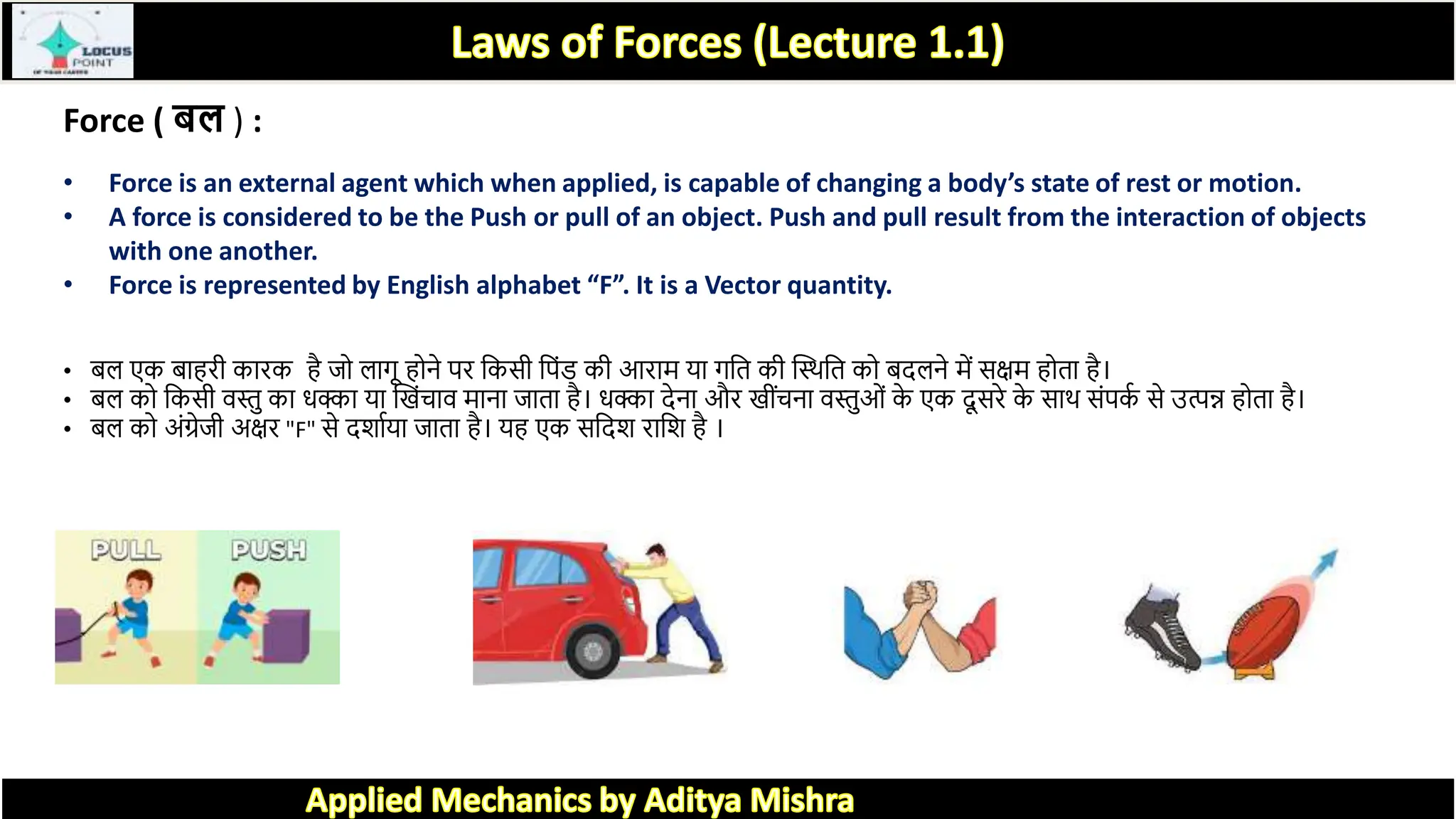
• Force is an external agent which when applied, is capable of changing a body’s state of rest or motion.
• A force is considered to be the Push or pull of an object. Push and pull result from the interaction of objects
with one another.
• Force is represented by English alphabet “F”. It is a Vector quantity.
• बल एक ब हरी क रक है जो ल गू होने पर त्रकसी त्रपांड की आर म य गत्रि की स्थित्रि को बदलने में सक्षम होि है।
• बल को त्रकसी वस्तु क धक्क य स् ांच व म न ज ि है। धक्क देन और ीांचन वस्तुओां क
े एक दू सरे क
े स ि सांपक
क से उत्पन्न होि है।
• बल को अांग्रेजी अक्षर "F" से दर् कय ज ि है। यह एक सत्रदर् र त्रर् है ।
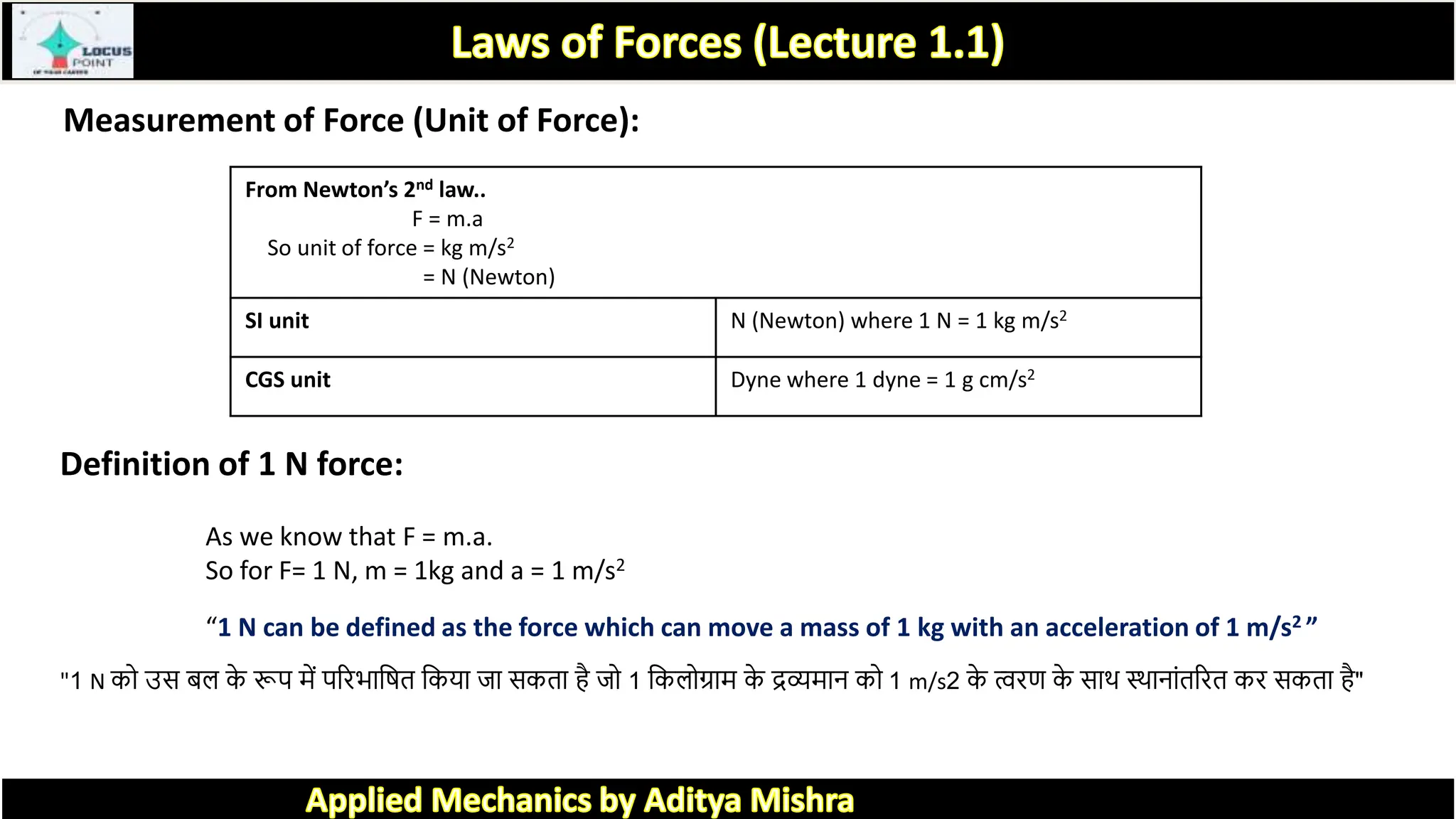
Measurement of Force (Unit of Force):
From Newton’s 2nd law..
F = m.a
So unit of force = kg m/s2
= N (Newton)
SI unit N (Newton) where 1 N = 1 kg m/s2
CGS unit Dyne where 1 dyne = 1 g cm/s2
Definition of 1 N force:
As we know that F = m.a.
So for F= 1 N, m = 1kg and a = 1 m/s2
“1 N can be defined as the force which can move a mass of 1 kg with an acceleration of 1 m/s2 ”
"1 N को उस बल क
े रूप में पररभ त्रिि त्रकय ज सकि है जो 1 त्रकलोग्र म क
े द्रव्यम न को 1 m/s2 क
े त्वरण क
े स ि थि न ांिररि कर सकि है"
Representation of Force :
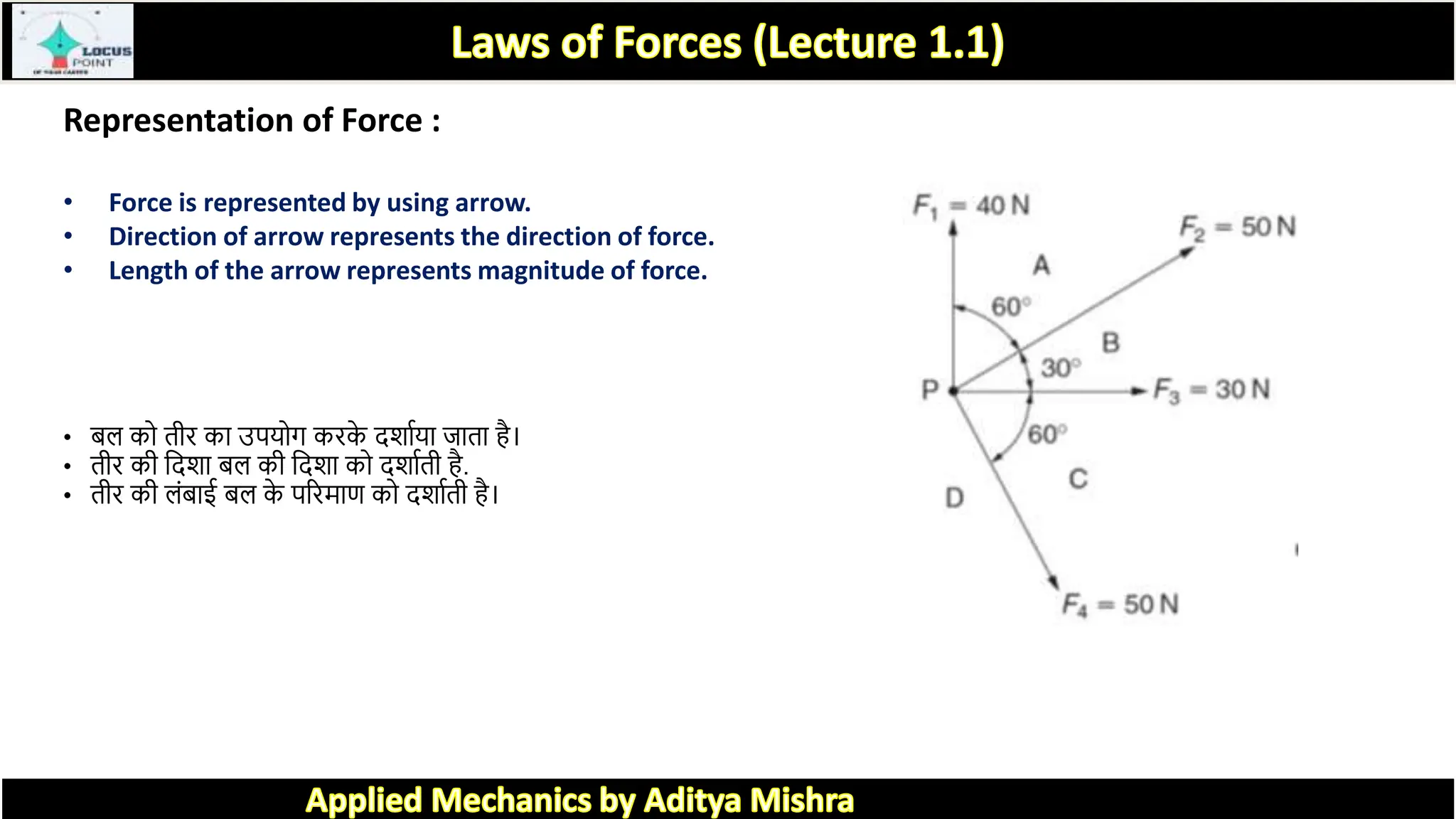
• Force is represented by using arrow.
• Direction of arrow represents the direction of force.
• Length of the arrow represents magnitude of force.
• बल को िीर क उपयोग करक
े दर् कय ज ि है।
• िीर की त्रदर् बल की त्रदर् को दर् किी है.
• िीर की लांब ई बल क
े पररम ण को दर् किी है।
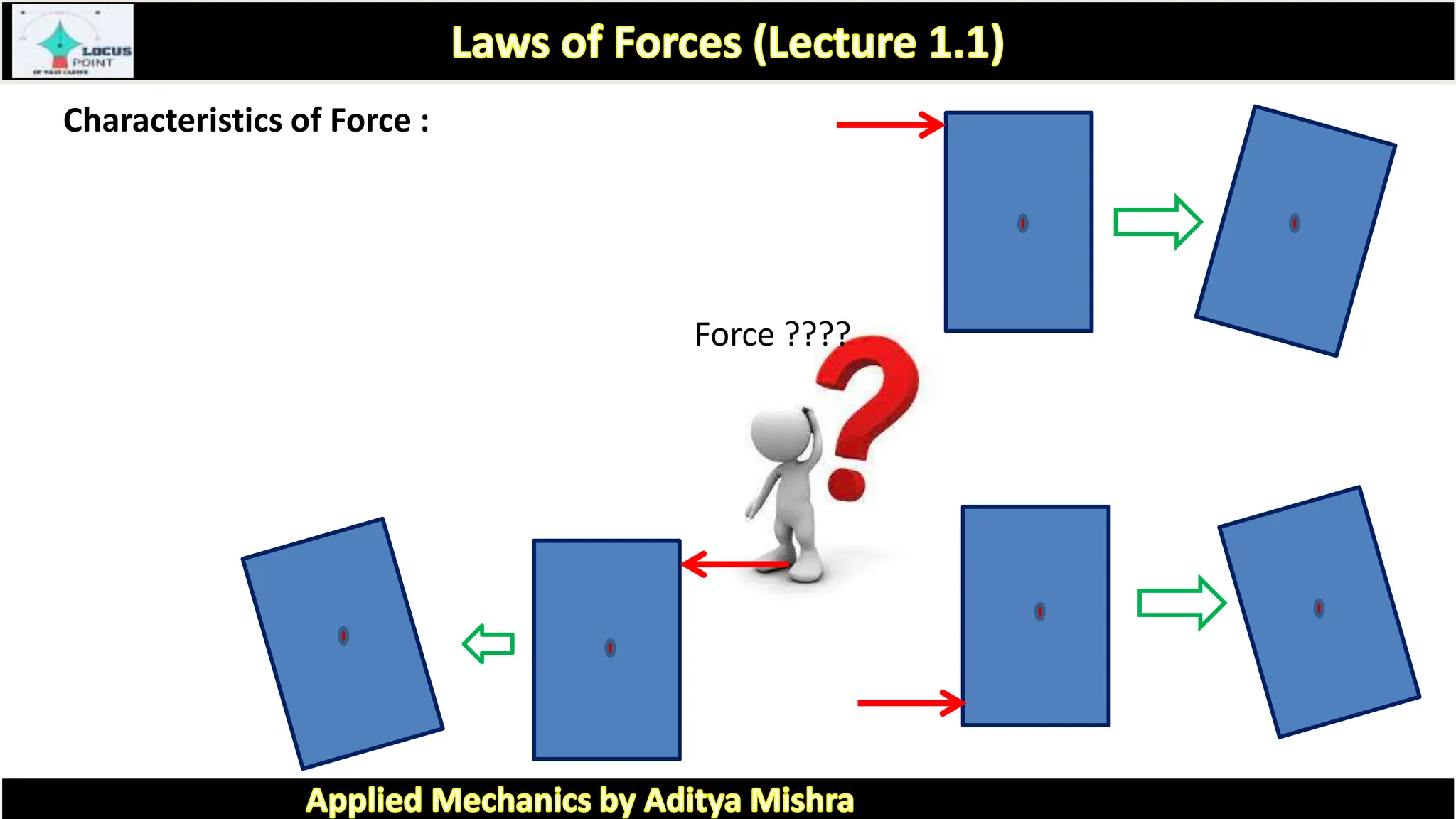
Characteristics of Force :
Force ????
Characteristics of Force :
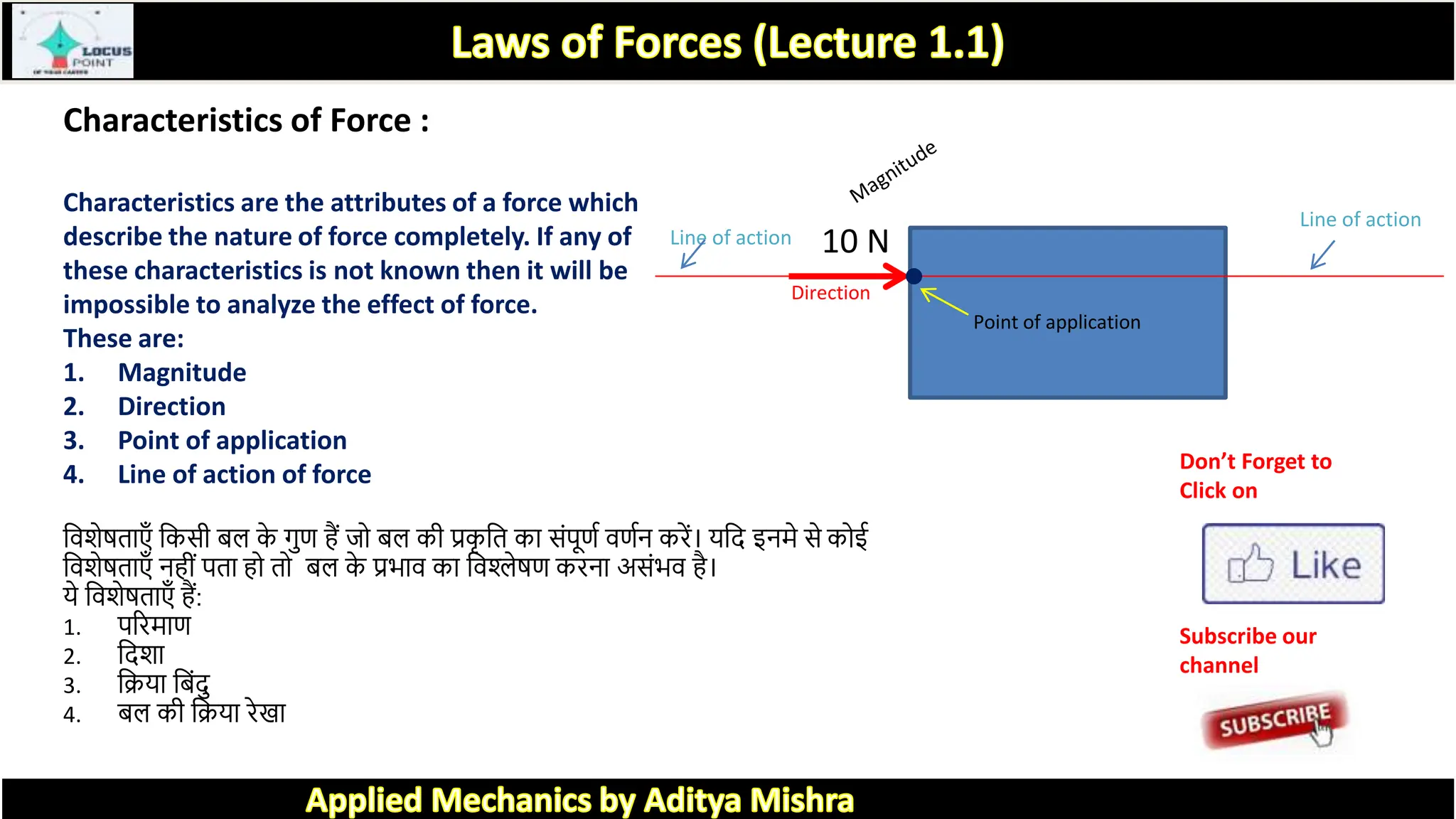
Characteristics are the attributes of a force which
describe the nature of force completely. If any of
these characteristics is not known then it will be
impossible to analyze the effect of force.
These are:
1. Magnitude
2. Direction
3. Point of application
4. Line of action of force
त्रवर्ेिि एँ त्रकसी बल क
े गुण हैं जो बल की प्रक
ृ त्रि क सांपूणक वणकन करें। यत्रद इनमे से कोई
त्रवर्ेिि एँ नहीां पि हो िो बल क
े प्रभ व क त्रवश्लेिण करन असांभव है।
ये त्रवर्ेिि एँ हैं:
1. पररम ण
2. त्रदर्
3. त्रिय त्रबांदु
4. बल की त्रिय रे
10 N
Line of action
Line of action
Point of application
Direction
Don’t Forget to
Click on
Subscribe our
channel
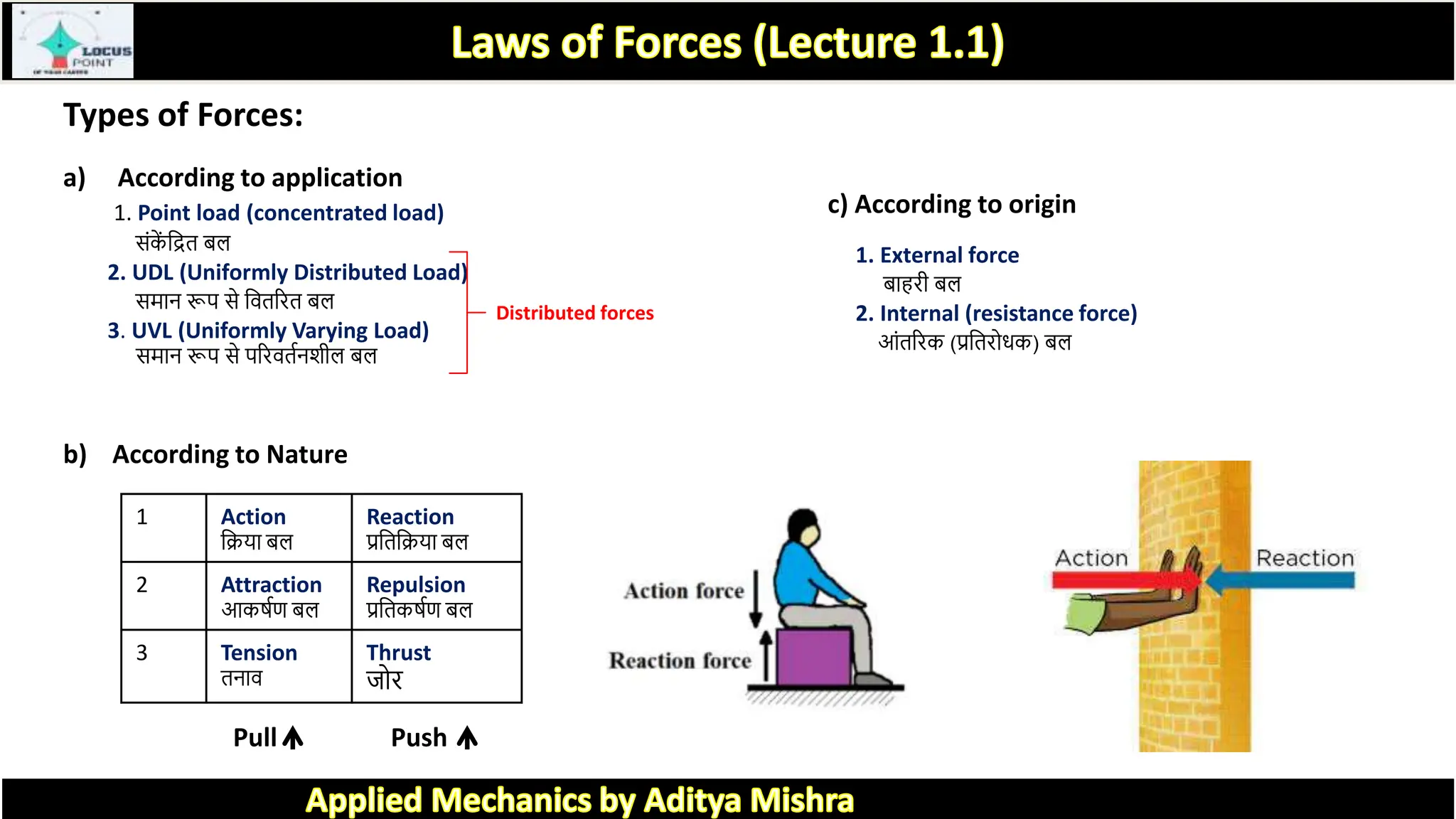
Types of Forces:
a) According to application
1. Point load (concentrated load)
सांक
ें त्रद्रि बल
2. UDL (Uniformly Distributed Load)
सम न रूप से त्रविररि बल
3. UVL (Uniformly Varying Load)
सम न रूप से पररविकनर्ील बल
b) According to Nature
Distributed forces
1 Action
त्रिय बल
Reaction
प्रत्रित्रिय बल
2 Attraction
आकिकण बल
Repulsion
प्रत्रिकिकण बल
3 Tension
िन व
Thrust
जोर
Pull Push
c) According to origin
1. External force
ब हरी बल
2. Internal (resistance force)
आांिररक (प्रत्रिरोधक) बल
Types of Forces:
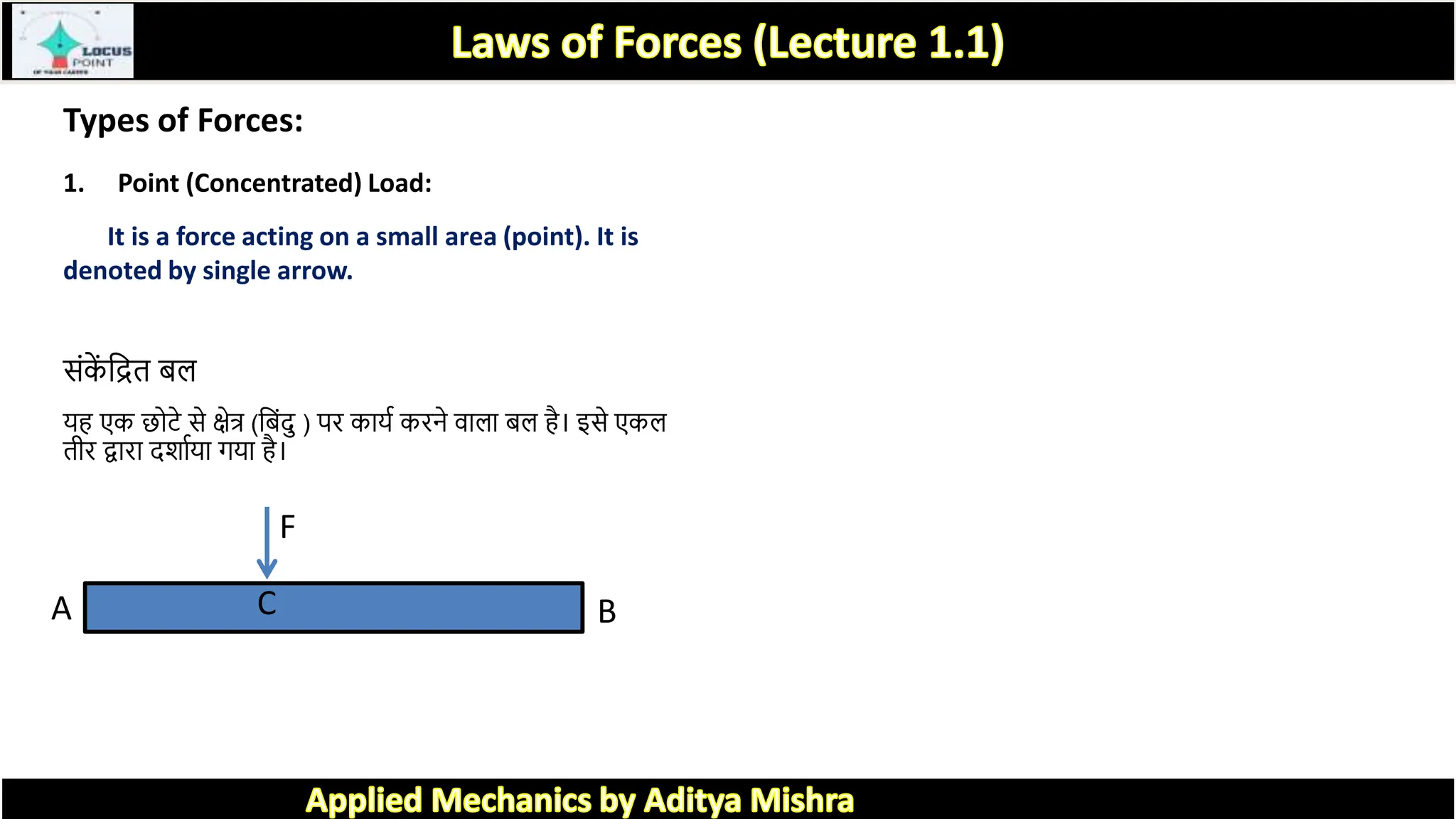
1. Point (Concentrated) Load:
It is a force acting on a small area (point). It is
denoted by single arrow.
सांक
ें त्रद्रि बल
यह एक छोटे से क्षेि (त्रबांदु ) पर क यक करने व ल बल है। इसे एकल
िीर द्व र दर् कय गय है।
A B
C
F
Types of Forces:
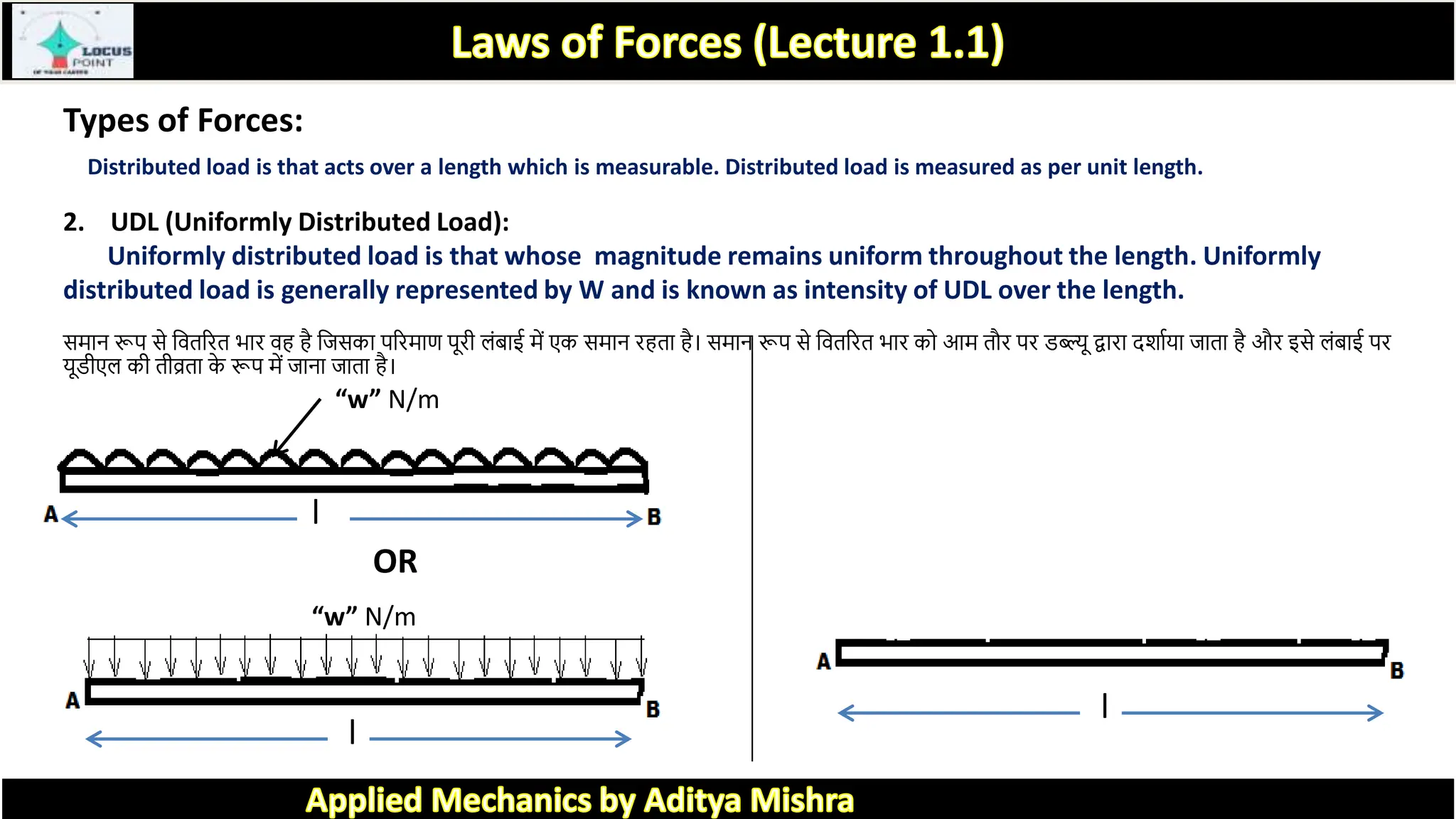
2. UDL (Uniformly Distributed Load):
Uniformly distributed load is that whose magnitude remains uniform throughout the length. Uniformly
distributed load is generally represented by W and is known as intensity of UDL over the length.
सम न रूप से त्रविररि भ र वह है त्रजसक पररम ण पूरी लांब ई में एक सम न रहि है। सम न रूप से त्रविररि भ र को आम िौर पर डब्ल्यू द्व र दर् कय ज ि है और इसे लांब ई पर
यूडीएल की िीव्रि क
े रूप में ज न ज ि है।
Distributed load is that acts over a length which is measurable. Distributed load is measured as per unit length.
“w” N/m
“w” N/m
l
l
OR
l
Types of Forces:
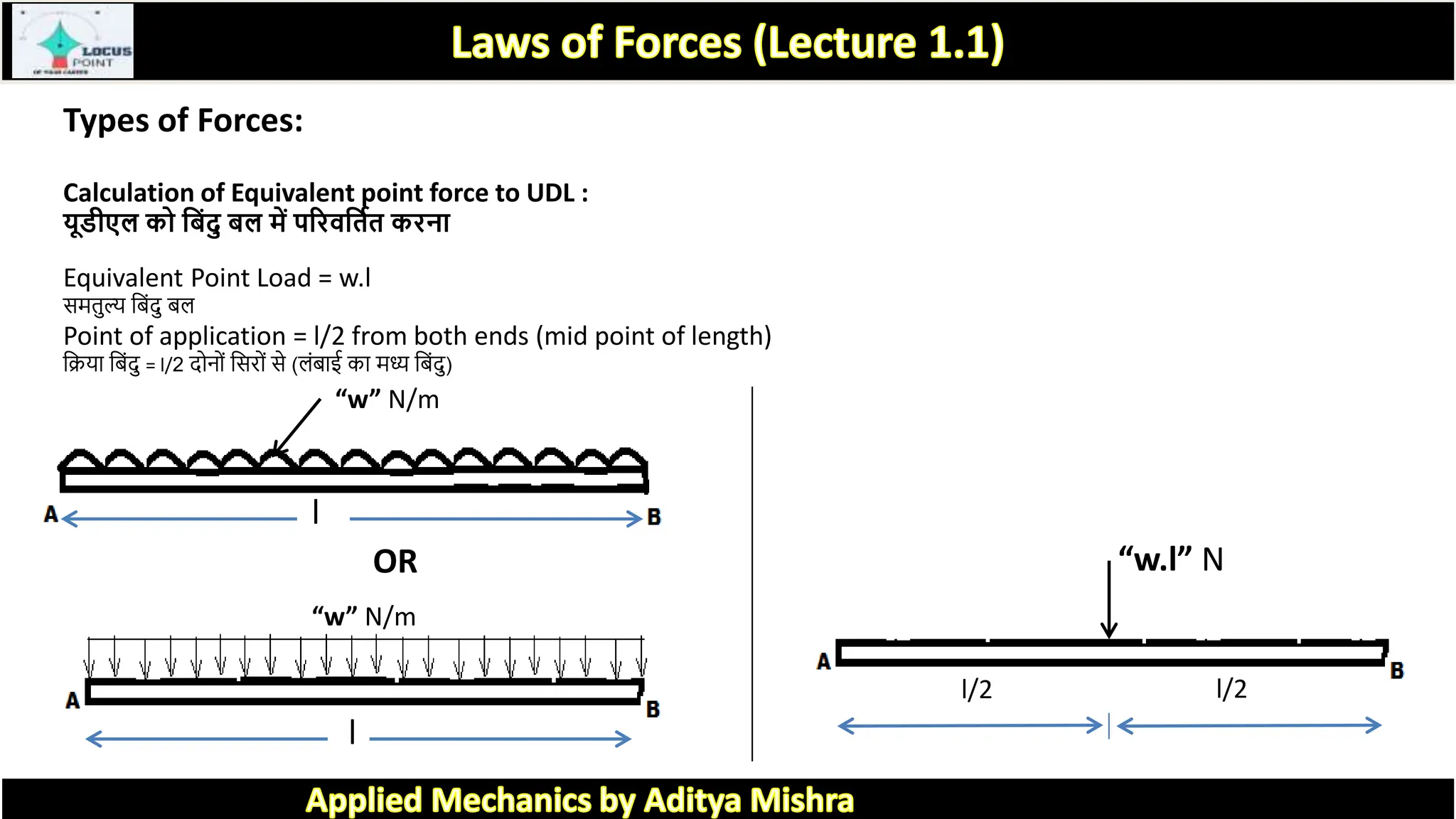
Calculation of Equivalent point force to UDL :
यूडीएल को बबिंदु बल में परिवबतित किना
Equivalent Point Load = w.l
समिुल्य त्रबांदु बल
Point of application = l/2 from both ends (mid point of length)
त्रिय त्रबांदु = l/2 दोनोां त्रसरोां से (लांब ई क मध्य त्रबांदु)
“w” N/m
“w” N/m
l
l
OR
l/2
“w.l” N
l/2
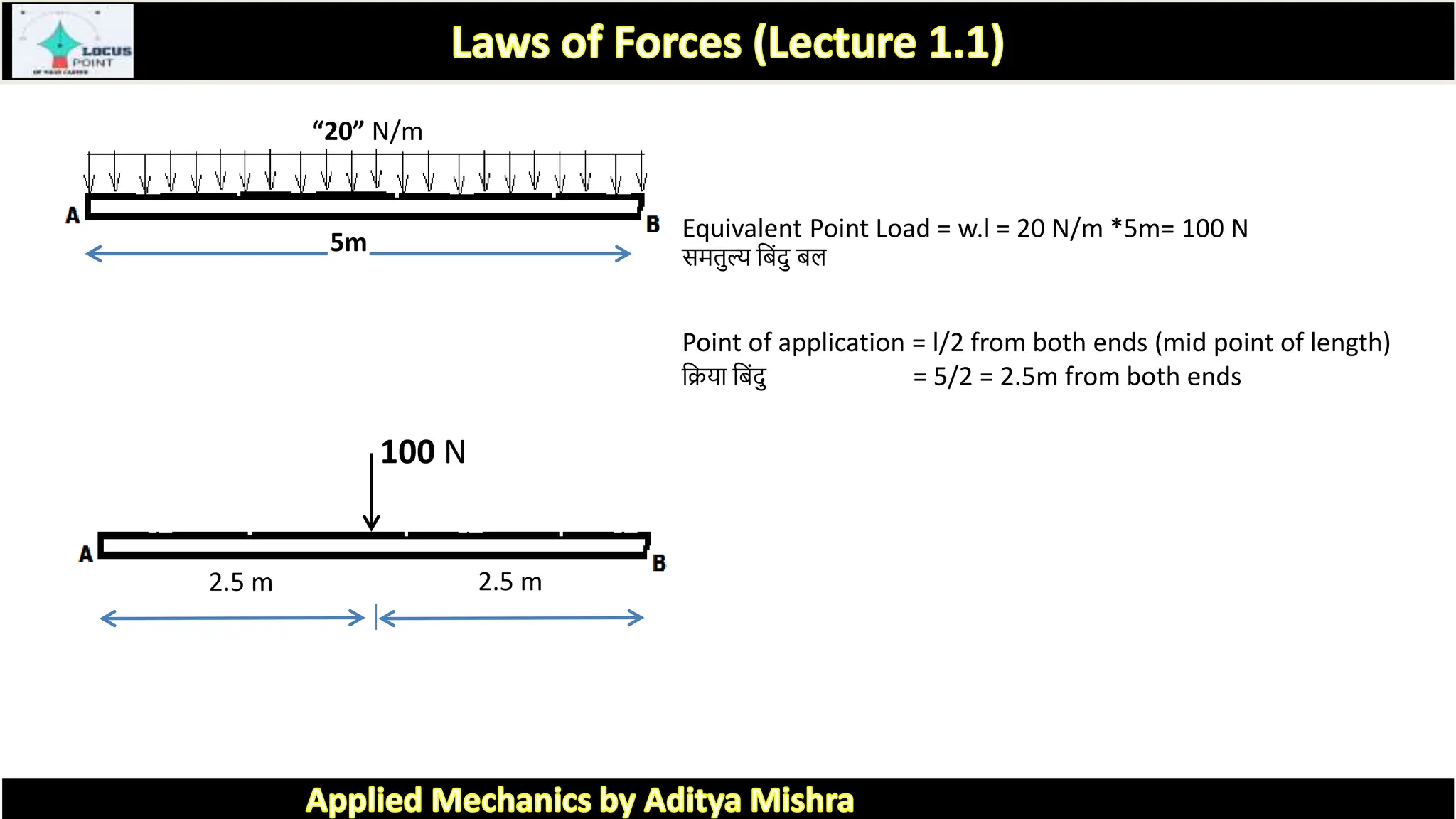
“20” N/m
5m Equivalent Point Load = w.l = 20 N/m *5m= 100 N
समिुल्य त्रबांदु बल
Point of application = l/2 from both ends (mid point of length)
त्रिय त्रबांदु = 5/2 = 2.5m from both ends
2.5 m
100 N
2.5 m
Next Video Lecture On:
Force Systems, Law of Transmissibility of Forces, Law of
Superposition
APPLIED MECHANICS (अनुप्रयुक्त य ांत्रिकी )
@Locus Point of Your Career : By Aditya Mishra
Topic :
Laws of Forces
Lecture 1.2 :
Law of Transmissibility of forces,
System of Forces
Common to
B.Tech (1st Year),
Polytechnic (1st Year) students
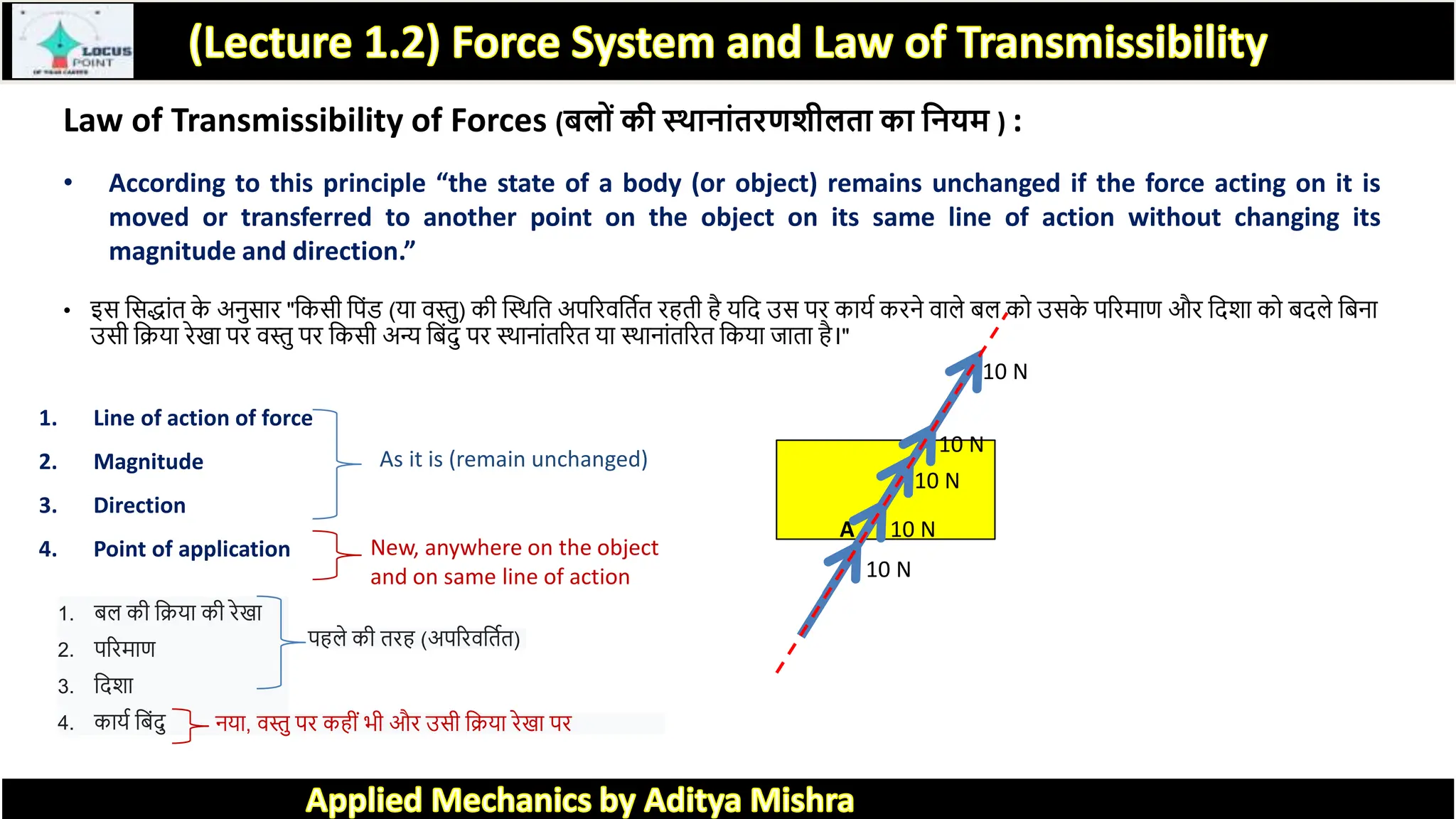
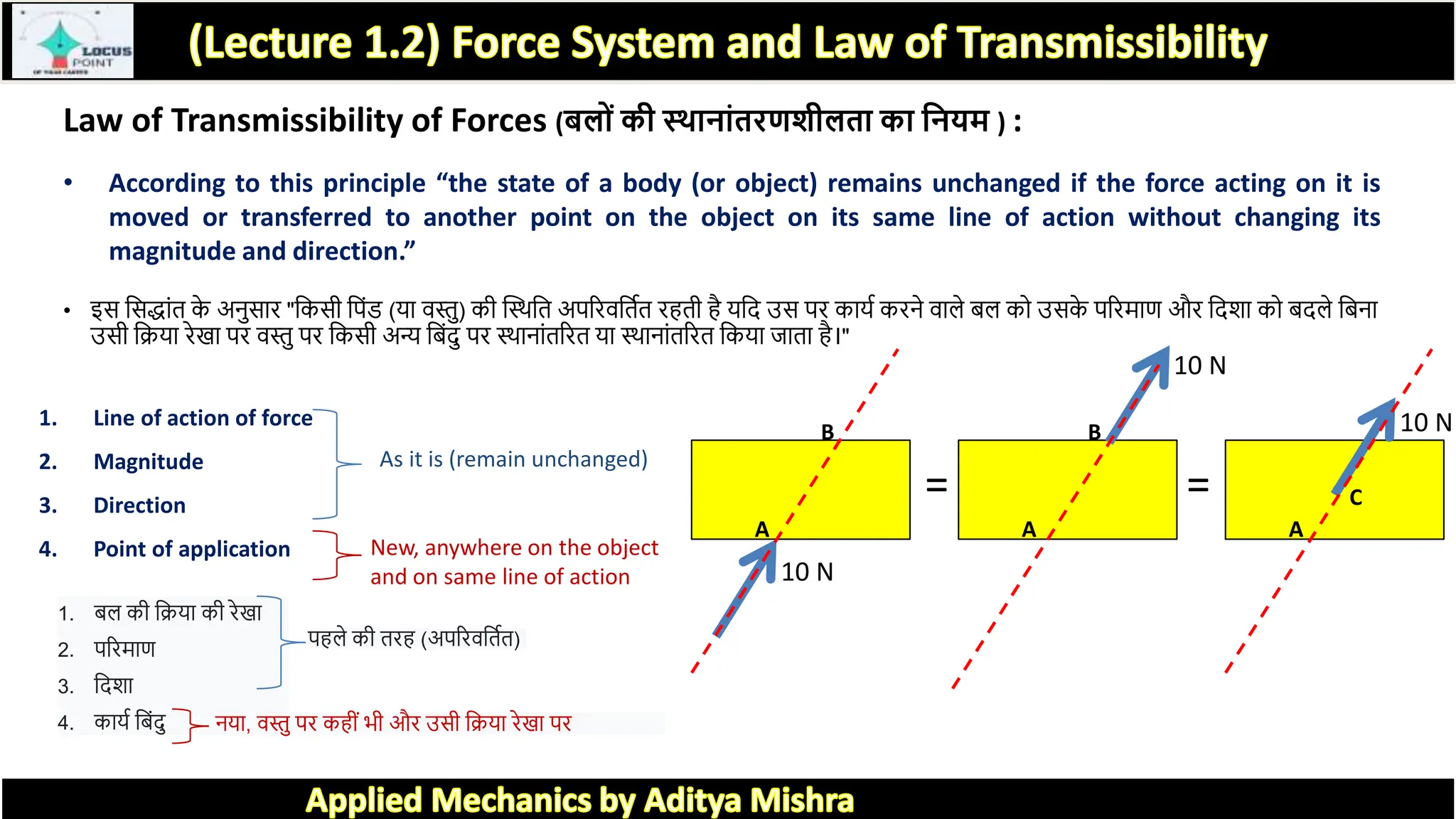
Law of Transmissibility of Forces (बलोिं की स्थानािंतिणशीलता का बनयम ) :
• According to this principle “the state of a body (or object) remains unchanged if the force acting on it is
moved or transferred to another point on the object on its same line of action without changing its
magnitude and direction.”
• इस त्रसद् ांि क
े अनुस र "त्रकसी त्रपांड (य वस्तु) की स्थित्रि अपररवत्रिकि रहिी है यत्रद उस पर क यक करने व ले बल को उसक
े पररम ण और त्रदर् को बदले त्रबन
उसी त्रिय रे पर वस्तु पर त्रकसी अन्य त्रबांदु पर थि न ांिररि य थि न ांिररि त्रकय ज ि है।"
1. Line of action of force
2. Magnitude
3. Direction
4. Point of application
1. बल की त्रिय की रे
2. पररम ण
3. त्रदर्
4. क यक त्रबांदु
As it is (remain unchanged)
पहले की िरह (अपररवत्रिकि)
New, anywhere on the object
and on same line of action
नय , वस्तु पर कहीां भी और उसी त्रिय रे पर
A
10 N
10 N
10 N
10 N
10 N
Law of Transmissibility of Forces (बलोिं की स्थानािंतिणशीलता का बनयम ) :
• According to this principle “the state of a body (or object) remains unchanged if the force acting on it is
moved or transferred to another point on the object on its same line of action without changing its
magnitude and direction.”
• इस त्रसद् ांि क
े अनुस र "त्रकसी त्रपांड (य वस्तु) की स्थित्रि अपररवत्रिकि रहिी है यत्रद उस पर क यक करने व ले बल को उसक
े पररम ण और त्रदर् को बदले त्रबन
उसी त्रिय रे पर वस्तु पर त्रकसी अन्य त्रबांदु पर थि न ांिररि य थि न ांिररि त्रकय ज ि है।"
1. Line of action of force
2. Magnitude
3. Direction
4. Point of application
1. बल की त्रिय की रे
2. पररम ण
3. त्रदर्
4. क यक त्रबांदु
As it is (remain unchanged)
पहले की िरह (अपररवत्रिकि)
New, anywhere on the object
and on same line of action
नय , वस्तु पर कहीां भी और उसी त्रिय रे पर
= =
A
B
A
C
A
B
10 N
10 N
10 N
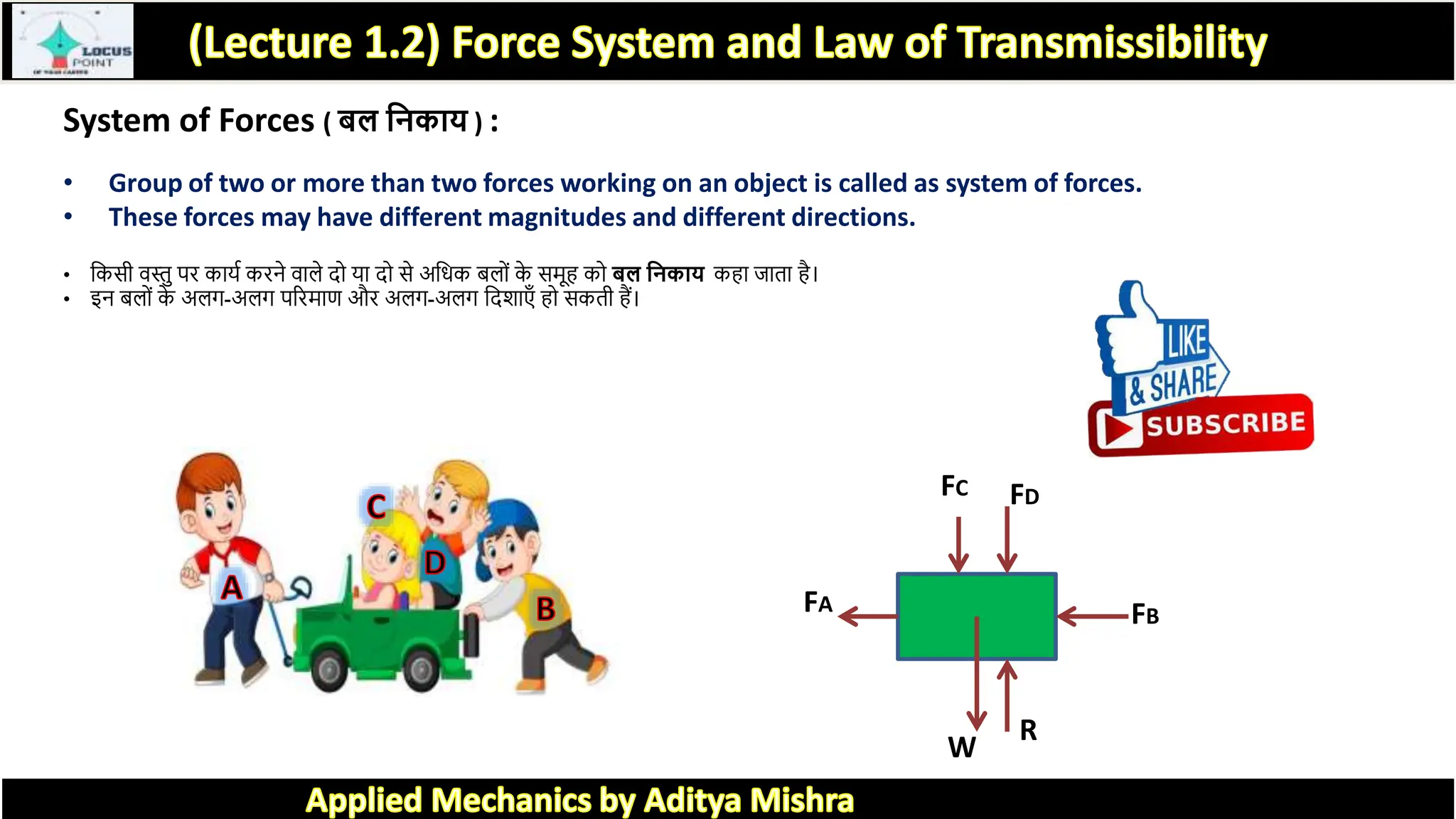
System of Forces ( बल बनकाय ) :
• Group of two or more than two forces working on an object is called as system of forces.
• These forces may have different magnitudes and different directions.
• त्रकसी वस्तु पर क यक करने व ले दो य दो से अत्रधक बलोां क
े समूह को बल बनकाय कह ज ि है।
• इन बलोां क
े अलग-अलग पररम ण और अलग-अलग त्रदर् एँ हो सकिी हैं।
FA FB
FC FD
W
R
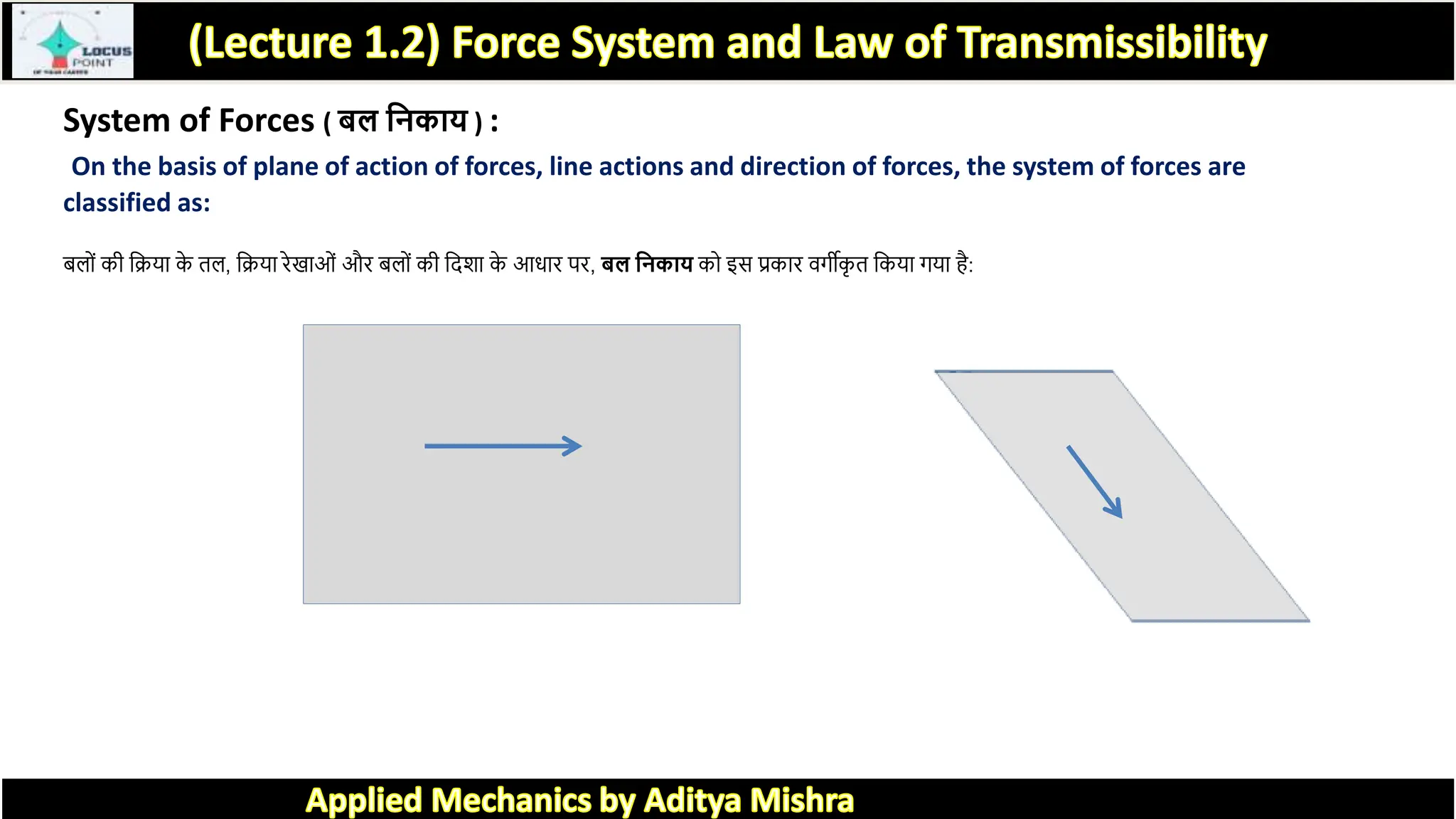
System of Forces ( बल बनकाय ) :
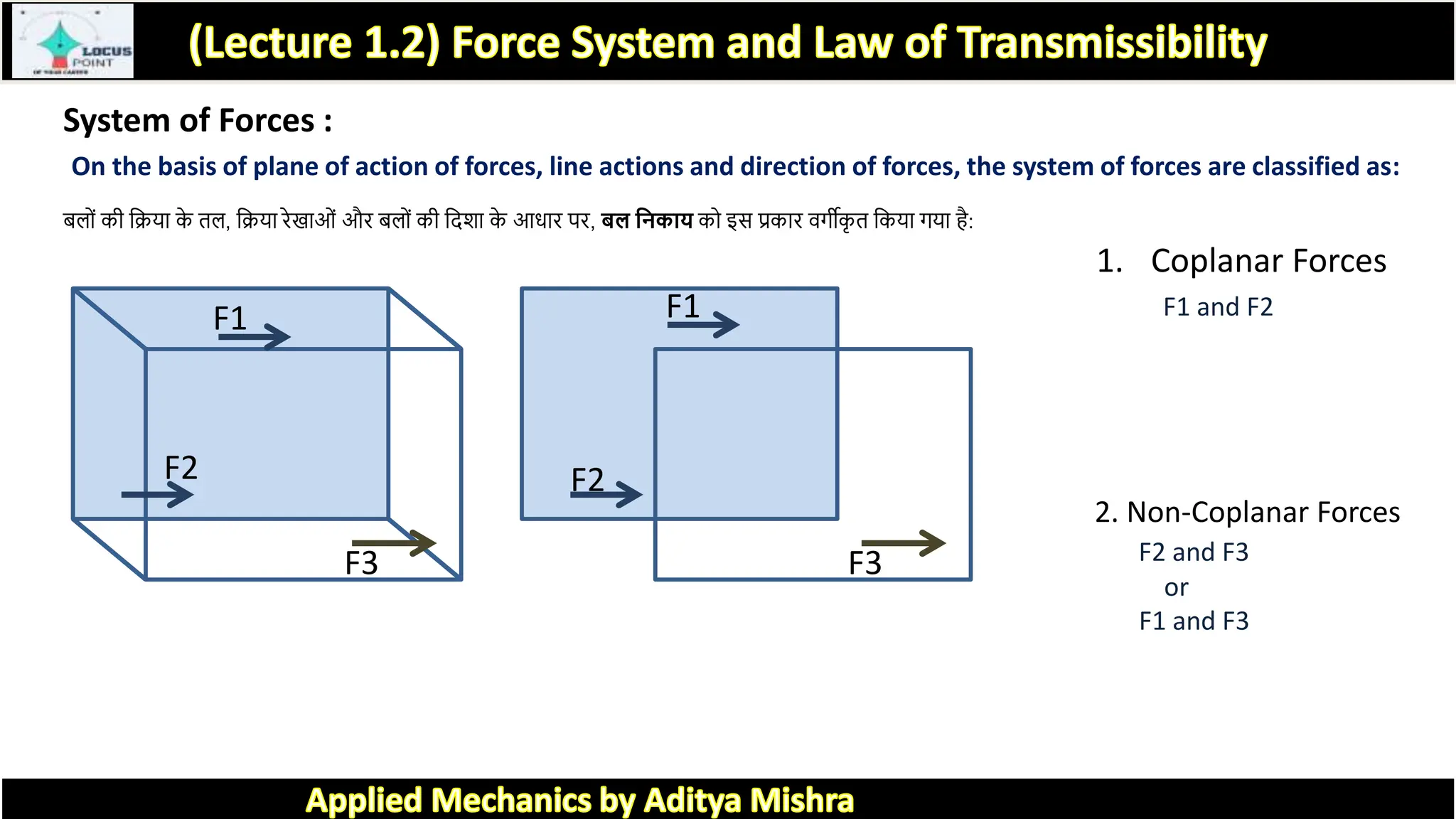
On the basis of plane of action of forces, line actions and direction of forces, the system of forces are
classified as:
बलोां की त्रिय क
े िल, त्रिय रे ओां और बलोां की त्रदर् क
े आध र पर, बल बनकाय को इस प्रक र वगीक
ृ ि त्रकय गय है:
System of Forces :
On the basis of plane of action of forces, line actions and direction of forces, the system of forces are classified as:
बलोां की त्रिय क
े िल, त्रिय रे ओां और बलोां की त्रदर् क
े आध र पर, बल बनकाय को इस प्रक र वगीक
ृ ि त्रकय गय है:
F1
F2
F3
F1
F2
F3
1. Coplanar Forces
F1 and F2
2. Non-Coplanar Forces
F2 and F3
or
F1 and F3
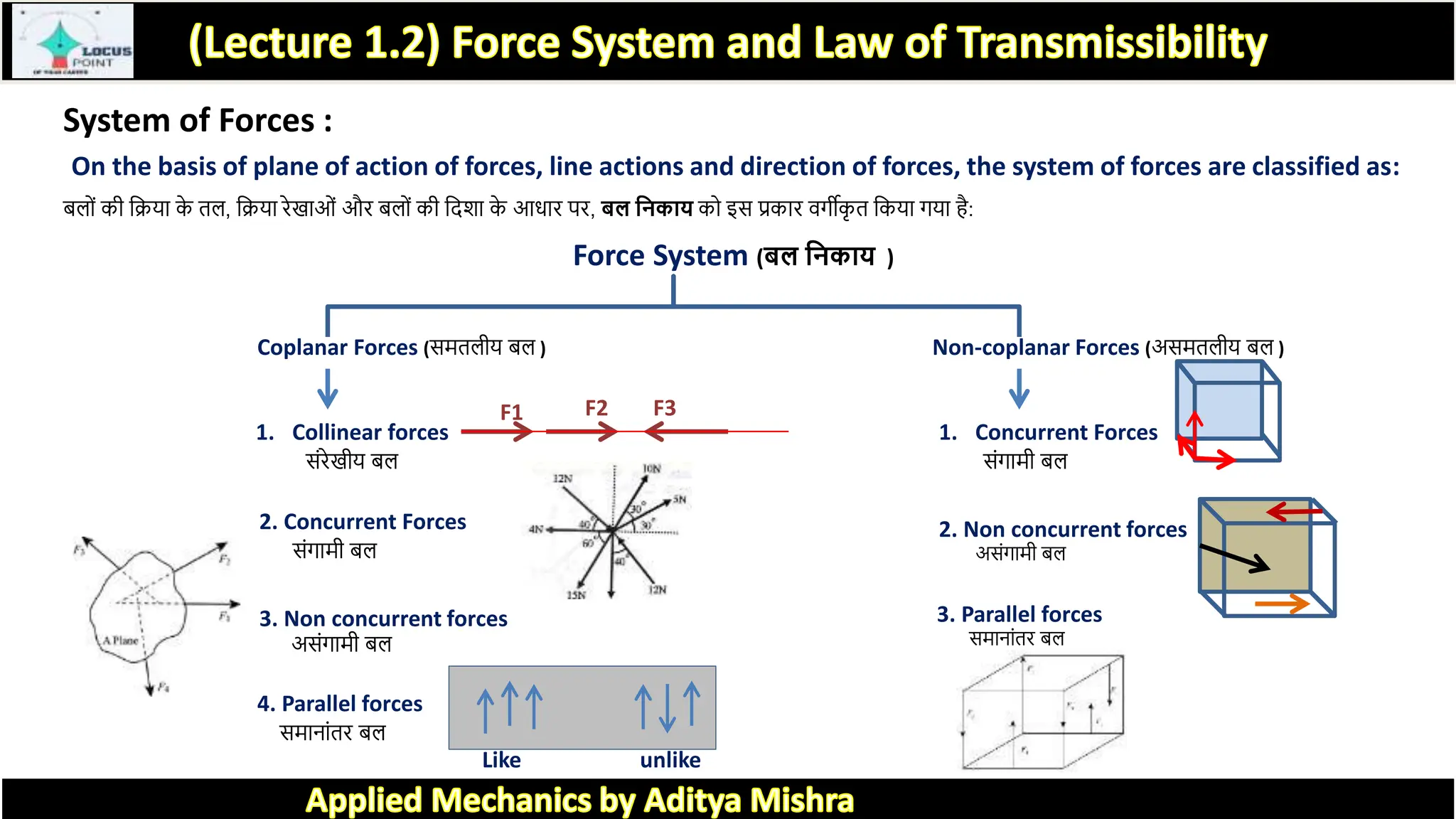
Force System (बल बनकाय )
Coplanar Forces (समिलीय बल ) Non-coplanar Forces (असमिलीय बल )
1. Collinear forces
सांरे ीय बल
2. Concurrent Forces
सांग मी बल
4. Parallel forces
सम न ांिर बल
3. Non concurrent forces
असांग मी बल
1. Concurrent Forces
सांग मी बल
3. Parallel forces
सम न ांिर बल
2. Non concurrent forces
असांग मी बल
F1 F2 F3
System of Forces :
On the basis of plane of action of forces, line actions and direction of forces, the system of forces are classified as:
बलोां की त्रिय क
े िल, त्रिय रे ओां और बलोां की त्रदर् क
े आध र पर, बल बनकाय को इस प्रक र वगीक
ृ ि त्रकय गय है:
Like unlike
Basics of applied mechanics: force and force systems.pptx

Basics of applied mechanics: force and force systems.pptx

  • 1.
    APPLIED MECHANICS (अनुप्रयुक्तय ांत्रिकी ) @Locus Point of Your Career : By Aditya Mishra Topic : Laws of Forces Lecture 1.1 : (Introduction to Force) Definition of force, measurement of force, its representation, types of force: Point force/concentrated force & Uniformly distributed force, effects of force, characteristics of a force Common to B.Tech (1st Year), Polytechnic (1st Year) students
  • 2.
    Force ( बल) : • Force is an external agent which when applied, is capable of changing a body’s state of rest or motion. • A force is considered to be the Push or pull of an object. Push and pull result from the interaction of objects with one another. • Force is represented by English alphabet “F”. It is a Vector quantity. • बल एक ब हरी क रक है जो ल गू होने पर त्रकसी त्रपांड की आर म य गत्रि की स्थित्रि को बदलने में सक्षम होि है। • बल को त्रकसी वस्तु क धक्क य स् ांच व म न ज ि है। धक्क देन और ीांचन वस्तुओां क े एक दू सरे क े स ि सांपक क से उत्पन्न होि है। • बल को अांग्रेजी अक्षर "F" से दर् कय ज ि है। यह एक सत्रदर् र त्रर् है ।
  • 3.
    Measurement of Force(Unit of Force): From Newton’s 2nd law.. F = m.a So unit of force = kg m/s2 = N (Newton) SI unit N (Newton) where 1 N = 1 kg m/s2 CGS unit Dyne where 1 dyne = 1 g cm/s2 Definition of 1 N force: As we know that F = m.a. So for F= 1 N, m = 1kg and a = 1 m/s2 “1 N can be defined as the force which can move a mass of 1 kg with an acceleration of 1 m/s2 ” "1 N को उस बल क े रूप में पररभ त्रिि त्रकय ज सकि है जो 1 त्रकलोग्र म क े द्रव्यम न को 1 m/s2 क े त्वरण क े स ि थि न ांिररि कर सकि है"
  • 4.
    Representation of Force: • Force is represented by using arrow. • Direction of arrow represents the direction of force. • Length of the arrow represents magnitude of force. • बल को िीर क उपयोग करक े दर् कय ज ि है। • िीर की त्रदर् बल की त्रदर् को दर् किी है. • िीर की लांब ई बल क े पररम ण को दर् किी है।
  • 5.
  • 6.
    Characteristics of Force: Characteristics are the attributes of a force which describe the nature of force completely. If any of these characteristics is not known then it will be impossible to analyze the effect of force. These are: 1. Magnitude 2. Direction 3. Point of application 4. Line of action of force त्रवर्ेिि एँ त्रकसी बल क े गुण हैं जो बल की प्रक ृ त्रि क सांपूणक वणकन करें। यत्रद इनमे से कोई त्रवर्ेिि एँ नहीां पि हो िो बल क े प्रभ व क त्रवश्लेिण करन असांभव है। ये त्रवर्ेिि एँ हैं: 1. पररम ण 2. त्रदर् 3. त्रिय त्रबांदु 4. बल की त्रिय रे 10 N Line of action Line of action Point of application Direction Don’t Forget to Click on Subscribe our channel
  • 7.
    Types of Forces: a)According to application 1. Point load (concentrated load) सांक ें त्रद्रि बल 2. UDL (Uniformly Distributed Load) सम न रूप से त्रविररि बल 3. UVL (Uniformly Varying Load) सम न रूप से पररविकनर्ील बल b) According to Nature Distributed forces 1 Action त्रिय बल Reaction प्रत्रित्रिय बल 2 Attraction आकिकण बल Repulsion प्रत्रिकिकण बल 3 Tension िन व Thrust जोर Pull Push c) According to origin 1. External force ब हरी बल 2. Internal (resistance force) आांिररक (प्रत्रिरोधक) बल
  • 8.
    Types of Forces: 1.Point (Concentrated) Load: It is a force acting on a small area (point). It is denoted by single arrow. सांक ें त्रद्रि बल यह एक छोटे से क्षेि (त्रबांदु ) पर क यक करने व ल बल है। इसे एकल िीर द्व र दर् कय गय है। A B C F
  • 9.
    Types of Forces: 2.UDL (Uniformly Distributed Load): Uniformly distributed load is that whose magnitude remains uniform throughout the length. Uniformly distributed load is generally represented by W and is known as intensity of UDL over the length. सम न रूप से त्रविररि भ र वह है त्रजसक पररम ण पूरी लांब ई में एक सम न रहि है। सम न रूप से त्रविररि भ र को आम िौर पर डब्ल्यू द्व र दर् कय ज ि है और इसे लांब ई पर यूडीएल की िीव्रि क े रूप में ज न ज ि है। Distributed load is that acts over a length which is measurable. Distributed load is measured as per unit length. “w” N/m “w” N/m l l OR l
  • 10.
    Types of Forces: Calculationof Equivalent point force to UDL : यूडीएल को बबिंदु बल में परिवबतित किना Equivalent Point Load = w.l समिुल्य त्रबांदु बल Point of application = l/2 from both ends (mid point of length) त्रिय त्रबांदु = l/2 दोनोां त्रसरोां से (लांब ई क मध्य त्रबांदु) “w” N/m “w” N/m l l OR l/2 “w.l” N l/2
  • 11.
    “20” N/m 5m EquivalentPoint Load = w.l = 20 N/m *5m= 100 N समिुल्य त्रबांदु बल Point of application = l/2 from both ends (mid point of length) त्रिय त्रबांदु = 5/2 = 2.5m from both ends 2.5 m 100 N 2.5 m
  • 12.
    Next Video LectureOn: Force Systems, Law of Transmissibility of Forces, Law of Superposition
  • 13.
    APPLIED MECHANICS (अनुप्रयुक्तय ांत्रिकी ) @Locus Point of Your Career : By Aditya Mishra Topic : Laws of Forces Lecture 1.2 : Law of Transmissibility of forces, System of Forces Common to B.Tech (1st Year), Polytechnic (1st Year) students
  • 14.
    Law of Transmissibilityof Forces (बलोिं की स्थानािंतिणशीलता का बनयम ) : • According to this principle “the state of a body (or object) remains unchanged if the force acting on it is moved or transferred to another point on the object on its same line of action without changing its magnitude and direction.” • इस त्रसद् ांि क े अनुस र "त्रकसी त्रपांड (य वस्तु) की स्थित्रि अपररवत्रिकि रहिी है यत्रद उस पर क यक करने व ले बल को उसक े पररम ण और त्रदर् को बदले त्रबन उसी त्रिय रे पर वस्तु पर त्रकसी अन्य त्रबांदु पर थि न ांिररि य थि न ांिररि त्रकय ज ि है।" 1. Line of action of force 2. Magnitude 3. Direction 4. Point of application 1. बल की त्रिय की रे 2. पररम ण 3. त्रदर् 4. क यक त्रबांदु As it is (remain unchanged) पहले की िरह (अपररवत्रिकि) New, anywhere on the object and on same line of action नय , वस्तु पर कहीां भी और उसी त्रिय रे पर A 10 N 10 N 10 N 10 N 10 N
  • 15.
    Law of Transmissibilityof Forces (बलोिं की स्थानािंतिणशीलता का बनयम ) : • According to this principle “the state of a body (or object) remains unchanged if the force acting on it is moved or transferred to another point on the object on its same line of action without changing its magnitude and direction.” • इस त्रसद् ांि क े अनुस र "त्रकसी त्रपांड (य वस्तु) की स्थित्रि अपररवत्रिकि रहिी है यत्रद उस पर क यक करने व ले बल को उसक े पररम ण और त्रदर् को बदले त्रबन उसी त्रिय रे पर वस्तु पर त्रकसी अन्य त्रबांदु पर थि न ांिररि य थि न ांिररि त्रकय ज ि है।" 1. Line of action of force 2. Magnitude 3. Direction 4. Point of application 1. बल की त्रिय की रे 2. पररम ण 3. त्रदर् 4. क यक त्रबांदु As it is (remain unchanged) पहले की िरह (अपररवत्रिकि) New, anywhere on the object and on same line of action नय , वस्तु पर कहीां भी और उसी त्रिय रे पर = = A B A C A B 10 N 10 N 10 N
  • 16.
    System of Forces( बल बनकाय ) : • Group of two or more than two forces working on an object is called as system of forces. • These forces may have different magnitudes and different directions. • त्रकसी वस्तु पर क यक करने व ले दो य दो से अत्रधक बलोां क े समूह को बल बनकाय कह ज ि है। • इन बलोां क े अलग-अलग पररम ण और अलग-अलग त्रदर् एँ हो सकिी हैं। FA FB FC FD W R
  • 17.
    System of Forces( बल बनकाय ) : On the basis of plane of action of forces, line actions and direction of forces, the system of forces are classified as: बलोां की त्रिय क े िल, त्रिय रे ओां और बलोां की त्रदर् क े आध र पर, बल बनकाय को इस प्रक र वगीक ृ ि त्रकय गय है:
  • 18.
    System of Forces: On the basis of plane of action of forces, line actions and direction of forces, the system of forces are classified as: बलोां की त्रिय क े िल, त्रिय रे ओां और बलोां की त्रदर् क े आध र पर, बल बनकाय को इस प्रक र वगीक ृ ि त्रकय गय है: F1 F2 F3 F1 F2 F3 1. Coplanar Forces F1 and F2 2. Non-Coplanar Forces F2 and F3 or F1 and F3
  • 19.
    Force System (बलबनकाय ) Coplanar Forces (समिलीय बल ) Non-coplanar Forces (असमिलीय बल ) 1. Collinear forces सांरे ीय बल 2. Concurrent Forces सांग मी बल 4. Parallel forces सम न ांिर बल 3. Non concurrent forces असांग मी बल 1. Concurrent Forces सांग मी बल 3. Parallel forces सम न ांिर बल 2. Non concurrent forces असांग मी बल F1 F2 F3 System of Forces : On the basis of plane of action of forces, line actions and direction of forces, the system of forces are classified as: बलोां की त्रिय क े िल, त्रिय रे ओां और बलोां की त्रदर् क े आध र पर, बल बनकाय को इस प्रक र वगीक ृ ि त्रकय गय है: Like unlike