INTRODUCTION
 Renewable Energy or Non-Renewable Energy?
OR
Why Renewable Energy?
Why only Solar?
 Sun…the never ending source
of energy.
 Primary source – Fossil
Fuels Limited.
 Clean Energy.
 Easily Scalable.
 Modular character
technology.
Why only Solar?
• The Solar energy radiate by the sun is 3.8 x 1026 joules /sec (NASA).
• India is one of the sun’s most favored nations, blessed with about 5,000 Terawh of
solar Energy radiation very year with most parts receiving 4 – 7 Kwh / Sq. Meter /
Per day.
• Daily average solar energy incident over India varies 4 to 7 Kwh/m2 / Day
• With about 300 clear , sunny days in a year, India have abundant solar potential.
Photovoltaic Cell
 Solar Cell
 Working
 Material
 Type
Fundamental of solar cell.
• The μp is the heart of the processing within a computer..
• Similarly a solar cell is the key component in chain of the photovoltaic solar
system.
• Photovoltaic = photo + voltaic.
• Photo associated with light and voltaic means voltage or voltage that developed
within the solar cell.
n-type
semiconductor
p-type
semiconductor
+ + + + + + + + + + + + + + +
- - - - - - - - - - - - - - - - - -
Physics of Photovoltaic Generation
Depletion Zone
Light And Photo Electric Effect
• Photoelectric effect is a phenomenon in which electrons are emitted
from matter after absorption of energy from visible light.
• Electrons gain energy from incoming photons and are emitted when this
absorbed energy exceeds the work function of the material.
• Electric field associated with a semiconductor P--‐N junction can form
an electric current and deliver power to an external load.
• Thus a specially built semiconductor junction can function as a SOLAR
CELL converting natural sunlight into electricity.
Photovoltaic Cell Material
• Thin wafers of silicon
 Similar to computer chips
 Much bigger
 Much cheaper
• Silicon is abundant (sand)
 Non-toxic
 Safe
PV Technology Classification
Silicon Crystalline Technology
Mono crystalline
PV cell
Multi/Poly
crystalline PV
cell.
Thin Film Technology
Amorphous
Silicon PV cells.
Poly Crystalline
PV Cells
PV Technology Classification
• Silicon Crystalline Technology
 Currently makes up 86% of PV market
 Very stable with module efficiencies 10-16%
Silicon Crystalline Technology
• Mono crystalline PV cell
 Made using saw-cut from single cylindrical crystal of Si
 Most efficient commercially available module (11% - 18%)
 Most expensive to produce Circular (square-round) cell creates wasted space on
module
Silicon Crystalline Technology
• Multi/Poly crystalline PV cell.
 Caste from ingot of melted and recrystallised silicon.
 Cells slightly less efficient than a mono crystalline (10% - 16%).
 Less expensive to make than mono-crystalline modules.
 Square shape cells fit into module efficiently using the entire space.
 Accounts for 90% of crystalline Si market .
Thin Film Technology
 Silicon deposited in a continuous on a base material such as glass, metal or
polymers
 Thin-film crystalline solar cell consists of layers about 10μm thick compared with
200-300μm layers for crystalline silicon cells
 PROS
• Low cost substrate and fabrication process
 CONS
• Not very stable
Thin Film Technology
• AMORPHOUS SILICON PV CELLS.
Most inexpensive technology to produce
Metal grid replaced with transparent oxides
Can be deposited on flexible substrates, less susceptible to shading problems
Better performance in low light conditions that with crystalline modules.
Operating efficiency ~ 6-8%
• PROS
 Mature manufacturing technologies available
• CONS
 Initial 20-40% loss in efficiency
Poly Crystalline PV Cells
• Non – silicon based technology
• CADMIUM TELLURIDE ( CDTE)
 Unlike most other II/IV material cdte exhibits direct band gap of 1.4ev and high
absorption coefficient
 PROS
• 16% laboratory efficiency
• 6-9% module efficiency
 CONS
• Immature manufacturing process
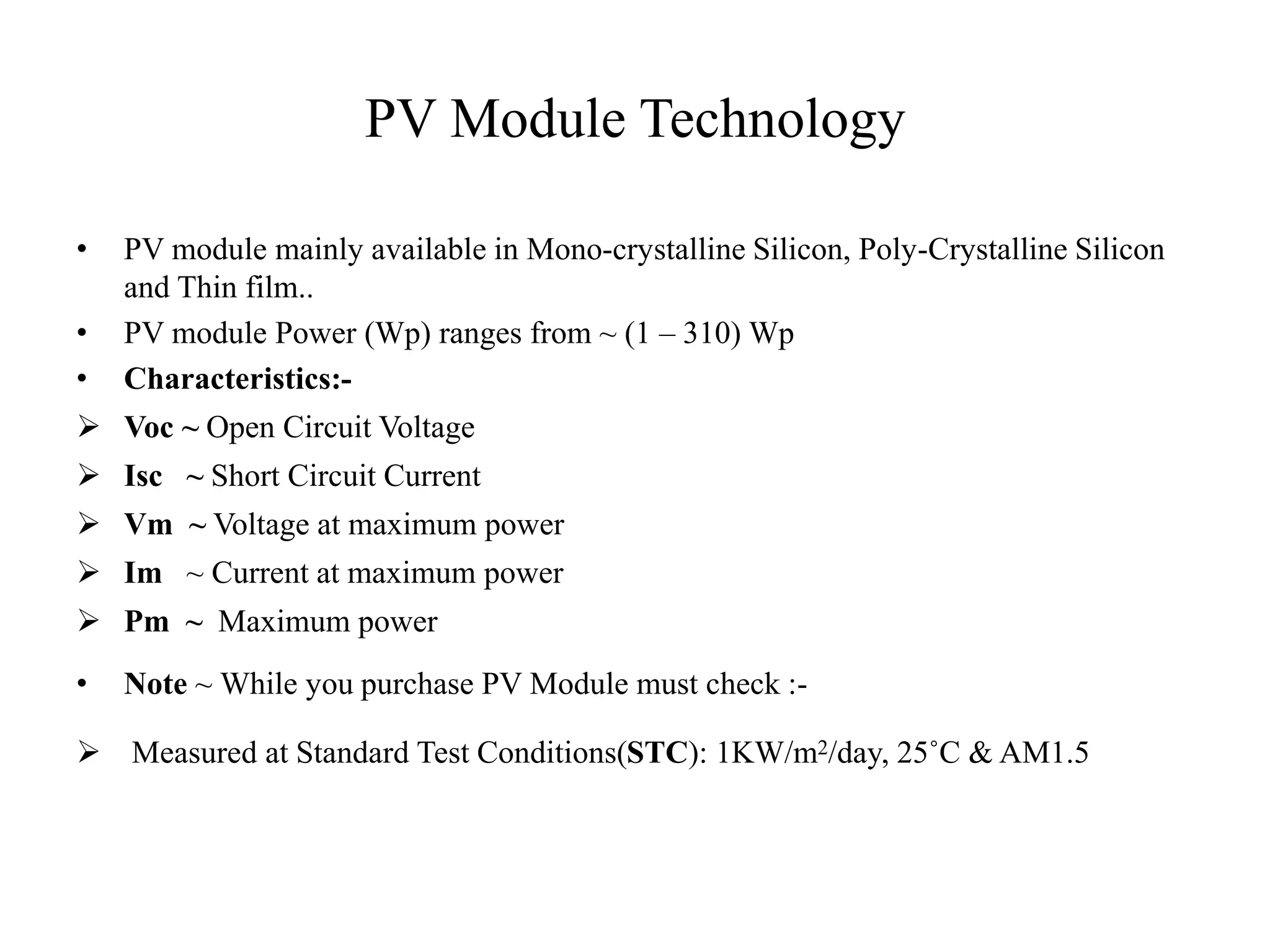
PV Module Technology
• PV module mainly available in Mono-crystalline Silicon, Poly-Crystalline Silicon
and Thin film..
• PV module Power (Wp) ranges from ~ (1 – 310) Wp
• Characteristics:-
 Voc ~ Open Circuit Voltage
 Isc ~ Short Circuit Current
 Vm ~ Voltage at maximum power
 Im ~ Current at maximum power
 Pm ~ Maximum power
• Note ~ While you purchase PV Module must check :-
 Measured at Standard Test Conditions(STC): 1KW/m2/day, 25˚C & AM1.5
Current-Voltage & Power-Voltage
Characteristics
PV Module Current-Voltage(I-V) Curve
PV Module Technology
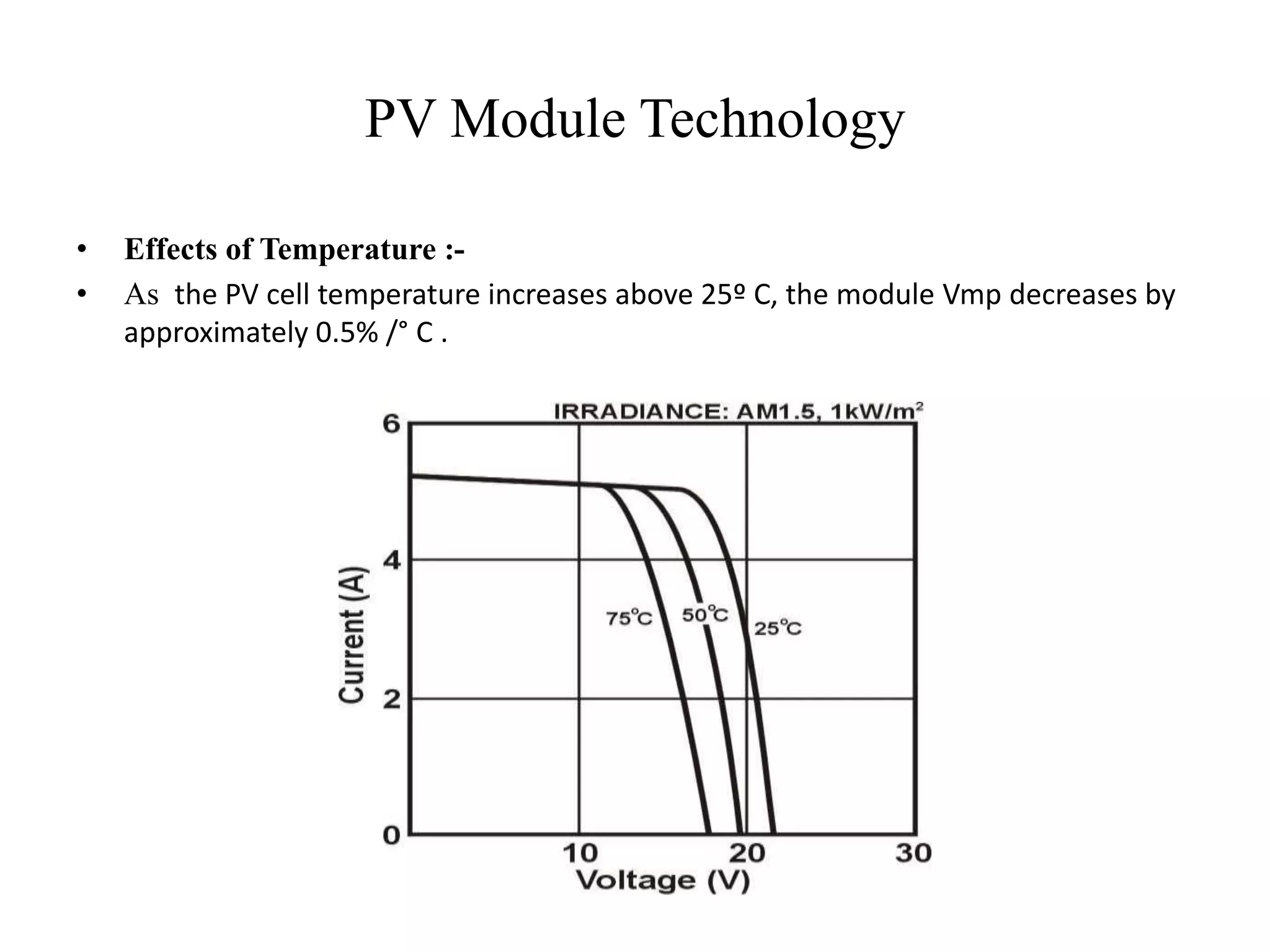
• Effects of Temperature :-
• As the PV cell temperature increases above 25º C, the module Vmp decreases by
approximately 0.5% /° C .
Specification & Performance Of Typical
Module.
Module size 119.1 cm x 53.3 cm
Module weight 7.5 kg
Cell size 12.5cm x 12.5 cm
Number of cell 36
Nominal output 80 W
Nominal voltage 12V
Maximum voltage 17V
Open circuit voltage 21.2V
Short circuit curent 4.9A
Conversion efficiancy 12.5%
Global solar radiation 1000w/cm²
Air mass Am 1.5 spectrum
Cell temperature 25°c
Solar Energy Ecosystem
Solar PV Application
• Distributed off grid product.
 Solar Lanterns ~
Solar PV Application
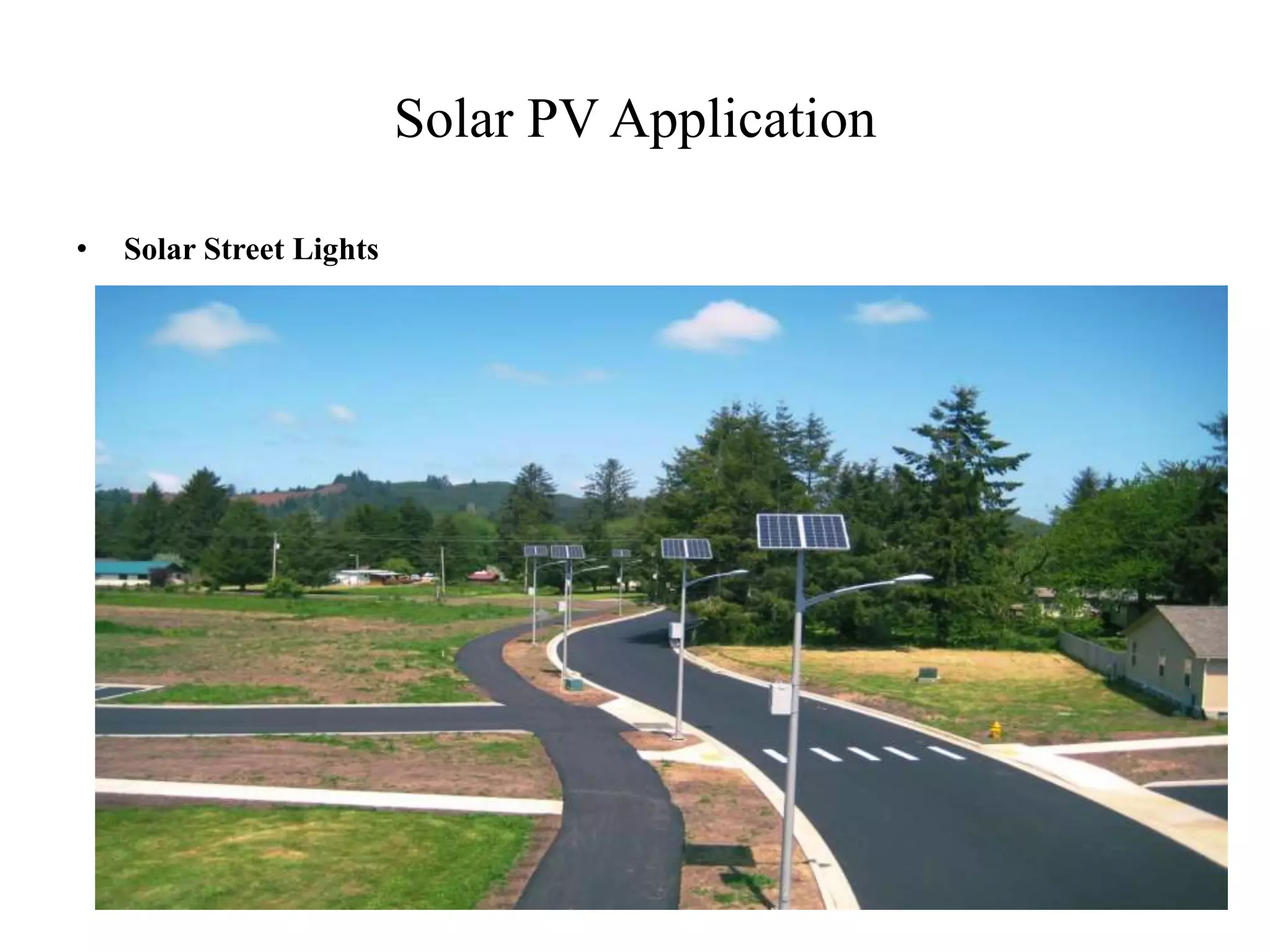
• Solar Street Lights
Solar PV Application
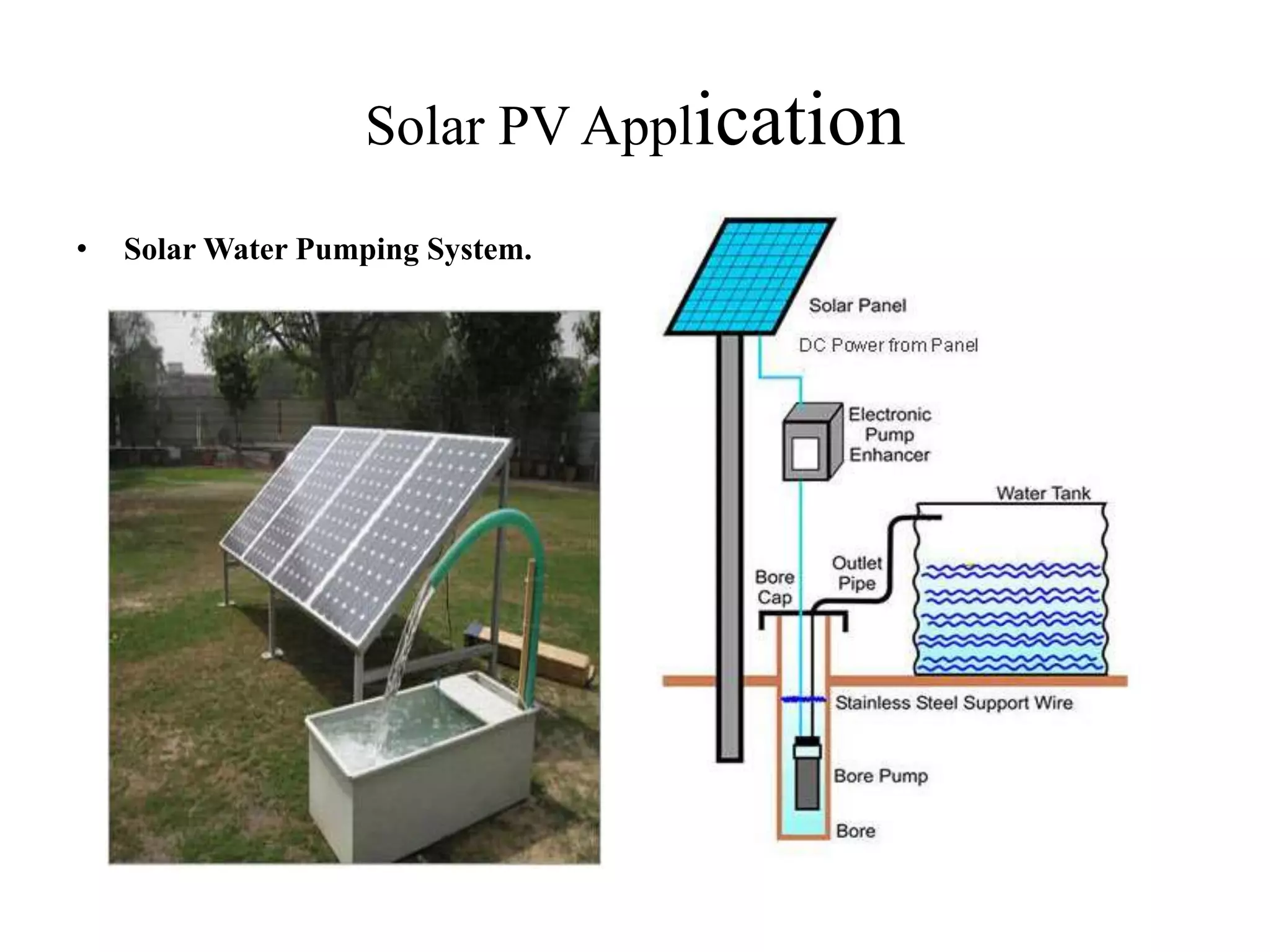
• Solar Water Pumping System.
Solar PV Application
Solar Fencing around The farm or
Irrigation land To protect against animals.
Solar fencing For marking the
boundary
Solar PV Application
• Solar Plant On Stadiums.
Solar PV Application
• Solar On Petrol Pump
Solar PV Application
• Solar On Parking Area
Solar PV Application
• World First Solar Air Flight
Solar PV Application
• JAPAN CRUISE SHIP
Solar PV Application
• Delhi Metro Station Dwarka .
Thank You…

Basic Introduction to solar PV System.

  • 1.
    INTRODUCTION  Renewable Energyor Non-Renewable Energy? OR
  • 2.
  • 3.
    Why only Solar? Sun…the never ending source of energy.  Primary source – Fossil Fuels Limited.  Clean Energy.  Easily Scalable.  Modular character technology.
  • 4.
    Why only Solar? •The Solar energy radiate by the sun is 3.8 x 1026 joules /sec (NASA). • India is one of the sun’s most favored nations, blessed with about 5,000 Terawh of solar Energy radiation very year with most parts receiving 4 – 7 Kwh / Sq. Meter / Per day. • Daily average solar energy incident over India varies 4 to 7 Kwh/m2 / Day • With about 300 clear , sunny days in a year, India have abundant solar potential.
  • 5.
    Photovoltaic Cell  SolarCell  Working  Material  Type
  • 6.
    Fundamental of solarcell. • The μp is the heart of the processing within a computer.. • Similarly a solar cell is the key component in chain of the photovoltaic solar system. • Photovoltaic = photo + voltaic. • Photo associated with light and voltaic means voltage or voltage that developed within the solar cell.
  • 7.
    n-type semiconductor p-type semiconductor + + ++ + + + + + + + + + + + - - - - - - - - - - - - - - - - - - Physics of Photovoltaic Generation Depletion Zone
  • 8.
    Light And PhotoElectric Effect • Photoelectric effect is a phenomenon in which electrons are emitted from matter after absorption of energy from visible light. • Electrons gain energy from incoming photons and are emitted when this absorbed energy exceeds the work function of the material. • Electric field associated with a semiconductor P--‐N junction can form an electric current and deliver power to an external load. • Thus a specially built semiconductor junction can function as a SOLAR CELL converting natural sunlight into electricity.
  • 9.
    Photovoltaic Cell Material •Thin wafers of silicon  Similar to computer chips  Much bigger  Much cheaper • Silicon is abundant (sand)  Non-toxic  Safe
  • 10.
    PV Technology Classification SiliconCrystalline Technology Mono crystalline PV cell Multi/Poly crystalline PV cell. Thin Film Technology Amorphous Silicon PV cells. Poly Crystalline PV Cells
  • 11.
    PV Technology Classification •Silicon Crystalline Technology  Currently makes up 86% of PV market  Very stable with module efficiencies 10-16%
  • 12.
    Silicon Crystalline Technology •Mono crystalline PV cell  Made using saw-cut from single cylindrical crystal of Si  Most efficient commercially available module (11% - 18%)  Most expensive to produce Circular (square-round) cell creates wasted space on module
  • 13.
    Silicon Crystalline Technology •Multi/Poly crystalline PV cell.  Caste from ingot of melted and recrystallised silicon.  Cells slightly less efficient than a mono crystalline (10% - 16%).  Less expensive to make than mono-crystalline modules.  Square shape cells fit into module efficiently using the entire space.  Accounts for 90% of crystalline Si market .
  • 14.
    Thin Film Technology Silicon deposited in a continuous on a base material such as glass, metal or polymers  Thin-film crystalline solar cell consists of layers about 10μm thick compared with 200-300μm layers for crystalline silicon cells  PROS • Low cost substrate and fabrication process  CONS • Not very stable
  • 15.
    Thin Film Technology •AMORPHOUS SILICON PV CELLS. Most inexpensive technology to produce Metal grid replaced with transparent oxides Can be deposited on flexible substrates, less susceptible to shading problems Better performance in low light conditions that with crystalline modules. Operating efficiency ~ 6-8% • PROS  Mature manufacturing technologies available • CONS  Initial 20-40% loss in efficiency
  • 16.
    Poly Crystalline PVCells • Non – silicon based technology • CADMIUM TELLURIDE ( CDTE)  Unlike most other II/IV material cdte exhibits direct band gap of 1.4ev and high absorption coefficient  PROS • 16% laboratory efficiency • 6-9% module efficiency  CONS • Immature manufacturing process
  • 17.
    PV Module Technology •PV module mainly available in Mono-crystalline Silicon, Poly-Crystalline Silicon and Thin film.. • PV module Power (Wp) ranges from ~ (1 – 310) Wp • Characteristics:-  Voc ~ Open Circuit Voltage  Isc ~ Short Circuit Current  Vm ~ Voltage at maximum power  Im ~ Current at maximum power  Pm ~ Maximum power • Note ~ While you purchase PV Module must check :-  Measured at Standard Test Conditions(STC): 1KW/m2/day, 25˚C & AM1.5
  • 18.
  • 19.
  • 20.
    PV Module Technology •Effects of Temperature :- • As the PV cell temperature increases above 25º C, the module Vmp decreases by approximately 0.5% /° C .
  • 21.
    Specification & PerformanceOf Typical Module. Module size 119.1 cm x 53.3 cm Module weight 7.5 kg Cell size 12.5cm x 12.5 cm Number of cell 36 Nominal output 80 W Nominal voltage 12V Maximum voltage 17V Open circuit voltage 21.2V Short circuit curent 4.9A Conversion efficiancy 12.5% Global solar radiation 1000w/cm² Air mass Am 1.5 spectrum Cell temperature 25°c
  • 22.
  • 23.
    Solar PV Application •Distributed off grid product.  Solar Lanterns ~
  • 24.
    Solar PV Application •Solar Street Lights
  • 25.
    Solar PV Application •Solar Water Pumping System.
  • 26.
    Solar PV Application SolarFencing around The farm or Irrigation land To protect against animals. Solar fencing For marking the boundary
  • 27.
    Solar PV Application •Solar Plant On Stadiums.
  • 28.
    Solar PV Application •Solar On Petrol Pump
  • 29.
    Solar PV Application •Solar On Parking Area
  • 30.
    Solar PV Application •World First Solar Air Flight
  • 31.
    Solar PV Application •JAPAN CRUISE SHIP
  • 32.
    Solar PV Application •Delhi Metro Station Dwarka .
  • 33.