Audit
Scope and Objectives of Internal Auditing
Monitoring of internal control. The establishment of adequate internal control is a
responsibility of management which demands proper attention on a continuous basis.
Internal auditing is ordinarily assigned specific responsibility by management for
reviewing controls, monitoring their operation and recommending improvements thereto.
Examination of financial and operating information. This may include review of the means
used to identify, measure, classify and report such information and specific inquiry into
individual items including detailed testing of transactions, balances and procedures.
Review of the economy,efficiency and effectiveness of operations including non financial
controls of an entity.
Review of compliance with laws, regulations and other external requirements and with
management policies and directives and other internal requirements.
International Standard
• The International Auditing and Assurance Standards Board (IAASB) is
an independent standard-setting body
• Serves the public interest by setting high-quality international
standards for auditing, quality control, review, other assurance, and
related services, and by facilitating the convergence of international
and national standards.
• In doing so, the IAASB enhances the quality and uniformity of practice
throughout the world and strengthens public confidence in the global
auditing and assurance profession http://www.iaasb.org/clarity-
center/clarified-standards
Local Standard (SLAuS)
GeneralPrinciplesand Responsibilities
SLAuS 200 - Objectiveand GeneralPrinciples Governingand Audit of Financial
Statements
SLAuS 210 - Terms of Audit Engagements
RISK ASSESSMENT AND RESPONSE TO ASSESSED RISKS
SLAuS 300 - Planning an Audit of Financial
Statements
SLAuS 315 - Understanding theEntity and Its Environmentand Assessingthe Risks of
Material Misstatement
SLAuS320 - Audit Materiality
AUDIT EVIDENCE
SLAuS 500 - Audit Evidence
SLAuS 501 - Audit Evidence – Additional Considerations for Specific
Items
SLAuS 505 - External Confirmations
USING WORK OF OTHERS
SLAuS 600 - Using the Work of Another Auditor
SLAuS 610 - Considering the Work of Internal Audit
AUDIT CONCLUSIONS & REPORTING
SLAuS 700 - The Auditor’s Report on Financial Statements
SLAuS 710 - Comparatives
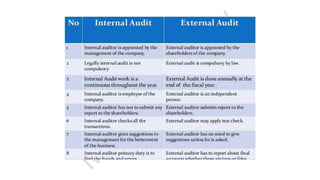
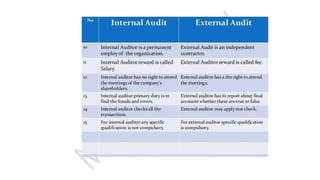
Relationship between Internal Auditing and the
External Audit
Relationship between Internal Auditing and the
External Audit
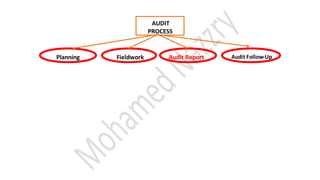
Planning Fieldwork Audit Report Audit Follow-Up
AUDIT
PROCESS
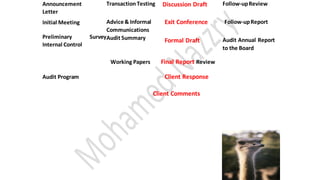
Working Papers Final Report Review
Audit Program Client Response
Client Comments
Announcement
Letter
Initial Meeting
Preliminary Survey
Internal Control
Transaction Testing
Advice& Informal
Communications
Audit Summary
Discussion Draft
Exit Conference
Formal Draft
Follow-upReview
Follow-upReport
Audit Annual Report
to the Board
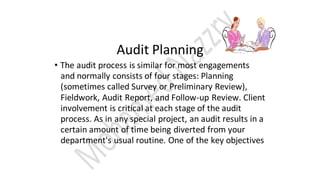
Audit Planning
• The audit process is similar for most engagements
and normally consists of four stages: Planning
(sometimes called Survey or Preliminary Review),
Fieldwork, Audit Report, and Follow-up Review. Client
involvement is critical at each stage of the audit
process. As in any special project, an audit results in a
certain amount of time being diverted from your
department's usual routine. One of the key objectives
is to minimize this time and avoid disrupting ongoing
activities.
Planning
• During the planning portion of the audit, the auditor
notifies the client of the audit, discusses the scope and
objectives of the examination in a formal meeting with
organization management, gathers information on
important processes, evaluates existing controls, and
plans the remaining audit steps.
• Announcement Letter: The client is informed of the
audit through an announcement or engagement letter
from the Internal Audit Director.
• Initial Meeting: the client describes the unit or system
to be reviewed, the organization, available resources
(personnel, facilities, equipment, funds), and other
relevant information.
• Preliminary Survey: In this phase the auditor gathers
relevant information about the unit in order to obtain
a general overview of operations.
• Internal Control Review: The auditor will review the
unit's internal control structure, a process which is
usually time-consuming.
Audit Program
• Preparation of the audit program concludes the preliminary review
phase. This program outlines the fieldwork necessary to achieve
the audit objectives.
AUDITREPORT
.
Discussion Draft
At the conclusion of fieldwork, the auditor drafts the
report. Audit's goal is to complete the audit and issue a
draft audit report within 30 days after the completion of
fieldwork.
Audit management reviews the audit working papers
and the discussion draft before it is presented to the
client for comment. This discussion draft is submitted to
the client for review before the exit conference.
Exit Conference
Internal Audit meets with the unit's management
team to discuss the findings, recommendations, and
text of the discussion draft. At this meeting, the client
comments on the draft and the group works to reach
an agreement on the audit findings.
Exit Conference
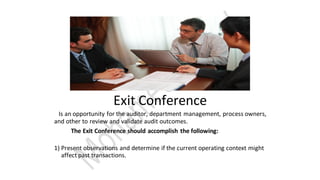
Is an opportunity for the auditor, department management, process owners,
and other to review and validate audit outcomes.
The Exit Conference should accomplish the following:
1) Present observations and determine if the current operating context might
affect past transactions.
2) Confirm facts, observations, and conclusions, e.g., that the findings are
accurate.
3) Validate the cause leading to findings and present recommendations.
4) Estimate the effect of the findings on operations or its risk management.
5) Solicit draft management comments on the audit findings and determine if
alternative recommendations adequately eliminate the cause of findings.
6) Define the timeline for issuing the final audit report and implementing
recommendations.
Audit Finding
Audit Findings
Reconciliation Supervisory Review (Urgent)
During our sample review of accountreconciliations,it was noted
that many accountreconciliationswere not being reviewed by the
supervisor in Item Processingand Deposit Operations.
Recommendation
We recommend managementreview all accountsat least monthly.
Action Plan
The Supervisorof the Item ProcessingDepartment was advised of
this requirementand has implemented changes as requested.
The Deposit OperationsManager will sign and reviewall account
reconciliations.A secondary signatureby the balancing associate
and/orsupervisor will also be implemented.This procedure is
currently in place.
Exit Conference Checklist
Procedure
Set the date, time, and location of the exit meeting.
The agenda should include the following:
• Accomplishment of the audit objectives (theirs and ours).
• Discussionof potential audit findings and recommendations.
• Discussionof when management’s
response will be due.
• Audit reporting process.
• Follow up process.
Document results of the exit meeting.
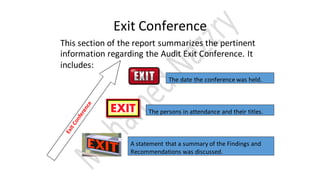
Exit Conference
This section of the report summarizes the pertinent
information regarding the Audit Exit Conference. It
includes:
The date the conference was held.
The persons in attendance and their titles.
A statement that a summary of the Findings and
Recommendations was discussed.
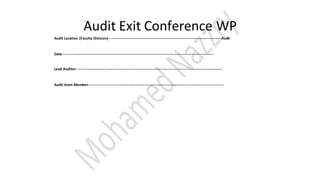
Audit Exit Conference WP
Audit Location (Faculty Division)--------------------------------------------------------------------------------------------Audit
Date---------------------------------------------------------------------------------------------------------------------------
Lead Auditor-----------------------------------------------------------------------------------------------------------------------
Audit team Member--------------------------------------------------------------------------------------------------------------
The main purpose of this meeting is to immediately present audit
observations to the senior management ina timely manner at the end
of theaudit and in such a manner so as to ensure that they clearly
understand the results of the audit.
List Observations:
The lead auditor should present observations, taking into account their
perceived significance and identifying key non-conformance areas.
Key Non-conformances:
JOSE
Formal Draft
The auditor then prepares a formal draft, taking into
account any revisions resulting from the exit
conference and other discussions. This report
is issued to the audited requesting a written
response to
any audit findings and recommendations.
When the changes have been reviewed by
audit management and the client, the final
report is issued.
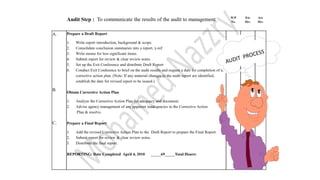
AUDIT REPORT
Our principal product is the final report in which we present the
audit findings and discuss recommendations for improvements.
Once the fieldwork is completed, Internal Audit will draft a report
to include the result of the audit including recommendations for
improvement. After the draft report is completed, it will be
forwarded to department management for review and discussionat
a scheduled exit conference.
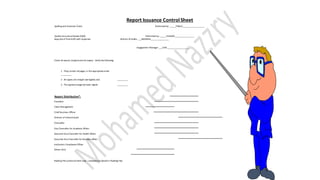
Report Issuance Control Sheet
Spelling and Grammar Check Performed by: ______PABLO____________________
Quality Assurance Review (QAR) Performed by: ______VILMARI__________________
Approval of final draft with responses Director of Audits: ___AMANDA_________________
Check all reports (original and all copies). Verify the following:
1. They contain all pages, in the appropriate order
__________
2 All copies are straight and legible; and __________
3. The signature page has been signed. __________
Report Distribution*:
President
Client Management
Chief Business Officer
Director of Internal Audit
Chancellor
Vice Chancellor for Academic Affairs
Executive Vice Chancellor for Health Affairs
Executive Vice Chancellor for Business Affairs
Institution Compliance Officer
Others (list)
Reading File (unbound hard copy – stampedand placed in Reading File)
Engagement Manager: ___JOSE ____________________
Unbound hard copyprovided to Office Associate
* As determined by type of audit and institution where engagement is conducted (Academic, Medical, or System Administration).
Compliance Officer should be included in report distribution ifengagement involves a compliance issue.
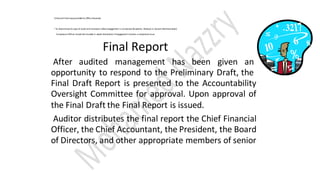
Final Report
After audited management has been given an
opportunity to respond to the Preliminary Draft, the
Final Draft Report is presented to the Accountability
Oversight Committee for approval. Upon approval of
the Final Draft the Final Report is issued.
Auditor distributes the final report the Chief Financial
Officer, the Chief Accountant, the President, the Board
of Directors, and other appropriate members of senior
management. Final Reports are considered public
information and will be available to anyone.
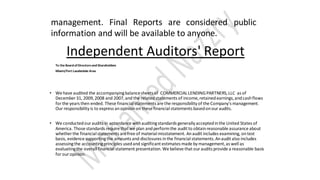
Independent Auditors' Report
To the Board ofDirectorsand Shareholders
Miami/Fort Lauderdale Area
• We have audited the accompanyingbalancesheets of COMMERCIALLENDINGPARTNERS,LLC as of
December 31, 2009,2008 and 2007,and the relatedstatements of income,retainedearnings,andcashflows
for the years then ended. These financial statements are the responsibility of the Company's management.
Our responsibility is to express anopinionon these financial statements basedonouraudits.
• We conductedouraudits in accordance withauditingstandards generally acceptedinthe United States of
America. Those standards require that we plan andperformthe audit to obtainreasonable assurance about
whether the financial statements are free of material misstatement. Anaudit includes examining, ontest
basis, evidence supportingthe amounts and disclosures inthe financial statements.Anaudit also includes
assessingthe accountingprinciples usedand significant estimates made by management,as well as
evaluatingthe overall financial statement presentation. We believe that ouraudits provide a reasonable basis
for our opinion.
• In our opinion,the financial statements referredto above present fairly,inall material respects,the financial
positionof COMMERCIALLENDINGPARTNERS,LLC as ofDecember 31,2009,2008 and 2007, andthe results
of its operations andits cashflows forthe years thenended in conformity withaccountingprincipals
generally acceptedinthe UnitedStates of America.
Jose Cintron,MBA
April 4,2010
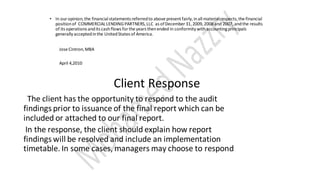
Client Response
The client has the opportunity to respond to the audit
findings prior to issuance of the final report which can be
included or attached to our final report.
In the response, the client should explain how report
findings will be resolved and include an implementation
timetable. In some cases, managers may choose to respond
with a decision not to implement an audit recommendation
and to accept the risks associatedwith an audit finding
Client Response Example
Client Response (1) - Treasury balances are reconciled monthly.
Treasury activity is reconciled daily. Differences are isolated to the
period of October 1, 2002 and prior, and have been controlled
since that date.
Adjusting entries are made with proper documentation and
review.
Moving the function to a private sector financial institution has
been
discussed and poses two major obstacles. The first obstacle is the
negotiability of a private sector check versus a U.S. Treasury check.
This would obviously cause problems for account holders in
remote locations as U.S. Treasury checks are readily negotiated at
local merchants. A private sector financial institutions checks
would not be as negotiable. The second obstacle is the financial
resources required to obtain the services of a private sector
institution.
Client Comments
Finally, as part of Internal Audit's self-evaluation
program, we ask clients to comment on Internal
Audit's performance. This feedback has proven to be
very beneficial to us, and we have made changes in
our procedures as a result of clients' suggestions.
Client Comment Example
"I would highly recommend Schmidt & Associates to any credit union
currently searching for a quality auditing firm. I have been very impressed
with the scope of the audits and the level of detail employed by
representatives of the firm during their monthly and quarter
contacts. Furthermore, I alwaysreceive
prompt attention whenever I have questions
regardingregulatoryor compliance issues."
Greg Kidwell
MembersFirst Credit Union
Columbus,Ohio
11,000 Members, $38 Millionin Assets
Audit Follow up
• Depending on the nature of the audit or the audit findings, the
Follow-Up procedure may formal or informal”.
Audit
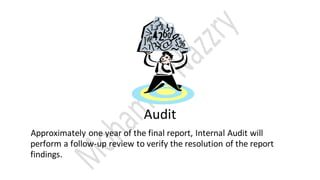
Approximately one year of the final report, Internal Audit will
perform a follow-up review to verify the resolution of the report
findings.
• FOLLOW UP REVIEW
• FOLLOW UP REPORT
• AUDIT ANNUAL REPORT TO THE BOARD
Followed up review
• The actions taken to resolve the audit report findings may be tested
to ensure that the desired results were achieved.
Followed up Report
• To resolve the original report findings.
• Unresolved findings will include a brief description of the finding, the
original audit recommendation, the client response, the current
condition, and the continued exposure to the board of company.
Audit Annual Report
• Memorandum to the senior manager that notifies them that
audit activities are underway and describes the follow-up
process.
This memo should include:
• timeframes for the project,
• a copy of the outstanding findings relatingto areas reporting.
• a request that they distributethe findings to these areas and ask
the managers to provide Internal Audit with the information
requested,
• a statement that these comments were previously distributed as
part of an audit report or close-out letter
• notificationthat the results will be reported to Board of
Trustees.
• The Announce Memo report Findings Access database provides
sample wording for the notification memo.
• The notification memo should be sent

Basic Audit

  • 1.
    Audit Scope and Objectivesof Internal Auditing Monitoring of internal control. The establishment of adequate internal control is a responsibility of management which demands proper attention on a continuous basis. Internal auditing is ordinarily assigned specific responsibility by management for reviewing controls, monitoring their operation and recommending improvements thereto. Examination of financial and operating information. This may include review of the means used to identify, measure, classify and report such information and specific inquiry into individual items including detailed testing of transactions, balances and procedures.
  • 2.
    Review of theeconomy,efficiency and effectiveness of operations including non financial controls of an entity. Review of compliance with laws, regulations and other external requirements and with management policies and directives and other internal requirements. International Standard • The International Auditing and Assurance Standards Board (IAASB) is an independent standard-setting body • Serves the public interest by setting high-quality international standards for auditing, quality control, review, other assurance, and related services, and by facilitating the convergence of international and national standards.
  • 3.
    • In doingso, the IAASB enhances the quality and uniformity of practice throughout the world and strengthens public confidence in the global auditing and assurance profession http://www.iaasb.org/clarity- center/clarified-standards Local Standard (SLAuS) GeneralPrinciplesand Responsibilities SLAuS 200 - Objectiveand GeneralPrinciples Governingand Audit of Financial Statements SLAuS 210 - Terms of Audit Engagements RISK ASSESSMENT AND RESPONSE TO ASSESSED RISKS SLAuS 300 - Planning an Audit of Financial
  • 4.
    Statements SLAuS 315 -Understanding theEntity and Its Environmentand Assessingthe Risks of Material Misstatement SLAuS320 - Audit Materiality AUDIT EVIDENCE SLAuS 500 - Audit Evidence SLAuS 501 - Audit Evidence – Additional Considerations for Specific Items SLAuS 505 - External Confirmations USING WORK OF OTHERS SLAuS 600 - Using the Work of Another Auditor
  • 5.
    SLAuS 610 -Considering the Work of Internal Audit AUDIT CONCLUSIONS & REPORTING SLAuS 700 - The Auditor’s Report on Financial Statements SLAuS 710 - Comparatives
  • 6.
    Relationship between InternalAuditing and the External Audit
  • 8.
    Relationship between InternalAuditing and the External Audit
  • 10.
    Planning Fieldwork AuditReport Audit Follow-Up AUDIT PROCESS
  • 11.
    Working Papers FinalReport Review Audit Program Client Response Client Comments Announcement Letter Initial Meeting Preliminary Survey Internal Control Transaction Testing Advice& Informal Communications Audit Summary Discussion Draft Exit Conference Formal Draft Follow-upReview Follow-upReport Audit Annual Report to the Board
  • 12.
    Audit Planning • Theaudit process is similar for most engagements and normally consists of four stages: Planning (sometimes called Survey or Preliminary Review), Fieldwork, Audit Report, and Follow-up Review. Client involvement is critical at each stage of the audit process. As in any special project, an audit results in a certain amount of time being diverted from your department's usual routine. One of the key objectives
  • 13.
    is to minimizethis time and avoid disrupting ongoing activities. Planning • During the planning portion of the audit, the auditor notifies the client of the audit, discusses the scope and objectives of the examination in a formal meeting with organization management, gathers information on important processes, evaluates existing controls, and plans the remaining audit steps.
  • 14.
    • Announcement Letter:The client is informed of the audit through an announcement or engagement letter from the Internal Audit Director. • Initial Meeting: the client describes the unit or system to be reviewed, the organization, available resources
  • 15.
    (personnel, facilities, equipment,funds), and other relevant information.
  • 16.
    • Preliminary Survey:In this phase the auditor gathers relevant information about the unit in order to obtain a general overview of operations. • Internal Control Review: The auditor will review the unit's internal control structure, a process which is usually time-consuming.
  • 17.
    Audit Program • Preparationof the audit program concludes the preliminary review phase. This program outlines the fieldwork necessary to achieve the audit objectives. AUDITREPORT .
  • 19.
    Discussion Draft At theconclusion of fieldwork, the auditor drafts the report. Audit's goal is to complete the audit and issue a draft audit report within 30 days after the completion of fieldwork. Audit management reviews the audit working papers and the discussion draft before it is presented to the client for comment. This discussion draft is submitted to the client for review before the exit conference.
  • 20.
    Exit Conference Internal Auditmeets with the unit's management team to discuss the findings, recommendations, and text of the discussion draft. At this meeting, the client comments on the draft and the group works to reach an agreement on the audit findings.
  • 21.
    Exit Conference Is anopportunity for the auditor, department management, process owners, and other to review and validate audit outcomes. The Exit Conference should accomplish the following: 1) Present observations and determine if the current operating context might affect past transactions.
  • 22.
    2) Confirm facts,observations, and conclusions, e.g., that the findings are accurate. 3) Validate the cause leading to findings and present recommendations. 4) Estimate the effect of the findings on operations or its risk management. 5) Solicit draft management comments on the audit findings and determine if alternative recommendations adequately eliminate the cause of findings. 6) Define the timeline for issuing the final audit report and implementing recommendations. Audit Finding Audit Findings Reconciliation Supervisory Review (Urgent)
  • 23.
    During our samplereview of accountreconciliations,it was noted that many accountreconciliationswere not being reviewed by the supervisor in Item Processingand Deposit Operations. Recommendation We recommend managementreview all accountsat least monthly. Action Plan The Supervisorof the Item ProcessingDepartment was advised of this requirementand has implemented changes as requested. The Deposit OperationsManager will sign and reviewall account reconciliations.A secondary signatureby the balancing associate and/orsupervisor will also be implemented.This procedure is currently in place.
  • 24.
    Exit Conference Checklist Procedure Setthe date, time, and location of the exit meeting. The agenda should include the following: • Accomplishment of the audit objectives (theirs and ours). • Discussionof potential audit findings and recommendations. • Discussionof when management’s response will be due. • Audit reporting process. • Follow up process. Document results of the exit meeting.
  • 25.
    Exit Conference This sectionof the report summarizes the pertinent information regarding the Audit Exit Conference. It includes: The date the conference was held. The persons in attendance and their titles. A statement that a summary of the Findings and Recommendations was discussed.
  • 26.
    Audit Exit ConferenceWP Audit Location (Faculty Division)--------------------------------------------------------------------------------------------Audit Date--------------------------------------------------------------------------------------------------------------------------- Lead Auditor----------------------------------------------------------------------------------------------------------------------- Audit team Member--------------------------------------------------------------------------------------------------------------
  • 27.
    The main purposeof this meeting is to immediately present audit observations to the senior management ina timely manner at the end of theaudit and in such a manner so as to ensure that they clearly understand the results of the audit. List Observations: The lead auditor should present observations, taking into account their perceived significance and identifying key non-conformance areas. Key Non-conformances: JOSE
  • 28.
    Formal Draft The auditorthen prepares a formal draft, taking into account any revisions resulting from the exit conference and other discussions. This report is issued to the audited requesting a written response to any audit findings and recommendations. When the changes have been reviewed by audit management and the client, the final report is issued.
  • 29.
    AUDIT REPORT Our principalproduct is the final report in which we present the audit findings and discuss recommendations for improvements. Once the fieldwork is completed, Internal Audit will draft a report to include the result of the audit including recommendations for improvement. After the draft report is completed, it will be forwarded to department management for review and discussionat a scheduled exit conference.
  • 30.
    Report Issuance ControlSheet Spelling and Grammar Check Performed by: ______PABLO____________________ Quality Assurance Review (QAR) Performed by: ______VILMARI__________________ Approval of final draft with responses Director of Audits: ___AMANDA_________________ Check all reports (original and all copies). Verify the following: 1. They contain all pages, in the appropriate order __________ 2 All copies are straight and legible; and __________ 3. The signature page has been signed. __________ Report Distribution*: President Client Management Chief Business Officer Director of Internal Audit Chancellor Vice Chancellor for Academic Affairs Executive Vice Chancellor for Health Affairs Executive Vice Chancellor for Business Affairs Institution Compliance Officer Others (list) Reading File (unbound hard copy – stampedand placed in Reading File) Engagement Manager: ___JOSE ____________________
  • 31.
    Unbound hard copyprovidedto Office Associate * As determined by type of audit and institution where engagement is conducted (Academic, Medical, or System Administration). Compliance Officer should be included in report distribution ifengagement involves a compliance issue. Final Report After audited management has been given an opportunity to respond to the Preliminary Draft, the Final Draft Report is presented to the Accountability Oversight Committee for approval. Upon approval of the Final Draft the Final Report is issued. Auditor distributes the final report the Chief Financial Officer, the Chief Accountant, the President, the Board of Directors, and other appropriate members of senior
  • 32.
    management. Final Reportsare considered public information and will be available to anyone. Independent Auditors' Report To the Board ofDirectorsand Shareholders Miami/Fort Lauderdale Area • We have audited the accompanyingbalancesheets of COMMERCIALLENDINGPARTNERS,LLC as of December 31, 2009,2008 and 2007,and the relatedstatements of income,retainedearnings,andcashflows for the years then ended. These financial statements are the responsibility of the Company's management. Our responsibility is to express anopinionon these financial statements basedonouraudits. • We conductedouraudits in accordance withauditingstandards generally acceptedinthe United States of America. Those standards require that we plan andperformthe audit to obtainreasonable assurance about whether the financial statements are free of material misstatement. Anaudit includes examining, ontest basis, evidence supportingthe amounts and disclosures inthe financial statements.Anaudit also includes assessingthe accountingprinciples usedand significant estimates made by management,as well as evaluatingthe overall financial statement presentation. We believe that ouraudits provide a reasonable basis for our opinion.
  • 33.
    • In ouropinion,the financial statements referredto above present fairly,inall material respects,the financial positionof COMMERCIALLENDINGPARTNERS,LLC as ofDecember 31,2009,2008 and 2007, andthe results of its operations andits cashflows forthe years thenended in conformity withaccountingprincipals generally acceptedinthe UnitedStates of America. Jose Cintron,MBA April 4,2010 Client Response The client has the opportunity to respond to the audit findings prior to issuance of the final report which can be included or attached to our final report. In the response, the client should explain how report findings will be resolved and include an implementation timetable. In some cases, managers may choose to respond
  • 34.
    with a decisionnot to implement an audit recommendation and to accept the risks associatedwith an audit finding Client Response Example Client Response (1) - Treasury balances are reconciled monthly.
  • 35.
    Treasury activity isreconciled daily. Differences are isolated to the period of October 1, 2002 and prior, and have been controlled since that date. Adjusting entries are made with proper documentation and review. Moving the function to a private sector financial institution has been discussed and poses two major obstacles. The first obstacle is the negotiability of a private sector check versus a U.S. Treasury check. This would obviously cause problems for account holders in remote locations as U.S. Treasury checks are readily negotiated at local merchants. A private sector financial institutions checks would not be as negotiable. The second obstacle is the financial
  • 36.
    resources required toobtain the services of a private sector institution. Client Comments Finally, as part of Internal Audit's self-evaluation program, we ask clients to comment on Internal Audit's performance. This feedback has proven to be
  • 37.
    very beneficial tous, and we have made changes in our procedures as a result of clients' suggestions. Client Comment Example "I would highly recommend Schmidt & Associates to any credit union currently searching for a quality auditing firm. I have been very impressed with the scope of the audits and the level of detail employed by representatives of the firm during their monthly and quarter contacts. Furthermore, I alwaysreceive prompt attention whenever I have questions regardingregulatoryor compliance issues." Greg Kidwell MembersFirst Credit Union
  • 38.
    Columbus,Ohio 11,000 Members, $38Millionin Assets Audit Follow up • Depending on the nature of the audit or the audit findings, the Follow-Up procedure may formal or informal”.
  • 39.
    Audit Approximately one yearof the final report, Internal Audit will perform a follow-up review to verify the resolution of the report findings.
  • 40.
    • FOLLOW UPREVIEW • FOLLOW UP REPORT • AUDIT ANNUAL REPORT TO THE BOARD Followed up review • The actions taken to resolve the audit report findings may be tested to ensure that the desired results were achieved.
  • 41.
    Followed up Report •To resolve the original report findings.
  • 42.
    • Unresolved findingswill include a brief description of the finding, the original audit recommendation, the client response, the current condition, and the continued exposure to the board of company.
  • 43.
    Audit Annual Report •Memorandum to the senior manager that notifies them that audit activities are underway and describes the follow-up process. This memo should include: • timeframes for the project, • a copy of the outstanding findings relatingto areas reporting. • a request that they distributethe findings to these areas and ask the managers to provide Internal Audit with the information requested, • a statement that these comments were previously distributed as part of an audit report or close-out letter
  • 44.
    • notificationthat theresults will be reported to Board of Trustees. • The Announce Memo report Findings Access database provides sample wording for the notification memo. • The notification memo should be sent