Baseline Testing in Software Testing Concepts, Process & Real-World Examples
Learn how baseline testing in software testing ensures build stability, prevents unintended defects, and supports reliable releases with practical examples.
Baseline Testing in Software Testing Concepts, Process & Real-World Examples
1.
Baseline Testing inSoftware
Testing: Concepts, Process &
Real-World Examples
Establishing Stability and Confidence Across Software
Releases
keploy.io
2.
keploy.io
Introduction
Software releases ofteninvolve enhancements, bug
fixes, or structural changes. However, even small
modifications can unintentionally impact stable
features. This is where baseline testing in software
testing becomes essential. It provides a structured way
to verify that a previously approved and stable version
of the application continues to function correctly after
changes are introduced. By establishing a fixed
reference point, teams can confidently validate system
stability before moving forward with broader testing or
deployment activities.
3.
keploy.io
What Is BaselineTesting?
Baseline testing in software testing is a validation approach in which a set of
approved test cases is executed against a stable build to ensure that no unexpected
deviations have occurred. The “baseline” refers to a formally reviewed and accepted
version of the application that serves as a benchmark for comparison.
This method helps teams confirm that core business functionalities remain intact
after updates, configuration changes, or enhancements. It focuses on consistency
and stability rather than exploratory defect discovery.
4.
keploy.io
Why Baseline TestingMatters?
• Maintain consistency across builds
• Detect unintended behavioral changes
early
• Protect high-risk business functions
• Reduce last-minute release surprises
In modern development environments, frequent releases increase the risk of unintended side effects.
Baseline testing in software testing ensures that critical workflows continue to operate as originally
approved.
It helps organizations:
Without a defined baseline, it becomes
difficult to determine whether new issues
stem from recent changes or pre-existing
instability.
5.
keploy.io
Baseline Testing vsRegression Testing
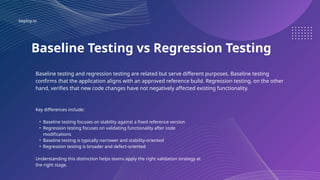
Baseline testing and regression testing are related but serve different purposes. Baseline testing
confirms that the application aligns with an approved reference build. Regression testing, on the other
hand, verifies that new code changes have not negatively affected existing functionality.
Key differences include:
• Baseline testing focuses on stability against a fixed reference version
• Regression testing focuses on validating functionality after code
modifications
• Baseline testing is typically narrower and stability-oriented
• Regression testing is broader and defect-oriented
Understanding this distinction helps teams apply the right validation strategy at
the right stage.
6.
keploy.io
The Baseline TestingProcess
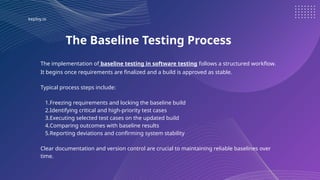
The implementation of baseline testing in software testing follows a structured workflow.
It begins once requirements are finalized and a build is approved as stable.
Typical process steps include:
1.Freezing requirements and locking the baseline build
2.Identifying critical and high-priority test cases
3.Executing selected test cases on the updated build
4.Comparing outcomes with baseline results
5.Reporting deviations and confirming system stability
Clear documentation and version control are crucial to maintaining reliable baselines over
time.
7.
keploy.io
Real-World Example –Financial Application
Consider a banking application that introduces a redesigned dashboard
interface. Although the UI changes seem minor, they could impact
transaction processing or login validation. Before release, QA executes
previously approved login, fund transfer, and account summary test cases
against the updated build. Results are compared with baseline outputs to
confirm no deviations occur.
This practical application of baseline testing in software testing ensures
customer-facing features remain stable despite interface modifications.
8.
keploy.io
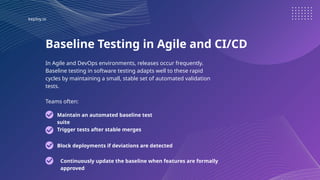
Baseline Testing inAgile and CI/CD
In Agile and DevOps environments, releases occur frequently.
Baseline testing in software testing adapts well to these rapid
cycles by maintaining a small, stable set of automated validation
tests.
Teams often:
Maintain an automated baseline test
suite
Trigger tests after stable merges
Block deployments if deviations are detected
Continuously update the baseline when features are formally
approved
9.
keploy.io
Conclusion
Baseline testing insoftware testing provides a structured way to
maintain stability in evolving software systems. By establishing a
clear reference version and validating critical workflows against it,
teams reduce uncertainty and minimize release risk. Baseline testing
in software testing is particularly valuable when managing frequent
updates, regulatory requirements, or high-impact business
applications. When implemented thoughtfully, it strengthens quality
assurance practices and ensures that innovation does not
compromise reliability.
10.
Thank You
For YourAttention
8076581413 keploy.io
Contact Us Learn More
keploy.io