Corporate Governance
and Climate Change:
The Banking Sector

January 2008


A Ceres Report


Lead Author:
Douglas G. Cogan
Ceres commissioned this report from Institutional Shareholder Services,
                        which was acquired by RiskMetrics Group in January 2007.

    Ceres is a national coalition of investors, environmental groups and other public interest organizations
        working with companies to address sustainability challenges such as global climate change.
     Ceres directs the Investor Network on Climate Risk, a group of more than 60 institutional investors
                         from the U.S. and Europe managing over $4 trillion in assets.

   RiskMetrics Group is a leader in the disciplines of risk management, corporate governance and financial
research & analysis. It analyzes a broad spectrum of risk for financial institutions and corporations worldwide.

     RiskMetrics Group wrote and prepared this report for informational purposes. Although RiskMetrics
     exercised due care in compiling the information contained herein, it makes no warranty, express or
       implied, as to the accuracy, completeness or usefulness of the information, nor does it assume,
         and expressly disclaims, any liability arising out of the use of this information by any party.
      The views expressed in this report are those of the authors and do not constitute an endorsement
         by RiskMetrics Group. Changing circumstances may cause this information to be obsolete.

  This report was made possible through grants from the Rockefeller Brothers Fund, the Energy Foundation,
   the Nathan Cummings Foundation, the Blue Moon Fund, the Richard and Rhoda Goldman Foundation,
       and the Marisla Foundation. The opinions expressed in this report are those of the author and do
                              not necessarily reflect the views of the sponsors.

The authors wish to thank Rich Leggett and David Roscoe of RiskMetrics Group for their review of report drafts
     and its scoring methodology. Heidi Welsh of RiskMetrics Group created a database to help manage
       the flow of information. Dan Bakal, Jim Coburn, Peyton Fleming, Andrew Logan, Mindy Lubber
             and Andrea Moffat of Ceres also provided valuable insights and editing suggestions.

Ceres wishes to thank the Investor Network on Climate Risk (INCR) members who helped develop this report,
and additional members of the Ceres team who edited the report: Ian Gray, Scott Kleiman and Lindsey White.


                                           Copyright 2008 by Ceres

                   Copyrighted RiskMetrics Group material used with permission by Ceres


                                                 Ceres, Inc.
                                              99 Chauncy Street
                                              Boston, MA 02111

                                                www.ceres.org


                                           RiskMetrics Group Inc.
                                         One Chase Manhattan Plaza
                                                44th Floor
                                            New York, NY 10015

                                             www.riskmetrics.com
Table of Contents

Foreword by Mindy Lubber, President, Ceres                                                                                                  .  .  .  .  .  .  .  .  .  .  .  .  .  .  .  .  .  .  .  .  .  .  .  .  .  .  .  .  .  .  .  .  .  .  .  .  .  .  .  .  .  .   i

I. Executive Summary                                        . .  .  .  .  .  .  .  .  .  .  .  .  .  .  .  .  .  .  .  .  .  .  .  .  .  .  .  .  .  .  .  .  .  .  .  .  .  .  .  .  .  .  .  .  .  .  .  .  .  .  .  .  .  .  .  .  .  .  .  .  .  .  .  .  .  .  .      1
   How Companies Were Scored                                                                      .  .  .  .  .  .  .  .  .  .  .  .  .  .  .  .  .  .  .  .  .  .  .  .  .  .  .  .  .  .  .  .  .  .  .  .  .  .  .  .  .  .  .  .  .  .  .  .  .  .  .  .  .  .  .      5
   40 Company Scores                                             .  .  .  .  .  .  .  .  .  .  .  .  .  .  .  .  .  .  .  .  .  .  .  .  .  .  .  .  .  .  .  .  .  .  .  .  .  .  .  .  .  .  .  .  .  .  .  .  .  .  .  .  .  .  .  .  .  .  .  .  .  .  .  .  .  .      7
   Banking Sector Best Practices .  .  .  .  .  .  .  .  .  .  .  .  .  .  .  .  .  .  .  .  .  .  .  .  .  .  .  .  .  .  .  .  .  .  .  .  .  .  .  .  .  .  .  .  .  .  .  .  .  .  .  .  .  .  . 8

Profiles of 40 Companies
Click these links to view banks’ profiles:
   U.S. Banks
   Canadian Banks
   European Banks
   Asia-Pacific & Other Banks

II. Overview: The Climate ‘Mega-Trend’                                                                                    .  .  .  .  .  .  .  .  .  .  .  .  .  .  .  .  .  .  .  .  .  .  .  .  .  .  .  .  .  .  .  .  .  .  .  .  .  .  .  .  .  .  .  .  .      11

III. Findings
   Climate Governance                                            .  .  .  .  .  .  .  .  .  .  .  .  .  .  .  .  .  .  .  .  .  .  .  .  .  .  .  .  .  .  .  .  .  .  .  .  .  .  .  .  .  .  .  .  .  .  .  .  .  .  .  .  .  .  .  .  .  .  .  .  .  .  .  .  .   16
   Internal Greenhouse Gas Management                                                                                            . .  .  .  .  .  .  .  .  .  .  .  .  .  .  .  .  .  .  .  .  .  .  .  .  .  .  .  .  .  .  .  .  .  .  .  .  .  .  .  .  .  .  .   21
   External Financing                                      .  .  .  .  .  .  .  .  .  .  .  .  .  .  .  .  .  .  .  .  .  .  .  .  .  .  .  .  .  .  .  .  .  .  .  .  .  .  .  .  .  .  .  .  .  .  .  .  .  .  .  .  .  .  .  .  .  .  .  .  .  .  .  .  .  .  .   24
   Investment/Retail Products                                                            .  .  .  .  .  .  .  .  .  .  .  .  .  .  .  .  .  .  .  .  .  .  .  .  .  .  .  .  .  .  .  .  .  .  .  .  .  .  .  .  .  .  .  .  .  .  .  .  .  .  .  .  .  .  .  .  .   28
   Carbon Trading                              .  .  .  .  .  .  .  .  .  .  .  .  .  .  .  .  .  .  .  .  .  .  .  .  .  .  .  .  .  .  .  .  .  .  .  .  .  .  .  .  .  .  .  .  .  .  .  .  .  .  .  .  .  .  .  .  .  .  .  .  .  .  .  .  .  .  .  .  .  .  .   30

IV. Conclusions                     . .  .  .  .  .  .  .  .  .  .  .  .  .  .  .  .  .  .  .  .  .  .  .  .  .  .  .  .  .  .  .  .  .  .  .  .  .  .  .  .  .  .  .  .  .  .  .  .  .  .  .  .  .  .  .  .  .  .  .  .  .  .  .  .  .  .  .  .  .  .  .  .  .  .   34

Appendices
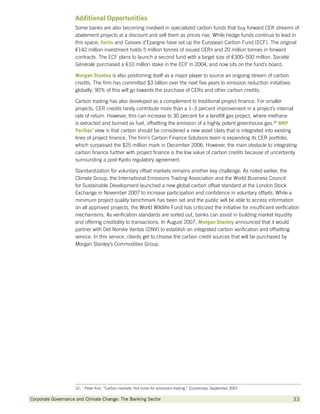
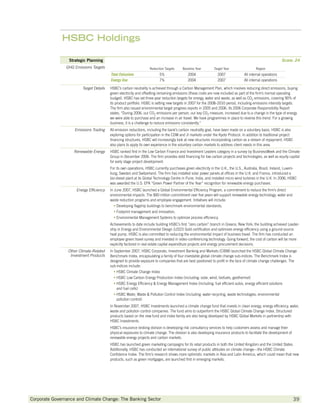
   Sample Profile: HSBC Holdings                                                                          ...................................................                                                                                                        36
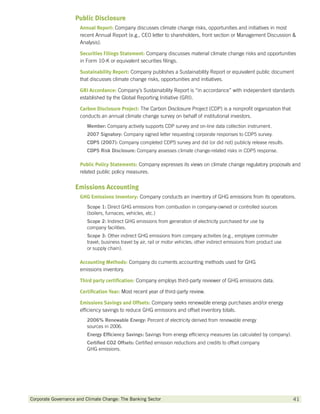
   Profile Key                  .  .  .  .  .  .  .  .  .  .  .  .  .  .  .  .  .  .  .  .  .  .  .  .  .  .  .  .  .  .  .  .  .  .  .  .  .  .  .  .  .  .  .  .  .  .  .  .  .  .  .  .  .  .  .  .  .  .  .  .  .  .  .  .  .  .  .  .  .  .  .  .  .  .  .  .   40
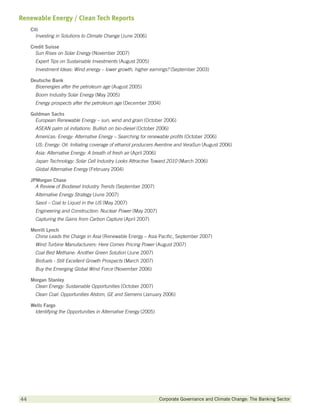
   Published Climate Change Research                                                                                      .  .  .  .  .  .  .  .  .  .  .  .  .  .  .  .  .  .  .  .  .  .  .  .  .  .  .  .  .  .  .  .  .  .  .  .  .  .  .  .  .  .  .  .  .  .   43
   Climate Specific Indices and Funds                                                                                   . .  .  .  .  .  .  .  .  .  .  .  .  .  .  .  .  .  .  .  .  .  .  .  .  .  .  .  .  .  .  .  .  .  .  .  .  .  .  .  .  .  .  .  .  .  .   47
   External Initiatives                                    .  .  .  .  .  .  .  .  .  .  .  .  .  .  .  .  .  .  .  .  .  .  .  .  .  .  .  .  .  .  .  .  .  .  .  .  .  .  .  .  .  .  .  .  .  .  .  .  .  .  .  .  .  .  .  .  .  .  .  .  .  .  .  .  .  .  .   48
   Carbon Trading Glossary                                                      .  .  .  .  .  .  .  .  .  .  .  .  .  .  .  .  .  .  .  .  .  .  .  .  .  .  .  .  .  .  .  .  .  .  .  .  .  .  .  .  .  .  .  .  .  .  .  .  .  .  .  .  .  .  .  .  .  .  .  .   55
Acronyms
AAU – Assigned Allocation Unit                     GHG – Greenhouse Gas
ADEME –  gency for Environment and Energy
        A                                          GRI – Global Reporting Initiative
        Management (France)                        HVAC – Heating, Ventilation  Air Conditioning
BREEAM –  uilding Research Establishment
         B                                         ICE – Intercontinental Exchange
         Environmental Assessment Method
                                                   IETA – International Emissions Trading Association
CaCX – California Climate Exchange
                                                   IPCC – Intergovernmental Panel on Climate Change
CCFE – Chicago Climate Futures Exchange
                                                   IPO – Initial Public Offering
CCX – Chicago Climate Exchange
                                                   ISO – International Standards Organization
CDM – Clean Development Mechanism
                                                   JI – Joint Implementation
CDO – Collateralized Debt Obligation
                                                   KW – Kilowatt
CDP – Carbon Disclosure Project
                                                   KWh – Kilowatt hour
CER – Certified Emission Reduction
                                                   LEED – Leadership in Energy and
                                                          
CO2 – Carbon Dioxide                                      Environmental Design
CO2e – Carbon Dioxide Equivalent                   MDG – Millennium Development Goals
CR – Corporate Responsibility                      MW – Megawatt
CSR – Corporate Social Responsibility              MWh – Megawatt hour
Defra –  epartment for Environment,
        D                                          NRE – Nouvelles Régulations Économiques
                                                         
        Food and Rural Affairs (U.K.)                    (New Economic Regulations)
EAI – Enhanced Analytics Initiative                NGO – Non-Governmental Organization
ECX – European Climate Exchange                    OTC – Over The Counter
EHS – Environment, Health  Safety                 PPM – Parts Per Million
EMS – Environmental Management System              REC – Renewable Energy Certificate
EPA – Environmental Protection Agency (U.S.)       RMB – Renminbi
ERU – Emission Reduction Unit                      SME – Small  Medium Enterprise
ESCO – Energy Service Company                      SRI – Socially Responsible Investment
ESG – Environmental, Social and Governance         UNEP – United Nations Environment Programme
EUA – EU Emission Allowance                        UNFCCC –  nited Nations Framework Convention
                                                            U
EU ETS – European Union Emissions Trading Scheme            on Climate Change
FTE – Full Time Equivalent                         VER – Verified Emission Reduction
Foreword
                    Banks are the backbone of the global economy, providing capital for innovation, infrastructure, job
                    creation and overall prosperity. Banks also play an integral role in society, affecting not only spending
                    by individual consumers, but also the growth of entire industries.

                    As the impacts of global warming from the heat-trapping gases released by power plants, vehicles and
                    other sources take root in everyday life, banks have never been more important to chart the future.
                    The companies that banks decide to finance will be a linchpin in slowing Earth’s warming and moving
                    the world economy away from fossil fuels and into cleaner technologies.

                    There is now overwhelming scientific evidence that worldwide temperatures are rising, glaciers are
                    melting, and drought and wildfires are becoming more severe. Scientists believe most of the warming
                    in the last 50 years is human-induced. This confluence of evidence has galvanized public attention
                    and governments worldwide to take action to avert a possible climate catastrophe.

                                With nearly $6 trillion in market capitalization, the global financial sector will play a vital
This report is a                role in supporting timely, cost-effective solutions to reduce U.S. and global greenhouse
                                gas emissions. As risk management experts, it is essential that banks begin now to
comprehensive
                                consider the financial risk implications of continued investment in carbon-intensive energy
assessment of how 40            technologies.
of the world’s largest
                                This report is the first comprehensive assessment of how 40 of the world’s largest banks
banks are preparing             are preparing themselves to face this colossal challenge. It pays particular attention to
themselves to face              how corporate executives and board directors are addressing the governance systems that
the colossal climate            will be needed to minimize climate risks while maximizing investments in solutions that
change challenge                mitigate and help society adapt to climate change.

                                The report employs a “Climate Change Governance Checklist” to evaluate how 16 U.S.
                                banks and 24 non-U.S. banks are addressing climate change through board oversight,
                    management execution, public disclosure, greenhouse gas emissions accounting and strategic
                    planning. In addition to the U.S. banks, the study includes 15 European, five Asian, one Brazilian
                    and three Canadian banks in several different classes of financial services to provide a global cross-
                    sectional analysis of the banking sector.

                    The results provide some basis for encouragement. The report finds evidence that many banks are
                    responding to climate change, with European banks being in the forefront and many U.S. banks
                    following closely behind. Many of the positive actions have come in the past 12 to 18 months,
                    especially in regard to overall disclosure, research and financial support for clean energy. Among
                    the highlights:

                      •  he banks have issued nearly 100 research reports on climate change and related investment
                        T
                        and regulatory strategies, more than half of them in 2007 alone.
                      •  hirty-four banks responded to the latest climate-disclosure annual survey conducted by the
                        T
                        Carbon Disclosure Project, a non-profit organization that seeks information on climate risks and
                        opportunities from companies on behalf of an investor coalition of 315 firms with a combined
                        $41 trillion in assets under management.
                      •  wenty-four of the banks have set some type of greenhouse gas reduction target for internal
                        T
                        operations.
                      •  wenty-nine of the banks have reported on their financial support for alternative energy projects;
                        T
                        eight of these banks have provided more than $12 billion of direct financing and investments in
                        renewable energy and other clean energy projects.


Corporate Governance and Climate Change: The Banking Sector 	                                                                   i
Yet for all of the positive momentum, many of the 40 banks have done little or nothing to elevate
climate change as a governance priority—a trend that cuts across European, North American and
Asian banks alike. For example, only a dozen of the 40 banks have board-level involvement in
climate change, and all but one of those firms are non-U.S. based. Only 14 banks have adopted risk
management policies or lending procedures that address climate change in a systematic way.
Only a half-dozen banks say they are formally calculating carbon risk in their loan portfolios, and
only one of the 40 banks—Bank of America
                              Bank America—has announced a specific target to reduce
the rate of greenhouse gas emissions associated with the utility portion of its lending
portfolio. And no bank has set a policy to avoid investments in carbon-intensive projects
such as coal-fired power plants.                                                                  While many
While many banks have made improvements, the actions to date are the tip of the                          banks have made
iceberg of what is needed to reduce greenhouse gas emissions consistent with targets                     improvements, the
scientists say are needed to avoid the dangerous impacts of climate change. In this                      actions to date are the
regard, more banks should:
                                                                                                         tip of the iceberg of
         • elevate climate change as a governance priority for board members and CEOs,
                                                                                                        what is needed
           especially at U.S. banks where direct board involvement has been virtually
           non-existent;
         •  rovide better disclosure about the financial and material risks posed by climate change, their
           p
           own emissions reduction strategies, and emissions resulting from financing and investment;
         •  xplain how they are factoring carbon costs into their financing and investment decisions,
           e
           especially for energy-intensive projects that pose financial risks as carbon-reducing regulations
           take hold worldwide;
         •  et progressively higher targets to shrink the carbon footprint of their lending and investment
           s
           portfolios, and be more transparent about how they intend to meet these objectives.

As one of the world’s largest economic sectors, and as one that reaches virtually every consumer
and business, the financial services industry must be involved in mitigating climate change and
its impacts. At the same time, banks face an immense but as yet largely untapped opportunity to
enter new markets and develop more efficient and environmentally sound industries that will benefit
generations to come, while preserving their longstanding leadership role in wealth and capital
formation.

Banks have the reach, influence and access to capital required to lead the changes needed to
expeditiously address global warming.

	              Mindy S. Lubber
	              President, Ceres
	              Director, Investor Network on Climate Risk


    ii           		                                                      Corporate Governance and Climate Change: The Banking Sector
I. Executive Summary
                    This report analyzes the corporate governance and strategic approaches of 40 of the world’s largest
                    banks1 to the challenges and opportunities posed by climate change. With delegates of 190 nations
                    meeting in Bali, Indonesia, in December 2007 to decide whether to extend or replace the 10-year old
                    Kyoto Protocol after 2012, climate change has become not just a future political consideration, but
                    also a key driver of how global business is being conducted today.

                                    The financial community is at the center of this economic transformation. With nearly
Banks will play a                   $6 trillion in market capitalization, banks are the world’s major capital providers and risk
                                    management experts. As such, banks have a vital role in finding timely, practical and
vital role in finding
                                    cost-effective solutions to mitigate climate change and adapt the economy to its already
timely, practical                   apparent effects. Bringing greenhouse gas (GHG) emissions under control presents
and cost-effective                  a formidable technological and financial challenge that will require an effective “de-
solutions to mitigate               carbonization” of the global economy over the next 50 years. Banks can begin by factoring
                                    a market price for carbon dioxide (the main greenhouse gas) in lending and investment
climate change
                                    decisions, while helping to build new markets through GHG emissions management,
                                    trading and brokerage.

                    Yet the responsibility of banks does not end there. New global energy supply is expected to require
                    more than $20 trillion of capital investment over the next-quarter century. If GHG emissions are to be
                    brought on a downward path—and soon—banks must begin to systematically address a re-balancing
                    of corporate and project financing away from carbon-intensive energy sources and technologies
                    toward more efficient and low-carbon alternatives. At the same time, banks must account for the
                    effects of a warming climate and emerging GHG-reducing regulations that will alter the costs of
                    production, the pricing of securities, the size of liabilities and the assignment of credit and asset
                    valuations. Growing demand for “climate friendly” financial products and services will also lead banks
                    into whole new markets.


                    Banks and Climate Governance
                    Clearly, banks that have strong governance structures in place to address climate change and take
                    early action on the attendant risks and opportunities will be at an advantage. The broad reach of
                    climate change requires a holistic and forward-looking management approach. To stay ahead of the
                    curve, banks will need to combine practical considerations of managing their own GHG emissions
                    with the broader implications of how climate change affects the competitive marketplace, lending and
                    investment strategies, and ultimately, their financial bottom lines.

                    This report is designed as a benchmarking tool that highlights climate change best practices within
                    the financial sector. It employs a “Climate Change Governance Checklist” to evaluate the 40 selected
                    banks in their approaches to climate change in five governance areas: board oversight; management
                    execution; public disclosure; GHG emissions accounting; and strategic planning. Because the 40
                    banks are varied and are not all engaged in the same financial service offerings, scores for asset
                    managers and investment banks were adjusted to account for their particular lines of business.
                    Therefore, analysis of sector peers offers the most useful basis for comparison of leaders and laggards
                    (see p. 7 for rankings).


                    1.  he banking sector includes a diverse group of financial services firms, including investment banks and brokerages, diversified
                       T
                       commercial banks, and custodial banks and asset managers. For purposes of this report, these firms are described generically
                       as “banks.”

Corporate Governance and Climate Change: The Banking Sector 	                                                                                             1
Leading the Way
This report provides fresh evidence that banks are responding to the climate challenge. However,
the report also finds a divergence in strategies and priorities being employed by the 16 U.S.,
15 European, five Asian, three Canadian and one Brazilian bank included in this study. Most
leading banks are addressing climate change as a risk management issue as they would other credit,
operational and reputation issues. European banks are at the forefront of integrating climate change
into environmental policies, risk management and product development. The majority of other
banks in this study, including many of the leading U.S. banks, are working towards better disclosure
of climate risks as an essential first step toward embracing a changing regulatory and economic
environment. Asset managers that do not offer traditional banking services and banks
based in emerging markets like China and Brazil have the most catching up to do in
terms of climate risk disclosure and management practices.
                                                                                                Leading banks are
This study finds that climate change is a rapidly growing topic of interest and concern in
                                                                                                addressing climate
the banking community:
                                                                                                change as they
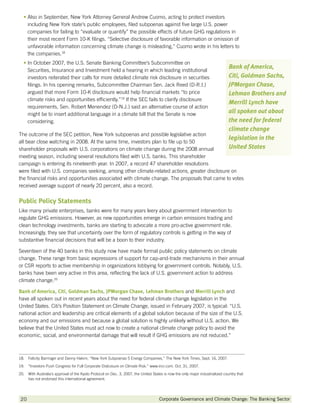
  •  f the 40 banks profiled in this study, 23 include a reference or discussion of
    O                                                                                           would other risk
    climate change in their latest annual shareholder reports.
                                                                                                management issues
  •  ollectively, these banks have written nearly 100 research reports on climate change
    C
    and related investment and regulatory topics; more than half of these reports were
    issued in 2007 alone.
  • n addition, 26 of these banks are signatories to the Carbon Disclosure Project (CDP), which
    I
    seeks information on climate risks and opportunities from companies on behalf of an investor
    coalition of 315 firms with $41 trillion in assets under management; 34 of these banks
    responded to the latest annual survey conducted by CDP.
  •  owever, only nine of the 40 banks mentioned climate change or related issues in their latest
    H
    Form 10-K or comparable regulatory filings. This suggests that most banks have yet to evaluate
    and disclose their own material risks and opportunties posed by climate change.

Board Oversight
Leading banks are beginning to view climate change as an issue that corporate board directors have a
fiduciary duty to address:

  •  f the 40 banks examined in this study, nine banks have assigned a board member
    O                                                                                               Board Oversight
    to oversee the company’s climate-related policies and initiatives.                                 Leaders
  •  wenty-two of the banks conduct periodic board reviews of the company’s
    T                                                                                                    ABN AMRO
    environmental affairs, and 12 integrate climate change as part of this review process.            Deutsche Bank
  •  otably, 11 of the 12 banks with board-level involvement on climate change are non-
    N                                                                                                      HBOS
    U.S. firms—seven in Europe, three in Canada, and one in Japan. This indicates a                        HSBC
    need for U.S. banks in particular to re-examine the emerging role of boards in climate         Royal Bank of Scotland
    change oversight, policy formation and risk management.                                                 UBS


2         		                                                     Corporate Governance and Climate Change: The Banking Sector
Management Execution
                                  At the management level, climate change is commanding more attention of senior
    Management                    executives and is translating into more formal policies and governance programs.
  Execution Leaders
                                  •  hirteen of the 40 banks in this study have developed specific climate-related
                                    T
        ABN AMRO                    policies and/or strategies.
            Citi
                                  • n addition, 13 banks have created executive-level committees, working groups or
                                    I
      Crédit Agricole
                                    task forces focused on climate change. In some instances, new executive positions
     Goldman Sachs
                                    and departments are being defined around climate change specifically.
          HBOS
          HSBC                    •  ixteen banks have also made formal public policy statements on climate change—
                                    S
   Royal Bank of Canada             ranging from basic expressions of support for GHG cap-and-trade mechanisms to
                                    active membership in organizations lobbying for near-term government controls.

                    Internal Greenhouse Gas Management
                    Many banks are altering their energy procurement policies in favor of renewable energy sources and
                    integrating energy efficient, green building principles into real estate management.

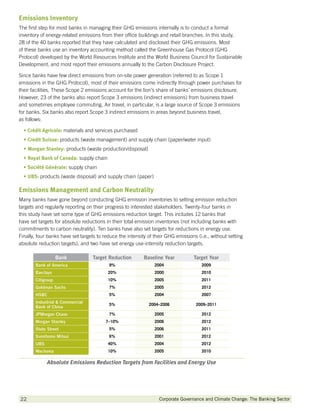
                      •  wenty-eight of the 40 banks have calculated and disclosed their GHG emissions
                        T
                        from operations.
                      •  t the same time, 24 of these banks have set some type of GHG emissions reduction target.
                        A
                      •  growing number of banks are declaring targets to achieve “carbon neutrality.” Ten banks
                        A
                        say they have either achieved or are committed to carbon neutrality for their operations.

                    Risk Management and External Financing
                    Twenty-three of the banks in this study have adopted the Equator Principles to incorporate
                    environmental, social and governance (ESG) factors for development projects in emerging markets.
                    Some leading banks are going further to institute climate-specific lending policies and alternative
                    energy investments throughout their institutions:

                                 •  hirteen of the 40 banks have adopted risk management policies or lending
                                   T
   Risk Management                 procedures that address climate change in some form. Most of these policies are
        Leaders                    process oriented and focused on due diligence research; many apply to the power
                                   sector specifically.
        ABN AMRO
     Bank of America             •  small but growing number of banks also are formally calculating carbon risk in
                                   A
           Citi                    their loan portfolios, including Citi Mitsubishi UFJ Financial Group Mizuho Financial
                                                                    Citi,                         Group,
          Fortis                   Group Royal Bank of Canada and Wells Fargo
                                   Group,                                     Fargo.
          HBOS                   •  ank of America is the only one of the 40 banks to announce a specific target to
                                   B
          HSBC                     reduce GHG emissions associated with its lending portfolio. Its policy applies to its
     Goldman Sachs                 utility corporate finance portfolio, for which it is seeking a 7 percent reduction in the
       Merrill Lynch               rate of GHG emissions by 2009, as represented by the carbon-intensity mix of utilities
  Mizuho Financial Group           in the portfolio.
   Royal Bank of Canada          •  dditionally, 29 banks document their involvement in the burgeoning renewable
                                   A
  Royal Bank of Scotland           energy and “clean tech” market. Several U.S. and European banks have made multi-
                                   billion dollar investments or financing commitments in this growing sector.


Corporate Governance and Climate Change: The Banking Sector 	                                                                  3
Investment and Retail Products
Climate change also offers an opportunity for banks to diversify their investment and retail product
lines. Growing client interest in climate risk management, carbon offsets and socially responsible
investing is fueling interest in these businesses.

  •  wenty-one of the banks evaluated offer climate-related products, including 10 with climate-
    T
    specific funds and index offerings. Many of these products have been launched in 2007, and
    most are coming out of European banks.
  •  wenty-two of the banks examined offer climate-related retail products—from preferred-rate
    T
    “green” mortgages to climate-focused credit card programs and “green” car loans.


    Investment Product                Retail Product Leaders                   Carbon Trading
          Leaders                          Bank of America
                                                                                  Leaders
         ABN AMRO                              Barclays                          Bank of America
        Credit Suisse                        BNP Paribas                             Barclays
       Deutsche Bank                            Fortis                             BNP Paribas
           HSBC                                 HBOS                              Credit Suisse
            ING                                  ING                             Deutsche Bank
      JPMorgan Chase                       Société Générale                           Fortis
        Merrill Lynch                        Wells Fargo                          Merrill Lynch
            UBS                                                                   Mitsubishi UFJ
                                                                                 Morgan Stanley


Carbon Trading
Banks that engage in commodities trading and brokerage services are recognizing a huge growth
opportunity presented by GHG emissions trading.

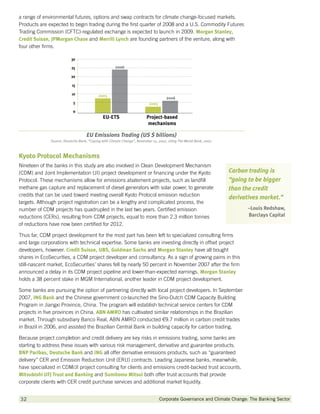
  •  eventeen banks are actively trading under the European Union Emissions Trading Scheme,
    S
    while seven banks in this study are involved with voluntary emissions trading exchanges, such
    as the Chicago Climate Exchange (CCX) and the new “Green Exchange” announced by the New
    York Mercantile Exchange in December 2007.
  •  any banks are also involved in the financing of Clean Development Mechanism (CDM) and
    M
    Joint Implementation (JI) projects under the Kyoto Protocol to generate tradable emissions
    reduction credits. Nineteen banks have participated and a smaller number are developing risk
    management, derivative and guarantee products to support this market.


4         		                                                    Corporate Governance and Climate Change: The Banking Sector
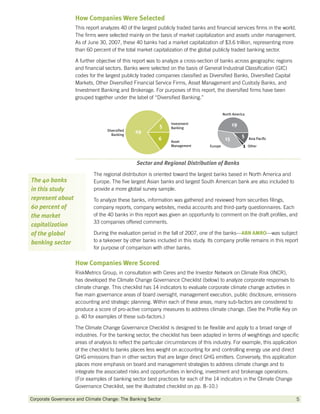
How Companies Were Selected
                    This report analyzes 40 of the largest publicly traded banks and financial services firms in the world.
                    The firms were selected mainly on the basis of market capitalization and assets under management.
                    As of June 30, 2007, these 40 banks had a market capitalization of $3.6 trillion, representing more
                    than 60 percent of the total market capitalization of the global publicly traded banking sector.

                    A further objective of this report was to analyze a cross-section of banks across geographic regions
                    and financial sectors. Banks were selected on the basis of General Industrial Classification (GIC)
                    codes for the largest publicly traded companies classified as Diversified Banks, Diversified Capital
                    Markets, Other Diversified Financial Service Firms, Asset Management and Custody Banks, and
                    Investment Banking and Brokerage. For purposes of this report, the diversified firms have been
                    grouped together under the label of “Diversified Banking.”


                                                Sector and Regional Distribution of Banks
                            The regional distribution is oriented toward the largest banks based in North America and
The 40 banks                Europe. The five largest Asian banks and largest South American bank are also included to
in this study               provide a more global survey sample.
represent about             To analyze these banks, information was gathered and reviewed from securities filings,
60 percent of               company reports, company websites, media accounts and third-party questionnaires. Each
the market                  of the 40 banks in this report was given an opportunity to comment on the draft profiles, and
                            33 companies offered comments.
capitalization
of the global               During the evaluation period in the fall of 2007, one of the banks—ABN AMRO
                                                                                               ABN AMRO—was subject
banking sector              to a takeover by other banks included in this study. Its company profile remains in this report
                            for purpose of comparison with other banks.


                    How Companies Were Scored
                    RiskMetrics Group, in consultation with Ceres and the Investor Network on Climate Risk (INCR),
                    has developed the Climate Change Governance Checklist (below) to analyze corporate responses to
                    climate change. This checklist has 14 indicators to evaluate corporate climate change activities in
                    five main governance areas of board oversight, management execution, public disclosure, emissions
                    accounting and strategic planning. Within each of these areas, many sub-factors are considered to
                    produce a score of pro-active company measures to address climate change. (See the Profile Key on
                    p. 40 for examples of these sub-factors.)

                    The Climate Change Governance Checklist is designed to be flexible and apply to a broad range of
                    industries. For the banking sector, the checklist has been adapted in terms of weightings and specific
                    areas of analysis to reflect the particular circumstances of this industry. For example, this application
                    of the checklist to banks places less weight on accounting for and controlling energy use and direct
                    GHG emissions than in other sectors that are larger direct GHG emitters. Conversely, this application
                    places more emphasis on board and management strategies to address climate change and to
                    integrate the associated risks and opportunities in lending, investment and brokerage operations.
                    (For examples of banking sector best practices for each of the 14 indicators in the Climate Change
                    Governance Checklist, see the illustrated checklist on pp. 8–10.)

Corporate Governance and Climate Change: The Banking Sector 	                                                                 5
Banks’ individual scores have been determined according to a 100-point scale. Because
not all banks are engaged in the full spectrum of financial service offerings assessed by the                    A 14-point
Climate Change Governance Checklist, however, scores are weighted differently for each                           ‘Climate Change
of the three classes of financial services firms included in the study. Companies classified                     Governance
as asset managers were scored according to an 80-point scale, with points removed for
                                                                                                                 Checklist’ has
scoring metrics related to activities that fall outside the purview of the companies’ traditional
business operations. The scores listed for these banks reflect the company’s raw score                           been used to
calculated as a percentage of the maximum 80 points. Similarly, investment banks were                            evaluate banks in
assessed according to 97-point scale. Diversified banks, whose range of traditional business                     this report
operations cover all “best practice” indicators addressed in the Climate Change Governance
Checklist, were scored according to the full 100-point scale.

Due to these variations within the financial sector, analysis of sector peers forms a more useful basis
for comparison of leaders and laggards than analysis of banks across financial sectors.

                   Climate Change Governance Checklist — Banking Sector
                                              Board Oversight                                           Points
          Board is actively engaged in climate change policy and has assigned oversight
    1     responsibility to board member, board committee or full board.
                                                                                                      Up to 16


                                          Management Execution
          Chairman/CEO assumes leadership role in articulating and executing climate change
    2     policy.

          Top executives and/or executive committees assigned to manage climate change response
    3     strategies.
                                                                                                      Up to 22
          Climate change initiatives are integrated into risk management and mainstream business
    4     activities.

          Executive officers’ compensation is linked to attainment of environmental goals and GHG
    5     targets.


                                              Public Disclosure

    6     Securities filings disclose material risks and opportunities posed by climate change.

                                                                                                      Up to 18
          Public communications offer comprehensive, transparent presentation of response
    7     measures.


                                           Emissions Accounting

    8     Company calculates and registers GHG emissions savings and offsets from operations.


    9     Company conducts annual inventory of GHG emissions and publicly reports results.
                                                                                                      Up to 14
    10    Company has an emissions baseline by which to gauge future GHG emissions trends.


    11    Company has third-party verification process for GHG emissions data.


                                             Strategic Planning
          Company sets absolute GHG emission reduction targets for facilities, energy use, business
    12    travel and other operations (including indirect emissions).

    13    Company participates in GHG emissions trading programs.
                                                                                                      Up to 30
          Company pursues business strategies to reduce GHG emissions, minimize exposure to
    14    regulatory and physical risks, and maximize opportunities from changing market forces
          and emerging controls.


6          		                                                                 Corporate Governance and Climate Change: The Banking Sector
Scores by Banking Sector                                      Scores for All Banks
                                            State Street Corp.                     36       HSBC Holdings PLC                       70
                                            Northern Trust Corp.                   14       ABN AMRO Holding N.V.                   66


                      MANAGERS*
                        ASSET
                                            BlackRock, Inc.                         4       Barclays PLC                            61
                                            T. Rowe Price Group, Inc.               4       HBOS PLC                                61
                                            Legg Mason, Inc.                        3       Deutsche Bank AG                        60
                                            Franklin Resources, Inc.                1
                                                                                            Citigroup Inc.                          59
                                            HSBC Holdings PLC                      70       Bank of America Corp.                   56
                                            ABN AMRO Holding N.V.                  66       Royal Bank of Scotland Group PLC        55
                                            Barclays PLC                           61       Fortis N.V.                             54
                                            HBOS PLC                               61       Goldman Sachs Group, Inc.               53
                                            Deutsche Bank AG                       60       ING Groep N.V.                          52
                                            Citigroup Inc.                         59       Merrill Lynch  Co., Inc.               52
                                            Bank of America Corp.                  56       UBS AG                                  52
                                            Royal Bank of Scotland Group PLC       55       Credit Suisse Group                     50
                                            Fortis N.V.                            54
                                                                                            Morgan Stanley                          49
                                            ING Groep N.V.                         52
                                                                                            Royal Bank of Canada                    49
                                            UBS AG                                 52
                                                                                            BNP Paribas                             48
                                            Credit Suisse Group                    50
                                                                                            Crédit Agricole SA                      47
                                            Royal Bank of Canada                   49
                        DIVERSIFIED BANKS


                                                                                            Société Générale                        46
                                            BNP Paribas                            48
                                                                                            JPMorgan Chase  Co.                    43
                                            Crédit Agricole SA                     47
                                                                                            Wells Fargo  Co.                       41
                                            Société Générale                       46
                                            JPMorgan Chase  Co.                   43       Mitsubishi UFJ Financial Group, Inc.    39

                                            Wells Fargo  Co.                      41       State Street Corp.                      36
                                            Mitsubishi UFJ Financial Group, Inc.   39       Sumitomo Mitsui Financial Group, Inc.   33
                                            Sumitomo Mitsui Financial Group,                Wachovia Corp.                          27
                                                                                   33
                                            Inc.                                            The Bank of Nova Scotia                 26
                                            Wachovia Corp.                         27
                                                                                            Intesa Sanpaolo S.p.A.                  26
                                            The Bank of Nova Scotia                26
                                                                                            Lehman Brothers Holdings Inc.           26
                                            Intesa Sanpaolo S.p.A.                 26
                                                                                            TD Bank Financial Group                 25
                                            TD Bank Financial Group                25
                                                                                            Mizuho Financial Group, Inc.            24
                                            Mizuho Financial Group, Inc.           24
                                                                                            Banco Santander, S.A.                   22
                                            Banco Santander, S.A.                  22
                                                                                            Banco do Brasil                         14
                                            Banco do Brasil                        14
                                            Industrial  Commercial Bank of                 Northern Trust Corp.                    14
                                                                                    8
                                            China                                           Industrial  Commercial Bank of China   8
                                            Bank of China Ltd.                      4       Bank of China Ltd.                      4
                                                                                            BlackRock, Inc.                         4
                                            Goldman Sachs Group, Inc.              53
                      INVESTMENT


                                            Merrill Lynch  Co., Inc.              52       T. Rowe Price Group, Inc.               4
                        BANKS*


                                            Morgan Stanley                         49       Legg Mason, Inc.                        3
                                            Lehman Brothers Holdings Inc.          26       Franklin Resources, Inc.                1
                                            The Bear Stearns Companies Inc.         0       The Bear Stearns Companies Inc.         0


                                                                   * Scores weighted (see pg. 6 for explanation)
                                                                        Source: Ceres and RiskMetrics Group


Corporate Governance and Climate Change: The Banking Sector 	                                                                        7
Climate Change Governance Checklist — Banking Sector Best Practices
                                              Board Oversight                                           16 Total Points
         Board is actively engaged in climate change policy and has assigned oversight
         responsibility to board member, board committee or full board.
         HSBC has assigned environmental and climate change oversight to its board’s Corporate
         Responsibility Committee. In addition, Group Chairman Stephen Green has been
         designated as having ultimate responsibility for climate change matters. The Group
         Management Board is also involved in climate change policymaking, including the firm’s           Awarded 13
    1    decision to become carbon neutral and new business expansion relating to carbon market         out of 16 points
         opportunities. Finally, the board assesses social, ethical and environmental risks and
         receives training on corporate responsibility issues.

           •  or full credit, would need climate change-specific training and explicit board
             F
             oversight of climate change as a risk management issue.


                                          Management Execution                                          22 Total Points
         Chairman/CEO assumes leadership role in articulating and executing climate
         change policy.
         ABN AMRO’s former Managing Board Chairman Rijkman Groenink has publicly advocated
         for a complete regulatory framework to address climate change, stating: “We as a private
                                                                                                          Awarded 4
    2    sector cannot do that alone. We need long-term policy guarantees and incentives to
                                                                                                        out of 4 points
         achieve carbon reduction.” At the end of 2006, Groenink co-signed a letter to the Dutch
         government urging for more government action towards combating climate change.
         ABN AMRO has also co-signed letters on climate change policy to the President of the
         European Commission and the Prime Minister of the United Kingdom.

         Top executives and/or executive committees assigned to manage climate change
         response strategies.
         At Goldman Sachs, Mark Tercek, Managing Director and Head of the Environmental
         Strategy Group and Center for Environmental Markets, reports directly to the CEO. In
                                                                                                          Awarded 6
    3    addition to the Environmental Strategy Group, business area heads oversee investment,
                                                                                                        out of 6 points
         capital markets advisory and other business activities in environmental markets. In
         addition, Goldman Sachs has carried out global due diligence training with respect to its
         Environmental Policy Framework and training for the Corporate Services and Real Estate
         team on green building standards.

         Climate change initiatives are integrated into risk management and mainstream
         business activities.
         Royal Bank of Canada established an Environmental Risk Management Group in 1992
         (the group is now incorporated into Corporate Environmental Affairs). RBC utilizes a suite
         of environment credit risk policies to address ESG issues in its lending and investment
         activities. In addition, in May 2002, RBC launched its Carbon Risk Management Project,           Awarded 9
    4    which has involved a carbon risk profile of the firm’s lending portfolio and a review of the   out of 10 points
         potential physical impacts of climate change to North American business sectors and
         regions. RBC has also integrated ESG analysis into its wealth management division.

           •  or full credit, would need a detailed explanation of integration of climate change
             F
             issues into investment and business opportunity planning.

         Executive officers’ compensation is linked to attainment of environmental goals and
         GHG targets.
         Credit Suisse Information Technology (IT) is promoting energy conservation internally
         by evaluating managers according to how well they have reduced energy use. The IT
                                                                                                          Awarded 1
    5    department recently introduced green scorecards - an evaluation tool that provides metrics
                                                                                                        out of 2 points
         around green computing.

           •  or full credit, would need a climate change specific link to wider executive
             F
             compensation policies.


8         		                                                                  Corporate Governance and Climate Change: The Banking Sector
Public Disclosure                                          18 Total Points
                              Securities filings disclose material risks and opportunities posed by climate change.
                              Bank of Nova Scotia’s 2006 40-F includes an overview of environmental risk management
                              policies, including monitoring of climate change policy developments.                            Awarded 4
                        6       •  or full credit, would need identification of material risks and strategic business
                                  F                                                                                          out of 8 points
                                  opportunities posed by climate change and further discussion of climate change
                                  and/or GHG regulations in the context of risk management.

                              Public communications offer comprehensive, transparent presentation of
                              response measures.
                              Bank of America announced in March 2007 a $20 billion ten-year climate change
                              initiative, detailing the company’s emissions reduction targets and energy efficiency
                              efforts. In May 2004, the company released a Climate Change Position Paper and the
                                                                                                                               Awarded 10
                        7     firm’s Sustainability Report is in accordance with GRI reporting standards. In addition, the
                              firm’s 2006 Annual Report Letter to Shareholders discusses climate change and Bank             out of 10 points
                              of America has publicly responded to the Carbon Disclosure Project. Finally, Bank of
                              America has advocated for a U.S. cap and trade system and federal emissions regulations;
                              the firm’s Investment Strategies Group also distributes materials to clients on the economic
                              transitions posed by climate change and potential legislation.


                                                               Emissions Accounting                                          14 Total Points
                              Company   calculates and registers GHG emissions savings and offsets from operations.
                              Company   conducts annual inventory of GHG emissions and publicly reports results.
                              Company   has an emissions baseline by which to gauge future GHG emissions trends.
                              Company   has third party verification process for GHG emissions data.
                              Citi has conducted a GHG emissions inventory that measures direct (Scope 1) emissions
                              as well as indirect (Score 2 and 3) emissions resulting from electricity purchase and
                              business travel. In addition, the company has calculated the CO2 emissions associated
                              with power plant financing. Citi has calculated emissions savings associated with its            Awarded 10
                     8–11     renewable energy purchases, and has set 2005 as a baseline by which to compare                 out of 14 points
                              current/future emissions in setting its targets. The company’s GHG inventory was
                              conducted according to the GHG Protocol and was verified by consultants designated by
                              the EPA Climate Leaders program.

                                •  or full credit, would need to set emissions baseline prior to 2004 and estimate
                                  F
                                  forward projection of emissions trends. Would also need to estimate savings from
                                  energy efficiency measures and banking/lending variations.


                                                                 Strategic Planning                                          30 Total Points
                              Company sets absolute GHG emission reduction targets for facilities, energy use,
                              business travel and other operations (including indirect emissions).
                              Barclays has achieved carbon neutrality in the United Kingdom. In addition to this
                              carbon neutrality target, the company has also set an absolute emissions target (20%
                              total emissions reduction by 2010 in the U.K.), two energy use targets (for both the U.K.
                                                                                                                               Awarded 7
                       12     and global operations), and an emissions intensity target (12.6 tonnes CO2 per €1 million
                                                                                                                             out of 10 points
                              U.K. income). Barclays has also made a commitment to increase its renewable energy
                              purchase from 3% to 50% of its U.K. operations.

                                •  or full credit, would need to set an emissions reduction target for financing/
                                  F
                                  lending operations.

                              Company participates in GHG emissions trading programs.
                              Fortis has been active in the European Union Allowance (EUA) trading market since
                              2003. Today, Fortis trades in all existing carbon contracts and provides services to over
                                                                                                                               Awarded 5
                       13     100 carbon clients globally. Apart from carbon trading services, Fortis provides various
                              carbon finance, clearing, trust and fund services. Fortis is also a co-sponsor of the          out of 5 points
                              European Carbon Fund and is the financial services provider for the UNDP’s Millennium
                              Development Goals Carbon Facility.


Corporate Governance and Climate Change: The Banking Sector 	                                                                                  9
Strategic Planning (continued)
         Company pursues business strategies to reduce GHG emissions, minimize exposure to
         regulatory and physical risks, and maximize opportunities from changing market forces
         and emerging controls.
         HSBC participates in a variety of climate-related third party initiatives and coalitions,
         including the Climate Group, the Institutional Investors Group on Climate Change, and the
         G8 Gleneagles CEO Roundtable on Climate Change. The company also ranked first in the
         Low Carbon Finance and Investment Leaders category in a survey by BusinessWeek and
         the Climate Group (December 2006) for its debt financing for low carbon projects and
         technologies, as well as equity capital for early stage project development. In June 2007,
         HSBC launched a Global Environmental Efficiency Program, a commitment to reduce
         the firm’s direct environmental impacts. The $90 million commitment over five years will       Awarded 14
  14     support renewable energy technology, water and waste reduction programs and employee         out of 15 points
         engagement.

         In addition, HSBC offers a variety of climate-related investment products, including the
         HSBC Global Climate Change Benchmark Index (and four sub-indices) and a climate
         change fund that aims to outperform the index. HSBC is also developing risk consultancy
         services to help customers assess and manage their physical exposures to climate change
         and insurance products to facilitate the development of renewable energy projects and
         carbon markets.

            •  or full credit, would need to currently offer climate-related retail products.
              F


To view a sample bank profile, go to p. 36.  To view all 40 bank profiles, go to www.ceres.org.


10        		                                                                     Corporate Governance and Climate Change: The Banking Sector
II. Overview
                    The Climate ‘Mega-Trend’
                    Climate change is changing the world of banking in many ways. One investment bank described
                    climate change recently as “the next global mega-trend,” after the fall of the Iron Curtain and the
                    Internet revolution.2 From a macro-economic standpoint, a carbon-filled atmosphere is joining capital
                    and labor as a new resource constraint in production. Moreover, cost impacts from extreme weather
                    events and greenhouse gas (GHG) regulation are emerging as risk factors in pricing securities and
                    assigning credit and asset valuations.

                    For a global economy already faced with $100-barrel oil and a projected 50 percent increase in
                    energy demand over the next 25 years, the climate change “mega-trend” may bring the global
                    economy to a historic tipping point. While globalization and the spread of market-based economies
                    have created wealth for a fast-growing human population, they have also hastened a day of reckoning
                    when fossil fuel shortages and excess climate-changing emissions could combine to spawn a global
                    climate and energy crisis. As Theodore Roosevelt IV, a managing director for Lehman Brothers, stated
                    recently, “The economic transformation driven by climate change, we believe, will be more profound
                    and deeper than globalization, as energy is so fundamental to economic growth.”3

                                   A new report from the United Nations Intergovernmental Panel on Climate Change (IPCC)
From a macro-                      makes the strongest case yet for near-term, concerted action to combat global warming.4
economic standpoint,               The report concludes that as a result of rapid consumption of fossil fuels since the start
a carbon-filled                    of the Industrial Revolution, “There is very high confidence that the net effect of human
                                   activities since 1750 has been one of warming.” This extensively peer-reviewed report—
atmosphere is
                                   whose authors share in the 2007 Nobel Peace Prize—finds:
joining capital
                                   •  arth’s surface temperature has increased 1.33 degrees Fahrenheit since 1900
                                     E
and labor as a new
                                     (0.74 degrees Celsius), mostly in the last 50 years, likely making this the warmest
resource constraint                  period of the last 1,300 years.
in production                      •  leven of the last 12 years have been the warmest in the instrumental record, dating
                                     E
                                     back to 1850.
                      •  ecent temperature and carbon dioxide (CO2) emission trends are at the high end
                        R
                        of the range forecast by the IPCC, with the global average temperature now rising about one-half
                        degree F per decade.
                      •  he frequency of heat waves, forest fires and heavy precipitation events has increased
                        T
                        globally since 1950.
                      •  reas affected by drought have spread globally since the 1970s.
                        A
                      •  he incidence of coastal flooding has increased since 1975.
                        T
                      •  rctic sea ice cover has shrunk 20 percent since 1978, when satellite measurements began.
                        A
                      •  he rate of sea level rise has jumped 70 percent since 1993, compared to the prior 30-year
                        T
                        measurement period. Rapid melting of the Greenland ice sheet is now raising new concerns
                        that the amount of sea level rise that might occur this century will be measured in meters,
                        not inches.

                    Climate change is already taking a discernible human and financial toll, with an increase in heat-

                    2.  Elga Bartsch, “The Economics of Climate Change—a Primer,” Morgan Stanley Research Europe, Morgan Stanley, Oct. 3, 2007.
                    3.  Clive Horwood, “The new colour of money,” Euromoney, September 2007.
                    4. “Summary for Policymakers of the Synthesis Report of the IPCC Fourth Assessment Report,” Intergovernmental Panel on Climate
                        Change, Geneva, Switzerland, Nov. 16, 2007.


Corporate Governance and Climate Change: The Banking Sector 	                                                                                     11
related mortality in Europe, drought-induced famine in Africa, and spread of infectious disease vectors
and allergenic pollen across the Northern Hemisphere. Receding mountain glaciers and snow cover
are shrinking the water supply of some major population centers, including California; transforming
Arctic communities that depend on hunting and travel over snow and ice; and threatening the
livelihood of winter resort communities in some lower-elevation alpine areas, such as the European
Alps and northeastern United States.

Ominously, the IPCC warns of “abrupt or irreversible” damage that might occur as a
result of delays in curbing GHG emissions. Left unchecked, global temperatures could                                 As the main
rise fully 10 degrees F by the end of this century, with thermal expansion of the oceans                             providers of capital
causing at least two feet of sea level rise. Such global temperatures, if sustained, could                           and with their
set in motion irreversible melting of the Greenland ice sheet, resulting in 23 feet of sea
                                                                                                                     expertise in risk
level rise over a matter of centuries, inundating the world’s coastal cities and wasting
trillions of dollars of urban infrastructure.                                                                        management,
                                                                                                                     banks can do
Even more modest temperature increases—on the order of 3 to 5 degrees F—are
expected to accelerate the trend toward more frequent heat waves, flooding rainstorms,
                                                                                                                     much to combat
rising sea level, severe hurricanes and a poleward shift of extra-tropical storms. The                               climate change
consequences for the global economy could be devastating. One study commissioned
by the U.K. Treasury Department estimated that if CO2 emissions are left unabated,
climate change could cause a 5 to 20 percent reduction in the projected global gross domestic
product by 2050.5 Damage from catastrophic storms and sea level rise, rising agricultural and forestry
losses, growing food and water shortages, and massive refugee problems could bring about economic
losses equivalent to those suffered during the Great Depression, this report found. In presenting the
study’s findings, Sir Nicholas Stern, the report’s lead author and a former chief economist at the World
Bank, cast climate change as “the greatest market failure the world has ever seen.”


Banks’ Leadership Role
Can banks correct this market failure? Not by themselves. But as the main providers of capital to
the global economy, and with their expertise in risk management, banks can do much to combat
climate change.

First and foremost, banks can start factoring in a market price for CO2 as carbon-
reducing regulations and carbon emissions trading expand globally. With the start of                                 Through lending
emissions trading in Europe in 2005, CO2 has become a fungible commodity that could
                                                                                                                     and investing, banks
eclipse the value of oil over time.6 This puts banks in a pivotal position to help build new
                                                                                                                     can help lead a “clean
markets through carbon emissions management, trading and brokerage. At the same
time, through lending and investing, banks can help lead a “clean energy” revolution                                 energy” revolution
in energy efficiency technologies and renewable resources that could spur hundreds of                                in energy efficiency
billions of dollars in new annual revenue streams in the decades ahead.                                              technologies and
Whether banks will seize these opportunities—and this report finds preliminary evidence
                                                                                                                     renewable resources
that they are pursuing at least some—banks will come to realize that climate change                                  that could spur
affects all facets of their business and all classes of investing. On the way toward a                               hundreds of billions
warmer, carbon-constrained world, equity valuations will be shaped by everything from                                of dollars in new
new regulatory schemes and incentives, to physical damage to facilities, and shifts in                               annual revenue
consumer preferences toward “climate friendly” products and services. The ability of                                 streams in the
companies to adjust to this fast-changing physical and regulatory environment—by
                                                                                                                     decades ahead
mitigating climate risks and capitalizing on new investment opportunities—will become


5.  Stern Review Report on the Economics of Climate Change, U.K. Treasury Department, October 2006.
6. “Emissions Trading Expert Peter Fusaro: Carbon Trading is going to be Bigger than Oil Trading.” July 31, 2007.
    See http://energytechstocks.com.previewmysite.com/wp/?p=120

12           		                                                                     Corporate Governance and Climate Change: The Banking Sector
increasingly central to banks’ financing of corporations, equity research and portfolio management.

                    At the same time, banks will need to re-examine their treatment of fixed-income assets, many of
                    which are designed to last for decades but which may come under rising inflationary pressure from
                    weather-related losses and carbon regulations that will make carbon emissions more costly. Demand
                    for “climate protection” products and services could lead banks into whole new markets to support
                    efficient risk sharing of increasingly vulnerable infrastructure. In addition, government securities may
                    be called upon to backstop climate-related risks that the private sector is no longer willing or able to
                    finance and insure. Even global trade and currency valuations will be affected, with countries lacking
                    the necessary financial resources and adaptive capacity seeing their currencies weakened, as others
                    benefit from new international trade and capital flows spurred by carbon-related emissions trading
                    and project development.


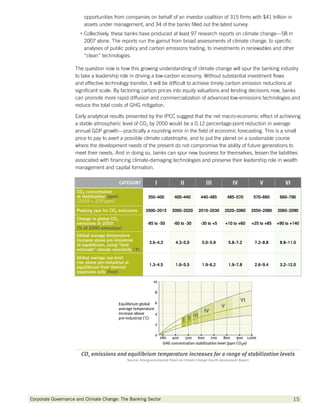
                              $500 billion Value of low-carbon energy markets by 2050 (Stern)

                              $100 billion Demand for projects generating GHG emissions credits by 2030 (UN)

                              $100 billion Worldwide investment in clean energy by 2009 (New Energy Finance)

                                $18.6–      Estimated solar industry revenues by 2010 (Solar Buzz)
                              $23.1 billion
                                                   Global fuel cell and distributed hydrogen market by 2015
                               $15 billion         (The Climate Group)


                                                   Cumulative net savings from energy efficient products in US by 2012
                               $84 billion         (The Climate Group)


                                                                    Size of the Opportunity
                                                     Source: Deutsche Bank. “Investing in Climate Change.” October 2007


                    Need for Action
                    While the transition to a lower-carbon economy will take decades, “What we do in the next two or three
                    years will determine our future,” says Rajendra Pachauri, an economist and scientist who heads the
                    the Intergovernmental Panel on Climate Change. If no further action is taken to control GHG emissions
                    before 2012, “it’s too late,” Pachauri believes. “This is the defining moment.”7

                    Bringing GHG emissions under control presents a formidable challenge for the global economy.
                    In the last 35 years, anthropogenic emissions of CO2, the most important greenhouse gas, have
                    increased 80 percent, mainly as a result of rapid increases in the rate of combustion of fossil fuels.
                    The atmospheric concentration of CO2 now stands at 380 parts per million—far above the natural
                    range over the last 650,000 years.

                    Since 2000, even the amount of carbon per unit of energy produced has increased, reversing a trend
                    toward use of lower-carbon energy sources since the start of the Industrial Revolution. This reversal
                    is mainly the result of emerging economies like China and India that are relying heavily on coal and
                    oil—the most carbon-intensive energy sources—to fuel their economic booms. But it is also because
                    fossil energy developers elsewhere have begun to tap unconventional sources that require far more
                    energy to refine and produce, such as tar sands and oil shale in Canada and the western United
                    States. From a carbon emissions standpoint, expanded use of these carbon-rich fuels has canceled
                    out the sizeable gains made in production from non-carbon resources like wind and solar since 2000.

                    If current trends continue, a climate and energy crisis is virtually unavoidable. Between now and

                    7. Elizabeth Rosenthal and James Kanter, “Grim Report on Climate Change Described as Too Rosy,” The New York Times,
                        Nov. 17, 2007.

Corporate Governance and Climate Change: The Banking Sector 	                                                                              13
2030, CO2-equivalent (CO2e) emissions are expected to nearly double under business as usual
forecasts. Even with more optimistic assumptions about gains in energy efficiency and expansion of
renewables, emissions are expected to rise by at least 25 percent. Such forecasts make it virtually
impossible to achieve what scientists say is needed by 2050 to avoid “dangerous human interference”
with the climate system—a 60 to 80 percent reduction in CO2e emissions below current levels.


Tipping Point?
To keep major GHG reductions by 2050 in the realm of possibility, the IPCC is recommending an
emissions path where global energy-related CO2 emissions peak by no later than 2020 and return to
current levels by 2030. In that time frame, more than $20 trillion of energy-related capital investment
is projected to occur. With an additional net investment of 5 to 10 percent a year to
speed the penetration of non-carbon based fuels, the IPCC believes it would be possible           Only one of the banks
to return emissions to current levels by 2030, even as the global economy grows virtually         in this report has
unabated. This places an enormous responsibility on energy companies and the banks
                                                                                                  made a formal, but
that finance them to make sound investment decisions, since most of the energy stock
added now will still be in use in 2030. Yet there must be a substantial shift away from           modest, commitment
carbon-based fuels over the period if these emissions goals are to be achieved.8                  to shift the balance
                                                                                                                            of its financing in
One piece of good news in this report is that banks are stepping up their investments
in “clean technology” to make this possible. Of the 40 banks profiled, 29 document                                          the power sector in
their involvement in the renewable energy and clean tech market through everything                                          favor of lower-carbon
from private equity and fund investments, to underwriting of initial public offerings,                                      companies
debt financing and even direct ownership stakes in some companies. Altogether,
annual investment in renewable energy globally passed the $100-billion mark in 2006,
according to the United Nations Environment Programme.9

Even so, the amount of investment in traditional fossil fuels far exceeds that of renewables, and
few banks have yet given any indication that they are willing to scale back their funding of carbon-
intensive energy sources like tar sands and new conventional coal-fired power plants. Only one of the
banks evaluated in this report—Bank of America
                                  Bank America—has made a formal, but modest, commitment to
shift the balance of its financing in the power sector in favor of lower-carbon utilities, so that its lending
portfolio will have reduced carbon exposure over time. (See p. 26 for details.) Yet even this bank along
with others has come under fire for its continued role in financing large coal-based utilities.10 In any
event, more banks will need to follow this precedent of tracking the relative flow of capital into carbon
vs. non-carbon energy sources—and place increasingly aggressive limits on the proportion going into
carbon sources—if there is to be any prospect of halting the atmospheric buildup of GHGs by 2050.

What this report can say with certainty is that climate change has galvanized the attention of the
banking community. A growing number of banks recognize the challenges and opportunities posed by
global warming, and some of the leading banks are treating this as a risk management issue—as they
would other credit, operational and reputation issues:

  • Of the 40 banks profiled in this study, 23 include a reference or discussion of climate change in
    
    their latest annual shareholder reports.
  •  wenty-six of these banks were signatories to the latest annual survey conducted by the
    T
    Carbon Disclosure Project, a non-profit organization that seeks information on climate risks and

8. Successful commercialization of carbon capture and storage technology could offset the need for some fossil fuel replacement, but
    not eliminate the need for this shift toward new energy sources.
9.  “Global Trends in Sustainable Energy Investment 2007,” United Nations Environment Programme, June 2007.
10.  “Banks, Climate Change and the New Coal Rush,” Rainforest Action Network, October 2007.


14           		                                                                    Corporate Governance and Climate Change: The Banking Sector
opportunities from companies on behalf of an investor coalition of 315 firms with $41 trillion in
                        assets under management, and 34 of the banks filled out the latest survey.
                      •  ollectively, these banks have produced at least 97 research reports on climate change—58 in
                        C
                        2007 alone. The reports run the gamut from broad assessments of climate change, to specific
                        analyses of public policy and carbon emissions trading, to investments in renewables and other
                        “clean” technologies.

                    The question now is how this growing understanding of climate change will spur the banking industry
                    to take a leadership role in driving a low-carbon economy. Without substantial investment flows
                    and effective technology transfer, it will be difficult to achieve timely carbon emission reductions at
                    significant scale. By factoring carbon prices into equity valuations and lending decisions now, banks
                    can promote more rapid diffusion and commercialization of advanced low-emissions technologies and
                    reduce the total costs of GHG mitigation.

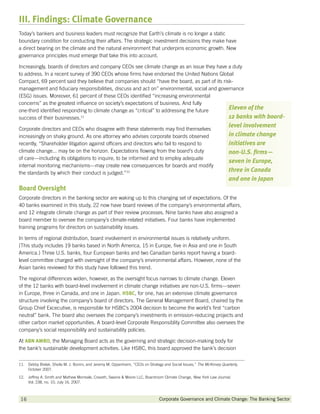
                    Early analytical results presented by the IPCC suggest that the net macro-economic effect of achieving
                    a stable atmospheric level of CO2 by 2050 would be a 0.12 percentage-point reduction in average
                    annual GDP growth—practically a rounding error in the field of economic forecasting. This is a small
                    price to pay to avert a possible climate catastrophe, and to put the planet on a sustainable course
                    where the development needs of the present do not compromise the ability of future generations to
                    meet their needs. And in doing so, banks can spur new business for themselves, lessen the liabilities
                    associated with financing climate-damaging technologies and preserve their leadership role in wealth
                    management and capital formation.

                                              CATEGORY           I              II             III              IV               V            VI
                     CO2 concentration
                     at stabilization (ppm)                 350–400         400–440         440–485         485–570           570–660      660–790
                     (2005 = 379 ppm)

                     Peaking year for CO2 emissions        2000–2015       2000–2020       2010–2030       2020–2060         2050–2080    2060–2090
                     Change in global CO2
                     emissions in 2050                      -85 to -50      -60 to -30      -30 to +5      +10 to +60        +25 to +85   +90 to +140
                     (% of 2000 emissions)
                     Global average temperature
                     increase above pre-industrial
                                                             3.6–4.3         4.3–5.0         5.0–5.8         5.8–7.2          7.2–8.8      8.8–11.0
                     at equilibrium, using “best
                     estimate” climate sensitivity (˚F)
                     Global average sea level
                     rise above pre-industrial at
                                                             1.3–4.5         1.6–5.5         1.9–6.2         1.9–7.8          2.6–9.4      3.2–12.0
                     equilibrium from thermal
                     expansion only (Feet)


                       CO2 emissions and equilibrium temperature increases for a range of stabilization levels
                                                Source: Intergovernmental Panel on Climate Change Fourth Assessment Report


Corporate Governance and Climate Change: The Banking Sector 	                                                                                      15
III. Findings: Climate Governance
Today’s bankers and business leaders must recognize that Earth’s climate is no longer a static
boundary condition for conducting their affairs. The strategic investment decisions they make have
a direct bearing on the climate and the natural environment that underpins economic growth. New
governance principles must emerge that take this into account.

Increasingly, boards of directors and company CEOs see climate change as an issue they have a duty
to address. In a recent survey of 390 CEOs whose firms have endorsed the United Nations Global
Compact, 69 percent said they believe that companies should “have the board, as part of its risk-
management and fiduciary responsibilities, discuss and act on” environmental, social and governance
(ESG) issues. Moreover, 61 percent of these CEOs identified “increasing environmental
concerns” as the greatest influence on society’s expectations of business. And fully
one-third identified responding to climate change as “critical” to addressing the future
                                                                                               Eleven of the
success of their businesses.11                                                                 12 banks with board-
                                                                                                                        level involvement
Corporate directors and CEOs who disagree with these statements may find themselves
increasingly on shaky ground. As one attorney who advises corporate boards observed                                     in climate change
recently, “Shareholder litigation against officers and directors who fail to respond to                                 initiatives are
climate change... may be on the horizon. Expectations flowing from the board’s duty                                     non-U.S. firms—
of care—including its obligations to inquire, to be informed and to employ adequate
                                                                                                                        seven in Europe,
internal monitoring mechanisms—may create new consequences for boards and modify
the standards by which their conduct is judged.”12
                                                                                                                        three in Canada
                                                                                                                        and one in Japan
Board Oversight
Corporate directors in the banking sector are waking up to this changing set of expectations. Of the
40 banks examined in this study, 22 now have board reviews of the company’s environmental affairs,
and 12 integrate climate change as part of their review processes. Nine banks have also assigned a
board member to oversee the company’s climate-related initiatives. Four banks have implemented
training programs for directors on sustainability issues.

In terms of regional distribution, board involvement in environmental issues is relatively uniform.
(This study includes 19 banks based in North America, 15 in Europe, five in Asia and one in South
America.) Three U.S. banks, four European banks and two Canadian banks report having a board-
level committee charged with oversight of the company’s environmental affairs. However, none of the
Asian banks reviewed for this study have followed this trend.

The regional differences widen, however, as the oversight focus narrows to climate change. Eleven
of the 12 banks with board-level involvement in climate change initiatives are non-U.S. firms—seven
in Europe, three in Canada, and one in Japan. HSBC for one, has an extensive climate governance
                                                HSBC,
structure involving the company’s board of directors. The General Management Board, chaired by the
Group Chief Excecutive, is responsible for HSBC’s 2004 decision to become the world’s first “carbon
neutral” bank. The board also oversees the company’s investments in emission-reducing projects and
other carbon market opportunities. A board-level Corporate Responsiblity Committee also oversees the
company’s social responsibility and sustainability policies.

At ABN AMRO the Managing Board acts as the governing and strategic decision-making body for
       AMRO,
the bank’s sustainable development activities. Like HSBC, this board approved the bank’s decision


11. Debby Bielak, Sheila M. J. Bonini, and Jeremy M. Oppenheim, “CEOs on Strategy and Social Issues,” The McKinsey Quarterly,
     October 2007.
12. Jeffrey A. Smith and Mathew Morreale, Cravath, Swaine  Moore LLC, Boardroom Climate Change, New York Law Journal,
     Vol. 238, no. 10, July 16, 2007.


16           		                                                                 Corporate Governance and Climate Change: The Banking Sector
to become carbon neutral, and it receives regular updates from the company’s Sustainability
                    Department.


                    Management Execution
                    At the executive level, management of climate change issues has started to move beyond the
                    purview of government relations and public affairs departments and into the realm of traditional risk
                    management. The broad reach of climate change compels a holistic and forward-looking management
                    approach. It combines practical considerations of how banks manage their own energy use and
                    associated greenhouse gas emissions with the broader implications of how climate change affects
                    their lending and investment operations, competitive positioning, reputations and, ultimately, financial
                    bottom lines.

                                   Senior-level support and engagement are the most critical components of any successful
Twenty-six of
                                   climate strategy, according to a recent report from the Pew Center on Global Climate
the banks in                       Change.13 Among survey respondents for this report, CEO leadership was identified as
this study have                    a key driver at all stages of climate program development and implementation. CEO
established general                leadership is also key indicator in the Climate Change Governance Checklist featured in
environmental                      this report.

policies, and 13 have
                                   Environmental Management
specific climate-                 Increasingly, senior-level management attention to climate change is translating into formal
related policies and/             company-wide environmental policies. Twenty-six of the banks reviewed in this study
or strategies                     have established general environmental policies, and 13 have specific climate-related
                                  policies and/or strategies. Of the banks with climate-specific policies, eight are based in
                                  Europe, four are in the United States and one is in Canada—and all are diversified banks.
                    None of the banks in the asset management and investment banking sectors, or the five Asian banks
                    examined in this study, have thus far developed climate-specific policies or strategies. These figures
                    are likely to rise, however, as much of the corporate policy focus on climate change has come only
                    recently. Of the 13 banks with formal policies, nine created or updated them in just the past two years.

                    Morgan Stanley for example, updated its Environmental Policy Statement in 2007. The policy
                             Stanley,
                    commits the bank to helping clients in GHG intensive industries to develop financial strategies for
                    responding to emerging regulatory mandates, devoting resources towards sustainable and renewable
                    sources of energy, continuing to provide investment research that enhances understanding of the
                    impacts of climate change and carbon constraints on businesses, and encouraging clients to evaluate
                    the issue of GHG emissions and to consider investing in and making use of emerging environmental
                    technologies.

                    Royal Bank of Canada (RBC) unveiled an Environmental Blueprint in October 2007 that is focused
                    on climate change, biodiversity and water issues. Among other things, this policy commits the bank
                    to reducing its environmental footprint, providing a suite of environmental credit risk policies for its
                    clients and offering new climate-focused products and services. This is the latest outgrowth of a
                    Carbon Risk Management Project that RBC began in 2002. As part of this project, RBC undertook
                    a carbon risk profile of its lending portfolio in order to assess potential credit risk impacts, and
                    undertook a review of the potential physical impacts of climate change to North American business
                    sectors and regions.

                    Barclays PLC adopted its Environmental Policy in January 2005, which includes a five-point Climate
                    Action Program. The goals are to increase energy efficiency, purchase renewable energy, achieve
                    carbon neutrality for its U.K. operations, offer climate products and services to customers, and actively


                    13. Andrew Hoffman, “Getting Ahead of the Curve: Corporate Strategies to Address Climate Change,” Pew Center on Global Climate
                         Change, October 2006.

Corporate Governance and Climate Change: The Banking Sector 	                                                                                   17
engage in the climate change policy debate. Several other banks have adopted similar climate-related
goals as part of their environmental policies in recent years.


Risk Management
For some banks, however, climate change is not merely an extension of environmental policy; it is
an important component of the company’s risk management. “Take the issue of CO2 emissions and
climate change,” Barclays wrote in its 2005 Corporate Responsibility Report. “We have already seen
how business is responding commercially to the challenge. But we also have to deal with it as a risk
management issue.”14 In Barclays’ case, the firm has established an Environmental
and Social Impact Assessment Policy to ensure that “lending proposals are thoroughly
assessed to identify any environmental and social risks.” The policy is implemented            “ e have already
                                                                                                 W
through its lending managers and credit teams as well as a specially designated                  seen how business
Environmental and Social Risk Policy team. The Brand and Reputation Committee, a                 is responding
subcommittee of Barclays’ Executive Committee, oversees the process.
                                                                                                              commercially to the
Several other European banks have variations on this risk management scheme. ABN                              [climate] challenge.
AMRO Group Risk Committee (GRC) is mandated to include environmental, social and
AMRO’s                                                                                                        But we also have to
ethical (ESE) considerations in decision-making on client and transaction engagements.
                                                                                                              deal with it as a risk
To help fulfill this mandate, a Sustainable Risk Advisory (SRA) team works within the
Group Risk Management division to assess ESE risks and advise the GRC on business                             management issue.”
engagement decisions. With respect to climate change and project finance, the                                           –Barclays PLC
company identifies regulatory risk from emerging GHG emissions policies, cash-flow
risks from volatile costs and physical risks from weather events.

HSBC also has an Environmental Risk Standard, established in 2003, and has since adapted it into a
Sustainability Risk Framework. HSBC is upgrading its risk approval systems to include sustainability
risk ratings, which will be gradually assigned to clients globally. The risk ratings will enable the firm
to differentiate deal approval levels, the type of facility it would offer a client and provide portfolio
information. HSBC has a network of 27 environmental risk managers that support its Sustainability
Risk team in London. It also recently hired a dedicated climate change executive who heads a Climate
Change Center for Excellence. “Over the next five years,” Group Chairman Stephen Green stated in
2007, “HSBC will make responding to climate change central to our business operations and at the
heart of the way we work with our clients across the world.”15


Executive Task Forces
As climate change evolves as a risk management issue, banks must consider how it will affect their
diverse lines of business and operations that often span several continents. One way banks are
coordinating their governance responses at the executive level is by establishing climate-focused
committees or task forces led by the CEO or other top-ranking executives. Twenty-five of the banks
analyzed in this study have established general environmental/sustainability executive committees,
task forces or working groups; 13 have created working groups focused specifically on climate
change.

Crédit Agricole has organized a top-down climate governance response that reaches from the CEO all
the way to lending officers within its regional development banks. The three-tiered structure includes
a top-level Sustainable Development Committee, a Sustainable Development Mission and a network
of Sustainable Development officers. The Sustainable Development Committee is chaired by the
CEO and includes several top executives who are responsible for drafting the main guidelines for the

14.  Barclays PLC, 2005 Corporate Responsibility Report.
15.  News conference to announce the HSBC Climate Partnership, London, U.K., May 30, 2007.


18           		                                                               Corporate Governance and Climate Change: The Banking Sector
Sustainable Development Mission. Crédit Agricole has also established a 12-member specialized
                    Environmental Unit responsible for developing the company’s carbon assessment tools and new
                    climate-related products. This unit reports directly to the Sustainable Development Committee.

                    Other companies have implemented climate governance strategies with a more decentralized
                    structure, where working groups operate within different business units. At UBS the primary
                                                                                                  UBS,
                    responsibility for implementing environmental policies lies within its business groups, each of which
                    has appointed an environmental representative to act as sponsor of environment-related initiatives
                    within that group. UBS also has an executive-level Environmental Committee, chaired by the Group
                    Chief Credit Officer, which consists of each group’s environmental representatives and other senior
                    executives. A Group Environmental Policy unit supports the Environmental Committee’s work.

                    Adhering to the philosophy that environmental issues should be incorporated as a standard business
                    consideration by all business lines and operating areas within the company, Bank of America has also
                    taken a more decentralized approach. An Environmental Council with executive representation meets
                    periodically throughout the year to help business lines drive their performance objectives. In addition,
                    cross-functional teams have been developed to address environmental issues and opportunities.
                    These teams focus on areas such as credit risk, reporting and tracking, operations and supply chain
                    management, procurement and corporate services, energy management and associate engagement.

                    Fortis utilizes a hybrid climate governance structure combining these centralized and decentralized
                    approaches. At the corporate level, it has a Corporate Social Responsibility (CSR) department, with
                    CSR managers deployed in each of the company’s businesses. The CSR department coordinates and
                    synthesizes broad sustainability policies in line with the company’s overall global strategy, while the
                    CSR managers integrate specific climate-related issues into their business units. In addition, Fortis
                    has established a Corporate Sustainability Steering group, comprised of 10 senior managers from
                    various parts of the organization to “embed sustainability deeper within the organization.” In 2007,
                    Fortis also set up a CSR Advisory Board, comprised of external experts, to offer additional perspective
                    on the company’s CSR initiatives.


                    Public Disclosure
                                   Corporate disclosure of climate change risk is growing steadily in response to investor and
The lack of climate                other stakeholder initiatives—and the banking industry is no exception. Twenty-six of the
                                   40 banks in this study were signatories to the latest annual survey of climate-related risks
risk disclosure in
                                   conducted by the Carbon Disclosure Project.16 In addition, 34 of the banks completed this
securities filings                 survey and shared the results with other CDP signatories.
continues to be of
                               However, banks have a spottier record when it comes to direct communication with their
particular concern to          shareholders on climate change. Only 23 of the 40 banks analyzed in this report included
many shareholders              a reference to climate change in their latest annual reports. And only nine of the banks
                               mentioned climate change or related issues in their latest Form 10-K or comparable
                               regulatory filings. The lack of disclosure in securities filings continues to be of particular
                    concern to many shareholders:

                      • n September 2007, 22 institutional investors and other organizations filed a petition requesting
                        I
                        that the U.S. Securities and Exchange Commission issue interpretive guidance on what material
                        climate-related information should be included in corporate disclosures.17


                    16.  Carbon Disclosure Project Report 2007: Global FT500 and USA SP500 reports, September 2007.
                    17. Rebecca Smith, “SEC Pressed on Climate Change Disclosure,” Wall Street Journal. Sept. 18, 2007.
                         See http://sec.gov/rules/petitions.shtml.


Corporate Governance and Climate Change: The Banking Sector 	                                                              19
•  lso in September, New York Attorney General Andrew Cuomo, acting to protect investors
    A
    including New York state’s public employees, filed subpoenas against five large U.S. power
    companies for failing to “evaluate or quantify” the possible effects of future GHG regulations in
    their most recent Form 10-K filings. “Selective disclosure of favorable information or omission of
    unfavorable information concerning climate change is misleading,” Cuomo wrote in his letters to
    the companies.18
  • n October 2007, the U.S. Senate Banking Committee’s Subcommittee on
    I
                                                                                                                                Bank of America,
    Securities, Insurance and Investment held a hearing in which leading institutional
    investors reiterated their calls for more detailed climate risk disclosure in securities                                    Citi, Goldman Sachs,
    filings. In his opening remarks, Subcommittee Chairman Sen. Jack Reed (D-R.I.)                                              JPMorgan Chase,
    argued that more Form 10-K disclosure would help financial markets “to price                                                Lehman Brothers and
    climate risks and opportunities efficiently.”19 If the SEC fails to clarify disclosure
                                                                                                                                Merrill Lynch have
    requirements, Sen. Robert Menendez (D-N.J.) said an alternative course of action
    might be to insert additional language in a climate bill that the Senate is now
                                                                                                                                all spoken out about
    considering.                                                                                                                the need for federal
                                                                                                                                climate change
The outcome of the SEC petition, New York subpoenas and possible legislative action
                                                                                                                                legislation in the
all bear close watching in 2008. At the same time, investors plan to file up to 50
shareholder proposals with U.S. corporations on climate change during the 2008 annual                                           United States
meeting season, including several resolutions filed with U.S. banks. This shareholder
campaign is entering its nineteenth year. In 2007, a record 47 shareholder resolutions
were filed with U.S. companies seeking, among other climate-related actions, greater disclosure on
the financial risks and opportunities associated with climate change. The proposals that came to votes
received average support of nearly 20 percent, also a record.


Public Policy Statements
Like many private enterprises, banks were for many years leery about government intervention to
regulate GHG emissions. However, as new opportunities emerge in carbon emissions trading and
clean technology investments, banks are starting to advocate a more pro-active government role.
Increasingly, they see that uncertainty over the form of regulatory controls is getting in the way of
substantive financial decisions that will be a boon to their industry.

Seventeen of the 40 banks in this study now have made formal public policy statements on climate
change. These range from basic expressions of support for cap-and-trade mechanisms in their annual
or CSR reports to active membership in organizations lobbying for government controls. Notably, U.S.
banks have been very active in this area, reflecting the lack of U.S. government action to address
climate change.20

Bank of America Citi Goldman Sachs JPMorgan Chase Lehman Brothers and Merrill Lynch and
         America, Citi,            Sachs,          Chase,
have all spoken out in recent years about the need for federal climate change legislation in the
United States. Citi’s Position Statement on Climate Change, issued in February 2007, is typical: “U.S.
national action and leadership are critical elements of a global solution because of the size of the U.S.
economy and our emissions and because a global solution is highly unlikely without U.S. action. We
believe that the United States must act now to create a national climate change policy to avoid the
economic, social, and environmental damage that will result if GHG emissions are not reduced.”


18.  Felicity Barringer and Danny Hakim, “New York Subpoenas 5 Energy Companies,” The New York Times, Sept. 16, 2007.
19.  “Investors Push Congress for Full Corporate Dislcosure on Climate Risk.” www.incr.com. Oct. 31, 2007.
20. With Australia’s approval of the Kyoto Protocol on Dec. 3, 2007, the United States is now the only major industrialized country that
     has not endorsed this international agreement.


20            		                                                                     Corporate Governance and Climate Change: The Banking Sector
Merrill Lynch has taken the further step of joining a group of 65 companies and institutional investors
                    organized by Ceres. In March 2007, the group, whose members manage more than $4 trillion in
                    assets, called on the U.S Congress to adopt a mandatory, market-based policy, such as a cap-and-
                    trade system. The group’s Call to Action statement recommends achieving GHG emissions reductions
                    of 60-90 percent below 1990 levels by 2050, as well as establishing an economy-wide carbon price.
                    The group also called on the SEC to require better corporate disclosure of climate risks.

                    European banks, meanwhile, have been advocating for GHG emissions trading as the key climate
                    change policy solution over imposing carbon taxes or other command-and-control government
                    policies. Many of these are joint initiatives. ABN AMRO has participated in several policy forums and
                    has co-signed letters on climate change to the President of the European Commission and the Prime
                    Minister of the United Kingdom. Barclays Chairman Marcus Agius is a member of the Confederation
                    of British Industry’s Climate Change Taskforce, a group of chairmen and CEOs from some of the U.K.’s
                    biggest companies who are trying to frame a business policy agenda to tackle climate change. HBOS
                    is a member of the Institutional Investors Group on Climate Change, which has explicitly supported
                    the U.K. government’s policy target of a 60 percent reduction in U.K. GHG emissions below 1990
                    levels by 2050.

                    Additionally, in November 2007, ABN AMRO Barclays Fortis HBOS and HSBC signed the Bali
                                                        AMRO, Barclays, Fortis,
                    Communiqué, organized by the Prince of Wales’s UK and EU Corporate Leaders Groups on Climate
                    Change. The Communiqué calls for a comprehensive, legally binding United Nations framework to
                    tackle climate change and was announced at the start of the Bali, Indonesia negotiations for a post-
                    2012 Kyoto Protocol agreement.


                    Findings: Internal Greenhouse Gas Management
                    While banks are not large GHG emitters on the scale of utilities or industrial firms, they still have a
                    vital role to play in managing their emissions. Since the building sector accounts for up to 40 percent
                    of GHG emissions in some countries, banks can set an important example for their clients by
                    adopting formal emissions accounting and management systems. Many banks are altering their
                                  energy procurement policies in favor of renewable energy sources and integrating green
                                  building principles into real estate management. In addition, banks are expanding their
Twenty-four                       GHG management programs to include limits on business travel, which in some cases
                                  rivals emissions from company-owned buildings.
banks in this study
have some type                  Moreover, large multinational banks with thousands of branch offices around the world
                                can influence local uptake of energy efficiency and clean energy technologies. Some
of GHG emissions
                                banks are looking beyond their own properties to include financing of other energy
reduction target                efficiency initiatives in urban areas. For example, five banks—ABN AMRO Citi Deutsche
                                                                                                  ABN AMRO, Citi,
                                Bank JPMorgan Chase and UBS
                                Bank,                          UBS—each have pledged $1 billion to support an Energy
                                Efficiency Building Retrofit Program under the Clinton Foundation’s Climate Initiative. This
                    program is being conducted in partnership with 16 large city governments around the world to arrange
                    financing for cities and private building owners to undertake retrofits that pay for themselves through
                    energy savings over the life of the investments. The $5 billion being committed by these banks will
                    double the global market to finance energy retrofits in buildings.21


                    21. President Clinton Announces Landmark Program to Reduce Energy Use in Buildings Worldwide,” May 16, 2007. 
                         See http://www.clintonfoundation.org/051607-nr-cf-pr-cci-president-clinton-announces-landmark-program-to-reduce-energy-use-
                         in-buildings-worldwide.htm


Corporate Governance and Climate Change: The Banking Sector 	                                                                                   21
Emissions Inventory
The first step for most banks in managing their GHG emissions internally is to conduct a formal
inventory of energy-related emissions from their office buildings and retail branches. In this study,
28 of the 40 banks reported that they have calculated and disclosed their GHG emissions. Most
of these banks use an inventory accounting method called the Greenhouse Gas Protocol (GHG
Protocol) developed by the World Resources Institute and the World Business Council for Sustainable
Development, and most report their emissions annually to the Carbon Disclosure Project.

Since banks have few direct emissions from on-site power generation (referred to as Scope 1
emissions in the GHG Protocol), most of their emissions come indirectly through power purchases for
their facilities. These Scope 2 emissions account for the lion’s share of banks’ emissions disclosure.
However, 23 of the banks also report Scope 3 emissions (indirect emissions) from business travel
and sometimes employee commuting. Air travel, in particular, is a large source of Scope 3 emissions
for banks. Six banks also report Scope 3 indirect emissions in areas beyond business travel,
as follows:

  •  rédit Agricole: materials and services purchased
    Crédit
    C
  •  redit Suisse: products (waste management) and supply chain (paper/water input)
    Credit
    C
  •  organ Stanley: products (waste production/disposal)
    Morgan
    M
  •  oyal Bank of Canada: supply chain
    Royal
    R
  •  ociété Générale: supply chain
    Société
    S
  •  BS: products (waste disposal) and supply chain (paper)
    UBS:
    U

Emissions Management and Carbon Neutrality
Many banks have gone beyond conducting GHG emission inventories to setting emission reduction
targets and regularly reporting on their progress to interested stakeholders. Twenty-four banks in
this study have set some type of GHG emissions reduction target. This includes 12 banks that
have set targets for absolute reductions in their total emission inventories (not including banks with
commitments to carbon neutrality). Ten banks have also set targets for reductions in energy use.
Finally, four banks have set targets to reduce the intensity of their GHG emissions (i.e., without setting
absolute reduction targets), and two have set energy use-intensity reduction targets.

                   Bank            Target Reduction        Baseline Year          Target Year
       Bank of America                    9%                    2004                  2009
       Barclays                           20%                   2000                  2010
       Citigroup                          10%                   2005                  2011
       Goldman Sachs                      7%                    2005                  2012
       HSBC                               5%                    2004                  2007
       Industrial  Commercial
                                          5%                 2004–2006             2009–2011
       Bank of China
       JPMorgan Chase                     7%                    2005                  2012
       Morgan Stanley                    7–10%                  2006                  2012
       State Street                       5%                    2006                  2011
       Sumitomo Mitsui                    6%                    2001                  2012
       UBS                                40%                   2004                  2012
       Wachovia                           10%                   2005                  2010

             Absolute Emissions Reduction Targets from Facilities and Energy Use


22         		                                                     Corporate Governance and Climate Change: The Banking Sector
In addition, 22 banks in this study are purchasing renewable energy to reduce their emission
                    footprints, and 19 are purchasing certified emissions reduction offsets. Some of these bank programs
                    are not company-wide, but are limited to certain countries of operation or facilities.

                    A growing number of banks are declaring targets to achieve “carbon neutrality” for their operations.
                    Ten banks in this study say they have either achieved or are committed to carbon neutrality. In each
                    instance, this includes commitments to purchase renewable energy to help power their facilities and
                    other means of offsetting their emissions.


                                                                Emissions Reduction Targets
                    While carbon neutrality can be an appealing concept to bank customers, how banks define and go
                    about achieving neutrality is drawing further scrutiny. In particular, questions have been raised about
                    the efficacy of certain offset programs in stimulating additional renewable energy production and
                    bringing about actual emissions reductions. In November 2007, a Voluntary Carbon Standard (VCS)
                    was announced to provide more investor confidence and transparency around the offset process,
                    which has lacked standardized verification methods.22 The VCS could help maintain the momentum
                     of the voluntary carbon offset market, which by some estimates could reach $4 billion over the next
                                                   Filings      Withdrawals
                    five years.
                       35

                    Several banks with carbon neutrality commitments have identified measures beyond offsets to achieve
                       30

                    this goal. Key to these efforts is improvement in energy efficiency at bank facilities. Twenty-one banks
                       25
                    in 20 study cite the use of programs such as EPA’s ENERGY STAR and the U.S. Green Building
                       this
                    Council’s Leadership in Energy and Environmental Design (LEED) green building rating system to
                       15
                    document their commitment to achieving cutting-edge energy efficiency improvements at one or more
                    of 10
                       their facilities.
                       5

                       0          Goldman Sachs has developed uniform green building standards for use in the
                           1995     1996 1997 1998 1999 2000 2001 2002 2003 2004 2005
                                  construction and major renovation of its facilities. The standards are designed to
                                  ensure that the firm meets the intent of Leadership in Energy and Environmental
                                  Design (LEED) Gold certification or other whole building standards on all future
                                  projects. The firm has a LEED-certified building in Jersey City, N.J., and is working
                                  towards LEED Gold certification for its new world headquarters in New York City,
                                  scheduled to be completed in 2009. Following the completion of this building,
                                  Goldman Sachs will be the largest owner of LEED-certified commercial office buildings
                                  in the world.


                    22. “New Carbon Standard Guarantees Environmental Integrity and Transparency for Global Offset Market,” May 16, 2007. 
                         See http://www.ieta.org/ieta/www/pages/getfile.php?docID=2713.


Corporate Governance and Climate Change: The Banking Sector 	                                                                                 23
Findings: External Financing
If climate change is the next “mega-trend” that a growing number of bankers believe it will be, it will
have a profound effect on the asset values and credit ratings of corporations and, ultimately, how
banks engage companies through financing. According to Michael Klein, chairman and co-CEO of Citi
Markets and Banking, “The sectors that will be most affected [by climate change] are infrastructure,
transport, energy and technology. These can account for up to half the global financing needed in any
given year. The impact on financing could be hundreds of billions of dollars.”23

As discussed in Section IV of this report, banks increasingly see climate change as a risk management
issue. Their lending to extractive industries like oil, gas and mining has always carried
considerable operational, credit and political risks. Now climate change is exacerbating
these risks—while adding reputational risk to the mix as banks face greater scrutiny of        “ he impact on
                                                                                                 T
the environmental impacts of their lending operations.                                           financing could
Thirty of the banks in this study have a general environmental risk assessment policy in
                                                                                                            be hundreds of
place, including several that have created specialized environmental risk management                        billions of dollars.” 
teams or integrated environmental issues into mainstream risk assessment processes.                                  –Michael Klein,
However, such assessments often are confined to traditional environmental risks, such                                   Citi Markets
as site contamination, or assessing high-polluting sectors. Such processes do not                                      and Banking
necessarily address emerging environmental risks like climate change or involve any
public disclosure requirements.


Equator Principles
Mindful of the lack of transparency guiding financing decisions for development projects in emerging
markets, four banks—ABN AMRO Barclays Citigroup and WestLB
                         ABN AMRO, Barclays,                  WestLB—worked with the World Bank’s
International Finance Corporation to launch the Equator Principles in 2003. These principles are
intended to help banks assess, mitigate, document and monitor the credit risk and reputation risk
associated with financing such development projects, and through collaboration establish industry
best practices. Although the Equator Principles do not directly address climate change mitigation, they
are a first step at integrating environmental considerations into project finance, and signatory banks
may be more likely to develop robust climate change governance policies going forward. To date, 54
banks have signed on to the Equator Principles, including 23 of the 40 banks included in this study.
Some banks that are not involved in project finance also say they refer to the principles to help guide
their financing decisions on sensitive projects.

As part of an annual review process, banks are supposed to report on development projects they have
considered for financing, ranking the degree of social and environmental impact the projects might
have. Signatories are asked to disclose the number of projects they declined to finance due to their
negative effects, as well as the projects they did support. As part of the most recent update of the
principles in July 2006, the threshold for project-finance reporting was dropped from $50 million to
$10 million.

Whether the Equator Principles will set a precedent for evaluating broader financing programs
by commercial and investment banks remains to be seen. Royal Bank of Canada for one, now
                                                                           Canada,
analyzes carbon intensity as part of a broader social and environmental review that is included in its
assessment of a firm’s exposure to credit risk. But some critics of the Equator Principles and other
like-minded initiatives say these evaluation processes do not translate into any actual requirements
for mitigation of climate change impacts. However, as discussed at the end of this section, some new
ideas are emerging that could point a new way forward.


23.  Clive Horwood, “The new colour of money,” Euromoney, September 2007.

24          		                                                              Corporate Governance and Climate Change: The Banking Sector
Climate Considerations in Lending
                    Thirteen of the 40 banks in this study have adopted risk management policies or lending procedures
                    that address climate change in some way. Most of these policies are process oriented and focused on
                    due diligence research; many apply to the power sector specifically:

                      •  iti says it incorporates the potential costs of carbon in the firm’s financing of power generation.
                        C
                      •  errill Lynch has a specific policy on financing coal-fired electricity generation (see box).
                        M

                              Merrill Lynch coal financing policy recognizes that GHG emissions associated with
                                      Lynch’s
                              coal have become a significant environmental concern and that incentives are needed
                              to commercialize a cost-effective technological solution. The firm says it prefers to
                              “finance electrical generation when the producer is a recipient of effective initiatives
                              to reduce GHG and other pollutants, subject to the current state-of-the-art, including
                              energy conservation.” Where the producer has not received such incentives, Merrill
                              Lynch will advocate best practices.


                    In addition, some banks are assisting clients in analyzing carbon exposure and developing emissions
                    reduction strategies:

                      •  rédit Agricole Chevreux, the bank’s European brokerage and research arm, has hired a
                        C       Agricole’s
                        full-time carbon analyst to measure the financial impact of carbon constraints on European
                        companies subject to the E.U. Emissions Trading Scheme.
                      •  SBC has called on clients to disclose their carbon emissions and mitigation strategies in a
                        H
                        consistent way.
                      •  ortis as part of its due diligence process, says it discusses with borrowers whether they have
                        Fortis,
                        taken carbon pricing into account.
                      •  iti Royal Bank of Scotland and TD Bank Financial Group have also said that they will
                        Citi,
                        encourage clients that are large GHG emitters to develop carbon mitigation plans.

                    A small but growing number of banks also say they are formally calculating carbon risk in their
                    loan portfolios:

                      •  itsubishi UFJ Financial Group and Mizuho Financial Group have developed “carbon
                        M
                        accounting” methodologies that take into account GHG emissions in project financing.
                      •  oyal Bank of Canada has undertaken a carbon risk analysis of its lending portfolio, and has
                        R
                        developed a proposal to incorporate carbon risk into the credit and risk rating methodologies of
                        the entire firm.
                      •  ells Fargo has conducted a GHG assessment of three key lending portfolios—agriculture,
                        W
                        primary energy production and power generation.

                              HBOS considers climate change risk under five main categories: credit, market,
                              liquidity, insurance and operational risks (the latter including reputation and
                              regulatory risks). The firm’s asset management business, Insight Investment, also
                              helped develop the Investor Statement on Climate Change, sponsored by the U.K.
                              Institutional Investor Group on Climate Change. The Statement, issued in October
                              2006, follows the United Nations Principles for Responsible Investment and
                              directs pension funds and asset managers to incorporate climate change risks and
                              opportunities in their investment analysis and selection.


Corporate Governance and Climate Change: The Banking Sector 	                                                               25
Constraints on Lending?
Whether the emergence of these climate policies will have a tangible effect on lending decisions
remains to be seen. To date, only one bank—Bank of America
                                                 Bank America—has announced a specific target to
reduce GHG emissions associated with its lending portfolio. Its policy applies to its utility corporate
finance portfolio, for which it is seeking a 7 percent reduction in the rate of GHG emissions by 2009,
relative to electricity produced. To accomplish this goal, Bank of America is changing its portfolio mix
to add customers with lower-carbon emission profiles.

While Bank of America’s policy is precedent setting, it still leaves ample room to finance
traditional carbon-intensive power suppliers. Some environmental organizations are calling on                                        “To be effective, risk
banks to adopt tougher lending restrictions—or even outright bans—on companies with high-
                                                                                                                                     management needs to
carbon intensity profiles and projects. In 2007, Rainforest Action Network, an environmental
group that focused early attention on the impact of banks’ lending policies on the environment,
                                                                                                                                     minimize the overall
launched a new campaign against Bank of America and Citi for their involvement in corporate                                          carbon footprint of
and/or project financing of coal-fired power generation. BankTrack, a European group of non-                                         the project-financing
governmental organizations focused on ethics in finance, has also taken aim at banks like ABN                                        portfolio and to work
AMRO for its funding of the huge Shell-led Sakhalin II oil and gas project in Siberia and Royal
                                                                                                                                     in the context of
Bank of Scotland which until recently promoted itself as “the oil and gas bank.”
         Scotland,
                                                                                                                                     the newly emerging
Thus, a big question for banks going forward is the extent to which they should be held to
                                                                                                                                     carbon markets.” 
account for their financing of new carbon-based energy projects. After withdrawing its “oil and
gas bank” advertising campaign in July 2007, RBS Chairman Sir Tom McKillop questioned,                                                    –ABN AMRO, 2006
“Are we really saying that banks should take on the entire carbon footprint of the world? It’s                                          Sustainability Report
preposterous.”24

To be sure, banks are hardly in a position to halt all financial support of the fossil fuels industry and
carbon-intensive energy projects. This would not only be bad for business, but also would leave the
global economy in a lurch as the transition from fossil fuels may take decades to complete. Yet banks
no longer are in a position to carry on with “business as usual,” either, if real progress is to be made in
curbing GHG emissions.

So what can banks do? ABN AMRO offers one preliminary answer in its 2006 Sustainability Report,
stating, “To be effective, risk management needs to minimize the overall carbon footprint of the
project-financing portfolio and to work in the context of the newly emerging carbon markets.”25 This
would entail tracking GHG emissions from lending operations and factoring in a meaningful price for
carbon emissions.

BankTrack, for one, believes banks could do much more. It is recommending that banks adopt
the “Kiribati Principles,” named after a Pacific atoll threatened by sea level rise. The Kiribati
Principles would address all forms of bank lending, not just project finance. As part of this “collective
commitment to deal with the climate crisis,” banks would pledge to move away from fossil fuel
financing and instead increase renewable energy investments, agree on portfolio level GHG reduction
targets, prioritize preservation of forests and encourage energy efficiency.26


Renewable Energy Finance
While most banks remain relatively quiet about their continued support of the fossil fuels industry,
many have been eager to advertise their growing involvement in the burgeoning renewable energy
industry. The United Nations Environment Programme reported in June 2007 that investment
capital flowing into renewable energy reached a record $100 billion in 2006. In total, 29 banks of


24.  Ed Crooks and Paul J Davies, “Bank seeks climate change credentials,” Financial Times, July 10, 2007.
25.  ABN AMRO, 2006 Sustainability Report.
26.  “The Equator Principles: A toddler finds its feet, but still takes an occasional tumble,” Ethical Corporation, Nov. 17, 2007.

26            		                                                                      Corporate Governance and Climate Change: The Banking Sector
the 40 banks in this study have highlighted their involvement in the renewable energy market. Banks
                    are participating through direct ownership stakes in renewable energy companies, debt financing,
                    private equity and fund investments, underwriting of initial public offerings and offering financial
                    advisory services.


                                          Worldwide Investment in Clean Energy (US$ billions)
                                                                Source: New Energy Finance


                    The following banks have made multi-billion dollar commitments to the renewable energy sector,
                    with the scale of financing rising substantially in the last year:

                                •  ortis has provided almost $2 billion in financing for renewable energy projects over
                                  F
While most banks                  the last 10 years.
remain quiet about              •  oyal Bank of Canada transactions in the renewable energy sector have totaled
                                  Royal
                                  R              Canada’s
about their financing             approximately $4.5 billion since 2003.

of the fossil fuels             •  oyal Bank of Scotland gained the leading global market share of renewable energy
                                  R
                                  finance in 2006, providing $2.6 billion of capital, according to Infrastructure Journal
industry, 29 of the
                                  magazine.
40 banks in this study
                                •  NP Paribas ranked fourth globally in renewable energy finance in 2006, with more
                                  B
have highlighted their            than $1 billion financed through eight projects, according to New Energy Finance.
involvement in the
                                •  PMorgan Chase raised $1.5 billion of equity for the wind power market in 2006,
                                  J
burgeoning renewable              and its own portfolio of investments in renewable energy totals $1 billion.
energy market                   •  oldman Sachs has made significant investments in renewable energy
                                  G
                                  technologies through its Principal Investments division, totaling more than $2 billion
                                  as of year-end 2007.
                      •  ells Fargo has made a five-year commitment to lend or invest more than $1 billion for
                        W
                        environmental businesses. Since mid-2006, Wells Fargo has invested more than $125 million in
                        renewable energy projects.
                      •  ank of America in March 2007 announced a $20 billion, 10-year initiative to support the
                        B
                        growth of environmentally sustainable business activity to address global climate change. The
                        broad-based initiative, encompassing its real estate banking, corporate and investment banking
                        and consumer finance divisions, encourages development of environmentally sustainable
                        business practices and low-carbon technologies.
                      •  iti in May 2007 announced plans to invest in and finance more than $31 billion in clean
                        C
                        energy and alternative technology over the next 10 years, as part of a $50 billion commitment to
                        address global climate change.

Corporate Governance and Climate Change: The Banking Sector 	                                                               27
Some banks have developed financing specializations in renewable energy technologies such as wind
power. BNP Paribas is considered the world’s top wind financier. Santander is another leading wind
banker, having financed nearly one-third of Spain’s installed wind power. Santander is also active
in ethanol project financing in the United States and Europe. Goldman Sachs has invested in other
emerging technologies, such as cellulosic ethanol. RBS is the only bank in this study that mentioned
financing carbon capture and storage (CCS) technology for fossil fuels; the firm is supporting one of
the largest pilot projects to demonstrate CCS in coal beds.


             Fortis Venturing has initiated the Start Green Sustainable Innovation Fund I to help
             entrepreneurs who have sustainable new technology ideas in the Netherlands. The
             fund is a joint venture between Fortis, DOEN Participaties and Triodos Innovation
             Fund. Fortis also has its own ‘Green Bank’—Fortis Groenbank—to serve the
             sustainable energy financing field in the Netherlands.


Findings: Investment/Retail Products
As the climate mega-trend unfolds in the banking industry, it is also revealing itself through a
growing number of investment and retail products aimed at environmentally conscious customers.
An August 2007 United Nations Environmental Program - Finance Initiative (UNEP-FI) study found
that rising environmental awareness and media coverage of climate change, combined with growing
support for regulatory and legislative action, is spurring rapid growth in green financial products.
The study finds:27

    In interviews, most banks currently consider climate change as the most important environmental issue
    they face. In response, carbon commodity products and services are developing at an extraordinary pace,
    particularly among European and Japanese banks. The innovation displayed by the front-runners in
    carbon finance is based on their capacity to identify opportunities for carbon asset generation across all
    types of financing activities... We are in the midst of a promising drive towards ‘green’ financial product
    development into mainstream banking.

The findings of this report parallel those of the UNEP-FI study. Twenty-seven of the 40 banks
examined now offer climate-related investment and/or retail products to clients.


             Intesa Sanpaolo announced in October 2007, with the Association of Producers of
             Energy from Renewable Sources (APER), preferential financing terms for producers
             of solar photovoltaics and other renewable energy sources. The firm has designed
             incentive schemes for small and medium enterprises to reduce initial capital costs
             and take advantage of government subsidies. Intesa has signed an agreement with a
             local electrical services operator, whereby government incentives can be used both as
             a loan guarantee and as direct payment for the loan installment.


27. Green Financial Products and Services: Current Trends and Future Opportunities in North America,
     United Nations Environment Programme—Financial Initiative, August 2007.

28           		                                                                  Corporate Governance and Climate Change: The Banking Sector
Investment Products
                                  Most notable are the trends in the asset management business. Twenty-one of the banks
21 of the banks                   evaluated offer climate-related investment products, including ten with climate-specific
evaluated offer                   funds and indices (see Appendix II for a complete list). Notably, nearly all the banks with
                                  climate-focused funds and indices launched the products within the past two years—and
climate-related
                                  of the 15 climate-specific funds/indices, ten were launched in 2007. Only four of these
investment products,              products come from the United States.
including 10 with
                                  In September 2007, HSBC Corporate, Investment Banking and Markets (CIBM) launched
climate-specific funds            the HSBC Global Climate Change Benchmark Index, together with a family of four
and indices                       investable global climate change sub-indices. The Benchmark Index is designed to
                                  provide exposure to companies that are best positioned to profit in the face of climate
                                  challenges. HSBC now offers a climate change fund based on this index.

                    Also in 2007, UBS launched five different climate-specific products, including several indices,
                    structured products and investment funds (see box).


                                UBS has launched several indexes, structured products and investment funds that
                                take into account the increasing demand for climate change related products. These
                                include:

                                   •  BS Investment Bank’s UBS Global Warming Index (UBS-GWI). The index is a
                                     U
                                     tradable benchmark for global investments in the weather derivatives market.

                                   •  BS World Emissions Index (UBS-WEMI). These index-linked products offered
                                     U
                                     by the Investment Bank allow clients to participate in the index’s performance,
                                     which is linked to tradable derivative instruments referencing emissions
                                     allowances.

                                   •  BS Investment Bank’s UBS Diapason Global Biofuel Index, the world’s first
                                     U
                                     biofuel index.

                                   •  BS Climate Change Strategy Certificate. This actively managed basket of
                                     U
                                     around 25 stocks, launched in February 2007, includes companies developing
                                     solutions in renewable energy and energy efficiency.

                                   •  BS Global Asset Management’s UBS (Lux) Equity Fund—Global Innovators.
                                     U
                                     The fund’s investment themes include renewable energy, mobility, water,
                                     nutrition and healthcare.


                    Retail Products
                    The retail banking sector has also become involved in climate product development. Green products
                    in this sector span a diverse and innovative suite of offerings—from “green” mortgages to climate-
                    focused credit card programs and “green” car loans. As Richie Prager, Bank of America Head of
                                                                                                   America’s
                    Global Rates, Currencies and Commodities, observed recently, “We have 57 million clients in the U.S.
                    domestic market, and they have gone beyond the tipping point in terms of environmental awareness.
                    We’re going to see more credit cards, auto financing and home loans aimed at making a contribution
                    to combating climate change.”28

                    This study confirms such trends. Twenty-two of the banks examined currently offer a diverse array
                    of climate-related retail investment products. Bank of America introduced a credit card in November
                    2007 that allows customers to earn carbon offset credits through their purchases. Several other banks
                    have similar cards available. Wells Fargo was the first U.S. financial services firm to offer Renewable
                    Energy Certificates through credit and debit card reward programs. Barclays has launched several


                    28.  Clive Horwood, “The new colour of money,” Euromoney, September 2007.

Corporate Governance and Climate Change: The Banking Sector 	                                                             29
innovative products linked to its credit and debit card programs, including a carbon neutral debit card
that the company is rolling out to all of its clients (see box).


             Barclays launched Barclaycard Breathe in July 2007, a credit card that donates
             50 percent of net profits after tax to projects that address climate change. Barclays
             also developed the first carbon neutral debit card in the United Kingdom, and is in
             the process of rolling out the card out to the company’s 11 million debit card users.
             All carbon credits used to offset the manufacturing of the cards are generated from
             emission reduction projects located in the U.K. Barclaycard Business Commercial
             Cards has launched a Carbon Offset corporate charge card that provides customers
             with offsetting services.

Fortis offers an Energy Saving Credit program, a credit facility with lower interest rates for consumers
that are financing the purchase of energy saving products. The company also offers a Clean Car Credit
program, a car-financing arrangement to encourage motorists to cut CO2 emissions, and a Clean Car
Insurance product, which offers a 10 percent discount on coverage for hybrids and bio-fuel models.
In France, Société Générale has partnered with ADEME, the French Agency for Environment and
Energy Management, to offer “ecological mortgages,” loans that offer preferential rates to customers
in financing and renovations of energy-efficient/low-impact homes.

The three Japanese banks examined in this study—Mitsubishi UJF Financial Group Mizuho
                                                      Mitsubishi                 Group,
Financial Group and Sumitomo Mitsui Financial GroupGroup—in the last two years have also started to
offer preferred rate loans (typically 0.5 percent below posted rates) for small and medium enterprises
that meet specific environmental standards. Mizuho has extended this loan program to residential
customers installing photovoltaic generation equipment, and it is providing Life Cycle Assessments
of environmental products for its corporate clients. Through their asset management businesses, all
three banks have also established “eco-funds” that invest in Japanese companies with pro-active
environmental management policies.


             Santander through its Company Banking division, has launched “Crédito IDi,” a
             Santander,
             financing line that allows clients to finance the cost of both the energy audit and the
             investment needed to achieve emissions savings in private residences/facilities.

American banks have fewer retail offerings focused on climate change than their European and
Japanese counterparts. Just four of the 22 banks offering climate-related retail products are U.S.-
based. As climate change continues to rise on the social and political agenda, however, it is expected
that U.S. banks will seize the opportunity to provide more climate-related offerings. As the UNEP-FI
observed in its recent study, the true challenge of banks is no longer “the introduction of new green
niche products, but the integration of environmental incentives into mainstream offerings.”29


Findings: Carbon Trading
Banks that engage in commodities trading and brokerage services have another huge growth
opportunity presented by climate change—GHG emissions trading. With the advent of cap-and-trade
regulatory schemes in Europe that soon may be adopted in the United States and elsewhere, the
carbon emissions trading market is “going to be bigger than the credit derivatives market,” predicts
Louis Redsahw, head of environmental markets at Barclays Capital 30 Already, trading volume on
                                                           Capital.
the European Union Emissions Trading Scheme (EU-ETS)—the one regulated exchange for GHG


29. Green Financial Products and Services: Current Trends and Future Opportunities in North America, United Nations Environment
     Programme—Financial Initiative, August 2007.
30.  Clive Horwood, “The new colour of money,” Euromoney, September 2007.

30           		                                                                  Corporate Governance and Climate Change: The Banking Sector
emissions trading—has increased from approximately €5 billion in 2005 to €14.6 billion in 2006, a
                    threefold increase. As the EU-ETS enters an expanded, second phase in 2008, trading volume by
                    some estimates could see another sevenfold increase, rising to 140 million tonnes of CO2e by 2010
                    from an estimated 2 million tonnes in 2007. The UNFCCC estimates that with a truly global carbon
                    market demand for GHG reduction credits could increase to six billion tons of CO2e, worth as much
                    $300 billion, in 2030.31

                    The three main areas of opportunity for banks presented by emissions trading are: the brokerage of
                    GHG emissions allowances and credits; the financing and development of carbon offseting projects;
                    and speculative investing and derivative offerings in emissions credits.

                    Seventeen banks included in this study are actively trading under the EU-ETS. Barclays was the first
                    U.K. bank to establish a carbon trading desk for the EU-ETS, and today Barclays Capital’s Emissions
                    Trading Desk is the largest intermediary in the carbon market. As GHG emissions trading goes global,
                    further expansion of this commodities market will be enormous, with the value of carbon trades likely
                    to eclipse that of oil in coming decades.

                                                                               2005                                           2006
                                                                   Volume                  Value                  Volume                    Value
                                                                  (MtCO2e)                (MUS$)                 (MtCO2e)                  (MUS$)

                                                                                 Allowances
                        EU ETS                                       321                 7,908                    1,101                    24,357
                        New South Wales                               6                    59                       20                      225
                        Chicago Climate Exchange                      1                     3                       10                       38
                        UK-ETS                                        0                    11                      N/A                      N/A
                        Sub total                                    328                 7,971                    1,131                    24,620

                                                                       Project-based transactions
                        Primary CDM                                  341                2,417                       450                    4,813
                        Secondary CDM                                 10                  221                        25                     444
                        JI                                            11                   68                        16                     141
                        Other compliance                              20                  187                        17                      79
                        Sub total                                    328                 2,894                      508                    5,477
                        TOTAL                                        710                10,864                     1,639                   30,098

                                            Carbon Market at a Glance, Volumes  Values in 2005–6
                                       Source: The World Bank. “State and Trends of the Carbon Market 2007”, Washington, D.C., May 2007.


                    Emissions Trading Exchanges
                    Many companies are beginning to develop GHG emission-trading strategies in anticipation of
                    regulation in the United States and elsewhere. Banks can assist these companies in sourcing offset
                    projects and hedging against future regulation. Seven banks in this study are active in voluntary
                    exchanges like the Chicago Climate Exchange (CCX). The CCX has seen significant growth in trading
                    volume in recent years, though not on the scale of the EU-ETS.

                    Recognizing the growth potential of such exchanges, Goldman Sachs in September 2006 took
                    a minority equity stake in the Climate Exchange PLC (CLE). The CLE owns the Chicago Climate
                    Exchange and the European Climate Exchange (ECX) as well as the newly created California Climate
                    Exchange (CaCX). Bank of America has also taken a 0.5 percent investment stake in CLE. In addition,
                    Bank of America has joined the CCX as a full, emissions-reducing member and as a liquidity provider.
                    Soon Bank of America will launch CLE-linked offset products and services for retail and institutional
                    customers.

                    In December 2007, NYMEX announced the formation of the Green Exchange, a new exchange to offer


                    31. “Carbon Crunch: Meeting the Cost,” United Nations Environment Programme—Financial Initiative, December 2007.
                         Assumes a price of $50 per ton of CO2 in 2030.

Corporate Governance and Climate Change: The Banking Sector 	                                                                                       31
a range of environmental futures, options and swap contracts for climate change-focused markets.
Products are expected to begin trading during the first quarter of 2008 and a U.S. Commodity Futures
Trading Commission (CFTC)-regulated exchange is expected to launch in 2009. Morgan Stanley
                                                                                       Stanley,
Credit Suisse JPMorgan Chase and Merrill Lynch are founding partners of the venture, along with
       Suisse,
four other firms.


                                    EU Emissions Trading (US $ billions)
              Source: Deutsche Bank, “Coping with Climate Change”, November 15, 2007, citing The World Bank, 2007.


Kyoto Protocol Mechanisms
Nineteen of the banks in this study are also involved in Clean Development Mechanism
(CDM) and Joint Implementation (JI) project development or financing under the Kyoto                                 Carbon trading is
Protocol. These mechanisms allow for emissions abatement projects, such as landfill                                  “going to be bigger
methane gas capture and replacement of diesel generators with solar power, to generate                               than the credit
credits that can be used toward meeting overall Kyoto Protocol emission reduction
                                                                                                                     derivatives market.”
targets. Although project registration can be a lengthy and complicated process, the
number of CDM projects has quadrupled in the last two years. Certified emission                                             –Louis Redshaw,
reductions (CERs), resulting from CDM projects, equal to more than 2.3 million tonnes                                       Barclays Capital
of reductions have now been certified for 2012.

Thus far, CDM project development for the most part has been left to specialized consulting firms
and large corporations with technical expertise. Some banks are investing directly in offset project
developers, however. Credit Suisse UBS Goldman Sachs and Morgan Stanley have all bought
                             Suisse, UBS,
shares in EcoSecurities, a CDM project developer and consultancy. As a sign of growing pains in this
still-nascent market, EcoSecurities’ shares fell by nearly 50 percent in November 2007 after the firm
announced a delay in its CDM project pipeline and lower-than-expected earnings. Morgan Stanley
holds a 38 percent stake in MGM International, another leader in CDM project development.

Some banks are pursuing the option of partnering directly with local project developers. In September
2007, ING Bank and the Chinese government co-launched the Sino-Dutch CDM Capacity Building
Program in Jiangxi Province, China. The program will establish technical service centers for CDM
projects in five provinces in China. ABN AMRO has cultivated similar relationships in the Brazilian
market. Through subsidiary Banco Real, ABN AMRO conducted €9.7 million in carbon credit trades
in Brazil in 2006, and assisted the Brazilian Central Bank in building capacity for carbon trading.

Because project completion and credit delivery are key risks in emissions trading, some banks are
starting to address these issues with various risk management, derivative and guarantee products.
BNP Paribas Deutsche Bank and ING all offer derivative emissions products, such as “guaranteed
      Paribas,
delivery” CER and Emission Reduction Unit (ERU) contracts. Leading Japanese banks, meanwhile,
have specialized in CDM/JI project consulting for clients and emissions credit-backed trust accounts.
Mitsubishi UFJ Trust and Banking and Sumitomo Mitsui both offer trust accounts that provide
corporate clients with CER credit purchase services and additional market liquidity.


32        		                                                                     Corporate Governance and Climate Change: The Banking Sector
Additional Opportunities
                    Some banks are also becoming involved in specialized carbon funds that buy forward CER streams of
                    abatement projects at a discount and sell them as prices rise. While hedge funds continue to lead in
                    this space, Fortis and Caisses d’Epargne have set up the European Carbon Fund (ECF). The original
                    €142 million investment holds 5 million tonnes of issued CERs and 20 million tonnes in forward
                    contracts. The ECF plans to launch a second fund with a target size of €300–500 million. Société
                    Générale purchased a €10 million stake in the ECF in 2004, and now sits on the fund’s board.

                    Morgan Stanley is also positioning itself as a major player to source an ongoing stream of carbon
                    credits. The firm has committed $3 billion over the next five years to emission reduction initiatives
                    globally; 90% of this will go towards the purchase of CERs and other carbon credits.

                    Carbon trading has also developed as a complement to traditional project finance. For smaller
                    projects, CER credits rarely contribute more than a 1–3 percent improvement in a project’s internal
                    rate of return. However, this can increase to 30 percent for a landfill gas project, where methane
                    is extracted and burned as fuel, offsetting the emission of a highly potent greenhouse gas.32 BNP
                    Paribas view is that carbon should be considered a new asset class that is integrated into existing
                    Paribas’
                    lines of project finance. The firm’s Carbon Finance Solutions team is expanding its CER portfolio,
                    which surpassed the $25 million mark in December 2006. However, the main obstacle to integrating
                    carbon finance further with project finance is the low value of carbon credits because of uncertainty
                    surrounding a post-Kyoto regulatory agreement.

                    Standardization for voluntary offset markets remains another key challenge. As noted earlier, the
                    Climate Group, the International Emissions Trading Association and the World Business Council
                    for Sustainable Development launched a new global carbon offset standard at the London Stock
                    Exchange in November 2007 to increase participation and confidence in voluntary offsets. While a
                    minimum project quality benchmark has been set and the public will be able to access information
                    on all approved projects, the World Wildlife Fund has criticized the initiative for insufficient verification
                    mechanisms. As verification standards are sorted out, banks can assist in building market liquidity
                    and offering credibility to transactions. In August 2007, Morgan Stanley announced that it would
                    partner with Det Norske Veritas (DNV) to establish an integrated carbon verification and offsetting
                    service. In this service, clients get to choose the carbon credit sources that will be purchased by
                    Morgan Stanley’s Commodities Group.


                    32.  Peter Koh, “Carbon markets: Hot times for emissions trading,” Euromoney, September 2007.

Corporate Governance and Climate Change: The Banking Sector 	                                                                 33
IV. Conclusions
Climate change is a “mega-trend” that will affect all facets of the financial services industry and
all classes of investing. This report provides fresh evidence that the banking sector is beginning
to respond to the climate challenge, but hard work and difficult choices still lie ahead. “De-
carbonization” of the global economy will require banks not only to manage their own GHG emissions,
but also to consider how climate change affects the competitive marketplace, lending and investment
strategies, and ultimately, their financial bottom lines. To date, banks have said relatively little in
securities filings to suggest that they fully appreciate the material risks and opportunties posed by
climate change.

A warming climate and emerging carbon-control regulations will alter the costs of
production, the pricing of securities, the size of liabilities and the assignment of credit     A key test going
and asset valuations. Leading banks are starting to factor a market price for carbon            forward is whether
dioxide in lending and investment decisions, while helping to build new markets
                                                                                                banks will
through GHG emissions management, trading and brokerage. Yet none of the banks
in this report have committed to a fundamental re-balancing of corporate and project
                                                                                                continue financing
financing away from carbon-intensive technologies toward more efficient and low-carbon          business-as-usual,
alternatives. A key test going forward is whether banks will begin to turn down financing       carbon intensive
opportunities representative of business-as-usual, carbon-intensive development                 development
strategies.
                                                                                                strategies
The 40 banks evaluated in this study have a divergence of interests, programs and
priorities when it comes to addressing climate change. European banks are at the
forefront of integrating climate change into environmental policies, risk management and product
development. The majority of other banks in this study, including many of the leading U.S. banks,
are working towards better disclosure of climate risks as an essential first step toward embracing a
changing regulatory and economic environment. Asset managers that do not offer traditional banking
services and banks based in emerging markets have done the least to embrace climate change in
their business practices.

Four key findings of this report are as follows:

  •  isclosure: Banks are increasingly discussing climate change business opportunities in
    Disclosure:
    D
    their annual reports, and they have more than doubled the volume of climate change-related
    research reports issued in the last year. Yet banks’ securities filings still have a dearth of
    disclosure—only nine of the 40 banks in this study mentioned climate change-related issues in
    their latest filings, and none have cited climate change as a material risk.
  •  missions Management: Twenty-eight of the 40 banks in this study have calculated and
    Emissions
    E
    disclosed their GHG emissions from operations, and 24 have set some type of GHG emissions
    reduction target. However, only six banks are formally calculating carbon risk in their loan
    portfolios, and only one bank has set a specific target to reduce GHG emissions associated with
    a portion of its lending portfolio.


34         		                                                    Corporate Governance and Climate Change: The Banking Sector
•  nvestment Opportunities: Growing demand for “climate friendly” financial products and
                        Investment
                        I
                        services is leading banks into whole new markets. Twenty-nine of the 40 banks document their
                        involvement in the burgeoning renewable energy and “clean tech” market. Twenty-one of the
                        banks offer climate-related investment products, while 22 offer climate-related retail banking
                        products. However, more than three-quarters of the banks offering these new products are
                        based outside of the United States.
                      •  missions Trading: In this rapidly growing market, investment banks have taken a leading role
                        Emissions
                        E
                        in supporting emissions trading mechanisms and introducing new risk management products.
                        Twenty-three of the banks in this study are actively involved in GHG emissions trading, and six
                        have taken equity stakes in GHG commodity exchanges.

                                The broad reach and high stakes of climate change requires banks to take a holistic and
In addressing climate           forward-looking management approach. Banks that have strong governance structures
change, banks can               and that take early action on climate risks and opportunities will be at an advantage over
spur new business,              time. Ultimately, all banks will gauge their success or failure to some degree on their ability
                                to adjust to this fast-changing physical, regulatory and competitive environment.
lessen liabilities
for climate damage,             While the transition to a lower-carbon economy will take decades, this is a defining
                                moment. If current trends in fossil energy use continue, a climate and energy crisis is
and preserve their
                                virtually unavoidable. Banks must start now to track the relative flow of capital into carbon
leadership role in              vs. non-carbon energy sources—and place increasingly aggressive limits on the proportion
wealth and capital              going into carbon sources—if there is to be any prospect of halting irreversible climate-
formation                       related damage.

                                By factoring carbon prices into equity valuations and financing decisions, banks can
                                promote more rapid diffusion and commercialization of advanced low-emissions
                    technologies and reduce the total costs of GHG mitigation. While this would result in huge capital
                    swings relative to business-as-usual forecasts, the net effect on global economic growth would be
                    vanishingly small and would help achieve a stable atmospheric level of CO2 by 2050. This seems
                    a small price to pay to avert a possible climate catastrophe. In the process, banks can spur the
                    growth of new industries and new business for themselves, while lessening the liabilities associated
                    with financing climate-damaging industries, and preserve their leadership role in wealth and capital
                    formation.


Corporate Governance and Climate Change: The Banking Sector 	                                                              35
Appendix I. Sample Profile

 HSBC Holdings                                                                                                      NYSE: HBC

In December 2004, HSBC made a commitment to become the world’s first major bank to achieve carbon
neutrality. The firm met this target in October 2005, and now believes it is well-positioned to offer
clients new climate change-related products and services based on its own experience. In September
2007, the firm announced the launch of several investable climate change indices and plans for its own                   Summary Score: 70
climate change fund. HSBC has also recently announced the appointment of Sir Nicholas Stern, former
chief economist at the World Bank and lead author of a U.K. Treasury Department report on climate
change, as its Special Advisor on Economic Development and Climate Change.

   Company Information
                            The second-largest bank in the world by assets, HSBC Holdings is active in more than 80 countries, providing consumer
                            and commercial banking services, credit cards, asset management, private banking, securities underwriting and trading,
                            insurance, and leasing. Its North American operations include HSBC USA, consumer lender HSBC Finance, and HSBC
                            Bank Canada.

     Contact Information
                Chairman    Stephen K. Green (Group Chairman)
                     CEO    Michael F. Geoghegan (Group CEO)
                  Contact
                 Address    8 Canada Square
                            London, E14 5HQ
                            United Kingdom

        Board Oversight                                                                                                                          Score: 13
        Board Committee:    Corporate Responsibility Committee
  Environmental Oversight
         Committee Chair    The Right Honorable Lord Butler of Brockwell
        Board Committee:    Corporate Responsibility Committee
          Climate Change
          Board Member:     Stephen Green, Group Chairman
          Climate Change
              Board Role    Stephen Green, Group Chairman, has ultimate responsibility for climate change matters.
                            At the board level, there are two committees that have responsibility for climate change matters. The Group Management
                            Board (GMB), which is chaired by the Group Chief Executive, operates as a general management committee under the direct
                            authority of the board. GMB responsibilities include the firm’s 2004 decision to become carbon neutral, emissions reduction
                            project investments and new business expansion relating to carbon market opportunities. The second committee with board
                            representation is the Corporate Responsibility Committee, which is responsible for overseeing corporate responsibility and
                            sustainability policies.
                            Additionally, reputation risks, including social, ethical and environmental (SEE) risks, are considered and assessed by the
                            board, the Group Management Board, subsidiary company boards, board committees and/or senior management during
                            policy formulation.
           Board Training   The Corporate Responsibility (CR) Committee gives guidance on the CR component of directors’ induction and training
                            programs and provides the board with assurance that relevant executive training programs, including credit officer training
                            courses, contain appropriate CR training.

 Management Execution                                                                                                                            Score: 17
         CEO Leadership/    Speaking at a May 2007 news conference to announce HSBC’s Climate Partnership, discussed below, Group Chairman
             Statements
                            responding to climate change central to our business operations and at the heart of the way we work with our clients across
                            the world.”
          Company Policy
                            electricity generation, it pledged to seek out new opportunities in key low carbon technologies (wind, solar, biofuels, energy/
                            transport efficiency, landfill gas/methane capture, geothermal energy) in priority countries where government policy and


                            can be tackled at minimal economic cost if we do it today.”
      Chief Environmental
                   Officer


            Levels to CEO   0


36           		
Corporate Governance and Climate Change: The Banking Sector
                                                                                          Corporate Governance and Climate Change: The Banking Sector
                                                                                        FOR INTERNAL USE ONLY – DO NOT DISTRIBUTE                         95
HSBC Holdings

              Climate Change Executive      Nick Robins, Head, Climate Change Center of Excellence
                                            In July 2007, HSBC announced the appointment of Nick Robins as head of its newly created Climate Change Center of


                                                                                                                              Stern Review on the Economics of
                                            Climate Change. For HSBC, Stern serves as an advisor on strategic issues, contributes to management development
                                            programs and provides client advice related to climate change and sustainable business strategies.
                  Executive Committee       The Group Corporate Sustainability function is responsible, among other things, for addressing risks and opportunities
                                            derived from climate change and for embedding sustainability within the firm’s mainstream operations from both a risk and
                                            business development perspective. Group Corporate Sustainability has five focus areas: business development, risk manage-
                                            ment, footprint management, communications/reporting and internal sustainable development advisory.
                                            In 2006, HSBC also created a Climate Change Center of Excellence, based in Bangalore, India, to evaluate the implications
                                            of climate change for the HSBC Group, its Global Research division and other business units. The Center is intended to be
                                            HSBC’s central source of climate knowledge and will support the implementation of the firm’s Carbon Finance Strategy.
                        ESG Factors in      HSBC established an Environmental Risk Standard in 2003, which has been adapted into a Sustainability Risk Framework.
                    Risk Management/        HSBC is upgrading its risk approval systems to include sustainability risk ratings, which will be gradually assigned to clients
                            Financing       globally. It is working with a third party to develop the underlying sustainability risk decision support tool. The risk ratings will
                                            enable it to differentiate deal approval levels, the type of facility it would offer a client and provide portfolio information. HSBC
                                            has a network of 27 environmental risk managers that support the Sustainability Risk team in London.
                                            In financing, HSBC has issued five sector lending guideline reports on forest lands and forest products, freshwater infrastruc-
                                            ture, the chemicals industry, the metals  mining industry, and the energy industry. The Energy Sector Risk Policy report,
                                            issued in May 2006, states that “HSBC supports a transition to a lower carbon economy.” It says it expects its clients to abide
                                            by regional or national laws to implement greenhouse gas (GHG) reductions under the Kyoto Protocol and the EU ETS. HSBC
                                            has also called on clients to disclose their carbon emissions and mitigation strategies in a consistent manner.
                Staff Training/Education
                                            climate change and the role of HSBC in the issue. Climate change issues are also considered in other HSBC training courses,
                                            including the Chairman’s Strategic Forum and Group Credit and Risk training. All project and export finance teams have
                                            been trained in the Equator Principles. In 2006, HSBC also staged a road show in mainland China, Hong Kong SAR, India,
                                            Malaysia and Singapore to educate more than 100 employees on carbon finance and other issues. The firm is also conduct-
                                            ing a benchmarking survey of employee engagement on sustainability issues and planning e-learning forums.
                                            In 2007, HSBC launched the HSBC Climate Partnership, a five-year, $100 million partnership between HSBC, The Climate

                                            cities to influence climate change policy and create employee “climate champions” who will undertake field research on
                                            climate change issues. The program will involve carbon measurement in the world’s forests and protection of major rivers
                                            from the impacts of climate change.
                     External Initiatives
                                               The Bali Communiqué                                                G8 Gleneagles Initiative CEO Roundtable on
                                               The Climate Group                                                  Climate Change

                                               EPA Climate Leaders                                                Institutional Investors Group on Climate Change

                                               EPA Green Power Partners                                           Principles for Responsible Investment

                                               Equator Principles                                                 Roundtable on Sustainable Palm Oil (Board member)

                                               Extractive Industries Transparency Initiative                      UNEP-Finance Initiative

                                            In 2004, HSBC formed the HSBC Partnership for Environmental Innovation with Newcastle University and the University of
                                            East Anglia. This three-year global program conducts research on climate change and other environmental challenges.
                  Investment Research       HSBC Investments launched a new SRI team in 2006 covering environmental, social and governance issues. The team
                                            consists of six SRI analysts based in Europe, India and Brazil, plus two product specialists. HSBC Global Research, a division
                                            of HSBC’s Corporate, Investment Banking and Markets group, also offers coverage of alternative energy stocks.
                       Climate-related      None identified.
                     Research Reports
                    Compensation Link       HSBC’s Group Corporate Real Estate is responsible for proposing environmental targets and with the support of Purchasing
                                            and IT Functions ensuring delivery of such targets. Incentives around sustainability performance are built into objectives and
                                            reward structures for these units. More broadly, senior managers at HSBC have Corporate Responsibility objectives — includ-
                                            ing objectives related to climate change — as part of their remit with reward schemes recognizing achievements.
                                            In addition, starting in 2007, the cost of procuring carbon offsets to maintain HSBC’s carbon neutrality is being borne by the
                                            regional offices responsible for the emissions, providing an increasing incentive to manage the company’s total emissions.


Corporate Governance and Climate Change: The Banking Sector 	                                                                                                                37
              96     FOR INTERNAL USE ONLY – DO NOT DISTRIBUTE                           Corporate Governance and Climate Change: The Banking Sector
HSBC Holdings

      Public Disclosure                                                                                                                                 Score: 9
           Annual Report     HSBC’s 2006 annual report does not include a discussion of climate change. However, it provides a broad overview of
                             corporate social responsibility issues and consideration of reputational risk issues arising from social, environmental and
                             ethical issues as part of its corporate governance policy.
        Securities Filings   None identified.
               Statement
     Sustainability Report   2006 Corporate Responsibility Report, published May 2007
                             http://www.hsbc.com/1/2/corporate-social-responsibility/csr-reports-and-updates
                             GRI Accordance: 2002: CI
Carbon Disclosure Project    Member: Yes          2007 Signatory: Yes             CDP5 (2007): Answered Questionnaire (Public)
                             CDP5 Risk Disclosure: The response states, “climate change risk will need to be increasingly factored in when performing
                             equity valuations and making investment decisions.” Customer-related risk ranges from business disruptions to slowed
                             economic growth due to extreme climate events. To address potential physical risks, HSBC is undertaking an internal
                             assessment of insurance coverage for facilities that may be impacted by extreme weather events or sea level changes. The
                             firm has also established contingency plans for environmental risks. In terms of regulatory risk, HSBC notes that the firm is
                             well-positioned to respond to future regulation regarding emissions limits and energy efficiency standards due to its voluntary
                             implementation of its carbon neutrality policy. HSBC also recognizes the credit and reputational risk the firm may face due to
                             client exposure to regulatory changes.
 Public Policy Statements
                             be required from governments, business and individuals to stimulate adoption of energy efficiency and clean generation
                             technologies to stabilize carbon dioxide (CO2) emissions.” HSBC also states that it supports an international cap and trade
                             system to achieve global emissions reduction targets.

                             Summit that “emissions trading needs to go global.” He also suggested that a post-Kyoto global agreement could be negoti-
                             ated with 20 major carbon-emitting countries.

                             Groups on Climate Change. The Communiqué calls for a comprehensive, legally binding United Nations framework to tackle
                             climate change.
Emissions Accounting                                                                                                                                    Score: 7
GHG Emissions Inventory      Year: 2006           Facility/Region: All internal operations          Protocol: GHG Protocol

                             Emissions                             CO2e (Metric Tonnes)
                             Total Emissions                       813,000*
                             Scope 1 (Direct)                                                  * Total emissions offset in 2006.
                             Scope 2 (Indirect—Electricity)        634,000**
                             Scope 3                                                              use is purchased energy (Scope 2), HSBC does own some
                               Travel                              179,000                        on-site electrical generation facilities, but these are currently
                               Products                                                           not tracked separately.
                               Supply Chain

     Accounting Methods      HSBC converts data on building energy use (covering 96% of full-time employees) and employee business travel using
                             emission factors set out by the local environmental authority or the utility supplier. If such information is not available, factors

                             Affairs, are used.
  Third Party Certification
                             HSBC’s CO2 emissions and carbon neutrality.
        Certification Year    2006
       Emissions Savings     2006 % Renewable Energy: 40%
                Offsets     Energy Efficiency Savings: None calculated
                             Certified CO2 Offsets: 2006 was the first full year that HSBC was carbon neutral. The firm estimated the quantity of
                             emissions that would cover all properties and buildings (i.e., 100% of full-time equivalent employees), and then applied an
                             additional 2.5% to estimated emissions from electricity, 10% to estimated emissions from other energy sources and 5% to es-
                             timated emissions from transport to account for any uncertainty in estimates. To achieve carbon neutrality HSBC purchased


Corporate Governance and Climate Change: The Banking Sector                               FOR INTERNAL USE ONLY – DO NOT DISTRIBUTE                            97
38          		                                                                               Corporate Governance and Climate Change: The Banking Sector
HSBC Holdings

                  Strategic Planning                                                                                                                         Score: 24
                GHG Emissions Targets                                Reduction Targets      Baseline Year      Target Year                 Region
                                          Total Emissions                  5%                  2004              2007              All internal operations
                                          Energy Use                       7%                  2004              2007              All internal operations

                         Target Details   HSBC’s carbon neutrality is achieved through a Carbon Management Plan, which involves reducing direct emissions, buying
                                          green electricity and offsetting remaining emissions (these costs are now included as part of the firm’s normal operating
                                          budget). HSBC has set three-year reduction targets for energy, water and waste, as well as CO2 emissions, covering 90% of
                                          its product portfolio. HSBC is setting new targets in 2007 for the 2008–2010 period, including emissions intensity targets.
                                          The firm also issued environmental target progress reports in 2005 and 2006. Its 2006 Corporate Responsibility Report
                                                                         2 emissions per person, our key CO2 measure, increased due to a change in the type of energy


                                          business, it is a challenge to reduce emissions consistently.”
                     Emissions Trading    All emission reductions, including the bank’s carbon neutrality goal, have been made on a voluntary basis. HSBC is also

                                          financing structures, HSBC will increasingly look at new structures incorporating carbon as a stream of repayment. HSBC
                                          also plans to apply its own experience in the voluntary carbon markets to address client needs in this area.
                    Renewable Energy

                                          for early stage project development.
                                          For its own operations, HSBC currently purchases green electricity in the U.K., the U.S., Australia, Brazil, Ireland, Luxem-
                                          burg, Sweden and Switzerland. The firm has installed solar power panels at offices in the U.K. and France, introduced a
                                          bio-diesel plant at its Global Technology Centre in Pune, India, and installed micro wind turbines in the U.K. In 2006, HSBC
                                          was awarded the U.S. EPA “Green Power Partner of the Year” recognition for renewable energy purchases.
                     Energy Efficiency     In June 2007, HSBC launched a Global Environmental Efficiency Program, a commitment to reduce the firm’s direct
                                          environmental impacts. The $90 million commitment over five years will support renewable energy technology, water and
                                          waste reduction programs and employee engagement. Initiatives will include:


                                              Environmental Management Systems to optimize process efficiency.
                                                                                                                                                                         -

                                          heat pump. HSBC is also committed to reducing the environmental impact of business travel. The firm has conducted an
                                          employee green travel survey and invested in video-conferencing technology. Going forward, the cost of carbon will be more
                                          explicitly factored in real estate capital expenditure projects and energy procurement decisions.
                 Other Climate-Related    In September 2007, HSBC Corporate, Investment Banking and Markets (CIBM) launched the HSBC Global Climate Change
                  Investment Products     Benchmark Index, encapsulating a family of four investable global climate change sub-indices. The Benchmark Index is
                                          designed to provide exposure to companies that are best positioned to profit in the face of climate change challenges. The
                                          sub-indices include:
                                              HSBC Climate Change Index
                                              HSBC Low Carbon Energy Production Index (including: solar, wind, biofuels, geothermal)
                                              HSBC Energy Efficiency  Energy Management Index (including: fuel efficient autos, energy efficient solutions
                                              and fuel cells)

                                              pollution control)
                                          In November 2007, HSBC Investments launched a climate change fund that invests in clean energy, energy efficiency, water,
                                          waste and pollution control companies. The fund aims to outperform the HSBC Global Climate Change Index. Structured
                                          products based on the new fund and index family are also being developed by HSBC Global Markets in partnership with
                                          HSBC Investments.
                                          HSBC’s insurance broking division is developing risk consultancy services to help customers assess and manage their
                                          physical exposures to climate change. The division is also developing insurance products to facilitate the development of
                                          renewable energy projects and carbon markets.
                                          HSBC has launched green marketing campaigns for its retail products in both the United Kingdom and the United States.
                                          Additionally, HSBC has conducted an international survey of public attitudes on climate change—the HSBC Climate
                                          Confidence Index. The firm’s research shows more optimistic markets in Asia and Latin America, which could mean that new
                                          products, such as green mortgages, are launched first in emerging markets.


              98     FOR INTERNAL USE ONLY – DO NOT DISTRIBUTE                           Corporate Governance and Climate Change: The Banking Sector
Corporate Governance and Climate Change: The Banking Sector 	                                                                                                         39
APPENDIX II: Profile Key
Board Oversight
 Board Committee – Environmental Oversight: Board of Directors designates a board-level
 committee with explicit oversight of the company’s environmental affairs.

 Board Committee – Climate Change: Board designates a board-level committee with explicit
 oversight of the company’s climate change policy and initiatives.

 Board Member – Climate Change: Board designates a specific board member with explicit oversight
 of the company’s climate change policy and initiatives.

 Board Role: Board has taken specific actions to initiate, approve and/or monitor the company’s
 environmental affairs and climate change initiatives.

 Board Training: Board receives training and education addressing environmental, climate change
 and/or sustainability issues.


Management Execution
 CEO Leadership/Statements: Chairman/CEO assumes leadership role in articulating the company’s
 climate change strategy, including shareholder communications and participation in external
 initiatives.

 Company Policy: Company produces a policy statement addressing climate change and/or broader
 sustainability issues.

 Chief Environmental Officer: Company designates a corporate-level executive with explicit
 responsibility for managing environmental affairs.
     Levels to CEO: Company discloses the number of reporting levels between the chief
     environmental officer and CEO (0 = reports directly to CEO).

 Climate Change Executive: Company designates a corporate-level executive with explicit
 responsibility for managing climate change policy and initiatives (may be same person as chief
 environmental officer).

 Executive Committee: Company has executive-level committee, task force or working group
 to address climate change issues (including environmental/CSR/sustainability departments or
 committees).

 ESG Factors in Risk Management/Financing: Company issues formal policy and governance
 procedures to incorporate environmental, social, and governance (ESG) factors in its risk
 management function and/or financing decisions.

 Staff Training/Education: Staff receives training and education addressing environmental, climate
 change and/or sustainability issues.

 External Initiatives: Company participates in external coalitions, working groups or initiatives to
 mobilize action on climate change and incorporation of ESG factors in financing decisions.

 Investment Research: Company publishes research and analysis of climate-related issues for
 shareholders and/or clients.

 Compensation Link: Company explicitly links executive officers’ compensation to attainment of
 environmental and/or climate-related goals.


40        		                                                     Corporate Governance and Climate Change: The Banking Sector
Public Disclosure
                      Annual Report: Company discusses climate change risks, opportunities and initiatives in most
                      recent Annual Report (e.g., CEO letter to shareholders, front section or Management Discussion 
                      Analysis).

                      Securities Filings Statement: Company discusses material climate change risks and opportunities
                      in Form 10-K or equivalent securities filings.

                      Sustainability Report: Company publishes a Sustainability Report or equivalent public document
                      that discusses climate change risks, opportunities and initiatives.

                      GRI Accordance: Company’s Sustainability Report is “in accordance” with independent standards
                      established by the Global Reporting Initiative (GRI).

                      Carbon Disclosure Project: The Carbon Disclosure Project (CDP) is a nonprofit organization that
                      conducts an annual climate change survey on behalf of institutional investors.
                         Member: Company actively supports CDP survey and on-line data collection instrument.
                         2007 Signatory: Company signed letter requesting corporate responses to CDP5 survey.
                         CDP5 (2007): Company completed CDP5 survey and did (or did not) publicly release results.
                         CDP5 Risk Disclosure: Company assesses climate change-related risks in CDP5 response.

                      Public Policy Statements: Company expresses its views on climate change regulatory proposals and
                      related public policy measures.


                    Emissions Accounting
                      GHG Emissions Inventory: Company conducts an inventory of GHG emissions from its operations.
                         Scope 1: Direct GHG emissions from combustion in company-owned or controlled sources
                         (boilers, furnaces, vehicles, etc.)
                         Scope 2: Indirect GHG emissions from generation of electricity purchased for use by
                         company facilities.
                         Scope 3: Other indirect GHG emissions from company activities (e.g., employee commuter
                         travel; business travel by air, rail or motor vehicles; other indirect emissions from product use
                         or supply chain).

                      Accounting Methods: Company do cuments accounting methods used for GHG
                      emissions inventory.

                      Third party certification: Company employs third-party reviewer of GHG emissions data.

                      Certification Year: Most recent year of third-party review.

                      Emissions Savings and Offsets: Company seeks renewable energy purchases and/or energy
                      efficiency savings to reduce GHG emissions and offset inventory totals.
                         2006% Renewable Energy: Percent of electricity derived from renewable energy
                         sources in 2006.
                         Energy Efficiency Savings: Savings from energy efficiency measures (as calculated by company).
                         Certified CO2 Offsets: Certified emission reductions and credits to offset company
                         GHG emissions.


Corporate Governance and Climate Change: The Banking Sector 	                                                                41
Strategic Planning:
 GHG Emissions Targets: Company sets targets to reduce GHG emissions or related energy use.

 Emissions Trading: Company engages in voluntary or mandatory GHG emissions trading programs
 to offset its own emissions and/or provides emissions trading services to others.

 Renewable Energy: Company purchases renewable energy for its own operations and/or
 finances/invests in the renewable energy sector.

 Energy Efficiency: Company takes measures to improve energy efficiency of its own operations
 and/or finances/invests in energy efficiency measures available to clients.

 Other Climate-Related Investment Products: Company offers climate-related investment and/or
 retail products.


42       		                                                 Corporate Governance and Climate Change: The Banking Sector
APPENDIX III: Published Climate Change Research
                    General Issue Reports
                         Barclays
                           Credit risk impacts of a changing climate (October 2007, published with Acclimatise)

                         Citi
                           Climatic Consequences: An Update (April 2007)
                            Climatic Consequences (January 2007)

                         Crédit Agricole
                           The Economy and Climate Change (Part 2); Monthly Eclairages (September 2007)
                            The Economy and Climate Change (Part I); Monthly Eclairages (July 2007)

                         Deutsche Bank
                           Investing in Climate Change: An Asset Management Perspective (October 2007)

                         Goldman Sachs
                           Insuring the Planet (July 2007)
                            Japan and Brazil: Role Models for Energy Efficiency? (July 2007)
                            Europe’s Green Comparative Advantage (February 2007)
                            Why the BRICs Dream Should Be Green (February 2007)
                            Things Are Heating Up: Economic Issues and Opportunities From Global Warming
                            (February 2007)
                            Climate Change as a Catalyst for Competitive Advantage (December 2006)
                            Why the BRICS Dream Won’t Be Green (October 2006)
                            US Investment Outlook: The Bigger Picture (October 2006)
                            Portfolio Strategy: The growing interest in environmental issues is important to both socially
                            responsible and fundamental investors (August 2005)

                         JPMorgan Chase
                           Air Pollution: Business Risk or Competitive Advantage (May 2007)

                         Lehman Brothers
                           Business of Climate Change II (September 2007)
                            Business of Climate Change (February 2007)

                         Merrill Lynch
                          Combating Climate Change – Opportunities  Risks (April 2007)

                         Morgan Stanley
                          The Economics of Climate Change (October 2007)
                            Doing Good: Nostra Terra, Nostra Navis (Our Earth, Our Ship) (February 2007)

                         UBS
                          Climate Change: Beyond Whether (January 2007)
                            Q-Series: Reacting to Climate Change (June 2007)
                            Need to Know – Reacting to Climate Change (June 2007)


Corporate Governance and Climate Change: The Banking Sector 	                                                                43
Renewable Energy / Clean Tech Reports
     Citi
       Investing in Solutions to Climate Change (June 2006)

     Credit Suisse
       Sun Rises on Solar Energy (November 2007)
       Expert Tips on Sustainable Investments (August 2005)
       Investment Ideas: Wind energy – lower growth, higher earnings? (September 2003)

     Deutsche Bank
       Bioenergies after the petroleum age (August 2005)
       Boom Industry Solar Energy (May 2005)
       Energy prospects after the petroleum age (December 2004)

     Goldman Sachs
       European Renewable Energy – sun, wind and grain (October 2006)
       ASEAN palm oil initiations: Bullish on bio-diesel (October 2006)
       Americas: Energy: Alternative Energy – Searching for renewable profits (October 2006)
       US: Energy: Oil: Initiating coverage of ethanol producers Aventine and VeraSun (August 2006)
       Asia: Alternative Energy: A breath of fresh air (April 2006)
       Japan Technology: Solar Cell Industry Looks Attractive Toward 2010 (March 2006)
       Global Alternative Energy (February 2004)

     JPMorgan Chase
       A Review of Biodiesel Industry Trends (September 2007)
       Alternative Energy Strategy (June 2007)
       Sasol – Coal to Liquid in the US (May 2007)
       Engineering and Construction: Nuclear Power (May 2007)
       Capturing the Gains from Carbon Capture (April 2007)

     Merrill Lynch
      China Leads the Charge in Asia (Renewable Energy – Asia Pacific, September 2007)
       Wind Turbine Manufacturers: Here Comes Pricing Power (August 2007)
       Coal Bed Methane: Another Green Solution (June 2007)
       Biofuels - Still Excellent Growth Prospects (March 2007)
       Buy the Emerging Global Wind Force (November 2006)

     Morgan Stanley
      Clean Energy: Sustainable Opportunities (October 2007)
       Clean Coal: Opportunities Alstom, GE and Siemens (January 2006)

     Wells Fargo
      Identifying the Opportunities in Alternative Energy (2005)


44        		                                                          Corporate Governance and Climate Change: The Banking Sector
Other Sector Specific Reports
                         ABN AMRO
                           Eco-Markets Equity Strategy Research Note, Global Markets Equity Strategy (January 2007)

                         Barclays
                           Equity Gilt Study (2007)

                         Citi
                           CAFE and the U.S. Auto Industry: A Growing Auto Investor Issue, 2012–2020 (October 2007)
                            Coal: Missing the Window (July 2007)
                            CO2 – A New Auto Investor Issue for 2007 (January 2007)

                         Crédit Agricole
                           Carbon Impact (2006)

                         Deutsche Bank
                           Climate Change and Sectors: Some like it hot! (May 2007)
                            Airline CO2 emissions: fuel for thought (April 2007)
                            Technology to clean up coal for the post-oil era (February 2007)

                         Goldman Sachs
                           Insurance: GS SUSTAIN: Integrating ESG (September 2007)
                            Introducing GS Sustain (June 2007)
                            Healthcare: Pharmaceuticals: Integrating ESG (May 2007)
                            Global Food  Beverages: Integrating ESG (February 2007)
                            Global Energy: Integrating ESG (February 2004, August 2005, October 2006)
                            Global Mining and Steel: Integrating ESG (July 2006)
                            European Utilities: Carbon crazy (April 2006)
                            European Utilities: Carbon – Putting the fizz into European power markets (February 2006)
                            Europe Media ESG (February 2006)

                         HBOS
                          The Climate Change Disclosures of European Electricity Utilities (May 2006)

                         ING
                           Food and Beverages: Climate change; food versus oil (December 2006)
                            European Utilities: Climate change; when hell freezes over (October 2006)

                         Merrill Lynch
                          Carbon Leaders: Quality Win-Win Stocks (September 2007)

                         Royal Bank of Canada
                           Climate Change: An Examination of its Effects Upon North American Industries  Regions
                           (August 2002)

                         UBS
                          Q-Series: Climate and Materials (September 2007)


Corporate Governance and Climate Change: The Banking Sector 	                                                           45
Regulatory Policy / Carbon Trading Reports
     ABN AMRO
       Beyond Kyoto (2005)

     Citi
       Carbon Trading: The Sky’s the Limit (March 2007)

     Crédit Agricole
       Carbon Focus (April 2006)

     Credit Suisse
       CO2 is a New Commodity (January 2007)

     Deutsche Bank
       Carbon Emissions: Bali Bearings—Reading the Roadmap to a Post-Kyoto Deal
       (December 2007)
       EU energy policy: High time for action! (April 2007)
       EU Emission Trading: Allocation battles intensifying (March 2007)
       EU Emission Trading: Kyotonomics: pricing carbon over 2008–12 (April 2006)
       The US’s new energy policy – barely a start (December 2005)

     Intesa Sanpaolo
       Kyoto and its impact on investment in the power industry (September 2003)

     JPMorgan Chase
       All you wanted to know about carbon trading (August 2007: four volumes)
       Trading Climate Change (May 2007)
       Supreme Court Greenhouse Ruling (April 2007)
       Carbon Dioxide: A Commodity Market Perspective (March 2007)
       Global Utilities: Trading Climate Change (March 2007)

     Royal Bank of Canada
       Greenhouse Gas Emission Trading: An Examination of the Markets, and the Risks
       and Opportunities for RBC (June 2004)

     TD Bank Financial Group
       Market-based Solutions to Protect the Environment (March 2007)

Carbon Risk Model Reports
     JPMorganChase
       Introducing the JENI Beta Carbon Index (February 2007)

     Royal Bank of Canada
       Carbon Risk in Credit Risk Management project (2004)

     Société Générale
       CREAM-ing Carbon Risk: European Carbon Winners and Losers (June 2007)


46        		                                                     Corporate Governance and Climate Change: The Banking Sector
Appendix IV: Climate Specific Indices and Funds
                    (Does not include renewable energy funds)

                         ABN AMRO Climate Change and Environment Index (March 2007)
                           “ racks the performance of stock directly related to businesses that are addressing climate
                            T
                            change and other environmental issues.” Renewable energy companies make up 45% of the
                            index. ABN AMRO has already launched a certificate to track the index.

                         ABN AMRO Low Carbon Accelerator Fund (October 2006)
                           Fund invests in a wide portfolio of companies entirely devoted to low carbon and energy
                           efficiency. The fund focuses on carbon credits, solar energy, fuel cells, wind energy, and bio-
                           fuels.

                         Barclays Capital Global Carbon Index (December 2007)
                           The world’s first index tracking the performance of carbon credits from main greenhouse gas
                           emissions trading systems, including the Kyoto Clean Development Mechanism and the EU
                           ETS.

                         Credit Suisse Clariden Leu’s CO2 Certificate (2006)
                           Enables investors to participate in the price movements of European emission rights.

                         Credit Suisse Global Warming Index (2007)
                           Focused on 40 renewable energy and carbon controlling stocks.

                         Deutsche Bank DWS Klimawandel (Climate Protection Fund)
                           A retail fund that focuses on companies offering climate change mitigation and adaptation
                           products and services

                         Deutsche Bank DWS Climate Change Fund
                           Invests globally in clean technology, energy efficiency and environmental management
                           companies (launched by DWS Scudder, Deutsche Bank Asset Management’s U.S. retail asset
                           management division)

                         HSBC Global Climate Change Benchmark Index (September 2007)
                          The Benchmark Index is designed to provide exposure to companies that are best positioned to
                          profit in the face of climate change challenges. The fund includes sub-indices:
                             Climate Change Index
                             Low Carbon Energy Production Index
                             Energy Efficiency and Energy Management Index
                             Water, Waste and Pollution

                         HSBC’s Climate Change Fund (November 2007)
                          Aims to outperform the Global Climate Change Benchmark Index

                         ING Climate Focus Fund (2007)
                           The fund is managed by ING Investment Managementand offers investors exposure to various
                           sectors such as waste management, clean water and renewable energy.

                         JPMorgan Environmental Index-Carbon BETA (2007)
                           The first high-grade corporate bond index designed to address the risks of climate change.
                           A collaboration between JPMorgan and Innovest Strategic Investment Advisors, JENI-Carbon
                           Beta is designed to enable credit investors to make return-driven investment decisions that
                           systematically take the risks and opportunities created by climate change into account.

                         Merrill Lynch Carbon Leaders Europe Index (October 2007)
                          Offers exposure to low carbon footprint stocks, and two biofuels indices. Carbon data provided
                          by Trucost.


Corporate Governance and Climate Change: The Banking Sector 	                                                                47
Santander/Instituto de Credito Oficial Fondo de Carbono para la Empresa Española (FC2E)
      (2005)
        The purpose of the fund is to support Spanish companies in their compliance with the targets
        established under the Kyoto Protocol by financing CDM and JI projects and purchasing the
        carbon credits generated by these projects.

      UBS Global Warming Index (April 2007)
       The index is a tradable benchmark for global investments in the weather derivatives market.

      UBS Climate Change Strategy Certificate (February 2007)
       An actively managed basket of around 20-25 stocks, was launched in February 2007 and
       includes companies developing solutions in renewable energy and energy efficiency.

      UBS World Emissions Index (November 2006)
       Index-linked products offered by the UBS Investment Bank allow clients to participate in
       this index’s performance, which is linked to tradable derivative instruments referencing
       emissions allowances.


Appendix V: External Initiatives
The 3C Initiative
 The 3C Initiative is a global opinion group consisting of 46 companies that demand an integration
 of climate issues into the world of markets and trade facilitated by means of a global framework
 coming into force in 2013. The 3C (standing for Combat Climate Change) has launched a call to
 action with recommendations on policy priorities for the world’s politicians. These recommendations
 are based on an analysis of how to reduce emissions cost-effectively throughout the global economy.
 www.combatclimatechange.org

ABI Energia
 ABI Energia is a consortium of Italian banks focused on sustainable energy.
 http://www.abienergia.it/energia/default.jsp

AGE
 AGE is an initiative of the German Ministry for the Environment, Nature Conservation and Nuclear
 Safety to establish an emissions trading scheme in Germany.

The Bali Communiqué
 On 30th November 2007, the business leaders of 150 global companies published a communiqué
 to world leaders calling for a comprehensive, legally binding United Nations framework to
 tackle climate change. The initiative is being led by The Prince of Wales’s UK and EU Corporate
 Leaders Groups on Climate Change, which are developed and run by the University of Cambridge
 Programme for Industry. http://www.balicommunique.com/

Canadian Bankers Association’s Environmental Issues Specialist Group
 The Canadian Bankers Association Environmental Issues Specialist Group, comprised of
 representatives from Canadian banks, examines and comments on environmental legislation
 as it relates to lending practices, bankruptcy and realization, and liability issues.
 http://www.cba.ca/en/default.asp


48         		                                                     Corporate Governance and Climate Change: The Banking Sector
Canadian Business for Social Responsibility (CBSR)
                      Founded in 1995, CBSR is a business-led, non-profit CSR consultancy and peer-to-peer learning
                      organization that provides its members with counsel and customized advisory services as they
                      formulate business decisions related to CSR issues. CBSR actively defines CSR in Canada
                      through original research on CSR market trends, sector-specific programming, and information
                      dissemination to multiple societal and industry segments. www.cbsr.ca

                    Carbon Markets Association (CMA)
                      CMA, formerly known as London Climate Change Services, is a City trade association
                      representing the UK’s service providers to the Global Carbon Market. The association was formed
                      to represent businesses of the UK services sector working to reduce carbon emissions through
                      the market mechanisms of the United Nations Kyoto Protocol. CMA has more than 40 company
                      members, including carbon funds, project developers, consultants, lawyers, investment banking
                      divisions, accountants, verifiers, traders, brokers, accountants, IT firms and engineers.
                      www.carbonmarketsassociation.net

                    Ceres
                      Ceres is a national network of investors, environmental organizations and other public interest
                      groups working with companies and investors to address sustainability challenges such as global
                      climate change. www.ceres.org

                    The Climate Group
                      The Climate Group is an independent, nonprofit organization dedicated to advancing business
                      and government leadership on climate change.  The group, which is based the UK, the USA
                      and Australia, was founded in 2004 by a diverse group of governments, companies, and other
                      supporters. www.theclimategroup.org

                    Clinton Climate Initiative (CCI)
                      CCI was launched by President Bill Clinton in August 2006 with the mission of applying the
                      Foundation’s business-oriented approach to the fight against climate change. In its first phase,
                      CCI is working with the C40 Large Cities Climate Leadership Group, an association of large
                      cities dedicated to tackling climate change, to develop and implement a range of actions that
                      will accelerate greenhouse gas emissions reductions.
                      http://www.clintonfoundation.org/cf-pgm-cci-home.htm

                    Clinton Foundation – Energy Efficiency Building Retrofit Program
                      The Clinton Foundation’s Energy Efficiency Building Retrofit Program brings together four of the
                      world’s largest energy service companies (ESCOs), five of the world’s largest banks, and sixteen of
                      the world’s largest cities in an initiative designed to reduce energy consumption in existing buildings.
                      ABN AMRO, Citi, Deutsche Bank, JPMorgan Chase, and UBS have agreed to finance the first
                      generation of retrofit projects. Sixteen cities have committed to work with the Foundation and its
                      expert partners to develop programs to audit their buildings and to implement retrofits that improve
                      their energy efficiency.
                      http://www.clintonfoundation.org/051607-nr-cf-pr-cci-president-clinton-announces-landmark-
                      program-to-reduce-energy-use-in-buildings-worldwide.htm

                    Confederation of British Industry (CBI) – Climate Change Task Force
                      The CBI is the UK’s leading business organization, speaking for some 240,000 businesses that
                      together employ around a third of the private sector workforce. After ten months of intensive work
                      by 18 Chairman and Chief Executives from some of the UK’s biggest companies, the task force
                      released a report stating that “British businesses are committed to do what it takes to tackle climate


Corporate Governance and Climate Change: The Banking Sector 	                                                             49
change but the UK effort will only succeed if it becomes an urgent, shared national priority for
 companies, consumers and the government.” www.cbi.org.uk/climate

Conference Board of Canada – Business Council for Sustainability
 The Business Council for Sustainability is a network of senior executives from Canadian companies
 whose responsibilities include environmental management and sustainability performance.
 http://www.conferenceboard.ca/BCS/Default.asp

Corporate Leaders Group on Climate Change (CLG)
 CLG brings together business leaders from major UK and international companies who believe
 that there is an urgent need to develop new and longer-term policies for tackling climate change.
 The first output from the group was a letter to the Prime Minister in the run up to the G8 Summit
 in Gleneagles. The group is currently working in partnership with the UK Government towards
 strengthening domestic and international progress on reducing greenhouse gas emissions.
 They are also working to engage other British businesses, the UK public and governments and
 businesses internationally to back this effort. http://www.cpi.cam.ac.uk/programmes/energy_and_
 climate_change/corporate_leaders_group_on_cli.aspx

Deutsche Energie-Agentur GmbH (dena)
 The Deutsche Energie-Agentur GmbH (the German Energy Agency) is the competence centre
 for energy efficiency and renewable energies. Its objectives include the environmentally friendly
 production, conversion and use of energy, and the development of sustainable energy systems with
 a greater emphasis on renewable energy sources. www.dena.de/

Enterprises pour l’Environnement (EpE)
 EpE is a coalition of forty leading companies operating in France united by a commitment to the
 environment and to sustainable development. http://www.environnement.ccip.fr/acteurs/epe.htm

Environment Canada
 Through Environment Canada’s Corporate Environmental Innovation (CEI) initiative, Environment
 Canada has engaged an informal Network of North American expert organizations working on
 linking environmental performance to financial value. The Network aims to identify the connection
 between environmental performance and business value, including shareholder value in the
 North American context, and to make this connection more relevant to financial sector audiences.
 www.ec.gc.ca

Environmental Bankers Association (EBA)
 EBA is an association that assists the financial services industry in developing environmental risk
 management policies and procedures. www.envirobank.org/entryscreen.php

EPA Climate Leaders
 EPA’s Climate Leaders is an industry-government partnership that works with companies to
 develop long-term comprehensive climate change strategies. Partners set a corporate-wide
 greenhouse gas (GHG) reduction goal and inventory their emissions to measure progress.
 www.epa.gov/stateply

EPA Energy Star
 ENERGY STAR is a joint program of the U.S. Environmental Protection Agency and the U.S.
 Department of Energy to encourage energy efficient products and practices. ENERGY STAR works
 with more than 9,000 public and private sector organizations to improve the energy and financial
 performance of their business, manufacture products to meet ENERGY STAR specifications, sell
 ENERGY STAR labeled products, promote ENERGY STAR qualified products or homes as a utility or
 state funds administrator, and build ENERGY STAR qualified homes. www.energystar.gov

50       		                                                     Corporate Governance and Climate Change: The Banking Sector
EPA Green Power Partners
                      The Green Power Partnership is a voluntary program that encourages organizations to buy green
                      power. Partner organizations voluntarily purchase green power annually and are required to submit
                      a yearly report to verify the status of their green power purchases. www.epa.gov/greenpower/

                    Equator Principles
                      The Equator Principles is a set of environmental and social benchmarks for managing
                      environmental and social issues in development project finance in the emerging markets. Once
                      adopted by banks and other financial institutions, the Equator Principles commit the adoptees not
                      to finance projects that fail to follow the processes defined by the Principles. The Equator Principles
                      were developed by private sector banks – led by ABN AMRO, Citigroup, Barclays and WestLB – and
                      were launched in June 2003. www.equator-principles.com

                    European Carbon Investors and Services (ECIS)
                      The ECIS is a trade association formed to represent the ‘market’ perspective on
                      emissions trading and climate investments to policymakers worldwide.
                      http://www.greenstream.net/default.asp?docId=13120

                    The EXCEL Partnership
                      EXCEL is a partnership of major Canadian corporations that are committed to sustainable
                      development leadership through the continuous improvement of economic, environmental and
                      social performance. www.excelpartnership.ca

                    Extractive Industries Transparency Initiative (EITI)
                      The EITI is a coalition of governments, companies, civil society groups, investors and international
                      organizations aimed to strengthen governance by improving transparency and accountability in
                      the extractives sector. The EITI, which was announced by UK Prime Minister Tony Blair at the
                      September 2002 World Summit on Sustainable Development in Johannesburg, is an effort to
                      increase transparency over payments by companies to governments and to government-linked
                      entities, as well as transparency over revenues by those host country governments.
                      www.eitransparency.org

                    Forum für Zukunftsenergien (Forum for Future Energies)
                      The Forum für Zukunftsenergien is a 250-member association dedicated to renewable and non-
                      renewable energies as well as the rational and economical use of energy in order to promote a
                      secure, cost-effective power supply that conserves resources and the environment. The Forum is
                      independent from political parties and industries, providing a platform for interdisciplinary dialogue
                      involving different interest groups and for the discussion of possibly conflicting points of view and
                      opinions. http://www.zukunftsenergien.de/hp2/eu-project/organizer.htm

                    G8 Gleneagles CEO Roundtable on Climate Change
                      The G8 Gleneagles CEO Roundtable on Climate Change, first formed at the World Economic
                      Forum’s 2005 Annual Meeting in Davos, prepared a statement in response to an invitation from
                      Prime Minister Tony Blair to provide business’s perspectives on climate change in advance of the
                      G-8 Summit that took place in Gleneagles, Scotland, in early July 2005. The group of roughly 40
                      CEOs wrote the leaders of the G8 urging them to take action on climate change.

                    Global Roundtable on Climate Change
                      The Global Roundtable on Climate Change, coordinated by the Earth Institute at Columbia
                      University, brings together high-level, critical stakeholders from all regions of the world — including
                      senior executives from the private sector and leaders of international governmental and non-


Corporate Governance and Climate Change: The Banking Sector 	                                                             51
governmental organizations — to discuss and explore areas of potential consensus regarding core
 scientific, technological, and economic issues critical to shaping sound public policies on climate
 change. www.earthinstitute.columbia.edu/grocc

The Heinz Center Business Council
 Established in December 1995, The H. John Heinz III Center for Science, Economics and the
 Environment is a nonprofit, nonpartisan institution dedicated to improving the scientific and
 economic foundation for environmental policy. The Heinz Center Business Council is a strategic
 partnership opportunity for leaders in global industry and regional business who are concerned
 about environmental issues that affect the economy and the world in which we live.
 www.heinzctr.org

Institutional Investors Group on Climate Change (IGCC)
 IIGCC is a forum for collaboration between pension funds and other institutional investors on issues
 related to climate change. IIGCC seeks to: a) promote better understanding of the implications of
 climate change amongst our members and other institutional investors; b) encourage companies
 and markets in which IIGCC members invest to address any material risks and opportunities to their
 businesses associated with climate change and a shift to a lower carbon economy. IIGCC seeks to
 occupy the overlap between “interested investor” (aware of the implications of climate change) and
 “responsible investor” (acting to manage the risks climate change poses our investments). IIGCC
 does not seek to become a “campaigning investor” (advocating immediate or otherwise radical
 changes in energy and economic activity). www.iigcc.org

International Emissions Trading Association (IETA)
 IETA is a non-profit business organization created in June 1999 to establish a functional
 international framework for trading in greenhouse gas emission reductions. IETA is dedicated to
 ensuring that the objectives of the United National convention on Climate Change and ultimately
 climate protection are met through the establishment of effective systems for trading in greenhouse
 gas emissions by business, in an economically efficient manner while maintaining society equity
 and environmental integrity. www.ieta.org

Investor Network on Climate Risk (INCR)
 INCR is a $4 trillion network of investors that promotes better understanding of the financial risks
 and opportunities posed by climate change. www.incr.com

Investors and Business for U.S. Climate Action
 On March 19, 2007 more than 60 leading investors, asset managers and companies released a
 climate policy call to action requesting prompt tangible action by US lawmakers to tackle global
 climate change. www.ceres.org/pub/docs/FAQ.pdf

Klima-Partner 2007
 Klima-Partner 2007 is an association formed to promote the development of climate-neutral
 products and services. www.klimaneutral-partner.de

The London Accord
 The London Accord is a co-operative research initiative supported by leading investment banks and
 research houses, major institutional investors and key NGOs and academics. The project will bring
 the insights and rigor of financial analysis to the implications of climate change for investors and
 corporate decision makers. www.london-accord.co.uk


52       		                                                     Corporate Governance and Climate Change: The Banking Sector
Massachusetts Institute of Technology Joint Program on the Science and Policy of
                    Global Change
                      The MIT Joint Program on the Science and Policy of Global Change was founded in 1991 as an
                      interdisciplinary organization that conducts research, independent policy analysis, and public
                      communication on issues of global environmental change. www.mit.edu/globalchange

                    Pew Center on Global Climate Change’s Business Environmental Leadership Council
                    (BELC)
                      The Pew Center is a nonprofit that brings together business leaders, policy makers, scientists, and
                      other experts with the mission to provide credible information, straight answers, and innovative
                      solutions in the effort to address global climate change.  The Business Environmental Leadership
                      Council, a Pew Center initiative, is the largest U.S.-based association of corporations focused on
                      addressing the challenges of climate change, with 44 members representing $2.8 trillion in market
                      capitalization and over 3.8 million employees. The council includes representatives from a variety of
                      sectors. www.pewclimate.org/companies_leading_the_way_belc

                    Renewable Energy and Energy Efficiency Program (REEEP)
                      REEEP is a global public-private partnership that was launched by the United Kingdom along with
                      other partners at the Johannesburg World Summit on Sustainable Development in August 2002. By
                      providing opportunities for concerted collaboration among its partners, REEEP aims to accelerate
                      the marketplace for renewable energy and energy efficiency. www.reeep.org

                    Roundtable on Sustainable Palm Oil
                      RSPO is a global multi-stakeholder initiative on sustainable palm oil formally established under
                      Article 60 of the Swiss Civil Code in April 2004. The principal objective of RSPO is “to promote
                      the growth and use of sustainable palm oil through co-operation within the supply chain and open
                      dialogue between its stakeholders”. The nonprofit association includes members representing
                      major players along the palm oil supply chain, namely the oil palm growers, palm oil processors
                      and traders, consumer goods manufacturers, retailers, banks and investors, environmental/nature
                      conservation NGOs and social/development NGOs. www.rspo.org

                    Sustainable Energy Europe
                      The Sustainable Energy Europe 2005-2008 Campaign is a European Commission initiative in
                      the framework of the Intelligent Energy - Europe (2003-2006) program, which aims to raise
                      public awareness and promote sustainable energy production and use among individuals and
                      organizations, private companies and public authorities, professional and energy agencies, industry
                      associations and NGOs across Europe. www.sustenergy.org

                    United Nations Environment Program Finance Initiative (UNEP FI)
                      UNEP FI is a global partnership between the United Nations Environment Programme (UNEP)
                      and the private financial sector. UNEP FI works closely with over 160 financial institutions who are
                      signatories to the UNEP FI Statements, and a range of partner organizations to develop and promote
                      linkages between the environment, sustainability and financial performance. Through regional
                      activities, a comprehensive work programme, training programs and research, UNEP FI carries out
                      its mission to identify, promote, and realize the adoption of best environmental and sustainability
                      practice at all levels of financial institution operations. www.unepfi.org


Corporate Governance and Climate Change: The Banking Sector 	                                                          53
United Nations Principles for Responsible Investment
 The United Nations Principles for Responsible Investment (PRI) is an investor initiative in
 partnership with UNEP Finance Initiative (UNEPFI) and the UN Global Compact which focuses on
 integrating environmental, social and governance [ESG] factors into investment decisions. The PRI
 encourages major pension funds, investment managers and service providers in the investment
 industry to integrate ESG risks and opportunities into investment decisions. PRI was launched by
 former UN Secretary General Kofi Annan and is supported by UN SG Ban Ki-moon. Since its launch
 on the 27th April 2006, the PRI has been adopted by more than 240 signatories representing over
 US$ 10 trillion in assets under management. www.unpri.org

U.S. Green Buildings Council
 The U.S. Green Building Council (USGBC) is a non-profit organization committed to expanding
 sustainable building practices. USGBC is composed of more than 12,000 organizations from across
 the building industry that are working to advance structures that are environmentally responsible,
 profitable, and healthy places to live and work. Members includes building owners and end-users,
 real estate developers, facility managers, architects, designers, engineers, general contractors,
 subcontractors, product and building system manufacturers, government agencies, and nonprofits.
 www.usgbc.org

World Business Council on Sustainable Development
 The World Business Council for Sustainable Development (WBCSD) is a CEO-led, global association
 of some 200 companies dealing exclusively with business and sustainable development. Energy and
 Climate is one of the four key areas of focus for the organization. www.wbcsd.org

World Resources Institute – Climate Northeast Working Group
 The Climate Northeast partnership, a project of the World Resources Institute, builds strategies
 for companies to thrive in a carbon-constrained economy. Partners develop greenhouse gas
 inventories, share energy management practices and invest in clean energy technologies. These
 corporate actions shape multi-sector policy approaches for a safe climate and sound business
 future in the Northeast. www.earthinstitute.columbia.edu/grocc/

World Resources Institute’s (WRI) Corporate Council
 The Corporate Council is a partnership between WRI and the corporate sector. In return for
 financial contributions to the organization, council members receive help from WRI in identifying
 environmental trends relevant to their industry. WRI also leads discussions on current issues,
 and provides cutting-edge information on business ideas for council members.
 archive.wri.org/partners/funders_cc.cfm


54       		                                                   Corporate Governance and Climate Change: The Banking Sector
Appendix VI: Carbon Trading Glossary
                      Annex B Countries: The 39 emissions-capped countries listed in Annex B of the Kyoto Protocol.

                      Annex I Countries: The 36 countries and economies in transition listed in Annex I of the UNFCCC.
                      Belarus and Turkey are listed in Annex I but not Annex B; and Croatia, Liechtenstein, Monaco and
                      Slovenia are listed in Annex B but not Annex I. In practice, however, Annex I of the UNFCCC and
                      Annex B of the Kyoto Protocol are often used interchangeably.

                      Annex II Countries: All original OECD member countries plus the European Union.

                      Assigned Amount: The quantity of greenhouse gases that an Annex I country can release during a
                      Kyoto Protocol commitment period.

                      Assigned Allocation Unit (AAU): Fraction of the assigned amount equaling one metric tonne of
                      greenhouse gas in carbon dioxide equivalent.

                      Carbon Dioxide Equivalent (CO2e): The universal unit of measurement used to indicate the global
                      warming potential of each of the six greenhouse gases. Carbon dioxide is the reference gas against
                      which the other greenhouse gases are measured.

                      Certified Emission Reductions (CERs): A unit of greenhouse gas emission reductions issued
                      pursuant to the Clean Development Mechanism of the Kyoto Protocol, and measured in metric tons
                      of carbon dioxide equivalent.

                      Clean Development Mechanism (CDM): The mechanism provided by Article 12 of the Kyoto
                      Protocol, designed to assist developing countries in achieving sustainable development by
                      permitting industrialized countries to finance projects for reducing greenhouse gas emission in
                      developing countries and receive credit for doing so.

                      Emission Reduction Units (ERUs): A unit of emission reductions issued pursuant to Joint
                      Implementation. This unit is equal to one metric ton of carbon dioxide equivalent.

                      European Union Emissions Trading Scheme (EU ETS): Trading Scheme within the European Union.
                      The first compliance phase is from 2005 to 2007, while the second compliance phase continues
                      from 2008 to 2012.

                      Joint Implementation (JI): Mechanism provided by Article 6 of the Kyoto Protocol, whereby
                      a country included in Annex I of the UNFCCC and the Kyoto Protocol may acquire Emission
                      Reduction Units when it helps to finance projects that reduce net emissions in another
                      industrialized country (including countries with economies in transition).

                      Kyoto Protocol: The Kyoto Protocol originated at COP-3 to the UNFCCC in Kyoto, Japan, December
                      1997. It specifies emission obligations for the Annex B countries and defines the three so-called
                      Kyoto mechanisms: JI, CDM and emissions trading. It entered into force on 16 February 2005.

                      Renewable Energy Certificates: Also known as RECs, green tags, green energy certificates, or
                      tradable renewable certificates, certificates represent the technology and environmental attributes
                      of electricity generated from renewable sources. Renewable energy credits are usually sold in
                      1 Megawatt-hour (MWh) units. A certificate can be sold separately from the MWh of electricity
                      with which it is associated. This flexibility enables customers to offset a percentage of their annual
                      electricity use with certificates generated elsewhere.

                      Verified Emission Reductions (VERs): Emission reduction credits generated by small-scale projects,
                      which are assessed and verified by third party organizations rather than through the UNFCCC.


Corporate Governance and Climate Change: The Banking Sector 	                                                             55
About the Authors
The authors of this report are members of RiskMetrics’ Climate Change Research Team. Doug Cogan
leads this team and has more than 20 years of experience in studying investment responses to climate
change. Prior to joining RiskMetrics Group, he worked with the Investor Responsibility Research Center
and Institutional Shareholder Services, where he wrote several other publications for Ceres and the
Investor Network on Climate Risk, including two prior editions of Corporate Governance and Climate
Change: Making the Connection. His co-authors on this report are climate change senior analyst
Megan Good and research analyst Emily McAteer, who conducted the primary research, prepared the
company profiles and helped draft the Summary Report.


About RiskMetrics Group
RiskMetrics Group helps investors and other financial market participants better understand and
manage the risk inherent in their portfolios so they can make more informed investment decisions.
The firm covers a broad spectrum of risk to include considerations in corporate governance,
compliance, accounting, legal, transactional, environmental and social risks. The firm’s goal is to
improve financial markets by bringing transparency, expertise and access to all market participants.
RiskMetrics Group offers advanced tools to help investment managers engage and assess corporate
commitment to social responsibility, environmental stewardship and climate change as a material risk
and growth opportunity. For more information, visit www.riskmetrics.com.


About Ceres
Ceres is a national coalition of investors, environmental groups, and other public interest organizations
working with companies to address sustainability challenges such as climate change. Ceres also
directs the Investor Network on Climate Risk, a group of 60 institutional investors from the U.S. and
Europe managing over $4 trillion of assets. INCR was launched at the Institutional Investor Summit
on Climate Risk at United Nations Headquarters in 2003. The purpose of INCR is to promote better
understanding of the risks of climate change among institutional investors. For more information, visit
www.ceres.org and www.incr.com.


     For more information, contact:

     Jim Coburn
     Program Manager, Investor Programs
     Ceres, Inc.
     99 Chauncy St., 6th Floor
     Boston, MA 02111
     coburn@ceres.org

     www.ceres.org

     www.incr.com
Ceres
99 Chauncy Street
Boston, MA 02111
 T: 617-247-0700
 F: 617-267-5400
 www.ceres.org


  ©2008 Ceres


       FPO

Bankensektor

  • 1.
    Corporate Governance and ClimateChange: The Banking Sector January 2008 A Ceres Report Lead Author: Douglas G. Cogan
  • 2.
    Ceres commissioned thisreport from Institutional Shareholder Services, which was acquired by RiskMetrics Group in January 2007. Ceres is a national coalition of investors, environmental groups and other public interest organizations working with companies to address sustainability challenges such as global climate change. Ceres directs the Investor Network on Climate Risk, a group of more than 60 institutional investors from the U.S. and Europe managing over $4 trillion in assets. RiskMetrics Group is a leader in the disciplines of risk management, corporate governance and financial research & analysis. It analyzes a broad spectrum of risk for financial institutions and corporations worldwide. RiskMetrics Group wrote and prepared this report for informational purposes. Although RiskMetrics exercised due care in compiling the information contained herein, it makes no warranty, express or implied, as to the accuracy, completeness or usefulness of the information, nor does it assume, and expressly disclaims, any liability arising out of the use of this information by any party. The views expressed in this report are those of the authors and do not constitute an endorsement by RiskMetrics Group. Changing circumstances may cause this information to be obsolete. This report was made possible through grants from the Rockefeller Brothers Fund, the Energy Foundation, the Nathan Cummings Foundation, the Blue Moon Fund, the Richard and Rhoda Goldman Foundation, and the Marisla Foundation. The opinions expressed in this report are those of the author and do not necessarily reflect the views of the sponsors. The authors wish to thank Rich Leggett and David Roscoe of RiskMetrics Group for their review of report drafts and its scoring methodology. Heidi Welsh of RiskMetrics Group created a database to help manage the flow of information. Dan Bakal, Jim Coburn, Peyton Fleming, Andrew Logan, Mindy Lubber and Andrea Moffat of Ceres also provided valuable insights and editing suggestions. Ceres wishes to thank the Investor Network on Climate Risk (INCR) members who helped develop this report, and additional members of the Ceres team who edited the report: Ian Gray, Scott Kleiman and Lindsey White. Copyright 2008 by Ceres Copyrighted RiskMetrics Group material used with permission by Ceres Ceres, Inc. 99 Chauncy Street Boston, MA 02111 www.ceres.org RiskMetrics Group Inc. One Chase Manhattan Plaza 44th Floor New York, NY 10015 www.riskmetrics.com
  • 3.
    Table of Contents Forewordby Mindy Lubber, President, Ceres . . . . . . . . . . . . . . . . . . . . . . . . . . . . . . . . . . . . . . . . . . i I. Executive Summary . . . . . . . . . . . . . . . . . . . . . . . . . . . . . . . . . . . . . . . . . . . . . . . . . . . . . . . . . . . . . . . . . . . . 1 How Companies Were Scored . . . . . . . . . . . . . . . . . . . . . . . . . . . . . . . . . . . . . . . . . . . . . . . . . . . . . . . 5 40 Company Scores . . . . . . . . . . . . . . . . . . . . . . . . . . . . . . . . . . . . . . . . . . . . . . . . . . . . . . . . . . . . . . . . . . 7 Banking Sector Best Practices . . . . . . . . . . . . . . . . . . . . . . . . . . . . . . . . . . . . . . . . . . . . . . . . . . . . . . . 8 Profiles of 40 Companies Click these links to view banks’ profiles: U.S. Banks Canadian Banks European Banks Asia-Pacific & Other Banks II. Overview: The Climate ‘Mega-Trend’ . . . . . . . . . . . . . . . . . . . . . . . . . . . . . . . . . . . . . . . . . . . . . 11 III. Findings Climate Governance . . . . . . . . . . . . . . . . . . . . . . . . . . . . . . . . . . . . . . . . . . . . . . . . . . . . . . . . . . . . . . . . . 16 Internal Greenhouse Gas Management . . . . . . . . . . . . . . . . . . . . . . . . . . . . . . . . . . . . . . . . . . . . 21 External Financing . . . . . . . . . . . . . . . . . . . . . . . . . . . . . . . . . . . . . . . . . . . . . . . . . . . . . . . . . . . . . . . . . . . 24 Investment/Retail Products . . . . . . . . . . . . . . . . . . . . . . . . . . . . . . . . . . . . . . . . . . . . . . . . . . . . . . . . . 28 Carbon Trading . . . . . . . . . . . . . . . . . . . . . . . . . . . . . . . . . . . . . . . . . . . . . . . . . . . . . . . . . . . . . . . . . . . . . . . 30 IV. Conclusions . . . . . . . . . . . . . . . . . . . . . . . . . . . . . . . . . . . . . . . . . . . . . . . . . . . . . . . . . . . . . . . . . . . . . . . . . . . 34 Appendices Sample Profile: HSBC Holdings ................................................... 36 Profile Key . . . . . . . . . . . . . . . . . . . . . . . . . . . . . . . . . . . . . . . . . . . . . . . . . . . . . . . . . . . . . . . . . . . . . . . . . . . . 40 Published Climate Change Research . . . . . . . . . . . . . . . . . . . . . . . . . . . . . . . . . . . . . . . . . . . . . . 43 Climate Specific Indices and Funds . . . . . . . . . . . . . . . . . . . . . . . . . . . . . . . . . . . . . . . . . . . . . . . 47 External Initiatives . . . . . . . . . . . . . . . . . . . . . . . . . . . . . . . . . . . . . . . . . . . . . . . . . . . . . . . . . . . . . . . . . . . 48 Carbon Trading Glossary . . . . . . . . . . . . . . . . . . . . . . . . . . . . . . . . . . . . . . . . . . . . . . . . . . . . . . . . . . . . 55
  • 4.
    Acronyms AAU – AssignedAllocation Unit GHG – Greenhouse Gas ADEME – gency for Environment and Energy A GRI – Global Reporting Initiative Management (France) HVAC – Heating, Ventilation Air Conditioning BREEAM – uilding Research Establishment B ICE – Intercontinental Exchange Environmental Assessment Method IETA – International Emissions Trading Association CaCX – California Climate Exchange IPCC – Intergovernmental Panel on Climate Change CCFE – Chicago Climate Futures Exchange IPO – Initial Public Offering CCX – Chicago Climate Exchange ISO – International Standards Organization CDM – Clean Development Mechanism JI – Joint Implementation CDO – Collateralized Debt Obligation KW – Kilowatt CDP – Carbon Disclosure Project KWh – Kilowatt hour CER – Certified Emission Reduction LEED – Leadership in Energy and CO2 – Carbon Dioxide Environmental Design CO2e – Carbon Dioxide Equivalent MDG – Millennium Development Goals CR – Corporate Responsibility MW – Megawatt CSR – Corporate Social Responsibility MWh – Megawatt hour Defra – epartment for Environment, D NRE – Nouvelles Régulations Économiques Food and Rural Affairs (U.K.) (New Economic Regulations) EAI – Enhanced Analytics Initiative NGO – Non-Governmental Organization ECX – European Climate Exchange OTC – Over The Counter EHS – Environment, Health Safety PPM – Parts Per Million EMS – Environmental Management System REC – Renewable Energy Certificate EPA – Environmental Protection Agency (U.S.) RMB – Renminbi ERU – Emission Reduction Unit SME – Small Medium Enterprise ESCO – Energy Service Company SRI – Socially Responsible Investment ESG – Environmental, Social and Governance UNEP – United Nations Environment Programme EUA – EU Emission Allowance UNFCCC – nited Nations Framework Convention U EU ETS – European Union Emissions Trading Scheme on Climate Change FTE – Full Time Equivalent VER – Verified Emission Reduction
  • 5.
    Foreword Banks are the backbone of the global economy, providing capital for innovation, infrastructure, job creation and overall prosperity. Banks also play an integral role in society, affecting not only spending by individual consumers, but also the growth of entire industries. As the impacts of global warming from the heat-trapping gases released by power plants, vehicles and other sources take root in everyday life, banks have never been more important to chart the future. The companies that banks decide to finance will be a linchpin in slowing Earth’s warming and moving the world economy away from fossil fuels and into cleaner technologies. There is now overwhelming scientific evidence that worldwide temperatures are rising, glaciers are melting, and drought and wildfires are becoming more severe. Scientists believe most of the warming in the last 50 years is human-induced. This confluence of evidence has galvanized public attention and governments worldwide to take action to avert a possible climate catastrophe. With nearly $6 trillion in market capitalization, the global financial sector will play a vital This report is a role in supporting timely, cost-effective solutions to reduce U.S. and global greenhouse gas emissions. As risk management experts, it is essential that banks begin now to comprehensive consider the financial risk implications of continued investment in carbon-intensive energy assessment of how 40 technologies. of the world’s largest This report is the first comprehensive assessment of how 40 of the world’s largest banks banks are preparing are preparing themselves to face this colossal challenge. It pays particular attention to themselves to face how corporate executives and board directors are addressing the governance systems that the colossal climate will be needed to minimize climate risks while maximizing investments in solutions that change challenge mitigate and help society adapt to climate change. The report employs a “Climate Change Governance Checklist” to evaluate how 16 U.S. banks and 24 non-U.S. banks are addressing climate change through board oversight, management execution, public disclosure, greenhouse gas emissions accounting and strategic planning. In addition to the U.S. banks, the study includes 15 European, five Asian, one Brazilian and three Canadian banks in several different classes of financial services to provide a global cross- sectional analysis of the banking sector. The results provide some basis for encouragement. The report finds evidence that many banks are responding to climate change, with European banks being in the forefront and many U.S. banks following closely behind. Many of the positive actions have come in the past 12 to 18 months, especially in regard to overall disclosure, research and financial support for clean energy. Among the highlights: • he banks have issued nearly 100 research reports on climate change and related investment T and regulatory strategies, more than half of them in 2007 alone. • hirty-four banks responded to the latest climate-disclosure annual survey conducted by the T Carbon Disclosure Project, a non-profit organization that seeks information on climate risks and opportunities from companies on behalf of an investor coalition of 315 firms with a combined $41 trillion in assets under management. • wenty-four of the banks have set some type of greenhouse gas reduction target for internal T operations. • wenty-nine of the banks have reported on their financial support for alternative energy projects; T eight of these banks have provided more than $12 billion of direct financing and investments in renewable energy and other clean energy projects. Corporate Governance and Climate Change: The Banking Sector i
  • 6.
    Yet for allof the positive momentum, many of the 40 banks have done little or nothing to elevate climate change as a governance priority—a trend that cuts across European, North American and Asian banks alike. For example, only a dozen of the 40 banks have board-level involvement in climate change, and all but one of those firms are non-U.S. based. Only 14 banks have adopted risk management policies or lending procedures that address climate change in a systematic way. Only a half-dozen banks say they are formally calculating carbon risk in their loan portfolios, and only one of the 40 banks—Bank of America Bank America—has announced a specific target to reduce the rate of greenhouse gas emissions associated with the utility portion of its lending portfolio. And no bank has set a policy to avoid investments in carbon-intensive projects such as coal-fired power plants. While many While many banks have made improvements, the actions to date are the tip of the banks have made iceberg of what is needed to reduce greenhouse gas emissions consistent with targets improvements, the scientists say are needed to avoid the dangerous impacts of climate change. In this actions to date are the regard, more banks should: tip of the iceberg of • elevate climate change as a governance priority for board members and CEOs, what is needed especially at U.S. banks where direct board involvement has been virtually non-existent; • rovide better disclosure about the financial and material risks posed by climate change, their p own emissions reduction strategies, and emissions resulting from financing and investment; • xplain how they are factoring carbon costs into their financing and investment decisions, e especially for energy-intensive projects that pose financial risks as carbon-reducing regulations take hold worldwide; • et progressively higher targets to shrink the carbon footprint of their lending and investment s portfolios, and be more transparent about how they intend to meet these objectives. As one of the world’s largest economic sectors, and as one that reaches virtually every consumer and business, the financial services industry must be involved in mitigating climate change and its impacts. At the same time, banks face an immense but as yet largely untapped opportunity to enter new markets and develop more efficient and environmentally sound industries that will benefit generations to come, while preserving their longstanding leadership role in wealth and capital formation. Banks have the reach, influence and access to capital required to lead the changes needed to expeditiously address global warming. Mindy S. Lubber President, Ceres Director, Investor Network on Climate Risk ii Corporate Governance and Climate Change: The Banking Sector
  • 7.
    I. Executive Summary This report analyzes the corporate governance and strategic approaches of 40 of the world’s largest banks1 to the challenges and opportunities posed by climate change. With delegates of 190 nations meeting in Bali, Indonesia, in December 2007 to decide whether to extend or replace the 10-year old Kyoto Protocol after 2012, climate change has become not just a future political consideration, but also a key driver of how global business is being conducted today. The financial community is at the center of this economic transformation. With nearly Banks will play a $6 trillion in market capitalization, banks are the world’s major capital providers and risk management experts. As such, banks have a vital role in finding timely, practical and vital role in finding cost-effective solutions to mitigate climate change and adapt the economy to its already timely, practical apparent effects. Bringing greenhouse gas (GHG) emissions under control presents and cost-effective a formidable technological and financial challenge that will require an effective “de- solutions to mitigate carbonization” of the global economy over the next 50 years. Banks can begin by factoring a market price for carbon dioxide (the main greenhouse gas) in lending and investment climate change decisions, while helping to build new markets through GHG emissions management, trading and brokerage. Yet the responsibility of banks does not end there. New global energy supply is expected to require more than $20 trillion of capital investment over the next-quarter century. If GHG emissions are to be brought on a downward path—and soon—banks must begin to systematically address a re-balancing of corporate and project financing away from carbon-intensive energy sources and technologies toward more efficient and low-carbon alternatives. At the same time, banks must account for the effects of a warming climate and emerging GHG-reducing regulations that will alter the costs of production, the pricing of securities, the size of liabilities and the assignment of credit and asset valuations. Growing demand for “climate friendly” financial products and services will also lead banks into whole new markets. Banks and Climate Governance Clearly, banks that have strong governance structures in place to address climate change and take early action on the attendant risks and opportunities will be at an advantage. The broad reach of climate change requires a holistic and forward-looking management approach. To stay ahead of the curve, banks will need to combine practical considerations of managing their own GHG emissions with the broader implications of how climate change affects the competitive marketplace, lending and investment strategies, and ultimately, their financial bottom lines. This report is designed as a benchmarking tool that highlights climate change best practices within the financial sector. It employs a “Climate Change Governance Checklist” to evaluate the 40 selected banks in their approaches to climate change in five governance areas: board oversight; management execution; public disclosure; GHG emissions accounting; and strategic planning. Because the 40 banks are varied and are not all engaged in the same financial service offerings, scores for asset managers and investment banks were adjusted to account for their particular lines of business. Therefore, analysis of sector peers offers the most useful basis for comparison of leaders and laggards (see p. 7 for rankings). 1. he banking sector includes a diverse group of financial services firms, including investment banks and brokerages, diversified T commercial banks, and custodial banks and asset managers. For purposes of this report, these firms are described generically as “banks.” Corporate Governance and Climate Change: The Banking Sector 1
  • 8.
    Leading the Way Thisreport provides fresh evidence that banks are responding to the climate challenge. However, the report also finds a divergence in strategies and priorities being employed by the 16 U.S., 15 European, five Asian, three Canadian and one Brazilian bank included in this study. Most leading banks are addressing climate change as a risk management issue as they would other credit, operational and reputation issues. European banks are at the forefront of integrating climate change into environmental policies, risk management and product development. The majority of other banks in this study, including many of the leading U.S. banks, are working towards better disclosure of climate risks as an essential first step toward embracing a changing regulatory and economic environment. Asset managers that do not offer traditional banking services and banks based in emerging markets like China and Brazil have the most catching up to do in terms of climate risk disclosure and management practices. Leading banks are This study finds that climate change is a rapidly growing topic of interest and concern in addressing climate the banking community: change as they • f the 40 banks profiled in this study, 23 include a reference or discussion of O would other risk climate change in their latest annual shareholder reports. management issues • ollectively, these banks have written nearly 100 research reports on climate change C and related investment and regulatory topics; more than half of these reports were issued in 2007 alone. • n addition, 26 of these banks are signatories to the Carbon Disclosure Project (CDP), which I seeks information on climate risks and opportunities from companies on behalf of an investor coalition of 315 firms with $41 trillion in assets under management; 34 of these banks responded to the latest annual survey conducted by CDP. • owever, only nine of the 40 banks mentioned climate change or related issues in their latest H Form 10-K or comparable regulatory filings. This suggests that most banks have yet to evaluate and disclose their own material risks and opportunties posed by climate change. Board Oversight Leading banks are beginning to view climate change as an issue that corporate board directors have a fiduciary duty to address: • f the 40 banks examined in this study, nine banks have assigned a board member O Board Oversight to oversee the company’s climate-related policies and initiatives. Leaders • wenty-two of the banks conduct periodic board reviews of the company’s T ABN AMRO environmental affairs, and 12 integrate climate change as part of this review process. Deutsche Bank • otably, 11 of the 12 banks with board-level involvement on climate change are non- N HBOS U.S. firms—seven in Europe, three in Canada, and one in Japan. This indicates a HSBC need for U.S. banks in particular to re-examine the emerging role of boards in climate Royal Bank of Scotland change oversight, policy formation and risk management. UBS 2 Corporate Governance and Climate Change: The Banking Sector
  • 9.
    Management Execution At the management level, climate change is commanding more attention of senior Management executives and is translating into more formal policies and governance programs. Execution Leaders • hirteen of the 40 banks in this study have developed specific climate-related T ABN AMRO policies and/or strategies. Citi • n addition, 13 banks have created executive-level committees, working groups or I Crédit Agricole task forces focused on climate change. In some instances, new executive positions Goldman Sachs and departments are being defined around climate change specifically. HBOS HSBC • ixteen banks have also made formal public policy statements on climate change— S Royal Bank of Canada ranging from basic expressions of support for GHG cap-and-trade mechanisms to active membership in organizations lobbying for near-term government controls. Internal Greenhouse Gas Management Many banks are altering their energy procurement policies in favor of renewable energy sources and integrating energy efficient, green building principles into real estate management. • wenty-eight of the 40 banks have calculated and disclosed their GHG emissions T from operations. • t the same time, 24 of these banks have set some type of GHG emissions reduction target. A • growing number of banks are declaring targets to achieve “carbon neutrality.” Ten banks A say they have either achieved or are committed to carbon neutrality for their operations. Risk Management and External Financing Twenty-three of the banks in this study have adopted the Equator Principles to incorporate environmental, social and governance (ESG) factors for development projects in emerging markets. Some leading banks are going further to institute climate-specific lending policies and alternative energy investments throughout their institutions: • hirteen of the 40 banks have adopted risk management policies or lending T Risk Management procedures that address climate change in some form. Most of these policies are Leaders process oriented and focused on due diligence research; many apply to the power sector specifically. ABN AMRO Bank of America • small but growing number of banks also are formally calculating carbon risk in A Citi their loan portfolios, including Citi Mitsubishi UFJ Financial Group Mizuho Financial Citi, Group, Fortis Group Royal Bank of Canada and Wells Fargo Group, Fargo. HBOS • ank of America is the only one of the 40 banks to announce a specific target to B HSBC reduce GHG emissions associated with its lending portfolio. Its policy applies to its Goldman Sachs utility corporate finance portfolio, for which it is seeking a 7 percent reduction in the Merrill Lynch rate of GHG emissions by 2009, as represented by the carbon-intensity mix of utilities Mizuho Financial Group in the portfolio. Royal Bank of Canada • dditionally, 29 banks document their involvement in the burgeoning renewable A Royal Bank of Scotland energy and “clean tech” market. Several U.S. and European banks have made multi- billion dollar investments or financing commitments in this growing sector. Corporate Governance and Climate Change: The Banking Sector 3
  • 10.
    Investment and RetailProducts Climate change also offers an opportunity for banks to diversify their investment and retail product lines. Growing client interest in climate risk management, carbon offsets and socially responsible investing is fueling interest in these businesses. • wenty-one of the banks evaluated offer climate-related products, including 10 with climate- T specific funds and index offerings. Many of these products have been launched in 2007, and most are coming out of European banks. • wenty-two of the banks examined offer climate-related retail products—from preferred-rate T “green” mortgages to climate-focused credit card programs and “green” car loans. Investment Product Retail Product Leaders Carbon Trading Leaders Bank of America Leaders ABN AMRO Barclays Bank of America Credit Suisse BNP Paribas Barclays Deutsche Bank Fortis BNP Paribas HSBC HBOS Credit Suisse ING ING Deutsche Bank JPMorgan Chase Société Générale Fortis Merrill Lynch Wells Fargo Merrill Lynch UBS Mitsubishi UFJ Morgan Stanley Carbon Trading Banks that engage in commodities trading and brokerage services are recognizing a huge growth opportunity presented by GHG emissions trading. • eventeen banks are actively trading under the European Union Emissions Trading Scheme, S while seven banks in this study are involved with voluntary emissions trading exchanges, such as the Chicago Climate Exchange (CCX) and the new “Green Exchange” announced by the New York Mercantile Exchange in December 2007. • any banks are also involved in the financing of Clean Development Mechanism (CDM) and M Joint Implementation (JI) projects under the Kyoto Protocol to generate tradable emissions reduction credits. Nineteen banks have participated and a smaller number are developing risk management, derivative and guarantee products to support this market. 4 Corporate Governance and Climate Change: The Banking Sector
  • 11.
    How Companies WereSelected This report analyzes 40 of the largest publicly traded banks and financial services firms in the world. The firms were selected mainly on the basis of market capitalization and assets under management. As of June 30, 2007, these 40 banks had a market capitalization of $3.6 trillion, representing more than 60 percent of the total market capitalization of the global publicly traded banking sector. A further objective of this report was to analyze a cross-section of banks across geographic regions and financial sectors. Banks were selected on the basis of General Industrial Classification (GIC) codes for the largest publicly traded companies classified as Diversified Banks, Diversified Capital Markets, Other Diversified Financial Service Firms, Asset Management and Custody Banks, and Investment Banking and Brokerage. For purposes of this report, the diversified firms have been grouped together under the label of “Diversified Banking.” Sector and Regional Distribution of Banks The regional distribution is oriented toward the largest banks based in North America and The 40 banks Europe. The five largest Asian banks and largest South American bank are also included to in this study provide a more global survey sample. represent about To analyze these banks, information was gathered and reviewed from securities filings, 60 percent of company reports, company websites, media accounts and third-party questionnaires. Each the market of the 40 banks in this report was given an opportunity to comment on the draft profiles, and 33 companies offered comments. capitalization of the global During the evaluation period in the fall of 2007, one of the banks—ABN AMRO ABN AMRO—was subject banking sector to a takeover by other banks included in this study. Its company profile remains in this report for purpose of comparison with other banks. How Companies Were Scored RiskMetrics Group, in consultation with Ceres and the Investor Network on Climate Risk (INCR), has developed the Climate Change Governance Checklist (below) to analyze corporate responses to climate change. This checklist has 14 indicators to evaluate corporate climate change activities in five main governance areas of board oversight, management execution, public disclosure, emissions accounting and strategic planning. Within each of these areas, many sub-factors are considered to produce a score of pro-active company measures to address climate change. (See the Profile Key on p. 40 for examples of these sub-factors.) The Climate Change Governance Checklist is designed to be flexible and apply to a broad range of industries. For the banking sector, the checklist has been adapted in terms of weightings and specific areas of analysis to reflect the particular circumstances of this industry. For example, this application of the checklist to banks places less weight on accounting for and controlling energy use and direct GHG emissions than in other sectors that are larger direct GHG emitters. Conversely, this application places more emphasis on board and management strategies to address climate change and to integrate the associated risks and opportunities in lending, investment and brokerage operations. (For examples of banking sector best practices for each of the 14 indicators in the Climate Change Governance Checklist, see the illustrated checklist on pp. 8–10.) Corporate Governance and Climate Change: The Banking Sector 5
  • 12.
    Banks’ individual scoreshave been determined according to a 100-point scale. Because not all banks are engaged in the full spectrum of financial service offerings assessed by the A 14-point Climate Change Governance Checklist, however, scores are weighted differently for each ‘Climate Change of the three classes of financial services firms included in the study. Companies classified Governance as asset managers were scored according to an 80-point scale, with points removed for Checklist’ has scoring metrics related to activities that fall outside the purview of the companies’ traditional business operations. The scores listed for these banks reflect the company’s raw score been used to calculated as a percentage of the maximum 80 points. Similarly, investment banks were evaluate banks in assessed according to 97-point scale. Diversified banks, whose range of traditional business this report operations cover all “best practice” indicators addressed in the Climate Change Governance Checklist, were scored according to the full 100-point scale. Due to these variations within the financial sector, analysis of sector peers forms a more useful basis for comparison of leaders and laggards than analysis of banks across financial sectors. Climate Change Governance Checklist — Banking Sector Board Oversight Points Board is actively engaged in climate change policy and has assigned oversight 1 responsibility to board member, board committee or full board. Up to 16 Management Execution Chairman/CEO assumes leadership role in articulating and executing climate change 2 policy. Top executives and/or executive committees assigned to manage climate change response 3 strategies. Up to 22 Climate change initiatives are integrated into risk management and mainstream business 4 activities. Executive officers’ compensation is linked to attainment of environmental goals and GHG 5 targets. Public Disclosure 6 Securities filings disclose material risks and opportunities posed by climate change. Up to 18 Public communications offer comprehensive, transparent presentation of response 7 measures. Emissions Accounting 8 Company calculates and registers GHG emissions savings and offsets from operations. 9 Company conducts annual inventory of GHG emissions and publicly reports results. Up to 14 10 Company has an emissions baseline by which to gauge future GHG emissions trends. 11 Company has third-party verification process for GHG emissions data. Strategic Planning Company sets absolute GHG emission reduction targets for facilities, energy use, business 12 travel and other operations (including indirect emissions). 13 Company participates in GHG emissions trading programs. Up to 30 Company pursues business strategies to reduce GHG emissions, minimize exposure to 14 regulatory and physical risks, and maximize opportunities from changing market forces and emerging controls. 6 Corporate Governance and Climate Change: The Banking Sector
  • 13.
    Scores by BankingSector Scores for All Banks State Street Corp. 36 HSBC Holdings PLC 70 Northern Trust Corp. 14 ABN AMRO Holding N.V. 66 MANAGERS* ASSET BlackRock, Inc. 4 Barclays PLC 61 T. Rowe Price Group, Inc. 4 HBOS PLC 61 Legg Mason, Inc. 3 Deutsche Bank AG 60 Franklin Resources, Inc. 1 Citigroup Inc. 59 HSBC Holdings PLC 70 Bank of America Corp. 56 ABN AMRO Holding N.V. 66 Royal Bank of Scotland Group PLC 55 Barclays PLC 61 Fortis N.V. 54 HBOS PLC 61 Goldman Sachs Group, Inc. 53 Deutsche Bank AG 60 ING Groep N.V. 52 Citigroup Inc. 59 Merrill Lynch Co., Inc. 52 Bank of America Corp. 56 UBS AG 52 Royal Bank of Scotland Group PLC 55 Credit Suisse Group 50 Fortis N.V. 54 Morgan Stanley 49 ING Groep N.V. 52 Royal Bank of Canada 49 UBS AG 52 BNP Paribas 48 Credit Suisse Group 50 Crédit Agricole SA 47 Royal Bank of Canada 49 DIVERSIFIED BANKS Société Générale 46 BNP Paribas 48 JPMorgan Chase Co. 43 Crédit Agricole SA 47 Wells Fargo Co. 41 Société Générale 46 JPMorgan Chase Co. 43 Mitsubishi UFJ Financial Group, Inc. 39 Wells Fargo Co. 41 State Street Corp. 36 Mitsubishi UFJ Financial Group, Inc. 39 Sumitomo Mitsui Financial Group, Inc. 33 Sumitomo Mitsui Financial Group, Wachovia Corp. 27 33 Inc. The Bank of Nova Scotia 26 Wachovia Corp. 27 Intesa Sanpaolo S.p.A. 26 The Bank of Nova Scotia 26 Lehman Brothers Holdings Inc. 26 Intesa Sanpaolo S.p.A. 26 TD Bank Financial Group 25 TD Bank Financial Group 25 Mizuho Financial Group, Inc. 24 Mizuho Financial Group, Inc. 24 Banco Santander, S.A. 22 Banco Santander, S.A. 22 Banco do Brasil 14 Banco do Brasil 14 Industrial Commercial Bank of Northern Trust Corp. 14 8 China Industrial Commercial Bank of China 8 Bank of China Ltd. 4 Bank of China Ltd. 4 BlackRock, Inc. 4 Goldman Sachs Group, Inc. 53 INVESTMENT Merrill Lynch Co., Inc. 52 T. Rowe Price Group, Inc. 4 BANKS* Morgan Stanley 49 Legg Mason, Inc. 3 Lehman Brothers Holdings Inc. 26 Franklin Resources, Inc. 1 The Bear Stearns Companies Inc. 0 The Bear Stearns Companies Inc. 0 * Scores weighted (see pg. 6 for explanation) Source: Ceres and RiskMetrics Group Corporate Governance and Climate Change: The Banking Sector 7
  • 14.
    Climate Change GovernanceChecklist — Banking Sector Best Practices Board Oversight 16 Total Points Board is actively engaged in climate change policy and has assigned oversight responsibility to board member, board committee or full board. HSBC has assigned environmental and climate change oversight to its board’s Corporate Responsibility Committee. In addition, Group Chairman Stephen Green has been designated as having ultimate responsibility for climate change matters. The Group Management Board is also involved in climate change policymaking, including the firm’s Awarded 13 1 decision to become carbon neutral and new business expansion relating to carbon market out of 16 points opportunities. Finally, the board assesses social, ethical and environmental risks and receives training on corporate responsibility issues. • or full credit, would need climate change-specific training and explicit board F oversight of climate change as a risk management issue. Management Execution 22 Total Points Chairman/CEO assumes leadership role in articulating and executing climate change policy. ABN AMRO’s former Managing Board Chairman Rijkman Groenink has publicly advocated for a complete regulatory framework to address climate change, stating: “We as a private Awarded 4 2 sector cannot do that alone. We need long-term policy guarantees and incentives to out of 4 points achieve carbon reduction.” At the end of 2006, Groenink co-signed a letter to the Dutch government urging for more government action towards combating climate change. ABN AMRO has also co-signed letters on climate change policy to the President of the European Commission and the Prime Minister of the United Kingdom. Top executives and/or executive committees assigned to manage climate change response strategies. At Goldman Sachs, Mark Tercek, Managing Director and Head of the Environmental Strategy Group and Center for Environmental Markets, reports directly to the CEO. In Awarded 6 3 addition to the Environmental Strategy Group, business area heads oversee investment, out of 6 points capital markets advisory and other business activities in environmental markets. In addition, Goldman Sachs has carried out global due diligence training with respect to its Environmental Policy Framework and training for the Corporate Services and Real Estate team on green building standards. Climate change initiatives are integrated into risk management and mainstream business activities. Royal Bank of Canada established an Environmental Risk Management Group in 1992 (the group is now incorporated into Corporate Environmental Affairs). RBC utilizes a suite of environment credit risk policies to address ESG issues in its lending and investment activities. In addition, in May 2002, RBC launched its Carbon Risk Management Project, Awarded 9 4 which has involved a carbon risk profile of the firm’s lending portfolio and a review of the out of 10 points potential physical impacts of climate change to North American business sectors and regions. RBC has also integrated ESG analysis into its wealth management division. • or full credit, would need a detailed explanation of integration of climate change F issues into investment and business opportunity planning. Executive officers’ compensation is linked to attainment of environmental goals and GHG targets. Credit Suisse Information Technology (IT) is promoting energy conservation internally by evaluating managers according to how well they have reduced energy use. The IT Awarded 1 5 department recently introduced green scorecards - an evaluation tool that provides metrics out of 2 points around green computing. • or full credit, would need a climate change specific link to wider executive F compensation policies. 8 Corporate Governance and Climate Change: The Banking Sector
  • 15.
    Public Disclosure 18 Total Points Securities filings disclose material risks and opportunities posed by climate change. Bank of Nova Scotia’s 2006 40-F includes an overview of environmental risk management policies, including monitoring of climate change policy developments. Awarded 4 6 • or full credit, would need identification of material risks and strategic business F out of 8 points opportunities posed by climate change and further discussion of climate change and/or GHG regulations in the context of risk management. Public communications offer comprehensive, transparent presentation of response measures. Bank of America announced in March 2007 a $20 billion ten-year climate change initiative, detailing the company’s emissions reduction targets and energy efficiency efforts. In May 2004, the company released a Climate Change Position Paper and the Awarded 10 7 firm’s Sustainability Report is in accordance with GRI reporting standards. In addition, the firm’s 2006 Annual Report Letter to Shareholders discusses climate change and Bank out of 10 points of America has publicly responded to the Carbon Disclosure Project. Finally, Bank of America has advocated for a U.S. cap and trade system and federal emissions regulations; the firm’s Investment Strategies Group also distributes materials to clients on the economic transitions posed by climate change and potential legislation. Emissions Accounting 14 Total Points Company calculates and registers GHG emissions savings and offsets from operations. Company conducts annual inventory of GHG emissions and publicly reports results. Company has an emissions baseline by which to gauge future GHG emissions trends. Company has third party verification process for GHG emissions data. Citi has conducted a GHG emissions inventory that measures direct (Scope 1) emissions as well as indirect (Score 2 and 3) emissions resulting from electricity purchase and business travel. In addition, the company has calculated the CO2 emissions associated with power plant financing. Citi has calculated emissions savings associated with its Awarded 10 8–11 renewable energy purchases, and has set 2005 as a baseline by which to compare out of 14 points current/future emissions in setting its targets. The company’s GHG inventory was conducted according to the GHG Protocol and was verified by consultants designated by the EPA Climate Leaders program. • or full credit, would need to set emissions baseline prior to 2004 and estimate F forward projection of emissions trends. Would also need to estimate savings from energy efficiency measures and banking/lending variations. Strategic Planning 30 Total Points Company sets absolute GHG emission reduction targets for facilities, energy use, business travel and other operations (including indirect emissions). Barclays has achieved carbon neutrality in the United Kingdom. In addition to this carbon neutrality target, the company has also set an absolute emissions target (20% total emissions reduction by 2010 in the U.K.), two energy use targets (for both the U.K. Awarded 7 12 and global operations), and an emissions intensity target (12.6 tonnes CO2 per €1 million out of 10 points U.K. income). Barclays has also made a commitment to increase its renewable energy purchase from 3% to 50% of its U.K. operations. • or full credit, would need to set an emissions reduction target for financing/ F lending operations. Company participates in GHG emissions trading programs. Fortis has been active in the European Union Allowance (EUA) trading market since 2003. Today, Fortis trades in all existing carbon contracts and provides services to over Awarded 5 13 100 carbon clients globally. Apart from carbon trading services, Fortis provides various carbon finance, clearing, trust and fund services. Fortis is also a co-sponsor of the out of 5 points European Carbon Fund and is the financial services provider for the UNDP’s Millennium Development Goals Carbon Facility. Corporate Governance and Climate Change: The Banking Sector 9
  • 16.
    Strategic Planning (continued) Company pursues business strategies to reduce GHG emissions, minimize exposure to regulatory and physical risks, and maximize opportunities from changing market forces and emerging controls. HSBC participates in a variety of climate-related third party initiatives and coalitions, including the Climate Group, the Institutional Investors Group on Climate Change, and the G8 Gleneagles CEO Roundtable on Climate Change. The company also ranked first in the Low Carbon Finance and Investment Leaders category in a survey by BusinessWeek and the Climate Group (December 2006) for its debt financing for low carbon projects and technologies, as well as equity capital for early stage project development. In June 2007, HSBC launched a Global Environmental Efficiency Program, a commitment to reduce the firm’s direct environmental impacts. The $90 million commitment over five years will Awarded 14 14 support renewable energy technology, water and waste reduction programs and employee out of 15 points engagement. In addition, HSBC offers a variety of climate-related investment products, including the HSBC Global Climate Change Benchmark Index (and four sub-indices) and a climate change fund that aims to outperform the index. HSBC is also developing risk consultancy services to help customers assess and manage their physical exposures to climate change and insurance products to facilitate the development of renewable energy projects and carbon markets. • or full credit, would need to currently offer climate-related retail products. F To view a sample bank profile, go to p. 36.  To view all 40 bank profiles, go to www.ceres.org. 10 Corporate Governance and Climate Change: The Banking Sector
  • 17.
    II. Overview The Climate ‘Mega-Trend’ Climate change is changing the world of banking in many ways. One investment bank described climate change recently as “the next global mega-trend,” after the fall of the Iron Curtain and the Internet revolution.2 From a macro-economic standpoint, a carbon-filled atmosphere is joining capital and labor as a new resource constraint in production. Moreover, cost impacts from extreme weather events and greenhouse gas (GHG) regulation are emerging as risk factors in pricing securities and assigning credit and asset valuations. For a global economy already faced with $100-barrel oil and a projected 50 percent increase in energy demand over the next 25 years, the climate change “mega-trend” may bring the global economy to a historic tipping point. While globalization and the spread of market-based economies have created wealth for a fast-growing human population, they have also hastened a day of reckoning when fossil fuel shortages and excess climate-changing emissions could combine to spawn a global climate and energy crisis. As Theodore Roosevelt IV, a managing director for Lehman Brothers, stated recently, “The economic transformation driven by climate change, we believe, will be more profound and deeper than globalization, as energy is so fundamental to economic growth.”3 A new report from the United Nations Intergovernmental Panel on Climate Change (IPCC) From a macro- makes the strongest case yet for near-term, concerted action to combat global warming.4 economic standpoint, The report concludes that as a result of rapid consumption of fossil fuels since the start a carbon-filled of the Industrial Revolution, “There is very high confidence that the net effect of human activities since 1750 has been one of warming.” This extensively peer-reviewed report— atmosphere is whose authors share in the 2007 Nobel Peace Prize—finds: joining capital • arth’s surface temperature has increased 1.33 degrees Fahrenheit since 1900 E and labor as a new (0.74 degrees Celsius), mostly in the last 50 years, likely making this the warmest resource constraint period of the last 1,300 years. in production • leven of the last 12 years have been the warmest in the instrumental record, dating E back to 1850. • ecent temperature and carbon dioxide (CO2) emission trends are at the high end R of the range forecast by the IPCC, with the global average temperature now rising about one-half degree F per decade. • he frequency of heat waves, forest fires and heavy precipitation events has increased T globally since 1950. • reas affected by drought have spread globally since the 1970s. A • he incidence of coastal flooding has increased since 1975. T • rctic sea ice cover has shrunk 20 percent since 1978, when satellite measurements began. A • he rate of sea level rise has jumped 70 percent since 1993, compared to the prior 30-year T measurement period. Rapid melting of the Greenland ice sheet is now raising new concerns that the amount of sea level rise that might occur this century will be measured in meters, not inches. Climate change is already taking a discernible human and financial toll, with an increase in heat- 2.  Elga Bartsch, “The Economics of Climate Change—a Primer,” Morgan Stanley Research Europe, Morgan Stanley, Oct. 3, 2007. 3.  Clive Horwood, “The new colour of money,” Euromoney, September 2007. 4. “Summary for Policymakers of the Synthesis Report of the IPCC Fourth Assessment Report,” Intergovernmental Panel on Climate Change, Geneva, Switzerland, Nov. 16, 2007. Corporate Governance and Climate Change: The Banking Sector 11
  • 18.
    related mortality inEurope, drought-induced famine in Africa, and spread of infectious disease vectors and allergenic pollen across the Northern Hemisphere. Receding mountain glaciers and snow cover are shrinking the water supply of some major population centers, including California; transforming Arctic communities that depend on hunting and travel over snow and ice; and threatening the livelihood of winter resort communities in some lower-elevation alpine areas, such as the European Alps and northeastern United States. Ominously, the IPCC warns of “abrupt or irreversible” damage that might occur as a result of delays in curbing GHG emissions. Left unchecked, global temperatures could As the main rise fully 10 degrees F by the end of this century, with thermal expansion of the oceans providers of capital causing at least two feet of sea level rise. Such global temperatures, if sustained, could and with their set in motion irreversible melting of the Greenland ice sheet, resulting in 23 feet of sea expertise in risk level rise over a matter of centuries, inundating the world’s coastal cities and wasting trillions of dollars of urban infrastructure. management, banks can do Even more modest temperature increases—on the order of 3 to 5 degrees F—are expected to accelerate the trend toward more frequent heat waves, flooding rainstorms, much to combat rising sea level, severe hurricanes and a poleward shift of extra-tropical storms. The climate change consequences for the global economy could be devastating. One study commissioned by the U.K. Treasury Department estimated that if CO2 emissions are left unabated, climate change could cause a 5 to 20 percent reduction in the projected global gross domestic product by 2050.5 Damage from catastrophic storms and sea level rise, rising agricultural and forestry losses, growing food and water shortages, and massive refugee problems could bring about economic losses equivalent to those suffered during the Great Depression, this report found. In presenting the study’s findings, Sir Nicholas Stern, the report’s lead author and a former chief economist at the World Bank, cast climate change as “the greatest market failure the world has ever seen.” Banks’ Leadership Role Can banks correct this market failure? Not by themselves. But as the main providers of capital to the global economy, and with their expertise in risk management, banks can do much to combat climate change. First and foremost, banks can start factoring in a market price for CO2 as carbon- reducing regulations and carbon emissions trading expand globally. With the start of Through lending emissions trading in Europe in 2005, CO2 has become a fungible commodity that could and investing, banks eclipse the value of oil over time.6 This puts banks in a pivotal position to help build new can help lead a “clean markets through carbon emissions management, trading and brokerage. At the same time, through lending and investing, banks can help lead a “clean energy” revolution energy” revolution in energy efficiency technologies and renewable resources that could spur hundreds of in energy efficiency billions of dollars in new annual revenue streams in the decades ahead. technologies and Whether banks will seize these opportunities—and this report finds preliminary evidence renewable resources that they are pursuing at least some—banks will come to realize that climate change that could spur affects all facets of their business and all classes of investing. On the way toward a hundreds of billions warmer, carbon-constrained world, equity valuations will be shaped by everything from of dollars in new new regulatory schemes and incentives, to physical damage to facilities, and shifts in annual revenue consumer preferences toward “climate friendly” products and services. The ability of streams in the companies to adjust to this fast-changing physical and regulatory environment—by decades ahead mitigating climate risks and capitalizing on new investment opportunities—will become 5.  Stern Review Report on the Economics of Climate Change, U.K. Treasury Department, October 2006. 6. “Emissions Trading Expert Peter Fusaro: Carbon Trading is going to be Bigger than Oil Trading.” July 31, 2007. See http://energytechstocks.com.previewmysite.com/wp/?p=120 12 Corporate Governance and Climate Change: The Banking Sector
  • 19.
    increasingly central tobanks’ financing of corporations, equity research and portfolio management. At the same time, banks will need to re-examine their treatment of fixed-income assets, many of which are designed to last for decades but which may come under rising inflationary pressure from weather-related losses and carbon regulations that will make carbon emissions more costly. Demand for “climate protection” products and services could lead banks into whole new markets to support efficient risk sharing of increasingly vulnerable infrastructure. In addition, government securities may be called upon to backstop climate-related risks that the private sector is no longer willing or able to finance and insure. Even global trade and currency valuations will be affected, with countries lacking the necessary financial resources and adaptive capacity seeing their currencies weakened, as others benefit from new international trade and capital flows spurred by carbon-related emissions trading and project development. $500 billion Value of low-carbon energy markets by 2050 (Stern) $100 billion Demand for projects generating GHG emissions credits by 2030 (UN) $100 billion Worldwide investment in clean energy by 2009 (New Energy Finance) $18.6– Estimated solar industry revenues by 2010 (Solar Buzz) $23.1 billion Global fuel cell and distributed hydrogen market by 2015 $15 billion (The Climate Group) Cumulative net savings from energy efficient products in US by 2012 $84 billion (The Climate Group) Size of the Opportunity Source: Deutsche Bank. “Investing in Climate Change.” October 2007 Need for Action While the transition to a lower-carbon economy will take decades, “What we do in the next two or three years will determine our future,” says Rajendra Pachauri, an economist and scientist who heads the the Intergovernmental Panel on Climate Change. If no further action is taken to control GHG emissions before 2012, “it’s too late,” Pachauri believes. “This is the defining moment.”7 Bringing GHG emissions under control presents a formidable challenge for the global economy. In the last 35 years, anthropogenic emissions of CO2, the most important greenhouse gas, have increased 80 percent, mainly as a result of rapid increases in the rate of combustion of fossil fuels. The atmospheric concentration of CO2 now stands at 380 parts per million—far above the natural range over the last 650,000 years. Since 2000, even the amount of carbon per unit of energy produced has increased, reversing a trend toward use of lower-carbon energy sources since the start of the Industrial Revolution. This reversal is mainly the result of emerging economies like China and India that are relying heavily on coal and oil—the most carbon-intensive energy sources—to fuel their economic booms. But it is also because fossil energy developers elsewhere have begun to tap unconventional sources that require far more energy to refine and produce, such as tar sands and oil shale in Canada and the western United States. From a carbon emissions standpoint, expanded use of these carbon-rich fuels has canceled out the sizeable gains made in production from non-carbon resources like wind and solar since 2000. If current trends continue, a climate and energy crisis is virtually unavoidable. Between now and 7. Elizabeth Rosenthal and James Kanter, “Grim Report on Climate Change Described as Too Rosy,” The New York Times, Nov. 17, 2007. Corporate Governance and Climate Change: The Banking Sector 13
  • 20.
    2030, CO2-equivalent (CO2e)emissions are expected to nearly double under business as usual forecasts. Even with more optimistic assumptions about gains in energy efficiency and expansion of renewables, emissions are expected to rise by at least 25 percent. Such forecasts make it virtually impossible to achieve what scientists say is needed by 2050 to avoid “dangerous human interference” with the climate system—a 60 to 80 percent reduction in CO2e emissions below current levels. Tipping Point? To keep major GHG reductions by 2050 in the realm of possibility, the IPCC is recommending an emissions path where global energy-related CO2 emissions peak by no later than 2020 and return to current levels by 2030. In that time frame, more than $20 trillion of energy-related capital investment is projected to occur. With an additional net investment of 5 to 10 percent a year to speed the penetration of non-carbon based fuels, the IPCC believes it would be possible Only one of the banks to return emissions to current levels by 2030, even as the global economy grows virtually in this report has unabated. This places an enormous responsibility on energy companies and the banks made a formal, but that finance them to make sound investment decisions, since most of the energy stock added now will still be in use in 2030. Yet there must be a substantial shift away from modest, commitment carbon-based fuels over the period if these emissions goals are to be achieved.8 to shift the balance of its financing in One piece of good news in this report is that banks are stepping up their investments in “clean technology” to make this possible. Of the 40 banks profiled, 29 document the power sector in their involvement in the renewable energy and clean tech market through everything favor of lower-carbon from private equity and fund investments, to underwriting of initial public offerings, companies debt financing and even direct ownership stakes in some companies. Altogether, annual investment in renewable energy globally passed the $100-billion mark in 2006, according to the United Nations Environment Programme.9 Even so, the amount of investment in traditional fossil fuels far exceeds that of renewables, and few banks have yet given any indication that they are willing to scale back their funding of carbon- intensive energy sources like tar sands and new conventional coal-fired power plants. Only one of the banks evaluated in this report—Bank of America Bank America—has made a formal, but modest, commitment to shift the balance of its financing in the power sector in favor of lower-carbon utilities, so that its lending portfolio will have reduced carbon exposure over time. (See p. 26 for details.) Yet even this bank along with others has come under fire for its continued role in financing large coal-based utilities.10 In any event, more banks will need to follow this precedent of tracking the relative flow of capital into carbon vs. non-carbon energy sources—and place increasingly aggressive limits on the proportion going into carbon sources—if there is to be any prospect of halting the atmospheric buildup of GHGs by 2050. What this report can say with certainty is that climate change has galvanized the attention of the banking community. A growing number of banks recognize the challenges and opportunities posed by global warming, and some of the leading banks are treating this as a risk management issue—as they would other credit, operational and reputation issues: • Of the 40 banks profiled in this study, 23 include a reference or discussion of climate change in their latest annual shareholder reports. • wenty-six of these banks were signatories to the latest annual survey conducted by the T Carbon Disclosure Project, a non-profit organization that seeks information on climate risks and 8. Successful commercialization of carbon capture and storage technology could offset the need for some fossil fuel replacement, but not eliminate the need for this shift toward new energy sources. 9.  “Global Trends in Sustainable Energy Investment 2007,” United Nations Environment Programme, June 2007. 10.  “Banks, Climate Change and the New Coal Rush,” Rainforest Action Network, October 2007. 14 Corporate Governance and Climate Change: The Banking Sector
  • 21.
    opportunities from companieson behalf of an investor coalition of 315 firms with $41 trillion in assets under management, and 34 of the banks filled out the latest survey. • ollectively, these banks have produced at least 97 research reports on climate change—58 in C 2007 alone. The reports run the gamut from broad assessments of climate change, to specific analyses of public policy and carbon emissions trading, to investments in renewables and other “clean” technologies. The question now is how this growing understanding of climate change will spur the banking industry to take a leadership role in driving a low-carbon economy. Without substantial investment flows and effective technology transfer, it will be difficult to achieve timely carbon emission reductions at significant scale. By factoring carbon prices into equity valuations and lending decisions now, banks can promote more rapid diffusion and commercialization of advanced low-emissions technologies and reduce the total costs of GHG mitigation. Early analytical results presented by the IPCC suggest that the net macro-economic effect of achieving a stable atmospheric level of CO2 by 2050 would be a 0.12 percentage-point reduction in average annual GDP growth—practically a rounding error in the field of economic forecasting. This is a small price to pay to avert a possible climate catastrophe, and to put the planet on a sustainable course where the development needs of the present do not compromise the ability of future generations to meet their needs. And in doing so, banks can spur new business for themselves, lessen the liabilities associated with financing climate-damaging technologies and preserve their leadership role in wealth management and capital formation. CATEGORY I II III IV V VI CO2 concentration at stabilization (ppm) 350–400 400–440 440–485 485–570 570–660 660–790 (2005 = 379 ppm) Peaking year for CO2 emissions 2000–2015 2000–2020 2010–2030 2020–2060 2050–2080 2060–2090 Change in global CO2 emissions in 2050 -85 to -50 -60 to -30 -30 to +5 +10 to +60 +25 to +85 +90 to +140 (% of 2000 emissions) Global average temperature increase above pre-industrial 3.6–4.3 4.3–5.0 5.0–5.8 5.8–7.2 7.2–8.8 8.8–11.0 at equilibrium, using “best estimate” climate sensitivity (˚F) Global average sea level rise above pre-industrial at 1.3–4.5 1.6–5.5 1.9–6.2 1.9–7.8 2.6–9.4 3.2–12.0 equilibrium from thermal expansion only (Feet) CO2 emissions and equilibrium temperature increases for a range of stabilization levels Source: Intergovernmental Panel on Climate Change Fourth Assessment Report Corporate Governance and Climate Change: The Banking Sector 15
  • 22.
    III. Findings: ClimateGovernance Today’s bankers and business leaders must recognize that Earth’s climate is no longer a static boundary condition for conducting their affairs. The strategic investment decisions they make have a direct bearing on the climate and the natural environment that underpins economic growth. New governance principles must emerge that take this into account. Increasingly, boards of directors and company CEOs see climate change as an issue they have a duty to address. In a recent survey of 390 CEOs whose firms have endorsed the United Nations Global Compact, 69 percent said they believe that companies should “have the board, as part of its risk- management and fiduciary responsibilities, discuss and act on” environmental, social and governance (ESG) issues. Moreover, 61 percent of these CEOs identified “increasing environmental concerns” as the greatest influence on society’s expectations of business. And fully one-third identified responding to climate change as “critical” to addressing the future Eleven of the success of their businesses.11 12 banks with board- level involvement Corporate directors and CEOs who disagree with these statements may find themselves increasingly on shaky ground. As one attorney who advises corporate boards observed in climate change recently, “Shareholder litigation against officers and directors who fail to respond to initiatives are climate change... may be on the horizon. Expectations flowing from the board’s duty non-U.S. firms— of care—including its obligations to inquire, to be informed and to employ adequate seven in Europe, internal monitoring mechanisms—may create new consequences for boards and modify the standards by which their conduct is judged.”12 three in Canada and one in Japan Board Oversight Corporate directors in the banking sector are waking up to this changing set of expectations. Of the 40 banks examined in this study, 22 now have board reviews of the company’s environmental affairs, and 12 integrate climate change as part of their review processes. Nine banks have also assigned a board member to oversee the company’s climate-related initiatives. Four banks have implemented training programs for directors on sustainability issues. In terms of regional distribution, board involvement in environmental issues is relatively uniform. (This study includes 19 banks based in North America, 15 in Europe, five in Asia and one in South America.) Three U.S. banks, four European banks and two Canadian banks report having a board- level committee charged with oversight of the company’s environmental affairs. However, none of the Asian banks reviewed for this study have followed this trend. The regional differences widen, however, as the oversight focus narrows to climate change. Eleven of the 12 banks with board-level involvement in climate change initiatives are non-U.S. firms—seven in Europe, three in Canada, and one in Japan. HSBC for one, has an extensive climate governance HSBC, structure involving the company’s board of directors. The General Management Board, chaired by the Group Chief Excecutive, is responsible for HSBC’s 2004 decision to become the world’s first “carbon neutral” bank. The board also oversees the company’s investments in emission-reducing projects and other carbon market opportunities. A board-level Corporate Responsiblity Committee also oversees the company’s social responsibility and sustainability policies. At ABN AMRO the Managing Board acts as the governing and strategic decision-making body for AMRO, the bank’s sustainable development activities. Like HSBC, this board approved the bank’s decision 11. Debby Bielak, Sheila M. J. Bonini, and Jeremy M. Oppenheim, “CEOs on Strategy and Social Issues,” The McKinsey Quarterly, October 2007. 12. Jeffrey A. Smith and Mathew Morreale, Cravath, Swaine Moore LLC, Boardroom Climate Change, New York Law Journal, Vol. 238, no. 10, July 16, 2007. 16 Corporate Governance and Climate Change: The Banking Sector
  • 23.
    to become carbonneutral, and it receives regular updates from the company’s Sustainability Department. Management Execution At the executive level, management of climate change issues has started to move beyond the purview of government relations and public affairs departments and into the realm of traditional risk management. The broad reach of climate change compels a holistic and forward-looking management approach. It combines practical considerations of how banks manage their own energy use and associated greenhouse gas emissions with the broader implications of how climate change affects their lending and investment operations, competitive positioning, reputations and, ultimately, financial bottom lines. Senior-level support and engagement are the most critical components of any successful Twenty-six of climate strategy, according to a recent report from the Pew Center on Global Climate the banks in Change.13 Among survey respondents for this report, CEO leadership was identified as this study have a key driver at all stages of climate program development and implementation. CEO established general leadership is also key indicator in the Climate Change Governance Checklist featured in environmental this report. policies, and 13 have Environmental Management specific climate- Increasingly, senior-level management attention to climate change is translating into formal related policies and/ company-wide environmental policies. Twenty-six of the banks reviewed in this study or strategies have established general environmental policies, and 13 have specific climate-related policies and/or strategies. Of the banks with climate-specific policies, eight are based in Europe, four are in the United States and one is in Canada—and all are diversified banks. None of the banks in the asset management and investment banking sectors, or the five Asian banks examined in this study, have thus far developed climate-specific policies or strategies. These figures are likely to rise, however, as much of the corporate policy focus on climate change has come only recently. Of the 13 banks with formal policies, nine created or updated them in just the past two years. Morgan Stanley for example, updated its Environmental Policy Statement in 2007. The policy Stanley, commits the bank to helping clients in GHG intensive industries to develop financial strategies for responding to emerging regulatory mandates, devoting resources towards sustainable and renewable sources of energy, continuing to provide investment research that enhances understanding of the impacts of climate change and carbon constraints on businesses, and encouraging clients to evaluate the issue of GHG emissions and to consider investing in and making use of emerging environmental technologies. Royal Bank of Canada (RBC) unveiled an Environmental Blueprint in October 2007 that is focused on climate change, biodiversity and water issues. Among other things, this policy commits the bank to reducing its environmental footprint, providing a suite of environmental credit risk policies for its clients and offering new climate-focused products and services. This is the latest outgrowth of a Carbon Risk Management Project that RBC began in 2002. As part of this project, RBC undertook a carbon risk profile of its lending portfolio in order to assess potential credit risk impacts, and undertook a review of the potential physical impacts of climate change to North American business sectors and regions. Barclays PLC adopted its Environmental Policy in January 2005, which includes a five-point Climate Action Program. The goals are to increase energy efficiency, purchase renewable energy, achieve carbon neutrality for its U.K. operations, offer climate products and services to customers, and actively 13. Andrew Hoffman, “Getting Ahead of the Curve: Corporate Strategies to Address Climate Change,” Pew Center on Global Climate Change, October 2006. Corporate Governance and Climate Change: The Banking Sector 17
  • 24.
    engage in theclimate change policy debate. Several other banks have adopted similar climate-related goals as part of their environmental policies in recent years. Risk Management For some banks, however, climate change is not merely an extension of environmental policy; it is an important component of the company’s risk management. “Take the issue of CO2 emissions and climate change,” Barclays wrote in its 2005 Corporate Responsibility Report. “We have already seen how business is responding commercially to the challenge. But we also have to deal with it as a risk management issue.”14 In Barclays’ case, the firm has established an Environmental and Social Impact Assessment Policy to ensure that “lending proposals are thoroughly assessed to identify any environmental and social risks.” The policy is implemented “ e have already W through its lending managers and credit teams as well as a specially designated seen how business Environmental and Social Risk Policy team. The Brand and Reputation Committee, a is responding subcommittee of Barclays’ Executive Committee, oversees the process. commercially to the Several other European banks have variations on this risk management scheme. ABN [climate] challenge. AMRO Group Risk Committee (GRC) is mandated to include environmental, social and AMRO’s But we also have to ethical (ESE) considerations in decision-making on client and transaction engagements. deal with it as a risk To help fulfill this mandate, a Sustainable Risk Advisory (SRA) team works within the Group Risk Management division to assess ESE risks and advise the GRC on business management issue.” engagement decisions. With respect to climate change and project finance, the –Barclays PLC company identifies regulatory risk from emerging GHG emissions policies, cash-flow risks from volatile costs and physical risks from weather events. HSBC also has an Environmental Risk Standard, established in 2003, and has since adapted it into a Sustainability Risk Framework. HSBC is upgrading its risk approval systems to include sustainability risk ratings, which will be gradually assigned to clients globally. The risk ratings will enable the firm to differentiate deal approval levels, the type of facility it would offer a client and provide portfolio information. HSBC has a network of 27 environmental risk managers that support its Sustainability Risk team in London. It also recently hired a dedicated climate change executive who heads a Climate Change Center for Excellence. “Over the next five years,” Group Chairman Stephen Green stated in 2007, “HSBC will make responding to climate change central to our business operations and at the heart of the way we work with our clients across the world.”15 Executive Task Forces As climate change evolves as a risk management issue, banks must consider how it will affect their diverse lines of business and operations that often span several continents. One way banks are coordinating their governance responses at the executive level is by establishing climate-focused committees or task forces led by the CEO or other top-ranking executives. Twenty-five of the banks analyzed in this study have established general environmental/sustainability executive committees, task forces or working groups; 13 have created working groups focused specifically on climate change. Crédit Agricole has organized a top-down climate governance response that reaches from the CEO all the way to lending officers within its regional development banks. The three-tiered structure includes a top-level Sustainable Development Committee, a Sustainable Development Mission and a network of Sustainable Development officers. The Sustainable Development Committee is chaired by the CEO and includes several top executives who are responsible for drafting the main guidelines for the 14.  Barclays PLC, 2005 Corporate Responsibility Report. 15.  News conference to announce the HSBC Climate Partnership, London, U.K., May 30, 2007. 18 Corporate Governance and Climate Change: The Banking Sector
  • 25.
    Sustainable Development Mission.Crédit Agricole has also established a 12-member specialized Environmental Unit responsible for developing the company’s carbon assessment tools and new climate-related products. This unit reports directly to the Sustainable Development Committee. Other companies have implemented climate governance strategies with a more decentralized structure, where working groups operate within different business units. At UBS the primary UBS, responsibility for implementing environmental policies lies within its business groups, each of which has appointed an environmental representative to act as sponsor of environment-related initiatives within that group. UBS also has an executive-level Environmental Committee, chaired by the Group Chief Credit Officer, which consists of each group’s environmental representatives and other senior executives. A Group Environmental Policy unit supports the Environmental Committee’s work. Adhering to the philosophy that environmental issues should be incorporated as a standard business consideration by all business lines and operating areas within the company, Bank of America has also taken a more decentralized approach. An Environmental Council with executive representation meets periodically throughout the year to help business lines drive their performance objectives. In addition, cross-functional teams have been developed to address environmental issues and opportunities. These teams focus on areas such as credit risk, reporting and tracking, operations and supply chain management, procurement and corporate services, energy management and associate engagement. Fortis utilizes a hybrid climate governance structure combining these centralized and decentralized approaches. At the corporate level, it has a Corporate Social Responsibility (CSR) department, with CSR managers deployed in each of the company’s businesses. The CSR department coordinates and synthesizes broad sustainability policies in line with the company’s overall global strategy, while the CSR managers integrate specific climate-related issues into their business units. In addition, Fortis has established a Corporate Sustainability Steering group, comprised of 10 senior managers from various parts of the organization to “embed sustainability deeper within the organization.” In 2007, Fortis also set up a CSR Advisory Board, comprised of external experts, to offer additional perspective on the company’s CSR initiatives. Public Disclosure Corporate disclosure of climate change risk is growing steadily in response to investor and The lack of climate other stakeholder initiatives—and the banking industry is no exception. Twenty-six of the 40 banks in this study were signatories to the latest annual survey of climate-related risks risk disclosure in conducted by the Carbon Disclosure Project.16 In addition, 34 of the banks completed this securities filings survey and shared the results with other CDP signatories. continues to be of However, banks have a spottier record when it comes to direct communication with their particular concern to shareholders on climate change. Only 23 of the 40 banks analyzed in this report included many shareholders a reference to climate change in their latest annual reports. And only nine of the banks mentioned climate change or related issues in their latest Form 10-K or comparable regulatory filings. The lack of disclosure in securities filings continues to be of particular concern to many shareholders: • n September 2007, 22 institutional investors and other organizations filed a petition requesting I that the U.S. Securities and Exchange Commission issue interpretive guidance on what material climate-related information should be included in corporate disclosures.17 16.  Carbon Disclosure Project Report 2007: Global FT500 and USA SP500 reports, September 2007. 17. Rebecca Smith, “SEC Pressed on Climate Change Disclosure,” Wall Street Journal. Sept. 18, 2007. See http://sec.gov/rules/petitions.shtml. Corporate Governance and Climate Change: The Banking Sector 19
  • 26.
    • lsoin September, New York Attorney General Andrew Cuomo, acting to protect investors A including New York state’s public employees, filed subpoenas against five large U.S. power companies for failing to “evaluate or quantify” the possible effects of future GHG regulations in their most recent Form 10-K filings. “Selective disclosure of favorable information or omission of unfavorable information concerning climate change is misleading,” Cuomo wrote in his letters to the companies.18 • n October 2007, the U.S. Senate Banking Committee’s Subcommittee on I Bank of America, Securities, Insurance and Investment held a hearing in which leading institutional investors reiterated their calls for more detailed climate risk disclosure in securities Citi, Goldman Sachs, filings. In his opening remarks, Subcommittee Chairman Sen. Jack Reed (D-R.I.) JPMorgan Chase, argued that more Form 10-K disclosure would help financial markets “to price Lehman Brothers and climate risks and opportunities efficiently.”19 If the SEC fails to clarify disclosure Merrill Lynch have requirements, Sen. Robert Menendez (D-N.J.) said an alternative course of action might be to insert additional language in a climate bill that the Senate is now all spoken out about considering. the need for federal climate change The outcome of the SEC petition, New York subpoenas and possible legislative action legislation in the all bear close watching in 2008. At the same time, investors plan to file up to 50 shareholder proposals with U.S. corporations on climate change during the 2008 annual United States meeting season, including several resolutions filed with U.S. banks. This shareholder campaign is entering its nineteenth year. In 2007, a record 47 shareholder resolutions were filed with U.S. companies seeking, among other climate-related actions, greater disclosure on the financial risks and opportunities associated with climate change. The proposals that came to votes received average support of nearly 20 percent, also a record. Public Policy Statements Like many private enterprises, banks were for many years leery about government intervention to regulate GHG emissions. However, as new opportunities emerge in carbon emissions trading and clean technology investments, banks are starting to advocate a more pro-active government role. Increasingly, they see that uncertainty over the form of regulatory controls is getting in the way of substantive financial decisions that will be a boon to their industry. Seventeen of the 40 banks in this study now have made formal public policy statements on climate change. These range from basic expressions of support for cap-and-trade mechanisms in their annual or CSR reports to active membership in organizations lobbying for government controls. Notably, U.S. banks have been very active in this area, reflecting the lack of U.S. government action to address climate change.20 Bank of America Citi Goldman Sachs JPMorgan Chase Lehman Brothers and Merrill Lynch and America, Citi, Sachs, Chase, have all spoken out in recent years about the need for federal climate change legislation in the United States. Citi’s Position Statement on Climate Change, issued in February 2007, is typical: “U.S. national action and leadership are critical elements of a global solution because of the size of the U.S. economy and our emissions and because a global solution is highly unlikely without U.S. action. We believe that the United States must act now to create a national climate change policy to avoid the economic, social, and environmental damage that will result if GHG emissions are not reduced.” 18.  Felicity Barringer and Danny Hakim, “New York Subpoenas 5 Energy Companies,” The New York Times, Sept. 16, 2007. 19.  “Investors Push Congress for Full Corporate Dislcosure on Climate Risk.” www.incr.com. Oct. 31, 2007. 20. With Australia’s approval of the Kyoto Protocol on Dec. 3, 2007, the United States is now the only major industrialized country that has not endorsed this international agreement. 20 Corporate Governance and Climate Change: The Banking Sector
  • 27.
    Merrill Lynch hastaken the further step of joining a group of 65 companies and institutional investors organized by Ceres. In March 2007, the group, whose members manage more than $4 trillion in assets, called on the U.S Congress to adopt a mandatory, market-based policy, such as a cap-and- trade system. The group’s Call to Action statement recommends achieving GHG emissions reductions of 60-90 percent below 1990 levels by 2050, as well as establishing an economy-wide carbon price. The group also called on the SEC to require better corporate disclosure of climate risks. European banks, meanwhile, have been advocating for GHG emissions trading as the key climate change policy solution over imposing carbon taxes or other command-and-control government policies. Many of these are joint initiatives. ABN AMRO has participated in several policy forums and has co-signed letters on climate change to the President of the European Commission and the Prime Minister of the United Kingdom. Barclays Chairman Marcus Agius is a member of the Confederation of British Industry’s Climate Change Taskforce, a group of chairmen and CEOs from some of the U.K.’s biggest companies who are trying to frame a business policy agenda to tackle climate change. HBOS is a member of the Institutional Investors Group on Climate Change, which has explicitly supported the U.K. government’s policy target of a 60 percent reduction in U.K. GHG emissions below 1990 levels by 2050. Additionally, in November 2007, ABN AMRO Barclays Fortis HBOS and HSBC signed the Bali AMRO, Barclays, Fortis, Communiqué, organized by the Prince of Wales’s UK and EU Corporate Leaders Groups on Climate Change. The Communiqué calls for a comprehensive, legally binding United Nations framework to tackle climate change and was announced at the start of the Bali, Indonesia negotiations for a post- 2012 Kyoto Protocol agreement. Findings: Internal Greenhouse Gas Management While banks are not large GHG emitters on the scale of utilities or industrial firms, they still have a vital role to play in managing their emissions. Since the building sector accounts for up to 40 percent of GHG emissions in some countries, banks can set an important example for their clients by adopting formal emissions accounting and management systems. Many banks are altering their energy procurement policies in favor of renewable energy sources and integrating green building principles into real estate management. In addition, banks are expanding their Twenty-four GHG management programs to include limits on business travel, which in some cases rivals emissions from company-owned buildings. banks in this study have some type Moreover, large multinational banks with thousands of branch offices around the world can influence local uptake of energy efficiency and clean energy technologies. Some of GHG emissions banks are looking beyond their own properties to include financing of other energy reduction target efficiency initiatives in urban areas. For example, five banks—ABN AMRO Citi Deutsche ABN AMRO, Citi, Bank JPMorgan Chase and UBS Bank, UBS—each have pledged $1 billion to support an Energy Efficiency Building Retrofit Program under the Clinton Foundation’s Climate Initiative. This program is being conducted in partnership with 16 large city governments around the world to arrange financing for cities and private building owners to undertake retrofits that pay for themselves through energy savings over the life of the investments. The $5 billion being committed by these banks will double the global market to finance energy retrofits in buildings.21 21. President Clinton Announces Landmark Program to Reduce Energy Use in Buildings Worldwide,” May 16, 2007.  See http://www.clintonfoundation.org/051607-nr-cf-pr-cci-president-clinton-announces-landmark-program-to-reduce-energy-use- in-buildings-worldwide.htm Corporate Governance and Climate Change: The Banking Sector 21
  • 28.
    Emissions Inventory The firststep for most banks in managing their GHG emissions internally is to conduct a formal inventory of energy-related emissions from their office buildings and retail branches. In this study, 28 of the 40 banks reported that they have calculated and disclosed their GHG emissions. Most of these banks use an inventory accounting method called the Greenhouse Gas Protocol (GHG Protocol) developed by the World Resources Institute and the World Business Council for Sustainable Development, and most report their emissions annually to the Carbon Disclosure Project. Since banks have few direct emissions from on-site power generation (referred to as Scope 1 emissions in the GHG Protocol), most of their emissions come indirectly through power purchases for their facilities. These Scope 2 emissions account for the lion’s share of banks’ emissions disclosure. However, 23 of the banks also report Scope 3 emissions (indirect emissions) from business travel and sometimes employee commuting. Air travel, in particular, is a large source of Scope 3 emissions for banks. Six banks also report Scope 3 indirect emissions in areas beyond business travel, as follows: • rédit Agricole: materials and services purchased Crédit C • redit Suisse: products (waste management) and supply chain (paper/water input) Credit C • organ Stanley: products (waste production/disposal) Morgan M • oyal Bank of Canada: supply chain Royal R • ociété Générale: supply chain Société S • BS: products (waste disposal) and supply chain (paper) UBS: U Emissions Management and Carbon Neutrality Many banks have gone beyond conducting GHG emission inventories to setting emission reduction targets and regularly reporting on their progress to interested stakeholders. Twenty-four banks in this study have set some type of GHG emissions reduction target. This includes 12 banks that have set targets for absolute reductions in their total emission inventories (not including banks with commitments to carbon neutrality). Ten banks have also set targets for reductions in energy use. Finally, four banks have set targets to reduce the intensity of their GHG emissions (i.e., without setting absolute reduction targets), and two have set energy use-intensity reduction targets. Bank Target Reduction Baseline Year Target Year Bank of America 9% 2004 2009 Barclays 20% 2000 2010 Citigroup 10% 2005 2011 Goldman Sachs 7% 2005 2012 HSBC 5% 2004 2007 Industrial Commercial 5% 2004–2006 2009–2011 Bank of China JPMorgan Chase 7% 2005 2012 Morgan Stanley 7–10% 2006 2012 State Street 5% 2006 2011 Sumitomo Mitsui 6% 2001 2012 UBS 40% 2004 2012 Wachovia 10% 2005 2010 Absolute Emissions Reduction Targets from Facilities and Energy Use 22 Corporate Governance and Climate Change: The Banking Sector
  • 29.
    In addition, 22banks in this study are purchasing renewable energy to reduce their emission footprints, and 19 are purchasing certified emissions reduction offsets. Some of these bank programs are not company-wide, but are limited to certain countries of operation or facilities. A growing number of banks are declaring targets to achieve “carbon neutrality” for their operations. Ten banks in this study say they have either achieved or are committed to carbon neutrality. In each instance, this includes commitments to purchase renewable energy to help power their facilities and other means of offsetting their emissions. Emissions Reduction Targets While carbon neutrality can be an appealing concept to bank customers, how banks define and go about achieving neutrality is drawing further scrutiny. In particular, questions have been raised about the efficacy of certain offset programs in stimulating additional renewable energy production and bringing about actual emissions reductions. In November 2007, a Voluntary Carbon Standard (VCS) was announced to provide more investor confidence and transparency around the offset process, which has lacked standardized verification methods.22 The VCS could help maintain the momentum of the voluntary carbon offset market, which by some estimates could reach $4 billion over the next Filings Withdrawals five years. 35 Several banks with carbon neutrality commitments have identified measures beyond offsets to achieve 30 this goal. Key to these efforts is improvement in energy efficiency at bank facilities. Twenty-one banks 25 in 20 study cite the use of programs such as EPA’s ENERGY STAR and the U.S. Green Building this Council’s Leadership in Energy and Environmental Design (LEED) green building rating system to 15 document their commitment to achieving cutting-edge energy efficiency improvements at one or more of 10 their facilities. 5 0 Goldman Sachs has developed uniform green building standards for use in the 1995 1996 1997 1998 1999 2000 2001 2002 2003 2004 2005 construction and major renovation of its facilities. The standards are designed to ensure that the firm meets the intent of Leadership in Energy and Environmental Design (LEED) Gold certification or other whole building standards on all future projects. The firm has a LEED-certified building in Jersey City, N.J., and is working towards LEED Gold certification for its new world headquarters in New York City, scheduled to be completed in 2009. Following the completion of this building, Goldman Sachs will be the largest owner of LEED-certified commercial office buildings in the world. 22. “New Carbon Standard Guarantees Environmental Integrity and Transparency for Global Offset Market,” May 16, 2007.  See http://www.ieta.org/ieta/www/pages/getfile.php?docID=2713. Corporate Governance and Climate Change: The Banking Sector 23
  • 30.
    Findings: External Financing Ifclimate change is the next “mega-trend” that a growing number of bankers believe it will be, it will have a profound effect on the asset values and credit ratings of corporations and, ultimately, how banks engage companies through financing. According to Michael Klein, chairman and co-CEO of Citi Markets and Banking, “The sectors that will be most affected [by climate change] are infrastructure, transport, energy and technology. These can account for up to half the global financing needed in any given year. The impact on financing could be hundreds of billions of dollars.”23 As discussed in Section IV of this report, banks increasingly see climate change as a risk management issue. Their lending to extractive industries like oil, gas and mining has always carried considerable operational, credit and political risks. Now climate change is exacerbating these risks—while adding reputational risk to the mix as banks face greater scrutiny of “ he impact on T the environmental impacts of their lending operations. financing could Thirty of the banks in this study have a general environmental risk assessment policy in be hundreds of place, including several that have created specialized environmental risk management billions of dollars.”  teams or integrated environmental issues into mainstream risk assessment processes. –Michael Klein, However, such assessments often are confined to traditional environmental risks, such Citi Markets as site contamination, or assessing high-polluting sectors. Such processes do not and Banking necessarily address emerging environmental risks like climate change or involve any public disclosure requirements. Equator Principles Mindful of the lack of transparency guiding financing decisions for development projects in emerging markets, four banks—ABN AMRO Barclays Citigroup and WestLB ABN AMRO, Barclays, WestLB—worked with the World Bank’s International Finance Corporation to launch the Equator Principles in 2003. These principles are intended to help banks assess, mitigate, document and monitor the credit risk and reputation risk associated with financing such development projects, and through collaboration establish industry best practices. Although the Equator Principles do not directly address climate change mitigation, they are a first step at integrating environmental considerations into project finance, and signatory banks may be more likely to develop robust climate change governance policies going forward. To date, 54 banks have signed on to the Equator Principles, including 23 of the 40 banks included in this study. Some banks that are not involved in project finance also say they refer to the principles to help guide their financing decisions on sensitive projects. As part of an annual review process, banks are supposed to report on development projects they have considered for financing, ranking the degree of social and environmental impact the projects might have. Signatories are asked to disclose the number of projects they declined to finance due to their negative effects, as well as the projects they did support. As part of the most recent update of the principles in July 2006, the threshold for project-finance reporting was dropped from $50 million to $10 million. Whether the Equator Principles will set a precedent for evaluating broader financing programs by commercial and investment banks remains to be seen. Royal Bank of Canada for one, now Canada, analyzes carbon intensity as part of a broader social and environmental review that is included in its assessment of a firm’s exposure to credit risk. But some critics of the Equator Principles and other like-minded initiatives say these evaluation processes do not translate into any actual requirements for mitigation of climate change impacts. However, as discussed at the end of this section, some new ideas are emerging that could point a new way forward. 23.  Clive Horwood, “The new colour of money,” Euromoney, September 2007. 24 Corporate Governance and Climate Change: The Banking Sector
  • 31.
    Climate Considerations inLending Thirteen of the 40 banks in this study have adopted risk management policies or lending procedures that address climate change in some way. Most of these policies are process oriented and focused on due diligence research; many apply to the power sector specifically: • iti says it incorporates the potential costs of carbon in the firm’s financing of power generation. C • errill Lynch has a specific policy on financing coal-fired electricity generation (see box). M Merrill Lynch coal financing policy recognizes that GHG emissions associated with Lynch’s coal have become a significant environmental concern and that incentives are needed to commercialize a cost-effective technological solution. The firm says it prefers to “finance electrical generation when the producer is a recipient of effective initiatives to reduce GHG and other pollutants, subject to the current state-of-the-art, including energy conservation.” Where the producer has not received such incentives, Merrill Lynch will advocate best practices. In addition, some banks are assisting clients in analyzing carbon exposure and developing emissions reduction strategies: • rédit Agricole Chevreux, the bank’s European brokerage and research arm, has hired a C Agricole’s full-time carbon analyst to measure the financial impact of carbon constraints on European companies subject to the E.U. Emissions Trading Scheme. • SBC has called on clients to disclose their carbon emissions and mitigation strategies in a H consistent way. • ortis as part of its due diligence process, says it discusses with borrowers whether they have Fortis, taken carbon pricing into account. • iti Royal Bank of Scotland and TD Bank Financial Group have also said that they will Citi, encourage clients that are large GHG emitters to develop carbon mitigation plans. A small but growing number of banks also say they are formally calculating carbon risk in their loan portfolios: • itsubishi UFJ Financial Group and Mizuho Financial Group have developed “carbon M accounting” methodologies that take into account GHG emissions in project financing. • oyal Bank of Canada has undertaken a carbon risk analysis of its lending portfolio, and has R developed a proposal to incorporate carbon risk into the credit and risk rating methodologies of the entire firm. • ells Fargo has conducted a GHG assessment of three key lending portfolios—agriculture, W primary energy production and power generation. HBOS considers climate change risk under five main categories: credit, market, liquidity, insurance and operational risks (the latter including reputation and regulatory risks). The firm’s asset management business, Insight Investment, also helped develop the Investor Statement on Climate Change, sponsored by the U.K. Institutional Investor Group on Climate Change. The Statement, issued in October 2006, follows the United Nations Principles for Responsible Investment and directs pension funds and asset managers to incorporate climate change risks and opportunities in their investment analysis and selection. Corporate Governance and Climate Change: The Banking Sector 25
  • 32.
    Constraints on Lending? Whetherthe emergence of these climate policies will have a tangible effect on lending decisions remains to be seen. To date, only one bank—Bank of America Bank America—has announced a specific target to reduce GHG emissions associated with its lending portfolio. Its policy applies to its utility corporate finance portfolio, for which it is seeking a 7 percent reduction in the rate of GHG emissions by 2009, relative to electricity produced. To accomplish this goal, Bank of America is changing its portfolio mix to add customers with lower-carbon emission profiles. While Bank of America’s policy is precedent setting, it still leaves ample room to finance traditional carbon-intensive power suppliers. Some environmental organizations are calling on “To be effective, risk banks to adopt tougher lending restrictions—or even outright bans—on companies with high- management needs to carbon intensity profiles and projects. In 2007, Rainforest Action Network, an environmental group that focused early attention on the impact of banks’ lending policies on the environment, minimize the overall launched a new campaign against Bank of America and Citi for their involvement in corporate carbon footprint of and/or project financing of coal-fired power generation. BankTrack, a European group of non- the project-financing governmental organizations focused on ethics in finance, has also taken aim at banks like ABN portfolio and to work AMRO for its funding of the huge Shell-led Sakhalin II oil and gas project in Siberia and Royal in the context of Bank of Scotland which until recently promoted itself as “the oil and gas bank.” Scotland, the newly emerging Thus, a big question for banks going forward is the extent to which they should be held to carbon markets.”  account for their financing of new carbon-based energy projects. After withdrawing its “oil and gas bank” advertising campaign in July 2007, RBS Chairman Sir Tom McKillop questioned, –ABN AMRO, 2006 “Are we really saying that banks should take on the entire carbon footprint of the world? It’s Sustainability Report preposterous.”24 To be sure, banks are hardly in a position to halt all financial support of the fossil fuels industry and carbon-intensive energy projects. This would not only be bad for business, but also would leave the global economy in a lurch as the transition from fossil fuels may take decades to complete. Yet banks no longer are in a position to carry on with “business as usual,” either, if real progress is to be made in curbing GHG emissions. So what can banks do? ABN AMRO offers one preliminary answer in its 2006 Sustainability Report, stating, “To be effective, risk management needs to minimize the overall carbon footprint of the project-financing portfolio and to work in the context of the newly emerging carbon markets.”25 This would entail tracking GHG emissions from lending operations and factoring in a meaningful price for carbon emissions. BankTrack, for one, believes banks could do much more. It is recommending that banks adopt the “Kiribati Principles,” named after a Pacific atoll threatened by sea level rise. The Kiribati Principles would address all forms of bank lending, not just project finance. As part of this “collective commitment to deal with the climate crisis,” banks would pledge to move away from fossil fuel financing and instead increase renewable energy investments, agree on portfolio level GHG reduction targets, prioritize preservation of forests and encourage energy efficiency.26 Renewable Energy Finance While most banks remain relatively quiet about their continued support of the fossil fuels industry, many have been eager to advertise their growing involvement in the burgeoning renewable energy industry. The United Nations Environment Programme reported in June 2007 that investment capital flowing into renewable energy reached a record $100 billion in 2006. In total, 29 banks of 24.  Ed Crooks and Paul J Davies, “Bank seeks climate change credentials,” Financial Times, July 10, 2007. 25.  ABN AMRO, 2006 Sustainability Report. 26.  “The Equator Principles: A toddler finds its feet, but still takes an occasional tumble,” Ethical Corporation, Nov. 17, 2007. 26 Corporate Governance and Climate Change: The Banking Sector
  • 33.
    the 40 banksin this study have highlighted their involvement in the renewable energy market. Banks are participating through direct ownership stakes in renewable energy companies, debt financing, private equity and fund investments, underwriting of initial public offerings and offering financial advisory services. Worldwide Investment in Clean Energy (US$ billions) Source: New Energy Finance The following banks have made multi-billion dollar commitments to the renewable energy sector, with the scale of financing rising substantially in the last year: • ortis has provided almost $2 billion in financing for renewable energy projects over F While most banks the last 10 years. remain quiet about • oyal Bank of Canada transactions in the renewable energy sector have totaled Royal R Canada’s about their financing approximately $4.5 billion since 2003. of the fossil fuels • oyal Bank of Scotland gained the leading global market share of renewable energy R finance in 2006, providing $2.6 billion of capital, according to Infrastructure Journal industry, 29 of the magazine. 40 banks in this study • NP Paribas ranked fourth globally in renewable energy finance in 2006, with more B have highlighted their than $1 billion financed through eight projects, according to New Energy Finance. involvement in the • PMorgan Chase raised $1.5 billion of equity for the wind power market in 2006, J burgeoning renewable and its own portfolio of investments in renewable energy totals $1 billion. energy market • oldman Sachs has made significant investments in renewable energy G technologies through its Principal Investments division, totaling more than $2 billion as of year-end 2007. • ells Fargo has made a five-year commitment to lend or invest more than $1 billion for W environmental businesses. Since mid-2006, Wells Fargo has invested more than $125 million in renewable energy projects. • ank of America in March 2007 announced a $20 billion, 10-year initiative to support the B growth of environmentally sustainable business activity to address global climate change. The broad-based initiative, encompassing its real estate banking, corporate and investment banking and consumer finance divisions, encourages development of environmentally sustainable business practices and low-carbon technologies. • iti in May 2007 announced plans to invest in and finance more than $31 billion in clean C energy and alternative technology over the next 10 years, as part of a $50 billion commitment to address global climate change. Corporate Governance and Climate Change: The Banking Sector 27
  • 34.
    Some banks havedeveloped financing specializations in renewable energy technologies such as wind power. BNP Paribas is considered the world’s top wind financier. Santander is another leading wind banker, having financed nearly one-third of Spain’s installed wind power. Santander is also active in ethanol project financing in the United States and Europe. Goldman Sachs has invested in other emerging technologies, such as cellulosic ethanol. RBS is the only bank in this study that mentioned financing carbon capture and storage (CCS) technology for fossil fuels; the firm is supporting one of the largest pilot projects to demonstrate CCS in coal beds. Fortis Venturing has initiated the Start Green Sustainable Innovation Fund I to help entrepreneurs who have sustainable new technology ideas in the Netherlands. The fund is a joint venture between Fortis, DOEN Participaties and Triodos Innovation Fund. Fortis also has its own ‘Green Bank’—Fortis Groenbank—to serve the sustainable energy financing field in the Netherlands. Findings: Investment/Retail Products As the climate mega-trend unfolds in the banking industry, it is also revealing itself through a growing number of investment and retail products aimed at environmentally conscious customers. An August 2007 United Nations Environmental Program - Finance Initiative (UNEP-FI) study found that rising environmental awareness and media coverage of climate change, combined with growing support for regulatory and legislative action, is spurring rapid growth in green financial products. The study finds:27 In interviews, most banks currently consider climate change as the most important environmental issue they face. In response, carbon commodity products and services are developing at an extraordinary pace, particularly among European and Japanese banks. The innovation displayed by the front-runners in carbon finance is based on their capacity to identify opportunities for carbon asset generation across all types of financing activities... We are in the midst of a promising drive towards ‘green’ financial product development into mainstream banking. The findings of this report parallel those of the UNEP-FI study. Twenty-seven of the 40 banks examined now offer climate-related investment and/or retail products to clients. Intesa Sanpaolo announced in October 2007, with the Association of Producers of Energy from Renewable Sources (APER), preferential financing terms for producers of solar photovoltaics and other renewable energy sources. The firm has designed incentive schemes for small and medium enterprises to reduce initial capital costs and take advantage of government subsidies. Intesa has signed an agreement with a local electrical services operator, whereby government incentives can be used both as a loan guarantee and as direct payment for the loan installment. 27. Green Financial Products and Services: Current Trends and Future Opportunities in North America, United Nations Environment Programme—Financial Initiative, August 2007. 28 Corporate Governance and Climate Change: The Banking Sector
  • 35.
    Investment Products Most notable are the trends in the asset management business. Twenty-one of the banks 21 of the banks evaluated offer climate-related investment products, including ten with climate-specific evaluated offer funds and indices (see Appendix II for a complete list). Notably, nearly all the banks with climate-focused funds and indices launched the products within the past two years—and climate-related of the 15 climate-specific funds/indices, ten were launched in 2007. Only four of these investment products, products come from the United States. including 10 with In September 2007, HSBC Corporate, Investment Banking and Markets (CIBM) launched climate-specific funds the HSBC Global Climate Change Benchmark Index, together with a family of four and indices investable global climate change sub-indices. The Benchmark Index is designed to provide exposure to companies that are best positioned to profit in the face of climate challenges. HSBC now offers a climate change fund based on this index. Also in 2007, UBS launched five different climate-specific products, including several indices, structured products and investment funds (see box). UBS has launched several indexes, structured products and investment funds that take into account the increasing demand for climate change related products. These include: • BS Investment Bank’s UBS Global Warming Index (UBS-GWI). The index is a U tradable benchmark for global investments in the weather derivatives market. • BS World Emissions Index (UBS-WEMI). These index-linked products offered U by the Investment Bank allow clients to participate in the index’s performance, which is linked to tradable derivative instruments referencing emissions allowances. • BS Investment Bank’s UBS Diapason Global Biofuel Index, the world’s first U biofuel index. • BS Climate Change Strategy Certificate. This actively managed basket of U around 25 stocks, launched in February 2007, includes companies developing solutions in renewable energy and energy efficiency. • BS Global Asset Management’s UBS (Lux) Equity Fund—Global Innovators. U The fund’s investment themes include renewable energy, mobility, water, nutrition and healthcare. Retail Products The retail banking sector has also become involved in climate product development. Green products in this sector span a diverse and innovative suite of offerings—from “green” mortgages to climate- focused credit card programs and “green” car loans. As Richie Prager, Bank of America Head of America’s Global Rates, Currencies and Commodities, observed recently, “We have 57 million clients in the U.S. domestic market, and they have gone beyond the tipping point in terms of environmental awareness. We’re going to see more credit cards, auto financing and home loans aimed at making a contribution to combating climate change.”28 This study confirms such trends. Twenty-two of the banks examined currently offer a diverse array of climate-related retail investment products. Bank of America introduced a credit card in November 2007 that allows customers to earn carbon offset credits through their purchases. Several other banks have similar cards available. Wells Fargo was the first U.S. financial services firm to offer Renewable Energy Certificates through credit and debit card reward programs. Barclays has launched several 28.  Clive Horwood, “The new colour of money,” Euromoney, September 2007. Corporate Governance and Climate Change: The Banking Sector 29
  • 36.
    innovative products linkedto its credit and debit card programs, including a carbon neutral debit card that the company is rolling out to all of its clients (see box). Barclays launched Barclaycard Breathe in July 2007, a credit card that donates 50 percent of net profits after tax to projects that address climate change. Barclays also developed the first carbon neutral debit card in the United Kingdom, and is in the process of rolling out the card out to the company’s 11 million debit card users. All carbon credits used to offset the manufacturing of the cards are generated from emission reduction projects located in the U.K. Barclaycard Business Commercial Cards has launched a Carbon Offset corporate charge card that provides customers with offsetting services. Fortis offers an Energy Saving Credit program, a credit facility with lower interest rates for consumers that are financing the purchase of energy saving products. The company also offers a Clean Car Credit program, a car-financing arrangement to encourage motorists to cut CO2 emissions, and a Clean Car Insurance product, which offers a 10 percent discount on coverage for hybrids and bio-fuel models. In France, Société Générale has partnered with ADEME, the French Agency for Environment and Energy Management, to offer “ecological mortgages,” loans that offer preferential rates to customers in financing and renovations of energy-efficient/low-impact homes. The three Japanese banks examined in this study—Mitsubishi UJF Financial Group Mizuho Mitsubishi Group, Financial Group and Sumitomo Mitsui Financial GroupGroup—in the last two years have also started to offer preferred rate loans (typically 0.5 percent below posted rates) for small and medium enterprises that meet specific environmental standards. Mizuho has extended this loan program to residential customers installing photovoltaic generation equipment, and it is providing Life Cycle Assessments of environmental products for its corporate clients. Through their asset management businesses, all three banks have also established “eco-funds” that invest in Japanese companies with pro-active environmental management policies. Santander through its Company Banking division, has launched “Crédito IDi,” a Santander, financing line that allows clients to finance the cost of both the energy audit and the investment needed to achieve emissions savings in private residences/facilities. American banks have fewer retail offerings focused on climate change than their European and Japanese counterparts. Just four of the 22 banks offering climate-related retail products are U.S.- based. As climate change continues to rise on the social and political agenda, however, it is expected that U.S. banks will seize the opportunity to provide more climate-related offerings. As the UNEP-FI observed in its recent study, the true challenge of banks is no longer “the introduction of new green niche products, but the integration of environmental incentives into mainstream offerings.”29 Findings: Carbon Trading Banks that engage in commodities trading and brokerage services have another huge growth opportunity presented by climate change—GHG emissions trading. With the advent of cap-and-trade regulatory schemes in Europe that soon may be adopted in the United States and elsewhere, the carbon emissions trading market is “going to be bigger than the credit derivatives market,” predicts Louis Redsahw, head of environmental markets at Barclays Capital 30 Already, trading volume on Capital. the European Union Emissions Trading Scheme (EU-ETS)—the one regulated exchange for GHG 29. Green Financial Products and Services: Current Trends and Future Opportunities in North America, United Nations Environment Programme—Financial Initiative, August 2007. 30.  Clive Horwood, “The new colour of money,” Euromoney, September 2007. 30 Corporate Governance and Climate Change: The Banking Sector
  • 37.
    emissions trading—has increasedfrom approximately €5 billion in 2005 to €14.6 billion in 2006, a threefold increase. As the EU-ETS enters an expanded, second phase in 2008, trading volume by some estimates could see another sevenfold increase, rising to 140 million tonnes of CO2e by 2010 from an estimated 2 million tonnes in 2007. The UNFCCC estimates that with a truly global carbon market demand for GHG reduction credits could increase to six billion tons of CO2e, worth as much $300 billion, in 2030.31 The three main areas of opportunity for banks presented by emissions trading are: the brokerage of GHG emissions allowances and credits; the financing and development of carbon offseting projects; and speculative investing and derivative offerings in emissions credits. Seventeen banks included in this study are actively trading under the EU-ETS. Barclays was the first U.K. bank to establish a carbon trading desk for the EU-ETS, and today Barclays Capital’s Emissions Trading Desk is the largest intermediary in the carbon market. As GHG emissions trading goes global, further expansion of this commodities market will be enormous, with the value of carbon trades likely to eclipse that of oil in coming decades. 2005 2006 Volume Value Volume Value (MtCO2e) (MUS$) (MtCO2e) (MUS$) Allowances EU ETS 321 7,908 1,101 24,357 New South Wales 6 59 20 225 Chicago Climate Exchange 1 3 10 38 UK-ETS 0 11 N/A N/A Sub total 328 7,971 1,131 24,620 Project-based transactions Primary CDM 341 2,417 450 4,813 Secondary CDM 10 221 25 444 JI 11 68 16 141 Other compliance 20 187 17 79 Sub total 328 2,894 508 5,477 TOTAL 710 10,864 1,639 30,098 Carbon Market at a Glance, Volumes Values in 2005–6 Source: The World Bank. “State and Trends of the Carbon Market 2007”, Washington, D.C., May 2007. Emissions Trading Exchanges Many companies are beginning to develop GHG emission-trading strategies in anticipation of regulation in the United States and elsewhere. Banks can assist these companies in sourcing offset projects and hedging against future regulation. Seven banks in this study are active in voluntary exchanges like the Chicago Climate Exchange (CCX). The CCX has seen significant growth in trading volume in recent years, though not on the scale of the EU-ETS. Recognizing the growth potential of such exchanges, Goldman Sachs in September 2006 took a minority equity stake in the Climate Exchange PLC (CLE). The CLE owns the Chicago Climate Exchange and the European Climate Exchange (ECX) as well as the newly created California Climate Exchange (CaCX). Bank of America has also taken a 0.5 percent investment stake in CLE. In addition, Bank of America has joined the CCX as a full, emissions-reducing member and as a liquidity provider. Soon Bank of America will launch CLE-linked offset products and services for retail and institutional customers. In December 2007, NYMEX announced the formation of the Green Exchange, a new exchange to offer 31. “Carbon Crunch: Meeting the Cost,” United Nations Environment Programme—Financial Initiative, December 2007. Assumes a price of $50 per ton of CO2 in 2030. Corporate Governance and Climate Change: The Banking Sector 31
  • 38.
    a range ofenvironmental futures, options and swap contracts for climate change-focused markets. Products are expected to begin trading during the first quarter of 2008 and a U.S. Commodity Futures Trading Commission (CFTC)-regulated exchange is expected to launch in 2009. Morgan Stanley Stanley, Credit Suisse JPMorgan Chase and Merrill Lynch are founding partners of the venture, along with Suisse, four other firms. EU Emissions Trading (US $ billions) Source: Deutsche Bank, “Coping with Climate Change”, November 15, 2007, citing The World Bank, 2007. Kyoto Protocol Mechanisms Nineteen of the banks in this study are also involved in Clean Development Mechanism (CDM) and Joint Implementation (JI) project development or financing under the Kyoto Carbon trading is Protocol. These mechanisms allow for emissions abatement projects, such as landfill “going to be bigger methane gas capture and replacement of diesel generators with solar power, to generate than the credit credits that can be used toward meeting overall Kyoto Protocol emission reduction derivatives market.” targets. Although project registration can be a lengthy and complicated process, the number of CDM projects has quadrupled in the last two years. Certified emission –Louis Redshaw, reductions (CERs), resulting from CDM projects, equal to more than 2.3 million tonnes Barclays Capital of reductions have now been certified for 2012. Thus far, CDM project development for the most part has been left to specialized consulting firms and large corporations with technical expertise. Some banks are investing directly in offset project developers, however. Credit Suisse UBS Goldman Sachs and Morgan Stanley have all bought Suisse, UBS, shares in EcoSecurities, a CDM project developer and consultancy. As a sign of growing pains in this still-nascent market, EcoSecurities’ shares fell by nearly 50 percent in November 2007 after the firm announced a delay in its CDM project pipeline and lower-than-expected earnings. Morgan Stanley holds a 38 percent stake in MGM International, another leader in CDM project development. Some banks are pursuing the option of partnering directly with local project developers. In September 2007, ING Bank and the Chinese government co-launched the Sino-Dutch CDM Capacity Building Program in Jiangxi Province, China. The program will establish technical service centers for CDM projects in five provinces in China. ABN AMRO has cultivated similar relationships in the Brazilian market. Through subsidiary Banco Real, ABN AMRO conducted €9.7 million in carbon credit trades in Brazil in 2006, and assisted the Brazilian Central Bank in building capacity for carbon trading. Because project completion and credit delivery are key risks in emissions trading, some banks are starting to address these issues with various risk management, derivative and guarantee products. BNP Paribas Deutsche Bank and ING all offer derivative emissions products, such as “guaranteed Paribas, delivery” CER and Emission Reduction Unit (ERU) contracts. Leading Japanese banks, meanwhile, have specialized in CDM/JI project consulting for clients and emissions credit-backed trust accounts. Mitsubishi UFJ Trust and Banking and Sumitomo Mitsui both offer trust accounts that provide corporate clients with CER credit purchase services and additional market liquidity. 32 Corporate Governance and Climate Change: The Banking Sector
  • 39.
    Additional Opportunities Some banks are also becoming involved in specialized carbon funds that buy forward CER streams of abatement projects at a discount and sell them as prices rise. While hedge funds continue to lead in this space, Fortis and Caisses d’Epargne have set up the European Carbon Fund (ECF). The original €142 million investment holds 5 million tonnes of issued CERs and 20 million tonnes in forward contracts. The ECF plans to launch a second fund with a target size of €300–500 million. Société Générale purchased a €10 million stake in the ECF in 2004, and now sits on the fund’s board. Morgan Stanley is also positioning itself as a major player to source an ongoing stream of carbon credits. The firm has committed $3 billion over the next five years to emission reduction initiatives globally; 90% of this will go towards the purchase of CERs and other carbon credits. Carbon trading has also developed as a complement to traditional project finance. For smaller projects, CER credits rarely contribute more than a 1–3 percent improvement in a project’s internal rate of return. However, this can increase to 30 percent for a landfill gas project, where methane is extracted and burned as fuel, offsetting the emission of a highly potent greenhouse gas.32 BNP Paribas view is that carbon should be considered a new asset class that is integrated into existing Paribas’ lines of project finance. The firm’s Carbon Finance Solutions team is expanding its CER portfolio, which surpassed the $25 million mark in December 2006. However, the main obstacle to integrating carbon finance further with project finance is the low value of carbon credits because of uncertainty surrounding a post-Kyoto regulatory agreement. Standardization for voluntary offset markets remains another key challenge. As noted earlier, the Climate Group, the International Emissions Trading Association and the World Business Council for Sustainable Development launched a new global carbon offset standard at the London Stock Exchange in November 2007 to increase participation and confidence in voluntary offsets. While a minimum project quality benchmark has been set and the public will be able to access information on all approved projects, the World Wildlife Fund has criticized the initiative for insufficient verification mechanisms. As verification standards are sorted out, banks can assist in building market liquidity and offering credibility to transactions. In August 2007, Morgan Stanley announced that it would partner with Det Norske Veritas (DNV) to establish an integrated carbon verification and offsetting service. In this service, clients get to choose the carbon credit sources that will be purchased by Morgan Stanley’s Commodities Group. 32.  Peter Koh, “Carbon markets: Hot times for emissions trading,” Euromoney, September 2007. Corporate Governance and Climate Change: The Banking Sector 33
  • 40.
    IV. Conclusions Climate changeis a “mega-trend” that will affect all facets of the financial services industry and all classes of investing. This report provides fresh evidence that the banking sector is beginning to respond to the climate challenge, but hard work and difficult choices still lie ahead. “De- carbonization” of the global economy will require banks not only to manage their own GHG emissions, but also to consider how climate change affects the competitive marketplace, lending and investment strategies, and ultimately, their financial bottom lines. To date, banks have said relatively little in securities filings to suggest that they fully appreciate the material risks and opportunties posed by climate change. A warming climate and emerging carbon-control regulations will alter the costs of production, the pricing of securities, the size of liabilities and the assignment of credit A key test going and asset valuations. Leading banks are starting to factor a market price for carbon forward is whether dioxide in lending and investment decisions, while helping to build new markets banks will through GHG emissions management, trading and brokerage. Yet none of the banks in this report have committed to a fundamental re-balancing of corporate and project continue financing financing away from carbon-intensive technologies toward more efficient and low-carbon business-as-usual, alternatives. A key test going forward is whether banks will begin to turn down financing carbon intensive opportunities representative of business-as-usual, carbon-intensive development development strategies. strategies The 40 banks evaluated in this study have a divergence of interests, programs and priorities when it comes to addressing climate change. European banks are at the forefront of integrating climate change into environmental policies, risk management and product development. The majority of other banks in this study, including many of the leading U.S. banks, are working towards better disclosure of climate risks as an essential first step toward embracing a changing regulatory and economic environment. Asset managers that do not offer traditional banking services and banks based in emerging markets have done the least to embrace climate change in their business practices. Four key findings of this report are as follows: • isclosure: Banks are increasingly discussing climate change business opportunities in Disclosure: D their annual reports, and they have more than doubled the volume of climate change-related research reports issued in the last year. Yet banks’ securities filings still have a dearth of disclosure—only nine of the 40 banks in this study mentioned climate change-related issues in their latest filings, and none have cited climate change as a material risk. • missions Management: Twenty-eight of the 40 banks in this study have calculated and Emissions E disclosed their GHG emissions from operations, and 24 have set some type of GHG emissions reduction target. However, only six banks are formally calculating carbon risk in their loan portfolios, and only one bank has set a specific target to reduce GHG emissions associated with a portion of its lending portfolio. 34 Corporate Governance and Climate Change: The Banking Sector
  • 41.
    • nvestmentOpportunities: Growing demand for “climate friendly” financial products and Investment I services is leading banks into whole new markets. Twenty-nine of the 40 banks document their involvement in the burgeoning renewable energy and “clean tech” market. Twenty-one of the banks offer climate-related investment products, while 22 offer climate-related retail banking products. However, more than three-quarters of the banks offering these new products are based outside of the United States. • missions Trading: In this rapidly growing market, investment banks have taken a leading role Emissions E in supporting emissions trading mechanisms and introducing new risk management products. Twenty-three of the banks in this study are actively involved in GHG emissions trading, and six have taken equity stakes in GHG commodity exchanges. The broad reach and high stakes of climate change requires banks to take a holistic and In addressing climate forward-looking management approach. Banks that have strong governance structures change, banks can and that take early action on climate risks and opportunities will be at an advantage over spur new business, time. Ultimately, all banks will gauge their success or failure to some degree on their ability to adjust to this fast-changing physical, regulatory and competitive environment. lessen liabilities for climate damage, While the transition to a lower-carbon economy will take decades, this is a defining moment. If current trends in fossil energy use continue, a climate and energy crisis is and preserve their virtually unavoidable. Banks must start now to track the relative flow of capital into carbon leadership role in vs. non-carbon energy sources—and place increasingly aggressive limits on the proportion wealth and capital going into carbon sources—if there is to be any prospect of halting irreversible climate- formation related damage. By factoring carbon prices into equity valuations and financing decisions, banks can promote more rapid diffusion and commercialization of advanced low-emissions technologies and reduce the total costs of GHG mitigation. While this would result in huge capital swings relative to business-as-usual forecasts, the net effect on global economic growth would be vanishingly small and would help achieve a stable atmospheric level of CO2 by 2050. This seems a small price to pay to avert a possible climate catastrophe. In the process, banks can spur the growth of new industries and new business for themselves, while lessening the liabilities associated with financing climate-damaging industries, and preserve their leadership role in wealth and capital formation. Corporate Governance and Climate Change: The Banking Sector 35
  • 42.
    Appendix I. SampleProfile HSBC Holdings NYSE: HBC In December 2004, HSBC made a commitment to become the world’s first major bank to achieve carbon neutrality. The firm met this target in October 2005, and now believes it is well-positioned to offer clients new climate change-related products and services based on its own experience. In September 2007, the firm announced the launch of several investable climate change indices and plans for its own Summary Score: 70 climate change fund. HSBC has also recently announced the appointment of Sir Nicholas Stern, former chief economist at the World Bank and lead author of a U.K. Treasury Department report on climate change, as its Special Advisor on Economic Development and Climate Change. Company Information The second-largest bank in the world by assets, HSBC Holdings is active in more than 80 countries, providing consumer and commercial banking services, credit cards, asset management, private banking, securities underwriting and trading, insurance, and leasing. Its North American operations include HSBC USA, consumer lender HSBC Finance, and HSBC Bank Canada. Contact Information Chairman Stephen K. Green (Group Chairman) CEO Michael F. Geoghegan (Group CEO) Contact Address 8 Canada Square London, E14 5HQ United Kingdom Board Oversight Score: 13 Board Committee: Corporate Responsibility Committee Environmental Oversight Committee Chair The Right Honorable Lord Butler of Brockwell Board Committee: Corporate Responsibility Committee Climate Change Board Member: Stephen Green, Group Chairman Climate Change Board Role Stephen Green, Group Chairman, has ultimate responsibility for climate change matters. At the board level, there are two committees that have responsibility for climate change matters. The Group Management Board (GMB), which is chaired by the Group Chief Executive, operates as a general management committee under the direct authority of the board. GMB responsibilities include the firm’s 2004 decision to become carbon neutral, emissions reduction project investments and new business expansion relating to carbon market opportunities. The second committee with board representation is the Corporate Responsibility Committee, which is responsible for overseeing corporate responsibility and sustainability policies. Additionally, reputation risks, including social, ethical and environmental (SEE) risks, are considered and assessed by the board, the Group Management Board, subsidiary company boards, board committees and/or senior management during policy formulation. Board Training The Corporate Responsibility (CR) Committee gives guidance on the CR component of directors’ induction and training programs and provides the board with assurance that relevant executive training programs, including credit officer training courses, contain appropriate CR training. Management Execution Score: 17 CEO Leadership/ Speaking at a May 2007 news conference to announce HSBC’s Climate Partnership, discussed below, Group Chairman Statements responding to climate change central to our business operations and at the heart of the way we work with our clients across the world.” Company Policy electricity generation, it pledged to seek out new opportunities in key low carbon technologies (wind, solar, biofuels, energy/ transport efficiency, landfill gas/methane capture, geothermal energy) in priority countries where government policy and can be tackled at minimal economic cost if we do it today.” Chief Environmental Officer Levels to CEO 0 36 Corporate Governance and Climate Change: The Banking Sector Corporate Governance and Climate Change: The Banking Sector FOR INTERNAL USE ONLY – DO NOT DISTRIBUTE 95
  • 43.
    HSBC Holdings Climate Change Executive Nick Robins, Head, Climate Change Center of Excellence In July 2007, HSBC announced the appointment of Nick Robins as head of its newly created Climate Change Center of Stern Review on the Economics of Climate Change. For HSBC, Stern serves as an advisor on strategic issues, contributes to management development programs and provides client advice related to climate change and sustainable business strategies. Executive Committee The Group Corporate Sustainability function is responsible, among other things, for addressing risks and opportunities derived from climate change and for embedding sustainability within the firm’s mainstream operations from both a risk and business development perspective. Group Corporate Sustainability has five focus areas: business development, risk manage- ment, footprint management, communications/reporting and internal sustainable development advisory. In 2006, HSBC also created a Climate Change Center of Excellence, based in Bangalore, India, to evaluate the implications of climate change for the HSBC Group, its Global Research division and other business units. The Center is intended to be HSBC’s central source of climate knowledge and will support the implementation of the firm’s Carbon Finance Strategy. ESG Factors in HSBC established an Environmental Risk Standard in 2003, which has been adapted into a Sustainability Risk Framework. Risk Management/ HSBC is upgrading its risk approval systems to include sustainability risk ratings, which will be gradually assigned to clients Financing globally. It is working with a third party to develop the underlying sustainability risk decision support tool. The risk ratings will enable it to differentiate deal approval levels, the type of facility it would offer a client and provide portfolio information. HSBC has a network of 27 environmental risk managers that support the Sustainability Risk team in London. In financing, HSBC has issued five sector lending guideline reports on forest lands and forest products, freshwater infrastruc- ture, the chemicals industry, the metals mining industry, and the energy industry. The Energy Sector Risk Policy report, issued in May 2006, states that “HSBC supports a transition to a lower carbon economy.” It says it expects its clients to abide by regional or national laws to implement greenhouse gas (GHG) reductions under the Kyoto Protocol and the EU ETS. HSBC has also called on clients to disclose their carbon emissions and mitigation strategies in a consistent manner. Staff Training/Education climate change and the role of HSBC in the issue. Climate change issues are also considered in other HSBC training courses, including the Chairman’s Strategic Forum and Group Credit and Risk training. All project and export finance teams have been trained in the Equator Principles. In 2006, HSBC also staged a road show in mainland China, Hong Kong SAR, India, Malaysia and Singapore to educate more than 100 employees on carbon finance and other issues. The firm is also conduct- ing a benchmarking survey of employee engagement on sustainability issues and planning e-learning forums. In 2007, HSBC launched the HSBC Climate Partnership, a five-year, $100 million partnership between HSBC, The Climate cities to influence climate change policy and create employee “climate champions” who will undertake field research on climate change issues. The program will involve carbon measurement in the world’s forests and protection of major rivers from the impacts of climate change. External Initiatives The Bali Communiqué G8 Gleneagles Initiative CEO Roundtable on The Climate Group Climate Change EPA Climate Leaders Institutional Investors Group on Climate Change EPA Green Power Partners Principles for Responsible Investment Equator Principles Roundtable on Sustainable Palm Oil (Board member) Extractive Industries Transparency Initiative UNEP-Finance Initiative In 2004, HSBC formed the HSBC Partnership for Environmental Innovation with Newcastle University and the University of East Anglia. This three-year global program conducts research on climate change and other environmental challenges. Investment Research HSBC Investments launched a new SRI team in 2006 covering environmental, social and governance issues. The team consists of six SRI analysts based in Europe, India and Brazil, plus two product specialists. HSBC Global Research, a division of HSBC’s Corporate, Investment Banking and Markets group, also offers coverage of alternative energy stocks. Climate-related None identified. Research Reports Compensation Link HSBC’s Group Corporate Real Estate is responsible for proposing environmental targets and with the support of Purchasing and IT Functions ensuring delivery of such targets. Incentives around sustainability performance are built into objectives and reward structures for these units. More broadly, senior managers at HSBC have Corporate Responsibility objectives — includ- ing objectives related to climate change — as part of their remit with reward schemes recognizing achievements. In addition, starting in 2007, the cost of procuring carbon offsets to maintain HSBC’s carbon neutrality is being borne by the regional offices responsible for the emissions, providing an increasing incentive to manage the company’s total emissions. Corporate Governance and Climate Change: The Banking Sector 37 96 FOR INTERNAL USE ONLY – DO NOT DISTRIBUTE Corporate Governance and Climate Change: The Banking Sector
  • 44.
    HSBC Holdings Public Disclosure Score: 9 Annual Report HSBC’s 2006 annual report does not include a discussion of climate change. However, it provides a broad overview of corporate social responsibility issues and consideration of reputational risk issues arising from social, environmental and ethical issues as part of its corporate governance policy. Securities Filings None identified. Statement Sustainability Report 2006 Corporate Responsibility Report, published May 2007 http://www.hsbc.com/1/2/corporate-social-responsibility/csr-reports-and-updates GRI Accordance: 2002: CI Carbon Disclosure Project Member: Yes 2007 Signatory: Yes CDP5 (2007): Answered Questionnaire (Public) CDP5 Risk Disclosure: The response states, “climate change risk will need to be increasingly factored in when performing equity valuations and making investment decisions.” Customer-related risk ranges from business disruptions to slowed economic growth due to extreme climate events. To address potential physical risks, HSBC is undertaking an internal assessment of insurance coverage for facilities that may be impacted by extreme weather events or sea level changes. The firm has also established contingency plans for environmental risks. In terms of regulatory risk, HSBC notes that the firm is well-positioned to respond to future regulation regarding emissions limits and energy efficiency standards due to its voluntary implementation of its carbon neutrality policy. HSBC also recognizes the credit and reputational risk the firm may face due to client exposure to regulatory changes. Public Policy Statements be required from governments, business and individuals to stimulate adoption of energy efficiency and clean generation technologies to stabilize carbon dioxide (CO2) emissions.” HSBC also states that it supports an international cap and trade system to achieve global emissions reduction targets. Summit that “emissions trading needs to go global.” He also suggested that a post-Kyoto global agreement could be negoti- ated with 20 major carbon-emitting countries. Groups on Climate Change. The Communiqué calls for a comprehensive, legally binding United Nations framework to tackle climate change. Emissions Accounting Score: 7 GHG Emissions Inventory Year: 2006 Facility/Region: All internal operations Protocol: GHG Protocol Emissions CO2e (Metric Tonnes) Total Emissions 813,000* Scope 1 (Direct) * Total emissions offset in 2006. Scope 2 (Indirect—Electricity) 634,000** Scope 3 use is purchased energy (Scope 2), HSBC does own some Travel 179,000 on-site electrical generation facilities, but these are currently Products not tracked separately. Supply Chain Accounting Methods HSBC converts data on building energy use (covering 96% of full-time employees) and employee business travel using emission factors set out by the local environmental authority or the utility supplier. If such information is not available, factors Affairs, are used. Third Party Certification HSBC’s CO2 emissions and carbon neutrality. Certification Year 2006 Emissions Savings 2006 % Renewable Energy: 40% Offsets Energy Efficiency Savings: None calculated Certified CO2 Offsets: 2006 was the first full year that HSBC was carbon neutral. The firm estimated the quantity of emissions that would cover all properties and buildings (i.e., 100% of full-time equivalent employees), and then applied an additional 2.5% to estimated emissions from electricity, 10% to estimated emissions from other energy sources and 5% to es- timated emissions from transport to account for any uncertainty in estimates. To achieve carbon neutrality HSBC purchased Corporate Governance and Climate Change: The Banking Sector FOR INTERNAL USE ONLY – DO NOT DISTRIBUTE 97 38 Corporate Governance and Climate Change: The Banking Sector
  • 45.
    HSBC Holdings Strategic Planning Score: 24 GHG Emissions Targets Reduction Targets Baseline Year Target Year Region Total Emissions 5% 2004 2007 All internal operations Energy Use 7% 2004 2007 All internal operations Target Details HSBC’s carbon neutrality is achieved through a Carbon Management Plan, which involves reducing direct emissions, buying green electricity and offsetting remaining emissions (these costs are now included as part of the firm’s normal operating budget). HSBC has set three-year reduction targets for energy, water and waste, as well as CO2 emissions, covering 90% of its product portfolio. HSBC is setting new targets in 2007 for the 2008–2010 period, including emissions intensity targets. The firm also issued environmental target progress reports in 2005 and 2006. Its 2006 Corporate Responsibility Report 2 emissions per person, our key CO2 measure, increased due to a change in the type of energy business, it is a challenge to reduce emissions consistently.” Emissions Trading All emission reductions, including the bank’s carbon neutrality goal, have been made on a voluntary basis. HSBC is also financing structures, HSBC will increasingly look at new structures incorporating carbon as a stream of repayment. HSBC also plans to apply its own experience in the voluntary carbon markets to address client needs in this area. Renewable Energy for early stage project development. For its own operations, HSBC currently purchases green electricity in the U.K., the U.S., Australia, Brazil, Ireland, Luxem- burg, Sweden and Switzerland. The firm has installed solar power panels at offices in the U.K. and France, introduced a bio-diesel plant at its Global Technology Centre in Pune, India, and installed micro wind turbines in the U.K. In 2006, HSBC was awarded the U.S. EPA “Green Power Partner of the Year” recognition for renewable energy purchases. Energy Efficiency In June 2007, HSBC launched a Global Environmental Efficiency Program, a commitment to reduce the firm’s direct environmental impacts. The $90 million commitment over five years will support renewable energy technology, water and waste reduction programs and employee engagement. Initiatives will include: Environmental Management Systems to optimize process efficiency. - heat pump. HSBC is also committed to reducing the environmental impact of business travel. The firm has conducted an employee green travel survey and invested in video-conferencing technology. Going forward, the cost of carbon will be more explicitly factored in real estate capital expenditure projects and energy procurement decisions. Other Climate-Related In September 2007, HSBC Corporate, Investment Banking and Markets (CIBM) launched the HSBC Global Climate Change Investment Products Benchmark Index, encapsulating a family of four investable global climate change sub-indices. The Benchmark Index is designed to provide exposure to companies that are best positioned to profit in the face of climate change challenges. The sub-indices include: HSBC Climate Change Index HSBC Low Carbon Energy Production Index (including: solar, wind, biofuels, geothermal) HSBC Energy Efficiency Energy Management Index (including: fuel efficient autos, energy efficient solutions and fuel cells) pollution control) In November 2007, HSBC Investments launched a climate change fund that invests in clean energy, energy efficiency, water, waste and pollution control companies. The fund aims to outperform the HSBC Global Climate Change Index. Structured products based on the new fund and index family are also being developed by HSBC Global Markets in partnership with HSBC Investments. HSBC’s insurance broking division is developing risk consultancy services to help customers assess and manage their physical exposures to climate change. The division is also developing insurance products to facilitate the development of renewable energy projects and carbon markets. HSBC has launched green marketing campaigns for its retail products in both the United Kingdom and the United States. Additionally, HSBC has conducted an international survey of public attitudes on climate change—the HSBC Climate Confidence Index. The firm’s research shows more optimistic markets in Asia and Latin America, which could mean that new products, such as green mortgages, are launched first in emerging markets. 98 FOR INTERNAL USE ONLY – DO NOT DISTRIBUTE Corporate Governance and Climate Change: The Banking Sector Corporate Governance and Climate Change: The Banking Sector 39
  • 46.
    APPENDIX II: ProfileKey Board Oversight Board Committee – Environmental Oversight: Board of Directors designates a board-level committee with explicit oversight of the company’s environmental affairs. Board Committee – Climate Change: Board designates a board-level committee with explicit oversight of the company’s climate change policy and initiatives. Board Member – Climate Change: Board designates a specific board member with explicit oversight of the company’s climate change policy and initiatives. Board Role: Board has taken specific actions to initiate, approve and/or monitor the company’s environmental affairs and climate change initiatives. Board Training: Board receives training and education addressing environmental, climate change and/or sustainability issues. Management Execution CEO Leadership/Statements: Chairman/CEO assumes leadership role in articulating the company’s climate change strategy, including shareholder communications and participation in external initiatives. Company Policy: Company produces a policy statement addressing climate change and/or broader sustainability issues. Chief Environmental Officer: Company designates a corporate-level executive with explicit responsibility for managing environmental affairs. Levels to CEO: Company discloses the number of reporting levels between the chief environmental officer and CEO (0 = reports directly to CEO). Climate Change Executive: Company designates a corporate-level executive with explicit responsibility for managing climate change policy and initiatives (may be same person as chief environmental officer). Executive Committee: Company has executive-level committee, task force or working group to address climate change issues (including environmental/CSR/sustainability departments or committees). ESG Factors in Risk Management/Financing: Company issues formal policy and governance procedures to incorporate environmental, social, and governance (ESG) factors in its risk management function and/or financing decisions. Staff Training/Education: Staff receives training and education addressing environmental, climate change and/or sustainability issues. External Initiatives: Company participates in external coalitions, working groups or initiatives to mobilize action on climate change and incorporation of ESG factors in financing decisions. Investment Research: Company publishes research and analysis of climate-related issues for shareholders and/or clients. Compensation Link: Company explicitly links executive officers’ compensation to attainment of environmental and/or climate-related goals. 40 Corporate Governance and Climate Change: The Banking Sector
  • 47.
    Public Disclosure Annual Report: Company discusses climate change risks, opportunities and initiatives in most recent Annual Report (e.g., CEO letter to shareholders, front section or Management Discussion Analysis). Securities Filings Statement: Company discusses material climate change risks and opportunities in Form 10-K or equivalent securities filings. Sustainability Report: Company publishes a Sustainability Report or equivalent public document that discusses climate change risks, opportunities and initiatives. GRI Accordance: Company’s Sustainability Report is “in accordance” with independent standards established by the Global Reporting Initiative (GRI). Carbon Disclosure Project: The Carbon Disclosure Project (CDP) is a nonprofit organization that conducts an annual climate change survey on behalf of institutional investors. Member: Company actively supports CDP survey and on-line data collection instrument. 2007 Signatory: Company signed letter requesting corporate responses to CDP5 survey. CDP5 (2007): Company completed CDP5 survey and did (or did not) publicly release results. CDP5 Risk Disclosure: Company assesses climate change-related risks in CDP5 response. Public Policy Statements: Company expresses its views on climate change regulatory proposals and related public policy measures. Emissions Accounting GHG Emissions Inventory: Company conducts an inventory of GHG emissions from its operations. Scope 1: Direct GHG emissions from combustion in company-owned or controlled sources (boilers, furnaces, vehicles, etc.) Scope 2: Indirect GHG emissions from generation of electricity purchased for use by company facilities. Scope 3: Other indirect GHG emissions from company activities (e.g., employee commuter travel; business travel by air, rail or motor vehicles; other indirect emissions from product use or supply chain). Accounting Methods: Company do cuments accounting methods used for GHG emissions inventory. Third party certification: Company employs third-party reviewer of GHG emissions data. Certification Year: Most recent year of third-party review. Emissions Savings and Offsets: Company seeks renewable energy purchases and/or energy efficiency savings to reduce GHG emissions and offset inventory totals. 2006% Renewable Energy: Percent of electricity derived from renewable energy sources in 2006. Energy Efficiency Savings: Savings from energy efficiency measures (as calculated by company). Certified CO2 Offsets: Certified emission reductions and credits to offset company GHG emissions. Corporate Governance and Climate Change: The Banking Sector 41
  • 48.
    Strategic Planning: GHGEmissions Targets: Company sets targets to reduce GHG emissions or related energy use. Emissions Trading: Company engages in voluntary or mandatory GHG emissions trading programs to offset its own emissions and/or provides emissions trading services to others. Renewable Energy: Company purchases renewable energy for its own operations and/or finances/invests in the renewable energy sector. Energy Efficiency: Company takes measures to improve energy efficiency of its own operations and/or finances/invests in energy efficiency measures available to clients. Other Climate-Related Investment Products: Company offers climate-related investment and/or retail products. 42 Corporate Governance and Climate Change: The Banking Sector
  • 49.
    APPENDIX III: PublishedClimate Change Research General Issue Reports Barclays Credit risk impacts of a changing climate (October 2007, published with Acclimatise) Citi Climatic Consequences: An Update (April 2007) Climatic Consequences (January 2007) Crédit Agricole The Economy and Climate Change (Part 2); Monthly Eclairages (September 2007) The Economy and Climate Change (Part I); Monthly Eclairages (July 2007) Deutsche Bank Investing in Climate Change: An Asset Management Perspective (October 2007) Goldman Sachs Insuring the Planet (July 2007) Japan and Brazil: Role Models for Energy Efficiency? (July 2007) Europe’s Green Comparative Advantage (February 2007) Why the BRICs Dream Should Be Green (February 2007) Things Are Heating Up: Economic Issues and Opportunities From Global Warming (February 2007) Climate Change as a Catalyst for Competitive Advantage (December 2006) Why the BRICS Dream Won’t Be Green (October 2006) US Investment Outlook: The Bigger Picture (October 2006) Portfolio Strategy: The growing interest in environmental issues is important to both socially responsible and fundamental investors (August 2005) JPMorgan Chase Air Pollution: Business Risk or Competitive Advantage (May 2007) Lehman Brothers Business of Climate Change II (September 2007) Business of Climate Change (February 2007) Merrill Lynch Combating Climate Change – Opportunities Risks (April 2007) Morgan Stanley The Economics of Climate Change (October 2007) Doing Good: Nostra Terra, Nostra Navis (Our Earth, Our Ship) (February 2007) UBS Climate Change: Beyond Whether (January 2007) Q-Series: Reacting to Climate Change (June 2007) Need to Know – Reacting to Climate Change (June 2007) Corporate Governance and Climate Change: The Banking Sector 43
  • 50.
    Renewable Energy /Clean Tech Reports Citi Investing in Solutions to Climate Change (June 2006) Credit Suisse Sun Rises on Solar Energy (November 2007) Expert Tips on Sustainable Investments (August 2005) Investment Ideas: Wind energy – lower growth, higher earnings? (September 2003) Deutsche Bank Bioenergies after the petroleum age (August 2005) Boom Industry Solar Energy (May 2005) Energy prospects after the petroleum age (December 2004) Goldman Sachs European Renewable Energy – sun, wind and grain (October 2006) ASEAN palm oil initiations: Bullish on bio-diesel (October 2006) Americas: Energy: Alternative Energy – Searching for renewable profits (October 2006) US: Energy: Oil: Initiating coverage of ethanol producers Aventine and VeraSun (August 2006) Asia: Alternative Energy: A breath of fresh air (April 2006) Japan Technology: Solar Cell Industry Looks Attractive Toward 2010 (March 2006) Global Alternative Energy (February 2004) JPMorgan Chase A Review of Biodiesel Industry Trends (September 2007) Alternative Energy Strategy (June 2007) Sasol – Coal to Liquid in the US (May 2007) Engineering and Construction: Nuclear Power (May 2007) Capturing the Gains from Carbon Capture (April 2007) Merrill Lynch China Leads the Charge in Asia (Renewable Energy – Asia Pacific, September 2007) Wind Turbine Manufacturers: Here Comes Pricing Power (August 2007) Coal Bed Methane: Another Green Solution (June 2007) Biofuels - Still Excellent Growth Prospects (March 2007) Buy the Emerging Global Wind Force (November 2006) Morgan Stanley Clean Energy: Sustainable Opportunities (October 2007) Clean Coal: Opportunities Alstom, GE and Siemens (January 2006) Wells Fargo Identifying the Opportunities in Alternative Energy (2005) 44 Corporate Governance and Climate Change: The Banking Sector
  • 51.
    Other Sector SpecificReports ABN AMRO Eco-Markets Equity Strategy Research Note, Global Markets Equity Strategy (January 2007) Barclays Equity Gilt Study (2007) Citi CAFE and the U.S. Auto Industry: A Growing Auto Investor Issue, 2012–2020 (October 2007) Coal: Missing the Window (July 2007) CO2 – A New Auto Investor Issue for 2007 (January 2007) Crédit Agricole Carbon Impact (2006) Deutsche Bank Climate Change and Sectors: Some like it hot! (May 2007) Airline CO2 emissions: fuel for thought (April 2007) Technology to clean up coal for the post-oil era (February 2007) Goldman Sachs Insurance: GS SUSTAIN: Integrating ESG (September 2007) Introducing GS Sustain (June 2007) Healthcare: Pharmaceuticals: Integrating ESG (May 2007) Global Food Beverages: Integrating ESG (February 2007) Global Energy: Integrating ESG (February 2004, August 2005, October 2006) Global Mining and Steel: Integrating ESG (July 2006) European Utilities: Carbon crazy (April 2006) European Utilities: Carbon – Putting the fizz into European power markets (February 2006) Europe Media ESG (February 2006) HBOS The Climate Change Disclosures of European Electricity Utilities (May 2006) ING Food and Beverages: Climate change; food versus oil (December 2006) European Utilities: Climate change; when hell freezes over (October 2006) Merrill Lynch Carbon Leaders: Quality Win-Win Stocks (September 2007) Royal Bank of Canada Climate Change: An Examination of its Effects Upon North American Industries Regions (August 2002) UBS Q-Series: Climate and Materials (September 2007) Corporate Governance and Climate Change: The Banking Sector 45
  • 52.
    Regulatory Policy /Carbon Trading Reports ABN AMRO Beyond Kyoto (2005) Citi Carbon Trading: The Sky’s the Limit (March 2007) Crédit Agricole Carbon Focus (April 2006) Credit Suisse CO2 is a New Commodity (January 2007) Deutsche Bank Carbon Emissions: Bali Bearings—Reading the Roadmap to a Post-Kyoto Deal (December 2007) EU energy policy: High time for action! (April 2007) EU Emission Trading: Allocation battles intensifying (March 2007) EU Emission Trading: Kyotonomics: pricing carbon over 2008–12 (April 2006) The US’s new energy policy – barely a start (December 2005) Intesa Sanpaolo Kyoto and its impact on investment in the power industry (September 2003) JPMorgan Chase All you wanted to know about carbon trading (August 2007: four volumes) Trading Climate Change (May 2007) Supreme Court Greenhouse Ruling (April 2007) Carbon Dioxide: A Commodity Market Perspective (March 2007) Global Utilities: Trading Climate Change (March 2007) Royal Bank of Canada Greenhouse Gas Emission Trading: An Examination of the Markets, and the Risks and Opportunities for RBC (June 2004) TD Bank Financial Group Market-based Solutions to Protect the Environment (March 2007) Carbon Risk Model Reports JPMorganChase Introducing the JENI Beta Carbon Index (February 2007) Royal Bank of Canada Carbon Risk in Credit Risk Management project (2004) Société Générale CREAM-ing Carbon Risk: European Carbon Winners and Losers (June 2007) 46 Corporate Governance and Climate Change: The Banking Sector
  • 53.
    Appendix IV: ClimateSpecific Indices and Funds (Does not include renewable energy funds) ABN AMRO Climate Change and Environment Index (March 2007) “ racks the performance of stock directly related to businesses that are addressing climate T change and other environmental issues.” Renewable energy companies make up 45% of the index. ABN AMRO has already launched a certificate to track the index. ABN AMRO Low Carbon Accelerator Fund (October 2006) Fund invests in a wide portfolio of companies entirely devoted to low carbon and energy efficiency. The fund focuses on carbon credits, solar energy, fuel cells, wind energy, and bio- fuels. Barclays Capital Global Carbon Index (December 2007) The world’s first index tracking the performance of carbon credits from main greenhouse gas emissions trading systems, including the Kyoto Clean Development Mechanism and the EU ETS. Credit Suisse Clariden Leu’s CO2 Certificate (2006) Enables investors to participate in the price movements of European emission rights. Credit Suisse Global Warming Index (2007) Focused on 40 renewable energy and carbon controlling stocks. Deutsche Bank DWS Klimawandel (Climate Protection Fund) A retail fund that focuses on companies offering climate change mitigation and adaptation products and services Deutsche Bank DWS Climate Change Fund Invests globally in clean technology, energy efficiency and environmental management companies (launched by DWS Scudder, Deutsche Bank Asset Management’s U.S. retail asset management division) HSBC Global Climate Change Benchmark Index (September 2007) The Benchmark Index is designed to provide exposure to companies that are best positioned to profit in the face of climate change challenges. The fund includes sub-indices: Climate Change Index Low Carbon Energy Production Index Energy Efficiency and Energy Management Index Water, Waste and Pollution HSBC’s Climate Change Fund (November 2007) Aims to outperform the Global Climate Change Benchmark Index ING Climate Focus Fund (2007) The fund is managed by ING Investment Managementand offers investors exposure to various sectors such as waste management, clean water and renewable energy. JPMorgan Environmental Index-Carbon BETA (2007) The first high-grade corporate bond index designed to address the risks of climate change. A collaboration between JPMorgan and Innovest Strategic Investment Advisors, JENI-Carbon Beta is designed to enable credit investors to make return-driven investment decisions that systematically take the risks and opportunities created by climate change into account. Merrill Lynch Carbon Leaders Europe Index (October 2007) Offers exposure to low carbon footprint stocks, and two biofuels indices. Carbon data provided by Trucost. Corporate Governance and Climate Change: The Banking Sector 47
  • 54.
    Santander/Instituto de CreditoOficial Fondo de Carbono para la Empresa Española (FC2E) (2005) The purpose of the fund is to support Spanish companies in their compliance with the targets established under the Kyoto Protocol by financing CDM and JI projects and purchasing the carbon credits generated by these projects. UBS Global Warming Index (April 2007) The index is a tradable benchmark for global investments in the weather derivatives market. UBS Climate Change Strategy Certificate (February 2007) An actively managed basket of around 20-25 stocks, was launched in February 2007 and includes companies developing solutions in renewable energy and energy efficiency. UBS World Emissions Index (November 2006) Index-linked products offered by the UBS Investment Bank allow clients to participate in this index’s performance, which is linked to tradable derivative instruments referencing emissions allowances. Appendix V: External Initiatives The 3C Initiative The 3C Initiative is a global opinion group consisting of 46 companies that demand an integration of climate issues into the world of markets and trade facilitated by means of a global framework coming into force in 2013. The 3C (standing for Combat Climate Change) has launched a call to action with recommendations on policy priorities for the world’s politicians. These recommendations are based on an analysis of how to reduce emissions cost-effectively throughout the global economy. www.combatclimatechange.org ABI Energia ABI Energia is a consortium of Italian banks focused on sustainable energy. http://www.abienergia.it/energia/default.jsp AGE AGE is an initiative of the German Ministry for the Environment, Nature Conservation and Nuclear Safety to establish an emissions trading scheme in Germany. The Bali Communiqué On 30th November 2007, the business leaders of 150 global companies published a communiqué to world leaders calling for a comprehensive, legally binding United Nations framework to tackle climate change. The initiative is being led by The Prince of Wales’s UK and EU Corporate Leaders Groups on Climate Change, which are developed and run by the University of Cambridge Programme for Industry. http://www.balicommunique.com/ Canadian Bankers Association’s Environmental Issues Specialist Group The Canadian Bankers Association Environmental Issues Specialist Group, comprised of representatives from Canadian banks, examines and comments on environmental legislation as it relates to lending practices, bankruptcy and realization, and liability issues. http://www.cba.ca/en/default.asp 48 Corporate Governance and Climate Change: The Banking Sector
  • 55.
    Canadian Business forSocial Responsibility (CBSR) Founded in 1995, CBSR is a business-led, non-profit CSR consultancy and peer-to-peer learning organization that provides its members with counsel and customized advisory services as they formulate business decisions related to CSR issues. CBSR actively defines CSR in Canada through original research on CSR market trends, sector-specific programming, and information dissemination to multiple societal and industry segments. www.cbsr.ca Carbon Markets Association (CMA) CMA, formerly known as London Climate Change Services, is a City trade association representing the UK’s service providers to the Global Carbon Market. The association was formed to represent businesses of the UK services sector working to reduce carbon emissions through the market mechanisms of the United Nations Kyoto Protocol. CMA has more than 40 company members, including carbon funds, project developers, consultants, lawyers, investment banking divisions, accountants, verifiers, traders, brokers, accountants, IT firms and engineers. www.carbonmarketsassociation.net Ceres Ceres is a national network of investors, environmental organizations and other public interest groups working with companies and investors to address sustainability challenges such as global climate change. www.ceres.org The Climate Group The Climate Group is an independent, nonprofit organization dedicated to advancing business and government leadership on climate change.  The group, which is based the UK, the USA and Australia, was founded in 2004 by a diverse group of governments, companies, and other supporters. www.theclimategroup.org Clinton Climate Initiative (CCI) CCI was launched by President Bill Clinton in August 2006 with the mission of applying the Foundation’s business-oriented approach to the fight against climate change. In its first phase, CCI is working with the C40 Large Cities Climate Leadership Group, an association of large cities dedicated to tackling climate change, to develop and implement a range of actions that will accelerate greenhouse gas emissions reductions. http://www.clintonfoundation.org/cf-pgm-cci-home.htm Clinton Foundation – Energy Efficiency Building Retrofit Program The Clinton Foundation’s Energy Efficiency Building Retrofit Program brings together four of the world’s largest energy service companies (ESCOs), five of the world’s largest banks, and sixteen of the world’s largest cities in an initiative designed to reduce energy consumption in existing buildings. ABN AMRO, Citi, Deutsche Bank, JPMorgan Chase, and UBS have agreed to finance the first generation of retrofit projects. Sixteen cities have committed to work with the Foundation and its expert partners to develop programs to audit their buildings and to implement retrofits that improve their energy efficiency. http://www.clintonfoundation.org/051607-nr-cf-pr-cci-president-clinton-announces-landmark- program-to-reduce-energy-use-in-buildings-worldwide.htm Confederation of British Industry (CBI) – Climate Change Task Force The CBI is the UK’s leading business organization, speaking for some 240,000 businesses that together employ around a third of the private sector workforce. After ten months of intensive work by 18 Chairman and Chief Executives from some of the UK’s biggest companies, the task force released a report stating that “British businesses are committed to do what it takes to tackle climate Corporate Governance and Climate Change: The Banking Sector 49
  • 56.
    change but theUK effort will only succeed if it becomes an urgent, shared national priority for companies, consumers and the government.” www.cbi.org.uk/climate Conference Board of Canada – Business Council for Sustainability The Business Council for Sustainability is a network of senior executives from Canadian companies whose responsibilities include environmental management and sustainability performance. http://www.conferenceboard.ca/BCS/Default.asp Corporate Leaders Group on Climate Change (CLG) CLG brings together business leaders from major UK and international companies who believe that there is an urgent need to develop new and longer-term policies for tackling climate change. The first output from the group was a letter to the Prime Minister in the run up to the G8 Summit in Gleneagles. The group is currently working in partnership with the UK Government towards strengthening domestic and international progress on reducing greenhouse gas emissions. They are also working to engage other British businesses, the UK public and governments and businesses internationally to back this effort. http://www.cpi.cam.ac.uk/programmes/energy_and_ climate_change/corporate_leaders_group_on_cli.aspx Deutsche Energie-Agentur GmbH (dena) The Deutsche Energie-Agentur GmbH (the German Energy Agency) is the competence centre for energy efficiency and renewable energies. Its objectives include the environmentally friendly production, conversion and use of energy, and the development of sustainable energy systems with a greater emphasis on renewable energy sources. www.dena.de/ Enterprises pour l’Environnement (EpE) EpE is a coalition of forty leading companies operating in France united by a commitment to the environment and to sustainable development. http://www.environnement.ccip.fr/acteurs/epe.htm Environment Canada Through Environment Canada’s Corporate Environmental Innovation (CEI) initiative, Environment Canada has engaged an informal Network of North American expert organizations working on linking environmental performance to financial value. The Network aims to identify the connection between environmental performance and business value, including shareholder value in the North American context, and to make this connection more relevant to financial sector audiences. www.ec.gc.ca Environmental Bankers Association (EBA) EBA is an association that assists the financial services industry in developing environmental risk management policies and procedures. www.envirobank.org/entryscreen.php EPA Climate Leaders EPA’s Climate Leaders is an industry-government partnership that works with companies to develop long-term comprehensive climate change strategies. Partners set a corporate-wide greenhouse gas (GHG) reduction goal and inventory their emissions to measure progress. www.epa.gov/stateply EPA Energy Star ENERGY STAR is a joint program of the U.S. Environmental Protection Agency and the U.S. Department of Energy to encourage energy efficient products and practices. ENERGY STAR works with more than 9,000 public and private sector organizations to improve the energy and financial performance of their business, manufacture products to meet ENERGY STAR specifications, sell ENERGY STAR labeled products, promote ENERGY STAR qualified products or homes as a utility or state funds administrator, and build ENERGY STAR qualified homes. www.energystar.gov 50 Corporate Governance and Climate Change: The Banking Sector
  • 57.
    EPA Green PowerPartners The Green Power Partnership is a voluntary program that encourages organizations to buy green power. Partner organizations voluntarily purchase green power annually and are required to submit a yearly report to verify the status of their green power purchases. www.epa.gov/greenpower/ Equator Principles The Equator Principles is a set of environmental and social benchmarks for managing environmental and social issues in development project finance in the emerging markets. Once adopted by banks and other financial institutions, the Equator Principles commit the adoptees not to finance projects that fail to follow the processes defined by the Principles. The Equator Principles were developed by private sector banks – led by ABN AMRO, Citigroup, Barclays and WestLB – and were launched in June 2003. www.equator-principles.com European Carbon Investors and Services (ECIS) The ECIS is a trade association formed to represent the ‘market’ perspective on emissions trading and climate investments to policymakers worldwide. http://www.greenstream.net/default.asp?docId=13120 The EXCEL Partnership EXCEL is a partnership of major Canadian corporations that are committed to sustainable development leadership through the continuous improvement of economic, environmental and social performance. www.excelpartnership.ca Extractive Industries Transparency Initiative (EITI) The EITI is a coalition of governments, companies, civil society groups, investors and international organizations aimed to strengthen governance by improving transparency and accountability in the extractives sector. The EITI, which was announced by UK Prime Minister Tony Blair at the September 2002 World Summit on Sustainable Development in Johannesburg, is an effort to increase transparency over payments by companies to governments and to government-linked entities, as well as transparency over revenues by those host country governments. www.eitransparency.org Forum für Zukunftsenergien (Forum for Future Energies) The Forum für Zukunftsenergien is a 250-member association dedicated to renewable and non- renewable energies as well as the rational and economical use of energy in order to promote a secure, cost-effective power supply that conserves resources and the environment. The Forum is independent from political parties and industries, providing a platform for interdisciplinary dialogue involving different interest groups and for the discussion of possibly conflicting points of view and opinions. http://www.zukunftsenergien.de/hp2/eu-project/organizer.htm G8 Gleneagles CEO Roundtable on Climate Change The G8 Gleneagles CEO Roundtable on Climate Change, first formed at the World Economic Forum’s 2005 Annual Meeting in Davos, prepared a statement in response to an invitation from Prime Minister Tony Blair to provide business’s perspectives on climate change in advance of the G-8 Summit that took place in Gleneagles, Scotland, in early July 2005. The group of roughly 40 CEOs wrote the leaders of the G8 urging them to take action on climate change. Global Roundtable on Climate Change The Global Roundtable on Climate Change, coordinated by the Earth Institute at Columbia University, brings together high-level, critical stakeholders from all regions of the world — including senior executives from the private sector and leaders of international governmental and non- Corporate Governance and Climate Change: The Banking Sector 51
  • 58.
    governmental organizations —to discuss and explore areas of potential consensus regarding core scientific, technological, and economic issues critical to shaping sound public policies on climate change. www.earthinstitute.columbia.edu/grocc The Heinz Center Business Council Established in December 1995, The H. John Heinz III Center for Science, Economics and the Environment is a nonprofit, nonpartisan institution dedicated to improving the scientific and economic foundation for environmental policy. The Heinz Center Business Council is a strategic partnership opportunity for leaders in global industry and regional business who are concerned about environmental issues that affect the economy and the world in which we live. www.heinzctr.org Institutional Investors Group on Climate Change (IGCC) IIGCC is a forum for collaboration between pension funds and other institutional investors on issues related to climate change. IIGCC seeks to: a) promote better understanding of the implications of climate change amongst our members and other institutional investors; b) encourage companies and markets in which IIGCC members invest to address any material risks and opportunities to their businesses associated with climate change and a shift to a lower carbon economy. IIGCC seeks to occupy the overlap between “interested investor” (aware of the implications of climate change) and “responsible investor” (acting to manage the risks climate change poses our investments). IIGCC does not seek to become a “campaigning investor” (advocating immediate or otherwise radical changes in energy and economic activity). www.iigcc.org International Emissions Trading Association (IETA) IETA is a non-profit business organization created in June 1999 to establish a functional international framework for trading in greenhouse gas emission reductions. IETA is dedicated to ensuring that the objectives of the United National convention on Climate Change and ultimately climate protection are met through the establishment of effective systems for trading in greenhouse gas emissions by business, in an economically efficient manner while maintaining society equity and environmental integrity. www.ieta.org Investor Network on Climate Risk (INCR) INCR is a $4 trillion network of investors that promotes better understanding of the financial risks and opportunities posed by climate change. www.incr.com Investors and Business for U.S. Climate Action On March 19, 2007 more than 60 leading investors, asset managers and companies released a climate policy call to action requesting prompt tangible action by US lawmakers to tackle global climate change. www.ceres.org/pub/docs/FAQ.pdf Klima-Partner 2007 Klima-Partner 2007 is an association formed to promote the development of climate-neutral products and services. www.klimaneutral-partner.de The London Accord The London Accord is a co-operative research initiative supported by leading investment banks and research houses, major institutional investors and key NGOs and academics. The project will bring the insights and rigor of financial analysis to the implications of climate change for investors and corporate decision makers. www.london-accord.co.uk 52 Corporate Governance and Climate Change: The Banking Sector
  • 59.
    Massachusetts Institute ofTechnology Joint Program on the Science and Policy of Global Change The MIT Joint Program on the Science and Policy of Global Change was founded in 1991 as an interdisciplinary organization that conducts research, independent policy analysis, and public communication on issues of global environmental change. www.mit.edu/globalchange Pew Center on Global Climate Change’s Business Environmental Leadership Council (BELC) The Pew Center is a nonprofit that brings together business leaders, policy makers, scientists, and other experts with the mission to provide credible information, straight answers, and innovative solutions in the effort to address global climate change.  The Business Environmental Leadership Council, a Pew Center initiative, is the largest U.S.-based association of corporations focused on addressing the challenges of climate change, with 44 members representing $2.8 trillion in market capitalization and over 3.8 million employees. The council includes representatives from a variety of sectors. www.pewclimate.org/companies_leading_the_way_belc Renewable Energy and Energy Efficiency Program (REEEP) REEEP is a global public-private partnership that was launched by the United Kingdom along with other partners at the Johannesburg World Summit on Sustainable Development in August 2002. By providing opportunities for concerted collaboration among its partners, REEEP aims to accelerate the marketplace for renewable energy and energy efficiency. www.reeep.org Roundtable on Sustainable Palm Oil RSPO is a global multi-stakeholder initiative on sustainable palm oil formally established under Article 60 of the Swiss Civil Code in April 2004. The principal objective of RSPO is “to promote the growth and use of sustainable palm oil through co-operation within the supply chain and open dialogue between its stakeholders”. The nonprofit association includes members representing major players along the palm oil supply chain, namely the oil palm growers, palm oil processors and traders, consumer goods manufacturers, retailers, banks and investors, environmental/nature conservation NGOs and social/development NGOs. www.rspo.org Sustainable Energy Europe The Sustainable Energy Europe 2005-2008 Campaign is a European Commission initiative in the framework of the Intelligent Energy - Europe (2003-2006) program, which aims to raise public awareness and promote sustainable energy production and use among individuals and organizations, private companies and public authorities, professional and energy agencies, industry associations and NGOs across Europe. www.sustenergy.org United Nations Environment Program Finance Initiative (UNEP FI) UNEP FI is a global partnership between the United Nations Environment Programme (UNEP) and the private financial sector. UNEP FI works closely with over 160 financial institutions who are signatories to the UNEP FI Statements, and a range of partner organizations to develop and promote linkages between the environment, sustainability and financial performance. Through regional activities, a comprehensive work programme, training programs and research, UNEP FI carries out its mission to identify, promote, and realize the adoption of best environmental and sustainability practice at all levels of financial institution operations. www.unepfi.org Corporate Governance and Climate Change: The Banking Sector 53
  • 60.
    United Nations Principlesfor Responsible Investment The United Nations Principles for Responsible Investment (PRI) is an investor initiative in partnership with UNEP Finance Initiative (UNEPFI) and the UN Global Compact which focuses on integrating environmental, social and governance [ESG] factors into investment decisions. The PRI encourages major pension funds, investment managers and service providers in the investment industry to integrate ESG risks and opportunities into investment decisions. PRI was launched by former UN Secretary General Kofi Annan and is supported by UN SG Ban Ki-moon. Since its launch on the 27th April 2006, the PRI has been adopted by more than 240 signatories representing over US$ 10 trillion in assets under management. www.unpri.org U.S. Green Buildings Council The U.S. Green Building Council (USGBC) is a non-profit organization committed to expanding sustainable building practices. USGBC is composed of more than 12,000 organizations from across the building industry that are working to advance structures that are environmentally responsible, profitable, and healthy places to live and work. Members includes building owners and end-users, real estate developers, facility managers, architects, designers, engineers, general contractors, subcontractors, product and building system manufacturers, government agencies, and nonprofits. www.usgbc.org World Business Council on Sustainable Development The World Business Council for Sustainable Development (WBCSD) is a CEO-led, global association of some 200 companies dealing exclusively with business and sustainable development. Energy and Climate is one of the four key areas of focus for the organization. www.wbcsd.org World Resources Institute – Climate Northeast Working Group The Climate Northeast partnership, a project of the World Resources Institute, builds strategies for companies to thrive in a carbon-constrained economy. Partners develop greenhouse gas inventories, share energy management practices and invest in clean energy technologies. These corporate actions shape multi-sector policy approaches for a safe climate and sound business future in the Northeast. www.earthinstitute.columbia.edu/grocc/ World Resources Institute’s (WRI) Corporate Council The Corporate Council is a partnership between WRI and the corporate sector. In return for financial contributions to the organization, council members receive help from WRI in identifying environmental trends relevant to their industry. WRI also leads discussions on current issues, and provides cutting-edge information on business ideas for council members. archive.wri.org/partners/funders_cc.cfm 54 Corporate Governance and Climate Change: The Banking Sector
  • 61.
    Appendix VI: CarbonTrading Glossary Annex B Countries: The 39 emissions-capped countries listed in Annex B of the Kyoto Protocol. Annex I Countries: The 36 countries and economies in transition listed in Annex I of the UNFCCC. Belarus and Turkey are listed in Annex I but not Annex B; and Croatia, Liechtenstein, Monaco and Slovenia are listed in Annex B but not Annex I. In practice, however, Annex I of the UNFCCC and Annex B of the Kyoto Protocol are often used interchangeably. Annex II Countries: All original OECD member countries plus the European Union. Assigned Amount: The quantity of greenhouse gases that an Annex I country can release during a Kyoto Protocol commitment period. Assigned Allocation Unit (AAU): Fraction of the assigned amount equaling one metric tonne of greenhouse gas in carbon dioxide equivalent. Carbon Dioxide Equivalent (CO2e): The universal unit of measurement used to indicate the global warming potential of each of the six greenhouse gases. Carbon dioxide is the reference gas against which the other greenhouse gases are measured. Certified Emission Reductions (CERs): A unit of greenhouse gas emission reductions issued pursuant to the Clean Development Mechanism of the Kyoto Protocol, and measured in metric tons of carbon dioxide equivalent. Clean Development Mechanism (CDM): The mechanism provided by Article 12 of the Kyoto Protocol, designed to assist developing countries in achieving sustainable development by permitting industrialized countries to finance projects for reducing greenhouse gas emission in developing countries and receive credit for doing so. Emission Reduction Units (ERUs): A unit of emission reductions issued pursuant to Joint Implementation. This unit is equal to one metric ton of carbon dioxide equivalent. European Union Emissions Trading Scheme (EU ETS): Trading Scheme within the European Union. The first compliance phase is from 2005 to 2007, while the second compliance phase continues from 2008 to 2012. Joint Implementation (JI): Mechanism provided by Article 6 of the Kyoto Protocol, whereby a country included in Annex I of the UNFCCC and the Kyoto Protocol may acquire Emission Reduction Units when it helps to finance projects that reduce net emissions in another industrialized country (including countries with economies in transition). Kyoto Protocol: The Kyoto Protocol originated at COP-3 to the UNFCCC in Kyoto, Japan, December 1997. It specifies emission obligations for the Annex B countries and defines the three so-called Kyoto mechanisms: JI, CDM and emissions trading. It entered into force on 16 February 2005. Renewable Energy Certificates: Also known as RECs, green tags, green energy certificates, or tradable renewable certificates, certificates represent the technology and environmental attributes of electricity generated from renewable sources. Renewable energy credits are usually sold in 1 Megawatt-hour (MWh) units. A certificate can be sold separately from the MWh of electricity with which it is associated. This flexibility enables customers to offset a percentage of their annual electricity use with certificates generated elsewhere. Verified Emission Reductions (VERs): Emission reduction credits generated by small-scale projects, which are assessed and verified by third party organizations rather than through the UNFCCC. Corporate Governance and Climate Change: The Banking Sector 55
  • 63.
    About the Authors Theauthors of this report are members of RiskMetrics’ Climate Change Research Team. Doug Cogan leads this team and has more than 20 years of experience in studying investment responses to climate change. Prior to joining RiskMetrics Group, he worked with the Investor Responsibility Research Center and Institutional Shareholder Services, where he wrote several other publications for Ceres and the Investor Network on Climate Risk, including two prior editions of Corporate Governance and Climate Change: Making the Connection. His co-authors on this report are climate change senior analyst Megan Good and research analyst Emily McAteer, who conducted the primary research, prepared the company profiles and helped draft the Summary Report. About RiskMetrics Group RiskMetrics Group helps investors and other financial market participants better understand and manage the risk inherent in their portfolios so they can make more informed investment decisions. The firm covers a broad spectrum of risk to include considerations in corporate governance, compliance, accounting, legal, transactional, environmental and social risks. The firm’s goal is to improve financial markets by bringing transparency, expertise and access to all market participants. RiskMetrics Group offers advanced tools to help investment managers engage and assess corporate commitment to social responsibility, environmental stewardship and climate change as a material risk and growth opportunity. For more information, visit www.riskmetrics.com. About Ceres Ceres is a national coalition of investors, environmental groups, and other public interest organizations working with companies to address sustainability challenges such as climate change. Ceres also directs the Investor Network on Climate Risk, a group of 60 institutional investors from the U.S. and Europe managing over $4 trillion of assets. INCR was launched at the Institutional Investor Summit on Climate Risk at United Nations Headquarters in 2003. The purpose of INCR is to promote better understanding of the risks of climate change among institutional investors. For more information, visit www.ceres.org and www.incr.com. For more information, contact: Jim Coburn Program Manager, Investor Programs Ceres, Inc. 99 Chauncy St., 6th Floor Boston, MA 02111 coburn@ceres.org www.ceres.org www.incr.com
  • 64.
    Ceres 99 Chauncy Street Boston,MA 02111 T: 617-247-0700 F: 617-267-5400 www.ceres.org ©2008 Ceres FPO