
Bài 2
Expressions and variables; for loops
http://pythonvietnam.info
2
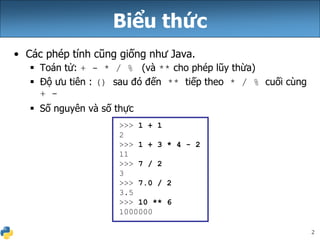
Biểu thức
• Các phép tính cũng giống như Java.
 Toán tử: + - * / % (và ** cho phép lũy thừa)
 Độ ưu tiên : () sau đó đến ** tiếp theo * / % cuối cùng
+ -
 Số nguyên và số thực
>>> 1 + 1
2
>>> 1 + 3 * 4 - 2
11
>>> 7 / 2
3
>>> 7.0 / 2
3.5
>>> 10 ** 6
1000000
3
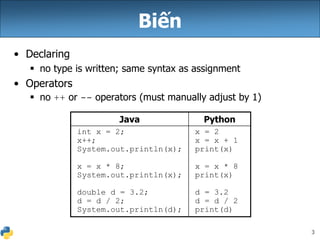
Biến
• Declaring
 no type is written; same syntax as assignment
• Operators
 no ++ or -- operators (must manually adjust by 1)
Java Python
int x = 2;
x++;
System.out.println(x);
x = x * 8;
System.out.println(x);
double d = 3.2;
d = d / 2;
System.out.println(d);
x = 2
x = x + 1
print(x)
x = x * 8
print(x)
d = 3.2
d = d / 2
print(d)
4
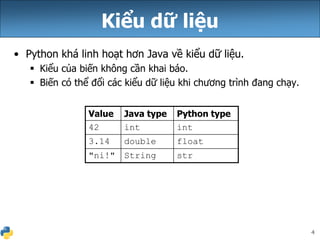
Kiểu dữ liệu
• Python khá linh hoạt hơn Java về kiểu dữ liệu.
 Kiểu của biến không cần khai báo.
 Biến có thể đổi các kiểu dữ liệu khi chương trình đang chạy.
Value Java type Python type
42 int int
3.14 double float
"ni!" String str
5
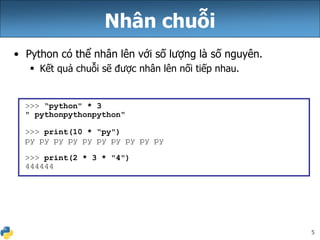
Nhân chuỗi
• Python có thể nhân lên với số lượng là số nguyên.
 Kết quả chuỗi sẽ được nhân lên nối tiếp nhau.
>>> “python" * 3
" pythonpythonpython"
>>> print(10 * “py")
py py py py py py py py py py
>>> print(2 * 3 * "4")
444444
6
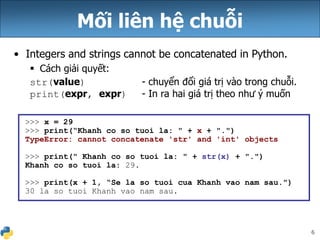
Mối liên hệ chuỗi
• Integers and strings cannot be concatenated in Python.
 Cách giải quyết:
str(value) - chuyển đổi giá trị vào trong chuỗi.
print(expr, expr) - In ra hai giá trị theo như ý muốn
>>> x = 29
>>> print(“Khanh co so tuoi la: " + x + ".")
TypeError: cannot concatenate 'str' and 'int' objects
>>> print(" Khanh co so tuoi la: " + str(x) + ".")
Khanh co so tuoi la: 29.
>>> print(x + 1, “Se la so tuoi cua Khanh vao nam sau.")
30 la so tuoi Khanh vao nam sau.
7
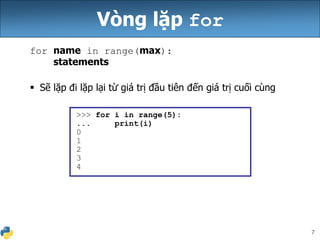
Vòng lặp for
for name in range(max):
statements
 Sẽ lặp đi lặp lại từ giá trị đầu tiên đến giá trị cuối cùng
>>> for i in range(5):
... print(i)
0
1
2
3
4
8
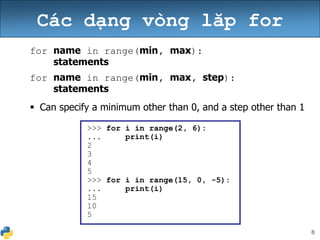
Các dạng vòng lăp for
for name in range(min, max):
statements
for name in range(min, max, step):
statements
 Can specify a minimum other than 0, and a step other than 1
>>> for i in range(2, 6):
... print(i)
2
3
4
5
>>> for i in range(15, 0, -5):
... print(i)
15
10
5
9
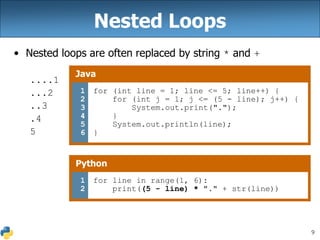
Nested Loops
• Nested loops are often replaced by string * and +
....1
...2
..3
.4
5
Java
1
2
3
4
5
6
for (int line = 1; line <= 5; line++) {
for (int j = 1; j <= (5 - line); j++) {
System.out.print(".");
}
System.out.println(line);
}
Python
1
2
for line in range(1, 6):
print((5 - line) * "." + str(line))
10
Bài tập
• Hãy viết chương trình in ra màn hình chuỗi sau:
#================#
| <><> |
| <>....<> |
| <>........<> |
|<>............<>|
|<>............<>|
| <>........<> |
| <>....<> |
| <><> |
#================#
11
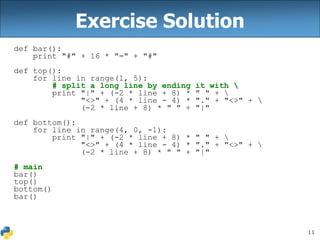
Exercise Solution
def bar():
print "#" + 16 * "=" + "#"
def top():
for line in range(1, 5):
# split a long line by ending it with 
print "|" + (-2 * line + 8) * " " + 
"<>" + (4 * line - 4) * "." + "<>" + 
(-2 * line + 8) * " " + "|"
def bottom():
for line in range(4, 0, -1):
print "|" + (-2 * line + 8) * " " + 
"<>" + (4 * line - 4) * "." + "<>" + 
(-2 * line + 8) * " " + "|"
# main
bar()
top()
bottom()
bar()
12
Kết nối các khoảng
• Các khoảng dữ liệu có thể kết nối bằng dấu +
 Có thể sử dụng vòng vặp trên một phạm vi để nối các dãy số
>>> range(1, 5) + range(10, 15)
[1, 2, 3, 4, 10, 11, 12, 13, 14]
>>> for i in range(4) + range(10, 7, -1):
... print(i)
0
1
2
3
10
9
8
13
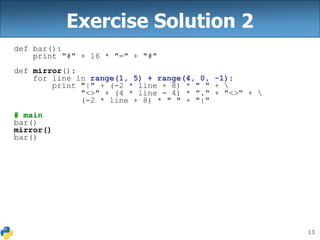
Exercise Solution 2
def bar():
print "#" + 16 * "=" + "#"
def mirror():
for line in range(1, 5) + range(4, 0, -1):
print "|" + (-2 * line + 8) * " " + 
"<>" + (4 * line - 4) * "." + "<>" + 
(-2 * line + 8) * " " + "|"
# main
bar()
mirror()
bar()
14
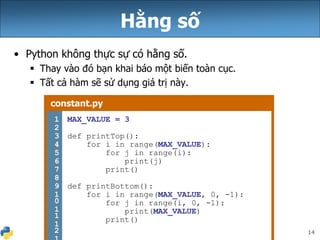
Hằng số
• Python không thực sự có hằng số.
 Thay vào đó bạn khai báo một biến toàn cục.
 Tất cả hàm sẽ sử dụng giá trị này.
constant.py
1
2
3
4
5
6
7
8
9
1
0
1
1
1
2
MAX_VALUE = 3
def printTop():
for i in range(MAX_VALUE):
for j in range(i):
print(j)
print()
def printBottom():
for i in range(MAX_VALUE, 0, -1):
for j in range(i, 0, -1):
print(MAX_VALUE)
print()
15
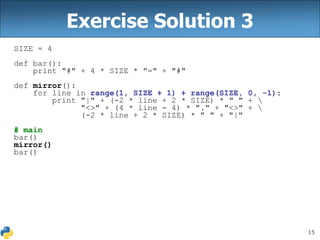
Exercise Solution 3
SIZE = 4
def bar():
print "#" + 4 * SIZE * "=" + "#"
def mirror():
for line in range(1, SIZE + 1) + range(SIZE, 0, -1):
print "|" + (-2 * line + 2 * SIZE) * " " + 
"<>" + (4 * line - 4) * "." + "<>" + 
(-2 * line + 2 * SIZE) * " " + "|"
# main
bar()
mirror()
bar()

Slide Python Bai 2 pythonvietnam.info

  • 1.
    Bài 2 Expressions andvariables; for loops http://pythonvietnam.info
  • 2.
    2 Biểu thức • Cácphép tính cũng giống như Java.  Toán tử: + - * / % (và ** cho phép lũy thừa)  Độ ưu tiên : () sau đó đến ** tiếp theo * / % cuối cùng + -  Số nguyên và số thực >>> 1 + 1 2 >>> 1 + 3 * 4 - 2 11 >>> 7 / 2 3 >>> 7.0 / 2 3.5 >>> 10 ** 6 1000000
  • 3.
    3 Biến • Declaring  notype is written; same syntax as assignment • Operators  no ++ or -- operators (must manually adjust by 1) Java Python int x = 2; x++; System.out.println(x); x = x * 8; System.out.println(x); double d = 3.2; d = d / 2; System.out.println(d); x = 2 x = x + 1 print(x) x = x * 8 print(x) d = 3.2 d = d / 2 print(d)
  • 4.
    4 Kiểu dữ liệu •Python khá linh hoạt hơn Java về kiểu dữ liệu.  Kiểu của biến không cần khai báo.  Biến có thể đổi các kiểu dữ liệu khi chương trình đang chạy. Value Java type Python type 42 int int 3.14 double float "ni!" String str
  • 5.
    5 Nhân chuỗi • Pythoncó thể nhân lên với số lượng là số nguyên.  Kết quả chuỗi sẽ được nhân lên nối tiếp nhau. >>> “python" * 3 " pythonpythonpython" >>> print(10 * “py") py py py py py py py py py py >>> print(2 * 3 * "4") 444444
  • 6.
    6 Mối liên hệchuỗi • Integers and strings cannot be concatenated in Python.  Cách giải quyết: str(value) - chuyển đổi giá trị vào trong chuỗi. print(expr, expr) - In ra hai giá trị theo như ý muốn >>> x = 29 >>> print(“Khanh co so tuoi la: " + x + ".") TypeError: cannot concatenate 'str' and 'int' objects >>> print(" Khanh co so tuoi la: " + str(x) + ".") Khanh co so tuoi la: 29. >>> print(x + 1, “Se la so tuoi cua Khanh vao nam sau.") 30 la so tuoi Khanh vao nam sau.
  • 7.
    7 Vòng lặp for forname in range(max): statements  Sẽ lặp đi lặp lại từ giá trị đầu tiên đến giá trị cuối cùng >>> for i in range(5): ... print(i) 0 1 2 3 4
  • 8.
    8 Các dạng vònglăp for for name in range(min, max): statements for name in range(min, max, step): statements  Can specify a minimum other than 0, and a step other than 1 >>> for i in range(2, 6): ... print(i) 2 3 4 5 >>> for i in range(15, 0, -5): ... print(i) 15 10 5
  • 9.
    9 Nested Loops • Nestedloops are often replaced by string * and + ....1 ...2 ..3 .4 5 Java 1 2 3 4 5 6 for (int line = 1; line <= 5; line++) { for (int j = 1; j <= (5 - line); j++) { System.out.print("."); } System.out.println(line); } Python 1 2 for line in range(1, 6): print((5 - line) * "." + str(line))
  • 10.
    10 Bài tập • Hãyviết chương trình in ra màn hình chuỗi sau: #================# | <><> | | <>....<> | | <>........<> | |<>............<>| |<>............<>| | <>........<> | | <>....<> | | <><> | #================#
  • 11.
    11 Exercise Solution def bar(): print"#" + 16 * "=" + "#" def top(): for line in range(1, 5): # split a long line by ending it with print "|" + (-2 * line + 8) * " " + "<>" + (4 * line - 4) * "." + "<>" + (-2 * line + 8) * " " + "|" def bottom(): for line in range(4, 0, -1): print "|" + (-2 * line + 8) * " " + "<>" + (4 * line - 4) * "." + "<>" + (-2 * line + 8) * " " + "|" # main bar() top() bottom() bar()
  • 12.
    12 Kết nối cáckhoảng • Các khoảng dữ liệu có thể kết nối bằng dấu +  Có thể sử dụng vòng vặp trên một phạm vi để nối các dãy số >>> range(1, 5) + range(10, 15) [1, 2, 3, 4, 10, 11, 12, 13, 14] >>> for i in range(4) + range(10, 7, -1): ... print(i) 0 1 2 3 10 9 8
  • 13.
    13 Exercise Solution 2 defbar(): print "#" + 16 * "=" + "#" def mirror(): for line in range(1, 5) + range(4, 0, -1): print "|" + (-2 * line + 8) * " " + "<>" + (4 * line - 4) * "." + "<>" + (-2 * line + 8) * " " + "|" # main bar() mirror() bar()
  • 14.
    14 Hằng số • Pythonkhông thực sự có hằng số.  Thay vào đó bạn khai báo một biến toàn cục.  Tất cả hàm sẽ sử dụng giá trị này. constant.py 1 2 3 4 5 6 7 8 9 1 0 1 1 1 2 MAX_VALUE = 3 def printTop(): for i in range(MAX_VALUE): for j in range(i): print(j) print() def printBottom(): for i in range(MAX_VALUE, 0, -1): for j in range(i, 0, -1): print(MAX_VALUE) print()
  • 15.
    15 Exercise Solution 3 SIZE= 4 def bar(): print "#" + 4 * SIZE * "=" + "#" def mirror(): for line in range(1, SIZE + 1) + range(SIZE, 0, -1): print "|" + (-2 * line + 2 * SIZE) * " " + "<>" + (4 * line - 4) * "." + "<>" + (-2 * line + 2 * SIZE) * " " + "|" # main bar() mirror() bar()