IOSR Journal of Humanities and Social Science (IOSRJHSS)
ISSN: 2279-0845 Volume 1, Issue 1 (July-August 2012), PP 05-08
www.iosrjournals.org

                 “It Application in Library - Rfid Technology”
                        1
                         Prof. Kuldeep P. Pawar , 2Dr.Sunanda G. Rodge
                 1
                     Librarian, Government College Of Education, Parbhani, Maharashtra, India
                 2
                     Principal ,Government College Of Education, Parbhani, Maharashtra, India

Abstract: Libraries are using cutting edge item level RFID technology in a closed loop system. Today, more
and more libraries are adopting RFID as it streamlines workflow in the area of self service, book returns, shelf
management and inventory. The potential benefits of using RFID in libraries from the perspective of its main
stake holders- the organization; library staff and its patrons shall be highlighted. The paper discusses underline
NCIP standards development, practical issues related to RFID working in a library environment and touch
upon basic RFID issues concerning equipment maintenance & support; software compatibility; privacy and
standardization. Real potential of RFID as a cross-institution platform for identification will be limited by use of
proprietary RFID systems and hence recommends system integrators, vendors and libraries to adopt standards
& follow best practices guidelines issued by NISO for use of RFID in Libraries.
Keywords: Open Protocol, RFID, NCIP, SIP2, ILS

                                           I.          Introduction
         Radio Frequency IDentification (RFID) is a next generation of Auto Identification and Data Collection
(AIDC) technology which helps to automate business processes in an Open environment with security.This
automation can provide accurate and timely information without any human intervention. Access to such
information where one can individually identify each one of the tagged items uniquely, helps in improving your
processes and also to make informed decision.
         RFID technology is currently widely accepted by various LIS software using number of protocols.
NCIP is one such Open Protocol which is being developed NISO working group for interoperability of various
hardware and software with each other. Unlike other proprietary protocols, NCIP is a protocol that is limited to
the exchange of messages between and among computer-based applications to enable them to perform functions
necessary to lend and borrow items, to provide controlled access to electronic resources, and to facilitate
cooperative management of these functions while using

A.RFID technology
RFID is a state of art AIDC technology that is gaining popularity with Library fraternity in India
A RFID system for library environment consists of:
Tags
Readers
Middleware
Host Computer
Application Software (ILS)

B. RFID in Libraries
          Librarians are always known as early adopters of technology, as seen in case of Computer and later in
case of Bar-codes. Later have seen standards like MARC and OCLC becoming popular among libraries for
sharing bibliographic information with other libraries. In last decade have seen various library automation
softwares being emerging as next wave of automation in libraries. Today patrons can visit library’s catalogue
any time they wish to with use of library’s website. Library communities have always shown eagerness in
experimenting new technology and have improved patron services today as a result of those efforts. RFID
Technology is going to be next wave to automation in Library industry.
          RFI D plays vital role in redefining the library process to make everyone’s job easier right frompatron
to library staff. RFID provides a platform to automate most of the process performed by the library staff like
Check in – check out, sorting, stock management and inventory.Library staff whose job is meant to be helping
patron, use library resources at the fullest, is always busy handling the books. RFID helps to automate this
process and provides them an opportunity to better utilize their time in serving patrons.


                                                www.iosrjournals.org                                       5 | Page
“It Application In Library - Rfid Technology”
                          II.         Benefits of RFID Technology in Library
2.1. Overview
          Fastest, easiest, most efficient way to track, locate & manage library materials. Efficient Book
circulation management. Automatic Check-in and Check-out. Library inventory tracking in minutes instead of
hours. Multiple books can be read simultaneously. Unique ID of the RFID tag prevents counterfeiting.
Automated material handling using conveyor & sorting systems. Facilitate inter library & intra-library
borrowing Let us know have look at the benefits in more details by categorizing the benefits for each identity
which is connected to Library industry.

2.2. Benefits - Libraries
A). Stock management
B). Operations such as managing material on the shelves,
C). Identifying missing & miss shelved items and taking
D).Stocks regularly will be feasible
E) Proved Patron Services
F).Spending minimal time on circulation operations allows library staff to assist patrons
         G).Routine patron services are not disturbed even when libraries are facing staff shortages & budget
cuts Flexibility And Modularity Ability to add newer products and features as finances and customer needs
dictate Security Library item identification & security is combined into a single tag, there by eliminating the
need to attach an additional security strip

2.3. Benefits - Staff
         Less time needed for circulation operations Implementing RFID will considerably reduce the amount
of time required to issue, receive, transport, sort & shelve library materials Efficient Inventory management
Inventory management can be done using a handheld reader without closing the library and is at least 20 times
faster compared to existing barcode based system Reducing Repetitive Stress Injuries (RSI) RFID based system
reduces repetitive scanning of individual items at the circulation desk during check in, check out and hence
avoids RSI such as carpal tunnel syndrome Taking inventory in a RFID based system doesn’t require physical
de-shelving & shelving of library materials

4. Benefits – Patrons
         Patrons will spend less time waiting in check-out lines by using Self Check in - Check out Systems
Patrons find what they are looking for quickly & easily Reminders for due dates allows patrons to submit
borrowed materials in time Use of book drops & return chutes for returning library material, allows for flexible
timings RFID enabled patron cards allows for easy patron identification & reduces errors Self service enhances
patron privacy Improved patron services even when libraries are facing staff shortage

                                  III.         RFID Standards in Library
          Below is detailed description of some of the standards related to RFID hardware used In Libraries
National Information Standards Organization Circulation Interchange Protocol (NCIP) is a protocol that is
limited to the exchange of messages beaten and among computer-based applications to enable them to perform
functions necessary to lend and borrow items, to provide controlled access to electronic resources, and to
facilitate cooperative management of these functions. Released in May 2001 and approved on October 17, 2002,
ANSI/NISO Z39.83-2002 or NCIP is a ―NISO Draft Standard for Trial Use.‖ This protocol defines a repertoire
of messages and associated rules of syntax and semantics for use by applications: to perform the functions
necessary to lend items; to provide controlled access to electronic resources; and to facilitate co-operative
management of these functions. It is intended to address conditions in which the application or applications
that initiate the lending of items or control of access must acquire or transmit information about the user, items,
and/or access that is essential to successful conclusion of the function.

3.1 ISO 180003- Mode 1 : is a ISO standard for parameters for air interface communications at 13.56 MHz
(High Frequency), based on which RFID hardware is being developed for usage in Library. The standard
defines communication parameters on which the tag and reader communicates with each other.

3.2 ISO 28560-1/2/3 -: is a set of Information and documentation — Data model for use of radio frequency
identifier (RFID) in libraries. The standard is under development stage at ISO and is planned to release in 2010.
The standard is based on NISO committee’s recommendation document ―RFID in US Libraries‖. It will be
defining various aspects of usage of RFID in libraries right from RFID hardware selection to placement of RFID
tags and information to be written inside the tag


                                              www.iosrjournals.org                                        6 | Page
“It Application In Library - Rfid Technology”
3.3 SIP2 Protocol: is a communication protocol that provides a standard interface beaten a library’s integrated
library system (ILS) and library automation devices (e.g., check-out devices, check- in devices, etc.). The
protocol can be used by any application that has a need to retrieve information from an ILS or process
circulation transactions via the ILS. There are two versions of SIP, version 1.0 and 2.0. SIP2 is based on a
proprietary protocol, but has been opened for use by all parties providing systems for library circulation

                                 IV.          NISO Recommendations
         In Libraries, 13.56MHz High Frequency tags should be used RFID tags for library use should be
passive The typical read range of tags for library applications should not be increased substantially beyond the
present range of 8-20 inches for smaller tags in future Only tags including standardized AFI feature should be
used in libraries The system will cause no interference with other applications The system will utilize ISO/IEC
18000-3 Mode 1 tags programmed so that they should work for identification of items in other libraries The
system will use tags that will not interfere with the operation of security systems in other libraries Security
implementations for RFID in libraries should not lock a compliant system into any one security possibility
(EAS, AFI, Virtual deactivation), but rather leave security as a place for differentiation beaten vendors RFID
tags should be reprogrammable for migration purposes Data on RFID tags should be encoded according to the
recommended data model, using encoding described in ISO/IEC 15962 & using relative object IDs specified in
anticipated standard ISO/NP 28560 for RFID in Libraries.

                           V.         RFID Implementation in Libraries
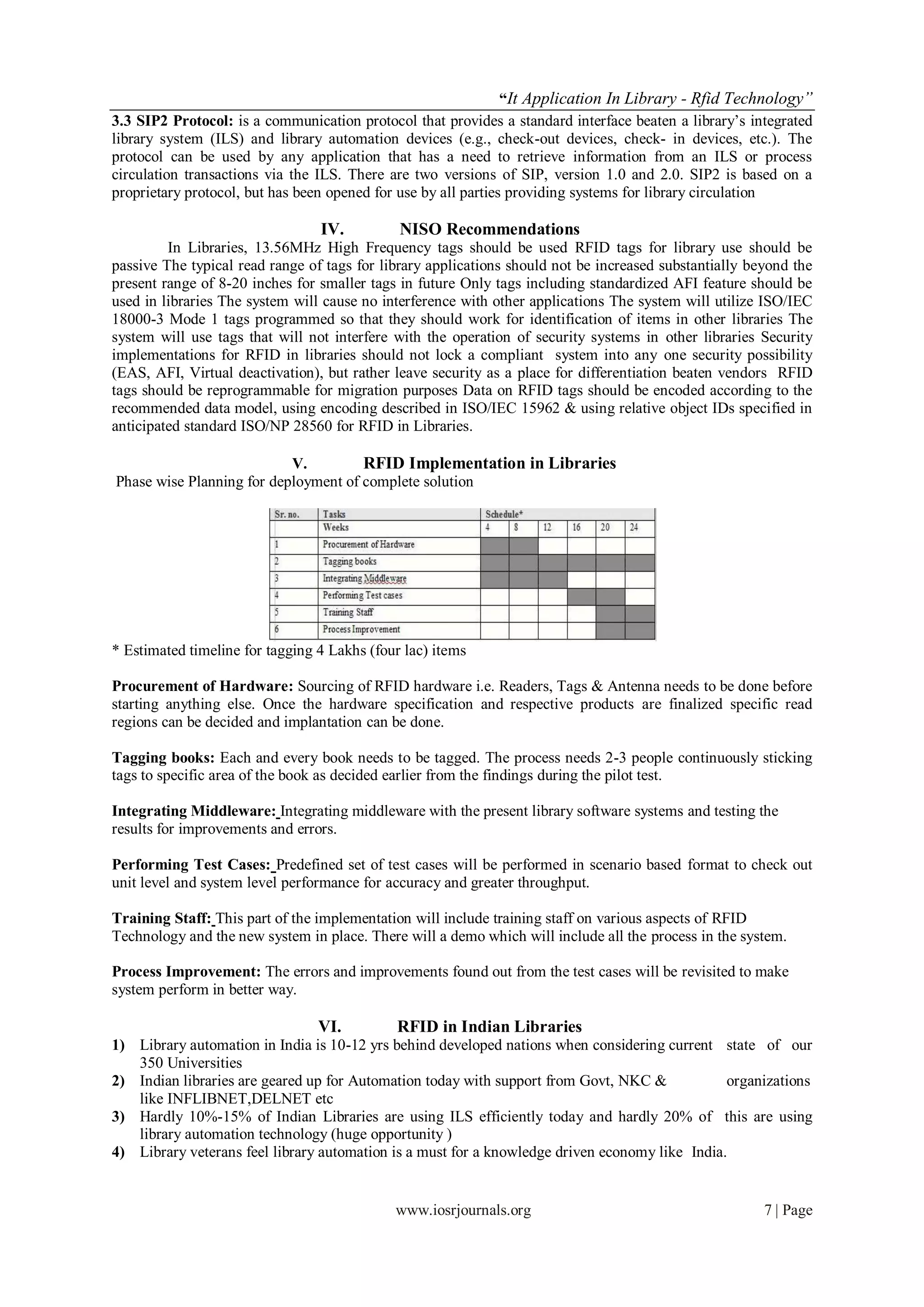
Phase wise Planning for deployment of complete solution


* Estimated timeline for tagging 4 Lakhs (four lac) items

Procurement of Hardware: Sourcing of RFID hardware i.e. Readers, Tags & Antenna needs to be done before
starting anything else. Once the hardware specification and respective products are finalized specific read
regions can be decided and implantation can be done.

Tagging books: Each and every book needs to be tagged. The process needs 2-3 people continuously sticking
tags to specific area of the book as decided earlier from the findings during the pilot test.

Integrating Middleware: Integrating middleware with the present library software systems and testing the
results for improvements and errors.

Performing Test Cases: Predefined set of test cases will be performed in scenario based format to check out
unit level and system level performance for accuracy and greater throughput.

Training Staff: This part of the implementation will include training staff on various aspects of RFID
Technology and the new system in place. There will a demo which will include all the process in the system.

Process Improvement: The errors and improvements found out from the test cases will be revisited to make
system perform in better way.

                                 VI.         RFID in Indian Libraries
1) Library automation in India is 10-12 yrs behind developed nations when considering current state of our
   350 Universities
2) Indian libraries are geared up for Automation today with support from Govt, NKC &            organizations
   like INFLIBNET,DELNET etc
3) Hardly 10%-15% of Indian Libraries are using ILS efficiently today and hardly 20% of this are using
   library automation technology (huge opportunity )
4) Library veterans feel library automation is a must for a knowledge driven economy like India.


                                             www.iosrjournals.org                                       7 | Page
“It Application In Library - Rfid Technology”
       5)    ILS automation software’s & technologies such as RFID will allow uniform resource sharing amongst
             University libraries
       6)    Real potential of RFID as a cross-institution platform for identification will be limited by use of proprietary
             standards & RFID tags should be installed at the earliest point in th life cycle         of the book
       7)    Large University libraries should go for automation with RFID as this will allow efficient        circulation of
             library items to large number of patrons visiting this libraries
       8)    Libraries should be promoted as an environment for serious learning (Information centers,         facilities,
             ambience etc.)
       9)    A mechanism to rank the libraries on basis of collection, services, use of technology
       10)   Library Automation will also help in building a National Union Catalog similar to LOC

                                                VII.           Vendor Selection
        Hardware & Software should meet global recommended standards for use of RFID in                Libraries
        FID hardware products for library should be compatible with global protocols such as SIP2, NCIP, ISO
         18000-3, ISO 15693, ISO 14443A & ISO 28560 (Part 1, 2 & 3)
        Supplied equipment should allow forward compatibility with anticipated new standards
        Can tags be purchased from other manufacturers & still be sure of interoperability with existing hardware in
         future
        Will the existing protocols & software work with the new hardware & tags? If not, what is required to make
         them compatible?
        Vendors should make hardware & software upgrades in future to conform to standards
        Judge Vendors Technology know how for products to be supplied
        Ask for Customer reference & discuss your concerns with them
        Special emphasis on Staff training & Local Suppor

                                                   VIII.           Conclusion
                 This paper is intended to give overall view of RFID technology to library fraternity. The information
       has been gathered and compiled with our inputs for librarians to refer this paper as a base, when planning to go
       for a RFID solution without getting into technical jargons. It is an attempt to touch base with all the areas
       relating to use of RFID in Libraries in simple language. The paper stands as a ready reference for librarians
       when they commence conversation with vendors for implementation of RFID in their libraries. For more
       detailed information please visit documents, reference for which, is provided in the Reference section.

                                                              References
 [1]         ALA Library Fact Sheet Number 25 — RFID: A Brief Bibliography
 [2]          http://www.ala.org/ala/alalibrary/libraryfactsheet/alalibraryfactsheet25.htm
 [3]         Boss, Richard W. ―RFID Technology for Libraries‖
 [4]         http://www.ala.org/ala/pla/plapubs/technotes/rfidtechnology.htm
 [5]         ALA Office of Intellectual Freedom:
 [6]         http://www.ala.org/ala/oif/ifissues/rfid.htm
 [7]         Ward, Diane Marie. ―Helping you Buy: RFID.‖ Computers in Libraries 24:3
 [8]         Intellident RFID Library Installation (A Colchester Library Case Study)
 [9]         http://www.niso.org/publications/rp/RP-6-2008.pdf
[10]         http://en.wikipedia.org/wiki/
[11]         8National_Information_Standards_Organization_Circulation_Interchange_Protocol
[12]         http://libraryrfid.typepad.com/libraryrfid/2004/04/new_email_list.html
[13]         www.rfidwizard.com
[14]         Josef, Schuermann. ―Information Technology – Radio Frequency Identification (RFID) And The World of Radio Regulations.‖
             http://www.iso.org/


                                                           www.iosrjournals.org                                            8 | Page

B0110508

  • 1.
    IOSR Journal ofHumanities and Social Science (IOSRJHSS) ISSN: 2279-0845 Volume 1, Issue 1 (July-August 2012), PP 05-08 www.iosrjournals.org “It Application in Library - Rfid Technology” 1 Prof. Kuldeep P. Pawar , 2Dr.Sunanda G. Rodge 1 Librarian, Government College Of Education, Parbhani, Maharashtra, India 2 Principal ,Government College Of Education, Parbhani, Maharashtra, India Abstract: Libraries are using cutting edge item level RFID technology in a closed loop system. Today, more and more libraries are adopting RFID as it streamlines workflow in the area of self service, book returns, shelf management and inventory. The potential benefits of using RFID in libraries from the perspective of its main stake holders- the organization; library staff and its patrons shall be highlighted. The paper discusses underline NCIP standards development, practical issues related to RFID working in a library environment and touch upon basic RFID issues concerning equipment maintenance & support; software compatibility; privacy and standardization. Real potential of RFID as a cross-institution platform for identification will be limited by use of proprietary RFID systems and hence recommends system integrators, vendors and libraries to adopt standards & follow best practices guidelines issued by NISO for use of RFID in Libraries. Keywords: Open Protocol, RFID, NCIP, SIP2, ILS I. Introduction Radio Frequency IDentification (RFID) is a next generation of Auto Identification and Data Collection (AIDC) technology which helps to automate business processes in an Open environment with security.This automation can provide accurate and timely information without any human intervention. Access to such information where one can individually identify each one of the tagged items uniquely, helps in improving your processes and also to make informed decision. RFID technology is currently widely accepted by various LIS software using number of protocols. NCIP is one such Open Protocol which is being developed NISO working group for interoperability of various hardware and software with each other. Unlike other proprietary protocols, NCIP is a protocol that is limited to the exchange of messages between and among computer-based applications to enable them to perform functions necessary to lend and borrow items, to provide controlled access to electronic resources, and to facilitate cooperative management of these functions while using A.RFID technology RFID is a state of art AIDC technology that is gaining popularity with Library fraternity in India A RFID system for library environment consists of: Tags Readers Middleware Host Computer Application Software (ILS) B. RFID in Libraries Librarians are always known as early adopters of technology, as seen in case of Computer and later in case of Bar-codes. Later have seen standards like MARC and OCLC becoming popular among libraries for sharing bibliographic information with other libraries. In last decade have seen various library automation softwares being emerging as next wave of automation in libraries. Today patrons can visit library’s catalogue any time they wish to with use of library’s website. Library communities have always shown eagerness in experimenting new technology and have improved patron services today as a result of those efforts. RFID Technology is going to be next wave to automation in Library industry. RFI D plays vital role in redefining the library process to make everyone’s job easier right frompatron to library staff. RFID provides a platform to automate most of the process performed by the library staff like Check in – check out, sorting, stock management and inventory.Library staff whose job is meant to be helping patron, use library resources at the fullest, is always busy handling the books. RFID helps to automate this process and provides them an opportunity to better utilize their time in serving patrons. www.iosrjournals.org 5 | Page
  • 2.
    “It Application InLibrary - Rfid Technology” II. Benefits of RFID Technology in Library 2.1. Overview Fastest, easiest, most efficient way to track, locate & manage library materials. Efficient Book circulation management. Automatic Check-in and Check-out. Library inventory tracking in minutes instead of hours. Multiple books can be read simultaneously. Unique ID of the RFID tag prevents counterfeiting. Automated material handling using conveyor & sorting systems. Facilitate inter library & intra-library borrowing Let us know have look at the benefits in more details by categorizing the benefits for each identity which is connected to Library industry. 2.2. Benefits - Libraries A). Stock management B). Operations such as managing material on the shelves, C). Identifying missing & miss shelved items and taking D).Stocks regularly will be feasible E) Proved Patron Services F).Spending minimal time on circulation operations allows library staff to assist patrons G).Routine patron services are not disturbed even when libraries are facing staff shortages & budget cuts Flexibility And Modularity Ability to add newer products and features as finances and customer needs dictate Security Library item identification & security is combined into a single tag, there by eliminating the need to attach an additional security strip 2.3. Benefits - Staff Less time needed for circulation operations Implementing RFID will considerably reduce the amount of time required to issue, receive, transport, sort & shelve library materials Efficient Inventory management Inventory management can be done using a handheld reader without closing the library and is at least 20 times faster compared to existing barcode based system Reducing Repetitive Stress Injuries (RSI) RFID based system reduces repetitive scanning of individual items at the circulation desk during check in, check out and hence avoids RSI such as carpal tunnel syndrome Taking inventory in a RFID based system doesn’t require physical de-shelving & shelving of library materials 4. Benefits – Patrons Patrons will spend less time waiting in check-out lines by using Self Check in - Check out Systems Patrons find what they are looking for quickly & easily Reminders for due dates allows patrons to submit borrowed materials in time Use of book drops & return chutes for returning library material, allows for flexible timings RFID enabled patron cards allows for easy patron identification & reduces errors Self service enhances patron privacy Improved patron services even when libraries are facing staff shortage III. RFID Standards in Library Below is detailed description of some of the standards related to RFID hardware used In Libraries National Information Standards Organization Circulation Interchange Protocol (NCIP) is a protocol that is limited to the exchange of messages beaten and among computer-based applications to enable them to perform functions necessary to lend and borrow items, to provide controlled access to electronic resources, and to facilitate cooperative management of these functions. Released in May 2001 and approved on October 17, 2002, ANSI/NISO Z39.83-2002 or NCIP is a ―NISO Draft Standard for Trial Use.‖ This protocol defines a repertoire of messages and associated rules of syntax and semantics for use by applications: to perform the functions necessary to lend items; to provide controlled access to electronic resources; and to facilitate co-operative management of these functions. It is intended to address conditions in which the application or applications that initiate the lending of items or control of access must acquire or transmit information about the user, items, and/or access that is essential to successful conclusion of the function. 3.1 ISO 180003- Mode 1 : is a ISO standard for parameters for air interface communications at 13.56 MHz (High Frequency), based on which RFID hardware is being developed for usage in Library. The standard defines communication parameters on which the tag and reader communicates with each other. 3.2 ISO 28560-1/2/3 -: is a set of Information and documentation — Data model for use of radio frequency identifier (RFID) in libraries. The standard is under development stage at ISO and is planned to release in 2010. The standard is based on NISO committee’s recommendation document ―RFID in US Libraries‖. It will be defining various aspects of usage of RFID in libraries right from RFID hardware selection to placement of RFID tags and information to be written inside the tag www.iosrjournals.org 6 | Page
  • 3.
    “It Application InLibrary - Rfid Technology” 3.3 SIP2 Protocol: is a communication protocol that provides a standard interface beaten a library’s integrated library system (ILS) and library automation devices (e.g., check-out devices, check- in devices, etc.). The protocol can be used by any application that has a need to retrieve information from an ILS or process circulation transactions via the ILS. There are two versions of SIP, version 1.0 and 2.0. SIP2 is based on a proprietary protocol, but has been opened for use by all parties providing systems for library circulation IV. NISO Recommendations In Libraries, 13.56MHz High Frequency tags should be used RFID tags for library use should be passive The typical read range of tags for library applications should not be increased substantially beyond the present range of 8-20 inches for smaller tags in future Only tags including standardized AFI feature should be used in libraries The system will cause no interference with other applications The system will utilize ISO/IEC 18000-3 Mode 1 tags programmed so that they should work for identification of items in other libraries The system will use tags that will not interfere with the operation of security systems in other libraries Security implementations for RFID in libraries should not lock a compliant system into any one security possibility (EAS, AFI, Virtual deactivation), but rather leave security as a place for differentiation beaten vendors RFID tags should be reprogrammable for migration purposes Data on RFID tags should be encoded according to the recommended data model, using encoding described in ISO/IEC 15962 & using relative object IDs specified in anticipated standard ISO/NP 28560 for RFID in Libraries. V. RFID Implementation in Libraries Phase wise Planning for deployment of complete solution * Estimated timeline for tagging 4 Lakhs (four lac) items Procurement of Hardware: Sourcing of RFID hardware i.e. Readers, Tags & Antenna needs to be done before starting anything else. Once the hardware specification and respective products are finalized specific read regions can be decided and implantation can be done. Tagging books: Each and every book needs to be tagged. The process needs 2-3 people continuously sticking tags to specific area of the book as decided earlier from the findings during the pilot test. Integrating Middleware: Integrating middleware with the present library software systems and testing the results for improvements and errors. Performing Test Cases: Predefined set of test cases will be performed in scenario based format to check out unit level and system level performance for accuracy and greater throughput. Training Staff: This part of the implementation will include training staff on various aspects of RFID Technology and the new system in place. There will a demo which will include all the process in the system. Process Improvement: The errors and improvements found out from the test cases will be revisited to make system perform in better way. VI. RFID in Indian Libraries 1) Library automation in India is 10-12 yrs behind developed nations when considering current state of our 350 Universities 2) Indian libraries are geared up for Automation today with support from Govt, NKC & organizations like INFLIBNET,DELNET etc 3) Hardly 10%-15% of Indian Libraries are using ILS efficiently today and hardly 20% of this are using library automation technology (huge opportunity ) 4) Library veterans feel library automation is a must for a knowledge driven economy like India. www.iosrjournals.org 7 | Page
  • 4.
    “It Application InLibrary - Rfid Technology” 5) ILS automation software’s & technologies such as RFID will allow uniform resource sharing amongst University libraries 6) Real potential of RFID as a cross-institution platform for identification will be limited by use of proprietary standards & RFID tags should be installed at the earliest point in th life cycle of the book 7) Large University libraries should go for automation with RFID as this will allow efficient circulation of library items to large number of patrons visiting this libraries 8) Libraries should be promoted as an environment for serious learning (Information centers, facilities, ambience etc.) 9) A mechanism to rank the libraries on basis of collection, services, use of technology 10) Library Automation will also help in building a National Union Catalog similar to LOC VII. Vendor Selection  Hardware & Software should meet global recommended standards for use of RFID in Libraries  FID hardware products for library should be compatible with global protocols such as SIP2, NCIP, ISO 18000-3, ISO 15693, ISO 14443A & ISO 28560 (Part 1, 2 & 3)  Supplied equipment should allow forward compatibility with anticipated new standards  Can tags be purchased from other manufacturers & still be sure of interoperability with existing hardware in future  Will the existing protocols & software work with the new hardware & tags? If not, what is required to make them compatible?  Vendors should make hardware & software upgrades in future to conform to standards  Judge Vendors Technology know how for products to be supplied  Ask for Customer reference & discuss your concerns with them  Special emphasis on Staff training & Local Suppor VIII. Conclusion This paper is intended to give overall view of RFID technology to library fraternity. The information has been gathered and compiled with our inputs for librarians to refer this paper as a base, when planning to go for a RFID solution without getting into technical jargons. It is an attempt to touch base with all the areas relating to use of RFID in Libraries in simple language. The paper stands as a ready reference for librarians when they commence conversation with vendors for implementation of RFID in their libraries. For more detailed information please visit documents, reference for which, is provided in the Reference section. References [1] ALA Library Fact Sheet Number 25 — RFID: A Brief Bibliography [2] http://www.ala.org/ala/alalibrary/libraryfactsheet/alalibraryfactsheet25.htm [3] Boss, Richard W. ―RFID Technology for Libraries‖ [4] http://www.ala.org/ala/pla/plapubs/technotes/rfidtechnology.htm [5] ALA Office of Intellectual Freedom: [6] http://www.ala.org/ala/oif/ifissues/rfid.htm [7] Ward, Diane Marie. ―Helping you Buy: RFID.‖ Computers in Libraries 24:3 [8] Intellident RFID Library Installation (A Colchester Library Case Study) [9] http://www.niso.org/publications/rp/RP-6-2008.pdf [10] http://en.wikipedia.org/wiki/ [11] 8National_Information_Standards_Organization_Circulation_Interchange_Protocol [12] http://libraryrfid.typepad.com/libraryrfid/2004/04/new_email_list.html [13] www.rfidwizard.com [14] Josef, Schuermann. ―Information Technology – Radio Frequency Identification (RFID) And The World of Radio Regulations.‖ http://www.iso.org/ www.iosrjournals.org 8 | Page