Barkatullah University, Bhopal
          Semester – Wise Scheme for B Sc (Computer Science)
                         Session 2008 onwards

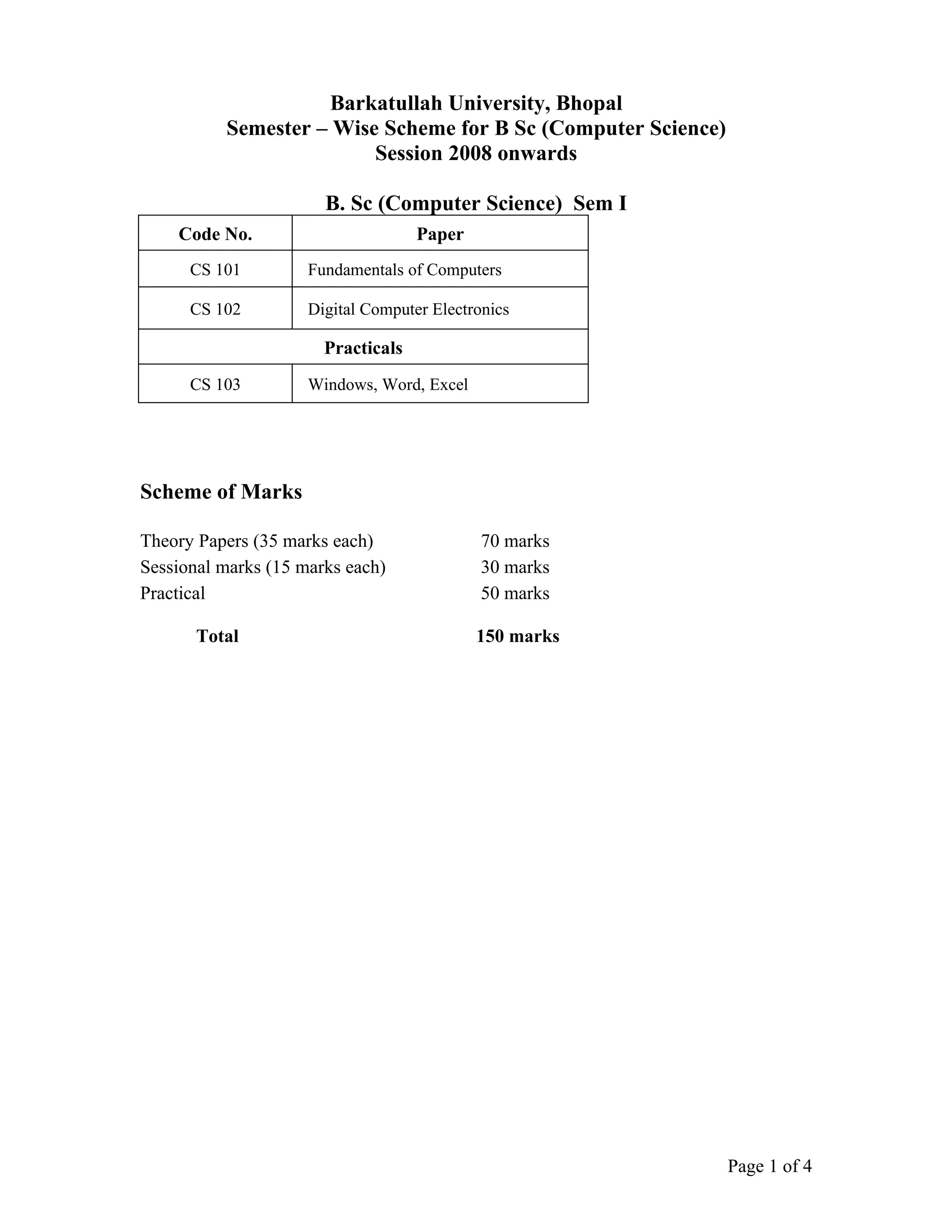
                       B. Sc (Computer Science) Sem I
    Code No.                        Paper
      CS 101         Fundamentals of Computers

      CS 102         Digital Computer Electronics

                       Practicals
      CS 103         Windows, Word, Excel


Scheme of Marks

Theory Papers (35 marks each)                70 marks
Sessional marks (15 marks each)              30 marks
Practical                                    50 marks

       Total                                150 marks


                                                               Page 1 of 4
Barkatullah University, Bhopal
              Semester–Wise Scheme for B Sc (Computer Science)
                           Session 2008 onwards
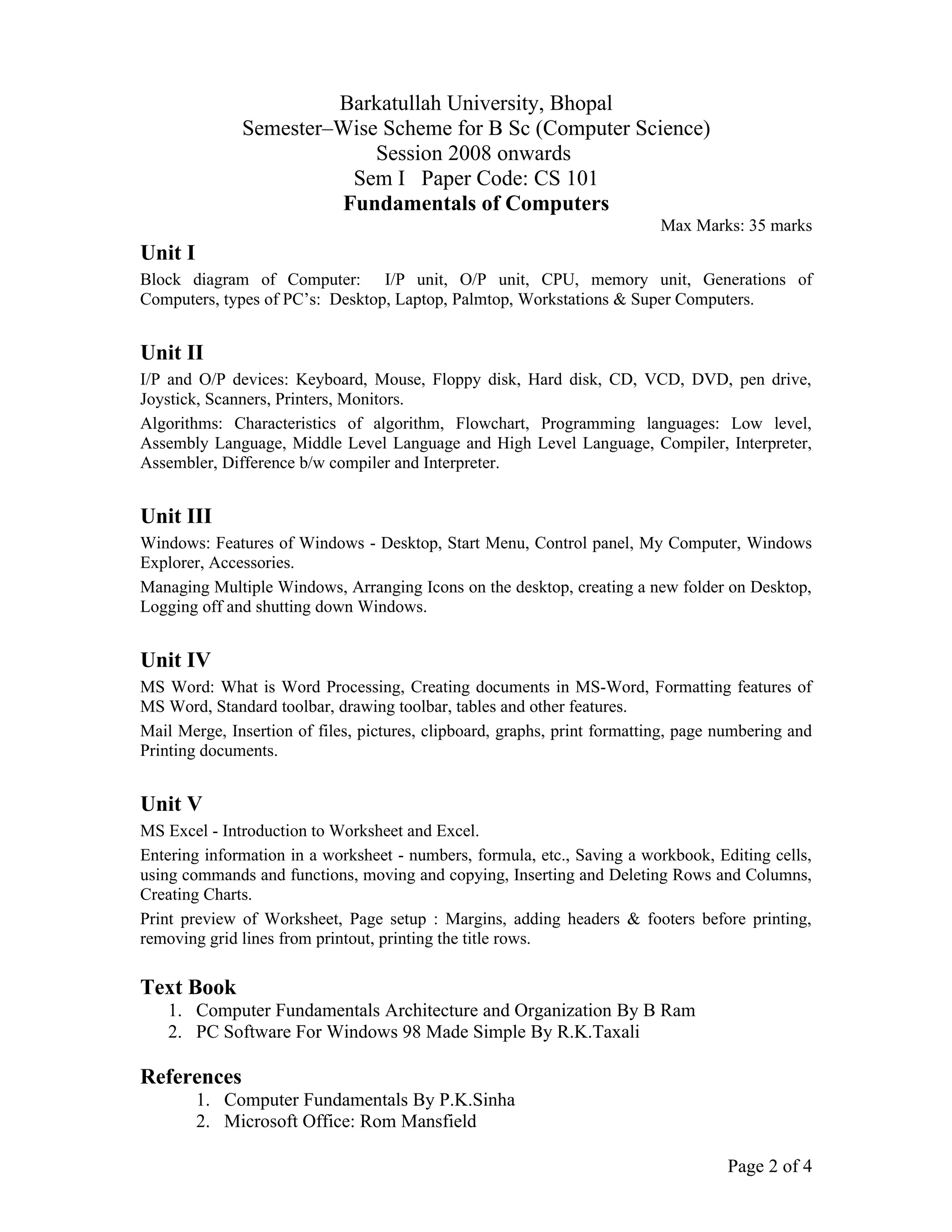
                        Sem I Paper Code: CS 101
                       Fundamentals of Computers
                                                                           Max Marks: 35 marks
Unit I
Block diagram of Computer: I/P unit, O/P unit, CPU, memory unit, Generations of
Computers, types of PC’s: Desktop, Laptop, Palmtop, Workstations & Super Computers.


Unit II
I/P and O/P devices: Keyboard, Mouse, Floppy disk, Hard disk, CD, VCD, DVD, pen drive,
Joystick, Scanners, Printers, Monitors.
Algorithms: Characteristics of algorithm, Flowchart, Programming languages: Low level,
Assembly Language, Middle Level Language and High Level Language, Compiler, Interpreter,
Assembler, Difference b/w compiler and Interpreter.


Unit III
Windows: Features of Windows - Desktop, Start Menu, Control panel, My Computer, Windows
Explorer, Accessories.
Managing Multiple Windows, Arranging Icons on the desktop, creating a new folder on Desktop,
Logging off and shutting down Windows.


Unit IV
MS Word: What is Word Processing, Creating documents in MS-Word, Formatting features of
MS Word, Standard toolbar, drawing toolbar, tables and other features.
Mail Merge, Insertion of files, pictures, clipboard, graphs, print formatting, page numbering and
Printing documents.


Unit V
MS Excel - Introduction to Worksheet and Excel.
Entering information in a worksheet - numbers, formula, etc., Saving a workbook, Editing cells,
using commands and functions, moving and copying, Inserting and Deleting Rows and Columns,
Creating Charts.
Print preview of Worksheet, Page setup : Margins, adding headers & footers before printing,
removing grid lines from printout, printing the title rows.

Text Book
    1. Computer Fundamentals Architecture and Organization By B Ram
    2. PC Software For Windows 98 Made Simple By R.K.Taxali

References
         1. Computer Fundamentals By P.K.Sinha
         2. Microsoft Office: Rom Mansfield

                                                                                    Page 2 of 4
Barkatullah University, Bhopal
               Semester–Wise Scheme for B Sc (Computer Science)
                                Session 2008 onwards
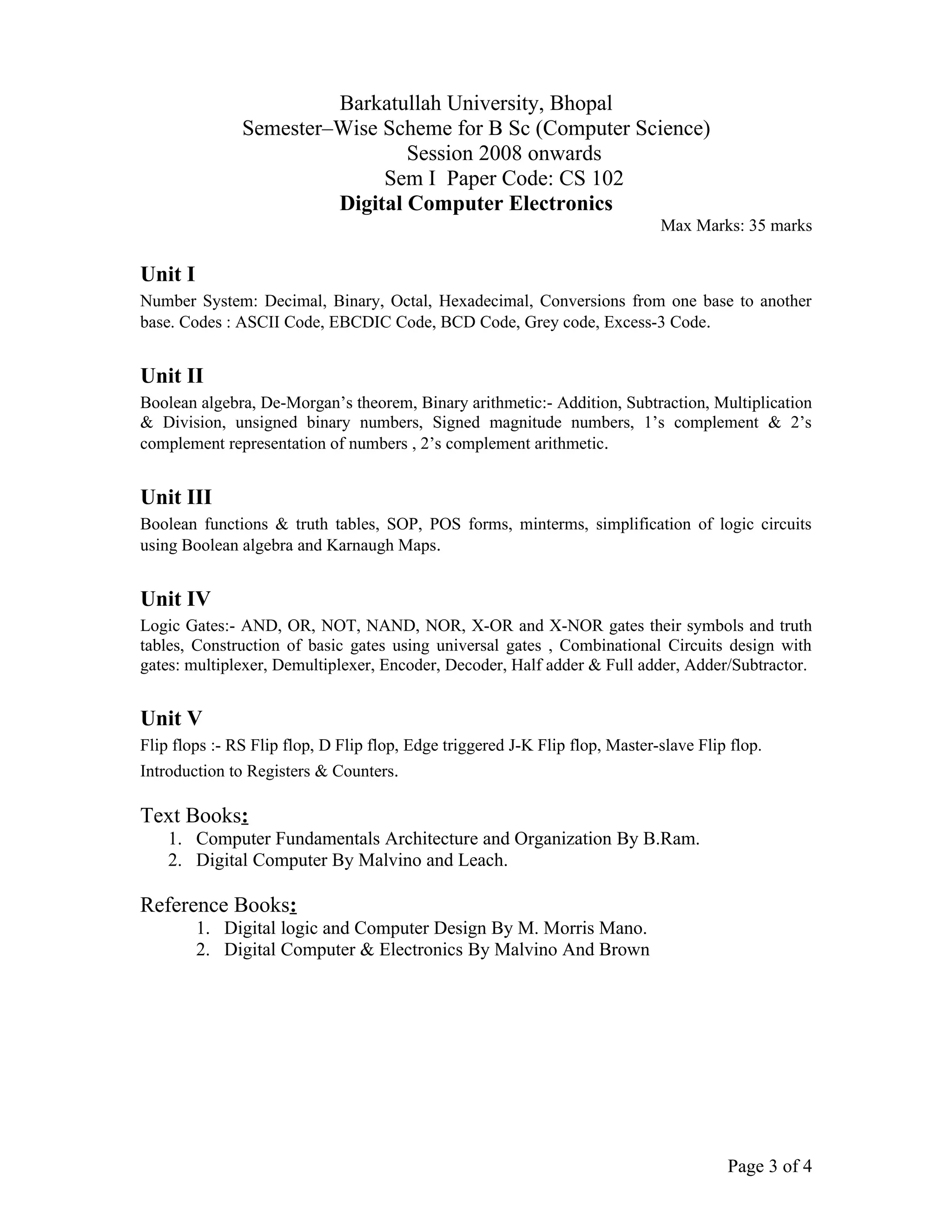
                             Sem I Paper Code: CS 102
                        Digital Computer Electronics
                                                                              Max Marks: 35 marks

Unit I
Number System: Decimal, Binary, Octal, Hexadecimal, Conversions from one base to another
base. Codes : ASCII Code, EBCDIC Code, BCD Code, Grey code, Excess-3 Code.


Unit II
Boolean algebra, De-Morgan’s theorem, Binary arithmetic:- Addition, Subtraction, Multiplication
& Division, unsigned binary numbers, Signed magnitude numbers, 1’s complement & 2’s
complement representation of numbers , 2’s complement arithmetic.


Unit III
Boolean functions & truth tables, SOP, POS forms, minterms, simplification of logic circuits
using Boolean algebra and Karnaugh Maps.


Unit IV
Logic Gates:- AND, OR, NOT, NAND, NOR, X-OR and X-NOR gates their symbols and truth
tables, Construction of basic gates using universal gates , Combinational Circuits design with
gates: multiplexer, Demultiplexer, Encoder, Decoder, Half adder & Full adder, Adder/Subtractor.


Unit V
Flip flops :- RS Flip flop, D Flip flop, Edge triggered J-K Flip flop, Master-slave Flip flop.
Introduction to Registers & Counters.

Text Books:
    1. Computer Fundamentals Architecture and Organization By B.Ram.
    2. Digital Computer By Malvino and Leach.

Reference Books:
         1. Digital logic and Computer Design By M. Morris Mano.
         2. Digital Computer & Electronics By Malvino And Brown


                                                                                        Page 3 of 4
B Sc (Comp. Sc.) Sem I
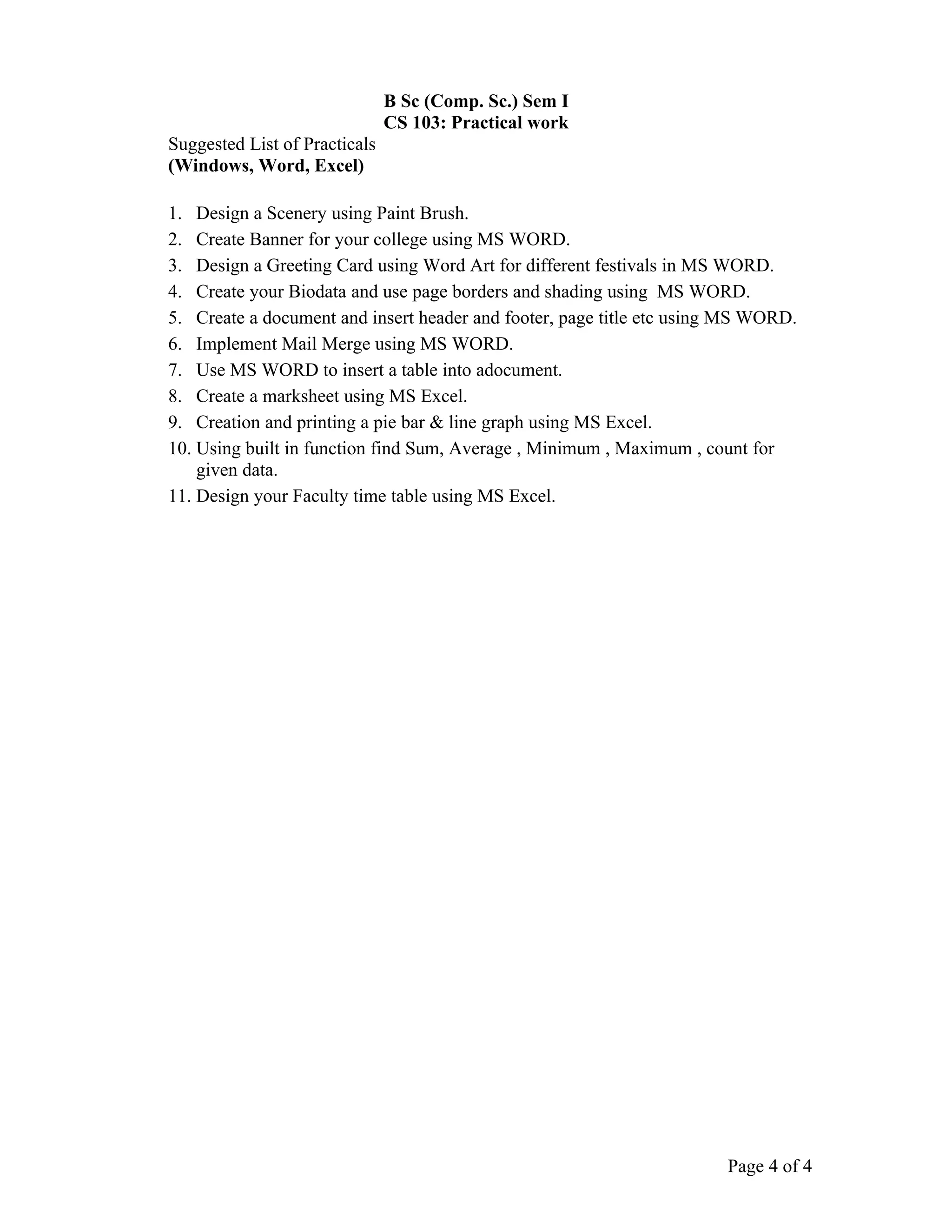
                               CS 103: Practical work
Suggested List of Practicals
(Windows, Word, Excel)

1. Design a Scenery using Paint Brush.
2. Create Banner for your college using MS WORD.
3. Design a Greeting Card using Word Art for different festivals in MS WORD.
4. Create your Biodata and use page borders and shading using MS WORD.
5. Create a document and insert header and footer, page title etc using MS WORD.
6. Implement Mail Merge using MS WORD.
7. Use MS WORD to insert a table into adocument.
8. Create a marksheet using MS Excel.
9. Creation and printing a pie bar & line graph using MS Excel.
10. Using built in function find Sum, Average , Minimum , Maximum , count for
    given data.
11. Design your Faculty time table using MS Excel.


                                                                       Page 4 of 4

B sc semester i

  • 1.
    Barkatullah University, Bhopal Semester – Wise Scheme for B Sc (Computer Science) Session 2008 onwards B. Sc (Computer Science) Sem I Code No. Paper CS 101 Fundamentals of Computers CS 102 Digital Computer Electronics Practicals CS 103 Windows, Word, Excel Scheme of Marks Theory Papers (35 marks each) 70 marks Sessional marks (15 marks each) 30 marks Practical 50 marks Total 150 marks Page 1 of 4
  • 2.
    Barkatullah University, Bhopal Semester–Wise Scheme for B Sc (Computer Science) Session 2008 onwards Sem I Paper Code: CS 101 Fundamentals of Computers Max Marks: 35 marks Unit I Block diagram of Computer: I/P unit, O/P unit, CPU, memory unit, Generations of Computers, types of PC’s: Desktop, Laptop, Palmtop, Workstations & Super Computers. Unit II I/P and O/P devices: Keyboard, Mouse, Floppy disk, Hard disk, CD, VCD, DVD, pen drive, Joystick, Scanners, Printers, Monitors. Algorithms: Characteristics of algorithm, Flowchart, Programming languages: Low level, Assembly Language, Middle Level Language and High Level Language, Compiler, Interpreter, Assembler, Difference b/w compiler and Interpreter. Unit III Windows: Features of Windows - Desktop, Start Menu, Control panel, My Computer, Windows Explorer, Accessories. Managing Multiple Windows, Arranging Icons on the desktop, creating a new folder on Desktop, Logging off and shutting down Windows. Unit IV MS Word: What is Word Processing, Creating documents in MS-Word, Formatting features of MS Word, Standard toolbar, drawing toolbar, tables and other features. Mail Merge, Insertion of files, pictures, clipboard, graphs, print formatting, page numbering and Printing documents. Unit V MS Excel - Introduction to Worksheet and Excel. Entering information in a worksheet - numbers, formula, etc., Saving a workbook, Editing cells, using commands and functions, moving and copying, Inserting and Deleting Rows and Columns, Creating Charts. Print preview of Worksheet, Page setup : Margins, adding headers & footers before printing, removing grid lines from printout, printing the title rows. Text Book 1. Computer Fundamentals Architecture and Organization By B Ram 2. PC Software For Windows 98 Made Simple By R.K.Taxali References 1. Computer Fundamentals By P.K.Sinha 2. Microsoft Office: Rom Mansfield Page 2 of 4
  • 3.
    Barkatullah University, Bhopal Semester–Wise Scheme for B Sc (Computer Science) Session 2008 onwards Sem I Paper Code: CS 102 Digital Computer Electronics Max Marks: 35 marks Unit I Number System: Decimal, Binary, Octal, Hexadecimal, Conversions from one base to another base. Codes : ASCII Code, EBCDIC Code, BCD Code, Grey code, Excess-3 Code. Unit II Boolean algebra, De-Morgan’s theorem, Binary arithmetic:- Addition, Subtraction, Multiplication & Division, unsigned binary numbers, Signed magnitude numbers, 1’s complement & 2’s complement representation of numbers , 2’s complement arithmetic. Unit III Boolean functions & truth tables, SOP, POS forms, minterms, simplification of logic circuits using Boolean algebra and Karnaugh Maps. Unit IV Logic Gates:- AND, OR, NOT, NAND, NOR, X-OR and X-NOR gates their symbols and truth tables, Construction of basic gates using universal gates , Combinational Circuits design with gates: multiplexer, Demultiplexer, Encoder, Decoder, Half adder & Full adder, Adder/Subtractor. Unit V Flip flops :- RS Flip flop, D Flip flop, Edge triggered J-K Flip flop, Master-slave Flip flop. Introduction to Registers & Counters. Text Books: 1. Computer Fundamentals Architecture and Organization By B.Ram. 2. Digital Computer By Malvino and Leach. Reference Books: 1. Digital logic and Computer Design By M. Morris Mano. 2. Digital Computer & Electronics By Malvino And Brown Page 3 of 4
  • 4.
    B Sc (Comp.Sc.) Sem I CS 103: Practical work Suggested List of Practicals (Windows, Word, Excel) 1. Design a Scenery using Paint Brush. 2. Create Banner for your college using MS WORD. 3. Design a Greeting Card using Word Art for different festivals in MS WORD. 4. Create your Biodata and use page borders and shading using MS WORD. 5. Create a document and insert header and footer, page title etc using MS WORD. 6. Implement Mail Merge using MS WORD. 7. Use MS WORD to insert a table into adocument. 8. Create a marksheet using MS Excel. 9. Creation and printing a pie bar & line graph using MS Excel. 10. Using built in function find Sum, Average , Minimum , Maximum , count for given data. 11. Design your Faculty time table using MS Excel. Page 4 of 4