Science and Technology
One of the Aztecs’ most remarkable technological achievements was the building of their island city,
Tenochtitlan. The Aztecs enlarged the area of the city by creating artificial islands called chinampas. To
make a chinampa, they first formed a bed of soil by piling boulders and mud on a mat made of reeds.
They tied the mat to wooden posts and drove the posts into the lake. Trees and willows planted around
the posts anchored the soil beds. Today, flower farmers in Xochimilco (so-chee-mil-co) near Mexico
City, still use chinampas.
Just as impressive as the chinampas were the three causeways that connected Tenochtitlan to the
mainland. The causeways were often filled with people traveling to and from the capital. During the
rainy season, when the lake waters rose, the causeways also served as
dikes to protect the islands from flooding.
For tracking time, the Aztecs adapted the Mayan solar and
sacred calendars. The 365-day solar calendar was especially useful
for farming, since it tracked the seasons. Priests used the sacred 260-
day calendar to predict events and to determine “lucky” days for such
things as planting crops and going to war.
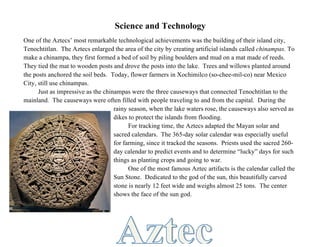
One of the most famous Aztec artifacts is the calendar called the
Sun Stone. Dedicated to the god of the sun, this beautifully carved
stone is nearly 12 feet wide and weighs almost 25 tons. The center
shows the face of the sun god.
Arts and Architecture
The Aztecs practiced a number of arts, including poetry, music,
dance, and sculpture. Poets wrote verses to sing the praises of
the gods, to tell stories, and to celebrate the natural world. Aztec
poets sung their poems or recited them to music.
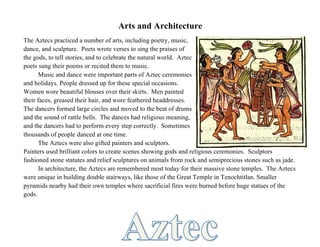
Music and dance were important parts of Aztec ceremonies
and holidays. People dressed up for these special occasions.
Women wore beautiful blouses over their skirts. Men painted
their faces, greased their hair, and wore feathered headdresses.
The dancers formed large circles and moved to the beat of drums
and the sound of rattle bells. The dances had religious meaning,
and the dancers had to perform every step correctly. Sometimes
thousands of people danced at one time.
The Aztecs were also gifted painters and sculptors.
Painters used brilliant colors to create scenes showing gods and religious ceremonies. Sculptors
fashioned stone statutes and relief sculptures on animals from rock and semiprecious stones such as jade.
In architecture, the Aztecs are remembered most today for their massive stone temples. The Aztecs
were unique in building double stairways, like those of the Great Temple in Tenochtitlan. Smaller
pyramids nearby had their own temples where sacrificial fires were burned before huge statues of the
gods.
Language and Writing
Spoken language was raised to an art form in Aztec society. Almost any occasion called for dramatic
and often flowery speeches. The rich vocabulary of the Aztec language, Nahuatl, allowed speakers to
create new words and describe abstract concepts like
loyalty and love.
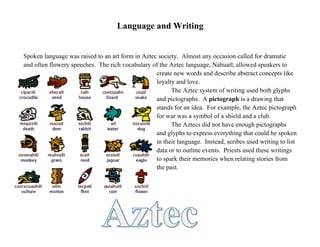
The Aztec system of writing used both glyphs
and pictographs. A pictograph is a drawing that
stands for an idea. For example, the Aztec pictograph
for war was a symbol of a shield and a club.
The Aztecs did not have enough pictographs
and glyphs to express everything that could be spoken
in their language. Instead, scribes used writing to list
data or to outline events. Priests used these writings
to spark their memories when relating stories from
the past.

aztec achievements placards.pdf maganda yan

  • 1.
    Science and Technology Oneof the Aztecs’ most remarkable technological achievements was the building of their island city, Tenochtitlan. The Aztecs enlarged the area of the city by creating artificial islands called chinampas. To make a chinampa, they first formed a bed of soil by piling boulders and mud on a mat made of reeds. They tied the mat to wooden posts and drove the posts into the lake. Trees and willows planted around the posts anchored the soil beds. Today, flower farmers in Xochimilco (so-chee-mil-co) near Mexico City, still use chinampas. Just as impressive as the chinampas were the three causeways that connected Tenochtitlan to the mainland. The causeways were often filled with people traveling to and from the capital. During the rainy season, when the lake waters rose, the causeways also served as dikes to protect the islands from flooding. For tracking time, the Aztecs adapted the Mayan solar and sacred calendars. The 365-day solar calendar was especially useful for farming, since it tracked the seasons. Priests used the sacred 260- day calendar to predict events and to determine “lucky” days for such things as planting crops and going to war. One of the most famous Aztec artifacts is the calendar called the Sun Stone. Dedicated to the god of the sun, this beautifully carved stone is nearly 12 feet wide and weighs almost 25 tons. The center shows the face of the sun god.
  • 2.
    Arts and Architecture TheAztecs practiced a number of arts, including poetry, music, dance, and sculpture. Poets wrote verses to sing the praises of the gods, to tell stories, and to celebrate the natural world. Aztec poets sung their poems or recited them to music. Music and dance were important parts of Aztec ceremonies and holidays. People dressed up for these special occasions. Women wore beautiful blouses over their skirts. Men painted their faces, greased their hair, and wore feathered headdresses. The dancers formed large circles and moved to the beat of drums and the sound of rattle bells. The dances had religious meaning, and the dancers had to perform every step correctly. Sometimes thousands of people danced at one time. The Aztecs were also gifted painters and sculptors. Painters used brilliant colors to create scenes showing gods and religious ceremonies. Sculptors fashioned stone statutes and relief sculptures on animals from rock and semiprecious stones such as jade. In architecture, the Aztecs are remembered most today for their massive stone temples. The Aztecs were unique in building double stairways, like those of the Great Temple in Tenochtitlan. Smaller pyramids nearby had their own temples where sacrificial fires were burned before huge statues of the gods.
  • 3.
    Language and Writing Spokenlanguage was raised to an art form in Aztec society. Almost any occasion called for dramatic and often flowery speeches. The rich vocabulary of the Aztec language, Nahuatl, allowed speakers to create new words and describe abstract concepts like loyalty and love. The Aztec system of writing used both glyphs and pictographs. A pictograph is a drawing that stands for an idea. For example, the Aztec pictograph for war was a symbol of a shield and a club. The Aztecs did not have enough pictographs and glyphs to express everything that could be spoken in their language. Instead, scribes used writing to list data or to outline events. Priests used these writings to spark their memories when relating stories from the past.