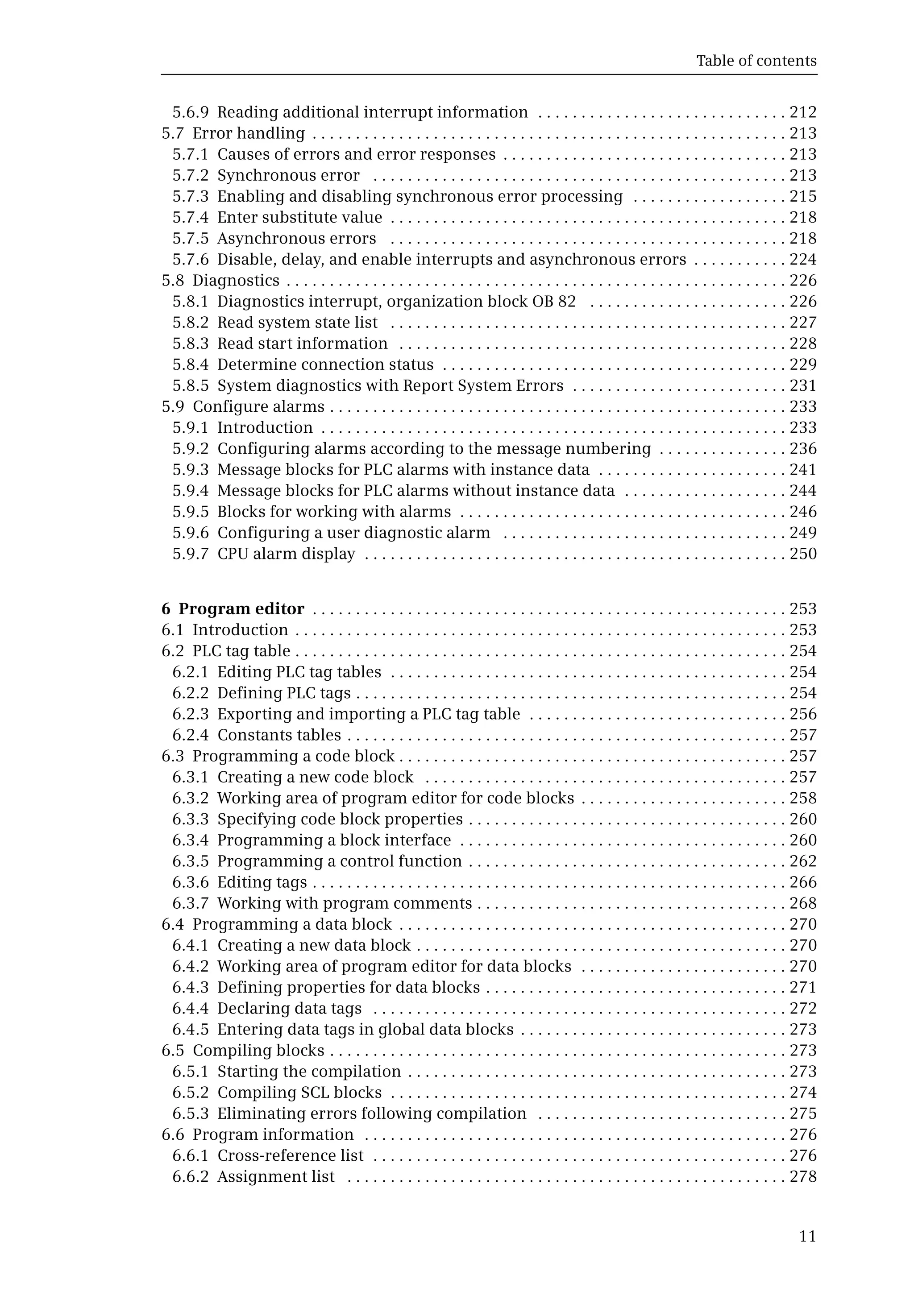
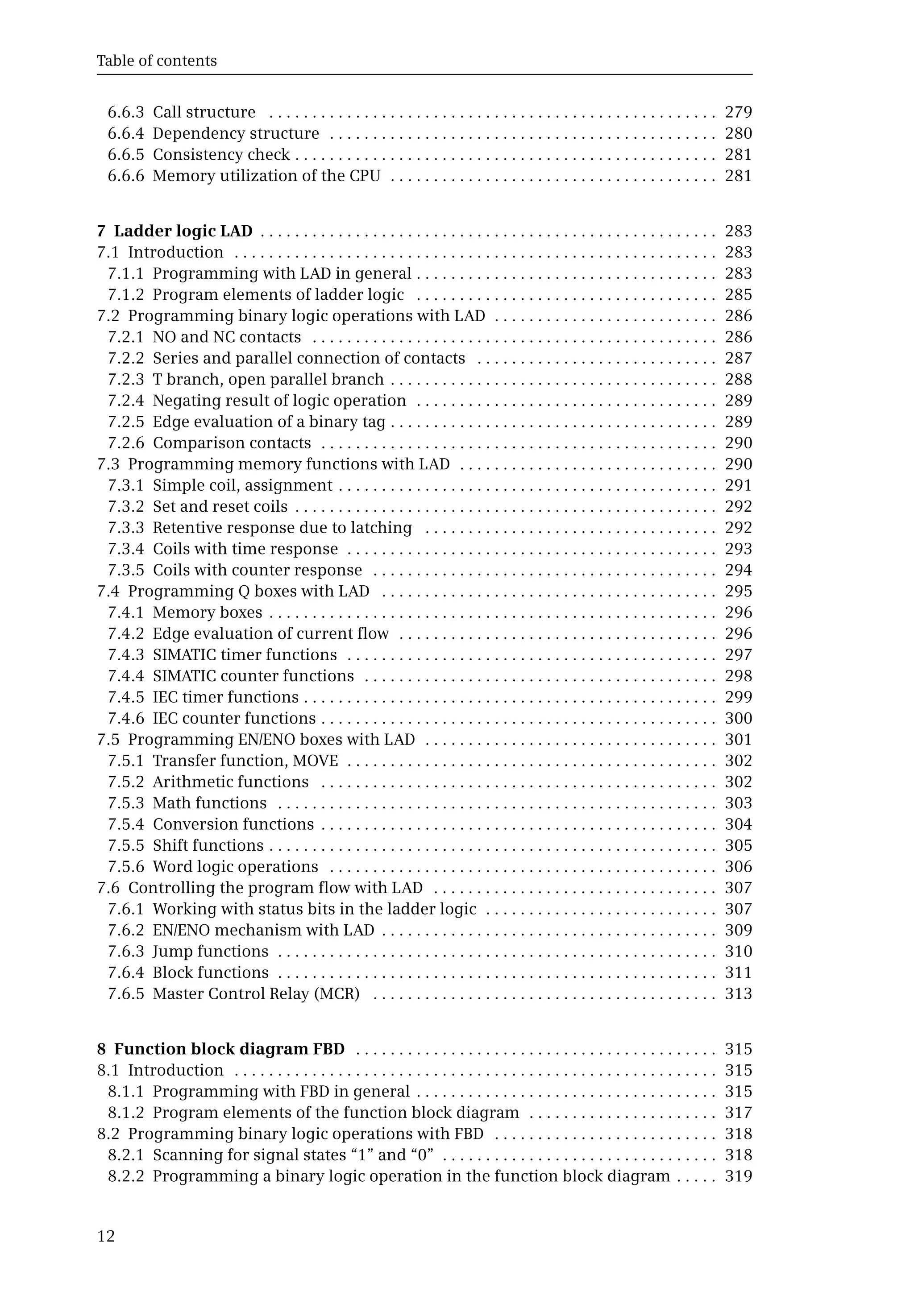
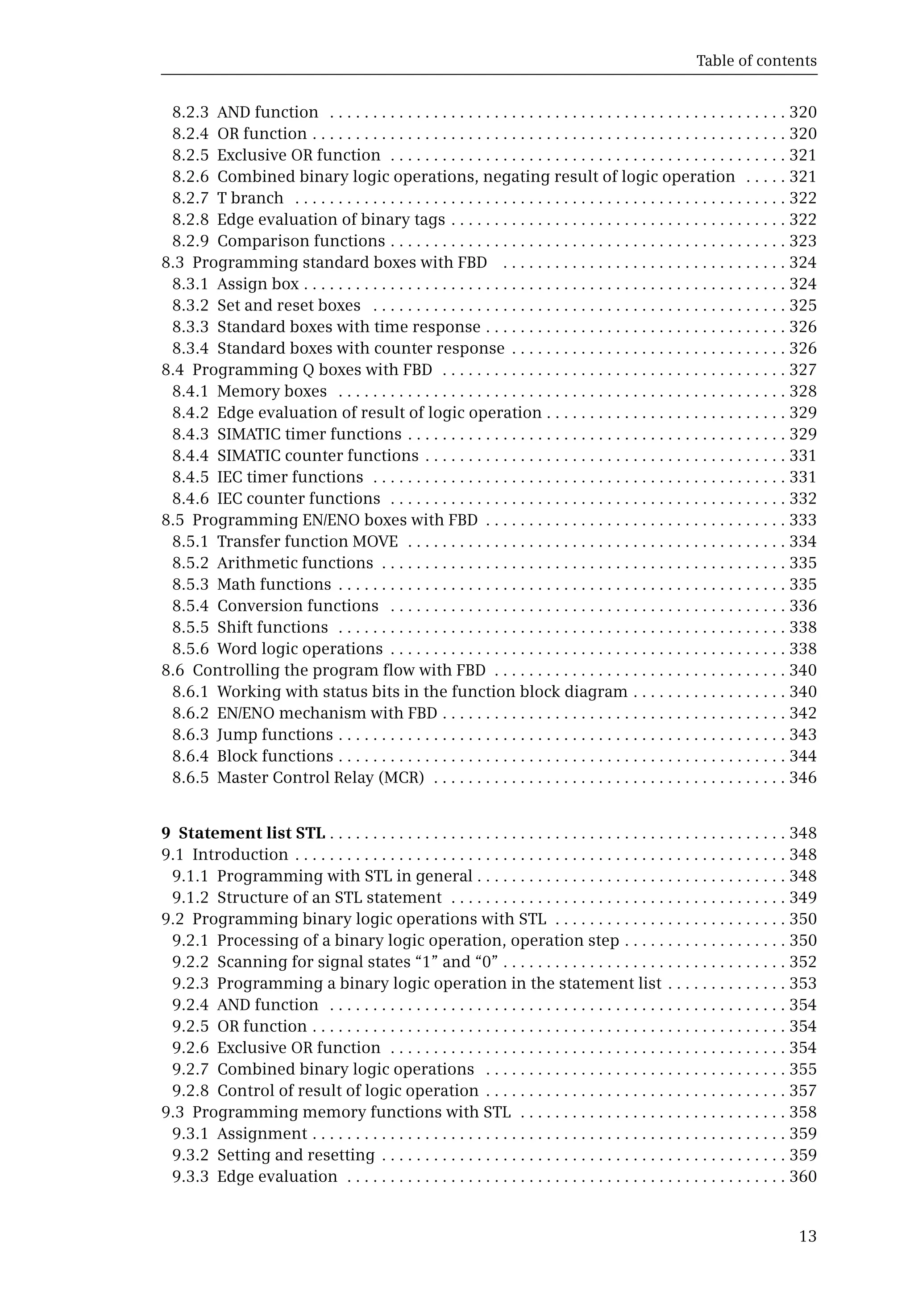
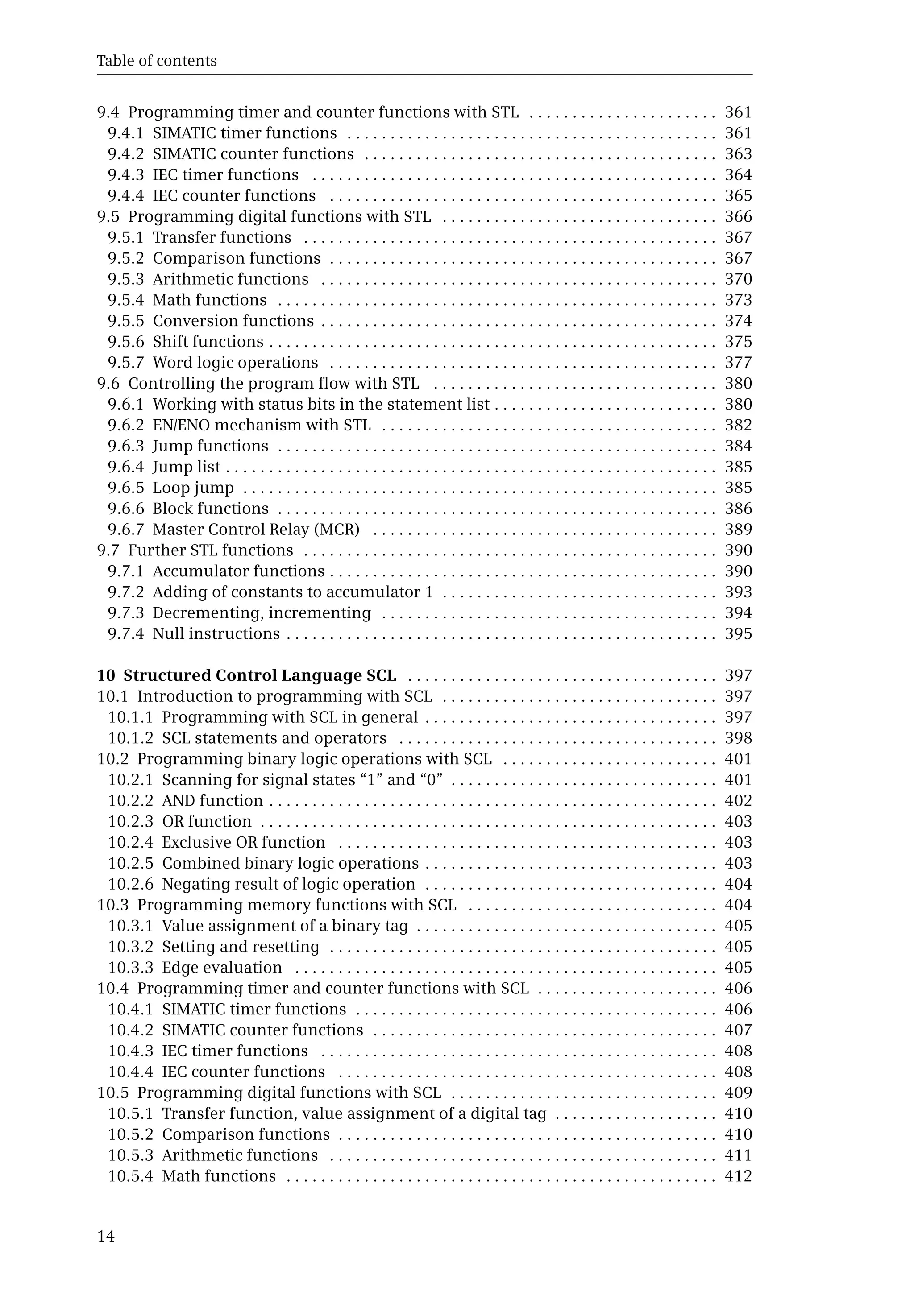
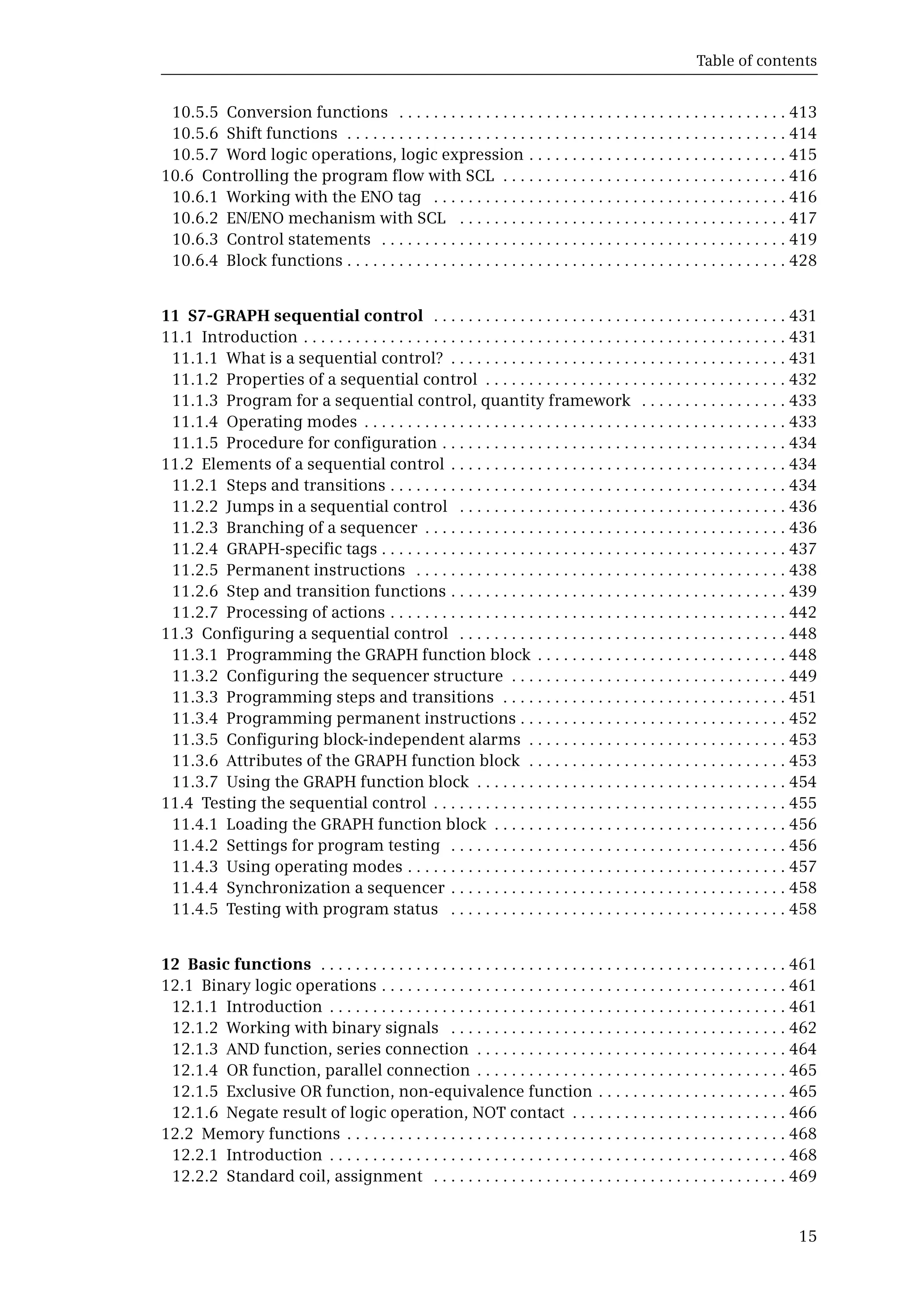
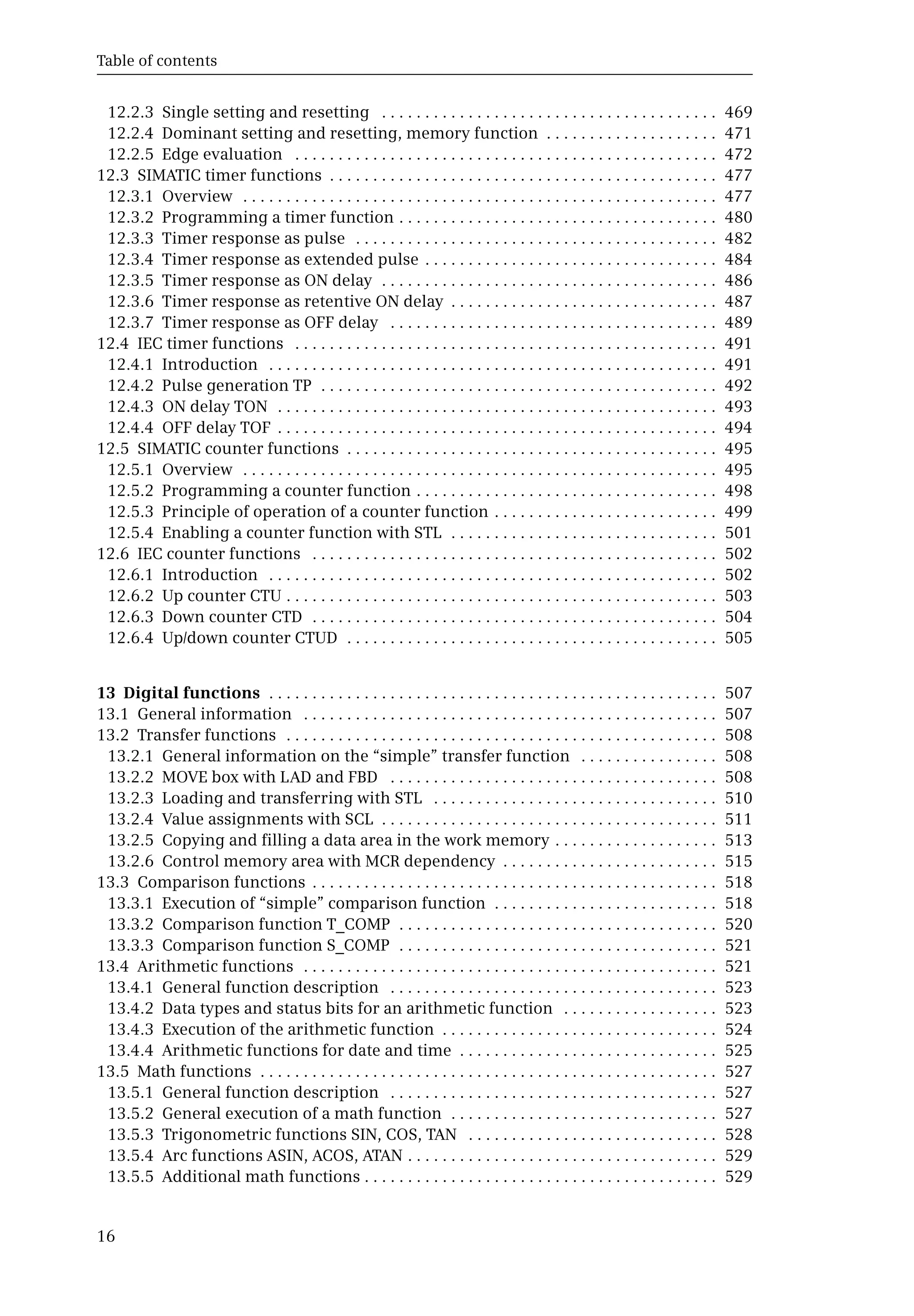
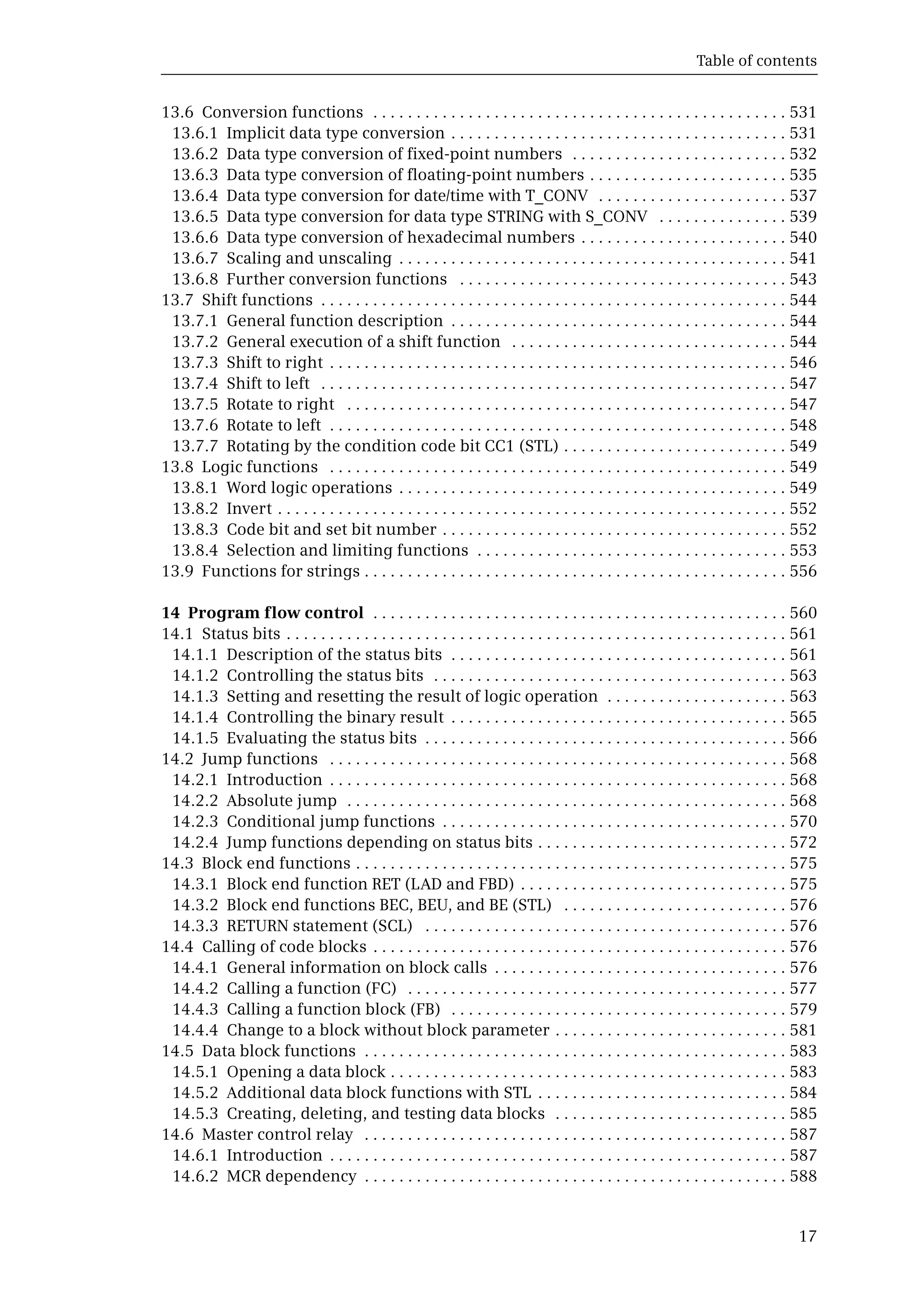
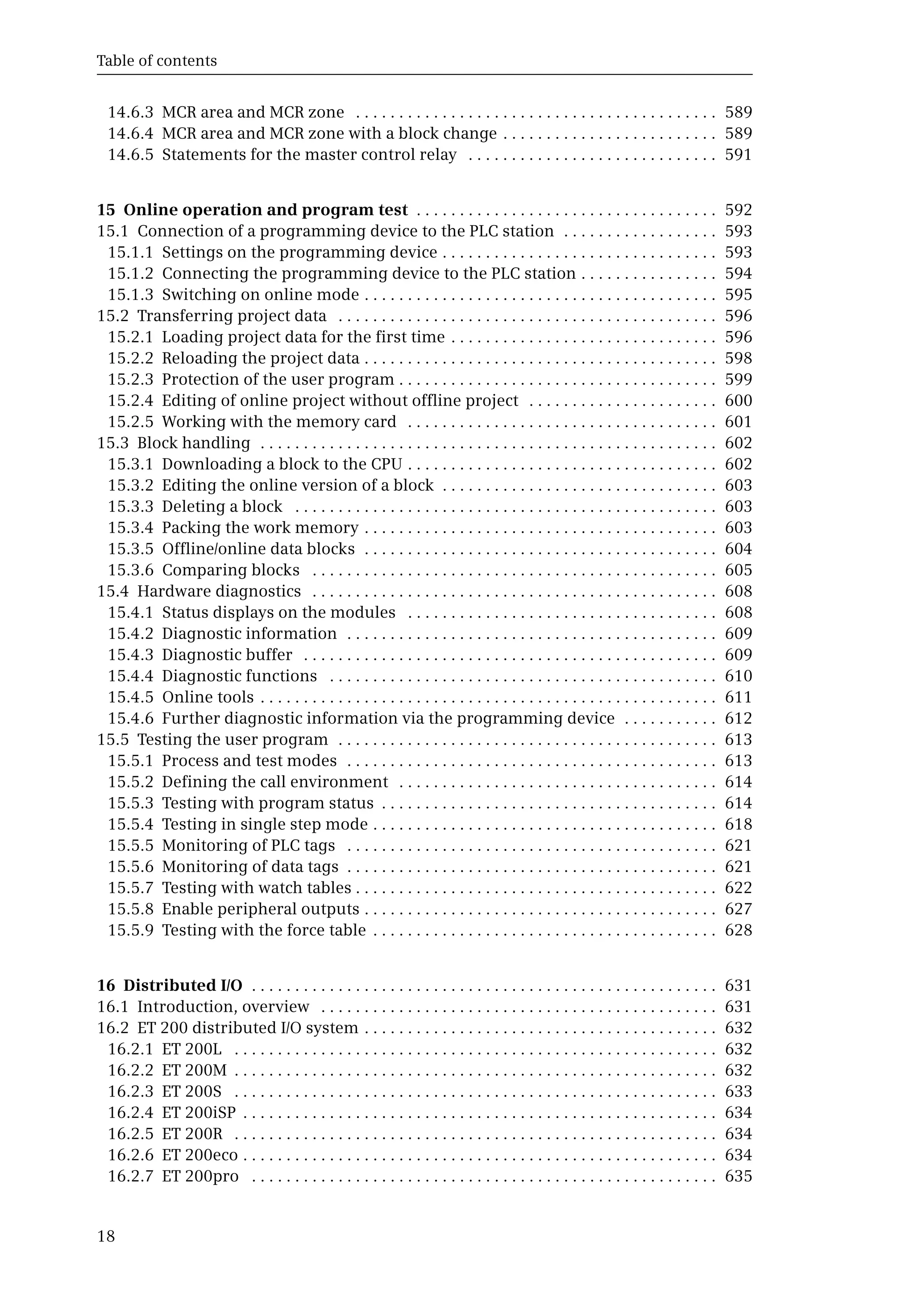
Automating with SIMATIC S7 400 inside TIA Portal 1st Edition Hans Berger
Automating with SIMATIC S7 400 inside TIA Portal 1st Edition Hans Berger
Automating with SIMATIC S7 400 inside TIA Portal 1st Edition Hans Berger
Automating with SIMATIC S7 400 inside TIA Portal 1st Edition Hans Berger
Automating with SIMATIC S7 400 inside TIA Portal 1st Edition Hans Berger
1.
Automating with SIMATICS7 400 inside TIA Portal
1st Edition Hans Berger pdf download
https://ebookname.com/product/automating-with-
simatic-s7-400-inside-tia-portal-1st-edition-hans-berger/
Get Instant Ebook Downloads – Browse at https://ebookname.com
2.
Instant digital products(PDF, ePub, MOBI) available
Download now and explore formats that suit you...
Automating with STEP 7 in STL and SCL SIMATIC S7 300
400 Programmable Controllers 6th Edition Hans Berger
https://ebookname.com/product/automating-with-step-7-in-stl-and-
scl-simatic-s7-300-400-programmable-controllers-6th-edition-hans-
berger/
Automating with SIMATIC S7 1500 Configuring Programming
and Testing with STEP 7 Professional 1st Edition Hans
Berger
https://ebookname.com/product/automating-with-
simatic-s7-1500-configuring-programming-and-testing-with-
step-7-professional-1st-edition-hans-berger/
STEP 7 in 7 Steps A Practical Guide to Implementing S7
300 S7 400 Programmable Logic Controllers 1ST Edition
Clarence T. Jones
https://ebookname.com/product/step-7-in-7-steps-a-practical-
guide-to-implementing-s7-300-s7-400-programmable-logic-
controllers-1st-edition-clarence-t-jones/
Upgrading Fixing PCs For Dummies 7th ed Edition Andy
Rathbone
https://ebookname.com/product/upgrading-fixing-pcs-for-
dummies-7th-ed-edition-andy-rathbone/
3.
The transcripts 3rded. digitized & modernized in 2008
Edition Xexoxial Editions
https://ebookname.com/product/the-transcripts-3rd-ed-digitized-
modernized-in-2008-edition-xexoxial-editions/
The parallel brain the cognitive neuroscience of the
corpus callosum 1st Edition Eran Zaidel
https://ebookname.com/product/the-parallel-brain-the-cognitive-
neuroscience-of-the-corpus-callosum-1st-edition-eran-zaidel/
India and the Anglosphere Race Identity and Hierarchy
in International Relations Alexander E Davis
https://ebookname.com/product/india-and-the-anglosphere-race-
identity-and-hierarchy-in-international-relations-alexander-e-
davis/
Applied Calculus Fifth Edition Geoffrey C. Berresford
https://ebookname.com/product/applied-calculus-fifth-edition-
geoffrey-c-berresford/
Unstitching Rex Trueform The Story of an African
Factory 1st Edition Ilze Wolff
https://ebookname.com/product/unstitching-rex-trueform-the-story-
of-an-african-factory-1st-edition-ilze-wolff/
4.
JUNOS High AvailabilityBest Practices for High Network
Uptime 1st Edition James Sonderegger
https://ebookname.com/product/junos-high-availability-best-
practices-for-high-network-uptime-1st-edition-james-sonderegger/
Preface
5
Preface
The SIMATIC automationsystem unites all the subsystems of an automation solu-
tion under a uniform system architecture to form a homogenous whole from the
field level right up to process control.
The Totally Integrated Automation (TIA) concept permits uniform handling of all
automation components using a single system platform and tools with uniform
operator interfaces. These requirements are fulfilled by the SIMATIC automation
system, which provides uniformity for configuration, programming, data manage-
ment, and communication.
This book describes the hardware components of the SIMATIC S7-400 automation
system with standard controllers, and the features provided for designing a distrib-
uted control concept with PROFIBUS and PROFINET. To permit communication with
other automation systems, the controllers offer integrated bus interfaces for multi-
point interface (MPI), PROFIBUS, and Industrial Ethernet.
The STEP 7 Professional engineering software makes it possible to use the complete
functionality of the S7-400 controllers. STEP 7 Professional is the common tool for
hardware configuration, generation of the user program, and for program testing
and diagnostics.
STEP 7 Professional provides five languages for generation of the user program:
Ladder logic (LAD) with a graphic representation similar to a circuit diagram, func-
tion block diagram (FBD) with a graphic representation based on electronic circuit-
ry systems, statement list (STL) with formulation of the control task as a list of com-
mands at machine level, a high-level Structured Control Language (SCL) similar to
Pascal, and finally GRAPH as a sequencer with sequential processing of the user
program.
STEP 7 Professional supports testing of the user program by means of watch tables
for monitoring, control and forcing of tag values, by representation of the program
with the current tag values during ongoing operation, and by offline simulation of
the programmable controller.
This book describes the configuration, programming, and testing of the S7-400
automation system with the STEP 7 Professional engineering software Version 11
with Service Pack 4.
Erlangen, June 2013 Hans Berger
11.
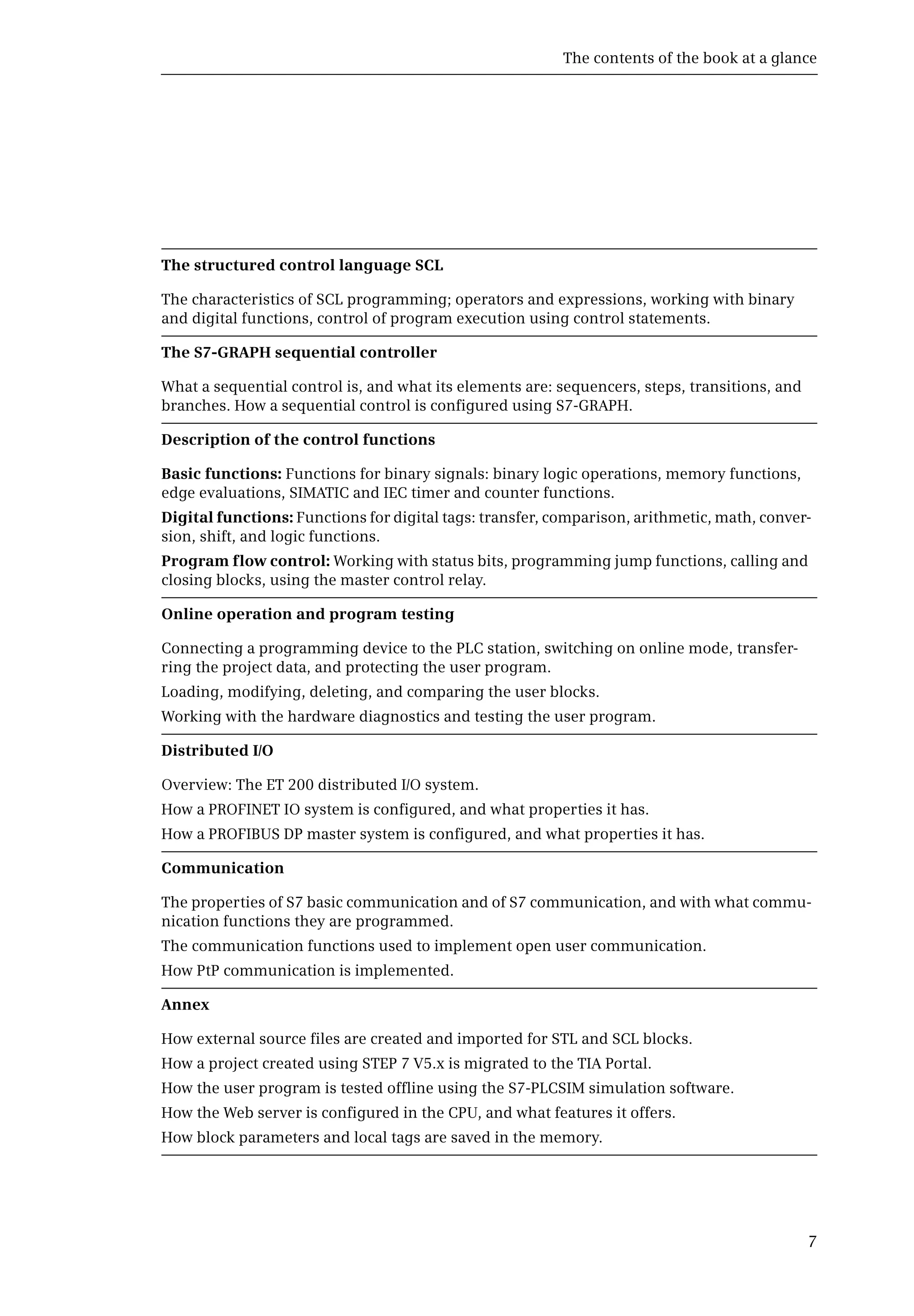
The contents ofthe book at a glance
6
The contents of the book at a glance
Start
Overview of the SIMATIC S7-400 automation system.
Introduction to the SIMATIC STEP 7 Professional V11 engineering software.
The basis of the automation solution: Creating and editing a project.
SIMATIC S7-400 automation system
Overview of SIMATIC S7-400 modules: Design of an automation system, CPUs, signal, func-
tion and communication modules.
Device configuration
Configuration of a station, parameterization of modules, and networking of stations.
Tags, addressing, and data types
The properties of inputs, outputs, I/O, bit memories, data, and temporary local data as oper-
and areas, and how they are addressed: absolute, symbolic, and indirect.
Description of elementary and compound data types, data types for block parameters, point-
ers, and user data types.
Program execution
How the CPU module responds in the STARTUP, RUN, and STOP modes.
How the user program is structured with blocks, what the properties of these blocks are,
and how they are called.
How the user program is executed: startup characteristics, main program, interrupt process-
ing, troubleshooting, and diagnostics.
The program editor
Working with the PLC tag table, creating and editing code and data blocks, compiling blocks,
and evaluating program information.
The ladder logic programming language LAD
The characteristics of LAD programming; series and parallel connection of contacts, the use
of coils, standard boxes, Q boxes, and EN/ENO boxes.
The function block diagram programming language FBD
The characteristics of FBD programming; boxes for binary logic operations, the use of stan-
dard boxes, Q boxes, and EN/ENO boxes.
The statement list programming language STL
The characteristics of STL programming; programming of binary logic operations, applica-
tion of digital functions, and control of program execution.
12.
The contents ofthe book at a glance
7
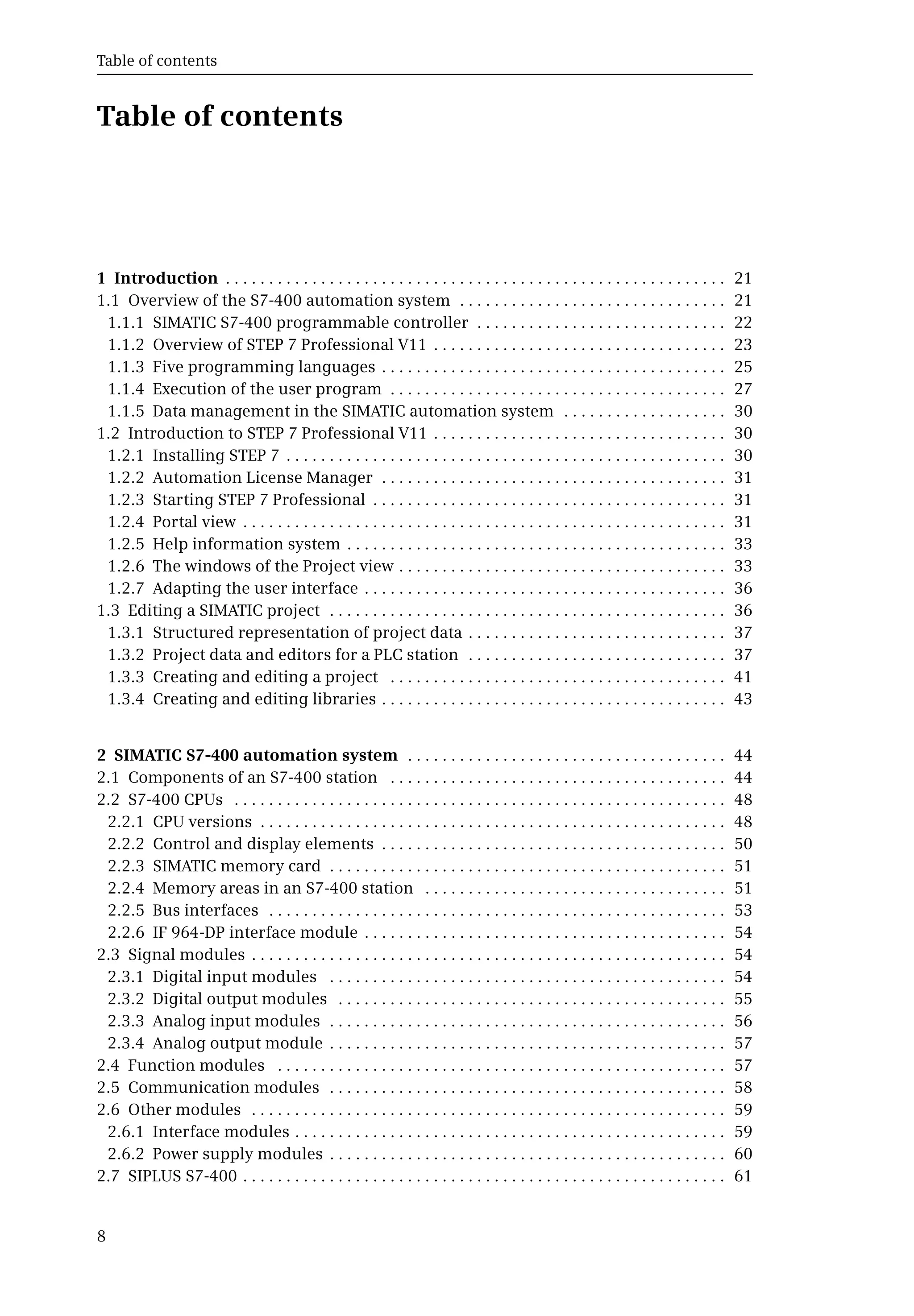
The structured control language SCL
The characteristics of SCL programming; operators and expressions, working with binary
and digital functions, control of program execution using control statements.
The S7-GRAPH sequential controller
What a sequential control is, and what its elements are: sequencers, steps, transitions, and
branches. How a sequential control is configured using S7-GRAPH.
Description of the control functions
Basic functions: Functions for binary signals: binary logic operations, memory functions,
edge evaluations, SIMATIC and IEC timer and counter functions.
Digital functions: Functions for digital tags: transfer, comparison, arithmetic, math, conver-
sion, shift, and logic functions.
Program flow control: Working with status bits, programming jump functions, calling and
closing blocks, using the master control relay.
Online operation and program testing
Connecting a programming device to the PLC station, switching on online mode, transfer-
ring the project data, and protecting the user program.
Loading, modifying, deleting, and comparing the user blocks.
Working with the hardware diagnostics and testing the user program.
Distributed I/O
Overview: The ET 200 distributed I/O system.
How a PROFINET IO system is configured, and what properties it has.
How a PROFIBUS DP master system is configured, and what properties it has.
Communication
The properties of S7 basic communication and of S7 communication, and with what commu-
nication functions they are programmed.
The communication functions used to implement open user communication.
How PtP communication is implemented.
Annex
How external source files are created and imported for STL and SCL blocks.
How a project created using STEP 7 V5.x is migrated to the TIA Portal.
How the user program is tested offline using the S7-PLCSIM simulation software.
How the Web server is configured in the CPU, and what features it offers.
How block parameters and local tags are saved in the memory.
1.1 Overview ofthe S7-400 automation system
21
1 Introduction
1.1 Overview of the S7-400 automation system
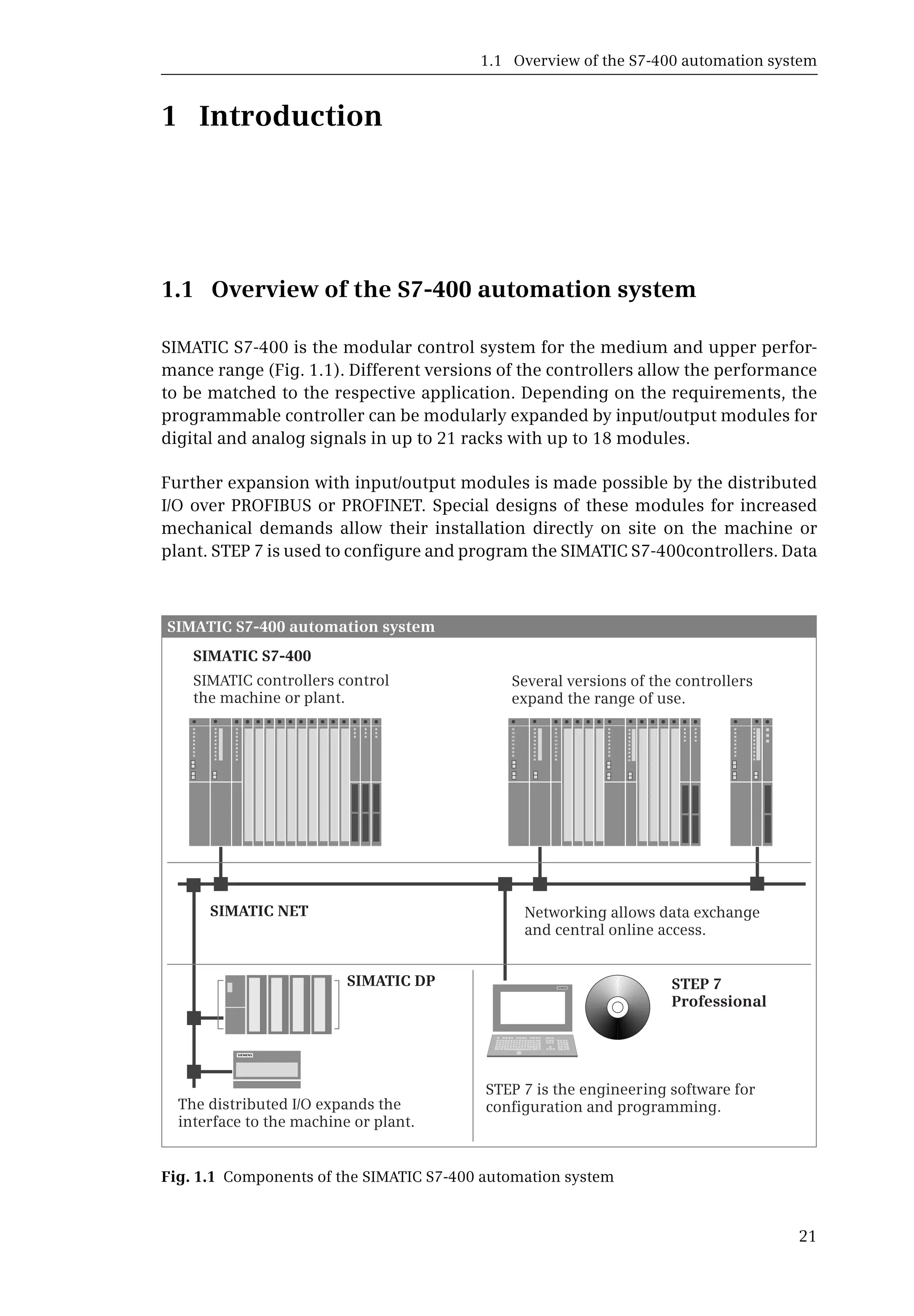
SIMATIC S7-400 is the modular control system for the medium and upper perfor-
mance range (Fig. 1.1). Different versions of the controllers allow the performance
to be matched to the respective application. Depending on the requirements, the
programmable controller can be modularly expanded by input/output modules for
digital and analog signals in up to 21 racks with up to 18 modules.
Further expansion with input/output modules is made possible by the distributed
I/O over PROFIBUS or PROFINET. Special designs of these modules for increased
mechanical demands allow their installation directly on site on the machine or
plant. STEP 7 is used to configure and program the SIMATIC S7-400controllers. Data
Fig. 1.1 Components of the SIMATIC S7-400 automation system
SIMATIC NET
SIMATIC DP STEP 7
Professional
S
S
SIMATIC S7-400 automation system
SIMATIC S7-400
27.
1 Introduction
22
exchange betweenthe controllers, the distributed I/O, and the programming device
is carried out over SIMATIC NET.
1.1.1 SIMATIC S7-400 programmable controller
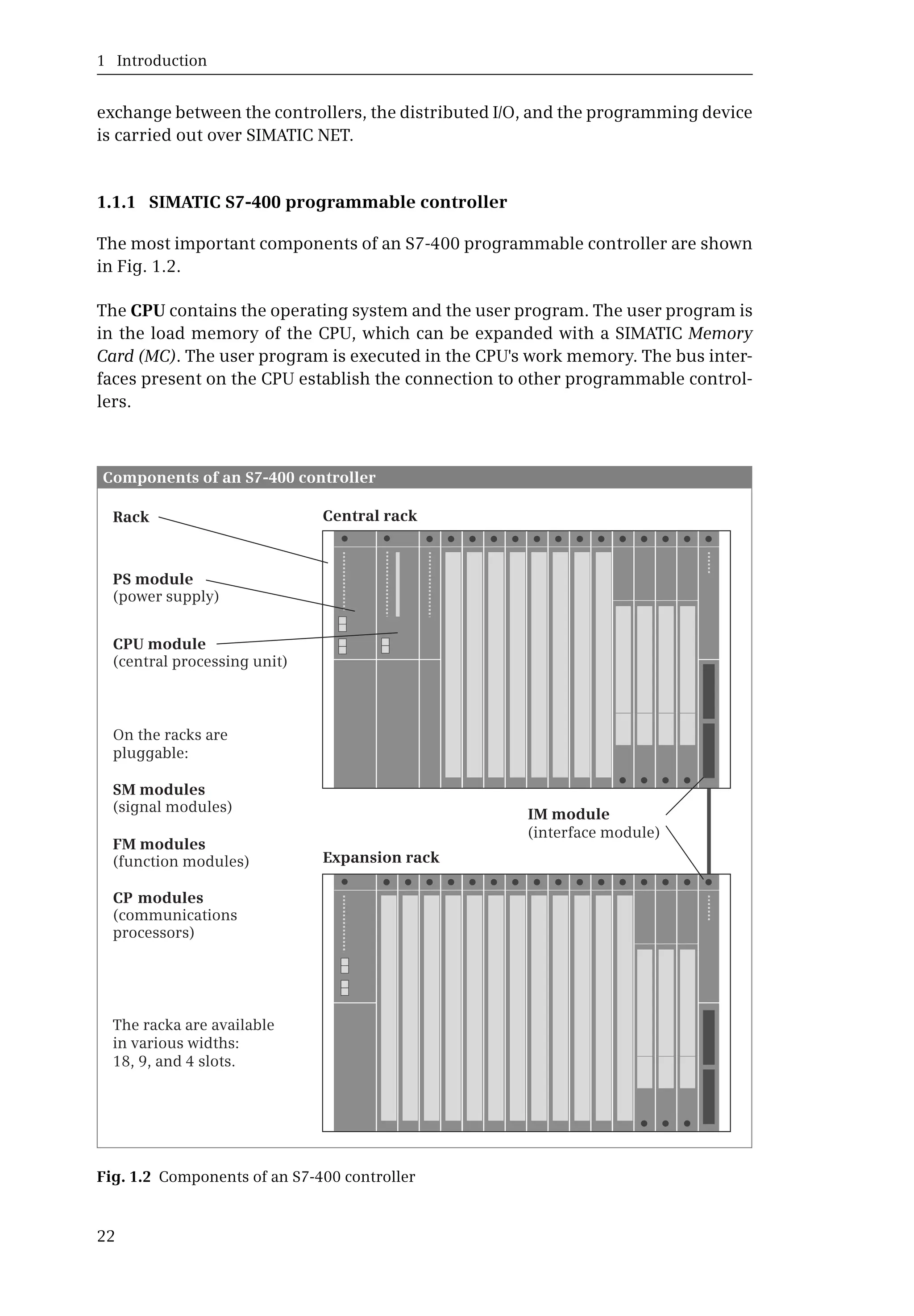
The most important components of an S7-400 programmable controller are shown
in Fig. 1.2.
The CPU contains the operating system and the user program. The user program is
in the load memory of the CPU, which can be expanded with a SIMATIC Memory
Card (MC). The user program is executed in the CPU's work memory. The bus inter-
faces present on the CPU establish the connection to other programmable control-
lers.
Fig. 1.2 Components of an S7-400 controller
Expansion rack
Central rack
IM module
Components of an S7-400 controller
The racka are available
in various widths:
18, 9, and 4 slots.
CPU module
PS module
SM modules
FM modules
CP modules
Rack
On the racks are
pluggable:
28.
1.1 Overview ofthe S7-400 automation system
23
Signal modules (SM) are responsible for the connection to the controlled plant.
These input and output modules are available for digital and analog signals.
The function modules (FM) are signal-preprocessing, “intelligent” I/O modules
which prepare signals coming from the process independent of the CPU and either
return them directly to the process or make them available at the CPU's internal
interface. Function modules are responsible for handling functions which the CPU
cannot usually execute quickly enough, such as counting pulses, positioning, or
controlling drives.
The CP modules allow data transfer in excess of the possibilities provided by the
standard interfaces on the CPU with regard to protocols and communication func-
tions.
In the case of an expansion, the interface modules (IM) connect the central rack
to a maximum of 21 expansion racks.
Finally, a power supply module provides the internal voltages required by the pro-
grammable controller. Load voltages or load currents must be provided via external
load current supply units.
1.1.2 Overview of STEP 7 Professional V11
STEP 7 is the central automation tool for SIMATIC. STEP 7 requires authorization (li-
censing) and is executed on the current Microsoft Windows operating systems.
Configuration of an S7-400 controller is carried out in two views: the Portal view
and the Project view.
The Portal view is task-oriented.
In the Start portal you can open an existing project, create a new project, or migrate
a project. A “project” is a data structure containing all the programs and data
required for your automation task. The most important STEP 7 tools and functions
can be accessed from here via further portals (Fig. 1.3):
b In the Devices & networks portal you configure the programmable controllers,
i.e. you position the modules in a rack and set their parameters.
b In the PLC programming portal you create the user program in the form of indi-
vidual sections referred to as “blocks”.
b The Visualization portal provides the most important tools for configuration and
simulation of HMI systems using SIMATIC WinCC.
b The Online & Diagnostics portal allows you to connect the programming device
online to a CPU. You can control the CPU's operating modes and transfer and test
the user program.
The Project view is an object-oriented view with several windows whose contents
change depending on the current activity. In the Device configuration, the focal
point is the working area with the device to be configured. The Device view includes
the rack and the modules which have already been positioned (Fig. 1.4). A further
window – the inspector window – displays the properties of the selected module,
29.
1 Introduction
24
Fig. 1.3Tools in the Start portal of STEP 7 Professional V11
Fig. 1.4 Example of a Project view: working area of the device configuration
“It was toobad, Oliver, not to come for me!” she cried.
“I meant to be home in time; I did indeed, Jane,” he answered; “but
somehow the evening slipped on.”
“Were you at Mr. Paul’s?”
“No; I was with MacEveril.”
“At billiards, I suppose!—and it’s very foolish of you, Oliver, for you
know you can’t afford billiards.”
“I can’t afford anything, Janey, as it seems to me,” returned Oliver,
kicking up the dust in the road as they walked along. “Billiards don’t
cost much; it’s only the tables: anyway, MacEveril paid for all.”
“Has MacEveril talked any more about going away?”
“He talks of nothing else; is full of it,” answered Oliver. “His uncle
says he is not to go; and old Paul stopped him at the first half-word,
saying he could not be spared from the office. Dick says he shall
start all the same, leave or no leave.”
“Dick will be very silly to go just now, when we are about to be so
gay,” remarked Jane, “There’s the picnic coming off; and the dance
at Mrs. Jacob Chandler’s; and no end of tea-parties.”
For just now the neighbourhood was putting on a spurt of gaiety,
induced to it perhaps by the lovely summer sunshine. Oliver’s face
wore a look of gloom, and he made no answer to Jane’s remark.
Several matters, cross and contrary, were trying Oliver Preen; not
the least of them that he seemed to make no way whatever with
Miss Emma.
When we left school for the midsummer holidays that year, Mr. and
Mrs. Todhetley were staying at Crabb Cot. We got there on Friday,
the eleventh of June.
32.
On the followingMonday morning the Squire went to his own small
sitting-room after breakfast to busy himself with his accounts and
papers. Presently I heard him call me.
“Have you a mind for a walk, Johnny?”
“Yes, sir; I should be glad of one.” Tod had gone to the Whitneys for
a couple of days, and without him I felt like a fish out of water.
“Well, I want you to go as far as Massock’s. He is a regular cheat;
that man, Johnny, needs looking after—— What is it, Thomas?”
For old Thomas had come in, a card between his fingers. “It’s Mr.
Gervais Preen, sir,” he said, in answer, putting the card on the
Squire’s table. “Can you see him?”
“Oh, yes, I can see him; show him in. Wait a bit, though, Thomas,”
broke off the Squire. “Johnny, I expect Preen has come about that
pony. I suppose we may as well keep him?”
“Tod said on Saturday, sir, that we should not do better,” I answered.
“He tried him well, and thinks he is worth the price.”
“Ay; ten pounds, wasn’t it? We’ll keep him, then. Mr. Preen can come
in, Thomas.”
Some few days before this the Squire had happened to say in
Preen’s hearing that he wanted a pony for the two children to ride,
Hugh and Lena. Preen caught up the words, saying he had one for
sale—a very nice pony, sound and quiet. So the pony had been sent
to Crabb Cot upon trial, and we all liked him. His name was Taffy.
Mr. Preen came into the room, his small face cool and dark as usual;
he had driven from Duck Brook. “A fine morning,” he remarked, as
he sat down; but it would be fiery hot by-and-by, too hot for the
middle of June, and we should probably pay for it later. The Squire
asked if he would take anything, but he declined.
33.
“What of thepony—Taffy—Squire?” went on Mr. Preen. “Do you like
him?”
“Yes, we like him very well,” said the Squire, heartily, “and we mean
to keep him, Preen.”
“All right,” said Mr. Preen. “You will not repent it.”
Then they fell to talking of horses in general, and of other topics. I
stayed on, sitting by the window, not having received the message
for Massock. Mr. Preen stayed also, making no move to go away;
when it suddenly occurred to the Squire—he mentioned it later—that
perhaps Preen might be waiting for the money.
“Ten pounds, I think, was the price agreed upon,” observed the
Squire with ready carelessness. “Would you like to be paid now?”
“If it does not inconvenience you.”
The Squire unlocked his shabby old bureau, which stood against the
wall, fingered his stock of money, and brought forth a ten-pound
bank-note. This he handed to Preen, together with a sheet of paper,
that he might give a receipt.
When the receipt was written, Mr. Preen took up the note, looked at
it for a moment or two, and then passed it back again.
“Would you mind writing your name on this note, Squire?”
The Squire laughed gently. “Not at all,” he answered; “but why
should I? Do you think it is a bad one? No fear, Preen; I had it from
the Old Bank at Worcester.”
“No, I do not fear that,” said Preen, speaking quietly. “But since a
disagreeable trouble which happened to me some years ago, I have
always liked, when receiving a bank-note, to get, if possible, the
donor’s name upon it in his own handwriting.”
“What was the trouble?”
34.
“I was playingcards at the house of a man of fashion, who was
brother to an earl, and lived in a fashionable square at the West End
of London, and I had a ten-pound note paid me, for I won, by a man
who, I understood, had recently retired with honours from the army,
a Major D——. I will not give you his name. The next day, or next
but one, I paid this note away to a tradesman, and it was found to
be forged; cleverly forged,” repeated Preen, with emphasis.
“What did you do?” asked the Squire.
“I got Major D.’s address from the house where we had played,
carried the note to him, and inquired what it meant and whence he
got it. Will you believe, Mr. Todhetley,” added the speaker, with slight
agitation, “that the man utterly repudiated the note, saying——”
“But how could he repudiate it?” interrupted the Squire, interested in
the tale.
“He said it was not the note he had paid me; he stood it out in the
most impudent manner. I told him, and it was the pure truth, that it
was impossible there could be any mistake. I was a poor man, down
on my luck just then, and it was the only note I had had about me
for some time past. All in vain. He held to it that it was not the note,
and there the matter ended. I could not prove that it was the note
except by my bare word. It was my word against his, you see, and
naturally I went to the wall.”
The Squire nodded. “Who was at the loss of the money?”
“I was. Besides that, I had the cold shoulder turned upon me. Major
D. was believed; I was doubted; some people went so far as to say I
must have trumped up the tale. For some time after that I would not
take a bank-note from any man unless he put his signature to it, and
it has grown into a habit with me. So, if you don’t mind, Squire——”
The Squire smiled goodnaturedly, drew the bank-note to him, and
wrote upon the back in a corner, “J. Todhetley.”
35.
“There, Preen,” saidhe, returning it, “I won’t repudiate that.
Couldn’t if I would.”
Mr. Preen put the note into his pocket-book, and rose to leave. We
strolled with him across the front garden to the gate, where his gig
was waiting.
“I have to go as far as Norton; and possibly after that on to
Stoulton,” he remarked, as he took the reins in his hand and got in.
“You will have a hot drive of it,” said the Squire.
“Yes; but if one undertakes business it must be attended to,” said
Preen, as he drove off.
36.
A TRAGEDY
II.—IN THEBUTTERY
I
The windows of the room, called the Buttery, which Mr. Preen used
as an office in his house at Duck Brook, were thrown open to the
warm, pure air. It was about the hottest part of the afternoon. Oliver
Preen sat back in his chair before the large table covered with
papers, waiting in idleness and inward rebellion—rebellion against
the untoward fate which had latterly condemned him to this dreary
and monotonous life. Taking out his pocket-handkerchief with a fling,
he passed it over his fair, mild face, which was very hot just now.
To-day, of all days, Oliver had wanted to be at liberty, whereas he
was being kept a prisoner longer than usual, and for nothing. When
Mr. Preen rode out after breakfast in the morning he had left Oliver a
couple of letters to copy as a beginning, remarking that there was a
great deal to do that day, double work, and he should be back in
half-an-hour. The double work arose from the fact that none had
been done the day before, as Mr. Preen was out. For that day,
Monday—this was Tuesday—was the day Mr. Preen had paid us a
visit at Crabb Cott, to be paid for Taffy, the pony, and had then gone
to Norton, and afterwards to Stoulton, and it had taken him the best
part of the day. So the double work was waiting. But the half hours
and the hours had passed on, and Mr. Preen had not yet returned. It
was now three o’clock in the afternoon, and they had dined without
him.
Oliver, who did not dare to absent himself without permission, and
perhaps was too conscientious to do so, left his chair for the
37.
window. The oldgarden was quite a wilderness of blossom and
colour, with all kinds of homely flowers crowded into it. The young
man stretched forth his hand and plucked a spray or two of
jessamine, which grew against the wall. Idly smelling it, he lost
himself in a vision of the days gone by; his careless, happy life at
Tours, in his aunt’s luxurious home, when he had no fear of a dark
future, had only to dress well and ride or drive out, and idly enjoy
himself.
Suddenly he was brought back to reality. The sound of hoofs
clattering into the fold-yard behind the house struck upon his ear,
and he knew his father had come home.
Ten minutes yet, or more, and then Mr. Preen came into the room,
his little dark face looking darker and more cross than usual. He had
been snatching some light refreshment, and sat down at once in his
place at the table, facing the windows; Oliver sat opposite to him.
“What have you done?” asked he.
“I have only copied those two letters; there was nothing else to do,”
replied Oliver.
“Could you not have looked over the pile of letters which came this
morning, to see whether there were any you could answer?”
growled Mr. Preen.
“Why, no, father,” replied Oliver in slight surprise; “I did not know I
might look at them. And if I had looked I should not have known
what to reply.”
Mr. Preen began reading the letters over at railroad speed, dictating
answers for Oliver to write, writing some himself. This took time. He
had been unexpectedly detained at the other end of Captain
Falkner’s land by some business which had vexed him. Most of these
letters were from farmers and others, about the new patent
agricultural implements for which Mr. Preen had taken the agency.
38.
G. Preen.”
He wishedto push the sale of them, as it gave him a good
percentage.
The answers, addressed and stamped for the post, at length lay
ready on the table. Mr. Preen then took out his pocket-book and
extracted from it that ten-pound bank-note given him the previous
morning by Mr. Todhetley for the children’s pony, the note he had
got the Squire to indorse, as I have already told. Letting the bank-
note lie open before him, Mr. Preen penned a few lines, as follows,
Oliver looking on:—
“Dear Sir,—I enclose you the ten pounds. Have not been able to
send it before. Truly yours,
Mr. Preen folded the sheet on which he had written this, put the
bank-note within it, and enclosed all in a good-sized business
envelope, which he fastened securely down. He then addressed it to
John Paul, Esquire, Islip, and put on a postage stamp.
“I shall seal this, Oliver,” he remarked; “it’s safer. Get the candle and
the wax. Here, you can seal it,” he added, taking the signet ring
from his finger, on which was engraved the crest of the Preen family.
Oliver lighted a candle kept on a stand at the back for such
purposes, brought it to the table, and sealed the letter with a large,
imposing red seal. As he passed the ring and letter back to his
father, he spoke.
“If you are particularly anxious that the letter should reach Mr. Paul
safely, father, and of course you are so, as it contains money, why
did you not send it by hand? I would have taken it to him.”
“There’s nothing safer than the post,” returned Mr. Preen, “and I
want him to have it to-morrow morning.”
Oliver laughed. “I could have taken it this evening, father. I can do
so still, if you like.”
“No, it shall go by post. You want to be off to MacEveril, I suppose.”
39.
“No, I donot,” replied Oliver. “Had I been able to finish here this
morning I might have gone over this afternoon; it is too late now.”
“You had nothing to do all day yesterday,” growled his father.
“Oh, yes, I know. I am not grumbling.”
Mr. Preen put the letter into his pocket, gathered up the pile of other
letters, handed half of them to his son, for it was a pretty good
heap, and they started for the post, about three minutes’ walk.
The small shop containing the post-office at Duck Brook was kept by
Mrs. Sym, who sold sweetstuff, also tapes and cottons. Young Sym,
her son, a growing youth, delivered the letters, which were brought
in by a mail-cart. She was a clean, tidy woman of middle age, never
seen out of a muslin cap with a wide border and a black bow, a
handkerchief crossed over her shoulders, and a checked apron.
Oliver, of lighter step than his father, reached the post-office first and
tumbled his portion of the letters into the box placed in the window
to receive them. The next moment Mr. Preen put his in also,
together with the letter addressed to Mr. Paul.
“We are too late,” observed Oliver. “I thought we should be.”
“Eh?” exclaimed Mr. Preen, in surprise, as he turned round. “Too
late! Why how can the afternoon have gone on?” he continued, his
eyes falling on the clock of the little grey church which stood beyond
the triangle of houses, the hands of which were pointing to a quarter
past five.
“If you knew it was so late why did you not say so?” he asked
sharply of his son.
“I was not sure until I saw the clock; I only thought it must be late
by the time we had been at work,” replied Oliver.
“I might have sent you over with that letter as you suggested, had I
known it would not go to-night. I wonder whether Dame Sym would
40.
give it backto me.”
He dived down the two steps into the shop as he spoke, Oliver
following. Dame Sym—so Duck Brook called her—stood knitting
behind the little counter, an employment she took up at spare
moments.
“Mrs. Sym, I’ve just put some letters into the box, not perceiving
that it was past five o’clock,” began Mr. Preen, civilly. “I suppose
they’ll not go to-night?”
“Can’t, sir,” replied the humble post-mistress. “The bag’s made up.”
“There’s one letter that will hardly bear delay. It is for Mr. Paul of
Islip. If you can return it me out of the box I will send it over by
hand at once; my son will take it.”
“But it is not possible, sir. Once a letter is put into the box I dare not
give it back again,” remonstrated Mrs. Sym, gazing amiably at Mr.
Preen through her spectacles, whose round glasses had a trick of
glistening when at right angles with the light.
“You might stretch a point for once, to oblige me,” returned Mr.
Preen, fretfully.
“And I’m sure I’d not need to be pressed to do it, sir, if I could,” she
cried in her hearty way. “But I dare not break the rules, sir; I might
lose my place. Our orders are not to open the receiving box until the
time for making-up, or give a letter back on any pretence whatever.”
Mr. Preen saw that further argument would be useless. She was a
kindly, obliging old body, but upright to the last degree in all that
related to her place. Anything that she believed (right or wrong)
might not be done she stuck to.
“Obstinate as the grave,” muttered he.
Dame Sym did not hear; she had turned away to serve a child who
came in for some toffee. Mr. Preen waited.
41.
“When will theletter go?” he asked, as the child went out.
“By to-morrow’s day mail, sir. It will be delivered at Islip—I think you
said Islip, Mr. Preen—about half-past four, or so, in the afternoon.”
“Is the delay of much consequence, sir?” inquired Oliver, as he and
his father turned out of the shop.
“No,” said Mr. Preen. “Only I hate letters to be delayed uselessly in
the post.”
Tea was waiting when they got in. A mutton chop was served with it
for Mr. Preen, as he had lost his dinner. Jane ran downstairs, drank a
cup of tea in haste, and ran back again. She had been busy in her
bedroom all day, smartening-up a dress. A picnic was to be held on
Thursday, the next day but one; Jane and Oliver were invited to it,
and Jane wanted to look as well as other girls.
After tea Oliver sat for ever so long at the open window, reading the
Worcester Journal. He then strolled out to the Inlets, sauntered
beside the brook, and presently threw himself listlessly upon one of
the benches facing it. The sun shone right upon his face there, so he
tilted his straw hat over his eyes. That did not do, and he moved to
another bench which the trees shaded. He often felt lonely and
weary now; this evening especially so; even Jane was not with him.
His thoughts turned to Emma Paul; and a glow, bright as the
declining sun rays, shot up in his heart. As long as she filled it, he
could not be all gloom.
“If I had means to justify it I should speak to her,” mused he—as he
had told himself forty times over, and forty more. “But when a fellow
has no fortune, and no prospect of fortune; when it may be seen by
no end of odd signs and tokens that he has not so much as a silver
coin in his pocket, how can he ask a girl the one great question of
life? Old Paul would send me to the right-about.”
42.
He leaned hishead sideways for a few minutes against the trunk of
a tree, gazing at the reddening sky through the green tracery of the
waving boughs; and fell to musing again.
“If she loved me as I love her, she would be glad to wait on as
things are, hoping for better times. Lovers, who are truly attached to
each other, do wait for years and years, and are all the happier for it.
Sometimes I feel inclined to enlist in a crack regiment. The worst of
it is that a fellow rarely rises from the ranks in England to position
and honour, as he does in France; they manage things better over
there. If old Uncle Edward would only open his purse-strings and
buy me a commission, I might—— Halloa!”
A burst of girlish laughter, and a pair of girlish arms, flung round his
neck from behind, disturbed Oliver’s castles-in-the-air. Jane came
round and sat down beside him. “I thought I should find you here,
Oliver,” she said.
“Frock finished, Janey?”
“Finished! why no,” she exclaimed. “It will hardly be finished by this
time to-morrow.”
“Why, how idle you must have been!”
“Idle? You don’t understand things, or the time it takes to make an
old frock into a new one. A dressmaker might have done it in a day,
but I’m not a dressmaker, you know, Oliver.”
“Is it a silk gown?”
“It is a mousseline-de-laine, if you chance to be acquainted with that
material,” answered Janey. “It was very pretty when it was new: pale
pink and lilac blossoms upon a cream ground. But it has been
washed, and that has made it shrink, and it has to be let out
everywhere and lengthened, and the faded silk trimming has to be
turned, and—oh, ever so much work. And now, I daresay you are as
wise as you were before, Oliver.”
43.
“I’ve heard ofwashed-out dresses,” remarked Oliver. “They look like
rags, don’t they?”
“Some may. Mine won’t. It has washed like a pocket-handkerchief,
and it looks as good as new.”
“Wish my coats would wash,” said Oliver. “They are getting shabby,
and I want some new ones.”
Not having any consolation to administer in regard to the coats, Jane
did not take up the subject. “What have you been doing all day,
Oliver?” she asked.
“Airing my patience in that blessed Buttery,” replied he. “Never
stirred out of it at all, except for dinner.”
“I thought you wanted to get over to Islip this afternoon.”
“I might want to get over to the North Pole, and be none the nearer
to it. MacEveril was bound for some place a mile or two across fields
this afternoon, on business for the office, and I promised to go over
to walk with him. Promises, though, are like pie-crust, Janey: made
to be broken.”
Jane nodded assent. “And a promise which you are obliged to break
is sure to be one you particularly want to keep. I wish I had a pair of
new gloves, Oliver. Pale grey.”
“I wish I had half-a-dozen new pairs, for the matter of that. Just
look at those little minnows, leaping in the water. How pretty they
are!”
He went to the edge of the brook and stood looking down at the
small fry. Jane followed. Then they walked about in the Inlets, then
sat down again and watched the sunset; and so the evening wore
away until they went home.
Jane was shut up again the following day, busy with her dress;
Oliver, as usual, was in the Buttery with his father. At twelve o’clock
44.
Mr. Preen preparedto go out to keep an appointment at Evesham,
leaving Oliver a lot of work to do, very much to his aggravation.
“It’s a shame. It will take me all the afternoon to get through it,” ran
his thoughts—and he would have liked to say so aloud.
“You don’t look pleased, young man,” remarked his father. “Recollect
you will be off duty to-morrow.”
Oliver’s countenance cleared; his disposition was a pleasant one,
never retaining anger long, and he set to his task with a good will.
The morrow being the day of the picnic, he would have whole
holiday.
At five o’clock the young servant carried the tea-tray into the parlour.
Presently Mrs. Preen came in, made the tea, and sat down to wait
for her son and daughter. Tired and hot, she was glad of the rest.
Jane ran downstairs, all happiness. “Mamma, it is finished,” she
cried; “quite finished. It looks so well.”
“It had need look well,” fretfully retorted Mrs. Preen, who had been
unable to get at Jane for any useful purpose these two days, and
resented it accordingly.
“When all trades fail I can turn dressmaker,” said the girl, gaily.
“Where’s Oliver?”
“In the Buttery, I expect; he said he had a great deal to do there this
afternoon, and I have not seen him about,” replied Mrs. Preen, as
she poured out the tea. “Not that I should have been likely to see
him—shut into that hot kitchen with the ironing.”
Jane knew this was a shaft meant for herself. At ordinary times she
did her share of the ironing. “I will tell Oliver that tea is ready,
mamma,” she said, rising to go to the other room. “Why, there he is,
sitting in the shade under the walnut tree,” she exclaimed,
happening to look from the window.
45.
“Sitting out inthe cool,” remarked Mrs. Preen. “I don’t blame him,
poring all day long over those accounts and things. Call him in,
Jane.”
“Coming,” said Oliver, in response to Jane’s call from the open
window.
He crossed the grass slowly, fanning himself with his straw hat. His
fair face—an unusual thing with him—was scarlet.
“You look red-hot, Oliver,” laughed his sister.
“If it is as hot to-morrow as it is to-day we shall get a baking,”
returned Oliver.
“In this intense weather nothing makes one feel the heat like work,
and I suppose you’ve been hard at it this afternoon,” said his mother
in a tone of compassion, for she disliked work naturally very much
herself.
“Of course; I had to be,” answered Oliver.
He and Jane sat together under the shade of the walnut tree after
tea. When it grew a little cooler they went to the Inlets, that
favourite resort of theirs; a spot destined to bear a strange
significance for one of them in the days to come; a haunting
remembrance.
II
The white mist, giving promise of a hot and glorious day, had hardly
cleared itself from the earth, when, at ten o’clock on the Thursday
morning, Jane and Oliver Preen set off in the gig for North Villa, both
of them as spruce as you please; Jane in that pretty summer dress
she had spent so much work over, a straw hat with its wreath of pink
may shading her fair face, Oliver with a white rose in his button-
hole. The party was first to assemble at Mrs. Jacob Chandler’s, and
to go from thence in waggonettes. There had been some trouble
46.
about the gig,Mr. Preen wanting it himself that day, or telling Jane
and Oliver that he did, and that they could walk. Jane almost cried,
declaring she did not care to arrive at North Villa looking like a
milkmaid, hot and red with walking; and Mr. Preen gave way. Oliver
was to drive himself and Jane, Sam being sent on to Crabb to bring
back the gig.
Mr. Preen did not regard the picnic with favour. Mr. Preen could not
imagine what anybody could want at one, he said, when
ungraciously giving consent to Oliver’s absenting himself from that
delightful Buttery for a whole day.
Picnics in truth are nearly all alike, and are no doubt more agreeable
to the young than to the old. This one was given conjointly by the
Jacob Chandlers, the Letsoms, the Coneys, and the Ashtons of
Timberdale. A few honorary guests were invited. I call them
honorary because they had nothing to do with finding provisions.
Tod got an invitation, myself also; and uncommonly vexed we were
not to be able to arrive till late in the afternoon. The Beeles from
Pigeon Green were coming to spend the day at Crabb Cot, and the
Squire would not let us off earlier.
The picnic was held upon Mrs. Cramp’s farm, not far from Crabb,
and a charming spot for it. Gentle hills and dales, shady groves and
mossy glens surrounded the house, which was a very good one. So
that it may be said we all were chiefly Mrs. Cramp’s guests. Mrs.
Cramp made a beaming hostess, and was commander-in-chief at her
own tea-table. Tea was taken in her large parlour, to save the bother
of carrying things out. Dinner had been taken in the dell, under
shade of the high and wide-spreading trees.
They were seated at tea when we got there. Such a large company
at the long table; and such tempting things to eat! I found a seat by
Emma Paul, the prettiest girl there; Oliver Preen was next her on the
other side. Mary MacEveril made room for Tod beside her. The
MacEverils were proud, exclusive people, and Miss MacEveril
47.
privately looked downon some of her fellow guests; but Tod was
welcome; he was of her own order.
Two or three minutes later Tom Chandler came in; he also had not
been able to get away earlier. He shook hands with his aunt, Mrs.
Cramp, nodded to the rest of us, and deftly managed to wedge
himself in between Emma Paul and young Preen. Preen did not seem
pleased, Emma did; and made all the room she could, by crushing
me.
“I wouldn’t be in your shoes to-morrow morning, young man,” began
Mr. Chandler, in a serio-comic tone, as he looked at Dick MacEveril
across the table. “To leave the office to its own devices the first
thing this morning, in defiance of orders——”
“Hang the musty old office!” interrupted MacEveril, with a genial
laugh.
Valentine Chandler had done the same by his office; pleasure first
and business later always with both of them; but Valentine was his
own master and MacEveril was not. In point of fact, Mr. Paul, not a
man to be set at defiance by his clerks, was in a great rage with Dick
MacEveril.
I supposed the attractions of the picnic had been too powerful for
Dick, and that he thought the sooner he got to it the better. But this
proved to be a fallacy. Mrs. Cramp was setting her nephew right.
“My dear Tom, you are mistaken. Mr. MacEveril did not come this
morning; he only got here an hour ago—like two or three more of
the young men.”
“Oh, did he not, Aunt Mary Ann?” replied Tom, turning his
handsome, pleasant face upon her.
“Yes, and if you were not at the office I should like to know what
you did with yourself all day, Dick,” severely cried Miss MacEveril,
bending forward to regard her cousin.
48.
“I went tosee the pigeon-match,” said Dick, coolly.
“To see the pigeon-match!” she echoed. “How cruel of you! You had
better not let papa know.”
“If anyone lets him know it will be yourself, Miss Mary. And suppose
you hold your tongue now,” cried Dick, not very politely.
This little passage-at-arms over, we went on with tea. Afterwards we
strolled out of doors and disposed of ourselves at will. Some of the
Chandler girls took possession of me, and I went about with them.
When it was getting late, and they had talked me deaf, I began
looking about for Tod, and found him on a bench within the Grove. A
sheltered spot. Sitting there, you could look out, but people could
not look in. Mary MacEveril and Georgiana Chandler were with him;
Oliver Preen stood close by, leaning against the stump of a tree. I
thought how sad his look was, and wondered what made it so.
Within view of us, but not within hearing, in a dark, narrow walk
Tom Chandler and Emma Paul were pacing side by side, absorbed
evidently in one another. The sun had set, the lovely colours in the
sky were giving place to twilight. It was the hour when matter-of-
fact prosaic influences change into romance; when, if there’s any
sentiment within us it is safe to come out.
49.
“It is thehour when from the boughs
The nightingale’s high note is heard;
It is the hour when lovers’ vows
Seem sweet in every whispered word,”
as Lord Byron says. And who could discourse on love—the true ring
of it, mind you—as he did?
“Do sing,” said Tod to Miss MacEveril; and I found they had been
teasing her to do so for the last five minutes. She had a pleasant
voice and sang well.
“I’m sure you don’t care to hear me, Mr. Todhetley.”
“But I’m sure I do,” answered Tod, who would flirt with pretty girls
when the fit took him. Flirt and flatter too.
“We should have everyone coming round us.”
“Not a soul of them. They are all away somewhere, out of hearing.
Do sing me one song.”
She began at once, without more ado, choosing an old song that
Mrs. Todhetley often chose; one that was a favourite of hers, as it
was of mine: “Faithless Emma.” Those songs of the old days bore, all
of them, a history.
“I wandered once at break of day,
While yet upon the sunless sea
In wanton sighs the breeze delayed,
And o’er the wavy surface played.
Then first the fairest face I knew,
First loved the eye of softest blue,
And ventured, fearful, first to sip
The sweets that hung upon the lip
Of faithless Emma.
So mixed the rose and lily white
That nature seemed uncertain, quite,
50.
To deck hercheek which flower she chose,
The lily or the blushing rose.
I wish I ne’er had seen her eye,
Ne’er seen her cheeks of doubtful dye,
Nor ever, ever dared to sip
The sweets that hung upon the lip
Of faithless Emma.
Now though from early dawn of day,
I rove alone and, anxious, stray
Till night with curtain dark descends,
And day no more its glimmering lends;
Yet still, like hers no cheek I find,
No eye like hers, save in my mind,
Where still I fancy that I sip
The sweets that hung upon the lip
Of faithless Emma.”
“I think all Emmas are faithless,” exclaimed Georgiana, speaking at
random, as the last sounds of the sweet song died away.
“A sweeping assertion, Miss Georgie,” laughed Tod.
“Any way, I knew two girls named Emma who were faithless to their
engaged lovers, and one of them’s not married yet to any one else,”
returned Georgie.
“I think I know one Emma who will be true for ever and a day,” cried
Tod, as he pointed significantly to Emma Paul, still walking side by
side with Tom Chandler in the distance.
“I could have told you that before now,” said Mary MacEveril. “I have
seen it for a long time, though Miss Emma will never confess to it.”
“And now, I fancy it will soon be a case,” continued Tod.
“A case!” cried Georgie. “What do you mean?”
“A regular case; dead, and gone, and done for,” nodded Tod.
“Church bells and wedding gloves, and all the rest of the
paraphernalia. Looks like it, anyhow, to-night.”
51.
Welcome to ourwebsite – the ideal destination for book lovers and
knowledge seekers. With a mission to inspire endlessly, we offer a
vast collection of books, ranging from classic literary works to
specialized publications, self-development books, and children's
literature. Each book is a new journey of discovery, expanding
knowledge and enriching the soul of the reade
Our website is not just a platform for buying books, but a bridge
connecting readers to the timeless values of culture and wisdom. With
an elegant, user-friendly interface and an intelligent search system,
we are committed to providing a quick and convenient shopping
experience. Additionally, our special promotions and home delivery
services ensure that you save time and fully enjoy the joy of reading.
Let us accompany you on the journey of exploring knowledge and
personal growth!
ebookname.com