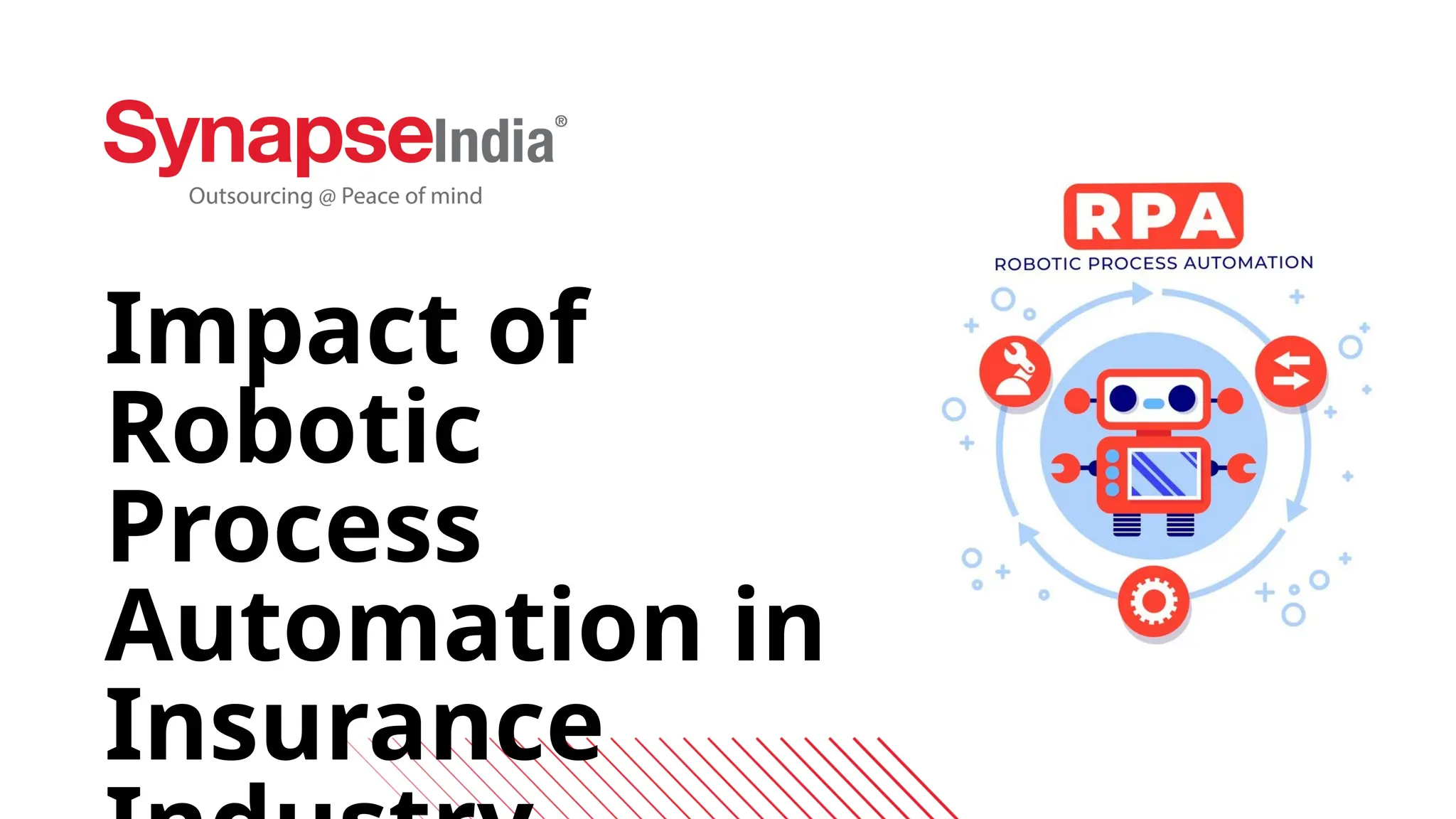
Impact of
Robotic
Process
Automation in
Insurance
TABLE OF CONTENT
• Introduction to RPA in
Insurance
• Key Benefits of RPA in
Insurance
• Use Cases of RPA in Insurance
Introduction to RPA in
Insurance
• RPA is the use of software bots to
automate repetitive tasks.
• It enhances operational efficiency by
reducing manual intervention.
• RPA In the insurance sector, streamlines
processes such as data entry, claims
processing, and compliance.
Key Benefits of RPA
in Insurance
• Improved Efficiency: Automates time-
consuming tasks, speeding up
processes.
• Reduced Errors: Minimizes human
errors, enhancing data accuracy.
• Cost Reduction: Decreases operational
costs by automating repetitive tasks.
• Better Compliance: Ensures regulatory
adherence through automated data
Use Cases of RPA in
Insurance
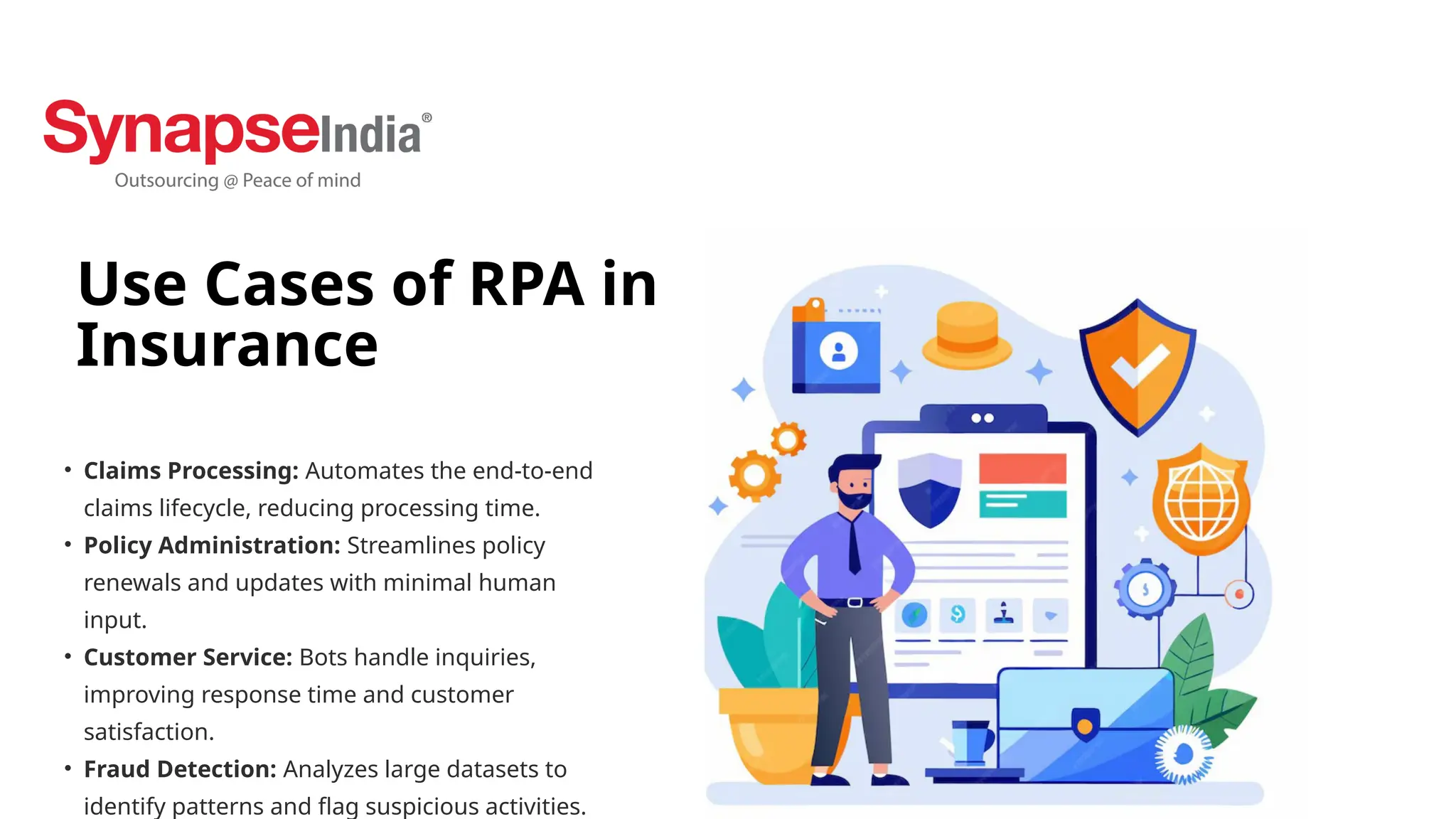
• Claims Processing: Automates the end-to-end
claims lifecycle, reducing processing time.
• Policy Administration: Streamlines policy
renewals and updates with minimal human
input.
• Customer Service: Bots handle inquiries,
improving response time and customer
satisfaction.
• Fraud Detection: Analyzes large datasets to
identify patterns and flag suspicious activities.
How RPA Transforms
the Workforce
• Focus on Higher-Value Tasks: Employees can
shift focus to strategic roles, such as customer
relations.
• Increased Job Satisfaction: Eliminating
mundane tasks boosts employee morale and
engagement.
• Collaboration with RPA: Bots and humans
work together to drive productivity.
Challenges in
Implementing RPA
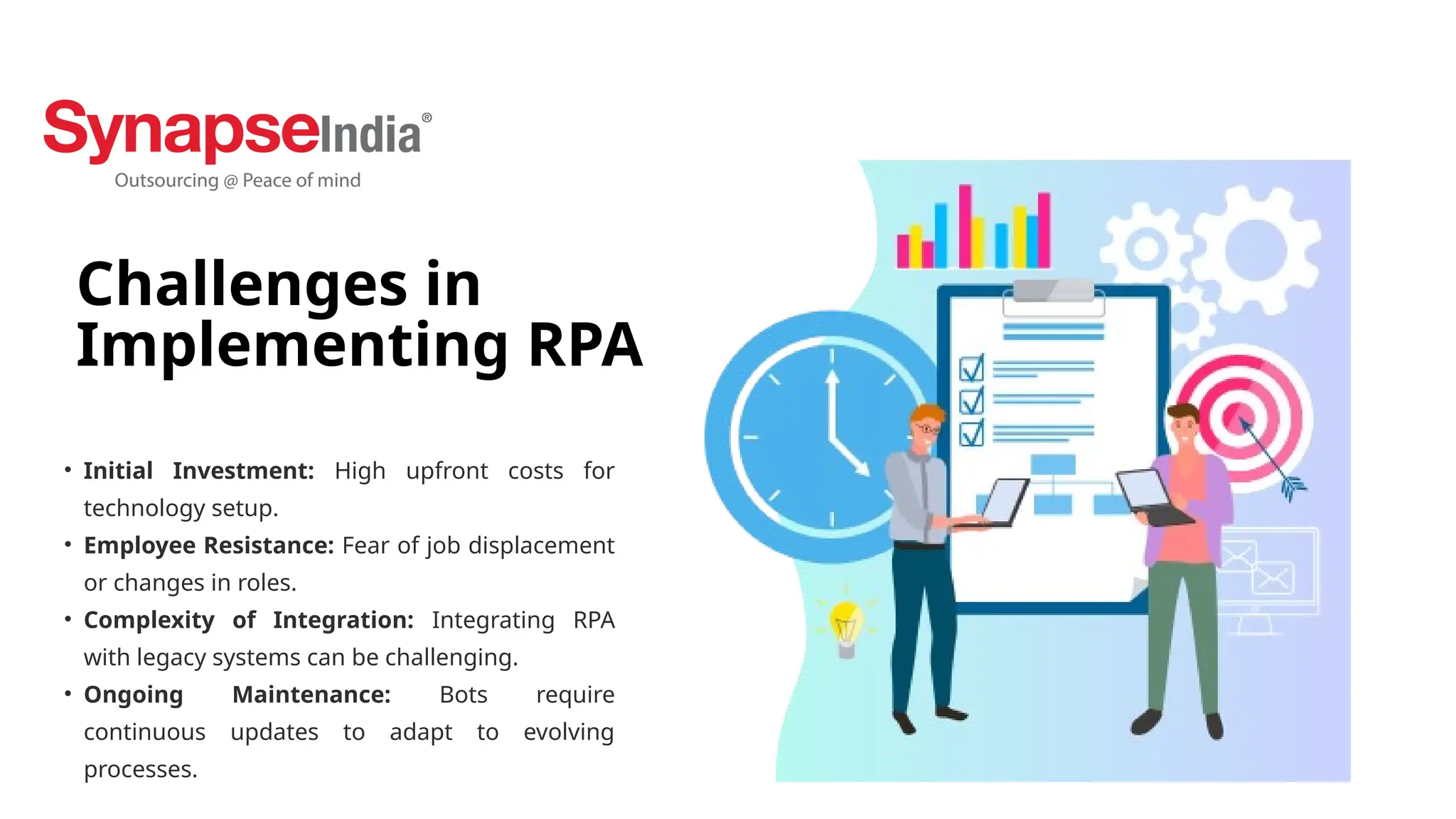
• Initial Investment: High upfront costs for
technology setup.
• Employee Resistance: Fear of job displacement
or changes in roles.
• Complexity of Integration: Integrating RPA
with legacy systems can be challenging.
• Ongoing Maintenance: Bots require
continuous updates to adapt to evolving
processes.
Future of RPA in
Insurance
• AI Integration: Combining RPA with AI for
smarter automation, such as predictive analytics
for underwriting.
• Scalability: More processes across insurance
companies will adopt automation.
• Enhanced Customer Experience: Faster, more
accurate service will be a priority for customer
retention.
• Data-Driven Decision Making: RPA will aid in
extracting insights from large volumes of
Conclusion
• The insurance industry is undergoing a digital
transformation, with RPA at its core.
• Early adoption of RPA can lead to better
efficiency, lower costs, and improved customer
service.
Contact
Us
+1855796277
3
info@synapseindia.co
m
rpa.synapseindia.c
om

Automate Insurance Processes with Industry-Specific RPA

  • 1.
  • 2.
    TABLE OF CONTENT •Introduction to RPA in Insurance • Key Benefits of RPA in Insurance • Use Cases of RPA in Insurance
  • 3.
    Introduction to RPAin Insurance • RPA is the use of software bots to automate repetitive tasks. • It enhances operational efficiency by reducing manual intervention. • RPA In the insurance sector, streamlines processes such as data entry, claims processing, and compliance.
  • 4.
    Key Benefits ofRPA in Insurance • Improved Efficiency: Automates time- consuming tasks, speeding up processes. • Reduced Errors: Minimizes human errors, enhancing data accuracy. • Cost Reduction: Decreases operational costs by automating repetitive tasks. • Better Compliance: Ensures regulatory adherence through automated data
  • 5.
    Use Cases ofRPA in Insurance • Claims Processing: Automates the end-to-end claims lifecycle, reducing processing time. • Policy Administration: Streamlines policy renewals and updates with minimal human input. • Customer Service: Bots handle inquiries, improving response time and customer satisfaction. • Fraud Detection: Analyzes large datasets to identify patterns and flag suspicious activities.
  • 6.
    How RPA Transforms theWorkforce • Focus on Higher-Value Tasks: Employees can shift focus to strategic roles, such as customer relations. • Increased Job Satisfaction: Eliminating mundane tasks boosts employee morale and engagement. • Collaboration with RPA: Bots and humans work together to drive productivity.
  • 7.
    Challenges in Implementing RPA •Initial Investment: High upfront costs for technology setup. • Employee Resistance: Fear of job displacement or changes in roles. • Complexity of Integration: Integrating RPA with legacy systems can be challenging. • Ongoing Maintenance: Bots require continuous updates to adapt to evolving processes.
  • 8.
    Future of RPAin Insurance • AI Integration: Combining RPA with AI for smarter automation, such as predictive analytics for underwriting. • Scalability: More processes across insurance companies will adopt automation. • Enhanced Customer Experience: Faster, more accurate service will be a priority for customer retention. • Data-Driven Decision Making: RPA will aid in extracting insights from large volumes of
  • 9.
    Conclusion • The insuranceindustry is undergoing a digital transformation, with RPA at its core. • Early adoption of RPA can lead to better efficiency, lower costs, and improved customer service.
  • 10.