• M Nauman = 19
• Usman Haider = 20
• Rai Amad Ud Din = 28
• Bassam Saleem = 33
• Haroon = 07(ch-o6)
Sharif college of engineering and Techonolgy
AUTO-CATALYTIC REACTION
Presentation topic:
Auto catalytic reactions
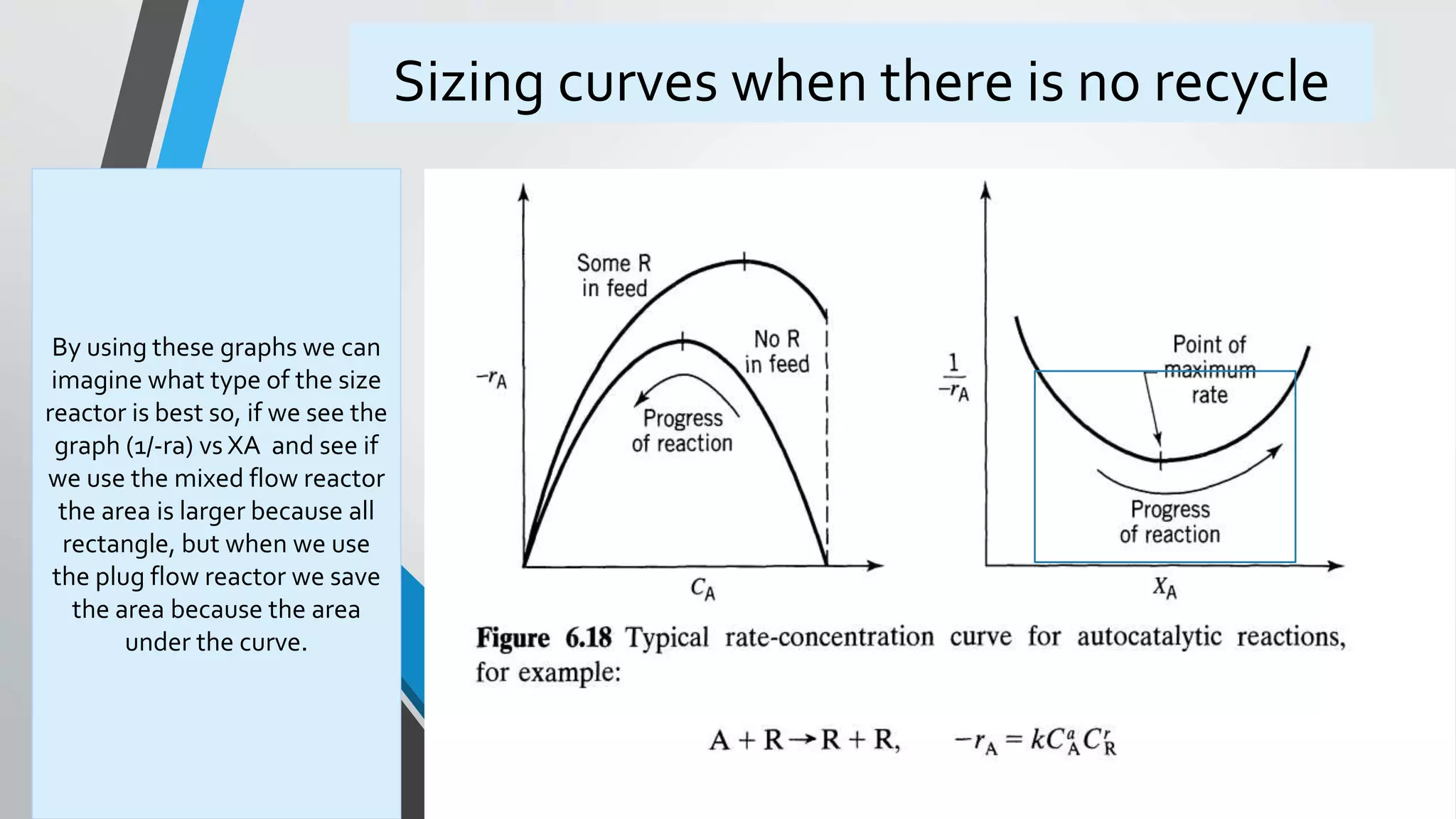
Introduction:In an autocatalytic reaction, however the rate at the start
is low because little product is present; it increases to a maximum as
product is formed and then drops again to a low value as reactant is
consumed. Figure 6.18 shows a typical situation.Reactions with such
rate-concentration curves lead to interesting optimization problems. In
addition, they provide a good illustration of the general design method
presented in this chapter. For these reasons let us examine these
reactions in some detail. In our approach we deal exclusively with their
1/(r,) versus X, curves with their characteristic minim.
In autocatalyst reaction, the product which is formed acts as
catalyst and it increase the rate of reaction, we cannot add any
external catalyst
Example of autocatalyst reaction
The most important examples of autocatalytic reactions are the broad class of
fermentation reactions which result from the reaction of microorganism on an organic
feed. When they can be treated as single reactions, the methods of this chapter can be
applied directly. Another type of reaction which has autocatalytic behavior is the
exothermic reaction (say, the combustion of fuel gas) proceeding in an adiabatic
manner with cool reactants entering the system. In such a reaction, called autothermal,
heat may be considered to be the product which sustains the reaction. Thus, with plug
flow the reaction will die. With back mixing the reaction will be self-sustaining because
the heat generated by the reaction can raise fresh reactants to a temperature at which
they will react.
Design equation
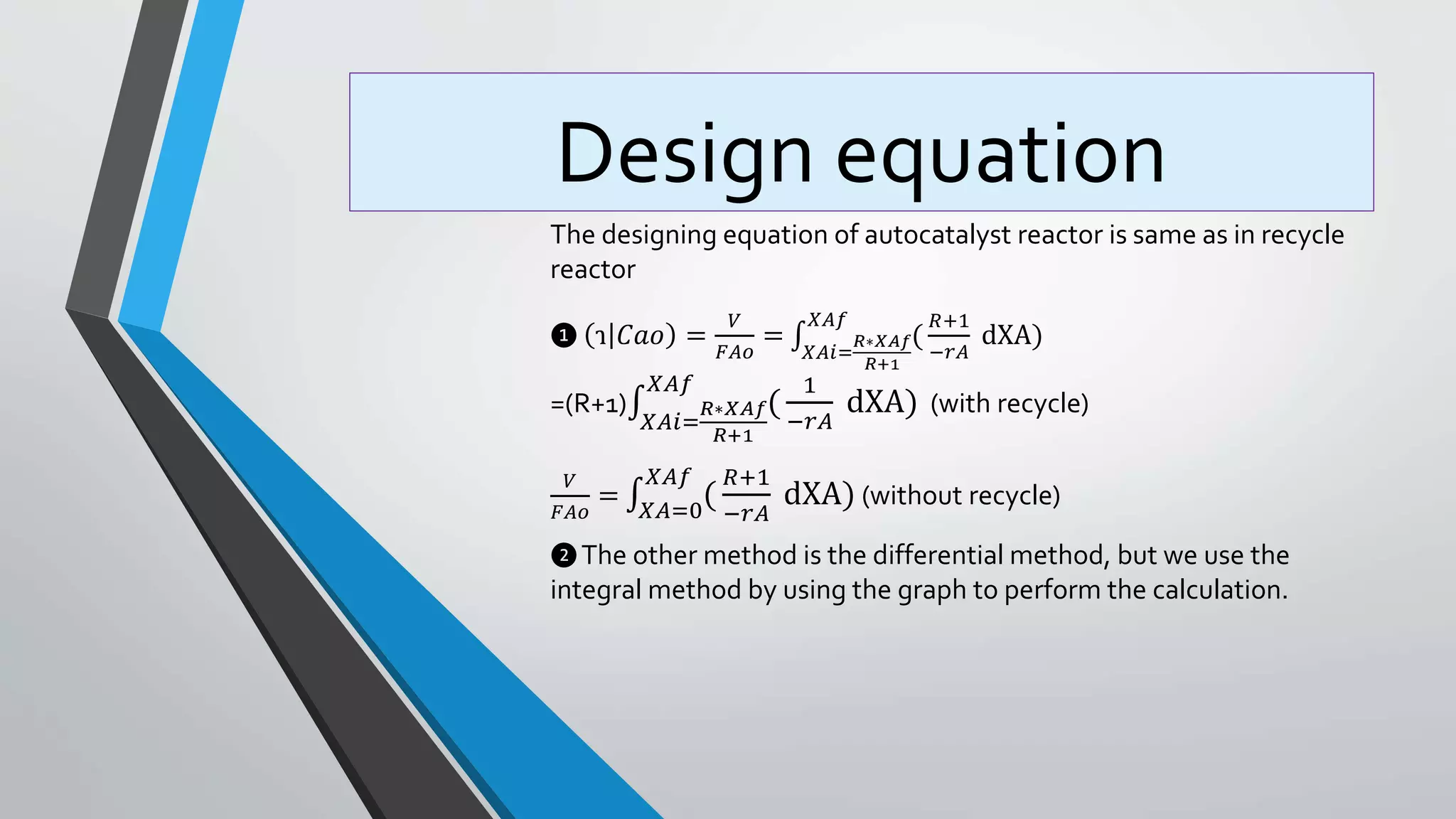
The designing equation of autocatalyst reactor is same as in recycle
reactor
❶ ɿ 𝐶𝑎𝑜 =
𝑉
𝐹𝐴𝑜
=
𝑋𝐴𝑖=
𝑅∗𝑋𝐴𝑓
𝑅+1
𝑋𝐴𝑓
(
𝑅+1
−𝑟𝐴
dXA)
=(R+1)
𝑋𝐴𝑖=
𝑅∗𝑋𝐴𝑓
𝑅+1
𝑋𝐴𝑓
(
1
−𝑟𝐴
dXA) (with recycle)
𝑉
𝐹𝐴𝑜
= 𝑋𝐴=0
𝑋𝐴𝑓
(
𝑅+1
−𝑟𝐴
dXA) (without recycle)
❷The other method is the differential method, but we use the
integral method by using the graph to perform the calculation.
Sizing curves when there is no recycle
By using these graphs we can
imagine what type of the size
reactor is best so, if we see the
graph (1/-ra) vs XA and see if
we use the mixed flow reactor
the area is larger because all
rectangle, but when we use
the plug flow reactor we save
the area because the area
under the curve.
Plug flowVersus mixed Flow
Reactor, No Recycle
For any particular rate concentration curve a comparison of areas in Fig. 6.19 will show
which reactor is superior (which requires a smaller volume) for a given job. We thus find
1. At low conversion the mixed reactor is superior to the plug flow reactor.
2. At high enough conversions the plug flow reactor is superior.
These findings differ from ordinary nth-order reactions (n > 0) where the plug flow reactor is
always more efficient than the mixed flow reactor. In addition, we should note that a plug
flow reactor will not operate at all with a feed of pure reactant. In such a situation the feed
must be continually primed with product, an ideal opportunity for using a recycle reactor.
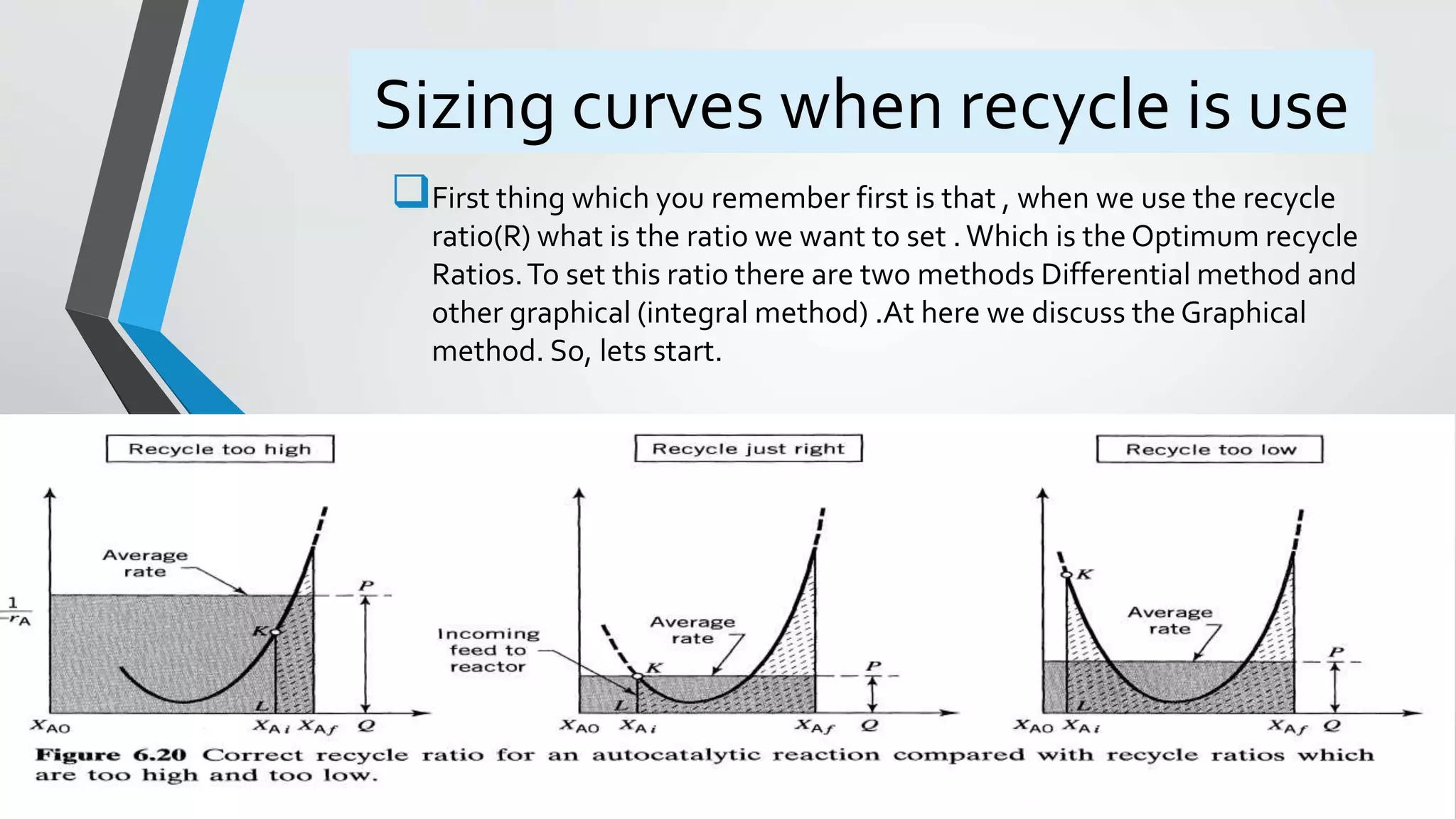
Sizing curves when recycle is use
First thing which you remember first is that , when we use the recycle
ratio(R) what is the ratio we want to set . Which is the Optimum recycle
Ratios.To set this ratio there are two methods Differential method and
other graphical (integral method) .At here we discuss the Graphical
method. So, lets start.
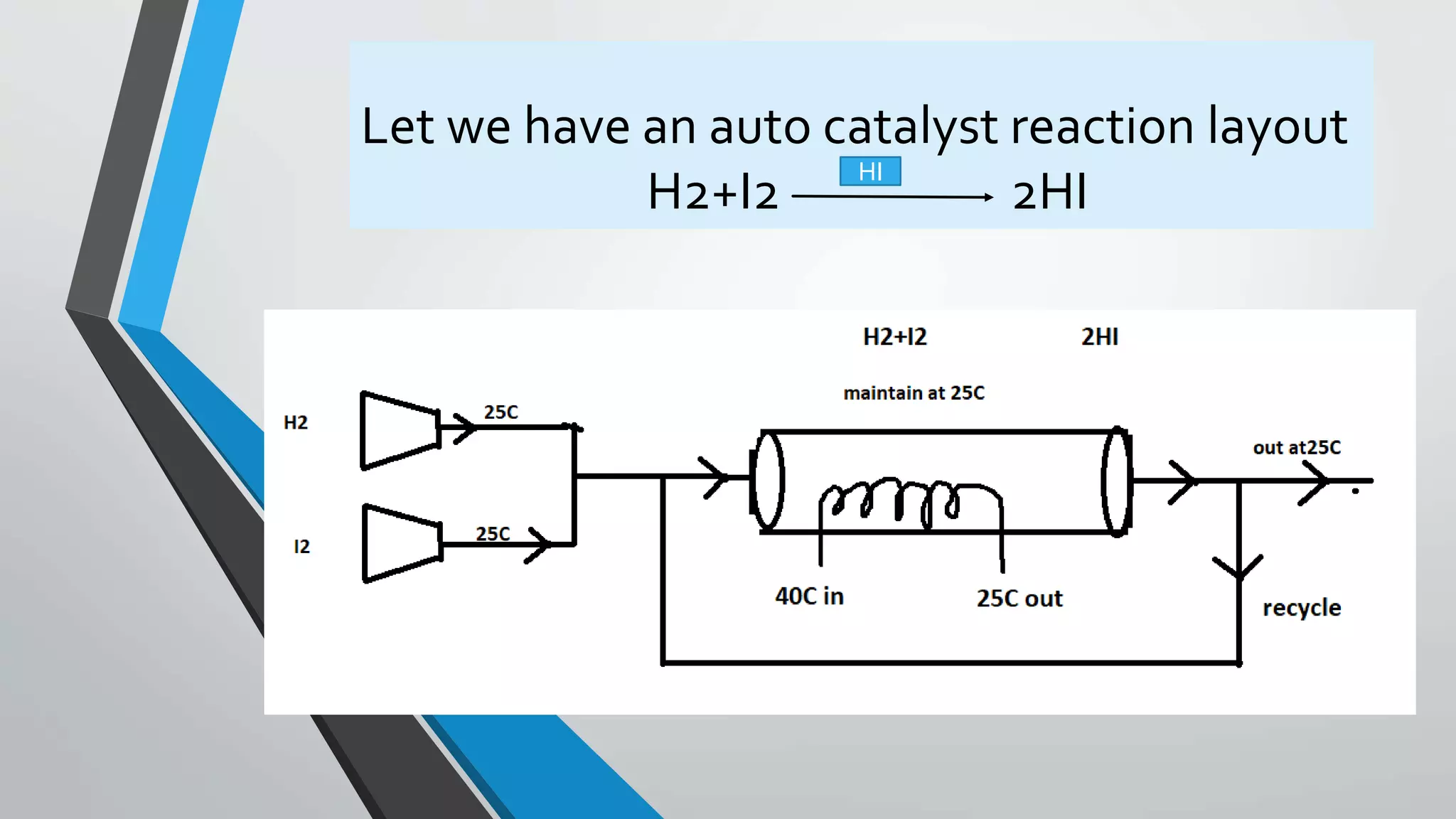
Let we have an auto catalyst reaction layout
H2+I2 2HI
HI
This is the elementry gas phase autocatalytic
reaction
So we first find the (Ea)
Ea =
𝑃𝑟𝑜𝑑𝑢𝑐𝑡 −𝑟𝑒𝑐𝑡𝑎𝑛𝑡𝑠
𝑟𝑒𝑐𝑡𝑎𝑛𝑡𝑠
=
2−2
1
= 0
Rate if reaction for autocatalytic reaction
-rH2= K[H2]*[I2]*[HI]^2
When we study the kinetics and calculate the values ,so we can see the
value of Ca and rate (-rH2) the table is given below.
Table and Graph (graph is sizing curve )
Ca Rate(-rH2) Xa=Cao-Ca/Cao (-1/rH2)
0.6 0.06 0.95 16.67
1.6 0.08 0.86 12.50
2.6 0.2 0.78 5.00
3.6 0.5 0.69 2.00
5.6 0.6 0.52 1.67
7.6 0.25 0.34 4.00
9.6 0.1 0.17 10.00
11.6 0.06 0.00 16.67
0.00
2.00
4.00
6.00
8.00
10.00
12.00
14.00
16.00
18.00
0.00 0.20 0.40 0.60 0.80 1.00
(-1/rH2)
Xa
Graph between Xa vs -1/rH2
How to set the production capacity
H2 I2 HI
2 253.8088 256.18
2/256.18 253.80/256.18 256.18/256.18
0.0079 0.99 1
1000* 0.0079 1000* 0.99 1000*1
7.9kg 990kg 1000kg
We find that our conversion is 0.95
7.9/0.95 990/0.95 1000kg
Basis : 1hr so,
8.31kg/hr 1042.2kg/hr 1000kg/hr (unreacted 50kg/hr)
4.155 mol/hr 4.155mol/hr 3.903mol/hr(unreacted 4.297)
8.31mol/hr
Case study
Case 1: If the molar flow of the rectants is (8.31 mol/hr) and we get the 95% conversion. What
is the volume of the reactor.(Cao=11.6mol/m3)
(a). If we use the mixed flow reactor.
(b). If we use the plug flow reactor.
solution:
(a):So if we use the mixed flow reactor area is the rectangle
ɿ= (0.95)*(16.6)= 15.77 hr
so in order to find volume (V)
ɿ
𝐶𝑎𝑜
=
𝑉
𝐹𝐴𝑜
V=11.29m3 (mixed flow)
0.00
2.00
4.00
6.00
8.00
10.00
12.00
14.00
16.00
18.00
0.00 0.50 1.00
(-1/rH2)
Xa
Graph between Xa vs -
1/rH2
If we use the plug flow reactor
(b): if we use the plug flow reactor then the area under the curve
so, ɿ=Area under the curve= 6.62 hr
so find v
ɿ
𝐶𝑎𝑜
=
𝑉
𝐹𝐴𝑜
V= 4.74 m3(plug flow reactor)
So, by using the plug flow reactor we can use less volume as
Compared to mixed flow reactor.
Volumetric flow rate in case of mixed flow=V/ ɿ = 0.7159m3/hr
Volumertic flow rate in plug flow reactor=V/ ɿ=0.716m3/hr
0.00
2.00
4.00
6.00
8.00
10.00
12.00
14.00
16.00
18.00
0.00 0.50 1.00
(-1/rH2)
Xa
Graph between Xa vs -
1/rH2
Case 2: If we used the plug flow reactor and recycle is
used then what is the optimum recycle operation. At
what conversion the recycle is just right.
As we can discuss earlier that from the graph we see at what point the recycle is
good.
0.00
5.00
10.00
15.00
20.00
0.00 0.20 0.40 0.60 0.80 1.00
(-1/rH2)
Xa
Graph between Xa vs -1/rH2
0.00
5.00
10.00
15.00
20.00
0.00 0.20 0.40 0.60 0.80 1.00
(-1/rH2)
Xa
Graph between Xa vs -
1/rH2
0.00
5.00
10.00
15.00
20.00
0.00 0.20 0.40 0.60 0.80 1.00
(-1/rH2)
Xa
Graph between Xa vs -
1/rH2
P
Q
L
M
PQ>LM so recycle is no
suitable(recycle to high)
PQ<LM so recycle is no
suitable(recycle to small)
P
Q
L
M
PL
M
PQ=LM so recycle is just
right at conversion 0.30
Q
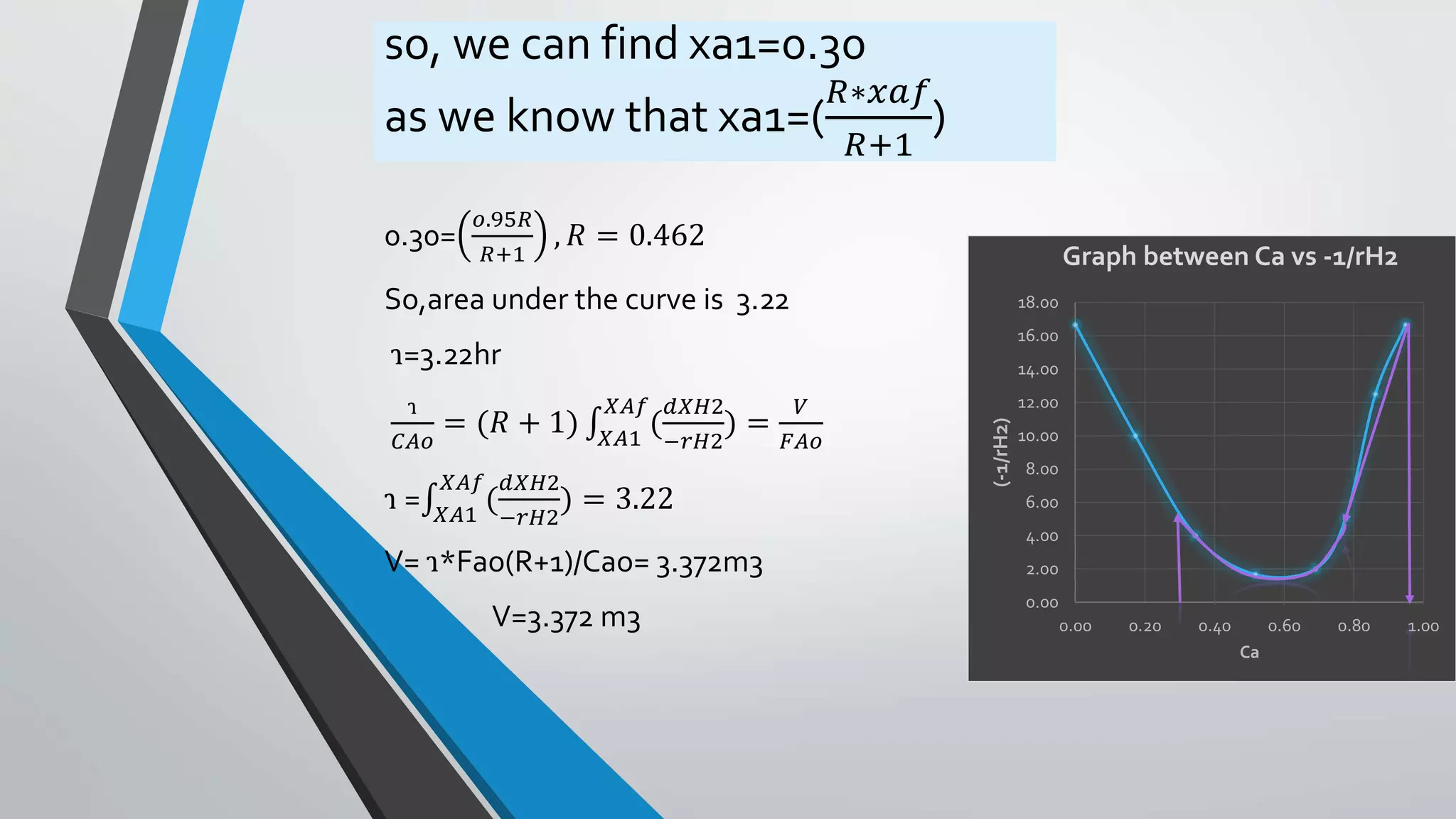
so, we can find xa1=0.30
as we know that xa1=(
𝑅∗𝑥𝑎𝑓
𝑅+1
)
0.30=
𝑜.95𝑅
𝑅+1
, 𝑅 = 0.462
So,area under the curve is 3.22
ɿ=3.22hr
ɿ
𝐶𝐴𝑜
= (𝑅 + 1) 𝑋𝐴1
𝑋𝐴𝑓
(
𝑑𝑋𝐻2
−𝑟𝐻2
) =
𝑉
𝐹𝐴𝑜
ɿ = 𝑋𝐴1
𝑋𝐴𝑓
(
𝑑𝑋𝐻2
−𝑟𝐻2
) = 3.22
V= ɿ*Fao(R+1)/Cao= 3.372m3
V=3.372 m3
0.00
2.00
4.00
6.00
8.00
10.00
12.00
14.00
16.00
18.00
0.00 0.20 0.40 0.60 0.80 1.00
(-1/rH2)
Ca
Graph between Ca vs -1/rH2
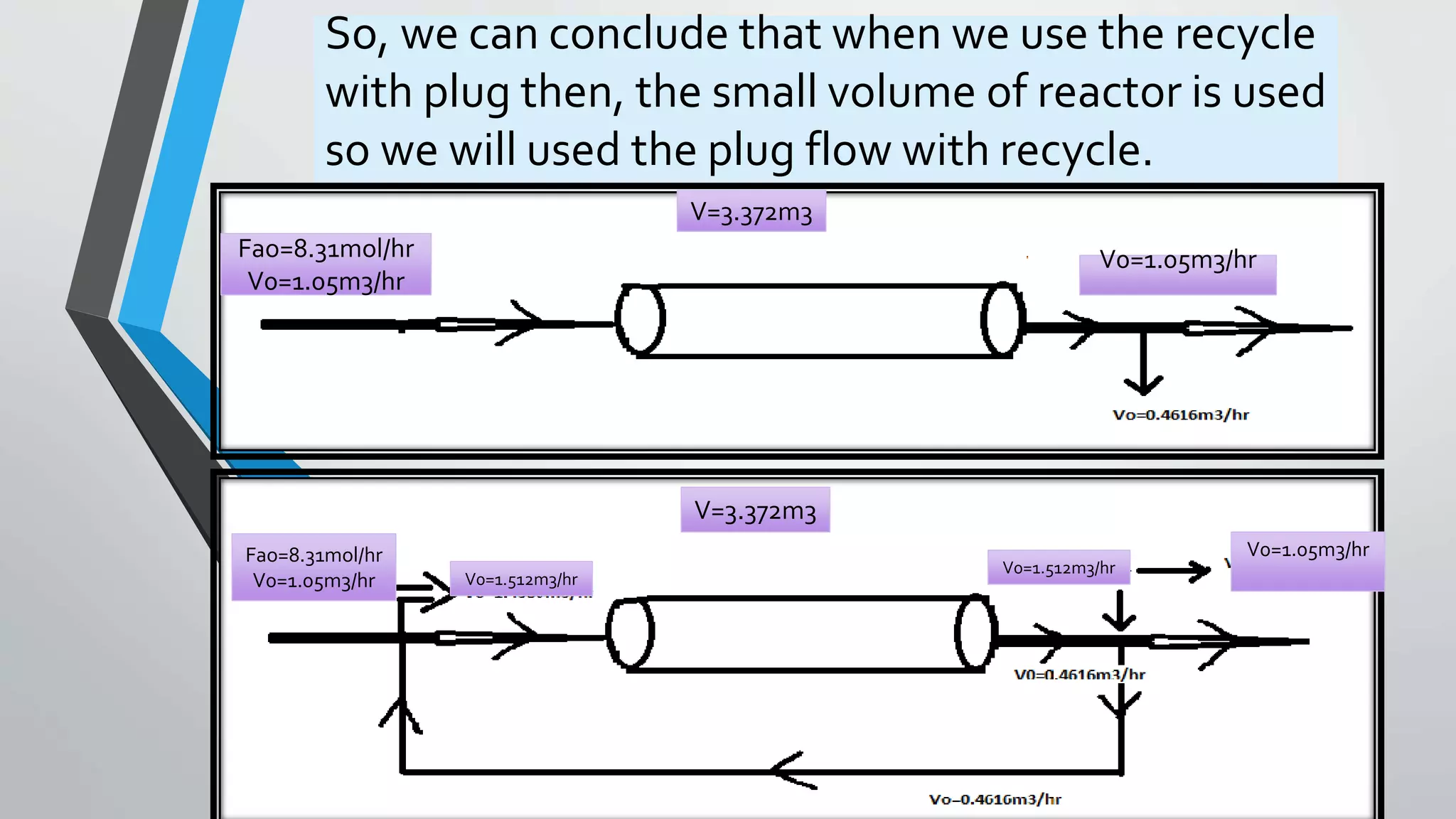
So, we can conclude that when we use the recycle
with plug then, the small volume of reactor is used
so we will used the plug flow with recycle.
Fao=8.31mol/hr
V0=1.05m3/hr
V=3.372m3
V0=1.05m3/hr
Fao=8.31mol/hr
V0=1.05m3/hr V0=1.512m3/hr
V=3.372m3
V0=1.05m3/hr
V0=1.512m3/hr
Height of Plug Flow reactor
• V=3.14*d^2*(length)
d=0.2m ,V=3.372m3 Height of plug flow reactor=26.976m
3.372=3.14*0.2^2*(l)
Height=26.976m
D=0.2m
Energy balance
Reaction:
H2+I2 2HI
Enthalpy of reaction= Heat formation of product - Heat formation of reactant
=650 - 325
=325kj/mol
I2H2
Q=Enthalpy of reaction*0.95=325*0.95 =308.75kj/mol (Heat of reaction)
General Balance Equation:
Heat in + Heat generation - heat out =0( For steady state)
Heat in by reactant + Heat in by coolant + heat of reaction -Heat out by coolant-Heat out by
product=0
mcP(T2-T1) + mcP(T2-T1) + 308.75kj/mol - mcP(T2-T1) - mcP(T2-T1)=0
As temperature in and out are same so heat in by reactant and product will be zero
0 +mcP (25-40) +308.75kj/mol -0 =0
(-438.75)*m +308.75=0
m= -308.75/-438.75
m= 0.703kg/hr
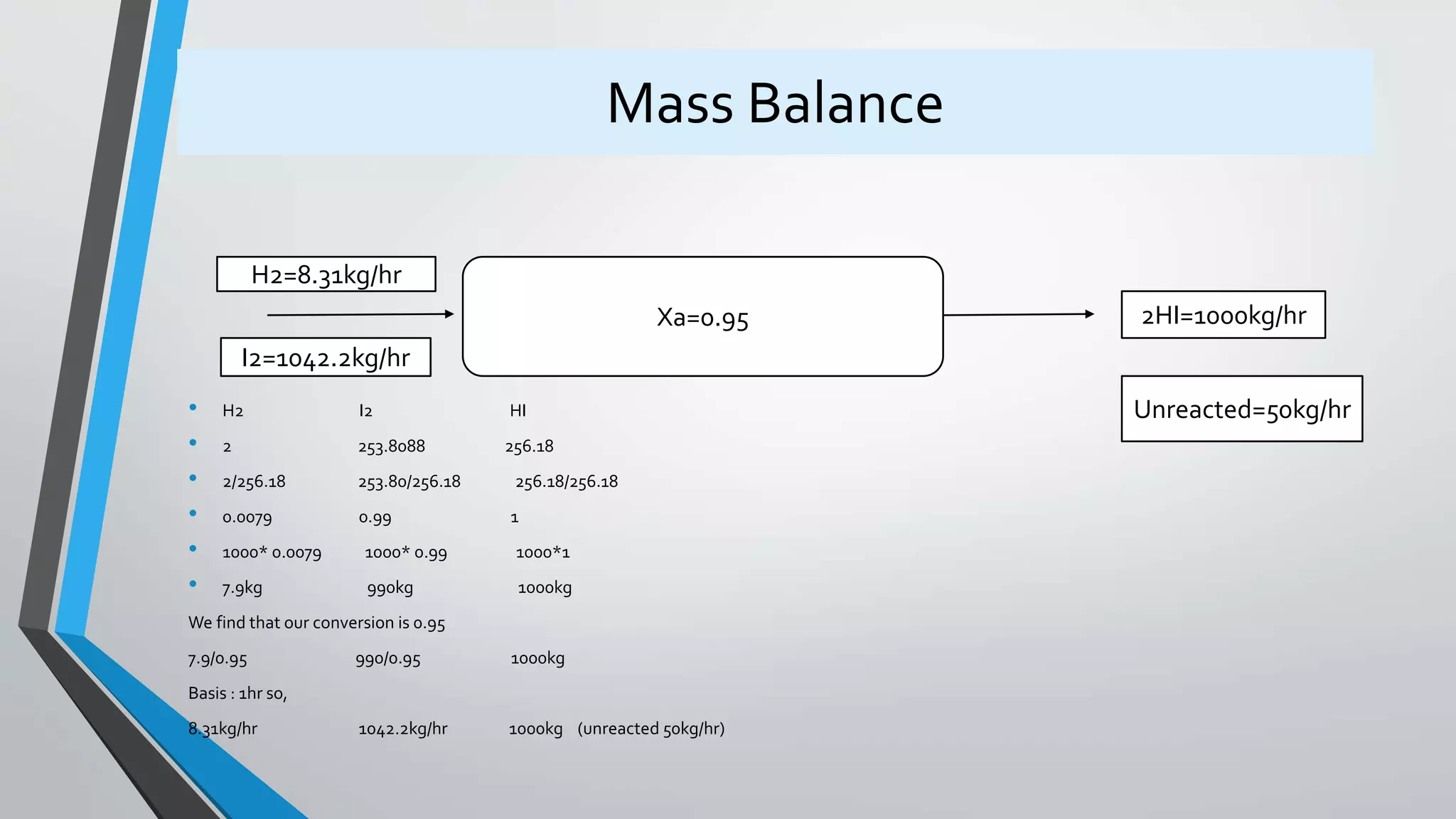
Mass Balance
• H2 I2 HI
• 2 253.8088 256.18
• 2/256.18 253.80/256.18 256.18/256.18
• 0.0079 0.99 1
• 1000* 0.0079 1000* 0.99 1000*1
• 7.9kg 990kg 1000kg
We find that our conversion is 0.95
7.9/0.95 990/0.95 1000kg
Basis : 1hr so,
8.31kg/hr 1042.2kg/hr 1000kg (unreacted 50kg/hr)
Xa=0.95
H2=8.31kg/hr
I2=1042.2kg/hr
2HI=1000kg/hr
Unreacted=50kg/hr
Advantage and Disadvantage
• Re-usable • Can be toxic
• Less energy is used so low
temperature and pressure
can be used to carry out
chemical reaction
• Can be poisoned by waste
product
• Low production cost – can
be used at low temperature
• They often need to be
removed from a product
and cleaned
• Can speed up reaction • Can be ruined by impurities
so they stopped working
THANKYOU !!!!!!

Auto catalytic reactions presentation

  • 1.
    • M Nauman= 19 • Usman Haider = 20 • Rai Amad Ud Din = 28 • Bassam Saleem = 33 • Haroon = 07(ch-o6) Sharif college of engineering and Techonolgy
  • 2.
  • 3.
    Auto catalytic reactions Introduction:Inan autocatalytic reaction, however the rate at the start is low because little product is present; it increases to a maximum as product is formed and then drops again to a low value as reactant is consumed. Figure 6.18 shows a typical situation.Reactions with such rate-concentration curves lead to interesting optimization problems. In addition, they provide a good illustration of the general design method presented in this chapter. For these reasons let us examine these reactions in some detail. In our approach we deal exclusively with their 1/(r,) versus X, curves with their characteristic minim. In autocatalyst reaction, the product which is formed acts as catalyst and it increase the rate of reaction, we cannot add any external catalyst
  • 4.
    Example of autocatalystreaction The most important examples of autocatalytic reactions are the broad class of fermentation reactions which result from the reaction of microorganism on an organic feed. When they can be treated as single reactions, the methods of this chapter can be applied directly. Another type of reaction which has autocatalytic behavior is the exothermic reaction (say, the combustion of fuel gas) proceeding in an adiabatic manner with cool reactants entering the system. In such a reaction, called autothermal, heat may be considered to be the product which sustains the reaction. Thus, with plug flow the reaction will die. With back mixing the reaction will be self-sustaining because the heat generated by the reaction can raise fresh reactants to a temperature at which they will react.
  • 5.
    Design equation The designingequation of autocatalyst reactor is same as in recycle reactor ❶ ɿ 𝐶𝑎𝑜 = 𝑉 𝐹𝐴𝑜 = 𝑋𝐴𝑖= 𝑅∗𝑋𝐴𝑓 𝑅+1 𝑋𝐴𝑓 ( 𝑅+1 −𝑟𝐴 dXA) =(R+1) 𝑋𝐴𝑖= 𝑅∗𝑋𝐴𝑓 𝑅+1 𝑋𝐴𝑓 ( 1 −𝑟𝐴 dXA) (with recycle) 𝑉 𝐹𝐴𝑜 = 𝑋𝐴=0 𝑋𝐴𝑓 ( 𝑅+1 −𝑟𝐴 dXA) (without recycle) ❷The other method is the differential method, but we use the integral method by using the graph to perform the calculation.
  • 6.
    Sizing curves whenthere is no recycle By using these graphs we can imagine what type of the size reactor is best so, if we see the graph (1/-ra) vs XA and see if we use the mixed flow reactor the area is larger because all rectangle, but when we use the plug flow reactor we save the area because the area under the curve.
  • 7.
    Plug flowVersus mixedFlow Reactor, No Recycle For any particular rate concentration curve a comparison of areas in Fig. 6.19 will show which reactor is superior (which requires a smaller volume) for a given job. We thus find 1. At low conversion the mixed reactor is superior to the plug flow reactor. 2. At high enough conversions the plug flow reactor is superior. These findings differ from ordinary nth-order reactions (n > 0) where the plug flow reactor is always more efficient than the mixed flow reactor. In addition, we should note that a plug flow reactor will not operate at all with a feed of pure reactant. In such a situation the feed must be continually primed with product, an ideal opportunity for using a recycle reactor.
  • 8.
    Sizing curves whenrecycle is use First thing which you remember first is that , when we use the recycle ratio(R) what is the ratio we want to set . Which is the Optimum recycle Ratios.To set this ratio there are two methods Differential method and other graphical (integral method) .At here we discuss the Graphical method. So, lets start.
  • 9.
    Let we havean auto catalyst reaction layout H2+I2 2HI HI
  • 10.
    This is theelementry gas phase autocatalytic reaction So we first find the (Ea) Ea = 𝑃𝑟𝑜𝑑𝑢𝑐𝑡 −𝑟𝑒𝑐𝑡𝑎𝑛𝑡𝑠 𝑟𝑒𝑐𝑡𝑎𝑛𝑡𝑠 = 2−2 1 = 0 Rate if reaction for autocatalytic reaction -rH2= K[H2]*[I2]*[HI]^2 When we study the kinetics and calculate the values ,so we can see the value of Ca and rate (-rH2) the table is given below.
  • 11.
    Table and Graph(graph is sizing curve ) Ca Rate(-rH2) Xa=Cao-Ca/Cao (-1/rH2) 0.6 0.06 0.95 16.67 1.6 0.08 0.86 12.50 2.6 0.2 0.78 5.00 3.6 0.5 0.69 2.00 5.6 0.6 0.52 1.67 7.6 0.25 0.34 4.00 9.6 0.1 0.17 10.00 11.6 0.06 0.00 16.67 0.00 2.00 4.00 6.00 8.00 10.00 12.00 14.00 16.00 18.00 0.00 0.20 0.40 0.60 0.80 1.00 (-1/rH2) Xa Graph between Xa vs -1/rH2
  • 12.
    How to setthe production capacity H2 I2 HI 2 253.8088 256.18 2/256.18 253.80/256.18 256.18/256.18 0.0079 0.99 1 1000* 0.0079 1000* 0.99 1000*1 7.9kg 990kg 1000kg We find that our conversion is 0.95 7.9/0.95 990/0.95 1000kg Basis : 1hr so, 8.31kg/hr 1042.2kg/hr 1000kg/hr (unreacted 50kg/hr) 4.155 mol/hr 4.155mol/hr 3.903mol/hr(unreacted 4.297) 8.31mol/hr
  • 13.
    Case study Case 1:If the molar flow of the rectants is (8.31 mol/hr) and we get the 95% conversion. What is the volume of the reactor.(Cao=11.6mol/m3) (a). If we use the mixed flow reactor. (b). If we use the plug flow reactor. solution: (a):So if we use the mixed flow reactor area is the rectangle ɿ= (0.95)*(16.6)= 15.77 hr so in order to find volume (V) ɿ 𝐶𝑎𝑜 = 𝑉 𝐹𝐴𝑜 V=11.29m3 (mixed flow) 0.00 2.00 4.00 6.00 8.00 10.00 12.00 14.00 16.00 18.00 0.00 0.50 1.00 (-1/rH2) Xa Graph between Xa vs - 1/rH2
  • 14.
    If we usethe plug flow reactor (b): if we use the plug flow reactor then the area under the curve so, ɿ=Area under the curve= 6.62 hr so find v ɿ 𝐶𝑎𝑜 = 𝑉 𝐹𝐴𝑜 V= 4.74 m3(plug flow reactor) So, by using the plug flow reactor we can use less volume as Compared to mixed flow reactor. Volumetric flow rate in case of mixed flow=V/ ɿ = 0.7159m3/hr Volumertic flow rate in plug flow reactor=V/ ɿ=0.716m3/hr 0.00 2.00 4.00 6.00 8.00 10.00 12.00 14.00 16.00 18.00 0.00 0.50 1.00 (-1/rH2) Xa Graph between Xa vs - 1/rH2
  • 15.
    Case 2: Ifwe used the plug flow reactor and recycle is used then what is the optimum recycle operation. At what conversion the recycle is just right. As we can discuss earlier that from the graph we see at what point the recycle is good. 0.00 5.00 10.00 15.00 20.00 0.00 0.20 0.40 0.60 0.80 1.00 (-1/rH2) Xa Graph between Xa vs -1/rH2 0.00 5.00 10.00 15.00 20.00 0.00 0.20 0.40 0.60 0.80 1.00 (-1/rH2) Xa Graph between Xa vs - 1/rH2 0.00 5.00 10.00 15.00 20.00 0.00 0.20 0.40 0.60 0.80 1.00 (-1/rH2) Xa Graph between Xa vs - 1/rH2 P Q L M PQ>LM so recycle is no suitable(recycle to high) PQ<LM so recycle is no suitable(recycle to small) P Q L M PL M PQ=LM so recycle is just right at conversion 0.30 Q
  • 16.
    so, we canfind xa1=0.30 as we know that xa1=( 𝑅∗𝑥𝑎𝑓 𝑅+1 ) 0.30= 𝑜.95𝑅 𝑅+1 , 𝑅 = 0.462 So,area under the curve is 3.22 ɿ=3.22hr ɿ 𝐶𝐴𝑜 = (𝑅 + 1) 𝑋𝐴1 𝑋𝐴𝑓 ( 𝑑𝑋𝐻2 −𝑟𝐻2 ) = 𝑉 𝐹𝐴𝑜 ɿ = 𝑋𝐴1 𝑋𝐴𝑓 ( 𝑑𝑋𝐻2 −𝑟𝐻2 ) = 3.22 V= ɿ*Fao(R+1)/Cao= 3.372m3 V=3.372 m3 0.00 2.00 4.00 6.00 8.00 10.00 12.00 14.00 16.00 18.00 0.00 0.20 0.40 0.60 0.80 1.00 (-1/rH2) Ca Graph between Ca vs -1/rH2
  • 17.
    So, we canconclude that when we use the recycle with plug then, the small volume of reactor is used so we will used the plug flow with recycle. Fao=8.31mol/hr V0=1.05m3/hr V=3.372m3 V0=1.05m3/hr Fao=8.31mol/hr V0=1.05m3/hr V0=1.512m3/hr V=3.372m3 V0=1.05m3/hr V0=1.512m3/hr
  • 18.
    Height of PlugFlow reactor • V=3.14*d^2*(length) d=0.2m ,V=3.372m3 Height of plug flow reactor=26.976m 3.372=3.14*0.2^2*(l) Height=26.976m D=0.2m
  • 19.
    Energy balance Reaction: H2+I2 2HI Enthalpyof reaction= Heat formation of product - Heat formation of reactant =650 - 325 =325kj/mol I2H2
  • 20.
    Q=Enthalpy of reaction*0.95=325*0.95=308.75kj/mol (Heat of reaction) General Balance Equation: Heat in + Heat generation - heat out =0( For steady state) Heat in by reactant + Heat in by coolant + heat of reaction -Heat out by coolant-Heat out by product=0 mcP(T2-T1) + mcP(T2-T1) + 308.75kj/mol - mcP(T2-T1) - mcP(T2-T1)=0 As temperature in and out are same so heat in by reactant and product will be zero 0 +mcP (25-40) +308.75kj/mol -0 =0 (-438.75)*m +308.75=0 m= -308.75/-438.75 m= 0.703kg/hr
  • 21.
    Mass Balance • H2I2 HI • 2 253.8088 256.18 • 2/256.18 253.80/256.18 256.18/256.18 • 0.0079 0.99 1 • 1000* 0.0079 1000* 0.99 1000*1 • 7.9kg 990kg 1000kg We find that our conversion is 0.95 7.9/0.95 990/0.95 1000kg Basis : 1hr so, 8.31kg/hr 1042.2kg/hr 1000kg (unreacted 50kg/hr) Xa=0.95 H2=8.31kg/hr I2=1042.2kg/hr 2HI=1000kg/hr Unreacted=50kg/hr
  • 22.
    Advantage and Disadvantage •Re-usable • Can be toxic • Less energy is used so low temperature and pressure can be used to carry out chemical reaction • Can be poisoned by waste product • Low production cost – can be used at low temperature • They often need to be removed from a product and cleaned • Can speed up reaction • Can be ruined by impurities so they stopped working
  • 23.