Anti-money laundering and counter-terrorist financing measures in Australia – Mutual Evaluation Report – April 2015 1
Anti-money laundering and counter-
terrorist financing (AML/CFT)
measures in Australia
Fourth Round Mutual Evaluation
Key findings, ratings and priority actions
20 April 2015
www.fatf-gafi.org/topics/mutualevaluations/documents/mer-australia-2015.html
Anti-money laundering and counter-terrorist financing measures in Australia – Mutual Evaluation Report – April 2015
Key findings
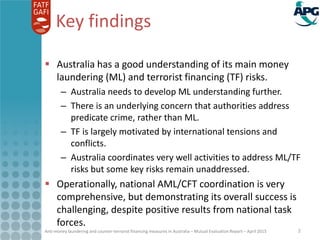
 Australia has a good understanding of its main money
laundering (ML) and terrorist financing (TF) risks.
– Australia needs to develop ML understanding further.
– There is an underlying concern that authorities address
predicate crime, rather than ML.
– TF is largely motivated by international tensions and
conflicts.
– Australia coordinates very well activities to address ML/TF
risks but some key risks remain unaddressed.
 Operationally, national AML/CFT coordination is very
comprehensive, but demonstrating its overall success is
challenging, despite positive results from national task
forces.
2
Anti-money laundering and counter-terrorist financing measures in Australia – Mutual Evaluation Report – April 2015
Key findings
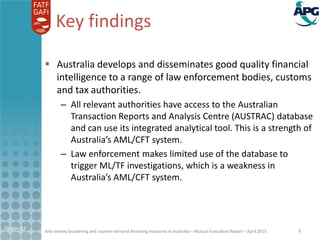
 Australia develops and disseminates good quality financial
intelligence to a range of law enforcement bodies, customs
and tax authorities.
– All relevant authorities have access to the Australian
Transaction Reports and Analysis Centre (AUSTRAC) database
and can use its integrated analytical tool. This is a strength of
Australia’s AML/CFT system.
– Law enforcement makes limited use of the database to
trigger ML/TF investigations, which is a weakness in
Australia’s AML/CFT system.
21-Apr-15 3
Anti-money laundering and counter-terrorist financing measures in Australia – Mutual Evaluation Report – April 2015
Key findings
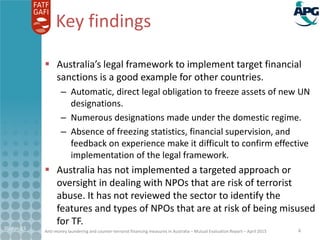
 Australia’s legal framework to implement target financial
sanctions is a good example for other countries.
– Automatic, direct legal obligation to freeze assets of new UN
designations.
– Numerous designations made under the domestic regime.
– Absence of freezing statistics, financial supervision, and
feedback on experience make it difficult to confirm effective
implementation of the legal framework.
 Australia has not implemented a targeted approach or
oversight in dealing with NPOs that are risk of terrorist
abuse. It has not reviewed the sector to identify the
features and types of NPOs that are at risk of being misused
for TF.
21-Apr-15 4
Anti-money laundering and counter-terrorist financing measures in Australia – Mutual Evaluation Report – April 2015
Key findings
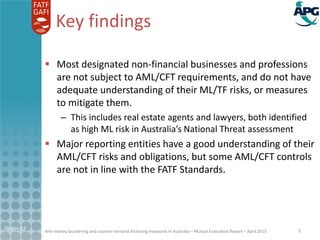
 Most designated non-financial businesses and professions
are not subject to AML/CFT requirements, and do not have
adequate understanding of their ML/TF risks, or measures
to mitigate them.
– This includes real estate agents and lawyers, both identified
as high ML risk in Australia’s National Threat assessment
 Major reporting entities have a good understanding of their
AML/CFT risks and obligations, but some AML/CFT controls
are not in line with the FATF Standards.
21-Apr-15 5
Anti-money laundering and counter-terrorist financing measures in Australia – Mutual Evaluation Report – April 2015
Key findings
 AUSTRAC supervision has a range of deficiencies.
– There is no supervision or regulation of most higher-risk
designated non-financial businesses and professions
because they are not subject to AML/CFT requirements.
– The authorities were unable to demonstrate that they are
improving AML/CFT compliance by reporting entities or
that they are successfully discouraging criminal abuse of
the financial and DNFBP sectors.
21-Apr-15 6
Anti-money laundering and counter-terrorist financing measures in Australia – Mutual Evaluation Report – April 2015
Key findings
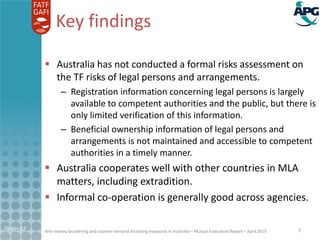
 Australia has not conducted a formal risks assessmenton
the TF risks of legal persons and arrangements.
– Registration information concerning legal persons is largely
available to competent authorities and the public, but there is
only limited verification of this information.
– Beneficial ownership information of legal persons and
arrangements is not maintained and accessible to competent
authorities in a timely manner.
 Australia cooperates well with other countries in MLA
matters, including extradition.
 Informal co-operation is generally good across agencies.
21-Apr-15 7
Anti-money laundering and counter-terrorist financing measures in Australia – Mutual Evaluation Report – April 2015
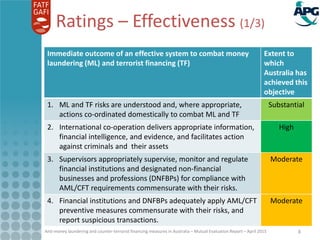
Ratings – Effectiveness (1/3)
8
Immediate outcome of an effective system to combat money
laundering (ML) and terroristfinancing (TF)
Extent to
which
Australia has
achieved this
objective
1. ML and TF risks are understood and, where appropriate,
actions co-ordinateddomesticallyto combat ML and TF
Substantial
2. International co-operationdelivers appropriateinformation,
financialintelligence,and evidence, and facilitatesaction
against criminals and their assets
High
3. Supervisors appropriatelysupervise, monitor and regulate
financialinstitutionsand designated non-financial
businesses and professions (DNFBPs) for compliancewith
AML/CFT requirements commensurate with their risks.
Moderate
4. Financialinstitutionsand DNFBPs adequatelyapplyAML/CFT
preventivemeasures commensurate with their risks, and
report suspicious transactions.
Moderate
Anti-money laundering and counter-terrorist financing measures in Australia – Mutual Evaluation Report – April 2015 9
Immediate outcome of an effective system to combat money
laundering (ML) and terroristfinancing (TF)
Extent to
which
Australia has
achieved this
objective
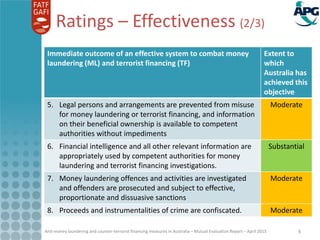
5. Legal persons and arrangements are prevented from misuse
for money launderingor terrorist financing, and information
on their beneficialownership is availableto competent
authorities without impediments
Moderate
6. Financialintelligenceand all other relevantinformation are
appropriatelyused by competent authorities for money
launderingand terrorist financing investigations.
Substantial
7. Money launderingoffences and activities are investigated
and offenders are prosecuted and subject to effective,
proportionateand dissuasive sanctions
Moderate
8. Proceeds and instrumentalitiesof crime are confiscated. Moderate
Ratings – Effectiveness (2/3)
Anti-money laundering and counter-terrorist financing measures in Australia – Mutual Evaluation Report – April 2015 10
Immediate outcome of an effective system to combat money
laundering (ML) and terroristfinancing (TF)
Extent to
which
Australia has
achieved this
objective
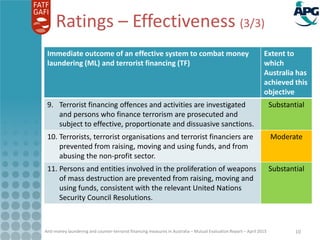
9. Terrorist financing offences and activities are investigated
and persons who finance terrorism are prosecuted and
subject to effective, proportionateand dissuasive sanctions.
Substantial
10. Terrorists, terrorist organisationsand terrorist financiers are
prevented from raising, moving and using funds, and from
abusing the non-profit sector.
Moderate
11. Persons and entities involvedin the proliferationof weapons
of mass destruction are preventedfrom raising, moving and
using funds, consistent with the relevantUnited Nations
Security CouncilResolutions.
Substantial
Ratings – Effectiveness (3/3)
Anti-money laundering and counter-terrorist financing measures in Australia – Mutual Evaluation Report – April 2015
21-Apr-15
11
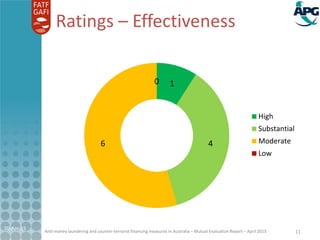
Ratings – Effectiveness
1
46
0
High
Substantial
Moderate
Low
21-Apr-15
12
Ratings – technical compliance
(1/5)
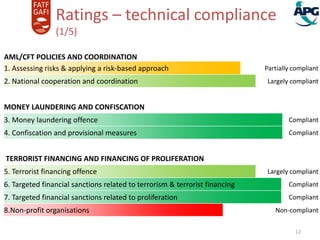
AML/CFT POLICIES AND COORDINATION
1. Assessing risks & applyinga risk-based approach Partially compliant
2. National cooperationand coordination Largely compliant
MONEY LAUNDERING AND CONFISCATION
3. Money launderingoffence Compliant
4. Confiscationand provisional measures Compliant
TERRORIST FINANCING AND FINANCING OF PROLIFERATION
5. Terrorist financingoffence Largely compliant
6. Targeted financialsanctions related to terrorism & terrorist financing Compliant
7. Targeted financialsanctions related to proliferation Compliant
8.Non-profit organisations Non-compliant
21-Apr-15
13
Ratings – technical compliance
(2/5)
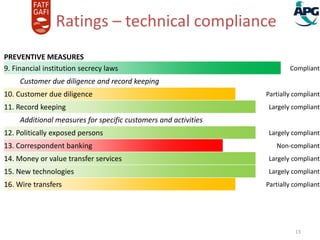
PREVENTIVE MEASURES
9. Financialinstitution secrecy laws Compliant
Customer due diligence and record keeping
10. Customer due diligence Partially compliant
11. Record keeping Largely compliant
Additional measures for specific customers and activities
12. Politicallyexposed persons Largely compliant
13. Correspondent banking Non-compliant
14. Money or value transfer services Largely compliant
15. New technologies Largely compliant
16. Wire transfers Partially compliant
21-Apr-15
14
Ratings – technical compliance
(3/5)
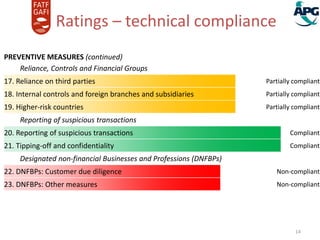
PREVENTIVE MEASURES (continued)
Reliance, Controls and Financial Groups
17. Relianceon third parties Partially compliant
18. Internal controls and foreign branches and subsidiaries Partially compliant
19. Higher-risk countries Partially compliant
Reporting of suspicious transactions
20. Reporting of suspicious transactions Compliant
21. Tipping-off and confidentiality Compliant
Designated non-financial Businesses and Professions (DNFBPs)
22. DNFBPs: Customer due diligence Non-compliant
23. DNFBPs: Other measures Non-compliant
21-Apr-15
15
Ratings – technical compliance
(4/5)
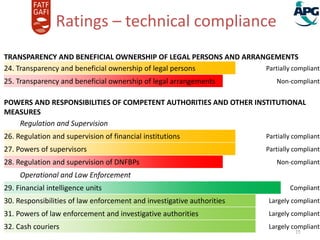
TRANSPARENCYAND BENEFICIAL OWNERSHIP OF LEGAL PERSONS AND ARRANGEMENTS
24. Transparencyand beneficialownership of legal persons Partially compliant
25. Transparencyand beneficialownership of legal arrangements Non-compliant
POWERS AND RESPONSIBILITIES OF COMPETENTAUTHORITIES AND OTHER INSTITUTIONAL
MEASURES
Regulation and Supervision
26. Regulationand supervision of financialinstitutions Partially compliant
27. Powers of supervisors Partially compliant
28. Regulationand supervision of DNFBPs Non-compliant
Operational and Law Enforcement
29. Financialintelligenceunits Compliant
30. Responsibilitiesof law enforcement and investigativeauthorities Largely compliant
31. Powers of law enforcement and investigativeauthorities Largely compliant
32. Cash couriers Largely compliant
21-Apr-15
16
Ratings – technical compliance
(5/5)
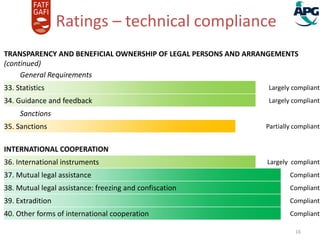
TRANSPARENCYAND BENEFICIAL OWNERSHIP OF LEGAL PERSONS AND ARRANGEMENTS
(continued)
General Requirements
33. Statistics Largely compliant
34. Guidance and feedback Largely compliant
Sanctions
35. Sanctions Partially compliant
INTERNATIONAL COOPERATION
36. International instruments Largely compliant
37. Mutuallegal assistance Compliant
38. Mutuallegal assistance: freezing and confiscation Compliant
39. Extradition Compliant
40. Other forms of international cooperation Compliant
Anti-money laundering and counter-terrorist financing measures in Australia – Mutual Evaluation Report – April 2015
21-Apr-15
17
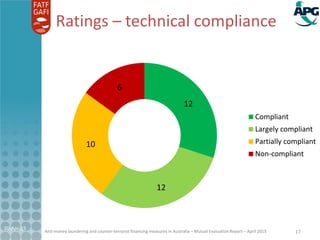
Ratings – technical compliance
12
12
10
6
Compliant
Largely compliant
Partially compliant
Non-compliant
Anti-money laundering and counter-terrorist financing measures in Australia – Mutual Evaluation Report – April 2015
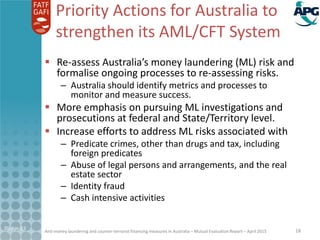
Priority Actions for Australia to
strengthen its AML/CFT System
 Re-assess Australia’s money laundering (ML) risk and
formalise ongoing processes to re-assessing risks.
– Australia should identify metrics and processes to
monitor and measure success.
 More emphasis on pursuing ML investigations and
prosecutions at federal and State/Territory level.
 Increase efforts to address ML risks associated with
– Predicate crimes, other than drugs and tax, including
foreign predicates
– Abuse of legal persons and arrangements, and the real
estate sector
– Identity fraud
– Cash intensive activities
21-Apr-15 18
Anti-money laundering and counter-terrorist financing measures in Australia – Mutual Evaluation Report – April 2015
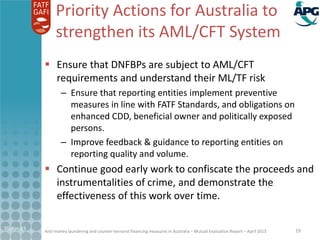
Priority Actions for Australia to
strengthen its AML/CFT System
 Ensure that DNFBPs are subject to AML/CFT
requirements and understand their ML/TF risk
– Ensure that reporting entities implement preventive
measures in line with FATF Standards, and obligations on
enhanced CDD, beneficial owner and politically exposed
persons.
– Improve feedback & guidance to reporting entities on
reporting quality and volume.
 Continue good early work to confiscate the proceeds and
instrumentalities of crime, and demonstrate the
effectiveness of this work over time.
21-Apr-15 19
Anti-money laundering and counter-terrorist financing measures in Australia – Mutual Evaluation Report – April 2015
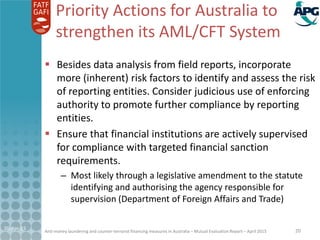
Priority Actions for Australia to
strengthen its AML/CFT System
 Besides data analysis from field reports, incorporate
more (inherent) risk factors to identify and assess the risk
of reporting entities. Consider judicious use of enforcing
authority to promote further compliance by reporting
entities.
 Ensure that financial institutions are actively supervised
for compliance with targeted financial sanction
requirements.
– Most likely through a legislative amendment to the statute
identifying and authorising the agency responsible for
supervision (Department of Foreign Affairs and Trade)
21-Apr-15 20
Anti-money laundering and counter-terrorist financing measures in Australia – Mutual Evaluation Report – April 2015
Priority Actions for Australia to
strengthen its AML/CFT System
 Australia should implement a targeted approach in
relation to preventing non-profit organisations from
terrorist financing (TF) abuse.
– As a first step, undertake a thorough review of the TF
risks that NPOs are facing and the potential vulnerabilities
of the sector to terrorist activities.
 Ensure that lawyers, accountants, real estate agents,
precious stones dealers, and trust and company
service providers understand their ML/TF risks and
are required to effectively implement AML/CFT
obligations and risk mitigating measures.
21-Apr-15 21
Anti-money laundering and counter-terrorist financing measures in Australia – Mutual Evaluation Report – April 2015
Priority Actions for Australia to
strengthen its AML/CFT System
 Ensure that reporting entities implement as early as
possible the obligations on enhanced customer due
diligence (CDD), beneficial owners, and politically exposed
persons introduced on 1 June 2014.
 Australia should assess the risks of TF posed by all forms
of legal persons and arrangements.
 Australia should also take measures to ensure that
beneficial ownership information for legal persons is
collected and available. Trustees should be required to
hold and maintain information on the constituent
elements of a trust including the settlor and beneficiary.
21-Apr-15 22

Australia mutual evaluation report 2015

  • 1.
    Anti-money laundering andcounter-terrorist financing measures in Australia – Mutual Evaluation Report – April 2015 1 Anti-money laundering and counter- terrorist financing (AML/CFT) measures in Australia Fourth Round Mutual Evaluation Key findings, ratings and priority actions 20 April 2015 www.fatf-gafi.org/topics/mutualevaluations/documents/mer-australia-2015.html
  • 2.
    Anti-money laundering andcounter-terrorist financing measures in Australia – Mutual Evaluation Report – April 2015 Key findings  Australia has a good understanding of its main money laundering (ML) and terrorist financing (TF) risks. – Australia needs to develop ML understanding further. – There is an underlying concern that authorities address predicate crime, rather than ML. – TF is largely motivated by international tensions and conflicts. – Australia coordinates very well activities to address ML/TF risks but some key risks remain unaddressed.  Operationally, national AML/CFT coordination is very comprehensive, but demonstrating its overall success is challenging, despite positive results from national task forces. 2
  • 3.
    Anti-money laundering andcounter-terrorist financing measures in Australia – Mutual Evaluation Report – April 2015 Key findings  Australia develops and disseminates good quality financial intelligence to a range of law enforcement bodies, customs and tax authorities. – All relevant authorities have access to the Australian Transaction Reports and Analysis Centre (AUSTRAC) database and can use its integrated analytical tool. This is a strength of Australia’s AML/CFT system. – Law enforcement makes limited use of the database to trigger ML/TF investigations, which is a weakness in Australia’s AML/CFT system. 21-Apr-15 3
  • 4.
    Anti-money laundering andcounter-terrorist financing measures in Australia – Mutual Evaluation Report – April 2015 Key findings  Australia’s legal framework to implement target financial sanctions is a good example for other countries. – Automatic, direct legal obligation to freeze assets of new UN designations. – Numerous designations made under the domestic regime. – Absence of freezing statistics, financial supervision, and feedback on experience make it difficult to confirm effective implementation of the legal framework.  Australia has not implemented a targeted approach or oversight in dealing with NPOs that are risk of terrorist abuse. It has not reviewed the sector to identify the features and types of NPOs that are at risk of being misused for TF. 21-Apr-15 4
  • 5.
    Anti-money laundering andcounter-terrorist financing measures in Australia – Mutual Evaluation Report – April 2015 Key findings  Most designated non-financial businesses and professions are not subject to AML/CFT requirements, and do not have adequate understanding of their ML/TF risks, or measures to mitigate them. – This includes real estate agents and lawyers, both identified as high ML risk in Australia’s National Threat assessment  Major reporting entities have a good understanding of their AML/CFT risks and obligations, but some AML/CFT controls are not in line with the FATF Standards. 21-Apr-15 5
  • 6.
    Anti-money laundering andcounter-terrorist financing measures in Australia – Mutual Evaluation Report – April 2015 Key findings  AUSTRAC supervision has a range of deficiencies. – There is no supervision or regulation of most higher-risk designated non-financial businesses and professions because they are not subject to AML/CFT requirements. – The authorities were unable to demonstrate that they are improving AML/CFT compliance by reporting entities or that they are successfully discouraging criminal abuse of the financial and DNFBP sectors. 21-Apr-15 6
  • 7.
    Anti-money laundering andcounter-terrorist financing measures in Australia – Mutual Evaluation Report – April 2015 Key findings  Australia has not conducted a formal risks assessmenton the TF risks of legal persons and arrangements. – Registration information concerning legal persons is largely available to competent authorities and the public, but there is only limited verification of this information. – Beneficial ownership information of legal persons and arrangements is not maintained and accessible to competent authorities in a timely manner.  Australia cooperates well with other countries in MLA matters, including extradition.  Informal co-operation is generally good across agencies. 21-Apr-15 7
  • 8.
    Anti-money laundering andcounter-terrorist financing measures in Australia – Mutual Evaluation Report – April 2015 Ratings – Effectiveness (1/3) 8 Immediate outcome of an effective system to combat money laundering (ML) and terroristfinancing (TF) Extent to which Australia has achieved this objective 1. ML and TF risks are understood and, where appropriate, actions co-ordinateddomesticallyto combat ML and TF Substantial 2. International co-operationdelivers appropriateinformation, financialintelligence,and evidence, and facilitatesaction against criminals and their assets High 3. Supervisors appropriatelysupervise, monitor and regulate financialinstitutionsand designated non-financial businesses and professions (DNFBPs) for compliancewith AML/CFT requirements commensurate with their risks. Moderate 4. Financialinstitutionsand DNFBPs adequatelyapplyAML/CFT preventivemeasures commensurate with their risks, and report suspicious transactions. Moderate
  • 9.
    Anti-money laundering andcounter-terrorist financing measures in Australia – Mutual Evaluation Report – April 2015 9 Immediate outcome of an effective system to combat money laundering (ML) and terroristfinancing (TF) Extent to which Australia has achieved this objective 5. Legal persons and arrangements are prevented from misuse for money launderingor terrorist financing, and information on their beneficialownership is availableto competent authorities without impediments Moderate 6. Financialintelligenceand all other relevantinformation are appropriatelyused by competent authorities for money launderingand terrorist financing investigations. Substantial 7. Money launderingoffences and activities are investigated and offenders are prosecuted and subject to effective, proportionateand dissuasive sanctions Moderate 8. Proceeds and instrumentalitiesof crime are confiscated. Moderate Ratings – Effectiveness (2/3)
  • 10.
    Anti-money laundering andcounter-terrorist financing measures in Australia – Mutual Evaluation Report – April 2015 10 Immediate outcome of an effective system to combat money laundering (ML) and terroristfinancing (TF) Extent to which Australia has achieved this objective 9. Terrorist financing offences and activities are investigated and persons who finance terrorism are prosecuted and subject to effective, proportionateand dissuasive sanctions. Substantial 10. Terrorists, terrorist organisationsand terrorist financiers are prevented from raising, moving and using funds, and from abusing the non-profit sector. Moderate 11. Persons and entities involvedin the proliferationof weapons of mass destruction are preventedfrom raising, moving and using funds, consistent with the relevantUnited Nations Security CouncilResolutions. Substantial Ratings – Effectiveness (3/3)
  • 11.
    Anti-money laundering andcounter-terrorist financing measures in Australia – Mutual Evaluation Report – April 2015 21-Apr-15 11 Ratings – Effectiveness 1 46 0 High Substantial Moderate Low
  • 12.
    21-Apr-15 12 Ratings – technicalcompliance (1/5) AML/CFT POLICIES AND COORDINATION 1. Assessing risks & applyinga risk-based approach Partially compliant 2. National cooperationand coordination Largely compliant MONEY LAUNDERING AND CONFISCATION 3. Money launderingoffence Compliant 4. Confiscationand provisional measures Compliant TERRORIST FINANCING AND FINANCING OF PROLIFERATION 5. Terrorist financingoffence Largely compliant 6. Targeted financialsanctions related to terrorism & terrorist financing Compliant 7. Targeted financialsanctions related to proliferation Compliant 8.Non-profit organisations Non-compliant
  • 13.
    21-Apr-15 13 Ratings – technicalcompliance (2/5) PREVENTIVE MEASURES 9. Financialinstitution secrecy laws Compliant Customer due diligence and record keeping 10. Customer due diligence Partially compliant 11. Record keeping Largely compliant Additional measures for specific customers and activities 12. Politicallyexposed persons Largely compliant 13. Correspondent banking Non-compliant 14. Money or value transfer services Largely compliant 15. New technologies Largely compliant 16. Wire transfers Partially compliant
  • 14.
    21-Apr-15 14 Ratings – technicalcompliance (3/5) PREVENTIVE MEASURES (continued) Reliance, Controls and Financial Groups 17. Relianceon third parties Partially compliant 18. Internal controls and foreign branches and subsidiaries Partially compliant 19. Higher-risk countries Partially compliant Reporting of suspicious transactions 20. Reporting of suspicious transactions Compliant 21. Tipping-off and confidentiality Compliant Designated non-financial Businesses and Professions (DNFBPs) 22. DNFBPs: Customer due diligence Non-compliant 23. DNFBPs: Other measures Non-compliant
  • 15.
    21-Apr-15 15 Ratings – technicalcompliance (4/5) TRANSPARENCYAND BENEFICIAL OWNERSHIP OF LEGAL PERSONS AND ARRANGEMENTS 24. Transparencyand beneficialownership of legal persons Partially compliant 25. Transparencyand beneficialownership of legal arrangements Non-compliant POWERS AND RESPONSIBILITIES OF COMPETENTAUTHORITIES AND OTHER INSTITUTIONAL MEASURES Regulation and Supervision 26. Regulationand supervision of financialinstitutions Partially compliant 27. Powers of supervisors Partially compliant 28. Regulationand supervision of DNFBPs Non-compliant Operational and Law Enforcement 29. Financialintelligenceunits Compliant 30. Responsibilitiesof law enforcement and investigativeauthorities Largely compliant 31. Powers of law enforcement and investigativeauthorities Largely compliant 32. Cash couriers Largely compliant
  • 16.
    21-Apr-15 16 Ratings – technicalcompliance (5/5) TRANSPARENCYAND BENEFICIAL OWNERSHIP OF LEGAL PERSONS AND ARRANGEMENTS (continued) General Requirements 33. Statistics Largely compliant 34. Guidance and feedback Largely compliant Sanctions 35. Sanctions Partially compliant INTERNATIONAL COOPERATION 36. International instruments Largely compliant 37. Mutuallegal assistance Compliant 38. Mutuallegal assistance: freezing and confiscation Compliant 39. Extradition Compliant 40. Other forms of international cooperation Compliant
  • 17.
    Anti-money laundering andcounter-terrorist financing measures in Australia – Mutual Evaluation Report – April 2015 21-Apr-15 17 Ratings – technical compliance 12 12 10 6 Compliant Largely compliant Partially compliant Non-compliant
  • 18.
    Anti-money laundering andcounter-terrorist financing measures in Australia – Mutual Evaluation Report – April 2015 Priority Actions for Australia to strengthen its AML/CFT System  Re-assess Australia’s money laundering (ML) risk and formalise ongoing processes to re-assessing risks. – Australia should identify metrics and processes to monitor and measure success.  More emphasis on pursuing ML investigations and prosecutions at federal and State/Territory level.  Increase efforts to address ML risks associated with – Predicate crimes, other than drugs and tax, including foreign predicates – Abuse of legal persons and arrangements, and the real estate sector – Identity fraud – Cash intensive activities 21-Apr-15 18
  • 19.
    Anti-money laundering andcounter-terrorist financing measures in Australia – Mutual Evaluation Report – April 2015 Priority Actions for Australia to strengthen its AML/CFT System  Ensure that DNFBPs are subject to AML/CFT requirements and understand their ML/TF risk – Ensure that reporting entities implement preventive measures in line with FATF Standards, and obligations on enhanced CDD, beneficial owner and politically exposed persons. – Improve feedback & guidance to reporting entities on reporting quality and volume.  Continue good early work to confiscate the proceeds and instrumentalities of crime, and demonstrate the effectiveness of this work over time. 21-Apr-15 19
  • 20.
    Anti-money laundering andcounter-terrorist financing measures in Australia – Mutual Evaluation Report – April 2015 Priority Actions for Australia to strengthen its AML/CFT System  Besides data analysis from field reports, incorporate more (inherent) risk factors to identify and assess the risk of reporting entities. Consider judicious use of enforcing authority to promote further compliance by reporting entities.  Ensure that financial institutions are actively supervised for compliance with targeted financial sanction requirements. – Most likely through a legislative amendment to the statute identifying and authorising the agency responsible for supervision (Department of Foreign Affairs and Trade) 21-Apr-15 20
  • 21.
    Anti-money laundering andcounter-terrorist financing measures in Australia – Mutual Evaluation Report – April 2015 Priority Actions for Australia to strengthen its AML/CFT System  Australia should implement a targeted approach in relation to preventing non-profit organisations from terrorist financing (TF) abuse. – As a first step, undertake a thorough review of the TF risks that NPOs are facing and the potential vulnerabilities of the sector to terrorist activities.  Ensure that lawyers, accountants, real estate agents, precious stones dealers, and trust and company service providers understand their ML/TF risks and are required to effectively implement AML/CFT obligations and risk mitigating measures. 21-Apr-15 21
  • 22.
    Anti-money laundering andcounter-terrorist financing measures in Australia – Mutual Evaluation Report – April 2015 Priority Actions for Australia to strengthen its AML/CFT System  Ensure that reporting entities implement as early as possible the obligations on enhanced customer due diligence (CDD), beneficial owners, and politically exposed persons introduced on 1 June 2014.  Australia should assess the risks of TF posed by all forms of legal persons and arrangements.  Australia should also take measures to ensure that beneficial ownership information for legal persons is collected and available. Trustees should be required to hold and maintain information on the constituent elements of a trust including the settlor and beneficiary. 21-Apr-15 22