The substantiveprocedures approach
This is also referred to as the vouching approach or
the direct verification approach.
In this approach, audit resources are targeted on
testing large volumes of transactions and account
balances without any particular focus on specified
areas of the financial statements.
4.
The balancesheet approach
In this approach, substantive procedures are focused on
balance sheet (statement of financial position) accounts,
with only very limited procedures being carried out on
income statement/profit and loss account items.
The justification for this approach is the notion that if
the relevant management assertions for all balance sheet
(statement of financial position) accounts are tested and
verified, then the profit/loss figure reported for the
accounting period will not be materially misstated.
5.
The systems-basedapproach
The approach whereby the auditor relies upon the entity’s
system of internal control
This approach requires auditors to assess the
effectiveness of the internal controls of an entity, and
then to direct substantive procedures primarily to those
areas where it is considered that systems objectives will
not be met.
Reduced testing is carried out in those areas where it is
considered systems objectives will be met.
6.
The risk-basedapproach
In this approach, audit resources are directed
towards those areas of the financial statements that
may contain misstatements (either by error or
omission) as a consequence of the risks faced by the
business.
ERCA is emphasizing the risk based approach.
7.
Risk based Audittests
Set audit objectives
- transaction related
- balance related
Asses and evaluate internal controls
Design and perform audit tests
8.
Analytical Procedures
Whatare analytical procedures?
Variation Analysis
Ratio Analysis
Trend Analysis
Why use analytical procedures?
Typically, analytical procedures are a quick way to point out
unusual trends or activity in account balances
8
04/26/2025
9.
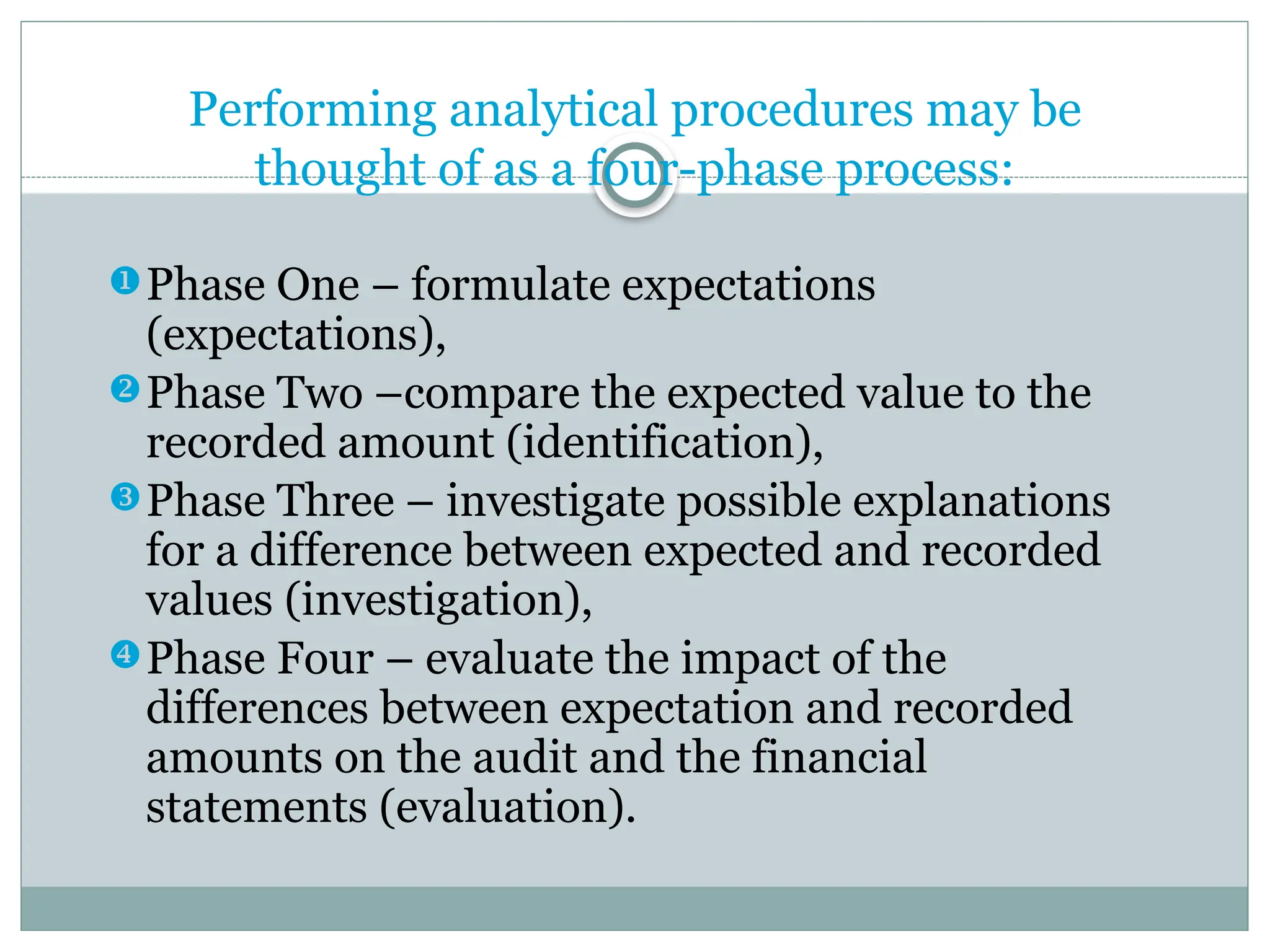
Performing analytical proceduresmay be
thought of as a four-phase process:
Phase One – formulate expectations
(expectations),
Phase Two –compare the expected value to the
recorded amount (identification),
Phase Three – investigate possible explanations
for a difference between expected and recorded
values (investigation),
Phase Four – evaluate the impact of the
differences between expectation and recorded
amounts on the audit and the financial
statements (evaluation).
10.
04/26/2025
10
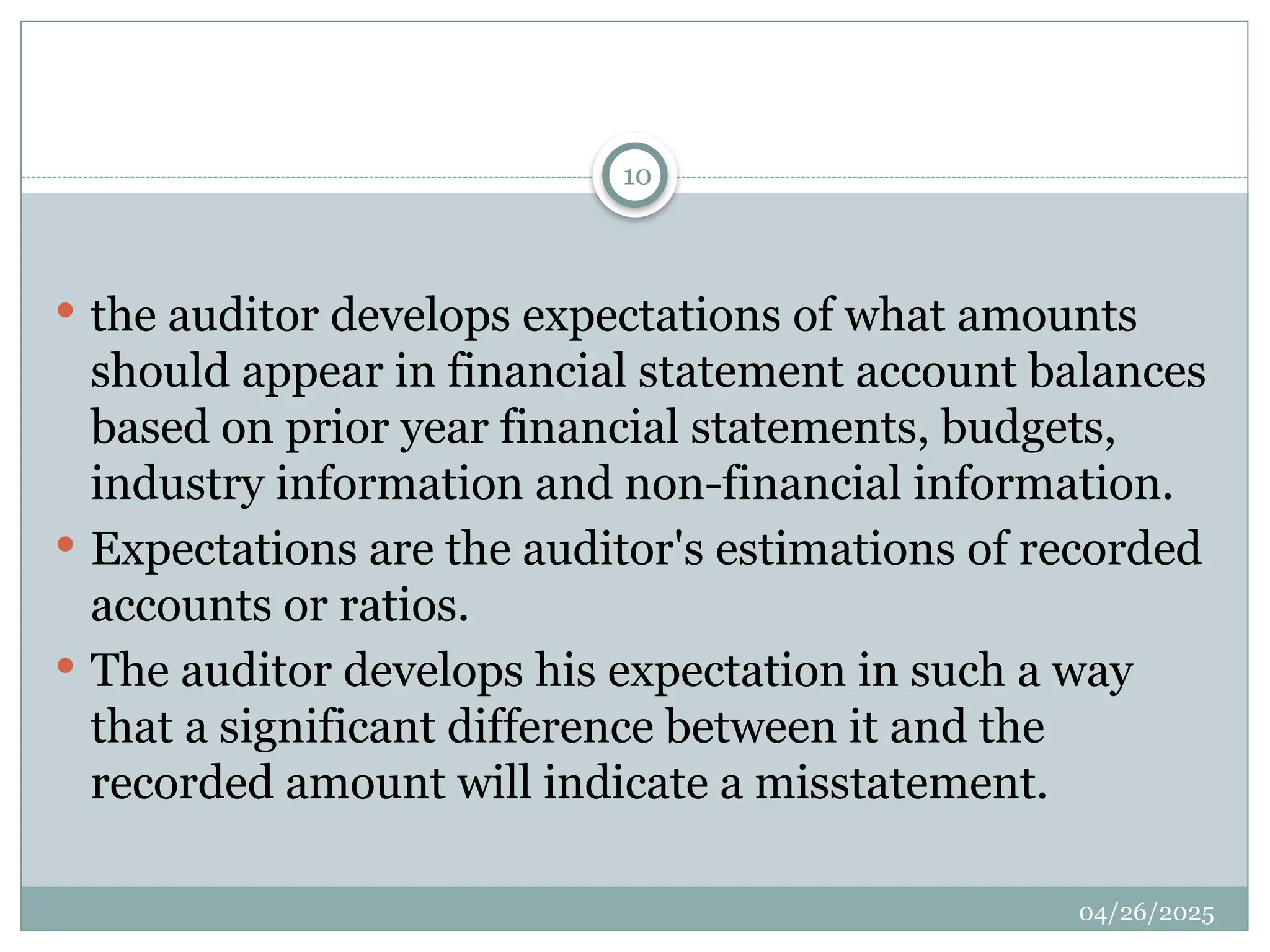
the auditordevelops expectations of what amounts
should appear in financial statement account balances
based on prior year financial statements, budgets,
industry information and non-financial information.
Expectations are the auditor's estimations of recorded
accounts or ratios.
The auditor develops his expectation in such a way
that a significant difference between it and the
recorded amount will indicate a misstatement.
11.
04/26/2025
11
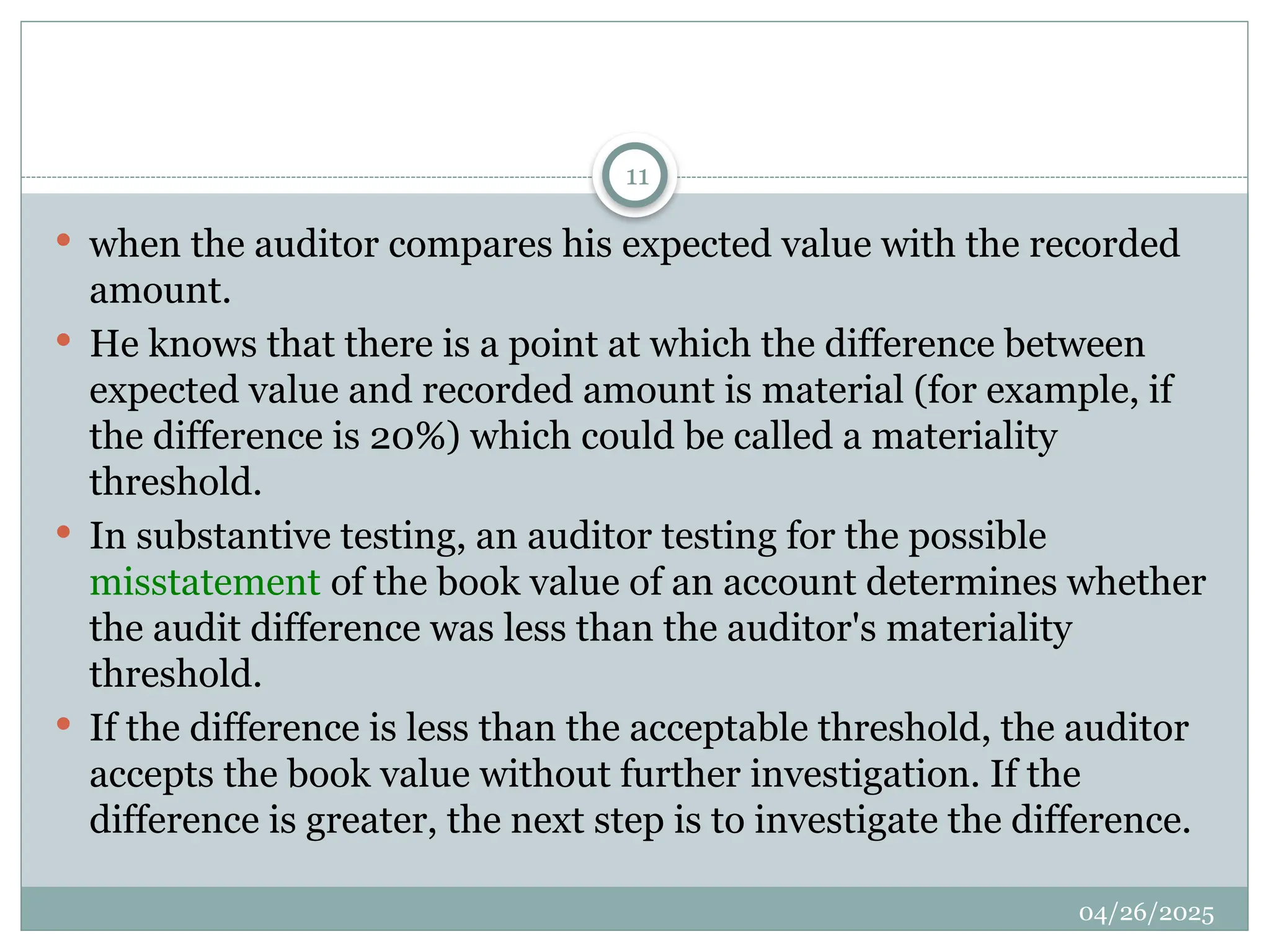
when theauditor compares his expected value with the recorded
amount.
He knows that there is a point at which the difference between
expected value and recorded amount is material (for example, if
the difference is 20%) which could be called a materiality
threshold.
In substantive testing, an auditor testing for the possible
misstatement of the book value of an account determines whether
the audit difference was less than the auditor's materiality
threshold.
If the difference is less than the acceptable threshold, the auditor
accepts the book value without further investigation. If the
difference is greater, the next step is to investigate the difference.
12.
04/26/2025
12
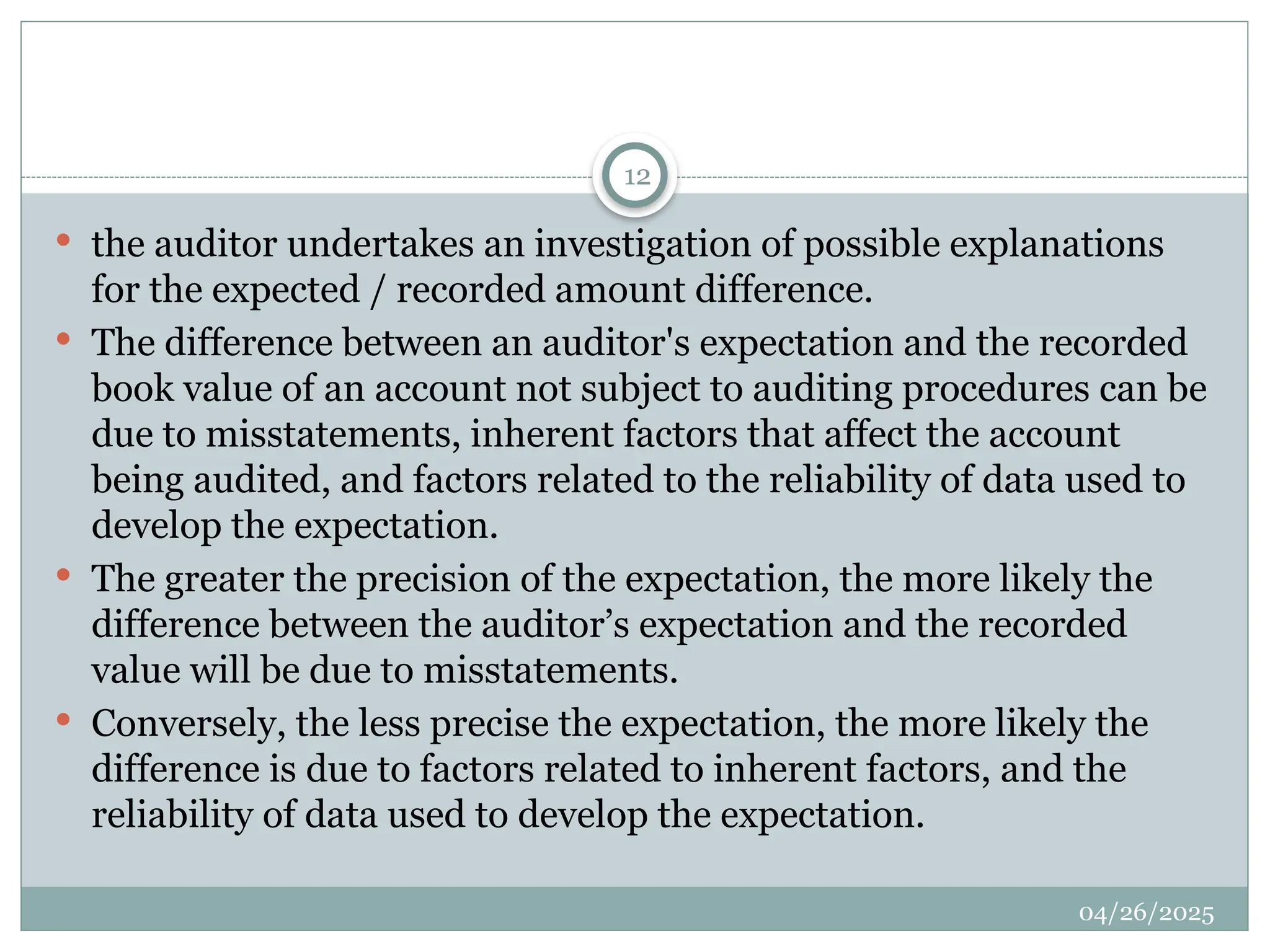
the auditorundertakes an investigation of possible explanations
for the expected / recorded amount difference.
The difference between an auditor's expectation and the recorded
book value of an account not subject to auditing procedures can be
due to misstatements, inherent factors that affect the account
being audited, and factors related to the reliability of data used to
develop the expectation.
The greater the precision of the expectation, the more likely the
difference between the auditor’s expectation and the recorded
value will be due to misstatements.
Conversely, the less precise the expectation, the more likely the
difference is due to factors related to inherent factors, and the
reliability of data used to develop the expectation.
13.
04/26/2025
13
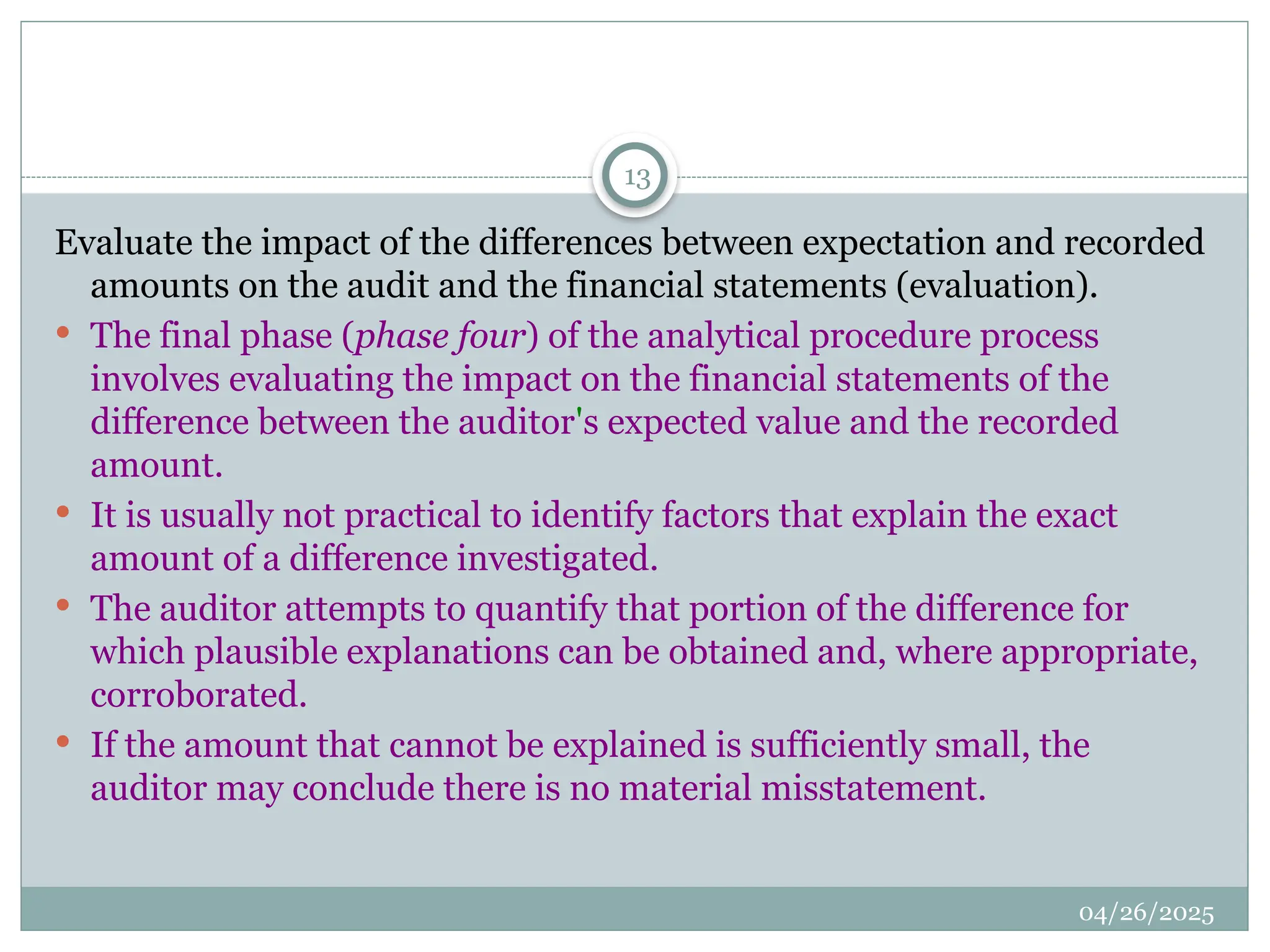
Evaluate the impactof the differences between expectation and recorded
amounts on the audit and the financial statements (evaluation).
The final phase (phase four) of the analytical procedure process
involves evaluating the impact on the financial statements of the
difference between the auditor's expected value and the recorded
amount.
It is usually not practical to identify factors that explain the exact
amount of a difference investigated.
The auditor attempts to quantify that portion of the difference for
which plausible explanations can be obtained and, where appropriate,
corroborated.
If the amount that cannot be explained is sufficiently small, the
auditor may conclude there is no material misstatement.
14.
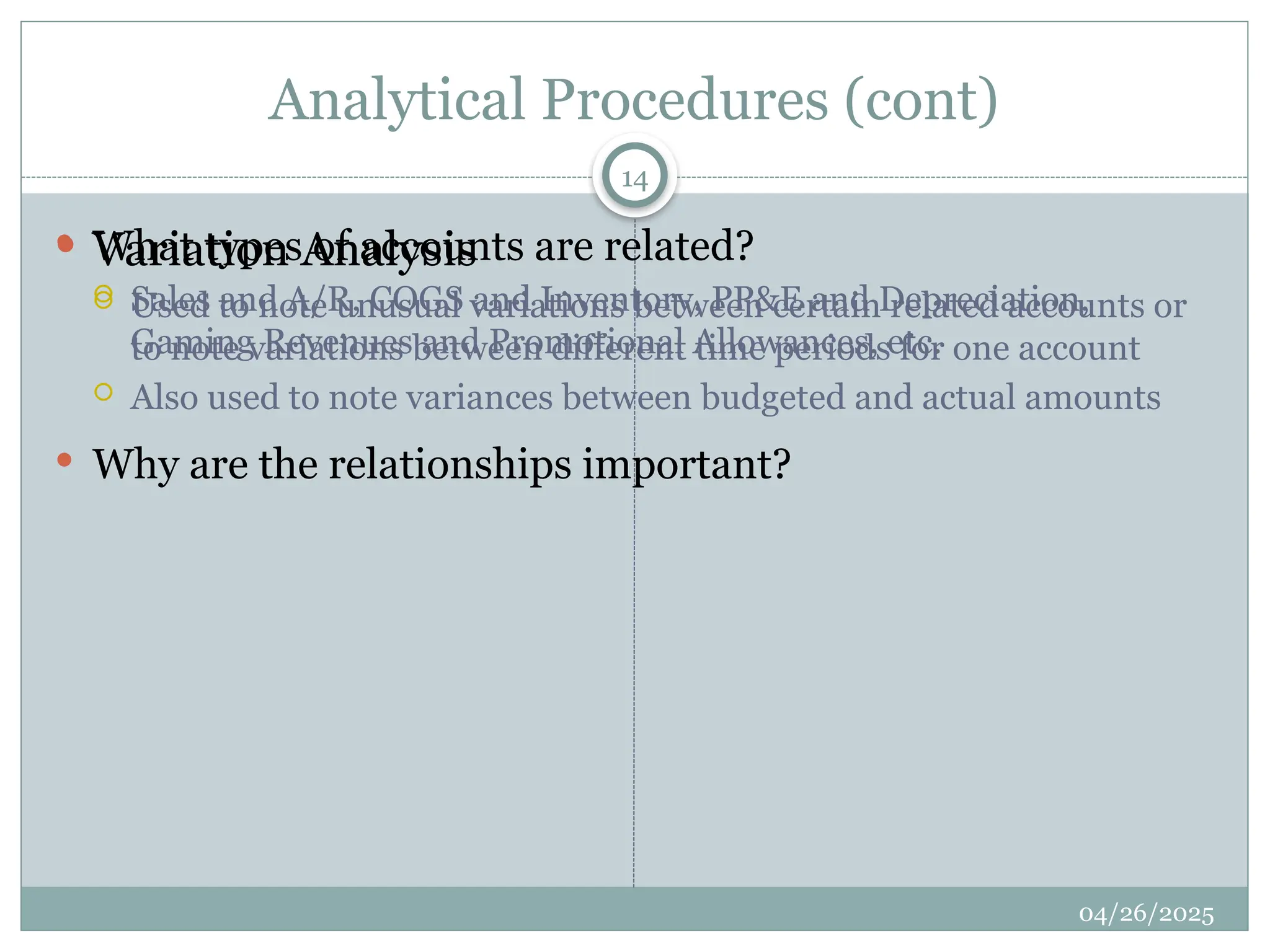
Analytical Procedures (cont)
Variation Analysis
Used to note unusual variations between certain related accounts or
to note variations between different time periods for one account
Also used to note variances between budgeted and actual amounts
What types of accounts are related?
Sales and A/R, COGS and Inventory, PP&E and Depreciation,
Gaming Revenues and Promotional Allowances, etc.
Why are the relationships important?
14
04/26/2025
15.
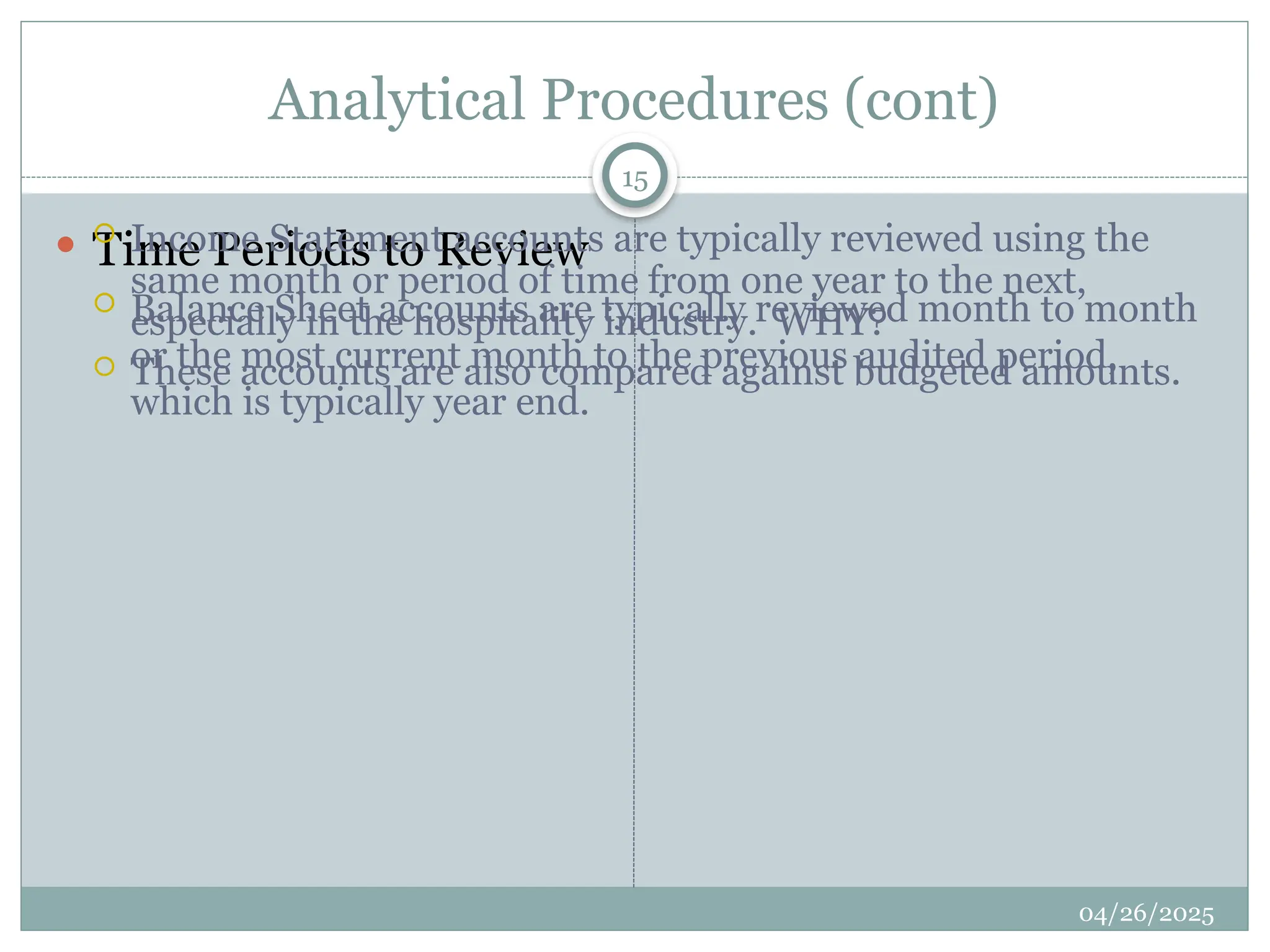
Analytical Procedures (cont)
Time Periods to Review
Balance Sheet accounts are typically reviewed month to month
or the most current month to the previous audited period,
which is typically year end.
Income Statement accounts are typically reviewed using the
same month or period of time from one year to the next,
especially in the hospitality industry. WHY?
These accounts are also compared against budgeted amounts.
15
04/26/2025
16.
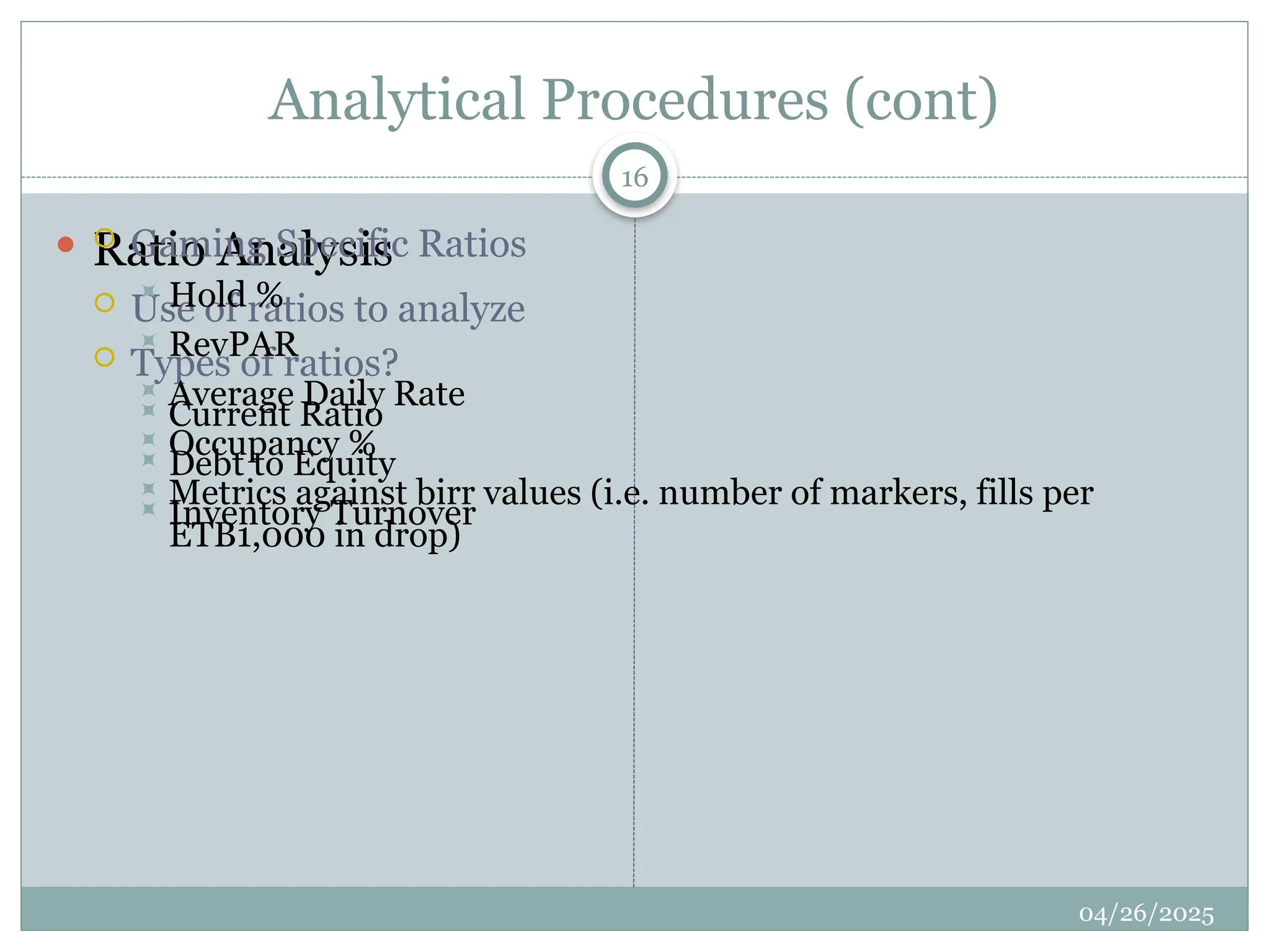
Analytical Procedures (cont)
Ratio Analysis
Use of ratios to analyze
Types of ratios?
Current Ratio
Debt to Equity
Inventory Turnover
Gaming Specific Ratios
Hold %
RevPAR
Average Daily Rate
Occupancy %
Metrics against birr values (i.e. number of markers, fills per
ETB1,000 in drop)
16
04/26/2025
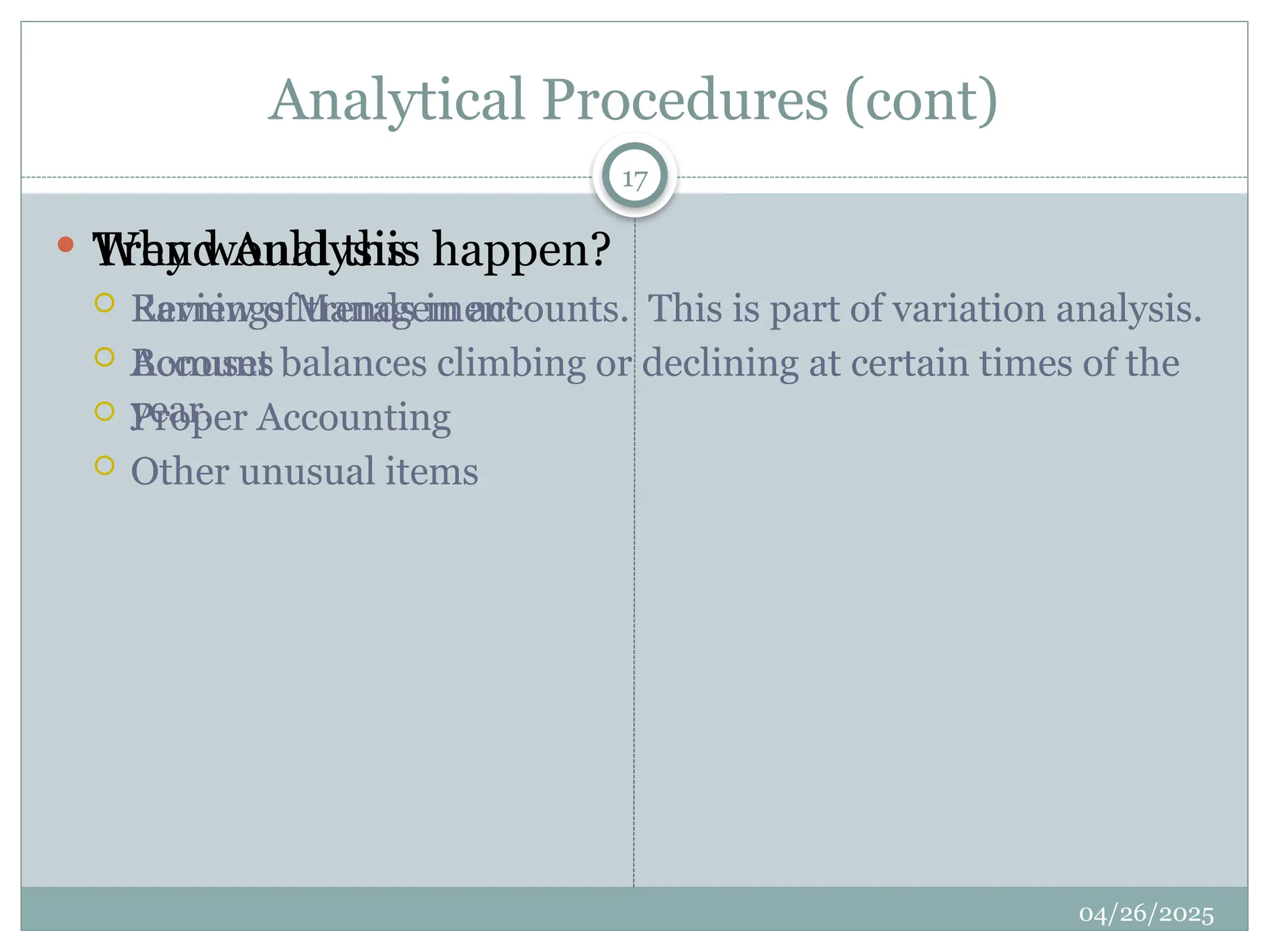
17.
Analytical Procedures (cont)
Trend Analysis
Review of trends in accounts. This is part of variation analysis.
Account balances climbing or declining at certain times of the
year.
Why would this happen?
Earnings Management
Bonuses
Proper Accounting
Other unusual items
17
04/26/2025
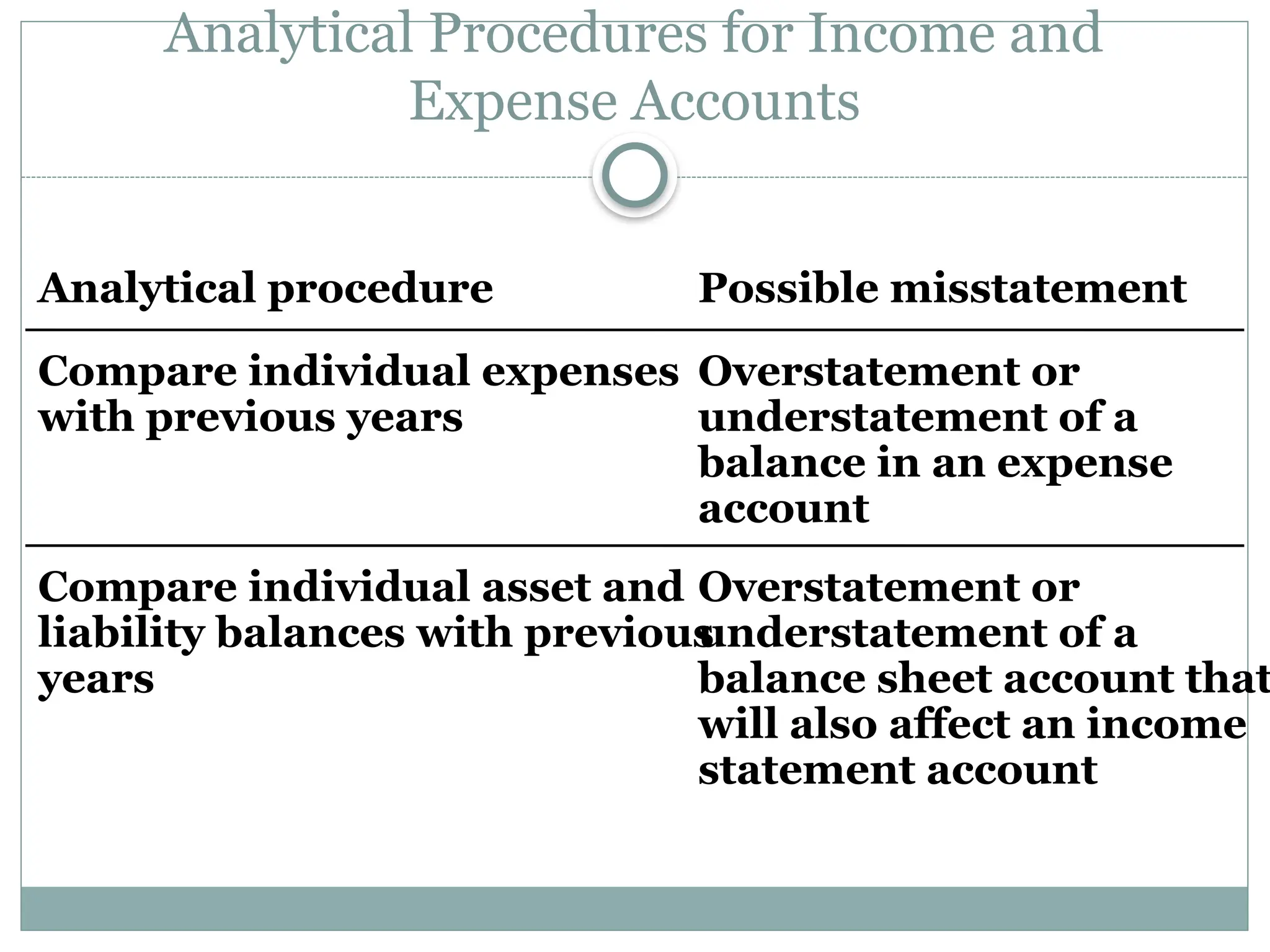
18.
Analytical Procedures forIncome and
Expense Accounts
Compare individual asset and
liability balances with previous
years
Overstatement or
understatement of a
balance sheet account that
will also affect an income
statement account
Analytical procedure
Compare individual expenses
with previous years
Overstatement or
understatement of a
balance in an expense
account
Possible misstatement
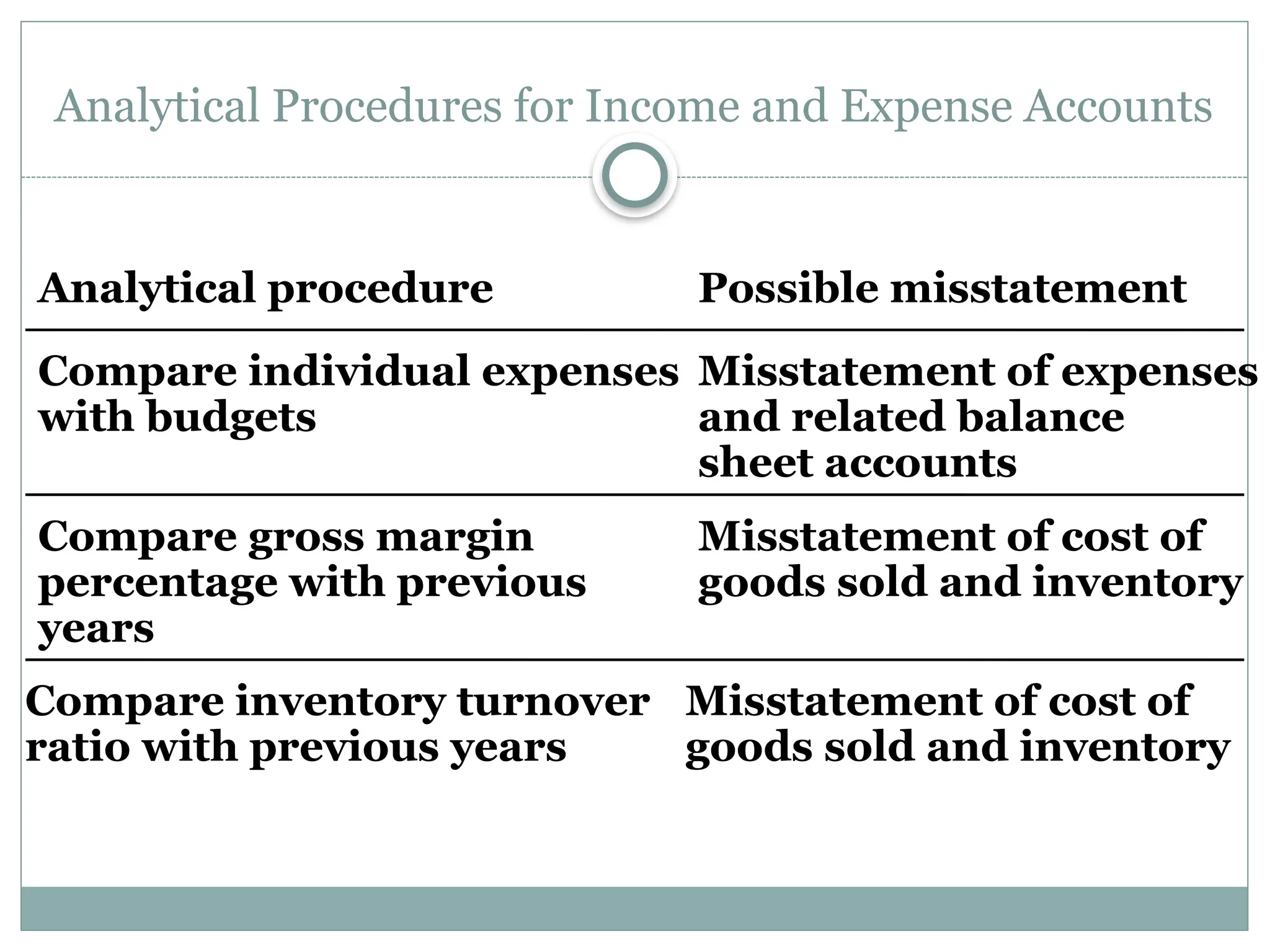
19.
Analytical Procedures forIncome and Expense Accounts
Analytical procedure
Compare individual expenses
with budgets
Misstatement of expenses
and related balance
sheet accounts
Possible misstatement
Compare gross margin
percentage with previous
years
Misstatement of cost of
goods sold and inventory
Compare inventory turnover
ratio with previous years
Misstatement of cost of
goods sold and inventory
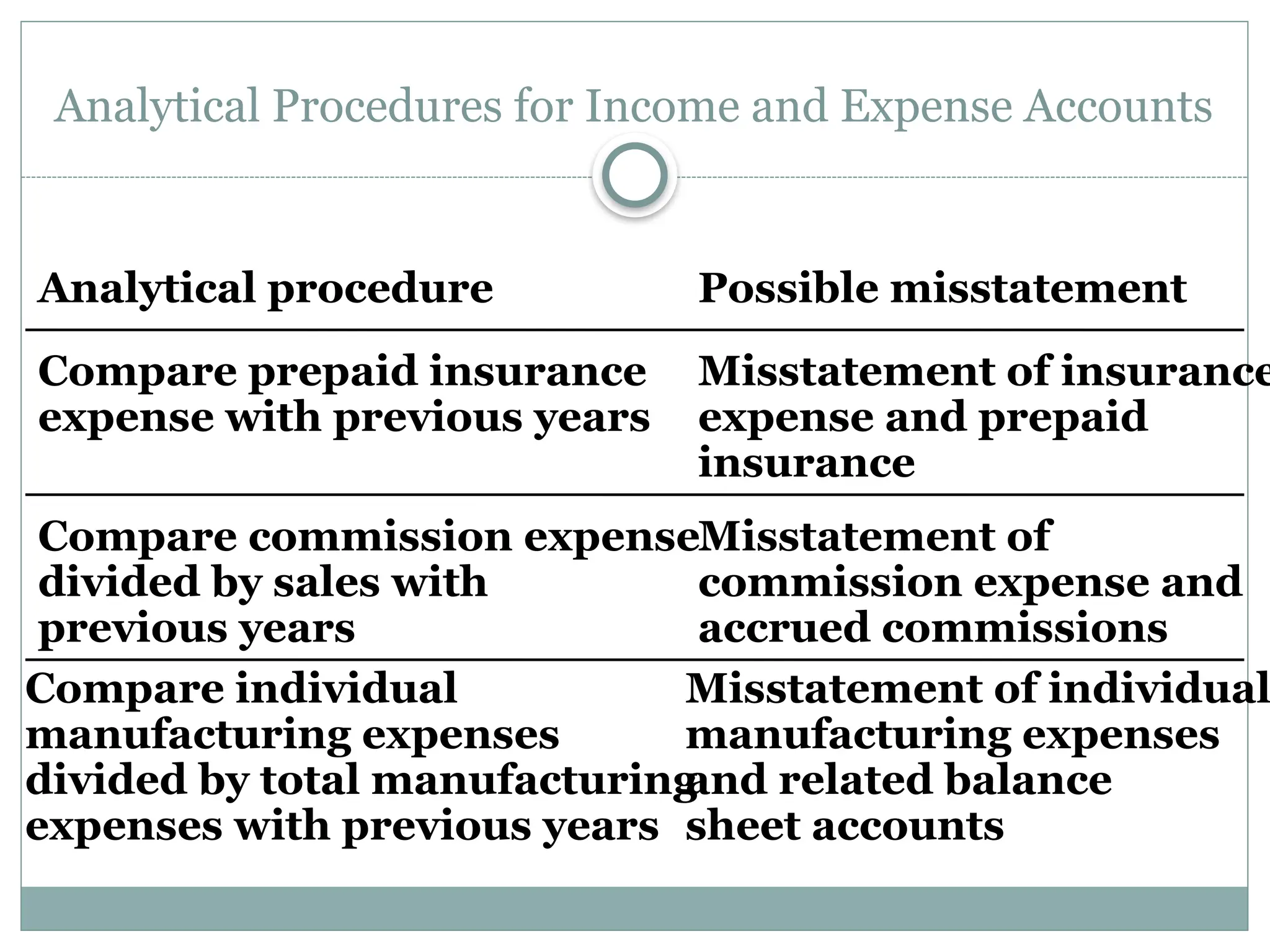
20.
Analytical Procedures forIncome and Expense Accounts
Analytical procedure
Compare prepaid insurance
expense with previous years
Misstatement of insurance
expense and prepaid
insurance
Possible misstatement
Compare commission expense
divided by sales with
previous years
Misstatement of
commission expense and
accrued commissions
Compare individual
manufacturing expenses
divided by total manufacturing
expenses with previous years
Misstatement of individual
manufacturing expenses
and related balance
sheet accounts
21.
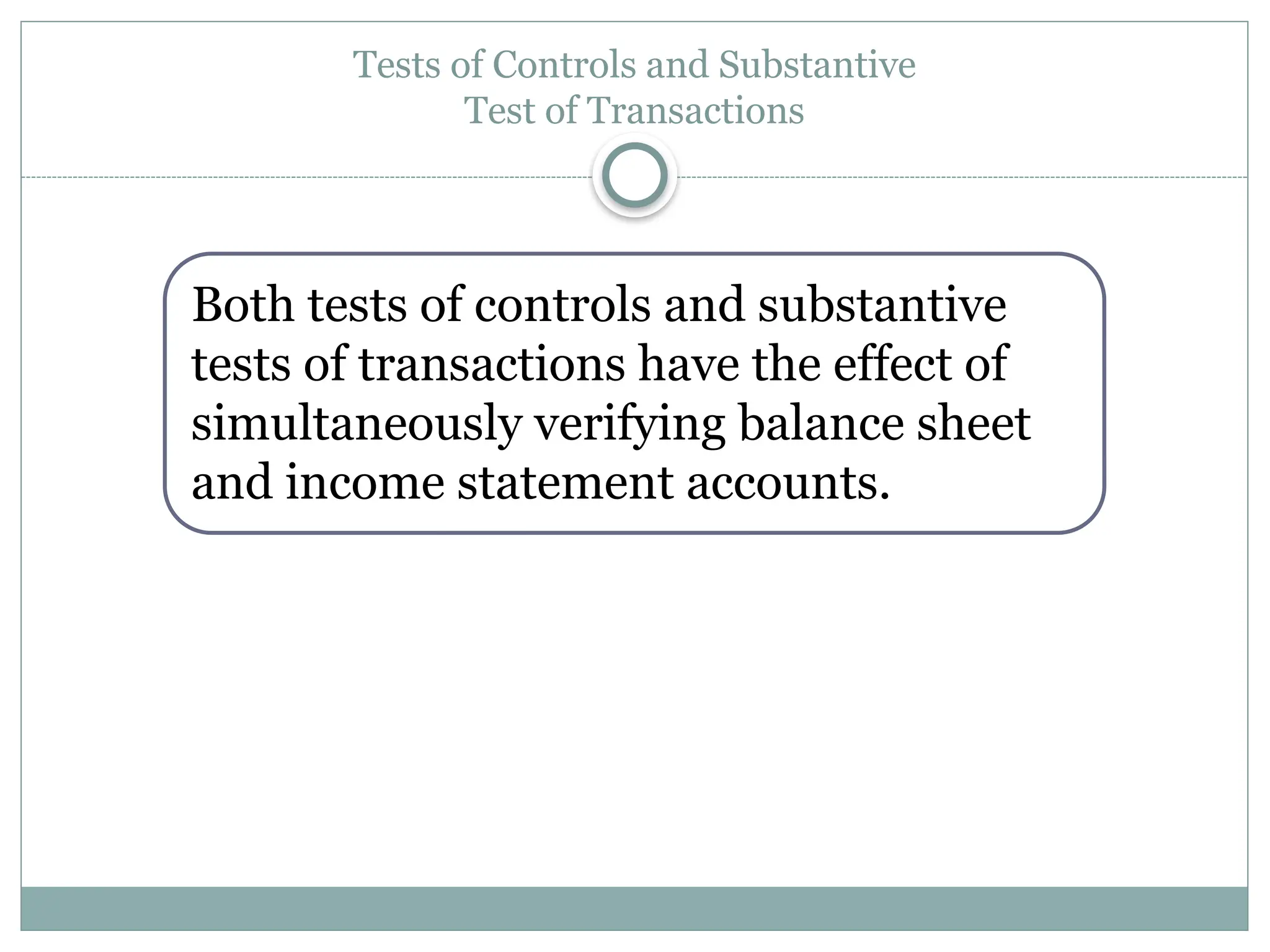
Tests of Controlsand Substantive
Test of Transactions
Both tests of controls and substantive
tests of transactions have the effect of
simultaneously verifying balance sheet
and income statement accounts.
22.
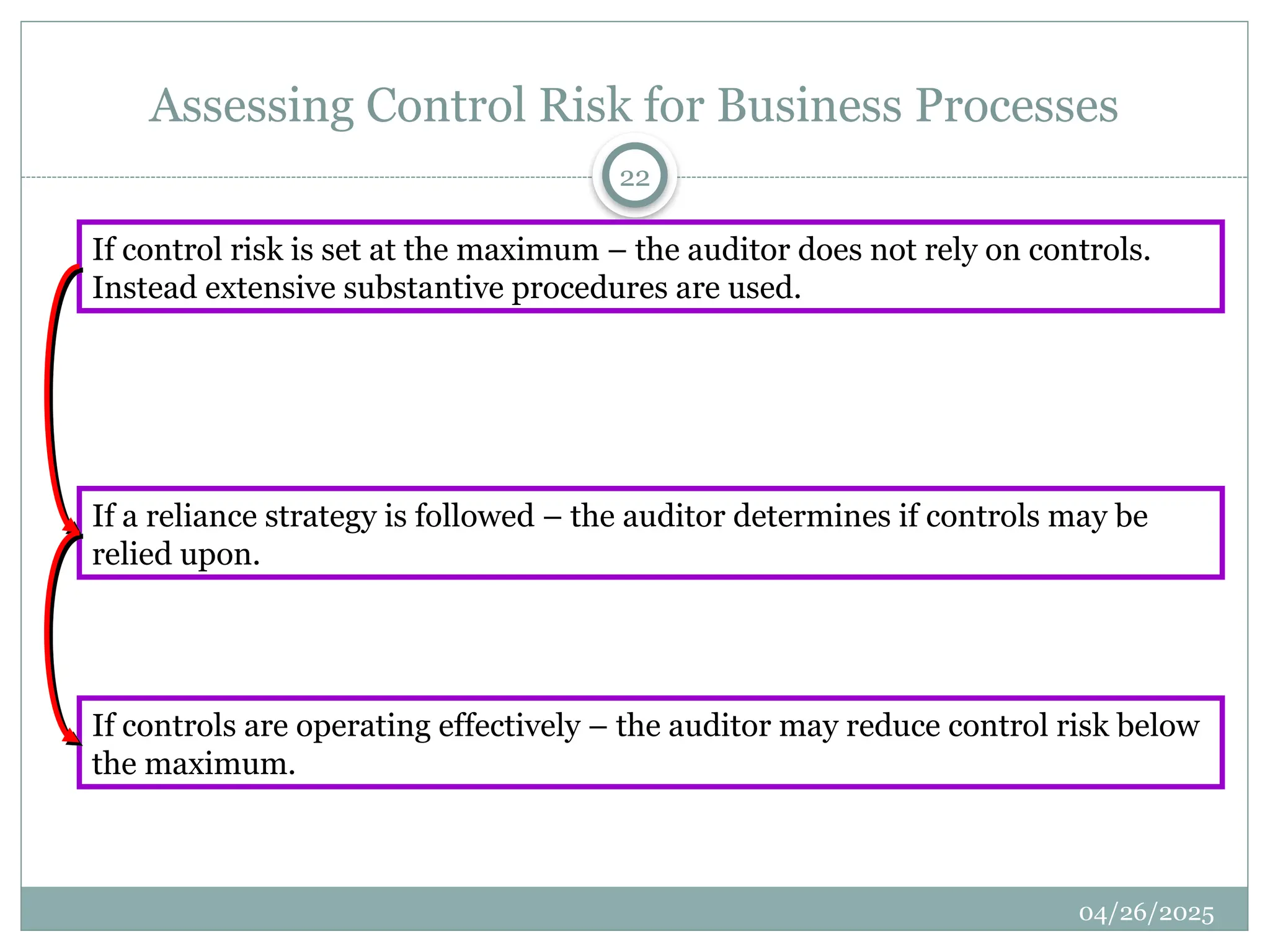
Assessing Control Riskfor Business Processes
If control risk is set at the maximum – the auditor does not rely on controls.
Instead extensive substantive procedures are used.
If a reliance strategy is followed – the auditor determines if controls may be
relied upon.
If controls are operating effectively – the auditor may reduce control risk below
the maximum.
22
04/26/2025
23.
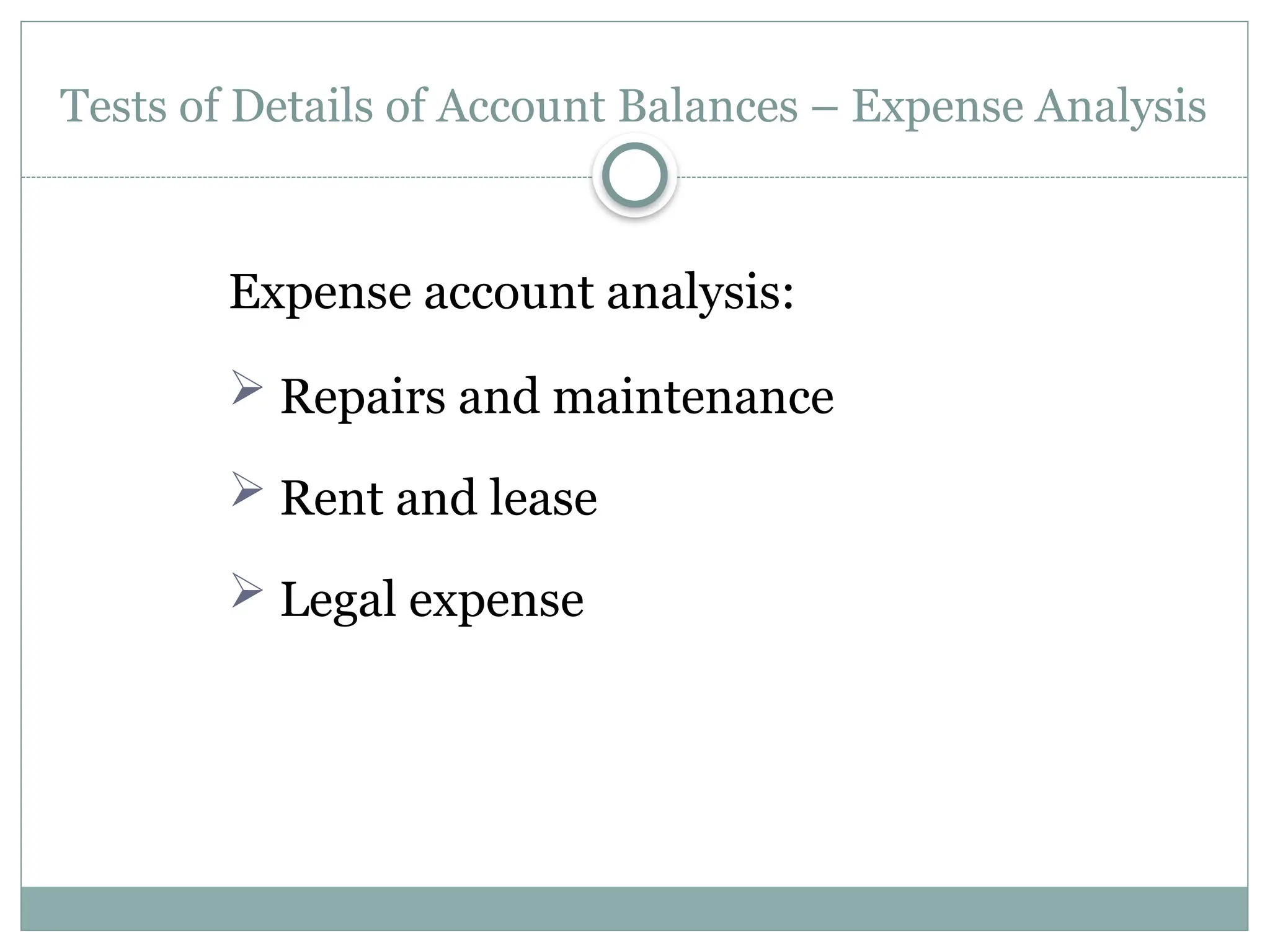
Tests of Detailsof Account Balances – Expense Analysis
Expense account analysis:
Repairs and maintenance
Rent and lease
Legal expense
24.
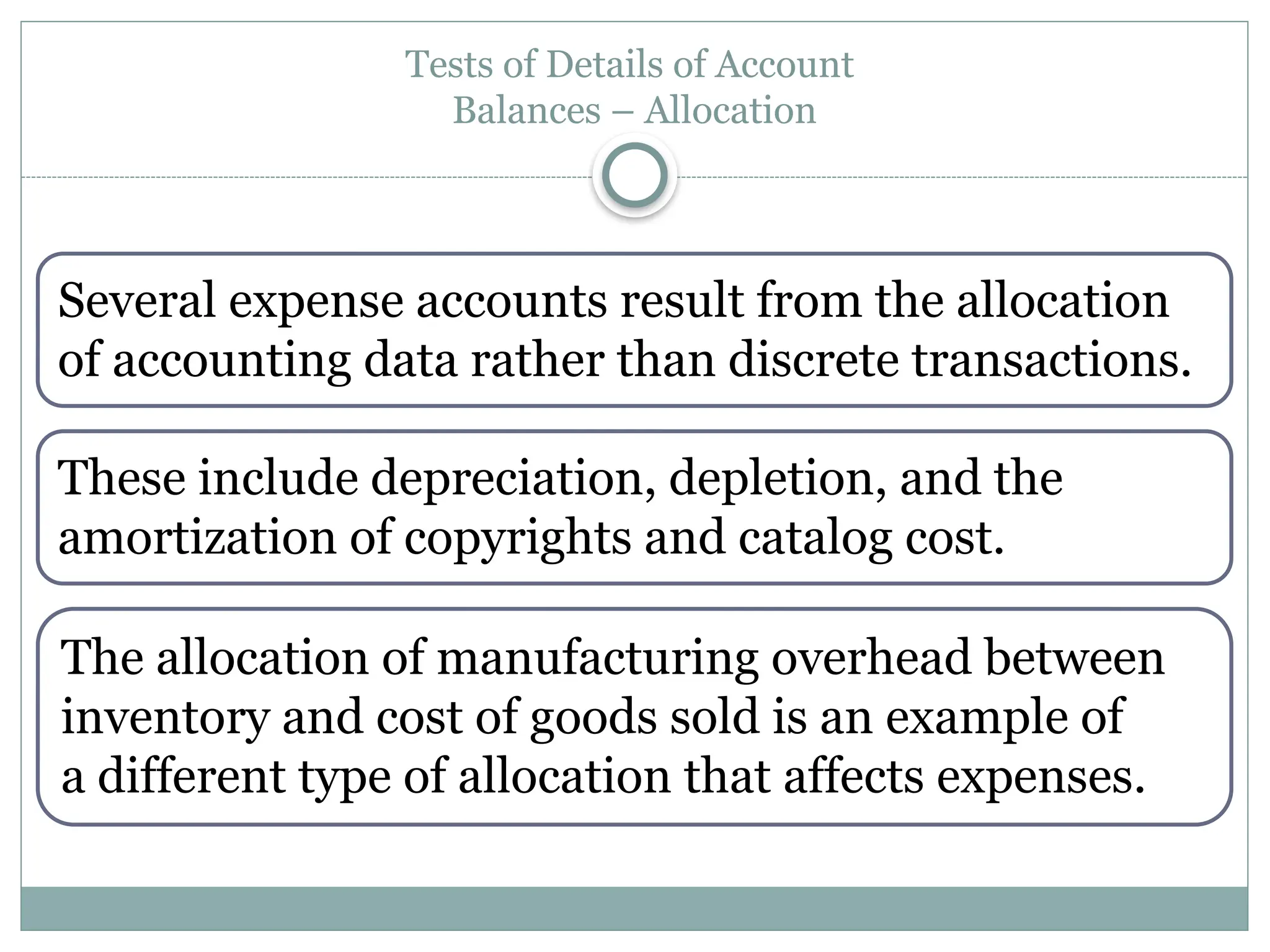
Tests of Detailsof Account
Balances – Allocation
Several expense accounts result from the allocation
of accounting data rather than discrete transactions.
These include depreciation, depletion, and the
amortization of copyrights and catalog cost.
The allocation of manufacturing overhead between
inventory and cost of goods sold is an example of
a different type of allocation that affects expenses.
25.
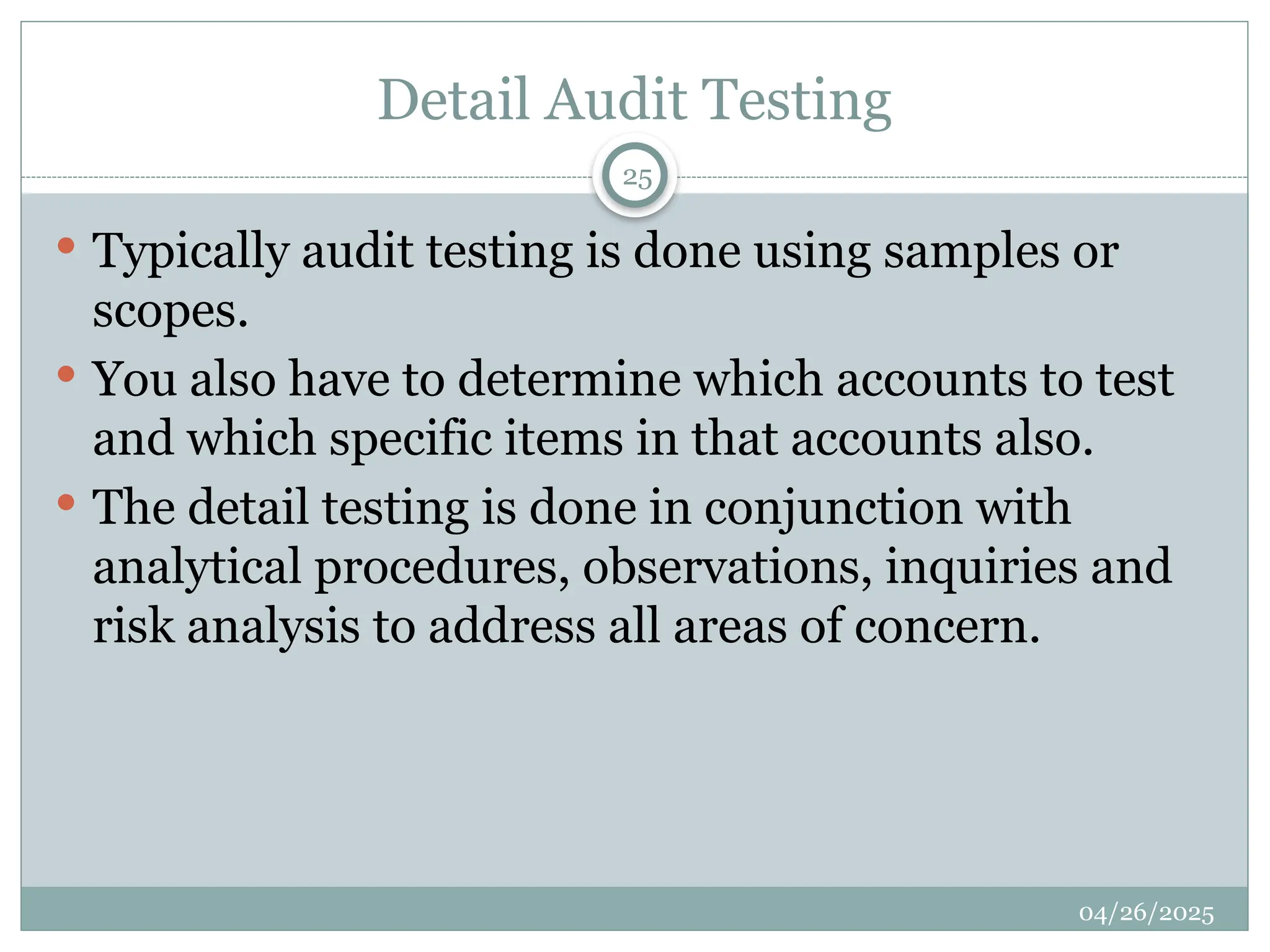
Detail Audit Testing
Typically audit testing is done using samples or
scopes.
You also have to determine which accounts to test
and which specific items in that accounts also.
The detail testing is done in conjunction with
analytical procedures, observations, inquiries and
risk analysis to address all areas of concern.
25
04/26/2025
26.
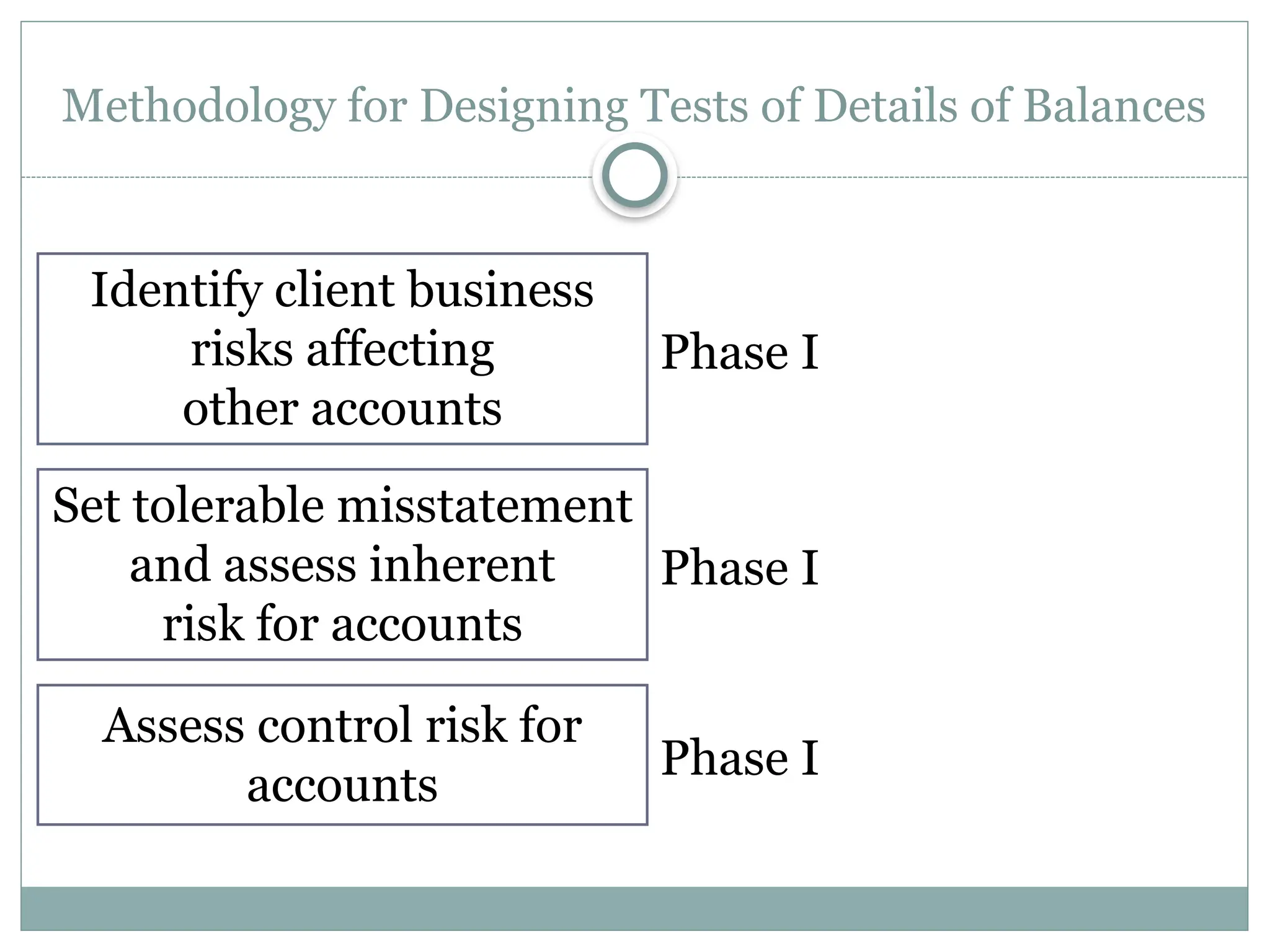
Identify client business
risksaffecting
other accounts
Methodology for Designing Tests of Details of Balances
Set tolerable misstatement
and assess inherent
risk for accounts
Assess control risk for
accounts
Phase I
Phase I
Phase I
27.
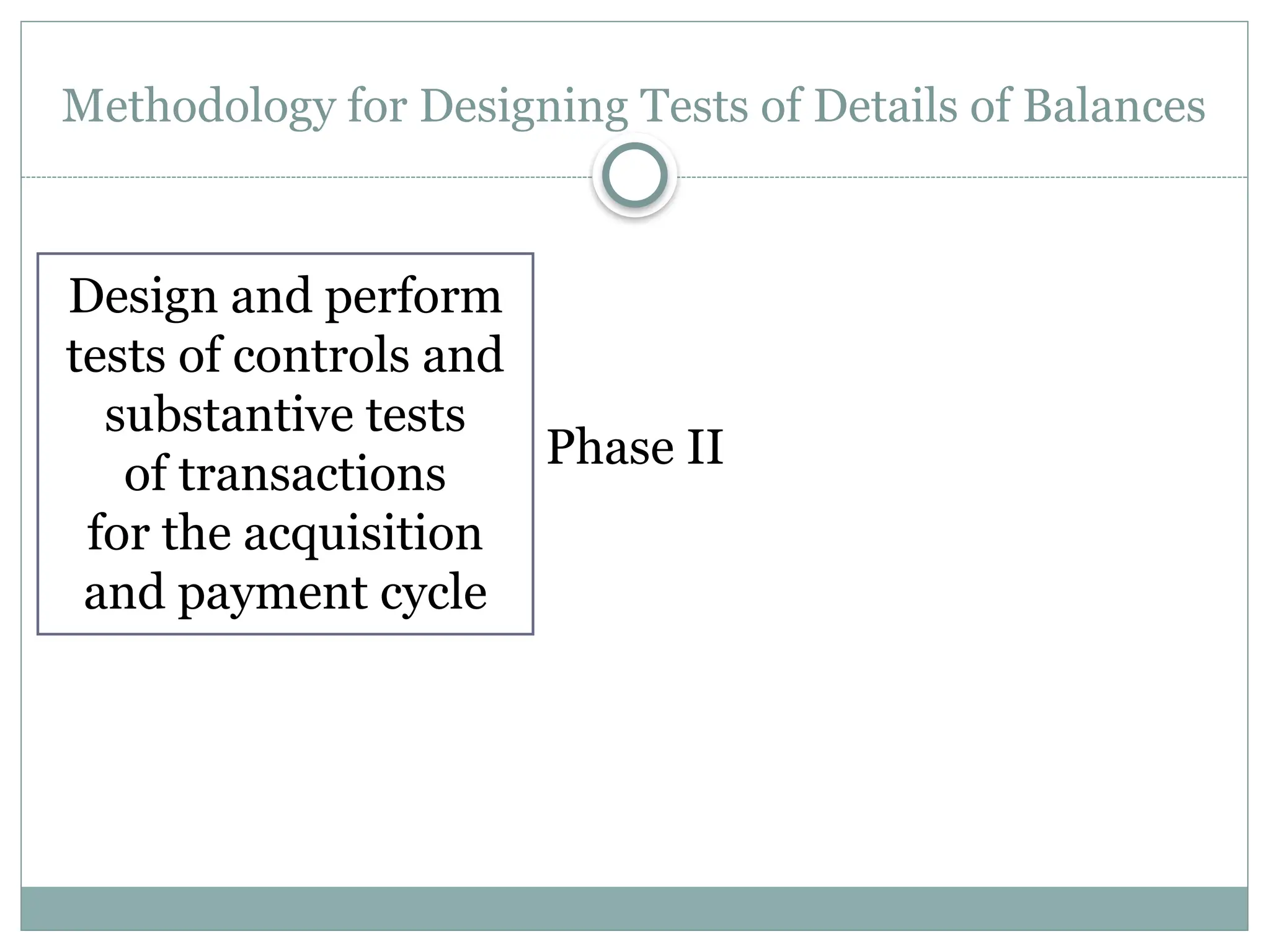
Methodology for DesigningTests of Details of Balances
Design and perform
tests of controls and
substantive tests
of transactions
for the acquisition
and payment cycle
Phase II
28.
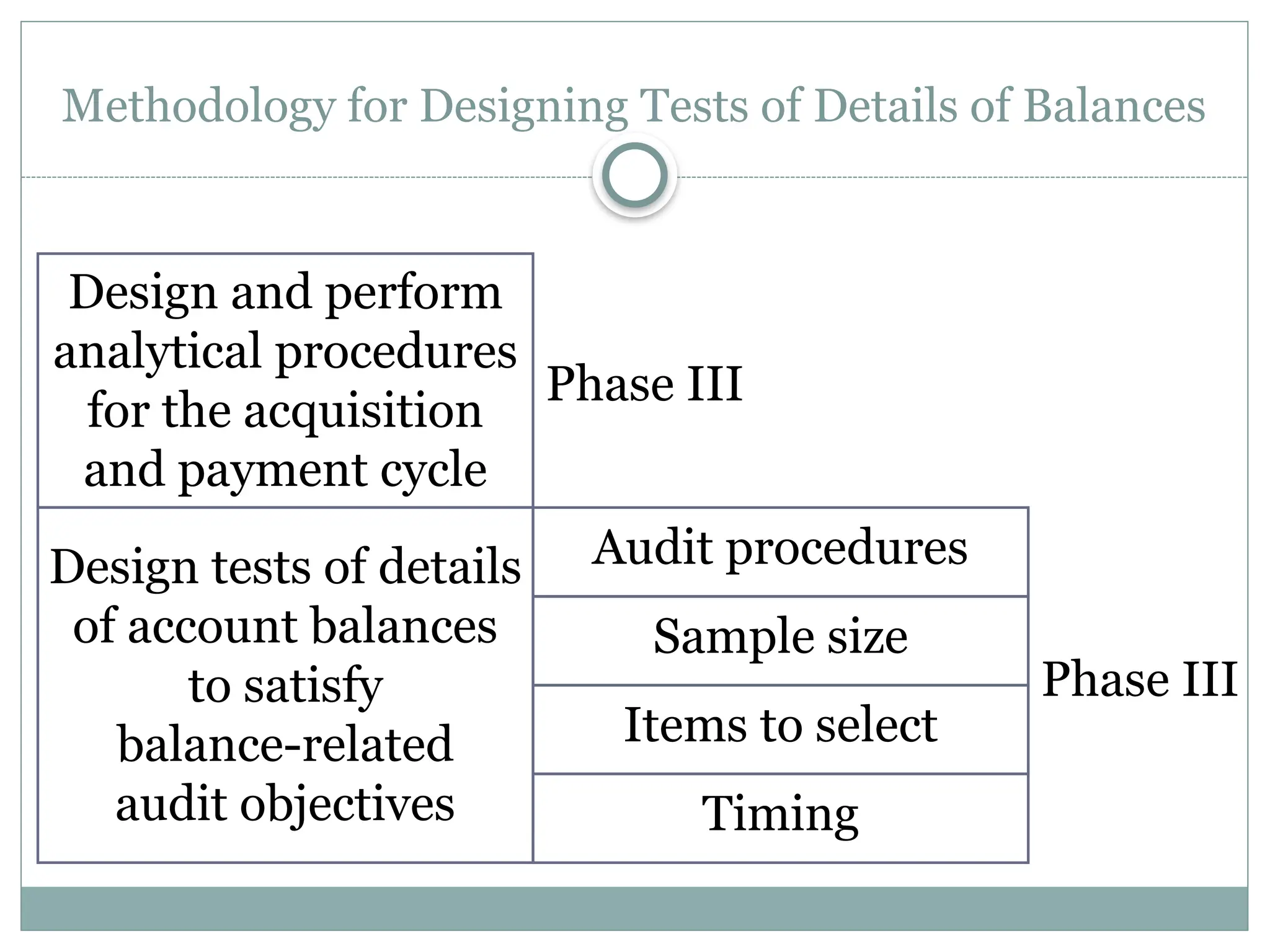
Timing
Items to select
Samplesize
Audit procedures
Methodology for Designing Tests of Details of Balances
Design and perform
analytical procedures
for the acquisition
and payment cycle
Design tests of details
of account balances
to satisfy
balance-related
audit objectives
Phase III
Phase III