
AUDIENCE
SEGMENTATIONLAURA KERRIGAN | DATA AND ANALYSIS
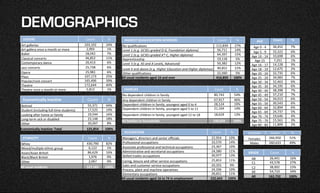
LEISURE Count %
Art	galleries 103,102 24%
Art	gallery	once	a	month	or	more 2,993 1%	
Ballet 28,042 7%
Classical	concerts 46,852 11%
Contemporary	dance 26,413 6%
Jazz	concerts 25,738 6%
Opera 25,981 6%
Plays 107,173 25%
Popular/rock	concert 165,496 39%
Theatre 172,644 40%
Theatre	once	a	month	or	more 5,813 1%
GENDER Count %
Females 266,950 51%
Males 260,633 49%
AGE Count %
Age	0	- 4 36,452 7%
Age	5	- 9 33,322 6%
Age	10	- 14 33,698 6%
Age	15 7,251 1%
Age	16	- 17 14,128 3%
Age	18	- 19 12,675 2%
Age	20	- 24 32,735 6%
Age	25	- 29 34,983 7%
Age	30	- 34 32,463 6%
Age	35	- 39 34,195 6%
Age	40	- 44 38,398 7%
Age	45	- 49 37,210 7%
Age	50	- 54 34,013 6%
Age	55	- 59 30,543 6%
Age	60	- 64 32,894 6%
Age	65	- 69 24,737 5%
Age	70	- 74 19,646 4%
Age	75	- 79 15,561 3%
Age	80	- 84 11,809 2%
FAMILIES Count %
No	dependent	children	in	family 80,743 54%
Any	dependent	children	in	family 67,917 46%
Dependent	children	in	family,	youngest	aged	0	to	4 28,124 19%
Dependent	children	in	family,	youngest	aged	5	to	11 21,164 14%
Dependent	children	in	family,	youngest	aged	12	to	18 18,629 13%
All	families	in	households 148,659 100%
Economically	inactive Count %
Retired 55,371 44%
Student	(including	full-time	students) 17,525 14%
Looking	after	home	or	family 19,544 16%
Long-term	sick	or	disabled 23,148 18%
Other 10,267 8%
Economically	inactive:	Total 125,854 100%
HIGHEST	QUALIFICATION	ACHIEVED Count %
No	qualifications 112,839 27%
Level	1	(e.g.	GCSEs	graded	D-G,	Foundation	diploma) 56,711 14%
Level	2	(e.g.	GCSEs	graded	A*-C,	Higher	diploma) 64,397 15%
Apprenticeship 19,118 5%
Level	3	(e.g.	AS	and	A	Levels,	Advanced) 50,382 12%
Level	4	and	above	(e.g.	Higher	Education	and	Higher	diplomas) 90,852 22%
Other	qualifications 22,560 5%
All	usual	residents	aged	16	and	over 416,859 100%
OCCUPATION Count %
Managers,	directors	and	senior	officials 22,954 10%
Professional	occupations 33,570 14%
Associate	professional	and	technical	occupations 23,367 10%
Administrative	and	secretarial	occupations 24,580 11%
Skilled	trades	occupations 30,977 13%
Caring,	leisure	and	other	service	occupations 25,853 11%
Sales	and	customer	service	occupations 20,355 9%
Process,	plant	and	machine	operatives 24,336 10%
Elementary	occupations 26,651 11%
All	usual	residents	aged	16	to	74	in	employment 232,643 100%
GRADE Count %
AB 26,441 16%
C1 43,578 27%
C2 38,002 23%
DE 54,710 34%
All 162,732 100%
ETHNICITY Count %
White 430,790 82%
Mixed/multiple	ethnic	group 6,122 1%
Asian/Asian	British 86,629 16%
Black/Black	British 1,976 0%
Other 2,067 0%
All	usual	residents 527,583 100%
DEMOGRAPHICS
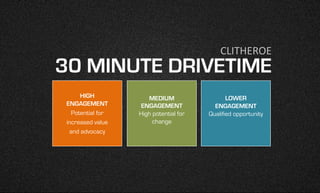
30 MINUTE DRIVETIME
OF CLITHEROE
HIGH
ENGAGEMENT
Potential for
increased value
and advocacy
MEDIUM
ENGAGEMENT
High potential for
change
LOWER
ENGAGEMENT
Qualified opportunity
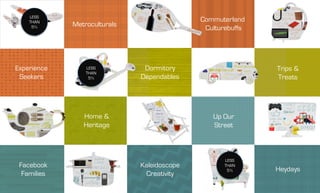
CLITHEROE
Metroculturals
Commuterland
Culturebuffs
Experience
Seekers
Dormitory
Dependables
Trips &
Treats
Home &
Heritage
Up Our
Street
Facebook
Families
Kaleidoscope
Creativity
Heydays
LESS
THAN
5%
LESS
THAN
5%
LESS
THAN
5%
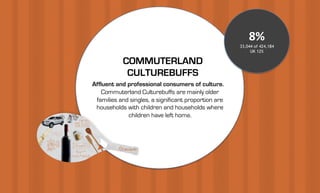
Affluent and professional consumers of culture.
Commuterland Culturebuffs are mainly older
families and singles, a significant proportion are
households with children and households where
children have left home.
COMMUTERLAND
CULTUREBUFFS
8%
33,044 of 424,184
UK 12%
GENERAL
• Affluent	and	settled	group	with	many	
working	in	higher	managerial	and	
professional	occupations
• Keen	consumers	of	culture,	with	broad	
tastes	but	a	leaning	towards	heritage	
and	more	classical	or	traditional	
offerings
• Often	mature	families	or	retirees,	living	
in	countryside	comfort
• A	group	willing	to	travel	and	pay	for	
premium	experiences,	their	habits	
perhaps	influenced	by	commuting
• Motivations	are	multiple,	ranging	from	
social	and	self-improvement,	to	the	
pursuit	of	learning	opportunities	for	
older	children
• Tend	to	be	frequent	attenders	and	
potential	donors
OPPORTUNITY
Already	highly	engaged,	they	are	open	to	
high	quality	offerings,	which	they	have	
the	means	to	attend	regularly.	Leaning	
towards	classical	programme	choices,	
time	is	viewed	as	a	valuable	resource	and	
they	will	pay	premium	prices	to	ensure	
premium	artistic	experiences.	
Opportunities	that	offer	exclusive	access,	
added	value	events	such	as	talks	and	
tailored	interpretation/content	may	help	
to	develop	their	loyalty	to	a	particular	
artform/organisation.
CREATIVE	PARTICIPATION
Participation	in	cultural	and	creative	activities	
is	as	important	to	Commuterland	Culturebuffs	
as	attending	events.
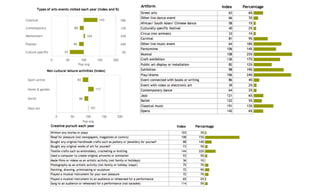
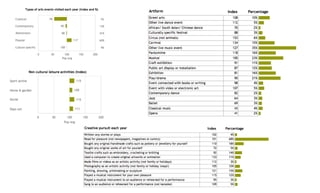
They	participate	widely	in	performing	arts	
activities	and	can	be	found	wherever	there	are	
activities	like	ballet,	singing	and	playing	
musical	instruments.	Where	there	are	
opportunities	for	public	rehearsals	and	
performances	of	plays	and	opera	there	are	
likely	to	be	a	significant	contingent	of	
Commuterland	Culturebuffs.
They	are	amongst	those	most	likely	to	
purchase	original	works	of	art	and	handmade	
crafts.
They	have	a	much	higher	than	average	
propensity	to	participate	in	street	arts,	
carnivals	and	to	practice	circus	skills.	
Photography	and	film/video	making	are	also	
relatively	popular.
LIFESTYLE
Enjoy	a	high	standard	of	living,	with	43%	
of	households	having	an	annual	income	
above	£50,000,	and	a	further	37%	with	
an	income	between	£25,000	– £50,000.
They	are	very	well	educated,	47%	have	
obtained	a	degree	level	qualification	or	
higher.
They	value	the	arts	intrinsically	and	
recognise	the	wider	social	impacts.	They	
also	feel	heritage	is	an	important	
contributor	to	sense	of	place	and	believe	
in	the	conservation	of	local	heritage	sites.
COMMUNITY	INVOLVEMENT
Have	a	tendency	to	be	quite	involved	in	local	
communities.	They	are	the	group	that	is	most	
likely	to	engage	in	volunteering	opportunities	
and	more	than	a	third	will	have	done	so	in	the	
last	year.	They	chiefly	get	involved	in	
volunteering	either	through	leading	groups,	
membership	of	committees	or	organising	or	
helping	to	run	events.	More	than	a	third	will	
have	raised	money	for	charitable	causes	in	the	
last	year	through	sponsored	events.
35%	volunteer	each	year	- Rank	1st	for	
volunteering
GIVING
Commuterland	Culturebuffs	are	likely	
prospects	for	making	donations	to	arts	
and	cultural	organisations.	10%	will	have	
donated	to	an	arts	organisation	in	the	last	
year,	whilst	22%	will	have	made	
donations	to	museums	and	galleries	and	
24%	to	heritage	sites.
Charitable	giving	outside	of	the	arts	is	
most	likely	to	be	directed	towards	
medical	research,	children	and	young	
people	or	rescue	services.
LIFESTAGE
Older	families	and	singles	– more	
than	two	thirds	are	families.	They	
tend	to	be	older	families,	but	a	
large	proportion	of	households	
with	children	are	mixed	with	
some	where	children	are	old	
enough	to	have	left	home.	Over	
70%	in	this	group	are	aged	
between	46	and	70	years	old.
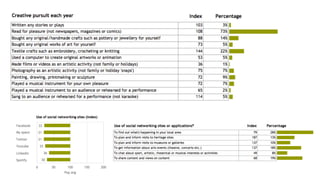
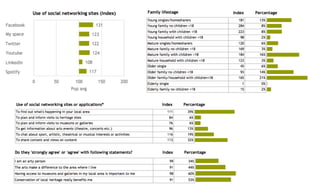
DIGITAL	HABITS
With	busy	lives	to	manage,	this	
group	make	good	practical	use	of	
the	internet	without	spending	
long	hours	online.	They	regularly	
visit	arts	and	cultural	
organisation’s	websites	to	find	
out	information	and	plan	a	visit	–
up	to	two	thirds	of	those	who	use	
websites	in	this	way	may	go	on	to	
book	tickets	online.
Commuterland	Culturebuffs	are	
also	more	likely	than	average	to	
view	or	download	artistic	content	
online,	and	a	quarter	will	have	
done	so	in	the	last	year.	
However,	they	are	far	less	likely	
to	use	social	networking	sites	to	
find	out	information	about	what’s	
going	on	locally,	or	to	plan	a	visit,	
but	may	use	social	media	to	
share	and	discuss	artistic	content.
PRICING
Can	afford	to	attend	regularly,	and	will	
pay	premium	prices	to	ensure	a	high	
quality	of	experience.	Discounting	
strategies	are	less	likely	to	be	effective	
compared	to	offering	priority	access,	or	
opportunities	to	add	value	to	the	
experience.
As	there	is	such	a	strong	family	and	
social	element	to	their	motivations	for	
attending,	opportunities	to	encourage	
ancillary	spending	through	catering	and	
retail	should	be	emphasised.
PLACE:	ACCESS	&	DISTANCE
Commuterland	Culturebuffs	
enjoy	quite	good	access	to	
cultural	provision.	They	live	in	
commuter	locations	within	reach	
of	urban	centres where	transport	
links	ought	to	be	good,	and	car	
ownership	is	above	average.	
However,	highlighting	and	
recommending	best	travel	
options	is	likely	to	be	useful.
Most	enjoy	good	health	and	
there	is	a	reduced	tendency	
amongst	Commuterland	
Culturebuffs	to	limit	their	
activities	due	to	disability.	So	
they	are	generally	not	likely	to	
require	specific	measures	that	go	
above	or	beyond	normal	
accessibility	provision.
PROMOTION
The	internet	is	an	important	
information	channel,	with	many	
using	cultural	organisations’	
websites	to	find	out	information	and	
to	plan	and	book	visits	online.
There	is	a	complex	mixture	of	
decision	making	styles	amongst	
Commuterland	Culturebuffs,	but	a	
majority	are	instinctively	analytical	in	
their	approach	and	value	clear	
information	above	all.	Some	will	be	
confident	in	their	own	analysis	to	
make	choices	themselves,	but	others	
may	like	the	reassurance	of	trusted	
recommendation	– therefore	expert	
endorsements,	or	content	to	
mobilise word	of	mouth	is	
recommended.
Responsive	to	email	and	post	but	
less	likely	to	respond	to	mobile,	
landline	or	SMS	communications.
PARTNERSHIPS
Membership	of	heritage	
organisations	is	very	high,	and	
there	is	a	strong	interest	in	its	
place	in	the	community,	and	its	
conservation.	These	could	form	
the	basis	of	mutually	beneficial	
partnerships.
The	philanthropic	habits	of	
Commuterland	Culturebuffs	
suggest	that	they	have	strong	
empathy	with	children	and	young	
people’s	charities,	as	well	as	with	
medical	research	and	rescue	
services.	These	also	may	form	a	
potential	basis	for	fruitful	creative	
partnerships.
PLACE:	ENVIRONMENT
There	is	a	strong	social	
motivation	behind	their	arts	
attending,	so	the	opportunity	
to	share	food	and	drink	in	
pleasant	café/restaurant	
surroundings	at	the	events	
themselves	will	be	a	benefit.	
High	quality	facilities	and	
customer	service	would	be	
important	features	to	promote.
Families	tend	to	be	older,	but	
there	are	significant	numbers	
for	whom	it	would	be	worth	
foregrounding	any	Family	
Friendly	features.
PROGRAMME	PREFERENCES
Programme	offerings	such	as	
plays,	musicals,	opera,	ballet	and	
classical	music	are	core	artistic	
choices.
Guarantees	of	quality	are	
important	so	classic	or	traditional	
productions	and	established	
performers	and	companies	are	
popular.	The	endorsement	of	
well-known	and	respected	artists	
or	experts	will	be	well	received.
They	are	also	open	to	artforms
such	as	contemporary	dance	and	
jazz,	literary	events,	
video/electronic	arts	and	crafts,	
but	these	are	generally	not	as	
well	attended	as	more	traditional	
artforms.
PARTICIPATION
Already	willing	and	active	arts	and	cultural	participants	they	
are	open	to	a	wide	range	of	opportunities	such	as	craft,	
playing	musical	instruments,	painting,	sculpting	and	
photography.	These	help	enhance	the	sense	that	the	arts	
make	up	a	significant	part	of	who	they	are.	Opportunities	to	
either	learn	or	improve	artistic	skills	individually	or	
collectively	through	tailored	programmes,	or	performance	
opportunities	will	be	taken	up,	as	will	any	ad	hoc	
opportunities	to	engage.
GIVING	&	VOLUNTEERING
Commuterland	Culturebuffs	are	likely	prospects	for	making	
donations	to	arts	and	cultural	organisations	and	top	the	
league	for	giving	to	Museums	&	Galleries	and	Heritage.	
Their	motivations	for	giving	to	arts	and	culture	are	quite	
altruistic,	motivated	to	give	in	order	to	preserve	those	
cultural	facilities,	rather	than	for	any	personal	benefit.
The	philanthropic	habits	of	Commuterland	Culturebuffs	
suggest	that	they	have	strong	empathy	with	children	and	
young	people’s	charities,	as	well	as	with	medical	research	
and	rescue	services.
RELATIONSHIP	BUILDING
As	regular	attenders	to	the	arts	(almost	a	third	attend	five	or	
more	different	artforms annually),	their	breadth	of	artistic	
interests	means	that	they	are	likely	to	attend	a	wide	range	
of	organisations.	Ensuring	quality	of	artistic	experience,	
enabling	social	elements	of	attendance	(café,	restaurant,	
bar,	shop	etc),	and	maximising opportunities	for	depth	of	
engagement	(e.g.	by	enabling	dialogue,	encouraging	input	to	
the	creative	process,	sharing	&	discussion	of	experience	and	
content)	are	likely	to	help	build	relationships.
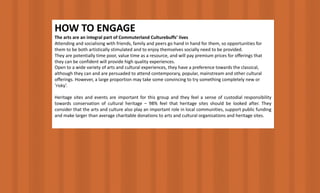
HOW	TO	ENGAGE
The arts are an integral part of Commuterland Culturebuffs’ lives
Attending	and	socialising with	friends,	family	and	peers	go	hand	in	hand	for	them,	so	opportunities	for	
them	to	be	both	artistically	stimulated	and	to	enjoy	themselves	socially	need	to	be	provided.
They	are	potentially	time	poor,	value	time	as	a	resource,	and	will	pay	premium	prices	for	offerings	that	
they	can	be	confident	will	provide	high	quality	experiences.
Open	to	a	wide	variety	of	arts	and	cultural	experiences,	they	have	a	preference	towards	the	classical,	
although	they	can	and	are	persuaded	to	attend	contemporary,	popular,	mainstream	and	other	cultural	
offerings.	However,	a	large	proportion	may	take	some	convincing	to	try	something	completely	new	or	
‘risky’.
Heritage sites and events are important for this group and they feel a sense of custodial responsibility
towards conservation of cultural heritage – 98% feel that heritage sites should be looked after. They
consider that the arts and culture also play an important role in local communities, support public funding
and make larger than average charitable donations to arts and cultural organisations and heritage sites.
Affluent	and	professional	consumers	of	culture.
Commuterland	Culturebuffs	are	mainly	older	
families	and	singles,	a	significant	proportion	are	
households	with	children	and	households	where	
children	have	left	home.
COMMUTERLAND
CULTUREBUFFS
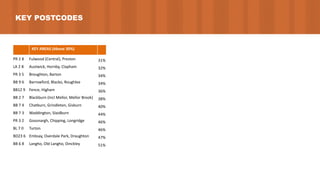
KEY POSTCODES
KEY	AREAS	(Above	30%)
PR	2	8 Fulwood	(Central),	Preston 31%
LA	2	8 Austwick,	Hornby,	Clapham 32%
PR	3	5 Broughton,	Barton 34%
BB	9	6 Barrowford,	Blacko,	Roughlee 34%
BB12	9 Fence,	Higham 36%
BB	2	7 Blackburn	(Incl Mellor,	Mellor	Brook) 38%
BB	7	4 Chatburn,	Grindleton,	Gisburn 40%
BB	7	3 Waddington,	Slaidburn 44%
PR	3	2 Goosnargh,	Chipping,	Longridge 46%
BL	7	0 Turton 46%
BD23	6 Embsay,	Overdale Park,	Draughton 47%
BB	6	8 Langho,	Old	Langho,	Dinckley 51%
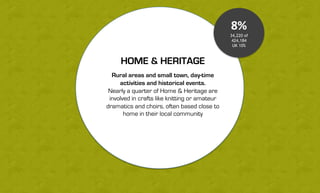
Rural areas and small town, day-time
activities and historical events.
Nearly a quarter of Home & Heritage are
involved in crafts like knitting or amateur
dramatics and choirs, often based close to
home in their local community
HOME & HERITAGE
8%
34,220 of
424,184
UK 10%
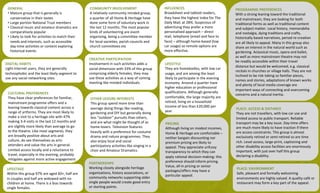
GENERAL
• Mature	group	that	is	generally	is	
conservative	in	their	tastes
• Large	portion	National	Trust	members
• Classical	music	and	amateur	dramatics	are	
comparatively	popular
• Likely	to	look	for	activities	to	match	their	
needs	and	interests,	such	as	accessible	
day-time	activities	or	content	exploring	
historical	events
CREATIVE	PARTICIPATION
Involvement	in	such	activities	adds	a	
social	dimension	with	33%	of	this	group	
comprising	elderly	females,	they	may	
use	these	activities	as	a	way	of	coming	
meeting	like	minded	individuals.
LIFESTYLE
They	are	homebodies,	with	low	car	
usage,	and	are	among	the	least	
likely	to	participate	in	the	evening	
economy.	Around	a	quarter	have	
higher	education	or	professional	
qualifications.	Although	generally	
comfortable,	the	large	majority	are	
retired,	living	on	a	household	
income	of	less	than	£20,000	per	
year.
COMMUNITY	INVOLVEMENT
A	relatively	community	minded	group,	
a	quarter	of	all	Home	&	Heritage	have	
done	some	form	of	voluntary	work	in	
the	last	12	months.	The	most	popular	
kinds	of	volunteering	are	event	
organising,	being	a	committee	member	
for	local	societies,	parish	councils	and	
church	committees	etc
LIFESTAGE
Within	this	group	97%	are	aged	60+,	half	are	
in	couples	and	half	are	widowed	with	no	
children	at	home.	There	is	a	bias	towards	
single	females.
DIGITAL	HABITS
Light	internet	users,	they	are	generally	
technophobic	and	the	least	likely	segment	to	
use	any	social	networking	sites.
INFLUENCES
Broadsheet	and	tabloid	readers,	
they	have	the	highest	index	for	The	
Daily	Mail,	at	28%.	Suspicious	of	
advertising	they	prefer	a	more	
personalised approach	– direct	
mail,	telephone	(email	and	face	to	
face)	– although	home-based	(low	
car	usage)	so	remote	options	are	
more	effective.
CULTURAL	PREFERENCES
They	have	clear	preferences	for	familiar,	
mainstream	programme offers	and	a	
leaning	towards	classical	content	across	a	
range	of	artforms.	They	are	most	likely	to	
make	a	visit	to	a	heritage	site	with	47%	
making	3-4	visits	in	the	last	12	months	and	
are	slightly	more	likely	than	average	to	go	
to	the	theatre.	Like	most	segments,	they	
are	broadly	positive	about	arts	and	
culture,	do	see	themselves	as	arts-
attenders and	value	the	arts	in	general.	
Limited	access	locally	and	a	reluctance	to	
travel,	especially	in	the	evening,	probably	
mitigates	against	more	active	engagement.
OTHER	LEISURE	INTERESTS
This	group	spend	more	time	than	
average	doing	things	like	reading,	
gardening	and	DIY	but	generally	doing	
less	“outdoor”	pursuits	than	others,	
and	are	what	might	be	thought	of	as	
home-lovers.	Television	features	
heavily	with	a	preference	for	costume	
drama	and	nature	programmes.	They	
also	enjoy	local	and	social	
participatory	activities	like	singing	in	a	
choir	and	Amateur	Dramatics.
PARTNERSHIPS
Working	closely	alongside	heritage	
organisations,	history	associations,	or	
community	networks	supporting	older	
single	people	would	create	good	entry	
or	starting	points.
PROGRAMME	PREFERENCES
With	a	strong	leaning	toward	the	traditional	
and	mainstream,	they	are	looking	for	both	
traditional	forms	as	well	as	traditional	content	
and	subject	matter.	Local	history,	memorabilia	
and	nostalgia,	dying	traditions	and	crafts,	
historically	based	narratives,	period	re-creation	
are	all	likely	to	appeal.	Many	in	this	group	also	
share	an	interest	in	the	natural	world	such	as	
gardening.	Aclassical music,	opera	and	ballet,	
as	well	as	more	mainstream	theatre	may	not	
be	readily	accessible	within	their	travel	
distance	but	would	be	welcomed,	e.g.	classical	
recitals	in	churches	or	village	halls.	They	are	not	
inclined	to	be	risk-taking	so	familiar	pieces,	
names	and	stories,	adaptations	of	known	works	
and	plenty	of	local	media	coverage	are	
important	ways	of	connecting	and	overcoming	
concerns	and	a	natural	inertia.
PRICING
Although	living	on	modest	incomes,	
Home	&	Heritage	are	comfortable	–
neither	bargain	discounting	nor	
premium	pricing	are	likely	to	
appeal.	They	appreciate	unfussy	
transparency	to	which	they	can	
apply	rational	decision-making:	this	
preference	should	inform	pricing.	
Value,	all-in	pricing	or	senior	
packages/offers	may	have	a	
particular	appeal.
PLACE:	ACCESS	&	DISTANCE
They	are	not	travellers,	with	low	car	use	and	
limited	access	to	public	transport.	Reliable	
transport	may	be	a	key	issue.	Day-time	offers	
are	much	more	likely	to	have	traction	if	there	
are	access	constraints.	This	group	is	almost	
exclusively	retired	or	semi-retired	so	are	time	
rich.	Level	access,	large-print,	captioning	and	
other	disability	access	facilities	are	enormously	
important,	with	just	over	half	this	group	
declaring	a	disability.
PLACE:	ENVIRONMENT
Safe,	pleasant	and	formally	welcoming	
environments	are	highly	valued.	A	quality	café	or	
restaurant	may	form	a	key	part	of	the	appeal.
HOW	TO	ENGAGE
Home	&	Heritage	live	their	lives	locally,	expressing	their	creativity	through	craft	and	local	participation
Nearly	half	feel	that	they	have	plenty	of	opportunity	to	get	involved	in	the	arts,	and	only	26%	feel	that	“the	
arts	is	not	for	them”.	They	feel	that	heritage	is	an	important	contributor	to	sense	of	place	and	believe	in	
the	conservation	of	local	heritage	sites.	About	70%	have	been	to	an	arts	event	in	the	last	year,	and	about	
50%	have	attended	a	museum	or	gallery.	They	have	a	low	reception	to	broadcast	advertising,	and	respond	
to	tailored/targeted	communications,	like	plain	speaking	and	face	to	face	contact.	Home	&	Heritage	are	
open	to	persuasion	if	appealed	to	directly	with	tailored	communications	that	meet	their	tastes	and	access	
needs	and	offer	a	complete	package,	which	may	involve	provision	of	transport.	Opportunities	to	engage	
them	could	include	participatory	events	through	U3A	and	local	rural	touring	schemes.
Affluent	and	professional	consumers	of	culture.
Commuterland	Culturebuffs	are	mainly	older	
families	and	singles,	a	significant	proportion	are	
households	with	children	and	households	where	
children	have	left	home.
COMMUTERLAND
CULTUREBUFFS
KEY POSTCODES
HOME AND HERITAGE
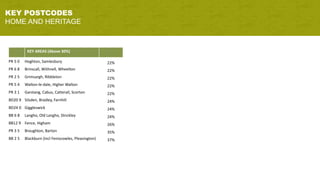
KEY	AREAS	(Above	30%)
PR	5	0 Hoghton,	Samlesbury 22%
PR	6	8 Brinscall,	Withnell,	Wheelton 22%
PR	2	5 Grimsargh,	Ribbleton 22%
PR	5	4 Walton-le-dale,	Higher	Walton 22%
PR	3	1 Garstang,	Cabus,	Catterall,	Scorton 22%
BD20	9 Silsden,	Bradley,	Farnhill 24%
BD24	0 Giggleswick 24%
BB	6	8 Langho,	Old	Langho,	Dinckley 24%
BB12	9 Fence,	Higham 26%
PR	3	5 Broughton,	Barton 35%
BB	2	5 Blackburn	(Incl Feniscowles,	Pleasington) 37%
Suburban and small towns interest in heritage
activities and mainstream arts
Predominantly older families and singles, with a
large proportion of households with children.
DORMITORY
DEPENDABLES
8%
34,220 of 424,184
UK 10%
GENERAL
• A	significant	proportion	of	arts	
audiences	are	made	up	of	this	
dependably	regular	if	not	frequently	
engaging	group
• Most	live	in	suburban	or	small	towns	
and	show	a	preference	for	heritage	
activities	alongside	popular	and	more	
traditional	mainstream	arts
• Many	are	thriving,	well	off	mature	
couples	or	busy	older	families
• Lifestage coupled	with	more	limited	
access	to	an	extensive	cultural	offer	
mean	that	culture	is	more	an	
occasional	treat	or	family	or	social	
outing	than	an	integral	part	of	their	
lifestyle
CREATIVE	PARTICIPATION
Their	strong	interest	in	
musicals	and	other	live	music	
events	is	reflected	in	a	
relatively	high	propensity	to	
play	a	musical	instrument.	
Photography	is	another	artistic	
activity	that	they	have	an	
inclination	towards,	as	are	the	
use	of	computers	to	create	
original	artworks	and	the	
making	of	film	and	videos.	
They	are	also	apt	to	purchase	
original	works	of	art	and	
handmade	crafts.
LIFESTYLE
They	tend	to	be	quite	comfortably	off,	
being	either	successful	people	in	senior	
management	positions,	or	highly	
experienced	in	lower	managerial,	
supervisory	or	technical	roles.	About	two	
thirds	of	households	have	an	income	of	
over	£25,000	per	year.	Their	education	
profile	is	similar	to	that	of	the	English	
population	at	large,	with	a	third	having	
attained	a	degree	or	higher	level	of	
qualification.	A	number	have	also	gained	
higher	educational	qualifications	below	
degree	level,	and	around	4%	have	
undertaken	trade	apprenticeships.
More	likely	to	think	of	themselves	as	sporty	
rather	than	arty,	they	do	however	feel	it	is	
important	to	be	able	to	have	access	to	
opportunities	to	enjoy	cultural	experiences,	
particularly	museums,	galleries	and	
heritage	sites,	e.g.	as	social	occasions	and	
days	out,	which	are	often	organised with	
and	around	family	and	friends.
COMMUNITY	INVOLVEMENT
A	quite	community	minded	group,	a	quarter	of	all	
Dormitory	Dependables have	done	some	form	of	
voluntary	work	in	the	last	12	months.	They	are	
averagely	disposed	to	volunteering	with	arts	and	
cultural	organisations,	but	much	more	likely	to	do	
so	around	sports.
OPPOTUNITY
Infrequently	attending	but	regular,	They	
make	up	one	of	the	largest	proportions	of	the	
population.	Warm	to	museums	and	the	arts,	
and	in	particular	to	popular	and	mainstream	
events.	A	small	increase	in	their	individual	
engagement	could	potentially	have	a	big	
effect	on	audiences	overall.	They	are	very	
keen	on	live	music	events	and	have	a	
particular	preference	for	the	heritage	offer.
DIGITAL	HABITS
Digital	is	an	important	information	
source	for	Dormitory	Dependables.	Arts	
and	cultural	organisations’	websites	are	
widely	used	(especially	heritage	
organisations),	as	a	place	to	find	out	
information	about	events,	artists,	
performers	and	venues.	However,	they	
are	less	likely	to	book	tickets,	or	to	view	
arts	and	cultural	content	through	
cultural	organisations’	websites.	Use	of	
social	networking	sites	is	slightly	above	
the	average	– used	to	find	out	
information,	chat	about	events	they’ve	
experienced	and	to	share	pictures,	
music	and	other	media	content.	Twitter	
is	preferred	to	Facebook,	and	given	
their	musical	interests,	Spotify is	
particularly	popular.
INFLUENCES
As	their	digital	habits	illustrate,	
there	is	no	such	thing	as	too	
much	information	for	them.	
They	like	to	see	all	the	facts	
and	consider	their	options	
before	making	rational,	
analytical	decisions.	Once	they	
have	all	the	information,	
they’ll	have	no	trouble	at	all	
making	a	decision.	They	are	
apt	to	change	their	minds,	if	
there	are	good	enough	
reasons	to	do	so.	There	is	a	
fairly	broad	readership	across	
the	range	of	newspapers,	
perhaps	reflecting	an	
assortment	of	political	
outlooks.	Stronger	preferences	
where	they	do	exist	are	for	
The	Daily	Mail,	The	
Independent	and	The	Times.	
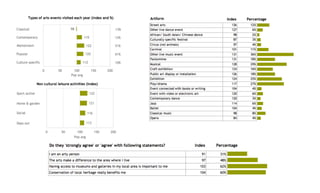
CULTURAL	INTERESTS
Living	in	suburban	and	rural	areas	their	access	
to	a	broad	range	of	arts	offerings	is	not	as	
extensive	as	it	might	be,	and	this	along	with	
their	busy	lifestyles,	may	contribute	to	their	
infrequent	engagement.	Sometimes	when	
they	do	attend	they	have	to	make	time	and	
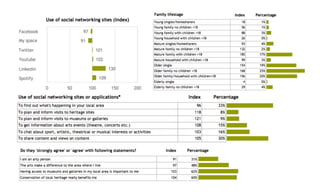
travel,	so	arts	and	culture	may	tend	to	be	
more	of	a	special	treat	than	part	and	parcel	of	
their	everyday	social	lives.	They	do	not	think	
of	themselves	as	particularly	arty	people,	but	
enjoy	attending	to	be	entertained	and	to	
socialise and	relax	with	friends.	Whilst	open	to	
a	broad	range	of	arts	and	cultural	activities,	
they	have	a	marked	inclination	towards	
popular	and	mainstream	offerings,	with	more	
than	half	taking	in	events	annually.	Their	
disposition	towards	contemporary	and	
classical	events	is	not	quite	as	strong,	but	
those	artforms are	still	attended	roughly	in	
line	with	or	slightly	above	the	national	
average.	Museum	and	gallery	visits	are	made	
regularly	but	infrequently	with	the	majority	
visiting	once	or	twice	a	year.	They	do	have	a	
marked	leaning	towards	heritage	sites,	to	
which	they	have	quite	good	access,	with	more	
than	half	of	all	households	visiting	annually.	Of	
those	who	do	visit	heritage	sites,	nearly	half	
go	three	or	four	times	a	year.
PROMOTION
Dormitory	Dependables are	busy	and	active,	so	providing	clear	
information	on	how	the	offer	will	meet	a	need	is	key.	They	are	less	reliant	
on	word	of	mouth,	and	more	confident	in	their	own	choices	when	given	
enough	appropriate	detail	on	what,	how,	why,	when	and	where	to	
attend.
They	are	most	responsive	to	email	communications,	SMS	messaging	and	
phone	as	direct	communications	channels,	and	least	likely	to	respond	to	
PARTNERSHIPS
Dormitory	Dependables are	keen	to	explore	
new	learning	opportunities	and	stretch	their	
intellect.	Their	charitable	giving	reflects	these	
interests	in	their	support	of	schools	and	higher	
education	and	partnerships	with	learning	
communities	might	well	be	beneficially	
entered	into	by	all	parties.	The	same	may	also	
be	true	of	charities	supporting	developing	
countries.	Two	thirds	also	participate	regularly	
in	sport	and	exercise,	so	sports	clubs,	teams	
and	related	stakeholders	might	prove	high	
profile	enough	to	create	popular	partnership	
opportunities.
PLACE:	ENVIRONMENT
As	reasons	for	attending	the	arts	tend	to	revolve	around	finding	
opportunities	to	relax,	socialise and	be	entertained	– often	by	way	of	a	
special	treat	– the	surroundings	need	to	be	mindful	of	providing	
suitable	facilities	and	ambiance	to	fulfil this	need.	The	enquiring	
nature	and	thirst	for	knowledge	of	Dormitory	Dependables also	
requires	information,	so	exhibitions	and	displays	should	provide	rich	
background	detail	and	an	Living	in	provincial	towns,	city	suburbs	or	
rural	areas	means	that	accessing	arts	and	cultural	opportunities	often	
involves	a	degree	of	travel.	Car	ownership	is	high	above	average,	
meaning	distance	doesn’t	necessarily	deter	them	from	attending.	
Good	transport	links	will	help,	as	will	clear	guidance	on	the	best	
options	for	getting	to	the	event.	Timing	of	events	may	also	be	an	
important	consideration	to	make	sure	they	fit	with	travel	plans.	Good	
health	is	a	fairly	broad	feature	amongst	them,	and	with	a	high	instance	
of	families	with	children,	venues,	events	and	facilities	might	benefit	
significantly	from	ensuring	a	Family	Friendly	approach.	
PROGRAMME	PREFERENCES
Live	music	is	a	chief	interest	of	Dormitory	
Dependables,	with	an	emphasis	on	the	
popular	or	mainstream.	They	attend	rock	and	
pop	events	more	than	any	other	group,	with	
classical	or	choral	music	less	popular	than	
average.	As	their	preference	for	the	popular	
suggests,	pantomime,	musicals,	live	dance	
events	and	street	arts	are	also	relatively	
sought	after.	A	large	number	also	attend	plays	
and	drama,	but	are	not	likely	to	do	so	more	
than	once	or	twice	a	year.	There	is	a	large	
proportion	of	families	with	children,	so	family	
friendly	programme choices	form	an	
important	part	of	the	mix.	Their	interest	in	
heritage,	history	and	current	affairs	may	also	
be	fruitful	areas	to	explore.	As	many	have	a	
keen	interest	in	visiting	art	exhibitions,	
displays	and	installations.	These	might	all	be	
features	that	can	be	developed	individually	or	
in	combination	to	good	effect	through	
programme offers.
PARTICIPATION
Dormitory	Dependables are	keen	to	participate	in	a	
wide	range	of	activities,	which	can	be	tailored	
around	opportunities	to	develop	and	showcase	
individual	skills	such	as	photography	and	playing	
musical	instruments.	Providing	access	to	activities	
which	might	be	undertaken	in	groups,	such	as	
rehearsing	or	performing	drama,	ballet	or	other	
kinds	of	dance	may	prove	little	less	popular	but	are	
still	likely	to	be	taken	up	in	line	with	or	slightly	above	
average	levels.
GIVING	&	VOLUNTEERING
Appeals	for	low	level,	infrequent	giving	are	most	
likely	to	meet	with	success	amongst	Dormitory	
Dependables.	Heritage	organisations,	museums	and	
galleries	are	most	likely	to	appeal	to	their	sense	of	
charity	and	history,	especially	if	the	benefits	to	the	
wider	public	from	such	giving,	e.g.	preservation	and	
development	of	engagement	opportunities	is	
clearly	articulated.	Levels	of	volunteering	generally	
are	around	average,	however	most	of	their	
volunteering	happens	outside	the	arts,	museums	or	
heritage	sectors.	The	most	likely	way	to	engage	
them	as	volunteers	is	co-opt	them	in	the	running	of	
activities	and	events.
RELATIONSHIP	BUILDING
As	largely	infrequent	attenders,	friends	or	
membership	schemes	for	which	benefits	are	realised
over	multiple	attendances	will	likely	have	limited	
appeal.	Instead,	strategies	aimed	at	encouraging	
more	frequent	engagement	e.g.	Test	Drive	are	likely	
to	prove	more	effective.	These	could	also	be	linked	
to	their	wider	social	motivations	and	incorporate	
catering	offers	or	other	incentives	(which	might	be	
time	limited).
PRICING
There	is	a	mixture	of	levels	of	disposable	income	amongst	Dormitory	
Dependables,	particularly	between	those	in	senior	managerial	and	
professional	positions,	and	those	in	lower	management	and	supervisory	
roles.	Add	to	this	the	mix	between	those	with	children	at	home	and	those	
empty	nesters	and	it	becomes	clear	that	a	model	of	mixed	pricing	
strategies	are	required.	Some	discount	based	promotions	around	family	
or	social	groups	might	appeal	as	a	means	to	addressing	both	the	overall	
cost	of	attending	relative	to	disposable	income,	and	‘risk’	factors	where	
programming	style	veers	away	from	the	popular	and	mainstream.
HOW	TO	ENGAGE
Dormitory Dependables make up a significant proportion of the UK population.
They are averagely or slightly more than averagely disposed to engaging with arts and cultural events and
with museums and gallery activities and tend to appear in significant numbers in many or most audiences
within reach of where they live. The arts provide them with opportunities for social occasions, but their
social lives do not depend on the arts. They have a particular leaning towards the heritage offer. They
attend arts and cultural events infrequently compared to the most highly engaged groups, but regularly, so
there may be merit in trying to persuade them to take part or attend more often. As “warm” prospects
and numerous in number, successful efforts to engage them more frequently could potentially have large
impacts on audiences overall.
Popular and mainstream events are this group’s default preference, but they are not averse to
contemporary, and possibly slightly more risky, experiences. The offer will be received more
enthusiastically when it is geared towards an emphasis on the experience and all its trappings, rather than
any overly deep focus on the artistic merits of the event.
Affluent	and	professional	consumers	of	culture.
Commuterland	Culturebuffs	are	mainly	older	
families	and	singles,	a	significant	proportion	are	
households	with	children	and	households	where	
children	have	left	home.
COMMUTERLAND
CULTUREBUFFS
KEY POSTCODES
DORMITORY DEPENDABLES
PC KEY	AREAS	(Above	30%) %
BL	0	9 Ramsbottom 38%
BD24	0 Giggleswick 38%
BB	4	4 Haslingden,	Helmshore 39%
LA	2	9 Caton,	Brookhouse,	Dolphinholme 40%
PR	2	5 Grimsargh,	Ribbleton 41%
PR	2	9 Fulwood (North),	Preston 43%
LA	2	8 Austwick,	Hornby,	Clapham 46%
PC KEY	AREAS	(Above	30%) %
BL	0	0 Ramsbottom,	Bl	0	0 31%
BD23	3 Gargrave,	Carleton 32%
BL	7	0 Turton 33%
BB	7	9 Whalley,	Billington,	Sabden 34%
PR25	5 Mendip	Road,	Leyland 35%
PR	6	7 Clayton-le-woods 35%
PR	5	0 Hoghton,	Samlesbury 35%
BL	0	0 Ramsbottom,	Bl 0	0 31%
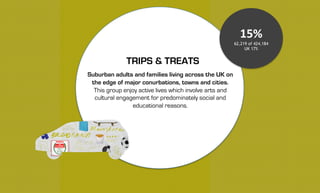
Suburban adults and families living across the UK on
the edge of major conurbations, towns and cities.
This group enjoy active lives which involve arts and
cultural engagement for predominately social and
educational reasons.
TRIPS & TREATS
15%
62,219 of 424,184
UK 17%
GENERAL
• While	this	group	may	not	view	arts	
and	culture	as	a	passion,	they	are	
reasonably	culturally	active,	despite	
being	particularly	busy	with	a	wide	
range	of	leisure	interests
• Tend	to	be	comfortably	off	and	living	
in	the	heart	of	suburbia
• Children	range	in	ages,	and	include	
young	people	still	living	at	home
• With	a	strong	preference	for	
mainstream	arts	and	popular	culture	
like	musicals	and	familiar	drama,	
mixed	in	with	days	out	to	museums	
and	heritage	sites
• This	group	are	led	by	their	children’s	
interests	and	strongly	influenced	by	
friends	and	family
CREATIVE	PARTICIPATION
Many	are	also	involved	in	craft,	photography	
and	playing	a	musical	instrument.	As	busy	
families	these	activities	to	a	certain	extent	
may	revolve	around	the	children,	but	are	led	
by	parents	who	believe	that	creative	
participation	is	important	and	possibly	
educational.
LIFESTYLE
With	an	average	level	of	
education	for	the	population,	
this	group	are	mostly	employed	
in	mid-level	professions	or	
lower	management.	
Their	salaries	offer	them	a	
comfortable	standard	of	living	
in	the	main.	Some	are	still	
paying	off	mortgages	so	have	
higher	outgoings,	others	have	
paid	them	off	(but	may	still	be	
supporting	older	children	in	one	
way	or	another).	Use	of	
websites	such	as	Ebay and	
Amazon	and	out	of	town	
superstores	such	as	Aldi,	Asda,	
Tesco	or	Cash	and	Carry	where	
they	are	likely	to	use	vouchers,	
coupons,	collect	reward	points	
and	make	the	most	of	discounts	
and	meal	deals	helps	control	
their	spending.	
COMMUNITY	INVOLVEMENT
They	believe	culture	does	make	some	
difference	to	their	localities	and	people’s	
lives	and	that	access	to	it	is	therefore	
important.	Less	than	a	quarter	do	some	
volunteering	– mostly	for	arts	and	sports	–
which	is	at	a	lower	rate	than	the	national	
average.	Much	of	this	may	be	associated	
with	or	aligned	to	family	interests.
GIVING
If	they	consider	the	local	arts	
offer	worth	supporting,	they	
are	moderately	likely	to	have	
donated,	but	mostly	give	to	
museums,	galleries	or	heritage,	
with	32%	having	donated	
between	£20	and	£99.	The	
higher	value	donations	going	to	
arts	and	heritage	and	lower	
levels	to	museums	and	
galleries.	10%	of	this	group	are	
members	of	The	National	Trust.
LIFESTAGE
The	group	contains	a	broad	spread	of	
ages	up	to	60	years	old	with	58%	aged	
between	31- 50.	50%	are	households	
with	children	and	most	live	in	what	are	
essentially	family	homes	where	older	
children	may	have	either	left,	are	
frequently	coming	and	going,	or	still	
resident.	Many	have	younger	families	
and	most	have	at	least	one	or	two	
children,	although	there	may	also	be	
other	adults	living	in	the	household,	
such	as	older	relatives.	22%	are	
singles,	either	living	on	their	own	or	
co-habiting,	while	some	are	younger	
couples	just	starting	out.
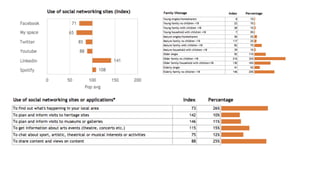
DIGITAL	HABITS
Technically	savvy,	but	not	always	seeking	out	the	
latest	gadgets,	Trips	&	Treats	contains	families	
which	are	regular	users	of	the	internet.	Those	
who	are	younger	are	keen	social	networkers	and	
adept	at	managing	their	money	online.	All	are	
using	websites	to	research	and	seek	out	
information	on	a	daily	basis.
They	use	social	media	to	find	out	what’s	going	on	
locally	and	to	chat	about	activities	and	other	
cultural	events,	but	not	necessarily	for	following	
cultural	organisations.	They	are	likely	to	use	the	
full	range	of	platforms	depending	on	what	
they’re	doing	– Facebook,	Twitter,	YouTube,	
Pinterest.	Many	own	smartphones and	download	
a	large	number	of	apps.	Downloading	or	
streaming	music	using	Spotify is	also	common.	
They	much	prefer	contact	by	email	than	phone	
or	in	person.
INFLUENCES
Mainly	tabloid	readers,	Trips	&	Treats	are	
likely	to	read	The	Sun	and	The	Daily	Mail,	
along	with	a	local	daily	newspaper.	A	few	
will	read	a	broadsheet.	They	are	most	
likely	to	respond	to	messages	received	by	
email	bulletins,	or	those	seen	on	the	
television	and	read	about	in	magazines.	
However,	their	primary	source	of	
information	is	family	and	friends,	whose	
opinions	they	trust	to	help	them	make	
decisions.	Depending	on	how	confident	
they	are	feeling	some	may	take	a	few	
risks,	but	invariably	they	go	with	what	
they	know	or	seek	to	lower	the	possibility	
of	risk	by	drawing	on	a	range	of	easy	to	
access	information	sources.
CULTURAL	INTERESTS
With	above	average	attendance	at	museums,	
galleries	and	particularly	heritage	sites,	cultural	
engagement	of	some	sort	is	part	of	their	lives.	
Given	that	access	to	provision	can	be	relatively	
low,	considering	where	some	of	this	group	lives,	
they	are	more	active	than	might	be	expected	
with	some	making	planned	efforts	to	attend.
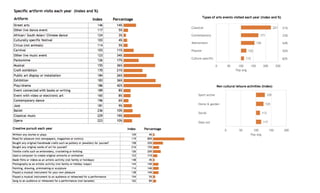
Live	music,	musicals,	film,	pantomime,	circus,	
carnival,	plays/drama,	museums,	galleries	and	
street	arts	feature	most	highly	in	their	choices.	
Around	half	have	attended	museums,	galleries	or	
heritage	sites	in	the	last	12	months.	Family	
outings,	including	for	special	occasions,	are	
reasonably	frequent.	They	are	sporty,	
undertaking	activities	such	as	team	sports	and	
dance	for	fitness.
INCREASING	REACH	AND	DIVERSITY
Understanding	the	local	population	and	
where	there	is	greater	potential	amongst	
this	group	can	be	supported	by	targeted	
door	to	door	or	digital	marketing	
campaigns	in	key	geographic	areas.	
Diversity	in	programming	will	bring	a	range	
of	age-ranges,	and	organisations should	
consider	the	entire	offer	for	meeting	those	
different	needs	in	different	ways.
PLACE:	ACCESS	&	DISTANCE
Happy	to	travel	into	a	city	
centre,	they	are	more	than	
likely	to	use	the	car,	so	parking	
facilities	are	important,	as	is	
security.	At	a	local	level,	they	
may	rely	more	on	public	
transport,	but	will	still	probably	
choose	to	get	around	by	car.
PROMOTION
For	larger	shows	or	exhibitions	Trips	&	
Treats	will	expect	to	see	prominent	
advertising	and	clear	messages.	If	they	
commute	they	will	look	for	street	
advertising,	otherwise	local	newspapers	
and	radio	may	be	key	sources.	Word	of	
mouth	may	be	effective	through	provision	
of	entertaining	and	engaging	digital	
content	which	can	be	shared.	This	group	
are	fairly	responsive	to	direct	emails	or	
post,	once	engaged.	Websites	should	be	
clear	and	informative,	as	they	will	be	
regularly	visited	once	a	family	is	
interested.	For	more	local	activities,	
promotion	via	third	party	organisations at	
a	community	level	may	be	effective	–
engaging	local	‘advocates’	to	help	spread	
the	word.	While	social	media	is	a	key	
influencer	for	this	group,	providing	them	
with	content	through	other	digital	
channels	to	share	and	incentivising them	
to	do	this,	may	be	most	effective.
PARTNERSHIPS
At	a	local	level	connections	with	local	
community	groups	may	be	effective	
etc.	Links	with	groups	supporting	
families	such	as	children’s	centres,	
family	activities	in	libraries	or	local	
scouts	and	guide	centres.	Schools	will	
be	key	partners	to	seek	out	and	
support,	along	with	other	local	
cultural	activities	for	young	people,	
e.g.	drama	centres or	colleges.
This	is	also	a	group	who	will	be	
receptive	to	brand	associations	–
whether	food,	drink	or	retail.
PLACE:	ENVIRONMENT
At	the	younger	end	the	
environment	needs	to	be	family	
friendly,	at	the	older	end	the	
environment	would	need	space	
and	opportunities	for	socialising
– whether	in	a	bar,	restaurant,	
foyer	or	outside	area.
PROGRAMME	PREFERENCES
Annual	events	such	as	pantomime,	
carnival	or	circus	and	street	arts	will	
engage	them,	alongside	branded	
shows,	live	bands	or	blockbuster	
exhibitions.	At	a	local	level	it	may	be	
possible	to	support	them	with	a	more	
‘risky’	or	unexpected	offer,	but	this	
will	involve	a	certain	amount	of	hand-
holding	– which	may	be	effective	
through	an	initially	participative	
route.
PARTICIPATION
The	participative	route	may	be	an	effective	entry	
route	for	many	families	into	cultural	activities.	For	
younger	families	it	will	be	about	fun	days	and	
activity	workshops	programmed	on	a	drop-in	basis,	
and	for	older	families	more	educational	or	
structured	participation	or	making	i.e.	half	term	
‘courses’.	Connecting	to	local	schools,	nurseries	or	
children’s	centres offering	outreach	performances	or	
workshops	will	also	effectively	introduce	them	to	a	
different	range	of	cultural	events.
GIVING	&	VOLUNTEERING
This	group	may	consider	themselves	as	potential	
givers	for	the	right	offer	and	benefits.	Nurturing	
those	already	giving	may	be	effective	to	understand	
what	their	motivations	might	be.	Otherwise	they	
may	also	respond	well	to	one	off	appeals	for	
particular	projects	relevant	to	families	or	which	
enhance	their	local	offer.	There	will	be	limited	scope	
for	increasing	volunteering,	but	they	may	for	
instance	be	interested	in	supporting	fundraising	with	
their	time.
RELATIONSHIP	BUILDING
Relationship	building	could	initially	be	focused	on	
attracting	them	for	regular	annual	events	in	the	
programme or	for	annual	treats	– for	instance	
around	birthdays	or	anniversaries	when	the	family	
would	like	to	celebrate	together.	Using	that	as	a	
starting	point	frequency	could	be	developed	with	a	
variety	of	offers.	Good	relations	will	rely	on	a	high	
level	of	customer	service	and	guaranteed	
experiences,	which	will	encourage	a	family	to	
repeat	visit.	Attention	to	the	whole	experience	may	
also	keep	them	coming	back	with	the	potential	for	
loyalty	to	a	particular	organisation or	venue	activity.
PRICING
While	able	to	afford	a	
premium	price	on	occasion,	
families	in	this	group	will	still	
be	looking	for	value	for	money	
– so	family	tickets	
(accommodating	a	range	of	
family	structures)	will	be	
welcomed	as	well	as	access	to	
some	discounts.	The	additional	
costs	of	a	family	outing	should	
also	be	considered	i.e.	food	
and	drink,	while	younger	
families	will	expect	free	or	
very	low	costs	for	local	
activities.
OPPORTUNITY
Positioning	cultural	events	as	fun,	
family	friendly	and	educational	
provides	opportunities	for	some	
additional	adventurous	attendance	to	
encourage	more	frequent	and	lifelong	
engagement.
HOW TO ENGAGE
Trips & Treats are already as active as they might be in cultural and other leisure activities
Trips & Treats are already as active as they might be in cultural and other leisure activities, so the
challenge is to support their interest within a familiar offer whilst also encouraging them to broaden or
deepen their engagement beyond the obvious.
They are receptive to advertising and direct marketing messages, but need endorsement from friends
and family – as they do not have the time or perhaps the inclination to seek out new or different
opportunities from the known. Led by their children’s interests, depending on their age, a good family
friendly offer or accessible work offering a guaranteed family day or night out is what they are seeking. As
they will invariably have to travel from the edges of town, thought should also be put into advice on
transport, parking and appropriate food and drink options.
Affluent	and	professional	consumers	of	culture.
Commuterland	Culturebuffs	are	mainly	older	
families	and	singles,	a	significant	proportion	are	
households	with	children	and	households	where	
children	have	left	home.
COMMUTERLAND
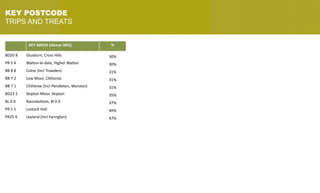
CULTUREBUFFSKEY	AREAS	(Above	30%) %
BD20	8 Glusburn,	Cross	Hills 30%
PR	5	4 Walton-le-dale,	Higher	Walton 30%
BB	8	8 Colne	(Incl	Trawden) 31%
BB	7	2 Low	Moor,	Clitheroe 31%
BB	7	1 Clitheroe	(Incl	Pendleton,	Worston) 31%
BD23	2 Skipton	Moor,	Skipton 35%
BL	0	0 Ramsbottom,	Bl	0	0 37%
PR	5	5 Lostock	Hall 40%
PR25	4 Leyland	(Incl Farington) 47%
KEY POSTCODE
TRIPS AND TREATS
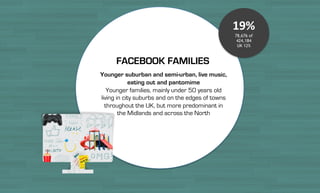
Younger suburban and semi-urban, live music,
eating out and pantomime
Younger families, mainly under 50 years old
living in city suburbs and on the edges of towns
throughout the UK, but more predominant in
the Midlands and across the North
FACEBOOK FAMILIES
19%
78,676 of
424,184
UK 12%
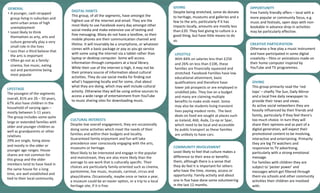
GENERAL
• A	younger,	cash-strapped	
group	living	in	suburban	and	
semi-urban	areas	of	high	
unemployment
• Least	likely	to	think	
themselves	as	arty,	arts	and	
culture	generally	play	a	very	
small	role	in	the	lives
• Less	than	a	third	believe	that	
the	arts	is	important
• Often	go	out	as	a	family:	
cinema,	live	music,	eating	
out	and	pantomime	being	
most	popular
OPPORTUNITY
Free	Family	friendly	offers	– local	with	a	
more	popular	or	community	focus,	e.g.	
music	and	festivals,	open	days	with	non-
bookable	in	advance	drop	in	activities	
may	be	particularly	effective.
LIFESTYLE
With	84%	on	salaries	less	than	£25K	
and	26%	on	less	than	£10K,	these	
families	are	financially	squeezed	and	
stretched.	Facebook Families	have	low	
educational	attainment,	basic	
qualifications	and	therefore	have	
lower	job	prospects	or	are	employed	in	
unskilled	jobs.	They	live	on	a	budget	
and	many	are	claiming	multiple	
benefits	to	make	ends	meet.	Some	
may	also	be	students	living	transient	
lives	paying	modest	rents.		The	best	
deals	on	food	are	sought	at	places	such	
as	Iceland,	Aldi,	Asda,	Co-op	or	Spar,	
which	need	to	be	local	and	accessible	
by	public	transport	as	these	families	
are	unlikely	to	have	cars.
COMMUNITY	INVOLVEMENT
Least	likely	to	feel	that	culture	makes	a	
difference	to	their	area	or	benefits	
them,	although	there	is	a	sense	that	
they	do	feel	it	is	important	for	others	
who	have	the	time,	money,	access	or	
opportunity.	Family	activity	and	about	
one	in	five	have	done	some	volunteering	
in	the	last	12	months.
GIVING
Despite	being	stretched,	some	do	donate	
to	heritage,	museums	and	galleries	and	a	
few	to	the	arts,	particularly	if	it	has	
impacts	locally,	amounts	are	mostly	less	
than	£20.	They	feel	giving	to	culture	is	a	
good	thing,	but	have	little	means	to	do	
so.
LIFESTAGE
The	youngest	of	the	segments	
overall,	81%	are	26	– 50	years,	
67%	also	have	children	in	the	
household	of	varying	ages	–
mostly	between	5-11	years.	
The	group	includes	some	quite	
large	or	extended	families	with	
older	and	younger	children	as	
well	as	grandparents	or	other	
relatives.
29%	are	single,	living	alone	
and	mostly	in	the	older	or	
younger	age	ranges.	House	
shares	are	not	common	for	
this	group	and	the	older	
members	tend	to	have	lived	in	
the	same	house	for	a	long	
time,	are	well	established	and	
tied	to	their	local	community.
DIGITAL	HABITS
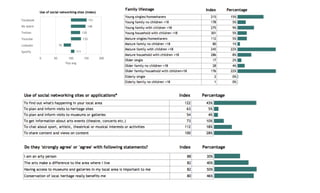
This	group,	of	all	the	segments,	have	amongst	the	
highest	use	of	the	internet	and	email.	They	are	the	
most	likely	to	use	Facebook every	day	amongst	other	
social	media	and	make	extensive	use	of	texting	and	
free	messaging.	Many	do	not	have	a	landline,	so	their	
mobile	phones	are	their	communication	channel	and	
lifeline.	It	will	invariably	be	a	smartphone,	or	whatever	
comes	with	a	basic	package	or	pay	as	you	go	service	
with	some	using	the	internet	via	a	tablet	rather	than	
laptop	or	desktop	computer.	Some	will	access	
information	through	computers	at	a	local	library.	
While	their	use	of	the	internet	is	high,	it	may	not	be	
their	primary	source	of	information	about	cultural	
activities.	They	do	use	social	media	for	finding	out	
what’s	happening	locally	and	for	some,	chat	about	
what	they	are	doing,	which	may	well	include	cultural	
activity.	Otherwise	they	will	be	using	online	sources	to	
access	a	wide	range	of	entertainment	from	YouTube	
to	music	sharing	sites	for	downloading	music.
CREATIVE	PARTICIPATION
Otherwise	a	few	play	a	music	instrument	
and	have	participated	in	some	digital	
creativity	– films	or	animations	made	on	
their	home	computer	inspired	by	
YouTube	and	TV	programmes.
CULTURAL	INTERESTS
Despite	low	overall	engagement,	they	are	occasionally	
doing	some	activities	which	meet	the	needs	of	their	
families	and	within	their	budgets	and	locality.	
Guaranteed	family	enjoyment	and	fun	will	take	
precedence	over	consciously	engaging	with	the	arts,	
museums	or	heritage.
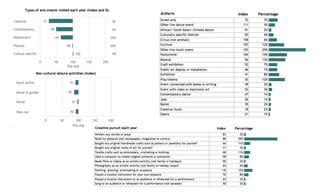
Most	likely	to	be	interested	and	engage	in	the	popular	
and	mainstream,	they	are	also	more	likely	than	the	
average	to	see	work	that	is	culturally	specific.	Their	
choices	are	particularly	family-oriented	such	as	cinema,	
pantomime,	live	music,	musicals,	carnival,	circus	and	
plays/drama.	Occasionally,	maybe	once	or	twice	a	year,	
a	museum	could	be	an	easier	option,	or	a	trip	to	a	local	
heritage	site,	if	it	is	free.
GIVING
This	group	primarily	read	the	‘red	
tops’	– chiefly	The	Sun,	Daily	Mirror	
and	a	local	free	daily	newspaper	to	
provide	their	news	and	views.
As	active	social	networkers	they	are	
heavily	influenced	by	their	friends	and	
family,	particularly	if	they	feel	there’s	
too	much	choice.	In	turn	they	will	
share	their	opinions	and	as	part	of	a	
digital	generation,	will	expect	their	
promotional	content	to	be	involving,	
interactive	and	entertaining.	Primarily	
they	are	big	TV	watchers	and	
responsive	to	TV	advertising,	
particularly	with	a	strong	emotional	
message.
For	families	with	children	they	are	
subject	to	‘pester	power’	and	
messages	which	get	filtered	through	
them	via	schools	and	other	community	
activities	their	children	are	involved	
with.
INCREASING	REACH	AND	DIVERSITY
Attracting	more	local	families	or	those	of	a	particular	community	
should	involve	creation	of	links	and	consultation	in	order	to	devise	
appropriate	projects	or	activities	with	the	involvement	of	target	
groups.	Strategies	such	as	working	with	local	community	
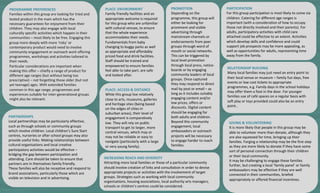
organisations,	housing	associations,	local	authority	arts	managers,	
schools	or	children’s	centres could	be	considered.
PLACE:	ACCESS	&	DISTANCE
While	this	group	live	relatively	
close	to	arts,	museums,	galleries	
and	heritage	sites	(being	based	
on	the	edges	of	cities	in	
suburban	areas),	their	level	of	
engagement	is	comparatively	
low.	They	will	rely	on	public	
transport	to	get	to	larger,	more	
central	venues,	which	may	or	
may	not	be	reliable	or	easy	to	
navigate	(particularly	with	a	large	
or	very	young	family).
PROMOTION
Depending	on	the	
programme,	this	group	will	
either	be	looking	for	
prominent	and	visible	
advertising	through	
mainstream	channels	or	
endorsements	from	peer	
groups	through	word	of	
mouth	or	social	networks.	
This	can	be	triggered	by	
local	level	promotion	
through	local	press,	notice-
boards	or	by	engaging	
community	leaders	of	local	
groups.	Once	captured	
they	may	respond	to	direct	
mail	by	post	or	email	– as	
long	as	it	includes	suitably	
engaging	content	and/or	
low	prices,	offers	or	
discounts.	Digital	content	
should	be	engaging	for	
both	adults	and	children.
Beyond	this	community	
engagement,	local	
ambassadors	or	outreach	
projects	will	be	necessary	
to	engage	harder	to	reach	
families.
PARTNERSHIPS
Local	partnerships	may	be	particularly	effective,	
such	as	through	schools	or	community	groups	
which	involve	children.	Local	children’s	Sure	Start	
centres,	nurseries	or	after	school	groups	may	also	
provide	useful	links.	Making	relationships	between	
cultural	organisations and	local	creative	
participatory	activities	would	be	effective	–
bridging	the	gap	between	participation	and	
attending.	Care	should	be	taken	to	ensure	that	
partners	are	in	themselves	family	friendly.
These	families	will	also	be	receptive	and	respond	to	
brand	associations,	particularly	those	which	are	
visible	on	television	and	in	advertising.
PLACE:	ENVIRONMENT
Family	friendly	facilities	and	an	
appropriate	welcome	is	required	
for	this	group	who	are	unfamiliar	
with	cultural	venues,	to	ensure	
that	the	whole	experience	
accommodates	their	needs.	
Fundamentals	from	baby	
changing	to	buggy	parks	as	well	
as	appropriate	and	affordably	
priced	food	and	drink	facilities.	
Staff	should	be	trained	and	
empowered	to	ensure	families	
feel	able	to	take	part,	are	safe	
and	looked	after.
PROGRAMME	PREFERENCES
Families	within	this	group	are	looking	for	tried	and	
tested	product	in	the	main	which	has	the	
necessary	guarantees	for	enjoyment	from	their	
children.	They	may	also	engage	with	local	
culturally	specific	activities	which	happen	in	their	
communities	– most	likely	to	be	free.	Engaging	this	
group	more	deeply	with	more	‘risky’	or	
contemporary	product	would	need	to	involve	
community	engagement	or	outreach	work	offering	
programmes,	workshops	and	activities	tailored	to	
their	needs.
Particular	considerations	are	important	when	
making	this	offer	– chiefly	a	range	of	product	for	
different	age	ranges	(but	without	being	too	
prescriptive)	– not	forgetting	those	older	(but	not	
yet	teenage)	ages.	With	extended	families	
common	in	this	age	range,	programmes and	
experiences	suitable	for	inter-generational	groups	
might	also	be	relevant.
PARTICIPATION
For	this	group	participation	is	most	likely	to	come	via	
children.	Catering	for	different	age	ranges	is	
important	(with	a	consideration	of	how	to	occupy	
those	not	directly	involved	and	their	parents).	For	
adults,	participatory	activities	with	child	care	
attached	could	be	effective	to	an	extent.	Activities	
which	develop	skills	and	confidence	and	could	
support	job	prospects	may	be	more	appealing,	as	
well	as	opportunities	for	adults,	representing	time	
away	from	the	family.
GIVING	&	VOLUNTEERING
It	is	more	likely	that	people	in	this	group	may	be	
able	to	volunteer	more	than	donate,	although	they	
are	also	squeezed	for	time,	bringing	up	their	
families.	Forging	a	relationship	may	be	the	first	step	
as	they	are	more	likely	to	donate	if	they	have	some	
sort	of	personal	connection	through	their	children	
or	their	local	community.
It	may	be	challenging	to	engage	these	families	
further,	but	creating	a	local	‘family	panel’	or	family	
ambassadors	may	be	effective	if	they	are	well	
connected	in	their	communities,	briefed	
appropriately	or	offered	financial	incentives.	
RELATIONSHIP	BUILDING
Many	local	families	may	just	need	an	entry	point	to	
their	local	venue	or	museum	– family	fun	days,	free	
events	or	low	cost	tickets	to	appropriate	
programmes,	e.g.	Family	days	in	the	school	holidays	
may	offer	them	a	foot	in	the	door.	For	younger	
families	use	of	café	spaces	on	a	regular	basis	with	
soft	play	or	toys	provided	could	also	be	an	entry	
point..
HOW	TO	ENGAGE
Local, free and family friendly are the watchwords for engaging this group with a focus on entertainment
and fun
A chance to get out with the children and enjoy some social time without having to worry about the
expense. While they are willing to pay possibly a higher price than might be expected for family treats, it
will only be for guaranteed product – popular and well-known. For all activities, these families will be
looking for endorsements through either high profile local and TV advertising or their own social media
networks. Hidden costs for a day out with the family may prove a barrier to engagement, so pricing
strategies should consider add-ons such as transport, food and take-aways for children. At a local level,
engaging families in community activities provide opportunities if they are free and offer social
opportunities for parents.
COMMUTERLAND
CULTUREBUFFS
KEY	AREAS	(Above	30%)
BB	9	8 Nelson	(Incl	Barrowford,	Newbridge) 33%
BB11	3 Burnley	(Incl	Cliviger,	Burnley	Wood) 34%
BB	3	1 Sunnyhurst,	Darwen 35%
BB12	7 Padiham,	Read,	Simonstone 35%
PR	2	6 Ribbleton,	Fulwood 39%
BB11	2 Rose	Hill,	Burnley 41%
BB	2	3 Higher	Croft,	Whinny	Heights,	Blackburn 42%
BB	2	2 Stansfeld Street,	Blackburn 47%
BB11	1 St	James	Street,	Burnley 49%
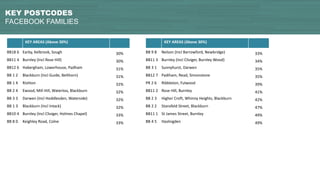
BB	4	5 Haslingden 49%
KEY POSTCODES
FACEBOOK FAMILIES
KEY	AREAS	(Above	30%)
BB18	6 Earby,	Kelbrook,	Sough 30%
BB11	4 Burnley	(Incl	Rose	Hill) 30%
BB12	6 Habergham,	Lowerhouse,	Padham 31%
BB	1	2 Blackburn	(Incl	Guide,	Belthorn) 31%
BB	1	4 Rishton 32%
BB	2	4 Ewood,	Mill	Hill,	Waterloo,	Blackburn 32%
BB	3	3 Darwen	(Incl	Hoddlesden,	Waterside) 32%
BB	1	3 Blackburn	(Incl	Intack) 32%
BB10	4 Burnley	(Incl	Cliviger,	Holmes	Chapel) 33%
BB	8	0 Keighley Road,	Colne 33%
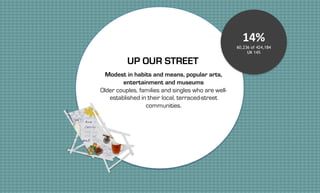
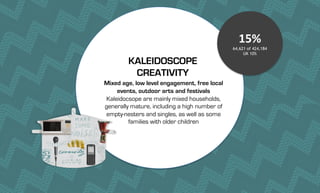
Modest in habits and means, popular arts,
entertainment and museums
Older couples, families and singles who are well-
established in their local, terraced-street
communities.
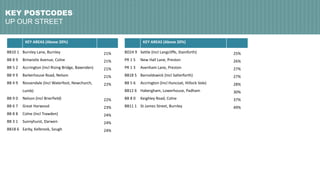
UP OUR STREET
14%
60,236 of 424,184
UK 14%
GENERAL
• Often	living	reasonably	
comfortable	and	stable	
lives
• A	group	that	engage	with	
popular	arts	and	
entertainment	and	
museums,	and	are	also	
visitors	of	heritage	sites
• Many	are	older	and	have	
some	health	issues
• Living	on	average	or	
below	average	household	
incomes,	so	access	in	all	
its	forms	can	be	an	issue
• Characterised as	modest	
in	their	habits	and	in	their	
means,	value	for	money	
and	low-risk	can	be	
important	factors	in	
leisure	decision	making
COMMUNITY	INVOLVEMENT
Although	they’re	interested	in	what	is	going	
on	in	their	local	area,	Up	Our	Street	are	not	
particularly	disposed	to	get	involved	through	
volunteering,	with	less	than	one	in	five	
people	choosing	to	do	so.	Those	that	do	
volunteer,	are	more	likely	to	be	found	
organising community	events,	being	
members	of	a	committee	or	offering	
practical	help	to	others,	but	don’t	tend	to	do	
so	with	arts	organisations.
As	a	segment	they	are	amongst	the	least	
likely	to	make	donations	to	arts	and	cultural	
organisations,	which	are	not	seen	by	the	
majority	as	worthy	charitable	causes.	The	
small	proportion	who	are	open	to	giving,	are	
three	times	more	likely	to	give	to	museums	
or	heritage	sites	than	to	arts	organisations,	
and	the	vast	majority	are	apt	to	make	very	
low	level,	infrequent	donations.
AGE	AND	DIVERSITY
Whilst	over	75%	of	Up	Our	Street	are	
people	aged	over	50,	there	is	a	broad	range	
in	each	of	the	age	bands	between	50	and	
76+.	Therefore	a	mixture	of	people	from	
those	who	still	have	a	number	of	years	to	
work	before	reaching	retirement,	those	
who	are	well	established	in	their	retirement	
and	those	who	fall	between	the	two.	There	
is	also	a	slightly	higher	proportion	of	people	
with	some	form	of	disability	or	limiting	
illness,	most	particularly	around	mobility	
issues.	This	indicates	that	a	range	of	
potential	barriers	or	challenges	may	need	
to	be	addressed	or	overcome	for	wider	arts	
engagement	to	be	successful.
LIFESTAGE
Mostly	aged	between	51-65	
years	old	and	heading	
towards	retirement.	There	
is	a	significant	proportion	of	
singles	(44%)	in	this	
segment,	along	with	older	
married	couples	and	
families	with	grown-up	
children	and	grandchildren.	
Most	likely	to	be	single,	or	
couples	without	children	
living	in	the	home.
DIGITAL	HABITS
Up	Our	Street	are	comfortable	with	
using	digital	technology,	but	they	do	so	
to	a	more	limited	extent	compared	with	
people	more	generally.	They	tend	to	be	
late	adopters	and	use	of	social	
networking	sites	is	not	widespread.	
Those	who	do	use	them	will	most	likely	
be	looking	for	information	about	events	
happening	in	their	local	area	rather	
than	to	engage	with	artistic	content	or	
media	online.	Facebook is	preferred	to	
Twitter,	YouTube,	or	other	media	
channels.
CREATIVE	PARTICIPATION
They	enjoy	pastimes	that	can	be	done	alone	or	in	
the	home	and	that	allow	them	to	practice	and	
make	use	of	their	practical	skills,	such	as	textile	
crafts	like	embroidery	and	knitting,	whilst	
woodwork	is	also	relatively	popular.	This	interest	
in	craft	extends	to	purchasing	original/handmade	
crafts	made	by	others.
The	propensity	towards	poetry	writing	is	higher	
than	amongst	many	other	segments,	but	in	
overall	terms	this	applies	to	a	relatively	small	
proportion	of	people	sharing	such	interest.
The	numbers	of	people	taking	part	in	activities	
linked	to	classical	or	contemporary	performing	
arts,	such	as	playing	musical	instruments,	singing,	
rehearsing	or	performing	in	plays,	ballet	or	other	
dance	performances	is	noticeably	lower	than	
levels	seen	nationally.
CULTURAL	INTERESTS
They	have	a	distinct	preference	for	
popular	and	mainstream	artforms,	
especially	live	music.	They	prefer	rock	
and	pop,	but	have	a	broad	range	of	
interest	in	most	types	of	music,	though	
are	not	particularly	keen	on	
contemporary	or	classical	events.	A	
significant	proportion	also	go	to	
musicals,	pantomimes,	craft	exhibitions	
and	carnivals.	This	indicates	a	leaning	
towards	easily	accessible,	experiential	
events	which	may	be	free	or	low	cost.
They	are	more	likely	to	visit	a	museum	
or	gallery	than	heritage	site.	There	is	a	
relatively	low	number	of	National	Trust	
and	English	Heritage	members,	possibly	
due	to	the	cost	of	membership	and	the	
distances	required	to	travel	to	get	to	
heritage	sites.
LIFESTYLE
Many	are	employed	in	jobs,	perhaps	in	
skilled	trade	occupations	for	which	an	
apprenticeship	was	undertaken,	or	in	
administrative	or	customer	service	
roles.	Most	rely	on	lower	to	middle	
incomes	of	between	£15,000- £25,000.	
They	lead	a	modest	lifestyles,	enjoying	
inexpensive	hobbies	and	occasional	
treats.
PRICING
Providing	opportunities	for	Up	Our	Street	
to	gain	access	to	inexpensive	tickets	and	
being	sure	to	foreground	value	for	money	
in	the	offer	are	key.	Emphasising the	
experiential	benefits	that	mark	cultural	
activities	out	as	a	better	alternative	to	
competing	leisure	activities,	and	enhancing	
the	treat	factor	may	work	well.
There	will	also	be	opportunities	to	boost	
ancillary	spend	for	this	group	around	
catering	and	retail	products.	People	are	apt	
to	buy	works	of	art	and	craft,	so	associated	
products,	if	keenly	priced,	are	likely	to	
prove	popular	and	add	to	the	overall	
experience.
PLACE:	ACCESS	&	DISTANCE
Car	ownership	is	low,	so	easily	accessed	
community	events	are	key.	Beyond	that,	
cheap,	effective,	reliable	transport	links	are	
important	and	programming	needs	to	factor	
in	any	limitations	that	transport	services	
might	dictate,	e.g.	last	bus	times.
PARTNERSHIPS
Although	not	necessarily	highly	active	within	their	the	
community,	they	do	tend	to	live	out	much	of	their	lives	
within	them	and	have	an	interest	in	what’s	going	on	locally.	
Community	services	like	media	(papers,	radio	channels),	
shops,	clubs,	church	groups	and	healthcare	providers	will	
form	regular	touch	points	for	Up	Our	Street	that	might	
make	them	effective	partners	for	reaching	these	mutually	
shared	households.
PLACE:	ENVIRONMENT
Enjoying	a	drink	with	friends	is	a	
commonplace	pastime,	and	perhaps	making	
sure	events	have	facilities	to	do	so	in	
comfortable	surroundings	might	potentially	
be	important.	As	culture	forms	something	of	
a	treat,	a	developed	retail	offer	could	
present	an	opportunity	to	enhance	the	
sense	of	“treat”	with	access	to	food,	
shopping	and	all	the	trimmings.
PROGRAMME	PREFERENCES
Most	cultural	attendance	from	Up	Our	Street	happens	at	
popular	and	mainstream	events.	Those	opportunities	
likely	to	appeal	will	be	easily	accessible	outdoor	festivals,	
especially	music	and	specifically	rock	and	pop	(although	
wider	musical	offerings	may	also	appeal).	A	slightly	older	
lifestage means	that	people	are	less	likely	to	be	looking	
for	content	to	interest	younger	children	– enjoyment	is	a	
key	criterion	– unless	they	are	grandparents	looking	to	
find	activities	they	can	share	with	their	grandchildren.	
Museums	may	have	an	advantage	and	be	able	to	exploit	
people’s	interest	in	history	and	in	their	local	
communities	to	package	opportunities	which	may	chime	
with	these	cost	conscious	households.
Heritage	sites	might	equally	appeal	to	many	with	the	
same	needs,	and	perhaps	provide	ideal	days	out	to	share	
with	grandchildren.	If	there	are	opportunities	to	get	
close	to	nature	and	wildlife	nearby	then	so	much	the	
better.
Classical	and	contemporary	events,	with	which	many	are	
not	familiar,	are	much	less	likely	to	be	taken	up	by	this	
risk	averse	segment,	unless	the	risk	can	be	highly	
mitigated,	perhaps	by	pricing	strategies	like	“pay	what	
you	want”	or	“money	back”	guarantees,	or	are	part	of	
taster	events	at	free	outdoor	festivals.
PARTICIPATION
Participatory	activities,	such	as	
embroidery,	knitting,	crochet,	wood	
turning,	carving	and	furniture	making,	or	
those	that	provide	a	chance	to	use	and	
develop	craft	and	handiwork	skills	may	
be	well	received.	These	might	also	form	
opportunities	to	socialise and	share	that	
all	important	drink	with	friends	and	
similar	like-minded	people.
Poetry	writing	while	a	relatively	minority	
activity	that	is	comparatively	popular	
with	this	segment,	could	be	an	
important	activity	for	organisations
planning	activities	with	some	in	this	
group.
Most	of	the	participatory	activities	that	
tend	to	be	popular	are	those	that	can	be	
practised in	and	around	the	home,	and	
for	reasons	of	physical	and	financial	
access,	have	to	be.
GIVING	&	VOLUNTEERING
Membership,	friends	or	loyalty	schemes,	
as	a	means	to	incentivising increased	
attending	may	not	be	effective.	People	
from	this	group	are	unlikely	to	become	
frequent	enough	attenders fast	enough	
to	realise any	of	the	financial	benefits	
inherent	in	such	schemes.
Seeking	donations	is	also	unlikely	to	be	
fruitful	for	arts	organisations,	but	
heritage	sited	may	have	more	success,	
with	targeted	campaigns	designed	to	
encourage	infrequent,	low	level	giving	
when	visiting.
INCREASING	
REACH	AND	
DIVERSITY
Up	Our	Street	have	
a	lower	propensity	
to	engage.	A	focus	
therefore	on	
increasing	the	
frequency	of	visits	
made,	or	the	
number	of	those	
engaging	will,	by	
default,	broaden	
reach	into	newer	
audience	areas,	
particularly	
amongst	older,	less	
well	off,	
sometimes	socially	
disadvantaged	
people	in	this	
group.	Challenges	
to	overcome,	
include	physical,	
economic	and	
psychological	
barriers	as	people	
in	this	group	are	
not	affluent,	highly	
engaged	or	see	
themselves	as	arty.
PROMOTION
Word	of	mouth	is	perhaps	the	
most	important	channel	in	
influencing	engagement.	They	
rely	heavily	on	
recommendation	and	
reassurance	from	people	they	
know	and	trust.	This	is	an	
opportunity	that	might	well	be	
used	to	good	advantage	
through	arts	ambassador	type	
schemes.	Existing	audiences	
from	Up	Our	Street who	are	
recruited	to	encourage	and	
incentivise their	friends	and	
neighbours to	attend	could	be	
an	effective	strategy.
Newspapers	are	a	widely	read	
and	an	important	source	of	
information	– especially	local	
papers.	Television	and	SMS	
messaging	are	also	popular	
channels	for	receiving	
information,	and	they	respond	
comparatively	well	to	postal	
communications.
Generally	late	adopters	of	
technology,	engagement	with	
cultural	organisations’	websites	
is	low	and	shouldn’t	be	used	as	
the	only	or	principal	channel.	
Those	who	do	use	such	
websites	are	doing	so	primarily	
to	gather	information,	rather	
than	buying	tickets	or	engaging	
online,	and	the	same	is	true	of	
the	smaller	numbers	who	use	
social	networks.
LOCATION
Up	Our	Street	are	mainly	home	owners	who	have	worked	
hard	to	buy	their	own	homes,	live	in	older	terraced	or	semi-
detached	homes,	some	bought	from	the	local	council.	The	
majority	live	across	the	industrial	North	and	Midlands,	in	
places	like	Doncaster,	Blackpool and	Coventry.	They	are	less	
likely	than	average	to	own	a	car	so	may	be	restricted	in	the	
places	they	can	travel	to	easily	or	independently.
OTHER	INTERESTS
Up	Our	Street	are	likely	to	spend	their	spare	time	in	the	
home	perhaps	doing	DIY	and	gardening.	They	are	also	
heavy	and	frequent	viewers	of	TV,	which	is	another	of	
their	chief	pastimes.
They	enjoy	occasionally	going	out	for	day	trips.	Wildlife	
and	history	are	subjects	that	interest	them,	and	these	
might	provide	a	focus	for	days	out,	often	with	
grandchildren.	On	the	whole	they’re	not	overly	sporty,	
but	fishing	is	an	activity	that	is	relatively	popular.
Eating	out	at	restaurants,	spending	time	meeting	friends	
over	a	drink	in	pubs,	bars,	sports	and	social	clubs	is	a	
frequent	pastime	for	many.	They	also	enjoy	some	
moderate	gambling	such	as	playing	bingo	and/or	the	
lottery.
RELATIONSHIP	BUILDING
Effective	strategies	for	building	relationships	might	best	be	focused	upon	
developing	community	ties.	Those	people	from	Up	Our	Street	who	do	volunteer	
tend	to	do	so	through	organising or	running	community	events,	offering	
opportunities	for	co-creation	or	co-production	with	local	communities.	Arts	
ambassador	type	schemes,	as	a	means	of	reaching	and	developing	new	
audiences	for	this	type	of	work,	might	flourish	within	this	context.LIFESTYLE
Many	are	employed	in	jobs,	perhaps	in	skilled	trade	
occupations	for	which	an	apprenticeship	was	undertaken,	or	
in	administrative	or	customer	service	roles.	Most	rely	on	
lower	to	middle	incomes	of	between	£15,000- £25,000.	
They	lead	a	modest	lifestyles,	enjoying	inexpensive	hobbies	
and	occasional	treats.
INFLUENCES
Print	newspapers	are	widely	read,	with	The	Sun	being	the	most	popular,	though	
a	high	number	read	local	papers.	Newspapers	are	a	very	significant	media	
channel	for	Up	Our	Street	as	nearly	two-thirds	read	one	at	least	3	times	a	week.	
The	number	using	the	internet	to	visit	cultural	organisations’	websites	is	
significantly	below	the	national	average,	and	this	is	equally	true	to	a	similar	
degree	for	performing	arts,	museums,	galleries	and	heritage	organisations.	This	
is	likely	a	combined	reflection	of	their	relatively	low	levels	of	interest	in	cultural	
activities	and	their	use	of	the	internet.
Other	preferred	channels	for	receiving	information	include	television	and	SMS	
text	messaging.	They	are	also	comparatively	apt	to	respond	to	postal	
communications.	Most	important	of	all	is	word	of	mouth,	as	they	are	heavily	
reliant	on	recommendations	and	reassurance.
OPPORTUNITY
While	neither	frequent	nor	adventurous	attenders,	people	in	this	group	do	
engage	with	a	range	of	cultural	experiences.	They	may	be	open	to	persuasion	for	
the	right	offer	in	their	area,	perhaps	with	the	encouragement	of	others	in	their	
community.	This	might	include	locally	based	activity	that’s	tried	and	tested,	
outdoor	festivals,	theatre	and	music	or	live	streamed	events.
HOW	TO	ENGAGE
Up Our Street are infrequent attenders that make up a significant proportion of the English population
This group have difficulty with too much choice and so are swayed by other people’s opinions. The goal
should be to introduce something with which they’re reasonably familiar and comfortable. Any
introduction of risk, to which they’re naturally averse, should come much further down the development
line.
Heritage sites potentially have an advantage in seeking to develop audiences from this segment, as they’re
already averagely disposed to do so. This group like taking days out (often with grandchildren for a treat),
and many are interested in history and wildlife – all of which might be brought together in suitably
packaged offers. Many museums will also be able to cater to this group by offering similar features.
For some in this segment, health issues could present barriers to attending, which organisations should be
mindful of and address through thoughtful access planning. Incomes are not high and cultural activities,
which provide some of this segment’s potential ‘treat’ opportunities, will need to be priced appropriately
or have added value experiences to make them more attractive over competing leisure offers.
COMMUTERLAND
CULTUREBUFFS
KEY	AREAS	(Above	20%)
BD24	9 Settle	(Incl	Langcliffe,	Stainforth) 25%
PR	1	5 New	Hall	Lane,	Preston 26%
PR	1	3 Avenham	Lane,	Preston 27%
BB18	5 Barnoldswick	(Incl	Salterforth) 27%
BB	5	6 Accrington (Incl Huncoat,	Hillock	Vale) 28%
BB12	6 Habergham,	Lowerhouse,	Padham 30%
BB	8	0 Keighley Road,	Colne 37%
BB11	1 St	James	Street,	Burnley 49%
KEY POSTCODES
UP OUR STREET
KEY	AREAS	(Above	20%)
BB10	1 Burnley Lane,	Burnley 21%
BB	8	9 Birtwistle Avenue,	Colne 21%
BB	5	2 Accrington (Incl Rising	Bridge,	Baxenden) 21%
BB	9	9 Barkerhouse Road,	Nelson 21%
BB	4	9 Rossendale	(Incl	Waterfoot,	Newchurch,	
Lumb)
22%
BB	9	0 Nelson	(Incl	Brierfield) 22%
BB	6	7 Great	Harwood 23%
BB	8	8 Colne	(Incl	Trawden) 24%
BB	3	1 Sunnyhurst,	Darwen 24%
BB18	6 Earby,	Kelbrook,	Sough 24%
Mixed age, low level engagement, free local
events, outdoor arts and festivals
Kaleidocsope are mainly mixed households,
generally mature, including a high number of
empty-nesters and singles, as well as some
families with older children
KALEIDOSCOPE
CREATIVITY
15%
64,621 of 424,184
UK 10%
LIFESTYLE
Household	incomes	tend	to	be	
lower	for	the	majority,	with	
around	two-thirds	living	on	less	
than	£20,000	per	year.
Educational	attainment	is	mixed	
with	a	quarter	having	completed	
a	Higher	Education	course,	but	
the	majority	of	this	group	have	
not	followed	a	further	education	
path.	Many	are	likely	to	have	
been	in	the	same	area	for	a	long	
time	and	be	settled	in	their	
communities.	However,	lower	
levels	of	educational	attainment	
and	a	reliance	on	public	
transport	for	travel	may	be	
factors	that	contribute	to	some	
facing	limited	employment	
options.
COMMUNITY	INVOLVEMENT
Amongst	the	least	likely	to	be	
involved	in	volunteering,	fewer	
than	one	in	five	people	from	
Kaleidoscope	Creativity	have	
volunteered	in	the	last	12	
months.	When	they	do	volunteer	
it	is	likely	to	be	outside	of	arts	or	
cultural	organisations.
However,	they	do	have	strong	
community	ties.	They	are	the	
group	most	likely	to	volunteer	by	
befriending	and	mentoring	
others	and	more	likely	to	help	on	
committees	and	in	organising
events.
LIFESTAGE
Kaleidoscope	Creativity	
comprises	people	across	a	
broad	age	spectrum,	with	the	
majority	of	the	group	between	
35-65	years	old.	There	is	a	
mixture	of	singles	and	
generally	older	families,	
although	approximately	a	third	
have	children	in	the	household.
DIGITAL	HABITS
They	use	technology	as	part	of	their	daily	lives,	often	
through	mobile	phones.	They	are	much	more	likely	to	
browse	content	such	as	blogs	and	to	download	video	
and	music,	than	to	produce	their	own	content.	They	
are	likely	to	be	part	of	a	broad	range	of	social	
networking	services	like	Facebook,	Twitter,	Myspace
and	YouTube.	Their	engagement	with	cultural	
organisations’	websites	is	quite	low	and	they	only	tend	
to	use	technology	to	research	what	is	happening	in	
their	local	area,	rather	than	to	make	purchases.
CREATIVE	PARTICIPATION
Whilst	they’re	comparatively	niche	pastimes,	
there	is	also	a	relatively	high	propensity	amongst	
to	compose	music	or	to	write	poetry.	The	
outdoors	and	community	spaces	provide	creative	
platforms	and	are	important.	Their	interest	in	
attending	festivals	and	events	is	reflected	in	their	
high	propensity	to	participate	in	carnivals	and	
streets	arts	as	well,	most	likely	with	culturally	
specific	themes.	However	they	also	contains	a	
higher	proportion	of	people	who	don’t	
participate	in	any	cultural	activity	at	all.
CULTURAL	INTERESTS
A	significant	proportion	also	enjoy	carnivals.	
However,	despite	having	very	good	access	to	other	
arts	and	cultural	events	and	opportunities	from	the	
western	mainstream	they	are	amongst	those	least	
likely	to	attend,	and	this	is	most	true	of	classical	or	
contemporary	events.	Artforms such	as	film	and	live	
music	are	popular,	whilst	musical	tastes	are	wide	
ranging,	from	soul,	hip-hop	and	R&B	to	more	
culturally	specific	music,	reflecting	the	diversity	of	
backgrounds	from	which	they’re	drawn.	About	a	
quarter	will	attend	such	popular	events	annually,	
which	is	much	lower	than	average.	They	are	more	
positively	disposed	to	arts	events	than	to	museum	
or	heritage	offerings.	Very	few	have	membership	of	
the	National	Trust	or	English	Heritage.	This	supports	
the	indication	that	they	don’t	tend	to	go	to	
traditional	cultural	hubs	or	centres and	are	more	
likely	to	engage	in	the	arts	when	it	is	outside	these	
traditional	places	in	a	community	setting.	Such	a	
rejection	of	conventional	provision	is	perhaps	
reflected	by	an	above	average	number	feeling	that	
the	arts	is	not	for	the	likes	of	them;	whist	at	the	
same	time	an	above	average	proportion	see	
themselves	as	“arty	people”.
INFLUENCES
Respond	well	to	communications	that	are	
entertaining	as	well	as	informative.	They’re	
much	more	likely	than	other	groups	to	read	the	
Metro	newspaper.	This	is	indicative	of	the	
majority	of	them	living	in	urban	areas	of	larger	
cities	and	probably	reflects	their	reliance	on	
public	transport,	where	the	paper	is	freely	
distributed.	They	are	also	likely	to	read	The	Sun	
and	are	highly	influenced	by	national	
newspapers	and	advertising	which	makes	this	an	
effective	way	to	reach	them.	They	are	also	quite	
responsive	to	SMS	texts	and	information	sent	to	
their	phone.
GENERAL
• A	group	characterised by	
low	levels	of	cultural	
engagement
• Often	living	in	and	around	
city	areas	where	plenty	of	
opportunities	are	within	
easy	reach
• Mix	of	ages,	living	
circumstances,	resources	
and	cultural	backgrounds
• For	many	low	incomes	and	
unemployment	can	present	
barriers	to	accessing	some	
cultural	provision
• Two	thirds	annually	engage	
with	more	popular	and	
accessible	culture,	some	of	
this	in	the	local	community	
and	outside	the	mainstream
• Free,	local	events	like	
outdoor	arts,	festivals	and	
carnivals	may	appeal,	and	so	
might	popular	offerings	like	
musicals	and	music	events
OPPOTUNITY
Some	see	themselves	as	“arty”,	but	they	do	have	
a	slight	leaning	towards	participatory	events,	and	
arts	and	heritage	from	cultures	other	than	the	
Western	mainstream.	More	sustained,	locally	co-
created	strategies	developed	with	a	strong	
knowledge	of	the	complexities	of	a	particular	
community	may	be	key	to	longer	term	
engagement.	High-profile	musicals	may	also	be	a	
good	way	to	reach	people	in	this	group.
PLACE:	ACCESS	&	DISTANCE
Although	car	ownership	is	low,	as	Kaleidoscope	Creativity	
live	exclusively	in	and	around	urban	centres,	they	are	
likely	to	be	well	served	by	public	transport	links.	The	cost	
of	public	transport	however	could	present	a	barrier	to	
some,	as	incomes	are	often	lower	than	average.	Work	
with	local	transport	providers	therefore	might	present	a	
further	partnership	opportunity.
PROMOTION
Building	genuine	relationships	with	people	and	
communities	requires	significant	effort	and	investment	
of	time	and	money,	but	is	likely	to	prove	the	most	
effective	in	reaching	and	attracting	Kaleidoscope	
Creativity.	Finding	community	gatekeepers	who	will	
act	as	and	recruit	“arts	ambassadors”	is	one	of	the	
best	ways	to	harness	effective	word	of	mouth.
Other	channels	of	communication	that	may	be	most	
effective	include	advertising	which	has	a	strong	focus	
on	providing	entertainment	as	well	as	information,	
newspaper	advertising	and	editorial	and	SMS	text	
messaging.	Cultural	organisations’	web	content	is	
unlikely	to	be	widely	browsed,	unless	“pushed”	to	
smart	phones	via	relevant	apps	and	social	media	
networking	channels.PARTNERSHIPS
Local	community	clubs,	youth	programmes,	churches,	religious	
institutions,	healthcare	providers,	local	authorities,	community	
support	workers,	voluntary	organisations,	shops	and	services	all	
provide	shared	touch	points	with	people	in	Kaleidoscope	
Creativity	that	might	have	mutually	beneficial	relationships	and	
common	interests	in	engaging	people	through	them.
Their	interest	in	fashion	and	shopping	might	also	lend	itself	to	
promoting	the	arts	and	cultural	activities	as	effective	ways	of	
reaching	Kaleidoscope	Creativity	that	stakeholders	from	the	
fashion	industry	might	be	keen	on	exploring	and	developing	in	
partnerships	with	arts	and	cultural	organisations.
PLACE:	ENVIRONMENT
Events	and	activities	programmed	to	take	place	within	
conventional	theatres,	concert	halls,	museums	and	
gallery	spaces	may	meet	with	limited	success	in	
attracting	Kaleidoscope	Creativity.	Instead,	community	
based	activities	that	take	place	on	their	home	ground,	
e.g.	community	spaces	such	as	youth	clubs,	schools	or	
church	halls,	or	in	neutral	outdoor	and	particularly	open	
spaces	are	more	likely	to	prove	appealing,	or	certainly	
less	alienating.
PROGRAMME	PREFERENCES
Their	favourable disposition	towards	culturally	specific	festivals	
(such	as	Mela,	Baisakhi and	Navratri)	are	obvious	offerings	that	
might	be	developed	or	drawn	upon	and	as	these	are	likely	to	
be	well	received.	Mainstream	and	popular	events	such	as	
carnivals,	musicals	and	live	music	events	are	attended	in	
greater	numbers	of	people	from	Kaleidoscope	Creativity	than	
even	culturally	specific	festivals	– however,	the	overall	
propensity for	them	to	do	so	is	much	less	than	is	seen	in	the	
wider	population	at	large.	This	means	that	if	you	were	
generally	looking	to	find	an	audience	(any	audience)	for	a	live	
music	performance	you	wouldn’t	necessarily	start	by	trying	to	
engage	Kaleidoscope	Creativity,	because	comparatively	
speaking,	they’re	less	inclined	to	attend	live	music	events	than	
most	other	segments.
However,	if	you	were	looking	at	an	activity	that	Kaleidoscope	
Creativity	might	engage	with,	you	may	well	consider	a	live	
music	performance,	because	in	terms	of	actual	numbers	of	
people	going,	more	Kaleidoscope	Creativity	go	to	live	music	
events	than	to	culturally	specific	festivals.	Moreover,	if	you	
were	trying	to	find	an	audience	for	a	culturally	specific	festival,	
you	almost	certainly	would	target	Kaleidoscope	Creativity,	
because	they’re	more	likely	to	engage	than	people	from	
almost	every	other	segment.
PARTICIPATION
Considering	their	propensity	to	attend	arts	and	
cultural	events	is	comparatively	low,	Kaleidoscope	
Creativity’s	disposition	to	take	part	in	participatory	
activities	is	reasonably	good.	Being	around	or	just	
below	national	averages	in	relation	to	dance	(and	
possibly	culturally	specific	dance),	playing	and	
creating	music,	painting	and	taking	part	in	outdoors	
events;	activities	such	as	street	arts,	carnivals	and	
community	festivals	therefore	provide	a	potentially	
good	opportunity.
GIVING	&	VOLUNTEERING
Amongst	the	least	likely	to	be	involved	in	
volunteering,	fewer	than	one	in	five	people	from	
this	segment	have	volunteered	in	the	last	12	
months.	When	they	do	volunteer	it	is	likely	to	be	
outside	of	arts	or	cultural	organisations.	Very	few	
have	membership	of	the	National	Trust	or	English	
Heritage	and	are	more	likely	to	engage	in	the	arts	
when	it	is	outside	these	traditional	places	in	a	
community	setting.
They	are	the	group	most	likely	to	volunteer	by	
befriending	and	mentoring	others	and	more	likely	
to	help	on	committees	and	in	organising events.
PRICING
Expensively	priced	tickets	will	present	a	barrier	for	
some	in	this	group	on	low	incomes,	so	a	range	of	
suitable	price	discounting	options	are	likely	to	be	
necessary.	In	fact,	some	of	the	activities	with	which	
Kaleidoscope	Creativity	are	most	well-disposed	to	
engage	with	tend	to	be	free.	Finding	partners	to	
enable	free	access,	or	other	revenue	streams	(such	
as	retail,	donations,	funding,	or	sponsorship)	and	
volunteering	opportunities	to	help	facilitate	this	may	
be	important.
HOW TO ENGAGE
Participatory activities and festivals offer perhaps the best opportunity to engage Kaleidoscope
Creativity, and particularly those that might take place within community and culturally diverse
settings
Many consider that the arts are not relevant to them and whilst they’re amongst those least disposed to
attending arts and cultural events – and seem to shun conventional classical and contemporary western
formats and stages – many people do consider themselves to be “arty”. This incongruity suggests that
there are artistic needs and aspirations that are not being met through present styles and levels of
cultural provision and opportunity.
Efforts to increase engagement through arts and cultural events, might require careful planning and long
term strategies which seek to reach out to people, demonstrate an understanding of their needs and
aspirations and are delivered in partnership with local communities. This is about building genuine
relationships with communities and audiences, understanding what they want and finding ways to deliver
it to and with them sustainably. Locating key community gatekeepers to foster these creative
relationships and to help communicate and engage with people from this segment will also be important.
Affluent	and	professional	consumers	of	culture.
Commuterland	Culturebuffs	are	mainly	older	
families	and	singles,	a	significant	proportion	are	
households	with	children	and	households	where	
children	have	left	home.
COMMUTERLAND
CULTUREBUFFS
PC KEY	AREAS	(Above	30%) &
BB	5	1 Blackburn	Road,	Accrington 60%
BB	1	5 Blackburn	(Incl Little	Harwood) 61%
BB	2	6 Blackburn	(Incl	Pleasington) 64%
BB	1	1 Queen's	Park,	Higher	Audley,	Blackburn 83%
BB	9	7 Every	Street,	Nelson 89%
BB	1	6 Brookhouse,	Blackburn 97%
BB	1	7 London	Road,	Blackburn 100%
KEY POSTCODES
KALIDOSCOPE CREATIVITY
PC KEY	AREAS	(Above	30%) %
BB	9	9 Barkerhouse Road,	Nelson 36%
BB	9	5 Brierfield 40%
BB10	1 Burnley Lane,	Burnley 47%
PR	1	4 Fishwick,	Frenchwood,	Preston 49%
BB	5	0 Accrington (Incl Oswaldtwistle,	Church) 50%
PR	1	6 St	Georges	Road,	Preston 52%
BB	2	1 Redlam,	Blackburn 55%
BB	1	8 Four	Lane	Ends,	Pleekgate,	Blackburn 56%

Audience segmentation local